EP3612620B1 - 4-ethyl-octen-2/3-nitril als riechstoff - Google Patents
4-ethyl-octen-2/3-nitril als riechstoff Download PDFInfo
- Publication number
- EP3612620B1 EP3612620B1 EP17719552.6A EP17719552A EP3612620B1 EP 3612620 B1 EP3612620 B1 EP 3612620B1 EP 17719552 A EP17719552 A EP 17719552A EP 3612620 B1 EP3612620 B1 EP 3612620B1
- Authority
- EP
- European Patent Office
- Prior art keywords
- notes
- iris
- carrot
- rosy
- formula
- Prior art date
- Legal status (The legal status is an assumption and is not a legal conclusion. Google has not performed a legal analysis and makes no representation as to the accuracy of the status listed.)
- Active
Links
Classifications
-
- C—CHEMISTRY; METALLURGY
- C11—ANIMAL OR VEGETABLE OILS, FATS, FATTY SUBSTANCES OR WAXES; FATTY ACIDS THEREFROM; DETERGENTS; CANDLES
- C11D—DETERGENT COMPOSITIONS; USE OF SINGLE SUBSTANCES AS DETERGENTS; SOAP OR SOAP-MAKING; RESIN SOAPS; RECOVERY OF GLYCEROL
- C11D3/00—Other compounding ingredients of detergent compositions covered in group C11D1/00
- C11D3/50—Perfumes
-
- C—CHEMISTRY; METALLURGY
- C11—ANIMAL OR VEGETABLE OILS, FATS, FATTY SUBSTANCES OR WAXES; FATTY ACIDS THEREFROM; DETERGENTS; CANDLES
- C11B—PRODUCING, e.g. BY PRESSING RAW MATERIALS OR BY EXTRACTION FROM WASTE MATERIALS, REFINING OR PRESERVING FATS, FATTY SUBSTANCES, e.g. LANOLIN, FATTY OILS OR WAXES; ESSENTIAL OILS; PERFUMES
- C11B9/00—Essential oils; Perfumes
- C11B9/0007—Aliphatic compounds
- C11B9/0023—Aliphatic compounds containing nitrogen as the only heteroatom
-
- C—CHEMISTRY; METALLURGY
- C07—ORGANIC CHEMISTRY
- C07C—ACYCLIC OR CARBOCYCLIC COMPOUNDS
- C07C255/00—Carboxylic acid nitriles
- C07C255/01—Carboxylic acid nitriles having cyano groups bound to acyclic carbon atoms
- C07C255/06—Carboxylic acid nitriles having cyano groups bound to acyclic carbon atoms of an acyclic and unsaturated carbon skeleton
- C07C255/07—Mononitriles
Definitions
- the present invention relates primarily to the use of 4-ethyl-octene-2-nitrile and / or 4-ethyl-octene-3-nitrile, i.e. a compound of the formula (I) as described herein, as a fragrance.
- the invention also relates to new fragrance compositions comprising 4-ethyl-octene-2/3-nitrile, perfumed articles comprising 4-ethyl-octene-2/3-nitrile and various methods for imparting, modifying and / or enhancing certain odor notes.
- EP 1 413 570 A1 discloses the compound 5,7,7-trimethyloctanenitrile and certain uses of this compound, in particular as (iris) fragrance.
- US 2010/0279917 A1 discloses compounds of the general formula in which R represents a hydrogen atom, a methyl group, a CH 2 OH group, an ester group or a methylene group, and in which no more than one of the four dashed lines represents a carbon-carbon double bond, a process for their production and their use as fragrances in perfume compositions.
- U.S. 4,156,690 A discloses alpha, beta-dialkyl conjugated nitriles of the general formula which have interesting perfume properties.
- R represents an aliphatic hydrocarbon radical with 1 to 15 carbon atoms which has no unsaturated compound in conjugation with the nitrile or the alpha, beta-olefinic unsaturated compound.
- R 'and R are identical or different from one another and correspond to the definition of R, or R' and R", taken together, form a cycloaliphatic radical having 6 to 15 carbon atoms.
- WO 2008/037105 A1 discloses the use of short-chain alpha, beta-unsaturated nitriles as flavor and odor substances.
- EP 0 395 982 A2 discloses beta, gamma-unsaturated nitriles, their production and use as fragrances.
- fragrances that are able (in fragrance compositions) to generate other interesting notes in addition to a primary fragrance note and, with their novel or original olfactory properties, expand the perfumer's possibilities.
- scent notes which are able to enter into a harmonious combination with flowery and / or fruity fragrances.
- fragrances with special sensory properties which are suitable for serving as the basis for the composition of novel perfumes with a complex sensory character.
- preferred fragrances sought should have other notes and aspects that give them character and complexity.
- the primary task was to find fragrances that have an interesting, preferably complex, and original sensory profile and that are suitable as fragrances for use in e.g. perfumery or other areas, possibly also in edible preparations.
- substances were sought which have one, several or all of the notes green, flowery and woody or which can convey, modify and / or intensify.
- substances should be found which preferably have and / or can convey at least one of the notes green, nitrile, rosy after iris and carrot.
- the substances sought should enable the production of novel fragrance compositions with special olfactory notes and aspects.
- Substances which are particularly suitable for combination with other fragrances and which have one or more of the notes green, nitrile and / or rosy after the iris and carrot notes would be advantageous.
- the fragrances fulfilling this primary task should preferably have additional positive secondary properties beyond their primary, namely olfactory, properties, such as high stability under certain application conditions, high yield, good adhesion, high substantivity or odor-enhancing properties (so-called booster properties). or enhancer effect), and / or in combination with other fragrances round off their naturalness, freshness, fullness, (radiant) power and / or radiance, so that noticeable sensory effects can be achieved.
- additional positive secondary properties beyond their primary namely olfactory, properties, such as high stability under certain application conditions, high yield, good adhesion, high substantivity or odor-enhancing properties (so-called booster properties). or enhancer effect), and / or in combination with other fragrances round off their naturalness, freshness, fullness, (radiant) power and / or radiance, so that noticeable sensory effects can be achieved.
- the primary problem posed is achieved through the use of 4-ethyl-octene-3-nitrile (4-ethyl-oct-3-en-nitrile; formula (Ia); see, for example, CAS No. 29127-85-3) and / or 4-ethyl-octen-2-nitrile (4-ethyl-oct-2-en-nitrile; formula (Ib); see e.g. CAS No. 82125-04-0), i.e. one or more or both compounds ( en) of the formula (I) (4-ethyl-octene-2/3-nitrile) as a fragrance (or fragrance mixture).
- a compound of the formula (Ia), a compound of the formula (Ib) or - preferably - a mixture of a compound of the formula (Ia) and a compound of the formula (Ib) can be used or employed.
- a compound of the formula (I) or (Ia) or (Ib) to be used according to the invention can be present in any stereoisomeric form, ie configuration (enantiomers, cis / trans isomers) or conformation, or can be present as any mixture of stereoisomers (e.g. E / Z mixture).
- a compound of the formula (I) has its own olfactory properties which clearly stand out from the known odorous substances and also surpass them.
- the suitability of the compounds of the formula (I) as fragrances was not previously known. It is therefore particularly surprising that a fragrance with valuable, interesting and complex odor properties could be found in the field that has already been well investigated.
- the use according to the invention preferably relates to a use for conveying, modifying and / or enhancing one or more odor notes selected from the group consisting of the notes green, nitrile, herbaceous, fresh, fruity, flowery, rosy, woody, sweet, earthy, greasy, metallic , balsamic and iris and carrot notes, preferably at least one of the olfactory notes selected from the group consisting of the notes green, nitrile, rosy and iris and carrot notes, preferably rosy with iris and carrot notes.
- a compound of the formula (I) to be used according to the invention may convey a very complex and diverse sensory overall impression which otherwise can usually only be achieved by mixtures of several components (such as essential oils or spice mixtures) is particularly surprising.
- the compounds of the formula (I) also have positive secondary properties, in particular good adhesion and high substantivity compared to odorants with similar odor properties, as well as high stability in certain media and preparations, a high one Abundance and are also biodegradable.
- a compound of the formula (I) to be used according to the invention has a high, very excellent stability, in particular in largely neutral, but in particular in alkaline and / or in oxidizing media.
- the compounds of the formula (I) are extremely suitable for use as fragrances, in particular when they are used in perfumed articles or preparations which have a pH of 5.5 or greater, preferably greater than or equal to 6, preferably greater than 7, more preferably greater than 7.5, particularly preferably greater than 8; also in oxidizing preparations, which preferably have a pH value greater than or equal to 7, preferably in oxidizing preparations having a pH value greater than or equal to 8.
- the pH values given relate to measured values at 25 ° C Values.
- a compound of the formula (I) to be used according to the invention can also increase the intensity of a fragrance mixture (fragrance composition) and round off the overall appearance of the mixture in terms of odor.
- the compounds described herein can therefore be used to give a fragrance composition more fullness, freshness, (radiance) power, radiance, shine, rounding, harmony and / or naturalness.
- Compounds of the formula (I) are also suitable as agents for increasing the substantivity and / or retention of a mixture of fragrances and / or as a fixative.
- a compound of the formula (I) to be used according to the invention can be prepared by means of reactions and processes known per se.
- a compound of the formula (I) can be prepared, for example, by a Knoevenagel reaction with cycanoacetic acid and 2-ethylhexanal, with appropriate catalysts and the appropriate conditions (the starting materials used for this are commercially available).
- a compound of the formula (I) to be used according to the invention is usually used within the scope of the use according to the invention in a sensorially effective amount, i.e. in a total amount in which they develop a sensorial effect.
- the compound of the formula (I) to be used according to the invention is preferably used together with other fragrances.
- Such fragrance compositions can be produced in the usual way, for example by simply mixing or homogenizing the constituents.
- These further fragrances can be any further fragrances.
- a further aspect of the present invention therefore relates to a fragrance composition
- a fragrance composition comprising or consisting of one or more compound (s) of the formula (Ia) and / or of the formula (Ib) and one, two, three, four, five, six, seven, eight, nine, ten or more further fragrance (s), wherein in a fragrance composition according to the invention the weight ratio of the total amount of compound (s) of the formula (I) to the total amount of further fragrance (s) is in the range from 1: 1000 to 1: 0.1, preferably from 1: 1000 to 1: 0.5.
- the total amount of compound (s) of the formula (I), based on the total weight of the fragrance composition is in the range from 0.0001 to 99.9% by weight, preferably 0.001 to 99.5% by weight. %, particularly preferably 0.01 to 99% by weight, 0.01 to 90% by weight, 0.05 to 80% by weight, 0.1 to 70% by weight, 0.25 to 50% by weight %, 0.5 to 40% by weight or 0.75 to 25% by weight.
- the total amount of Compound (s) of the formula (I) can also be chosen to be comparatively low and, for example, preferably in the range from 0.01 to 5% by weight, more preferably in the range from 0.1 to 2% by weight, based on the total amount of the fragrance composition. If a comparatively low concentration is selected within the preferred concentration ranges, depending on the other components of the respective composition, the intrinsic odor notes specified herein may not yet be conveyed in the individual case. Thus, depending on the desired effect of a compound of the formula (I), the person skilled in the art can select an amount of compound (s) of the formula (I) which is favorable for the particular application.
- a compound of the formula (I) is particularly suitable for use in fragrance compositions according to the invention.
- a compound of the formula (I) can advantageously be combined with a large number of other fragrances and used in numerous different products and articles.
- a fragrance composition according to the invention that the total amount of the compound (s) of the formula (I) is contained in the fragrance composition in a sensorially effective amount, preferably in an amount which is sufficient to contain one or more odor notes selected from the group consisting of the notes green, nitrile, herbaceous, fresh, fruity, flowery, rosy, woody, sweet, earthy, greasy, metallic, balsamic and iris and carrot notes, preferably at least one of the olfactory notes selected from the group consisting of the notes green, nitrile, To convey and / or intensify rosy and iris and carrot notes, preferably rosy with iris and carrot notes, and / or to modify one or more odor notes of one or more odorous substance (s) of the odorous substance composition in the direction of one or more of these odorous notes .
- the or one, several or all of the further fragrances (also) one or more odor notes selected from the group consisting of the notes green, nitrile, herbaceous, fresh, fruity, flowery, rosy, woody, sweet, earthy, greasy, metallic, balsamic and iris and carrot notes, preferably at least one of the olfactory notes selected from the group consisting of the notes woody, fruity and floral, particularly preferably selected from the group consisting of the notes fruity and floral, convey, modify and / or reinforce.
- the or one, several or all of the further fragrances, but also one or more other or different odor notes can convey, modify and / or intensify.
- fragrances that can be advantageously combined with a compound of the formula (I) in the context of the present invention can be found, for. B. in S. Arctander, Perfume and Flavor Materials, Vol. I and II, Montclair, NJ 1969 , Self-published, or K. Bauer et al., Common Fragrance and Flavor Materials, 4th Edition, Wiley-VCH, Weinheim 2001 .
- Extracts from natural raw materials such as essential oils, concretes, absolutes, resins, resinoids, balms, tinctures such as B.
- fragrances which impart a floral and / or fruity odor note are particularly preferred.
- a compound of the formula (I) to be used according to the invention advantageously (at least partially) achieves an odor enhancement of the floral and / or fruity notes.
- Flowery fragrances with which compounds of the formula (I) to be used according to the invention (in particular in fragrance compositions according to the invention) can be combined particularly advantageously, are preferably selected from the group consisting of: Hydroxycitronellal, methoxycitronellal, cyclamenaldehyde [2-methyl-3- (4-isopropylphenyl) propanal], 1- (4-isopropyl-cyclohexyl) ethanol (Mugetanol®), 4-tert.-butyl- ⁇ -methyldihydrocinnamaldehyde (Lilial®), cis-hexahydrocuminyl alcohol (Mayol®), 3- [4- (1,1-dimethylethyl) phenyl] propanal (Bourgeonal®), 2,2-dimethyl-3- (3-methylphenyl) propanol (Majantol®), 3-methyl -3- (3-methylbenzyl) -butan-2-ol, 2-iso
- Fruity fragrances with which compounds of the formula (I) according to the invention to be used can advantageously be combined, and which are accordingly particularly preferred (further) fragrances of a fragrance composition according to the invention, are preferably selected from the group consisting of: 2-methyl-butyric acid ethyl ester, 4- (p-hydroxyphenyl) -2-butanone, ethyl 3-methyl-3-phenylglycidate, butyric acid isoamyl ester, acetic acid isoamyl ester, acetic acid n-butyl ester, Butyric acid ethyl ester, 3-methyl-butyric acid ethyl ester, n-hexanoic acid ethyl ester, n-hexanoic acid allyl ester, ethyl 2-trans-4-cis-decadienoate, 1,1-dimethoxy-2,2,5-trimethyl-4-hexane, 2,6- Dimethyl-5-hepten
- Fragrance compositions according to the invention which contain a compound of the formula (I) can be or will be in liquid form, undiluted or diluted with a solvent and advantageously used for perfuming.
- Preferred solvents for this are ethanol, isopropanol, diethylene glycol monoethyleter, glycerol, propylene glycol, 1,2-butylene glycol, dipropylene glycol, diethyl phthalate, triethyl citrate, isopropyl myristate, triacetin and diacetin.
- fragrance compositions according to the invention can be adsorbed on a carrier substance which ensures both a fine distribution of the fragrances in the product and a controlled release during use.
- a carrier substance which ensures both a fine distribution of the fragrances in the product and a controlled release during use.
- Such carriers can be porous inorganic materials such as light sulfate, silica gels, zeolites, plasters, clays, clay granules, aerated concrete, etc. or organic materials such as wood, cellulose-based substances, sugar, dextrins (e.g. maltodextrin) or plastics such as PVC, polyvinyl acetates or polyurethanes.
- the resulting combination of composition according to the invention and carrier substance is also to be understood as a fragrance composition according to the invention or can be present as an article according to the invention (as described further below).
- Fragrance compositions or articles according to the invention can also be microencapsulated, spray-dried, as inclusion complexes or as extrusion products and - in the case of a fragrance composition - added in this form, for example, to an article to be perfumed (as described further below ).
- compositions or articles modified in this way can be further optimized by so-called “coating” with suitable materials with a view to a more targeted release of fragrances, for which purpose waxy plastics such as polyvinyl alcohol are preferably used.
- suitable materials with a view to a more targeted release of fragrances, for which purpose waxy plastics such as polyvinyl alcohol are preferably used.
- waxy plastics such as polyvinyl alcohol are preferably used.
- the resulting products in turn represent articles according to the invention.
- Microencapsulation can take place, for example, by the so-called coacervation process with the aid of capsule materials, for example made of polyurethane-like substances or soft gelatin.
- Spray-dried products are preferably produced by spray-drying an emulsion or dispersion containing the odorant composition, it being possible to use modified starches, proteins, dextrin and vegetable gums as carriers.
- Inclusion complexes can be prepared, for example, by introducing dispersions of the fragrance composition and cyclodextrins or urea derivatives into a suitable solvent, e.g. water.
- Extrusion products can be obtained, for example, by fusing the fragrance compositions with a suitable waxy substance and by extrusion with subsequent solidification, optionally in a suitable solvent, e.g. isopropanol.
- a suitable solvent e.g. isopropanol.
- Another aspect of the present invention relates to the use of a fragrance composition according to the invention for conveying, modifying and / or enhancing one or more odor notes selected from the group consisting of the notes green, nitrile, herbaceous, fresh, fruity, flowery, rosy, woody, sweet, earthy, greasy, metallic, balsamic and iris and carrot notes, preferably at least one of the olfactory notes selected from the group consisting of the notes green, nitrile, rosy and iris and carrot notes, preferably rosy with iris and carrot notes.
- Fragrance compositions according to the invention can advantageously be used in concentrated form, in solutions or in the modified form described above for the production of perfumed articles according to the invention, e.g. B. perfume extracts, eau de perfumes, eau de toilettes, aftershave, eau de colognes, pre-shave products, splash colognes and perfumed refreshing towels as well as the perfuming of acidic, alkaline and neutral cleaning agents such as floor cleaners, window glass cleaners, dishwashing detergents , Bathroom and sanitary cleaners, scouring milk, solid and liquid toilet cleaners, powder and foam carpet cleaners, textile fresheners, ironing aids, liquid detergents, powder detergents, laundry pretreatment agents such as bleaches, soaking agents and stain removers, fabric softeners, laundry soaps, washing tablets, and disinfectants Air fresheners in liquid, gel-like or applied form on a solid carrier, aerosol sprays, waxes and polishes such as furniture polishes, floor waxes, shoe creams and personal
- An article according to the invention is preferably selected from the group consisting of detergents and cleaning agents, hygiene or care products, preferably in the field of body and hair care, cosmetics and household, preferably from the group consisting of perfume extracts, eau de perfumes, Eau de toilettes, aftershave lotions, eau de colognes, pre-shave products, splash colognes, perfumed refreshing tissues, acidic, alkaline or neutral detergents, textile fresheners, ironing aids, liquid detergents, powder detergents, laundry pretreatment agents, fabric softeners, detergents, disinfectant tablets, Surface disinfectants, air fresheners, aerosol sprays, waxes and polishes, personal care products, hand creams and lotions, foot creams and lotions, depilatory creams and lotions, after-shave creams and lotions, tanning creams and lotions, hair care products, deodorants, antiperspirants, decorative cosmetics, candles, lamp oils, incense sticks, insecticides, repellants and fuels.
- component (i) is contained in a sensorially effective amount, preferably in an amount sufficient for a consumer to have one or more odor notes selected from the group consisting of the notes green, nitrile, herbaceous , fresh, fruity, floral, rosy, woody, sweet, earthy, greasy, metallic, balsamic and iris and carrot notes, preferably at least one of the olfactory notes selected from the group consisting of the notes green, nitrile, rosy and iris and carrot notes, prefers rosy with iris and carrot notes.
- the perfumed article contains a total amount of compound (s) of the formula (I), based on the total weight of the article, in the range from 0.00001 to 10% by weight, preferably from 0.0001 to 5% by weight. %, particularly preferably 0.001 to 2% by weight, more preferably 0.005 to 1% by weight.
- the additives, auxiliaries and / or active ingredients described above are preferably not fragrances and, if included, are preferably selected from the group consisting of: Preservatives, preferably those mentioned in US 2006/0089413, abrasives, anti-acne agents and agents for reducing sebum, preferably those in WO 2008/046791 mentioned, anti-aging agents, preferably those in WO 2005/123101 antibacterial agents mentioned, anti-cellulite agents, anti-dandruff agents, preferably the anti-inflammatory agents mentioned in WO 2008/046795, anti-irritant agents, anti-irritants (anti-inflammatory, anti-irritant and anti-irritant agents), preferably those in WO 2007/042472 and US 2006/0089413 mentioned, antimicrobial agents, preferably the antioxidants mentioned in WO 2005/123101, preferably those in WO 2005/123101 mentioned, astringents, antiseptic agents, antistatic agents, binders, buffers, carrier materials, preferably those in WO 2005/123101 mentioned
- the raw material is fractionally distilled on a canned column in vacuo.
- this perfume composition is awakened by the addition of 2% by weight of a compound of the formula (Ia) or (Ib) or a mixture of (Ia) and (Ib) 10% in DPG.
- the impression of flowery is enhanced.
- the composition looks more woody, rounded and harmonious, with a natural note added.
- the perfume composition gains 1% strength in DPG by adding 5% by weight of a compound of the formula (Ia) or (Ib) or a mixture of (Ia) and (Ib).
- the floral aspects are enhanced.
- the composition looks more woody, rounded and harmonious, with a natural note added.
- Example 1 or 1a The product to be used according to the invention from Example 1 or 1a was incorporated in a dosage of 0.5% by weight into a shampoo base of the following composition: Sodium lauryl ether sulfate 12% (for example Texapon NSO, from Cognis Deutschland GmbH) Cocamidopropyl betaine 2% (for example Dehyton K, from Cognis Deutschland GmbH) sodium chloride 1.4% Citric acid 1.3% Phenoxyethanol, methyl, ethyl, butyl, and propyl paraben 0.5% water 82.8%
- the pH of the shampoo base was around 6. 100 mL of a 20% strength by weight aqueous shampoo solution were produced from this. In this shampoo solution, 2 strands of hair were washed together for 2 minutes and then rinsed for 20 seconds under running lukewarm water. One strand of hair was wrapped wet in aluminum foil and the second strand of hair was dried with a hair dryer. Both strands of hair were assessed odor by a panel. Smell description of both strands of hair: strong green, nitrile, rosy with iris and carrot notes
- the perfume composition from Example 2 (after adding 0.5% by weight of the product from Example 1 or 1a) was incorporated in a dosage of 0.5% by weight into a fabric softener base mass of the following composition: Quaternary ammonium methosulfate (esterquat), approx. 90% 5.5% (e.g. Rewoquat WE 18, Witco Surfactants GmbH) Alkyldimethylbenzylammonium chloride, approx. 50% 0.2% (e.g. Preventol R50, Bayer AG) Color solution, approx. 1% 0.3% water 94.0%
- the pH value of the fabric softener base was in the range from 2 to 3.
- Two cloth swabs were mixed with 370 g of a 1% aqueous fabric softener solution based on the fabric softener comprising 0.5% by weight of the perfume composition from Example 2.
- Base mass rinsed in a Linetest machine in the fabric softener program for 30 minutes at 20 ° C.
- the rags were wrung out and then spun for 20 seconds.
- One rag was welded in wet and one hung up to dry. Subsequently, both cloths were assessed odor by a panel.
- Example 3 The perfume oil composition from Example 3 (after the addition of 0.5% by weight of the product from Example 1 or 1a, 10% in DPG) was added in a dosage of 0.4% by weight to a washing powder base of the following Incorporated recipe: Linear Na-alkylbenzenesulfonate 8.8% Ethoxylated fatty alcohol C12-18 (7 EO) 4.7% Na soap defoamer DOW CORNING 2-4248S 3.2% POWDERED ANTIFOAM, silicone oil on zeolite as a carrier material 3.9% Zeolite 4A 28.3% Na carbonate 11.6% Na salt of a copolymer of acrylic and maleic acid (Sokalan CP5) 2.4% Sodium silicate 3.0% Carboxymethyl cellulose 1.2% Dequest 2066 2.8% ([[(Phosphonomethyl) imino] bis [(ethylenenitrilo) bis (methylene)]] tetrakis-phosphonic acid, sodium salt) Optical brightener 0.2% Na sulfate 6.5% Prot
- Two cloth swabs were filled with 370 g of a 1% aqueous washing powder liquor based on the washing powder base comprising 0.4% by weight of the perfume oil composition from Example 3 (the pH of the washing powder liquor is clearly in the basic range) in a Linetest machine Washed in the main wash cycle for 45 minutes at 60 ° C.
- the Cloths were first rinsed with cold water for 5 minutes, wrung out and then spun for 20 seconds. One rag was welded in wet and one hung up to dry. Subsequently, both cloths were assessed odor by a panel.
Landscapes
- Chemical & Material Sciences (AREA)
- Life Sciences & Earth Sciences (AREA)
- Engineering & Computer Science (AREA)
- Chemical Kinetics & Catalysis (AREA)
- Oil, Petroleum & Natural Gas (AREA)
- Wood Science & Technology (AREA)
- Organic Chemistry (AREA)
- Fats And Perfumes (AREA)
- Cosmetics (AREA)
Description
- Die vorliegende Erfindung betrifft primär die Verwendung von 4-Ethyl-octen-2-nitril und/oder 4-Ethyl-octen-3-nitril, d.h. einer Verbindung der Formel (I) wie hierin beschrieben, als Riechstoff. Die Erfindung betrifft zudem neue Riechstoffkompositionen umfassend 4-Ethyl-octen-2/3-nitril, parfümierte Artikel umfassend 4-Ethyl-octen-2/3-nitril sowie diverse Verfahren zum Vermitteln, Modifizieren und/oder Verstärken bestimmter Geruchsnoten.
- Weitere Aspekte und bevorzugte Ausgestaltungen der vorliegenden Erfindung ergeben sich aus den nachfolgenden Ausführungen, den beigefügten Beispielen und insbesondere den beigefügten Patentansprüchen.
-
EP 1 413 570 A1 offenbart die Verbindung 5,7,7-Trimethyloctannitril sowie bestimmte Verwendungen dieser Verbindung, insbesondere als (Iris-)Riechstoff. -
US 2010/0279917 A1 offenbart Verbindungen der allgemeinen Formel
-
US 4,156,690 A offenbart alpha, beta-Dialkyl konjugierte Nitrile der allgemeinen Formel
-
WO 2008/037105 A1 offenbart die Verwendung kurzkettiger alpha, beta-ungesättigter Nitrile als Geschmacks- und Geruchsstoffe. -
EP 0 395 982 A2 offenbart beta, gamma-ungesättigte Nitrile, deren Herstellung und Verwendung als Riechstoffe. - Trotz einer Vielzahl bereits vorhandener Riechstoffe besteht in der Parfümindustrie auch weiterhin ein genereller Bedarf an neuen Riechstoffen. So besteht beispielsweise ein Bedarf an Riechstoffen, die in der Lage sind (in Riechstoffkompositionen) neben einer primären Duftnote weitere interessante Noten zu erzeugen und mit ihren neuartigen bzw. originellen olfaktorischen Eigenschaften die Möglichkeiten des Parfümeurs zu erweitern. Insbesondere besteht ein Interesse an Riechstoffen mit Duftnoten, welche in der Lage sind, eine harmonische Kombination mit blumigen und/oder fruchtigen Riechstoffen einzugehen. Vorzugsweise sollte dabei eine Überlagerung der unterschiedlichen geruchlichen Aspekte und Noten erfolgen, um dadurch einen insgesamt komplexen Geruchseindruck zu erzeugen.
- Für die Kreation neuartiger Kompositionen besteht ständiger Bedarf an Riechstoffen mit besonderen sensorischen Eigenschaften, die geeignet sind, als Grundlage für die Komposition von neuartigen Parfüms mit komplexem sensorischen Charakter zu dienen. Bevorzugte gesuchte Riechstoffe sollten neben einer bestimmten Note weitere Noten und Aspekte aufweisen, die ihnen Charakter und Komplexität verleihen.
- Die Suche nach geeigneten Stoffen, die zur vorliegenden Erfindung führte, wurde durch folgende Sachverhalte erschwert:
- die Mechanismen der Geruchswahrnehmung sind nicht ausreichend bekannt;
- die Zusammenhänge zwischen der speziellen Geruchswahrnehmung einerseits und der chemischen Struktur des zugehörigen Riechstoffs andererseits sind nicht hinreichend erforscht;
- häufig bewirken bereits geringfügige Änderungen am strukturellen Aufbau eines bekannten Riechstoffs starke Änderungen der sensorischen Eigenschaften und beeinträchtigen die Verträglichkeit für den menschlichen Organismus.
- Die primäre Aufgabe bestand nun darin, Riechstoffe zu finden, die ein interessantes, vorzugsweise komplexes, und originelles sensorisches Profil aufweisen und sich als Riechstoffe für den Einsatz in z.B. der Parfümerie oder anderen Gebieten, ggf. auch in verzehrbaren Zubereitungen, eignen.
- Es wurden im Rahmen der vorliegenden Erfindung insbesondere Stoffe gesucht, die eine, mehrere oder sämtliche der Noten grün, blumig und holzig aufweisen bzw. vermitteln, modifizieren und/oder verstärken können. Insbesondere sollten Stoffe gefunden werden, welche vorzugsweise zumindest eine der Noten grün, nitrilig, rosig nach Iris und Karotte aufweisen und/oder vermitteln können.
- Die gesuchten Stoffe sollten die Herstellung von neuartigen Riechstoffkompositionen mit besonderen geruchlichen Noten und Aspekten ermöglichen. Von Vorteil wären dabei solche Stoffe, welche insbesondere zur Kombination mit weiteren Riechstoffen geeignet sind, die eine oder mehrere der Noten grün, nitrilig und/oder rosig nach Iris- und Karottennote aufweisen.
- Daneben sollten die diese primäre Aufgabe erfüllenden Riechstoffe vorzugsweise über ihre primären, nämlich geruchlichen, Eigenschaften hinaus zusätzliche positive Sekundäreigenschaften besitzen, wie z.B. eine hohe Stabilität unter bestimmten Anwendungsbedingungen, eine hohe Ausgiebigkeit, ein gutes Haftungsvermögen, eine hohe Substantivität oder geruchsverstärkende Eigenschaften (sogenannte Booster- oder Enhancer-Wirkung), und/oder in Kombination mit anderen Riechstoffen deren Natürlichkeit, Frische, Fülle, (Strahl-)Kraft und/oder Ausstrahlung abrunden, so dass sensorisch bemerkenswerte Effekte erzielt werden können.
- Erfindungsgemäß gelöst wird die primäre gestellte Aufgabe durch die Verwendung von 4-Ethyl-octen-3-nitril (4-Ethyl-oct-3-en-nitril; Formel (la); s. z.B. CAS-Nr. 29127-85-3) und/oder 4-Ethyl-octen-2-nitril (4-Ethyl-oct-2-en-nitril; Formel (Ib); s. z.B. CAS-Nr. 82125-04-0), d.h. einer oder mehrerer bzw. beider Verbindung(en) der Formel (I) (4-Ethyl-octen-2/3-nitril)

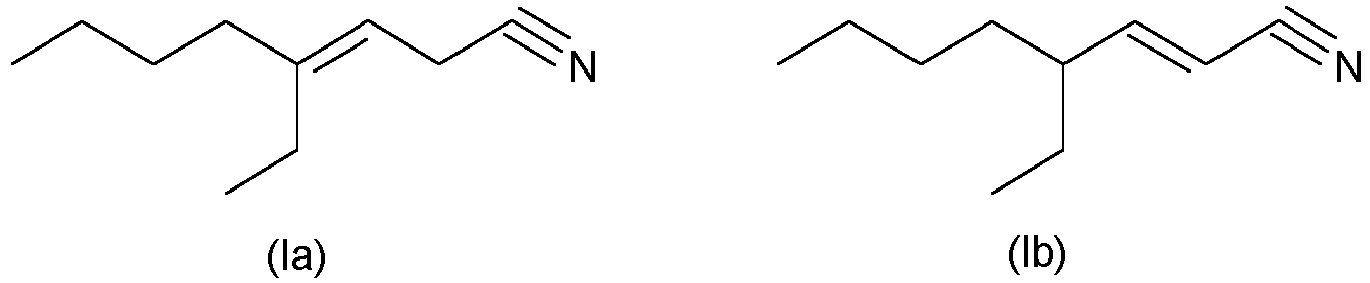
- Sofern in Rahmen dieses Textes versehentlich eine Unstimmigkeit zwischen dem chemischen Namen und den dargestellten Strukturformeln auftreten sollte, gelten die dargestellten Strukturformeln.
- Das hierin für eine Verbindung der Formel (I) Gesagte, insbesondere die hierin beschrieben Vorteile, gelten besonders auch für die bevorzugt zu verwendende bzw. einzusetzende Mischung einer Verbindung der Formel (la) und einer Verbindung der Formel (Ib) (s. oben).
- Eine Verbindung der Formel (I) verfügt über ganz eigenständige olfaktorische Eigenschaften, die sich deutlich von den bekannten Riechstoffen abheben und diese auch übertreffen. Die Eignung der Verbindungen der Formel (I) als Riechstoffe war bislang nicht bekannt. Es ist daher besonders überraschend, dass auf dem bereits gut untersuchten Gebiet ein Riechstoff mit wertvollen, interessanten und komplexen Geruchseigenschaften gefunden werden konnte.
- Vorzugsweise betrifft die erfindungsgemäße Verwendung eine Verwendung zum Vermitteln, Modifizieren und/oder Verstärken einer oder mehrerer Geruchsnoten ausgewählt aus der Gruppe bestehend aus den Noten grün, nitrilig, krautig, frisch, fruchtig, blumig, rosig, holzig, süß, erdig, fettig, metallisch, balsamisch und Iris- und Karottennoten, vorzugsweise wenigstens einer der Geruchsnoten ausgewählt aus der Gruppe bestehend aus den Noten grün, nitrilig, rosig und Iris- und Karottennoten, bevorzugt rosig mit Iris- und Karottennoten.
- Die Tatsache, dass eine erfindungsgemäß einzusetzende Verbindung der Formel (I) einen sehr komplexen und vielfältigen sensorischen Gesamteindruck zu vermitteln mag, der sonst meist nur von Mischungen mehrerer Komponenten (wie beispielsweise ätherischen Ölen oder Gewürzmischungen) erreicht werden kann, ist besonders überraschend.
- Über die primären, nämlich geruchlichen, Eigenschaften hinaus verfügen die Verbindungen der Formel (I) zusätzlich über positive Sekundäreigenschaften, insbesondere ein gutes Haftungsvermögen und eine hohe Substantivität im Vergleich zu Riechstoffen mit ähnlichen Geruchseigenschaften, sowie eine hohe Stabilität in bestimmten Medien und Zubereitungen, eine hohe Ausgiebigkeit und sind zudem biologisch abbaubar.
- Eine erfindungsgemäß einzusetzende Verbindung der Formel (I) weist insbesondere in weitgehend neutralen, insbesondere jedoch in alkalischen und/oder in oxidierenden Medien eine hohe, ganz hervorragende Stabilität auf. Insbesondere wegen dieser Eigenschaften eignen sich die Verbindungen der Formel (I) ausgezeichnet für die Verwendung als Riechstoffe, und zwar insbesondere, wenn sie in parfümierten Artikeln oder Zubereitungen eingesetzt werden, die einen pH-Wert von 5,5 oder größer besitzen, vorzugsweise von größer oder gleich 6, bevorzugt von größer 7, weiter bevorzugt von größer 7,5, insbesondere bevorzugt von größer 8; ferner in oxidierend wirkenden Zubereitungen, die vorzugsweise einen pH-Wert von größer oder gleich 7 aufweisen, bevorzugt in oxidierend wirkenden Zubereitungen mit einem pH-Wert von größer oder gleich 8. Die angegebenen pH-Werte beziehen sich dabei jeweils auf bei 25°C gemessene Werte.
- Im Zusammenhang mit der bevorzugten Verwendung zum Vermitteln, Modifizieren und/oder Verstärken einer hierin beschriebenen Geruchsnote steht auch die Erkenntnis, dass die Verbindungen der Formel (I) hervorragend als sogenannte Booster (Verstärker; Enhancer) fungieren können.
- Insofern wird hierin auch eine Verwendung bzw. ein Verfahren zum Modifizieren und/oder Verstärken (Boosten) eines Geruchs mit einer, mehreren oder sämtlichen der hierin beschriebenen Noten, vorzugsweise der Note(n) blumig, fruchtig und/oder holzig, bereitgestellt, umfassend folgenden Schritt:
- Vermischen eines oder mehrerer Riechstoffe mit einer, mehreren oder sämtlichen der hierin beschriebenen Noten, vorzugsweise der Note(n) blumig, fruchtig und/oder holzig, mit einer Menge an Verbindung(en) der Formel (I), die ausreicht, um den Geruchseindruck des bzw. der Riechstoffe bzw. die besagte(n) Note(n) sensorisch zu modifizieren und/oder zu verstärken.
- Eine erfindungsgemäß zu verwendende Verbindung der Formel (I) kann zudem die Intensität einer Riechstoffmischung (Riechstoffkomposition) verstärken und das Gesamtbild der Mischung geruchlich abrunden. Die hierin beschriebenen Verbindungen können daher eingesetzt werden, um einer Riechstoffkomposition mehr Fülle, Frische, (Strahl-) Kraft, Ausstrahlung, Glanz, Abrundung, Harmonie und/oder Natürlichkeit zu verleihen.
- Weiterhin eignen sich Verbindungen der Formel (I) als Mittel zum Erhöhen der Substantivität und/oder Retention einer Riechstoffmischung und/oder als Fixateur.
- Die Herstellung einer erfindungsgemäß zu verwendenden Verbindung der Formel (I) kann mittels an sich bekannter Reaktionen und Verfahren erfolgen. Wie dem Fachmann bekannt ist, kann z.B. durch eine Knoevenagel-Reaktion mit Cycanessigsäure und 2-Ethylhexanal, mit entsprechenden Katalysatoren und den entsprechenden Bedingungen, eine Verbindung der Formel (I) hergestellt werden (die dafür eingesetzten Edukte sind kommerziell erhältlich).
- Eine erfindungsgemäß einzusetzende Verbindung der Formel (I) wird im Rahmen der erfindungsgemäßen Verwendung üblicherweise in einer sensorisch wirksamen Menge eingesetzt, d.h. in einer Gesamtmenge, in der sie eine sensorische Wirkung entfalten. Vorzugsweise wird die erfindungsgemäß einzusetzende Verbindung der Formel (I) zusammen mit anderen Riechstoffen eingesetzt. Solche Riechstoffkompositionen können in üblicher Weise hergestellt werden, beispielsweise durch einfaches Vermischen oder Homogenisieren der Bestandteile. Bei diesen weiteren Riechstoffen kann es sich um beliebige weitere Riechstoffe handeln.
- Ein weiterer Aspekt der vorliegenden Erfindung betrifft daher eine Riechstoffkomposition umfassend oder bestehend aus einer oder mehreren Verbindung(en) der Formel (la) und/oder der Formel (Ib)

- Hierbei ist es bevorzugt, wenn die Gesamtmenge an Verbindung(en) der Formel (I), bezogen auf das Gesamtgewicht der Riechstoffkomposition, im Bereich von 0,0001 bis 99,9 Gew.-%, vorzugsweise 0,001 bis 99,5 Gew.-%, besonders bevorzugt 0,01 bis 99 Gew.-%, 0,01 bis 90 Gew.-%, 0,05 bis 80 Gew.-%, 0,1 bis 70 Gew.-%, 0,25 bis 50 Gew.-%, 0,5 bis 40 Gew.-% oder 0,75 bis 25 Gew.-%, liegt.
- Sofern eine Verbindung der Formel (I) hauptsächlich eingesetzt wird, um einer Riechstoffkomposition mehr (Aus-)Strahlung, Abrundung, Harmonie und/oder Natürlichkeit zu verleihen und/oder bestimmte (durch weitere Riechstoffe bereits vorhandene) Noten zu verstärken, kann die Gesamtmenge der Verbindung(en) der Formel (I) auch vergleichsweise niedrig gewählt werden und z.B. bevorzugt im Bereich von 0,01 bis 5 Gew.-%, weiter bevorzugt im Bereich von 0,1 bis 2 Gew.-%, bezogen auf die Gesamtmenge der Riechstoffkomposition, liegen. Sofern innerhalb der bevorzugten Konzentrationsbereiche eine vergleichsweise niedrige Konzentration gewählt wird, kann es in Abhängigkeit von den weiteren Komponenten der jeweiligen Komposition im Einzelfall noch nicht zu der Vermittlung der hierin angegebenen Eigengeruchsnoten kommen. So kann der Fachmann je nach gewünschtem Effekt einer Verbindung der Formel (I) eine für die jeweilige Anwendung günstige Menge an Verbindung(en) der Formel (I) auswählen.
- Eine Verbindung der Formel (I) eignet sich wegen ihrer olfaktorischen Eigenschaften vorzüglich für den Einsatz in erfindungsgemäßen Riechstoffkompositionen. Eine Verbindung der Formel (I) kann vorteilhafterweise mit einer Vielzahl weiterer Riechstoffe kombiniert und in zahlreichen unterschiedlichen Produkten und Artikeln verwendet werden.
- Vorzugweise gilt für eine erfindungsgemäße Riechstoffkomposition, dass die Gesamtmenge der Verbindung(en) der Formel (I) in der Riechstoffkomposition in einer sensorisch wirksamen Menge enthalten ist, vorzugsweise in einer Menge, die ausreicht, um eine oder mehrere Geruchsnoten ausgewählt aus der Gruppe bestehend aus den Noten grün, nitrilig, krautig, frisch, fruchtig, blumig, rosig, holzig, süß, erdig, fettig, metallisch, balsamisch und Iris- und Karottennoten, vorzugsweise wenigstens einer der Geruchsnoten ausgewählt aus der Gruppe bestehend aus den Noten grün, nitrilig, rosig und Iris- und Karottennoten, bevorzugt rosig mit Iris- und Karottennoten, zu vermitteln und/oder zu verstärken und/oder eine oder mehrere Geruchsnoten eines bzw. des / der weiteren Riechstoffs/e der Riechstoffkomposition in Richtung einer oder mehrerer dieser Geruchsnoten zu modifizieren.
- Besonders bevorzugt ist es, wenn der bzw. ein, mehrere oder sämtliche der weiteren Riechstoffe (ebenfalls) eine oder mehrere Geruchsnoten ausgewählt aus der Gruppe bestehend aus den Noten grün, nitrilig, krautig, frisch, fruchtig, blumig, rosig, holzig, süß, erdig, fettig, metallisch, balsamisch und Iris- und Karottennoten, vorzugsweise wenigstens eine der Geruchsnoten ausgewählt aus der Gruppe bestehend aus den Noten holzig, fruchtig und blumig, besonders bevorzugt ausgewählt aus der Gruppe bestehend aus den Noten fruchtig und blumig, vermitteln, modifizieren und/oder verstärken. Entsprechend einer alternativen Ausgestaltung kann bzw. können der bzw. ein, mehrere oder sämtliche der weiteren Riechstoffe aber auch eine oder mehrere andere bzw. unterschiedliche Geruchsnoten vermitteln, modifizieren und/oder verstärken.
- Beispiele für Riechstoffe, die im Rahmen der vorliegenden Erfindung vorteilhafterweise mit einer Verbindung der Formel (I) kombiniert werden können, finden sich z. B. in S. Arctander, Perfume and Flavor Materials, Vol. I und II, Montclair, N. J. 1969, Eigenverlag, oder K. Bauer et al., Common Fragrance and Flavor Materials, 4th Edition, Wiley-VCH, Weinheim 2001.
- Im Einzelnen seien genannt: Extrakte aus natürlichen Rohstoffen wie ätherische Öle, Concretes, Absolues, Resine, Resinoide, Balsame, Tinkturen wie z. B.
- Ambratinktur; Amyrisöl; Angelicasamenöl; Angelicawurzelöl; Anisöl; Baldrianöl; Basilikumöl; Baummoos-Absolue; Bayöl; Beifußöl; Benzoeresin; Bergamotteöl; Bienenwachs-Absolue; Birkenteeröl; Bittermandelöl; Bohnenkrautöl; Buccoblätteröl; Cabreuvaöl; Cadeöl; Calmusöl; Campheröl; Canangaöl; Cardamomenöl; Cascarillaöl; Cassiaöl; Cassie-Absolue; Castoreum-absolue; Cedernblätteröl; Cedernholzöl; Cistusöl; Citronellöl; Citronenöl; Copaivabalsam; Copaivabalsamöl; Corianderöl; Costuswurzelöl; Cuminöl; Cypressenöl; Davanaöl; Dillkrautöl; Dillsamenöl; Eau de brouts-Absolue; Eichenmoos-Absolue; Elemiöl; Estragonöl; Eucalyptus-citriodora-ÖI; Eucalyptusöl; Fenchelöl; Fichtennadelöl; Galbanumöl; Galbanumresin; Geraniumöl; Grapefruitöl; Guajakholzöl; Gurjunbalsam; Gurjunbalsamöl; Helichrysum-Absolue; Helichrysumöl; Ingweröl; Iriswurzel-Absolue; Iriswurzelöl; Jasmin-Absolue; Kalmusöl; Kamillenöl blau; Kamillenöl römisch; Karottensamenöl; Kaskarillaöl; Kiefernnadelöl; Krauseminzöl; Kümmelöl; Labdanumöl; Labdanum-Absolue; Labdanumresin; Lavandin-Absolue; Lavandinöl; Lavendel-Absolue; Lavendelöl; Lemongrasöl; Liebstocköl; Limetteöl destilliert; Limetteöl gepresst; Linaloeöl; Litsea-cubeba-ÖI; Lorbeerblätteröl; Macisöl; Majoranöl; Mandarinenöl; Massoirindenöl; Mimosa-Absolue; Moschuskörneröl; Moschustinktur; Muskateller-Salbei-Öl; Muskatnussöl; Myrrhen-Absolue; Myrrhenöl; Myrtenöl; Nelkenblätteröl; Nelkenblütenöl; Neroliöl; Olibanum-Absolue; Olibanumöl; Opopanaxöl; Orangenblüten-Absolue; Orangenöl; Origanumöl; Palmarosaöl; Patchouliöl; Perillaöl; Perubalsamöl; Petersilienblätteröl; Petersiliensamenöl; Petitgrainöl; Pfefferminzöl; Pfefferöl; Pimentöl; Pineöl; Poleyöl; Rosen-Absolue; Rosenholzöl; Rosenöl; Rosmarinöl; Salbeiöl dalmatinisch; Salbeiöl spanisch; Sandelholzöl; Selleriesamenöl; Spiklavendelöl; Sternanisöl; Styraxöl; Tagetesöl; Tannennadelöl; Tea-tree-Öl; Terpentinöl; Thymianöl; Tolubalsam; Tonka-Absolue; Tuberosen-Absolue; Vanilleextrakt; Veilchenblätter-Absolue; Verbenaöl; Vetiveröl; Wacholderbeeröl; Weinhefenöl; Wermutöl; Wintergrünöl; Ylangöl; Ysopöl; Zibet-Absolue; Zimtblätteröl; Zimtrindenöl sowie Fraktionen davon, bzw. daraus isolierte Inhaltsstoffe;
Einzel-Riechstoffe aus der Gruppe der Kohlenwasserstoffe, wie z.B. 3-Caren; α-Pinen; β-Pinen; α-Terpinen; γ-Terpinen; p-Cymol; Bisabolen; Camphen; Caryophyllen; Cedren; Farnesen; Limonen; Longifolen; Myrcen; Ocimen; Valencen; (E,Z)-1,3,5-Undecatrien; Styrol; Diphenylmethan;
der aliphatischen Alkohole wie z.B. Hexanol; Octanol; 3-Octanol; 2,6-Dimethylheptanol; 2-Methyl-2-heptanol; 2-Methyl-2-octanol; (E)-2-Hexenol; 1-Octen-3-ol; Gemisch von 3,4,5,6,6-Pentamethyl-3/4-hepten-2-ol und 3,5,6,6-Tetramethyl-4-methyleneheptan-2-ol; (E,Z)-2,6-Nonadienol; 3,7-Dimethyl-7-methoxyoctan-2-ol; 9-Decenol; 10-Undecenol; 4-Methyl-3-decen-5-ol;
der aliphatischen Aldehyde und deren Acetale wie z.B. Hexanal; Heptanal; Octanal; Nonanal; Decanal; Undecanal; Dodecanal; 2-Methyloctanal; 2-Methylnonanal; (E)-2-Hexenal; (Z)-4-Heptenal; 2,6-Dimethyl-5-heptenal; 10-Undecenal; (E)-4-Decenal; 2-Dodecenal;2,6,10-Trimethyl-9-undecenal; 2,6,10-Trimethyl-5,9-undecadienal; Heptanaldiethylacetal; 1,1-Dimethoxy-2,2,5-trimethyl-4-hexen; Citronellyloxyacetaldehyd; 1-(1-Methoxy-propoxy)-(E/Z)-3-hexen;
der aliphatischen Ketone und deren Oxime wie z.B. 2-Heptanon; 2-Octanon; 3-Octanon; 2-Nonanon; 5-Methyl-3-heptanon; 5-Methyl-3-heptanonoxim; 2,4,4,7-Tetramethyl-6-octen-3-on; 6-Methyl-5-hepten-2-on;
der aliphatischen schwefelhaltigen Verbindungen wie z.B. 3-Methylthio-hexanol; 3-Methylthiohexylacetat; 3-Mercaptohexanol; 3-Mercaptohexylacetat; 3-Mercaptohexylbutyrat; 3-Acetylthiohexylacetat; 1-Menthen-8-thiol;
der aliphatischen Nitrile wie z.B. 2-Nonensäurenitril; 2-Undecensäurenitril; 2-Tridecensäurenitril; 3,12-Tridecadiensäurenitril; 3,7-Dimethyl-2,6-octadien-säurenitril; 3,7-Dimethyl-6-octensäurenitril;
der Ester von aliphatischen Carbonsäuren wie z.B. (E)- und (Z)-3-Hexenylformiat; Ethylacetoacetat; Isoamylacetat; 3,5,5-Trimethylhexylacetat; 3-Methyl-2-butenylacetat; (E)-2-Hexenylacetat; (E)- und (Z)-3-Hexenylacetat; Octylacetat; 3-Octylacetat; 1-Octen-3-ylacetat; Ethylbutyrat; Butylbutyrat; Isoamylbutyrat; Hexylbutyrat; (E)- und (Z)-3-Hexenyl-isobutyrat; Hexylcrotonat; Ethylisovalerianat; Ethyl-2-methylpentanoat; Ethylhexanoat; Allylhexanoat; Ethylheptanoat; Allylheptanoat; Ethyloctanoat; Ethyl-(E,Z)-2,4-decadienoat; Methyl-2-octinat; Methyl-2-noninat; Allyl-2-isoamyloxyacetat; Methyl-3,7-dimethyl-2,6-octadien-oat;4-Methyl-2-pentyl-crotonat;
der acyclischen Terpenalkohole wie z. B. Geraniol; Nerol; Lavadulol; Nerolidol; Farnesol; Tetrahydrolinalool; Tetrahydrogeraniol; 2,6-Dimethyl-7-octen-2-ol; 2,6-Dimethyloctan-2-ol; 2-Methyl-6-methylen-7-octen-2-ol; 2,6-Dimethyl-5,7-octadien-2-ol; 2,6-Dimethyl-3,5-octadien-2-ol; 3,7-Dimethyl-4,6-octadien-3-ol; 3,7-Dimethyl-1,5,7-octatrien-3-ol 2,6-Dimethyl-2,5,7-octatrien-1-ol; sowie deren Formiate, Acetate, Propionate, Isobutyrate, Butyrate, Isovalerianate, Pentanoate, Hexanoate, Crotonate, Tiglinate und 3-Methyl-2-butenoate;
der acyclischen Terpenaldehyde und -ketone wie z. B. Citronellal; 7-Methoxy-3,7-dimethyloctanal; 2,6,10-Trimethyl-9-undecenal; Geranylaceton; sowie die Dimethyl- und Diethylacetale von Geranial, Neral,
der cyclischen Terpenalkohole wie z. B. Menthol; Isopulegol; alpha-Terpineol; Terpinenol-4; Menthan-8-ol; Menthan-1-ol; Menthan-7-ol; Borneol; Isoborneol; Linalooloxid; Nopol; Cedrol; Ambrinol; Vetiverol; Guajol; sowie deren Formiate, Acetate, Propionate, Isobutyrate, Butyrate, Isovalerianate, Pentanoate, Hexanoate, Crotonate, Tiglinate und 3-Methyl-2-butenoate;
der cyclischen Terpenaldehyde und -ketone wie z. B. Menthon; Isomenthon; 8-Mercaptomenthan-3-on; Carvon; Campher; Fenchon; alpha-lonon; beta-Ionon; alpha-n-Methylionon; beta-n-Methylionon; alpha-Isomethylionon; beta-Isomethyl-ionon; alpha-Iron; beta-Damascenon; 1-(2,4,4-Trimethyl-2-cyclohexen-1-yl)-2-buten-1-on; 1,3,4,6,7,8a-Hexahydro-1,1,5,5-tetramethyl-2H-2,4a-methano-naphthalen-8(5H)-on;2-Methyl-4-(2,6,6-trimethyl-1-cyclohexen-1-yl)-2-butenal; Nootkaton; Dihydronootkaton; 4,6,8-Megastigmatrien-3-on; alpha-Sinensal; beta-Sinensal; acetyliertes Cedernholzöl (Methylcedrylketon);
der cyclischen Alkohole wie z.B. 4-tert.-Butylcyclohexanol; 3,3,5-Trimethylcyclohexanol; 3-Isocamphylcyclohexanol; 2,6,9-Trimethyl-Z2,Z5,E9-cyclododecatrien-1-ol; 2-Isobutyl-4-methyltetrahydro-2H-pyran-4-ol;
der cycloaliphatischen Alkohole wie z.B. alpha,3,3-Trimethylcyclohexylmethanol;1-(4-Isopropylcyclohexyl)ethanol; 2-Methyl-4-(2,2,3-trimethyl-3-cyclopent-1-yl)butanol; 2-Methyl-4-(2,2,3-trimethyl-3-cyclopent-1-yl)-2-buten-1-ol; 3-Methyl-5-(2,2,3-trimethyl-3-cyclopent-1-yl)-pentan-2-ol; 3-Methyl-5-(2,2,3-trimethyl-3-cyclopent-1-yl)-4-penten-2-ol; 3,3-Dimethyl-5-(2,2,3-trimethyl-3-cyclopent-1-yl)-4-penten-2-ol; 1-(2,2,6-Trimethylcyclohexyl)pentan-3-ol; 1-(2,2,6-Trimethylcyclohexyl)hexan-3-ol;
der cyclischen und cycloaliphatischen Ether wie z.B. Cineol; Cedrylmethylether; Cyclododecylmethylether; 1,1-Dimethoxycyclododecan; (Ethoxymethoxy)cyclo-dodecan; alpha-Cedrenepoxid; 3a,6,6,9a-Tetramethyldodecahydro-naphtho[2,1-b]furan; 3a-Ethyl-6,6,9a-trimethyldodecahydronaphtho[2,1b]furan; 1,5,9-Tri-methyl-13-oxabicyclo[10.1,0]trideca-4,8-dien; Rosenoxid; 2-(2,4-Dimethyl-3-cyclohexen-1-yl)-5-methyl-5-(1-methylpropyl)-1,3-dioxan;
der cyclischen und makrocyclischen Ketone wie z.B. 4-tert.-Butylcyclohexanon; 2,2,5-Trimethyl-5-pentylcyclopentanon; 2-Heptylcyclopentanon; 2-Pentyl-cyclopentanon; 2-Hydroxy-3-methyl-2-cyclopenten-1-on; 3-Methyl-cis-2-penten-1-yl-2-cyclopenten-1-on; 3-Methyl-2-pentyl-2-cyclopenten-1-on; 3-Methyl-4-cyclopentadecenon; 3-Methyl-5-cyclopentadecenon; 3-Methylcyclopenta-decanon; 4-(1-Ethoxyvinyl)-3,3,5,5-tetramethylcyclohexanon; 4-tert.-Pentylcyclo-hexanon; 5-Cyclohexadecen-1-on; 6,7-Dihydro-1,1,2,3,3-pentamethyl-4(5H)-indanon; 8-Cyclohexadecen-1-on; 9-Cycloheptadecen-1-on; Cyclopentadecanon; Cyclohexadecanon;
der cycloaliphatischen Aldehyde wie z.B. 2-Methyl-4-(2,2,6-trimethyl-cyclohexen-1-yl)-2-butenal; 4-(4-Hydroxy-4-methylpentyl)-3-cyclohexencarbaldehyd; 4-(4-Methyl-3-penten-1-yl)-3-cyclohexencarbald ehyd;
der cycloaliphatischen Ketone wie z. B. 1-(3,3-Dimethylcyclohexyl)-4-penten-1-on; 2,2-Dimethyl-1-(2,4-dimethyl-3-cyclohexen-1-yl)-1-propanon; 1-(5,5-Dimethyl-1-cyclohexen-1-yl)-4-penten-1-on; 2,3,8,8-Tetramethyl-1,2,3,4,5,6,7,8-octahydro-2-naphtalenylmethylketon; Methyl-2,6,10-trimethyl-2,5,9-cyclododecatrienylketon; tert.-Butyl-(2,4-dimethyl-3-cyclohexen-1-yl)keton;
der Ester cyclischer Alkohole wie z.B. 2-tert-Butylcyclohexylacetat; 4-tert-Butylcyclohexylacetat; 2-tert-Pentylcyclohexylacetat; 4-tert-Pentyl-cyclo-hexyl-acetat; 3,3,5-Trimethylcyclohexylacetat; Decahydro-2-naphthylacetat; 2-Cyclopentylcyclopentylcrotonat; 3-Pentyltetrahydro-2H-pyran-4-ylacetat; Decahydro-2,5,5,8a-tetramethyl-2-naphthylacetat; 4,7-Methano-3a,4,5,6,7,7a-hexa-hydro-5, bzw. 6-indenylacetat; 4,7-Methano-3a,4,5,6,7,7a-hexahydro-5, bzw. 6-indenyl-propionat; 4,7-Methano-3a,4,5,6,7,7a-hexahydro-5, bzw. 6-inden-ylisobutyrat; 4,7-Methanooctahydro-5, bzw. 6-indenylacetat;
der Ester cycloaliphatischer Alkohole wie z.B.1-Cyclohexylethylcrotonat;
der Ester cycloaliphatischer Carbonsäuren wie z. B. Allyl-3-cyclohexylpropionat; Allylcyclohexyloxyacetat; cis- und trans-Methyldihydrojasmonat; cis- und trans-Methyljasmonat; Methyl-2-hexyl-3-oxocyclopentancarboxylat; Ethyl-2-ethyl-6,6-dimethyl-2-cyclohexencarboxylat; Ethyl-2,3,6,6-tetramethyl-2-cyclohexen-carboxylat; Ethyl-2-methyl-1,3-dioxolan-2-acetat;
der araliphatischen Alkohole wie z.B. Benzylalkohol; 1-Phenylethylalkohol; 3-Phenylpropanol; 2-Phenylpropanol; 2-Phenoxyethanol; 2,2-Dimethyl-3-phenylpropanol; 2,2-Dimethyl-3-(3-methylphenyl)propanol; 1,1-Dimethyl-2-phenylethylalkohol; 1,1-Dimethyl-3-phenylpropanol; 1-Ethyl-1-methyl-3-phenyl-propanol; 2-Methyl-5-phenylpentanol; 3-Methyl-5-phenylpentanol; 3-Phenyl-2-propen-1-ol; 4-Methoxybenzylalkohol; 1-(4-Isopropylphenyl)ethanol;
der Ester von araliphatischen Alkoholen und aliphatischen Carbonsäuren wie z.B. Benzylacetat; Benzylpropionat; Benzylisobutyrat; Benzylisovalerianat; 2-Phenylethylacetat; 2-Phenylethylpropionat; 2-Phenylethylisobutyrat; 2-Phenylethylisovalerianat; 1-Phenylethylacetat; alpha-Trichlormethylbenzylacetat; alpha, alpha-Dimethylphenylethylacetat; alpha,alpha-Dimethylphenylethylbutyrat; Cinnamylacetat; 2-Phenoxyethylisobutyrat; 4-Methoxybenzylacetat;
der araliphatischen Ether wie z.B. 2-Phenylethylmethylether; 2-Phenylethyl-isoamylether; 2-Phenylethyl-1-ethoxyethylether; Phenylacetaldehyddimethylacetal; Phenylacetaldehyddiethylacetal; Hydratropaaldehyddimethylacetal; Phenylacetaldehydglycerinacetal; 2,4,6-Trimethyl-4-phenyl-1,3-dioxan; 4,4a,5,9b-Tetra-hydroindeno[1,2-d]-m-dioxin; 4,4a,5,9b-Tetrahydro-2,4-dimethylindeno[1,2-d]-m-dioxin;
der aromatischen und araliphatischen Aldehyde wie z. B. Benzaldehyd; Phenylacetaldehyd; 3-Phenylpropanal; Hydratropaaldehyd; 4-Methylbenzaldehyd; 4-Methylphenylacetaldehyd; 3-(4-Ethylphenyl)-2,2-dimethylpropanal; 2-Methyl-3-(4-isopropylphenyl)propanal; 2-Methyl-3-(4-isobutylphenyl)propanal; 3-(4-tert.-Butylphenyl)propanal; Zimtaldehyd; alpha-Butylzimtaldehyd; alpha-Hexylzimtaldehyd; 3-Methyl-5-phenylpentanal; 4-Methoxybenzaldehyd; 4-Hydroxy-3-methoxybenz-aldehyd; 4-Hydroxy-3-ethoxybenzaldehyd; 3,4-Methylendioxybenzaldehyd; 3,4-Dimethoxybenzaldehyd; 2-Methyl-3-(4-methoxyphenyl)propanal; 2-Methyl-3-(4-methylendioxyphenyl)propanal;
der aromatischen und araliphatischen Ketone wie z.B. Acetophenon; 4-Methylacetophenon; 4-Methoxyacetophenon; 4-tert.-Butyl-2,6-dimethylaceto-phenon; 4-Phenyl-2-butanon; 4-(4-Hydroxyphenyl)-2-butanon; 1-(2-Naphtha-lenyl)ethanon;2-Benzofuranylethanon;(3-Methyl-2-benzofuranyl)ethanon; Benzophenon; 1,1,2,3,3,6-Hexamethyl-5-indanylmethylketon; 6-tert.-Butyl-1,1-di-methyl-4-indanylmethylketon; 1-[2,3-dihydro-1,1,2,6-tetramethyl-3-(1-methylethyl)-1H-5-indenyl]ethanon; 5',6',7',8'-Tetrahydro-3',5',5',6',8',8'-hexamethyl-2-aceto-naphthon;
der aromatischen und araliphatischen Carbonsäuren und deren Ester wie z.B. Benzoesäure; Phenylessigsäure; Methylbenzoat; Ethylbenzoat; Hexylbenzoat; Benzylbenzoat; Methylphenylacetat; Ethylphenylacetat; Geranylphenylacetat; Phenylethylphenylacetat; Methylcinnmat; Ethylcinnamat; Benzylcinnamat; Phenylethylcinnamat; Cinnamylcinnamat; Allylphenoxyacetat; Methylsalicylat; Hexylsalicylat; Cyclohexylsalicylat; Cis-3-Hexenylsalicylat; Benzylsalicylat; Phenylethylsalicylat; Methyl-2,4-dihydroxy-3,6-dimethylbenzoat; Ethyl-3-phenylglycidat; Ethyl-3-methyl-3-phenylglycidat;
der stickstoffhaltigen aromatischen Verbindungen wie z.B. 2,4,6-Trinitro-1,3-dimethyl-5-tert.-butylbenzol; 3,5-Dinitro-2,6-dimethyl-4-tert.-butylacetophenon; Zimtsäurenitril; 3-Methyl-5-phenyl-2-pentensäurenitril; 3-Methyl-5-phenylpentan-säurenitril; Methylanthranilat; Methy-N-methylanthranilat; Schiff'sche Basen von Methylanthranilat mit 7-Hydroxy-3,7-dimethyloctanal, 2-Methyl-3-(4-tert.-butyl-phenyl)propanal oder 2,4-Dimethyl-3-cyclohexencarbaldehyd; 6-Isopropyl-chinolin; 6-Isobutylchinolin; 6-sec.-Butylchinolin; 2-(3-Phenylpropyl)pyridin; Indol; Skatol; 2-Methoxy-3-isopropylpyrazin; 2-Isobutyl-3-methoxypyrazin;
der Phenole, Phenylether und Phenylester wie z.B. Estragol; Anethol; Eugenylmethylether; Isoeugenol; Isoeugenylmethylether; Thymol; Carvacrol; Diphenylether; beta-Naphthylmethylether; beta-Naphthylethylether; beta-Naphthylisobutylether; 1,4-Dimethoxybenzol; Eugenylacetat; 2-Methoxy-4-methylphenol; 2-Ethoxy-5-(1-propenyl)phenol; p-Kresylphenylacetat;
der heterocyclischen Verbindungen wie z.B. 2,5-Dimethyl-4-hydroxy-2H-furan-3-on; 2-Ethyl-4-hydroxy-5-methyl-2H-furan-3-on; 3-Hydroxy-2-methyl-4H-pyran-4-on; 2-Ethyl-3-hydroxy-4H-pyran-4-on;
der Lactone wie z.B. 1,4-Octanolid; 3-Methyl-1,4-octanolid; 1,4-Nonanolid; 1,4-Decanolid; 8-Decen-1,4-olid; 1,4-Undecanolid; 1,4-Dodecanolid; 1,5-Decanolid; 1,5-Dodecanolid;4-Methyl-1,4-decanolid; 1,15-Pentadecanolid; 1,16-Hexadeca-nolid; 9-Hexadecen-1,16-olid; 10-Oxa-1,16-hexadecanolid; 11-Oxa-1,16-hexa-decanolid; 12-Oxa-1,16-hexadecanolid; Ethylen-1,12-dodecandioat; Ethylen-1,13-tridecandioat; 2,3-Dihydrocumarin; Octahydrocumarin. - Besonders bevorzugt sind solche Riechstoffe, die eine blumige und/oder fruchtige Geruchsnote vermitteln. Insbesondere bei solchen Riechstoffen wird durch eine erfindungsgemäße zu verwendende Verbindung der Formel (I) vorteilhafterweise (zumindest teilweise) eine geruchliche Verstärkung der blumigen und/oder fruchtigen Noten erreicht.
- Blumige Riechstoffe, mit denen erfindungsgemäß zu verwendende Verbindungen der Formel (I) (insbesondere in erfindungsgemäßen Riechstoffkompositionen) besonders vorteilhaft kombiniert werden können, sind vorzugsweise ausgewählt aus der Gruppe bestehend aus:
Hydroxycitronellal, Methoxycitronellal, Cyclamenaldehyd [2-Methyl-3-(4-isopropylphenyl)propanal], 1-(4-Isopropyl-cyclohexyl)ethanol (Mugetanol®), 4-tert.-Butyl-α-methyldihydrozimtaldehyd (Lilial®), cis-Hexahydrocuminylalkohol (Mayol®), 3-[4-(1,1-Dimethylethyl)phenyl]propanal (Bourgeonal®), 2,2-Dimethyl-3-(3-methylphenyl)propanol (Majantol®), 3-Methyl-3-(3-methylbenzyl)-butan-2-ol, 2-Isobutyl-4-methyltetrahydro-2H-pyran-4-ol (Florosa®), 2-Methyl-3-(3,4-methylendioxyphenyl)propanal (Heliofolal®), 4-(4-Hydroxy-4-methylpentyl)-3-cyclohexencarbaldehyd (Lyral®), 4-(Octahydro-4,7-methano-5H-inden-5-yliden-butanal (Dupical®), Vernaldehyd, 4-(4-Methyl-3-penten-1-yl)-3-cyclohexencarbaldehyd (Vertomugal®), Octahydro-5-(4-methoxybutyliden)-4,7-methano-1H-inden (Mugoflor®). 2,6-Dimethyl-2-heptanol (Freesiol®), 1-Ethyl-1-methyl-3-phenylpropanol (Phemec®), 2,2-Dimethyl-3-phenyl-1-propanol (Muguet alcohol), Profarnesol, Dihydrofarnesol, Farnesol, Nerolidol, Hydroxycitronellaldimethylacetal, Hexylbenzoat, Geraniol, Nerol, Linalool, Tetrahydrogeraniol, Tetrahydrolinalool, Ethyllinalool, Geranyltiglinat, Phenethylalkohol (2-Phenylethylalkohol), Citronellol, Rosenoxid, 2-Methyl-5-phenylpentanol (Rosaphen), 3-Methyl-5-phenylpentanol (Phenoxanol), Methyldihydrojasmonat (Hedion®, Hedione® high cis), 2-Heptylcyclopentanon (Projasmon P), cis-Jasmon, Dihydrojasmon, Zimtalkohol (3-Phenyl-2-propen-1-ol), Dihydrozimtalkohol (3-Phenylpropanol), 2-Methyl-4-phenyl-1,3-dioxolan (Jacinthaflor®) und Dihydromyrcenol (2,6-Dimethyl-7-octen-2-ol). - Fruchtige Riechstoffe, mit denen erfindungsgemäße zu verwendende Verbindungen der Formel (I) vorteilhaft kombiniert werden können, und die demnach besonders bevorzugte (weitere) Riechstoffe einer erfindungsgemäßen Riechstoffkompositionen sind, sind vorzugsweise ausgewählt der Gruppe bestehend aus:
2-Methyl-buttersäureethylester, 4-(p-Hydroxyphenyl)-2-butanon, Ethyl-3-methyl-3-phenylglycidat, Buttersäureisoamylester, Essigsäureisoamylester, Essigsäure-n-butylester, Buttersäureethylester, 3-Methyl-buttersäureethylester, n-Hexansäureethylester, n-Hexansäureallylester, Ethyl-2-trans-4-cis-decadienoat, 1,1-Dimethoxy-2,2,5-trimethyl-4-hexan, 2,6-Dimethyl-5-hepten-1-al, gamma-Undecalacton, gamma-Nonalacton, Hexanal, 3Z-Hexenal, n-Decanal, n-Dodecanal, Citral, Vanillin, Ethylvanillin, Maltol, Ethylmaltol und deren Mischungen. - Erfindungsgemäße Riechstoffkompositionen, welche eine Verbindung der Formel (I) enthalten, können in flüssiger Form, unverdünnt oder mit einem Lösungsmittel verdünnt sein bzw. werden und vorteilhafterweise zur Parfümierung eingesetzt werden. Bevorzugte Lösungsmittel hierfür sind Ethanol, Isopropanol, Diethylenglycolmonoethyleter, Glycerin, Propylenglycol, 1,2-Butylenglycol, Dipropylenglycol, Diethylphtalat, Triethylcitrat, Isopropylmyristat, Triacetin und Diacetin.
- Des Weiteren können erfindungsgemäße Riechstoffkompositionen an einem Trägerstoff adsorbiert sein, der sowohl für eine feine Verteilung der Riechstoffe im Produkt als auch für eine kontrollierte Freisetzung bei der Anwendung sorgt. Derartige Träger können poröse anorganische Materialien wie Leichtsulfat, Kieselgele, Zeolithe, Gipse, Tone, Tongranulate, Gasbeton usw. oder organische Materialien wie Hölzer, Cellulosebasierende Stoffe, Zucker, Dextrine (z.B. Maltodextrin) oder Kunststoffe wie PVC, Polyvinylacetate oder Polyurethane sein. Die resultierende Kombination aus erfindungsgemäßer Komposition und Trägerstoff ist ebenfalls als erfindungsgemäße Riechstoffkomposition zu verstehen oder kann als erfindungsgemäßer Artikel (wie hierin weiter unten beschrieben) vorliegen.
- Erfindungsgemäße Riechstoffkompositionen oder Artikel (wie hierin weiter unten beschrieben) können auch mikroverkapselt, sprühgetrocknet, als Einschluss-Komplexe oder als Extrusions-Produkte vorliegen und - im Falle einer Riechstoffkomposition - in dieser Form z.B. einem zu parfümierenden Artikel hinzugefügt werden (wie hierin weiter unten beschrieben).
- Gegebenenfalls können die Eigenschaften der derart modifizierten Kompositionen oder Artikel durch sog. "Coaten" mit geeigneten Materialien im Hinblick auf eine gezieltere Duftfreisetzung weiter optimiert werden, wozu vorzugsweise wachsartige Kunststoffe wie z.B. Polyvinylalkohol verwendet werden. Die resultierenden Produkte stellen wiederum erfindungsgemäße Artikel dar.
- Eine Mikroverkapselung kann beispielsweise durch das sogenannte Koazervationsverfahren mit Hilfe von Kapselmaterialien z.B. aus polyurethanartigen Stoffen oder Weichgelatine, erfolgen.
- Sprühgetrocknete Produkte werden vorzugsweise durch Sprühtrocknung einer die Riechstoffkomposition enthaltenden Emulsion, bzw. Dispersion hergestellt, wobei als Trägerstoffe modifizierte Stärken, Proteine, Dextrin und pflanzliche Gummen verwendet werden können.
- Einschluss-Komplexe können z.B. durch Eintragen von Dispersionen von der Riechstoffkomposition und Cyclodextrinen oder Harnstoffderivaten in ein geeignetes Lösungsmittel, z.B. Wasser, hergestellt werden.
- Extrusions-Produkte können z.B. durch Verschmelzen der Riechstoffkompositionen mit einem geeigneten wachsartigen Stoff und durch Extrusion mit nachfolgender Erstarrung, gegebenenfalls in einem geeigneten Lösungsmittel, z.B. Isopropanol, erhalten werden.
- Ein weiterer Aspekt der vorliegenden Erfindung betrifft die Verwendung einer erfindungsgemäßen Riechstoffkomposition zum Vermitteln, Modifizieren und/oder Verstärken einer oder mehrerer Geruchsnoten ausgewählt aus der Gruppe bestehend aus den Noten grün, nitrilig, krautig, frisch, fruchtig, blumig, rosig, holzig, süß, erdig, fettig, metallisch, balsamisch und Iris- und Karottennoten, vorzugsweise wenigstens einer der Geruchsnoten ausgewählt aus der Gruppe bestehend aus den Noten grün, nitrilig, rosig und Iris- und Karottennoten, bevorzugt rosig mit Iris- und Karottennoten.
- Für bevorzugte Ausgestaltungen gilt hierbei das oben im Zusammenhang mit einer erfindungsgemäßen Verwendung oder erfindungsgemäßen Riechstoffkomposition Gesagte entsprechend.
- Erfindungsgemäße Riechstoffkompositionen können vorteilhafterweise in konzentrierter Form, in Lösungen oder in oben beschriebener modifizierter Form für die Herstellung von erfindungsgemäßen parfümierten Artikeln verwendet werden, z. B. Parfüm-Extraits, Eau de Parfums, Eau de Toilettes, Rasierwässer, Eau de Colognes, Pre-shave-Produkte, Splash-Colognes und parfümierten Erfrischungstüchern sowie die Parfümierung von sauren, alkalischen und neutralen Reinigungsmitteln, wie z.B. Fußbodenreinigern, Fensterglasreinigern, Geschirrspülmittel, Bad- und Sanitärreinigern, Scheuermilch, festen und flüssigen WC-Reinigern, pulver- und schaumförmigen Teppichreinigern, Textilerfrischern, Bügelhilfen, flüssigen Waschmitteln, pulverförmigen Waschmitteln, Wäschevorbehandlungsmitteln wie Bleichmittel, Einweichmittel und Fleckenentfernern, Wäscheweichspülern, Waschseifen, Waschtabletten, Desinfektionsmitteln, Oberflächendesinfektionsmitteln sowie von Luftverbesserern in flüssiger, gelartiger oder auf einem festen Träger aufgebrachter Form, Aerosolsprays, Wachsen und Polituren wie Möbelpolituren, Fußbodenwachsen, Schuhcremes sowie Körperpflegemitteln wie z.B. festen und flüssigen Seifen, Duschgelen, Shampoos, Rasierseifen, Rasierschäumen, Badeölen, kosmetischen Emulsionen vom Öl-in-Wasser-, vom Wasser-in-Öl- und vom Wasser-in-ÖI-in-Wasser-Typ wie z.B. Hautcremes- und -lotionen, Gesichtscremes und -lotionen, Sonnenschutzcremes-und -lotionen, After-sun-cremes und -lotionen, Handcremes und -lotionen, Fußcremes und -lotionen, Enthaarungscremes und -lotionen, After-shave-Cremes und -lotionen, Bräunungscremes und -lotionen, Haarpflegeprodukten wie z.B. Haarsprays, Haargelen, festigenden Haarlotionen, Haarspülungen, permanenten und semipermanenten Haarfärbemitteln, Haarverformungsmitteln wie Kaltwellen und Haarglättungsmitteln, Haarwässern, Haarcremes und -lotionen, Deodorantien und Antiperspirantien wie z.B. Achselsprays, Roll-ons, Deosticks, Deocremes, Produkten der dekorativen Kosmetik wie z.B. Lidschatten, Nagellacke, Make-ups, Lippenstifte, Mascara sowie von Kerzen, Lampenölen, Räucherstäbchen, Insektiziden, Repellentien und Treibstoffen.
- Ein weiterer Aspekt der vorliegenden Erfindung betrifft dementsprechend einen parfümierten Artikel, umfassend oder bestehend aus
- (i) einer erfindungsgemäßen Riechstoffkomposition (wie hierin beschrieben), und
- (ii) einem oder mehreren weiteren Bestandteil(en), vorzugsweise wenigstens einem oder mehreren, vorzugsweise einem, zwei, drei, vier, fünf oder mehr, Zusatz-, Hilfs- und/oder Wirkstoff(en).
- Für bevorzugte Ausgestaltungen gilt hierbei das oben im Zusammenhang mit erfindungsgemäßen Verwendungen oder erfindungsgemäßen Riechstoffkompositionen Gesagte entsprechend.
- Bevorzugt ist ein erfindungsgemäßer Artikel ausgewählt aus der Gruppe bestehend aus Wasch- und Reinigungsmitteln, Hygiene- oder Pflegeprodukten, vorzugsweise im Bereich der Körper- und Haarpflege, der Kosmetik und des Haushalts, vorzugsweise aus der Gruppe bestehend aus Parfüm-Extraits, Eau de Parfums, Eau de Toilettes, Rasierwässer, Eau de Colognes, Pre-shave-Produkte, Splash-Colognes, parfümierte Erfrischungstüchern, sauren, alkalischen oder neutralen Reinigungsmitteln, Textilerfrischern, Bügelhilfen, flüssigen Waschmitteln, pulverförmigen Waschmitteln, Wäschevorbehandlungsmitteln, Wäscheweichspülern, Waschseifen, Waschtabletten, Desinfektionsmitteln, Oberflächendesinfektionsmitteln, Luftverbesserern, Aerosolsprays, Wachse und Polituren, Körperpflegemitteln, Handcremes und -lotionen, Fußcremes und -lotionen, Enthaarungscremes und -lotionen, After-shave-Cremes und -lotionen, Bräunungscremes und -Iotionen, Haarpflegeprodukten, Deodorantien, Antiperspirantien, Produkte der dekorativen Kosmetik, Kerzen, Lampenölen, Räucherstäbchen, Insektiziden, Repellentien und Treibstoffen.
- Außerdem gilt für einen erfindungsgemäßen parfümierten Artikel vorzugsweise, dass Bestandteil (i) in einer sensorisch wirksamen Menge enthalten ist, vorzugsweise in einer Menge, die ausreicht, dass ein Verbraucher eine oder mehrere Geruchsnoten ausgewählt aus der Gruppe bestehend aus den Noten grün, nitrilig, krautig, frisch, fruchtig, blumig, rosig, holzig, süß, erdig, fettig, metallisch, balsamisch und Iris- und Karottennoten, vorzugsweise wenigstens eine der Geruchsnoten ausgewählt aus der Gruppe bestehend aus den Noten grün, nitrilig, rosig und Iris- und Karottennoten, bevorzugt rosig mit Iris-und Karottennoten, wahrnimmt.
- Bevorzugt ist auch, wenn der parfümierte Artikel eine Gesamtmenge an Verbindung(en) der Formel (I), bezogen auf das Gesamtgewicht des Artikels, im Bereich von 0,00001 bis 10 Gew.-%, vorzugsweise 0,0001 bis 5 Gew.-%, besonders bevorzugt 0,001 bis 2 Gew.-%, weiter bevorzugt 0,005 bis 1 Gew.-%, enthält.
- Die oben beschriebenen Zusatz-, Hilfs- und/oder Wirkstoffe sind vorzugsweise keine Riechstoffe und sind, falls enthalten, vorzugsweise ausgewählt aus der Gruppe bestehend aus:
Konservierungsmittel, vorzugsweise die in US 2006/0089413 genannten, Abrasiva, Antiakne-Mittel und Mittel zu Sebumreduktion, vorzugsweise die inWO 2008/046791 genannten, Mittel gegen Hautalterung, vorzugsweise die inWO 2005/123101 genannten, antibakterielle Mittel, Anticellulitis-Mittel, Antischuppen-Mittel, vorzugsweise die in WO 2008/046795 genannten, entzündungshemmende Mittel, irritationsverhindernde Mittel, Antiirritantien (antiinflammatorische, irritationshemmende und irritationsverhindernde Mittel), vorzugsweise die inWO 2007/042472 undUS 2006/0089413 genannten, antimikrobielle Mittel, vorzugsweise die in WO 2005/123101 genannten, Antioxidantien, vorzugsweise die inWO 2005/123101 genannten, Adstringentien, antiseptische Mittel, Antistatika, Binder, Puffer, Trägermaterialien, vorzugsweise die inWO 2005/123101 genannten, Chelatbildner, vorzugsweise die inWO 2005/123101 genannten, Zellstimulantien, reinigende Mittel, pflegende Mittel, Enthaarungsmittel, oberflächenaktive Substanzen, deodorierende Mittel und Antiperspirantien, vorzugsweise die inWO 2005/123101 genannten, Weichmacher, Emulgatoren, vorzugsweise die inWO 2005/123101 genannten, Enzyme, ätherische Öle, vorzugsweise die inUS 2008/0070825 genannten, Insektenrepellentien, vorzugsweise die inWO 2005/123101 genannten, Fasern, Filmbildner, (weitere) Fixateure, Schaumbildner, Schaumstabilisatoren, Substanzen zum Verhindern des Schäumens, Schaumbooster, Fungizide, gelierende Mittel und gelbildende Mittel, vorzugsweise die inWO 2005/123101 genannten, Haarpflegemittel, Haarverformungsmittel, Haarglättungsmittel, Feuchtigkeitsregulatoren (feuchtigkeitsspendende, anfeuchtende und/oder feuchthaltende Substanzen), vorzugsweise die inWO 2005/123101 genannten, Osmolyte, vorzugsweise die inWO 2005/123101 genannten, kompatible Solute, vorzugsweise die inWO 01/76572 WO 02/15686 WO 2008/046676 genannten, Pulver, Proteine und Proteinhydrolysate, vorzugsweise die inWO 2005/123101 undWO 2008/046676 genannten, rückfettende Mittel, abschleifende Mittel, hautberuhigende Mittel, hautreinigende Mittel, hautpflegende Mittel, hautheilende Mittel (skin repair agents), vorzugsweise enthaltend Cholesterin und/oder Fettsäuren und/oder Ceramide und/oder Pseudoceramide, dabei bevorzugt die inWO 2006/053912 genannten, Hautaufhellungsmittel, vorzugsweise die inWO 2007/110415 genannten, hautschützende Mittel, hauterweichende Mittel, hautkühlende Mittel, vorzugsweise die inWO 2005/123101 genannten, hautwärmende Mittel, vorzugsweise die inWO 2005/123101 genannten, Stabilisatoren, UV-absorbierende Mittel und UV-Filter, vorzugsweise die inWO 2005/123101 genannten, Benzyliden-betadicarbonylverbindungen, vorzugsweise die inWO 2005/107692 genannten, alpha-Benzoylzimtsäurenitrile, vorzugsweise die inWO 2006/015954 genannten, AhR-Rezeptor-Antagonisten, vorzugsweise die inWO 2007/128723 undWO 2007/060256 genannten, Waschmittel, Weichspüler, suspendierende Mittel, Hautbräunungsmittel, vorzugsweise die inWO 2006/045760 genannten, Verdickungsmittel, Vitamine, vorzugsweise die inWO 2005/123101 genannten, fette Öle, Wachse und Fette, vorzugsweise die inWO 2005/123101 genannten, Phospholipide, vorzugsweise die inWO 2005/123101 genannten, Fettsäuren (gesättigte Fettsäuren, ein- oder mehrfach ungesättigte Fettsäuren, α-Hydroxysäuren, Polyhydroxyfettsäuren), vorzugsweise die inWO 2005/123101 genannten, Farbstoffe und farbschützende Mittel sowie Pigmente, vorzugsweise die inWO 2005/123101 genannten, Antikorrosiva, Alkohole und Polyole, vorzugsweise die inWO 2005/123101 genannten, Tenside, vorzugsweise die inWO 2005/123101 genannten, tierische Extrakte, Hefeextrakte, Extrakte von Algen oder Mikroalgen, Elektrolyte, Verflüssiger, organische Lösungsmittel, vorzugsweise die inWO 2005/123101 genannten, haarwachstumsmodulierende Mittel (haarwachstumsfördend oder haarwachstumshemmend), vorzugsweise die inEP 2168570 undEP 2193785 genannten oder Silikone und Silikonderivate, vorzugsweise die inWO 2008/046676 genannten,
bevorzugt aus der Gruppe bestehend aus Konservierungsmitteln, anorganischen Salzen, Chelatbildnern, Tensiden, haut- und/oder haarpflegenden Mitteln, Enzymen Emulgatoren, Fetten, fetten Ölen, Wachsen, Fettalkoholen, Silikonen, Silikonderivaten und Wasser. - Ein weiterer Aspekt der vorliegenden Erfindung betrifft ein Verfahren zum Parfümieren eines Artikels (für bevorzugte Artikel s. oben), umfassend oder bestehend aus folgenden Schritten:
- (a) Bereitstellen
- (a.1) einer erfindungsgemäßen Riechstoffkomposition (wie hierin beschrieben),
oder - (a.2) einer oder mehreren Verbindung(en) der Formel (la) und/oder der Formel (Ib)

und
- (a.1) einer erfindungsgemäßen Riechstoffkomposition (wie hierin beschrieben),
- (b) Hinzufügen der Riechstoffkomposition (a.1) bzw. Verbindungen(en) / Riechstoffen (a.2) zu dem zu parfümierenden Artikel, in einer sensorisch wirksamen Menge, vorzugsweise in einer Menge, die ausreicht, um eine oder mehrere Geruchsnoten ausgewählt aus der Gruppe bestehend aus den Noten grün, nitrilig, krautig, frisch, fruchtig, blumig, rosig, holzig, süß, erdig, fettig, metallisch, balsamisch und Iris- und Karottennoten, vorzugsweise wenigstens eine der Geruchsnoten ausgewählt aus der Gruppe bestehend aus den Noten grün, nitrilig, rosig und Iris- und Karottennoten, bevorzugt rosig mit Iris- und Karottennoten, zu vermitteln, zu verstärken und/oder zu modifizieren.
- Weiterhin betrifft die vorliegende Erfindung ein Verfahren zum Parfümieren von Haaren, Haut, textilen Fasern, Oberflächen und/oder Raumluft umfassend oder bestehend aus folgenden Schritten:
- (a) Bereitstellen
- (a.1) einer erfindungsgemäßen Riechstoffkomposition (wie hierin beschrieben), vorzugsweise enthaltend ein Tensid oder eine Tensidmischung,
oder - (a.2) einer oder mehreren Verbindung(en) der Formel (la) und/oder der Formel (Ib)

und zudem bevorzugt einem Tensid oder einer Tensidmischung, oder - (a.3) einem erfindungsgemäßen Artikel (wie hierin beschrieben), vorzugsweise enthaltend ein Tensid oder eine Tensidmischung,
und
- (a.1) einer erfindungsgemäßen Riechstoffkomposition (wie hierin beschrieben), vorzugsweise enthaltend ein Tensid oder eine Tensidmischung,
- (b) Auftragen bzw. Einbringen der Riechstoffkomposition (a.1) bzw. der Verbindungen(en) / Riechstoffe (a.2) bzw. des Artikels (a.3) auf die zu parfümierende(n) Haare bzw. Haut bzw. Fasern bzw. Oberfläche bzw. in die zu parfümierende Raumluft in einer sensorisch wirksamen Menge, vorzugsweise in einer Menge, die ausreicht, dass der Verbraucher eine oder mehrere Geruchsnoten ausgewählt aus der Gruppe bestehend aus den Noten grün, nitrilig, krautig, frisch, fruchtig, blumig, rosig, holzig, süß, erdig, fettig, metallisch, balsamisch und Iris- und Karottennoten, vorzugsweise wenigstens eine der Geruchsnoten ausgewählt aus der Gruppe bestehend aus den Noten grün, nitrilig, rosig und Iris- und Karottennoten, bevorzugt rosig mit Iris- und Karottennoten, wahrnimmt.
- Für bevorzugte Ausgestaltungen dieser Verfahren gilt wiederum das oben im Zusammenhang mit erfindungsgemäßen Verwendungen oder erfindungsgemäßen Riechstoffkompositionen oder erfindungsgemäßen Artikeln Gesagte entsprechend.
- Nachfolgend wird die Erfindung anhand von ausgewählten Beispielen näher erläutert. Sofern nicht anders angegeben, beziehen sich alle Angaben auf das Gewicht.
Verwendete Abkürzungen: DPG = Dipropylenglycol, TEC = Triethylcitrat - In einen 1000 ml Rührwerk mit Wasserabscheider wurden 254 g 2-Ethyhexanal, 38 g Ammoniumacetat und 46 g Essigsäure in 520 g Toluol vorgelegt. Danach unter Rühren portionsweise mit 189 g Cyanessigsäure bei RT versetzt. Anschließend 14 h am Wasserabscheider refluxiert und nach dem Abkühlen mit 10%iger Schwefelsäure, 5%iger Natronlauge bzw. Wasser waschen. Die organische Phase wurde eingeengt und das Rohprodukt (280 g) an einer 40 cm Vigreux-Kolonne im Vakuum fraktioniert destilliert.
Ausbeute: 190 g (63,9% d. Th.) Sdp.: 80°-85°C/0,8 mbar
GC-Auswertung (20m DB-WAX, Innendurchmesser 0,18µm / 60-9-220°C Kaltaufgabesystem)
Das Produkt besteht aus 4 Isomeren, 4,5% (E/Z) 4-Ethyl-octen-2-nitril und 95,5% (E/Z) 4-Ethyl-octen-3-nitril
(E/Z) 4-Ethyl-octen-2-nitril
MS: m/z (%) = 150(2), 136(7), 122(14), 110(38), 97(54), 80(100), 70(48), 55(78), 41(89)
MS: m/z (%) = 150(2), 136(5), 122(12), 110(27), 97(51), 80(67), 70(65), 56(100), 41(94)
(E/Z) 4-Ethyl-octen-3-nitril
MS: m/z (%) = 151(2), 136(2), 122(4), 110(26), 94(32), 81(23), 69(100), 55(21), 41(43)
MS: m/z (%) = 151(2), 136(2), 122(5), 110(25), 94(32), 81(22), 69(100), 55(21), 41(42) - In einen 1000 ml Rührwerk mit Wasserabscheider und Tropftrichter wurden 254 g 2-Ethyhexanal und 189 g Cyanessigsäure in 500 ml Cyclohexan vorgelegt. Danach unter Rühren und Sieden 65 g 3-Picolin zudosiert. Anschließend 26 h am Wasserabscheider refluxiert und nach dem Abkühlen mit 10%iger Schwefelsäure, 5%iger Natronlauge bzw. Wasser waschen. Die organische Phase wurde eingeengt und das Rohprodukt (250 g) erhalten. Das Rohprodukt besteht aus 4 Isomeren, 16,5% (E/Z) 4-Ethyl-octen-2-nitril und 63,9% (E/Z) 4-Ethyl-octen-3-nitril
- Die Rohware wird an einer Spaltrohr-Kolonne im Vakuum fraktioniert destilliert.
- Ausbeute an Produkt: 37,5 g (E/Z) 4-Ethyl-octen-2-nitril (95,4%ig)
Sdp.: 75°-80°C/0,8 mbar
GC-Auswertung (20m DB-WAX, Innendurchmesser 0,18µm / 60-9-220°C Kaltaufgabesystem) -
AMAROCIT® 10% DPG 6 AMBRETTOLIDE 2 AMBRINOL S 10% DPG 6 BENZOIN OLIFFAC TYPE BASE 8 CASSIS 345B TYPE BASE W/O MYRCENE 10 DECALACTON DELTA 10% DPG 3 DIHYDROIONON BETA 6 DIHYDROJASMON 10% DPG 3,5 DIHYDROMYRCENOL 6 DIPROPYLENGLYCOL 63 EBANOL 10% DPG 6 ETHYLENBRASSYLAT 80 ETHYLLINALOOL 10 ETHYLMALTOL 10% DPG 1 FLOROSA BM / PYRANOL 5 GLOBALIDE® 18 GLOBANONE® 12 HEDION 140 HELIONAL 10 HELIOTROPIN/PIPERONAL 3 HEXYLACETAT 3 IONON ALPHA 30 IRISNITRIL 1% DPG 4 IRON ALPHA 10% DPG 3 ISO E SUPER 80 KOAVONE 6 LACTOJASMONE 1 MACROLIDE® SUPRA 10 MENTHANYLACETAT 10 METHYLHEPTENON-6,5,2 10% DPG 2 MUSCENONE 1 MYSORE ACETAT 15 OCTAHYDROCUMARIN 1,5 ORANGENOEL 5X 1 PENTYLACETAT N 1% DPG 10 PHENOXANOL 25 SANDALORE 15 SANDRANOL® 20 TERPINYLACETAT 20 TETRAHYDROLINALOOL 30 VANILLIN 8 YSAMBER® K 6 DIPROPYLENGLYKOL 300 - Nach Meinung der Parfümeure wird diese Parfümkomposition durch den Zusatz von 0,5 Gew.-% einer Verbindung der Formel (la) oder (Ib) bzw. einer Mischung aus (la) und (Ib) trockener, pudriger, abgerundeter und harmonischer, wobei eine deutliche Iris-Veilchen-und Rosennote hinzukommt und die holzigen und blumigen Aspekte verstärkt werden. Die erfindungsgemäße Kombination bzw. Verwendung verleiht der Komposition einen eigenen Charakter und verbindet die unterschiedlichen geruchlichen Elemente.
-
AMBERWOOD® F 30 AMBRA CORE 70 AMBROCENIDE® 10 DPG 10% DPG 10 AMBROXIDE 10 AMYLSALICYLAT N 3 BERGAMOTT ECO ESSENCE 15 CARDAMOMENOEL GUATEMALA 2 CEDERNHOLZOEL VIRGINIA 10 CHOCOLAT NOIR 0.1% DPG 10 CUMARIN 10 DAMASCENON 10% DPG 5 DIPROPYLENGLYCOL 449 GLOBALIDE® 100 HEDION 20 HELIOTROPIN/PIPERONAL 3 HEXENYLSALICYLAT CIS-3 8 IONON BETA 3 ISO E SUPER NON DISCOLORING 200 LINALOOL 5 RED BERRIES EXTRACT 2 SANDALORE 5 SANDRANOL® 2 TIMBEROL® 10 VANILLIN 10 DIPROPYLENGLYCOL 8 - Nach Meinung der Parfümeure erwacht diese Parfümkomposition durch den Zusatz von 2 Gew.-% einer Verbindung der Formel (la) oder (Ib) bzw. einer Mischung aus (la) und (Ib) 10%ig in DPG. Der Eindruck von Blumigkeit wird verstärkt. Die Komposition wirkt holziger, abgerundeter und harmonischer, wobei eine natürliche Note hinzukommt.
-
ACETYL PYRAZINE-2 / 1% IN TEC 1% DPG 4 AMBROXIDE 15 BOISIRIS 60 CEDREN 5 CETONE ALPHA 5 DIPROPYLENGLYCOL 25 ETHYLVANILLIN 10% DPG 5 GLOBALIDE® 45 HEDION HC/70 300 IONON BETA 15 IONON BETA NAT. 15 IRISNITRIL 0.1% DPG 20 ISO E SUPER 100 ISORALDEIN 70 35 LAIT CHAUD 1 NEROLIDOL 30 NONENALTRANS-2 0.1% DPG 5 VELVIONE 15 - Nach Meinung der Parfümeure gewinnt die Parfümkomposition durch den Zusatz von 5 Gew.-% einer Verbindung der Formel (la) oder (Ib) bzw. einer Mischung aus (la) und (Ib) 1%ig in DPG. Die blumigen Aspekte werden verstärkt. Die Komposition wirkt holziger, abgerundeter und harmonischer, wobei eine natürliche Note hinzukommt.
- Das erfindungsgemäß zu verwendende Produkt aus Beispiel 1 bzw. 1a wurde in einer Dosierung von 0,5 Gew.-% in eine Shampoo-Grundmasse folgender Zusammensetzung eingearbeitet:
Natriumlaurylethersulfat 12% (z.B. Texapon NSO, Fa. Cognis Deutschland GmbH) Cocamidopropylbetain 2% (z.B. Dehyton K, Fa. Cognis Deutschland GmbH) Natriumchlorid 1,4% Citronensäure 1,3% Phenoxyethanol, Methyl-, Ethyl-, Butyl-, und Propylparaben 0,5% Wasser 82,8% - Der pH-Wert der Shampoo-Grundmasse lag bei etwa 6. Hieraus wurden 100 mL einer 20 Gew.%-igen wässrigen Shampoo-Lösung hergestellt. In dieser Shampoo-Lösung wurden 2 Haarsträhnchen gemeinsam für 2 Minuten gewaschen und anschließend 20 Sekunden unter fließendem handwarmem Wasser gespült. Eine Haarsträhne wurde nass in Aluminiumfolie eingepackt und die zweite Haarsträhne mit einem Fön getrocknet. Beide Haarsträhnen wurden von einem Panel geruchlich beurteilt.
Geruchsbeschreibung beider Haarsträhnen: stark grün, nitrilig, rosig mit Iris- und Karottennoten - Die Parfümkomposition aus Beispiel 2 (nach Zusatz von 0,5 Gew.-% des Produktes aus Beispiel 1 bzw. 1a) wurde in einer Dosierung von 0,5 Gew.-% in eine Weichspüler-Grundmasse folgender Zusammensetzung eingearbeitet:
Quarternäres Ammoniummethosulfat (Esterquat), ca. 90% 5,5% (z.B. Rewoquat WE 18, Fa. Witco Surfactants GmbH) Alkyldimethylbenzylammoniumchlorid, ca. 50% 0,2% (z.B. Preventol R50, Fa. Bayer AG) Farblösung, ca. 1%-ig 0,3% Wasser 94,0% - Der pH-Wert der Weichspüler-Grundmasse lag im Bereich von 2 bis 3. Zwei Stofflappen wurden mit 370 g einer 1%-igen wässrigen Weichspüler-Lösung auf Basis der 0,5% Gew.-% der Parfümkomposition aus Beispiel 2 umfassenden Weichspüler-Grundmasse in einer Linetest-Maschine im Weichspülprogramm 30 Minuten bei 20°C gespült. Die Lappen wurden ausgewrungen und anschließend 20 Sekunden geschleudert. Ein Lappen wurde nass eingeschweisst, und einer zum Trocknen aufgehängt. Anschließend wurden beide Lappen durch ein Panel geruchlich beurteilt.
- Geruchsbeschreibung beider Stofflappen: trockener, pudriger, abgerundeter und harmonische, mit einer deutlichen Iris-Veilchen- und Rosennote.
- Die Parfümölkomposition aus Beispiel 3 (nach Zusatz von 0,5 Gew.-% des Produkts aus Beispiel 1 bzw. 1a, 10%ig in DPG) wurde in einer Dosierung von 0,4 Gew.-% in eine Waschpulver-Grundmasse der folgenden Rezeptur eingearbeitet:
Lineares Na-Alkylbenzolsulfonat 8,8 % Ethoxylierter Fettalkohol C12-18 (7 EO) 4,7 % Na-Seife Entschäumer DOW CORNING 2-4248S 3,2 % POWDERED ANTIFOAM, Silikonöl auf Zeolith als Trägermaterial 3,9 % Zeolith 4A 28,3 % Na-Carbonat 11,6 % Na-Salz eines Copolymers aus Acryl- und Maleinsäure (Sokalan CP5) 2,4 % Na-Silikat 3,0 % Carboxymethylcellulose 1,2 % Dequest 2066 2,8 % ([[(Phosphonomethyl)imino]bis[(ethylennitrilo)bis (methylen)]]tetrakis-phosphonsäure, Natriumsalz) Optischer Aufheller 0,2 % Na-Sulfat 6,5 % Protease 0,4 % Natriumperborat-tetrahydrat 22,0 % TAED 1,0 % - Zwei Stofflappen wurden mit 370 g einer 1%-igen wässrigen Waschpulverlauge auf Basis des 0,4 Gew.-% der Parfümölkomposition aus Beispiel 3 umfassenden Waschpulver-Grundmasse (der pH-Wert der Waschpulverlauge liegt deutlich im basischen Bereich) in einer Linetest-Maschine im Hauptwaschgang 45 Minuten bei 60°C gewaschen. Die Lappen wurden zunächst 5 Minuten mit kaltem Wasser gespült, ausgewrungen und anschließend 20 Sekunden geschleudert. Ein Lappen wurde nass eingeschweisst, und einer zum Trocknen aufgehängt. Anschließend wurden beide Lappen durch ein Panel geruchlich beurteilt.
- Geruchsbeschreibung jeweils: eine schöne blumige Note mit holzigem Unterton ist wahrzunehmen. Die Parfümkomposition wirkt abgerundet, harmonisch, mit einer natürlichen Note.
Claims (13)
- Verwendung einer oder mehrerer Verbindung(en) der Formel (la) und/oder der Formel (Ib),

- Verwendung nach Anspruch 1 zum Vermitteln, Modifizieren und/oder Verstärken einer oder mehrerer Geruchsnoten ausgewählt aus der Gruppe bestehend aus den Noten grün, nitrilig, krautig, frisch, fruchtig, blumig, rosig, holzig, süß, erdig, fettig, metallisch, balsamisch und Iris- und Karottennoten, vorzugsweise wenigstens einer der Geruchsnoten ausgewählt aus der Gruppe bestehend aus den Noten grün, nitrilig, rosig und Iris- und Karottennoten, bevorzugt rosig mit Iris- und Karottennoten.
- Riechstoffkomposition umfassend oder bestehend aus einer oder mehreren Verbindung(en) der Formel (la) und/oder der Formel (Ib)

- Riechstoffkomposition nach Anspruch 3, wobei die Gesamtmenge an Verbindung(en) der Formel (I), bezogen auf das Gesamtgewicht der Riechstoffkomposition, im Bereich von 0,0001 bis 99,9 Gew.-%, vorzugsweise 0,001 bis 99,5 Gew.-%, besonders bevorzugt 0,01 bis 99 Gew.-%, liegt.
- Riechstoffkomposition nach Anspruch 3 oder 4, wobei die Gesamtmenge der Verbindung(en) der Formel (I) in der Riechstoffkomposition in einer sensorisch wirksamen Menge enthalten ist, vorzugsweise in einer Menge, die ausreicht, um eine oder mehrere Geruchsnoten ausgewählt aus der Gruppe bestehend aus den Noten grün, nitrilig, krautig, frisch, fruchtig, blumig, rosig, holzig, süß, erdig, fettig, metallisch, balsamisch und Iris- und Karottennoten, vorzugsweise wenigstens einer der Geruchsnoten ausgewählt aus der Gruppe bestehend aus den Noten grün, nitrilig, rosig und Iris- und Karottennoten, bevorzugt rosig mit Iris- und Karottennoten, zu vermitteln und/oder zu verstärken und/oder eine oder mehrere Geruchsnoten eines bzw. des / der weiteren Riechstoffs/e der Riechstoffkomposition in Richtung einer oder mehrerer dieser Geruchsnoten zu modifizieren.
- Riechstoffkomposition nach einem der Ansprüche 3 bis 5, wobei der bzw. ein, mehrere oder sämtliche der weiteren Riechstoffe (ebenfalls) eine oder mehrere Geruchsnoten ausgewählt aus der Gruppe bestehend aus den Noten grün, nitrilig, krautig, frisch, fruchtig, blumig, rosig, holzig, süß, erdig, fettig, metallisch, balsamisch und Iris- und Karottennoten, vorzugsweise wenigstens eine der Geruchsnoten ausgewählt aus der Gruppe bestehend aus den Noten holzig, fruchtig und blumig, besonders bevorzugt ausgewählt aus der Gruppe bestehend aus den Noten fruchtig und blumig, vermitteln, modifizieren und/oder verstärken.
- Verwendung einer Riechstoffkomposition nach einem der Ansprüche 3 bis 6 zum Vermitteln, Modifizieren und/oder Verstärken einer oder mehrerer Geruchsnoten ausgewählt aus der Gruppe bestehend aus den Noten grün, nitrilig, krautig, frisch, fruchtig, blumig, rosig, holzig, süß, erdig, fettig, metallisch, balsamisch und Iris- und Karottennoten, vorzugsweise wenigstens einer der Geruchsnoten ausgewählt aus der Gruppe bestehend aus den Noten grün, nitrilig, rosig und Iris- und Karottennoten, bevorzugt rosig mit Iris- und Karottennoten.
- Parfümierter Artikel, umfassend oder bestehend aus(i) einer Riechstoffkomposition nach einem der Ansprüche 3 bis 6,
und(ii) einem oder mehreren weiteren Bestandteil(en), vorzugsweise wenigstens einem oder mehreren, vorzugsweise einem, zwei, drei, vier, fünf oder mehr, Zusatz-, Hilfs- und/oder Wirkstoff(en). - Parfümierter Artikel nach Anspruch 8, wobei der Artikel ausgewählt ist aus der Gruppe bestehend aus Wasch- und Reinigungsmitteln, Hygiene- oder Pflegeprodukten, vorzugsweise im Bereich der Körper- und Haarpflege, der Kosmetik und des Haushalts, vorzugsweise aus der Gruppe bestehend aus Parfüm-Extraits, Eau de Parfums, Eau de Toilettes, Rasierwässer, Eau de Colognes, Pre-shave-Produkte, Splash-Colognes, parfümierte Erfrischungstüchern, sauren, alkalischen oder neutralen Reinigungsmitteln, Textilerfrischern, Bügelhilfen, flüssigen Waschmitteln, pulverförmigen Waschmitteln, Wäschevorbehandlungsmitteln, Wäscheweichspülern, Waschseifen, Waschtabletten, Desinfektionsmitteln, Oberflächendesinfektionsmitteln, Luftverbesserern, Aerosolsprays, Wachse und Polituren, Körperpflegemitteln, Handcremes und -lotionen, Fußcremes und -lotionen, Enthaarungscremes und - lotionen, After-shave-Cremes und -lotionen, Bräunungscremes und -lotionen, Haarpflegeprodukten, Deodorantien, Antiperspirantien, Produkte der dekorativen Kosmetik, Kerzen, Lampenölen, Räucherstäbchen, Insektiziden, Repellentien und Treibstoffen.
- Parfümierter Artikel nach Anspruch 8 oder 9, wobei Bestandteil (i) in einer sensorisch wirksamen Menge enthalten ist, vorzugsweise in einer Menge, die ausreicht, dass ein Verbraucher eine oder mehrere Geruchsnoten ausgewählt aus der Gruppe bestehend aus den Noten grün, nitrilig, krautig, frisch, fruchtig, blumig, rosig, holzig, süß, erdig, fettig, metallisch, balsamisch und Iris- und Karottennoten, vorzugsweise wenigstens eine der Geruchsnoten ausgewählt aus der Gruppe bestehend aus den Noten grün, nitrilig, rosig und Iris- und Karottennoten, bevorzugt rosig mit Iris- und Karottennoten, wahrnimmt.
- Parfümierter Artikel nach einem der Ansprüche 8 bis 10, wobei die Gesamtmenge an Verbindung(en) der Formel (I), bezogen auf das Gesamtgewicht des Artikels, im Bereich von 0,00001 bis 10 Gew.-%, vorzugsweise 0,0001 bis 5 Gew.-%, besonders bevorzugt 0,001 bis 2 Gew.-%, weiter bevorzugt 0,005 bis 1 Gew.-%, liegt.
- Verfahren zum Parfümieren eines Artikels, umfassend oder bestehend aus folgenden Schritten:(a) Bereitstellen(a.1) einer Riechstoffkomposition nach einem der Ansprüche 3 bis 6,
oder(a.2) einer oder mehreren Verbindung(en) der Formel (la) und/oder der Formel (Ib)
und(b) Hinzufügen der Riechstoffkomposition (a.1) bzw. Verbindungen(en) / Riechstoffen (a.2) zu dem zu parfümierenden Artikel, in einer sensorisch wirksamen Menge, vorzugsweise in einer Menge, die ausreicht, um eine oder mehrere Geruchsnoten ausgewählt aus der Gruppe bestehend aus den Noten grün, nitrilig, krautig, frisch, fruchtig, blumig, rosig, holzig, süß, erdig, fettig, metallisch, balsamisch und Iris- und Karottennoten, vorzugsweise wenigstens eine der Geruchsnoten ausgewählt aus der Gruppe bestehend aus den Noten grün, nitrilig, rosig und Iris- und Karottennoten, bevorzugt rosig mit Iris- und Karottennoten, zu vermitteln, zu verstärken und/oder zu modifizieren. - Verfahren zum Parfümieren von Haaren, Haut, textilen Fasern, Oberflächen und/oder Raumluft umfassend oder bestehend aus folgenden Schritten:(a) Bereitstellen(a.1) einer Riechstoffkomposition nach einem der Ansprüche 3 bis 6, vorzugsweise enthaltend ein Tensid oder eine Tensidmischung,
oder(a.2) einer oder mehreren Verbindung(en) der Formel (la) und/oder der Formel (Ib)
und zudem bevorzugt einem Tensid oder einer Tensidmischung,
oder(a.3) einem Artikel nach einem der Ansprüche 8 bis 11, vorzugsweise enthaltend ein Tensid oder eine Tensidmischung,
und(b) Auftragen bzw. Einbringen der Riechstoffkomposition (a.1) bzw. der Verbindungen(en) / Riechstoffe (a.2) bzw. des Artikels (a.3) auf die zu parfümierende(n) Haare bzw. Haut bzw. Fasern bzw. Oberfläche bzw. in die zu parfümierende Raumluft in einer sensorisch wirksamen Menge, vorzugsweise in einer Menge, die ausreicht, dass der Verbraucher eine oder mehrere Geruchsnoten ausgewählt aus der Gruppe bestehend aus den Noten grün, nitrilig, krautig, frisch, fruchtig, blumig, rosig, holzig, süß, erdig, fettig, metallisch, balsamisch und Iris- und Karottennoten, vorzugsweise wenigstens eine der Geruchsnoten ausgewählt aus der Gruppe bestehend aus den Noten grün, nitrilig, rosig und Iris- und Karottennoten, bevorzugt rosig mit Iris- und Karottennoten, wahrnimmt.
Applications Claiming Priority (1)
| Application Number | Priority Date | Filing Date | Title |
|---|---|---|---|
| PCT/EP2017/059479 WO2018192665A1 (de) | 2017-04-21 | 2017-04-21 | 4-ethyl-octen-2/3-nitril als riechstoff |
Publications (2)
| Publication Number | Publication Date |
|---|---|
| EP3612620A1 EP3612620A1 (de) | 2020-02-26 |
| EP3612620B1 true EP3612620B1 (de) | 2021-03-03 |
Family
ID=58632972
Family Applications (1)
| Application Number | Title | Priority Date | Filing Date |
|---|---|---|---|
| EP17719552.6A Active EP3612620B1 (de) | 2017-04-21 | 2017-04-21 | 4-ethyl-octen-2/3-nitril als riechstoff |
Country Status (5)
| Country | Link |
|---|---|
| US (1) | US10745645B2 (de) |
| EP (1) | EP3612620B1 (de) |
| JP (1) | JP6928671B2 (de) |
| CN (1) | CN110546247B (de) |
| WO (1) | WO2018192665A1 (de) |
Families Citing this family (2)
| Publication number | Priority date | Publication date | Assignee | Title |
|---|---|---|---|---|
| KR102675474B1 (ko) * | 2020-08-25 | 2024-06-28 | 삼성물산 주식회사 | 장미 향취를 재현하는 향료 조성물 및 이의 제조방법 |
| WO2023232241A1 (en) | 2022-06-01 | 2023-12-07 | Symrise Ag | 5,5-disubstitued tetrahydrofuran-2-one as fragrance compounds |
Family Cites Families (29)
| Publication number | Priority date | Publication date | Assignee | Title |
|---|---|---|---|---|
| US2352515A (en) * | 1941-12-06 | 1944-06-27 | Resinous Prod & Chemical Co | Unsaturated polynitriles and process for making same |
| IT1040373B (it) * | 1975-08-08 | 1979-12-20 | Snam Progetti | Nitrili e procedimento per la lord preparazione |
| GB1534132A (en) * | 1975-12-11 | 1978-11-29 | Polak Frutal Works | Alpha beta-disubstituted conjugated nitriles for perfume use |
| US4277377A (en) * | 1979-03-22 | 1981-07-07 | Bush Boake Allen Limited | Perfume compositions containing dimethyl heptenonitriles |
| DE3914391A1 (de) * | 1989-04-29 | 1991-01-17 | Basf Ag | Ss,(gamma)-ungesaettigte nitrile, deren herstellung und verwendung als riechstoffe |
| JP3566355B2 (ja) * | 1994-10-27 | 2004-09-15 | 花王株式会社 | 3,7−ジメチル−2,6−オクタジエンニトリルの異性化方法 |
| US20030147937A1 (en) | 2000-04-12 | 2003-08-07 | Thomas Schwarz | Use of compatible solutes as substances having free radical scavenging properties |
| SE0002960D0 (sv) | 2000-08-21 | 2000-08-21 | Eurotube Ab | Engångs-smådjursfälla |
| DE10247966A1 (de) * | 2002-10-15 | 2004-05-06 | Symrise Gmbh & Co. Kg | 5,7,7-Trimethyloctannitril |
| DE10254872A1 (de) | 2002-11-25 | 2004-06-03 | Symrise Gmbh & Co. Kg | Anthranilsäureamide und deren Derivate als kosmetische und pharmazeutische Wirkstoffe |
| DE102004029239A1 (de) | 2004-05-03 | 2005-12-01 | Symrise Gmbh & Co. Kg | Benyliden-β-dicarbonylverbindungen als neue UV-Absorber |
| US9987217B2 (en) | 2004-06-18 | 2018-06-05 | Symrise Ag | Blackberry extract |
| DE102004038485A1 (de) | 2004-08-07 | 2006-02-23 | Symrise Gmbh & Co. Kg | alpha-Benzoyl-zimtsäurenitrile als neue UV-Absorber |
| EP1807039A1 (de) | 2004-10-25 | 2007-07-18 | Symrise GmbH & Co. KG | Verwendung von glykosylierten flavanonen zur bräunung von haut oder haar |
| JP2008520630A (ja) | 2004-11-22 | 2008-06-19 | シムライズ・ゲゼルシヤフト・ミツト・ベシユレンクテル・ハフツング・ウント・コンパニー・コマンジツト・ゲゼルシヤフト | 皮膚損傷に有効なセラミド及び/又は偽セラミドと(α−)ビサボロールを含む製剤 |
| US7361630B2 (en) * | 2005-09-07 | 2008-04-22 | International Flavors & Fragranies Inc. | Alkyl substituted octennitrile derivatives |
| WO2007042472A1 (en) | 2005-10-14 | 2007-04-19 | Symrise Gmbh & Co. Kg | Synergistic mixtures of bisabolol and ginger extract |
| DE102005056890A1 (de) | 2005-11-28 | 2007-05-31 | Institut für Umweltmedizinische Forschung gGmbH | Kosmetisches Verfahren zur Beeinflussung der Melaninbildung in der Haut |
| WO2007110415A2 (en) | 2006-03-27 | 2007-10-04 | Symrise Gmbh & Co. Kg | Use of diacetyl trimers and cosmetic or therapeutic formulations containing these compounds |
| ES2421191T3 (es) | 2006-05-03 | 2013-08-29 | Symrise Ag | Antagonistas del receptor de Ah |
| DE102006043587A1 (de) | 2006-09-16 | 2008-03-27 | Symrise Gmbh & Co. Kg | 2-Methyl-2-alkenyl-substituierte 1,3-Dioxane als Riechstoffe |
| GB0618870D0 (en) * | 2006-09-26 | 2006-11-01 | Givaudan Sa | Organic compounds |
| EP1915982A1 (de) | 2006-10-20 | 2008-04-30 | Symrise GmbH & Co. KG | Verwendung von 1,2-Decandiol zur Sebumreduktion bzw. zur Unterstützung des Eindringens von Wirkstoffen in Hautbereiche, sowie kosmetische und/oder dermatologische Zubereitungen umfassend 1,2-Decandiol |
| EP1923041A1 (de) | 2006-10-20 | 2008-05-21 | Symrise GmbH & Co. KG | Verwendung von C10-C14-Alkandiolen zur Herstellung eines Mittels zur Prophylaxe und/oder Behandlung von Malassezia-induzierter Schuppenbildung, sowie Zubereitungen enthaltend C10-C14-Alkandiole |
| DE102006050398A1 (de) | 2006-10-20 | 2008-04-24 | Henkel Kgaa | Kosmetisches Mittel enthaltend Purin und/oder Purinderivat und Taurin |
| FR2922888B1 (fr) * | 2007-10-29 | 2010-02-12 | Mane Fils V | Octane(ene)nitriles substitues,leurs procedes de syntheses et leurs utilisations en parfumerie |
| US10463891B2 (en) | 2008-09-30 | 2019-11-05 | Symrise Ag | Extracts of Isochrysis sp. |
| EP2346816B1 (de) * | 2008-10-13 | 2013-01-23 | Firmenich S.A. | Chemisch stabile Inhaltsstoffe als Zitronengeruchsstoffe |
| EP2193785B1 (de) | 2008-12-05 | 2018-07-18 | Symrise AG | Extrakte von Tetraselmis sp. für kosmetische und therapeutische Zwecke |
-
2017
- 2017-04-21 EP EP17719552.6A patent/EP3612620B1/de active Active
- 2017-04-21 US US16/606,247 patent/US10745645B2/en active Active
- 2017-04-21 WO PCT/EP2017/059479 patent/WO2018192665A1/de not_active Ceased
- 2017-04-21 CN CN201780089726.9A patent/CN110546247B/zh active Active
- 2017-04-21 JP JP2019557385A patent/JP6928671B2/ja active Active
Non-Patent Citations (1)
| Title |
|---|
| None * |
Also Published As
| Publication number | Publication date |
|---|---|
| WO2018192665A1 (de) | 2018-10-25 |
| US10745645B2 (en) | 2020-08-18 |
| US20200123466A1 (en) | 2020-04-23 |
| EP3612620A1 (de) | 2020-02-26 |
| CN110546247B (zh) | 2023-02-03 |
| JP2020517782A (ja) | 2020-06-18 |
| JP6928671B2 (ja) | 2021-09-01 |
| CN110546247A (zh) | 2019-12-06 |
Similar Documents
| Publication | Publication Date | Title |
|---|---|---|
| EP1914231A2 (de) | 2-Methyl-2-alkenyl-substituierte 1,3-Dioxane als Riechstoffe | |
| EP1682230A1 (de) | 4,8-dimethyl-7-nonen-2-on und 4,8-dimethylnonan-2-on als riechstoffe | |
| EP2803666A1 (de) | Cyclische Acetale und Ketale sowie deren Verwendung als Riechstoff | |
| EP2848611B1 (de) | Octahydrobenzofurane und Octahydrochromene - Verfahren zur Herstellung und ihre Verwendung als Duftstoffe | |
| DE112007000301B4 (de) | Mischungen ungesättigter makrocyclischer Epoxide als Riechstoffe | |
| EP2072083B1 (de) | Verwendung von 2,4'-Dimethyl-propiophenon als Riechstoff | |
| EP2948534B1 (de) | Verwendung von 4,8-dimethyl-3,7-nonadien-2-ol als riechstoff | |
| EP3612620B1 (de) | 4-ethyl-octen-2/3-nitril als riechstoff | |
| EP3826986B1 (de) | Neue riechstoffe mit rosengeruch | |
| DE202005021550U1 (de) | 3-Methylbenzylisobutyrat | |
| DE102007055124A1 (de) | 7-(3-Methylbut-2-en-1-yl)-2H-1,5-benzodioxepin-3(4H)-on als Riechstoff | |
| EP4204406B1 (de) | Anreicherung eines diastereomers in magnolan | |
| DE10308047A1 (de) | 4-Cyclohexyl-2-butanol als Riechstoff | |
| DE102004047536A1 (de) | 4-Isoamylcyclohexanol als Riechstoff | |
| WO2021008696A1 (de) | Riechstoffmischung enthaltend 1,3-propandiol | |
| EP3853199B1 (de) | 2-(5-isopropyl-2-methyl-cyclohex-2-en-1-yl-) acetaldehyd und 2-(6-isopropyl-3-methyl-cyclohex-2-en-1-yl-) acetaldehyd als neue riechstoffe | |
| EP1761618A1 (de) | Verwendung eines gemisches von cis- und trans-3-methyl-g-decalacton sowie riechstoffkompositionen und parfümierte artikel umfassend ein solches gemisch | |
| EP1648526B1 (de) | Cis-3,3,5-trimethylcyclohexylester | |
| WO2022228658A1 (de) | 2,4-dimethylocta-2,7-dien-4-ol als riechstoff | |
| EP1923389A1 (de) | 2-Isopropyl-5-methyloxepan und dessen Verwendung als Riechstoff | |
| WO2022188952A1 (de) | 2,6,6-trimethylnorpinan-2-ol als riechstoff | |
| WO2018192652A1 (de) | 1,1-dimeth/ethoxynon-3-in als riechstoff | |
| WO2018196988A1 (de) | Ethyl-2-acetyl-2,4-dimethyl-pent-4-enoat als riechstoff | |
| WO2007009982A1 (de) | 4-isoamylcyclohexanon als riechstoff | |
| DE10325628A1 (de) | 2-Methyl-5-phenylpentanal als Rosenriechstoff |
Legal Events
| Date | Code | Title | Description |
|---|---|---|---|
| STAA | Information on the status of an ep patent application or granted ep patent |
Free format text: STATUS: UNKNOWN |
|
| STAA | Information on the status of an ep patent application or granted ep patent |
Free format text: STATUS: THE INTERNATIONAL PUBLICATION HAS BEEN MADE |
|
| PUAI | Public reference made under article 153(3) epc to a published international application that has entered the european phase |
Free format text: ORIGINAL CODE: 0009012 |
|
| STAA | Information on the status of an ep patent application or granted ep patent |
Free format text: STATUS: REQUEST FOR EXAMINATION WAS MADE |
|
| 17P | Request for examination filed |
Effective date: 20191121 |
|
| AK | Designated contracting states |
Kind code of ref document: A1 Designated state(s): AL AT BE BG CH CY CZ DE DK EE ES FI FR GB GR HR HU IE IS IT LI LT LU LV MC MK MT NL NO PL PT RO RS SE SI SK SM TR |
|
| AX | Request for extension of the european patent |
Extension state: BA ME |
|
| DAV | Request for validation of the european patent (deleted) | ||
| DAX | Request for extension of the european patent (deleted) | ||
| GRAP | Despatch of communication of intention to grant a patent |
Free format text: ORIGINAL CODE: EPIDOSNIGR1 |
|
| STAA | Information on the status of an ep patent application or granted ep patent |
Free format text: STATUS: GRANT OF PATENT IS INTENDED |
|
| INTG | Intention to grant announced |
Effective date: 20200915 |
|
| GRAS | Grant fee paid |
Free format text: ORIGINAL CODE: EPIDOSNIGR3 |
|
| GRAA | (expected) grant |
Free format text: ORIGINAL CODE: 0009210 |
|
| STAA | Information on the status of an ep patent application or granted ep patent |
Free format text: STATUS: THE PATENT HAS BEEN GRANTED |
|
| AK | Designated contracting states |
Kind code of ref document: B1 Designated state(s): AL AT BE BG CH CY CZ DE DK EE ES FI FR GB GR HR HU IE IS IT LI LT LU LV MC MK MT NL NO PL PT RO RS SE SI SK SM TR |
|
| REG | Reference to a national code |
Ref country code: GB Ref legal event code: FG4D Free format text: NOT ENGLISH |
|
| REG | Reference to a national code |
Ref country code: AT Ref legal event code: REF Ref document number: 1367215 Country of ref document: AT Kind code of ref document: T Effective date: 20210315 Ref country code: CH Ref legal event code: EP |
|
| REG | Reference to a national code |
Ref country code: DE Ref legal event code: R096 Ref document number: 502017009571 Country of ref document: DE |
|
| REG | Reference to a national code |
Ref country code: IE Ref legal event code: FG4D Free format text: LANGUAGE OF EP DOCUMENT: GERMAN |
|
| REG | Reference to a national code |
Ref country code: LT Ref legal event code: MG9D |
|
| PG25 | Lapsed in a contracting state [announced via postgrant information from national office to epo] |
Ref country code: NO Free format text: LAPSE BECAUSE OF FAILURE TO SUBMIT A TRANSLATION OF THE DESCRIPTION OR TO PAY THE FEE WITHIN THE PRESCRIBED TIME-LIMIT Effective date: 20210603 Ref country code: HR Free format text: LAPSE BECAUSE OF FAILURE TO SUBMIT A TRANSLATION OF THE DESCRIPTION OR TO PAY THE FEE WITHIN THE PRESCRIBED TIME-LIMIT Effective date: 20210303 Ref country code: FI Free format text: LAPSE BECAUSE OF FAILURE TO SUBMIT A TRANSLATION OF THE DESCRIPTION OR TO PAY THE FEE WITHIN THE PRESCRIBED TIME-LIMIT Effective date: 20210303 Ref country code: GR Free format text: LAPSE BECAUSE OF FAILURE TO SUBMIT A TRANSLATION OF THE DESCRIPTION OR TO PAY THE FEE WITHIN THE PRESCRIBED TIME-LIMIT Effective date: 20210604 Ref country code: BG Free format text: LAPSE BECAUSE OF FAILURE TO SUBMIT A TRANSLATION OF THE DESCRIPTION OR TO PAY THE FEE WITHIN THE PRESCRIBED TIME-LIMIT Effective date: 20210603 Ref country code: LT Free format text: LAPSE BECAUSE OF FAILURE TO SUBMIT A TRANSLATION OF THE DESCRIPTION OR TO PAY THE FEE WITHIN THE PRESCRIBED TIME-LIMIT Effective date: 20210303 |
|
| REG | Reference to a national code |
Ref country code: NL Ref legal event code: MP Effective date: 20210303 |
|
| PG25 | Lapsed in a contracting state [announced via postgrant information from national office to epo] |
Ref country code: RS Free format text: LAPSE BECAUSE OF FAILURE TO SUBMIT A TRANSLATION OF THE DESCRIPTION OR TO PAY THE FEE WITHIN THE PRESCRIBED TIME-LIMIT Effective date: 20210303 Ref country code: LV Free format text: LAPSE BECAUSE OF FAILURE TO SUBMIT A TRANSLATION OF THE DESCRIPTION OR TO PAY THE FEE WITHIN THE PRESCRIBED TIME-LIMIT Effective date: 20210303 Ref country code: PL Free format text: LAPSE BECAUSE OF FAILURE TO SUBMIT A TRANSLATION OF THE DESCRIPTION OR TO PAY THE FEE WITHIN THE PRESCRIBED TIME-LIMIT Effective date: 20210303 Ref country code: SE Free format text: LAPSE BECAUSE OF FAILURE TO SUBMIT A TRANSLATION OF THE DESCRIPTION OR TO PAY THE FEE WITHIN THE PRESCRIBED TIME-LIMIT Effective date: 20210303 |
|
| PG25 | Lapsed in a contracting state [announced via postgrant information from national office to epo] |
Ref country code: NL Free format text: LAPSE BECAUSE OF FAILURE TO SUBMIT A TRANSLATION OF THE DESCRIPTION OR TO PAY THE FEE WITHIN THE PRESCRIBED TIME-LIMIT Effective date: 20210303 |
|
| PG25 | Lapsed in a contracting state [announced via postgrant information from national office to epo] |
Ref country code: SM Free format text: LAPSE BECAUSE OF FAILURE TO SUBMIT A TRANSLATION OF THE DESCRIPTION OR TO PAY THE FEE WITHIN THE PRESCRIBED TIME-LIMIT Effective date: 20210303 Ref country code: EE Free format text: LAPSE BECAUSE OF FAILURE TO SUBMIT A TRANSLATION OF THE DESCRIPTION OR TO PAY THE FEE WITHIN THE PRESCRIBED TIME-LIMIT Effective date: 20210303 Ref country code: CZ Free format text: LAPSE BECAUSE OF FAILURE TO SUBMIT A TRANSLATION OF THE DESCRIPTION OR TO PAY THE FEE WITHIN THE PRESCRIBED TIME-LIMIT Effective date: 20210303 |
|
| PG25 | Lapsed in a contracting state [announced via postgrant information from national office to epo] |
Ref country code: IS Free format text: LAPSE BECAUSE OF FAILURE TO SUBMIT A TRANSLATION OF THE DESCRIPTION OR TO PAY THE FEE WITHIN THE PRESCRIBED TIME-LIMIT Effective date: 20210703 Ref country code: RO Free format text: LAPSE BECAUSE OF FAILURE TO SUBMIT A TRANSLATION OF THE DESCRIPTION OR TO PAY THE FEE WITHIN THE PRESCRIBED TIME-LIMIT Effective date: 20210303 Ref country code: SK Free format text: LAPSE BECAUSE OF FAILURE TO SUBMIT A TRANSLATION OF THE DESCRIPTION OR TO PAY THE FEE WITHIN THE PRESCRIBED TIME-LIMIT Effective date: 20210303 Ref country code: PT Free format text: LAPSE BECAUSE OF FAILURE TO SUBMIT A TRANSLATION OF THE DESCRIPTION OR TO PAY THE FEE WITHIN THE PRESCRIBED TIME-LIMIT Effective date: 20210705 |
|
| REG | Reference to a national code |
Ref country code: DE Ref legal event code: R097 Ref document number: 502017009571 Country of ref document: DE |
|
| PG25 | Lapsed in a contracting state [announced via postgrant information from national office to epo] |
Ref country code: LU Free format text: LAPSE BECAUSE OF NON-PAYMENT OF DUE FEES Effective date: 20210421 |
|
| PLBE | No opposition filed within time limit |
Free format text: ORIGINAL CODE: 0009261 |
|
| STAA | Information on the status of an ep patent application or granted ep patent |
Free format text: STATUS: NO OPPOSITION FILED WITHIN TIME LIMIT |
|
| REG | Reference to a national code |
Ref country code: BE Ref legal event code: MM Effective date: 20210430 |
|
| PG25 | Lapsed in a contracting state [announced via postgrant information from national office to epo] |
Ref country code: ES Free format text: LAPSE BECAUSE OF FAILURE TO SUBMIT A TRANSLATION OF THE DESCRIPTION OR TO PAY THE FEE WITHIN THE PRESCRIBED TIME-LIMIT Effective date: 20210303 Ref country code: DK Free format text: LAPSE BECAUSE OF FAILURE TO SUBMIT A TRANSLATION OF THE DESCRIPTION OR TO PAY THE FEE WITHIN THE PRESCRIBED TIME-LIMIT Effective date: 20210303 Ref country code: CH Free format text: LAPSE BECAUSE OF NON-PAYMENT OF DUE FEES Effective date: 20210430 Ref country code: AL Free format text: LAPSE BECAUSE OF FAILURE TO SUBMIT A TRANSLATION OF THE DESCRIPTION OR TO PAY THE FEE WITHIN THE PRESCRIBED TIME-LIMIT Effective date: 20210303 Ref country code: LI Free format text: LAPSE BECAUSE OF NON-PAYMENT OF DUE FEES Effective date: 20210430 Ref country code: MC Free format text: LAPSE BECAUSE OF FAILURE TO SUBMIT A TRANSLATION OF THE DESCRIPTION OR TO PAY THE FEE WITHIN THE PRESCRIBED TIME-LIMIT Effective date: 20210303 |
|
| 26N | No opposition filed |
Effective date: 20211206 |
|
| PG25 | Lapsed in a contracting state [announced via postgrant information from national office to epo] |
Ref country code: SI Free format text: LAPSE BECAUSE OF FAILURE TO SUBMIT A TRANSLATION OF THE DESCRIPTION OR TO PAY THE FEE WITHIN THE PRESCRIBED TIME-LIMIT Effective date: 20210303 |
|
| PG25 | Lapsed in a contracting state [announced via postgrant information from national office to epo] |
Ref country code: IT Free format text: LAPSE BECAUSE OF FAILURE TO SUBMIT A TRANSLATION OF THE DESCRIPTION OR TO PAY THE FEE WITHIN THE PRESCRIBED TIME-LIMIT Effective date: 20210303 Ref country code: IE Free format text: LAPSE BECAUSE OF NON-PAYMENT OF DUE FEES Effective date: 20210421 |
|
| PG25 | Lapsed in a contracting state [announced via postgrant information from national office to epo] |
Ref country code: IS Free format text: LAPSE BECAUSE OF FAILURE TO SUBMIT A TRANSLATION OF THE DESCRIPTION OR TO PAY THE FEE WITHIN THE PRESCRIBED TIME-LIMIT Effective date: 20210703 |
|
| PG25 | Lapsed in a contracting state [announced via postgrant information from national office to epo] |
Ref country code: BE Free format text: LAPSE BECAUSE OF NON-PAYMENT OF DUE FEES Effective date: 20210430 |
|
| REG | Reference to a national code |
Ref country code: AT Ref legal event code: MM01 Ref document number: 1367215 Country of ref document: AT Kind code of ref document: T Effective date: 20220421 |
|
| PG25 | Lapsed in a contracting state [announced via postgrant information from national office to epo] |
Ref country code: CY Free format text: LAPSE BECAUSE OF FAILURE TO SUBMIT A TRANSLATION OF THE DESCRIPTION OR TO PAY THE FEE WITHIN THE PRESCRIBED TIME-LIMIT Effective date: 20210303 |
|
| PG25 | Lapsed in a contracting state [announced via postgrant information from national office to epo] |
Ref country code: HU Free format text: LAPSE BECAUSE OF FAILURE TO SUBMIT A TRANSLATION OF THE DESCRIPTION OR TO PAY THE FEE WITHIN THE PRESCRIBED TIME-LIMIT; INVALID AB INITIO Effective date: 20170421 Ref country code: AT Free format text: LAPSE BECAUSE OF NON-PAYMENT OF DUE FEES Effective date: 20220421 |
|
| PG25 | Lapsed in a contracting state [announced via postgrant information from national office to epo] |
Ref country code: MK Free format text: LAPSE BECAUSE OF FAILURE TO SUBMIT A TRANSLATION OF THE DESCRIPTION OR TO PAY THE FEE WITHIN THE PRESCRIBED TIME-LIMIT Effective date: 20210303 |
|
| PG25 | Lapsed in a contracting state [announced via postgrant information from national office to epo] |
Ref country code: MT Free format text: LAPSE BECAUSE OF FAILURE TO SUBMIT A TRANSLATION OF THE DESCRIPTION OR TO PAY THE FEE WITHIN THE PRESCRIBED TIME-LIMIT Effective date: 20210303 |
|
| PGFP | Annual fee paid to national office [announced via postgrant information from national office to epo] |
Ref country code: DE Payment date: 20250417 Year of fee payment: 9 |
|
| PGFP | Annual fee paid to national office [announced via postgrant information from national office to epo] |
Ref country code: FR Payment date: 20250422 Year of fee payment: 9 |
|
| PG25 | Lapsed in a contracting state [announced via postgrant information from national office to epo] |
Ref country code: TR Free format text: LAPSE BECAUSE OF FAILURE TO SUBMIT A TRANSLATION OF THE DESCRIPTION OR TO PAY THE FEE WITHIN THE PRESCRIBED TIME-LIMIT Effective date: 20210303 |
|
| PGFP | Annual fee paid to national office [announced via postgrant information from national office to epo] |
Ref country code: GB Payment date: 20260324 Year of fee payment: 10 |