EP3612832B1 - Détection rapide d'azote uréique salivaire - Google Patents
Détection rapide d'azote uréique salivaire Download PDFInfo
- Publication number
- EP3612832B1 EP3612832B1 EP18787508.3A EP18787508A EP3612832B1 EP 3612832 B1 EP3612832 B1 EP 3612832B1 EP 18787508 A EP18787508 A EP 18787508A EP 3612832 B1 EP3612832 B1 EP 3612832B1
- Authority
- EP
- European Patent Office
- Prior art keywords
- ammonia
- porous pad
- target molecule
- saliva
- biological sample
- Prior art date
- Legal status (The legal status is an assumption and is not a legal conclusion. Google has not performed a legal analysis and makes no representation as to the accuracy of the status listed.)
- Active
Links
Images





Classifications
-
- G—PHYSICS
- G01—MEASURING; TESTING
- G01N—INVESTIGATING OR ANALYSING MATERIALS BY DETERMINING THEIR CHEMICAL OR PHYSICAL PROPERTIES
- G01N33/00—Investigating or analysing materials by specific methods not covered by groups G01N1/00 - G01N31/00
- G01N33/48—Biological material, e.g. blood, urine; Haemocytometers
- G01N33/483—Physical analysis of biological material
- G01N33/487—Physical analysis of biological material of liquid biological material
-
- C—CHEMISTRY; METALLURGY
- C12—BIOCHEMISTRY; BEER; SPIRITS; WINE; VINEGAR; MICROBIOLOGY; ENZYMOLOGY; MUTATION OR GENETIC ENGINEERING
- C12Q—MEASURING OR TESTING PROCESSES INVOLVING ENZYMES, NUCLEIC ACIDS OR MICROORGANISMS; COMPOSITIONS OR TEST PAPERS THEREFOR; PROCESSES OF PREPARING SUCH COMPOSITIONS; CONDITION-RESPONSIVE CONTROL IN MICROBIOLOGICAL OR ENZYMOLOGICAL PROCESSES
- C12Q1/00—Measuring or testing processes involving enzymes, nucleic acids or microorganisms; Compositions therefor; Processes of preparing such compositions
- C12Q1/58—Measuring or testing processes involving enzymes, nucleic acids or microorganisms; Compositions therefor; Processes of preparing such compositions involving urea or urease
-
- A—HUMAN NECESSITIES
- A61—MEDICAL OR VETERINARY SCIENCE; HYGIENE
- A61B—DIAGNOSIS; SURGERY; IDENTIFICATION
- A61B10/00—Instruments for taking body samples for diagnostic purposes; Other methods or instruments for diagnosis, e.g. for vaccination diagnosis, sex determination or ovulation-period determination; Throat striking implements
- A61B10/0045—Devices for taking samples of body liquids
- A61B10/0051—Devices for taking samples of body liquids for taking saliva or sputum samples
-
- G—PHYSICS
- G01—MEASURING; TESTING
- G01N—INVESTIGATING OR ANALYSING MATERIALS BY DETERMINING THEIR CHEMICAL OR PHYSICAL PROPERTIES
- G01N30/00—Investigating or analysing materials by separation into components using adsorption, absorption or similar phenomena or using ion-exchange, e.g. chromatography or field flow fractionation
- G01N30/02—Column chromatography
- G01N30/62—Detectors specially adapted therefor
- G01N30/72—Mass spectrometers
-
- G—PHYSICS
- G01—MEASURING; TESTING
- G01N—INVESTIGATING OR ANALYSING MATERIALS BY DETERMINING THEIR CHEMICAL OR PHYSICAL PROPERTIES
- G01N33/00—Investigating or analysing materials by specific methods not covered by groups G01N1/00 - G01N31/00
- G01N33/48—Biological material, e.g. blood, urine; Haemocytometers
- G01N33/50—Chemical analysis of biological material, e.g. blood, urine; Testing involving biospecific ligand binding methods; Immunological testing
- G01N33/62—Chemical analysis of biological material, e.g. blood, urine; Testing involving biospecific ligand binding methods; Immunological testing involving urea
-
- G—PHYSICS
- G01—MEASURING; TESTING
- G01N—INVESTIGATING OR ANALYSING MATERIALS BY DETERMINING THEIR CHEMICAL OR PHYSICAL PROPERTIES
- G01N33/00—Investigating or analysing materials by specific methods not covered by groups G01N1/00 - G01N31/00
- G01N33/48—Biological material, e.g. blood, urine; Haemocytometers
- G01N33/50—Chemical analysis of biological material, e.g. blood, urine; Testing involving biospecific ligand binding methods; Immunological testing
- G01N33/70—Chemical analysis of biological material, e.g. blood, urine; Testing involving biospecific ligand binding methods; Immunological testing involving creatine or creatinine
-
- Y—GENERAL TAGGING OF NEW TECHNOLOGICAL DEVELOPMENTS; GENERAL TAGGING OF CROSS-SECTIONAL TECHNOLOGIES SPANNING OVER SEVERAL SECTIONS OF THE IPC; TECHNICAL SUBJECTS COVERED BY FORMER USPC CROSS-REFERENCE ART COLLECTIONS [XRACs] AND DIGESTS
- Y10—TECHNICAL SUBJECTS COVERED BY FORMER USPC
- Y10T—TECHNICAL SUBJECTS COVERED BY FORMER US CLASSIFICATION
- Y10T436/00—Chemistry: analytical and immunological testing
- Y10T436/14—Heterocyclic carbon compound [i.e., O, S, N, Se, Te, as only ring hetero atom]
- Y10T436/145555—Hetero-N
- Y10T436/147777—Plural nitrogen in the same ring [e.g., barbituates, creatinine, etc.]
-
- Y—GENERAL TAGGING OF NEW TECHNOLOGICAL DEVELOPMENTS; GENERAL TAGGING OF CROSS-SECTIONAL TECHNOLOGIES SPANNING OVER SEVERAL SECTIONS OF THE IPC; TECHNICAL SUBJECTS COVERED BY FORMER USPC CROSS-REFERENCE ART COLLECTIONS [XRACs] AND DIGESTS
- Y10—TECHNICAL SUBJECTS COVERED BY FORMER USPC
- Y10T—TECHNICAL SUBJECTS COVERED BY FORMER US CLASSIFICATION
- Y10T436/00—Chemistry: analytical and immunological testing
- Y10T436/17—Nitrogen containing
- Y10T436/171538—Urea or blood urea nitrogen
-
- Y—GENERAL TAGGING OF NEW TECHNOLOGICAL DEVELOPMENTS; GENERAL TAGGING OF CROSS-SECTIONAL TECHNOLOGIES SPANNING OVER SEVERAL SECTIONS OF THE IPC; TECHNICAL SUBJECTS COVERED BY FORMER USPC CROSS-REFERENCE ART COLLECTIONS [XRACs] AND DIGESTS
- Y10—TECHNICAL SUBJECTS COVERED BY FORMER USPC
- Y10T—TECHNICAL SUBJECTS COVERED BY FORMER US CLASSIFICATION
- Y10T436/00—Chemistry: analytical and immunological testing
- Y10T436/17—Nitrogen containing
- Y10T436/173845—Amine and quaternary ammonium
- Y10T436/175383—Ammonia
Definitions
- the present invention relates to an apparatus and a kit for measuring a concentration of a target molecule from a biological sample.
- the apparatus of the present invention is defined in claim 1.
- the kit comprises a saliva collecting device, a porous pad, an ammonia level indicating strip, and a hydrophobic and gas permeable membrane disposed between the porous pad and the ammonia level indicating strip.
- the kit of the present invention is defined in claim 13.
- a salivary urea nitrogen level testing kit which comprises a saliva collecting device, a porous pad, a gas sensor, and a hydrophobic and gas permeable membrane disposed between the porous pad and the gas sensor.
- the present invention generally relates to a low cost apparatus for determining the concentration of clinically relevant molecules, such as urea, in biological fluids.
- concentration of urea in saliva correlates with the hydration state of a person.
- the test is easily administered and does not require instrumentation or expert operation.
- FIGS. 1 , 2 , and 4 illustrate different embodiments of an apparatus for measuring a concentration of a target molecule in a biological sample.
- the apparatus 100 comprises among others, a bottom half housing 201, a top half housing 205, and a porous pad 203.
- the bottom half housing 201 and the top half housing 205 can be attached together to form a cavity for disposing the porous pad 203.
- a membrane 204 is disposed on top of the porous pad 203 and couples to the top half housing 205.
- the membrane 204 is made of Teflon ® .
- the membrane 204 is made of polypropylene.
- the membrane 204 is made of polyethylene. Any other suitable materials that are hydrophobic and gas permeable can be used to make membrane 204.
- a second water proof membrane 202 is disposed underneath the porous pad 203 and couples to the bottom half housing 201.
- the top half housing 205 includes an opening 208 which allows a gas sensor to be in contact with the membrane 204.
- FIG. 2 illustrates another embodiment of the apparatus 200 with a target molecule level indicating strip 109.
- apparatus 200 comprises a bottom half housing 101, a top half housing 108, and a porous pad 103.
- the bottom half housing 101 and the top half housing 108 also can be attached together to form a cavity for disposing the porous pad 103.
- a membrane 104 same as membrane 204, is disposed over the porous pad 103 and the target molecule level indicating strip 109 is disposed on top of the membrane 104.
- Another waterproof and transparent membrane 102 is placed over the target molecule level indicating strip 109 and couples with the top half housing 108.
- the top half housing 108 comprises an opening to allow observation of the target molecule level indicating strip 109 through the membrane 102.
- FIG. 4 illustrates another embodiment of the apparatus 400 with a second porous pad 406b.
- the apparatus 400 comprises a bottom half housing 401, a top half housing 411, a first porous pad 406a, a second porous pad 406b.
- the two porous pads 406a and 406b are separated by a waterproof membrane 402 when they are disposed in a cavity formed by attaching the top half housing 411 and the bottom half housing 401.
- the apparatus comprises a first target molecule indicating strip 412 and a second target molecule indicating strip 413.
- the first target molecule is different from the second target molecule.
- the first target molecule indicating strip 412 is disposed on top of the first porous pad 406a with a waterproof membrane 407, same as membrane 204, placed in between.
- the second target molecule indicating strip 413 is disposed underneath the second porous pad 406b.
- Another biomarker can be detected without the need for a membrane like membrane 407.
- colorimetric paper that is specific for hydrogen peroxide detection can be used without a membrane.
- waterproof membranes 402 laying over the first target molecule indicating strip 412 and the second target molecule indicating strip 413 respectively. All plastic components in the apparatus 100/200/400 would be oral grade and sterile.
- apparatus 400 can be used to detect two different target molecules at the same time.
- the first porous pad 406a is impregnated with a first solution containing urease and the second porous pad 406b is impregnated with a second solution containing a different enzyme, which can react with creatinine to generate hydrogen peroxide. Hydrogen peroxide can be measured to determine the level of creatinine.
- the combined detection of urea and creatinine levels can be used to detect dehydration and assess kidney function.
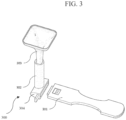
- FIG. 3 illustrates an assembled apparatus 100/200/400 and an embodiment of a biological sample collecting device 300.
- the device 300 comprises a funnel 303, a container 302, and a tray 304.
- the assembled porous pads and membranes protrude out the assembled top and bottom housing. Further, the protruded portion can be inserted into the tray 304. After collecting a biological sample, the sample flows down from the funnel 303, through the container 302, and the tray 304.
- the protruded portion of the assembled apparatus 301 is inserted inside tray 304, the collected sample is able to be absorbed into the porous pad.
- the porous pads 103, 203, 406a, and 406b are impregnated with a water-miscible solution.
- the water-miscible solution comprises polyhydroxy organic compounds and an agent that is designed to release a target molecule from the biological fluid.
- the agent is enzyme urease, which can cause ammonia to release from urea nitrogen contained in a biological fluid, such as saliva.
- a biological fluid such as saliva.
- Two other examples are: (1) the measurement of high levels of creatinine in saliva using the enzyme creatinine deaminase, which produces ammonia; and (2) total cholesterol could be detected using cholesterase enzyme with detection of hydrogen peroxide.
- the polyhydroxy organic compounds are selected from the group consisting of glycerol, sucrose, polysorbate, ethylene glycol, propylene glycol, and a combination thereof.
- the water-miscible solution comprises a liquid that has a heavier density and a higher viscosity than those of the biological fluids.
- the solution contains 50% by volume of glycerol and 50% by volume of water. This solution may also comprises components that are able to increase shelf life of urease.
- the biological fluids can be blood, serum, plasma, urine, saliva, spinal fluid, sweat, tears, vaginal fluid, mucous, or semen.
- the porous pads could be gauze or other suitable materials that have capacity to contain an unfilled capillary matrix after impregnating with the water-miscible solution.
- the unfilled capillary matrix allows the porous pad to be filled quickly of a biological fluid by capillary action.
- Korteweg stresses occur within the porous pad due to the differences in density of the biological fluid and the water-miscible solution.
- viscous fingering occurs when a less viscous liquid, such as the biological fluid, is introduced into a pore or capillary that contains a more viscous liquid, such as the water-miscible solution.
- an amount of the biological fluid absorbed by the porous pad can be adjusted over a wide range by employing porous pads with different sizes.
- a porous pad that is about 2mm in thickness and about 15mm in length and width can absorb about 300 microliters of saliva quickly.
- a larger amount of biological fluid is needed in order to accumulate a target molecule for accurate measuring.
- the width and length of the porous pads can be increased or decreased while maintaining the thickness of the porous pad at 2 mm. While particular measurements of the porous pad are described herein, these measurements are not meant to be limiting.
- the present invention relates to a salivary urea nitrogen level testing.
- the kit comprises a saliva collecting device, a porous pad, an ammonia level indicating strip, and a hydrophobic and gas permeable membrane disposed between the porous pad and the ammonia level indicating strip.
- the ammonia level indicating strip comprises three different levels indicated by three different colors 105, 106, 107 in FIG. 2 to show low, medium, and high levels of salivary urea nitrogen concentrations.
- the color green indicates a normal level of salivary urea nitrogen (SUN); the color yellow indicates a borderline high level of SUN; and the color red indicates a high level of SUN, which means a subject is dehydrated.
- the ammonia level indicating strip further comprises a liquid crystal display (LCD) readout panel, wherein the LCD readout panel is configured to display a numeric ammonia concentration.
- LCD liquid crystal display
- the salivary urea nitrogen level testing kit contains a saliva collecting device, a porous pad, a gas sensor, and a hydrophobic and gas permeable membrane disposed between the porous pad and the gas sensor.
- the ammonia gas sensor is an ammonia gas sensor iOS MQ137 and is configured to detect and measure urea concentrations in ammonia gas.
- this kit may further comprise an ammonia level indicating element, which includes a LCD readout panel. The LCD readout panel may be configured to provide a numeric urea concentration after the ammonia gas sensor measures the urea concentration.
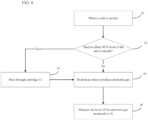
- step 30 a saliva sample is obtained. If the ammonia level in the saliva sample needs to be diluted, step 30 transitions to step 32 to dilute the ammonia level. In some embodiments, diluting ammonia would be useful when a high level of urea accuracy is needed under rapid dehydration due to exertion. In other embodiments, ammonia dilution in a saliva sample is not performed under gradual dehydration over a longer period of time due to environment or other conditions.
- a color changing test strip that is specific for ammonia regardless of pH and in order to keep the initial clinical testing simple is used.
- Pad 1 as listed in Table 1 is the color indicator from Hach ammonia indicator test strip
- Pads 2 and 3 as listed in Table 1 are from Whatman, Panpeha Plus test strips that give color variations in the range 5.5 --- 9.0 of pH.
- ammonia permeating through the rnembrane is generating the color change, so the color does not reflect the pH of the liquid sample.
- the porous gauze pad was loaded with 200 microliters of urease in 50% by volume of glycerol with an enzyme activity of 6.4 units/ml. Buffer, saliva samples, and saliva samples containing added urea were analyzed twice by measuring the gas sensor voltage output over a total elapsed time of 15 minutes from when the sample was contacted with the porous gauze pad.
- Proper procedure for saliva collection consisted of drinking 5 ounces of water and refraining from food and drink for 30 minutes prior to sample collection.
- the collected saliva samples were not pretreated or diluted, and at least 200 microliters of sample is needed, although exact measurement is unnecessary due to the fixed liquid capacity of the porous gauze pad. All that was done once sufficient saliva is collected.
- the saliva sample is allowed to contact the porous gauze pad for about 20 seconds in order for capillary action to be completed.
- the color pads are used in combination within a chart developed based on observations of how the indicator paper responds to different levels of ammonia vapor above a pH 7 solution with a hydrophobic membrane barrier.
- the color variations as a group are useful for detecting a wider range since Pad 1 is mostly used to indicate that the saliva sample was properly detected. If a saliva sample does not register above the original color denoted as color scale level 1, then there was a problem with the sample or it is a negative control. However, Pad 1 is not very sensitive to changes in some of the lower parts of the salivary urea nitrogen scale and Pad 2 is best used for matching the color in the normal to borderline high level. In turn, Pad 3 becomes most useful in the high range.
- the technology determines the concentration of urea in saliva by generating a color change that can be observed visually and compared to a color chart.
- the concentration of urea in saliva correlates with hydration state of a person. The test is rapid, low cost, and does not require instrumentation or expert operation.
- a very reliable, common, and simple way to measure urea in saliva is to use the enzyme Urease to convert urea into ammonia.
- Urease results and ammonia levels found in saliva were corroborated using a spectrometer to track the change in phenolphthalein with pH as ammonia is introduced or when Urease produces ammonia.
- a laboratory in the Biodesign Institute working to produce urease from waste seed has been working with our laboratory to compare the standard method of measuring Urease activity (e.g., Nessler Method) with our measurements, and there is a reasonably good agreement between the two.
- Our spectroscopic method does not produce any hazardous waste and is a relatively simple method that can be accomplished with a portable spectrometer as well, if additional field-lab testing is needed.
- the beta test kit uses plastic disposable components, a timer, and a color reference card. No power or measurement instrumentation is needed.
- the consumables of the test kit are provided in a sealed clear plastic container and should be stored in a refrigerator at approximately 4 oC, and the enzyme, beads, and test strip are expected to have a shelf life at 4 oC of up to one year. This is due to the way we stabilize the Urease through formulation and entrapment onto a solid support.
- the shelf life of the formulation has been tested in our refrigerator since July 2016, and we have thus far found that the enzyme appears to maintain its reactivity for 7 months.
- the entrapment method should extend the shelf life even more, based on the extensive literature of how immobilizing antibodies and enzymes increase shelf life of these proteins.
- a 12 mm x 12 mm x 3 mm thick porous gauze pad was soaked in 200 uL solution of 50 v.% glycerol/ 50 v.% water with urease and dried overnight in the refrigerator.
- the porous gauze pad was able to quickly wick up about 1 ml of simulated saliva.
- the porous gauze pad performed in the same manner when placed in a 3-D printed cartridge assembled based on the line drawings. Measurements with several color indicator paper preparations with a gas permeable membrane showed that ammonia in the gas phase can be detected while the enzymatic reaction is taking place. Room temperature experiments indicate that after 5 minutes readings can be taken.
- the result of universal indicator paper color change indicated that 40 mg/dl Urea simulated saliva can be distinguished from 10 mg/dl simulated saliva.
- the calibration of the paper with ammonia standards in simulated saliva gives values of between 100 - 1,000 ppm ammonia for 40 mg/dl and 50 ppm ammonia for 10 mg/dl Urea. This is within the expected range.
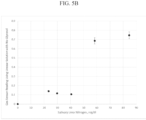
- An ammonia gas sensor (MQ 137) programmed to display voltage using an chicken microcomputer was integrated into the SUN Device. Using 500 microliter pre imbibed Urease solution onto a gauze pad, 1 ml of simulated saliva at pH 7 containing either 10, 20, and 40 mg/dl of Urea respectively was applied to the pad and recording commenced immediately. The final design would use a "razor and blades" model whereby the gauze pad and saliva contacting portion would be detachable from the small sensor so that the electronics would be retained for more measurements while disposing of that portion of the device.
Landscapes
- Health & Medical Sciences (AREA)
- Life Sciences & Earth Sciences (AREA)
- Engineering & Computer Science (AREA)
- Chemical & Material Sciences (AREA)
- Biomedical Technology (AREA)
- Molecular Biology (AREA)
- General Health & Medical Sciences (AREA)
- Immunology (AREA)
- Physics & Mathematics (AREA)
- Hematology (AREA)
- Analytical Chemistry (AREA)
- Pathology (AREA)
- Biochemistry (AREA)
- Organic Chemistry (AREA)
- Urology & Nephrology (AREA)
- General Physics & Mathematics (AREA)
- Microbiology (AREA)
- Wood Science & Technology (AREA)
- Zoology (AREA)
- Biotechnology (AREA)
- Proteomics, Peptides & Aminoacids (AREA)
- Food Science & Technology (AREA)
- Medicinal Chemistry (AREA)
- Biophysics (AREA)
- Veterinary Medicine (AREA)
- Medical Informatics (AREA)
- Heart & Thoracic Surgery (AREA)
- Surgery (AREA)
- Public Health (AREA)
- Animal Behavior & Ethology (AREA)
- Pulmonology (AREA)
- Bioinformatics & Cheminformatics (AREA)
- General Engineering & Computer Science (AREA)
- Genetics & Genomics (AREA)
- Cell Biology (AREA)
- Investigating Or Analysing Biological Materials (AREA)
Claims (15)
- Appareil destiné à mesurer une concentration d'une molécule cible à partir d'un échantillon biologique, l'appareil comprenant :un boîtier (301) incluant une partie sommet (105) de boîtier présentant une ouverture de sommet et une partie fond (101) de boîtier présentant une ouverture de fond, les partie sommet (105) de boîtier et partie fond (101) de boîtier définissant une cavité entre elles lorsqu'elles sont attachées l'une à l'autre pour former un boîtier (301) assemblé ;une pile de composants matériels disposés dans ladite cavité de manière adjacente à l'ouverture de sommet et à l'ouverture de fond de manière à faire saillie vers l'extérieur depuis un côté du boîtier, la pile incluant :une couche de membrane imperméable inférieure (102) ;une couche de tampon poreux (103) sur le dessus de la couche de membrane imperméable inférieure (102), la couche de tampon poreux (103) comprenant une matrice capillaire non chargée et imprégnée d'une solution miscible à l'eau contenant un agent sensible à la molécule cible ;une couche de membrane supérieure hydrophobe et perméable aux gaz (104) sur la couche de tampon poreux (103) ;dans lequel la couche de membrane imperméable inférieure (102) est couplée à la partie fond (101) de boîtier pour être visuellement et fluidiquement accessible par l'ouverture de fond et la couche de membrane supérieure (104) est couplée à la partie sommet (105) de boîtier pour être visuellement et fluidiquement accessible par l'ouverture de sommet ;
etun dispositif (300) de collecte d'échantillon biologique qui inclut :un réceptacle (304) définissant une ouverture de réceptacle sur un côté du réceptacle, l'ouverture de réceptacle servant à recevoir une partie de la pile de composants matériels faisant saillie depuis le côté du boîtier (301) ;un contenant (302) définissant, à travers celui-ci, un passage de fluide fonctionnellement attaché au sommet du réceptacle (304) ; etun entonnoir (303) coopérant avec le réceptacle (304) et menant fluidiquement à ce dernier par le biais du contenant (302),le dispositif (300) de collecte d'échantillon biologique étant configuré pour coopérer avec le boîtier (301) assemblé contenant la pile de composants matériels tout en recevant ladite partie de la pile de composants matériels dans l'ouverture de réceptacle. - Appareil selon la revendication 1, dans lequel la pile comprend en outre une bande (109) d'indication de niveau de molécule cible prise en sandwich entre la couche de membrane supérieure (104) et une couche de membrane supérieure supplémentaire disposée au-dessus de ladite bande (109) de manière à pouvoir être perçue visuellement par l'ouverture de sommet et à travers la couche de membrane supérieure.
- Appareil selon la revendication 2, dans lequel la pile comprend en outre une bande (413) d'indication de niveau de molécule cible prise en sandwich entre la couche de membrane inférieure (102) et une couche de membrane de fond supplémentaire (402) disposée sous ladite bande de manière à pouvoir être perçue visuellement par l'ouverture de fond et à travers la couche de membrane de fond.
- Appareil selon l'une quelconque des revendications précédentes, comprenant en outre un capteur de gaz juxtaposé à l'ouverture de sommet pour recevoir un gaz émanant de la couche de tampon poreux (103) à la suite d'une réaction de l'échantillon biologique avec l'agent lorsque la couche de tampon poreux (103) reçoit l'échantillon biologique provenant de l'entonnoir (303) par le biais du contenant (302) par le biais du réceptacle (304) via ladite partie de la pile de composants matériels.
- Appareil selon la revendication 1, dans lequel l'agent est de l'uréase.
- Appareil selon la revendication 1, dans lequel la couche de tampon poreux (103) absorbe une quantité de l'échantillon biologique qui est suffisante pour mesurer la concentration de la molécule cible.
- Appareil selon la revendication 1, dans lequel la solution miscible à l'eau comprend des composés organiques de polyhydroxy sélectionnés dans le groupe consistant en glycérol, sucrose, polysorbate, éthylène glycol, propylène glycol, et une combinaison de ceux-ci ; et dans lequel la solution miscible à l'eau présente un niveau de viscosité plus élevé que celui de l'échantillon biologique pour créer une digitation visqueuse dans ladite couche de tampon poreux (103).
- Appareil selon la revendication 1, configuré pour mesurer la concentration d'une molécule cible à partir de l'échantillon biologique qui inclut sang, sérum, plasma, urine, salive, liquide céphalo-rachidien, sueur, larmes, sécrétions vaginales, mucus, ou sperme.
- Appareil selon la revendication 8, dans lequel l'échantillon biologique est la salive.
- Appareil selon la revendication 9, dans lequel la molécule cible est l'ammoniac.
- Appareil selon la revendication 2 ou la revendication 3, dans lequel la bande (109) d'indication de niveau de molécule cible est spécifique à l'ammoniac quel que soit un niveau de pH et comprend trois niveaux différents indiqués par trois couleurs différentes qui sont activées lorsque la molécule cible est de l'ammoniac, et qui peuvent être visuellement perçues par au moins l'une parmi l'ouverture de sommet et l'ouverture de fond pour effectuer ladite mesure sur la base d'une visualisation des trois couleurs.
- Appareil selon la revendication 1, comprenant en outre un tampon poreux auxiliaire imprégné d'une solution miscible à l'eau auxiliaire contenant un agent auxiliaire qui réagit avec la créatinine pour générer du peroxyde d'hydrogène et pour détecter deux molécules cibles simultanément.
- Kit de test de niveau d'azote uréique salivaire comprenant un dispositif de collecte de salive configuré en tant que dispositif (300) de collecte d'échantillon biologique de l'appareil selon la revendication 1,
et une pile de couches comprenant :une couche de tampon poreux (103) incluant une matrice capillaire non chargée et imprégnée d'une solution miscible à l'eau contenant un agent sensible à l'ammoniac,une bande (109) d'indication de niveau d'ammoniac spécifique à l'ammoniac quel que soit un niveau de pH et incluant un panneau de lecture à affichage à cristaux liquides (LCD) qui est configuré pour afficher numériquement la concentration d'ammoniac, etune membrane hydrophobe et perméable aux gaz (104) disposée entre la couche de tampon poreux (103) et la bande (109) d'indication de niveau d'ammoniac. - Kit selon la revendication 13, dans lequel la solution miscible à l'eau contient de l'uréase.
- Kit selon la revendication 13, dans lequel la bande (109) d'indication de niveau d'ammoniac comprend trois niveaux différents indiqués par trois couleurs différentes qui sont activées lorsque la bande est en contact avec de l'ammoniac.
Applications Claiming Priority (3)
| Application Number | Priority Date | Filing Date | Title |
|---|---|---|---|
| US201762486340P | 2017-04-17 | 2017-04-17 | |
| US201762505572P | 2017-05-12 | 2017-05-12 | |
| PCT/US2018/027916 WO2018195043A1 (fr) | 2017-04-17 | 2018-04-17 | Détection rapide d'azote uréique salivaire |
Publications (3)
| Publication Number | Publication Date |
|---|---|
| EP3612832A1 EP3612832A1 (fr) | 2020-02-26 |
| EP3612832A4 EP3612832A4 (fr) | 2020-12-30 |
| EP3612832B1 true EP3612832B1 (fr) | 2025-03-19 |
Family
ID=63856345
Family Applications (1)
| Application Number | Title | Priority Date | Filing Date |
|---|---|---|---|
| EP18787508.3A Active EP3612832B1 (fr) | 2017-04-17 | 2018-04-17 | Détection rapide d'azote uréique salivaire |
Country Status (3)
| Country | Link |
|---|---|
| US (1) | US11254967B2 (fr) |
| EP (1) | EP3612832B1 (fr) |
| WO (1) | WO2018195043A1 (fr) |
Families Citing this family (2)
| Publication number | Priority date | Publication date | Assignee | Title |
|---|---|---|---|---|
| US11254967B2 (en) | 2017-04-17 | 2022-02-22 | Dignity Health | Salivary urea nitrogen rapid detection |
| WO2020256941A1 (fr) * | 2019-06-17 | 2020-12-24 | Dignity Health | Détection rapide d'azote uréique salivaire |
Family Cites Families (45)
| Publication number | Priority date | Publication date | Assignee | Title |
|---|---|---|---|---|
| NL6509361A (fr) * | 1964-07-20 | 1966-01-21 | ||
| ZA733611B (en) * | 1972-10-11 | 1974-04-24 | Merck Patent Gmbh | Indicator for the determination of urea |
| US3950226A (en) | 1974-10-31 | 1976-04-13 | Moon Ki Chang | Novel reagent and method for the determination of urea in biological fluids |
| US4271264A (en) | 1976-09-13 | 1981-06-02 | Modrovich Ivan Endre | Stabilized liquid enzyme and coenzyme compositions |
| US4176008A (en) * | 1978-02-24 | 1979-11-27 | Eastman Kodak Company | Method, composition and element for the detection of nitrogen-containing compounds |
| DE2821469A1 (de) | 1978-05-17 | 1979-11-22 | Boehringer Mannheim Gmbh | Diagnostisches mittel zur bestimmung von harnstoff |
| US4282316A (en) | 1979-09-11 | 1981-08-04 | Modrovich Ivan Endre | Stabilized enzymic solutions for determining urea |
| JPS5877661A (ja) | 1981-11-02 | 1983-05-11 | Fuji Photo Film Co Ltd | アンモニアまたはアンモニア生成基質分析用一体型多層分析材料および検出法 |
| JPS5877663A (ja) * | 1981-11-02 | 1983-05-11 | Kyoto Daiichi Kagaku:Kk | 尿素分析方法および分析用具 |
| JPH0616033B2 (ja) * | 1982-04-19 | 1994-03-02 | 株式会社京都第一科学 | アンモニアおよび尿素の分析具 |
| US4839296A (en) | 1985-10-18 | 1989-06-13 | Chem-Elec, Inc. | Blood plasma test method |
| CA1317532C (fr) * | 1987-01-28 | 1993-05-11 | Louis Terminiello | Systeme de production d'un reactif sec |
| US5137692A (en) * | 1990-12-11 | 1992-08-11 | Robert Fritz | Nitrogen test kit for physical training |
| JP2665640B2 (ja) * | 1991-07-22 | 1997-10-22 | 富士写真フイルム株式会社 | 乾式分析要素を用いた測定方法及び乾式分析要素 |
| US5804452A (en) * | 1995-04-27 | 1998-09-08 | Quidel Corporation | One step urine creatinine assays |
| ATE340999T1 (de) | 1997-08-04 | 2006-10-15 | Serex Inc | Integrierte sammel- und testvorrichtung für speichel und blut |
| AU3219099A (en) * | 1998-03-30 | 1999-10-18 | Epitope, Inc. | Collection device for single step assay of oral fluids |
| US6303081B1 (en) | 1998-03-30 | 2001-10-16 | Orasure Technologies, Inc. | Device for collection and assay of oral fluids |
| EP1121198A1 (fr) | 1998-10-14 | 2001-08-08 | Arizona Board of Regents | Systeme de dosage immunologique faisant intervenir des ions argent immobilises |
| US6365417B1 (en) | 2000-02-09 | 2002-04-02 | A-Fem Medical Corporation | Collection device for lateral flow chromatography |
| AU2001264888A1 (en) | 2000-05-23 | 2001-12-03 | Arizona Board Of Regents | Novel method of creating micro-structures for micro-fluidic applications |
| AU2001272012A1 (en) | 2000-06-19 | 2002-01-02 | Arizona Board Of Regents | Rapid flow-based immunoassay microchip |
| JP4004009B2 (ja) * | 2000-10-16 | 2007-11-07 | 富士フイルム株式会社 | アンモニア又はアンモニア生成物質分析用一体型多層分析素子 |
| WO2004000446A2 (fr) | 2002-06-20 | 2003-12-31 | Arizona Board Of Regents | Procede et dispositif permettant de faire tourner des particules a induction magnetique |
| US7425302B2 (en) | 2003-02-24 | 2008-09-16 | Binax, Inc. | Dry chemistry, lateral flow-reconstituted chromatographic enzyme-driven assays |
| WO2006132640A2 (fr) | 2004-06-14 | 2006-12-14 | Arizona Board Of Regents For And On Behalf Of Arizona State University | Dispositifs microfluidiques commandes par la lumiere et amplification du mouillage induit par un stimulus |
| US20080213853A1 (en) | 2006-02-27 | 2008-09-04 | Antonio Garcia | Magnetofluidics |
| WO2007101174A2 (fr) | 2006-02-27 | 2007-09-07 | Arizona Board Of Regents For And On Behalf Of Arizona State University | Dispositifs et procedes magneto-fluidiques numeriques |
| US20080050451A1 (en) | 2006-06-16 | 2008-02-28 | Mabry Helen C | Methods for assessing dehydration and shock, assays and kits for the methods |
| CA2658662A1 (fr) | 2006-07-21 | 2008-01-31 | The Procter & Gamble Company | Articles absorbants jetables dotes d'un capteur place dans une fenetre |
| AU2008247479A1 (en) | 2007-05-04 | 2008-11-13 | Upspring Ltd. | Diagnostic device and method for testing hydration and other conditions |
| US20090157024A1 (en) | 2007-12-14 | 2009-06-18 | Kimberly-Clark Worldwide, Inc. | Hydration Test Devices |
| JP2011523704A (ja) | 2008-05-20 | 2011-08-18 | カンタイマー,インコーポレイティド | イオン交換によって生体液試料を分析するための方法、システム、及び装置 |
| US20100159599A1 (en) | 2008-12-18 | 2010-06-24 | Xuedong Song | Lateral-flow porous membrane assay with flow rate control |
| US20100159611A1 (en) | 2008-12-18 | 2010-06-24 | Xuedong Song | Hydration/dehydration sensor |
| US20110287409A1 (en) | 2009-02-05 | 2011-11-24 | Hydradx, Inc. | Diagnostic device and method |
| US20100254581A1 (en) | 2009-04-07 | 2010-10-07 | Reveal Sciences, Llc | Device, method, and apparatus for biological testing with a mobile device |
| US9995688B2 (en) | 2009-09-21 | 2018-06-12 | Arizona Board Of Regents | Use of superhydrophobic surfaces for liquid agglutination assays |
| GB201003190D0 (en) | 2010-02-25 | 2010-04-14 | Bedfont Scient Ltd | Apparatus and method |
| EP2622344A4 (fr) | 2010-09-30 | 2015-11-25 | Hydradx Inc | Dispositif de diagnostic et procédé de détection d'état d'hydratation d'un sujet mammifère |
| JP5925026B2 (ja) * | 2011-04-28 | 2016-05-25 | アークレイ株式会社 | クレアチニン測定用乾式試験片及びクレアチニン測定法 |
| US20150157300A1 (en) | 2013-12-05 | 2015-06-11 | George D. Ealovega | Urine-specimen collection, storage and testing device |
| US11254967B2 (en) | 2017-04-17 | 2022-02-22 | Dignity Health | Salivary urea nitrogen rapid detection |
| EP3651841A4 (fr) | 2017-07-11 | 2021-04-07 | Arizona Board of Regents on behalf of Arizona State University | Détection et surveillance de distribution de dose pour cires, solides ou huiles visqueuses vaporisés, et cannabinoïdes |
| WO2020256941A1 (fr) | 2019-06-17 | 2020-12-24 | Dignity Health | Détection rapide d'azote uréique salivaire |
-
2018
- 2018-04-17 US US16/605,695 patent/US11254967B2/en active Active
- 2018-04-17 EP EP18787508.3A patent/EP3612832B1/fr active Active
- 2018-04-17 WO PCT/US2018/027916 patent/WO2018195043A1/fr not_active Ceased
Also Published As
| Publication number | Publication date |
|---|---|
| CA3097508A1 (fr) | 2018-10-25 |
| US11254967B2 (en) | 2022-02-22 |
| US20200131559A1 (en) | 2020-04-30 |
| EP3612832A1 (fr) | 2020-02-26 |
| WO2018195043A1 (fr) | 2018-10-25 |
| EP3612832A4 (fr) | 2020-12-30 |
Similar Documents
| Publication | Publication Date | Title |
|---|---|---|
| US12178575B2 (en) | Systems and methods for the detection and quantification of ammonia and ammonium in fluids | |
| US5834626A (en) | Colorimetric indicators for breath, air, gas and vapor analyses and method of manufacture | |
| EP3289353B1 (fr) | Dispositif et procédés d'utilisation d'un dispositif pour la détection de l'hyperammoniémie | |
| CN105980841A (zh) | 血氨的快速小体积检测 | |
| JP2020505606A (ja) | 流体試料中のグルコース濃度を検出するための垂直流アッセイデバイス | |
| EP3612832B1 (fr) | Détection rapide d'azote uréique salivaire | |
| Liu et al. | A handheld, colorimetric optoelectronic dynamics analyzer for measuring total ammonia of biological samples | |
| WO2017023500A1 (fr) | Appareil et procédé permettant la surveillance non-invasive d'oxyde nitrique et d'autres gaz dans le sang | |
| US11213228B2 (en) | Stacked sensor assembly for fluid analyzer | |
| Mukherjee et al. | Capillary-osmotic wearable patch based on lateral flow assay for sweat potassium analysis | |
| WO1999035487A1 (fr) | Procedes et appareil permettant l'analyse exacte des composants d'un fluide corporel | |
| WO2020256941A1 (fr) | Détection rapide d'azote uréique salivaire | |
| CN110398469A (zh) | 一种用于确定体液葡萄糖水平的反应液及方法 | |
| CA3097508C (fr) | Detection rapide d'azote ureique salivaire | |
| JP2005526953A (ja) | エンボス加工されたテストストリップシステム | |
| CN118191294B (zh) | 一种非侵入性尿酸比色试纸及其制造方法和检测方法 | |
| MXPA05011080A (es) | Dispositivo medico para monitorear niveles de fenilalanina en la sangre. | |
| US20230060490A1 (en) | Apparatus to Detect Salt Concentrations and Glucose in Bodily Fluids | |
| US11553861B1 (en) | Apparatus to detect salt concentrations and glucose in bodily fluids | |
| Vap et al. | Field chemistry analysis | |
| Sinha et al. | Biosensors for Point‐of‐Care Applications: Replacing Pathology Labs by Bedside Devices | |
| US5679577A (en) | System for verifying the authenticity of a urine specimen utilizing levels of dissolved gases | |
| GB2442748A (en) | Device and method for measuring a nitric oxide metabolite such as nitrite or nitrate | |
| Eltze et al. | Inexpensive Metal Oxide Gas Sensors for Salivary Urea Quantitation | |
| Thamilselvi et al. | IoT-based Saliva pH Monitoring System for Multi-Disease Oral Health Detection |
Legal Events
| Date | Code | Title | Description |
|---|---|---|---|
| STAA | Information on the status of an ep patent application or granted ep patent |
Free format text: STATUS: THE INTERNATIONAL PUBLICATION HAS BEEN MADE |
|
| PUAI | Public reference made under article 153(3) epc to a published international application that has entered the european phase |
Free format text: ORIGINAL CODE: 0009012 |
|
| STAA | Information on the status of an ep patent application or granted ep patent |
Free format text: STATUS: REQUEST FOR EXAMINATION WAS MADE |
|
| 17P | Request for examination filed |
Effective date: 20191114 |
|
| AK | Designated contracting states |
Kind code of ref document: A1 Designated state(s): AL AT BE BG CH CY CZ DE DK EE ES FI FR GB GR HR HU IE IS IT LI LT LU LV MC MK MT NL NO PL PT RO RS SE SI SK SM TR |
|
| AX | Request for extension of the european patent |
Extension state: BA ME |
|
| DAV | Request for validation of the european patent (deleted) | ||
| DAX | Request for extension of the european patent (deleted) | ||
| A4 | Supplementary search report drawn up and despatched |
Effective date: 20201127 |
|
| RIC1 | Information provided on ipc code assigned before grant |
Ipc: G01N 33/487 20060101ALI20201123BHEP Ipc: G01N 30/72 20060101AFI20201123BHEP |
|
| STAA | Information on the status of an ep patent application or granted ep patent |
Free format text: STATUS: EXAMINATION IS IN PROGRESS |
|
| 17Q | First examination report despatched |
Effective date: 20221222 |
|
| GRAP | Despatch of communication of intention to grant a patent |
Free format text: ORIGINAL CODE: EPIDOSNIGR1 |
|
| STAA | Information on the status of an ep patent application or granted ep patent |
Free format text: STATUS: GRANT OF PATENT IS INTENDED |
|
| INTG | Intention to grant announced |
Effective date: 20241016 |
|
| RIN1 | Information on inventor provided before grant (corrected) |
Inventor name: LIEBERMAN, ABRAHAM Inventor name: GARCIA, ANTONIO |
|
| GRAS | Grant fee paid |
Free format text: ORIGINAL CODE: EPIDOSNIGR3 |
|
| GRAA | (expected) grant |
Free format text: ORIGINAL CODE: 0009210 |
|
| STAA | Information on the status of an ep patent application or granted ep patent |
Free format text: STATUS: THE PATENT HAS BEEN GRANTED |
|
| AK | Designated contracting states |
Kind code of ref document: B1 Designated state(s): AL AT BE BG CH CY CZ DE DK EE ES FI FR GB GR HR HU IE IS IT LI LT LU LV MC MK MT NL NO PL PT RO RS SE SI SK SM TR |
|
| REG | Reference to a national code |
Ref country code: GB Ref legal event code: FG4D |
|
| REG | Reference to a national code |
Ref country code: CH Ref legal event code: EP |
|
| REG | Reference to a national code |
Ref country code: DE Ref legal event code: R096 Ref document number: 602018080288 Country of ref document: DE |
|
| REG | Reference to a national code |
Ref country code: IE Ref legal event code: FG4D |
|
| PG25 | Lapsed in a contracting state [announced via postgrant information from national office to epo] |
Ref country code: RS Free format text: LAPSE BECAUSE OF FAILURE TO SUBMIT A TRANSLATION OF THE DESCRIPTION OR TO PAY THE FEE WITHIN THE PRESCRIBED TIME-LIMIT Effective date: 20250619 |
|
| PG25 | Lapsed in a contracting state [announced via postgrant information from national office to epo] |
Ref country code: FI Free format text: LAPSE BECAUSE OF FAILURE TO SUBMIT A TRANSLATION OF THE DESCRIPTION OR TO PAY THE FEE WITHIN THE PRESCRIBED TIME-LIMIT Effective date: 20250319 |
|
| PGFP | Annual fee paid to national office [announced via postgrant information from national office to epo] |
Ref country code: DE Payment date: 20250321 Year of fee payment: 8 |
|
| PGFP | Annual fee paid to national office [announced via postgrant information from national office to epo] |
Ref country code: GB Payment date: 20250410 Year of fee payment: 8 |
|
| REG | Reference to a national code |
Ref country code: LT Ref legal event code: MG9D |
|
| PG25 | Lapsed in a contracting state [announced via postgrant information from national office to epo] |
Ref country code: NO Free format text: LAPSE BECAUSE OF FAILURE TO SUBMIT A TRANSLATION OF THE DESCRIPTION OR TO PAY THE FEE WITHIN THE PRESCRIBED TIME-LIMIT Effective date: 20250619 |
|
| PG25 | Lapsed in a contracting state [announced via postgrant information from national office to epo] |
Ref country code: HR Free format text: LAPSE BECAUSE OF FAILURE TO SUBMIT A TRANSLATION OF THE DESCRIPTION OR TO PAY THE FEE WITHIN THE PRESCRIBED TIME-LIMIT Effective date: 20250319 |
|
| PG25 | Lapsed in a contracting state [announced via postgrant information from national office to epo] |
Ref country code: LV Free format text: LAPSE BECAUSE OF FAILURE TO SUBMIT A TRANSLATION OF THE DESCRIPTION OR TO PAY THE FEE WITHIN THE PRESCRIBED TIME-LIMIT Effective date: 20250319 |
|
| PGFP | Annual fee paid to national office [announced via postgrant information from national office to epo] |
Ref country code: FR Payment date: 20250410 Year of fee payment: 8 |
|
| PG25 | Lapsed in a contracting state [announced via postgrant information from national office to epo] |
Ref country code: BG Free format text: LAPSE BECAUSE OF FAILURE TO SUBMIT A TRANSLATION OF THE DESCRIPTION OR TO PAY THE FEE WITHIN THE PRESCRIBED TIME-LIMIT Effective date: 20250319 Ref country code: GR Free format text: LAPSE BECAUSE OF FAILURE TO SUBMIT A TRANSLATION OF THE DESCRIPTION OR TO PAY THE FEE WITHIN THE PRESCRIBED TIME-LIMIT Effective date: 20250620 |
|
| REG | Reference to a national code |
Ref country code: NL Ref legal event code: MP Effective date: 20250319 |
|
| REG | Reference to a national code |
Ref country code: AT Ref legal event code: MK05 Ref document number: 1777333 Country of ref document: AT Kind code of ref document: T Effective date: 20250319 |
|
| PG25 | Lapsed in a contracting state [announced via postgrant information from national office to epo] |
Ref country code: NL Free format text: LAPSE BECAUSE OF FAILURE TO SUBMIT A TRANSLATION OF THE DESCRIPTION OR TO PAY THE FEE WITHIN THE PRESCRIBED TIME-LIMIT Effective date: 20250319 |
|
| PG25 | Lapsed in a contracting state [announced via postgrant information from national office to epo] |
Ref country code: SE Free format text: LAPSE BECAUSE OF FAILURE TO SUBMIT A TRANSLATION OF THE DESCRIPTION OR TO PAY THE FEE WITHIN THE PRESCRIBED TIME-LIMIT Effective date: 20250319 |
|
| PG25 | Lapsed in a contracting state [announced via postgrant information from national office to epo] |
Ref country code: SM Free format text: LAPSE BECAUSE OF FAILURE TO SUBMIT A TRANSLATION OF THE DESCRIPTION OR TO PAY THE FEE WITHIN THE PRESCRIBED TIME-LIMIT Effective date: 20250319 |
|
| PG25 | Lapsed in a contracting state [announced via postgrant information from national office to epo] |
Ref country code: PT Free format text: LAPSE BECAUSE OF FAILURE TO SUBMIT A TRANSLATION OF THE DESCRIPTION OR TO PAY THE FEE WITHIN THE PRESCRIBED TIME-LIMIT Effective date: 20250721 Ref country code: ES Free format text: LAPSE BECAUSE OF FAILURE TO SUBMIT A TRANSLATION OF THE DESCRIPTION OR TO PAY THE FEE WITHIN THE PRESCRIBED TIME-LIMIT Effective date: 20250319 |
|
| PG25 | Lapsed in a contracting state [announced via postgrant information from national office to epo] |
Ref country code: IT Free format text: LAPSE BECAUSE OF FAILURE TO SUBMIT A TRANSLATION OF THE DESCRIPTION OR TO PAY THE FEE WITHIN THE PRESCRIBED TIME-LIMIT Effective date: 20250319 Ref country code: PL Free format text: LAPSE BECAUSE OF FAILURE TO SUBMIT A TRANSLATION OF THE DESCRIPTION OR TO PAY THE FEE WITHIN THE PRESCRIBED TIME-LIMIT Effective date: 20250319 |
|
| PG25 | Lapsed in a contracting state [announced via postgrant information from national office to epo] |
Ref country code: AT Free format text: LAPSE BECAUSE OF FAILURE TO SUBMIT A TRANSLATION OF THE DESCRIPTION OR TO PAY THE FEE WITHIN THE PRESCRIBED TIME-LIMIT Effective date: 20250319 |
|
| PG25 | Lapsed in a contracting state [announced via postgrant information from national office to epo] |
Ref country code: EE Free format text: LAPSE BECAUSE OF FAILURE TO SUBMIT A TRANSLATION OF THE DESCRIPTION OR TO PAY THE FEE WITHIN THE PRESCRIBED TIME-LIMIT Effective date: 20250319 Ref country code: CZ Free format text: LAPSE BECAUSE OF FAILURE TO SUBMIT A TRANSLATION OF THE DESCRIPTION OR TO PAY THE FEE WITHIN THE PRESCRIBED TIME-LIMIT Effective date: 20250319 |
|
| PG25 | Lapsed in a contracting state [announced via postgrant information from national office to epo] |
Ref country code: RO Free format text: LAPSE BECAUSE OF FAILURE TO SUBMIT A TRANSLATION OF THE DESCRIPTION OR TO PAY THE FEE WITHIN THE PRESCRIBED TIME-LIMIT Effective date: 20250319 |
|
| PG25 | Lapsed in a contracting state [announced via postgrant information from national office to epo] |
Ref country code: SK Free format text: LAPSE BECAUSE OF FAILURE TO SUBMIT A TRANSLATION OF THE DESCRIPTION OR TO PAY THE FEE WITHIN THE PRESCRIBED TIME-LIMIT Effective date: 20250319 |
|
| PG25 | Lapsed in a contracting state [announced via postgrant information from national office to epo] |
Ref country code: IS Free format text: LAPSE BECAUSE OF FAILURE TO SUBMIT A TRANSLATION OF THE DESCRIPTION OR TO PAY THE FEE WITHIN THE PRESCRIBED TIME-LIMIT Effective date: 20250719 |
|
| REG | Reference to a national code |
Ref country code: CH Ref legal event code: H13 Free format text: ST27 STATUS EVENT CODE: U-0-0-H10-H13 (AS PROVIDED BY THE NATIONAL OFFICE) Effective date: 20251125 |
|
| PG25 | Lapsed in a contracting state [announced via postgrant information from national office to epo] |
Ref country code: LU Free format text: LAPSE BECAUSE OF NON-PAYMENT OF DUE FEES Effective date: 20250417 |
|
| PG25 | Lapsed in a contracting state [announced via postgrant information from national office to epo] |
Ref country code: MC Free format text: LAPSE BECAUSE OF FAILURE TO SUBMIT A TRANSLATION OF THE DESCRIPTION OR TO PAY THE FEE WITHIN THE PRESCRIBED TIME-LIMIT Effective date: 20250319 |
|
| REG | Reference to a national code |
Ref country code: DE Ref legal event code: R097 Ref document number: 602018080288 Country of ref document: DE |
|
| REG | Reference to a national code |
Ref country code: BE Ref legal event code: MM Effective date: 20250430 |
|
| PG25 | Lapsed in a contracting state [announced via postgrant information from national office to epo] |
Ref country code: DK Free format text: LAPSE BECAUSE OF FAILURE TO SUBMIT A TRANSLATION OF THE DESCRIPTION OR TO PAY THE FEE WITHIN THE PRESCRIBED TIME-LIMIT Effective date: 20250319 |
|
| PG25 | Lapsed in a contracting state [announced via postgrant information from national office to epo] |
Ref country code: BE Free format text: LAPSE BECAUSE OF NON-PAYMENT OF DUE FEES Effective date: 20250430 |
|
| PG25 | Lapsed in a contracting state [announced via postgrant information from national office to epo] |
Ref country code: CH Free format text: LAPSE BECAUSE OF NON-PAYMENT OF DUE FEES Effective date: 20250430 |
|
| PLBE | No opposition filed within time limit |
Free format text: ORIGINAL CODE: 0009261 |
|
| STAA | Information on the status of an ep patent application or granted ep patent |
Free format text: STATUS: NO OPPOSITION FILED WITHIN TIME LIMIT |
|
| REG | Reference to a national code |
Ref country code: CH Ref legal event code: L10 Free format text: ST27 STATUS EVENT CODE: U-0-0-L10-L00 (AS PROVIDED BY THE NATIONAL OFFICE) Effective date: 20260128 |
|
| 26N | No opposition filed |
Effective date: 20251222 |
|
| PG25 | Lapsed in a contracting state [announced via postgrant information from national office to epo] |
Ref country code: IE Free format text: LAPSE BECAUSE OF NON-PAYMENT OF DUE FEES Effective date: 20250417 |