EP3615524B1 - Nouveaux modulateurs du récepteur du glp-1 - Google Patents
Nouveaux modulateurs du récepteur du glp-1 Download PDFInfo
- Publication number
- EP3615524B1 EP3615524B1 EP18723347.3A EP18723347A EP3615524B1 EP 3615524 B1 EP3615524 B1 EP 3615524B1 EP 18723347 A EP18723347 A EP 18723347A EP 3615524 B1 EP3615524 B1 EP 3615524B1
- Authority
- EP
- European Patent Office
- Prior art keywords
- compound
- ring
- alkyl
- independently
- mmol
- Prior art date
- Legal status (The legal status is an assumption and is not a legal conclusion. Google has not performed a legal analysis and makes no representation as to the accuracy of the status listed.)
- Active
Links
Classifications
-
- C—CHEMISTRY; METALLURGY
- C07—ORGANIC CHEMISTRY
- C07D—HETEROCYCLIC COMPOUNDS
- C07D239/00—Heterocyclic compounds containing 1,3-diazine or hydrogenated 1,3-diazine rings
- C07D239/02—Heterocyclic compounds containing 1,3-diazine or hydrogenated 1,3-diazine rings not condensed with other rings
- C07D239/24—Heterocyclic compounds containing 1,3-diazine or hydrogenated 1,3-diazine rings not condensed with other rings having three or more double bonds between ring members or between ring members and non-ring members
- C07D239/26—Heterocyclic compounds containing 1,3-diazine or hydrogenated 1,3-diazine rings not condensed with other rings having three or more double bonds between ring members or between ring members and non-ring members with only hydrogen atoms, hydrocarbon or substituted hydrocarbon radicals, directly attached to ring carbon atoms
-
- C—CHEMISTRY; METALLURGY
- C07—ORGANIC CHEMISTRY
- C07D—HETEROCYCLIC COMPOUNDS
- C07D413/00—Heterocyclic compounds containing two or more hetero rings, at least one ring having nitrogen and oxygen atoms as the only ring hetero atoms
- C07D413/02—Heterocyclic compounds containing two or more hetero rings, at least one ring having nitrogen and oxygen atoms as the only ring hetero atoms containing two hetero rings
- C07D413/12—Heterocyclic compounds containing two or more hetero rings, at least one ring having nitrogen and oxygen atoms as the only ring hetero atoms containing two hetero rings linked by a chain containing hetero atoms as chain links
-
- A—HUMAN NECESSITIES
- A61—MEDICAL OR VETERINARY SCIENCE; HYGIENE
- A61P—SPECIFIC THERAPEUTIC ACTIVITY OF CHEMICAL COMPOUNDS OR MEDICINAL PREPARATIONS
- A61P3/00—Drugs for disorders of the metabolism
-
- C—CHEMISTRY; METALLURGY
- C07—ORGANIC CHEMISTRY
- C07D—HETEROCYCLIC COMPOUNDS
- C07D401/00—Heterocyclic compounds containing two or more hetero rings, having nitrogen atoms as the only ring hetero atoms, at least one ring being a six-membered ring with only one nitrogen atom
- C07D401/02—Heterocyclic compounds containing two or more hetero rings, having nitrogen atoms as the only ring hetero atoms, at least one ring being a six-membered ring with only one nitrogen atom containing two hetero rings
- C07D401/12—Heterocyclic compounds containing two or more hetero rings, having nitrogen atoms as the only ring hetero atoms, at least one ring being a six-membered ring with only one nitrogen atom containing two hetero rings linked by a chain containing hetero atoms as chain links
-
- C—CHEMISTRY; METALLURGY
- C07—ORGANIC CHEMISTRY
- C07D—HETEROCYCLIC COMPOUNDS
- C07D403/00—Heterocyclic compounds containing two or more hetero rings, having nitrogen atoms as the only ring hetero atoms, not provided for by group C07D401/00
- C07D403/02—Heterocyclic compounds containing two or more hetero rings, having nitrogen atoms as the only ring hetero atoms, not provided for by group C07D401/00 containing two hetero rings
- C07D403/12—Heterocyclic compounds containing two or more hetero rings, having nitrogen atoms as the only ring hetero atoms, not provided for by group C07D401/00 containing two hetero rings linked by a chain containing hetero atoms as chain links
-
- C—CHEMISTRY; METALLURGY
- C07—ORGANIC CHEMISTRY
- C07D—HETEROCYCLIC COMPOUNDS
- C07D405/00—Heterocyclic compounds containing both one or more hetero rings having oxygen atoms as the only ring hetero atoms, and one or more rings having nitrogen as the only ring hetero atom
- C07D405/02—Heterocyclic compounds containing both one or more hetero rings having oxygen atoms as the only ring hetero atoms, and one or more rings having nitrogen as the only ring hetero atom containing two hetero rings
- C07D405/12—Heterocyclic compounds containing both one or more hetero rings having oxygen atoms as the only ring hetero atoms, and one or more rings having nitrogen as the only ring hetero atom containing two hetero rings linked by a chain containing hetero atoms as chain links
-
- C—CHEMISTRY; METALLURGY
- C07—ORGANIC CHEMISTRY
- C07D—HETEROCYCLIC COMPOUNDS
- C07D409/00—Heterocyclic compounds containing two or more hetero rings, at least one ring having sulfur atoms as the only ring hetero atoms
- C07D409/02—Heterocyclic compounds containing two or more hetero rings, at least one ring having sulfur atoms as the only ring hetero atoms containing two hetero rings
- C07D409/12—Heterocyclic compounds containing two or more hetero rings, at least one ring having sulfur atoms as the only ring hetero atoms containing two hetero rings linked by a chain containing hetero atoms as chain links
-
- C—CHEMISTRY; METALLURGY
- C07—ORGANIC CHEMISTRY
- C07D—HETEROCYCLIC COMPOUNDS
- C07D417/00—Heterocyclic compounds containing two or more hetero rings, at least one ring having nitrogen and sulfur atoms as the only ring hetero atoms, not provided for by group C07D415/00
- C07D417/02—Heterocyclic compounds containing two or more hetero rings, at least one ring having nitrogen and sulfur atoms as the only ring hetero atoms, not provided for by group C07D415/00 containing two hetero rings
- C07D417/12—Heterocyclic compounds containing two or more hetero rings, at least one ring having nitrogen and sulfur atoms as the only ring hetero atoms, not provided for by group C07D415/00 containing two hetero rings linked by a chain containing hetero atoms as chain links
Definitions
- the disclosure is directed to compounds that modulate the glucagon-like peptide 1 (GLP-1) receptor, as well as to related products and methods for their use and synthesis.
- GLP-1 glucagon-like peptide 1
- GLP-1R Glucagon-like peptide 1 receptor
- GLP-1R belongs to Family B1 of the seven-transmembrane G protein-coupled receptors, and its natural agonist ligand is the peptide hormone glucagon-like peptide-1 (GLP-1).
- GLP-1 is a peptide hormone arising by its alternative enzymatic cleavage from proglucagon, the prohormone precursor for GLP-1, which is highly expressed in enteroendocrine cells of the intestine, the alpha cells of the endocrine pancreas (islets of Langerhans), and the brain ( Kieffer T. J. and Habener, J. F. Endocrin. Rev. 20:876-913 (1999 ); Drucker, D.
- GLP-1 receptors couple to the ⁇ subunit of G protein, with subsequent activation of adenylate cyclase and increase of cAMP levels, thereby potentiating glucose-stimulated insulin secretion. Therefore, GLP-1 is an attractive target to lower blood glucose levels and preserve the ⁇ -cells of the pancreas of diabetic patients.
- Glucagon has been used for decades in medical practice within diabetes and several glucagon-like peptides are being developed for various therapeutic indications. GLP-1 analogs and derivatives are being developed for the treatment for patients suffering from diabetes.
- WO 2012/166951 discloses compounds that bind the glucagon-like peptide 1 (GLP-1) receptor, methods of their synthesis, methods of their therapeutic and/or prophylactic use, and methods of their use in stabilizing GLP-1 receptor in vitro for crystallization of the GLP-1 receptor.
- Certain compounds may have activity as modulators or potentiators with respect to glucagon receptor, GIP receptor, GLP-1 and GLP-2 receptors, and PTH receptor on their own or in the presence of receptor ligands such as GIP(1-42), PTH(1-34), Glucagon(1-29), GLP-2(1-33), GLP-1 (7-36), GLP-1 (9-36), oxyntomodulin and exendin variants.
- WO 2013/090454 discloses compounds that modulate the glucagon-like peptide 1 (GLP-1) receptor, methods of their synthesis, and methods of their therapeutic and/or prophylactic use. Such compounds may act as modulators or potentiators of GLP-1 receptor on their own, or with receptor ligands including GLP-1 peptides GLP-1(7-36) and GLP-1(9-36), or with peptide-based therapies, such as exenatide and liraglutide.
- GLP-1 glucagon-like peptide 1
- WO 2014/201172 discloses compounds that modulate the glucagon-like peptide 1 (GLP-1) receptor, as well as methods of their synthesis, and methods of their therapeutic and/or prophylactic use. Such compounds can act as modulators or potentiators of GLP-1 receptor on their own, or with incretin peptides such as GLP-1(7-36) and GLP-1(9-36), or with peptide-based therapies, such as exenatide and liraglutide.
- GLP-1 glucagon-like peptide 1
- the present invention is directed to compounds adapted to act as modulators of the GLP-1 receptor, particularly GLP-1 receptor agonists, as well as to related products and methods of their preparation and their use, such as in treatment of a malcondition mediated by GLP-1 receptor, or when modulation of GLP-1 receptor is medically indicated.
- References herein to methods of treatment refer to the compounds, pharmaceutically acceptable salts and pharmaceutical compositions of the present invention for use in a method of treatment of the human or animal body by therapy.
- Compounds of the invention have the structure of Formula (II): or a pharmaceutically acceptable salts thereof, wherein J, W 1 , Y, Z, R 1 , R 2 , R 3 and R 4 are as defined below.
- the compounds of Formula (II) include, but are not limited to, hydrates, hydrates and/or isotopes thereof, as well as stereoisomers to the extent such compounds contain one or more chiral centers.
- a pharmaceutical composition comprising a compound of Formula (II) together with at least one pharmaceutically acceptable carrier, diluent or excipient is provided.
- a compound of Formula (II), or a pharmaceutical composition comprising a compound of Formula (II) is provided for use in a method for treating a malcondition in a subject for which modulation of a GLP-1 receptor is medically indicated, comprising administering the compound or pharmaceutically acceptable coposition to the subject.
- the malcondition is type I diabetes, type II diabetes, gestational diabetes, obesity, excessive appetite, insufficient satiety, or metabolic disorder.
- the malcondition is non-alcoholic fatty liver disease (NAFLD) and/or non-alcoholic steatohepatitis (NASH).
- NAFLD non-alcoholic fatty liver disease
- NASH non-alcoholic steatohepatitis
- the present invention provides compounds which modulate the GLP-1 receptor, particularly GLP-1 receptor agonists, as well as to methods of their preparation and use in the treatment of conditions mediated by the GLP-1 receptor, including (but not limited to) type I diabetes, type II diabetes, gestational diabetes, obesity, excessive appetite, insufficient satiety, metabolic disorder, non-alcoholic fatty liver disease (NAFLD) and/or non-alcoholic steatohepatitis (NASH).
- GLP-1 receptor particularly GLP-1 receptor agonists
- the compounds of Formula (II) include, but are not limited to, hydrates, hydrates and/or isotopes thereof.
- the compounds of Formula (II) also include stereoisomers to the extent that the compounds of Formula (II) contain one or more chiral centers.
- Alkyl groups include straight chain and branched alkyl groups having from 1 to about 20 carbon atoms, and typically from 1 to 12 carbons (C 1 -C 12 alkyl), or, in some embodiments, from 1 to 8 carbon atoms (C 1 -C 8 alkyl), or, in some embodiments, from 1 to 4 carbon atoms (C 1 -C 4 alkyl). In the case of cycloalkyl groups, such groups have from 3-20 carbon atoms.
- straight chain alkyl groups include, but are not limited to, methyl, ethyl, n-propyl, n-butyl, n-pentyl, n-hexyl, n-heptyl, and n-octyl groups.
- branched alkyl groups include, but are not limited to, isopropyl, iso-butyl, sec-butyl, t-butyl, neopentyl, isopentyl, and 2,2-dimethylpropyl groups.
- alkenyl groups include straight and branched chain alkyl groups as defined above, except that at least one double bond exists between two carbon atoms. Thus, alkenyl groups have from 2 to about 20 carbon atoms, and typically from 2 to 12 carbons or, in some embodiments, from 2 to 8 carbon atoms.
- Cycloalkyl groups are alkyl groups forming a ring structure, which can be substituted or unsubstituted, wherein the ring is either completely saturated, partially unsaturated, or fully unsaturated, wherein if there is unsaturation, the conjugation of the pi-electrons in the ring do not give rise to aromaticity.
- Examples of cycloalkyl include, but are not limited to, cyclopropyl, cyclobutyl, cyclopentyl, cyclohexyl, cycloheptyl, and cyclooctyl groups.
- the cycloalkyl group has 3 to 8 ring members, whereas in other embodiments the number of ring carbon atoms range from 3 to 5, 3 to 6, or 3 to 7.
- cycloalkyl groups are partially unsaturated, including, for example, but not limited to cyclohexenyl, cyclopentenyl, and cyclohexadienyl groups.
- Cycloalkyl groups further include polycyclic cycloalkyl groups such as, but not limited to, norbornyl, adamantyl, bornyl, camphenyl, isocamphenyl, and carenyl groups, and fused rings such as, but not limited to, decalinyl, and the like.
- Aryl groups are cyclic aromatic hydrocarbons that do not contain heteroatoms.
- aryl groups include, but are not limited to, phenyl, azulenyl, heptalenyl, biphenyl, indacenyl, fluorenyl, phenanthrenyl, triphenylenyl, pyrenyl, naphthacenyl, chrysenyl, biphenylenyl, anthracenyl, and naphthyl groups.
- aryl groups contain 6-14 carbons in the ring portions of the groups.
- the phrase "aryl groups” includes groups containing fused rings, such as fused aromatic-aliphatic ring systems (e.g., indanyl, tetrahydronaphthyl, and the like).
- Alkyl groups are alkyl, alkenyl or alkynyl groups as defined above in which a hydrogen atom of an alkyl, alkenyl or alkynyl group is replaced with an aryl group as defined above.
- Heterocyclyl or “heterocyclic” groups include aromatic and non-aromatic ring moieties containing 3 or more ring members, of which one or more is a heteroatom such as, but not limited to, N, O, S, or P.
- heterocyclyl groups include 3 to 20 ring members, whereas other such groups have 3 to 15 ring members, including for example single ring systems containing 5, 6 or 7 ring members. At least one ring contains a heteroatom, but every ring in a polycyclic system need not contain a heteroatom.
- a dioxolanyl ring and a benzdioxolanyl ring system are both heterocyclyl groups within the meaning herein.
- a heterocyclyl group designated as a C 2 -heterocyclyl can be a 5-ring with two carbon atoms and three heteroatoms, a 6-ring with two carbon atoms and four heteroatoms, and so forth.
- a C 4 -heterocyclyl can be a 5-ring with one heteroatom, a 6-ring with two heteroatoms, and so forth.
- the number of carbon atoms plus the number of heteroatoms sums up to equal the total number of ring atoms.
- heterocyclyl includes fused ring species including those having fused aromatic and non-aromatic groups.
- the phrase also includes polycyclic and/or bridging ring systems containing a heteroatom such as, but not limited to, quinuclidyl and 7-azabicyclo[2.2.1]heptane, and also includes heterocyclyl groups that have substituents, including but not limited to alkyl, halo, amino, hydroxy, cyano, carboxy, nitro, thio, or alkoxy groups, bonded to one of the ring members.
- a heterocyclyl group as defined herein can be a heteroaryl group or a partially or completely saturated cyclic group including at least one ring heteroatom.
- Heterocyclyl groups include, but are not limited to, pyrazinyl, pyrimidinyl, pyridazinyl, thiadiazolyl, oxadiazolyl, imidazolinyl, hexahydropyrimidinyl, diazepanyl, triazinyl, imidazolyl, pyrrolidinyl, furanyl, tetrahydrofuranyl, tetrahydro-2H-pyranyl, dioxolanyl, piperidinyl, piperazinyl, morpholinyl, pyrrolyl, pyrazolyl, triazolyl, tetrazolyl, oxazolyl, isoxazolyl, thiazolyl, pyridinyl, thiophenyl, benzothiophenyl, benzofuranyl, dihydrobenzofuranyl, indolyl, dihydroindolyl, azaind
- Heteroaryl groups are aromatic ring moieties containing 5 or more ring members, of which, one or more is a heteroatom such as, but not limited to, N, O, and S.
- a heteroaryl group designated as a C 2 -heteroaryl can be a 5-ring with two carbon atoms and three heteroatoms, a 6-ring with two carbon atoms and four heteroatoms and so forth.
- a C 4 -heteroaryl can be a 5-ring with one heteroatom, a 6-ring with two heteroatoms, and so forth. The number of carbon atoms plus the number of heteroatoms sums up to equal the total number of ring atoms.
- Heteroaryl groups include, but are not limited to, groups such as pyrrolyl, pyrazolyl, pyridinyl, pyridazinyl, pyrimidyl, pyrazyl, pyrazinyl, pyrimidinyl, thiadiazolyl, imidazolyl, oxadiazolyl, thienyl, triazolyl, tetrazolyl, triazinyl, thiazolyl, thiophenyl, oxazolyl, isoxazolyl, benzothiophenyl, benzofuranyl, indolyl, azaindolyl, indazolyl, benzimidazolyl, azabenzimidazolyl, benzoxazolyl, benzothiazolyl, benzothiadiazolyl, imidazopyridinyl, isoxazolopyridinyl, thianaphthalenyl, purinyl, xant
- heteroaryl and “heteroaryl groups” include fused ring compounds such as wherein at least one ring, but not necessarily all rings, are aromatic, including tetrahydroquinolinyl, tetrahydroisoquinolinyl, indolyl and 2,3-dihydro indolyl.
- aryl and heteroaryl groups include but are not limited to phenyl, biphenyl, indenyl, naphthyl (1-naphthyl, 2-naphthyl), N-hydroxytetrazolyl, N-hydroxytriazolyl, N-hydroxyimidazolyl, anthracenyl (1-anthracenyl, 2-anthracenyl, 3-anthracenyl), thiophenyl (2-thienyl, 3-thienyl), furyl (2-furyl, 3-furyl), indolyl, oxadiazolyl (1,2,4-oxadiazolyl, 1,3,4-oxadiazolyl), thiadiazolyl (1,2,4-thiadiazolyl, 1,3,4-thiadiazolyl),isoxazolyl, quinazolinyl, fluorenyl, xanthenyl, isoindanyl, benzhydryl, acridinyl,
- ring system as the term is used herein is meant a moiety comprising one, two, three or more rings, which can be substituted with non-ring groups or with other ring systems, or both, which can be fully saturated, partially unsaturated, fully unsaturated, or aromatic, and when the ring system includes more than a single ring, the rings can be fused, bridging, or spirocyclic.
- spirocyclic is meant the class of structures wherein two rings are fused at a single tetrahedral carbon atom, as is well known in the art.
- alkoxy refers to an oxygen atom connected to an alkyl group, including a cycloalkyl group, as are defined above.
- linear alkoxy groups include but are not limited to methoxy, ethoxy, n-propoxy, n-butoxy, n-pentyloxy, n-hexyloxy, n-heptyloxy, n-octyloxy n-nonyloxy, and the like.
- branched alkoxy include but are not limited to isopropoxy, sec-butoxy, tert-butoxy, isopentyloxy, isohexyloxy, and the like.
- cyclic alkoxy include but are not limited to cyclopropyloxy, cyclobutyloxy, cyclopentyloxy, cyclohexyloxy, and the like.
- acyl group refers to a group containing a carbonyl moiety wherein the group is bonded via the carbonyl carbon atom.
- the carbonyl carbon atom is also bonded to another carbon atom, which can be part of an alkyl, aryl, aralkyl cycloalkyl, cycloalkylalkyl, heterocyclyl, heterocyclylalkyl, heteroaryl, heteroarylalkyl group or the like.
- the group is a "formyl” group, an acyl group as the term is defined herein.
- An acyl group can include 0 to about 12-20 additional carbon atoms bonded to the carbonyl group.
- An acyl group can include double or triple bonds within the meaning herein.
- An acryloyl group is an example of an acyl group.
- An acyl group can also include heteroatoms within the meaning here.
- a nicotinoyl group (pyridyl-3-carbonyl) group is an example of an acyl group within the meaning herein.
- Other examples include acetyl, benzoyl, phenylacetyl, pyridylacetyl, cinnamoyl, and acryloyl groups and the like.
- the group containing the carbon atom that is bonded to the carbonyl carbon atom contains a halogen, the group is termed a "haloacyl" group.
- An example is a trifluoroacetyl group.
- amine includes primary, secondary, and tertiary amines having, e.g., the formula N(group) 3 wherein each group can independently be H or non-H, such as alkyl, aryl, and the like.
- Amines include but are not limited to R-NH 2 , for example, alkylamines, arylamines, alkylarylamines; R 2 NH wherein each R is independently selected, such as dialkylamines, diarylamines, aralkylamines, heterocyclylamines and the like; and R 3 N wherein each R is independently selected, such as trialkylamines, dialkylarylamines, alkyldiarylamines, triarylamines, and the like.
- the term "amine” also includes ammonium ions as used herein.
- amino group is a substituent of the form -NH 2 , -NHR, -NR 2 , - NR 3 + , wherein each R is independently selected, and protonated forms of each. Accordingly, any compound substituted with an amino group can be viewed as an amine.
- ammonium ion includes the unsubstituted ammonium ion NH 4 + , but unless otherwise specified, it also includes any protonated or quaternarized forms of amines. Thus, trimethylammonium hydrochloride and tetramethylammonium chloride are both ammonium ions, and amines, within the meaning herein.
- amide or “amido” includes C- and N-amide groups, i.e ., -C(O)NR 2 , and -NRC(O)R groups, respectively.
- Amide groups therefore include but are not limited to carbamoyl groups (-C(O)NH 2 ) and formamide groups (-NHC(O)H).
- a "carboxamido” group is a group of the formula C(O)NR 2 , wherein R can be H, alkyl, aryl, etc.
- carbonyl refers to a -C(O)- group.
- Halo include fluorine, chlorine, bromine and iodine.
- perhaloalkyl refers to an alkyl group where all of the hydrogen atoms are replaced by halogen atoms. Perhaloalkyl groups include, but are not limited to, -CF 3 and -C(CF 3 ) 3 .
- haloalkyl refers to an alkyl group where some but not necessarily all of the hydrogen atoms are replaced by halogen atoms. Haloalkyl groups include but are not limited to -CHF 2 and -CH 2 F.
- perhaloalkoxy refers to an alkoxy group where all of the hydrogen atoms are replaced by halogen atoms.
- Perhaloalkoxy groups include, but are not limited to, -OCF 3 and -OC(CF 3 ) 3 .
- haloalkoxy refers to an alkoxy group where some but not necessarily all of the hydrogen atoms are replaced by halogen atoms.
- Haloalkoxy groups include but are not limited to -OCHF2 and -OCH2F.
- compounds are provided having the structure of Formula (III): wherein J, W 1 , R 1 , R 2 , R 3 , R 4 , and R 7 are as defined for Formula (II) above
- compounds are provided having the structure of Formula (IV): wherein W 1 , Y, Z, X 1A , X 1B , X 1C , X 1D , R 1 , R 2 , R 3 and R 4 are as defined for Formula (II) above.
- compounds are provided having the structure of Formula (V): wherein W 1 , R 1 , R 2 , R 3 , R 4 , and R 7 are as defined for Formula (II) above.
- compounds are provided having the structure of Formula (VI): wherein W 1 , R 3 , R 4 , and R 7 are as defined for Formula (II) above.
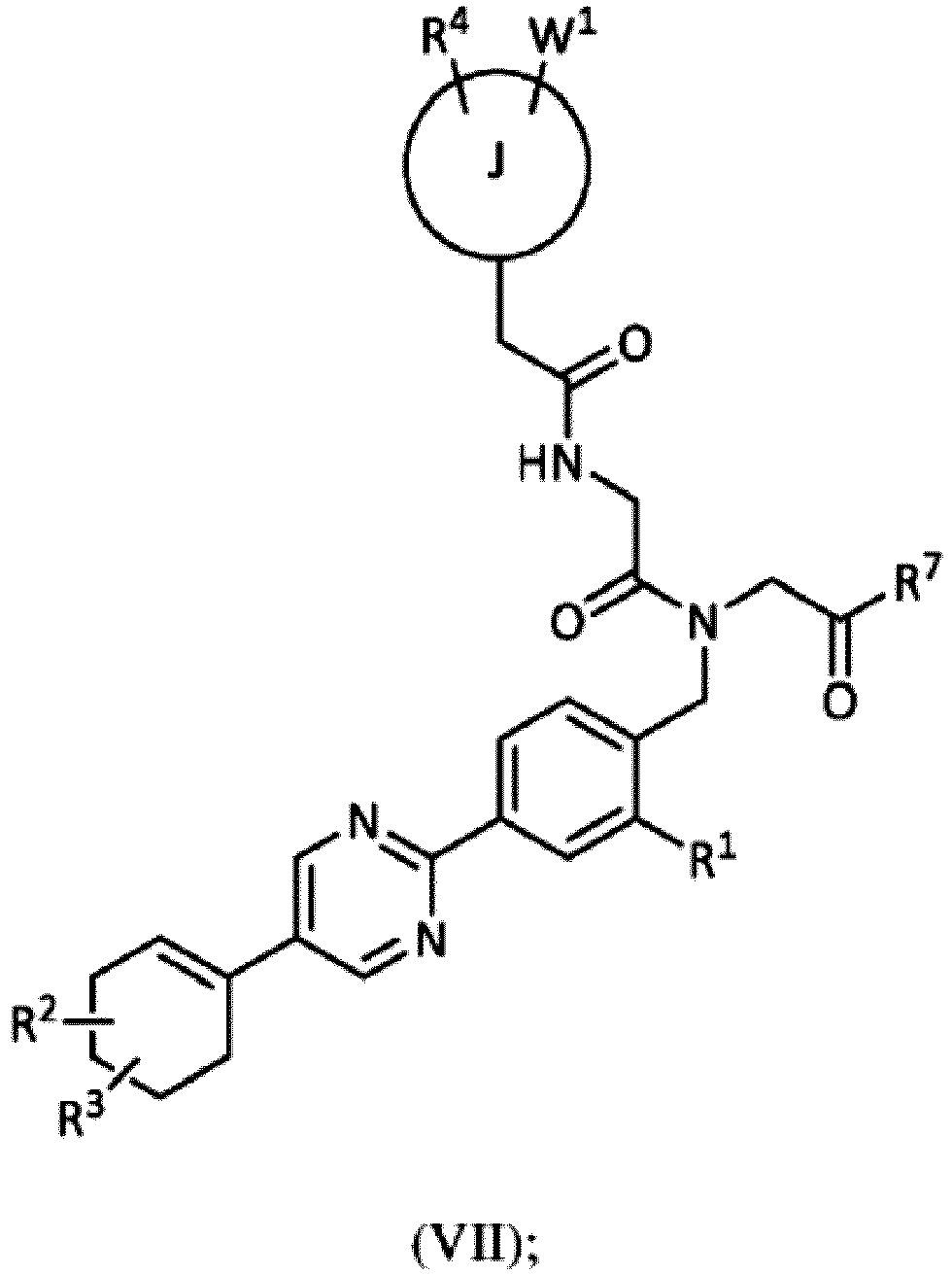
- compounds are provided having the structure of Formula (VII): wherein J, W 1 , R 1 , R 2 , R 3 , R 4 , and R 7 are as defined for Formula (II) above.
- compounds are provided having the structure of Formula (VIII): wherein W 1 , R 1 , R 2 , R 3 , R 4 , and R 7 are as defined for Formula (II) above.
- compounds are provided having the structure of Formula (IX): wherein W 1 , R 1 , R 3 , R 4 , and R 7 are as defined for Formula (II) above.
- compounds are provided having the structure of Formula (X): wherein J, W 1 , R 1 , R 2 , R 3 , R 4 , and R 7 are as defined for Formula (II) above.
- compounds are provided having the structure of Formula (XI): wherein W 1 , R 1 , R 2 , R 3 , R 4 , and R 7 are as defined for Formula (II) above.
- compounds are provided having the structure of Formula (XII): wherein W 1 , R 1 , R 3 , R 4 , and R 7 are as defined for Formula (II) above.
- the compounds of any one of Formulas (II) through (XII) above include, but are not limited to, hydrates, hydrates and/or isotopes thereof, as well as stereoisomers to the extent such compounds contain one or more chiral centers.
- the compounds of any one of Formulas (II) through (XII) above also include pharmaceutically acceptable salts.
- the various substituents e.g., J, W 1 , Y, Z, R 1 , R 2 , R 3 , R 4 , and R 7
- the various substituents are set forth in more detail with respect to the compounds of each of Formulas (II) through (XII) above, as applicable to the substituents being further defined.
- reference to Y below is intended to further limit the compounds of Formulas (II) and (IV) above, but not Formulas (III) or (V)-(XII) since the Y substituent has already been further defined in the same.
- reference to the substituents below is intended to further modify Formulas (II)-(XII) to the extent such formulas recite that particular substituent as a variable.
- Y is -C(O)-.
- Y is -C(O)-CH 2 -.
- Y is -C(O)-CH 2 -NH-C(O)-CH 2 -.
- Y is -C(O)-CH 2 -NH-C(O)-CH 2 -NH-S(O) 2 -CH 2 -.
- Y is -C(O)-CH 2 -NH-C(O)-CH 2 -NH-.
- Y is -C(O)-CH 2 -NH-C(O)-CH 2 -NH-S(O) 2 -CH 2 -.
- Z is -CH 2 C(O)OH.
- W 1 is attached to one of X 1A , X 1B , X 1C , X 1D , X 1E , X 1F or X 1G .
- the ring atom of X 1A , X 1B , X 1C , X 1D , X 1E , X 1F and X 1G to which W 1 is attached is C.
- W 1 is attached to X 1G and X 1G is C.
- each of X 1A , X 1B , X 1C and X 1D is C or CH.
- one of X 1A , X 1B , X 1C and X 1D is N.
- two of X 1A , X 1B , X 1C , and X 1D is N.
- one of X 1E , X 1F and X 1G is N.
- X 1F is N.
- X 1H is O.
- X 1H is S.
- W 1 is attached in the para position.
- W 1 is -(CR a R b ) i1 -L 1 -(CR a R b ) j1 -R 60 .
- W 1 is -NH-C(O)-(CH 2 ) n -R 60 .
- W 1 is -NH-C(O)-CH 2 -R 60 .
- W 1 is -OR 10 , -NHCO(CH 2 ) n -R 60 , -N(CH 3 )CO(CH 2 ) n -R 60 or -NH(CH 2 ) n -R 60 .
- i1 is 0, in another embodiment i1 is 1, and in a futher embodiment i1 is 2.
- j 1 is 0, in another embodiment j 1 is 1, and in a further embodiment j1 is 2.
- L 1 is -NR 10 C(O)-.
- L 1 is -NR 10 -.
- L 1 is -N(R 10 )SO 2 -.
- R 10 is -H.
- R 60 is R 13 .
- R 60 is -O-(CH 2 ) n -R 13 , in another embodiment R 60 is -O-R 13 , and in a further embodiment R 60 is -O-CH 2 -R 13 .
- R 13 is aryl optionally substituted with one or more R 14 , and in another embodiment R 13 is phenyl.
- R 13 is cycloalkyl or heterocycloalkyl, and in another embodiment, R 13 is cyclopentyl, cyclohexyl, thiazolyl, tetrahydrofuranyl, oxazolyl, thiophenyl, 1,2,4-oxadiazolyl, furanyl, tetrahydro-2H-pyranyl, or piperidinyl.
- R 13 is unsubstituted or substituted at one or more ring position with methyl, ethyl, isopropyl, t-butyl, -CF 3 , methoxy, ethoxy, hydroxyl, -OCF 3 , halogen (F, Cl, Br or I), methylthio or -SO 2 CH 3 .
- R 13 is substituted with one or more of methyl, methoxy, F or -CF 3 .
- R 13 is cycloalkyl, aryl or heteroaryl, where any ring atom of R 13 may be optionally substituted with R 14 .
- each R 14 is independently H, alkyl, halo, alkoxy, perhaloalkyl or perhaloalkoxy. In another embodiment, R 14 is halo, alkoxy, perhaloalkyl or perhaloalkoxy. In a further embodiment, R 14 is alkoxy or perhaloalkyl.
- each R 31 and R 32 is independently H, alkyl or alkyl substituted with carboxyl. In another embodiment, at least one of R 31 and R 32 is H.
- R 60 is:
- each of R a and R b is H. In another embodiment, at least one of R a and R b is methyl.
- At least one of R a and R b is isopropyl.
- At least one of R a and R b is benzyl or hydroxybenzyl.
- At least one pair of R a and R b is, taken together, oxo or cycloalkyl.
- R 2 is alkyl. In another embodiment, R 2 is methyl, ethyl, isopropyl or t-butyl.
- R 2 is cycloalkyl. In another embodiment, R 2 is cyclopropyl, cyclobutyl, cyclopentyl, cyclohexyl, cycloheptyl, cyclopropenyl, cyclobutenyl, cyclopentenyl, cyclohexenyl or cycloheptenyl.
- R 2 is aryl. In another embodiment, R 2 is phenyl.
- R 2 is substituted with at least one R 3 .
- R 3 is halo, alkyl, alkoxy, perhaloalkyl or perhaloalkoxy. In another embodiment, R 3 is methyl, ethyl, n-propyl, iso-propyl, n-butyl, iso-butyl, tert-butyl, n-pentyl or -CF 3 .
- a compound having the structure any one of compound numbers 1-153 as shown in the following Table 1, or a stereoisomer, hydrate, solvate, isotope or pharmaceutically acceptable salts thereof.
- Table 1 Representative Compounds Structure Cpd. No.
- Compound Nos. 1-153 of Table 1 above include, but are not limited to, hydrates, hydrates and/or isotopes thereof, as well as pharmaceutically acceptable salts thereof.
- a “salt” as is well known in the art includes an organic compound such as a carboxylic acid, a sulfonic acid, or an amine, in ionic form, in combination with a counter ion.
- acids in their anionic form can form salts with cations such as metal cations, for example sodium, potassium, and the like; with ammonium salts such as NH 4 + or the cations of various amines, including tetraalkyl ammonium salts such as tetramethylammonium, or other cations such as trimethylsulfonium, and the like.
- a “pharmaceutically acceptable salt” is a salt formed from a counter ion that has been approved for human consumption and is generally non-toxic.
- Acid addition salts of the disclosed compounds include, for example, salts prepared by adding and inorganic acid or an organic acid.
- inorganic acids include, but are not limited to, hydrochloric, hydrobromic, hydriodic, nitric, carbonic, sulfuric, and phosphoric acids.
- organic acids include, but are not limited to, aliphatic, cycloaliphatic, aromatic, araliphatic, heterocyclic, carboxylic and sulfonic classes of organic acids, representative examples of which include formic acetic, propionic, succinic, glycolic, gluconic, lactic, malic, tartaric, citric, ascorbic, glucuronic, maleic, fumaric, pyruvic, aspartic, glutamic, benzoic, anthranilic, 4-hydroxybenzoic, phenylacetic, mandelic, embonic (pamoic), methanesulfonic, ethanesulfonic, benzenesulfonic, panthothenic, trifluoromethanesulfonic, 2-hydroxyethanesulfonic, p-toluenesulfonic, sulfanilic, cyclohexylaminosulfonic, stearic, alginic, ⁇ -hydroxy
- Base addition salts of the disclosed compounds include, but are not limited to, salts prepared by adding alkali metal, alkaline earth metal and transition metal salts such as, for example, calcium, magnesium, potassium, sodium and zinc salts.
- Representative base addition salts also include salts made from organic bases such as, for example, N , N '-dibenzylethylenediamine, chloroprocaine, choline, diethanolamine, ethylenediamine, meglumine (N-methylglucamine) and procaine.
- a “hydrate” is a compound that exists in a composition with water molecules.
- the composition can include water in stoichiometric quantities, such as a monohydrate or a dihydrate, or can include water in random amounts.
- a "hydrate” refers to a solid form ( i.e., a compound in water solution, while it may be hydrated, is not a hydrate as the term is used herein).
- a “solvate” is a similar composition except that a solvent other that water replaces the water.
- a solvent other that water replaces the water.
- methanol or ethanol can form an "alcoholate", which can again be stoichiometric or non-stoichiometric.
- a “solvate” refers to a solid form ( i.e., a compound in solution in a solvent, while it may be solvated, is not a solvate as the term is used herein).
- isotope refers to atoms with the same number of protons but a different number of neutrons
- an isotope of a compound of Formula (II) includes any such compound wherein one or more atoms are replaced by an isotope of that atom.
- carbon 12 the most common form of carbon, has six protons and six neutrons, whereas carbon 13 has six protons and seven neutrons, and carbon 14 has six protons and eight neutrons.
- Hydrogen has two stable isotopes, deuterium (one proton and one neutron) and tritium (one proton and two neutrons). While fluorine has a number of isotopes, fluorine 19 is longest-lived.
- an isotope of a compound having the structure of Formula (II) includes, but not limited to, compounds of Formula (II) wherein one or more carbon 12 atoms are replaced by carbon 13 and/or 14 atoms, wherein one or more hydrogen atoms are replaced with deuterium and/or tritium, and/or wherein one or more fluorine atoms are replaced by fluorine 19.
- Steps include all chiral, enantiomeric, diastereomeric and/or racemic forms of a compound, unless a particular stereochemistry or isomeric form is specifically indicated.
- Compounds of the present invention include enriched or resolved optical isomers at any or all asymmetric atoms as are apparent from the depictions, at any degree of enrichment, including, for example, enrichment to a weight purity of 98%, 99%, 99.5% or 99.9%.
- Both racemic, enantiomeric and diastereomeric mixtures, as well as the individual optical isomers can be synthesized so as to be substantially free of their enantiomeric or diastereomeric partners, and these are all within the scope of certain embodiments of the invention.
- Enantiomers are sometimes called optical isomers because a pure enantiomer rotates plane-polarized light in a particular direction. If the light rotates clockwise, then that enantiomer is labeled "(+)” or “d” for dextrorotatory, its counterpart will rotate the light counterclockwise and is labeled "(-)” or "1” for levorotatory.
- Stereoisomers that differ at some stereocenters but not at others are not mirror images, so they are not enantiomers. Instead, they are referred to as diastereomers. A diastereomer is any stereoisomer that is not an enantiomer.
- racemate and “racemic mixture” are frequently used interchangeably.
- a racemate is an equal mixture of two enantiomers.
- a racemate is labeled “( ⁇ )” because it is not optically active (i.e., will not rotate plane-polarized light in either direction since its constituent enantiomers cancel each other out).
- the "A" group of Formula (II) has the following structure, wherein the asterisk ( ⁇ ) denotes chiral carbon.
- R 2 is cyclohexyl substituted with R 3 , as illustrated below.
- the noted hydrogen atoms can exist in a cis-or trans-configuration:
- a prodrug is a substance that can be administered to a patient where the substance is converted in vivo by the action of biochemicals within the patient's body, such as enzymes, to the active pharmaceutical ingredient.
- prodrugs include esters of carboxylic acid groups, which can be hydrolyzed by endogenous esterases as are found in the bloodstream of humans and other mammals.
- substances are provided that can be administered to a patient where the substance is converted in vivo by the action of biochemical reactions within the patient's body, such as enzymes, to a compound having the structure of any one of Formulas (II)-(XII), or a compound of Table 1.
- a pharmaceutical composition comprising a compound of Formula (II)-(XII), a compound of Table 1, or a pharmaceutically acceptable salt thereof, in combination with at least one pharmaceutically acceptable carrier, diluent or excipient.
- a compound that "modulates" a GLP-1 receptor means that the compound interacts with the receptor, either directly or by way of an allosteric interaction, thereby activating, potentiating and/or agonizing the GLP-1 receptor for which it modulates.
- the present invention encompasses compounds that modulate GLP-1 receptor, with high affinity and specificity, an agonist manner or as an activator or a potentiator.
- a compound of the invention acts as a positive allosteric modulator of GLP-1 receptor.
- the present invention provides a method for agonizing a GLP-1 receptor with a compound of the invention (i.e., an agonist).
- the method involves contacting the receptor with a suitable concentration of an inventive compound to bring about activation of the receptor.
- the contacting can take place in vitro, for example in carrying out an assay to determine the GLP-1 receptor activation activity of an inventive compound undergoing experimentation related to a submission for regulatory approval.
- the method for modulating a GLP-1 receptor can also be carried out in vivo, that is, within the living body of a mammal, such as a human patient or a test animal.
- the inventive compound can be supplied to the living organism via one of the routes as described above (e.g., orally), or can be provided locally within the body tissues. In the presence of the inventive compound, activation of the receptor takes place and the effect thereof can be studied.
- a method for modulation of a GLP-1 receptor by contacting the receptor with an effective amount of a compound of this invention, or a pharmaceutical composition comprising the same, wherein the GLP-1 receptor is disposed within a living mammal.
- a method for treatment of a malcondition in a subject for which modulation of a GLP-1 receptor is medically indicated, by administering an effective amount of a compound of this invention to the subject at a frequency and for duration of time sufficient to provide a beneficial effect to the subject (e.g., patient).
- Treating refers to an alleviation of symptoms associated with a disorder or disease, or inhibition of further progression or worsening of those symptoms, or prevention or prophylaxis of the disease or disorder.
- Effective amount refers to an amount sufficient to produce a beneficial therapeutic effect on the patient.
- effective amount or a “therapeutically effective amount” of a compound of the invention refers to an amount of the compound that alleviates, in whole or in part, symptoms associated with the disorder or condition, or halts or slows further progression or worsening of those symptoms, or prevents or provides prophylaxis for the disorder or condition.
- a “therapeutically effective amount” refers to an amount effective, at dosages and for periods of time necessary, to achieve the desired therapeutic result by acting as a modulator of GLP-1 activity.
- a therapeutically effective amount is also one in which any toxic or detrimental effects of compounds of the invention are outweighed by the therapeutically beneficial effects.
- a therapeutically effective amount of a GLP-1 receptor agonist is an amount sufficient to control the malcondition, to mitigate the progress of the malcondition, or to relieve the symptoms of the malcondition.
- the dosages and formulations for the other agents to be employed, where applicable, will be as set out in the latest edition of the Physicians' Desk Reference.
- a method for treatment of a malcondition in a subject for which modulation of a GLP-1 receptor is medically indicated by administering an effective amount of a compound of this invention to the subject at a frequency and for a duration of time sufficient to provide a beneficial effect to the subject, wherein the malcondition comprises type I diabetes, type II diabetes, gestational diabetes, obesity, excessive appetite, insufficient satiety, or metabolic disorder.
- the subject is a patient or a human being.
- the human being is afflicted with, or at risk of developing, a disease or condition selected from the group consisting of type I diabetes, type II diabetes, gestational diabetes, obesity, excessive appetite, insufficient satiety, and metabolic disorder.
- said disease is type I diabetes or type II diabetes.
- methods of treatment provided by the invention include administration of a compound of the invention to a subject (e.g., patient) for the treatment of non-alcoholic fatty liver disease (NAFLD) and/or non-alcoholic steatohepatitis (NASH).
- NAFLD non-alcoholic fatty liver disease
- NASH non-alcoholic steatohepatitis
- NAFLD is believed to be caused by the disruption of hepatic lipid homeostasis and, at least in a portion of patients, can progress to NASH.
- NAFLD is associated with insulin resistance in type 2 diabetes mellitus, and GLP1 increases insulin sensitivity and aids glucose metabolism.
- the compounds of this invention are beneficial in this context by serving to increase fatty acid oxidation, decrease lipogenesis, and/or improve hepatic glucose metabolism ( see e.g., Lee et.
- methods are provided for use of a compound of this invention for preparation of a medicament adapted for treatment of a disorder or a malcondition wherein modulation of a GLP-1 receptor is medically indicated.
- PG is a protecting group (i) Pd(dppf)Cl 2 , Na 2 CO 3 or NaHCO 3 , dioxane, water; (ii) NBS, AIBN, CHCl 3 ; (iii) DIEA, THF.
- PG is a protecting group (i) Pd(dppf)Cl 2 , Na 2 CO 3 or NaHCO 3 , dioxane, water.
- PG is a protecting group (i) HATU, DIEA, DMF; (ii) NH 4 Cl, iron, THF, EtOH, water.
- PG is a protecting group
- Coupling with acid HATU, DIEA, DMF or coupling with acid chloride: DIEA, DCM
- DIEA acid chloride
- Deprotection of PG e.g. deprotection of tert-butyl ester: TFA, DCM.
- PG is a protecting group
- Coupling with acid HATU, DIEA, DMF or coupling with acid chloride: DIEA, DCM
- DIEA acid chloride
- Deprotection of PG e.g. deprotection of tert-butyl ester: TFA, DCM.
- PG is a protecting group (i) Coupling with acid: HATU, DIEA, DMF or coupling with acid chloride: DIEA, DCM.
- PG is a protecting group (i) Pd(dppf)Cl 2 , Na 2 CO 3 or NaHCO 3 , dioxane, water; (ii) Deprotection of PG: e.g. deprotection of tert -butyl ester: TFA, DCM.
- Reagents: PG is a protecting group (i) HATU, DIEA, DMF; (ii) Deprotection of PG: e.g. deprotection of tert-butyl ester: TFA, DCM.
- PG is a protecting group (i) HATU, DIEA, DMF; (ii) Deprotection of PG: e.g. deprotection of tert-butyl ester: TFA, DCM.
- Reagents (i) 1,1'-carbonyldiimidazole, methanesulfonamide, 1,8-diazabicyclo[5.4.0]undec-7-ene, THF.
- PG is a protecting group (i) HATU, DIEA, DMF; (ii) NaH, THF; (iii) Deprotection of PG: e.g. deprotection of tert-butyl ester: TFA, DCM.
- PG 1 and PG 2 are protecting groups (i) HATU, DIEA, DMF; (ii) Deprotection of PG1: e.g. deprotection of Boc-amine: 5-6N HCl in IPA, DCM.
- PG is a protecting group (i) HATU, DIEA, DMF; (ii) Deprotection of PG: e.g. deprotection of tert-butyl ester: TFA, DCM.
- PG is a protecting group (i) HATU, DIEA, DMF; (ii) Deprotection of PG: e.g. deprotection of tert-butyl ester: TFA, DCM.
- PG is a protecting group (i) HATU, DIEA, DMF; (ii) Deprotection of PG: e.g. deprotection of tert-butyl ester: TFA, DCM.
- PG is a protecting group (i) HATU, DIEA, DMF; (ii) Deprotection of PG: e.g. deprotection of tert-butyl ester: TFA, DCM.
- PG is a protecting group (i) HATU, DIEA, DMF; (ii) Deprotection of PG: e.g. deprotection of tert -butyl ester: TFA, DCM.
- PG is a protecting group (i) HATU, DIEA, DMF; (ii) Pd(dppf)Cl 2 , Na 2 CO 3 or NaHCO 3 , dioxane, water; (iii) Deprotection of PG: e.g. deprotection of tert -butyl ester: TFA, DCM.
- PG is a protecting group (i) HATU, DIEA, DMF; (ii) Deprotection of PG: e.g. deprotection of tert-butyl ester: TFA, DCM.
- PG is a protecting group (i) HATU, DIEA, DMF; (ii) Deprotection of PG: e.g. deprotection of tert-butyl ester: TFA, DCM.
- LCMS Mass spectra
- System 1 Agilent 1100/6110 HPLC system equipped with a Waters X-Bridge C-8, 3.5 ⁇ (50 x 4.6 mm) column using water with 5 mM ammonium acetate as the mobile phase C, and acetonitrile with 5 mM ammonium acetate as the mobile phase D with a flow rate of 1 mL/min.
- Method 1 20% D (80% C) to 95% D over 12.0 min. and hold at 95% D for 2.8 min. then 20% D over 0.2 min.
- Method 2 20% D (80% C) to 95% D over 3 min. then held at 95% D for 3.8 min. and then to 5% D over 0.2 min.
- System 2 Agilent 1260 LCMS equipped with a Waters Xselect CSH C18 3.5 ⁇ m (4.6 x 50 mm) column using water with 0.1% formic acid as mobile phase A and acetonitrile with 0.1% formic acid as mobile phase B.
- Method 3 The gradient was 5-95% mobile phase B over 13.0 min with a flow rate of 2.5 mL/min, then held at 95% for 1.0 min with a flow rate of 4.5 mL/min.
- Method 4 The gradient was 5-95% mobile phase B over 3.0 min with a flow rate of 2.5 mL/min, then held at 95% for 0.6 min with a flow rate of 4.5 mL/min.
- THF tetrahydrofuran
- EA ethyl acetate
- TEA triethylamine
- HOBt N- hydroxybenzotriazole
- EDC 1-ethyl-3-(3-dimethylaminopropyl) carbodiimide hydrochloride
- HATU 1-[Bis(dimethylamino)methylene]-1H-1,2,3-triazolo[4,5-b]pyridinium 3-oxide hexafluorophosphate
- HATU 1-[Bis(dimethylamino)methylene]-1H-1,2,3-triazolo[4,5-b]pyridinium 3-oxide hexafluorophosphate
- DMF N,N -dimethylformamide
- DMA dimethyl acetamide
- DMA Di- tert -butyl dicarbonate
- Boc 2 O N,N- Diisopropylethylamine
- acetic acid Ac
- the gradient was 45-95% mobile phase B over 7.5 min, held at 95% for 1 min, and then returned to 45% over 1.5 min with a flow rate of 28 mL/min or 2) Waters X-Bridge C-8, 5 ⁇ m (19 x 150 mm) column using water containing 0.04% trifluoroacetic acid as mobile phase A, and acetonitrile with 0.04% trifluoroacetic acid as mobile phase B.
- the gradient was 20-95% mobile phase B over 7 min, held at 95% for 3 min, and then return to 20% over 2 min with flow rate of 28 mL/min. Fractions were collected by UV detection at 254 nm or by mass and evaporated using a Genevac EZ-2.
- the coupling reagent could be HATU (1.05 - 2.5 eq) optionally with DMAP (0.01 - 1 eq), EDC (1.5 eq) with HOBt (1.5 eq) or DMAP (0.01 - 1 eq), DCC (1.1 eq) with HOBt (1.1 eq) or DCC (1.5 eq) with DMAP (2.0 eq).
- reaction mixture was stirred until the reaction was complete.
- the reaction was diluted with EA and washed with saturated aqueous NaHCO 3 .
- the organic layer was dried over MgSO 4 and concentrated.
- the product was purified by chromatography or alternatively can be carried on to the next step without further purification.
- the mixture was de-gassed then treated with PdCl 2 (dppf) (0.099 g, 0.128 mmol).
- the mixture was heated to 90°C for 3 h then allowed to cool and treated with water (30 mL).
- the mixture was extracted with EA (3 ⁇ 100 mL) and the combined organic extracts washed with brine (150 mL), dried over MgSO 4 and solvents evaporated.
- the resulting solution was added to a stirring solution of tert -butyl 4-aminobenzoate (2.68 g, 13.88 mmol) and DIEA (3.8 mL, 20.8 mmol) in DCM (10 mL) at -10°C such that the internal temperature was maintained below -5°C.
- the mixture was allowed to warm slowly then poured into a mixture of ice-water (200 mL), 1 M HCl (50 mL) and iso -hexane (100 mL). After 10 min, the precipitate was collected by filtration, washing successively with water (2 ⁇ 20 mL), iso -hexane (2 ⁇ 20 mL), and MTBE (5 mL).
- 6-(2-(4-methoxy-2-(trifluoromethyl)phenyl)acetamido)nicotinic acid (carboxylic acid for Compound 46 ) was prepared from 2-(4-methoxy-2-(trifluoromethyl)phenyl)acetyl chloride and methyl 6-aminonicotinate using General Procedures 5 then 3.
- 6-(2-(4-methoxyphenyl)acetamido)pyridazine-3-carboxylic acid (carboxylic acid for Compound 57 ) was prepared from 2-(4-methoxyphenyl)acetyl chloride and methyl 6-aminopyridazine-3-carboxylate using General Procedures 5 then 3.
- 6-(2-(4-methoxy-2-(trifluoromethyl)phenyl)acetamido)pyridazine-3-carboxylic acid (carboxylic acid for Compound 58 ) was prepared from 2-(4-methoxy-2-(trifluoromethyl)phenyl)acetyl chloride and methyl 6-aminopyridazine-3-carboxylate using General Procedures 5 then 3.
- 2,3-dichloro-4-(2-(4-methoxyphenyl)acetamido)benzoic acid (carboxylic acid for Compound 68 ) was prepared from 2-(4-methoxyphenyl)acetyl chloride and 4-amino-2,3-dichlorobenzoic acid using General Procedure 5.
- Methyl 2-bromo-4-(2-(4-methoxy-2-(trifluoromethyl)phenyl)-acetamido) benzoate (290 mg, 0.65 mmol) in NMP (7.22 mL) was treated with copper cyanide (87 mg, 0.975 mmol) and heated to 150 °C for 18 hours. Water (10 mL) was added to the mixture and the layers were separated. The aqueous layer was extracted with EA (2 x 10 mL).
- EA 10 mL
- 1M HCl 10 mL
- the aqueous layer was extracted with EA (10 mL) and the combined organic layers were washed with saturated sodium bicarbonate (10 mL) and brine (10 mL).
- the 2-(4-methoxyphenyl)acetyl chloride (542.78 mg, 2.94 mmol) was added to above solution at 0 °C and the reaction mixture was allowed to warm to RT. The mixture stirred was stirred for 18 h. After evaporated THF solvent, the reaction mixture was diluted with EA then washed with saturated aqueous NaHCO 3 and water.
- Human GLP-1R CRE-bla CHO-K1 cells were cultured in growth medium (DMEM-High glucose, 10% dialyzed FBS, 0.1 mM NEAA, 25 mM Hepes, 100 U/mL penicillin/100 ⁇ g/mL streptomycin, 5 ⁇ g/mL Blasticidin, 600 ⁇ g/mL Hygromycin), trypsinized and plated in suspension into 384-well white flat bottom plates at 5000 cells/well in 12 ⁇ L assay buffer (Hank's Balanced Salt Solution, 10 mM Hepes, 0.1% BSA, pH 7.4).
- growth medium DMEM-High glucose, 10% dialyzed FBS, 0.1 mM NEAA, 25 mM Hepes, 100 U/mL penicillin/100 ⁇ g/mL streptomycin, 5 ⁇ g/mL Blasticidin, 600 ⁇ g/mL Hygromycin
- Each compound at a 5x concentration was diluted to a final concentration range of 10 to 0.01 ⁇ M (11 points) in assay buffer containing 1.5 mM IBMX and 4% DMSO.
- GLP-1(9-36) was diluted from 4.2 ⁇ M (30x) to a final assay concentration of 60 nM in assay buffer containing 1.5 mM IBMX and 4% DMSO.
- Each compound concentration (5x) was added (3 ⁇ L), followed by 0.5 ⁇ L of GLP-1(9-36) and cells incubated for 30 minutes at 37°C. The peptide was added to the wells using siliconized tips.
- Luminescence was converted to total cAMP using a cAMP standard curve and data were analyzed by non-linear regression to determine the EC50 and Emax for each compound.
- GLP-1 (7-36) was purchased from GenScript.
- GLP-1 (9-36) were purchased from Biopeptide Co., Inc.
Landscapes
- Chemical & Material Sciences (AREA)
- Organic Chemistry (AREA)
- Health & Medical Sciences (AREA)
- Engineering & Computer Science (AREA)
- Bioinformatics & Cheminformatics (AREA)
- Diabetes (AREA)
- Hematology (AREA)
- Obesity (AREA)
- Chemical Kinetics & Catalysis (AREA)
- General Chemical & Material Sciences (AREA)
- Medicinal Chemistry (AREA)
- Nuclear Medicine, Radiotherapy & Molecular Imaging (AREA)
- Pharmacology & Pharmacy (AREA)
- Life Sciences & Earth Sciences (AREA)
- Animal Behavior & Ethology (AREA)
- General Health & Medical Sciences (AREA)
- Public Health (AREA)
- Veterinary Medicine (AREA)
- Pharmaceuticals Containing Other Organic And Inorganic Compounds (AREA)
- Plural Heterocyclic Compounds (AREA)
Claims (15)
- Composé possédant la structure de formule (II) :


 chacun parmi X1A, X1B, X1C, X1D, X1E, X1F et X1G étant C, CH ou N;X1H étant O ou S ;X1J étant CH2 ou NH ;R1 étant H, alkyle ou alcoxy ;Y étant -C(O)-, -CH2-, -C(O)-CH2-, -CH2-C(O)-, -C(O)-(CRaRb)n-N(Rc)-C(O)-(CRaRb)n-, -C(O)-(CRaRb)n-N(Rd), où Rd peut former un cycle condensé avec J ou avec un système cyclique condensé J-R4-W1, -C(O)-(CRaRb)n-N(Rc)-C(O)-(CRaRb)n-N(Rc)-S(O)k-(CRaRb)n-, -C(O)-(CRaRb)n-N(Rc)-C(O)-(CRaRb)-N(Rd)-, où Rd peut former un cycle condensé avec J ou avec un système cyclique condensé J-R4-W1, ou-C(O)-(CRaRb)n-N(Rc)-S(O)k-(CRaRb)- ;Z étant -(CRaRb)n-C(O)-R7 ;R7 étant -OR30, -NR31R32, -NH(CRaRb)n-C(O)-R7, -NHSO2R7 ou -(CO)-NH-SO2-R7, ou R31 ;chaque R30 étant indépendamment H ou alkyle ;chaque R31 et R32 étant indépendamment H ou C1-C6 alkyle éventuellement substitué par un ou plusieurs R33, ou pris ensemble avec l'atome de N auquel ils sont fixés pouvant former un cycle hétérocyclique à 3 à 7 chaînons ;chaque R33 étant indépendamment halogéno, hydroxyle, alcoxy, perhalogénoalkyle, perhalogénoalcoxy, carboxyle, -C(O)O-R30, -OR30, -N(R30)2 ou hétérocyclyle ;chaque R4 étant indépendamment H, alkyle, alcoxy, ou alkyle substitué par un ou plusieurs R43, halogène, perhalogénoalkyle, perhalogénoalcoxy, -CN, -OR40 ou -NR41R42 ;chaque R41 et R42 étant indépendamment H, alkyle,-(CH2)n-C(O)O-R40, -C(O)-R40, aryle, hétéroaryle ; ou R41 et R42, pris ensemble avec l'atome de N auquel ils sont fixés, pouvant former un cycle hétérocyclique à 3 à 7 chaînons ;chaque R43 étant indépendamment H, halogéno, hydroxyle, -NR41R42, ou alcoxy ;W1 étant -(CRaRb)i1-L1-(CRaRb)j1-R60 ou R4 ; ou W1 et R4 pris ensemble comprenant un cycle carbocyclique ou hétérocyclique à 5 ou 6 chaînons condensé avec le cycle auquel W1 et R4 sont fixés et éventuellement possédant un, deux ou trois hétéroatomes où chaque tel hétéroatome est indépendamment choisi parmi O, N, et S, et où un quelconque atome de cycle d'un tel cycle hétérocyclique peut être éventuellement substitué par un ou plusieurs -L1-R13 ou R13 ; ou W1 étant un cycle hétérocyclique à 5 ou 6 chaînons condensé avec un cycle phényle et possédant un, deux ou trois hétéroatomes où chaque tel hétéroatome est indépendamment choisi parmi O, N, et S, et où un quelconque atome de cycle d'un tel cycle hétérocyclique condensé et groupement cyclique phényle peut être éventuellement substitué par un ou plusieurs R14 ;L1 étant -O-, -C(O)-, -OC(O)-, -C(O)O-, -NR10-, - C(O)NR10-, -N(R10)-(CH2)n-C(O)-, -N(R10)-C(O)-N(R10)-, -N(R10)-S(O)2-, -S(O)2-NR10-, ou -N(S(O)2-(CH2)n-R60)2 ;R60 étant R13, -O-(CH2)n-R13, ou R10 ;chaque R10, R11 et R12 étant indépendamment H ou alkyle ;R13 étant cycloalkyle, hétérocycloalkyle, aryle, ou hétéroaryle, ou un bicycle ou tricycle condensé de deux ou trois quelconques parmi de tels groupements cycliques, ou R13 et R10 pris ensemble avec l'atome de N auquel ils sont fixés formant un cycle hétérocyclique, où tout atome de cycle de R13 peut être éventuellement substitué par un ou plusieurs R14 ou R15 ;chaque R14 étant indépendamment H, alkyle, halogéno, hydroxy, cyano, alcoxy, perhalogénoalkyle, et perhalogénoalcoxy, -OR10, -(CH2)n-C(O)OR10, -SR10,-SO-R10, -S(O)2-R10, -(CH2)n-NR11R12, -NH-C(O)-(CH2)n-R12, -N(R11)-C(O)-(CH2)n-R12, ou -NH(CH2)n-R12 ;R15 étant cycloalkyle, hétérocycloalkyle, aryle, ou hétéroaryle, ou un bicycle condensé de deux quelconques parmi de tels groupements cycliques, où un quelconque atome de cycle de R15 peut être éventuellement substitué par un ou plusieurs R14 ; chaque R5 étant indépendamment H, alkyle, alcoxy, alkyle substitué par un ou plusieurs R53, halogène, perhalogénoalkyle, perhalogénoalcoxy, -CN, -OR50, ou -NR51R52 ;chaque R40 et R50 étant indépendamment H ou alkyle ; chaque R51 et R52 étant indépendamment H ou alkyle, - (CH2)n-C(O)O-R50, -C(O)-R50, aryle, hétéroaryle, ou deux pris ensemble avec l'atome de N auquel ils sont fixés pouvant former un cycle hétérocyclique à 3 à 7 chaînons ;chaque Ra et Rb étant indépendamment H, hydroxy, alkyle, ou aralkyle éventuellement substitué par hydroxyle ; ou à la fois Ra et Rb fixés au même atome de carbone étant, pris ensemble, oxo, ou cycloalkyle ;chaque Rc et Rd étant indépendamment H, hydroxy, alkyle, -S(O)k-R7 ou -C(O)-R7 ;R2 étant alkyle, halogénoalkyle, cycloalkyle, hétérocycloalkyle, aryle, hétéroaryle, ou un bicycle condensé de deux quelconques parmi de tels groupements cycliques, où un quelconque atome de cycle de R2 peut être éventuellement substitué par un ou plusieurs R3 ;chaque R3 étant indépendamment H, alkyle, ou perhalogénoalkyle ;chaque n étant indépendamment 0, 1, 2, 3 ou 4 ; et chaque i1, i2, j1 et j2 étant indépendamment 0, 1, 2, 3 ou 4.
 - Composé selon la revendication 1, le composé possédant une structure de formule (III), (IV), (V), (VI), (VII), (VIII), (IX), (X), (XI), ou (XII) :




- Composé selon la revendication 1,chacun parmi X1A, X1B, X1C, X1D étant C ou CH ;l'un parmi X1A, X1B, X1C, et X1D étant N ;deux parmi X1A, X1B, X1C, et X1D étant N ;l'un parmi X1E, X1F et X1G étant N ;X1F étant N ;X1H étant O ;X1H étant S ;Y étant -C(O)-, -C(O)-CH2-, -C(O)-CH2-NH-C(O)-CH2-, -C(O)-CH2-NH-C(O)-CH2-NH-S(O)2-CH2-, -C(O)-CH2-NH-C(O)-CH2NH-, ou -C(O)-CH2-NH-C(O)-CH2-NH-S(O)2-CH2- ;ouZ étant -CH2C(O)OH.
- Composé selon l'une quelconque des revendications 1 à 3,W1 étant -(CRaRb)i1-L1-(CRaRb)j1-R60, ouW1 étant fixé au niveau de la position para du groupement cyclique :

- Composé selon la revendication 1,il étant (a) 0, (b) 1, ou (c) 2 ; ouj1 étant (a) 0, (b) 1, ou (c) 2.
- Composé selon la revendication 1, L1 étant (a)-NR10C(O)-,(b)-NR10-, ou (c) -N(R10)SO2-.
- Composé selon la revendication 6, R10 étant -H.
- Composé selon l'une quelconque des revendications 1 à 7, R60 étant (a) R13, ou (b)-O-(CH2)n-R13.
- Composé selon la revendication 8,(i) n dans R60 étant (a) 0 ou (b) 1 ; et/ou(ii) R13 étant(a) phényle, ou(b) cycloalkyle ou hétérocycloalkyle ; éventuellement, R13 étant cyclopentyle, cyclohexyle, thiazolyle, tétrahydrofurannyle, oxazolyle, thiophényle, 1,2,4-oxadiazolyle, furannyle, tétrahydro-2H-pyrannyle ou pipéridinyle ; et/ou,(iii) R13 étant non substitué ou substitué au niveau d'une ou plusieurs positions cycliques par des substituants choisis dans le groupe constitué par méthyle, éthyle, isopropyle, t-butyle, -CF3, méthoxy, éthoxy, hydroxyle, -OCF3, halogène, méthylthio, et - SO2CH3 ; éventuellement
R13 étant substitué par l'un ou plusieurs parmi méthyle, méthoxy, F ou -CF3 ; ou(iv) R60 étant
- Composé selon l'une quelconque des revendications 4 à 9,chacun parmi Ra et Rb étant H ;au moins l'un parmi Ra et Rb et Rb étant -CH3 ; ouau moins l'un parmi Ra et Rb étant benzyle ou hydroxybenzyle.
- Composé selon la revendication 1, R2 étant (a) alkyle, (b) cycloalkyle, ou (c) aryle, éventuellement, R2 étant substitué par au moins un R3, en outre éventuellement, l'au moins un R3 étant (i) alkyle ou (ii) perhalogénoalkyle.
- Composé selon la revendication 1, le composé étant choisi parmi l'un quelconque des composés suivants, ou un quelconque sel pharmaceutiquement acceptable correspondant :

1 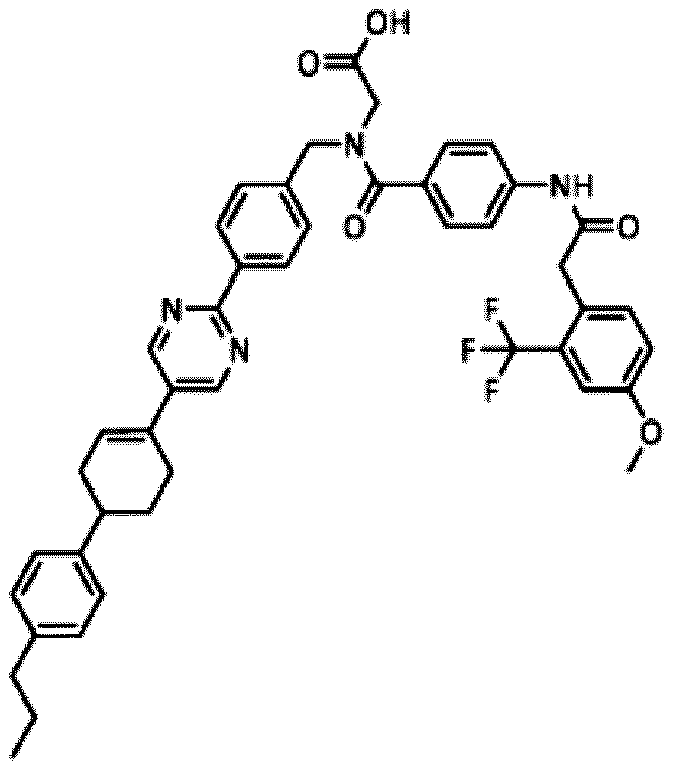
2 
3 
4 
5 
6 
7 
8 
9 
10 
11 
12 
13 
14 
15 
16 
17 
18 
19 
10 
21 
22 
23 
24 
25 
26 
27 
28 
29 
30 
31 
32 
33 
34 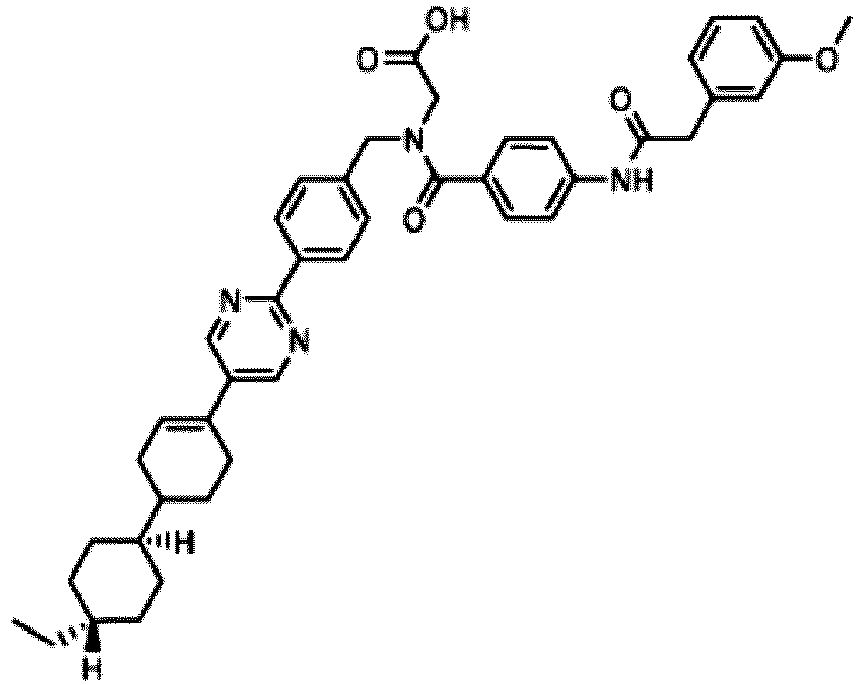
35 
3 6 
37 
38 
39 
40 
41 
42 
43 
44 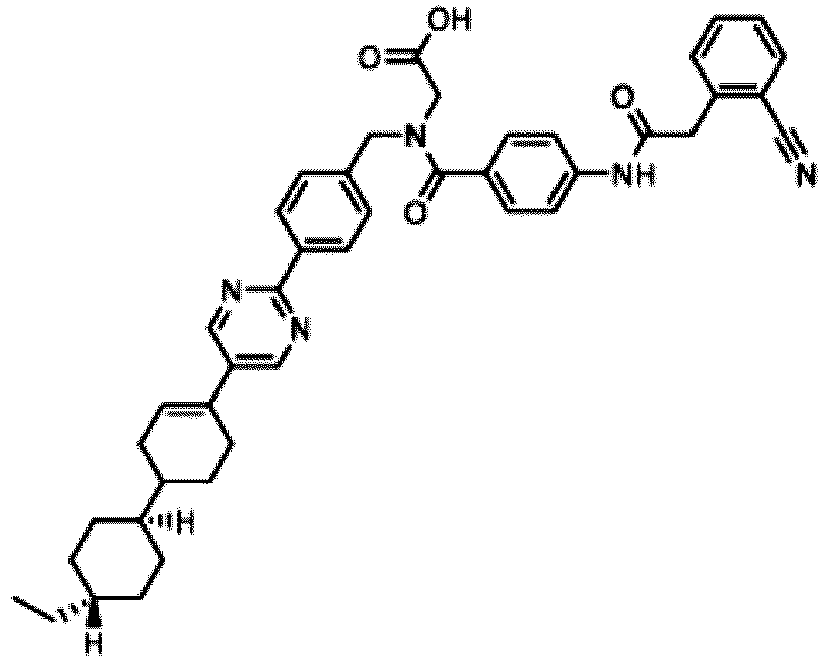
45 
46 
47 
48 
49 
50 
51 
52 
53 
54 
55 
56 
57 
58 
59 
60 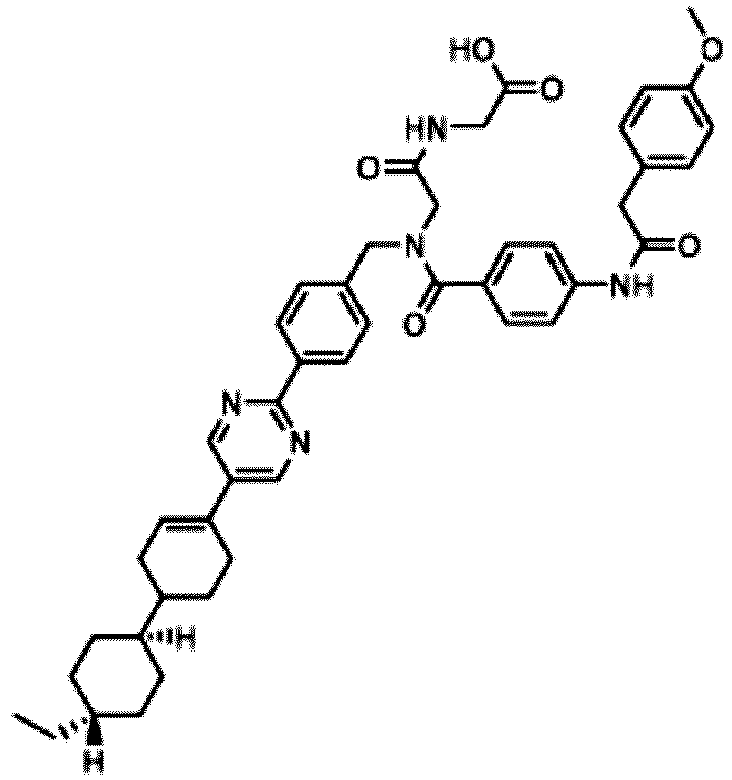
61 
62 
63 
64 
65 
66 
67 
68 
69 
70 
71 
72 
73 
74 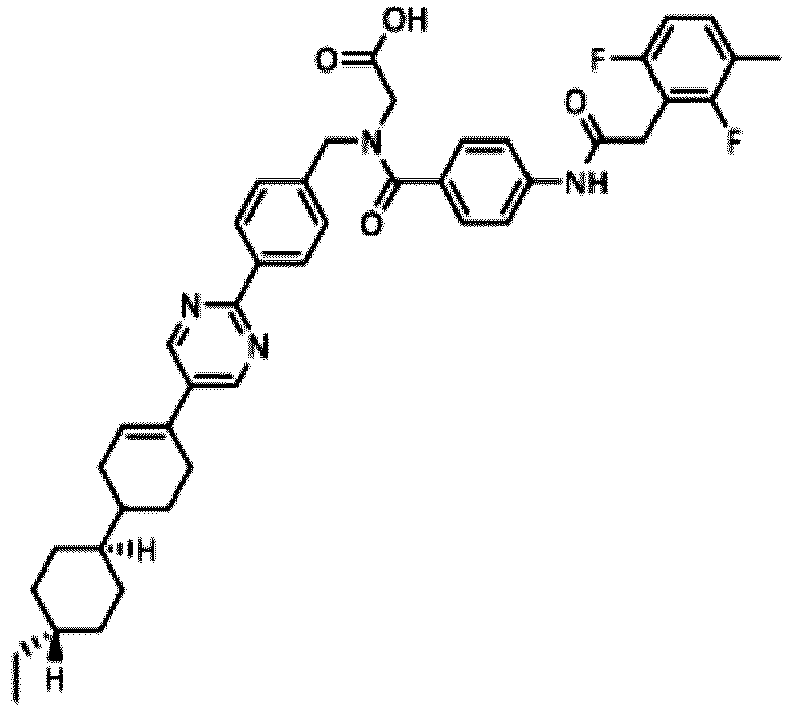
75 
76 
77 
78 
79 
80 
81 
82 
83 
84 
85 
86 
87 
88 
89 
90 
91 
92 
93 
94 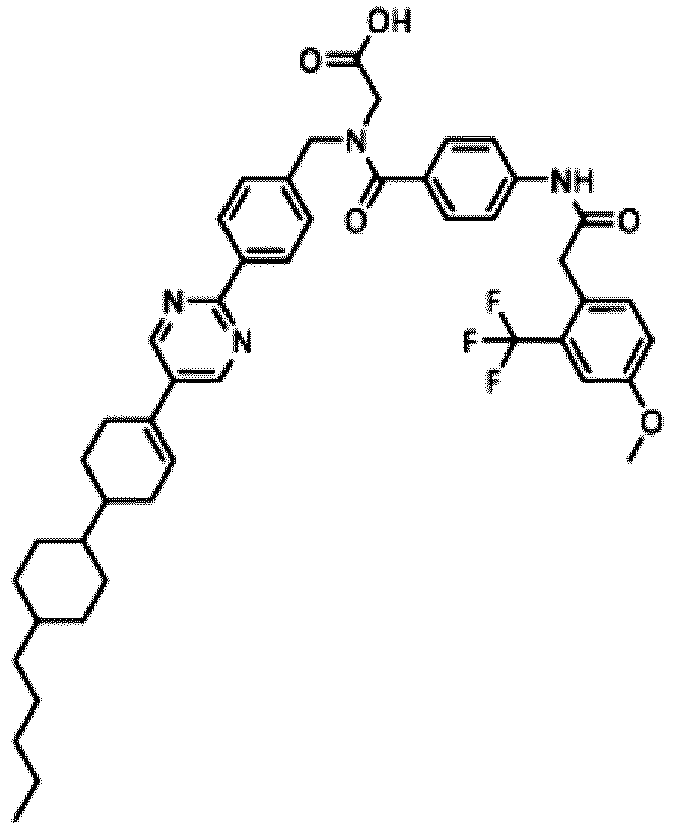
95 
96 
97 
98 
99 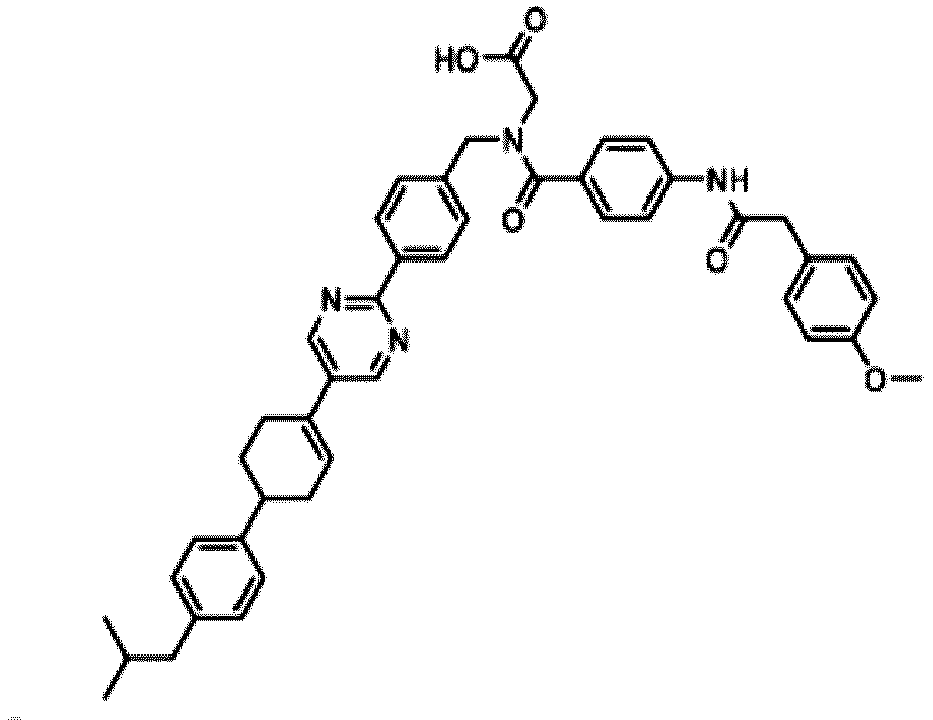
100 
101 
102 
103 
104 
105 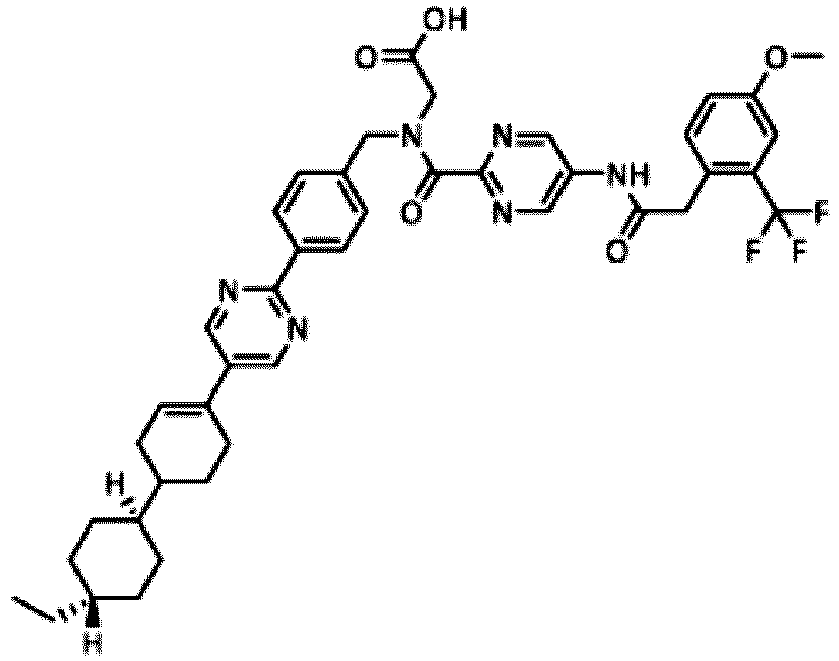
106 
107 
108 
109 
110 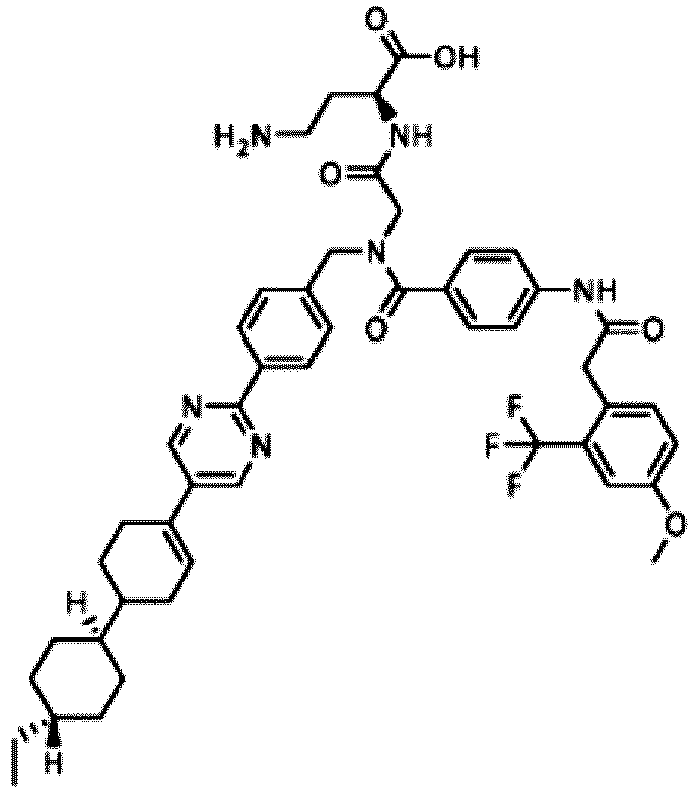
111 
112 
113 
114 
115 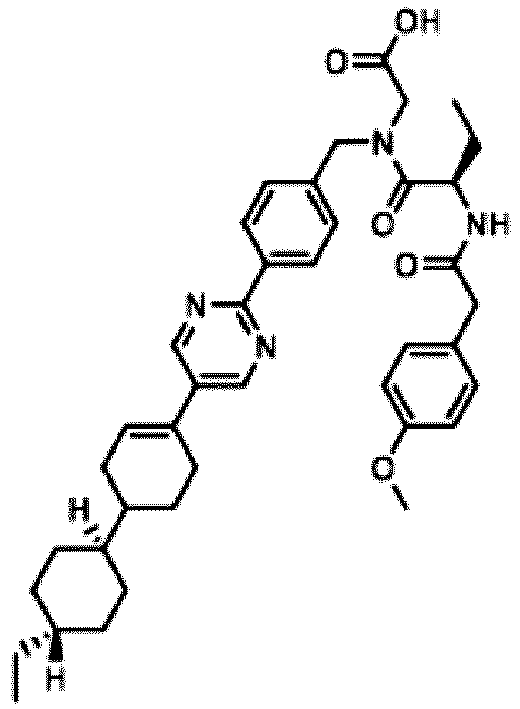
116 
117 
118 
119 
120 
121 
122 
123 
124 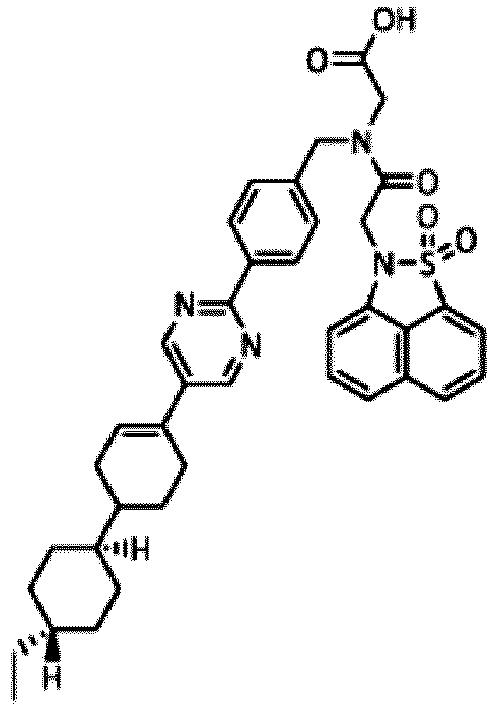
125 
126 
127 
128 
129 
130 
131 
132 
133 
134 
135 
136 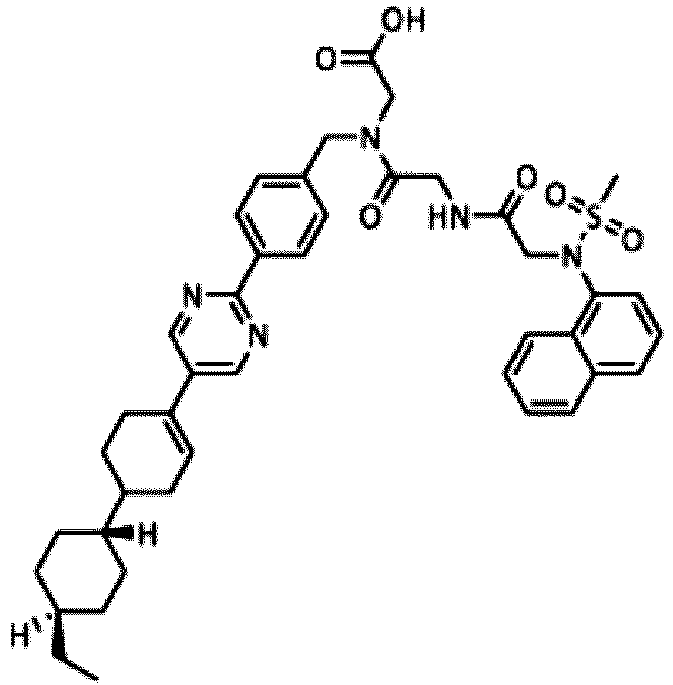
137 
138 
139 
140 
141 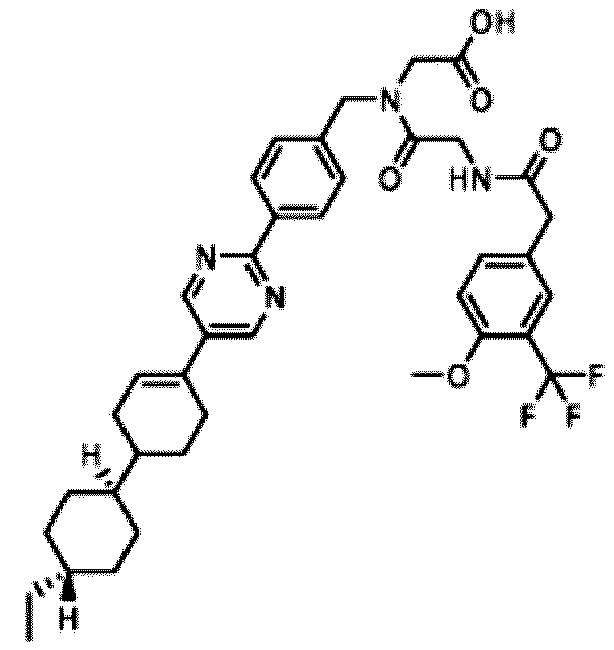
142 
143 
144 
145 
146 
147 
148 
149 
150 
151 
152 
153 - Composition pharmaceutique comprenant un composé selon l'une quelconque des revendications 1 à 12 ou un sel pharmaceutiquement acceptable correspondant conjointement avec au moins un support, diluant ou excipient pharmaceutiquement acceptable.
- Composé selon l'une quelconque des revendications 1 à 12 ou sel pharmaceutiquement acceptable correspondant pour une utilisation dans un procédé pour le traitement d'un état pathologique chez un patient pour lequel la modulation d'un récepteur du glucagon-like peptide 1 est médicalement indiquée, comprenant l'administration d'une quantité efficace du composé au patient à une fréquence et pendant une durée suffisantes pour fournir un effet bénéfique au patient, l'état pathologique étant sélectionné parmi :(i) le diabète de type I, le diabète de type II, le diabète gestationnel, l'obésité, l'appétit excessif, la satiété insuffisante, et un trouble métabolique ; ou(ii) une maladie du foie gras non alcoolique (NAFLD), et une stéatohépatite non alcoolique (NASH).
- Composition pharmaceutique selon la revendication 13 pour une utilisation dans un procédé pour le traitement d'un état pathologique chez un patient pour lequel la modulation d'un récepteur du glucagon-like peptide 1 est médicalement indiquée, comprenant l'administration d'une quantité efficace de la composition pharmaceutique au patient à une fréquence et pendant une durée suffisantes pour fournir un effet bénéfique au patient, l'état pathologique étant sélectionné parmi :(i) le diabète de type I, le diabète de type II, le diabète gestationnel, l'obésité, l'appétit excessif, la satiété insuffisante, et un trouble métabolique ; ou(ii) une maladie du foie gras non alcoolique (NAFLD), et une stéatohépatite non alcoolique (NASH).
Applications Claiming Priority (2)
| Application Number | Priority Date | Filing Date | Title |
|---|---|---|---|
| US201762491892P | 2017-04-28 | 2017-04-28 | |
| PCT/US2018/029597 WO2018200833A1 (fr) | 2017-04-28 | 2018-04-26 | Nouveaux modulateurs du récepteur du glp-1 |
Publications (2)
| Publication Number | Publication Date |
|---|---|
| EP3615524A1 EP3615524A1 (fr) | 2020-03-04 |
| EP3615524B1 true EP3615524B1 (fr) | 2022-11-09 |
Family
ID=62117189
Family Applications (1)
| Application Number | Title | Priority Date | Filing Date |
|---|---|---|---|
| EP18723347.3A Active EP3615524B1 (fr) | 2017-04-28 | 2018-04-26 | Nouveaux modulateurs du récepteur du glp-1 |
Country Status (7)
| Country | Link |
|---|---|
| US (1) | US11530205B2 (fr) |
| EP (1) | EP3615524B1 (fr) |
| JP (1) | JP7116745B2 (fr) |
| AU (1) | AU2018260686B2 (fr) |
| CA (1) | CA3060424A1 (fr) |
| ES (1) | ES2937835T3 (fr) |
| WO (1) | WO2018200833A1 (fr) |
Families Citing this family (6)
| Publication number | Priority date | Publication date | Assignee | Title |
|---|---|---|---|---|
| CN109503510B (zh) * | 2019-01-03 | 2020-07-03 | 山东大学 | 一种防龋抗菌的噻唑类化合物及其制备方法 |
| GB201908453D0 (en) | 2019-06-12 | 2019-07-24 | Enterprise Therapeutics Ltd | Compounds for treating respiratory disease |
| WO2023029380A1 (fr) | 2021-08-30 | 2023-03-09 | 杭州德睿智药科技有限公司 | Nouveau composé hétérocyclique substitué par un éther arylique utilisés en tant qu'agoniste du glp1r |
| CN114181187A (zh) * | 2021-11-24 | 2022-03-15 | 上海应用技术大学 | 一种4-甲磺酰胺基丁酰胺化合物的制备方法 |
| CN120981457A (zh) | 2023-09-14 | 2025-11-18 | 歌礼制药(中国)有限公司 | Glp-1r激动剂及其治疗方法 |
| TW202521534A (zh) | 2023-11-24 | 2025-06-01 | 香港商歌禮製藥(中國)有限公司 | Glp-1r 激動劑及其治療方法 |
Family Cites Families (6)
| Publication number | Priority date | Publication date | Assignee | Title |
|---|---|---|---|---|
| JP6007417B2 (ja) * | 2011-05-31 | 2016-10-12 | レセプトス エルエルシー | 新規glp−1受容体安定剤および調節剤 |
| BR112014013925B1 (pt) * | 2011-12-12 | 2022-02-22 | Receptos Llc | Compostos moduladores do receptor de glp-1 e composição e combinação farmacêutica compreendendo os ditos compostos |
| CN109867630A (zh) | 2013-06-11 | 2019-06-11 | 赛尔基因第二国际有限公司 | 新型glp-1受体调节剂 |
| KR101651505B1 (ko) * | 2014-05-02 | 2016-08-29 | 현대약품 주식회사 | 싸이클로 헥센 유도체, 이의 제조방법 및 이를 유효성분으로 함유하는 대사성 질환의 예방 또는 치료용 약학적 조성물 |
| CA2955836C (fr) * | 2014-07-25 | 2023-02-14 | Celgene International Ii Sarl | Nouveaux modulateurs du recepteur glp-1 |
| ES2844573T3 (es) * | 2014-12-10 | 2021-07-22 | Receptos Llc | Moduladores del receptor de GLP-1 |
-
2018
- 2018-04-26 WO PCT/US2018/029597 patent/WO2018200833A1/fr not_active Ceased
- 2018-04-26 AU AU2018260686A patent/AU2018260686B2/en not_active Ceased
- 2018-04-26 EP EP18723347.3A patent/EP3615524B1/fr active Active
- 2018-04-26 CA CA3060424A patent/CA3060424A1/fr active Pending
- 2018-04-26 ES ES18723347T patent/ES2937835T3/es active Active
- 2018-04-26 US US16/608,134 patent/US11530205B2/en active Active
- 2018-04-26 JP JP2019558778A patent/JP7116745B2/ja not_active Expired - Fee Related
Also Published As
| Publication number | Publication date |
|---|---|
| WO2018200833A1 (fr) | 2018-11-01 |
| AU2018260686A1 (en) | 2019-11-07 |
| CA3060424A1 (fr) | 2018-11-01 |
| US11530205B2 (en) | 2022-12-20 |
| US20210371409A1 (en) | 2021-12-02 |
| JP2020518571A (ja) | 2020-06-25 |
| EP3615524A1 (fr) | 2020-03-04 |
| JP7116745B2 (ja) | 2022-08-10 |
| ES2937835T3 (es) | 2023-03-31 |
| AU2018260686B2 (en) | 2022-03-17 |
Similar Documents
| Publication | Publication Date | Title |
|---|---|---|
| EP3615524B1 (fr) | Nouveaux modulateurs du récepteur du glp-1 | |
| EP3172199B1 (fr) | Dérivés de pyrimidine comme modulateurs du récepteur glp-1 | |
| EP2791112B1 (fr) | Dérivés d'acide carboxylique comprenant quatre cycles agissant comme modulateurs du récepteur glp-1 pour la thérapie de maladies telles que le diabète | |
| EP3008056B1 (fr) | Nouveaux modulateurs du récepteur glp-1 | |
| JP2013530963A (ja) | 新規のglp−1受容体安定化薬および調節薬 | |
| EP3230276B1 (fr) | Modulateurs du récepteur du glp-1 | |
| HK40042919A (en) | Novel glp-1 receptor modulators | |
| NZ626122B2 (en) | Carboxylic acid derivatives comprising four cycles acting as glp-1 receptor modulators for therapy of diseases such as diabetes | |
| HK1202864B (en) | Carboxylic acid derivatives comprising four cycles acting as glp-1 receptor modulators for therapy of diseases such as diabetes | |
| NZ715006B2 (en) | Novel glp-1 receptor modulators |
Legal Events
| Date | Code | Title | Description |
|---|---|---|---|
| STAA | Information on the status of an ep patent application or granted ep patent |
Free format text: STATUS: UNKNOWN |
|
| STAA | Information on the status of an ep patent application or granted ep patent |
Free format text: STATUS: THE INTERNATIONAL PUBLICATION HAS BEEN MADE |
|
| PUAI | Public reference made under article 153(3) epc to a published international application that has entered the european phase |
Free format text: ORIGINAL CODE: 0009012 |
|
| STAA | Information on the status of an ep patent application or granted ep patent |
Free format text: STATUS: REQUEST FOR EXAMINATION WAS MADE |
|
| 17P | Request for examination filed |
Effective date: 20191113 |
|
| AK | Designated contracting states |
Kind code of ref document: A1 Designated state(s): AL AT BE BG CH CY CZ DE DK EE ES FI FR GB GR HR HU IE IS IT LI LT LU LV MC MK MT NL NO PL PT RO RS SE SI SK SM TR |
|
| AX | Request for extension of the european patent |
Extension state: BA ME |
|
| DAV | Request for validation of the european patent (deleted) | ||
| DAX | Request for extension of the european patent (deleted) | ||
| RAP1 | Party data changed (applicant data changed or rights of an application transferred) |
Owner name: RECEPTOS LLC |
|
| STAA | Information on the status of an ep patent application or granted ep patent |
Free format text: STATUS: EXAMINATION IS IN PROGRESS |
|
| 17Q | First examination report despatched |
Effective date: 20211109 |
|
| GRAP | Despatch of communication of intention to grant a patent |
Free format text: ORIGINAL CODE: EPIDOSNIGR1 |
|
| STAA | Information on the status of an ep patent application or granted ep patent |
Free format text: STATUS: GRANT OF PATENT IS INTENDED |
|
| INTG | Intention to grant announced |
Effective date: 20220610 |
|
| GRAS | Grant fee paid |
Free format text: ORIGINAL CODE: EPIDOSNIGR3 |
|
| GRAA | (expected) grant |
Free format text: ORIGINAL CODE: 0009210 |
|
| STAA | Information on the status of an ep patent application or granted ep patent |
Free format text: STATUS: THE PATENT HAS BEEN GRANTED |
|
| AK | Designated contracting states |
Kind code of ref document: B1 Designated state(s): AL AT BE BG CH CY CZ DE DK EE ES FI FR GB GR HR HU IE IS IT LI LT LU LV MC MK MT NL NO PL PT RO RS SE SI SK SM TR |
|
| REG | Reference to a national code |
Ref country code: GB Ref legal event code: FG4D |
|
| REG | Reference to a national code |
Ref country code: CH Ref legal event code: EP Ref country code: AT Ref legal event code: REF Ref document number: 1530293 Country of ref document: AT Kind code of ref document: T Effective date: 20221115 |
|
| REG | Reference to a national code |
Ref country code: DE Ref legal event code: R096 Ref document number: 602018042835 Country of ref document: DE |
|
| REG | Reference to a national code |
Ref country code: IE Ref legal event code: FG4D |
|
| REG | Reference to a national code |
Ref country code: LT Ref legal event code: MG9D |
|
| REG | Reference to a national code |
Ref country code: NL Ref legal event code: MP Effective date: 20221109 |
|
| REG | Reference to a national code |
Ref country code: ES Ref legal event code: FG2A Ref document number: 2937835 Country of ref document: ES Kind code of ref document: T3 Effective date: 20230331 |
|
| REG | Reference to a national code |
Ref country code: AT Ref legal event code: MK05 Ref document number: 1530293 Country of ref document: AT Kind code of ref document: T Effective date: 20221109 |
|
| PG25 | Lapsed in a contracting state [announced via postgrant information from national office to epo] |
Ref country code: SE Free format text: LAPSE BECAUSE OF FAILURE TO SUBMIT A TRANSLATION OF THE DESCRIPTION OR TO PAY THE FEE WITHIN THE PRESCRIBED TIME-LIMIT Effective date: 20221109 Ref country code: PT Free format text: LAPSE BECAUSE OF FAILURE TO SUBMIT A TRANSLATION OF THE DESCRIPTION OR TO PAY THE FEE WITHIN THE PRESCRIBED TIME-LIMIT Effective date: 20230309 Ref country code: NO Free format text: LAPSE BECAUSE OF FAILURE TO SUBMIT A TRANSLATION OF THE DESCRIPTION OR TO PAY THE FEE WITHIN THE PRESCRIBED TIME-LIMIT Effective date: 20230209 Ref country code: LT Free format text: LAPSE BECAUSE OF FAILURE TO SUBMIT A TRANSLATION OF THE DESCRIPTION OR TO PAY THE FEE WITHIN THE PRESCRIBED TIME-LIMIT Effective date: 20221109 Ref country code: FI Free format text: LAPSE BECAUSE OF FAILURE TO SUBMIT A TRANSLATION OF THE DESCRIPTION OR TO PAY THE FEE WITHIN THE PRESCRIBED TIME-LIMIT Effective date: 20221109 Ref country code: AT Free format text: LAPSE BECAUSE OF FAILURE TO SUBMIT A TRANSLATION OF THE DESCRIPTION OR TO PAY THE FEE WITHIN THE PRESCRIBED TIME-LIMIT Effective date: 20221109 |
|
| PGFP | Annual fee paid to national office [announced via postgrant information from national office to epo] |
Ref country code: FR Payment date: 20230309 Year of fee payment: 6 |
|
| PG25 | Lapsed in a contracting state [announced via postgrant information from national office to epo] |
Ref country code: RS Free format text: LAPSE BECAUSE OF FAILURE TO SUBMIT A TRANSLATION OF THE DESCRIPTION OR TO PAY THE FEE WITHIN THE PRESCRIBED TIME-LIMIT Effective date: 20221109 Ref country code: PL Free format text: LAPSE BECAUSE OF FAILURE TO SUBMIT A TRANSLATION OF THE DESCRIPTION OR TO PAY THE FEE WITHIN THE PRESCRIBED TIME-LIMIT Effective date: 20221109 Ref country code: LV Free format text: LAPSE BECAUSE OF FAILURE TO SUBMIT A TRANSLATION OF THE DESCRIPTION OR TO PAY THE FEE WITHIN THE PRESCRIBED TIME-LIMIT Effective date: 20221109 Ref country code: IS Free format text: LAPSE BECAUSE OF FAILURE TO SUBMIT A TRANSLATION OF THE DESCRIPTION OR TO PAY THE FEE WITHIN THE PRESCRIBED TIME-LIMIT Effective date: 20230309 Ref country code: HR Free format text: LAPSE BECAUSE OF FAILURE TO SUBMIT A TRANSLATION OF THE DESCRIPTION OR TO PAY THE FEE WITHIN THE PRESCRIBED TIME-LIMIT Effective date: 20221109 Ref country code: GR Free format text: LAPSE BECAUSE OF FAILURE TO SUBMIT A TRANSLATION OF THE DESCRIPTION OR TO PAY THE FEE WITHIN THE PRESCRIBED TIME-LIMIT Effective date: 20230210 |
|
| PGFP | Annual fee paid to national office [announced via postgrant information from national office to epo] |
Ref country code: IT Payment date: 20230310 Year of fee payment: 6 Ref country code: GB Payment date: 20230302 Year of fee payment: 6 |
|
| P01 | Opt-out of the competence of the unified patent court (upc) registered |
Effective date: 20230520 |
|
| PG25 | Lapsed in a contracting state [announced via postgrant information from national office to epo] |
Ref country code: NL Free format text: LAPSE BECAUSE OF FAILURE TO SUBMIT A TRANSLATION OF THE DESCRIPTION OR TO PAY THE FEE WITHIN THE PRESCRIBED TIME-LIMIT Effective date: 20221109 |
|
| PG25 | Lapsed in a contracting state [announced via postgrant information from national office to epo] |
Ref country code: SM Free format text: LAPSE BECAUSE OF FAILURE TO SUBMIT A TRANSLATION OF THE DESCRIPTION OR TO PAY THE FEE WITHIN THE PRESCRIBED TIME-LIMIT Effective date: 20221109 Ref country code: RO Free format text: LAPSE BECAUSE OF FAILURE TO SUBMIT A TRANSLATION OF THE DESCRIPTION OR TO PAY THE FEE WITHIN THE PRESCRIBED TIME-LIMIT Effective date: 20221109 Ref country code: EE Free format text: LAPSE BECAUSE OF FAILURE TO SUBMIT A TRANSLATION OF THE DESCRIPTION OR TO PAY THE FEE WITHIN THE PRESCRIBED TIME-LIMIT Effective date: 20221109 Ref country code: DK Free format text: LAPSE BECAUSE OF FAILURE TO SUBMIT A TRANSLATION OF THE DESCRIPTION OR TO PAY THE FEE WITHIN THE PRESCRIBED TIME-LIMIT Effective date: 20221109 Ref country code: CZ Free format text: LAPSE BECAUSE OF FAILURE TO SUBMIT A TRANSLATION OF THE DESCRIPTION OR TO PAY THE FEE WITHIN THE PRESCRIBED TIME-LIMIT Effective date: 20221109 |
|
| PGFP | Annual fee paid to national office [announced via postgrant information from national office to epo] |
Ref country code: ES Payment date: 20230510 Year of fee payment: 6 Ref country code: DE Payment date: 20230228 Year of fee payment: 6 |
|
| REG | Reference to a national code |
Ref country code: DE Ref legal event code: R097 Ref document number: 602018042835 Country of ref document: DE |
|
| PG25 | Lapsed in a contracting state [announced via postgrant information from national office to epo] |
Ref country code: SK Free format text: LAPSE BECAUSE OF FAILURE TO SUBMIT A TRANSLATION OF THE DESCRIPTION OR TO PAY THE FEE WITHIN THE PRESCRIBED TIME-LIMIT Effective date: 20221109 Ref country code: AL Free format text: LAPSE BECAUSE OF FAILURE TO SUBMIT A TRANSLATION OF THE DESCRIPTION OR TO PAY THE FEE WITHIN THE PRESCRIBED TIME-LIMIT Effective date: 20221109 |
|
| PLBE | No opposition filed within time limit |
Free format text: ORIGINAL CODE: 0009261 |
|
| STAA | Information on the status of an ep patent application or granted ep patent |
Free format text: STATUS: NO OPPOSITION FILED WITHIN TIME LIMIT |
|
| 26N | No opposition filed |
Effective date: 20230810 |
|
| PG25 | Lapsed in a contracting state [announced via postgrant information from national office to epo] |
Ref country code: SI Free format text: LAPSE BECAUSE OF FAILURE TO SUBMIT A TRANSLATION OF THE DESCRIPTION OR TO PAY THE FEE WITHIN THE PRESCRIBED TIME-LIMIT Effective date: 20221109 |
|
| REG | Reference to a national code |
Ref country code: CH Ref legal event code: PL |
|
| PG25 | Lapsed in a contracting state [announced via postgrant information from national office to epo] |
Ref country code: LU Free format text: LAPSE BECAUSE OF NON-PAYMENT OF DUE FEES Effective date: 20230426 |
|
| REG | Reference to a national code |
Ref country code: BE Ref legal event code: MM Effective date: 20230430 |
|
| PG25 | Lapsed in a contracting state [announced via postgrant information from national office to epo] |
Ref country code: MC Free format text: LAPSE BECAUSE OF FAILURE TO SUBMIT A TRANSLATION OF THE DESCRIPTION OR TO PAY THE FEE WITHIN THE PRESCRIBED TIME-LIMIT Effective date: 20221109 |
|
| PG25 | Lapsed in a contracting state [announced via postgrant information from national office to epo] |
Ref country code: MC Free format text: LAPSE BECAUSE OF FAILURE TO SUBMIT A TRANSLATION OF THE DESCRIPTION OR TO PAY THE FEE WITHIN THE PRESCRIBED TIME-LIMIT Effective date: 20221109 Ref country code: LI Free format text: LAPSE BECAUSE OF NON-PAYMENT OF DUE FEES Effective date: 20230430 Ref country code: CH Free format text: LAPSE BECAUSE OF NON-PAYMENT OF DUE FEES Effective date: 20230430 |
|
| REG | Reference to a national code |
Ref country code: IE Ref legal event code: MM4A |
|
| PG25 | Lapsed in a contracting state [announced via postgrant information from national office to epo] |
Ref country code: BE Free format text: LAPSE BECAUSE OF NON-PAYMENT OF DUE FEES Effective date: 20230430 |
|
| PG25 | Lapsed in a contracting state [announced via postgrant information from national office to epo] |
Ref country code: IE Free format text: LAPSE BECAUSE OF NON-PAYMENT OF DUE FEES Effective date: 20230426 |
|
| PG25 | Lapsed in a contracting state [announced via postgrant information from national office to epo] |
Ref country code: IE Free format text: LAPSE BECAUSE OF NON-PAYMENT OF DUE FEES Effective date: 20230426 |
|
| REG | Reference to a national code |
Ref country code: DE Ref legal event code: R119 Ref document number: 602018042835 Country of ref document: DE |
|
| PG25 | Lapsed in a contracting state [announced via postgrant information from national office to epo] |
Ref country code: BG Free format text: LAPSE BECAUSE OF FAILURE TO SUBMIT A TRANSLATION OF THE DESCRIPTION OR TO PAY THE FEE WITHIN THE PRESCRIBED TIME-LIMIT Effective date: 20221109 |
|
| PG25 | Lapsed in a contracting state [announced via postgrant information from national office to epo] |
Ref country code: BG Free format text: LAPSE BECAUSE OF FAILURE TO SUBMIT A TRANSLATION OF THE DESCRIPTION OR TO PAY THE FEE WITHIN THE PRESCRIBED TIME-LIMIT Effective date: 20221109 |
|
| GBPC | Gb: european patent ceased through non-payment of renewal fee |
Effective date: 20240426 |
|
| PG25 | Lapsed in a contracting state [announced via postgrant information from national office to epo] |
Ref country code: DE Free format text: LAPSE BECAUSE OF NON-PAYMENT OF DUE FEES Effective date: 20241105 |
|
| PG25 | Lapsed in a contracting state [announced via postgrant information from national office to epo] |
Ref country code: GB Free format text: LAPSE BECAUSE OF NON-PAYMENT OF DUE FEES Effective date: 20240426 |
|
| PG25 | Lapsed in a contracting state [announced via postgrant information from national office to epo] |
Ref country code: FR Free format text: LAPSE BECAUSE OF NON-PAYMENT OF DUE FEES Effective date: 20240430 |
|
| PG25 | Lapsed in a contracting state [announced via postgrant information from national office to epo] |
Ref country code: GB Free format text: LAPSE BECAUSE OF NON-PAYMENT OF DUE FEES Effective date: 20240426 Ref country code: FR Free format text: LAPSE BECAUSE OF NON-PAYMENT OF DUE FEES Effective date: 20240430 Ref country code: DE Free format text: LAPSE BECAUSE OF NON-PAYMENT OF DUE FEES Effective date: 20241105 |
|
| PG25 | Lapsed in a contracting state [announced via postgrant information from national office to epo] |
Ref country code: IT Free format text: LAPSE BECAUSE OF NON-PAYMENT OF DUE FEES Effective date: 20240426 |
|
| REG | Reference to a national code |
Ref country code: ES Ref legal event code: FD2A Effective date: 20250530 |
|
| PG25 | Lapsed in a contracting state [announced via postgrant information from national office to epo] |
Ref country code: ES Free format text: LAPSE BECAUSE OF NON-PAYMENT OF DUE FEES Effective date: 20240427 |
|
| PG25 | Lapsed in a contracting state [announced via postgrant information from national office to epo] |
Ref country code: CY Free format text: LAPSE BECAUSE OF FAILURE TO SUBMIT A TRANSLATION OF THE DESCRIPTION OR TO PAY THE FEE WITHIN THE PRESCRIBED TIME-LIMIT; INVALID AB INITIO Effective date: 20180426 |
|
| PG25 | Lapsed in a contracting state [announced via postgrant information from national office to epo] |
Ref country code: HU Free format text: LAPSE BECAUSE OF FAILURE TO SUBMIT A TRANSLATION OF THE DESCRIPTION OR TO PAY THE FEE WITHIN THE PRESCRIBED TIME-LIMIT; INVALID AB INITIO Effective date: 20180426 |
|
| PG25 | Lapsed in a contracting state [announced via postgrant information from national office to epo] |
Ref country code: TR Free format text: LAPSE BECAUSE OF FAILURE TO SUBMIT A TRANSLATION OF THE DESCRIPTION OR TO PAY THE FEE WITHIN THE PRESCRIBED TIME-LIMIT Effective date: 20221109 |