EP3615577B1 - Polymères ramifiés - Google Patents
Polymères ramifiés Download PDFInfo
- Publication number
- EP3615577B1 EP3615577B1 EP18728695.0A EP18728695A EP3615577B1 EP 3615577 B1 EP3615577 B1 EP 3615577B1 EP 18728695 A EP18728695 A EP 18728695A EP 3615577 B1 EP3615577 B1 EP 3615577B1
- Authority
- EP
- European Patent Office
- Prior art keywords
- monomer
- vinyl
- polymer
- multivinyl
- residues
- Prior art date
- Legal status (The legal status is an assumption and is not a legal conclusion. Google has not performed a legal analysis and makes no representation as to the accuracy of the status listed.)
- Active
Links
Images







Classifications
-
- C—CHEMISTRY; METALLURGY
- C08—ORGANIC MACROMOLECULAR COMPOUNDS; THEIR PREPARATION OR CHEMICAL WORKING-UP; COMPOSITIONS BASED THEREON
- C08F—MACROMOLECULAR COMPOUNDS OBTAINED BY REACTIONS ONLY INVOLVING CARBON-TO-CARBON UNSATURATED BONDS
- C08F2/00—Processes of polymerisation
- C08F2/38—Polymerisation using regulators, e.g. chain terminating agents, e.g. telomerisation
-
- C—CHEMISTRY; METALLURGY
- C08—ORGANIC MACROMOLECULAR COMPOUNDS; THEIR PREPARATION OR CHEMICAL WORKING-UP; COMPOSITIONS BASED THEREON
- C08F—MACROMOLECULAR COMPOUNDS OBTAINED BY REACTIONS ONLY INVOLVING CARBON-TO-CARBON UNSATURATED BONDS
- C08F12/00—Homopolymers and copolymers of compounds having one or more unsaturated aliphatic radicals, each having only one carbon-to-carbon double bond, and at least one being terminated by an aromatic carbocyclic ring
- C08F12/34—Monomers containing two or more unsaturated aliphatic radicals
- C08F12/36—Divinylbenzene
-
- C—CHEMISTRY; METALLURGY
- C08—ORGANIC MACROMOLECULAR COMPOUNDS; THEIR PREPARATION OR CHEMICAL WORKING-UP; COMPOSITIONS BASED THEREON
- C08F—MACROMOLECULAR COMPOUNDS OBTAINED BY REACTIONS ONLY INVOLVING CARBON-TO-CARBON UNSATURATED BONDS
- C08F122/00—Homopolymers of compounds having one or more unsaturated aliphatic radicals each having only one carbon-to-carbon double bond, and at least one being terminated by a carboxyl radical and containing at least one other carboxyl radical in the molecule; Salts, anhydrides, esters, amides, imides or nitriles thereof
- C08F122/10—Esters
- C08F122/1006—Esters of polyhydric alcohols or polyhydric phenols, e.g. ethylene glycol dimethacrylate
-
- C—CHEMISTRY; METALLURGY
- C08—ORGANIC MACROMOLECULAR COMPOUNDS; THEIR PREPARATION OR CHEMICAL WORKING-UP; COMPOSITIONS BASED THEREON
- C08F—MACROMOLECULAR COMPOUNDS OBTAINED BY REACTIONS ONLY INVOLVING CARBON-TO-CARBON UNSATURATED BONDS
- C08F122/00—Homopolymers of compounds having one or more unsaturated aliphatic radicals each having only one carbon-to-carbon double bond, and at least one being terminated by a carboxyl radical and containing at least one other carboxyl radical in the molecule; Salts, anhydrides, esters, amides, imides or nitriles thereof
- C08F122/36—Amides or imides
- C08F122/38—Amides
- C08F122/385—Monomers containing two or more (meth)acrylamide groups, e.g. N,N'-methylenebisacrylamide
-
- C—CHEMISTRY; METALLURGY
- C08—ORGANIC MACROMOLECULAR COMPOUNDS; THEIR PREPARATION OR CHEMICAL WORKING-UP; COMPOSITIONS BASED THEREON
- C08F—MACROMOLECULAR COMPOUNDS OBTAINED BY REACTIONS ONLY INVOLVING CARBON-TO-CARBON UNSATURATED BONDS
- C08F220/00—Copolymers of compounds having one or more unsaturated aliphatic radicals, each having only one carbon-to-carbon double bond, and only one being terminated by only one carboxyl radical or a salt, anhydride ester, amide, imide or nitrile thereof
- C08F220/02—Monocarboxylic acids having less than ten carbon atoms; Derivatives thereof
- C08F220/10—Esters
- C08F220/12—Esters of monohydric alcohols or phenols
- C08F220/16—Esters of monohydric alcohols or phenols of phenols or of alcohols containing two or more carbon atoms
- C08F220/18—Esters of monohydric alcohols or phenols of phenols or of alcohols containing two or more carbon atoms with acrylic or methacrylic acids
- C08F220/1807—C7-(meth)acrylate, e.g. heptyl (meth)acrylate or benzyl (meth)acrylate
-
- C—CHEMISTRY; METALLURGY
- C08—ORGANIC MACROMOLECULAR COMPOUNDS; THEIR PREPARATION OR CHEMICAL WORKING-UP; COMPOSITIONS BASED THEREON
- C08F—MACROMOLECULAR COMPOUNDS OBTAINED BY REACTIONS ONLY INVOLVING CARBON-TO-CARBON UNSATURATED BONDS
- C08F222/00—Copolymers of compounds having one or more unsaturated aliphatic radicals, each having only one carbon-to-carbon double bond, and at least one being terminated by a carboxyl radical and containing at least one other carboxyl radical in the molecule; Salts, anhydrides, esters, amides, imides, or nitriles thereof
- C08F222/10—Esters
-
- C—CHEMISTRY; METALLURGY
- C08—ORGANIC MACROMOLECULAR COMPOUNDS; THEIR PREPARATION OR CHEMICAL WORKING-UP; COMPOSITIONS BASED THEREON
- C08F—MACROMOLECULAR COMPOUNDS OBTAINED BY REACTIONS ONLY INVOLVING CARBON-TO-CARBON UNSATURATED BONDS
- C08F222/00—Copolymers of compounds having one or more unsaturated aliphatic radicals, each having only one carbon-to-carbon double bond, and at least one being terminated by a carboxyl radical and containing at least one other carboxyl radical in the molecule; Salts, anhydrides, esters, amides, imides, or nitriles thereof
- C08F222/10—Esters
- C08F222/1006—Esters of polyhydric alcohols or polyhydric phenols
- C08F222/102—Esters of polyhydric alcohols or polyhydric phenols of dialcohols, e.g. ethylene glycol di(meth)acrylate or 1,4-butanediol dimethacrylate
-
- C—CHEMISTRY; METALLURGY
- C08—ORGANIC MACROMOLECULAR COMPOUNDS; THEIR PREPARATION OR CHEMICAL WORKING-UP; COMPOSITIONS BASED THEREON
- C08F—MACROMOLECULAR COMPOUNDS OBTAINED BY REACTIONS ONLY INVOLVING CARBON-TO-CARBON UNSATURATED BONDS
- C08F222/00—Copolymers of compounds having one or more unsaturated aliphatic radicals, each having only one carbon-to-carbon double bond, and at least one being terminated by a carboxyl radical and containing at least one other carboxyl radical in the molecule; Salts, anhydrides, esters, amides, imides, or nitriles thereof
- C08F222/10—Esters
- C08F222/1006—Esters of polyhydric alcohols or polyhydric phenols
- C08F222/106—Esters of polycondensation macromers
- C08F222/1063—Esters of polycondensation macromers of alcohol terminated polyethers
-
- C—CHEMISTRY; METALLURGY
- C08—ORGANIC MACROMOLECULAR COMPOUNDS; THEIR PREPARATION OR CHEMICAL WORKING-UP; COMPOSITIONS BASED THEREON
- C08F—MACROMOLECULAR COMPOUNDS OBTAINED BY REACTIONS ONLY INVOLVING CARBON-TO-CARBON UNSATURATED BONDS
- C08F222/00—Copolymers of compounds having one or more unsaturated aliphatic radicals, each having only one carbon-to-carbon double bond, and at least one being terminated by a carboxyl radical and containing at least one other carboxyl radical in the molecule; Salts, anhydrides, esters, amides, imides, or nitriles thereof
- C08F222/10—Esters
- C08F222/1006—Esters of polyhydric alcohols or polyhydric phenols
- C08F222/106—Esters of polycondensation macromers
- C08F222/1067—Esters of polycondensation macromers of alcohol terminated epoxy functional polymers, e.g. epoxy(meth)acrylates
-
- C—CHEMISTRY; METALLURGY
- C08—ORGANIC MACROMOLECULAR COMPOUNDS; THEIR PREPARATION OR CHEMICAL WORKING-UP; COMPOSITIONS BASED THEREON
- C08F—MACROMOLECULAR COMPOUNDS OBTAINED BY REACTIONS ONLY INVOLVING CARBON-TO-CARBON UNSATURATED BONDS
- C08F222/00—Copolymers of compounds having one or more unsaturated aliphatic radicals, each having only one carbon-to-carbon double bond, and at least one being terminated by a carboxyl radical and containing at least one other carboxyl radical in the molecule; Salts, anhydrides, esters, amides, imides, or nitriles thereof
- C08F222/36—Amides or imides
- C08F222/38—Amides
- C08F222/385—Monomers containing two or more (meth)acrylamide groups, e.g. N,N'-methylenebisacrylamide
-
- C—CHEMISTRY; METALLURGY
- C08—ORGANIC MACROMOLECULAR COMPOUNDS; THEIR PREPARATION OR CHEMICAL WORKING-UP; COMPOSITIONS BASED THEREON
- C08F—MACROMOLECULAR COMPOUNDS OBTAINED BY REACTIONS ONLY INVOLVING CARBON-TO-CARBON UNSATURATED BONDS
- C08F4/00—Polymerisation catalysts
- C08F4/04—Azo-compounds
-
- C—CHEMISTRY; METALLURGY
- C08—ORGANIC MACROMOLECULAR COMPOUNDS; THEIR PREPARATION OR CHEMICAL WORKING-UP; COMPOSITIONS BASED THEREON
- C08G—MACROMOLECULAR COMPOUNDS OBTAINED OTHERWISE THAN BY REACTIONS ONLY INVOLVING UNSATURATED CARBON-TO-CARBON BONDS
- C08G83/00—Macromolecular compounds not provided for in groups C08G2/00 - C08G81/00
- C08G83/002—Dendritic macromolecules
- C08G83/005—Hyperbranched macromolecules
-
- C—CHEMISTRY; METALLURGY
- C08—ORGANIC MACROMOLECULAR COMPOUNDS; THEIR PREPARATION OR CHEMICAL WORKING-UP; COMPOSITIONS BASED THEREON
- C08F—MACROMOLECULAR COMPOUNDS OBTAINED BY REACTIONS ONLY INVOLVING CARBON-TO-CARBON UNSATURATED BONDS
- C08F112/00—Homopolymers of compounds having one or more unsaturated aliphatic radicals, each having only one carbon-to-carbon double bond, and at least one being terminated by an aromatic carbocyclic ring
- C08F112/34—Monomers containing two or more unsaturated aliphatic radicals
- C08F112/36—Divinylbenzene
-
- C—CHEMISTRY; METALLURGY
- C08—ORGANIC MACROMOLECULAR COMPOUNDS; THEIR PREPARATION OR CHEMICAL WORKING-UP; COMPOSITIONS BASED THEREON
- C08F—MACROMOLECULAR COMPOUNDS OBTAINED BY REACTIONS ONLY INVOLVING CARBON-TO-CARBON UNSATURATED BONDS
- C08F132/00—Homopolymers of cyclic compounds containing no unsaturated aliphatic radicals in a side chain, and having one or more carbon-to-carbon double bonds in a carbocyclic ring system
- C08F132/02—Homopolymers of cyclic compounds containing no unsaturated aliphatic radicals in a side chain, and having one or more carbon-to-carbon double bonds in a carbocyclic ring system having no condensed rings
- C08F132/06—Homopolymers of cyclic compounds containing no unsaturated aliphatic radicals in a side chain, and having one or more carbon-to-carbon double bonds in a carbocyclic ring system having no condensed rings having two or more carbon-to-carbon double bonds
-
- C—CHEMISTRY; METALLURGY
- C08—ORGANIC MACROMOLECULAR COMPOUNDS; THEIR PREPARATION OR CHEMICAL WORKING-UP; COMPOSITIONS BASED THEREON
- C08F—MACROMOLECULAR COMPOUNDS OBTAINED BY REACTIONS ONLY INVOLVING CARBON-TO-CARBON UNSATURATED BONDS
- C08F136/00—Homopolymers of compounds having one or more unsaturated aliphatic radicals, at least one having two or more carbon-to-carbon double bonds
- C08F136/02—Homopolymers of compounds having one or more unsaturated aliphatic radicals, at least one having two or more carbon-to-carbon double bonds the radical having only two carbon-to-carbon double bonds
- C08F136/20—Homopolymers of compounds having one or more unsaturated aliphatic radicals, at least one having two or more carbon-to-carbon double bonds the radical having only two carbon-to-carbon double bonds unconjugated
-
- C—CHEMISTRY; METALLURGY
- C08—ORGANIC MACROMOLECULAR COMPOUNDS; THEIR PREPARATION OR CHEMICAL WORKING-UP; COMPOSITIONS BASED THEREON
- C08F—MACROMOLECULAR COMPOUNDS OBTAINED BY REACTIONS ONLY INVOLVING CARBON-TO-CARBON UNSATURATED BONDS
- C08F2/00—Processes of polymerisation
- C08F2/38—Polymerisation using regulators, e.g. chain terminating agents, e.g. telomerisation
- C08F2/40—Polymerisation using regulators, e.g. chain terminating agents, e.g. telomerisation using retarding agents
-
- C—CHEMISTRY; METALLURGY
- C08—ORGANIC MACROMOLECULAR COMPOUNDS; THEIR PREPARATION OR CHEMICAL WORKING-UP; COMPOSITIONS BASED THEREON
- C08F—MACROMOLECULAR COMPOUNDS OBTAINED BY REACTIONS ONLY INVOLVING CARBON-TO-CARBON UNSATURATED BONDS
- C08F2/00—Processes of polymerisation
- C08F2/38—Polymerisation using regulators, e.g. chain terminating agents, e.g. telomerisation
- C08F2/42—Polymerisation using regulators, e.g. chain terminating agents, e.g. telomerisation using short-stopping agents
-
- C—CHEMISTRY; METALLURGY
- C08—ORGANIC MACROMOLECULAR COMPOUNDS; THEIR PREPARATION OR CHEMICAL WORKING-UP; COMPOSITIONS BASED THEREON
- C08F—MACROMOLECULAR COMPOUNDS OBTAINED BY REACTIONS ONLY INVOLVING CARBON-TO-CARBON UNSATURATED BONDS
- C08F212/00—Copolymers of compounds having one or more unsaturated aliphatic radicals, each having only one carbon-to-carbon double bond, and at least one being terminated by an aromatic carbocyclic ring
- C08F212/34—Monomers containing two or more unsaturated aliphatic radicals
- C08F212/36—Divinylbenzene
-
- C—CHEMISTRY; METALLURGY
- C08—ORGANIC MACROMOLECULAR COMPOUNDS; THEIR PREPARATION OR CHEMICAL WORKING-UP; COMPOSITIONS BASED THEREON
- C08F—MACROMOLECULAR COMPOUNDS OBTAINED BY REACTIONS ONLY INVOLVING CARBON-TO-CARBON UNSATURATED BONDS
- C08F222/00—Copolymers of compounds having one or more unsaturated aliphatic radicals, each having only one carbon-to-carbon double bond, and at least one being terminated by a carboxyl radical and containing at least one other carboxyl radical in the molecule; Salts, anhydrides, esters, amides, imides, or nitriles thereof
- C08F222/10—Esters
- C08F222/1006—Esters of polyhydric alcohols or polyhydric phenols
- C08F222/102—Esters of polyhydric alcohols or polyhydric phenols of dialcohols, e.g. ethylene glycol di(meth)acrylate or 1,4-butanediol dimethacrylate
- C08F222/1025—Esters of polyhydric alcohols or polyhydric phenols of dialcohols, e.g. ethylene glycol di(meth)acrylate or 1,4-butanediol dimethacrylate of aromatic dialcohols
-
- C—CHEMISTRY; METALLURGY
- C08—ORGANIC MACROMOLECULAR COMPOUNDS; THEIR PREPARATION OR CHEMICAL WORKING-UP; COMPOSITIONS BASED THEREON
- C08F—MACROMOLECULAR COMPOUNDS OBTAINED BY REACTIONS ONLY INVOLVING CARBON-TO-CARBON UNSATURATED BONDS
- C08F222/00—Copolymers of compounds having one or more unsaturated aliphatic radicals, each having only one carbon-to-carbon double bond, and at least one being terminated by a carboxyl radical and containing at least one other carboxyl radical in the molecule; Salts, anhydrides, esters, amides, imides, or nitriles thereof
- C08F222/10—Esters
- C08F222/1006—Esters of polyhydric alcohols or polyhydric phenols
- C08F222/103—Esters of polyhydric alcohols or polyhydric phenols of trialcohols, e.g. trimethylolpropane tri(meth)acrylate
-
- C—CHEMISTRY; METALLURGY
- C08—ORGANIC MACROMOLECULAR COMPOUNDS; THEIR PREPARATION OR CHEMICAL WORKING-UP; COMPOSITIONS BASED THEREON
- C08F—MACROMOLECULAR COMPOUNDS OBTAINED BY REACTIONS ONLY INVOLVING CARBON-TO-CARBON UNSATURATED BONDS
- C08F222/00—Copolymers of compounds having one or more unsaturated aliphatic radicals, each having only one carbon-to-carbon double bond, and at least one being terminated by a carboxyl radical and containing at least one other carboxyl radical in the molecule; Salts, anhydrides, esters, amides, imides, or nitriles thereof
- C08F222/10—Esters
- C08F222/1006—Esters of polyhydric alcohols or polyhydric phenols
- C08F222/103—Esters of polyhydric alcohols or polyhydric phenols of trialcohols, e.g. trimethylolpropane tri(meth)acrylate
- C08F222/1035—Esters of polyhydric alcohols or polyhydric phenols of trialcohols, e.g. trimethylolpropane tri(meth)acrylate of aromatic trialcohols
-
- C—CHEMISTRY; METALLURGY
- C08—ORGANIC MACROMOLECULAR COMPOUNDS; THEIR PREPARATION OR CHEMICAL WORKING-UP; COMPOSITIONS BASED THEREON
- C08F—MACROMOLECULAR COMPOUNDS OBTAINED BY REACTIONS ONLY INVOLVING CARBON-TO-CARBON UNSATURATED BONDS
- C08F222/00—Copolymers of compounds having one or more unsaturated aliphatic radicals, each having only one carbon-to-carbon double bond, and at least one being terminated by a carboxyl radical and containing at least one other carboxyl radical in the molecule; Salts, anhydrides, esters, amides, imides, or nitriles thereof
- C08F222/10—Esters
- C08F222/1006—Esters of polyhydric alcohols or polyhydric phenols
- C08F222/104—Esters of polyhydric alcohols or polyhydric phenols of tetraalcohols, e.g. pentaerythritol tetra(meth)acrylate
-
- C—CHEMISTRY; METALLURGY
- C08—ORGANIC MACROMOLECULAR COMPOUNDS; THEIR PREPARATION OR CHEMICAL WORKING-UP; COMPOSITIONS BASED THEREON
- C08F—MACROMOLECULAR COMPOUNDS OBTAINED BY REACTIONS ONLY INVOLVING CARBON-TO-CARBON UNSATURATED BONDS
- C08F222/00—Copolymers of compounds having one or more unsaturated aliphatic radicals, each having only one carbon-to-carbon double bond, and at least one being terminated by a carboxyl radical and containing at least one other carboxyl radical in the molecule; Salts, anhydrides, esters, amides, imides, or nitriles thereof
- C08F222/10—Esters
- C08F222/1006—Esters of polyhydric alcohols or polyhydric phenols
- C08F222/104—Esters of polyhydric alcohols or polyhydric phenols of tetraalcohols, e.g. pentaerythritol tetra(meth)acrylate
- C08F222/1045—Esters of polyhydric alcohols or polyhydric phenols of tetraalcohols, e.g. pentaerythritol tetra(meth)acrylate of aromatic tetraalcohols
-
- C—CHEMISTRY; METALLURGY
- C08—ORGANIC MACROMOLECULAR COMPOUNDS; THEIR PREPARATION OR CHEMICAL WORKING-UP; COMPOSITIONS BASED THEREON
- C08F—MACROMOLECULAR COMPOUNDS OBTAINED BY REACTIONS ONLY INVOLVING CARBON-TO-CARBON UNSATURATED BONDS
- C08F222/00—Copolymers of compounds having one or more unsaturated aliphatic radicals, each having only one carbon-to-carbon double bond, and at least one being terminated by a carboxyl radical and containing at least one other carboxyl radical in the molecule; Salts, anhydrides, esters, amides, imides, or nitriles thereof
- C08F222/10—Esters
- C08F222/1006—Esters of polyhydric alcohols or polyhydric phenols
- C08F222/105—Esters of polyhydric alcohols or polyhydric phenols of pentaalcohols
- C08F222/1055—Esters of polyhydric alcohols or polyhydric phenols of pentaalcohols of aromatic pentaalcohols
-
- C—CHEMISTRY; METALLURGY
- C08—ORGANIC MACROMOLECULAR COMPOUNDS; THEIR PREPARATION OR CHEMICAL WORKING-UP; COMPOSITIONS BASED THEREON
- C08F—MACROMOLECULAR COMPOUNDS OBTAINED BY REACTIONS ONLY INVOLVING CARBON-TO-CARBON UNSATURATED BONDS
- C08F232/00—Copolymers of cyclic compounds containing no unsaturated aliphatic radicals in a side chain, and having one or more carbon-to-carbon double bonds in a carbocyclic ring system
- C08F232/02—Copolymers of cyclic compounds containing no unsaturated aliphatic radicals in a side chain, and having one or more carbon-to-carbon double bonds in a carbocyclic ring system having no condensed rings
- C08F232/06—Copolymers of cyclic compounds containing no unsaturated aliphatic radicals in a side chain, and having one or more carbon-to-carbon double bonds in a carbocyclic ring system having no condensed rings having two or more carbon-to-carbon double bonds
-
- C—CHEMISTRY; METALLURGY
- C08—ORGANIC MACROMOLECULAR COMPOUNDS; THEIR PREPARATION OR CHEMICAL WORKING-UP; COMPOSITIONS BASED THEREON
- C08F—MACROMOLECULAR COMPOUNDS OBTAINED BY REACTIONS ONLY INVOLVING CARBON-TO-CARBON UNSATURATED BONDS
- C08F236/00—Copolymers of compounds having one or more unsaturated aliphatic radicals, at least one having two or more carbon-to-carbon double bonds
- C08F236/02—Copolymers of compounds having one or more unsaturated aliphatic radicals, at least one having two or more carbon-to-carbon double bonds the radical having only two carbon-to-carbon double bonds
- C08F236/20—Copolymers of compounds having one or more unsaturated aliphatic radicals, at least one having two or more carbon-to-carbon double bonds the radical having only two carbon-to-carbon double bonds unconjugated
-
- C—CHEMISTRY; METALLURGY
- C08—ORGANIC MACROMOLECULAR COMPOUNDS; THEIR PREPARATION OR CHEMICAL WORKING-UP; COMPOSITIONS BASED THEREON
- C08F—MACROMOLECULAR COMPOUNDS OBTAINED BY REACTIONS ONLY INVOLVING CARBON-TO-CARBON UNSATURATED BONDS
- C08F2438/00—Living radical polymerisation
-
- C—CHEMISTRY; METALLURGY
- C08—ORGANIC MACROMOLECULAR COMPOUNDS; THEIR PREPARATION OR CHEMICAL WORKING-UP; COMPOSITIONS BASED THEREON
- C08F—MACROMOLECULAR COMPOUNDS OBTAINED BY REACTIONS ONLY INVOLVING CARBON-TO-CARBON UNSATURATED BONDS
- C08F32/00—Homopolymers and copolymers of cyclic compounds having no unsaturated aliphatic radicals in a side chain, and having one or more carbon-to-carbon double bonds in a carbocyclic ring system
- C08F32/02—Homopolymers and copolymers of cyclic compounds having no unsaturated aliphatic radicals in a side chain, and having one or more carbon-to-carbon double bonds in a carbocyclic ring system having no condensed rings
- C08F32/06—Homopolymers and copolymers of cyclic compounds having no unsaturated aliphatic radicals in a side chain, and having one or more carbon-to-carbon double bonds in a carbocyclic ring system having no condensed rings having two or more carbon-to-carbon double bonds
-
- C—CHEMISTRY; METALLURGY
- C08—ORGANIC MACROMOLECULAR COMPOUNDS; THEIR PREPARATION OR CHEMICAL WORKING-UP; COMPOSITIONS BASED THEREON
- C08F—MACROMOLECULAR COMPOUNDS OBTAINED BY REACTIONS ONLY INVOLVING CARBON-TO-CARBON UNSATURATED BONDS
- C08F36/00—Homopolymers and copolymers of compounds having one or more unsaturated aliphatic radicals, at least one having two or more carbon-to-carbon double bonds
- C08F36/02—Homopolymers and copolymers of compounds having one or more unsaturated aliphatic radicals, at least one having two or more carbon-to-carbon double bonds the radical having only two carbon-to-carbon double bonds
- C08F36/20—Homopolymers and copolymers of compounds having one or more unsaturated aliphatic radicals, at least one having two or more carbon-to-carbon double bonds the radical having only two carbon-to-carbon double bonds unconjugated
Definitions
- the present invention relates to branched polymers and methods of preparing them.
- the present invention relates to polymers prepared by free radical reactions involving vinyl-containing monomers.
- Some branched polymers are cross-linked or gelled, whereas others are soluble and non-gelled.
- branched polymers are governed by several characteristics including the architecture of the polymers, the type of monomers from which they are made, the type of polymerisation, the level of branching, the functional groups on the polymers, the use of other reagents, and the conditions under which polymerisation is carried out. These characteristics can in turn affect the hydrophobicity of the polymers or parts of them, viscosity, solubility, and the form and behaviour of the polymers on a nanoparticulate level, in bulk and in solution.
- gelation can be avoided if a vinyl polymer made from predominantly a monofunctional monomer is branched by virtue of a difunctional vinyl monomer so that there is on average one branch or fewer per vinyl polymer chain, as disclosed, for example, in WO 2009/122220 , WO 2014/199174 and WO 2014 199175 .
- a further example of a soluble branched polymer is disclosed in T. Sato, H. Ihara, T. Hirano, M. Seno, Polymer 2004, 45, 7491-7498 .
- This uses high concentrations of initiator and copolymerises a divinyl monomer (ethylene glycol dimethacrylate - EGDMA) with a monovinyl monomer (N-methylmethacrylamide).
- JP2015147923 (A ) discloses a thermosetting hyperbranched polymer obtained by polymerization of a polyfunctional monomer having two or more vinyl groups with an addition-fragmentation chain transfer agent.
- US5,767,211 discloses the synthesis of multi-functional hyperbranched polymers by free radical polymerization of di- or tri-vinyl monomers in the presence of a chain transfer catalyst and a non-peroxide free radical initiator.
- WO2013/005050 discloses soluble branched addition copolymers which can be cured post synthesis to form membranes, methods for their preparation, compositions comprising such copolymers and their use in membrane preparation.
- WO2012/036554 discloses an apparatus for removal of ions, the apparatus being provided with a housing.
- the apparatus comprises: a water inlet for letting water in the housing; a water outlet for letting water out of the housing; a first and second electrode; a spacer between the first and second electrode for allowing water to flow in between the first and second electrode; and, an ion exchange membrane between the first and/or second electrode and the spacer; wherein the membrane comprises a crosslinked hyperbranched polymer with ion exchange groups.
- WO2008/071662 discloses a branched polymer obtainable an addition polymerisation process, preferably a free-radical polymerisation process, which is the reaction product of: (a) an initiator, optionally but preferably a free-radical initiator, (b) optionally but preferably a compatible chain transfer agent, (c) at least one ethyleneically monounsaturated monomer, (d) at least one ethyleneically polyunsaturated monomer, wherein at least one of (a)-(d) has a molecular weight of at least 1000 Daltons, and the mole ratio of (d) to (c) is greater than 0.0005 to 1.
- the present invention provides a method of preparing a branched polymer comprising the free radical polymerisation of one or more multivinyl monomer and optionally one or more monovinyl monomer in the presence of one or more chain transfer agent, using a source of radicals; wherein the extent of propagation is controlled relative to the extent of chain transfer to prevent gelation of the polymer; wherein at least 1 equivalent of chain transfer agent is used related to multivinyl monomer; wherein, if not only one or more multivinyl monomer but also one or more monovinyl monomer is incorporated, 40% or more of the vinyl monomers used are multivinyl monomers; and wherein the conversion of double bond functionality to saturated carbon-carbon bonds in the polymer is 80% or more.
- multivinyl monomer denotes monomers which have more than one free radical polymerisable vinyl group.
- One particular class of such monomers are those which have two such vinyl groups, i.e. divinyl monomers.
- cross-linking and insolubility are avoided not by using a combination of a predominant amount of monovinyl monomer and a lesser amount of divinyl monomer, but instead by controlling the way in which a divinyl monomer, or other multivinyl monomer, reacts.
- the polymer contains a multiplicity of vinyl polymer chain segments, and controlling the amount or rate of chain transfer relative to the amount or rate of propagation affects the average length of those vinyl polymer chains.
- propagation is controlled relative to chain transfer to achieve a polymer having a multiplicity of vinyl polymer chain segments wherein the average number of divinyl monomer residues per vinyl polymer chain is between 1 and 3.
- propagation is controlled relative to chain transfer to achieve a polymer having a multiplicity of vinyl polymer chain segments wherein the average number of multivinyl monomer residues per vinyl polymer chain is between 1 and 3.
- a method of preparing a branched polymer may comprise the free radical polymerisation of a trivinyl monomer in the presence of a chain transfer agent, using a source of radicals, wherein propagation is controlled relative to chain transfer to achieve a polymer having a multiplicity of vinyl polymer chain segments wherein the average number of trivinyl monomer residues per vinyl polymer chain is between 1 and 2.
- a method of preparing a branched polymer may comprise the free radical polymerisation of a tetravinyl monomer in the presence of a chain transfer agent, using a source of radicals, wherein propagation is controlled relative to chain transfer to achieve a polymer having a multiplicity of vinyl polymer chain segments wherein the average number of tetravinyl monomer residues per vinyl polymer chain is between 1 and 1.7.
- Any suitable source of radicals can be used for the free radical polymerisation.
- this could be an initiator such as AIBN.
- a thermal or photochemical or other process can be used to provide free radicals.
- the skilled person is able to control the chain transfer reaction relative to the propagation reaction by known techniques. This may be done by using a sufficiently large amount of a chain transfer agent (CTA).
- CTA chain transfer agent
- the chain transfer agent caps the vinyl polymer chains and thereby limits their length. It also controls the chain end chemistry.
- Various chain transfer agents are suitable and of low cost, and impart versatility to the method and resultant product.
- the primary chains are kept very short so that gel formation is avoided, whilst at the same time a high level of branching is achieved.
- An important advantage of the present invention is that industrial free radical polymerisation is used. This is completely scalable, very straightforward and extremely cost effective. In contrast, some prior art methods are based on controlled or living polymerisation and/or require the use of initiator systems or more complex purification procedures.
- Monovinyl monomers are not required in the method of the present invention.
- monovinyl monomers may be used, i.e. optionally a copolymerisation may be carried out.
- the method may comprise the incorporation of not only a divinyl monomer but also an amount, optionally a lesser amount, of monovinyl monomer.
- the molar amount of divinyl monomer relative to monovinyl monomer may be greater than 50%, greater than 75%, greater than 90% or greater than 95%, for example.
- the ratio of divinyl monomer residues to monovinyl monomer residues may be greater than or equal to 1:1, or greater than or equal to 3:1, greater than or equal to 10:1 or greater than or equal to 20:1.
- the method may comprise the incorporation of not only one or more multivinyl monomer but also monovinyl monomer, wherein 40% or more, 50% or more, 60% or more, 70% or more, 80% or more, 90% or more, or 95% or more, of the vinyl monomers used are multivinyl monomers.
- the method may comprise the incorporation of not only one or more multivinyl monomer but also monovinyl monomer, wherein 40% or more, 50% or more, 60% or more, 70% or more, 80% or more, 90% or more, or 95% or more, of the vinyl monomers residues in the product are multivinyl monomer residues.
- One type of multivinyl monomer which may be used in the present invention is a divinyl monomer.
- the divinyl monomer contains two double bonds each of which is suitable for free radical polymerisation. It may contain one or more other group which for example may be selected from, but not limited to: aliphatic chains; esters; amides; esters; urethanes; silicones; amines; aromatic groups; oligomers or polymers; or a combination of one or more of these; and/or which may optionally be substituted. For example there may be PEG groups or PDMS groups between the double bonds, or a benzene ring (e.g. as in the monomer divinyl benzene) or other aromatic groups.
- Each vinyl group in the divinyl monomer may for example be an acrylate, methacrylate, acrylamide, methacrylamide, vinyl ester, vinyl aliphatic, or vinyl aromatic (e.g. styrene) group.
- the vinyl polymer chains in the final product are generally quite short and the chemistry of the longest chains in the polymer may be governed by the other chemical species in the monomer.
- ester linkages e.g. dimethacrylates, such as EGDMA
- amide linkages e.g. bisacrylamides
- the present invention opens up new ways of making polyesters, polyamides or other polymers, allowing the formation of different types of architecture to those previously considered possible.
- the divinyl monomer may be stimuli-responsive, e.g. may be pH, thermally, or biologically responsive. The response may be degradation.
- the linkage between the two double bonds may for example be acid- or base-cleavable, for example may contain an acetal group.
- the method of the present invention may comprise a further step of cleaving divinyl monomer to remove bridges in the polymer, such that the commercial product is one in which the linkages between vinyl polymer chains have been removed or reduced.
- a mixture of divinyl monomers may be used.
- two or more different divinyl monomers may be copolymerised.
- Multivinyl monomers other than divinyl monomers may be used, for example, trivinyl monomers, tetravinyl monomers and/or monomers with more vinyl groups.
- Trivinyl monomers in particular, are useful, as they can be sourced or prepared without significant difficulty, and allow further options for producing different types of branched polymers.
- the discussion, disclosures and teachings herein in relation to divinyl monomers also apply where appropriate, mutatis mutandis, to other multivinyl monomers.
- Any suitable chain transfer agent may be used.
- thiols including optionally substituted aliphatic thiols, such as dodecane thiol (DDT).
- DDT dodecane thiol
- Another suitable chain transfer agent is alpha-methylstyrene dimer.
- Other compounds having functionality which is known to allow the transfer of radical chains may be used. These can be bespoke to bring about desired functionality to the polymers.
- the chain-end chemistry can be tailored by the choice of CTA. Thus, hydrophobic/ hydrophilic behaviour and other properties can be influenced.
- Alkyl thiols can have quite different properties to alcohol-containing groups, acid-containing groups, or amine-containing groups, for example.
- a mixture of CTAs may be used.
- two or more different CTAs may be incorporated into the product.
- the relative amounts of chain transfer agent and divinyl monomer can be modified easily and optimised by routine procedures to obtain non-gelled polymers without undue burden to the skilled person.
- the analysis of the products can be carried out by routine procedures, for example the relative amounts of chain transfer agent and divinyl monomer can be determined by NMR analysis.
- At least 1 equivalent, and optionally between 1 and 10 equivalents, or between 1.2 and 10 equivalents, or between 1.3 and 10 equivalents, or between 1.3 and 5 equivalents, or between 1 and 5 equivalents, or between 1 and 3 equivalents, or between 1 and 2 equivalents, or between 1.2 and 3 equivalents, or between 1.2 and 2 equivalents, of chain transfer agent may be used relative to divinyl monomer.
- the presence of a large amount of chain transfer agent means that on average the primary vinyl polymer chains react, and are capped by, chain transfer agent, whilst they are short. This procedure amounts to telomerisation, i.e. the formation of short chains with small numbers of repeat units.
- n+1 chain transfer agent moieties per n divinyl monomer moieties may be present per divinyl monomer moiety, optionally between 0.7 and 1.5, optionally between 0.75 and 1.3, or between 0.8 and 1.2, or between 0.9 and 1.1, or between 1 and 1.05, or approximately 1.
- the (n+1):n relationship of this idealized scenario can be rationalized as follows.
- There may be one chain transfer agent per vinyl polymer chain e.g. if the chain transfer agent is a thiol ("RSH") then an RS. radical is incorporated at one end of the chain and a H. radical at the other).
- the simplest theoretical product contains a single divinyl monomer wherein each of the two double bonds is capped by a chain transfer agent (such that each of the two double bonds can be considered a vinyl polymer chain having a length of only one vinyl group).
- a chain transfer agent such that each of the two double bonds can be considered a vinyl polymer chain having a length of only one vinyl group.
- multivinyl monomer used is a trivinyl monomer
- the following may optionally apply.
- reagents used optionally at least 2 equivalents, or between 2 and 20 equivalents, or between 2.4 and 20 equivalents, or between 2.6 and 20 equivalents, or between 2.6 and 10 equivalents, or between 2 and 10 equivalents, or between 2 and 6 equivalents, or between 2 and 4 equivalents, or between 2.4 and 6 equivalents, or between 2.4 and 4 equivalents, of chain transfer agent may be used relative to trivinyl monomer.
- the (2n+1):n relationship of this idealized scenario can be rationalized as follows.
- There may be one chain transfer agent per vinyl polymer chain e.g. if the chain transfer agent is a thiol ("RSH") then an RS. radical is incorporated at one end of the chain and a H. radical at the other).
- the simplest theoretical product contains a single trivinyl monomer wherein each of the three double bonds is capped by a chain transfer agent (such that each of the three double bonds can be considered a vinyl polymer chain having a length of only one vinyl group).
- a chain transfer agent such that each of the three double bonds can be considered a vinyl polymer chain having a length of only one vinyl group.
- each further trivinyl monomer which is incorporated there needs to be two further chain transfer agents incorporated if there is to be a product of finite size and if there is to be no intramolecular crosslinking: this is because one double bond of the further trivinyl monomer can be incorporated into one existing chain which does not need further chain transfer agent, whereas the other two double bonds of the further trivinyl monomer each require a further chain transfer agent to cap them.
- multivinyl monomer used is a tetravinyl monomer
- the following may optionally apply.
- reagents used optionally at least 3 equivalents, or between 3 and 30 equivalents, or between 3.6 and 30 equivalents, or between 3.9 and 30 equivalents, or between 3.9 and 15 equivalents, or between 3 and 15 equivalents, or between 3 and 9 equivalents, or between 3 and 6 equivalents, or between 3.6 and 9 equivalents, or between 3.6 and 6 equivalents, of chain transfer agent may be used relative to tetravinyl monomer.
- the (3n+1):n relationship of this idealized scenario can be rationalized as follows.
- There may be one chain transfer agent per vinyl polymer chain e.g. if the chain transfer agent is a thiol ("RSH") then an RS. radical is incorporated at one end of the chain and a H. radical at the other).
- the simplest theoretical product contains a single tetravinyl monomer wherein each of the four double bonds is capped by a chain transfer agent (such that each of the four double bonds can be considered a vinyl polymer chain having a length of only one vinyl group).
- a chain transfer agent such that each of the four double bonds can be considered a vinyl polymer chain having a length of only one vinyl group.
- the number of CTA residues per n MVM residues in the final product may be as follows: Number of CTA residues per n MVM residues in final product as n tends to infinity, the ratio tends towards Divinyl monomer n+1 1:1 Trivinyl monomer 2n+1 2:1 Tetravinyl monomer 3n+1 3:1
- At least 1 equivalent, and optionally between 1 and 30 equivalents, or between 1.2 and 30 equivalents, or between 1.3 and 30 equivalents, or between 1.3 and 15 equivalents, or between 1 and 15 equivalents, or between 1 and 9 equivalents, or between 1 and 6 equivalents, or between 1.2 and 9 equivalents, or between 1.2 and 6 equivalents, of chain transfer agent may be used relative to multivinyl monomer.
- chain transfer agent moieties are present per multivinyl monomer moiety, optionally between 0.7 and 4.5, optionally between 0.75 and 3.9, or between 0.8 and 3.6, or between 0.9 and 3.3, or between 1 and 3.15, or between approximately 1 and approximately 3.
- a typical polymeric molecule prepared in accordance with the present invention will contain many vinyl polymer chains (each of which is on average quite short) linked together by the moiety which in the multivinyl monomer is between the double bonds.
- the resulting chain length in this context is the kinetic chain length.
- the number of propagation steps (i.e. how many divinyl monomers are added) before each chain transfer (i.e. termination of the growing vinyl polymer chain) needs to be high enough to generate a branched polymer but low enough to prevent gelation. It appears that an average vinyl polymer chain length of between 1 and 3, between 1 and 2.5, between 1 and 2.2, between 1 and 2, between 1.3 and 2, between 1.5 and 2, between 1.7 and 2, between 1.8 and 2, between 1.9 and 2, or between 1.95 and 2, or of approximately 2, divinyl monomer residues, is suitable.
- a small number of vinyl polymer chains may contain significantly more divinyl monomer residues, for example as many as 10, 15, 18, 20 or more.
- Optionally 90 % of the vinyl polymer chains contain fewer than 10 DVM residues, or 90% have a length of 7 or fewer, or 90% have a length of 5 or fewer, or 95% have a length of 15 or fewer, or 95% have a length of 10 or fewer, or 95% have a length of 7 or fewer, or 75% have a length of 10 or fewer, or 75% have a length of 7 or fewer, or 75% have a length of 5 or fewer, or 75% have a length of 4 or fewer, or 75% have a length of 3 or fewer.
- the average vinyl polymer chain length, or kinetic chain length, in a scenario which assumes that there is no intramolecular reaction can be calculated as follows. If, as discussed above there are n+1 chain transfer agent moieties per n divinyl monomer moieties, and one chain transfer agent per vinyl polymer chain, then, because there are 2n double bonds per n divinyl monomers, the number of double bond residues per chain will on average be 2n/(n+1) which will tend towards 2 as the molecular weight increases.
- the process makes a range of products which, depending on the conditions, can include low molecular weight products (the smallest being the product containing just one DVM, i.e. wherein the vinyl chain length is 1) up to high molecular weight products.
- low molecular weight products the smallest being the product containing just one DVM, i.e. wherein the vinyl chain length is 1
- high molecular weight products the average vinyl polymer chain length in the resultant purified product may be higher.
- the appropriate extent of polymerization has been determined by 1) taking a representative monofunctional monomer that resembles the multifunctional monomer chemically, 2) taking the CTA of interest, 3) conducting a range of linear polymerizations at varying CTA/monomer ratios, 4) analysing the products and 5) determining the average chain length.
- DVMs which contain cleavable groups between the two vinyl groups. These not only enable interesting and commercially useful products to be prepared but also allow the extent of vinyl polymerisation to be investigated.
- the product may contain a large amount of divinyl monomer residues wherein one of the double bond residues is capped with a chain transfer agent (as opposed to being part of a chain), i.e. has a nominal chain length of 1.
- the other double bond residues of those divinyl monomer residues may be part of a longer chain.
- This may be the most common form of the vinyl residue in the product.
- the most common vinyl "chain” is that which contains only one divinyl monomer residue.
- the two most common vinyl chains are (i) the vinyl "chain” which contains only one divinyl monomer residue and (ii) a vinyl chain which contains an integer selected from between 2 and 8, e.g. between 2 and 7, e.g. between 2 and 6, e.g.
- the most common vinyl "chain" is that which contains only one divinyl monomer residue, and the second most common vinyl chain contains an integer selected from between 2 and 8, e.g. between 2 and 7, e.g. between 2 and 6, e.g. between 3 and 8, e.g. between 3 and 7, e.g. between 3 and 6, e.g. between 3 and 5, e.g. 4 or 5, e.g. 5, divinyl monomer residues.
- the distribution of chain lengths may be bimodal, e.g.
- the maxima may be at chain length 1 and at a second chain length which may optionally be between 3 and 8, e.g. between 3 and 7, e.g. between 3 and 6, e.g. between 3 and 5, e.g. 4 or 5, e.g. 5.
- the number of propagation steps i.e. how many trivinyl monomers are added
- each chain transfer i.e. termination of the growing vinyl polymer chain
- an average vinyl polymer chain length of between 1 and 2, between 1 and 1.8, between 1 and 1.7, between 1 and 1.5, between 1.1 and 1.5, between 1.2 and 1.5, between 1.25 and 1.5, between 1.3 and 1.5, between 1.4 and 1.5, or between 1.45 and 1.5, or of approximately 1.5, trivinyl monomer residues, is suitable.
- a small number of vinyl polymer chains may contain significantly more trivinyl monomer (TVM) residues, for example as many as 5, 10, 15, 18, 20 or more.
- TVM trivinyl monomer
- 90 % of the vinyl polymer chains contain fewer than 8 TVM residues, or 90% have a length of 5 or fewer, or 90% have a length of 4 or fewer, or 95% have a length of 10 or fewer, or 95% have a length of 8 or fewer, or 95% have a length of 5 or fewer, or 75% have a length of 8 or fewer, or 75% have a length of 6 or fewer, or 75% have a length of 4 or fewer, or 75% have a length of 3 or fewer, or 75% have a length of 2 or fewer.
- the average vinyl polymer chain length, or kinetic chain length, in a scenario which assumes that there is no intramolecular reaction can be calculated as follows. If, as discussed above there are 2n+1 chain transfer agent moieties per n trivinyl monomer moieties, and one chain transfer agent per vinyl polymer chain, then, because there are 3n double bonds per n trivinyl monomers, the number of double bond residues per chain will on average be 3n/(2n+1) which will tend towards 1.5 as the molecular weight increases.
- the range for the average kinetic chain length under certain theoretical conditions, is between 1 and 1.5. In practice the value may fall outside this range: other reactions, for example intramolecular polymerisation, may occur.
- the process makes a range of products which, depending on the conditions, can include low molecular weight products (the smallest being the product containing just one TVM, i.e. wherein the vinyl chain length is 1) up to high molecular weight products.
- low molecular weight products the smallest being the product containing just one TVM, i.e. wherein the vinyl chain length is 1
- high molecular weight products the average vinyl polymer chain length in the resultant purified product may be higher.
- the product may contain a large amount of trivinyl monomer residues wherein two of the double bond residues are capped with a chain transfer agent (as opposed to being part of a chain), i.e. have a nominal chain length of 1.
- the other double bond residues of those trivinyl monomer residues may be part of a longer chain.
- This may be the most common form of the vinyl residue in the product.
- the most common vinyl "chain” is that which contains only one trivinyl monomer residue.
- the two most common vinyl chains are (i) the vinyl "chain” which contains only one trivinyl monomer residue and (ii) a vinyl chain which contains an integer selected from between 2 and 7, e.g. between 2 and 6, e.g.
- the most common vinyl "chain" is that which contains only one trivinyl monomer residue
- the second most common vinyl chain contains an integer selected from between 2 and 7, e.g. between 2 and 6, e.g. between 2 and 5, e.g. between 3 and 7, e.g. between 3 and 6, e.g. between 3 and 5, e.g. 3 or 4, e.g. 3 or e.g. 4, trivinyl monomer residues.
- the distribution of chain lengths may be bimodal, e.g. the maxima may be at chain length 1 and at a second chain length which may optionally be between 3 and 7, e.g. between 3 and 6, e.g. between 3 and 5, e.g. 3 or 4, e.g. 3 or e.g. 4.
- the number of propagation steps i.e. how many tetravinyl monomers are added
- each chain transfer i.e. termination of the growing vinyl polymer chain
- an average vinyl polymer chain length of between 1 and 1.7, between 1 and 1.5, between 1 and 1.4, between 1 and 1.33, between 1.1 and 1.33, between 1.2 and 1.33, between 1.25 and 1.33, or between 1.3 and 1.33, or of approximately 1.33, tetravinyl monomer residues, is suitable.
- a small number of vinyl polymer chains may contain significantly more tetravinyl monomer residues, for example as many as 3, 5, 10, 15, 18, 20 or more.
- Optionally 90 % of the vinyl polymer chains contain fewer than 6 tetravinyl monomer residues, or 90% have a length of 4 or fewer, or 90% have a length of 3 or fewer, or 90% have a length of 2 or fewer, or 95% have a length of 8 or fewer, or 95% have a length of 6 or fewer, or 95% have a length of 4 or fewer, or 95% have a length of 3 or fewer, or 75% have a length of 5 or fewer, or 75% have a length of 4 or fewer, or 75% have a length of 3 or fewer, or 75% have a length of 2 or fewer.
- the average vinyl polymer chain length, or kinetic chain length, in a scenario which assumes that there is no intramolecular reaction can be calculated as follows. If, as discussed above there are 3n+1 chain transfer agent moieties per n tetravinyl monomer moieties, and one chain transfer agent per vinyl polymer chain, then, because there are 4n double bonds per n tetravinyl monomers, the number of double bond residues per chain will on average be 4n/(3n+1) which will tend towards 1.33 as the molecular weight increases.
- the process makes a range of products which, depending on the conditions, can include low molecular weight products (the smallest being the product containing just one tetravinyl monomer residue i.e. wherein the vinyl chain length is 1) up to high molecular weight products.
- low molecular weight products the smallest being the product containing just one tetravinyl monomer residue i.e. wherein the vinyl chain length is 1
- high molecular weight products the average vinyl polymer chain length in the resultant purified product may be higher.
- the product may contain a large amount of tetravinyl monomer residues wherein three of the double bond residues are capped with a chain transfer agent (as opposed to being part of a chain), i.e. have a nominal chain length of 1.
- the other double bond residues of those tetravinyl monomer residues may be part of a longer chain.
- This may be the most common form of the vinyl residue in the product.
- the most common vinyl "chain” is that which contains only one tetravinyl monomer residue.
- the two most common vinyl chains are (i) the vinyl "chain” which contains only one tetravinyl monomer residue and (ii) a vinyl chain which contains an integer selected from between 2 and 6, e.g.
- the most common vinyl "chain" is that which contains only one tetravinyl monomer residue
- the second most common vinyl chain contains an integer selected from between 2 and 6, e.g. between 2 and 5, e.g. between 2 and 4, e.g. between 3 and 6, e.g. between 3 and 5, e.g. 3 or 4, e.g. 3 or e.g. 4, tetravinyl monomer residues.
- the distribution of chain lengths may be bimodal, e.g. the maxima may be at chain length 1 and at a second chain length which may optionally be between 3 and 6, e.g. between 3 and 5, e.g. 3 or 4, e.g. 3 or e.g. 4.
- the average number of multivinyl monomer residues per vinyl polymer chain may be as follows, where the product contains n multivinyl monomer residues: Average number of multivinyl monomer residues per vinyl polymer chain in final product as n tends to infinity, the average number of MVM residues per vinyl polymer chain tends towards Divinyl monomer 2n/(n+1) 2 Trivinyl monomer 3n/(2n+1) 1.5 Tetravinyl monomer 4n/(3n+1) 1.33
- the average vinyl polymer chain length may contain the following number of multivinyl monomer residues: between 1 and 3, between 1 and 2.5, between 1 and 2.2, between 1 and 2, between 1.1 and 2, between 1.2 and 2, between 1.3 and 2, between 1.33 and 2, between 1.5 and 2, between 1.8 and 2, between 1.9 and 2, between 1.95 and 2, between 1.2 and 1.5, between 1.3 and 1.5, between 1.4 and 1.5, between 1.45 and 1.5, between 1.1 and 1.4, between 1.2 and 1.4, between 1.2 and 1.33, or between 1.3 and 1.33.
- a small number of vinyl polymer chains may contain significantly more multivinyl monomer residues, for example as many as 3, 5, 8, 10, 15, 18, 20 or more.
- Optionally 90 % of the vinyl polymer chains contain fewer than 10 multivinyl monomer residues, or 90% have a length of 7 or fewer, or 90% have a length of 5 or fewer, or 90% have a length of 4 or fewer, or 90% have a length of 3 or fewer, or 90% have a length of 2 or fewer, or 95% have a length of 15 or fewer, or 95% have a length of 10 or fewer, or 95% have a length of 7 or fewer, or 95% have a length of 5 or fewer, or 95% have a length of 4 or fewer, or 95% have a length of 3 or fewer, or 75% have a length of 10 or fewer, or 75% have a length of 7 or fewer, or 75% have a length of 5 or fewer, or 75% have a length of 4 or fewer, or 75% have a length of 3 or fewer, or 75% have a length of 10 or fewer, or 75% have a length of 7 or fewer,
- the product may contain a large amount of multivinyl monomer residues wherein all but one of the double bond residues in the multivinyl monomer residue is capped with a chain transfer agent (as opposed to being part of a chain), i.e. has a nominal chain length of 1.
- the remaining double bond residue of the multivinyl monomer residues may be part of a longer chain. This may be the most common form of the vinyl residue in the product.
- the most common vinyl "chain” is that which contains only one multivinyl monomer residue.
- the two most common vinyl chains are (i) the vinyl "chain” which contains only one multivinyl monomer residue and (ii) a vinyl chain which contains an integer selected from between 2 and 8, e.g.
- the most common vinyl "chain" is that which contains only one multivinyl monomer residue, and the second most common vinyl chain contains an integer selected from between 2 and 8, e.g. between 2 and 7, e.g. between 2 and 6, e.g. between 2 and 5, e.g. between 3 and 8, e.g. between 3 and 7, e.g. between 3 and 6, e.g. between 3 and 5, e.g. 3, e.g. 4 or e.g. 5 multivinyl monomer residues.
- the most common vinyl "chain" is that which contains only one multivinyl monomer residue
- the second most common vinyl chain contains an integer selected from between 2 and 8, e.g. between 2 and 7, e.g. between 2 and 6, e.g. between 2 and 5, e.g. between 3 and 8, e.g. between 3 and 7, e.g. between 3 and 6, e.g.
- the distribution of chain lengths may be bimodal, e.g. the maxima may be at chain length 1 and at a second chain length which may optionally be between 3 and 8, e.g. between 3 and 7, e.g. between 3 and 6, e.g. between 3 and 5, e.g. 3, 4 or 5.
- the source of radicals may be an initiator such as azoisobutyronitrile (AIBN).
- AIBN azoisobutyronitrile
- the amount used relative to divinyl monomer may be 0.001 to 1, 0.01 to 0.1, 0.01 to 0.05, 0.02 to 0.04 or approximately 0.03 equivalents. In view of the presence of two double bonds per monomer this equates to 0.0005 to 0.5, 0.005 to 0.05, 0.005 to 0.025, 0.01 to 0.02 or approximately 0.015 equivalents relative to double bond.
- radicals include peroxides, organo-boranes, persulphates or UV-initiated systems.
- the reaction may be carried out under conventional industrial free radical polymerisation conditions.
- a solvent such as for example toluene may be used.
- the amount of CTA in the product can decrease. Without wishing to be bound by theory, this may be because at greater dilution intramolecular reaction is more likely, meaning that, effectively, reaction of the molecule with itself takes the place of reaction of the molecule with a CTA molecule. Accordingly, this can alter the numerical relationships discussed above, because these assume a theoretical situation in which there is no intramolecular reaction.
- This provides a further way of controlling the chemistry and tailoring the type of product and its properties. For example, whereas in some scenarios it may be desirable to have a large amount of CTA residue in the product, in other scenarios it is desirable not to, for example to reduce the amount of thiol residues. Furthermore, carrying out the same reaction at different dilutions can lead to different physical properties such that for example some products are solids and others are liquids. Ways of manipulating the glass-transition temperature and/or melting temperature can be useful for various applications.
- polymerization may proceed to the extent that the polymer product contains very little, substantially no, or no, residual vinyl functionality.
- NMR analysis has indicated that products of the present invention can be obtained with no measurable residual vinyl signals. This is clearly advantageous in controlling the chemistry and consequent properties of the product.
- the present invention not only avoids gelation but also allows substantially complete conversion.
- the method of the present invention is also advantageous in allowing complete reaction in a short space of time.
- reaction is substantially complete after about 2.5 hours: after that point there is no significant increase in molecular weight distribution (as measured by size exclusion chromatography).
- molecular weight distribution as measured by size exclusion chromatography
- the present invention provides a method of preparing a branched polymer comprising the free radical polymerisation of a divinyl monomer in the presence of a chain transfer agent, using a source of radicals, wherein 1 to 10 molar equivalents of chain transfer agent are used relative to divinyl monomer, and/or wherein the polymer product contains on average 0.9 to 1.1 chain transfer agent moieties per divinyl monomer moiety, and/or wherein the average vinyl polymer chain length is between 1.8 and 2 divinyl monomer residues, and/or wherein conversion of divinyl monomer to polymer is 80% or more, and/or wherein 0.001 to 1 molar equivalents of radical source are used relative to divinyl monomer.
- the present invention provides a method of preparing a branched polymer comprising the free radical polymerisation of a multivinyl monomer in the presence of a chain transfer agent, using a source of radicals, wherein 1 to 6 molar equivalents of chain transfer agent are used relative to multivinyl monomer, and/or wherein the polymer product contains on average 1 to 3 chain transfer agent moieties per multivinyl monomer moiety, and/or wherein the average vinyl polymer chain length is between 1.33 and 2 multivinyl monomer residues, and/or wherein conversion of multivinyl monomer to polymer is 80% or more, and/or wherein 0.001 to 1 molar equivalents of radical source are used relative to multivinyl monomer.
- the present invention relates not only to a new method of polymerisation but to corresponding polymerisation products.
- the process imparts particular distinguishing characteristics (particularly in terms of architecture, branching and solubility).
- Polymer products are obtainable by the process of the present invention.
- Polymer products are obtained by the process of the present invention.
- the present invention provides a branched polymer product comprising one or more multivinyl monomer residues and chain transfer agent residues, and optionally one or more monovinyl monomer residues; comprising on average between 0.9 and 3.3 chain transfer agent residues per multivinyl monomer residue; wherein the product comprises multivinyl monomer residues in which no more than 20% of the double bonds of said multivinyl monomers remain as unreacted double bonds; and wherein 40% or more of the vinyl monomer residues in the product are multivinyl monomer residues.
- the branched polymer product comprises divinyl monomer residues and chain transfer residues, wherein the molar ratio of chain transfer residues to divinyl monomer residues is between 0.9 and 1.1, optionally between 1 and 1.05, optionally approximately 1.
- Some of the vinyl polymer chains may contain as many as 18, or 15, divinyl monomer residues. Only a small proportion are this long, however: the average, for high molecular weight materials, may be around 2.
- Optionally 90 % of the vinyl polymer chains contain fewer than 10 DVM residues, or 90% have a length of 7 or fewer, or 90% have a length of 5 or fewer, or 95% have a length of 15 or fewer, or 95% have a length of 10 or fewer, or 95% have a length of 7 or fewer, or 75% have a length of 10 or fewer, or 75% have a length of 7 or fewer, or 75% have a length of 5 or fewer, or 75% have a length of 4 or fewer, or 75% have a length of 3 or fewer).
- the present invention provides a branched polymer product comprising divinyl monomer residues and chain transfer residues, wherein 90 % of the vinyl polymer chains contain fewer than 10 DVM residues, or 90% have a length of 7 or fewer, or 90% have a length of 5 or fewer, or 95% have a length of 15 or fewer, or 95% have a length of 10 or fewer, or 95% have a length of 7 or fewer, or 75% have a length of 10 or fewer, or 75% have a length of 7 or fewer, or 75% have a length of 7 or fewer, or 75% have a length of 5 or fewer, or 75% have a length of 4 or fewer, or 75% have a length of 3 or fewer).
- each vinyl residue may be directly linked to 0, 1 or 2 other vinyl residues as closest neighbours. We have found that where the mean of this number is within particular ranges, then effective branched polymers are obtained.
- the present invention provides a branched polymer product comprising divinyl monomer residues and chain transfer residues, wherein each vinyl residue is directly vinyl polymerised to on average 0.5 to 1.5 other divinyl monomer residue.
- this may be 0.8 to 1.2, 0.8 to 1.1, 0.9 to 1, or approximately 1, on average.
- the polymers of the present invention are characterised by having a large amount of chain transfer agent incorporation, and also by having short distinct vinyl polymer chains.
- a vinyl polymer chain will normally comprise a long saturated backbone, in the present invention - even though the polymers are built up using vinyl polymerisation - most of the double bonds only react with one other double bond, or react with no other double bonds, rather than react with two other double bonds.
- a further way of defining the present invention is in terms of the limited length of vinyl chain segments within the polymer.
- the branched polymer product comprises divinyl monomer residues and chain transfer residues, wherein the branched polymer product comprises a multiplicity of vinyl polymer chain segments having an average length of between 1 and 3 divinyl monomer residues.
- the average length may be between 1 and 2.5, between 1 and 2.2, between 1 and 2, between 1.3 and 2, between 1.5 and 2, between 1.7 and 2, between 1.8 and 2, between 1.9 and 2, between 1.95 and 2, or approximately 2.
- monovinyl monomers as well as divinyl monomers may affect the average vinyl chain length but does not affect the average number of divinyl monomer residues per chain. It can be a way of increasing the vinyl chains without increasing branching.
- the product can also be defined in terms of the amount of residual vinyl functionality.
- the present invention provides a branched polymer product comprising divinyl monomer residues and chain transfer residues wherein the divinyl monomer residues comprise less than 20mol% double bond functionality.
- the residues may comprise less than 10mol%, or less than 5mol%, or less than 2mol%, or less than 1mol%, or substantially no, double bond functionality.
- Another way of defining the product is in terms of its Mark Houwink alpha value. Optionally, this may be below 0.5.
- polymer products relate in particular to those containing divinyl monomer residues.
- the present invention provides polymer products containing other multivinyl monomer residues including for example trivinyl monomer residues and tetravinyl monomer residues. Disclosures herein relating to the polymerisation methods are applicable also to the resultant products.
- the present invention provides a branched polymer product comprising multivinyl monomer residues and chain transfer residues, wherein the molar ratio, on average, of chain transfer residues to multivinyl monomer residues may optionally be:
- the present invention provides a branched polymer product comprising multivinyl monomer residues and chain transfer residues, wherein optionally:
- the present invention also provides a branched polymer product comprising multivinyl monomer residues and chain transfer residues, wherein optionally each vinyl bond is directly vinyl polymerised to on average:
- the present invention provides a branched polymer product comprising multivinyl monomer residues and chain transfer residues, wherein the branched polymer product comprises a multiplicity of vinyl polymer chain segments having an average length of:
- monovinyl monomers as well as multivinyl monomers may affect the average vinyl chain length but does not affect the average number of multivinyl monomer residues per chain. It can be a way of increasing the vinyl chains without increasing branching.
- the present invention provides a branched polymer product comprising multivinyl monomer residues and chain transfer residues wherein the multivinyl monomer residues comprise less than 20mol% double bond functionality.
- the residues may comprise less than 10mol%, or less than 5mol%, or less than 2mol%, or less than 1mol%, or substantially no, double bond functionality.
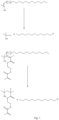
- radical activity is transferred to a chain transfer agent such as dodecanethiol, by reaction with a radical derived from an initiator such as AIBN, or by reaction with a radical derived from a divinyl monomer (e.g. from EGDMA) which has previously reacted with a source of radicals.
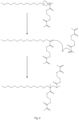
- a chain transfer agent radical [CH 3 (CH 2 ) 11 S• in Figure 1 ] which ( Figure 2 ) reacts with divinyl monomer in the present invention and results in propagation of the chain.
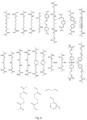
- FIG. 3 A schematic representation of the resultant branched polymer is shown in Figures 3 and 4 .
- DDT is used as the chain transfer agent the circle represents a moiety which comprises a dodecyl chain.
- the polymer is built up by vinyl polymerisation, nevertheless the chemistry of the longest chains in the product is determined by the other functional groups present in the divinyl monomer, and accordingly in some embodiments the longest chains may be polyesters.
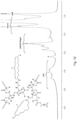
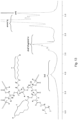
- One advantage of the present invention is that the vinyl functionality of the monomers can react completely. Experimental proof of this has been obtained by NMR analysis: in Figure 5 , the top NMR spectrum, in respect of a sample at the start of the reaction, shoes 1 H NMR due to the presence of double bond hydrogens. After reaction, the NMR trace (bottom) shows no detectable double bond signals.
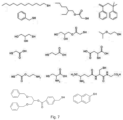
- Figure 8 shows a branched polymer made from the divinyl monomer EGDMA and chain transfer agent DDT (shown as spheres). Thick lines indicate the C-C bonds which were double bonds in the monomer. The numerals indicate the vinyl polymer chain lengths. It can be seen that there are 13 chains of length 1, five chains of length 2, six chains of length 3, one chain of length 4 and one chain of length 5.
- the product shown in Figure 8 is consistent with the discussion above which refers to some standard systems having (n+1) chain transfer agent residues per n divinyl monomer residues, and average vinyl polymer chain lengths of 2n/(n+1).
- Example 1 EGDMA as divinyl monomer and DDT as chain transfer agent
- the divinyl monomer is EGDMA
- the chain transfer agent is DDT
- a small amount of AIBN is used to provide a source of radicals.
- the reaction may be carried out in toluene, or other solvents.
- chain transfer agent can affect the degree of polymerisation. For example, if just enough chain transfer agent is used to avoid gelation, a high molecular weight product can be obtained. The skilled person is able to tailor the product accordingly.
- Example 2 EGDMA as divinyl monomer and benzyl mercaptan as chain transfer agent
- EGDMA (mol%) Benzyl Mercaptan (mol%) Gel formation EGDMA: benzyl mercaptan in final polymer product a Vinyl Conversion a Mw (kg/mol) b Mn (kg/mol) b ⁇ a d 1 1 Yes - - - - - - 1 0.5 Yes - - - - - - 1 c 2 c No c 1:1.1 c 100 % c 16.9 c 3.1 c 5.5 c 0.288 c 1 1.33 Yes - - - - - - 1 2 No 1:1.02 100% - - - - - Details as Example 1, except: c Reacted for 72 hours
- EGDMA (mol%) 2-Naphthalenethiol (mol%) Gel formation Reaction Time (hrs) Vinyl conversion EGDMA: 2-naphthalenethiol in final polymer product 2 1 Yes 1 - - 1 1 No 24 Unable to determine a Unable to determine a 1 1 No 48 Unable to determine a Unable to determine a Details as Example 1 except: a Unable to analyse as it seems to be immiscible in chosen solvents: CDCl 3 , toluene and CDCl 3 , DMF and THF.
- Example 4 EGDMA as divinyl monomer and a dendron thiol as chain transfer agent
- Example 6 PEGDMA (approximately 3350 g mol -1 ) as divinyl monomer and DDT as chain transfer agent
- Example 11 Bisacrylamide as divinyl monomer and thioglycerol as chain transfer agent
- Example 12 PEGDMA (875 g/mol) as divinyl monomer and thioglycerol as chain transfer agent
- Example 13 PEGDMA (875 g/mol) as divinyl monomer with mixed chain transfer agents (DDT and thiolglycerol)
- Example 14 incorporation of a monovinyl monomer (benzyl methacrylate) into the system (EGDMA as divinyl monomer and DDT as chain transfer agent)
- Example 15 BDME as stimuli-responsive (acid-cleavable) divinyl monomer and DDT as chain transfer agent
- Example 16 Experiments, using degradable monomers, to help elucidate the polymerisation mechanisms and structures within the products
- TFA trifluoroacetic acid
- 10 ⁇ L, ⁇ 2 eq vs BDME trifluoroacetic acid
- Basic alumina ⁇ 2 g was added to the reaction mixture followed by filtration with a 200 nm syringe filter. The solvent was evaporated on a rotary evaporator and the resulting product was analysed by GPC and MALDI-TOF mass spectroscopy.
- the GPC analysis showed very low molecular weight species that were difficult to study using the available analytical instrument.
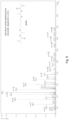
- the sample was subjected to MALDI-TOF mass spectrometry, yielding the mass spectrum shown in Figure 9 .
- the species present are polymethacrylic acid oligomers and telomers with a single CTA at one end of the chain and are generated during the cleavage as follows:
- the MALDI-TOF spectrum (negative ion) clearly indicates that a distribution of telomers and oligomers are present with a chain length of up to 18 units. These correspond to polyacid monomer residues within the branched polyacetal structure.
- Methyl methacrylate (2.27 g, 22.7 mmol, 1 eq) was purged with nitrogen for 15 minutes.
- AlBN (0.0559 g, 0.341 mmol) and toluene (6.16 mL) were added to the 25 mL round-bottomed flask and purged with nitrogen for 5 minutes.
- the reaction flask was heated in an oil bath at 70 oC and stirred for 24 hours and then cooled.
- the reaction mixture was concentrated by rotary evaporation and the resulting product was analysed by GPC and MALDI-TOF mass spectroscopy.
- telomerisation/oligomerisation of MMA under identical conditions generates a near identical distribution of identifiable species. Structures up to 18 monomer units are seen through the free radical polymerisation of MMA under these conditions and such species were seen in the homopolymerisation of the divinyl monomer BDME.
- the resulting crude material was analysed by 1 H NMR and showed no evidence of remaining double bonds after 24 hours. Further purification of the product was performed by evaporating the toluene on a rotary evaporator, dissolving the resulting mixture in THF and precipitating in methanol (MeOH) at room temperature. The product was collected by removing the supernatant and was rinsed with fresh MeOH. Finally, the resulting polymer was dried under vacuum at 40 °C for 12 hours. After purification, the polymer was collected with a yield of 73 % (m polymer /m DDT+TMPTMA ). The purified product was further analysed by GPC and 1 H NMR.
- Trivinyl monomer was homopolymerized, and was also copolymerised with divinyl monomer and with monovinyl monomer. It was possible to incorporate various functionalities e.g. tertiary amine functionality and epoxy functionality, thereby facilitating further reaction possibilities.
- GlyMA Glycidyl methacrylate
- the ratios in the first column indicate the relative molar amounts of reagents used in the reaction.
- the polymer products can have various properties depending on the functional groups within the monomers and other components. For example, degradable, biodegradable, compostable or responsive properties can be incorporated.
- Figure 16 shows schematically a divinyl monomer and a fragment of a polymer made from it.
- a and L could be any substituent
- E and J could be any linker (e.g. an ester)
- G could be additional linking chemistry (of course there could just be one linking moiety).
- M denotes CTA, T initiator fragment and Q and X terminating groups from chain transfer.
- Degradable components could be introduced via for example E, J or G, or alternatively or additionally M or Q.
- the products of the present invention may be biodegradable.
- Vinyl conversions of less than 80% are not encompassed by the wording of the claims.
Landscapes
- Chemical & Material Sciences (AREA)
- Health & Medical Sciences (AREA)
- Chemical Kinetics & Catalysis (AREA)
- Medicinal Chemistry (AREA)
- Polymers & Plastics (AREA)
- Organic Chemistry (AREA)
- Engineering & Computer Science (AREA)
- Materials Engineering (AREA)
- Addition Polymer Or Copolymer, Post-Treatments, Or Chemical Modifications (AREA)
- Polymerisation Methods In General (AREA)
- Medicinal Preparation (AREA)
Claims (19)
- Procédé de préparation d'un polymère ramifié comprenant la polymérisation par radicaux libres d'un ou plusieurs monomères multivinyles et éventuellement d'un ou plusieurs monomères monovinyles en présence d'un ou plusieurs agents de transfert de chaîne, à l'aide d'une source de radicaux ; dans lequel l'étendue de la propagation est contrôlée par rapport à l'étendue du transfert de chaîne afin d'éviter la gélification du polymère ; dans lequel au moins un équivalent d'agent de transfert de chaîne est utilisé en relation avec le monomère multivinyle ; dans lequel, si l'on incorpore non seulement un ou plusieurs monomères multivinyles mais aussi un ou plusieurs monomères monovinyles, 40 % ou plus des monomères vinyliques utilisés sont des monomères multivinyles ; et dans lequel la conversion de la fonctionnalité de double liaison en liaisons carbone-carbone saturées dans le polymère est de 80 % ou plus.
- Procédé selon la revendication 1, dans lequel le ou les monomères multivinyles comprennent un monomère divinyle.
- Procédé selon l'une quelconque revendication précédente, dans lequel la propagation est contrôlée par rapport au transfert de chaîne afin d'obtenir un polymère présentant une multiplicité de segments de chaîne de polymère vinylique, dans lequel la chaîne moyenne de polymère vinylique contient entre 1 et 3 résidus de monomère multivinylique.
- Procédé selon l'une quelconque revendication précédente, dans lequel le ou les monomères multivinyles sont choisis parmi les multiméthacrylates, les multiacrylates et les multiacrylamides.
- Procédé selon la revendication 4, dans lequel le ou les monomères multivinyles comprennent un monomère divinyle choisi parmi les diméthacrylates, les diacrylates, l'EGDMA et les bisacrylamides.
- Procédé selon l'une quelconque revendication précédente, dans lequel l'agent de transfert de chaîne est un thiol.
- Procédé selon la revendication 6, dans lequel le thiol est le dodécanethiol.
- Procédé selon l'une quelconque revendication précédente, dans lequel on incorpore un monomère ayant une fonction époxyde.
- Procédé selon l'une quelconque revendication précédente, dans lequel on incorpore un monomère ayant une fonction amine tertiaire.
- Produit polymère ramifié comprenant un ou plusieurs résidus de monomère multivinyle et d'agent de transfert de chaîne, et éventuellement un ou plusieurs résidus de monomère monovinyle ; comprenant en moyenne entre 0,9 et 3,3 résidus d'agents de transfert de chaîne par résidu de monomère multivinyle ; dans lequel le produit comprend des résidus de monomères multivinyles dans lesquels il ne reste pas plus de 20 % des doubles liaisons desdits monomères multivinyles sous forme de doubles liaisons n'ayant pas réagi ; et dans lequel 40 % ou plus des résidus de monomères vinyliques dans le produit sont des résidus de monomères multivinyliques.
- Produit polymère ramifié selon la revendication 10, dans lequel le ou les résidus de monomère multivinyle comprennent des résidus de monomère divinyle, et dans lequel le produit comprend en moyenne entre 0,9 et 1,1 résidu d'agent de transfert de chaîne par résidu de monomère divinyle.
- Produit polymère ramifié selon la revendication 10 ou la revendication 11, dans lequel le produit polymère ramifié comprend une multiplicité de segments de chaîne de polymère vinylique ayant une longueur moyenne comprise entre 1 et 3 résidus de monomère multivinylique.
- Produit polymère ramifié selon l'une quelconque des revendications 10 à 12, dans lequel chaque résidu vinylique du monomère multivinyle est directement polymérisé en vinyle avec en moyenne 0,1 à 1,5 autres résidus de monomère multivinyle.
- Polymère selon l'une quelconque des revendications 10 à 13, dans lequel le ou les monomères multivinyles sont choisis parmi les multiméthacrylates, les multiacrylates et les multiacrylamides.
- Polymère selon la revendication 14, dans lequel le ou les monomères multivinyles comprennent un monomère divinyle choisi parmi les diméthacrylates, les diacrylates, l'EGDMA et les bisacrylamides.
- Polymère selon l'une quelconque des revendications 10 à 15, dans lequel l'agent de transfert de chaîne est un thiol.
- Polymère selon la revendication 16, dans lequel le thiol est du dodécanethiol.
- Polymère selon l'une quelconque des revendications 10 à 17, dans lequel est incorporé un monomère ayant une fonctionnalité époxyde.
- Polymère selon l'une quelconque des revendications 10 à 18, dans lequel est incorporé un monomère ayant une fonctionnalité amine tertiaire.
Applications Claiming Priority (2)
| Application Number | Priority Date | Filing Date | Title |
|---|---|---|---|
| GBGB1706658.0A GB201706658D0 (en) | 2017-04-26 | 2017-04-26 | Branched Polymers |
| PCT/GB2018/051106 WO2018197885A1 (fr) | 2017-04-26 | 2018-04-26 | Polymères ramifiés |
Publications (3)
| Publication Number | Publication Date |
|---|---|
| EP3615577A1 EP3615577A1 (fr) | 2020-03-04 |
| EP3615577C0 EP3615577C0 (fr) | 2024-12-18 |
| EP3615577B1 true EP3615577B1 (fr) | 2024-12-18 |
Family
ID=58795730
Family Applications (1)
| Application Number | Title | Priority Date | Filing Date |
|---|---|---|---|
| EP18728695.0A Active EP3615577B1 (fr) | 2017-04-26 | 2018-04-26 | Polymères ramifiés |
Country Status (7)
| Country | Link |
|---|---|
| US (1) | US12448467B2 (fr) |
| EP (1) | EP3615577B1 (fr) |
| JP (1) | JP7144064B2 (fr) |
| KR (1) | KR102656198B1 (fr) |
| CN (2) | CN110662772B (fr) |
| GB (1) | GB201706658D0 (fr) |
| WO (1) | WO2018197885A1 (fr) |
Families Citing this family (5)
| Publication number | Priority date | Publication date | Assignee | Title |
|---|---|---|---|---|
| GB201706658D0 (en) | 2017-04-26 | 2017-06-07 | Univ Liverpool | Branched Polymers |
| GB201817837D0 (en) * | 2018-10-31 | 2018-12-19 | Univ Liverpool | Branched polymers |
| GB202208034D0 (en) | 2022-05-31 | 2022-07-13 | Univ Liverpool | Recyclable thermoset resins |
| GB202208033D0 (en) | 2022-05-31 | 2022-07-13 | Univ Liverpool | Powder coating materials |
| GB202416930D0 (en) | 2024-11-18 | 2025-01-01 | Scott Bader Co | Polymeric photoinitiating compositions |
Family Cites Families (29)
| Publication number | Priority date | Publication date | Assignee | Title |
|---|---|---|---|---|
| US6313251B1 (en) | 1995-05-30 | 2001-11-06 | Sola International Holdings, Ltd. | High index/high abbe number composition |
| US5767211A (en) * | 1996-05-02 | 1998-06-16 | E. I. Du Pont De Nemours And Company | Synthesis of multi-functional hyperbranched polymers by polymerization of di-or tri-vinyl monomers in the presence of a chain transfer catalyst |
| US6509418B1 (en) * | 1997-02-19 | 2003-01-21 | Prc-Desoto International, Inc. | Sealants and potting formulations including mercapto-terminated polymers produced by the reaction of a polythiol and polyvinyl ether monomer |
| US6353066B1 (en) | 2001-02-09 | 2002-03-05 | Fina Technology, Inc. | Method for producing copolymers in the presence of a chain transfer agent |
| US6862392B2 (en) | 2003-06-04 | 2005-03-01 | Corning Incorporated | Coated optical fiber and curable compositions suitable for coating optical fiber |
| DE10344412A1 (de) | 2003-09-25 | 2005-05-19 | Röhm GmbH & Co. KG | Polymernetzwerke |
| US9138383B1 (en) | 2004-04-28 | 2015-09-22 | The Regents Of The University Of Colorado, A Body Corporate | Nanogel materials and methods of use thereof |
| US20060116492A1 (en) * | 2004-12-01 | 2006-06-01 | 3M Innovative Properties Company | Branched polymer |
| JP5508016B2 (ja) * | 2006-10-06 | 2014-05-28 | 株式会社ブリヂストン | 分岐重合体、並びにその合成方法及び使用方法 |
| EP2102259B1 (fr) * | 2006-12-12 | 2012-06-27 | Unilever PLC | Polymères |
| EP2102256B1 (fr) * | 2006-12-12 | 2012-01-25 | Unilever PLC | Polymères |
| JP2009190331A (ja) | 2008-02-15 | 2009-08-27 | Asahi Kasei E-Materials Corp | レーザー彫刻印刷原版用樹脂組成物 |
| CN101538345A (zh) * | 2009-02-05 | 2009-09-23 | 上海华谊(集团)公司 | 树枝状高支化聚合物、制备方法及用途 |
| GB0902052D0 (en) | 2009-02-09 | 2009-03-11 | Unilever Plc | Polymers,composition and use |
| CN101544708A (zh) * | 2009-04-14 | 2009-09-30 | 江南大学 | 一种巯基链转移超支化聚合法 |
| US9334338B2 (en) | 2010-04-30 | 2016-05-10 | Halliburton Energy Services, Inc. | Water-soluble degradable synthetic vinyl polymers and related methods |
| EP2616501B1 (fr) * | 2010-09-16 | 2017-12-06 | Voltea B.V. | Appareil d'élimination d'ions comprenant une membrane échangeuse d'ions qui comprend un (co)polymère hyperramifié réticulé (un hbp réticulé) ayant des groupes d'échange d'ions |
| GB201111609D0 (en) | 2011-07-06 | 2011-08-24 | Unilever Plc | Copolymers and membranes |
| GB201310652D0 (en) * | 2013-06-14 | 2013-07-31 | Univ Liverpool | Polydendrons |
| JP6516319B2 (ja) * | 2014-01-09 | 2019-05-22 | 公立大学法人大阪市立大学 | 熱硬化性多分岐型高分子とその製造方法および硬化多分岐型高分子 |
| US20150266986A1 (en) * | 2014-03-20 | 2015-09-24 | National University Of Ireland, Galway | Multifunctional Hyperbranched Polymers |
| GB201501924D0 (en) | 2015-02-05 | 2015-03-25 | Univ Liverpool | Nanoemulsions |
| US9588852B2 (en) * | 2015-03-09 | 2017-03-07 | International Business Machines Corporation | Temporary pipeline marking for processor error workarounds |
| WO2016147984A1 (fr) | 2015-03-13 | 2016-09-22 | 京セラ株式会社 | Composition de résine, pré-imprégné, stratifié plaqué de métal et carte de câblage |
| JP2016216646A (ja) * | 2015-05-22 | 2016-12-22 | Jnc株式会社 | 重合体の製造方法およびその重合体 |
| CN105153354B (zh) * | 2015-10-18 | 2017-07-11 | 长春工业大学 | 一种高支化聚合物的制备方法 |
| GB201706657D0 (en) | 2017-04-26 | 2017-06-07 | Univ Liverpool | Polymers |
| GB201706658D0 (en) | 2017-04-26 | 2017-06-07 | Univ Liverpool | Branched Polymers |
| GB201817837D0 (en) | 2018-10-31 | 2018-12-19 | Univ Liverpool | Branched polymers |
-
2017
- 2017-04-26 GB GBGB1706658.0A patent/GB201706658D0/en not_active Ceased
-
2018
- 2018-04-26 JP JP2019558528A patent/JP7144064B2/ja active Active
- 2018-04-26 US US16/608,072 patent/US12448467B2/en active Active
- 2018-04-26 EP EP18728695.0A patent/EP3615577B1/fr active Active
- 2018-04-26 KR KR1020197034714A patent/KR102656198B1/ko active Active
- 2018-04-26 CN CN201880033784.4A patent/CN110662772B/zh active Active
- 2018-04-26 WO PCT/GB2018/051106 patent/WO2018197885A1/fr not_active Ceased
- 2018-04-26 CN CN202210301298.4A patent/CN114456293B/zh active Active
Also Published As
| Publication number | Publication date |
|---|---|
| EP3615577C0 (fr) | 2024-12-18 |
| US12448467B2 (en) | 2025-10-21 |
| US20200190237A1 (en) | 2020-06-18 |
| JP2020517806A (ja) | 2020-06-18 |
| CN114456293B (zh) | 2023-09-26 |
| EP3615577A1 (fr) | 2020-03-04 |
| WO2018197885A1 (fr) | 2018-11-01 |
| CN110662772B (zh) | 2022-04-08 |
| GB201706658D0 (en) | 2017-06-07 |
| CN110662772A (zh) | 2020-01-07 |
| KR102656198B1 (ko) | 2024-04-09 |
| CN114456293A (zh) | 2022-05-10 |
| JP7144064B2 (ja) | 2022-09-29 |
| KR20190136104A (ko) | 2019-12-09 |
Similar Documents
| Publication | Publication Date | Title |
|---|---|---|
| US12448467B2 (en) | Branched polymers | |
| US12291590B2 (en) | Branched polymers | |
| US20200181335A1 (en) | Polymers | |
| Wendler et al. | Amphiphilic cationic block copolymers via controlled free radical polymerization | |
| US6300443B1 (en) | Process for preparing polymeric microgels | |
| Sevimli et al. | Synthesis, self-assembly and stimuli responsive properties of cholesterol conjugated polymers | |
| US8420771B2 (en) | PH-sensitive polyethylene oxide co-polymer and synthetic method thereof | |
| Wang et al. | Synthetic protocols toward polypeptide conjugates via chain end functionalization after RAFT polymerization | |
| Li et al. | Synthesis and characterization of a novel water-soluble cationic diblock copolymer with star conformation by ATRP | |
| CN112961278A (zh) | 一种功能化乙烯基吡咯烷酮共聚物及其制备方法 | |
| David et al. | Poly (N-isopropylacrylamide)/poly [(N-acetylimino) ethylene] thermosensitive block and graft copolymers | |
| WO1998046655A1 (fr) | Polymere methacrylique possedant un groupe fonctionnel terminal, et composition a base de ce polymere | |
| CN110615866B (zh) | 一种可逆加成-断裂链转移聚合体系及其在制备嵌段环化共聚物中的应用 | |
| Ito et al. | Silicon-containing block copolymer membranes | |
| Stiernet et al. | Tailor-Made Poly (vinylamine) s via Thermal or Photochemical Organometallic Mediated Radical Polymerization | |
| Kim et al. | Synthesis and polymerization of methacryloyl-PEG-sulfonic acid as a functional macromer for biocompatible polymeric surfaces | |
| CN119875118A (zh) | 一种侧链含有羟基官能团的噁唑啉均聚物的合成方法 | |
| Doyle | Synthesis of Diacetone Acrylamide and 2-Aminoethylmethacrylamide Hydrochloride Copolymers using Thermal Initiated RAFT Polymerization. | |
| CENGİZ | Preparation and Dual-Functionalization of Pendant Aldehyde and Azide-Bearing Hydrophilic Polymer | |
| Zhang | Synthesis of Polystyrene (PS)-Polyhedral Oligomeric Silsesquioxane (POSS)-Based Giant Molecules with Sequence-controlled POSS Heads | |
| Shen | Modification and application of hyperbranched Polyglycerol and Polyethylenimine | |
| AU5469098A (en) | A process for preparing polymeric microgels | |
| Wang et al. | Polymer Chemistry |
Legal Events
| Date | Code | Title | Description |
|---|---|---|---|
| STAA | Information on the status of an ep patent application or granted ep patent |
Free format text: STATUS: UNKNOWN |
|
| STAA | Information on the status of an ep patent application or granted ep patent |
Free format text: STATUS: THE INTERNATIONAL PUBLICATION HAS BEEN MADE |
|
| PUAI | Public reference made under article 153(3) epc to a published international application that has entered the european phase |
Free format text: ORIGINAL CODE: 0009012 |
|
| STAA | Information on the status of an ep patent application or granted ep patent |
Free format text: STATUS: REQUEST FOR EXAMINATION WAS MADE |
|
| 17P | Request for examination filed |
Effective date: 20191029 |
|
| AK | Designated contracting states |
Kind code of ref document: A1 Designated state(s): AL AT BE BG CH CY CZ DE DK EE ES FI FR GB GR HR HU IE IS IT LI LT LU LV MC MK MT NL NO PL PT RO RS SE SI SK SM TR |
|
| AX | Request for extension of the european patent |
Extension state: BA ME |
|
| DAV | Request for validation of the european patent (deleted) | ||
| DAX | Request for extension of the european patent (deleted) | ||
| STAA | Information on the status of an ep patent application or granted ep patent |
Free format text: STATUS: EXAMINATION IS IN PROGRESS |
|
| 17Q | First examination report despatched |
Effective date: 20200819 |
|
| REG | Reference to a national code |
Ref country code: DE Ref legal event code: R079 Free format text: PREVIOUS MAIN CLASS: C08F0002380000 Ipc: C08F0004040000 Ref country code: DE Ref legal event code: R079 Ref document number: 602018077689 Country of ref document: DE Free format text: PREVIOUS MAIN CLASS: C08F0002380000 Ipc: C08F0004040000 |
|
| RIC1 | Information provided on ipc code assigned before grant |
Ipc: C08F 222/10 20060101ALI20230725BHEP Ipc: C08F 122/10 20060101ALI20230725BHEP Ipc: C08F 2/38 20060101ALI20230725BHEP Ipc: C08F 12/36 20060101ALI20230725BHEP Ipc: C08F 4/04 20060101AFI20230725BHEP |
|
| GRAP | Despatch of communication of intention to grant a patent |
Free format text: ORIGINAL CODE: EPIDOSNIGR1 |
|
| STAA | Information on the status of an ep patent application or granted ep patent |
Free format text: STATUS: GRANT OF PATENT IS INTENDED |
|
| INTG | Intention to grant announced |
Effective date: 20240712 |
|
| GRAS | Grant fee paid |
Free format text: ORIGINAL CODE: EPIDOSNIGR3 |
|
| GRAA | (expected) grant |
Free format text: ORIGINAL CODE: 0009210 |
|
| STAA | Information on the status of an ep patent application or granted ep patent |
Free format text: STATUS: THE PATENT HAS BEEN GRANTED |
|
| AK | Designated contracting states |
Kind code of ref document: B1 Designated state(s): AL AT BE BG CH CY CZ DE DK EE ES FI FR GB GR HR HU IE IS IT LI LT LU LV MC MK MT NL NO PL PT RO RS SE SI SK SM TR |
|
| REG | Reference to a national code |
Ref country code: GB Ref legal event code: FG4D |
|
| REG | Reference to a national code |
Ref country code: CH Ref legal event code: EP |
|
| REG | Reference to a national code |
Ref country code: DE Ref legal event code: R096 Ref document number: 602018077689 Country of ref document: DE |
|
| REG | Reference to a national code |
Ref country code: IE Ref legal event code: FG4D |
|
| U01 | Request for unitary effect filed |
Effective date: 20250113 |
|
| U07 | Unitary effect registered |
Designated state(s): AT BE BG DE DK EE FI FR IT LT LU LV MT NL PT RO SE SI Effective date: 20250120 |
|
| PG25 | Lapsed in a contracting state [announced via postgrant information from national office to epo] |
Ref country code: HR Free format text: LAPSE BECAUSE OF FAILURE TO SUBMIT A TRANSLATION OF THE DESCRIPTION OR TO PAY THE FEE WITHIN THE PRESCRIBED TIME-LIMIT Effective date: 20241218 |
|
| PG25 | Lapsed in a contracting state [announced via postgrant information from national office to epo] |
Ref country code: NO Free format text: LAPSE BECAUSE OF FAILURE TO SUBMIT A TRANSLATION OF THE DESCRIPTION OR TO PAY THE FEE WITHIN THE PRESCRIBED TIME-LIMIT Effective date: 20250318 |
|
| PG25 | Lapsed in a contracting state [announced via postgrant information from national office to epo] |
Ref country code: GR Free format text: LAPSE BECAUSE OF FAILURE TO SUBMIT A TRANSLATION OF THE DESCRIPTION OR TO PAY THE FEE WITHIN THE PRESCRIBED TIME-LIMIT Effective date: 20250319 |
|
| PG25 | Lapsed in a contracting state [announced via postgrant information from national office to epo] |
Ref country code: RS Free format text: LAPSE BECAUSE OF FAILURE TO SUBMIT A TRANSLATION OF THE DESCRIPTION OR TO PAY THE FEE WITHIN THE PRESCRIBED TIME-LIMIT Effective date: 20250318 |
|
| U20 | Renewal fee for the european patent with unitary effect paid |
Year of fee payment: 8 Effective date: 20250424 |
|
| PG25 | Lapsed in a contracting state [announced via postgrant information from national office to epo] |
Ref country code: SM Free format text: LAPSE BECAUSE OF FAILURE TO SUBMIT A TRANSLATION OF THE DESCRIPTION OR TO PAY THE FEE WITHIN THE PRESCRIBED TIME-LIMIT Effective date: 20241218 |
|
| PG25 | Lapsed in a contracting state [announced via postgrant information from national office to epo] |
Ref country code: PL Free format text: LAPSE BECAUSE OF FAILURE TO SUBMIT A TRANSLATION OF THE DESCRIPTION OR TO PAY THE FEE WITHIN THE PRESCRIBED TIME-LIMIT Effective date: 20241218 |
|
| PG25 | Lapsed in a contracting state [announced via postgrant information from national office to epo] |
Ref country code: ES Free format text: LAPSE BECAUSE OF FAILURE TO SUBMIT A TRANSLATION OF THE DESCRIPTION OR TO PAY THE FEE WITHIN THE PRESCRIBED TIME-LIMIT Effective date: 20241218 |
|
| PG25 | Lapsed in a contracting state [announced via postgrant information from national office to epo] |
Ref country code: IS Free format text: LAPSE BECAUSE OF FAILURE TO SUBMIT A TRANSLATION OF THE DESCRIPTION OR TO PAY THE FEE WITHIN THE PRESCRIBED TIME-LIMIT Effective date: 20250418 |
|
| PG25 | Lapsed in a contracting state [announced via postgrant information from national office to epo] |
Ref country code: SK Free format text: LAPSE BECAUSE OF FAILURE TO SUBMIT A TRANSLATION OF THE DESCRIPTION OR TO PAY THE FEE WITHIN THE PRESCRIBED TIME-LIMIT Effective date: 20241218 |
|
| PG25 | Lapsed in a contracting state [announced via postgrant information from national office to epo] |
Ref country code: CZ Free format text: LAPSE BECAUSE OF FAILURE TO SUBMIT A TRANSLATION OF THE DESCRIPTION OR TO PAY THE FEE WITHIN THE PRESCRIBED TIME-LIMIT Effective date: 20241218 |
|
| PLBE | No opposition filed within time limit |
Free format text: ORIGINAL CODE: 0009261 |
|
| STAA | Information on the status of an ep patent application or granted ep patent |
Free format text: STATUS: NO OPPOSITION FILED WITHIN TIME LIMIT |
|
| REG | Reference to a national code |
Ref country code: CH Ref legal event code: L10 Free format text: ST27 STATUS EVENT CODE: U-0-0-L10-L00 (AS PROVIDED BY THE NATIONAL OFFICE) Effective date: 20251029 |
|
| REG | Reference to a national code |
Ref country code: CH Ref legal event code: H13 Free format text: ST27 STATUS EVENT CODE: U-0-0-H10-H13 (AS PROVIDED BY THE NATIONAL OFFICE) Effective date: 20251125 |
|
| 26N | No opposition filed |
Effective date: 20250919 |
|
| PG25 | Lapsed in a contracting state [announced via postgrant information from national office to epo] |
Ref country code: MC Free format text: LAPSE BECAUSE OF FAILURE TO SUBMIT A TRANSLATION OF THE DESCRIPTION OR TO PAY THE FEE WITHIN THE PRESCRIBED TIME-LIMIT Effective date: 20241218 |
|
| PG25 | Lapsed in a contracting state [announced via postgrant information from national office to epo] |
Ref country code: CH Free format text: LAPSE BECAUSE OF NON-PAYMENT OF DUE FEES Effective date: 20250430 |
|
| PG25 | Lapsed in a contracting state [announced via postgrant information from national office to epo] |
Ref country code: IE Free format text: LAPSE BECAUSE OF NON-PAYMENT OF DUE FEES Effective date: 20250426 |
|
| U20 | Renewal fee for the european patent with unitary effect paid |
Year of fee payment: 9 Effective date: 20260424 |
|
| PG25 | Lapsed in a contracting state [announced via postgrant information from national office to epo] |
Ref country code: CY Free format text: LAPSE BECAUSE OF FAILURE TO SUBMIT A TRANSLATION OF THE DESCRIPTION OR TO PAY THE FEE WITHIN THE PRESCRIBED TIME-LIMIT Effective date: 20241218 |
|
| PGFP | Annual fee paid to national office [announced via postgrant information from national office to epo] |
Ref country code: GB Payment date: 20260403 Year of fee payment: 9 |