EP3616432B1 - N ud de réseau et procédés associés destinés au réordonnancement du protocole de convergence de données par paquets (pdcp) - Google Patents
N ud de réseau et procédés associés destinés au réordonnancement du protocole de convergence de données par paquets (pdcp) Download PDFInfo
- Publication number
- EP3616432B1 EP3616432B1 EP18714627.9A EP18714627A EP3616432B1 EP 3616432 B1 EP3616432 B1 EP 3616432B1 EP 18714627 A EP18714627 A EP 18714627A EP 3616432 B1 EP3616432 B1 EP 3616432B1
- Authority
- EP
- European Patent Office
- Prior art keywords
- pdcp
- time period
- received
- layer
- network node
- Prior art date
- Legal status (The legal status is an assumption and is not a legal conclusion. Google has not performed a legal analysis and makes no representation as to the accuracy of the status listed.)
- Active
Links
Images





Classifications
-
- H—ELECTRICITY
- H04—ELECTRIC COMMUNICATION TECHNIQUE
- H04W—WIRELESS COMMUNICATION NETWORKS
- H04W80/00—Wireless network protocols or protocol adaptations to wireless operation
- H04W80/08—Upper layer protocols
-
- H—ELECTRICITY
- H04—ELECTRIC COMMUNICATION TECHNIQUE
- H04W—WIRELESS COMMUNICATION NETWORKS
- H04W24/00—Supervisory, monitoring or testing arrangements
- H04W24/02—Arrangements for optimising operational condition
-
- H—ELECTRICITY
- H04—ELECTRIC COMMUNICATION TECHNIQUE
- H04L—TRANSMISSION OF DIGITAL INFORMATION, e.g. TELEGRAPHIC COMMUNICATION
- H04L47/00—Traffic control in data switching networks
- H04L47/10—Flow control; Congestion control
- H04L47/19—Flow control; Congestion control at layers above the network layer
- H04L47/193—Flow control; Congestion control at layers above the network layer at the transport layer, e.g. TCP related
-
- H—ELECTRICITY
- H04—ELECTRIC COMMUNICATION TECHNIQUE
- H04L—TRANSMISSION OF DIGITAL INFORMATION, e.g. TELEGRAPHIC COMMUNICATION
- H04L47/00—Traffic control in data switching networks
- H04L47/10—Flow control; Congestion control
- H04L47/28—Flow control; Congestion control in relation to timing considerations
- H04L47/283—Flow control; Congestion control in relation to timing considerations in response to processing delays, e.g. caused by jitter or round trip time [RTT]
-
- H—ELECTRICITY
- H04—ELECTRIC COMMUNICATION TECHNIQUE
- H04L—TRANSMISSION OF DIGITAL INFORMATION, e.g. TELEGRAPHIC COMMUNICATION
- H04L47/00—Traffic control in data switching networks
- H04L47/10—Flow control; Congestion control
- H04L47/34—Flow control; Congestion control ensuring sequence integrity, e.g. using sequence numbers
-
- H—ELECTRICITY
- H04—ELECTRIC COMMUNICATION TECHNIQUE
- H04W—WIRELESS COMMUNICATION NETWORKS
- H04W28/00—Network traffic management; Network resource management
- H04W28/02—Traffic management, e.g. flow control or congestion control
- H04W28/10—Flow control between communication endpoints
- H04W28/12—Flow control between communication endpoints using signalling between network elements
-
- H—ELECTRICITY
- H04—ELECTRIC COMMUNICATION TECHNIQUE
- H04W—WIRELESS COMMUNICATION NETWORKS
- H04W8/00—Network data management
- H04W8/02—Processing of mobility data, e.g. registration information at HLR [Home Location Register] or VLR [Visitor Location Register]; Transfer of mobility data, e.g. between HLR, VLR or external networks
- H04W8/04—Registration at HLR or HSS [Home Subscriber Server]
Definitions
- Embodiments herein relate to a network node, and to methods therein. Especially, embodiments herein relate to Packet Data Convergence Protocol (PDCP) reordering.
- PDCP Packet Data Convergence Protocol
- Communication devices such as terminals or wireless devices are also known as e.g. User Equipments (UEs), mobile terminals, wireless terminals and/or mobile stations.
- UEs User Equipments
- Such terminals are enabled to communicate wirelessly in a wireless communication system or a cellular communications network, sometimes also referred to as a cellular radio system or cellular networks.
- the communication may be performed e.g. between two wireless devices, between a wireless device and a regular telephone and/or between a wireless device and a server via a Radio Access Network (RAN) and possibly one or more core networks, comprised within the wireless communications network.
- RAN Radio Access Network
- the above terminals or wireless devices may further be referred to as mobile telephones, cellular telephones, laptops, or tablets with wireless capability, just to mention some further examples.
- the terminals or wireless devices in the present context may be, for example, portable, pocket-storable, hand-held, computer-comprised, or vehicle-mounted mobile devices, enabled to communicate voice and/or data, via the RAN, with another entity, such as another terminal or a server.
- the cellular communications network covers a geographical area which is divided into cell areas, wherein each cell area being served by an access node such as a base station, e.g. a Radio Base Station (RBS), which sometimes may be referred to as e.g. an "eNB”, an "eNodeB”, a “NodeB”, a B node”, or a Base Transceiver Station (BTS), depending on the technology and terminology used.
- a base station e.g. a Radio Base Station (RBS), which sometimes may be referred to as e.g. an "eNB”, an "eNodeB”, a “NodeB”, a B node”, or a Base Transceiver Station (BTS), depending on the technology and terminology used.
- the base stations may be of different classes such as e.g. macro eNodeB, home eNodeB or pico base station, based on transmission power and thereby also cell size.
- a cell is the geographical area where radio coverage is provided by the base station at
- One base station situated at the base station site, may serve one or several cells. Further, each base station may support one or several communication technologies. The base stations communicate over the air interface operating on radio frequencies with the terminals or wireless devices within range of the base stations.
- the expression Downlink (DL) is used for the transmission path from the base station to the mobile station.
- the expression Uplink (UL) is used for the transmission path in the opposite direction i.e. from the mobile station to the base station.
- a Universal Mobile Telecommunications System is a third generation (3G) telecommunication network, which evolved from the second generation (2G) Global System for Mobile Communications (GSM).
- the UMTS Terrestrial Radio Access Network (UTRAN) is essentially a RAN using Wideband Code Division Multiple Access (WCDMA) and/or High Speed Packet Access (HSPA) for user equipment.
- WCDMA Wideband Code Division Multiple Access
- HSPA High Speed Packet Access
- 3GPP Third Generation Partnership Project
- telecommunications suppliers propose and agree upon standards for third generation networks, and investigate enhanced data rate and radio capacity.
- 3GPP Third Generation Partnership Project
- radio network nodes may be connected, e.g., by landlines or microwave, to a controller node, such as a Radio Network Controller (RNC) or a Base Station Controller (BSC), which supervises and coordinates various activities of the plural radio network nodes connected thereto.
- RNC Radio Network Controller
- BSC Base Station Controller
- This type of connection is sometimes referred to as a backhaul connection.
- the RNCs and BSCs are typically connected to one or more core networks.
- the Evolved Packet System also called a Fourth Generation (4G) network
- the EPS comprises the Evolved Universal Terrestrial Radio Access Network (E-UTRAN), also known as the Long Term Evolution (LTE) radio access network, and the Evolved Packet Core (EPC), also known as System Architecture Evolution (SAE) core network.
- E-UTRAN/LTE is a variant of a 3GPP radio access network wherein the radio network nodes are directly connected to the EPC core network rather than to RNCs.
- the functions of an RNC are distributed between the radio network nodes, e.g. eNodeBs in LTE, and the core network.
- the RAN of an EPS has an essentially "flat" architecture comprising radio network nodes connected directly to one or more core networks, i.e. they are not connected to RNCs.
- the E-UTRAN specification defines a direct interface between the radio network nodes, this interface being denoted the X2 interface.
- base stations which may be referred to as eNodeBs or even eNBs, may be directly connected to one or more core networks.
- the 3GPP LTE radio access standard has been written in order to support high bitrates and low latency both for uplink and downlink traffic. All data transmission is in LTE controlled by the radio base station.
- Multi-antenna techniques may significantly increase the data rates and reliability of a wireless communication system. The performance is in particular improved if both the transmitter and the receiver are equipped with multiple antennas, which results in a Multiple-Input Multiple-Output (MIMO) communication channel.
- MIMO Multiple-Input Multiple-Output
- Such systems and/or related techniques are commonly referred to as MIMO systems.
- a Radio Link Control (RLC) protocol such as the RLC protocol according to section 5.1.3.2 "Receive operations" of the 3GPP TS 36.322 standard, always performs reordering to guarantee in-sequence order delivery of data units to a Packet Data Convergence Protocol (PDCP) and further on from there.
- PDCP Packet Data Convergence Protocol
- the reordering functionality is performed to reorder data units received out of order to guarantee that the received data units are delivered in a correct order.
- the RLC is a layer 2 protocol used by LTE on the air interface. Further, the RLC is located on top of the 3GPP MAC layer and below the PDCP layer.
- the PDCP layer is a data link layer or a data forwarding layer.
- the PDCP protocol in LTE e.g. the PDCP protocol according to section 5.1.2.1.4 "Procedures for DRBs mapped on RLC AM and for LWA bearers when the reordering function is use" of the 3GPP TS 36.323 standard, does also have a function to perform reordering of its Protocol Data Units (PDUs), which is used at times when the RLC does not manage to guarantee in-sequence delivery, e.g. during times when the RLC is re-established, e.g. for handover etc., and when data is sent using two parallel RLC protocols and different physical layer adaptation functions. This is sometimes referred to as dual connectivity.
- PDUs Protocol Data Units
- the 3GPP New Radio (NR) communications network e.g. the 5G communications network, aims at providing larger bandwidths at higher frequencies with more challenging radio coverage, and is expected to have an increased dependency on PDCP anchored dual connectivity and/or multi-connectivity.
- NR 3GPP New Radio
- SDU Service Data Unit
- An SDU is a unit of data that has been passed down from an upper layer to a lower layer.
- the SDU has not yet been encapsulated into a Protocol Data Unit (PDU) by the lower layer.
- PDU Protocol Data Unit
- the input to a protocol of a layer may be referred to as the SDU and the output of the protocol of the layer may be referred to as the PDU.
- the SDU at any given layer (n) is the PDU of the layer above (n+1).
- the SDU is the payload of a given PDU.
- the layer (n-1) adds headers or footers, or both, to the SDU when forming the PDU.
- the terms the RLC SDU and the PDCP PDU are interpreted as being equal and used interchangeably. It follows that the PDCP will meet new challenges to continuously execute reordering, at least at occasions when in sequence delivery to one or more layers above the PDCP is needed.
- the layer above the PDCP layer may be a data link layer, a network layer, a transport layer, a session layer, a presentation layer or an application layer just to give some examples.
- the reordering function in the LTE PDCP is using a t-Reordering timer to limit the time to wait for missing PDCP PDUs. If one or more out-of-sequence PDCP PDUs are received by the PDCP layer, from lower layers, e.g. from the RLC layer, i.e. there is one or more missing PDCP PDUs, the reordering function in LTE PDCP will do the following:
- the PDCP reordering functionality provides a robust way to ensure in-order delivery for PDCP PDUs that are received within a certain time period, but at the cost of setting a limit for how late PDUs, e.g. packets, may arrive.
- EP 3 063 909 A1 relates to techniques for aggregating data from a wireless wide area network (WWAN) and wireless local area network (WLAN).
- a packet convergence entity e.g., PDCP layer entity
- RAT radio access technology
- the packet convergence entity may determine from which of the first and second RAT links a data packet is received and may monitor a sequence number value of each of the received data packets.
- the packet convergence entity may perform one or more actions based on a determination that the data packets are received out of order.
- the packet convergence entity may deliver the data packets to an upper layer entity as they are received (e.g., in order or out of order), may reorder the data packets and ignore data packet losses, and/or may request retransmissions of missing data packets.
- a target base station may re-order packets received from the source base station within a re-ordering window and may send the re -ordered packets to a UE.
- the target base station may start a timer upon receiving the first packet from the source base station.
- the target base station may buffer the first packet if it is received out of order.
- the target base station may also buffer all subsequent packets received out of order from the source base station prior to expiration of the timer.
- the target base station may re-order and send the buffered packets after expiration of the timer.
- 3GPP contribution R2-140115 "Discussion on PDCP reordering issue for small cell" discloses PDCP reordering with a moving time window and indicates start and end conditions for a timer, e.g. t-reordering.
- 3GPP contribution R2-1701200 discusses RLC Operation Modes and discloses that any RLC-PDUs received out of sequence are stored in the reception buffer until all the previous RLC PDUs are received and delivered to the upper layer. During the reordering process, any duplicate RLC PDUs received are detected by checking the SN and discarded. This ensures that the upper layer receives upper layer PDUs only once.
- a reordering timer is used in the receiving RLC entity to set the maximum time to wait for the reception of RLC PDUs that have not been received in sequence.
- the receiving RLC entity starts the reordering timer when a missing RLC PDU is detected, and it waits for the missing RLC PDUs until the timer expires.
- An object addressed by embodiments herein is how to improve performance in a wireless communications network.
- An aim of some embodiments disclosed herein is to overcome or mitigate at least some of the drawbacks with the prior art.
- the object is achieved by a method performed by a network node, such as a Radio Network Node or a communications device, for PDCP reordering.
- the network node is operating in a wireless communications network.
- the network node buffers in order one or more first data units received out of order by a PDCP layer.
- the one or more first data units are received from a lower layer during a first time period.
- the lower layer is a layer below the PDCP layer.
- the upper layer is a layer above the PDCP layer.
- the network node forwards the one or more buffered first data units in order to an upper layer and starts a second time period.
- the network node forwards, to the upper layer and in any order, one or more second data units received from the lower layer during the second time period.
- the one or more second data units arriving too late to the PDCP layer to be buffered in order are forwarded to the upper layer in time for a reordering functionality of the upper layer.
- the network node buffering in order one or more first data units means that the one or more first data units are buffered in sequence number order.
- the one or more second data units are immediately forwarded to the upper layer, e.g. they are forwarded directly after reception.
- the first and second time periods may be consecutive time periods. Further, the first time period may be shorter that the second timer period.
- the network node may be waiting for the shorter first time period for missing packets to deliver these in order without waiting too long, and then may be waiting till a longer second time period for any late still missing packets and still deliver these to upper layers before advancing a lower edge of a receive window.
- advancing the lower edge of the receive window when used herein is meant that a lower end of the receive window is moved forward, i.e. that the lower end of the receive window is moved to a higher sequence number.
- the receive window is sometimes in this disclosure referred to as a receiving window and it should be understood that the terms may be used interchangeably.
- the receiving window comprises the first and second time periods.
- the object is achieved by a network node, such as a Radio Network Node or a communications device, for PDCP reordering.
- the network node is configured to operate in a wireless communications network.
- the network node is configured to buffer in order one or more first data units received out of order by a PDCP layer.
- the one or more first data units are received from a lower layer and during a first time period.
- the lower layer is a layer below the PDCP layer.
- the upper layer is a layer above the PDCP layer.
- the network node is configured to forward the one or more buffered first data units in order to an upper layer and to start a second time period, when the first time period has expired.
- the network node is configured to forward, to the upper layer and in any order, one or more second data units received from the lower layer during the second time period. Thereby, the one or more second data units arriving too late to the PDCP layer to be buffered in order is forwarded to the upper layer in time for a reordering functionality of the upper layer.
- the network node is configured to immediately forward, to the upper layer, the one or more second data units. In other words, the network node may be configured to forward, to the upper layer, the one or more second data units directly after reception.
- the first and second time periods may be consecutive time periods. Further, the first time period may be shorter that the second timer period. In other words, the network node may be configured to wait for the shorter first time period for missing packets to deliver these in order without waiting too long, and then may be configured to wait till a longer second time period for any late still missing packets and still deliver these to upper layers before advancing lower edge of receive window.
- the object is achieved by a computer program, comprising instructions which, when executed on at least one processor, causes the at least one processor to carry out the method performed by the network node.
- the object is achieved by a carrier comprising the computer program, wherein the carrier is one of an electronic signal, an optical signal, a radio signal or a computer readable storage medium.
- An advantage with some embodiments disclosed herein is that the requirement of in-order delivery is decoupled from the advancement of the lower edge of the receiving window, which means that it is possible to use two different time periods, e.g. first and second time periods, for the forwarding of received PDCP SDUs:
- receiver and sender when used herein is meant either the case when the UE is the sender and the gNB/eNB is the receiver (uplink traffic), or the case when the UE is the receiver and the gNB/eNB is the sender (downlink traffic).
- the prior art PDCP reordering functionality provides a robust way to ensure in-order delivery for PDCP PDUs that are received within a certain time period, but at the cost of setting a limit for how late PDUs, e.g. packets, may arrive.
- Figure 1 schematically illustrates re-ordering and in-order delivery of the LTE PDCP.
- action 101 no PDUs are awaiting in the receiving window, which receiving window in Figure 1 encompasses Sequence Numbers (SN) N-2, N-1, N, N+1, ...N+7.
- action 102 a PDU N arrives and is buffered, but PDU N-1 and PDU N-2 are missing.
- the t-reordering timer is started.
- action 103 when the t-reordering timer expires, e.g.
- the lower end of the receiving window is moved forward (in this example the receiving window then encompasses SNs N+1, N+2, ..., N+10), and the PDU N is forwarded to one or more upper layers as indicated by the thick arrow in Figure 1 .
- the PDUs N-1 and N-2 arrive too late, i.e. outside the receiving window, and are therefore discarded.
- the better-late-than-never delivery may be accomplished by using a larger value for the t-Reordering timer, but that would obviously imply that PDCP PDUs already received out-of-sequence must reside longer in PDCP buffer before they may be forwarded to higher layers.
- the amount of memory needed at the PDCP receiver is greatly dependent on the length of the t-Reordering timer. With a long timer value there will be a need to potentially store many PDCP PDUs in case of one or more missing packets. For the communications network which may need to handle thousands of such data flow in parallel this extra memory requirement will be quite substantial.
- An object addressed by embodiments herein is how to improve performance in a wireless communications network.
- Embodiments described herein are related to the PDCP in a 5G new generation radio communications network. Some embodiments propose one or more ways to make implementation of a PDCP reordering function more efficient for an expected traffic pattern.
- the legacy PDCP reordering function is improved so that PDCP PDU's arriving late and outside the receiving window because the t-Reordering timer has expired, are not discarded, provided they are received within a certain time limit.
- An extra timer is proposed to be added to determine how long to wait for when these late PDCP PDU's are discarded.
- reference may be referred to a first timer and to a second timer.
- the first timer may be the t-Reordering timer and the second timer may be a t-WaitForLatePDUs timer.
- a reference to the first timer may be interpreted as a reference to a first period of time and a reference to the second timer may be interpreted as reference to a second period of time, and the terms timer, period of time, time period may sometimes herein be used interchangeably.
- the second period of time may be defined by the first period of time and an offset value. Therefore, some embodiments disclosed herein only comprise a single timer.
- PDU data unit
- SDU forwarding of a data packet to higher layers.
- layers in plural e.g. when describing transmission of a PDU from lower layers to upper layers, but it should be understood that embodiments described herein are equally applicable to single layers, e.g. a PDU may be transmitted from a lower layer to an upper layer, or to a combination of single and plural layers.
- dual connectivity where there is two legs connected to the same PDCP entity reference may be made to lower layers in plural.
- a reference to an upper layer is the same as a reference to a higher layer, and vice versa.
- Radio Network Node such as a gNB or an eNB
- a communications device such as a UE
- RNN Radio Network Node
- a reference to a PDCP receiver should be understood as a reference to the communications device
- a reference to the PDCP receiver should be understood as a reference the RNN.
- the RNN and the communications device may also be referred to as a first and a second network node, respectively.
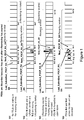
- Figure 2 schematically illustrates embodiments relating to the forwarding of the PDU N to one or more upper layers and the awaiting for late PDUs during a t-WaitForLatePDUs time period.
- actions 203-205 are shown. These actions may be preceded by two actions 201 and 202 corresponding to actions 101 and 102 of Figure 1 .
- action 201 no PDUs are awaiting in the receiving window, and in action 202 a PDU N arrives out of order and is buffered, but PDU N-1, and PDU N-2 are missing.
- the t-reordering timer expires, the lower end of the receiving window is not moved forward as described in relation to Figure 1 . Instead the receiving window is retained at its current position. Further, the PDU N is forwarded to one or more upper layers and the t-WaitForLatePDUs timer is started.
- the PDU N-2 arrives and is forwarded, e.g. immediately forwarded, to one or more upper layers. Since the PDU N-2 is arrived out of the receiving window it is forwarded to the upper layer out of order, i.e. it will be forwarded out of sequence number order.
- the timer t-WaitForLatePDUs is started when t-Reordering timer expires, and it is the t-WaitForLatePDUs timer that is responsible for moving the lower edge of the receiving window once the t-WaitForLatePDUs timer expires.
- the t-WaitForLatePDUs timer is running, any late PDUs that are received by the PDCP receiver, will immediately be forwarded to higher layers. Thus, they will be forwarded in any order to the higher layers, i.e. they may be forwarded out of sequence number order to the higher layers.
- the TCP transmitter is an upper layer entity that handles the transmission of TCP packets.
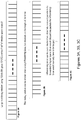
- Figure 3 schematically shows how the length of the reordering window depends on the t-Reordering timer, cf. Figures 3A and 3B , and how the reordering window may be decreased when using a separate t-WaitForLatePDUs timer, cf. Figure 3C.
- Figure 3A illustrates a large reordering window using 18 bits sequence numbers which gives 131072 entries if half of the window space is used for buffering PDUs.
- the memory needed for the reordering window may be quite large because usually a reference to the stored PCDP PDU needs to be stored in each window entry, so that packets quickly can be forwarded to higher layers in order, i.e. in sequence number order, and also the packets themselves need to be stored.
- the reordering window may be shorter when a t-reordering timer is used, but the length of the reordering window will depend on the length of the t-reordering timer, and thus the reordering window may be large when the t-reordering timer corresponds to a long time period.
- Figure 3C it is illustrated how the reordering window, which as mentioned above depends on the t-reordering timer, may be even shorter if late received packets received outside the reordering window are allowed to be forwarded to higher layers.
- t-WaitForLatePDUs timer does not require any memory, since it is only guarding the lower end of the receiving window and is hence used for knowing where the reception window starts.
- a duplicate detection function may be implemented by using a window, e.g. a receiving window, associated with the t-WaitForLatePDUs timer, but where this window only needs one bit per window entry to indicate if a certain PDCP PDU has been received or not.
- a window associated with the t-WaitForLatePDUs may be used to detect and discard duplicates.
- Figure 4 schematically shows how this window may be used.
- the memory needed for this window, e.g. the receiving window, associated with the t-WaitForLatePDUs timer is rather small because only one bit is needed per entry to indicate if a PDU has been received or not.
- t-Reordering timer set to 20 ms and a t-WaitForLatePDUs timer set to 120 ms to wait for late PDUs are used, only 8340 packets are needed to be stored in the window corresponding to a 12.5 Mbyte memory space.
- the window to keep track of received PDCP PDUs while the t- WaitForLatePDUs timer is running has a size of 50040 bits corresponding to a 6 Kbytes memory space.
- the memory space required for some embodiments disclosed herein are lesser than the memory space required by the prior art solution.
- an out-of-order data unit when used in this disclosure is meant that the data unit is received out of sequence number order.
- an out-of-sequence data unit is a data unit received with a higher sequence number than the most recent data unit received and there is a gap in the sequence numbers between these two data units.
- one or more out-of-order data units are received, implies that there are one or more missing data units, some of which may be received at a later point of time while the first timer is still running, some even later while only the second timer is running and further some after the second timer expires.
- the first timer expires all data units that has been received in sequence, i.e. up to the first missing data unit, are delivered and forwarded to upper layers.
- the second timer expires, data units of two types are delivered and forwarded to upper layers.
- the first type of data units are those that were received out-of-order while the first timer was running.
- the second type of data units are those that were missing when the first timer expired but which were received before expiry of the second timer.
- a reference to a missing data unit may be interpreted as a reference to a data unit identified by a sequence number which is expected but has not been received, and a data unit which is received out-of-sequence may be interpreted as a reference to a data unit identified by a sequence number which comes after the sequence number of some missing data unit.
- a reference to a data unit arriving too late may be interpreted as a data unit arriving after the expiry of the second timer and identified by its sequence number as a data unit that was noted to be a missing data unit while the first timer was running, and was still missing when the second timer expired.
- the expiration timer values of the first and second timers may be set based on estimates of the round trip times between a sender and a receiver of a first level transport protocol of the data generator entity, and the one-way latency between a second level sender and receiver transport protocol. For example, the expiration timer values may be estimated based on the round trip times between two network nodes, e.g. between a Radio Network Node and a communications device.
- the first level is an IP-layer transport protocol functionality such as a TCP, a UDP or a QUIC protocol
- the second level is an access network transport functionality, such as the 3GPP PDCP, or the RLC protocol.
- the first level corresponds to a higher layer and the second level corresponds to a lower layer.
- Some embodiments herein disclose window based methods to keep track of received PDUs related to the first and second timers.
- Some embodiments herein disclose duplicated detection function of the implemented window based methods wherein windows only needs one bit per window entry to indicate if a certain data unit has been received or not.
- LTE Long Term Evolution
- 5G Fifth Generation
- LTE Long Term Evolution
- LTE Long Term Evolution
- WCDMA Wideband Code Division Multiple Access
- GSM Global System for Mobile Communications
- WiMAX Worldwide Interoperability for Microwave Access
- WLAN Wireless Local Area Network
- LR-WPAN Low Rate Wireless Personal Access Network
- IEEE 802.15.4 a Bluetooth network, a SIGFOX network, a Zigbee network, a Bluetooth Low Energy (BLE) network such as a Bluetooth Smart network, or a Cellular Internet of Things (CloT) network such as an Enhanced Coverage GSM-loT (EC-GSM-loT) network, a Narrow Band loT (NB-IoT) network or a network comprising one or more wireless devices configured for Machine Type Communication (MTC) sometimes herein referred to as an eMTC network, may also benefit from exploiting the ideas covered within this disclosure.
- BLE Bluetooth Low Energy
- CloT Cellular Internet of Things
- E-GSM-loT Enhanced Coverage GSM-loT
- NB-IoT Narrow Band loT
- MTC Machine Type Communication
- the wireless communications network 600 may be a cellular communications network such as a NR network, a 5G network, an LTE network, a WCDMA network, a GSM network, any 3GPP cellular network, or a short range communications network, such as a WLAN, an LR-WPAN, a Bluetooth network, WiMAX network, a SIGFOX network, a Zigbee network, a BLE network such as a Bluetooth Smart network, or a CloT network such as an EC-GSM-IoT network, a NB-loT network or an eMTC network, or a combination of one or more of the aforementioned communications networks just to mention some examples.
- a cellular communications network such as a NR network, a 5G network, an LTE network, a WCDMA network, a GSM network, any 3GPP cellular network, or a short range communications network, such as a WLAN, an LR-WPAN, a Bluetooth network, WiMAX network, a
- a Core Network (CN) 602 may be comprised in the communications network 600
- the core network 602 may be an NR core network, a 5G core network, an LTE core network, a WCDMA core network, a GSM core network, any 3GPP cellular core network, or a short range communications core network, such as a WLAN core network, an LR-WPAN core network, a Bluetooth core network, WiMAX core network, a SIGFOX core network, a Zigbee core network, a BLE core network such as a Bluetooth Smart network, or a CloT network such as an EC-GSM-loT core network, a NB-loT core network or an eMTC core network, or a combination of one or more of the aforementioned communications core networks just to mention some examples.
- a Core Network Node (CNN), 604 may be comprised in or arranged in communication with the core network 602.
- the core network node 604 may be a Mobility Management Entity (MME) or a Serving GPRS Support Node (SGSN).
- MME Mobility Management Entity
- SGSN Serving GPRS Support Node
- the core network node is sometimes referred to as just a network node 604.
- a Radio Network Node (RNN), 606 is arranged and configured to operate in the communication network 600.
- the RNN 606 is configured for wireless communication with communications devices, e.g. communications devices such as a communications device 608, when they are located within a coverage area 606a, e.g. a geographical area served by the RNN 606. It should be understood that the RNN 606 may serve or manage a plurality of coverage areas 606a, even though only one is illustrated in Figure 6 for clarity reasons.
- the one more coverage areas 606a are sometimes in this disclosure referred to as one or more cells 606a.
- the RNN 606 may be a transmission point such as a radio base station, for example a gNB, an E-UTRA node, a LTE eNB, an eNB, an Node B, or an Home Node B, an Home eNode B, a Base Station Transceiver (BTS) or any other network node being capable to serve a communications device in a communications network, such as the communications network 600.
- the RNN 606 may further be configured to communicate with the core network node 604.
- the RNN 606 is sometimes referred to as just a network node 606.
- a communications device 608 is operating in the wireless communications network 600.
- the communications device 608 also sometimes referred to as a wireless communications device, a wireless device, a user equipment (UE), or a Mobile Station (MS), may be located in the wireless communications network 600.
- the communications device 608 may be an Internet of Things (loT) device, a user equipment, a mobile terminal or a wireless terminal, a mobile phone, a computer such as e.g. a laptop, a Personal Digital Assistants (PDAs) or a tablet computer, with wireless capability, or any other radio network units capable to communicate over a radio link in a wireless communications network.
- LoT Internet of Things
- PDAs Personal Digital Assistants
- tablet computer with wireless capability, or any other radio network units capable to communicate over a radio link in a wireless communications network.
- the term user equipment used in this document also covers other wireless devices such as Machine to Machine (M2M) devices, even though they are not handled by any user.
- the communications device 608 is a stationary wireless device.
- the communications device 608 is sometimes in this disclosure referred to as a stationary communications device 608.
- stationary wireless device when used herein is meant that the communications device 608 is not moving.
- the stationary communications device 608 is not moving when in use, e.g. during operation.
- the communications device 608 is sometimes referred to as just a network node 608. Further, the RNN 606, the communications device 608, and the core network node 604, may be referred to as first, second and third network nodes 608, 606, 604.
- network node 606, 608 related embodiments relate to Figures 7A, 7B and 8 .
- a method performed by a network node 606, 608, such as the RNN 606 or the communications device 608, for PDCP reordering will now be described.
- the network node 606,608 is operating in the wireless communications network 600.
- the method comprises one or more of the actions below and it should be understood that actions may be combined and that actions may be performed in any suitable order.
- the network node 606,608 buffers one or more first data units received out of order from a lower layer and during a first time period. Especially, the network node 606,608 buffers in order one or more first data units received out of order by a PDCP layer. In other words, the network node 606,608 buffers in sequence number order the one or more first data units received out of sequence number order by the PDCP layer. As mentioned above, the one or more first data units are received from a lower layer during a first time period. Further, the lower layer is a layer below the PDCP layer.
- This action relates to Action 202 previously described and may be performed by a buffering module, e.g. a buffering module 803, comprised in the network node 608, 606, such as the RNN 606 or the communications device 608.
- the buffering module 803 may be implemented by or arranged in communication with a processor 807 of the network node 608, 606.
- the processor 407 and the buffering module 803 will be described in more detail below.
- the network node 606,608 forwards the one or more buffered first data units in order to an upper layer.
- the network node 606,608 forwards the one or more buffered first data units in sequence number order to the upper layer.
- the network node 606,608 starts a second time period.
- the upper layer is a layer, e.g. a TCP layer, above the PDCP layer.
- the expiry of the first and second time periods may be determined by a respective first and second timer, or may be determined by the first timer and a PDCP sequence number offset.
- the PDCP sequence number offset is an offset from the Last_Submitted_PDCP_RX_SN parameter.
- the Last_Submitted_PDCP_RX_SN parameter tracks the sequence number corresponding to the last one of the first data units that are in sequence.
- the Last_Submitted_PDCP_RX_SN may also be defined to indicate the sequence number SN of the last PDCP SDU delivered to the upper layers.
- the first and second time periods may be calculated based on a multiplicity of the round trip time.
- the first and second time periods are set based on an estimate of round trip times between network nodes 606,608, e.g. between the network node 606,608 and another network node 606,608, or based on a PDCP data unit one-way delay and its variance.
- the network node 606,608 associates a window with the second time period, and for each entry of the window the network node 606,608 indicates whether or not a certain data unit has been received. Further, the network node 606,608 may discard a received data unit when the received data unit is indicated as already being received. Thus, an already received data unit will not be forwarded.
- This action relates to Action 203 previously described and may be performed by a forwarding module, e.g. a forwarding module 804, comprised in the network node 608, 606, such as the RNN 606 or the communications device 608.
- the forwarding module 804 may be implemented by or arranged in communication with the processor 807 of the network node. The forwarding module 804 will be described in more detail below.
- the network node 606,608 forwards, to the upper layer, one or more second data units received from the lower layer during a second time period.
- the network node 606,608 may forward, to the upper layer and in any order, the one or more second data units received from the lower layer during the second time period. Thereby, the one or more second data units arriving too late to the PDCP layer to be buffered in order is forwarded to the upper layer in time for a reordering functionality of the upper layer.
- the one or more second data units are immediately forwarded to the upper layer, e.g. they are forwarded directly after reception.
- the network node 606,608 may forward the one or more second data units to the upper layer directly after reception of the one or more second data units.
- the first and second time periods may be consecutive time periods.
- This action relates to Action 204 previously described and may be performed by the forwarding module, e.g. the forwarding module 804.
- the network node 606,608 moves a lower end of a receiving window forward to a sequence number N+1 upon expiration of the second time period.
- the second time period was started at a sequence number N, and the receiving window comprises the first time period and the second time period. This action relates to Action 205 previously described.
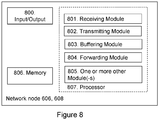
- the network node 606,608 may be configured according to an arrangement depicted in Figure 8 . As previously described, the network node 206,208 is configured to operate in the wireless communications network 200.
- the network node 608, 606, such as the RNN 606 or the communications device 608, may comprise an interface unit, e.g. an input/output interface 800, to facilitate communications between the network node and other network nodes or devices.
- the interface may, for example, include a transceiver configured to transmit and receive radio signals over an air interface in accordance with a suitable standard.
- the network node 608, 606, such as the RNN 606 or the communications device 608, is configured to receive, by means of a receiving module 701 configured to receive, a transmission, e.g. a data unit, a data packet, a signal or information, from one or more network nodes.
- the receiving module 801 may be implemented by or arranged in communication with the processor 807 of the network node.
- the network node 608, 606, such as the RNN 606 or the communications device 608, is configured to transmit, by means of a transmitting module 701 configured to transmit, a transmission, e.g. a data unit, a data packet, a signal or information, from one or more network nodes.
- the transmitting module 801 may be implemented by or arranged in communication with the processor 807 of the network node.
- the network node 606, 608, such as the RNN 606 or the communications device 608, is configured to buffer, by means of e.g. a buffering module 803 configured to buffer, one or more first data units.
- the buffering module 803 may be implemented by or arranged in communication with the processor 807.
- the network node 606, 608 is configured to buffer in order one or more first data units received out of order by a PDCP layer.
- the one or more first data units are configured to be received from a lower layer during a first time period, and the lower layer is a layer below the PDCP layer.
- the network node 606, 608, such as the RNN 606 or the communications device 608, is configured to forward, by means of e.g. the forwarding module 804 configured to forward, data units to an upper layer.
- the forwarding module 804 may be implemented by or arranged in communication with the processor 807 of the network node.
- the network node 606, 608 is configured to forward the one or more buffered first data units in order to an upper layer when the first time period has expired. Further, the network node 606, 608 is configured to start a second time period.
- the upper layer is a layer above the PDCP layer.
- the network node 606, 608 is configured to forward, to the upper layer and in any order, one or more second data units configured to be received from the lower layer during the second time period. Thereby the one or more second data units arriving too late to the PDCP layer to be buffered in order is forwarded to the upper layer in time for a reordering functionality of the upper layer.
- the network node 606, 608 is configured to forward the one or more second data units to the upper layer directly after reception of the one or more second data units.
- the first and second time periods may be configured to be consecutive time periods.
- the network node 606, 608 is configured to move a lower end of a receiving window forward to a sequence number N+1 upon expiration of the second time period.
- the second time period is configured to be started at a sequence number N
- the receiving window is configured to comprise the first time period and the second time period.
- the network node 606, 608 may be configured to set the first and second time periods based on an estimate of the round trip times between network nodes 606, 608 or based on a PDCP data unit one-way delay and its variance.
- the network node 606, 608 determines expiry of the first and second time periods by a respective first and second timer, or by the first timer and a PDCP sequence number offset.
- the network node 606, 608 may be configured to associate a window with the second time period, and for each entry of the window indicate whether or not a certain data unit has been received. Further, the network node 606, 608 may be configured to discard a received data unit when the received data unit is indicated as already being received.
- the network node 608, 606, such as the RNN 606 or the communications device 608, is configured to perform, by means of one or more other modules 805 configured to perform one or more further actions described herein.
- the one or more other modules may be implemented by or arranged in communication with the processor 807 of the network node.
- the network node 608, 606, such as the RNN 606 or the communications device 608, may also comprise means for storing data.
- the network node 608, 606 comprises a memory 806 configured to store the data.
- the data may be processed or non-processed data and/or information relating thereto.
- the memory 806 may comprise one or more memory units.
- the memory 806 may be a computer data storage or a semiconductor memory such as a computer memory, a read-only memory, a volatile memory or a non-volatile memory.
- the memory is arranged to be used to store obtained information, data, configurations, and applications etc. to perform the methods herein when being executed in the network node.
- Embodiments herein for PDCP reordering may be implemented through one or more processors, such as the processor 807 in the arrangement depicted in Fig. 8 , together with computer program code for performing the functions and/or method actions of embodiments herein.
- the program code mentioned above may also be provided as a computer program product, for instance in the form of a data carrier carrying computer program code for performing the embodiments herein when being loaded into network node.
- One such carrier may be in the form of an electronic signal, an optical signal, a radio signal or a computer readable storage medium.
- the computer readable storage medium may be a CD ROM disc or a memory stick.
- the computer program code may furthermore be provided as program code stored on a server and downloaded to the network node.
- the input/output interface 800, the receiving module 801, the transmitting module 802, the buffering module 803, the forwarding module 804, and the one or more other modules 805 above may refer to a combination of analogue and digital circuits, and/or one or more processors configured with software and/or firmware, e.g. stored in the memory 806, that when executed by the one or more processors such as the processors in the network node perform as described above.
- processors may be included in a single Application-Specific Integrated Circuitry (ASIC), or several processors and various digital hardware may be distributed among several separate components, whether individually packaged or assembled into a System-on-a-Chip (SoC).
- ASIC Application-Specific Integrated Circuitry
- SoC System-on-a-Chip
- Figure 9 schematically illustrates some parameters that may be used in the PDCP receiver, e.g. the network node 606, 608, such as the RNN 606 for an uplink transmission or the communications device 608 for a downlink transmission, to handle re-ordering and in-order delivery of PDCP SDUs and further, specifically as proposed by some embodiments, to provide delivery of late PDCP SDUs to higher layers even if they are received and delivered out-of-order.
- the network node 606, 608 such as the RNN 606 for an uplink transmission or the communications device 608 for a downlink transmission
- the receiving window comprises a first time window and a second time window.
- the network node 606, 608 waits for late packets and keep them in order, e.g. in sequence number order.
- the first time window is sometimes referred to as the reordering window.
- the network node 606, 608 waits for late, e.g. very late, packets without keeping them in order. The late packets are received outside the first time window.
- a first parameter is a Lower_PDCP_RX_SN parameter indicating the sequence number of the lower edge of the receiving window.
- a second parameter is a Wait_PDCP_RX-SN parameter indicating the sequence number of the last submitted PDCP PDU that was delivered to the upper layer when the t-WaitForLatePDUs timer expired.
- a third parameter is a Last_Submitted_PDCP_RX_SN parameter indicating the sequence number of the last PDCP SDU that was submitted in-order to the upper layer. It should be understood that the data unit indicated by Last_Submitted_PDCP_RX_SN has already been delivered to higher layers, and is therefore not subject to reordering.
- a fourth parameter is a Reordering_PDCP_RX_COUNT parameter indicating the COUNT value of the PDCP PDU following the COUNT value of the PDCP PDU that triggered t-Reordering.
- the Reordering_PDCP_RX_COUNT parameter indicates the sequence number that the lower edge of the reordering window should be moved to when the t-Reordering timer expires.
- a fifth parameter Next_PDCP_RX_SN indicates the sequence number of the PDCP PDU that is expected to be received by the PDCP entity.
- Last_Submitted_PDCP_RX_SN is updated to track the SN corresponding to the last of those SDUs that are in sequence. This mechanism is proposed in some embodiments to be reused for PDCP.
- the t-Reordering timer is proposed to be used for advancing the lower edge of the reordering window, but in some embodiments disclosed herein it is proposed to use an additional timer, called a t-WaitForLatePDUs timer, to advance the lower edge of the complete receiving window, where the reordering window is a subset of the receiving window.
- a t-WaitForLatePDUs timer an additional timer, called a t-WaitForLatePDUs timer.
- t- WaitForLatePDUs timer which advances the lower edge of the receiving window and allows immediate deliveries of received PDCP PDUs with no re-ordering for PDCP PDUs received outside the reordering window but inside the receiving window.
- the PDCP receiver e.g. the network node 606, 608, such as the RNN 606 for an uplink transmission or the communications device 608 for a downlink transmission, will continue to forward any SDU, e.g. any PDCP SDU, that was noted to be missing after the first process of in-sequence delivery, as soon as they may get fully received and assembled, i.e. without concern of its sequence number and the order in which it gets to be forwarded.
- any SDU e.g. any PDCP SDU
- the timer t-WaitForLatePDUs does not need to be used. If that is the case, the Last_Submitted_PDCP_RX_SN is a good marker of a lower edge of both the reordering window and the in-order-delivery window, i.e. the Lower_PDCP_RX_SN may be set to the Last_Submitted_PDCP_RX_SN.
- the t-WaitForLatePDUs timer may be started if not already started to supervise a late out-of-sequence delivery during which Lower_PDCP_RX_SN, i.e. the lower end of the reordering window, does not change.
- the receiving window of the PDCP receiver e.g. the network node 606, 608, such as the RNN 606 for an uplink transmission or the communications device 608 for a downlink transmission
- the t-WaitForLatePDUs timer is controlled by the t-WaitForLatePDUs timer, while the t-Reordering timer is instead controlling an upper subset of this window, which is the reordering window.
- the reordering window may be visualized as a pushed window, i.e. a window which is pushed from its lower end.
- the event or action that performs the pushing is the in-sequence submission to higher layers, which, similar to LTE, is controlled by the variable Last_Submitted_PDCP_RX_SN that keeps track of that lower edge of the reordering window.
- the lower edge of the reordering window is controlled by the variable Lower_PDCP_RX_SN, and is used to wait for late PDCP SDUs.
- the receiving window thus comprises two parts: a sub window in the form of the reordering window, which ensures in-order-delivery, and a trailing part which is used to wait for any late PDUs but does not ensure in-order-delivery.
- the Last_Submitted_PDCP_RX_SN variable is updated using the t-Reordering timer just like in LTE, and controls the lower edge of the in-order-delivery window, which is an upper subset of the receiving window.
- the Lower_PDCP_RX_SN variable is updated using the t-WaitForLatePDUs timer, and this variable controls the lower edge of the receiving window.
- the lower edge of the PDCP receiving window will be moved forward to the sequence number for which the t-WaitForLatePDUs timer was started.
- the Wait_PDCP_RX_SN variable stores the sequence number for which the Lower_PDCP_RX_SN will be set to when the t-WaitForLatePDUs timer expires.
- the receiving window uses the variable Wait_PDCP_RX_SN to keep track of the last SDU that was delivered to upper layers when t-WaitForLatePDUs was (re)started.
- t-Reordering timer if the t-Reordering timer is set to 0 it means that the reordering window will have zero length, and thus no enforcement of in-order-delivery will be done, but any late PDCP SDUs received within the receiving window and which has not already been forwarded will be forwarded directly to upper layers, even if they are out-of-order.
- the in-order-delivery window i.e. the reordering window
- the in-order-delivery window will be exactly the same as the receiving window because the t-WaitForLatePDUs timer will immediately expire once started.
- the lower edge of the receiving window will be the same as the reordering window, and hence any late PDCP PDUs received within the receiving window will also be received within the in-order-delivery window, and thus in-order delivery will be maintained towards upper layers.
- the t-WaitForLatePDUs timer is started at expiry of the t-Reordering timer but only at occurrence of missing SDUs. In some other embodiments, the t-WaitForLatePDUs timer is started at the same time as the t-Reordering timer. In such a case, the t-WaitForLatePDUs timer is set to a larger value, approximately equal or preferably slightly less than a Round-trip Time (RTT) used by the higher layer, such as the TCP RTT.
- RTT Round-trip Time
- the rest of the receiving window which is not in the reordering window is mapped to an array of indicators that keeps track of PDUs that have been received. This was described above with reference to e.g. Figure 4 .
- the array is used to detect duplicates, i.e. PDUs which have already been received.
- the PDCP receiver e.g. the network node 606, 608, such as the RNN 606 for an uplink transmission or the communications device 608 for a downlink transmission, receives a PDCP PDU which has an SN for which a PDCP PDU has already been received, the PDCP will discard the packet.
- the values of the t-Reordering timer and the t-WaitForLatePDUs timer may be set based on an estimate of the higher layer protocol round trip time, e.g. the TCP RTT, referred here to as T_higherlayerRtt and an estimate of the PDCP PDU one-way delay and its variance referred here to as T _ delay and T_delayVariance respectively, such as; wherein alfa is a scaling factor between 0 to1.
- TCP RTT referred here to as T_higherlayerRtt
- T_ delay and T_delayVariance an estimate of the PDCP PDU one-way delay and its variance
- alfa is a scaling factor between 0 to1.
- the PDCP PDU one-way delay T_delay may be measured via a ping program method between the UE and the RNN, and the variance, T_delayVariance, may be calculated from those measurements.
- the PDCP PDU one-way delay T_delay may be implicitly measured by checking the time when sending a RLC data unit and then checking the time of receiving the corresponding RLC acknowledgement and calculate the PDCP PDU one-way delay T_delay, and then its variance, T_delayVariance, from those measurements.
- the T_higherlayerRtt may also be measured by pings between the RNN and the UE, and the RNN and the higher-layer protocol sender, e.g. an Internet server, and adding them together.
- the T_higherlayerRtt may also be implicitly measured by examining the higher-layer protocol headers for time stamp values and matching data units with its corresponding acknowledgements.
- a timer is used to determine when to move the lower edge of the receiving window.
- an offset e.g. a fixed offset, is used instead to define the lower edge of the receiving window.
- Figure 10 schematically illustrates the use of a Wait_Delta_Offset parameter to defined the start of the receiving window from the Last_Submitted_PDCP_RX_SN parameter.
- Some fourth exemplifying embodiments is similar to some embodiments wherein a timer is used to move the lower edge of the receiving window, but the difference is that the lower edge of the receiving window is instead set to an offset from the Last_Submitted_PDCP_RX_SN parameter.
Landscapes
- Engineering & Computer Science (AREA)
- Computer Networks & Wireless Communication (AREA)
- Signal Processing (AREA)
- Computer Security & Cryptography (AREA)
- Databases & Information Systems (AREA)
- Mobile Radio Communication Systems (AREA)
- Communication Control (AREA)
- Data Exchanges In Wide-Area Networks (AREA)
Claims (14)
- Procédé réalisé par un nœud de réseau (606, 608) pour le réordonnancement de protocole de convergence de données en paquets, PDCP, dans lequel le nœud de réseau (606, 608) fonctionne dans un réseau de communication sans fil (600), et dans lequel le procédé comprend :- la mise en mémoire tampon (202, 701) dans l'ordre d'une ou plusieurs premières unités de données reçues dans le désordre par une couche PDCP, dans lequel les une ou plusieurs premières unités de données sont reçues depuis une couche inférieure au cours d'une première période de temps, et dans lequel la couche inférieure est une couche au-dessous de la couche PDCP ;- lorsque la première période de temps a expiré, le transfert (203, 702) des une ou plusieurs premières unités de données mises en mémoire tampon dans l'ordre à une couche supérieure, dans lequel la couche supérieure est une couche au-dessus de la couche PDCP ;- le transfert (204, 703), à la couche supérieure et dans n'importe quel ordre, d'une ou plusieurs deuxièmes unités de données reçues depuis la couche inférieure au cours de la deuxième période de temps, de telle manière que les une ou plusieurs deuxièmes unités de données arrivant trop tard à la couche PDCP à mettre en mémoire tampon dans l'ordre soient transférées à la couche supérieure à temps pour une fonctionnalité de réordonnancement de la couche supérieure ;
le procédé étant en outre caractérisé par :
lorsque la première période de temps a expiré, le commencement d'une deuxième période de temps ;- à l'expiration de la deuxième période de temps, le déplacement (205) d'une extrémité inférieure d'une fenêtre de réception vers l'avant jusqu'à un numéro de séquence N+1, dans lequel la deuxième période de temps a été commencée à un numéro de séquence N, et dans lequel la fenêtre de réception comprend la première période de temps et la deuxième période de temps. - Procédé selon la revendication 1, dans lequel le transfert (204, 703) des une ou plusieurs deuxièmes unités de données reçues depuis la couche inférieure au cours de la deuxième période de temps comprend :- le transfert des une ou plusieurs deuxièmes unités de données à la couche supérieure directement après la réception des une ou plusieurs deuxièmes unités de données.
- Procédé selon la revendication 1 ou 2, dans lequel les première et deuxième périodes de temps sont des périodes de temps consécutives.
- Procédé selon l'une quelconque des revendications 1 à 3, dans lequel les première et deuxième périodes de temps sont réglées sur la base d'une estimation de temps aller-retour entre des nœuds de réseau (606, 608) ou sur la base d'un retard unidirectionnel d'unités de données PDCP et de sa variance.
- Procédé selon l'une quelconque des revendications 1 à 4, dans lequel l'expiration des première et deuxième périodes de temps est déterminée par des première et deuxième minuteries respectives, ou est déterminée par la première minuterie et un décalage de numéro de séquence PDCP.
- Procédé selon l'une quelconque des revendications 1 à 5, comprenant :- l'association d'une fenêtre à la deuxième période de temps, et, pour chaque entrée de la fenêtre, l'indication si une certaine unité de données a été reçue ou non ; et- le rejet d'une unité de données reçue lorsqu'il est indiqué que l'unité de données reçue a déjà été reçue.
- Nœud de réseau (606, 608) pour le réordonnancement de protocole de convergence de données en paquets, PDCP, dans lequel le nœud de réseau (606, 608) est configuré pour fonctionner dans un réseau de communication sans fil (600), et dans lequel le nœud de réseau (606, 608) est configuré pour :- la mise en mémoire tampon dans l'ordre d'une ou plusieurs premières unités de données reçues dans le désordre par une couche PDCP, dans lequel les une ou plusieurs premières unités de données sont reçues depuis une couche inférieure au cours d'une première période de temps, et dans lequel la couche inférieure est une couche au-dessous de la couche PDCP ;- le transfert des une ou plusieurs premières unités de données mises en mémoire tampon dans l'ordre à une couche supérieure lorsque la première période de temps a expiré, dans lequel la couche supérieure est une couche au-dessus de la couche PDCP ;
caractérisé en ce que le nœud de réseau est en outre configuré pour le commencement d'une deuxième période de temps lorsque la première période de temps a expiré ;- le transfert, à la couche supérieure et dans n'importe quel ordre, d'une ou plusieurs deuxièmes unités de données configurées pour être reçues depuis la couche inférieure au cours de la deuxième période de temps, de telle manière que les une ou plusieurs deuxièmes unités de données arrivant trop tard à la couche PDCP à mettre en mémoire tampon dans l'ordre soient transférées à la couche supérieure à temps pour une fonctionnalité de réordonnancement de la couche supérieure ; et- le déplacement d'une extrémité inférieure d'une fenêtre de réception vers l'avant jusqu'à un numéro de séquence N+1 à l'expiration de la deuxième période de temps, dans lequel la deuxième période de temps est configurée pour être commencée à un numéro de séquence N, et dans lequel la fenêtre de réception est configurée pour comprendre la première période de temps et la deuxième période de temps. - Nœud de réseau (606, 608) selon la revendication 7, en outre configuré pour le transfert des une ou plusieurs deuxièmes unités de données configurées pour être reçues depuis la couche inférieure au cours de la deuxième période de temps, en étant en outre configuré pour :- le transfert des une ou plusieurs deuxièmes unités de données à la couche supérieure directement après la réception des une ou plusieurs deuxièmes unités de données.
- Nœud de réseau (606, 608) selon la revendication 7 ou 8, dans lequel les première et deuxième périodes de temps sont des périodes de temps consécutives.
- Nœud de réseau (606, 608) selon l'une quelconque des revendications 7 à 9, dans lequel les première et deuxième périodes de temps sont configurées pour être réglées sur la base d'une estimation de temps aller-retour entre des nœuds de réseau (606, 608) ou sur la base d'un retard unidirectionnel d'unités de données PDCP et de sa variance.
- Nœud de réseau (606, 608) selon l'une quelconque des revendications 7 à 10, dans lequel l'expiration des première et deuxième périodes de temps est déterminée par des première et deuxième minuteries respectives, ou est déterminée par la première minuterie et un décalage de numéro de séquence PDCP.
- Nœud de réseau (606, 608) selon l'une quelconque des revendications 7 à 11, configuré en outre pour :- l'association d'une fenêtre à la deuxième période de temps, et, pour chaque entrée de la fenêtre, l'indication si une certaine unité de données a été reçue ou non ; et- le rejet d'une unité de données reçue lorsqu'il est indiqué que l'unité de données reçue a déjà été reçue.
- Programme informatique comprenant des instructions qui, lorsqu'elles sont exécutées sur au moins un processeur, amènent l'au moins un processeur à réaliser le procédé selon l'une quelconque des revendications 1 à 6.
- Support comprenant le programme informatique selon la revendication 13, dans lequel le support est l'un parmi un signal électronique, un signal optique, un signal radio ou un support de stockage lisible par ordinateur.
Applications Claiming Priority (2)
| Application Number | Priority Date | Filing Date | Title |
|---|---|---|---|
| US201762491291P | 2017-04-28 | 2017-04-28 | |
| PCT/SE2018/050252 WO2018199822A1 (fr) | 2017-04-28 | 2018-03-15 | Nœud de réseau et procédés associés destinés au réordonnancement du protocole de convergence de données par paquets (pdcp) |
Publications (2)
| Publication Number | Publication Date |
|---|---|
| EP3616432A1 EP3616432A1 (fr) | 2020-03-04 |
| EP3616432B1 true EP3616432B1 (fr) | 2020-11-25 |
Family
ID=61832562
Family Applications (1)
| Application Number | Title | Priority Date | Filing Date |
|---|---|---|---|
| EP18714627.9A Active EP3616432B1 (fr) | 2017-04-28 | 2018-03-15 | N ud de réseau et procédés associés destinés au réordonnancement du protocole de convergence de données par paquets (pdcp) |
Country Status (8)
| Country | Link |
|---|---|
| US (2) | US10736174B2 (fr) |
| EP (1) | EP3616432B1 (fr) |
| JP (1) | JP2020520567A (fr) |
| CN (1) | CN110622543A (fr) |
| AR (1) | AR111628A1 (fr) |
| CO (1) | CO2019010354A2 (fr) |
| RU (1) | RU2019138317A (fr) |
| WO (1) | WO2018199822A1 (fr) |
Cited By (1)
| Publication number | Priority date | Publication date | Assignee | Title |
|---|---|---|---|---|
| US12376191B2 (en) * | 2020-11-11 | 2025-07-29 | Qualcomm Incorporated | Handling unordered signaling radio bearer (SRB) packets |
Families Citing this family (18)
| Publication number | Priority date | Publication date | Assignee | Title |
|---|---|---|---|---|
| SG11201811738UA (en) * | 2017-08-10 | 2019-03-28 | Lg Electronics Inc | Method for performing a re-establishment of a pdcp entity associated with um rlc entity in wireless communication system and a device therefor |
| US10893437B2 (en) * | 2018-02-27 | 2021-01-12 | Verizon Patent And Licensing Inc. | Out-of-order packet handling in 5G/new radio |
| US11012367B2 (en) * | 2018-03-30 | 2021-05-18 | Intel IP Corporation | Technologies for managing TCP/IP packet delivery |
| US11483225B2 (en) | 2018-04-17 | 2022-10-25 | Intel Corporation | Technologies for out-of-order network packet management and selective data flow splitting |
| EP3874811B1 (fr) | 2018-11-01 | 2025-08-06 | Telefonaktiebolaget LM Ericsson (publ) | Empêcher un transfert provoqué par un message non sécurisé provenant d'un noeud de réseau |
| CN112153691B (zh) * | 2019-06-27 | 2022-04-12 | 华为技术有限公司 | 数据包传输的方法和通信装置 |
| CN115088300B (zh) * | 2020-01-23 | 2025-07-29 | 伟光有限公司 | 用于在介质访问控制层对分组数据单元进行排队的方法及系统 |
| US12301469B2 (en) * | 2020-08-21 | 2025-05-13 | Qualcomm Incorporated | Techniques for improving packet data convergence protocol reordering configuration |
| CN114337936B (zh) * | 2020-09-30 | 2024-09-10 | 上海华为技术有限公司 | 确定收发窗口不一致的方法,装置以及相关设备 |
| WO2022139656A1 (fr) * | 2020-12-22 | 2022-06-30 | Telefonaktiebolaget Lm Ericsson (Publ) | Fonction d'ordonnancement de paquets pour réseaux tsn/detnet |
| WO2022258194A1 (fr) * | 2021-06-11 | 2022-12-15 | Telefonaktiebolaget Lm Ericsson (Publ) | Gestion de gigue |
| US11665103B2 (en) * | 2021-06-16 | 2023-05-30 | Nxp Usa, Inc. | Dynamic packet data convergence protocol reordering |
| CN115834742B (zh) * | 2021-09-16 | 2024-11-22 | 大唐移动通信设备有限公司 | 定时器处理方法、装置及存储介质 |
| US12348314B2 (en) * | 2022-01-20 | 2025-07-01 | T-Mobile Innovations Llc | Duplicate message removal technique for improving retransmission success rate |
| US12120033B2 (en) * | 2022-06-16 | 2024-10-15 | Samsung Electronics Co., Ltd. | Method and apparatus for managing the flow of data in PDCP |
| WO2024041340A1 (fr) * | 2022-08-23 | 2024-02-29 | 华为技术有限公司 | Procédé de distribution de données et appareil de communication |
| US20240236009A1 (en) * | 2023-01-11 | 2024-07-11 | Qualcomm Incorporated | Techniques for packet data convergence protocol reordering within a timer |
| US20250386243A1 (en) * | 2024-06-17 | 2025-12-18 | Qualcomm Incorporated | Selective service data unit forwarding techniques |
Family Cites Families (12)
| Publication number | Priority date | Publication date | Assignee | Title |
|---|---|---|---|---|
| KR100938090B1 (ko) | 2006-10-19 | 2010-01-21 | 삼성전자주식회사 | 이동통신 시스템에서 핸드오버 수행 방법 및 장치 |
| CN101647257B (zh) * | 2007-03-23 | 2015-04-01 | 株式会社Ntt都科摩 | 重发请求发送方法和接收侧装置 |
| KR101191491B1 (ko) * | 2007-06-18 | 2012-10-15 | 엘지전자 주식회사 | 핸드오버 중 하향링크 pdcp 동작 |
| US20090168723A1 (en) * | 2007-11-27 | 2009-07-02 | Qualcomm Incorporated | Method and apparatus for handling out-of-order packets during handover in a wireless communication system |
| KR101638195B1 (ko) * | 2010-02-01 | 2016-07-08 | 삼성전자주식회사 | 통신 시스템에서 무선 링크 제어 계층 및 패킷 데이터 융합 프로토콜 계층 간의 플로우 제어를 위한 방법 및 장치 |
| US20140301188A1 (en) * | 2013-04-04 | 2014-10-09 | Nokia Siemens Networks Oy | Delivery of protocol data units |
| EP2830352A1 (fr) * | 2013-07-24 | 2015-01-28 | Panasonic Intellectual Property Corporation of America | Mécanisme d'abandon efficace dans un déploiement à petites cellules |
| US9585048B2 (en) * | 2013-10-30 | 2017-02-28 | Qualcomm Incorporated | Techniques for aggregating data from WWAN and WLAN |
| US10027593B2 (en) | 2014-01-28 | 2018-07-17 | Mediatek Singapore Pte. Ltd. | Methods for re-order PDCP packets |
| CN104935413B (zh) * | 2014-03-19 | 2019-12-27 | 夏普株式会社 | 分组数据汇聚协议pdcp实体及其执行的方法 |
| KR102211471B1 (ko) * | 2014-05-02 | 2021-02-04 | 팬텍 주식회사 | 듀얼 커넥티비티 하에서 데이터 송수신 방법 및 그 장치 |
| US9999049B2 (en) * | 2015-08-31 | 2018-06-12 | Qualcomm Incorporated | Avoiding unnecessary protocol data unit (PDU) transmissions |
-
2018
- 2018-03-15 EP EP18714627.9A patent/EP3616432B1/fr active Active
- 2018-03-15 JP JP2019554398A patent/JP2020520567A/ja active Pending
- 2018-03-15 RU RU2019138317A patent/RU2019138317A/ru not_active Application Discontinuation
- 2018-03-15 CN CN201880028503.6A patent/CN110622543A/zh not_active Withdrawn
- 2018-03-15 WO PCT/SE2018/050252 patent/WO2018199822A1/fr not_active Ceased
- 2018-03-15 US US15/781,556 patent/US10736174B2/en active Active
- 2018-04-27 AR ARP180101111A patent/AR111628A1/es unknown
-
2019
- 2019-09-25 CO CONC2019/0010354A patent/CO2019010354A2/es unknown
-
2020
- 2020-06-22 US US16/907,750 patent/US11477845B2/en active Active
Non-Patent Citations (1)
| Title |
|---|
| None * |
Cited By (1)
| Publication number | Priority date | Publication date | Assignee | Title |
|---|---|---|---|---|
| US12376191B2 (en) * | 2020-11-11 | 2025-07-29 | Qualcomm Incorporated | Handling unordered signaling radio bearer (SRB) packets |
Also Published As
| Publication number | Publication date |
|---|---|
| AR111628A1 (es) | 2019-07-31 |
| US20200351983A1 (en) | 2020-11-05 |
| RU2019138317A3 (fr) | 2021-05-28 |
| JP2020520567A (ja) | 2020-07-09 |
| RU2019138317A (ru) | 2021-05-28 |
| US10736174B2 (en) | 2020-08-04 |
| WO2018199822A1 (fr) | 2018-11-01 |
| CO2019010354A2 (es) | 2019-10-09 |
| US20200100324A1 (en) | 2020-03-26 |
| EP3616432A1 (fr) | 2020-03-04 |
| CN110622543A (zh) | 2019-12-27 |
| US11477845B2 (en) | 2022-10-18 |
Similar Documents
| Publication | Publication Date | Title |
|---|---|---|
| US11477845B2 (en) | Network node and methods therein for packet data convergence protocol (PDCP) reordering | |
| Racz et al. | Handover performance in 3GPP long term evolution (LTE) systems | |
| EP2749118B1 (fr) | Amélioration de performance de tcp dans un réseau cellulaire | |
| CN201444641U (zh) | 无线发射/接收单元 | |
| US9456378B2 (en) | End-to-end (E2E) tunneling for multi-radio access technology (multi-rat) | |
| TWI400971B (zh) | 執行具中繼節點切換之方法及裝置 | |
| US20190319889A1 (en) | Packet transmission method, terminal, network device, and communications system | |
| AU2003276747B2 (en) | Method for moving a receive window in a radio access network | |
| EP2494815B1 (fr) | Procédé et appareil de communication de distribution de paquets de données à un équipement utilisateur dans un système de communication sans fil | |
| EP2658311B1 (fr) | Distribution dans un ordre de livraison de paquets de données pendant un transfert | |
| US10412634B2 (en) | Predictive adaptive queue management | |
| CN101888675A (zh) | 一种长期演进系统中跨基站切换方法及系统 | |
| WO2007144041A1 (fr) | Procédé permettant d'éviter des requêtes de retransmission dans un schéma de retransmission de paquets | |
| US20120129530A1 (en) | Handover Method for Reducing the Amount of Data Forwarded to a Target Node | |
| WO2015064318A1 (fr) | Équipement utilisateur et procédé | |
| CN107005884A (zh) | 用于ran‑wlan无线电聚合的接口功能 | |
| TW202226879A (zh) | 降低多分支傳輸中封包延遲的方法和裝置 | |
| CN107959554B (zh) | 一种数据的重传方法及装置 | |
| CN115277608B (zh) | 无线通信的方法及设备 | |
| US9125109B1 (en) | Determining a reordering timer | |
| EP3222014B1 (fr) | Gestion active de files d'attente pour un réseau de communication sans fil | |
| WO2026101442A1 (fr) | Gestion de file d'attente intégrée à fusion de protocole de convergence de données et de protocole de commande de liaison radio 6g |
Legal Events
| Date | Code | Title | Description |
|---|---|---|---|
| STAA | Information on the status of an ep patent application or granted ep patent |
Free format text: STATUS: UNKNOWN |
|
| STAA | Information on the status of an ep patent application or granted ep patent |
Free format text: STATUS: THE INTERNATIONAL PUBLICATION HAS BEEN MADE |
|
| PUAI | Public reference made under article 153(3) epc to a published international application that has entered the european phase |
Free format text: ORIGINAL CODE: 0009012 |
|
| STAA | Information on the status of an ep patent application or granted ep patent |
Free format text: STATUS: REQUEST FOR EXAMINATION WAS MADE |
|
| 17P | Request for examination filed |
Effective date: 20190904 |
|
| AK | Designated contracting states |
Kind code of ref document: A1 Designated state(s): AL AT BE BG CH CY CZ DE DK EE ES FI FR GB GR HR HU IE IS IT LI LT LU LV MC MK MT NL NO PL PT RO RS SE SI SK SM TR |
|
| AX | Request for extension of the european patent |
Extension state: BA ME |
|
| RIC1 | Information provided on ipc code assigned before grant |
Ipc: H04L 12/801 20130101ALI20200602BHEP Ipc: H04W 24/02 20090101AFI20200602BHEP |
|
| GRAP | Despatch of communication of intention to grant a patent |
Free format text: ORIGINAL CODE: EPIDOSNIGR1 |
|
| STAA | Information on the status of an ep patent application or granted ep patent |
Free format text: STATUS: GRANT OF PATENT IS INTENDED |
|
| DAV | Request for validation of the european patent (deleted) | ||
| DAX | Request for extension of the european patent (deleted) | ||
| INTG | Intention to grant announced |
Effective date: 20200721 |
|
| RIN1 | Information on inventor provided before grant (corrected) |
Inventor name: WITTBERG, MIKAEL Inventor name: BERGQUIST, GUNNAR Inventor name: HANNU, HANS Inventor name: JONSSON, ANDERS Inventor name: JOHANSSON, INGEMAR |
|
| GRAS | Grant fee paid |
Free format text: ORIGINAL CODE: EPIDOSNIGR3 |
|
| GRAA | (expected) grant |
Free format text: ORIGINAL CODE: 0009210 |
|
| STAA | Information on the status of an ep patent application or granted ep patent |
Free format text: STATUS: THE PATENT HAS BEEN GRANTED |
|
| AK | Designated contracting states |
Kind code of ref document: B1 Designated state(s): AL AT BE BG CH CY CZ DE DK EE ES FI FR GB GR HR HU IE IS IT LI LT LU LV MC MK MT NL NO PL PT RO RS SE SI SK SM TR |
|
| REG | Reference to a national code |
Ref country code: GB Ref legal event code: FG4D |
|
| REG | Reference to a national code |
Ref country code: CH Ref legal event code: EP |
|
| REG | Reference to a national code |
Ref country code: AT Ref legal event code: REF Ref document number: 1339725 Country of ref document: AT Kind code of ref document: T Effective date: 20201215 |
|
| REG | Reference to a national code |
Ref country code: DE Ref legal event code: R096 Ref document number: 602018010158 Country of ref document: DE |
|
| REG | Reference to a national code |
Ref country code: IE Ref legal event code: FG4D |
|
| REG | Reference to a national code |
Ref country code: AT Ref legal event code: MK05 Ref document number: 1339725 Country of ref document: AT Kind code of ref document: T Effective date: 20201125 |
|
| REG | Reference to a national code |
Ref country code: NL Ref legal event code: MP Effective date: 20201125 |
|
| PG25 | Lapsed in a contracting state [announced via postgrant information from national office to epo] |
Ref country code: FI Free format text: LAPSE BECAUSE OF FAILURE TO SUBMIT A TRANSLATION OF THE DESCRIPTION OR TO PAY THE FEE WITHIN THE PRESCRIBED TIME-LIMIT Effective date: 20201125 Ref country code: RS Free format text: LAPSE BECAUSE OF FAILURE TO SUBMIT A TRANSLATION OF THE DESCRIPTION OR TO PAY THE FEE WITHIN THE PRESCRIBED TIME-LIMIT Effective date: 20201125 Ref country code: PT Free format text: LAPSE BECAUSE OF FAILURE TO SUBMIT A TRANSLATION OF THE DESCRIPTION OR TO PAY THE FEE WITHIN THE PRESCRIBED TIME-LIMIT Effective date: 20210325 Ref country code: NO Free format text: LAPSE BECAUSE OF FAILURE TO SUBMIT A TRANSLATION OF THE DESCRIPTION OR TO PAY THE FEE WITHIN THE PRESCRIBED TIME-LIMIT Effective date: 20210225 Ref country code: GR Free format text: LAPSE BECAUSE OF FAILURE TO SUBMIT A TRANSLATION OF THE DESCRIPTION OR TO PAY THE FEE WITHIN THE PRESCRIBED TIME-LIMIT Effective date: 20210226 |
|
| PG25 | Lapsed in a contracting state [announced via postgrant information from national office to epo] |
Ref country code: SE Free format text: LAPSE BECAUSE OF FAILURE TO SUBMIT A TRANSLATION OF THE DESCRIPTION OR TO PAY THE FEE WITHIN THE PRESCRIBED TIME-LIMIT Effective date: 20201125 Ref country code: PL Free format text: LAPSE BECAUSE OF FAILURE TO SUBMIT A TRANSLATION OF THE DESCRIPTION OR TO PAY THE FEE WITHIN THE PRESCRIBED TIME-LIMIT Effective date: 20201125 Ref country code: IS Free format text: LAPSE BECAUSE OF FAILURE TO SUBMIT A TRANSLATION OF THE DESCRIPTION OR TO PAY THE FEE WITHIN THE PRESCRIBED TIME-LIMIT Effective date: 20210325 Ref country code: LV Free format text: LAPSE BECAUSE OF FAILURE TO SUBMIT A TRANSLATION OF THE DESCRIPTION OR TO PAY THE FEE WITHIN THE PRESCRIBED TIME-LIMIT Effective date: 20201125 Ref country code: BG Free format text: LAPSE BECAUSE OF FAILURE TO SUBMIT A TRANSLATION OF THE DESCRIPTION OR TO PAY THE FEE WITHIN THE PRESCRIBED TIME-LIMIT Effective date: 20210225 Ref country code: AT Free format text: LAPSE BECAUSE OF FAILURE TO SUBMIT A TRANSLATION OF THE DESCRIPTION OR TO PAY THE FEE WITHIN THE PRESCRIBED TIME-LIMIT Effective date: 20201125 |
|
| REG | Reference to a national code |
Ref country code: LT Ref legal event code: MG9D |
|
| PG25 | Lapsed in a contracting state [announced via postgrant information from national office to epo] |
Ref country code: HR Free format text: LAPSE BECAUSE OF FAILURE TO SUBMIT A TRANSLATION OF THE DESCRIPTION OR TO PAY THE FEE WITHIN THE PRESCRIBED TIME-LIMIT Effective date: 20201125 |
|
| PG25 | Lapsed in a contracting state [announced via postgrant information from national office to epo] |
Ref country code: CZ Free format text: LAPSE BECAUSE OF FAILURE TO SUBMIT A TRANSLATION OF THE DESCRIPTION OR TO PAY THE FEE WITHIN THE PRESCRIBED TIME-LIMIT Effective date: 20201125 Ref country code: EE Free format text: LAPSE BECAUSE OF FAILURE TO SUBMIT A TRANSLATION OF THE DESCRIPTION OR TO PAY THE FEE WITHIN THE PRESCRIBED TIME-LIMIT Effective date: 20201125 Ref country code: SM Free format text: LAPSE BECAUSE OF FAILURE TO SUBMIT A TRANSLATION OF THE DESCRIPTION OR TO PAY THE FEE WITHIN THE PRESCRIBED TIME-LIMIT Effective date: 20201125 Ref country code: SK Free format text: LAPSE BECAUSE OF FAILURE TO SUBMIT A TRANSLATION OF THE DESCRIPTION OR TO PAY THE FEE WITHIN THE PRESCRIBED TIME-LIMIT Effective date: 20201125 Ref country code: RO Free format text: LAPSE BECAUSE OF FAILURE TO SUBMIT A TRANSLATION OF THE DESCRIPTION OR TO PAY THE FEE WITHIN THE PRESCRIBED TIME-LIMIT Effective date: 20201125 Ref country code: LT Free format text: LAPSE BECAUSE OF FAILURE TO SUBMIT A TRANSLATION OF THE DESCRIPTION OR TO PAY THE FEE WITHIN THE PRESCRIBED TIME-LIMIT Effective date: 20201125 |
|
| REG | Reference to a national code |
Ref country code: DE Ref legal event code: R097 Ref document number: 602018010158 Country of ref document: DE |
|
| PG25 | Lapsed in a contracting state [announced via postgrant information from national office to epo] |
Ref country code: DK Free format text: LAPSE BECAUSE OF FAILURE TO SUBMIT A TRANSLATION OF THE DESCRIPTION OR TO PAY THE FEE WITHIN THE PRESCRIBED TIME-LIMIT Effective date: 20201125 |
|
| PLBE | No opposition filed within time limit |
Free format text: ORIGINAL CODE: 0009261 |
|
| STAA | Information on the status of an ep patent application or granted ep patent |
Free format text: STATUS: NO OPPOSITION FILED WITHIN TIME LIMIT |
|
| PG25 | Lapsed in a contracting state [announced via postgrant information from national office to epo] |
Ref country code: AL Free format text: LAPSE BECAUSE OF FAILURE TO SUBMIT A TRANSLATION OF THE DESCRIPTION OR TO PAY THE FEE WITHIN THE PRESCRIBED TIME-LIMIT Effective date: 20201125 Ref country code: NL Free format text: LAPSE BECAUSE OF FAILURE TO SUBMIT A TRANSLATION OF THE DESCRIPTION OR TO PAY THE FEE WITHIN THE PRESCRIBED TIME-LIMIT Effective date: 20201125 Ref country code: MC Free format text: LAPSE BECAUSE OF FAILURE TO SUBMIT A TRANSLATION OF THE DESCRIPTION OR TO PAY THE FEE WITHIN THE PRESCRIBED TIME-LIMIT Effective date: 20201125 Ref country code: IT Free format text: LAPSE BECAUSE OF FAILURE TO SUBMIT A TRANSLATION OF THE DESCRIPTION OR TO PAY THE FEE WITHIN THE PRESCRIBED TIME-LIMIT Effective date: 20201125 |
|
| REG | Reference to a national code |
Ref country code: CH Ref legal event code: PL |
|
| 26N | No opposition filed |
Effective date: 20210826 |
|
| PG25 | Lapsed in a contracting state [announced via postgrant information from national office to epo] |
Ref country code: SI Free format text: LAPSE BECAUSE OF FAILURE TO SUBMIT A TRANSLATION OF THE DESCRIPTION OR TO PAY THE FEE WITHIN THE PRESCRIBED TIME-LIMIT Effective date: 20201125 |
|
| REG | Reference to a national code |
Ref country code: BE Ref legal event code: MM Effective date: 20210331 |
|
| PG25 | Lapsed in a contracting state [announced via postgrant information from national office to epo] |
Ref country code: ES Free format text: LAPSE BECAUSE OF FAILURE TO SUBMIT A TRANSLATION OF THE DESCRIPTION OR TO PAY THE FEE WITHIN THE PRESCRIBED TIME-LIMIT Effective date: 20201125 Ref country code: LU Free format text: LAPSE BECAUSE OF NON-PAYMENT OF DUE FEES Effective date: 20210315 Ref country code: IE Free format text: LAPSE BECAUSE OF NON-PAYMENT OF DUE FEES Effective date: 20210315 Ref country code: LI Free format text: LAPSE BECAUSE OF NON-PAYMENT OF DUE FEES Effective date: 20210331 Ref country code: CH Free format text: LAPSE BECAUSE OF NON-PAYMENT OF DUE FEES Effective date: 20210331 |
|
| PG25 | Lapsed in a contracting state [announced via postgrant information from national office to epo] |
Ref country code: IS Free format text: LAPSE BECAUSE OF FAILURE TO SUBMIT A TRANSLATION OF THE DESCRIPTION OR TO PAY THE FEE WITHIN THE PRESCRIBED TIME-LIMIT Effective date: 20210325 |
|
| PG25 | Lapsed in a contracting state [announced via postgrant information from national office to epo] |
Ref country code: BE Free format text: LAPSE BECAUSE OF NON-PAYMENT OF DUE FEES Effective date: 20210331 |
|
| PG25 | Lapsed in a contracting state [announced via postgrant information from national office to epo] |
Ref country code: CY Free format text: LAPSE BECAUSE OF FAILURE TO SUBMIT A TRANSLATION OF THE DESCRIPTION OR TO PAY THE FEE WITHIN THE PRESCRIBED TIME-LIMIT Effective date: 20201125 |
|
| PG25 | Lapsed in a contracting state [announced via postgrant information from national office to epo] |
Ref country code: HU Free format text: LAPSE BECAUSE OF FAILURE TO SUBMIT A TRANSLATION OF THE DESCRIPTION OR TO PAY THE FEE WITHIN THE PRESCRIBED TIME-LIMIT; INVALID AB INITIO Effective date: 20180315 |
|
| PG25 | Lapsed in a contracting state [announced via postgrant information from national office to epo] |
Ref country code: MK Free format text: LAPSE BECAUSE OF FAILURE TO SUBMIT A TRANSLATION OF THE DESCRIPTION OR TO PAY THE FEE WITHIN THE PRESCRIBED TIME-LIMIT Effective date: 20201125 |
|
| PG25 | Lapsed in a contracting state [announced via postgrant information from national office to epo] |
Ref country code: TR Free format text: LAPSE BECAUSE OF FAILURE TO SUBMIT A TRANSLATION OF THE DESCRIPTION OR TO PAY THE FEE WITHIN THE PRESCRIBED TIME-LIMIT Effective date: 20201125 |
|
| PG25 | Lapsed in a contracting state [announced via postgrant information from national office to epo] |
Ref country code: MT Free format text: LAPSE BECAUSE OF FAILURE TO SUBMIT A TRANSLATION OF THE DESCRIPTION OR TO PAY THE FEE WITHIN THE PRESCRIBED TIME-LIMIT Effective date: 20201125 |
|
| PGFP | Annual fee paid to national office [announced via postgrant information from national office to epo] |
Ref country code: GB Payment date: 20260327 Year of fee payment: 9 |
|
| PGFP | Annual fee paid to national office [announced via postgrant information from national office to epo] |
Ref country code: DE Payment date: 20260327 Year of fee payment: 9 |
|
| PGFP | Annual fee paid to national office [announced via postgrant information from national office to epo] |
Ref country code: FR Payment date: 20260325 Year of fee payment: 9 |