EP3618436B1 - Skalierbare videokodierung über zwischenschichtvorhersagebeitrag zur erweiterungsschichtvorhersage - Google Patents
Skalierbare videokodierung über zwischenschichtvorhersagebeitrag zur erweiterungsschichtvorhersage Download PDFInfo
- Publication number
- EP3618436B1 EP3618436B1 EP19187886.7A EP19187886A EP3618436B1 EP 3618436 B1 EP3618436 B1 EP 3618436B1 EP 19187886 A EP19187886 A EP 19187886A EP 3618436 B1 EP3618436 B1 EP 3618436B1
- Authority
- EP
- European Patent Office
- Prior art keywords
- signal
- enhancement layer
- prediction
- base layer
- block
- Prior art date
- Legal status (The legal status is an assumption and is not a legal conclusion. Google has not performed a legal analysis and makes no representation as to the accuracy of the status listed.)
- Active
Links
Images














Classifications
-
- H—ELECTRICITY
- H04—ELECTRIC COMMUNICATION TECHNIQUE
- H04N—PICTORIAL COMMUNICATION, e.g. TELEVISION
- H04N19/00—Methods or arrangements for coding, decoding, compressing or decompressing digital video signals
- H04N19/70—Methods or arrangements for coding, decoding, compressing or decompressing digital video signals characterised by syntax aspects related to video coding, e.g. related to compression standards
-
- H—ELECTRICITY
- H04—ELECTRIC COMMUNICATION TECHNIQUE
- H04N—PICTORIAL COMMUNICATION, e.g. TELEVISION
- H04N19/00—Methods or arrangements for coding, decoding, compressing or decompressing digital video signals
- H04N19/10—Methods or arrangements for coding, decoding, compressing or decompressing digital video signals using adaptive coding
- H04N19/102—Methods or arrangements for coding, decoding, compressing or decompressing digital video signals using adaptive coding characterised by the element, parameter or selection affected or controlled by the adaptive coding
- H04N19/103—Selection of coding mode or of prediction mode
- H04N19/105—Selection of the reference unit for prediction within a chosen coding or prediction mode, e.g. adaptive choice of position and number of pixels used for prediction
-
- H—ELECTRICITY
- H04—ELECTRIC COMMUNICATION TECHNIQUE
- H04N—PICTORIAL COMMUNICATION, e.g. TELEVISION
- H04N19/00—Methods or arrangements for coding, decoding, compressing or decompressing digital video signals
- H04N19/10—Methods or arrangements for coding, decoding, compressing or decompressing digital video signals using adaptive coding
- H04N19/102—Methods or arrangements for coding, decoding, compressing or decompressing digital video signals using adaptive coding characterised by the element, parameter or selection affected or controlled by the adaptive coding
- H04N19/103—Selection of coding mode or of prediction mode
- H04N19/107—Selection of coding mode or of prediction mode between spatial and temporal predictive coding, e.g. picture refresh
-
- H—ELECTRICITY
- H04—ELECTRIC COMMUNICATION TECHNIQUE
- H04N—PICTORIAL COMMUNICATION, e.g. TELEVISION
- H04N19/00—Methods or arrangements for coding, decoding, compressing or decompressing digital video signals
- H04N19/10—Methods or arrangements for coding, decoding, compressing or decompressing digital video signals using adaptive coding
- H04N19/102—Methods or arrangements for coding, decoding, compressing or decompressing digital video signals using adaptive coding characterised by the element, parameter or selection affected or controlled by the adaptive coding
- H04N19/117—Filters, e.g. for pre-processing or post-processing
-
- H—ELECTRICITY
- H04—ELECTRIC COMMUNICATION TECHNIQUE
- H04N—PICTORIAL COMMUNICATION, e.g. TELEVISION
- H04N19/00—Methods or arrangements for coding, decoding, compressing or decompressing digital video signals
- H04N19/10—Methods or arrangements for coding, decoding, compressing or decompressing digital video signals using adaptive coding
- H04N19/102—Methods or arrangements for coding, decoding, compressing or decompressing digital video signals using adaptive coding characterised by the element, parameter or selection affected or controlled by the adaptive coding
- H04N19/119—Adaptive subdivision aspects, e.g. subdivision of a picture into rectangular or non-rectangular coding blocks
-
- H—ELECTRICITY
- H04—ELECTRIC COMMUNICATION TECHNIQUE
- H04N—PICTORIAL COMMUNICATION, e.g. TELEVISION
- H04N19/00—Methods or arrangements for coding, decoding, compressing or decompressing digital video signals
- H04N19/10—Methods or arrangements for coding, decoding, compressing or decompressing digital video signals using adaptive coding
- H04N19/134—Methods or arrangements for coding, decoding, compressing or decompressing digital video signals using adaptive coding characterised by the element, parameter or criterion affecting or controlling the adaptive coding
- H04N19/136—Incoming video signal characteristics or properties
-
- H—ELECTRICITY
- H04—ELECTRIC COMMUNICATION TECHNIQUE
- H04N—PICTORIAL COMMUNICATION, e.g. TELEVISION
- H04N19/00—Methods or arrangements for coding, decoding, compressing or decompressing digital video signals
- H04N19/10—Methods or arrangements for coding, decoding, compressing or decompressing digital video signals using adaptive coding
- H04N19/134—Methods or arrangements for coding, decoding, compressing or decompressing digital video signals using adaptive coding characterised by the element, parameter or criterion affecting or controlling the adaptive coding
- H04N19/136—Incoming video signal characteristics or properties
- H04N19/137—Motion inside a coding unit, e.g. average field, frame or block difference
-
- H—ELECTRICITY
- H04—ELECTRIC COMMUNICATION TECHNIQUE
- H04N—PICTORIAL COMMUNICATION, e.g. TELEVISION
- H04N19/00—Methods or arrangements for coding, decoding, compressing or decompressing digital video signals
- H04N19/10—Methods or arrangements for coding, decoding, compressing or decompressing digital video signals using adaptive coding
- H04N19/134—Methods or arrangements for coding, decoding, compressing or decompressing digital video signals using adaptive coding characterised by the element, parameter or criterion affecting or controlling the adaptive coding
- H04N19/157—Assigned coding mode, i.e. the coding mode being predefined or preselected to be further used for selection of another element or parameter
-
- H—ELECTRICITY
- H04—ELECTRIC COMMUNICATION TECHNIQUE
- H04N—PICTORIAL COMMUNICATION, e.g. TELEVISION
- H04N19/00—Methods or arrangements for coding, decoding, compressing or decompressing digital video signals
- H04N19/10—Methods or arrangements for coding, decoding, compressing or decompressing digital video signals using adaptive coding
- H04N19/134—Methods or arrangements for coding, decoding, compressing or decompressing digital video signals using adaptive coding characterised by the element, parameter or criterion affecting or controlling the adaptive coding
- H04N19/157—Assigned coding mode, i.e. the coding mode being predefined or preselected to be further used for selection of another element or parameter
- H04N19/159—Prediction type, e.g. intra-frame, inter-frame or bidirectional frame prediction
-
- H—ELECTRICITY
- H04—ELECTRIC COMMUNICATION TECHNIQUE
- H04N—PICTORIAL COMMUNICATION, e.g. TELEVISION
- H04N19/00—Methods or arrangements for coding, decoding, compressing or decompressing digital video signals
- H04N19/10—Methods or arrangements for coding, decoding, compressing or decompressing digital video signals using adaptive coding
- H04N19/169—Methods or arrangements for coding, decoding, compressing or decompressing digital video signals using adaptive coding characterised by the coding unit, i.e. the structural portion or semantic portion of the video signal being the object or the subject of the adaptive coding
- H04N19/17—Methods or arrangements for coding, decoding, compressing or decompressing digital video signals using adaptive coding characterised by the coding unit, i.e. the structural portion or semantic portion of the video signal being the object or the subject of the adaptive coding the unit being an image region, e.g. an object
- H04N19/176—Methods or arrangements for coding, decoding, compressing or decompressing digital video signals using adaptive coding characterised by the coding unit, i.e. the structural portion or semantic portion of the video signal being the object or the subject of the adaptive coding the unit being an image region, e.g. an object the region being a block, e.g. a macroblock
-
- H—ELECTRICITY
- H04—ELECTRIC COMMUNICATION TECHNIQUE
- H04N—PICTORIAL COMMUNICATION, e.g. TELEVISION
- H04N19/00—Methods or arrangements for coding, decoding, compressing or decompressing digital video signals
- H04N19/10—Methods or arrangements for coding, decoding, compressing or decompressing digital video signals using adaptive coding
- H04N19/169—Methods or arrangements for coding, decoding, compressing or decompressing digital video signals using adaptive coding characterised by the coding unit, i.e. the structural portion or semantic portion of the video signal being the object or the subject of the adaptive coding
- H04N19/18—Methods or arrangements for coding, decoding, compressing or decompressing digital video signals using adaptive coding characterised by the coding unit, i.e. the structural portion or semantic portion of the video signal being the object or the subject of the adaptive coding the unit being a set of transform coefficients
-
- H—ELECTRICITY
- H04—ELECTRIC COMMUNICATION TECHNIQUE
- H04N—PICTORIAL COMMUNICATION, e.g. TELEVISION
- H04N19/00—Methods or arrangements for coding, decoding, compressing or decompressing digital video signals
- H04N19/10—Methods or arrangements for coding, decoding, compressing or decompressing digital video signals using adaptive coding
- H04N19/169—Methods or arrangements for coding, decoding, compressing or decompressing digital video signals using adaptive coding characterised by the coding unit, i.e. the structural portion or semantic portion of the video signal being the object or the subject of the adaptive coding
- H04N19/187—Methods or arrangements for coding, decoding, compressing or decompressing digital video signals using adaptive coding characterised by the coding unit, i.e. the structural portion or semantic portion of the video signal being the object or the subject of the adaptive coding the unit being a scalable video layer
-
- H—ELECTRICITY
- H04—ELECTRIC COMMUNICATION TECHNIQUE
- H04N—PICTORIAL COMMUNICATION, e.g. TELEVISION
- H04N19/00—Methods or arrangements for coding, decoding, compressing or decompressing digital video signals
- H04N19/10—Methods or arrangements for coding, decoding, compressing or decompressing digital video signals using adaptive coding
- H04N19/189—Methods or arrangements for coding, decoding, compressing or decompressing digital video signals using adaptive coding characterised by the adaptation method, adaptation tool or adaptation type used for the adaptive coding
- H04N19/196—Methods or arrangements for coding, decoding, compressing or decompressing digital video signals using adaptive coding characterised by the adaptation method, adaptation tool or adaptation type used for the adaptive coding being specially adapted for the computation of encoding parameters, e.g. by averaging previously computed encoding parameters
- H04N19/198—Methods or arrangements for coding, decoding, compressing or decompressing digital video signals using adaptive coding characterised by the adaptation method, adaptation tool or adaptation type used for the adaptive coding being specially adapted for the computation of encoding parameters, e.g. by averaging previously computed encoding parameters including smoothing of a sequence of encoding parameters, e.g. by averaging, by choice of the maximum, minimum or median value
-
- H—ELECTRICITY
- H04—ELECTRIC COMMUNICATION TECHNIQUE
- H04N—PICTORIAL COMMUNICATION, e.g. TELEVISION
- H04N19/00—Methods or arrangements for coding, decoding, compressing or decompressing digital video signals
- H04N19/30—Methods or arrangements for coding, decoding, compressing or decompressing digital video signals using hierarchical techniques, e.g. scalability
-
- H—ELECTRICITY
- H04—ELECTRIC COMMUNICATION TECHNIQUE
- H04N—PICTORIAL COMMUNICATION, e.g. TELEVISION
- H04N19/00—Methods or arrangements for coding, decoding, compressing or decompressing digital video signals
- H04N19/30—Methods or arrangements for coding, decoding, compressing or decompressing digital video signals using hierarchical techniques, e.g. scalability
- H04N19/33—Methods or arrangements for coding, decoding, compressing or decompressing digital video signals using hierarchical techniques, e.g. scalability in the spatial domain
-
- H—ELECTRICITY
- H04—ELECTRIC COMMUNICATION TECHNIQUE
- H04N—PICTORIAL COMMUNICATION, e.g. TELEVISION
- H04N19/00—Methods or arrangements for coding, decoding, compressing or decompressing digital video signals
- H04N19/48—Methods or arrangements for coding, decoding, compressing or decompressing digital video signals using compressed domain processing techniques other than decoding, e.g. modification of transform coefficients, variable length coding [VLC] data or run-length data
-
- H—ELECTRICITY
- H04—ELECTRIC COMMUNICATION TECHNIQUE
- H04N—PICTORIAL COMMUNICATION, e.g. TELEVISION
- H04N19/00—Methods or arrangements for coding, decoding, compressing or decompressing digital video signals
- H04N19/50—Methods or arrangements for coding, decoding, compressing or decompressing digital video signals using predictive coding
- H04N19/503—Methods or arrangements for coding, decoding, compressing or decompressing digital video signals using predictive coding involving temporal prediction
-
- H—ELECTRICITY
- H04—ELECTRIC COMMUNICATION TECHNIQUE
- H04N—PICTORIAL COMMUNICATION, e.g. TELEVISION
- H04N19/00—Methods or arrangements for coding, decoding, compressing or decompressing digital video signals
- H04N19/50—Methods or arrangements for coding, decoding, compressing or decompressing digital video signals using predictive coding
- H04N19/503—Methods or arrangements for coding, decoding, compressing or decompressing digital video signals using predictive coding involving temporal prediction
- H04N19/51—Motion estimation or motion compensation
- H04N19/513—Processing of motion vectors
- H04N19/517—Processing of motion vectors by encoding
- H04N19/52—Processing of motion vectors by encoding by predictive encoding
-
- H—ELECTRICITY
- H04—ELECTRIC COMMUNICATION TECHNIQUE
- H04N—PICTORIAL COMMUNICATION, e.g. TELEVISION
- H04N19/00—Methods or arrangements for coding, decoding, compressing or decompressing digital video signals
- H04N19/50—Methods or arrangements for coding, decoding, compressing or decompressing digital video signals using predictive coding
- H04N19/587—Methods or arrangements for coding, decoding, compressing or decompressing digital video signals using predictive coding involving temporal sub-sampling or interpolation, e.g. decimation or subsequent interpolation of pictures in a video sequence
-
- H—ELECTRICITY
- H04—ELECTRIC COMMUNICATION TECHNIQUE
- H04N—PICTORIAL COMMUNICATION, e.g. TELEVISION
- H04N19/00—Methods or arrangements for coding, decoding, compressing or decompressing digital video signals
- H04N19/50—Methods or arrangements for coding, decoding, compressing or decompressing digital video signals using predictive coding
- H04N19/59—Methods or arrangements for coding, decoding, compressing or decompressing digital video signals using predictive coding involving spatial sub-sampling or interpolation, e.g. alteration of picture size or resolution
-
- H—ELECTRICITY
- H04—ELECTRIC COMMUNICATION TECHNIQUE
- H04N—PICTORIAL COMMUNICATION, e.g. TELEVISION
- H04N19/00—Methods or arrangements for coding, decoding, compressing or decompressing digital video signals
- H04N19/50—Methods or arrangements for coding, decoding, compressing or decompressing digital video signals using predictive coding
- H04N19/593—Methods or arrangements for coding, decoding, compressing or decompressing digital video signals using predictive coding involving spatial prediction techniques
-
- H—ELECTRICITY
- H04—ELECTRIC COMMUNICATION TECHNIQUE
- H04N—PICTORIAL COMMUNICATION, e.g. TELEVISION
- H04N19/00—Methods or arrangements for coding, decoding, compressing or decompressing digital video signals
- H04N19/60—Methods or arrangements for coding, decoding, compressing or decompressing digital video signals using transform coding
- H04N19/61—Methods or arrangements for coding, decoding, compressing or decompressing digital video signals using transform coding in combination with predictive coding
-
- H—ELECTRICITY
- H04—ELECTRIC COMMUNICATION TECHNIQUE
- H04N—PICTORIAL COMMUNICATION, e.g. TELEVISION
- H04N19/00—Methods or arrangements for coding, decoding, compressing or decompressing digital video signals
- H04N19/60—Methods or arrangements for coding, decoding, compressing or decompressing digital video signals using transform coding
- H04N19/61—Methods or arrangements for coding, decoding, compressing or decompressing digital video signals using transform coding in combination with predictive coding
- H04N19/615—Methods or arrangements for coding, decoding, compressing or decompressing digital video signals using transform coding in combination with predictive coding using motion compensated temporal filtering [MCTF]
-
- H—ELECTRICITY
- H04—ELECTRIC COMMUNICATION TECHNIQUE
- H04N—PICTORIAL COMMUNICATION, e.g. TELEVISION
- H04N19/00—Methods or arrangements for coding, decoding, compressing or decompressing digital video signals
- H04N19/80—Details of filtering operations specially adapted for video compression, e.g. for pixel interpolation
- H04N19/82—Details of filtering operations specially adapted for video compression, e.g. for pixel interpolation involving filtering within a prediction loop
-
- H—ELECTRICITY
- H04—ELECTRIC COMMUNICATION TECHNIQUE
- H04N—PICTORIAL COMMUNICATION, e.g. TELEVISION
- H04N19/00—Methods or arrangements for coding, decoding, compressing or decompressing digital video signals
- H04N19/85—Methods or arrangements for coding, decoding, compressing or decompressing digital video signals using pre-processing or post-processing specially adapted for video compression
- H04N19/86—Methods or arrangements for coding, decoding, compressing or decompressing digital video signals using pre-processing or post-processing specially adapted for video compression involving reduction of coding artifacts, e.g. of blockiness
- H04N19/865—Methods or arrangements for coding, decoding, compressing or decompressing digital video signals using pre-processing or post-processing specially adapted for video compression involving reduction of coding artifacts, e.g. of blockiness with detection of the former encoding block subdivision in decompressed video
-
- H—ELECTRICITY
- H04—ELECTRIC COMMUNICATION TECHNIQUE
- H04N—PICTORIAL COMMUNICATION, e.g. TELEVISION
- H04N19/00—Methods or arrangements for coding, decoding, compressing or decompressing digital video signals
- H04N19/10—Methods or arrangements for coding, decoding, compressing or decompressing digital video signals using adaptive coding
- H04N19/102—Methods or arrangements for coding, decoding, compressing or decompressing digital video signals using adaptive coding characterised by the element, parameter or selection affected or controlled by the adaptive coding
- H04N19/103—Selection of coding mode or of prediction mode
- H04N19/11—Selection of coding mode or of prediction mode among a plurality of spatial predictive coding modes
-
- H—ELECTRICITY
- H04—ELECTRIC COMMUNICATION TECHNIQUE
- H04N—PICTORIAL COMMUNICATION, e.g. TELEVISION
- H04N19/00—Methods or arrangements for coding, decoding, compressing or decompressing digital video signals
- H04N19/30—Methods or arrangements for coding, decoding, compressing or decompressing digital video signals using hierarchical techniques, e.g. scalability
- H04N19/34—Scalability techniques involving progressive bit-plane based encoding of the enhancement layer, e.g. fine granular scalability [FGS]
-
- H—ELECTRICITY
- H04—ELECTRIC COMMUNICATION TECHNIQUE
- H04N—PICTORIAL COMMUNICATION, e.g. TELEVISION
- H04N19/00—Methods or arrangements for coding, decoding, compressing or decompressing digital video signals
- H04N19/30—Methods or arrangements for coding, decoding, compressing or decompressing digital video signals using hierarchical techniques, e.g. scalability
- H04N19/36—Scalability techniques involving formatting the layers as a function of picture distortion after decoding, e.g. signal-to-noise [SNR] scalability
-
- H—ELECTRICITY
- H04—ELECTRIC COMMUNICATION TECHNIQUE
- H04N—PICTORIAL COMMUNICATION, e.g. TELEVISION
- H04N19/00—Methods or arrangements for coding, decoding, compressing or decompressing digital video signals
- H04N19/46—Embedding additional information in the video signal during the compression process
- H04N19/463—Embedding additional information in the video signal during the compression process by compressing encoding parameters before transmission
Definitions
- the present invention concerns scalable video coding.
- intra coding refers to coding techniques that do not reference data of already coding pictures, but exploit only data (e.g., reconstructed samples, coding mode, or symbol statistics) of already coded parts of the current picture.
- Intra-coded pictures are for example used in broadcast bitstreams in order to allow decoders to tune into a bitstream at so-called random access points.
- Intra pictures are also used to limit the error propagation in error-prone environments.
- the first picture of a coded video sequence must be coded as an intra picture, since here no picture are available that can be used as reference pictures.
- intra pictures are also used at scene cuts where temporal prediction typically cannot provide a suitable prediction signal.
- intra coding modes are also used for particular areas/blocks in so-called inter pictures, where they might perform better in terms of rate-distortion efficiency than inter coding modes. This is the often case in flat regions as well as in regions where temporal predictions performs rather poorly (occlusions, partially dissolves or fading objects).
- intra coding coding of intra pictures and coding of intra blocks in inter pictures
- intra coding modes for a spatial or quality enhancement layer can also make use of inter-layer prediction from a lower layer picture at the same time instant to increase the coding efficiency. That means that not only already coded parts inside the current enhancement layer picture can be used for intra prediction, but also already coded lower layer pictures at the same time instant can be exploited.
- the latter concept is also referred to as inter-layer intra prediction.
- the pictures of a video sequence are divided into blocks of samples.
- the block size can either be fixed or the coding approach can provide a hierarchical structure which allows blocks to be further subdivided into blocks with smaller block sizes.
- the reconstruction of a block is typically obtained by generating a prediction signal for the block and adding a transmitted residual signal.
- the residual signal is typically transmitted using transform coding, which means the quantization indices for transform coefficients (also referred to as transform coefficient levels) are transmitted using entropy coding techniques, and at the decoder side, these transmitted transform coefficient levels are scaled and inverse transformed to obtain the residual signal which is added to the prediction signal.
- the residual signal is generated either by intra prediction (using only already transmitted data for the current time instant) or by inter prediction (using already transmitted data for different time instants).
- the prediction block is derived by motion-compensated prediction using samples of already reconstructed frames. This can be done by unidirectional prediction (using one reference picture and one set of motion parameters), or the prediction signal can be generated by multi-hypothesis prediction. In the latter case, two or more prediction signals are superimposed, i.e., for each sample, a weighted average is constructed to form the final prediction signal.
- the multiple prediction signals (which are superimposed) can be generated by using different motion parameters for the different hypotheses (e.g., different reference pictures or motion vectors).
- For unidirectional prediction it is also possible to multiply the samples of the motion-compensated prediction signal with a constant factor and add a constant offset in order to form the final prediction signal. Such a scaling and offset correction can also be used for all or selected hypothesis in multi-hypotheses prediction.
- the intra prediction signal for a block is obtained by predicting samples from the spatial neighborhood (which was reconstructed before the current block according to the blocks processing order) of the current block.
- various prediction methods are utilized that perform prediction in the spatial domain.
- There are fine-granular directional prediction modes where filtered or unfiltered samples of neighboring blocks are extended in a specific angle to generate the prediction signal.
- plane-based and DC-based prediction modes that use neighboring block samples to generate flat prediction planes or DC prediction blocks.
- intra prediction was performed in the transform domain.
- the transmitted coefficients were inverse quantized.
- the transform coefficient value was predicted using the corresponding reconstructed transform coefficient of a neighboring block.
- the inverse quantized transform coefficients were added to the predicted transform coefficient values, and the reconstructed transform coefficients were used as input to the inverse transform.
- the output of the inverse transform did form the final reconstructed signal for a block.
- the base layer information can be utilized to support the prediction process for the enhancement layer.
- the SVC extension of H.264/AVC there is one additional mode for improving the coding efficiency of the intra prediction process in an enhancement layer. This mode is signaled at a macroblock level (a block of 16x16 luma samples). This mode is only supported if the co-located samples in the lower layer are coded using an intra prediction mode. If this mode is selected for a macroblock in a quality enhancement layer, the prediction signal is built by the co-located samples of the reconstructed lower layer signal before the deblocking filter operation.
- the prediction signal is generated by upsampling the co-located reconstructed base layer signal (after the deblocking filter operation). For upsampling, FIR filters are used.
- an additional residual signal is transmitted by transform coding. The transmission of the residual signal can also be omitted (inferred to be equal to zero) if it is correspondingly signaled inside the bitstream.
- the final reconstruction signal is obtained by adding the reconstructed residual signal (obtained by scaling the transmitted transform coefficient levels and applying an inverse spatial transform) to the prediction signal.
- US 2007/160133 A1 relates to video coding techniques that support spatial scalability using a generalizes fine granularily scalability (FGS) approach, wherein various degrees of spatial scalability can be achieved by sending spatially scalable enhancement layers in a generalizes FGS format.
- FGS fine granularily scalability
- EP 2 497 271 A2 describes hybrid video coding, achieving an increase in coding efficiency by additionally predicting the residual signal of a current frame by motion-compensated prediction using a reference residual signal of a previous frame.
- WO 2007/114622 A2 relates to video compression technology, more precisely to encoding/decoding Fine Granular Scalability (FGS) layers by using weighted average sums, including calculating weighted average sums using an adaptive reference scheme.
- FGS Fine Granular Scalability
- the inter-layer prediction signal's contribution to the enhancement layer prediction signal should, by respective weighting, exceed the enhancement layer internal prediction signal's contribution to the enhancement layer prediction signal in the lower frequencies and deceed the enhancement layer internal prediction signal's contribution to the enhancement layer prediction signal as far as the higher frequencies are concerned.
- a more accurate enhancement layer prediction signal may be achieved, thereby increasing the coding efficiency and resulting in a higher compression rate.
- the decision as to which domain is actually chosen for performing the formation of the spectrally weighted average may be dependent on whether the scalable video data stream contains, for the portion currently to be constructed in the enhancement layer signal, a residual signal in the form of transform coefficients or not: if not, the detour via the transform domain could be left off, while in case of an existing residual signal, the detour via the transform domain is even more advantageous since it allows for the transmitted residual signal in the transform domain to be added to the spectrally weighted average in the transform domain, directly.
- One aspect of the present application is that information available from coding/decoding the base layer, i.e. base-layer hints, may be exploited to render the motion-compensated prediction of the enhancement layer more efficient by more efficiently coding the enhancement layer motion parameters.
- a set of motion parameter candidates gathered from neighboring already reconstructed blocks of the frame of the enhancement layer signal maybe enlarged by a set of one or more base layer motion parameters of a block of the base layer signal, co-located to the block of the frame of the enhancement layer signal, thereby improving the available quality of the motion parameter candidate set based on which the motion compensated prediction of the block of the enhancement layer signal may be performed by selecting one of the motion parameter candidates of the extended motion parameter candidate set and using the selected motion parameter candidate for the prediction.
- the motion parameter candidate list of an enhancement layer signal may be ordered dependent on base layer motion parameters involved in coding/decoding the base layer.
- the probability distribution for selecting the enhancement layer motion parameter out of the ordered motion parameter candidate list is condensed so that, for example, an explicitly signaled index syntax element may be coded using less bits such as, for example, using entropy coding.
- an index used in coding/decoding the base layer may serve as a basis for determining the index into the motion parameter candidate list for the enhancement layer.
- a subblock-based coding of transform coefficient blocks of the enhancement layer may be rendered more efficient if the subblock subdivision of the respective transform coefficient block is controlled on the basis of the base layer residual signal or the base layer signal.
- the subblocks may be made longer along a spatial frequency axis transverse to edge extensions observable from the base layer residual signal or the base layer signal.
- any subblock has a similar number of significant transform coefficients on the one hand and insignificant transform coefficients on the other hand. Due to the fact, however, that subblocks having no significant transform coefficient may be signaled within the data stream efficiently, such as by use of merely one flag, and that subblocks almost completely filled with significant transform coefficients do not necessitate a waste of signalization amount for coding the insignificant transform coefficients which may be interspersed therein, the coding efficiency for coding the transform coefficient blocks of the enhancement layer is increased.
- the coding efficiency of scalable video coding may be increased by substituting missing spatial intra prediction parameter candidates in a spatial neighborhood of a current block of the enhancement layer by use of intra prediction parameters of a co-located block of the base layer signal.
- the coding efficiency for coding the spatial intra prediction parameters is increased due to the improved prediction quality of the set of intra prediction parameters of the enhancement layer, or, more precisely stated, the increased likelihood, that appropriate predictors for the intra prediction parameters for an intra predicted block of the enhancement layer are available thereby increasing the likelihood that the signaling of the intra prediction parameter of the respective enhancement layer block may be performed, on average, with less bits.
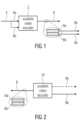
- Fig. 1 shows in a general manner an embodiment for a scalable video encoder into which the embodiments outlined further below could be built into.
- the scalable video encoder of Fig. 1 is generally indicated using reference sign 2 and receives a video 4 to be encoded.
- the scalable video encoder 2 is configured to encode video 4 into a data stream 6 in a scalable manner. That is, data stream 6 comprises a first portion 6a having video 4 encoded thereinto at a first information content amount, and a further portion 6b having video 4 encoded thereinto at an information content amount greater than the one of portion 6a.
- the information content amount of portions 6a and 6b may differ, for example, in quality or fidelity, i.e.
- Portion 6a may be called base layer data stream or base layer substream, while portion 6b may be called enhancement layer data stream or enhancement layer substream.
- Scalable video encoder 2 is configured to exploit redundancies between the versions 8a and 8b of video 4 reconstructible from base layer substream 6a without enhancement layer substream 6b on the one hand and both substreams 6a and 6b on the other hand, respectively. In order to do so, scalable video encoder 2 may use inter-layer prediction.
- scalable video encoder 2 may alternatively receive two versions 4a and 4b of video 4, both versions differing from each other in the amount of information content just as base layer and enhancement layer substreams 6a and 6b do. Then, for example, scalable video encoder 2 would be configured to generate substreams 6a and 6b such that base layer substream 6a has version 4a encoded thereinto, while enhancement layer data stream 6b, using inter-layer prediction based on the base layer substream 6b, has encoded thereinto version 4b.
- the encoding of substreams 6a and 6b may both be lossy.
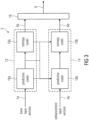
- Fig. 2 shows a scalable video decoder fitting to the scalable video encoder of Fig. 1 and also, in the same manner, suitable for incorporating any of the subsequently outlined embodiments.
- the scalable video decoder of Fig. 2 is generally indicated using reference sign 10 and is configured to decode the coded data stream 6 so as to reconstruct therefrom the enhancement layer version 8b of the video if both portions 6a and 6b of data stream 6 arrive at scalable video decoder 10 in an intact manner, or base layer version 8a if, for example, portion 6b is not available due transmission loss or the like, for example. That is, scalable video decoder 10 is configured such that same is able to reconstruct version 8a from base layer substream 6a solely, and to reconstruct version 8b from both portions 6a and 6b using inter-layer prediction.
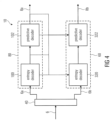
- Fig. 3 shows a scalable video encoder 2 as comprising a base layer coder 12, an enhancement layer coder 14 and a multiplexer 16.
- Base layer coder 12 is configured to encode base layer version 4a of the inbound video
- enhancement layer coder 14 is configured to encode the enhancement layer version 4b of the video.
- multiplexer 16 receives the base layer substream 6a from base layer coder 12 and the enhancement layer substream 6b from the enhancement layer coder 14 and multiplexes both into coded data stream 6 at its output.
- both coders 12 and 14 may be predictive coders using, for example, spatial and/or temporal prediction in order to encode the respective inbound version 4a and 4b into the respective substreams 6a and 6b, respectively.
- coders 12 and 14 may be hybrid video block coders, respectively. That is, each one of coders 12 and 14 may be configured to, on a block-by-block basis, encode the respective inbound version of the video while choosing, for example, between different prediction modes for each block of the blocks into which the pictures or frames of the respective video version 4a and 4b, respectively, are subdivided.
- the different prediction modes of base layer coder 12 may comprise spatial and/or temporal prediction modes, while enhancement layer coder 14 may additionally support an inter-layer prediction mode.
- the subdivision into blocks may be different among base layer and enhancement layer.
- Prediction modes, prediction parameters for the prediction modes selected for the various blocks, prediction residual and, optionally, the block subdividing of the respective video version may be described by the respective coder 12, 14 using a respective syntax including syntax elements which, in turn, may be coded into the respective substream 6a, 6b using entropy coding.
- Inter-layer prediction may be exploited at one or more occasions such as, for example, in order to predict samples of the enhancement layer video, prediction modes, prediction parameters and/or the block subdividing, just to mentioned a few examples.
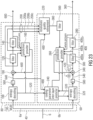
- both the base layer coder 12 and the enhancement layer coder 14 may comprise a predictive coder 18a, 18b, respectively, followed by an entropy coder 19a, 19b, respectively.
- the predictive coder 18a,b forms the syntax element stream using predictive coding from the inbound version 4a and 4b, respectively
- the entropy coder entropy encodes the syntax elements output by the respective predictive coder.
- the inter-layer prediction of encoder 2 may pertain to different occasions in the encoding procedure of the enhancement layer, and accordingly predictive coder 18b is shown to be connected to one or more of the predictive coder 18a, the output thereof, and entropy coder 19a.
- entropy coder 19b may, optionally, also take advantage of inter-layer prediction, for example, such as by predicting contexts used for entropy coding from the base layer and accordingly, entropy coder 19b is optionally shown as being connected to any of the elements of the base layer coder 12.
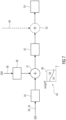
- base layer decoder 80 is able to reconstruct the base layer version 8a from the base layer substream 6a
- the enhancement layer decoder 60 is configured to reconstruct the enhancement layer version 8b of the video using the enhancement layer substream 6b.
- each of the base layer and enhancement layer decoders 60 and 80 may, internally comprise an entropy decoder 100, 320 followed by a predictive decoder 102, 322, respectively.
- Fig. 5 exemplarily shows the different versions of video 4, namely the base layer versions 4a and 8a deviating from each other merely by coding loss, and the enhancement layer versions 4b and 8b, respectively, which likewise merely deviate from each other by coding loss.
- base layer and enhancement layer signal may be composed of a sequence of pictures 22a and 22b, respectively. They are illustrated in Fig. 5 as being registered to each other along a temporal axis 24, i.e. a picture 22a of the base layer version besides the temporally corresponding picture 22b of the enhancement layer signal.
- picture 22b may have a higher spatial resolution and/or may represent the video 4 at a higher fidelity such as, for example, at a higher bit depth of the sample values of the pictures.
- a coding/decoding order is shown to be defined among pictures 22a, 22b.
- the coding/decoding order traverses pictures 22a and 22b in a manner so that the base layer picture 22a of a certain time stamp/instance is traversed prior to the enhancement layer picture 22b of the same time stamp of the enhancement layer signal.
- the pictures 22a, 22b may be traversed by the coding/decoding order 26 in presentation time order, but an order deviating from the presentation time order of pictures 22a, 22b would also be feasible.
- encoder nor decoder 10, 2 needs to sequentially encode/decode along the coding/decoding order 26. Rather, parallel coding/decoding may be used.
- the coding/decoding order 26 may define an availability of between portions of base and enhancement layer signals neighboring each other, in a spatial, temporal and/or inter-layer sense, so that, at the time of coding/decoding a current portion of the enhancement layer, the available portions for that current enhancement layer portion are defined via the coding/decoding order. Accordingly, merely neighboring portions being available in accordance with this coding/decoding order 26 are used for prediction by the encoder so that the decoder has a access to the same source of information for redoing the prediction.
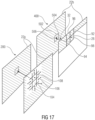
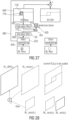
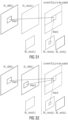
- Fig. 6 illustrates pictures 22b of the enhancement layer signal, here indicated using reference sign 360, and pictures 22a of the base layer signal, here indicated using reference sign 200. Temporally corresponding pictures of the different layers are shown in a manner registered to each other with respect to temporal axis 24. Using hatching, portions within the base and enhancement layer signals 200 and 36, which have already been coded/decoded according to the coding/decoding order, are distinguished over portions not yet coded or decoded in accordance with the coding/decoding order shown in Fig. 5 . Fig. 6 also shows a portion 28 of the enhancement layer signal 360, which is currently to be coded/decoded.
- the prediction of portion 28 uses both intra-layer prediction within the enhancement layer itself as well as inter-layer prediction from the base layer, so as to predict portion 28.
- the predictions are combined in a manner so that these predictions contribute to the final predictor of portion 28 in a spectrally varying manner so that, in particular, the ratio between both contributions varies spectrally.
- the portion 28 is spatially or temporally predicted from an already reconstructed portion of the enhancement layer signal 400, namely any portion illustrated by hatching in Fig. 6 within enhancement layer signal 400.
- Spatial prediction is illustrated using arrow 30 while temporal prediction is illustrated using arrow 32.
- Temporal prediction may involve, for example, motion compensated prediction, according to which information on a motion vector is transmitted within the enhancement layer substream for current portion 28, the motion vector indicating a displacement of a portion of a reference picture of the enhancement layer signal 400 to be copied in order to obtain a temporal prediction of current portion 28.
- Spatial prediction 30 may involve extrapolating spatially neighboring, already coded/decoded portions of the picture 22b, spatially neighboring current portion 28, into the current portion 28.
- intra prediction information such as an extrapolation (or angular) direction
- intra prediction information such as an extrapolation (or angular) direction
- a combination of spatial and temporal prediction 30 and 32 may be used as well.
- an enhancement layer internal prediction signal 34 is obtained thereby as illustrated in Fig. 7 .
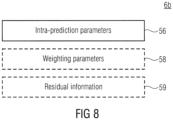
- the enhancement layer substream 6b may comprise, for current portion 28, intra prediction parameters 56 for controlling the spatial and/or temporal prediction 30, 32, and, optionally, weighting parameters 58 for controlling the formation 41 of the spectrally weighted average and residual information 59 for signaling the residual signal 48. While the scalable video encoder determines all of these parameters 56, 58 and 59 accordingly and inserts same into the enhancement layer substream 6b, the scalable video decoder uses the same in order to reconstruct the current portion 28 as outlined above. All of these elements 56, 58 and 59 may be subject to some of quantization, and accordingly the scalable video encoder may determine these parameters/elements, i.e.
- the encoder 2 uses the parameters/elements 56, 58 and 59, thus determined, itself so as to obtain the reconstructed version 54 for the current portion 28 so as to serve itself as a basis for any prediction for portions of, for example, the enhancement layer signal 400 succeeding in coding/decoding order.
- weighting parameters 58 could merely signal one of two states for the current portion 28, namely one state activating the formation of the spectrally weighted average as described so far, and the other state deactivating the contribution of the inter-layer prediction signal 38 so that the final enhancement layer prediction signal 42 is, in that case, merely made up by the enhancement layer internal prediction signal 34.
- weighting parameter 58 for current portion 28 could switch between activating spectrally weighted average formation on the one hand and inter-layer prediction signal 39 forming the enhancement layer prediction signal 42 alone on the other hand.
- the weighting parameter 58 could also be designed to signal one of the three states/alternatives just mentioned. Alternatively, or additionally, weighting parameters 58 could control the spectrally weighted average formation 41 for the current portion 28 with respect to the spectral variation of the ratio between the weight at which prediction signals 34 and 39 contribute to the final prediction signal 42. Later on, it will be described that the spectrally weighted average formation 41 may involve filtering one or both of prediction signals 34 and 39 before adding same, such as using, for example, a high pass and/or low pass filter, and in that case weighting parameters 58 could signal a filter characteristic for the filter or filters to be used for the prediction of current portion 28. As an alternative, it is described hereinafter that the spectral weighting in step 41 could be achieved by a spectral component individual weighting in the transform domain, and accordingly in this case the weighting parameters 58 could signal/set these spectral component individual weighting values.
- the weighting parameter for the current portion 28 could signal whether the spectral weighting in step 41 is to be performed in the transform domain or the spatial domain.
- Fig. 9 illustrates an embodiment for performing the spectrally weighted average formation in the spatial domain.
- Prediction signals 39 and 34 are illustrated as obtained in the form of respective pixel arrays coinciding with the pixel raster of current portion 28.
- both pixel arrays of both prediction signals 34 and 39 are shown to be subject to filtering.
- Fig. 9 illustrates the filtering illustratively by showing filter kernels 62 and 64 traversing the pixel arrays of prediction signals 34 and 39 so as to perform, for example, an FIR filtering. IIR filtering would, however, also be feasible.
- merely one of prediction signals 34 and 39 may be subject to filtering.
- both filters 62 and 64 The transfer functions of both filters 62 and 64 is different so that adding up 66 the filtering results of the pixel arrays of prediction signals 39 and 34 results in the spectrally weighted average formation result, namely the enhancement layer prediction signal 42.
- the adding 66 would simply add up co-located samples within prediction signal 39 and 34 as filtered using filter 62 and 64, respectively. 62 to 66 would thus result in the spectrally weighted average formation 41.
- an inverse transform 68 may be used to result in the spatial domain in the form of a pixel array 70 so that the combination 52 resulting in the reconstructed version 55 may be realized by a simple pixel-wise addition of the residual signal array 70 and the enhancement layer prediction signal 42.
- the prediction is performed by scalable video encoder and decoders, with using the prediction for reconstruction in decoder and encoder, respectively.
- Fig. 10 shows exemplarily how to perform the spectrally weighted average formation in the transform domain.
- the pixel arrays of the prediction signals 39 and 34 are subject to transformation 72 and 74, respectively, thereby resulting in spectral decompositions 76 and 78, respectively.
- Each spectral decomposition 76 and 78 is made up of an array of transform coefficients with one transform coefficient per spectral component.
- Each transform coefficient block 76 and 78 is multiplied with a corresponding block of weights, namely blocks 82 and 84. Thereby, at each spectral component, the transform coefficients of blocks 76 and 78 are weighted individually.
- the weighting values of blocks 82 and 84 may add-up to a value common to all spectral components, but this is not mandatory.
- the multiplication 86 between block 76 and 82 and the multiplication 88 between block 78 and block 84 each represents a spectral filtering in the transform domain, and a transform coefficient/spectral component-wise adding 90 finishes the spectrally weighted average formation 41 so as to result in a transform domain version of the enhancement layer prediction signal 42 in the form of a block of transform coefficients.
- the parameters present within the enhancement layer substream 6b for the current portion 28 such as the residual information 59, or the weighting parameters 58, may signal as to whether the average formation 41 is performed within the transform domain as shown in Fig. 10 , or the spatial domain according to Fig. 9 .
- the residual information 59 indicates the absence of any transform coefficient block for current portion 28, then the spatial domain could be used, or the weighting parameter 58 could switch between both domains irrespective of the residual information 59 comprising transform coefficients or not.
- a difference signal may be computed, and managed, between an already reconstructed portion of an enhancement layer signal and the inter-layer prediction signal. Spatial prediction of the difference signal at a first portion collocated to the portion of the enhancement layer signal, currently to be reconstructed, from a second portion of the difference signal, spatially neighboring the first portion and belonging to the already reconstructed portion of the enhancement layer signal, may then be used to spatial predict the difference sginal.
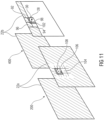
- Fig. 11 illustrates a possibility to perform spatial prediction 30 of the current portion 28.
- the following description of Fig. 11 may thus be combined with the description with respect to Figs. 6 to 10 .
- the aspect described hereinafter will be described later on with respect to illustrative implementation examples by referring to aspects X and Y.
- Fig. 11 corresponds to the one shown in Fig. 6 . That is, base layer and enhancement layer signals 200 and 400 are shown, with the already coded/decoded portions being illustrated using hatching.
- the portion currently to be coded/decoded within the enhancement layer signal 400 has neighboring blocks 92 and 94, here exemplarily depicted as a block 92 above and a block 94 to the left of current portion 28, with both blocks 92 and 94 having exemplarily the same size as current block 28.
- the coinciding size however is not mandatory. Rather, the portions of blocks into which picture 22b of the enhancement layer signal 400 is subdivided may have different sizes. They are not even restricted to quadratic forms. They may be rectangular or of other shape.
- Current block 28 has further neighboring blocks not specifically depicted in Fig. 11 which, however, have not yet been decoded/coded, i.e. they follow in coding/decoding order and are thus not available for prediction.
- the number of such predetermined neighboring blocks is not restricted to be two. It may be higher or merely one, too.
- Scalable video encoder and scalable video decoder may determine the set of predetermined neighboring blocks, here blocks 92, 94, out of the set of already coded neighboring blocks, here blocks 92 to 96, depending on, for example, a predetermined sample position 98 within current portion 28 such as the upper left sample thereof.
- a predetermined sample position 98 within current portion 28 such as the upper left sample thereof.
- those already coded neighboring blocks of the current portion 28 may form the set of "predetermined neighboring blocks" which comprise sample positions immediately adjacent to predetermined sample position 98.
- the neighboring already coded/decoded blocks comprise samples 102 adjacent to current block 28 based on the sample values of which the area of current block 28 is to be spatially predicted.
- a spatial prediction parameter such as 56 is signaled in the enhancement layer substream 6b.
- the spatial prediction parameter for current block 28 indicates a spatial direction along which sample values of samples 102 are to be copied into the area of current block 28.
- the scalable video decoder/encoder has already reconstructed (and encoded in case of the encoder) the base layer 200 using the base layer substream 6a, at least as far as the relevant spatially corresponding area of the temporally corresponding picture 22a is concerned such as, as described above, using block-wise prediction and using, for example, a block-wise selection between spatial and temporal prediction modes.
- the intra prediction parameter is not contained in the set of most probable intra prediction parameters, its signaling inside the bitstream requires more bits.
- the amount of bits to be spent for the syntax element for signaling the intra prediction parameter for the current intra-predicted block depends on the quality of the set of most probable, or probably advantageous, intra prediction parameters .
- a set of possibly advantageous intra prediction parameters for a current enhancement layer block is composed by inspecting intra prediction parameters of predetermined neighboring blocks and exceptionally resorting to a co-located block in the base layer in case of any of the predetermined neighboring blocks not having suitable intra prediction parameters associated therewith because, for example, the respective predetermined neighboring block not being coded in the intra prediction mode.
- the intra prediction parameter of a block 108 of the base layer signal 200 is included in the set of probably advantageous inter prediction parameters for the current block 28, which is co-located to the current block 28.
- the co-located block 108 is determined using a predetermined sample position 98 of current block 28, namely the block 108 covering the position 106 locally corresponding to the predetermined sample position 98 within the temporally aligned picture 22a of the base layer signal 200.
- a further check could be performed as to whether this co-located block 108 within the base layer signal 200 is actually a spatially intra predicted block.
- the intra prediction parameter of a predetermined neighboring block is substituted by the intra prediction parameter of the co-located base layer block, even if the respective predetermined neighboring block is of the intra prediction mode.
- a further check may be performed for any predetermined neighboring block of the intra prediction mode, as to whether the intra prediction parameter fulfills a certain criterion. If a certain criterion is not fulfilled by the intra prediction parameter of the neighboring block, but the same criterion is fulfilled by the intra prediction parameter of the co-located base layer block, then the substitution performed despite the very neighboring block being intra-coded.
- the intra prediction parameter of the neighboring block could be replaced by the intra prediction parameter of the base layer block, if the intra prediction parameter of the neighboring block does not represent an angular intra prediction mode (but for example a DC or planar intra prediction mode), but the intra prediction parameter of the co-located base layer block represents an angular intra prediction mode.
- the inter prediction parameter for the current block 28 is then determined based on a syntax element present in the coded data stream such as the enhancement layer substream 6b for the current block 28, and the set of probably advantageous intra prediction parameters. That is, the syntax element may be coded using less bits in case of the inter prediction parameter for the current block 28 being member of the set of probably advantageous intra prediction parameters than in case of being member of a remainder of the set of possible intra prediction parameters, disjoint to the set of probably advantageous intra prediction parameters.
- the set of possible intra prediction parameters may encompass several angular directional modes, according to which the current block is filled by copying from the already coded/decoded adjacent samples by copying along the angular direction of the respective mode/parameter, one DC mode according to which the samples of the current block are set to a constant value determined based on the already coded/decoded adjacent samples such as, for example, by some averaging, and a plane mode according to which the samples of the current block are set to a value distribution following a linear function the slopes in x and y and the intercept of which are determined based on the already coded/decoded adjacent samples, for example.
- Fig. 12 illustrates a possibility as to how the spatial prediction parameter substitute obtained from the co-located block 108 of the base layer could be used along with a syntax element signaled in the enhancement layer substream.
- Fig. 12 shows, in an enlarged manner, current block 28 along with the adjacent already coded/decoded samples 102 and the predetermined neighboring blocks 92 and 94.
- Fig. 12 also exemplarily illustrates an angular direction 112 as indicated by the spatial prediction parameter of the co-located block 108.
- the syntax element could, for example, comprise a flag and an index field, the flag indicating whether the index points into list 122 or list 125 - including or excluding members of list 122, or the syntax element comprises a field identifying one of a member 124 of list 122 or an escape code, and, in case of the escape code, a second field identifying a member out of list 125 - including or excluding members of list 122.
- the order among the members 124 within the list 122 may be determined, for example, based on default rules.
- the co-located block 108 is, for example, checked as to whether same, in turn, is a spatially predicted block and if yes the spatial prediction parameter of the same, such as an angular direction 112, having been used for spatially predicting this co-located block 108, is included in list 122. If the base layer block 108 does also not comprise a suitable intra prediction parameter, list 122 may be left without any contribution from the respective predetermined neighboring block 92 or 94.
- list 122 In order to avoid list 122 being empty because, for example, both the predetermined neighboring blocks 92, 98 as well as the co-located block 108 lacking suitable intra prediction parameters because of, for example, being inter predicted, at least one of members 124 may unconditionally be determined using a default intra prediction parameter. Alternatively, list 122 may be allowed to be empty.
- Fig. 14 showing, in a temporally registered manner, pictures 22b and 22a of enhancement layer signal 400 and base layer signal 200, respectively. A portion currently to be coded/decoded is shown at 28.
- the base layer signal 200 is predictively coded by the scalable video encoder and predictively reconstructed by the scalable video decoder, using base layer coding parameters spatially varying over the base layer signal.
- the spatial variation is illustrated in Fig. 14 using a hatched portion 132 within which the base layer coding parameters used for predictively coding/reconstructing the base layer signal 200 are constant, surrounded by non-hatched areas where, when transitioning from the hatched portion 132 to the non-hatched area, the base layer coding parameters change.
- the enhancement layer signal 400 is encoded/reconstructed in units of blocks.
- the current portion 28 is such a block.
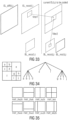
- a subblock subdivision for current portion 28 is selected out of a set of possible subblock subdivisions on the basis of the spatial variation of the base layer coding parameters within a co-located portion 134 of the base layer signal 200, i.e. within a spatially co-located portion of a temporally corresponding picture 22a of base layer signal 200.
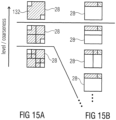
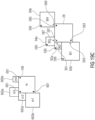
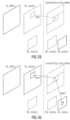
- Fig. 15a shows portion 28 having inscribed thereinto, using hatching, the spatial variation of the base layer coding parameters within the co-located portion 134.
- bock 28 is subdivided into four subblocks and at least one of the latter is subdivided further into four subblocks in the next lower level and so forth.
- the quad-tree subdivisioning is selected where the number of subblocks is smallest with, nevertheless, no subblock overlaying a base layer coding parameter change border. That is, it can be seen that in the case of Fig. 15a , the quad-tree subdivisioning of block 28 which should be selected for subdividing block 28 is the lowest one shown in Fig. 15a .
- the base layer coding parameters of the base layer are constant within each portion co-located to a respective subblock of the subblock subdivisioning.
- Fig. 15b exemplarily shows the case of selecting a possible subblock subdivisioning out of a set of available subblock subdivisioning for a current block 28 when exemplarily using the subdivisioning of Fig. 35 as the available set.
- Different hatchings show areas within which the respective co-located areas within the base layer signal have the same base layer coding parameters associated therewith.
- the selection just outlined may be implemented by traversing the possible subblock subdivisions according to some sequential order, such as an order of increasing or decreasing level of coarseness, and selecting that possible subblock subdivision from which possible subblock subdivision on the circumstance that within each subblock of the respective subblock subdivision the base layer coding parameters are sufficiently similar to each other, no longer applies (in case of using a traversal according to increasing coarseness) or firstly happens to apply (in case of using a traversal according to decreasing level of coarseness). Alternatively, all possible subdivisions may be tested.
- some sequential order such as an order of increasing or decreasing level of coarseness
- the definition of "sufficiency" of similarity of base layer coding parameters within a certain subblock may be determined/defined merely over a subset of the base layer coding parameters.
- the similarity may be determined based on the prediction modes only.
- prediction parameters further adjusting spatial and/or temporal prediction may form parameters which the similarity of base layer coding parameters within a certain subblock depends on.
- the subblock subdivision selected is not the only quantity which may be predicted or transferred from the base layer signal. Rather, the base layer coding parameters themselves may be transferred onto the enhancement layer signal so as to derive, based thereon, enhancement layer coding parameters for the subblocks of the subblock subdivision obtained by transferring the selected subblock subdivision from the base layer signal to the enhancement layer signal. As far as motion parameters are concerned, for example, scaling may be used in order to take the transition from the base layer to the enhancement layer into account. Preferably, merely those portions, or syntax elements, of the prediction parameters of the base layer are used to set the subblocks of the current portions subblock subdivision obtained from the base layer, which influence the similarity measure.
- the base layer signal 200 is predictively reconstructed by a scalable video decoder, and predictively encoded by use of a scalable video encoder, by subdividing frames 22a of the base layer signal 200 into intra-blocks and inter-blocks.
- the latter subdivision is done in a two-stage manner: first of all, frames 22a are regularly subdivided into largest blocks or largest coding units, indicated by reference sign 302 in Fig. 16 and using a double line along the circumference thereof. Then, each such largest block 302 is subject to hierarchical quad-tree subdivision into coding units forming the aforementioned intra-blocks and inter-blocks.
- coding unit 308 of current picture 22b of the enhancement layer signal 400 is exemplarily assumed to be assigned to the inter-layer prediction mode and is illustrated using hatching.
- Fig. 16 illustrates at 312 how the subdivision of coding unit 308 is predictively derived by local transferal from the base layer signal.
- the local area overlaid by coding unit 308 is shown.
- dotted lines indicate borders between neighboring blocks of the base layer signal or, more generally, boarders via which the base layer coding parameters of the base layer may possibly change.
- borders could, thus, be borders of prediction blocks 306 of the base layer signal 200 and could partially coincide with borders between neighboring coding units 304 or even neighboring largest coding units 302 of the base layer signal 200, respectively.
- Dashed lines at 312 indicate the current coding unit's 308 subdivision into prediction blocks as derived/selected by the local transferal from the base layer signal 200. Details with regard to the local transferal were described above.
- all blocks shown by hatchings extending from the top left to the bottom right may set to be intra prediction blocks of coding unit 308 since the locally corresponding portion of the base layer signal is covered by prediction blocks 306 having the spatial intra prediction mode associated therewith, while the others, i.e. the ones hatched from bottom left to top right, may be set to be inter prediction blocks since the locally corresponding portion of the base layer signal is covered by prediction blocks 306 having the temporal inter prediction mode associated therewith.
- same are further subdivided into prediction blocks having a prediction mode assigned thereto which is common for all of the prediction blocks within a coding unit and is, in particular, the same prediction mode as assigned to the respective coding unit. That is, differing from coding units such as coding unit 308 which has the inter-layer prediction mode associated therewith, coding units having the spatial intra prediction mode or having the temporal inter prediction mode associated therewith, are subdivided into prediction blocks of the same prediction mode, only, namely the prediction mode inherited from the respective coding unit from which they are derived by subdivision of the respective coding unit.
- a further difference between coding units of the inter-layer prediction mode, such as coding unit 308, and coding units of a spatial intra prediction mode or a temporal inter prediction mode is that when subjecting prediction blocks of spatial intra prediction mode coding units or temporal inter prediction mode coding units to spatial prediction and temporal prediction, respectively, the prediction parameters are set without any dependency on the base layer signal 200 such as, for example, by way of signaling within the enhancement layer substream 6b. Even the subdivision of coding units other than those having the inter-layer layer prediction mode associated therewith such as coding unit 308, may be signaled within the enhancement layer signal 6b.
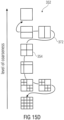
- Fig. 15d illustrates that the level or measure of coarseness may, at least for some of the available subblock subdivisions, be equal to each other. In other words, the ordering according to increasing or decreasing level of coarseness may be ambiguous. However, this does not disturb the searching of the "coarsest subblock subdivision" belonging to set 364, since merely one of such equally coarse possible subblock subdivisions may belong to set 364.
- the motion parameters mentioned in in accordance with Fig. 18 may pertain to the motion vectors only (motion vector prediction), or to the complete set of motion parameters including the number of motion hypotheses per block, reference indices, partitioning information (merging). Accordingly, the "scaled version" may stem from a scaling of the motion parameters used in the base layer signal in accordance with the spatial resolution ratio between base and enhancement layer signal in case of spatial scalability.
- the coding/decoding of base layer motion parameters of the base layer signal by way of the coded data stream may involve motion vector prediction such as spatially or temporally, or merging.
- the incorporation 526 of the motion parameters 523 used at a co-located portion 108 of the base layer signal into the set 528 of merging/motion vector candidates 532 enables a very effective indexing among the intra-layer candidates 514 and the one or more inter-layer candidate 524.
- the selection 534 may involve explicit signaling of an index into the extended set/list of motion parameter candidates in the enhancement layer signal 6b such as per prediction block, per coding unit or the like.
- the selection index 536 may be inferred from other information of the enhancement layer signal 6b or inter-layer information.
- Fig. 19b shows the first of the just outlined alternatives for deriving the enhancement layer ordering for the list of motion parameter candidates by use of base layer hints.
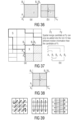
- Fig. 19b shows current block 28 and three different predetermined sample positions of the same, namely exemplarily the upper left sample 581, the lower left sample 583 and the upper right sample 585. The example shall be interpreted merely as being illustrative.
- the set of predetermined neighboring blocks would exemplarily encompass four types of neighbors: a neighboring block 94a covering the sample position 587 immediately adjacent and positioned above sample position 581, and a neighboring block 94b including or covering the sample position 589 adjacent to, and located immediately above, sample position 585.
- neighboring blocks 92a and 92b are those blocks including the immediately adjacent sample positions 591 and 593, positioned to the left of sample position 581 and 583.
- the number of predetermined neighboring blocks may vary, despite the predetermined number determination rules as will be described also with respect to Figs. 36 to 38 . Nevertheless, the predetermined neighboring blocks 92a,b and 94a,b are distinguishable by the rule of their determination.
- four neighbor blocks of block 108 are determined in the same manner as described with respect to the enhancement layer neighbor blocks 92a,b and 94a,b with respect to the predetermined sample positions 581, 583 and 585 of current block 28: four base layer neighbor blocks 603a, 603b, 605a and 605b are found in this manner, 603a obviously corresponds to enhancement layer neighbor block 92a, base layer block 603b corresponds to enhancement layer neighbor block 92b, base layer block 605a corresponds to enhancement layer neighbor block 94a and base layer block 605b corresponds to enhancement layer neighbor block 94b.
- the base layer motion parameters M1 to M4 of the base layer blocks 903a,b and 905a,b and their distances to the base layer motion parameter m of the co-located base layer block 108 are used so as to order the motion parameter candidates within list 528/512 formed out of motion parameters M1 to M4 of the enhancement layer blocks 92a,b and 94a,b.
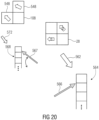
- the formation 562 of the final motion parameter candidate list for the enhancement layer signal for portion 28 is merely optionally performed as outlined with respect to Fig. 18 and/or 19. That is, same may be 528 or 512 or 528/512' and the reference sign 564 is used in Fig. 20 .
- the index 566 pointing into a motion parameter candidate list 564 is determined depending on an index 567 into a motion parameter candidate list 568 having been used for coding/decoding the base layer signal with respect to co-located block 108, for example.
- the index 566 for the enhancement layer may be determined in a way that that neighboring enhancement layer block 92, 94 is pointed to by index 566 which is co-located with the base layer block 548 associated with the indexed base layer candidate, i.e. the one which index 567 points to.
- the index 567 may thus serve as a meaningful prediction of index 566.
- An enhancement layer motion parameter is then determined using the index 566 into the motion parameter candidate list 564 and the motion compensated prediction of block 28 is performed using the determined motion parameter.
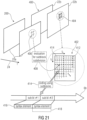
- the corresponding portion 406 of the base layer signal 200 may have already been decoded/coded at the time of decoding/coding the transform coefficient block 402.
- predictive coding/decoding may have been used therefore, including the signalization of a base layer residual signal within the coded data stream, such as the base layer substream 6a.
- scalable video decoder/encoder exploits the fact that an evaluation 408 of the base layer signal or the base layer residual signal at portion 406 co-located to portion 404 may result in an advantageous selection of the subdivision of transform coefficient block 402 into subblocks 412.
- several possible subblock subdivisions for subdividing the transform coefficient block 402 into subblocks may be supported by the scalable video decoder/encoder. These possible subblock subdivisions may regularly subdivide the transform coefficient block 402 into rectangular subblocks 412.
- the transform coefficients 414 of transform coefficient block 402 may be arranged in rows and columns, and in accordance with the possible subblock subdivisions, these transform coefficients 414 are clustered into the subblocks 412 on a regular basis so that the subblocks 412 themselves are arranged in columns and rows.
- the evaluation 408 enables setting the ratio between the number of columns and number of rows of subblocks 412, i.e. their width and height, in a manner so that the coding of the transform coefficient block 402 using the thus selected subblock subdivision is most efficient.
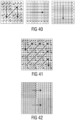
- the subblocks 412 should be selected to be longer along the vertical direction and smaller along the horizontal direction and in the second instance, the subblocks should be longer in the horizontal direction and smaller in the vertical direction.
- the latter case is illustratively shown in Fig. 40 .
- scalable video decoder/encoder may inspect all transform coefficient blocks of the base layer transform blocks 434 illustrated by different hatchings in Fig. 22 , which at least partially overlay the co-located portion 406.
- there are four base layer transform blocks the transform coefficient blocks of which would then be inspected.
- a scaling 436 may be performed onto the transform coefficient blocks of these overlaying base layer transform blocks 434, so as to result in an approximation of a transform coefficient block 438 of a spectral decomposition of the base layer residual signal within portion 406.
- the distribution of the values of the transform coefficients within that transform coefficient block 438, i.e. 442 may then be used within the evaluation 408 so as to appropriately set the subblock dimensions 428 and 432, thereby selecting the subblock subdivision of transform coefficient block 402.
- a further alternative which may additionally or alternatively be used in order to perform the evaluation 408 is to inspect the base layer residual signal or the reconstructed base layer signal within the spatial domain by use of edge detection 444 or determination of the main gradient direction, for example, deciding based on the extension direction of the edges detected or the gradient determined within the co-located portion 406 so as to appropriately set the subblock dimensions 428 and 432.
- enhancement layer decoding stage 60 additionally comprises a coding parameter inter-layer predictor 240, a resolution/quality refiner 220 and/or a prediction provider 260 which, compared to prediction provider 160, additionally/alternatively supports inter-layer prediction modes which are able to provide the enhancement layer prediction signal 420 based on data derived from internal states of base layer decoding stage 80.
- the resolution/quality refiner 220 is to subject any of the reconstructed base layer signals 200a, 200b and 200c or the base layer residual signal 480 to a resolution or quality refinement to obtain a inter-layer prediction signal 380
- the coding parameter inter-layer predictor 240 is to somehow predict coding parameters such as prediction parameters and motion parameters, respectively.
- the decoding stages 60 and 80 may operate in a block-based manner. That is, frames of the video may be subdivided into portions such as blocks. Different granularity levels may be used to assign the prediction modes as performed by prediction providers 160 and 260, the local transformations by inverse transformers 560 and 580, filter coefficient selections by filters 120 and 140 and prediction parameter settings for the prediction modes by prediction providers 160 and 260. That is, the sub-partitioning of the frames into the prediction blocks may, in turn, be a continuation of the sub-partitioning of the frames into the blocks for which the prediction modes are selected, called coding units or prediction units, for example.
- the two generated signal components are added 752 together to form the final enhancement layer intra prediction signal.
- the multiple methods for generating an intra prediction signal using base layer data include the following method:
- the (upsampled/filtered) reconstructed base layer signal is combined with a spatial intra prediction signal, where the spatial intra prediction is derived based on reconstructed enhancement layer samples of neighboring blocks.
- the final prediction signal is obtained by weighting (cp. 41) the spatial prediction signal and the base layer prediction signal in a way that different frequency components use a different weighting. This can be for example realized by filtering (cp. 62) the base layer prediction signal (cp. 38) with a low-pass filter and filtering (cp. 64) the spatial intra prediction signal (cp. 34) with a high-pass filter and adding up (cp. 66) the obtained filtered signals.
- Fig. 27 shows such generation of an inter-layer intra prediction signal by a frequency-weighted sum of an (upsampled/filtered) base layer reconstruction signal (BL Reco) and a spatial intra prediction that uses reconstructed enhancement layer samples (EH Reco) of already coding neighboring blocks.
- BL Reco base layer reconstruction signal
- EH Reco reconstructed enhancement layer samples
- the sum of the weighting factors can be unequal to 1 for some or all transform coefficient positions.
- the weighting factors are chosen in a way that for transform coefficients that represent low-frequency components, the weighting factor for the base layer reconstruction is greater than the weighting factor for the enhancement layer intra prediction signal, and, for transform coefficients that represent high-frequency components, the weighting factor for the base layer reconstruction is less than the weighting factor for the enhancement layer intra prediction signal.
- the transform block obtained by summing up the weighted transformed signals for both components can be either inverse transformed and used as enhancement layer prediction signal or, in a second embodiment, the obtained transform coefficients can be added to the scaled transmitted transform coefficient levels and then inverse transformed in order to obtain the reconstructed block before deblocking and in-loop processing.
- a selection of a base layer reconstruction and residual signal may be used, too.
- the following versions can be used:
- the selection of the corresponding base layer signal 200a,b,c can be fixed for a particular decoder (and encoder) implementation, or it can be signaled inside the bitstream 6. For the latter case, different versions can be used.
- the usage of a particular version of the base layer signal can be signaled at a sequence level, or at a picture level, or at a slice level, or at a largest coding unit level, or at a coding unit level, or a prediction block level, or at a transform block level, or at any other block level.
- the selection can be made dependent on other coding parameters (such as coding modes) or on the characteristic of the base layer signal.
- Different filters can be used for upsampling/filtering the reconstructed base layer signal and the base layer residual signal. That means that for upsampling the base layer residual signal, a different approach is used than for upsampling the base layer reconstruction signal.
- the corresponding base layer residual signal can be replaced with another signal derived from the base layer.
- This can be, for example, a high-pass filtered version of the reconstructed base layer block or any other difference-like signal derived from the reconstructed base layer samples or reconstructed base layer residual samples of neighboring blocks.
- the intra prediction mode is typically signaled in a way that among the set of possible intra prediction modes one or more modes are classified as most probable modes, which can then be signaled with shorter code words (or less arithmetic codes binary decisions results in less bits).
- the intra prediction mode of the block to the top (if available) and the intra prediction mode of the block to the left (if available) are included in the set of most probable modes.
- one or more additional modes are included into the list of most probable modes, where the actual added modes depend on the availability of the intra prediction modes of the block above the current block and the block to the left of the current block.
- exactly 3 modes are classified as most probable modes.
- H.264/AVC one mode is classified as most probable mode, this mode is derived based on the intra prediction modes that are used for the block above the current block and the block to the left of the current block. Any other concept (different from H.264/AVC and HEVC) for classifying the intra prediction modes is possible, and can be used for the following extension.
- the base layer information can be utilized to support the inter prediction process for the enhancement layer.
- the SVC extension of H.264/AVC there is one additional mode for improving the coding efficiency of the inter prediction process in an enhancement layer.
- This mode is signaled at a macroblock level (a block of 16x16 luma samples).
- the reconstructed residual samples in the lower layer are used for improving the motion-compensated prediction signal in the enhancement layer.
- This mode is also referred to as inter-layer residual prediction. If this mode is selected for a macroblock in a quality enhancement layer, the inter-layer prediction signal is built by the co-located samples of the reconstructed lower layer residual signal.
- this residual prediction flag is equal to 1, the residual signal of the corresponding area in the reference layer is block-wise upsampled using a bilinear filter and used as prediction for the residual signal of the enhancement layer macroblock, so that only the corresponding difference signal needs to be coded in the enhancement layer.
- Fig. 29 Conventional motion-compensated prediction as used in all hybrid video coding standards (e.g., MPEG-2, H.264/AVC, or the upcoming HEVC standard) is illustrated in Fig. 29 .
- a motion vector is typically coded inside the bitstreams.
- the referenced area in the reference picture can be directly copied to form the prediction signal. It is, however, also possible to transmit fractional-sample precision motion vectors.
- the prediction signal is obtained by filtering the reference signal with a filter with fractional sample delay.
- the multiple methods include the following method: A conventional inter prediction signal (derived by motion-compensated interpolation of already reconstructed enhancement layer pictures) is combined with an (upsampled/filtered) base layer residual signal (inverse transform of base layer transform coefficients or difference between base layer reconstruction and base layer prediction). This method is also referred to as the BL_resi mode (cp. Fig. 30 ).
- a motion vector predictor is derived based on already coded motion vectors (and potentially a syntax element indicating the used of one of a set of potential motion vector predictors), and a difference vector is included in the bitstream.
- the final motion vector is obtained by adding the transmitted motion vector difference to the motion vector predictor.
- a list of potential motion parameter candidates is constructed based on already coded data. This list can include the motion parameters of spatially neighboring blocks as well as motion parameters that are derived based on motion parameters of a co-located block in a reference frame.
- the base layer (BL) residual signal can be defined as one of the following:
- the final EL prediction is obtained by adding the filtered EL reconstruction samples and the filtered BL residual samples.
- the EL difference signal When the EL difference signal is defined to use the difference between EL reconstruction and upsampled/filtered BL reconstruction, it becomes amenable to just save EL reconstruction and BL reconstruction and compute the EL difference signal on-the-fly for the blocks using thei sprediction mode, thereby saving the memory required to store the EL difference signal. However, it may incur a slight computational complexity overhead.
- the integer part of a MV is used to fetch a set of samples from a difference picture and the fractional part of a MV is used to select a MCP filter from a set of filters.
- the fetched difference samples are filtered to produce filtered difference samples.
- the following versions can be used. This can be fixed or it can be signaled at a sequence level, picture level, slice level, largest coding unit level, coding unit level, or other partitioning levels. Or it can be made dependent on other coding parameters.
- a prediction may be performed by using a combination of base layer reconstruction and enhancement layer reconstruction (see aspect C).
- One major difference to the description above with respect to Fig. 11 , 12 and 13 is the coding mode to obtain the intra-layer prediction 34 which is performed temporally rather than spatially. That is, instead of spatial prediction 30, temporal prediction 32 is used so as to form the intra-layer prediction signal 34. Accordingly, some aspects described below are readily transferable onto the above embodiments of Fig. 6 to 10 and 11 to 13 , respectively.
- the multiple methods include the following method: The (upsampled/filtered) reconstructed base layer signal is combined with an inter prediction signal, where the inter prediction is derived by motion-compensated prediction using reconstructed enhancement layer pictures. The final prediction signal is obtained by weighting the inter prediction signal and the base layer prediction signal in a way that different frequency components use a different weighting. This can be, for example, realized by any of the following:
- the weighting is made dependent on the EL block size to be predicted. For instance, for a 4x4 block in the EL, a weighting matrix can be defined that specifies the weighting for the EL reconstruction transform coefficients and another weighting matrix can be defined that specifies the weighting for the BL reconstruction transform coefficients.
- a weighting matrix for BL reconstruction transform coefficients can be, e.g.,
- the coding (or prediction) -parameters to be used for reconstructing an enhancement layer block can be derived by multiple methods from the co-located coding parameters in the base layer.
- the base and enhancement layers can have different spatial resolution or they can have the same spatial resolution.
- a block in the enhancement layer is coded using co-located information from the base layer.
- the function f c can be chosen in such a way, that there always exists at least one candidate decomposition at some level in step b).
- the grouping of blocks with identical coding parameters is not restricted to square blocks, but the blocks can also be summarized to rectangular blocks. Furthermore, the grouping is not restricted to a quadtree structure, it is also possible to use decomposition structures in which a block is decomposed into two rectangular blocks of the same size or two rectangular blocks of different sizes. It is also possible to use a decomposition structures that uses a quadtree decomposition up to a particular level and then uses a decomposition into two rectangular blocks. Also, any other block decomposition is possible.
- the described mode is not only supported at a macroblock level (or largest supported block size), but at arbitrary block sizes. That means, the mode cannot only be signaled for the largest supported block size, but a block of the largest supported block size (macroblock in MPEG-4, H.264 and coding tree block/largest coding unit in HEVC) can be hierarchically subdivided into smaller blocks/coding units and the usage of the inter-layer motion mode can be signaled at any supported block size (for the corresponding block). In a particular embodiment, this mode is only supported for selected block sizes.
- the function f c ( p el ) returns the following coding parameters c:
- an enhancement layer block which is signaled to be using co-located base layer information, associate to those enhancement layer sample positions with derived intra prediction parameters a default set of motion parameters, so that a block can be merged with the block containing these samples (i.e. copy the default set of motion parameters).
- the default set of motion parameters is comprised of an indicator to use one or two hypotheses, reference indices referencing the first picture in a reference picture list, and motion vectors with zero spatial displacement.
- the enhancement layer samples with derived motion parameters are predicted and reconstructed first in some order. After that, the samples with derived intra prediction parameters are predicted in an intra reconstruction order. Thereby, the intra prediction can then use the already reconstructed sample values from (a) any neighboring inter prediction block and (b) neighboring intra prediction blocks which are predecessors in the intra reconstruction order.
- the difference measure used in step 2 b) states that there are small differences in a sub-block if either (a) all contained sample positions have derived motion parameters and no pair of sample positions inside the block have derived motion parameters differing more than a particular value according to a vector norm applied to the corresponding motion vectors or (b) all contained sample positions have derived intra prediction parameters and no pair of sample positions inside the block have derived intra prediction parameters differing more than a particular angle of directional intra prediction.
- the resulting parameters for the sub-block are calculated by mean or median operations.
- the partitioning obtained by inferring coding parameters from the base layer can be further refined based on side information signaled inside the bitstream.
- the following section describes a method for using multiple enhancement layer predictors including predictors derived from the base layer to code the motion parameters of the enhancement layer.
- Motion information that is already coded for the base layer can be employed to significantly reduce the motion data rate while coding the enhancement layer.
- This method includes the possibility to directly derive all motion data of a prediction block from the base layer in which case no additional motion data needs to be coded.
- prediction block refers to a prediction unit in HEVC, a MxN block in H.264/AVC and can be understood as a general set of samples in a picture.
- the motion vector is derived from center position C 1 of the collocated prediction block of the base layer and added to the top of the candidate list as a first entry.
- the candidate list of motion vector predictors is extended by one item. If there is no motion data in the base layer available for the sample position C 1 the list construction is untouched.
- any sequence of sample positions in the base layer may be checked for motion data. In case motion data is found, the motion vector predictor of the corresponding position is inserted to the candidate list and available for the motion compensated prediction of the enhancement layer.
- the motion vector predictor derived from the base layer may be inserted to the candidate list at any other position of the list.
- the base layer motion predictor may only be inserted to the candidate list if certain constraints are met.
- more than one motion vector predictors from several sample position of the base layer may be added to the candidate list of the enhancement layer.
- the candidate with the motion vector predictor inferred from the collocated block may replace spatial or temporal candidates in the list rather than extending the list. It is also possible to include multiple motion vector predictors derived from base layer data into the motion vector predictor candidate list.
- the collocated base layer block is motion compensated predicted with a candidate that originates from a prediction block that covers the sample position A 1 as depicted in Fig. 38 . If the merge candidate list of the prediction block in the enhancement layer contains a candidate whose motion vector predictor originates from the corresponding sample position A 1 inside the enhancement layer this candidate is put as the first entry into the list. Consequently this candidate is indexed by index 0 and therefore assigned the shortest fixed length codeword. In this embodiment this step is performed after the derivation of the motion vector predictor of the collocated base layer block for the merge candidate list in the enhancement layer. Hence the reordering process assigns the lowest index to the candidate that originates from the corresponding block as the collocated base layer block's motion vector predictor.
- the second lowest index is assigned to the candidate that is derived from the collocated block in the base layer as described in the second part of this section. Furthermore the reordering process is only taking place if the merge_flag of the collocated block in the base layer is equal to 1. In another embodiment the reordering process may be performed independent of the value of merge_flag of the collocated prediction block in the base layer. In another embodiment the candidate with the motion vector predictor of the corresponding origin may be put at any position of the merge candidate list. In another embodiment the reordering process may remove all other candidates in the merge candidate list. Here only the candidate whose motion vector predictor has the same origin as the motion vector predictor used for the motion compensated prediction of collocated block in the base layer remains in list. In this case a single candidate is available and the no index is transmitted.
- the following is about enhancement layer coding of transform coefficients.
- Fig. 39 shows the diagonal, vertical and horizontal scan as it is defined for a 4x4 transformation block. Coefficients of larger transformations are divided into subgroups of 16 coefficients. These subgroups allow a hierarchical coding of significant coefficient positions. A subgroup signaled as non-significant does not contain any significant coefficients. Scans for 8x8 and 16x16 transformations are depicted together with their associated subgroup divisions in Fig. 40 and Fig. 41 , respectively. The large arrows represent the scan order of coefficient subgroups.
- extensions for transformation coefficient coding include an introduction of new scan modes, methods of assigning scans to transformation blocks and a modified coding of significant coefficient positions. These extensions allow a better adaptation to different coefficient distributions within the transformation block, and thus achieve a coding gain in rate-distortion sense.
- New realizations for vertical and horizontal scan patterns are introduced for 16x16 and 32x32 transformation blocks.
- the size of a scan subgroup is, 16x1 for horizontal scan, and 1 ⁇ 16 for vertical scans, respectively.
- Subgroups with a size of 8x2 and 2x8, respectively, might be also chosen. The subgroups themselves are scanned in the same manner.
- the horizontal scan is efficient for transformed coefficients that are found in a row wise spread. This can be found in images that contain vertical edges.
- VerHor scan is a introduced scan pattern, which allows coding of coefficients in a column by row wise scan. For 4x4 blocks the first column is scanned followed by the rest of the first row then the rest of the second column then the rest of the coefficients in second row. Then the rest of the third column is scanned and finally the rest of the fourth row and column.
- the block is divided into 4x4 subgroups. These 4x4 blocks are scanned in a VerHor scan, whereas the subgroups are scanned VerHor scan themselves.
- An edge detector may be applied on the investigated block as follows: First the block is smoothed by n x n smoothing filter (e.g. Gaussian).
- n x n smoothing filter e.g. Gaussian
- the scan pattern can be derived from the EL signal by
- the scan pattern can also be derived from the BL signal.
- any coding parameter described above can be used.
- a gradient of a co-located base layer signal can be calculated and compared to predefined thresholds and/or potentially found edges can be utilized.
- the vertical and horizontal scan are added to the candidate lists of a transformation block, if both the x and y coordinates of the last significant position are greater than a specific threshold.
- This threshold can be mode and/or TU size dependent.
- a preferable threshold value is 3 for all sizes larger than 4x4, and 1 for 4x4 TUs.
- the vertical and horizontal scan are added to the candidate lists of a transformation block, if either, the x or the y coordinates of the last significant position is greater than a specific threshold.
- This threshold can be mode and/or TU size dependent.
- a preferable threshold value is 3 for all sizes larger than 4x4, and 1 for 4x4 TUs.
- the vertical and horizontal scans are only added to the candidate lists of 16x16 and 32x32 transformation blocks, if the x and y coordinates of the last significant position both are greater than a specific threshold.
- This threshold can be mode and/or TU size dependent.
- a preferable threshold value is 3 for all sizes larger than 4x4, and 1 for 4x4 TUs.
- context-adaptive coding is used for signaling an index into the scan pattern candidate list of a TU, whereas the context model is derived based on the transformation size and/or the position of the last significant position within the TU.
- the selection of the prediction method is signaled in the bitstream and can be coded using entropy coding. Inside a hierarchical block subdivision structure this coding method can be selected in every sub-level or alternatively only on subsets of the coding hierarchy.
- the encoder can transmit a refinement motion parameter set prediction signal to the decoder.
- the refinement signal contains differentially coded values of the motion parameters.
- the refinement signal can be entropy coded.
- the search is performed on the reconstructed base layer signal.
- the selected motion vector is scaled according to the spatial resolution change before creating the prediction signal in step 4.
- Both encoder and decoder can perform the same prediction steps to select the optimal motion vector among the candidates and create identical prediction signals. These vectors are not signaled in the coded video bitstream.
- an intra prediction signal is formed using an intra prediction mode (p) which is inferred by the following algorithm.
- Both encoder and decoder can perform the same steps to select the best prediction mode (p best ) and form a matching prediction signal.
- the actual intra prediction mode (p best ) is thus not signaled in the coded video bitstream.
- An alternative embodiment uses the surrounding sample values of (b) or (b i ) to determine the predicted intra prediction mode (p best ). For instance when a 4x4 block (a i ) of a spatial enhancement layer (n) has a corresponding 2x2 base layer block (b i ), the surrounding samples of (b i ) are used to form a 4x4 block (c i ) which is used for determining the predicted intra prediction mode (p best ).
- the encoder can transmit a refinement intra prediction direction signal to the decoder.
- most intra prediction modes correspond to an angle from which border pixels are used to form the prediction signal.
- the offset to the optimal mode can be transmitted as difference to the predicted mode (p best ) (which is determined as described above).
- the refinement mode can be entropy coded.
- a neighboring line of pixels (b) (that is derived as described above) is used as a template to fill in each line (a j ) of the block (a).
- the fill direction (x-axis) can be horizontal (left to right or right to left), vertical (top to bottom or bottom to top), diagonal, or any other angle.
- the samples used for the template line (b) are the samples in the direct neighborhood of the block along the x-axis.
- the template line (b) is shifted along the y-axis, which forms a 90° angle to the x-axis.
- Both encoder and decoder run the same algorithm to determine the best prediction angles and offsets. No explicit angle or offset information needs to be signaled in the bitstream.
- a refinement e.g. difference value
- Entropy coding can be used for coding the refinement offset value.
- a refinement e.g. difference value
- Entropy coding can be used for coding the refinement direction value.
- An alternative embodiment uses a threshold to select if the line (b' j ) is used for prediction. If the error measure for the optimal offset (o j ) is below the threshold, the line (c i ) is used to determine the values of the block line (a j ). If the error measure for the optimal offset (o j ) is above the threshold, the (upsampled) base layer signal is used to determine the values of the block line (a j )
- Enhancement layer coding with multiple methods for generating an intra prediction signal using reconstructed base layer samples
- Main aspect For coding a block in the enhancement layer multiple methods for generating an inter prediction signal using reconstructed base layer samples are provided in addition to methods that generate the prediction signal based on reconstructed enhancement layer samples only.
- Main aspect Use multiple enhancement layer predictors and at least one predictor derived from the base layer for enhancement layer motion parameter coding.
- Main aspect Inference of enhancement layer partitioning and motion parameters based on base layer partitioning and motion parameters (probably required to combine this aspect with any of the sub aspects).
- Main aspect Transform coefficient coding using different scan patterns.
- enhancement layers context modelling based on coding mode and/or base layer data, and different initializations for context models.
- A1) Scalable video decoder configured to:
- the base layer signal may be reconstructed by the base layer decoding stage 80 from the coded data stream 6 or the substream 6a, respectively, in the block-based predictive manner described above with, for example, transform decoding as far as the base layer residual signal 640/480 is concerned, but other reconstruction alternatives are also feasible.
- the computation of the difference signal may be done pixel-wise, i.e., co-located pixels of the enhancement layer signal on the one hand and the prediction signal 380 on the other hand are subtracted from each other and this is done per pixel position.
- the spatial prediction of the difference signal may be done in any way, such as by transmitting in the coded data stream 6 or within substream 6b an intra-prediction parameter, such as an intra prediction direction, and copying/interpolating already reconstructed pixels bordering the portion of the enhancement layer signal 360, currently to be reconstructed, along this intra prediction direction into the current portion of the enhancement layer signal.
- the combination may involve a summation, a weighted sum or even more sophisticated combinations such as combinations which differently weight the contributions in the frequency domain.
- the decoding of the base layer residual signal from the coded data stream may, as shown in the figure, be performed by using entropy decoding and inverse transformation.
- the scalable video decoder may also, optionally, perform the reconstruction of the base layer signal itself, namely by predictive decoding by deriving a base layer prediction signal 660 and combining same with the base layer residual signal 480. As just mentioned, this is merely optional.
- the resolution or quality refinement may be performed as denoted above with respect to A).
- this spatial prediction may also be performed as exemplarily outlined in A) with respect to the difference signal.
- a similar note is valid as far as the combination and the predictive reconstruction is concerned.
- the base layer residual signal 480 in aspect B is not restricted to equal the explicitly signaled version of the base layer residual signal 480. Rather, it may be possible that the scalable video decoder subtracts any reconstructed base layer signal version 200 with the base layer prediction signal 660, thereby obtaining a base layer residual signal 480 which may deviate from the explicitly signaled one by deviations stemming from filter functions such as of filters 120 or 140. The latter statement is also valid for other aspects where the base layer residual signal is involved in inter-layer prediction.
- the formation (260) of the weighted average comprises, at the portion currently to be reconstructed, filtering (260) the inter-layer prediction signal (380) with a low-pass filter and filtering (260) the enhancement layer internal prediction signal with a high-pass filter to obtain filtered signals, and adding-up the obtained filtered signals.
- the temporal prediction mentioned in C may involve the prediction provider 160 deriving motion prediction parameters from the coded data stream 6 and substream 6a, respectively.
- the motion parameters may comprise: a motion vector, a reference frame index, or they may comprise a combination of a motion subdivision information and a motion vector per sub-block of the currently reconstructed portion.
- the formation of the weighted average may end up in the spatial domain or the transform domain and accordingly, the adding at adder 340 may be performed in the spatial or transform domain. In the latter case, the inverse transformer 580 would apply the inverse transform onto the weighted average.
- the predictive reconstruction mentioned in D may involve the prediction provider 160, as described above, and may involve
- the inter-layer prediction signal (380) evolves, controlled via side-information in the coded bit-stream (360), from a different one of none (200a), one or all (200b,c) of a deblocking and an in-loop filtering (140) for different portions of the video means the following:
- the base layer substream 6a itself may (optionally) signal the usage of different measures to result in the final base layer signal 600 such as bypassing all filters 120, 140, the use of merely deblocking or the use of merely in-loop filtering or the use of both deblocking and in-loop filtering.
- Even the filter transfer functions may be signaled/varied by side information in 6a.
- substream 6b comprises side-information, which signals a new (i.e.
- the inter-layer prediction signal evolves, controlled via side-information in the coded bit-stream (6) or signal-dependent, from different filter transfer functions for an upsampling interpolation filter (220) for different portions of the video means the following:
- the base layer substream 6a itself may (optionally) signal the usage of different measures to result in the final base layer signal 600 such as bypassing all filters 120, 140, the use of merely deblocking or the use of merely in-loop filtering or the use of both deblocking and in-loop filtering.
- Even the filter transfer functions may be signaled/varied by side information in 6a.
- the base layer substream 6a itself may (optionally) signal the usage of different measures to result in the final base layer signal 600 such as bypassing all filters 120, 140. See above descriptions of D) and E).
- substream 6b may comprise side-information, which signal additionally (i.e. independent from the just-mentioned side-information in base layer signal 6a) a variation of the filter transfer function used in refiner 220 to obtain refined residual signal 380.
- the granularity defining the different portions at which these variations are done may be defined by the afore-mentioned coding units, prediction blocks or any other granularity and may differ from the mentioned granularity of the base layer signal 6a.
- the non-availability may result from the following facts: imagine that the predetermined neighborhood encompasses neighboring samples above the top edge of the portion/block currently to be reconstructed as well as samples extending further to the right thereof, and samples to the left of the left edge of the current block/portion currently to be reconstructed as well as samples extending further downwards thereof. Further, imagine that the spatial prediction is applied to blocks/portions being the leafs of a multi-tree based subdivision and that these blocks are traversed in the predictive reconstruction process in a depth-first-zig-zag-traversal order. Then, some blocks have all neighboring samples in question available, i.e. they are already reconstructed. Some blocks, however, lack some of these samples, i.e. they are not completely reconstructed.
- the missing samples are then replaced as described.
- Another fact potentially necessitating replacement is the position of slice borders in internal to any frame.
- the replacement itself is done by copying the co-located samples of the inter-layer prediction signal (380) to the missing samples.
- the spatial prediction is done using the complete (completed) predetermined neighborhood, including samples copied from the inter-layer prediction signal (380) and samples from the reconstructed enhancement layer signal.
- the motion compensated prediction may involve the prediction provider 260 deriving motion prediction parameters from the coded data stream 6 and substream 6b, respectively, for a currently reconstructed block of the enhancement signal, the derivation involving the decoder 320.
- the motion vector(s) is/are applied to the location of the portion of the enhancement signal currently to be reconstructed, and the respectively displaced portion(s) is/are copied (with or without fractional-sample interpolation) from the difference signal.
- the thus copied portion is, in the combination, for example, pixel-wise added with the portion of the inter-layer prediction signal (380), co-located to the currently to be reconstructed portion.
- the motion parameters mentioned in this aspect may pertain to the motion vectors only (motion vector prediction), or to the complete set of motion parameters including the number of motion hypotheses per block, reference indices, partitioning information (merging).
- the ordering may also be done in accordance with a measure which measures the difference between the base layer motion parameters of the base layer signal, relating to a block of the base layer signal co-located to a current block of the enhancement layer signal, and the base layer motion parameters of spatially and/or temporally neighboring blocks in the base layer.
- the determined ordering in the base layer is then transferred to the enhancement layer, so that the enhancement layer motion parameter candidates are ordered in a way that the ordering is the same as the determined ordering for the corresponding base layer candidates, where a base layer motion parameter candidate is said to correspond to an enhancement layer motion parameter candidate when the associated base layer block is spatially/temporally co-located with the enhancement layer block that is associated with the considered enhancement layer motion parameters candidate.
- the selection is performed by explicit signaling.
- the decoding of the base layer motion parameters 520 may involve, for blocks of the base layer signal:
- the gradient of, or information on a spectral decomposition of, the base layer residual signal (480) or the base layer signal is used to determine the context model.
- the coding parameters determined for the enhancement layer relate to motion parameters such as reference pictures or motion vectors.
- Scalable video decoder configured to:
- the line direction may for example be horizontal or vertical, so that that prediction is done row by row or column by column, respectively.
- a scalable video decoder is configured to reconstruct 80 a base layer signal from a coded data stream 6 to obtain a reconstructed base layer signal; reconstruct 60 an enhancement layer signal 400 comprising spatially 30 or temporally 32 predicting a portion of an enhancement layer signal 360, currently to be reconstructed, from an already reconstructed portion of the enhancement layer signal to obtain an enhancement layer internal prediction signal 34; forming 41, at the portion 28 currently to be reconstructed, a weighted average of an inter-layer prediction signal 39 obtained from the reconstructed base layer signal 200, and the enhancement layer internal prediction signal to obtain an enhancement layer prediction signal 42 such that a weighting between the inter-layer prediction signal and the enhancement layer internal prediction signal varies over different spatial frequency components; and predictively reconstructing 52 the enhancement layer signal using the enhancement layer prediction signal.
- the scalable video decoder is further configured to, in forming the weighted average, filter, at the portion currently to be reconstructed, the inter-layer prediction signal 39 with a first filter 62 and filter the enhancement layer internal prediction signal 34 with a second filter 64 to obtain filtered signals, and add-up the obtained filtered signals, the first and second filter having different transfer functions.
- the first and second filters form a quadrature mirror filter pair.
- the scalable video decoder is further configured to, in forming the weighted average, transform 72, 74, at the portion currently to be reconstructed, the inter-layer prediction signal and the enhancement layer internal prediction signal so as to obtain transform coefficients 76, 78; and superimposing 90 the obtained transform coefficients with using weighting factors 82, 84 of different ratios therebetween for different spatial frequency components to obtain superimposed transform coefficients.
- the weighting factors for weighting the inter-layer prediction signal and the enhancement layer internal prediction signal add-up to a value 46 equal for all spatial frequency components.
- the scalable video decoder is further configured to, in reconstructing 60 the enhancement layer signal, compute a difference signal 734 between an already reconstructed portion of an enhancement layer signal and the inter-layer prediction signal; spatially predict the difference signal at a first portion 744 collocated to the portion of the enhancement layer signal, currently to be reconstructed, from a second portion 736 of the difference signal, spatially neighboring the first portion and belonging to the already reconstructed portion of the enhancement layer signal to obtain a spatial intra prediction signal 746; combine 732 the inter-layer prediction signal and the spatial intra prediction signal to obtain the enhancement layer prediction signal.
- a scalable video decoding method comprises: reconstruct 80 a base layer signal from a coded data stream 6 to obtain a reconstructed base layer signal; reconstruct 60 an enhancement layer signal comprising spatially or temporally predicting a portion of an enhancement layer signal, currently to be reconstructed, from an already reconstructed portion of the enhancement layer signal to obtain an enhancement layer internal prediction signal; forming, at the portion currently to be reconstructed, a weighted average of a inter-layer prediction signal obtained from the reconstructed base layer signal, and the enhancement layer internal prediction signal 380 to obtain an enhancement layer prediction signal such that a weighting between the inter-layer prediction signal and the enhancement layer internal prediction signal varies over different spatial frequency components; and predictively reconstructing the enhancement layer signal using the enhancement layer prediction signal.
- a scalable video encoding method comprises: encode 12 a base layer signal into a coded data stream 6 in a manner allowing reconstructing a reconstructed base layer signal from the coded data stream; encode 14 an enhancement layer signal comprising spatially or temporally predicting a portion of an enhancement layer signal, currently to be encoded, from an already encoded portion of the enhancement layer signal to obtain an enhancement layer internal prediction signal; forming, at the portion currently to be encoded, a weighted average of an inter-layer prediction signal obtained from the reconstructed base layer signal, and the enhancement layer internal prediction signal to obtain an enhancement layer prediction signal such that a weighting between the inter-layer prediction signal and the enhancement layer internal prediction signal varies over different spatial frequency components; and predictively encode the enhancement layer signal using the enhancement layer prediction signal.
- Some embodiments according to the invention comprise a data carrier having electronically readable control signals, which are capable of cooperating with a programmable computer system, such that one of the methods described herein is performed.
- an embodiment of the inventive method is, therefore, a computer program having a program code for performing one of the methods described herein, when the computer program runs on a computer.
- a further embodiment of the inventive methods is, therefore, a data carrier (or a digital storage medium, or a computer-readable medium) comprising, recorded thereon, the computer program for performing one of the methods described herein.
- the data carrier, the digital storage medium or the recorded medium are typically tangible and/or non-transitionary.
- a further embodiment of the inventive method is, therefore, a data stream or a sequence of signals representing the computer program for performing one of the methods described herein.
- the data stream or the sequence of signals may for example be configured to be transferred via a data communication connection, for example via the Internet.
- a further embodiment comprises a processing means, for example a computer, or a programmable logic device, configured to or adapted to perform one of the methods described herein.
- a processing means for example a computer, or a programmable logic device, configured to or adapted to perform one of the methods described herein.
- a further embodiment comprises a computer having installed thereon the computer program for performing one of the methods described herein.
- a programmable logic device for example a field programmable gate array
- a field programmable gate array may cooperate with a microprocessor in order to perform one of the methods described herein.
- the methods are preferably performed by any hardware apparatus.
Landscapes
- Engineering & Computer Science (AREA)
- Multimedia (AREA)
- Signal Processing (AREA)
- Computing Systems (AREA)
- Theoretical Computer Science (AREA)
- Compression Or Coding Systems Of Tv Signals (AREA)
- Apparatus For Radiation Diagnosis (AREA)
Claims (13)
- Skalierbares-Video-Decodierer, der dazu konfiguriert ist,ein Basisschichtsignal aus einem Basisschichtteilstrom (6a) eines codierten Datenstroms (6) zu rekonstruieren (80), um ein rekonstruiertes Basisschichtsignal (8a) zu erhalten;ein Erweiterungsschichtsignal (400) zu rekonstruieren (60), wobei dies Folgendes aufweist:räumliches (30) oder zeitliches (32) Vorhersagen eines Abschnittes eines Erweiterungsschichtsignals (360), das aktuell zu rekonstruieren ist, aus einem bereits rekonstruierten Abschnitt des Erweiterungsschichtsignals, um ein internes Erweiterungsschichtvorhersagesignal (34) zu erhalten, wobei das räumliche (30) oder zeitliche (32) Vorhersagen über Intravorhersageparameter (56) in einem Erweiterungsschichtteilstrom (6b) des codierten Datenstroms (6) gesteuert wird;Bilden (41), an dem Abschnitt (28), der aktuell zu rekonstruieren ist, eines gewichteten Mittelwerts eines Zwischenschichtvorhersagesignals (39), das aus dem rekonstruierten Basisschichtsignal (200) erhalten wird, und des internen Erweiterungsschichtvorhersagesignals, um ein Erweiterungsschichtvorhersagesignal (42) zu erhalten, so dass eine Gewichtung zwischen dem Zwischenschichtvorhersagesignal und dem internen Erweiterungsschichtvorhersagesignal über verschiedene räumliche Frequenzkomponenten variiert, wobei die Bildung über Gewichtungsparameter (58) in dem Erweiterungsschichtteilstrom (6b) gesteuert wird; undprädiktives Rekonstruieren (52) des Erweiterungsschichtsignals durch Kombinieren des Erweiterungsschichtvorhersagesignals und eines Restsignals, das durch Restinformationen in dem Erweiterungsschichtteilstrom (6b) signalisiert wird;wobei der Skalierbares-Video-Decodierer ferner dazu konfiguriert ist, beim Bilden des gewichteten Mittelwerts, an dem Abschnitt, der aktuell zu rekonstruieren ist, das Zwischenschichtvorhersagesignal (39) mit einem ersten Filter (62) zu filtern und das interne Erweiterungsschichtvorhersagesignal (34) mit einem zweiten Filter (64) zu filtern, um gefilterte Signale zu erhalten, und die erhaltenen gefilterten Signale zu summieren, wobei das erste und das zweite Filter verschiedene Übertragungsfunktionen aufweisen,dadurch gekennzeichnet, dass der Basisschichtteilstrom und der Erweiterungsschichtteilstrom derart sind, dass ein Bild, das in den Erweiterungsschichtteilstrom codiert ist, eine höhere räumliche Auflösung aufweist als ein Bild, das in den Basisschichtteilstrom codiert ist.
- Skalierbares-Video-Decodierer gemäß Anspruch 1, der ferner dazu konfiguriert ist, beim Rekonstruieren (60) eines Erweiterungsschichtsignals das rekonstruierte Basisschichtsignal einer Auflösungsverfeinerung zu unterziehen (38), um das Zwischenschichtvorhersagesignal zu erhalten.
- Skalierbares-Video-Decodierer gemäß Anspruch 1 oder 2, wobei das erste Filter ein Tiefpassfilter ist und das zweite Filter ein Hochpassfilter ist.
- Skalierbares-Video-Decodierer gemäß einem der Ansprüche 1 bis 3, wobei das erste und das zweite Filter ein Quadraturspiegelfilterpaar bilden.
- Skalierbares-Video-Decodierer gemäß Anspruch 1 oder 2, der ferner dazu konfiguriert ist, beim Bilden des gewichteten Mittelwerts, an dem Abschnitt, der aktuell zu rekonstruieren ist, das Zwischenschichtvorhersagesignal und das interne Erweiterungsschichtvorhersagesignal zu transformieren (72, 74), um Transformationskoeffizienten (76, 78) zu erhalten; und die erhaltenen Transformationskoeffizienten unter Verwendung von Gewichtungsfaktoren (82, 84) verschiedener Verhältnisse dazwischen für verschiedene räumliche Frequenzkomponenten zu überlagern (90), um überlagerte Transformationskoeffizienten zu erhalten.
- Skalierbares-Video-Decodierer gemäß Anspruch 5, der ferner dazu konfiguriert ist, die überlagerten Transformationskoeffizienten invers zu transformieren (84), um das Erweiterungsschichtvorhersagesignal zu erhalten.
- Skalierbares-Video-Decodierer gemäß Anspruch 5, der ferner dazu konfiguriert ist, beim prädiktiven Rekonstruieren des Erweiterungsschichtsignals unter Verwendung des Erweiterungsschichtvorhersagesignals Transformationskoeffizientenpegel (59) für das Erweiterungsschichtsignal aus einem codierten Datenstrom (6) zu extrahieren, eine Summierung (52) der Transformationskoeffizientenpegel und der überlagerten Transformationskoeffizienten durchzuführen, um eine transformierte Version des Erweiterungsschichtsignals zu erhalten, und die transformierte Version des Erweiterungsschichtsignals einer inversen Transformation zu unterziehen (84), um das Erweiterungsschichtsignal zu erhalten.
- Skalierbares-Video-Decodierer gemäß einem der Ansprüche 4 bis 7, wobei sich pro räumlicher Frequenzkomponente die Gewichtungsfaktoren zum Gewichten des Zwischenschichtvorhersagesignals und des internen Erweiterungsschichtvorhersagesignals auf einen Wert (46) summieren, der für alle räumlichen Frequenzkomponenten gleich ist.
- Skalierbares-Video-Decodierer gemäß einem der Ansprüche 4 bis 8, wobei die Gewichtungsfaktoren zum Gewichten des Zwischenschichtvorhersagesignals einer Tiefpassübertragungsfunktion entsprechen und die Gewichtungsfaktoren zum Gewichten des internen Erweiterungsschichtvorhersagesignals einer Hochpassübertragungsfunktion entsprechen.
- Skalierbares-Video-Decodierverfahren, das folgende Schritte aufweist:Rekonstruieren (80) eines Basisschichtsignals aus einem Basisschichtteilstrom eines codierten Datenstroms (6), um ein rekonstruiertes Basisschichtsignal zu erhalten;Rekonstruieren (60) eines Erweiterungsschichtsignals, das folgende Schritte aufweist:räumliches oder zeitliches Vorhersagen eines Abschnittes eines Erweiterungsschichtsignals, das aktuell zu rekonstruieren ist, aus einem bereits rekonstruierten Abschnitt des Erweiterungsschichtsignals, um ein internes Erweiterungsschichtvorhersagesignal zu erhalten, wobei das räumliche (30) oder zeitliche (32) Vorhersagen über Intravorhersageparameter (56) in einem Erweiterungsschichtteilstrom (6b) des codierten Datenstroms (6) gesteuert wird;Bilden, an dem Abschnitt, der aktuell zu rekonstruieren ist, eines gewichteten Mittelwerts eines Zwischenschichtvorhersagesignals, das aus dem rekonstruierten Basisschichtsignal erhalten wird, und des internen Erweiterungsschichtvorhersagesignals (380), um ein Erweiterungsschichtvorhersagesignal zu erhalten, so dass eine Gewichtung zwischen dem Zwischenschichtvorhersagesignal und dem internen Erweiterungsschichtvorhersagesignal über verschiedene räumliche Frequenzkomponenten variiert, wobei die Bildung über Gewichtungsparameter (58) in dem Erweiterungsschichtteilstrom (6b) gesteuert wird; undprädiktives Rekonstruieren des Erweiterungsschichtsignals durch Kombinieren des Erweiterungsschichtvorhersagesignals und eines Restsignals, das durch Restinformationen in dem Erweiterungsschichtteilstrom (6b) signalisiert wird;wobei das Verfahren ferner folgende Schritte aufweist: beim Bilden des gewichteten Mittelwerts, Filtern, an dem Abschnitt, der aktuell zu rekonstruieren ist, des Zwischenschichtvorhersagesignals (39) mit einem ersten Filter (62) und Filtern des internen Erweiterungsschichtvorhersagesignals (34) mit einem zweiten Filter (64), um gefilterte Signale zu erhalten, und Summieren der erhaltenen gefilterten Signale, wobei das erste und das zweite Filter verschiedene Übertragungsfunktionen aufweisen,dadurch gekennzeichnet, dass der Basisschichtteilstrom und der Erweiterungsschichtteilstrom derart sind, dass ein Bild, das in den Erweiterungsschichtteilstrom codiert ist, eine höhere räumliche Auflösung aufweist als ein Bild, das in den Basisschichtteilstrom codiert ist.
- Skalierbares-Video-Codierer, der dazu konfiguriert ist,ein Basisschichtsignal in einen Basisschichtteilstrom eines codierten Datenstroms (6) auf eine Weise zu codieren (12), die ein Rekonstruieren eines rekonstruierten Basisschichtsignals aus dem codierten Datenstrom ermöglicht;ein Erweiterungsschichtsignal zu codieren (14), wobei dies Folgendes aufweist:räumliches oder zeitliches Vorhersagen eines Abschnittes eines Erweiterungsschichtsignals, das aktuell zu codieren ist, aus einem bereits codierten Abschnitt des Erweiterungsschichtsignals, um ein internes Erweiterungsschichtvorhersagesignal zu erhalten, wobei das räumliche (30) oder zeitliche (32) Vorhersagen über Intravorhersageparameter (56) in einem Erweiterungsschichtteilstrom (6b) des codierten Datenstroms (6) gesteuert wird;Bilden, an dem Abschnitt, der aktuell zu codieren ist, eines gewichteten Mittelwerts eines Zwischenschichtvorhersagesignals, das aus dem rekonstruierten Basisschichtsignal erhalten wird, und des internen Erweiterungsschichtvorhersagesignals, um ein Erweiterungsschichtvorhersagesignal zu erhalten, so dass eine Gewichtung zwischen dem Zwischenschichtvorhersagesignal und dem internen Erweiterungsschichtvorhersagesignal über verschiedene räumliche Frequenzkomponenten variiert, wobei die Bildung über Gewichtungsparameter (58) in dem Erweiterungsschichtteilstrom (6b) gesteuert wird; undprädiktives Codieren des Erweiterungsschichtsignals unter Verwendung des Erweiterungsschichtvorhersagesignals durch Signalisieren von Restinformationen in dem Erweiterungsschichtteilstrom (6b), um mit dem Erweiterungsschichtvorhersagesignal kombiniert zu werden;wobei der Skalierbares-Video-Codierer ferner dazu konfiguriert ist, beim Bilden des gewichteten Mittelwerts, an dem Abschnitt, der aktuell zu codieren ist, das Zwischenschichtvorhersagesignal (39) mit einem ersten Filter (62) zu filtern und das interne Erweiterungsschichtvorhersagesignal (34) mit einem zweiten Filter (64) zu filtern, um gefilterte Signale zu erhalten, und die erhaltenen gefilterten Signale zu summieren, wobei das erste und das zweite Filter verschiedene Übertragungsfunktionen aufweisen,dadurch gekennzeichnet, dass der Basisschichtteilstrom und der Erweiterungsschichtteilstrom derart sind, dass ein Bild, das in den Erweiterungsschichtteilstrom codiert ist, eine höhere räumliche Auflösung aufweist als ein Bild, das in den Basisschichtteilstrom codiert ist.
- Skalierbares-Video-Codierverfahren, das folgende Schritte aufweistCodieren (12) eines Basisschichtsignals in einen Basisschichtteilstrom eines codierten Datenstroms (6) auf eine Weise, die ein Rekonstruieren eines rekonstruierten Basisschichtsignals aus dem codierten Datenstrom ermöglicht;Codieren (14) eines Erweiterungsschichtsignals, das folgende Schritte aufweist:räumliches oder zeitliches Vorhersagen eines Abschnittes eines Erweiterungsschichtsignals, das aktuell zu codieren ist, aus einem bereits codierten Abschnitt des Erweiterungsschichtsignals, um ein internes Erweiterungsschichtvorhersagesignal zu erhalten, wobei das räumliche (30) oder zeitliche (32) Vorhersagen über Intravorhersageparameter (56) in einem Erweiterungsschichtteilstrom (6b) des codierten Datenstroms (6) gesteuert wird;Bilden, an dem Abschnitt, der aktuell zu codieren ist, eines gewichteten Mittelwerts eines Zwischenschichtvorhersagesignals, das aus dem rekonstruierten Basisschichtsignal erhalten wird, und des internen Erweiterungsschichtvorhersagesignals, um ein Erweiterungsschichtvorhersagesignal zu erhalten, so dass eine Gewichtung zwischen dem Zwischenschichtvorhersagesignal und dem internen Erweiterungsschichtvorhersagesignal über verschiedene räumliche Frequenzkomponenten variiert, wobei die Bildung über Gewichtungsparameter (58) in dem Erweiterungsschichtteilstrom (6b) gesteuert wird; undprädiktives Codieren des Erweiterungsschichtsignals unter Verwendung des Erweiterungsschichtvorhersagesignals durch Signalisieren von Restinformationen in dem Erweiterungsschichtteilstrom (6b), um mit dem Erweiterungsschichtvorhersagesignal kombiniert zu werden;wobei das Verfahren ferner folgende Schritte aufweist: beim Bilden des gewichteten Mittelwerts, Filtern, an dem Abschnitt, der aktuell zu codieren ist, des Zwischenschichtvorhersagesignals (39) mit einem ersten Filter (62) und Filtern des internen Erweiterungsschichtvorhersagesignals (34) mit einem zweiten Filter (64), um gefilterte Signale zu erhalten, und Summieren der erhaltenen gefilterten Signale, wobei das erste und das zweite Filter verschiedene Übertragungsfunktionen aufweisen,dadurch gekennzeichnet, dass der Basisschichtteilstrom und der Erweiterungsschichtteilstrom derart sind, dass ein Bild, das in den Erweiterungsschichtteilstrom codiert ist, eine höhere räumliche Auflösung aufweist als ein Bild, das in den Basisschichtteilstrom codiert ist.
- Computerprogramm mit einem Programmcode zum Durchführen, wenn es auf einem Computer läuft, eines Verfahrens nach Anspruch 10 oder 12.
Priority Applications (1)
| Application Number | Priority Date | Filing Date | Title |
|---|---|---|---|
| EP25169077.2A EP4593395A3 (de) | 2012-10-01 | 2013-10-01 | Skalierbare videocodierung über zwischenschichtvorhersagebeitrag zur erweiterungsschichtvorhersage |
Applications Claiming Priority (3)
| Application Number | Priority Date | Filing Date | Title |
|---|---|---|---|
| US201261708201P | 2012-10-01 | 2012-10-01 | |
| PCT/EP2013/070484 WO2014053512A1 (en) | 2012-10-01 | 2013-10-01 | Scalable video coding using inter-layer prediction contribution to enhancement layer prediction |
| EP13770936.6A EP2904783B1 (de) | 2012-10-01 | 2013-10-01 | Skalierbare videocodierung über zwischenschichtvorhersagebeitrag zur erweiterungsschichtvorhersage |
Related Parent Applications (1)
| Application Number | Title | Priority Date | Filing Date |
|---|---|---|---|
| EP13770936.6A Division EP2904783B1 (de) | 2012-10-01 | 2013-10-01 | Skalierbare videocodierung über zwischenschichtvorhersagebeitrag zur erweiterungsschichtvorhersage |
Related Child Applications (1)
| Application Number | Title | Priority Date | Filing Date |
|---|---|---|---|
| EP25169077.2A Division EP4593395A3 (de) | 2012-10-01 | 2013-10-01 | Skalierbare videocodierung über zwischenschichtvorhersagebeitrag zur erweiterungsschichtvorhersage |
Publications (2)
| Publication Number | Publication Date |
|---|---|
| EP3618436A1 EP3618436A1 (de) | 2020-03-04 |
| EP3618436B1 true EP3618436B1 (de) | 2025-04-09 |
Family
ID=49274661
Family Applications (13)
| Application Number | Title | Priority Date | Filing Date |
|---|---|---|---|
| EP25169077.2A Pending EP4593395A3 (de) | 2012-10-01 | 2013-10-01 | Skalierbare videocodierung über zwischenschichtvorhersagebeitrag zur erweiterungsschichtvorhersage |
| EP13770936.6A Active EP2904783B1 (de) | 2012-10-01 | 2013-10-01 | Skalierbare videocodierung über zwischenschichtvorhersagebeitrag zur erweiterungsschichtvorhersage |
| EP13773691.4A Active EP2904785B1 (de) | 2012-10-01 | 2013-10-01 | Skalierbare videocodierung unter verwendung eine subblockbasierte codierung von transformationskoeffizientenblöcken in der verstärkungsschicht |
| EP19171218.1A Pending EP3588947A1 (de) | 2012-10-01 | 2013-10-01 | Skalierbare videokodierung unter auswahl der filterung der rekonstruierten basisschicht |
| EP18177341.7A Active EP3429203B1 (de) | 2012-10-01 | 2013-10-01 | Skalierbare videocodierung unter verwendung einer subblockbasierten codierung von transformationskoeffizientenblöcken in der verstärkungsschicht |
| EP22152073.7A Pending EP4054188A1 (de) | 2012-10-01 | 2013-10-01 | Skalierbare videocodierung über eine zwischenschichtvoraussage räumlicher introprädiktionsparameter |
| EP13776752.1A Ceased EP2904803A1 (de) | 2012-10-01 | 2013-10-01 | Skalierbare videocodierung mittels ableitung von subblockunterteilung zur vorhersage von der basisschicht |
| EP13773692.2A Active EP2904786B1 (de) | 2012-10-01 | 2013-10-01 | Skalierbare videocodierung über eine zwischenschichtvoraussage räumlicher intraprädiktionsparameter |
| EP25173250.9A Pending EP4598025A3 (de) | 2012-10-01 | 2013-10-01 | Skalierbare videocodierung unter verwendung von basisschichthinweisen für anreicherungsschichtbewegungsparameter |
| EP20211111.8A Active EP3846468B1 (de) | 2012-10-01 | 2013-10-01 | Skalierbare videocodierung unter verwendung von basisschichthinweisen für anreicherungsschicht-bewegungsparameter |
| EP13773689.8A Active EP2904801B8 (de) | 2012-10-01 | 2013-10-01 | Skalierbare videokodierung unter verwendung von basisschicht basierenden kontexten für die kodierung des erweiterungsschicht-restfehlers |
| EP18210240.0A Active EP3474546B1 (de) | 2012-10-01 | 2013-10-01 | Skalierbare videocodierung über eine zwischenschichtvoraussage räumlicher intraprädiktionsparameter |
| EP19187886.7A Active EP3618436B1 (de) | 2012-10-01 | 2013-10-01 | Skalierbare videokodierung über zwischenschichtvorhersagebeitrag zur erweiterungsschichtvorhersage |
Family Applications Before (12)
| Application Number | Title | Priority Date | Filing Date |
|---|---|---|---|
| EP25169077.2A Pending EP4593395A3 (de) | 2012-10-01 | 2013-10-01 | Skalierbare videocodierung über zwischenschichtvorhersagebeitrag zur erweiterungsschichtvorhersage |
| EP13770936.6A Active EP2904783B1 (de) | 2012-10-01 | 2013-10-01 | Skalierbare videocodierung über zwischenschichtvorhersagebeitrag zur erweiterungsschichtvorhersage |
| EP13773691.4A Active EP2904785B1 (de) | 2012-10-01 | 2013-10-01 | Skalierbare videocodierung unter verwendung eine subblockbasierte codierung von transformationskoeffizientenblöcken in der verstärkungsschicht |
| EP19171218.1A Pending EP3588947A1 (de) | 2012-10-01 | 2013-10-01 | Skalierbare videokodierung unter auswahl der filterung der rekonstruierten basisschicht |
| EP18177341.7A Active EP3429203B1 (de) | 2012-10-01 | 2013-10-01 | Skalierbare videocodierung unter verwendung einer subblockbasierten codierung von transformationskoeffizientenblöcken in der verstärkungsschicht |
| EP22152073.7A Pending EP4054188A1 (de) | 2012-10-01 | 2013-10-01 | Skalierbare videocodierung über eine zwischenschichtvoraussage räumlicher introprädiktionsparameter |
| EP13776752.1A Ceased EP2904803A1 (de) | 2012-10-01 | 2013-10-01 | Skalierbare videocodierung mittels ableitung von subblockunterteilung zur vorhersage von der basisschicht |
| EP13773692.2A Active EP2904786B1 (de) | 2012-10-01 | 2013-10-01 | Skalierbare videocodierung über eine zwischenschichtvoraussage räumlicher intraprädiktionsparameter |
| EP25173250.9A Pending EP4598025A3 (de) | 2012-10-01 | 2013-10-01 | Skalierbare videocodierung unter verwendung von basisschichthinweisen für anreicherungsschichtbewegungsparameter |
| EP20211111.8A Active EP3846468B1 (de) | 2012-10-01 | 2013-10-01 | Skalierbare videocodierung unter verwendung von basisschichthinweisen für anreicherungsschicht-bewegungsparameter |
| EP13773689.8A Active EP2904801B8 (de) | 2012-10-01 | 2013-10-01 | Skalierbare videokodierung unter verwendung von basisschicht basierenden kontexten für die kodierung des erweiterungsschicht-restfehlers |
| EP18210240.0A Active EP3474546B1 (de) | 2012-10-01 | 2013-10-01 | Skalierbare videocodierung über eine zwischenschichtvoraussage räumlicher intraprädiktionsparameter |
Country Status (6)
| Country | Link |
|---|---|
| US (19) | US10477210B2 (de) |
| EP (13) | EP4593395A3 (de) |
| JP (20) | JP6788346B2 (de) |
| KR (30) | KR102447521B1 (de) |
| CN (8) | CN108401157B (de) |
| WO (5) | WO2014053517A1 (de) |
Families Citing this family (154)
| Publication number | Priority date | Publication date | Assignee | Title |
|---|---|---|---|---|
| CN107071460B (zh) * | 2010-12-14 | 2020-03-06 | M&K控股株式会社 | 用于编码运动画面的设备 |
| ES2934221T3 (es) * | 2010-12-22 | 2023-02-20 | Lg Electronics Inc | Método de intrapredicción y aparato que utiliza el método |
| JP5950541B2 (ja) * | 2011-11-07 | 2016-07-13 | キヤノン株式会社 | 動きベクトル符号化装置、動きベクトル符号化方法及びプログラム、動きベクトル復号装置、動きベクトル復号方法及びプログラム |
| TWI580264B (zh) * | 2011-11-10 | 2017-04-21 | Sony Corp | Image processing apparatus and method |
| CA2878807C (en) * | 2012-07-09 | 2018-06-12 | Vid Scale, Inc. | Codec architecture for multiple layer video coding |
| JPWO2014050948A1 (ja) * | 2012-09-28 | 2016-08-22 | シャープ株式会社 | 画像復号装置、画像復号方法及び画像符号化装置 |
| EP3661215A1 (de) | 2012-09-28 | 2020-06-03 | Vid Scale, Inc. | Ebenenübergreifende filtrierung zur chromasignalverbesserung in der videocodierung |
| US9826229B2 (en) * | 2012-09-29 | 2017-11-21 | Google Technology Holdings LLC | Scan pattern determination from base layer pixel information for scalable extension |
| EP4593395A3 (de) | 2012-10-01 | 2025-10-01 | GE Video Compression, LLC | Skalierbare videocodierung über zwischenschichtvorhersagebeitrag zur erweiterungsschichtvorhersage |
| WO2014075552A1 (en) * | 2012-11-15 | 2014-05-22 | Mediatek Inc. | Inter-layer texture coding with adaptive transform and multiple inter-layer motion candidates |
| US20140185671A1 (en) * | 2012-12-27 | 2014-07-03 | Electronics And Telecommunications Research Institute | Video encoding and decoding method and apparatus using the same |
| US9596465B2 (en) * | 2013-01-04 | 2017-03-14 | Intel Corporation | Refining filter for inter layer prediction of scalable video coding |
| US20140198846A1 (en) * | 2013-01-16 | 2014-07-17 | Qualcomm Incorporated | Device and method for scalable coding of video information |
| KR20140121315A (ko) * | 2013-04-04 | 2014-10-15 | 한국전자통신연구원 | 참조 픽처 리스트를 이용한 다 계층 기반의 영상 부호화/복호화 방법 및 그 장치 |
| WO2014163418A1 (ko) | 2013-04-04 | 2014-10-09 | 한국전자통신연구원 | 영상 부호화/복호화 방법 및 장치 |
| WO2015007751A1 (en) | 2013-07-15 | 2015-01-22 | Fraunhofer-Gesellschaft zur Förderung der angewandten Forschung e.V. | Layer characteristic signaling in multi-layered coding |
| FR3008840A1 (fr) * | 2013-07-17 | 2015-01-23 | Thomson Licensing | Procede et dispositif de decodage d'un train scalable representatif d'une sequence d'images et procede et dispositif de codage correspondants |
| JP6397902B2 (ja) * | 2013-09-24 | 2018-09-26 | ヴィド スケール インコーポレイテッド | スケーラブルビデオ符号化のためのレイヤ間予測 |
| US9712834B2 (en) * | 2013-10-01 | 2017-07-18 | Dolby Laboratories Licensing Corporation | Hardware efficient sparse FIR filtering in video codec |
| EP2938084A4 (de) * | 2013-12-27 | 2016-10-26 | Sony Corp | Bildverarbeitungsvorrichtung und bildverarbeitungsverfahren |
| EP3128754B1 (de) * | 2014-03-31 | 2020-11-11 | Samsung Electronics Co., Ltd. | Zwischenschicht-videodekodierungsverfahren zur durchführung einer subblock-basierten vorhersage und zugehörige vorrichtung sowie zwischenschicht-videokodierungsverfahren zur durchführung einer subblock-basierten vorhersage und zugehörige vorrichtung |
| WO2015168581A1 (en) * | 2014-05-01 | 2015-11-05 | Arris Enterprises, Inc. | Reference layer and scaled reference layer offsets for scalable video coding |
| WO2016069459A1 (en) | 2014-10-27 | 2016-05-06 | Dolby Laboratories Licensing Corporation | Content mapping using extended color range |
| KR20170078682A (ko) * | 2014-11-04 | 2017-07-07 | 삼성전자주식회사 | 에지 타입의 오프셋을 적용하는 비디오 부호화 방법 및 그 장치, 비디오 복호화 방법 및 그 장치 |
| EP3026913A1 (de) * | 2014-11-27 | 2016-06-01 | Thomson Licensing | Skalierbare Codierungs- und Decodierungsverfahren und zugehörige Vorrichtungen |
| FR3029333A1 (fr) * | 2014-11-27 | 2016-06-03 | Orange | Procede de codage et decodage d'images, dispositif de codage et decodage et programmes d'ordinateur correspondants |
| BR112017013624B1 (pt) * | 2015-02-17 | 2019-10-29 | Dolby Laboratories Licensing Corp | predição intercamada para sinais com uma faixa dinâmica aprimorada |
| EP3292687A4 (de) * | 2015-05-06 | 2019-07-03 | NGCodec Inc. | Intraprädiktionsprozessor mit reduzierter kostenblockpartitionierung und verfeinerter intramodusauswahl |
| EP4404572A3 (de) * | 2015-07-08 | 2024-10-16 | InterDigital Madison Patent Holdings, SAS | Verbesserte chroma-codierung mit kreuzebenenfilterung |
| AU2016309262B2 (en) * | 2015-08-19 | 2020-07-30 | Sony Corporation | Transmission device, transmission method, reception device, and reception method |
| US10750174B2 (en) | 2015-08-28 | 2020-08-18 | Kt Corporation | Method and device for deriving a prediction sample in decoding/encoding video signal using binary and quad trees |
| US10080038B2 (en) * | 2015-09-01 | 2018-09-18 | Telefonaktiebolaget Lm Ericsson (Publ) | Spatial improvement of transform blocks |
| KR102775879B1 (ko) * | 2015-09-10 | 2025-02-28 | 엘지전자 주식회사 | 인터-인트라 병합 예측 모드 기반 영상 처리 방법 및 이를 위한 장치 |
| ES2844525B1 (es) | 2015-09-11 | 2022-07-05 | Kt Corp | Metodo para decodificar un video |
| CN106612433B (zh) * | 2015-10-22 | 2019-11-26 | 中国科学院上海高等研究院 | 一种层析式编码译码方法 |
| US20170150176A1 (en) * | 2015-11-25 | 2017-05-25 | Qualcomm Incorporated | Linear-model prediction with non-square prediction units in video coding |
| WO2017121549A1 (en) * | 2016-01-12 | 2017-07-20 | Telefonaktiebolaget Lm Ericsson (Publ) | Frequency based prediction |
| EP3435673A4 (de) * | 2016-03-24 | 2019-12-25 | Intellectual Discovery Co., Ltd. | Verfahren und vorrichtung zur codierung/decodierung eines videosignals |
| ES2853700T3 (es) | 2016-04-15 | 2021-09-17 | Magic Pony Tech Limited | Compensación de movimiento utilizando interpolación de imagen temporal |
| WO2017178827A1 (en) * | 2016-04-15 | 2017-10-19 | Magic Pony Technology Limited | In-loop post filtering for video encoding and decoding |
| CN116962721A (zh) | 2016-05-04 | 2023-10-27 | 微软技术许可有限责任公司 | 利用样本值的非相邻参考线进行帧内图片预测的方法 |
| CN114222140B (zh) * | 2016-05-28 | 2025-03-25 | 皇家飞利浦有限公司 | 视频信号的解码方法 |
| US20170374369A1 (en) * | 2016-06-24 | 2017-12-28 | Mediatek Inc. | Methods and Apparatuses of Decoder Side Intra Mode Derivation |
| US10440366B2 (en) | 2016-07-01 | 2019-10-08 | Intel Corporation | Method and system of video coding using content based metadata |
| US10666946B2 (en) | 2016-07-01 | 2020-05-26 | Intel Corporation | Method and system of video coding using display modification input |
| CN116708783A (zh) * | 2016-07-12 | 2023-09-05 | 韩国电子通信研究院 | 图像编码/解码方法以及用于该方法的记录介质 |
| CN109952761B (zh) | 2016-09-20 | 2022-04-15 | 株式会社Kt | 用于处理视频信号的方法和装置 |
| EP3301925A1 (de) * | 2016-09-30 | 2018-04-04 | Thomson Licensing | Verfahren zur lokalen inter-schicht-vorhersage auf intra basis |
| KR20260027320A (ko) | 2016-10-04 | 2026-02-27 | 주식회사 비원영상기술연구소 | 영상 데이터 부호화/복호화 방법 및 장치 |
| US12587689B2 (en) | 2016-10-04 | 2026-03-24 | B1 Institute Of Image Technology, Inc. | Method and apparatus for reconstructing 360-degree image according to projection format |
| WO2018097669A1 (ko) * | 2016-11-24 | 2018-05-31 | 한국전자통신연구원 | 스케일러블 비디오를 처리하기 위한 방법 및 장치 |
| EP3550835A4 (de) * | 2016-11-29 | 2020-04-29 | Research Business Foundation Sungkyunkwan University | Bildcodierungs-/-decodierungsverfahren und vorrichtung, sowie aufzeichnungsmedium mit dem darauf gespeicherten bitstrom |
| US10694202B2 (en) * | 2016-12-01 | 2020-06-23 | Qualcomm Incorporated | Indication of bilateral filter usage in video coding |
| WO2018117892A1 (en) * | 2016-12-23 | 2018-06-28 | Huawei Technologies Co., Ltd. | An intra-prediction apparatus for extending a set of predetermined directional intra-prediction modes |
| CN115190301B (zh) | 2017-01-05 | 2026-02-13 | 弗劳恩霍夫应用研究促进协会 | 图像的基于块的预测编码和解码 |
| US10715827B2 (en) * | 2017-01-06 | 2020-07-14 | Mediatek Inc. | Multi-hypotheses merge mode |
| CN116170585A (zh) * | 2017-01-16 | 2023-05-26 | 世宗大学校产学协力团 | 影像编码/解码方法 |
| WO2018190595A1 (ko) * | 2017-04-13 | 2018-10-18 | 엘지전자(주) | 비디오 신호를 엔트로피 인코딩, 디코딩하는 방법 및 장치 |
| PL3618444T3 (pl) * | 2017-04-27 | 2025-03-10 | Panasonic Intellectual Property Corporation Of America | Koder, dekoder, sposób kodowania oraz sposób dekodowania |
| WO2018200993A1 (en) | 2017-04-28 | 2018-11-01 | Zermatt Technologies Llc | Video pipeline |
| US10979685B1 (en) | 2017-04-28 | 2021-04-13 | Apple Inc. | Focusing for virtual and augmented reality systems |
| CN107172386B (zh) * | 2017-05-09 | 2018-06-29 | 西安科技大学 | 一种基于计算机视觉的非接触式数据传输方法 |
| US10531085B2 (en) * | 2017-05-09 | 2020-01-07 | Futurewei Technologies, Inc. | Coding chroma samples in video compression |
| CN110800302A (zh) * | 2017-06-07 | 2020-02-14 | 联发科技股份有限公司 | 用于视频编解码的帧内-帧间预测的方法及装置 |
| US20200014945A1 (en) | 2018-07-08 | 2020-01-09 | Mellanox Technologies, Ltd. | Application acceleration |
| US11252464B2 (en) | 2017-06-14 | 2022-02-15 | Mellanox Technologies, Ltd. | Regrouping of video data in host memory |
| US12058309B2 (en) * | 2018-07-08 | 2024-08-06 | Mellanox Technologies, Ltd. | Application accelerator |
| GB2564133B (en) * | 2017-07-04 | 2021-03-17 | Canon Kk | Method and apparatus for encoding or decoding video data with sub-pixel motion vector refinement |
| US10861142B2 (en) * | 2017-07-21 | 2020-12-08 | Apple Inc. | Gaze direction-based adaptive pre-filtering of video data |
| CN107580224B (zh) * | 2017-08-08 | 2019-11-22 | 西安理工大学 | 一种面向hevc熵编码的自适应扫描方法 |
| EP3451665A1 (de) | 2017-09-01 | 2019-03-06 | Thomson Licensing | Verfeinerung von internen subblöcken einer codierungseinheit |
| AU2018334351B2 (en) | 2017-09-15 | 2022-09-15 | Sony Corporation | Image processing device and method |
| EP3457695A1 (de) * | 2017-09-18 | 2019-03-20 | Thomson Licensing | Verfahren und vorrichtung zur bewegungsvektorprädiktoranpassung für omnidirektionales video |
| US10986360B2 (en) * | 2017-10-16 | 2021-04-20 | Qualcomm Incorproated | Various improvements to FRUC template matching |
| FR3072850B1 (fr) | 2017-10-19 | 2021-06-04 | Tdf | Procedes de codage et de decodage d'un flux de donnees representatif d'une video omnidirectionnelle |
| CN117676138A (zh) * | 2017-12-06 | 2024-03-08 | V-诺瓦国际有限公司 | 编码信号的方法、编码器、解码数据流的方法以及解码器 |
| US10445762B1 (en) | 2018-01-17 | 2019-10-15 | Yaoshiang Ho | Online video system, method, and medium for A/B testing of video content |
| CN111727463B (zh) * | 2018-01-19 | 2025-04-11 | 松下电器(美国)知识产权公司 | 三维数据编码方法、三维数据解码方法、三维数据编码装置、以及三维数据解码装置 |
| KR102722939B1 (ko) * | 2018-02-09 | 2024-10-29 | 프라운호퍼 게젤샤프트 쭈르 푀르데룽 데어 안겐반텐 포르슝 에. 베. | 파티션 기반 인트라 코딩 개념 |
| CN118264797A (zh) | 2018-02-28 | 2024-06-28 | 弗劳恩霍夫应用研究促进协会 | 合成式预测及限制性合并 |
| US10771781B2 (en) * | 2018-03-12 | 2020-09-08 | Electronics And Telecommunications Research Institute | Method and apparatus for deriving intra prediction mode |
| TWI731322B (zh) * | 2018-03-29 | 2021-06-21 | 弗勞恩霍夫爾協會 | 變換組 |
| NZ769114A (en) | 2018-04-01 | 2022-04-29 | B1 Institute Image Technology Inc | Method and apparatus for encoding/decoding image |
| KR20210006355A (ko) * | 2018-05-07 | 2021-01-18 | 인터디지털 브이씨 홀딩스 인코포레이티드 | 인코딩/디코딩에서의 데이터 의존성 |
| WO2019234598A1 (en) | 2018-06-05 | 2019-12-12 | Beijing Bytedance Network Technology Co., Ltd. | Interaction between ibc and stmvp |
| EP3788782A1 (de) | 2018-06-21 | 2021-03-10 | Beijing Bytedance Network Technology Co. Ltd. | Subblock-mv-vererbung zwischen farbkomponenten |
| CN110636298B (zh) | 2018-06-21 | 2022-09-13 | 北京字节跳动网络技术有限公司 | 对于Merge仿射模式和非Merge仿射模式的统一约束 |
| MX2021000173A (es) | 2018-07-02 | 2021-05-27 | Huawei Tech Co Ltd | Aparato y metodo para filtrar en codificacion de video. |
| US10645380B2 (en) * | 2018-07-09 | 2020-05-05 | Tencent America LLC | Method and apparatus for video coding |
| US10715812B2 (en) * | 2018-07-13 | 2020-07-14 | Tencent America LLC | Method and apparatus for video coding |
| US11051010B2 (en) * | 2018-07-18 | 2021-06-29 | Mediatek Inc. | Merge candidates with multiple hypothesis |
| CN112544082B (zh) | 2018-07-18 | 2023-12-15 | 寰发股份有限公司 | 一种视频编解码的帧间预测方法及装置 |
| WO2020023167A1 (en) | 2018-07-26 | 2020-01-30 | Google Llc | Spatial layer rate allocation |
| CN108982521A (zh) * | 2018-08-04 | 2018-12-11 | 石修英 | 可视化土壤健康水平检测设备 |
| CN116761000B (zh) | 2018-08-29 | 2023-12-19 | 北京达佳互联信息技术有限公司 | 视频解码的方法、计算设备和存储介质 |
| WO2020053394A1 (en) * | 2018-09-13 | 2020-03-19 | Fraunhofer-Gesellschaft zur Förderung der angewandten Forschung e.V. | Affine linear weighted intra predictions |
| EP3844959A2 (de) | 2018-09-16 | 2021-07-07 | Huawei Technologies Co., Ltd. | Vorrichtung und verfahren zur filtrierung in der videocodierung mit einer auf der grundlage von bitstrominformation ausgewählten nachschlagetabelle |
| GB2577339A (en) | 2018-09-24 | 2020-03-25 | Sony Corp | Image data encoding and decoding |
| US11006150B2 (en) | 2018-09-24 | 2021-05-11 | Tencent America LLC | Method and apparatus for video coding |
| WO2020065517A1 (en) | 2018-09-24 | 2020-04-02 | Beijing Bytedance Network Technology Co., Ltd. | Simplified history based motion vector prediction |
| EP3861741A1 (de) * | 2018-10-02 | 2021-08-11 | InterDigital VC Holdings, Inc. | Verfahren und vorrichtung zur videocodierung und -decodierung unter verwendung einer liste von prädiktorkandidaten |
| US11184461B2 (en) | 2018-10-23 | 2021-11-23 | At&T Intellectual Property I, L.P. | VR video transmission with layered video by re-using existing network infrastructures |
| CN109660794B (zh) * | 2018-11-07 | 2020-07-07 | 北京达佳互联信息技术有限公司 | 帧内预测模式的决策方法、决策装置和计算机可读存储介质 |
| PL3849184T3 (pl) * | 2018-11-08 | 2023-07-24 | Guangdong Oppo Mobile Telecommunications Corp., Ltd. | Sposób kodowania/dekodowania sygnału obrazu i urządzenie do jego wykonywania |
| CN112997495B (zh) | 2018-11-10 | 2024-02-20 | 北京字节跳动网络技术有限公司 | 当前图片参考中的取整 |
| KR102127846B1 (ko) * | 2018-11-28 | 2020-06-29 | 주식회사 카이 | 영상을 처리하는 방법, 영상을 재생하는 방법 및 그 장치들 |
| AU2019401811B2 (en) | 2018-12-21 | 2023-11-23 | Huawei Technologies Co., Ltd. | Method and apparatus of interpolation filtering for predictive coding |
| WO2020139169A1 (en) * | 2018-12-28 | 2020-07-02 | Huawei Technologies Co., Ltd. | Method and apparatus of sharpening interpolation filtering for predictive coding |
| KR102760707B1 (ko) | 2018-12-28 | 2025-02-03 | 텔레호낙티에볼라게트 엘엠 에릭슨(피유비엘) | 움직임 벡터 예측자 리스트의 생성 |
| US11032560B2 (en) * | 2019-01-17 | 2021-06-08 | Tencent America LLC | Method and apparatus for video coding without updating the HMVP table |
| CN109672690B (zh) * | 2019-01-29 | 2021-02-19 | 哈尔滨工业大学 | 一种针对数据幅值范围已知的数据流进行编码的方法 |
| CN113475079B (zh) | 2019-02-01 | 2026-03-24 | 北京字节跳动网络技术有限公司 | 环路整形和帧内块复制之间的相互作用 |
| AU2020214946B2 (en) | 2019-02-01 | 2023-06-08 | Beijing Bytedance Network Technology Co., Ltd. | Interactions between in-loop reshaping and inter coding tools |
| KR102517389B1 (ko) | 2019-02-05 | 2023-04-03 | 베이징 다지아 인터넷 인포메이션 테크놀로지 컴퍼니 리미티드 | 인트라 서브-파티션 코드 모드를 이용한 비디오 코딩 |
| US11012701B2 (en) * | 2019-02-22 | 2021-05-18 | Tencent America LLC | Residual coding for transform skip mode and block differential pulse-code modulation |
| US11323731B2 (en) * | 2019-03-08 | 2022-05-03 | Tencent America LLC | Method and apparatus for video coding |
| CN115633169A (zh) * | 2019-03-11 | 2023-01-20 | 北京字节跳动网络技术有限公司 | 视频编解码中的运动矢量细化 |
| CN117499644A (zh) | 2019-03-14 | 2024-02-02 | 北京字节跳动网络技术有限公司 | 环路整形信息的信令和语法 |
| CN113632462B (zh) | 2019-03-23 | 2023-08-22 | 北京字节跳动网络技术有限公司 | 默认的环内整形参数 |
| CN113950838B (zh) * | 2019-06-06 | 2026-03-17 | 北京字节跳动网络技术有限公司 | 基于子块的帧内块复制 |
| KR102857618B1 (ko) * | 2019-06-19 | 2025-09-09 | 엘지전자 주식회사 | 결정된 예측 모드를 적용하여 예측 샘플들을 생성하는 영상 디코딩 방법 및 그 장치 |
| MX2021015641A (es) * | 2019-06-21 | 2022-02-03 | Ericsson Telefon Ab L M | Indicacion de cambio ascendente de capa de codificacion de video. |
| KR102232246B1 (ko) * | 2019-06-21 | 2021-03-25 | 삼성전자주식회사 | 영상 부호화 방법 및 장치, 영상 복호화 방법 및 장치 |
| WO2020259426A1 (en) | 2019-06-22 | 2020-12-30 | Beijing Bytedance Network Technology Co., Ltd. | Motion candidate list construction for intra block copy mode |
| CN114270817B (zh) * | 2019-08-20 | 2024-07-05 | 北京字节跳动网络技术有限公司 | 基于位置的系数缩放 |
| CN110662071B (zh) * | 2019-09-27 | 2023-10-24 | 腾讯科技(深圳)有限公司 | 视频解码方法和装置、存储介质及电子装置 |
| CN114830661B (zh) * | 2019-10-18 | 2026-01-02 | 威诺瓦国际有限公司 | 分层分级编码中分量的灵活编码 |
| FI4049452T3 (fi) * | 2019-10-25 | 2023-11-15 | V Nova Int Ltd | Tiedon upottaminen muunnettujen kertoimien sisällä käyttämällä bitinositusoperaatioita |
| US12238273B2 (en) | 2019-12-03 | 2025-02-25 | Mellanox Technologies, Ltd | Video coding system |
| US11323732B2 (en) * | 2020-04-13 | 2022-05-03 | Tencent America LLC | Method and apparatus for video coding |
| WO2021235759A1 (ko) * | 2020-05-22 | 2021-11-25 | 엘지전자 주식회사 | 비디오 또는 영상 코딩 시스템에서의 다중 레이어 기반 영상 코딩 방법 |
| WO2021248115A1 (en) * | 2020-06-06 | 2021-12-09 | Alibaba Group Holding Limited | Angular weighted prediction for inter prediction |
| US11330296B2 (en) * | 2020-09-14 | 2022-05-10 | Apple Inc. | Systems and methods for encoding image data |
| US12058322B2 (en) * | 2020-11-05 | 2024-08-06 | Alibaba Group Holding Limited | Methods and apparatuses for filtering intra predicted video blocks |
| KR20220096624A (ko) | 2020-12-31 | 2022-07-07 | 엘지디스플레이 주식회사 | 표시 장치 |
| CN114915782B (zh) * | 2021-02-10 | 2025-09-12 | 华为技术有限公司 | 一种编码方法、解码方法及设备 |
| US11595665B2 (en) | 2021-02-11 | 2023-02-28 | Qualcomm Incorporated | Upsampling reference pixels for intra-prediction in video coding |
| US12058310B2 (en) * | 2021-02-26 | 2024-08-06 | Lemon Inc. | Methods of coding images/videos with alpha channels |
| US20220279185A1 (en) * | 2021-02-26 | 2022-09-01 | Lemon Inc. | Methods of coding images/videos with alpha channels |
| CN113271467B (zh) * | 2021-07-19 | 2021-10-22 | 成都索贝数码科技股份有限公司 | 一种支持高效编辑的超高清视频分层编解码方法 |
| GB2609218B (en) * | 2021-07-22 | 2023-08-30 | Imagination Tech Ltd | Coding blocks of pixels |
| GB2603559B (en) | 2021-07-22 | 2023-08-09 | Imagination Tech Ltd | Coding blocks of pixels |
| US12339902B2 (en) | 2021-10-05 | 2025-06-24 | Mellanox Technologies, Ltd | Hardware accelerated video encoding |
| CN119032559A (zh) * | 2022-02-25 | 2024-11-26 | Op解决方案有限责任公司 | 具有自适应推理的用于机器视频编码和解码的系统、方法和比特流结构 |
| US12519975B2 (en) | 2022-06-06 | 2026-01-06 | Tencent America LLC | Signaling method for scaling parameter in chroma from luma intra prediction mode |
| WO2024010635A1 (en) * | 2022-07-05 | 2024-01-11 | Innopeak Technology, Inc. | System and method for multiple-hypothesis prediction for video coding |
| KR102617498B1 (ko) | 2022-10-13 | 2023-12-27 | 주식회사 엘지에너지솔루션 | 리튬 이차전지용 음극 및 이를 위한 음극용 자성 정렬 장치 |
| US12382018B2 (en) * | 2022-10-26 | 2025-08-05 | Tencent America LLC | Context design for coding and decoding syntax elements in inter prediction modes |
| US12464133B2 (en) | 2023-02-02 | 2025-11-04 | Tencent America LLC | Smooth sub-block motion vector prediction |
| JP2025014171A (ja) | 2023-07-18 | 2025-01-30 | 株式会社Aescジャパン | 電池セル |
| US20250150586A1 (en) * | 2023-11-03 | 2025-05-08 | Tencent America LLC | Direction-adaptive region-based prediction combination |
| US20250294188A1 (en) * | 2024-03-15 | 2025-09-18 | Tencent America LLC | Intra prediction based on transform domain equation |
| KR20250144047A (ko) | 2024-03-26 | 2025-10-10 | 한양대학교 에리카산학협력단 | 영상인식을 기반으로 공유 전동킥보드의 불법 주정차 검지 및 알림 시스템 및 동작 방법 |
| US20250330614A1 (en) * | 2024-04-22 | 2025-10-23 | Tencent America LLC | Intra mode information based on non-conventional intra predictor |
Family Cites Families (287)
| Publication number | Priority date | Publication date | Assignee | Title |
|---|---|---|---|---|
| JPS62145988A (ja) * | 1985-12-20 | 1987-06-30 | Fujitsu Ltd | 適応的走査線変換画像伝送方式 |
| JPS631932A (ja) | 1986-06-23 | 1988-01-06 | Toshiba Corp | 振動検出器の断線検出回路 |
| US5933538A (en) | 1990-07-31 | 1999-08-03 | Fujitsu Limited | Image data processing method and apparatus |
| JPH05208631A (ja) | 1992-01-30 | 1993-08-20 | Aisin Seiki Co Ltd | スライドレールの取付ブラケツト |
| JP3032088B2 (ja) | 1992-03-03 | 2000-04-10 | 株式会社東芝 | 動画像符号化装置 |
| JPH06153180A (ja) | 1992-09-16 | 1994-05-31 | Fujitsu Ltd | 画像データ符号化方法及び装置 |
| US5408580A (en) * | 1992-09-21 | 1995-04-18 | Aware, Inc. | Audio compression system employing multi-rate signal analysis |
| US6252909B1 (en) * | 1992-09-21 | 2001-06-26 | Aware, Inc. | Multi-carrier transmission system utilizing channels of different bandwidth |
| US5553277A (en) | 1992-12-29 | 1996-09-03 | Fujitsu Limited | Image search method for searching and retrieving desired image from memory device |
| JP3189258B2 (ja) | 1993-01-11 | 2001-07-16 | ソニー株式会社 | 画像信号符号化方法および画像信号符号化装置、並びに画像信号復号化方法および画像信号復号化装置 |
| EP0607484B1 (de) | 1993-01-20 | 1998-09-09 | Samsung Electronics Co. Ltd. | Verfahren und Vorrichtung zur Codierung und Decodierung von Bilddaten |
| JP3186307B2 (ja) | 1993-03-09 | 2001-07-11 | ソニー株式会社 | 圧縮データ記録装置及び方法 |
| JPH06301932A (ja) | 1993-04-15 | 1994-10-28 | Sumitomo Metal Ind Ltd | 薄膜磁気ヘッド及びその製造方法 |
| CA2127151A1 (en) | 1993-09-21 | 1995-03-22 | Atul Puri | Spatially scalable video encoding and decoding |
| JP3627870B2 (ja) * | 1995-02-28 | 2005-03-09 | ソニー株式会社 | 動きベクトル検出方法及び装置 |
| US5619256A (en) | 1995-05-26 | 1997-04-08 | Lucent Technologies Inc. | Digital 3D/stereoscopic video compression technique utilizing disparity and motion compensated predictions |
| DE19526366A1 (de) * | 1995-07-20 | 1997-01-23 | Bosch Gmbh Robert | Verfahren zur Redundanzreduktion bei der Codierung von mehrkanaligen Signalen und Vorrichtung zur Dekodierung von redundanzreduzierten, mehrkanaligen Signalen |
| JPH0951504A (ja) | 1995-08-03 | 1997-02-18 | Matsushita Electric Ind Co Ltd | 画像符号化装置及び画像復号化装置 |
| KR100308627B1 (ko) | 1995-10-25 | 2001-11-02 | 마찌다 가쯔히꼬 | 중첩블럭이동보상및제로트리웨이브릿코딩을이용한저비트레이트비디오엔코더 |
| US5852565A (en) * | 1996-01-30 | 1998-12-22 | Demografx | Temporal and resolution layering in advanced television |
| US6957350B1 (en) * | 1996-01-30 | 2005-10-18 | Dolby Laboratories Licensing Corporation | Encrypted and watermarked temporal and resolution layering in advanced television |
| JPH09208631A (ja) | 1996-02-07 | 1997-08-12 | Mitsubishi Chem Corp | 塩化ビニル系重合体 |
| JPH09238350A (ja) | 1996-03-01 | 1997-09-09 | Matsushita Electric Ind Co Ltd | 動画像符号化装置 |
| US6233017B1 (en) | 1996-09-16 | 2001-05-15 | Microsoft Corporation | Multimedia compression system with adaptive block sizes |
| US6545687B2 (en) | 1997-01-09 | 2003-04-08 | Canon Kabushiki Kaisha | Thumbnail manipulation using fast and aspect ratio zooming, compressing and scaling |
| US6728775B1 (en) * | 1997-03-17 | 2004-04-27 | Microsoft Corporation | Multiple multicasting of multimedia streams |
| US6741748B1 (en) * | 1997-06-19 | 2004-05-25 | Samsung Electronics Co. | Scan interleaving method based on context values of neighboring pixels, improved encoding/decoding method of binary shape data and encoding/decoding apparatus suitable for the same |
| AUPO951397A0 (en) | 1997-09-29 | 1997-10-23 | Canon Information Systems Research Australia Pty Ltd | A method for digital data compression |
| EP0905978A3 (de) | 1997-09-29 | 2000-04-12 | Canon Kabushiki Kaisha | Kodierungsverfahren und -vorrichtung |
| WO1999039303A1 (en) | 1998-02-02 | 1999-08-05 | The Trustees Of The University Of Pennsylvania | Method and system for computing 8x8 dct/idct and a vlsi implementation |
| US8050329B2 (en) | 1998-06-26 | 2011-11-01 | Mediatek Inc. | Method and apparatus for generic scalable shape coding |
| AU743246B2 (en) | 1998-11-04 | 2002-01-24 | Mitsubishi Denki Kabushiki Kaisha | Image decoder and image encoder |
| US6480547B1 (en) * | 1999-10-15 | 2002-11-12 | Koninklijke Philips Electronics N.V. | System and method for encoding and decoding the residual signal for fine granular scalable video |
| US6476805B1 (en) | 1999-12-23 | 2002-11-05 | Microsoft Corporation | Techniques for spatial displacement estimation and multi-resolution operations on light fields |
| US8117313B2 (en) * | 2001-03-19 | 2012-02-14 | International Business Machines Corporation | System and method for adaptive formatting of image information for efficient delivery and presentation |
| CN1493157A (zh) | 2001-09-12 | 2004-04-28 | ���µ�����ҵ��ʽ���� | 图像编码方法和图像解码方法 |
| CN101448162B (zh) | 2001-12-17 | 2013-01-02 | 微软公司 | 处理视频图像的方法 |
| US20030118113A1 (en) * | 2001-12-20 | 2003-06-26 | Comer Mary Lafuze | Fine-grain scalable video decoder with conditional replacement |
| WO2003063505A1 (en) | 2002-01-23 | 2003-07-31 | Nokia Corporation | Grouping of image frames in video coding |
| WO2003103178A1 (en) * | 2002-05-29 | 2003-12-11 | Pixonics, Inc. | Video interpolation coding |
| AU2002951574A0 (en) * | 2002-09-20 | 2002-10-03 | Unisearch Limited | Method of signalling motion information for efficient scalable video compression |
| WO2004073312A1 (en) * | 2003-02-17 | 2004-08-26 | Koninklijke Philips Electronics N.V. | Video coding |
| US8107535B2 (en) * | 2003-06-10 | 2012-01-31 | Rensselaer Polytechnic Institute (Rpi) | Method and apparatus for scalable motion vector coding |
| US6900748B2 (en) | 2003-07-17 | 2005-05-31 | Fraunhofer-Gesellschaft Zur Foerderung Der Angewandten Forschung E.V. | Method and apparatus for binarization and arithmetic coding of a data value |
| US20050013498A1 (en) * | 2003-07-18 | 2005-01-20 | Microsoft Corporation | Coding of motion vector information |
| JP2005135249A (ja) | 2003-10-31 | 2005-05-26 | Kddi Corp | 映像の領域分割装置 |
| US7346111B2 (en) | 2003-12-10 | 2008-03-18 | Lsi Logic Corporation | Co-located motion vector storage |
| EP1558039A1 (de) | 2004-01-21 | 2005-07-27 | Deutsche Thomson-Brandt Gmbh | Verfahren und Vorrichtung zur Erzeugung/Auswertung von Prädiktionsinformationen in der Codierung/Decodierung eines Bildsignals |
| US7227894B2 (en) | 2004-02-24 | 2007-06-05 | Industrial Technology Research Institute | Method and apparatus for MPEG-4 FGS performance enhancement |
| US7627037B2 (en) | 2004-02-27 | 2009-12-01 | Microsoft Corporation | Barbell lifting for multi-layer wavelet coding |
| CA2499163A1 (en) | 2004-03-03 | 2005-09-03 | Her Majesty The Queen In Right Of Canada, As Represented By The Minister Of Industry, Through The Communication Research Centre Canada | Curved wavelet transform for image and video compression |
| US20070195878A1 (en) * | 2004-04-06 | 2007-08-23 | Koninklijke Philips Electronics, N.V. | Device and method for receiving video data |
| KR100586882B1 (ko) * | 2004-04-13 | 2006-06-08 | 삼성전자주식회사 | 모션 스케일러빌리티를 지원하는 코딩 방법 및 장치 |
| US8442108B2 (en) * | 2004-07-12 | 2013-05-14 | Microsoft Corporation | Adaptive updates in motion-compensated temporal filtering |
| US8340177B2 (en) * | 2004-07-12 | 2012-12-25 | Microsoft Corporation | Embedded base layer codec for 3D sub-band coding |
| US8374238B2 (en) * | 2004-07-13 | 2013-02-12 | Microsoft Corporation | Spatial scalability in 3D sub-band decoding of SDMCTF-encoded video |
| KR100679011B1 (ko) * | 2004-07-15 | 2007-02-05 | 삼성전자주식회사 | 기초 계층을 이용하는 스케일러블 비디오 코딩 방법 및 장치 |
| CN100466735C (zh) * | 2004-07-15 | 2009-03-04 | 三星电子株式会社 | 视频编码和解码方法以及视频编码器和解码器 |
| KR100678949B1 (ko) | 2004-07-15 | 2007-02-06 | 삼성전자주식회사 | 비디오 코딩 및 디코딩 방법, 비디오 인코더 및 디코더 |
| DE102004041664A1 (de) * | 2004-08-27 | 2006-03-09 | Siemens Ag | Verfahren zum Codieren und Decodieren, sowie Codier- und Decodiervorrichtung zur Videocodierung |
| WO2006044370A1 (en) * | 2004-10-13 | 2006-04-27 | Thomson Licensing | Method and apparatus for complexity scalable video encoding and decoding |
| DE102004059978B4 (de) | 2004-10-15 | 2006-09-07 | Fraunhofer-Gesellschaft zur Förderung der angewandten Forschung e.V. | Vorrichtung und Verfahren zum Erzeugen einer codierten Videosequenz und zum Decodieren einer codierten Videosequenz unter Verwendung einer Zwischen-Schicht-Restwerte-Prädiktion sowie ein Computerprogramm und ein computerlesbares Medium |
| KR100703740B1 (ko) * | 2004-10-21 | 2007-04-05 | 삼성전자주식회사 | 다 계층 기반의 모션 벡터를 효율적으로 부호화하는 방법및 장치 |
| KR100679025B1 (ko) * | 2004-11-12 | 2007-02-05 | 삼성전자주식회사 | 다 계층 기반의 인트라 예측 방법, 및 그 방법을 이용한비디오 코딩 방법 및 장치 |
| KR100679031B1 (ko) * | 2004-12-03 | 2007-02-05 | 삼성전자주식회사 | 다 계층 기반의 비디오 인코딩 방법, 디코딩 방법 및 상기방법을 이용한 장치 |
| EP1817911A4 (de) * | 2004-12-03 | 2015-05-20 | Samsung Electronics Co Ltd | Verfahren und vorrichtung für mehrschichtige videokodierung und -dekodierung |
| EP1694074A1 (de) | 2005-02-18 | 2006-08-23 | Thomson Licensing | Verfahren für skalierte Bildkodierung |
| KR100888962B1 (ko) * | 2004-12-06 | 2009-03-17 | 엘지전자 주식회사 | 영상 신호의 인코딩 및 디코딩 방법 |
| KR100888963B1 (ko) * | 2004-12-06 | 2009-03-17 | 엘지전자 주식회사 | 영상 신호의 스케일러블 인코딩 및 디코딩 방법 |
| US20060153295A1 (en) * | 2005-01-12 | 2006-07-13 | Nokia Corporation | Method and system for inter-layer prediction mode coding in scalable video coding |
| FR2880743A1 (fr) * | 2005-01-12 | 2006-07-14 | France Telecom | Dispositif et procedes de codage et de decodage echelonnables de flux de donnees d'images, signal, programme d'ordinateur et module d'adaptation de qualite d'image correspondants |
| WO2006075901A1 (en) | 2005-01-14 | 2006-07-20 | Sungkyunkwan University | Methods of and apparatuses for adaptive entropy encoding and adaptive entropy decoding for scalable video encoding |
| KR100703748B1 (ko) | 2005-01-25 | 2007-04-05 | 삼성전자주식회사 | 다 계층 기반의 비디오 프레임을 효율적으로 예측하는 방법및 그 방법을 이용한 비디오 코딩 방법 및 장치 |
| US7792385B2 (en) | 2005-01-25 | 2010-09-07 | Globalfoundries Inc. | Scratch pad for storing intermediate loop filter data |
| US8576924B2 (en) | 2005-01-25 | 2013-11-05 | Advanced Micro Devices, Inc. | Piecewise processing of overlap smoothing and in-loop deblocking |
| KR100703751B1 (ko) | 2005-02-14 | 2007-04-06 | 삼성전자주식회사 | 가상 영역의 영상을 참조하여 인코딩 및 디코딩 하는 방법및 장치 |
| EP1849303A2 (de) * | 2005-02-18 | 2007-10-31 | THOMSON Licensing | Verfahren zum ableiten von codierungsinformationen für hochauflösende bilder aus bildern mit niedriger auflösung |
| EP1894412A1 (de) | 2005-02-18 | 2008-03-05 | THOMSON Licensing | Verfahren zum ableiten von codierungsinformationen für hochauflösende bilder aus wenig auflösenden bildern und das verfahren implementierende codierungs- und decodierungseinrichtungen |
| CA2600410C (en) | 2005-03-25 | 2014-01-28 | Samsung Electronics Co., Ltd. | Video coding and decoding method using weighted prediction and apparatus for the same |
| KR100703770B1 (ko) | 2005-03-25 | 2007-04-06 | 삼성전자주식회사 | 가중 예측을 이용한 비디오 코딩 및 디코딩 방법, 이를위한 장치 |
| EP1867171A1 (de) * | 2005-04-06 | 2007-12-19 | Thomson Licensing | Verfahren und vorrichtung zum codieren von videodaten der enhancement-schicht |
| EP1711018A1 (de) | 2005-04-08 | 2006-10-11 | Thomson Licensing | Verfahren und Vorrichtung zur Kodierung und Dekodierung von Videobildern. |
| US7876833B2 (en) | 2005-04-11 | 2011-01-25 | Sharp Laboratories Of America, Inc. | Method and apparatus for adaptive up-scaling for spatially scalable coding |
| TW200704202A (en) * | 2005-04-12 | 2007-01-16 | Nokia Corp | Method and system for motion compensated fine granularity scalable video coding with drift control |
| KR100664936B1 (ko) * | 2005-04-13 | 2007-01-04 | 삼성전자주식회사 | 코딩 효율이 향상된 컨텍스트 기반 적응적 산술 코딩 및디코딩 방법과 이를 위한 장치, 이를 포함하는 비디오 코딩및 디코딩 방법과 이를 위한 장치 |
| KR100896279B1 (ko) * | 2005-04-15 | 2009-05-07 | 엘지전자 주식회사 | 영상 신호의 스케일러블 인코딩 및 디코딩 방법 |
| KR100703776B1 (ko) * | 2005-04-19 | 2007-04-06 | 삼성전자주식회사 | 향상된 코딩 효율을 갖는 컨텍스트 기반 적응적 산술 코딩및 디코딩 방법과 이를 위한 장치, 이를 포함하는 비디오코딩 및 디코딩 방법과 이를 위한 장치 |
| KR100746007B1 (ko) * | 2005-04-19 | 2007-08-06 | 삼성전자주식회사 | 엔트로피 코딩의 컨텍스트 모델을 적응적으로 선택하는방법 및 비디오 디코더 |
| US8619860B2 (en) | 2005-05-03 | 2013-12-31 | Qualcomm Incorporated | System and method for scalable encoding and decoding of multimedia data using multiple layers |
| US8059608B2 (en) * | 2005-06-14 | 2011-11-15 | Qualcomm Incorporated | Transmit spatial diversity for cellular single frequency networks |
| US20070071090A1 (en) * | 2005-06-21 | 2007-03-29 | National Chiao Tung University | Method for performing context adaptive binary arithmetic coding with stochastic bit reshuffling for fine granularity scalability |
| KR100714696B1 (ko) * | 2005-06-24 | 2007-05-04 | 삼성전자주식회사 | 다계층 기반의 가중 예측을 이용한 비디오 코딩 방법 및장치 |
| US7965773B1 (en) | 2005-06-30 | 2011-06-21 | Advanced Micro Devices, Inc. | Macroblock cache |
| US8320453B2 (en) * | 2005-07-08 | 2012-11-27 | Lg Electronics Inc. | Method for modeling coding information of a video signal to compress/decompress the information |
| KR101154999B1 (ko) | 2005-07-08 | 2012-07-09 | 엘지전자 주식회사 | 영상 신호의 코딩정보를 압축/해제하기 위해 모델링하는 방법 |
| KR101326610B1 (ko) * | 2005-07-11 | 2013-11-08 | 톰슨 라이센싱 | 매크로블록 적응적 인터-층 인트라 텍스쳐 예측을 위한 방법 및 장치 |
| JP4486560B2 (ja) * | 2005-07-14 | 2010-06-23 | 日本電信電話株式会社 | スケーラブル符号化方法および装置,スケーラブル復号方法および装置,並びにそれらのプログラムおよびその記録媒体 |
| US7562021B2 (en) | 2005-07-15 | 2009-07-14 | Microsoft Corporation | Modification of codewords in dictionary used for efficient coding of digital media spectral data |
| US7630882B2 (en) | 2005-07-15 | 2009-12-08 | Microsoft Corporation | Frequency segmentation to obtain bands for efficient coding of digital media |
| WO2007011147A1 (en) | 2005-07-18 | 2007-01-25 | Electronics And Telecommunications Research Institute | Apparatus of predictive coding/decoding using view-temporal reference picture buffers and method using the same |
| US8289370B2 (en) | 2005-07-20 | 2012-10-16 | Vidyo, Inc. | System and method for scalable and low-delay videoconferencing using scalable video coding |
| CN101228794B (zh) | 2005-07-21 | 2011-05-11 | 汤姆森许可贸易公司 | 针对加权预测的可分级视频编码方法及设备 |
| KR100678911B1 (ko) * | 2005-07-21 | 2007-02-05 | 삼성전자주식회사 | 방향적 인트라 예측의 적용을 확장하여 비디오 신호를인코딩하고 디코딩하는 방법 및 장치 |
| US20070025444A1 (en) | 2005-07-28 | 2007-02-01 | Shigeyuki Okada | Coding Method |
| KR100746011B1 (ko) * | 2005-08-24 | 2007-08-06 | 삼성전자주식회사 | 잔차 예측의 성능 개선 방법, 상기 방법을 이용한 비디오인코더 및 비디오 디코더 |
| JP4490351B2 (ja) * | 2005-08-29 | 2010-06-23 | 日本電信電話株式会社 | 階層間予測処理方法,階層間予測処理装置,階層間予測処理プログラムおよびその記録媒体 |
| KR100736086B1 (ko) * | 2005-09-06 | 2007-07-06 | 삼성전자주식회사 | 엔트로피 코딩의 성능 향상 방법 및 장치, 상기 방법을이용한 비디오 코딩 방법 및 장치 |
| WO2007035042A1 (en) | 2005-09-21 | 2007-03-29 | Samsung Electronics Co., Ltd. | Apparatus and method for encoding and decoding multi-view video |
| JP4801160B2 (ja) * | 2005-09-23 | 2011-10-26 | テレフオンアクチーボラゲット エル エム エリクソン(パブル) | 逐次改善可能な格子ベクトル量子化 |
| US7348903B2 (en) | 2005-09-26 | 2008-03-25 | Samsung Electronics Co., Ltd. | Method and apparatus for enhancing performance of entropy coding, and video coding method and apparatus using the entropy coding performance enhancing method |
| EP1932361A1 (de) * | 2005-10-03 | 2008-06-18 | Nokia Corporation | Adaptive codes variabler länge für unabhängige variablen |
| KR100891662B1 (ko) * | 2005-10-05 | 2009-04-02 | 엘지전자 주식회사 | 비디오 신호 디코딩 및 인코딩 방법 |
| WO2007044556A2 (en) * | 2005-10-07 | 2007-04-19 | Innovation Management Sciences, L.L.C. | Method and apparatus for scalable video decoder using an enhancement stream |
| US8180826B2 (en) * | 2005-10-31 | 2012-05-15 | Microsoft Corporation | Media sharing and authoring on the web |
| FR2894421B1 (fr) * | 2005-12-07 | 2008-01-18 | Canon Kk | Procede et dispositif de decodage d'un flux video code suivant un codage hierarchique |
| KR100772870B1 (ko) | 2005-12-12 | 2007-11-02 | 삼성전자주식회사 | Fgs 계층의 블록에 포함되는 계수의 특성에 따라 비디오신호를 부호화하고 복호화하는 방법 및 장치 |
| JP4565392B2 (ja) | 2005-12-22 | 2010-10-20 | 日本ビクター株式会社 | 映像信号階層復号化装置、映像信号階層復号化方法、及び映像信号階層復号化プログラム |
| GB0600141D0 (en) | 2006-01-05 | 2006-02-15 | British Broadcasting Corp | Scalable coding of video signals |
| US8457201B2 (en) | 2006-01-09 | 2013-06-04 | Lg Electronics Inc. | Inter-layer prediction method for video signal |
| EP1977603A2 (de) * | 2006-01-09 | 2008-10-08 | Nokia Corporation | Verfahren und vorrichtung zur entropiecodierung bei der skalierbaren videocodierung mit feiner granularität |
| EP1977612A2 (de) | 2006-01-09 | 2008-10-08 | Nokia Corporation | Fehlerrobuste modusentscheidung bei der skalierbaren videocodierung |
| ZA200805337B (en) | 2006-01-09 | 2009-11-25 | Thomson Licensing | Method and apparatus for providing reduced resolution update mode for multiview video coding |
| US8315308B2 (en) * | 2006-01-11 | 2012-11-20 | Qualcomm Incorporated | Video coding with fine granularity spatial scalability |
| US8619865B2 (en) | 2006-02-16 | 2013-12-31 | Vidyo, Inc. | System and method for thinning of scalable video coding bit-streams |
| US8693538B2 (en) | 2006-03-03 | 2014-04-08 | Vidyo, Inc. | System and method for providing error resilience, random access and rate control in scalable video communications |
| US8340179B2 (en) * | 2006-03-21 | 2012-12-25 | Canon Kabushiki Kaisha | Methods and devices for coding and decoding moving images, a telecommunication system comprising such a device and a program implementing such a method |
| EP1859630B1 (de) | 2006-03-22 | 2014-10-22 | Fraunhofer-Gesellschaft zur Förderung der angewandten Forschung e.V. | Präzisionsskalierbarkeit ermöglichendes codierungsschema |
| US20070230567A1 (en) | 2006-03-28 | 2007-10-04 | Nokia Corporation | Slice groups and data partitioning in scalable video coding |
| US8320450B2 (en) | 2006-03-29 | 2012-11-27 | Vidyo, Inc. | System and method for transcoding between scalable and non-scalable video codecs |
| KR100949975B1 (ko) * | 2006-03-30 | 2010-03-29 | 엘지전자 주식회사 | 비디오 신호를 디코딩/인코딩하기 위한 방법 및 장치 |
| KR100736104B1 (ko) * | 2006-04-06 | 2007-07-06 | 삼성전자주식회사 | 독립적 파싱을 지원하는 비디오 코딩 방법 및 장치 |
| KR100781525B1 (ko) * | 2006-04-06 | 2007-12-03 | 삼성전자주식회사 | 가중 평균합을 이용하여 fgs 계층을 인코딩 및디코딩하는 방법 및 장치 |
| KR101311656B1 (ko) * | 2006-05-05 | 2013-09-25 | 톰슨 라이센싱 | 스케일러블 비디오 코딩을 위한 간략화된 레이어간 모션 예측 |
| JP5155159B2 (ja) | 2006-05-24 | 2013-02-27 | パナソニック株式会社 | 動画像復号装置 |
| US7773672B2 (en) * | 2006-05-30 | 2010-08-10 | Freescale Semiconductor, Inc. | Scalable rate control system for a video encoder |
| ZA200900032B (en) * | 2006-07-07 | 2010-03-31 | Ericsson Telefon Ab L M | Video data management |
| CA2655970A1 (en) * | 2006-07-07 | 2008-01-10 | Telefonaktiebolaget L M Ericsson (Publ) | Video data management |
| US8059714B2 (en) * | 2006-07-10 | 2011-11-15 | Sharp Laboratories Of America, Inc. | Methods and systems for residual layer scaling |
| US7885471B2 (en) * | 2006-07-10 | 2011-02-08 | Sharp Laboratories Of America, Inc. | Methods and systems for maintenance and use of coded block pattern information |
| EP2044773A4 (de) * | 2006-07-10 | 2011-10-12 | Sharp Kk | Verfahren und systeme zum kombinieren von schichten in einem mehrschicht-bitstrom |
| US8422555B2 (en) * | 2006-07-11 | 2013-04-16 | Nokia Corporation | Scalable video coding |
| CN101491096B (zh) | 2006-07-12 | 2012-05-30 | Lg电子株式会社 | 信号处理方法及其装置 |
| US8155454B2 (en) | 2006-07-20 | 2012-04-10 | Qualcomm Incorporated | Method and apparatus for encoder assisted post-processing |
| US8253752B2 (en) | 2006-07-20 | 2012-08-28 | Qualcomm Incorporated | Method and apparatus for encoder assisted pre-processing |
| KR101526914B1 (ko) * | 2006-08-02 | 2015-06-08 | 톰슨 라이센싱 | 비디오 디코딩을 위한 적응형 기하학적 파티셔닝 방법 및 장치 |
| US9001899B2 (en) | 2006-09-15 | 2015-04-07 | Freescale Semiconductor, Inc. | Video information processing system with selective chroma deblock filtering |
| US8942292B2 (en) | 2006-10-13 | 2015-01-27 | Qualcomm Incorporated | Efficient significant coefficients coding in scalable video codecs |
| JP2008099045A (ja) | 2006-10-13 | 2008-04-24 | Nippon Telegr & Teleph Corp <Ntt> | スケーラブル符号化方法,復号方法,これらの装置,およびこれらのプログラム並びにその記録媒体 |
| US9014280B2 (en) * | 2006-10-13 | 2015-04-21 | Qualcomm Incorporated | Video coding with adaptive filtering for motion compensated prediction |
| JP5134001B2 (ja) | 2006-10-18 | 2013-01-30 | アップル インコーポレイテッド | 下層のフィルタリングを備えたスケーラブルビデオ符号化 |
| US20080095228A1 (en) | 2006-10-20 | 2008-04-24 | Nokia Corporation | System and method for providing picture output indications in video coding |
| WO2008051755A2 (en) * | 2006-10-20 | 2008-05-02 | Motorola, Inc. | Method and apparatus for intra-frame spatial scalable video coding |
| US20080095235A1 (en) * | 2006-10-20 | 2008-04-24 | Motorola, Inc. | Method and apparatus for intra-frame spatial scalable video coding |
| EP2084913B1 (de) * | 2006-10-25 | 2019-02-20 | GE Video Compression, LLC | Qualitätsskalierbare kodierung |
| MY146880A (en) | 2006-11-09 | 2012-10-15 | Invenpro M Sdn Bhd | Method for drying a substrate |
| JP2009540666A (ja) * | 2006-11-09 | 2009-11-19 | エルジー エレクトロニクス インコーポレイティド | ビデオ信号のデコーディング/エンコーディング方法及び装置 |
| US7545293B2 (en) * | 2006-11-14 | 2009-06-09 | Qualcomm Incorporated | Memory efficient coding of variable length codes |
| US7573407B2 (en) * | 2006-11-14 | 2009-08-11 | Qualcomm Incorporated | Memory efficient adaptive block coding |
| CN101536524B (zh) * | 2006-11-15 | 2012-06-13 | 高通股份有限公司 | 用于使用信道切换帧的应用的系统和方法 |
| US9445128B2 (en) | 2006-12-08 | 2016-09-13 | Freescale Semiconductor, Inc. | System and method of determining deblocking control flag of scalable video system for indicating presentation of deblocking parameters for multiple layers |
| US9961372B2 (en) * | 2006-12-08 | 2018-05-01 | Nxp Usa, Inc. | Adaptive disabling of deblock filtering based on a content characteristic of video information |
| EP1933563A1 (de) * | 2006-12-14 | 2008-06-18 | Thomson Licensing | Verfahren und Vorrichtung zur Kodierung und/oder Dekodierung von nach Bittiefe skalierbaren Videodaten mittels adaptiver Erweiterungsschichtrestvoraussage |
| CN101622877A (zh) | 2006-12-22 | 2010-01-06 | 高通股份有限公司 | 用于有效空间帧内可预测性确定(或评估)的系统和方法 |
| US8331448B2 (en) * | 2006-12-22 | 2012-12-11 | Qualcomm Incorporated | Systems and methods for efficient spatial intra predictabilty determination (or assessment) |
| US8577168B2 (en) | 2006-12-28 | 2013-11-05 | Vidyo, Inc. | System and method for in-loop deblocking in scalable video coding |
| TWI351883B (en) | 2006-12-28 | 2011-11-01 | Nippon Telegraph & Telephone | Video encoding method and decoding method, apparat |
| US8335261B2 (en) * | 2007-01-08 | 2012-12-18 | Qualcomm Incorporated | Variable length coding techniques for coded block patterns |
| CN104822062B (zh) | 2007-01-08 | 2018-11-30 | 诺基亚公司 | 用于视频编码中扩展空间可分级性的改进层间预测 |
| US8199812B2 (en) * | 2007-01-09 | 2012-06-12 | Qualcomm Incorporated | Adaptive upsampling for scalable video coding |
| KR20080066522A (ko) | 2007-01-11 | 2008-07-16 | 삼성전자주식회사 | 다시점 영상의 부호화, 복호화 방법 및 장치 |
| US8135071B2 (en) | 2007-01-16 | 2012-03-13 | Cisco Technology, Inc. | Breakpoint determining for hybrid variable length coding using relationship to neighboring blocks |
| US20080170611A1 (en) | 2007-01-17 | 2008-07-17 | Srikrishna Ramaswamy | Configurable functional multi-processing architecture for video processing |
| CA2675891C (en) * | 2007-01-18 | 2013-04-16 | Fraunhofer-Gesellschaft Zur Foerderung Der Angewandten Forschung E.V. | Quality scalable video data stream |
| US20080205508A1 (en) | 2007-02-22 | 2008-08-28 | Streaming Networks (Pvt.) Ltd. | Method and apparatus for low complexity video encoding and decoding |
| WO2008111005A1 (en) | 2007-03-15 | 2008-09-18 | Nokia Corporation | System and method for providing improved residual prediction for spatial scalability in video coding |
| US8204129B2 (en) | 2007-03-27 | 2012-06-19 | Freescale Semiconductor, Inc. | Simplified deblock filtering for reduced memory access and computational complexity |
| KR20100014553A (ko) | 2007-04-25 | 2010-02-10 | 엘지전자 주식회사 | 비디오 신호의 인코딩/디코딩 방법 및 장치 |
| KR20080107965A (ko) * | 2007-06-08 | 2008-12-11 | 삼성전자주식회사 | 객체 경계 기반 파티션을 이용한 영상의 부호화, 복호화방법 및 장치 |
| US8331444B2 (en) * | 2007-06-26 | 2012-12-11 | Qualcomm Incorporated | Sub-band scanning techniques for entropy coding of sub-bands |
| EP2168380A2 (de) | 2007-06-28 | 2010-03-31 | Thomson Licensing | Einschleifige decodierung von mehransichtscodierten videosignalen |
| DE602007009730D1 (de) * | 2007-06-29 | 2010-11-18 | Fraunhofer Ges Forschung | Skalierbare videocodierung, die pixelwert-verfeinerungsskalierbarkeit unterstützt |
| US8265144B2 (en) | 2007-06-30 | 2012-09-11 | Microsoft Corporation | Innovations in video decoder implementations |
| WO2009011492A1 (en) | 2007-07-13 | 2009-01-22 | Samsung Electronics Co., Ltd. | Method and apparatus for encoding and decoding stereoscopic image format including both information of base view image and information of additional view image |
| WO2009023091A2 (en) | 2007-08-15 | 2009-02-19 | Thomson Licensing | Methods and apparatus for motion skip mode in multi-view coded video using regional disparity vectors |
| KR101345287B1 (ko) * | 2007-10-12 | 2013-12-27 | 삼성전자주식회사 | 스케일러블 영상 부호화 방법 및 장치와 그 영상 복호화방법 및 장치 |
| US8938009B2 (en) | 2007-10-12 | 2015-01-20 | Qualcomm Incorporated | Layered encoded bitstream structure |
| US8432968B2 (en) | 2007-10-15 | 2013-04-30 | Qualcomm Incorporated | Scalable video coding techniques for scalable bitdepths |
| CN101415115B (zh) | 2007-10-15 | 2011-02-02 | 华为技术有限公司 | 基于运动跳跃模式的视频编解码方法及其编解码器 |
| US7777654B2 (en) | 2007-10-16 | 2010-08-17 | Industrial Technology Research Institute | System and method for context-based adaptive binary arithematic encoding and decoding |
| KR101509070B1 (ko) | 2007-10-16 | 2015-04-06 | 톰슨 라이센싱 | 비트 깊이 크기 조정 능력에 관한 아티팩트 제거 방법 및 장치 |
| KR100918862B1 (ko) | 2007-10-19 | 2009-09-28 | 광주과학기술원 | 참조영상을 이용한 깊이영상 생성방법 및 그 장치, 생성된깊이영상을 부호화/복호화하는 방법 및 이를 위한인코더/디코더, 그리고 상기 방법에 따라 생성되는 영상을기록하는 기록매체 |
| US8548039B2 (en) | 2007-10-25 | 2013-10-01 | Nippon Telegraph And Telephone Corporation | Video scalable encoding method and decoding method, apparatuses therefor, programs therefor, and recording media where programs are recorded |
| KR20090055803A (ko) | 2007-11-29 | 2009-06-03 | 광주과학기술원 | 다시점 깊이맵 생성 방법 및 장치, 다시점 영상에서의변이값 생성 방법 |
| CN101198064A (zh) * | 2007-12-10 | 2008-06-11 | 武汉大学 | 一种分辨率分层技术中的运动矢量预测方法 |
| US8175158B2 (en) | 2008-01-04 | 2012-05-08 | Sharp Laboratories Of America, Inc. | Methods and systems for inter-layer image prediction parameter determination |
| KR101560182B1 (ko) | 2008-01-07 | 2015-10-15 | 삼성전자주식회사 | 다시점 비디오 부호화 방법과 그 장치 및 다시점 비디오 복호화 방법과 그 장치 |
| US8126054B2 (en) * | 2008-01-09 | 2012-02-28 | Motorola Mobility, Inc. | Method and apparatus for highly scalable intraframe video coding |
| EP2232875A2 (de) | 2008-01-11 | 2010-09-29 | Thomson Licensing | Video- und tiefencodierung |
| BRPI0907748A2 (pt) * | 2008-02-05 | 2015-07-21 | Thomson Licensing | Métodos e aparelhos para segmentação implícita de blocos em codificação e decodificação de vídeo |
| US8861598B2 (en) * | 2008-03-19 | 2014-10-14 | Cisco Technology, Inc. | Video compression using search techniques of long-term reference memory |
| DK2835976T3 (en) * | 2008-04-16 | 2016-12-05 | Ge Video Compression Llc | Bit depth scalability |
| BRPI0911447A2 (pt) | 2008-04-25 | 2018-03-20 | Thomson Licensing | codificação de sinal de profundidade |
| BRPI0911672A2 (pt) | 2008-04-25 | 2018-03-13 | Thomson Licensing | modos de pulo intervisualizações com profundidade |
| US8421840B2 (en) | 2008-06-09 | 2013-04-16 | Vidyo, Inc. | System and method for improved view layout management in scalable video and audio communication systems |
| US8315475B2 (en) * | 2008-07-31 | 2012-11-20 | Thomson Licensing | Method and apparatus for detecting image blocking artifacts |
| CN102124742B (zh) | 2008-08-20 | 2013-09-11 | 汤姆逊许可公司 | 精制深度图 |
| US8724697B2 (en) | 2008-09-26 | 2014-05-13 | Qualcomm Incorporated | Locating motion vectors for video data units |
| US8634457B2 (en) | 2008-09-26 | 2014-01-21 | Qualcomm Incorporated | Determining availability of video data units |
| US8660176B2 (en) | 2008-09-26 | 2014-02-25 | Qualcomm Incorporated | Resolving geometric relationships among video data units |
| US8634456B2 (en) * | 2008-10-03 | 2014-01-21 | Qualcomm Incorporated | Video coding with large macroblocks |
| US20100098156A1 (en) * | 2008-10-16 | 2010-04-22 | Qualcomm Incorporated | Weighted prediction based on vectorized entropy coding |
| US9973739B2 (en) | 2008-10-17 | 2018-05-15 | Nokia Technologies Oy | Sharing of motion vector in 3D video coding |
| KR101697598B1 (ko) | 2008-10-27 | 2017-02-01 | 엘지전자 주식회사 | 가상 뷰 이미지 합성 방법 및 장치 |
| US20100172409A1 (en) * | 2009-01-06 | 2010-07-08 | Qualcom Incorporated | Low-complexity transforms for data compression and decompression |
| KR101590511B1 (ko) | 2009-01-23 | 2016-02-02 | 에스케이텔레콤 주식회사 | 움직임 벡터 부호화/복호화 장치 및 방법과 그를 이용한 영상 부호화/복호화 장치 및 방법 |
| EP2394437B1 (de) * | 2009-02-06 | 2015-04-08 | Thomson Licensing | Verfahren und vorrichtungen zur impliziten und semiimplizieten intra-modus-signalisierung für videocodierer und decodierer |
| TWI468020B (zh) * | 2009-02-19 | 2015-01-01 | Sony Corp | Image processing apparatus and method |
| KR20100095992A (ko) * | 2009-02-23 | 2010-09-01 | 한국과학기술원 | 비디오 부호화에서의 분할 블록 부호화 방법, 비디오 복호화에서의 분할 블록 복호화 방법 및 이를 구현하는 기록매체 |
| EP2420068A4 (de) * | 2009-04-13 | 2012-08-08 | Reald Inc | Verschlüsselung, entschlüsselung und verteilung stereoskopischer videoinhalte mit verstärkter auflösung |
| US8780999B2 (en) * | 2009-06-12 | 2014-07-15 | Qualcomm Incorporated | Assembling multiview video coding sub-BITSTREAMS in MPEG-2 systems |
| US8411746B2 (en) | 2009-06-12 | 2013-04-02 | Qualcomm Incorporated | Multiview video coding over MPEG-2 systems |
| EP2265026A1 (de) * | 2009-06-16 | 2010-12-22 | Canon Kabushiki Kaisha | Verfahren und Vorrichtung zur Ensperrung des Filters von SVC-Videostreams während der Decodierung |
| US9615108B2 (en) * | 2009-06-29 | 2017-04-04 | Thomson Licensing | Methods and apparatus for adaptive probability update for non-coded syntax |
| KR20110001990A (ko) | 2009-06-30 | 2011-01-06 | 삼성전자주식회사 | 영상 데이터의 인 루프 필터링 장치 및 방법과 이를 이용한 영상 부호화/복호화 장치 |
| US8665964B2 (en) | 2009-06-30 | 2014-03-04 | Qualcomm Incorporated | Video coding based on first order prediction and pre-defined second order prediction mode |
| US9774882B2 (en) | 2009-07-04 | 2017-09-26 | Dolby Laboratories Licensing Corporation | Encoding and decoding architectures for format compatible 3D video delivery |
| WO2011054879A2 (en) * | 2009-11-06 | 2011-05-12 | Fraunhofer-Gesellschaft zur Förderung der angewandten Forschung e.V. | Hybrid video coding |
| BR112012014182A2 (pt) * | 2009-12-14 | 2016-05-31 | Thomson Lincensing | mistura de correntes de bits codificadas |
| EP2529184A4 (de) | 2010-01-29 | 2016-03-09 | Nokia Technologies Oy | Systeme, verfahren und vorrichtungen zur bereitstellung kontextbasierter navigationsdienste |
| US20110194613A1 (en) | 2010-02-11 | 2011-08-11 | Qualcomm Incorporated | Video coding with large macroblocks |
| US9973768B2 (en) | 2010-03-16 | 2018-05-15 | Texas Instruments Incorporated | CABAC decoder with decoupled arithmetic decoding and inverse binarization |
| US8410959B2 (en) | 2010-04-09 | 2013-04-02 | Qualcomm, Incorporated | Variable length codes for coding of video data |
| EP2375747B1 (de) * | 2010-04-12 | 2019-03-13 | Sun Patent Trust | Filterpositionierung und -auswahl |
| ES2912048T3 (es) | 2010-04-13 | 2022-05-24 | Ge Video Compression Llc | Codificación de mapas de significado y bloques de coeficiente de transformada |
| KR102124149B1 (ko) | 2010-05-12 | 2020-06-18 | 인터디지탈 매디슨 페이튼트 홀딩스 | 통합된 유효성 맵 코딩을 위한 방법 및 장치 |
| WO2011146451A1 (en) * | 2010-05-20 | 2011-11-24 | Thomson Licensing | Methods and apparatus for adaptive motion vector candidate ordering for video encoding and decoding |
| US20120130801A1 (en) | 2010-05-27 | 2012-05-24 | Victor Baranov | System and method for mobile advertising |
| US8930562B2 (en) | 2010-07-20 | 2015-01-06 | Qualcomm Incorporated | Arranging sub-track fragments for streaming video data |
| KR20120012385A (ko) * | 2010-07-31 | 2012-02-09 | 오수미 | 인트라 예측 부호화 장치 |
| JP5703781B2 (ja) | 2010-09-03 | 2015-04-22 | ソニー株式会社 | 画像処理装置および方法 |
| GB2483294B (en) | 2010-09-03 | 2013-01-02 | Canon Kk | Method and device for motion estimation of video data coded according to a scalable coding structure |
| US8780991B2 (en) | 2010-09-14 | 2014-07-15 | Texas Instruments Incorporated | Motion estimation in enhancement layers in video encoding |
| US20120075436A1 (en) * | 2010-09-24 | 2012-03-29 | Qualcomm Incorporated | Coding stereo video data |
| US8519871B2 (en) * | 2010-10-01 | 2013-08-27 | Research In Motion Limited | Methods and devices for parallel encoding and decoding using a bitstream structured for reduced delay |
| EP2622857A1 (de) * | 2010-10-01 | 2013-08-07 | Dolby Laboratories Licensing Corporation | Optimierte filterauswahl für die verarbeitung von referenzbildern |
| US8923395B2 (en) * | 2010-10-01 | 2014-12-30 | Qualcomm Incorporated | Video coding using intra-prediction |
| US9532059B2 (en) * | 2010-10-05 | 2016-12-27 | Google Technology Holdings LLC | Method and apparatus for spatial scalability for video coding |
| EP2606647A1 (de) * | 2010-10-05 | 2013-06-26 | General instrument Corporation | Verfahren und vorrichtung für merkmalsbasierte videokodierung |
| US20120082235A1 (en) | 2010-10-05 | 2012-04-05 | General Instrument Corporation | Coding and decoding utilizing context model selection with adaptive scan pattern |
| US8861617B2 (en) | 2010-10-05 | 2014-10-14 | Mediatek Inc | Method and apparatus of region-based adaptive loop filtering |
| US9525884B2 (en) | 2010-11-02 | 2016-12-20 | Hfi Innovation Inc. | Method and apparatus of slice boundary filtering for high efficiency video coding |
| HUE072362T2 (hu) | 2010-11-04 | 2025-11-28 | Ge Video Compression Llc | Blokkegyesítési és kihagyási módot támogató képkódolás |
| US20120114036A1 (en) | 2010-11-10 | 2012-05-10 | Hong Kong Applied Science and Technology Research Institute Company Limited | Method and Apparatus for Multiview Video Coding |
| US9497472B2 (en) | 2010-11-16 | 2016-11-15 | Qualcomm Incorporated | Parallel context calculation in video coding |
| US9042440B2 (en) | 2010-12-03 | 2015-05-26 | Qualcomm Incorporated | Coding the position of a last significant coefficient within a video block based on a scanning order for the block in video coding |
| US20120163448A1 (en) | 2010-12-22 | 2012-06-28 | Qualcomm Incorporated | Coding the position of a last significant coefficient of a video block in video coding |
| US20120163456A1 (en) | 2010-12-22 | 2012-06-28 | Qualcomm Incorporated | Using a most probable scanning order to efficiently code scanning order information for a video block in video coding |
| US9571849B2 (en) * | 2011-01-04 | 2017-02-14 | Blackberry Limited | Coding of residual data in predictive compression |
| EP2661886B1 (de) * | 2011-01-04 | 2020-11-18 | BlackBerry Limited | Kodierung von restdaten in einer prädiktiven kompression |
| US9635382B2 (en) * | 2011-01-07 | 2017-04-25 | Texas Instruments Incorporated | Method, system and computer program product for determining a motion vector |
| GB2487197B (en) * | 2011-01-11 | 2015-06-17 | Canon Kk | Video encoding and decoding with improved error resilience |
| JP6004271B2 (ja) | 2011-01-12 | 2016-10-05 | サン パテント トラスト | 画像符号化方法、画像復号方法、画像符号化装置および画像復号装置 |
| CA2824741C (en) | 2011-01-14 | 2016-08-30 | Vidyo, Inc. | Improved nal unit header |
| JP2012149982A (ja) | 2011-01-19 | 2012-08-09 | Fujifilm Corp | 放射線画像撮影用格子ユニット及び放射線画像撮影システム、並びに格子体の製造方法 |
| US8553769B2 (en) * | 2011-01-19 | 2013-10-08 | Blackberry Limited | Method and device for improved multi-layer data compression |
| JP2012169762A (ja) | 2011-02-10 | 2012-09-06 | Sony Corp | 画像符号化装置と画像復号化装置およびその方法とプログラム |
| US9001883B2 (en) | 2011-02-16 | 2015-04-07 | Mediatek Inc | Method and apparatus for slice common information sharing |
| US10499059B2 (en) | 2011-03-08 | 2019-12-03 | Velos Media, Llc | Coding of transform coefficients for video coding |
| US9288501B2 (en) | 2011-03-08 | 2016-03-15 | Qualcomm Incorporated | Motion vector predictors (MVPs) for bi-predictive inter mode in video coding |
| US9706227B2 (en) * | 2011-03-10 | 2017-07-11 | Qualcomm Incorporated | Video coding techniques for coding dependent pictures after random access |
| US20120236115A1 (en) | 2011-03-14 | 2012-09-20 | Qualcomm Incorporated | Post-filtering in full resolution frame-compatible stereoscopic video coding |
| US9071848B2 (en) | 2011-03-15 | 2015-06-30 | Broadcom Corporation | Sub-band video coding architecture for packet based transmission |
| US9247249B2 (en) | 2011-04-20 | 2016-01-26 | Qualcomm Incorporated | Motion vector prediction in video coding |
| KR20140005296A (ko) * | 2011-06-10 | 2014-01-14 | 미디어텍 인크. | 스케일러블 비디오 코딩의 방법 및 장치 |
| IN2014CN01784A (de) | 2011-08-30 | 2015-05-29 | Nokia Corp | |
| BR112014011425B1 (pt) | 2011-11-11 | 2022-08-23 | GE Video Compression, LLC. | Codificação de multi-visualização eficiente utilizando estimativa e atualização de mapa por profundidade |
| JP2013110518A (ja) * | 2011-11-18 | 2013-06-06 | Canon Inc | 画像符号化装置、画像符号化方法及びプログラム、画像復号装置、画像復号方法及びプログラム |
| WO2013072484A1 (en) | 2011-11-18 | 2013-05-23 | Fraunhofer-Gesellschaft zur Förderung der angewandten Forschung e.V. | Multi-view coding with efficient residual handling |
| WO2013145021A1 (ja) * | 2012-03-30 | 2013-10-03 | 株式会社日立製作所 | 画像復号方法及び画像復号装置 |
| EP2853096A4 (de) * | 2012-05-21 | 2016-07-06 | Mediatek Singapore Pte Ltd | Verfahren und vorrichtung zur zwischenschichtfilterung zur skalierbaren videocodierung |
| JP2015167267A (ja) * | 2012-07-03 | 2015-09-24 | シャープ株式会社 | 画像復号装置、および画像符号化装置 |
| US9906786B2 (en) | 2012-09-07 | 2018-02-27 | Qualcomm Incorporated | Weighted prediction mode for scalable video coding |
| SG11201500311XA (en) * | 2012-09-28 | 2015-02-27 | Intel Corp | Inter-layer pixel sample prediction |
| EP4593395A3 (de) | 2012-10-01 | 2025-10-01 | GE Video Compression, LLC | Skalierbare videocodierung über zwischenschichtvorhersagebeitrag zur erweiterungsschichtvorhersage |
| US9992493B2 (en) | 2013-04-01 | 2018-06-05 | Qualcomm Incorporated | Inter-layer reference picture restriction for high level syntax-only scalable video coding |
| US20160065980A1 (en) | 2013-04-05 | 2016-03-03 | Samsung Electronics Co., Ltd. | Video stream encoding method according to a layer identifier expansion and an apparatus thereof, and a video stream decoding method according to a layer identifier expansion and an apparatus thereof |
| JP6209468B2 (ja) | 2014-03-13 | 2017-10-04 | 株式会社ハイレックスコーポレーション | ワイヤ |
-
2013
- 2013-10-01 EP EP25169077.2A patent/EP4593395A3/de active Pending
- 2013-10-01 KR KR1020217015435A patent/KR102447521B1/ko active Active
- 2013-10-01 EP EP13770936.6A patent/EP2904783B1/de active Active
- 2013-10-01 KR KR1020257020773A patent/KR20250099276A/ko active Pending
- 2013-10-01 KR KR1020197021988A patent/KR20190091377A/ko not_active Ceased
- 2013-10-01 CN CN201810455061.5A patent/CN108401157B/zh active Active
- 2013-10-01 KR KR1020227032879A patent/KR102703618B1/ko active Active
- 2013-10-01 KR KR1020207036488A patent/KR102367210B1/ko active Active
- 2013-10-01 EP EP13773691.4A patent/EP2904785B1/de active Active
- 2013-10-01 KR KR1020267002353A patent/KR20260027311A/ko active Pending
- 2013-10-01 KR KR1020187005900A patent/KR102063306B1/ko active Active
- 2013-10-01 KR KR1020217002851A patent/KR102379609B1/ko active Active
- 2013-10-01 JP JP2015534998A patent/JP6788346B2/ja active Active
- 2013-10-01 KR KR1020187005899A patent/KR101962442B1/ko active Active
- 2013-10-01 CN CN201380062699.8A patent/CN105052133B/zh active Active
- 2013-10-01 CN CN201380062694.5A patent/CN105009577B/zh active Active
- 2013-10-01 WO PCT/EP2013/070490 patent/WO2014053517A1/en not_active Ceased
- 2013-10-01 EP EP19171218.1A patent/EP3588947A1/de active Pending
- 2013-10-01 EP EP18177341.7A patent/EP3429203B1/de active Active
- 2013-10-01 KR KR1020237016616A patent/KR102668857B1/ko active Active
- 2013-10-01 EP EP22152073.7A patent/EP4054188A1/de active Pending
- 2013-10-01 KR KR1020157011529A patent/KR101835360B1/ko active Active
- 2013-10-01 EP EP13776752.1A patent/EP2904803A1/de not_active Ceased
- 2013-10-01 KR KR1020247006906A patent/KR102919130B1/ko active Active
- 2013-10-01 KR KR1020207034470A patent/KR102472484B1/ko active Active
- 2013-10-01 KR KR1020247029537A patent/KR20240135883A/ko active Pending
- 2013-10-01 JP JP2015534997A patent/JP6763664B2/ja active Active
- 2013-10-01 KR KR1020197039023A patent/KR102257542B1/ko active Active
- 2013-10-01 EP EP13773692.2A patent/EP2904786B1/de active Active
- 2013-10-01 WO PCT/EP2013/070492 patent/WO2014053519A1/en not_active Ceased
- 2013-10-01 KR KR1020157011530A patent/KR102211196B1/ko active Active
- 2013-10-01 CN CN201910341031.6A patent/CN110267035B/zh active Active
- 2013-10-01 KR KR1020157011347A patent/KR101835358B1/ko active Active
- 2013-10-01 KR KR1020227031961A patent/KR102657912B1/ko active Active
- 2013-10-01 EP EP25173250.9A patent/EP4598025A3/de active Pending
- 2013-10-01 CN CN201380062701.1A patent/CN104904207B/zh active Active
- 2013-10-01 EP EP20211111.8A patent/EP3846468B1/de active Active
- 2013-10-01 KR KR1020237005915A patent/KR102825253B1/ko active Active
- 2013-10-01 KR KR1020157011336A patent/KR102194749B1/ko active Active
- 2013-10-01 CN CN201911194632.5A patent/CN110996100B/zh active Active
- 2013-10-01 JP JP2015534999A patent/JP6301932B2/ja active Active
- 2013-10-01 KR KR1020217015529A patent/KR102445274B1/ko active Active
- 2013-10-01 KR KR1020227005755A patent/KR102534713B1/ko active Active
- 2013-10-01 JP JP2015535000A patent/JP6301933B2/ja active Active
- 2013-10-01 WO PCT/EP2013/070486 patent/WO2014053514A1/en not_active Ceased
- 2013-10-01 EP EP13773689.8A patent/EP2904801B8/de active Active
- 2013-10-01 WO PCT/EP2013/070491 patent/WO2014053518A1/en not_active Ceased
- 2013-10-01 EP EP18210240.0A patent/EP3474546B1/de active Active
- 2013-10-01 KR KR1020157011364A patent/KR20150070205A/ko not_active Ceased
- 2013-10-01 KR KR1020247012080A patent/KR20240065272A/ko active Pending
- 2013-10-01 KR KR1020227009728A patent/KR102503114B1/ko active Active
- 2013-10-01 KR KR1020187000276A patent/KR102005915B1/ko active Active
- 2013-10-01 KR KR1020197008139A patent/KR102095504B1/ko active Active
- 2013-10-01 WO PCT/EP2013/070484 patent/WO2014053512A1/en not_active Ceased
- 2013-10-01 CN CN201380062705.XA patent/CN105052134B/zh active Active
- 2013-10-01 JP JP2015534996A patent/JP6636802B2/ja active Active
- 2013-10-01 KR KR1020227041493A patent/KR102643661B1/ko active Active
- 2013-10-01 KR KR1020207008700A patent/KR102187179B1/ko active Active
- 2013-10-01 EP EP19187886.7A patent/EP3618436B1/de active Active
- 2013-10-01 CN CN201380062675.2A patent/CN105052132B/zh active Active
- 2013-10-01 KR KR1020247016757A patent/KR20240093824A/ko active Pending
-
2015
- 2015-03-24 US US14/666,600 patent/US10477210B2/en active Active
- 2015-03-24 US US14/666,658 patent/US10212420B2/en active Active
- 2015-03-24 US US14/666,634 patent/US10212419B2/en active Active
- 2015-03-24 US US14/666,662 patent/US10218973B2/en active Active
- 2015-03-31 US US14/673,908 patent/US10694182B2/en active Active
-
2017
- 2017-10-13 JP JP2017198961A patent/JP6760911B2/ja active Active
- 2017-12-15 JP JP2017240170A patent/JP6693940B2/ja active Active
-
2018
- 2018-06-27 JP JP2018122462A patent/JP7030025B2/ja active Active
- 2018-09-25 US US16/140,796 patent/US10687059B2/en active Active
- 2018-09-26 US US16/142,195 patent/US10694183B2/en active Active
- 2018-10-12 JP JP2018193886A patent/JP6912438B2/ja active Active
- 2018-10-12 JP JP2018193252A patent/JP6912437B2/ja active Active
- 2018-11-05 US US16/180,292 patent/US10681348B2/en active Active
-
2019
- 2019-07-02 US US16/459,940 patent/US11134255B2/en active Active
-
2020
- 2020-04-16 US US16/850,588 patent/US12010334B2/en active Active
- 2020-04-29 US US16/861,540 patent/US11575921B2/en active Active
- 2020-05-05 US US16/867,181 patent/US11589062B2/en active Active
- 2020-05-11 US US16/871,866 patent/US11477467B2/en active Active
- 2020-09-03 JP JP2020148098A patent/JP2020205618A/ja active Pending
-
2021
- 2021-07-08 JP JP2021113786A patent/JP7323578B2/ja active Active
- 2021-07-08 JP JP2021113490A patent/JP7323577B2/ja active Active
- 2021-07-30 JP JP2021125888A patent/JP7284221B2/ja active Active
- 2021-08-25 US US17/412,171 patent/US12155867B2/en active Active
-
2022
- 2022-06-23 US US17/847,673 patent/US20220400271A1/en active Pending
-
2023
- 2023-02-03 US US18/164,548 patent/US20230262241A1/en active Pending
- 2023-02-06 US US18/165,318 patent/US20230262242A1/en active Pending
- 2023-05-18 JP JP2023081951A patent/JP7648677B2/ja active Active
- 2023-07-27 JP JP2023122307A patent/JP7682959B2/ja active Active
- 2023-07-27 JP JP2023122201A patent/JP7723045B2/ja active Active
- 2023-09-11 JP JP2023146612A patent/JP2023164991A/ja active Pending
-
2024
- 2024-05-09 US US18/660,193 patent/US12574557B2/en active Active
- 2024-11-22 US US18/956,282 patent/US20250168408A1/en active Pending
-
2025
- 2025-03-06 JP JP2025035195A patent/JP2025102790A/ja active Pending
- 2025-07-31 JP JP2025127882A patent/JP2025169276A/ja active Pending
Also Published As
Similar Documents
| Publication | Publication Date | Title |
|---|---|---|
| US12574557B2 (en) | Scalable video coding using base-layer hints for enhancement layer motion parameters | |
| HK40024966B (en) | Scalable video coding using inter-layer prediction contribution to enhancement layer prediction | |
| HK40024966A (en) | Scalable video coding using inter-layer prediction contribution to enhancement layer prediction | |
| HK40019585A (en) | Scalable video coding with selective filtering of reconstructed base layer data | |
| HK40003400A (en) | Scalable video coding using subblock-based coding of transform coefficient blocks in the enhancement layer | |
| HK40003400B (en) | Scalable video coding using subblock-based coding of transform coefficient blocks in the enhancement layer |
Legal Events
| Date | Code | Title | Description |
|---|---|---|---|
| PUAI | Public reference made under article 153(3) epc to a published international application that has entered the european phase |
Free format text: ORIGINAL CODE: 0009012 |
|
| STAA | Information on the status of an ep patent application or granted ep patent |
Free format text: STATUS: THE APPLICATION HAS BEEN PUBLISHED |
|
| AC | Divisional application: reference to earlier application |
Ref document number: 2904783 Country of ref document: EP Kind code of ref document: P |
|
| AK | Designated contracting states |
Kind code of ref document: A1 Designated state(s): AL AT BE BG CH CY CZ DE DK EE ES FI FR GB GR HR HU IE IS IT LI LT LU LV MC MK MT NL NO PL PT RO RS SE SI SK SM TR |
|
| STAA | Information on the status of an ep patent application or granted ep patent |
Free format text: STATUS: REQUEST FOR EXAMINATION WAS MADE |
|
| 17P | Request for examination filed |
Effective date: 20200904 |
|
| RBV | Designated contracting states (corrected) |
Designated state(s): AL AT BE BG CH CY CZ DE DK EE ES FI FR GB GR HR HU IE IS IT LI LT LU LV MC MK MT NL NO PL PT RO RS SE SI SK SM TR |
|
| REG | Reference to a national code |
Ref country code: HK Ref legal event code: DE Ref document number: 40024966 Country of ref document: HK |
|
| RAP1 | Party data changed (applicant data changed or rights of an application transferred) |
Owner name: GE VIDEO COMPRESSION, LLC |
|
| STAA | Information on the status of an ep patent application or granted ep patent |
Free format text: STATUS: EXAMINATION IS IN PROGRESS |
|
| 17Q | First examination report despatched |
Effective date: 20210125 |
|
| P01 | Opt-out of the competence of the unified patent court (upc) registered |
Effective date: 20230803 |
|
| GRAP | Despatch of communication of intention to grant a patent |
Free format text: ORIGINAL CODE: EPIDOSNIGR1 |
|
| STAA | Information on the status of an ep patent application or granted ep patent |
Free format text: STATUS: GRANT OF PATENT IS INTENDED |
|
| RIC1 | Information provided on ipc code assigned before grant |
Ipc: H04N 19/463 20140101ALN20241022BHEP Ipc: H04N 19/11 20140101ALN20241022BHEP Ipc: H04N 19/82 20140101ALI20241022BHEP Ipc: H04N 19/33 20140101ALI20241022BHEP Ipc: H04N 19/187 20140101ALI20241022BHEP Ipc: H04N 19/157 20140101ALI20241022BHEP Ipc: H04N 19/119 20140101ALI20241022BHEP Ipc: H04N 19/117 20140101ALI20241022BHEP Ipc: H04N 19/105 20140101AFI20241022BHEP |
|
| INTG | Intention to grant announced |
Effective date: 20241030 |
|
| GRAS | Grant fee paid |
Free format text: ORIGINAL CODE: EPIDOSNIGR3 |
|
| GRAA | (expected) grant |
Free format text: ORIGINAL CODE: 0009210 |
|
| STAA | Information on the status of an ep patent application or granted ep patent |
Free format text: STATUS: THE PATENT HAS BEEN GRANTED |
|
| AC | Divisional application: reference to earlier application |
Ref document number: 2904783 Country of ref document: EP Kind code of ref document: P |
|
| AK | Designated contracting states |
Kind code of ref document: B1 Designated state(s): AL AT BE BG CH CY CZ DE DK EE ES FI FR GB GR HR HU IE IS IT LI LT LU LV MC MK MT NL NO PL PT RO RS SE SI SK SM TR |
|
| REG | Reference to a national code |
Ref country code: GB Ref legal event code: FG4D |
|
| REG | Reference to a national code |
Ref country code: CH Ref legal event code: EP |
|
| REG | Reference to a national code |
Ref country code: DE Ref legal event code: R096 Ref document number: 602013086669 Country of ref document: DE |
|
| REG | Reference to a national code |
Ref country code: IE Ref legal event code: FG4D |
|
| REG | Reference to a national code |
Ref country code: NL Ref legal event code: MP Effective date: 20250409 |
|
| PG25 | Lapsed in a contracting state [announced via postgrant information from national office to epo] |
Ref country code: NL Free format text: LAPSE BECAUSE OF FAILURE TO SUBMIT A TRANSLATION OF THE DESCRIPTION OR TO PAY THE FEE WITHIN THE PRESCRIBED TIME-LIMIT Effective date: 20250409 |
|
| REG | Reference to a national code |
Ref country code: AT Ref legal event code: MK05 Ref document number: 1784631 Country of ref document: AT Kind code of ref document: T Effective date: 20250409 |
|
| PG25 | Lapsed in a contracting state [announced via postgrant information from national office to epo] |
Ref country code: PT Free format text: LAPSE BECAUSE OF FAILURE TO SUBMIT A TRANSLATION OF THE DESCRIPTION OR TO PAY THE FEE WITHIN THE PRESCRIBED TIME-LIMIT Effective date: 20250811 Ref country code: ES Free format text: LAPSE BECAUSE OF FAILURE TO SUBMIT A TRANSLATION OF THE DESCRIPTION OR TO PAY THE FEE WITHIN THE PRESCRIBED TIME-LIMIT Effective date: 20250409 Ref country code: FI Free format text: LAPSE BECAUSE OF FAILURE TO SUBMIT A TRANSLATION OF THE DESCRIPTION OR TO PAY THE FEE WITHIN THE PRESCRIBED TIME-LIMIT Effective date: 20250409 |
|
| REG | Reference to a national code |
Ref country code: LT Ref legal event code: MG9D |
|
| PG25 | Lapsed in a contracting state [announced via postgrant information from national office to epo] |
Ref country code: GR Free format text: LAPSE BECAUSE OF FAILURE TO SUBMIT A TRANSLATION OF THE DESCRIPTION OR TO PAY THE FEE WITHIN THE PRESCRIBED TIME-LIMIT Effective date: 20250710 Ref country code: NO Free format text: LAPSE BECAUSE OF FAILURE TO SUBMIT A TRANSLATION OF THE DESCRIPTION OR TO PAY THE FEE WITHIN THE PRESCRIBED TIME-LIMIT Effective date: 20250709 |
|
| PG25 | Lapsed in a contracting state [announced via postgrant information from national office to epo] |
Ref country code: PL Free format text: LAPSE BECAUSE OF FAILURE TO SUBMIT A TRANSLATION OF THE DESCRIPTION OR TO PAY THE FEE WITHIN THE PRESCRIBED TIME-LIMIT Effective date: 20250409 |
|
| PG25 | Lapsed in a contracting state [announced via postgrant information from national office to epo] |
Ref country code: BG Free format text: LAPSE BECAUSE OF FAILURE TO SUBMIT A TRANSLATION OF THE DESCRIPTION OR TO PAY THE FEE WITHIN THE PRESCRIBED TIME-LIMIT Effective date: 20250409 |
|
| PGFP | Annual fee paid to national office [announced via postgrant information from national office to epo] |
Ref country code: GB Payment date: 20250923 Year of fee payment: 13 |
|
| PG25 | Lapsed in a contracting state [announced via postgrant information from national office to epo] |
Ref country code: HR Free format text: LAPSE BECAUSE OF FAILURE TO SUBMIT A TRANSLATION OF THE DESCRIPTION OR TO PAY THE FEE WITHIN THE PRESCRIBED TIME-LIMIT Effective date: 20250409 |
|
| PG25 | Lapsed in a contracting state [announced via postgrant information from national office to epo] |
Ref country code: AT Free format text: LAPSE BECAUSE OF FAILURE TO SUBMIT A TRANSLATION OF THE DESCRIPTION OR TO PAY THE FEE WITHIN THE PRESCRIBED TIME-LIMIT Effective date: 20250409 |
|
| PGFP | Annual fee paid to national office [announced via postgrant information from national office to epo] |
Ref country code: FR Payment date: 20250924 Year of fee payment: 13 |
|
| PG25 | Lapsed in a contracting state [announced via postgrant information from national office to epo] |
Ref country code: RS Free format text: LAPSE BECAUSE OF FAILURE TO SUBMIT A TRANSLATION OF THE DESCRIPTION OR TO PAY THE FEE WITHIN THE PRESCRIBED TIME-LIMIT Effective date: 20250709 |
|
| PG25 | Lapsed in a contracting state [announced via postgrant information from national office to epo] |
Ref country code: IS Free format text: LAPSE BECAUSE OF FAILURE TO SUBMIT A TRANSLATION OF THE DESCRIPTION OR TO PAY THE FEE WITHIN THE PRESCRIBED TIME-LIMIT Effective date: 20250809 |
|
| PG25 | Lapsed in a contracting state [announced via postgrant information from national office to epo] |
Ref country code: LV Free format text: LAPSE BECAUSE OF FAILURE TO SUBMIT A TRANSLATION OF THE DESCRIPTION OR TO PAY THE FEE WITHIN THE PRESCRIBED TIME-LIMIT Effective date: 20250409 |
|
| REG | Reference to a national code |
Ref country code: DE Ref legal event code: R081 Ref document number: 602013086669 Country of ref document: DE Owner name: GE VIDEO COMPRESSION, LLC, NISKAYUNA, US Free format text: FORMER OWNER: GE VIDEO COMPRESSION, LLC, NISKAYUNA, NY, US Ref country code: DE Ref legal event code: R081 Ref document number: 602013086669 Country of ref document: DE Owner name: DOLBY VIDEO COMPRESSION, LLC, NISKAYUNA, US Free format text: FORMER OWNER: GE VIDEO COMPRESSION, LLC, NISKAYUNA, NY, US |
|
| REG | Reference to a national code |
Ref country code: DE Ref legal event code: R081 Ref document number: 602013086669 Country of ref document: DE Owner name: DOLBY VIDEO COMPRESSION, LLC, NISKAYUNA, US Free format text: FORMER OWNER: GE VIDEO COMPRESSION, LLC, NISKAYUNA, NY, US |
|
| PGFP | Annual fee paid to national office [announced via postgrant information from national office to epo] |
Ref country code: DE Payment date: 20250923 Year of fee payment: 13 |
|
| REG | Reference to a national code |
Ref country code: DE Ref legal event code: R097 Ref document number: 602013086669 Country of ref document: DE |
|
| PG25 | Lapsed in a contracting state [announced via postgrant information from national office to epo] |
Ref country code: DK Free format text: LAPSE BECAUSE OF FAILURE TO SUBMIT A TRANSLATION OF THE DESCRIPTION OR TO PAY THE FEE WITHIN THE PRESCRIBED TIME-LIMIT Effective date: 20250409 Ref country code: SM Free format text: LAPSE BECAUSE OF FAILURE TO SUBMIT A TRANSLATION OF THE DESCRIPTION OR TO PAY THE FEE WITHIN THE PRESCRIBED TIME-LIMIT Effective date: 20250409 |
|
| PG25 | Lapsed in a contracting state [announced via postgrant information from national office to epo] |
Ref country code: CZ Free format text: LAPSE BECAUSE OF FAILURE TO SUBMIT A TRANSLATION OF THE DESCRIPTION OR TO PAY THE FEE WITHIN THE PRESCRIBED TIME-LIMIT Effective date: 20250409 |
|
| PG25 | Lapsed in a contracting state [announced via postgrant information from national office to epo] |
Ref country code: EE Free format text: LAPSE BECAUSE OF FAILURE TO SUBMIT A TRANSLATION OF THE DESCRIPTION OR TO PAY THE FEE WITHIN THE PRESCRIBED TIME-LIMIT Effective date: 20250409 |
|
| PG25 | Lapsed in a contracting state [announced via postgrant information from national office to epo] |
Ref country code: RO Free format text: LAPSE BECAUSE OF FAILURE TO SUBMIT A TRANSLATION OF THE DESCRIPTION OR TO PAY THE FEE WITHIN THE PRESCRIBED TIME-LIMIT Effective date: 20250409 Ref country code: SK Free format text: LAPSE BECAUSE OF FAILURE TO SUBMIT A TRANSLATION OF THE DESCRIPTION OR TO PAY THE FEE WITHIN THE PRESCRIBED TIME-LIMIT Effective date: 20250409 |
|
| PG25 | Lapsed in a contracting state [announced via postgrant information from national office to epo] |
Ref country code: IT Free format text: LAPSE BECAUSE OF FAILURE TO SUBMIT A TRANSLATION OF THE DESCRIPTION OR TO PAY THE FEE WITHIN THE PRESCRIBED TIME-LIMIT Effective date: 20250409 |
|
| PLBE | No opposition filed within time limit |
Free format text: ORIGINAL CODE: 0009261 |
|
| STAA | Information on the status of an ep patent application or granted ep patent |
Free format text: STATUS: NO OPPOSITION FILED WITHIN TIME LIMIT |
|
| REG | Reference to a national code |
Ref country code: CH Ref legal event code: L10 Free format text: ST27 STATUS EVENT CODE: U-0-0-L10-L00 (AS PROVIDED BY THE NATIONAL OFFICE) Effective date: 20260218 |
|
| 26N | No opposition filed |
Effective date: 20260112 |