EP3619656B1 - Lernen und einsetzen von adaptiven drahtlosen kommunikationen - Google Patents
Lernen und einsetzen von adaptiven drahtlosen kommunikationen Download PDFInfo
- Publication number
- EP3619656B1 EP3619656B1 EP18793816.2A EP18793816A EP3619656B1 EP 3619656 B1 EP3619656 B1 EP 3619656B1 EP 18793816 A EP18793816 A EP 18793816A EP 3619656 B1 EP3619656 B1 EP 3619656B1
- Authority
- EP
- European Patent Office
- Prior art keywords
- network
- encoder
- information
- decoder
- machine
- Prior art date
- Legal status (The legal status is an assumption and is not a legal conclusion. Google has not performed a legal analysis and makes no representation as to the accuracy of the status listed.)
- Active
Links
Images




Classifications
-
- H—ELECTRICITY
- H04—ELECTRIC COMMUNICATION TECHNIQUE
- H04L—TRANSMISSION OF DIGITAL INFORMATION, e.g. TELEGRAPHIC COMMUNICATION
- H04L1/00—Arrangements for detecting or preventing errors in the information received
- H04L1/0001—Systems modifying transmission characteristics according to link quality, e.g. power backoff
-
- G—PHYSICS
- G06—COMPUTING OR CALCULATING; COUNTING
- G06N—COMPUTING ARRANGEMENTS BASED ON SPECIFIC COMPUTATIONAL MODELS
- G06N3/00—Computing arrangements based on biological models
- G06N3/02—Neural networks
- G06N3/08—Learning methods
-
- G—PHYSICS
- G06—COMPUTING OR CALCULATING; COUNTING
- G06N—COMPUTING ARRANGEMENTS BASED ON SPECIFIC COMPUTATIONAL MODELS
- G06N3/00—Computing arrangements based on biological models
- G06N3/02—Neural networks
- G06N3/04—Architecture, e.g. interconnection topology
- G06N3/044—Recurrent networks, e.g. Hopfield networks
-
- G—PHYSICS
- G06—COMPUTING OR CALCULATING; COUNTING
- G06N—COMPUTING ARRANGEMENTS BASED ON SPECIFIC COMPUTATIONAL MODELS
- G06N3/00—Computing arrangements based on biological models
- G06N3/02—Neural networks
- G06N3/04—Architecture, e.g. interconnection topology
- G06N3/044—Recurrent networks, e.g. Hopfield networks
- G06N3/0442—Recurrent networks, e.g. Hopfield networks characterised by memory or gating, e.g. long short-term memory [LSTM] or gated recurrent units [GRU]
-
- G—PHYSICS
- G06—COMPUTING OR CALCULATING; COUNTING
- G06N—COMPUTING ARRANGEMENTS BASED ON SPECIFIC COMPUTATIONAL MODELS
- G06N3/00—Computing arrangements based on biological models
- G06N3/02—Neural networks
- G06N3/04—Architecture, e.g. interconnection topology
- G06N3/045—Combinations of networks
-
- G—PHYSICS
- G06—COMPUTING OR CALCULATING; COUNTING
- G06N—COMPUTING ARRANGEMENTS BASED ON SPECIFIC COMPUTATIONAL MODELS
- G06N3/00—Computing arrangements based on biological models
- G06N3/02—Neural networks
- G06N3/04—Architecture, e.g. interconnection topology
- G06N3/045—Combinations of networks
- G06N3/0455—Auto-encoder networks; Encoder-decoder networks
-
- G—PHYSICS
- G06—COMPUTING OR CALCULATING; COUNTING
- G06N—COMPUTING ARRANGEMENTS BASED ON SPECIFIC COMPUTATIONAL MODELS
- G06N3/00—Computing arrangements based on biological models
- G06N3/02—Neural networks
- G06N3/04—Architecture, e.g. interconnection topology
- G06N3/0464—Convolutional networks [CNN, ConvNet]
-
- G—PHYSICS
- G06—COMPUTING OR CALCULATING; COUNTING
- G06N—COMPUTING ARRANGEMENTS BASED ON SPECIFIC COMPUTATIONAL MODELS
- G06N3/00—Computing arrangements based on biological models
- G06N3/02—Neural networks
- G06N3/08—Learning methods
- G06N3/082—Learning methods modifying the architecture, e.g. adding, deleting or silencing nodes or connections
-
- G—PHYSICS
- G06—COMPUTING OR CALCULATING; COUNTING
- G06N—COMPUTING ARRANGEMENTS BASED ON SPECIFIC COMPUTATIONAL MODELS
- G06N3/00—Computing arrangements based on biological models
- G06N3/02—Neural networks
- G06N3/08—Learning methods
- G06N3/0895—Weakly supervised learning, e.g. semi-supervised or self-supervised learning
-
- G—PHYSICS
- G06—COMPUTING OR CALCULATING; COUNTING
- G06N—COMPUTING ARRANGEMENTS BASED ON SPECIFIC COMPUTATIONAL MODELS
- G06N3/00—Computing arrangements based on biological models
- G06N3/02—Neural networks
- G06N3/08—Learning methods
- G06N3/09—Supervised learning
-
- H—ELECTRICITY
- H04—ELECTRIC COMMUNICATION TECHNIQUE
- H04L—TRANSMISSION OF DIGITAL INFORMATION, e.g. TELEGRAPHIC COMMUNICATION
- H04L1/00—Arrangements for detecting or preventing errors in the information received
- H04L1/0001—Systems modifying transmission characteristics according to link quality, e.g. power backoff
- H04L1/0023—Systems modifying transmission characteristics according to link quality, e.g. power backoff characterised by the signalling
- H04L1/0026—Transmission of channel quality indication
-
- H—ELECTRICITY
- H04—ELECTRIC COMMUNICATION TECHNIQUE
- H04L—TRANSMISSION OF DIGITAL INFORMATION, e.g. TELEGRAPHIC COMMUNICATION
- H04L1/00—Arrangements for detecting or preventing errors in the information received
- H04L1/0001—Systems modifying transmission characteristics according to link quality, e.g. power backoff
- H04L1/0033—Systems modifying transmission characteristics according to link quality, e.g. power backoff arrangements specific to the transmitter
-
- H—ELECTRICITY
- H04—ELECTRIC COMMUNICATION TECHNIQUE
- H04L—TRANSMISSION OF DIGITAL INFORMATION, e.g. TELEGRAPHIC COMMUNICATION
- H04L1/00—Arrangements for detecting or preventing errors in the information received
- H04L1/0001—Systems modifying transmission characteristics according to link quality, e.g. power backoff
- H04L1/0036—Systems modifying transmission characteristics according to link quality, e.g. power backoff arrangements specific to the receiver
Definitions
- the present disclosure relates to machine learning and deployment of adaptive wireless communications, and in particular for radio frequency (RF) signals.
- RF radio frequency
- Radio frequency (RF) waveforms are prevalent in many systems for communication, storage, sensing, measurements, and monitoring.
- RF waveforms are transmitted and received through various types of communication media, such as over the air, under water, or through outer space.
- RF waveforms transmit information that is modulated onto one or more carrier waveforms operating at RF frequencies.
- RF waveforms are themselves information, such as outputs of sensors or probes.
- Information that is carried in RF waveforms is typically processed, stored, and/or transported through other forms of communication, such as through an internal system bus in a computer or through local or wide-area networks.
- further learning and adaptation of the encoder and decoder may be implemented during deployment, based on feedback information.
- These encoders and decoders may replace or augment one or more signal processing functions such as modulation, demodulation, mapping, error correction, or other components which exist in those systems today.
- Channel impairments may include, for example, thermal noise, such as Gaussian-like noise, to more complex impairments such as multi-path fading, impulse noise, spurious or continuous jamming, interference, distortion, hardware effects, and other impairments.
- an encoder machine-learning network and decoder machine-learning network may be implemented as an autoencoder, in which the encoder network and decoder network are jointly optimized.
- the autoencoder may be trained by modeling the effects of an impaired channel as one or more channel-modeling layers, such as stochastic layers which may include regularization layers (e.g. regularization layers, transforming layers, variational layers/samplers, noise layers, mixing layers, etc.) in the autoencoder network or as another set of differentiable functions representing the behavior of a wireless channel.
- the layers that model the channel may form a regularization function across random behavior of a channel.
- Encoders and/or decoders that utilize results of training such machine-learning networks may further be updated during deployment, thus providing advantages in adapting to different types of wireless system requirements, and in some cases improving the throughput, error rate, complexity, and power consumption performance of such systems.
- FIG. 1 illustrates an example of a radio frequency (RF) system 100 that implements an encoder and decoder to perform learned communication over one or more RF channels.
- the system 100 includes both an encoder 102 and a decoder 104 that implement encoding and decoding techniques that were learned by machine learning networks to communicate over an impaired RF channel 106.
- RF radio frequency
- error feedback of loss functions may occur in some instances via a communications bus, or a protocol message within the wireless system which can be used to update the encoder 102 and/or decoder 104, along with information to help characterize the response of the channel 106.
- the transmitted signal 112 and received signal 114 may represent actual RF waveforms that are transmitted and received over the RF channel 106 through one or more antennas.
- the encoder 102 and decoder 104 represent generalized mappings between information 108/110 and RF waveforms 112/114.
- the system 100 may implement signal processing and RF transmission/reception processes separately from the encoder 102 and decoder 104.
- one or more signal transmission and/or signal reception components such as filtering, modulation, A/D or D/A conversion, single or multiple antennas, etc., may be represented as part of the channel 106.
- the impairments in the channel 1 06 may therefore include transmitter/receiver effects, such as filtering impairments, additive noise, or other impairments in the transmitter and/or receiver components.
- the encoder 102 and the decoder 104 may include artificial neural networks that consist of one or more connected layers of parametric multiplications, additions, and non-linearities.
- updating the encoder 102 and/or decoder 104 may include updating weights of the neural network layers, or updating connectivity in the neural network layers, or other modifications of the neural network architecture, so as to modify a mapping of inputs to outputs.
- the encoder 102 and/or decoder 104 may utilize simplified encoding and decoding techniques based on results of training machine-learning networks.
- the encoder 102 and/or decoder 104 may utilize approximations or compact look up tables based on the learned encoding/decoding mappings.
- the encoder 102 and/or decoder 104 may implement more simplified structures, rather than a full machine-learning network. For example, techniques such as distillation may be used to train smaller machine-learning networks which perform the same signal processing function. Further discussion of such deployment scenarios is provided in regards to FIG. 7 , below.
- RF signals that are transmitted and received by system 100 may include any suitable radio-frequency signal, such as acoustic signals, optical signals, or other analog waveforms.
- the spectrum of RF signals that are processed by system 100 may be in a range of 1 kHz to 300 GHz.
- RF signals include very low frequency (VLF) RF signals between 1 kHz to 30 kHz, low frequency (LF) RF signals between 30 kHz to 300 kHz, medium frequency (MF) RF signals between 300 kHz to 1 MHz, high frequency (HF) RF signals between 1 MHz to 30 MHz, and higher-frequency RF signals up to 300 GHz.
- VLF very low frequency
- LF low frequency
- MF medium frequency
- HF high frequency
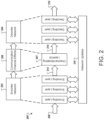
- FIG. 2 illustrates an example of a network structure 200 of machine-learning encoder network and decoder networks that may be implemented in an RF system to perform learned communication over RF channels..
- the encoder network 202 and/or decoder network 204 may include one or more collections of multiplications, divisions, and summations or other operations of inputs and intermediate values, optionally followed by non-linearities (such as rectified linear units, sigmoid function, or otherwise) or other operations (e.g., normalization), which may be arranged in a feed-forward manner or in a manner with feedback and in-layer connections (e.g., a recurrent neural network (RNN) where sequences of training information may be used in some instances).
- RNN recurrent neural network
- a recurrent neural network may be a long-short term memory (LSTM) neural network that includes one or more LSTM memory blocks, or a quasi-recurrent neural network (QRNN) which combines elements of convolutional networks with recurrent networks.
- LSTM long-short term memory
- QRNN quasi-recurrent neural network
- Parameters and weight values in the network may be used for a single multiplication, as in a fully connected neural network (DNN), or they may be "tied” or replicated across multiple locations within the network to form one or more receptive fields, such as in a convolutional neural network, a dilated convolutional neural network, a residual network unit, or similar.
- a collection of one or more of these layers may constitute both the encoder 202 and the decoder 204, as shown in the example of FIG. 2 .
- the specific structure for the networks may be explicitly specified at design time, or may be selected from a plurality of possible architecture candidates to ascertain the best performing candidate.
- the encoder network 202 may include an output layer that includes a linear regression layer.
- the decoder network 204 may include at least one of (i) an output layer that includes a linear layer for regression of reconstructed information 210 in decoding the received RF signal 214, or (ii) a sigmoid or hard-sigmoid activation layer for probability regression or slicing of the received RF signal 214, or (iii) an activation of a combination of sigmoid expressions such as a SoftMax or hierarchical SoftMax which can compute a probabilistic expression such as a pseudo-likelihood of a discrete message or set of bits.
- the encoder network 202 and/or decoder network 204 may include one or more layers that implement fixed communications algorithms, such as synchronization, equalization, etc. As such, in some scenarios, the encoder network 202 and/or decoder network 204 may be trained and deployed to learn suitable encoding and/or decoding techniques based on such fixed layers in the networks. Therefore, in general, the network structure 200 disclosed herein enables flexible design and training of the encoder network 202 and decoder network 204, for example by incorporating one or more existing communication algorithms that may be deployed in real-world systems in conjunction with machine-learning techniques to optimize around those fixed algorithms.
- FIG. 2 shows only one possible implementation of a network structure that may be implemented.
- implementations are not limited to these specific types of layers, and other configurations of layers and non-linearities may be used, such as dense, fully connected, and/or DNN layers, including rectified linear-unit (ReLU), sign-told, tanh, and others.
- the network structure 200 uses these layers to predict an output 210 for a received input 208.
- a linear regression layer may be implemented on the output of the encoder 202 and a linear layer on the output of the decoder 204. (for soft decoding), or a hard-sigmoid activation on the output of the decoder 204 (for hard decoding).
- a transmitted signal 212 created by the encoder 202, may be the actual RF waveform in analog form, or may be a series of radio samples in time, frequency, or any other signal representation basis, or may be an intermediate representation (e.g., RF samples, basis coefficients, distributions over RF waveform values, etc.), for mapping the input information 208 into an RF waveform for transmission over the channel 206.
- the received signal 214 may be the actual received RF waveform in analog form, or may be an intermediate representation (e.g., RF samples, basis coefficients, distributions over RF waveform values, etc.), for mapping a received RF waveform into the reconstructed information 210.
- the transmitted RF signal 212 and received RF signal 214 may represent distributions over RF waveform values.
- the channel-modeling layer(s) 207 may model impairment effects in the channel 206, which may be include various types of impairments in an RF medium and/or transmission and reception components.
- Such channel-modeling layers 207 may be implemented during training of the network structure 200, in which case the channel-modeling layer(s) 207 may be implemented as one or more layers in an overall auto-encoder structure to represent impairment effects of the channel 206.
- the channel 206 During evaluation or deployment over a real RF channels, the channel 206 would be a real-world communication channel (including possible transmitter and/or receiver effects), and the corresponding channel-modeling layers 207 would be removed from deployment, with only the network layers of the encoder 202 and the decoder 204 being deployed on the real channel 206.
- channel-modeling layers 207 may be implemented for various in different parts of the network structure 200 for various reasons, such as to prevent over-fitting, or to implement dropout, such as a penalty on the convolutional layer weights, to encourage minimum energy bases, or to implement a penalty on dense layer activations to encourage sparsity of solutions, or to improve generalization of the system to unseen conditions or channel states or behaviors.
- Such channel-modeling layers 207 may be used during training and removed during evaluation or deployment over real channels.
- additive noise such as Additive White Gaussian Noise (AWGN) may be modeled by adding a real-valued Gaussian random variable to different signal components, which may be signal basis functions (e.g., in-phase (I) and quadrature (Q) components), that are passed through the channel.
- AWGN Additive White Gaussian Noise
- a normalization layer may be implemented before the AWGN effects, which normalizes the average power incoming activations, for example to a normalized value equal to 1.
- This form of constraint can be applied to the encoder 202 to enforce a wide range of possible waveform design criteria, such as a maximum power, minimum power, mean power, mean amplitude, peak to average power ratio, or a wide range of properties of the transmit waveform which may be used as a hard constraint.
- waveform design criteria such as a maximum power, minimum power, mean power, mean amplitude, peak to average power ratio, or a wide range of properties of the transmit waveform which may be used as a hard constraint.
- similar such waveform design objectives may be included as soft constraints which are combined into the network's loss function during training, as further discussed in regards to FIG. 3 , below.
- Channel-modeling layers 207 may also be implemented to model unknown time and rate of arrival, for example by applying a random or a priori unknown shift and scaling in the time domain, which may model scenarios in which radio propagation times vary and clocks on distributed radio systems are not synchronized. These effects may be modeled, for example, by a random time shift and a random time-dilation rate that have Gaussian distributions.
- channel-modeling layers 207 carrier frequency and phase offset may be modeled as rotations in signal components, which may be signal basis functions.
- sampling may be performed using complex baseband representations, in which case unknown offsets in center frequency and absolute phase of arrival due to unsynchronized oscillators on transmitter and receiver, as well as Doppler shift, may result in static or linear polar mixing of the different signal components.
- channel-modeling layers 207 may randomly select a phase and a frequency offset, or a linear phase ramp based on an expected center frequency offset error due to independent drifting oscillators.
- delay spread in the received signal may be modeled to simulate the arrival of numerous delayed and phase shifted copies of a signal arriving at the receiver. Since this is simulated as a linear system and we assume stability over a single sample time window, we can choose a random non-impulsive channel delay spread filter and convolve it with the input signal to obtain an output which has been spread in time linearly according to a random channel response. This assumption may be appropriate, for example, in scenarios where the signal window is smaller than the channel coherence time. In scenarios where the signal window larger than a channel coherence time, the channel progression may be modeled as a sequence with some degree of correlation, and the network 200 may learn techniques correcting the sequence of delay spread modes.
- delay spread and coherence time may vary in different types of communication systems, including wire-line and space-based wireless systems which can sometimes have very short impulsive channel responses, or high frequency and dense multi-path wireless systems which can have long delay spreads.
- the delay spread is modeled as a channel-modeling layer 207 that implements one or more convolutions or filtering operations on the transmitted RF signal.
- the network structure 200 may be utilized with one or more fixed transmission and/or receiving techniques, and may adapt the layers of the encoding network 202 and/or the decoding network 204 to learn encoding and decoding operations that are suitable for those fixed transmission/reception components.
- the network structure 200 may employ fixed filtering, sampling, modulation, equalization, subcarrier assignment, reference signal insertion, encoding, or other transmission/reception techniques, and may learn suitable network layer parameters or network structures that adapt the overall communication system to best utilize those fixed components.
- a general design objective for the network structure 200 may be to obtain a desired reconstruction performance for the reconstructed information 210, subject to other objectives or constraints. For example, certain realizations of the system may favor reduced power and/or bandwidth, other improved properties of the RF signals transmitted over the channel, or improved computational complexity. As such, the system may evaluate a trade-off between these objectives, which may be used in order to help determine the specific architecture used for encoding, decoding, or other signal inference tasks.
- FIG. 3 illustrates an example of a training an RF system 300 that implements machine-learning encoder and decoder networks to communicate over RF channels.
- the system 300 includes an encoder network 302 and a decoder network 304 that are trained to communicate over the channel 306.
- the training illustrated in FIG. 3 may be implemented prior to deployment, or in some scenarios may be incorporated as part of deployment, for example to further update and refine the encoder network 302 and decoder network 304 based on real-world performance.
- the encoder network 302 and decoder network 304 may be utilized for training to learn suitable encoding and decoding mappings, and such mappings may be implemented in a deployed system using more simplified encoders and decoders.
- a deployed system may utilize using lookup tables at the encoder and distance-based metrics at the decoder, or other simplified forms of encoding and decoding, that are designed based on results of training the encoder network 302 and decoder network 304. Further discussion of such simplified deployment scenarios is provided in regards to FIG. 7 , below.
- the channel 306 that is implemented during training may be a model of an RF channel that is obtained via simulation and/or based on real-world RF channel data.
- training may begin with a simulated channel model and train the encoder network 302 and decoder network 304 based on simulated propagation models reflecting a real world propagation environment or emitter data.
- the encoder network 302 and decoder network 304 may then be further trained against a real channel where hardware is used with a training feedback loop.
- the model of the channel 306 may include effects of transmitter and receiver components, such as filtering, modulation, etc.
- effects of transmitter and receiver components such as filtering, modulation, etc.
- an analytic channel impairment model may be utilized that fits a specific set of hardware/software and wireless deployment conditions.
- the training in FIG. 3 may train the encoder network 302 and decoder network 304 to operate under different channel conditions, as well as for different real-world transmitter and receiver scenarios.
- the encoder network 302 and decoder network 304 may either be jointly trained or iteratively trained.
- the encoder network 302 and the decoder network 304 may be jointly trained as an auto-encoder (as described in regards to FIG. 2 , above).
- the encoder network 302 and decoder network 304 may be separately trained.
- one of the networks may be fixed, either by previous training or by a transmission/reception scheme, while the other network is trained to learn an encoding/decoding strategy that is appropriate for the fixed counterpart network.
- the encoder network 302 may be fixed to generate a particular mapping of input information 308 to transmitted RF signals 312, and the decoder network 304 may be trained to learn a mapping from the received RF signal 314 to reconstructed information 310 that is best suited for the fixed encoder 302.
- the input information 308 may be represented by training data that is utilized for training purposes.
- the training data may have a different form than the input information 308, but nonetheless may represent the input information 308 for purposes of training.
- the encoder network 302 may processes the training data that represents the first information, and the decoder network 304 may generate reconstructed information 310 as a reconstruction of the first information 308 represented by the training data.
- additional loss terms may be used in the loss function 318 in combination with such primary loss terms, for example to accomplish secondary objectives (e.g., to reduce interference imposed upon a secondary receiver, or to improve favorable signal properties such as peak to average power ratio (PAPR)).
- secondary objectives e.g., to reduce interference imposed upon a secondary receiver, or to improve favorable signal properties such as peak to average power ratio (PAPR)).
- PAPR peak to average power ratio
- the system 300 may also be configured to achieve an objective related to other performance measures, such as power, bandwidth, complexity, or other performance metrics that are relevant for communication.
- the system 300 may be configured to achieve a desired trade-off between different performance metrics. For example, achieving such a trade-off may be implemented using an objective function that combines different metrics, for example as a weighted combination of the metrics. In addition or as an alternative, this trade-off may be achieved by selecting a model according to user preferences or application specifications.
- the system 300 may implement one or more hard constraints on performance metrics, such as constraints on power, bandwidth, reconstruction error, etc.
- a network update process 316 may update the encoder network 302 and/or decoder network 304 based on the various performance metrics. This updating may include updates to the network architectures, parameters, or weights of the networks in the encoder network 302 and/or decoder network 304. For example, the updating may include updating weights or parameters in one or more layers of the networks, selecting machine-learning models for the encoder network 302 and decoder network 304, or selecting a specific network architecture, such as choice of layers, layer-hyperparameters, or other network features. As discussed, updating may be implemented on the encoder network 302 and decoder network 304 in a joint or iterative manner, or individually (as in the case where one of the networks is fixed).
- the updates performed by network update process 316 may be performed during training to learn suitable encoding and decoding techniques prior to deployment, and/or may be performed during deployment (if a deployed encoder and/or decoder implement machine-learning networks) to further update the encoder network 302 and/or decoder network 304 based on real-world deployment performance results.
- the network update process 316 updates the encoder network 302 and/or decoder network 304 to achieve a desired objective function, which includes the loss function 318 and other performance metrics discussed above.
- the network update process 316 may utilize an optimization method such as one of evolution, gradient descent, stochastic gradient descent, or other solution technique.
- the network update process 316 may calculate a rate of change of the objective function relative to variations in the encoder network 302 and/or decoder network 304, for example by calculating or approximating a gradient of the objective function.
- Such variations may include, for example, variations in the weights of one or more network layers, as shown in the example of FIG. 3 , or other network architecture choices.
- an approximate method may be used to estimate the gradient of the objective function.
- the network update process 316 determines a first variation for the encoder network 302 and a second variation for the decoder network 304.
- These variations may be computed, for example, using Stochastic Gradient Descent (SGD) style optimizers, such as Adam, AdaGrad, Nesterov SGD, or others.
- SGD Stochastic Gradient Descent
- these variations may be computed using other scalable methods for direct search, such as evolutionary algorithms or particle swarm optimizations.
- the network update process 316 then applies those variations to the encoder network 302 and/or the decoder network 304.
- the network update process 316 may update at least one encoding network weight in one or more layers of the encoder network 302, and/or at least one decoding network weight in one or more layers of the decoder network 304.
- updating the encoder network 302 and decoder network 304 is not limited to updating network weights, and other types of updates may be implemented.
- updating the encoder network 302 and the decoder network 304 may include selecting a machine-learning model for the encoder network 302, from among a plurality of encoding models, and selecting a machine-learning model for the decoder network 304, from among a plurality of decoding models.
- selecting machine-learning models may include selecting a specific network architecture, such as choice of layers, layer-hyperparameters, or other network features.
- the encoder network 302 and/or decoder network 304 may be trained over various training models of the channel 306, which may be of the same type or of different types of channel models. Depending on the composition of the set of models for channel 306, the encoder network 302 and decoder network 304 may be optimized to communicate over a certain type of RF channel or a wide range of different types of RF channels.
- the model of channel 306 may be categorized into a number of different modes.
- the encoder network 302 and/or decoder network 304 may be trained on the different modes of the channel 306. For each of these modes, the encoder network 302 and/or decoder network 304 may learn suitable encoding and/or decoding techniques for the different modes.
- the different modes of the channel 306 may represent any suitable categorization of channel condition, such as level of noise, SNR, delay spread, rate of channel variations, bandwidth, etc.
- a real channel may be used to train the encoder network 302 and/or decoder network 304.
- additional transmission and reception components may be implemented to transmit and receive analog RF waveforms over the real channel.
- Such transmit and receive components may be implemented either in the encoder network 302 and decoder network 304, or their effects may be included in the channel effects that are accounted for in the model of the channel 306.
- the training in FIG. 3 may be performed over any suitable channel 306, whether simulated or real, to train the encoder network 302 and decoder network 304 to learn suitable encoding and decoding techniques.
- the encoder network 302 may be configured to learn a mapping from input information 308 into a transmitted RF signal 312.
- the decoder network 304 may be configured to learn a reverse mapping from a received RF signal 314 into reconstructed information 310.
- the transmitted RF signal 312 and received RF signal 314 may represent analog RF waveforms that are transmitted and received over an RF channel, or may represent intermediate representations (e.g., samples of RF waveforms, coefficients of basis functions, distributions over RF waveforms, etc.) that are transformed to and from analog RF waveforms through processing by one or more other components, such as filters, modulators, equalizers, etc.
- the RF signals 212 and 214 may represent distributions over RF waveform values.
- the transmitted RF signal 312 and received RF signal 314 may represent any suitable RF signal representations that are learned by the encoder network 302 and decoder network 304 for encoding and decoding information over a particular channel or class of channels.
- the encoding and decoding mappings may involve a set of basis functions.
- the basis functions may be used by the encoder network 302 to transform the input information 308 into the transmitted RF signal, which may be a set of basis coefficients, or an RF waveform that is a weighted combination of basis functions, or other suitable representation using a particular set of basis functions.
- the decoder network 304 may use the same set of basis functions to process the received RF signal 314 to generate the reconstructed information 310, for example by taking projections of the RF signal 314 onto the set of basis functions to generate basis coefficients, or in the scenario where the RF signal 314 is itself a set of basis coefficients, by transforming the basis coefficients in the RF signal 314 into the reconstructed information 310.
- the basis functions may be any suitable set of orthogonal or non-orthogonal set of basis functions.
- the basis functions may be In-Phase and Quadrature-Phase (I/Q) signals, Fourier basis functions, polynomial basis functions, Gaussian basis functions, exponential basis functions, wavelet basis functions, or combinations of these and/or other suitable set of basis functions that can be utilized represent RF waveforms that are transmitted over a channel.
- the basis functions may have different phase, amplitude, and/or frequency components.
- the basis functions may be parameterized and the training may involve optimizing over parameters of the basis functions.
- Training the encoder network 302 and decoder network 304 may begin with any suitable set of initial conditions.
- the training may begin with a random set of basis functions subject to certain conditions.
- the training may begin with a fixed set of basis functions, such as commonly used RF communication basis functions including Quadrature Phase-Shift Keying (QPSK) or Gaussian Binary Frequency Shift Keying (GFSK), orthogonal frequency division multiple access (OFDM), or other fixed set of basis functions.
- QPSK Quadrature Phase-Shift Keying
- GFSK Gaussian Binary Frequency Shift Keying
- OFDM orthogonal frequency division multiple access
- the encoder network 302 and decoder network 304 attempt to learn improved basis functions, according to results of encoding and decoding.
- Training the encoder 102 and decoder 104 may involve optimizing over a set of basis functions or over different sets of basis functions, for example using greedy search or other optimization-type algorithm.
- the input information 308 may be chosen from a training set of information.
- the input information 308 may, in some implementations, be limited to a particular class of information, such as binary information, discrete-time information, analog waveforms, or other class of information.
- the system 300 will be trained to learn communication encoding and decoding techniques that are tuned to communicate that particular class of information (over a particular channel or class of channels).
- the system 300 may be trained to learn different encoding and decoding operations that are applicable to different communication scenarios.
- the loss function 318 may be any suitable measure, or combination of measures, of distance between the input information 308 and the reconstructed information 310.
- the loss function 318 may include cross-entropy, mean squared error (MSE), clipped MSE which penalizes predicted values according to MSE but only for values which fall on the wrong side of a decision threshold, or an exponential loss function that penalizes loss exponentially, or other suitable distance metric(s).
- MSE mean squared error
- clipped MSE which penalizes predicted values according to MSE but only for values which fall on the wrong side of a decision threshold
- an exponential loss function that penalizes loss exponentially, or other suitable distance metric(s).
- performance metrics may be incorporated into training, for example as part of the loss function 318 and/or as hard constraints, etc.
- performance metrics may include bit error rate (BER) as a function of the signal-to-noise ratio (SNR), communication bandwidth, communication power, spectral efficiency (the number of bits per second that can be transmitted over a fixed bandwidth channel at a specific SNR).
- SNR signal-to-noise ratio
- Any one or combinations of such metrics may be utilized during training as part of the loss function 318 (e.g., as a weighted combination) and/or as hard constraints in addition to the loss function 318.
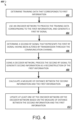
- FIG. 4 is a flowchart illustrating an example method 400 of training an RF system that implements machine-learning encoder and decoder networks to learn encoding and decoding over RF channels.
- the training method 400 may be performed by one or more processors, such as one or more CPUs, GPUs, DSPs, FPGAs, ASICs, TPUs, or neuromorphic chips or vector accelerators that execute instructions encoded on a computer storage medium.
- processors such as one or more CPUs, GPUs, DSPs, FPGAs, ASICs, TPUs, or neuromorphic chips or vector accelerators that execute instructions encoded on a computer storage medium.
- the training method 400 includes determining first information (402), which may be information that is to be communicated over an RF channel.
- the first information may be any suitable discrete-time, analog, discrete-valued, or continuous-valued information.
- this input information may be whitened discrete bits or symbols, or in other cases, the input information may follow the distribution of a non-whitened information source.
- the first information may be represented by training data that is utilized for training purposes. In such scenarios, the training data may have a different form than the first information, but nonetheless may represent the first information for purposes of training.
- An encoder machine-learning network is used to process this first information to generate a first RF signal that is to be transmitted over a communication channel (404).
- the first information may be represented by training data, in which case the encoder machine-learning network processes the training data representing the first information.
- the generated first RF signal may represent an analog RF waveform that is transmitted over a channel, or may be an intermediate representation (e.g., samples, basis coefficients, distributions over RF waveforms, etc.) that undergoes further processing (e.g., filtering, D/A conversion, modulation, etc.) to generate an analog RF waveform.
- This encoding process may utilize any suitable mapping from an input information space into an RF signal space, as discussed in regards to FIG. 3 , above.
- the training method 400 further includes determining a second RF signal that represents the first RF signal having been altered by transmission through the communication channel (406).
- the effects of the communication channel may be implemented by a model of a channel obtained by simulation and/or real channel data, or may be implemented by a real-world communication channel.
- the second RF signal may represent an analog RF waveform that is received over a channel, or may be an intermediate representation (e.g., samples, basis coefficients, distributions over RF waveforms etc.) that is a result of processing (e.g., filtering, sampling, equalizing, etc.) a received analog RF waveform.
- a decoder machine-learning network is then used to process the received RF signal and generate second information as a reconstruction of the first information (408).
- the first information may have been represented by training data that is utilized for training purposes.
- the input training data may have a different form than the original first information, but nonetheless the decoder may generate the second information as a reconstruction of the first information that is represented by the training data.
- This decoding process may utilize any suitable mapping from an RF signal space into reconstructed information space, as discussed in regards to FIG. 3 , above.
- a measure of distance is calculated between the second information and the first information (410).
- This measure of distance may be implemented as a loss function (e.g., loss function 318 in FIG. 3 ) and may represent a difference or error between the original input information and the second (reconstructed) information.
- the measure of distance may include cross-entropy, mean squared error, or other geometric distance metric (e.g., MSE, MAE, KL divergence), or may combine several geometric and/or entropy-based distance metrics into an aggregate expression for distance.
- the training method 400 further includes updating at least one of the encoder network or the decoder network based on the measure of distance between the second information and the first information (412).
- This update may be applied to the encoder network and/or the decoder network in a joint or iterative manner, or individually, as discussed above.
- the updates may generally include updating any suitable machine-learning network feature of the encoder network and/or decoder network, such as network weights, architecture choice, machine-learning model, or other parameter or connectivity design, as discussed in regards to FIG. 3 , above.
- the update process may include updating the set of basis functions that are utilized in the encoder network and/or decoder network.
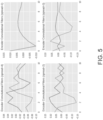
- FIG. 5 illustrates examples of basis functions that may be learned and utilized by an encoder machine-learning network and/or decoder machine-learning network to communicate over RF channels.
- the examples in FIG. 5 illustrate four different sets of convolutional basis functions that are learned by an encoder for four different values of delay spread in a communication channel.
- any suitable form of basis functions may be learned by the encoder network and/or decoder network.
- each set of basis functions has two components, although in general any suitable number of basis functions may be learned.
- the encoder has learned to adjust the compactness of the two basis components depending on the delay spread in the channel.
- the encoder and/or decoder may be deployed to utilize different sets of basis functions for different channel conditions (e.g., different channel delay spreads) in an adaptive manner.
- the system may obtain channel state information (CSI) and adjust the encoder network and/or decoder network according to the state of the channel.
- the encoder network and/or decoder network may simply adjust parameters (e.g., transmission power) for the same set of basis functions, or may change the set of basis functions entirely (e.g., by switching between the four sets of basis functions in FIG. 5 ).
- Such updates may also be performed during deployment based on simplified encoders and/or decoders that do not utilize full machine-learning networks, but instead utilize simplified encoding and/or decoding techniques based on results of training a corresponding encoder machine-learning network and decoder machine-learning network.
- FIG. 6 illustrates examples of a transmitted RF signal 612 and a received RF signal 614 that may be learned by the encoder and decoder machine-learning networks for communicating over an RF channel.
- the signals may correspond to the previously discussed transmitted RF signal 312 and received RF signal 314 in FIG. 3 , above.
- the transmitted RF signal 612 and received RF signal 614 represent analog RF waveforms that are actually transmitted and received over a channel.
- the transmitted RF signal 312 may be a waveform that is actually transmitted over a communication medium
- the received RF signal 314 may be a waveform that is actually received after having undergone impairments over a communication medium.
- the transmitted RF signals and received RF signals that are learned by the encoder and decoder may be any suitable representation (e.g., samples, basis coefficients, etc.) that may be further processed or transformed into analog RF waveforms.
- the RF signals are at 0 dB SNR for 128 bits of information, and In-phase and Quadrature-phase components are shown for the transmitted and received RF signals.
- the encoder and decoder machine-learning networks may be trained to learn any suitable form of transmitted and received RF signals, and are not limited in the number of components in each RF signal.
- the transmitted RF signal 612 is not immediately recognizable as corresponding to any known modulation scheme that is currently used in systems today.
- the transmitted RF signal 612 appears to use at least three common discrete levels, and appears to encode information in some mixture of time and frequency across the sample space.
- FIG. 7 illustrates an example of a system 700 with an encoder and decoder that may be deployed for learned communication of information over a real-world communication channel.
- the system 700 includes an encoder 702 and decoder 704 that are deployed to communicate over a real-world channel 706.
- the encoder 702 receives input information 708 to be communicated, and maps the input information 708 into a transmitted RF signal 712.
- the encoding mapping that is utilized by the encoder 702 may be designed based on previous training of a machine-learning network that learned how to encode information into RF signals, using the training described in regards to FIGS. 3 and 4 , above.
- the encoder 702 may implement a trained machine-learning network during deployment, or may implement a simplified encoding mapping that utilizes results of training a machine-learning network, as discussed further below.
- the encoder 702 may include processing (e.g., filtering, modulation, etc.) that generates the RF signal 712 as an analog RF waveform for transmission.
- processing e.g., filtering, modulation, etc.
- the encoder 702 may generate the RF signal 712 as an intermediate representation that is subsequently processed into an analog RF waveform by additional processing such as filtering or modulation for transmission over the channel 706.
- the decoder 704 receives RF signal 714 that has been impaired by the channel 706, and maps the received RF signal 714. into reconstructed information 710.
- the decoding mapping that is utilized by decoder 704 may be designed based on previous training of a machine-learning network that learned how to decode RF signals into reconstructed information, using the training described in regards to FIGS. 3 and 4 , above.
- the decoder 704 may implement a trained machine-learning network during deployment, or may implement a simplified decoding mapping that utilizes results of training a machine-learning network, as discussed further below
- the decoder 704 may include processing (e.g., filtering, modulation, etc.) that directly inputs the received RF signal 714 as an analog RF waveform received over the channel.
- the decoder 704 may process the RF signal as an intermediate representation that results from prior processing of an analog RF waveform that was received from the channel 706.
- the encoder 702 and/or decoder 704 may be updated during deployment, for example by update process 716, based on results of communication. Such updates may be based on feedback information that is determined based on results of transmission and reconstructions during deployment.
- the system 700 may be configured to collect information regarding the channel 706 and/or regarding performance metrics, for example using channel state and performance estimator 718.
- the estimator 718 may be configured to detect such information, for example, by detecting a training signal that was transmitted as the transmitted RF signal 712.
- the estimator 718 may provide such information via feedback to control various updates to the encoder 702 and/or decoder 704 during deployment, as shown in the example of FIG. 7 .
- Such updates may include updating one or more machine-learning features (in scenarios where the encoder 702 and/or decoder 704 implement machine-learning networks during deployment), or may include updating a simplified encoding and/or decoding mapping that is utilized by the encoder 702 and/or decoder 704 (in scenarios where the encoder 702 and/or decoder 704 implement simplified encoding/decoding techniques based on previously-trained machine-learning networks).
- the feedback that is sent from the channel state and performance estimator 718 may take any suitable form and may be transmitted on any suitable time scale. For example, such feedback may be provided based on estimates obtained from the forward link (encoder 702 to decoder 704) or based obtained from a reverse link (decoder 704 to encoder 702) to estimate the state of the channel and/or estimates of performance.
- the feedback information may vary in size depending on various factors, such as the number of modes to choose from, the available bandwidth and latency of the feedback channel, and other considerations. In some instances, this feedback information may be encoded into protocol messages within a wireless system.
- the feedback may be generated by the encoder 702 transmitting a known training RF signal, and the decoder 704 (and/or other component in the RF receiver) determining the state of the channel and performance measurements based on comparing the received RF signal with the known transmitted training RF signal.
- the feedback may only be provided to the receiver to update the decoder 704, without necessarily providing the feedback to the transmitter to update the encoder 702 (half-model updates).
- the conditions of channel 706 may change over different time scales, for example depending on the type of environment in which the RF signals are communicated.
- the time scale of variations in the channel 706 may depend on whether the environment is rural or urban, whether environmental objects are moving quickly or slowly (e.g., specifying coherence time, or correlation time of channel statistics), whether the environment is in an aircraft or spacecraft, or whether other radio emitters are located nearby.
- the channel coherence time is very long or static (e.g., fixed radios and reflectors)
- encodings may be specifically learned for these impairments over long time scale.
- This might be in a fixed geometry industrial or urban communications environment.
- the conditions present in the channel 706 may be categorized into a number of different modes.
- the different modes may represent any suitable categorization of channel conditions, such as level of noise, SNR, delay spread, time scale of channel variations, etc.
- the encoder 702 and/or decoder 704 may have been trained to learn a suitable set of encoding and/or decoding techniques, as discussed in regards to FIG. 3 , above.
- the encoder 702 and/or decoder 704 may be adaptively updated based on the particular mode of the channel 706 that is estimated.
- a transmission mode controller 720 may be implemented to decide which mode configuration is to be utilized for the encoder 702 and/or decoder 704.
- the transmission mode controller 720 may utilize feedback from the channel state and performance estimation 718. As discussed above, such feedback may be obtained from the forward and/or reverse link, and may be provided to the transmission mode controller 720 to help decide which mode of operation to select at any given time. In this way, the system 700 can learn suitable encoding and/or decoding techniques for a range of different channel conditions and then adaptively update the encoder 702 and/or decoder 704 to select a suitable mode under any given channel condition.
- the encoder 702 and/or decoder 704 may be trained on closed-form analytic models of channel 706. Given sufficiently accurate stable analytic models of the channel of interest, efficient representations for communication across the channel 706 may be learned and used without any on-line adaptation. Such implementations may be suitable in environments where the real-world channel 706 sufficiently corresponds to analytic models, such as channels that vary slowly in time, or are otherwise more stable and predictable.
- the system 700 may perform on-line adaptation and on-line learning of specialized encoding and/or decoding techniques that perform well for the given real world deployment scenario.
- updates to the encoder 702 and/or decoder 704 may be performed during deployment, based on real-world measurements of the channel and/or system performance. Such updates may be performed based on results of objective-achieving strategies that were learned in regards to training in FIGS. 3 and 4 , above.
- the update process 716 may utilize approximations, rather than exact analytic solutions, to determine updates for the encoder 702 and/or decoder 704. For example, in implementations where gradients of an objective function are computed, then approximate gradients may be computed, rather than exact derivative calculations.
- the update process 716 may additionally consider real-world factors, such as communications cost, latency, and capacity of the feedback channel from the channel state and performance estimator 718. In general, more accurate and more extensive feedback allows for updates that are more effective by the update process 716, but at the cost of communications, latency, and bandwidth. Therefore, in deployment scenarios where the encoder 702 and/or decoder 704 are updated based on feedback information, such additional considerations may be factored into the update process 716.
- the encoder 702 and/or decoder 704 may utilized simplified forms of encoding and/or decoding mappings that were learned during training.
- the encoder 702 may utilize a simplified lookup table to generate the transmitted RF signal 712 based on the input information 708.
- the decoder 704 may generate the reconstructed information 710 from the received RF signal 714 by utilizing a distance-based decoding technique, or other simplified decoding technique that is based on a more general decoding mapping learned during training, or that is based on an encoder mapping that was learned during training.
- an encoder machine-learning network may learn a mapping from input information 708 to RF signals 712.
- the mapping may be, for example, a signal constellation that represents different RF signals 712 as different points in the constellation corresponding to particular inputs 708.
- the encoder 702 may utilize a simplified lookup-table (LUT) to map input information 708 to points on the constellation to generate the RF signal 712, based on the training results of the encoder machine-learning network.
- the decoder 704 may utilize simplified decoding algorithms (e.g., distance-based decoding algorithms) that are based on results of training a decoder machine-learning network, or based on a counterpart trained encoder machine-learning network.
- the encoder 702 and/or decoder 704 may be trained (e.g., as an autoencoder) for system design during training, but approximations or compact look up tables may be utilized, in the encoder 702 and/or the decoder 704, to deploy and implement the system 700 in real-world applications.
- the encoder 702 and decoder 704 that are implemented in a deployed system may not implement a full machine-learning network, but instead may utilize results of encoding and decoding mappings that were learned by machine-learning networks during training. In some cases, these learned mappings from a neural network may already form very compact and efficient tensor computation expressions which can be deployed efficiently into a baseband processor.
- FIG. 8 is a flowchart illustrating an example method 800 of deploying an encoder and decoder to perform learned communication over a real-world RF channel.
- Such deployment may utilize encoding and decoding techniques that were previously learned by machine-networks during trained, for example by using training techniques discussed in regards to FIGS. 3 and 4 , above, or similar training techniques.
- the method 800 includes determining an encoder and a decoder, at least one of which implements an encoding or decoding that is based on at least one of an encoder machine-learning network or a decoder machine-learning network that has been trained to encode or decode information over a communication channel (802).
- the deployed encoder and/or decoder may implement machine-learning networks that were previously trained.
- the encoder and/or decoder may utilize simplified encoding/decoding mappings that are based on results of previously training an encoder machine-learning network and/or decoder machine-learning network, as discussed in regards to FIG. 7 , above.
- the method 800 further includes determining first information (804).
- the first information may be any suitable discrete-time, analog, discrete-valued, or continuous-valued information.
- the encoder is then used to process this first information to generate a first RF signal (806).
- the first RF signal may represent an analog RF waveform that is transmitted over a channel, or may be an intermediate representation (e.g., samples, basis coefficients, etc.) that undergoes further processing (e.g., filtering, D/A conversion, modulation, etc.) to generate an analog RF waveform.
- This encoding process may utilize any suitable mapping, or simplified form of a mapping, from an input information space into an RF signal space that was learned during training an encoder machine-learning network, for example using training techniques discussed in regards to FIG. 3 , above.
- the method 800 further includes transmitting, using at least one transmitter, the first RF signal, through a communication channel (808).
- transmission of the first RF signal may involve directly transmitting the first RF signal itself (e.g., if the encoder has generated the first RF signal as an analog RF waveform suitable for transmission over the channel), or may involve processing the first RF signal to convert it into an analog RF waveform for transmission (e.g., using filtering, D/A conversion, modulation, etc.).
- the transmission may utilize any suitable transmission technique which may include other features or parameters, for example using single or multiple antennas, adaptive power control, etc.
- the method 800 further includes receiving a second RF signal that represents the first RF signal having been altered by transmission through the communication channel (810).
- the communication is a real-world channel (in contrast to training scenarios of FIGS. 3 and 4 , where the channel may be a simulated channel or real-world channel).
- the second RF signal may represent an analog RF waveform that is received over a channel, or may be an intermediate representation (e.g., samples, basis coefficients, etc.) that is a result of processing (e.g., filtering, sampling, equalizing, etc.) a received analog RF waveform.
- a decoder is then used to process the received second RF signal and generate second information as a reconstruction of the first information (812).
- This decoding process may utilize any suitable mapping, or simplified form of a mapping, from an RF signal space into reconstructed information space that was learned by a decoder machine-learning network during training, for example using training techniques discussed in regards to FIG. 3 , above.
- a deployed system may further utilize the received second RF signal (and/or other information resulting from the communication) to generate feedback and update the encoder and/or the decoder.
- the encoder and/or decoder may utilized simplified forms of encoding and/or decoding mappings that were learned during training.
- the encoder may utilize a simplified lookup table to generate the first RF signal based on the first information.
- the decoder may utilize a distance-based decoding technique, or other simplified decoding technique that is based on a more general decoding mapping that was learned during training, or that is based on the encoder mapping that was learned during training.
- the encoder and decoder that are implemented in a deployed system may not implement a full machine-learning network, but instead may utilize results of encoding and decoding mappings that were learned by machine-learning networks during training.
- FIG. 9 is a diagram illustrating an example of a computing system that may be used to implement one or more components of a system that performs learned communication over RF channels.
- the computing system includes computing device 900 and a mobile computing device 950 that can be used to implement the techniques described herein.
- a mobile computing device 950 that can be used to implement the techniques described herein.
- one or more parts of an encoder machine-learning network system or a decoder machine-learning network system could be an example of the system 900 described here, such as a computer system implemented in any of the machine-learning networks, devices that access information from the machine-learning networks, or a server that accesses or stores information regarding the encoding and decoding performed by the machine-learning networks.
- the computing device 900 is intended to represent various forms of digital computers, such as laptops, desktops, workstations, personal digital assistants, servers, blade servers, mainframes, and other appropriate computers.
- the mobile computing device 950 is intended to represent various forms of mobile devices, such as personal digital assistants, cellular telephones, smart-phones, mobile embedded radio systems, radio diagnostic computing devices, and other similar computing devices.
- the components shown here, their connections and relationships, and their functions, are meant to be examples only, and are not meant to be limiting.
- the computing device 900 includes a processor 902, a memory 904, a storage device 906, a high-speed interface 908 connecting to the memory 904 and multiple high-speed expansion ports 910, and a low-speed interface 912 connecting to a low-speed expansion port 914 and the storage device 906.
- Each of the processor 902, the memory 904, the storage device 906, the high-speed interface 908, the high-speed expansion ports 910, and the low-speed interface 912 are interconnected using various busses, and may be mounted on a common motherboard or in other manners as appropriate.
- the processor 902 can process instructions for execution within the computing device 900, including instructions stored in the memory 904 or on the storage device 906 to display graphical information for a GUI on an external input/output device, such as a display 916 coupled to the high-speed interface 908.
- multiple processors and/or multiple buses may be used, as appropriate, along with multiple memories and types of memory.
- multiple computing devices may be connected, with each device providing portions of the operations (e.g., as a server bank, a group of blade servers, or a multi-processor system).
- the processor 902 is a single-threaded processor.
- the processor 902 is a multi-threaded processor.
- the processor 902 is a quantum computer.
- the memory 904 stores information within the computing device 900.
- the memory 904 is a volatile memory unit or units.
- the memory 904 is a non-volatile memory unit or units.
- the memory 904 may also be another form of computer-readable medium, such as a magnetic or optical disk.
- the high-speed interface 908 manages bandwidth-intensive operations for the computing device 900, while the low-speed interface 912 manages lower bandwidth-intensive operations. Such allocation of functions is an example only.
- the high-speed interface 908 is coupled to the memory 904, the display 916 (e.g., through a graphics processor or accelerator), and to the high-speed expansion ports 910, which may accept various expansion cards (not shown).
- the low-speed interface 912 is coupled to the storage device 906 and the low-speed expansion port 914.
- the low-speed expansion port 914 which may include various communication ports (e.g., USB, Bluetooth, Ethernet, wireless Ethernet) may be coupled to one or more input/output devices, such as a keyboard, a pointing device, a scanner, or a networking device such as a switch or router, e.g., through a network adapter.
- input/output devices such as a keyboard, a pointing device, a scanner, or a networking device such as a switch or router, e.g., through a network adapter.
- the computing device 900 may be implemented in a number of different forms, as shown in the figure. For example, it may be implemented as a standard server 920, or multiple times in a group of such servers. In addition, it may be implemented in a personal computer such as a laptop computer 922. It may also be implemented as part of a rack server system 924. Alternatively, components from the computing device 900 may be combined with other components in a mobile device (not shown), such as a mobile computing device 950. Each of such devices may include one or more of the computing device 900 and the mobile computing device 950, and an entire system may be made up of multiple computing devices communicating with each other.
- the mobile computing device 950 includes a processor 952, a memory 964, an input/output device such as a display 954, a communication interface 966, and a transceiver 968, among other components.
- the mobile computing device 950 may also be provided with a storage device, such as a micro-drive or other device, to provide additional storage.
- a storage device such as a micro-drive or other device, to provide additional storage.
- Each of the processor 952, the memory 964, the display 954, the communication interface 966, and the transceiver 968, are interconnected using various buses, and several of the components may be mounted on a common motherboard or in other manners as appropriate.
- the processor 952 may communicate with a user through a control interface 958 and a display interface 956 coupled to the display 954.
- the display 954 may be, for example, a TFT (Thin-Film-Transistor Liquid Crystal Display) display or an OLED (Organic Light Emitting Diode) display, or other appropriate display technology.
- the display interface 956 may include appropriate circuitry for driving the display 954 to present graphical and other information to a user.
- the control interface 958 may receive commands from a user and convert them for submission to the processor 952.
- an external interface 962 may provide communication with the processor 952, so as to enable near area communication of the mobile computing device 950 with other devices.
- the external interface 962 may provide, for example, for wired communication in some implementations, or for wireless communication in other implementations, and multiple interfaces may also be used.
- the memory 964 stores information within the mobile computing device 950.
- the memory 964 can be implemented as one or more of a computer-readable medium or media, a volatile memory unit or units, or a non-volatile memory unit or units.
- An expansion memory 974 may also be provided and connected to the mobile computing device 950 through an expansion interface 972, which may include, for example, a SIMM (Single In Line Memory Module) card interface.
- SIMM Single In Line Memory Module
- the expansion memory 974 may provide extra storage space for the mobile computing device 950, or may also store applications or other information for the mobile computing device 950.
- the expansion memory 974 may include instructions to carry out or supplement the processes described above, and may include secure information also.
- the expansion memory 974 may be provide as a security module for the mobile computing device 950, and may be programmed with instructions that permit secure use of the mobile computing device 950.
- secure applications may be provided via the SIMM cards, along with additional information, such as placing identifying information on the SIMM card in a non-hackable manner.
- the memory may include, for example, flash memory and/or NVRAM memory (non-volatile random access memory), as discussed below.
- instructions are stored in an information carrier such that the instructions, when executed by one or more processing devices (for example, processor 952), perform one or more methods, such as those described above.
- the instructions can also be stored by one or more storage devices, such as one or more computer- or machine-readable mediums (for example, the memory 964, the expansion memory 974, or memory on the processor 952).
- the instructions can be received in a propagated signal, for example, over the transceiver 968 or the external interface 962.
- the mobile computing device 950 may communicate wirelessly through the communication interface 966, which may include digital signal processing circuitry where necessary.
- the communication interface 966 may provide for communications under various modes or protocols, such as GSM voice calls (Global System for Mobile communications), SMS (Short Message Service), EMS (Enhanced Messaging Service), or MMS messaging (Multimedia Messaging Service), CDMA (code division multiple access), TDMA (time division multiple access), PDC (Personal Digital Cellular), WCDMA (Wideband Code Division Multiple Access), CDMA2000, or GPRS (General Packet Radio Service), LTE, 5G/6G cellular, among others.
- GSM voice calls Global System for Mobile communications
- SMS Short Message Service
- EMS Enhanced Messaging Service
- MMS messaging Multimedia Messaging Service
- CDMA code division multiple access
- TDMA time division multiple access
- PDC Personal Digital Cellular
- WCDMA Wideband Code Division Multiple Access
- CDMA2000 Code Division Multiple Access
- GPRS General Packet Radio Service
- LTE 5G/6G
- a GPS (Global Positioning System) receiver module 970 may provide additional navigation- and location-related wireless data to the mobile computing device 950, which may be used as appropriate by applications running on the mobile computing device 950.
- the mobile computing device 950 may also communicate audibly using an audio codec 960, which may receive spoken information from a user and convert it to usable digital information.
- the audio codec 960 may likewise generate audible sound for a user, such as through a speaker, e.g., in a handset of the mobile computing device 950.
- Such sound may include sound from voice telephone calls, may include recorded sound (e.g., voice messages, music files, etc.) and may also include sound generated by applications operating on the mobile computing device 950.
- the mobile computing device 950 may be implemented in a number of different forms, as shown in the figure. For example, it may be implemented as a cellular telephone 980. It may also be implemented as part of a smart-phone 982, personal digital assistant, or other similar mobile device.
- system may encompass all apparatus, devices, and machines for processing data, including by way of example a programmable processor, a computer, or multiple processors or computers.
- a processing system can include, in addition to hardware, code that creates an execution environment for the computer program in question, e.g., code that constitutes processor firmware, a protocol stack, a database management system, an operating system, or a combination of one or more of them.
- a computer program (also known as a program, software, software application, script, executable logic, or code) can be written in any form of programming language, including compiled or interpreted languages, or declarative or procedural languages, and it can be deployed in any form, including as a standalone program or as a module, component, subroutine, or other unit suitable for use in a computing environment.
- a computer program does not necessarily correspond to a file in a file system.
- a program can be stored in a portion of a file that holds other programs or data (e.g., one or more scripts stored in a markup language document), in a single file dedicated to the program in question, or in multiple coordinated files (e.g., files that store one or more modules, sub programs, or portions of code).
- a computer program can be deployed to be executed on one computer or on multiple computers that are located at one site or distributed across multiple sites and interconnected by a communication network.
- Computer readable media suitable for storing computer program instructions and data include all forms of non-volatile or volatile memory, media and memory devices, including by way of example semiconductor memory devices, e.g., EPROM, EEPROM, and flash memory devices; magnetic disks, e.g., internal hard disks or removable disks or magnetic tapes; magneto optical disks; and CD-ROM and DVD-ROM disks.
- semiconductor memory devices e.g., EPROM, EEPROM, and flash memory devices
- magnetic disks e.g., internal hard disks or removable disks or magnetic tapes
- magneto optical disks and CD-ROM and DVD-ROM disks.
- the processor and the memory can be supplemented by, or incorporated in, special purpose logic circuitry.
- a server is a general-purpose computer, and sometimes it is a custom-tailored special purpose electronic device, and sometimes it is a combination of these things.
- Implementations can include a back end component, e.g., a data server, or a middleware component, e.g., an application server, or a front end component, e.g., a client computer having a graphical user interface or a Web browser through which a user can interact with an implementation of the subject matter described is this specification, or any combination of one or more such back end, middleware, or front end components.
- the components of the system can be interconnected by any form or medium of digital data communication, e.g., a communication network. Examples of communication networks include a local area network (“LAN”) and a wide area network (“WAN”), e.g., the Internet.
- LAN local area network
- WAN wide area network
- the features described can be implemented in digital electronic circuitry, or in computer hardware, firmware, software, or in combinations of them.
- the apparatus can be implemented in a computer program product tangibly embodied in an information carrier, e.g., in a machine-readable storage device, for execution by a programmable processor; and method steps can be performed by a programmable processor executing a program of instructions to perform functions of the described implementations by operating on input data and generating output.
- the described features can be implemented advantageously in one or more computer programs that are executable on a programmable system including at least one programmable processor coupled to receive data and instructions from, and to transmit data and instructions to, a data storage system, at least one input device, and at least one output device.
- a computer program is a set of instructions that can be used, directly or indirectly, in a computer to perform a certain activity or bring about a certain result.
- a computer program can be written in any form of programming language, including compiled or interpreted languages, and it can be deployed in any form, including as a stand-alone program or as a module, component, subroutine, or other unit suitable for use in a computing environment.
Landscapes
- Engineering & Computer Science (AREA)
- Theoretical Computer Science (AREA)
- Physics & Mathematics (AREA)
- General Health & Medical Sciences (AREA)
- Computing Systems (AREA)
- Biomedical Technology (AREA)
- Biophysics (AREA)
- Computational Linguistics (AREA)
- Data Mining & Analysis (AREA)
- Evolutionary Computation (AREA)
- Life Sciences & Earth Sciences (AREA)
- Molecular Biology (AREA)
- Artificial Intelligence (AREA)
- General Engineering & Computer Science (AREA)
- General Physics & Mathematics (AREA)
- Mathematical Physics (AREA)
- Software Systems (AREA)
- Health & Medical Sciences (AREA)
- Quality & Reliability (AREA)
- Computer Networks & Wireless Communication (AREA)
- Signal Processing (AREA)
- Mobile Radio Communication Systems (AREA)
- Cable Transmission Systems, Equalization Of Radio And Reduction Of Echo (AREA)
Claims (13)
- Verfahren, das von mindestens einem Prozessor durchgeführt wird, um mindestens ein Netzwerk für maschinelles Lernen zu trainieren, um über einen Kommunikationskanal zu kommunizieren, wobei das Verfahren umfasst:Bestimmen der ersten Informationen (308);Verwenden eines Encoder-Netzes für maschinelles Lernen (302), um die ersten Informationen (308) zu verarbeiten, und ein erstes HF-Signals (312) zur Übertragung über einen Kommunikationskanal (306) zu erzeugen;Bestimmen eines zweiten HF-Signals (314), das das erste HF-Signal darstellt, das durch Übertragung über den Kommunikationskanal (306) verändert wurde;Verwenden eines Decoder-Netzes für maschinelles Lernen (304), um das zweite HF-Signals (314) zu verarbeiten, und zweite Informationen (310) als Rekonstruktion der ersten Informationen zu erzeugen, wobei das Encoder-Netz für maschinelles Lernen eine oder mehrere Schichten beinhaltet und das Decoder-Netz für maschinelles Lernen jeweils eine oder mehrere Schichten beinhaltet;Berechnen eines Maßes für die Entfernung zwischen den zweiten Informationen und den ersten Informationen; undAktualisieren mindestens eines des Encoder-Netzes für maschinelles Lernen (302) oder des Decoder-Netzes für maschinelles Lernen (304) basierend auf dem Maß der Entfernung zwischen den zweiten Informationen und den ersten Informationen, wobei das Aktualisieren mindestens eines des Encoder-Netzes für maschinelles Lernen oder des Decoder-Netzes für maschinelles Lernen basierend auf dem Maß der Entfernung zwischen den zweiten Informationen und den ersten Informationen umfasst:
Bestimmen einer Zielfunktion (318), die das Maß der Entfernung zwischen den zweiten Informationen und den ersten Informationen umfasst; gekennzeichnet durch:Berechnen einer Änderungsrate der Zielfunktion (318) im Verhältnis zu Variationen im Encoder-Netz für maschinelles Lernen und zu Variationen im Decoder-Netz für maschinelles Lernen, wobei die Variationen in Gewichten einer oder mehrerer Netzschichten am Encoder-Netz für maschinelles Lernen bzw. am Decoder-Netz für maschinelles Lernen liegen und wobei die Zielfunktion auch eine Kombination von Leistungsmetriken beinhaltet, die für die Kommunikation über den Kommunikationskanal relevant sind;Auswählen, basierend auf den berechneten Änderungsraten der Zielfunktion, mindestens einer von einer ersten Variation für das Enoder-Netz für maschinelles Lernen oder von einer zweiten Variation für das Decoder-Netz für maschinelles Lernen, wobei die erste Variation eine Variation der Gewichte einer oder mehrerer Schichten des Encoder-Netzes für maschinelles Lernen und die zweite Variation eine Variation der Gewichte einer oder mehrerer Decoder-Netzschichten für maschinelles Lernen ist; undAktualisieren mindestens eines Gewichtes des Encoder-Netzes der einen oder mehreren Schichten des Encoder-Netzes für maschinelles Lernen oder Aktualisieren mindestens eines Gewichtes des Decoder-Netzes für maschinelles Lernen basierend auf mindestens einer der ausgewählten ersten Variation für das Encoder-Netz für maschinelles Lernen oder der ausgewählten zweiten Variation für das Decoder-Netz für maschinelles Lernen. - Verfahren nach Anspruch 1, wobei das Maß der Entfernung zwischen den zweiten Informationen und den ersten Informationen mindestens eines von (i) einer Kreuzentropie zwischen den zweiten Informationen und den ersten Informationen oder (ii) eine geometrischen Entfernungsmetrik zwischen den zweiten Informationen und den ersten Informationen umfasst.
- Verfahren nach Anspruch 1, wobei das Aktualisieren mindestens eines des Encoder-Netzes für maschinelles Lernen oder des Decoder-Netzes für maschinelles Lernen ferner umfasst:Bestimmen eines Kanalmodus aus einer Mehrzahl von Kanalmodi, der den Status des Kommunikationskanals darstellt; undAktualisieren von mindestens einem des Encoder-Netzes für maschinelles Lernen oder des Decoder-Netzes für maschinelles Lernen basierend auf dem Kanalmodus des Kommunikationskanals.
- Verfahren nach Anspruch 1, wobei das Encoder-Netz für maschinelles Lernen und das Decoder-Netz für maschinelles Lernen gemeinsam als Auto-Encoder trainiert sind, um Kommunikation über einen Kommunikationskanal zu erlernen, und wobei der Auto-Encoder mindestens eine Kanal-Modellierungsschicht umfasst, die Effekte des Kommunikationskanals auf übertragene Wellenformen darstellt.
- Verfahren nach Anspruch 4, wobei die wenigstens eine Kanal-Modellierungsschicht mindestens eines von (i) additivem Gaußschen thermischem Rauschen im Kommunikationskanal, (ii) Verzögerungsverteilung, die durch zeitvariierende Effekte des Kommunikationskanals verursacht wird, (iii) Phasenrauschen, das durch Übertragung und Empfang über den Kommunikationskanal verursacht wird, oder (iv) Verschiebungen in Phase, Frequenz oder Timing, die durch Übertragung und Empfang über den Kommunikationskanal verursacht werden, darstellt.
- Verfahren nach Anspruch 1, wobei mindestens eines des Encoder-Netzes für maschinelles Lernen oder des Decoder-Netzes für maschinelles Lernen mindestens eines von einem "Deep-Dense" neuronalen Netzwerks (DNN), einem Faltungsneuronalen Netzwerk (CNN) oder einem rekurrenten neuronalen Netzwerk (RNN) umfasst, das parametrische Multiplikationen, Additionen und Nichtlinearitäten umfasst.
- Verfahren nach Anspruch 1, das ferner umfasst:Verarbeiten des ersten HF-Signals, um eine erste analoge HF-Wellenform zu erzeugen, die in den Kommunikationskanal eingegeben wird;Empfangen einer zweiten analogen HF-Wellenform als Ausgabe des Kommunikationskanals, der die erste analoge HF-Wellenform darstellt, die vom Kommunikationskanal verändert wurde; undVerarbeiten der zweiten analogen HF-Wellenform, um das zweite HF-Signal zu erzeugen.
- Verfahren nach Anspruch 1, wobei der Kommunikationskanal mindestens einen von einem Funkkommunikationskanal, einem akustischen Kommunikationskanal oder einem optischen Kommunikationskanal umfasst.
- Verfahren nach Anspruch 1, wobei die Kombination der Leistungsmetriken Leistungsmetriken beinhaltet, die aus der Gruppe von Leistung, Bandbreite und Kommunikationskomplexität ausgewählt wurden.
- Verfahren nach Anspruch 1, wobei die Kombination der Leistungsmetriken eine gewichtete Kombination der ausgewählten Leistungsmetriken ist.
- Verfahren nach Anspruch 1, wobei das Verfahren beinhaltet:
Implementieren einer oder mehrerer harter Beschränkungen für die in der Kombination der Leistungsmetriken ausgewählten Leistungsmetriken, wobei die eine oder mehreren harten Beschränkungen Beschränkungen beinhalten, für Metriken, die Energie, Bandbreite und Rekonstruktionsfehler beinhalten. - Verfahren nach Anspruch 1, wobei die Leistungsmetriken der Kombination eine Bitfehlerrate beinhalten, die eine Funktion einer oder mehrerer eines Signal-Rausch-Verhältnisses ist, d. h. SNR, Kommunikationsbandbreite, Kommunikationsleistung, oder spektrale Effizienz als Anzahl von Bits pro Sekunde, die über einen Kanal mit fester Bandbreite mit einem bestimmten SNR übertragen werden können.
- System, das umfasst:mindestens einen Prozessor; undmindestens einen Computerspeicher, der mit dem mindestens einen Prozessor mit darauf gespeicherten Anweisungen gekoppelt ist, die, wenn sie von dem mindestens einen Prozessor ausgeführt werden, dem mindestens einen Prozessor veranlassen, das Verfahren nach einem der Ansprüche 1 bis 12 durchzuführen.
Priority Applications (2)
| Application Number | Priority Date | Filing Date | Title |
|---|---|---|---|
| EP24218523.9A EP4546681A3 (de) | 2017-05-03 | 2018-05-03 | Lernen und einsetzen von adaptiven drahtlosen kommunikationen |
| EP24218524.7A EP4542898A3 (de) | 2017-05-03 | 2018-05-03 | Lernen und einsetzen von adaptiven drahtlosen kommunikationen |
Applications Claiming Priority (2)
| Application Number | Priority Date | Filing Date | Title |
|---|---|---|---|
| US201762500621P | 2017-05-03 | 2017-05-03 | |
| PCT/US2018/030876 WO2018204632A1 (en) | 2017-05-03 | 2018-05-03 | Learning and deployment of adaptive wireless communications |
Related Child Applications (2)
| Application Number | Title | Priority Date | Filing Date |
|---|---|---|---|
| EP24218523.9A Division EP4546681A3 (de) | 2017-05-03 | 2018-05-03 | Lernen und einsetzen von adaptiven drahtlosen kommunikationen |
| EP24218524.7A Division EP4542898A3 (de) | 2017-05-03 | 2018-05-03 | Lernen und einsetzen von adaptiven drahtlosen kommunikationen |
Publications (3)
| Publication Number | Publication Date |
|---|---|
| EP3619656A1 EP3619656A1 (de) | 2020-03-11 |
| EP3619656A4 EP3619656A4 (de) | 2021-01-20 |
| EP3619656B1 true EP3619656B1 (de) | 2024-12-11 |
Family
ID=64014789
Family Applications (3)
| Application Number | Title | Priority Date | Filing Date |
|---|---|---|---|
| EP18793816.2A Active EP3619656B1 (de) | 2017-05-03 | 2018-05-03 | Lernen und einsetzen von adaptiven drahtlosen kommunikationen |
| EP24218524.7A Pending EP4542898A3 (de) | 2017-05-03 | 2018-05-03 | Lernen und einsetzen von adaptiven drahtlosen kommunikationen |
| EP24218523.9A Pending EP4546681A3 (de) | 2017-05-03 | 2018-05-03 | Lernen und einsetzen von adaptiven drahtlosen kommunikationen |
Family Applications After (2)
| Application Number | Title | Priority Date | Filing Date |
|---|---|---|---|
| EP24218524.7A Pending EP4542898A3 (de) | 2017-05-03 | 2018-05-03 | Lernen und einsetzen von adaptiven drahtlosen kommunikationen |
| EP24218523.9A Pending EP4546681A3 (de) | 2017-05-03 | 2018-05-03 | Lernen und einsetzen von adaptiven drahtlosen kommunikationen |
Country Status (7)
| Country | Link |
|---|---|
| US (3) | US10217047B2 (de) |
| EP (3) | EP3619656B1 (de) |
| JP (1) | JP6758524B2 (de) |
| KR (1) | KR102165645B1 (de) |
| CN (2) | CN111512323A (de) |
| FI (1) | FI3619656T3 (de) |
| WO (1) | WO2018204632A1 (de) |
Families Citing this family (89)
| Publication number | Priority date | Publication date | Assignee | Title |
|---|---|---|---|---|
| US9942074B1 (en) | 2016-11-30 | 2018-04-10 | Micron Technology, Inc. | Wireless devices and systems including examples of mixing coefficient data specific to a processing mode selection |
| US10879620B2 (en) * | 2017-03-22 | 2020-12-29 | Nec Corporation | Antenna directivity adjustment apparatus and antenna directivity adjustment method |
| FI3616198T3 (fi) | 2017-04-24 | 2025-01-17 | Virginia Tech Intellectual Properties Inc | Radiosignaalitunnistus, tunnistusjärjestelmän oppiminen ja tunnisteen käyttöönotto |
| KR102165645B1 (ko) | 2017-05-03 | 2020-10-14 | 버지니아 테크 인터렉추얼 프라퍼티스, 인크. | 적응형 무선 통신의 학습 및 전개 |
| CN111434049B (zh) * | 2017-06-19 | 2021-06-11 | 弗吉尼亚科技知识产权有限公司 | 使用多天线收发器无线传输的信息的编码和解码 |
| US11228379B1 (en) | 2017-06-23 | 2022-01-18 | DeepSig Inc. | Radio signal processing network model search |
| US10749594B1 (en) | 2017-08-18 | 2020-08-18 | DeepSig Inc. | Learning-based space communications systems |
| US10429486B1 (en) * | 2017-08-18 | 2019-10-01 | DeepSig Inc. | Method and system for learned communications signal shaping |
| US11551144B2 (en) * | 2018-01-30 | 2023-01-10 | Deepmind Technologies Limited | Dynamic placement of computation sub-graphs |
| WO2020094995A1 (fr) * | 2018-11-09 | 2020-05-14 | Adagos | Procédé de construction de réseau de neurones pour la simulation de systèmes physiques |
| FR3088463A1 (fr) * | 2018-11-09 | 2020-05-15 | Adagos | Procede de construction de reseau de neurones pour la simulation de systemes reels |
| US11599773B2 (en) * | 2018-12-27 | 2023-03-07 | Micron Technology, Inc. | Neural networks and systems for decoding encoded data |
| CN111416642B (zh) * | 2019-01-04 | 2023-02-17 | 财团法人工业技术研究院 | 基于深度学习与信道状态信息的通信系统及编解码方法 |
| US12045726B2 (en) * | 2019-02-08 | 2024-07-23 | DeepSig Inc. | Adversarially generated communications |
| WO2020183059A1 (en) | 2019-03-14 | 2020-09-17 | Nokia Technologies Oy | An apparatus, a method and a computer program for training a neural network |
| CN113906719B (zh) * | 2019-04-23 | 2023-08-29 | 迪普西格有限公司 | 使用机器学习网络处理通信信号 |
| CN110351658B (zh) * | 2019-06-03 | 2020-12-01 | 西北大学 | 一种基于卷积神经网络的室内定位方法 |
| CN110351212A (zh) * | 2019-08-10 | 2019-10-18 | 南京理工大学 | 快衰落信道下基于卷积神经网络的信道估计方法 |
| EP3979514A4 (de) * | 2019-08-26 | 2022-08-03 | Guangdong Oppo Mobile Telecommunications Corp., Ltd. | Verfahren zur verarbeitung von kanalzustandsinformationen, elektronische vorrichtung und speichermedium |
| US11005697B2 (en) | 2019-09-03 | 2021-05-11 | Cisco Technology, Inc. | Orthogonal frequency-division multiplexing equalization using deep neural network |
| CN114365424A (zh) * | 2019-09-12 | 2022-04-15 | 瑞典爱立信有限公司 | 提供用于多天线发射机的预编码器选择策略 |
| CN110620632B (zh) * | 2019-09-12 | 2021-02-23 | 华为技术有限公司 | 一种时间同步方法及装置 |
| GB2587008B (en) * | 2019-09-12 | 2024-03-27 | Airbus Defence & Space Ltd | Soft-decision decoding |
| CN110728314B (zh) * | 2019-09-30 | 2022-10-25 | 西安交通大学 | 一种大规模免调度系统活跃用户检测方法 |
| JP2021072539A (ja) * | 2019-10-30 | 2021-05-06 | キヤノン株式会社 | 画像符号化装置、復号装置、伝送システム、及びその制御方法 |
| US10924152B1 (en) | 2019-11-13 | 2021-02-16 | Micron Technology, Inc. | Mixing coefficient data for processing mode selection |
| US11424764B2 (en) * | 2019-11-13 | 2022-08-23 | Micron Technology, Inc. | Recurrent neural networks and systems for decoding encoded data |
| EP4064592B1 (de) * | 2019-12-04 | 2023-11-08 | Mitsubishi Electric Corporation | Übertragungsvorrichtung, übertragungsverfahren und speichermedium |
| US20210185700A1 (en) * | 2019-12-13 | 2021-06-17 | Qualcomm Incorporated | Scheduling request associated with artificial intelligence information |
| US11356305B2 (en) * | 2020-02-24 | 2022-06-07 | Qualcomm Incorporated | Method to convey the TX waveform distortion to the receiver |
| US11653228B2 (en) * | 2020-02-24 | 2023-05-16 | Qualcomm Incorporated | Channel state information (CSI) learning |
| US11533658B2 (en) | 2020-02-24 | 2022-12-20 | Qualcomm Incorporated | Compressed measurement feedback using an encoder neural network |
| US12156221B2 (en) * | 2020-02-24 | 2024-11-26 | Qualcomm Incorporated | Machine learning for addressing transmit (Tx) non-linearity |
| US11468328B2 (en) | 2020-02-24 | 2022-10-11 | Qualcomm Incorporated | Managing information transmission for wireless communication |
| US11936452B2 (en) * | 2020-02-28 | 2024-03-19 | Qualcomm Incorporated | Neural network based channel state information feedback |
| US12418897B1 (en) * | 2020-03-18 | 2025-09-16 | Nvidia Corporation | Fifth generation new radio signal processing |
| PH12022552240A1 (en) | 2020-04-17 | 2024-03-11 | Qualcomm Inc | Configurable neural network for channel state feedback (csf) learning |
| CN111582200B (zh) * | 2020-05-12 | 2023-11-21 | 北京邮电大学 | 人体姿态估计方法、装置、电子设备及介质 |
| CN113676226B (zh) * | 2020-05-15 | 2023-03-14 | 维沃移动通信有限公司 | 导频信息符号发送方法、信道估计方法、通信设备及介质 |
| WO2021251510A1 (ko) * | 2020-06-08 | 2021-12-16 | 엘지전자 주식회사 | 무선 통신 시스템에서 상향링크 데이터 또는 하향링크 데이터를 전송하는 방법 및 이를 위한 장치 |
| US11863221B1 (en) * | 2020-07-14 | 2024-01-02 | Hrl Laboratories, Llc | Low size, weight and power (swap) efficient hardware implementation of a wide instantaneous bandwidth neuromorphic adaptive core (NeurACore) |
| US12566244B1 (en) | 2020-07-13 | 2026-03-03 | Hrl Laboratories, Llc | System and method for real-time radar range-doppler map learning |
| US12057989B1 (en) * | 2020-07-14 | 2024-08-06 | Hrl Laboratories, Llc | Ultra-wide instantaneous bandwidth complex neuromorphic adaptive core processor |
| EP4189889A1 (de) | 2020-07-31 | 2023-06-07 | Google LLC | Auf neuronalem netzwerk basierende übertragungsrückkopplung in einem zellularen netzwerk |
| BR112023002367A2 (pt) * | 2020-08-18 | 2023-03-21 | Qualcomm Inc | Aprendizagem federada de pares de autocodificador para comunicação sem fio |
| US12267189B2 (en) | 2020-08-20 | 2025-04-01 | Nokia Technologies Oy | Neural-network-based receivers |
| US12200660B2 (en) * | 2020-08-31 | 2025-01-14 | Qualcomm Incorporated | Unsupervised learning for simultaneous localization and mapping in deep neural networks using channel state information |
| EP4205289A4 (de) * | 2020-08-31 | 2024-08-21 | Qualcomm Incorporated | Konfigurierbare metriken zur kanalzustandskompression und -rückkopplung |
| CN114337911A (zh) * | 2020-09-30 | 2022-04-12 | 华为技术有限公司 | 一种基于神经网络的通信方法以及相关装置 |
| US12482452B2 (en) * | 2020-10-02 | 2025-11-25 | Google Llc | Learned audio frontend machine learning model for audio understanding |
| WO2022086949A1 (en) * | 2020-10-21 | 2022-04-28 | Idac Holdings, Inc | Methods for training artificial intelligence components in wireless systems |
| CN112188487B (zh) * | 2020-12-01 | 2021-03-12 | 索信达(北京)数据技术有限公司 | 一种提高用户鉴权准确性的方法与系统 |
| CN112600772B (zh) * | 2020-12-09 | 2022-05-17 | 齐鲁工业大学 | 一种基于数据驱动神经网络的ofdm信道估计与信号检测方法 |
| JP7258249B2 (ja) * | 2020-12-17 | 2023-04-14 | 三菱電機株式会社 | 送信装置、送信方法、制御回路および記憶媒体 |
| CN112713966B (zh) * | 2020-12-30 | 2023-07-25 | 大连大学 | 基于似然估计修正信噪比的编码调制切换方法 |
| KR102520316B1 (ko) * | 2021-02-09 | 2023-04-11 | 한양대학교 에리카산학협력단 | 집중화 모델 학습 장치 및 그 방법 |
| CN113052081B (zh) * | 2021-03-26 | 2024-03-15 | 江苏师范大学 | 一种基于柯西Score星座图的调制方式识别方法 |
| JP7714050B2 (ja) * | 2021-04-13 | 2025-07-28 | グーグル エルエルシー | データストリーミング用のエンドツーエンドのニューラルネットワーク構成を採用する無線システム |
| US11563449B2 (en) | 2021-04-27 | 2023-01-24 | Micron Technology, Inc. | Systems for error reduction of encoded data using neural networks |
| US11973513B2 (en) | 2021-04-27 | 2024-04-30 | Micron Technology, Inc. | Decoders and systems for decoding encoded data using neural networks |
| WO2022241137A1 (en) * | 2021-05-13 | 2022-11-17 | Origen | Physics-informed attention-based neural network |
| US20240333601A1 (en) * | 2021-06-25 | 2024-10-03 | Google Llc | Wireless network employing neural networks for channel state feedback |
| WO2022271073A1 (en) * | 2021-06-25 | 2022-12-29 | Telefonaktiebolaget Lm Ericsson (Publ) | Training network-based decoders of user equipment (ue) channel state information (csi) feedback |
| JP7654494B2 (ja) * | 2021-07-13 | 2025-04-01 | 東芝テック株式会社 | タグ読取装置 |
| CN117203898A (zh) * | 2021-07-28 | 2023-12-08 | Oppo广东移动通信有限公司 | 信道信息反馈的方法、发端设备和收端设备 |
| CN117837130A (zh) * | 2021-09-02 | 2024-04-05 | Oppo广东移动通信有限公司 | 模型处理方法、电子设备、网络设备和终端设备 |
| US11755408B2 (en) | 2021-10-07 | 2023-09-12 | Micron Technology, Inc. | Systems for estimating bit error rate (BER) of encoded data using neural networks |
| CN113872911B (zh) * | 2021-10-15 | 2023-10-24 | 齐鲁工业大学 | 模型驱动的正交频分复用系统高峰均比抑制方法及系统 |
| US20230131694A1 (en) * | 2021-10-19 | 2023-04-27 | Samsung Electronics Co., Ltd. | Systems, methods, and apparatus for artificial intelligence and machine learning for a physical layer of communication system |
| KR102892714B1 (ko) * | 2021-10-20 | 2025-12-01 | 한국철도기술연구원 | 타겟 모델 학습방법 및 평가방법과 이를 이용한 통신 시스템 |
| WO2023083431A1 (en) * | 2021-11-09 | 2023-05-19 | Nokia Technologies Oy | Reconfigurable demodulation and decoding |
| CN118235455A (zh) * | 2021-11-15 | 2024-06-21 | Oppo广东移动通信有限公司 | 用于无线信道处理的模型更新方法、装置、终端及介质 |
| WO2023097522A1 (zh) * | 2021-11-30 | 2023-06-08 | Oppo广东移动通信有限公司 | 用于无线信道处理的模型更新方法、装置、设备及介质 |
| US20250047346A1 (en) * | 2021-12-15 | 2025-02-06 | Telefonaktiebolaget Lm Ericsson (Publ) | Communications nodes and methods for proprietary machine learning-based csi reporting |
| CN116828486A (zh) * | 2022-03-21 | 2023-09-29 | 华为技术有限公司 | 一种通信方法及相关装置 |
| CN116961711A (zh) * | 2022-04-19 | 2023-10-27 | 华为技术有限公司 | 一种通信方法及装置 |
| EP4515721A4 (de) * | 2022-04-25 | 2026-03-25 | Deepsig Inc | Zugangsnetze mit maschinenlernen |
| CN114978342B (zh) * | 2022-04-29 | 2023-09-26 | 上海交通大学 | 相干光通信数字多载波系统中光滤波损伤补偿方法和系统 |
| US20230359872A1 (en) * | 2022-05-05 | 2023-11-09 | Nvidia Corporation | Neural network capability indication |
| WO2024000437A1 (en) * | 2022-06-30 | 2024-01-04 | Huawei Technologies Co., Ltd. | Representing underlying logical constructs related to temporal sensing and measuring of a radio environment |
| US12432007B2 (en) * | 2022-10-11 | 2025-09-30 | Xerox Corporation | System and method for symbol decoding in high frequency (hf) communication channels |
| WO2024087154A1 (en) * | 2022-10-28 | 2024-05-02 | Qualcomm Incorporated | Control information reporting test framework |
| WO2024150202A1 (en) * | 2023-02-16 | 2024-07-18 | Lenovo (Singapore) Pte. Ltd. | A method for a flexible and adaptable end-to-end communication using a two-sided machine learning model |
| EP4443786A1 (de) * | 2023-04-05 | 2024-10-09 | Nokia Solutions and Networks Oy | Rekonstruktion von kanalzustandsinformationen durch die kombination von mindestens zwei decodern |
| CN121713525A (zh) * | 2023-09-05 | 2026-03-20 | 华为技术有限公司 | 一种通信方法及相关设备 |
| WO2025134283A1 (ja) * | 2023-12-20 | 2025-06-26 | 日本電信電話株式会社 | 受信機及び無線通信プログラム |
| WO2025134282A1 (ja) * | 2023-12-20 | 2025-06-26 | 日本電信電話株式会社 | 受信機及び無線通信プログラム |
| WO2025134284A1 (ja) * | 2023-12-20 | 2025-06-26 | 日本電信電話株式会社 | 受信機及び無線通信プログラム |
| WO2025166574A1 (zh) * | 2024-02-06 | 2025-08-14 | Oppo广东移动通信有限公司 | 信息处理方法和设备 |
Family Cites Families (26)
| Publication number | Priority date | Publication date | Assignee | Title |
|---|---|---|---|---|
| KR950003285B1 (ko) | 1993-03-25 | 1995-04-07 | 삼성전자 주식회사 | 압축기 |
| US6104991A (en) * | 1998-02-27 | 2000-08-15 | Lucent Technologies, Inc. | Speech encoding and decoding system which modifies encoding and decoding characteristics based on an audio signal |
| US6307895B1 (en) | 1998-04-01 | 2001-10-23 | The United States Of America As Represented By The Secretary Of The Navy | Complex Fourier coefficient extractor |
| US6850735B2 (en) | 2002-04-22 | 2005-02-01 | Cognio, Inc. | System and method for signal classiciation of signals in a frequency band |
| GB2398976B (en) * | 2003-02-28 | 2006-03-08 | Samsung Electronics Co Ltd | Neural network decoder |
| US7554989B2 (en) * | 2005-01-18 | 2009-06-30 | Creative Technology Ltd. | Real time optimization over a shared communication channel |
| US7487066B2 (en) | 2005-04-28 | 2009-02-03 | Caterpillar Inc. | Classifying a work machine operation |
| TWI364919B (en) * | 2008-05-16 | 2012-05-21 | Hon Hai Prec Ind Co Ltd | Radio signal transceiver and communication system employing the same |
| US8209080B2 (en) * | 2009-04-27 | 2012-06-26 | Toyota Motor Engineering & Manufacturing North America, Inc. | System for determining most probable cause of a problem in a plant |
| CN101741782B (zh) | 2009-11-24 | 2012-08-15 | 东南大学 | 双层多载波超宽带无线通信方法 |
| US8494464B1 (en) | 2010-09-08 | 2013-07-23 | Rockwell Collins, Inc. | Cognitive networked electronic warfare |
| EP3193453B1 (de) | 2014-09-12 | 2019-11-06 | Hitachi Kokusai Electric Inc. | Drahtloskommunikationsvorrichtung und -verfahren |
| US10338191B2 (en) | 2014-10-30 | 2019-07-02 | Bastille Networks, Inc. | Sensor mesh and signal transmission architectures for electromagnetic signature analysis |
| US10082551B2 (en) * | 2015-10-19 | 2018-09-25 | Ecole Polytechnique Federale De Lausanne (Epfl) | Learning-based subsampling |
| JP7140681B2 (ja) * | 2016-02-03 | 2022-09-21 | トレリスウェア テクノロジーズ インコーポレイテッド | 異種リンクを用いた通信のための方法およびシステム |
| CN106126807B (zh) * | 2016-06-22 | 2019-04-09 | 北京邮电大学 | 一种基于大数据挖掘的无线信道建模方法 |
| CN106060852A (zh) * | 2016-07-08 | 2016-10-26 | 北京全路通信信号研究设计院集团有限公司 | 一种参数调整方法、基站和移动终端 |
| EP3532854A4 (de) | 2016-09-27 | 2020-10-14 | BAE SYSTEMS Information and Electronic Systems Integration Inc. | Verfahren zur implementierung eines tragbaren spektrumsanalysators |
| JP2018074522A (ja) | 2016-11-02 | 2018-05-10 | 日本電気株式会社 | ゲートウェイ装置、移動管理装置、基地局、通信方法、制御方法、ページング方法、及びプログラム |
| US20180144241A1 (en) * | 2016-11-22 | 2018-05-24 | Mitsubishi Electric Research Laboratories, Inc. | Active Learning Method for Training Artificial Neural Networks |
| US10552738B2 (en) * | 2016-12-15 | 2020-02-04 | Google Llc | Adaptive channel coding using machine-learned models |
| US10382478B2 (en) | 2016-12-20 | 2019-08-13 | Cisco Technology, Inc. | Detecting malicious domains and client addresses in DNS traffic |
| US11832969B2 (en) * | 2016-12-22 | 2023-12-05 | The Johns Hopkins University | Machine learning approach to beamforming |
| FI3616198T3 (fi) | 2017-04-24 | 2025-01-17 | Virginia Tech Intellectual Properties Inc | Radiosignaalitunnistus, tunnistusjärjestelmän oppiminen ja tunnisteen käyttöönotto |
| KR102165645B1 (ko) | 2017-05-03 | 2020-10-14 | 버지니아 테크 인터렉추얼 프라퍼티스, 인크. | 적응형 무선 통신의 학습 및 전개 |
| CN111434049B (zh) * | 2017-06-19 | 2021-06-11 | 弗吉尼亚科技知识产权有限公司 | 使用多天线收发器无线传输的信息的编码和解码 |
-
2018
- 2018-05-03 KR KR1020197035228A patent/KR102165645B1/ko active Active
- 2018-05-03 CN CN201880037563.4A patent/CN111512323A/zh active Pending
- 2018-05-03 US US15/970,324 patent/US10217047B2/en active Active
- 2018-05-03 EP EP18793816.2A patent/EP3619656B1/de active Active
- 2018-05-03 CN CN202511396935.0A patent/CN121212197A/zh active Pending
- 2018-05-03 EP EP24218524.7A patent/EP4542898A3/de active Pending
- 2018-05-03 FI FIEP18793816.2T patent/FI3619656T3/fi active
- 2018-05-03 EP EP24218523.9A patent/EP4546681A3/de active Pending
- 2018-05-03 JP JP2019559296A patent/JP6758524B2/ja active Active
- 2018-05-03 WO PCT/US2018/030876 patent/WO2018204632A1/en not_active Ceased
-
2019
- 2019-02-21 US US16/281,246 patent/US11423301B2/en active Active
-
2022
- 2022-08-17 US US17/889,420 patent/US20230055213A1/en active Pending
Also Published As
| Publication number | Publication date |
|---|---|
| KR102165645B1 (ko) | 2020-10-14 |
| CN121212197A (zh) | 2025-12-26 |
| JP2020520497A (ja) | 2020-07-09 |
| US20230055213A1 (en) | 2023-02-23 |
| EP4542898A2 (de) | 2025-04-23 |
| JP6758524B2 (ja) | 2020-09-23 |
| WO2018204632A1 (en) | 2018-11-08 |
| US20180322388A1 (en) | 2018-11-08 |
| US10217047B2 (en) | 2019-02-26 |
| EP3619656A1 (de) | 2020-03-11 |
| EP3619656A4 (de) | 2021-01-20 |
| EP4546681A2 (de) | 2025-04-30 |
| EP4546681A3 (de) | 2025-07-16 |
| US11423301B2 (en) | 2022-08-23 |
| FI3619656T3 (fi) | 2025-03-14 |
| CN111512323A (zh) | 2020-08-07 |
| KR20200004340A (ko) | 2020-01-13 |
| EP4542898A3 (de) | 2025-07-02 |
| US20190188565A1 (en) | 2019-06-20 |
Similar Documents
| Publication | Publication Date | Title |
|---|---|---|
| US20230055213A1 (en) | Learning and deployment of adaptive wireless communications | |
| US12334997B2 (en) | Encoding and decoding of information for wireless transmission using multi-antenna transceivers | |
| US20240397459A1 (en) | Learning communication systems using channel approximation | |
| US12223443B1 (en) | Learning approximate estimation networks for communication channel state information | |
| US20250053817A1 (en) | Adversarially generated communications | |
| CN113906719B (zh) | 使用机器学习网络处理通信信号 |
Legal Events
| Date | Code | Title | Description |
|---|---|---|---|
| STAA | Information on the status of an ep patent application or granted ep patent |
Free format text: STATUS: THE INTERNATIONAL PUBLICATION HAS BEEN MADE |
|
| PUAI | Public reference made under article 153(3) epc to a published international application that has entered the european phase |
Free format text: ORIGINAL CODE: 0009012 |
|
| STAA | Information on the status of an ep patent application or granted ep patent |
Free format text: STATUS: REQUEST FOR EXAMINATION WAS MADE |
|
| 17P | Request for examination filed |
Effective date: 20191203 |
|
| AK | Designated contracting states |
Kind code of ref document: A1 Designated state(s): AL AT BE BG CH CY CZ DE DK EE ES FI FR GB GR HR HU IE IS IT LI LT LU LV MC MK MT NL NO PL PT RO RS SE SI SK SM TR |
|
| AX | Request for extension of the european patent |
Extension state: BA ME |
|
| RAP1 | Party data changed (applicant data changed or rights of an application transferred) |
Owner name: VIRGINIA TECH INTELLECTUAL PROPERTIES, INC. |
|
| DAV | Request for validation of the european patent (deleted) | ||
| DAX | Request for extension of the european patent (deleted) | ||
| A4 | Supplementary search report drawn up and despatched |
Effective date: 20201218 |
|
| RIC1 | Information provided on ipc code assigned before grant |
Ipc: G10L 15/20 20060101ALI20201214BHEP Ipc: G10L 17/18 20130101ALI20201214BHEP Ipc: G06N 3/08 20060101ALI20201214BHEP Ipc: G10L 15/00 20130101ALI20201214BHEP Ipc: G06N 3/063 20060101AFI20201214BHEP Ipc: H04L 1/00 20060101ALI20201214BHEP |
|
| STAA | Information on the status of an ep patent application or granted ep patent |
Free format text: STATUS: EXAMINATION IS IN PROGRESS |
|
| 17Q | First examination report despatched |
Effective date: 20221018 |
|
| GRAP | Despatch of communication of intention to grant a patent |
Free format text: ORIGINAL CODE: EPIDOSNIGR1 |
|
| STAA | Information on the status of an ep patent application or granted ep patent |
Free format text: STATUS: GRANT OF PATENT IS INTENDED |
|
| INTG | Intention to grant announced |
Effective date: 20240708 |
|
| GRAS | Grant fee paid |
Free format text: ORIGINAL CODE: EPIDOSNIGR3 |
|
| GRAA | (expected) grant |
Free format text: ORIGINAL CODE: 0009210 |
|
| STAA | Information on the status of an ep patent application or granted ep patent |
Free format text: STATUS: THE PATENT HAS BEEN GRANTED |
|
| AK | Designated contracting states |
Kind code of ref document: B1 Designated state(s): AL AT BE BG CH CY CZ DE DK EE ES FI FR GB GR HR HU IE IS IT LI LT LU LV MC MK MT NL NO PL PT RO RS SE SI SK SM TR |
|
| REG | Reference to a national code |
Ref country code: GB Ref legal event code: FG4D |
|
| REG | Reference to a national code |
Ref country code: CH Ref legal event code: EP |
|
| REG | Reference to a national code |
Ref country code: DE Ref legal event code: R096 Ref document number: 602018077538 Country of ref document: DE |
|
| REG | Reference to a national code |
Ref country code: IE Ref legal event code: FG4D |
|
| P01 | Opt-out of the competence of the unified patent court (upc) registered |
Free format text: CASE NUMBER: APP_65043/2024 Effective date: 20241209 |
|
| REG | Reference to a national code |
Ref country code: FI Ref legal event code: FGE |
|
| REG | Reference to a national code |
Ref country code: SE Ref legal event code: TRGR |
|
| REG | Reference to a national code |
Ref country code: LT Ref legal event code: MG9D |
|
| PG25 | Lapsed in a contracting state [announced via postgrant information from national office to epo] |
Ref country code: HR Free format text: LAPSE BECAUSE OF FAILURE TO SUBMIT A TRANSLATION OF THE DESCRIPTION OR TO PAY THE FEE WITHIN THE PRESCRIBED TIME-LIMIT Effective date: 20241211 |
|
| PG25 | Lapsed in a contracting state [announced via postgrant information from national office to epo] |
Ref country code: BG Free format text: LAPSE BECAUSE OF FAILURE TO SUBMIT A TRANSLATION OF THE DESCRIPTION OR TO PAY THE FEE WITHIN THE PRESCRIBED TIME-LIMIT Effective date: 20241211 |
|
| REG | Reference to a national code |
Ref country code: NL Ref legal event code: MP Effective date: 20241211 |
|
| PG25 | Lapsed in a contracting state [announced via postgrant information from national office to epo] |
Ref country code: ES Free format text: LAPSE BECAUSE OF FAILURE TO SUBMIT A TRANSLATION OF THE DESCRIPTION OR TO PAY THE FEE WITHIN THE PRESCRIBED TIME-LIMIT Effective date: 20241211 |
|
| PG25 | Lapsed in a contracting state [announced via postgrant information from national office to epo] |
Ref country code: NO Free format text: LAPSE BECAUSE OF FAILURE TO SUBMIT A TRANSLATION OF THE DESCRIPTION OR TO PAY THE FEE WITHIN THE PRESCRIBED TIME-LIMIT Effective date: 20250311 |
|
| PG25 | Lapsed in a contracting state [announced via postgrant information from national office to epo] |
Ref country code: LV Free format text: LAPSE BECAUSE OF FAILURE TO SUBMIT A TRANSLATION OF THE DESCRIPTION OR TO PAY THE FEE WITHIN THE PRESCRIBED TIME-LIMIT Effective date: 20241211 Ref country code: GR Free format text: LAPSE BECAUSE OF FAILURE TO SUBMIT A TRANSLATION OF THE DESCRIPTION OR TO PAY THE FEE WITHIN THE PRESCRIBED TIME-LIMIT Effective date: 20250312 |
|
| PG25 | Lapsed in a contracting state [announced via postgrant information from national office to epo] |
Ref country code: RS Free format text: LAPSE BECAUSE OF FAILURE TO SUBMIT A TRANSLATION OF THE DESCRIPTION OR TO PAY THE FEE WITHIN THE PRESCRIBED TIME-LIMIT Effective date: 20250311 |
|
| PG25 | Lapsed in a contracting state [announced via postgrant information from national office to epo] |
Ref country code: NL Free format text: LAPSE BECAUSE OF FAILURE TO SUBMIT A TRANSLATION OF THE DESCRIPTION OR TO PAY THE FEE WITHIN THE PRESCRIBED TIME-LIMIT Effective date: 20241211 |
|
| REG | Reference to a national code |
Ref country code: AT Ref legal event code: MK05 Ref document number: 1750977 Country of ref document: AT Kind code of ref document: T Effective date: 20241211 |
|
| PG25 | Lapsed in a contracting state [announced via postgrant information from national office to epo] |
Ref country code: SM Free format text: LAPSE BECAUSE OF FAILURE TO SUBMIT A TRANSLATION OF THE DESCRIPTION OR TO PAY THE FEE WITHIN THE PRESCRIBED TIME-LIMIT Effective date: 20241211 |
|
| PGFP | Annual fee paid to national office [announced via postgrant information from national office to epo] |
Ref country code: FI Payment date: 20250513 Year of fee payment: 8 |
|
| PG25 | Lapsed in a contracting state [announced via postgrant information from national office to epo] |
Ref country code: PL Free format text: LAPSE BECAUSE OF FAILURE TO SUBMIT A TRANSLATION OF THE DESCRIPTION OR TO PAY THE FEE WITHIN THE PRESCRIBED TIME-LIMIT Effective date: 20241211 |
|
| PGFP | Annual fee paid to national office [announced via postgrant information from national office to epo] |
Ref country code: DE Payment date: 20250408 Year of fee payment: 8 |
|
| PGFP | Annual fee paid to national office [announced via postgrant information from national office to epo] |
Ref country code: GB Payment date: 20250403 Year of fee payment: 8 |
|
| PG25 | Lapsed in a contracting state [announced via postgrant information from national office to epo] |
Ref country code: IS Free format text: LAPSE BECAUSE OF FAILURE TO SUBMIT A TRANSLATION OF THE DESCRIPTION OR TO PAY THE FEE WITHIN THE PRESCRIBED TIME-LIMIT Effective date: 20250411 |
|
| PG25 | Lapsed in a contracting state [announced via postgrant information from national office to epo] |
Ref country code: PT Free format text: LAPSE BECAUSE OF FAILURE TO SUBMIT A TRANSLATION OF THE DESCRIPTION OR TO PAY THE FEE WITHIN THE PRESCRIBED TIME-LIMIT Effective date: 20250411 |
|
| PG25 | Lapsed in a contracting state [announced via postgrant information from national office to epo] |
Ref country code: EE Free format text: LAPSE BECAUSE OF FAILURE TO SUBMIT A TRANSLATION OF THE DESCRIPTION OR TO PAY THE FEE WITHIN THE PRESCRIBED TIME-LIMIT Effective date: 20241211 |
|
| PG25 | Lapsed in a contracting state [announced via postgrant information from national office to epo] |
Ref country code: AT Free format text: LAPSE BECAUSE OF FAILURE TO SUBMIT A TRANSLATION OF THE DESCRIPTION OR TO PAY THE FEE WITHIN THE PRESCRIBED TIME-LIMIT Effective date: 20241211 Ref country code: RO Free format text: LAPSE BECAUSE OF FAILURE TO SUBMIT A TRANSLATION OF THE DESCRIPTION OR TO PAY THE FEE WITHIN THE PRESCRIBED TIME-LIMIT Effective date: 20241211 |
|
| PG25 | Lapsed in a contracting state [announced via postgrant information from national office to epo] |
Ref country code: SK Free format text: LAPSE BECAUSE OF FAILURE TO SUBMIT A TRANSLATION OF THE DESCRIPTION OR TO PAY THE FEE WITHIN THE PRESCRIBED TIME-LIMIT Effective date: 20241211 |
|
| PG25 | Lapsed in a contracting state [announced via postgrant information from national office to epo] |
Ref country code: CZ Free format text: LAPSE BECAUSE OF FAILURE TO SUBMIT A TRANSLATION OF THE DESCRIPTION OR TO PAY THE FEE WITHIN THE PRESCRIBED TIME-LIMIT Effective date: 20241211 |
|
| PG25 | Lapsed in a contracting state [announced via postgrant information from national office to epo] |
Ref country code: IT Free format text: LAPSE BECAUSE OF FAILURE TO SUBMIT A TRANSLATION OF THE DESCRIPTION OR TO PAY THE FEE WITHIN THE PRESCRIBED TIME-LIMIT Effective date: 20241211 |
|
| PGFP | Annual fee paid to national office [announced via postgrant information from national office to epo] |
Ref country code: SE Payment date: 20250411 Year of fee payment: 8 |
|
| REG | Reference to a national code |
Ref country code: DE Ref legal event code: R097 Ref document number: 602018077538 Country of ref document: DE |
|
| PG25 | Lapsed in a contracting state [announced via postgrant information from national office to epo] |
Ref country code: DK Free format text: LAPSE BECAUSE OF FAILURE TO SUBMIT A TRANSLATION OF THE DESCRIPTION OR TO PAY THE FEE WITHIN THE PRESCRIBED TIME-LIMIT Effective date: 20241211 |
|
| PLBE | No opposition filed within time limit |
Free format text: ORIGINAL CODE: 0009261 |
|
| STAA | Information on the status of an ep patent application or granted ep patent |
Free format text: STATUS: NO OPPOSITION FILED WITHIN TIME LIMIT |
|
| REG | Reference to a national code |
Ref country code: CH Ref legal event code: L10 Free format text: ST27 STATUS EVENT CODE: U-0-0-L10-L00 (AS PROVIDED BY THE NATIONAL OFFICE) Effective date: 20251022 |
|
| 26N | No opposition filed |
Effective date: 20250912 |
|
| REG | Reference to a national code |
Ref country code: CH Ref legal event code: H13 Free format text: ST27 STATUS EVENT CODE: U-0-0-H10-H13 (AS PROVIDED BY THE NATIONAL OFFICE) Effective date: 20251223 |
|
| PG25 | Lapsed in a contracting state [announced via postgrant information from national office to epo] |
Ref country code: LU Free format text: LAPSE BECAUSE OF NON-PAYMENT OF DUE FEES Effective date: 20250503 |
|
| PG25 | Lapsed in a contracting state [announced via postgrant information from national office to epo] |
Ref country code: CH Free format text: LAPSE BECAUSE OF NON-PAYMENT OF DUE FEES Effective date: 20250531 |
|
| REG | Reference to a national code |
Ref country code: BE Ref legal event code: MM Effective date: 20250531 |
|
| PG25 | Lapsed in a contracting state [announced via postgrant information from national office to epo] |
Ref country code: MC Free format text: LAPSE BECAUSE OF FAILURE TO SUBMIT A TRANSLATION OF THE DESCRIPTION OR TO PAY THE FEE WITHIN THE PRESCRIBED TIME-LIMIT Effective date: 20241211 |
|
| PG25 | Lapsed in a contracting state [announced via postgrant information from national office to epo] |
Ref country code: IE Free format text: LAPSE BECAUSE OF NON-PAYMENT OF DUE FEES Effective date: 20250503 |
|
| PG25 | Lapsed in a contracting state [announced via postgrant information from national office to epo] |
Ref country code: BE Free format text: LAPSE BECAUSE OF NON-PAYMENT OF DUE FEES Effective date: 20250531 |
|
| PG25 | Lapsed in a contracting state [announced via postgrant information from national office to epo] |
Ref country code: FR Free format text: LAPSE BECAUSE OF NON-PAYMENT OF DUE FEES Effective date: 20250531 |