EP3620132A1 - Elektrische zahnbürste - Google Patents
Elektrische zahnbürste Download PDFInfo
- Publication number
- EP3620132A1 EP3620132A1 EP19808670.4A EP19808670A EP3620132A1 EP 3620132 A1 EP3620132 A1 EP 3620132A1 EP 19808670 A EP19808670 A EP 19808670A EP 3620132 A1 EP3620132 A1 EP 3620132A1
- Authority
- EP
- European Patent Office
- Prior art keywords
- electric toothbrush
- electrode
- brush
- current
- main body
- Prior art date
- Legal status (The legal status is an assumption and is not a legal conclusion. Google has not performed a legal analysis and makes no representation as to the accuracy of the status listed.)
- Withdrawn
Links
- 210000000214 mouth Anatomy 0.000 claims abstract description 15
- 239000004065 semiconductor Substances 0.000 claims description 24
- 238000001514 detection method Methods 0.000 claims description 11
- 229910052751 metal Inorganic materials 0.000 claims description 7
- 239000002184 metal Substances 0.000 claims description 7
- GWEVSGVZZGPLCZ-UHFFFAOYSA-N Titan oxide Chemical compound O=[Ti]=O GWEVSGVZZGPLCZ-UHFFFAOYSA-N 0.000 description 19
- OGIDPMRJRNCKJF-UHFFFAOYSA-N titanium oxide Inorganic materials [Ti]=O OGIDPMRJRNCKJF-UHFFFAOYSA-N 0.000 description 19
- 230000001699 photocatalysis Effects 0.000 description 8
- 210000003296 saliva Anatomy 0.000 description 8
- JVTAAEKCZFNVCJ-UHFFFAOYSA-N lactic acid Chemical compound CC(O)C(O)=O JVTAAEKCZFNVCJ-UHFFFAOYSA-N 0.000 description 6
- XLYOFNOQVPJJNP-UHFFFAOYSA-N water Substances O XLYOFNOQVPJJNP-UHFFFAOYSA-N 0.000 description 6
- 238000006243 chemical reaction Methods 0.000 description 3
- 230000000694 effects Effects 0.000 description 3
- 230000005669 field effect Effects 0.000 description 3
- -1 lactic acid Chemical class 0.000 description 3
- 235000014655 lactic acid Nutrition 0.000 description 3
- 239000004310 lactic acid Substances 0.000 description 3
- 238000004519 manufacturing process Methods 0.000 description 3
- 150000007524 organic acids Chemical class 0.000 description 3
- 235000005985 organic acids Nutrition 0.000 description 3
- 241000894006 Bacteria Species 0.000 description 2
- 208000002925 dental caries Diseases 0.000 description 2
- 230000007774 longterm Effects 0.000 description 2
- 230000007257 malfunction Effects 0.000 description 2
- 208000028169 periodontal disease Diseases 0.000 description 2
- 238000006722 reduction reaction Methods 0.000 description 2
- 229910001220 stainless steel Inorganic materials 0.000 description 2
- 239000010935 stainless steel Substances 0.000 description 2
- 208000006558 Dental Calculus Diseases 0.000 description 1
- 208000002064 Dental Plaque Diseases 0.000 description 1
- 241001669679 Eleotris Species 0.000 description 1
- QVGXLLKOCUKJST-UHFFFAOYSA-N atomic oxygen Chemical compound [O] QVGXLLKOCUKJST-UHFFFAOYSA-N 0.000 description 1
- 230000015572 biosynthetic process Effects 0.000 description 1
- 230000001680 brushing effect Effects 0.000 description 1
- 239000004020 conductor Substances 0.000 description 1
- 230000003111 delayed effect Effects 0.000 description 1
- 238000010586 diagram Methods 0.000 description 1
- 239000001257 hydrogen Substances 0.000 description 1
- 229910052739 hydrogen Inorganic materials 0.000 description 1
- WABPQHHGFIMREM-UHFFFAOYSA-N lead(0) Chemical compound [Pb] WABPQHHGFIMREM-UHFFFAOYSA-N 0.000 description 1
- 238000007254 oxidation reaction Methods 0.000 description 1
- 230000033116 oxidation-reduction process Effects 0.000 description 1
- 239000001301 oxygen Substances 0.000 description 1
- 229910052760 oxygen Inorganic materials 0.000 description 1
- 239000000049 pigment Substances 0.000 description 1
- 230000007505 plaque formation Effects 0.000 description 1
- 238000006479 redox reaction Methods 0.000 description 1
- 239000011347 resin Substances 0.000 description 1
- 229920005989 resin Polymers 0.000 description 1
- 239000000126 substance Substances 0.000 description 1
Images



Classifications
-
- A—HUMAN NECESSITIES
- A61—MEDICAL OR VETERINARY SCIENCE; HYGIENE
- A61C—DENTISTRY; APPARATUS OR METHODS FOR ORAL OR DENTAL HYGIENE
- A61C17/00—Devices for cleaning, polishing, rinsing or drying teeth, teeth cavities or prostheses; Saliva removers; Dental appliances for receiving spittle
- A61C17/16—Power-driven cleaning or polishing devices
- A61C17/22—Power-driven cleaning or polishing devices with brushes, cushions, cups, or the like
- A61C17/221—Control arrangements therefor
-
- A—HUMAN NECESSITIES
- A61—MEDICAL OR VETERINARY SCIENCE; HYGIENE
- A61C—DENTISTRY; APPARATUS OR METHODS FOR ORAL OR DENTAL HYGIENE
- A61C17/00—Devices for cleaning, polishing, rinsing or drying teeth, teeth cavities or prostheses; Saliva removers; Dental appliances for receiving spittle
- A61C17/16—Power-driven cleaning or polishing devices
- A61C17/22—Power-driven cleaning or polishing devices with brushes, cushions, cups, or the like
- A61C17/32—Power-driven cleaning or polishing devices with brushes, cushions, cups, or the like reciprocating or oscillating
- A61C17/34—Power-driven cleaning or polishing devices with brushes, cushions, cups, or the like reciprocating or oscillating driven by electric motor
- A61C17/3409—Power-driven cleaning or polishing devices with brushes, cushions, cups, or the like reciprocating or oscillating driven by electric motor characterized by the movement of the brush body
- A61C17/3481—Vibrating brush body, e.g. by using eccentric weights
Definitions
- the present disclosure relates to an electric toothbrush.
- An electric toothbrush for plaque control has been proposed to prevent the formation of plaque (tooth tartar) adhering to intraoral tooth and to remove the generated plaque by using the photocatalytic action of N-type semiconductor such as titanium oxide.
- N-type semiconductor such as titanium oxide
- a redox reaction caused by such photocatalytic action can finally decompose organic substances resulting in dirt and odor, to CO 2 and H 2 O.
- An electric toothbrush using the N-type semiconductor such as titanium oxide having such a photocatalytic action can decompose and remove bacteria present in the oral cavity, plaques attached to tooth, and organic acids such as lactic acid, by which the formation of dental caries and periodontal disease can be prevented.
- Japanese Patent Laid-Open No. 1994-90,824 discloses an electric toothbrush comprising a grip provided with a motor, a DC power supply for driving the motor, a switch for turning on and off a conduction state between the DC power supply and the motor, and a movement converting means for converting a rotational movement of the motor into a small vibration or reciprocation of a flocked part, further comprising an N-type semiconductor which is at least partially inserted into the oral cavity and comes in contact with water across the flocked part and the grip, wherein the N-type semiconductor and a positive electrode of the DC power supply are connected, and a conductor provided on the outer surface of the grip portion is connected to a negative electrode of the DC power supply.
- combining the DC power supply for driving the motor and the N-type semiconductor can further promote to reduce the manufacturing cost and the downsizing of the entire electric toothbrush including the grip portion.
- Japanese Patent No. 5,820,494 discloses an electric toothbrush comprising a main body part serving as a handle having a conductive portion, an N-type semiconductor rod provided at the tip of the main body part in the longitudinal direction, a brush part provided with a transparent brush base where brush bristles are embedded, an ultraviolet light emitting element provided at an end of the main body part, a transparent cylindrical light guide covering the ultraviolet light emitting element and a part of the N-type semiconductor rod, and a vibration generating unit integrally formed with a light guide.
- this electric toothbrush comprises the ultraviolet light emitting element and the N type semiconductor causing a photocatalytic action, even if the electric toothbrush is not irradiated with light from the outside, the ultraviolet light from the ultraviolet light emitting element generates photocatalytic action on the N-type semiconductor. Furthermore, since the electric toothbrush comprises the transparent cylindrical light guide covering the ultraviolet light emitting element and a part of the N-type semiconductor rod, the ultraviolet light emitted by the ultraviolet light emitting element can efficiently reach to the tip of the N type semiconductor. In addition, since the vibration generating unit and the cylindrical light guide are integrally formed, the electric toothbrush can efficiently transmit the vibration and the ultraviolet light.
- the electric toothbrush of the present disclosure comprises a main body part provided with a first electrode; a second electrode provided at an end in the longitudinal direction of the main body part and connected to one end of the main body part; a brush part including a brush base in which brush bristles are embedded, and connected to the second electrode; a power supply part; a current detecting part for detecting a weak current generated by the user holding the brush part in the oral cavity of the user while touching the first electrode; and a vibration generating unit, wherein the vibration generating unit is driven when the weak current is detected by the current detecting part.
- a voltage is always applied between the first electrode and the second electrode.
- the user's hand or finger holding the main body part touches the first electrode.
- a weak current flows between the second electrode and the tooth via saliva etc., and then flows into the first electrode touched by the user's hand or finger via the user's body.
- the vibration generating unit is driven to start a brushing operation.
- the vibration generating unit is driven, so that the user does not need to turn the switch on and off.
- the weak current has an effect of removing plaque.
- the vibration generating unit is driven by the user holding the electric toothbrush (that is, touching the first electrode) and putting it into the oral cavity. Therefore, the user does not need to turn the power switch on and off. For this reason, the electric toothbrush is very convenient for normal users because they do not need to switch on and off the electric toothbrush. Also, for the elderly or disabled people who cannot use their fingers or hands freely, the electric toothbrush is easy to use as there is no need to switch the electric toothbrush on and off.
- the present disclosure is made corresponding to such a problem, and can provide an effect of providing the electric toothbrush having no power switch.
- the current detecting part comprises a transistor, and when the weak current flows between the base and the emitter of the transistor, the collector of the transistor becomes a ground potential to drive the vibration generating unit.
- the weak current generated by the user holding the electric toothbrush that is, touches the first electrode
- putting the electric toothbrush into the oral cavity flows between the base and the emitter of the transistor, which makes the transistor collector to a ground potential.
- current flows from the power supply part into the vibration generating unit, which drives the vibration generating unit.
- the detection current may be 3-100 ⁇ A. When the detection current is less than 3 ⁇ A, a switching on may occur due to a malfunction. When it is more than 100 ⁇ A, the electric toothbrush may not operate and the user may feel the current.
- the electric toothbrush of this disclosure can further be equipped with a display unit for displaying that the current detecting part has detected the weak current.
- the display unit displays that the weak current has been detected, that is, the electric toothbrush is operating.
- the second electrode may be an N-type semiconductor.
- the second electrode is the N-type semiconductor, excited electrons and holes are generated by the photocatalytic effect, and conduction is made between the tooth (N-type semiconductor) and the first electrode. Thereby, the detection current can be detected efficiently. Furthermore, due to the photocatalytic effect of the N-type semiconductor, it is possible to generate OH radicals that decompose organic acids such as dental plaque, deposited pigment and lactic acid.
- the electric toothbrush of the present disclosure may further comprise a solar cell that applies a voltage to the second electrode. Since the voltage is also applied to the second electrode from the solar cell, consumption of the battery used in the power supply part can be delayed. Furthermore, in the case where the second electrode is the N-type semiconductor, even if the battery is completely consumed and cannot be used, the voltage is supplied from the solar cell, so that plaque etc. attached to the teeth can be removed and decomposed due to the photoelectrochemical reaction.
- the second electrode may be a metal.
- the tooth (N-type semiconductor) and the first electrode are electrically connected by water such as the conductive saliva having a conductivity therebetween.
- the power supply part may be a primary battery or a secondary battery. Thus, the power supply part can supply sufficient power to the vibration generating unit.
- the brush part may be detachably fitted to the second electrode. Thereby, the brush part deformed by long-term use can be replaced with a new one.
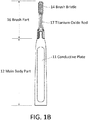
- FIG. 1A is a top view showing the entire electric toothbrush of Embodiment 1
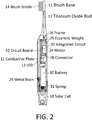
- FIG. 2 is a cross-sectional view thereof
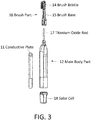
- FIG. 3 is a developed view thereof.
- the electric toothbrush according to Embodiment 1 comprises a brush part 16, a main body part 12 and a solar cell 18.
- the length from the tip of the brush part 16 to the end of the solar cell 18 is 23 cm, and the diameter of the main body part 12 is 2.5 cm.
- the brush part 16 is formed of a transparent resin, and the brush bristles 14 are embedded in the tip thereof.
- the titanium oxide rod 17 is held by the space provided at the tip of the frame 26 of the main body part 12.
- a space is provided in the frame 26 so as to be fitted into the titanium oxide rod 17 which is an N-type semiconductor protruding from the main body part 12 inside the brush base 15.
- an eccentric weight 25 and a motor 24 are provided below the titanium oxide rod 17.
- the eccentric weight 25 converts the rotational movement of the motor 24 into the reciprocating oscillating movement of the brush part 16.
- a circuit board 32 is fixed to the frame 26.
- the circuit board 32 is provided with an integrated circuit 20 and a boosting transformer 33.
- the conductive plate 11 as the first electrode and the anode of the battery 30 are connected by the metal bush 29.
- the anode of the battery 30 is also connected to the motor 24 by a lead 34.
- a spring 31 is provided to fix the battery 30 and to electrically conduct with the cathode of the battery 30.
- the spring 31 is connected to the titanium oxide rod 17 by lead wires 34.
- the connector 27 fixes the circuit board 32 and the lead wires 34 which are a wiring to the motor.
- the solar cell 18 is connected between the main body part ground and the conductive plate 11.
- an LED 13 may display such drive.
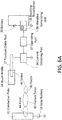
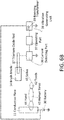
- the anode of the solar cell 18 is connected to the conductive plate 11 serving as the first electrode, and the current detecting part 36 is connected to the titanium oxide rod 17 serving as the second electrode.
- An operating part 37 is connected to the current detecting part 36, and further, a vibration generating unit 38 is connected to the operating part 37.
- the battery 30 is connected in parallel to the vibration generating unit 38.
- the current detecting part 36 connected to the titanium oxide rod 17 comprises a transistor Q2.
- a voltage of +3.3 V is supplied to the collector of the transistor Q2.
- the voltage of +3.3 V is obtained by boosting the voltage of the battery 30 by the boosting unit 39 (for example, consisting of a switching circuit and the boosting transformer 33).
- the operating part 37 is constituted by an integrated circuit 20, and its PGC terminal is connected to the collector of transistor Q2.
- the vibration generating unit 38 comprises a motor M1 and a vibration strength controlling part 40.
- the gate of the field effect transistor constituting the vibration strength controlling part 40 is connected to the PWM terminal of the integrated circuit 20.
- the vibration strength controlling part 40 controls the strength of the reciprocating vibrational motion of the brush part 16 generated by the motor 30 and the eccentric weight 25.
- the operation principle of the electric toothbrush of the Embodiment 1 will be explained.
- a voltage of +2.5 V from the solar cell 18 is applied to the conductive plate 11, and the integrated circuit 20 is in a sleep mode, so there is no conduction between the conductive plate 11 as the first electrode and the titanium oxide rod 17 as the second electrode.
- the user holds the main body part 12 (conductive plate 11) by hand and inserts the brush part 16 into the oral cavity.
- the integrated circuit 20 is programmed to send a signal to the vibration generating unit 38 to turn on the field effect transistor of the vibration generating unit 38 when such a change occurs.
- the vibration generating unit 38 receives such a signal, the voltage of the battery 30 is applied to the motor 24 by turning on the field effect transistor, and the motor 24 and the eccentric sleeper 25 are driven.
- the titanium oxide rod 17 and the brush part 16 connected thereto perform a reciprocating vibration operation.
- the user can drive the electric toothbrush only by holding the main body part 12 and putting it in the oral cavity, so that there is no need to turn on the power switch.
- the titanium oxide rod 17 which is an N-type semiconductor is used for the second electrode, a photoelectrochemical reaction can be utilized.
- a photoelectrochemical reaction can be utilized.
- the N-type semiconductor comes in contact with water such as saliva, a space potential layer is formed due to the difference between the Fermi level of the N-type semiconductor and the oxidation-reduction order of the water.
- the N-type semiconductor is irradiated with light, an oxidation reaction by holes in a valence band occurs on the light irradiated surface, water molecules are oxidized, and OH radicals are generated.
- the excited electrons in a conduction band that have reached the back surface of the N-type semiconductor cause a reduction reaction. Due to the decrease of hydrogen ions, a reaction in which pH increases, or the reduction of dissolved oxygen composed of water such as saliva, OH radicals are generated. These OH radicals are effective in decomposing and removing organic acids such as lactic acid and plaques attached to bacteria and teeth present in the oral cavity, thereby enabling to prevent the occurrence of dental caries and periodontal disease.
- the voltage applied to the titanium oxide rod 17 is usually supplied from the battery 30.
- the battery 30 is exhausted and the voltage cannot be supplied to the titanium oxide rod 17
- a weak current flows in the tooth 42 due to the supplied voltage from the solar cell 18.
- OH radicals are generated, and plaque and the like adhering to the teeth can be decomposed and removed.
- the range of the detection current is configured to be 3 to 100 ⁇ A. If the detection current is less than 3 ⁇ A, a malfunction may occur. If the detection current is more than 100 ⁇ A, a current detecting circuit may not operate, and the user may feel the current. Therefore, the range of 3 to 100 ⁇ A is appropriate. Even within this range, in particular, it is optimal to set the detection current to 10 ⁇ A. In addition, the current which flows while this electric toothbrush is driven is 5 mA.
- the integrated circuit 20 is held in the sleep mode until the detection current is detected. Therefore, the standby current while the electric toothbrush is not used can be small.
- the electric toothbrush of the Embodiment 2 is the electric toothbrush of the Embodiment 1 from which the solar cell 18 is omitted, and its top view is shown in FIG. 1B and its basic configuration is shown in FIG. 6B .
- a voltage is applied to the conductive plate 11 from the anode of the battery 30.
- the total length of the brush 16 and the main body part 12 is as short as 20 cm, since the solar cell 18 is not present. Furthermore, since the solar cell 18 is not required, the manufacturing cost of the electric toothbrush can be kept low.
- the electric toothbrush of Embodiment 3 differs from the electric toothbrush of Embodiment 1 in that the titanium oxide rod 17 as the second electrode is replaced by a stainless steel metal rod 17'. Since the second electrode is a stainless steel metal rod, the manufacturing cost of the electric toothbrush can be kept low.
- the electric toothbrush of Embodiment 4 is the same as the electric toothbrush of Embodiment 3 except that the solar cell 18 is omitted, and the feature is the same as that of the electric toothbrush of Embodiment 2.
Landscapes
- Health & Medical Sciences (AREA)
- Dentistry (AREA)
- Epidemiology (AREA)
- Life Sciences & Earth Sciences (AREA)
- Animal Behavior & Ethology (AREA)
- General Health & Medical Sciences (AREA)
- Public Health (AREA)
- Veterinary Medicine (AREA)
- Brushes (AREA)
Applications Claiming Priority (2)
| Application Number | Priority Date | Filing Date | Title |
|---|---|---|---|
| JP2018105865A JP6567732B1 (ja) | 2018-06-01 | 2018-06-01 | 電動歯ブラシ |
| PCT/JP2019/021043 WO2019230704A1 (ja) | 2018-06-01 | 2019-05-28 | 電動歯ブラシ |
Publications (3)
| Publication Number | Publication Date |
|---|---|
| EP3620132A1 true EP3620132A1 (de) | 2020-03-11 |
| EP3620132A4 EP3620132A4 (de) | 2020-07-15 |
| EP3620132A8 EP3620132A8 (de) | 2020-08-19 |
Family
ID=67766672
Family Applications (1)
| Application Number | Title | Priority Date | Filing Date |
|---|---|---|---|
| EP19808670.4A Withdrawn EP3620132A4 (de) | 2018-06-01 | 2019-05-28 | Elektrische zahnbürste |
Country Status (4)
| Country | Link |
|---|---|
| EP (1) | EP3620132A4 (de) |
| JP (1) | JP6567732B1 (de) |
| TW (1) | TW202002913A (de) |
| WO (1) | WO2019230704A1 (de) |
Families Citing this family (3)
| Publication number | Priority date | Publication date | Assignee | Title |
|---|---|---|---|---|
| EP3788956A1 (de) * | 2019-09-03 | 2021-03-10 | Koninklijke Philips N.V. | Steuergerät |
| CN110840604B (zh) * | 2019-11-11 | 2021-08-27 | 爱马斯克(深圳)科技有限公司 | 电动牙刷及电动牙刷组件 |
| KR102195771B1 (ko) * | 2020-04-06 | 2020-12-28 | 주식회사 프록시헬스케어 | 전기 칫솔 |
Family Cites Families (7)
| Publication number | Priority date | Publication date | Assignee | Title |
|---|---|---|---|---|
| JPH0690824A (ja) | 1992-03-31 | 1994-04-05 | Shiken:Kk | 電動歯ブラシ |
| JP2853798B2 (ja) * | 1995-04-05 | 1999-02-03 | リズム時計工業株式会社 | 電動歯刷子 |
| JP2000175745A (ja) * | 1998-12-16 | 2000-06-27 | Akoozu:Kk | 電子歯ブラシ |
| JP4372537B2 (ja) * | 2003-12-26 | 2009-11-25 | ライオン株式会社 | 口腔清掃用具 |
| JP5820494B2 (ja) | 2014-02-28 | 2015-11-24 | 三發電器製造廠有限公司 | 歯ブラシ |
| JP6345717B2 (ja) * | 2016-02-19 | 2018-06-20 | 株式会社シケン | 電子歯ブラシ |
| US10352881B2 (en) | 2016-12-27 | 2019-07-16 | Malvern Panalytical B.V. | Computed tomography |
-
2018
- 2018-06-01 JP JP2018105865A patent/JP6567732B1/ja active Active
-
2019
- 2019-05-28 WO PCT/JP2019/021043 patent/WO2019230704A1/ja not_active Ceased
- 2019-05-28 EP EP19808670.4A patent/EP3620132A4/de not_active Withdrawn
- 2019-05-29 TW TW108118553A patent/TW202002913A/zh unknown
Also Published As
| Publication number | Publication date |
|---|---|
| JP2019208713A (ja) | 2019-12-12 |
| EP3620132A8 (de) | 2020-08-19 |
| JP6567732B1 (ja) | 2019-08-28 |
| EP3620132A4 (de) | 2020-07-15 |
| WO2019230704A1 (ja) | 2019-12-05 |
| TW202002913A (zh) | 2020-01-16 |
Similar Documents
| Publication | Publication Date | Title |
|---|---|---|
| EP1951085B1 (de) | Mundhygienevorrichtung mit einem elektrischen potential | |
| AU2011248332B2 (en) | Tongue cleaning device | |
| JP5437531B2 (ja) | 口腔清掃装置及び口腔清掃装置のヘッド部分 | |
| EP2194912B1 (de) | Bioaktivierte zahnbürste | |
| EP3620132A1 (de) | Elektrische zahnbürste | |
| US20120233791A1 (en) | Brush body and toothbrush | |
| JP5820494B2 (ja) | 歯ブラシ | |
| EP2368457A2 (de) | Bürstenkörper und Zahnbürste | |
| ATE502597T1 (de) | Mundreinigungsvorrichtung | |
| JPH0690824A (ja) | 電動歯ブラシ | |
| JP2003164334A (ja) | 発光体及び文字図形表示装置を具備した光電池イオン歯ブラシ | |
| JP2006180953A (ja) | 電動歯刷子 | |
| JP2015211917A (ja) | 歯ブラシ | |
| JP2000175745A (ja) | 電子歯ブラシ | |
| KR100474512B1 (ko) | 문자도형 및 전자발광표시장치를 구비한 광전지 이온칫솔 | |
| JP4372537B2 (ja) | 口腔清掃用具 | |
| KR100474514B1 (ko) | 3원적(Three Way) 이온반응 장치와 문자도형 및 전자발광표시를 구비한 광전지 이온칫솔 | |
| EP4292471A1 (de) | Elektrolysevorrichtung und verfahren zum betreiben derselben | |
| KR200225401Y1 (ko) | 발광체를 구비한 광전기이온치솔 | |
| CN212066919U (zh) | 可置换保健模块的电动保健装置 | |
| CN101164508A (zh) | 口腔清洗电动牙刷 | |
| JP3093250U (ja) | 発光歯ブラシ | |
| JPS60253461A (ja) | 高電位歯ブラシ | |
| US20040172781A1 (en) | Electronic toothbrush and electronic brush | |
| CN200973764Y (zh) | 口腔清洗电动牙刷 |
Legal Events
| Date | Code | Title | Description |
|---|---|---|---|
| STAA | Information on the status of an ep patent application or granted ep patent |
Free format text: STATUS: UNKNOWN |
|
| STAA | Information on the status of an ep patent application or granted ep patent |
Free format text: STATUS: THE INTERNATIONAL PUBLICATION HAS BEEN MADE |
|
| PUAI | Public reference made under article 153(3) epc to a published international application that has entered the european phase |
Free format text: ORIGINAL CODE: 0009012 |
|
| STAA | Information on the status of an ep patent application or granted ep patent |
Free format text: STATUS: REQUEST FOR EXAMINATION WAS MADE |
|
| 17P | Request for examination filed |
Effective date: 20191203 |
|
| AK | Designated contracting states |
Kind code of ref document: A1 Designated state(s): AL AT BE BG CH CY CZ DE DK EE ES FI FR GB GR HR HU IE IS IT LI LT LU LV MC MK MT NL NO PL PT RO RS SE SI SK SM TR |
|
| AX | Request for extension of the european patent |
Extension state: BA ME |
|
| A4 | Supplementary search report drawn up and despatched |
Effective date: 20200615 |
|
| RIC1 | Information provided on ipc code assigned before grant |
Ipc: A61C 17/22 20060101AFI20200608BHEP Ipc: A61C 17/34 20060101ALI20200608BHEP |
|
| RAP1 | Party data changed (applicant data changed or rights of an application transferred) |
Owner name: SHIKEN CO., LTD. Owner name: SANFAT ELECTRIC MANUFACTURING COMPANY LIMITED |
|
| STAA | Information on the status of an ep patent application or granted ep patent |
Free format text: STATUS: THE APPLICATION IS DEEMED TO BE WITHDRAWN |
|
| 18D | Application deemed to be withdrawn |
Effective date: 20210113 |