EP3620174B1 - Dengue-impfstoffeinheitsdosis und verabreichung davon - Google Patents
Dengue-impfstoffeinheitsdosis und verabreichung davon Download PDFInfo
- Publication number
- EP3620174B1 EP3620174B1 EP19195692.9A EP19195692A EP3620174B1 EP 3620174 B1 EP3620174 B1 EP 3620174B1 EP 19195692 A EP19195692 A EP 19195692A EP 3620174 B1 EP3620174 B1 EP 3620174B1
- Authority
- EP
- European Patent Office
- Prior art keywords
- dengue
- serotype
- strain
- concentration
- pfu
- Prior art date
- Legal status (The legal status is an assumption and is not a legal conclusion. Google has not performed a legal analysis and makes no representation as to the accuracy of the status listed.)
- Active
Links
Images




Classifications
-
- A—HUMAN NECESSITIES
- A61—MEDICAL OR VETERINARY SCIENCE; HYGIENE
- A61K—PREPARATIONS FOR MEDICAL, DENTAL OR TOILETRY PURPOSES
- A61K39/00—Medicinal preparations containing antigens or antibodies
- A61K39/0016—Combination vaccines based on diphtheria-tetanus-pertussis
- A61K39/0018—Combination vaccines based on acellular diphtheria-tetanus-pertussis
-
- A—HUMAN NECESSITIES
- A61—MEDICAL OR VETERINARY SCIENCE; HYGIENE
- A61K—PREPARATIONS FOR MEDICAL, DENTAL OR TOILETRY PURPOSES
- A61K35/00—Medicinal preparations containing materials or reaction products thereof with undetermined constitution
- A61K35/66—Microorganisms or materials therefrom
- A61K35/76—Viruses; Subviral particles; Bacteriophages
-
- A—HUMAN NECESSITIES
- A61—MEDICAL OR VETERINARY SCIENCE; HYGIENE
- A61K—PREPARATIONS FOR MEDICAL, DENTAL OR TOILETRY PURPOSES
- A61K39/00—Medicinal preparations containing antigens or antibodies
- A61K39/12—Viral antigens
-
- A—HUMAN NECESSITIES
- A61—MEDICAL OR VETERINARY SCIENCE; HYGIENE
- A61K—PREPARATIONS FOR MEDICAL, DENTAL OR TOILETRY PURPOSES
- A61K39/00—Medicinal preparations containing antigens or antibodies
- A61K39/12—Viral antigens
- A61K39/295—Polyvalent viral antigens; Mixtures of viral and bacterial antigens
-
- A—HUMAN NECESSITIES
- A61—MEDICAL OR VETERINARY SCIENCE; HYGIENE
- A61P—SPECIFIC THERAPEUTIC ACTIVITY OF CHEMICAL COMPOUNDS OR MEDICINAL PREPARATIONS
- A61P31/00—Antiinfectives, i.e. antibiotics, antiseptics, chemotherapeutics
- A61P31/04—Antibacterial agents
-
- A—HUMAN NECESSITIES
- A61—MEDICAL OR VETERINARY SCIENCE; HYGIENE
- A61P—SPECIFIC THERAPEUTIC ACTIVITY OF CHEMICAL COMPOUNDS OR MEDICINAL PREPARATIONS
- A61P31/00—Antiinfectives, i.e. antibiotics, antiseptics, chemotherapeutics
- A61P31/12—Antivirals
- A61P31/14—Antivirals for RNA viruses
-
- A—HUMAN NECESSITIES
- A61—MEDICAL OR VETERINARY SCIENCE; HYGIENE
- A61K—PREPARATIONS FOR MEDICAL, DENTAL OR TOILETRY PURPOSES
- A61K39/00—Medicinal preparations containing antigens or antibodies
- A61K2039/51—Medicinal preparations containing antigens or antibodies comprising whole cells, viruses or DNA/RNA
- A61K2039/525—Virus
- A61K2039/5252—Virus inactivated (killed)
-
- A—HUMAN NECESSITIES
- A61—MEDICAL OR VETERINARY SCIENCE; HYGIENE
- A61K—PREPARATIONS FOR MEDICAL, DENTAL OR TOILETRY PURPOSES
- A61K39/00—Medicinal preparations containing antigens or antibodies
- A61K2039/51—Medicinal preparations containing antigens or antibodies comprising whole cells, viruses or DNA/RNA
- A61K2039/525—Virus
- A61K2039/5254—Virus avirulent or attenuated
-
- A—HUMAN NECESSITIES
- A61—MEDICAL OR VETERINARY SCIENCE; HYGIENE
- A61K—PREPARATIONS FOR MEDICAL, DENTAL OR TOILETRY PURPOSES
- A61K39/00—Medicinal preparations containing antigens or antibodies
- A61K2039/545—Medicinal preparations containing antigens or antibodies characterised by the dose, timing or administration schedule
-
- A—HUMAN NECESSITIES
- A61—MEDICAL OR VETERINARY SCIENCE; HYGIENE
- A61K—PREPARATIONS FOR MEDICAL, DENTAL OR TOILETRY PURPOSES
- A61K39/00—Medicinal preparations containing antigens or antibodies
- A61K2039/55—Medicinal preparations containing antigens or antibodies characterised by the host/recipient, e.g. newborn with maternal antibodies
-
- A—HUMAN NECESSITIES
- A61—MEDICAL OR VETERINARY SCIENCE; HYGIENE
- A61K—PREPARATIONS FOR MEDICAL, DENTAL OR TOILETRY PURPOSES
- A61K39/00—Medicinal preparations containing antigens or antibodies
- A61K2039/57—Medicinal preparations containing antigens or antibodies characterised by the type of response, e.g. Th1, Th2
- A61K2039/572—Medicinal preparations containing antigens or antibodies characterised by the type of response, e.g. Th1, Th2 cytotoxic response
-
- A—HUMAN NECESSITIES
- A61—MEDICAL OR VETERINARY SCIENCE; HYGIENE
- A61K—PREPARATIONS FOR MEDICAL, DENTAL OR TOILETRY PURPOSES
- A61K39/00—Medicinal preparations containing antigens or antibodies
- A61K2039/57—Medicinal preparations containing antigens or antibodies characterised by the type of response, e.g. Th1, Th2
- A61K2039/575—Medicinal preparations containing antigens or antibodies characterised by the type of response, e.g. Th1, Th2 humoral response
-
- A—HUMAN NECESSITIES
- A61—MEDICAL OR VETERINARY SCIENCE; HYGIENE
- A61K—PREPARATIONS FOR MEDICAL, DENTAL OR TOILETRY PURPOSES
- A61K39/00—Medicinal preparations containing antigens or antibodies
- A61K2039/70—Multivalent vaccine
-
- C—CHEMISTRY; METALLURGY
- C12—BIOCHEMISTRY; BEER; SPIRITS; WINE; VINEGAR; MICROBIOLOGY; ENZYMOLOGY; MUTATION OR GENETIC ENGINEERING
- C12N—MICROORGANISMS OR ENZYMES; COMPOSITIONS THEREOF; PROPAGATING, PRESERVING, OR MAINTAINING MICROORGANISMS; MUTATION OR GENETIC ENGINEERING; CULTURE MEDIA
- C12N2710/00—MICROORGANISMS OR ENZYMES; COMPOSITIONS THEREOF; PROPAGATING, PRESERVING, OR MAINTAINING MICROORGANISMS; MUTATION OR GENETIC ENGINEERING; CULTURE MEDIA dsDNA viruses
- C12N2710/00011—Details
- C12N2710/20011—Papillomaviridae
- C12N2710/20034—Use of virus or viral component as vaccine, e.g. live-attenuated or inactivated virus, VLP, viral protein
-
- C—CHEMISTRY; METALLURGY
- C12—BIOCHEMISTRY; BEER; SPIRITS; WINE; VINEGAR; MICROBIOLOGY; ENZYMOLOGY; MUTATION OR GENETIC ENGINEERING
- C12N—MICROORGANISMS OR ENZYMES; COMPOSITIONS THEREOF; PROPAGATING, PRESERVING, OR MAINTAINING MICROORGANISMS; MUTATION OR GENETIC ENGINEERING; CULTURE MEDIA
- C12N2770/00—MICROORGANISMS OR ENZYMES; COMPOSITIONS THEREOF; PROPAGATING, PRESERVING, OR MAINTAINING MICROORGANISMS; MUTATION OR GENETIC ENGINEERING; CULTURE MEDIA ssRNA viruses positive-sense
- C12N2770/00011—Details
- C12N2770/24011—Flaviviridae
- C12N2770/24111—Flavivirus, e.g. yellow fever virus, dengue, JEV
- C12N2770/24122—New viral proteins or individual genes, new structural or functional aspects of known viral proteins or genes
-
- C—CHEMISTRY; METALLURGY
- C12—BIOCHEMISTRY; BEER; SPIRITS; WINE; VINEGAR; MICROBIOLOGY; ENZYMOLOGY; MUTATION OR GENETIC ENGINEERING
- C12N—MICROORGANISMS OR ENZYMES; COMPOSITIONS THEREOF; PROPAGATING, PRESERVING, OR MAINTAINING MICROORGANISMS; MUTATION OR GENETIC ENGINEERING; CULTURE MEDIA
- C12N2770/00—MICROORGANISMS OR ENZYMES; COMPOSITIONS THEREOF; PROPAGATING, PRESERVING, OR MAINTAINING MICROORGANISMS; MUTATION OR GENETIC ENGINEERING; CULTURE MEDIA ssRNA viruses positive-sense
- C12N2770/00011—Details
- C12N2770/24011—Flaviviridae
- C12N2770/24111—Flavivirus, e.g. yellow fever virus, dengue, JEV
- C12N2770/24134—Use of virus or viral component as vaccine, e.g. live-attenuated or inactivated virus, VLP, viral protein
-
- C—CHEMISTRY; METALLURGY
- C12—BIOCHEMISTRY; BEER; SPIRITS; WINE; VINEGAR; MICROBIOLOGY; ENZYMOLOGY; MUTATION OR GENETIC ENGINEERING
- C12N—MICROORGANISMS OR ENZYMES; COMPOSITIONS THEREOF; PROPAGATING, PRESERVING, OR MAINTAINING MICROORGANISMS; MUTATION OR GENETIC ENGINEERING; CULTURE MEDIA
- C12N2770/00—MICROORGANISMS OR ENZYMES; COMPOSITIONS THEREOF; PROPAGATING, PRESERVING, OR MAINTAINING MICROORGANISMS; MUTATION OR GENETIC ENGINEERING; CULTURE MEDIA ssRNA viruses positive-sense
- C12N2770/00011—Details
- C12N2770/24011—Flaviviridae
- C12N2770/24111—Flavivirus, e.g. yellow fever virus, dengue, JEV
- C12N2770/24171—Demonstrated in vivo effect
-
- C—CHEMISTRY; METALLURGY
- C12—BIOCHEMISTRY; BEER; SPIRITS; WINE; VINEGAR; MICROBIOLOGY; ENZYMOLOGY; MUTATION OR GENETIC ENGINEERING
- C12N—MICROORGANISMS OR ENZYMES; COMPOSITIONS THEREOF; PROPAGATING, PRESERVING, OR MAINTAINING MICROORGANISMS; MUTATION OR GENETIC ENGINEERING; CULTURE MEDIA
- C12N2770/00—MICROORGANISMS OR ENZYMES; COMPOSITIONS THEREOF; PROPAGATING, PRESERVING, OR MAINTAINING MICROORGANISMS; MUTATION OR GENETIC ENGINEERING; CULTURE MEDIA ssRNA viruses positive-sense
- C12N2770/00011—Details
- C12N2770/32011—Picornaviridae
- C12N2770/32411—Hepatovirus, i.e. hepatitis A virus
- C12N2770/32434—Use of virus or viral component as vaccine, e.g. live-attenuated or inactivated virus, VLP, viral protein
-
- Y—GENERAL TAGGING OF NEW TECHNOLOGICAL DEVELOPMENTS; GENERAL TAGGING OF CROSS-SECTIONAL TECHNOLOGIES SPANNING OVER SEVERAL SECTIONS OF THE IPC; TECHNICAL SUBJECTS COVERED BY FORMER USPC CROSS-REFERENCE ART COLLECTIONS [XRACs] AND DIGESTS
- Y02—TECHNOLOGIES OR APPLICATIONS FOR MITIGATION OR ADAPTATION AGAINST CLIMATE CHANGE
- Y02A—TECHNOLOGIES FOR ADAPTATION TO CLIMATE CHANGE
- Y02A50/00—TECHNOLOGIES FOR ADAPTATION TO CLIMATE CHANGE in human health protection, e.g. against extreme weather
- Y02A50/30—Against vector-borne diseases, e.g. mosquito-borne, fly-borne, tick-borne or waterborne diseases whose impact is exacerbated by climate change
Definitions
- Dengvaxia ® is only for use in people from 9 to 45 years of age who have been infected with dengue virus before and who live in areas where this infection is endemic.
- Endemic areas are areas where the disease occurs regularly throughout the year.
- Sridhar S et al Effect of Dengue Serostatus on Dengue Vaccine Safety and Efficacy. N Engl J Med 2018, 379:327-40 ; and World Health Organization.
- Dengue vaccine WHO position paper - September 2018. Wkly. Epidemiol. Rec. 2018, 93:457-476 .
- Dengue fever and yellow fever (YF) viruses belong to the same family of flaviviridae and share antigenic determinants, which may result in cross-reacting antibodies. They are both transmitted between humans by mosquitoes (primarily Aedes aegypti), and are both endemic in tropical areas of Africa and Latin America with a high public health impact.
- a yellow fever vaccine is recommended for people from nine months of age and older who are living in or traveling to endemic areas, persons travelling to or through countries requiring.
- a single dose of yellow fever vaccine administered subcutaneously is usually sufficient to confer sustained lifelong protective immunity against yellow fever.
- a booster dose is recommended every 10 years.
- Hepatitis A is a liver disease caused by the hepatitis A virus (HAV).
- HAV hepatitis A virus
- the virus is primarily spread when an uninfected (and unvaccinated) person ingests food or water that is contaminated with the feces of an infected person.
- the disease is closely associated with unsafe water or food, inadequate sanitation and poor personal hygiene.
- the virus can also be transmitted through close physical contact with an infectious person.
- hepatitis A infection does not cause chronic liver disease and is rarely fatal, but it can cause debilitating symptoms and fulminant hepatitis (acute liver failure), which is often fatal.
- Hepatitis A occurs sporadically and in epidemics worldwide, with a tendency for cyclic recurrences.
- HAVRIX ® HAVRIX ® and VAQTA ® .
- Tdap is a combination vaccine that protects against the three potentially life-threatening bacterial diseases tetanus, diphtheria, and pertussis (whooping cough).
- Tdap stands for tetanus and diphtheria toxoids with acellular pertussis.
- Tdap is an inactive vaccine produced by using dead bacteria. It is recommended that vaccination against tetanus, diphtheria and pertussis carried out in infancy (in children of less than 7 years of age) is done by using a particular diphtheria toxoid, tetanus toxoid and acellular pertussis absorbed vaccine, such as INFANRIX ® from GlaxoSmithKline.
- the present invention is also in particular directed to such a composition or unit dose which upon reconstitution with a pharmaceutically acceptable diluent (i), (ii), (iii), and (iv) provide a total concentration of pfu/0.5 mL and based on said total concentration the concentration of (ii) in pfu/0.5 mL is less than 10%, and the concentration of (iv) in pfu/0.5 mL is at least 50%, and the concentration of (i) in pfu/0.5 mL is at least 1%, and the concentration of (iii) in pfu/0.5 mL is at least 10%, or at least 12%, or at least 14%, or at least 16%, or at least 18%.
- the method of inoculating is finalized without determination of a previous dengue infection.
- the method further optionally comprises at least 1 years after the administration of the second unit dose a booster dose of the unit dose.
- the present invention is directed to such use wherein the method is safe.
- the present invention is therefore related in part to a method of preventing dengue disease as well as yellow fever.
- the present invention is therefore related in part to a method of preventing dengue disease as well as HPV-associated cancers or genital warts.
- the present invention is therefore also related in part to a method of prevention any combination of the above mentioned diseases.
- unit dose of a dengue vaccine composition refers to the amount of a dengue vaccine which is administered to a subject in a single dose.
- one unit dose is present in a vial and this unit dose is administered to a subject, e.g. optionally after reconstitution.
- more than one unit dose of the dengue vaccine composition may be present in a vial so that with the content of one vial more than one subject can be vaccinated.
- dengue serotype refers to a species of dengue virus which is defined by its cell surface antigens and therefore can be distinguished by serological methods known in the art. At present, four serotypes of dengue virus are known, i.e. dengue serotype 1 (DENV-1), dengue serotype 2 (DENV-2), dengue serotype 3 (DENV-3) and dengue serotype 4 (DENV-4).
- TDV-3 has the nucleotide sequence according to SEQ ID No. 5 and/or the amino acid sequence according to SEQ ID No. 6. In one embodiment, TDV-4 has the nucleotide sequence according to SEQ ID No. 7 and/or the amino acid sequence according to SEQ ID No. 8.
- dengue disease refers to the disease which is caused by infection with dengue virus. Symptoms of dengue disease include sudden high fever, headaches, joint and muscle pain, nausea, vomiting and skin rashes. The term dengue disease also includes the more severe forms of dengue hemorrhagic fever (DHF) and dengue shock syndrome (DSS). Symptoms of DHF include increased vascular permeability, hypovolemia and abnormal blood clotting mechanisms. Subjects with DHF may present with severe manifestations of plasma leakage and hemorrhage. When a subject with DHF experiences shock he or she will be categorized as having DSS. Symptoms of DSS include bleeding that may appear as tiny spots of blood on the skin and larger patches of blood under the skin.
- DHF dengue hemorrhagic fever
- DSS dengue shock syndrome
- preventing dengue disease refers to preventing a subject from developing one or more symptoms of dengue disease because of an infection with a dengue virus.
- preventing dengue disease is achieved by vaccinating or inoculating a subject with a dengue vaccine composition, such as the reconstituted unit dose described herein.
- a dengue vaccine composition such as the reconstituted unit dose described herein.
- prophylactically treating dengue disease is equivalent to "preventing dengue disease”.
- preventing dengue disease includes preventing DHS and/or DSS.
- safety is the combined vaccine efficacy against virologically-confirmed dengue with hospitalization against all four serotypes with a 2-sided 95% confidence interval, wherein the lower bound is more than 25%, in particular when measured against placebo in a subject population of at least 1,500 or at least 2,000 healthy subjects (in particular when measured in age groups selected in particular from the age group of 4 to 16 year old subjects, the age group of 4 to under 9 year old subjects, the age group of 2 to under 9 year old subjects, the age group of 4 to 5 year old subjects, the age group of 6 to 11 year old subjects, and the age group of 12 to 16 year old subjects) being seronegative against all serotypes at baseline or being seropositive against at least one serotype at baseline, in particular when said unit dose or said placebo is administered at least twice within less than 6 months, such as within 3 months, about from first administration or from 30 days after the second or last administration of the administration schedule until at least 12 months, until 12 to 18 months, until 12 months, or until 18 months after the second or last
- ⁇ v denote the hazard rate for the subjects vaccinated with a tetravalent dengue vaccine composition as disclosed herein and ⁇ c denote the hazard rate for unvaccinated subjects, i.e. subjects receiving placebo.
- the hazard rate ratio HR is estimated from a Cox proportional hazard model with study vaccine as a factor, adjusted for age, and stratified by region.
- the combined vaccine efficacy may be also 40% or more, 50% or more, 60% or more, 70% or more, 72% or more, or 80% or more, in particular when determined from 30 days after a second administration until 12 months after a second administration or 18 months after a second vaccination, in particular when determined in age groups selected from the age group of 4 to 16 year old subjects, the age group of 4 to under 9 year old subjects, the age group of 2 to under 9 year old subjects, the age group of 4 to 5 year old subjects, the age group of 6 to 11 year old subjects, and the age group of 12 to 16 year old subjects.
- effective in particular refers to a vaccine that is effective for all subjects irrespective of their serostatus at baseline.
- Whether a geographic area or a subject population is dengue-endemic or not can be determined by different calculatory methods such as the ones described in Bhatt et al. (2013) Nature 496 (7446): 504-507 and supplementary material and in Stanaway et al. (2016) Lancet Infect Dis. 16(6): 712-723 and supplementary material.
- Overviews of dengue endemic regions and dengue epidemiology are regularly published, for example, by the WHO or CDC. Typical dengue-endemic regions are in Latin America, Southeast Asia and the Pacific islands and dengue endemic countries include, but are not limited to, Australia, Brazil, Bangladesh, Colombia, China, Dominican Republic, Indonesia, India, Mexico, Malaysia, Portugal, Pakistan, Panama, Philippines, Puerto Rico, Singapore, Sri Lanka, Thailand and Vietnam.
- the terms "geometric mean neutralizing antibody titer” and “GMT” refer to the geometric mean value of the titer of neutralizing antibodies against the corresponding dengue serotype in the serum of subjects in a subject population.
- the geometric mean value is calculated by a well-known formula.
- the "ratio of not more than 20 for the GMT of dengue serotype 2 to the GMT of dengue serotype 4" means that the geometric mean neutralizing antibody titer of dengue serotype 2 (GMT DENV-2) is divided by the geometric mean neutralizing antibody titer of dengue serotype 4 (GMT DENV-4) and that the ratio obtained hereby is no more than 20.
- the geometric mean neutralizing antibody titer of dengue serotype 2 is not more than 20-times higher than the geometric mean neutralizing antibody titer of dengue serotype 4 in the subject population.
- total concentration in pfu/0.5 ml which serves as a base value for the calculation of the percentage concentration for each individual component of a tetravalent dengue vaccine is shown for one exemplary tetravalent vaccine composition comprising dengue serotype 1 in a concentration of 3.60 log10pfu/0.5 ml, a dengue serotype 2 concentration of 4.00 log10pfu/0.5 ml, a dengue serotype 3 concentration of 4.60 log10pfu/0.5 ml and a dengue serotype 4 concentration of 5.11 log10pfu/0.5 ml. Primarily, the logarithmic values of the concentrations are converted into numerical values.
- spontaneous administration means an administration of at least two different vaccines, such as a dengue vaccine and a fellow fever vaccine, or a dengue vaccine and a hepatitis A vaccine, or a dengue vaccine and a HPV vaccine, or a dengue vaccine and a MMR vaccine, or a dengue vaccine and a Tdap vaccine, or a dengue vaccine and a DTaP/IPV/Hib vaccine on the same day.
- the simultaneous administration may be administered by the same medical practitioner, such as during the same medical appointment.
- HPV-associated cancers or genital warts refers to cancers and genital wards caused by an HPV infection, respectively.
- HPV serotypes 16, 18, 45, 31, 33, 52, 58 also referred to as “high-risk” HPV serotypes, are the types most common in cervical cancers, wherein the two HPV serotypes 16 and 18 cause about 70% of cervical cancers worldwide.
- HPV serotypes 6 and 11, also referred to as "low-risk” HPV serotypes cause genital warts.
- the genetically modified tetravalent dengue vaccine TDV is based on a molecularly characterized and cloned dengue-2 virus strain (TDV-2).
- TDV-2 strain was generated by cDNA cloning of the attenuated laboratory-derived DEN-2 PDK-53 virus strain that was originally isolated at Mahidol University, Bangkok, Thailand ( Kinney et al. (1997) Virology 230(2): 300-308 ).
- DEN-2 PDK-53 was generated by 53 serial passages in primary dog kidney (PDK) cells at 32°C ( Bhamarapravati et al. (1987) Bull. World Health Organ. 65(2): 189-195 ).
- TDV-2 comprises in addition to the three attenuating mutations the mutations a) and g), preferably the mutations a), g), c), e) and h), more preferably the mutations a), g), c), e), h) and b), even more preferably the mutations a), g), c), e), h), b) and d), and most preferably the mutations a) to h).
- the nucleotide positions and amino acids positions of TDV-2 refer to the nucleotide sequence as shown in SEQ ID NO. 3 and amino acid sequence as shown in SEQ ID NO. 4.
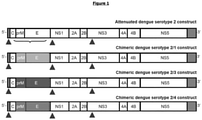
- FIG. 1 A diagram of the four TDV strains comprised in the dengue vaccine composition is shown in Figure 1 .
- the unit dose of the invention as described herein comprises the live attenuated dengue virus strains TDV-1, TDV-2, TDV-3 and TDV-4, wherein TDV-1, TDV-3 and TDV-4 are based on TDV-2 and comprise the prM and E regions of DENV-1, -3 and -4, respectively.
- TDV-1 is characterized by the nucleotide sequence according to SEQ ID No. 1 and the amino acid sequence according to SEQ ID No. 2
- TDV-2 is characterized by the nucleotide sequence according to SEQ ID No. 3 and the amino acid sequence according to SEQ ID No. 4
- TDV-3 is characterized by the nucleotide sequence according to SEQ ID No. 5 and the amino acid sequence according to SEQ ID No. 6
- TDV-4 is characterized by the nucleotide sequence according to SEQ ID No. 7 and the amino acid sequence according to SEQ ID No. 8.
- the chimeric dengue serotype 2/1 strain is TDV-1
- the dengue serotype 2 strain is TDV-2
- the chimeric dengue serotype 2/3 strain is TDV-3
- the chimeric dengue serotype 2/4 strain is TDV-4.
- TDV-1 is characterized by the nucleotide sequence according to SEQ ID No. 1 and the amino acid sequence according to SEQ ID No. 2
- TDV-2 is characterized by the nucleotide sequence according to SEQ ID No. 3 and the amino acid sequence according to SEQ ID No. 4
- TDV-3 is characterized by the nucleotide sequence according to SEQ ID No. 5
- TDV-4 is characterized by the nucleotide sequence according to SEQ ID No. 7 and the amino acid sequence according to SEQ ID No. 8.
- the dengue vaccine composition comprises a tetravalent dengue virus composition including four live attenuated dengue virus strains wherein:
- the dengue vaccine composition comprises a tetravalent dengue virus composition including four live attenuated dengue virus strains wherein:
- the dengue vaccine composition comprises a tetravalent dengue virus composition including four live attenuated dengue virus strains wherein the arithmetic sum of all four serotypes is in the range of 4.6 log10 pfu/dose to 6.7 log10 pfu/dose, preferably in the range of 4.6 log10 pfu/dose to 5.5 log10 pfu/dose.
- composition of the present invention provide a total concentration of pfu/0.5 mL and based on said total concentration the concentration of (ii) in pfu/0.5 mL is less than 10%, and the concentration of (iv) in pfu/0.5 mL is at least 50%, and the concentration of (i) in pfu/0.5 mL is at least 1%, and the concentration of (iii) in pfu/0.5 mL is at least 10%, or at least 12%, or at least 14%, or at least 16%, or at least 18%.
- cells are fixed and stained using serotype-specific anti-dengue monoclonal antibodies and a secondary antibody such as an antibody labeled with alkaline phosphatase.
- the foci are stained by adding a suitable substrate for the enzyme attached to the secondary antibody, such as 5-bromo-4-chloro-3-indolyl-phosphate/nitro blue tetrazolium phosphatase substrate.
- the number of plaques on the plate corresponds to the plaque forming units of the virus in the solutions applied to the cells. For example, a concentration of 1,000 pfu/ ⁇ l indicates that 1 ⁇ l of the solution applied to the cells contains enough viruses to produce 1,000 plaques in a cell monolayer.
- the dengue vaccine composition comprises a tetravalent dengue virus composition including four live attenuated dengue virus strains, wherein a chimeric dengue serotype 2/1 strain, a dengue serotype 2 strain, a chimeric dengue serotype 2/3 strain, and a chimeric dengue serotype 2/4 strain provide a total concentration in pfu/0.5 mL.
- the dengue vaccine composition comprises a tetravalent dengue virus composition including four live attenuated dengue virus strains, wherein the concentration of the chimeric dengue serotype 2/1 strain measured in pfu/0.5 mL is 1% to 7% of the total concentration, the concentration of the dengue serotype 2 strain measured in pfu/0.5 mL is less than 8% of the total concentration, such as in the range of 1% to 8% of the total concentration, the concentration of the chimeric dengue serotype 2/3 strain measured in pfu/0.5 mL is at least 10% of the total concentration, and the concentration of the chimeric dengue serotype 2/4 strain measured in pfu/0.5 mL is at least 65% of the total concentration, such as in the range of 65% to 80%.
- the chimeric dengue serotype 2/1 strain is TDV-1
- the dengue serotype 2 strain is TDV-2
- the chimeric dengue serotype 2/3 strain is TDV-3
- the chimeric dengue serotype 2/4 strain is TDV-4.
- TDV-1 is characterized by the nucleotide sequence according to SEQ ID No. 1 and the amino acid sequence according to SEQ ID No. 2
- TDV-2 is characterized by the nucleotide sequence according to SEQ ID No. 3 and the amino acid sequence according to SEQ ID No. 4
- TDV-3 is characterized by the nucleotide sequence according to SEQ ID No. 5
- TDV-4 is characterized by the nucleotide sequence according to SEQ ID No. 7 and the amino acid sequence according to SEQ ID No. 8.
- the present invention is in part directed to a unit dose of a dengue vaccine composition, wherein the dengue vaccine composition comprises one or more pharmaceutically acceptable excipients.
- the dengue vaccine composition comprises a non-reducing sugar, a surfactant, a protein and an inorganic salt.
- the non-reducing sugar is trehalose
- the surfactant is poloxamer 407
- the protein is human serum albumin
- the inorganic salt is sodium chloride.
- the present invention according to claim 1 is directed in part to a unit dose of a dengue vaccine composition comprising a tetravalent dengue virus composition as described herein and pharmaceutically acceptable excipients as described herein.
- Such a combined dengue/hepatitis A vaccine comprises the unit dose of the invention as described herein and a hepatitis A vaccine, such as HAVRIX ® or VAQTA ® , in the same formulation.
- a hepatitis A vaccine such as HAVRIX ® or VAQTA ®
- the invention is directed to a kit comprising such a combined dengue/hepatitis A vaccine and a unit dose of the invention as described herein.
- the kit may further comprise a HPV vaccine, in particular a 9vHPV vaccine, such as GARDASIL ® 9.
- the HPV vaccine may be in a separate container, such as a vial.
- the HPV vaccine and the unit dose of the invention may be in the same container.
- the invention encompasses in part a combined dengue/HPV vaccine, wherein the unit dose of the invention as described herein is combined with a HPV vaccine.
- a combined dengue/HPV vaccine comprises the unit dose of the invention as described herein and a HPV vaccine, in particular a 9vHPV vaccine, such as GARDASIL ® 9, in the same formulation.
- the invention is directed to a kit comprising such a combined dengue/HPV vaccine and a unit dose of the invention as described herein.
- HAVRIX ® also contains residual MRC-5 cellular proteins (not more than 5 ⁇ g/mL), formalin (not more than 0.1 mg/mL), and neomycin sulfate (not more than 40 ng/mL), an aminoglycoside antibiotic included in the cell growth media. HAVRIX ® is formulated without preservatives.
- VAQTA ® a hepatitis A vaccine from Merck Sharp & Dohme Corp., is an inactivated whole virus vaccine derived from hepatitis A virus grown in cell culture in human MRC-5 diploid fibroblasts. It contains inactivated virus of a strain, which was originally derived by further serial passage of a proven attenuated strain. The virus is grown, harvested, purified by a combination of physical and high performance liquid chromatographic techniques developed at the Merck Research Laboratories, formalin inactivated, and then adsorbed onto amorphous aluminum hydroxyphosphate sulfate. VAQTA ® is a sterile suspension for intramuscular injection.
- Each 0.5-mL dose contains approximately 30 ⁇ g of HPV serotype 6 L1 protein, 40 ⁇ g of HPV serotype 11 L1 protein, 60 ⁇ g of HPV serotype 16 L1 protein, 40 ⁇ g of HPV serotype 18 L1 protein, 20 ⁇ g of HPV serotype 31 L1 protein, 20 ⁇ g of HPV serotype 33 L1 protein, 20 ⁇ g of HPV serotype 45 L1 protein, 20 ⁇ g of HPV serotype 52 L1 protein, and 20 ⁇ g of HPV serotype 58 L1 protein.
- Each 0.5-mL dose of the vaccine also contains approximately 500 ⁇ g of aluminum (provided as AAHS), 9.56 mg of sodium chloride, 0.78 mg of L-histidine, 50 ⁇ g of polysorbate 80, 35 ⁇ g of sodium borate.
- the growth medium for measles and mumps is Medium 199 (a buffered salt solution containing vitamins and amino acids and supplemented with fetal bovine serum) containing SPGA (sucrose, phosphate, glutamate, and recombinant human albumin) as stabilizer and neomycin.
- the growth medium for rubella is Minimum Essential Medium (MEM) (a buffered salt solution containing vitamins and amino acids and supplemented with fetal bovine serum) containing recombinant human albumin and neomycin. Sorbitol and hydrolyzed gelatin stabilizer are added to the individual virus harvests. The cells, virus pools, and fetal bovine serum are all screened for the absence of adventitious agents.
- the reconstituted vaccine is for subcutaneous administration.
- Each 0.5 mL dose contains not less than 1,000 TCID 50 (tissue culture infectious doses) of measles virus, 12,500 TCID 50 of mumps virus, and 1,000 TCID 50 of rubella virus.
- Each dose of the vaccine is calculated to contain sorbitol (14.5 mg), sodium phosphate, sucrose (1.9 mg), sodium chloride, hydrolyzed gelatin (14.5 mg), recombinant human albumin ( ⁇ 0.3 mg), fetal bovine serum ( ⁇ 1 ppm), other buffer and media ingredients and approximately 25 ⁇ g of neomycin.
- the product contains no preservative.
- the lyophilized vaccine is reconstituted before administration.
- BOOSTRIX ® a combined tetanus toxoid, reduced diphtheria toxoid and acellular pertussis (adsorbed) (Tdap) vaccine, is a non-infectious, sterile vaccine for intramuscular administration. It contains tetanus toxoid, diphtheria toxoid, and pertussis antigens (inactivated pertussis toxin (iPT) and formaldehyde-treated filamentous hemagglutinin (FHA) and pertactin (PRN)). The antigens are the same as those in INFANRIX ® , but BOOSTRIX ® is formulated with reduced quantities of these antigens.
- BOOSTRIX ® is supplied as a 0.5 mL suspension for injection. Each 0.5 mL dose of BOOSTRIX ® is formulated to contain 5 Limits of flocculation (Lf) of tetanus toxoid, 2.5 Lf of diphtheria toxoid, 8 ⁇ g of iPT, 8 ⁇ g of formaldehyde treated FHA, and 2.5 ⁇ g of PRN (69 kiloDalton outer membrane protein), aluminum hydroxide as adjuvant (not more than 0.39 mg aluminum by assay), 4.5 mg of sodium chloride, ⁇ 100 ⁇ g of residual formaldehyde, and ⁇ 100 ⁇ g of polysorbate 80 (Tween 80).
- Pentacel ® a combined DTaP/IPV/Hib vaccine, consists of a diphtheria and tetanus toxoids and acellular pertussis adsorbed and inactivated poliovirus (DTaP-IPV) component and an ActHIB ® component combined through reconstitution for intramuscular injection.
- ActHIB ® Haemophilus b Conjugate Vaccine (Tetanus Toxoid Conjugate)
- the DTaP-IPV component is supplied as a sterile liquid used to reconstitute the lyophilized ActHIB ® component to form Pentacel ® .
- Each 0.5 mL dose contains 15 Limits of flocculation (Lf) diphtheria toxoid, 5 Lf tetanus toxoid, acellular pertussis antigens (20 ⁇ g detoxified pertussis toxin (PT), 20 ⁇ g filamentous hemagglutinin (FHA), 3 ⁇ g pertactin (PRN), 5 ⁇ g fimbriae types 2 and 3 (FIM)), inactivated polioviruses (40 D-antigen units (DU) Type 1 (Mahoney), 8 DU Type 2 (MEF-1), 32 DU Type 3 (Saukett)) and 10 ⁇ g PRP of Haemophilus influenzae type b covalently bound to 24 ⁇ g of tetanus toxoid (PRP-T).
- Lf flocculation
- PT detoxified pertussis toxin
- FHA filamentous hemagglutinin
- PRN 3 ⁇ g
- Clostridium tetani is grown in modified Mueller-Miller casamino acid medium without beef heart infusion.
- Tetanus toxin is detoxified with formaldehyde and purified by ammonium sulfate fractionation and diafiltration. Diphtheria and tetanus toxoids are individually adsorbed onto aluminum phosphate.
- the acellular pertussis vaccine antigens are produced from Bordetella pertussis cultures grown in Stainer-Scholte medium modified by the addition of casamino acids and dimethyl-beta-cyclodextrin.
- PT, FHA and PRN are isolated separately from the supernatant culture medium.
- FIM are extracted and co-purified from the bacterial cells.
- the pertussis antigens are purified by sequential filtration, salt-precipitation, ultrafiltration and chromatography.
- PT is detoxified with glutaraldehyde.
- FHA is treated with formaldehyde and the residual aldehydes are removed by ultrafiltration.
- the individual antigens are adsorbed separately onto aluminum phosphate.
- the adsorbed diphtheria, tetanus and acellular pertussis antigens are combined with aluminum phosphate (as adjuvant), 2-phenoxyethanol (not as a preservative) and water for injection, into an intermediate concentrate.
- aluminum phosphate as adjuvant
- 2-phenoxyethanol not as a preservative
- water for injection into an intermediate concentrate.
- the trivalent poliovirus concentrate is added and the DTaP-IPV component is diluted to its final concentration.
- the DTaP-IPV component does not contain a preservative.
- Both diphtheria and tetanus toxoids induce at least 2 neutralizing units per mL in the guinea pig potency test.
- the potency of the acellular pertussis antigens is evaluated by the antibody response of immunized mice to detoxified PT, FHA, PRN and FIM as measured by enzyme-linked immunosorbent assay (ELISA).
- the potency of inactivated poliovirus antigens is determined by measuring antibody-mediated neutralization of poliovirus in sera from immunized rats.
- PRP a high molecular weight polymer
- the tetanus toxoid for conjugation to PRP is prepared by ammonium sulfate purification, and formalin inactivation of the toxin from cultures of Clostridium tetani (Harvard strain) grown in a modified Mueller and Miller medium.
- the toxoid is filter sterilized prior to the conjugation process.
- the ActHIB ® component does not contain a preservative. Potency of the ActHIB ® component is specified on each lot by limits on the content of PRP polysaccharide and protein per dose and the proportion of polysaccharide and protein that is characterized as high molecular weight conjugate.
- the present invention is related in part to a method of preventing dengue disease (in particular virologically confirmable dengue, VCD) in a subject.
- the invention is related to a method of preventing dengue disease in a subject, comprising administering to the subject, a unit dose/tetravalent dengue virus composition, in particular a reconstituted unit dose of the invention as described herein.
- the present invention is related in part to a method of preventing dengue hemorrhagic fever (DHF) and dengue shock syndrome (DSS).
- DHF dengue hemorrhagic fever
- DSS dengue shock syndrome
- the invention is related to a method of preventing dengue hemorrhagic fever (DHF) and dengue shock syndrome (DSS), comprising administering to the subject a reconstituted unit dose/tetravalent dengue virus composition of the invention as described herein.
- the present invention is in particular related to such a method wherein the unit dose is lyophilized and upon reconstitution with 0.5 mL of a pharmaceutically acceptable diluent comprises:
- the present invention is also in particular related to such a method wherein upon reconstitution with a pharmaceutically acceptable diluent (i), (ii), (iii), and (iv) provide a total concentration of pfu/0.5 mL and based on said total concentration the concentration of (ii) in pfu/0.5 mL is less than 10%, and the concentration of (iv) in pfu/0.5 mL is at least 50%, and the concentration of (i) in pfu/0.5 mL is at least 1%, and the concentration of (iii) in pfu/0.5 mL is at least 10%, or at least 12%, or at least 14%, or at least 16%, or at least 18%, and wherein preferably the subject is 4 to 16 years of age.
- tetravalent composition or the unit dose can be derived from section "Dengue vaccine composition" and "Unit dose” above.
- the administration of only two doses within 3 months is sufficient to provide effective protection against a subsequent dengue infection.
- Such method preferably provides a combined vaccine efficacy against all four serotypes in preventing virologically confirmable dengue disease with a 2-sided 95% confidence interval, wherein the lower bound is more than 60%, when measured against placebo in a subject population of at least 5,000 healthy subjects irrespective of serostatus at baseline and 14 to 16 years of age, from the first administration of the administration schedule until 18 months after the second administration of the administration schedule.
- the method of inoculation against the virologically confirmable dengue disease is due to a dengue serotype 2, and/or due to a dengue serotype 1.
- the method has very high efficacy against dengue serotype 2 and dengue serotype 1 and the highest efficacy against dengue serotype 2.
- the invention is related to said methods having a vaccine efficacy against serotype 1, in preventing virologically confirmable dengue disease with a 2-sided 95% confidence interval, wherein the lower bound is more than 25%, when measured against placebo in a subject population of at least 1,500, or at least 2,000, or at least 5,000 healthy subjects (or at least 10,000, or at least 15,000 healthy subjects) irrespective of serostatus at baseline and 4 to 16 years of age from 30 days post second administration until 12 to 18 months (e.g. at 12 or at 18 months) after the second administration.
- the lower bound is more than 30%, is more than 35% is more than 40%, is more than 45%, is more than 50%, or is more than 54%.
- the subject population of at least 1,500 is seronegative against all serotypes at base line and the lower bound is more than 35%.
- the seronegative and seropositive population each provide a vaccine efficacy against serotype 1 with a 2-sided 95% confidence interval, wherein the lower bounds are within 10 %-points.
- the invention is related to said methods having a vaccine efficacy against serotype 2, in preventing virologically confirmable dengue disease with a 2-sided 95% confidence interval, wherein the lower bound is more than 25%, when measured against placebo in a subject population of at least 1,500, or at least 2,000, or at least 5,000 healthy subjects (or at least 10,000, or at least 15,000 healthy subjects) irrespective of serostatus at baseline and 4 to 16 years of age from 30 days post second administration until 12 to 18 months (e.g. at 12 or at 18 months) after the second administration.
- the lower bound is more than 50%, is more than 60%, is more than 70%, is more than 80%, or is more than 85%.
- the subject population of at least 1,500 is seronegative against all serotypes.
- the seronegative and seropositive population each provide a vaccine efficacy against serotype 2 with a 2-sided 95% confidence interval, wherein the lower bounds are within 5 %-points.
- such a method does not include a step of determination of a previous dengue infection in the subjects preferably at any time before, during or after the steps of administration or wherein the serostatus of the subject is unknown preferably at any time before, during or after the steps of administration.
- the subject is from a region wherein the seroprevalence rate is unknown and/or wherein the seroprevalence rate is below 80%, or below 70%, or below 60%.
- such a method does not include vaccine immunogenicity analysis including GMTs for dengue neutralizing antibodies.
- Such a method does not include a reactogenicity analysis.
- a reactogenicity analysis relates to solicited local AEs (injection site pain, injection site erythema, and injection site swelling) and solicited systemic AEs (child ⁇ 6 years: fever, irritability/fussiness, drowsiness and loss of appetite; child ⁇ 6 years: asthenia, fever, headache, malaise and myalgia) which will e.g. be assessed for 7 days and 14 days, respectively, following each vaccination (vaccination day included) via collection of diary cards.
- Selecting the subject may include all types of considerations but preferably not the determination of a previous dengue infection.
- the selection may include consideration of the age, health conditions, and threat of infection.
- the threat of infection includes consideration of the seroprevalence rate in the region in which the subject normally lives or intends to travel, the serotype specific seroprevalence rate and an outbreak situation or serotype specific outbreak situations.
- the subject may be selected due to its exposure to serotype 1 and/or serotype 2 or due to the fact it requires protection against a specific dengue serotype, i.e. serotype 1 and/or serotype 2.
- the neutralizing antibody titer for dengue serotype 2 and the neutralizing antibody titer for dengue serotype 4 at day 180 or day 365 after at least a first administration of the reconstituted unit dose of the invention as described herein, and optionally a second administration of a reconstituted unit dose of the invention as described herein 90 days after said first administration provide a ratio of neutralizing antibody titer for DENV-2 : neutralizing antibody titer for GMT DENV-4 of not more than 50, or not more than 40, or not more than 30, or not more than 20.
- the present invention is in part related to a method of preventing virologically confirmable dengue disease in a subject or subject population comprising administering to the subject or subject population a reconstituted unit dose of a tetravalent dengue virus composition including four live, attenuated dengue serotypes, in particular the virus strains as described herein.
- the method includes a reconstituted unit dose/tetravalent dengue virus composition of a dengue vaccine composition administered for preventing dengue disease in a subject or a subject population, the reconstituted unit dose comprising: a tetravalent virus composition including four live attenuated dengue virus strains, wherein a unit dose is lyophilized and upon reconstitution with 0.5 mL of a pharmaceutically acceptable diluent the reconstituted unit dose is obtained which comprises:
- the chimeric dengue serotype 2/1 strain is TDV-1
- the dengue serotype 2 strain is TDV-2
- the chimeric dengue serotype 2/3 strain is TDV-3
- the chimeric dengue serotype 2/4 strain is TDV-4.
- TDV-1 is characterized by the nucleotide sequence according to SEQ ID No. 1 and the amino acid sequence according to SEQ ID No. 2
- TDV-2 is characterized by the nucleotide sequence according to SEQ ID No. 3 and the amino acid sequence according to SEQ ID No. 4
- TDV-3 is characterized by the nucleotide sequence according to SEQ ID No. 5
- TDV-4 is characterized by the nucleotide sequence according to SEQ ID No. 7 and the amino acid sequence according to SEQ ID No. 8.
- the invention is related to said methods, wherein the reconstituted unit dose is administered to a subject of unknown serostatus and/or wherein no test has been carried out to determine whether the subject is seropositive or seronegative (before) the unit dose as described herein is administered.
- the invention is related to said methods which do not include a step of determination of a previous dengue infection in the subject or subjects.
- the invention is related to said methods which do not include the analysis of the seroprevalence rate in the region or is conducted in a region with a seroprevalence of below 80%, below 70% or below 60%.
- the invention is related to a method wherein the serostatus of the subject is unknown. In such embodiments the serostatus is not determined at any time before and after administration in relation to this method.
- the method is used in an outbreak situation.
- the invention is related to said methods being conducted outside a clinical trial.
- the invention is related to said methods, wherein two unit doses of the invention as described herein are administered.
- the two unit doses are administered within three months, and optionally at least 4 weeks apart such as at day 0 and day 90 or at day 1 and day 90.
- a further third unit dose of the invention as described herein is administered after the second administration.
- Such a third administration may act as a booster and may be administered between 6 to 12 months after the first administration, such as 12 months after the first administration, or later than 12 month after the first administration, such as 12 months (1 year) after the second administration or even 5 years or longer after the first or second administration.
- Such a subject population or such a subject may be vaccinated according to the present invention in the context of traveling to a dengue endemic region.
- the reconstituted unit dose of the invention as described herein is administered subcutaneously to a subject, or subject population that is from a dengue endemic region or a dengue non-endemic region.
- the invention is related to said methods, wherein the reconstituted unit dose of the invention as described herein is administered subcutaneously to children and adolescents of 4 to 16 years of age.
- the subjects or subject population are less than 9 years of age, or less than 4 years of age.
- the subjects or subject population are from 2 to 9 years of age, or from 2 to 5 years of age, or from 4 to 9 years of age or from 6 to 9 years of age.
- the subject or subject population is 4 to 16 years of age.
- the subject or subject population is 4-5 years of age, 6-11 years of age or 12-16 years of age.
- the subject or subject population is seronegative with respect to all dengue serotypes.
- the invention is related to said methods, wherein the subject or subject population is from Asia Pacific or Latin America and seropositive for at least one dengue serotype at baseline. In other embodiments, the subject or subject population is from Asia Pacific or Latin America and seronegative for at all dengue serotype at baseline.
- the present invention is related in part to a method of preventing virologically confirmable dengue disease in a subject comprising administering to the subject a tetravalent dengue virus composition including four dengue virus strains representing serotype 1, serotype 2, serotype 3 and serotype 4, wherein the virus strains are optionally live, attenuated dengue virus strains.
- the present invention is related in part to a method of preventing virologically confirmable dengue disease in a subject consisting of administering to the subject a tetravalent dengue virus composition including four dengue virus strains representing serotype 1, serotype 2, serotype 3 and serotype 4, wherein the virus strains are optionally live, attenuated dengue virus strains.
- the invention is related to said methods, wherein there is no step of determining the serostatus of the subject at baseline, in other words, said methods do not comprise a determination of a previous dengue infection of the subject at baseline before the administration of the tetravalent dengue virus composition.
- said methods are safe and effective.
- the subject has not been tested for the presence a previous dengue infection.
- the invention is related to said methods, wherein the composition includes at least one chimeric dengue virus.
- the invention is directed to said methods, wherein the composition includes one non-chimeric dengue virus and at least one chimeric dengue virus, a chimeric dengue serotype 2/1 strain and a dengue serotype 2 strain and a chimeric dengue serotype 2/3 strain and a chimeric dengue serotype 2/4 strain. The details of the composition are described above.
- the invention is related to said methods having a vaccine efficacy, preferably a combined vaccine efficacy against all four serotypes, in preventing virologically confirmable dengue disease with a 2-sided 95% confidence interval, wherein the lower bound is more than 25%, when measured against placebo in a subject population of at least 5,000 healthy subjects (or at least 10,000, or at least 15,000 healthy subjects) irrespective of serostatus at baseline, wherein a reconstituted unit dose or tetravalent dengue virus composition as described herein or placebo is administered at least once, until 15 to 21 months (e.g.
- the subject is from a region wherein the seroprevalence rate is unknown and/or wherein the seroprevalence rate is below 80%, or below 70%, or below 60%.
- such a method does not include the active surveillance with respect to febrile illness of the subject after the administration of the first- and second-unit dose.
- active surveillance any subject with febrile illness (defined as fever ⁇ 38°C on any 2 of 3 consecutive days) will be asked to return to the site for dengue fever evaluation by the Investigator.
- Subjects/guardians will be contacted at least weekly to ensure robust identification of febrile illness by reminding subjects/guardians of their obligation to return to the site in case of febrile illness. This contact will be implemented through appropriate methods that may differ in each trial site (eg, phone calls, text messaging, home visits, school-based surveillance).
- Selecting the subject may include all types of considerations but preferably not the determination of a previous dengue infection.
- the selection may include consideration of the age, health conditions, and threat of infection.
- the threat of infection includes consideration of the seroprevalence rate in the region in which the subject normally lives or intends to travel, the serotype specific seroprevalence rate and an outbreak situation or serotype specific outbreak situations.
- the subject may be selected due to its exposure to serotype 1 and/or serotype 2 or due to the fact it requires protection against a specific dengue serotype, i.e. serotype 1 and/or serotype 2.
- the method is applicable to subjects of all kinds of ages.
- the subject is under 9 years of age, or 4 to 5 years of age, or 6 to 11 years of age or 12 to 16 years, or 6 to 16 years of age or 4 to 16 years of age, or 9 years of age, or over 9 years of age.
- the present invention is directed in part to a reconstituted unit dose of a dengue vaccine composition as described herein for use in a method of preventing virologically confirmable dengue disease in a subject comprising consecutively administering at least a first and a second unit dose of the dengue vaccine composition to the subject, wherein said first and second unit dose are administered subcutaneously within 3 months and at least 4 weeks apart, optionally at about day 1 and at about day 90, wherein the dengue vaccine composition is a tetravalent dengue virus composition including four dengue virus strains representing dengue serotype 1, dengue serotype 2, dengue serotype 3 and dengue serotype 4, optionally wherein the dengue virus strains are live, attenuated, and wherein upon reconstitution with 0.5 mL of a pharmaceutically acceptable diluent
- the method is safe.
- the subject is under 9 years of age or from 4 years of age and/or the serostatus of the subject is unknown or seronegative.
- the subject is from 4 years of age and the serostatus of the subject is unknown or seronegative, preferably seronegative.
- the dengue serotype 4 represents the highest concentration in the composition of all four serotypes, preferably with at least about 70% of the total concentration in pfu/0.5 mL
- dengue serotype 3 represents the second highest concentration in the composition of all four serotypes, preferably with at least about 10% of the total concentration in pfu/0.5 mL
- dengue serotype 1 and dengue serotype 2 each represent lower concentrations than the concentration of serotype 3, and optionally together represent less than about 10% of the total concentration in pfu/0.5 mL.
- the method is for preventing dengue hemorrhagic fever (DHF) or dengue shock syndrome (DSS).
- DHF dengue hemorrhagic fever
- DSS dengue shock syndrome
- the subject is from a dengue endemic region. In other embodiments, the subject is from a dengue non-endemic region.
- the subject is from Asia Pacific or Latin America.
- the invention is directed to a dengue vaccine composition as described herein for use in a method of preventing virologically confirmable dengue disease in a subject comprising consecutively administering at least a first and a second unit dose of the dengue vaccine composition to the subject, wherein said first and second unit dose are administered subcutaneously within 3 months and at least 4 weeks apart, optionally at about day 1 and at about day 90, and wherein the dengue vaccine composition is a tetravalent dengue virus composition including four live, attenuated dengue virus strains representing dengue serotype 1, dengue serotype 2, dengue serotype 3 and dengue serotype 4 , wherein the attenuated dengue virus strains comprise chimeric dengue viruses and at least one non-chimeric dengue virus, and wherein the dengue serotype 1 and the dengue serotype 2 are present each in a concentration based on the total concentration in pfu/0.5 mL which is within 5%-points of each other and/or are together less
- the method does not comprise a determination of a previous dengue infection of the subject before the administration of the first unit dose of the tetravalent dengue virus composition and wherein the method is safe and effective.
- the subject has not been tested for the presence a previous dengue infection.
- the dengue serotype 3 is at least about 10% of the total concentration in pfu/0.5 mL and/or the dengue serotype 4 is at least about 70% of the total concentration in pfu/0.5 mL.
- the unit doses are administered to the deltoid region of the arm.
- the subject is seronegative to all dengue serotypes at baseline and/or is 4 to 16 years of age, under 9 years of age, from 4 years of age to under 9 years of age, 4 to 5 years of age, 6 to 11 years of age, or 12 to 16 years of age. In particular the subject may be under 9 years of age and seronegative to all four dengue serotypes at baseline.
- the subject is seropositive to at least one dengue serotypes at baseline and/or is 4 to 16 years of age, under 9 years of age, from 4 years of age to under 9 years of age, 4 to 5 years of age, 6 to 11 years of age, or 12 to 16 years of age.
- the subject may be under 9 years of age and seropositive to at least one dengue serotypes at baseline. In certain preferred embodiments, the subject is 4 to 5 years of age, 6 to 11 years of age or 12 to 16 years of age.
- the subject is from a dengue endemic region or from a dengue non-endemic region.
- the subject is from Asia Pacific or Latin America.
- the composition provides a seropositivity rate when it is administered to a subject population of at least 50 subjects in two unit doses subcutaneously at day 1 and at day 90, wherein the subjects of the subject population are seronegative to all dengue serotypes at baseline, in particular wherein at least one month after administration of the first unit dose, such as at day 30, at least 80% of the subject population are seropositive for all four dengue serotypes, and/or at least 80% of the subject population are seropositive for all four dengue serotypes before or at the time of the administration of the second unit dose, such as at day 90, and/or at least 80%, or at least 85% or at least 90%, or at least 95% of the subject population are seropositive for all four dengue serotypes after the administration of the second unit dose, such as at day 120, and/or at least 80%, or at least 85%, or at least 90% of the subject population are seropositive for all four dengue serotypes after the administration of the second unit dose,
- the geometric mean neutralizing antibody titer for dengue serotype 2 (GMT DENV-2) and the geometric mean neutralizing antibody titer for dengue serotype 4 (GMT DENV-4) when tested in at least 40, or at least 50, or at least 60 subjects at day 180 or day 365 after at least a first administration of said reconstituted unit dose of the invention as described herein, and optionally a second administration of a reconstituted unit dose of the invention as described herein 90 days after said first administration, provide a ratio of GMT DENV-2 : GMT DENV-4 of not more than 50, or not more than 40, or not more than 30, or not more than 20.
- the ratio of GMT DENV-2 : GMT DENV-1 is not more than 20, or not more than 18, or not more than 15 at day 180 or 365 after administration of said first reconstituted unit dose
- the ratio of GMT DENV-2 : GMT DENV-3 is not more than 20, or not more than 18, or not more than 15 at day 180 or 365 after administration of said first reconstituted unit dose.
- the neutralizing antibody titer for dengue serotype 2 and the neutralizing antibody titer for dengue serotype 4 at day 180 or day 365 after at least a first administration of the reconstituted unit dose of the invention as described herein, and optionally a second administration of a reconstituted unit dose of the invention as described herein 90 days after said first administration provide a ratio of neutralizing antibody titer for DENV-2 : neutralizing antibody titer for GMT DENV-4 of not more than 50, or not more than 40, or not more than 30, or not more than 20.
- the invention is directed to a reconstituted unit dose of the invention as described herein for said uses, wherein the subject or subject population is seronegative to all dengue serotypes.
- the present invention is related in part to a method of preventing dengue disease as well as yellow fever in a subject.
- the invention is related to a method of preventing dengue disease in a subject, comprising administering to the subject a reconstituted unit dose of the invention as described herein, wherein the method further comprises preventing yellow fever in the subject by concomitant administration of a yellow fever vaccine, in particular YF-17D, to the subject.
- a yellow fever vaccine in particular YF-17D
- the present invention is related in part to a method of preventing dengue disease as well as yellow fever in a subject population.
- the invention is related to a method of preventing dengue disease in a subject population, comprising administering to the subject population a reconstituted unit dose of the invention as described herein, wherein the method further comprises preventing yellow fever in the subject population by concomitant administration of a yellow fever vaccine, in particular YF-17D, to the subject population.
- the ratio of GMT DENV-2 : GMT DENV-1 is not more than 20, or not more than 18, or not more than 15 at day 180 or 365 after administration of said first reconstituted unit dose
- the ratio of GMT DENV-2 : GMT DENV-3 is not more than 20, or not more than 18, or not more than 15 at day 180 or 365 after administration of said first reconstituted unit dose.
- the neutralizing antibody titer for dengue serotype 2 and the neutralizing antibody titer for dengue serotype 4 at day 180 or day 365 after at least a first administration of the reconstituted unit dose of the invention as described herein, and optionally a second administration of a reconstituted unit dose of the invention as described herein 90 days after said first administration provide a ratio of neutralizing antibody titer for DENV-2 : neutralizing antibody titer for DENV-4 of not more than 50, or not more than 40, or not more than 30, or not more than 20.
- the geometric mean neutralizing antibody titers (GMTs) of a subject population or the neutralizing antibody titers of a subject are determined in accordance with a microneutralization test, for example according to the method described in Example 2.
- the invention is related to said methods, wherein the reconstituted unit dose of the invention as described herein is administered and the yellow fever vaccine, in particular YF-17D, are administered by subcutaneous injection.
- the subcutaneous injections are administered to the arm, preferably to the deltoid region of the arm.
- the subcutaneous injections of the unit dose of the invention as described herein and yellow fever vaccine, in particular YF-17D are administered to different anatomical sites, such as to opposite arms, in particular when the vaccines are administered simultaneously.
- the invention is related to said methods, wherein two reconstituted unit doses of the invention as described herein and one dose of a yellow fever vaccine, in particular YF-17D, are administered, in particular according to the following schedule
- the yellow fever vaccine and unit dose of the invention as described herein are administered simultaneously on day 0 or simultaneously on day 90.
- the invention is related to said methods, wherein the subject or subject population is seronegative to all dengue serotypes.
- the invention is directed to said methods, wherein the reconstituted unit dose of the invention as described herein is administered subcutaneously to a subject or subject population and the yellow fever vaccine, in particular YF-17D vaccine, is administered subcutaneously to a subject or subject population, and wherein the subject or the subject population is seronegative with respect to all dengue serotypes.
- the subject or subject population is seropositive with respect to at least one dengue serotype.
- the invention is related to said methods, wherein the unit dose of the invention as described herein and the yellow fever vaccine, in particular YF-17D, are administered to a subject or subject population from a dengue endemic region.
- the reconstituted unit dose of the invention as described herein and the yellow fever vaccine, in particular YF-17D are administered subcutaneously to a subject or subject population from a dengue endemic region.
- the subject or subject population is from a dengue non-endemic region.
- Such a subject population or such a subject may be vaccinated according to the present invention in the context of traveling to a dengue endemic region and yellow fever endemic region.
- the present invention encompasses the unit dose of a dengue vaccine composition as described herein and the yellow fever vaccine, in particular YF-17D, for use in a method of preventing dengue disease and yellow fever in a subject population, comprising administering to the subject population at least a first reconstituted unit dose of the invention as described herein, wherein certain ratios of geometric mean neutralizing antibody titers (GMTs) at day 180 or 365 after administration of said first unit dose to the subject population are achieved, and concomitantly administering a yellow fever vaccine, in particular YF-17D, to the subject population.
- GTTs geometric mean neutralizing antibody titers
- the present invention encompasses the unit dose of a dengue vaccine composition as described herein and the yellow fever vaccine, in particular YF-17D, for use in a method of preventing dengue disease and yellow fever in a subject comprising administering to the subject at least a first reconstituted unit dose of the invention as described herein, wherein certain ratios of neutralizing antibody titers at day 180 or 365 after administration of said first unit dose to the subject are achieved, and concomitantly administering a yellow fever vaccine, in particular YF-17D, to the subject.
- the invention encompasses the unit dose of the invention as described herein and the yellow fever vaccine, in particular YF-17D, for said uses, wherein said unit dose and said yellow fever vaccine are administered simultaneously.
- the simultaneous administration is on day 0 or day 90, preferably on day 0.
- the administration of said unit dose and said yellow fever vaccine, in particular YF-17D are done sequentially.
- the invention encompasses the unit dose of the invention as described herein and the yellow fever vaccine, in particular YF-17D, for said uses, wherein two unit doses of the invention as described herein and one dose of the yellow fever vaccine are administered, in particular according to the following schedule
- the present invention is related in part to a method of preventing dengue disease as well as hepatitis A in a subject.
- the invention is related to a method of preventing dengue disease in a subject, comprising administering to the subject a reconstituted unit dose of the invention as described herein, wherein the method further comprises preventing hepatitis A in the subject by concomitant administration of a hepatitis A vaccine, such as HAVRIX ® or VAQTA ® , to the subject.
- a hepatitis A vaccine such as HAVRIX ® or VAQTA ®
- the present invention is related in part to a method of preventing dengue disease as well as hepatitis A in a subject population.
- the invention is related to a method of preventing dengue disease in a subject population, comprising administering to the subject population a reconstituted unit dose of the invention as described herein, wherein the method further comprises preventing hepatitis A in the subject population by concomitant administration of a hepatitis A vaccine, such as HAVRIX ® or VAQTA ® , to the subject population.
- a hepatitis A vaccine such as HAVRIX ® or VAQTA ®
- the present invention is in part related to said method for preventing dengue disease and hepatitis A in a subject population comprising administering to the subject population at least a first reconstituted unit dose of the invention as described herein, wherein certain ratios of geometric mean neutralizing antibody titers (GMTs) at day 180 or 365 after administration of said first unit dose to the subject population are achieved, and concomitantly administering a hepatitis A vaccine, such as HAVRIX ® or VAQTA ® , to the subject population.
- GTTs geometric mean neutralizing antibody titers
- the invention is related to said methods, wherein the unit dose of the invention as described herein and the hepatitis A vaccine, such as HAVRIX ® or VAQTA ® , are administered simultaneously.
- the simultaneous administration is on day 0 or day 90, preferably on day 0.
- the administration of the unit dose of the invention as described herein and the hepatitis A vaccine, such as HAVRIX ® or VAQTA ® are done sequentially.
- the invention is related to said methods, wherein two reconstituted unit doses of the invention as described herein and one dose of a hepatitis A vaccine, such as HAVRIX ® or VAQTA ® , are administered, in particular according to the following schedule
- the invention is related to said methods, wherein the unit dose of the invention as described herein and the hepatitis A vaccine, such as HAVRIX ® or VAQTA ® , are administered to a subject or subject population from a dengue endemic region.
- the reconstituted unit dose of the invention as described herein is administered subcutaneously and the hepatitis A vaccine, such as HAVRIX ® or VAQTA ® , is administered intramuscularly to a subject or subject population from a dengue endemic region.
- the present invention encompasses in part the unit dose of the invention as described herein for use in a method of preventing dengue disease in a subject, wherein the method also comprises the prevention of hepatitis A in the subject with a hepatitis A vaccine, such as HAVRIX ® or VAQTA ® .
- the present invention encompasses in part a unit dose of a dengue vaccine composition as described herein and a hepatitis A vaccine, such as HAVRIX ® or VAQTA ® , for use in a method of preventing dengue disease and hepatitis A in a subject, respectively.
- the present invention encompasses in part the unit dose of a dengue vaccine composition as described herein and the hepatitis A vaccine, such as HAVRIX ® or VAQTA ® , for use in a method of preventing dengue disease and hepatitis A in a subject population, comprising administering to the subject population at least a first reconstituted unit dose of the invention as described herein, wherein certain ratios of geometric mean neutralizing antibody titers (GMTs) at day 180 or 365 after administration of said first unit dose to the subject population are achieved, and concomitantly administering a hepatitis A vaccine, such as HAVRIX ® or VAQTA ® , to the subject population.
- GTTs geometric mean neutralizing antibody titers
- the geometric mean neutralizing antibody titer for dengue serotype 2 (GMT DENV-2) and the geometric mean neutralizing antibody titer for dengue serotype 4 (GMT DENV-4) when tested in at least 40, or at least 50, or at least 60 subjects at day 180 or day 365 after at least a first administration of said reconstituted unit dose of the invention as described herein, and optionally a second administration of a reconstituted unit dose of the invention as described herein 90 days after said first administration, provide a ratio of GMT DENV-2 : GMT DENV-4 of not more than 50, or not more than 40, or not more than 30, or not more than 20.
- the present invention encompasses in part the unit dose of a dengue vaccine composition as described herein and the hepatitis A vaccine, such as HAVRIX ® or VAQTA ® , for use in a method of preventing dengue disease and hepatitis A in a subject comprising administering to the subject a hepatitis A vaccine, such as HAVRIX ® or VAQTA ® , and at least a first reconstituted unit dose of the invention as described herein, wherein certain ratios of neutralizing antibody titers at day 180 or 365 after administration of said first unit dose to the subject are achieved, and concomitantly administering a hepatitis A vaccine, such as HAVRIX ® or VAQTA ® , to the subject.
- a hepatitis A vaccine such as HAVRIX ® or VAQTA ®
- the neutralizing antibody titer for dengue serotype 2 and the neutralizing antibody titer for dengue serotype 4 at day 180 or day 365 after at least a first administration of the reconstituted unit dose of the invention as described herein, and optionally a second administration of a reconstituted unit dose of the invention as described herein 90 days after said first administration provide a ratio of neutralizing antibody titer for DENV-2 : neutralizing antibody titer for DENV-4 of not more than 50, or not more than 40, or not more than 30, or not more than 20, wherein the method further comprises preventing hepatitis A in the subject by concomitant administration of a hepatitis A vaccine, such as HAVRIX ® or VAQTA ® , to the subject.
- a hepatitis A vaccine such as HAVRIX ® or VAQTA ®
- the ratio of the neutralizing antibody titers of DENV-2 : DENV-1 is not more than 20, or not more than 18, or not more than 15 at day 180 or 365 after administration of said first reconstituted unit dose, and/or the ratio of the neutralizing antibody titers of DENV-2 : DENV-3 is not more than 20, or not more than 18, or not more than 15 at day 180 or 365 after administration of said first reconstituted unit dose.
- the geometric mean neutralizing antibody titers (GMTs) of a subject population or the neutralizing antibody titers of a subject are determined in accordance with a microneutralization test, for example according to the method described in Example 2.
- the invention encompasses the unit dose of the invention as described herein and the hepatitis A vaccine, such as HAVRIX ® or VAQTA ® , for said uses, wherein said unit dose and said hepatitis A vaccine are administered simultaneously.
- the simultaneous administration is on day 0 or day 90, preferably on day 0.
- the administration of said unit dose and said hepatitis A vaccine are done sequentially.
- the invention encompasses the unit dose of the invention as described herein and the hepatitis A vaccine, such as HAVRIX ® or VAQTA ® , for said uses, wherein said unit dose is administered by subcutaneous injection and wherein said hepatitis A vaccine is administered by intramuscular injection.
- the injections are administered to the arm, preferably to the deltoid region of the arm.
- the subcutaneous injection of said unit dose and the intramuscular injection of said hepatitis A vaccine are administered to different anatomical sites, such as to opposite arms, in particular when the vaccines are administered simultaneously.
- the invention encompasses the unit dose of the invention as described herein and the hepatitis A vaccine, such as HAVRIX ® or VAQTA ® , for said uses, wherein the subject or subject population is seronegative to all dengue serotypes.
- the invention ecompasses the unit dose of the invention as described herein and the hepatitis A vaccine, such as HAVRIX ® or VAQTA ® , for said uses, wherein said unit dose is reconstituted and administered subcutaneously to a subject or subject population and said hepatitis A vaccine is administered intramuscularly to a subject or subject population, and wherein the subject or the subject population is seronegative with respect to all dengue serotypes.
- the subject or subject population is seropositive with respect to at least one dengue serotype.
- the invention encompasses the unit dose of the invention as described herein and the hepatitis A vaccine, such as HAVRIX ® or VAQTA ® , for said uses, wherein said unit dose and said hepatitis A vaccine are administered to a subject or subject population from a dengue endemic region.
- the reconstituted unit dose of the invention as described herein is administered subcutaneously and the hepatitis A vaccine, such as HAVRIX ® or VAQTA ® , is administered intramuscularly to a subject or subject population from a dengue endemic region.
- the invention encompasses the unit dose of the invention as described herein and the hepatitis A vaccine, such as HAVRIX ® or VAQTA ® , for said uses, wherein a further second dose of a hepatitis A vaccine, such as HAVRIX ® or VAQTA ® , is administered.
- the second dose of the hepatitis A vaccine may be administered after the first administration of the hepatitis A vaccine.
- Such a second administration may act as a booster and may be administered 9 months after the first administration of the hepatitis A vaccine, such as on day 270.
- the present invention is in part related to said method for preventing dengue disease and HPV-associated cancers or genital warts in a subject population comprising administering to the subject population at least a first reconstituted unit dose of the invention as described herein, wherein certain ratios of geometric mean neutralizing antibody titers (GMTs) at day 180 or 365 after administration of said first unit dose to the subject population are achieved, and concomitantly administering a HPV vaccine, in particular a 9vHPV vaccine, such as GARDASIL ® 9, to the subject population.
- GTTs geometric mean neutralizing antibody titers
- the geometric mean neutralizing antibody titer for dengue serotype 2 (GMT DENV-2) and the geometric mean neutralizing antibody titer for dengue serotype 4 (GMT DENV-4) when tested in at least 40, or at least 50, or at least 60 subjects at day 180 or day 365 after at least a first administration of said reconstituted unit dose of the invention as described herein, and optionally a second administration of a reconstituted unit dose of the invention as described herein 90 days after said first administration, provide a ratio of GMT DENV-2 : GMT DENV-4 of not more than 50, or not more than 40, or not more than 30, or not more than 20.
- the ratio of GMT DENV-2 : GMT DENV-1 is not more than 20, or not more than 18, or not more than 15 at day 180 or 365 after administration of said first reconstituted unit dose
- the ratio of GMT DENV-2 : GMT DENV-3 is not more than 20, or not more than 18, or not more than 15 at day 180 or 365 after administration of said first reconstituted unit dose.
- the present invention is in part related to said method for preventing dengue disease and HPV-associated cancers or genital warts in a subject comprising administering to the subject at least a first reconstituted unit dose of the invention as described herein, wherein certain ratios of neutralizing antibody titers at day 180 or 365 after administration of said first unit dose to the subject are achieved, and concomitantly administering a HPV vaccine, in particular a 9vHPV vaccine, such as GARDASIL ® 9, to the subject.
- a HPV vaccine in particular a 9vHPV vaccine, such as GARDASIL ® 9
- the ratio of the neutralizing antibody titers of DENV-2 : DENV-1 is not more than 20, or not more than 18, or not more than 15 at day 180 or 365 after administration of said first reconstituted unit dose, and/or the ratio of the neutralizing antibody titers of DENV-2 : DENV-3 is not more than 20, or not more than 18, or not more than 15 at day 180 or 365 after administration of said first reconstituted unit dose.
- the geometric mean neutralizing antibody titers (GMTs) of a subject population or the neutralizing antibody titers of a subject are determined in accordance with a microneutralization test, for example according to the method described in Example 2.
- the invention is related to said methods, wherein the unit dose of the invention as described herein and the HPV vaccine, in particular a 9vHPV vaccine, such as GARDASIL ® 9, are administered simultaneously.
- the simultaneous administration is on day 0 or day 90, preferably on day 0.
- the administration of the unit dose of the invention as described herein and the HPV vaccine, in particular a 9vHPV vaccine, such as GARDASIL ® 9, are done sequentially.
- the invention is related to said methods, wherein the reconstituted unit dose of the invention as described herein is administered by subcutaneous injection and wherein the HPV vaccine, in particular a 9vHPV vaccine, such as GARDASIL ® 9, is administered by intramuscular injection.
- the injections are administered to the arm, preferably to the deltoid region of the arm.
- the subcutaneous injection of the unit dose of the invention as described herein and the intramuscular injection of the HPV vaccine, in particular a 9vHPV vaccine, such as GARDASIL ® 9 are administered to different anatomical sites, such as to opposite arms, in particular when the vaccines are administered simultaneously.
- the invention is related to said methods, wherein two reconstituted unit doses of the invention as described herein and two doses of a HPV vaccine, in particular a 9vHPV vaccine, such as GARDASIL ® 9, are administered, in particular according to the following schedule
- the invention is related to said methods, wherein the subject or subject population is seronegative to all dengue serotypes.
- the invention is related to said methods, wherein the reconstituted unit dose of the invention as described herein is administered subcutaneously to a subject or subject population and the HPV vaccine, in particular a 9vHPV vaccine, such as GARDASIL ® 9, is administered intramuscularly to a subject or subject population, and wherein the subject or the subject population is seronegative with respect to all dengue serotypes.
- the subject or subject population is seropositive with respect to at least one dengue serotype.
- the invention is related to said methods, wherein the reconstituted unit dose of the invention as described herein is administered subcutaneously and wherein the HPV vaccine, in particular a 9vHPV vaccine, such as GARDASIL ® 9, is administered intramuscularly to a subject or subject population of 9 to 26 years of age, preferably 9 to 15 years of age.
- the subject or subject population is from a dengue endemic region.
- the subject or subject population is female.
- the subject or subject population is seronegative for all four dengue serotypes.
- the present invention encompasses in part the unit dose of the invention as described herein for use in a method of preventing dengue disease in a subject, wherein the method also comprises the prevention of HPV-associated cancers or genital warts in the subject with a HPV vaccine, in particular a 9vHPV vaccine, such as GARDASIL ® 9.
- a HPV vaccine in particular a 9vHPV vaccine, such as GARDASIL ® 9
- the present invention encompasses in part a unit dose of a dengue vaccine composition as described herein and a HPV vaccine, in particular a 9vHPV vaccine, such as GARDASIL ® 9, for use in a method of preventing dengue disease and HPV-associated cancers or genital warts in a subject, respectively.
- the present invention encompasses in part the unit dose of the invention as described herein for use in a method of preventing dengue disease in a subject population, wherein the method also comprises the prevention of HPV-associated cancers or genital warts in the subject population with a HPV vaccine, in particular a 9vHPV vaccine, such as GARDASIL ® 9.
- a HPV vaccine in particular a 9vHPV vaccine, such as GARDASIL ® 9
- the present invention encompasses in part a unit dose of a dengue vaccine composition as described herein and a HPV vaccine, in particular a 9vHPV vaccine, such as GARDASIL ® 9, for use in a method of preventing dengue disease and HPV-associated cancers or genital warts in a subject population, respectively.
- the present invention encompasses in part the unit dose of a dengue vaccine composition as described herein and the HPV vaccine, in particular a 9vHPV vaccine, such as GARDASIL ® 9, for use in a method of preventing dengue disease and HPV-associated cancers or genital warts in a subject population, comprising administering to the subject population at least a first reconstituted unit dose of the invention as described herein, wherein certain ratios of geometric mean neutralizing antibody titers (GMTs) at day 180 or 365 after administration of said first unit dose to the subject population are achieved, and concomitantly administering a HPV vaccine, in particular a 9vHPV vaccine, such as GARDASIL ® 9, to the subject population.
- GTTs geometric mean neutralizing antibody titers
- the geometric mean neutralizing antibody titer for dengue serotype 2 (GMT DENV-2) and the geometric mean neutralizing antibody titer for dengue serotype 4 (GMT DENV-4) when tested in at least 40, or at least 50, or at least 60 subjects at day 180 or day 365 after at least a first administration of said reconstituted unit dose of the invention as described herein, and optionally a second administration of a reconstituted unit dose of the invention as described herein 90 days after said first administration, provide a ratio of GMT DENV-2 : GMT DENV-4 of not more than 50, or not more than 40, or not more than 30, or not more than 20.
- the present invention encompasses in part the unit dose of a dengue vaccine composition as described herein and the HPV vaccine, in particular a 9vHPV vaccine, such as GARDASIL ® 9, for use in a method of preventing dengue disease and HPV-associated cancers or genital warts in a subject comprising administering to the subject at least a first reconstituted unit dose of the invention as described herein, wherein certain ratios of neutralizing antibody titers at day 180 or 365 after administration of said first unit dose to the subject are achieved, and concomitantly administering a HPV vaccine, in particular a 9vHPV vaccine, such as GARDASIL ® 9, to the subject.
- a 9vHPV vaccine such as GARDASIL ® 9
- the neutralizing antibody titer for dengue serotype 2 and the neutralizing antibody titer for dengue serotype 4 at day 180 or day 365 after at least a first administration of the reconstituted unit dose of the invention as described herein, and optionally a second administration of a reconstituted unit dose of the invention as described herein 90 days after said first administration provide a ratio of neutralizing antibody titer for DENV-2 : neutralizing antibody titer for DENV-4 of not more than 50, or not more than 40, or not more than 30, or not more than 20.
- the ratio of the neutralizing antibody titers of DENV-2 : DENV-1 is not more than 20, or not more than 18, or not more than 15 at day 180 or 365 after administration of said first reconstituted unit dose, and/or the ratio of the neutralizing antibody titers of DENV-2 : DENV-3 is not more than 20, or not more than 18, or not more than 15 at day 180 or 365 after administration of said first reconstituted unit dose.
- the geometric mean neutralizing antibody titers (GMTs) of a subject population or the neutralizing antibody titers of a subject are determined in accordance with a microneutralization test, for example according to the method described in Example 2.
- the invention encompasses the unit dose of the invention as described herein and the HPV vaccine, in particular a 9vHPV vaccine, such as GARDASIL ® 9, for said uses, wherein said unit dose is administered by subcutaneous injection and wherein said HPV vaccine is administered by intramuscular injection.
- the injections are administered to the arm, preferably to the deltoid region of the arm.
- the subcutaneous injection of said unit dose and the intramuscular injection of said HPV vaccine are administered to different anatomical sites, such as to opposite arms, in particular when the vaccines are administered simultaneously.
- Such a third administration may act as a booster and may be administered between 6 to 12 months after the first administration, such as 12 months after the first administration, or later than 12 month after the first administration, such as 12 months (1 year) after the second administration or even 5 years or longer after the first or second administration.
- the invention encompasses the unit dose of the invention as described herein and the HPV vaccine, in particular a 9vHPV vaccine, such as GARDASIL ® 9, for said uses, wherein two reconstituted unit doses of the invention as described herein and two doses of the HPV vaccine are administered, in particular according to the following schedule
- the invention encompasses the unit dose of the invention as described herein and the HPV vaccine, in particular a 9vHPV vaccine, such as GARDASIL ® 9, for said uses, wherein the subject or subject population is seronegative to all dengue serotypes.
- the invention encompasses the unit dose of the invention as described herein and the HPV vaccine, in particular a 9vHPV vaccine, such as GARDASIL ® 9, for said uses, wherein said unit dose is reconstituted and administered subcutaneously to a subject or subject population and said HPV vaccine is administered intramuscularly to a subject or subject population, and wherein the subject or the subject population is seronegative with respect to all dengue serotypes.
- the subject or subject population is seropositive with respect to at least one dengue serotype.
- the invention encompasses the unit dose of the invention as described herein and the HPV vaccine, in particular a 9vHPV vaccine, such as GARDASIL ® 9, for said uses, wherein said unit dose and said HPV vaccine are administered to a subject or subject population from a dengue endemic region.
- the reconstituted unit dose of the invention as described herein is administered subcutaneously and the HPV vaccine, in particular a 9vHPV vaccine, such as GARDASIL ® 9, is administered intramuscularly to a subject or subject population from a dengue endemic region.
- the invention encompasses the unit dose of the invention as described herein and the HPV vaccine, in particular a 9vHPV vaccine, such as GARDASIL ® 9, for use in a method of preventing dengue disease and HPV-associated cancers or genital warts in a subject comprising administering to the subject a subcutaneous injection of the reconstituted unit dose of the invention as described herein and an intramuscular injection of the HPV vaccine, in particular a 9vHPV vaccine, such as GARDASIL ® 9, according to the above described administration schedule, wherein the subject is a female subject of 9 to 15 years of age from a dengue endemic region.
- a 9vHPV vaccine such as GARDASIL ® 9
- the present invention is related in part to a method of preventing dengue disease as well as measles, mumps and rubella in a subject.
- the invention is related to a method of preventing dengue disease in a subject, comprising administering to the subject a reconstituted unit dose of the invention as described herein, wherein the method further comprises preventing measles, mumps and rubella in the subject by concomitant administration of a MMR vaccine, such as M-M-R ® II, to the subject.
- a MMR vaccine such as M-M-R ® II
- the present invention is related in part to a method of preventing dengue disease as well as measles, mumps and rubella in a subject population.
- the invention is related to a method of preventing dengue disease in a subject population, comprising administering to the subject population a reconstituted unit dose of the invention as described herein, wherein the method further comprises preventing measles, mumps and rubella in the subject population by concomitant administration of a MMR vaccine, such as M-M-R ® II, to the subject population.
- a MMR vaccine such as M-M-R ® II
- the present invention is in part related to said method for preventing dengue disease and measles, mumps and rubella in a subject population comprising administering to the subject population at least a first reconstituted unit dose of the invention as described herein, wherein certain ratios of geometric mean neutralizing antibody titers (GMTs) at day 180 or 365 after administration of said first unit dose to the subject population are achieved, and concomitantly administering a MMR vaccine, such as M-M-R ® II, to the subject population.
- GTTs geometric mean neutralizing antibody titers
- the geometric mean neutralizing antibody titer for dengue serotype 2 (GMT DENV-2) and the geometric mean neutralizing antibody titer for dengue serotype 4 (GMT DENV-4) when tested in at least 40, or at least 50, or at least 60 subjects at day 180 or day 365 after at least a first administration of said reconstituted unit dose of the invention as described herein, and optionally a second administration of a reconstituted unit dose of the invention as described herein 90 days after said first administration, provide a ratio of GMT DENV-2 : GMT DENV-4 of not more than 50, or not more than 40, or not more than 30, or not more than 20.
- the ratio of GMT DENV-2 : GMT DENV-1 is not more than 20, or not more than 18, or not more than 15 at day 180 or 365 after administration of said first reconstituted unit dose
- the ratio of GMT DENV-2 : GMT DENV-3 is not more than 20, or not more than 18, or not more than 15 at day 180 or 365 after administration of said first reconstituted unit dose.
- the present invention is in part related to said method for preventing dengue disease and measles, mumps and rubella in a subject comprising administering to the subject at least a first reconstituted unit dose of the invention as described herein, wherein certain ratios of neutralizing antibody titers at day 180 or 365 after administration of said first unit dose to the subject are achieved, and concomitantly administering a MMR vaccine, such as M-M-R ® II, to the subject.
- a MMR vaccine such as M-M-R ® II
- the neutralizing antibody titer for dengue serotype 2 and the neutralizing antibody titer for dengue serotype 4 at day 180 or day 365 after at least a first administration of the reconstituted unit dose of the invention as described herein, and optionally a second administration of a reconstituted unit dose of the invention as described herein 90 days after said first administration provide a ratio of neutralizing antibody titer for DENV-2 : neutralizing antibody titer for DENV-4 of not more than 50, or not more than 40, or not more than 30, or not more than 20.
- the ratio of the neutralizing antibody titers of DENV-2 : DENV-1 is not more than 20, or not more than 18, or not more than 15 at day 180 or 365 after administration of said first reconstituted unit dose, and/or the ratio of the neutralizing antibody titers of DENV-2 : DENV-3 is not more than 20, or not more than 18, or not more than 15 at day 180 or 365 after administration of said first reconstituted unit dose.
- the geometric mean neutralizing antibody titers (GMTs) of a subject population or the neutralizing antibody titers of a subject are determined in accordance with a microneutralization test, for example according to the method described in Example 2.
- the invention is related to said methods, wherein the unit dose of the invention as described herein and the MMR vaccine, such as M-M-R ® II, are administered simultaneously.
- the simultaneous administration is on day 0 or day 90, preferably on day 0.
- the administration of the unit dose of the invention as described herein and the MMR vaccine, such as M-M-R ® II are done sequentially.
- the invention is related to said methods, wherein the reconstituted unit dose of the invention as described herein is administered by subcutaneous injection and wherein the MMR vaccine, such as M-M-R ® II, is administered by subcutaneous injection.
- the injections are administered to the arm, preferably to the deltoid region of the arm.
- the subcutaneous injection of the unit dose of the invention as described herein and the subcutaneous injection of the MMR vaccine, such as M-M-R ® II are administered to different anatomical sites, such as to opposite arms, in particular when the vaccines are administered simultaneously.
- the invention is related to said methods, wherein two unit doses of the invention as described herein are administered.
- the two unit doses of the invention as described herein are administered within three months, such as at day 0/1 and day 90.
- a further third unit dose of the invention as described herein is administered after the second.
- Such a third administration may act as a booster and may be administered between 6 to 12 months after the first administration, such as 12 months after the first administration, or later than 12 month after the first administration, such as 12 months (1 year) after the second administration or even 5 years or longer after the first or second administration.
- the invention is related to said methods, wherein the subject or subject population is seronegative to all dengue serotypes.
- the invention is related to said methods, wherein the reconstituted unit dose of the invention as described herein and the MMR vaccine, such as M-M-R ® II, are administered subcutaneously to a subject or subject population, and wherein the subject or the subject population is seronegative with respect to all dengue serotypes.
- the subject or subject population is seropositive with respect to at least one dengue serotype.
- the invention is related to said methods, wherein the unit dose of the invention as described herein and the MMR vaccine, such as M-M-R ® II, are administered to a subject or subject population from a dengue endemic region.
- the reconstituted unit dose of the invention as described herein and the MMR vaccine, such as M-M-R ® II are administered subcutaneously to a subject or subject population from a dengue endemic region.
- the invention is related to said methods, wherein the reconstituted unit dose of the invention as described herein and wherein the MMR vaccine, such as M-M-R ® II, are administered subcutaneously to a subject or subject population of 1 to 10 years of age, preferably 2 months to 7 years of age.
- the subject or subject population is from a dengue endemic region.
- the subject or subject population is from a dengue non-endemic region.
- the subject or subject population is seronegative for all four dengue serotypes.
- the present invention encompasses in part the unit dose of the invention as described herein for use in a method of preventing dengue disease in a subject population, wherein the method also comprises the prevention of measles, mumps and rubella in the subject population with a MMR vaccine, such as M-M-R ® II.
- a MMR vaccine such as M-M-R ® II.
- the present invention encompasses in part a unit dose of a dengue vaccine composition as described herein and a MMR vaccine, such as M-M-R ® II, for use in a method of preventing dengue disease and measles, mumps and rubella in a subject population, respectively.
- the present invention encompasses in part the unit dose of a dengue vaccine composition as described herein and the MMR vaccine, such as M-M-R ® II, for use in a method of preventing dengue disease and measles, mumps and rubella in a subject population, comprising administering to the subject population at least a first reconstituted unit dose of the invention as described herein, wherein certain ratios of geometric mean neutralizing antibody titers (GMTs) at day 180 or 365 after administration of said first unit dose to the subject population are achieved, and concomitantly administering a MMR vaccine, such as M-M-R ® II, to the subject population.
- MTTs geometric mean neutralizing antibody titers
- the ratio of GMT DENV-2 : GMT DENV-1 is not more than 20, or not more than 18, or not more than 15 at day 180 or 365 after administration of said first reconstituted unit dose
- the ratio of GMT DENV-2 : GMT DENV-3 is not more than 20, or not more than 18, or not more than 15 at day 180 or 365 after administration of said first reconstituted unit dose.
- the present invention encompasses in part the unit dose of a dengue vaccine composition as described herein and the MMR vaccine, such as M-M-R ® II, for use in a method of preventing dengue disease and measles, mumps and rubella in a subject comprising administering to the subject at least a first reconstituted unit dose of the invention as described herein, wherein certain ratios of neutralizing antibody titers at day 180 or 365 after administration of said first unit dose to the subject are achieved, and concomitantly administering a MMR vaccine, such as M-M-R ® II, to the subject.
- MMR vaccine such as M-M-R ® II
- the ratio of the neutralizing antibody titers of DENV-2 : DENV-1 is not more than 20, or not more than 18, or not more than 15 at day 180 or 365 after administration of said first reconstituted unit dose, and/or the ratio of the neutralizing antibody titers of DENV-2 : DENV-3 is not more than 20, or not more than 18, or not more than 15 at day 180 or 365 after administration of said first reconstituted unit dose.
- the geometric mean neutralizing antibody titers (GMTs) of a subject population or the neutralizing antibody titers of a subject are determined in accordance with a microneutralization test, for example according to the method described in Example 2.
- the invention encompasses the unit dose of the invention as described herein and the MMR vaccine, such as M-M-R ® II, for said uses, wherein two reconstituted unit doses of the invention as described herein are administered.
- the two unit doses of the invention as described herein are administered within three months, such as at day 0/1 and day 90.
- a further third reconstituted unit dose of the invention as described herein is administered after the second administration.
- Such a third administration may act as a booster and may be administered between 6 to 12 months after the first administration, such as 12 months after the first administration, or later than 12 month after the first administration, such as 12 months (1 year) after the second administration or even 5 years or longer after the first or second administration.
- the invention encompasses the unit dose of the invention as described herein and the MMR vaccine, such as M-M-R ® II, for said uses, wherein two reconstituted unit doses of the invention as described herein and two doses of the MMR vaccine are administered, in particular according to the following schedule
- the invention encompasses the unit dose of the invention as described herein and the MMR vaccine, such as M-M-R ® II, for said uses, wherein said unit dose and said MMR vaccine are administered to a subject or subject population from a dengue endemic region.
- the reconstituted unit dose of the invention as described herein and the MMR vaccine, such as M-M-R ® II are administered subcutaneously to a subject or subject population from a dengue endemic region.
- the present invention is related in part to a method of preventing dengue disease, as well as tetanus, diphtheria, and pertussis in a subject population.
- the invention is related to a method of preventing dengue disease, in a subject population, comprising administering to the subject population a reconstituted unit dose of the invention as described herein, , wherein the method further comprises preventing tetanus, diphtheria, and pertussis in the subject population by concomitant administration of a Tdap vaccine, in particular a combined tetanus toxoid, reduced diphtheria toxoid and acellular pertussis (adsorbed) vaccine, such as BOOSTRIX ® , to the subject population.
- a Tdap vaccine in particular a combined tetanus toxoid, reduced diphtheria toxoid and acellular pertussis (adsorbed) vaccine, such as BOOSTRIX
- the present invention is in part related to said method for preventing dengue disease and tetanus, diphtheria, and pertussis in a subject population comprising administering to the subject population at least a first reconstituted unit dose of the invention as described herein, wherein certain ratios of geometric mean neutralizing antibody titers (GMTs) at day 180 or 365 after administration of said first unit dose to the subject population are achieved, and concomitantly administering a Tdap vaccine, in particular a combined tetanus toxoid, reduced diphtheria toxoid and acellular pertussis (adsorbed) vaccine, such as BOOSTRIX ® , to the subject population.
- GTTs geometric mean neutralizing antibody titers
- the geometric mean neutralizing antibody titer for dengue serotype 2 (GMT DENV-2) and the geometric mean neutralizing antibody titer for dengue serotype 4 (GMT DENV-4) when tested in at least 40, or at least 50, or at least 60 subjects at day 180 or day 365 after at least a first administration of said reconstituted unit dose of the invention as described herein, and optionally a second administration of a reconstituted unit dose of the invention as described herein 90 days after said first administration, provide a ratio of GMT DENV-2 : GMT DENV-4 of not more than 50, or not more than 40, or nor more than 30, or not more than 20.
- the ratio of GMT DENV-2 : GMT DENV-1 is not more than 20, or not more than 18, or not more than 15 at day 180 or 365 after administration of said first reconstituted unit dose
- the ratio of GMT DENV-2 : GMT DENV-3 is not more than 20, or not more than 18, or not more than 15 at day 180 or 365 after administration of said first reconstituted unit dose.
- the neutralizing antibody titer for dengue serotype 2 and the neutralizing antibody titer for dengue serotype 4 at day 180 or day 365 after at least a first administration of the reconstituted unit dose of the invention as described herein, and optionally a second administration of a reconstituted unit dose of the invention as described herein 90 days after said first administration provide a ratio of neutralizing antibody titer for DENV-2 : neutralizing antibody titer for GMT DENV-4 of not more than 50, or not more than 40, or not more than 30, or not more than 20.
- the ratio of the neutralizing antibody titers of DENV-2 : DENV-1 is not more than 20, or not more than 18, or not more than 15 at day 180 or 365 after administration of said first reconstituted unit dose, and/or the ratio of the neutralizing antibody titers of DENV-2 : DENV-3 is not more than 20, or not more than 18, or not more than 15 at day 180 or 365 after administration of said first reconstituted unit dose.
- the geometric mean neutralizing antibody titers (GMTs) of a subject population or the neutralizing antibody titers of a subject are determined in accordance with a microneutralization test, for example according to the method described in Example 2.
- the invention is related to said methods, wherein the unit dose of the invention as described herein and the Tdap vaccine, in particular a combined tetanus toxoid, reduced diphtheria toxoid and acellular pertussis (adsorbed) vaccine, such as BOOSTRIX ® , are administered simultaneously.
- the simultaneous administration is on day 0 or day 90, preferably on day 0.
- the administration of the unit dose of the invention as described herein and the Tdap vaccine, in particular combined tetanus toxoid, reduced diphtheria toxoid and acellular pertussis (adsorbed) vaccine, such as BOOSTRIX ® , are done sequentially.
- the invention is related to said methods, wherein the reconstituted unit dose of the invention as described herein is administered by subcutaneous injection and wherein the Tdap vaccine, in particular a combined tetanus toxoid, reduced diphtheria toxoid and acellular pertussis (adsorbed) vaccine, such as BOOSTRIX ® , is administered by intramuscular injection.
- the injections are administered to the arm, preferably to the deltoid region of the arm.
- the subcutaneous injection of the unit dose of the invention as described herein and the intramuscular injection of the Tdap vaccine, in particular a combined tetanus toxoid, reduced diphtheria toxoid and acellular pertussis (adsorbed) vaccine, such as BOOSTRIX ® , are administered to different anatomical sites, such as to opposite arms, in particular when the vaccines are administered simultaneously.
- the invention is related to said methods, wherein two unit doses of the invention as described herein are administered.
- the two unit doses of the invention as described herein are administered within 3 months, such as at day 0/1 and day 90.
- a further third unit dose of the invention as described herein is administered after the second administration.
- Such a third administration may act as a booster and may be administered between 6 to 12 months after the first administration, such as 12 months after the first administration, or later than 12 month after the first administration, such as 12 months (1 year) after the second administration or even 5 years or longer after the first or second administration.
- the invention is related to said methods, wherein two reconstituted unit doses of the invention as described herein and one dose of a Tdap vaccine, in particular a combined tetanus toxoid, reduced diphtheria toxoid and acellular pertussis (adsorbed) vaccine, such as BOOSTRIX ® , are administered, in particular according to the following schedule:
- the invention is related to said methods, wherein the unit dose of the invention as described herein and the Tdap vaccine, in particular a combined tetanus toxoid, reduced diphtheria toxoid and acellular pertussis (adsorbed) vaccine, such as BOOSTRIX ® , are administered to a subject or subject population from a dengue endemic region.
- the unit dose of the invention as described herein and the Tdap vaccine in particular a combined tetanus toxoid, reduced diphtheria toxoid and acellular pertussis (adsorbed) vaccine, such as BOOSTRIX ® , are administered to a subject or subject population from a dengue endemic region.
- the reconstituted unit dose of the invention as described herein is administered subcutaneously and the Tdap vaccine, in particular a combined tetanus toxoid, reduced diphtheria toxoid and acellular pertussis (adsorbed) vaccine, such as BOOSTRIX ® , is administered intramuscularly to a subject or subject population from a dengue endemic region.
- Tdap vaccine in particular a combined tetanus toxoid, reduced diphtheria toxoid and acellular pertussis (adsorbed) vaccine, such as BOOSTRIX ®
- BOOSTRIX ® a combined tetanus toxoid, reduced diphtheria toxoid and acellular pertussis (adsorbed) vaccine
- the invention is related to said methods, wherein the reconstituted unit dose of the invention as described herein is administered subcutaneously and wherein the Tdap vaccine, in particular a combined tetanus toxoid, reduced diphtheria toxoid and acellular pertussis (adsorbed) vaccine, such as BOOSTRIX ® , is administered intramuscularly to a subject or subject population of 10 to 18 years of age.
- the subject or subject population is from a dengue endemic region.
- the subject or subject population is seronegative for all four dengue serotypes.
- the invention is related a method of preventing dengue disease, and tetanus, diphtheria and pertussis in a subject comprising administering to the subject a subcutaneous injection of the reconstituted unit dose of the invention as described herein and an intramuscular injection of the Tdap vaccine, in particular a combined tetanus toxoid, reduced diphtheria toxoid and acellular pertussis (adsorbed) vaccine, such as BOOSTRIX ® , according to the above described administration schedule, wherein the subject is between 10 years and 18 years of age and from a dengue endemic region.
- the present invention encompasses in part the unit dose of the invention as described herein for use in a method of preventing dengue disease in a subject, wherein the method also comprises the prevention of tetanus, diphtheria, and pertussis in the subject with a Tdap vaccine, in particular a combined tetanus toxoid, reduced diphtheria toxoid and acellular pertussis (adsorbed) vaccine, such as BOOSTRIX ® .
- the present invention encompasses in part a unit dose of a dengue vaccine composition as described herein and a Tdap vaccine, in particular a combined tetanus toxoid, reduced diphtheria toxoid and acellular pertussis (adsorbed) vaccine, such as BOOSTRIX ® , for use in a method of preventing dengue disease, and tetanus, diphtheria, and pertussis in a subject, respectively.
- a Tdap vaccine in particular a combined tetanus toxoid, reduced diphtheria toxoid and acellular pertussis (adsorbed) vaccine, such as BOOSTRIX ® , for use in a method of preventing dengue disease, and tetanus, diphtheria, and pertussis in a subject, respectively.
- the present invention encompasses in part the unit dose of the invention as described herein for use in a method of preventing dengue disease in a subject population, wherein the method also comprises the prevention of tetanus, diphtheria, and pertussis in a subject population with a Tdap vaccine, in particular a combined tetanus toxoid, reduced diphtheria toxoid and acellular pertussis (adsorbed) vaccine, such as BOOSTRIX ® .
- the present invention encompasses in part a unit dose of a dengue vaccine composition as described herein and a Tdap vaccine, in particular a combined tetanus toxoid, reduced diphtheria toxoid and acellular pertussis (adsorbed) vaccine, such as BOOSTRIX ® , for use in a method of preventing dengue disease, and tetanus, diphtheria, and pertussis in a subject population, respectively.
- a Tdap vaccine in particular a combined tetanus toxoid, reduced diphtheria toxoid and acellular pertussis (adsorbed) vaccine, such as BOOSTRIX ® , for use in a method of preventing dengue disease, and tetanus, diphtheria, and pertussis in a subject population, respectively.
- the present invention encompasses in part the unit dose of a dengue vaccine composition as described herein and the Tdap vaccine, in particular a combined tetanus toxoid, reduced diphtheria toxoid and acellular pertussis (adsorbed) vaccine, such as BOOSTRIX ® , for use in a method of preventing dengue disease and tetanus, diphtheria, and pertussis in a subject population, comprising administering to the subject population at least a first reconstituted unit dose of the invention as described herein, wherein certain ratios of geometric mean neutralizing antibody titers (GMTs) at day 180 or 365 after administration of said first unit dose to the subject population are achieved, and concomitantly administering a Tdap vaccine, in particular a combined tetanus toxoid, reduced diphtheria toxoid and acellular pertussis (adsorbed) vaccine, such as BOOSTRIX ®
- the geometric mean neutralizing antibody titer for dengue serotype 2 (GMT DENV-2) and the geometric mean neutralizing antibody titer for dengue serotype 4 (GMT DENV-4) when tested in at least 40, or at least 50, or at least 60 subjects at day 180 or day 365 after at least a first administration of said reconstituted unit dose of the invention as described herein, and optionally a second administration of a reconstituted unit dose of the invention as described herein 90 days after said first administration, provide a ratio of GMT DENV-2 : GMT DENV-4 of not more than 50, or not more than 40, or not more than 30, or not more than 20.
- the ratio of GMT DENV-2 : GMT DENV-1 is not more than 20, or not more than 18, or not more than 15 at day 180 or 365 after administration of said first reconstituted unit dose
- the ratio of GMT DENV-2 : GMT DENV-3 is not more than 20, or not more than 18, or not more than 15 at day 180 or 365 after administration of said first reconstituted unit dose.
- the present invention encompasses in part the unit dose of a dengue vaccine composition as described herein and the Tdap vaccine, in particular a combined tetanus toxoid, reduced diphtheria toxoid and acellular pertussis (adsorbed) vaccine, such as BOOSTRIX ® , for use in a method of preventing dengue disease and tetanus, diphtheria, and pertussis in a subject comprising administering to the subject at least a first reconstituted unit dose of the invention as described herein, wherein certain ratios of neutralizing antibody titers at day 180 or 365 after administration of said first unit dose to the subject are achieved, and concomitantly administering a Tdap vaccine, in particular a combined tetanus toxoid, reduced diphtheria toxoid and acellular pertussis (adsorbed) vaccine, such as BOOSTRIX ® , to the subject.
- the neutralizing antibody titer for dengue serotype 2 and the neutralizing antibody titer for dengue serotype 4 at day 180 or day 365 after at least a first administration of the reconstituted unit dose of the invention as described herein, and optionally a second administration of a reconstituted unit dose of the invention as described herein 90 days after said first administration provide a ratio of neutralizing antibody titer for DENV-2 : neutralizing antibody titer for GMT DENV-4 of not more than 50, or not more than 40, or not more than 30, or not more than 20.
- the ratio of the neutralizing antibody titers of DENV-2 : DENV-1 is not more than 20, or not more than 18, or not more than 15 at day 180 or 365 after administration of said first reconstituted unit dose, and/or the ratio of the neutralizing antibody titers of DENV-2 : DENV-3 is not more than 20, or not more than 18, or not more than 15 at day 180 or 365 after administration of said first reconstituted unit dose.
- the geometric mean neutralizing antibody titers (GMTs) of a subject population or the neutralizing antibody titers of a subject are determined in accordance with a microneutralization test, for example according to the method described in Example 2.
- the invention encompasses the unit dose of the invention as described herein and the Tdap vaccine, in particular a combined tetanus toxoid, reduced diphtheria toxoid and acellular pertussis (adsorbed) vaccine, such as BOOSTRIX ® , for said uses, wherein said unit dose and said Tdap vaccine are administered simultaneously.
- the simultaneous administration is on day 0 or day 90, preferably on day 0.
- the administration of said unit dose and said Tdap vaccine are done sequentially.
- the invention encompasses the unit dose of the invention as described herein and the Tdap vaccine, in particular a combined tetanus toxoid, reduced diphtheria toxoid and acellular pertussis (adsorbed) vaccine, such as BOOSTRIX ® , for said uses, wherein said unit dose is administered by subcutaneous injection and wherein said Tdap vaccine is administered by intramuscular injection.
- the injections are administered to the arm, preferably to the deltoid region of the arm.
- the subcutaneous injection of said unit dose and the intramuscular injection of said Tdap vaccine are administered to different anatomical sites, such as to opposite arms, in particular when the vaccines are administered simultaneously.
- Such a third administration may act as a booster and may be administered between 6 to 12 months after the first administration, such as 12 months after the first administration, or later than 12 months after the first administration, such as 12 months (1 year) after the second administration or even 5 years or longer after the first or second administration.
- the invention encompasses the unit dose of the invention as described herein and the Tdap vaccine, in particular a combined tetanus toxoid, reduced diphtheria toxoid and acellular pertussis (adsorbed) vaccine, such as BOOSTRIX ® , for said uses, wherein two reconstituted unit doses of the invention as described herein and one dose of the Tdap vaccine are administered, in particular according to the following schedule
- the invention encompasses the unit dose of the invention as described herein and the Tdap vaccine, in particular a combined tetanus toxoid, reduced diphtheria toxoid and acellular pertussis (adsorbed) vaccine, such as BOOSTRIX ® , for said uses, wherein the subject or subject population is seronegative to all dengue serotypes.
- Tdap vaccine in particular a combined tetanus toxoid, reduced diphtheria toxoid and acellular pertussis (adsorbed) vaccine, such as BOOSTRIX ® , for said uses, wherein the subject or subject population is seronegative to all dengue serotypes.
- the invention encompasses the unit dose of the invention as described herein and the Tdap vaccine, in particular a combined tetanus toxoid, reduced diphtheria toxoid and acellular pertussis (adsorbed) vaccine, such as BOOSTRIX ® , for said uses, wherein said unit dose is reconstituted and administered subcutaneously to a subject or subject population and said Tdap vaccine is administered intramuscularly to a subject or subject population, and wherein the subject or the subject population is seronegative with respect to all dengue serotypes. In other embodiments, the subject or subject population is seropositive with respect to at least one dengue serotype.
- the invention encompasses the unit dose of the invention as described herein and the Tdap vaccine, in particular a combined tetanus toxoid, reduced diphtheria toxoid and acellular pertussis (adsorbed) vaccine, such as BOOSTRIX ® , for said uses, wherein said unit dose and said Tdap vaccine are administered to a subject or subject population from a dengue endemic region.
- the Tdap vaccine in particular a combined tetanus toxoid, reduced diphtheria toxoid and acellular pertussis (adsorbed) vaccine, such as BOOSTRIX ® , for said uses, wherein said unit dose and said Tdap vaccine are administered to a subject or subject population from a dengue endemic region.
- the reconstituted unit dose of the invention as described herein is administered subcutaneously and the Tdap vaccine, in particular a combined tetanus toxoid, reduced diphtheria toxoid and acellular pertussis (adsorbed) vaccine, such as BOOSTRIX ® , is administered intramuscularly to a subject or subject population from a dengue endemic region.
- Tdap vaccine in particular a combined tetanus toxoid, reduced diphtheria toxoid and acellular pertussis (adsorbed) vaccine, such as BOOSTRIX ®
- BOOSTRIX ® a combined tetanus toxoid, reduced diphtheria toxoid and acellular pertussis (adsorbed) vaccine
- the present invention is related in part to a method of preventing dengue disease as well as diphtheria, tetanus, pertussis, poliomyelitis and diseases caused by Haemophilus influenzae type b in a subject population.
- the invention is related to a method of preventing dengue disease in a subject population, comprising administering to the subject population a reconstituted unit dose of the invention as described herein, wherein the method further comprises preventing diphtheria, tetanus, pertussis, poliomyelitis and diseases caused by Haemophilus influenzaetype b in the subject population by concomitant administration of a DTaP/IPV/Hib vaccine, in particular a combined DTaP/IPV/Hib vaccine, such as Pentacel ® , to the subject population.
- a DTaP/IPV/Hib vaccine in particular a combined DTaP/IPV/Hib vaccine, such as Pentacel ®
- the geometric mean neutralizing antibody titer for dengue serotype 2 (GMT DENV-2) and the geometric mean neutralizing antibody titer for dengue serotype 4 (GMT DENV-4) when tested in at least 40, or at least 50, or at least 60 subjects at day 180 or day 365 after at least a first administration of said reconstituted unit dose of the invention as described herein, and optionally a second administration of a reconstituted unit dose of the invention as described herein 90 days after said first administration, provide a ratio of GMT DENV-2 : GMT DENV-4 of not more than 50, or not more than 40, or not more than 30, or not more than 20.
- the invention is related to said methods, wherein two reconstituted unit doses of the invention as described herein and four doses of a DTaP/IPV/Hib vaccine, in particular a combined DTaP/IPV/Hib vaccine, such as Pentacel ® , are administered, in particular according to the following schedule
- the present invention encompasses in part a unit dose of a dengue vaccine composition as described herein and a DTaP/IPV/Hib vaccine, in particular a combined DTaP/IPV/Hib vaccine, such as Pentacel ® , for use in a method of preventing dengue disease and diphtheria, tetanus, pertussis, poliomyelitis and diseases caused by Haemophilus influenzae type b in a subject population, respectively.
- a DTaP/IPV/Hib vaccine in particular a combined DTaP/IPV/Hib vaccine, such as Pentacel ® , for use in a method of preventing dengue disease and diphtheria, tetanus, pertussis, poliomyelitis and diseases caused by Haemophilus influenzae type b in a subject population, respectively.
- the subcutaneous injection of the unit dose of the invention as described herein and the intramuscular injection of the DTaP/IPV/Hib vaccine, in particular a combined DTaP/IPV/Hib vaccine, such as Pentacel ® , are administered to different anatomical sites.
- said unit dose is administered subcutaneously to the arm, preferably to the deltoid region, and said DTaP/IPV/Hib vaccine is administered intramuscularly to the thigh, preferably to the anterolateral aspect of the thigh.
- the invention encompasses the unit dose of the invention as described herein and the DTaP/IPV/Hib vaccine, in particular a combined DTaP/IPV/Hib vaccine, such as Pentacel ® , for said uses, wherein two reconstituted unit doses of the invention as described herein are administered.
- the two unit doses of the invention as described herein are administered within three months, such as at day 0/1 and day 90.
- a further third reconstituted unit dose of the invention as described herein is administered after the second administration.
- Such a third administration may act as a booster and may be administered between 6 to 12 months after the first administration, such as 12 months after the first administration, or later than 12 month after the first administration, such as 12 months (1 year) after the second administration or even 5 years or longer after the first or second administration.
- a further sixth administration of a fifth dose of a DTaP/IPV/Hib vaccine may be conducted 30 to 57 months after the administration of the fourth dose of a DTaP/IPV/Hib vaccine, in particular a combined DTaP/IPV/Hib vaccine, such as Pentacel ® .
- the invention encompasses the unit dose of the invention as described herein and the DTaP/IPV/Hib vaccine, in particular a combined DTaP/IPV/Hib vaccine, such as Pentacel ® , for said uses, wherein said unit dose is reconstituted and administered subcutaneously to a subject or subject population and said DTaP/IPV/Hib vaccine is administered intramuscularly to a subject or subject population, and wherein the subject or the subject population is seronegative with respect to all dengue serotypes. In other embodiments, the subject or subject population is seropositive with respect to at least one dengue serotype.
- the invention encompasses the unit dose of the invention as described herein and the DTaP/IPV/Hib vaccine, in particular a combined DTaP/IPV/Hib vaccine, such as Pentacel ® , for said uses, wherein said unit dose and said DTaP/IPV/Hib vaccine are administered to a subject or subject population from a dengue endemic region.
- the reconstituted unit dose of the invention as described herein is administered subcutaneously and the DTaP/IPV/Hib vaccine, in particular a combined DTaP/IPV/Hib vaccine, such as Pentacel ® , is administered intramuscularly to a subject or subject population from a dengue endemic region.
- the invention encomapsses the unit dose of the invention as described herein and the DTaP/IPV/Hib vaccine, in particular a combined DTaP/IPV/Hib vaccine, such as Pentacel ® , for said uses, wherein the reconstituted unit dose of the invention as described herein is administered subcutaneously and wherein the DTaP/IPV/Hib vaccine, in particular a combined DTaP/IPV/Hib vaccine, such as Pentacel ® , is administered intramuscular to a subject or subject population of 2 months to 4 years of age.
- the subject or subject population is from a dengue endemic region.
- the subject or subject population is from a dengue non-endemic region.
- the subject or subject population is seronegative for all four dengue serotypes.
- the invention encompasses the unit dose of the invention as described herein and the DTaP/IPV/Hib vaccine, in particular a combined DTaP/IPV/Hib vaccine, such as Pentacel ® , for use in a method of preventing dengue disease and diphtheria, tetanus, pertussis, poliomyelitis and diseases caused by Haemophilus influenzae type b in a subject comprising administering to the subject subcutaneous injections of the reconstituted unit dose of the invention as described herein and intramuscular injections of the DTaP/IPV/Hib vaccine, in particular a combined DTaP/IPV/Hib vaccine, such as Pentacel ® , according to one of the above described administration schedule, wherein the subject is a subject of 2 months to 4 years of age from a dengue endemic region.
- a combined DTaP/IPV/Hib vaccine such as Pentacel ®
- the invention is related to said method, wherein the immune response to all four serotypes of dengue virus is balanced.
- the invention is related to said method, wherein the reconstituted unit dose is administered by subcutaneous injection to the arm, preferably to the deltoid region of the arm.
- the invention is related to said method, wherein the subject is seronegative to all dengue serotypes.
- the invention is related to said method, wherein two reconstituted unit doses of the invention as described herein are administered.
- the two reconstituted doses are administered within three months, such as at day 0 and day 90 or at day 1 and day 90.
- a third unit dose of the invention as described herein is administered between 6 and 12 months after the administration of said first unit dose, such as 12 months after the first administration, or later than 12 month after the first administration, such as 12 months after the second administration.
- the invention is related to said method, wherein the unit dose of the invention as described herein is administered to a subject from a dengue endemic region.
- the subject is from Singapore, Dominican Republic, Panama, Philippines, Colombia, Puerto Rico or Thailand, in particular from Singapore, Dominican Republic, Panama, or Philippines.
- the subject is from a dengue non-endemic region.
- Such a subject may be subject to a vaccination according to the invention in the context of traveling to a dengue endemic region.
- the reconstituted unit dose of the invention as described herein is administered subcutaneously to a subject that is from a dengue endemic region or a dengue non-endemic region.
- the invention is related to said method, wherein the neutralizing antibody titers of the subject when tested at day 180 or day 365 after at least a first administration of said unit dose, and optionally a second administration of said unit dose 90 days after said first administration, provide a ratio of not more than 50, or not more than 40, or nor more than 30, or not more than 20 for the neutralizing antibody titer of dengue serotype 2 to the neutralizing antibody titer of dengue serotype 4.
- said neutralizing antibody titers of the subject further provide a ratio of not more than 20 for the neutralizing antibody titer of dengue serotype 2 to the neutralizing antibody titer of dengue serotype 1, and/or a ratio of not more than 20 for the neutralizing antibody titer of dengue serotype 2 to the neutralizing antibody titer of dengue serotype 3.
- the invention is related to said method, wherein the unit dose of the invention as described herein is administered to a subject is 4 to 16 years of age, or less than 9 years of age,. According to some of these embodiments the subject is seronegative and from a dengue-endemic region.
- the invention is related to said method, wherein the reconstituted unit dose of the invention as described herein is administered concomitantly with another vaccine.
- the reconstituted unit dose of the invention as described herein is administered concomitantly with a yellow fever vaccine, in particular YF-17D. It is particularly preferred that the reconstituted unit dose of the invention as described herein is administered concomitantly with a yellow fever vaccine, in particular YF-17D, as described in the previous section.
- the invention is related to said method, wherein the reconstituted unit dose of the invention as described herein is administered concomitantly with another vaccine.
- the reconstituted unit dose of the invention as described herein is administered concomitantly with a HPV vaccine, in particular a 9vHPV vaccine, such as GARDASIL ® 9.
- a HPV vaccine in particular a 9vHPV vaccine, such as GARDASIL ® 9
- a 9vHPV vaccine such as GARDASIL ® 9
- the invention is related to said method, wherein the reconstituted unit dose of the invention as described herein is administered concomitantly with another vaccine.
- the reconstituted unit dose of the invention as described herein is administered concomitantly with a MMR vaccine, such as M-M-R ® II. It is particularly preferred that the reconstituted unit dose of the invention as described herein is administered concomitantly with a MMR vaccine, such as M-M-R ® II, as described in the previous section.
- the invention is related to said method, wherein the immune response to all four serotypes of dengue virus is balanced.
- the invention is related to said method, wherein two reconstituted unit doses of the invention as described herein are administered.
- the two reconstituted doses are administered within three months, such as at day 0 and day 90.
- a third unit dose of the invention as described herein is administered between 6 and 12 months after the administration of said first unit dose, such as 12 months after the first administration, or later than 12 month after the first administration, such as 12 months after the second administration.
- the present invention is related to a use of the reconstituted unit dose/tetravalent dengue virus composition of a dengue vaccine composition for the manufacture of a medicament for stimulating an immune response to all four serotypes of dengue virus in a subject or in a subject population, wherein the reconstituted unit dose comprises a tetravalent virus composition including four live attenuated dengue virus strains, wherein a unit dose, as described herein, is lyophilized and upon reconstitution with 0.5 mL of a pharmaceutically acceptable diluent the reconstituted unit dose is obtained, wherein the reconstituted unit dose comprises:
- the use of reconstituted unit dose/tetravalent dengue virus composition for the manufacture of a medicament for a method for stimulating an immune response to all four serotypes of dengue virus in a subject or in a subject population is obtained upon reconstitution of the unit dose described herein with a pharmaceutically acceptable diluent and the dengue serotypes (i), (ii), (iii), and (iv) provide a total concentration of pfu/0.5 mL and based on said total concentration the concentration of (ii) in pfu/0.5 mL is less than 10%, and the concentration of (iv) in pfu/0.5 mL is at least 50%, and the concentration of (i) in pfu/0.5 mL is at least 1%, and the concentration of (iii) in pfu/0.5 mL is at least 10% and wherein the subject or subject population is of 4 to 16 years of age.
- the invention is related to said use, wherein the reconstituted unit dose is administered by subcutaneous injection to the arm, preferably to the deltoid region of the arm.
- the invention is related the reconstituted unit dose of the invention as described herein for said use, wherein the subject is seronegative to all dengue serotypes.
- the invention is related to said use, wherein two reconstituted unit doses of the invention as described herein are administered.
- the two reconstituted unit doses are administered within three months, such as at day 0 and day 90 or at day 1 and day 90.
- a third reconstituted unit dose is administered 6 to 12 months after the administration of the first reconstituted unit dose, such as 12 months after the first administration, or later than 12 month after the first administration, such as 12 months (1 year) after the second administration or even 5 years or longer after the first or second administration.
- the invention is related to said use, wherein the subject is from a dengue endemic region.
- the subject is from a dengue non-endemic region.
- Such a subject may be subject to a vaccination according to the invention in the context of traveling to a dengue endemic region.
- the reconstituted unit dose of the invention as described herein is administered subcutaneously to a subject that is from a dengue endemic region or a dengue non-endemic region.
- the invention is related to said use, wherein the reconstituted unit dose of the invention as described herein is administered subcutaneously to a subject that is seronegative with respect to all dengue serotypes.
- the subject is seropositive with respect to at least one dengue serotype.
- said neutralizing antibody titers of the subject further provide a ratio of not more than 20 for the neutralizing antibody titer of dengue serotype 2 to the neutralizing antibody titer of dengue serotype 1, and/or a ratio of not more than 20 for the neutralizing antibody titer of dengue serotype 2 to the neutralizing antibody titer of dengue serotype 3.
- the invention is related to said use, wherein the reconstituted unit dose of the invention as described herein is administered to a subject is 4 to 16 years of age, or less than 9 years of age.
- the subject is seronegative and from a dengue-endemic region.
- the invention is related to said use, wherein the reconstituted unit dose of the invention as described herein is administered concomitantly with another vaccine.
- the reconstituted unit dose of the invention as described herein is administered concomitantly with a HPV vaccine, in particular a 9vHPV vaccine, such as GARDASIL ® 9.
- a HPV vaccine in particular a 9vHPV vaccine, such as GARDASIL ® 9
- a 9vHPV vaccine such as GARDASIL ® 9
- the invention is related to said use, wherein the reconstituted unit dose of the invention as described herein is administered concomitantly with another vaccine.
- the reconstituted unit dose of the invention as described herein is administered concomitantly with a MMR vaccine, such as M-M-R ® II. It is particularly preferred that the reconstituted unit dose of the invention as described herein is administered concomitantly with a MMR vaccine, such as M-M-R ® II, as described in the previous section.
- the invention is related to said use, wherein the reconstituted unit dose of the invention as described herein is administered concomitantly with another vaccine.
- the reconstituted unit dose of the invention as described herein is administered concomitantly with a DTaP/IPV/Hib vaccine, in particular a combined DTaP/IPV/Hib vaccine, such as Pentacel ® .
- a DTaP/IPV/Hib vaccine in particular a combined DTaP/IPV/Hib vaccine, such as Pentacel ® , as described in the previous section.
- the present invention is in part related to the use of the reconstituted unit dose of the invention as described herein for the manufacture of a medicament for stimulating an immune response to all four serotypes of dengue virus in an elderly subject.
- a reconstituted unit dose of the invention as described herein is administered by subcutaneous injection.
- the invention is related to said use, wherein the immune response to all four serotypes of dengue virus is balanced.
- the invention is related to said use, wherein the reconstituted unit dose is administered by subcutaneous injection to the arm, preferably to the deltoid region of the arm.
- the invention is related to the reconstituted unit dose of the invention as described herein for said use, wherein the elderly subject is seronegative to all dengue serotypes.
- the invention is related to said use, wherein two reconstituted unit doses of the invention as described herein are administered.
- the two reconstituted unit doses are administered within three months, such as at day 0 and day 90.
- a third reconstituted unit dose is administered 6 to 12 months after the administration of the first reconstituted unit dose, such as 12 months after the first administration, or later than 12 month after the first administration, such as 12 months (1 year) after the second administration or even 5 years or longer after the first or second administration.
- the present disclosure provides a method for determining the titer of neutralizing antibodies against each of dengue serotypes 1, 2, 3 and 4 in a blood serum sample (not covered by the claims), the method comprising the steps of:
- the incubation period for mixtures of dengue serotype 4 may beshorter than the incubation period for mixtures of dengue serotypes 1, 2 and 3, for example the incubation period for mixtures of dengue serotype 4 may be less than 50 hours, preferably 46 ⁇ 2 hours.
- the incubation period for mixtures of dengue serotype 2 may be longer than the incubation period for mixtures of dengue serotypes 1, 3 and 4, for example the incubation period for mixtures of dengue serotype 2 may be between 60 and 70 hours, preferably 70 ⁇ 2 hours.
- the dengue-susceptible cell line used in step (a) may be selected from Vero cells, LLC-MK2 cells and BHK-21 cells.
- the culture period of the cells may be 12 to 36 hours.
- step (c) may be incubated overnight at a temperature of 2 to 8°C.
- the overlay in step (e) may be selected from the group consisting of methylcellulose, carboxymethylcellulose and agarose.
- the cells with the overlay may be incubated at a temperature of 33°C to 35°C.
- the number of plaques in each well may be determined using serotype-specific anti-dengue monoclonal antibodies.
- the disclosure also provides a method for determining the titer of neutralizing antibodies against each of dengue serotypes 1, 2, 3 and 4 in a blood serum sample (not covered by the claims), the method comprising the steps of:
- the mixture of dengue serotypes is present in a dengue vaccine composition and combined with a composition of pharmaceutically acceptable excipients resulting in a dengue vaccine composition comprising 15% w/v ⁇ , ⁇ trehalose dihydrate, 1% w/v poloxamer 407, 0.1% w/v human serum albumin and 100 mM sodium chloride.
- the dengue vaccine composition is lyophilized and represents a lyophilized unit dose of TDV.
- the lyophilized unit dose is reconstituted with 37 mM aqueous sodium chloride solution and the reconstituted unit dose comprises 15% w/v ⁇ , ⁇ trehalose dihydrate, 1% w/v poloxamer 407, 0.1% w/v human serum albumin and 137 mM sodium chloride.
- Immunogenicity was measured by a microneutralization assay to each one of the four dengue serotypes with titers defined as the dilution resulting in a 50% reduction in plaque values (MNT50). Briefly, on day 1 Vero cells were seeded on 96-well assay plates in DMEM and 10% FBS at a density of 2.5 ⁇ 10 5 cells/ml and incubated at 37°C for 24 hours.
- the cells were washed twice with PBS and fixed by adding cold methanol and incubating for 60 minutes at a temperature of ⁇ -20°C. After fixing the plates were dried and washed three times with washing buffer (1x PBS, pH 7.4 with 0.5% Tween), before 50 ⁇ l of serotype-specific anti-dengue monoclonal antibodies in blocking solution (2.5% nonfat dry milk in PBST) per well were added and incubated with the cells for 18 ⁇ 4 hours at 2-8°C.
- washing buffer (1x PBS, pH 7.4 with 0.5% Tween
- the monoclonal antibodies were made as described in Gentry et al. (1982) Am. J. Trop. Med. Hyg. 31, 548-555 ; Henchal et al. (1985) Am. J. Trop. Med. Hyg. 34, 162-169 ; and Henchal et al. (1982) Am. J. Trop. Med. Hyg. 31(4):830-6 ).
- the anti-DENV-1 HBD was made against dengue 1 strain Hawaii, Envelope
- the anti-DENV-2 was made against dengue 2 strain New Guinea C
- the anti-DENV-3 HBD was made against dengue 3 strain H87, Envelope, isotype 2A
- the anti-DENV-4 HBD was made against dengue 4 strain H241, Envelope, isotype 2A.
- the plates were washed three times with washing buffer and 50 ⁇ l of a secondary peroxidase labelled goat anti-mouse IgG (H + L) (KPL Cat#074-1806) in blocking solution was added and incubated for 90 to 120 minutes at 37°C. Then the plates were washed three times with washing buffer and 50 ⁇ l of precipitant substrate (2-amino-9-ethyl carbazole (AEC) tablet in 2.5 ml DMSO, 47.5 ml 50mM acetate buffer and 250 ⁇ l hydrogen peroxide) were added and the mixture was incubated for 20 minutes at room temperature. Finally, the substrate was removed, the plates were rinsed with dH 2 O and dried.
- AEC 2-amino-9-ethyl carbazole
- Example 3 Clinical trial comparing two different unit doses
- Comparative unit dose (HD-TDV) 0.5 mL comprising TDV-1, TDV-2, TDV-3 and TDV-4 containing 3.2 ⁇ 10 4 PFU, 1.3 ⁇ 10 5 PFU, 2.5 ⁇ 10 5 PFU, and 4 ⁇ 10 5 PFU, respectively. Administered by subcutaneous injection on day 1.
- Example 1 unit dose (TDV) 0.5 mL comprising TDV-1, TDV-2, TDV-3 and TDV-4 containing 2.5 ⁇ 10 4 PFU, 6.3 ⁇ 10 3 PFU, 3.2 ⁇ 10 4 PFU, and 4 ⁇ 10 5 PFU, respectively.
- Immunogenicity was evaluated at Days 15, 30, 90, 180, and 365 post-vaccination as geometric mean titers (GMTs) and seropositivity rates. Immunogenicity of the vaccines against each of the four dengue serotypes was assessed using a microneutralization assay, with titers corresponding to the dilution resulting in a 50% reduction in plaque reduction (MNT50) as described in Example 2. Primary immunogenicity endpoints were reported in terms of geometric mean titers (GMTs) of neutralizing antibodies, and seropositivity rates (which were defined as percentages of subjects with reciprocal neutralizing titers ⁇ 10 for each of the DENV serotypes) in the overall trial population.
- GTTs geometric mean titers
- seropositivity rates which were defined as percentages of subjects with reciprocal neutralizing titers ⁇ 10 for each of the DENV serotypes
- Dengue seropositivity is based on the result of the microneutralization test (MNT) described in Example 2 and is defined as a reciprocal neutralizing antibody titer ⁇ 10 for one or more dengue serotype at baseline.
- the baseline seropositivity rate for each dengue serotype is defined as the percentage of seropositive subjects for the given dengue serotype and was derived from the neutralizing antibodies titers of the dengue serotypes as measured in the subjects before administration of the first unit dose.
- the seropositivity rate at day 180 or day 365 is defined as the percentage of seropositive subjects and was derived from the neutralizing antibodies titers of the dengue serotypes as measured in the subjects 180 and 365 days after administration of the first unit dose, respectively.
- Example 1 unit dose Baseline seropositivity status (count of participants) Seropositive for at least one dengue serotype 92 95 Seronegative for all dengue serotypes 83 80 Baseline seropositivity rate for each serotype (percentage of participants) TDV-1 48.6 48.6 TDV-2 47.4 50.3 TDV-3 44.0 46.3 TDV-4 41.7 40.6
- Seropositivity rates increased to Day 30 after administration of the unit doses, and remained high through to Day 365 for each of the four serotypes ( Figure 3 ).
- the percentages of subjects who were seropositive for DENV-1 and DENV-3 were similar in the HD-TDV and TDV groups, whereas higher post-baseline seropositivity rates were seen for the HD-TDV group against DENV-2, and for the TDV group against DENV-4 ( Figure 3B ).
- higher seropositivity rates were seen in subjects already seropositive at baseline than in seronegative subjects.
- Seropositivity rates rose to nearly 100% against all four dengue serotypes in the seropositive vaccine groups by Day 30, and remained at this level through to Day 365; no difference was seen between HD-TDV and TDV ( Figure 3A ).
- the seropositivity rates increased more gradually to a peak at Day 30, with limited decline until Day 365.
- the rates were consistently higher for HD-TDV than TDV against DENV-2, but were higher for TDV than HD-TDV against DENV-4, through to Day 365 ( Figure 3A ).
- Seropositivity rate at day 365 Comparative unit dose
- Example 1 unit dose Overall number of participants analyzed 160 156 Seropositivity rate at day 365 (95% Confidence Interval) Day 365, TDV-1 84.4 (77.8 to 89.6) 89.7 (83.9 to 94.0) Day 365, TDV-2 98.8 (95.6 to 99.8) 91.0 (85.4 to 95.0) Day 365, TDV-3 79.4 (72.3 to 85.4) 77.6 (70.2 to 83.8) Day 365, TDV-4 72.5 (64.9 to 79.3) 81.4 (74.4 to 87.2)
- Neutralizing antibody titers for each dengue serotype were determined in a serum sample of a subject taken before administration of the first unit dose of the dengue vaccine composition and 180 or 365 days after administration of the first unit dose of the dengue vaccine composition using the microneutralization (MNT) assay as described in Example 2.
- GTTs Geometric mean neutralizing antibody titers
- Example 1 unit dose Overall number of participants analyzed 166 163 GMTs (95% Confidence Interval) [units: Titer] Day 180, TDV-1 379.4 (252.3 to 570.3) 312.2 (212.2 to 459.2) Day 180, TDV-2 2585.5 (2088.8 to 3200.3) 1235.0 (890.7 to 1712.5) Day 180, TDV-3 236.2 (162.2 to 344.0) 161.0 (110.5 to 234.6) Day 180, TDV-4 91.0 (65.7 to 125.9) 92.9 (68.9 to 125.4) Table 10.
- GTTs Geometric mean neutralizing antibody titers
- TDV-1 (Seropositive) 1633.3 (1055.8 to 2526.7) 1081.5 (724.0 to 1615.6)
- TDV-2 (Seropositive) 3316.0 (2623.8 to 4190.9) 2177.3 (1613.5 to 2938.1)
- Day 365 TDV-3 (Seropositive) 830.6 (551.2 to 1251.5) 600.2 (402.3 to 895.3) Day 365
- TDV-4 Seronegative 76 Participants 71 Participants Day 365, TDV-1 (Seronegative) 30.7 (20.4 to 46.2) 48.8 (32.1 to 74.2) Day 365, TDV-2 (Seronegative) 838.7 (621.9 to 113
- Anti-NS1 antibody concentration in seropositive subjects at day 0 and day 120 Dengue seropositive subjects Anti-NS1 antibody concentration (RU/ml) DENV1 DENV2 DENV3 DENV4 Subj. d0 d120 d0 d120 d0 d120 d0 d120 1052010 691.83 11481.54 309.03 12022.64 436.52 7585.78 245.47 4677.35 1052014 758.58 1445.44 407.38 891.25 758.58 1122.02 724.44 707.95 1052015 3890.45 3467.37 2570.40 2344.23 3235.94 2818.38 660.69 707.95 1071007 478.63 851.14 239.88 478.63 660.69 1202.26 870.96 1258.93 1071012 691.83 776.25 724.44 676.08 776.25 812.83 346.74 446.68 1082009 5888.44 5370.32 74
- Exclusion criteria include:
- the "percentage concentration" for each of the serotypes 1, 2, 3 and 4 is obtained by dividing the numerical concentration value (expressed as pfu/0.5 ml) of an individual serotype by the total concentration (expressed in pfu/0.5 ml) and multiplying the result by 100 i.e.:
- DENV-1 was reported in all countries with VCD and included all the 21 cases in Panama. In Sri Lanka, 54 of 60 VCD were DENV-2, and 87 of 109 VCD in the Philippines were DENV-3. All seven DENV-4 VCD were reported in the Philippines. No VCD were reported in Colombia or the Dominican Republic. Of the associated 58 hospitalized VCD, 43 were reported in Sri Lanka. A total of two severe dengue (both DENV-3) and five dengue hemorrhagic fever (DHF; three DENV-2; two DENV-3) cases were reported (Table 21). These seven were also the only such cases in the entire part 1 safety set.
- the primary vaccine efficacy (VE) of two doses of TDV in preventing virologically-confirmed dengue (VCD) fever induced by any dengue serotype is shown in Table 20.
- Vaccine efficacy of TDV in preventing virologically-confirmed dengue (VCD) fever against any serotype from 30 days post-second vaccination until end of part 1 Per Protocol Set (PPS), i.e. 12 months post-second vaccination.
- PPS Per Protocol Set
Landscapes
- Health & Medical Sciences (AREA)
- Life Sciences & Earth Sciences (AREA)
- Virology (AREA)
- Veterinary Medicine (AREA)
- Chemical & Material Sciences (AREA)
- Medicinal Chemistry (AREA)
- Pharmacology & Pharmacy (AREA)
- Animal Behavior & Ethology (AREA)
- General Health & Medical Sciences (AREA)
- Public Health (AREA)
- Mycology (AREA)
- Epidemiology (AREA)
- Microbiology (AREA)
- Immunology (AREA)
- Nuclear Medicine, Radiotherapy & Molecular Imaging (AREA)
- Communicable Diseases (AREA)
- Oncology (AREA)
- Chemical Kinetics & Catalysis (AREA)
- General Chemical & Material Sciences (AREA)
- Organic Chemistry (AREA)
- Molecular Biology (AREA)
- Medicines Containing Antibodies Or Antigens For Use As Internal Diagnostic Agents (AREA)
- Micro-Organisms Or Cultivation Processes Thereof (AREA)
- Medicinal Preparation (AREA)
- Peptides Or Proteins (AREA)
- Medicines That Contain Protein Lipid Enzymes And Other Medicines (AREA)
Claims (13)
- Einheitsdosis einer Dengue-Impfstoffzusammensetzung, umfassend:eine tetravalente Virus-Zusammensetzung, die vier lebende attenuierte Dengue-Virus-Serotypen beinhaltet, wobei die Einheitsdosis lyophilisiert ist und nach Rekonstitution mit 0,5 ml eines pharmazeutisch verträglichen Verdünnungsmittels Folgendes umfasst:(i) einen chimären Dengue-Serotyp 2/1-Stamm in einer Konzentration von mindestens 3,3 log10 pfu/0,5 ml,(ii) einen Dengue-Serotyp-2-Stamm in einer Konzentration von mindestens 2,7 log10 pfu/0,5 ml,(iii) einen chimären Dengue-Serotyp 2/3-Stamm in einer Konzentration von mindestens 4,0 log10 pfu/0,5 ml und(iv) einen chimären Dengue-Serotyp 2/4-Stamm, in einer Konzentration von mindestens 4,5 log10 pfu/0,5 ml, wobei nach der Rekonstitution mit einem pharmazeutisch verträglichen Verdünnungsmittel (i), (ii), (iii) und (iv) eine Gesamtkonzentration von pfu/0,5 ml bereitstellen und bezogen auf die Gesamtkonzentration von pfu/0,5 mldie Konzentration von (i) in pfu/0,5 ml mindestens 1 % beträgt,die Konzentration von (ii) in pfu/0,5 ml weniger als 10 % beträgt,die Konzentration von (iii) in pfu/0,5 ml mindestens 10 % beträgt unddie Konzentration von (iv) in pfu/0,5 ml mindestens 50 % beträgt,wobei der Dengue-Serotyp-2-Stamm vom Wildtyp-Virusstamm DEN-2 16681 abgeleitet ist und sich in mindestens drei Nukleotiden vom Wildtyp wie folgt unterscheidet:a) 5'-nichtcodierende Region (NCR)-57 (nt-57 C-nach-T)b) NS1-53 Gly-nach-Asp (nt-2579 G-nach-A)c) NS3-250 Glu-nach-Val (nt-5270 A-nach-T); undwobei die drei chimären Dengue-Stämme vom Serotyp-2-Stamm abgeleitet sind, indem die Strukturproteine prM und E vom Serotyp-2-Stamm durch die entsprechenden Strukturproteine der anderen Dengue-Serotypen ersetzt sind, was zu den folgenden chimären Dengue-Stämmen führt:- eine DENV-2/1-Chimäre,- eine DENV-2/3-Chimäre und- eine DENV-2/4-Chimäre.
- Einheitsdosis nach Anspruch 1, wobei bezogen auf die Gesamtkonzentration von pfu/0,5 ml die Konzentration von (iii) in pfu/0,5 ml mindestens 12 % oder mindestens 14 % oder mindestens 16 % oder mindestens 18 % beträgt.
- Einheitsdosis nach Anspruch 1 oder 2, wobei die Einheitsdosis umfasst:(i) den chimären Dengue-Serotyp 2/1-Stamm in einer Konzentration von mindestens 3,3 log10 pfu/0,5 ml bis 3,8 log10 pfu/0,5 ml,(ii) den Dengue-Serotyp-2-Stamm in einer Konzentration von mindestens 2,7 log10 pfu/0,5 ml,(iii) den chimären Dengue-Serotyp 2/3-Stamm in einer Konzentration von mindestens 4,0 log10 pfu/0,5 ml und(iv) den chimären Dengue-Serotyp 2/4-Stamm in einer Konzentration von mindestens 4,5 log10 pfu/0,5 ml oder mindestens 4,6 log10 pfu/0,5 ml bis optional 6,2 log10 pfu/0,5 ml.
- Tetravalente Dengue-Virus-Zusammensetzung, die vier lebende attenuierte Dengue-Virusstämme beinhaltet, die Serotyp 1, Serotyp 2, Serotyp 3 und Serotyp 4 repräsentieren, zur Verwendung in einem Verfahren zum Vorbeugen von Dengue-Krankheit bei einem Subjekt im Alter von 4 bis 16 Jahren, wobei das Verfahren eine Grundimpfung mit nur zwei Verabreichungen einer Einheitsdosis umfasst, umfassend die Schritte:Verabreichen einer ersten Einheitsdosis der tetravalenten Dengue-Virus-Zusammensetzung an das Subjekt undVerabreichen einer zweiten Einheitsdosis der tetravalenten Dengue-Virus-Zusammensetzung an das Subjekt innerhalb von 3 Monaten nach der Verabreichung der ersten Einheitsdosis, wobei die tetravalente Dengue-Virus-Zusammensetzung in Form einer lyophilisierten Einheitsdosis vorliegt, die nach Rekonstitution mit 0,5 ml eines pharmazeutisch verträglichen Verdünnungsmittels Folgendes umfasst:(i) einen chimären Dengue-Serotyp 2/1-Stamm in einer Konzentration von mindestens 3,3 log10 pfu/0,5 ml,(ii) einen Dengue-Serotyp-2-Stamm in einer Konzentration von mindestens 2,7 log10 pfu/0,5 ml,(iii) einen chimären Dengue-Serotyp 2/3-Stamm in einer Konzentration von mindestens 4,0 log10 pfu/0,5 ml und(iv) einen chimären Dengue-Serotyp 2/4-Stamm in einer Konzentration von mindestens 4,5 log10 pfu/0,5 ml, wobei bei der Rekonstitution mit einem pharmazeutisch verträglichen Verdünnungsmittel (i), (ii), (iii) und (iv) eine Gesamtkonzentration von pfu/0,5 ml bereitstellen und bezogen auf die Gesamtkonzentration von pfu/0,5 mldie Konzentration von (i) in pfu/0,5 ml mindestens 1 % beträgt,die Konzentration von (ii) in pfu/0,5 ml weniger als 10 % beträgt,die Konzentration von (iii) in pfu/0,5 ml mindestens 10 % beträgt unddie Konzentration von (iv) in pfu/0,5 ml mindestens 50 % beträgt, undwobei der Dengue-Serotyp-2-Stamm vom Wildtyp-Virusstamm DEN-2 16681 abgeleitet ist und sich in mindestens drei Nukleotiden vom Wildtyp wie folgt unterscheidet:a) 5'-nichtcodierende Region (NCR)-57 (nt-57 C-nach-T)b) NS1-53 Gly-nach-Asp (nt-2579 G-nach-A)c) NS3-250 Glu-nach-Val (nt-5270 A-nach-T); undwobei die drei chimären Dengue-Stämme vom Serotyp-2-Stamm abgeleitet sind, indem die Strukturproteine prM und E vom Serotyp-2-Stamm durch die entsprechenden Strukturproteine der anderen Dengue-Serotypen ersetzt sind, was zu den folgenden chimären Dengue-Stämmen führt:- eine DENV-2/1-Chimäre,- eine DENV-2/3-Chimäre und- eine DENV-2/4-Chimäre.
- Tetravalente Dengue-Virus-Zusammensetzung zur Verwendung nach Anspruch 4, wobei das Verfahren keinen Schritt der Bestimmung umfasst, ob bei dem Subjekt vor der Verabreichung der Einheitsdosis eine frühere Dengue-Infektion vorlag, oder wobei der Serostatus des Subjekts vor der Verabreichung der Einheitsdosis unbekannt ist.
- Tetravalente Dengue-Virus-Zusammensetzung zur Verwendung nach einem der Ansprüche 4 oder 5, wobei das Verfahren keinen Schritt der Bestimmung umfasst, ob bei den Subjekten zu irgendeinem Zeitpunkt vor, während oder nach den Verabreichungsschritten eine frühere Dengue-Infektion vorlag, oder wobei der Serostatus des Subjekts zu irgendeinem Zeitpunkt vor, während oder nach den Verabreichungsschritten unbekannt ist.
- Tetravalente Dengue-Virus-Zusammensetzung zur Verwendung nach einem der Ansprüche 4 oder 6, wobei das Verfahren nach der Verabreichung der ersten und zweiten Einheitsdosis keine aktive Überwachung des Subjekts in Bezug auf fieberhafte Erkrankung, vorzugsweise Fieber ≥38 °C an 2 oder 3 aufeinanderfolgenden Tagen beinhaltet.
- Tetravalente Dengue-Virus-Zusammensetzung zur Verwendung nach einem der Ansprüche 4 oder 6, wobei das Verfahren nach der Verabreichung der ersten und zweiten Einheitsdosis keine Impfstoff-Immunogenitätsanalyse einschließlich GMTs für Dengueneutralisierende Antikörper beinhaltet.
- Tetravalente Dengue-Virus-Zusammensetzung zur Verwendung nach einem der Ansprüche 4 oder 6, wobei das Verfahren keine Reaktogenitätsanalyse in Bezug auf aufgeführte lokale und/oder systemische unerwünschte Ereignisse beinhaltet.
- Tetravalente Dengue-Virus-Zusammensetzung zur Verwendung nach Anspruch 4, wobei das Verfahren eine Grundimpfung umfasst, die aus den folgenden Schritten besteht:(A) Auswählen eines Subjekts zur Verabreichung der Einheitsdosen der tetravalenten Dengue-Virus-Zusammensetzung, das eines Schutzes gegen eine Dengue-Infektion bedarf, ohne zu bestimmen, ob eine frühere Dengue-Infektion vorlag, und(B) Verabreichen einer ersten Einheitsdosis der tetravalenten Dengue-Virus-Zusammensetzung an das Subjekt und(C) Verabreichen einer zweiten Einheitsdosis der tetravalenten Dengue-Virus-Zusammensetzung an das Subjekt innerhalb von 3 Monaten nach der Verabreichung der ersten Einheitsdosis.
- Tetravalente Dengue-Virus-Zusammensetzung zur Verwendung nach einem der Ansprüche 4 bis 10, wobei die Dengue-Krankheit auf einen Dengue-Serotyp 2 und/oder auf einen Dengue-Serotyp 1 zurückzuführen ist.
- Tetravalente Dengue-Virus-Zusammensetzung zur Verwendung nach einem der Ansprüche 4 bis 11, wobei das Subjekt 4 bis 5 Jahre alt, 6 bis 11 Jahre alt oder 12 bis 16 Jahre alt oder 6 bis 16 Jahre alt oder 9 Jahre alt ist.
- Tetravalente Dengue-Virus-Zusammensetzung zur Verwendung nach einem der Ansprüche 4 bis 12, wobei bezogen auf die Gesamtkonzentration von pfu/0,5 ml die Konzentration von (iii) in pfu/0,5 ml mindestens 12 % oder mindestens 14 % oder mindestens 16 % oder mindestens 18 % beträgt.
Priority Applications (13)
| Application Number | Priority Date | Filing Date | Title |
|---|---|---|---|
| EP22151940.8A EP4082568A1 (de) | 2018-09-05 | 2019-09-05 | Dengue-impfstoff-einheitsdosis und verabreichung davon |
| PH1/2022/550261A PH12022550261A1 (en) | 2019-08-16 | 2020-03-04 | Methods for preventing dengue and hepatitis a |
| BR112022001476A BR112022001476A2 (pt) | 2019-08-16 | 2020-03-04 | Uso de uma vacina contra hepatite a e uma composição de vacina contra dengue ou uma dose unitária de uma composição de vacina contra dengue, combinação de vacina e kit |
| CN202080071928.2A CN114555113A (zh) | 2019-08-16 | 2020-03-04 | 用于预防登革热和甲型肝炎的方法 |
| PCT/US2020/020991 WO2021034349A1 (en) | 2019-08-16 | 2020-03-04 | Methods for preventing dengue and hepatitis a |
| AU2020331884A AU2020331884B2 (en) | 2019-08-16 | 2020-03-04 | Methods for preventing dengue and Hepatitis A |
| KR1020227008716A KR20220049023A (ko) | 2019-08-16 | 2020-03-04 | 뎅기열 및 a형 간염을 예방하기 위한 방법 |
| CA3147807A CA3147807A1 (en) | 2019-08-16 | 2020-03-04 | Methods for preventing dengue and hepatitis a |
| JP2022509723A JP7731344B2 (ja) | 2019-08-16 | 2020-03-04 | デング熱及びa型肝炎を予防するための方法 |
| MX2022001742A MX2022001742A (es) | 2019-08-16 | 2020-03-04 | Metodos para prevenir el dengue y la hepatitis a. |
| EP20719243.6A EP4013451A1 (de) | 2019-08-16 | 2020-03-04 | Verfahren zur vorbeugung von dengue und hepatitis a |
| JP2024177535A JP2025032070A (ja) | 2019-08-16 | 2024-10-09 | デング熱及びa型肝炎を予防するための方法 |
| AU2025202876A AU2025202876B2 (en) | 2019-08-16 | 2025-04-23 | Methods For Preventing Dengue And Yellow Fever |
Applications Claiming Priority (11)
| Application Number | Priority Date | Filing Date | Title |
|---|---|---|---|
| EP18192717 | 2018-09-05 | ||
| EP18192701 | 2018-09-05 | ||
| EP18192800 | 2018-09-05 | ||
| EP18192776 | 2018-09-05 | ||
| EP18192787 | 2018-09-05 | ||
| EP18192711 | 2018-09-05 | ||
| EP18192814 | 2018-09-05 | ||
| EP18192793 | 2018-09-05 | ||
| EP19154334 | 2019-01-29 | ||
| US16/295,611 US11464815B2 (en) | 2018-09-05 | 2019-03-07 | Dengue vaccine unit dose and administration thereof |
| EP19161184 | 2019-03-07 |
Related Child Applications (1)
| Application Number | Title | Priority Date | Filing Date |
|---|---|---|---|
| EP22151940.8A Division EP4082568A1 (de) | 2018-09-05 | 2019-09-05 | Dengue-impfstoff-einheitsdosis und verabreichung davon |
Publications (2)
| Publication Number | Publication Date |
|---|---|
| EP3620174A1 EP3620174A1 (de) | 2020-03-11 |
| EP3620174B1 true EP3620174B1 (de) | 2022-01-19 |
Family
ID=69722836
Family Applications (3)
| Application Number | Title | Priority Date | Filing Date |
|---|---|---|---|
| EP19769699.0A Pending EP3846849A1 (de) | 2018-09-05 | 2019-09-05 | Dengue-impfstoff-einheitsdosis und verabreichung davon |
| EP19195692.9A Active EP3620174B1 (de) | 2018-09-05 | 2019-09-05 | Dengue-impfstoffeinheitsdosis und verabreichung davon |
| EP22151940.8A Pending EP4082568A1 (de) | 2018-09-05 | 2019-09-05 | Dengue-impfstoff-einheitsdosis und verabreichung davon |
Family Applications Before (1)
| Application Number | Title | Priority Date | Filing Date |
|---|---|---|---|
| EP19769699.0A Pending EP3846849A1 (de) | 2018-09-05 | 2019-09-05 | Dengue-impfstoff-einheitsdosis und verabreichung davon |
Family Applications After (1)
| Application Number | Title | Priority Date | Filing Date |
|---|---|---|---|
| EP22151940.8A Pending EP4082568A1 (de) | 2018-09-05 | 2019-09-05 | Dengue-impfstoff-einheitsdosis und verabreichung davon |
Country Status (18)
| Country | Link |
|---|---|
| US (3) | US20220226401A1 (de) |
| EP (3) | EP3846849A1 (de) |
| JP (3) | JP7579780B2 (de) |
| KR (1) | KR20210071979A (de) |
| CN (1) | CN112912106A (de) |
| AU (4) | AU2019335006B2 (de) |
| BR (1) | BR112021003962A2 (de) |
| CA (1) | CA3111332A1 (de) |
| CO (1) | CO2021003931A2 (de) |
| DK (1) | DK3620174T3 (de) |
| EC (1) | ECSP21023398A (de) |
| ES (1) | ES2908304T3 (de) |
| IL (2) | IL281177B2 (de) |
| MX (1) | MX2021002586A (de) |
| PE (1) | PE20211545A1 (de) |
| PH (1) | PH12021550479A1 (de) |
| SG (1) | SG11202102104SA (de) |
| WO (1) | WO2020051334A1 (de) |
Families Citing this family (11)
| Publication number | Priority date | Publication date | Assignee | Title |
|---|---|---|---|---|
| EP2968516B1 (de) | 2013-03-15 | 2022-01-12 | Takeda Vaccines, Inc. | Zusammensetzungen und verfahren für chimäre dengue-viruskonstrukte in impfstoffen |
| JP2019511533A (ja) * | 2016-04-13 | 2019-04-25 | タケダ ワクチン, インコーポレイテッドTakeda Vaccines, Inc. | 小児及び若年成人のデングウイルスに対するワクチンの組成物及び方法 |
| EP3846849A1 (de) * | 2018-09-05 | 2021-07-14 | Takeda Vaccines, Inc. | Dengue-impfstoff-einheitsdosis und verabreichung davon |
| BR112022015710A2 (pt) * | 2020-02-27 | 2022-09-27 | Takeda Vaccines Inc | Método para remover dna de célula hospedeira a partir da preparação de vírus |
| CA3174826A1 (en) * | 2021-01-19 | 2022-07-28 | Katsuro HAGIWARA | Virus stabilizer, gelatin hydrolysate for virus stabilizer, and virus-containing composition |
| CN112813089A (zh) * | 2021-03-22 | 2021-05-18 | 苏州诺威百奥生物科技有限公司 | 黄病毒科检测用多位点重组抗原的制备方法 |
| CN113913551B (zh) * | 2021-06-22 | 2022-05-13 | 中国检验检疫科学研究院 | 一种登革病毒分型的测序引物、检测方法及试剂盒 |
| EP4356925B1 (de) | 2022-10-18 | 2025-09-10 | Takeda Vaccines, Inc. | Dengue-impfstoffformulierung |
| EP4605562A1 (de) * | 2022-10-20 | 2025-08-27 | Takeda Vaccines, Inc. | Verfahren zum nachweis der anwesenheit eines denguevirus-serotyps in einer probe mit mindestens einem denguevirus-serotyp |
| WO2024108087A1 (en) * | 2022-11-18 | 2024-05-23 | Takeda Vaccines, Inc. | A method for determining the proportion of a live, attenuated flavivirus having a nucleotide sequence comprising at least one attenuation locus in a formulation |
| WO2025146159A1 (zh) * | 2024-01-05 | 2025-07-10 | 北京昌平实验室 | 针对寨卡/登革病毒的重组抗原、其疫苗组合物及其应用 |
Family Cites Families (44)
| Publication number | Priority date | Publication date | Assignee | Title |
|---|---|---|---|---|
| US4810092A (en) | 1986-02-21 | 1989-03-07 | Midac Corporation | Economical spectrometer unit having simplified structure |
| JPH084508B2 (ja) | 1987-09-16 | 1996-01-24 | 国立予防衛生研究所長 | 組み換えワクチニアウイルス |
| JP2511494B2 (ja) | 1988-05-12 | 1996-06-26 | 善治 松浦 | 日本脳炎ウイルス表面抗原蛋白質の製造法 |
| US6184024B1 (en) | 1988-07-14 | 2001-02-06 | The United States Of America As Represented By The Department Of Health And Human Services | Chimeric and/or growth-restricted flaviviruses |
| IL91304A0 (en) | 1988-08-20 | 1990-03-19 | Us Health | Recombinant vaccinia virus for prevention of disease caused by flavivirus |
| MY109299A (en) | 1990-08-15 | 1996-12-31 | Virogenetics Corp | Recombinant pox virus encoding flaviviral structural proteins |
| US5514375A (en) | 1990-08-15 | 1996-05-07 | Virogenetics Corporation | Flavivirus recombinant poxvirus vaccine |
| US5494671A (en) | 1990-08-27 | 1996-02-27 | The United States Of America As Represented By The Department Of Health And Human Services | C-terminally truncated dengue and Japanese encephalitis virus envelope proteins |
| EP1018556B1 (de) | 1991-09-19 | 2005-11-23 | THE GOVERNMENT OF THE UNITED STATES OF AMERICA as represented by the Secretary of the Department of HEALTH AND HUMAN SERVICES | Chimäre und/oder wachstumsgehemmte Flaviviren |
| JPH05276941A (ja) | 1992-02-28 | 1993-10-26 | Nippon Zeon Co Ltd | フラビウイルス科に属するウイルスの表面抗原タンパク質を含む非感染性の構造物粒子の製造方法 |
| DE69624815T2 (de) | 1995-05-24 | 2003-07-10 | Hawaii Biotech Group | Untereinheitsimpfstoff gegen flavivirus infektion |
| WO1996040933A1 (en) | 1995-06-07 | 1996-12-19 | The Government Of The United States Of America, Represented By The Secretary Department Of Health And Human Services | Infectious dengue 2 virus pdk-53 as quadravalent vaccine |
| EP0977587B1 (de) | 1997-02-28 | 2005-06-15 | Acambis Inc. | Chimäre impfstoffe gegen flaviviren |
| AU9794198A (en) | 1997-10-08 | 1999-04-27 | Government Of The United States Of America, As Represented By The Secretary Of The Department Of Health And Human Services, The | Chimeric vaccine against tick-borne encephalitis virus |
| IL139844A0 (en) | 1998-06-04 | 2002-02-10 | Us Gov Health & Human Serv | Nucleic acid vaccines for prevention of flavivirus infection |
| ATE526411T1 (de) | 2000-02-16 | 2011-10-15 | Us Gov Health & Human Serv | Avirulente, immunogene flavivirus-chimäre |
| WO2002072036A2 (en) | 2001-03-12 | 2002-09-19 | Yale University | Compositions and methods comprising west nile virus polypeptides |
| US20040259224A1 (en) | 2002-05-31 | 2004-12-23 | Farshad Guirakhoo | Tetravalent Dengue vaccines |
| CA2611954C (en) | 2005-06-17 | 2014-01-28 | Sanofi Pasteur | Dengue serotype 2 attenuated strain |
| JP5227172B2 (ja) | 2005-08-10 | 2013-07-03 | サノフィ パスツール バイオロジクス リミテッド ライアビリティ カンパニー | デングウイルス感染に対するワクチン接種 |
| FR2903605A1 (fr) | 2006-07-12 | 2008-01-18 | Sanofi Pasteur Sa | Methode d'immunisation contre les quatres serotypes de la dengue |
| FR2906724B1 (fr) | 2006-10-04 | 2009-03-20 | Sanofi Pasteur Sa | Methode d'immunisation contre les 4 serotypes de la dengue. |
| FR2909286B1 (fr) | 2006-12-01 | 2012-06-08 | Sanofi Pasteur | Methode d'immunisation contre les 4 serotypes de la dengue |
| ATE547425T1 (de) | 2007-07-13 | 2012-03-15 | Florida Gulf Coast University | Optimiertes dengue-virus-eintrittshemmendes peptid (dn81) |
| SG157244A1 (en) | 2008-05-15 | 2009-12-29 | Mp Biomedicals Asia Pacific Pte Ltd | Point of care test for the detection of exposure or immunity to dengue virus |
| WO2010085358A2 (en) | 2009-01-23 | 2010-07-29 | The Board Of Regents Of The University Of Texas System | Flaviviruses expressing the prm, e, and ns1 proteins of other flaviviruses and uses thereof |
| US8968996B2 (en) | 2009-06-01 | 2015-03-03 | Takeda Vaccines, Inc. | Compositions and methods for rapid immunization against dengue virus |
| AU2010256845B2 (en) | 2009-06-01 | 2016-09-22 | Takeda Vaccines, Inc. | Compositions and methods for administration of vaccines against dengue virus |
| BRPI0904020B8 (pt) | 2009-10-01 | 2021-05-25 | Fundacao Oswaldo Cruz | composição vacinal contra o vírus da dengue, e, kit |
| EP2353609A1 (de) | 2010-02-04 | 2011-08-10 | Sanofi Pasteur | Immunisierungszusammensetzungen und -verfahren |
| JP2015520196A (ja) | 2012-06-10 | 2015-07-16 | タケダ ワクチン, インコーポレイテッドTakeda Vaccines, Inc. | デングウイルスに対するワクチン投与のための組成物および方法 |
| SG10201912291YA (en) | 2012-07-24 | 2020-02-27 | Sanofi Pasteur | Vaccine compositions |
| AU2013295016A1 (en) | 2012-07-24 | 2015-01-29 | Sanofi Pasteur | Vaccine compositions for prevention against dengue virus infection |
| TW201428101A (zh) | 2012-11-08 | 2014-07-16 | Inviragen Inc | 登革熱病毒血清型4型之建構物的組成物、方法及用途 |
| US9878031B2 (en) | 2012-12-14 | 2018-01-30 | Takeda Vaccines, Inc. | Compositions, methods of administration and uses for trivalent dengue virus formulations |
| EP2968516B1 (de) | 2013-03-15 | 2022-01-12 | Takeda Vaccines, Inc. | Zusammensetzungen und verfahren für chimäre dengue-viruskonstrukte in impfstoffen |
| TWI852899B (zh) | 2014-09-02 | 2024-08-21 | 法商賽諾菲巴斯德公司 | 疫苗組合物 |
| EP3316905A1 (de) | 2015-07-03 | 2018-05-09 | Sanofi Pasteur | Gleichzeitige impfung gegen dengue und gelbfieber |
| WO2017005654A1 (en) | 2015-07-03 | 2017-01-12 | Sanofi Pasteur | Concomitant dengue, diphtheria, tetanus, whooping cough (pertussis), polio, and haemophilus influenzae type b vaccination. |
| US10004795B2 (en) | 2015-09-08 | 2018-06-26 | Fundacao Butantan | Process for preparing an attenuated tetravalent dengue vaccine |
| JP2019511533A (ja) * | 2016-04-13 | 2019-04-25 | タケダ ワクチン, インコーポレイテッドTakeda Vaccines, Inc. | 小児及び若年成人のデングウイルスに対するワクチンの組成物及び方法 |
| SG10201607778XA (en) | 2016-09-16 | 2018-04-27 | Chugai Pharmaceutical Co Ltd | Anti-Dengue Virus Antibodies, Polypeptides Containing Variant Fc Regions, And Methods Of Use |
| EP3846849A1 (de) * | 2018-09-05 | 2021-07-14 | Takeda Vaccines, Inc. | Dengue-impfstoff-einheitsdosis und verabreichung davon |
| US11464815B2 (en) * | 2018-09-05 | 2022-10-11 | Takeda Vaccines, Inc. | Dengue vaccine unit dose and administration thereof |
-
2019
- 2019-09-05 EP EP19769699.0A patent/EP3846849A1/de active Pending
- 2019-09-05 SG SG11202102104SA patent/SG11202102104SA/en unknown
- 2019-09-05 US US17/274,016 patent/US20220226401A1/en active Pending
- 2019-09-05 ES ES19195692T patent/ES2908304T3/es active Active
- 2019-09-05 MX MX2021002586A patent/MX2021002586A/es unknown
- 2019-09-05 BR BR112021003962-7A patent/BR112021003962A2/pt unknown
- 2019-09-05 KR KR1020217009759A patent/KR20210071979A/ko active Pending
- 2019-09-05 EP EP19195692.9A patent/EP3620174B1/de active Active
- 2019-09-05 CN CN201980070866.0A patent/CN112912106A/zh active Pending
- 2019-09-05 JP JP2021512482A patent/JP7579780B2/ja active Active
- 2019-09-05 PE PE2021000288A patent/PE20211545A1/es unknown
- 2019-09-05 IL IL281177A patent/IL281177B2/en unknown
- 2019-09-05 WO PCT/US2019/049749 patent/WO2020051334A1/en not_active Ceased
- 2019-09-05 IL IL298307A patent/IL298307A/en unknown
- 2019-09-05 AU AU2019335006A patent/AU2019335006B2/en active Active
- 2019-09-05 US US16/561,953 patent/US11590221B2/en active Active
- 2019-09-05 DK DK19195692.9T patent/DK3620174T3/da active
- 2019-09-05 CA CA3111332A patent/CA3111332A1/en active Pending
- 2019-09-05 EP EP22151940.8A patent/EP4082568A1/de active Pending
-
2021
- 2021-03-05 PH PH12021550479A patent/PH12021550479A1/en unknown
- 2021-03-29 CO CONC2021/0003931A patent/CO2021003931A2/es unknown
- 2021-04-05 EC ECSENADI202123398A patent/ECSP21023398A/es unknown
-
2023
- 2023-01-04 US US18/149,742 patent/US20230355748A1/en active Pending
-
2024
- 2024-04-03 JP JP2024060499A patent/JP7791925B2/ja active Active
- 2024-09-26 AU AU2024220111A patent/AU2024220111B9/en active Active
-
2025
- 2025-07-07 AU AU2025205182A patent/AU2025205182B1/en active Active
- 2025-10-21 JP JP2025177428A patent/JP2026031938A/ja active Pending
- 2025-12-10 AU AU2025279696A patent/AU2025279696A1/en active Pending
Non-Patent Citations (2)
| Title |
|---|
| JOSILENE RAMOS PINHEIRO-MICHELSEN ET AL: "Anti-dengue Vaccines: From Development to Clinical Trials", FRONTIERS IN IMMUNOLOGY, vol. 11, 18 June 2020 (2020-06-18), XP055770220, DOI: 10.3389/fimmu.2020.01252 * |
| SHIBADAS BISWAL ET AL: "Efficacy of a Tetravalent Dengue Vaccine in Healthy Children and Adolescents", NEW ENGLAND JOURNAL OF MEDICINE, vol. 381, no. 21, 21 November 2019 (2019-11-21), US, pages 2009 - 2019, XP055770234, ISSN: 0028-4793, DOI: 10.1056/NEJMoa1903869 * |
Also Published As
Similar Documents
| Publication | Publication Date | Title |
|---|---|---|
| US20230355748A1 (en) | Dengue vaccine unit dose and administration thereof | |
| US20230233628A1 (en) | Dengue vaccine unit dose and administration thereof | |
| AU2025202876B2 (en) | Methods For Preventing Dengue And Yellow Fever | |
| HK40082761A (en) | Dengue vaccine unit dose and administration thereof | |
| HK40023196B (en) | Dengue vaccine unit dose and administration thereof | |
| HK40023196A (en) | Dengue vaccine unit dose and administration thereof | |
| US12201683B2 (en) | Methods for preventing dengue and hepatitis a | |
| WO2025072259A9 (en) | Coadministration of tetravalent dengue vaccine with hpv vaccine |
Legal Events
| Date | Code | Title | Description |
|---|---|---|---|
| PUAI | Public reference made under article 153(3) epc to a published international application that has entered the european phase |
Free format text: ORIGINAL CODE: 0009012 |
|
| STAA | Information on the status of an ep patent application or granted ep patent |
Free format text: STATUS: THE APPLICATION HAS BEEN PUBLISHED |
|
| AK | Designated contracting states |
Kind code of ref document: A1 Designated state(s): AL AT BE BG CH CY CZ DE DK EE ES FI FR GB GR HR HU IE IS IT LI LT LU LV MC MK MT NL NO PL PT RO RS SE SI SK SM TR |
|
| AX | Request for extension of the european patent |
Extension state: BA ME |
|
| STAA | Information on the status of an ep patent application or granted ep patent |
Free format text: STATUS: REQUEST FOR EXAMINATION WAS MADE |
|
| 17P | Request for examination filed |
Effective date: 20200714 |
|
| RBV | Designated contracting states (corrected) |
Designated state(s): AL AT BE BG CH CY CZ DE DK EE ES FI FR GB GR HR HU IE IS IT LI LT LU LV MC MK MT NL NO PL PT RO RS SE SI SK SM TR |
|
| STAA | Information on the status of an ep patent application or granted ep patent |
Free format text: STATUS: EXAMINATION IS IN PROGRESS |
|
| 17Q | First examination report despatched |
Effective date: 20201014 |
|
| REG | Reference to a national code |
Ref country code: HK Ref legal event code: DE Ref document number: 40023196 Country of ref document: HK |
|
| RIC1 | Information provided on ipc code assigned before grant |
Ipc: A61P 31/14 20060101ALI20210915BHEP Ipc: A61P 31/04 20060101ALI20210915BHEP Ipc: A61K 39/29 20060101ALI20210915BHEP Ipc: A61K 39/125 20060101ALI20210915BHEP Ipc: A61K 39/00 20060101ALI20210915BHEP Ipc: A61K 39/12 20060101ALI20210915BHEP Ipc: A61K 39/295 20060101AFI20210915BHEP |
|
| GRAP | Despatch of communication of intention to grant a patent |
Free format text: ORIGINAL CODE: EPIDOSNIGR1 |
|
| STAA | Information on the status of an ep patent application or granted ep patent |
Free format text: STATUS: GRANT OF PATENT IS INTENDED |
|
| GRAS | Grant fee paid |
Free format text: ORIGINAL CODE: EPIDOSNIGR3 |
|
| INTG | Intention to grant announced |
Effective date: 20211109 |
|
| GRAA | (expected) grant |
Free format text: ORIGINAL CODE: 0009210 |
|
| STAA | Information on the status of an ep patent application or granted ep patent |
Free format text: STATUS: THE PATENT HAS BEEN GRANTED |
|
| AK | Designated contracting states |
Kind code of ref document: B1 Designated state(s): AL AT BE BG CH CY CZ DE DK EE ES FI FR GB GR HR HU IE IS IT LI LT LU LV MC MK MT NL NO PL PT RO RS SE SI SK SM TR |
|
| REG | Reference to a national code |
Ref country code: GB Ref legal event code: FG4D |
|
| REG | Reference to a national code |
Ref country code: CH Ref legal event code: EP |
|
| REG | Reference to a national code |
Ref country code: DE Ref legal event code: R096 Ref document number: 602019011002 Country of ref document: DE |
|
| REG | Reference to a national code |
Ref country code: AT Ref legal event code: REF Ref document number: 1463402 Country of ref document: AT Kind code of ref document: T Effective date: 20220215 |
|
| REG | Reference to a national code |
Ref country code: IE Ref legal event code: FG4D |
|
| REG | Reference to a national code |
Ref country code: FI Ref legal event code: FGE |
|
| REG | Reference to a national code |
Ref country code: DK Ref legal event code: T3 Effective date: 20220307 |
|
| REG | Reference to a national code |
Ref country code: SE Ref legal event code: TRGR |
|
| REG | Reference to a national code |
Ref country code: NL Ref legal event code: FP |
|
| REG | Reference to a national code |
Ref country code: ES Ref legal event code: FG2A Ref document number: 2908304 Country of ref document: ES Kind code of ref document: T3 Effective date: 20220428 |
|
| REG | Reference to a national code |
Ref country code: NO Ref legal event code: T2 Effective date: 20220119 |
|
| REG | Reference to a national code |
Ref country code: LT Ref legal event code: MG9D |
|
| PG25 | Lapsed in a contracting state [announced via postgrant information from national office to epo] |
Ref country code: RS Free format text: LAPSE BECAUSE OF FAILURE TO SUBMIT A TRANSLATION OF THE DESCRIPTION OR TO PAY THE FEE WITHIN THE PRESCRIBED TIME-LIMIT Effective date: 20220119 Ref country code: PT Free format text: LAPSE BECAUSE OF FAILURE TO SUBMIT A TRANSLATION OF THE DESCRIPTION OR TO PAY THE FEE WITHIN THE PRESCRIBED TIME-LIMIT Effective date: 20220519 Ref country code: LT Free format text: LAPSE BECAUSE OF FAILURE TO SUBMIT A TRANSLATION OF THE DESCRIPTION OR TO PAY THE FEE WITHIN THE PRESCRIBED TIME-LIMIT Effective date: 20220119 Ref country code: HR Free format text: LAPSE BECAUSE OF FAILURE TO SUBMIT A TRANSLATION OF THE DESCRIPTION OR TO PAY THE FEE WITHIN THE PRESCRIBED TIME-LIMIT Effective date: 20220119 Ref country code: BG Free format text: LAPSE BECAUSE OF FAILURE TO SUBMIT A TRANSLATION OF THE DESCRIPTION OR TO PAY THE FEE WITHIN THE PRESCRIBED TIME-LIMIT Effective date: 20220419 |
|
| PG25 | Lapsed in a contracting state [announced via postgrant information from national office to epo] |
Ref country code: PL Free format text: LAPSE BECAUSE OF FAILURE TO SUBMIT A TRANSLATION OF THE DESCRIPTION OR TO PAY THE FEE WITHIN THE PRESCRIBED TIME-LIMIT Effective date: 20220119 Ref country code: LV Free format text: LAPSE BECAUSE OF FAILURE TO SUBMIT A TRANSLATION OF THE DESCRIPTION OR TO PAY THE FEE WITHIN THE PRESCRIBED TIME-LIMIT Effective date: 20220119 Ref country code: GR Free format text: LAPSE BECAUSE OF FAILURE TO SUBMIT A TRANSLATION OF THE DESCRIPTION OR TO PAY THE FEE WITHIN THE PRESCRIBED TIME-LIMIT Effective date: 20220420 |
|
| PG25 | Lapsed in a contracting state [announced via postgrant information from national office to epo] |
Ref country code: IS Free format text: LAPSE BECAUSE OF FAILURE TO SUBMIT A TRANSLATION OF THE DESCRIPTION OR TO PAY THE FEE WITHIN THE PRESCRIBED TIME-LIMIT Effective date: 20220519 |
|
| REG | Reference to a national code |
Ref country code: DE Ref legal event code: R097 Ref document number: 602019011002 Country of ref document: DE |
|
| PG25 | Lapsed in a contracting state [announced via postgrant information from national office to epo] |
Ref country code: SM Free format text: LAPSE BECAUSE OF FAILURE TO SUBMIT A TRANSLATION OF THE DESCRIPTION OR TO PAY THE FEE WITHIN THE PRESCRIBED TIME-LIMIT Effective date: 20220119 Ref country code: SK Free format text: LAPSE BECAUSE OF FAILURE TO SUBMIT A TRANSLATION OF THE DESCRIPTION OR TO PAY THE FEE WITHIN THE PRESCRIBED TIME-LIMIT Effective date: 20220119 Ref country code: RO Free format text: LAPSE BECAUSE OF FAILURE TO SUBMIT A TRANSLATION OF THE DESCRIPTION OR TO PAY THE FEE WITHIN THE PRESCRIBED TIME-LIMIT Effective date: 20220119 Ref country code: EE Free format text: LAPSE BECAUSE OF FAILURE TO SUBMIT A TRANSLATION OF THE DESCRIPTION OR TO PAY THE FEE WITHIN THE PRESCRIBED TIME-LIMIT Effective date: 20220119 |
|
| PLBE | No opposition filed within time limit |
Free format text: ORIGINAL CODE: 0009261 |
|
| STAA | Information on the status of an ep patent application or granted ep patent |
Free format text: STATUS: NO OPPOSITION FILED WITHIN TIME LIMIT |
|
| PG25 | Lapsed in a contracting state [announced via postgrant information from national office to epo] |
Ref country code: AL Free format text: LAPSE BECAUSE OF FAILURE TO SUBMIT A TRANSLATION OF THE DESCRIPTION OR TO PAY THE FEE WITHIN THE PRESCRIBED TIME-LIMIT Effective date: 20220119 |
|
| 26N | No opposition filed |
Effective date: 20221020 |
|
| PG25 | Lapsed in a contracting state [announced via postgrant information from national office to epo] |
Ref country code: SI Free format text: LAPSE BECAUSE OF FAILURE TO SUBMIT A TRANSLATION OF THE DESCRIPTION OR TO PAY THE FEE WITHIN THE PRESCRIBED TIME-LIMIT Effective date: 20220119 |
|
| PG25 | Lapsed in a contracting state [announced via postgrant information from national office to epo] |
Ref country code: MC Free format text: LAPSE BECAUSE OF FAILURE TO SUBMIT A TRANSLATION OF THE DESCRIPTION OR TO PAY THE FEE WITHIN THE PRESCRIBED TIME-LIMIT Effective date: 20220119 |
|
| P01 | Opt-out of the competence of the unified patent court (upc) registered |
Effective date: 20230516 |
|
| PG25 | Lapsed in a contracting state [announced via postgrant information from national office to epo] |
Ref country code: LU Free format text: LAPSE BECAUSE OF NON-PAYMENT OF DUE FEES Effective date: 20220905 |
|
| REG | Reference to a national code |
Ref country code: AT Ref legal event code: UEP Ref document number: 1463402 Country of ref document: AT Kind code of ref document: T Effective date: 20220119 |
|
| PG25 | Lapsed in a contracting state [announced via postgrant information from national office to epo] |
Ref country code: HU Free format text: LAPSE BECAUSE OF FAILURE TO SUBMIT A TRANSLATION OF THE DESCRIPTION OR TO PAY THE FEE WITHIN THE PRESCRIBED TIME-LIMIT; INVALID AB INITIO Effective date: 20190905 |
|
| PG25 | Lapsed in a contracting state [announced via postgrant information from national office to epo] |
Ref country code: CY Free format text: LAPSE BECAUSE OF FAILURE TO SUBMIT A TRANSLATION OF THE DESCRIPTION OR TO PAY THE FEE WITHIN THE PRESCRIBED TIME-LIMIT Effective date: 20220119 |
|
| PG25 | Lapsed in a contracting state [announced via postgrant information from national office to epo] |
Ref country code: MK Free format text: LAPSE BECAUSE OF FAILURE TO SUBMIT A TRANSLATION OF THE DESCRIPTION OR TO PAY THE FEE WITHIN THE PRESCRIBED TIME-LIMIT Effective date: 20220119 |
|
| PG25 | Lapsed in a contracting state [announced via postgrant information from national office to epo] |
Ref country code: TR Free format text: LAPSE BECAUSE OF FAILURE TO SUBMIT A TRANSLATION OF THE DESCRIPTION OR TO PAY THE FEE WITHIN THE PRESCRIBED TIME-LIMIT Effective date: 20220119 |
|
| PG25 | Lapsed in a contracting state [announced via postgrant information from national office to epo] |
Ref country code: MT Free format text: LAPSE BECAUSE OF FAILURE TO SUBMIT A TRANSLATION OF THE DESCRIPTION OR TO PAY THE FEE WITHIN THE PRESCRIBED TIME-LIMIT Effective date: 20220119 |
|
| PGFP | Annual fee paid to national office [announced via postgrant information from national office to epo] |
Ref country code: NL Payment date: 20250820 Year of fee payment: 7 |
|
| REG | Reference to a national code |
Ref country code: CH Ref legal event code: U11 Free format text: ST27 STATUS EVENT CODE: U-0-0-U10-U11 (AS PROVIDED BY THE NATIONAL OFFICE) Effective date: 20251001 |
|
| PGFP | Annual fee paid to national office [announced via postgrant information from national office to epo] |
Ref country code: FI Payment date: 20250820 Year of fee payment: 7 |
|
| PGFP | Annual fee paid to national office [announced via postgrant information from national office to epo] |
Ref country code: DE Payment date: 20250820 Year of fee payment: 7 Ref country code: DK Payment date: 20250820 Year of fee payment: 7 |
|
| PGFP | Annual fee paid to national office [announced via postgrant information from national office to epo] |
Ref country code: NO Payment date: 20250825 Year of fee payment: 7 |
|
| PGFP | Annual fee paid to national office [announced via postgrant information from national office to epo] |
Ref country code: IT Payment date: 20250822 Year of fee payment: 7 |
|
| PGFP | Annual fee paid to national office [announced via postgrant information from national office to epo] |
Ref country code: BE Payment date: 20250820 Year of fee payment: 7 Ref country code: GB Payment date: 20250822 Year of fee payment: 7 |
|
| PGFP | Annual fee paid to national office [announced via postgrant information from national office to epo] |
Ref country code: FR Payment date: 20250820 Year of fee payment: 7 Ref country code: AT Payment date: 20250822 Year of fee payment: 7 |
|
| PGFP | Annual fee paid to national office [announced via postgrant information from national office to epo] |
Ref country code: SE Payment date: 20250820 Year of fee payment: 7 |
|
| PGFP | Annual fee paid to national office [announced via postgrant information from national office to epo] |
Ref country code: IE Payment date: 20250822 Year of fee payment: 7 Ref country code: CZ Payment date: 20250828 Year of fee payment: 7 |
|
| PGFP | Annual fee paid to national office [announced via postgrant information from national office to epo] |
Ref country code: CH Payment date: 20251001 Year of fee payment: 7 |
|
| PGFP | Annual fee paid to national office [announced via postgrant information from national office to epo] |
Ref country code: ES Payment date: 20251001 Year of fee payment: 7 |