EP3620403B1 - Aktivreiniger - Google Patents
Aktivreiniger Download PDFInfo
- Publication number
- EP3620403B1 EP3620403B1 EP19194907.2A EP19194907A EP3620403B1 EP 3620403 B1 EP3620403 B1 EP 3620403B1 EP 19194907 A EP19194907 A EP 19194907A EP 3620403 B1 EP3620403 B1 EP 3620403B1
- Authority
- EP
- European Patent Office
- Prior art keywords
- spray
- storage bag
- cleaning agent
- contained
- solutions
- Prior art date
- Legal status (The legal status is an assumption and is not a legal conclusion. Google has not performed a legal analysis and makes no representation as to the accuracy of the status listed.)
- Active
Links
Images
Classifications
-
- B—PERFORMING OPERATIONS; TRANSPORTING
- B65—CONVEYING; PACKING; STORING; HANDLING THIN OR FILAMENTARY MATERIAL
- B65D—CONTAINERS FOR STORAGE OR TRANSPORT OF ARTICLES OR MATERIALS, e.g. BAGS, BARRELS, BOTTLES, BOXES, CANS, CARTONS, CRATES, DRUMS, JARS, TANKS, HOPPERS, FORWARDING CONTAINERS; ACCESSORIES, CLOSURES, OR FITTINGS THEREFOR; PACKAGING ELEMENTS; PACKAGES
- B65D83/00—Containers or packages with special means for dispensing contents
- B65D83/14—Containers for dispensing liquid or semi-liquid contents by internal gaseous pressure, i.e. aerosol containers comprising propellant
- B65D83/68—Dispensing two or more contents
- B65D83/682—Dispensing two or more contents initially separated and subsequently mixed
-
- B—PERFORMING OPERATIONS; TRANSPORTING
- B65—CONVEYING; PACKING; STORING; HANDLING THIN OR FILAMENTARY MATERIAL
- B65D—CONTAINERS FOR STORAGE OR TRANSPORT OF ARTICLES OR MATERIALS, e.g. BAGS, BARRELS, BOTTLES, BOXES, CANS, CARTONS, CRATES, DRUMS, JARS, TANKS, HOPPERS, FORWARDING CONTAINERS; ACCESSORIES, CLOSURES, OR FITTINGS THEREFOR; PACKAGING ELEMENTS; PACKAGES
- B65D83/00—Containers or packages with special means for dispensing contents
- B65D83/14—Containers for dispensing liquid or semi-liquid contents by internal gaseous pressure, i.e. aerosol containers comprising propellant
- B65D83/141—Containers for dispensing liquid or semi-liquid contents by internal gaseous pressure, i.e. aerosol containers comprising propellant specially adapted for specific contents or propellants
-
- B—PERFORMING OPERATIONS; TRANSPORTING
- B65—CONVEYING; PACKING; STORING; HANDLING THIN OR FILAMENTARY MATERIAL
- B65D—CONTAINERS FOR STORAGE OR TRANSPORT OF ARTICLES OR MATERIALS, e.g. BAGS, BARRELS, BOTTLES, BOXES, CANS, CARTONS, CRATES, DRUMS, JARS, TANKS, HOPPERS, FORWARDING CONTAINERS; ACCESSORIES, CLOSURES, OR FITTINGS THEREFOR; PACKAGING ELEMENTS; PACKAGES
- B65D83/00—Containers or packages with special means for dispensing contents
- B65D83/14—Containers for dispensing liquid or semi-liquid contents by internal gaseous pressure, i.e. aerosol containers comprising propellant
- B65D83/60—Containers for dispensing liquid or semi-liquid contents by internal gaseous pressure, i.e. aerosol containers comprising propellant with contents and propellant separated
- B65D83/62—Containers for dispensing liquid or semi-liquid contents by internal gaseous pressure, i.e. aerosol containers comprising propellant with contents and propellant separated by membranes, bags or the like
Definitions
- the present application relates to the use of a spray can with two separate storage bags for spraying two separately supplied solutions which are mixed during spraying and thereby form a cleaning agent based on active oxygen.
- JP 2009-023684 A describes a spray can for applying a silver mirror.
- JP 2009-40464 A also describes a spray nozzle for applying a silver mirror.
- US 3,966,090 as well as FR 2,035,195 describe a unit pack for dispensing an antiseptic composition. Two separate template solutions are mixed during spraying. The first feed solution contains an alkali metal iodide, the second feed solution contains hydrogen peroxide to form free iodine during spraying.
- U.S. 9,074,163 B2 describes a system in which a hypohalic acid, such as hypochlorous acid or salts thereof, is contained in a first chamber and a reducing agent is contained in a second chamber.
- 2011/0215113 A1 describes a spray device for dispensing a mixture of two compositions, the spray device having first and second chambers and a single spray head.
- Sodium carbonate is used as an activator.
- GB 1 263 739 relates to a shaving foam. This shaving foam is formed by two separate compositions, with a “surfactant-forming acid” being placed in the first sachet and a “surfactant-forming base” being placed in the second sachet.
- a further object of the present invention was to provide such a cleaning agent in a form that is easy for the user to handle.
- a spray device in which at least two spray solutions are initially separate from one another and in which the two spray solutions are first mixed for use, active oxygen can be generated in situ and cleaning agents with a bleaching and disinfecting effect can thus be provided.
- active oxygen can be generated in situ and cleaning agents with a bleaching and disinfecting effect can thus be provided.
- hypochlorite or other dubious bleaching agents can thus be dispensed with according to the invention.
- the in situ generation of active oxygen is achieved by using a spray device containing at least two separate storage bags, each containing a first and a second spray solution.
- the active component namely active oxygen, is not yet present in the spray solutions in the stable storage form, but is only formed during spraying by mixing the at least two spray solutions present separately from one another in the spray device.
- the use of silver nitrate or silver nitrate and potassium iodide in the spray solution in the first storage bag as a catalyst for releasing oxygen from hydrogen peroxide effectively forms active oxygen when spraying and mixing the first and second spray solutions.
- active oxygen is formed in a short time and at ambient temperature.
- the formation of active oxygen can already take place at an only slightly alkaline pH.
- the active cleaner formed according to the invention by mixing together a plurality of spray liquids is, in particular, an oxygen bleach and not a chlorine bleach.
- a spray solution A is contained in a first storage bag, which comprises at least one catalyst for releasing oxygen from hydrogen peroxide, selected from silver nitrate or from silver nitrate and potassium iodide.
- the spray solution A can optionally contain further catalysts for the release of oxygen from hydrogen peroxide.
- the release of oxygen from hydrogen peroxide is caused, for example, by heavy metal ions, iodide, hydroxide, iron(III) salts, manganese oxide and copper sulfate.
- Suitable catalysts are, in particular, sodium hydroxide, potassium iodide, sodium carbonate and/or silver nitrate.
- the total proportion of catalysts in the spray solution A is preferably 1-20% by weight, in particular 10-15% by weight, based on the total weight of the spray solution A.
- the proportion of catalysts in the spray solution A is preferably 2- 15% by weight, more preferably from 3-12% by weight and most preferably from 5-10% by weight, based on the total weight of the spray solution A.
- One or more catalysts may be present.
- Potassium iodide is preferably present in a proportion of 0.5 to 6% by weight, preferably 1 to 6% by weight, in particular 2 to 4% by weight. Potassium iodide is also preferably present in a proportion of 0.5 to 2.0% by weight, even more preferably 1.0 to 2.0% by weight.
- Silver nitrate is preferably contained in an amount of 0 to 50 ppm, more preferably 0 to 30 ppm, preferably 1 to 20 ppm, and particularly preferably 5 to 20 ppm.
- Sodium carbonate is preferably present in a proportion of 5 to 10% by weight, preferably 6 to 8% by weight. Also preferred is sodium carbonate with a proportion of 2.0 to 5.0 wt.%, Preferably of 3.0 to 4.0% by weight.
- Sodium hydroxide serves as a catalyst and at the same time for adjusting the pH value and is accordingly preferably present in a proportion of 0.5 to 2% by weight, in particular 0.75 to 1.5% by weight.
- the ppm and weight percent data for the catalysts are each based on the total weight of solution A.
- the hydrogen peroxide contained in the second spray solution B decomposes to form oxygen.
- the catalysts contained in the first spray solution A achieve rapid, active decomposition of hydrogen peroxide to form oxygen at room temperature (20° C.). Due to this decomposition of hydrogen peroxide to oxygen, the cleaner acts as a strong oxidizing agent with a bleaching and disinfecting effect.
- Spray solution A particularly preferably comprises a catalyst combination of potassium iodide, sodium carbonate, sodium hydroxide and silver nitrate, in particular a catalyst combination comprising 2-4% by weight potassium iodide, 6-8% by weight sodium carbonate, 0.5 to 1.5% by weight sodium hydroxide and 1 -30 ppm silver nitrate.
- Spray solution A also preferably comprises a catalyst combination of potassium iodide, sodium carbonate, sodium hydroxide and silver nitrate, in particular a catalyst combination comprising 0.5-2% by weight potassium iodide, 3-6% by weight sodium carbonate, 0.5 to 1.5% by weight sodium hydroxide and 1-30 ppm silver nitrate.
- the spray solution A comprises a catalyst combination of potassium iodide and sodium carbonate, in particular a catalyst combination comprising 1.0 to 2.0% by weight potassium iodide and 2.0 to 5.0% by weight sodium carbonate.
- the spray solution A comprises a catalyst combination of silver nitrate and sodium carbonate, in particular a catalyst combination comprising 10 to 50 ppm silver nitrate and 2.0 to 5.0% by weight sodium carbonate.
- the spray solution A contained in the first storage bag preferably has a basic pH, in particular a pH of ⁇ 8.0.
- the spray solution A can have a pH ⁇ 10.0, for example a pH ⁇ 12.0 or a pH ⁇ 13.0.
- the spray solution A contained in the first storage bag preferably has a pH of from 8.0 to 11.0, preferably from 9.0 to 11.0 and even more preferably from 10.0 to 11.0.
- the catalysts used according to the invention, potassium iodide and silver nitrate, and in particular potassium iodide make it possible to release active oxygen even at relatively low pH values.
- a basic pH value is set in the overall mixture, which further promotes rapid decomposition of hydrogen peroxide to oxygen at room temperature.
- hydrogen peroxide decomposes to oxygen when spray solution A and spray solution B are mixed according to the invention in less than 10 seconds, more preferably in less than 5 seconds, even more preferably in less than 1 second at room temperature.
- the spray solution A preferably contains sodium carbonate, monoethanolamine, triethanolamine and/or alkali metal hydroxides, in particular sodium hydroxide.
- Spray solution A in the first sachet may contain other optional ingredients.
- Surfactants in particular nonionic surfactants, anionic surfactants or amphoteric surfactants are preferably present.
- Nonionic alkyl polyglycosides are preferred.
- the proportion of surfactants and in particular of nonionic alkyl polyglycosides in the spray solution A is preferably 1-8% by weight, in particular 2-6% by weight.
- the spray solution A preferably contains a thickener, particularly preferably xanthan gum, to adjust the viscosity.
- the proportion of thickener and in particular of xanthan gum in the spray solution A is particularly preferably 0.010-0.10% by weight.
- the spray solution A can contain complexing agents, preferably citrates, EDTA-Na, nitriloacetic acid or sodium metasilicate.
- the proportion of complexing agents in the spray solution A is preferably from 0.10 to 2.0% by weight, more preferably from 0.50 to 1.50% by weight.
- the remainder of the spray solution A preferably consists of water, in particular demineralized water as the solvent.
- a spray solution B is placed in a second storage bag.
- This spray solution B is a composition comprising hydrogen peroxide.
- the content of hydrogen peroxide in the spray solution B is preferably from 5-35% by weight, more preferably from 7-15% by weight. More preferably, the content of hydrogen peroxide in the spray solution B is 2 to 12% by weight, preferably 3 to 10% by weight, in particular 4 to 8% by weight.
- the pH of the spray solution B containing hydrogen peroxide is preferably acidic so that the hydrogen peroxide remains stable during storage.
- Spray solution B preferably has a pH of ⁇ 5.0, more preferably ⁇ 4.0 and most preferably ⁇ 3.0.
- the spray solution B particularly preferably has a pH of from 2.0 to 5.0, in particular from 3.0 to 4.0.
- Peroxide stabilizers can optionally be added to the spray solution B, in particular sodium stannate, sodium diphosphate, phosphoric acid and/or uric acid.
- the proportion of peroxide stabilizers is preferably 0.1 to 1% by weight.
- the spray solution B preferably contains a thickener to adjust the viscosity, in particular xanthan gum and/or polyacrylic acid (carbomers).
- a thickener to adjust the viscosity
- polyacrylic acid polymers such as Carbopol ETD
- Carbopol ETD 2020 is particularly preferred.
- the proportion of thickener and in particular of polyacrylic acid polymers is preferably from 0.10 to 0.5% by weight.
- the spray head is designed in such a way that the active cleaning agent formed by mixing together the solutions contained in the storage bags is sprayed.
- the active cleaning agent is additionally foamed, so that it appears as a foam on the surface to be treated. Foaming can be achieved, for example, by installing a foaming net in the spray head.
- the active cleaner formed according to the invention by mixing at least two spray solutions during spraying is preferably an active cleaner with a bleaching and disinfecting effect. It is particularly preferably a stain remover, an upholstery cleaner, a sanitary cleaner, an oven cleaner, a grill grate cleaner, a tile joint cleaner, a silicone joint cleaner, a stainless steel cleaner or a chrome cleaner.
- Suitable spray devices for dispensing a plurality of liquids which can be used for spraying an active cleaning agent according to the invention, are, for example, in EP 2 508 446 A1 , in EP 2 597 055 A1 , in EP 2 647 587 A1 as in EP 2 738 117 A1 described.
- the spray device used according to the invention comprises a spray device container.
- a standard spray can can be used for this.
- the filling volume is preferably from 100 ml to 2000 ml, preferably from 200 ml to 1000 ml.
- the spray device used according to the invention has at least two spray valves and at least two storage bags which are separate from one another and are fitted inside the spray device container.
- a first storage bag is connected to a first spray valve and a second storage bag is connected to a second spray valve.
- the spray solutions are then released from the separate storage bags via the respective spray valve and only mixed when sprayed.
- the spray device used according to the invention also includes a spray head.
- the at least two spray valves are preferably operated simultaneously by the one spray head, so that the multiple liquids are released simply by pressing the spray head.
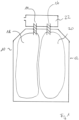
- a schematic representation of a spray device that can be used according to the invention is shown in 1 shown.
- different specific spray solutions A and B are placed in the first storage bag and in a second storage bag.
- the materials of the storage bags, the spray valves and the spray head are preferably selected according to the compositions of the spray solutions A and B.
- contact of the multiple spray solutions prior to spraying and ingress of air into the spray solutions during storage must be prevented.
- the first storage bag which is intended in particular to hold a spray solution A, can be formed from a single material or from a laminated material.
- the first storage bag is preferably formed from a thermoplastic polymer, in particular a polyethylene or polypropylene.
- the first storage bag for holding the spray solution A is particularly preferably formed from a laminated material which has at least one layer which prevents the passage of oxygen and a further, inner layer which prevents the spray solution A from coming into contact with the oxygen-tight layer.
- the first presentation bag is formed from a laminated material comprising a metal foil and an inner layer made from a thermoplastic polymer.
- a metal foil or an iron foil, for example, can be used as the metal foil, with an aluminum foil being preferred.
- the thickness of the metal foil and in particular the aluminum foil is 5-20 ⁇ m.
- the inner layer of thermoplastic polymer is preferably made of a polyolefin, and more preferably of polyethylene or polypropylene. A pouch made from this material has been shown to be particularly resistant to high pH compositions, in excess of pH 13.
- the laminated material for the first presentation bag can also preferably have an outer layer, in particular a polyethylene terephthalate layer or a nylon layer.
- the individual layers of the laminate material for the first presentation bag are preferably connected to one another with an adhesive, with polyether-urethane resin adhesives having proven to be particularly suitable.
- a laminate material comprising polyethylene terephthalate as the outer layer, an aluminum foil as the oxygen-blocking layer and a polyolefin, in particular polypropylene or polyethylene, as the inner layer has proven to be particularly suitable as a material for the first storage bag.
- the thickness of the outer polyethylene terephthalate layer is preferably 5-20 ⁇ m, the thickness of the aluminum foil is 5-20 ⁇ m and the thickness of the inner polyolefin layer is 10-100 ⁇ m.
- the layers are preferably bonded together by means of an adhesive, with polyether urethane resin adhesives being particularly preferred.
- the second storage bag which is intended in particular to hold a spray solution B, can be formed from a single material or from a laminated material.
- the second Template bag formed from a thermoplastic polymer, in particular a polyethylene or polypropylene.
- the second storage bag for holding the spray solution B is particularly preferably formed from a laminated material which has at least one layer which prevents the passage of oxygen and a further, inner layer which prevents the spray solution B from coming into contact with the oxygen-tight layer.
- the second presentation bag is formed from a laminated material comprising a metal foil and an inner layer made from a thermoplastic polymer.
- a metal foil or an iron foil, for example, can be used as the metal foil, with an aluminum foil being preferred.
- the thickness of the metal foil and in particular the aluminum foil is 5-20 ⁇ m.
- the inner layer of thermoplastic polymer is preferably made of a polyolefin, and more preferably of polyethylene or polypropylene.
- a storage bag made from this material has proven to be particularly resistant to compositions with low pH values of less than pH 3.
- the laminated material for the second presentation bag can also preferably have an outer layer, in particular a polyethylene terephthalate layer or a nylon layer.
- the individual layers of the laminate material for the second presentation bag are preferably connected to one another with an adhesive, with polyether-urethane resin adhesives having proven to be particularly suitable.
- a laminate material comprising polyethylene terephthalate as the outer layer, an aluminum foil as the oxygen-blocking layer, polyethylene terephthalate as the intermediate layer and a polyolefin, in particular polypropylene or polyethylene, as the inner layer has proven particularly suitable as a material for the second storage bag.
- the thickness of the outer polyethylene terephthalate layer is preferably 5-20 ⁇ m Thickness of the aluminum foil 5-20 ⁇ m, the thickness of the polyethylene terephthalate intermediate layer 5-20 ⁇ m and the thickness of the polyolefin inner layer 10-100 ⁇ m.
- the layers are in turn preferably connected to one another by means of an adhesive, polyether-urethane resin adhesives being particularly preferred again.
- the active cleaner to be sprayed is formed in situ by the simultaneous delivery of at least two different spray solutions.
- the at least two spray valves are preferably set in such a way that the spray flow of the spray solutions contained in the at least two separate storage bags, based on the volume, is 2:1 to 1:2, preferably 1.5:1 to 1:1.5 and more preferably 1.1:1 to 1:1.1.
- the spray flow can be adjusted, for example, by the viscosity of the spray solutions.
- Another way to adjust the spray flow is to use predefined cross-sections of the spray valves. It is often preferred to set a spray flow of the individual spray solutions that is as large as possible. In this configuration, the storage bags of the same size can be used and all storage bags can be emptied completely in a simple manner.
- FIG 1 shows a schematic representation of a spray device (10) that can be used according to the invention, comprising a spray device container (12), at least two spray valves (14, 16), at least two storage bags (18, 20) that are separate from one another, and a spray head (22).
- spray solution A is placed in the first sachet and spray solution B is placed in the second sachet, as specified below.
- the spray solutions When sprayed, the spray solutions are mixed and an active oxygen-based cleaning agent is formed.
- Spray solution A comprising: Na metasilicate complexing agent 0.50% by weight tri-sodium citrate complexing agent 0.50% by weight Xanthan Gum thickener 0.050% by weight AgNO 3 solution (1%) catalyst 0.300% by weight potassium iodide catalyst 2,000% by weight sodium catalyst 7,000% by weight NaOH (50%) pH adjustment 2,000% by weight Glucopon GD70 surfactant 5,000% by weight monoethanolamine pH adjustment 10,000% by weight water, demineralized solvent 72.65% by weight
- This spray solution A has a pH value of pH 13.
- a spray solution B is placed in the second storage bag, comprising: Carbopol ETD thickener 0.150% by weight Hydrogen Peroxide (35% solution) active substance 25,000% by weight phosphoric acid (85%) peroxide stabilizer 0.500% by weight water, demineralized solvent 74.350% by weight
- the spray solution B containing hydrogen peroxide has a pH value of pH 3.
- the spray can produced as described in Example 1 was subjected to stability tests. For this purpose, the spray can was stored at 40° C. for 3 months. It was found that both the spray solutions and the inner bags are stable and no changes were observed.
- a multi-liquid dispensing aerosol can prepared according to Example 1 was tested in various applications. It was shown that the active cleaner formed in situ when sprayed developed an excellent cleaning effect and could therefore be used in particular as a stain remover for textiles and as an upholstery cleaner.
- spray solution A is placed in the first sachet and spray solution B is placed in the second sachet, as specified below.
- the spray solutions When sprayed, the spray solutions are mixed and an active oxygen-based cleaning agent is formed.
- Spray solution A comprising (with potassium iodide and sodium carbonate):
- monoethanolamine solvent 4.00% by weight sodium catalyst 3.50% by weight
- Glucopon GD70 surfactant 3.00% by weight potassium iodide catalyst 1.50% by weight tri-sodium citrate complexing agent 0.80% by weight citric acid pH adjustment 0.80% by weight water, demineralized solvent 86.40% by weight
- This spray solution A has a pH value of pH 10-11.
- Spray solution B comprising:
- the pH of the spray solution B is adjusted to a value of 3.5-4 by adding NaOH.
- the first storage bag contains a Spray solution A and in the second bag a spray solution B as specified below.
- the spray solutions When sprayed, the spray solutions are mixed and an active oxygen-based cleaning agent is formed.
- Spray solution A comprising (with silver nitrate and sodium carbonate):
- This spray solution A has a pH value of pH 10-11.
- Spray solution B comprising:
- the pH of the spray solution B is adjusted to a value of 3.5-4 by adding NaOH.
Landscapes
- Chemical & Material Sciences (AREA)
- Dispersion Chemistry (AREA)
- Engineering & Computer Science (AREA)
- Mechanical Engineering (AREA)
- Detergent Compositions (AREA)
- Containers And Packaging Bodies Having A Special Means To Remove Contents (AREA)
Description
- Die vorliegende Anmeldung betrifft die Verwendung einer Sprühdose mit zwei separaten Vorlagebeuteln zum Versprühen von zwei getrennt vorgelegten Lösungen, die beim Versprühen vermischt werden und dabei ein Reinigungsmittel auf Basis von aktivem Sauerstoff bilden.
- Aktivreiniger mit bleichender und/oder desinfizierender Wirkung enthalten oftmals Natriumhypochlorit (Chlorbleiche). Die Anwesenheit von Chlor in solchen Reinigungsmitteln ist aber im Hinblick auf Gesundheitsvorschriften und Umweltbedenken zunehmend unerwünscht.
-
JP 2009-023684 A JP 2009-40464 A US 3,966,090 sowieFR 2,035,195 US 9,074,163 B2 US 2011/0215113 A1 beschreibt eine Sprühvorrichtung zur Abgabe eines Gemisches von zwei Zusammensetzungen, wobei die Sprühvorrichtung eine erste und eine zweite Kammer und einen einzelnen Sprühkopf aufweist. Als Aktivator wird Natriumkarbonat eingesetzt.GB 1 263 739 - Eine Aufgabe der vorliegenden Erfindung war es deshalb, ein Reinigungsmittel mit bleichender und/oder desinfizierender Wirkung bereitzustellen, bei dem auf die Verwendung von Hypochlorit bzw. anderer bedenklicher Bleichmittel verzichtet werden kann. Eine weitere Aufgabe der vorliegenden Erfindung war es, ein solches Reinigungsmittel in einer für den Anwender einfach zu handhabenden Form bereitzustellen.
- Diese Aufgaben werden erfindungsgemäß gelöst durch die Verwendung einer Sprühvorrichtung zur Abgabe mehrerer Flüssigkeiten umfassend
- (i) einen Sprühvorrichtungsbehälter,
- (ii) mindestens zwei Sprühventile,
- (iii) mindestens zwei voneinander getrennte Vorlagebeutel, angebracht innerhalb des Sprühvorrichtungsbehälters, wobei ein erster Vorlagebeutel mit einem ersten Sprühventil in Verbindung steht und ein zweiter Vorlagebeutel mit einem zweiten Sprühventil in Verbindung steht sowie
- (iv) einen Sprühkopf,
- Erfindungsgemäß kann durch die Verwendung einer Sprühvorrichtung, in der mindestens zwei Sprühlösungen zunächst voneinander getrennt vorliegen und bei der die beiden Sprühlösungen erst zur Anwendung vermischt werden, in situ aktiver Sauerstoff erzeugt und somit Reinigungsmittel mit bleichender und desinfizierender Wirkung bereitgestellt werden. Auf die Verwendung von Hypochlorit oder anderer bedenklicher Bleichmittel kann erfindungsgemäß somit verzichtet werden.
- Die in situ-Erzeugung von aktivem Sauerstoff gelingt durch die Verwendung einer Sprühvorrichtung, in der wenigstens zwei voneinander getrennte Vorlagebeutel enthalten sind, in denen jeweils eine erste sowie eine zweite Sprühlösung enthalten sind. Die aktive Komponente, nämlich aktiver Sauerstoff, liegt in der stabilen Lagerform in den Sprühlösungen noch nicht vor, sondern wird erst beim Aufsprühen durch Vermischen der wenigstens zwei getrennt voneinander in der Sprühvorrichtung vorhandenen Sprühlösungen gebildet.
- Erfindungsgemäß wurde festgestellt, dass durch den Einsatz von Silbernitrat oder von Silbernitrat und Kaliumiodid in der Sprühlösung im ersten Vorlagebeutel als Katalysator zur Freisetzung von Sauerstoff aus Wasserstoffperoxid eine effektive Bildung von aktivem Sauerstoff beim Versprühen und Vermischen der ersten und zweiten Sprühlösung bewirkt wird. Die Bildung von aktivem Sauerstoff erfolgt dabei erfindungsgemäß in kurzer Zeit und bei Umgebungstemperatur. Zudem kann erfindungsgemäß die Bildung von aktivem Sauerstoff bereits bei einem nur leicht alkalischen pH-Wert erfolgen.
- Der erfindungsgemäß durch Zusammenmischen mehrerer Sprühflüssigkeiten gebildete Aktivreiniger stellt insbesondere eine Sauerstoffbleiche dar und keine Chlorbleiche.
- Erfindungsgemäß ist in einem ersten Vorlagebeutel eine Sprühlösung A enthalten, die wenigstens einen Katalysator zur Freisetzung von Sauerstoff aus Wasserstoffperoxid umfasst, ausgewählt aus Silbernitrat oder aus Silbernitrat und Kaliumiodid. Neben den zwingend vorhandenen Katalysatoren Silbernitrat oder Silbernitrat und Kaliumiodid, welche eine schnelle Sauerstofffreisetzung bei Umgebungstemperaturen bewirken, kann die Sprühlösung A optional weitere Katalysatoren zur Freisetzung von Sauerstoff aus Wasserstoffperoxid enthalten. Eine Freisetzung von Sauerstoff aus Wasserstoffperoxid bewirken z.B. Schwermetallionen, Jodid, Hydroxid, Eisen(III)salze, Manganoxid sowie Kupfersulfat. Geeignete Katalysatoren sind insbesondere Natriumhydroxid, Kaliumiodid, Natriumcarbonat oder/und Silbernitrat.
- Der Anteil an Katalysatoren in der Sprühlösung A beträgt in Summe vorzugsweise 1-20 Gew.%, insbesondere 10-15 Gew.%, bezogen auf das Gesamtgewicht der Sprühlösung A. Bevorzugt beträgt der Anteil an Katalysatoren in der Sprühlösung A in Summe von 2-15 Gew.%, mehr bevorzugt von 3-12 Gew.% und am meisten bevorzugt von 5-10 Gew.%, bezogen auf das Gesamtgewicht der Sprühlösung A. Es können ein oder mehrere Katalysatoren enthalten sein. Kaliumiodid ist vorzugsweise mit einem Anteil von 0,5 bis 6 Gew.%, vorzugsweise von 1 bis 6 Gew.%, insbesondere von 2 bis 4 Gew.% enthalten. Weiterhin bevorzugt ist Kaliumiodid mit einem Anteil von 0,5 bis 2,0 Gew.%, noch mehr bevorzugt von 1,0 bis 2,0 Gew.% enthalten. Silbernitrat ist vorzugsweise in einer Menge von 0 bis 50 ppm, mehr bevorzugt von 0 bis 30 ppm, vorzugsweise 1 bis 20 ppm und besonders bevorzugt von 5 bis 20 ppm enthalten.
- Natriumcarbonat ist vorzugsweise mit einem Anteil von 5 bis 10 Gew.%, vorzugsweise 6 bis 8 Gew.% enthalten. Weiterhin bevorzugt ist Natriumcarbonat mit einem Anteil von 2,0 bis 5,0 Gew.%, vorzugsweise von 3,0 bis 4,0 Gew..% enthalten. Natriumhydroxid dient als Katalysator und gleichzeitig zur pH-Wert-Einstellung und ist entsprechend bevorzugt mit einem Anteil von 0,5 bis 2 Gew.%, insbesondere 0,75 bis 1,5 Gew.% enthalten.
- Die ppm- sowie Gew.%-Angaben für die Katalysatoren beziehen sich jeweils auf das Gesamtgewicht der Lösung A.
- Beim gleichzeitigen Versprühen der mindestens zwei Sprühlösungen zerfällt erfindungsgemäß das in der zweiten Sprühlösung B enthaltene Wasserstoffperoxid zu Sauerstoff. Durch die in der ersten Sprühlösung A enthaltenen Katalysatoren wird ein schnelles, aktives Zerfallen von Wasserstoffperoxid zu Sauerstoff bei Raumtemperatur (20°C) erreicht. Durch diesen Zerfall von Wasserstoffperoxid zu Sauerstoff wirkt der Reiniger als starkes Oxidationsmittel mit bleichender und desinfizierender Wirkung.
- Besonders bevorzugt umfasst die Sprühlösung A eine Katalysatorkombination aus Kaliumiodid, Natriumcarbonat, Natriumhydroxid und Silbernitrat, insbesondere eine Katalysatorkombination umfassend 2-4 Gew.% Kaliumiodid, 6-8 Gew.% Natriumcarbonat, 0,5 bis 1,5 Gew.% Natriumhydroxid und 1-30 ppm Silbernitrat.
- Weiterhin bevorzugt umfasst die Sprühlösung A eine Katalysatorkombination aus Kaliumiodid, Natriumcarbonat, Natriumhydroxid und Silbernitrat, insbesondere eine Katalysatorkombination umfassend 0,5-2 Gew.% Kaliumiodid, 3-6 Gew.% Natriumcarbonat, 0,5 bis 1,5 Gew.% Natriumhydroxid und 1-30 ppm Silbernitrat.
- Hierin beschrieben wird auch eine nicht erfindungsgemäße Ausführungsform in der die Sprühlösung A eine Katalysatorkombination umfasst aus Kaliumiodid und Natriumcarbonat, insbesondere eine Katalysatorkombination umfassend 1,0 bis 2,0 Gew.% Kaliumiodid und 2,0 bis 5,0 Gew.% Natriumcarbonat.
- In einer weiteren besonders bevorzugten Ausführungsform umfasst die Sprühlösung A eine Katalysatorkombination aus Silbernitrat und Natriumcarbonat, insbesondere eine Katalysatorkombination umfassend 10 bis 50 ppm Silbernitrat und 2,0 bis 5,0 Gew.% Natriumcarbonat.
- Weiterhin weist die im ersten Vorlagebeutel enthaltene Sprühlösung A vorzugsweise einen basischen pH-Wert, insbesondere einen pH von ≥ 8,0 auf. Die Sprühlösung A kann einen pH ≥ 10,0, beispielsweise einen pH ≥ 12,0 oder einen pH ≥ 13,0 aufweisen. Bevorzugt weist die im ersten Vorlagebeutel enthaltene Sprühlösung A einen pH-Wert von 8,0 bis 11,0, bevorzugt von 9,0 bis 11,0 und noch mehr bevorzugt von 10,0 bis 11,0 auf. Die erfindungsgemäß eingesetzten Katalysatoren Kaliumiodid sowie Silbernitrat und insbesondere Kaliumiodid ermöglichen die Freisetzung von aktivem Sauerstoff bereits bei relativ niedrigen pH-Werten.
- Beim Vermischen der Sprühlösung A aus dem ersten Vorlagebeutel und der Sprühlösung B aus dem zweiten Vorlagebeutel wird dadurch im Gesamtgemisch ein basischer pH-Wert eingestellt, wodurch ein schneller Zerfall von Wasserstoffperoxid zu Sauerstoff bei Raumtemperatur weiter gefördert wird. Insbesondere erfolgt ein Zerfall von Wasserstoffperoxid zu Sauerstoff bei Vermischen der Sprühlösung A und Sprühlösung B erfindungsgemäß in weniger als 10 Sekunden, mehr bevorzugt in weniger als 5 Sekunden, noch mehr bevorzugt in weniger als 1 Sekunde bei Raumtemperatur.
- Zur Einstellung eines alkalischen pH-Werts enthält die Sprühlösung A vorzugsweise Natriumcarbonat, Monoethanolamin, Triethanolamin oder/und Alkalihydroxide, insbesondere Natriumhydroxid.
- Die Sprühlösung A im ersten Vorlagebeutel kann weitere optionale Bestandteile enthalten. Vorzugsweise sind Tenside, insbesondere nicht ionische Tenside, anionische Tenside oder amphotere Tenside enthalten. Bevorzugt sind nicht ionische Alkylpolyglykoside (Zuckertenside).
- Der Anteil an Tensiden und insbesondere an nicht ionischen Alkylpolyglykosiden in der Sprühlösung A beträgt vorzugsweise 1-8 Gew.%, insbesondere 2-6 Gew.%.
- Weiterhin wurde festgestellt, dass die Viskosität der einzelnen Lösungen Einfluss auf den Sprühfluss der jeweiligen Lösungen hat. Deshalb enthält die Sprühlösung A vorzugsweise ein Verdickungsmittel, besonders bevorzugt Xanthan Gum zur Einstellung der Viskosität. Besonders bevorzugt beträgt der Anteil an Verdickungsmittel und insbesondere an Xanthan Gum in der Sprühlösung A 0,010-0,10 Gew.%.
- Weiterhin können in der Sprühlösung A Komplexbildner, vorzugsweise Citrate, EDTA-Na, Nitriloessigsäure oder Natriummetasilikat enthalten sein. Der Anteil an Komplexbildnern in der Sprühlösung A beträgt vorzugsweise von 0,10 bis 2,0 Gew.%, mehr bevorzugt von 0,50 bis 1,50 Gew%.
- Der Rest der Sprühlösung A besteht vorzugsweise aus Wasser, insbesondere aus entmineralisiertem Wasser als Lösungsmittel.
- Erfindungsgemäß wird in einem zweiten Vorlagebeutel eine Sprühlösung B vorgelegt. Diese Sprühlösung B ist eine Zusammensetzung umfassend Wasserstoffperoxid. Der Gehalt an Wasserstoffperoxid in der Sprühlösung B beträgt vorzugsweise von 5-35 Gew.%, mehr bevorzugt von 7-15 Gew.%. Weiter bevorzugt beträgt der Gehalt an Wasserstoffperoxid in der Sprühlösung B 2 bis 12 Gew.%, bevorzugt 3 bis 10 Gew.%, insbesondere 4 bis 8 Gew.%.
- Der pH-Wert der wasserstoffperoxidhaltigen Sprühlösung B ist vorzugsweise im Sauren, damit das Wasserstoffperoxid bei der Lagerung stabil bleibt. Vorzugsweise weist die Sprühlösung B einen pH-Wert von ≤ 5,0, mehr bevorzugt ≤ 4,0 und am meisten bevorzugt ≤ 3,0 auf. Besonders bevorzugt weist die Sprühlösung B einen pH-Wert von 2,0 bis 5,0, insbesondere von 3,0 bis 4,0 auf.
- Optional können der Sprühlösung B Peroxidstabilisatoren zugegeben werden, insbesondere Natriumstannat, Natriumdiphosphat, Phosphorsäure oder/und Harnsäure. Der Anteil an Peroxidstabilisatoren beträgt vorzugsweise 0,1 bis 1 Gew.%.
- Weiterhin enthält die Sprühlösung B vorzugsweise ein Verdickungsmittel zur Einstellung der Viskosität, insbesondere Xanthan Gum und/oder Polyacrylsäure (Carbomere). Zur Ausbildung eines Sprühnebels werden insbesondere Polyacrylsäurepolymere, wie beispielsweise Carbopol ETD eingesetzt. Besonders bevorzugt ist Carbopol ETD 2020. Der Anteil an Verdickungsmittel und insbesondere an Polyacrylsäurepolymeren beträgt vorzugsweise von 0,10 bis 0,5 Gew.%.
- Beim erfindungsgemäßen Versprühen der Sprühlösung A und Sprühlösung B werden die separat vorgelegten Lösungen vermischt, wodurch das in Sprühlösung B enthaltene Wasserstoffperoxid durch Inkontaktkommen mit den Katalysatoren der Sprühlösung A sowie durch die Verschiebung des pH-Werts ins Basische bei Raumtemperatur gemäß folgender Gleichung:
2H2O2→2H2O+O2
zerfällt. Dadurch wird in situ beim Versprühen ein Aktivreiniger auf Sauerstoffbasis gebildet. - In einer Ausführungsform der vorliegenden Erfindung ist der Sprühkopf so ausgestaltet, dass der durch Zusammenmischen der in den Vorlagebeuteln enthaltenen Lösungen gebildete Aktivreiniger versprüht wird. In einer weiteren, ebenfalls bevorzugten Ausführungsform wird der Aktivreiniger zusätzlich verschäumt, so dass er bereits als Schaum auf die zu behandelnde Oberfläche auftritt. Ein Verschäumen kann beispielsweise durch Anbringen eines Netzes zum Verschäumen im Sprühkopf erzielt werden.
- Bei dem erfindungsgemäß durch Vermischen von mindestens zwei Sprühlösungen beim Versprühen gebildeten Aktivreiniger handelt es sich vorzugsweise um einen Aktivreiniger mit bleichender und desinfizierender Wirkung. Besonders bevorzugt handelt es sich um einen Fleckentferner, um einen Polsterreiniger, um einen Sanitärreiniger, um einen Backofenreiniger, um einen Grillrostreiniger, um einen Fliesenfugenreiniger, um einen Silikonfugenreiniger, um einen Edelstahlreiniger oder um einen Chromreiniger.
- Für die spezifische Ausgestaltung der Reiniger können in der ersten und/oder zweiten Sprühlösung weitere spezifische Inhaltsstoffe enthalten sein. Es ist aber auch möglich, in einem oder weiteren zusätzlichen Vorlagebeuteln, die wiederum jeweils mit einem eigenen Sprühventil in Verbindung stehen, weitere Sprühlösungen mit spezifischen Inhaltsstoffen vorzusehen.
- Geeignete Sprühvorrichtungen zur Abgabe mehrerer Flüssigkeiten, die zur erfindungsgemäßen Anwendung zum Versprühen eines Aktivreinigers eingesetzt werden können, sind beispielsweise in
EP 2 508 446 A1 , inEP 2 597 055 A1 , inEP 2 647 587 A1 sowie inEP 2 738 117 A1 beschrieben. - Die erfindungsgemäß verwendete Sprühvorrichtung umfasst einen Sprühvorrichtungsbehälter. Hierzu kann eine übliche Sprühdose verwendet werden. Das Füllvolumen beträgt vorzugsweise von 100 ml bis 2000 ml, vorzugsweise von 200 ml bis 1000 ml.
- Zum getrennten Lagern und gleichzeitigen Versprühen von mehreren Sprühflüssigkeiten weist die erfindungsgemäß eingesetzte Sprühvorrichtung mindestens zwei Sprühventile und mindestens zwei voneinander getrennte Vorlagebeutel, angebracht innerhalb des Sprühvorrichtungsbehälters auf. Dabei steht ein erster Vorlagebeutel mit einem ersten Sprühventil in Verbindung und ein zweiter Vorlagebeutel mit einem zweiten Sprühventil. Auf diese Weise ist es möglich, die Sprühlösungen bei der Lagerung und Aufbewahrung getrennt voneinander verpackt innerhalb des Sprühvorrichtungsbehälters in den einzelnen Vorlagebeuteln verpackt zu lagern. Die Sprühlösungen werden dann aus den getrennten Vorlagebeuteln über das jeweilige Sprühventil abgegeben und erst beim Versprühen vermischt.
- Die erfindungsgemäß eingesetzte Sprühvorrichtung umfasst weiterhin einen Sprühkopf. Vorzugsweise werden durch den einen Sprühkopf die mindestens zwei Sprühventile gleichzeitig bedient, so dass eine Abgabe der mehreren Flüssigkeiten durch einfaches Drücken auf den Sprühkopf bewirkt wird.
- Eine schematische Darstellung einer erfindungsgemäß einsetzbaren Sprühvorrichtung ist in
Fig. 1 gezeigt. - Wie hierin beschrieben, werden in dem ersten Vorlagebeutel und in einem zweiten Vorlagebeutel insbesondere verschiedene spezifische Sprühlösungen A und B vorgelegt. Erfindungsgemäß bevorzugt werden die Materialien der Vorlagebeutel, der Sprühventile und des Sprühkopfes entsprechend den Zusammensetzungen der Sprühlösungen A und B ausgewählt. Insbesondere muss ein Kontakt der mehreren Sprühlösungen vor dem Versprühen sowie ein Eindringen von Luft in die Sprühlösungen während der Lagerungen verhindert werden.
- Der erste Vorlagebeutel, welcher insbesondere eine Sprühlösung A aufnehmen soll, kann aus einem einzigen Material oder aus einem laminierten Material gebildet werden. Vorzugsweise wird der erste Vorlagebeutel aus einem thermoplastischen Polymer gebildet, insbesondere einem Polyethylen oder Polypropylen.
- Besonders bevorzugt wird der erste Vorlagebeutel zur Aufnahme der Sprühlösung A aus einem laminierten Material gebildet, welches wenigstens eine Schicht aufweist, welche den Durchtritt von Sauerstoff verhindert und eine weitere, innere Schicht, welche einen Kontakt mit der Sprühlösung A mit der sauerstoffdichten Schicht verhindert.
- In einer Ausgestaltung ist der erste Vorlagebeutel aus einem laminierten Material gebildet, umfassend eine Metallfolie sowie eine innere Schicht aus einem thermoplastischen Polymer. Als Metallfolie kann beispielsweise eine Aluminiumfolie oder eine Eisenfolie verwendet werden, wobei eine Aluminiumfolie bevorzugt ist. Die Dicke der Metallfolie und insbesondere der Aluminiumfolie beträgt 5-20 µm. Die innere Schicht aus thermoplastischem Polymer besteht vorzugweise aus einem Polyolefin und insbesondere aus Polyethylen oder Polypropylen. Ein Vorlagebeutel aus diesem Material hat sich insbesondere als beständig gegenüber Zusammensetzungen mit hohen pH-Werten von über pH 13 gezeigt.
- Das laminierte Material für den ersten Vorlagebeutel kann weiterhin vorzugsweise eine Außenschicht aufweisen, insbesondere eine Polyethylenterephthalatschicht oder eine Nylonschicht.
- Die einzelnen Schichten des Laminatmaterials für den ersten Vorlagebeutel werden vorzugsweise mit einem Adhäsiv miteinander verbunden, wobei sich Polyether-urethanharz-Adhäsive als besonders geeignet erwiesen haben.
- Besonders geeignet als Material für den ersten Vorlagebeutel hat sich ein Laminatmaterial umfassend als äußere Schicht Polyethylenterephthalat, als sauerstoffblockierende Schicht eine Aluminiumfolie und als innere Schicht ein Polyolefin, insbesondere Polypropylen oder Polyethylen erwiesen. Die Dicke der äußeren Polyethylenterephthalatschicht beträgt dabei vorzugsweise 5-20 µm, die Dicke der Aluminiumfolie 5-20 µm und die Dicke der Polyolefin-Innenschicht 10-100 µm.
- Die Schichten werden vorzugsweise mittels eines Adhäsivs miteinander verbunden, wobei Polyether-urethanharz-Adhäsive besonders bevorzugt sind.
- Der zweite Vorlagebeutel, welcher insbesondere eine Sprühlösung B aufnehmen soll, kann aus einem einzigen Material oder aus einem laminierten Material gebildet werden. Vorzugsweise wird der zweite Vorlagebeutel aus einem thermoplastischen Polymer gebildet, insbesondere einem Polyethylen oder Polypropylen.
- Besonders bevorzugt wird der zweite Vorlagebeutel zur Aufnahme der Sprühlösung B aus einem laminierten Material gebildet, welches wenigstens eine Schicht aufweist, welche den Durchtritt von Sauerstoff verhindert und eine weitere, innere Schicht, welche einen Kontakt mit der Sprühlösung B mit der sauerstoffdichten Schicht verhindert.
- In einer Ausgestaltung ist der zweite Vorlagebeutel aus einem laminierten Material gebildet, umfassend eine Metallfolie sowie eine innere Schicht aus einem thermoplastischen Polymer. Als Metallfolie kann beispielsweise eine Aluminiumfolie oder eine Eisenfolie verwendet werden, wobei eine Aluminiumfolie bevorzugt ist. Die Dicke der Metallfolie und insbesondere der Aluminiumfolie beträgt 5-20 µm. Die innere Schicht aus thermoplastischem Polymer besteht vorzugweise aus einem Polyolefin und insbesondere aus Polyethylen oder Polypropylen. Ein Vorlagebeutel aus diesem Material hat sich insbesondere als beständig gegenüber Zusammensetzungen mit geringen pH-Werten von unter pH 3 gezeigt.
- Das laminierte Material für den zweiten Vorlagebeutel kann weiterhin vorzugsweise eine Außenschicht aufweisen, insbesondere eine Polyethylenterephthalatschicht oder eine Nylonschicht.
- Die einzelnen Schichten des Laminatmaterials für den zweiten Vorlagebeutel werden vorzugsweise mit einem Adhäsiv miteinander verbunden, wobei sich Polyether-urethanharz-Adhäsive als besonders geeignet erwiesen haben.
- Besonders geeignet als Material für den zweiten Vorlagebeutel hat sich ein Laminatmaterial umfassend als äußere Schicht Polyethylenterephthalat, als sauerstoffblockierende Schicht eine Aluminiumfolie, als Zwischenschicht Polyethylenterephthalat und als innere Schicht ein Polyolefin, insbesondere Polypropylen oder Polyethylen erwiesen. Die Dicke der äußeren Polyethylenterephthalatschicht beträgt dabei vorzugsweise 5-20 µm, die Dicke der Aluminiumfolie 5-20 µm, die Dicke der Polyethylenterephthalat-Zwischenschicht 5-20 µm und die Dicke der Polyolefin-Innenschicht 10-100 µm.
- Die Schichten werden wiederum vorzugsweise mittels eines Adhäsivs miteinander verbunden, wobei wiederum Polyether-urethanharz-Adhäsive besonders bevorzugt sind.
- Mit den bevorzugten Beutelmaterialien ist insbesondere eine sichere Lagerung der Sprühlösungen auch bei erhöhten Temperaturen von 40-60°C möglich.
- Erfindungsgemäß wird der zu versprühende Aktivreiniger in situ durch gleichzeitige Abgabe von mindestens zwei verschiedenen Sprühlösungen gebildet. Vorzugsweise sind die mindestens zwei Sprühventile dabei so eingestellt, dass der Sprühfluss der in den mindestens zwei voneinander getrennten Vorlagebeuteln enthaltenen Sprühlösungen, bezogen auf das Volumen, 2:1 bis 1:2, vorzugsweise 1,5:1 bis 1:1,5 und besonders bevorzugt 1,1:1 bis 1:1,1 beträgt. Der Sprühfluss kann beispielsweise durch die Viskosität der Sprühlösungen eingestellt werden. Eine weitere Möglichkeit, den Sprühfluss einzustellen, ist die Verwendung von vordefinierten Querschnitten der Sprühventile. Oftmals ist es bevorzugt, einen möglichst gleich großen Sprühfluss der einzelnen Sprühlösungen einzustellen. Bei dieser Ausgestaltung können gleich große Vorlagebeutel verwendet werden und es wird auf einfache Weise eine vollständige Entleerung aller Vorlagebeutel erzielt. In manchen Ausgestaltungen kann es aber bevorzugt sein, unterschiedlich große Anteile der einzelnen Sprühlösungen miteinander zu vermischen. Hierzu ist es erfindungsgemäß möglich, praktisch beliebige Sprühflüsse einzustellen. Beispielsweise kann es zur Erzielung eines basischen pH-Wertes der Gesamtzusammensetzung günstig sein, einen höheren Sprühfluss einer alkalischen Komponente einzustellen. Auf diese Weise wird ein gesamtalkalischer pH-Wert erzielt, ohne dass die alkalische Komponente selbst einen zu hohen und somit schwierig zu handhabenden pH-Wert aufweisen muss.
- Die vorliegende Erfindung umfasst weiterhin eine Sprühvorrichtung zur Abgabe mehrerer Flüssigkeiten umfassend
- (i) einen Sprühvorrichtungsbehälter,
- (ii) mindestens zwei Sprühventile,
- (iii) mindestens zwei voneinander getrennte Vorlagebeutel, angebracht innerhalb des Sprühvorrichtungsbehälters, wobei ein erster Vorlagebeutel mit einem ersten Sprühventil in Verbindung steht und ein zweiter Vorlagebeutel mit einem zweiten Sprühventil in Verbindung steht sowie
- (iv) einen Sprühkopf,
- Die jeweiligen in den Vorlagebeuteln der erfindungsgemäßen Sprühvorrichtung enthaltenen Sprühlösungen sind insbesondere wie hierin zuvor ausgeführt ausgestaltet.
- Die Erfindung wird durch die beigefügte Figur sowie die folgenden Beispiele weiter erläutert.
-
Figur 1 zeigt eine schematische Darstellung einer erfindungsgemäß einsetzbaren Sprühvorrichtung (10) umfassend einen Sprühvorrichtungsbehälter (12), mindestens zwei Sprühventile (14, 16), mindestens zwei voneinander getrennte Vorlagebeutel (18, 20), sowie einen Sprühkopf (22). - In einer Sprühdose mit zwei separaten Vorlagebeuteln mit einem Volumen von jeweils 100 ml pro Beutel werden im ersten Vorlagebeutel eine Sprühlösung A und im zweiten Beutel eine Sprühlösung B, wie im Folgenden spezifiziert, vorgelegt.
- Beim Versprühen werden die Sprühlösungen vermischt und es wird ein Reinigungsmittel auf Basis von aktivem Sauerstoff gebildet.
- Sprühlösung A umfassend:
Na-Metasilikat Komplexbildner 0,50 Gew.% Tri-Natriumcitrat Komplexbildner 0,50 Gew.% Xanthan Gum Verdickungsmittel 0,050 Gew.% AgNO3-Lösung (1%-ig) Katalysator 0,300 Gew.% Kaliumiodid Katalysator 2,000 Gew.% Natriumcarbonat Katalysator 7,000 Gew.% NaOH (50%-ig) pH-Einstellung 2,000 Gew.% Glucopon GD70 Tensid 5,000 Gew.% Monoethanolamin pH-Einstellung 10,000 Gew.% Wasser, entmineralisiert Lösungsmittel 72,65 Gew.% - Diese Sprühlösung A weist einen pH-Wert von pH 13 auf.
- In dem zweiten Vorlagebeutel wird eine Sprühlösung B vorgelegt, umfassend:
Carbopol ETD Verdickungsmittel 0,150 Gew.% Wasserstoffperoxid (35%-ige Lösung) Aktivsubstanz 25,000 Gew.% Phosphorsäure (85%-ig) Peroxid-stabilisator 0,500 Gew.% Wasser, entmineralisiert Lösungsmittel 74,350 Gew.% - Die Wasserstoffperoxid enthaltende Sprühlösung B weist einen pH-Wert von pH 3 auf.
- Die wie in Beispiel 1 beschrieben hergestellte Sprühdose wurde Stabilitätstests unterzogen. Dazu wurde die Sprühdose bei 40°C für 3 Monate gelagert. Es zeigte sich, dass sowohl die Sprühlösungen als auch die Innenbeutel stabil sind und keine Veränderungen beobachtet wurden.
- Eine gemäß Beispiel 1 hergestellte Sprühdose zur Abgabe mehrerer Flüssigkeiten wurde in verschiedenen Anwendungen getestet. Dabei zeigte sich, dass der in situ beim Versprühen gebildete Aktivreiniger eine hervorragende Reinigungswirkung entwickelte und somit insbesondere als Fleckenlöser für Textilien und als Polsterreiniger eingesetzt werden konnte.
- Weiterhin zeigten sich hervorragende Ergebnisse beim Einsatz als Edelstahl- bzw. Chromreiniger sowie bei der Verwendung als Fliesenfugen- und Silikonfugenreiniger.
- In einer Sprühdose mit zwei separaten Vorlagebeuteln mit einem Volumen von jeweils 100 ml pro Beutel werden im ersten Vorlagebeutel eine Sprühlösung A und im zweiten Beutel eine Sprühlösung B, wie im Folgenden spezifiziert, vorgelegt.
- Beim Versprühen werden die Sprühlösungen vermischt und es wird ein Reinigungsmittel auf Basis von aktivem Sauerstoff gebildet.
-
Monoethanolamin Lösungsmittel 4,00 Gew.% Natriumcarbonat Katalysator 3,50 Gew.% Glucopon GD70 Tensid 3,00 Gew.% Kaliumiodid Katalysator 1,50 Gew.% Tri-Natriumcitrat Komplexbildner 0,80 Gew.% Citronensäure pH-Einstellung 0,80 Gew.% Wasser, entmineralisiert Lösungsmittel 86,40 Gew.% - Diese Sprühlösung A weist einen pH-Wert von pH 10-11 auf.
-
Wasserstoffperoxid Aktivsubstanz 25,00 Gew.% 35%ige Lösung Wasser, entmineralisiert Lösungsmittel 74,50 Gew.% Phosphorsäure Peroxidstabilisator 0,50 Gew.% - Der pH-Wert der Sprühlösung B wird durch Zugabe von NaOH auf einen Wert von 3,5 - 4 eingestellt.
- In einer Sprühdose mit zwei separaten Vorlagebeuteln mit einem Volumen von jeweils 100 ml pro Beutel werden im ersten Vorlagebeutel eine Sprühlösung A und im zweiten Beutel eine Sprühlösung B, wie im Folgenden spezifiziert, vorgelegt.
- Beim Versprühen werden die Sprühlösungen vermischt und es wird ein Reinigungsmittel auf Basis von aktivem Sauerstoff gebildet.
-
Monoethanolamin Lösungsmittel 4,00 Gew.% Natriumcarbonat Katalysator 3,50 Gew.% Glucopon GD70 Tensid 3,00 Gew.% Tri-Natriumcitrat Komplexbildner 0,80 Gew.% Citronensäure pH-Einstellung 0,80 Gew.% AgNO3-Lösung (1%-ig) Katalysator 0,30 Gew.% Wasser, entmineralisiert Lösungsmittel 87,60 Gew.% - Diese Sprühlösung A weist einen pH-Wert von pH 10-11 auf.
-
Wasserstoffperoxid Aktivsubstanz 25,00 Gew.% 35%ige Lösung Wasser, entmineralisiert Lösungsmittel 74,50 Gew.% Phosphorsäure Peroxidstabilisator 0,50 Gew.% - Der pH-Wert der Sprühlösung B wird durch Zugabe von NaOH auf einen Wert von 3,5 - 4 eingestellt.
dadurch gekennzeichnet, dass in dem ersten Vorlagebeutel wenigstens ein Katalysator zur Freisetzung von Sauerstoff aus Wasserstoffperoxid enthalten ist, ausgewählt aus Silbernitrat oder aus Silbernitrat und zudem Kaliumiodid enthalten ist.
Claims (13)
- Verwendung einer Sprühvorrichtung (10) zur Abgabe mehrerer Flüssigkeiten umfassend(i) einen Sprühvorrichtungsbehälter (12),(ii) mindestens zwei Sprühventile (14,16),(iii) mindestens zwei voneinander getrennte Vorlagebeutel (18,20), angebracht innerhalb des Sprühvorrichtungsbehälters (12), wobei ein erster Vorlagebeutel (18) mit einem ersten Sprühventil (14) in Verbindung steht und ein zweiter Vorlagebeutel (20) mit einem zweiten Sprühventil (16) in Verbindung steht sowie(iv) einen Sprühkopf (22),zum gleichzeitigen Versprühen von mindestens zwei Sprühlösungen, wobei die Sprühlösungen jeweils separiert voneinander in den mindestens zwei Vorlagebeuteln (18,20) vorgelegt werden und wobei die separat vorgelegten Lösungen beim Versprühen vermischt werden, zum Versprühen eines Aktivreinigers,wobei in dem zweiten Vorlagebeutel (20) eine Sprühlösung umfassend Wasserstoffperoxid enthalten ist,dadurch gekennzeichnet, dass in dem ersten Vorlagebeutel (18) eine Sprühlösung enthalten ist umfassend wenigstens einen Katalysator zur Freisetzung von Sauerstoff aus Wasserstoffperoxid ausgewählt aus Silbernitrat oder aus Silbernitrat und zudem Kaliumiodid.
- Verwendung nach Anspruch 1,
dadurch gekennzeichnet, dass in dem ersten Vorlagebeutel (18) weiterhin Natriumhydroxid und/oder Natriumcarbonat enthalten ist. - Verwendung nach einem der Ansprüche 1-2,
dadurch gekennzeichnet, dass der pH-Wert der Sprühlösung im ersten Vorlagebeutel (18) mindestens 11,0 beträgt oder dass der pH-Wert der Sprühlösung im ersten Vorlagebeutel (18) 9,0 bis 11,0 beträgt. - Verwendung nach einem der Ansprüche 1-3,
dadurch gekennzeichnet, dass in dem ersten Vorlagebeutel (18) eine Sprühlösung umfassend einen Katalysator zur Freisetzung von Sauerstoff aus Wasserstoffperoxid, ausgewählt aus Silbernitrat oder Silbernitrat und zudem Kaliumiodid, wenigstens ein Tensid, wenigstens ein Komplexbildner sowie wenigstens eine alkalische Komponente enthalten ist. - Verwendung nach einem der Ansprüche 1-4,
dadurch gekennzeichnet, dass in dem zweiten Vorlagebeutel (20) eine Sprühlösung umfassend Wasserstoffperoxid sowie wenigstens ein Peroxidstabilisator enthalten ist. - Verwendung nach einem der Ansprüche 1-5,
dadurch gekennzeichnet, dass die in dem zweiten Vorlagebeutel (20) enthaltene Sprühlösung einen pH-Wert von 2,0 bis 5,0 aufweist. - Verwendung nach einem der Ansprüche 1-6,
dadurch gekennzeichnet, dass der Aktivreiniger versprüht und/oder verschäumt wird. - Verwendung nach einem der Ansprüche 1-7,
dadurch gekennzeichnet, dass es sich bei dem Aktivreiniger um einen Intensivreiniger mit bleichender und desinfizierender Wirkung, um einen Fleckentferner, um einen Polsterreiniger, um einen Sanitärreiniger, um einen Backofenreiniger, um einen Grillrostreiniger, um einen Fliesenfugenreiniger, um einen Silikonfugenreiniger, um einen Edelstahlreiniger oder um einen Chromreiniger handelt. - Verwendung nach einem der Ansprüche 1-8,
dadurch gekennzeichnet, dass die Vorlagebeutel (18,20) zumindest teilweise aus Aluminium bestehen. - Verwendung nach einem der Ansprüche 1-9,
dadurch gekennzeichnet, dass die mindestens zwei Sprühventile (14,16) so eingestellt sind, dass der Sprühfluss der in den mindestens zwei voneinander getrennten Vorlagebeuteln (18,20) enthaltenen Sprühlösungen bezogen auf das Volumen 2:1 bis 1:2, vorzugsweise 1,5:1 bis 1:1,5 und besonders bevorzugt 1,1:1 bis 1:1,1 beträgt. - Verwendung nach einem der Ansprüche 1-10,
dadurch gekennzeichnet, dass bei Vermischen der ersten Sprühlösung aus dem ersten Vorlagebeutel (18) und der zweiten Sprühlösung aus dem zweiten Vorlagebeutel (20) während des Versprühens bei Raumtemperatur mittels der in der ersten Sprühlösung enthaltenen Katalysatoren Sauerstoff freigesetzt wird. - Verwendung nach einem der Ansprüche 1-10,
dadurch gekennzeichnet, dass die separat in den Vorlagebeuteln (18,20) vorgelegten Sprühlösungen beim Versprühen im Sprühkopf (22) vermischt werden. - Sprühvorrichtung (10) zur Abgabe mehrerer Flüssigkeiten umfassend(i) einen Sprühvorrichtungsbehälter (12),(ii) mindestens zwei Sprühventile (14,16),(iii) mindestens zwei voneinander getrennte Vorlagebeutel (18,20), angebracht innerhalb des Sprühvorrichtungsbehälters (12), wobei ein erster Vorlagebeutel (18) mit einem ersten Sprühventil (14) in Verbindung steht und ein zweiter Vorlagebeutel (20) mit einem zweiten Sprühventil (16) in Verbindung steht sowie(iv) einen Sprühkopf (22),zum gleichzeitigen Versprühen von mindestens zwei Sprühlösungen, wobei die Sprühlösungen jeweils separiert voneinander in den mindestens zwei Vorlagebeuteln (18,20) vorgelegt werden und wobei die separat vorgelegten Lösungen beim Versprühen im Sprühkopf (22) vermischt werden,wobei in dem zweiten Vorlagebeutel (20) eine Zusammensetzung umfassend Wasserstoffperoxid enthalten ist,dadurch gekennzeichnet, dassin dem ersten Vorlagebeutel (18) wenigstens ein Katalysator zur Freisetzung von Sauerstoff aus Wasserstoffperoxid enthalten ist, ausgewählt aus Silbernitrat oder aus Silbernitrat und zudem Kaliumiodid.
Applications Claiming Priority (1)
| Application Number | Priority Date | Filing Date | Title |
|---|---|---|---|
| DE102018215090.7A DE102018215090A1 (de) | 2018-09-05 | 2018-09-05 | Aktivreiniger |
Publications (3)
| Publication Number | Publication Date |
|---|---|
| EP3620403A1 EP3620403A1 (de) | 2020-03-11 |
| EP3620403B1 true EP3620403B1 (de) | 2023-06-07 |
| EP3620403C0 EP3620403C0 (de) | 2023-06-07 |
Family
ID=67840982
Family Applications (1)
| Application Number | Title | Priority Date | Filing Date |
|---|---|---|---|
| EP19194907.2A Active EP3620403B1 (de) | 2018-09-05 | 2019-09-02 | Aktivreiniger |
Country Status (2)
| Country | Link |
|---|---|
| EP (1) | EP3620403B1 (de) |
| DE (1) | DE102018215090A1 (de) |
Family Cites Families (17)
| Publication number | Priority date | Publication date | Assignee | Title |
|---|---|---|---|---|
| US2973883A (en) * | 1957-05-22 | 1961-03-07 | Modern Lab Inc | Pressurized dispensing device |
| FR1468909A (fr) * | 1964-11-13 | 1967-02-10 | Fmc Corp | Procédé et dispositif pour la production de mousse chaude |
| NL134288C (de) * | 1968-02-14 | |||
| NL7001482A (de) * | 1969-02-17 | 1970-08-19 | ||
| US3966090A (en) * | 1969-02-17 | 1976-06-29 | Dart Industries Inc. | Package for dispensing an antiseptic composition |
| WO1997031087A1 (en) * | 1996-02-23 | 1997-08-28 | The Clorox Company | Composition and apparatus for surface cleaning |
| DE60016727T2 (de) * | 1999-04-12 | 2005-05-19 | Unilever N.V. | Mehrkomponentenbleichmittelzusammensetzungen |
| CA2364559C (en) * | 1999-04-12 | 2010-10-12 | Unilever Plc | Multiple component hard surface cleaning compositions |
| US7967220B2 (en) * | 2002-09-13 | 2011-06-28 | Bissell Homecare, Inc. | Manual sprayer with dual bag-on-valve assembly |
| US7906473B2 (en) * | 2002-09-13 | 2011-03-15 | Bissell Homecare, Inc. | Manual spray cleaner |
| JP2009023684A (ja) * | 2007-07-19 | 2009-02-05 | Eiji Mori | 塗装スプレー缶 |
| JP2009040464A (ja) * | 2007-08-08 | 2009-02-26 | Eiji Mori | 塗装スプレー缶 |
| KR101226572B1 (ko) * | 2009-12-01 | 2013-01-25 | 도요 에어로졸 고교 가부시키가이샤 | 복수액 분배용 에어졸장치 |
| EP2597055B1 (de) * | 2010-07-20 | 2015-09-16 | Toyo Aerosol Industry Co., Ltd. | Aerosolvorrichtung zur ausgabe mehrerer flüssigkeiten |
| CN103097262B (zh) * | 2010-12-02 | 2014-12-17 | 东洋喷雾工业株式会社 | 多种液体分配用的喷雾器装置 |
| US20130216631A1 (en) * | 2012-02-17 | 2013-08-22 | The Clorox Company | Targeted performance of hypohalite compositions thereof |
| JP5986786B2 (ja) * | 2012-04-12 | 2016-09-06 | 東洋製罐株式会社 | 二重構造エアゾール缶に収納される内装パウチ |
-
2018
- 2018-09-05 DE DE102018215090.7A patent/DE102018215090A1/de not_active Withdrawn
-
2019
- 2019-09-02 EP EP19194907.2A patent/EP3620403B1/de active Active
Also Published As
| Publication number | Publication date |
|---|---|
| EP3620403A1 (de) | 2020-03-11 |
| DE102018215090A1 (de) | 2020-03-05 |
| EP3620403C0 (de) | 2023-06-07 |
Similar Documents
| Publication | Publication Date | Title |
|---|---|---|
| DE69414131T2 (de) | Zweiteilige reinigungsmittelzusammensetzung welche mindestens eine peroxidverbindung enthaelt | |
| DE69523168T2 (de) | Zusammensetzung und gebrauch eines intern-carbonisierten tensidfreien reinigungsmittels | |
| EP3469051B1 (de) | Chlordioxid desinfektionstuch | |
| EP1343864B1 (de) | Reinigungs- und desinfektionsmittel | |
| DE102008008759A1 (de) | Verfahren zur Herstellung eines Desinfektionsmittels auf der Basis hypochloriger Säure und transportables System zur Erzeugung eines solchen Desinfektionsmittels | |
| DE1069832B (de) | Transparente Zahnpasta und Verfahren zu deren Herstellung | |
| DE102020002380A1 (de) | Tablettenherstellung | |
| WO2019219220A1 (de) | Desinfektionsverfahren mit einem durch reaktion von h2o2 und no2- in situ gebildetem desinfektionswirkstoff | |
| EP2338960B1 (de) | Schaumstabiler WC-Reiniger und -Entkalker in fester Form | |
| EP3620403B1 (de) | Aktivreiniger | |
| EP3984365B1 (de) | Mopps und tücher getränkt mit einer wässrigen desinfektionsmittelzusammensetzung enthaltend peressigsäure | |
| DE3832885C2 (de) | ||
| DE102022133540A1 (de) | Wässrige Lösung einer Reinigungsmitteltablette und Verfahren zu deren Herstellung | |
| AT410801B (de) | Reinigungs- und desinfektionsmittel | |
| DE592090C (de) | Verfahren zur Herstellung desinfizierend wirkender Seifen | |
| EP2228430A1 (de) | Verfahren zur Herstellung von Reinigungstabletten | |
| DE102011107684A1 (de) | Chlorhaltige Reinigertablette für Toiletten | |
| EP1794762B1 (de) | Flüssigkonzentrat-set | |
| AT212262B (de) | Aktives Chlor enthaltendes Präparat | |
| DE10240389B3 (de) | Festes Filterreinigungsmaterial und Verfahren zur Reinigung von Filtern | |
| EP3142969B1 (de) | Verfahren zur hygienisierung von mobilen trinkwasseranlagen | |
| DE1592561A1 (de) | Nicht staeubende pulverfoermige Mittel | |
| DE1809258A1 (de) | Reinigungsmittel | |
| EP4696140A1 (de) | Keimreduzierende wässrige zusammensetzung umfassend wasserstoffperoxid und wirksamkeitssteigernde komponenten | |
| AT256289B (de) | Reinigungsmittel für Glasoberflächen |
Legal Events
| Date | Code | Title | Description |
|---|---|---|---|
| PUAI | Public reference made under article 153(3) epc to a published international application that has entered the european phase |
Free format text: ORIGINAL CODE: 0009012 |
|
| STAA | Information on the status of an ep patent application or granted ep patent |
Free format text: STATUS: THE APPLICATION HAS BEEN PUBLISHED |
|
| AK | Designated contracting states |
Kind code of ref document: A1 Designated state(s): AL AT BE BG CH CY CZ DE DK EE ES FI FR GB GR HR HU IE IS IT LI LT LU LV MC MK MT NL NO PL PT RO RS SE SI SK SM TR |
|
| AX | Request for extension of the european patent |
Extension state: BA ME |
|
| STAA | Information on the status of an ep patent application or granted ep patent |
Free format text: STATUS: REQUEST FOR EXAMINATION WAS MADE |
|
| 17P | Request for examination filed |
Effective date: 20200820 |
|
| RBV | Designated contracting states (corrected) |
Designated state(s): AL AT BE BG CH CY CZ DE DK EE ES FI FR GB GR HR HU IE IS IT LI LT LU LV MC MK MT NL NO PL PT RO RS SE SI SK SM TR |
|
| STAA | Information on the status of an ep patent application or granted ep patent |
Free format text: STATUS: EXAMINATION IS IN PROGRESS |
|
| 17Q | First examination report despatched |
Effective date: 20210113 |
|
| GRAP | Despatch of communication of intention to grant a patent |
Free format text: ORIGINAL CODE: EPIDOSNIGR1 |
|
| STAA | Information on the status of an ep patent application or granted ep patent |
Free format text: STATUS: GRANT OF PATENT IS INTENDED |
|
| INTG | Intention to grant announced |
Effective date: 20220316 |
|
| GRAJ | Information related to disapproval of communication of intention to grant by the applicant or resumption of examination proceedings by the epo deleted |
Free format text: ORIGINAL CODE: EPIDOSDIGR1 |
|
| STAA | Information on the status of an ep patent application or granted ep patent |
Free format text: STATUS: EXAMINATION IS IN PROGRESS |
|
| INTC | Intention to grant announced (deleted) | ||
| RIN1 | Information on inventor provided before grant (corrected) |
Inventor name: MOSER, CHRISTIAN |
|
| GRAP | Despatch of communication of intention to grant a patent |
Free format text: ORIGINAL CODE: EPIDOSNIGR1 |
|
| STAA | Information on the status of an ep patent application or granted ep patent |
Free format text: STATUS: GRANT OF PATENT IS INTENDED |
|
| INTG | Intention to grant announced |
Effective date: 20220919 |
|
| GRAS | Grant fee paid |
Free format text: ORIGINAL CODE: EPIDOSNIGR3 |
|
| GRAA | (expected) grant |
Free format text: ORIGINAL CODE: 0009210 |
|
| STAA | Information on the status of an ep patent application or granted ep patent |
Free format text: STATUS: THE PATENT HAS BEEN GRANTED |
|
| AK | Designated contracting states |
Kind code of ref document: B1 Designated state(s): AL AT BE BG CH CY CZ DE DK EE ES FI FR GB GR HR HU IE IS IT LI LT LU LV MC MK MT NL NO PL PT RO RS SE SI SK SM TR |
|
| REG | Reference to a national code |
Ref country code: GB Ref legal event code: FG4D Free format text: NOT ENGLISH |
|
| REG | Reference to a national code |
Ref country code: CH Ref legal event code: EP Ref country code: AT Ref legal event code: REF Ref document number: 1574394 Country of ref document: AT Kind code of ref document: T Effective date: 20230615 Ref country code: DE Ref legal event code: R096 Ref document number: 502019007917 Country of ref document: DE |
|
| U01 | Request for unitary effect filed |
Effective date: 20230703 |
|
| U07 | Unitary effect registered |
Designated state(s): AT BE BG DE DK EE FI FR IT LT LU LV MT NL PT SE SI Effective date: 20230711 |
|
| U1N | Appointed representative for the unitary patent procedure changed after the registration of the unitary effect |
Representative=s name: WEICKMANN & WEICKMANN PARTMBB; DE |
|
| REG | Reference to a national code |
Ref country code: LT Ref legal event code: MG9D |
|
| U20 | Renewal fee for the european patent with unitary effect paid |
Year of fee payment: 5 Effective date: 20230831 |
|
| PG25 | Lapsed in a contracting state [announced via postgrant information from national office to epo] |
Ref country code: NO Free format text: LAPSE BECAUSE OF FAILURE TO SUBMIT A TRANSLATION OF THE DESCRIPTION OR TO PAY THE FEE WITHIN THE PRESCRIBED TIME-LIMIT Effective date: 20230907 Ref country code: ES Free format text: LAPSE BECAUSE OF FAILURE TO SUBMIT A TRANSLATION OF THE DESCRIPTION OR TO PAY THE FEE WITHIN THE PRESCRIBED TIME-LIMIT Effective date: 20230607 |
|
| PG25 | Lapsed in a contracting state [announced via postgrant information from national office to epo] |
Ref country code: RS Free format text: LAPSE BECAUSE OF FAILURE TO SUBMIT A TRANSLATION OF THE DESCRIPTION OR TO PAY THE FEE WITHIN THE PRESCRIBED TIME-LIMIT Effective date: 20230607 Ref country code: HR Free format text: LAPSE BECAUSE OF FAILURE TO SUBMIT A TRANSLATION OF THE DESCRIPTION OR TO PAY THE FEE WITHIN THE PRESCRIBED TIME-LIMIT Effective date: 20230607 Ref country code: GR Free format text: LAPSE BECAUSE OF FAILURE TO SUBMIT A TRANSLATION OF THE DESCRIPTION OR TO PAY THE FEE WITHIN THE PRESCRIBED TIME-LIMIT Effective date: 20230908 |
|
| PG25 | Lapsed in a contracting state [announced via postgrant information from national office to epo] |
Ref country code: SK Free format text: LAPSE BECAUSE OF FAILURE TO SUBMIT A TRANSLATION OF THE DESCRIPTION OR TO PAY THE FEE WITHIN THE PRESCRIBED TIME-LIMIT Effective date: 20230607 |
|
| PG25 | Lapsed in a contracting state [announced via postgrant information from national office to epo] |
Ref country code: IS Free format text: LAPSE BECAUSE OF FAILURE TO SUBMIT A TRANSLATION OF THE DESCRIPTION OR TO PAY THE FEE WITHIN THE PRESCRIBED TIME-LIMIT Effective date: 20231007 |
|
| PG25 | Lapsed in a contracting state [announced via postgrant information from national office to epo] |
Ref country code: SM Free format text: LAPSE BECAUSE OF FAILURE TO SUBMIT A TRANSLATION OF THE DESCRIPTION OR TO PAY THE FEE WITHIN THE PRESCRIBED TIME-LIMIT Effective date: 20230607 Ref country code: SK Free format text: LAPSE BECAUSE OF FAILURE TO SUBMIT A TRANSLATION OF THE DESCRIPTION OR TO PAY THE FEE WITHIN THE PRESCRIBED TIME-LIMIT Effective date: 20230607 Ref country code: RO Free format text: LAPSE BECAUSE OF FAILURE TO SUBMIT A TRANSLATION OF THE DESCRIPTION OR TO PAY THE FEE WITHIN THE PRESCRIBED TIME-LIMIT Effective date: 20230607 Ref country code: IS Free format text: LAPSE BECAUSE OF FAILURE TO SUBMIT A TRANSLATION OF THE DESCRIPTION OR TO PAY THE FEE WITHIN THE PRESCRIBED TIME-LIMIT Effective date: 20231007 Ref country code: CZ Free format text: LAPSE BECAUSE OF FAILURE TO SUBMIT A TRANSLATION OF THE DESCRIPTION OR TO PAY THE FEE WITHIN THE PRESCRIBED TIME-LIMIT Effective date: 20230607 |
|
| PG25 | Lapsed in a contracting state [announced via postgrant information from national office to epo] |
Ref country code: PL Free format text: LAPSE BECAUSE OF FAILURE TO SUBMIT A TRANSLATION OF THE DESCRIPTION OR TO PAY THE FEE WITHIN THE PRESCRIBED TIME-LIMIT Effective date: 20230607 |
|
| REG | Reference to a national code |
Ref country code: DE Ref legal event code: R097 Ref document number: 502019007917 Country of ref document: DE |
|
| PLBE | No opposition filed within time limit |
Free format text: ORIGINAL CODE: 0009261 |
|
| STAA | Information on the status of an ep patent application or granted ep patent |
Free format text: STATUS: NO OPPOSITION FILED WITHIN TIME LIMIT |
|
| REG | Reference to a national code |
Ref country code: CH Ref legal event code: PL |
|
| 26N | No opposition filed |
Effective date: 20240308 |
|
| GBPC | Gb: european patent ceased through non-payment of renewal fee |
Effective date: 20230907 |
|
| PG25 | Lapsed in a contracting state [announced via postgrant information from national office to epo] |
Ref country code: MC Free format text: LAPSE BECAUSE OF FAILURE TO SUBMIT A TRANSLATION OF THE DESCRIPTION OR TO PAY THE FEE WITHIN THE PRESCRIBED TIME-LIMIT Effective date: 20230607 |
|
| REG | Reference to a national code |
Ref country code: IE Ref legal event code: MM4A |
|
| PG25 | Lapsed in a contracting state [announced via postgrant information from national office to epo] |
Ref country code: IE Free format text: LAPSE BECAUSE OF NON-PAYMENT OF DUE FEES Effective date: 20230902 |
|
| PG25 | Lapsed in a contracting state [announced via postgrant information from national office to epo] |
Ref country code: GB Free format text: LAPSE BECAUSE OF NON-PAYMENT OF DUE FEES Effective date: 20230907 |
|
| PG25 | Lapsed in a contracting state [announced via postgrant information from national office to epo] |
Ref country code: CH Free format text: LAPSE BECAUSE OF NON-PAYMENT OF DUE FEES Effective date: 20230930 |
|
| PG25 | Lapsed in a contracting state [announced via postgrant information from national office to epo] |
Ref country code: IE Free format text: LAPSE BECAUSE OF NON-PAYMENT OF DUE FEES Effective date: 20230902 Ref country code: GB Free format text: LAPSE BECAUSE OF NON-PAYMENT OF DUE FEES Effective date: 20230907 Ref country code: CH Free format text: LAPSE BECAUSE OF NON-PAYMENT OF DUE FEES Effective date: 20230930 |
|
| U20 | Renewal fee for the european patent with unitary effect paid |
Year of fee payment: 6 Effective date: 20240827 |
|
| PG25 | Lapsed in a contracting state [announced via postgrant information from national office to epo] |
Ref country code: CY Free format text: LAPSE BECAUSE OF FAILURE TO SUBMIT A TRANSLATION OF THE DESCRIPTION OR TO PAY THE FEE WITHIN THE PRESCRIBED TIME-LIMIT; INVALID AB INITIO Effective date: 20190902 |
|
| PG25 | Lapsed in a contracting state [announced via postgrant information from national office to epo] |
Ref country code: HU Free format text: LAPSE BECAUSE OF FAILURE TO SUBMIT A TRANSLATION OF THE DESCRIPTION OR TO PAY THE FEE WITHIN THE PRESCRIBED TIME-LIMIT; INVALID AB INITIO Effective date: 20190902 |
|
| U20 | Renewal fee for the european patent with unitary effect paid |
Year of fee payment: 7 Effective date: 20250821 |
|
| PG25 | Lapsed in a contracting state [announced via postgrant information from national office to epo] |
Ref country code: TR Free format text: LAPSE BECAUSE OF FAILURE TO SUBMIT A TRANSLATION OF THE DESCRIPTION OR TO PAY THE FEE WITHIN THE PRESCRIBED TIME-LIMIT Effective date: 20230607 |