EP3620880A1 - Verfahren und vorrichtung zum ableiten einer fahrstrategie für ein selbstfahrendes fahrzeug und eine elektronische steuereinheit zum ausführen der fahrstrategie und ein selbstfahrendes fahrzeug mit der elektronischen steuereinheit - Google Patents
Verfahren und vorrichtung zum ableiten einer fahrstrategie für ein selbstfahrendes fahrzeug und eine elektronische steuereinheit zum ausführen der fahrstrategie und ein selbstfahrendes fahrzeug mit der elektronischen steuereinheit Download PDFInfo
- Publication number
- EP3620880A1 EP3620880A1 EP18192474.7A EP18192474A EP3620880A1 EP 3620880 A1 EP3620880 A1 EP 3620880A1 EP 18192474 A EP18192474 A EP 18192474A EP 3620880 A1 EP3620880 A1 EP 3620880A1
- Authority
- EP
- European Patent Office
- Prior art keywords
- self
- driving
- traffic situation
- driving vehicle
- specific traffic
- Prior art date
- Legal status (The legal status is an assumption and is not a legal conclusion. Google has not performed a legal analysis and makes no representation as to the accuracy of the status listed.)
- Withdrawn
Links
Images
Classifications
-
- G—PHYSICS
- G05—CONTROLLING; REGULATING
- G05D—SYSTEMS FOR CONTROLLING OR REGULATING NON-ELECTRIC VARIABLES
- G05D1/00—Control of position, course, altitude or attitude of land, water, air or space vehicles, e.g. using automatic pilots
- G05D1/0088—Control of position, course, altitude or attitude of land, water, air or space vehicles, e.g. using automatic pilots characterized by the autonomous decision making process, e.g. artificial intelligence, predefined behaviours
-
- G—PHYSICS
- G06—COMPUTING OR CALCULATING; COUNTING
- G06N—COMPUTING ARRANGEMENTS BASED ON SPECIFIC COMPUTATIONAL MODELS
- G06N3/00—Computing arrangements based on biological models
- G06N3/02—Neural networks
- G06N3/08—Learning methods
-
- G—PHYSICS
- G06—COMPUTING OR CALCULATING; COUNTING
- G06N—COMPUTING ARRANGEMENTS BASED ON SPECIFIC COMPUTATIONAL MODELS
- G06N3/00—Computing arrangements based on biological models
- G06N3/02—Neural networks
- G06N3/08—Learning methods
- G06N3/092—Reinforcement learning
Definitions
- the invention is concerned with a method for deriving a driving strategy for a self-driving vehicle in at least one specific traffic situation.
- the derivation of the driving strategy is based on an artificial neural network.
- the invention also provides a device for performing the method for deriving a driving strategy.
- the invention further provides an electronic control unit of a self-driving vehicle for performing the driving strategy.
- the invention is also concerned with a self-driving vehicle comprising the electronic control unit.
- Automotive safety has been an important issue in the field of automotive technology. Attempts to improve automobile safety have been focused on improving the vehicle itself, the driving conditions and the driving skills of the driver. However, with the development of autonomous-driving or self-driving vehicles, various new measures and/or technologies and/or strategies concerned with the safety of the vehicle need to be developed. Hence, there is a requirement in the field of automotive technology to create a new technology to enable a protection of the self-driving vehicle and the surroundings of the self-driving vehicle from damage, for example, in the case of a crash or near-crash situation.
- Document US 2018/ 075 309 A1 discloses aggregating a plurality of video segments associated with near collision events from a plurality of vehicles and labeling each video segment with the cause of the respective near-collision event. Then, filtering the plurality of video segments based on the respective cause is performed and an artificial neural network of an autonomous vehicle control module is trained based on the filtered plurality of video segments and respective user responses. The neural network thus learns the strategy from the user response for each specific collision event or traffic situation. However, the document does not disclose letting the neural network derive a strategy by itself until a successful driving strategy is derived. For each specific traffic situation, a human user response is necessary.
- the invention provides a method for deriving a driving strategy for a self-driving vehicle in at least one predefined or specific traffic situation.
- the at least one specific situation describes a near collision situation and/or a situation with a high collision risk, as may be defined by a predefined near-collision criterion.
- the at least one specific situation can be a near collision situation of the vehicle with a physical object, such as static object, e.g., a standing vehicle or traffic board sign on a side way of a street, or a mobile object, e.g., a moving vehicle in front of the vehicle or in the proximity to the vehicle.
- the derivation of the driving strategy is based on an artificial neural network.
- a reinforcement learning is applied to train the artificial neural network based on description data of the at least one specific traffic situation. This is of advantage, because based on the description data of the at least one specific traffic situation, the artificial neural network derives a tentative driving strategy by itself, without the necessity of any user response data, and then owing to the reinforcement learning, this tentative driving strategy by itself, without the necessity of any user response data, and then, owing to the reinforcement learning, this tentative driving strategy may be improved automatically.
- the description data is generated by numerical simulations of the respective specific traffic situation by means of a mathematical model.
- the mathematical model can be based on mathematical equations to perform numerical simulations such as crash-simulations and/or the mathematical model can be based on at least one probabilistic or stochastic model.
- At least one parameter of the specific traffic situation such as vehicle's velocity, road type, traffic density, time of the day, may be provided as boundary and/or operating condition to the numerical simulation.
- a virtual and/or a digital representation of a physical vehicle traversing through a physical volume is developed by means of a mathematical model.
- the numerical simulations are performed on a computing system in a laboratory.
- the artificial neural network by feeding of the description data to the artificial neural network several times, the artificial neural network is confronted with the at least one specific traffic situation repeatedly, i.e., each time and derives a tentative driving strategy in reaction to the respective at least one specific traffic situation.
- the reinforcement learning is applied each time the artificial neural network has passed through the numerically simulated specific traffic situation on the basis of the tentative driving strategy (in its then current state) until the tentative driving strategy is a successful driving strategy according to a predefined evaluation criterion.
- the description data obtained from the numerically simulated specific traffic situation is fed to the artificial neural network several times, the reinforcement learning is applied to train the artificial neural network each time the traffic situation has been passed through.
- the artificial neural network to iteratively derive or evolve a tentative driving strategy in reaction to the respective at least one specific traffic situation.
- the process of feeding the description data and the derivation of the tentative driving strategy is thus conducted in an iterative manner, the iterative process can be conducted by means of a computer program of the same said computing unit or another computing unit.
- the iterative process is conducted until the tentative driving strategy is a successful driving strategy according to a predefined evaluation criterion.
- the predefined evaluation criterion can be a zero crash and/or zero collision condition, in which a crash and/or collision of the vehicle with a physical object, as described according the numerically simulated specific traffic situation, is avoided.
- the invention also comprises embodiments that provide features which afford additional technical advantages.
- the at least one specific traffic situation can comprise at least one situation according to which at a point of time, there is no obstacle in front of the self-driving vehicle and/or in a field of view of the self-driving vehicle, but at a next point of time, an obstacle appears in front of the self-driving vehicle which lies in the current driving path of the self-driving vehicle, i.e., which may lead to a collision of the self-driving vehicle with an obstacle and/or cause damage to the self-driving vehicle.
- One specific traffic situation can be, for example, a traffic situation on a street crossing at an urban location where two nearly orthogonal streets cross at the street crossing, wherein the both the streets comprise of buildings and/or shops along the sideways.
- the self-driving vehicle cannot view the other orthogonally crossing street apart from the part at the street crossing.
- a traffic signal of the street corresponding to the self-driving vehicle is drive on
- a traffic signal of the street orthogonal to that of the self-driving vehicle is to stop.
- another vehicle on the orthogonal street ignores the stop sign and drives through the street crossing, then in this case there as possibility of a collision between the self-driving vehicle and the other vehicle.
- Such specific traffic situations can be simulated numerically and driving strategy can be derived for the self-driving vehicle.
- the self-driving vehicle be made to drive at a lower speed near the street crossing at an urban location, where the probability of such specific traffic situations can be high.
- This enables an application of power brakes on the self-driving vehicle and a collision with the other vehicle can be avoided.
- This is of advantage, because such specific traffic situations can be simulated in a virtual environment by means of numerical simulations at various operating conditions, which in turn are extremely difficult and expensive and/or nearly impossible to realize by means of test driving.
- This enables the generation of corresponding description data for training the artificial neural network and an appropriate driving strategy can be derived by means of reinforcement learning.
- the predefined evaluation criterion can comprise a criterion according to which no damage to the self-driving vehicle at the at least one specific traffic situation takes place. This is of advantage, because this enables the artificial neural network to derive an appropriate driving strategy to achieve an ideal scenario, where the self-driving vehicle has no damage, which in turn ensures that the users or people inside the self-driving vehicle are in safety. It is further thinkable, that a hierarchical priority is defined as the predefined evaluation criterion.
- the hierarchical priority can comprise of priority values, in which the safety and/or no damage to a person/persons inside the vehicle and/or a person/persons in an external proximal vehicle environment has the highest priority value followed by a no damage condition to the self-driving vehicle.
- This is of importance, in a case and/or a specific traffic situation where a situation could involve a choice between a damage to the self-driving vehicle and a damage to a person in the external proximal vehicle environment, which in this case according hierarchical priority, the safety of the person in the external proximal vehicle environment is preferred and at the same the damage to the self-driving vehicle is limited to a minimal condition, such that the person/persons inside the self-driving vehicle are safe.
- the mathematical model can be based on real life data of the at least one specific traffic situation collected from police records for accidents. This is of advantage, because based on the real life data of the specific traffic situation collected from the police records for accidents and/or collision situation that has occurred at various possible conditions, such as on high ways or urban traffic conditions and/or different weather conditions.
- a specific traffic situation can be numerically simulated and the corresponding description data can be generated.
- the generated description data corresponding to the accidents and/or collision situations can be fed to the artificial neural network, which in turn can enable to derive an appropriate driving strategy. This enables to derive a driving strategy to avoid accident and/or collision situation in the future which had occurred in real life.
- the mathematical model can be based on schooling data of the at least one specific traffic situation collected from driving schools records. This enables a procurement of the at least one traffic situation collected from driving school records, such a traffic situation can be of interest to consider specific traffic situation which is rare and complex.
- a specific traffic situation can be numerically simulated and the corresponding description data can be generated.
- the generated description data corresponding to the traffic situation according to the driving school records can be fed to the artificial neural network, which in turn can enable to derive an appropriate driving strategy.
- This enables to derive a driving strategy for certain rare and complex traffic situations which have occurred in a driving school environment.
- This enables to derive an appropriate driving strategy for such a rare and complex traffic situation which can in the future on a street, for example in an urban location.
- the description data generated by the mathematical model can describe a map of a surrounding of the self-driving vehicle equivalent to a map generated by means of a sensor data fusion of sensors of the self-driving vehicle.
- the description data generated by the mathematical model by means of the numerical simulation is a virtual representation of the physical environment of the self-driving vehicle.
- the physical environment of the self-driving vehicle can be described by such a map of the surrounding of the self-driving vehicle which is equivalent to the map generated by means of the sensor data fusion of sensors of the self-driving vehicle.
- the self-driving vehicle itself can comprise several sensors for generating a map of the surroundings, such as LIDAR sensors and/or the CCD sensors and/or radar sensors and/or location systems such as GPS.
- This is of advantage, because this ensures that the description data generated by the mathematical model represent a physical environment of the self-driving vehicle, which in turn would enable the artificial neural network to derive an appropriate strategy in response to the description data which is analogous to a real life situation of a physical self-driving vehicle in a physical environment.
- An additional advantage is given in that the map represents the environment independent of the type of sensors used for creating the map, as the map is the output of the sensor data fusion.
- the numerical simulation of the at least one specific traffic situation and the feeding of the generated description data by the numerical simulation to the artificial neural network can take place outside the self-driving vehicle.
- the numerical simulation for the at least one specific traffic situation can be conducted on a computing unit, for example, in a laboratory.
- the computing unit for conducting such numerical simulations can require higher computing capacities, such as a processing unit for solving the mathematical model, wherein the solving of the mathematical model can involve various iterations till a convergence is achieved.
- Such simulations can require parallel computing facilities, in which case a plurality of computing units and/or processing units would be required.
- the computing unit can require a storage unit with large storage capacities in order to store all the generated description data as well as intermediate generated data from various iterations of the numerical simulations and/or a communication unit and/or a power unit and/or a housing of the computing unit.
- a computing unit can require a large physical space which would be possible in a location such as a laboratory.
- the feeding of the generated description data to the artificial neural network, so that an appropriate driving strategy can be derived by the reinforcement learning can be conducting by the same computing unit or another computing unit in the same location and/or a different location, wherein then the communication and/or transfer of the generated description data by the numerical simulations can be conducted by wireless and/or a wired communication unit.
- a communicating unit can be efficiently realized and/or installed in a location such as laboratory and would be very difficult to install such a computing unit inside a self-driving vehicle due to the required physical space and weight of the computing unit.
- a collection of the real life data of the at least one specific traffic situation from police records for accidents and the schooling data of the at least one specific traffic situation from driving school records can conducted by the computing unit or another computing unit.
- the collected real life data and the schooling data by the computing unit can be used for the numerical simulations to generate the description data accordingly by the computing unit or another computing unit.
- the trained artificial neural network can be used as a prototype for other artificial neural networks that are used in the self-driving vehicle and at least one other self-driving vehicle or in other words, each copy of the prototype may be used in one specific self-driving vehicle.
- the trained artificial network can transferred as a network data file to backend server, such as cloud. From the backend server the network data file can be sent other self-driving vehicle or a plurality of self-driving vehicles wirelessly.
- the invention also comprises a device for deriving a driving strategy that a self-driving vehicle may apply in at least one respective specific traffic situation.
- the device may be in form of a computing unit which can be located a computing facility such as laboratory.
- the invention also comprises an electronic control unit for a self-driving vehicle, wherein the electronic control unit comprises a processing device that is designed to operate an artificial neural network that is configured to recognize at least one specific traffic situation and on recognizing the at least one specific traffic situation to provide a successful driving strategy according to a predefined driving evaluation criterion.
- the electronic control unit comprises a processing device that is designed to operate an artificial neural network that is configured to recognize at least one specific traffic situation and on recognizing the at least one specific traffic situation to provide a successful driving strategy according to a predefined driving evaluation criterion.
- the finally trained neural network may be put into operation by means of the electronic control unit.
- the invention further comprises a self-driving vehicle comprising at least one sensor for generating a digital map of surroundings of the self-driving vehicle.
- the map may be generated on the basis of said sensor data fusion.
- the self-driving vehicle also comprises the electronic control unit.
- the self-driving vehicle itself can comprise several sensors for generating the digital map of the surroundings, such as at least one LIDAR sensor and/or at least one CCD sensor and/or at least one radar sensor and/or a GNSS unit (GNSS - Global navigation satellite system), e.g., a GPS unit (GPS - Global positioning system).
- GNSS - Global navigation satellite system e.g., a GPS unit (GPS - Global positioning system).
- the invention also comprises the various combinations of the features of the described embodiments, if not stated otherwise.
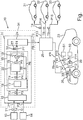
- FIG. a schematic illustration of an embodiment of a device for deriving a driving strategy for a self-driving vehicle
- the figure shows a schematic illustration of an embodiment of a device 10.
- the device 10 may be a computing unit 11.
- the computing unit 11 comprises a first electronic unit 12 which may comprise an NIC (network interface controller) to receive real life data T1 of at least one specific traffic situation collected from, e.g., police records 13 for accidents, which is shown by a transmission path P1.
- the first electronic unit 12 may further receive schooling data T2 of the at least one specific traffic situation collected from driving schools records 14, which is shown by a transmission path P2.
- the first electronic unit 12 may further comprise a storage unit, for example, a hard disk to store the collected real life data T1 and the schooling data T2 of the at least one specific traffic situation.
- the first electronic unit 12 may prepare a list T3 of the collected real life data T1 and the schooling data T2.
- the list T3 can comprise of operating and boundary conditions, such as the velocity of a vehicle, road conditions, weather conditions, traffic density.
- the list T3 comprising of the aforementioned operating and boundary conditions of each of the data of the real life data T1 and the schooling data T2 may be sent to a second electronic unit 15 of the computing unit 11.
- the list T3 can be sent to the second electronic control unit 15, as shown by a transmission path P3, by means of wireless systems, e.g., cellular, WiFi, Bluetooth, RF, NFC and/or wired systems, e.g., Ethernet and/or vehicle bus connections.
- the second electronic unit 15 may comprise of a first processor unit 16 comprising, e.g., a set of GPUs, CPUs, microprocessor, TPUs.
- the first processor unit 16 comprises of a computer code consisting of a mathematical model 17.
- the first processor unit receives the list T3 and sends a first set of operating and boundary conditions to the mathematical model 17.
- the first processor unit simulates the mathematical model 17 and generates a description data T4.
- the description data T4 generated by the mathematical model 17 describes a map of a surrounding of a self-driving vehicle 23 equivalent to a map generated by means of a sensor data fusion of sensors S1, S2 of the self-driving vehicle 23.
- the description data T4 can be sent to a second processor unit 19 of the second electronic unit 15 wirelessly and/or wired, shown by a transmission path P4.
- the second processor unit 19 comprises of a computer code consisting of an artificial neural network 20.
- a reinforcement learning is applied to train the artificial neural network 20 based on description data T4 of the at least one specific traffic situation.
- the description data T4 is generated by numerical simulations of the respective traffic situations by means of the mathematical model 17, wherein the description data T4 is fed to the artificial neural network 20.
- the reinforcement learning is applied as the artificial neural network 20 has passed through the numerically simulated specific traffic situation and a tentative driving strategy T5 is generated.
- the tentative driving strategy T5 is sent to a decision module 21, shown by a transmission path P5.
- the decision module 21 comprises of a predefined driving evaluation criterion 22.
- the predefined driving evaluation criterion 22 may comprise a criterion according to which no damage to the self-driving vehicle 23 at the at least one specific traffic situation takes place.
- the decision module 21 sends a repeat signal T6 to the first processor unit 16, which is shown by a transmission path P6.
- the first processor unit 16 upon receiving the repeat signal T6 in turn sends the description data T4 at the next point of time and further more to the artificial neural network 20.
- the artificial neural network 20 is confronted with the at least one specific traffic situation each time and derives a tentative driving strategy T5 in reaction to the respective at least one specific traffic situation.
- the reinforcement learning is applied each time the artificial neural network 20 has passed through the numerically simulated specific traffic situation on the basis of the tentative driving strategy T5 until the tentative driving strategy T5 is a successful driving strategy according to a predefined driving evaluation criterion 22. Hence, an iterative process is conducted until the tentative driving strategy T5 is a successful driving strategy T7 according to a predefined evaluation criterion.
- a strategy data file T8 comprising the successful driving strategy T7 and the corresponding description data T4 of the at least one specific traffic situation according to the list T3 is sent to a third electronic unit 24, shown by a transmission path P7.
- the third electronic unit 24 can comprise can comprise a storage unit to store the successful driving strategy T7.
- the at least one specific traffic situation can comprise at least one situation that at a point of time, there is no obstacle in front of the self-driving vehicle 23 and/or in a field of view of the self-driving vehicle 23, but at a next point of time, an obstacle appears in front of the self-driving vehicle which leads to a collision of the self-driving vehicle 23 with an obstacle and/or cause damage to the self-driving vehicle 23.
- One specific traffic situation can be, for example, a traffic situation on a street crossing at an urban location (not shown in figure) where two nearly orthogonal streets cross at the street crossing, wherein the both the streets comprise of buildings and/or shops along the sideways.
- the self-driving vehicle cannot view the other orthogonally crossing street apart from the part at the street crossing.
- a traffic signal of the street corresponding to the self-driving vehicle 23 is drive on
- a traffic signal of the street orthogonal to that of the self-driving vehicle 23 is to stop.
- another vehicle on the orthogonal street ignores the stop sign and drives through the street crossing, then in this case there as possibility of a collision between the self-driving vehicle 23 and the other vehicle.
- Such specific traffic situations can be simulated numerically and successful driving strategy T7 can be derived for the self-driving vehicle 23.
- the self-driving vehicle 23 be made to drive at a lower speed near the street crossing at an urban location, where the probability of such specific traffic situations can be high. This enables an application of power brakes on the self-driving vehicle 23 and a collision with the other vehicle can be avoided.
- the method of feeding the artificial intelligence neural network 20 with another description data T4 of the at least one specific traffic situation according to the list T3 is repeated until a corresponding successful driving strategy T7 to that particular description data T4 is achieved. Then a corresponding strategy data file T8 is send to the third electronic control unit 24. The method is repeated till all entries of the description data T4 from the list T3 are solved, that is a successful strategy T7 to each of the all the entries of the description data T4 from the list T3 are obtained.
- the numerical simulation of the at least one specific traffic situation and the feeding of the generated description data T4 by the numerical simulation to the artificial neural network 20 takes place outside the self-driving vehicle 23, such as a laboratory 34.
- a network data file T9 comprising of all the entries of the successful driving strategy T7 is generated.
- the generated network data file T9 can be sent to a backend server unit 25, e.g., a computing unit or a cloud, by means of a wireless connection, shown by a transmission path P8.
- the backend server unit 25 can send the network data file T9 to an electronic control unit 26 of the self-driving vehicle 23 wirelessly, shown by a transmission path P9.
- the self-driving vehicle 23 comprises of two sensors S1, S2, such as a CCD sensor S1 and an LIDAR sensor S2.
- the CCD sensor S1 can send a first sensor signal T10 comprising of information in the form of color and/or infrared pixels of a camera image of the proximal physical environment of the self-driven vehicle 23 to a processor unit 27, as shown by a transmission path P10.
- the LIDAR sensor 18 can send a second sensor data T11 to the processor unit 27, as shown by a transmission path P11.
- the information of the surroundings of the self-driven vehicle 23 is in the form of 3D representations of the surroundings.
- the processor unit 27 can comprise a computer program 28 which is designed to perform a sensor fusion of the first sensor data T10 and the second sensor data T11.
- a sensor fusion data T12 is generated.
- the sensor fusion data T12 comprises of information about the map of the surroundings of the self-driving vehicle at that point of time.
- the sensor fusion data T12 is sent to the electronic control unit 26, as shown by a transmission path P12.
- the electronic control unit 26 comprises a processing device 29 that is designed to operate an artificial neural network 30 that is configured to recognize at least one specific traffic situation by means of the sensor fusion data T12.
- the least one specific traffic situation by means of the sensor fusion data T12 can be compared to the network data file T9 by means of a pattern recognition algorithm.
- the map of the physical surroundings of the self-driving vehicle 23 is compared to a virtual map of the description data T4 contained in the network data file T9 by means of the pattern recognition algorithm. Once a match is found, that is comparison fulfills a predefined matching criterion, then at least one specific traffic situation is recognized.
- a corresponding successful driving strategy T7 according to the predefined criterion 22 is selected, i.e., a corresponding successful driving strategy T7 corresponding to that particular description data T4 from the network data file T9 is selected.
- a successful driving strategy T7 can be derived by the artificial neural network 30 of the self-driving vehicle 23 to the traffic situation according to the sensor fusion data T12.
- the backend server 25 sends the network data file T9 wirelessly to other artificial neural networks that are used in the self-driving vehicle 23 and other self-driving vehicles 31, 32 and 33, shown by transmission paths P13, P14 and P15 respectively.
- the trained artificial neural network 20 is used as a prototype for other artificial neural networks 30 that are used in the self-driving vehicle 23 and at one other self-driving vehicle 31, 32 and 33.
- the example shows how the derivation of a driving strategy for a self-driving vehicle for certain specific traffic situations can be obtained.
Landscapes
- Engineering & Computer Science (AREA)
- Physics & Mathematics (AREA)
- Theoretical Computer Science (AREA)
- Evolutionary Computation (AREA)
- Health & Medical Sciences (AREA)
- Artificial Intelligence (AREA)
- General Physics & Mathematics (AREA)
- Computing Systems (AREA)
- Software Systems (AREA)
- Computational Linguistics (AREA)
- General Health & Medical Sciences (AREA)
- Molecular Biology (AREA)
- Biophysics (AREA)
- General Engineering & Computer Science (AREA)
- Biomedical Technology (AREA)
- Mathematical Physics (AREA)
- Data Mining & Analysis (AREA)
- Life Sciences & Earth Sciences (AREA)
- Business, Economics & Management (AREA)
- Game Theory and Decision Science (AREA)
- Medical Informatics (AREA)
- Aviation & Aerospace Engineering (AREA)
- Radar, Positioning & Navigation (AREA)
- Remote Sensing (AREA)
- Automation & Control Theory (AREA)
- Traffic Control Systems (AREA)
Priority Applications (1)
| Application Number | Priority Date | Filing Date | Title |
|---|---|---|---|
| EP18192474.7A EP3620880A1 (de) | 2018-09-04 | 2018-09-04 | Verfahren und vorrichtung zum ableiten einer fahrstrategie für ein selbstfahrendes fahrzeug und eine elektronische steuereinheit zum ausführen der fahrstrategie und ein selbstfahrendes fahrzeug mit der elektronischen steuereinheit |
Applications Claiming Priority (1)
| Application Number | Priority Date | Filing Date | Title |
|---|---|---|---|
| EP18192474.7A EP3620880A1 (de) | 2018-09-04 | 2018-09-04 | Verfahren und vorrichtung zum ableiten einer fahrstrategie für ein selbstfahrendes fahrzeug und eine elektronische steuereinheit zum ausführen der fahrstrategie und ein selbstfahrendes fahrzeug mit der elektronischen steuereinheit |
Publications (1)
| Publication Number | Publication Date |
|---|---|
| EP3620880A1 true EP3620880A1 (de) | 2020-03-11 |
Family
ID=63491500
Family Applications (1)
| Application Number | Title | Priority Date | Filing Date |
|---|---|---|---|
| EP18192474.7A Withdrawn EP3620880A1 (de) | 2018-09-04 | 2018-09-04 | Verfahren und vorrichtung zum ableiten einer fahrstrategie für ein selbstfahrendes fahrzeug und eine elektronische steuereinheit zum ausführen der fahrstrategie und ein selbstfahrendes fahrzeug mit der elektronischen steuereinheit |
Country Status (1)
| Country | Link |
|---|---|
| EP (1) | EP3620880A1 (de) |
Cited By (9)
| Publication number | Priority date | Publication date | Assignee | Title |
|---|---|---|---|---|
| CN112859849A (zh) * | 2021-01-06 | 2021-05-28 | 北京三快在线科技有限公司 | 自动行驶设备的路口运动规划方法、装置、电子设备 |
| CN112925331A (zh) * | 2021-05-10 | 2021-06-08 | 北京三快在线科技有限公司 | 一种无人设备控制方法、装置、存储介质及电子设备 |
| US11080602B1 (en) | 2020-06-27 | 2021-08-03 | Sas Institute Inc. | Universal attention-based reinforcement learning model for control systems |
| CN113359759A (zh) * | 2021-06-24 | 2021-09-07 | 中国第一汽车股份有限公司 | 基于自动驾驶的泊车控制方法、系统、车辆及存储介质 |
| GB2598802A (en) * | 2020-08-24 | 2022-03-16 | Motional Ad Llc | Driving scenario sampling for training/tuning machine learning models for vehicles |
| CN114285751A (zh) * | 2021-12-07 | 2022-04-05 | 中国科学院计算技术研究所 | 一种流量工程方法及系统 |
| WO2022138352A1 (ja) * | 2020-12-23 | 2022-06-30 | 株式会社明電舎 | 自動操縦ロボットの制御装置及び制御方法 |
| CN116128013A (zh) * | 2023-04-07 | 2023-05-16 | 中国人民解放军国防科技大学 | 基于多样性种群训练的临机协同方法、装置和计算机设备 |
| CN117334060A (zh) * | 2023-09-14 | 2024-01-02 | 航天科工广信智能技术有限公司 | 基于重要性采样的策略梯度双交叉口交通信号控制方法 |
Citations (4)
| Publication number | Priority date | Publication date | Assignee | Title |
|---|---|---|---|---|
| DE102016000493A1 (de) * | 2016-01-19 | 2017-07-20 | Audi Ag | Verfahren zum Betrieb eines Fahrzeugsystems und Kraftfahrzeug |
| US20180075309A1 (en) | 2016-09-14 | 2018-03-15 | Nauto, Inc. | Systems and methods for near-crash determination |
| CN107862346A (zh) * | 2017-12-01 | 2018-03-30 | 驭势科技(北京)有限公司 | 一种进行驾驶策略模型训练的方法与设备 |
| CN108333959A (zh) * | 2018-03-09 | 2018-07-27 | 清华大学 | 一种基于卷积神经网络模型的机车节能操纵方法 |
-
2018
- 2018-09-04 EP EP18192474.7A patent/EP3620880A1/de not_active Withdrawn
Patent Citations (4)
| Publication number | Priority date | Publication date | Assignee | Title |
|---|---|---|---|---|
| DE102016000493A1 (de) * | 2016-01-19 | 2017-07-20 | Audi Ag | Verfahren zum Betrieb eines Fahrzeugsystems und Kraftfahrzeug |
| US20180075309A1 (en) | 2016-09-14 | 2018-03-15 | Nauto, Inc. | Systems and methods for near-crash determination |
| CN107862346A (zh) * | 2017-12-01 | 2018-03-30 | 驭势科技(北京)有限公司 | 一种进行驾驶策略模型训练的方法与设备 |
| CN108333959A (zh) * | 2018-03-09 | 2018-07-27 | 清华大学 | 一种基于卷积神经网络模型的机车节能操纵方法 |
Cited By (14)
| Publication number | Priority date | Publication date | Assignee | Title |
|---|---|---|---|---|
| US11080602B1 (en) | 2020-06-27 | 2021-08-03 | Sas Institute Inc. | Universal attention-based reinforcement learning model for control systems |
| GB2598802B (en) * | 2020-08-24 | 2023-08-02 | Motional Ad Llc | Driving scenario sampling for training/tuning machine learning models for vehicles |
| GB2598802A (en) * | 2020-08-24 | 2022-03-16 | Motional Ad Llc | Driving scenario sampling for training/tuning machine learning models for vehicles |
| US11364927B2 (en) | 2020-08-24 | 2022-06-21 | Motional Ad Llc | Driving scenario sampling for training/tuning machine learning models for vehicles |
| US11938957B2 (en) | 2020-08-24 | 2024-03-26 | Motional Ad Llc | Driving scenario sampling for training/tuning machine learning models for vehicles |
| WO2022138352A1 (ja) * | 2020-12-23 | 2022-06-30 | 株式会社明電舎 | 自動操縦ロボットの制御装置及び制御方法 |
| CN112859849A (zh) * | 2021-01-06 | 2021-05-28 | 北京三快在线科技有限公司 | 自动行驶设备的路口运动规划方法、装置、电子设备 |
| CN112925331A (zh) * | 2021-05-10 | 2021-06-08 | 北京三快在线科技有限公司 | 一种无人设备控制方法、装置、存储介质及电子设备 |
| CN112925331B (zh) * | 2021-05-10 | 2021-09-24 | 北京三快在线科技有限公司 | 一种无人设备控制方法、装置、存储介质及电子设备 |
| CN113359759A (zh) * | 2021-06-24 | 2021-09-07 | 中国第一汽车股份有限公司 | 基于自动驾驶的泊车控制方法、系统、车辆及存储介质 |
| CN114285751A (zh) * | 2021-12-07 | 2022-04-05 | 中国科学院计算技术研究所 | 一种流量工程方法及系统 |
| CN116128013B (zh) * | 2023-04-07 | 2023-07-04 | 中国人民解放军国防科技大学 | 基于多样性种群训练的临机协同方法、装置和计算机设备 |
| CN116128013A (zh) * | 2023-04-07 | 2023-05-16 | 中国人民解放军国防科技大学 | 基于多样性种群训练的临机协同方法、装置和计算机设备 |
| CN117334060A (zh) * | 2023-09-14 | 2024-01-02 | 航天科工广信智能技术有限公司 | 基于重要性采样的策略梯度双交叉口交通信号控制方法 |
Similar Documents
| Publication | Publication Date | Title |
|---|---|---|
| EP3620880A1 (de) | Verfahren und vorrichtung zum ableiten einer fahrstrategie für ein selbstfahrendes fahrzeug und eine elektronische steuereinheit zum ausführen der fahrstrategie und ein selbstfahrendes fahrzeug mit der elektronischen steuereinheit | |
| US10636295B1 (en) | Method and device for creating traffic scenario with domain adaptation on virtual driving environment for testing, validating, and training autonomous vehicle | |
| US11562490B2 (en) | Systems and methods for video object segmentation | |
| US12223734B2 (en) | Systems and methods for training machine-learned models with deviating intermediate representations | |
| US12037025B2 (en) | Systems and methods for motion forecasting and planning for autonomous vehicles | |
| US10713148B2 (en) | Using divergence to conduct log-based simulations | |
| CN112307978B (zh) | 目标检测方法、装置、电子设备及可读存储介质 | |
| US11385991B1 (en) | Collision evaluation for log-based simulations | |
| US20200134494A1 (en) | Systems and Methods for Generating Artificial Scenarios for an Autonomous Vehicle | |
| CN112163446B (zh) | 一种障碍物检测方法、装置、电子设备及存储介质 | |
| CN112069279B (zh) | 地图数据更新方法、装置、设备及可读存储介质 | |
| CN109461342B (zh) | 一种用于无人驾驶机动车的教学系统及其教学方法 | |
| Jisha et al. | An android application for school bus tracking and student monitoring system | |
| GB2562049A (en) | Improved pedestrian prediction by using enhanced map data in automated vehicles | |
| WO2022072764A1 (en) | Metrics for evaluating autonomous vehicle performance | |
| De Borba et al. | Increasing safety of automated driving by infrastructure-based sensors | |
| Alahmed et al. | Enhancing safety in autonomous vehicles through advanced AI-driven perception and decision-making systems | |
| Sharma et al. | Applications of blockchain in automated heavy vehicles: Yesterday, today, and tomorrow | |
| Achenef et al. | Latest breakthroughs, research results, and challenges in intelligent control of autonomous vehicles | |
| CN114987512A (zh) | 收集交通工具的传感器数据 | |
| Norouzi et al. | Applications of pre-trained CNN models and data fusion techniques in Unity3D for connected vehicles: M. Norouzi et al. | |
| Yu et al. | V2X Fusion Communication Framework Based on VANETS Collaborative Autonomous Driving | |
| Agarkar et al. | Simulation Based Closed Loop Scenario Fuzzing for Safety Critical ADAS Applications | |
| Thapa et al. | A survey of reference architectures for autonomous cars | |
| AlKishri et al. | Object recognition for organizing the movement of self-driving car |
Legal Events
| Date | Code | Title | Description |
|---|---|---|---|
| PUAI | Public reference made under article 153(3) epc to a published international application that has entered the european phase |
Free format text: ORIGINAL CODE: 0009012 |
|
| STAA | Information on the status of an ep patent application or granted ep patent |
Free format text: STATUS: THE APPLICATION HAS BEEN PUBLISHED |
|
| AK | Designated contracting states |
Kind code of ref document: A1 Designated state(s): AL AT BE BG CH CY CZ DE DK EE ES FI FR GB GR HR HU IE IS IT LI LT LU LV MC MK MT NL NO PL PT RO RS SE SI SK SM TR |
|
| AX | Request for extension of the european patent |
Extension state: BA ME |
|
| RAP1 | Party data changed (applicant data changed or rights of an application transferred) |
Owner name: ARGO AI GMBH |
|
| STAA | Information on the status of an ep patent application or granted ep patent |
Free format text: STATUS: THE APPLICATION IS DEEMED TO BE WITHDRAWN |
|
| 18D | Application deemed to be withdrawn |
Effective date: 20200912 |