EP3620928B1 - Vorrichtung und verfahren zur anlayse des verhaltens eines anwendungsbausteins, der einer ressourcenverknappung ausgesetzt ist - Google Patents
Vorrichtung und verfahren zur anlayse des verhaltens eines anwendungsbausteins, der einer ressourcenverknappung ausgesetzt ist Download PDFInfo
- Publication number
- EP3620928B1 EP3620928B1 EP19306076.1A EP19306076A EP3620928B1 EP 3620928 B1 EP3620928 B1 EP 3620928B1 EP 19306076 A EP19306076 A EP 19306076A EP 3620928 B1 EP3620928 B1 EP 3620928B1
- Authority
- EP
- European Patent Office
- Prior art keywords
- application
- resource
- resources
- application component
- failure
- Prior art date
- Legal status (The legal status is an assumption and is not a legal conclusion. Google has not performed a legal analysis and makes no representation as to the accuracy of the status listed.)
- Active
Links
Images




Classifications
-
- G—PHYSICS
- G06—COMPUTING OR CALCULATING; COUNTING
- G06F—ELECTRIC DIGITAL DATA PROCESSING
- G06F11/00—Error detection; Error correction; Monitoring
- G06F11/30—Monitoring
- G06F11/34—Recording or statistical evaluation of computer activity, e.g. of down time, of input/output operation ; Recording or statistical evaluation of user activity, e.g. usability assessment
- G06F11/3409—Recording or statistical evaluation of computer activity, e.g. of down time, of input/output operation ; Recording or statistical evaluation of user activity, e.g. usability assessment for performance assessment
- G06F11/3433—Recording or statistical evaluation of computer activity, e.g. of down time, of input/output operation ; Recording or statistical evaluation of user activity, e.g. usability assessment for performance assessment for load management
-
- G—PHYSICS
- G06—COMPUTING OR CALCULATING; COUNTING
- G06F—ELECTRIC DIGITAL DATA PROCESSING
- G06F11/00—Error detection; Error correction; Monitoring
- G06F11/07—Responding to the occurrence of a fault, e.g. fault tolerance
- G06F11/0703—Error or fault processing not based on redundancy, i.e. by taking additional measures to deal with the error or fault not making use of redundancy in operation, in hardware, or in data representation
- G06F11/079—Root cause analysis, i.e. error or fault diagnosis
-
- G—PHYSICS
- G06—COMPUTING OR CALCULATING; COUNTING
- G06F—ELECTRIC DIGITAL DATA PROCESSING
- G06F2201/00—Indexing scheme relating to error detection, to error correction, and to monitoring
- G06F2201/865—Monitoring of software
Definitions
- the present invention relates to the field of monitoring the performance of IT infrastructures and particularly that of application resilience. More particularly, the invention relates to a device and a method for analyzing an application brick subject to a scarcity of resources in order to improve its resilience.
- IS information system
- resilience of an application or application chain is its ability to provide the best possible service despite the occurrence of a problem in one of its components. Resilience becomes increasingly important as companies continue to implement applications whose continued operation is critical to them and for which service interruption is not an option. Thus, resilience is a very broad term that includes fault tolerance, high availability, and the ability to recover from a failure. High resilience helps reduce the negative consequences of failures.
- EP3106989 describes a solution that simulates resource scarcity by applying a parasitic load.
- the application is subjected to indiscriminate scarcity of all resources without considering critical resources.
- IT administrators will increase the available resources, possibly based on load testing. consisting of a simulation of the increase in application load.
- load testing consisting of a simulation of the increase in application load.
- IT administrators generally evolve their IT infrastructure in order to always offer efficient business application services adapted to the demands of their organization.
- a resilient application will be able, despite the loss of a portion of the available resources, to continue to operate while ensuring desired service levels or to operate in a degraded mode where only critical services are maintained at acceptable service levels.
- the invention therefore aims to remedy the drawbacks of the prior art.
- the invention aims to propose a device for analyzing the behavior of an application brick subject to a scarcity of resources, said device making it possible to monitor the behavior of the application brick and to diagnose the nature and/or source of a possible failure caused by the scarcity of resources.
- this device can in particular be used to improve the resilience of an application brick in the face of a scarcity of resources.
- the invention also aims to propose a method for analyzing the behavior of an application brick subject to a scarcity of resources, said method being able, according to one embodiment, to make applications more resilient in the face of saturation of available resources.
- the invention relates to a device for analyzing the behavior of an application brick subject to a scarcity of resources in an IT infrastructure according to claim 1.
- Such a device can be used to simulate the saturation of one or more resources and to analyze the behavior of applications using these resources in order to make them more resilient to the various saturations that may occur in production. Indeed, for each critical resource, it is possible to use the resource scarcity module to gradually simulate the scarcity of the resource while maintaining the load level of the application (i.e. application brick) to be qualified.
- the scarcity of the resource is preferably progressive until it causes a failure of the application, then the application performance management module makes it possible to determine the source and/or the nature of the failure.
- the device according to the invention can provide an IS administrator with the source and the nature of the failures of the brick application following a resource shortage. This will allow the IT administrator to take appropriate corrective measures.
- the resilient application brick will then be able to continue to operate while ensuring desired service levels despite the loss of some of the available resources, or to operate in a degraded mode where only critical services are maintained at acceptable service levels.
- the device according to the invention can be used to repeat the simulation in order to validate that the adaptations allow the application brick to be resilient to the scarcity of the resource. If this is the case, the device can be used to continue the scarcity of said resource to validate the resilience of the application brick beyond the failure point found previously or to test the resilience of the application brick on another type of resource.
- the invention further relates to a method for analyzing the behavior of an application brick subject to a scarcity of resources in an IT infrastructure according to claim 10.
- the method according to the invention makes it possible, in an automated manner, to make an application brick more resilient in the face of saturation of available resources.
- it may include a step of selecting at least one corrective action instruction if a failure is identified and a step of applying the identified corrective action.
- the process will be able to automatically determine the origin of a failure and possibly include a step of applying an identified corrective action.
- each block in the flowcharts or block diagrams may represent a system, device, module, or portion of instructions, which includes one or more executable instructions for implementing the specified logical function(s).
- the functions associated with the blocks may appear in a different order than shown in the figures. For example, two blocks shown in succession may, in fact, be executed substantially simultaneously, or the blocks may sometimes be executed in reverse order, depending on the functionality involved.
- Each block of the block diagrams and/or flowchart, and combinations of blocks in the block diagrams and/or flowchart may be implemented by special hardware systems that perform the specified functions or acts or carry out combinations of special hardware and computer instructions.
- behavior of an application brick means the execution conditions of the application brick such as the execution of the processes involved, internal or external transactions, or even the performance of the application brick with respect to users.
- the term "resilience" within the meaning of the invention corresponds to the capacity of an application brick to offer the expected service despite the occurrence of a malfunction in the IT infrastructure hosting it or a failure in one of its components.
- IT infrastructure means a set of IT structures (i.e. IT devices) capable of operating an application or an application chain.
- the IT structure may be one or more servers, for example composed of a presentation server, a business server and a data server.
- the IT infrastructure may also be a "test" server with the same resources as a production server or a clone of a virtual production server.
- an IT structure is a server.
- application chain within the meaning of the invention corresponds to a set of applications, linked together by a flow of information and aiming to offer, through several processes, one or more functionalities which may be the subject of a service level agreement (SLA for "Service-level agreement”).
- SLA Service-level agreement
- application brick within the meaning of the invention corresponds to a component of an application.
- the combination of application bricks is often necessary for the operation of applications, in particular business applications, such as for example a Web application, a content sharing platform or a computing platform.
- the application building blocks of the IT infrastructure include, for example, an FTP server, an email server, a Java application server and/or one or more databases.
- probe or "computer probe” means software associated with equipment which makes it possible to carry out, manage and send back to computer equipment measurements intended to provide information, among other things, on the values of quality of service parameters, the operating status of resources or the use of resources.
- predetermined load plan means a configuration file for the load or constraint to be applied to an IT infrastructure.
- the configuration file may, for example, be a file, or a set of files, that allows several data or fields to be associated. This association of fields is also called a load record.
- Such a load configuration file is, for example, an XML file, a CSV file, an INI file, a JSON file, etc.
- a load configuration file may include one or more load records. It may be generated from information provided by a user.
- Resources means hardware resources such as parameters, capabilities or functions of computing devices enabling the operation of an application brick or an application.
- a single computing device is generally associated with several resources.
- a single resource is generally shared between several application bricks.
- the term “resource” may include physical or virtual resources such as network disks characterized for example by their inputs/outputs (I/O), reading/writing on disks, the memory usage rate, a network characterized by its bandwidth, a processor characterized for example by its use (as a percentage) or the occupancy rate of its caches, a RAM characterized by the allocated quantity, or more generally the latency time of a process or packet losses.
- Resource usage means the consumption of a resource, for example by a business application made up of one or more application bricks that monopolize at least part of the resources.
- critical resource within the meaning of the invention corresponds to the resource(s) whose use under nominal (i.e. usual) conditions is closest to its limit use (predetermined maximum use threshold) or its saturation.
- the scarcity of a critical resource means that the execution conditions of the application brick are not respected (e.g. resource consumption threshold not respected or processing times not respected). For example, in an IT infrastructure comprising a CPU and 8Gb of RAM where under usual conditions there is consumption of 80% of CPU and 2 Gb of RAM then the critical resource will be the CPU resource.
- level of a resource or “resource levels” means a quantity of resource. For example, this may correspond, for network disks, to the number of available network disks or the quantity of memory available on these network disks, for a processor, to the number of cores or the number of processors or the size of the caches, for RAM, to the available quantity, and for ports, to the number of ports that can be opened simultaneously.
- the initial level of a resource corresponds to the quantity of resource available on the IT infrastructure for the application chain(s).
- the "step of a resource” may be, on the one hand, the minimum quantity of resource that can be added or subtracted during a modification step and, on the other hand, a multiple of the modification that can be undergone by the level of said resource.
- Some resources have a high granularity (e.g., servers) while others have a low granularity (e.g., available RAM).
- the term "resource utilization level” means a value representative of the consumption or occupation of said resource during the operation of an application chain.
- the utilization value may correspond, for network disks, to their inputs/outputs, reading/writing on disks, the memory utilization rate, for a network to its bandwidth, for processors to their use (in percent) or to the cache occupancy rate, for RAM the quantity used and for ports, the number of ports having been opened simultaneously during the operation of the method.
- the utilization value is advantageously reduced to the percentage of the resource level.
- predetermined maximum usage threshold is meant, within the meaning of the invention, a maximum parameter value associated with each resource allowing a proper functioning of said resource. For example, this corresponds to the maximum acceptable limits of resource consumption for an IT infrastructure hosting one or more application bricks. These limits can be real or hypothetical and generally correspond to a level of use beyond which malfunctions can occur and result in a shutdown of the resource, the IT infrastructure or at the very least a drop in quality of service.
- Table 1 shows the predetermined maximum usage thresholds for three resources.
- Table 1 CPU1 Network usage Disk Usage Predetermined maximum usage threshold 80% 350 KBps 60 o/s
- malware within the meaning of the invention corresponds to the occurrence of a hardware incident or congestion on the IT structure hosting an application brick.
- failure within the meaning of the invention corresponds to a reduction in the quality of service of the application brick of various natures and/or sources which may, for example, arise from a design or configuration problem.
- level of service or “quality of service” within the meaning of the invention corresponds to an assessment of the quality of the service provided by an application brick or an application chain. A third party can commit to a level of service and thus guarantee good performance for the critical applications of an organization.
- quality of service parameter within the meaning of the invention corresponds to subjective or objective criteria such as latency times of a process, packet losses, throughputs, resource utilization values and response times per request. There are generally a plurality of quality of service parameters. In particular, there may be a different threshold response time for each of the different requests or an overall response time.
- degraded mode within the meaning of the invention corresponds to an operation of the application brick where only part of the services are maintained.
- predetermined quality of service parameter threshold corresponds to a parameter value to which a third party can commit in order to guarantee good performance for the critical applications of an organization and as may be defined in a service level agreement (SLA).
- SLA service level agreement
- a threshold may be of the type: all response times are less than 3 seconds.
- it may be advantageous to have detailed thresholds depending on the business actions. For example, a request implementing a file printing may have a higher response time threshold than a request involving the display of a web page.
- the predetermined thresholds for quality of service parameters may also include predetermined maximum usage thresholds.
- a critical resource may be a resource for which a reduction in its resource level or an exceeding of the predetermined maximum usage threshold would have a significant impact on one or more application brick service levels.
- “exceeding” means exceeding or lowering 10%, preferably 20%, of the values predetermined by the measured values.
- process means an action performed by a device or processor unless the context indicates otherwise.
- operations refer to actions and/or processes of a data processing system, for example a computer system or an electronic computing device, which manipulates and transforms data represented as physical (electronic) quantities in the memories of the computer system or other devices for storing, transmitting or displaying information. These operations may be based on applications or software.
- program code means any expression, code or notation, of a set of instructions intended to cause data processing to perform a particular function directly or indirectly (e.g. after a conversion operation to other code).
- program code may include, but are not limited to, a subroutine, a function, an executable application, source code, object code, a library and/or any other sequence of instructions designed for execution on a computer system.
- processor means at least one hardware circuit configured to execute operations according to instructions contained in a code.
- the hardware circuit may be an integrated circuit. Examples of a processor include, but not limited to, a central processing unit, a graphics processor, an application-specific integrated circuit (ASIC), and a programmable logic circuit.
- ASIC application-specific integrated circuit
- Coupled means connected, directly or indirectly, with one or more intermediate elements. Two elements may be coupled mechanically, electrically, or linked by a communication channel.
- human-machine interface within the meaning of the invention corresponds to any element allowing a human being to communicate with a computer in particular and without this list being exhaustive, a keyboard and means allowing in response to orders entered on the keyboard to carry out displays and possibly to select using the mouse or a touchpad elements displayed on the screen.
- a touch screen allowing to directly select on the screen the elements touched by the finger or an object and possibly with the possibility of displaying a virtual keyboard.
- Figures 1A and 1B illustrate the consumption of resources, here the CPU occupancy rate, as a function of time, by application bricks (B1, B2) hosted on the same IT infrastructure.
- Figure 1A presents the CPU consumption of the application bricks as a function of time and as a function of the maximum capacity of the IT structure on which they are currently hosted.
- FIG. 1B presents the cumulative CPU consumption over time on IT infrastructure 1 of application bricks B1 and B2.
- Figure 1B shows that although consumption is controlled in the first period, there is a little later, about five months later, an excess over a period p of a predetermined maximum usage threshold (dotted line). Such an excess leads to a risk of failure on one or other of these application bricks.
- a classic method of securing the operation of application brick B1 or brick B2 could be to further increase the quantity of resources available for the application bricks according to increase predictions needs.
- a failure associated with saturation (i.e. scarcity) of a critical resource can occur even if a resource margin has been planned.
- the inventors have developed a new device 1 for analyzing the behavior of an application brick 2 subject to a scarcity of resources in an IT infrastructure 4.
- This device advantageously makes it possible to study the behavior of an application brick facing a scarcity of resources. For example, it can be used to determine the behavior of an application brick facing a loss of more than 10, 20, 30 or 40% of available RAM, check whether the application brick continues to function and, if so, determine the nature of the failure.
- This device can also be used to increase the resilience of an application brick.
- An application brick whose resilience has been increased will, for example, be able to continue to operate despite a reduction in availability of more than 10, 20, 30 or 40% of one or more resources used.
- an application brick whose resilience has been increased will be able to keep its main (i.e. essential) functions operational despite a significant reduction in available resources.
- the IS administrator will know, in the event of a malfunction or peak load, what is the level of reduction of available resources that the application bricks can support, whether or not there has been an improvement in resilience to resource saturation.
- the use of the device according to the invention can allow him to modify the application brick and/or its environment so as to increase its resilience to resource reductions.
- the device according to the invention is also a tool allowing the IS administrator to determine which modification will ensure high availability of the application brick studied.
- FIG. 2 schematically illustrates a non-limiting functional representation of a device 1 for analyzing the behavior of an application brick 2 subject to a scarcity of resources in an IT infrastructure 4.
- the IT infrastructure 4 may comprise one or more IT structures 3 (e.g. server, machine, virtual machine) and the application brick(s) 2 may call upon one or more IT structures 3.
- the IT infrastructure 4 preferably designates a pre-production architecture having a similar configuration or identical to a production architecture and can, for example, take the form of a virtual machine.
- the device 1 comprises a storage module 10, a resource scarcity module 20, an injection module 30, a metrics collection module 40, a failure detection module 50, and an application performance management module 60.
- the device 1 can also be configured (e.g. via dedicated software) to implement the behavior analysis method according to the invention.
- a storage module 10 is capable of, preferably configured to, store a plurality of repositories.
- the storage module 10 may comprise any computer-readable medium known in the art including, for example, volatile memory, such as static random access memory (SRAM) and dynamic random access memory (DRAM), and/or non-volatile memory, such as read-only memory, flash memories, hard disks, optical disks, and magnetic tapes.
- volatile memory such as static random access memory (SRAM) and dynamic random access memory (DRAM)
- non-volatile memory such as read-only memory, flash memories, hard disks, optical disks, and magnetic tapes.
- the storage module 10 may comprise a plurality of instructions or modules or applications for performing various functionalities.
- the storage module 10 may implement routines, programs, or matrix-type data structures.
- the storage module 10 may comprise a medium readable by a computer system in the form of volatile memory, such as random access memory (RAM) and/or cache memory.
- RAM random access memory
- cache memory can, for example, be
- the storage module 10 is in particular configured to store a resource repository 11 configured to store identification data of critical resources used by the application brick.
- the resource repository 11 may for example be configured to store identification data of the different virtual machines or partitions supporting the application brick(s) studied.
- the critical resource may for example be a RAM but many other resources may be considered such as reading/writing a disk, reading/writing a network, or the usage rate of a memory.
- the resource repository 11 may be configured to store the available quantity of critical resources (e.g. CPU number and power, quantity of memory).
- a critical resource can be a resource whose average consumption is greater than 60% or a resource whose consumption has one or more consumption peaks greater than 70% or a resource whose loss of 20% or more availability leads to a failure on the application brick studied.
- the device 1 according to the invention can also be able to identify which resources are important for the operation of the application brick.
- the storage module 10 is also configured to store a repository 12 of execution rules.
- the repository 12 of execution rules is configured to store data corresponding to predetermined quality of service parameter thresholds, beyond which the application brick is considered to be faulty (i.e. malfunctioning).
- the execution rule repository 12 is configured to store several categories of predetermined thresholds of quality of service parameters with, for example, a category corresponding to the service levels beyond which an application brick is considered to provide a degraded but acceptable service and a category corresponding to the service levels beyond which an application brick is considered to be faulty.
- the category can correspond to an indicator of acceptability of the service level with, for example, values of the type: expected operation, acceptable operation, unacceptable operation.
- the predetermined quality of service parameter thresholds comprise at least response time values
- the predetermined quality of service parameter thresholds may also comprise CPU consumption, network or disk usage values.
- Several resources may be measured in parallel as well as several service level indicators may be monitored in parallel.
- the service levels are measured regularly and may correspond for example to a search response time of less than one second.
- the execution rules repository 12 is configured to store data corresponding to predetermined quality of service parameter thresholds beyond which the application brick is considered to be faulty.
- the storage module 10 is also configured to store a rarefaction reference frame 13.
- the rarefaction reference frame 13 is configured to memorize rules for consumption of critical resources that can be used for a progressive scarcity of critical resources.
- this scarcity repository 13 is configured to memorize instructions allowing the consumption and therefore the scarcity of the resources available for the application brick 2. Such consumption of resources can be carried out according to the noise generation method described in the document EP2975526 .
- Critical resources consumed through the implementation of consumption rules may include (but are not limited to) network type, conditions associated with the network, available transmit and/or receive bandwidth, available power/energy, available processor power (e.g. clock speed, number of cores, cache, etc.), and available amount of memory.
- scarcity is generated via resource consumption, the consumed portion of which (i.e. used or occupied) is then no longer available for the application brick whose behavior is being studied.
- the scarcity reference 13 thus makes it possible to define consumption rules for a progressive modification of the scarcity of resources of different virtual machines.
- reference 13 makes it possible to simply define a progressive scarcity of critical resources.
- the duration between each increase step may, for example, be greater than or equal to five minutes or greater than or equal to ten minutes.
- the duration between each increase step is not too long so as to allow a rapid study of the behavior of the application brick.
- the predetermined duration between each increase step is less than two hours.
- the repository 13 may take the form of one or more resource scarcity configuration files or instructions transmitted from a graphical interface or any other communication interface. Indeed, these values may be pre-recorded or entered via an interface when implementing the study of the behavior of the application brick.
- Some critical resource consumption rule data is advantageously entered when implementing the application brick behavior study. This is the case, for example, of the scarcity start date and the identifier of the critical resource to be scarified.
- a resource scarcity configuration file which may be an XML file, a CSV file, an INI file, or a JSON file.
- a configuration file contains one or more configuration records.
- the scarcity configuration file is stored in a database.
- consumption rules can specify an order of the different rarefactions to be performed and a duration during which each rarefaction must be performed.
- the storage module 10 is also capable of, preferably configured to, store an application load reference 14.
- the application load reference 14 is configured to store a predetermined load plan, preferably representative of the operation of the application brick.
- the predetermined load plan is representative of the typical operation, or nominal load, of the application brick 2 to be tested.
- the predetermined load plan can be used to generate constraints on the IT infrastructure. simulating the activity and therefore the use of resources by the application brick 2 to be tested.
- the nominal load corresponds to the current activity on the application or the load usually observed in production for the application brick. This may correspond, for example, to a distribution of different types of scenarios reproducing the main actions of the application brick with, for example, how many scenarios per hour of each type must be played to mimic the operation of the application brick. Indeed, during the method according to the invention, to simulate the operation of the application brick, it is not necessary to reproduce the exhaustiveness of the actions or requests supported by said application brick during its current use. Thus, the set of requests can be limited to the simulation of the main business scenarios in which the application brick is involved.
- the load plan advantageously includes values for the following parameters: the different types of scenario, the weighting of each of these business scenarios (e.g. the relative proportion of some compared to others), and the overall load level (e.g. the target volume or the desired request rate during the process). Equivalently, it can include information on the number of scenarios of each type executed simultaneously, for example for an hour. It can also include information on the IT infrastructure tested.
- the set of queries is generally recorded in a load command file containing the code to be executed.
- Execution of the load command file can produce a number of actions as diverse as creating, consulting, modifying, deleting files or printing, copying and displaying data. These actions will generally be similar to the main business actions supported by the application brick.
- the method according to the invention can also include a step of loading a load command file.
- This application load repository 14 can be configured to store instructions, in the form of a load plan, making it possible to simulate the activity of the application brick 2 studied.
- the load plan configuration file can also include fields relating to the start date of the load, for example an absolute date evaluated relative to an internal clock of the device 1 or a date relative to the start of a test scenario. It can also include the end date of the load or the duration of the load, for example a number of seconds.
- the storage module 10 may be capable of, preferably configured to, store a knowledge repository 15 configured to store predetermined failure data based on execution data.
- the knowledge repository 15 includes data relating to the different sources and natures of application brick failures (i.e. predetermined failure data) which are correlated with execution data. It can therefore be used to generate information on application brick failures based on measured execution data.
- the knowledge repository 15 may include a list of failure nature based on measured execution data.
- the storage module 10 may be capable of, preferably configured to, store a repository 16 of evolution rules.
- the repository 16 of evolution rules is configured to store predetermined failure parameters and corrective action data associated with predetermined failure parameters.
- the repository 16 of evolution rules may be configured to store associations between predetermined failure parameters (e.g. execution data and/or nature of failure) and data relating to at least one corrective action.
- the data relating to at least one corrective action may include reports intended for an administrator or executable instructions allowing modification of the configuration of the IT infrastructure or the application component (e.g. Java Messaging Service - JMS, Java Database Connectivity - JDBC).
- the application component e.g. Java Messaging Service - JMS, Java Database Connectivity - JDBC.
- the evolution rules repository 16 is configured to store corrective actions based on failure data.
- the storage module 10 may be capable of, preferably configured to, store a repository 17 of accessible resources.
- the repository 17 of accessible resources is configured to store data characteristic of accessible resources.
- the data characteristic of accessible resources comprise, for at least one type of resource, quantity data. available of the accessible resource as well as data corresponding to an indicator of the complexity of making the accessible resource available.
- the accessible resources are, for example, unassigned resources that the IS administrator can assign to the IT infrastructure 4 and more particularly to the application brick 2 whose behavior is being studied.
- this repository 17 can correspond to a listing of data on resources that can be added to the IT infrastructure 4 in order to improve the resilience of the application brick 2 being studied.
- This reference may also include data relating to the complexity of integrating said resource.
- the data corresponding to an indicator of evolution complexity is representative of the complexity of evolving (i.e. downwards and/or upwards) the resources of the IT structure(s) 3. For example, depending on the resources, these may be in stock (i.e. low complexity) or already used on another server (i.e. high complexity).
- adding or removing RAM and adding a disk are relatively easy and quick actions, whereas removing a disk is a more delicate operation.
- adding power to a virtual server is very easy.
- the repository 17 of accessible resources also includes data corresponding to a compatibility indicator.
- the compatibility indicator makes it possible to determine on which computer structures the available resource can be installed.
- the data stored via the repository 17 of accessible resources are generally entered by a user via an HMI.
- the data stored via the repository 17 of accessible resources can also be received via a communication module and come from accessible resource inventory management software.
- Table 2 below illustrates a repository 17 of resources accessible according to an embodiment detailing the compatibility according to the IT structures 3 (S1, S2-Virt, S3).
- Table 2 Resource type Compatibility Quantity Complexity indicator Disk - 4 TB S1, S3 10 1 Memory - 2 GB S1, S3 10 3 Memory - 1 GB S2-Virt 8 GB 1
- the device according to the invention comprises a resource scarcity module 20.
- the resource scarcity module 20 is capable of, preferably configured to, generate a controlled consumption of at least one critical resource according to the consumption rules previously stored in the scarcity repository 13.
- the resource scarcity module 20 advantageously has the function of gradually simulating the scarcity of a critical resource. Thus, it is possible to gradually increase the scarcity of the critical resource until it causes a failure of the application or application brick 2.
- the resource scarcity module 20 is configured to generate a controlled consumption of at least one critical resource according to the consumption rules previously stored in the scarcity repository 13. There may be a consumption of one critical resource or a simultaneous consumption of several critical resources.
- These values may for example be acquired by the resource scarcity module 20 via a call to one or more resource scarcity configuration files of the scarcity repository 13 or else to instructions transmitted from an interface (e.g. graphical).
- the scarcity module 20 may be configured to receive and take into account consumption rules. These consumption rules are for example entered via a graphical interface and stored in a memory, for example a RAM.
- the rarefaction repository 13 coupled with the rarefaction module 20 allow the generation of codes whose execution results in the implementation of the rarefaction (i.e. the consumption of resources).
- codes are either object codes, for example for the rarefaction of memory, or so-called "shell" scripts or shell scripts.
- the codes can also be compilable codes, the compilation being carried out at the time of the implementation of the rarefaction.
- the device is configured to carry out the scarcity of resource(s) in parallel with maintaining a load level of the application brick to be qualified (i.e. studied).
- the device 1 according to the invention also comprises an injection module 30.
- the injection module 30 is capable of, preferably configured to, subject the IT infrastructure 4 to a load corresponding to the application load of the application brick 2 according to a predetermined load plan stored in the application load repository 14.
- the load corresponds to the nominal application load.
- the load data contained in the load plan, can be used by the injection module 30 in order to create a load plan making it possible to simulate an activity of the application brick with, for example, the opening and sending of files, backups or even internet browsing.
- the submission of the IT infrastructure 4 to the application load is preferably obtained by using injection mechanisms such as JMeter, Tsung or Gatling. Preferably, this is achieved by injecting requests according to a predetermined load plan.
- the device 1 according to the invention also comprises a metrics collection module 40.
- the metrics collection module 40 is capable of, preferably configured to, measure the consumption of the resources of the IT infrastructure 4 and/or the service levels of the application brick 2.
- the metrics collection module 40 is configured to generate measured values of service levels of the application brick.
- the metrics collection module 40 may use a probe 41 or a plurality of probes 41.
- the probe(s) 41 make it possible to collect data on the consumption of the resources of the IT infrastructure 4 and more particularly of each application structure 3 comprising it. Several resources may be measured in parallel.
- the probe(s) 41 may also be used to measure the service levels of the application brick 2.
- the collection module 40 may use a monitoring file comprising metrics collection rules. These metrics collection rules may specify data that must be recorded during the execution of the application brick.
- Nmon probes allow, for example, the display of CPU, memory, swap, network data, information on users, groups, storage media, kernel usage, or the most power-consuming processes.
- Perfmon probes allow the performance of an IT infrastructure to be measured.
- the information collected can, for example, correspond to resource usage percentages, response times, processing times, but also the status of ports, the number of JDBC or JMS message queues, the file system occupancy rate, the operating rate of the garbage collector for J2EE (Java Enterprise Edition) applications.
- probes can be associated with each parameter (e.g. resource or functionality) to return measurement or metric information, representing for example the operating status of the resources and the associated consumption.
- the probe(s) define a parameter identifier and a value parameter. Parameter values may be tracked continuously or at configurable intervals to provide information for each parameter over time. This information may be stored in memory.
- the device includes a human-machine interface for defining probes on each machine that report metrics from the machine's resource utilization.
- the metric collection module 40 allows you to collect and measure resource consumption and/or service levels of the application brick.
- the device according to the invention also comprises a failure detection module 50.
- the detection of a failure via the measured service level values makes it possible to monitor the performance of the application brick and can, for example, refer to the performance observed by the end users of the application brick, such as, for example, an average response time.
- the failure detection module 50 is capable of, preferably configured to, compare the predetermined quality of service parameter thresholds with the measured values of the resource consumption and/or the service levels of the application brick.
- the failure detection module 50 is generally configured to identify an exceeding of the predetermined maximum values by the measured values.
- the failure detection module 50 is advantageously configured to allow IT administrators to implement rules defining which types of events constitute abnormal behavior and to analyze the collected data to identify when abnormal behavior has occurred during the controlled consumption of resources.
- the failure detection module 50 may further be configured to, in the presence of an overrun, interrupt the controlled consumption.
- the device according to the invention also comprises an application performance management module 60.
- the application performance management module 60 is capable of, preferably configured to, in the presence of an exceedance, the predetermined quality of service parameter thresholds, analyze the behavior of the application brick and generate failure data capable of providing information on the nature and/or the source of the failure.
- the device 1 can determine, in particular using the application performance management module 60, the nature of the failure.
- the failure can have many natures. For example, it can be linked to system configuration issues (number of open files, number of ports, etc.) as well as to application configuration problems (jms file, jdbc pool, etc.) or even to application brick design problems such as too strong coupling between processing operations.
- the application performance management module 60 is configured to implement profiling or trace analysis functionalities in order to identify the nature of the failure.
- the application performance management module 60 is configured to perform monitoring and tracking of individual transactions and to provide data describing the internal execution details, performance and behavior of each individual monitored transaction.
- the application performance management module 60 may comprise trace collectors 61 deployed on the processes involved in the execution of the application brick studied. These trace collectors 61 are configured to identify the transactions executed by the processes of the application brick studied and capture the execution details of these transactions. These trace collectors 61 may also monitor the incoming and outgoing communications carried out by the processes with which they are associated so as to correlate trace data of a transaction to the parties (e.g. components or third-party application bricks) involved in this transaction.
- parties e.g. components or third-party application bricks
- the application performance management module 60 may for this purpose comprise one or more trace collectors 61.
- a trace collector is configured to monitor the execution of the application brick and create an execution trace.
- the trace collector 61 may record information associated with the execution of the application brick, such as other application bricks with which the application brick communicates and which memory areas the application brick accesses. This information from the trace collector(s) 61 may be collected and stored as data and then analyzed by the application performance management module 60.
- the application performance management module 60 is therefore advantageously configured to process execution data (i.e. traces) in response to the detection of a failure.
- execution data i.e. traces
- the trace collectors 61 can execute so as to generate an execution trace when the memory usage exceeds a predetermined threshold and then the module processes the data so as to identify the nature of the failure.
- the application performance management module 60 is configured to monitor parameters of the execution of the application brick studied while the controlled consumption of resources is carried out.
- This runtime data may be correlated with the scarcities to determine what scarcities levels caused the application behavior (e.g., performance degradation, excessive consumption of one or more resources).
- the application performance management module 60 may correlate the scarcities with the monitored service level data (e.g., using timestamps or other information).
- the application performance management module 60 may be configured to correlate a level of available resources to a service level.
- the application performance management module 60 can correlate the execution details of the transactions performed during the rarefactions and in particular during a failure so as to identify the nature of the failure. For example, the application performance management module 60 can correlate the rarefactions with the monitored execution data to determine that a decrease in the amount of available memory can cause an unwanted increase in disk reads/writes (I/O), or that a certain processor speed can cause an increase in memory usage or that a storage device is failing because it cannot support a moderate increase in I/O.
- the application performance management module 60 is preferably configured to identify the nature of the failure.
- the nature of the failure can for example be linked to the IT infrastructure (e.g. hardware or software configuration) or to the application component (e.g. configuration or design).
- Performance management module 60 provides information on the nature and/or source of the failure.
- the device according to the invention may also comprise a resilience improvement module 70.
- This module makes it possible, from a repository 16 of evolution rules, to select the solution(s) to be implemented according to the type of failure (i.e. source and/or nature).
- the resilience improvement module 70 is capable of, preferably configured to, select at least one corrective action from the failure data generated by the application performance management module 60 and from a repository 16 of evolution rules comprising predetermined values of the failure parameters.
- the resilience improvement module 70 is preferably configured to compare the nature of the identified failure and/or the measured execution data to predetermined values of the failure parameters.
- the selected corrective action may correspond to an instruction to change the storage device concerned.
- the selected corrective action may correspond to an instruction to increase the amount of memory on one or more computing structures 3 so as to avoid overloading the disks in the presence of resource scarcity.
- the resilience improvement module 70 may be configured to send an administrator an instruction comprising data relating to at least one corrective action.
- the resilience improvement module 70 may be configured to execute a corrective action such as, for example, opening additional ports.
- a corrective action such as, for example, opening additional ports.
- it may be capable of, preferably configured to, implement said corrective actions to enable the application (i.e. the application brick) to be resilient to a scarcity of resources.
- the resilience improvement module 70 monitors the application brick and processes the execution data associated with the application brick.
- Resilience improvement module 70 analyzes collected execution data and/or failure data to associate an identified failure with a predetermined corrective action and recorded in a repository 16 of evolution rules.
- the device according to the invention may also comprise an infrastructure evolution module 80.
- the infrastructure evolution module 80 is capable of, preferably configured to, generate at least one evolution plan listing resource modifications to be carried out in the IT infrastructure 4 from the characteristic data of accessible resources from the repository 17 of accessible resources and the failure data.
- the different modules or repositories are distinct on the Figure 2 but the invention can provide various types of arrangement such as for example a single module combining all the functions described here. Similarly, these means can be divided into several electronic cards or else gathered on a single electronic card.
- the device 1 may be integrated into a computer system and thus be able to communicate with one or more external devices such as a keyboard, a pointing device, a display, or any device allowing a user to interact with the device 1. It should be understood that although not shown, other hardware and/or software components could be used in conjunction with a device 1.
- the device 1 may be coupled to a human machine interface (HMI).
- HMI human machine interface
- the HMI may be used to allow the transmission of parameters to the devices or conversely make available to the user the values of the data measured or calculated by the device.
- the HMI is communicatively coupled with a processor and it comprises a user output interface and a user input interface.
- the user output interface may comprise a display and audio output interface and various indicators such as visual indicators, audible indicators and haptic indicators.
- the user input interface may include a keyboard, mouse, or other cursor navigation module such as a touchscreen, touchpad, stylus input interface, and microphone for inputting audible signals such as user speech, data, and commands that can be recognized by the processor.
- the device 1 may be coupled to a communication interface, for example a network interface of the type Ethernet, FiberChannel, InfiniBand or any devices that allow Device 1 to communicate with one or more other computing devices.
- a communication interface for example a network interface of the type Ethernet, FiberChannel, InfiniBand or any devices that allow Device 1 to communicate with one or more other computing devices.
- aspects of the present invention may be embodied as a system, method, or computer program product. Accordingly, aspects of the present invention may take the form of an all-hardware embodiment, an all-software embodiment (including firmware, resident software, microcode, etc.), or a particular embodiment such as a "circuit,” "module,” or “system.” Furthermore, aspects of the present invention may take the form of a computer program product embodied in one or more computer-readable media having computer-readable program code embodied thereon.
- a computer-readable medium may be any tangible medium that can contain, or store a program for use by or in connection with an instruction execution system, apparatus, or device.
- a computer-readable medium may be, for example, but not limited to, an electronic, magnetic, optical, electromagnetic, infrared, or semiconductor system, apparatus, or device, or any suitable combination of the foregoing. More specific examples (a non-exhaustive list) of the computer-readable storage medium would include: a hard disk drive, random access memory (RAM).
- Computer program code for performing operations for aspects of the present invention may be written in any combination of one or more programming languages, including an object-oriented programming language such as Java, C++ or the like, the "C" programming language or similar programming languages, a scripting language such as Perl, or similar languages, and/or functional languages such as Meta Language.
- the program code may execute entirely on a user's computer, partly on a user's computer and partly on a remote computer, or entirely on the remote computer or server. In the latter scenario, the remote computer may be connected to a user's computer by any type of network, including a local area network (LAN) or a wide area network (WAN).
- LAN local area network
- WAN wide area network
- These computer program instructions may be stored on a computer-readable medium capable of controlling a computing device (e.g., computer, server, etc.), such that the instructions stored in the computer-readable medium produce a computing device configured to implement the invention.
- a computing device e.g., computer, server, etc.
- the invention relates to a method for analyzing the behavior of an application brick 2 subject to a scarcity of resources in an IT infrastructure4.
- the method can be implemented by a device 1 according to the invention and more particularly by a device 1 according to the preferred embodiments of the invention.
- the method according to the invention can be implemented by a behavior analysis device comprising a storage module 10, a resource scarcity module 20, an injection module 30, a metrics collection module 40, a failure detection module 50, and an application performance management module 60.
- the method according to the invention may comprise a data acquisition step 100.
- This acquisition step 100 corresponds for example to the loading 120 of the parameters and operating rules allowing the implementation of the method. This step may be carried out just before the following steps of the method.
- This data acquisition step 100 more particularly comprises the loading 120 of data, preferably stored on a storage module 10 according to the invention, including data identifying critical resources used by the application brick, data corresponding to predetermined quality of service parameter thresholds, beyond which the application brick is considered to be failing, rules for consumption of critical resources for a progressive scarcity of critical resources and a predetermined load plan representative of the operation of the application brick.
- the method according to the invention may also include a prior storage step 110 corresponding to the recording of the parameters and operating rules enabling the implementation of the method. This step may be carried out just before the following steps of the method or may be carried out well before.
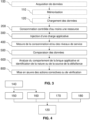
- the Figure 4 illustrates steps of preparing the device and/or initiating the method according to the invention.
- the method according to the invention may include the reception 140 of data from probes 41.
- This data may be processed so as to define 150 the application load so as to establish a load plan comprising data relating to the level of use of resources by said application brick, as a function of time.
- the probe data 41 can also be processed so as to identify 160 the critical resources.
- the method can comprise the choice 170 of the application brick to be studied for example via an interface as well as the definition 180 of the consumption rules allowing a progressive rarefaction. Once this data has been defined or acquired, it can be loaded 120 by the device 1.
- the method according to the invention comprises a step 200 of generating a controlled consumption of at least one critical resource according to the consumption rules previously stored, for example on a scarcity reference 13.
- This step 200 of generating controlled consumption can for example be carried out by a resource scarcity module 20.
- FIG. 5 presents a detailed illustration of the sub-steps that can be implemented during the generation 200 of the controlled consumption of at least one critical resource.
- This controlled consumption can begin with the loading 210 into memory of the instructions included in a rarefaction repository 13 and detailing the type of rarefaction to be implemented.
- a user can via a user client 5 configure 220 the duration of the rarefaction, for example, by modifying the instruction codes of the rarefaction according to the desired duration of the rarefaction.
- the rarefaction module 20 integrates the rarefaction data and the settings so as to generate 230 a resource rarefaction configuration file comprising the instruction codes capable of generating the desired rarefaction. Then, it identifies the device(s) or computing structures 3 that are to undergo the scarcity and transfers 240 the resource scarcity configuration file to them. Finally, it can initiate 250 the execution of the instruction codes on said devices.
- the rarefaction can be deployed from the behavior analysis device on IT infrastructures and then executed by these IT structures 3 according to a schedule managed by the IT structures 3.
- the method according to the invention also comprises a step 300 of submitting the IT infrastructure 4 to an application load, said application load being representative of the operation of the application brick 2.
- This step of generating 300 an application load can for example be carried out by an injection module 30.
- this application load which is injected onto the IT infrastructure 4 preferably corresponds to the nominal load of the application brick when the application chain concerned operates in nominal mode.
- the IT infrastructure 4 will be subjected to a load corresponding to the nominal application load of the application brick 2 according to a predetermined load plan stored on the application load repository 14.
- the method according to the invention also comprises a step 400 of measuring the consumption of the resources of the IT infrastructure 4 and/or the service levels of the application brick 2.
- This step 400 of measuring the consumption of the resources can for example be carried out by a module 40 for collecting metrics.
- the measurement step 400 can be carried out via computer probes.
- the computer probe mechanism is started before the scarcity of resources and the implementation of the load plan. This makes it possible, on the one hand, to quickly identify degradations in performance or service levels (such as response times) beyond a predetermined limit and to identify resources having a utilization value greater than a predetermined maximum utilization threshold and therefore that the resource is at risk of failure.
- the method may also include a step of storing the measured values of resource usage during the execution of all the requests.
- the method according to the invention also comprises a step 500 of comparing the predetermined quality of service parameter thresholds with the measured values of service levels of the application brick. Furthermore, in the presence of an overrun, the method can interrupt the controlled consumption. This comparison step 500 can for example be carried out by a failure detection module 50.
- the measured QoS parameter values are in line with the QoS parameter threshold values when they have not crossed the predetermined thresholds. For example, when the response time of a request has remained below the predetermined quality of service parameter threshold for the response time to this request.
- the method may also include a step of storing the measured values of resource usage during the execution of all the requests.
- the method according to the invention also comprises, in the presence of an overrun, a step 600 of analyzing the behavior of the application brick 2 and identifying the nature and/or source of the failure.
- This analysis step 600 can for example be carried out by an application performance management module 60.
- This analysis can for example consist of determining whether different hypotheses have been proven, detecting anomalies or estimating an impact on users.
- This analysis step may include processing of the application brick's log files and/or data generated by trace collectors such as Profiling ® , J profiler ® or Dynatrace ® .
- the method according to the invention may advantageously include a step of improving resilience comprising the identification of corrective actions corresponding to the nature of the identified failures. This step may for example be carried out by a resilience improvement module 70.
- the method according to the invention may include a step 800 of implementing corrective actions or verifying their implementation.
- the method according to the invention may include a step of modifying the level of a resource of the IT infrastructure before re-executing the steps of the method.
- the method comprises a step making it possible to implement in an automated manner, for example via a script, said modification or optimization and then to re-execute the scarcity of resources and the application load so as to determine whether the resilience of the application brick has actually been improved following the modification of the resources.
- the resource level that can be modified can for example be selected from: the number of CPUs allocated, the quantity of available memory and the number of ports that can be opened simultaneously.
- Such a step can for example be implemented by an infrastructure evolution module 80.
- the level of a single resource is modified at this stage.
- modifying a single resource at a time makes it possible to better identify the consequences of this modification on the quality of service of the application brick as well as on the use of resources.
- a single resource is modified at a time and this resource is modified iteratively until the resilience of the application brick with respect to a scarcity of this resource reaches the expected level.
- Changing the resource level can be done by the resource step.
- the level of said resource is changed by subtracting or adding at least one step of that resource to its current resource level value.
- the magnitude of the change in the level of a resource is then equal to one or more steps of said resource.
- the level of certain resources may be modified automatically within the framework of the method of the invention without external intervention. Indeed, certain resources may be modified via scripts executed on the IT infrastructure 4 and capable of providing access to new resources. However, not all resources may be modified in this way by a software action and certain resources will require the intervention of an operator capable of physically modifying the IT infrastructure in order to increase the level of the resource.
- the method according to the invention may include a step of determining a mode of modification of the resource.
- each resource may be associated with information concerning the method of modification of said resource.
- the method may call upon a file comprising metadata making it possible to know, for example, whether the resource is modifiable, which scripts must be called to modify the resource, and whether said resource will require a restart of the machine or whether hot modification is possible.
- the resources that can be easily modified, for example via a dedicated script are typically: CPU configuration of a machine, memory configuration of a machine and number of ports that can be opened simultaneously.
- the method according to the invention may comprise a step of generating an alert, said alert comprising an identifier of the resource whose level is to be modified and an instruction on the level to be reached.
- an alert comprising an identifier of the resource whose level is to be modified and an instruction on the level to be reached.
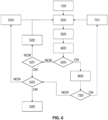
- FIG. 6 illustrates a method according to one embodiment of the invention.
- the method can be initiated by loading 120 stored data necessary for implementing the method. This includes here, a step of acquiring the configuration of the scarcity of resources on the one hand and the application load on the other hand.
- This data may have been previously stored in repositories or have been transmitted by a human-machine interface and then preferably stored.
- the method implements a comparison 520 of data so as to identify a failure.
- the method may comprise a step 521 of comparing the controlled consumption to a maximum threshold of controlled consumption so as to determine whether the scarcity can be increased. If this is the case (NOK), the scarcity is reconfigured 522 so as to increase the controlled consumption and then it is implemented again. If the maximum threshold of controlled consumption has been reached (OK), then the method may comprise a step 523 making it possible to determine whether all the critical resources have been tested (i.e. scarce). If there are still resources to be tested (NOK), then it comprises a step 524 of modifying the critical resource to be scarce, while if there are no resources left to be tested (OK), then resilience is reached 525 for this application brick.
- the method comprises a failure analysis step 600 and then, from generated failure data, the method may comprise a step 720 of selecting at least one corrective action instruction, preferably by a resilience improvement module 70. If a corrective action is identified (OK) then the method includes a step of applying the corrective action 721 while in the absence of corrective action (NOK), the method can include a step 523 making it possible to determine whether all the critical resources have been tested (i.e. made scarce).
- FIG. 7 illustrates an analysis 600 of the failure according to an embodiment of the invention.
- This analysis may comprise a first step of analyzing the implication of the design 610 of the application brick in the failure following a scarcity of a critical resource. If during this step, comprising for example an analysis of a trace collector file, it is determined that the design of the application brick is involved (OK) in the failure then the method comprises a step of generating 611 a report comprising the collected trace data then a step of determining 612 the existence or not of other critical resources to be tested for this application brick. If this is the case (OK) then there is a modification 613 of the critical resource to be scarce and if not (NOK) then the analysis of the behavior of this application brick is finalized and a report is generated 650.
- the method comprises a step of analyzing the involvement of the configuration 620 of the application brick in the failure. If during this step, comprising for example an analysis of a trace collector file, it is determined that the configuration of the application brick is involved in the failure following a scarcity of a critical resource then the method comprises a step of generating 621 a report comprising data on the faulty configuration of the application brick and a step of modifying 622 the configuration files of the application brick. The method then comprises a reinitialization 660 of the analysis with an application brick having a modified configuration.
- the method comprises a step of analyzing the involvement of the resources 630 of the IT infrastructure 4 in the failure. If during this step, comprising for example an analysis of a trace collector file, it is determined that one or more resources are involved in the failure following a scarcity of a critical resource then the method comprises a step of generating 631 a report comprising data on the faulty resource(s) and a step of modifying 632 the resources of the IT infrastructure. The method comprises then a 660 reset of the analysis with an application brick having a modified configuration.
- the method comprises a step 633 of generating a report. This can be followed by a step 634 of determining whether or not there are other critical resources to be tested for this application brick. If this is the case (OK) then there is a modification 635 of the critical resource to be made scarce and if not (NOK) then the analysis of the behavior of this application brick is finalized and a report is generated 650.
- the behavior analysis process is reset to validate that the adaptations now allow the application to be resilient to resource scarcity. If this is indeed the case, we can decide to continue scarcity of said resource to validate the resilience of the application beyond the breaking point found previously or test the resilience of the application on another type of resource.
- the present invention makes it possible to automatically analyze the behavior of an application brick as well as its resilience to resource scarcity and, if necessary, to make modifications to increase said resilience. This, as well as all these advantages previously described, therefore contribute to facilitating the management of an IT infrastructure for an IT administrator and to increasing the resilience of the application bricks that it supports without having to systematically increase the quantities of resources allocated.
Landscapes
- Engineering & Computer Science (AREA)
- General Engineering & Computer Science (AREA)
- Theoretical Computer Science (AREA)
- Computer Hardware Design (AREA)
- Quality & Reliability (AREA)
- Physics & Mathematics (AREA)
- General Physics & Mathematics (AREA)
- Debugging And Monitoring (AREA)
- Storage Device Security (AREA)
Claims (15)
- Vorrichtung (1) zum Analysieren des Verhaltens eines Anwendungsbausteins (2), der einer Ressourcenverknappung in einer IT-Infrastruktur (4) ausgesetzt ist, die Vorrichtung umfassend:- Mittel zum Identifizieren der kritischen Ressourcen, die durch den Anwendungsbaustein genutzt werden, wobei eine kritische Ressource eine Ressource ist, deren Nutzung unter Nennbedingungen ihrer Grenznutzung oder ihrer Sättigung am nächsten kommt;- ein Speichermodul (10), das zum Speichern einer Vielzahl von Repositorys konfiguriert ist, einschließlich:o eines Ressourcen-Repositorys (11), das zum Speichern von Daten zum Identifizieren von kritischen Ressourcen konfiguriert ist, die durch den Anwendungsbaustein genutzt werden,o eines Ausführungsregel-Repositorys (12), das zum Speichern von Daten konfiguriert ist, die zuvor bestimmten Schwellenwerten für Dienstgüteparameter entsprechen, jenseits derer der Anwendungsbaustein als ausgefallen gilt,o eines Verknappungs-Repositorys (13), das zum Speichern der Verbrauchsregeln von kritischen Ressourcen für eine fortschreitende Verknappung der kritischen Ressourcen konfiguriert ist, undo eines Anwendungsbelastungs-Repositorys (14), das zum Speichern eines zuvor bestimmten Belastungsplans konfiguriert ist, der den Betrieb des Anwendungsbausteins darstellt;- eines Ressourcenverknappungsmoduls (20), das zum Erzeugen eines kontrollierten Verbrauchs mindestens einer kritischen Ressource konfiguriert ist, die gemäß den Verbrauchsregeln identifiziert wird, die vorab in dem Verknappungs-Repository (13) gespeichert wurden;- ein Injektionsmodul (30), das zum Aussetzen der IT-Infrastruktur einer Anwendungsbelastung konfiguriert ist, die den Betrieb des Anwendungsbausteins (2) gemäß dem Belastungsplan darstellt, der in dem Anwendungsbelastungs-Repository (14) gespeichert ist;- ein Metrikerfassungsmodul (40), das zum Messen des Ressourcenverbrauchs der IT-Infrastruktur (4) und/oder der Dienststufen des Anwendungsbausteins (2) konfiguriert ist;- ein Ausfallerkennungsmodul (50), das zum Vergleichen der zuvor bestimmten Schwellenwerte für Dienstgüteparameter mit den gemessenen Werten des Ressourcenverbrauchs und/oder der Dienststufen des Anwendungsbausteins konfiguriert ist; und- ein Anwendungsleistungsverwaltungsmodul (60), das zum Analysieren, angesichts einer Überschreitung der zuvor bestimmten Schwellenwerte für Dienstgüteparameter, des Verhaltens des Anwendungsbausteins und Erzeugen von Ausfalldaten konfiguriert ist, die in der Lage sind, über die Art und/oder den Ursprung des Ausfalls zu informieren.
- Verhaltensanalysevorrichtung nach Anspruch 1,
dadurch gekennzeichnet, dass die erzeugten Ausfalldaten ein Datenelement über eine Ressourcenverknappungsstufe umfassen, der der Anwendungsbaustein (2) standhalten kann, bevor er einen Ausfall erfährt. - Verhaltensanalysevorrichtung nach einem der Ansprüche 1 oder 2,
dadurch gekennzeichnet, dass das Anwendungsleistungsverwaltungsmodul (60) zum Auswählen der Art des Ausfalls konfiguriert ist aus:- einer Hardwarekonfiguration der IT-Infrastruktur,- einer Softwarekonfiguration der IT-Infrastruktur,- einer Konfiguration des Anwendungsbausteins, und- einem Design des Anwendungsbausteins. - Verhaltensanalysevorrichtung nach einem der Ansprüche 1 bis 3,
dadurch gekennzeichnet, dass es ferner ein Wissens-Repository (15) umfasst, das zum Speichern zuvor bestimmter Ausfalldaten in Abhängigkeit von Ausführungsdaten konfiguriert ist, dass das Anwendungsleistungsverwaltungsmodul (60) Spurenerfasser (61) umfasst, wobei die Spurenerfasser (61) zum Erfassen von Ausführungsdaten konfiguriert sind, und dass das Anwendungsleistungsverwaltungsmodul (60) zum Erzeugen der Ausfalldaten aus dem Wissens-Repository (15) in Abhängigkeit von erfassten Ausführungsdaten konfiguriert ist. - Verhaltensanalysevorrichtung nach einem der Ansprüche 1 bis 4,
dadurch gekennzeichnet, dass es ferner ein Entwicklungsregel-Repository (16), das zum Speichern von Korrekturmaßnahmen in Abhängigkeit von Ausfalldaten konfiguriert ist, und ein Belastbarkeitsverbesserungsmodul (70) umfasst, das zum Identifizieren von Korrekturmaßnahmen aus Ausfalldaten konfiguriert ist, die durch das Anwendungsleistungsverwaltungsmodul (60) erzeugt werden. - Verhaltensanalysevorrichtung nach Anspruch 5,
dadurch gekennzeichnet, dass das Ausführungsregel-Repository (12) zum Speichern mehrerer Kategorien von zuvor bestimmten Schwellenwerten für Dienstgüteparameter konfiguriert ist, einschließlich einer sogenannten akzeptablen Kategorie, die den Dienststufen entspricht, jenseits derer der Anwendungsbaustein als einen verschlechterten, aber akzeptablen Dienst bereitstellend gilt, und dass das Belastbarkeitsverbesserungsmodul (70) zum Implementieren der Korrekturmaßnahmen so konfiguriert ist, dass der Anwendungsbaustein (2) trotz einer Ressourcenverknappung Dienststufen bereitstellt, die der sogenannten akzeptablen Kategorie entsprechen. - Verhaltensanalysevorrichtung nach einem der Ansprüche 5 oder 6,
dadurch gekennzeichnet, dass das Belastbarkeitsverbesserungsmodul (70) zum Implementieren der Korrekturmaßnahmen oder Verifizieren deren Implementierung zum Ermöglichen, dass die Anwendung in Hinblick auf eine Ressourcenverknappung belastbar gemacht wird, konfiguriert ist. - Verhaltensanalysevorrichtung nach einem der Ansprüche 1 bis 7,
dadurch gekennzeichnet, dass es ferner ein Repository (17) für zugängliche Ressourcen, das zum Speichern charakteristischer Daten von zugänglichen Ressourcen konfiguriert ist, und ein Infrastrukturentwicklungsmodul (80) umfasst, das zum Erzeugen mindestens eines Entwicklungsplans, der die Ressourcenänderungen auflistet, die in der IT-Infrastruktur (4) durchgeführt werden sollen, aus kennzeichnenden Daten der zugänglichen Ressourcen und Ausfalldaten konfiguriert ist. - Verhaltensanalysevorrichtung nach einem der Ansprüche 1 bis 8,
dadurch gekennzeichnet, dass die Verbrauchsregeln der kritischen Ressourcen mindestens die folgenden Daten umfassen:- eine Stufe des anfänglichen Ressourcenverbrauchs,- eine endgültige Stufe des Ressourcenverbrauchs,- einen Anstiegsschritt des Verbrauchs, und- eine Dauer zwischen jedem Anstiegsschritt. - Verfahren zum Analysieren des Verhaltens eines Anwendungsbausteins, der einer Ressourcenverknappung in einer IT-Infrastruktur ausgesetzt ist, wobei das Verfahren durch eine Verhaltensanalysevorrichtung implementiert wird, umfassend ein Speichermodul (10), ein Ressourcenverknappungsmodul (20), ein Injektionsmodul (30), ein Metrikerfassungsmodul (40), ein Ausfallerkennungsmodul (50) und ein Anwendungsleistungsverwaltungsmodul (60), das Verfahren umfassend die folgenden Schritte:- Identifizieren (160) der kritischen Ressourcen, wobei eine kritische Ressource eine Ressource ist, deren Nutzung unter Nennbedingungen ihrer Grenznutzung oder ihrer Sättigung am nächsten kommt;- Erzeugen (200) auf einer IT-Infrastruktur, über das Ressourcenknappheitsmodul (20), eines kontrollierten Verbrauchs von mindestens einer kritischen Ressource, die gemäß den vorab gespeicherten Verbrauchsregeln identifiziert wird;- Aussetzen (300) der IT-Infrastruktur, über das Injektionsmodul (30), einer Anwendungsbelastung, die den Betrieb des Anwendungsbausteins (2) gemäß einem Belastungsplan darstellt, der beispielsweise in einem Anwendungsbelastungs-Repository (14) gespeichert ist;- Messen (400), über das Metrikerfassungsmodul (40), des Verbrauchs der IT-Infrastrukturressourcen (4) und/oder der Dienststufen des Anwendungsbausteins (2);- Vergleichen (500), über das Ausfallerkennungsmodul (50), zuvor bestimmter Schwellenwerte für Dienstgüteparameter mit den gemessenen Werten von Dienststufen des Anwendungsbausteins (2), um eine Überschreitung zu identifizieren; und- angesichts einer Überschreitung der zuvor bestimmten Schwellenwerte für Dienstgüteparameter, Analysieren (600) des Verhaltens des Anwendungsbausteins (2) und Erzeugen, über das Anwendungsleistungsverwaltungsmodul (60), von Ausfalldaten, die in der Lage sind, über die Art und/oder den Ursprung des Ausfalls zu informieren.
- Verfahren zum Analysieren des Verhaltens eines Anwendungsbausteins nach Anspruch 10, dadurch gekennzeichnet, dass es ferner einen Schritt zum Auswählen (720) mindestens einer Korrekturmaßnahmeanweisung, falls ein Ausfall identifiziert wird, und einen Schritt zum Anwenden der identifizierten Korrekturmaßnahme (721) umfasst.
- Verfahren zum Analysieren des Verhaltens eines Anwendungsbausteins nach einem der Ansprüche 10 oder 11, dadurch gekennzeichnet, dass, wenn bestimmt wird, dass das Design des Anwendungsbausteins an dem Ausfall beteiligt ist, das Verfahren einen Schritt zum Erzeugen (611) eines Berichts, umfassend erfasste Spurendaten, danach einen Schritt zum Bestimmen (612) des Vorhandenseins oder Nichtvorhandenseins anderer kritischer Ressourcen umfasst, die für diesen Anwendungsbaustein getestet werden sollen.
- Verfahren zum Analysieren des Verhaltens eines Anwendungsbausteins nach Anspruch 12, dadurch gekennzeichnet, dass, wenn die Bestimmung des Vorhandenseins anderer kritischer Ressourcen vorliegt, die für diesen Anwendungsbaustein getestet werden sollen, dann das Verfahren ferner eine Modifikation (613) der kritischen Ressource umfasst, die verknappt werden soll, und andernfalls die Analyse des Verhaltens dieses Anwendungsbausteins abgeschlossen und ein Bericht erzeugt wird (650).
- Verfahren zum Analysieren des Verhaltens eines Anwendungsbausteins nach einem der Ansprüche 10 bis 13, dadurch gekennzeichnet, dass, wenn bestimmt wird, dass die Konfiguration (620) des Anwendungsbausteins an dem Ausfall beteiligt ist, dann das Verfahren einen Schritt zum Erzeugen (621) eines Berichts, umfassend ein Datenelement über die ausgefallene Konfiguration des Anwendungsbausteins, und einen Schritt zum Modifizieren (622) der Konfigurationsdateien des Anwendungsbausteins umfasst.
- Verfahren zum Analysieren des Verhaltens eines Anwendungsbausteins nach einem der Ansprüche 10 bis 14, dadurch gekennzeichnet, dass, wenn nach einer Verknappung einer kritischen Ressource bestimmt wird, dass eine oder mehrere Ressourcen an dem Ausfall beteiligt sind, dann das Verfahren einen Schritt zum Erzeugen (631) eines Berichts, umfassend ein Datenelement über die ausgefallene(n) Ressource(n), und einen Schritt zum Modifizieren (632) der Ressourcen der IT-Infrastruktur umfasst.
Applications Claiming Priority (1)
| Application Number | Priority Date | Filing Date | Title |
|---|---|---|---|
| FR1858072A FR3085771B1 (fr) | 2018-09-07 | 2018-09-07 | Dispositif et procede d'analyse du comportement d'une brique applicative soumise a une rarefaction des ressources |
Publications (2)
| Publication Number | Publication Date |
|---|---|
| EP3620928A1 EP3620928A1 (de) | 2020-03-11 |
| EP3620928B1 true EP3620928B1 (de) | 2025-04-23 |
Family
ID=65685480
Family Applications (1)
| Application Number | Title | Priority Date | Filing Date |
|---|---|---|---|
| EP19306076.1A Active EP3620928B1 (de) | 2018-09-07 | 2019-09-06 | Vorrichtung und verfahren zur anlayse des verhaltens eines anwendungsbausteins, der einer ressourcenverknappung ausgesetzt ist |
Country Status (2)
| Country | Link |
|---|---|
| EP (1) | EP3620928B1 (de) |
| FR (1) | FR3085771B1 (de) |
Families Citing this family (3)
| Publication number | Priority date | Publication date | Assignee | Title |
|---|---|---|---|---|
| FR3108743B1 (fr) * | 2020-03-31 | 2023-05-05 | Bull Sas | Procede de prevention d’incident sur une chaine applicative et dispositif informatique de prevention d’incident |
| CN114115763B (zh) * | 2021-11-15 | 2024-05-17 | 上海商米科技集团股份有限公司 | 打印机平台化产品的配置装置及配置方法 |
| EP4645092A4 (de) * | 2022-12-26 | 2026-01-28 | Rakuten Mobile Inc | Schätzung der ursache von anwendungsinstabilität |
Family Cites Families (5)
| Publication number | Priority date | Publication date | Assignee | Title |
|---|---|---|---|---|
| US20090271152A1 (en) * | 2008-04-28 | 2009-10-29 | Alcatel | Load testing mechanism for server-based applications |
| US8892960B2 (en) * | 2011-01-19 | 2014-11-18 | Oracle International Corporation | System and method for determining causes of performance problems within middleware systems |
| FR3023940B1 (fr) | 2014-07-17 | 2017-12-29 | Bull Sas | Procede de production de perturbations controlees de l'activite d'un dispositif de traitement automatise pendant un scenario de test d'une application |
| FR3037675B1 (fr) * | 2015-06-18 | 2017-07-28 | Bull Sas | Procede de determination d'une quantite de ressources disponibles garantissant une experience utilisateur de qualite |
| FR3043223A1 (fr) * | 2015-11-02 | 2017-05-05 | Bull Sas | Mecanisme d'analyse de correlation lors de la degradation des performances d'une chaine applicative. |
-
2018
- 2018-09-07 FR FR1858072A patent/FR3085771B1/fr active Active
-
2019
- 2019-09-06 EP EP19306076.1A patent/EP3620928B1/de active Active
Also Published As
| Publication number | Publication date |
|---|---|
| FR3085771B1 (fr) | 2020-12-11 |
| FR3085771A1 (fr) | 2020-03-13 |
| EP3620928A1 (de) | 2020-03-11 |
Similar Documents
| Publication | Publication Date | Title |
|---|---|---|
| Birke et al. | Failure analysis of virtual and physical machines: patterns, causes and characteristics | |
| US9811443B2 (en) | Dynamic trace level control | |
| US11526413B2 (en) | Distributed tracing of huge spans for application and dependent application performance monitoring | |
| US20220100632A1 (en) | Detecting performance degradation in remotely deployed applications | |
| EP3113025B1 (de) | Automatischer diagnostik-mechanismus mithilfe von informationen aus einem applikativen überwachungssystem | |
| US20190079854A1 (en) | Systems and methods for executing tests | |
| EP3343839B1 (de) | Mechanismus zur überwachung und alarmierung von computersystemanwendungen | |
| EP3506094B1 (de) | Verfahren und system zur optimisierung der planung von batchprozessen | |
| EP3163445B1 (de) | Mechanismus zur korrelationsanalyse anlässlich der leistungsverschlechterung einer anwendungskette | |
| EP3620928A1 (de) | Vorrichtung und verfahren zur anlayse des verhaltens eines anwendungsbausteins, der einer ressourcenverknappung ausgesetzt ist | |
| EP3767474B1 (de) | Verfahren zur analyse des ressourcenverbrauchs einer it-infrastruktur, alarm und dimensionierung | |
| US20220391302A1 (en) | Calibration technique using computer analysis for ascertaining performance of containers | |
| WO2022022572A1 (en) | Calculating developer time during development process | |
| US10642675B2 (en) | Dynamically controlling runtime system logging based on end-user reviews | |
| EP3617888A1 (de) | Vorrichtung und verfahren zur optimierung der zeitlichen verwendung der ressourcen einer it-infrastruktur | |
| EP3767475A1 (de) | Vorrichtung und verfahren für die analyse der leistungen einer web-anwendung | |
| EP3767476A1 (de) | Vorrichtung und verfahren für die analyse der leistungen einer mehrschichtigen anwendung (n-tier-app) | |
| EP2770439B1 (de) | Überwachung der Leistungsmessung einer IT-Infrastruktur | |
| FR3091376A1 (fr) | Procédé d’optimisation d’un plan d’ordonnancement et du dimensionnement d’une infrastructure informaTique | |
| EP3483733B1 (de) | Verfahren und vorrichtung zur erforschung einer marge zur ressourcenoptimierung in einer anwendungskette | |
| FR3087556A1 (fr) | Procede d'amelioration de l'efficacite d'utlisation des ressources d'une infrastructure destinee a executer un plan d'ordonnancement | |
| FR3108743A1 (fr) | Procede de prevention d’incident sur une chaine applicative et dispositif informatique de prevention d’incident | |
| FR3069933B1 (fr) | Procede de validation de mutualisation de briques applicatives sur une infrastructure informatique | |
| EP3640800A1 (de) | Verfahren zur effizienzverbesserung der verwendung von ressourcen einer infrastruktur, die zur ausführung einer ablaufplanung bestimmt ist | |
| FR3087282A1 (fr) | Procede d'optimisation du dimensionnement minimum d'une infrastructure destinee a executer un plan d'ordonnancement |
Legal Events
| Date | Code | Title | Description |
|---|---|---|---|
| PUAI | Public reference made under article 153(3) epc to a published international application that has entered the european phase |
Free format text: ORIGINAL CODE: 0009012 |
|
| STAA | Information on the status of an ep patent application or granted ep patent |
Free format text: STATUS: THE APPLICATION HAS BEEN PUBLISHED |
|
| AK | Designated contracting states |
Kind code of ref document: A1 Designated state(s): AL AT BE BG CH CY CZ DE DK EE ES FI FR GB GR HR HU IE IS IT LI LT LU LV MC MK MT NL NO PL PT RO RS SE SI SK SM TR |
|
| AX | Request for extension of the european patent |
Extension state: BA ME |
|
| STAA | Information on the status of an ep patent application or granted ep patent |
Free format text: STATUS: REQUEST FOR EXAMINATION WAS MADE |
|
| 17P | Request for examination filed |
Effective date: 20200828 |
|
| RBV | Designated contracting states (corrected) |
Designated state(s): AL AT BE BG CH CY CZ DE DK EE ES FI FR GB GR HR HU IE IS IT LI LT LU LV MC MK MT NL NO PL PT RO RS SE SI SK SM TR |
|
| STAA | Information on the status of an ep patent application or granted ep patent |
Free format text: STATUS: EXAMINATION IS IN PROGRESS |
|
| 17Q | First examination report despatched |
Effective date: 20211118 |
|
| P01 | Opt-out of the competence of the unified patent court (upc) registered |
Effective date: 20230330 |
|
| GRAP | Despatch of communication of intention to grant a patent |
Free format text: ORIGINAL CODE: EPIDOSNIGR1 |
|
| STAA | Information on the status of an ep patent application or granted ep patent |
Free format text: STATUS: GRANT OF PATENT IS INTENDED |
|
| RIC1 | Information provided on ipc code assigned before grant |
Ipc: G06F 11/07 20060101ALN20241111BHEP Ipc: G06F 11/34 20060101AFI20241111BHEP |
|
| INTG | Intention to grant announced |
Effective date: 20241126 |
|
| RIC1 | Information provided on ipc code assigned before grant |
Ipc: G06F 11/07 20060101ALN20241115BHEP Ipc: G06F 11/34 20060101AFI20241115BHEP |
|
| GRAS | Grant fee paid |
Free format text: ORIGINAL CODE: EPIDOSNIGR3 |
|
| GRAA | (expected) grant |
Free format text: ORIGINAL CODE: 0009210 |
|
| STAA | Information on the status of an ep patent application or granted ep patent |
Free format text: STATUS: THE PATENT HAS BEEN GRANTED |
|
| AK | Designated contracting states |
Kind code of ref document: B1 Designated state(s): AL AT BE BG CH CY CZ DE DK EE ES FI FR GB GR HR HU IE IS IT LI LT LU LV MC MK MT NL NO PL PT RO RS SE SI SK SM TR |
|
| REG | Reference to a national code |
Ref country code: GB Ref legal event code: FG4D Free format text: NOT ENGLISH |
|
| REG | Reference to a national code |
Ref country code: CH Ref legal event code: EP |
|
| REG | Reference to a national code |
Ref country code: DE Ref legal event code: R096 Ref document number: 602019068949 Country of ref document: DE |
|
| REG | Reference to a national code |
Ref country code: IE Ref legal event code: FG4D Free format text: LANGUAGE OF EP DOCUMENT: FRENCH |
|
| REG | Reference to a national code |
Ref country code: NL Ref legal event code: MP Effective date: 20250423 |
|
| PG25 | Lapsed in a contracting state [announced via postgrant information from national office to epo] |
Ref country code: NL Free format text: LAPSE BECAUSE OF FAILURE TO SUBMIT A TRANSLATION OF THE DESCRIPTION OR TO PAY THE FEE WITHIN THE PRESCRIBED TIME-LIMIT Effective date: 20250423 |
|
| REG | Reference to a national code |
Ref country code: AT Ref legal event code: MK05 Ref document number: 1788444 Country of ref document: AT Kind code of ref document: T Effective date: 20250423 |
|
| PG25 | Lapsed in a contracting state [announced via postgrant information from national office to epo] |
Ref country code: PT Free format text: LAPSE BECAUSE OF FAILURE TO SUBMIT A TRANSLATION OF THE DESCRIPTION OR TO PAY THE FEE WITHIN THE PRESCRIBED TIME-LIMIT Effective date: 20250825 Ref country code: FI Free format text: LAPSE BECAUSE OF FAILURE TO SUBMIT A TRANSLATION OF THE DESCRIPTION OR TO PAY THE FEE WITHIN THE PRESCRIBED TIME-LIMIT Effective date: 20250423 Ref country code: ES Free format text: LAPSE BECAUSE OF FAILURE TO SUBMIT A TRANSLATION OF THE DESCRIPTION OR TO PAY THE FEE WITHIN THE PRESCRIBED TIME-LIMIT Effective date: 20250423 |
|
| PGFP | Annual fee paid to national office [announced via postgrant information from national office to epo] |
Ref country code: DE Payment date: 20250919 Year of fee payment: 7 |
|
| REG | Reference to a national code |
Ref country code: LT Ref legal event code: MG9D |
|
| PG25 | Lapsed in a contracting state [announced via postgrant information from national office to epo] |
Ref country code: GR Free format text: LAPSE BECAUSE OF FAILURE TO SUBMIT A TRANSLATION OF THE DESCRIPTION OR TO PAY THE FEE WITHIN THE PRESCRIBED TIME-LIMIT Effective date: 20250724 Ref country code: NO Free format text: LAPSE BECAUSE OF FAILURE TO SUBMIT A TRANSLATION OF THE DESCRIPTION OR TO PAY THE FEE WITHIN THE PRESCRIBED TIME-LIMIT Effective date: 20250723 |
|
| PG25 | Lapsed in a contracting state [announced via postgrant information from national office to epo] |
Ref country code: PL Free format text: LAPSE BECAUSE OF FAILURE TO SUBMIT A TRANSLATION OF THE DESCRIPTION OR TO PAY THE FEE WITHIN THE PRESCRIBED TIME-LIMIT Effective date: 20250423 |
|
| PG25 | Lapsed in a contracting state [announced via postgrant information from national office to epo] |
Ref country code: BG Free format text: LAPSE BECAUSE OF FAILURE TO SUBMIT A TRANSLATION OF THE DESCRIPTION OR TO PAY THE FEE WITHIN THE PRESCRIBED TIME-LIMIT Effective date: 20250423 |
|
| PGFP | Annual fee paid to national office [announced via postgrant information from national office to epo] |
Ref country code: GB Payment date: 20250923 Year of fee payment: 7 |
|
| PG25 | Lapsed in a contracting state [announced via postgrant information from national office to epo] |
Ref country code: HR Free format text: LAPSE BECAUSE OF FAILURE TO SUBMIT A TRANSLATION OF THE DESCRIPTION OR TO PAY THE FEE WITHIN THE PRESCRIBED TIME-LIMIT Effective date: 20250423 |
|
| PG25 | Lapsed in a contracting state [announced via postgrant information from national office to epo] |
Ref country code: AT Free format text: LAPSE BECAUSE OF FAILURE TO SUBMIT A TRANSLATION OF THE DESCRIPTION OR TO PAY THE FEE WITHIN THE PRESCRIBED TIME-LIMIT Effective date: 20250423 |
|
| PGFP | Annual fee paid to national office [announced via postgrant information from national office to epo] |
Ref country code: FR Payment date: 20250925 Year of fee payment: 7 |
|
| PG25 | Lapsed in a contracting state [announced via postgrant information from national office to epo] |
Ref country code: RS Free format text: LAPSE BECAUSE OF FAILURE TO SUBMIT A TRANSLATION OF THE DESCRIPTION OR TO PAY THE FEE WITHIN THE PRESCRIBED TIME-LIMIT Effective date: 20250723 |
|
| PG25 | Lapsed in a contracting state [announced via postgrant information from national office to epo] |
Ref country code: IS Free format text: LAPSE BECAUSE OF FAILURE TO SUBMIT A TRANSLATION OF THE DESCRIPTION OR TO PAY THE FEE WITHIN THE PRESCRIBED TIME-LIMIT Effective date: 20250823 |
|
| PG25 | Lapsed in a contracting state [announced via postgrant information from national office to epo] |
Ref country code: LV Free format text: LAPSE BECAUSE OF FAILURE TO SUBMIT A TRANSLATION OF THE DESCRIPTION OR TO PAY THE FEE WITHIN THE PRESCRIBED TIME-LIMIT Effective date: 20250423 |
|
| PG25 | Lapsed in a contracting state [announced via postgrant information from national office to epo] |
Ref country code: SM Free format text: LAPSE BECAUSE OF FAILURE TO SUBMIT A TRANSLATION OF THE DESCRIPTION OR TO PAY THE FEE WITHIN THE PRESCRIBED TIME-LIMIT Effective date: 20250423 Ref country code: DK Free format text: LAPSE BECAUSE OF FAILURE TO SUBMIT A TRANSLATION OF THE DESCRIPTION OR TO PAY THE FEE WITHIN THE PRESCRIBED TIME-LIMIT Effective date: 20250423 |
|
| PG25 | Lapsed in a contracting state [announced via postgrant information from national office to epo] |
Ref country code: CZ Free format text: LAPSE BECAUSE OF FAILURE TO SUBMIT A TRANSLATION OF THE DESCRIPTION OR TO PAY THE FEE WITHIN THE PRESCRIBED TIME-LIMIT Effective date: 20250423 |
|
| PG25 | Lapsed in a contracting state [announced via postgrant information from national office to epo] |
Ref country code: EE Free format text: LAPSE BECAUSE OF FAILURE TO SUBMIT A TRANSLATION OF THE DESCRIPTION OR TO PAY THE FEE WITHIN THE PRESCRIBED TIME-LIMIT Effective date: 20250423 |
|
| REG | Reference to a national code |
Ref country code: DE Ref legal event code: R097 Ref document number: 602019068949 Country of ref document: DE |
|
| PG25 | Lapsed in a contracting state [announced via postgrant information from national office to epo] |
Ref country code: SK Free format text: LAPSE BECAUSE OF FAILURE TO SUBMIT A TRANSLATION OF THE DESCRIPTION OR TO PAY THE FEE WITHIN THE PRESCRIBED TIME-LIMIT Effective date: 20250423 Ref country code: RO Free format text: LAPSE BECAUSE OF FAILURE TO SUBMIT A TRANSLATION OF THE DESCRIPTION OR TO PAY THE FEE WITHIN THE PRESCRIBED TIME-LIMIT Effective date: 20250423 |
|
| PG25 | Lapsed in a contracting state [announced via postgrant information from national office to epo] |
Ref country code: IT Free format text: LAPSE BECAUSE OF FAILURE TO SUBMIT A TRANSLATION OF THE DESCRIPTION OR TO PAY THE FEE WITHIN THE PRESCRIBED TIME-LIMIT Effective date: 20250423 |
|
| PLBE | No opposition filed within time limit |
Free format text: ORIGINAL CODE: 0009261 |
|
| STAA | Information on the status of an ep patent application or granted ep patent |
Free format text: STATUS: NO OPPOSITION FILED WITHIN TIME LIMIT |
|
| REG | Reference to a national code |
Ref country code: CH Ref legal event code: L10 Free format text: ST27 STATUS EVENT CODE: U-0-0-L10-L00 (AS PROVIDED BY THE NATIONAL OFFICE) Effective date: 20260304 |
|
| 26N | No opposition filed |
Effective date: 20260126 |
|
| REG | Reference to a national code |
Ref country code: CH Ref legal event code: H13 Free format text: ST27 STATUS EVENT CODE: U-0-0-H10-H13 (AS PROVIDED BY THE NATIONAL OFFICE) Effective date: 20260425 |