EP3620958A1 - Procédé d'apprentissage, dispositif d'apprentissage permettant de détecter une voie par un modèle de voie et procédé de test, dispositif de test l'utilisant - Google Patents
Procédé d'apprentissage, dispositif d'apprentissage permettant de détecter une voie par un modèle de voie et procédé de test, dispositif de test l'utilisant Download PDFInfo
- Publication number
- EP3620958A1 EP3620958A1 EP19178066.7A EP19178066A EP3620958A1 EP 3620958 A1 EP3620958 A1 EP 3620958A1 EP 19178066 A EP19178066 A EP 19178066A EP 3620958 A1 EP3620958 A1 EP 3620958A1
- Authority
- EP
- European Patent Office
- Prior art keywords
- lanes
- cluster
- testing
- estimated
- vector
- Prior art date
- Legal status (The legal status is an assumption and is not a legal conclusion. Google has not performed a legal analysis and makes no representation as to the accuracy of the status listed.)
- Granted
Links
Images





Classifications
-
- G—PHYSICS
- G06—COMPUTING OR CALCULATING; COUNTING
- G06N—COMPUTING ARRANGEMENTS BASED ON SPECIFIC COMPUTATIONAL MODELS
- G06N3/00—Computing arrangements based on biological models
- G06N3/02—Neural networks
- G06N3/08—Learning methods
- G06N3/084—Backpropagation, e.g. using gradient descent
-
- G—PHYSICS
- G06—COMPUTING OR CALCULATING; COUNTING
- G06F—ELECTRIC DIGITAL DATA PROCESSING
- G06F18/00—Pattern recognition
- G06F18/20—Analysing
- G06F18/21—Design or setup of recognition systems or techniques; Extraction of features in feature space; Blind source separation
- G06F18/217—Validation; Performance evaluation; Active pattern learning techniques
-
- G—PHYSICS
- G06—COMPUTING OR CALCULATING; COUNTING
- G06F—ELECTRIC DIGITAL DATA PROCESSING
- G06F18/00—Pattern recognition
- G06F18/20—Analysing
- G06F18/23—Clustering techniques
-
- G—PHYSICS
- G06—COMPUTING OR CALCULATING; COUNTING
- G06F—ELECTRIC DIGITAL DATA PROCESSING
- G06F18/00—Pattern recognition
- G06F18/20—Analysing
- G06F18/24—Classification techniques
- G06F18/241—Classification techniques relating to the classification model, e.g. parametric or non-parametric approaches
- G06F18/2411—Classification techniques relating to the classification model, e.g. parametric or non-parametric approaches based on the proximity to a decision surface, e.g. support vector machines
-
- G—PHYSICS
- G06—COMPUTING OR CALCULATING; COUNTING
- G06N—COMPUTING ARRANGEMENTS BASED ON SPECIFIC COMPUTATIONAL MODELS
- G06N3/00—Computing arrangements based on biological models
- G06N3/02—Neural networks
- G06N3/04—Architecture, e.g. interconnection topology
- G06N3/045—Combinations of networks
-
- G—PHYSICS
- G06—COMPUTING OR CALCULATING; COUNTING
- G06N—COMPUTING ARRANGEMENTS BASED ON SPECIFIC COMPUTATIONAL MODELS
- G06N3/00—Computing arrangements based on biological models
- G06N3/02—Neural networks
- G06N3/04—Architecture, e.g. interconnection topology
- G06N3/0464—Convolutional networks [CNN, ConvNet]
-
- G—PHYSICS
- G06—COMPUTING OR CALCULATING; COUNTING
- G06N—COMPUTING ARRANGEMENTS BASED ON SPECIFIC COMPUTATIONAL MODELS
- G06N3/00—Computing arrangements based on biological models
- G06N3/02—Neural networks
- G06N3/08—Learning methods
-
- G—PHYSICS
- G06—COMPUTING OR CALCULATING; COUNTING
- G06N—COMPUTING ARRANGEMENTS BASED ON SPECIFIC COMPUTATIONAL MODELS
- G06N3/00—Computing arrangements based on biological models
- G06N3/02—Neural networks
- G06N3/08—Learning methods
- G06N3/09—Supervised learning
-
- G—PHYSICS
- G06—COMPUTING OR CALCULATING; COUNTING
- G06T—IMAGE DATA PROCESSING OR GENERATION, IN GENERAL
- G06T7/00—Image analysis
- G06T7/10—Segmentation; Edge detection
- G06T7/11—Region-based segmentation
-
- G—PHYSICS
- G06—COMPUTING OR CALCULATING; COUNTING
- G06T—IMAGE DATA PROCESSING OR GENERATION, IN GENERAL
- G06T7/00—Image analysis
- G06T7/70—Determining position or orientation of objects or cameras
- G06T7/73—Determining position or orientation of objects or cameras using feature-based methods
-
- G—PHYSICS
- G06—COMPUTING OR CALCULATING; COUNTING
- G06T—IMAGE DATA PROCESSING OR GENERATION, IN GENERAL
- G06T7/00—Image analysis
- G06T7/70—Determining position or orientation of objects or cameras
- G06T7/77—Determining position or orientation of objects or cameras using statistical methods
-
- G—PHYSICS
- G06—COMPUTING OR CALCULATING; COUNTING
- G06V—IMAGE OR VIDEO RECOGNITION OR UNDERSTANDING
- G06V10/00—Arrangements for image or video recognition or understanding
- G06V10/70—Arrangements for image or video recognition or understanding using pattern recognition or machine learning
- G06V10/762—Arrangements for image or video recognition or understanding using pattern recognition or machine learning using clustering, e.g. of similar faces in social networks
-
- G—PHYSICS
- G06—COMPUTING OR CALCULATING; COUNTING
- G06V—IMAGE OR VIDEO RECOGNITION OR UNDERSTANDING
- G06V10/00—Arrangements for image or video recognition or understanding
- G06V10/70—Arrangements for image or video recognition or understanding using pattern recognition or machine learning
- G06V10/82—Arrangements for image or video recognition or understanding using pattern recognition or machine learning using neural networks
-
- G—PHYSICS
- G06—COMPUTING OR CALCULATING; COUNTING
- G06V—IMAGE OR VIDEO RECOGNITION OR UNDERSTANDING
- G06V20/00—Scenes; Scene-specific elements
- G06V20/50—Context or environment of the image
- G06V20/56—Context or environment of the image exterior to a vehicle by using sensors mounted on the vehicle
- G06V20/588—Recognition of the road, e.g. of lane markings; Recognition of the vehicle driving pattern in relation to the road
-
- G—PHYSICS
- G06—COMPUTING OR CALCULATING; COUNTING
- G06T—IMAGE DATA PROCESSING OR GENERATION, IN GENERAL
- G06T2207/00—Indexing scheme for image analysis or image enhancement
- G06T2207/20—Special algorithmic details
- G06T2207/20081—Training; Learning
-
- G—PHYSICS
- G06—COMPUTING OR CALCULATING; COUNTING
- G06T—IMAGE DATA PROCESSING OR GENERATION, IN GENERAL
- G06T2207/00—Indexing scheme for image analysis or image enhancement
- G06T2207/20—Special algorithmic details
- G06T2207/20084—Artificial neural networks [ANN]
-
- G—PHYSICS
- G06—COMPUTING OR CALCULATING; COUNTING
- G06T—IMAGE DATA PROCESSING OR GENERATION, IN GENERAL
- G06T2207/00—Indexing scheme for image analysis or image enhancement
- G06T2207/30—Subject of image; Context of image processing
- G06T2207/30248—Vehicle exterior or interior
- G06T2207/30252—Vehicle exterior; Vicinity of vehicle
- G06T2207/30256—Lane; Road marking
Definitions
- the present invention relates to a learning method of a CNN capable of detecting one or more lanes using a lane model; and more particularly, to the method of (a) acquiring information on the lanes from at least one image data set, wherein the information on the lanes are represented by respective sets of coordinates of pixels on the lanes; (b) calculating one or more function parameters of a lane modeling function of each of the lanes by using the coordinates of the pixels on the lanes; and (c) performing processes of classifying the function parameters into K cluster groups by using a clustering algorithm, assigning each of one or more cluster IDs to each of the cluster groups, and generating a cluster ID GT vector representing GT information on probabilities of being the cluster IDs corresponding to types of the lanes, and a learning device, a testing method, and a testing device using the same.
- Deep learning is a technology used to cluster or classify objects or data. For example, computers cannot distinguish dogs and cats from photographs alone. But a human can easily distinguish those two. To this end, a method called “machine learning” was devised. It is a technique to allow a computer to classify similar things among lots of data inputted into the computer. When a photo of an animal similar to a dog is inputted, the computer will classify it as a dog photo.
- Deep Convolution Neural Networks are the heart of the remarkable development in deep learning. CNNs have already been used in the 90's to solve the problem of character recognition, but their use has become as widespread as it is now thanks to recent research. These deep CNNs won the 2012 ImageNet image classification tournament, crushing other competitors. Then, the convolution neural network became a very useful tool in the field of the machine learning.
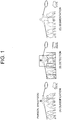
- Fig. 1 shows an example of various outputs to be acquired from a photograph using a deep CNN according to prior art.
- Classification is a method for identifying a type of a class to be acquired from a photograph, for example, as shown in Fig. 1 , determining whether an acquired object is a person, a lamb, or a dog.
- Detection is a method for finding every object and displaying the found object as enclosed in a bounding box.
- Segmentation is a method for distinguishing a region of a specific object from other objects in a photograph. As the deep learning has recently become popular, the classification, the detection, and the segmentation are using the deep learning heavily.
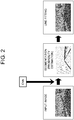
- Fig. 2 is a simplified drawing of a conventional lane detection method using a CNN
- Fig. 3 is a simplified drawing of a general CNN segmentation process.
- a learning device receives an input image, acquires feature maps by multiple convolution operations and non-linear operations like ReLU in multiple convolutional layers, and acquires a segmentation result by performing multiple deconvolution operations in multiple deconvolutional layers and SoftMax operations on a last of the feature maps.
- the segmentation result of the conventional lane detection method is composed of two elements, i.e., lanes and backgrounds, as shown in the middle of Fig. 2 .
- the segmentation result is expressed as probability estimation.
- the lanes are found by sampling pixels with high probabilities of being on any lane from candidate pixels on the lane selected as such, and then the lanes are finally determined by using a lane modeling function acquired from pixels on the found lanes.
- a learning method of a CNN capable of detecting one or more lanes using a lane model, including steps of: (a) a learning device acquiring or supporting another device to acquire information on the lanes from at least one image data set, wherein the information on the lanes are represented by respective sets of coordinates of pixels on the lanes; (b) the learning device calculating or supporting another device to calculate one or more function parameters of a lane modeling function of each of the lanes by using the coordinates of the pixels on the lanes; and (c) the learning device performing or supporting another device to perform processes of classifying the function parameters into K cluster groups by using a clustering algorithm, assigning each of one or more cluster IDs to each of the cluster groups, and generating a cluster ID GT vector representing GT information on probabilities of being the cluster IDs corresponding to types of the lanes.
- the learning method further includes a step of (d) the learning device learning or supporting another device to learn device parameters of the CNN capable of estimating at least one of the cluster IDs corresponding to at least one of the lanes in an input image acquired from the at least one image data set; wherein the step of (d) includes steps of: (d1) the learning device instructing one or more convolutional layers to generate one or more feature maps by applying one or more convolution operations to the input image; (d2) the learning device instructing an FC layer to generate a result vector of cluster ID classifications of the lanes in the input image by feeding a specific feature map outputted from the convolutional layers into the FC layer; and (d3) the learning device instructing a loss layer to generate at least one classification loss by referring to the result vector of the cluster ID classifications and the cluster ID GT vector, and backpropagate the classification loss, to thereby optimize the device parameters of the CNN.
- the cluster ID GT vector is a K+1 dimensional vector, and (i) on condition that the lanes are determined as present in the input image, if there is a specific lane, having a specific cluster ID C k among the K cluster IDs, among the lanes in the input image, then a k-th dimension of the cluster ID GT vector is filled with 1, other dimensions of the cluster ID GT vector which respectively correspond to other cluster IDs, among the cluster IDs, not in the input image are filled with 0, and a (K+1)-th dimension of the cluster ID GT vector is filled with 0, and (ii) if no lanes are determined as present in the input image, a first dimension to a K-th dimension of the cluster ID GT vector are filled with 0, and the (K+1) -th dimension of the cluster ID GT vector is filled with 1, wherein k is an integer ranging from 1 to K, and wherein, at the step of (d3), the result vector of the cluster ID classifications is a K+1 dimensional vector.
- ( x , y) are the coordinates of the center points on a j -th lane in an i -th input image ⁇ ⁇ ( x , y)
- x f ( y ; ⁇ i,j ) ⁇ and wherein ⁇ i,j are the respective function parameters of the j -th lane in the i -th input image.
- the lane model of the lane modeling function is a parameterized model, wherein the function parameters are generated by using a regression algorithm, and wherein the regression algorithm is varied according to the lane model.
- the lane model is a polynomial function, and wherein the regression algorithm is a least square error algorithm.
- each of the cluster groups has each of averaged values 1 C k ⁇ L i , j ⁇ C k ⁇ i , j over the function parameters of the respective lanes included in the respective cluster groups, as each of representative cluster group values ⁇ k
- the learning method further includes a step of: (e) the learning device generating or supporting another device to generate each of the representative cluster group values corresponding to each of the estimated cluster IDs, and determining or supporting another device to determine each of the estimated lanes represented by each of the representative cluster group values ⁇ k .
- each of the representative cluster group values is acquired by using at least part of the estimated cluster IDs, wherein the at least part of the estimated cluster IDs are determined by referring to information on whether each of vector components of the result vector is larger than a predetermined value.
- the learning method further includes steps of: (f) the learning device generating or supporting another device to generate at least one existence classification lossexistence loss which represents whether one of GT lanes is present near each of the estimated lanes, based on whether coordinates of said one of the GT lanes is present within a certain number of pixels in either direction parallel to an x-axis from respective coordinates of each of the estimated lanes; (g) the learning device, if said one of the GT lanes is determined as present near each of the estimated lanes, generating or supporting another device to generate at least one distance regression loss by referring to each of distances x GT - f ( y
- the learning method further includes a step of: (f0) the learning device extracting or supporting another device to extract each of one or more areal features which represents each of areas near the pixels ( f ( y
- the existence loss is generated by using a cross entropy
- the distance regression loss is generated by using at least one Euclidean distance regression loss
- a testing method of a CNN capable of detecting one or more lanes using a lane model, including steps of: (a) on condition that a learning device using the CNN has (i) acquired information on the lanes represented as sets of coordinates of the lanes from at least one training image; (ii) calculated function parameters of a lane modeling function of each of the lanes by using pixel information of coordinates of center points of the lanes; (iii) classified the function parameters into K cluster groups for training by using a clustering algorithm, and generated a cluster ID GT (Ground Truth) vector representing information on one or more cluster IDs for training corresponding to types of the lanes in each training image; (iv) generated one or more feature maps for training by applying one or more convolution operations to the training image; (v) generated a result vector of cluster ID classifications for training by feeding a specific feature map among the feature maps for training into an FC (Fully Connected) layer, and generated at least one classification loss by referring to
- the method further includes steps of (e) the testing device extracting or supporting another device to extract each of one or more areal features which represents each of areas near the pixels ( f ( y
- each of the representative cluster group values for testing is acquired by using at least part of the estimated cluster IDs for testing, wherein the at least part of the estimated cluster IDs for testing are determined by referring to information on whether each of vector components of the result vector of the cluster ID classifications for testing is larger than a predetermined value.
- a learning device of a CNN capable of detecting one or more lanes using a lane model, including: a communication part for acquiring or supporting another device to acquire at least one image data set; and a processor for performing processes of (i) acquiring or supporting another device to acquire information on the lanes from the at least one image data set, wherein the information on the lanes are represented by respective sets of coordinates of pixels on the lanes; (ii) calculating or supporting another device to calculate one or more function parameters of a lane modeling function of each of the lanes by using the coordinates of the pixels on the lanes; (iii) performing or supporting another device to perform processes of classifying the function parameters into K cluster groups by using a clustering algorithm, assigning each of one or more cluster IDs to each of the cluster groups, and generating a cluster ID GT vector representing GT information on probabilities of being the cluster IDs corresponding to types of the lanes.
- the processor further performs a process of: (iv) learning or supporting another device to learn device parameters of the CNN capable of estimating at least one of the cluster IDs corresponding to at least one of the lanes in an input image acquired from the at least one image data set; wherein the process of (iv) includes processes of: (iv-1) instructing one or more convolutional layers to generate one or more feature maps by applying one or more convolution operations to the input image; (iv-2) instructing an FC layer to generate a result vector of cluster ID classifications of the lanes in the input image by feeding a specific feature map outputted from the convolutional layers into the FC layer; and (iv-3) instructing a loss layer to generate at least one classification loss by referring to the result vector of the cluster ID classifications and the cluster ID GT vector, and backpropagate the classification loss, to thereby optimize the device parameters of the CNN.
- the cluster ID GT vector is a K+1 dimensional vector, and (i) on condition that the lanes are determined as present in the input image, if there is a specific lane, having a specific cluster ID C k among the K cluster IDs, among the lanes in the input image, then a k-th dimension of the cluster ID GT vector is filled with 1, other dimensions of the cluster ID GT vector which respectively correspond to other cluster IDs, among the cluster IDs, not in the input image are filled with 0, and a (K+1)-th dimension of the cluster ID GT vector is filled with 0, and (ii) if no lanes are determined as present in the input image, a first dimension to a K-th dimension of the cluster ID GT vector are filled with 0, and the (K+1)-th dimension of the cluster ID GT vector is filled with 1, wherein k is an integer ranging from 1 to K, and wherein, at the process of (iv-3), the result vector of the cluster ID classifications is a K+1 dimensional vector.
- ( x ,y) are the coordinates of the center points on a j-th lane in an i-th input image ⁇ ⁇ ( x ,y)
- x f ( y ; ⁇ i,j ) ⁇ and wherein ⁇ i,j are the respective function parameters of the j -th lane in the i -th input image.
- the lane model of the lane modeling function is a parameterized model, wherein the function parameters are generated by using a regression algorithm, and wherein the regression algorithm is varied according to the lane model.
- the lane model is a polynomial function, and wherein the regression algorithm is a least square error algorithm.
- each of the cluster groups has each of averaged values 1 C k ⁇ L i , j ⁇ C k ⁇ i , j over the function parameters of the respective lanes included in the respective cluster groups, as each of representative cluster group values ⁇ k , and wherein the processor further performs a process of: (v) generating or supporting another device to generate each of the representative cluster group values corresponding to each of the estimated cluster IDs, and determining or supporting another device to determine each of the estimated lanes represented by each of the representative cluster group values ⁇ k .
- each of the representative cluster group values is acquired by using at least part of the estimated cluster IDs, and wherein the at least part of the estimated cluster IDs are determined by referring to information on whether each of vector components of the result vector is larger than a predetermined value.
- the processor further performs processes of: (vi) generating or supporting another device to generate at least one existence loss which represents whether one of GT lanes is present near each of the estimated lanes, based on whether coordinates of said one of the GT lanes is present within a certain number of pixels in either direction parallel to an x-axis from respective coordinates of each of the estimated lanes; (vii) if said one of the GT lanes is determined as present near each of the estimated lanes, generating or supporting another device to generate at least one distance regression loss by referring to each of distances x GT - f ( y
- the processor further performs a process of: (vi-0) extracting or supporting another device to extract each of one or more areal features which represents each of areas near the pixels ( f ( y
- the existence loss is generated by using a cross entropy
- the distance regression loss is generated by using at least one Euclidean distance regression loss
- a testing device of a CNN capable of detecting one or more lanes using a lane model, including: communication part, on condition that a learning device using the CNN has (i) acquired information on the lanes represented as sets of coordinates of the lanes from at least one training image; (ii) calculated function parameters of a lane modeling function of each of the lanes by using pixel information of coordinates of center points of the lanes; (iii) classified the function parameters into K cluster groups for training by using a clustering algorithm, and generated a cluster ID GT (Ground Truth) vector representing information on one or more cluster IDs for training corresponding to types of the lanes in each training image; (iv) generated one or more feature maps for training by applying one or more convolution operations to the training image; (v) generated a result vector of cluster ID classifications for training by feeding a specific feature map among the feature maps for training into an FC (Fully Connected) layer, and generated at least one classification loss by referring to
- the processor further performs processes of: (IV) extracting or supporting another device to extract each of one or more areal features which represents each of areas near the pixels ( f ( y
- each of the representative cluster group values for testing is acquired by using at least part of the estimated cluster IDs for testing, wherein the at least part of the estimated cluster IDs for testing are determined by referring to information on whether each of vector components of the result vector of the cluster ID classifications for testing is larger than a predetermined value.
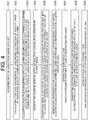
- Fig. 4 is a drawing schematically illustrating a flow chart representing a learning method of a CNN (Convolutional Neural Network) capable of detecting one or more lanes using a lane model in accordance with the present invention.
- CNN Convolutional Neural Network
- the learning method detecting the lanes through the lane model by using the CNN in accordance with the present invention may include a step S01 of acquiring information on lanes from at least one image data set, a step S02 of calculating function parameters of a lane modeling function of each of the lanes by using pixel information of coordinates of center points of the lanes, a step S03 of classifying the function parameters into K cluster groups by using a clustering algorithm, and generating a cluster ID GT (Ground Truth) vector representing information on one or more cluster IDs corresponding to types of the lanes in each input image of the at least one image data set, a step S04 of generating one or more feature maps by applying multiple convolution operations to the input image, a step S05 of generating a result vector of cluster ID classifications by feeding a specific feature map into an FC (Fully Connected) layer and generating at least one classification loss by referring to the result vector of the cluster ID classifications and the cluster ID GT vector, a step S06
- every step from S01 to S09 of the present invention is not a requirement, that is, the present invention may be comprised only of the steps from S01 to S03 of generating the cluster ID GT vector, or may be comprised only of the steps from S04 to S09 of learning the device parameters on condition that the cluster ID GT vector has been acquired in any ways, e.g., without the steps from S01 to S03.
- the learning method of the CNN capable of detecting the lanes using the lane model in accordance with the present invention may acquire from the at least one image data set (i) information on coordinates of the center points on the lanes and (ii) the cluster ID GT vector generated by clustering the function parameters of the lane modeling function calculated from the information on the coordinates of the center points. Then, the learning method in accordance with the present invention suggests a learning device that may estimate or support another device to estimate the lane modeling function using the input image, and find or support another device to find the center points on the lanes in the input image using the lane modeling function.
- Fig. 5 is a drawing schematically illustrating a process of acquiring the lane modeling function and the cluster IDs from the at least one image data set.
- the information on the lanes may be acquired from the at least one image data set.
- pixel information on the lanes may be acquired from a specific input image 510 of the at least one image data set, and the information on the coordinates of the center points on the lanes may be acquired.
- the coordinates of the center points may be expressed as (x, y), and the lanes may be defined as a set of the coordinates of the center points.
- the function parameters may be calculated by using the pixel information on the lanes, or the lane modeling function may be derived from the function parameters.
- the lane modeling function representing the coordinates of the center points (x, y) included in the lanes L i,j is expressed as below.
- L i,j ⁇ ( x , y)
- ⁇ ⁇ ( x , y)
- x f ( y; ⁇ i,j ) ⁇
- ⁇ i,j may represent the j-th function parameter in the i-th input image.
- the function parameters of the lane model for each of the lanes may be calculated by using the pixel information given as described above. That is, the lanes may be represented by defining a function that best describes the center points on the lanes L i,j .
- the lane modeling function may be a parameterized function, and the function parameters may be acquired by using a regression algorithm.
- Various algorithms may be used for the regression algorithm, according to the lane modeling function.
- the lane modeling function may be a polynomial function
- the regression algorithm may be a least square error algorithm
- the function parameters may be classified into K cluster groups by using the clustering algorithm, and the cluster ID GT vector representing the cluster IDs corresponding to the types of the lanes in each image of the at least one image data set may be generated.
- the cluster IDs of the lanes for creating training data may be defined.
- the function parameters may be classified into the K cluster groups by using the clustering algorithm, each of the cluster IDs may be assigned to each of the cluster groups, and the cluster ID GT vector representing GT information on exact probabilities of being the cluster IDs corresponding to the types of the lanes may be generated.
- every each of the function parameters of the lane modeling function from every image may be classified into the K cluster groups by using the clustering algorithm, and the learning device may learn the device parameters of the CNN to estimate which of the cluster IDs the lanes in the input image belong to.
- Clustering is a method to classify N data into K clusters or groups where N ⁇ K. Typical clustering includes k-means clustering, spectral clustering, etc. and any clustering methods may be used in the present invention. Further, clustering is the task of grouping a set of objects in such a way that objects in the same group, i.e., cluster, are more similar to each other than to those in other groups.
- N parameters ⁇ i,j of the lanes in said each image of the at least one image data set included in the training data are classified into K clusters, where each of the lanes L i,j is included in only one cluster C k and where 1 ⁇ k ⁇ K. That is, no two clusters share a lane as their element.
- the cluster ID of the lane L i,j may be k.
- the lanes may be represented approximately as the representative value of the cluster.
- solid lines may be the lanes drawn by using the function parameters of the GT lanes
- dotted lines may be exemplar lanes drawn by using the representative cluster group values of the clusters to which their corresponding function parameters of the GT lanes belong as shown in Fig. 5 .
- each of the representative cluster group values of the cluster does not represent a perfect GT lane, but does represent a lane very similar to the GT lane.
- Fig. 6 is a drawing schematically illustrating the learning method of the CNN for detecting the lanes through the lane model in accordance with the present invention.
- an encoding layer 610 may be used to instruct one or more convolutional layers to generate the feature maps 620 by applying one or more convolution operations to the input image.
- the result vector of the cluster ID classifications may be acquired from the feature maps, and the classification loss may be calculated by referring to the result vector of the cluster ID classifications and the cluster ID GT vector. That is, the learning device may instruct an FC layer 630 to generate the result vector of the cluster ID classifications of the lanes in the input image by feeding a feature map 620 outputted from the convolutional layers into the FC layer 630 and, may calculate the classification loss by referring to the result vector 640 and the cluster ID GT vector.
- the classification loss may be used to optimize the device parameters of the CNN by backpropagation.
- the cluster ID GT vector may be a K+1 dimensional vector including the cluster IDs of the lanes in said each image of the at least one image data set, and (i) on condition that the lanes are determined as present in the input image, if there is a lane having a specific cluster ID Ck among the K cluster IDs in the input image, then a k-th dimension of the cluster ID GT vector may be filled with 1, other dimensions of the cluster ID GT vector which correspond to other cluster IDs corresponding to clusters not in the input image may be filled with 0, and a (K+1)-th dimension of the cluster ID GT vector may be filled with 0, and (ii) if no lanes are determined as present in the input image, a first dimension to a K-th dimension of the cluster ID GT vector may be filled with 0, and the (K+1)-th dimension of the cluster ID GT vector may be filled with 1.
- the cluster ID GT vector may be in a form of (0, 0, ..., 0, 1).
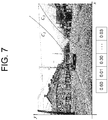
- Fig. 7 is a drawing schematically illustrating an example of the result vector of the cluster ID classifications of the lanes detected by the learning device in accordance with the present invention.
- the feature map 620 may be inputted into the FC layer 630 and its result vector 640 may be outputted, and the result vector may be a K+1 dimensional vector corresponding to the cluster ID GT vector which may also be a K+1 dimensional vector.
- the calculated result vector 640 may be expressed as (0.60, 0.01, 0.30, ..., 0.03). That is, in the example of Fig. 7 , it may be determined that the lanes whose cluster IDs are C1 and C3 have high probabilities of being in the input image.
- the classification loss may be calculated by referring to the calculated result vector (0.60, 0.01, 0.30, ..., 0.03) and the cluster ID GT vector (1, 0, 1, 0, ..., 0).
- This classification loss lc may also be calculated as a cross entropy loss between the result vector and the cluster ID GT vector.
- a representative cluster group value corresponding to the estimated cluster ID may be acquired, and the representative cluster group value ⁇ k as the estimated lanes may be acquired.
- the learning device may acquire or support another device to acquire the representative cluster group value ⁇ k corresponding to the cluster ID estimated at the step of S05, and may determine or support another device to determine each of the estimated lanes represented by each of the representative cluster group values ⁇ k .
- the learning device for each proposed cluster which is a cluster having a value larger than the predetermined threshold among the result vector of the cluster ID classifications, may generate or support another device to generate the existence loss and the distance regression loss, i.e., two outputs, for each y value.
- the existence loss may be calculated which represents whether one of the GT lanes is present near the estimated lanes, and as illustrated in Fig. 6 , the feature map 620 and the result vector 640 may be inputted into an ROI (Region Of Interest) pooling layer 650, and a result from the ROI pooling layer 650 is inputted into an FC layer 660 for detecting presence of the lanes, then the existence loss le may be calculated.
- ROI Region Of Interest
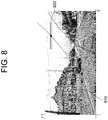
- Fig. 8 is a drawing schematically illustrating a process of confirming whether the coordinates of the GT lanes exist in either direction parallel to the x-axis from the coordinates of the estimated lanes, and by referring to Fig. 8 , the dotted lines may represent the estimated lanes acquired by using the estimated cluster IDs.
- the learning device may calculate or support another device to calculate values representing whether the coordinates of the GT lanes are present near each pixel on the dotted lines with respect to y value of said each pixel, for example, the learning device may generate or support another device to generate the existence loss which represents whether one of the GT lanes is present near each of the estimated lanes, based on whether coordinates of said one of the GT lanes are present within a certain number of pixels in either direction parallel to the x-axis from the respective coordinates of each of the estimated lanes.
- the existence loss may be a label representing whether said one of the GT lanes is near, and may be a two dimensional vector. For example, [1, 0] if one of the GT lanes is near the estimated lanes, and [0, 1] if no GT lanes are near the estimated lanes.
- a method may be used for determining whether the center points of one of the GT lanes are present within a nearby area within a certain number of pixels in either direction parallel to the x-axis from the respective coordinates acquired by calculating f ( y
- the distance regression loss may be calculated by referring to each of distances between pixels of the estimated lanes and their corresponding pixels of the GT lanes, and as illustrated in Fig. 6 , the feature map 620 and the result vector 640 of the cluster ID classifications may be inputted into the ROI pooling layer 650, and the result from the ROI pooling layer 650 may be inputted into an FC layer 670 for detecting differences between the GT lanes and the estimated lanes, then if the GT lanes are determined as present near the estimated lanes, the distance regression loss lr may be calculated.
- Fig. 10 illustrates a process of calculating the distance regression loss, and as illustrated in example thereof, if said one of the GT lanes is determined as present near each of the estimated lanes, the distance regression loss lr may be calculated by referring to each of distances x GT - f ( y
- a certain region like the region 810 represented as the solid lines, is searched in the either direction parallel to the x-axis from the pixels of the estimated lanes, and if one of the GT lanes is determined as present, like the pixels on the solid line in the positive direction of the x-axis from the coordinates of the pixels on the estimated lanes, then a first output, i.e., the existence loss, may be [1, 0], and a second output, i.e., the distance regression loss, may be acquired by referring to a difference between the x-coordinates of the two pixels.
- the first output i.e., the existence loss
- the second output i.e., the distance regression loss
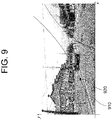
- the ROI pooling layer 650 may extract the areal features of region 910 near the pixels 920 ( f ( y
- the learning device may calculate or support another device to calculate the existence loss and the distance regression loss by using the feature map outputted from the ROI pooling layer 650.
- the learning device may further perform or support another device to perform processes of extracting the areal features of the region 910 near the pixels 920 on the estimated lanes from the feature map, and of calculating the existence loss and the distance regression loss based on the areal features.
- the present invention provides a method of performing calculation, not by checking every pixel in the feature map of the input image, but by extracting only nearby areas of the pixels on the estimated lanes as illustrated in Fig. 9 , and thus remarkably reducing the amount of calculation.
- the step of S09 may be performed by backpropagating the classification loss, the existence loss and the distance regression loss, to thereby optimize the device parameters of the CNN.
- the existence loss is used for determining whether the lanes are present nearby or not, therefore it may be regarded as classification.
- the existence loss may calculated by using the cross entropy, etc.
- the distance regression loss uses a distance between coordinates acquired from learning and the GT coordinates, therefore it may be regarded as a regression loss.
- the distance regression loss may be calculated by using the Euclidean distance loss, etc.
- the device parameters of the learning device are optimized by learning processes described in Figs. 4 to 10 , and the lanes within images inputted from real-world driving situation are detected by using a testing device employing the device parameters.
- Fig. 11 is a drawing schematically illustrating a process of the lane detection through the lane model by using the testing device in accordance with the present invention.
- the testing device using the device parameters may instruct its encoding layer 1110 to apply the convolution operations to the acquired input image for testing, to thereby generate a feature map for testing 1120, and may input the feature map for testing 1120 into an FC layer 1130 for cluster ID classification, to thereby generate a result vector of the cluster ID classifications for testing 1140, which represents estimated cluster IDs for testing of cluster groups of the lanes in the,input image for testing.
- the testing device may generate or support another device to generate each of representative cluster group values for testing by using at least part of the estimated cluster IDs for testing, where the at least part of the estimated cluster IDs for testing are determined by referring to information on whether each of vector components of the result vector of the cluster ID classifications for testing 1140 is larger than the predetermined threshold, and may determine each of estimated lanes for testing represented by each of the representative cluster group value ⁇ k for testing.
- the testing device may perform following processes by using the lanes represented by the representative cluster group values. That is, the testing device may perform or support another device to perform processes of (i) acquiring each x value for each y value from the representative cluster group values by using the equation ⁇ ( x , y)
- x f ( y ; ⁇ i,j ) ⁇ , (ii) extracting areal features of the pixels on the estimated lanes for testing by using an ROI pooling layer 1150, (iii) determining whether actual lanes are present by using outputs from an FC layer 1160, (iv) if the actual lanes are determined as present, calculating each of distances between the actual lanes and the lanes represented by the representative cluster group values by using the FC layer for distance regression 1170, and (v) determining lanes, acquired via using the representative cluster group values and translating pixels of the estimated lanes by the amount of said each of distances, as the actual lanes.
- the testing device may perform or support another device to perform a step of extracting the areal features of certain regions near the pixels of the estimated lanes for testing from the feature map; a step of determining whether one of the actual lanes is present near each of the estimated lanes for testing, based on whether coordinates of said one of the actual lanes are present within a certain number of pixels in either direction parallel to the x-axis from respective coordinates of said each of the estimated lanes for testing, and if said one of the actual lanes is present nearby, calculating a distance between coordinates of said one of the actual lanes and those of the estimated lanes for testing; and a step of determining the estimated lanes for testing via translating the estimated lanes for testing by the amount of the distance.
- the actual lanes at the step of testing do not necessarily mean the GT lanes, but lanes in the input image for testing.
- the presence of the lanes within the ROI may be determined by the process (iii) of existence classification, and the difference between the actual lanes and the lanes estimated from the representative cluster group values may be estimated by using features in the ROI at the process (iv) of distance regression, thus the estimated lanes for testing may be determined by referring to the difference of the distances.
- the present invention discloses methods of generating data for learning the lane model by clustering and modeling of the lanes from the data for learning, learning the function parameters of the lane modeling function of the lanes in the input image based on the data for learning, and deriving the lane modeling function from the input image and detecting the lanes based on the lane modeling function.
- the lanes may be detected with less computations than conventional technology because only the feature maps near the detected lanes are used.
- communication parts of the learning device and the testing device may perform transmission of image data, for example, images described above like a training image, an input image, and an input image for testing, etc.
- processors and/or memories of the learning device and the testing device may retain data for feature maps and performing operations
- the processors of the learning device and the testing device may perform convolution operations, deconvolution operations, and loss value operations, but the scope of the present invention is not limited thereto.
- the present invention has an effect of generating data for learning the lane model by clustering and modeling of the lanes from the data for learning, and learning the function parameters by referring to the cluster IDs of the lane modeling function of the lanes in the input image based on the data for learning.
- the present invention has another effect of detecting the lanes based on the lane modeling functions derived from the input image by CNN learning.
- the present invention has still another effect of detecting the lanes with less computations than conventional technology because only feature maps near the detected lanes are used.
- the embodiments of the present invention as explained above can be implemented in a form of executable program command through a variety of computer means recordable to computer readable media.
- the computer readable media may include solely or in combination, program commands, data files, and data structures.
- the program commands recorded to the media may be components specially designed for the present invention or may be usable to a skilled human in a field of computer software.
- Computer readable media include magnetic media such as hard disk, floppy disk, and magnetic tape, optical media such as CD-ROM and DVD, magneto-optical media such as floptical disk and hardware devices such as ROM, RAM, and flash memory specially designed to store and carry out program commands.
- Program commands include not only a machine language code made by a compiler but also a high level code that can be used by an interpreter etc., which is executed by a computer.
- the aforementioned hardware device can work as more than a software module to perform the action of the present invention and they can do the same in the opposite case.
Landscapes
- Engineering & Computer Science (AREA)
- Theoretical Computer Science (AREA)
- Physics & Mathematics (AREA)
- General Physics & Mathematics (AREA)
- Data Mining & Analysis (AREA)
- Evolutionary Computation (AREA)
- Artificial Intelligence (AREA)
- Life Sciences & Earth Sciences (AREA)
- Software Systems (AREA)
- General Engineering & Computer Science (AREA)
- Computing Systems (AREA)
- Health & Medical Sciences (AREA)
- General Health & Medical Sciences (AREA)
- Computer Vision & Pattern Recognition (AREA)
- Molecular Biology (AREA)
- Computational Linguistics (AREA)
- Biophysics (AREA)
- Biomedical Technology (AREA)
- Mathematical Physics (AREA)
- Multimedia (AREA)
- Evolutionary Biology (AREA)
- Bioinformatics & Computational Biology (AREA)
- Bioinformatics & Cheminformatics (AREA)
- Databases & Information Systems (AREA)
- Medical Informatics (AREA)
- Probability & Statistics with Applications (AREA)
- Image Analysis (AREA)
Applications Claiming Priority (1)
| Application Number | Priority Date | Filing Date | Title |
|---|---|---|---|
| US16/121,640 US10275667B1 (en) | 2018-09-05 | 2018-09-05 | Learning method, learning device for detecting lane through lane model and testing method, testing device using the same |
Publications (3)
| Publication Number | Publication Date |
|---|---|
| EP3620958A1 true EP3620958A1 (fr) | 2020-03-11 |
| EP3620958B1 EP3620958B1 (fr) | 2023-11-29 |
| EP3620958C0 EP3620958C0 (fr) | 2023-11-29 |
Family
ID=66248244
Family Applications (1)
| Application Number | Title | Priority Date | Filing Date |
|---|---|---|---|
| EP19178066.7A Active EP3620958B1 (fr) | 2018-09-05 | 2019-06-04 | Procédé d'apprentissage, dispositif d'apprentissage permettant de détecter une voie par un modèle de voie et procédé de test, dispositif de test l'utilisant |
Country Status (5)
| Country | Link |
|---|---|
| US (1) | US10275667B1 (fr) |
| EP (1) | EP3620958B1 (fr) |
| JP (1) | JP6980289B2 (fr) |
| KR (1) | KR102279388B1 (fr) |
| CN (1) | CN110879961B (fr) |
Families Citing this family (13)
| Publication number | Priority date | Publication date | Assignee | Title |
|---|---|---|---|---|
| US10783610B2 (en) * | 2015-12-14 | 2020-09-22 | Motion Metrics International Corp. | Method and apparatus for identifying fragmented material portions within an image |
| CN110246180A (zh) * | 2019-05-17 | 2019-09-17 | 福州瑞芯微电子股份有限公司 | 一种基于深度学习的教师位置检测方法及系统 |
| GB201908530D0 (en) * | 2019-06-13 | 2019-07-31 | Microsoft Technology Licensing Llc | Robutness against manipulations n machine learning |
| CN111126327B (zh) * | 2019-12-30 | 2023-09-15 | 中国科学院自动化研究所 | 车道线检测方法、系统、车载系统及车辆 |
| CN111141306A (zh) * | 2020-01-07 | 2020-05-12 | 深圳南方德尔汽车电子有限公司 | 基于A-star全局路径规划方法、装置、计算机设备及存储介质 |
| CN111666808A (zh) * | 2020-04-20 | 2020-09-15 | 中汽数据有限公司 | 一种生成车辆典型变道测试工况的方法 |
| US12139173B2 (en) * | 2021-01-19 | 2024-11-12 | Baidu Usa Llc | Dynamic model evaluation package for autonomous driving vehicles |
| KR20220144456A (ko) * | 2021-04-19 | 2022-10-27 | 현대모비스 주식회사 | Svm 원 영상을 기반으로 근접 주행 환경을 인식하는 방법 및 시스템 |
| US12340596B2 (en) * | 2021-10-11 | 2025-06-24 | Autobrains Technologies Ltd | Continuous context-based learning for lane prediction |
| JP7808994B2 (ja) | 2022-03-29 | 2026-01-30 | 本田技研工業株式会社 | 画像処理装置、画像処理方法、およびプログラム |
| KR102915086B1 (ko) * | 2022-11-29 | 2026-01-19 | 한국기술교육대학교 산학협력단 | 차선 인식 시스템 및 차선 인식 방법 |
| CN116543365B (zh) * | 2023-07-06 | 2023-10-10 | 广汽埃安新能源汽车股份有限公司 | 一种车道线识别方法、装置、电子设备及存储介质 |
| CN119261883B (zh) * | 2024-11-06 | 2025-10-31 | 安徽海博智能科技有限责任公司 | 一种基于前车轨迹聚类预测的无人车辆主动避撞方法 |
Family Cites Families (12)
| Publication number | Priority date | Publication date | Assignee | Title |
|---|---|---|---|---|
| JPH09223218A (ja) * | 1996-02-15 | 1997-08-26 | Toyota Motor Corp | 走路検出方法及び装置 |
| JP5083658B2 (ja) * | 2008-03-26 | 2012-11-28 | 本田技研工業株式会社 | 車両用車線認識装置、車両、及び車両用車線認識プログラム |
| KR101225626B1 (ko) * | 2010-07-19 | 2013-01-24 | 포항공과대학교 산학협력단 | 차선 인식 시스템 및 방법 |
| US9815462B2 (en) * | 2015-08-27 | 2017-11-14 | Toyota Motor Engineering & Manufacturing North America, Inc. | Path determination for automated vehicles |
| CN105260699B (zh) * | 2015-09-10 | 2018-06-26 | 百度在线网络技术(北京)有限公司 | 一种车道线数据的处理方法及装置 |
| US9418546B1 (en) * | 2015-11-16 | 2016-08-16 | Iteris, Inc. | Traffic detection with multiple outputs depending on type of object detected |
| KR102628654B1 (ko) * | 2016-11-07 | 2024-01-24 | 삼성전자주식회사 | 차선을 표시하는 방법 및 장치 |
| JP6798860B2 (ja) * | 2016-11-29 | 2020-12-09 | 株式会社Soken | 境界線推定装置 |
| KR101882743B1 (ko) * | 2017-04-17 | 2018-08-30 | 인하대학교 산학협력단 | 콘볼루션 신경망 기반-계층적 특징 모델링을 이용한 효율적인 객체 검출 방법 |
| KR101949448B1 (ko) * | 2017-04-25 | 2019-02-18 | 서울대학교산학협력단 | 가우시안 프로세스 회귀분석을 이용한 클러스터링 방법 및 그 장치 |
| US10007865B1 (en) * | 2017-10-16 | 2018-06-26 | StradVision, Inc. | Learning method and learning device for adjusting parameters of CNN by using multi-scale feature maps and testing method and testing device using the same |
| KR101896406B1 (ko) * | 2018-03-13 | 2018-10-22 | 연세대학교 산학협력단 | 블랙박스 영상을 이용한 딥러닝 기반의 픽셀 단위 도로 크랙 검출 장치 및 그 방법, 그리고 이 방법을 실행시키기 위해 컴퓨터가 판독 가능한 기록매체에 저장된 컴퓨터 프로그램 |
-
2018
- 2018-09-05 US US16/121,640 patent/US10275667B1/en active Active
-
2019
- 2019-06-04 EP EP19178066.7A patent/EP3620958B1/fr active Active
- 2019-08-27 KR KR1020190105469A patent/KR102279388B1/ko active Active
- 2019-08-30 CN CN201910813171.9A patent/CN110879961B/zh active Active
- 2019-09-03 JP JP2019160073A patent/JP6980289B2/ja active Active
Non-Patent Citations (2)
| Title |
|---|
| BRODY HUVAL ET AL: "An Empirical Evaluation of Deep Learning on Highway Driving", ARXIV.ORG, CORNELL UNIVERSITY LIBRARY, 201 OLIN LIBRARY CORNELL UNIVERSITY ITHACA, NY 14853, 7 April 2015 (2015-04-07), XP081335864 * |
| DAVY NEVEN ET AL: "Towards End-to-End Lane Detection: an Instance Segmentation Approach", 2018 IEEE INTELLIGENT VEHICLES SYMPOSIUM (IV), 26 June 2018 (2018-06-26), pages 286 - 291, XP055655903, ISBN: 978-1-5386-4452-2, DOI: 10.1109/IVS.2018.8500547 * |
Also Published As
| Publication number | Publication date |
|---|---|
| JP2020038661A (ja) | 2020-03-12 |
| CN110879961B (zh) | 2023-10-17 |
| EP3620958B1 (fr) | 2023-11-29 |
| JP6980289B2 (ja) | 2021-12-15 |
| EP3620958C0 (fr) | 2023-11-29 |
| KR102279388B1 (ko) | 2021-07-21 |
| CN110879961A (zh) | 2020-03-13 |
| KR20200027888A (ko) | 2020-03-13 |
| US10275667B1 (en) | 2019-04-30 |
Similar Documents
| Publication | Publication Date | Title |
|---|---|---|
| EP3620958B1 (fr) | Procédé d'apprentissage, dispositif d'apprentissage permettant de détecter une voie par un modèle de voie et procédé de test, dispositif de test l'utilisant | |
| EP3620980B1 (fr) | Procédé d'apprentissage, dispositif d'apprentissage pour la détection de voie à l'aide de cnn et procédé de test, dispositif de test l'utilisant | |
| EP3620956B1 (fr) | Procédé d'apprentissage, dispositif d'apprentissage permettant de détecter une voie par classement de pixels de voie candidate et procédé de test, dispositif de test l'utilisant | |
| US10229346B1 (en) | Learning method, learning device for detecting object using edge image and testing method, testing device using the same | |
| US10474713B1 (en) | Learning method and learning device using multiple labeled databases with different label sets and testing method and testing device using the same | |
| US10504027B1 (en) | CNN-based learning method, learning device for selecting useful training data and test method, test device using the same | |
| CN110909618B (zh) | 一种宠物身份的识别方法及装置 | |
| EP3690741B1 (fr) | Procédé d'évaluation automatique de la fiabilité d'étiquetage de formation d'images destiné à être utilisé dans un réseau d'apprentissage profond pour analyser des images et dispositif d'évaluation de la fiabilité l'utilisant | |
| CN106682696B (zh) | 基于在线示例分类器精化的多示例检测网络及其训练方法 | |
| CN110879962B (zh) | 利用多个视频帧优化cnn参数的方法和装置 | |
| JP2008217706A (ja) | ラベリング装置、ラベリング方法及びプログラム | |
| CN110147841A (zh) | 基于弱监督及无监督部件检测和分割的细粒度分类方法 | |
| CN111444816A (zh) | 一种基于Faster RCNN的多尺度密集行人检测方法 | |
| EP3623991B1 (fr) | Procédé d'apprentissage, dispositif d'apprentissage pour la détection de voies à base de cnn et procédé de test, dispositif de test l'utilisant | |
| CN111177447B (zh) | 一种基于深度网络模型的行人图像识别方法 | |
| CN114170625B (zh) | 一种上下文感知、噪声鲁棒的行人搜索方法 | |
| CN116342876B (zh) | 一种图像分割方法、系统、电子设备及存储介质 | |
| Pakkala et al. | Road Surface Analysis Through Prognostic Model Using Image Processing and Deep Learning Techniques |
Legal Events
| Date | Code | Title | Description |
|---|---|---|---|
| PUAI | Public reference made under article 153(3) epc to a published international application that has entered the european phase |
Free format text: ORIGINAL CODE: 0009012 |
|
| STAA | Information on the status of an ep patent application or granted ep patent |
Free format text: STATUS: REQUEST FOR EXAMINATION WAS MADE |
|
| 17P | Request for examination filed |
Effective date: 20190604 |
|
| AK | Designated contracting states |
Kind code of ref document: A1 Designated state(s): AL AT BE BG CH CY CZ DE DK EE ES FI FR GB GR HR HU IE IS IT LI LT LU LV MC MK MT NL NO PL PT RO RS SE SI SK SM TR |
|
| AX | Request for extension of the european patent |
Extension state: BA ME |
|
| RBV | Designated contracting states (corrected) |
Designated state(s): AL AT BE BG CH CY CZ DE DK EE ES FI FR GB GR HR HU IE IS IT LI LT LU LV MC MK MT NL NO PL PT RO RS SE SI SK SM TR |
|
| STAA | Information on the status of an ep patent application or granted ep patent |
Free format text: STATUS: EXAMINATION IS IN PROGRESS |
|
| 17Q | First examination report despatched |
Effective date: 20211015 |
|
| REG | Reference to a national code |
Ref legal event code: R079 Ipc: G06V0010762000 Ref country code: DE Ref document number: 602019042210 Country of ref document: DE Free format text: PREVIOUS MAIN CLASS: G06K0009000000 |
|
| GRAP | Despatch of communication of intention to grant a patent |
Free format text: ORIGINAL CODE: EPIDOSNIGR1 |
|
| STAA | Information on the status of an ep patent application or granted ep patent |
Free format text: STATUS: GRANT OF PATENT IS INTENDED |
|
| INTG | Intention to grant announced |
Effective date: 20230706 |
|
| RIC1 | Information provided on ipc code assigned before grant |
Ipc: G06T 7/73 20170101ALI20230623BHEP Ipc: G06N 3/084 20230101ALI20230623BHEP Ipc: G06N 3/045 20230101ALI20230623BHEP Ipc: G06F 18/23 20230101ALI20230623BHEP Ipc: G06V 20/56 20220101ALI20230623BHEP Ipc: G06V 10/82 20220101ALI20230623BHEP Ipc: G06V 10/762 20220101AFI20230623BHEP |
|
| GRAS | Grant fee paid |
Free format text: ORIGINAL CODE: EPIDOSNIGR3 |
|
| GRAA | (expected) grant |
Free format text: ORIGINAL CODE: 0009210 |
|
| STAA | Information on the status of an ep patent application or granted ep patent |
Free format text: STATUS: THE PATENT HAS BEEN GRANTED |
|
| AK | Designated contracting states |
Kind code of ref document: B1 Designated state(s): AL AT BE BG CH CY CZ DE DK EE ES FI FR GB GR HR HU IE IS IT LI LT LU LV MC MK MT NL NO PL PT RO RS SE SI SK SM TR |
|
| REG | Reference to a national code |
Ref country code: GB Ref legal event code: FG4D |
|
| REG | Reference to a national code |
Ref country code: CH Ref legal event code: EP |
|
| REG | Reference to a national code |
Ref country code: DE Ref legal event code: R096 Ref document number: 602019042210 Country of ref document: DE |
|
| REG | Reference to a national code |
Ref country code: IE Ref legal event code: FG4D |
|
| U01 | Request for unitary effect filed |
Effective date: 20231220 |
|
| U07 | Unitary effect registered |
Designated state(s): AT BE BG DE DK EE FI FR IT LT LU LV MT NL PT SE SI Effective date: 20240103 |
|
| PG25 | Lapsed in a contracting state [announced via postgrant information from national office to epo] |
Ref country code: GR Free format text: LAPSE BECAUSE OF FAILURE TO SUBMIT A TRANSLATION OF THE DESCRIPTION OR TO PAY THE FEE WITHIN THE PRESCRIBED TIME-LIMIT Effective date: 20240301 |
|
| PG25 | Lapsed in a contracting state [announced via postgrant information from national office to epo] |
Ref country code: IS Free format text: LAPSE BECAUSE OF FAILURE TO SUBMIT A TRANSLATION OF THE DESCRIPTION OR TO PAY THE FEE WITHIN THE PRESCRIBED TIME-LIMIT Effective date: 20240329 |
|
| PG25 | Lapsed in a contracting state [announced via postgrant information from national office to epo] |
Ref country code: ES Free format text: LAPSE BECAUSE OF FAILURE TO SUBMIT A TRANSLATION OF THE DESCRIPTION OR TO PAY THE FEE WITHIN THE PRESCRIBED TIME-LIMIT Effective date: 20231129 |
|
| PG25 | Lapsed in a contracting state [announced via postgrant information from national office to epo] |
Ref country code: IS Free format text: LAPSE BECAUSE OF FAILURE TO SUBMIT A TRANSLATION OF THE DESCRIPTION OR TO PAY THE FEE WITHIN THE PRESCRIBED TIME-LIMIT Effective date: 20240329 Ref country code: GR Free format text: LAPSE BECAUSE OF FAILURE TO SUBMIT A TRANSLATION OF THE DESCRIPTION OR TO PAY THE FEE WITHIN THE PRESCRIBED TIME-LIMIT Effective date: 20240301 Ref country code: ES Free format text: LAPSE BECAUSE OF FAILURE TO SUBMIT A TRANSLATION OF THE DESCRIPTION OR TO PAY THE FEE WITHIN THE PRESCRIBED TIME-LIMIT Effective date: 20231129 |
|
| PG25 | Lapsed in a contracting state [announced via postgrant information from national office to epo] |
Ref country code: RS Free format text: LAPSE BECAUSE OF FAILURE TO SUBMIT A TRANSLATION OF THE DESCRIPTION OR TO PAY THE FEE WITHIN THE PRESCRIBED TIME-LIMIT Effective date: 20231129 Ref country code: PL Free format text: LAPSE BECAUSE OF FAILURE TO SUBMIT A TRANSLATION OF THE DESCRIPTION OR TO PAY THE FEE WITHIN THE PRESCRIBED TIME-LIMIT Effective date: 20231129 Ref country code: NO Free format text: LAPSE BECAUSE OF FAILURE TO SUBMIT A TRANSLATION OF THE DESCRIPTION OR TO PAY THE FEE WITHIN THE PRESCRIBED TIME-LIMIT Effective date: 20240229 Ref country code: HR Free format text: LAPSE BECAUSE OF FAILURE TO SUBMIT A TRANSLATION OF THE DESCRIPTION OR TO PAY THE FEE WITHIN THE PRESCRIBED TIME-LIMIT Effective date: 20231129 |
|
| U20 | Renewal fee for the european patent with unitary effect paid |
Year of fee payment: 6 Effective date: 20240503 |
|
| PG25 | Lapsed in a contracting state [announced via postgrant information from national office to epo] |
Ref country code: CZ Free format text: LAPSE BECAUSE OF FAILURE TO SUBMIT A TRANSLATION OF THE DESCRIPTION OR TO PAY THE FEE WITHIN THE PRESCRIBED TIME-LIMIT Effective date: 20231129 |
|
| PG25 | Lapsed in a contracting state [announced via postgrant information from national office to epo] |
Ref country code: SK Free format text: LAPSE BECAUSE OF FAILURE TO SUBMIT A TRANSLATION OF THE DESCRIPTION OR TO PAY THE FEE WITHIN THE PRESCRIBED TIME-LIMIT Effective date: 20231129 |
|
| PG25 | Lapsed in a contracting state [announced via postgrant information from national office to epo] |
Ref country code: SM Free format text: LAPSE BECAUSE OF FAILURE TO SUBMIT A TRANSLATION OF THE DESCRIPTION OR TO PAY THE FEE WITHIN THE PRESCRIBED TIME-LIMIT Effective date: 20231129 Ref country code: SK Free format text: LAPSE BECAUSE OF FAILURE TO SUBMIT A TRANSLATION OF THE DESCRIPTION OR TO PAY THE FEE WITHIN THE PRESCRIBED TIME-LIMIT Effective date: 20231129 Ref country code: RO Free format text: LAPSE BECAUSE OF FAILURE TO SUBMIT A TRANSLATION OF THE DESCRIPTION OR TO PAY THE FEE WITHIN THE PRESCRIBED TIME-LIMIT Effective date: 20231129 Ref country code: CZ Free format text: LAPSE BECAUSE OF FAILURE TO SUBMIT A TRANSLATION OF THE DESCRIPTION OR TO PAY THE FEE WITHIN THE PRESCRIBED TIME-LIMIT Effective date: 20231129 |
|
| REG | Reference to a national code |
Ref country code: DE Ref legal event code: R097 Ref document number: 602019042210 Country of ref document: DE |
|
| PLBE | No opposition filed within time limit |
Free format text: ORIGINAL CODE: 0009261 |
|
| STAA | Information on the status of an ep patent application or granted ep patent |
Free format text: STATUS: NO OPPOSITION FILED WITHIN TIME LIMIT |
|
| 26N | No opposition filed |
Effective date: 20240830 |
|
| PG25 | Lapsed in a contracting state [announced via postgrant information from national office to epo] |
Ref country code: MC Free format text: LAPSE BECAUSE OF FAILURE TO SUBMIT A TRANSLATION OF THE DESCRIPTION OR TO PAY THE FEE WITHIN THE PRESCRIBED TIME-LIMIT Effective date: 20231129 |
|
| REG | Reference to a national code |
Ref country code: CH Ref legal event code: PL |
|
| GBPC | Gb: european patent ceased through non-payment of renewal fee |
Effective date: 20240604 |
|
| PG25 | Lapsed in a contracting state [announced via postgrant information from national office to epo] |
Ref country code: IE Free format text: LAPSE BECAUSE OF NON-PAYMENT OF DUE FEES Effective date: 20240604 |
|
| PG25 | Lapsed in a contracting state [announced via postgrant information from national office to epo] |
Ref country code: CH Free format text: LAPSE BECAUSE OF NON-PAYMENT OF DUE FEES Effective date: 20240630 |
|
| PG25 | Lapsed in a contracting state [announced via postgrant information from national office to epo] |
Ref country code: GB Free format text: LAPSE BECAUSE OF NON-PAYMENT OF DUE FEES Effective date: 20240604 |
|
| U20 | Renewal fee for the european patent with unitary effect paid |
Year of fee payment: 7 Effective date: 20250506 |
|
| PG25 | Lapsed in a contracting state [announced via postgrant information from national office to epo] |
Ref country code: CY Free format text: LAPSE BECAUSE OF FAILURE TO SUBMIT A TRANSLATION OF THE DESCRIPTION OR TO PAY THE FEE WITHIN THE PRESCRIBED TIME-LIMIT; INVALID AB INITIO Effective date: 20190604 |
|
| PG25 | Lapsed in a contracting state [announced via postgrant information from national office to epo] |
Ref country code: HU Free format text: LAPSE BECAUSE OF FAILURE TO SUBMIT A TRANSLATION OF THE DESCRIPTION OR TO PAY THE FEE WITHIN THE PRESCRIBED TIME-LIMIT; INVALID AB INITIO Effective date: 20190604 |