EP3620978A1 - Procédé et dispositif de classement d'objets - Google Patents
Procédé et dispositif de classement d'objets Download PDFInfo
- Publication number
- EP3620978A1 EP3620978A1 EP18194448.9A EP18194448A EP3620978A1 EP 3620978 A1 EP3620978 A1 EP 3620978A1 EP 18194448 A EP18194448 A EP 18194448A EP 3620978 A1 EP3620978 A1 EP 3620978A1
- Authority
- EP
- European Patent Office
- Prior art keywords
- modality
- sensor
- measurement data
- feature
- features
- Prior art date
- Legal status (The legal status is an assumption and is not a legal conclusion. Google has not performed a legal analysis and makes no representation as to the accuracy of the status listed.)
- Withdrawn
Links
Images
Classifications
-
- G—PHYSICS
- G06—COMPUTING OR CALCULATING; COUNTING
- G06V—IMAGE OR VIDEO RECOGNITION OR UNDERSTANDING
- G06V20/00—Scenes; Scene-specific elements
- G06V20/50—Context or environment of the image
- G06V20/56—Context or environment of the image exterior to a vehicle by using sensors mounted on the vehicle
- G06V20/58—Recognition of moving objects or obstacles, e.g. vehicles or pedestrians; Recognition of traffic objects, e.g. traffic signs, traffic lights or roads
-
- G—PHYSICS
- G06—COMPUTING OR CALCULATING; COUNTING
- G06F—ELECTRIC DIGITAL DATA PROCESSING
- G06F18/00—Pattern recognition
- G06F18/20—Analysing
- G06F18/21—Design or setup of recognition systems or techniques; Extraction of features in feature space; Blind source separation
- G06F18/217—Validation; Performance evaluation; Active pattern learning techniques
-
- G—PHYSICS
- G06—COMPUTING OR CALCULATING; COUNTING
- G06F—ELECTRIC DIGITAL DATA PROCESSING
- G06F18/00—Pattern recognition
- G06F18/20—Analysing
- G06F18/24—Classification techniques
- G06F18/241—Classification techniques relating to the classification model, e.g. parametric or non-parametric approaches
- G06F18/2413—Classification techniques relating to the classification model, e.g. parametric or non-parametric approaches based on distances to training or reference patterns
-
- G—PHYSICS
- G06—COMPUTING OR CALCULATING; COUNTING
- G06F—ELECTRIC DIGITAL DATA PROCESSING
- G06F18/00—Pattern recognition
- G06F18/20—Analysing
- G06F18/25—Fusion techniques
- G06F18/253—Fusion techniques of extracted features
-
- G—PHYSICS
- G06—COMPUTING OR CALCULATING; COUNTING
- G06N—COMPUTING ARRANGEMENTS BASED ON SPECIFIC COMPUTATIONAL MODELS
- G06N3/00—Computing arrangements based on biological models
- G06N3/02—Neural networks
- G06N3/04—Architecture, e.g. interconnection topology
-
- G—PHYSICS
- G06—COMPUTING OR CALCULATING; COUNTING
- G06N—COMPUTING ARRANGEMENTS BASED ON SPECIFIC COMPUTATIONAL MODELS
- G06N3/00—Computing arrangements based on biological models
- G06N3/02—Neural networks
- G06N3/08—Learning methods
- G06N3/082—Learning methods modifying the architecture, e.g. adding, deleting or silencing nodes or connections
-
- G—PHYSICS
- G06—COMPUTING OR CALCULATING; COUNTING
- G06V—IMAGE OR VIDEO RECOGNITION OR UNDERSTANDING
- G06V10/00—Arrangements for image or video recognition or understanding
- G06V10/40—Extraction of image or video features
- G06V10/44—Local feature extraction by analysis of parts of the pattern, e.g. by detecting edges, contours, loops, corners, strokes or intersections; Connectivity analysis, e.g. of connected components
- G06V10/443—Local feature extraction by analysis of parts of the pattern, e.g. by detecting edges, contours, loops, corners, strokes or intersections; Connectivity analysis, e.g. of connected components by matching or filtering
- G06V10/449—Biologically inspired filters, e.g. difference of Gaussians [DoG] or Gabor filters
- G06V10/451—Biologically inspired filters, e.g. difference of Gaussians [DoG] or Gabor filters with interaction between the filter responses, e.g. cortical complex cells
- G06V10/454—Integrating the filters into a hierarchical structure, e.g. convolutional neural networks [CNN]
-
- G—PHYSICS
- G06—COMPUTING OR CALCULATING; COUNTING
- G06V—IMAGE OR VIDEO RECOGNITION OR UNDERSTANDING
- G06V10/00—Arrangements for image or video recognition or understanding
- G06V10/70—Arrangements for image or video recognition or understanding using pattern recognition or machine learning
- G06V10/77—Processing image or video features in feature spaces; using data integration or data reduction, e.g. principal component analysis [PCA] or independent component analysis [ICA] or self-organising maps [SOM]; Blind source separation
- G06V10/80—Fusion, i.e. combining data from various sources at the sensor level, preprocessing level, feature extraction level or classification level
- G06V10/806—Fusion, i.e. combining data from various sources at the sensor level, preprocessing level, feature extraction level or classification level of extracted features
-
- G—PHYSICS
- G06—COMPUTING OR CALCULATING; COUNTING
- G06V—IMAGE OR VIDEO RECOGNITION OR UNDERSTANDING
- G06V10/00—Arrangements for image or video recognition or understanding
- G06V10/70—Arrangements for image or video recognition or understanding using pattern recognition or machine learning
- G06V10/82—Arrangements for image or video recognition or understanding using pattern recognition or machine learning using neural networks
Definitions
- the invention relates to a method and a device for classifying objects.
- the data extracted from the measurement data are modality-dependent, so that it is necessary for a separate classification module to be available for each sensor modality and thus also to be trained.
- This is extremely difficult, especially when it is not about image data, since annotating lidar or radar data sets for teaching classification modules is very time-consuming and error-prone.
- the reason for this is that the measured data is difficult for people to understand and people who annotate corresponding data records have to be trained in a time-consuming manner before they can start the task.
- the existing annotated data sets are much smaller compared to image data sets.
- the invention is based on the object of improving a method and a device for classifying objects in such a way that, in comparison to the prior art, a classification unit for classifying the features does not have to be trained separately for the measurement data of different sensor modalities, but one time on the basis of measurement data single sensor modality can be learned.
- the above-mentioned object is achieved by the method according to the invention for classifying objects.
- the method comprises the provision of measurement data from a sensor for a feature extraction unit. Furthermore, the method comprises extracting features that are independent of modality, in particular by means of the feature extraction unit, from the measurement data.
- the modality-independent features are independent of a sensor modality of the sensor, so that no conclusion about the sensor modality is possible from the modality-independent features.
- the term "sensor modality” is in particular the German term of the English term "sensor modality”.
- the sensor modality is a sensor category or a sensor type. Sensors therefore differ in particular in terms of the sensor modality, that is to say the sensor type or the sensor category.
- the sensor modality determines the measurement method with which the measurement data are generated.
- the sensor modality is preferably lidar, radar, image or ultrasound. This preferably means that the corresponding modality sensor is a lidar sensor, a radar sensor, an image sensor, in particular a camera, or an ultrasound sensor.
- features means in particular characteristic properties from the measurement data. In particular, these are so-called “features”, which are typically dependent on the sensor modality of the sensor that recorded the measurement data.
- Modality-independent features are, however, independent of the sensor modality of the sensor that recorded the measurement data. It are general, in other words sensor-independent, characteristics. A conclusion on the sensor modality of the sensor is not possible on the basis of features that are independent of modality. In particular, the modality-independent features are independent of the type of measurement method from which the measurement data result.
- the method is able to extract modality-independent features from the measurement data that are independent of the sensor modality of the sensor.
- a classification unit for classifying the features no longer has to be provided and trained separately for each sensor modality. It is sufficient to provide a single classification unit for all measurement data of different sensor modalities.
- the method is designed to extract features independent of modality from measurement data of a sensor of the first sensor modality in such a way that measurement data of a sensor of the second measurement modality can be reconstructed.
- the method is preferably designed to extract modality-independent features from measurement data of the second sensor modality, specifically in such a way that measurement data of the first modality can be reconstructed.
- Reconstructable means that if a decoder were provided for each sensor modality, that is to say a decoder for the first sensor modality and a decoder for the second measurement modality, these would be able to generate measurement data of the corresponding modality from the modality-independent features.
- the first sensor modality is lidar
- the second modality is image.
- the feature extraction unit can extract modality-independent features from the lidar measurement data.
- An image, ie measurement data of the second sensor modality can be reconstructed from these modality-independent features, although the modality-independent features only come from Lidar measurement data.
- the sensor modality preferably determines the type of measurement data, the type of measurement data being radar measurement data, lidar measurement data, image data or ultrasound measurement data.
- the measurement data can be point clouds and / or image data.
- the point clouds are unsorted point clouds.
- the method is preferably designed to extract features that are independent of modality from point clouds and / or image data such that measurement data of the respective other measurement modality can be reconstructed.
- the feature extraction unit is designed to extract features that are independent of modality from a point cloud and / or image data, such that measurement data of the respective other sensor modality, that is to say an image and / or a point cloud, can be reconstructed from features that are independent of modality.
- the senor has a first sensor modality, which preferably means that the sensor corresponds to a specific sensor modality.
- a sensor can preferably have only a single sensor modality.
- the method includes in particular the generation of the measurement data, in particular measurement data for classification, which are subsequently passed on to the feature extraction unit.
- the measurement data are lidar measurement data, so that the sensor of the first sensor modality is a lidar sensor.
- the method comprises, in particular, sending out a large number of measurement pulses, in particular for generating lidar measurement data.
- a measuring pulse is in particular an optical, in particular electromagnetic, signal.
- the measuring pulse preferably has a wavelength that does not come from the range visible to the human eye. For security reasons, invisible infrared is preferably used.
- a measuring pulse preferably has a pulse width so that the measuring pulse can be understood as a time-limited portion of electromagnetic radiation. Since the measuring pulse is an electromagnetic signal and the speed of the measuring pulse is known, the running time of a measuring pulse can be determined using the speed of light conclude which distance the measuring pulse has covered in the runtime.
- the method comprises performing a large number of scans. This means that measuring pulses or a measuring pulse sequence are sent out sequentially in different directions.
- the method is a scanning lidar method. After sending the measuring pulses into an area to be measured, a respective scan is completed and a new scan can begin. In particular, after each completed scan, modality-independent features are extracted from the measurement data using the feature extraction unit in order to classify objects.
- the method comprises generating measurement data of a sensor of a second sensor modality, the method comprising providing the measurement data for the feature extraction unit.
- the second sensor modality and the first sensor modality preferably differ.
- the method preferably includes generating measurement data from a sensor of a second sensor modality and measurement data from a sensor of a first sensor modality, the method comprising providing the measurement data of both sensor modalities for the feature extraction unit.
- the method can include the generation of measurement data of a sensor of a third sensor modality, which are also provided for the feature extraction unit.
- the second sensor modality and the first sensor modality preferably differ.
- the method can include the generation of measurement data of a sensor of a fourth sensor modality, which are also provided for the feature extraction unit.
- the first sensor modality and / or the second sensor modality and / or the third sensor modality and / or the fourth sensor modality can be lidar, radar, image or ultrasound.
- the sensor modalities differ.
- the method thus includes in particular the generation of measurement data of different sensor modalities and a modality-independent feature extraction, so that an advantage is derived from being able to use other sensor data for teaching the classification unit.
- the feature extraction unit preferably comprises at least one feature extractor, the feature extractor extracting modality-dependent features from the measurement data.
- the feature extraction unit in each case comprises one feature extractor per sensor modality of the sensors which generate measurement data.
- the feature extraction unit comprises a feature extractor for the first sensor modality, that is to say preferably for lidar measurement data, the feature extractor being designed to extract lidar features from the lidar measurement data.
- the lidar features are modality-dependent features.
- the preferably feature extraction unit preferably comprises a respective corresponding feature extractor for the second sensor modality and / or the third sensor modality and / or the fourth sensor modality, which is designed to extract modality-dependent features from corresponding measurement data, for example radar measurement data corresponding to radar - Features or image features corresponding from image data.
- the feature extractor is, in particular, an "encoder", preferably a lidar encoder, radar encoder, image encoder or ultrasound encoder, depending on the sensor modality.
- the encoder can preferably be a point cloud encoder, in particular if the measurement data are lidar measurement data.
- the feature extraction unit further preferably comprises a feature transformation unit that transforms modality-dependent features into modality-independent features.
- a feature transformation unit that transforms modality-dependent features into modality-independent features.
- all the modality-dependent features that extract the feature extractor are provided for the feature transformation unit, the feature transformation unit transforming them into modality-independent features.
- the extracted modality-dependent features of the at least one feature extractor are a vector, a so-called feature vector.
- the respective feature extractors extract the features in the form of vectors, but in separate rooms, depending on the sensor modality, the feature transformation unit being designed to transform the vectors of the separate rooms into a common room, the so-called feature room.
- the feature space is in particular a vector space, preferably a metric space.
- the transformation is particularly an illustration the vectors from the modality dependent vector spaces into the common feature space. The advantage of this transformation is that after the transformation into the same feature space based on the vectors, it is no longer possible to draw any conclusions about the sensor modality of the sensor from which the features originate.
- the feature extraction unit outputs a feature vector as a result of the extraction and transformation, which is independent of the modality.
- the feature extraction unit provides feature vectors for the classification unit for classification.
- the method can preferably include the prior teaching in of the feature extraction unit, in particular the feature transformation unit and / or the respective feature extractor.
- the term “previous” is also intended preferably to mean that the teaching is carried out before the generation of measurement data for classification.
- the feature extraction unit is provided with at least one data set for learning.
- the unsupervised learning is carried out in particular on the basis of at least one non-annotated data set.
- the feature transformation unit is learned with the aid of unsupervised learning in order to learn features that are independent of modality.
- the feature extraction unit in particular the feature transformation unit and / or the respective feature extractor, can be taught in with the aid of a neural network, in particular an auto-encoder.
- the feature transformation unit can be learned with the help of deep learning, so-called deep learning.
- the method includes classifying the modality-independent features, in particular the feature vectors obtained from the extraction unit, using a classification unit.
- the method uses a single classification unit for the classification of all features of the sensors of all sensor modalities, from which measurement data are generated and provided.
- the method does not include the use of a separate classification unit for each sensor modality.
- the method can include the prior teaching of the classification unit with the aid of monitored learning.
- this is the classification unit at least one data set is provided for learning.
- the classification unit is taught on the basis of annotated image data.
- the term “previous” is also intended preferably to mean that the teaching is carried out before the generation of measurement data for classification.
- the classification unit is learned in particular with the aid of monitored learning in order to classify features that are independent of modality.
- Teaching the classification unit based on annotated image data sets is particularly advantageous because annotated image data sets currently make up the largest mass of annotated data. Because the feature extraction unit is designed to extract modality-independent features that are independent of a sensor modality, a single classification unit can be used that is trained on the basis of data records of a single sensor modality. Although the classification unit was preferably trained on annotated image data sets, due to the modality independence of the extracted features, it is equally able to classify features from lidar measurement data, although it was never learned from lidar measurement data. This is a major advantage of the present method over the prior art.
- the method primarily comprises the passing on of at least one feature vector from the feature extraction unit to the classification unit, the classification of the modality-independent features comprising the comparison of the feature vector obtained with a previously determined average feature vector per class, and if the value falls below one a corresponding class label is issued beforehand.
- the teaching of the classification unit can include the determination of classes.
- the classification unit uses the at least one data record that has been made available to it for learning to determine the classes for which it is to assign so-called class labels after the training has been completed. For example, one class can affect cars while another class can affect pedestrians.
- the at least one data set for teaching preferably comprises a plurality of feature vectors, it being possible for a plurality of feature vectors to be assigned to each class.
- Training may also include determining an average feature vector per class.
- the average feature vector of a class is primarily determined by averaging the feature vectors of this class.
- the method involves storing the average feature vectors.
- the method can include the transfer of at least one feature vector from the feature extraction unit to the classification unit, which is to be classified by means of the classification unit.
- the feature vector is first revised by means of the classification unit. The result is a revised feature vector, especially a bottle neck vector.
- the main purpose of the revision is to make clear dividing lines between different classes recognizable.
- the classification unit can comprise a decision module, which carries out a comparison of the feature vector obtained with the average feature vectors.
- the revised feature vectors are compared with the average feature vectors.
- the average feature vectors represent the safe learned knowledge of the classification unit.
- the cosine similarity between the feature vector obtained, preferably the revised feature vector, and the average feature vectors is determined in each case.
- deviation limits so-called thresholds, are defined beforehand. This is used to determine the similarity with which a particular class should be recognized or the deviation from which a class label should no longer be assigned for this class. If the deviation from the average feature vector is below the limit, a corresponding class label is output.
- the classification module recognizes an object of this class if it is sufficiently similar to the average feature vector of a class and outputs the corresponding class label.
- the decision module can output as a result that no object of the classes was recognized. In particular, no class label is issued.
- the comparison and the output is primarily carried out by a decision module of the classification unit. The decision module thus decides to what extent a class label should be issued if the classification unit deviates from the reliable knowledge.
- the invention comprises a method for optical distance measurement comprising an above-described method for classifying objects.
- optical distance measurement is characterized in particular by the fact that distances are determined using optical signals, here optical measuring pulses.
- distance means a distance. Below the distance covered by the measuring pulse is the distance between a device for carrying out the method, which emitted the measuring pulse, and the object that reflected it, plus the distance between the object and the device that received the corresponding reflected measuring pulse, to understand.
- the reflected measuring pulses each represent backscatter signals of the transmitted measuring pulses.
- the measuring pulses reflected on an object are measuring pulses previously transmitted with the aid of the transmitting unit.
- the optical distance measurement is preferably based on the time-of-flight principle.
- the method for classifying objects and / or the method for measuring distance is used for navigation of a driverless vehicle.
- the invention comprises a device for classifying objects, which is designed to carry out a method for classifying objects described above.
- the device comprises in particular a transmitter unit and a receiver unit.
- the receiving unit in each case comprises at least one sensor per sensor modality, the transmitting unit in each case having the corresponding transmission modules for generating the measurement data for transmitting the signals for generating the measurement data for the respective sensor modality.
- the device comprises a sensor of a first sensor modality, preferably a sensor of a second sensor modality and / or a sensor of a third sensor modality and / or a sensor of a fourth sensor modality.
- the device is thus designed to generate measurement data from at least two sensor modalities, preferably three or four sensor modalities.
- the device is a scanning lidar sensor, which can preferably comprise further sensors of other sensor modalities.
- the device can also be designed to carry out a method for distance measurement described above.
- the device comprises a feature extraction unit, which in turn has a feature extractor for each sensor modality of the sensors used.
- the feature extraction unit comprises a feature transformation unit for transforming the modality-dependent features of the respective feature extractor into modality-independent features.
- the feature transformation unit is learned in particular with the aid of unsupervised learning, the classification unit being further preferably taught in, in particular with the aid of monitored learning.
- the device is used for navigation of a driverless vehicle.
- the invention comprises a computer program product which comprises a computer-readable storage medium on which a program is stored that enables a computer, after it has been loaded into the memory of the computer, to a method for classifying objects and / or for measuring distance described above , possibly in conjunction with a device described above.
- the invention relates to a computer-readable storage medium on which a program is stored which enables a computer after it has been loaded into the memory of the computer, a method described above for classifying objects and / or for distance measurement, possibly in cooperation with a device described above to perform.
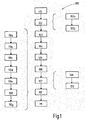
- FIG. 1 A process diagram of a method (100) according to the invention is shown.
- the method (100) according to the invention can preferably include the prior teaching (101) of a transformation unit (17) of a feature extraction unit (13).
- the method (100) according to the invention can further preferably include prior teaching (102) of a classification unit (18).
- the teaching (102) of the classification unit (18) can include, in particular, the determination (102a) of classes, in particular on the basis of the at least one data record that was made available to the classification unit (18) for teaching.
- the classes for which the classification unit (18) is to assign so-called class labels after the training has been completed are determined.
- the teaching (102) can include the determination (102b) and storage of an average feature vector per class.
- the method includes, in particular, the provision (106) of measurement data for the feature extraction unit.
- the method may previously include generating (103) measurement data from a sensor of a first sensor modality, further preferably also generating (104) measurement data from a sensor of a second sensor modality and / or generating (105) measurement data from a sensor of a third sensor modality.
- Steps 103 to 105 can preferably be carried out simultaneously.
- the method comprises performing scans, with measurement data of all sensor modalities being available after completion of a scan and being able to be provided for the feature extraction unit (13).
- the method further comprises extracting (107) modality-independent features.
- modality-dependent features are preferably extracted (108) using a respective feature extractor, and these modality-dependent features are transformed (109) into modality-independent features using the transformation unit (17).
- the method can include the classification (110) of the modality-independent features by means of the classification unit (18), so that an object classification (111) can be carried out.
- the classification (110) can include that at least one feature vector is passed on from the feature extraction unit (13) to the classification unit (18) (110a), the classification unit (18) preferably revising the feature vector (110b).
- the feature vector, the one obtained or preferably the revised one, is compared in each case with the previously determined average feature vectors (110c). Furthermore, limits of deviation from the average feature vectors can be set for comparison (110d).
- the respective cosine similarities between the feature vector and the average feature vectors are preferably determined (110e). If one of the previously defined deviation limits is undershot, the corresponding class label is output (110f), while if all previously defined deviation limits are exceeded, the output (110g) is that no object of the classes has been recognized. This is done primarily by means of a decision module (18a) of the classification unit (18).
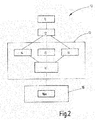
- FIG. 2 shows a schematic view of a device (10) according to the invention.
- the device (10) comprises a transmitting unit (11) and a receiving unit (12).
- the receiving unit (12) in each case comprises at least one sensor per sensor modality, the transmission unit (11) in each case having the corresponding transmission modules for generating the measurement data for transmitting the signals for generating the measurement data of the respective sensor modality.
- the transmission unit (11) can each have a source for transmitting lidar and radar measurement data.
- the measurement data received in the receiving unit (12) are made available to the feature extraction unit (13).
- the feature extraction unit (13) comprises a feature extractor (14) for measurement data of the sensor of the first sensor modality, one Feature extractors (15) for measurement data of the sensor of the second sensor modality and a feature extractor (16) for measurement data of the sensor of the third sensor modality.
- the respective feature extractors (14, 15, 16) extract modality-dependent features that are made available to the transformation unit (17), which generates modality-independent features therefrom.
- the device also has a classification unit (18) which classifies the modality-independent features of the transformation unit (17).
- the classification unit (18) comprises a decision module (18a).
Landscapes
- Engineering & Computer Science (AREA)
- Theoretical Computer Science (AREA)
- Physics & Mathematics (AREA)
- General Physics & Mathematics (AREA)
- Evolutionary Computation (AREA)
- Artificial Intelligence (AREA)
- Computer Vision & Pattern Recognition (AREA)
- Data Mining & Analysis (AREA)
- Life Sciences & Earth Sciences (AREA)
- General Health & Medical Sciences (AREA)
- Health & Medical Sciences (AREA)
- Multimedia (AREA)
- General Engineering & Computer Science (AREA)
- Computing Systems (AREA)
- Software Systems (AREA)
- Evolutionary Biology (AREA)
- Bioinformatics & Cheminformatics (AREA)
- Bioinformatics & Computational Biology (AREA)
- Biomedical Technology (AREA)
- Molecular Biology (AREA)
- Databases & Information Systems (AREA)
- Medical Informatics (AREA)
- Biophysics (AREA)
- Computational Linguistics (AREA)
- Mathematical Physics (AREA)
- Biodiversity & Conservation Biology (AREA)
- Image Analysis (AREA)
- Traffic Control Systems (AREA)
Priority Applications (8)
| Application Number | Priority Date | Filing Date | Title |
|---|---|---|---|
| PCT/EP2019/073828 WO2020049154A1 (fr) | 2018-09-07 | 2019-09-06 | Procédé et dispositif de classification d'objets |
| KR1020217006494A KR102625493B1 (ko) | 2018-09-07 | 2019-09-06 | 객체 분류 방법 및 디바이스 |
| EP19765470.0A EP3847578A1 (fr) | 2018-09-07 | 2019-09-06 | Procédé et dispositif de classification d'objets |
| CA3110387A CA3110387A1 (fr) | 2018-09-07 | 2019-09-06 | Procede et dispositif de classification d'objets |
| IL281302A IL281302B2 (en) | 2018-09-07 | 2019-09-06 | Method and device for classifying objects |
| CN201980058249.9A CN112655001B (zh) | 2018-09-07 | 2019-09-06 | 分类对象的方法和装置 |
| JP2021512490A JP7164708B2 (ja) | 2018-09-07 | 2019-09-06 | オブジェクトを分類するための方法およびデバイス |
| US17/181,096 US11645848B2 (en) | 2018-09-07 | 2021-02-22 | Method and device for classifying objects |
Applications Claiming Priority (1)
| Application Number | Priority Date | Filing Date | Title |
|---|---|---|---|
| EP18193125 | 2018-09-07 |
Publications (1)
| Publication Number | Publication Date |
|---|---|
| EP3620978A1 true EP3620978A1 (fr) | 2020-03-11 |
Family
ID=67436794
Family Applications (2)
| Application Number | Title | Priority Date | Filing Date |
|---|---|---|---|
| EP18194448.9A Withdrawn EP3620978A1 (fr) | 2018-09-07 | 2018-09-14 | Procédé et dispositif de classement d'objets |
| EP19765470.0A Pending EP3847578A1 (fr) | 2018-09-07 | 2019-09-06 | Procédé et dispositif de classification d'objets |
Family Applications After (1)
| Application Number | Title | Priority Date | Filing Date |
|---|---|---|---|
| EP19765470.0A Pending EP3847578A1 (fr) | 2018-09-07 | 2019-09-06 | Procédé et dispositif de classification d'objets |
Country Status (8)
| Country | Link |
|---|---|
| US (1) | US11645848B2 (fr) |
| EP (2) | EP3620978A1 (fr) |
| JP (1) | JP7164708B2 (fr) |
| KR (1) | KR102625493B1 (fr) |
| CN (1) | CN112655001B (fr) |
| CA (1) | CA3110387A1 (fr) |
| IL (1) | IL281302B2 (fr) |
| WO (1) | WO2020049154A1 (fr) |
Cited By (1)
| Publication number | Priority date | Publication date | Assignee | Title |
|---|---|---|---|---|
| CN112418129A (zh) * | 2020-11-30 | 2021-02-26 | 上海商汤临港智能科技有限公司 | 一种点云数据处理的方法、装置、电子设备及存储介质 |
Families Citing this family (17)
| Publication number | Priority date | Publication date | Assignee | Title |
|---|---|---|---|---|
| JP7130190B2 (ja) * | 2018-12-27 | 2022-09-05 | オムロン株式会社 | 画像判定装置、学習方法及び画像判定プログラム |
| KR20210061839A (ko) * | 2019-11-20 | 2021-05-28 | 삼성전자주식회사 | 전자 장치 및 그 제어 방법 |
| US11501107B2 (en) * | 2020-05-07 | 2022-11-15 | Adobe Inc. | Key-value memory network for predicting time-series metrics of target entities |
| US11605228B2 (en) | 2020-06-26 | 2023-03-14 | Nxp Usa, Inc. | System and method for sensor fusion system having distributed convolutional neural network |
| CN112115997B (zh) * | 2020-09-11 | 2022-12-02 | 苏州浪潮智能科技有限公司 | 一种物体识别模型的训练方法、系统及装置 |
| EP3985558B1 (fr) * | 2020-10-14 | 2024-11-06 | MicroVision, Inc. | Procédé ainsi que dispositif de classification des données de capteur |
| US11972348B2 (en) * | 2020-10-30 | 2024-04-30 | Apple Inc. | Texture unit circuit in neural network processor |
| CN115700559A (zh) * | 2021-07-23 | 2023-02-07 | 伊姆西Ip控股有限责任公司 | 在物联网环境中处理样本数据的方法、设备和程序产品 |
| KR20230043318A (ko) * | 2021-09-24 | 2023-03-31 | 삼성전자주식회사 | 영상 내 객체를 분류하는 객체 분류 방법 및 장치 |
| KR102651012B1 (ko) * | 2021-11-24 | 2024-03-25 | (주)스마트레이더시스템 | 4차원 레이더 신호처리 장치 |
| DE102022205674A1 (de) | 2022-06-02 | 2023-12-07 | Zf Friedrichshafen Ag | Verfahren und Steuereinrichtung zum Steuern eines Flurförderzeugs |
| DE102022121868A1 (de) | 2022-08-30 | 2024-02-29 | Bayerische Motoren Werke Aktiengesellschaft | Verfahren und Assistenzeinrichtung zum Klassifizieren von Sensordetektionen basierend auf Punktwolken und entsprechend eingerichtetes Kraftfahrzeug |
| CN116229097B (zh) * | 2023-01-09 | 2024-06-07 | 钧捷科技(北京)有限公司 | 基于图像传感器的图像处理方法 |
| CN115880337B (zh) * | 2023-02-16 | 2023-05-30 | 南昌工程学院 | 基于重参数卷积和特征过滤器的目标跟踪方法与系统 |
| US20240362905A1 (en) * | 2023-04-26 | 2024-10-31 | Nokia Solutions And Networks Oy | Localization by a neural network |
| US20240386256A1 (en) * | 2023-05-16 | 2024-11-21 | Google Llc | Sparse Mixer Architecture |
| DE102024201465A1 (de) * | 2024-02-16 | 2025-08-21 | Robert Bosch Gesellschaft mit beschränkter Haftung | Trainingsverfahren, Verfahren und System zum Generieren von synthetischen Messdaten |
Citations (3)
| Publication number | Priority date | Publication date | Assignee | Title |
|---|---|---|---|---|
| US9612123B1 (en) * | 2015-11-04 | 2017-04-04 | Zoox, Inc. | Adaptive mapping to navigate autonomous vehicles responsive to physical environment changes |
| CN107463952A (zh) * | 2017-07-21 | 2017-12-12 | 清华大学 | 一种基于多模态融合深度学习的物体材质分类方法 |
| CN107944490A (zh) * | 2017-11-22 | 2018-04-20 | 中南大学 | 一种基于半多模态融合特征约简框架的图像分类方法 |
Family Cites Families (16)
| Publication number | Priority date | Publication date | Assignee | Title |
|---|---|---|---|---|
| JPH08131403A (ja) * | 1994-11-09 | 1996-05-28 | Toshiba Medical Eng Co Ltd | 医用画像処理装置 |
| RU2196346C1 (ru) * | 2001-06-26 | 2003-01-10 | Федеральное государственное унитарное предприятие Московское конструкторское бюро "Электрон" | Способ реконструкции пространственных изображений полей гидроакустических параметрических приемных антенн (ппа) |
| JP4874701B2 (ja) | 2006-04-18 | 2012-02-15 | 富士フイルム株式会社 | 類似画像検索装置および方法並びにプログラム |
| WO2013105108A1 (fr) * | 2011-11-09 | 2013-07-18 | Tata Consultancy Services Limited | Système et procédé pour améliorer le comptage d'êtres humains par fusion de résultats de procédures de détection d'êtres humains |
| JP5789211B2 (ja) * | 2012-03-23 | 2015-10-07 | 富士フイルム株式会社 | 類似画像検索装置、方法及びプログラム |
| US9405893B2 (en) * | 2014-02-05 | 2016-08-02 | International Business Machines Corporation | Biometric authentication |
| JP6365035B2 (ja) | 2014-07-10 | 2018-08-01 | 株式会社デンソー | 交通オブジェクト検出装置 |
| US9922272B2 (en) * | 2014-09-25 | 2018-03-20 | Siemens Healthcare Gmbh | Deep similarity learning for multimodal medical images |
| DE102015111621A1 (de) * | 2015-03-24 | 2016-09-29 | Werth Messtechnik Gmbh | Vorrichtung und Verfahren zur computertomografischen Messung eines Werkstücks |
| EP3156942A1 (fr) * | 2015-10-16 | 2017-04-19 | Thomson Licensing | Marquage de scène de données rgb-d avec option interactive |
| CN106650709A (zh) * | 2017-01-22 | 2017-05-10 | 深圳市唯特视科技有限公司 | 一种基于传感器数据的深度学习脚步检测方法 |
| KR101907883B1 (ko) * | 2017-05-10 | 2018-10-16 | 국방과학연구소 | 객체 검출 및 분류 방법 |
| CN108230329B (zh) * | 2017-12-18 | 2021-09-21 | 孙颖 | 基于多尺度卷积神经网络的语义分割方法 |
| CN108052911B (zh) * | 2017-12-20 | 2021-12-07 | 上海海洋大学 | 基于深度学习的多模态遥感影像高层特征融合分类方法 |
| CN108182441B (zh) * | 2017-12-29 | 2020-09-18 | 华中科技大学 | 平行多通道卷积神经网络、构建方法及图像特征提取方法 |
| US10893228B2 (en) * | 2018-08-02 | 2021-01-12 | GM Global Technology Operations LLC | System and method for displaying information in a vehicle |
-
2018
- 2018-09-14 EP EP18194448.9A patent/EP3620978A1/fr not_active Withdrawn
-
2019
- 2019-09-06 CA CA3110387A patent/CA3110387A1/fr active Pending
- 2019-09-06 EP EP19765470.0A patent/EP3847578A1/fr active Pending
- 2019-09-06 KR KR1020217006494A patent/KR102625493B1/ko active Active
- 2019-09-06 CN CN201980058249.9A patent/CN112655001B/zh active Active
- 2019-09-06 JP JP2021512490A patent/JP7164708B2/ja active Active
- 2019-09-06 IL IL281302A patent/IL281302B2/en unknown
- 2019-09-06 WO PCT/EP2019/073828 patent/WO2020049154A1/fr not_active Ceased
-
2021
- 2021-02-22 US US17/181,096 patent/US11645848B2/en active Active
Patent Citations (3)
| Publication number | Priority date | Publication date | Assignee | Title |
|---|---|---|---|---|
| US9612123B1 (en) * | 2015-11-04 | 2017-04-04 | Zoox, Inc. | Adaptive mapping to navigate autonomous vehicles responsive to physical environment changes |
| CN107463952A (zh) * | 2017-07-21 | 2017-12-12 | 清华大学 | 一种基于多模态融合深度学习的物体材质分类方法 |
| CN107944490A (zh) * | 2017-11-22 | 2018-04-20 | 中南大学 | 一种基于半多模态融合特征约简框架的图像分类方法 |
Non-Patent Citations (2)
| Title |
|---|
| JIQUAN NGIAM ET AL: "Multimodal Deep Learning", INTERNATIONAL CONFERENCE ON MACHINE LEARNING (ICML), 28 June 2011 (2011-06-28), XP055565988, Retrieved from the Internet <URL:https://people.csail.mit.edu/khosla/papers/icml2011_ngiam.pdf> [retrieved on 20190307] * |
| KUAN LIU ET AL: "Learn to Combine Modalities in Multimodal Deep Learning", 29 May 2018 (2018-05-29), XP055565979, Retrieved from the Internet <URL:https://arxiv.org/pdf/1805.11730.pdf> [retrieved on 20190307] * |
Cited By (2)
| Publication number | Priority date | Publication date | Assignee | Title |
|---|---|---|---|---|
| CN112418129A (zh) * | 2020-11-30 | 2021-02-26 | 上海商汤临港智能科技有限公司 | 一种点云数据处理的方法、装置、电子设备及存储介质 |
| CN112418129B (zh) * | 2020-11-30 | 2024-04-12 | 上海商汤临港智能科技有限公司 | 一种点云数据处理的方法、装置、电子设备及存储介质 |
Also Published As
| Publication number | Publication date |
|---|---|
| IL281302B1 (en) | 2024-05-01 |
| CN112655001A (zh) | 2021-04-13 |
| IL281302B2 (en) | 2024-09-01 |
| US11645848B2 (en) | 2023-05-09 |
| KR102625493B1 (ko) | 2024-01-15 |
| CA3110387A1 (fr) | 2020-03-12 |
| KR20210040415A (ko) | 2021-04-13 |
| US20210174133A1 (en) | 2021-06-10 |
| EP3847578A1 (fr) | 2021-07-14 |
| JP2021536634A (ja) | 2021-12-27 |
| CN112655001B (zh) | 2025-01-03 |
| WO2020049154A1 (fr) | 2020-03-12 |
| JP7164708B2 (ja) | 2022-11-01 |
| IL281302A (en) | 2021-04-29 |
Similar Documents
| Publication | Publication Date | Title |
|---|---|---|
| WO2020049154A1 (fr) | Procédé et dispositif de classification d'objets | |
| EP3657386A1 (fr) | Procédé et système d'aide à la conduite d'un véhicule automatisé | |
| DE102020200503A1 (de) | Verfahren zum Generieren von gelabelten Daten, insbesondere für das Training eines neuronalen Netzes, mittels Verbesserung initialer Label | |
| DE102022208714A1 (de) | Computerimplementiertes System und Verfahren zur semantischen Analyse einer Szene | |
| WO2022106414A2 (fr) | Procédé et système pour annoter des données de capteur | |
| EP3985558B1 (fr) | Procédé ainsi que dispositif de classification des données de capteur | |
| DE102021204040A1 (de) | Verfahren, Vorrichtung und Computerprogramm zur Erstellung von Trainingsdaten im Fahrzeug | |
| DE102018114231A1 (de) | Verfahren und System zum Erfassen von Objekten unter Verwendung mindestens eines Bildes eines Bereichs von Interesse (ROI) | |
| DE102019211459A1 (de) | Verfahren und Vorrichtung zum Überprüfen einer Kalibrierung von Umfeldsensoren | |
| EP4191469B1 (fr) | Procédé de détermination des scénarios similaires, procédé d'apprentissage et appareil de commande d'apprentissage | |
| DE102020214596A1 (de) | Verfahren zum Erzeugen von Trainingsdaten für ein Erkennungsmodell zum Erkennen von Objekten in Sensordaten einer Umfeldsensorik eines Fahrzeugs, Verfahren zum Erzeugen eines solchen Erkennungsmodells und Verfahren zum Ansteuern einer Aktorik eines Fahrzeugs | |
| DE102023123114A1 (de) | Verfahren und Vorrichtung zur semantischen Segmentierung und Clutter-Erkennung | |
| DE102018217267A1 (de) | Vorrichtung, Verfahren und System zum Erkennen eines Baumes in einem Sichtbereich eines Radarsensors | |
| EP3701428B1 (fr) | Procédé et dispositif destinés à améliorer la robustesse d'un système d'apprentissage par machine | |
| DE102021132025A1 (de) | Verfahren zum Bestimmen ähnlicher Szenarien, Trainingsverfahren und Trainingssteuergerät | |
| DE102022213244A1 (de) | Fahrzeugsystem zur Erhöhung der Sicherheit eines Fahrzeugs, Verfahren und Verwendung | |
| DE102020204758A1 (de) | Schnelle Symmetrieerkennung für die Klassifikation von Objekten aus digitalen Bildern | |
| DE102019220615A1 (de) | Verfahren und Vorrichtung zum Erkennen und Klassifizieren von Objekten | |
| DE102020213947B3 (de) | Verfahren zum Auswerten einer Umgebung eines Kraftfahrzeugs mittels eines Assistenzsystems, sowie Assistenzsystem | |
| DE102019217951A1 (de) | Verfahren und Vorrichtung zum Bestimmen einer Domänendistanz zwischen mindestens zwei Datendomänen | |
| EP4521360A1 (fr) | Procédé et système d'annotation automatique de données de capteur | |
| DE102023211087A1 (de) | Verfahren zum Trainieren eines maschinellen Lernmodells zur Verarbeitung von Videodaten, Inferenzverfahren und Kamerasystem | |
| DE102023128344A1 (de) | Verfahren zum Modifizieren einer Suchanfrage für eine textbasierte Bildsuche | |
| DE102022213064A1 (de) | Erkennung unbekannter Objekte durch neuronale Netze für Fahrzeuge | |
| DE102020201469A1 (de) | Erkennung von Objekten |
Legal Events
| Date | Code | Title | Description |
|---|---|---|---|
| PUAI | Public reference made under article 153(3) epc to a published international application that has entered the european phase |
Free format text: ORIGINAL CODE: 0009012 |
|
| STAA | Information on the status of an ep patent application or granted ep patent |
Free format text: STATUS: THE APPLICATION HAS BEEN PUBLISHED |
|
| AK | Designated contracting states |
Kind code of ref document: A1 Designated state(s): AL AT BE BG CH CY CZ DE DK EE ES FI FR GB GR HR HU IE IS IT LI LT LU LV MC MK MT NL NO PL PT RO RS SE SI SK SM TR |
|
| AX | Request for extension of the european patent |
Extension state: BA ME |
|
| STAA | Information on the status of an ep patent application or granted ep patent |
Free format text: STATUS: THE APPLICATION HAS BEEN WITHDRAWN |
|
| 18W | Application withdrawn |
Effective date: 20200313 |