EP3621941B1 - Utilisation de précurseurs pour la préparation d'acides aminés marqués au carbone 11 et leurs dérivés - Google Patents
Utilisation de précurseurs pour la préparation d'acides aminés marqués au carbone 11 et leurs dérivés Download PDFInfo
- Publication number
- EP3621941B1 EP3621941B1 EP18724833.1A EP18724833A EP3621941B1 EP 3621941 B1 EP3621941 B1 EP 3621941B1 EP 18724833 A EP18724833 A EP 18724833A EP 3621941 B1 EP3621941 B1 EP 3621941B1
- Authority
- EP
- European Patent Office
- Prior art keywords
- substituted
- compound
- unsubstituted
- formula
- group
- Prior art date
- Legal status (The legal status is an assumption and is not a legal conclusion. Google has not performed a legal analysis and makes no representation as to the accuracy of the status listed.)
- Active
Links
- 0 *C(N[S@](*)=O)I Chemical compound *C(N[S@](*)=O)I 0.000 description 10
- SURNLDMUXHLWDG-OFFHKIPUSA-N CC(C)C/C=N/[S@@](C(C)(C)C)=O Chemical compound CC(C)C/C=N/[S@@](C(C)(C)C)=O SURNLDMUXHLWDG-OFFHKIPUSA-N 0.000 description 1
Images


Classifications
-
- C—CHEMISTRY; METALLURGY
- C07—ORGANIC CHEMISTRY
- C07B—GENERAL METHODS OF ORGANIC CHEMISTRY; APPARATUS THEREFOR
- C07B59/00—Introduction of isotopes of elements into organic compounds ; Labelled organic compounds per se
- C07B59/001—Acyclic or carbocyclic compounds
-
- C—CHEMISTRY; METALLURGY
- C07—ORGANIC CHEMISTRY
- C07C—ACYCLIC OR CARBOCYCLIC COMPOUNDS
- C07C227/00—Preparation of compounds containing amino and carboxyl groups bound to the same carbon skeleton
- C07C227/02—Formation of carboxyl groups in compounds containing amino groups, e.g. by oxidation of amino alcohols
-
- C—CHEMISTRY; METALLURGY
- C07—ORGANIC CHEMISTRY
- C07C—ACYCLIC OR CARBOCYCLIC COMPOUNDS
- C07C253/00—Preparation of carboxylic acid nitriles
- C07C253/30—Preparation of carboxylic acid nitriles by reactions not involving the formation of cyano groups
-
- C—CHEMISTRY; METALLURGY
- C07—ORGANIC CHEMISTRY
- C07C—ACYCLIC OR CARBOCYCLIC COMPOUNDS
- C07C313/00—Sulfinic acids; Sulfenic acids; Halides, esters or anhydrides thereof; Amides of sulfinic or sulfenic acids, i.e. compounds having singly-bound oxygen atoms of sulfinic or sulfenic groups replaced by nitrogen atoms, not being part of nitro or nitroso groups
- C07C313/02—Sulfinic acids; Derivatives thereof
- C07C313/06—Sulfinamides
Definitions
- the invention relates to the use of precursors for the production of carbon-11-labeled amino acids and amino acid derivatives and a method for the production of carbon-11-labeled amino acids and amino acid derivatives using these precursors.
- Radiolabeled compounds are used as radiopharmaceuticals in positron emission tomography (PET). They can be used as tracers in oncological imaging. They are also used in neuro-oncology.
- An important group of these radiolabeled compounds are carbon-11 radiolabeled amino acids. These amino acids belong to the group of chiral PET radiopharmaceuticals. For example, they can be used to depict the increased amino acid metabolism described for cancer cells.
- the radioactive labeling of amino acids with carbon-11 offers the advantage that the radiolabeled amino acid and the endogenous molecule have an identical structure.
- L-enantiomers are preferred in mammalian cells, as demonstrated by the use of L- and D- [11 C] phenylalanine, with the L-enantiomer of [ 11 C] phenylalanine showing better pancreas-to-liver ratios . This was also demonstrated by the better imaging properties of L- 18 F-labeled fluoroalkylphenylalanine analogues, all of which show a high tumor uptake compared to the surrounding tissue.
- the half-life of carbon-11 (20.39 min) enables a patient to be examined with different [ 11 C] labeled PET radiotracers in a single hospital visit on the same day can be carried out.
- the half-life also means that the period of time available for the production and use of the [ 11 C] marked PET radiotracer is extremely short. Time-consuming syntheses therefore considerably reduce the practical applicability of a [ 11 C] labeled PET radiotracer.
- As a rule only 60 minutes are available for the synthesis, purification and quality control of a [ 11 C] marked PET radiotracer. This means that the number of synthesis steps must be as small as possible.
- the reaction time required for a synthesis step must be as short as possible.
- the Strecker reaction can be used to synthesize carbon-11-labeled amino acids (see Xing, J. et al., High-yielding automated convergent synthesis of no-carrier-added [11C-carbonyl] -labeled amino acids using the halogen reaction. Synlett (2017), 28 (3), 371-375 ).
- the Xing et al. proposed variant of the Strecker reaction for the production of [ 11 C] sacrosine, where the carbon atom of the carbonyl group is the carbon 11 atom, requires the production of [ 11 C] ⁇ -aminonitrile by condensation of formaldehyde with methylamine and [ 11 C ] Sodium cyanide.
- the aminonitrile thus obtained is then subjected to basic hydrolysis with sodium hydroxide.
- This variant can be transferred to other [ 11 C] amino acids, in which case the formaldehyde has to be replaced by another ketone or the methylamine by another amine or both compounds.
- the synthesis times required are less than 20 minutes, but the radioactive yields are low.
- Prasad, B., et al. (Tetrahedron Letters (2004) 45, 9565-9567 ) describe the addition of trimethylsilyl cyanide to aryl aldimines as a form of the Strecker synthesis.
- the object of the invention is to eliminate the disadvantages of the prior art.
- the use of precursors for the enantioselective production of amino acids and derivatives thereof is to be proposed.
- a method for the diastereoselective labeling of these precursors with carbon-11 is to be proposed.
- the precursor of the invention enables diastereoselective labeling with a carbon-11 synthon, i. H. a diastereomer is preferably obtained.
- a diastereomer is preferably obtained.
- the precursor thus allows the enantioselective production of carbon-11-labeled amino acids and derivatives thereof.
- the precursor according to the invention can be used in particular for the enantioselective production of ⁇ -amino acids and derivatives thereof such as ⁇ -amino acid esters and ⁇ -amino acid amides, particularly preferably L- ⁇ -amino acids and derivatives thereof such as L- ⁇ -amino acid esters and L- ⁇ - Amino acid amides can be used.
- the precursor according to the invention can, however, also be used for the enantioselective production of D- ⁇ -amino acids and derivatives thereof such as D- ⁇ -amino acid esters and D- ⁇ -amino acid amides.
- the precursor according to the invention thus enables the enantioselective production of either the L- ⁇ -amino acids and derivatives thereof such as L- ⁇ -amino acid esters and L- ⁇ -amino acid amides or the D- ⁇ -amino acids and derivatives thereof such as D- ⁇ -amino acid -Esters and D- ⁇ -amino acid amides.
- the precursors of the formula I should be thermodynamically stable compounds.
- substituted in the present invention relates in particular to one or more substituents selected from the group consisting of halogen, cyano, nitro, protected or unprotected hydroxy, protected or unprotected -N (R 11 R 12 ) and protected or unprotected thiol.
- R 11 and R 12 can be independently selected from the group comprising hydrogen, unsubstituted or substituted C 1 -C 6 -alkyl, unsubstituted or substituted C 2 -C 6 -alkenyl, substituted or unsubstituted aryl and substituted or unsubstituted heteroaryl.
- R 11 and R 12 are preferably both hydrogen.
- protected relates in particular to a protecting group for protecting the hydroxyl group, the -N (R 11 R 12 ) group or the thiol group.
- the protective group can be removed after the precursor has been converted.
- Known protecting groups can be used to protect the hydroxy group.
- a protective group for protecting the hydroxy group can be selected, for example, from the group consisting of trityl, benzyl, methoxybenzyl, p-nitrobenzyl, benzoyl, substituted benzoyl, trimethylsilyl, triethylsilyl, isopropyldimethylsilyl, tert-butyldimethylsilyl, tert-butyldiphenyldimethylsilyl, Methoxymethyl, (2-methoxyethoxy) methyl and tetrahydropyranyl.
- Known protecting groups can be used to protect the amine group, ie R 11 and R 12 are both hydrogen.
- a protective group for protecting the amine group can be selected, for example, from the group comprising tert-butylcarbonyl, benzylcarbonyl, 9-fluorenylmethylcarbonyl and allylcarbonyl.
- Known protecting groups can be used to protect the thiol group.
- halogens refers to fluorine, chlorine, bromine or iodine.
- alkyl particularly refers to a saturated aliphatic hydrocarbon group having a branched or unbranched carbon chain of 1 to 6 carbon atoms.
- alkylene particularly refers to an unsaturated aliphatic hydrocarbon group having from 2 to 6 carbon atoms, for example ethylene, 2,2-dimethylethylene, propylene, 2-methylpropylene, butylene, pentylene and the like.
- aryl refers to a monovalent cyclic aromatic hydrocarbon group which can comprise a mono-, bi-, or tricyclic aromatic ring.
- the aryl group can optionally be substituted.
- aryl groups are - optionally substituted - phenyl, naphthyl, phenanthryl, fluorenyl, indenyl, azulenyl, oxydiphenyl, biphenyl, methylenediphenyl, aminodiphenyl, diphenylsulphidyl, diphenylsulphonyl, diphenylisopropylidenyl, benzo-dioxanyl, benzo-peroxadioxylylynyl, benzo-azolene-ylidenyl, benzo-piper-dioxylylynyl, benzo-azol-dioxylyinyl, benzo-azoledioxylylynyl, benzo-piper-dioxylylynyl
- heteroaryl relates in particular to a monocyclic, bicyclic or tricyclic group having 5 to 12 ring atoms, at least one aromatic ring containing one, two or three ring heteroatoms selected from N, O or S, the remaining ring atoms being C. .
- the heteroaryl group can optionally be substituted.
- heteroaryl groups are - optionally substituted - imidazolyl, oxazolyl, isoxazolyl, thiazolyl, isothiazolyl, oxadiazolyl, thiadiazolyl, pyrazinyl, pyridazinyl, thiophenyl, furanyl, pyranyl, Pyridinyl, pyrrolyl, pyrazolyl, pyrimidyl, quinolinyl, isoquinolinyl, quinazolinyl, benzofuranyl, benzothiophenyl, benzothiopyranyl, benzimidazolyl, benzoxazolyl, benzooxadiazolyl, benzothiazolyl, benzothiadiazolyl, quinopyranyl, tri-azolyl, quinopyranyl, trizinolyl, quinopyranyl, trizolyl, indolynyl, quinopyranyl, tricinoidia
- alkylaryl relates in particular to monovalent alkyl radicals bearing an aryl group, where the alkyl radical, as defined above, can have 1 to 6 carbon atoms.
- arylalkyl relates in particular to monovalent aryl radicals bearing an alkyl group, where the alkyl radical, as defined above, can have 1 to 6 carbon atoms.
- R 1 is selected from the group consisting of methyl, protected and unprotected hydroxymethyl, ethyl, n-propyl, iso-propyl, n-butyl, iso-butanyl, sec-butyl, tert-butyl, phenyl, protected and unprotected hydroxyphenyl, Includes benzyl and protected and unprotected hydroxybenzyl, and R 2 is hydrogen.
- chiral auxiliary relates in particular to a group with at least one center of chirality.
- the chiral auxiliary enables a diastereoselective conversion of the precursor according to the invention, so that one enantiomer is preferably obtained after the chiral auxiliary has been split off.
- Preferred chiral auxiliaries are substituted or unsubstituted alkylsulfinyl and substituted or unsubstituted arylsulfinyl, substituted or unsubstituted alkylsulfinyl being particularly preferred. Because of the chiral auxiliary, the precursor of formula I has two enantiomers.
- the two enantiomers are illustrated in the formulas Ia and Ib, the representation of the bond between the nitrogen atom and the group R 3 is only intended to illustrate the two enantiomers, but does not necessarily correspond to the projection rules because this depends on the structure of the radical R 3.
- Formula Ia illustrates an enantiomer that can preferably be used to prepare the D-amino acid.
- Formula Ib illustrates an enantiomer that can preferably be used to prepare the L-amino acid: where R 1 , R 2 and R 3 are as defined above. Depending on the chiral auxiliary and reaction conditions, either the L- or the D-amino acid is preferentially formed.
- alkylsulfinyl and arylsulfinyl represent a -S (O) -R 4 group, where R 4 is selected from the group comprising unsubstituted or substituted C 1 -C 6 -alkyl and substituted or unsubstituted aryl.
- the compound of the formula I is a compound of the formula II-a or II-b: where R 1 and R 2 are as defined above and R 4 is selected from the group comprising unsubstituted or substituted C 1 -C 6 -alkyl and substituted or unsubstituted aryl.
- R 4 is preferably tert -butyl.
- a compound of the formula II-b is preferably used for the production of L-amino acids and their derivatives.
- the precursor according to the invention is a compound of the formula II-a or II-b, where R 1 is selected from the group consisting of unsubstituted or substituted C 1 -C 6 -alkyl, substituted or unsubstituted aryl and substituted or unsubstituted heteroaryl includes; R 2 is hydrogen; and R 4 is selected from the group consisting of unsubstituted or substituted C 1 -C 6 alkyl and substituted or unsubstituted aryl.
- the precursor according to the invention is a compound of the formula II-a or II-b, where R 1 are selected from the group consisting of unsubstituted or substituted C 1 -C 6 -alkyl, substituted or unsubstituted aryl and substituted or unsubstituted Heteroaryl includes; R 2 is hydrogen; and R 4 is tert -butyl.
- R 1 are selected from the group consisting of unsubstituted or substituted C 1 -C 6 -alkyl, substituted or unsubstituted aryl and substituted or unsubstituted Heteroaryl includes; R 2 is hydrogen; and R 4 is tert -butyl.
- R 1 are selected from the group consisting of unsubstituted or substituted C 1 -C 6 -alkyl, substituted or unsubstituted aryl and substituted or unsubstituted Heteroaryl includes; R 2 is hydrogen; and R 4 is tert
- the precursor according to the invention is a compound of the formula III-a or III-b, where R 1 is selected from the group consisting of methyl, protected and unprotected hydroxymethyl, ethyl, n-propyl, iso-propyl, n- Includes butyl, iso-butanyl, sec-butyl, tert-butyl, phenyl, protected and unprotected hydroxyphenyl, benzyl, and protected and unprotected hydroxybenzyl.
- arylalkyl represent an aryl group which carries one or more C 1 -C 6 -alkyl groups.
- the arylalkyl group can be substituted or unsubstituted. Examples are - optionally substituted - benzyl, phenylethyl and arylglycinol, the list not being exhaustive.
- arylglycinol represent a subgroup of chiral auxiliaries referred to as “arylalkyl".
- precursors with arylglycinol group can be a group of the formula IV-a or IV-b: where R 13 is substituted or unsubstituted aryl as defined above.
- Examples of an arylglycinol group are - optionally substituted or unsubstituted - phenylglycinol, protected or unprotected phenylglycinol, the list not being exhaustive.
- the precursors according to the invention allow a rapid and diastereoselective reaction with a carbon-11 synthon.
- This reaction also known as the labeling reaction, is diastereoselective. Due to the subsequent cleavage of the chiral auxiliary, for example by means of alcoholysis and / or hydrolysis, an enantiomer is formed in excess. This means that the method according to the invention is enantioselective as a result.
- the precursors according to the invention can be used to produce amino acids, in particular ⁇ -amino acids and derivatives thereof such as amino acid esters and amino acid amides, the carbonyl unit of which has a carbon-11 atom instead of a carbon-12 atom.
- the remaining carbon atoms of the amino acids and amino acid derivatives are preferably not carbon-11 atoms.
- the time required for the synthesis of these compounds is less than 20 minutes.
- the radiochemical yield is over 10% (not corrected for decay (ndc)) or over 20% (corrected for decay (dc), based in each case on the [ 11 C] HCN formed).
- the precursors according to the invention can, for example, be synthesized by condensation of the corresponding aldehyde with an alkylsulfinyl amine in the presence of anhydrous copper sulfate in dichloromethane at room temperature and then optionally purified by chromatography.
- a method for the diastereoselective labeling of a precursor according to the invention with carbon-11 is provided, the precursor being reacted with a carbon-11-labeled synthon to form a carbon-11 labeled compound which has a carbon-11-labeled carbonyl group will.
- the carbon-11 labeled synthon is [ 11 C] R 31 CN, where R 31 is selected from the group consisting of hydrogen, an alkali metal such as lithium, sodium or potassium, acetyl and alkylsilyl.
- R 31 is preferably hydrogen, sodium or potassium, particularly preferably hydrogen or an alkylsilyl, particularly preferably hydrogen.
- a preferred example of an alkylsilyl is trimethylsilyl.
- R 31 can be present as a cation to the anion [ 11 C] CN - .
- [ 11 C] R 31 CN is preferably passed as a gas stream through the reaction mixture, which contains the precursor and optionally solvents and auxiliaries.
- [ 11 C] R 31 CN is preferably prepared by conversion from [ 11 C] CO 2 . This can be done using known methods.
- the implementation of the precursor with the synthon is not a specific reaction. Rather, it depends on the chiral auxiliary and / or the reaction conditions, in particular the auxiliary substance (s) added and / or the solvent (s) used, which of the two enantiomers is obtained when the precursor is reacted with the synthon. This implementation is therefore not a specific reaction.
- the carbon-11 labeled compound can be, for example, amino acids and derivatives thereof, such as amino acid esters and amino acid amides, preferably ⁇ -amino acids and derivatives thereof, such as ⁇ -amino acid esters and ⁇ -amino acid amides, in particular preferably L- ⁇ -amino acids and derivatives thereof, such as L- ⁇ -amino acid esters and L- ⁇ -amino acid amides.
- the carbon-11 labeled compound can, however, also be D- ⁇ -amino acids and derivatives thereof, such as D- ⁇ -amino acid esters and D- ⁇ -amino acid amides.
- the process according to the invention enables the enantioselective production of either the L- ⁇ -amino acids and derivatives thereof, such as L- ⁇ -amino acid esters and L- ⁇ -amino acid amides, or the D- ⁇ -amino acids and derivatives thereof, such as D- ⁇ - Amino acid esters and D- ⁇ -amino acid amides.
- L- ⁇ -amino acids and derivatives thereof such as L- ⁇ -amino acid esters and L- ⁇ -amino acid amides
- D- ⁇ -amino acids and derivatives thereof such as D- ⁇ - Amino acid esters and D- ⁇ -amino acid amides.
- a precursor is expediently selected which - apart from optionally provided protective groups on the radicals R 1 and / or R 2 - radicals R 1 and R 2 which correspond to the radicals R 21 and R 22 of the compound of the formula X. If a precursor is used which has protective groups on the radicals R 1 and / or R 2 , the process according to the invention can include the splitting off of the protective groups.
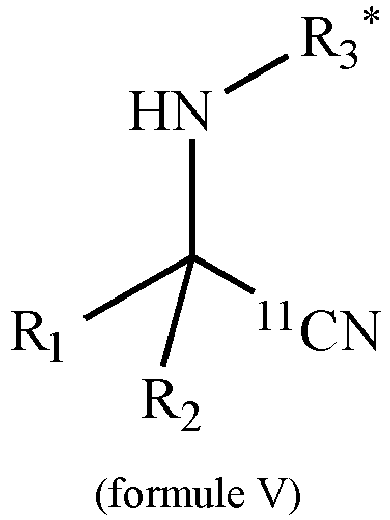
- the method according to the invention can comprise the reaction of the precursor according to the invention with the carbon-11-labeled synthon to give a compound of the formula V: where R 1 , R 2 and R 3 have the meanings given in claim 1.
- the reaction conditions are preferably chosen so that the carbon-11-labeled synthon binds to the precursor by nucleophilic addition.
- the reaction is preferably carried out in an aprotic solvent, for example 1,4-dioxane, tetrahydrofuran, diethyl ether, methyl tert-butyl ether, toluene, benzene, dichloromethane and other halogenated solvents, the list being non-exhaustive, a protic organic solvent, for example methanol , Ethanol, isopropyl alcohol, n-propyl alcohol, n-butanol, or the solvents water, DMSO and DMF, the list not being exhaustive, or mixtures of an aprotic solvent and a protic organic solvent.
- an aprotic solvent for example 1,4-dioxane, tetrahydrofuran, diethyl ether, methyl tert-butyl ether, toluene, benzene, dichloromethane and other halogenated solvents
- a protic organic solvent for example methanol
- a solvent mixture is preferred which has a mixing ratio of the aprotic solvent and the protic organic solvent in every conceivable ratio.
- a particularly preferred solvent mixture is a mixture of 1,4-dioxane and methanol.
- the reaction is preferably carried out at a temperature of 10 to 60 ° C., particularly preferably at room temperature.
- the reaction time can be between 1 and 10 minutes.
- the reaction mixture can contain one or more auxiliaries.
- Such an auxiliary can be an additive salt such as cesium fluoride, "tetrabutylammonium fluoride” (TBAF), zinc diiodide, aluminum trichloride or other Lewis acids or fluoride salts, with cesium fluoride being preferred.
- cesium fluoride tetrabutylammonium fluoride
- TBAF tetrabutylammonium fluoride
- zinc diiodide aluminum trichloride or other Lewis acids or fluoride salts, with cesium fluoride being preferred.
- a compound of the formula Ib is preferably converted into a compound of the formula Va (scheme la):
- the reaction according to scheme 2a is particularly advantageous when the process according to the invention is to be used for the preparation of L-amino acids and their derivatives. It depends on the precursor, in particular the chiral auxiliary used of the precursor, and the reaction conditions, in particular the auxiliary substance (s) and the solvent (s), which of the two compounds Va or Vb is obtained in excess.
- a compound of the formula Ia can be converted into a compound of the formula Va or Vb (Scheme 1b). It depends on the precursor, in particular the chiral auxiliary used of the precursor, and the reaction conditions, in particular the auxiliary substance (s) and / or the solvent (s) used, which of the two compounds Va or Vb is obtained in excess.
- the implementation of precursor I with the synthon is not a specific reaction.
- the compound of the formula XI does not include any amino acids. Apart from this and if the precursor does not have a protective group, the compound of the formula XI corresponds to the compound of the formula X.
- R 1 and R 2 correspond to R 21 and R 22 . If, on the other hand, the precursor has protective groups, the R 1 and / or R 2 , depending on whether both radicals have a protective group or only one of them, can be converted into the radicals R 21 and R 22 by splitting off the protective groups.
- reaction according to scheme 2a is particularly advantageous when the process according to the invention is to be used for the preparation of L-amino acids and their derivatives.
- the compound of the formula XI can then be converted into a compound of the formula XII by means of hydrolysis: where R 1 and R 2 are defined above.
- the compound of formula XII includes only amino acids. Apart from this and if the precursor does not have a protective group, the compound of the formula XII corresponds to the compound of the formula X. That is, R 1 and R 2 correspond to R 21 and R 22 . If, on the other hand, the precursor has protective groups, the R 1 and / or R 2 , depending on whether both radicals have a protective group or only one of them, can be converted into the radicals R 21 and R 22 by splitting off the protective groups.
- the hydrolysis can be carried out under reaction conditions known to the person skilled in the art.
- the hydrolysis can be carried out under acidic or basic conditions.
- reaction according to scheme 3a is particularly advantageous when the process according to the invention is to be used for the preparation of L-amino acids and their derivatives.
- the preferred embodiment may initially comprise reacting the compound of Formula II with the carbon-11 labeled synthon to give a compound of Formula XIV: where R 1 , R 2 and R 4 have the meanings given above.
- the reaction conditions are preferably chosen so that the carbon-11-labeled synthon binds to the precursor by nucleophilic addition.
- the reaction is preferably carried out in an aprotic solvent, for example 1,4-dioxane, tetrahydrofuran, diethyl ether, methyl tert-butyl ether, toluene, benzene, dichloromethane and other halogenated solvents, the (list not being exhaustive), a protic organic solvent, for example methanol, ethanol, isopropyl alcohol, n-propyl alcohol, n-butanol, or the solvents water, DMSO and DMF, the list not being exhaustive, or mixtures of an aprotic solvent and a protic organic solvent.
- an aprotic solvent for example 1,4-dioxane, tetrahydrofuran, diethyl ether, methyl tert-butyl ether, toluene, benzene, dichloromethane and other halogenated solvents, the (list not being exhaustive)
- a protic organic solvent for example
- a solvent mixture is preferred which has a mixing ratio of the aprotic solvent and the protic organic solvent in any conceivable ratio, preferably in a range from 7: 3 to 9: 1, based on volume.
- a particularly preferred mixture of solvents is a mixture from 1,4-dioxane and methanol.
- the reaction is preferably carried out at a temperature of 10 to 60 ° C., particularly preferably at room temperature.
- the reaction time can be between 1 and 10 minutes.
- the reaction mixture can contain one or more auxiliaries.
- auxiliary examples include cesium fluoride, tetrabutylammonium fluoride, zinc diiodide, aluminum trichloride or other Lewis acids or fluoride salts. If [ 11 C] HCN is used as a synthon, the labeling rates are 70 to 95%, based on the [ 11 C] HCN used.
- the conversion of the compound of the formula II-a into a mixture of the enantiomers of the formula XIV-a-1 and XIV-a-2 is shown in Scheme 4a
- the conversion of the compound of the formula II-b into a mixture of the enantiomers of the formula XIV- b-1 and XIV-b-2 are shown in Scheme 4b.
- reaction according to scheme 4b is particularly advantageous when the process according to the invention is to be used for the preparation of L-amino acids and their derivatives.
- the compound of the formula IV can then be converted into a compound of the formula XV by means of alcoholysis: where R 1 , R 2 and R 6 are as defined above, with the proviso that R 6 is not hydrogen.
- the compound of the formula XV does not include any amino acids.
- the compound of the formula XV corresponds to the compound of the formula X. That is, R 1 and R 2 correspond to R 21 and R 22 . If, on the other hand, the precursor has protective groups, the R 1 and / or R 2 , depending on whether both radicals have a protective group or only one of them, can be converted into the radicals R 21 and R 22 by splitting off the protective groups.
- the alcoholysis is carried out using an alcohol which has the group R 6 and is shown in Schemes 5a and 5b as R 6 OH.
- the alcoholysis can be carried out under reaction conditions known to the person skilled in the art.
- the reaction time can be, for example, from 5 to 60 minutes, and the reaction temperature, for example, from 60 to 150.degree.
- the conversion of the compound of the formula XIV-a-1 into a compound of the formula XV-a is in scheme 5a-1
- the conversion of the compound of the formula XIV-a-2 into a compound of the formula XVb is in scheme 5a-2
- the conversion of the compound of the formula XIV-b-1 into a compound of the formula XV-b is in scheme 5b-1
- the conversion of the compound of the formula XIV-b-2 into a compound of the formula XV-a is in scheme 5b- 2 shown.
- the compound of the formula XV-a is preferably prepared.
- the compound of the formula XV can then be converted into a compound of the formula XII by means of hydrolysis: where R 1 and R 2 are defined as above .. If the precursor does not have a protective group, the compound of the formula XII corresponds to the compound of the formula X, where R 5 is hydroxy. That is, R 1 and R 2 correspond to R 21 and R 22 . If, on the other hand, the precursor has protective groups, the R 1 and / or R 2 , depending on whether both radicals have a protective group or only one of them, can be converted into the radicals R 21 and R 22 by splitting off the protective groups.
- the hydrolysis can be carried out under acidic conditions.
- aqueous concentrated hydrochloric acid can be used for the hydrolysis.
- the reaction temperature can be, for example, from 100 to 250 ° C. and the reaction time from 2 to 20 minutes
- the conversion of the compound of the formula XV-a by hydrolysis into a compound of the formula XII-a is in Scheme 6a
- the conversion of the compound of the formula XV-b by means of hydrolysis into a compound of the formula XII-b is shown in Scheme 6b:
- the compound of the formula XV-a is converted to the compound of the formula XII-a.
- the compound of the formula XV-b is converted to the compound of the formula XII-b.
- the compounds of the formula XIV can be subjected directly to a direct hydrolysis.
- the compound of the formula XIV is first converted into a compound of the formula XVI wherein R 1 and R 2 are as defined in claim 6 and R 9 is selected from the group consisting of hydrogen, unsubstituted or substituted C 1 -C 6 -alkyl, unsubstituted or substituted C 2 -C 6 -alkenyl, substituted or unsubstituted aryl and substituted or unsubstituted heteroaryl.
- R 9 is preferably hydrogen.
- the hydrolysis can then be continued by converting the compound of the formula XVI into a compound of the formula XII: where R 1 and R 2 are as defined above.
- the direct hydrolysis can be carried out under acidic or basic conditions, preferably under acidic conditions.
- aqueous concentrated hydrochloric acid can be used for acidic hydrolysis.
- the reaction temperature can be, for example, from 100 to 250 ° C. and the reaction time from 2 to 20 minutes.
- the compound of the formula XVI-a is converted to the compound of the formula XII-a.
- the compound of the formula XVI-b is converted to the compound of the formula XII-b.
- radicals R 1 and R 2 are unprotected radicals, it can be provided that the radicals R 1 and R 2 of a compound of the formulas XI, XII, XIII, XV or XVI correspond to the radicals R 21 and / or R 22 of the compound X. If, on the other hand, the radical R 1 is a protected radical, provision can be made for the radical R 1 of a compound of the formulas XI, XII, XIII, XV or XVI to be converted into the radical R 21 of the compound X by splitting off one or more protective groups.
- radical R 2 is a protected radical, it can be provided that the radical R 2 of a compound of the formulas XI, XII, XIII, XV or XVI is converted into the radical R 22 of the compound X by splitting off one or more protective groups.
- the method according to the invention can be carried out in a microfluidic system, in particular a microfluidic reactor.
- the microfluidic system can be, for example, the ISAR® platform offered by General Electric.
- the microfluidic system may include cleaning cartridges to clean the target compound, i. H. to subject a compound of the formula X, or an intermediate stage to a purification.
- the microfluidic system can have a polymer chip on which the synthesis of the carbon-11-labeled amino acids or derivatives thereof can be carried out.
- the method according to the invention can be an automated method.
- the process according to the invention is preferably carried out as a synthesis that is not bound to a carrier (n.c.a synthesis).
- the process according to the invention can comprise a purification step to separate off the undesired enantiomer.
- the purification step can be, for example, an enzymatic purification or a chiral separation. If the aim of the method according to the invention is to produce an L-amino acid or a derivative thereof, the corresponding D-amino acid or its derivative can be separated off by means of the purification step.
- the process of the invention enables synthesis times of less than 20 min for the preparation of carbon-11-labeled amino acids or their derivatives, including (i) the conversion of [ 11 C] CO 2 to [ 11 C] R 31 CN, ( ii) the incorporation of [ 11 C] R 31 CN into the precursor and (iii) the alcoholysis, and optionally subsequent hydrolysis, or the direct hydrolysis of the nitrile group in the optionally substituted carboxylic acid.
- the carbon-11-labeled amino acids or derivatives thereof produced by means of the method according to the invention can be converted further into peptides, in particular oligopeptides, or peptide analogs.
- the carbon-11-labeled amino acids or derivatives thereof produced by the method according to the invention can be used for incorporation into peptides, proteins or antibodies.
- the invention is based, without wishing to be bound by an explanation, on the following findings:
- the optimal solvent preferably 1,4-dioxane in a ratio to methanol of 4: 1
- the auxiliary substance preferably cesium fluoride (CsF)
- CsF cesium fluoride
- the de values are very good (70% to> 90%) in pure dioxane, dichloromethane, toluene or other aprotic non-polar solvents with the addition of cesium fluoride.
- CsF is only sparingly soluble in these solvents, which means that the reaction time is unacceptably extended to several hours or days.
- the auxiliary substance CsF is more soluble in protic polar solvents such as water, DMSO or various alcohols such as methanol, ethanol and propanol. This shortens the response times to less than an hour. However, the stereo selectivity changes for the worse ( ⁇ 50%) and even turns around.
- the inventors have found that in a mixture of dioxane with a little methanol or water, ie a proportion of preferably 10 to 20%, based on the volume, of the solvent mixture, the solubility of the auxiliary CsF rises sharply and thus the reaction time to less than 20 min decreases.
- the de values were a good 70 to 80%.
- enzymatic purification can take place.
- the D-amino acid can be removed by immobilized D- ⁇ -amino acid oxidase (D-AAO).
- D-AAO immobilized D- ⁇ -amino acid oxidase
- L-AAO L- ⁇ -amino acid oxidase
- the enantiomeric D-amino acid can in principle also be represented.
- amino acids and derivatives thereof can be obtained - without purification such as enzymatic or chiral purification - with an ee value of 30% or higher, preferably 50% or higher, more preferably 70% or higher and particularly preferably 90% or higher will.
- specific activities of approx. 20 to 70 GBq / ⁇ mol can be obtained. It is possible to achieve higher specific activities, which among other things requires the use of extremely clean gases, in particular nitrogen and / or hydrogen.
- a reagent kit can also be provided which can comprise a precursor according to the invention for the enantioselective production of a carbon-11-labeled amino acid or a derivative thereof, solvent and one or more auxiliaries.
- the reagent kit according to the invention can comprise one or more cleaning cartridges. The reagent kit according to the invention enables the automated enantioselective production of the carbon-11-labeled amino acid or the derivative thereof.
- the [ 11 C] CO 2 formed in the cyclotron is fed into the hot cell and absorbed there on a molecular sieve (4 ⁇ ). Meanwhile, nitrogen flows through the molecular sieve and pulls unwanted impurities with it.
- the molecular sieve is now heated to a temperature of 350 ° C, with the captured [ 11 C] CO 2 being desorbed by the molecular sieve from approx. 200 ° C and forwarding through the nitrogen stream (40 mL / min).
- hydrogen gas (20 ml / min) is passed to the nitrogen / [ 11 C] CO 2 mixture and this gas mixture is passed over a 400 ° C nickel catalyst.
- the [ 11 C] CO 2 is reduced to 11 C methane ([ 11 C] CH 4 ) and water.
- Water and unreacted [11 C] CO 2 are captured (with ascarite and siccapent) and gaseous ammonia (5 ml / min) is added to the methane stream that remains.
- This gas mixture is passed over a platinum wire at 950 ° C and [ 11 C] HCN is formed in the process. This gas stream is now used directly for the synthesis of amino acids.
- the radiolabeled, gaseous [ 11 C] HCN is introduced into this reactor vial with a carrier gas stream (mix of N 2 , H 2 and NH 3 ) of approx. 50-500 mL / min.
- the reaction is carried out at room temperature, but higher and lower temperatures are also possible, e.g. B. 10 to 60 ° C.
- V 2 to 4 ml
- the hydrolysis can also be carried out in the same reactor vial.
- the reactor vial is heated externally and hydrogen gas is passed through the reaction solution, whereby the solution is somewhat concentrated.
- concentrated HCl 400-1000 ⁇ l
- the reaction solution is heated at 100-250 ° C. for 2-20 min.
- sufficient buffer K 3 PO 4
- the pH is advantageously about 2 points below the isoelectric point of the target compound, ie an ⁇ -amino acid of the formula X.
- the target compound obtained in step B) can be purified automatically or manually.
- SPE solid phase extraction
- the SPE cartridge is rinsed with so-called washing solutions (H 2 O, acetonitrile (ACN), dilute acids such as acetic acid (AcOH)) and the purified, free target compound is washed with a suitable eluent (e.g. 0.5 M aqueous NaOH or 0.4 M NH 3 in H 2 O / ACN) eluted (other eluent solutions are possible).
- washing solutions H 2 O, acetonitrile (ACN), dilute acids such as acetic acid (AcOH)
- a suitable eluent e.g. 0.5
- This solution is slowly passed through a cartridge which is filled with 0.1-2 g of immobilized D- ⁇ -amino acid oxidase (D-AAO).
- D-AAO immobilized D- ⁇ -amino acid oxidase
- a compound of the formula X where R 5 is hydroxy is obtained in about 30 to 50% decay-corrected yield (10 to 15% non-decay-corrected, based on the [ 11 C] HCN formed, although higher yields are also possible), in > 95% radiochemical purity, and an ee value of 100%. Without enzymatic purification, the amino acid is obtained with an ee value of 70 to 90%.
- the radiolabeled, gaseous [ 11 C] HCN was introduced into this reactor vial for 8 min at room temperature from below with a carrier gas stream (mix of N 2 , H 2 and NH 3) of approx. 65-70 mL / min.
- the [1- 11 C] pheirylalanine nitrile was formed as an intermediate compound with labeling rates of 73 ⁇ 3% of the [ 11 C] HCN used.
- the solution was applied to a conditioned SPE cartridge (eg PSH + from Machery Nagel), 4 ml / min.
- the SPE cartridge was washed successively with 2 ml 3% acetic acid (AcOH), 2 ml of acetonitrile (ACN) and 5 ml H 2 O and rinsed the [1- 11 C] -phenylalanine was treated with 1.5 ml of 0.5 M aqueous NaOH eluted.
- This eluate was mixed with 500 ⁇ l of a Tris buffer (500 mM Tris base, 50 ⁇ M flavin adenine dinucleotide, pH 7.5) and the solution was slowly passed through a cartridge which was filled with 0.5 g of immobilized D- Alpha Amino Acid Oxidase (D-AAO) was filled.
- a Tris buffer 500 mM Tris base, 50 ⁇ M flavin adenine dinucleotide, pH 7.5
- the radiolabeled, gaseous [ 11 C] HCN was introduced into this reactor vial for 8 min at room temperature from below with a carrier gas stream (mix of N 2 , H 2 and NH 3) of approx. 65-70 mL / min.
- the para-methoxybenzyl-protected [1- 11 C] tyrosine nitrile was formed as an intermediate compound with labeling rates of 88 ⁇ 5% of the [ 11 C] HCN used.
- the reactor vial was then heated from the outside and hydrogen gas was passed through the reaction solution, whereby the solution was concentrated somewhat.
- concentrated HCl 800 ⁇ l was added to this reactor vial and the reaction solution was heated at 150 ° C. for 5 minutes.
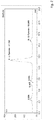
- FIG. 1 shows the results of the labeling reaction.
- (S) -N - ((R) -1-cyano-2- (4- (4-methoxybenzyloxy) phenyl) ethyl) -2-methylpropane-2-sulfinamide at 13.684 min you find that (S) -N - ((S) -1-cyano-2- (4- (4-methoxybenzyloxy) phenyl) ethyl) -2-methylpropane-2-sulfinamide.
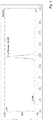
- Fig. 2 shows the reaction products after hydrolysis and before purification. It can be seen that the target compound is present in a large excess to the other enantiomer (D-tyrosine).
- Fig. 3 shows the results of the purification with an SPE cartridge and Fig. 4 the results of the enzymatic purification. It can be seen that the enantiomeric purity was further increased by the purification steps.
- the radiolabeled, gaseous [ 11 C] HCN was introduced into this reactor vial for 8 min at room temperature from below with a carrier gas stream (mix of N 2 , H 2 and NH 3) of approx. 65-70 mL / min.
- the [1- 11 C] leucine nitrile was formed as an intermediate compound with labeling rates of 70 ⁇ 10% of the [11 C] HCN used.
- the hydrolysis was carried out as in Example 1, except that the hydrolysis temperature was 130 ° C.
- the radiolabeled, gaseous [ 11 C] HCN was introduced into this reactor vial for 8 min at room temperature from below with a carrier gas stream (mix of N 2 , H 2 and NH 3) of approx. 65-70 mL / min.
- the [1- 11 C] valine nitrile was formed as an intermediate compound with labeling rates of 70 ⁇ 3% of the [ 11 C] HCN used.
- the radiolabeled, gaseous [ 11 C] HCN was introduced into this reactor vial for 8 min at room temperature from below with a carrier gas stream (mix of N 2 , H 2 and NH 3) of approx. 65-70 mL / min.
- the [1- 11 C] alanine nitrile was formed as an intermediate compound with labeling rates of 76 ⁇ 5% of the [ 11 C] HCN used.
- the radiolabeled, gaseous [ 11 C] HCN was introduced into this reactor vial for 8 min at room temperature from below with a carrier gas stream (mix of N 2 , H 2 and NH 3) of approx. 65-70 mL / min.
- the para-methoxybenzyl-protected [1- 11 C] serine nitrile was formed as an intermediate compound with labeling rates of 78 ⁇ 5% of the [ 11 C] H
Landscapes
- Chemical & Material Sciences (AREA)
- Organic Chemistry (AREA)
- Chemical Kinetics & Catalysis (AREA)
- Organic Low-Molecular-Weight Compounds And Preparation Thereof (AREA)
Claims (17)
- Utilisation d'un précurseur pour la fabrication d'acides aminés marqués au carbone 11 ou de leurs dérivés, ledit précurseur étant une liaison de la formule I :
 R1 et R2 étant choisis indépendamment l'un de l'autre dans le groupe qui comprend hydrogène, alkyle C1-C6 non-substitué ou substitué pouvant être modifié le cas échéant par intercalation d'au moins un groupe X dans la chaîne carbonée, alkényle C2-C6 non-substitué ou substitué pouvant être modifié le cas échéant par intercalation d'au moins un groupe X dans la chaîne carbonée, alkylaryle substitué ou non-substitué, arylalkyle substitué ou non-substitué, aryle substitué ou non-substitué et hétéroaryle substitué ou non-substitué,R3 étant un auxiliaire chiral choisi dans le groupe qui comprend alkylsulfinyle C1-C6 substitué ou non-substitué, arylsulfinyle substitué ou non-substitué, arylalkyle substitué ou non-substitué et arylglycinol substitué ou non-substitué,X étant choisi dans le groupe qui comprend oxygène, soufre, -SO-, -SO2- et -N(R10)-,R10 comprenant hydrogène, alkyle C1-C6 non-substitué ou substitué, alkényle C2-C6 non-substitué ou substitué, aryle substitué ou non-substitué et hétéroaryle substitué ou non-substitué,les restes étant, le cas échéant, non-protégés ou protégés.
 - Utilisation selon la revendication 1 caractérisée en ce que ledit précurseur est une liaison de la formule II-a ou II-b :

- Utilisation selon la revendication 2 caractérisée en ce que R1 est choisi dans le groupe qui comprend alkyle C1-C6 non-substitué ou substitué, aryle substitué ou non-substitué et hétéroaryle substitué ou non-substitué ; R2 étant l'hydrogène ; et R4 étant défini selon la revendication 2.
- Utilisation selon l'une des revendications précédentes caractérisée en ce que R1 est choisi dans le groupe qui comprend méthyle, hydroxyméthyle protégé ou non, éthyle, n-propyle, iso-propyle, n-butyle, iso-butanyle, sec-butyle, tert-butyle, phényle, hydroxyphényle protégé ou non, benzyle et hydroxybenzyle protégé ou non, et que R2 est l'hydrogène.
- Procédé pour le marquage diastéréosélectif d'un précurseur de la formule I :
 R1 et R2 étant choisis indépendamment l'un de l'autre dans le groupe qui comprend hydrogène, alkyle C1-C6 non-substitué ou substitué pouvant être modifié le cas échéant par intercalation d'au moins un groupe X dans la chaîne carbonée, alkényle C2-C6 non-substitué ou substitué pouvant être modifié le cas échéant par intercalation d'au moins un groupe X dans la chaîne carbonée, alkylaryle substitué ou non-substitué, arylalkyle substitué ou non-substitué, aryle substitué ou non-substitué et hétéroaryle substitué ou non-substitué,R3 étant un auxiliaire chiral choisi dans le groupe qui comprend alkylsulfinyle C1-C6 substitué ou non-substitué, arylsulfinyle substitué ou non-substitué, arylalkyle substitué ou non-substitué et arylglycinol substitué ou non-substitué,X étant choisi dans le groupe qui comprend oxygène, soufre, -SO-, -SO2- et -N(R10)-,R10 comprenant hydrogène, alkyle C1-C6 non-substitué ou substitué, alkényle C2-C6 non-substitué ou substitué, aryle substitué ou non-substitué et hétéroaryl substitué ou non-substitué etles restes étant, le cas échéant, non-protégés ou protégés,caractérisé en ce que ledit précurseur est converti avec un synthon marqué au carbone 11 en une liaison marquée au carbone 11, laquelle présente un groupe carbonyle marqué au carbone 11.
 - Procédé selon la revendication 5 caractérisé en ce que ladite liaison marquée au carbone 11est une liaison de la formule X :
 R21 et R22, ayant les significations données pour R1 et R2 dans les revendications 1 à 4,R5 étant choisi dans le groupe qui comprend OR6 et NR7R8,R6, R7 et R8 étant choisis indépendamment dans le groupe qui comprend hydrogène, alkyle C1-C6 non-substitué ou substitué, alkényle C2-C6 non-substitué ou substitué, aryle substitué ou non-substitué et hétéroaryle substitué ou non-substitué,un précurseur selon l'une des revendications 1 à 4 étant converti avec un synthon marqué au carbone 11 en la liaison de la formule X.
 - Procédé selon la revendication 5 ou la revendication 6 caractérisé en ce que ledit synthon marqué au carbone 11 est [11C]R31CN, R31 étant choisi dans le groupe qui comprend hydrogène, un métal alcalin tel que lithium, sodium ou potassium, acétyle et alkylsilyle.
- Procédé selon l'une des revendications 5 à 7 caractérisé en ce que ledit précurseur est converti avec ledit synthon marqué au carbone 11 en une liaison de la formule V :
- Procédé selon la revendication 8 caractérisé en ce que la liaison de ladite formule V est converti par alcoolyse ou hydrolyse en une liaison de la formule XI :

- Procédé selon la revendication 9 caractérisé en ce que la liaison de ladite formule XI est convertie par hydrolyse en une liaison de la formule XII :

- Procédé selon l'une des revendications 6 à 8 caractérisé en ce que pour l'obtention d'une liaison de la formule XIII :


- Procédé selon la revendication 11 caractérisé en ce que qu'une liaison de ladite formule II est convertie avec ledit synthon marqué au carbone 11 en une liaison de la formule XIV :

- Procédé selon la revendication 12 caractérisé en ce que la liaison de ladite formule XIV est convertie par alcoolyse en une liaison de la formule XV :

- Procédé selon la revendication 12 caractérisé en ce que la liaison de ladite formule XIV est convertie par hydrolyse en une liaison de la formule XVI :

- Procédé selon la revendication 13 ou la revendication 14 caractérisé en ce que la liaison desdites formules XV et XVI est convertie par hydrolyse en une liaison de la formule XII :

- Procédé selon l'une des revendications précédentes caractérisé en ce que les restes R1 et R2 d'une liaison desdites formules XI, XII, XIII, XV ou XVI correspondent au restes R21 et/ou R22 de la liaison X, lorsque lesdits restes R1 et R2 sont non-protégés, ou en ce que ledit reste R1 d'une liaison desdites formules XI, XII, XIII, XV ou XVI est converti en reste R21 de ladite liaison X par séparation d'un ou plusieurs groupes de protection, et/ou que ledit reste R2 d'une liaison desdites formules XI, XII, XIII, XV ou XVI est converti en reste R22 de ladite liaison X par séparation d'un ou plusieurs groupes de protection.
- Kit pour l'obtention énantiosélective d'un acide aminé marqué au carbone 11, ou d'un de ses dérivés, présentant un précurseur selon l'une des revendications 1 à 4, un ou plusieurs solvants, un ou plusieurs agents accessoires et une ou plusieurs cartouches de nettoyage.
Priority Applications (1)
| Application Number | Priority Date | Filing Date | Title |
|---|---|---|---|
| PL18724833T PL3621941T3 (pl) | 2017-05-12 | 2018-05-09 | Zastosowanie prekursorów do wytwarzania aminokwasów znakowanych węglem 11C oraz ich pochodnych |
Applications Claiming Priority (2)
| Application Number | Priority Date | Filing Date | Title |
|---|---|---|---|
| DE102017110429.1A DE102017110429B4 (de) | 2017-05-12 | 2017-05-12 | Verwendung von Präkursoren für die Herstellung von Kohlenstoff-11-markierten Aminosäuren und Derivaten davon |
| PCT/EP2018/062147 WO2018206728A1 (fr) | 2017-05-12 | 2018-05-09 | Utilisation de précurseurs pour la préparation d'acides aminés marqués au carbone 11 et leurs dérivés |
Publications (2)
| Publication Number | Publication Date |
|---|---|
| EP3621941A1 EP3621941A1 (fr) | 2020-03-18 |
| EP3621941B1 true EP3621941B1 (fr) | 2021-10-06 |
Family
ID=62167311
Family Applications (1)
| Application Number | Title | Priority Date | Filing Date |
|---|---|---|---|
| EP18724833.1A Active EP3621941B1 (fr) | 2017-05-12 | 2018-05-09 | Utilisation de précurseurs pour la préparation d'acides aminés marqués au carbone 11 et leurs dérivés |
Country Status (7)
| Country | Link |
|---|---|
| EP (1) | EP3621941B1 (fr) |
| DE (1) | DE102017110429B4 (fr) |
| DK (1) | DK3621941T3 (fr) |
| ES (1) | ES2902763T3 (fr) |
| PL (1) | PL3621941T3 (fr) |
| PT (1) | PT3621941T (fr) |
| WO (1) | WO2018206728A1 (fr) |
Families Citing this family (1)
| Publication number | Priority date | Publication date | Assignee | Title |
|---|---|---|---|---|
| DE102022210704A1 (de) | 2022-10-11 | 2024-04-11 | Robert Bosch Gesellschaft mit beschränkter Haftung | Reinigungskartusche für eine mikrofluidische Vorrichtung, mikrofluidische Vorrichtung und Verfahren zur Reinigung der mikrofluidischen Vorrichtung |
-
2017
- 2017-05-12 DE DE102017110429.1A patent/DE102017110429B4/de not_active Expired - Fee Related
-
2018
- 2018-05-09 PL PL18724833T patent/PL3621941T3/pl unknown
- 2018-05-09 WO PCT/EP2018/062147 patent/WO2018206728A1/fr not_active Ceased
- 2018-05-09 EP EP18724833.1A patent/EP3621941B1/fr active Active
- 2018-05-09 PT PT187248331T patent/PT3621941T/pt unknown
- 2018-05-09 ES ES18724833T patent/ES2902763T3/es active Active
- 2018-05-09 DK DK18724833.1T patent/DK3621941T3/da active
Also Published As
| Publication number | Publication date |
|---|---|
| ES2902763T3 (es) | 2022-03-29 |
| DE102017110429B4 (de) | 2020-12-17 |
| DK3621941T3 (da) | 2022-01-10 |
| PT3621941T (pt) | 2022-01-11 |
| EP3621941A1 (fr) | 2020-03-18 |
| PL3621941T3 (pl) | 2022-02-07 |
| WO2018206728A1 (fr) | 2018-11-15 |
| DE102017110429A1 (de) | 2018-11-15 |
Similar Documents
| Publication | Publication Date | Title |
|---|---|---|
| EP2252393B1 (fr) | Nouveaux sélecteurs chiraux et phases stationnaires pour séparation de mélanges d'énantiomères | |
| EP2086924A1 (fr) | Acide l-glutamique marque au [f-18], l-glutamine marquée au [f-18], leurs derives et leur utilisation, ainsi que leur procede de fabrication | |
| WO2009141091A1 (fr) | Nouveaux dérivés (i) d'acide l-glutamique et de l-glutamine marqués au [f-18], leur utilisation et leur procédé de production | |
| JP2011524871A (ja) | キャスポファンギンおよびその中間体の調製方法 | |
| EP1876168B1 (fr) | Procédé destiné à la fabrication d'amides d'acides béta-amino-alpha-hydroxy-carbone | |
| EP3621941B1 (fr) | Utilisation de précurseurs pour la préparation d'acides aminés marqués au carbone 11 et leurs dérivés | |
| DE60102825T2 (de) | Kinetische racematspaltung chiraler 2- und 3- substituierter carbonsäuren | |
| EP0523449A2 (fr) | Amination réductive d'un acide aminé ou d'un dérivé d'acide aminé par un alpha-cétoacide ou un dérivé d'un alpha-cétoacide | |
| DE112011103715B4 (de) | Herstellungsverfahren für Caspofungin | |
| AU2010321278B2 (en) | Method for production of F-18 labeled glutamic acid derivatives | |
| HUE027735T2 (en) | A process for the preparation of process intermediates for the synthesis of argatroban monohydrate | |
| WO2009141079A1 (fr) | Nouveaux dérivés (ii) d'acides l-glutamique et de l-glutamine marqués au [f-18], leur utilisation et leur procédé de production | |
| US20040176637A1 (en) | Process for preparation of 2-chlorophenylglycine derivatives and enantiomerically separation | |
| DE60031299T2 (de) | Verfahren zur industriellen Herstellung von (Aminomethyl)trifluormethlcarbinol-Derivaten | |
| DE19533617A1 (de) | Neues Verfahren zur Herstellung von optisch aktiven alpha-Aminosäuren und alpha-Aminosäure-Derivaten | |
| DE68906086T2 (de) | Von spergualin abgeleitete verbindungen, verfahren zu ihrer herstellung und ihre verwendung. | |
| KR101863795B1 (ko) | 헥사메틸프로필렌아민옥심의 신규 제조 방법 및 이의 중간체 | |
| DE69525169T2 (de) | Verfahren zur herstellung von n-carboxyanhydridaminosäuren aus n-(n'-nitrosocarbamoyl)-aminosäuren | |
| DE60316973T2 (de) | Verfahren zur synthese von peptiden, die mindestens ein glycinmolekül enthalten | |
| US20120093726A1 (en) | Radiolabeled Fluorine Derivatives of Methionine | |
| DE69421849T2 (de) | Verfahren zur Herstellung von alpha,omega-Diaminosäuren abgeleiteten Harnstoffen | |
| JP2010260832A (ja) | アミノ酸−n−カルボキシ無水物の製造方法 | |
| DE3421303A1 (de) | Salze aus 3-hydroxy-4-oxo-3,4-dihydro-1,2,3-benzotriazin und amino-verbindungen | |
| JP2005504825A (ja) | キラルアミノ−ニトリルの製造および組成物 | |
| DE2720995C2 (fr) |
Legal Events
| Date | Code | Title | Description |
|---|---|---|---|
| STAA | Information on the status of an ep patent application or granted ep patent |
Free format text: STATUS: UNKNOWN |
|
| STAA | Information on the status of an ep patent application or granted ep patent |
Free format text: STATUS: THE INTERNATIONAL PUBLICATION HAS BEEN MADE |
|
| PUAI | Public reference made under article 153(3) epc to a published international application that has entered the european phase |
Free format text: ORIGINAL CODE: 0009012 |
|
| STAA | Information on the status of an ep patent application or granted ep patent |
Free format text: STATUS: REQUEST FOR EXAMINATION WAS MADE |
|
| 17P | Request for examination filed |
Effective date: 20191023 |
|
| AK | Designated contracting states |
Kind code of ref document: A1 Designated state(s): AL AT BE BG CH CY CZ DE DK EE ES FI FR GB GR HR HU IE IS IT LI LT LU LV MC MK MT NL NO PL PT RO RS SE SI SK SM TR |
|
| AX | Request for extension of the european patent |
Extension state: BA ME |
|
| RIN1 | Information on inventor provided before grant (corrected) |
Inventor name: FASEL, ANTJE Inventor name: HESSE, RONNY Inventor name: MUELLER, MARCO Inventor name: HOEPPING, ALEXANDER Inventor name: BUGDAHN, NIKOLAS |
|
| DAV | Request for validation of the european patent (deleted) | ||
| DAX | Request for extension of the european patent (deleted) | ||
| GRAP | Despatch of communication of intention to grant a patent |
Free format text: ORIGINAL CODE: EPIDOSNIGR1 |
|
| STAA | Information on the status of an ep patent application or granted ep patent |
Free format text: STATUS: GRANT OF PATENT IS INTENDED |
|
| INTG | Intention to grant announced |
Effective date: 20210215 |
|
| GRAS | Grant fee paid |
Free format text: ORIGINAL CODE: EPIDOSNIGR3 |
|
| GRAJ | Information related to disapproval of communication of intention to grant by the applicant or resumption of examination proceedings by the epo deleted |
Free format text: ORIGINAL CODE: EPIDOSDIGR1 |
|
| GRAL | Information related to payment of fee for publishing/printing deleted |
Free format text: ORIGINAL CODE: EPIDOSDIGR3 |
|
| STAA | Information on the status of an ep patent application or granted ep patent |
Free format text: STATUS: REQUEST FOR EXAMINATION WAS MADE |
|
| INTC | Intention to grant announced (deleted) | ||
| GRAP | Despatch of communication of intention to grant a patent |
Free format text: ORIGINAL CODE: EPIDOSNIGR1 |
|
| STAA | Information on the status of an ep patent application or granted ep patent |
Free format text: STATUS: GRANT OF PATENT IS INTENDED |
|
| GRAA | (expected) grant |
Free format text: ORIGINAL CODE: 0009210 |
|
| STAA | Information on the status of an ep patent application or granted ep patent |
Free format text: STATUS: THE PATENT HAS BEEN GRANTED |
|
| INTG | Intention to grant announced |
Effective date: 20210817 |
|
| AK | Designated contracting states |
Kind code of ref document: B1 Designated state(s): AL AT BE BG CH CY CZ DE DK EE ES FI FR GB GR HR HU IE IS IT LI LT LU LV MC MK MT NL NO PL PT RO RS SE SI SK SM TR |
|
| REG | Reference to a national code |
Ref country code: GB Ref legal event code: FG4D Free format text: NOT ENGLISH |
|
| REG | Reference to a national code |
Ref country code: CH Ref legal event code: EP Ref country code: AT Ref legal event code: REF Ref document number: 1436104 Country of ref document: AT Kind code of ref document: T Effective date: 20211015 |
|
| REG | Reference to a national code |
Ref country code: DE Ref legal event code: R096 Ref document number: 502018007362 Country of ref document: DE |
|
| REG | Reference to a national code |
Ref country code: IE Ref legal event code: FG4D Free format text: LANGUAGE OF EP DOCUMENT: GERMAN |
|
| REG | Reference to a national code |
Ref country code: DK Ref legal event code: T3 Effective date: 20220106 |
|
| REG | Reference to a national code |
Ref country code: PT Ref legal event code: SC4A Ref document number: 3621941 Country of ref document: PT Date of ref document: 20220111 Kind code of ref document: T Free format text: AVAILABILITY OF NATIONAL TRANSLATION Effective date: 20220104 |
|
| REG | Reference to a national code |
Ref country code: LT Ref legal event code: MG9D |
|
| REG | Reference to a national code |
Ref country code: NL Ref legal event code: FP |
|
| REG | Reference to a national code |
Ref country code: GR Ref legal event code: EP Ref document number: 20220400042 Country of ref document: GR Effective date: 20220211 |
|
| REG | Reference to a national code |
Ref country code: ES Ref legal event code: FG2A Ref document number: 2902763 Country of ref document: ES Kind code of ref document: T3 Effective date: 20220329 |
|
| PG25 | Lapsed in a contracting state [announced via postgrant information from national office to epo] |
Ref country code: RS Free format text: LAPSE BECAUSE OF FAILURE TO SUBMIT A TRANSLATION OF THE DESCRIPTION OR TO PAY THE FEE WITHIN THE PRESCRIBED TIME-LIMIT Effective date: 20211006 Ref country code: LT Free format text: LAPSE BECAUSE OF FAILURE TO SUBMIT A TRANSLATION OF THE DESCRIPTION OR TO PAY THE FEE WITHIN THE PRESCRIBED TIME-LIMIT Effective date: 20211006 Ref country code: FI Free format text: LAPSE BECAUSE OF FAILURE TO SUBMIT A TRANSLATION OF THE DESCRIPTION OR TO PAY THE FEE WITHIN THE PRESCRIBED TIME-LIMIT Effective date: 20211006 Ref country code: BG Free format text: LAPSE BECAUSE OF FAILURE TO SUBMIT A TRANSLATION OF THE DESCRIPTION OR TO PAY THE FEE WITHIN THE PRESCRIBED TIME-LIMIT Effective date: 20220106 |
|
| PG25 | Lapsed in a contracting state [announced via postgrant information from national office to epo] |
Ref country code: IS Free format text: LAPSE BECAUSE OF FAILURE TO SUBMIT A TRANSLATION OF THE DESCRIPTION OR TO PAY THE FEE WITHIN THE PRESCRIBED TIME-LIMIT Effective date: 20220206 Ref country code: SE Free format text: LAPSE BECAUSE OF FAILURE TO SUBMIT A TRANSLATION OF THE DESCRIPTION OR TO PAY THE FEE WITHIN THE PRESCRIBED TIME-LIMIT Effective date: 20211006 Ref country code: NO Free format text: LAPSE BECAUSE OF FAILURE TO SUBMIT A TRANSLATION OF THE DESCRIPTION OR TO PAY THE FEE WITHIN THE PRESCRIBED TIME-LIMIT Effective date: 20220106 Ref country code: LV Free format text: LAPSE BECAUSE OF FAILURE TO SUBMIT A TRANSLATION OF THE DESCRIPTION OR TO PAY THE FEE WITHIN THE PRESCRIBED TIME-LIMIT Effective date: 20211006 Ref country code: HR Free format text: LAPSE BECAUSE OF FAILURE TO SUBMIT A TRANSLATION OF THE DESCRIPTION OR TO PAY THE FEE WITHIN THE PRESCRIBED TIME-LIMIT Effective date: 20211006 |
|
| REG | Reference to a national code |
Ref country code: DE Ref legal event code: R097 Ref document number: 502018007362 Country of ref document: DE |
|
| PG25 | Lapsed in a contracting state [announced via postgrant information from national office to epo] |
Ref country code: SM Free format text: LAPSE BECAUSE OF FAILURE TO SUBMIT A TRANSLATION OF THE DESCRIPTION OR TO PAY THE FEE WITHIN THE PRESCRIBED TIME-LIMIT Effective date: 20211006 Ref country code: SK Free format text: LAPSE BECAUSE OF FAILURE TO SUBMIT A TRANSLATION OF THE DESCRIPTION OR TO PAY THE FEE WITHIN THE PRESCRIBED TIME-LIMIT Effective date: 20211006 Ref country code: RO Free format text: LAPSE BECAUSE OF FAILURE TO SUBMIT A TRANSLATION OF THE DESCRIPTION OR TO PAY THE FEE WITHIN THE PRESCRIBED TIME-LIMIT Effective date: 20211006 Ref country code: EE Free format text: LAPSE BECAUSE OF FAILURE TO SUBMIT A TRANSLATION OF THE DESCRIPTION OR TO PAY THE FEE WITHIN THE PRESCRIBED TIME-LIMIT Effective date: 20211006 |
|
| PLBE | No opposition filed within time limit |
Free format text: ORIGINAL CODE: 0009261 |
|
| STAA | Information on the status of an ep patent application or granted ep patent |
Free format text: STATUS: NO OPPOSITION FILED WITHIN TIME LIMIT |
|
| 26N | No opposition filed |
Effective date: 20220707 |
|
| PG25 | Lapsed in a contracting state [announced via postgrant information from national office to epo] |
Ref country code: AL Free format text: LAPSE BECAUSE OF FAILURE TO SUBMIT A TRANSLATION OF THE DESCRIPTION OR TO PAY THE FEE WITHIN THE PRESCRIBED TIME-LIMIT Effective date: 20211006 |
|
| PG25 | Lapsed in a contracting state [announced via postgrant information from national office to epo] |
Ref country code: SI Free format text: LAPSE BECAUSE OF FAILURE TO SUBMIT A TRANSLATION OF THE DESCRIPTION OR TO PAY THE FEE WITHIN THE PRESCRIBED TIME-LIMIT Effective date: 20211006 |
|
| PG25 | Lapsed in a contracting state [announced via postgrant information from national office to epo] |
Ref country code: MC Free format text: LAPSE BECAUSE OF FAILURE TO SUBMIT A TRANSLATION OF THE DESCRIPTION OR TO PAY THE FEE WITHIN THE PRESCRIBED TIME-LIMIT Effective date: 20211006 Ref country code: LU Free format text: LAPSE BECAUSE OF NON-PAYMENT OF DUE FEES Effective date: 20220509 |
|
| PGFP | Annual fee paid to national office [announced via postgrant information from national office to epo] |
Ref country code: PT Payment date: 20230504 Year of fee payment: 6 Ref country code: NL Payment date: 20230523 Year of fee payment: 6 Ref country code: IT Payment date: 20230525 Year of fee payment: 6 Ref country code: IE Payment date: 20230516 Year of fee payment: 6 Ref country code: FR Payment date: 20230517 Year of fee payment: 6 Ref country code: ES Payment date: 20230605 Year of fee payment: 6 Ref country code: DK Payment date: 20230509 Year of fee payment: 6 Ref country code: CZ Payment date: 20230505 Year of fee payment: 6 Ref country code: CH Payment date: 20230605 Year of fee payment: 6 |
|
| PGFP | Annual fee paid to national office [announced via postgrant information from national office to epo] |
Ref country code: TR Payment date: 20230505 Year of fee payment: 6 Ref country code: PL Payment date: 20230504 Year of fee payment: 6 Ref country code: GR Payment date: 20230523 Year of fee payment: 6 Ref country code: AT Payment date: 20230516 Year of fee payment: 6 |
|
| PGFP | Annual fee paid to national office [announced via postgrant information from national office to epo] |
Ref country code: BE Payment date: 20230517 Year of fee payment: 6 |
|
| PGFP | Annual fee paid to national office [announced via postgrant information from national office to epo] |
Ref country code: GB Payment date: 20230522 Year of fee payment: 6 |
|
| PG25 | Lapsed in a contracting state [announced via postgrant information from national office to epo] |
Ref country code: MK Free format text: LAPSE BECAUSE OF FAILURE TO SUBMIT A TRANSLATION OF THE DESCRIPTION OR TO PAY THE FEE WITHIN THE PRESCRIBED TIME-LIMIT Effective date: 20211006 Ref country code: CY Free format text: LAPSE BECAUSE OF FAILURE TO SUBMIT A TRANSLATION OF THE DESCRIPTION OR TO PAY THE FEE WITHIN THE PRESCRIBED TIME-LIMIT Effective date: 20211006 |
|
| PG25 | Lapsed in a contracting state [announced via postgrant information from national office to epo] |
Ref country code: HU Free format text: LAPSE BECAUSE OF FAILURE TO SUBMIT A TRANSLATION OF THE DESCRIPTION OR TO PAY THE FEE WITHIN THE PRESCRIBED TIME-LIMIT; INVALID AB INITIO Effective date: 20180509 |
|
| PG25 | Lapsed in a contracting state [announced via postgrant information from national office to epo] |
Ref country code: MT Free format text: LAPSE BECAUSE OF FAILURE TO SUBMIT A TRANSLATION OF THE DESCRIPTION OR TO PAY THE FEE WITHIN THE PRESCRIBED TIME-LIMIT Effective date: 20211006 |
|
| PG25 | Lapsed in a contracting state [announced via postgrant information from national office to epo] |
Ref country code: PT Free format text: LAPSE BECAUSE OF NON-PAYMENT OF DUE FEES Effective date: 20241111 |
|
| REG | Reference to a national code |
Ref country code: CH Ref legal event code: PL |
|
| PG25 | Lapsed in a contracting state [announced via postgrant information from national office to epo] |
Ref country code: PT Free format text: LAPSE BECAUSE OF NON-PAYMENT OF DUE FEES Effective date: 20241111 |
|
| REG | Reference to a national code |
Ref country code: DK Ref legal event code: EBP Effective date: 20240531 |
|
| REG | Reference to a national code |
Ref country code: NL Ref legal event code: MM Effective date: 20240601 |
|
| REG | Reference to a national code |
Ref country code: AT Ref legal event code: MM01 Ref document number: 1436104 Country of ref document: AT Kind code of ref document: T Effective date: 20240509 |
|
| PG25 | Lapsed in a contracting state [announced via postgrant information from national office to epo] |
Ref country code: GR Free format text: LAPSE BECAUSE OF NON-PAYMENT OF DUE FEES Effective date: 20241204 |
|
| PG25 | Lapsed in a contracting state [announced via postgrant information from national office to epo] |
Ref country code: AT Free format text: LAPSE BECAUSE OF NON-PAYMENT OF DUE FEES Effective date: 20240509 |
|
| PG25 | Lapsed in a contracting state [announced via postgrant information from national office to epo] |
Ref country code: CZ Free format text: LAPSE BECAUSE OF NON-PAYMENT OF DUE FEES Effective date: 20240509 |
|
| GBPC | Gb: european patent ceased through non-payment of renewal fee |
Effective date: 20240509 |
|
| PG25 | Lapsed in a contracting state [announced via postgrant information from national office to epo] |
Ref country code: GR Free format text: LAPSE BECAUSE OF NON-PAYMENT OF DUE FEES Effective date: 20241204 Ref country code: CZ Free format text: LAPSE BECAUSE OF NON-PAYMENT OF DUE FEES Effective date: 20240509 Ref country code: AT Free format text: LAPSE BECAUSE OF NON-PAYMENT OF DUE FEES Effective date: 20240509 Ref country code: CH Free format text: LAPSE BECAUSE OF NON-PAYMENT OF DUE FEES Effective date: 20240531 |
|
| PG25 | Lapsed in a contracting state [announced via postgrant information from national office to epo] |
Ref country code: NL Free format text: LAPSE BECAUSE OF NON-PAYMENT OF DUE FEES Effective date: 20240601 |
|
| REG | Reference to a national code |
Ref country code: BE Ref legal event code: MM Effective date: 20240531 |
|
| PG25 | Lapsed in a contracting state [announced via postgrant information from national office to epo] |
Ref country code: DK Free format text: LAPSE BECAUSE OF NON-PAYMENT OF DUE FEES Effective date: 20240531 |
|
| PG25 | Lapsed in a contracting state [announced via postgrant information from national office to epo] |
Ref country code: IE Free format text: LAPSE BECAUSE OF NON-PAYMENT OF DUE FEES Effective date: 20240509 |
|
| PG25 | Lapsed in a contracting state [announced via postgrant information from national office to epo] |
Ref country code: BE Free format text: LAPSE BECAUSE OF NON-PAYMENT OF DUE FEES Effective date: 20240531 |
|
| PG25 | Lapsed in a contracting state [announced via postgrant information from national office to epo] |
Ref country code: FR Free format text: LAPSE BECAUSE OF NON-PAYMENT OF DUE FEES Effective date: 20240531 |
|
| PG25 | Lapsed in a contracting state [announced via postgrant information from national office to epo] |
Ref country code: IT Free format text: LAPSE BECAUSE OF NON-PAYMENT OF DUE FEES Effective date: 20240509 Ref country code: GB Free format text: LAPSE BECAUSE OF NON-PAYMENT OF DUE FEES Effective date: 20240509 |
|
| REG | Reference to a national code |
Ref country code: ES Ref legal event code: FD2A Effective date: 20250627 |
|
| PGFP | Annual fee paid to national office [announced via postgrant information from national office to epo] |
Ref country code: DE Payment date: 20250513 Year of fee payment: 8 |
|
| PG25 | Lapsed in a contracting state [announced via postgrant information from national office to epo] |
Ref country code: ES Free format text: LAPSE BECAUSE OF NON-PAYMENT OF DUE FEES Effective date: 20240510 |
|
| PG25 | Lapsed in a contracting state [announced via postgrant information from national office to epo] |
Ref country code: PL Free format text: LAPSE BECAUSE OF FAILURE TO SUBMIT A TRANSLATION OF THE DESCRIPTION OR TO PAY THE FEE WITHIN THE PRESCRIBED TIME-LIMIT Effective date: 20240509 |
|
| PG25 | Lapsed in a contracting state [announced via postgrant information from national office to epo] |
Ref country code: PL Free format text: LAPSE BECAUSE OF NON-PAYMENT OF DUE FEES Effective date: 20240509 |