EP3622738B1 - Indikator zur bestimmung eines schlüssels zur verarbeitung von nachrichten in einem kommunikationssystem - Google Patents
Indikator zur bestimmung eines schlüssels zur verarbeitung von nachrichten in einem kommunikationssystem Download PDFInfo
- Publication number
- EP3622738B1 EP3622738B1 EP18727100.2A EP18727100A EP3622738B1 EP 3622738 B1 EP3622738 B1 EP 3622738B1 EP 18727100 A EP18727100 A EP 18727100A EP 3622738 B1 EP3622738 B1 EP 3622738B1
- Authority
- EP
- European Patent Office
- Prior art keywords
- key pair
- function
- message
- cryptographic key
- indicator
- Prior art date
- Legal status (The legal status is an assumption and is not a legal conclusion. Google has not performed a legal analysis and makes no representation as to the accuracy of the status listed.)
- Active
Links
Images


Classifications
-
- H—ELECTRICITY
- H04—ELECTRIC COMMUNICATION TECHNIQUE
- H04L—TRANSMISSION OF DIGITAL INFORMATION, e.g. TELEGRAPHIC COMMUNICATION
- H04L9/00—Cryptographic mechanisms or cryptographic arrangements for secret or secure communications; Network security protocols
- H04L9/30—Public key, i.e. encryption algorithm being computationally infeasible to invert or user's encryption keys not requiring secrecy
- H04L9/3066—Public key, i.e. encryption algorithm being computationally infeasible to invert or user's encryption keys not requiring secrecy involving algebraic varieties, e.g. elliptic or hyper-elliptic curves
- H04L9/3073—Public key, i.e. encryption algorithm being computationally infeasible to invert or user's encryption keys not requiring secrecy involving algebraic varieties, e.g. elliptic or hyper-elliptic curves involving pairings, e.g. identity based encryption [IBE], bilinear mappings or bilinear pairings, e.g. Weil or Tate pairing
-
- H—ELECTRICITY
- H04—ELECTRIC COMMUNICATION TECHNIQUE
- H04L—TRANSMISSION OF DIGITAL INFORMATION, e.g. TELEGRAPHIC COMMUNICATION
- H04L63/00—Network architectures or network communication protocols for network security
- H04L63/04—Network architectures or network communication protocols for network security for providing a confidential data exchange among entities communicating through data packet networks
- H04L63/0428—Network architectures or network communication protocols for network security for providing a confidential data exchange among entities communicating through data packet networks wherein the data content is protected, e.g. by encrypting or encapsulating the payload
- H04L63/0442—Network architectures or network communication protocols for network security for providing a confidential data exchange among entities communicating through data packet networks wherein the data content is protected, e.g. by encrypting or encapsulating the payload wherein the sending and receiving network entities apply asymmetric encryption, i.e. different keys for encryption and decryption
-
- H—ELECTRICITY
- H04—ELECTRIC COMMUNICATION TECHNIQUE
- H04L—TRANSMISSION OF DIGITAL INFORMATION, e.g. TELEGRAPHIC COMMUNICATION
- H04L63/00—Network architectures or network communication protocols for network security
- H04L63/06—Network architectures or network communication protocols for network security for supporting key management in a packet data network
- H04L63/062—Network architectures or network communication protocols for network security for supporting key management in a packet data network for key distribution, e.g. centrally by trusted party
-
- H—ELECTRICITY
- H04—ELECTRIC COMMUNICATION TECHNIQUE
- H04L—TRANSMISSION OF DIGITAL INFORMATION, e.g. TELEGRAPHIC COMMUNICATION
- H04L9/00—Cryptographic mechanisms or cryptographic arrangements for secret or secure communications; Network security protocols
- H04L9/006—Cryptographic mechanisms or cryptographic arrangements for secret or secure communications; Network security protocols involving public key infrastructure [PKI] trust models
-
- H—ELECTRICITY
- H04—ELECTRIC COMMUNICATION TECHNIQUE
- H04L—TRANSMISSION OF DIGITAL INFORMATION, e.g. TELEGRAPHIC COMMUNICATION
- H04L9/00—Cryptographic mechanisms or cryptographic arrangements for secret or secure communications; Network security protocols
- H04L9/08—Key distribution or management, e.g. generation, sharing or updating, of cryptographic keys or passwords
- H04L9/0816—Key establishment, i.e. cryptographic processes or cryptographic protocols whereby a shared secret becomes available to two or more parties, for subsequent use
- H04L9/0819—Key transport or distribution, i.e. key establishment techniques where one party creates or otherwise obtains a secret value, and securely transfers it to the other(s)
- H04L9/083—Key transport or distribution, i.e. key establishment techniques where one party creates or otherwise obtains a secret value, and securely transfers it to the other(s) involving central third party, e.g. key distribution center [KDC] or trusted third party [TTP]
-
- H—ELECTRICITY
- H04—ELECTRIC COMMUNICATION TECHNIQUE
- H04L—TRANSMISSION OF DIGITAL INFORMATION, e.g. TELEGRAPHIC COMMUNICATION
- H04L9/00—Cryptographic mechanisms or cryptographic arrangements for secret or secure communications; Network security protocols
- H04L9/08—Key distribution or management, e.g. generation, sharing or updating, of cryptographic keys or passwords
- H04L9/0891—Revocation or update of secret information, e.g. encryption key update or rekeying
-
- H—ELECTRICITY
- H04—ELECTRIC COMMUNICATION TECHNIQUE
- H04L—TRANSMISSION OF DIGITAL INFORMATION, e.g. TELEGRAPHIC COMMUNICATION
- H04L9/00—Cryptographic mechanisms or cryptographic arrangements for secret or secure communications; Network security protocols
- H04L9/08—Key distribution or management, e.g. generation, sharing or updating, of cryptographic keys or passwords
- H04L9/0894—Escrow, recovery or storing of secret information, e.g. secret key escrow or cryptographic key storage
- H04L9/0897—Escrow, recovery or storing of secret information, e.g. secret key escrow or cryptographic key storage involving additional devices, e.g. trusted platform module [TPM], smartcard or USB
-
- H—ELECTRICITY
- H04—ELECTRIC COMMUNICATION TECHNIQUE
- H04L—TRANSMISSION OF DIGITAL INFORMATION, e.g. TELEGRAPHIC COMMUNICATION
- H04L9/00—Cryptographic mechanisms or cryptographic arrangements for secret or secure communications; Network security protocols
- H04L9/14—Cryptographic mechanisms or cryptographic arrangements for secret or secure communications; Network security protocols using a plurality of keys or algorithms
-
- H—ELECTRICITY
- H04—ELECTRIC COMMUNICATION TECHNIQUE
- H04W—WIRELESS COMMUNICATION NETWORKS
- H04W12/00—Security arrangements; Authentication; Protecting privacy or anonymity
- H04W12/02—Protecting privacy or anonymity, e.g. protecting personally identifiable information [PII]
-
- H—ELECTRICITY
- H04—ELECTRIC COMMUNICATION TECHNIQUE
- H04W—WIRELESS COMMUNICATION NETWORKS
- H04W12/00—Security arrangements; Authentication; Protecting privacy or anonymity
- H04W12/04—Key management, e.g. using generic bootstrapping architecture [GBA]
-
- H—ELECTRICITY
- H04—ELECTRIC COMMUNICATION TECHNIQUE
- H04W—WIRELESS COMMUNICATION NETWORKS
- H04W12/00—Security arrangements; Authentication; Protecting privacy or anonymity
- H04W12/30—Security of mobile devices; Security of mobile applications
- H04W12/35—Protecting application or service provisioning, e.g. securing SIM application provisioning
-
- H—ELECTRICITY
- H04—ELECTRIC COMMUNICATION TECHNIQUE
- H04L—TRANSMISSION OF DIGITAL INFORMATION, e.g. TELEGRAPHIC COMMUNICATION
- H04L63/00—Network architectures or network communication protocols for network security
- H04L63/06—Network architectures or network communication protocols for network security for supporting key management in a packet data network
- H04L63/068—Network architectures or network communication protocols for network security for supporting key management in a packet data network using time-dependent keys, e.g. periodically changing keys
Definitions
- the field relates generally to communication systems, and more particularly, but not exclusively, to security within such systems.
- Fourth generation (4G) wireless mobile telecommunications technology also known as Long Term Evolution (LTE) technology, was designed to provide high capacity mobile multimedia with high data rates particularly for human interaction.
- Next generation or fifth generation (5G) technology is intended to be used not only for human interaction, but also for machine type communications in so-called Internet of Things (IoT) networks.
- IoT Internet of Things
- 5G networks are intended to enable massive ioT services (e.g., very large numbers of limited capacity devices) and mission-critical IoT services (e.g., requiring high reliability), improvements over legacy mobile communication services are supported in the form of enhanced mobile broadband (eMBB) services intended to provide improved wireless Internet access for mobile devices.
- eMBB enhanced mobile broadband
- user equipment in a 5G network or, more broadly, a UE
- a base station or access point referred to as a gNB in a 5G network or an eNB (evolved Node B) in an LTE network.
- the access point e.g., gNB/eNB
- the access network is illustratively part of an access network of the communication system.
- the access network is referred to as a 5G System and is described in 5G Technical Specification (TS) 23.501, VO.4.0, entitled "Technical Specification Group Services and System Aspects; System Architecture for the 5G System".
- TS Technical Specification
- the access network is an Evolved Universal Terrestrial Radio Access Network (E-UTRAN).
- E-UTRAN Evolved Universal Terrestrial Radio Access Network
- the access point e.g., gNB/eNB
- CN core network
- a data network such as a packet data network (e.g., Internet).
- TR 33.899 identifies subscription (UE) privacy as one of the most important security areas to be addressed in 5G networks.
- US2013/003971A1 teaches that an identifier containing at least one encrypted part may be received at a first network entity. A second network entity may then be determined based on the identifier. A request for assistance in decryption of the identifier from the second network entity may be sent from the first entity to the second network entity. The second network entity may then assist the first networks entity in an appropriate manner.
- Illustrative examples provide security techniques for determination of appropriate cryptographic keys for processing messages in communication systems.
- a unique indicator is assigned to each cryptographic key pair provisioned in a communication system.
- the indicator is then sent to one or more network elements or functions in the communication system along with a message encrypted with a first part of the key pair corresponding to the indicator.
- a network element or function receiving the encrypted message determines, based on the indicator, a corresponding second part of the key pair to use to process the encrypted message.
- the message may comprise a permanent identifier of given user equipment and the network element or function may comprise a server location function, a home subscriber server of the home network of the given user equipment, a secure module, or some other element or function in the communication system.
- the key pair may be a public/private key pair with the first part being a public key and the second part being a private key provisioned for the home network of the given user equipment.
- illustrative examples enable network elements or functions to know which key is in use, and therefore avoid the situation that the given user equipment and the network element or function are out of synchronization (out-of-sync), and therefore can avoid loss of data.
- Non-transitory computer-readable storage medium having embodied therein executable program code that when executed by a processor causes the processor to perform the above steps.
- Still further examples comprise apparatus with a processor and a memory configured to perform the above steps.
- the invention which is defined by the appended claims, relates to a method, an apparatus and a non- transitory computer-readable storage medium.
- Examples will be illustrated herein in conjunction with example communication systems and associated techniques for managing authentication requests in a manner which protects the privacy of the user's subscription identity, it should be understood, however, that the scope of the claims is not limited to particular types of communication systems and/or processes disclosed. Examples can be implemented in a wide variety of other types of communication systems, using alternative processes and operations. For example, although illustrated in the context of wireless cellular systems utilizing 3 GPP system elements such as an LTE Evolved Packet Core (EPC) and a 3GPP next generation system (5G), the disclosed examples can be adapted in a straightforward manner to a variety of other types of communication systems including, but not limited to, WiMAX systems and Wi-Fi systems.
- EPC Evolved Packet Core
- 5G next generation system
- TR 33.899 describes several solutions to provide privacy over the air interface that can be generally grouped in three solution classes:
- an international Mobile Subscriber Identity is a permanent subscription identifier (subscriber identity) of a UE.
- the IMSI is a fixed 15 -digit length and consists of a 3-digit Mobile Country Code (MCC), a 3-digit Mobile Network Code (MNC), and a 9-digit Mobile Station Identification Number (MSIN).
- MCC Mobile Country Code
- MNC Mobile Network Code
- MSIN Mobile Station Identification Number
- the home subscriber server/function is called a Home Subscriber Server (HSS), and in a 5G network it is called User Data Management (UDM) which may also comprise an Authentication and Security Function (AUSF) and an Authentication Credential Repository and Processing Function (ARPF) as part of the UDM function.
- HSS Home Subscriber Server
- UDM User Data Management
- AUSF Authentication and Security Function
- ARPF Authentication Credential Repository and Processing Function
- the home operator provides its public key to all home network subscribers. They will use it to encrypt the subscriber identity, which is, by way of example, the MS IN part of IMSI. Only the MS IN part needs to be encrypted, because MNC+MCC is needed by the serving network to route to the correct home network. Only the home HSS can decrypt the message because it possesses the private key that corresponds to the public key.
- HSS/AuC where AuC is the Authentication Center part of the HSS
- AVs authentication vectors
- the UDM/ARPF creates the AVs requested via AUSF.
- AUSF and UDM could be co-located for optimization reasons.
- SLF Server Location Function
- the SLF provides user identity (IMSI)-to-HSS resolution using a locally maintained subscriber profile database and routes Diameter messages containing the user authentication requests, as a Diameter proxy to the chosen HSS.
- IMSI user identity
- the 5G UE and the HSS/UDM of its home network share a long-term identifier (subscriber permanent identifier or SUPI), such as IMSI, and a long-term key K.
- a home PLMN has a public key, which it has made available to the UE. Since this is a relationship between the operator and its subscribers, this can be a raw public key, i.e., no need for certificates (global public key infrastructure (PKI)).
- PKI global public key infrastructure
- the home PLMN can pre -provision the public key in the UE or use an over-the-air (OTA) mechanism to distribute it.
- OTA over-the-air
- the 5G UE Every time the 5G UE is required to send its long-term identifier, the 5G UE encrypts the parts of the long-term identifier not needed for routing purposes (i.e., MSIN) with the public key of the home PLMN and sends the encrypted identifier to the serving or home PLMN, Long-term identifiers are needed for initial attach and if the serving network does not have a temporary identity available. Other reasons for sending long-term identifiers could be possible.
- the UE Whenever the UE is asked to provide its identity, it sends the encrypted identity and the HSS UDM will retrieve the real identity. It is assumed that the HSS/UDM has a secure execution environment to decrypt any received request.
- HSS/UDM could try to decrypt the encrypted identity with one key; if not successful, HSS/UDM would just use the other key to decrypt the encrypted identity.
- illustrative examples provide an indication of which key is in use by the introduction of a key pair indicator, e.g., flag, field, identifier, or some other identification. More particularly, a key pair indicator is uniquely assigned to a given public/private key pair. Then, the indicator is advantageously used by the UE to indicate which public key was used to encrypt its permanent identifier, and by the HSS/UDM or other network element/function, as will be explained, to efficiently decide which private key will be selected/used for decryption.
- a key pair indicator e.g., flag, field, identifier, or some other identification.
- a key pair indicator is uniquely assigned to a given public/private key pair. Then, the indicator is advantageously used by the UE to indicate which public key was used to encrypt its permanent identifier, and by the H
- a cryptographic public/private key pair is generated. This may comprise the following:
- a usage methodology for the provisioned key pair and key par indicator may comprise:
- the steps/functions can be performed by the SLF completely, or some combination of sharing the steps/functions can be implemented between the HSS/UDM and the SLF. Still further, other network elements/functions (other than the HSS/IJDM or the SLF) can be configured to perform the above-enumerated and other steps. Alternatively, rather than a separate HSM, message decryption itself can be performed in the HSS/UDM or the SLF if a secure execution environment is available therein.
- SLF functionality in 5G may resemble the UDM discovery function of the Network-Function Repository Function (NRF) to discover the UDM instance which obtains the correct subscription information.
- NRF Network-Function Repository Function
- the UDM discovery function utilizes the NRF to discover the UDM instance(s) unless UDM information is available by other means, e.g., locally configured on NF (Network-Function) consumers, and selects a UDM instance based on the obtained UDM information.
- the UDM discovery function in NF consumers is applicable to both 3GPP access and non-3GPP access.
- the initial provisioning of the UICC (or Mobile Equipment (ME)) would benefit if two public keys (including the key pair indicator) are stored. Since the home network (HN) operator replaces one public key by another public key (including the key pair indicator), UICC storage capacity is configured for at least two public keys, if one public key is disabled, it could be overwritten by the newly provided public key. However, since a UE may be switched off for a relatively long period of time, the operator policy may decide that it is beneficial to keep two or more key pairs in storage. By keeping at least two public keys in storage, a UE could react immediately in case of a failure message, i.e., switch to the other public key.
- the HN operator could also decide to send only a disable message for the public key (identified by the key pair indicator), i.e., in advance of actually rolling out the new public key for replacement.
- HSS/UDM performs a mapping (e.g., look-up) procedure which comprises analysing the received key pair indicator to trigger the correct decryption by the secure environment (HSM).
- a mapping e.g., look-up
- one or more examples provide a failure code to the UE, which can be combined with the delivery of the new public key.
- a failure code to the UE, which can be combined with the delivery of the new public key.
- FIG. 1 shows a communication system 100 within which illustrative examples are implemented.
- the elements shown in communication system 100 are intended to represent main functions provided within the system, e.g., UE access functions, mobility management functions, authentication functions, serving gateway functions, etc.
- the blocks shown in FIG. 1 reference specific elements in LTE and 5G networks that provide the main functions. However, other network elements may be used to implement some or all of the main functions represented.
- not all functions of an LTE or 5G network are depicted in FIG. 1 . Rather, functions that facilitate an explanation of illustrative examples are represented. Subsequent figures depict some additional elements/functions.
- communication system 100 comprises user equipment (UE) 102 that communicates via an air interface 103 with an access point (eNB/gNB) 104.
- the UE 102 may be a mobile station, and such a mobile station may comprise, by way of example, a mobile telephone, a computer, or any other type of communication device.
- the term "user equipment” as used herein is therefore intended to be construed broadly, so as to encompass a variety of different types of mobile stations, subscriber stations or, more generally, communication devices, including examples such as a combination of a data card inserted in a laptop or other equipment (e.g., vehicle). Such communication devices are also intended to encompass devices commonly referred to as access terminals.
- UE 102 is comprised of a UICC and an ME.
- the UICC is the user- dependent part of the UE and contains at least one Universal Subscriber Identity Module (USIM) and appropriate application software.
- the USIM securely stores the IMSI number and its related key which are used to identify and authenticate subscribers to access networks.
- the ME is the user- independent part of the UE and contains terminal equipment (TE) functions and various mobile termination (MT) functions.
- the access point 104 is illustratively part of an access network of the communication system 100.
- Such an access network may comprise, for example, an E-UTRAN or 5G System (or mixed) having a plurality of base stations and one or more associated radio network control functions.
- the base stations and radio network control functions may be logically separate entities, but in a given example may be implemented in the same physical network element, such as, for example, a base station router or femto cellular access point.
- the access point 104 in this illustrative example is operatively coupled to a mobility management function 106.
- the function is typically implemented by a Mobility Management Element (MME), while in a 5G network, the function is implemented by an Access and Mobility Management Function (AMF).
- MME Mobility Management Element
- AMF Access and Mobility Management Function
- SEAF can be implemented with the AMF connecting a UE with the mobility management.
- K_SEAF would take over the role of the KASME in 5G.
- a mobility management function is the element or function in the core network (CN) part of the communication system that manages, among other network operations, access and authentication operations with the UE (through the access point 104).
- the MME/ AMF 106 in this illustrative example is operatively coupled to an SLF 107.
- SLF 107 is configured to respond to indicators that are sent in messages it receives.
- SLF 107 may decrypt (or cause to be decrypted by an HSM) a subscriber identity (consulting the key pair indicator provided by the UE) or simply forward the encrypted information to the appropriate home network of UE 102 to have the corresponding HSS/UDM decrypt (or cause to be decrypted by an HSM) the identity (consulting the key pair indicator provided by the UE), depending on which network element is configured to perform the decryption.
- SLF 107 is operatively coupled to a plurality of HSSs/UDMs 108-1, 108-2, ... , 108-N.
- HSSs/UDMs represent the home networks of UEs that may attach to the communication system 100.
- SLF 107 is configured to provide the UE information to the appropriate HSS/UDM 108.
- the access point 104 is also operatively coupled to a serving gateway function 110 (e.g., Serving Gateway (SGW) in an LTE network, and Session Management Function (SMF) in a 5G network), which is operatively coupled to a Packet Data Network (PDN) Gateway (PGW) 1 12.
- PGW 112 is operatively coupled to a Packet Data Network, e.g., Internet 114.
- MME/AMF 106 and SLF 107 may be considered part of a CN.
- MME/AMF 106 and SLF 107 can also be part of a serving network. Further typical operations and functions of such network elements are not described here since they are not the focus of the illustrative examples and may be found in appropriate 3GPP LTE or 5G documentation.
- system 100 may comprise authentication elements, as well as other elements not expressly shown herein.
- FIG. 1 arrangement is just one example configuration of a wireless cellular system, and numerous alternative configurations of system elements may be used.
- system elements may be used.
- eNB/gNB, MME/AMF, SLF, SGW/SMF and PGW elements are shown in the FIG. 1 example, this is for simplicity and clarity of description only.
- a given alternative example may of course include larger numbers of such system elements, as well as additional or alternative elements of a type commonly associated with conventional system implementations.
- FIG. 1 illustrates system elements as singular functional blocks, the various subnetworks that make up the 5G network are partitioned into so-called network slices.
- Network slices network partitions
- the network slices comprise a series of function sets (i.e., function chains) for each corresponding service type using network function virtualization (NFV) on a common physical infrastructure.
- the network slices are instantiated as needed for a given service, e.g., eMBB service, massive loT service, and mission-critical loT service.
- a network slice or function is thus instantiated when an instance of that network slice or function is created. In some examples, this involves installing or otherwise running the network slice or function on one or more host devices of the underlying physical infrastructure.
- UE 102 is configured to access one or more of these services via eNB/gNB 104.
- FIG. 2 shows a more detailed view of UE 102 and a network element/function 214 in an illustrative example.
- network element/function 214 represents a network element/function in the communication system 100 ( FIG. 1 ) that is configured to decrypt (or cause to be decrypted) the UE identity using the private key of the correct public/private key pair by consulting the key pair indicator, as explained above.
- network element/function 214 may be an SLF 107, an HSS UDM 108, and/or HSM, or some other network elements/functions in the communication system.
- Network element/function 214 could also be part of the TTP and used for key provisioning as described herein.
- the UE 102 comprises a processor 200 coupled to a memory 202 and interface circuitry 204.
- the processor 200 of the LIE 102 includes a key pair and indicator processing module 210 that may be implemented at least in part in the form of software executed by the processor.
- the processing module 210 performs public/private key pair and key pair indicator provisioning and usage operations of the processes described in conjunction with subsequent figures and otherwise herein.
- the memory 202 of the UE 102 includes a key pair and indicator storage module 212 that stores a public key and key pair indicator and related data generated or otherwise used during key management and authentication operations.
- the network element/function 214 comprises a processor 220 coupled to a memory 222 and interface circuitry 224.
- the processor 220 of the network element/function 214 includes a key pair and indicator processing module 230 that may be implemented at least in part in the form of software executed by the processor.
- the processing module 230 performs public/private key pair and key pair indicator provisioning and usage operations described in conjunction with subsequent figures and otherwise herein.
- the memory 222 of the network element/function 214 includes a key pair and indicator storage module 232 that stores a mapping of key pair indicators to public/private key pairs and related data generated or otherwise used during key management and authentication operations.
- the processors 200 and 220 of the respective UE 102 and network element/function 214 may comprise, for example, microprocessors, application-specific integrated circuits (ASICs), digital signal processors (DSPs) or other types of processing devices, as well as portions or combinations of such elements.
- ASICs application-specific integrated circuits
- DSPs digital signal processors
- the memories 202 and 222 of the respective UE 102 and network element/function 214 may be used to store one or more software programs that are executed by the respective processors 200 and 220 to implement at least a portion of the functionality described herein. For example, authentication operations and other functionality as described in conjunction with subsequent figures and otherwise herein may be implemented in a straightforward manner using software code executed by processors 200 and 220.
- a given one of the memories 202 or 222 may therefore be viewed as an example of what is more generally referred to herein as a computer program product or still more generally as a processor-readable storage medium that has executable program code embodied therein.
- processor-readable storage media may include disks or other types of magnetic or optical media, in any combination, illustrative examples can include articles of manufacture comprising such computer program products or other processor-readable storage media.
- the memory 202 or 222 may more particularly comprise, for example, an electronic random access memory (RAM) such as static RAM (SRAM), dynamic RAM (DRAM) or other types of volatile or non- volatile electronic memory.
- RAM electronic random access memory
- SRAM static RAM
- DRAM dynamic RAM
- the latter may include, for example, nonvolatile memories such as flash memory, magnetic RAM (MRAM), phase-change RAM (PC- RAM) or ferroelectric RAM (FRAM).
- MRAM magnetic RAM
- PC- RAM phase-change RAM
- FRAM ferroelectric RAM
- memory as used herein is intended to be broadly construed, and may additionally or alternatively encompass, for example, a read-only memory (ROM), a disk-based memory, or other type of storage device, as well as portions or combinations of such devices.
- the interface circuitries 204 and 224 of the respective UE 102 and network element/function 214 illustratively comprise transceivers or other communication hardware or firmware that allows the associated system elements to communicate with one another in the manner described herein.
- UE 102 is configured for communication with network element/function 214 and vice- versa via their respective interface circuitries 204 and 224.
- This communication involves UE 102 sending data to the network element/function 214, and the network element/function 214 sending data to the UE 102.
- other network elements may be operatively coupled between UE 102 and network element/function 214.
- the term "data" as used herein is intended to be construed broadly, so as to encompass any type of information that may be sent between user equipment and a core network via a base station element including, but not limited to, identity data, key pairs, key indicators, authentication data, control data, audio, video, multimedia, etc.
- the particular arrangement of components shown in FIG. 2 is an example only, and numerous alternative configurations may be used in other examples.
- the user equipment and mobility management function can be configured to incorporate additional or alternative components and to support other communication protocols.
- eNB/gNB 104 MME/AMF 106, SGW/SMF 110, and PGW 112
- eNB/gNB 104 MME/AMF 106
- SGW/SMF 110 SGW/SMF 110
- PGW 112 may each also be configured to include components such as a processor, memory and network interface.
- components such as a processor, memory and network interface.
- Such a processing platform may additionally comprise at least portions of an eNB/gNB and an associated radio network control function.
- FIGs. 3 and 4 illustrate message flows and network configurations within which one or more of the above-described key pair indicator techniques can be implemented. These message flows and network configurations are understood to be illustrative examples.
- FIG. 3 illustrates a key provisioning procedure 300, in accordance with one illustrative example.
- P refers to the public key of a public/private key pair
- K refers to the private key of the public/private key pair
- "i" refers to the key pair indicator that uniquely indicates the key pair instance.
- FIG. 3 shows TTP or Operator 302, UDM/HSS/SLF 304, secure environment HSM 306, and UE 308.
- UDM/HSS/SLF is intended to mean that when there is an SLF in the network, i.e., when there is more than one UDM/HSS and the SLF is needed to determine which UDM/HSS to select given a specific subscriber (UE), the SLF selects the appropriate UDM/HSS, and the selected UDM/HSS performs its typical functions.
- TTP or Operator 302 In step 1 of the key provisioning procedure flow, TTP or Operator 302 generates key pair ⁇ P, K ⁇ i.
- TTP or Operator 302 provides K and related identifier "i" to UDM/HSS/SLF 304.
- UDM/HSS/SLF 304 adds "i" to "supported key versions.”
- UDM/HSS/SLF 304 provides K and related identifier "i” to secure environment HSM 306.
- Secure environment HSM 306 then stores (new) K and "i” in step 5. Note that steps 3, 4 and 5 can alternatively be performed in less steps or one step.
- TTP or Operator 302 provides P and related identifier "i" Lo UE 308.
- UE 308 stores (new) P and "i.”
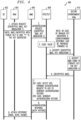
- FIG. 4 illustrates a UE authentication procedure 400 in an LTE network using encrypted MSI.
- SLF or HSS use key pair indicator "i" to decrypt the encrypted IMSI (or a part thereof), in accordance with one illustrative example.
- FIG. 4 shows UE 402, RAN 404, MME 406, HSS/SLF 408 and secure environment HSM 410.
- RAN refers to a radio access network.
- Reference to "HSS/SLF” is intended to mean that when there is an SLF in the network, i.e., when there is more than one HSS and the SLF is needed to determine which HSS to select given a specific subscriber (UE), the SLF selects the appropriate HSS, and the selected HSS performs its typical functions.
- step 1 of the UE authentication procedure flow UE 402 sends an attach request (encrypted IMSI, key indication i) through RAN 404 to MME 406.
- an attach request (encrypted IMSI, key indication i) through RAN 404 to MME 406.
- this can refer to the portion of the IMSI that is typically encrypted, e.g., MSIN, or all or other parts of IMSI.
- IMSI is encrypted with public key Ki and "i" is the key identifier.
- MME 406 then sends the authentication request (encrypted MSI, key indication "i") to HSS/SLF 408.
- HSS/SLF 408 determines if "i" is valid.
- a corresponding response may be provided to UE 402.
- HSS/SLF 408 sends a decrypt request with the encrypted IMSI and key indicator "i" to secure environment HSM 410.
- secure environment HSM 410 decrypts the encrypted IMSI using Pi (i.e., the private key for the key indicator "i").
- secure environment HSM 410 sends the decrypted IMSI to HSS/SLF 408.
- the SLF of HSS/SLF 408 selects the HSS, and forwards the authentication request to the selected HSS to generate authentication vectors.
- HSS/SLF 408 The selected HSS of HSS/SLF 408 generates authentication vectors.
- HSS/SLF 408 sends the authentication response including authentication vectors or AVs to MME 406.
- MME 406 sends the attach response including RAND, AUTN, and KASME to UE 402.
- RAND is a random challenge
- KASME is a master or base key
- AUTN is an authentication token.
- identifiers mentioned herein are for illustrative purposes only. That is, an identifier for a UE may have different names or acronyms in different protocols and standards for different communication network technologies. As such, none of the specific names or acronyms given to these identifiers herein are intended to limit examples in any manner.
- the examples are not limited to the LTE or 5G context and the disclosed techniques can be adapted in a straightforward manner to a wide variety of other communication system contexts including, but not limited to, other 3GPP systems and non- 3GPP systems which employ identity (e.g., IMSI or equivalent) in the identity request process.
- identity e.g., IMSI or equivalent
- the processor, memory, controller and other components of a user equipment or base station element of a communication system as disclosed herein may include well-known circuitry suitably modified to implement at least a portion of the identity request functionality described above.
- examples may be implemented in the form of articles of manufacture each comprising one or more software programs that are executed by processing circuitry of user equipment, base stations or other elements of a communication system.
- Conventional aspects of such circuitry are well known to those skilled in the art and therefore will not be described in detail herein.
- examples may be implemented in one or more ASICS, FPGAs or other types of integrated circuit devices, in any combination.
- Such integrated circuit devices, as well as portions or combinations thereof, are examples of "circuitry" as that term is used herein.
- a wide variety of other arrangements of hardware and associated software or firmware may be used in implementing the illustrative examples.
Landscapes
- Engineering & Computer Science (AREA)
- Computer Security & Cryptography (AREA)
- Computer Networks & Wireless Communication (AREA)
- Signal Processing (AREA)
- Computing Systems (AREA)
- Computer Hardware Design (AREA)
- General Engineering & Computer Science (AREA)
- Theoretical Computer Science (AREA)
- Algebra (AREA)
- General Physics & Mathematics (AREA)
- Mathematical Analysis (AREA)
- Mathematical Optimization (AREA)
- Mathematical Physics (AREA)
- Pure & Applied Mathematics (AREA)
- Physics & Mathematics (AREA)
- Mobile Radio Communication Systems (AREA)
Claims (10)
- Verfahren, das Folgendes umfasst:Bereitstellen von zwei oder mehr kryptographischen Schlüsselpaaren, die ein aktuelles kryptographisches Schlüsselpaar und ein künftiges kryptographisches Schlüsselpaar umfassen, zur Verwendung in einem Kommunikationssystem;Zuweisen eines Schlüsselpaarindikators zu jedem der zwei oder mehr kryptographischen Schlüsselpaare, wobei ein gegebener Schlüsselpaarindikator dazu ausgelegt ist, einem Element oder einer Funktion (304, 408) im Kommunikationssystem eine Anzeige zum gegebenen kryptographischen Schlüsselpaar bereitzustellen, das verwendet wird, um eine empfangene Nachricht zu verarbeiten, die von einer Teilnehmereinrichtung (308, 402) im Kommunikationssystem verschlüsselt wurde; undBereitstellen eines öffentlichen Schlüssels des aktuellen kryptographischen Schlüsselpaares, um eine erste Nachricht zu verschlüsseln, des Schlüsselpaarindikators, der dem aktuellen kryptographischen Schlüsselpaar zugewiesen ist, eines öffentlichen Schlüssels des künftigen kryptographischen Schlüsselpaares, um nach Empfangen einer Fehlernachricht von dem mindestens einen Element oder der mindestens einen Funktion (304, 408) eine zweite Nachricht zu verschlüsseln, wenn das Element oder die Funktion (304, 408) die verschlüsselte erste Nachricht nicht entschlüsselt, und des Schlüsselpaarindikators, der dem künftigen kryptographischen Schlüsselpaar zugewiesen ist, für die Teilnehmereinrichtung (308, 402) zur Speicherung.
- Verfahren nach Anspruch 1, wobei die Schritte des Bereitstellens und des Zuweisens von einer vertrauenswürdigen Plattform (302) durchgeführt werden.
- Verfahren nach Anspruch 1, das ferner das Bereitstellen eines privaten Schlüssels des aktuellen kryptographischen Schlüsselpaares und des Schlüsselpaarindikators, der dem aktuellen kryptographischen Schlüsselpaar zugewiesen ist, für mindestens ein Element oder mindestens eine Funktion (304, 408, 306, 410) im Kommunikationssystem umfasst.
- Verfahren nach Anspruch 3, wobei der private Schlüssel einem von einem Heimteilnehmerserver, einer Benutzerdatenverwaltungsfunktion und einer Serverstandortfunktion (304, 408) bereitgestellt wird.
- Verfahren nach Anspruch 3, wobei der private Schlüssel einer sicheren Umgebung (306, 410) bereitgestellt wird, die ein sicheres Modul umfasst.
- Vorrichtung, die einen Prozessor umfasst, der an einen Speicher wirkgekoppelt ist, der dazu ausgelegt ist, die Schritte nach Anspruch 1 durchzuführen.
- Nichttransitorisches computerlesbares Speichermedium, auf dem ein ausführbarer Programmcode vorhanden ist, der, wenn er von einem Prozessor ausgeführt wird, den Prozessor veranlasst, die Schritte nach Anspruch 1 durchzuführen.
- Verfahren, das Folgendes umfasst:Speichern eines öffentlichen Schlüssels eines aktuellen kryptographischen Schlüsselpaares, eines Schlüsselpaarindikators, der dem aktuellen kryptographischen Schlüsselpaar zugewiesen ist, eines öffentlichen Schlüssels eines künftigen kryptographischen Schlüsselpaares und eines Schlüsselpaarindikators, der dem künftigen kryptographischen Schlüsselpaar zugewiesen ist, an einer Teilnehmereinrichtung (308, 402) in einem Kommunikationssystem;Verschlüsseln einer ersten Nachricht an der Teilnehmereinrichtung (308, 402) unter Verwendung des öffentlichen Schlüssels des aktuellen kryptographischen Schlüsselpaares; undSenden der verschlüsselten ersten Nachricht von der Teilnehmereinrichtung (308, 402) an mindestens ein Element oder mindestens eine Funktion (304, 408) im Kommunikationssystem zusammen mit dem Schlüsselpaarindikator, der dem aktuellen kryptographischen Schlüsselpaar zugewiesen ist, wobei der Schlüsselpaarindikator dazu ausgelegt ist, dem mindestens einen Element oder der mindestens einen Funktion (304, 408) eine Anzeige über das aktuelle kryptographische Schlüsselpaar bereitzustellen, das verwendet wird, um die erste Nachricht zu verschlüsseln, derart, dass das Element oder die Funktion (304, 408) die verschlüsselte erste Nachricht unter Verwendung eines privaten Schlüssels des aktuellen kryptographischen Schlüsselpaares entschlüsseln kann;Empfangen einer Fehlernachricht an der Teilnehmereinrichtung (308, 402) von dem mindestens einen Element oder der mindestens einen Funktion (304, 408), wenn das mindestens eine Element oder die mindestens eine Funktion (304, 408) die verschlüsselte erste Nachricht nicht entschlüsselt; undVerschlüsseln einer zweiten Nachricht an der Teilnehmereinrichtung (308, 402) unter Verwendung des öffentlichen Schlüssels des künftigen kryptographischen Schlüsselpaares;Senden der verschlüsselten zweiten Nachricht von der Teilnehmereinrichtung (308, 402) an das mindestens eine Element oder die mindestens eine Funktion (304, 408) zusammen mit dem Schlüsselpaarindikator, der dem künftigen kryptographischen Schlüsselpaar zugewiesen ist, wobei der Schlüsselpaarindikator dazu ausgelegt ist, dem mindestens einen Element oder der mindestens einen Funktion (304, 408) eine Anzeige über das künftige kryptographische Schlüsselpaar bereitzustellen, das verwendet wird, um die zweite Nachricht zu verschlüsseln, derart, dass das mindestens eine Element oder die mindestens eine Funktion (304, 408) die verschlüsselte zweite Nachricht unter Verwendung eines privaten Schlüssels des künftigen kryptographischen Schlüsselpaares entschlüsseln kann.
- Vorrichtung, die einen Prozessor umfasst, der an einen Speicher wirkgekoppelt ist, der dazu ausgelegt ist, die Schritte nach Anspruch 8 durchzuführen.
- Nichttransitorisches computerlesbares Speichermedium, auf dem ein ausführbarer Programmcode vorhanden ist, der, wenn er von einem Prozessor ausgeführt wird, den Prozessor veranlasst, die Schritte nach Anspruch 8 durchzuführen.
Applications Claiming Priority (3)
| Application Number | Priority Date | Filing Date | Title |
|---|---|---|---|
| US201762505472P | 2017-05-12 | 2017-05-12 | |
| US15/726,974 US10574457B2 (en) | 2017-05-12 | 2017-10-06 | Indicator for determination of key for processing message in communication system |
| PCT/US2018/030366 WO2018208534A1 (en) | 2017-05-12 | 2018-05-01 | Indicator for determination of key for processing message in communication system |
Publications (2)
| Publication Number | Publication Date |
|---|---|
| EP3622738A1 EP3622738A1 (de) | 2020-03-18 |
| EP3622738B1 true EP3622738B1 (de) | 2024-08-21 |
Family
ID=64098014
Family Applications (1)
| Application Number | Title | Priority Date | Filing Date |
|---|---|---|---|
| EP18727100.2A Active EP3622738B1 (de) | 2017-05-12 | 2018-05-01 | Indikator zur bestimmung eines schlüssels zur verarbeitung von nachrichten in einem kommunikationssystem |
Country Status (3)
| Country | Link |
|---|---|
| US (1) | US10574457B2 (de) |
| EP (1) | EP3622738B1 (de) |
| WO (1) | WO2018208534A1 (de) |
Families Citing this family (15)
| Publication number | Priority date | Publication date | Assignee | Title |
|---|---|---|---|---|
| US10873464B2 (en) * | 2016-03-10 | 2020-12-22 | Futurewei Technologies, Inc. | Authentication mechanism for 5G technologies |
| CN114189857B (zh) * | 2017-05-11 | 2023-11-28 | 无线通信与技术公司 | 网关及由网关实施的方法 |
| EP4075844B1 (de) | 2017-07-25 | 2023-11-15 | Telefonaktiebolaget LM Ericsson (publ) | Verdeckte teilnehmerkennung |
| KR102425582B1 (ko) * | 2018-05-11 | 2022-07-26 | 삼성전자주식회사 | 무선통신 시스템에서 정보 보호 방법 및 장치 |
| US10932097B2 (en) * | 2018-12-21 | 2021-02-23 | Verizon Patent And Licensing Inc. | Method and system of routing selection for SMS over NAS |
| CN112087746B (zh) * | 2019-06-14 | 2023-04-18 | 中国电信股份有限公司 | 通信方法、系统、终端和可读存储介质 |
| CN112087297B (zh) * | 2019-06-14 | 2022-05-24 | 华为技术有限公司 | 一种获取安全上下文的方法、系统及设备 |
| CN110621051B (zh) * | 2019-10-16 | 2021-02-23 | 中国联合网络通信集团有限公司 | 路由方法及装置 |
| EP4055859A4 (de) * | 2019-11-08 | 2022-10-26 | ZTE Corporation | Drahtloses kommunikationsverfahren für registrierungsverfahren |
| CN113163402B (zh) * | 2020-01-23 | 2022-10-28 | 华为技术有限公司 | 一种通信方法、装置及系统 |
| CN112512043A (zh) * | 2020-10-22 | 2021-03-16 | 中兴通讯股份有限公司 | 一种会话请求方法、装置、终端及存储介质 |
| EP4057659A1 (de) | 2021-03-11 | 2022-09-14 | Thales DIS France SA | Verfahren zum ersetzen eines aktuellen schlüssels in einem sicherheitselement und zugehöriges sicherheitselement |
| CN115696322B (zh) * | 2021-07-31 | 2025-09-26 | 华为技术有限公司 | 一种卫星通信系统中密钥更新方法、系统及相关装置 |
| US12513515B2 (en) * | 2022-08-08 | 2025-12-30 | Kevin McTiernan | Identity resolution of a user equipment (UE) connectable to a fifth generation (5G) mobile network |
| US12574223B1 (en) * | 2023-01-24 | 2026-03-10 | Wells Fargo Bank, N.A. | Quantum derived unique key per transaction |
Family Cites Families (4)
| Publication number | Priority date | Publication date | Assignee | Title |
|---|---|---|---|---|
| EP1873998B1 (de) | 2006-06-27 | 2018-09-19 | Vringo Infrastructure Inc. | Identifikatoren in einem kommunikationssystem |
| US8347090B2 (en) * | 2006-10-16 | 2013-01-01 | Nokia Corporation | Encryption of identifiers in a communication system |
| US9585013B2 (en) | 2014-10-29 | 2017-02-28 | Alcatel Lucent | Generation of multiple shared keys by user equipment and base station using key expansion multiplier |
| EP3257227B1 (de) * | 2015-02-13 | 2021-03-31 | Visa International Service Association | Verwaltung von vertraulicher kommunikation |
-
2017
- 2017-10-06 US US15/726,974 patent/US10574457B2/en active Active
-
2018
- 2018-05-01 WO PCT/US2018/030366 patent/WO2018208534A1/en not_active Ceased
- 2018-05-01 EP EP18727100.2A patent/EP3622738B1/de active Active
Also Published As
| Publication number | Publication date |
|---|---|
| US10574457B2 (en) | 2020-02-25 |
| WO2018208534A1 (en) | 2018-11-15 |
| US20180331830A1 (en) | 2018-11-15 |
| EP3622738A1 (de) | 2020-03-18 |
Similar Documents
| Publication | Publication Date | Title |
|---|---|---|
| EP3622738B1 (de) | Indikator zur bestimmung eines schlüssels zur verarbeitung von nachrichten in einem kommunikationssystem | |
| AU2023202706B2 (en) | Privacy indicators for controlling authentication requests | |
| EP3662691B1 (de) | Schnittstellen für datenschutz management als service oder funktion | |
| US10893026B2 (en) | Privacy managing entity selection in communication system | |
| US20220272530A1 (en) | Securing user equipment identifier for use external to communication network | |
| HK40110139A (en) | Privacy indicators for controlling authentication requests |
Legal Events
| Date | Code | Title | Description |
|---|---|---|---|
| STAA | Information on the status of an ep patent application or granted ep patent |
Free format text: STATUS: UNKNOWN |
|
| STAA | Information on the status of an ep patent application or granted ep patent |
Free format text: STATUS: THE INTERNATIONAL PUBLICATION HAS BEEN MADE |
|
| PUAI | Public reference made under article 153(3) epc to a published international application that has entered the european phase |
Free format text: ORIGINAL CODE: 0009012 |
|
| STAA | Information on the status of an ep patent application or granted ep patent |
Free format text: STATUS: REQUEST FOR EXAMINATION WAS MADE |
|
| 17P | Request for examination filed |
Effective date: 20191212 |
|
| AK | Designated contracting states |
Kind code of ref document: A1 Designated state(s): AL AT BE BG CH CY CZ DE DK EE ES FI FR GB GR HR HU IE IS IT LI LT LU LV MC MK MT NL NO PL PT RO RS SE SI SK SM TR |
|
| AX | Request for extension of the european patent |
Extension state: BA ME |
|
| RAP1 | Party data changed (applicant data changed or rights of an application transferred) |
Owner name: NOKIA TECHNOLOGIES OY |
|
| DAV | Request for validation of the european patent (deleted) | ||
| DAX | Request for extension of the european patent (deleted) | ||
| STAA | Information on the status of an ep patent application or granted ep patent |
Free format text: STATUS: EXAMINATION IS IN PROGRESS |
|
| 17Q | First examination report despatched |
Effective date: 20210202 |
|
| GRAP | Despatch of communication of intention to grant a patent |
Free format text: ORIGINAL CODE: EPIDOSNIGR1 |
|
| STAA | Information on the status of an ep patent application or granted ep patent |
Free format text: STATUS: GRANT OF PATENT IS INTENDED |
|
| RIC1 | Information provided on ipc code assigned before grant |
Ipc: H04W 12/30 20210101ALI20230925BHEP Ipc: H04W 12/02 20090101ALI20230925BHEP Ipc: H04L 9/40 20220101ALI20230925BHEP Ipc: H04L 9/14 20060101ALI20230925BHEP Ipc: H04L 9/08 20060101ALI20230925BHEP Ipc: H04W 12/04 20090101AFI20230925BHEP |
|
| INTG | Intention to grant announced |
Effective date: 20231017 |
|
| GRAJ | Information related to disapproval of communication of intention to grant by the applicant or resumption of examination proceedings by the epo deleted |
Free format text: ORIGINAL CODE: EPIDOSDIGR1 |
|
| STAA | Information on the status of an ep patent application or granted ep patent |
Free format text: STATUS: EXAMINATION IS IN PROGRESS |
|
| GRAP | Despatch of communication of intention to grant a patent |
Free format text: ORIGINAL CODE: EPIDOSNIGR1 |
|
| STAA | Information on the status of an ep patent application or granted ep patent |
Free format text: STATUS: GRANT OF PATENT IS INTENDED |
|
| INTC | Intention to grant announced (deleted) | ||
| INTG | Intention to grant announced |
Effective date: 20240318 |
|
| GRAS | Grant fee paid |
Free format text: ORIGINAL CODE: EPIDOSNIGR3 |
|
| GRAA | (expected) grant |
Free format text: ORIGINAL CODE: 0009210 |
|
| STAA | Information on the status of an ep patent application or granted ep patent |
Free format text: STATUS: THE PATENT HAS BEEN GRANTED |
|
| AK | Designated contracting states |
Kind code of ref document: B1 Designated state(s): AL AT BE BG CH CY CZ DE DK EE ES FI FR GB GR HR HU IE IS IT LI LT LU LV MC MK MT NL NO PL PT RO RS SE SI SK SM TR |
|
| REG | Reference to a national code |
Ref country code: GB Ref legal event code: FG4D |
|
| REG | Reference to a national code |
Ref country code: CH Ref legal event code: EP |
|
| REG | Reference to a national code |
Ref country code: IE Ref legal event code: FG4D |
|
| REG | Reference to a national code |
Ref country code: DE Ref legal event code: R096 Ref document number: 602018073327 Country of ref document: DE |
|
| REG | Reference to a national code |
Ref country code: LT Ref legal event code: MG9D |
|
| REG | Reference to a national code |
Ref country code: NL Ref legal event code: MP Effective date: 20240821 |
|
| PG25 | Lapsed in a contracting state [announced via postgrant information from national office to epo] |
Ref country code: NO Free format text: LAPSE BECAUSE OF FAILURE TO SUBMIT A TRANSLATION OF THE DESCRIPTION OR TO PAY THE FEE WITHIN THE PRESCRIBED TIME-LIMIT Effective date: 20241121 |
|
| REG | Reference to a national code |
Ref country code: AT Ref legal event code: MK05 Ref document number: 1716774 Country of ref document: AT Kind code of ref document: T Effective date: 20240821 |
|
| PG25 | Lapsed in a contracting state [announced via postgrant information from national office to epo] |
Ref country code: NL Free format text: LAPSE BECAUSE OF FAILURE TO SUBMIT A TRANSLATION OF THE DESCRIPTION OR TO PAY THE FEE WITHIN THE PRESCRIBED TIME-LIMIT Effective date: 20240821 Ref country code: PL Free format text: LAPSE BECAUSE OF FAILURE TO SUBMIT A TRANSLATION OF THE DESCRIPTION OR TO PAY THE FEE WITHIN THE PRESCRIBED TIME-LIMIT Effective date: 20240821 Ref country code: GR Free format text: LAPSE BECAUSE OF FAILURE TO SUBMIT A TRANSLATION OF THE DESCRIPTION OR TO PAY THE FEE WITHIN THE PRESCRIBED TIME-LIMIT Effective date: 20241122 Ref country code: PT Free format text: LAPSE BECAUSE OF FAILURE TO SUBMIT A TRANSLATION OF THE DESCRIPTION OR TO PAY THE FEE WITHIN THE PRESCRIBED TIME-LIMIT Effective date: 20241223 Ref country code: FI Free format text: LAPSE BECAUSE OF FAILURE TO SUBMIT A TRANSLATION OF THE DESCRIPTION OR TO PAY THE FEE WITHIN THE PRESCRIBED TIME-LIMIT Effective date: 20240821 |
|
| PG25 | Lapsed in a contracting state [announced via postgrant information from national office to epo] |
Ref country code: BG Free format text: LAPSE BECAUSE OF FAILURE TO SUBMIT A TRANSLATION OF THE DESCRIPTION OR TO PAY THE FEE WITHIN THE PRESCRIBED TIME-LIMIT Effective date: 20240821 |
|
| PG25 | Lapsed in a contracting state [announced via postgrant information from national office to epo] |
Ref country code: LV Free format text: LAPSE BECAUSE OF FAILURE TO SUBMIT A TRANSLATION OF THE DESCRIPTION OR TO PAY THE FEE WITHIN THE PRESCRIBED TIME-LIMIT Effective date: 20240821 |
|
| PG25 | Lapsed in a contracting state [announced via postgrant information from national office to epo] |
Ref country code: IS Free format text: LAPSE BECAUSE OF FAILURE TO SUBMIT A TRANSLATION OF THE DESCRIPTION OR TO PAY THE FEE WITHIN THE PRESCRIBED TIME-LIMIT Effective date: 20241221 Ref country code: AT Free format text: LAPSE BECAUSE OF FAILURE TO SUBMIT A TRANSLATION OF THE DESCRIPTION OR TO PAY THE FEE WITHIN THE PRESCRIBED TIME-LIMIT Effective date: 20240821 |
|
| PG25 | Lapsed in a contracting state [announced via postgrant information from national office to epo] |
Ref country code: HR Free format text: LAPSE BECAUSE OF FAILURE TO SUBMIT A TRANSLATION OF THE DESCRIPTION OR TO PAY THE FEE WITHIN THE PRESCRIBED TIME-LIMIT Effective date: 20240821 |
|
| PG25 | Lapsed in a contracting state [announced via postgrant information from national office to epo] |
Ref country code: RS Free format text: LAPSE BECAUSE OF FAILURE TO SUBMIT A TRANSLATION OF THE DESCRIPTION OR TO PAY THE FEE WITHIN THE PRESCRIBED TIME-LIMIT Effective date: 20241121 Ref country code: ES Free format text: LAPSE BECAUSE OF FAILURE TO SUBMIT A TRANSLATION OF THE DESCRIPTION OR TO PAY THE FEE WITHIN THE PRESCRIBED TIME-LIMIT Effective date: 20240821 |
|
| PG25 | Lapsed in a contracting state [announced via postgrant information from national office to epo] |
Ref country code: RS Free format text: LAPSE BECAUSE OF FAILURE TO SUBMIT A TRANSLATION OF THE DESCRIPTION OR TO PAY THE FEE WITHIN THE PRESCRIBED TIME-LIMIT Effective date: 20241121 Ref country code: PT Free format text: LAPSE BECAUSE OF FAILURE TO SUBMIT A TRANSLATION OF THE DESCRIPTION OR TO PAY THE FEE WITHIN THE PRESCRIBED TIME-LIMIT Effective date: 20241223 Ref country code: PL Free format text: LAPSE BECAUSE OF FAILURE TO SUBMIT A TRANSLATION OF THE DESCRIPTION OR TO PAY THE FEE WITHIN THE PRESCRIBED TIME-LIMIT Effective date: 20240821 Ref country code: NO Free format text: LAPSE BECAUSE OF FAILURE TO SUBMIT A TRANSLATION OF THE DESCRIPTION OR TO PAY THE FEE WITHIN THE PRESCRIBED TIME-LIMIT Effective date: 20241121 Ref country code: NL Free format text: LAPSE BECAUSE OF FAILURE TO SUBMIT A TRANSLATION OF THE DESCRIPTION OR TO PAY THE FEE WITHIN THE PRESCRIBED TIME-LIMIT Effective date: 20240821 Ref country code: LV Free format text: LAPSE BECAUSE OF FAILURE TO SUBMIT A TRANSLATION OF THE DESCRIPTION OR TO PAY THE FEE WITHIN THE PRESCRIBED TIME-LIMIT Effective date: 20240821 Ref country code: IS Free format text: LAPSE BECAUSE OF FAILURE TO SUBMIT A TRANSLATION OF THE DESCRIPTION OR TO PAY THE FEE WITHIN THE PRESCRIBED TIME-LIMIT Effective date: 20241221 Ref country code: HR Free format text: LAPSE BECAUSE OF FAILURE TO SUBMIT A TRANSLATION OF THE DESCRIPTION OR TO PAY THE FEE WITHIN THE PRESCRIBED TIME-LIMIT Effective date: 20240821 Ref country code: GR Free format text: LAPSE BECAUSE OF FAILURE TO SUBMIT A TRANSLATION OF THE DESCRIPTION OR TO PAY THE FEE WITHIN THE PRESCRIBED TIME-LIMIT Effective date: 20241122 Ref country code: FI Free format text: LAPSE BECAUSE OF FAILURE TO SUBMIT A TRANSLATION OF THE DESCRIPTION OR TO PAY THE FEE WITHIN THE PRESCRIBED TIME-LIMIT Effective date: 20240821 Ref country code: ES Free format text: LAPSE BECAUSE OF FAILURE TO SUBMIT A TRANSLATION OF THE DESCRIPTION OR TO PAY THE FEE WITHIN THE PRESCRIBED TIME-LIMIT Effective date: 20240821 Ref country code: BG Free format text: LAPSE BECAUSE OF FAILURE TO SUBMIT A TRANSLATION OF THE DESCRIPTION OR TO PAY THE FEE WITHIN THE PRESCRIBED TIME-LIMIT Effective date: 20240821 Ref country code: AT Free format text: LAPSE BECAUSE OF FAILURE TO SUBMIT A TRANSLATION OF THE DESCRIPTION OR TO PAY THE FEE WITHIN THE PRESCRIBED TIME-LIMIT Effective date: 20240821 |
|
| PG25 | Lapsed in a contracting state [announced via postgrant information from national office to epo] |
Ref country code: DK Free format text: LAPSE BECAUSE OF FAILURE TO SUBMIT A TRANSLATION OF THE DESCRIPTION OR TO PAY THE FEE WITHIN THE PRESCRIBED TIME-LIMIT Effective date: 20240821 Ref country code: RO Free format text: LAPSE BECAUSE OF FAILURE TO SUBMIT A TRANSLATION OF THE DESCRIPTION OR TO PAY THE FEE WITHIN THE PRESCRIBED TIME-LIMIT Effective date: 20240821 Ref country code: SM Free format text: LAPSE BECAUSE OF FAILURE TO SUBMIT A TRANSLATION OF THE DESCRIPTION OR TO PAY THE FEE WITHIN THE PRESCRIBED TIME-LIMIT Effective date: 20240821 |
|
| PG25 | Lapsed in a contracting state [announced via postgrant information from national office to epo] |
Ref country code: EE Free format text: LAPSE BECAUSE OF FAILURE TO SUBMIT A TRANSLATION OF THE DESCRIPTION OR TO PAY THE FEE WITHIN THE PRESCRIBED TIME-LIMIT Effective date: 20240821 |
|
| PG25 | Lapsed in a contracting state [announced via postgrant information from national office to epo] |
Ref country code: CZ Free format text: LAPSE BECAUSE OF FAILURE TO SUBMIT A TRANSLATION OF THE DESCRIPTION OR TO PAY THE FEE WITHIN THE PRESCRIBED TIME-LIMIT Effective date: 20240821 |
|
| PG25 | Lapsed in a contracting state [announced via postgrant information from national office to epo] |
Ref country code: IT Free format text: LAPSE BECAUSE OF FAILURE TO SUBMIT A TRANSLATION OF THE DESCRIPTION OR TO PAY THE FEE WITHIN THE PRESCRIBED TIME-LIMIT Effective date: 20240821 Ref country code: SK Free format text: LAPSE BECAUSE OF FAILURE TO SUBMIT A TRANSLATION OF THE DESCRIPTION OR TO PAY THE FEE WITHIN THE PRESCRIBED TIME-LIMIT Effective date: 20240821 |
|
| REG | Reference to a national code |
Ref country code: DE Ref legal event code: R097 Ref document number: 602018073327 Country of ref document: DE |
|
| PLBE | No opposition filed within time limit |
Free format text: ORIGINAL CODE: 0009261 |
|
| STAA | Information on the status of an ep patent application or granted ep patent |
Free format text: STATUS: NO OPPOSITION FILED WITHIN TIME LIMIT |
|
| PGFP | Annual fee paid to national office [announced via postgrant information from national office to epo] |
Ref country code: DE Payment date: 20250402 Year of fee payment: 8 |
|
| 26N | No opposition filed |
Effective date: 20250522 |
|
| PG25 | Lapsed in a contracting state [announced via postgrant information from national office to epo] |
Ref country code: SE Free format text: LAPSE BECAUSE OF FAILURE TO SUBMIT A TRANSLATION OF THE DESCRIPTION OR TO PAY THE FEE WITHIN THE PRESCRIBED TIME-LIMIT Effective date: 20240821 |
|
| REG | Reference to a national code |
Ref country code: CH Ref legal event code: H13 Free format text: ST27 STATUS EVENT CODE: U-0-0-H10-H13 (AS PROVIDED BY THE NATIONAL OFFICE) Effective date: 20251223 |
|
| PG25 | Lapsed in a contracting state [announced via postgrant information from national office to epo] |
Ref country code: LU Free format text: LAPSE BECAUSE OF NON-PAYMENT OF DUE FEES Effective date: 20250501 |
|
| PG25 | Lapsed in a contracting state [announced via postgrant information from national office to epo] |
Ref country code: CH Free format text: LAPSE BECAUSE OF NON-PAYMENT OF DUE FEES Effective date: 20250531 |
|
| GBPC | Gb: european patent ceased through non-payment of renewal fee |
Effective date: 20250501 |
|
| REG | Reference to a national code |
Ref country code: BE Ref legal event code: MM Effective date: 20250531 |
|
| PG25 | Lapsed in a contracting state [announced via postgrant information from national office to epo] |
Ref country code: MC Free format text: LAPSE BECAUSE OF FAILURE TO SUBMIT A TRANSLATION OF THE DESCRIPTION OR TO PAY THE FEE WITHIN THE PRESCRIBED TIME-LIMIT Effective date: 20240821 |
|
| PG25 | Lapsed in a contracting state [announced via postgrant information from national office to epo] |
Ref country code: GB Free format text: LAPSE BECAUSE OF NON-PAYMENT OF DUE FEES Effective date: 20250501 |
|
| PG25 | Lapsed in a contracting state [announced via postgrant information from national office to epo] |
Ref country code: IE Free format text: LAPSE BECAUSE OF NON-PAYMENT OF DUE FEES Effective date: 20250501 |
|
| PG25 | Lapsed in a contracting state [announced via postgrant information from national office to epo] |
Ref country code: BE Free format text: LAPSE BECAUSE OF NON-PAYMENT OF DUE FEES Effective date: 20250531 |
|
| PG25 | Lapsed in a contracting state [announced via postgrant information from national office to epo] |
Ref country code: FR Free format text: LAPSE BECAUSE OF NON-PAYMENT OF DUE FEES Effective date: 20250531 |