EP3622901A1 - Aneurysmusverschlussvorrichtung - Google Patents
Aneurysmusverschlussvorrichtung Download PDFInfo
- Publication number
- EP3622901A1 EP3622901A1 EP19196722.3A EP19196722A EP3622901A1 EP 3622901 A1 EP3622901 A1 EP 3622901A1 EP 19196722 A EP19196722 A EP 19196722A EP 3622901 A1 EP3622901 A1 EP 3622901A1
- Authority
- EP
- European Patent Office
- Prior art keywords
- aneurysm
- occlusion device
- end region
- control ring
- proximal end
- Prior art date
- Legal status (The legal status is an assumption and is not a legal conclusion. Google has not performed a legal analysis and makes no representation as to the accuracy of the status listed.)
- Withdrawn
Links
- 206010002329 Aneurysm Diseases 0.000 title claims abstract description 97
- 210000004204 blood vessel Anatomy 0.000 claims abstract description 21
- 210000005166 vasculature Anatomy 0.000 claims abstract description 10
- 238000003780 insertion Methods 0.000 claims abstract description 6
- 230000037431 insertion Effects 0.000 claims abstract description 6
- 230000003073 embolic effect Effects 0.000 claims description 56
- 239000007943 implant Substances 0.000 claims description 26
- 239000000463 material Substances 0.000 claims description 20
- 239000007769 metal material Substances 0.000 claims description 4
- 238000012276 Endovascular treatment Methods 0.000 claims description 3
- 238000011282 treatment Methods 0.000 abstract description 2
- 238000010276 construction Methods 0.000 description 32
- 238000000034 method Methods 0.000 description 21
- BASFCYQUMIYNBI-UHFFFAOYSA-N platinum Chemical compound [Pt] BASFCYQUMIYNBI-UHFFFAOYSA-N 0.000 description 8
- 239000003550 marker Substances 0.000 description 6
- 238000002594 fluoroscopy Methods 0.000 description 5
- 210000000746 body region Anatomy 0.000 description 4
- HLXZNVUGXRDIFK-UHFFFAOYSA-N nickel titanium Chemical compound [Ti].[Ti].[Ti].[Ti].[Ti].[Ti].[Ti].[Ti].[Ti].[Ti].[Ti].[Ni].[Ni].[Ni].[Ni].[Ni].[Ni].[Ni].[Ni].[Ni].[Ni].[Ni].[Ni].[Ni].[Ni] HLXZNVUGXRDIFK-UHFFFAOYSA-N 0.000 description 4
- 229910001000 nickel titanium Inorganic materials 0.000 description 4
- 238000002513 implantation Methods 0.000 description 3
- 229910052751 metal Inorganic materials 0.000 description 3
- 239000002184 metal Substances 0.000 description 3
- 150000002739 metals Chemical class 0.000 description 3
- 229910052697 platinum Inorganic materials 0.000 description 3
- 239000011148 porous material Substances 0.000 description 3
- KHOITXIGCFIULA-UHFFFAOYSA-N Alophen Chemical compound C1=CC(OC(=O)C)=CC=C1C(C=1N=CC=CC=1)C1=CC=C(OC(C)=O)C=C1 KHOITXIGCFIULA-UHFFFAOYSA-N 0.000 description 2
- 208000022211 Arteriovenous Malformations Diseases 0.000 description 2
- JOYRKODLDBILNP-UHFFFAOYSA-N Ethyl urethane Chemical compound CCOC(N)=O JOYRKODLDBILNP-UHFFFAOYSA-N 0.000 description 2
- 230000005744 arteriovenous malformation Effects 0.000 description 2
- 230000015572 biosynthetic process Effects 0.000 description 2
- 230000017531 blood circulation Effects 0.000 description 2
- 230000036772 blood pressure Effects 0.000 description 2
- 230000007547 defect Effects 0.000 description 2
- 238000003698 laser cutting Methods 0.000 description 2
- -1 platinum Chemical class 0.000 description 2
- 239000004632 polycaprolactone Substances 0.000 description 2
- 229920001610 polycaprolactone Polymers 0.000 description 2
- 239000004633 polyglycolic acid Substances 0.000 description 2
- 229950008885 polyglycolic acid Drugs 0.000 description 2
- 238000006467 substitution reaction Methods 0.000 description 2
- 230000001732 thrombotic effect Effects 0.000 description 2
- 230000002792 vascular Effects 0.000 description 2
- FHVDTGUDJYJELY-UHFFFAOYSA-N 6-{[2-carboxy-4,5-dihydroxy-6-(phosphanyloxy)oxan-3-yl]oxy}-4,5-dihydroxy-3-phosphanyloxane-2-carboxylic acid Chemical compound O1C(C(O)=O)C(P)C(O)C(O)C1OC1C(C(O)=O)OC(OP)C(O)C1O FHVDTGUDJYJELY-UHFFFAOYSA-N 0.000 description 1
- 229910000684 Cobalt-chrome Inorganic materials 0.000 description 1
- 240000006829 Ficus sundaica Species 0.000 description 1
- 206010016717 Fistula Diseases 0.000 description 1
- 229910000831 Steel Inorganic materials 0.000 description 1
- 206010053648 Vascular occlusion Diseases 0.000 description 1
- WAIPAZQMEIHHTJ-UHFFFAOYSA-N [Cr].[Co] Chemical compound [Cr].[Co] WAIPAZQMEIHHTJ-UHFFFAOYSA-N 0.000 description 1
- 229940072056 alginate Drugs 0.000 description 1
- 229920000615 alginic acid Polymers 0.000 description 1
- 235000010443 alginic acid Nutrition 0.000 description 1
- 230000008321 arterial blood flow Effects 0.000 description 1
- 230000004872 arterial blood pressure Effects 0.000 description 1
- 210000005013 brain tissue Anatomy 0.000 description 1
- 229920002678 cellulose Polymers 0.000 description 1
- 239000001913 cellulose Substances 0.000 description 1
- 239000010952 cobalt-chrome Substances 0.000 description 1
- 238000005056 compaction Methods 0.000 description 1
- 150000001875 compounds Chemical class 0.000 description 1
- 238000002788 crimping Methods 0.000 description 1
- 229920000295 expanded polytetrafluoroethylene Polymers 0.000 description 1
- 210000001105 femoral artery Anatomy 0.000 description 1
- 230000003890 fistula Effects 0.000 description 1
- 239000006260 foam Substances 0.000 description 1
- 239000000499 gel Substances 0.000 description 1
- 150000004676 glycans Chemical class 0.000 description 1
- PCHJSUWPFVWCPO-UHFFFAOYSA-N gold Chemical compound [Au] PCHJSUWPFVWCPO-UHFFFAOYSA-N 0.000 description 1
- 229910052737 gold Inorganic materials 0.000 description 1
- 239000010931 gold Substances 0.000 description 1
- 210000004013 groin Anatomy 0.000 description 1
- 150000002632 lipids Chemical class 0.000 description 1
- 230000036244 malformation Effects 0.000 description 1
- 238000004519 manufacturing process Methods 0.000 description 1
- 239000000203 mixture Substances 0.000 description 1
- 238000012148 non-surgical treatment Methods 0.000 description 1
- 239000004626 polylactic acid Substances 0.000 description 1
- 229920006254 polymer film Polymers 0.000 description 1
- 229920001282 polysaccharide Polymers 0.000 description 1
- 239000005017 polysaccharide Substances 0.000 description 1
- 229920001343 polytetrafluoroethylene Polymers 0.000 description 1
- 239000004810 polytetrafluoroethylene Substances 0.000 description 1
- 239000007787 solid Substances 0.000 description 1
- 239000010935 stainless steel Substances 0.000 description 1
- 229910001220 stainless steel Inorganic materials 0.000 description 1
- 239000010959 steel Substances 0.000 description 1
- 239000000126 substance Substances 0.000 description 1
- 229910052715 tantalum Inorganic materials 0.000 description 1
- GUVRBAGPIYLISA-UHFFFAOYSA-N tantalum atom Chemical compound [Ta] GUVRBAGPIYLISA-UHFFFAOYSA-N 0.000 description 1
- 208000019553 vascular disease Diseases 0.000 description 1
- 208000021331 vascular occlusion disease Diseases 0.000 description 1
- 238000003466 welding Methods 0.000 description 1
Images






Classifications
-
- A—HUMAN NECESSITIES
- A61—MEDICAL OR VETERINARY SCIENCE; HYGIENE
- A61B—DIAGNOSIS; SURGERY; IDENTIFICATION
- A61B17/00—Surgical instruments, devices or methods
- A61B17/12—Surgical instruments, devices or methods for ligaturing or otherwise compressing tubular parts of the body, e.g. blood vessels or umbilical cord
- A61B17/12022—Occluding by internal devices, e.g. balloons or releasable wires
- A61B17/12027—Type of occlusion
- A61B17/12031—Type of occlusion complete occlusion
-
- A—HUMAN NECESSITIES
- A61—MEDICAL OR VETERINARY SCIENCE; HYGIENE
- A61B—DIAGNOSIS; SURGERY; IDENTIFICATION
- A61B17/00—Surgical instruments, devices or methods
- A61B17/12—Surgical instruments, devices or methods for ligaturing or otherwise compressing tubular parts of the body, e.g. blood vessels or umbilical cord
- A61B17/12022—Occluding by internal devices, e.g. balloons or releasable wires
- A61B17/12099—Occluding by internal devices, e.g. balloons or releasable wires characterised by the location of the occluder
- A61B17/12109—Occluding by internal devices, e.g. balloons or releasable wires characterised by the location of the occluder in a blood vessel
- A61B17/12113—Occluding by internal devices, e.g. balloons or releasable wires characterised by the location of the occluder in a blood vessel within an aneurysm
-
- A—HUMAN NECESSITIES
- A61—MEDICAL OR VETERINARY SCIENCE; HYGIENE
- A61B—DIAGNOSIS; SURGERY; IDENTIFICATION
- A61B17/00—Surgical instruments, devices or methods
- A61B17/12—Surgical instruments, devices or methods for ligaturing or otherwise compressing tubular parts of the body, e.g. blood vessels or umbilical cord
- A61B17/12022—Occluding by internal devices, e.g. balloons or releasable wires
- A61B17/12131—Occluding by internal devices, e.g. balloons or releasable wires characterised by the type of occluding device
- A61B17/1214—Coils or wires
-
- A—HUMAN NECESSITIES
- A61—MEDICAL OR VETERINARY SCIENCE; HYGIENE
- A61B—DIAGNOSIS; SURGERY; IDENTIFICATION
- A61B17/00—Surgical instruments, devices or methods
- A61B17/12—Surgical instruments, devices or methods for ligaturing or otherwise compressing tubular parts of the body, e.g. blood vessels or umbilical cord
- A61B17/12022—Occluding by internal devices, e.g. balloons or releasable wires
- A61B17/12131—Occluding by internal devices, e.g. balloons or releasable wires characterised by the type of occluding device
- A61B17/12168—Occluding by internal devices, e.g. balloons or releasable wires characterised by the type of occluding device having a mesh structure
-
- A—HUMAN NECESSITIES
- A61—MEDICAL OR VETERINARY SCIENCE; HYGIENE
- A61B—DIAGNOSIS; SURGERY; IDENTIFICATION
- A61B17/00—Surgical instruments, devices or methods
- A61B17/12—Surgical instruments, devices or methods for ligaturing or otherwise compressing tubular parts of the body, e.g. blood vessels or umbilical cord
- A61B17/12022—Occluding by internal devices, e.g. balloons or releasable wires
- A61B17/12131—Occluding by internal devices, e.g. balloons or releasable wires characterised by the type of occluding device
- A61B17/12168—Occluding by internal devices, e.g. balloons or releasable wires characterised by the type of occluding device having a mesh structure
- A61B17/12172—Occluding by internal devices, e.g. balloons or releasable wires characterised by the type of occluding device having a mesh structure having a pre-set deployed three-dimensional shape
-
- A—HUMAN NECESSITIES
- A61—MEDICAL OR VETERINARY SCIENCE; HYGIENE
- A61L—METHODS OR APPARATUS FOR STERILISING MATERIALS OR OBJECTS IN GENERAL; DISINFECTION, STERILISATION OR DEODORISATION OF AIR; CHEMICAL ASPECTS OF BANDAGES, DRESSINGS, ABSORBENT PADS OR SURGICAL ARTICLES; MATERIALS FOR BANDAGES, DRESSINGS, ABSORBENT PADS OR SURGICAL ARTICLES
- A61L31/00—Materials for other surgical articles, e.g. stents, stent-grafts, shunts, surgical drapes, guide wires, materials for adhesion prevention, occluding devices, surgical gloves, tissue fixation devices
- A61L31/02—Inorganic materials
- A61L31/022—Metals or alloys
-
- A—HUMAN NECESSITIES
- A61—MEDICAL OR VETERINARY SCIENCE; HYGIENE
- A61L—METHODS OR APPARATUS FOR STERILISING MATERIALS OR OBJECTS IN GENERAL; DISINFECTION, STERILISATION OR DEODORISATION OF AIR; CHEMICAL ASPECTS OF BANDAGES, DRESSINGS, ABSORBENT PADS OR SURGICAL ARTICLES; MATERIALS FOR BANDAGES, DRESSINGS, ABSORBENT PADS OR SURGICAL ARTICLES
- A61L31/00—Materials for other surgical articles, e.g. stents, stent-grafts, shunts, surgical drapes, guide wires, materials for adhesion prevention, occluding devices, surgical gloves, tissue fixation devices
- A61L31/14—Materials characterised by their function or physical properties, e.g. injectable or lubricating compositions, shape-memory materials, surface modified materials
- A61L31/18—Materials at least partially X-ray or laser opaque
-
- A—HUMAN NECESSITIES
- A61—MEDICAL OR VETERINARY SCIENCE; HYGIENE
- A61M—DEVICES FOR INTRODUCING MEDIA INTO, OR ONTO, THE BODY; DEVICES FOR TRANSDUCING BODY MEDIA OR FOR TAKING MEDIA FROM THE BODY; DEVICES FOR PRODUCING OR ENDING SLEEP OR STUPOR
- A61M25/00—Catheters; Hollow probes
- A61M25/0021—Catheters; Hollow probes characterised by the form of the tubing
-
- A—HUMAN NECESSITIES
- A61—MEDICAL OR VETERINARY SCIENCE; HYGIENE
- A61B—DIAGNOSIS; SURGERY; IDENTIFICATION
- A61B17/00—Surgical instruments, devices or methods
- A61B2017/00831—Material properties
- A61B2017/00902—Material properties transparent or translucent
- A61B2017/00915—Material properties transparent or translucent for radioactive radiation
-
- A—HUMAN NECESSITIES
- A61—MEDICAL OR VETERINARY SCIENCE; HYGIENE
- A61B—DIAGNOSIS; SURGERY; IDENTIFICATION
- A61B17/00—Surgical instruments, devices or methods
- A61B17/12—Surgical instruments, devices or methods for ligaturing or otherwise compressing tubular parts of the body, e.g. blood vessels or umbilical cord
- A61B17/12022—Occluding by internal devices, e.g. balloons or releasable wires
- A61B2017/1205—Introduction devices
-
- A—HUMAN NECESSITIES
- A61—MEDICAL OR VETERINARY SCIENCE; HYGIENE
- A61B—DIAGNOSIS; SURGERY; IDENTIFICATION
- A61B17/00—Surgical instruments, devices or methods
- A61B17/12—Surgical instruments, devices or methods for ligaturing or otherwise compressing tubular parts of the body, e.g. blood vessels or umbilical cord
- A61B17/12022—Occluding by internal devices, e.g. balloons or releasable wires
- A61B2017/1205—Introduction devices
- A61B2017/12054—Details concerning the detachment of the occluding device from the introduction device
-
- A—HUMAN NECESSITIES
- A61—MEDICAL OR VETERINARY SCIENCE; HYGIENE
- A61M—DEVICES FOR INTRODUCING MEDIA INTO, OR ONTO, THE BODY; DEVICES FOR TRANSDUCING BODY MEDIA OR FOR TAKING MEDIA FROM THE BODY; DEVICES FOR PRODUCING OR ENDING SLEEP OR STUPOR
- A61M25/00—Catheters; Hollow probes
- A61M25/0021—Catheters; Hollow probes characterised by the form of the tubing
- A61M2025/0042—Microcatheters, cannula or the like having outside diameters around 1 mm or less
Definitions
- the invention relates to implants within body vessels and more particularly to occlusion devices for small vascular openings such as a neck of an aneurysm.
- Vascular disorders and defects such as aneurysms and other arterio-venous malformations are especially difficult to treat when located near critical tissues or where ready access to a malformation is not available. Both difficulty factors apply especially to cranial aneurysms. Due to the sensitive brain tissue surrounding cranial blood vessels and the restricted access, it is very challenging and often risky to surgically treat defects of the cranial vasculature.
- the goal is to exclude the internal volume of the aneurysm sac from arterial blood pressure and flow. As long as the interior walls of the aneurysm are subjected to blood pressure and/or flow, there is a risk of the aneurysm rupturing.
- Non-surgical treatments include vascular occlusion devices such as embolic coils deployed using catheter delivery systems.
- vascular occlusion devices such as embolic coils deployed using catheter delivery systems.
- the distal end of an embolic coil delivery catheter is initially inserted into non-cranial vasculature of a patient, typically through a femoral artery in the groin, and guided to a predetermined delivery site in a blood vessel within the cranium.
- the aneurysm sac is then filled with embolic material that causes formation of a solid, thrombotic mass that protects the walls from blood pressure and flow.
- the thrombotic mass substantially restores the original blood vessel shape along the plane of the aneurysm's neck.
- the neck plane is an imaginary surface where the intima of the blood vessel would be if not for formation of the aneurysm.
- embolic coils simply utilizing embolic coils is not always effective at treating aneurysms as re-canalization of the aneurysm and/or coil compaction can occur over time.
- a bag for use in an aneurysm sac is described by Greenhalgh in US Patent Nos. 6,346,117 and 6,391,037
- an aneurysm neck obstruction device is shown in US Patent No. 6,454,780 by Wallace .
- Detachable neck bridges are disclosed by Abrams et al. in US Patent No. 6,036,720 and by Murphy et al. in US Patent No. 7,410,482 for example.
- one or more embolic coils are delivered within or through the neck bridges or other obstruction devices to fill the sac of the aneurysm.
- vaso-occlusive device is illustrated in US Patent No. 5,645,558 by Horton as having one or more strands of flexible material which are wound to form a generally spherical or ovoid vaso-occlusive structure when relaxed after being placed in a vascular cavity such as an aneurysm or fistula.
- US Patent No. 5,916,235 by Guglielmi cites earlier patents describing detachable coils and then discloses an expandable cage as a vaso-occlusive structure that can receive and retain one or more coils after the cage is expanded within an aneurysm.
- a self-expandable aneurysm filling device is disclosed in US Patent Publication No. 2010/0069948 by Veznedaroglu et al.
- An object of the present invention is to provide an improved occlusion device which substantially blocks flow into an aneurysm in a blood vessel.
- Another object of the present invention is to provide such an occlusion device which can be repositioned or retrieved from a sac of an aneurysm.
- This invention features an occlusion device suitable for endovascular treatment of an aneurysm in a blood vessel in a patient, including a substantially tubular structure having a proximal end region and a distal end region, having a first, expanded condition and a second, collapsed condition.
- the device has dimensions in the second, collapsed condition suitable for insertion through vasculature of the patient and through a neck of the aneurysm.
- the device further includes a control ring having a substantially annular body disposed on the proximal end region of the structure and at least substantially circumscribing the proximal end region to prevent radial expansion of the proximal end region and to provide an engagement feature during manipulation of the occlusion device.
- control ring defines an inner passage, such as a channel established by an inner sleeve, through which at least one embolic coil is insertable into the aneurysm.
- inner passage such as a channel established by an inner sleeve
- at least a portion of the proximal end region of the tubular structure defines a plurality of openings having a sufficiently small size to enhance occlusion of the aneurysm.
- the tubular structure cooperates with at least one vaso-occlusion structure such as a collapsible cage-like device.
- the occlusive device is capable of being utilized in combination with a delivery member defining an inner lumen and having a distal end region carrying a grabber having at least two finger elements, each finger element defining a gripping region to mechanically engage the control ring.
- the grabber is formed of a metallic material and the gripping regions are notches formed in the finger elements, each notch being sized to mechanically engage a portion of the control ring.
- the combination may further include a catheter having an inner lumen through which the delivery tube is insertable and translatable relative to the catheter.
- This invention may also be expressed as a method of treating an aneurysm in a blood vessel in a patient, the method including selecting an occlusion device with a structure having a substantially tubular structure having a proximal end region and a distal end region, having a first, expanded condition and a second, collapsed condition, and having dimensions in the second, collapsed condition suitable for insertion through vasculature of the patient and through a neck of the aneurysm.
- the device further includes a control ring having a substantially annular body disposed on the proximal end region of the structure and at least substantially circumscribing the proximal end region to prevent radial expansion of the proximal end region.
- the method further includes mechanically engaging the control ring with a grabber on a delivery tube to enable manipulation of the occlusion device, drawing the occlusion device into a catheter carrying the delivery tube to force the occlusion device into the collapsed condition, inserting the catheter with the occlusion device into vasculature of the patient to reach the region of the aneurysm in the blood vessel, and positioning the occlusion device within the aneurysm.
- the method additionally includes delivering at least one embolic coil through the delivery tube and through the control ring to secure the occlusion device within the aneurysm to occlude flow into the aneurysm, and mechanically releasing the control ring and withdrawing the catheter and the delivery tube from the patient.
- the method further includes selecting the occlusive device to be attached to a collapsible cage-like vaso-occlusive structure, and positioning the occlusive device within the aneurysm includes utilizing the vaso-occlusive structure to secure the proximal end region of the tubular structure across the neck of the aneurysm.
- This invention may be accomplished by an occlusion device suitable for endovascular treatment of an aneurysm in a blood vessel in a patient, with a substantially tubular structure having a proximal end region and a distal end region, having a first, expanded condition and a second, collapsed condition.
- the device has dimensions in the second, collapsed condition suitable for insertion through vasculature of the patient, utilizing a catheter such as a microcatheter, and through a neck of the aneurysm.
- the device further includes a control ring having a substantially annular body disposed on the proximal end region of the structure and at least substantially circumscribing the proximal end region to prevent radial expansion of the proximal end region and to provide an engagement feature during manipulation of the occlusion device.
- the control ring is releasably engageable by a releasable feature such as a grabber or at least one frangible member on a delivery member in some mechanical constructions or, in other constructions, by at least one electrolytically severable element.
- a releasable feature such as a grabber or at least one frangible member on a delivery member in some mechanical constructions or, in other constructions, by at least one electrolytically severable element.
- the control ring defines an inner passage through which at least one embolic coil is insertable into the aneurysm.
- the occlusion device is held in place within the aneurysm by at least one vaso-occlusive structure such as a cage-like device.
- FIG. 1 schematically illustrates the distal portion of a novel delivery system 10 including a microcatheter 12 and a delivery tube 14 holding a tubular occlusion device 20 according to the present invention to be implanted within sac S of aneurysm A emerging from blood vessel BV.
- the microcatheter 12 has a distal radiopaque marker band 13 and is advanced to the vicinity of neck N of aneurysm A such that marker band 13 is at the level of the neck N as seen under fluoroscopy.
- FIGS. 2 and 5 Enlarged views of the distal portion of delivery system 10 and of occlusion device 20 are provided in FIGS. 2 and 5 .
- Occlusion device 20 is shown in a second, collapsed condition in FIG. 2 within catheter lumen 11, with a control ring 22 held by grabber 30 of delivery tube 14.
- Control ring 22 is disposed about a proximal region 23 of device structure 25 and defines an inner passage 26 through which one or more embolic coils are inserted, as described in more detail below.
- Structure 25 of occlusion device 20 further includes a mesh body 24 and a distal region 28.
- control ring 22 is radiopaque and is aligned under fluoroscopy relative to marker 13 on catheter 12 as shown in FIGS. 3 and 4 .
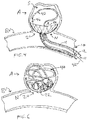
- At least one embolic coil 40 FIG. 4 is advanced through lumen 15 of delivery tube 14 as indicated by arrow 42, through passage 26 of control ring 22 as indicated by arrow 44, and is advanced, arrow 46, within aneurysm A to substantially fill sac S and to anchor body 24 of occlusion device 20 against the interior wall of aneurysm A to block neck N as shown in FIG. 6 .
- the catheter 12 is withdrawn proximally, as indicated by arrow 51 in FIG. 5 , while maintaining delivery tube 14 in place, to remove radial constraint on fingers 32 and 34 of grabber 30.
- Fingers 32 and 34 preferably are biased radially outwardly and move in the direction of arrows 50 and 52, respectively, to disengage control ring 22 from notches 36 and 38 in fingers 32 and 34, respectively.
- the catheter 12 is a polymeric microcatheter defining an inner lumen 11 having an inner diameter of between 0.020 inch and 0.027 inch
- the delivery tube 14 has outer diameter that is slightly less than the inner diameter of the catheter lumen 11, and the grabber 30 with occlusion device 20 in the collapsed condition shown in FIGS. 1 and 2 also have outer diameters that are substantially the same as the inner diameter of the catheter lumen 11, which radially constrains fingers 32 and 34 to engage control ring 22.
- the lumen 15 of delivery tube 14 has a diameter capable of allowing passage of a conventional embolic coil delivery system having a nominal outer diameter of between 0.010 inch and 0.015 inch.
- the delivery tube has at least one region of increased flexibility, especially near the distal end of the delivery tube, to minimize unintended microcatheter movement during translation of the delivery tube relative to the microcatheter.
- the at least one flexible region is made in one construction by laser-cutting a pattern of interrupted cuts into a medical-grade nitinol (NiTi) tube.
- a coiled metallic or polymeric cylindrical component and/or a cylindrical section of flexible polymeric material is added to the distal region of the delivery tube.
- the grabber is created in some constructions by laser-cutting material forming the grabber to create at least two finger elements, each preferably having a notch to enhance gripping of a control ring according to the present invention.
- the grabber is integral, that is, is monolithically formed with the same material as the remainder of the delivery tube and, in other constructions, is fixedly attached to the distal end of the delivery tube.
- the structure 25 of occlusion device 20 is formed of metallic filaments that establish an expandable braided mesh tube. Suitable materials for the filaments include nitinol wires and other biocompatible metals, such as platinum, that will not remain in a collapsed condition after being ejected from a delivery tube. Preferably, at least one platinum wire is included for radiopacity. In other constructions, the structure 25 is formed of at least one polymeric material that does not become "set" in the collapsed condition.
- Suitable materials for control ring 22 discussed above, and for control ring 22a and band 22b discussed below in relation to FIGS. 7-8B include biocompatible radiopaque materials such as platinum, tantalum and gold.
- Other suitable metallic materials include cobalt chromium, stainless steel, and combinations of two or more of biocompatible metals.
- Suitable polymeric materials include biocompatible biodegradable and non-biodegradable materials, as described in more detail below.
- FIG. 7 One technique for manufacturing an occlusion device according to the present invention is illustrated in FIG. 7 .
- structure 25a is formed as a braided mesh tube
- a control ring 22a is disposed by crimping and/or welding ring material about proximal region 23a to limit radial expansion at that site while defining an inner passage 26a through which one or more embolic coils can be inserted, as described above.
- an inner sleeve such as a grommet (not shown) is inserted within structure 25a and positioned under the control ring 23a to maintain an inner diameter opening of desired dimension for inner passage 26a.
- a spherical mandrel 60 such as a steel ball bearing is inserted through distal region 28a to enlarge and expand the structure 25a in body region 24a.
- a clamp-like element such as a band 22b is then crimped over distal region 62 to further shape the body 24a.
- the assembly is heated to set mesh body 24a in the expanded condition.
- a cut is made along the circumference of mandrel 60, typically equidistant between control ring 22a and band 22b as indicated by dashed line 63, as well as on the opposite sides of control ring 22a and band 22b as shown by arrows 64 and 66, respectively.
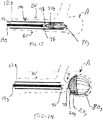
- This technique creates two separate devices 20a and 20b, as depicted in FIGS. 8A and 8B , respectively.
- Distal end regions 28a and 28b are both open, such as illustrated for device 20 in FIGS. 1-6 .
- Device 20b also has body 24b, proximal region 23b, and a passage 26b formed by band 22b which serves as a control ring according to the present invention.
- band 22b is incorporated into an implantable device 20b in one construction, instead of being a temporary clamp.
- band 22b is removed and mandrel 60, FIG. 7 , is extracted to form the occlusion device 20c, FIG. 9 , with a constricted yet un-constrained distal region 28c, having a single control ring 22a.
- a cut is made non-equatorially about structure 25a, such as along line 70, to generate device 20d, FIG. 10 .
- a non-spherical mandrel such as a lozenge-shaped mandrel, is utilized to form an elongated device 20e, FIG. 11 .
- the occlusion device according to the present invention can have many shapes such as round, elliptic, oblong, or otherwise asymmetric, and can have an open or a closed distal end. It is expected that an open distal end will typically allow better conformance to the neck and sac of the aneurysm to be treated.
- vaso-occlusive structure 80 is similar to one of the embodiments disclosed in US Patent No. 5,645,558 by Horton and, in certain other constructions, is similar to one of the embodiments disclosed in US Patent No. 5,916,235 by Guglielmi and in US Patent Publication No. 2010/0069948 by Veznedaroglu et al.
- an elongated delivery member 14f is advanced within lumen 11f of catheter 12f to enable occlusion device 20f and vaso-occlusive structure 80 to expand within sac S as shown in FIG. 12 .
- a grabber 30f continues to be constrained radially by lumen 11f of catheter 12f and maintains its grip on control ring 22f with a plurality of gripping regions.
- control ring 22f is radiopaque and is aligned under fluoroscopy in a similar manner as described above relative to FIGS. 3 and 4 .
- vaso-occlusive structure 80 presses occlusion device 20f against the interior wall and across the neck N of aneurysm A to secure it in place.
- vaso-occlusive structure 80 serves in an expanded condition as a frame or lattice to anchor occlusion device 20f against neck N, and occlusion device 20f, held in place by structure 80, serves as a cover extending at least across neck N, the cover preferably being porous or otherwise defining sufficiently small openings, to enhance occlusion of aneurysm A.
- occlusion device 20f is secured to vaso-occlusive structure 80 by at least one attachment point, being attached to at least one of a portion of the interior surface of device 20f and a portion of the control ring 22f, to maintain an aligned relationship between the device 20f and the structure 80, especially during loading and delivery of structure 80 and device 20f utilizing a delivery cannula.
- control ring 22f may lack a passage.
- an occlusion device 20g has a detachment feature 98, representing a conventional detachment joint, instead of a control ring.
- detachment feature 98 representing a conventional detachment joint, instead of a control ring.
- electrolytically severable joints and mechanical joints are described in US Patent No. 6,454,780 by Wallace and in US Patent No. 7,410,482 by Murphy et al. , for example.
- Similar detachable joints are described in US Patent No. 5,916,235 by Guglielmi for cage-like vaso-occlusive structures.
- a delivery member 14g also referred to as a pusher 14g, is advanced within lumen 11 g of catheter 12g to enable occlusion device 20g and vaso-occlusive structure 80g to expand within aneurysm A as shown in FIG. 14 .
- the connection between severable element 96 and detachment feature 98 is then severed, mechanically and/or electrolytically.
- Body 24g is formed of a wire mesh or braid in some constructions.
- the body of the occlusive device is a biocompatible film made from one or more polymeric substances.
- suitable biocompatible compositions for film material include films or matrices of cellulose, alginate, cross-linked gels, and very thin polymer films of materials such as urethane, polycaprolactone (PCL), poly-lactic acid (PLA) and/or poly-glycolic acid (PGA).
- PCL polycaprolactone
- PLA poly-lactic acid
- PGA poly-glycolic acid
- the film need not be erodible or bioabsorbable.
- microscopic pores or other openings are formed in the film having average diameters which are uniform in some constructions and non-uniform in other constructions.
- the geometric size of the pores is substantially constant along the length of the structure in some embodiments and, in other embodiments, varies along the length.
- the number of pores is substantially uniform along the length of the structure in some embodiments and, in other embodiments, varies along the length.
- Other potential materials include polysaccharides, colloidal compounds, and some lipid products.
- at least the body of the occlusive device is made of a durable, non-erodible, non-bioabsorbable material, such as a solidified urethane foam or expanded polytetrafluoroethylene (PTFE).
- the material defines openings at least 10 microns in diameter prior to implantation in the patient and has a thickness ranging between 10 microns to 500 microns.
- FIG. 15 schematically illustrates the distal portion of a novel delivery system 10h including an occlusion device delivery catheter 12h, a delivery tube 14h positioned within a lumen 11h of the occlusion device delivery catheter 12h holding a tubular occlusion device 20h, and an embolic implant delivery catheter 41h according to the present invention.
- the embolic implant delivery catheter 41h can be delivered to the aneurysm A separately from the occlusion device 20h.
- a distal end of the embolic implant delivery catheter 41h can be inserted into the sac S of the aneurysm A, and the occlusion device delivery catheter 12h can be positioned to implant the occlusion device 20h within sac S of aneurysm A.
- the microcatheter 12h has a distal radiopaque marker band 13h and is advanced to the vicinity of neck N of aneurysm A such that marker band 13h is at the level of the neck N as seen under fluoroscopy.
- FIG. 15 illustrates the delivery member 14h is advanced within lumen 11h of catheter 12h to enable occlusion device 20h to expand into an approximately hemi-spherical shape within sac S.
- FIG. 16 illustrates the expansion of a distal end region 28h of the occlusion device 20h as it exits the occlusion device delivery catheter 12h.
- FIG. 17A illustrates the tubular body region 24h of the occlusion device 20h expanded to such that an exterior surface of the occlusion device 20h contacts the aneurysm A and the embolic implant delivery catheter 41h.
- FIG. 17B is a cross-sectional view of FIG. 17A illustrating the conformity of the device 20h to the inner wall of the sac S and the embolic implant delivery catheter 41h.
- the body region 24h of the occlusion device 20h is in the expanded condition provides a force to appose the embolic catheter 41h to the aneurysm wall.
- occlusion device 20h is positioned within sac S, at least one embolic coil 40h, FIG. 18 , is advanced through a lumen of the embolic implant delivery catheter 41h to substantially fill sac S and to anchor body 24h of occlusion device 20h against the interior wall of aneurysm A to block neck N as shown in FIG. 19 .
- the embolic implant delivery catheter 41h can be removed. Once removed from the sac S, the occlusion device 20h can conform to the remaining section of the inner wall.
- a control ring 22h near a proximal end region 23h of the occlusion device 20h can be held by a grabber 30h on the delivery member 14h.
- the occlusion device 14h can be released from the delivery member 14h.
- the grabber 30h can be constrained by the occlusion device delivery catheter 12h, and fingers 32h and 34h of the grabber 30h can expand when exiting the occlusion device delivery catheter 12h to release the control ring 22h as shown in FIG.
- the grabber 30h can have a plurality of gripping regions such as notches 36h and 38h.
- control ring 22h is radiopaque and is aligned under fluoroscopy relative to marker 13h on catheter 12h as shown in FIGS. 15-18 and 20 .
- Fingers 32h and 34 preferably are biased radially outwardly to disengage control ring 22h from notches 36h and 38h in fingers 32h and 34h, respectively.
- FIGS. 15-20 An advantage of the system 10h illustrated in FIGS. 15-20 is that the occlusion device delivery catheter 12h, the control ring 22h, and the delivery member 14h need not be sized to deliver an embolic implant. Because the delivery member 14h need not be sized to delivery an embolic implant, numerous alternative delivery or pusher apparatus can be used in place of or in addition to the delivery members and delivery tubes described herein.
- the tubular structure, mesh body region 24h of occlusion device 20h is formed of metallic filaments that establish an expandable braided mesh tube.
- Suitable materials for the filaments include nitinol wires and other biocompatible metals, such as platinum, that will not remain in a collapsed condition after being ejected from a delivery tube.
- at least one platinum wire is included for radiopacity.
- the tubular structure 24h is formed of at least one polymeric material that does not become "set" in the collapsed condition.
Landscapes
- Health & Medical Sciences (AREA)
- Life Sciences & Earth Sciences (AREA)
- Surgery (AREA)
- Animal Behavior & Ethology (AREA)
- Veterinary Medicine (AREA)
- Public Health (AREA)
- Heart & Thoracic Surgery (AREA)
- General Health & Medical Sciences (AREA)
- Vascular Medicine (AREA)
- Biomedical Technology (AREA)
- Engineering & Computer Science (AREA)
- Reproductive Health (AREA)
- Molecular Biology (AREA)
- Medical Informatics (AREA)
- Nuclear Medicine, Radiotherapy & Molecular Imaging (AREA)
- Neurosurgery (AREA)
- Epidemiology (AREA)
- Biophysics (AREA)
- Pulmonology (AREA)
- Inorganic Chemistry (AREA)
- Chemical & Material Sciences (AREA)
- Anesthesiology (AREA)
- Hematology (AREA)
- Physics & Mathematics (AREA)
- Optics & Photonics (AREA)
- Surgical Instruments (AREA)
Applications Claiming Priority (1)
| Application Number | Priority Date | Filing Date | Title |
|---|---|---|---|
| US16/128,929 US11076860B2 (en) | 2014-03-31 | 2018-09-12 | Aneurysm occlusion device |
Publications (1)
| Publication Number | Publication Date |
|---|---|
| EP3622901A1 true EP3622901A1 (de) | 2020-03-18 |
Family
ID=67928717
Family Applications (1)
| Application Number | Title | Priority Date | Filing Date |
|---|---|---|---|
| EP19196722.3A Withdrawn EP3622901A1 (de) | 2018-09-12 | 2019-09-11 | Aneurysmusverschlussvorrichtung |
Country Status (11)
| Country | Link |
|---|---|
| EP (1) | EP3622901A1 (de) |
| JP (1) | JP2020039874A (de) |
| KR (1) | KR20200030464A (de) |
| CN (1) | CN110893111A (de) |
| AU (1) | AU2019222964A1 (de) |
| BR (1) | BR102019018819A2 (de) |
| CA (1) | CA3054188A1 (de) |
| CO (1) | CO2019009828A1 (de) |
| IL (1) | IL269005A (de) |
| RU (1) | RU2019127900A (de) |
| TW (1) | TW202027686A (de) |
Cited By (7)
| Publication number | Priority date | Publication date | Assignee | Title |
|---|---|---|---|---|
| CN113456150A (zh) * | 2021-07-05 | 2021-10-01 | 苏州舒通医疗科技有限公司 | 一种医用植入物及医用装置 |
| US11284901B2 (en) | 2014-04-30 | 2022-03-29 | Cerus Endovascular Limited | Occlusion device |
| US11406404B2 (en) | 2020-02-20 | 2022-08-09 | Cerus Endovascular Limited | Clot removal distal protection methods |
| US11471162B2 (en) | 2015-12-07 | 2022-10-18 | Cerus Endovascular Limited | Occlusion device |
| CN116098670A (zh) * | 2023-02-14 | 2023-05-12 | 赛诺神畅医疗科技有限公司 | 一种自适应动脉瘤的扰流装置及动脉瘤治疗系统 |
| US11648013B2 (en) | 2016-03-11 | 2023-05-16 | Cerus Endovascular Limited | Occlusion device |
| US11812971B2 (en) | 2017-08-21 | 2023-11-14 | Cerus Endovascular Limited | Occlusion device |
Families Citing this family (8)
| Publication number | Priority date | Publication date | Assignee | Title |
|---|---|---|---|---|
| CN114098879B (zh) * | 2020-08-31 | 2025-12-16 | 微创神通医疗科技(上海)有限公司 | 血管瘤封堵装置、血管瘤封堵治疗装置及血管瘤封堵系统 |
| WO2022138384A1 (ja) * | 2020-12-23 | 2022-06-30 | 株式会社カネカ | 塞栓システム |
| CN112656477B (zh) * | 2020-12-31 | 2023-06-20 | 杭州德诺脑神经医疗科技有限公司 | 动脉瘤闭塞装置及其微导管 |
| CN113017950A (zh) * | 2021-02-08 | 2021-06-25 | 北京联合大学 | 半球形编织支架及其制作方法 |
| KR102637024B1 (ko) * | 2021-11-10 | 2024-02-15 | 서울대학교산학협력단 | 동물의 동맥관 개존증의 치료를 위한 카테터와 오클루더 및 이를 포함하는 폐색 기구 |
| CN116831678B (zh) * | 2023-09-02 | 2023-11-14 | 杭州亿科医疗科技有限公司 | 一种便于推送的动脉瘤扰流装置 |
| CN116831679B (zh) * | 2023-09-02 | 2023-11-14 | 杭州亿科医疗科技有限公司 | 一种易于解脱的动脉瘤扰流装置 |
| CN118078370B (zh) * | 2024-04-26 | 2024-07-12 | 杭州亿科医疗科技有限公司 | 动脉瘤封颈装置及动脉瘤栓塞系统 |
Citations (13)
| Publication number | Priority date | Publication date | Assignee | Title |
|---|---|---|---|---|
| US5645558A (en) | 1995-04-20 | 1997-07-08 | Medical University Of South Carolina | Anatomically shaped vasoocclusive device and method of making the same |
| WO1999005977A1 (en) * | 1997-08-04 | 1999-02-11 | Boston Scientific Corporation | Occlusion system for aneurysm repair |
| US5916235A (en) | 1997-08-13 | 1999-06-29 | The Regents Of The University Of California | Apparatus and method for the use of detachable coils in vascular aneurysms and body cavities |
| US6036720A (en) | 1997-12-15 | 2000-03-14 | Target Therapeutics, Inc. | Sheet metal aneurysm neck bridge |
| US6086577A (en) * | 1997-08-13 | 2000-07-11 | Scimed Life Systems, Inc. | Detachable aneurysm neck bridge (III) |
| US6346117B1 (en) | 2000-03-02 | 2002-02-12 | Prodesco, Inc. | Bag for use in the intravascular treatment of saccular aneurysms |
| US6391037B1 (en) | 2000-03-02 | 2002-05-21 | Prodesco, Inc. | Bag for use in the intravascular treatment of saccular aneurysms |
| US6454780B1 (en) | 2001-06-21 | 2002-09-24 | Scimed Life Systems, Inc. | Aneurysm neck obstruction device |
| US7410482B2 (en) | 1998-09-04 | 2008-08-12 | Boston Scientific-Scimed, Inc. | Detachable aneurysm neck bridge |
| US20100069948A1 (en) | 2008-09-12 | 2010-03-18 | Micrus Endovascular Corporation | Self-expandable aneurysm filling device, system and method of placement |
| EP2926744A1 (de) * | 2014-03-31 | 2015-10-07 | Depuy Synthes Products, Inc. | Verbesserte aneurysmusverschlussvorrichtung |
| US20150313605A1 (en) * | 2014-04-30 | 2015-11-05 | Cerus Endovascular Limited | Occlusion Device |
| WO2016044647A2 (en) * | 2014-09-17 | 2016-03-24 | Metactive Medical, Inc. | Expandable body device and method of use |
Family Cites Families (1)
| Publication number | Priority date | Publication date | Assignee | Title |
|---|---|---|---|---|
| US20040172056A1 (en) * | 2002-07-12 | 2004-09-02 | Guterman Lee R. | Bifurcated aneurysm buttress arrangement |
-
2019
- 2019-08-29 IL IL26900519A patent/IL269005A/en unknown
- 2019-08-30 AU AU2019222964A patent/AU2019222964A1/en not_active Abandoned
- 2019-09-05 CA CA3054188A patent/CA3054188A1/en not_active Abandoned
- 2019-09-05 RU RU2019127900A patent/RU2019127900A/ru unknown
- 2019-09-10 KR KR1020190111957A patent/KR20200030464A/ko not_active Withdrawn
- 2019-09-10 CO CONC2019/0009828A patent/CO2019009828A1/es unknown
- 2019-09-10 TW TW108132533A patent/TW202027686A/zh unknown
- 2019-09-11 JP JP2019165153A patent/JP2020039874A/ja not_active Abandoned
- 2019-09-11 BR BR102019018819-7A patent/BR102019018819A2/pt not_active IP Right Cessation
- 2019-09-11 EP EP19196722.3A patent/EP3622901A1/de not_active Withdrawn
- 2019-09-12 CN CN201910863611.1A patent/CN110893111A/zh active Pending
Patent Citations (13)
| Publication number | Priority date | Publication date | Assignee | Title |
|---|---|---|---|---|
| US5645558A (en) | 1995-04-20 | 1997-07-08 | Medical University Of South Carolina | Anatomically shaped vasoocclusive device and method of making the same |
| WO1999005977A1 (en) * | 1997-08-04 | 1999-02-11 | Boston Scientific Corporation | Occlusion system for aneurysm repair |
| US5916235A (en) | 1997-08-13 | 1999-06-29 | The Regents Of The University Of California | Apparatus and method for the use of detachable coils in vascular aneurysms and body cavities |
| US6086577A (en) * | 1997-08-13 | 2000-07-11 | Scimed Life Systems, Inc. | Detachable aneurysm neck bridge (III) |
| US6036720A (en) | 1997-12-15 | 2000-03-14 | Target Therapeutics, Inc. | Sheet metal aneurysm neck bridge |
| US7410482B2 (en) | 1998-09-04 | 2008-08-12 | Boston Scientific-Scimed, Inc. | Detachable aneurysm neck bridge |
| US6391037B1 (en) | 2000-03-02 | 2002-05-21 | Prodesco, Inc. | Bag for use in the intravascular treatment of saccular aneurysms |
| US6346117B1 (en) | 2000-03-02 | 2002-02-12 | Prodesco, Inc. | Bag for use in the intravascular treatment of saccular aneurysms |
| US6454780B1 (en) | 2001-06-21 | 2002-09-24 | Scimed Life Systems, Inc. | Aneurysm neck obstruction device |
| US20100069948A1 (en) | 2008-09-12 | 2010-03-18 | Micrus Endovascular Corporation | Self-expandable aneurysm filling device, system and method of placement |
| EP2926744A1 (de) * | 2014-03-31 | 2015-10-07 | Depuy Synthes Products, Inc. | Verbesserte aneurysmusverschlussvorrichtung |
| US20150313605A1 (en) * | 2014-04-30 | 2015-11-05 | Cerus Endovascular Limited | Occlusion Device |
| WO2016044647A2 (en) * | 2014-09-17 | 2016-03-24 | Metactive Medical, Inc. | Expandable body device and method of use |
Cited By (14)
| Publication number | Priority date | Publication date | Assignee | Title |
|---|---|---|---|---|
| US12029431B2 (en) | 2014-04-30 | 2024-07-09 | Stryker Ireland Technology, Ltd. | Occlusion device |
| US11284901B2 (en) | 2014-04-30 | 2022-03-29 | Cerus Endovascular Limited | Occlusion device |
| US11389174B2 (en) | 2014-04-30 | 2022-07-19 | Cerus Endovascular Limited | Occlusion device |
| US12414775B1 (en) | 2014-04-30 | 2025-09-16 | Stryker Ireland Technology LTD | Occlusion device |
| US11471162B2 (en) | 2015-12-07 | 2022-10-18 | Cerus Endovascular Limited | Occlusion device |
| US12076022B2 (en) | 2015-12-07 | 2024-09-03 | Stryker Ireland Technology Ltd. | Occlusion device |
| US11648013B2 (en) | 2016-03-11 | 2023-05-16 | Cerus Endovascular Limited | Occlusion device |
| US12285175B2 (en) | 2016-03-11 | 2025-04-29 | Stryker Ireland Technology Ltd. | Occlusion device |
| US11812971B2 (en) | 2017-08-21 | 2023-11-14 | Cerus Endovascular Limited | Occlusion device |
| US12251112B2 (en) | 2017-08-21 | 2025-03-18 | Stryker Ireland Technology Ltd. | Occlusion device |
| US12303153B2 (en) | 2020-02-20 | 2025-05-20 | Stryker Ireland Technology Ltd. | Clot removal distal protection methods |
| US11406404B2 (en) | 2020-02-20 | 2022-08-09 | Cerus Endovascular Limited | Clot removal distal protection methods |
| CN113456150A (zh) * | 2021-07-05 | 2021-10-01 | 苏州舒通医疗科技有限公司 | 一种医用植入物及医用装置 |
| CN116098670A (zh) * | 2023-02-14 | 2023-05-12 | 赛诺神畅医疗科技有限公司 | 一种自适应动脉瘤的扰流装置及动脉瘤治疗系统 |
Also Published As
| Publication number | Publication date |
|---|---|
| IL269005A (en) | 2019-10-31 |
| AU2019222964A1 (en) | 2020-03-26 |
| CO2019009828A1 (es) | 2021-03-19 |
| BR102019018819A2 (pt) | 2020-03-24 |
| KR20200030464A (ko) | 2020-03-20 |
| RU2019127900A (ru) | 2021-03-05 |
| CA3054188A1 (en) | 2020-03-12 |
| JP2020039874A (ja) | 2020-03-19 |
| CN110893111A (zh) | 2020-03-20 |
| TW202027686A (zh) | 2020-08-01 |
Similar Documents
| Publication | Publication Date | Title |
|---|---|---|
| US11076860B2 (en) | Aneurysm occlusion device | |
| EP3622901A1 (de) | Aneurysmusverschlussvorrichtung | |
| US11154302B2 (en) | Aneurysm occlusion device | |
| US20220378435A1 (en) | Filamentary devices having a flexible joint for treatment of vascular defects | |
| CN113556985B (zh) | 用于治疗血管缺陷的丝装置 | |
| JP4447175B2 (ja) | 血管内に挿入される動脈瘤の塞栓形成装置 | |
| US12023034B2 (en) | Devices for treatment of vascular defects | |
| US8444668B2 (en) | Expandable vascular occlusion device | |
| JP4108273B2 (ja) | 動脈瘤の閉塞及び補強方法及び器具 | |
| US7309345B2 (en) | Method and system for delivering an implant utilizing a lumen reducing member | |
| US12408925B2 (en) | Multiple layer devices for treatment of vascular defects | |
| EP1475042A2 (de) | Intravaskulärer Stent zum Uberbrücken eines Aneurysmas | |
| AU2018224126A1 (en) | Aneurysm device and delivery system | |
| JP2005522266A (ja) | 動脈瘤内の脈管閉塞装置の固定装置 | |
| CN101472537A (zh) | 柔软的血管闭塞装置 | |
| EP3906863A2 (de) | Doppelschichtiges geflecht zum okkludieren von aneurysmen | |
| WO2024035592A1 (en) | Delivery devices for treatment of vascular defects | |
| EP4615340A1 (de) | Vorrichtungen zur behandlung von gefässdefekten |
Legal Events
| Date | Code | Title | Description |
|---|---|---|---|
| PUAI | Public reference made under article 153(3) epc to a published international application that has entered the european phase |
Free format text: ORIGINAL CODE: 0009012 |
|
| STAA | Information on the status of an ep patent application or granted ep patent |
Free format text: STATUS: THE APPLICATION HAS BEEN PUBLISHED |
|
| AK | Designated contracting states |
Kind code of ref document: A1 Designated state(s): AL AT BE BG CH CY CZ DE DK EE ES FI FR GB GR HR HU IE IS IT LI LT LU LV MC MK MT NL NO PL PT RO RS SE SI SK SM TR |
|
| AX | Request for extension of the european patent |
Extension state: BA ME |
|
| RIN1 | Information on inventor provided before grant (corrected) |
Inventor name: LORENZO, JUAN |
|
| STAA | Information on the status of an ep patent application or granted ep patent |
Free format text: STATUS: REQUEST FOR EXAMINATION WAS MADE |
|
| 17P | Request for examination filed |
Effective date: 20200901 |
|
| RBV | Designated contracting states (corrected) |
Designated state(s): AL AT BE BG CH CY CZ DE DK EE ES FI FR GB GR HR HU IE IS IT LI LT LU LV MC MK MT NL NO PL PT RO RS SE SI SK SM TR |
|
| STAA | Information on the status of an ep patent application or granted ep patent |
Free format text: STATUS: EXAMINATION IS IN PROGRESS |
|
| 17Q | First examination report despatched |
Effective date: 20230324 |
|
| STAA | Information on the status of an ep patent application or granted ep patent |
Free format text: STATUS: THE APPLICATION HAS BEEN WITHDRAWN |
|
| 18W | Application withdrawn |
Effective date: 20230522 |