EP3623680B1 - Anschlussvorrichtung für rohrleitungen - Google Patents
Anschlussvorrichtung für rohrleitungen Download PDFInfo
- Publication number
- EP3623680B1 EP3623680B1 EP19192744.1A EP19192744A EP3623680B1 EP 3623680 B1 EP3623680 B1 EP 3623680B1 EP 19192744 A EP19192744 A EP 19192744A EP 3623680 B1 EP3623680 B1 EP 3623680B1
- Authority
- EP
- European Patent Office
- Prior art keywords
- plug
- pipeline
- connection device
- resistance
- sensor element
- Prior art date
- Legal status (The legal status is an assumption and is not a legal conclusion. Google has not performed a legal analysis and makes no representation as to the accuracy of the status listed.)
- Active
Links
Images


Classifications
-
- F—MECHANICAL ENGINEERING; LIGHTING; HEATING; WEAPONS; BLASTING
- F16—ENGINEERING ELEMENTS AND UNITS; GENERAL MEASURES FOR PRODUCING AND MAINTAINING EFFECTIVE FUNCTIONING OF MACHINES OR INSTALLATIONS; THERMAL INSULATION IN GENERAL
- F16L—PIPES; JOINTS OR FITTINGS FOR PIPES; SUPPORTS FOR PIPES, CABLES OR PROTECTIVE TUBING; MEANS FOR THERMAL INSULATION IN GENERAL
- F16L37/00—Couplings of the quick-acting type
- F16L37/08—Couplings of the quick-acting type in which the connection between abutting or axially overlapping ends is maintained by locking members
- F16L37/084—Couplings of the quick-acting type in which the connection between abutting or axially overlapping ends is maintained by locking members combined with automatic locking
- F16L37/091—Couplings of the quick-acting type in which the connection between abutting or axially overlapping ends is maintained by locking members combined with automatic locking by means of a ring provided with teeth or fingers
- F16L37/0915—Couplings of the quick-acting type in which the connection between abutting or axially overlapping ends is maintained by locking members combined with automatic locking by means of a ring provided with teeth or fingers with a separate member for releasing the coupling
-
- F—MECHANICAL ENGINEERING; LIGHTING; HEATING; WEAPONS; BLASTING
- F16—ENGINEERING ELEMENTS AND UNITS; GENERAL MEASURES FOR PRODUCING AND MAINTAINING EFFECTIVE FUNCTIONING OF MACHINES OR INSTALLATIONS; THERMAL INSULATION IN GENERAL
- F16L—PIPES; JOINTS OR FITTINGS FOR PIPES; SUPPORTS FOR PIPES, CABLES OR PROTECTIVE TUBING; MEANS FOR THERMAL INSULATION IN GENERAL
- F16L2201/00—Special arrangements for pipe couplings
- F16L2201/10—Indicators for correct coupling
Definitions
- the invention relates to a connection device for pipelines with a connection body with a receiving opening for a pipeline to be inserted with one end of the line in an insertion direction, a support sleeve being arranged coaxially within the receiving opening in such a way that the end of the line can be pushed onto a cylindrical outer surface of the support sleeve by means of an assembly force when it is inserted and a holding element for fixing the inserted line end against being pulled out is mounted inside the receiving opening, with at least one peripheral seal being arranged inside the connection body, which seals an annular gap formed radially between the line end and the connection body to the outside, with the peripheral seal sending a haptic signal in Form of a sudden increase in the insertion resistance generated when the end of the line hits the perimeter seal.
- connection device is from EP 2 864 685 A1 famous.
- the problem with this connection device is that incorrect insertion of the pipeline can occur if the pipeline is not fully inserted and the pressure medium flowing in the pipeline can leak out, which can cause the entire system to fail.
- This risk is also particularly great with the connection device of the generic type because the pipeline is inserted directly and the insertion force is ultimately used to determine whether the pipeline has been inserted all the way to the stop. The error can occur that the cable is not sufficiently inserted because the user does not exert the necessary insertion force or misinterprets the insertion resistance of the peripheral seal as an end stop.
- connection device for inserting a line end, with a peripheral seal increasing the insertion resistance and checking the assembly is made possible by means of an acoustic signal.
- the object of the invention is to ensure reliable testing of the known connection device during assembly and before it is put into operation.
- the support sleeve has one or more radially elastic tabs extending in the direction of insertion and protruding radially outwards from the cylindrical outer surface of the support sleeve with a spread height to the direction of insertion and the sensor element at least one free end is arranged on the outer circumference of at least one tab, wherein the sensor element is designed as a radially outward-pointing projection, so that the support sleeve generates a second haptic signal in the form of a sudden increase in the insertion resistance depending on an insertion depth of the line end behind the peripheral seal in the insertion direction of the receiving body generated.
- the user can be able to recognize the correct insertion independently of external influences such as noise, installation positions or poor lighting conditions. Furthermore, the user can separate the pipeline from the connection body and reassemble it.
- the invention ensures the same for the second and each subsequent insertion process reliable verification as with the first insertion process. Electronic checking of an automated insertion process is also possible, insofar as the assembly force applied is recorded electronically and a resistance profile is derived therefrom, which is evaluated using a program, and a faulty connection is automatically and reliably detected or made available to the user on a screen or as a printout for evaluation.
- the insertion resistance is reduced to an intermediate resistance which, in particular, is greater than the resistance value immediately in front of the peripheral seal.
- the intermediate resistance is preferably weakened, in particular by lubricating the sealing ring. The intermediate resistance makes it even easier for the user to recognize the haptic signals. In particular, the respective haptic signal can be increased and thus made more recognizable because the user only has to overcome the increased plug-in resistance for a short time.
- the support sleeve forms an insurmountable pipe stop behind the sensor element in the insertion direction.
- This pipe stop advantageously forms a final end for the end of the line. Correct plugging is ensured when the end of the line passes the second haptic signal, with the pipe stop forming a definitive deepest possible insertion for the end of the line and in particular an additional third haptic signal which gives the user additional security.
- connection device 1 for the quick and also detachable connection of a pipeline 2 by simply inserting a line end 2a into a receiving opening of a connection body 4 is illustrated.
- the insertion direction E is in Fig. 1a and 2 each illustrated with an arrow. Since there is therefore no connecting mandrel for attaching the pipeline 2, one can also speak of a “mandrelless plug-in system”.
- a retaining element 5 is mounted within the receiving opening, which is in particular a spring-elastic retaining ring with an outer peripheral area and with several distributed over the circumference, extending radially inwards and obliquely in the direction of insertion E and thereby exerting a barb-like force - Is formed and / or positively acting against the outer peripheral surface of the line end 2a retaining teeth.
- At least one peripheral seal 8 is also mounted within the connection body 4, which seals an annular gap formed radially between the line end 2a and the connection body 4 to the outside, with the peripheral seal 8 sending a haptic signal in the form of a sudden increase in the Insertion resistance generated when the line end 2a hits the peripheral seal 8.
- the outer peripheral area of the retaining ring lies in a plane perpendicular to the longitudinal axis X-X of the connecting device 1, while the retaining teeth are aligned in a cone-shaped manner all around due to their inclined position.
- the holding teeth With their inner holding edges, the holding teeth define a circumference whose diameter is smaller than the outside diameter of the pipeline 2 in the non-deformed state.
- the holding edges act with a radial holding force, in particular in a positive or at least non-positive manner against the outer circumference of the inserted line end 2a.
- the retaining ring is mounted in particular with its outer peripheral area with a defined, limited axial and radial movement play within the connection body 4 .
- This axial and radial play of movement is limited by axially opposing contact sections on both sides within the connection body 4 .
- the retaining ring can be better centered on the line to be inserted due to the axial and radial movement play.
- the retaining ring interacts with a peripheral tilting edge 5a provided inside the connection body 4 on the radially inner circumference of the radial contact surface forming the first contact section, so that when the cable end 2a is inserted, it rests against the retaining teeth the retaining ring is pressed with its outer peripheral area against the first, lower contact section and is pivoted like a seesaw around the tilting edge 5a until the outer peripheral area reaches radially outside for supported contact with the second, axially opposite, upper contact section.
- connection device 1 provides that the retaining element 5 is designed in particular as a cone-shaped slotted retaining ring whose axial and radial mobility is limited by the connection body 4 and a cone part.
- the conical retaining ring has, in particular, a cutting edge that is aligned in the direction of insertion E and protrudes into the receiving opening, so that when the end of the line 2a is inserted, it rests against the cutting edge of the retaining ring and expands elastically in the radial direction, as a result of which the pipeline 2 can be moved in the direction of insertion E.
- the plug-in process is then completed by the line end 2a being pulled back slightly against the plug-in direction E.
- the cutting edge cuts into the outer circumference of the line end 2a in a positive or at least non-positive manner.
- the conical slotted retaining ring is moved in particular against the correspondingly shaped and mounted conical part, with the conical retaining ring and the conical part being preferably shaped in relation to one another such that when the axial movement of the cone-shaped retaining ring against the insertion direction E, the cone-shaped retaining ring is radially compressed by the cone part, as a result of which the cutting edge increasingly cuts into the line end 2a.
- a support sleeve 6 is arranged coaxially within the receiving opening of the connection body 4 in such a way that the line end 2a can be pushed onto a cylindrical outer surface 6a of the support sleeve 6 when it is plugged in.
- the inserted line end 2a is supported radially by the support sleeve 6, so that deformations of the pipeline 2 in the effective area of the retaining ring are avoided when it is subjected to a radial retaining force caused by the retaining ring.
- the above-described tilting edge 5a for the retaining ring can advantageously be formed on an insert ring 5b, which preferably also has the first contact section in the form of an end face that adjoins the tilting edge 5a radially outward and is perpendicular to the longitudinal axis XX.
- the tilting edge 5a is thus at the transition between the end face forming the first contact section and an internally adjoining conical surface.
- the use of the insert ring 5b in the connection body 4 is implemented in particular as a transition fit.
- the insert ring 5b delimits a sealing chamber for the circumferential pipe seal 8 within the connection body 4 with its end face pointing in the direction of insertion together with an axially opposite flank surface of the connection body 4 .
- the peripheral seal 8 is preferably also an O-ring, which is preferably made of EPDM (ethylene propylene diene monomer) or NBR (nitrile butadiene rubber) for use in compressed air pipelines and for use in compressed air pipelines in fuel pipes made of a fluoroelastomer.
- the insert ring 5b advantageously decouples the installation spaces for the holding element 5 on the one hand and the sealing element 8 on the other hand. Eccentricities and ovalities of the pipeline 2 in the area between sealing and holding are avoided or compensated for, particularly in combination with the support sleeve 6 .
- the insert ring 5b preferably consists of a plastic, in particular POM without glass fiber reinforcement, PBT or PA6.6, optionally with a glass fiber content of GF30%.
- the insert ring 5b can also be made of metal, in particular aluminum.
- a sleeve-shaped release element 7 is provided so that the pipeline 2 that has been inserted and fixed via the retaining ring can be detached.
- This release element 7 engages in the connection body 4 in such an axially displaceable manner that by pushing in the release element 7 in the insertion direction E, the retaining ring can be elastically deformed in order to release the line end 2a in the region of the retaining teeth.
- the release element 7 acts with actuating sections against the retaining ring, for example against the retaining teeth.
- the release element 7 is preferably held within the connection body 4 via a locking mechanism to prevent dismantling.
- the release element 7 has latching arms spaced by axial slots on its end pointing in the insertion direction E, which are formed at one end on the ring part which is closed on the circumference, and which engage behind a radial step surface with radially outwardly pointing locking lugs, this step surface being formed by a sleeve-shaped bearing element.
- the position of the bearing element is fixed within the connector body.
- the bearing element is arranged at the axial height radially between the connecting body 4 and the latching arms.
- connection body 4 has a circumferential groove with an enlarged diameter in the area of the bearing element, the diameter of the groove in the insertion direction E conically reducing again to the diameter in the area of the insert ring 5b.
- the bearing element has a body whose foremost base body in the direction of insertion E represents a step surface for the latching arms.
- the body of the bearing element also extends in the direction of insertion E in such a way that, with a surface directed in the direction of insertion E, it forms the contact surface for the holding element 5, in particular for the outer peripheral area.
- the bearing element forms a groove between the contact surface for the holding element 5 and the insert ring 5b, in which the holding element 5 is mounted in particular so that it can be displaced slightly radially and axially.
- the bearing element preferably holds the latching arms of the release element 7 so that the release element 7 cannot fall out of the connection body 4 axially against the insertion direction E.
- the latching arms are connected to the circumferentially closed ring part of the release element 7 via hinge-like constrictions, which promotes the radial mobility of the latching arms for mounting the release element 7 in the bearing element.
- the support sleeve 6 has at least one sensor element 10, in particular a projection 11, which generates a second haptic signal in the form of a sudden increase in the insertion resistance depending on an insertion depth of the line end 2a in the insertion direction E behind the peripheral seal 8 within the connection body 4.
- the insertion resistance can be particularly advantageously reduced to an intermediate resistance which is in particular greater than the resistance value directly in front of the peripheral seal 8.
- the intermediate resistance is preferably weakened, in particular by lubricating the sealing ring.
- Figures 3 to 4b show an embodiment of the support sleeve 6 according to the invention.
- the support sleeve 6 has in particular one or more radially elastic tabs 12 extending in the direction of insertion E and protruding radially outwards from the cylindrical outer surface 6a of the support sleeve 6 with a spreading height H to the direction of insertion.
- the pipeline 2 to be inserted is pushed onto the cylindrical outer surface 6a of the support sleeve 6 by means of an assembly force, the tabs 12, depending on their spread height H and a pipe inner diameter of the line 2 to be inserted, radially outward against an inner peripheral surface of the line 2 to be inserted to press.
- the Abab Soniere H at the end of a lever arm L of the tab 12 is preferably half a tolerance of an inner diameter of the to be inserted Pipeline 2 and acts as a tolerance compensation. Tolerance compensation ensures that the insertion is made in such a way that production-related tolerances of the pipeline 2 to be inserted are compensated for and the tab 12 rests against the inner diameter of the pipeline 2, regardless of whether the pipeline has a minimum diameter or a maximum diameter within the manufacturing tolerances.
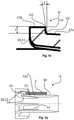
- Figure 4b shows a practical embodiment of a lug 12 particularly adapted to a specific type of pipe.
- the tab 12 in Figure 4b has a radius R min at the front end of the lug 12 viewed in the insertion direction E, which is designed in particular for the production-related smallest tolerance of the pipeline 2, and viewed in the insertion direction E at the rear end of the lug 12 has a radius R max which is advantageous is designed for the production-related maximum tolerance of the pipeline 2.
- Figure 5a shows in this regard a pipeline 2 with a maximum internal diameter.
- the expansion causes the pipeline 2, despite a production-related increased inner diameter compared to the pipeline in Figure 5b , is securely in contact with the support sleeve 6, in particular the tabs 12.
- Figure 5b represents a pipeline 2 with a minimum inner diameter. If the pipeline 2 is moved in the insertion direction E in example 5b, the elastic tabs 12 pivot radially inwards and allow the axial movement of the pipeline 2 in the insertion direction E, with the tabs 12 in particular always making contact of pipeline 2 have.
- the total tolerance is calculated at 0.6 mm.
- the effect described above is ensured by a radial spreading height H of 0.3 mm of the tab 12 .
- a locking of the pipeline 2 during and after the insertion process is particularly advantageous for a constantly guaranteed contact between the support sleeve 6 and the pipeline 2 .
- the sensor element 10, in particular a projection 11 according to Figure 4c a sudden increase in Insertion resistance generated depending on the insertion depth of the line end 2a in the insertion direction E behind the peripheral seal 8 within the connector body 4.
- the sensor element 10 is arranged in particular on at least one free end, advantageously with the lever arm L, on the outer circumference of at least one tab 12, with the sensor element 10 preferably being designed as a radially outward-pointing projection 11.
- the projection 11 at the end of the tab 12 captures the sensor element 10 in its entirety from the line end 2a when the pipeline 2 is inserted in the insertion direction.
- the second haptic signal ie the second insertion resistance
- the second haptic signal can be influenced by the extent of the lever arm L and the elasticity of the tab.
- low elasticity and a short lever arm L increase the second insertion resistance.
- the distance between the first haptic signal of the peripheral seal 8 and the sensor element 10, in particular the projection 11 can be adjusted to the application-related needs in a user-friendly manner.
- the support sleeve 6 can have in particular three tabs 12, with each tab 12 preferably having a respective sensor element 10, in particular a projection 11.
- the number of tabs 12 and in particular the sensor elements 10 or the projections 11 has a direct influence on the second haptic signal in that the effect described above can be intensified with an increasing number of tabs 12 .
- three tabs 12 distributed evenly over the circumference of the support sleeve 6 in order to create a centrality when inserting the pipeline 2.
- the projection 11 has in particular a first projection surface 11a, which extends in particular at an angle Z to a plane perpendicular to the longitudinal axis XX of the connecting device 1 radially outer peripheral surface 12a of the tab 12 extends radially outwards and preferably represents a stop that can be overcome in the insertion direction E for the line end 2a.
- the pipeline 2 is first pushed over the cylindrical outer surface 6a of the support sleeve 6 to the area from which the support sleeve 6 has arranged one or more tabs 12 during the insertion process, the tabs 12 additionally having outer peripheral surfaces 12a.
- the pipeline 2 slides further over the outer peripheral surfaces 12a of the lugs 12, as a result of which the line end 2a is guided in particular directly against the projection 11, preferably against its first projection surface 11a. If the line end 2a butts against the first projection surface 11a, the second haptic signal is generated, ie the insertion resistance is suddenly increased.
- the angle Z makes it possible to influence the insertion resistance as well as its rate of increase, so an increase in the angle Z causes the line end 2a to overcome the projection 11 more easily, whereby the insertion resistance is lower and the rate of increase is flatter.
- the projection 11 can preferably have a second projection surface 11b, which extends in particular in the insertion direction E and advantageously adjoins the first projection surface 11a, the second projection surface 11b being offset radially outwards at a distance Y from the tab 12.
- the radial extent of the first protruding surface 11a can be influenced by the distance Y between the second protruding surface 11b, which in particular influences the insertion resistance of the second haptic signal.
- transition U1 from the outer peripheral surface 12a of the tab 12 to the first projection surface 11a of the projection 11 has a radius. This advantageously flattens the rate of increase of the second haptic signal and protects the material of the line 2 in the area of the line end 2a.
- the transition U2 from the first projection surface 11a to the second projection surface 11b has a radius. Further reduced there is a risk that the line end 2a will damage the sensor element 10 when overcoming the projection or will itself be damaged by a sharp-edged transition, as a result of which particles can get loose and get into the system.
- the tabs 12 adjust the insertion resistance in front of the peripheral seal 8 in particular to a base value. This base value is influenced in particular by the inside diameter of the pipeline 2 and the bracing height H.
- the lever arm L From the ratio of the lever arm L to the bracing height H, it can also be set from which insertion depth the insertion resistance should be set to the base value.
- the base value sensitizes the user to the subsequent first and second haptic signal.
- Other factors with which the basic value can be adjusted are the number and the elasticity of the tabs 12 and the frictional resistance that arises from the contact of the outer peripheral surfaces 12a of the tabs 12 with the inner peripheral surface of the pipeline 2 .
- the support sleeve 6 forms, as in Figures 1a and 1b shown, in the insertion direction E behind the sensor element 10, in particular behind the projection 11, an insurmountable pipe stop 14.
- This pipe stop advantageously forms a final deepest possible insertion for the line end 2a and can be used in particular as an additional third haptic signal which gives the user additional security conveyed.
- the distance in the insertion direction E of the highest value of the first insertion resistance of the peripheral seal 8, the highest value of the second insertion resistance of the sensor element 10 and of the pipe stop 14 is preferably the same in each case.
- the highest value of the first insertion resistance of the peripheral seal 8 and the highest value of the second insertion resistance of the sensor element 10 are the same.
- a further advantageous embodiment provides that the support sleeve 6 is designed in particular as a one-piece molded part and the tabs 12 and the sensor element 10 or the projection 11 are advantageously molded on. Furthermore, the support sleeve 6 is preferably made of glass fiber material.
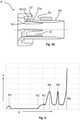
- FIG 6 shows an example of an advantageous progression of the assembly force F as a function of the insertion depth E for a connection device 1 according to the embodiment in FIG 1 .
- P1 in 6 denotes an increase in the assembly force F, which is required because of an increased insertion resistance, this insertion resistance being generated by an inner dirt seal 16 arranged in the receiving opening of the connection body 6 .
- P2 in 6 indicates the insertion depth from which the holding element 5, in particular a spring-elastic toothed ring, engages in the pipeline 2 for fixing the inserted line end 2a.
- the insertion depth P3 characterizes the point at which the line end 2a hits the elastic tabs 12, the tolerance compensation taking place at this point.
- the insertion resistance decreases again after P4 to the intermediate resistance, which is greater than the resistance value immediately in front of the peripheral seal 8.
- P5 in 6 P4 is similar to the peak of a sudden increase in the assembly force F, which is caused by the second haptic signal of the sensor element 10 or as in FIG 1 shown the projection 11, ie the second sudden increase in the insertion resistance is generated.
- the insertion resistance decreases again to the intermediate resistance after P5.
- the line end 2a has reached a pipe stop 14, which is advantageously designed on the support sleeve 6. If the user has noticed this assembly force profile or this insertion resistance profile in particular, he can assume that the pipeline 2 has been correctly inserted.
- the distance in the insertion direction E of the highest value of the first insertion resistance at P4 of the peripheral seal 8 and the highest value of the second insertion resistance at P5 of the sensor element 10 and the distance to the pipe stop 14 at P6 are each the same. Furthermore, in particular, the highest value of the first insertion resistance at P4 of the peripheral seal 8 and the highest value of the second insertion resistance at P5 are the same.
Landscapes
- Engineering & Computer Science (AREA)
- General Engineering & Computer Science (AREA)
- Mechanical Engineering (AREA)
- Quick-Acting Or Multi-Walled Pipe Joints (AREA)
Description
- Die Erfindung betrifft eine Anschlussvorrichtung für Rohrleitungen mit einem Anschlusskörper mit einer Aufnahmeöffnung für eine mit einem Leitungsende in eine Einsteckrichtung einzusteckende Rohrleitung, wobei innerhalb der Aufnahmeöffnung eine Stützhülse derart koaxial angeordnet ist, dass das Leitungsende beim Einstecken mittels einer Montagekraft auf eine zylindrische Außenfläche der Stützhülse aufschiebbar ist, und innerhalb der Aufnahmeöffnung ein Halteelement zum Fixieren des eingesteckten Leitungsendes gegen Herausziehen gelagert ist, wobei innerhalb des Anschlusskörpers mindestens eine Umfangsdichtung angeordnet ist, die einen radial zwischen dem Leitungsende und dem Anschlusskörper gebildeten Ringspalt nach außen abdichtet, wobei die Umfangsdichtung ein haptisches Signal in Form einer sprungartigen Erhöhung des Einsteckwiderstandes erzeugt, wenn das Leitungsende auf die Umfangsdichtung trifft.
- Eine derartige Anschlussvorrichtung ist aus der
EP 2 864 685 A1 bekannt. Bei dieser Anschlussvorrichtung ergibt sich das Problem, dass es zu einem fehlerhaften Einstecken der Rohrleitung kommen kann, wenn die Rohrleitung nicht vollständig eingesteckt ist und es somit zu einem Austritt des in der Rohrleitung fließenden Druckmediums kommt, wodurch das gesamte System ausfallen kann. Diese Gefahr ist bei der gattungsgemäßen Anschlussvorrichtung auch deshalb besonders groß, da die Rohrleitung unmittelbar eingesteckt wird, und über die Einsteckkraft letztlich festgestellt wird, ob die Rohrleitung bis zum Anschlag eingeführt ist. Dabei kann der Fehler auftreten, dass die Leitung nicht ausreichend eingesteckt wird, weil der Anwender die notwendige Steckkraft nicht ausübt oder den Einsteckwiderstand der Umfangsdichtung als Endanschlag fehlinterpretiert. - Bei bekannten Lösungen zur Überprüfung der korrekten Einsteckung der Rohrleitung ist es bekannt, mittels akustischer Signale dem Anwender eine Rückmeldung zu geben, wenn das Leitungsende eine definierte Einstecktiefe passiert. Nachteilig ist, dass diese Signalisierung in der Praxis, insbesondere in lauten Montagehallen, kaum bis nicht wahrnehmbar ist und bauartbedingt innerhalb des Anschlusskörpers einen großen Platzbedarf hat.
- Das Dokument
WO 2009/068932A1 offenbart eine Anschlussvorrichtung zum Einstecken eines Leitungsendes, wobei eine Umfangsdichtung den Einsteckwiderstand erhöht und eine Überprüfung der Montage mittels eines akustischen Signals ermöglicht wird. - Es ist ebenfalls bekannt, auf der Rohrleitung vom Leitungsende beabstandete farbige Kennzeichnungen aufzutragen, die die Einstecktiefe signalisieren. Nachteilig ist, dass diese auf jeder Rohrleitung vom Anwender ausgemessen und aufgetragen werden müssen und bei schlechten Lichtverhältnissen oder bei Montagen an nicht ersichtlichen Stellen, die aber durchaus mit den Händen des Monteurs erreichbar sind, z. B. hinter einem anderen Teil, nicht überprüfbar.
- Der Erfindung liegt die Aufgabe zugrunde, eine zuverlässige Überprüfung der bekannten Anschlussvorrichtung schon bei der Montage und vor der Inbetriebnahme zu gewährleisten.
- Die Aufgabe wird erfindungsgemäß durch die Merkmale des kennzeichnenden Teils des Anspruchs 1 gelöst, indem die Stützhülse eine oder mehrere radial elastische, sich in Einsteckrichtung erstreckende und mit einer Abspreizhöhe zur Einsteckrichtung radial von der zylindrischen Außenfläche der Stützhülse nach außen ragende Laschen aufweist und das Sensorelement an mindestens einem freien Ende am Außenumfang mindestens einer Lasche angeordnet ist, wobei das Sensorelement als ein radial nach außen weisender Vorsprung ausgebildet ist, damit die Stützhülse ein zweites haptisches Signal in Form einer sprungartigen Erhöhung des Einsteckwiderstandes abhängig einer Einstecktiefe des Leitungsendes in Einsteckrichtung hinter der Umfangsdichtung innerhalb des Aufnahmekörpers erzeugt. Besonders vorteilhaft kann der Anwender unabhängig von äußeren Einflüssen, wie Lärm, Einbaulagen oder schlechten Lichtverhältnissen, die korrekte Einsteckung erkennen. Weiterhin kann der Anwender die Rohrleitung vom Anschlusskörper trennen und erneut montieren. Vorteilhaft gewährleistet die Erfindung beim zweiten und jedem folgenden Einsteckvorgang eine genauso zuverlässige Überprüfung wie beim ersten Einsteckvorgang. Ebenso ist eine elektronische Überprüfung eines automatisierten Einsteckvorgangs möglich, insofern die angewendete Montagekraft elektronisch aufgezeichnet wird und daraus ein Widerstandsprofil ableitet, welches mittels eines Programms ausgewertet wird, und eine Fehlsteckung selbstständig und zuverlässig detektiert oder auf einem Bildschirm oder als Ausdruck einem Anwender zur Auswertung zur Verfügung gestellt wird.
- In einer vorteilhaften Ausführungsform der Erfindung vermindert sich im Bereich der Stützhülse zwischen der Umfangsdichtung und dem Sensorelement sowie im Bereich der Stützhülse nach dem Sensorelement der Einsteckwiderstand auf einen Zwischenwiderstand, welcher insbesondere größer ist als der Widerstandswert unmittelbar vor der Umfangsdichtung. Insbesondere wirkt beim Einsteckvorgang ab Erreichen des Dichtrings eine Vorspannkraft des Dichtrings auf das Rohr, daher vermindert sich der Einsteckwiderstand insbesondere, wenn sich das Leitungsende im Bereich zwischen der Umfangsdichtung und dem Sensorelement sowie im Bereich nach dem Sensorelement befindet auf den Zwischenwiderstand, welcher insbesondere größer ist als der Widerstandswert unmittelbar vor der Umfangsdichtung. Vorzugsweise ist der Zwischenwiderstand insbesondere durch Schmierung des Dichtrings abgeschwächt. Durch den Zwischenwiderstand sind die haptischen Signale für den Anwender noch leichter zu erkennen. Insbesondere kann das jeweilige haptische Signal erhöht und dadurch kenntlicher gemacht werden, weil der Anwender nur kurzzeitig den erhöhten Einsteckwiderstand überwinden muss.
- Gemäß Erfindung bildet die Stützhülse in Einsteckrichtung hinter dem Sensorelement einen unüberwindbaren Rohranschlag. Dieser Rohranschlag bildet vorteilhaft ein endgültiges Ende für das Leitungsende. Eine korrekte Steckung ist gewährleistet, wenn das Leitungsende das zweite haptische Signal passiert, wobei der Rohranschlag eine endgültige tiefste Einsteckmöglichkeit für das Leitungsende bildet und insbesondere ein zusätzliches drittes haptisches Signal ist, welches dem Anwender ergänzend Sicherheit vermittelt.
- Weitere vorteilhafte Ausgestaltungen der Erfindung ergeben sich aus der folgenden Figurenbeschreibung und den abhängigen Unteransprüchen.
- Es zeigen:
- Fig. 1a
- einen Längsschnitt in Einsteckrichtung durch eine erfindungsgemäße Ausführungsform einer erfindungsgemäßen Anschlussvorrichtung mit voll eingesteckter Rohrleitung,
- Fig. 1b
- eine vergrößerte Darstellung der Einzelheit A in
Fig. 1a , - Fig. 2
- einen Längsschnitt in Einsteckrichtung durch die erfindungsgemäße Ausführungsform gemäß
Fig. 1a mit einer fehlerhaft teilweise eingesteckten Rohrleitung, - Fig. 3
- eine perspektivische Ansicht einer Stützhülse der Ausführungsform gemäß
Fig. 1a , - Fig. 4a
- einen Längsschnitt in Einsteckrichtung durch die erfindungsgemäße Stützhülse gemäß
Fig. 1a , - Fig. 4b
- eine vergrößerte Darstellung der Einzelheit C in
Fig. 4a , - Fig. 4c
- eine vergrößerte Darstellung der Einzelheit D in
Fig. 4b , - Fig. 5a
- einen Längsschnitt in Einsteckrichtung durch die erfindungsgemäße Stützhülse gemäß
Fig. 1a während der Montage einer ersten Rohrleitung, - Fig. 5b
- einen Längsschnitt in Einsteckrichtung durch die erfindungsgemäße Stützhülse gemäß
Fig. 1a während der Montage einer zweiten Rohrleitung, und - Fig. 6
- einen Montagekraftverlauf abhängig von der Einstecktiefe bei einer erfindungsgemäßen Anschlussvorrichtung gemäß
Fig. 1 . - In den verschiedenen Figuren der Zeichnung sind gleiche Teile stets mit denselben Bezugszeichen versehen.
- Zu der anschließenden Beschreibung wird beansprucht, dass die Erfindung nicht auf die Ausführungsbeispiele und dabei nicht auf alle oder mehrere Merkmale von beschriebenen Merkmalskombinationen beschränkt ist, vielmehr ist jedes einzelne Teilmerkmal des/jedes Ausführungsbeispiels auch losgelöst von allen anderen im Zusammenhang damit beschriebenen Teilmerkmalen für sich und auch in Kombination mit beliebigen Merkmalen eines anderen Ausführungsbeispiels von Bedeutung für den Gegenstand der Erfindung.
- In
Fig. 1a und2 ist eine erfindungsgemäße Anschlussvorrichtung 1 zum schnellen und auch lösbaren Anschluss einer Rohrleitung 2 durch das einfache Einstecken eines Leitungsendes 2a in eine Aufnahmeöffnung eines Anschlusskörpers 4 veranschaulicht. Die Einsteckrichtung E ist inFig. 1a und2 jeweils mit einem Pfeil veranschaulicht. Da somit kein Anschlussdorn zum Aufstecken der Rohrleitung 2 vorhanden ist, kann auch von einem "Dornlos-Stecksystem" gesprochen werden. Zum Arretieren des eingesteckten Leitungsendes 2a gegen Herausziehen ist innerhalb der Aufnahmeöffnung ein Halteelement 5 gelagert, welches insbesondere als federelastischer Haltering mit einem äußeren Umfangsbereich und mit mehreren über den Umfang verteilt angeordneten, sich radial nach innen und schräg in Einsteckrichtung E geneigt erstreckenden und dadurch widerhakenartig kraft- und/oder formschlüssig gegen die äußere Umfangsfläche des Leitungsendes 2a wirkenden Haltezähnen ausgebildet ist. Zur Abdichtung der eingesteckten Rohrleitung 2 nach außen ist zudem innerhalb des Anschlusskörpers 4 mindestens eine Umfangsdichtung 8 gelagert, die einen radial zwischen dem Leitungsende 2a und dem Anschlusskörper 4 gebildeten Ringspalt nach außen abdichtet, wobei die Umfangsdichtung 8 ein haptisches Signal in Form einer sprungartigen Erhöhung des Einsteckwiderstandes erzeugt, wenn das Leitungsende 2a auf die Umfangsdichtung 8 trifft. - Der äußere Umfangsbereich des Halterings liegt im unverformten Zustand in einer zur Längsachse X-X der Anschlussvorrichtung 1 senkrechten Ebene, während die Haltezähne gemeinsam durch ihre Schrägstellung umlaufend konusförmig ausgerichtet sind. Die Haltezähne definieren mit ihren inneren Haltekanten einen Umkreis, dessen Durchmesser im unverformten Zustand kleiner als der Außendurchmesser der Rohrleitung 2 ist. Dadurch wirken die Haltekanten mit einer radialen Haltekraft insbesondere formschlüssig oder zumindest kraftformschlüssig gegen den Außenumfang des eingesteckten Leitungsendes 2a.
- Der Haltering ist insbesondere mit seinem äußeren Umfangsbereich mit einem definiert begrenzten axialen und radialen Bewegungsspiel innerhalb des Anschlusskörpers 4 gelagert. Dieses axiale und radiale Bewegungsspiel wird durch beidseitige, axial gegenüberliegende Anlageabschnitte innerhalb des Anschlusskörpers 4 begrenzt. Vorteilhaft kann sich der Haltering durch das axiale und radiale Bewegungsspiel besser zu der einzusteckenden Leitung zentrieren. Weiterhin wirkt der Haltering am winkligen Übergang zwischen dem äußeren Umfangsbereich und den Haltezähnen derart mit einer innerhalb des Anschlusskörpers 4 am radial inneren Umfang der den ersten Anlageabschnitt bildenden radialen Anlagefläche vorgesehenen, umfangsgemäßen Kippkante 5a zusammen, dass beim Einstecken des Leitungsendes 2a durch dessen Anlage an den Haltezähnen der Haltering mit seinem äußeren Umfangsbereich gegen den ersten, unteren Anlageabschnitt gedrückt wird und wippenartig um die Kippkante 5a verschwenkt wird, bis der äußere Umfangsbereich radial außenseitig zur abgestützten Anlage an dem zweiten, axial gegenüberliegenden, oberen Anlageabschnitt gelangt. Wenn ausgehend von dieser Stellung das Leitungsende 2a weiter in Einsteckrichtung E bewegt wird, erfolgt eine elastische Biegeverformung im Wesentlichen nur noch im Bereich der die Kippkante 5a radial nach innen überragenden Haltezähne. Der Einsteckvorgang wird dann abgeschlossen, indem das Leitungsende 2a etwas gegen die Einsteckrichtung E zurückgezogen wird. Dadurch schneiden sich die Haltezähne formschlüssig oder zumindest kraftformschlüssig in den Außenumfang des Leitungsendes 2a ein.
- Eine alternative bevorzugte Ausführung der Anschlussvorrichtung 1 sieht vor, dass das Halteelement 5 insbesondere als ein konusförmiger geschlitzter Haltering ausgebildet ist, dessen axiale und radiale Beweglichkeit durch den Anschlusskörper 4 und ein Konusteil begrenzt ist. Der konusförmige Haltering weist insbesondere eine in Einsteckrichtung E ausgerichtete und in die Aufnahmeöffnung ragende Schneidkante auf, so dass beim Einstecken des Leitungsendes 2a durch dessen Anlage an der Schneidkante der Haltering radial elastisch geweitet wird, wodurch die Rohrleitung 2 in Einsteckrichtung E bewegt werden kann. Der Einsteckvorgang wird dann abgeschlossen, indem das Leitungsende 2a etwas gegen die Einsteckrichtung E zurückgezogen wird. Dadurch schneidet sich die Schneidkante formschlüssig oder zumindest kraftformschlüssig in den Außenumfang des Leitungsendes 2a ein. Durch weiteres Zurückziehen und den Mitnahmeeffekt, den das Leitungsende 2a auf den konusförmigen Haltering ausübt, wird der konusförmige geschlitzte Haltering insbesondere gegen das zu diesem korrespondierend geformte und gelagerte Konusteil bewegt, wobei der konusförmige Haltering sowie das Konusteil bevorzugt derart zueinander geformt sind, dass bei der axialen Bewegung des konusförmigen Halterings gegen die Einsteckrichtung E der konusförmige Haltering durch das Konusteil radial zusammengedrückt wird, wodurch sich die Schneidkante zunehmend in das Leitungsende 2a einschneidet.
- Innerhalb der Aufnahmeöffnung des Anschlusskörpers 4 ist eine Stützhülse 6 derart koaxial angeordnet, dass das Leitungsende 2a beim Einstecken auf eine zylindrische Außenfläche 6a der Stützhülse 6 aufschiebbar ist. Dadurch wird das eingesteckte Leitungsende 2a von der Stützhülse 6 radial abgestützt, so dass bei Beaufschlagung mit einer von dem Haltering bewirkten radialen Haltekraft Verformungen der Rohrleitung 2 im Wirkbereich des Halterings vermieden werden.
- Die oben beschriebene Kippkante 5a für den Haltering kann mit Vorteil an einem Einsatzring 5b gebildet sein, der bevorzugt auch den ersten Anlageabschnitt in Form einer radial nach außen an die Kippkante 5a angrenzenden, zur Längsachse X-X senkrechten Stirnfläche aufweist. Die Kippkante 5a ist somit am Übergang zwischen der den ersten Anlageabschnitt bildenden Stirnfläche und einer innen angrenzenden Konusfläche gebildet.
- Der Einsatz des Einsatzrings 5b in den Anschlusskörper 4 wird insbesondere als Übergangspassung umgesetzt. Hierbei ist insbesondere vorgesehen, dass der Einsatzring 5b innerhalb des Anschlusskörpers 4 mit seiner in Einsteckrichtung weisenden Stirnfläche gemeinsam mit einer dieser axial gegenüberliegenden Flankenfläche des Anschlusskörpers 4 eine Dichtungskammer für die Rohr-Umfangsdichtung 8 begrenzt. Bei der Umfangsdichtung 8 handelt es sich bevorzugt ebenfalls um einen O-Ring, der für eine Anwendung bei Druckluft-Rohrleitungen vorzugsweise aus EPDM (Ethylen-Propylen-Dien-Monomer) oder NBR (Nitrile Butadiene Rubber = Nitril Kautuschuk) besteht und für eine Anwendung bei Kraftstoff-Rohrleitungen aus einem Fluor-Elastomer.
- Der Einsatzring 5b entkoppelt vorteilhafterweise die Bauräume für das Halteelement 5 einerseits und das Dichtelement 8 andererseits. Insbesondere in Kombination mit der Stützhülse 6 werden Exzentrizitäten und Ovalitäten der Rohrleitung 2 im Bereich zwischen Dichten und Halten vermieden bzw. kompensiert. Bevorzugt besteht der Einsatzring 5b aus einem Kunststoff, insbesondere POM ohne Glasfaserverstärkung, PBToder PA6.6, gegebenenfalls mit Glasfaser-Anteil GF30 %. Alternativ kann der Einsatzring 5b auch aus Metall, insbesondere Aluminium bestehen.
- Für eine Lösbarkeit der eingesteckten und über den Haltering fixierten Rohrleitung 2 ist ein hülsenförmiges Löseelement 7 vorgesehen. Dieses Löseelement 7 greift derart axial verschiebbar in den Anschlusskörper 4 ein, dass durch Einschieben des Löseelementes 7 in Einsteckrichtung E der Haltering zur Freigabe des Leitungsendes 2a im Bereich der Haltezähne elastisch verformbar ist. Dazu wirkt das Löseelement 7 mit Betätigungsabschnitten gegen den Haltering, zum Beispiel gegen die Haltezähne.
- Das Löseelement 7 ist bevorzugt innerhalb des Anschlusskörpers 4 über eine Verrastung gegen Demontage gehalten. Dazu weist das Löseelement 7 an seinem in Einsteckrichtung E weisenden Ende durch axiale Schlitze beabstandete Rastarme auf, die einendig an dem umfangsgemäß geschlossenen Ringteil angeformt sind, und die mit radial nach außen weisenden Rastnasen eine radiale Stufenfläche hintergreifen, wobei diese Stufenfläche durch ein hülsenförmiges Lagerelement gebildet ist. Insbesondere ist die Lageposition des Lagerelements innerhalb des Anschlusskörpers fixiert. Wie in
Fig. 1a und2 veranschaulicht, ist das Lagerelement auf axialer Höhe radial zwischen dem Anschlusskörper 4 und den Rastarmen angeordnet. Zur Arretierung des Lagerelements weist der Anschlusskörper 4 im Bereich des Lagerelements eine umlaufende Nut mit einem vergrößerten Durchmesser auf, wobei sich der Durchmesser der Nut in Einsteckrichtung E konisch wieder auf den Durchmesser im Bereich des Einsatzrings 5b reduziert. Das Lagerelement weist einen Körper auf, dessen in Einsteckrichtung E vorderster Grundkörper eine Stufenfläche für die Rastarme darstellt, weiterhin erstreckt sich der Körper des Lagerelements derart in Einsteckrichtung E, dass er mit einer in die Einsteckrichtung E gerichteten Oberfläche die Anlagefläche für das Halteelement 5, insbesondere für den äußeren Umfangsbereich, definiert. Insbesondere bildet das Lagerelement eine Nut zwischen der Anlagefläche für das Halteelement 5 und dem Einsatzring 5b, in der das Halteelement 5 insbesondere geringfügig radial- und axialverschiebbar gelagert ist. Vorzugsweise hält das Lagerelement die Rastarme des Löseelements 7, so dass das Löseelement 7 nicht axial gegen die Einsteckrichtung E aus dem Anschlusskörper 4 fallen kann. - In einer weiteren vorteilhaften Ausgestaltung sind die Rastarme mit dem umfangsgemäß geschlossenen Ringteil des Löseelementes 7 über scharnierartige Einschnürungen verbunden, wodurch die radiale Beweglichkeit der Rastarme für die Montage des Löseelements 7 in das Lagerelement begünstigt wird.
- Wie in der Detailansicht gemäß
Fig. 1b dargestellt, weist die Stützhülse 6 erfindungsgemäß mindestens ein Sensorelement 10, insbesondere einen Vorsprung 11 auf, der ein zweites haptisches Signal in Form einer sprungartigen Erhöhung des Einsteckwiderstandes abhängig einer Einstecktiefe des Leitungsendes 2a in Einsteckrichtung E hinter der Umfangsdichtung 8 innerhalb des Anschlusskörpers 4 erzeugt. -
Fig. 2 zeigt einen Zustand, bei welchem das Leitungsende 2a noch nicht die Einstecktiefe des Sensorelements 10 passiert hat, folglich kommt es beim Montagezustand gemäßFig. 2 noch nicht zu einer zweiten sprunghaften Erhöhung des Einsteckwiderstandes, wodurch der Anwender die Gewissheit hat, dass der Einsteckvorgang noch nicht abgeschlossen ist oder, wenn es nicht mehr möglich ist, die Leitung 2 bzw. das Leitungsende 2a tiefer in Einsteckrichtung E in den Anschlusskörper 4 zu stecken, dass ein Fehler, z. B. eine Verschmutzung, vorliegt. - Besonders vorteilhaft kann sich beim Einsteckvorgang im Bereich der Stützhülse 6 zwischen der Umfangsdichtung 8 und dem Sensorelement 10 sowie im Bereich der Stützhülse 6 hinter dem Sensorelement 10 der Einsteckwiderstand auf einen Zwischenwiderstand vermindern, welcher insbesondere größer ist als der Widerstandswert unmittelbar vor der Umfangsdichtung 8. Dadurch sind die haptischen Signale für den Anwender noch leichter zu erkennen. Weiterhin besteht dadurch die Möglichkeit, das erste und/oder zweite haptische Signal, d. h. die Einsteckwiderstände zu erhöhen, wodurch diese leichter wahrnehmbar sind. Vorzugsweise ist der Zwischenwiderstand insbesondere durch Schmierung des Dichtrings abgeschwächt.
-
Fig. 3 bis 4b zeigen eine erfindungsgemässe Ausführung der Stützhülse 6. Demnach weist die Stützhülse 6 insbesondere eine oder mehrere radial elastische, sich in Einsteckrichtung E erstreckende und mit einer Abspreizhöhe H zur Einsteckrichtung radial von der zylindrischen Außenfläche 6a der Stützhülse 6 nach außen ragende Laschen 12 auf. Gemäß dieser Ausführung wird die einzusteckende Rohrleitung 2 mittels einer Montagekraft auf die zylindrische Außenfläche 6a der Stützhülse 6 aufgeschoben, wobei die Laschen 12, abhängig von ihrer Abspreizhöhe H und einem Rohrinnendurchmesser der einzusteckenden Leitung 2, gegen eine innere Umfangsfläche der einzusteckenden Leitung 2 radial nach außen drücken. - Bevorzugt ist die Abspreizhöhe H am Ende eines Hebelarmes L der Lasche 12 insbesondere eine halbe Toleranz eines Innendurchmessers der einzusteckenden Rohrleitung 2 und wirkt als ein Toleranzausgleich. Der Toleranzausgleich sichert dahingehend die Einsteckung, dass fertigungsbedingte Toleranzen der einzusteckenden Rohrleitung 2 ausgeglichen werden und die Lasche 12, unabhängig davon, ob die Rohrleitung einen Mindestdurchmesser oder einen maximalen Durchmesser im Rahmen der Fertigungstoleranz hat, am Innendurchmesser der Rohrleitung 2 anliegt.
-
Fig. 4b zeigt eine praktische Ausführung einer Lasche 12, die insbesondere an einen bestimmten Rohrleitungstyp angepasst ist. Die Lasche 12 inFig. 4b weist in Einsteckrichtung E gesehen zu am vorderen Ende der Lasche 12 einen Radius Rmin auf, welcher insbesondere auf die fertigungsbedingte kleinste Toleranz der Rohrleitung 2 ausgelegt ist, und in Einsteckrichtung E gesehen am hinteren Ende der Lasche 12 einen Radius Rmax auf, der vorteilhaft auf die fertigungsbedingte größte Toleranz der Rohrleitung 2 ausgelegt ist. -
Fig. 5a zeigt diesbezüglich eine Rohrleitung 2 mit einem maximalen Innendurchmesser. In diesem Beispiel bewirkt die Abspreizung, dass die Rohrleitung 2, trotz eines fertigungsbedingten vergrößerten Innendurchmessers im Vergleich zu der Rohrleitung inFig. 5b , sicher im Kontakt mit der Stützhülse 6, insbesondere den Laschen 12 ist.Fig. 5b stellt eine Rohrleitung 2 mit einem minimalen Innendurchmesser dar. Wird die Rohrleitung 2 im Beispiel 5b in Einsteckrichtung E bewegt, schwenken die elastischen Laschen 12 radial nach innen und ermöglichen die axiale Bewegung der Rohrleitung 2 in Einsteckrichtung E, wobei die Laschen 12 insbesondere stets Kontakt zu der Rohrleitung 2 haben. Beispielhaft für eine Rohrleitung 2 mit einem Außendurchmesser von 12 mm, einer Wandstärke von 1,5 mm, einem Innendurchmesser von 9 mm und einer Fertigungstoleranz von plus/minus 0,3 mm berechnet sich die Gesamttoleranz auf 0,6mm. Durch eine radiale Abspreizhöhe H von 0,3 mm der Lasche 12 ist der oben beschriebene Effekt sichergestellt. Besonders vorteilhaft an einem stets gewährleisteten Kontakt zwischen der Stützhülse 6 und der Rohrleitung 2 ist eine Arretierung der Rohrleitung 2 während und nach dem Einsteckvorgang. Weiterhin wird sichergestellt, dass das Sensorelement 10, insbesondere ein Vorsprung 11 gemäßFig. 4c , eine sprungartige Erhöhung des Einsteckwiderstandes abhängig von der Einstecktiefe des Leitungsendes 2a in Einsteckrichtung E hinter der Umfangsdichtung 8 innerhalb des Anschlusskörpers 4 erzeugt. - Gemäß der bevorzugten Ausführung, vorteilhaft dargestellt in
Fig. 4c , ist das Sensorelement 10 insbesondere an mindestens einem freien Ende, vorteilhaft mit dem Hebelarm L, am Außenumfang mindestens einer Lasche 12 angeordnet, wobei das Sensorelement 10 bevorzugt als ein radial nach außen weisender Vorsprung 11 ausgebildet ist. Insbesondere wird durch eine derartige Anordnung des Vorsprungs 11 am Ende der Lasche 12 das Sensorelement 10 in vollem Umfang von dem Leitungsende 2a beim Einstecken der Rohrleitung 2 in Einsteckrichtung erfasst. Durch das Ausmaß des Hebelarms L sowie die Elastizität der Lasche kann das zweite haptische Signal, d. h. der zweite Einsteckwiderstand, beeinflusst werden. Insbesondere eine niedrige Elastizität und ein kurzer Hebelarm L vergrößern den zweiten Einsteckwiderstand. Weiterhin kann durch eine Variation des Hebelarms L der Abstand zwischen dem ersten haptischen Signal der Umfangsdichtung 8 und des Sensorelements 10, insbesondere des Vorsprungs 11, an die anwendungsbezogenen Bedürfnisse anwenderfreundlich eingestellt werden. - Gemäß der Ausführung in
Fig. 3 kann die erfindungsgemäße Stützhülse 6 insbesondere drei Laschen 12 aufweisen, wobei bevorzugt jede Lasche 12 jeweils ein Sensorelement 10, insbesondere einen Vorsprung 11 aufweist. Die Anzahl der Laschen 12 und insbesondere der Sensorelemente 10 bzw. der Vorsprünge 11 hat dabei unmittelbaren Einfluss auf das zweite haptische Signal, indem der oben beschriebene Effekt mit einer steigenden Anzahl der Laschen 12 verstärkt werden kann. Vorteilhaft sind, wie inFig. 3 dargestellt, drei Laschen 12 gleichmäßig über den Umfang der Stützhülse 6 verteilt, um eine Zentralität beim Einstecken der Rohrleitung 2 zu erzeugen. - Gemäß der vorteilhaften Ausführung in
Fig. 4c weist der Vorsprung 11 insbesondere eine erste Vorsprungsfläche 11a auf, die sich insbesondere in einem Winkel Z zu einer, zu der Längsachse X-X der Anschlussvorrichtung 1 senkrechten Ebene, von einer radial äußeren Umfangsfläche 12a der Lasche 12 radial nach außen erstreckt und bevorzugt einen überwindbaren Anschlag in Einsteckrichtung E für das Leitungsende 2a darstellt. Praktischerweise wird die Rohrleitung 2 beim Einsteckvorgang zunächst über die zylindrische Außenfläche 6a der Stützhülse 6 bis zu dem Bereich geschoben, ab welchem die Stützhülse 6 eine oder mehrere Laschen 12 angeordnet hat, wobei die Laschen 12 zusätzlich äußere Umfangsflächen 12a aufweisen. Ab dieser Einstecktiefe gleitet die Rohrleitung 2 weiter über die äußeren Umfangsflächen 12a der Laschen 12, wodurch das Leitungsende 2a insbesondere unmittelbar an den Vorsprung 11, bevorzugt gegen seine erste Vorsprungsfläche 11a geführt wird. Stößt das Leitungsende 2a gegen die erste Vorsprungsfläche 11a, wird das zweite haptische Signal erzeugt, d. h. der Einsteckwiderstand wird sprunghaft erhöht. Der Winkel Z erlaubt es, den Einsteckwiderstand sowie dessen Anstiegsrate zu beeinflussen, so bewirkt eine Vergrößerung des Winkels Z, dass das Leitungsende 2a leichter den Vorsprung 11 überwinden kann, wodurch der Einsteckwiderstand geringer und die Anstiegsrate flacher ist. - Bevorzugt kann der Vorsprung 11 eine zweite Vorsprungsfläche 11b aufweisen, die sich insbesondere in Einsteckrichtung E erstreckt und vorteilhaft an die erste Vorsprungsfläche 11a angrenzt, wobei die zweite Vorsprungsfläche 11b in einem Abstand Y zu der Lasche 12 radial nach außen versetzt angeordnet ist. Insbesondere kann durch den Abstand Y der zweiten Vorsprungsfläche 11b die radiale Erstreckung der ersten Vorprungsfläche 11a beeinflusst werden, wodurch insbesondere der Einsteckwiderstand des zweiten haptischen Signals beeinflusst wird.
- Praktischerweise weist der Übergang U1 von der äußeren Umfangsfläche 12a der Lasche 12 auf die erste Vorsprungsfläche 11a des Vorsprungs 11 einen Radius auf. Vorteilhaft wird dadurch die Anstiegsrate des zweiten haptischen Signals abgeflacht und das Material der Leitung 2 im Bereich des Leitungsendes 2a geschont.
- Dieser das Leitungsende 2a schonende Effekt wird gemäß einer weiteren vorteilhaften Ausführung ebenfalls genutzt, indem der Übergang U2 der ersten Vorsprungsfläche 11a auf die zweite Vorsprungsfläche 11b einen Radius aufweist. Weiterhin reduziert sich die Gefahr, dass das Leitungsende 2a beim Überwinden des Vorsprungs das Sensorelement 10 beschädigt oder durch einen scharfkantigen Übergang selbst beschädigt wird, wodurch sich Partikel lösen können, die in das System gelangen. Gemäß einer vorteilhaften Ausführung stellt die Laschen 12 den Einsteckwiderstand vorder Umfangsdichtung 8 insbesondere auf einen Basiswert ein. Dieser Basiswert wird insbesondere beeinflusst von dem Innendurchmesser der Rohrleitung 2 und der Abspreizhöhe H. Aus dem Verhältnis des Hebelarms L zu der Abspreizhöhe H kann weiterhin eingestellt werden, ab welcher Einstecktiefe der Einsteckwiderstand auf den Basiswert eingestellt werden soll. Der Basiswert sensibilisiert den Anwender für das darauffolgende erste und zweite haptische Signal. Weitere Faktoren, mit welchen der Basiswert eingestellt werden kann, ist die Anzahl sowie die Elastizität der Laschen 12 und der Reibungswiderstand, der durch den Kontakt der äußeren Umfangsflächen 12a der Laschen 12 mit der inneren Umfangsfläche der Rohrleitung 2 entsteht.
- Die Stützhülse 6 bildet, wie in
Fig. 1a und 1b dargestellt, in Einsteckrichtung E hinter dem Sensorelement 10, insbesondere hinter dem Vorsprung 11, einen unüberwindbaren Rohranschlag 14. Dieser Rohranschlag bildet vorteilhaft eine endgültige tiefste Einsteckmöglichkeit für das Leitungsende 2a und kann insbesondere als ein zusätzliches drittes haptisches Signal verwendet werden, welches dem Anwender ergänzend Sicherheit vermittelt. - Bevorzugt ist der Abstand in Einsteckrichtung E des höchsten Wertes des ersten Einsteckwiderstandes der Umfangsdichtung 8, des höchsten Wertes des zweiten Einsteckwiderstandes des Sensorelements 10 sowie des Rohranschlags 14 jeweils gleich.
- Insbesondere kann es vorteilhaft sein, wenn der höchste Wert des ersten Einsteckwiderstandes der Umfangsdichtung 8 und der höchste Wert des zweiten Einsteckwiderstandes des Sensorelements 10 gleich sind.
- Eine weitere vorteilhafte Ausführung sieht vor, dass die Stützhülse 6 insbesondere als ein einteiliges Formteil ausgebildet ist und die Laschen 12 sowie das Sensorelement 10 bzw. der Vorsprung 11 vorteilhaft angeformt sind. Weiterhin besteht die Stützhülse 6 bevorzugt aus Glasfasermaterial.
-
Fig. 6 zeigt beispielhaft einen vorteilhaften Verlauf der Montagekraft F abhängig von der Einstecktiefe E bei einer Anschlussvorrichtung 1 gemäß der Ausführung inFig. 1 . P1 inFig. 6 kennzeichnet einen Anstieg der Montagekraft F, welche wegen eines erhöhten Einsteckwiderstands erforderlich ist, wobei dieser Einsteckwiderstand durch eine in der Aufnahmeöffnung des Anschlusskörpers 6 angeordnete innere Schmutzdichtung 16 erzeugt wird. P2 inFig. 6 kennzeichnet die Einstecktiefe, ab welcher das Halteelement 5, insbesondere ein federelastischer Zahnring, zum Fixieren des eingesteckten Leitungsendes 2a in die Rohrleitung 2 eingreift. Die Einstecktiefe P3 kennzeichnet die Stelle, an welcher das Leitungsende 2a gegen die elastischen Laschen 12 trifft, wobei an dieser Stelle der Toleranzausgleich stattfindet. Dem folgt in einer Einstecktiefe an P4 die Spitze einer sprunghaften Erhöhung der Montagekraft F, die durch das erste haptische Signal der Umfangsdichtung 8, d. h. die erste sprunghafte Steigerung des Einsteckwiderstands, erzeugt wird. Gemäß der vorteilhaften Ausführung vermindert sich der Einsteckwiderstand nach P4 wieder auf den Zwischenwiderstand, welcher insbesondere durch die auf das Rohr wirkende Vorspannkraft des Dichtrings größer ist als der Widerstandswert unmittelbar vor der Umfangsdichtung 8. P5 inFig. 6 ist P4 ähnelnd die Spitze einer sprunghaften Erhöhung der Montagekraft F, die durch das zweite haptische Signal des Sensorelements 10 bzw. wie inFig. 1 dargestellt des Vorsprungs 11, d. h. die zweite sprunghafte Steigerung des Einsteckwiderstands, erzeugt wird. Gemäß der vorteilhaften Ausführung vermindert sich wie schon beim ersten haptischen Signal, siehe P4, der Einsteckwiderstand nach P5 wieder auf den Zwischenwiderstand. In der Einstecktiefe bei P6 hat das Leitungsende 2a einen an der Stützhülse 6 vorteilhaft ausgebildeten Rohranschlag 14 erreicht. Hat der Anwender insbesondere diesen Montagekraftverlauf bzw. diesen Einsteckwiderstandverlauf wahrgenommen, kann er von einer montagerichtigen Steckung der Rohrleitung 2 ausgehen. - Besonders vorteilhaft ist in
Fig. 6 ergänzend dargestellt, dass bevorzugt der Abstand in Einsteckrichtung E des höchsten Wertes des ersten Einsteckwiderstandes bei P4 der Umfangsdichtung 8 und des höchsten Wertes des zweiten Einsteckwiderstandes bei P5 des Sensorelements 10 sowie der Abstand zum Rohranschlag 14 bei P6 jeweils gleich ist. Weiterhin ist insbesondere der höchste Wert des ersten Einsteckwiderstandes bei P4 der Umfangsdichtung 8 und der höchste Wert des zweiten Einsteckwiderstandes bei P5 gleich. -
- 1
- Anschlussvorrichtung
- 2
- Rohrleitung
- 2a
- Leitungsende
- 4
- Anschlusskörper
- 5
- Halteelement
- 5a
- Kippkante
- 5b
- Einsatzring
- 6
- Stützhülse
- 6a
- Außenfläche der Stützhülse
- 7
- Löseelement
- 8
- Umfangsdichtung
- 10
- Sensorelement
- 11
- Vorsprung
- 11a
- Erste Vorsprungsfläche
- 11b
- Zweite Vorsprungsfläche
- 12
- Lasche
- 12a
- Äußere Umfangsfläche der Lasche
- 14
- Rohranschlag
- 16
- Innere Schmutzdichtung
- U2
- Übergang der ersten auf die zweite Vorsprungsfläche
- U1
- Übergang der äußeren Umfangsfläche der Lasche auf die erste Vorsprungsfäche
- Rmin
- Kleinster Laschenradius
- Rmax
- Größter Laschenradius
- P1
- Punkt 1 im Bereich der inneren Schmutzdichtung
- P2
- Punkt 2 im Bereich des Halteelements
- P3
- Punkt 3 im Bereich des Toleranzausgleichs
- P4
- Punkt 4 im Bereich der Umfangsdichtung
- P5
- Punkt 5 im Bereich des Sensorelements
- P6
- Punkt 6 im Bereich des Rohranschlags
- E
- Einsteckrichtung
- F
- Montagekraft
- H
- Abspreizhöhe
- L
- Hebelarm
- X
- Längsachse der Anschlussvorrichtung
- Y
- Radiale Versetzung der zweiten Vorsprungsfläche
- Z
- Winkel
Claims (10)
- Anschlussvorrichtung (1) für Rohrleitungen (2) mit einem Anschlusskörper (4) mit einer Aufnahmeöffnung für eine mit einem Leitungsende (2a) in eine Einsteckrichtung (E) einzusteckende Rohrleitung (2), wobei innerhalb der Aufnahmeöffnung eine Stützhülse (6) derart koaxial angeordnet ist, dass das Leitungsende (2a) beim Einstecken mittels einer Montagekraft auf eine zylindrische Außenfläche (6a) der Stützhülse (6) aufschiebbar ist, und innerhalb der Aufnahmeöffnung ein Halteelement (5) zum Fixieren des eingesteckten Leitungsendes gegen Herausziehen gelagert ist, wobei innerhalb des Anschlusskörpers mindestens eine Umfangsdichtung (8) angeordnet ist, die einen radial zwischen dem Leitungsende (2a) und dem Anschlusskörper (4) gebildeten Ringspalt nach außen abdichtet, wobei die Umfangsdichtung (8) ein haptisches Signal in Form einer sprungartigen Erhöhung des Einsteckwiderstandes erzeugt, wenn das Leitungsende (2a) auf die Umfangsdichtung trifft, wobei die Stützhülse (6) mindestens ein Sensorelement (10) aufweist, wobei die Stützhülse (6) in Einsteckrichtung (E) hinter dem Sensorelement (10, 11) einen unüberwindbaren Rohranschlag (14) bildet, dadurch gekennzeichnet, dass das Sensorelement ein zweites haptisches Signal in Form einer sprungartigen Erhöhung des Einsteckwiderstandes abhängig einer Einstecktiefe des Leitungsendes (2a) in Einsteckrichtung (E) hinter der Umfangsdichtung (8) innerhalb des Anschlusskörpers (4) erzeugt, die Stützhülse (6) eine oder mehrere radial elastische, sich in Einsteckrichtung (E) erstreckende und mit einer Abspreizhöhe (H) zur Einsteckrichtung radial von der zylindrischen Außenfläche (6a) der Stützhülse (6) nach außen ragende Laschen (12) aufweist und das Sensorelement (10) an mindestens einem freien Ende am Außenumfang mindestens einer Lasche (12) angeordnet ist, wobei das Sensorelement (10) als ein radial nach außen weisender Vorsprung (11) ausgebildet ist.
- Anschlussvorrichtung nach Anspruch 1,
dadurch gekennzeichnet, dass sich im Bereich der Stützhülse (6) zwischen der Umfangsdichtung (8) und dem Sensorelement (10) sowie im Bereich der Stützhülse (6) hinter dem Sensorelement (10) der Einsteckwiderstand auf einen Zwischenwiderstand vermindert, welcher größer ist als der Widerstandswert unmittelbar vor der Umfangsdichtung (8). - Anschlussvorrichtung nach Anspruch 1 oder 2,
dadurch gekennzeichnet, dass der Vorsprung (11) eine erste Vorsprungsfläche (11a) aufweist, die sich in einem Winkel (Z) zu einer, zu der Längsachse (X-X) der Anschlussvorrichtung (1) senkrechten Ebene, von einer radial äußeren Umfangsfläche (12a) der Lasche (12) radial nach außen erstreckt und einen überwindbaren Anschlag in Einsteckrichtung (E) für das Leitungsende (2a) darstellt. - Anschlussvorrichtung nach Anspruch 3,
dadurch gekennzeichnet, dass der Vorsprung (11) eine zweite Vorsprungsfläche (11b) aufweist, die sich in Einsteckrichtung (E) erstreckt und an die erste Vorsprungsfläche (11a) angrenzt, wobei die zweite Vorsprungsfläche (11b) in einem Abstand (Y) zu der Lasche (12) radial nach außen versetzt angeordnet ist. - Anschlussvorrichtung nach Anspruch 4,
dadurch gekennzeichnet, dass der Übergang (U1) von der äußeren Umfangsfläche (12a) der Lasche (12) auf die erste Vorsprungsfläche (11a) einen Radius aufweist. - Anschlussvorrichtung nach Anspruch 4 oder 5,
dadurch gekennzeichnet, dass der Übergang (U2) von der ersten Vorsprungsfläche (11a) auf die zweite Vorsprungsfläche (11b) einen Radius aufweist. - Anschlussvorrichtung nach einem der Ansprüche 1 bis 6 und einzusteckende Rohrleitung (2),
dadurch gekennzeichnet, dass die Lasche (12) an einen bestimmten Rohrleitungstyp angepasst ist, wobei die Abspreizhöhe (H) der Lasche (12) eine halbe Toleranz eines Innendurchmessers der einzusteckenden Rohrleitung (2) ist. - Anschlussvorrichtung nach einem der Ansprüche 1 bis 7 und Rohrleitung (2),
dadurch gekennzeichnet, dass die Laschen (12) den Einsteckwiderstand vor der Umfangsdichtung (8) auf einen Basiswert einstellen, wobei der Basiswert von dem Innendurchmesser der Rohrleitung (2) und der Abspreizhöhe (H) beeinflusst wird und aus dem Verhältnis des Hebelarms (L) zu der Abspreizhöhe (H) eingestellt werden kann, ab welcher Einstecktiefe der Einsteckwiderstand auf den Basiswert eingestellt werden soll. - Anschlussvorrichtung nach einem der Ansprüche 1 bis 8,
dadurch gekennzeichnet, dass die Stützhülse (6) als ein einteiliges Formteil ausgebildet ist und die Laschen (12) sowie das Sensorelement (10, 11) angeformt sind. - Anschlussvorrichtung nach einem der Ansprüche 1 bis 9,
dadurch gekennzeichnet, dass die Stützhülse (6) aus Glasfasermaterial besteht.
Applications Claiming Priority (1)
| Application Number | Priority Date | Filing Date | Title |
|---|---|---|---|
| DE102018122732.9A DE102018122732A1 (de) | 2018-09-17 | 2018-09-17 | "Anschlussvorrichtung für Rohrleitungen" |
Publications (2)
| Publication Number | Publication Date |
|---|---|
| EP3623680A1 EP3623680A1 (de) | 2020-03-18 |
| EP3623680B1 true EP3623680B1 (de) | 2022-03-09 |
Family
ID=67659618
Family Applications (1)
| Application Number | Title | Priority Date | Filing Date |
|---|---|---|---|
| EP19192744.1A Active EP3623680B1 (de) | 2018-09-17 | 2019-08-21 | Anschlussvorrichtung für rohrleitungen |
Country Status (3)
| Country | Link |
|---|---|
| EP (1) | EP3623680B1 (de) |
| DE (1) | DE102018122732A1 (de) |
| PL (1) | PL3623680T3 (de) |
Families Citing this family (2)
| Publication number | Priority date | Publication date | Assignee | Title |
|---|---|---|---|---|
| DE102020119002B3 (de) | 2020-07-17 | 2021-12-30 | Poloplast Gmbh & Co. Kg | Rohrmuffe |
| FR3153122A1 (fr) | 2023-09-14 | 2025-03-21 | Saint-Gobain Pam Canalisation | Dispositif de pose de tuyaux avec moyens de contrôle, ensemble et procédé correspondants |
Family Cites Families (8)
| Publication number | Priority date | Publication date | Assignee | Title |
|---|---|---|---|---|
| DE8712299U1 (de) * | 1987-09-10 | 1987-11-05 | Armaturenfabrik Hermann Voss GmbH + Co, 5272 Wipperfürth | Steckverbindung für Druckluftrohrleitungen aus Kunststoff |
| FR2830071B1 (fr) * | 2001-09-21 | 2003-11-14 | Legris Sa | Dispositif de raccordement instantane |
| JP4444878B2 (ja) * | 2005-05-20 | 2010-03-31 | 株式会社Inax | 配管継手 |
| GB2452038B (en) * | 2007-08-20 | 2012-05-02 | Wavin Bv | Push-fit pipe fitting system |
| EP2217843B1 (de) * | 2007-11-28 | 2011-09-21 | Kongsberg Automotive AS | Rohrkupplungssystem |
| EP2508784B1 (de) * | 2011-04-08 | 2014-01-08 | Aronkasei CO., LTD. | Rohrkupplung |
| DE202012102342U1 (de) | 2012-06-26 | 2013-10-02 | Voss Automotive Gmbh | Anschlussvorrichtung für Rohrleitungen |
| EP2949984A4 (de) * | 2012-11-07 | 2016-11-16 | Hita Technology Of Plastic System S L | Schnellkopplung für rohre |
-
2018
- 2018-09-17 DE DE102018122732.9A patent/DE102018122732A1/de active Pending
-
2019
- 2019-08-21 PL PL19192744.1T patent/PL3623680T3/pl unknown
- 2019-08-21 EP EP19192744.1A patent/EP3623680B1/de active Active
Also Published As
| Publication number | Publication date |
|---|---|
| PL3623680T3 (pl) | 2022-08-08 |
| DE102018122732A1 (de) | 2020-03-19 |
| EP3623680A1 (de) | 2020-03-18 |
Similar Documents
| Publication | Publication Date | Title |
|---|---|---|
| DE112006004024B4 (de) | Montagewerkzeug für eine Anschlussvorrichtung für Medienleitungen | |
| EP1697675B1 (de) | Steckverbinder für medienleitungen | |
| EP1543267B1 (de) | Anschlussvorrichtung für rohrleitungen | |
| EP3441657B1 (de) | Anschlussvorrichtung für rohrleitungen mit leckageanzeige | |
| EP0816741A2 (de) | Einsteckkupplung | |
| DE102006013899B3 (de) | Steckkupplung | |
| DE202012102342U1 (de) | Anschlussvorrichtung für Rohrleitungen | |
| DE102012108791A1 (de) | Bausystem für eine Anschlussvorrichtung für Medienleitungen | |
| DE102015118314A1 (de) | Verfahren zum Befestigen eines Befestigungselements an einer Montageschiene sowie Befestigungselement | |
| EP0899498A2 (de) | Steckkupplung | |
| EP2283268B1 (de) | Steckkupplung für druckmittel-leitungen | |
| WO2017144570A1 (de) | Befestigungsstecker, anbauteilbaugruppe, befestigungsanordnung | |
| EP3623680B1 (de) | Anschlussvorrichtung für rohrleitungen | |
| EP2165104A1 (de) | Ladeluftschlauch | |
| EP3850260B1 (de) | Anschlussvorrichtung für rohrleitungen mit leckageanzeige | |
| DE102015110124A1 (de) | Anschlussvorrichtung zum lösbaren Anschluss von Kunststoff-Rohrleitungen | |
| EP0733845B1 (de) | Anschlussvorrichtung zum Anschluss von Rohrleitungen an ein Aggregateteil | |
| DE102005044751B4 (de) | Steckverbinder für Medienleitungen | |
| DE102008020833A1 (de) | Pressverbindung | |
| DE19625687C2 (de) | Einsteckkupplung | |
| EP3361135A1 (de) | Schnellverbindungsvorrichtung und schnellverbindungssystem | |
| EP3497358B1 (de) | Anschlussvorrichtung für rohrleitungen mit leckageanzeige | |
| DE102021107913A1 (de) | "Anschlussvorrichtung für Rohrleitungen mit Leckageanzeige" | |
| DE102006026162B4 (de) | Anschlussvorrichtung für Medienleitungen | |
| EP1882875B1 (de) | Steckmuffe zum Verbinden von Rohren |
Legal Events
| Date | Code | Title | Description |
|---|---|---|---|
| PUAI | Public reference made under article 153(3) epc to a published international application that has entered the european phase |
Free format text: ORIGINAL CODE: 0009012 |
|
| STAA | Information on the status of an ep patent application or granted ep patent |
Free format text: STATUS: THE APPLICATION HAS BEEN PUBLISHED |
|
| AK | Designated contracting states |
Kind code of ref document: A1 Designated state(s): AL AT BE BG CH CY CZ DE DK EE ES FI FR GB GR HR HU IE IS IT LI LT LU LV MC MK MT NL NO PL PT RO RS SE SI SK SM TR |
|
| AX | Request for extension of the european patent |
Extension state: BA ME |
|
| STAA | Information on the status of an ep patent application or granted ep patent |
Free format text: STATUS: REQUEST FOR EXAMINATION WAS MADE |
|
| 17P | Request for examination filed |
Effective date: 20200519 |
|
| RBV | Designated contracting states (corrected) |
Designated state(s): AL AT BE BG CH CY CZ DE DK EE ES FI FR GB GR HR HU IE IS IT LI LT LU LV MC MK MT NL NO PL PT RO RS SE SI SK SM TR |
|
| GRAP | Despatch of communication of intention to grant a patent |
Free format text: ORIGINAL CODE: EPIDOSNIGR1 |
|
| STAA | Information on the status of an ep patent application or granted ep patent |
Free format text: STATUS: GRANT OF PATENT IS INTENDED |
|
| INTG | Intention to grant announced |
Effective date: 20211015 |
|
| GRAS | Grant fee paid |
Free format text: ORIGINAL CODE: EPIDOSNIGR3 |
|
| GRAA | (expected) grant |
Free format text: ORIGINAL CODE: 0009210 |
|
| STAA | Information on the status of an ep patent application or granted ep patent |
Free format text: STATUS: THE PATENT HAS BEEN GRANTED |
|
| AK | Designated contracting states |
Kind code of ref document: B1 Designated state(s): AL AT BE BG CH CY CZ DE DK EE ES FI FR GB GR HR HU IE IS IT LI LT LU LV MC MK MT NL NO PL PT RO RS SE SI SK SM TR |
|
| REG | Reference to a national code |
Ref country code: CH Ref legal event code: EP Ref country code: AT Ref legal event code: REF Ref document number: 1474441 Country of ref document: AT Kind code of ref document: T Effective date: 20220315 |
|
| REG | Reference to a national code |
Ref country code: DE Ref legal event code: R096 Ref document number: 502019003630 Country of ref document: DE |
|
| REG | Reference to a national code |
Ref country code: IE Ref legal event code: FG4D Free format text: LANGUAGE OF EP DOCUMENT: GERMAN |
|
| REG | Reference to a national code |
Ref country code: LT Ref legal event code: MG9D |
|
| REG | Reference to a national code |
Ref country code: NL Ref legal event code: MP Effective date: 20220309 |
|
| PG25 | Lapsed in a contracting state [announced via postgrant information from national office to epo] |
Ref country code: SE Free format text: LAPSE BECAUSE OF FAILURE TO SUBMIT A TRANSLATION OF THE DESCRIPTION OR TO PAY THE FEE WITHIN THE PRESCRIBED TIME-LIMIT Effective date: 20220309 Ref country code: RS Free format text: LAPSE BECAUSE OF FAILURE TO SUBMIT A TRANSLATION OF THE DESCRIPTION OR TO PAY THE FEE WITHIN THE PRESCRIBED TIME-LIMIT Effective date: 20220309 Ref country code: NO Free format text: LAPSE BECAUSE OF FAILURE TO SUBMIT A TRANSLATION OF THE DESCRIPTION OR TO PAY THE FEE WITHIN THE PRESCRIBED TIME-LIMIT Effective date: 20220609 Ref country code: LT Free format text: LAPSE BECAUSE OF FAILURE TO SUBMIT A TRANSLATION OF THE DESCRIPTION OR TO PAY THE FEE WITHIN THE PRESCRIBED TIME-LIMIT Effective date: 20220309 Ref country code: HR Free format text: LAPSE BECAUSE OF FAILURE TO SUBMIT A TRANSLATION OF THE DESCRIPTION OR TO PAY THE FEE WITHIN THE PRESCRIBED TIME-LIMIT Effective date: 20220309 Ref country code: BG Free format text: LAPSE BECAUSE OF FAILURE TO SUBMIT A TRANSLATION OF THE DESCRIPTION OR TO PAY THE FEE WITHIN THE PRESCRIBED TIME-LIMIT Effective date: 20220609 |
|
| PG25 | Lapsed in a contracting state [announced via postgrant information from national office to epo] |
Ref country code: LV Free format text: LAPSE BECAUSE OF FAILURE TO SUBMIT A TRANSLATION OF THE DESCRIPTION OR TO PAY THE FEE WITHIN THE PRESCRIBED TIME-LIMIT Effective date: 20220309 Ref country code: GR Free format text: LAPSE BECAUSE OF FAILURE TO SUBMIT A TRANSLATION OF THE DESCRIPTION OR TO PAY THE FEE WITHIN THE PRESCRIBED TIME-LIMIT Effective date: 20220610 Ref country code: FI Free format text: LAPSE BECAUSE OF FAILURE TO SUBMIT A TRANSLATION OF THE DESCRIPTION OR TO PAY THE FEE WITHIN THE PRESCRIBED TIME-LIMIT Effective date: 20220309 |
|
| PG25 | Lapsed in a contracting state [announced via postgrant information from national office to epo] |
Ref country code: NL Free format text: LAPSE BECAUSE OF FAILURE TO SUBMIT A TRANSLATION OF THE DESCRIPTION OR TO PAY THE FEE WITHIN THE PRESCRIBED TIME-LIMIT Effective date: 20220309 |
|
| PG25 | Lapsed in a contracting state [announced via postgrant information from national office to epo] |
Ref country code: SM Free format text: LAPSE BECAUSE OF FAILURE TO SUBMIT A TRANSLATION OF THE DESCRIPTION OR TO PAY THE FEE WITHIN THE PRESCRIBED TIME-LIMIT Effective date: 20220309 Ref country code: SK Free format text: LAPSE BECAUSE OF FAILURE TO SUBMIT A TRANSLATION OF THE DESCRIPTION OR TO PAY THE FEE WITHIN THE PRESCRIBED TIME-LIMIT Effective date: 20220309 Ref country code: RO Free format text: LAPSE BECAUSE OF FAILURE TO SUBMIT A TRANSLATION OF THE DESCRIPTION OR TO PAY THE FEE WITHIN THE PRESCRIBED TIME-LIMIT Effective date: 20220309 Ref country code: PT Free format text: LAPSE BECAUSE OF FAILURE TO SUBMIT A TRANSLATION OF THE DESCRIPTION OR TO PAY THE FEE WITHIN THE PRESCRIBED TIME-LIMIT Effective date: 20220711 Ref country code: ES Free format text: LAPSE BECAUSE OF FAILURE TO SUBMIT A TRANSLATION OF THE DESCRIPTION OR TO PAY THE FEE WITHIN THE PRESCRIBED TIME-LIMIT Effective date: 20220309 Ref country code: EE Free format text: LAPSE BECAUSE OF FAILURE TO SUBMIT A TRANSLATION OF THE DESCRIPTION OR TO PAY THE FEE WITHIN THE PRESCRIBED TIME-LIMIT Effective date: 20220309 Ref country code: CZ Free format text: LAPSE BECAUSE OF FAILURE TO SUBMIT A TRANSLATION OF THE DESCRIPTION OR TO PAY THE FEE WITHIN THE PRESCRIBED TIME-LIMIT Effective date: 20220309 |
|
| PG25 | Lapsed in a contracting state [announced via postgrant information from national office to epo] |
Ref country code: IS Free format text: LAPSE BECAUSE OF FAILURE TO SUBMIT A TRANSLATION OF THE DESCRIPTION OR TO PAY THE FEE WITHIN THE PRESCRIBED TIME-LIMIT Effective date: 20220709 Ref country code: AL Free format text: LAPSE BECAUSE OF FAILURE TO SUBMIT A TRANSLATION OF THE DESCRIPTION OR TO PAY THE FEE WITHIN THE PRESCRIBED TIME-LIMIT Effective date: 20220309 |
|
| REG | Reference to a national code |
Ref country code: DE Ref legal event code: R097 Ref document number: 502019003630 Country of ref document: DE |
|
| PLBE | No opposition filed within time limit |
Free format text: ORIGINAL CODE: 0009261 |
|
| STAA | Information on the status of an ep patent application or granted ep patent |
Free format text: STATUS: NO OPPOSITION FILED WITHIN TIME LIMIT |
|
| PG25 | Lapsed in a contracting state [announced via postgrant information from national office to epo] |
Ref country code: DK Free format text: LAPSE BECAUSE OF FAILURE TO SUBMIT A TRANSLATION OF THE DESCRIPTION OR TO PAY THE FEE WITHIN THE PRESCRIBED TIME-LIMIT Effective date: 20220309 |
|
| 26N | No opposition filed |
Effective date: 20221212 |
|
| PG25 | Lapsed in a contracting state [announced via postgrant information from national office to epo] |
Ref country code: SI Free format text: LAPSE BECAUSE OF FAILURE TO SUBMIT A TRANSLATION OF THE DESCRIPTION OR TO PAY THE FEE WITHIN THE PRESCRIBED TIME-LIMIT Effective date: 20220309 |
|
| PG25 | Lapsed in a contracting state [announced via postgrant information from national office to epo] |
Ref country code: MC Free format text: LAPSE BECAUSE OF FAILURE TO SUBMIT A TRANSLATION OF THE DESCRIPTION OR TO PAY THE FEE WITHIN THE PRESCRIBED TIME-LIMIT Effective date: 20220309 |
|
| REG | Reference to a national code |
Ref country code: CH Ref legal event code: PL |
|
| PG25 | Lapsed in a contracting state [announced via postgrant information from national office to epo] |
Ref country code: LU Free format text: LAPSE BECAUSE OF NON-PAYMENT OF DUE FEES Effective date: 20220821 Ref country code: LI Free format text: LAPSE BECAUSE OF NON-PAYMENT OF DUE FEES Effective date: 20220831 Ref country code: CH Free format text: LAPSE BECAUSE OF NON-PAYMENT OF DUE FEES Effective date: 20220831 |
|
| REG | Reference to a national code |
Ref country code: BE Ref legal event code: MM Effective date: 20220831 |
|
| P01 | Opt-out of the competence of the unified patent court (upc) registered |
Effective date: 20230526 |
|
| PG25 | Lapsed in a contracting state [announced via postgrant information from national office to epo] |
Ref country code: IT Free format text: LAPSE BECAUSE OF FAILURE TO SUBMIT A TRANSLATION OF THE DESCRIPTION OR TO PAY THE FEE WITHIN THE PRESCRIBED TIME-LIMIT Effective date: 20220309 Ref country code: IE Free format text: LAPSE BECAUSE OF NON-PAYMENT OF DUE FEES Effective date: 20220821 |
|
| PG25 | Lapsed in a contracting state [announced via postgrant information from national office to epo] |
Ref country code: BE Free format text: LAPSE BECAUSE OF NON-PAYMENT OF DUE FEES Effective date: 20220831 |
|
| PG25 | Lapsed in a contracting state [announced via postgrant information from national office to epo] |
Ref country code: HU Free format text: LAPSE BECAUSE OF FAILURE TO SUBMIT A TRANSLATION OF THE DESCRIPTION OR TO PAY THE FEE WITHIN THE PRESCRIBED TIME-LIMIT; INVALID AB INITIO Effective date: 20190821 |
|
| GBPC | Gb: european patent ceased through non-payment of renewal fee |
Effective date: 20230821 |
|
| PG25 | Lapsed in a contracting state [announced via postgrant information from national office to epo] |
Ref country code: CY Free format text: LAPSE BECAUSE OF FAILURE TO SUBMIT A TRANSLATION OF THE DESCRIPTION OR TO PAY THE FEE WITHIN THE PRESCRIBED TIME-LIMIT Effective date: 20220309 |
|
| PG25 | Lapsed in a contracting state [announced via postgrant information from national office to epo] |
Ref country code: MK Free format text: LAPSE BECAUSE OF FAILURE TO SUBMIT A TRANSLATION OF THE DESCRIPTION OR TO PAY THE FEE WITHIN THE PRESCRIBED TIME-LIMIT Effective date: 20220309 |
|
| PG25 | Lapsed in a contracting state [announced via postgrant information from national office to epo] |
Ref country code: TR Free format text: LAPSE BECAUSE OF FAILURE TO SUBMIT A TRANSLATION OF THE DESCRIPTION OR TO PAY THE FEE WITHIN THE PRESCRIBED TIME-LIMIT Effective date: 20220309 |
|
| PG25 | Lapsed in a contracting state [announced via postgrant information from national office to epo] |
Ref country code: GB Free format text: LAPSE BECAUSE OF NON-PAYMENT OF DUE FEES Effective date: 20230821 |
|
| PG25 | Lapsed in a contracting state [announced via postgrant information from national office to epo] |
Ref country code: GB Free format text: LAPSE BECAUSE OF NON-PAYMENT OF DUE FEES Effective date: 20230821 |
|
| PG25 | Lapsed in a contracting state [announced via postgrant information from national office to epo] |
Ref country code: MT Free format text: LAPSE BECAUSE OF FAILURE TO SUBMIT A TRANSLATION OF THE DESCRIPTION OR TO PAY THE FEE WITHIN THE PRESCRIBED TIME-LIMIT Effective date: 20220309 |
|
| PGFP | Annual fee paid to national office [announced via postgrant information from national office to epo] |
Ref country code: PL Payment date: 20250703 Year of fee payment: 7 |
|
| REG | Reference to a national code |
Ref country code: AT Ref legal event code: MM01 Ref document number: 1474441 Country of ref document: AT Kind code of ref document: T Effective date: 20240821 |
|
| PG25 | Lapsed in a contracting state [announced via postgrant information from national office to epo] |
Ref country code: AT Free format text: LAPSE BECAUSE OF NON-PAYMENT OF DUE FEES Effective date: 20240821 |
|
| PGFP | Annual fee paid to national office [announced via postgrant information from national office to epo] |
Ref country code: FR Payment date: 20250707 Year of fee payment: 7 |
|
| PGFP | Annual fee paid to national office [announced via postgrant information from national office to epo] |
Ref country code: DE Payment date: 20251023 Year of fee payment: 7 |
|
| PGFP | Annual fee paid to national office [announced via postgrant information from national office to epo] |
Ref country code: AT Payment date: 20260410 Year of fee payment: 5 |