EP3623934B1 - Appareil, procédé, programme d'ordinateur pour permettre l'accès au contenu de réalité médiée par un utilisateur à distance - Google Patents
Appareil, procédé, programme d'ordinateur pour permettre l'accès au contenu de réalité médiée par un utilisateur à distance Download PDFInfo
- Publication number
- EP3623934B1 EP3623934B1 EP18193581.8A EP18193581A EP3623934B1 EP 3623934 B1 EP3623934 B1 EP 3623934B1 EP 18193581 A EP18193581 A EP 18193581A EP 3623934 B1 EP3623934 B1 EP 3623934B1
- Authority
- EP
- European Patent Office
- Prior art keywords
- spatial audio
- user
- portable device
- content
- audio content
- Prior art date
- Legal status (The legal status is an assumption and is not a legal conclusion. Google has not performed a legal analysis and makes no representation as to the accuracy of the status listed.)
- Active
Links
Images







Classifications
-
- H—ELECTRICITY
- H04—ELECTRIC COMMUNICATION TECHNIQUE
- H04S—STEREOPHONIC SYSTEMS
- H04S7/00—Indicating arrangements; Control arrangements, e.g. balance control
- H04S7/30—Control circuits for electronic adaptation of the sound field
- H04S7/301—Automatic calibration of stereophonic sound system, e.g. with test microphone
-
- G—PHYSICS
- G06—COMPUTING OR CALCULATING; COUNTING
- G06F—ELECTRIC DIGITAL DATA PROCESSING
- G06F3/00—Input arrangements for transferring data to be processed into a form capable of being handled by the computer; Output arrangements for transferring data from processing unit to output unit, e.g. interface arrangements
- G06F3/01—Input arrangements or combined input and output arrangements for interaction between user and computer
- G06F3/011—Arrangements for interaction with the human body, e.g. for user immersion in virtual reality
-
- G—PHYSICS
- G06—COMPUTING OR CALCULATING; COUNTING
- G06F—ELECTRIC DIGITAL DATA PROCESSING
- G06F3/00—Input arrangements for transferring data to be processed into a form capable of being handled by the computer; Output arrangements for transferring data from processing unit to output unit, e.g. interface arrangements
- G06F3/01—Input arrangements or combined input and output arrangements for interaction between user and computer
- G06F3/017—Gesture based interaction, e.g. based on a set of recognized hand gestures
-
- G—PHYSICS
- G06—COMPUTING OR CALCULATING; COUNTING
- G06F—ELECTRIC DIGITAL DATA PROCESSING
- G06F3/00—Input arrangements for transferring data to be processed into a form capable of being handled by the computer; Output arrangements for transferring data from processing unit to output unit, e.g. interface arrangements
- G06F3/16—Sound input; Sound output
- G06F3/165—Management of the audio stream, e.g. setting of volume, audio stream path
-
- G—PHYSICS
- G06—COMPUTING OR CALCULATING; COUNTING
- G06F—ELECTRIC DIGITAL DATA PROCESSING
- G06F3/00—Input arrangements for transferring data to be processed into a form capable of being handled by the computer; Output arrangements for transferring data from processing unit to output unit, e.g. interface arrangements
- G06F3/16—Sound input; Sound output
- G06F3/167—Audio in a user interface, e.g. using voice commands for navigating, audio feedback
-
- H—ELECTRICITY
- H04—ELECTRIC COMMUNICATION TECHNIQUE
- H04R—LOUDSPEAKERS, MICROPHONES, GRAMOPHONE PICK-UPS OR LIKE ACOUSTIC ELECTROMECHANICAL TRANSDUCERS; ELECTRIC HEARING AIDS; PUBLIC ADDRESS SYSTEMS
- H04R5/00—Stereophonic arrangements
- H04R5/04—Circuit arrangements, e.g. for selective connection of amplifier inputs/outputs to loudspeakers, for loudspeaker detection, or for adaptation of settings to personal preferences or hearing impairments
-
- H—ELECTRICITY
- H04—ELECTRIC COMMUNICATION TECHNIQUE
- H04S—STEREOPHONIC SYSTEMS
- H04S7/00—Indicating arrangements; Control arrangements, e.g. balance control
- H04S7/30—Control circuits for electronic adaptation of the sound field
- H04S7/302—Electronic adaptation of stereophonic sound system to listener position or orientation
-
- H—ELECTRICITY
- H04—ELECTRIC COMMUNICATION TECHNIQUE
- H04R—LOUDSPEAKERS, MICROPHONES, GRAMOPHONE PICK-UPS OR LIKE ACOUSTIC ELECTROMECHANICAL TRANSDUCERS; ELECTRIC HEARING AIDS; PUBLIC ADDRESS SYSTEMS
- H04R2460/00—Details of hearing devices, i.e. of ear- or headphones covered by H04R1/10 or H04R5/033 but not provided for in any of their subgroups, or of hearing aids covered by H04R25/00 but not provided for in any of its subgroups
- H04R2460/07—Use of position data from wide-area or local-area positioning systems in hearing devices, e.g. program or information selection
-
- H—ELECTRICITY
- H04—ELECTRIC COMMUNICATION TECHNIQUE
- H04S—STEREOPHONIC SYSTEMS
- H04S2400/00—Details of stereophonic systems covered by H04S but not provided for in its groups
- H04S2400/01—Multi-channel, i.e. more than two input channels, sound reproduction with two speakers wherein the multi-channel information is substantially preserved
-
- H—ELECTRICITY
- H04—ELECTRIC COMMUNICATION TECHNIQUE
- H04S—STEREOPHONIC SYSTEMS
- H04S2400/00—Details of stereophonic systems covered by H04S but not provided for in its groups
- H04S2400/11—Positioning of individual sound objects, e.g. moving airplane, within a sound field
-
- H—ELECTRICITY
- H04—ELECTRIC COMMUNICATION TECHNIQUE
- H04S—STEREOPHONIC SYSTEMS
- H04S2420/00—Techniques used stereophonic systems covered by H04S but not provided for in its groups
- H04S2420/01—Enhancing the perception of the sound image or of the spatial distribution using head related transfer functions [HRTF's] or equivalents thereof, e.g. interaural time difference [ITD] or interaural level difference [ILD]
-
- H—ELECTRICITY
- H04—ELECTRIC COMMUNICATION TECHNIQUE
- H04S—STEREOPHONIC SYSTEMS
- H04S2420/00—Techniques used stereophonic systems covered by H04S but not provided for in its groups
- H04S2420/03—Application of parametric coding in stereophonic audio systems
-
- H—ELECTRICITY
- H04—ELECTRIC COMMUNICATION TECHNIQUE
- H04S—STEREOPHONIC SYSTEMS
- H04S2420/00—Techniques used stereophonic systems covered by H04S but not provided for in its groups
- H04S2420/11—Application of ambisonics in stereophonic audio systems
Definitions
- Embodiments of the present disclosure relate to enabling access to mediated reality content by a remote user.
- mediated reality When mediated reality is rendered to a user the user experiences, for example visually and/or or aurally, a fully or partially artificial environment as a virtual scene at least partially rendered by an apparatus to a user.
- the virtual scene is determined by a point of view of a virtual user within a virtual space.
- Augmented reality is a form of mediated reality in which a user experiences a partially artificial environment as a virtual scene comprising a real scene, for example a real visual scene and/or real sound scene, of a physical real environment supplemented by one or more visual or audio elements rendered by an apparatus to a user.
- the term augmented reality implies a mixed reality or hybrid reality.
- Virtual reality is a form of mediated reality in which a user experiences a fully artificial environment as a virtual scene rendered by an apparatus to a user.
- First person perspective-mediated as applied to mediated reality means that the user's real point of view (location and/or orientation) determines the point of view (location and/or orientation) within the virtual space of a virtual user.
- mediated reality When mediated reality is rendered to a user as a sound scene, a three-dimensional sound field may be created.
- US 2016/0212538 A1 discloses embodiments related to outputting spatial audio via a portable computing device.
- a portable computing device for wirelessly detecting a presence of a remote speaker external to the portable computing device, determining a location of the remote speaker, and establishing a wireless connection with the remote speaker.
- the embodiment further includes presenting visual 35 content via a display of the portable computing device, the visual content comprising an object positionally associated with a location in a real-world environment around the portable computing device, generating an audio signal corresponding to the object, and sending the audio signal to the remote speaker.
- EP 3260950 A1 discloses a method comprising: enabling display to a user of a virtual visual scene; in dependence upon detection of an occurrence of a predetermined action by a user, starting display to the user of one or more control visual elements in the virtual visual scene while the virtual visual scene is being displayed to the user; and enabling interaction by the user with the one or more control visual elements within the displayed virtual visual scene to enable control while the virtual visual scene is being displayed to the user, wherein the one or more control visual elements displayed in the virtual visual scene represent a controller device physically used by the user, within the virtual visual scene, wherein the predetermined action by the user is in relation to a first portion of the physical controller device physically used by the user, and wherein the one or more control visual elements displayed in the virtual visual scene represent at least the first portion of the physical controller device within the virtual visual scene.
- EP 3370133 A1 discloses a method comprising: dividing a virtual space using virtual partitions that affect perception of the virtual space by a user within the virtual space; in response to a first action in the virtual space relative to a first virtual partition by a user making a first change to how the first virtual partition affects the virtual space perceived by the user.
- US 2014/0118631 A1 discloses a head mounded display that outputs an audio signal of an external digital device according to whether the audio signal is directional output signal.
- an apparatus a hand portable device, a method and a computer program according to the independent claims.
- a virtual visual scene 75 is that part of the virtual visual space 62 that is displayed to a user.
- a virtual sound scene 76 is that part of the virtual sound space 60 that is rendered to a user.
- the virtual sound space 60 and the virtual visual space 62 correspond in that a position within the virtual sound space 60 has an equivalent position within the virtual visual space 62.
- a change in the location 52 of the user 51 does not change the virtual location 72 or virtual orientation 73 of the virtual user 71.
- the user's real point of view 54 determines the point of view 74(virtual position) within the virtual space of a virtual user 71.
- the situation is as described for 3DoF and in addition it is possible to change the rendered virtual sound scene 76 and the displayed virtual visual scene 75 by movement of a location 52 of the user 51.
- a change in the location 52 of the user 51 produces a corresponding change in the virtual location 72 of the virtual user 71.
- a change in the virtual location 72 of the virtual user 71 changes the rendered sound scene 76 and also changes the rendered visual scene 75.
- FIGS. 1B, 1D and 1F illustrate the consequences of a change in location 52 and orientation 53 of the user 51 on respectively the rendered sound scene 76 ( FIG. 1D ) and the rendered visual scene 75 ( FIG. 1F ).
- the change in location may arise from a postural change of the user and/or a translation of the user by walking or otherwise.
- First person perspective mediated reality may control only a virtual sound scene 76, a virtual visual scene 75 and both a virtual sound scene 76 and virtual visual scene 75, depending upon implementation.
- a portion of the rendered sound space may be desirable for a portion of the rendered sound space to remain fixed in real space when the listener turns their head in space. This means that the rendered sound space needs to be rotated relative to the audio output device by the same amount in the opposite sense to the head rotation.
- the orientation of the portion of the rendered sound space tracks with the rotation of the listener's head so that the orientation of the rendered sound space remains fixed in space and does not move with the listener's head.
- a sound 'locked' to the real world may be referred to as a diegetic sound.
- a sound 'locked' to the user's head may be referred to as a non-diegetic sound.
- the rendering of a virtual sound scene 76 may also be described as providing spatial audio or providing immersive audio.
- the virtual sound scene 76 comprises one or more sound sources at different positions in the sound space 60.
- the audio rendered to the user depends upon the relative position of the virtual user from the positions of the sound sources.
- Perspective mediated virtual reality for example first person perspective mediated reality enables the user 51 to change the position of the virtual user 71 within the sound space 60 thereby changing the positions of the sound sources relative to the virtual user which changes the virtual sound scene 76 rendered to the user 51.
- Channel-based audio for example,.
- n,m surround sound e.g. 5.1, 7.1 or 22.2 surround sound
- binaural audio can be used or scene-based audio, including spatial information about a sound field and sound sources, can be used.
- Audio content may encode spatial audio as audio objects in the form of moving virtual loudspeakers.
- Audio content may encode spatial audio as audio signals with parametric side information or metadata.
- the audio signals can be, for example, First Order Ambisonics (FOA) or its special case B-format, Higher Order Ambisonics (HOA) signals or mid-side stereo.
- FOA First Order Ambisonics
- HOA Higher Order Ambisonics
- synthesis which utilizes the audio signals and the parametric metadata is used to synthesize the audio scene so that a desired spatial perception is created.
- the parametric metadata may be produced by different techniques. For example, Nokia's spatial audio capture (OZO Audio) or Directional Audio Coding (DirAC) can be used. Both capture a sound field and represent it using parametric metadata.
- the parametric metadata may for example comprise: direction parameters that indicate direction per frequency band; distance parameters that indicate distance per frequency band; energy-split parameters that indicate diffuse-to-total energy ratio per frequency band.
- Each time-frequency tile may be treated as a sound source with the direction parameter controlling vector based amplitude panning for a direct version and the energy-split parameter controlling differential gain for an indirect (decorrelated) version.
- the audio content encoded may be speech and/or music and/or generic audio.
- 3GPP IVAS (3GPP, Immersive Voice and Audio services), which currently under development, is expected to support new immersive voice and audio services, for example, mediated reality.
- amplitude panning techniques may be used to create or position a sound object.
- the known method of vector-based amplitude panning (VBAP) can be used to position a sound source.
- a sound object may be re-positioned by mixing a portion direct form of the object (an attenuated and directionally-filtered direct sound) with an indirect form of the object (e.g. positioned directional early reflections and/or diffuse reverberant).
- FIG. 2 illustrates an example of a system 100 for controlling rendering of spatial audio content 102.
- the system 100 comprises an apparatus 112 that receives the spatial audio content 102 and produces a first part 113 of the spatial audio content 102 (first audio content) for a first device 130 and a second part 111 of the spatial audio content 102 (second audio content) for a second device 120.
- the first device 130 is a hand portable device.
- a hand portable device is a device that has a size and mass that allows it to ported by hand. It some examples, it has a size and mass that allows it to moved relative to a user's body, for example lifted towards a user's ear by the user easily using one hand. It some examples, it has a size and mass that allows it carried in a user's pocket.
- the second device 120 is a spatial audio device and the second part 111 of the spatial audio content 102 is spatial audio content- the spatial audio device 120 is configured to render the second part 111 of the spatial audio content 102 as a rendered sound scene 76 with positioned rendered sound sources.
- the spatial audio device 120 may be configured to render only spatial audio or may be configured to render spatial audio and also a virtual visual scene 78.
- the stereo loudspeakers are configured to render binaural audio content or other spatial audio content.
- the loudspeakers position sound sources 140 (not illustrated in FIG. 2 ) within a sound space 60.
- the rendered sound scene 76 is dependent upon the received second part 111 of the spatial audio content 102 and, in some examples, personal rendering settings of the spatial audio device 120.
- the second part 111 of the spatial audio content 102 has or is converted to have a format suitable for rendering by the second device 120.
- the spatial audio device 120 may be a head-mounted audio output device, for example headphones.
- the headphones may use in-ear loudspeakers, over-ear bins with loudspeakers or adjacent-ear loudspeakers that are, for example, part of the 'temples' of a frame for eye glasses.
- the spatial audio device 120 may be passthrough headphones that allow the user to hear not only audio rendered by one or more loudspeakers of the spatial audio device 120 but to also hear clearly ambient audio such as audio output from the hand portable device 130.
- the spatial audio device 120 is configured to enable first person perspective mediated reality.
- the spatial audio device 120 may include circuitry that is capable of tracking movement of a user's head while they are wearing the spatial audio device 120.
- the hand portable device 130 comprises one or more loudspeakers and is configured to cause rendering of the first part 113 of the spatial audio content 102 via the one or more loudspeakers.
- the hand portable device 130 is, in some examples, capable of combined playback from multiple loudspeakers, it is not necessarily capable of spatial audio output.
- the output audio 131 is therefore heard as if emitted from the hand portable device 130.
- the spatial audio device 120 is capable of placing sound sources 140 within the sound space 60.
- the hand portable device 130 is a mobile cellular telephone.
- the renderer 110 is configured to enable first person perspective mediated reality with respect to the second part 111 of the spatial audio content 102. Consequently, the renderer 110 takes into account the point of view 54 of the user 51.
- a position of an additional source 140' is moved 144 based on user action 137, for example movement of the hand portable device 130 to a new position.
- FIG. 4A illustrates a position of a particular sound source 140' in the spatial audio content 102 before the spatial audio content 102 has been split, in response to the user action 137, into a first part 113 for the hand portable device 130 and a second part 111 for the spatial audio device 120.
- FIG. 4B illustrates the situation after the user 51 has performed the action 137 that causes the spatial audio content 102 to be split into the first part 113 and the second part 111.
- the first part 113 is or will be rendered by the hand portable device 130 as audio content 131 in the left ear of the user, where the hand portable device 130 is located.
- the rendering control module 106 causes the renderer 110 to adapt the second part 111 of the spatial audio content 102 to change a position of the spatial audio source 140'.
- the sound source 140' is moved 144 to be adjacent a right ear of the user 51.
- FIGs. 5A, 5B and 5C are similar to FIGs. 4A, 4B and 4C , however, there are now two original sound sources A, B and initial position of the particular sound source B 140 that is moved is different.
- the particular sound source 140' of the rendered sound scene 76 is directly adjacent the left ear of the user and it is moved 144 away from the left ear of the user to create spatial separation between the additional sound source 140' and the hand portable device 130.
- the allocation information 108 may provide information identifying a location of the hand portable device 130 in a three-dimensional space. This may, for example, indicate that it is proximal to a left ear or a right ear of the user or may provide a three-dimensional position in the real space 50.
- the rendering control module 106 is configured to determine a distance separation between the position of the hand portable device 130 and the additional sound source 140'. If the separation distance is below a threshold value, the rendering control module 106 determines that the additional sound source 140' is sub-optimally placed. It may, for example, determine that there is spatial conflict as illustrated in FIG. 4B or co-location as illustrated in FIG. 5B .
- the rendering control module 106 modifies the spatial audio sound scene 76 by moving at least the additional sound source 140'. In some, but not necessarily all examples, only the additional sound source 140' that is determined to be sub-optimally placed is moved. In other examples, the whole of the rendered sound scene 76 is rotated relative to the user 51 to remove the spatial conflict or co-location.
- the spatial audio content 102 is rendered to the user 51 using first person respective mediated reality.
- the additional sound source 140' may have a fixed position in real space as the user 51 changes their point of view 54.
- the spatial audio content 102 is rendered to the user 51 using first person respective mediated reality.
- the repositioned additional sound source 140' may have a fixed position in real space as the user 51 changes their point of view 54.
- the first part 113 of the spatial audio content 102 relates to a first voice associated with a first ear of the user 51, at which the hand portable device 130 is positioned.
- the second part 111 of the spatial audio content relates to at least a second different voice, wherein the spatial audio scene 76 defined by the second part 111 of the spatial audio content 102 is modified to place the second voice 140' at a second ear of the user, opposite the first ear.
- the first voice and the second different voice may relate to different sound sources within an immersive telephone call.
- the examples of FIGs. 4A to 4C and 5A to 5C may occur in pre-processing before any rendering of the spatial audio content 102.
- the spatial audio content 102, of the immersive telephone call may only be rendered, for the first time, after the modification to the second part 111 of the spatial audio content 102 illustrated in FIGs. 4C and 5C has occurred.
- FIGs. 6A to 6C illustrate an example in which the user 51 edits the second part 111 of the spatial audio content 102.
- the second part 111 of the spatial audio content 102 is edited in response to movement of the hand portable device 130, in this example.
- the user 51 can control allocation of sound sources 140 between the first part 113 for the hand portable device 130 and the second part 111 for the spatial audio device 120. This can be achieved by modifying the allocation information 108.
- the user 51 can control allocation of a sound source 140 by moving the sound source 140 from being rendered as part of the rendered scene 76 by the spatial audio device 120 to being rendered by the hand portable device 130 and/or control reallocation of the sound source 140 from being rendered by the hand portable device 130 to being rendered by the spatial audio device 120.
- the user can control the balance between the audio output by the hand portable device 130 and the spatial audio device 120 for example by separately controlling the volume of a device or by silencing a sound source 140 rendered by either device.
- a primary sound source Y is rendered 131 by the hand portable device 130, which is adjacent the left ear of the user 51.
- the spatial audio device 120 renders, as a rendered sound scene 76, an additional sound source 140'.
- This additional sound source 140' is a secondary sound source X.
- the primary sound source Y may, for example, be a voice in an immersive telephone call.
- the additional sound source 140' may, for example, be a different voice in the immersive call or other, different content.
- the system 100 is configured to enable the user 51 to control allocation of sound sources 140 between the rendering devices 120, 130.
- the user uses a user interface on the hand portable device 130 to switch the primary source Y with the secondary source X.
- the primary sound source Y is now rendered as a sound source 140 in the rendered sound scene 76 that is rendered by the spatial audio device 120. This is achieved by modifying the second part 111 of the spatial audio content 102 in response to control signals from the rendering control module 106.
- the secondary sound source X is now rendered by the hand portable device 130. This is achieved by modifying the first part 113 of the spatial audio content 102 under the control of the rendering control module 106.
- the user is now able to lower the hand portable device 130 so that the user can no longer hear the secondary sound object X.
- the user is then able to listen to the primary sound object Y as a sound source 140 in the rendered sound scene 76 that is rendered by the spatial audio device 120.
- the action 135 of lowering the hand portable device 120 may result in the removal of the secondary sound source X from the second part 111 of the spatial audio content 102.
- a subsequent raising of the hand portable device to the user's ear may then cause the primary sound source Y to be transferred back to the first part 113 of the spatial audio content 102.
- the user has consequently returned to a situation similar to that illustrated in FIG. 6A except that the additional sound source 140' has been removed from the sound scene 76 rendered by the spatial audio device 120.
- the apparatus 112 consequently comprises a means for simultaneously controlling content rendered by the hand portable device 130 and content rendered by the spatial audio device 120 and providing for rendering to the user 51, in response to an action by the user, of a first part 113, not a second part 111, of a spatial audio content 102 via the hand portable device 130 not the spatial audio device 120.
- FIG. 8 illustrates an example of a method 200 that may be performed by the apparatus 112.
- the apparatus 112 receives an immersive call.
- the immersive audio 102 is rendered by the spatial audio device 120.
- the apparatus 112 detects that the user 51 has raised the hand portable device 130 to be adjacent to the user's ear.
- the first part 113 of the spatial audio content 102 is created by the renderer 110 in response to rendering control block 106.
- all of the spatial audio content 102 of the immersive call is down-mixed to form a single first part 113 that is rendered by the hand portable device 130.
- the renderer 110 may not provide any second part 111 of the spatial audio content 102 to the spatial audio device 120.
- the mono downmix created from the spatial audio content 102 may be created with an emphasis on one or more sound sources in a particular direction of arrival that corresponds to the point of view 54 of the user 51.
- the selection of a particular sound source 140 may correspond to a sound source that is aligned with the point of view 54 of the user 51. Therefore, as the point of view 54 of the user 51 changes, then the content of the first part 113 of the spatial audio content 102 also changes.
- the first part 113 of the spatial audio content 102 is delivered, for rendering, to the hand portable device 130.
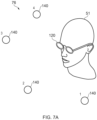
- the rendered sound scene 76 comprises multiple sound sources 140. These sound sources are fixed in space, in this example, so that when the user 51 changes his point of view 54, the positions of the sound sources 140 relative to the user 51 also change.
- the user has raised the hand portable device 130 to his left ear or performed any other suitable gesture to cause rendering of the first part 113 of the spatial audio content 102 via the hand portable device 130 and rendering of the second part 111 of the spatial audio content 102 via the spatial audio device 120.
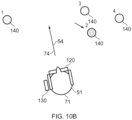
- the first part 113 of the spatial audio content emphasises the sound source 140 that is aligned with or closest to the point of view 74 of the virtual user 71.
- the mono downmix is emphasised in the direction of the virtual point of view 74.
- the point of view 74 selects the sound source 140 that is aligned with or closest to the virtual point of view 74.
- the selected sound source 140 is included in the first part 113 but is not included in the second part 111 of the spatial audio content 102.
- the sound source 140 labelled "2" is selected and emphasised in the first part 113 of the spatial audio content 102.
- the user 51 has changed his point of view 54 by changing an orientation of his head. This causes a consequent change in the point of view 74 of the virtual user 71.
- the change in the point of view 74 of the virtual user changes which part of the sound scene is emphasised in the first part 113 of the spatial audio content 102.
- the selection is as described for FIG. 9B , the only difference being the change in the point of view 74.
- the sound source 140 labelled "4" is selected and emphasised in the first part 113 of the spatial audio content 102.
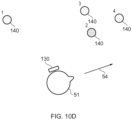
- the user 51 has removed the spatial audio device 120.
- the selected sound source 140 is now frozen.
- the sound source 140 labelled "4" is selected and emphasised. Subsequent movement of the user's head and a change in the point of view 54 of the user 51 does not change the point of view 74 of the virtual user 71. There is consequently no change in the selection of the emphasised sound source 140, as illustrated in FIG. 9E .
- the sound source labelled "4" remains the emphasised sound source 140 in the first part 113 of the spatial audio content 102.
- first-person perspective mediated reality is enabled.
- the point of view 54 of the user 51 and the virtual point of view 74 of the virtual user 71 correspond and track each other.
- the virtual point of view 71 is used to emphasise particular sound sources 140 within the spatial audio content that are aligned with the virtual point of view 74.
- the particular sound sources 140 are emphasised in the first part 113 of the spatial audio content 102.
- the emphasised sound source 140 can be varied by varying the user's point of view 54, which changes the virtual user's point of view 74.
Landscapes
- Engineering & Computer Science (AREA)
- Theoretical Computer Science (AREA)
- Physics & Mathematics (AREA)
- General Engineering & Computer Science (AREA)
- General Physics & Mathematics (AREA)
- Human Computer Interaction (AREA)
- Signal Processing (AREA)
- Acoustics & Sound (AREA)
- Multimedia (AREA)
- Health & Medical Sciences (AREA)
- Audiology, Speech & Language Pathology (AREA)
- General Health & Medical Sciences (AREA)
- Stereophonic System (AREA)
- Circuit For Audible Band Transducer (AREA)
Claims (12)
- Appareil comprenant des moyens pour :contrôler simultanément un contenu rendu par un dispositif portatif (130) et un contenu rendu par un dispositif audio spatial (120) ;en réponse à une action d'un utilisateur, diviser un contenu audio spatial (102) en une première partie (113) pour le dispositif portatif (130) et une deuxième partie (111) pour le dispositif audio spatial (120), dans lequel le rendu de la première partie (113) et de la deuxième partie (111) est simultané et se fait via le dispositif audio spatial (120), avant que l'action de l'utilisateur ne provoque la division du contenu audio spatial (102) en la première partie (113) pour le dispositif portatif (130) et la deuxième partie (111) pour le dispositif audio spatial (120) ; eten réponse à l'action de l'utilisateur, provoquer un rendu simultané à l'utilisateur de la première partie (113) du contenu audio spatial (102) via le dispositif portatif (130) et non le dispositif audio spatial (120), et de la deuxième partie (111) du contenu audio spatial (102) via le dispositif audio spatial (120) et non le dispositif portatif (130).
- Appareil selon l'une des revendications précédentes, dans lequel le contenu audio spatial (102) est reçu d'un réseau de communication par l'appareil en tant que canal de communication de liaison descendante d'une personne distante, et dans lequel la première partie (113) du contenu audio spatial (102) peut comprendre une voix de la personne distante.
- Appareil selon l'une des revendications précédentes, dans lequel l'appareil comprend des moyens pour communiquer avec le dispositif portatif (130) et/ou le dispositif audio spatial (120) pour déterminer quand l'action de l'utilisateur s'est produite, dans lequel l'action de l'utilisateur comprend le déplacement d'un dispositif portatif (130) vers la tête de l'utilisateur.
- Appareil selon l'une des revendications précédentes, dans lequel une scène audio spatiale définie par la deuxième partie (111) du contenu audio spatial (102) est modifiée en fonction d'une position du dispositif portatif (130).
- Appareil selon la revendication 4, dans lequel la première partie (113) du contenu audio spatial (102) se rapporte à une première voix associée à une première oreille de l'utilisateur à laquelle le dispositif portatif (130) est positionné, et dans lequel la deuxième partie (111) du contenu audio spatial (102) se rapporte à au moins une deuxième voix différente, dans lequel la scène audio spatiale définie par la deuxième partie (111) du contenu audio spatial (102) est modifiée pour placer la deuxième voix à une deuxième oreille de l'utilisateur, à l'opposé de la première oreille.
- Appareil selon l'une des revendications précédentes comprenant, en réponse au déplacement du dispositif portatif (130), des moyens d'éditer la deuxième partie (111) du contenu audio spatial (102).
- Appareil selon l'une des revendications précédentes, dans lequel la première partie (113) du contenu audio spatial (102) se rapporte à un appel entrant, et la deuxième partie (111) du contenu spatial se rapporte au moins au contenu qui continue d'être rendu après la réception de l'appel entrant.
- Appareil selon l'une des revendications 1 et 2, comprenant des moyens pour permettre la sélection de la première partie (113) du contenu audio spatial (102) par l'utilisateur en utilisant une réalité médiée de perspective de première personne.
- Appareil selon la revendication 8, dans lequel la première partie (113) du contenu audio spatial (102) est un objet audio sélectionné par une direction de l'attention de l'utilisateur, ou une scène audio sélectionnée par une direction de l'attention de l'utilisateur, ou dans lequel la première partie (113) du contenu audio spatial (102) est un premier objet audio mobile, dans lequel la première partie (113) du contenu audio est rendue comme si le premier objet audio était immobile.
- Dispositif portatif (130) comprenant un affichage et étant configuré comme l'appareil de l'une des revendications précédentes, ou logeant ce dernier.
- Procédé comprenant les étapes suivantes :contrôler simultanément un contenu rendu par un dispositif portatif (130) et un contenu rendu par un dispositif audio spatial (120) ;en réponse à une action d'un utilisateur, diviser un contenu audio spatial (102) en une première partie (113) pour le dispositif portatif (130) et une deuxième partie (111) pour le dispositif audio spatial (120), dans lequel le rendu de la première partie (113) et de la deuxième partie (111) est simultané et se fait via le dispositif audio spatial (120), avant que l'action de l'utilisateur ne provoque la division du contenu audio spatial (102) en la première partie (113) pour le dispositif portatif (130) et la deuxième partie (111) pour le dispositif audio spatial (120) ; etprovoquer un rendu simultané à l'utilisateur, en réponse à l'action de l'utilisateur, de la première partie (113) du contenu audio spatial (102) via le dispositif portatif (130) et non le dispositif audio spatial (120), et de la deuxième partie (111) du contenu audio spatial (102) via le dispositif audio spatial (120) et non le dispositif portatif (130).
- Instructions de programme informatique configurées pour amener l'appareil de la revendication 1 à effectuer ce qui suit :contrôler simultanément un contenu rendu par un dispositif portatif (130) et un contenu rendu par un dispositif audio spatial (120) ;en réponse à une action d'un utilisateur, diviser un contenu audio spatial (102) en une première partie (113) pour le dispositif portatif (130) et une deuxième partie (111) pour le dispositif audio spatial (120), dans lesquelles le rendu de la première partie (113) et de la deuxième partie (111) est simultané et se fait via le dispositif audio spatial (120), avant que l'action de l'utilisateur ne provoque la division du contenu audio spatial (102) en la première partie (113) pour le dispositif portatif (130) et la deuxième partie (111) pour le dispositif audio spatial (120) ; etprovoquer un rendu simultané à l'utilisateur, en réponse à l'action de l'utilisateur, de la première partie (113) du contenu audio spatial (102) via le dispositif portatif (130) et non le dispositif audio spatial (120), et de la deuxième partie (111) du contenu audio spatial (102) via le dispositif audio spatial (120) et non le dispositif portatif (130).
Priority Applications (4)
| Application Number | Priority Date | Filing Date | Title |
|---|---|---|---|
| EP18193581.8A EP3623934B1 (fr) | 2018-09-11 | 2018-09-11 | Appareil, procédé, programme d'ordinateur pour permettre l'accès au contenu de réalité médiée par un utilisateur à distance |
| US17/271,755 US11570565B2 (en) | 2018-09-11 | 2019-09-05 | Apparatus, method, computer program for enabling access to mediated reality content by a remote user |
| PCT/EP2019/073776 WO2020053074A1 (fr) | 2018-09-11 | 2019-09-05 | Appareil, procédé, programme d'ordinateur permettant à un utilisateur à distance d'accéder à un contenu de réalité médiatisée |
| CN201980059221.7A CN112689825B (zh) | 2018-09-11 | 2019-09-05 | 实现远程用户访问介导现实内容的装置、方法、计算机程序 |
Applications Claiming Priority (1)
| Application Number | Priority Date | Filing Date | Title |
|---|---|---|---|
| EP18193581.8A EP3623934B1 (fr) | 2018-09-11 | 2018-09-11 | Appareil, procédé, programme d'ordinateur pour permettre l'accès au contenu de réalité médiée par un utilisateur à distance |
Publications (2)
| Publication Number | Publication Date |
|---|---|
| EP3623934A1 EP3623934A1 (fr) | 2020-03-18 |
| EP3623934B1 true EP3623934B1 (fr) | 2025-07-02 |
Family
ID=63720457
Family Applications (1)
| Application Number | Title | Priority Date | Filing Date |
|---|---|---|---|
| EP18193581.8A Active EP3623934B1 (fr) | 2018-09-11 | 2018-09-11 | Appareil, procédé, programme d'ordinateur pour permettre l'accès au contenu de réalité médiée par un utilisateur à distance |
Country Status (4)
| Country | Link |
|---|---|
| US (1) | US11570565B2 (fr) |
| EP (1) | EP3623934B1 (fr) |
| CN (1) | CN112689825B (fr) |
| WO (1) | WO2020053074A1 (fr) |
Families Citing this family (3)
| Publication number | Priority date | Publication date | Assignee | Title |
|---|---|---|---|---|
| WO2019082129A1 (fr) | 2017-10-26 | 2019-05-02 | Noroo Holdings Co., Ltd | Production et séparation d'acide 3-hydroxypropionique |
| EP4224888B1 (fr) * | 2022-02-03 | 2024-11-13 | Nokia Technologies Oy | Contenu virtuel |
| GB2641568A (en) * | 2024-06-07 | 2025-12-10 | Nokia Technologies Oy | Audio generation |
Family Cites Families (8)
| Publication number | Priority date | Publication date | Assignee | Title |
|---|---|---|---|---|
| EP2311255A1 (fr) * | 2008-08-14 | 2011-04-20 | Telefonaktiebolaget L M Ericsson (PUBL) | Partage de contenu multimédia dans un réseau de communication |
| KR101989893B1 (ko) * | 2012-10-29 | 2019-09-30 | 엘지전자 주식회사 | 헤드 마운트 디스플레이 및 이를 이용한 오디오 신호 출력 방법 |
| US9584915B2 (en) * | 2015-01-19 | 2017-02-28 | Microsoft Technology Licensing, Llc | Spatial audio with remote speakers |
| EP3260950B1 (fr) * | 2016-06-22 | 2019-11-06 | Nokia Technologies Oy | Réalité induite |
| CN206096634U (zh) | 2016-10-12 | 2017-04-12 | 哈尔滨哲思科技发展有限公司 | 组合式增强现实智能眼镜 |
| EP3343349B1 (fr) * | 2016-12-30 | 2022-06-15 | Nokia Technologies Oy | Appareil et procédés associés dans le domaine de la réalité virtuelle |
| EP3370133B1 (fr) * | 2017-03-02 | 2023-10-18 | Nokia Technologies Oy | Traitement audio |
| EP3457716A1 (fr) * | 2017-09-15 | 2019-03-20 | Oticon A/s | Fourniture et transmission de signaux audio |
-
2018
- 2018-09-11 EP EP18193581.8A patent/EP3623934B1/fr active Active
-
2019
- 2019-09-05 CN CN201980059221.7A patent/CN112689825B/zh active Active
- 2019-09-05 WO PCT/EP2019/073776 patent/WO2020053074A1/fr not_active Ceased
- 2019-09-05 US US17/271,755 patent/US11570565B2/en active Active
Non-Patent Citations (1)
| Title |
|---|
| ANONYMOUS: "Splitting and Joining Stereo Tracks - Audacity Development Manual", 28 April 2018 (2018-04-28), pages 1 - 4, XP093123095, Retrieved from the Internet <URL:https://web.archive.org/web/20180428063945/http://manual.audacityteam.org/man/splitting_and_joining_stereo_tracks.html> [retrieved on 20240124] * |
Also Published As
| Publication number | Publication date |
|---|---|
| CN112689825A (zh) | 2021-04-20 |
| US11570565B2 (en) | 2023-01-31 |
| US20210321211A1 (en) | 2021-10-14 |
| EP3623934A1 (fr) | 2020-03-18 |
| WO2020053074A1 (fr) | 2020-03-19 |
| CN112689825B (zh) | 2025-02-07 |
Similar Documents
| Publication | Publication Date | Title |
|---|---|---|
| JP7631449B2 (ja) | オーディオ装置及びオーディオ処理の方法 | |
| EP3693846A1 (fr) | Appareil, procédé ou programme informatique pour le rendu de scènes sonores définies par un contenu audio spatial à un utilisateur | |
| EP3594802A1 (fr) | Appareil audio, système de distribution audio et son procédé de fonctionnement | |
| US11099802B2 (en) | Virtual reality | |
| US11570565B2 (en) | Apparatus, method, computer program for enabling access to mediated reality content by a remote user | |
| JP2025102861A (ja) | 視聴覚レンダリング装置およびその動作方法 | |
| EP3720149B1 (fr) | Appareil, procédé, programme informatique ou système de rendu de données audio | |
| US20220171593A1 (en) | An apparatus, method, computer program or system for indicating audibility of audio content rendered in a virtual space | |
| EP3691298A1 (fr) | Appareil méthode et programme d'ordinateur permettant la communication audio en temps réel entre utilisateurs en audio immerssion | |
| CN117676002B (zh) | 音频处理方法及电子设备 |
Legal Events
| Date | Code | Title | Description |
|---|---|---|---|
| PUAI | Public reference made under article 153(3) epc to a published international application that has entered the european phase |
Free format text: ORIGINAL CODE: 0009012 |
|
| STAA | Information on the status of an ep patent application or granted ep patent |
Free format text: STATUS: THE APPLICATION HAS BEEN PUBLISHED |
|
| AK | Designated contracting states |
Kind code of ref document: A1 Designated state(s): AL AT BE BG CH CY CZ DE DK EE ES FI FR GB GR HR HU IE IS IT LI LT LU LV MC MK MT NL NO PL PT RO RS SE SI SK SM TR |
|
| AX | Request for extension of the european patent |
Extension state: BA ME |
|
| STAA | Information on the status of an ep patent application or granted ep patent |
Free format text: STATUS: REQUEST FOR EXAMINATION WAS MADE |
|
| 17P | Request for examination filed |
Effective date: 20200916 |
|
| RBV | Designated contracting states (corrected) |
Designated state(s): AL AT BE BG CH CY CZ DE DK EE ES FI FR GB GR HR HU IE IS IT LI LT LU LV MC MK MT NL NO PL PT RO RS SE SI SK SM TR |
|
| STAA | Information on the status of an ep patent application or granted ep patent |
Free format text: STATUS: EXAMINATION IS IN PROGRESS |
|
| 17Q | First examination report despatched |
Effective date: 20211004 |
|
| GRAP | Despatch of communication of intention to grant a patent |
Free format text: ORIGINAL CODE: EPIDOSNIGR1 |
|
| STAA | Information on the status of an ep patent application or granted ep patent |
Free format text: STATUS: GRANT OF PATENT IS INTENDED |
|
| INTG | Intention to grant announced |
Effective date: 20250131 |
|
| GRAS | Grant fee paid |
Free format text: ORIGINAL CODE: EPIDOSNIGR3 |
|
| GRAA | (expected) grant |
Free format text: ORIGINAL CODE: 0009210 |
|
| STAA | Information on the status of an ep patent application or granted ep patent |
Free format text: STATUS: THE PATENT HAS BEEN GRANTED |
|
| AK | Designated contracting states |
Kind code of ref document: B1 Designated state(s): AL AT BE BG CH CY CZ DE DK EE ES FI FR GB GR HR HU IE IS IT LI LT LU LV MC MK MT NL NO PL PT RO RS SE SI SK SM TR |
|
| REG | Reference to a national code |
Ref country code: GB Ref legal event code: FG4D |
|
| REG | Reference to a national code |
Ref country code: CH Ref legal event code: EP |
|
| REG | Reference to a national code |
Ref country code: DE Ref legal event code: R096 Ref document number: 602018083127 Country of ref document: DE |
|
| REG | Reference to a national code |
Ref country code: IE Ref legal event code: FG4D |
|
| PGFP | Annual fee paid to national office [announced via postgrant information from national office to epo] |
Ref country code: DE Payment date: 20250730 Year of fee payment: 8 |
|
| PGFP | Annual fee paid to national office [announced via postgrant information from national office to epo] |
Ref country code: GB Payment date: 20250731 Year of fee payment: 8 |
|
| REG | Reference to a national code |
Ref country code: NL Ref legal event code: MP Effective date: 20250702 |
|
| PG25 | Lapsed in a contracting state [announced via postgrant information from national office to epo] |
Ref country code: PT Free format text: LAPSE BECAUSE OF FAILURE TO SUBMIT A TRANSLATION OF THE DESCRIPTION OR TO PAY THE FEE WITHIN THE PRESCRIBED TIME-LIMIT Effective date: 20251103 |
|
| PG25 | Lapsed in a contracting state [announced via postgrant information from national office to epo] |
Ref country code: NL Free format text: LAPSE BECAUSE OF FAILURE TO SUBMIT A TRANSLATION OF THE DESCRIPTION OR TO PAY THE FEE WITHIN THE PRESCRIBED TIME-LIMIT Effective date: 20250702 |
|
| REG | Reference to a national code |
Ref country code: AT Ref legal event code: MK05 Ref document number: 1809997 Country of ref document: AT Kind code of ref document: T Effective date: 20250702 |
|
| PG25 | Lapsed in a contracting state [announced via postgrant information from national office to epo] |
Ref country code: IS Free format text: LAPSE BECAUSE OF FAILURE TO SUBMIT A TRANSLATION OF THE DESCRIPTION OR TO PAY THE FEE WITHIN THE PRESCRIBED TIME-LIMIT Effective date: 20251102 |
|
| PG25 | Lapsed in a contracting state [announced via postgrant information from national office to epo] |
Ref country code: NO Free format text: LAPSE BECAUSE OF FAILURE TO SUBMIT A TRANSLATION OF THE DESCRIPTION OR TO PAY THE FEE WITHIN THE PRESCRIBED TIME-LIMIT Effective date: 20251002 |
|
| REG | Reference to a national code |
Ref country code: LT Ref legal event code: MG9D |
|
| PG25 | Lapsed in a contracting state [announced via postgrant information from national office to epo] |
Ref country code: AT Free format text: LAPSE BECAUSE OF FAILURE TO SUBMIT A TRANSLATION OF THE DESCRIPTION OR TO PAY THE FEE WITHIN THE PRESCRIBED TIME-LIMIT Effective date: 20250702 |
|
| PG25 | Lapsed in a contracting state [announced via postgrant information from national office to epo] |
Ref country code: FI Free format text: LAPSE BECAUSE OF FAILURE TO SUBMIT A TRANSLATION OF THE DESCRIPTION OR TO PAY THE FEE WITHIN THE PRESCRIBED TIME-LIMIT Effective date: 20250702 |
|
| PG25 | Lapsed in a contracting state [announced via postgrant information from national office to epo] |
Ref country code: HR Free format text: LAPSE BECAUSE OF FAILURE TO SUBMIT A TRANSLATION OF THE DESCRIPTION OR TO PAY THE FEE WITHIN THE PRESCRIBED TIME-LIMIT Effective date: 20250702 |
|
| PG25 | Lapsed in a contracting state [announced via postgrant information from national office to epo] |
Ref country code: GR Free format text: LAPSE BECAUSE OF FAILURE TO SUBMIT A TRANSLATION OF THE DESCRIPTION OR TO PAY THE FEE WITHIN THE PRESCRIBED TIME-LIMIT Effective date: 20251003 |
|
| PG25 | Lapsed in a contracting state [announced via postgrant information from national office to epo] |
Ref country code: SE Free format text: LAPSE BECAUSE OF FAILURE TO SUBMIT A TRANSLATION OF THE DESCRIPTION OR TO PAY THE FEE WITHIN THE PRESCRIBED TIME-LIMIT Effective date: 20250702 Ref country code: CZ Free format text: LAPSE BECAUSE OF FAILURE TO SUBMIT A TRANSLATION OF THE DESCRIPTION OR TO PAY THE FEE WITHIN THE PRESCRIBED TIME-LIMIT Effective date: 20250702 |
|
| PG25 | Lapsed in a contracting state [announced via postgrant information from national office to epo] |
Ref country code: LV Free format text: LAPSE BECAUSE OF FAILURE TO SUBMIT A TRANSLATION OF THE DESCRIPTION OR TO PAY THE FEE WITHIN THE PRESCRIBED TIME-LIMIT Effective date: 20250702 |
|
| PG25 | Lapsed in a contracting state [announced via postgrant information from national office to epo] |
Ref country code: BG Free format text: LAPSE BECAUSE OF FAILURE TO SUBMIT A TRANSLATION OF THE DESCRIPTION OR TO PAY THE FEE WITHIN THE PRESCRIBED TIME-LIMIT Effective date: 20250702 Ref country code: PL Free format text: LAPSE BECAUSE OF FAILURE TO SUBMIT A TRANSLATION OF THE DESCRIPTION OR TO PAY THE FEE WITHIN THE PRESCRIBED TIME-LIMIT Effective date: 20250702 |
|
| PG25 | Lapsed in a contracting state [announced via postgrant information from national office to epo] |
Ref country code: RS Free format text: LAPSE BECAUSE OF FAILURE TO SUBMIT A TRANSLATION OF THE DESCRIPTION OR TO PAY THE FEE WITHIN THE PRESCRIBED TIME-LIMIT Effective date: 20251002 |
|
| PG25 | Lapsed in a contracting state [announced via postgrant information from national office to epo] |
Ref country code: ES Free format text: LAPSE BECAUSE OF FAILURE TO SUBMIT A TRANSLATION OF THE DESCRIPTION OR TO PAY THE FEE WITHIN THE PRESCRIBED TIME-LIMIT Effective date: 20250702 |
|
| PG25 | Lapsed in a contracting state [announced via postgrant information from national office to epo] |
Ref country code: RO Free format text: LAPSE BECAUSE OF FAILURE TO SUBMIT A TRANSLATION OF THE DESCRIPTION OR TO PAY THE FEE WITHIN THE PRESCRIBED TIME-LIMIT Effective date: 20250702 |
|
| PG25 | Lapsed in a contracting state [announced via postgrant information from national office to epo] |
Ref country code: SM Free format text: LAPSE BECAUSE OF FAILURE TO SUBMIT A TRANSLATION OF THE DESCRIPTION OR TO PAY THE FEE WITHIN THE PRESCRIBED TIME-LIMIT Effective date: 20250702 |
|
| PG25 | Lapsed in a contracting state [announced via postgrant information from national office to epo] |
Ref country code: DK Free format text: LAPSE BECAUSE OF FAILURE TO SUBMIT A TRANSLATION OF THE DESCRIPTION OR TO PAY THE FEE WITHIN THE PRESCRIBED TIME-LIMIT Effective date: 20250702 |
|
| PG25 | Lapsed in a contracting state [announced via postgrant information from national office to epo] |
Ref country code: IT Free format text: LAPSE BECAUSE OF FAILURE TO SUBMIT A TRANSLATION OF THE DESCRIPTION OR TO PAY THE FEE WITHIN THE PRESCRIBED TIME-LIMIT Effective date: 20250702 |
|
| PG25 | Lapsed in a contracting state [announced via postgrant information from national office to epo] |
Ref country code: SK Free format text: LAPSE BECAUSE OF FAILURE TO SUBMIT A TRANSLATION OF THE DESCRIPTION OR TO PAY THE FEE WITHIN THE PRESCRIBED TIME-LIMIT Effective date: 20250702 Ref country code: EE Free format text: LAPSE BECAUSE OF FAILURE TO SUBMIT A TRANSLATION OF THE DESCRIPTION OR TO PAY THE FEE WITHIN THE PRESCRIBED TIME-LIMIT Effective date: 20250702 |