EP3625316B1 - Dispergiermittel, verfahren zur herstellung und verwendung davon - Google Patents
Dispergiermittel, verfahren zur herstellung und verwendung davon Download PDFInfo
- Publication number
- EP3625316B1 EP3625316B1 EP18734937.8A EP18734937A EP3625316B1 EP 3625316 B1 EP3625316 B1 EP 3625316B1 EP 18734937 A EP18734937 A EP 18734937A EP 3625316 B1 EP3625316 B1 EP 3625316B1
- Authority
- EP
- European Patent Office
- Prior art keywords
- lubricating oil
- dispersant
- oil
- alkyl
- acid
- Prior art date
- Legal status (The legal status is an assumption and is not a legal conclusion. Google has not performed a legal analysis and makes no representation as to the accuracy of the status listed.)
- Active
Links
Classifications
-
- C—CHEMISTRY; METALLURGY
- C10—PETROLEUM, GAS OR COKE INDUSTRIES; TECHNICAL GASES CONTAINING CARBON MONOXIDE; FUELS; LUBRICANTS; PEAT
- C10M—LUBRICATING COMPOSITIONS; USE OF CHEMICAL SUBSTANCES EITHER ALONE OR AS LUBRICATING INGREDIENTS IN A LUBRICATING COMPOSITION
- C10M133/00—Lubricating compositions characterised by the additive being an organic non-macromolecular compound containing nitrogen
- C10M133/52—Lubricating compositions characterised by the additive being an organic non-macromolecular compound containing nitrogen having a carbon chain of 30 or more atoms
- C10M133/56—Amides; Imides
-
- C—CHEMISTRY; METALLURGY
- C10—PETROLEUM, GAS OR COKE INDUSTRIES; TECHNICAL GASES CONTAINING CARBON MONOXIDE; FUELS; LUBRICANTS; PEAT
- C10M—LUBRICATING COMPOSITIONS; USE OF CHEMICAL SUBSTANCES EITHER ALONE OR AS LUBRICATING INGREDIENTS IN A LUBRICATING COMPOSITION
- C10M149/00—Lubricating compositions characterised by the additive being a macromolecular compound containing nitrogen
- C10M149/02—Macromolecular compounds obtained by reactions only involving carbon-to-carbon unsaturated bonds
- C10M149/10—Macromolecular compounds obtained by reactions only involving carbon-to-carbon unsaturated bonds containing monomers having an unsaturated radical bound to a nitrogen-containing hetero ring
-
- C—CHEMISTRY; METALLURGY
- C08—ORGANIC MACROMOLECULAR COMPOUNDS; THEIR PREPARATION OR CHEMICAL WORKING-UP; COMPOSITIONS BASED THEREON
- C08F—MACROMOLECULAR COMPOUNDS OBTAINED BY REACTIONS ONLY INVOLVING CARBON-TO-CARBON UNSATURATED BONDS
- C08F110/00—Homopolymers of unsaturated aliphatic hydrocarbons having only one carbon-to-carbon double bond
- C08F110/04—Monomers containing three or four carbon atoms
- C08F110/08—Butenes
- C08F110/10—Isobutene
-
- C—CHEMISTRY; METALLURGY
- C10—PETROLEUM, GAS OR COKE INDUSTRIES; TECHNICAL GASES CONTAINING CARBON MONOXIDE; FUELS; LUBRICANTS; PEAT
- C10M—LUBRICATING COMPOSITIONS; USE OF CHEMICAL SUBSTANCES EITHER ALONE OR AS LUBRICATING INGREDIENTS IN A LUBRICATING COMPOSITION
- C10M149/00—Lubricating compositions characterised by the additive being a macromolecular compound containing nitrogen
- C10M149/12—Macromolecular compounds obtained otherwise than by reactions only involving carbon-to-carbon unsaturated bonds
- C10M149/14—Macromolecular compounds obtained otherwise than by reactions only involving carbon-to-carbon unsaturated bonds a condensation reaction being involved
- C10M149/22—Polyamines
-
- C—CHEMISTRY; METALLURGY
- C10—PETROLEUM, GAS OR COKE INDUSTRIES; TECHNICAL GASES CONTAINING CARBON MONOXIDE; FUELS; LUBRICANTS; PEAT
- C10M—LUBRICATING COMPOSITIONS; USE OF CHEMICAL SUBSTANCES EITHER ALONE OR AS LUBRICATING INGREDIENTS IN A LUBRICATING COMPOSITION
- C10M159/00—Lubricating compositions characterised by the additive being of unknown or incompletely defined constitution
- C10M159/12—Reaction products
-
- C—CHEMISTRY; METALLURGY
- C10—PETROLEUM, GAS OR COKE INDUSTRIES; TECHNICAL GASES CONTAINING CARBON MONOXIDE; FUELS; LUBRICANTS; PEAT
- C10M—LUBRICATING COMPOSITIONS; USE OF CHEMICAL SUBSTANCES EITHER ALONE OR AS LUBRICATING INGREDIENTS IN A LUBRICATING COMPOSITION
- C10M169/00—Lubricating compositions characterised by containing as components a mixture of at least two types of ingredient selected from base-materials, thickeners or additives, covered by the preceding groups, each of these compounds being essential
- C10M169/04—Mixtures of base-materials and additives
- C10M169/041—Mixtures of base-materials and additives the additives being macromolecular compounds only
-
- C—CHEMISTRY; METALLURGY
- C08—ORGANIC MACROMOLECULAR COMPOUNDS; THEIR PREPARATION OR CHEMICAL WORKING-UP; COMPOSITIONS BASED THEREON
- C08F—MACROMOLECULAR COMPOUNDS OBTAINED BY REACTIONS ONLY INVOLVING CARBON-TO-CARBON UNSATURATED BONDS
- C08F2810/00—Chemical modification of a polymer
- C08F2810/30—Chemical modification of a polymer leading to the formation or introduction of aliphatic or alicyclic unsaturated groups
-
- C—CHEMISTRY; METALLURGY
- C10—PETROLEUM, GAS OR COKE INDUSTRIES; TECHNICAL GASES CONTAINING CARBON MONOXIDE; FUELS; LUBRICANTS; PEAT
- C10M—LUBRICATING COMPOSITIONS; USE OF CHEMICAL SUBSTANCES EITHER ALONE OR AS LUBRICATING INGREDIENTS IN A LUBRICATING COMPOSITION
- C10M2203/00—Organic non-macromolecular hydrocarbon compounds and hydrocarbon fractions as ingredients in lubricant compositions
- C10M2203/003—Organic non-macromolecular hydrocarbon compounds and hydrocarbon fractions as ingredients in lubricant compositions used as base material
-
- C—CHEMISTRY; METALLURGY
- C10—PETROLEUM, GAS OR COKE INDUSTRIES; TECHNICAL GASES CONTAINING CARBON MONOXIDE; FUELS; LUBRICANTS; PEAT
- C10M—LUBRICATING COMPOSITIONS; USE OF CHEMICAL SUBSTANCES EITHER ALONE OR AS LUBRICATING INGREDIENTS IN A LUBRICATING COMPOSITION
- C10M2207/00—Organic non-macromolecular hydrocarbon compounds containing hydrogen, carbon and oxygen as ingredients in lubricant compositions
- C10M2207/02—Hydroxy compounds
- C10M2207/023—Hydroxy compounds having hydroxy groups bound to carbon atoms of six-membered aromatic rings
- C10M2207/028—Overbased salts thereof
-
- C—CHEMISTRY; METALLURGY
- C10—PETROLEUM, GAS OR COKE INDUSTRIES; TECHNICAL GASES CONTAINING CARBON MONOXIDE; FUELS; LUBRICANTS; PEAT
- C10M—LUBRICATING COMPOSITIONS; USE OF CHEMICAL SUBSTANCES EITHER ALONE OR AS LUBRICATING INGREDIENTS IN A LUBRICATING COMPOSITION
- C10M2215/00—Organic non-macromolecular compounds containing nitrogen as ingredients in lubricant Compositions
- C10M2215/24—Organic non-macromolecular compounds containing nitrogen as ingredients in lubricant Compositions having hydrocarbon substituents containing thirty or more carbon atoms, e.g. nitrogen derivatives of substituted succinic acid
- C10M2215/28—Amides; Imides
-
- C—CHEMISTRY; METALLURGY
- C10—PETROLEUM, GAS OR COKE INDUSTRIES; TECHNICAL GASES CONTAINING CARBON MONOXIDE; FUELS; LUBRICANTS; PEAT
- C10M—LUBRICATING COMPOSITIONS; USE OF CHEMICAL SUBSTANCES EITHER ALONE OR AS LUBRICATING INGREDIENTS IN A LUBRICATING COMPOSITION
- C10M2217/00—Organic macromolecular compounds containing nitrogen as ingredients in lubricant compositions
- C10M2217/06—Macromolecular compounds obtained by functionalisation op polymers with a nitrogen containing compound
-
- C—CHEMISTRY; METALLURGY
- C10—PETROLEUM, GAS OR COKE INDUSTRIES; TECHNICAL GASES CONTAINING CARBON MONOXIDE; FUELS; LUBRICANTS; PEAT
- C10M—LUBRICATING COMPOSITIONS; USE OF CHEMICAL SUBSTANCES EITHER ALONE OR AS LUBRICATING INGREDIENTS IN A LUBRICATING COMPOSITION
- C10M2219/00—Organic non-macromolecular compounds containing sulfur, selenium or tellurium as ingredients in lubricant compositions
- C10M2219/04—Organic non-macromolecular compounds containing sulfur, selenium or tellurium as ingredients in lubricant compositions containing sulfur-to-oxygen bonds, i.e. sulfones, sulfoxides
- C10M2219/046—Overbased sulfonic acid salts
-
- C—CHEMISTRY; METALLURGY
- C10—PETROLEUM, GAS OR COKE INDUSTRIES; TECHNICAL GASES CONTAINING CARBON MONOXIDE; FUELS; LUBRICANTS; PEAT
- C10M—LUBRICATING COMPOSITIONS; USE OF CHEMICAL SUBSTANCES EITHER ALONE OR AS LUBRICATING INGREDIENTS IN A LUBRICATING COMPOSITION
- C10M2223/00—Organic non-macromolecular compounds containing phosphorus as ingredients in lubricant compositions
- C10M2223/02—Organic non-macromolecular compounds containing phosphorus as ingredients in lubricant compositions having no phosphorus-to-carbon bonds
- C10M2223/04—Phosphate esters
- C10M2223/045—Metal containing thio derivatives
-
- C—CHEMISTRY; METALLURGY
- C10—PETROLEUM, GAS OR COKE INDUSTRIES; TECHNICAL GASES CONTAINING CARBON MONOXIDE; FUELS; LUBRICANTS; PEAT
- C10N—INDEXING SCHEME ASSOCIATED WITH SUBCLASS C10M RELATING TO LUBRICATING COMPOSITIONS
- C10N2020/00—Specified physical or chemical properties or characteristics, i.e. function, of component of lubricating compositions
- C10N2020/01—Physico-chemical properties
- C10N2020/04—Molecular weight; Molecular weight distribution
-
- C—CHEMISTRY; METALLURGY
- C10—PETROLEUM, GAS OR COKE INDUSTRIES; TECHNICAL GASES CONTAINING CARBON MONOXIDE; FUELS; LUBRICANTS; PEAT
- C10N—INDEXING SCHEME ASSOCIATED WITH SUBCLASS C10M RELATING TO LUBRICATING COMPOSITIONS
- C10N2030/00—Specified physical or chemical properties which is improved by the additive characterising the lubricating composition, e.g. multifunctional additives
- C10N2030/04—Detergent property or dispersant property
- C10N2030/041—Soot induced viscosity control
-
- C—CHEMISTRY; METALLURGY
- C10—PETROLEUM, GAS OR COKE INDUSTRIES; TECHNICAL GASES CONTAINING CARBON MONOXIDE; FUELS; LUBRICANTS; PEAT
- C10N—INDEXING SCHEME ASSOCIATED WITH SUBCLASS C10M RELATING TO LUBRICATING COMPOSITIONS
- C10N2030/00—Specified physical or chemical properties which is improved by the additive characterising the lubricating composition, e.g. multifunctional additives
- C10N2030/12—Inhibition of corrosion, e.g. anti-rust agents or anti-corrosives
-
- C—CHEMISTRY; METALLURGY
- C10—PETROLEUM, GAS OR COKE INDUSTRIES; TECHNICAL GASES CONTAINING CARBON MONOXIDE; FUELS; LUBRICANTS; PEAT
- C10N—INDEXING SCHEME ASSOCIATED WITH SUBCLASS C10M RELATING TO LUBRICATING COMPOSITIONS
- C10N2040/00—Specified use or application for which the lubricating composition is intended
- C10N2040/25—Internal-combustion engines
-
- C—CHEMISTRY; METALLURGY
- C10—PETROLEUM, GAS OR COKE INDUSTRIES; TECHNICAL GASES CONTAINING CARBON MONOXIDE; FUELS; LUBRICANTS; PEAT
- C10N—INDEXING SCHEME ASSOCIATED WITH SUBCLASS C10M RELATING TO LUBRICATING COMPOSITIONS
- C10N2040/00—Specified use or application for which the lubricating composition is intended
- C10N2040/25—Internal-combustion engines
- C10N2040/255—Gasoline engines
-
- C—CHEMISTRY; METALLURGY
- C10—PETROLEUM, GAS OR COKE INDUSTRIES; TECHNICAL GASES CONTAINING CARBON MONOXIDE; FUELS; LUBRICANTS; PEAT
- C10N—INDEXING SCHEME ASSOCIATED WITH SUBCLASS C10M RELATING TO LUBRICATING COMPOSITIONS
- C10N2060/00—Chemical after-treatment of the constituents of the lubricating composition
- C10N2060/06—Chemical after-treatment of the constituents of the lubricating composition by epoxydes or oxyalkylation reactions
-
- C—CHEMISTRY; METALLURGY
- C10—PETROLEUM, GAS OR COKE INDUSTRIES; TECHNICAL GASES CONTAINING CARBON MONOXIDE; FUELS; LUBRICANTS; PEAT
- C10N—INDEXING SCHEME ASSOCIATED WITH SUBCLASS C10M RELATING TO LUBRICATING COMPOSITIONS
- C10N2060/00—Chemical after-treatment of the constituents of the lubricating composition
- C10N2060/09—Treatment with nitrogen containing compounds
-
- C—CHEMISTRY; METALLURGY
- C10—PETROLEUM, GAS OR COKE INDUSTRIES; TECHNICAL GASES CONTAINING CARBON MONOXIDE; FUELS; LUBRICANTS; PEAT
- C10N—INDEXING SCHEME ASSOCIATED WITH SUBCLASS C10M RELATING TO LUBRICATING COMPOSITIONS
- C10N2070/00—Specific manufacturing methods for lubricant compositions
- C10N2070/02—Concentrating of additives
Definitions
- the present disclosure generally relates to an improved dispersant additive composition that is used in engine oils. More generally, the disclosure relates to a class of dispersants with improved properties, such as soot dispersancy.
- U.S. Patent No. 7,361,629 discloses an amination product which contains a hydrocarbyl substituted succinic acylating agent and a mixture comprising aliphatic polyamine and aromatic polyamine.
- U.S. Patent No. 8,324,139 discloses Mannich post-treatment of PIBSA dispersants for soot dispersion.
- U.S. Patent No. 8,530,397 discloses Michael adducts of N-substituted phenylenediamines.
- U.S. Patent No. 8,557,753 and U.S. Patent No. 8,969,266 disclose an amine-functionalized additive which is derived from amine having at least 3 aromatic groups, at least one -NH 2 functional group, and at least 2 secondary or tertiary amino groups.
- U.S. Patent No. 8,569,217 discloses a reaction product of an aromatic amine and a carboxylic functionalized polymer.
- U.S. Patent Application Publication No. 2008/0293600 discloses dispersant polymer containing a graft polymer of polymer backbone having graftable sites, acylating agent having point of olefinic unsaturation, ethylenically unsaturated, aliphatic or aromatic monomer and amine.
- U.S. Patent Application Publication No. 2011/0287992 discloses a multifunctional multiple graft monomer low molecular weight polymer containing a graft low molecular weight polymer.
- U.S. Patent Application Publication No. 2005/0153849 discloses graft copolymer with a polymer backbone that has been grafted with certain amines.
- European Patent Application No. 0889112 discloses bis-succinimide compounds having an amide linking group.
- WO 2010/075103 A2 describes an oil-soluble lubricating oil additive composition prepared by a process which comprises reacting a succinimide, succinimide or mixtures thereof with a first pot-treating agent, thereby producing an initial post-treated product which is reacted with a second post-treating agent.
- an oil soluble or dispersible dispersant composition comprising the reaction product of: (i) a polyalkenyl succinimide post-treated with a post-treating agent selected from the group consisting of an organic carbonate, an epoxide, a lactone, a hydroxyaliphatic carboxylic acid, and combinations thereof; and (ii) an acylating agent selected from one of the following structures (a) or (b): wherein LG is a leaving group capable of being displaced in an acylation reaction; each of R 1 and R 2 is independently selected from hydrogen, alkyl, and aryl; n is from 1 to 28; A is an amine moiety; and B is an aromatic, heteroaromatic, alkaryl, or alkheteroaryl moiety having from 4 to 20 carbon atoms.
- a lubricating oil additive concentrate comprising from 80 to 20 wt. % of an organic liquid diluent and from 20 to 80 wt. % of the dispersant composition as described herein.
- a method for controlling soot-induced viscosity increase in a compression ignition engine lubricated with a lubricating oil by using as the lubricating oil the lubricating oil composition described herein.
- a method for improving lead corrosion performance in a compression ignition engine lubricated with a lubricating oil by using as the lubricating oil the lubricating oil composition described herein, wherein the lubricating oil is one that is determined to be corrosive to lead according to the High Temperature Corrosion Bench Test ASTM D6594 when the dispersant composition of the present disclosure is not present.
- a process for preparing a dispersant composition which comprises reacting a mixture comprising components (i) and (ii) as described herein above.
- PIB polyisobutene
- PISSA is an abbreviation for polyisobutenyl or polyisobutyl succinic anhydride.
- succinimide is understood in the art to include many of the amide, imide, and amidine species which may be formed by the reaction of a succinic anhydride with an amine.
- Alkenyl or alkyl succinimides are disclosed in numerous references and are well known in the art. Certain fundamental types of succinimides and related materials encompassed by the term of art "succinimide” are taught in U.S. Patent Nos. 2,992,708 , 3,018,291 ; 3,024,237 ; 3,100,673 ; 3,219,666 ; 3,172,892 ; and 3,272,746 .
- 'oil soluble' or 'oil dispersible' do not necessarily indicate that the compounds or additives are soluble, dissolvable, miscible or capable of being suspended in the oil in all proportions. These do mean, however, that they are, for instance, soluble or stably dispersible in oil to an extent sufficient to exert their intended effect in the environment in which the oil is employed. Moreover, the additional incorporation of other additives may also permit incorporation of higher levels of a particular additive, if desired.
- LG means the group with the meaning conventionally associated with it in synthetic organic chemistry, i.e., an atom or group displaceable under substitution reaction conditions.
- post-treating agent refers to organic reagents capable of functionalizing amines.
- Total Base Number refers to the amount of base equivalent to milligrams of KOH in 1 gram of sample (mg KOH/g). Thus, higher TBN numbers reflect more alkaline products, and therefore a greater alkalinity reserve.
- the TBN of a sample can be determined by ASTM D2896, D4739, or any other equivalent procedure.
- an oil soluble or dispersible dispersant composition comprising the reaction product of:(i) a polyalkenyl succinimide post-treated with a post-treating agent selected from the group consisting of an organic carbonate, an epoxide, a lactone, and a hydroxyaliphatic carboxylic acid, and combinations thereof; and (ii) an acylating agent selected from one of the following structures (a)or (b): where LG is a leaving group capable of being displaced in an acylation reaction; each of R 1 and R 2 is independently selected from H, alkyl, aryl, heteroaryl, alkaryl, and alkheteroaryl; n is from 1 to 28; A is an amine moiety; and B is an aromatic, heteroaromatic, alkaryl, or alkheteroaryl moiety having from 4 to 20 carbon atoms.
- a post-treating agent selected from the group consisting of an organic carbonate, an epoxide, a lactone, and
- Suitable leaving group include a halide (e.g., Br, Cl, I), a C 1 -C 4 alkoxy (e.g., methoxy, ethoxy), and an optionally substituted aryloxy (e.g., phenoxy, p- nitrophenoxy, pentafluorophenoxy).
- a halide e.g., Br, Cl, I
- a C 1 -C 4 alkoxy e.g., methoxy, ethoxy
- an optionally substituted aryloxy e.g., phenoxy, p- nitrophenoxy, pentafluorophenoxy
- a polyalkenyl bis-succinimide can be obtained by reacting a polyalkenyl-substituted succinic anhydride of structure (d): (wherein R is a polyalkenyl substituent is derived from a polyalkene group having a number average molecular weight of from about 500 to about 3000) with a polyamine.
- R is a polyalkenyl substituent is derived from a polyalkene group having a number average molecular weight of from about 1000 to about 2500.
- R is a polyisobutenyl substituent derived from a polyisobutene having a number average molecular weight of from about 500 to about 3000.
- R is a polyisobutenyl substituent derived from a polyisobutene having a number average molecular weight of from about 1000 to about 2500.
- Suitable polyamines for use in preparing the bis-succinimide dispersants include polyalkylene polyamines. Such polyalkylene polyamines will typically contain about 2 to about 12 nitrogen atoms and about 2 to 24 carbon atoms. Particularly suitable polyalkylene polyamines are those having the formula: H 2 N-(R'NH) x -H wherein R' is a straight- or branched-chain alkylene group having 2 or 3 carbon atoms and x is 1 to 9.
- suitable polyalkylene polyamines include ethylenediamine, diethylenetriamine, triethylenetetraamine, tetraethylenepentamine, pentaethylene hexamine, and heavy polyamines (e.g., Ethyleneamine E-100, available from Huntsman Corporation).
- the polyalkenyl-substituted succinic anhydride of formula (1) is reacted with the polyamine at a temperature of about 130°C to 220°C (e.g., 145°C to 175°C).
- the reaction can be carried out under an inert atmosphere, such as nitrogen or argon.
- a suitable molar charge of polyamine to polyalkenyl-substituted succinic anhydride is from about 0.35:1 to about 0.75:1 (e.g., 0.4:1 to 0.5:1).
- the "molar charge of polyamine to polyalkenyl-substituted succinic anhydride" means the ratio of the number of moles of polyamine to the number of succinic groups in the succinic anhydride reactant.
- One class of suitable polyalkenyl succinimides may be represented by the following structure (e): wherein R and R' are as described herein above and y is 1 to 11.
- the polyalkenyl succinimide is post-treated by conventional methods by reaction with a suitable post-treating agent to at least partially convert basic dispersant amino groups to non-basic moieties (e.g., carbamate groups) and to provide a hydroxy-functionalized polyalkenyl succinimide.
- Suitable post-treating agents herein include organic carbonates, epoxides, lactones, and hydroxyaliphatic carboxylic acids.
- Suitable organic carbonates ethylene carbonate (EC), propylene carbonate (PC), butylene carbonate (BC), and glycerine carbonate.
- Reaction of an organic carbonate with a polyamino polyalkenyl-substituted succinimide may yield a mixture of products.
- the molar charge of the organic carbonate to the basic nitrogen of the succinimide is 1 or less, it is anticipated that a large portion of the basic amines of the succinimide will be converted to hydroxy hydrocarbyl carbamic esters.
- the mole ratio greater than 1 poly(oxyalkylene) polymers of the carbamic esters are expected.
- the molar charge of organic carbonate employed in the post-treatment reaction is preferably based upon the theoretical number of basic nitrogen atoms contained in the polyamino substituent of the succinimide.
- TEPA tetraethylene pentamine
- the resulting bis-succinimide will theoretically contain 3 basic nitrogen atoms per molecule. Accordingly, a molar charge of 2 would require that two moles of organic carbonate be added for each basic nitrogen atom or, in this case, 6 moles of organic carbonate for each mole equivalent of polyalkenyl-substituted succinimide prepared from TEPA.
- Mole ratios of the organic carbonate to the basic amine nitrogen of the polyamino alkenyl succinimide are typically in the range of from about 1:1 to 4:1 (e.g., about 2:1 to 3:1).
- Suitable epoxides include C 2 -C 30 hydrocarbyl epoxides such as ethylene oxide, propylene oxide, butylene oxide, styrene oxide, and the like.
- the hydrocarbyl epoxide may be a hydroxy functionalized epoxide such as glycidol.
- the epoxide may be a mono- or polyepoxide. Post-treatment of nitrogen-containing dispersants by reaction with epoxides is described, for example, in U.S. Patent Nos. 3,367,943 ; 3,373,111 ; 4,617,137 ; 5,026,495 ; and 5,328,622 .
- Suitable hydroxyaliphatic carboxylic acids include glycolic acid, lactic acid, 3-hydroxypropionic acid, 2,2-bis(hydroxymethyl)propionic acid, and the like. Post-treatment of nitrogen-containing dispersants by reaction with hydroxyaliphatic carboxylic acids is described, for example, in U.S. Patent Nos. 4,482,464 ; 4,521,318 ; 4,663,064 and 4,713,189 .
- Suitable lactones include ⁇ -propiolactone, ⁇ -butyrolactone, ⁇ -valerolactone, ⁇ -valerolactone, ⁇ -caprolactone, ⁇ -caprolactone, and the like.
- Post-treatment of nitrogen-containing dispersants by reaction with lactones is described, for example, in U.S. Patent No. 4,617,138 ; 4,645,515 ; 4,963,275 ; and 4,971,711 .
- the post-treated polyalkenyl succinimide is reacted with an acylating agent to provide a dispersant composition.
- the acylating agent has the following structure (f): wherein each of R 5 and R 6 is independently selected from H, C 1 -C 30 alkyl, C 3 -C 8 cycloalkyl, or aryl; and each of R 7 and R 8 is independently selected from H, C 1 -C 30 alkyl, C 3 -C 8 cycloalkyl, aryl, 3-propionyl acid, and 3-propionyl acid ester or when taken together to the nitrogen atom to which they are attached form a nitrogen-containing heterocycle; and LG is a leaving group as described herein above.
- the nitrogen-containing heterocycle may be, for example, an aziridine, a pyrrole, a pyrrolidine, a piperidine, an imidazole, a carbazole, an indoline, a thiazole, a thiazine, a thiadiazole, or a morpholine.
- the nitrogen-containing heterocycle can be substituted or unsubstituted.
- the acylating agent is selected from one of the following structures (g) through (q): wherein R 5 and R 6 are as defined as above; each of R 7 , R 8 , R 9 , R 10 and R 11 is independently selected from H, alkyl, aryl, heteroaryl, alkaryl, and alkheteroaryl; m is an integer from 0 to 4; and p is an integer from 0 to 5.
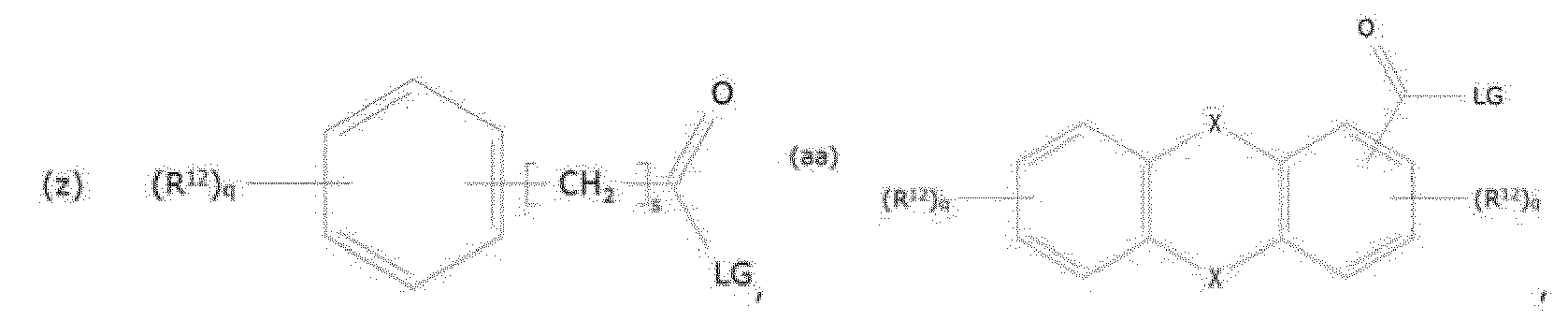
- the acylating agent is selected from one of the following structures (r) through (dd): where LG is a leaving group capable of being displaced in an acylation reaction; each X is independently selected from CH 2 , O, S, and NR, where R is H or aryl, heteroaryl, alkyl, alkaryl, or alkheteroaryl; and each Y is independently selected from CH and N, each R 12 is independently selected from hydrogen, alkyl and aryl; q is an integer from 0 to 5; r is an integer from 0 to 5; and s is an integer from 1 to 10.
- the acylating agent has the following structure (ee): where each of R 5 and R 6 is independently selected from H, C 1 -C 30 alkyl, C 3 -C 8 cycloalkyl, and aryl; LG is leaving group capable of being displaced in an acylation reaction; X is absent or selected from the group consisting of O, S, or NR, where R is H, C 1 -C 30 alkyl, C 3 -C 8 cycloalkyl, alkaryl, or aryl; and R 13 , R 14 , R 15 , R 16 are independently hydrogen and one or more of the pairs R 13 /R 14 and R 15 /R 16 can together form an optionally substituted carbocyclic or heterocyclic ring.
- each of R 5 and R 6 is independently selected from H, C 1 -C 30 alkyl, C 3 -C 8 cycloalkyl, and aryl
- LG is leaving group capable of being displaced in an acylation reaction
- X is absent or selected
- the carbocyclic ring can be aromatic or heteroaromatic.
- Suitable leaving groups (LG) include halogen (e.g., Br, Cl, I), C 1 -C 4 alkoxy (e.g., methoxy, ethoxy) and optionally substituted aryloxy (e.g., phenoxy, p -nitrophenoxy, pentafluorophenoxy).
- the dispersant composition of the present disclosure may be prepared by conventional direct esterification or transesterification methods.
- Typical catalysts are organometallic compounds of various metals such as scandium, zirconium, chromium, iron, nickel, copper, zinc, zirconium, ruthenium, rhodium, palladium, silver, cadmium, indium, tin, hafnium, titanium, osmium, iridium, platinum, gold, and lead.
- organometallic catalysts include dialkyltin dichloride, dialkyltin oxide, dialkyltin diacetate, dialkyltin maleate, tin tetrachloride, tin triflate, tin (II) 2-ethylhexanoate, titanium (IV) isopropoxide, titanium (IV) acetylacetonate, zirconium (IV) isopropoxide, zirconium (IV) tert -butoxide, zirconium (IV) acetylacetonate, zirconium (IV) 2-ethylhexanoate, zirconium (IV) acetate hydroxide, hafnium (IV) isopropoxide, and hafnium (IV) tert -butoxide.
- Suitable conditions include a temperature 100°C to 250°C for a time from 0.5 hours to 24 hours.
- the catalyst concentration may be varied in wide ranges and may be varied as a function of the type of catalyst.
- the catalyst concentration may be from 0.005 to 2.5 wt. %, based on the reaction mixture, alternatively, from 0.01 to 1.0 wt. %, and alternatively, from 0.01 to 0.5 wt. %.
- the charge mole ratio (CMR) of the acylating agent and the post-treated polyalkenyl succinimide can vary over a wide range, for example, from about 0.3:1 to about 3:1 or about 0.5: 1 to about 2.5:1.
- the transesterification may be performed in the presence of a solvent, which may be an aromatic, a hydrocarbon, non-polar or polar solvent. Suitable examples are but not limited to benzene, toluene, xylenes, pentane, hexane, heptane, tetrahydrofuran, dioxane (1,2-dioxane and/or 1,3-dioxane and/or 1,4-dioxane), and the like.
- a solvent which may be an aromatic, a hydrocarbon, non-polar or polar solvent. Suitable examples are but not limited to benzene, toluene, xylenes, pentane, hexane, heptane, tetrahydrofuran, dioxane (1,2-dioxane and/or 1,3-dioxane and/or 1,4-dioxane), and the like.
- An inert gas (e.g., N 2 ) may be passed through the reaction mixture in the reaction zone.
- the amount of gas passed through the reaction mixture may vary significantly but typically is in the range of from 0.5 to 5 volumes of gas per volume of reaction mixture per hour.
- Processes of this disclosure may be carried out in a batch, semi-continuous, or continuous mode.
- the present disclosure provides a lubricating oil composition
- a lubricating oil composition comprising (a) a major amount of an oil of lubricating viscosity and (b) from 0.05 to 15 wt. %, based on the total weight of the lubricating oil composition, of the dispersant composition as described herein.
- the lubricating oil compositions disclosed herein generally comprise at least one oil of lubricating viscosity.
- Any base oil known to a skilled artisan can be used as the oil of lubricating viscosity disclosed herein.
- Some base oils suitable for preparing the lubricating oil compositions have been described by R.M. Mortier et al. ("Chemistry and Technology of Lubricants," 3rd Edition, London, Springer, 2011, Chapters 1 and 2 ), A. Sequeria, Jr. ("Lubricant Base Oil and Wax Processing,” New York, Marcel Decker, 1994, Chapter 6 ), and D.V. Brock (Lubrication Eng., 1987, 43, 184-185 ).
- the amount of the base oil in the lubricating oil composition may be from about 70 to about 99.5 wt.%, based on the total weight of the lubricating oil composition. In some embodiments, the amount of the base oil in the lubricating oil composition is from about 75 to about 99 wt.%, from about 80 to about 98.5 wt.%, or from about 80 to about 98 wt.%, based on the total weight of the lubricating oil composition.
- the base oil is or comprises any natural or synthetic lubricating base oil fraction.
- synthetic oils include oils, such as polyalphaolefins or PAOs, prepared from the polymerization of at least one alpha-olefin, such as ethylene; and oils or from hydrocarbon synthesis procedures using carbon monoxide and hydrogen gases, such as the Fisher-Tropsch process.
- the base oil comprises less than about 10 wt.% of one or more heavy fractions, based on the total weight of the base oil.
- a heavy fraction refers to a lube oil fraction having a kinematic viscosity at 100°C of at least about 20 mm 2 /s.
- the heavy fraction has a kinematic viscosity at 100°C of at least about 25 mm 2 /s or at least about 30 mm 2 /s.
- the amount of the one or more heavy fractions in the base oil is less than about 10 wt. %, less than about 5 wt. %, less than about 2.5 wt. %, less than about 1 wt. %, or less than about 0.1 wt. %, based on the total weight of the base oil.
- the base oil comprises no heavy fraction.
- the lubricating oil compositions comprise a major amount of a base oil of lubricating viscosity.
- the base oil has a kinematic viscosity at 100°C from about 2.5 mm 2 /s to about 20 mm 2 /s.
- the kinematic viscosity of the base oils or the lubricating oil compositions disclosed herein can be measured according to ASTM D445.
- the base oil is or comprises a base stock or blend of base stocks.
- the base stocks are manufactured using a variety of different processes including, but not limited to, distillation, solvent refining, hydrogen processing, oligomerization, esterification, and rerefining.
- the base stocks comprise a rerefined stock.
- the rerefined stock shall be substantially free from materials introduced through manufacturing, contamination, or previous use.
- the base oil comprises one or more of the base stocks in one or more of Groups I-V as specified in the American Petroleum Institute (API) Publication 1509, Seventeenth Edition, September 2012 (i.e., Appendix E-API Base Oil Interchangeability Guidelines for Passenger Car Motor Oils and Diesel Engine Oils).
- the API guideline defines a base stock as a lubricant component that may be manufactured using a variety of different processes.
- Groups I, II and III base stocks are mineral oils, each with specific ranges of the amount of saturates, sulfur content and viscosity index.
- Group IV base stocks are polyalphaolefins (PAO).
- Group V base stocks include all other base stocks not included in Group I, II, III, or IV.
- the base oil comprises one or more of the base stocks in Group I, II, III, IV, V or a combination thereof. In other embodiments, the base oil comprises one or more of the base stocks in Group II, III, IV or a combination thereof.
- the base oil may be selected from the group consisting of natural oils of lubricating viscosity, synthetic oils of lubricating viscosity and mixtures thereof.
- the base oil includes base stocks obtained by isomerization of synthetic wax and slack wax, as well as hydrocrackate base stocks produced by hydrocracking (in addition to or instead of solvent extracting) the aromatic and polar components of the crude.
- the base oil of lubricating viscosity includes natural oils, such as animal oils, vegetable oils, mineral oils, oils derived from coal or shale, and combinations thereof.
- animal oils include bone oil, lanolin, fish oil, lard oil, dolphin oil, seal oil, shark oil, tallow oil, and whale oil.
- Some non-limiting examples of vegetable oils include castor oil, olive oil, peanut oil, rapeseed oil, corn oil, sesame oil, cottonseed oil, soybean oil, sunflower oil, safflower oil, hemp oil, linseed oil, tung oil, oiticica oil, jojoba oil, and meadow foam oil. Such oils may be partially or fully hydrogenated.
- Some non-limiting examples of mineral oils include Groups I, II, and III base stocks, liquid petroleum oils and solvent treated or acid-treated mineral oils of the paraffinic, naphthenic or mixed paraffinic-naphthenic types. In some embodiments, the mineral oils are neat or low viscosity mineral oils.
- the synthetic oils of lubricating viscosity include hydrocarbon oils and halo-substituted hydrocarbon oils such as polymerized and inter-polymerized olefins, alkylbenzenes, polyphenyls, alkylated diphenyl ethers, alkylated diphenyl sulfides, as well as their derivatives, analogues and homologues thereof, and the like.
- the synthetic oils include alkylene oxide polymers, interpolymers, copolymers and derivatives thereof wherein the terminal hydroxyl groups can be modified by esterification, etherification, and the like.
- the synthetic oils include the esters of dicarboxylic acids with a variety of alcohols. In certain embodiments, the synthetic oils include esters made from C 5 to C 12 monocarboxylic acids and polyols and polyol ethers. In further embodiments, the synthetic oils include tri-alkyl phosphate ester oils, such as tri-n-butyl phosphate and triisobutyl phosphate.
- the synthetic oils of lubricating viscosity include silicon-based oils (such as the polyalkyl-, polyaryl-, polyalkoxy-, polyaryloxy-siloxane oils and silicate oils).
- the synthetic oils include liquid esters of phosphorus-containing acids, polymeric tetrahydrofurans, polyalphaolefins, and the like.
- Base oil derived from the hydroisomerization of wax may also be used, either alone or in combination with the aforesaid natural and/or synthetic base oil.
- Such wax isomerate oil is produced by the hydroisomerization of natural or synthetic waxes or mixtures thereof over a hydroisomerization catalyst.
- the base oil comprises a polyalphaolefin (PAO).
- PAO polyalphaolefin
- the polyalphaolefins may be derived from an alpha-olefin having from 2 to about 30, from about 4 to about 20, or from about 6 to about 16 carbon atoms.
- suitable polyalphaolefins include those derived from octene, decene, mixtures thereof, and the like.
- These polyalphaolefins may have a kinematic viscosity at 100°C of from about 2 to about 15 mm 2 /s, from about 3 to about 12 mm 2 /s, or from about 4 to about 8 mm 2 /s.
- the polyalphaolefins may be used together with other base oils such as mineral oils.
- the base oil comprises a polyalkylene glycol or a polyalkylene glycol derivative, where the terminal hydroxyl groups of the polyalkylene glycol may be modified by esterification, etherification, acetylation and the like.
- suitable polyalkylene glycols include polyethylene glycol, polypropylene glycol, polyisopropylene glycol, and combinations thereof.
- Non-limiting examples of suitable polyalkylene glycol derivatives include ethers of polyalkylene glycols (e.g., methyl ether of polyisopropylene glycol, diphenyl ether of polyethylene glycol, diethyl ether of polypropylene glycol, etc.), mono- and polycarboxylic esters of polyalkylene glycols, and combinations thereof.
- the polyalkylene glycol or polyalkylene glycol derivative may be used together with other base oils such as poly-alpha-olefins and mineral oils.
- the base oil comprises any of the esters of dicarboxylic acids (e.g., phthalic acid, succinic acid, alkyl succinic acids, alkenyl succinic acids, maleic acid, azelaic acid, suberic acid, sebacic acid, fumaric acid, adipic acid, linoleic acid dimer, malonic acid, alkyl malonic acids, alkenyl malonic acids, and the like) with a variety of alcohols (e.g., butyl alcohol, hexyl alcohol, dodecyl alcohol, 2-ethylhexyl alcohol, ethylene glycol, diethylene glycol monoether, propylene glycol, and the like).
- dicarboxylic acids e.g., phthalic acid, succinic acid, alkyl succinic acids, alkenyl succinic acids, maleic acid, azelaic acid, suberic acid, sebacic acid, fumaric acid, adipic acid, l
- Non-limiting examples of these esters include dibutyl adipate, di(2-ethylhexyl) sebacate, di-n-hexyl fumarate, dioctyl sebacate, diisooctyl azelate, diisodecyl azelate, dioctyl phthalate, didecyl phthalate, dieicosyl sebacate, the 2-ethylhexyl diester of linoleic acid dimer, and the like.
- the base oil comprises a hydrocarbon prepared by the Fischer-Tropsch process.
- the Fischer-Tropsch process prepares hydrocarbons from gases containing hydrogen and carbon monoxide using a Fischer-Tropsch catalyst. These hydrocarbons may require further processing in order to be useful as base oils.
- the hydrocarbons may be dewaxed, hydroisomerized, and/or hydrocracked using processes known to a person of ordinary skill in the art.
- the base oil comprises an unrefined oil, a refined oil, a rerefined oil, or a mixture thereof.
- Unrefined oils are those obtained directly from a natural or synthetic source without further purification treatment.
- Non-limiting examples of unrefined oils include shale oils obtained directly from retorting operations, petroleum oils obtained directly from primary distillation, and ester oils obtained directly from an esterification process and used without further treatment.
- Refined oils are similar to the unrefined oils except the former have been further treated by one or more purification processes to improve one or more properties. Many such purification processes are known to those skilled in the art such as solvent extraction, secondary distillation, acid or base extraction, filtration, percolation, and the like.
- Rerefined oils are obtained by applying to refined oils processes similar to those used to obtain refined oils.
- Such rerefined oils are also known as reclaimed or reprocessed oils and often are additionally treated by processes directed to removal of spent additives and oil breakdown products.
- the lubricating oil compositions of the present disclosure may also contain other conventional additives that can impart or improve any desirable property of the lubricating oil composition in which these additives are dispersed or dissolved.
- Any additive known to one skilled in the art may be used in the lubricating oil compositions disclosed herein.
- Some suitable additives have been described by R.M. Mortier et al. ("Chemistry and Technology of Lubricants", 2nd Edition, London, Springer, 1996 ) and L.R. Rudnick (“Lubricant Additives: Chemistry and Applications", New York, Marcel Dekker, 2003 ).
- the lubricating oil compositions can be blended with antioxidants, anti-wear agents, detergents such as metal detergents, rust inhibitors, dehazing agents, demulsifying agents, metal deactivating agents, friction modifiers, pour point depressants, antifoaming agents, co-solvents, corrosion-inhibitors, ashless dispersants, dyes, extreme pressure agents and the like and mixtures thereof.
- antioxidants such as metal detergents, rust inhibitors, dehazing agents, demulsifying agents, metal deactivating agents, friction modifiers, pour point depressants, antifoaming agents, co-solvents, corrosion-inhibitors, ashless dispersants, dyes, extreme pressure agents and the like and mixtures thereof.
- detergents such as metal detergents, rust inhibitors, dehazing agents, demulsifying agents, metal deactivating agents, friction modifiers, pour point depressants, antifoaming agents, co-solvents, corrosion-inhibitors, ashless dispersants, dyes, extreme
- the lubricating oil compositions can contain one or more additional ashless dispersants containing one or more basic nitrogen atoms.
- the basic nitrogen compound for use herein must contain basic nitrogen as measured, for example, by ASTM D2896 or other equivalent method.
- the basic nitrogen compounds are selected from the group consisting of succinimides, polysuccinimides, carboxylic acid amides, hydrocarbyl monoamines, hydrocarbon polyamines, Mannich bases, phosphoramides, thiophosphoramides, phosphonamides, dispersant viscosity index improvers, and mixtures thereof. These basic nitrogen-containing compounds are described below (keeping in mind the reservation that each must have at least one basic nitrogen). Any of the nitrogen-containing compositions may be post-treated with, e.g., boron or ethylene carbonate, using procedures well known in the art so long as the compositions continue to contain basic nitrogen.
- VI improvers dispersant viscosity index improvers
- hydrocarbon polymer especially a polymer derived from ethylene and/or propylene, optionally containing additional units derived from one or more co-monomers such as alicyclic or aliphatic olefins or diolefins.
- the functionalization may be carried out by a variety of processes which introduce a reactive site or sites which usually has at least one oxygen atom on the polymer.
- the polymer is then contacted with a nitrogen-containing source to introduce nitrogen-containing functional groups on the polymer backbone.
- Commonly used nitrogen sources include any basic nitrogen compound especially those nitrogen-containing compounds and compositions described herein.
- Preferred nitrogen sources are alkylene amines, such as ethylene amines, alkyl amines, and Mannich bases.
- the basic nitrogen compounds for use in making the dispersants are succinimides, carboxylic acid amides, and Mannich bases.
- the basic nitrogen compounds for use in making the dispersants are succinimides having an average molecular weight of about 1000 or about 1300 or about 2300 and mixtures thereof. Such succinimides can be post treated with boron or ethylene carbonate as known in the art.
- the lubricating oil composition of the can contain one or more antioxidants that can reduce or prevent the oxidation of the base oil.
- Any antioxidant known by a person of ordinary skill in the art may be used in the lubricating oil composition.
- suitable antioxidants include amine-based antioxidants (e.g., alkyl diphenylamines such as bis-nonylated diphenylamine, bis-octylated diphenylamine, and octylated/butylated diphenylamine, phenyl- ⁇ -naphthylamine, alkyl or arylalkyl substituted phenyl- ⁇ -naphthylamine, alkylated p -phenylene diamines, tetramethyl-diaminodiphenylamine and the like), phenolic antioxidants (e.g., 2- tert -butylphenol, 4-methyl-2,6-di- tert -butylphenol, 2,4,
- the lubricating oil composition of the present disclosure can contain a detergent.
- Metal-containing or ash-forming detergents function as both detergents to reduce or remove deposits and as acid neutralizers or rust inhibitors, thereby reducing wear and corrosion and extending engine life.
- Detergents generally comprise a polar head with a long hydrophobic tail.
- the polar head comprises a metal salt of an acidic organic compound.
- the salts may contain a substantially stoichiometric amount of the metal in which case they are usually described as normal or neutral salts.
- a large amount of a metal base may be incorporated by reacting excess metal compound (e.g., an oxide or hydroxide) with an acidic gas (e.g., carbon dioxide).
- Detergents that may be used include oil-soluble neutral and overbased sulfonates, borated sulfonates, phenates, sulfurized phenates, thiophosphonates, salicylates, and naphthenates and other oil-soluble carboxylates of a metal, particularly the alkali or alkaline earth metals, e.g., barium, sodium, potassium, lithium, calcium, and magnesium.
- a metal particularly the alkali or alkaline earth metals, e.g., barium, sodium, potassium, lithium, calcium, and magnesium.
- the most commonly used metals are calcium and magnesium, which may both be present in detergents used in a lubricant, and mixtures of calcium and/or magnesium with sodium.
- the lubricating oil composition of the present disclosure can contain friction modifiers that can lower the friction between moving parts. Any friction modifier known by a person of ordinary skill in the art may be used in the lubricating oil composition.
- suitable friction modifiers include fatty carboxylic acids; derivatives (e.g., alcohol, esters, borated esters, amides, metal salts and the like) of fatty carboxylic acid; mono-, di- or tri-alkyl substituted phosphoric acids or phosphonic acids; derivatives (e.g., esters, amides, metal salts and the like) of mono-, di- or tri-alkyl substituted phosphoric acids or phosphonic acids; mono-, di- or tri-alkyl substituted amines; mono- or di-alkyl substituted amides and combinations thereof.
- examples of friction modifiers include, but are not limited to, alkoxylated fatty amines; borated fatty epoxides; fatty phosphites, fatty epoxides, fatty amines, borated alkoxylated fatty amines, metal salts of fatty acids, fatty acid amides, glycerol esters, borated glycerol esters; and fatty imidazolines as disclosed in U.S. Patent No.
- friction modifiers obtained from a reaction product of a C 4 to C 75 , or a Ce to C 24 , or a C 6 to C 20 , fatty acid ester and a nitrogen-containing compound selected from the group consisting of ammonia, and an alkanolamine and the like and mixtures thereof.
- the lubricating oil composition of the present disclosure can contain one or more anti-wear agents that can reduce friction and excessive wear.
- Any anti-wear agent known by a person of ordinary skill in the art may be used in the lubricating oil composition.
- suitable anti-wear agents include zinc dithiophosphates, metal (e.g., Pb, Sb, Mo and the like) salts of dithiophosphates, metal (e.g., Zn, Pb, Sb, Mo and the like) salts of dithiocarbamates, metal (e.g., Zn, Pb, Sb and the like) salts of fatty acids, boron compounds, phosphate esters, phosphite esters, amine salts of phosphoric acid esters or thiophosphoric acid esters, reaction products of dicyclopentadiene and thiophosphoric acids and combinations thereof.
- the anti-wear agent is or comprises a dihydrocarbyl dithiophosphate metal salt, such as zinc dialkyl dithiophosphate compounds.
- the metal of the dihydrocarbyl dithiophosphate metal salt may be an alkali or alkaline earth metal, or aluminum, lead, tin, molybdenum, manganese, nickel or copper. In some embodiments, the metal is zinc.
- the alkyl group of the dihydrocarbyl dithiophosphate metal salt has from about 3 to about 22 carbon atoms, from about 3 to about 18 carbon atoms, from about 3 to about 12 carbon atoms, or from about 3 to about 8 carbon atoms.
- the alkyl group may be linear or branched.
- the lubricating oil composition of the present disclosure can contain one or more foam inhibitors or anti-foam inhibitors that can break up foams in oils. Any foam inhibitor or anti-foam known by a person of ordinary skill in the art may be used in the lubricating oil composition.
- suitable foam inhibitors or anti-foam inhibitors include silicone oils or polydimethylsiloxanes, fluorosilicones, alkoxylated aliphatic acids, polyethers (e.g., polyethylene glycols), branched polyvinyl ethers, alkyl acrylate polymers, alkyl methacrylate polymers, polyalkoxyamines and combinations thereof.
- the foam inhibitors or anti-foam inhibitors comprises glycerol monostearate, polyglycol palmitate, a trialkyl monothiophosphate, an ester of sulfonated ricinoleic acid, benzoylacetone, methyl salicylate, glycerol monooleate, or glycerol dioleate.
- the lubricating oil composition of the present disclosure can contain one or more pour point depressants that can lower the pour point of the lubricating oil composition.
- Any pour point depressant known by a person of ordinary skill in the art may be used in the lubricating oil composition.
- suitable pour point depressants include polymethacrylates, alkyl acrylate polymers, alkyl methacrylate polymers, di(tetra-paraffin phenol)phthalate, condensates of tetra-paraffin phenol, condensates of a chlorinated paraffin with naphthalene and combinations thereof.
- the pour point depressant comprises an ethylene-vinyl acetate copolymer, a condensate of chlorinated paraffin and phenol, polyalkyl styrene or the like.
- the lubricating oil composition of the present disclosure can contain one or more demulsifiers that can promote oil-water separation in lubricating oil compositions that are exposed to water or steam. Any demulsifier known by a person of ordinary skill in the art may be used in the lubricating oil composition.
- demulsifiers include anionic surfactants (e.g., alkylnaphthalene sulfonates, alkyl benzene sulfonates and the like), nonionic alkoxylated alkyl phenol resins, polymers of alkylene oxides (e.g., polyethylene oxide, polypropylene oxide, block copolymers of ethylene oxide, propylene oxide and the like), esters of oil soluble acids, polyoxyethylene sorbitan ester and combinations thereof.
- anionic surfactants e.g., alkylnaphthalene sulfonates, alkyl benzene sulfonates and the like
- nonionic alkoxylated alkyl phenol resins e.g., polymers of alkylene oxides (e.g., polyethylene oxide, polypropylene oxide, block copolymers of ethylene oxide, propylene oxide and the like), esters of oil soluble acids, polyoxyethylene sorbitan ester
- the lubricating oil composition of the present disclosure can contain one or more corrosion inhibitors that can reduce corrosion. Any corrosion inhibitor known by a person of ordinary skill in the art may be used in the lubricating oil composition. Non-limiting examples of suitable corrosion inhibitor include half esters or amides of dodecylsuccinic acid, phosphate esters, thiophosphates, alkyl imidazolines, sarcosines and combinations thereof.
- the lubricating oil composition of the present disclosure can contain one or more extreme pressure (EP) agents that can prevent sliding metal surfaces from seizing under conditions of extreme pressure.
- EP extreme pressure
- Any extreme pressure agent known by a person of ordinary skill in the art may be used in the lubricating oil composition.
- the extreme pressure agent is a compound that can combine chemically with a metal to form a surface film that prevents the welding of asperities in opposing metal surfaces under high loads.
- Non-limiting examples of suitable extreme pressure agents include sulfurized animal or vegetable fats or oils, sulfurized animal or vegetable fatty acid esters, fully or partially esterified esters of trivalent or pentavalent acids of phosphorus, sulfurized olefins, dihydrocarbyl polysulfides, sulfurized Diels-Alder adducts, sulfurized dicyclopentadiene, sulfurized or co-sulfurized mixtures of fatty acid esters and monounsaturated olefins, co-sulfurized blends of fatty acid, fatty acid ester and alpha-olefin, functionally-substituted dihydrocarbyl polysulfides, thia-aldehydes, thia-ketones, epithio compounds, sulfur-containing acetal derivatives, co-sulfurized blends of terpene and acyclic olefins, and polysulfide olefin products, amine salts of phosphoric
- the lubricating oil composition of the present disclosure can contain one or more rust inhibitors that can inhibit the corrosion of ferrous metal surfaces. Any rust inhibitor known by a person of ordinary skill in the art may be used in the lubricating oil composition.
- suitable rust inhibitors include nonionic polyoxyalkylene agents, e.g., polyoxyethylene lauryl ether, polyoxyethylene higher alcohol ether, polyoxyethylene nonylphenyl ether, polyoxyethylene octylphenyl ether, polyoxyethylene octyl stearyl ether, polyoxyethylene oleyl ether, polyoxyethylene sorbitol monostearate, polyoxyethylene sorbitol monooleate, and polyethylene glycol monooleate; stearic acid and other fatty acids; dicarboxylic acids; metal soaps; fatty acid amine salts; metal salts of heavy sulfonic acid; partial carboxylic acid ester of polyhydric alcohol; phosphoric esters; (short
- the lubricating oil composition of the present disclosure can contain one or more multifunctional additives.
- suitable multifunctional additives include sulfurized oxymolybdenum dithiocarbamate, sulfurized oxymolybdenum organophosphorodithioate, oxymolybdenum monoglyceride, oxymolybdenum diethylate amide, amine-molybdenum complex compound, and sulfur-containing molybdenum complex compound.
- the lubricating oil composition of the present disclosure can contain one or more viscosity index improvers.
- suitable viscosity index improvers include, but are not limited to, olefin copolymers, such as ethylenepropylene copolymers, styrene-isoprene copolymers, hydrated styrene-isoprene copolymers, polybutene, polyisobutylene, polymethacrylates, vinylpyrrolidone and methacrylate copolymers and dispersant type viscosity index improvers.
- olefin copolymers such as ethylenepropylene copolymers, styrene-isoprene copolymers, hydrated styrene-isoprene copolymers, polybutene, polyisobutylene, polymethacrylates, vinylpyrrolidone and methacrylate copolymers and dispersant type viscosity index improvers
- viscosity modifiers can optionally be grafted with grafting materials such as, for example, maleic anhydride, and the grafted material can be reacted with, for example, amines, amides, nitrogen-containing heterocyclic compounds or alcohol, to form multifunctional viscosity modifiers (dispersant-viscosity modifiers).
- grafting materials such as, for example, maleic anhydride
- Other examples of viscosity modifiers include star polymers (e.g., a star polymer comprising isoprene/styrene/isoprene triblock).
- viscosity modifiers include poly alkyl(meth)acrylates of low Brookfield viscosity and high shear stability, functionalized poly alkyl(meth)acrylates with dispersant properties of high Brookfield viscosity and high shear stability, polyisobutylene having a weight average molecular weight ranging from 700 to 2,500 Daltons and mixtures thereof.
- the lubricating oil composition of the present disclosure can contain one or more metal deactivators.
- suitable metal deactivators include disalicylidene propylenediamine, triazole derivatives, thiadiazole derivatives, and mercaptobenzimidazoles.
- each of the foregoing additives when used, is used at a functionally effective amount to impart the desired properties to the lubricant.
- a functionally effective amount of this friction modifier would be an amount sufficient to impart the desired friction modifying characteristics to the lubricant.
- the concentration of each of these additives, when used may range, unless otherwise specified, from about 0.001 wt.% to about 10 wt.%, in one embodiment from about 0.005 wt.% to about 5 wt.%, or in one embodiment from about 0.1 wt.% to about 2.5 wt.%, based on the total weight of the lubricating oil composition.
- the total amount of the additives in the lubricating oil composition may range from about 0.001 wt.% to about 20 wt.%, from about 0.01 wt.% to about 10 wt.%, or from about 0.1 wt.% to about 5 wt.%, based on the total weight of the lubricating oil composition.
- the dispersant composition described herein may be provided as an additive package or concentrate in which the dispersant composition is incorporated into a substantially inert, normally liquid organic diluent such as mineral oil to form an additive concentrate.
- a substantially inert, normally liquid organic diluent such as mineral oil to form an additive concentrate.
- a neutral oil having a kinematic viscosity of 4 to 8.5 mm 2 /s at 100°C e.g., 4 to 6 mm 2 /s at 100°C
- synthetic oils, as well as other organic liquids which are compatible with the additive and finished lubricating oil can also be used.
- the concentrates contain sufficient diluent to make them easy to handle during shipping and storage.
- These concentrates usually include from 80 to 20 wt. % of an organic liquid diluent and from 20 to 80 wt.% of the dispersant composition described herein.
- N- ethylaniline 25 g, 0.21 mol
- methyl acrylate 26.6g, 0.31 mol
- aluminum chloride on silica 9.25 g, 15.45 mmol, 1.67 mmol/g.
- the reaction mixture was then heated to 80°C for 12 hours using a pre-heated aluminum tray equipped with a thermocouple under nitrogen.
- the reaction mixture was diluted with 5% ethyl acetate:hexanes passed through a pad of silica (4" ⁇ 0.5") and concentrated under reduced pressure to afford an orange oil (30 g, 70% yield).
- N-phenyl-1,4-phenylenediamine 36.8 g, 0.2 mol
- methyl acrylate 34.4 g, 0.4 mol
- the resulting reaction mixture stirred for 5 minutes whereupon silica-supported aluminum chloride silica (9 g, 15 mmol, 1.67 mmol/g) was added.
- the reaction mixture was then heated to 80°C for 6 hours using a pre-heated aluminum tray equipped with a thermocouple under nitrogen.
- the reaction mixture was then diluted with ethyl acetate, filtered and the mother liquor collected, washed with water, brine, dried (Na 2 SO 4 ), filtered and concentrated under reduced pressure to afford a dark oil (50 g, 92 % yield) which slowly crystallized upon standing.
- the product contained approximately 33% 3-(4-phenylamino-phenylamino) dipropanoic acid dimethyl ester; alt. name: dimethyl 3,3'-(4-phenylamino phenyl)azanediyl)dipropanoate.
- trans- methyl crotonate 34.5 g, 0.34 mol
- morpholine 20 g, 0.23 mol
- the reaction mixture was allowed to stir at room temperature for 10 minutes, then heated to 80°C using an aluminum tray equipped with a thermocouple under nitrogen for 6 hours.
- the reaction mixture was then cooled to room temperature. Volatiles were then removed under reduced pressure to afford a light yellow viscous oil (16.8 g, 39% yield).
- reaction mixture was allowed to cool to room temperature, diluted with ethyl acetate, filtered thru a silica pad (4" ⁇ 0.75") eluted with additional ethyl acetate. Solution concentrated under reduced pressure to afford a purple oil (14.66 g, 85% yield).
- This dispersant was prepared by transesterification as described in Example 15 using 1 H -indole-1-propanoic acid, 2,3-dihydro-, methyl ester, prepared by a scaled-up method of that described in Example 9.
- This dispersant was prepared by transesterification as described in Example 16 using 1 H -indole-1-propanoic acid, 2,3-dihydro-, methyl ester, prepared by a scaled-up method of that described in Example 9.
- This dispersant was prepared by trans-esterification as described in Example 17 using 1 H -indole-1-propanoic acid, 2,3-dihydro-, methyl ester, prepared by a scaled-up method of that described in Example 9.
- This dispersant was prepared by trans-esterification as described in Example 16 using 3-(phenylamino)propanoic acid methyl ester, prepared by a scaled-up method of that described in Example 1.
- This dispersant was prepared by transesterification as described in Example 16 using methyl 3-(ethylanilino) acid methyl ester prepared by a scaled-up method of that described in Example 2.
- This dispersant was prepared by transesterification as described in Example 16 using 3-(4-phenylamino-phenylamino)propanoic acid methyl ester prepared by a scaled-up method of that described in Example 3.
- This dispersant was prepared by transesterification as described in Example 16 using 1-piperazinepropanoic acid 4-phenyl-methyl ester prepared by a scaled-up method of that described in Example 4.
- This dispersant was prepared by transesterification as described in Example 16 using 4-morpholinepropanoic acid methyl ester prepared by a scaled-up method of that described in Example 6.
- This dispersant was prepared by transesterification as described in Example 16 using methyl 2-methyl-3-morpholinopropanoate prepared by a scaled-up method of that described in Example 7.
- This dispersant was prepared by transesterification as described in Example 16 using methyl methyl 3-morpholinobutanoate prepared by a scaled-up method of that described in Example 8.
- This dispersant was prepared by transesterification following procedure described in Example 16 using 3-(10 H -phenothiazin-10-yl)propionic acid methyl ester prepared by a scaled-up method of that described in Example 11.
- This dispersant was prepared by transesterification following procedure described in Example 16 using 1 H -imidazole-1-propanoic acid methyl ester prepared by a scaled-up method of that described in Example 12.
- This dispersant was prepared by transesterification following procedure described in Example 16 using 1 H -benzimidazole-1-propanoic acid methyl ester prepared by a scaled-up method of that described in Example 13.
- This dispersant was prepared by transesterification following procedure described in Example 16 using methyl nicotinate.
- This dispersant was prepared by transesterification following procedure described in Example 16 using methyl quinoline-2-carboxylate.
- This dispersant was prepared by transesterification following procedure described in Example 16 using methyl 2-pyrazinecarboxylate.
- This dispersant was prepared by transesterification following procedure described in Example 16 using methyl indole-2-carboxylate.
- the reactor agitator was started and titanium isopropoxide (1.62 g, 0.006 gmol) then was added to the reaction mixture via syringe.
- the reaction mixture was heated to 150°C for 6 hours.
- the reaction mixture was then cooled to room temperature.
- the reactor agitator was started and titanium isopropoxide (4.42 g, 0.018 gmol) then was added to the reaction mixture via syringe.
- the reaction mixture was heated to 150°C for 12 hours.
- the reaction mixture was then cooled to room temperature.
- the reactor agitator was started and titanium isopropoxide (2.01 g, 0.007 gmol) then was added to the reaction mixture via syringe.
- the reaction mixture was heated to 150°C for 4 hours.
- the reaction mixture was then cooled to room temperature.
- the reactor agitator was started and titanium isopropoxide (6.00 g, 0.021 gmol) then was added to the reaction mixture via syringe.
- the reaction mixture was heated to 150°C for 14 hours.
- the reaction mixture was then cooled to room temperature.
- a baseline lubricating oil composition was prepared which contained conventional amounts of an oxidation inhibitor package, a calcium-based detergent package containing a phenate and sulfonates, zinc dithiophosphate, viscosity index improver, pour point depressant, foam inhibitor and the balance lube oil.
- a lubricating oil composition was prepared by adding approximately 6 wt.% of an ethylene carbonate post-treated 2300 MW PIB succinimide to Formulation Baseline A.
- HTCBT High Temperature Corrosion Bench Test
- the lubricating oil compositions using Baseline Formulation A comprising 6wt.% dispersants of inventive Examples 16, 20, 22-26, 28, 32, 34-35, 38 and Comparative Example A were tested in the high temperature corrosion bench test (HTCBT), according to ASTM D6594, to determine ability of lubricating oil formulations to corrode various metals, specifically alloys of lead and copper commonly used in cam followers and bearings.
- HTCBT high temperature corrosion bench test
- ASTM D6594 high temperature corrosion bench test
- the lubricating oil compositions using Baseline Formulation A comprising 6, 4 or 2 wt.% dispersants of the present disclosure and Comparative Example A were evaluated for dynamic viscosity using a soot test which measures the ability of the formulation to disperse and control viscosity increase resulting from the addition of carbon black, a soot surrogate.
- a soot test which measures the ability of the formulation to disperse and control viscosity increase resulting from the addition of carbon black, a soot surrogate.
- glass tubes were charged with 40 g of lubricating oil and affixed to a condenser. Each oil was heated at 200°C with 115 mL/min of air flow bubbling through the oil for 8 hours. Then, 0.5 g of VULCAN ® XC72R carbon black (Cabot Corporation) was added to 12 g of each oxidized oil.
- the resulting mixture was heated in a 60°C oven for 16 hours. After removal from the oven, the mixture was stirred for 1 minute and then homogenized using a paint shaker for 30 minutes or using a Resodyn LabRAM II acoustic mixer for 4 minutes to completely disperse the carbon black. The mixture was then heated in a vacuum oven (full vacuum, ⁇ 25 mm Hg) at 100°C for 30 minutes. The mixture was removed from the vacuum oven and stirred using a vortex mixer for 30 seconds just prior to measuring viscosity.
- Baseline Formulation A comprising dispersants in Examples 15-23 showed similar or improved soot handling performance for treat rates of dispersant reduced to 4 or 2 wt.% demonstrating increased potency of these dispersants in reducing soot-induced viscosity.
Landscapes
- Chemical & Material Sciences (AREA)
- Chemical Kinetics & Catalysis (AREA)
- Organic Chemistry (AREA)
- General Chemical & Material Sciences (AREA)
- Oil, Petroleum & Natural Gas (AREA)
- Health & Medical Sciences (AREA)
- Medicinal Chemistry (AREA)
- Polymers & Plastics (AREA)
- Lubricants (AREA)
- Emulsifying, Dispersing, Foam-Producing Or Wetting Agents (AREA)
- Pyrrole Compounds (AREA)
Claims (15)
- Öllösliche oder -dispergierbare Dispergiermittelzusammensetzung, umfassend das Reaktionsprodukt von:(i) einem Polyalkenylsuccinimid, nachbehandelt mit einem Nachbehandlungsmittel ausgewählt aus der Gruppe bestehend aus einem organischen Carbonat, einem Epoxid, einem Lacton, einer hydroxyaliphatischen Carbonsäure und Kombinationen davon; und(ii) einem Acylierungsmittel ausgewählt aus einer der folgenden Strukturen (a) und (b):wobei:
 LG eine Abgangsgruppe ist, die fähig ist, bei einer Acylierungsgruppe abgelöst zu werden;jedes von R1 und R2 unabhängig ausgewählt ist aus Wasserstoff, Alkyl und Aryl;n von 1 bis 28 beträgt;Ⓐ eine Amineinheit ist; undⒷ eine aromatische, heteroaromatische, Alkaryl- oder Alkheteroaryleinheit mit von 4 bis 20 Kohlenstoffatomen ist.
 - Dispergiermittelzusammensetzung gemäß Anspruch 1, wobei der Polyalkenylsubstituent des Polyalkenylsuccinimids ein anzahlgemitteltes Molekulargewicht von 1000 bis 2500 aufweist.
- Dispergiermittelzusammensetzung gemäß Anspruch 1, wobei das Polyalkenylsuccinimid ein Polyisobutenylsuccinimid ist.
- Dispergiermittelzusammensetzung gemäß Anspruch 1, wobei das organische Carbonat eines oder mehrere von Ethylencarbonat, Propylencarbonat, Butylencarbonat und Glycerincarbonat umfasst.
- Dispergiermittelzusammensetzung gemäß Anspruch 1, wobei das Epoxid eines oder mehrere von Ethylenoxid, Propylenoxid, Butylenoxid, Styroloxid und Glycidol umfasst.
- Dispergiermittelzusammensetzung gemäß Anspruch 1, wobei das Lacton eines oder mehrere von β-Propiolacton, γ-Butyrolacton, δ-Valerolacton, γ-Valerolacton, ε-Caprolacton und δ-Caprolacton umfasst.
- Dispergiermittelzusammensetzung gemäß Anspruch 1, wobei die hydroxyaliphatische Carbonsäure eine oder mehrere von Glycolsäure, Milchsäure, 3-Hydroxypropionsäure und 2,2-Bis(hydroxymethyl)propionsäure umfasst.
- Dispergiermittelzusammensetzung gemäß Anspruch 1, wobei das Acylierungsmittel die folgende Struktur (f) aufweist:

- Dispergiermittelzusammensetzung gemäß Anspruch 8, wobei das Acylierungsmittel aus den folgenden Strukturen (g) bis (q) ausgewählt ist:


- Dispergiermittelzusammensetzung gemäß Anspruch 8, wobei das Acylierungsmittel aus den folgenden Strukturen (r) bis (dd) ausgewählt ist:




- Schmierölzusammensetzung, umfassend (a) eine Hauptmenge an einem Öl mit schmierender Viskosität und (b) von 0,05 bis 15 Gew.-%, bezogen auf das Gesamtgewicht der Schmierölzusammensetzung, an der Dispergiermittelzusammensetzung gemäß Anspruch 1.
- Schmierölzusammensetzung gemäß Anspruch 11, ferner umfassend wenigstens einen Zusatzstoff ausgewählt aus der Gruppe bestehend aus Demulgatoren, Detergenzien, Dispergiermitteln, Extremdruckmitteln, Schaumhemmern, Reibungsmodifikatoren, Multifunktionszusatzstoffen, Oxidationshemmern, Pourpoint-Senkern, Rosthemmern, Verschleißhemmern und Kombinationen davon.
- Schmierölzusatzstoffkonzentrat, umfassend von 80 bis 20 Gew.-% an einem organischen flüssigen Verdünnungsmittel und von 20 bis 80 Gew.-% an der Dispergiermittelzusammensetzung gemäß Anspruch 1.
- Verfahren zum Beherrschen von rußinduzierter Viskositätszunahme in einem mit einem Schmieröl geschmierten Motor mit Kompressionszündung durch die Verwendung der Schmierölzusammensetzung gemäß Anspruch 11 als das Schmieröl.
- Verfahren zum Verbessern der Bleikorrosionsleistung in einem mit einem Schmieröl geschmierten Motor mit Kompressionszündung durch die Verwendung der Schmierölzusammensetzung gemäß Anspruch 11 als das Schmieröl, wobei das Schmieröl eines ist, von dem bestimmt worden ist, dass es ohne Vorhandensein der Dispergiermittelzusammensetzung nach dem "High Temperature Corrosion Bench Test" ASTM D6594 gegenüber Blei korrosiv ist.
Applications Claiming Priority (2)
| Application Number | Priority Date | Filing Date | Title |
|---|---|---|---|
| US201762508559P | 2017-05-19 | 2017-05-19 | |
| PCT/IB2018/053513 WO2018211466A1 (en) | 2017-05-19 | 2018-05-18 | Dispersants, method of making, and using same |
Publications (2)
| Publication Number | Publication Date |
|---|---|
| EP3625316A1 EP3625316A1 (de) | 2020-03-25 |
| EP3625316B1 true EP3625316B1 (de) | 2023-08-23 |
Family
ID=62778949
Family Applications (1)
| Application Number | Title | Priority Date | Filing Date |
|---|---|---|---|
| EP18734937.8A Active EP3625316B1 (de) | 2017-05-19 | 2018-05-18 | Dispergiermittel, verfahren zur herstellung und verwendung davon |
Country Status (7)
| Country | Link |
|---|---|
| US (1) | US10815446B2 (de) |
| EP (1) | EP3625316B1 (de) |
| JP (1) | JP6848093B2 (de) |
| CN (1) | CN110621766B (de) |
| CA (1) | CA3061706C (de) |
| SG (1) | SG11201909078YA (de) |
| WO (1) | WO2018211466A1 (de) |
Families Citing this family (2)
| Publication number | Priority date | Publication date | Assignee | Title |
|---|---|---|---|---|
| US10947473B2 (en) | 2019-05-17 | 2021-03-16 | Vanderbilt Chemicals, Llc | Less corrosive organic compounds as lubricant additives |
| US20250109349A1 (en) | 2023-07-20 | 2025-04-03 | Infineum International Limited | Flat Oil Viscosity Lubricant Compositions |
Family Cites Families (55)
| Publication number | Priority date | Publication date | Assignee | Title |
|---|---|---|---|---|
| US3100673A (en) | 1963-08-13 | Dyeings and prints possessing fastness | ||
| US2992708A (en) | 1954-01-14 | 1961-07-18 | Lyon George Albert | Air circulating wheel structure |
| BR6024181D0 (pt) * | 1959-01-16 | 1973-06-28 | Geigy Ag J R | Processo de produzir novos compostos n-heterociclicos |
| DE1248643B (de) | 1959-03-30 | 1967-08-31 | The Lubrizol Corporation, Cleveland, Ohio (V. St. A.) | Verfahren zur Herstellung von öllöslichen aeylierten Aminen |
| NL255194A (de) | 1959-08-24 | |||
| NL255193A (de) | 1959-08-24 | |||
| GB1053340A (de) | 1963-10-14 | 1900-01-01 | ||
| GB1053577A (de) | 1963-11-01 | |||
| US3272746A (en) | 1965-11-22 | 1966-09-13 | Lubrizol Corp | Lubricating composition containing an acylated nitrogen compound |
| US4482464A (en) | 1983-02-14 | 1984-11-13 | Texaco Inc. | Hydrocarbyl-substituted mono- and bis-succinimide having polyamine chain linked hydroxyacyl radicals and mineral oil compositions containing same |
| US4521318A (en) | 1983-11-14 | 1985-06-04 | Texaco Inc. | Lubricant compositions containing both hydrocarbyl substituted mono and bissuccinimide having polyamine chain linked hydroxacyl radicals, and neopentyl derivative |
| US4612132A (en) * | 1984-07-20 | 1986-09-16 | Chevron Research Company | Modified succinimides |
| US4617137A (en) | 1984-11-21 | 1986-10-14 | Chevron Research Company | Glycidol modified succinimides |
| US4645515A (en) | 1985-04-12 | 1987-02-24 | Chevron Research Company | Modified succinimides (II) |
| US4617138A (en) | 1985-04-12 | 1986-10-14 | Chevron Research Company | Modified succinimides (II) |
| JPH086110B2 (ja) * | 1985-11-04 | 1996-01-24 | テキサコ・デベロツプメント・コ−ポレ−シヨン | 潤滑油組成物用分散剤、その製造方法及びそれを含む組成物 |
| US4663064A (en) | 1986-03-28 | 1987-05-05 | Texaco Inc. | Dibaisic acid lubricating oil dispersant and viton seal additives |
| US4713189A (en) | 1986-08-20 | 1987-12-15 | Texaco, Inc. | Precoupled mono-succinimide lubricating oil dispersants and viton seal additives |
| US4963275A (en) * | 1986-10-07 | 1990-10-16 | Exxon Chemical Patents Inc. | Dispersant additives derived from lactone modified amido-amine adducts |
| US4971711A (en) | 1987-07-24 | 1990-11-20 | Exxon Chemical Patents, Inc. | Lactone-modified, mannich base dispersant additives useful in oleaginous compositions |
| US5026495A (en) | 1987-11-19 | 1991-06-25 | Exxon Chemical Patents Inc. | Oil soluble dispersant additives useful in oleaginous compositions |
| CA2008258C (en) | 1989-01-30 | 2001-09-11 | Jacob Emert | Oil soluble dispersant additives modified with monoepoxy monounsaturated compounds |
| US5062980A (en) * | 1989-10-30 | 1991-11-05 | Texaco Inc. | Polymeric step ladder polysuccinimide compositions suitable for lubricating oil dispersants and fuel additives |
| US5102570A (en) * | 1990-12-31 | 1992-04-07 | Texaco Inc. | Acylated mannich base mono and/or bis-succinimide lubricating oil additives |
| US5334321A (en) | 1993-03-09 | 1994-08-02 | Chevron Research And Technology Company, A Division Of Chevron U.S.A. Inc. | Modified high molecular weight succinimides |
| US5356552A (en) | 1993-03-09 | 1994-10-18 | Chevron Research And Technology Company, A Division Of Chevron U.S.A. Inc. | Chlorine-free lubricating oils having modified high molecular weight succinimides |
| US5716912A (en) | 1996-04-09 | 1998-02-10 | Chevron Chemical Company | Polyalkylene succinimides and post-treated derivatives thereof |
| US5821205A (en) | 1995-12-01 | 1998-10-13 | Chevron Chemical Company | Polyalkylene succinimides and post-treated derivatives thereof |
| US5880070A (en) * | 1996-08-20 | 1999-03-09 | Chevron Chemical Company | Cross-linked succinimides from an acid derivative, a polyamine, and a polycarboxylic acid derivative |
| WO1998017747A1 (en) | 1996-10-22 | 1998-04-30 | Tonen Corporation | Lubricating oil composition for automatic transmissions |
| US5861363A (en) | 1998-01-29 | 1999-01-19 | Chevron Chemical Company Llc | Polyalkylene succinimide composition useful in internal combustion engines |
| US6372696B1 (en) | 1999-11-09 | 2002-04-16 | The Lubrizol Corporation | Traction fluid formulation |
| EP1151994A1 (de) * | 2000-05-01 | 2001-11-07 | Ethyl Corporation | Succinimid-Säure-Verbindungen und Derivate davon |
| US6715473B2 (en) * | 2002-07-30 | 2004-04-06 | Infineum International Ltd. | EGR equipped diesel engines and lubricating oil compositions |
| US6737387B2 (en) * | 2002-05-02 | 2004-05-18 | Chevron Oronite Company Llc | Dispersed hydrated potassium borate compositions having improved properties in lubricating oil compositions |
| US20050153849A1 (en) | 2004-01-09 | 2005-07-14 | Mishra Munmaya K. | Graft copolymers, method of making and compositions containing the same |
| US7361629B2 (en) | 2004-03-10 | 2008-04-22 | Afton Chemical Corporation | Additives for lubricants and fuels |
| WO2006084138A1 (en) * | 2005-02-03 | 2006-08-10 | The Lubrizol Corporation | Dispersants from condensed polyamines |
| EP1874837A1 (de) | 2005-04-28 | 2008-01-09 | Castrol Limited | Multifunktionelles dispergierend wirkendes pfropfpolymer |
| CA2611306C (en) * | 2005-06-16 | 2015-11-24 | The Lubrizol Corporation | Quaternary ammonium salt detergents for use in fuels |
| US8324139B2 (en) | 2006-08-03 | 2012-12-04 | The Lubrizol Corporation | Mannich post-treatment of PIBSA dispersants for improved dispersion of EGR soot |
| US7858566B2 (en) * | 2006-10-27 | 2010-12-28 | Chevron Oronite Company Llc | Lubricating oil additive composition and method of making the same |
| US8530397B2 (en) * | 2007-12-12 | 2013-09-10 | Infineum International Limited | Additive compositions |
| JP5459875B2 (ja) | 2008-11-26 | 2014-04-02 | ザ ルブリゾル コーポレイション | カルボン酸および芳香族ポリアミンで官能基化されたポリマーを含有する潤滑組成物 |
| US8859473B2 (en) * | 2008-12-22 | 2014-10-14 | Chevron Oronite Company Llc | Post-treated additive composition and method of making the same |
| US20100160192A1 (en) * | 2008-12-22 | 2010-06-24 | Chevron Oronite LLC | lubricating oil additive composition and method of making the same |
| WO2010099136A1 (en) | 2009-02-26 | 2010-09-02 | The Lubrizol Corporation | Lubricating compositions containing the reaction product of an aromatic amine and a carboxylic functionalised polymer and dispersant |
| EP2501726A1 (de) | 2009-11-17 | 2012-09-26 | Castrol Limited | Auf mehreren multifunktionellen pfropfmonomeren basierendes niedermolekulares polymer |
| US8901050B2 (en) * | 2010-03-31 | 2014-12-02 | Chevron Oronite Company Llc | Method for improving copper corrosion performance |
| EP2576741B1 (de) | 2010-06-02 | 2017-08-23 | The Lubrizol Corporation | Schmiermethode |
| US8426608B2 (en) * | 2011-01-21 | 2013-04-23 | Chevron Oronite Company Llc | Process for preparation of high molecular weight molybdenum succinimide complexes |
| KR101860971B1 (ko) * | 2011-02-09 | 2018-07-05 | 더루우브리졸코오포레이션 | 아스팔텐 분산제 함유 윤활 조성물 |
| US20170107438A1 (en) * | 2014-05-30 | 2017-04-20 | The Lubrizol Corporation | High molecular weight imide containing quaternary ammonium salts |
| WO2016099490A1 (en) * | 2014-12-17 | 2016-06-23 | The Lubrizol Corporation | Lubricating composition for lead and copper corrosion inhibition |
| WO2016201201A1 (en) * | 2015-06-12 | 2016-12-15 | The Lubrizol Corporation | Michael adduct amino esters as total base number boosters for marine diesel engine lubricating compositions |
-
2018
- 2018-05-18 SG SG11201909078Y patent/SG11201909078YA/en unknown
- 2018-05-18 WO PCT/IB2018/053513 patent/WO2018211466A1/en not_active Ceased
- 2018-05-18 EP EP18734937.8A patent/EP3625316B1/de active Active
- 2018-05-18 JP JP2019563743A patent/JP6848093B2/ja active Active
- 2018-05-18 US US15/983,161 patent/US10815446B2/en active Active
- 2018-05-18 CA CA3061706A patent/CA3061706C/en active Active
- 2018-05-18 CN CN201880031825.6A patent/CN110621766B/zh active Active
Also Published As
| Publication number | Publication date |
|---|---|
| EP3625316A1 (de) | 2020-03-25 |
| CA3061706A1 (en) | 2018-11-22 |
| WO2018211466A1 (en) | 2018-11-22 |
| JP6848093B2 (ja) | 2021-03-24 |
| CA3061706C (en) | 2025-03-11 |
| JP2020520799A (ja) | 2020-07-16 |
| CN110621766B (zh) | 2021-12-24 |
| US10815446B2 (en) | 2020-10-27 |
| US20180334635A1 (en) | 2018-11-22 |
| SG11201909078YA (en) | 2019-10-30 |
| CN110621766A (zh) | 2019-12-27 |
Similar Documents
| Publication | Publication Date | Title |
|---|---|---|
| EP3303528B1 (de) | Borierte polyolester eines gehinderten phenolhaltigen antioxidationsmittels/reibungsmodifikators mit verbesserter leistung | |
| EP1801190B1 (de) | Schmiermittelformulierungen enthaltend eine in Kohlenwasserstoff lösliche Titanverbindung mit verbesserten Verschleißschutzeigenschaften | |
| EP3310885B1 (de) | Multifunktionale verbindungen mit molybdän, verfahren zur herstellung und verwendung und schmierölzusammensetzungen damit | |
| EP1702973A1 (de) | Additive und Schmierstoffzusammensetzungen zur Verbesserung der antioxidativen Eigenschaften | |
| EP3257921B1 (de) | Schmieröladditive | |
| EP2300579B1 (de) | Schmierölzusatz und schmierölzusammensetzung damit | |
| EP2665718B1 (de) | Verbessertes verfahren zur herstellung von molybdän-succinimidkomplexen mit hohem molekulargewicht | |
| CA3251983A1 (en) | LUBRICATING OIL COMPOSITION | |
| US10815446B2 (en) | Dispersants, method of making, and using same | |
| US20200095355A1 (en) | Polymers and lubricating compositions containing polymers | |
| US10865359B2 (en) | Lubricating oil compositions | |
| KR20260029343A (ko) | 저분자량 중합체성 매연 분산제 | |
| US20190161698A1 (en) | Lubricating oil additives | |
| EP3882330A1 (de) | Niedrigviskose schmierölzusammensetzung | |
| KR20150043420A (ko) | 윤활제 조성물을 위한 중합체 및 그의 형성 방법 | |
| JP2006524263A5 (de) | ||
| CA2986823C (en) | Multifunctional molybdenum containing compounds, method of making and using, and lubricating oil compositions containing same | |
| JP2026022916A (ja) | 潤滑油組成物 | |
| SG181081A1 (en) | Aminomethyl-substituted imidazole compounds for use as friction modifiers in lubricating oil compositions |
Legal Events
| Date | Code | Title | Description |
|---|---|---|---|
| STAA | Information on the status of an ep patent application or granted ep patent |
Free format text: STATUS: UNKNOWN |
|
| STAA | Information on the status of an ep patent application or granted ep patent |
Free format text: STATUS: THE INTERNATIONAL PUBLICATION HAS BEEN MADE |
|
| PUAI | Public reference made under article 153(3) epc to a published international application that has entered the european phase |
Free format text: ORIGINAL CODE: 0009012 |
|
| STAA | Information on the status of an ep patent application or granted ep patent |
Free format text: STATUS: REQUEST FOR EXAMINATION WAS MADE |
|
| 17P | Request for examination filed |
Effective date: 20191010 |
|
| AK | Designated contracting states |
Kind code of ref document: A1 Designated state(s): AL AT BE BG CH CY CZ DE DK EE ES FI FR GB GR HR HU IE IS IT LI LT LU LV MC MK MT NL NO PL PT RO RS SE SI SK SM TR |
|
| AX | Request for extension of the european patent |
Extension state: BA ME |
|
| DAV | Request for validation of the european patent (deleted) | ||
| DAX | Request for extension of the european patent (deleted) | ||
| STAA | Information on the status of an ep patent application or granted ep patent |
Free format text: STATUS: EXAMINATION IS IN PROGRESS |
|
| 17Q | First examination report despatched |
Effective date: 20220223 |
|
| GRAP | Despatch of communication of intention to grant a patent |
Free format text: ORIGINAL CODE: EPIDOSNIGR1 |
|
| STAA | Information on the status of an ep patent application or granted ep patent |
Free format text: STATUS: GRANT OF PATENT IS INTENDED |
|
| INTG | Intention to grant announced |
Effective date: 20230316 |
|
| P01 | Opt-out of the competence of the unified patent court (upc) registered |
Effective date: 20230522 |
|
| GRAS | Grant fee paid |
Free format text: ORIGINAL CODE: EPIDOSNIGR3 |
|
| GRAA | (expected) grant |
Free format text: ORIGINAL CODE: 0009210 |
|
| STAA | Information on the status of an ep patent application or granted ep patent |
Free format text: STATUS: THE PATENT HAS BEEN GRANTED |
|
| AK | Designated contracting states |
Kind code of ref document: B1 Designated state(s): AL AT BE BG CH CY CZ DE DK EE ES FI FR GB GR HR HU IE IS IT LI LT LU LV MC MK MT NL NO PL PT RO RS SE SI SK SM TR |
|
| REG | Reference to a national code |
Ref country code: GB Ref legal event code: FG4D |
|
| REG | Reference to a national code |
Ref country code: CH Ref legal event code: EP |
|
| REG | Reference to a national code |
Ref country code: IE Ref legal event code: FG4D |
|
| REG | Reference to a national code |
Ref country code: DE Ref legal event code: R096 Ref document number: 602018055926 Country of ref document: DE |
|
| REG | Reference to a national code |
Ref country code: LT Ref legal event code: MG9D |
|
| REG | Reference to a national code |
Ref country code: NL Ref legal event code: MP Effective date: 20230823 |
|
| REG | Reference to a national code |
Ref country code: AT Ref legal event code: MK05 Ref document number: 1602605 Country of ref document: AT Kind code of ref document: T Effective date: 20230823 |
|
| PG25 | Lapsed in a contracting state [announced via postgrant information from national office to epo] |
Ref country code: GR Free format text: LAPSE BECAUSE OF FAILURE TO SUBMIT A TRANSLATION OF THE DESCRIPTION OR TO PAY THE FEE WITHIN THE PRESCRIBED TIME-LIMIT Effective date: 20231124 |
|
| PG25 | Lapsed in a contracting state [announced via postgrant information from national office to epo] |
Ref country code: IS Free format text: LAPSE BECAUSE OF FAILURE TO SUBMIT A TRANSLATION OF THE DESCRIPTION OR TO PAY THE FEE WITHIN THE PRESCRIBED TIME-LIMIT Effective date: 20231223 |
|
| PG25 | Lapsed in a contracting state [announced via postgrant information from national office to epo] |
Ref country code: SE Free format text: LAPSE BECAUSE OF FAILURE TO SUBMIT A TRANSLATION OF THE DESCRIPTION OR TO PAY THE FEE WITHIN THE PRESCRIBED TIME-LIMIT Effective date: 20230823 Ref country code: RS Free format text: LAPSE BECAUSE OF FAILURE TO SUBMIT A TRANSLATION OF THE DESCRIPTION OR TO PAY THE FEE WITHIN THE PRESCRIBED TIME-LIMIT Effective date: 20230823 Ref country code: PT Free format text: LAPSE BECAUSE OF FAILURE TO SUBMIT A TRANSLATION OF THE DESCRIPTION OR TO PAY THE FEE WITHIN THE PRESCRIBED TIME-LIMIT Effective date: 20231226 Ref country code: NO Free format text: LAPSE BECAUSE OF FAILURE TO SUBMIT A TRANSLATION OF THE DESCRIPTION OR TO PAY THE FEE WITHIN THE PRESCRIBED TIME-LIMIT Effective date: 20231123 Ref country code: NL Free format text: LAPSE BECAUSE OF FAILURE TO SUBMIT A TRANSLATION OF THE DESCRIPTION OR TO PAY THE FEE WITHIN THE PRESCRIBED TIME-LIMIT Effective date: 20230823 Ref country code: LV Free format text: LAPSE BECAUSE OF FAILURE TO SUBMIT A TRANSLATION OF THE DESCRIPTION OR TO PAY THE FEE WITHIN THE PRESCRIBED TIME-LIMIT Effective date: 20230823 Ref country code: LT Free format text: LAPSE BECAUSE OF FAILURE TO SUBMIT A TRANSLATION OF THE DESCRIPTION OR TO PAY THE FEE WITHIN THE PRESCRIBED TIME-LIMIT Effective date: 20230823 Ref country code: IS Free format text: LAPSE BECAUSE OF FAILURE TO SUBMIT A TRANSLATION OF THE DESCRIPTION OR TO PAY THE FEE WITHIN THE PRESCRIBED TIME-LIMIT Effective date: 20231223 Ref country code: HR Free format text: LAPSE BECAUSE OF FAILURE TO SUBMIT A TRANSLATION OF THE DESCRIPTION OR TO PAY THE FEE WITHIN THE PRESCRIBED TIME-LIMIT Effective date: 20230823 Ref country code: GR Free format text: LAPSE BECAUSE OF FAILURE TO SUBMIT A TRANSLATION OF THE DESCRIPTION OR TO PAY THE FEE WITHIN THE PRESCRIBED TIME-LIMIT Effective date: 20231124 Ref country code: FI Free format text: LAPSE BECAUSE OF FAILURE TO SUBMIT A TRANSLATION OF THE DESCRIPTION OR TO PAY THE FEE WITHIN THE PRESCRIBED TIME-LIMIT Effective date: 20230823 Ref country code: AT Free format text: LAPSE BECAUSE OF FAILURE TO SUBMIT A TRANSLATION OF THE DESCRIPTION OR TO PAY THE FEE WITHIN THE PRESCRIBED TIME-LIMIT Effective date: 20230823 |
|
| PG25 | Lapsed in a contracting state [announced via postgrant information from national office to epo] |
Ref country code: PL Free format text: LAPSE BECAUSE OF FAILURE TO SUBMIT A TRANSLATION OF THE DESCRIPTION OR TO PAY THE FEE WITHIN THE PRESCRIBED TIME-LIMIT Effective date: 20230823 |
|
| PG25 | Lapsed in a contracting state [announced via postgrant information from national office to epo] |
Ref country code: ES Free format text: LAPSE BECAUSE OF FAILURE TO SUBMIT A TRANSLATION OF THE DESCRIPTION OR TO PAY THE FEE WITHIN THE PRESCRIBED TIME-LIMIT Effective date: 20230823 |
|
| PG25 | Lapsed in a contracting state [announced via postgrant information from national office to epo] |
Ref country code: SM Free format text: LAPSE BECAUSE OF FAILURE TO SUBMIT A TRANSLATION OF THE DESCRIPTION OR TO PAY THE FEE WITHIN THE PRESCRIBED TIME-LIMIT Effective date: 20230823 Ref country code: RO Free format text: LAPSE BECAUSE OF FAILURE TO SUBMIT A TRANSLATION OF THE DESCRIPTION OR TO PAY THE FEE WITHIN THE PRESCRIBED TIME-LIMIT Effective date: 20230823 Ref country code: ES Free format text: LAPSE BECAUSE OF FAILURE TO SUBMIT A TRANSLATION OF THE DESCRIPTION OR TO PAY THE FEE WITHIN THE PRESCRIBED TIME-LIMIT Effective date: 20230823 Ref country code: EE Free format text: LAPSE BECAUSE OF FAILURE TO SUBMIT A TRANSLATION OF THE DESCRIPTION OR TO PAY THE FEE WITHIN THE PRESCRIBED TIME-LIMIT Effective date: 20230823 Ref country code: DK Free format text: LAPSE BECAUSE OF FAILURE TO SUBMIT A TRANSLATION OF THE DESCRIPTION OR TO PAY THE FEE WITHIN THE PRESCRIBED TIME-LIMIT Effective date: 20230823 Ref country code: CZ Free format text: LAPSE BECAUSE OF FAILURE TO SUBMIT A TRANSLATION OF THE DESCRIPTION OR TO PAY THE FEE WITHIN THE PRESCRIBED TIME-LIMIT Effective date: 20230823 Ref country code: SK Free format text: LAPSE BECAUSE OF FAILURE TO SUBMIT A TRANSLATION OF THE DESCRIPTION OR TO PAY THE FEE WITHIN THE PRESCRIBED TIME-LIMIT Effective date: 20230823 |
|
| REG | Reference to a national code |
Ref country code: DE Ref legal event code: R097 Ref document number: 602018055926 Country of ref document: DE |
|
| PG25 | Lapsed in a contracting state [announced via postgrant information from national office to epo] |
Ref country code: IT Free format text: LAPSE BECAUSE OF FAILURE TO SUBMIT A TRANSLATION OF THE DESCRIPTION OR TO PAY THE FEE WITHIN THE PRESCRIBED TIME-LIMIT Effective date: 20230823 |
|
| PLBE | No opposition filed within time limit |
Free format text: ORIGINAL CODE: 0009261 |
|
| STAA | Information on the status of an ep patent application or granted ep patent |
Free format text: STATUS: NO OPPOSITION FILED WITHIN TIME LIMIT |
|
| 26N | No opposition filed |
Effective date: 20240524 |
|
| PG25 | Lapsed in a contracting state [announced via postgrant information from national office to epo] |
Ref country code: SI Free format text: LAPSE BECAUSE OF FAILURE TO SUBMIT A TRANSLATION OF THE DESCRIPTION OR TO PAY THE FEE WITHIN THE PRESCRIBED TIME-LIMIT Effective date: 20230823 |
|
| PG25 | Lapsed in a contracting state [announced via postgrant information from national office to epo] |
Ref country code: BG Free format text: LAPSE BECAUSE OF FAILURE TO SUBMIT A TRANSLATION OF THE DESCRIPTION OR TO PAY THE FEE WITHIN THE PRESCRIBED TIME-LIMIT Effective date: 20230823 |
|
| PG25 | Lapsed in a contracting state [announced via postgrant information from national office to epo] |
Ref country code: BG Free format text: LAPSE BECAUSE OF FAILURE TO SUBMIT A TRANSLATION OF THE DESCRIPTION OR TO PAY THE FEE WITHIN THE PRESCRIBED TIME-LIMIT Effective date: 20230823 |
|
| REG | Reference to a national code |
Ref country code: CH Ref legal event code: PL |
|
| PG25 | Lapsed in a contracting state [announced via postgrant information from national office to epo] |
Ref country code: MC Free format text: LAPSE BECAUSE OF FAILURE TO SUBMIT A TRANSLATION OF THE DESCRIPTION OR TO PAY THE FEE WITHIN THE PRESCRIBED TIME-LIMIT Effective date: 20230823 |
|
| PG25 | Lapsed in a contracting state [announced via postgrant information from national office to epo] |
Ref country code: LU Free format text: LAPSE BECAUSE OF NON-PAYMENT OF DUE FEES Effective date: 20240518 |
|
| PG25 | Lapsed in a contracting state [announced via postgrant information from national office to epo] |
Ref country code: MC Free format text: LAPSE BECAUSE OF FAILURE TO SUBMIT A TRANSLATION OF THE DESCRIPTION OR TO PAY THE FEE WITHIN THE PRESCRIBED TIME-LIMIT Effective date: 20230823 Ref country code: LU Free format text: LAPSE BECAUSE OF NON-PAYMENT OF DUE FEES Effective date: 20240518 Ref country code: CH Free format text: LAPSE BECAUSE OF NON-PAYMENT OF DUE FEES Effective date: 20240531 |
|
| REG | Reference to a national code |
Ref country code: BE Ref legal event code: MM Effective date: 20240531 |
|
| PG25 | Lapsed in a contracting state [announced via postgrant information from national office to epo] |
Ref country code: IE Free format text: LAPSE BECAUSE OF NON-PAYMENT OF DUE FEES Effective date: 20240518 |
|
| PG25 | Lapsed in a contracting state [announced via postgrant information from national office to epo] |
Ref country code: BE Free format text: LAPSE BECAUSE OF NON-PAYMENT OF DUE FEES Effective date: 20240531 |
|
| PGFP | Annual fee paid to national office [announced via postgrant information from national office to epo] |
Ref country code: DE Payment date: 20250402 Year of fee payment: 8 |
|
| PGFP | Annual fee paid to national office [announced via postgrant information from national office to epo] |
Ref country code: GB Payment date: 20250401 Year of fee payment: 8 |
|
| PGFP | Annual fee paid to national office [announced via postgrant information from national office to epo] |
Ref country code: FR Payment date: 20250401 Year of fee payment: 8 |
|
| PG25 | Lapsed in a contracting state [announced via postgrant information from national office to epo] |
Ref country code: CY Free format text: LAPSE BECAUSE OF FAILURE TO SUBMIT A TRANSLATION OF THE DESCRIPTION OR TO PAY THE FEE WITHIN THE PRESCRIBED TIME-LIMIT; INVALID AB INITIO Effective date: 20180518 |
|
| PG25 | Lapsed in a contracting state [announced via postgrant information from national office to epo] |
Ref country code: HU Free format text: LAPSE BECAUSE OF FAILURE TO SUBMIT A TRANSLATION OF THE DESCRIPTION OR TO PAY THE FEE WITHIN THE PRESCRIBED TIME-LIMIT; INVALID AB INITIO Effective date: 20180518 |