EP3625546B1 - Verfahren und systeme zur beurteilung der qualität eines fleischprodukts - Google Patents
Verfahren und systeme zur beurteilung der qualität eines fleischprodukts Download PDFInfo
- Publication number
- EP3625546B1 EP3625546B1 EP18802403.8A EP18802403A EP3625546B1 EP 3625546 B1 EP3625546 B1 EP 3625546B1 EP 18802403 A EP18802403 A EP 18802403A EP 3625546 B1 EP3625546 B1 EP 3625546B1
- Authority
- EP
- European Patent Office
- Prior art keywords
- meat product
- data
- meat
- quality
- certain embodiments
- Prior art date
- Legal status (The legal status is an assumption and is not a legal conclusion. Google has not performed a legal analysis and makes no representation as to the accuracy of the status listed.)
- Active
Links
Images





Classifications
-
- G—PHYSICS
- G01—MEASURING; TESTING
- G01N—INVESTIGATING OR ANALYSING MATERIALS BY DETERMINING THEIR CHEMICAL OR PHYSICAL PROPERTIES
- G01N21/00—Investigating or analysing materials by the use of optical means, i.e. using sub-millimetre waves, infrared, visible or ultraviolet light
- G01N21/62—Systems in which the material investigated is excited whereby it emits light or causes a change in wavelength of the incident light
- G01N21/63—Systems in which the material investigated is excited whereby it emits light or causes a change in wavelength of the incident light optically excited
- G01N21/64—Fluorescence; Phosphorescence
- G01N21/6486—Measuring fluorescence of biological material, e.g. DNA, RNA, cells
-
- G—PHYSICS
- G01—MEASURING; TESTING
- G01N—INVESTIGATING OR ANALYSING MATERIALS BY DETERMINING THEIR CHEMICAL OR PHYSICAL PROPERTIES
- G01N21/00—Investigating or analysing materials by the use of optical means, i.e. using sub-millimetre waves, infrared, visible or ultraviolet light
- G01N21/62—Systems in which the material investigated is excited whereby it emits light or causes a change in wavelength of the incident light
- G01N21/63—Systems in which the material investigated is excited whereby it emits light or causes a change in wavelength of the incident light optically excited
- G01N21/64—Fluorescence; Phosphorescence
- G01N21/645—Specially adapted constructive features of fluorimeters
-
- G—PHYSICS
- G01—MEASURING; TESTING
- G01N—INVESTIGATING OR ANALYSING MATERIALS BY DETERMINING THEIR CHEMICAL OR PHYSICAL PROPERTIES
- G01N21/00—Investigating or analysing materials by the use of optical means, i.e. using sub-millimetre waves, infrared, visible or ultraviolet light
- G01N21/84—Systems specially adapted for particular applications
- G01N21/85—Investigating moving fluids or granular solids
- G01N21/8507—Probe photometers, i.e. with optical measuring part dipped into fluid sample
-
- G—PHYSICS
- G01—MEASURING; TESTING
- G01N—INVESTIGATING OR ANALYSING MATERIALS BY DETERMINING THEIR CHEMICAL OR PHYSICAL PROPERTIES
- G01N33/00—Investigating or analysing materials by specific methods not covered by groups G01N1/00 - G01N31/00
- G01N33/02—Food
- G01N33/12—Meat; Fish
-
- G—PHYSICS
- G06—COMPUTING OR CALCULATING; COUNTING
- G06N—COMPUTING ARRANGEMENTS BASED ON SPECIFIC COMPUTATIONAL MODELS
- G06N3/00—Computing arrangements based on biological models
- G06N3/02—Neural networks
- G06N3/04—Architecture, e.g. interconnection topology
- G06N3/0499—Feedforward networks
-
- G—PHYSICS
- G06—COMPUTING OR CALCULATING; COUNTING
- G06N—COMPUTING ARRANGEMENTS BASED ON SPECIFIC COMPUTATIONAL MODELS
- G06N3/00—Computing arrangements based on biological models
- G06N3/02—Neural networks
- G06N3/08—Learning methods
- G06N3/09—Supervised learning
-
- G—PHYSICS
- G01—MEASURING; TESTING
- G01N—INVESTIGATING OR ANALYSING MATERIALS BY DETERMINING THEIR CHEMICAL OR PHYSICAL PROPERTIES
- G01N21/00—Investigating or analysing materials by the use of optical means, i.e. using sub-millimetre waves, infrared, visible or ultraviolet light
- G01N21/62—Systems in which the material investigated is excited whereby it emits light or causes a change in wavelength of the incident light
- G01N21/63—Systems in which the material investigated is excited whereby it emits light or causes a change in wavelength of the incident light optically excited
- G01N21/64—Fluorescence; Phosphorescence
- G01N21/645—Specially adapted constructive features of fluorimeters
- G01N2021/6484—Optical fibres
-
- G—PHYSICS
- G01—MEASURING; TESTING
- G01N—INVESTIGATING OR ANALYSING MATERIALS BY DETERMINING THEIR CHEMICAL OR PHYSICAL PROPERTIES
- G01N21/00—Investigating or analysing materials by the use of optical means, i.e. using sub-millimetre waves, infrared, visible or ultraviolet light
- G01N21/84—Systems specially adapted for particular applications
- G01N21/85—Investigating moving fluids or granular solids
- G01N21/8507—Probe photometers, i.e. with optical measuring part dipped into fluid sample
- G01N2021/8528—Immerged light conductor
-
- G—PHYSICS
- G01—MEASURING; TESTING
- G01N—INVESTIGATING OR ANALYSING MATERIALS BY DETERMINING THEIR CHEMICAL OR PHYSICAL PROPERTIES
- G01N2201/00—Features of devices classified in G01N21/00
- G01N2201/06—Illumination; Optics
- G01N2201/061—Sources
- G01N2201/06113—Coherent sources; lasers
-
- G—PHYSICS
- G01—MEASURING; TESTING
- G01N—INVESTIGATING OR ANALYSING MATERIALS BY DETERMINING THEIR CHEMICAL OR PHYSICAL PROPERTIES
- G01N2201/00—Features of devices classified in G01N21/00
- G01N2201/08—Optical fibres; light guides
-
- G—PHYSICS
- G06—COMPUTING OR CALCULATING; COUNTING
- G06N—COMPUTING ARRANGEMENTS BASED ON SPECIFIC COMPUTATIONAL MODELS
- G06N3/00—Computing arrangements based on biological models
- G06N3/02—Neural networks
- G06N3/08—Learning methods
Definitions
- the present disclosure relates to methods and systems for assessing the quality of a meat product.
- Assessment of meat quality may involve assessing a variety of characteristics to ensure that meat provided to the consumer is of a desired quality. In addition, assessing the quality of meat informs a producer as to how animal characteristics, animal management and/or processing of animals influence the final quality of a meat product.
- Determining meat quality often involves methods of directly assessing characteristics of the meat, such as a colour assessment, an analysis of texture and a determination of muscle pH. In some cases, this requires a sample of the meat to be tested, which imposes an additional burden and/or constraint on the processing of meat products.
- processing of meat is typically undertaken on a large scale, so as to provide economic advantages associated with bulk processing.
- methods involving testing samples of meat for quality impose further burdens on bulk processing, such as introducing delays in the production process, the need for integration into the production process, and increased costs.
- US 2011/128373 A1 discloses methods and systems for the determination of meat tenderness using high resolution imaging of meat surfaces.
- DE 10 2013 008003 A1 discloses a measuring device to measure a surface coating on a foodstuff, such as meat, and in particular discloses the surface measurement of meat to assess metabolites of bacteria present on the surface, by measuring fluorescent radiation, in order detect bacterial contamination.
- Jordan et al. is directed to surface measurement of meat freshness and discloses the non- invasive mobile monitoring of meat quality.
- the monitoring is non-invasive and uses fluorescent measurements to determine the freshness of meat and recognises that the surface measurement involves fluorescence from contaminating bacteria on the surface of the meat.
- Jordan et al. also discloses the use of a lamp producing ultraviolet and visible light.
- US 6 563 580 B1 discloses the determination of the tenderness of meat by using optical measurement in the visible and near infrared ranges, discloses the measurement of light in either a transmission mode or a reflectance mode from the meat, and discloses the measurement of reflected light from the meat product.
- CN 104 458 594 B discloses a system for simultaneously detecting quality parameters of raw meat from multiple points.
- WO 2012/149654 A1 discloses a computer-implemented method for evaluating an animal product.
- this document discloses receiving measurement data of the animal product and selecting a generic mathematical model built from a plurality of corresponding animal products representing a variability of at least one aspect of a whole population.
- the present invention is directed to the subject-matter set out in the appended claims.
- the present invention is directed to method (40) of assessing quality of a meat product (12), the method comprising: receiving (42) data representative of autofluorescent light emitted from the meat product (12) upon application of incident laser light from a probe (16) inserted into the meat product (12) analysing (44) the data to determine one or more parameters indicative of quality of the meat product (12); and assessing (46) the quality of the meat product (12) on the basis of the one or more parameters.
- the meat product (12) is a carcass, a part of a carcass, a cut of meat from the carcass, or a processed product derived from the carcass or the cut of meat.
- the meat product (12) is a red meat product (12).
- the meat product (12) is a product derived from a sheep, a lamb, a cow, a calf, a pig, a goat, a deer, or a horse. Other types of meat products (12) are contemplated.
- the meat product (12) is an ovine meat product (12), a bovine meat product (12), a porcine meat product (12), a caprine meat product (12), a cervine meat product (12), or an equine meat product (12).
- the meat product (12) is a beef meat product (12), a veal meat product (12), a lamb meat product (12), a mutton meat product (12), a pig meat product (12), a goat meat product (12), a deer meat product (12), or a horse meat product (12).
- quality of a meat product (12) refers to a selected characteristic of a meat product (12).
- Examples of quality of a meat product (12) may comprise one or more of eating quality, price point, grading, pH, fat content, tenderness, and suitability for specific purposes.
- the quality of the meat product (12) comprises eating quality.
- the quality of the meat product (12) comprises pH.
- the quality of the meat product (12) comprises a grading or scoring system.
- the method (40) may be used to grade or score the eating quality of the meat product (12).
- the quality of the meat product (12) comprises a threshold value, a minimum value, a maximum value, an assigned value, or a range of values for a quality of the meat product (12).
- the quality of the meat product (12) may comprise one of a number of different grades, for example low, medium or high grade.
- the incident laser light comprises light of one or more specific wavelengths. In certain embodiments, the incident laser light comprises one or more wavelengths over a specific range of wavelengths.
- the incident laser light comprises a wavelength in the range of 400 nm to 415 nm. Other wavelength ranges are contemplated.
- the incident laser light comprises a wavelength in the range of one of 400 nm to 410 nm, 400 nm to 405 nm, 405 nm to 415 nm, 405 nm to 410 nm, or 410 nm to 415 nm, or about one of the aforementioned ranges.
- the incident laser light comprises a wavelength in the range of one of 402 nm to 408 nm, 403nm to 408 nm, 404 nm to 408 nm, 405 nm to 408 nm, 406 nm to 408 nm, 407 nm to 408 nm, 402 nm to 407 nm, 403 nm to 407 nm, 404 nm to 407 nm, 405 nm to 407 nm, 406 nm to 407 nm, 402 nm to 406 nm, 403 nm to 406 nm, 404 nm to 406 nm, 405 nm to 406 nm, 402 to 405 nm, 403 nm to 405 nm, 404 nm to 405 nm, 402 nm to nm, 403 nm to 405 nm, 404 nm to
- the incident laser light comprises a wavelength of 405 + 3 nm.
- the incident laser light comprises a wavelength of about 404 nm or about 405 nm.
- the incident laser light is transmitted to the meat product (12) via an optical fibre. In certain embodiments, the incident laser light is transmitted to a probe (16) via an optical fibre.
- the incident laser light is applied to the meat product (12) via a probe (16). In certain embodiments, the incident laser light is applied to the meat product (12) via a probe (16) below the surface of the meat product (12).
- the incident laser light is applied to the meat product (12) via an optical fibre. In certain embodiments, the incident laser light is applied to the meat product (12) via an optical fibre probe (16). In certain embodiments, the incident laser light is applied to the meat product (12) via an optical fibre in a needle.
- the incident laser light is applied to the surface of the meat product (12). In certain embodiments, the incident laser light is applied to below the surface of the meat product (12).
- the light emitted from the meat product (12) comprises autofluorescent excited light.
- the incident laser light induces autofluorescence in the meat product (12).
- the emitted light comprises autofluorescent light excited in the meat product (12) by application of the incident laser light to the meat product (12).
- the autofluoresence is excited by the application of laser light to the meat product.
- the method (40) comprises detecting autofluorescent emitted light from the meat product (12) upon application of the incident laser light to the meat product (12).
- Methods for detecting light and converting it into data are known in the art.
- the received (42) data from the meat product (12) comprises data associated with a spectrum of light. In certain embodiments, the received (42) data from the meat product (12) comprises data associated with autofluorescence excited light. In certain embodiments, the received (42) data from the meat product (12) comprises data associated with spectral autofluorescent light.
- the received (42) data from the meat product (12) comprises data associated with light with a wavelength in the range from 440 to 800 nm.
- the received (42) data comprises spectral data emitted from the meat product (12). In certain embodiments, the received (42) data comprises spectral data representative of autofluoresence excited in the meat product (12).
- the spectral data comprises data associated with light in the range of 350nm to 1100nm.
- the spectral data comprises data associated with light with a wavelength in the range selected from one of 400 nm to 800 nm, 450 to 800 nm, 500 to 800 nm, 550 nm to 800 nm, 600 nm to 800 nm, 650 nm to 800 nm, 700 to 800 nm, 750 to 800 nm, 400 nm to 750 nm, 450 to 750 nm, 500 to 750 nm, 550 nm to 750 nm, 600 nm to 750 nm, 650 nm to 750 nm, 700 to 750 nm, 400 nm to 700 nm, 450 to 700 nm, 500 to 700 nm, 550 nm to 700 nm, 600 nm to 700 nm, 650 nm to 700 nm, 400 nm to 650 nm, 450 to 650 nm, 500 to 650 nm,
- the one or more parameters indicative of quality of the meat product (12) comprises a single parameter. In certain embodiments, the one or more parameters indicative of quality of the meat product (12) comprise two parameters. In certain embodiments, the one or more parameters indicative of quality of the meat product (12) comprise a plurality of parameters.
- parameters include a parameter indicative of carcass weight (or part of a carcass), a parameter indicative of fat content in the meat product (12), a parameter indicative of fat mass in the meat product (12), a parameter indicative of a measurement (size, area, and/or depth) of a specific muscle or region in a carcass, a parameter indicative of acidity and/or alkalinity (such as pH) in the meat product (12), one or more colours of the meat product (12), shear force (SF), intramuscular fat (IMF), species of animal, time of year, or a combination of any one or more of the aforementioned parameters.
- a parameter indicative of carcass weight or part of a carcass
- a parameter indicative of fat content in the meat product (12) a parameter indicative of fat mass in the meat product (12)
- a parameter indicative of a measurement (size, area, and/or depth) of a specific muscle or region in a carcass a parameter indicative of acidity and/or alkalinity (such as pH) in the meat product (12)
- the one or more parameters comprises one or more of the following:
- the one or more parameters comprises one or more of the following:
- the one or more parameters comprise a parameter indicative of the temperature of the meat product (12).
- the one or more parameters comprise a parameter indicative of intra-muscular fat (IMF parameter) and a parameter indicative of shear force (SF parameter).
- IMF parameter intra-muscular fat
- SF parameter shear force
- the data is analysed using one or more models to predict the one or more parameters.
- the one or more models comprise linear statistical models. In certain embodiments, the one or more models comprise non-linear models.
- the one or more models are created using a data minimisation approach.
- the data minimisation approach includes employing Akaike's Information Criterion. Other methods for data minimisation are contemplated.
- the one or more models comprise non-linear models.
- the one or more models comprise logistic regression.
- the one or more models are created using training data including data representative of light emitted from a plurality of sample meat products (12) upon application of incident laser light to the sample meat products (12), each sample meat product (12) having pre-determined values for the one or more parameters.
- the one or more models are created using machine learning.
- the one or more models are created using neural networks.
- the one or models are created using deep learning.
- the data comprises spectral data which is processed prior to analysis to reduce a number of data points across the spectral range.
- the quality of the meat product (12) comprises eating quality.
- the quality of the meat product (12) comprises pH.
- the method (40) is used to grade, score or classify a meat product (12) for quality.
- Certain embodiments of the present invention include software (32) for use with a computer (34) comprising a processor (28) and memory (30) for storing the software (32), the software (32) comprising a series of instructions executable by the processor (28) to carry out the methods (40) as described herein.
- Certain embodiments of the present invention provide a system (10) for assessing quality of a meat product (12).
- Certain embodiments of the present invention provide a system (10) for assessing quality of a meat product (12), the system comprising: a laser light source (14) for applying incident light from a probe (16) inserted into the meat product (12); a measuring device (24) for producing data representative of autofluorescent light emitted from the meat product (12) upon application of the incident light to the meat product (12); a processor (28); a memory (30); and software (32) resident in the memory (30) accessible to the processor (28), the software (32) comprising a series of instructions executable by the processor (28) to analyse the data to determine one or more parameters indicative of quality of the meat product (12), and provide a measure of the quality of the meat product (12) on the basis of the one or more parameters.
- Meat products (12), and the quality of meat products (12), are as described herein.
- Sources of light for producing incident laser light are known in the art. Details of incident laser light are as described herein.
- the source of incident laser light produces light comprising a wavelength in the range of one of 400 nm to 415 nm. Other wavelength ranges are contemplated.
- the source of incident laser light produces light comprising a wavelength in the range of one of 400 nm to 410 nm, 400 nm to 405 nm, 405 nm to 415 nm, 405 nm to 410 nm, or 410 nm to 415 nm, or about one of the aforementioned ranges.
- the source of incident laser light produces light comprising a wavelength in the range of 402 nm to 408 nm, 403nm to 408 nm, 404 nm to 408 nm, 405 nm to 408 nm, 406 nm to 408 nm, 407 nm to 408 nm, 402 nm to 407 nm, 403 nm to 407 nm, 404 nm to 407 nm, 405 nm to 407 nm, 406 nm to 407 nm, 402 nm to 406 nm, 403 nm to 406 nm, 404 nm to 406 nm, 405 nm to 406 nm, 402 to 405 nm, 403 nm to 405 nm, 404 nm to 405 nm, 402 nm to nm, 403 nm to 405 nm, 404
- the source of incident laser light produces light comprising a wavelength of 405 ⁇ 3 nm.
- the source of incident laser light produces light comprising a wavelength of about 404nm or about 405 nm.
- the measuring device (24) detects and measures the emitted light.
- the measuring device (24) measures light comprising a wavelength in the range selected from one of 400 nm to 800 nm, 450 to 800 nm, 500 to 800 nm, 550 nm to 800 nm, 600 nm to 800 nm, 650 nm to 800 nm, 700 to 800 nm, 750 to 800 nm, 400 nm to 750 nm, 450 to 750 nm, 500 to 750 nm, 550 nm to 750 nm, 600 nm to 750 nm, 650 nm to 750 nm, 700 to 750 nm, 400 nm to 700 nm, 450 to 700 nm, 500 to 700 nm, 550 nm to 700 nm, 600 nm to 700 nm, 650 nm to 700 nm, 400 nm to 650 nm, 450 to 650 nm, 500 to 650 nm, 550 nm, 600
- the measuring device (24) measures light comprising a wavelength in the range from 440 to 800 nm.
- the light source (14) and/or the measuring device (24) comprise part of a probe (16). Other arrangements are contemplated.
- the light emitted from the meat product (12) comprises light with a wavelength in the range from 350 to 1100 nm.
- the light emitted from the meat product (12) comprises light with a wavelength in the range from 400 nm to 800 nm, 450 to 800 nm, 500 to 800 nm, 550 nm to 800 nm, 600 nm to 800 nm, 650 nm to 800 nm, 700 to 800 nm, 750 to 800 nm, 400 nm to 750 nm, 450 to 750 nm, 500 to 750 nm, 550 nm to 750 nm, 600 nm to 750 nm, 650 nm to 750 nm, 700 to 750 nm, 400 nm to 700 nm, 450 to 700 nm, 500 to 700 nm, 550 nm to 700 nm, 600 nm to 700 nm, 650 nm to 700 nm, 400 nm to 650 nm, 450 to 650 nm, 500 to 650 nm,
- the measuring device (24) comprises a spectrometer.
- Processors (28), memory (30) and software (32) are as described herein.
- the processor (28) is in physical data connection with the measuring device (24).
- the light source (14) and the measuring device (24) comprise part of a probe (16), and the processor (28), the memory (30) and the software (32) are located remotely from the probe (16) and receive the data over the internet.
- the software (32) comprises a series of instructions executable by the processor (28) using the method (40) described herein.
- One or more parameters indicative of quality, and methods for their determination, are as described herein.
- the use of the one or more parameters to provide a measure of the quality of a meat product (12) is as described herein.
- the quality of the meat product (12) comprises eating quality.
- the quality of the meat product (12) comprises pH.
- the quality of meat product (12) comprises fat content (such as intramuscular fat content) and/or tenderness (such as shear force).
- the system is used to grade, score or classify a meat product (12) for quality.
- Certain embodiments of the present disclosure provide a meat product graded, scored or classified using a system as described herein.
- Certain embodiments of the present disclosure provide a method of creating one or more models for assessing quality of a meat product.
- Certain embodiments of the present disclosure provide a method of creating one or more models for assessing quality of a meat product, the method comprising:
- Meat products, and the quality of meat products, are as described herein.
- the incident light comprises light with a wavelength in the range of one of 400 nm to 415 nm. Other wavelength ranges are contemplated.
- the incident light comprises light with a wavelength in the range of one of 400 nm to 410 nm, 400 nm to 405 nm, 405 nm to 415 nm, 405 nm to 410 nm, or 410 nm to 415 nm, or about one of the aforementioned ranges.
- the incident light comprises light with a wavelength in the range of 402 nm to 408 nm, 403nm to 408 nm, 404 nm to 408 nm, 405 nm to 408 nm, 406 nm to 408 nm, 407 nm to 408 nm, 402 nm to 407 nm, 403 nm to 407 nm, 404 nm to 407 nm, 405 nm to 407 nm, 406 nm to 407 nm, 402 nm to 406 nm, 403 nm to 406 nm, 404 nm to 406 nm, 405 nm to 406 nm, 402 to 405 nm, 403 nm to 405 nm, 404 nm to 405 nm, 402 nm to nm, 403 nm to 405 nm, 404 nm to 4
- the incident light comprises light with wavelength of 405 ⁇ 3 nm.
- the light comprises light with a wavelength of about 404 nm or about 405 nm.
- the light emitted from the sample comprises light with a wavelength in the range from 440 to 800 nm.
- the light emitted from the sample comprises light with a wavelength in the range selected from 400 nm to 800 nm, 450 to 800 nm, 500 to 800 nm, 550 nm to 800 nm, 600 nm to 800 nm, 650 nm to 800 nm, 700 to 800 nm, 750 to 800 nm, 400 nm to 750 nm, 450 to 750 nm, 500 to 750 nm, 550 nm to 750 nm, 600 nm to 750 nm, 650 nm to 750 nm, 700 to 750 nm, 400 nm to 700 nm, 450 to 700 nm, 500 to 700 nm, 550 nm to 700 nm, 600 nm to 700 nm, 650 nm to 700 nm, 400 nm to 650 nm, 450 to 650 nm, 500 to 650 nm, 550 nm, 600
- the pre-determined values comprise a parameter indicative of carcass weight (or part of a carcass), a parameter indicative of fat content in the meat product, a parameter indicative of fat mass in the meat product, a parameter indicative of a measurement (size, area, an/or depth) of a specific muscle in a carcass, a parameter indicative of acidity and/or alkalinity (such as pH) in the meat product, one or more colours of the meat product, shear force (SF), intramuscular fat (IMF), or a combination of any one or more of the aforementioned parameters.
- the pre-determined values comprise one or more parameters as follows:
- the predetermined values comprise one or more parameters as follows:
- the data comprises spectral data which is processed prior to using the spectral data to create one or more models.
- the one or more models comprise linear statistical models. In certain embodiments, the one or more models comprise non-linear statistical models.
- the one or more models comprise logistic regression.
- the one or more models are created using machine learning.
- the one or more models are created using neural networks.
- the one or models are created using deep learning.
- the one or more models are created using a data minimisation approach.
- the data minimisation approach comprises employing Akaike's Information Criterion.
- the one or more models are created using training data including data representative of light emitted from a plurality of sample meat products upon application of incident light to the sample meat products, each sample meat product having pre-determined values for the one or more parameters.
- a model as created by a method described herein is used in a system to grade, score or classify a meat product for quality.
- FIG. 1 An embodiment of a system 10 for assessing quality of a meat product 12 is shown in Figure 1 .
- the system 10 includes a light source, which in this embodiment is a blue laser 14 having a wavelength of about 404nm.
- the laser 14 is connected to a fibre probe 16 through a bifurcated optical fibre 18 and fibre connector 20.
- the fibre probe 16 is shown inserted into the meat product 12 in order to apply incident light from the laser 14 to the meat product 12.
- the probe is inserted to a depth of 2 to 6 cm, but other depths are applicable, and the present disclosure contemplates the use of the probe externally to the meat product.
- the meat product 12 may be a whole carcass, a side of meat or any cut of meat, for example meat suitable for wholesale or retail sale.
- the present disclosure may be used to assess the quality of a red meat product, for example lamb, beef, pork, venison, goat, or horse.
- the fibre probe 16 is inserted around the rib eye (the outer side of the rib) of a carcass. Penetration depths of approximately 20-40mm for lamb and 40-60mm for beef have been successfully trialled. Multi-probing of the carcass to assess multiple muscle groups may also be performed.
- the application of incident light from the laser 14 to the meat product 12 causes the meat product 12 to autofluoresce and emit light.
- the fibre probe 16 has a sensing tip 22, which receives the light emitted from the meat product 12. This emitted light passes through the bifurcated fibre 18 to a measuring device, which in this embodiment is a spectrometer 24.
- a long pass filter 26 is used to supress laser light background.
- the spectrometer 24 converts the emitted light into spectral data representative of the autofluorescence excited in the meat product 12.
- the spectral data may comprise a measurement of intensity of the emitted light across a range of wavelengths, for example 440nm to 800nm. Such measurements may be taken at different intervals across the range of wavelengths and multiple measurements may be taken for each interval.
- the system 10 further includes a processor 28, a memory 30 and software 32 resident in the memory 30 and accessible to the processor 28.
- the processor 28 and memory 30 are part of a computer 34, which is in data communication 36 with the spectrometer 24.
- the computer 34 may be co-located with the other components of the system 10 (hereafter referred to as the optical apparatus 38), or may be located remotely and in data communication with the spectrometer 24 over a data network, such as a LAN or the Internet. It may be physically connected to the spectrometer by a cable or in wireless communication. Alternatively, data from the spectrometer 24 may be saved, for example, on a memory card and later transferred to the computer 34 for analysis and/or stored on the cloud. It will be appreciated that the disclosure covers all means of transferring data from the spectrometer 24 to the computer 34, and all different forms the computer 34 may take including a desktop computer, laptop or mobile device.
- the optical apparatus 38 with or without the computer 34 may be portable. This may enable a user to walk alongside a continuously moving abattoir chain carrying meat products and probe the meat products, or to probe meat products in a chiller without removing them from the chiller.
- components of the optical apparatus 38 and control hardware 34 may be mounted into a pelican style case and attached to a harness. This allows the complete setup to be worn, for example as a backpack, while the measurements are being taken. A continuous connection to mains power is not required.
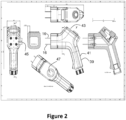
- the optical fibre probe 16 may be housed in a gun shaped housing 39 as shown in Figure 2 .
- the housing body 41 and top cover 43 in this embodiment is made from CNC machined ABS plastic.
- the front plate 45 and probes 16 are made from Stainless Steel.
- the probes 16 are 3mm outer diameter x 1mm inner diameter x 75mm length tubes with a taper and a M3 thread.
- a clear polycarbonate window 47 is included in the top cover 43, sealed with a food grade silicone.
- the housing 39 may facilitate ease of inserting and operating the probes 16. For example, the length of the probes 16 extending beyond the housing 39 may be set to a desired depth of insertion for the meat product being analysed. It will be appreciated that other shapes and materials of housing 39 may alternatively be used.
- a barcode scanner for reading barcodes identifying the meat products 12, so that a particular product 12 and its measured spectral data can be associated.
- the optical apparatus 38 included a 405nm continuous-wave (CW) laser 14 delivering 15mw of power, a UV/Vis Flame spectrometer 24 (integration time 100ms-200ms) collecting all wavelengths from 350nm-1100nm, a 407nm long pass filter 26, a 200uM multimodal bifurcated fibre 18 to combine the laser 12 and spectrometer 24, a 200uM multimodal fibre for combined delivery and collection of the signal and a stainless steel needle 16 for delivery of the fibre into the meat product 12.
- CW continuous-wave
- UV/Vis Flame spectrometer 24 integrated time 100ms-200ms
- a 200uM multimodal bifurcated fibre 18 to combine the laser 12 and spectrometer 24
- a 200uM multimodal fibre for combined delivery and collection of the signal
- a stainless steel needle 16 for delivery of the fibre into the meat product 12.
- the optical apparatus 38 was designed for taking multiple measurements at once.
- the optical apparatus 38 included the components of the first version except that four 200uM multimobal fibres for combined delivery and collection of signal were used, and also a PS Jena 1x6 optical splitter for multiple samples. The components were all mounted in a pelican style case for portability.
- the optical apparatus 38 included a 405nm CW laser 14 for each needle 16, the lasers 14 delivering 10-40mw of power, a UV/Vis Flame spectrometer 24 collecting all wavelengths from 350nm-1100nm, a 200um bifurcated bundle 18 (4xfibres) delivering light to the spectrometer 24 and a 420nm filter set 26, all mounted in a pelican style case for portability.
- control hardware 34 Different versions of the control hardware 34 were also trialled to control turning the laser/s 14 on/off, collect data from the spectrometer 24 and control a barcode scanner. The code was custom made and controlled using a beaglebone.
- One version of the control hardware 34 includes a 4S LiPo Battery 14.7V, a beaglebone for software control of components, an additional custom board for control of lasers (inputs controlled by the beaglebone), voltage regulated to ⁇ 5-6V and integrated with a wireless barcode scanner. In operation, spectral data measurements are taken using the optical apparatus 38 of Figure 1 .
- the probe 16 may be inserted into the meat at a depth of 20-60mm, the laser 14 activated and resulting autofluoresence in the meat measured by the spectrometer 24.
- a barcode associated with the meat may be scanned to obtain an identification number and the spectral data generated by the spectrometer 24 may be labelled using the identification number.
- Trials were performed probing hot carcasses (less than 30 minutes since kill) and cold carcasses (12-24 hours in a 4°C chiller). The hot and cold scanning took around 3 hours, and a transition time of around 15-30 minutes was used when transitioning the probe from hot to cold and vice versa. It is expected that end use will likely be 6-10 hours and the probe will likely remain in the hot or cold environment for at least 3 hours. It is expected that a scanning run will be unlikely to experience frequent thermal cycles (in/out of the chiller in less than 30 minutes).
- the meat was probed as it travelled on a continuously moving abattoir chain at a speed of approximately 8-12 carcasses per minute.
- the environmental temperature during hot scanning was approximately 15-35°C and the environmental temperature during cold scanning was approximately 1-15°C.
- the scanning of cold meat products was done either as carcasses exited the chiller on an abattoir chain or while the carcasses were stationary in the chiller. Four scans were taken on the hot carcass and four scans taken 24 hours post mortem on the cold carcass.
- a 200g meat sample was taken, labelled and aged at 4°C.
- the meat sample was assessed for defined variables including IMF, shear force, pH and colour. Details of some of the variables are given in the table below.
- the spectral data and identification number may then be sent to a computer in which the software 32 is installed (for example, at a remote location).
- the spectral data may then be processed utilising one or more of the following steps:
- the software 32 includes a series of instructions executable by the processor 28 to carry out a method to analyse the data to determine one or more parameters indicative of quality of the meat product 12.
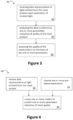
- the method 40 includes the steps of receiving 42 data representative of light emitted from the meat product 12 upon application of incident light to the meat product 12; analysing 44 the data to determine one or more parameters indicative of quality of the meat product 12; and assessing 46 the quality of the meat product 12 on the basis of the one or more parameters.
- the analysis 44 of data may involve using one or more models to predict the one or more parameters from the data output from the spectrometer 24. Based on these predictions, the quality of the meat product 12 can be assessed 46.
- the one or more parameters may be predicted values of properties of the meat product, or a range of likely values for these properties (for example, a value +/- an error).
- the one or more parameters may be a categorisation of a property of the meat product into one of a plurality of categories relating to a property of the meat product, or as being above or below a threshold.
- Figure 4 depicts a method 48 of creating one or more models for assessing quality of a meat product.
- the method 48 may be implemented in software and comprises, for a plurality of sample meat products, receiving data 50 representative of light emitted from the sample meat product upon application of incident light to the sample meat product; for the sample meat products, receiving one or more pre-determined values 52; and using the data and one or more pre-determined values to create one or more models 54 to predict one or more parameters indicative of quality of the meat product.
- the models may be created using linear statistical methods or supervised machine learning algorithms. Other models are contemplated.
- a prediction model may thus be created for each variable by spectral signals/signatures/fingerprints. Neural network and deep learning approaches may be applied to the data 50 to increase predictability beyond what the linear models can achieve.
- the software 32 could be supplied in a number of ways; for example on a computer readable medium, such as a disc or a memory of the computer 34, or as a data signal, such as by transmission from a server.
- the probe 16 may be inserted into the meat product in multiple positions, with measurements taken in each position and/or multiple measurements taken with the probe 16 in the same position.
- multiple probes may be used to take a number of simultaneous measurements of autofluoresence.
- Example 1 Measurement and sampling carcasses for meat eating quality analysis
- Hot carcase weight (HCWT), depth of tissue at the GR site (GR depth), cfat thickness, and eye muscle area (EMA) at the 12th rib were measured.
- HCWT was provided by the processing plant.
- GR depth (mm) was measured with a GR knife 4-6h post-mortem at the 12 th rib, 110 mm from the spinal column on the right-hand side of the carcass.
- EMW Eye muscle width
- EMD eye muscle depth
- cFat mm
- the fat and epimysium were removed from the section of the LL that was previously removed from the carcass.
- Samples for shear force (SF5; 65g) and intramuscular fat (IMF; 40g) were collected. IMF samples were frozen immediately after collection.
- the SF5 samples were vacuum packed and aged at 4-5 °C for five days prior to freezing at -20°C.
- Frozen 65g LL samples were placed into a water bath at 71°C for 35min to cook, and then immersed in chilled water prior to processing.
- the samples were processed according to the methods of Hopkins D.L. & Thompson J.M. (2001) "The relationship between tenderness, proteolysis, muscle contraction and dissociation of actomyosin.” Meat Science 57, 1 - 12 , and a Lloyd LRX machine was used to measure 5-6 1cm 3 sub-samples from each 65g LL sample.
- IMF samples were freeze dried and the IMF content was determined using a near infrared procedure (as described in Perry D., Shorthose W.R., Ferguson D.M. & Thompson J.M. (2001) "Methods used in the CRC program for the determination of carcass yield and beef quality.” pp. 953 - 7 ).
- Example 2 Acquisition of data, and processing of measurements taken using a probe
- This example describes the results of data processing of measurements taken using a fibre probe.
- Analysis of the data was used to determine one or more parameters indicative of quality of the meat product, and thereby assess the quality of the meat product on the basis of those one or more parameters.
- Spectral data measurements were taken using the optical apparatus 38 of Figure 1 .
- the fibre probe 16 was inserted into each of the 200 lamb carcasses, the laser 14 was activated to apply incident light to the carcass via the probe 16 and the spectrometer 24 generated spectral data representative of the autofluorescence excited in the lamb carcass. Twelve to twenty samples were taken for each carcass, and this was repeated at different temperatures, so that a hot data set, chilled data set and cold data set were obtained.
- the spectral data was then processed as follows, to reduce the complexity of the data and increase prediction accuracy:
- Predictor variables The following external parameters were considered as predictor variables in the analysis:
- the results of this analysis created a model that allowed for the estimation of a continuous variable for the prediction score. That is a value +/- an error rate was returned by the optimal model.
- An alternative categorical approach was also applied using machine learning which fragmented the dataset into categorical gradings for each variable. For example, IMF scores of 2-3 were categorised B, 3-4 were C etc. Thus a measurement was provided that allowed categorisation rather than quantification of measurements.
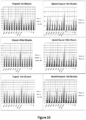
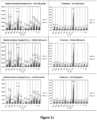
- FIGS 6 to 9 present the output parameters of the statistical model. pHu_temp predictor was excluded from the analysis as this variable varied in steps and was found to produce artificial statistical output. Moreover, this parameter was physically irrelevant to the spectral response variable considered in the analysis.
- Figure 6 shows the mean R-squared values for all data sets, averaged across three methods: linear model, Akaike's Information Criterion, and 5-fold Cross Validation.
- F-Statistic values were almost twice as large for the same parameters: HCWT, GRfat, FatC, SF, and IMF, and smaller p-values were attributed to the same parameters.
- the lightness parameter, L also showed better statistics for the Cold data set, while pHu_loin parameter showed better values for Hot data set.
- Figure 7 shows adjusted R-squared values for all data sets for linear model and Akaike's Information Criterion.
- Figure 8 shows mean Relative Residual Standard Error for all data sets averaged across linear model and AIC; and F-Statistic values for all data sets for linear model. Values much larger than 1 (shown in black line) indicate there is relationship between predictor and response variables.
- the head to head test yielded a 94.7% accuracy using a random forest approach.
- Sensitivity NA NA Specificity 1 Pos Pred Value NA NA Neg Pred Value NA NA Prevalence 0 0 Detection Rate 0 0 Detection Prevalence 0 0 Balanced Accuracy NA NA
- R-squared Overall, the R-squared values were relatively low, even for the fat-related parameters, and were around 0.6, with the adjusted R-squared values expectedly lower. Akaike's Information Criterion resulted in an improved model once the best fitting response variables were left in the model. On average, 30 - 50% of the initial response variables were left after AIC was applied. The k-fold Cross Validation method showed similar R-squared values to the linear model, or the AIC.
- RSEs for the fat-related parameters were as follows: ⁇ 10% for HCWT, ⁇ 30% for GRfat, ⁇ 45% for FatC, and ⁇ 15% for IMF.
- Figure 10 shows R-squared and Adjusted R-squared values for all data sets. Im - linear model, aic - Akaike's Information Criterion, 5fold - k-fold Cross Validation method with 5 folds.
- Figure 11 shows relative Residual Standard Error (RSE) and F-Statistics values for all data sets.
- RSE Residual Standard Error
- F-Statistics values for all data sets.
- F-Statistic value is considered good if it is much larger than 1 (shown as black lines).
- Example 3 Measurement and analysis of IMF, Shear Force and pH of beef carcasses (hot and cold)
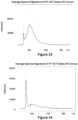
- Measurements were performed across two days. On the first day, 159 hot beef carcasses were scanned using the first version of the optical apparatus 38 as described above with the probe needle 16 attached directly to the bifurcated fibre 18. 139 body analyses were obtained with 20 bodies excluded due to either poor scan or missing variables. The integration time was approximately 80ms and spectral signatures were not normalised. The average spectral signature from the hot beef plus a variance is shown in Figure 13 . Any spectral signature with an intensity of ⁇ 5000 at 500nm was excluded as this was likely due to an accidental scan outside of the meat.
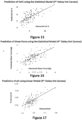
- IMF, SF, and pH have an approximate R2 value of 0.4 - 0.5 in hot carcasses ( Figures 14-16 ) and IMF, SF, and pH have an approximate R2 value of 0.5 - 0.6 in cold carcasses ( Figures 17-20 ).
- Figure 15 shows measured percentage of intra-muscular fat vs predicted percentage of intra-muscular fat for the hot carcass.
- the prediction of intra-muscular fat percentage has an R2 of 0.44 using a Linear model with AIC.
- Figure 16 shows measured shear force vs predicted shear force for the hot carcass.
- the prediction of shear force has an R2 of 0.51 using Linear model with AIC.
- Figure 17 shows measured pH vs predicted pH for the hot carcass.
- the prediction of pH has an R2 of 0.45 using Linear model with AIC.
- Figure 18 shows measured percentage of intra-muscular fat vs predicted percentage of intra-muscular fat for the cold carcass.
- the prediction of intra-muscular fat percentage has an R2 of 0.63 using a Linear model with AIC.
- Figure 19 shows measured shear force vs predicted shear force for the cold carcass.
- the prediction of shear force has an R2 of 0.66 using Linear model with AIC.
- Figure 20 shows measured pH vs predicted pH for the cold carcass.
- the prediction of pH has an R2 of 0.48 using Linear model with AIC.
Landscapes
- Health & Medical Sciences (AREA)
- Life Sciences & Earth Sciences (AREA)
- Engineering & Computer Science (AREA)
- Physics & Mathematics (AREA)
- General Physics & Mathematics (AREA)
- General Health & Medical Sciences (AREA)
- Chemical & Material Sciences (AREA)
- Biochemistry (AREA)
- Analytical Chemistry (AREA)
- Immunology (AREA)
- Pathology (AREA)
- Molecular Biology (AREA)
- Biomedical Technology (AREA)
- Theoretical Computer Science (AREA)
- Nuclear Medicine, Radiotherapy & Molecular Imaging (AREA)
- Food Science & Technology (AREA)
- General Engineering & Computer Science (AREA)
- Computational Linguistics (AREA)
- Data Mining & Analysis (AREA)
- Evolutionary Computation (AREA)
- Computing Systems (AREA)
- Software Systems (AREA)
- Mathematical Physics (AREA)
- Biophysics (AREA)
- Artificial Intelligence (AREA)
- Medicinal Chemistry (AREA)
- Investigating Or Analysing Materials By Optical Means (AREA)
- Meat, Egg Or Seafood Products (AREA)
- Investigating Materials By The Use Of Optical Means Adapted For Particular Applications (AREA)
- Investigating, Analyzing Materials By Fluorescence Or Luminescence (AREA)
Claims (14)
- Verfahren (40) zum Bewerten der Qualität eines Fleischprodukts (12), wobei das Verfahren umfasst:Erhalten (42) von Daten, die für Autofluoreszenzlicht repräsentativ sind, das von dem Fleischprodukt (12) nach Anwendung von einfallendem Laserlicht von einer in das Fleischprodukt (12) eingebrachten Sonde (16) emittiert wird;Analysieren (44) der Daten, um einen oder mehrere Parameter zu bestimmen, die für die Qualität des Fleischprodukts (12) indikativ sind; undBewerten (46) der Qualität des Fleischprodukts (12) auf der Grundlage des einen oder der mehreren Parameter.
- Verfahren (40) gemäß Anspruch 1, wobei das einfallende Laserlicht eine Wellenlänge in dem Bereich von 402 nm bis 408 nm umfasst.
- Verfahren (40) gemäß Anspruch 1 oder Anspruch 2, wobei die erhaltenen (42) Daten Spektraldaten umfassen, die für in dem Fleischprodukt (12) angeregte Autofluoreszenz repräsentativ sind.
- Verfahren (40) gemäß Anspruch 3, wobei die Spektraldaten Daten in dem Bereich von 350 nm bis 1100 nm umfassen.
- Verfahren (40) gemäß einem jeglichen der Ansprüche 1 bis 4, wobei der eine oder die mehreren Parameter einen oder mehrere der folgenden umfassen:ein Parameter, der für das Gewicht des heißen Schlachtkörpers indikativ ist (HCWT-Parameter);ein Maß für die Gewebetiefe über einer 12. Rippe (GRfat-Parameter);ein Parameter, der für eine Fettmenge über einem Augenmuskel indikativ ist (FatC-Parameter);ein Parameter, der für intramuskuläres Fett indikativ ist (IMF-Parameter);ein Parameter, der für die Scherkraft indikativ ist (SF-Parameter);ein Parameter, der für den pH-Wert des Fleischprodukts (12) indikativ ist; undein Parameter, der für eine Farbe des Fleischprodukts (12) indikativ ist.
- Verfahren (40) gemäß Anspruch 5, wobei die Daten unter Verwendung eines oder mehrerer Modelle zum Vorhersagen des einen oder der mehreren Parameter analysiert werden.
- Verfahren (40) gemäß Anspruch 6, wobei das eine oder die mehreren Modelle lineare statistische Modelle umfassen.
- Verfahren (40) gemäß Anspruch 7, wobei das eine oder die mehreren Modelle unter Verwendung eines Datenminimierungsansatzes erzeugt werden.
- Verfahren (40) gemäß einem jeglichen der Ansprüche 6 bis 8, wobei das eine oder die mehreren Modelle unter Verwendung von Trainingsdaten erzeugt werden, die Daten einschließen, die für Licht repräsentativ sind, das von einer Vielzahl von Proben-Fleischprodukten nach Anwendung des einfallenden Laserlichts auf die Proben-Fleischprodukte emittiert wird, wobei jedes Proben-Fleischprodukt vorbestimmte Werte für den einen oder die mehreren Parameter aufweist.
- Verfahren (40) gemäß einem jeglichen der Ansprüche 1 bis 9, wobei das Fleischprodukt (12) ein Schlachtkörper, ein Teil eines Schlachtkörpers, ein Stück Fleisch des Schlachtkörpers oder ein verarbeitetes Produkt, das von dem Schlachtkörper oder dem Stück Fleisch abstammt, ist.
- System (10) zum Bewerten der Qualität eines Fleischprodukts (12), wobei das System umfasst:eine Laserlichtquelle (14) zum Anwenden von einfallendem Laserlicht von einer in das Fleischprodukt (12) eingebrachten Sonde (16);eine Messvorrichtung (24) zum Produzieren von Daten, die für Autofluoreszenzlicht repräsentativ sind, das von dem Fleischprodukt (12) nach Anwendung des einfallenden Lichts auf das Fleischprodukt (12) emittiert wird;einen Prozessor (28);einen Speicher (30); undSoftware (32), die sich in dem Speicher (30) befindet, auf den der Prozessor (28) zugreifen kann, wobei die Software (32) eine Reihe von durch den Prozessor (28) ausführbare Instruktionen zur Analyse der Daten umfasst, um einen oder mehrere Parameter, die für die Qualität des Fleischprodukts (12) indikativ sind, zu bestimmen und ein Maß der Qualität des Fleischprodukts (12) auf der Grundlage des einen oder der mehreren Parameter bereitzustellen.
- System (10) gemäß Anspruch 11, wobei sich der Prozessor (28) in physischer Datenverbindung mit der Messvorrichtung (24) befindet.
- System (10) gemäß Anspruch 12, wobei die Lichtquelle (14) und die Messvorrichtung (24) einen Teil der Sonde (16) umfassen, und sich der Prozessor (28), der Speicher (30) und die Software (32) entfernt von der Sonde (16) befinden und die Daten über das Internet erhalten.
- System (10) gemäß einem jeglichen der Ansprüche 11 bis 13, wobei die Software (32) eine Reihe von Instruktionen umfasst, die durch den Prozessor (28) unter Verwendung des Verfahrens (40) gemäß einem jeglichen der Ansprüche 1 bis 10 ausführbar sind.
Applications Claiming Priority (2)
| Application Number | Priority Date | Filing Date | Title |
|---|---|---|---|
| AU2017901826A AU2017901826A0 (en) | 2017-05-16 | Methods and systems for assessing quality of a meat product | |
| PCT/AU2018/050455 WO2018209383A1 (en) | 2017-05-16 | 2018-05-15 | Methods and systems for assessing quality of a meat product |
Publications (4)
| Publication Number | Publication Date |
|---|---|
| EP3625546A1 EP3625546A1 (de) | 2020-03-25 |
| EP3625546A4 EP3625546A4 (de) | 2021-03-17 |
| EP3625546C0 EP3625546C0 (de) | 2024-10-30 |
| EP3625546B1 true EP3625546B1 (de) | 2024-10-30 |
Family
ID=64272979
Family Applications (1)
| Application Number | Title | Priority Date | Filing Date |
|---|---|---|---|
| EP18802403.8A Active EP3625546B1 (de) | 2017-05-16 | 2018-05-15 | Verfahren und systeme zur beurteilung der qualität eines fleischprodukts |
Country Status (8)
| Country | Link |
|---|---|
| US (2) | US11519862B2 (de) |
| EP (1) | EP3625546B1 (de) |
| JP (1) | JP2020520464A (de) |
| CN (1) | CN110892246A (de) |
| AU (1) | AU2018271137B2 (de) |
| BR (1) | BR112019024115B1 (de) |
| NZ (1) | NZ760010A (de) |
| WO (1) | WO2018209383A1 (de) |
Families Citing this family (10)
| Publication number | Priority date | Publication date | Assignee | Title |
|---|---|---|---|---|
| GB201600445D0 (en) * | 2016-01-11 | 2016-02-24 | Cairns Intellectual Property Ltd | Methods and apparatuses for temperature measurement |
| EP3625546B1 (de) * | 2017-05-16 | 2024-10-30 | MEQ Probe Pty Ltd | Verfahren und systeme zur beurteilung der qualität eines fleischprodukts |
| JP2022064715A (ja) * | 2020-10-14 | 2022-04-26 | 三菱電機株式会社 | 冷蔵庫 |
| CN112595694A (zh) * | 2020-12-16 | 2021-04-02 | 内蒙古农业大学 | 一种基于近红外快速检测羊肉品质数据库及其建立方法 |
| CN113866121A (zh) * | 2021-10-21 | 2021-12-31 | 江苏省家禽科学研究所 | 一种病死鸡快速鉴别方法及应用 |
| CN114965910A (zh) * | 2022-04-14 | 2022-08-30 | 北京市农林科学院信息技术研究中心 | 肉类品质感知方法及装置 |
| CN114970755B (zh) * | 2022-06-20 | 2024-05-31 | 滁州学院 | 一种基于穿戴技术的鸡胸肉品质预测装置及分级方法 |
| CN116804669B (zh) * | 2023-06-16 | 2024-04-02 | 枣庄华宝牧业开发有限公司 | 一种肉制品加工用油炸监视系统 |
| CN117630060A (zh) * | 2023-12-05 | 2024-03-01 | 同方威视技术股份有限公司 | 肉质成分计算方法以及系统 |
| CN118295339B (zh) * | 2024-03-19 | 2024-09-13 | 新农创云链(北京)科技有限公司 | 一种基于数据传输的一体化生产系统 |
Citations (1)
| Publication number | Priority date | Publication date | Assignee | Title |
|---|---|---|---|---|
| WO2018209383A1 (en) * | 2017-05-16 | 2018-11-22 | MEQ Probe Pty Ltd | Methods and systems for assessing quality of a meat product |
Family Cites Families (22)
| Publication number | Priority date | Publication date | Assignee | Title |
|---|---|---|---|---|
| DK163453C (da) | 1989-06-12 | 1992-07-20 | Slagteriernes Forskningsinst | Fremgangsmaade og apparat til fotometrisk bestemmelse af individuelle koedemners egenskaber |
| DK163382C (da) | 1990-02-28 | 1992-08-03 | Slagteriernes Forskningsinst | Fremgangsmaade til bestemmelse af individuelle koedemners kvalitetsegenskaber |
| GB9110474D0 (en) * | 1991-05-15 | 1991-07-03 | Commission Meat & Livestock | Meat quality sensing apparatus |
| CA2189817A1 (en) * | 1996-11-07 | 1998-05-07 | Howard J. Swatland | Apparatus for use in determining meat tenderness |
| US5918190A (en) * | 1996-12-31 | 1999-06-29 | Ontario Cattlemen's Association | Software controlled meat probe for use in determining meat tenderness |
| US6995675B2 (en) * | 1998-03-09 | 2006-02-07 | Curkendall Leland D | Method and system for agricultural data collection and management |
| FR2780790B1 (fr) * | 1998-07-03 | 2000-08-18 | Vitreenne Abattage | Procede et dispositif de prediction de la tendrete d'une viande sur le site de transformation a l'aide d'informations biologiques et/ou physico-chimiques et de mesures optiques dans le domaine du visible et du proche infrarouge |
| JP2003121351A (ja) | 2001-10-09 | 2003-04-23 | National Agricultural Research Organization | 食肉の鮮度判定方法 |
| US20110178409A1 (en) * | 2004-02-27 | 2011-07-21 | Optiscan Pty Ltd | Optical Element |
| JP2006030047A (ja) * | 2004-07-20 | 2006-02-02 | Kazumasa Sasaki | 食品品質評価方法、食品品質評価表示方法、食品品質評価装置及び食品品質評価表示装置 |
| WO2006057990A2 (en) * | 2004-11-29 | 2006-06-01 | Cargill, Incorporated | A method for predicting shear force of aged meat |
| WO2009140757A1 (en) * | 2008-05-20 | 2009-11-26 | University Health Network | Device and method for fluorescence-based imaging and monitoring |
| CN201392319Y (zh) | 2009-04-09 | 2010-01-27 | 浙江大学 | 一种基于图像与光谱信息融合的肉品在线无损检测装置 |
| US20110128373A1 (en) | 2009-11-28 | 2011-06-02 | Tenera Technology, Llc | Determining Meat Tenderness |
| US20140088939A1 (en) | 2011-05-02 | 2014-03-27 | Agridigit Inc | Evaluation of animal products based on customized models |
| WO2013001423A1 (en) * | 2011-06-28 | 2013-01-03 | Koninklijke Philips Electronics N.V. | An apparatus for optical analysis of an associated tissue sample |
| CN102323267A (zh) * | 2011-08-10 | 2012-01-18 | 中国农业大学 | 一种快速评价生鲜肉品新鲜度的系统及方法 |
| CN102519906B (zh) | 2011-12-19 | 2013-07-31 | 中国农业大学 | 多通道近红外光谱牛肉品质多参数同时检测方法 |
| DE102013008003B4 (de) | 2013-05-08 | 2015-03-19 | Freshdetect Gmbh | Messgerät zum Messen eines Oberflächenbelags auf einem Messobjekt, insbesondere auf einem Lebensmittel, und dessen Verwendung |
| CN104458594B (zh) * | 2014-12-16 | 2017-02-22 | 中国农业大学 | 一种生鲜肉品质参数多点同时检测的系统及方法 |
| CN104914069B (zh) * | 2015-05-28 | 2017-12-19 | 中国农业大学 | 可迁移计算的肉类品质近红外检测方法及装置 |
| CN106501211A (zh) * | 2016-11-01 | 2017-03-15 | 中国农业科学院农业质量标准与检测技术研究所 | 近红外光谱信息评价牛肉品质数据模型的建立方法与应用 |
-
2018
- 2018-05-15 EP EP18802403.8A patent/EP3625546B1/de active Active
- 2018-05-15 BR BR112019024115-9A patent/BR112019024115B1/pt active IP Right Grant
- 2018-05-15 WO PCT/AU2018/050455 patent/WO2018209383A1/en not_active Ceased
- 2018-05-15 US US16/614,082 patent/US11519862B2/en active Active
- 2018-05-15 AU AU2018271137A patent/AU2018271137B2/en active Active
- 2018-05-15 JP JP2020514305A patent/JP2020520464A/ja active Pending
- 2018-05-15 CN CN201880047240.3A patent/CN110892246A/zh active Pending
- 2018-05-15 NZ NZ760010A patent/NZ760010A/en active IP Right Revival
-
2022
- 2022-10-26 US US17/974,207 patent/US12163889B2/en active Active
Patent Citations (1)
| Publication number | Priority date | Publication date | Assignee | Title |
|---|---|---|---|---|
| WO2018209383A1 (en) * | 2017-05-16 | 2018-11-22 | MEQ Probe Pty Ltd | Methods and systems for assessing quality of a meat product |
Also Published As
| Publication number | Publication date |
|---|---|
| EP3625546C0 (de) | 2024-10-30 |
| NZ799878A (en) | 2025-07-25 |
| US20230066038A1 (en) | 2023-03-02 |
| EP3625546A4 (de) | 2021-03-17 |
| EP3625546A1 (de) | 2020-03-25 |
| AU2018271137A1 (en) | 2020-01-16 |
| BR112019024115B1 (pt) | 2024-01-09 |
| US20200173926A1 (en) | 2020-06-04 |
| WO2018209383A1 (en) | 2018-11-22 |
| AU2018271137B2 (en) | 2023-11-30 |
| NZ760010A (en) | 2023-06-30 |
| BR112019024115A2 (pt) | 2020-06-02 |
| CN110892246A (zh) | 2020-03-17 |
| US12163889B2 (en) | 2024-12-10 |
| US11519862B2 (en) | 2022-12-06 |
| JP2020520464A (ja) | 2020-07-09 |
Similar Documents
| Publication | Publication Date | Title |
|---|---|---|
| US12163889B2 (en) | Methods and systems for assessing quality of a meat product | |
| Rødbotten et al. | Prediction of beef quality attributes from early post mortem near infrared reflectance spectra | |
| Schmidt et al. | Preliminary investigation on the relationship of Raman spectra of sheep meat with shear force and cooking loss | |
| Khaled et al. | Emerging nondestructive approaches for meat quality and safety evaluation—A review | |
| Leroy et al. | Prediction of technological and organoleptic properties of beef Longissimus thoracis from near-infrared reflectance and transmission spectra | |
| Cai et al. | Determination of total volatile basic nitrogen (TVB-N) content and Warner–Bratzler shear force (WBSF) in pork using Fourier transform near infrared (FT-NIR) spectroscopy | |
| Oto et al. | Non-destructive evaluation of ATP content and plate count on pork meat surface by fluorescence spectroscopy | |
| Bauer et al. | Assessment of tenderness of aged bovine gluteus medius muscles using Raman spectroscopy | |
| Berhe et al. | Accurate determination of endpoint temperature of cooked meat after storage by Raman spectroscopy and chemometrics | |
| Prieto et al. | On-line application of visible and near infrared reflectance spectroscopy to predict chemical–physical and sensory characteristics of beef quality | |
| Reis et al. | Early on-line classification of beef carcasses based on ultimate pH by near infrared spectroscopy | |
| Qu et al. | Predicting pork freshness using multi-index statistical information fusion method based on near infrared spectroscopy | |
| BRPI1006077B1 (pt) | sistema para analisar uma ou mais propriedades de carne | |
| Fowler et al. | Raman spectroscopy compared against traditional predictors of shear force in lamb m. longissimus lumborum | |
| Moran et al. | Visible and near infrared spectroscopy as an authentication tool: Preliminary investigation of the prediction of the ageing time of beef steaks | |
| Fowler et al. | Predicting tenderness of fresh ovine semimembranosus using Raman spectroscopy | |
| Scheier et al. | Prediction of pork quality at the slaughter line using a portable Raman device | |
| Allen | Recent developments in the objective measurement of carcass and meat quality for industrial application | |
| US6118542A (en) | Method and apparatus for determination of a quality property of a piece of meat | |
| Rosenvold et al. | Temporal, biochemical and structural factors that influence beef quality measurement using near infrared spectroscopy | |
| Atanassova et al. | Differentiation of fresh and frozen-thawed poultry breast meat by near infrared spectroscopy. | |
| Muñoz-Lapeira et al. | Visible near-infrared hyperspectral imaging as a tool to characterise chicken breasts with myopathies and their durability | |
| CA2276123A1 (en) | Software controlled meat probe for use in determining meat tenderness | |
| Prieto et al. | Application of hyperspectral imaging on meat and meat products. | |
| Shibang et al. | Jestr r |
Legal Events
| Date | Code | Title | Description |
|---|---|---|---|
| STAA | Information on the status of an ep patent application or granted ep patent |
Free format text: STATUS: THE INTERNATIONAL PUBLICATION HAS BEEN MADE |
|
| PUAI | Public reference made under article 153(3) epc to a published international application that has entered the european phase |
Free format text: ORIGINAL CODE: 0009012 |
|
| STAA | Information on the status of an ep patent application or granted ep patent |
Free format text: STATUS: REQUEST FOR EXAMINATION WAS MADE |
|
| 17P | Request for examination filed |
Effective date: 20191216 |
|
| AK | Designated contracting states |
Kind code of ref document: A1 Designated state(s): AL AT BE BG CH CY CZ DE DK EE ES FI FR GB GR HR HU IE IS IT LI LT LU LV MC MK MT NL NO PL PT RO RS SE SI SK SM TR |
|
| AX | Request for extension of the european patent |
Extension state: BA ME |
|
| DAV | Request for validation of the european patent (deleted) | ||
| DAX | Request for extension of the european patent (deleted) | ||
| A4 | Supplementary search report drawn up and despatched |
Effective date: 20210211 |
|
| RIC1 | Information provided on ipc code assigned before grant |
Ipc: G01N 33/12 20060101ALI20210205BHEP Ipc: G01N 21/25 20060101AFI20210205BHEP Ipc: G01N 21/85 20060101ALI20210205BHEP Ipc: G06N 3/02 20060101ALI20210205BHEP Ipc: G01N 21/64 20060101ALI20210205BHEP Ipc: G06N 3/08 20060101ALN20210205BHEP Ipc: G06F 17/10 20060101ALI20210205BHEP |
|
| STAA | Information on the status of an ep patent application or granted ep patent |
Free format text: STATUS: EXAMINATION IS IN PROGRESS |
|
| 17Q | First examination report despatched |
Effective date: 20220810 |
|
| GRAP | Despatch of communication of intention to grant a patent |
Free format text: ORIGINAL CODE: EPIDOSNIGR1 |
|
| STAA | Information on the status of an ep patent application or granted ep patent |
Free format text: STATUS: GRANT OF PATENT IS INTENDED |
|
| RIC1 | Information provided on ipc code assigned before grant |
Ipc: G06N 3/08 20060101ALN20240508BHEP Ipc: G01N 21/85 20060101ALI20240508BHEP Ipc: G01N 21/64 20060101ALI20240508BHEP Ipc: G06F 17/10 20060101ALI20240508BHEP Ipc: G06N 3/02 20060101ALI20240508BHEP Ipc: G01N 33/12 20060101ALI20240508BHEP Ipc: G01N 21/25 20060101AFI20240508BHEP |
|
| INTG | Intention to grant announced |
Effective date: 20240523 |
|
| GRAS | Grant fee paid |
Free format text: ORIGINAL CODE: EPIDOSNIGR3 |
|
| GRAA | (expected) grant |
Free format text: ORIGINAL CODE: 0009210 |
|
| STAA | Information on the status of an ep patent application or granted ep patent |
Free format text: STATUS: THE PATENT HAS BEEN GRANTED |
|
| AK | Designated contracting states |
Kind code of ref document: B1 Designated state(s): AL AT BE BG CH CY CZ DE DK EE ES FI FR GB GR HR HU IE IS IT LI LT LU LV MC MK MT NL NO PL PT RO RS SE SI SK SM TR |
|
| REG | Reference to a national code |
Ref country code: GB Ref legal event code: FG4D |
|
| REG | Reference to a national code |
Ref country code: CH Ref legal event code: EP |
|
| REG | Reference to a national code |
Ref country code: IE Ref legal event code: FG4D |
|
| REG | Reference to a national code |
Ref country code: DE Ref legal event code: R096 Ref document number: 602018076041 Country of ref document: DE |
|
| U01 | Request for unitary effect filed |
Effective date: 20241125 |
|
| U07 | Unitary effect registered |
Designated state(s): AT BE BG DE DK EE FI FR IT LT LU LV MT NL PT RO SE SI Effective date: 20241129 |
|
| RAP4 | Party data changed (patent owner data changed or rights of a patent transferred) |
Owner name: MEQ PROBE PTY LTD |
|
| U1H | Name or address of the proprietor changed after the registration of the unitary effect |
Owner name: MEQ PROBE PTY LTD; AU |
|
| PG25 | Lapsed in a contracting state [announced via postgrant information from national office to epo] |
Ref country code: HR Free format text: LAPSE BECAUSE OF FAILURE TO SUBMIT A TRANSLATION OF THE DESCRIPTION OR TO PAY THE FEE WITHIN THE PRESCRIBED TIME-LIMIT Effective date: 20241030 Ref country code: IS Free format text: LAPSE BECAUSE OF FAILURE TO SUBMIT A TRANSLATION OF THE DESCRIPTION OR TO PAY THE FEE WITHIN THE PRESCRIBED TIME-LIMIT Effective date: 20250228 |
|
| PG25 | Lapsed in a contracting state [announced via postgrant information from national office to epo] |
Ref country code: ES Free format text: LAPSE BECAUSE OF FAILURE TO SUBMIT A TRANSLATION OF THE DESCRIPTION OR TO PAY THE FEE WITHIN THE PRESCRIBED TIME-LIMIT Effective date: 20241030 |
|
| PG25 | Lapsed in a contracting state [announced via postgrant information from national office to epo] |
Ref country code: NO Free format text: LAPSE BECAUSE OF FAILURE TO SUBMIT A TRANSLATION OF THE DESCRIPTION OR TO PAY THE FEE WITHIN THE PRESCRIBED TIME-LIMIT Effective date: 20250130 |
|
| U20 | Renewal fee for the european patent with unitary effect paid |
Year of fee payment: 8 Effective date: 20250318 |
|
| PG25 | Lapsed in a contracting state [announced via postgrant information from national office to epo] |
Ref country code: GR Free format text: LAPSE BECAUSE OF FAILURE TO SUBMIT A TRANSLATION OF THE DESCRIPTION OR TO PAY THE FEE WITHIN THE PRESCRIBED TIME-LIMIT Effective date: 20250131 |
|
| PG25 | Lapsed in a contracting state [announced via postgrant information from national office to epo] |
Ref country code: PL Free format text: LAPSE BECAUSE OF FAILURE TO SUBMIT A TRANSLATION OF THE DESCRIPTION OR TO PAY THE FEE WITHIN THE PRESCRIBED TIME-LIMIT Effective date: 20241030 |
|
| PG25 | Lapsed in a contracting state [announced via postgrant information from national office to epo] |
Ref country code: RS Free format text: LAPSE BECAUSE OF FAILURE TO SUBMIT A TRANSLATION OF THE DESCRIPTION OR TO PAY THE FEE WITHIN THE PRESCRIBED TIME-LIMIT Effective date: 20250130 |
|
| PG25 | Lapsed in a contracting state [announced via postgrant information from national office to epo] |
Ref country code: SM Free format text: LAPSE BECAUSE OF FAILURE TO SUBMIT A TRANSLATION OF THE DESCRIPTION OR TO PAY THE FEE WITHIN THE PRESCRIBED TIME-LIMIT Effective date: 20241030 |
|
| PG25 | Lapsed in a contracting state [announced via postgrant information from national office to epo] |
Ref country code: SK Free format text: LAPSE BECAUSE OF FAILURE TO SUBMIT A TRANSLATION OF THE DESCRIPTION OR TO PAY THE FEE WITHIN THE PRESCRIBED TIME-LIMIT Effective date: 20241030 |
|
| PG25 | Lapsed in a contracting state [announced via postgrant information from national office to epo] |
Ref country code: CZ Free format text: LAPSE BECAUSE OF FAILURE TO SUBMIT A TRANSLATION OF THE DESCRIPTION OR TO PAY THE FEE WITHIN THE PRESCRIBED TIME-LIMIT Effective date: 20241030 |
|
| PLBE | No opposition filed within time limit |
Free format text: ORIGINAL CODE: 0009261 |
|
| STAA | Information on the status of an ep patent application or granted ep patent |
Free format text: STATUS: NO OPPOSITION FILED WITHIN TIME LIMIT |
|
| 26N | No opposition filed |
Effective date: 20250731 |
|
| REG | Reference to a national code |
Ref country code: CH Ref legal event code: H13 Free format text: ST27 STATUS EVENT CODE: U-0-0-H10-H13 (AS PROVIDED BY THE NATIONAL OFFICE) Effective date: 20251223 |
|
| PG25 | Lapsed in a contracting state [announced via postgrant information from national office to epo] |
Ref country code: CH Free format text: LAPSE BECAUSE OF NON-PAYMENT OF DUE FEES Effective date: 20250531 |
|
| PG25 | Lapsed in a contracting state [announced via postgrant information from national office to epo] |
Ref country code: MC Free format text: LAPSE BECAUSE OF FAILURE TO SUBMIT A TRANSLATION OF THE DESCRIPTION OR TO PAY THE FEE WITHIN THE PRESCRIBED TIME-LIMIT Effective date: 20241030 |
|
| PGFP | Annual fee paid to national office [announced via postgrant information from national office to epo] |
Ref country code: GB Payment date: 20260317 Year of fee payment: 9 |
|
| PGFP | Annual fee paid to national office [announced via postgrant information from national office to epo] |
Ref country code: IE Payment date: 20260318 Year of fee payment: 9 |
|
| U20 | Renewal fee for the european patent with unitary effect paid |
Year of fee payment: 9 Effective date: 20260317 |