EP3626328A1 - Verfahren zur trennung einer gasmischung durch druckwechseladsorption - Google Patents
Verfahren zur trennung einer gasmischung durch druckwechseladsorption Download PDFInfo
- Publication number
- EP3626328A1 EP3626328A1 EP19197151.4A EP19197151A EP3626328A1 EP 3626328 A1 EP3626328 A1 EP 3626328A1 EP 19197151 A EP19197151 A EP 19197151A EP 3626328 A1 EP3626328 A1 EP 3626328A1
- Authority
- EP
- European Patent Office
- Prior art keywords
- gas
- gas mixture
- mixture
- methane
- concentration
- Prior art date
- Legal status (The legal status is an assumption and is not a legal conclusion. Google has not performed a legal analysis and makes no representation as to the accuracy of the status listed.)
- Pending
Links
Images


Classifications
-
- B—PERFORMING OPERATIONS; TRANSPORTING
- B01—PHYSICAL OR CHEMICAL PROCESSES OR APPARATUS IN GENERAL
- B01D—SEPARATION
- B01D53/00—Separation of gases or vapours; Recovering vapours of volatile solvents from gases; Chemical or biological purification of waste gases, e.g. engine exhaust gases, smoke, fumes, flue gases, aerosols
- B01D53/02—Separation of gases or vapours; Recovering vapours of volatile solvents from gases; Chemical or biological purification of waste gases, e.g. engine exhaust gases, smoke, fumes, flue gases, aerosols by adsorption, e.g. preparative gas chromatography
- B01D53/04—Separation of gases or vapours; Recovering vapours of volatile solvents from gases; Chemical or biological purification of waste gases, e.g. engine exhaust gases, smoke, fumes, flue gases, aerosols by adsorption, e.g. preparative gas chromatography with stationary adsorbents
- B01D53/047—Pressure swing adsorption
-
- B—PERFORMING OPERATIONS; TRANSPORTING
- B01—PHYSICAL OR CHEMICAL PROCESSES OR APPARATUS IN GENERAL
- B01D—SEPARATION
- B01D53/00—Separation of gases or vapours; Recovering vapours of volatile solvents from gases; Chemical or biological purification of waste gases, e.g. engine exhaust gases, smoke, fumes, flue gases, aerosols
- B01D53/14—Separation of gases or vapours; Recovering vapours of volatile solvents from gases; Chemical or biological purification of waste gases, e.g. engine exhaust gases, smoke, fumes, flue gases, aerosols by absorption
- B01D53/1456—Removing acid components
- B01D53/1475—Removing carbon dioxide
-
- B—PERFORMING OPERATIONS; TRANSPORTING
- B01—PHYSICAL OR CHEMICAL PROCESSES OR APPARATUS IN GENERAL
- B01D—SEPARATION
- B01D53/00—Separation of gases or vapours; Recovering vapours of volatile solvents from gases; Chemical or biological purification of waste gases, e.g. engine exhaust gases, smoke, fumes, flue gases, aerosols
- B01D53/22—Separation of gases or vapours; Recovering vapours of volatile solvents from gases; Chemical or biological purification of waste gases, e.g. engine exhaust gases, smoke, fumes, flue gases, aerosols by diffusion
- B01D53/229—Integrated processes (Diffusion and at least one other process, e.g. adsorption, absorption)
-
- C—CHEMISTRY; METALLURGY
- C01—INORGANIC CHEMISTRY
- C01B—NON-METALLIC ELEMENTS; COMPOUNDS THEREOF; METALLOIDS OR COMPOUNDS THEREOF NOT COVERED BY SUBCLASS C01C
- C01B3/00—Hydrogen; Gaseous mixtures containing hydrogen; Separation of hydrogen from mixtures containing it; Purification of hydrogen; Reversible storage of hydrogen
- C01B3/50—Separation of hydrogen or hydrogen-containing gases from gaseous mixtures, e.g. purification
- C01B3/501—Separation of hydrogen or hydrogen-containing gases from gaseous mixtures, e.g. purification by diffusion
-
- C—CHEMISTRY; METALLURGY
- C01—INORGANIC CHEMISTRY
- C01B—NON-METALLIC ELEMENTS; COMPOUNDS THEREOF; METALLOIDS OR COMPOUNDS THEREOF NOT COVERED BY SUBCLASS C01C
- C01B3/00—Hydrogen; Gaseous mixtures containing hydrogen; Separation of hydrogen from mixtures containing it; Purification of hydrogen; Reversible storage of hydrogen
- C01B3/50—Separation of hydrogen or hydrogen-containing gases from gaseous mixtures, e.g. purification
- C01B3/56—Separation of hydrogen or hydrogen-containing gases from gaseous mixtures, e.g. purification by contacting with solids; Regeneration of used solids
-
- C—CHEMISTRY; METALLURGY
- C12—BIOCHEMISTRY; BEER; SPIRITS; WINE; VINEGAR; MICROBIOLOGY; ENZYMOLOGY; MUTATION OR GENETIC ENGINEERING
- C12M—APPARATUS FOR ENZYMOLOGY OR MICROBIOLOGY; APPARATUS FOR CULTURING MICROORGANISMS FOR PRODUCING BIOMASS, FOR GROWING CELLS OR FOR OBTAINING FERMENTATION OR METABOLIC PRODUCTS, i.e. BIOREACTORS OR FERMENTERS
- C12M47/00—Means for after-treatment of the produced biomass or of the fermentation or metabolic products, e.g. storage of biomass
- C12M47/18—Gas cleaning, e.g. scrubbers; Separation of different gases
-
- B—PERFORMING OPERATIONS; TRANSPORTING
- B01—PHYSICAL OR CHEMICAL PROCESSES OR APPARATUS IN GENERAL
- B01D—SEPARATION
- B01D2252/00—Absorbents, i.e. solvents and liquid materials for gas absorption
- B01D2252/20—Organic absorbents
- B01D2252/204—Amines
-
- B—PERFORMING OPERATIONS; TRANSPORTING
- B01—PHYSICAL OR CHEMICAL PROCESSES OR APPARATUS IN GENERAL
- B01D—SEPARATION
- B01D2256/00—Main component in the product gas stream after treatment
- B01D2256/16—Hydrogen
-
- B—PERFORMING OPERATIONS; TRANSPORTING
- B01—PHYSICAL OR CHEMICAL PROCESSES OR APPARATUS IN GENERAL
- B01D—SEPARATION
- B01D2256/00—Main component in the product gas stream after treatment
- B01D2256/24—Hydrocarbons
- B01D2256/245—Methane
-
- B—PERFORMING OPERATIONS; TRANSPORTING
- B01—PHYSICAL OR CHEMICAL PROCESSES OR APPARATUS IN GENERAL
- B01D—SEPARATION
- B01D2257/00—Components to be removed
- B01D2257/50—Carbon oxides
- B01D2257/502—Carbon monoxide
-
- B—PERFORMING OPERATIONS; TRANSPORTING
- B01—PHYSICAL OR CHEMICAL PROCESSES OR APPARATUS IN GENERAL
- B01D—SEPARATION
- B01D2257/00—Components to be removed
- B01D2257/50—Carbon oxides
- B01D2257/504—Carbon dioxide
-
- B—PERFORMING OPERATIONS; TRANSPORTING
- B01—PHYSICAL OR CHEMICAL PROCESSES OR APPARATUS IN GENERAL
- B01D—SEPARATION
- B01D2257/00—Components to be removed
- B01D2257/70—Organic compounds not provided for in groups B01D2257/00 - B01D2257/602
- B01D2257/702—Hydrocarbons
- B01D2257/7022—Aliphatic hydrocarbons
- B01D2257/7025—Methane
-
- B—PERFORMING OPERATIONS; TRANSPORTING
- B01—PHYSICAL OR CHEMICAL PROCESSES OR APPARATUS IN GENERAL
- B01D—SEPARATION
- B01D2258/00—Sources of waste gases
- B01D2258/05—Biogas
-
- B—PERFORMING OPERATIONS; TRANSPORTING
- B01—PHYSICAL OR CHEMICAL PROCESSES OR APPARATUS IN GENERAL
- B01D—SEPARATION
- B01D2259/00—Type of treatment
- B01D2259/40—Further details for adsorption processes and devices
- B01D2259/40001—Methods relating to additional, e.g. intermediate, treatment of process gas
-
- B—PERFORMING OPERATIONS; TRANSPORTING
- B01—PHYSICAL OR CHEMICAL PROCESSES OR APPARATUS IN GENERAL
- B01D—SEPARATION
- B01D2259/00—Type of treatment
- B01D2259/40—Further details for adsorption processes and devices
- B01D2259/40011—Methods relating to the process cycle in pressure or temperature swing adsorption
- B01D2259/40043—Purging
- B01D2259/4005—Nature of purge gas
- B01D2259/40052—Recycled product or process gas
-
- C—CHEMISTRY; METALLURGY
- C01—INORGANIC CHEMISTRY
- C01B—NON-METALLIC ELEMENTS; COMPOUNDS THEREOF; METALLOIDS OR COMPOUNDS THEREOF NOT COVERED BY SUBCLASS C01C
- C01B2203/00—Integrated processes for the production of hydrogen or synthesis gas
- C01B2203/02—Processes for making hydrogen or synthesis gas
- C01B2203/0205—Processes for making hydrogen or synthesis gas containing a reforming step
- C01B2203/0227—Processes for making hydrogen or synthesis gas containing a reforming step containing a catalytic reforming step
- C01B2203/0233—Processes for making hydrogen or synthesis gas containing a reforming step containing a catalytic reforming step the reforming step being a steam reforming step
-
- C—CHEMISTRY; METALLURGY
- C01—INORGANIC CHEMISTRY
- C01B—NON-METALLIC ELEMENTS; COMPOUNDS THEREOF; METALLOIDS OR COMPOUNDS THEREOF NOT COVERED BY SUBCLASS C01C
- C01B2203/00—Integrated processes for the production of hydrogen or synthesis gas
- C01B2203/04—Integrated processes for the production of hydrogen or synthesis gas containing a purification step for the hydrogen or the synthesis gas
- C01B2203/0405—Purification by membrane separation
-
- C—CHEMISTRY; METALLURGY
- C01—INORGANIC CHEMISTRY
- C01B—NON-METALLIC ELEMENTS; COMPOUNDS THEREOF; METALLOIDS OR COMPOUNDS THEREOF NOT COVERED BY SUBCLASS C01C
- C01B2203/00—Integrated processes for the production of hydrogen or synthesis gas
- C01B2203/04—Integrated processes for the production of hydrogen or synthesis gas containing a purification step for the hydrogen or the synthesis gas
- C01B2203/042—Purification by adsorption on solids
- C01B2203/043—Regenerative adsorption process in two or more beds, one for adsorption, the other for regeneration
-
- Y—GENERAL TAGGING OF NEW TECHNOLOGICAL DEVELOPMENTS; GENERAL TAGGING OF CROSS-SECTIONAL TECHNOLOGIES SPANNING OVER SEVERAL SECTIONS OF THE IPC; TECHNICAL SUBJECTS COVERED BY FORMER USPC CROSS-REFERENCE ART COLLECTIONS [XRACs] AND DIGESTS
- Y02—TECHNOLOGIES OR APPLICATIONS FOR MITIGATION OR ADAPTATION AGAINST CLIMATE CHANGE
- Y02C—CAPTURE, STORAGE, SEQUESTRATION OR DISPOSAL OF GREENHOUSE GASES [GHG]
- Y02C20/00—Capture or disposal of greenhouse gases
- Y02C20/20—Capture or disposal of greenhouse gases of methane
-
- Y—GENERAL TAGGING OF NEW TECHNOLOGICAL DEVELOPMENTS; GENERAL TAGGING OF CROSS-SECTIONAL TECHNOLOGIES SPANNING OVER SEVERAL SECTIONS OF THE IPC; TECHNICAL SUBJECTS COVERED BY FORMER USPC CROSS-REFERENCE ART COLLECTIONS [XRACs] AND DIGESTS
- Y02—TECHNOLOGIES OR APPLICATIONS FOR MITIGATION OR ADAPTATION AGAINST CLIMATE CHANGE
- Y02C—CAPTURE, STORAGE, SEQUESTRATION OR DISPOSAL OF GREENHOUSE GASES [GHG]
- Y02C20/00—Capture or disposal of greenhouse gases
- Y02C20/40—Capture or disposal of greenhouse gases of CO2
-
- Y—GENERAL TAGGING OF NEW TECHNOLOGICAL DEVELOPMENTS; GENERAL TAGGING OF CROSS-SECTIONAL TECHNOLOGIES SPANNING OVER SEVERAL SECTIONS OF THE IPC; TECHNICAL SUBJECTS COVERED BY FORMER USPC CROSS-REFERENCE ART COLLECTIONS [XRACs] AND DIGESTS
- Y02—TECHNOLOGIES OR APPLICATIONS FOR MITIGATION OR ADAPTATION AGAINST CLIMATE CHANGE
- Y02E—REDUCTION OF GREENHOUSE GAS [GHG] EMISSIONS, RELATED TO ENERGY GENERATION, TRANSMISSION OR DISTRIBUTION
- Y02E50/00—Technologies for the production of fuel of non-fossil origin
- Y02E50/30—Fuel from waste, e.g. synthetic alcohol or diesel
-
- Y—GENERAL TAGGING OF NEW TECHNOLOGICAL DEVELOPMENTS; GENERAL TAGGING OF CROSS-SECTIONAL TECHNOLOGIES SPANNING OVER SEVERAL SECTIONS OF THE IPC; TECHNICAL SUBJECTS COVERED BY FORMER USPC CROSS-REFERENCE ART COLLECTIONS [XRACs] AND DIGESTS
- Y02—TECHNOLOGIES OR APPLICATIONS FOR MITIGATION OR ADAPTATION AGAINST CLIMATE CHANGE
- Y02P—CLIMATE CHANGE MITIGATION TECHNOLOGIES IN THE PRODUCTION OR PROCESSING OF GOODS
- Y02P20/00—Technologies relating to chemical industry
- Y02P20/151—Reduction of greenhouse gas [GHG] emissions, e.g. CO2
-
- Y—GENERAL TAGGING OF NEW TECHNOLOGICAL DEVELOPMENTS; GENERAL TAGGING OF CROSS-SECTIONAL TECHNOLOGIES SPANNING OVER SEVERAL SECTIONS OF THE IPC; TECHNICAL SUBJECTS COVERED BY FORMER USPC CROSS-REFERENCE ART COLLECTIONS [XRACs] AND DIGESTS
- Y02—TECHNOLOGIES OR APPLICATIONS FOR MITIGATION OR ADAPTATION AGAINST CLIMATE CHANGE
- Y02P—CLIMATE CHANGE MITIGATION TECHNOLOGIES IN THE PRODUCTION OR PROCESSING OF GOODS
- Y02P20/00—Technologies relating to chemical industry
- Y02P20/151—Reduction of greenhouse gas [GHG] emissions, e.g. CO2
- Y02P20/156—Methane [CH4]
-
- Y—GENERAL TAGGING OF NEW TECHNOLOGICAL DEVELOPMENTS; GENERAL TAGGING OF CROSS-SECTIONAL TECHNOLOGIES SPANNING OVER SEVERAL SECTIONS OF THE IPC; TECHNICAL SUBJECTS COVERED BY FORMER USPC CROSS-REFERENCE ART COLLECTIONS [XRACs] AND DIGESTS
- Y02—TECHNOLOGIES OR APPLICATIONS FOR MITIGATION OR ADAPTATION AGAINST CLIMATE CHANGE
- Y02P—CLIMATE CHANGE MITIGATION TECHNOLOGIES IN THE PRODUCTION OR PROCESSING OF GOODS
- Y02P20/00—Technologies relating to chemical industry
- Y02P20/50—Improvements relating to the production of bulk chemicals
- Y02P20/59—Biological synthesis; Biological purification
Definitions
- the invention relates to the purification of a gas that can be used as fuel starting from a crude gas mixture.
- a high purity level of fuel is of great importance to the combustion efficiency and moreover contributes to the life span of the parts of machines in which the fuels are being used.
- the invention thus relates to a method for purifying a gas that can be used as fuel, by separating a first gas mixture (A/B) 1 of a first gas (A) that can be used as fuel and at least a second gas (B), into a first gas (A) and at least a second gas (B), which method comprises the steps of (i) providing the first gas mixture (A/B) 1 , (ii) separating the first gas mixture (A/B) 1 into a second gas mixture (A/B) 2 of the first gas (A) and the second gas (B), in which the concentration [A] 2 of the first gas (A) is higher than the concentration [A] 1 of said gas in the first gas mixture (A/B) 1 , wherein the pressure of
- Separating a gas mixture according to a PSA process in a first separation device is known per se.
- the method is for instance used to separate hydrogen gas of extremely high purity (99,999%) from a so-called reformate, a mixture of hydrogen gas (H 2 ), carbon dioxide (CO 2 ), carbon monoxide (CO) and methane (CH 4 ).
- the adsorption mass is periodically regenerated, for which purpose a purge gas containing a substantially pure product gas is introduced into the respective vessel at a relatively low pressure, for instance 0.2 bar.
- a purge gas containing a substantially pure product gas is introduced into the respective vessel at a relatively low pressure, for instance 0.2 bar.
- the required use of product gas as purge gas for regenerating the adsorption mass results in an upper limit to the value of the yield of product gas that can be realized with a separation according to the PSA process.
- the yield that means the ratio of the quantities of product gas obtained and the product gas used for regenerating the adsorption mass in a first order approximation corresponds to the ratio of the pressure of the gas mixture introduced into the PSA device and the pressure of the purge gas.
- Separating a gas mixture at a high pressure in a PSA device is usually considered undesirable, because at a high pressure the partial pressures of the (pollution) gases to be separated are relatively high, as a result of which the adsorbent may become saturated.
- the concentration of the pollutants in the PSA device has been reduced to such an extent that even at the very high overall pressure, the partial pressures of the pollutants in the PSA device do not saturate the material of the adsorption mass.
- the gas released in the PSA device during purging can be passed back to the first separation device, and as a consequence does not result in a loss of product gas. That is why according to the method according to the invention the residual gas mixture (A/B) 5 is added to the first gas mixture (A/B) 1 to be separated according to step (ii). Adding the residual gas mixture (A/B) 5 to the first gas mixture (A/B) 1 makes it possible to realize an exceptionally high yield of the separation process.
- the value of p 1 is for instance increased by a factor of at least 10 to a value p 2 ( p 2 ⁇ 10 p 1 ), preferably by a factor of at least 30 ( p 2 ⁇ 30 p 1 ), more preferably by a factor of at least 50 ( p 2 ⁇ 50 p 1 ).
- the pressure of said gas is increased to a value p 2 amounting to for instance 60 bar, preferably 180 bar, more preferably 300 bar. If in said second gas mixture the concentration of the gas to be separated is for instance lower than 0.1%, the partial pressure of said gas at an overall pressure of 300 bar is 0.3 bar, and the adsorbent in the PSA device will not be saturated with said gas.
- the yield of a separation of a gas mixture which is introduced into an PSA device at a relatively very high pressure of for instance 300 bar and which is purged using a product gas at a relatively low pressure of for instance 0.2 bar, is very high (approximately 1500 with the exemplary values mentioned) compared to the yield of a separation in a PSA device according to the state of the art (in which the yield typically is between the values 8 and 20).
- the step (ii) of separating the first gas mixture (A/B) 1 is carried out according to a washing process.
- the separation according to a washing process for instance is of importance in the separation of gas mixtures that are released during fermenting a biomass.
- the step (ii) of separating the first gas mixture (A/B) 1 is carried out by means of a membrane.
- the invention relates to the separation of a gas containing methane.
- Crude gas mixtures originating from accepted gassing processes such as biogas or reform gas, usually contain methane that on the one hand may serve as combustible material and on the other hand may be a pollutant if the crude gas mixture comprises another combustible gas of interest.
- methane is the gas of interest and it is of importance that the product gas contains methane of high purity.
- the method is therefore aimed at the purification of methane.
- Gas (A) in the first gas mixture (A/B) 1 can then comprise or be methane (CH 4 ).
- the first gas mixture (A/B) 1 can therefore at least also comprise carbon dioxide (CO 2 ).
- Gas (A) in the first gas mixture (A/B) 1 can then comprise methane (CH 4 ) and the gas (B) can comprise at least carbon dioxide (CO 2 ).
- the initial gas (A/B) 1 comprises hydrogen (H 2 ) and the method is aimed at the purification of hydrogen.
- Gas (A) in the first gas mixture (A/B) 1 can then comprise or be hydrogen (H 2 ).
- the initial gas (A/B) 1 according to step (i) can in this case for instance be provided by means of converting a biomass according to a gassing process or by means of converting a hydrocarbon-containing gas mixture according to a steam reforming process.
- the crude initial mixture in these cases also at least contains methane, carbon monoxide (CO) and carbon dioxide (CO 2 ).
- the first gas mixture (A/B) 1 can therefore at least comprise methane (CH 4 ), hydrogen (H 2 ), carbon monoxide (CO) and carbon dioxide (CO 2 ).
- Gas (A) in the first gas mixture (A/B) 1 then comprises hydrogen (H 2 ) and the gas (B) comprises at least one of the gases methane (CH 4 ), carbon monoxide (CO) and carbon dioxide (CO 2 ).
- the present invention is aimed at the purification of a gas that can be used as fuel, or in other words a combustible gas or fuel gas. Both purified methane and hydrogen can be utilized as fuel, for instance in various industrial processes.
- the step (ii) of separating the first gas mixture (A/B) 1 is carried out according to a pressure swing process (PSA process).
- PSA process pressure swing process
- both the first gas mixture (A/B) 1 and the second gas mixture (A/B) 2 are separated according to a PSA process, wherein the pressure of the second gas mixture (A/B) 2 obtained from the first separation process is increased prior to it being subjected to the next PSA process.
- the gas (A) in the first gas mixture (A/B) 1 then for instance comprises hydrogen (H 2 ) and the gas (B) at least contains one of the gases methane (CH 4 ), carbon monoxide (CO) and carbon dioxide (CO 2 ), and the first gas mixture according to step (i) is for instance provided by means of converting a biomass according to a gassing process.
- the gas (A) in the first gas mixture (A/B) 1 comprises hydrogen (H 2 ), and the gas (B) contains at least one of the gases methane (CH 4 ), carbon monoxide (CO) and carbon dioxide (CO 2 ), which first gas mixture according to step (i) is provided by means of converting a hydrocarbon-containing gas mixture according to a steam reforming process.
- the method according to the invention can be carried out by means of a device for the separation of a first gas mixture (A/B) 1 of a first gas (A) and at least a second gas (B) into a first gas (A) and at least a second gas (B), comprising a first separation device for separating the first gas mixture (A/B) 1 into a second gas mixture (A/B) 2 of the first gas (A) and the second gas (B), in which the concentration [A] 2 of the first gas (A) is higher than the concentration [A] 1 of said gas in the first gas mixture (A/B) 1 wherein the pressure of the second gas mixture (A/B) 2 has a first value p 1 , and into a third gas mixture (A/B) 3 of the first gas (A) and the second gas (B), in which the concentration [B] 3 of the second gas (B) is higher than the concentration [B] 1 of said gas in the first gas mixture (A/B) 1 , a second separation device for separating the second gas
- outlet of the at least one vessel is coupled to the inlet of the first separation device.
- the first separation device comprises a washing device.
- the first separation device comprises a membrane.
- the first separation device comprises a device for a pressure swing adsorption process (PSA process), which device comprises a number of vessels, wherein each vessel has at least one inlet and one outlet and an adsorption mass is provided in each of these vessels for adsorbing the second gas (B).
- PSA process pressure swing adsorption process
- a device is particularly suitable for separating hydrogen (H 2 ) from a first gas mixture containing at least one of the gases carbon monoxide (CO), carbon dioxide (CO 2 ) and methane (CH 4 ), which first gas mixture is obtained by means of converting a hydrocarbon-containing gas mixture according to a steam reforming process.
- CO carbon monoxide
- CO 2 carbon dioxide
- CH 4 methane
- the at least one inlet is coupled to compressor means for increasing the pressure of the first gas mixture (A/B) 1 prior to being introduced into the at least one vessel.
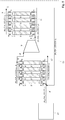
- Figure 1 schematically shows a production device 17 for the production of a first gas (A), wherein a first gas mixture (A/B) 1 of a first gas (A) and at least a second gas (B) is obtained.
- the production device 17 is coupled to a separation device 10 by a conduit, which separation device comprises an assembly of, connected in series, a first separation device 18, a compressor 19 and a PSA device which in this example has four adsorption vessels 1, 2, 3, 4.
- the first separation device 18 is configured for separating the first gas mixture (A/B) 1 into a second gas mixture (A/B) 2 of the first gas (A) and the second gas (B), in which the concentration [A] 2 of the first gas (A) is higher than the concentration [A] 1 of said gas in the first gas mixture (A/B) 1 , wherein the pressure of the second gas mixture (A/B) 2 has a first value p 1 , and into a third gas mixture (A/B) 3 of the first gas (A) and the second gas (B), in which the concentration [B] 3 of the second gas (B) is higher than the concentration [B] 1 of said gas (B) in the first gas mixture (A/B) 1 , a second separation device for according to a pressure swing adsorption process (PSA process) separating the second gas mixture (A/B) 2 into a fourth gas mixture (A/B) 4 of the first gas (A) and the second gas (B), comprising a number of vessels 1, 2, 3, 4.
- Each of the vessels 1, 2, 3, 4 is provided with an adsorption bed having an adsorption mass 5 of a material for having the second gas (B) adsorb to it, and with an inlet 6 and an outlet 7.
- the vessels 1, 2, 3, 4 are connected to four parallel conduits, namely a manifold 8 for the second gas mixture (A/B) 2 to be separated, a collecting conduit 9 for the fourth gas mixture (the product gas, (A/B) 4 ), a collecting conduit 11 for the separated fifth gas mixture (the exhaust gas, (A/B) 5 ), and a manifold 12 for equalization and purge gas.
- a supply valve 13, a product valve 14, an exhaust gas valve 15 and an equalization and purge valve 16, respectively, are present for each of the vessels 1, 2, 3, 4. Because the second gas mixture (the feed gas, (A/B) 2 ) can be introduced into the vessels 1, 2, 3, 4 at a very high pressure p 2 , an extremely high purity of the fourth gas mixture (the product gas, (A/B) 4 ) can be realized, that means a gas having a relatively extremely low concentration [B] of the second gas (B). As the exhaust gas (the fifth gas mixture (A/B) 5 ) is passed back from the PSA device to the first separation device 18 via the collecting conduit 11, an extremely high yield of the separation process can moreover be realized.
- FIG 2 is a schematic view of a biomass fermenting device 27 for the production of methane (CH 4 ), wherein a first gas mixture (CH 4 /CO 2 ) 1 of methane (the first gas (A)) and carbon dioxide (CO 2 ) (the second gas (B)) is obtained.
- the fermenting device 27 is coupled to a separation device 20 by a conduit 21, which separation device comprises an assembly of, connected in series, a washing tower 28, a compressor 19 and a PSA device which in this example has four vessels 1, 2, 3, 4.
- the CO 2 in the supplied first gas mixture (CH 4 /CO 2 ) 1 is washed out using a liquid, for instance a water-based solution of an amine-complex, which is introduced via inlet 24 and is sprayed, after which a methane-rich second gas mixture (CH 4 /CO 2 ) 2 of methane and carbon dioxide is guided via conduit 22 to a compressor 19 at a pressure p 1 , and a methane-poor third gas mixture (CH 4 /CO 2 ) 3 of methane and carbon dioxide, dissolved in the liquid, is discharged via an outlet 25.
- a liquid for instance a water-based solution of an amine-complex
- the pressure of the methane-rich second gas mixture (CH 4 /CO 2 ) 2 is increased from a value p 1 to a value p 2 , after which this second gas mixture is introduced into the respective adsorption vessels 1, 2, 3, 4 of the PSA device, in which the gas mixture is further separated into highly pure product gas (CH 4 /CO 2 ) 4 methane, with traces of carbon dioxide, which becomes available via collecting conduit 9, and a residual gas mixture (CH 4 /CO 2 ) 5 , which is passed back to the washing tower 28 via collecting conduit 11.
- FIG 3 is a schematic view of a biomass fermenting device 37 for the production of methane (CH 4 ), that is coupled to a separation device 30 by a conduit 21, which separation device comprises an assembly of, connected in series, a membrane 28, a compressor 19 and a PSA device which in this example has four vessels 1, 2, 3, 4.
- CH 4 methane
- the CO 2 in the supplied first gas mixture (CH 4 /CO 2 ) 1 of methane and carbon dioxide is dissolved in a fluid, which is introduced via inlet 34, after which a methane-rich second gas mixture (CH 4 /CO 2 ) 2 of methane and carbon dioxide is guided via conduit 22 to a compressor 19 at a pressure p 1 , and a methane-poor third gas mixture (CH 4 /CO 2 ) 3 of methane and carbon dioxide is discharged via an outlet 35.
- the separation device 30 differs from the device 20 shown in Figure 2 in the use of a membrane 38 instead of a washing tower 28, but is otherwise identical to it.
- Figure 4 is a schematic view of a biomass gassing device 47 for the production of methane (CH 4 ), that is coupled to a separation device 40 by a conduit 21, which separation device comprises an assembly of, connected in series, a first compressor 39, a first PSA device which in this example has four adsorption vessels 1', 2', 3', 4', a second compressor 19 and a second PSA device which in this example has four vessels 1, 2, 3, 4.
- a biomass accommodated therein is heated as a result of which said biomass is partially converted into a first gas mixture (H 2 /CH 4 , CO, CO 2 ) 1 containing hydrogen and at least one of the gases methane (CH 4 ), carbon monoxide (CO) and carbon dioxide (CO 2 ).
- a first gas mixture H 2 /CH 4 , CO, CO 2 ) 1 containing hydrogen and at least one of the gases methane (CH 4 ), carbon monoxide (CO) and carbon dioxide (CO 2 ).
- this first gas mixture is pressurized to for instance 8 bar, and introduced into the first PSA device 1', 2', 3', 4', where it is separated into a hydrogen-rich second gas mixture (H 2 /CH 4 , CO, CO 2 ) 2 of hydrogen, methane, carbon monoxide and carbon dioxide at a pressure p 1 , which is guided to the second compressor 19 via a collecting conduit 9', and a hydrogen-poor third gas mixture (H 2 /CH 4 , CO, CO 2 ) 3 of hydrogen, methane, carbon monoxide and carbon dioxide, that is discharged via a collecting conduit 11'.
- a hydrogen-rich second gas mixture H 2 /CH 4 , CO, CO 2
- CO 2 hydrogen-poor third gas mixture
- the pressure of the hydrogen-rich second gas mixture is increased from a value p 1 to a value p 2 of for instance 60 bar, after which this second gas mixture is introduced into the respective adsorption vessels 1, 2, 3, 4 of the second PSA device, in which the gas mixture is further separated into highly pure product gas hydrogen, which becomes available via collecting conduit 9, and a residual gas mixture (H 2 /CH 4 , CO, CO 2 ) 5 having traces of methane, carbon monoxide and carbon dioxide, which is passed back to the first PSA device 1', 2', 3', 4' via collecting conduit 11.
- FIG 5 is a schematic view of a steam reformer 57 for the production of hydrogen (H 2 ), that is coupled to a separation device 50 by a conduit 8', which separation device comprises an assembly of, connected in series, a first PSA device which in this example has four adsorption vessels 1', 2', 3', 4', a compressor 19 and a second PSA device which in this example has four vessels 1, 2, 3, 4.
- a first PSA device which in this example has four adsorption vessels 1', 2', 3', 4'
- a compressor 19 and a second PSA device which in this example has four vessels 1, 2, 3, 4.
- the separation device 50 differs from the device 40 shown in Figure 4 in the absence of a first compressor, preceding the first PSA device, but is otherwise identical to it.
- the first gas mixture (H 2 /CH 4 , CO, CO 2 ) 1 is directly introduced into the first PSA device 1', 2', 3', 4', after which the separation takes place analogous to the manner as described for Figure 4 above.
Landscapes
- Chemical & Material Sciences (AREA)
- Engineering & Computer Science (AREA)
- Organic Chemistry (AREA)
- Life Sciences & Earth Sciences (AREA)
- Oil, Petroleum & Natural Gas (AREA)
- Chemical Kinetics & Catalysis (AREA)
- General Chemical & Material Sciences (AREA)
- Analytical Chemistry (AREA)
- Biotechnology (AREA)
- Health & Medical Sciences (AREA)
- Bioinformatics & Cheminformatics (AREA)
- Inorganic Chemistry (AREA)
- Combustion & Propulsion (AREA)
- Wood Science & Technology (AREA)
- Zoology (AREA)
- Sustainable Development (AREA)
- General Engineering & Computer Science (AREA)
- General Health & Medical Sciences (AREA)
- Genetics & Genomics (AREA)
- Biochemistry (AREA)
- Microbiology (AREA)
- Biomedical Technology (AREA)
- Separation Of Gases By Adsorption (AREA)
- Hydrogen, Water And Hydrids (AREA)
Applications Claiming Priority (1)
| Application Number | Priority Date | Filing Date | Title |
|---|---|---|---|
| NL2021677A NL2021677B1 (nl) | 2018-09-20 | 2018-09-20 | Werkwijze en inrichting voor het scheiden van een gasmengsel volgens een pressure swing adsorption process (psa process) |
Publications (1)
| Publication Number | Publication Date |
|---|---|
| EP3626328A1 true EP3626328A1 (de) | 2020-03-25 |
Family
ID=63834618
Family Applications (1)
| Application Number | Title | Priority Date | Filing Date |
|---|---|---|---|
| EP19197151.4A Pending EP3626328A1 (de) | 2018-09-20 | 2019-09-13 | Verfahren zur trennung einer gasmischung durch druckwechseladsorption |
Country Status (2)
| Country | Link |
|---|---|
| EP (1) | EP3626328A1 (de) |
| NL (1) | NL2021677B1 (de) |
Citations (11)
| Publication number | Priority date | Publication date | Assignee | Title |
|---|---|---|---|---|
| US4690695A (en) * | 1986-04-10 | 1987-09-01 | Union Carbide Corporation | Enhanced gas separation process |
| US4701187A (en) * | 1986-11-03 | 1987-10-20 | Air Products And Chemicals, Inc. | Process for separating components of a gas stream |
| US5000925A (en) * | 1988-05-04 | 1991-03-19 | The Boc Group, Inc. | Hydrogen and carbon dioxide coproduction apparatus |
| EP0684066A2 (de) * | 1994-05-26 | 1995-11-29 | The Boc Group, Inc. | Verfahren zur Zurückgewinnung eines leichten Elementes aus einem verdünnten Rohgas |
| US20020162452A1 (en) * | 2001-02-26 | 2002-11-07 | Engelhard Corporation | Pressure swing adsorption process |
| US20050139072A1 (en) * | 2003-12-08 | 2005-06-30 | Landrum J. M. | Process to remove nitrogen and/or carbon dioxide from methane-containing streams |
| FR2876683A1 (fr) * | 2004-10-20 | 2006-04-21 | Air Liquide | Procede de production d'un gaz de synthese presentant un ratio h2/co inferieur a 2,5 |
| US20080078294A1 (en) * | 2006-09-29 | 2008-04-03 | Eleftherios Adamopoulos | Integrated Separation And Purification Process |
| US7875101B2 (en) * | 2008-11-12 | 2011-01-25 | Sandia Corporation | Hybrid membrane—PSA system for separating oxygen from air |
| EP2926883A1 (de) * | 2014-04-01 | 2015-10-07 | GS Engineering & Construction Corp. | System zur gastrennung |
| US20170312682A1 (en) * | 2016-04-28 | 2017-11-02 | Tobias KELLER | Method and industrial plant for obtaining helium from a helium-containing feed gas |
-
2018
- 2018-09-20 NL NL2021677A patent/NL2021677B1/nl active
-
2019
- 2019-09-13 EP EP19197151.4A patent/EP3626328A1/de active Pending
Patent Citations (11)
| Publication number | Priority date | Publication date | Assignee | Title |
|---|---|---|---|---|
| US4690695A (en) * | 1986-04-10 | 1987-09-01 | Union Carbide Corporation | Enhanced gas separation process |
| US4701187A (en) * | 1986-11-03 | 1987-10-20 | Air Products And Chemicals, Inc. | Process for separating components of a gas stream |
| US5000925A (en) * | 1988-05-04 | 1991-03-19 | The Boc Group, Inc. | Hydrogen and carbon dioxide coproduction apparatus |
| EP0684066A2 (de) * | 1994-05-26 | 1995-11-29 | The Boc Group, Inc. | Verfahren zur Zurückgewinnung eines leichten Elementes aus einem verdünnten Rohgas |
| US20020162452A1 (en) * | 2001-02-26 | 2002-11-07 | Engelhard Corporation | Pressure swing adsorption process |
| US20050139072A1 (en) * | 2003-12-08 | 2005-06-30 | Landrum J. M. | Process to remove nitrogen and/or carbon dioxide from methane-containing streams |
| FR2876683A1 (fr) * | 2004-10-20 | 2006-04-21 | Air Liquide | Procede de production d'un gaz de synthese presentant un ratio h2/co inferieur a 2,5 |
| US20080078294A1 (en) * | 2006-09-29 | 2008-04-03 | Eleftherios Adamopoulos | Integrated Separation And Purification Process |
| US7875101B2 (en) * | 2008-11-12 | 2011-01-25 | Sandia Corporation | Hybrid membrane—PSA system for separating oxygen from air |
| EP2926883A1 (de) * | 2014-04-01 | 2015-10-07 | GS Engineering & Construction Corp. | System zur gastrennung |
| US20170312682A1 (en) * | 2016-04-28 | 2017-11-02 | Tobias KELLER | Method and industrial plant for obtaining helium from a helium-containing feed gas |
Also Published As
| Publication number | Publication date |
|---|---|
| NL2021677B1 (nl) | 2020-05-07 |
Similar Documents
| Publication | Publication Date | Title |
|---|---|---|
| EP0750361B1 (de) | Verfahren zum Entfernen von CO aus einem CO + H2 enthaltenden Gasgemisch und Brennstoffzellensystem mit Verwendung derselben | |
| US20240382896A1 (en) | Ammonia Cracking for Green Hydrogen | |
| US5294247A (en) | Adsorption process to recover hydrogen from low pressure feeds | |
| US8460630B2 (en) | Method and apparatus for producing hydrogen and recovering carbon dioxide | |
| US7179324B2 (en) | Continuous feed three-bed pressure swing adsorption system | |
| US4813980A (en) | Recovery of nitrogen, hydrogen and carbon dioxide from hydrocarbon reformate | |
| KR101388266B1 (ko) | 고로가스의 분리방법 및 장치 | |
| CN102015974B (zh) | 处理氢气和一氧化碳的系统和方法 | |
| US20090223371A1 (en) | PSA apparatus for producing high-purity hydrogen gas | |
| US6770390B2 (en) | Carbon monoxide/water removal from fuel cell feed gas | |
| WO2008142009A1 (en) | Process for purifying a gas by cpsa having two regeneration stages, and purification unit for implementing this process | |
| JP6523134B2 (ja) | 水素ガス製造方法及び水素ガス製造装置 | |
| CA2607205A1 (en) | Adsorptive bulk separation for upgrading gas streams | |
| US7695545B2 (en) | Adsorption process to recover hydrogen from feed gas mixtures having low hydrogen concentration | |
| EP3085430B1 (de) | Verfahren und einrichtungen zur entschwefelung eines gasgemisches in einem druckwechsel-adsorptionsverfahren (psa) | |
| JP2017226562A (ja) | 水素ガス製造方法及び水素ガス製造装置 | |
| JP6619687B2 (ja) | 水素ガス製造方法及び水素ガス製造装置 | |
| JP6640660B2 (ja) | 水素ガス製造方法及び水素ガス製造装置 | |
| EP3626328A1 (de) | Verfahren zur trennung einer gasmischung durch druckwechseladsorption | |
| JP7372131B2 (ja) | 二酸化炭素回収装置および方法 | |
| JP2004299994A (ja) | 水素製造装置 | |
| AU2016201267B2 (en) | A plant and process for simutaneous recovering multiple gas products from petrochemical offgas | |
| JP2686349B2 (ja) | 圧力スイング式水素精製方法 | |
| CN213101492U (zh) | 从石化排放尾气中同时回收氢气和甲烷气的装置 | |
| TW202216972A (zh) | 用於以含氮天然氣生產貧氮合成氣的方法與裝置 |
Legal Events
| Date | Code | Title | Description |
|---|---|---|---|
| PUAI | Public reference made under article 153(3) epc to a published international application that has entered the european phase |
Free format text: ORIGINAL CODE: 0009012 |
|
| STAA | Information on the status of an ep patent application or granted ep patent |
Free format text: STATUS: THE APPLICATION HAS BEEN PUBLISHED |
|
| AK | Designated contracting states |
Kind code of ref document: A1 Designated state(s): AL AT BE BG CH CY CZ DE DK EE ES FI FR GB GR HR HU IE IS IT LI LT LU LV MC MK MT NL NO PL PT RO RS SE SI SK SM TR |
|
| AX | Request for extension of the european patent |
Extension state: BA ME |
|
| STAA | Information on the status of an ep patent application or granted ep patent |
Free format text: STATUS: REQUEST FOR EXAMINATION WAS MADE |
|
| 17P | Request for examination filed |
Effective date: 20200923 |
|
| RBV | Designated contracting states (corrected) |
Designated state(s): AL AT BE BG CH CY CZ DE DK EE ES FI FR GB GR HR HU IE IS IT LI LT LU LV MC MK MT NL NO PL PT RO RS SE SI SK SM TR |
|
| STAA | Information on the status of an ep patent application or granted ep patent |
Free format text: STATUS: EXAMINATION IS IN PROGRESS |
|
| 17Q | First examination report despatched |
Effective date: 20230607 |