EP3626531A1 - Station de retrait mobile pour la logistique de centre-ville - Google Patents
Station de retrait mobile pour la logistique de centre-ville Download PDFInfo
- Publication number
- EP3626531A1 EP3626531A1 EP19166994.4A EP19166994A EP3626531A1 EP 3626531 A1 EP3626531 A1 EP 3626531A1 EP 19166994 A EP19166994 A EP 19166994A EP 3626531 A1 EP3626531 A1 EP 3626531A1
- Authority
- EP
- European Patent Office
- Prior art keywords
- trailer
- locker
- lock
- drawbar
- station
- Prior art date
- Legal status (The legal status is an assumption and is not a legal conclusion. Google has not performed a legal analysis and makes no representation as to the accuracy of the status listed.)
- Granted
Links
Images




Classifications
-
- B—PERFORMING OPERATIONS; TRANSPORTING
- B60—VEHICLES IN GENERAL
- B60P—VEHICLES ADAPTED FOR LOAD TRANSPORTATION OR TO TRANSPORT, TO CARRY, OR TO COMPRISE SPECIAL LOADS OR OBJECTS
- B60P3/00—Vehicles adapted to transport, to carry or to comprise special loads or objects
- B60P3/007—Vehicles adapted to transport, to carry or to comprise special loads or objects for delivery of small articles, e.g. milk, frozen articles
-
- B—PERFORMING OPERATIONS; TRANSPORTING
- B60—VEHICLES IN GENERAL
- B60D—VEHICLE CONNECTIONS
- B60D1/00—Traction couplings; Hitches; Draw-gear; Towing devices
- B60D1/14—Draw-gear or towing devices characterised by their type
- B60D1/145—Draw-gear or towing devices characterised by their type consisting of an elongated single bar or tube
- B60D1/155—Draw-gear or towing devices characterised by their type consisting of an elongated single bar or tube comprising telescopic or foldable parts
-
- G—PHYSICS
- G06—COMPUTING OR CALCULATING; COUNTING
- G06Q—INFORMATION AND COMMUNICATION TECHNOLOGY [ICT] SPECIALLY ADAPTED FOR ADMINISTRATIVE, COMMERCIAL, FINANCIAL, MANAGERIAL OR SUPERVISORY PURPOSES; SYSTEMS OR METHODS SPECIALLY ADAPTED FOR ADMINISTRATIVE, COMMERCIAL, FINANCIAL, MANAGERIAL OR SUPERVISORY PURPOSES, NOT OTHERWISE PROVIDED FOR
- G06Q10/00—Administration; Management
- G06Q10/08—Logistics, e.g. warehousing, loading or distribution; Inventory or stock management
Definitions
- the invention relates to a mobile pick-up station according to the preamble of claim 1.
- small consignments are consignments that do not exceed certain dimensions and a certain weight, such as. B. packages, parcels, letters and the like.
- the vast majority of small consignments are delivered to private recipients, so that the small consignments are delivered particularly in inner-city areas, where - for example, in contrast to commercial areas - the traffic and parking spaces are particularly busy.
- it has turned out to be problematic due to the large number of small consignments that the delivery vehicles used for this represent an obstacle to the flow of traffic on the crowded traffic routes of inner cities.
- the known mobile pick-up station does not change much about this problem, since it is moved to the different receivers in the same way as the delivery vehicles that have been customary up to now.
- the invention is based on the object of improving a generic pick-up station in such a way that it can be designed as economically as possible and can relieve traffic in the inner cities.
- the invention proposes not to provide the cabinet system, which is designed as part of a vehicle, in a self-driving vehicle, be it autonomous or movable with a driver, but rather to design the vehicle as a trailer. Since the complete drive technology, including the technology for power supply to the drive, can be dispensed with, the proposed pick-up station can be made considerably cheaper than a self-propelled pick-up station.
- the present proposal is based on the consideration that the mobile pick-up station preferably does not belong to the various Receivers is moved, but rather is moved to a so-called installation site, which the recipients then visit and can remove their small consignments from the pick-up station.
- the travel routes can first be kept shorter and, in particular, the length of time during which the mobile pick-up station must be moved by means of a towing vehicle in the inner city area is compared to the travel time of a delivery vehicle that brings the various small consignments to the respective recipients .
- the vehicle designed as a trailer remains stationary at a place of installation for a long time, for example 12 or 14 hours during the day, a considerable economic advantage is achieved compared to the design of the pick-up station as a self-driving vehicle, because during this downtime the entire drive technology would of the self-driving vehicle remain unused.
- a towing vehicle that has brought this trailer to its installation site can then be used to either bring other pick-up stations to other installation sites or to be used as a towing vehicle.
- the vehicle trailer has a drawbar which serves to couple the trailer to a towing vehicle.
- This drawbar can be moved from an essentially lying driving position into a rest position. In the driving position, the drawbar extends outwards from the trailer's cupboard system, namely towards the coupling of the towing vehicle. In the rest position, on the other hand, the drawbar is retracted or retracted, so it does not protrude as far from the cabinet system.
- the proposed pick-up station requires less space than a self-driving vehicle, for example one Driver's cabin is not available and accordingly there is no space required for such a driver's cab at the installation site.
- the trailer can, for example, be placed close to a traffic area, for example adjacent to a footpath, a bicycle lane, or a running zone on a public square, whereby the towing vehicle can initially be located briefly on this traffic area when the trailer is set up. However, after the towing vehicle has been removed and the drawbar has been moved into its rest position, the trailer is in its place of installation without affecting the traffic area. This applies in particular if the trailer is set up in such a way that the lockers are not accessed via the traffic area, for example by a row of lockers not being parallel but oriented at right angles to the traffic area.
- the associated greater number of mobile pick-up stations is accompanied by a considerable economic advantage, which is realized by the design of the mobile pick-up station as inexpensively as possible, namely by dispensing with a drive technology and by the design of the mobile pick-up station as a vehicle trailer.
- the drawbar In order to move the drawbar from the lying driving position into the rest position, it can be provided in a first embodiment that the drawbar can be pivoted into an upright rest position.
- lightweight operation when lifting the drawbar into the rest position or later when lowering it again into the driving position can be made possible by the drawbar being constructed, for example, from light metal or by a counterweight being arranged beyond its pivot axis.
- the mobile pick-up station can advantageously have a storage compartment which holds the drawbar in its rest position.
- the storage compartment can be arranged in a cupboard system of the mobile collection station.
- a cabinet system is a larger housing in which the several lockers are arranged.
- This housing can accordingly be larger than is required exclusively for the lockers, so that this housing also has the storage compartment mentioned, into which the drawbar is pivoted from the lying driving position into the upright rest position can be.
- This ensures optimal protection against injury when the mobile pick-up station is in its place of installation, since the drawbar does not create an obstacle or a jagged outer contour of the mobile pick-up station.
- optimal weather protection can be created so that the swivel joint of the drawbar and also the electrical connections of the trailer, which are located on the drawbar and are used for the electrical connection of the trailer to the towing vehicle, are optimally protected from weather influences such as precipitation, dust and sand .
- the drawbar is not rotatably moved in a pivoting manner, but rather can be moved from its driving position into a lying rest position, in which it is arranged below the compartments of the cupboard system.
- the drawbar can be brought into the rest position by means of a horizontal sliding movement.
- An additional securing or support of the drawbar in its driving position is preferably provided to ensure that the drawbar is not inadvertently moved into its rest position by z. B. the remaining trailer is pushed onto the drawbar during a braking maneuver of the towing vehicle.
- the trailer which has the mobile pick-up station, can preferably have a vehicle frame in a manner known per se, to which, for example, the drawbar is connected and which also carries the chassis of the trailer.
- This vehicle frame can advantageously be provided with a storage compartment which receives the drawbar in its rest position.
- the storage compartment which can be at the level of the vehicle frame or below it, can ensure that the movement path along which the drawbar between the driving position and the idle position is shifted, is kept free from dirt and similar obstructions which could otherwise result from the operation of the trailer, especially in bad weather. If necessary, the storage compartment can flow into the construction of the vehicle frame and form part of the vehicle frame in order to support a weight-saving design of the vehicle frame.
- the height of the cupboard system can advantageously be adjusted between a driving position and an access position. It is provided that it is arranged lower in the access position than in the driving position. On the one hand, this height mobility of the cupboard system allows obstacles to be easily passed over in the driving position when the trailer is being moved from one place to another. On the other hand, the deeper arrangement of the cupboard system in its access position enables easier access to the lockers, or enables the arrangement of a larger number of floors of lockers and still ensures that the upper floors are easily accessible.
- the individual recipients of the small consignments register as so-called participants in the logistics concept with a so-called operator of the logistics concept, i.e. with one of the logistics service providers involved in this logistics concept.
- the access code can be communicated to the subscriber, for example electronically by means of a message which the recipient can receive on his smartphone or another suitable mobile device and which enables him to unlock the lock of a locker in which the lock intended for this recipient is located Small consignment is located.
- the participant can express wishes to always receive mailings in certain floors of the cabinet system, or to definitely exclude certain floors of the cabinet system. In this way the problem-free accessibility of the assigned locker can be guaranteed for the respective participant, taking into account or depending on the body size or possible physical impairments of the participant.
- the height flexibility of the cabinet system can be achieved, for example, by a so-called height-adjustable undercarriage, the vehicle frame including the superstructures, e.g. the cupboard system is adjustable in height compared to the trailer wheels.
- the cupboard system can be moved in height relative to the vehicle frame of the trailer. This enables a cheaper design of the trailer and possibly also a larger adjustment path of the cabinet system than a height-adjustable undercarriage.
- the adjustment can be carried out, for example, electrohydraulically or electropneumatically, in which case a mechanical locking of the cabinet system in its raised position is preferably provided in each case to protect against unintentional lowering in the event of leaks in the hydraulic or pneumatic systems.
- the advantage of such a configuration is that a central hydraulic or pneumatic element can be used and synchronous operation can be ensured without difficulty at several points of the lifting elements provided there.
- four lifting cylinders can be provided in order to raise the cupboard system relative to the chassis of the trailer.
- the adjustment can also be carried out exclusively electrically, for example via electromotive ones Spindles. Mechanical locking in the raised position is unnecessary due to the self-locking of the spindles, and leaks are excluded.
- the trailer can have a structure with an essentially rectangular plan.
- An "essentially rectangular” is also an oval floor plan or a hexagonal floor plan with two pointed end faces. Rather, the "essentially” rectangular floor plan takes into account the fact that a predetermined width is maintained, which enables transport in public road traffic, and that the cabinet system has a greater length in comparison to this width, in order in this way to provide the largest possible number of lockers .
- the lockers are arranged on two opposite long sides and accessible from the outside. The locks of the lockers are also accessible from the outside, so that the "participants" can unlock the locks of the lockers from the outside and open the lockers.
- the so-called outer doors of the compartments which are accessible from the outside, as well as the floors, ceilings and side walls of the compartments can be designed as closed surfaces.
- these surfaces can each consist of a wooden material, plastic or metal.
- the so-called inner doors facing the aisle, which allow the compartments to be loaded or emptied from the aisle, can advantageously also be designed as closed surfaces in order to also prevent an insight into the interior of these compartments from the opposite side of the trailer, when the outer door of a compartment is open there.
- the size of the compartments can vary within a cabinet system, so that the optimal compartment size can be used depending on the size of a package. In comparison to designing all subjects to be the same size, and to adapt to the largest package to be included, the largest possible number of subjects within one can be achieved due to the different subject sizes Cabinet system realized and the most effective use of the space available in the trailer are made possible.
- both the trailer and the design of the subjects can be customized.
- the cupboard system is built using scaffolding using standardized extruded profiles, the dimensions of the individual compartments can be easily determined and adapted to customer requirements.
- standardized semi-finished products such as commercially available panels can be used, which are cut to the desired dimensions.
- a door through which the aisle is accessible is arranged in one end of the essentially rectangular structure, so that the operator can enter the cabinet system from this end.
- a holder for the drawbar is advantageously provided in one end face.
- access to the lockers can be made by means of a general key or completely keyless, so that the lockers can be loaded with the small consignments in a logistics center with as little effort as possible, or from the back can be emptied.
- the holder which is provided on one end face for the drawbar, can be designed as a storage compartment which receives the drawbar in its rest position.
- both the door and the holder for the drawbar can be provided on the same end face. If the pick-up station is parked at its installation site and the drawbar is not used, but is swung up into its rest position, no access to the inside of the pick-up station is required. In this case, the pivoted-up drawbar prevents or hinders access to the interior of the cupboard system in the manner of a burglary protection, and the end wall opposite the drawbar can give the cupboard system a high degree of mechanical stability since it has no recess in the form of a door got to.
- the door on the one hand and the holder on the other hand are arranged on two opposite end faces.
- the drawbars In a logistics center, where a large number of trailers are parked and have to be loaded with the small consignments, it can be avoided that the drawbars must remain in their lowered driving position, in order not to gain access to the interior of the cabinet system in the manner of the intrusion protection mentioned, namely through the door.
- the lowered drawbars firstly increase the space requirement and also make access to the door more difficult in their lowered position, so that with a view to the situation in the logistics centers, the distribution of the drawbar on the one hand and the door on the other hand on two opposite end walls is advantageous.
- a towing vehicle which is driven by means of an electric motor can advantageously be assigned to the trailer.
- this transport of the trailer can be carried out using an electric driven towing vehicle take place locally in the city centers with as little emissions as possible.
- the electric motor is supplied with electrical energy, for example by a battery or a rechargeable battery, the operation can take place locally without any emissions.
- the electric motor is supplied with electrical energy by means of a fuel cell and the fuel cell is operated with hydrogen, low-emission operation of the towing vehicle is made possible since emissions are only released in the form of water vapor from the fuel cell.
- a lock of a locker of the mobile collection station can advantageously be designed as a PIN code lock.
- PIN designates a personal identification number so that the lock can be designed as a mechanical combination lock, for example.
- the lock can be designed as an electronic lock with a keypad for entering the PIN code.
- the keypad can be designed as a mechanical keyboard or as a touchscreen, which can display symbols on the one hand and, on the other hand, can be used as a touch-sensitive input medium, or the keypad can be designed in the form of sensor fields that represent the keys without a mechanical stroke.
- the code designated as a PIN does not necessarily have to be limited to the use of digits, that is to say only to a representation as a number. If, for example, an alphanumeric keyboard and not just a numeric keypad is provided for entering the PIN, the PIN can also be any alphanumeric character string, and in contrast to alphanumeric characters, the code can contain any graphically representable symbols, for example stars, emojis and any other symbols, which are then also shown on the input means of the lock.
- such a character string can be graphic and / or alphanumeric Characters are transmitted electronically to the participant on their mobile device, so that the entire usual character set, such as that used in Messanger apps, can also be used for such a code.
- the input means of the lock are designed as a touchscreen, the individual input fields, that is to say the virtual keys of such a touchscreen, can be provided with symbols which change from one coding to the next and are displayed by means of the touchscreen.
- the electronic lock makes it possible to change the coding of the locks after each use by a subscriber, in order to prevent improper opening of a locker whose PIN code has first become known to the authorized user. For security reasons, when using such an electronic lock, the PIN code can even be blocked automatically after the locker has been opened and closed again, if it can be assumed that the small parcel has been removed by the authorized subscriber.
- a lock is designed as an electronic lock, the coding of which can be changed by means of electronic signals and a radio device can be assigned to this locker or lock, so that the code can be reprogrammed not only decentrally, namely by a computer of the mobile pick-up station itself , but so that communication with a central office is also possible.
- This transmission of the code of a locker to the head office or from the head office to the electronic lock of the mobile pick-up station can also be used, for example, not only to block or change the access code of a locker to prevent unauthorized further use of the locker, but it re-programming of the code, i.e. changing the unlock code of the electronic lock, can also be used.
- the locker at the site of the mobile pick-up station can be used several times in succession on the same day, which makes the mobile pick-up station particularly versatile and improves its efficiency.
- the locker is first loaded with a small consignment in the logistics center.
- the code of the locker is communicated to a participant, namely the intended recipient of the small consignment.
- the mobile pick-up station is brought to the installation site and set up there.
- the participant can go to the installation site, enter the code and thus open the locker intended for him and remove the small consignment intended for him from the locker.
- a new code is then assigned to this locker or its electronic lock. This can either be done by a computer or from a database that is located decentrally in the mobile pick-up station itself, or this new assignment of the code can take place from a central computer that communicates wirelessly with a corresponding radio device of the mobile pick-up station.
- the participants in the logistics concept there can advantageously be the possibility of making a so-called demand request to the operators of the logistics concept, that is to say asking for a free locker.
- the locker that has become free in the above example can be used for such a request, so that the operator of the logistics concept reserves this locker and electronically sends the participant a corresponding confirmation message.
- the operator sends the participant payment information if the shipping costs are already known at this point in time, which can be based on the delivery address, size and weight of the small consignment and, if necessary, also on requests for urgent delivery.
- the mobile pick-up station can have aids in order to record the dimensions and / or the weight of the small consignment, so that the participant can transmit the required information as part of his request for requirements.
- the payment information can be a request for payment, so that the participant must now initiate a payment on his own initiative.
- a payment method can be particularly simple in that the subscriber merely confirms information transmitted by the operator.
- This information contains, for example, information about the amount of the payment to be made and information about a credit to be debited from the participant.
- This can be a credit with a payment service such as PayPal, or a credit in an account of a credit institution, or a credit that is credited to the participant at the operator of the logistics concept.
- the payment information transmitted electronically to the participant can only be information that the participant's credit will be debited with a certain amount or has already been debited. In this case, the participant only needs to be active if he is Wants to contradict information and thus wants to revoke his request for demand.
- the unlock code of the lock of the empty locker reserved for the participant is electronically transmitted to the participant upon request and the subsequent confirmation message.
- the participant can now go to the mobile pick-up station, unlock the lock by entering the code, this unlocking of the electronic lock automatically, e.g. B. is done by an electric motor, and he can then store his small consignment in the locker and close the door of the locker again.
- the lock is then automatically locked after the locker door has been opened and then closed again, and the code that unlocks this lock is automatically locked or at least changed after the locker door has been opened.
- the participant in the process is not the recipient of a small consignment, but rather the sender of a small consignment, who is also differentiated in this case from the so-called operators, namely the logistics service providers. If the mobile pick-up station is later brought back from the installation site to the logistics center by means of the towing vehicle, the small consignment can be dispatched from there.
- the shipping costs of the small consignment are not yet known when the participant places his small consignment in the mobile pick-up station, it can be provided that these costs are calculated in the logistics center after the mobile pick-up station has been moved from the installation site to the logistics center. Based on this calculation, the participant can now send the shipping costs electronically as payment information transmitted so that he can now make the payment as described above. If the participant should no longer wish to send the small consignment, he can refuse the payment so that the small consignment will be brought back to the installation site the next time the mobile pick-up station is driven to the installation location, and so that the participant can then send his small consignment again can withdraw and only has to pay the costs incurred for the previous handling.
- the locker code will automatically become invalid after the locker has been opened. In a first variant of the method, this can take place immediately after opening the locker or, in a second variant, only when the locker which was initially open has subsequently been closed again.
- the mobile pick-up station can be used as a "parcel station", as is known in many cities for example before Christmas.
- the subscriber who has fitted the empty locker with a small consignment can open the locker again during this predetermined time, during which the code remains valid, and remove his small consignment from the locker.
- the trailer contains a payment module, so that the recipient has the option of paying for goods that are available in the trailer before the unlock code of the subject in question is communicated to him and enables him to remove the now paid goods becomes.
- a status message can contain information about whether an outer door is unlocked or locked, whether an object is inside the compartment or not, whether a temperature in the compartment is exceeded or undershot or which temperature is in the compartment.
- a comparison with biometric data of the authorized recipient can be provided to unlock a lock.
- the trailer can have a biometric module, which is designed as a fingerprint or iris scanner.
- the biometric comparison can be used in favor of a particularly simple handling, so that the biometric data represent an unlock code that enables the opening of an outer door of a compartment without the respective user having to operate another input list of an unlock code, for example a keyboard or similar.
- the biometric comparison can be provided in addition to the entry of an unlock code that is otherwise provided anyway.
- these reference data can be stored permanently in a database which is stored in a decentralized memory in the trailer or which is available in a central memory to which the Trailers can be automatically wired or accessed wirelessly, e.g. B. by means of a program that runs on a PC arranged in the trailer. Permanent storage of the biometric data can be advantageous for users who regularly access a compartment of the cabinet system using the biometric data.
- this reference data can only be temporarily stored, for example for data protection reasons or for users who only access the compartment of the cabinet system once or occasionally using the biometric data.
- the temporary storage is advantageously carried out locally or locally in the trailer.
- the biometric reference data can be transmitted to the buffer via a mobile radio connection.
- This temporarily stored reference data can be deleted automatically after it has been used for a comparison, i.e. after access to the relevant compartment of the cabinet system, or after a specified storage period has expired, or whichever of the two events mentioned occurs first.
- the code can be sent after the participant has sent his small consignment inserted into the locker, also become invalid by not automatically assigning a new code to the lock, but rather by transmitting electronic information to this lock that puts the lock in a locked mode, so that it is independent of the one entered at the lock Code the lock remains in its bolt position. In this way, accidental opening of the locker by unauthorized persons from the outside is reliably avoided, while access from the inside, for example from the aisle mentioned, is still possible without any problems in order to be able to further process the item posted for dispatch in the logistics center.
- the participant can tell the operator of the logistics concept whether the small consignment should be posted for dispatch or the locker should only be rented for a certain time, such as at a parcel station.
- the basic method which can be carried out using the proposed mobile pick-up station for the delivery of letters, parcels and similar small consignments, therefore provides that a small consignment is stored in a locker in the locker system in a logistics center.
- the trailer is then coupled to a towing vehicle and brought to a site by means of this towing vehicle, where it is decoupled from the towing vehicle and set up.
- the code of the lock belonging to the locker is transmitted electronically to the intended recipient of the small consignment, who is designated as a participant in this logistics concept and is thus differentiated by the operators, namely the logistics service providers. After entering the code, the lock is automatically unlocked so that the participant has access to the locker and the small consignment inside.
- the proposed trailer can advantageously have a storage compartment, which is used to accommodate electronic devices.
- an electronic control can be housed therein, e.g. in the form of a PC, a radio module for an external radio connection, a radio module for a WLAN radio connection limited to the pick-up station, a GPS antenna and the like.
- the location of the pick-up station can be called up by radio interrogation, or it can be provided that the respective location is transmitted at regular intervals by the radio module of the pick-up station itself, which on the one hand does the work the logistics service provider facilitates and on the other hand can serve theft protection.
- Such a storage compartment can advantageously be created by dimensioning a storage compartment on the front side of the trailer where the drawbar is located to accommodate the folded-up drawbar so that electronic devices can also be accommodated therein.
- the storage compartment for example the storage compartment mentioned for the drawbar, can also have connections for an electrical energy supply and / or connections to a circuit of a liquid heat transfer medium. If some in the pick-up station Lockers are designed as refrigerated or warming compartments and must be tempered accordingly, the locker in question can be brought to the desired temperature by means of such connections in the logistics center.
- the connections can be connected, for example, to a stationary energy supply or temperature control device available in the logistics center, or can already be connected to an energy supply or a heat transfer circuit of the towing vehicle in the logistics center. Before the trailer is decoupled from the stationary facility in the logistics center and at the latest when the trailer is decoupled from the towing vehicle at the installation site, these connections are released and are secured against unauthorized access when the flap of the corresponding storage compartment is closed.
- Small tools can also be accommodated in a storage compartment of the trailer, for example in the storage compartment mentioned to hold the drawbar, for example hand-operated or motor-operated small tools such as e.g. a cordless screwdriver, a small compressor or the like.
- the small tools can be provided to carry out minor maintenance repairs on the trailer directly on site, so that the trailer is ready to drive and can be brought to the logistics center or to a service station.
- the small tools can also be provided for the regular operation of the trailer: for example, a mechanical height adjustment of the trailer can be provided with the aid of spindle drives, and the aforementioned cordless screwdriver can be used to drive it.
- the individual lockers of the pick-up station can advantageously be secured inside the trailer, for example where there is a passage between the lockers, by means of weight-saving locking grids in order to prevent unauthorized access outside, namely through an open locker to prevent another locker.
- the pick-up station advantageously has an energy store, which is not only dimensioned sufficiently for the operation of the electronic devices, but which also allows the trailer to be adjusted in height after the trailer has been uncoupled, for example in order to lower the trailer and thus easier access to the lockers, in particular the upper lockers.
- the energy store can also be used to temper the lockers if they are designed, for example, as cold stores or warming compartments.
- the pick-up station can advantageously have means for generating energy, for example in the form of a photovoltaic module and / or in the form of a wind generator, e.g. in the form of a vertical rotor.
- means for generating energy for example in the form of a photovoltaic module and / or in the form of a wind generator, e.g. in the form of a vertical rotor.
- the lockers preferably have different sizes depending on the small consignments to be accommodated in each case.
- the arrangement of so-called long goods compartments can advantageously be provided above the lockers. If, due to the axle arrangement, the lower row of lockers is arranged above the axle of the trailer or above the wheel wells of the trailer, the arrangement of long goods compartments can be provided below this lowest row of lockers, namely in front of and behind the wheel wells.
- FIG. 1 A mobile pick-up station is shown, which is designed as a vehicle trailer 1.
- the trailer 1 is coupled to a towing vehicle 3 with an electric drive by means of a schematically indicated drawbar 2 and has a cupboard system 4 which comprises a plurality of lockers 5.
- the lockers 5 are arranged one above the other on three floors and are accessible from the outside. For this purpose, they each have an outer door 11, each door 11 being operable and lockable by means of its own, schematically indicated lock 6, which, depending on the configuration, can also serve as a handle.
- the locks 6 are individually coded, so that only one specific lock 6 is opened and the one by means of an access code Access through the relevant outer door 11 can only be released to a certain locker 5.
- Fig. 2 shows a horizontal section through the cabinet system 4 of the mobile collection station of Fig. 1 .
- the lockers 5 are arranged in two rows, each on the outside on a long side 7 of the trailer 1.
- a passage 8 runs as a space between these two rows of lockers 5.
- the lockers 5 also have so-called inner doors 12, which allow access to the lockers 5 from the aisle 8.
- One also in Fig. 1 recognizable trailer door 10 is arranged in a rear end face 9 of the trailer 1
- the inner doors of the lockers 5 have no individually coded locks. Rather, they can be opened with a general key which enables all inner doors to be opened, or they can be designed without a lock and only have mechanical locking means which serve to prevent the inner door from being accidentally opened, e.g. when the trailer 1 makes jerky movements when driving over uneven ground.
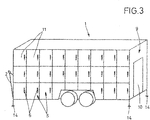
- FIG. 1 the mobile pick-up station shows that the trailer is 1 in Fig. 3 shown at its installation site, that is, where the mobile pick-up station should enable the respective recipients to access the lockers 5.
- the drawbar 2 has been pivoted upwards from its lying driving position and is in an upright rest position, so that the space requirement of the trailer 1 at the installation site is minimized. Furthermore, the trailer 1 with floor supports 14 stands on the ground.
- Fig. 4 explains schematically the loading of several trailers 1 with small consignments 15 in the form of packages in the area of a logistics center 16.
- the logistics center 16 represents a building represents, which has several loading ramps, with a trailer 1 is on each loading ramp.
- the small consignments delivered by the forwarding companies are assigned to the various trailers 1. This happens depending on which trailer 1 is intended for a location in the delivery area of the respective recipient.
- Fig. 5 shows in the manner of a map the outline of an urban area, this urban area is shown in eight delivery areas and purely schematically in each of these delivery areas a trailer 1, which is located at a location in its respective delivery area.
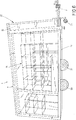
- Fig. 6 shows a view of a longitudinal side 7 of a trailer 1.
- a side wall of the trailer is removed and a rack structure 18 of the cabinet system 4 can be seen.
- the rack structure 18 can be filled with a plurality of plates to create the lockers 5.
- Fixed plates are provided as floors, ceilings and walls of the lockers 5, as well as movable plates which form the outer doors 11 and the inner doors 12 of the lockers 5.
- a vehicle frame 19 of the trailer 1 recognizable, which carries wheels 20, and to which also Drawbar 2 connects, which in turn carries a support wheel 21.
- a storage space 22 is arranged between the outer end wall of the trailer 1 and the closest lockers 5 of the rack structure 8.
- the storage space 22 can be used, for example, to accommodate batteries or similar energy stores which, for example, supply the locks 6 with energy when the locks 6 are designed as electronic locks.
- a computing unit can be accommodated in the storage space 22, which is also supplied with energy by this energy source and which, for example, serves to lock the lock 6 of this locker 5 or to change its code after an authorized access to a locker 5.
- a mobile radio device can be accommodated in the storage space 22, which is also supplied with energy by this energy source and which serves to enable communication with a central point, for example in order to change the coding of electronic locks 6.
- Communication with the central office can serve to transmit the opening of an outer door 11 of a locker 5 to the central office, so that information is available in the central office that the locker 5 in question has probably been emptied.
- the communication with the central office can also serve to transmit a new, centrally determined, changed coding for this locker 5 from the central office to the trailer 1 after an authorized opening of a locker 5.
- the new coding is determined and changed decentrally by means of a computing unit of the trailer 1, and that this changed code is then transmitted to the central office.
- a subscriber - for example a non-local subscriber - can use the central station to empty one Rent the locker 5 of the trailer 1 and thus use the mobile pick-up station as a parcel station to temporarily store goods purchased during a stay in the city in a locker 5 before this participant then removes these goods from the locker 5 and the goods themselves to him Transported home.
- a participant can rent an empty locker 5 via the central office and pay for it together with a forwarding service, so that this participant can then insert a small shipment 15 to be sent into the empty locker 5. If the trailer 1 is later picked up from its installation location and brought back to the logistics center 16 by means of a towing vehicle 3, the small consignment can be removed from the locker 5 there and further processed by a forwarding company and brought to the intended recipient.
- a mobile radio unit can also be provided in the trailer 1, but this is used for communication with the subscriber himself and possibly also with payment services via which the fee to be paid by the subscriber is billed.
- Fig. 6 shows the trailer 1 in a basically ready to drive condition.
- the trailer 1 only has to be coupled to a towing vehicle 3 and the support wheel 21 has to be raised or removed in order to subsequently be able to move the trailer 1, for example in order to be able to spend it back and forth between the logistics center 16 and the installation site.
- Fig. 7 shows a section of the rack structure 18, namely the section of an individual locker 5.
- the outer door 11 between the struts of the rack structure 18 can be seen.
- the outer door 11 has an electronic lock 6, which also serves as a door handle, and which has a keyboard with a numeric keypad so that a number code called PIN can be entered to unlock the lock 6 and then open the door 11 to be able to.
- Fig. 8 shows a perspective view of the trailer 1 of the Fig. 6 from the area of the end face 9. It can be seen that in the storage space 22 a storage compartment 23 is accessible through a storage compartment door 24. The storage compartment door 24 is in Fig. 8 shown in its open position so that a tether 25 can be seen in the storage compartment 23.
- Fig. 9 also shows the cabinet system 4 in its lowered access position.
- the drawbar 2 has been pivoted upwards from its lying driving position into an upright rest position, so that it is now completely arranged in the storage compartment 23. In this rest position it is secured by the tether 25.
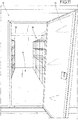
- Fig. 11 shows a view of the front end wall 9 with the trailer door 10 open. It can be seen that on both sides of the aisle 8 rack structures 18 are arranged to create lockers 5.
Landscapes
- Engineering & Computer Science (AREA)
- Business, Economics & Management (AREA)
- Mechanical Engineering (AREA)
- Economics (AREA)
- Transportation (AREA)
- Tourism & Hospitality (AREA)
- General Business, Economics & Management (AREA)
- Operations Research (AREA)
- Quality & Reliability (AREA)
- Strategic Management (AREA)
- Human Resources & Organizations (AREA)
- Physics & Mathematics (AREA)
- Marketing (AREA)
- General Physics & Mathematics (AREA)
- Theoretical Computer Science (AREA)
- Health & Medical Sciences (AREA)
- Public Health (AREA)
- Entrepreneurship & Innovation (AREA)
- Development Economics (AREA)
- Management, Administration, Business Operations System, And Electronic Commerce (AREA)
- Lock And Its Accessories (AREA)
Priority Applications (1)
| Application Number | Priority Date | Filing Date | Title |
|---|---|---|---|
| PL19166994T PL3626531T3 (pl) | 2018-09-21 | 2019-04-03 | Mobilne stanowisko odbiorcze dla logistyki miejskiej |
Applications Claiming Priority (1)
| Application Number | Priority Date | Filing Date | Title |
|---|---|---|---|
| DE102018123347 | 2018-09-21 |
Publications (2)
| Publication Number | Publication Date |
|---|---|
| EP3626531A1 true EP3626531A1 (fr) | 2020-03-25 |
| EP3626531B1 EP3626531B1 (fr) | 2021-12-29 |
Family
ID=66092030
Family Applications (1)
| Application Number | Title | Priority Date | Filing Date |
|---|---|---|---|
| EP19166994.4A Active EP3626531B1 (fr) | 2018-09-21 | 2019-04-03 | Station de retrait mobile pour la logistique de centre-ville |
Country Status (2)
| Country | Link |
|---|---|
| EP (1) | EP3626531B1 (fr) |
| PL (1) | PL3626531T3 (fr) |
Cited By (5)
| Publication number | Priority date | Publication date | Assignee | Title |
|---|---|---|---|---|
| DE102020118167A1 (de) | 2020-07-09 | 2022-01-13 | Deutsche Post Ag | Zustellfahrzeug mit einem mobilen Aufsatz |
| DE102020123088A1 (de) | 2020-09-03 | 2022-03-03 | Denso Automotive Deutschland Gmbh | Verfahren zur Allokation von mehreren Einrichtungen zum Bereitstellen von Warensendungen |
| DE102020211867A1 (de) | 2020-09-23 | 2022-03-24 | Ford Global Technologies, Llc | Logistiksystem |
| US11345269B2 (en) * | 2016-09-07 | 2022-05-31 | Pickdelso Oy | Trailer and arrangement for delivery of products |
| EP4339019A1 (fr) * | 2022-09-16 | 2024-03-20 | CityLog GmbH | Véhicule avec une consigne à colis disposée sur le véhicule |
Families Citing this family (1)
| Publication number | Priority date | Publication date | Assignee | Title |
|---|---|---|---|---|
| DE102022209735A1 (de) | 2022-09-16 | 2024-03-21 | CityLog GmbH | Fahrzeug mit einer auf dem Fahrzeug angeordneten Paketstation |
Citations (7)
| Publication number | Priority date | Publication date | Assignee | Title |
|---|---|---|---|---|
| EP1155913A1 (fr) * | 2000-05-16 | 2001-11-21 | Stewart Kenneth Hibberd | Système de stockage |
| DE202006003054U1 (de) * | 2006-02-27 | 2006-06-01 | Yildiz, Metin | Anhänger für Fahrzeuge |
| FR2902721A1 (fr) * | 2006-06-26 | 2007-12-28 | Bernard Cetier | Boite a depot |
| GB2461325A (en) * | 2008-06-25 | 2009-12-30 | Purple Line Ltd | A caravan trailer |
| DE202009011491U1 (de) * | 2009-08-26 | 2011-01-20 | Al-Ko Kober Ag | Fahrgestell |
| US9256852B1 (en) | 2013-07-01 | 2016-02-09 | Google Inc. | Autonomous delivery platform |
| WO2018046603A1 (fr) * | 2016-09-07 | 2018-03-15 | Pickdelso Oy | Remorque et agencement pour la livraison de produits |
Family Cites Families (1)
| Publication number | Priority date | Publication date | Assignee | Title |
|---|---|---|---|---|
| DE9003070U1 (de) * | 1990-03-14 | 1990-05-17 | Odenwaldwerke Rittersbach GmbH Fahrzeugbau und Katastrophenschutzsysteme, 6957 Elztal | Verfahrbare Telefonsprechstelle |
-
2019
- 2019-04-03 PL PL19166994T patent/PL3626531T3/pl unknown
- 2019-04-03 EP EP19166994.4A patent/EP3626531B1/fr active Active
Patent Citations (7)
| Publication number | Priority date | Publication date | Assignee | Title |
|---|---|---|---|---|
| EP1155913A1 (fr) * | 2000-05-16 | 2001-11-21 | Stewart Kenneth Hibberd | Système de stockage |
| DE202006003054U1 (de) * | 2006-02-27 | 2006-06-01 | Yildiz, Metin | Anhänger für Fahrzeuge |
| FR2902721A1 (fr) * | 2006-06-26 | 2007-12-28 | Bernard Cetier | Boite a depot |
| GB2461325A (en) * | 2008-06-25 | 2009-12-30 | Purple Line Ltd | A caravan trailer |
| DE202009011491U1 (de) * | 2009-08-26 | 2011-01-20 | Al-Ko Kober Ag | Fahrgestell |
| US9256852B1 (en) | 2013-07-01 | 2016-02-09 | Google Inc. | Autonomous delivery platform |
| WO2018046603A1 (fr) * | 2016-09-07 | 2018-03-15 | Pickdelso Oy | Remorque et agencement pour la livraison de produits |
Cited By (6)
| Publication number | Priority date | Publication date | Assignee | Title |
|---|---|---|---|---|
| US11345269B2 (en) * | 2016-09-07 | 2022-05-31 | Pickdelso Oy | Trailer and arrangement for delivery of products |
| DE102020118167A1 (de) | 2020-07-09 | 2022-01-13 | Deutsche Post Ag | Zustellfahrzeug mit einem mobilen Aufsatz |
| US12017572B2 (en) | 2020-07-09 | 2024-06-25 | Deutsche Post Ag | Delivery vehicle with a mobile attachment |
| DE102020123088A1 (de) | 2020-09-03 | 2022-03-03 | Denso Automotive Deutschland Gmbh | Verfahren zur Allokation von mehreren Einrichtungen zum Bereitstellen von Warensendungen |
| DE102020211867A1 (de) | 2020-09-23 | 2022-03-24 | Ford Global Technologies, Llc | Logistiksystem |
| EP4339019A1 (fr) * | 2022-09-16 | 2024-03-20 | CityLog GmbH | Véhicule avec une consigne à colis disposée sur le véhicule |
Also Published As
| Publication number | Publication date |
|---|---|
| EP3626531B1 (fr) | 2021-12-29 |
| PL3626531T3 (pl) | 2022-05-02 |
Similar Documents
| Publication | Publication Date | Title |
|---|---|---|
| EP3626531B1 (fr) | Station de retrait mobile pour la logistique de centre-ville | |
| EP3115319B1 (fr) | Vehicule utilitaire d'envoi d'une marchandise en transit | |
| WO2018011394A2 (fr) | Système de transport, véhicule automoteur et procédé de commande d'un système de transport | |
| DE102015203506A1 (de) | Automobile Transporteinheit zum Positionieren von Fahrzeugen, Verfahren dafür sowie Parksystem | |
| EP4046108B1 (fr) | Système et procédé pour le transport de marchandises | |
| WO2012034153A1 (fr) | Procédé de fonctionnement d'appareils automatiques de stockage pour la distribution d'objets à une pluralité de personnes, ainsi qu'appareil automatique de stockage correspondant | |
| DE102019206732A1 (de) | Förderverfahren und Fördervorrichtung | |
| DE102017119476A1 (de) | Serviceeinrichtung | |
| WO2019158232A1 (fr) | Procédé de fourniture d'un véhicule automobile pour une prestation de service et environnement de service | |
| EP4208400A1 (fr) | Dispositif de stockage et procédé de stockage d'objets, de retrait d'objets à partir d'un stockage, et/ou de déplacement d'objets stockés, procédé, dispositif de commande et/ou de régulation, et système de stockage | |
| DE102021113522A1 (de) | Lagereinrichtung und Verfahren zum Ein-, Aus und/oder Umlagern von Gegenständen, Verfahren, Steuer- und/oder Regeleinrichtung sowie Lagersystem | |
| DE202017003950U1 (de) | Standardcontainer zur zeitweiligen Aufbewahrung von Fahrrädern | |
| DE4306960A1 (de) | Vorrichtung und Verfahren zum gleichzeitigen, computergesteuerten, allseitigen Verladen, Transportieren, Austauschen und Umladen von Lasten zwischen momentan verfügbaren und zukünftigen Transportsystemen und/oder Haltestellen | |
| DE102024110718A1 (de) | Gemischte E-Fahrzeug-Ladestation | |
| DE102020110981A1 (de) | Kurierfahrzeug zum autonomen Transport von Stückgutmodulen nacheinander im öffentlichen Raum und Verfahren zum autonomen Transport wenigstens eines Stückgutmoduls im öffentlichen Raum | |
| DE19962990C2 (de) | Transportable Fabrikhalle und Verfahren zu deren Aufstellung | |
| EP3642136B1 (fr) | Caisse mobile | |
| AT527271A1 (de) | System zur Auslieferung und Abholung von Paketen | |
| WO2023052443A1 (fr) | Unité logistique et procédé d'approvisionnement de marchandises | |
| WO2023052470A1 (fr) | Unité de stockage, système de stockage et utilisation associée | |
| DE102017007095A1 (de) | Standardcontainer zur zeitweiligen Aufbewahrung von Fahrrädern | |
| DE202019005571U1 (de) | Containergebäude mit Aufbewahrungseinrichtung für Zweiräder | |
| EP3483091B1 (fr) | Procédé d'identification d'une quantité de déchets | |
| DE102022209735A1 (de) | Fahrzeug mit einer auf dem Fahrzeug angeordneten Paketstation | |
| EP4339019A1 (fr) | Véhicule avec une consigne à colis disposée sur le véhicule |
Legal Events
| Date | Code | Title | Description |
|---|---|---|---|
| PUAI | Public reference made under article 153(3) epc to a published international application that has entered the european phase |
Free format text: ORIGINAL CODE: 0009012 |
|
| STAA | Information on the status of an ep patent application or granted ep patent |
Free format text: STATUS: THE APPLICATION HAS BEEN PUBLISHED |
|
| AK | Designated contracting states |
Kind code of ref document: A1 Designated state(s): AL AT BE BG CH CY CZ DE DK EE ES FI FR GB GR HR HU IE IS IT LI LT LU LV MC MK MT NL NO PL PT RO RS SE SI SK SM TR |
|
| AX | Request for extension of the european patent |
Extension state: BA ME |
|
| STAA | Information on the status of an ep patent application or granted ep patent |
Free format text: STATUS: REQUEST FOR EXAMINATION WAS MADE |
|
| 17P | Request for examination filed |
Effective date: 20200922 |
|
| STAA | Information on the status of an ep patent application or granted ep patent |
Free format text: STATUS: EXAMINATION IS IN PROGRESS |
|
| RIC1 | Information provided on ipc code assigned before grant |
Ipc: B60D 1/155 20060101ALI20201209BHEP Ipc: B60P 3/00 20060101AFI20201209BHEP Ipc: G06Q 10/08 20120101ALI20201209BHEP |
|
| 17Q | First examination report despatched |
Effective date: 20201223 |
|
| GRAP | Despatch of communication of intention to grant a patent |
Free format text: ORIGINAL CODE: EPIDOSNIGR1 |
|
| STAA | Information on the status of an ep patent application or granted ep patent |
Free format text: STATUS: GRANT OF PATENT IS INTENDED |
|
| INTG | Intention to grant announced |
Effective date: 20210720 |
|
| GRAS | Grant fee paid |
Free format text: ORIGINAL CODE: EPIDOSNIGR3 |
|
| GRAA | (expected) grant |
Free format text: ORIGINAL CODE: 0009210 |
|
| STAA | Information on the status of an ep patent application or granted ep patent |
Free format text: STATUS: THE PATENT HAS BEEN GRANTED |
|
| AK | Designated contracting states |
Kind code of ref document: B1 Designated state(s): AL AT BE BG CH CY CZ DE DK EE ES FI FR GB GR HR HU IE IS IT LI LT LU LV MC MK MT NL NO PL PT RO RS SE SI SK SM TR |
|
| REG | Reference to a national code |
Ref country code: GB Ref legal event code: FG4D Free format text: NOT ENGLISH |
|
| REG | Reference to a national code |
Ref country code: CH Ref legal event code: EP |
|
| REG | Reference to a national code |
Ref country code: DE Ref legal event code: R096 Ref document number: 502019003081 Country of ref document: DE |
|
| REG | Reference to a national code |
Ref country code: AT Ref legal event code: REF Ref document number: 1458443 Country of ref document: AT Kind code of ref document: T Effective date: 20220115 |
|
| REG | Reference to a national code |
Ref country code: IE Ref legal event code: FG4D Free format text: LANGUAGE OF EP DOCUMENT: GERMAN |
|
| REG | Reference to a national code |
Ref country code: NL Ref legal event code: FP |
|
| REG | Reference to a national code |
Ref country code: LT Ref legal event code: MG9D |
|
| PG25 | Lapsed in a contracting state [announced via postgrant information from national office to epo] |
Ref country code: RS Free format text: LAPSE BECAUSE OF FAILURE TO SUBMIT A TRANSLATION OF THE DESCRIPTION OR TO PAY THE FEE WITHIN THE PRESCRIBED TIME-LIMIT Effective date: 20211229 Ref country code: LT Free format text: LAPSE BECAUSE OF FAILURE TO SUBMIT A TRANSLATION OF THE DESCRIPTION OR TO PAY THE FEE WITHIN THE PRESCRIBED TIME-LIMIT Effective date: 20211229 Ref country code: FI Free format text: LAPSE BECAUSE OF FAILURE TO SUBMIT A TRANSLATION OF THE DESCRIPTION OR TO PAY THE FEE WITHIN THE PRESCRIBED TIME-LIMIT Effective date: 20211229 Ref country code: BG Free format text: LAPSE BECAUSE OF FAILURE TO SUBMIT A TRANSLATION OF THE DESCRIPTION OR TO PAY THE FEE WITHIN THE PRESCRIBED TIME-LIMIT Effective date: 20220329 |
|
| PG25 | Lapsed in a contracting state [announced via postgrant information from national office to epo] |
Ref country code: SE Free format text: LAPSE BECAUSE OF FAILURE TO SUBMIT A TRANSLATION OF THE DESCRIPTION OR TO PAY THE FEE WITHIN THE PRESCRIBED TIME-LIMIT Effective date: 20211229 Ref country code: NO Free format text: LAPSE BECAUSE OF FAILURE TO SUBMIT A TRANSLATION OF THE DESCRIPTION OR TO PAY THE FEE WITHIN THE PRESCRIBED TIME-LIMIT Effective date: 20220329 Ref country code: LV Free format text: LAPSE BECAUSE OF FAILURE TO SUBMIT A TRANSLATION OF THE DESCRIPTION OR TO PAY THE FEE WITHIN THE PRESCRIBED TIME-LIMIT Effective date: 20211229 Ref country code: HR Free format text: LAPSE BECAUSE OF FAILURE TO SUBMIT A TRANSLATION OF THE DESCRIPTION OR TO PAY THE FEE WITHIN THE PRESCRIBED TIME-LIMIT Effective date: 20211229 Ref country code: GR Free format text: LAPSE BECAUSE OF FAILURE TO SUBMIT A TRANSLATION OF THE DESCRIPTION OR TO PAY THE FEE WITHIN THE PRESCRIBED TIME-LIMIT Effective date: 20220330 |
|
| PG25 | Lapsed in a contracting state [announced via postgrant information from national office to epo] |
Ref country code: SM Free format text: LAPSE BECAUSE OF FAILURE TO SUBMIT A TRANSLATION OF THE DESCRIPTION OR TO PAY THE FEE WITHIN THE PRESCRIBED TIME-LIMIT Effective date: 20211229 Ref country code: SK Free format text: LAPSE BECAUSE OF FAILURE TO SUBMIT A TRANSLATION OF THE DESCRIPTION OR TO PAY THE FEE WITHIN THE PRESCRIBED TIME-LIMIT Effective date: 20211229 Ref country code: RO Free format text: LAPSE BECAUSE OF FAILURE TO SUBMIT A TRANSLATION OF THE DESCRIPTION OR TO PAY THE FEE WITHIN THE PRESCRIBED TIME-LIMIT Effective date: 20211229 Ref country code: PT Free format text: LAPSE BECAUSE OF FAILURE TO SUBMIT A TRANSLATION OF THE DESCRIPTION OR TO PAY THE FEE WITHIN THE PRESCRIBED TIME-LIMIT Effective date: 20220429 Ref country code: ES Free format text: LAPSE BECAUSE OF FAILURE TO SUBMIT A TRANSLATION OF THE DESCRIPTION OR TO PAY THE FEE WITHIN THE PRESCRIBED TIME-LIMIT Effective date: 20211229 Ref country code: EE Free format text: LAPSE BECAUSE OF FAILURE TO SUBMIT A TRANSLATION OF THE DESCRIPTION OR TO PAY THE FEE WITHIN THE PRESCRIBED TIME-LIMIT Effective date: 20211229 Ref country code: CZ Free format text: LAPSE BECAUSE OF FAILURE TO SUBMIT A TRANSLATION OF THE DESCRIPTION OR TO PAY THE FEE WITHIN THE PRESCRIBED TIME-LIMIT Effective date: 20211229 |
|
| PG25 | Lapsed in a contracting state [announced via postgrant information from national office to epo] |
Ref country code: IS Free format text: LAPSE BECAUSE OF FAILURE TO SUBMIT A TRANSLATION OF THE DESCRIPTION OR TO PAY THE FEE WITHIN THE PRESCRIBED TIME-LIMIT Effective date: 20220429 |
|
| REG | Reference to a national code |
Ref country code: DE Ref legal event code: R097 Ref document number: 502019003081 Country of ref document: DE |
|
| PG25 | Lapsed in a contracting state [announced via postgrant information from national office to epo] |
Ref country code: DK Free format text: LAPSE BECAUSE OF FAILURE TO SUBMIT A TRANSLATION OF THE DESCRIPTION OR TO PAY THE FEE WITHIN THE PRESCRIBED TIME-LIMIT Effective date: 20211229 Ref country code: AL Free format text: LAPSE BECAUSE OF FAILURE TO SUBMIT A TRANSLATION OF THE DESCRIPTION OR TO PAY THE FEE WITHIN THE PRESCRIBED TIME-LIMIT Effective date: 20211229 |
|
| PLBE | No opposition filed within time limit |
Free format text: ORIGINAL CODE: 0009261 |
|
| STAA | Information on the status of an ep patent application or granted ep patent |
Free format text: STATUS: NO OPPOSITION FILED WITHIN TIME LIMIT |
|
| 26N | No opposition filed |
Effective date: 20220930 |
|
| REG | Reference to a national code |
Ref country code: BE Ref legal event code: MM Effective date: 20220430 |
|
| PG25 | Lapsed in a contracting state [announced via postgrant information from national office to epo] |
Ref country code: MC Free format text: LAPSE BECAUSE OF FAILURE TO SUBMIT A TRANSLATION OF THE DESCRIPTION OR TO PAY THE FEE WITHIN THE PRESCRIBED TIME-LIMIT Effective date: 20211229 Ref country code: LU Free format text: LAPSE BECAUSE OF NON-PAYMENT OF DUE FEES Effective date: 20220403 |
|
| PG25 | Lapsed in a contracting state [announced via postgrant information from national office to epo] |
Ref country code: SI Free format text: LAPSE BECAUSE OF FAILURE TO SUBMIT A TRANSLATION OF THE DESCRIPTION OR TO PAY THE FEE WITHIN THE PRESCRIBED TIME-LIMIT Effective date: 20211229 Ref country code: BE Free format text: LAPSE BECAUSE OF NON-PAYMENT OF DUE FEES Effective date: 20220430 |
|
| PG25 | Lapsed in a contracting state [announced via postgrant information from national office to epo] |
Ref country code: IE Free format text: LAPSE BECAUSE OF NON-PAYMENT OF DUE FEES Effective date: 20220403 |
|
| PG25 | Lapsed in a contracting state [announced via postgrant information from national office to epo] |
Ref country code: IT Free format text: LAPSE BECAUSE OF FAILURE TO SUBMIT A TRANSLATION OF THE DESCRIPTION OR TO PAY THE FEE WITHIN THE PRESCRIBED TIME-LIMIT Effective date: 20211229 |
|
| PGFP | Annual fee paid to national office [announced via postgrant information from national office to epo] |
Ref country code: PL Payment date: 20230310 Year of fee payment: 5 |
|
| PGFP | Annual fee paid to national office [announced via postgrant information from national office to epo] |
Ref country code: NL Payment date: 20230417 Year of fee payment: 5 |
|
| PGFP | Annual fee paid to national office [announced via postgrant information from national office to epo] |
Ref country code: FR Payment date: 20230417 Year of fee payment: 5 Ref country code: DE Payment date: 20230404 Year of fee payment: 5 Ref country code: CH Payment date: 20230502 Year of fee payment: 5 |
|
| REG | Reference to a national code |
Ref country code: DE Ref legal event code: R082 Ref document number: 502019003081 Country of ref document: DE Representative=s name: PATENTANWAELTE OLBRICHT, BUCHHOLD, KEULERTZ PA, DE |
|
| GBPC | Gb: european patent ceased through non-payment of renewal fee |
Effective date: 20230403 |
|
| PG25 | Lapsed in a contracting state [announced via postgrant information from national office to epo] |
Ref country code: GB Free format text: LAPSE BECAUSE OF NON-PAYMENT OF DUE FEES Effective date: 20230403 |
|
| PG25 | Lapsed in a contracting state [announced via postgrant information from national office to epo] |
Ref country code: GB Free format text: LAPSE BECAUSE OF NON-PAYMENT OF DUE FEES Effective date: 20230403 |
|
| PG25 | Lapsed in a contracting state [announced via postgrant information from national office to epo] |
Ref country code: MK Free format text: LAPSE BECAUSE OF FAILURE TO SUBMIT A TRANSLATION OF THE DESCRIPTION OR TO PAY THE FEE WITHIN THE PRESCRIBED TIME-LIMIT Effective date: 20211229 Ref country code: CY Free format text: LAPSE BECAUSE OF FAILURE TO SUBMIT A TRANSLATION OF THE DESCRIPTION OR TO PAY THE FEE WITHIN THE PRESCRIBED TIME-LIMIT Effective date: 20211229 |
|
| PG25 | Lapsed in a contracting state [announced via postgrant information from national office to epo] |
Ref country code: HU Free format text: LAPSE BECAUSE OF FAILURE TO SUBMIT A TRANSLATION OF THE DESCRIPTION OR TO PAY THE FEE WITHIN THE PRESCRIBED TIME-LIMIT; INVALID AB INITIO Effective date: 20190403 |
|
| PG25 | Lapsed in a contracting state [announced via postgrant information from national office to epo] |
Ref country code: TR Free format text: LAPSE BECAUSE OF FAILURE TO SUBMIT A TRANSLATION OF THE DESCRIPTION OR TO PAY THE FEE WITHIN THE PRESCRIBED TIME-LIMIT Effective date: 20211229 |
|
| PG25 | Lapsed in a contracting state [announced via postgrant information from national office to epo] |
Ref country code: MT Free format text: LAPSE BECAUSE OF FAILURE TO SUBMIT A TRANSLATION OF THE DESCRIPTION OR TO PAY THE FEE WITHIN THE PRESCRIBED TIME-LIMIT Effective date: 20211229 |
|
| REG | Reference to a national code |
Ref country code: DE Ref legal event code: R119 Ref document number: 502019003081 Country of ref document: DE |
|
| REG | Reference to a national code |
Ref country code: CH Ref legal event code: PL |
|
| REG | Reference to a national code |
Ref country code: NL Ref legal event code: MM Effective date: 20240501 |
|
| PG25 | Lapsed in a contracting state [announced via postgrant information from national office to epo] |
Ref country code: DE Free format text: LAPSE BECAUSE OF NON-PAYMENT OF DUE FEES Effective date: 20241105 |
|
| PG25 | Lapsed in a contracting state [announced via postgrant information from national office to epo] |
Ref country code: NL Free format text: LAPSE BECAUSE OF NON-PAYMENT OF DUE FEES Effective date: 20240501 |
|
| PG25 | Lapsed in a contracting state [announced via postgrant information from national office to epo] |
Ref country code: FR Free format text: LAPSE BECAUSE OF NON-PAYMENT OF DUE FEES Effective date: 20240430 |
|
| PG25 | Lapsed in a contracting state [announced via postgrant information from national office to epo] |
Ref country code: NL Free format text: LAPSE BECAUSE OF NON-PAYMENT OF DUE FEES Effective date: 20240501 Ref country code: FR Free format text: LAPSE BECAUSE OF NON-PAYMENT OF DUE FEES Effective date: 20240430 Ref country code: DE Free format text: LAPSE BECAUSE OF NON-PAYMENT OF DUE FEES Effective date: 20241105 Ref country code: CH Free format text: LAPSE BECAUSE OF NON-PAYMENT OF DUE FEES Effective date: 20240430 |
|
| REG | Reference to a national code |
Ref country code: AT Ref legal event code: MM01 Ref document number: 1458443 Country of ref document: AT Kind code of ref document: T Effective date: 20240403 |
|
| PG25 | Lapsed in a contracting state [announced via postgrant information from national office to epo] |
Ref country code: AT Free format text: LAPSE BECAUSE OF NON-PAYMENT OF DUE FEES Effective date: 20240403 |
|
| PG25 | Lapsed in a contracting state [announced via postgrant information from national office to epo] |
Ref country code: PL Free format text: LAPSE BECAUSE OF NON-PAYMENT OF DUE FEES Effective date: 20240403 |
|
| PGFP | Annual fee paid to national office [announced via postgrant information from national office to epo] |
Ref country code: AT Payment date: 20260410 Year of fee payment: 5 |