EP3626678A1 - Aérogels de carbone déformables élastiquement en tant que matière matricielle d'électrodes de soufre - Google Patents
Aérogels de carbone déformables élastiquement en tant que matière matricielle d'électrodes de soufre Download PDFInfo
- Publication number
- EP3626678A1 EP3626678A1 EP19197198.5A EP19197198A EP3626678A1 EP 3626678 A1 EP3626678 A1 EP 3626678A1 EP 19197198 A EP19197198 A EP 19197198A EP 3626678 A1 EP3626678 A1 EP 3626678A1
- Authority
- EP
- European Patent Office
- Prior art keywords
- sulfur
- airgel
- electrode
- carbon
- elastically deformable
- Prior art date
- Legal status (The legal status is an assumption and is not a legal conclusion. Google has not performed a legal analysis and makes no representation as to the accuracy of the status listed.)
- Granted
Links
Images



Classifications
-
- C—CHEMISTRY; METALLURGY
- C01—INORGANIC CHEMISTRY
- C01B—NON-METALLIC ELEMENTS; COMPOUNDS THEREOF; METALLOIDS OR COMPOUNDS THEREOF NOT COVERED BY SUBCLASS C01C
- C01B32/00—Carbon; Compounds thereof
-
- C—CHEMISTRY; METALLURGY
- C01—INORGANIC CHEMISTRY
- C01B—NON-METALLIC ELEMENTS; COMPOUNDS THEREOF; METALLOIDS OR COMPOUNDS THEREOF NOT COVERED BY SUBCLASS C01C
- C01B32/00—Carbon; Compounds thereof
- C01B32/05—Preparation or purification of carbon not covered by groups C01B32/15, C01B32/20, C01B32/25, C01B32/30
-
- H—ELECTRICITY
- H01—ELECTRIC ELEMENTS
- H01M—PROCESSES OR MEANS, e.g. BATTERIES, FOR THE DIRECT CONVERSION OF CHEMICAL ENERGY INTO ELECTRICAL ENERGY
- H01M4/00—Electrodes
- H01M4/02—Electrodes composed of, or comprising, active material
- H01M4/13—Electrodes for accumulators with non-aqueous electrolyte, e.g. for lithium-accumulators; Processes of manufacture thereof
- H01M4/133—Electrodes based on carbonaceous material, e.g. graphite-intercalation compounds or CFx
-
- H—ELECTRICITY
- H01—ELECTRIC ELEMENTS
- H01M—PROCESSES OR MEANS, e.g. BATTERIES, FOR THE DIRECT CONVERSION OF CHEMICAL ENERGY INTO ELECTRICAL ENERGY
- H01M4/00—Electrodes
- H01M4/02—Electrodes composed of, or comprising, active material
- H01M4/13—Electrodes for accumulators with non-aqueous electrolyte, e.g. for lithium-accumulators; Processes of manufacture thereof
- H01M4/134—Electrodes based on metals, Si or alloys
-
- H—ELECTRICITY
- H01—ELECTRIC ELEMENTS
- H01M—PROCESSES OR MEANS, e.g. BATTERIES, FOR THE DIRECT CONVERSION OF CHEMICAL ENERGY INTO ELECTRICAL ENERGY
- H01M4/00—Electrodes
- H01M4/02—Electrodes composed of, or comprising, active material
- H01M4/13—Electrodes for accumulators with non-aqueous electrolyte, e.g. for lithium-accumulators; Processes of manufacture thereof
- H01M4/136—Electrodes based on inorganic compounds other than oxides or hydroxides, e.g. sulfides, selenides, tellurides, halogenides or LiCoFy
-
- H—ELECTRICITY
- H01—ELECTRIC ELEMENTS
- H01M—PROCESSES OR MEANS, e.g. BATTERIES, FOR THE DIRECT CONVERSION OF CHEMICAL ENERGY INTO ELECTRICAL ENERGY
- H01M4/00—Electrodes
- H01M4/02—Electrodes composed of, or comprising, active material
- H01M4/13—Electrodes for accumulators with non-aqueous electrolyte, e.g. for lithium-accumulators; Processes of manufacture thereof
- H01M4/139—Processes of manufacture
- H01M4/1397—Processes of manufacture of electrodes based on inorganic compounds other than oxides or hydroxides, e.g. sulfides, selenides, tellurides, halogenides or LiCoFy
-
- H—ELECTRICITY
- H01—ELECTRIC ELEMENTS
- H01M—PROCESSES OR MEANS, e.g. BATTERIES, FOR THE DIRECT CONVERSION OF CHEMICAL ENERGY INTO ELECTRICAL ENERGY
- H01M4/00—Electrodes
- H01M4/02—Electrodes composed of, or comprising, active material
- H01M4/36—Selection of substances as active materials, active masses, active liquids
- H01M4/38—Selection of substances as active materials, active masses, active liquids of elements or alloys
- H01M4/381—Alkaline or alkaline earth metals elements
- H01M4/382—Lithium
-
- H—ELECTRICITY
- H01—ELECTRIC ELEMENTS
- H01M—PROCESSES OR MEANS, e.g. BATTERIES, FOR THE DIRECT CONVERSION OF CHEMICAL ENERGY INTO ELECTRICAL ENERGY
- H01M4/00—Electrodes
- H01M4/02—Electrodes composed of, or comprising, active material
- H01M4/36—Selection of substances as active materials, active masses, active liquids
- H01M4/58—Selection of substances as active materials, active masses, active liquids of inorganic compounds other than oxides or hydroxides, e.g. sulfides, selenides, tellurides, halogenides or LiCoFy; of polyanionic structures, e.g. phosphates, silicates or borates
- H01M4/581—Chalcogenides or intercalation compounds thereof
- H01M4/5815—Sulfides
-
- H—ELECTRICITY
- H01—ELECTRIC ELEMENTS
- H01M—PROCESSES OR MEANS, e.g. BATTERIES, FOR THE DIRECT CONVERSION OF CHEMICAL ENERGY INTO ELECTRICAL ENERGY
- H01M4/00—Electrodes
- H01M4/02—Electrodes composed of, or comprising, active material
- H01M4/62—Selection of inactive substances as ingredients for active masses, e.g. binders, fillers
- H01M4/624—Electric conductive fillers
- H01M4/625—Carbon or graphite
-
- C—CHEMISTRY; METALLURGY
- C08—ORGANIC MACROMOLECULAR COMPOUNDS; THEIR PREPARATION OR CHEMICAL WORKING-UP; COMPOSITIONS BASED THEREON
- C08J—WORKING-UP; GENERAL PROCESSES OF COMPOUNDING; AFTER-TREATMENT NOT COVERED BY SUBCLASSES C08B, C08C, C08F, C08G or C08H
- C08J2205/00—Foams characterised by their properties
- C08J2205/02—Foams characterised by their properties the finished foam itself being a gel or a gel being temporarily formed when processing the foamable composition
- C08J2205/026—Aerogel, i.e. a supercritically dried gel
-
- H—ELECTRICITY
- H01—ELECTRIC ELEMENTS
- H01M—PROCESSES OR MEANS, e.g. BATTERIES, FOR THE DIRECT CONVERSION OF CHEMICAL ENERGY INTO ELECTRICAL ENERGY
- H01M10/00—Secondary cells; Manufacture thereof
- H01M10/05—Accumulators with non-aqueous electrolyte
- H01M10/052—Li-accumulators
-
- Y—GENERAL TAGGING OF NEW TECHNOLOGICAL DEVELOPMENTS; GENERAL TAGGING OF CROSS-SECTIONAL TECHNOLOGIES SPANNING OVER SEVERAL SECTIONS OF THE IPC; TECHNICAL SUBJECTS COVERED BY FORMER USPC CROSS-REFERENCE ART COLLECTIONS [XRACs] AND DIGESTS
- Y02—TECHNOLOGIES OR APPLICATIONS FOR MITIGATION OR ADAPTATION AGAINST CLIMATE CHANGE
- Y02E—REDUCTION OF GREENHOUSE GAS [GHG] EMISSIONS, RELATED TO ENERGY GENERATION, TRANSMISSION OR DISTRIBUTION
- Y02E60/00—Enabling technologies; Technologies with a potential or indirect contribution to GHG emissions mitigation
- Y02E60/10—Energy storage using batteries
Definitions
- the present invention relates to an electrode for an accumulator, comprising an active mass (AM) consisting of sulfur and a carbon matrix material in the form of an elastically deformable microporous carbon airgel, in particular for use in a metal (for example lithium, magnesium, aluminum) sulfur accumulator , corresponding improved batteries, a method for producing the electrode according to the invention, and the use of elastically deformable microporous carbon aerogels as a matrix material for an electrode, in particular a sulfur electrode.
- AM active mass
- a carbon matrix material in the form of an elastically deformable microporous carbon airgel, in particular for use in a metal (for example lithium, magnesium, aluminum) sulfur accumulator , corresponding improved batteries
- a method for producing the electrode according to the invention and the use of elastically deformable microporous carbon aerogels as a matrix material for an electrode, in particular a sulfur electrode.
- Li-S lithium-sulfur
- Sulfur lithium-sulfur
- US 3,043,896 A lithium-sulfur (Li-S) battery was first patented by Herbert and Ulan in 1962 ( US 3,043,896 ). Almost unlimited availability of sulfur and the high specific capacity of the Li-S cell of 1672 mAh / g (sulfur) make lithium-sulfur batteries particularly attractive. Nevertheless, this capacity is not achieved in real applications, such as electric vehicles, since additional additives (lead additives, binders and the like) have to be used, depending on the design of the sulfur electrode.
- the capacity of the cell must be related to the specific capacity of the entire cell, which results in significantly lower capacities. To improve the specific capacity, it is therefore necessary to reduce the proportion of passive materials in the sulfur electrode and to maximize the proportion of the active material, sulfur.
- a particular difficulty here is that sulfur, despite its insulating nature, must be embedded in an electrically conductive matrix.
- the proportion of passive materials can be reduced by infiltrating the sulfur in conductive matrices.
- passive materials such as lead additives
- porous carbon materials is particularly described in the prior art.
- DE 199 38 822 A1 describes a process for producing a lithium ion intercalation electrode from open-pore monolithic carbons, preferably carbon aerogels, a carbon layer being deposited on the surface of a skeletal material at temperatures between 500 and 2000 ° C.
- EP 1 610 404 B1 discloses an electrochemical element made of liquid material, comprising a metal anode and a carbon-based cathode, the cathode comprising a carbon airgel.
- Out EP 2 250 692 B1 is known a material comprising carbon and sulfur, and an electrode formed from this material.
- the carbon is in the form of a porous matrix with a nanoporosity in the form of nanopores and nanochannels with an average diameter between 1 and 50 nm, the sulfur in the form of nanoparticles being positioned in the nanoporosity.
- FR 2 872 347 A describes a galvanic cell which comprises a metallic anode and a carbon-based cathode, the carbon cathode comprising a carbon airgel.
- a method of making a rope-shaped alkali metal battery comprising: (a) providing a first electrode comprising a conductive porous rod and a mixture of an active material of the first electrode and a first electrolyte located in the pores of the first porous rod; (b) providing a porous separator that encases the first electrode to form a separator-protected first electrode; (c) providing a second electrode comprising a conductive porous rod with a mixture of an active material of the second electrode and a second electrolyte, which is located in the pores of the second porous rod; (d) combining the separator-protected first electrode and the second electrode to form a braid or thread with a twist or spiral electrode; and (e) wrapping or wrapping the braid or yarn with a protective sheath or sheath to form the cable battery.
- the amount of sulfur in the sulfur electrode can be increased by increasing the pore volume of the matrix material used. If there is a large pore volume, a lot of active material (sulfur) can be infiltrated. Not only pore volumes, but also pore size and pore size distributions play a crucial role.
- Carbon aerogels are not only particularly suitable materials because of their high electrical conductivity, but above all because of their high porosity (up to 99 vol.%), Large specific surfaces (500 to 3500 m 2 / g) and the large pore volume (2 to 3 cm 3 / g). The pore sizes can be adjusted both during synthesis and during carbonization. It is known that carbon aerogels can be produced with mono-, bi- and / or multimodal pore size distributions.
- the so-called polysulfide shuttle represents a particular challenge for the use of sulfur electrodes with porous carbon materials in batteries. This process takes place when the cell is discharged, in which polysulfides are formed as intermediate products. These intermediates have a very good solubility in the electrolyte. In particular, the solubility of the long-chain polysulfides is very pronounced and leads to the polysulfide shuttle.
- the polysulfide shuttle describes the diffusion of polysulfides between the cathode and the anode. This mechanism causes the active material (sulfur) required for energy storage to leave the cathode compartment. In addition, the sulfur then reacts to Li 2 S at the anode, for example at the metallic lithium anode. The anode is through training a passivating layer. These processes reduce the capacity of the Li-S accumulator, since the charging reaction is inhibited by the passivating layer and the sulfur irreversibly leaves the cathode.
- the sulfur present in the beginning in the form of ⁇ -S 8 has a density of 2.06 g / cm 3 .
- the final discharge product Li 2 S has a density of 1.66 g / cm 3 . This difference in density causes a volume expansion of 80% when the cell is discharged and leads to an additional mechanical load in the cell. Due to the formation of microcracks within the cathode, this stress leads to a degradation of the lithium-sulfur cell.
- the object of the present invention is therefore to provide a sulfur electrode for accumulators, in particular for lithium-sulfur accumulators, which avoids the disadvantages described above from the prior art.
- the specific capacity is to be improved by increasing the sulfur content of the electrode as permanently as possible.
- the cycle stability is to be improved by avoiding or reducing the polysulfide shuttle and avoiding / reducing the formation of microcracks due to the volume expansion in the electrode.
- an electrode for an accumulator in particular a lithium-sulfur accumulator, comprising sulfur and a porous carbon material, the pores of the porous carbon material being infiltrated with the sulfur, characterized in that the porous carbon material comprises elastically deformable microporous carbon airgel.
- the porous carbon material preferably consists of the elastically deformable microporous carbon airgel.
- the electrode according to the invention differs from the prior art in particular in that a (flexible) carbon material is used as the matrix material which predominantly has micropores (less than 2 nm) and is also elastically deformable.
- a carbon airgel which can be used according to the invention is particularly in DE 10 2012 218 548 A1 without the present invention being limited to the material disclosed therein.
- Fig. 2 shows an example of the pore size distribution for a carbon airgel used according to the invention and an activated carbon material (Ketjenblack ®) used in the prior art, determined using the Barrett-Joyner-Halenda method (BJH) and density functional theory (DFT).
- BJH Barrett-Joyner-Halenda method
- DFT density functional theory
- the airgel described here has a predominantly microporous structure.
- This structure enables the polysulfide shuttle to be suppressed, since the contact between sulfur and electrolyte is significantly reduced due to the microporosity.
- the structure of the activated carbon material used in the prior art mainly consists of mesopores (pores in the range from 2 to 100 nm). With such structures, the contact of sulfur with electrolytes cannot be avoided.
- the carbon airgel used according to the invention has a large micropore volume of, for example, 0.18 cm 3 / g, while a comparable material (carbon black) from the prior art (Ketjenblack®) only has a micropore volume of 0.02 cm 3 / g.
- the microporous volume of the carbon airgel allows an increase in the sulfur content at the cathode, which leads to an increase in capacity.
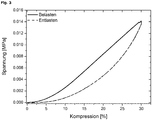
- Fig. 3 shows an example of a compression-relief curve of a carbon airgel used according to the invention. Due to the elasticity, the carbon airgel can compensate for the volume expansion of the cathode. The elasticity reduces or even prevents the formation of microcracks in the matrix and thus prevents the degradation of the cell and the associated loss of capacity.
- the carbon airgel used according to the invention is elastically deformable. Flexibility or elastic deformability is the property of a body to return to its original state after being deformed as soon as the deforming force no longer acts. For example, if the elastic deformability is 25%, it means that the 25% uniaxially compressed material completely returns to the initial state after the force has been removed.
- the elastic deformability should preferably have a value of at least 10%. An elastic deformability of at least 15% is particularly preferred.
- the carbon airgel very particularly preferably has an elastic deformability of at least 25%.
- the elastic deformability is preferably not more than 30%.
- the carbon airgel used according to the invention preferably has a specific surface area in a range from 400 to 2000 m 2 / g.
- the proportion is particularly preferably at least 75%, very particularly preferably at least 85%.
- the proportion can in particular be up to 98%, preferably 99%, particularly preferably up to 100%.
- the carbon organ has a microporous structure, with predominantly pores with a diameter of less than 2 nm.
- the volume of the pores with a diameter of less than 2 nm is preferably 0.1 to 3 cm 3 / g, particularly preferably 0.2 to 3 cm 3 / g, very particularly preferably 0.3 to 2 cm 3 / g. If the pore volume is too low, there is too little space for active material, which reduces the capacity of the accumulator. A high pore volume can have a positive effect on the performance of the battery.
- the total pore volume of the carbon airgel is preferably at least 65% by volume infiltrated with sulfur.
- the pore volume is particularly preferably infiltrated with sulfur to at least 85% by volume, very particularly preferably to at least 88% by volume.
- the total pore volume is preferably not more than 90% by volume infiltrated with sulfur.
- the sulfur content of the active material in the electrode is preferably at least 30% by weight [dompatent1] , particularly preferably at least 70% by weight, very particularly preferably at least 80% by weight.
- the sulfur content of the active material is preferably not more than 90% by weight. If the sulfur content is too low, the energy density drops; if the sulfur content is too high, the electrical conductivity is too low.
- the object on which the invention is based is achieved by an accumulator comprising a sulfur electrode according to the invention, a separator, an electrolyte and a further electrode.
- the two electrodes are surrounded by the electrolyte.
- the separator separates the electrolyte space into two separate rooms and prevents a direct current flow between the electrodes through the electrolyte.
- the further electrode can in particular be a lithium electrode known per se, so that the rechargeable battery according to the invention is a lithium-sulfur rechargeable battery.
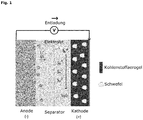
- the structure and mode of operation of a lithium-sulfur battery according to the invention is shown as an example.
- the further electrode can alternatively also comprise a Mg, Al, Si, Sn and their alloys electrode.
- the electrolyte can comprise, for example, a solvent and electrolyte compounds dissolved therein.
- the electrolyte compounds can comprise, for example, lithium bis (trifluoromethanesulfonyl) imide, lithium hexafluorophosphate (LiPF6), or mixtures thereof.
- solvents which can be used are ethylene glycol dimethyl ether, 1,3-dioxolane, ethylene carbonate (EC), dimethyl carbonate (DEC), fluoroethylene carbonate (FEC), dimethyl carbonate (DMC), and mixtures thereof.
- Polypropylene, polyethylene or a glass fiber fleece can be used as the separator material. These separators can either be used in one or more layers or also coated.
- an elastically deformable microporous carbon airgel which has the properties defined above and can be used in the sulfur electrode according to the invention. Any suitable method for airgel synthesis can be used for this.
- a carbon airgel according to the invention is preferably produced by pyrolysis of an organic airgel with the corresponding porosity and the corresponding elastic properties.
- the organic airgel is an airgel based on resorcinol-formaldehyde.
- the carbonization to produce the airgel can be carried out, for example, under an argon atmosphere at a temperature of at least 900 ° C., preferably 950 ° C., and up to 1000 ° C.
- the temperature is preferably 1000 ° C. Temperatures above 1000 ° C lead to a high shrinkage and reduction of the pore volume. Temperatures below 900 ° C lead to incomplete carbonization.
- the carbonization is preferably carried out within an hour. If necessary, the carbon airgel obtained by carbonization can be etched with CO 2 in order to increase the pore volume.
- the carbon airgel thus provided is ground with elemental sulfur, for example in a ball mill, during mixing.
- the mass ratio of carbon airgel to sulfur is in a range from 10:90 to 70:30, preferably in a range from 10:90 to 30:70, particularly preferably in a range from 10:90 to 20:80. In particular, the mass ratio can be 44:56. If the sulfur content is low, the storage capacity of the battery decreases, and if the sulfur content is too high, the electrical resistance and thus the voltage drop during operation increase.
- the mixture of carbon airgel and sulfur is ground after mixing.
- the milling can, for example, be milled in a ball mill with zirconium dioxide balls for a period of 3 to 7 minutes, at 500 to 800 rpm, with 2 to 4 repetitions.
- grinding can be carried out in a ball mill for 3 minutes at 700 rpm with 3 repetitions.
- the micropores of the carbon airgel are infiltrated by sulfur.
- the ground mixture in particular Sulfur and carbon airgel are heated, whereby a gas phase infiltration of the carbon airgel takes place.
- the heating can take place, for example, under reduced pressure, in particular under vacuum.
- the temperature must at least reach the boiling point of the sulfur at the selected pressure.
- the gas phase infiltration takes place under vacuum at a temperature of at least 400 ° C. and up to 800, preferably at least 500 ° C., very particularly preferably at a temperature of 600 ° C.
- the gas phase infiltration takes place within a period of at least 4 hours, in particular 5 hours.
- the milled mixture of carbon airgel and sulfur is heated to 600 ° C. under vacuum for 6 hours.
- the sulfur-airgel mixture can, for example, be melted in a glass ampoule and / or heated in a (closed) oven.
- excess sulfur can be evaporated.
- the pressure is increased in particular, an inert gas such as argon being added in particular.
- an inert gas such as argon being added in particular.
- heating or reducing the pressure of the mixture is also possible.
- the mixture is heated to 330 ° C. for 1.5 hours under an inert gas atmosphere, preferably an argon atmosphere.
- This procedure can be deviated from, but it must be ensured, however, that excess sulfur is removed.
- Excess sulfur can also be removed, for example, using a solvent. Suitable solvents include known solvents for sulfur, especially toluene.
- the elastically deformable, microporous carbon airgel thus infiltrated with sulfur is provided with a binder suspension and applied to a carrier material (current collector) in order to obtain a manageable electrode.
- the carrier material (current arrester) must have sufficient electrical conductivity.
- An aqueous dispersion of carboxymethyl cellulose (CMC), polyethylene glycol, polyethylene oxide (PEO), styrene-butadiene rubber (SBR), chitosan, guar gum (guar gum) or mixtures thereof can be used in particular as the binder suspension.
- a dispersion of carboxymethyl cellulose and polyethylene glycol in water is preferred, the mixing ratio of the two constituents being in a range from 2: 8 to 4: 6, in particular 3: 7.
- PVdF polyvinylidene difluoride
- DMSO dimethyl sulfoxide
- the carbon airgel infiltrated with sulfur is mechanically mixed with the binder suspension in a homogenizer.
- the mass ratio between sulfur-infiltrated carbon airgel and the solid constituents of the binder suspension is preferably in a range from 95: 5 to 85:15. A mass ratio of 90:10 is particularly preferred.
- the mixing can in particular be carried out in a tumble mixer for a period of 4 to 6 hours, preferably 5 hours. If the binder content is too low, a homogeneous mechanically stable layer is not produced; if the binder content is too high, the electrical resistance increases.
- the suspension obtained in this way is applied to a carrier material (current conductor).
- the application can take place, for example, using a doctor blade method, suspension spraying, spin coating, ultrasound spraying, dip coating or the like.
- An aluminum foil, carbon-coated aluminum foil or other corrosion-resistant materials such as titanium or nickel can preferably be used as the carrier material (current conductor).
- An electrode according to the invention which was produced by the method according to the invention, can be used as an electrode in an accumulator according to the invention be used.
- the electrode can be used in a lithium-sulfur accumulator.
- the task according to the invention is achieved by using the elastically deformable microporous carbon airgel as the matrix material for an electrode.
- the carbon airgel used according to the invention corresponds to the carbon airgel described, which is part of the sulfur electrode according to the invention.
- the elastically deformable microporous carbon airgel is used as the matrix material for a sulfur electrode.
- the solution was placed in a sealable container and allowed to gel in an oven at 80 ° C for one week.
- the gel obtained was removed from the oven and cooled to room temperature.
- the gel was carefully removed from the container and placed in a container filled with acetone. It was washed for three days, with the acetone being changed twice a day. After three days of washing, the washed gel was dried.
- Drying took place in an autoclave in supercritical CO 2 .
- the process parameters were: 83 bar, 50 ° C, mass flow in the range of 10 to 14 kg / h.
- the flexible resorcinol-formaldehyde airgel was carbonized in an argon atmosphere at 1000 ° C. for 1 hour and then etched with CO 2 .
- the ground sulfur-airgel mixture was melted under vacuum in a glass ampoule and heated in an oven at 600 ° C. for 6 h.
- the sulfur-airgel mixture was heated under an argon atmosphere in a reactor with a cold trap to 330 ° C. for 1.5 h.
- the suspension was applied to an aluminum foil using a doctor blade with a gap of 200 ⁇ m and dried at 60 ° C. for 6 h.
- the airgel-sulfur electrode was tested against pure lithium in a half-cell construction.
- a commercially available Celgard® 2500 polypropylene separator from Celgard was used as the separator.
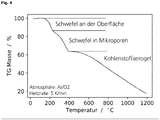
- the sample was heated to 1200 ° C. under an Ar / O 2 atmosphere in an Al 2 O 3 measuring crucible at 5 K / min.
- thermogravimetric analysis of the sulfur airgel after the gas phase filtration are shown.
- the thermogravimetric measurement shows that the carbon airgel has the ability to bind the sulfur in its micropores. As a result, this part of the sulfur, in contrast to the sulfur, evaporates at a higher temperature, which is on the surface.
- the battery cell was discharged and charged 100 times at an ambient temperature of 25 ° C and a C rate of 0.3 C.
- the battery cell was charged up to a final charge voltage of 3.3 V and discharged up to a final discharge voltage of 1.0 V.
- Fig. 5 the voltage curve of the cell during discharge and charge is shown over the specific capacity. A voltage plateau at 1.7 V can be observed here during the discharge. Normally, a lithium-sulfur battery shows two voltage plateaus, which is due to the individual stages of reduction of the sulfur chains.
- the cause could be the pore geometry of the micropores of the carbon airgel, which prevents the formation of longer sulfur chains. Only these longer chains would be soluble in the electrolyte and the polysulfide shuttle would occur.
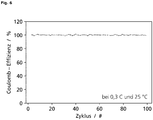
- Fig. 6 shows the course of the Coulomb efficiency over the cycles.
- Fig. 7 shows the course of the discharge capacity over the cycles.
- the absence of the polysulfide shuttle is shown by a high Coulomb efficiency, since the usual charge loss during discharge and charging is greatly reduced. This can be seen in the measurement results of the cycle measurements.
- the Coulomb efficiency is constant at almost 100% during the cycle measurement.
- the battery cell shows a constant discharge capacity of over 1000 mAh g -1 sulfur for the first 100 cycles. The capacity degradation between the 5th and 100th cycle is only 4.9%.
Landscapes
- Chemical & Material Sciences (AREA)
- Chemical Kinetics & Catalysis (AREA)
- Electrochemistry (AREA)
- General Chemical & Material Sciences (AREA)
- Engineering & Computer Science (AREA)
- Materials Engineering (AREA)
- Inorganic Chemistry (AREA)
- Organic Chemistry (AREA)
- Manufacturing & Machinery (AREA)
- Battery Electrode And Active Subsutance (AREA)
- Inert Electrodes (AREA)
Applications Claiming Priority (1)
| Application Number | Priority Date | Filing Date | Title |
|---|---|---|---|
| DE102018123285.3A DE102018123285A1 (de) | 2018-09-21 | 2018-09-21 | Elastisch verformbare Kohlenstoffaerogele als Matrixmaterial in Schwefelelektroden |
Publications (3)
| Publication Number | Publication Date |
|---|---|
| EP3626678A1 true EP3626678A1 (fr) | 2020-03-25 |
| EP3626678B1 EP3626678B1 (fr) | 2026-05-20 |
| EP3626678C0 EP3626678C0 (fr) | 2026-05-20 |
Family
ID=67956516
Family Applications (1)
| Application Number | Title | Priority Date | Filing Date |
|---|---|---|---|
| EP19197198.5A Active EP3626678B1 (fr) | 2018-09-21 | 2019-09-13 | Aérogels de carbone déformables élastiquement en tant que matière matricielle d'électrodes de soufre |
Country Status (2)
| Country | Link |
|---|---|
| EP (1) | EP3626678B1 (fr) |
| DE (1) | DE102018123285A1 (fr) |
Cited By (9)
| Publication number | Priority date | Publication date | Assignee | Title |
|---|---|---|---|---|
| CN111740091A (zh) * | 2020-07-08 | 2020-10-02 | 中国科学院山西煤炭化学研究所 | 一种锂硫电池正极用碳气凝胶@硫复合材料及其制备方法 |
| CN112063387A (zh) * | 2020-09-21 | 2020-12-11 | 武汉大学 | 一种木质素磺酸盐-酚醛树脂基炭气凝胶微球及其制备方法和应用 |
| CN112142034A (zh) * | 2020-09-27 | 2020-12-29 | 武汉理工大学 | 一种硫/碳气凝胶复合材料的制备方法 |
| CN113471416A (zh) * | 2021-05-18 | 2021-10-01 | 合肥国轩高科动力能源有限公司 | 一种氮硫硼共掺杂碳气凝胶基硫复合材料及其制备方法和应用 |
| CN114105119A (zh) * | 2021-11-26 | 2022-03-01 | 桂林电子科技大学 | 一种超弹性瓜尔胶碳气凝胶及其制备方法和应用 |
| CN114349537A (zh) * | 2022-01-25 | 2022-04-15 | 西安交通大学 | 一种超弹性气凝胶及其制备方法 |
| CN116443846A (zh) * | 2023-03-09 | 2023-07-18 | 乐山职业技术学院 | 一种炭气凝胶材料的制备方法及应用 |
| WO2024160876A1 (fr) * | 2023-02-01 | 2024-08-08 | Deutsches Zentrum für Luft- und Raumfahrt e.V. | Aérogels de carbone ayant une conductivité électrique élevée et microstructure réglable pour la conception de cathode dans des batteries métal-soufre et piles à combustible à membrane polymère-électrolyte |
| EP4641706A3 (fr) * | 2024-04-26 | 2026-01-14 | Samsung Sdi Co., Ltd. | Électrode pour batterie au lithium rechargeable et batterie au lithium rechargeable comprenant celle-ci |
Families Citing this family (3)
| Publication number | Priority date | Publication date | Assignee | Title |
|---|---|---|---|---|
| CN112563449B (zh) * | 2021-01-05 | 2022-06-10 | 齐鲁工业大学 | 一种锂硫电池双层电极材料的制备方法 |
| DE102022121579A1 (de) * | 2022-08-25 | 2024-03-07 | Deutsches Zentrum für Luft- und Raumfahrt e.V. | Schwefel-Kohlenstoff-Verbindungen mittels Mikrowellen |
| DE102023128578A1 (de) | 2023-10-18 | 2025-04-24 | Deutsches Zentrum für Luft- und Raumfahrt e.V. | Schwefel-Kohlenstoffaerogel-Komposite mittels Vakuum-Coating |
Citations (6)
| Publication number | Priority date | Publication date | Assignee | Title |
|---|---|---|---|---|
| US3043896A (en) | 1957-11-26 | 1962-07-10 | Electric Tech Corp | Electric dry cells and storage batteries |
| DE19938822A1 (de) | 1999-08-19 | 2001-02-22 | Zae Bayern | Verfahren zur Herstellung einer offenporigen monolithischen Elektrode aus Kohlenstoff für den Einsatz in einer reversiblen Lithium-Ionen-Batterie |
| EP1610404A1 (fr) | 2004-06-25 | 2005-12-28 | Saft | Générateur électrochimique à cathode en aérogel de carbone |
| EP2250692A2 (fr) | 2008-03-12 | 2010-11-17 | Toyota Motor Engineering & Manufacturing North America, Inc. | Matériau à base de soufre et de carbone |
| DE102012218548A1 (de) | 2012-10-11 | 2014-04-17 | Deutsches Zentrum für Luft- und Raumfahrt e.V. | Flexible Aerogele |
| US20180183067A1 (en) | 2016-12-28 | 2018-06-28 | Nanotek Instruments, Inc. | Process for Flexible and Shape-Conformal Rope-Shape Alkali Metal-Sulfur Batteries |
-
2018
- 2018-09-21 DE DE102018123285.3A patent/DE102018123285A1/de active Pending
-
2019
- 2019-09-13 EP EP19197198.5A patent/EP3626678B1/fr active Active
Patent Citations (7)
| Publication number | Priority date | Publication date | Assignee | Title |
|---|---|---|---|---|
| US3043896A (en) | 1957-11-26 | 1962-07-10 | Electric Tech Corp | Electric dry cells and storage batteries |
| DE19938822A1 (de) | 1999-08-19 | 2001-02-22 | Zae Bayern | Verfahren zur Herstellung einer offenporigen monolithischen Elektrode aus Kohlenstoff für den Einsatz in einer reversiblen Lithium-Ionen-Batterie |
| EP1610404A1 (fr) | 2004-06-25 | 2005-12-28 | Saft | Générateur électrochimique à cathode en aérogel de carbone |
| FR2872347A1 (fr) | 2004-06-25 | 2005-12-30 | Accumulateurs Fixes | Generateur electrochimique a cathode en aerogel de carbone |
| EP2250692A2 (fr) | 2008-03-12 | 2010-11-17 | Toyota Motor Engineering & Manufacturing North America, Inc. | Matériau à base de soufre et de carbone |
| DE102012218548A1 (de) | 2012-10-11 | 2014-04-17 | Deutsches Zentrum für Luft- und Raumfahrt e.V. | Flexible Aerogele |
| US20180183067A1 (en) | 2016-12-28 | 2018-06-28 | Nanotek Instruments, Inc. | Process for Flexible and Shape-Conformal Rope-Shape Alkali Metal-Sulfur Batteries |
Non-Patent Citations (4)
| Title |
|---|
| GROEN JCPEFFER LAAPEREZ-RARNIREZ J: "Pore size determination in modified micro- and mesoporous materials. Pitfalls and limitations in gas adsorption data analysis", MICROPOROUS MESOPOROUS MATER., vol. 60, 2003, pages 1 - 17, XP004430808, Retrieved from the Internet <URL:https://doi.org/10.1016/S1387-1811(03)00339-1> doi:10.1016/S1387-1811(03)00339-1 |
| LI ZIHAO ET AL: "Sulfur loaded in micropore-rich carbon aerogel as cathode of lithium-sulfur battery with improved cyclic stability", JOURNAL OF POWER SOURCES, ELSEVIER SA, CH, vol. 334, 7 October 2016 (2016-10-07), pages 23 - 30, XP029803839, ISSN: 0378-7753, DOI: 10.1016/J.JPOWSOUR.2016.10.003 * |
| MATTHIAS THOMMESKATSUMI KANEKOALEXANDER V. NEIMARKJAMES P. OLIVIERFRANCISCO RODRIGUEZ-REINOSOJEAN ROUQUEROLKENNETH S.W., SING PHYSISORPTION OF GASES, WITH SPECIAL REFERENCE TO THE EVALUATION OF SURFACE AREA AND PORE SIZE DISTRIBUTION (IUPAC TECHNICAL REPORT) PURE APPL. CHEM., 2015 |
| PEKALA RWALVISO CTLEMAY JD: "Organic aerogels: microstructural dependence of mechanical properties in compression", J NON-CRYST SOLIDS., vol. 125, 1990, pages 67 - 75, XP024058330, Retrieved from the Internet <URL:http://dx.doi.org/10.1016/0022-3093(90)90324-F> doi:10.1016/0022-3093(90)90324-F |
Cited By (14)
| Publication number | Priority date | Publication date | Assignee | Title |
|---|---|---|---|---|
| CN111740091B (zh) * | 2020-07-08 | 2022-05-17 | 中国科学院山西煤炭化学研究所 | 一种锂硫电池正极用碳气凝胶@硫复合材料及其制备方法 |
| CN111740091A (zh) * | 2020-07-08 | 2020-10-02 | 中国科学院山西煤炭化学研究所 | 一种锂硫电池正极用碳气凝胶@硫复合材料及其制备方法 |
| CN112063387A (zh) * | 2020-09-21 | 2020-12-11 | 武汉大学 | 一种木质素磺酸盐-酚醛树脂基炭气凝胶微球及其制备方法和应用 |
| CN112142034A (zh) * | 2020-09-27 | 2020-12-29 | 武汉理工大学 | 一种硫/碳气凝胶复合材料的制备方法 |
| CN113471416A (zh) * | 2021-05-18 | 2021-10-01 | 合肥国轩高科动力能源有限公司 | 一种氮硫硼共掺杂碳气凝胶基硫复合材料及其制备方法和应用 |
| CN113471416B (zh) * | 2021-05-18 | 2023-09-01 | 合肥国轩高科动力能源有限公司 | 一种氮硫硼共掺杂碳气凝胶基硫复合材料及其制备方法和应用 |
| CN114105119A (zh) * | 2021-11-26 | 2022-03-01 | 桂林电子科技大学 | 一种超弹性瓜尔胶碳气凝胶及其制备方法和应用 |
| CN114105119B (zh) * | 2021-11-26 | 2023-07-21 | 桂林电子科技大学 | 一种超弹性瓜尔胶碳气凝胶及其制备方法和应用 |
| CN114349537A (zh) * | 2022-01-25 | 2022-04-15 | 西安交通大学 | 一种超弹性气凝胶及其制备方法 |
| CN114349537B (zh) * | 2022-01-25 | 2022-12-13 | 西安交通大学 | 一种超弹性气凝胶及其制备方法 |
| WO2024160876A1 (fr) * | 2023-02-01 | 2024-08-08 | Deutsches Zentrum für Luft- und Raumfahrt e.V. | Aérogels de carbone ayant une conductivité électrique élevée et microstructure réglable pour la conception de cathode dans des batteries métal-soufre et piles à combustible à membrane polymère-électrolyte |
| CN116443846A (zh) * | 2023-03-09 | 2023-07-18 | 乐山职业技术学院 | 一种炭气凝胶材料的制备方法及应用 |
| CN116443846B (zh) * | 2023-03-09 | 2024-06-11 | 乐山职业技术学院 | 一种炭气凝胶材料的制备方法及应用 |
| EP4641706A3 (fr) * | 2024-04-26 | 2026-01-14 | Samsung Sdi Co., Ltd. | Électrode pour batterie au lithium rechargeable et batterie au lithium rechargeable comprenant celle-ci |
Also Published As
| Publication number | Publication date |
|---|---|
| EP3626678B1 (fr) | 2026-05-20 |
| DE102018123285A1 (de) | 2020-03-26 |
| EP3626678C0 (fr) | 2026-05-20 |
Similar Documents
| Publication | Publication Date | Title |
|---|---|---|
| DE102018123285A1 (de) | Elastisch verformbare Kohlenstoffaerogele als Matrixmaterial in Schwefelelektroden | |
| DE69910480T2 (de) | Sekundärbatterie Stromquelle | |
| DE60213696T2 (de) | Sekundär-Energiequelle | |
| DE102013106114B4 (de) | Lithium-Ionen-Zelle für eine Sekundärbatterie | |
| DE102018106901A1 (de) | Mikroporöser und hierarchischer poröser Kohlenstoff | |
| DE112012004734T5 (de) | Elektrode für eine elektrische Speichervorrichtung, elektrische Speichervorrichtung und Herstellungsverfahren einer Elektrode für eine elektrische Speichervorrichtung | |
| EP3063811B1 (fr) | Sulfure de lithium revêtu de carbon | |
| WO2012113606A1 (fr) | Matériau d'électrode doté d'une capacité élevée | |
| DE112015003654T5 (de) | Schwefel-pan-kompositwerkstoff, verfahren zur herstellung des kompositwerkstoffs, sowie den kompositwerkstoff enthaltende elektrode und lithium-schwefel-batterie | |
| DE102015222553A1 (de) | Kathode für eine Festkörper-Lithium-Batterie und Akkumulator, bei welchem diese eingesetzt wird | |
| DE102012107199B4 (de) | Verfahren zur Herstellung kohlenstoffbeschichteter metalldotierter Zinkoxid-Partikel, kohlenstoffbeschichtete metalldotierte Zinkoxid-Partikel, deren Verwendung, sowie Elektrodenmaterial, Elektrode und Elektrochemische Energiespeichervorrichtung | |
| WO2013045327A1 (fr) | Matériau actif structurellement stable pour électrodes de batteries | |
| EP2769427A1 (fr) | Matière active pour batteries | |
| WO2018202888A1 (fr) | Matériau d'électrode et électrodes composites à base d'un polymère et de carbone | |
| DE102022100864A1 (de) | Elektrodenmaterialzusammensetzungen für Elektroden von Energiespeicherzellen mit schneller Lade- und Entladefähigkeit | |
| DE102012101457A1 (de) | Elektrodenmaterial für Lithium-basierte elektrochemische Energiespeicher | |
| WO2018041339A1 (fr) | Anodes de batteries à ions lithium | |
| DE102011057015A1 (de) | Verfahren zur Herstellung von Cobaltoxid-Kohlenstoff-Komposit | |
| DE60202313T2 (de) | Sekundärstromquelle | |
| EP3293745B1 (fr) | Materiau additif pour une electrode d'une cellule electrochimique, condensateur a double couche et procede de production de son electrode | |
| WO2018077937A1 (fr) | Nouveaux systèmes d'agent liant pour des électrodes composites à teneur en silicium pour des batteries au lithium-ion | |
| EP3673531B1 (fr) | Batterie d'état solide basée sur une matrice conduisant l'ion faite du camphre ou 2-adamantanone | |
| WO2024160319A1 (fr) | Électrode pour une batterie au lithium-ion, comprenant un électrolyte hybride, et batterie au lithium-ion | |
| DE212025000068U1 (de) | Sekundärbatterie und stromverbrauchende Vorrichtung | |
| DE102014106002A1 (de) | Elektrodenmaterial für Natrium-basierte elektrochemische Energiespeicher |
Legal Events
| Date | Code | Title | Description |
|---|---|---|---|
| PUAI | Public reference made under article 153(3) epc to a published international application that has entered the european phase |
Free format text: ORIGINAL CODE: 0009012 |
|
| STAA | Information on the status of an ep patent application or granted ep patent |
Free format text: STATUS: THE APPLICATION HAS BEEN PUBLISHED |
|
| AK | Designated contracting states |
Kind code of ref document: A1 Designated state(s): AL AT BE BG CH CY CZ DE DK EE ES FI FR GB GR HR HU IE IS IT LI LT LU LV MC MK MT NL NO PL PT RO RS SE SI SK SM TR |
|
| AX | Request for extension of the european patent |
Extension state: BA ME |
|
| RIN1 | Information on inventor provided before grant (corrected) |
Inventor name: WAGNER, NORBERT Inventor name: MILOW, BARBARA Inventor name: WARTH, FRIEDER Inventor name: SCHWAN, MARINA |
|
| STAA | Information on the status of an ep patent application or granted ep patent |
Free format text: STATUS: REQUEST FOR EXAMINATION WAS MADE |
|
| 17P | Request for examination filed |
Effective date: 20200723 |
|
| RBV | Designated contracting states (corrected) |
Designated state(s): AL AT BE BG CH CY CZ DE DK EE ES FI FR GB GR HR HU IE IS IT LI LT LU LV MC MK MT NL NO PL PT RO RS SE SI SK SM TR |
|
| STAA | Information on the status of an ep patent application or granted ep patent |
Free format text: STATUS: EXAMINATION IS IN PROGRESS |
|
| 17Q | First examination report despatched |
Effective date: 20211210 |
|
| GRAP | Despatch of communication of intention to grant a patent |
Free format text: ORIGINAL CODE: EPIDOSNIGR1 |
|
| STAA | Information on the status of an ep patent application or granted ep patent |
Free format text: STATUS: GRANT OF PATENT IS INTENDED |
|
| GRAJ | Information related to disapproval of communication of intention to grant by the applicant or resumption of examination proceedings by the epo deleted |
Free format text: ORIGINAL CODE: EPIDOSDIGR1 |
|
| STAA | Information on the status of an ep patent application or granted ep patent |
Free format text: STATUS: EXAMINATION IS IN PROGRESS |
|
| RIC1 | Information provided on ipc code assigned before grant |
Ipc: C01B 32/00 20170101AFI20251105BHEP Ipc: H01M 4/136 20100101ALI20251105BHEP Ipc: H01M 4/1397 20100101ALI20251105BHEP Ipc: H01M 4/38 20060101ALI20251105BHEP Ipc: H01M 4/62 20060101ALI20251105BHEP Ipc: H01M 4/133 20100101ALI20251105BHEP Ipc: H01M 4/134 20100101ALI20251105BHEP Ipc: H01M 4/58 20100101ALI20251105BHEP Ipc: C01B 32/05 20170101ALI20251105BHEP Ipc: H01M 10/052 20100101ALN20251105BHEP |
|
| GRAP | Despatch of communication of intention to grant a patent |
Free format text: ORIGINAL CODE: EPIDOSNIGR1 |
|
| STAA | Information on the status of an ep patent application or granted ep patent |
Free format text: STATUS: GRANT OF PATENT IS INTENDED |
|
| INTG | Intention to grant announced |
Effective date: 20251126 |
|
| INTC | Intention to grant announced (deleted) | ||
| RIC1 | Information provided on ipc code assigned before grant |
Ipc: H01M 4/136 20100101ALI20251202BHEP Ipc: H01M 4/1397 20100101ALI20251202BHEP Ipc: H01M 4/38 20060101ALI20251202BHEP Ipc: C01B 32/00 20170101AFI20251202BHEP Ipc: H01M 4/62 20060101ALI20251202BHEP Ipc: H01M 4/133 20100101ALI20251202BHEP Ipc: H01M 4/134 20100101ALI20251202BHEP Ipc: H01M 4/58 20100101ALI20251202BHEP Ipc: C01B 32/05 20170101ALI20251202BHEP Ipc: H01M 10/052 20100101ALN20251202BHEP |
|
| INTG | Intention to grant announced |
Effective date: 20251218 |
|
| GRAS | Grant fee paid |
Free format text: ORIGINAL CODE: EPIDOSNIGR3 |
|
| GRAA | (expected) grant |
Free format text: ORIGINAL CODE: 0009210 |
|
| STAA | Information on the status of an ep patent application or granted ep patent |
Free format text: STATUS: THE PATENT HAS BEEN GRANTED |
|
| AK | Designated contracting states |
Kind code of ref document: B1 Designated state(s): AL AT BE BG CH CY CZ DE DK EE ES FI FR GB GR HR HU IE IS IT LI LT LU LV MC MK MT NL NO PL PT RO RS SE SI SK SM TR |
|
| REG | Reference to a national code |
Ref country code: CH Ref legal event code: F10 Free format text: ST27 STATUS EVENT CODE: U-0-0-F10-F00 (AS PROVIDED BY THE NATIONAL OFFICE) Effective date: 20260520 Ref country code: GB Ref legal event code: FG4D Free format text: NOT ENGLISH |
|
| REG | Reference to a national code |
Ref country code: DE Ref legal event code: R096 Ref document number: 502019014694 Country of ref document: DE |
|
| REG | Reference to a national code |
Ref country code: CH Ref legal event code: R17 Free format text: ST27 STATUS EVENT CODE: U-0-0-R10-R17 (AS PROVIDED BY THE NATIONAL OFFICE) Effective date: 20260722 |
|
| U01 | Request for unitary effect filed |
Effective date: 20260619 |
|
| U07 | Unitary effect registered |
Designated state(s): AT BE BG DE DK EE FI FR IT LT LU LV MT NL PT RO SE SI Effective date: 20260626 |