EP3627149A1 - Conditionnement d'un adsorbant - Google Patents
Conditionnement d'un adsorbant Download PDFInfo
- Publication number
- EP3627149A1 EP3627149A1 EP18196060.0A EP18196060A EP3627149A1 EP 3627149 A1 EP3627149 A1 EP 3627149A1 EP 18196060 A EP18196060 A EP 18196060A EP 3627149 A1 EP3627149 A1 EP 3627149A1
- Authority
- EP
- European Patent Office
- Prior art keywords
- fiber
- temperature
- chamber
- conditioning
- phase material
- Prior art date
- Legal status (The legal status is an assumption and is not a legal conclusion. Google has not performed a legal analysis and makes no representation as to the accuracy of the status listed.)
- Granted
Links
Images

Classifications
-
- G—PHYSICS
- G01—MEASURING; TESTING
- G01N—INVESTIGATING OR ANALYSING MATERIALS BY DETERMINING THEIR CHEMICAL OR PHYSICAL PROPERTIES
- G01N30/00—Investigating or analysing materials by separation into components using adsorption, absorption or similar phenomena or using ion-exchange, e.g. chromatography or field flow fractionation
- G01N30/02—Column chromatography
- G01N30/04—Preparation or injection of sample to be analysed
- G01N30/06—Preparation
-
- B—PERFORMING OPERATIONS; TRANSPORTING
- B01—PHYSICAL OR CHEMICAL PROCESSES OR APPARATUS IN GENERAL
- B01J—CHEMICAL OR PHYSICAL PROCESSES, e.g. CATALYSIS OR COLLOID CHEMISTRY; THEIR RELEVANT APPARATUS
- B01J20/00—Solid sorbent compositions or filter aid compositions; Sorbents for chromatography; Processes for preparing, regenerating or reactivating thereof
- B01J20/30—Processes for preparing, regenerating, or reactivating
- B01J20/34—Regenerating or reactivating
- B01J20/3483—Regenerating or reactivating by thermal treatment not covered by groups B01J20/3441 - B01J20/3475, e.g. by heating or cooling
-
- B—PERFORMING OPERATIONS; TRANSPORTING
- B01—PHYSICAL OR CHEMICAL PROCESSES OR APPARATUS IN GENERAL
- B01J—CHEMICAL OR PHYSICAL PROCESSES, e.g. CATALYSIS OR COLLOID CHEMISTRY; THEIR RELEVANT APPARATUS
- B01J20/00—Solid sorbent compositions or filter aid compositions; Sorbents for chromatography; Processes for preparing, regenerating or reactivating thereof
- B01J20/22—Solid sorbent compositions or filter aid compositions; Sorbents for chromatography; Processes for preparing, regenerating or reactivating thereof comprising organic material
- B01J20/26—Synthetic macromolecular compounds
- B01J20/261—Synthetic macromolecular compounds obtained by reactions only involving carbon to carbon unsaturated bonds
-
- B—PERFORMING OPERATIONS; TRANSPORTING
- B01—PHYSICAL OR CHEMICAL PROCESSES OR APPARATUS IN GENERAL
- B01J—CHEMICAL OR PHYSICAL PROCESSES, e.g. CATALYSIS OR COLLOID CHEMISTRY; THEIR RELEVANT APPARATUS
- B01J20/00—Solid sorbent compositions or filter aid compositions; Sorbents for chromatography; Processes for preparing, regenerating or reactivating thereof
- B01J20/22—Solid sorbent compositions or filter aid compositions; Sorbents for chromatography; Processes for preparing, regenerating or reactivating thereof comprising organic material
- B01J20/26—Synthetic macromolecular compounds
- B01J20/262—Synthetic macromolecular compounds obtained otherwise than by reactions only involving carbon to carbon unsaturated bonds, e.g. obtained by polycondensation
-
- B—PERFORMING OPERATIONS; TRANSPORTING
- B01—PHYSICAL OR CHEMICAL PROCESSES OR APPARATUS IN GENERAL
- B01J—CHEMICAL OR PHYSICAL PROCESSES, e.g. CATALYSIS OR COLLOID CHEMISTRY; THEIR RELEVANT APPARATUS
- B01J20/00—Solid sorbent compositions or filter aid compositions; Sorbents for chromatography; Processes for preparing, regenerating or reactivating thereof
- B01J20/28—Solid sorbent compositions or filter aid compositions; Sorbents for chromatography; Processes for preparing, regenerating or reactivating thereof characterised by their form or physical properties
- B01J20/28014—Solid sorbent compositions or filter aid compositions; Sorbents for chromatography; Processes for preparing, regenerating or reactivating thereof characterised by their form or physical properties characterised by their form
- B01J20/28023—Fibres or filaments
-
- B—PERFORMING OPERATIONS; TRANSPORTING
- B01—PHYSICAL OR CHEMICAL PROCESSES OR APPARATUS IN GENERAL
- B01J—CHEMICAL OR PHYSICAL PROCESSES, e.g. CATALYSIS OR COLLOID CHEMISTRY; THEIR RELEVANT APPARATUS
- B01J20/00—Solid sorbent compositions or filter aid compositions; Sorbents for chromatography; Processes for preparing, regenerating or reactivating thereof
- B01J20/281—Sorbents specially adapted for preparative, analytical or investigative chromatography
-
- G—PHYSICS
- G01—MEASURING; TESTING
- G01N—INVESTIGATING OR ANALYSING MATERIALS BY DETERMINING THEIR CHEMICAL OR PHYSICAL PROPERTIES
- G01N1/00—Sampling; Preparing specimens for investigation
- G01N1/28—Preparing specimens for investigation including physical details of (bio-)chemical methods covered elsewhere, e.g. G01N33/50, C12Q
- G01N1/40—Concentrating samples
- G01N1/405—Concentrating samples by adsorption or absorption
-
- G—PHYSICS
- G01—MEASURING; TESTING
- G01N—INVESTIGATING OR ANALYSING MATERIALS BY DETERMINING THEIR CHEMICAL OR PHYSICAL PROPERTIES
- G01N30/00—Investigating or analysing materials by separation into components using adsorption, absorption or similar phenomena or using ion-exchange, e.g. chromatography or field flow fractionation
- G01N2030/0075—Separation due to differential desorption
- G01N2030/008—Thermal desorption
-
- G—PHYSICS
- G01—MEASURING; TESTING
- G01N—INVESTIGATING OR ANALYSING MATERIALS BY DETERMINING THEIR CHEMICAL OR PHYSICAL PROPERTIES
- G01N30/00—Investigating or analysing materials by separation into components using adsorption, absorption or similar phenomena or using ion-exchange, e.g. chromatography or field flow fractionation
- G01N2030/009—Extraction
-
- G—PHYSICS
- G01—MEASURING; TESTING
- G01N—INVESTIGATING OR ANALYSING MATERIALS BY DETERMINING THEIR CHEMICAL OR PHYSICAL PROPERTIES
- G01N30/00—Investigating or analysing materials by separation into components using adsorption, absorption or similar phenomena or using ion-exchange, e.g. chromatography or field flow fractionation
- G01N30/02—Column chromatography
- G01N30/04—Preparation or injection of sample to be analysed
- G01N30/06—Preparation
- G01N2030/062—Preparation extracting sample from raw material
-
- G—PHYSICS
- G01—MEASURING; TESTING
- G01N—INVESTIGATING OR ANALYSING MATERIALS BY DETERMINING THEIR CHEMICAL OR PHYSICAL PROPERTIES
- G01N30/00—Investigating or analysing materials by separation into components using adsorption, absorption or similar phenomena or using ion-exchange, e.g. chromatography or field flow fractionation
- G01N30/02—Column chromatography
- G01N30/26—Conditioning of the fluid carrier; Flow patterns
- G01N30/28—Control of physical parameters of the fluid carrier
- G01N30/30—Control of physical parameters of the fluid carrier of temperature
- G01N2030/3076—Control of physical parameters of the fluid carrier of temperature using specially adapted T(t) profile
Definitions
- the invention relates to a method for the thermal desorption of a phase material, in particular for the conditioning of a fiber for carrying out a solid-phase microextraction, the adsorbent being heated along a temperature curve.
- the invention further relates to an associated device.
- Chemical analyzes often use adsorbents that adsorb the substance to be examined.
- adsorbents are used for example in solid phase extraction (SPE), in solid phase microextraction (SPME), but also in chromatography columns, such as in HPLC (high pressure liquid chromatograph) or GC (gas chromatograph).
- the adsorbent is used to adsorb an analyte from a gas phase or a liquid phase.
- the analyte is then released again, usually thermally, for analysis. This takes place, for example, in an injection port of an HPLC or a GC.
- the phase material or the adsorbent is designed, for example, at SPME as a phase material of a fiber, as a solid phase of a chromatography column or as another solid phase for analyte enrichment, filtration or chromatography.
- the phase material preferably comprises (not conclusively) polyacrylate, carbowax, polydivinylbenzene, carboxes, PDMS, polydimethylsiloxane or mixtures or derivatives thereof, in particular known materials of the separation columns from the field of chromatography, in particular from the field of gas or liquid chromatography (GC, LC) .
- the SPME is exposed to an analyte so that it is adsorbed by the phase material of the fiber.
- the fiber is then desorbed in an injection port of an analysis device.
- the fiber is then conditioned for further use, that is, the analyte remaining in the phase material of the fiber is completely desorbed in order to bring the fiber back into a usable state.
- the time required for complete desorption of the analyte from the phase material depends, among other things, on the analyte, the layer thickness of the phase material and the desorption temperature.
- the US 9,212,979 B2 discloses an automated headspace SPME method, which is coupled to a gas chromatograph / mass spectrometer.
- the SPME fiber is introduced into an injection port of a gas chromatograph.
- the SPME fiber is cleaned by heating the injection port for 2-10 minutes at a temperature between 200-350 ° C, preferably for 5 minutes at a temperature of 250 ° C.
- the US 7,047,661 B2 discloses an apparatus and method for cleaning and conditioning an SPME fiber without using a gas chromatograph because they are problematic in terms of carry-over and cross-contamination.
- the device comprises an elongated chamber with a first end in which the SPME fiber is received and an opposite end with a fluid outlet, as well as heating and means for flowing a fluid through the chamber from the first to the second end.
- the design of the conditioning device as a separate unit has the advantage that other temperatures can be selected compared to the injector of the analysis device.
- the SPME Fiber Conditioning Module sold by CTC Analytics AG, is operated at a temperature between 200 ° C and 340 ° C depending on the layer thickness of the stationary phase on the fiber.
- the fiber is conditioned at this temperature in the module for around 30 minutes.
- the known techniques for conditioning a fiber for SPME have the disadvantage that the fiber becomes unusable relatively quickly. It was found that the fiber becomes brittle or vitrified due to the strong heating and thus the fiber, depending on the layer thickness of the phase material and the diameter of the fiber, after relatively few applications, for example 30-35 applications and respective conditioning at 280 ° C for 20 Minutes can no longer be used because the adsorption properties are impaired too much.
- the object of the invention is to provide a method for conditioning phase material, in particular a fiber for the SPME, which belongs to the technical field mentioned at the outset, with which the service life of the phase material, in particular the fiber, can be increased compared to the known methods.
- the temperature curve of the phase material has at least one low point during the desorption.
- the temperature curve of the phase material has at least one low point during the desorption makes the conditioning process gentle on the phase material.
- the aging process or the glazing and embrittlement of the phase material is significantly reduced due to the drop in temperature to the low point of the temperature curve. This can be attributed, among other things, to the fact that the phase material has to be kept above a critical temperature for a certain period of time because the glazing occurs relatively slowly due to the high viscosity. Thus, if there is an interruption or a shortening of this period of time, glazing hardly or far less pronounced occurs.
- the maximum temperature can also be set lower than with conventional methods, so that the fiber, in particular the phase material, can be conditioned more gently. This can further increase the life of the fiber.
- temperatures mentioned are in each case a temperature in the chamber in which the phase material or the fiber is used for the conditioning.
- the phase material preferably comprises a sorbate, which can sorb a sorbent in the sense of the usual sorption isotherms (for example according to Zeldowitsch, Freundlich, Langmuir or BET models).
- the phase material is preferably comprised of a fiber, in particular a fiber for the SPME.
- the phase material can also be comprised by a chromatography column or the like.
- the fiber is preferably retractable and extendable into a cannula so that the fiber can be protected when it is not being used.
- the cannula has a slightly larger inner diameter than the fiber has an outer diameter.
- the diameter of a fiber including the phase material can be, for example, between 0.1 mm and 10 mm.
- the fiber has an outside diameter of 0.2 mm to 1.2 mm and the cannula accordingly has an outside diameter of around 0.6 mm to 1.6 mm. In further preferred embodiments, the fiber has a diameter of more than 1.6 mm, it being possible to dispense with the cannula, in particular if the fiber has a larger diameter.
- the fiber and / or the cannula can also have other dimensions.
- the fiber can have a surface area of approximately 5 mm 2 to 100 mm 2 in the area of the phase material.
- the surface can also be chosen to be smaller or larger.
- the cannula can generally also be dispensed with.
- the phase material in particular the fiber, does not necessarily have to be circular cylindrical, but can also have a polygonal or other cross section exhibit.
- the cross section can be triangular, oval, rectangular, hexagonal, etc., for example.
- the polygons do not have to be regular, for example the triangle can have a right angle or the hexagon two longer, parallel sides.
- the aspect ratio can in principle be of any design, in particular the phase material, for example the fiber, can also be in the form of a plate, in particular as a so-called coated SPME blade.
- the phase material, in particular the fiber can be designed for use in a gas chromatograph, a liquid chromatograph or other analysis devices.
- the term desorption is understood to mean the exit of the analyte from the phase material.
- the phase material or adsorbent is present in the fiber as a coating. This can have different layer thicknesses, e.g. between 1 and 500 microns, preferably between 7 and 250 microns. Experiments have shown that the desorption process is particularly preferable to conventional processes with larger layer thicknesses.
- the phase material preferably comprises one or more of the following substances: polyacrylate, carbowax, polydivinylbenzene, carboxen, PDMS, polydimethylsiloxane, silica gel, activated carbon or nanoporous materials.
- conditioning is understood to mean a process in which the phase material, in particular the fiber, is cleaned for reuse.
- residues of the analyte and any other substances such as solvents and the like are desorbed by heating the phase material.
- the term temperature curve is understood to mean a course of the temperature which prevails in the conditioning space during the conditioning process.
- the temperature curve is then visualized as a flat curve, the X-axis or the abscissa being the time and the Y-axis or the ordinate being the temperature.
- the low point represents a local minimum of the temperature curve.
- the method relates to the conditioning of a fiber for carrying out a solid-phase microextraction (SPME or Solid Phase Micro Extraction).
- SPME solid-phase microextraction
- the method for conditioning can also be used for other thermal conditioning methods, in particular an HPLC or GC column could also be conditioned with the same technique.
- a temperature difference between a maximum temperature of the temperature curve and the low point of the temperature curve is preferably between 50 ° C. and 500 ° C., preferably between 100 ° C. and 400 ° C., particularly preferably between 150 ° C. and 350 ° C.
- the temperature difference is preferably chosen such that the heating phase following the low point does not stress the phase material too much, but can only desorb the analyte or the substances adsorbed on the phase material.
- the temperature difference can also be less than 50 ° C or greater than 500 ° C.
- the maximum temperature is preferably between 100 ° C. and 600 ° C., preferably between 150 ° C. and 400 ° C., particularly preferably between 200 ° C. and 300 ° C.
- the maximum temperature is particularly preferably between 250 ° C. and 300 ° C., in particular around 280 ° C. Experiments have shown that this temperature is preferred for gentle yet efficient conditioning, especially when conditioning fiber for SPME. Basically, the conditioning of the phase material, especially the fiber, is gentler at lower temperatures.
- the maximum temperature can also be below 100 ° C or above 600 ° C.
- the low point is preferably between 0 ° C. and 300 ° C., preferably between 10 ° C. and 150 ° C., particularly preferably between 15 ° C. and 50 ° C.
- the low point is approximately room temperature, that is to say approximately 18 ° C. to 28 ° C. In particular without active cooling, an efficient process can be achieved by choosing the low point clearly above room temperature.
- the low point can also be below 0 ° C., in particular if active cooling is provided.
- the temperature curve preferably comprises more than one low point, in particular between 2 and 10 low points, preferably between 4 and 8 low points.
- the multiple low points can increase the efficiency of the conditioning process and thus reduce the carryover of analytes in subsequent analyzes. The greater the number of low points chosen, the more efficiently the conditioning process can be carried out.
- a single low point can also be sufficient.
- a high point which is greater than 0.8 times, preferably greater than 0.9 times, the maximum temperature is preferably reached between two low points. Particularly preferably, a high point with essentially the maximum temperature is reached between two low points.
- the temperature curve between two low points can also have a local maximum which is less than 0.8 times the maximum temperature.
- successive local maxima can continuously increase or exhibit other behaviors.
- a fluid can be provided that continuously flushes the chamber during conditioning.
- the fluid emerging from the chamber can be continuously analyzed (e.g. spectrometric or the like) in order to dynamically adapt the temperature curve based on the analysis result and thus optimize the conditioning process.
- the time span between two neighboring low points is made up of a heating phase and a cooling phase - whereby cooling can be carried out actively or passively during the cooling phase.
- the heating phase can comprise between 30% and 80%, in particular between 50% and 70%, particularly preferably between 55% and 65% of the time span.
- the heating phase is particularly preferably around 1 to 1.5 minutes, while the cooling phase lasts around 1 minute.
- the time span between two temporally adjacent low points can also be less than 15 seconds or greater than 600 seconds.
- a device for carrying out the method preferably comprises a chamber for receiving the fiber and a heating device for heating the chamber.
- the heating device preferably comprises one or more electrical heating elements within the chamber.
- the chamber preferably comprises a fluid inlet and fluid outlet, so that the chamber can be flushed with a fluid, in particular a gas.
- the chamber is preferably flushed with an inert gas, in particular with nitrogen or an inert gas.
- the heating device can also be designed in such a way that the gas flow is heated with it, whereby the fiber can be heated in addition or as an alternative to the heating elements.
- the fluid inlet and fluid outlet can also be dispensed with.
- the fluid inlet is preferably arranged in a region of the chamber in which the tip of the fiber is located when the fiber is inserted, so that the fluid can be guided through the chamber from the fiber tip.
- the fluid outlet is preferably at an end opposite the tip of the fiber when the fiber is inserted.
- the fluid inlet and fluid outlet can also be interchanged so that the fluid outlet is at the fiber tip.
- the heater can be in the form of an electric heater which is regulated to a constant temperature. A particularly inexpensive heater can thus be provided. In various variants, the heating output can be kept constant.
- the chamber can be designed as specific for the conditioning, whereby an entry opening for the fiber is open, that is, the entry opening does not comprise a septum.
- a heatable injection port of an analysis device in particular a gas chromatograph or liquid chromatograph, can be provided for the conditioning.
- the device for carrying out the conditioning can optionally comprise a second chamber which is designed as a cooling chamber and is kept, for example, at room temperature and flushed with inert gas.
- the cooling chamber can also be actively cooled, for example to 0 ° C or lower.
- the fiber is inserted into the chamber.
- the chamber can either already be heated when the fiber is inserted, or the chamber can be heated after the fiber is inserted. After the heating process, the first local maximum of the temperature curve is reached. After a predetermined period of time, for example after 1 minute, in a preferred embodiment the fiber is removed from the chamber in order to cool it. This allows the fiber to cool down particularly quickly while maintaining the temperature in the chamber.
- the cooling process outside the chamber can take place in a cooling chamber or in the ambient air.
- a fan can be provided both in the cooling chamber and in the variants in the ambient air.
- the cooling chamber has a temperature which is lower than the maximum temperature of the chamber.
- the fiber can remain in the chamber during the cooling process, the heating being switched off, so that the chamber and thus the fiber cool down.
- the cooling process is relatively slow, especially when heating with electrical heating elements in the chamber.
- the heating can also continue to be operated only with reduced power.
- Variants of the chamber can also be actively cooled. This is particularly advantageous in the case of chambers or phase materials with a large specific heat capacity and / or mass, since this can accelerate the cooling process. This can be of great advantage, in particular in the case of chromatography columns, for example in HPLC or GC.
- the cooling can take place, for example, with a fluid, in particular, for example, with nitrogen or the like. If the chamber is provided for flushing a fluid, only the volume flow of the fluid can be increased for the cooling process, for example.
- the cooling process can also be carried out with a cooling element, for example a piezo cooling element or the like. Instead of cooling the chamber directly, only the heating element can be cooled.
- the chamber can be heated with a hot gas stream and then cooled with a cool gas stream.
- the chamber is preferably designed such that the inner wall of the chamber has the lowest possible thermal conductivity or heat capacity.
- the fiber is introduced into the preheated chamber and heated.
- the fiber is then led out of the chamber to cool it down.
- the cooling preferably takes place outside the chamber, preferably through the ambient air.
- the fiber is preferably introduced into a cannula so that the fiber is not contaminated by the ambient air during the cooling process.
- the fiber is exposed again in the chamber and heated up.
- the chamber is at a constant temperature throughout the process.
- the temperature curve reflects the temperature of the phase material.
- the temperature increases are dependent on the heating power of the chamber and the layer thickness of the phase material, so that the gradient in these areas can be significantly larger, but also smaller.
- the slopes in the cooling phases can be larger or smaller depending on the type of cooling and the layer thickness of the phase material.
- the temperature curves should in particular also allow a qualitative view of the method, while the minimum and maximum temperatures, the slopes of the temperature curves and the holding times of the temperatures in the temperature curves are not to be restricted to the examples.
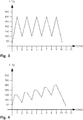
- the Figure 1 shows a first embodiment of a temperature curve for the conditioning process of a phase material in a chamber.
- the chamber is heated to a constant 300 ° C with the heating device.
- the temperature of the chamber remains constant over the entire conditioning process.
- the fiber is exposed in the chamber and thus heated for 60 seconds.
- the fiber is then removed from the chamber and cooled in the ambient air.
- the final temperature after the cooling process is approximately at room temperature, in this case around 25 ° C.
- the cooling process takes 60 seconds.
- the fiber is then exposed again in the chamber at a temperature of 300 ° C for 60 seconds, which increases the temperature of the fiber from room temperature to 300 ° C and keeps it at 300 ° C. These steps are repeated until the temperature of 300 ° C. has been reached six times.
- the process ends after the last cooling process.
- the temperature curve has five local minima or five low points at a temperature of approximately 25 ° C.
- the maximum temperature and the local maxima are each at a temperature of 300 ° C.
- the entire cycle takes around 12 minutes.
- the Figure 2 shows a second embodiment of a temperature curve for the conditioning process of an adsorbent in a chamber.
- the chamber is heated to a constant 250 ° C with the heating device.
- the fiber is heated in the chamber for 90 seconds and reaches a maximum temperature of 250 ° C.
- the heating device is then switched off for 60 seconds, whereupon the temperature drops from 250 ° C to around 50 ° C.
- the heater is turned on again, whereupon the temperature rises to 250 ° C within 30 seconds and is held for 60 seconds. These steps are repeated until the temperature has been maintained at 250 ° C. five times for 60 seconds.
- the process ends after the cooling process, ie at approximately 50 ° C.
- the temperature curve has four local minima or four low points at a temperature of 50 ° C.
- the maximum temperature and the local maximum are each at a temperature of 250 ° C.
- the entire cycle takes around 12.5 minutes.
- a lower maximum temperature is selected compared to the first embodiment, but this is kept longer.
- only 5 cycles are provided instead of 6 cycles.
- heating can alternatively also be carried out with other means which react less sluggishly, for example heating with hot gas, microwaves or other heating means known to the person skilled in the art.
- the cooling process can be carried out with cooled gas or with a gas at room temperature.
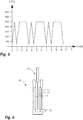
- the Figure 3 shows a third embodiment of a temperature curve for the conditioning process of an adsorbent in a chamber.
- the initial temperature in the chamber is around 300 ° C and remains constant during the process.
- the fiber is introduced into the chamber and heated to 300 ° C for 60 seconds.
- the fiber is then removed from the chamber and for another 60 Cooled to 100 ° C for seconds. These steps are repeated until the temperature of 300 ° C. has been reached five times.
- the process ends after the last cooling process at room temperature.
- the temperature curve has four local minima or four low points at a temperature of 100 ° C.
- the maximum temperature and the local maximum are each at a temperature of 300 ° C.
- the entire cycle takes around 10 minutes.
- a higher minimum temperature is chosen compared to the first embodiment.
- the maximum temperature of 300 ° C is only reached selectively and is not maintained for a long time. In the present procedure, 5 cycles are provided.
- the Figure 4 shows a fourth embodiment of a temperature curve for the conditioning process of an adsorbent in a chamber.
- the initial temperature in the chamber is around 150 ° C.
- the fiber is fed into the chamber for 60 seconds.
- the fiber is then cooled in a cannula in ambient air to a temperature of approximately 75 ° C for 60 seconds.
- the temperature in the chamber is increased by 25 ° C to 175 ° C.
- the fiber in the chamber is exposed to the temperature of 175 ° C for 60 seconds.
- the fiber is exposed, that is, extended from the cannula.
- the fiber is then moved back into the cannula and cooled in the ambient air to a temperature of approximately 100 ° C., while the chamber is heated to a temperature of 200 ° C.
- the temperature curve has four local minima or four low points, which increase successively by a temperature of 25 ° C.
- the temperature curve thus shows a trend with a positive slope.
- the temperature maximum is reached after 8 minutes and 30 seconds and is 250 ° C.
- the temperature curve can be varied as desired without departing from the basic idea of the invention.
- the trend shown in the fourth embodiment the temperature curve can also run differently, for example with a negative slope.
- the local minima or the local maxima can describe their own functions, which deviate from a straight line.
- the minima or the maxima can form a zigzag curve.
- the minima and the maxima of a temperature curve do not have to run parallel etc.
- the individual temperature profiles can be achieved by different chamber heating and by different cooling techniques.
- the second embodiment of a temperature curve can also be achieved with an additional cooling chamber, etc.
- the Figure 5 shows a fifth embodiment of a temperature curve for the conditioning process of an adsorbent in a chamber.
- the initial temperature in the chamber is around 250 ° C and remains constant during the conditioning process.
- the fiber is fed into the chamber for 30 seconds and heated to a temperature of 250 ° C.
- the fiber is then transferred to a separate cooling chamber and cooled to approximately room temperature over 30 seconds.
- the fiber is then transferred back into the chamber, where it is then exposed to the temperature of 250 ° C for 120 seconds.
- the fiber is then transferred to a separate cooling chamber and cooled to approximately room temperature over 30 seconds.
- the fiber is then transferred back into the chamber, where it is exposed to the temperature of 250 ° C for 30 seconds.
- the Figure 6 shows a schematic representation of an embodiment of a chamber 10 with a heating device 14, in which a fiber 20 comprising the phase material is arranged.
- the chamber 10 comprises a housing 11 with an interior 12, in which a heating device 15 is arranged.
- the heating device 14 is cylindrical, in particular in the form of a heating spiral, into which the fiber 20 can be inserted.
- the heating device can also be designed in another way, for example the heating device can be arranged only on one side in the interior 12 or on the bottom of the interior 12.
- the chamber 10 further includes a fluid inlet 13 in the Bottom region of the housing 11, with which a fluid can be guided into the interior 12. The fluid serves to flush the interior 12 while conditioning the fiber.
- the fluid can be gaseous or liquid. It is particularly preferably an inert gas, such as nitrogen or noble gas.
- the fluid can also be used to cool the fiber, so that the low points of the temperature curve can be reached more quickly.
- the fluid can be gaseous or liquid.
- the fluid can additionally or alternatively be used for cooling or for rinsing also for heating the fiber, whereby the local maxima of the temperature curve can be reached more quickly, the fluid in turn being gaseous or liquid.
- the device for performing the conditioning can be provided as a separate chamber for exclusive use for the conditioning.
- a heatable injector of an analysis device in particular a chromatograph, can be provided as a chamber.
- the device can further comprise a separate cooling chamber, wherein the fiber can be transferred to the cooling chamber for cooling during the process.
- the cooling chamber can be actively cooled or only flowed through with an inert gas at room temperature.
- the device can also comprise a fan.
- the fan can be arranged outside the chamber, so that the fiber, in particular the fiber located in the cannula, can be positioned in front of the fan for cooling out of the chamber and the fiber can be cooled directly or indirectly by the air flow.
- a cooling gas actively cooled or at room temperature
- the fan can also be arranged in a separate cooling chamber, with which a cooled or uncooled gas, in particular an inert gas, can be flowed through the cooling chamber in order to cool the fiber.
- the specialist are further possibilities are known, with which the fiber can be cooled more efficiently or simply.
- phase materials can also be conditioned with the method according to the invention.
- the process can also be used to condition a phase material for SPE.
- the process can also be used to gently condition HPLC or GC columns. Further possible applications of the method according to the invention are known to the person skilled in the art.
Landscapes
- Chemical & Material Sciences (AREA)
- Analytical Chemistry (AREA)
- Chemical Kinetics & Catalysis (AREA)
- Organic Chemistry (AREA)
- Physics & Mathematics (AREA)
- Health & Medical Sciences (AREA)
- Life Sciences & Earth Sciences (AREA)
- Biochemistry (AREA)
- General Health & Medical Sciences (AREA)
- General Physics & Mathematics (AREA)
- Immunology (AREA)
- Pathology (AREA)
- Thermal Sciences (AREA)
- Solid-Sorbent Or Filter-Aiding Compositions (AREA)
Priority Applications (2)
| Application Number | Priority Date | Filing Date | Title |
|---|---|---|---|
| EP18196060.0A EP3627149B1 (fr) | 2018-09-21 | 2018-09-21 | Conditionnement d'un adsorbant |
| US16/577,995 US11318443B2 (en) | 2018-09-21 | 2019-09-20 | Process for thermally desorbing a phase material |
Applications Claiming Priority (1)
| Application Number | Priority Date | Filing Date | Title |
|---|---|---|---|
| EP18196060.0A EP3627149B1 (fr) | 2018-09-21 | 2018-09-21 | Conditionnement d'un adsorbant |
Publications (2)
| Publication Number | Publication Date |
|---|---|
| EP3627149A1 true EP3627149A1 (fr) | 2020-03-25 |
| EP3627149B1 EP3627149B1 (fr) | 2021-03-17 |
Family
ID=63678534
Family Applications (1)
| Application Number | Title | Priority Date | Filing Date |
|---|---|---|---|
| EP18196060.0A Active EP3627149B1 (fr) | 2018-09-21 | 2018-09-21 | Conditionnement d'un adsorbant |
Country Status (2)
| Country | Link |
|---|---|
| US (1) | US11318443B2 (fr) |
| EP (1) | EP3627149B1 (fr) |
Citations (4)
| Publication number | Priority date | Publication date | Assignee | Title |
|---|---|---|---|---|
| WO2000017429A1 (fr) * | 1998-09-21 | 2000-03-30 | University Of South Florida | Structure de fibre de microextraction en phase solide et procede de production |
| GB2392114A (en) * | 2002-08-23 | 2004-02-25 | Glaxo Group Ltd | Temperature controlled membrane interface device. |
| US7047661B2 (en) | 2002-04-22 | 2006-05-23 | The Regents Of The University Of California | Solid phase microextraction fiber cleaning and conditioning apparatus and method |
| US9212979B2 (en) | 2014-01-15 | 2015-12-15 | King Fahd University Of Petroleum And Minerals | Automated microextraction technique for the analysis of N-nitrosamines in water |
-
2018
- 2018-09-21 EP EP18196060.0A patent/EP3627149B1/fr active Active
-
2019
- 2019-09-20 US US16/577,995 patent/US11318443B2/en active Active
Patent Citations (4)
| Publication number | Priority date | Publication date | Assignee | Title |
|---|---|---|---|---|
| WO2000017429A1 (fr) * | 1998-09-21 | 2000-03-30 | University Of South Florida | Structure de fibre de microextraction en phase solide et procede de production |
| US7047661B2 (en) | 2002-04-22 | 2006-05-23 | The Regents Of The University Of California | Solid phase microextraction fiber cleaning and conditioning apparatus and method |
| GB2392114A (en) * | 2002-08-23 | 2004-02-25 | Glaxo Group Ltd | Temperature controlled membrane interface device. |
| US9212979B2 (en) | 2014-01-15 | 2015-12-15 | King Fahd University Of Petroleum And Minerals | Automated microextraction technique for the analysis of N-nitrosamines in water |
Also Published As
| Publication number | Publication date |
|---|---|
| US20200094222A1 (en) | 2020-03-26 |
| US11318443B2 (en) | 2022-05-03 |
| EP3627149B1 (fr) | 2021-03-17 |
Similar Documents
| Publication | Publication Date | Title |
|---|---|---|
| EP1697736B1 (fr) | Dispositif pour preparer un echantillon | |
| DE69309055T2 (de) | Vorrichtung und methode zur umkehrpermeationsmembranextraktion von verbindungen aus probelösungen | |
| DE102013016774A1 (de) | Vakuumdämmkörper | |
| DE1278401B (de) | Kolonnenverschluss fuer Saeulenchromatographie | |
| EP3169998A1 (fr) | Pré-concentrateur d'adsorption et/ou de désorption d'au moins un composant d'un gaz | |
| DE102005004325A1 (de) | Ionenmobilitätsspektrometer und Verfahren zu seinem Betrieb | |
| EP1607134B1 (fr) | Sorbent de piégeage à base de polyorganosiloxane | |
| EP3627149B1 (fr) | Conditionnement d'un adsorbant | |
| EP3588080B1 (fr) | Procédé et dispositif de chromatographie automatique de plaques en couches minces | |
| EP3088888B1 (fr) | Dispositif d'extraction d'un composant volatile | |
| EP2394158B1 (fr) | Dispositif et procédé de préparation d'échantillons pour la chromatographie gazeuse | |
| EP1867982A2 (fr) | Dispositif d'analyse miniaturisé avec enrichissement d'échantillons pour chromatographie en phase gazeuse | |
| DE2141244A1 (de) | Probeventil fur ein Gerat zum Nach weis eines Gasgemisches | |
| DE2900344C2 (de) | Chromatographiesäule | |
| DE4107089C2 (fr) | ||
| EP1119767A1 (fr) | Procede et dispositif pour la separation rapide par chromatographie en phase liquide de melanges de substances et pour l'identification de substances | |
| DE19851821A1 (de) | Vorrichtung und Verfahren zum Nachweis von Probenmolekülen | |
| DE19719903A1 (de) | Meßvorrichtung und Verfahren zur Reinigung von Kontaminationsbereichen einer Meßvorrichtung | |
| DE3004347C2 (fr) | ||
| DE10013996C1 (de) | Gaschromatograph mit einer Kühleinrichtung | |
| DE112004000240B4 (de) | Kapillarschleife mit eingebauter Rückhaltefritte | |
| DE3242214C2 (de) | Verfahren und Vorrichtung zum Analysieren eines in einer Hochdruckextraktionsvorrichtung gewonnenen Extraktes | |
| DE102012215547A1 (de) | Probenkonzentrierung durch ortsveränderliches Temperieren in einer Flüssigchromatografievorrichtung | |
| CH654218A5 (de) | Geraet zur linearen ueberdruck-schichtchromatographie. | |
| DE29702315U1 (de) | Vorrichtung zur quasi kontinuierlichen Messung von organischen und anorganischen Substanzen in Prozeßgasen, insbesondere von polychlorierten Dibenzo-p-dioxinen und Dibenzofuranen im Abgas von Abfallverbrennungsanlagen |
Legal Events
| Date | Code | Title | Description |
|---|---|---|---|
| PUAI | Public reference made under article 153(3) epc to a published international application that has entered the european phase |
Free format text: ORIGINAL CODE: 0009012 |
|
| STAA | Information on the status of an ep patent application or granted ep patent |
Free format text: STATUS: THE APPLICATION HAS BEEN PUBLISHED |
|
| AK | Designated contracting states |
Kind code of ref document: A1 Designated state(s): AL AT BE BG CH CY CZ DE DK EE ES FI FR GB GR HR HU IE IS IT LI LT LU LV MC MK MT NL NO PL PT RO RS SE SI SK SM TR |
|
| AX | Request for extension of the european patent |
Extension state: BA ME |
|
| STAA | Information on the status of an ep patent application or granted ep patent |
Free format text: STATUS: REQUEST FOR EXAMINATION WAS MADE |
|
| 17P | Request for examination filed |
Effective date: 20200508 |
|
| RBV | Designated contracting states (corrected) |
Designated state(s): AL AT BE BG CH CY CZ DE DK EE ES FI FR GB GR HR HU IE IS IT LI LT LU LV MC MK MT NL NO PL PT RO RS SE SI SK SM TR |
|
| GRAP | Despatch of communication of intention to grant a patent |
Free format text: ORIGINAL CODE: EPIDOSNIGR1 |
|
| STAA | Information on the status of an ep patent application or granted ep patent |
Free format text: STATUS: GRANT OF PATENT IS INTENDED |
|
| INTG | Intention to grant announced |
Effective date: 20201022 |
|
| GRAS | Grant fee paid |
Free format text: ORIGINAL CODE: EPIDOSNIGR3 |
|
| GRAA | (expected) grant |
Free format text: ORIGINAL CODE: 0009210 |
|
| STAA | Information on the status of an ep patent application or granted ep patent |
Free format text: STATUS: THE PATENT HAS BEEN GRANTED |
|
| AK | Designated contracting states |
Kind code of ref document: B1 Designated state(s): AL AT BE BG CH CY CZ DE DK EE ES FI FR GB GR HR HU IE IS IT LI LT LU LV MC MK MT NL NO PL PT RO RS SE SI SK SM TR |
|
| REG | Reference to a national code |
Ref country code: GB Ref legal event code: FG4D Free format text: NOT ENGLISH |
|
| REG | Reference to a national code |
Ref country code: CH Ref legal event code: EP |
|
| REG | Reference to a national code |
Ref country code: DE Ref legal event code: R096 Ref document number: 502018004334 Country of ref document: DE |
|
| REG | Reference to a national code |
Ref country code: IE Ref legal event code: FG4D Free format text: LANGUAGE OF EP DOCUMENT: GERMAN |
|
| REG | Reference to a national code |
Ref country code: AT Ref legal event code: REF Ref document number: 1372705 Country of ref document: AT Kind code of ref document: T Effective date: 20210415 |
|
| REG | Reference to a national code |
Ref country code: CH Ref legal event code: NV Representative=s name: KELLER SCHNEIDER PATENT- UND MARKENANWAELTE AG, CH |
|
| REG | Reference to a national code |
Ref country code: LT Ref legal event code: MG9D |
|
| PG25 | Lapsed in a contracting state [announced via postgrant information from national office to epo] |
Ref country code: HR Free format text: LAPSE BECAUSE OF FAILURE TO SUBMIT A TRANSLATION OF THE DESCRIPTION OR TO PAY THE FEE WITHIN THE PRESCRIBED TIME-LIMIT Effective date: 20210317 Ref country code: FI Free format text: LAPSE BECAUSE OF FAILURE TO SUBMIT A TRANSLATION OF THE DESCRIPTION OR TO PAY THE FEE WITHIN THE PRESCRIBED TIME-LIMIT Effective date: 20210317 Ref country code: GR Free format text: LAPSE BECAUSE OF FAILURE TO SUBMIT A TRANSLATION OF THE DESCRIPTION OR TO PAY THE FEE WITHIN THE PRESCRIBED TIME-LIMIT Effective date: 20210618 Ref country code: BG Free format text: LAPSE BECAUSE OF FAILURE TO SUBMIT A TRANSLATION OF THE DESCRIPTION OR TO PAY THE FEE WITHIN THE PRESCRIBED TIME-LIMIT Effective date: 20210617 Ref country code: NO Free format text: LAPSE BECAUSE OF FAILURE TO SUBMIT A TRANSLATION OF THE DESCRIPTION OR TO PAY THE FEE WITHIN THE PRESCRIBED TIME-LIMIT Effective date: 20210617 |
|
| REG | Reference to a national code |
Ref country code: NL Ref legal event code: MP Effective date: 20210317 |
|
| PG25 | Lapsed in a contracting state [announced via postgrant information from national office to epo] |
Ref country code: RS Free format text: LAPSE BECAUSE OF FAILURE TO SUBMIT A TRANSLATION OF THE DESCRIPTION OR TO PAY THE FEE WITHIN THE PRESCRIBED TIME-LIMIT Effective date: 20210317 Ref country code: LV Free format text: LAPSE BECAUSE OF FAILURE TO SUBMIT A TRANSLATION OF THE DESCRIPTION OR TO PAY THE FEE WITHIN THE PRESCRIBED TIME-LIMIT Effective date: 20210317 Ref country code: SE Free format text: LAPSE BECAUSE OF FAILURE TO SUBMIT A TRANSLATION OF THE DESCRIPTION OR TO PAY THE FEE WITHIN THE PRESCRIBED TIME-LIMIT Effective date: 20210317 |
|
| PG25 | Lapsed in a contracting state [announced via postgrant information from national office to epo] |
Ref country code: NL Free format text: LAPSE BECAUSE OF FAILURE TO SUBMIT A TRANSLATION OF THE DESCRIPTION OR TO PAY THE FEE WITHIN THE PRESCRIBED TIME-LIMIT Effective date: 20210317 |
|
| PG25 | Lapsed in a contracting state [announced via postgrant information from national office to epo] |
Ref country code: SM Free format text: LAPSE BECAUSE OF FAILURE TO SUBMIT A TRANSLATION OF THE DESCRIPTION OR TO PAY THE FEE WITHIN THE PRESCRIBED TIME-LIMIT Effective date: 20210317 Ref country code: EE Free format text: LAPSE BECAUSE OF FAILURE TO SUBMIT A TRANSLATION OF THE DESCRIPTION OR TO PAY THE FEE WITHIN THE PRESCRIBED TIME-LIMIT Effective date: 20210317 Ref country code: CZ Free format text: LAPSE BECAUSE OF FAILURE TO SUBMIT A TRANSLATION OF THE DESCRIPTION OR TO PAY THE FEE WITHIN THE PRESCRIBED TIME-LIMIT Effective date: 20210317 Ref country code: LT Free format text: LAPSE BECAUSE OF FAILURE TO SUBMIT A TRANSLATION OF THE DESCRIPTION OR TO PAY THE FEE WITHIN THE PRESCRIBED TIME-LIMIT Effective date: 20210317 |
|
| PG25 | Lapsed in a contracting state [announced via postgrant information from national office to epo] |
Ref country code: RO Free format text: LAPSE BECAUSE OF FAILURE TO SUBMIT A TRANSLATION OF THE DESCRIPTION OR TO PAY THE FEE WITHIN THE PRESCRIBED TIME-LIMIT Effective date: 20210317 Ref country code: SK Free format text: LAPSE BECAUSE OF FAILURE TO SUBMIT A TRANSLATION OF THE DESCRIPTION OR TO PAY THE FEE WITHIN THE PRESCRIBED TIME-LIMIT Effective date: 20210317 Ref country code: PT Free format text: LAPSE BECAUSE OF FAILURE TO SUBMIT A TRANSLATION OF THE DESCRIPTION OR TO PAY THE FEE WITHIN THE PRESCRIBED TIME-LIMIT Effective date: 20210719 Ref country code: PL Free format text: LAPSE BECAUSE OF FAILURE TO SUBMIT A TRANSLATION OF THE DESCRIPTION OR TO PAY THE FEE WITHIN THE PRESCRIBED TIME-LIMIT Effective date: 20210317 Ref country code: IS Free format text: LAPSE BECAUSE OF FAILURE TO SUBMIT A TRANSLATION OF THE DESCRIPTION OR TO PAY THE FEE WITHIN THE PRESCRIBED TIME-LIMIT Effective date: 20210717 |
|
| REG | Reference to a national code |
Ref country code: DE Ref legal event code: R097 Ref document number: 502018004334 Country of ref document: DE |
|
| PLBE | No opposition filed within time limit |
Free format text: ORIGINAL CODE: 0009261 |
|
| STAA | Information on the status of an ep patent application or granted ep patent |
Free format text: STATUS: NO OPPOSITION FILED WITHIN TIME LIMIT |
|
| PG25 | Lapsed in a contracting state [announced via postgrant information from national office to epo] |
Ref country code: ES Free format text: LAPSE BECAUSE OF FAILURE TO SUBMIT A TRANSLATION OF THE DESCRIPTION OR TO PAY THE FEE WITHIN THE PRESCRIBED TIME-LIMIT Effective date: 20210317 Ref country code: AL Free format text: LAPSE BECAUSE OF FAILURE TO SUBMIT A TRANSLATION OF THE DESCRIPTION OR TO PAY THE FEE WITHIN THE PRESCRIBED TIME-LIMIT Effective date: 20210317 Ref country code: DK Free format text: LAPSE BECAUSE OF FAILURE TO SUBMIT A TRANSLATION OF THE DESCRIPTION OR TO PAY THE FEE WITHIN THE PRESCRIBED TIME-LIMIT Effective date: 20210317 |
|
| 26N | No opposition filed |
Effective date: 20211220 |
|
| PG25 | Lapsed in a contracting state [announced via postgrant information from national office to epo] |
Ref country code: SI Free format text: LAPSE BECAUSE OF FAILURE TO SUBMIT A TRANSLATION OF THE DESCRIPTION OR TO PAY THE FEE WITHIN THE PRESCRIBED TIME-LIMIT Effective date: 20210317 |
|
| PG25 | Lapsed in a contracting state [announced via postgrant information from national office to epo] |
Ref country code: IT Free format text: LAPSE BECAUSE OF FAILURE TO SUBMIT A TRANSLATION OF THE DESCRIPTION OR TO PAY THE FEE WITHIN THE PRESCRIBED TIME-LIMIT Effective date: 20210317 |
|
| REG | Reference to a national code |
Ref country code: BE Ref legal event code: MM Effective date: 20210930 |
|
| PG25 | Lapsed in a contracting state [announced via postgrant information from national office to epo] |
Ref country code: IS Free format text: LAPSE BECAUSE OF FAILURE TO SUBMIT A TRANSLATION OF THE DESCRIPTION OR TO PAY THE FEE WITHIN THE PRESCRIBED TIME-LIMIT Effective date: 20210717 Ref country code: MC Free format text: LAPSE BECAUSE OF FAILURE TO SUBMIT A TRANSLATION OF THE DESCRIPTION OR TO PAY THE FEE WITHIN THE PRESCRIBED TIME-LIMIT Effective date: 20210317 |
|
| PG25 | Lapsed in a contracting state [announced via postgrant information from national office to epo] |
Ref country code: LU Free format text: LAPSE BECAUSE OF NON-PAYMENT OF DUE FEES Effective date: 20210921 Ref country code: IE Free format text: LAPSE BECAUSE OF NON-PAYMENT OF DUE FEES Effective date: 20210921 Ref country code: FR Free format text: LAPSE BECAUSE OF NON-PAYMENT OF DUE FEES Effective date: 20210930 Ref country code: BE Free format text: LAPSE BECAUSE OF NON-PAYMENT OF DUE FEES Effective date: 20210930 |
|
| REG | Reference to a national code |
Ref country code: DE Ref legal event code: R082 Ref document number: 502018004334 Country of ref document: DE Representative=s name: PATENTANWAELTE OLBRICHT, BUCHHOLD, KEULERTZ PA, DE |
|
| GBPC | Gb: european patent ceased through non-payment of renewal fee |
Effective date: 20220921 |
|
| P01 | Opt-out of the competence of the unified patent court (upc) registered |
Effective date: 20230515 |
|
| PG25 | Lapsed in a contracting state [announced via postgrant information from national office to epo] |
Ref country code: CY Free format text: LAPSE BECAUSE OF FAILURE TO SUBMIT A TRANSLATION OF THE DESCRIPTION OR TO PAY THE FEE WITHIN THE PRESCRIBED TIME-LIMIT Effective date: 20210317 |
|
| PG25 | Lapsed in a contracting state [announced via postgrant information from national office to epo] |
Ref country code: HU Free format text: LAPSE BECAUSE OF FAILURE TO SUBMIT A TRANSLATION OF THE DESCRIPTION OR TO PAY THE FEE WITHIN THE PRESCRIBED TIME-LIMIT; INVALID AB INITIO Effective date: 20180921 |
|
| PG25 | Lapsed in a contracting state [announced via postgrant information from national office to epo] |
Ref country code: GB Free format text: LAPSE BECAUSE OF NON-PAYMENT OF DUE FEES Effective date: 20220921 |
|
| PG25 | Lapsed in a contracting state [announced via postgrant information from national office to epo] |
Ref country code: MK Free format text: LAPSE BECAUSE OF FAILURE TO SUBMIT A TRANSLATION OF THE DESCRIPTION OR TO PAY THE FEE WITHIN THE PRESCRIBED TIME-LIMIT Effective date: 20210317 |
|
| PG25 | Lapsed in a contracting state [announced via postgrant information from national office to epo] |
Ref country code: TR Free format text: LAPSE BECAUSE OF FAILURE TO SUBMIT A TRANSLATION OF THE DESCRIPTION OR TO PAY THE FEE WITHIN THE PRESCRIBED TIME-LIMIT Effective date: 20210317 |
|
| PG25 | Lapsed in a contracting state [announced via postgrant information from national office to epo] |
Ref country code: MT Free format text: LAPSE BECAUSE OF FAILURE TO SUBMIT A TRANSLATION OF THE DESCRIPTION OR TO PAY THE FEE WITHIN THE PRESCRIBED TIME-LIMIT Effective date: 20210317 |
|
| REG | Reference to a national code |
Ref country code: AT Ref legal event code: MM01 Ref document number: 1372705 Country of ref document: AT Kind code of ref document: T Effective date: 20230921 |
|
| PG25 | Lapsed in a contracting state [announced via postgrant information from national office to epo] |
Ref country code: AT Free format text: LAPSE BECAUSE OF NON-PAYMENT OF DUE FEES Effective date: 20230921 |
|
| PG25 | Lapsed in a contracting state [announced via postgrant information from national office to epo] |
Ref country code: AT Free format text: LAPSE BECAUSE OF NON-PAYMENT OF DUE FEES Effective date: 20230921 |
|
| REG | Reference to a national code |
Ref country code: CH Ref legal event code: U11 Free format text: ST27 STATUS EVENT CODE: U-0-0-U10-U11 (AS PROVIDED BY THE NATIONAL OFFICE) Effective date: 20251001 |
|
| PGFP | Annual fee paid to national office [announced via postgrant information from national office to epo] |
Ref country code: DE Payment date: 20250919 Year of fee payment: 8 |
|
| PGFP | Annual fee paid to national office [announced via postgrant information from national office to epo] |
Ref country code: CH Payment date: 20251001 Year of fee payment: 8 |
|
| PGFP | Annual fee paid to national office [announced via postgrant information from national office to epo] |
Ref country code: AT Payment date: 20260410 Year of fee payment: 5 |