EP3627343A1 - Contrôle d'accès simultané multiversion en mémoire efficace pour une base de données basée sur la structure de données arborescente - Google Patents
Contrôle d'accès simultané multiversion en mémoire efficace pour une base de données basée sur la structure de données arborescente Download PDFInfo
- Publication number
- EP3627343A1 EP3627343A1 EP18195454.6A EP18195454A EP3627343A1 EP 3627343 A1 EP3627343 A1 EP 3627343A1 EP 18195454 A EP18195454 A EP 18195454A EP 3627343 A1 EP3627343 A1 EP 3627343A1
- Authority
- EP
- European Patent Office
- Prior art keywords
- trie
- transaction
- nodes
- node
- array
- Prior art date
- Legal status (The legal status is an assumption and is not a legal conclusion. Google has not performed a legal analysis and makes no representation as to the accuracy of the status listed.)
- Ceased
Links
Images




Classifications
-
- G—PHYSICS
- G06—COMPUTING OR CALCULATING; COUNTING
- G06F—ELECTRIC DIGITAL DATA PROCESSING
- G06F16/00—Information retrieval; Database structures therefor; File system structures therefor
- G06F16/20—Information retrieval; Database structures therefor; File system structures therefor of structured data, e.g. relational data
- G06F16/24—Querying
- G06F16/245—Query processing
- G06F16/2458—Special types of queries, e.g. statistical queries, fuzzy queries or distributed queries
- G06F16/2474—Sequence data queries, e.g. querying versioned data
-
- G—PHYSICS
- G06—COMPUTING OR CALCULATING; COUNTING
- G06F—ELECTRIC DIGITAL DATA PROCESSING
- G06F16/00—Information retrieval; Database structures therefor; File system structures therefor
- G06F16/20—Information retrieval; Database structures therefor; File system structures therefor of structured data, e.g. relational data
- G06F16/22—Indexing; Data structures therefor; Storage structures
- G06F16/2228—Indexing structures
- G06F16/2246—Trees, e.g. B+trees
-
- G—PHYSICS
- G06—COMPUTING OR CALCULATING; COUNTING
- G06F—ELECTRIC DIGITAL DATA PROCESSING
- G06F12/00—Accessing, addressing or allocating within memory systems or architectures
- G06F12/02—Addressing or allocation; Relocation
- G06F12/0223—User address space allocation, e.g. contiguous or non contiguous base addressing
- G06F12/023—Free address space management
- G06F12/0253—Garbage collection, i.e. reclamation of unreferenced memory
-
- G—PHYSICS
- G06—COMPUTING OR CALCULATING; COUNTING
- G06F—ELECTRIC DIGITAL DATA PROCESSING
- G06F16/00—Information retrieval; Database structures therefor; File system structures therefor
- G06F16/20—Information retrieval; Database structures therefor; File system structures therefor of structured data, e.g. relational data
- G06F16/22—Indexing; Data structures therefor; Storage structures
- G06F16/2228—Indexing structures
- G06F16/2272—Management thereof
-
- G—PHYSICS
- G06—COMPUTING OR CALCULATING; COUNTING
- G06F—ELECTRIC DIGITAL DATA PROCESSING
- G06F16/00—Information retrieval; Database structures therefor; File system structures therefor
- G06F16/20—Information retrieval; Database structures therefor; File system structures therefor of structured data, e.g. relational data
- G06F16/23—Updating
- G06F16/2308—Concurrency control
- G06F16/2315—Optimistic concurrency control
- G06F16/2329—Optimistic concurrency control using versioning
Definitions
- the present invention relates generally to the efficient use of trie data structures in databases and information retrieval systems for multi-version concurrency control (MVCC) including version storage, garbage collection and index management.
- MVCC multi-version concurrency control
- Multi-version concurrency control is a popular transaction management scheme in database management systems (DBMSs). It typically increases parallelism while maintaining the desired serializability during transaction processing. Multi-versioning allows multiple read-only transactions to concurrently access current or older versions of records - even consistent snapshots of multiple records - without preventing write transactions from simultaneously generating newer versions.
- a database has to maintain multiple physical versions of each object.
- these objects are the tuples (records), in document-oriented databases these would be the documents, in key-value databases the objects would be the (opaque) values.
- an update to an object does not override the object or parts of it with new data but creates a new version of said object.
- the concurrency control protocol coordinates the execution of concurrent read and write transactions.
- the version that each transaction sees or has access to depends on the isolation level implemented by the MVCC.
- a common isolation level implemented is snapshot isolation, where a transaction has access to a state of the data as it has been when the transaction started. The following description focuses on snapshot isolation.
- Fig. 1A illustrates different version storage schemes for storing multiple versions.
- an object will be copied, modified and the new version will be appended to the storage space.
- a chain of versions has to be maintained for each object.
- the drawback of this approach is that a potentially long chain has to be traversed to find the appropriate version.
- Obsolete versions must be pruned frequently to keep up the performance.
- the head version of this chain could be the oldest or newest version depending on the implementation. Indexes have to be updated either during garbage collection if the head points to the oldest version or after an update if the head points to the new version. Alternatively, a double linked chain can be used, which would however cause further maintenance overhead.
- a time-travel storage 103 is similar to the append-only schema, but the versions are stored in a separate time-travel storage space.
- the master version In the main storage space, the master version is kept with a reference to the version chain in the time-travel storage space. For updates, a new object will be copied to the time-travel storage space.
- the master version could be the oldest or newest version depending on the implementation and depending on this, either the new copy in the time-travel storage space or the master version is modified by the update. Indexes point to the master version and are not affected.
- delta-storage 104 With delta-storage 104, the master version is maintained in the storage location, typically the current version. Update modifications are recorded in a delta-storage, referred to as rollback segment that stores the changes to the original version or parts of it, e.g. the modified attributes of a record. This leads to higher overhead during read access as the original object has to be retrieved and the logged changes have to be applied to gain the resulting object version.
- the garbage collection needs to be able to detect obsolete versions.
- An object version is obsolete if it has been superseded by a newer (current) version and there is no active transaction where the old version is still visible - in the case of snapshot isolation. This can be detected by having monotonously increasing IDs for each transaction, where each superseded object is marked with the ID of the transaction that replaced it. All objects with a replacement-ID less than any ID of all active transactions can be removed and its storage space can be reclaimed.
- the objects have to be unlinked from the chains, copied and the index has to be updated. Then the physical space can be reclaimed. For an in-memory database this leads to the question of memory management in general.
- MVCC database management systems according to the prior art keep the database's versioning information separate from its indexes. This implies that the existence of a key in an index means that some version exists with that key, but the index entry does not contain any information about the version.
- an index lookup will never result in false negatives, as there is always some version for the key, but it may result in false positives, as the index can point to a version for a key that is not visible to a particular transaction. This imposes an overhead hurting the performance as the results of queries using an index must be filtered in order to remove the false positive matches.
- Fig. iB shows two common approaches of how indexes reference objects: Using logical pointers 111 and using physical pointers 110.
- An index using logical pointers uses an indirection layer that maps a fixed object identifier (object ID) to the physical object storage. Depending on the version storage this is the head of the version chain or the master version. This approach avoids the problem of having to update all indexes to point to a new physical location whenever changes occur.
- a first embodiment of the invention is a computer-implemented method for determining, in an electronic database application or information retrieval system, a storage location of a database object of a specific version, wherein indexes for each version of the database object are stored in a trie having a root node corresponding to the specific version, the method comprising, determining a trie corresponding to the specific version by accessing the root node of the trie corresponding to the specific version; determining an object identifier of the database object by traversing the trie corresponding to the specific version using a secondary key related to the database object as search key; determining the storage location of the database object by traversing the trie corresponding to the specific version using the determined object identifier as search key.
- the information whether a search key is an object identifier, or a secondary key related to a database object is comprised in the search key.
- a secondary key comprises information regarding one or more properties encoded in the secondary key.
- the one or more properties encoded in the secondary key comprise one of a name, an address, etc.
- indexes are defined as having a key and a value.
- a first index is defined by having the secondary key as key and the object identifier as value
- a second index is defined by having the object identifier as key and the storage location of the database object as value
- the trie having a root node corresponding to the specific version is created by creating a new root node for the specific version, copying and modifying the nodes that have been amended with regard to the nodes of a previous trie having a root node corresponding to the previous version, and creating references pointing to the nodes in the previous trie that have not been amended.
- creating the trie having a root node corresponding to the specific version is performed during a transaction and the specific version is associated with the transaction.
- a 10 th embodiment of the invention is a computer-implemented method for identifying unused memory to be freed that is occupied by trie nodes of one or more tries comprising database indexes of an electronic database application or information retrieval system, wherein the method comprises: storing an array comprising one or more chunks, wherein a chunk is configured to store a trie node, and wherein the array comprises at least a first chunk containing a first trie node; storing a free chunk list indicating which chunks of the array are free to store a new trie node; while updating the first trie node during a first transaction, determining if the first trie node has been created during the first transaction; adding the first chunk containing the first trie node to the free chunk list depending on the result of the determination.
- the method further comprises: adding the first chunk containing the first trie node to the free chunk list.
- any one of the 10 th to 11 th embodiments wherein the determining if the first trie node has been created during a second transaction, and if it is determined that the first trie node has been created during a second transaction prior to the first transaction, adding the first chunk containing the first trie node to a pending free chunk list.
- the adding of the first chunk containing the first trie node to the pending free chunk list comprises generating a list entry in the pending free chunk list that is associated with the first transaction and contains a reference to the first chunk.
- the list entry in the pending free chunk list that is associated with the first transaction allows referencing all chunks that have been created during one or more transactions prior to the first transaction and have been updated during the first transaction.
- the referencing of all chunks that have been created during one or more transactions prior to the first transaction and have been updated in the first transaction is realized with a pointer associated with the first transaction pointing to a chain of chunks that have been created during one or more transactions prior to the first transaction and have been updated in the first transaction.
- the method further comprises: storing a transaction list containing active database transactions; determining if the pending free chunk list comprises one or more entries associated with a transaction that is older than the oldest transaction in the transaction list; if it is determined that the pending free chunk list comprises one or more entries associated with a transaction that is older than an oldest transaction in the transaction list, moving the chunks associated with the one or more entries to the free chunk list.
- each chunk comprises a payload value and a value identifying the transaction during which it is created.
- updating the first trie node during a first transaction comprises creating a second trie node as a copy of the first trie node with updated values.
- updating the first trie node during a first transaction comprises creating a second chunk containing the second trie node, wherein the value identifying the transaction during which the chunk is created corresponds to the first transaction.
- the value identifying the transaction during which a node is created is a transaction identifier.
- the determination if the first trie node has been created during the first transaction is performed by comparing the transaction identifier of the first transaction with the transaction identifier of the first chunk.
- the determination whether a transaction is older than the oldest transaction in the transaction list is performed by comparing transaction identifiers, wherein an older transaction has a lower transaction identifier than a newer transaction.
- the array further comprises free space not occupied by chunks.
- each node on the array is stored as a long integer.
- each node in a trie is referenced by a pointer comprising an index of the node in the array.
- the size of the array is limited.
- the one or more chunks comprise chunks having different sizes and chunks having the same sizes, wherein each chunk of a different size is referenced by a pointer stored in the free chunk list and wherein the chunks referenced by a pointer stored in the free chunk list comprise pointers to chunks of the same size as themselves.
- the one or more chunks comprise chunks of 64 different sizes.
- the different sizes are associated with the number of pointers contained in each node pointing to child nodes.
- chunks of the same size are linked to each other by pointers.
- a 31 st embodiment of the invention is a computer-implemented method for identifying unused memory to be freed occupied by trie nodes storing database indexes of an electronic database application or information retrieval system, wherein the method comprises: storing one or more arrays and an active array configured to store trie nodes, wherein each trie node is associated with a current trie root node corresponding to a current transaction and/or one or more previous trie root nodes corresponding to previous transactions; and performing, during an eviction transaction, the following steps of: determining if one of the one or more arrays meets a criterium, if it is determined that one of the one or more arrays meets the criterium, selecting the array that meets the criterium; if the selected array contains one or more nodes that are associated with the current trie root node, copying the one or more nodes of the selected array that are associated with the current trie root node to the active array; identifying the memory occupied by the selected array as unused memory to be
- copying of the one or more nodes of the selected array that are associated with the current trie root node to the active array further comprises: while traversing the nodes associated with the current trie root node, simultaneously traversing nodes associated with a previous trie root node that has been created after the selected array was the active array, comparing nodes associated with the current trie root node with nodes associated with the previous trie root node level-by-level from top-to-down, if it is determined by the comparison that a node is associated with the current trie root node but is not associated with the previous trie root node, not traversing said node and child nodes of said node.
- the previous trie root node that has been created after the selected array was the active array is the first trie root node that has been created after the selected array was the active array.
- the comparing of nodes associated with the current trie root node with nodes associated with the previous trie root node level-by-level from top-to-down comprises comparing the references to child nodes of the nodes.
- the references to child nodes of the nodes are compared by an AND operation.
- the references to child nodes of the nodes are indicated by bitmaps and the comparison is performed by a bitwise AND operation.
- the method further comprising: prior to identifying the memory occupied by the selected array as unused memory to be freed, determining if the selected array contains one or more nodes associated with one or more previous trie root nodes being used in one or more pending transactions, if it is determined that selected array contains one or more nodes that are part of one or more previous trie root nodes being used in one or more pending transactions, waiting until the pending transactions are terminated.
- the determination if the pending transactions are terminated is performed by comparing the pending transactions with the eviction transaction, and if it is determined that the pending transactions do not contain a transaction older than the eviction transaction, determining that the pending transactions are terminated.
- the active array is an array as defined in the 10 th to 30 th embodiments.
- the method further comprises: prior to copying the one or more nodes of the selected array that are part of the of the current trie root node to the active array, determining if the active array has sufficient free space to encompass the node; if it is determined that the active array does not have enough free space, creating a new array that becomes the active array and the previous active array becomes one of the one or more arrays.
- the active array and the one or more arrays have a limited size.
- the criterium comprises the number of transactions currently using an array and/or the number of nodes of one or more previous tries contained in an array.
- the criterium comprises the amount and size of the nodes in an array that have been superseded.
- each node in a trie is referenced by pointer comprising a reference to a respective array and an index of the node in the array.
- a 45 th embodiment of the invention is a computer program, in particular a database application or information retrieval system program, comprising instructions for performing the method of any one of 1 st to 44 th .
- a 46 th embodiment of the invention is a data-processing device or system comprising one or more processors and memory, the data-processing device or system being configured to perform the method of any one of 1 st to 44 th embodiments.
- a 47 th embodiment of the invention is a preferably non-transitory computer readable medium having stored thereon the computer program of the 45 th embodiment.
- a database has to maintain multiple versions of each object.
- Fig. 2 shows a logical pointer approach according to the prior art, where pointers for a specific object ID and a specific version are mapped to a physical location of the object in a storage.
- objects 206, 209 are stored in a persistent storage 202, which can be one or more files and/or persistent memory.
- a log structured storage concept is applied. This means that new objects are appended after a last used position 210 of the storage 202.
- Every object is identified by a primary key or ID, e.g. a record ID or document ID in case of relational or document-oriented databases.
- An ID-to-physical-location map (index) is used to derive the physical position of the object in the storage 202 for a given ID.
- An index is defined as key/value pair throughout this description.
- objects can be modified by transactions. If an object is to be modified in a transaction, a copy of the object is created, and the amendments are performed on the copied object. The original object is not amended or overwritten.
- Every transaction that modifies or creates an object creates a new version of the created or modified object and a new version of the ID-to-physical-location map to derive the physical position of the object in the storage 202.
- the storage 202 comprises two versions of the object.
- a lookup for first version "version 1" of the object with object ID "1” can be realized by using a pointer 203 pointing to map 204, which will lead to the storage position 205 of the first version of the object.
- a lookup for the same object ID but for the second version "version 2" can be realized by using a pointer 207 pointing to map 208 corresponding to a later or newer transaction that will lead to the storage position of the second version of the object 209.
- map 204 is still accessible as long as there are pending transactions using the corresponding snapshot view (the version referenced by the pointer 203) and corresponding object versions.
- Fig. 3a and Fig. 3b show the basic principle of how version storage garbage collection can be accomplished according to the prior art.
- every file is limited to a predetermined file length or size. If, during appending new data, the length of the file is reached, a new "active" file to write to is created and the old file is no longer modified.
- Fig. 3a shows a starting situation for garbage collection.
- Such example may comprise two files, file 1 and file 2, having different objects, wherein file 1 has reached its length limit and file 2 has still space to append to and is thus the active file.
- File 1 stores three objects having different object IDs.
- the object with object ID 1 stores two versions (v1 and v2) and thus two objects in the file.
- the object with object ID 2 stores a first version (vi) and a tomb stone indicating that the object has been deleted in the file.
- File 2 contains the latest version of the object with object ID 3.
- the current versions of the objects are referenced by "ID to pos map ti". "ti" indicates that it is the map of a transaction with a transaction id 1.
- Fig. 3b shows how the garbage collection for the version storage works in principle.
- a copying garbage collection method eviction
- the first step is to "clean" file 1, which means that if the file contains current versions of objects, which are still used and referenced by the current map "ID to pos map ti", they must be transferred to the active file. Therefore, the file is scanned and a look up, e.g. by using the object ID, is performed in the current ID-to-physical-location map "ID to pos map ti" comprising the physical positions of the latest version of the objects.
- the object is copied (written) to the active file, namely file 2.
- the object with object ID 1 and version 2 needs to be copied from file 1 to file 2.
- the object with object ID 1 and version 1 can be ignored as the map contains an object with the same ID but in a newer version.
- the location retrieved from the scan is different from the location in the file scan.
- the object with object ID 2 and version 1 can be ignored as it has been deleted and does not appear in the map at all.
- the object with object ID 3 does not need to be copied as the latest version is not in file 1 but already in the active file 2.
- garbage collection To know which object version store files are suitable candidates for eviction (also called garbage collection in this application), statistics are maintained for each file. Such statistics may comprise the amount and size of the objects that have been replaced by newer versions or have been deleted. If a file contains less than a certain amount of still current object versions, it is subject to garbage collection, which means that the corresponding memory is identified as memory to be freed. Such memory can then be rewritten or overwritten by other data. In case of a file that is has memory to be freed, the file can be deleted. Before deleting the file, it has to be verified that there are no more pending transactions that still need access to the file, e.g. reading data from the versions stored in the file.
- the goal of this invention is to provide a space and performance efficient persistent data structure for storing such a map.
- a persistent data structure is a data structure that always preserves the previous version of itself when it is modified.
- Tree-based structures can easily be used as persistent data structures by creating a partial copy of the tree for each modification up to the root node.
- Fig. 4 illustrates the copy-on-write approach for a trie with an example showing two tries with two different trie root nodes.
- trie structure 401 contains two tries with trie root nodes 402 and 406. Both trie root nodes 402 and 406 correspond to two different versions, which could for example be created during two different transactions.
- the first trie referenced by the trie rood node 402 comprises the keys "007" and "042", which are encoded by the child nodes 403, 404 and 405.
- Node 407 is the modified copy of node 403 and node 409 is the modified copy of node 405.
- the unchanged node 404 is referenced 408 by the new node 407.
- the invention solves many issues mentioned in the introduction.
- the issue regarding how to store multiple object versions and how to find the right version during read access is resolved by using the current root pointer of the trie at the time of transaction start throughout the whole transaction.
- Fig. 5 shows an embodiment implementing logical pointers and the copy-on-write approach for the secondary indexes according to the invention.
- the logical pointers and the copy-on-write approach for the secondary indexes are realized by storing the ID-to-physical-location map trie index 503, 508 and other secondary index tries 504, 509 in one combined physical trie. This is achieved by using the composite key capability of the trie as described in detail in the international patent application PCT/EP2018/056592 .
- a composite key also called “search key” in this application
- ID object identifier
- secondary key related to a database object
- the root of this combined trie provides a consistent (snapshot) view of the object versions.
- the objects are also sometimes referred to as database objects as such objects may maintained in a database and created and amended by database transactions.
- the secondary key 504 is used to derive the object ID 505 and then the object ID 505 is used to determine the physical object position. Modifying a trie referenced by trie root node 502 in a transaction results in a new partial copy of the trie with a new trie root node 507 that again provides a consistent view of all object versions and indexes.
- the search index and the indirection layer are typically different data structures.
- the index points only to one version, which may or may not be the requested version.
- a version chain must be traversed to find the requested version.
- the "requested version” may also be called “visible version” as it is the version that should correctly be visible for the transaction requesting the object.
- the invention solves the drawback of additionally traversing version chains by combining the indirection layer and search index into one physical trie which is always snapshot consistent.
- an object with logical ID "1" with two versions “1" and “2" are considered.
- the first version is stored at physical location 506 and the second version is stored at physical location 511.
- the first object version contains the value "Peter” as name and the second object version contains a changed value, namely the name "Matt”.
- the trie denoted by root note 402 then would contain the following two entries, "ID-Map, 1, 506" and "Name, 'Peter', 1".
- the first entry corresponds to the ID-to-physical storage location 503 and the second entry corresponds to the secondary key 504.
- the trie referenced by trie root node 507 would contain "ID-Map, 1, 511" and "Name, 'Matt', 1".
- the secondary key allows searching for the property "name” with the value "Peter” and returns the object ID "1". Then the trie is traversed by using the object ID "1" to find the physical storing location "506".
- the indirection layer is just another search index within the bunch of search indexes that the trie contains.
- ID-Map and Name of the first key part could be physically stored as Strings or an integer (enumeration) in the trie, e.g. ID-Map could be "1” and Name could be "2", which would result in the following entries: "1, 1, 506" and "2, 'Peter', 1".
- there may be several parameters in a same key e.g. "name, 'Peter', age, 30, 1".
- the trie may comprise different secondary keys. So, there may also be a key "age, 30, 1" comprised in the same trie.
- a further objective of the present invention lies in providing a practical, usable and efficient multi-version trie with efficient node allocation and deallocation and thus resolve the aforementioned issue of how versions that become obsolete and will never be read again are removed (garbage collection).
- the prior art is silent on how to perform node allocation and deallocation efficiently.
- the prior art does neither disclose how allocation and deallocation could be performed in general nor how garbage collection of obsolete nodes and their physical space while supporting multiple versions could be performed.
- a first aspect is to store nodes in an array, instead of allocating nodes separately in memory (cf. also Fig. 7 ).
- the nodes may be stored in an array of long integers, and instead of having memory pointers for nodes.
- a current node may be specified by an index into this array.
- a child pointer may be an index of the node position in the array.
- the offset to find the index of a child node based on the current node index may then be determined based on the space occupied by the current node.
- the child node may follow the current node and may thus be stored next to (or behind) the current node in the array.
- a position of the child node in the array may be the amount of least significant bits set in the bitmap before the target position plus one for the bitmap.
- a pointer to a node may comprise two parts.
- a first part e.g. a lower part of the pointer may be an index within the array
- a second part of the pointer e.g. the higher part is a reference to the array.
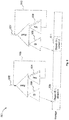
- Fig. 6 shows the example of glibc-malloc according to the prior art.
- memory is partitioned into chunks from a larger region of memory called "heap" 501.
- Unused (free/available) chunks are linked into a chain.
- a suitable unused chunk has to be found. If a free chunk with the requested size is not available, a larger free chunk is selected and split into parts which causes so called memory fragmentation. The goal therefore is to find a suitable sized unused chunk.
- bins (freelist bins) 602 that chain chunks with certain sizes (603, 604 for size a and 605 for size b).
- a chunk 605 would be of the correct size b for an allocation request, the chunk is unlinked from the free list chain and a pointer 606 to the available payload 607 is returned.
- the pointer 606 is the memory pointer returned to the application, but the chunk still has a header that contains size and other memory management information. For example, the chunk may have a flag indicating whether a chunk is free or used.
- the chunk When deallocated by the application, the chunk is returned to the appropriate chain of unused chunks. To reduce fragmentations, so called coalescing takes place, which means that adjacent chunks are combined to larger chunks.
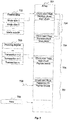
- Fig. 7 shows trie memory management according to the invention.
- nodes may be kept in multiple arrays.
- the embodiment shown in Fig. 7 illustrates trie memory management based on a single array 701.
- each node of the trie may be stored in a respective chunk 703, 705, 706 and 707.
- Each chunk that is not free and thus contains a node comprises a payload value comprising the node 706, and a value identifying the transaction during which it is created (cf. Transaction ID in Fig. 7 ).
- freelist bins 702 are checked first.
- the bins are checked for a free chunk with double size. If a chunk with double size is found, the free chunk with double size is split into two chunks.
- the arrays are (again - as the version storage) stored durable using memory mapped files. To accomplish this, the array needs to be periodically written to a file. It would hurt the performance badly, if every change to the trie is written to the persistent storage immediately. However, a system crash leads to an inconsistent state, because the trie is not stored after each modification. In order to avoid inconsistent states, the following crash recovery process is applied. The last saved state of the trie and the object store - which acts as write ahead log - is read and all changes present in the object store are applied to the last persisted version of the trie.
- a new trie node may be created: In this case, a chunk of the size required for the new node may be selected, and the node will be stored in this chunk. The chunk selected to accommodate the new node will be removed from the list of free chunks (freelist bins) 702. As mentioned above, if there is no free chunk of the needed size available, a new chunk needs to be allocated first. Each chunk contains header information, e.g. its size, pointers to other chunks and a transaction identifier that amended the chunk by storing a node in the chunk. Thus, when inserting a node into the chunk the transaction identifier that stored a node in the chunk needs to be updated.
- a trie node created by a former transaction is updated:
- a copy of the node may be created, and the copy may be modified.
- a new chunk may be created and the payload value will be adapted to contain the modified node.
- the value identifying the transaction of the chunk (transaction ID) will be set to the transaction identifier that created the chunk.
- the "replaced” node may however not be deleted immediately, as there may be pending transactions that still require access to the specific "replaced node". However, in order to be able to reuse the memory occupied by the "replaced node” as soon as possible, the node should be deallocated as soon as there are no transactions left that require the node.
- the chunk may be added to a pending free chunk list 703 (also called "pending freelist").
- the pending free chunk list 703 may have different entries, wherein each entry is associated with a specific transaction and refers to chunks comprising nodes that have been replaced during the specific transaction.
- an entry may have a reference pointing to a chain of chunks containing nodes replaced by the transaction of that entry.
- the chain may be realized by a linked list, where the entry points to the first chunk in the list, and each chunk points to a next chunk in the list (cf. "Next Chunk” in chunk 706).
- the transaction ID field is replaced by a pointer to the next chunk, when a chunk is added to the pending free chunk list 703.
- the chunk containing the node may be moved from the pending free chunk list 703 to the free chunk list 702 (also called “freelist bins") and is thus identified as free chunks (or as unused memory to be freed) that can be reused to accommodate new nodes.
- such determination whether or not a node is still required by a pending transaction is not performed for each node individually, but for all nodes that have been replaced in a specific transaction.
- determination may be realized by comparing the pending transactions identifiers with the identifier of the specific transaction that has replaced the nodes. Such comparison requires that the pending transactions identifiers are available and accessible to the memory management system. For example, the pending transactions identifiers may be stored in a pending transaction list. The comparison may then be achieved by determining if the pending transaction list comprises a transaction older than the specific transaction. The determination if an older transaction is contained in the pending transaction list may for example be achieved by using monotonously increasing transaction identifiers, i.e.
- the pending transaction list does not contain a transaction with a transaction identifier lower than the transaction identifier of the specific transaction that replaced the nodes. If it is determined that there are no more pending transactions, all chunks associated with (or referenced by) the specific transaction are moved from the pending free chunk list 703 to the free chunk list 602. The corresponding chunks are appended to the free chunk list 702 (when the chunks are organized in a linked list, as shown in Fig. 7 ) according to their respective sizes.
- a trie node created by the same transaction is updated: In this case, the node can either be overwritten, if the size of the amended node will be the same as the original node, or a new node will be created, and the replaced node can immediately be returned to the free chunk list 702 as no other transactions have access to it. This case may be detected by comparing the transaction ID of the chunk containing the node to update with the ID of the transaction that updates it. If both IDs are the same, it is determined that the same transaction created the node.
- the chunks are distributed according to their sizes to the free chunk list 702. If the free chunk list 702 has no entry (bin) for a size of a specific chunk, the size of the chunk may need to be amended. If the chunk is larger than the available sizes, the chunk is split into smaller chunks. If the chunk is smaller than the available sizes, the chunk is combined with adjacent chunks. When combining with adjacent chunks (also called coalescing), the chunk flags of adjacent chunks are evaluated to verify that the chunks are unused and available for combining.
- adjacent chunks also called coalescing
- Fig. 7 only describes memory management within a single array or epoch.
- the size of an array in a programming language is usually limited. Therefore, a solution for efficiently performing garbage collection of multiple arrays and array files (epochs) is required.
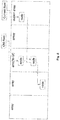
- Fig 8 illustrates an embodiment for efficiently performing garbage collection of multiple arrays according to the invention.
- Fig. 8 shows a plurality of arrays containing nodes from different tries.
- the multiple arrays result from the fact that the size of the arrays is limited. Thus, if additional nodes need to be stored, a new array needs to be created. Such new array is also called a new "epoch". When a new array is created, this array becomes the active array, which is used to store new and modified nodes of the trie. Thus, the lists, free chunk list 702 and pending free chunk list 703, mentioned above with regard to Fig. 7 , are maintained for the active array.
- Arrays other than the active array are considered closed and are no longer amended. If nodes are changed or added during a transaction, copies of these nodes are stored in the active array.
- each trie node is associated with a current trie root node corresponding to a current transaction and/or one or more previous trie root nodes corresponding to previous transactions.
- an array to be garbage collected needs to be determined in an eviction transaction. Such determination may be based on one or more criteria.
- the criteria may be predefined or adapted at runtime.
- the one or more criteria may comprise the number of transactions currently using an array and/or the number of nodes of one or more previous tries contained in an array.
- the candidate files that represent the trie arrays, that are eligible to garbage collection may also be determined by tracking the amount and size of the nodes in that file that have been superseded.
- the selected array contains one or more nodes that are associated with the current trie root node (and therefore still used). If the selected array comprises such nodes, the nodes need to be copied to the active array, in order to preserve the nodes.
- the copying of the one or more nodes of the selected array that are associated with the current trie root node to the active array comprises, traversing nodes associated with the current trie root node, and while traversing the nodes, copying nodes that are stored in the selected array, and ignoring nodes that are not stored in the selected array.
- nodes In order to accelerate the determination whether or not a node needs to be copied, child nodes of nodes stored in an array that has been created before the selected array are ignored and thus not traversed. Note that nodes can only point to nodes within the same array or into a former array but not into an array allocated later. Thus, nodes from an array that has been created before the selected array cannot point to the selected array. Avoiding these branches results in a better performance, since less nodes need to be evaluated (whether or not they are located in the selected array).
- nodes associated with the current trie root node it is possible to simultaneously traverse nodes associated with a previous trie root node that has been created after the selected array was the active array and compare nodes associated with the current trie root node with nodes associated with the previous trie root node level-by-level from top-to-down. If it is determined by the comparison that a node is associated with the current trie root node but is not associated with the previous trie root node, not traversing said node and child nodes of said node. Avoiding these nodes, may reduce the number of nodes to be traversed significantly, as nodes that are stored in arrays lying between the current array and the selected array ("array to GC" in Fig. 8 ) can be avoided.
- the previous trie root node that is selected to perform the comparison may be the first trie root node that has been created after the selected array was active array, which means that the selected array was closed and no longer amended.
- the trie root node created immediately after this switch may be considered the best starting point, as it may avoid most nodes being created between the selected array and the current/active array.
- the aforementioned comparing of nodes associated with the current trie root node with nodes associated with the previous trie root node level-by-level from top-to-down comprises comparing the references to child nodes of the nodes.
- Such references may comprise bitmaps and pointers as described in detail in the international patent application PCT/EP2018/056592 .
- the bitmaps are compared with a bitweise AND operator.
- the memory occupied by the selected array may be identified as unused memory to be freed.
- the identification as unused memory to be freed only occurs after all pending transactions are terminated.
- the eviction (garbage collection) itself is performed within a transaction.
- the selected array has to be kept, until all transactions that started earlier are finished.
- the determination if the pending transactions are terminated may be performed by comparing the pending transactions with the eviction transaction, and if it is determined that the pending transactions do not contain a transaction older than the eviction transaction, determining that the pending transactions are terminated. In other words, there is no more pending transaction with a transaction identifier smaller than the transaction identifier of the eviction (garbage collection) the array can be disposed.
- the durable storage can be disposed if and only if the current array and the new root pointer after the garbage collection transaction have been flushed reliably to the durable storage. Note that for performance reasons a flush is not performed for each individual transaction.
- Fig 9 illustrates an example for garbage collection of multiple arrays according Fig. 8 .
- tries are 32-ary, 64-ary.
- the bitmap referencing the pointers to the child nodes may comprise 32 or 64 bits.
- Fig. 9 shows a 4-ary trie.
- the example of Fig. 9 comprises three trie root nodes 901, 902 and 903.
- the trie root node 901 is the root to a first version of the trie, where the root node lies in "Array 2" that is subject to garbage collection ("Array 2" is the "selected array”).
- the trie root node 902 is the root node to some later second version of the trie that results from the first transaction that occurs after switching from "Array 2" to "Array 3" as current (active) array.
- the trie root node 903 is the current root of the trie.
- the trie nodes starting from the trie root nodes 902 and 903 are compared.
- the comparison may be performed by a bitwise AND of the bitmaps of the nodes (level-by-level and from top-to-down).
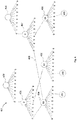
- bitmaps 904 and 905 are compared by using a bitwise AND operation. The result of the comparison reveals, that node 907 (key "2") is no longer present in the current trie and does not have to be evicted (copied to the current array).
- bitmaps on the next level 910, 911 of the nodes 912 and 913 are compared, and it is determined that node 906, which is part of the key "012", is present in both tries, but is stored in an array ("Array 1) before "Array 2". Therefore, the node is not traversed (ignored) and does not need to be copied to the current array, as "Array 1" is not subject to garbage collection.
- a bitmap comparison is not necessary. This evaluation can also be performed if, for example, only one trie is traversed.
- a node may be referenced by a pointer having two parts, wherein a first part points to the array using an index in a list of all arrays and a second part holds the index within that specific array.
- the evaluation if a node is stored in the selected array or a previous array may be performed by evaluating the first part of the pointer.
Landscapes
- Engineering & Computer Science (AREA)
- Theoretical Computer Science (AREA)
- Physics & Mathematics (AREA)
- General Physics & Mathematics (AREA)
- General Engineering & Computer Science (AREA)
- Databases & Information Systems (AREA)
- Data Mining & Analysis (AREA)
- Software Systems (AREA)
- Mathematical Physics (AREA)
- Computational Linguistics (AREA)
- Probability & Statistics with Applications (AREA)
- Fuzzy Systems (AREA)
- Information Retrieval, Db Structures And Fs Structures Therefor (AREA)
Priority Applications (6)
| Application Number | Priority Date | Filing Date | Title |
|---|---|---|---|
| EP18195454.6A EP3627343A1 (fr) | 2018-09-19 | 2018-09-19 | Contrôle d'accès simultané multiversion en mémoire efficace pour une base de données basée sur la structure de données arborescente |
| CN201980061597.1A CN112740197A (zh) | 2018-09-19 | 2019-09-18 | 用于基于特里数据结构的数据库的高效存储器内多版本并发控制 |
| US17/277,238 US11693866B2 (en) | 2018-09-19 | 2019-09-18 | Efficient in-memory multi-version concurrency control for a trie data structure based database |
| JP2021515453A JP7580371B2 (ja) | 2018-09-19 | 2019-09-18 | トライデータ構造ベースのデータベースのための効率的なインメモリマルチバージョン同時実行制御 |
| PCT/EP2019/074932 WO2020058300A1 (fr) | 2018-09-19 | 2019-09-18 | Commande de simultanéité multi-versions en mémoire efficace destinée à une base de données basée sur une structure de données arborescente |
| US17/960,171 US12164535B2 (en) | 2018-09-19 | 2022-10-05 | Efficient in-memory multi-version concurrency control for a trie data structure based database |
Applications Claiming Priority (1)
| Application Number | Priority Date | Filing Date | Title |
|---|---|---|---|
| EP18195454.6A EP3627343A1 (fr) | 2018-09-19 | 2018-09-19 | Contrôle d'accès simultané multiversion en mémoire efficace pour une base de données basée sur la structure de données arborescente |
Publications (1)
| Publication Number | Publication Date |
|---|---|
| EP3627343A1 true EP3627343A1 (fr) | 2020-03-25 |
Family
ID=63642850
Family Applications (1)
| Application Number | Title | Priority Date | Filing Date |
|---|---|---|---|
| EP18195454.6A Ceased EP3627343A1 (fr) | 2018-09-19 | 2018-09-19 | Contrôle d'accès simultané multiversion en mémoire efficace pour une base de données basée sur la structure de données arborescente |
Country Status (5)
| Country | Link |
|---|---|
| US (2) | US11693866B2 (fr) |
| EP (1) | EP3627343A1 (fr) |
| JP (1) | JP7580371B2 (fr) |
| CN (1) | CN112740197A (fr) |
| WO (1) | WO2020058300A1 (fr) |
Cited By (2)
| Publication number | Priority date | Publication date | Assignee | Title |
|---|---|---|---|---|
| CN113868244A (zh) * | 2020-06-30 | 2021-12-31 | 慧与发展有限责任合伙企业 | 生成键-值索引快照 |
| CN114780533A (zh) * | 2022-02-08 | 2022-07-22 | 北京箩筐时空数据技术有限公司 | 基于双数组字典树的存储空间分配方法、装置及电子设备 |
Families Citing this family (6)
| Publication number | Priority date | Publication date | Assignee | Title |
|---|---|---|---|---|
| EP3627343A1 (fr) | 2018-09-19 | 2020-03-25 | censhare AG | Contrôle d'accès simultané multiversion en mémoire efficace pour une base de données basée sur la structure de données arborescente |
| US20240211784A1 (en) * | 2020-06-05 | 2024-06-27 | State Farm Mutual Automobile Insurance Company | Systems and methods for processing using directed acyclic graphs |
| CN114356927A (zh) * | 2021-12-31 | 2022-04-15 | 杭州趣链科技有限公司 | 数据存储方法、装置、计算机设备和存储介质 |
| US12298859B2 (en) * | 2023-09-14 | 2025-05-13 | Gitlab Inc. | Transactional access to resource repositories |
| US12339824B2 (en) | 2023-09-27 | 2025-06-24 | Kenneth Kinion | Append-only optimized database using sorted radix tries |
| CN121542270A (zh) * | 2026-01-19 | 2026-02-17 | 天翼云科技有限公司 | 数据库系统的索引元组处理方法、装置和计算机设备 |
Citations (3)
| Publication number | Priority date | Publication date | Assignee | Title |
|---|---|---|---|---|
| US20100146004A1 (en) * | 2005-07-20 | 2010-06-10 | Siew Yong Sim-Tang | Method Of Creating Hierarchical Indices For A Distributed Object System |
| US20120221538A1 (en) * | 2011-02-28 | 2012-08-30 | International Business Machines Corporation | Optimistic, version number based concurrency control for index structures with atomic, non-versioned pointer updates |
| US20180004786A1 (en) * | 2016-06-29 | 2018-01-04 | EMC IP Holding Company LLC | Incremental bloom filter rebuild for b+ trees under multi-version concurrency control |
Family Cites Families (28)
| Publication number | Priority date | Publication date | Assignee | Title |
|---|---|---|---|---|
| JP2000227921A (ja) * | 1999-02-05 | 2000-08-15 | Dainippon Printing Co Ltd | デ―タ検索方法、装置および記録媒体 |
| US20040264479A1 (en) * | 2003-06-30 | 2004-12-30 | Makaram Raghunandan | Method for generating a trie having a reduced number of trie blocks |
| US7243088B2 (en) * | 2003-08-06 | 2007-07-10 | Oracle International Corporation | Database management system with efficient version control |
| US9477772B2 (en) * | 2004-01-28 | 2016-10-25 | Pointofdata Corporation | Storing and retrieving objects on a computer network in a distributed database |
| CN101467149A (zh) * | 2006-06-30 | 2009-06-24 | 电子地图北美公司 | 具有可变压缩的自适应索引 |
| JP5111813B2 (ja) * | 2006-09-11 | 2013-01-09 | ガイアホールディングス株式会社 | メモリアロケーション方法およびメモリアロケーションプログラム |
| US8880111B2 (en) * | 2008-07-25 | 2014-11-04 | Qualcomm Incorporated | System and method for network management |
| US8780926B2 (en) * | 2009-12-01 | 2014-07-15 | Polytechnic Institute Of New York University | Updating prefix-compressed tries for IP route lookup |
| JP5168334B2 (ja) * | 2010-09-29 | 2013-03-21 | ブラザー工業株式会社 | 情報生成装置、情報生成方法及び情報生成プログラム |
| US8495107B2 (en) * | 2011-06-23 | 2013-07-23 | Oracle International Corporation | System and method for use with garbage collected languages for enabling the allocated heap memory to be updated at runtime |
| US8767757B1 (en) * | 2012-02-15 | 2014-07-01 | Applied Micro Circuits Corporation | Packet forwarding system and method using patricia trie configured hardware |
| EP2631817A1 (fr) * | 2012-02-23 | 2013-08-28 | Fujitsu Limited | Base de données, appareil et procédé permettant de stocker les triplets codés |
| US8868926B2 (en) * | 2012-04-06 | 2014-10-21 | Exablox Corporation | Cryptographic hash database |
| US20140153577A1 (en) * | 2012-12-03 | 2014-06-05 | Aruba Networks, Inc. | Session-based forwarding |
| WO2014145154A1 (fr) * | 2013-03-15 | 2014-09-18 | Twitter, Inc. | Procédé et système pour générer un trie de géocode et faciliter des consultations de géocode inversé |
| JP6024559B2 (ja) * | 2013-03-28 | 2016-11-16 | 富士通株式会社 | プログラムおよびバージョン管理方法 |
| US10146806B2 (en) * | 2015-02-12 | 2018-12-04 | Oracle International Corporation | Adaptive resolution hsitogram |
| US9760288B2 (en) * | 2015-02-18 | 2017-09-12 | International Business Machines Corporation | Determining causes of external fragmentation of memory |
| CN105183915B (zh) * | 2015-10-14 | 2018-08-17 | 江苏师范大学 | 减少索引维护开销的多版本管理方法 |
| CN107153647B (zh) * | 2016-03-02 | 2021-12-07 | 北京字节跳动网络技术有限公司 | 进行数据压缩的方法、装置、系统和计算机程序产品 |
| US10142234B1 (en) * | 2016-10-04 | 2018-11-27 | Netapp, Inc. | Memory page indexing data structure |
| EP3376407B1 (fr) | 2017-03-15 | 2020-09-16 | censhare AG | Utilisation efficace de structure de données trie dans des bases de données |
| US11074179B2 (en) * | 2017-11-02 | 2021-07-27 | Hewlett Packard Enterprise Development Lp | Managing objects stored in memory |
| US10963177B2 (en) * | 2018-04-30 | 2021-03-30 | EMC IP Holding Company LLC | Deduplication using fingerprint tries |
| US11204905B2 (en) * | 2018-06-27 | 2021-12-21 | Datastax, Inc. | Trie-based indices for databases |
| US11243745B2 (en) * | 2018-07-15 | 2022-02-08 | Microsoft Technology Licensing, Llc | Text editor buffering implementation with offsets management |
| EP3627343A1 (fr) | 2018-09-19 | 2020-03-25 | censhare AG | Contrôle d'accès simultané multiversion en mémoire efficace pour une base de données basée sur la structure de données arborescente |
| US11165647B2 (en) * | 2019-06-28 | 2021-11-02 | Juniper Networks, Inc. | Managing multiple semantic versions of device configuration schemas |
-
2018
- 2018-09-19 EP EP18195454.6A patent/EP3627343A1/fr not_active Ceased
-
2019
- 2019-09-18 CN CN201980061597.1A patent/CN112740197A/zh active Pending
- 2019-09-18 JP JP2021515453A patent/JP7580371B2/ja active Active
- 2019-09-18 US US17/277,238 patent/US11693866B2/en active Active
- 2019-09-18 WO PCT/EP2019/074932 patent/WO2020058300A1/fr not_active Ceased
-
2022
- 2022-10-05 US US17/960,171 patent/US12164535B2/en active Active
Patent Citations (3)
| Publication number | Priority date | Publication date | Assignee | Title |
|---|---|---|---|---|
| US20100146004A1 (en) * | 2005-07-20 | 2010-06-10 | Siew Yong Sim-Tang | Method Of Creating Hierarchical Indices For A Distributed Object System |
| US20120221538A1 (en) * | 2011-02-28 | 2012-08-30 | International Business Machines Corporation | Optimistic, version number based concurrency control for index structures with atomic, non-versioned pointer updates |
| US20180004786A1 (en) * | 2016-06-29 | 2018-01-04 | EMC IP Holding Company LLC | Incremental bloom filter rebuild for b+ trees under multi-version concurrency control |
Non-Patent Citations (4)
| Title |
|---|
| ERIK D DEMAINE ET AL: "Confluently Persistent Tries for Efficient Version Control", 2 July 2008, ALGORITHM THEORY - SWAT 2008; [LECTURE NOTES IN COMPUTER SCIENCE], SPRINGER BERLIN HEIDELBERG, BERLIN, HEIDELBERG, PAGE(S) 160 - 172, ISBN: 978-3-540-69900-2, XP019091671 * |
| MOHAMMAD DASHTI ET AL: "Repairing Conflicts among MVCC Transactions", ARXIV.ORG, CORNELL UNIVERSITY LIBRARY, 201 OLIN LIBRARY CORNELL UNIVERSITY ITHACA, NY 14853, 2 March 2016 (2016-03-02), XP080686618 * |
| NORVAG K: "The vagabond temporal OID index: an index structure for OID indexing in temporal object database systems", DATABASE ENGINEERING AND APPLICATIONS SYMPOSIUM, 2000 INTERNATIONAL SEPT. 18-20, 2000, PISCATAWAY, NJ, USA,IEEE, 18 September 2000 (2000-09-18), pages 158 - 166, XP010519023, ISBN: 978-0-7695-0789-7, DOI: 10.1109/IDEAS.2000.880574 * |
| YINGJUN WU; JOY ARULRAJ; JIEXI LIN; RAN XIAN; ANDREW PAVLO: "An empirical evaluation of in memory multi-version concurrency control", PROC. VLDB ENDOW., vol. 10, 7, March 2017 (2017-03-01), pages 781 - 792, XP058327797, Retrieved from the Internet <URL:https://doi.org/10.14778/3067421.3067427> DOI: doi:10.14778/3067421.3067427 |
Cited By (5)
| Publication number | Priority date | Publication date | Assignee | Title |
|---|---|---|---|---|
| CN113868244A (zh) * | 2020-06-30 | 2021-12-31 | 慧与发展有限责任合伙企业 | 生成键-值索引快照 |
| US11556513B2 (en) * | 2020-06-30 | 2023-01-17 | Hewlett Packard Enterprise Development Lp | Generating snapshots of a key-value index |
| CN113868244B (zh) * | 2020-06-30 | 2023-08-04 | 慧与发展有限责任合伙企业 | 生成键-值索引快照 |
| DE102021108455B4 (de) | 2020-06-30 | 2024-05-08 | Hewlett Packard Enterprise Development Lp | Erzeugen von Snapshots eines Schlüssel-Wert-Index |
| CN114780533A (zh) * | 2022-02-08 | 2022-07-22 | 北京箩筐时空数据技术有限公司 | 基于双数组字典树的存储空间分配方法、装置及电子设备 |
Also Published As
| Publication number | Publication date |
|---|---|
| US20230022756A1 (en) | 2023-01-26 |
| US12164535B2 (en) | 2024-12-10 |
| CN112740197A (zh) | 2021-04-30 |
| US20210357400A1 (en) | 2021-11-18 |
| WO2020058300A1 (fr) | 2020-03-26 |
| JP2022502742A (ja) | 2022-01-11 |
| JP7580371B2 (ja) | 2024-11-11 |
| US11693866B2 (en) | 2023-07-04 |
Similar Documents
| Publication | Publication Date | Title |
|---|---|---|
| US12164535B2 (en) | Efficient in-memory multi-version concurrency control for a trie data structure based database | |
| US10656859B2 (en) | Efficient deduplication for storage systems | |
| US8620884B2 (en) | Scalable blob storage integrated with scalable structured storage | |
| US8868624B2 (en) | Blob manipulation in an integrated structured storage system | |
| US7376674B2 (en) | Storage of multiple pre-modification short duration copies of database information in short term memory | |
| US8762333B2 (en) | Apparatus and method for read optimized bulk data storage | |
| US8185551B2 (en) | Disk-resident streaming dictionary | |
| AU2004264231B2 (en) | A database management system with efficient version control | |
| US11741073B2 (en) | Granularly timestamped concurrency control for key-value store | |
| US8560500B2 (en) | Method and system for removing rows from directory tables | |
| US9268804B2 (en) | Managing a multi-version database | |
| US20120159098A1 (en) | Garbage collection and hotspots relief for a data deduplication chunk store | |
| US10289709B2 (en) | Interleaved storage of dictionary blocks in a page chain | |
| US10521117B2 (en) | Unified table delta dictionary memory size and load time optimization | |
| US20120317384A1 (en) | Data storage method | |
| WO2025042576A2 (fr) | Procédés et systèmes configurés pour éliminer l'utilisation de journaux d'écriture anticipée dans des magasins de valeurs clés de mappage direct par radiomessagerie | |
| US10997164B2 (en) | Unified table delta dictionary lazy materialization | |
| Shu | Key-Value Stores | |
| HK40036023B (zh) | 用於lsm数据结构中有效记录查找的高速缓存 | |
| HK1173514B (en) | Garbage collection and hotspots relief for a data deduplication chunk store |
Legal Events
| Date | Code | Title | Description |
|---|---|---|---|
| PUAI | Public reference made under article 153(3) epc to a published international application that has entered the european phase |
Free format text: ORIGINAL CODE: 0009012 |
|
| STAA | Information on the status of an ep patent application or granted ep patent |
Free format text: STATUS: THE APPLICATION HAS BEEN PUBLISHED |
|
| AK | Designated contracting states |
Kind code of ref document: A1 Designated state(s): AL AT BE BG CH CY CZ DE DK EE ES FI FR GB GR HR HU IE IS IT LI LT LU LV MC MK MT NL NO PL PT RO RS SE SI SK SM TR |
|
| AX | Request for extension of the european patent |
Extension state: BA ME |
|
| STAA | Information on the status of an ep patent application or granted ep patent |
Free format text: STATUS: REQUEST FOR EXAMINATION WAS MADE |
|
| 17P | Request for examination filed |
Effective date: 20200924 |
|
| RBV | Designated contracting states (corrected) |
Designated state(s): AL AT BE BG CH CY CZ DE DK EE ES FI FR GB GR HR HU IE IS IT LI LT LU LV MC MK MT NL NO PL PT RO RS SE SI SK SM TR |
|
| RAP3 | Party data changed (applicant data changed or rights of an application transferred) |
Owner name: CENSHARE GMBH |
|
| STAA | Information on the status of an ep patent application or granted ep patent |
Free format text: STATUS: EXAMINATION IS IN PROGRESS |
|
| 17Q | First examination report despatched |
Effective date: 20211109 |
|
| STAA | Information on the status of an ep patent application or granted ep patent |
Free format text: STATUS: THE APPLICATION HAS BEEN REFUSED |
|
| 18R | Application refused |
Effective date: 20230430 |