EP3627809B1 - Verfahren und vorrichtung zur verringerung des stromverbrauchs eines mobilen endgeräts, speichermedium und mobiles endgerät - Google Patents
Verfahren und vorrichtung zur verringerung des stromverbrauchs eines mobilen endgeräts, speichermedium und mobiles endgerät Download PDFInfo
- Publication number
- EP3627809B1 EP3627809B1 EP18838821.9A EP18838821A EP3627809B1 EP 3627809 B1 EP3627809 B1 EP 3627809B1 EP 18838821 A EP18838821 A EP 18838821A EP 3627809 B1 EP3627809 B1 EP 3627809B1
- Authority
- EP
- European Patent Office
- Prior art keywords
- fingerprint
- touch
- blank screen
- gesture
- display screen
- Prior art date
- Legal status (The legal status is an assumption and is not a legal conclusion. Google has not performed a legal analysis and makes no representation as to the accuracy of the status listed.)
- Not-in-force
Links
Images

Classifications
-
- G—PHYSICS
- G06—COMPUTING OR CALCULATING; COUNTING
- G06F—ELECTRIC DIGITAL DATA PROCESSING
- G06F1/00—Details not covered by groups G06F3/00 - G06F13/00 and G06F21/00
- G06F1/16—Constructional details or arrangements
- G06F1/1613—Constructional details or arrangements for portable computers
- G06F1/1633—Constructional details or arrangements of portable computers not specific to the type of enclosures covered by groups G06F1/1615 - G06F1/1626
- G06F1/1637—Details related to the display arrangement, including those related to the mounting of the display in the housing
- G06F1/1643—Details related to the display arrangement, including those related to the mounting of the display in the housing the display being associated to a digitizer, e.g. laptops that can be used as penpads
-
- H—ELECTRICITY
- H04—ELECTRIC COMMUNICATION TECHNIQUE
- H04W—WIRELESS COMMUNICATION NETWORKS
- H04W52/00—Power management, e.g. Transmission Power Control [TPC] or power classes
- H04W52/02—Power saving arrangements
- H04W52/0209—Power saving arrangements in terminal devices
- H04W52/0251—Power saving arrangements in terminal devices using monitoring of local events, e.g. events related to user activity
- H04W52/0254—Power saving arrangements in terminal devices using monitoring of local events, e.g. events related to user activity detecting a user operation or a tactile contact or a motion of the device
-
- G—PHYSICS
- G06—COMPUTING OR CALCULATING; COUNTING
- G06F—ELECTRIC DIGITAL DATA PROCESSING
- G06F1/00—Details not covered by groups G06F3/00 - G06F13/00 and G06F21/00
- G06F1/26—Power supply means, e.g. regulation thereof
- G06F1/32—Means for saving power
- G06F1/3203—Power management, i.e. event-based initiation of a power-saving mode
- G06F1/3206—Monitoring of events, devices or parameters that trigger a change in power modality
- G06F1/3215—Monitoring of peripheral devices
- G06F1/3218—Monitoring of peripheral devices of display devices
-
- G—PHYSICS
- G06—COMPUTING OR CALCULATING; COUNTING
- G06F—ELECTRIC DIGITAL DATA PROCESSING
- G06F1/00—Details not covered by groups G06F3/00 - G06F13/00 and G06F21/00
- G06F1/26—Power supply means, e.g. regulation thereof
- G06F1/32—Means for saving power
- G06F1/3203—Power management, i.e. event-based initiation of a power-saving mode
- G06F1/3234—Power saving characterised by the action undertaken
- G06F1/325—Power saving in peripheral device
- G06F1/3265—Power saving in display device
-
- G—PHYSICS
- G06—COMPUTING OR CALCULATING; COUNTING
- G06F—ELECTRIC DIGITAL DATA PROCESSING
- G06F1/00—Details not covered by groups G06F3/00 - G06F13/00 and G06F21/00
- G06F1/26—Power supply means, e.g. regulation thereof
- G06F1/32—Means for saving power
- G06F1/3203—Power management, i.e. event-based initiation of a power-saving mode
- G06F1/3234—Power saving characterised by the action undertaken
- G06F1/329—Power saving characterised by the action undertaken by task scheduling
-
- G—PHYSICS
- G06—COMPUTING OR CALCULATING; COUNTING
- G06F—ELECTRIC DIGITAL DATA PROCESSING
- G06F3/00—Input arrangements for transferring data to be processed into a form capable of being handled by the computer; Output arrangements for transferring data from processing unit to output unit, e.g. interface arrangements
- G06F3/01—Input arrangements or combined input and output arrangements for interaction between user and computer
- G06F3/048—Interaction techniques based on graphical user interfaces [GUI]
- G06F3/0487—Interaction techniques based on graphical user interfaces [GUI] using specific features provided by the input device, e.g. functions controlled by the rotation of a mouse with dual sensing arrangements, or of the nature of the input device, e.g. tap gestures based on pressure sensed by a digitiser
- G06F3/0488—Interaction techniques based on graphical user interfaces [GUI] using specific features provided by the input device, e.g. functions controlled by the rotation of a mouse with dual sensing arrangements, or of the nature of the input device, e.g. tap gestures based on pressure sensed by a digitiser using a touch-screen or digitiser, e.g. input of commands through traced gestures
- G06F3/04883—Interaction techniques based on graphical user interfaces [GUI] using specific features provided by the input device, e.g. functions controlled by the rotation of a mouse with dual sensing arrangements, or of the nature of the input device, e.g. tap gestures based on pressure sensed by a digitiser using a touch-screen or digitiser, e.g. input of commands through traced gestures for inputting data by handwriting, e.g. gesture or text
-
- H—ELECTRICITY
- H04—ELECTRIC COMMUNICATION TECHNIQUE
- H04M—TELEPHONIC COMMUNICATION
- H04M1/00—Substation equipment, e.g. for use by subscribers
- H04M1/66—Substation equipment, e.g. for use by subscribers with means for preventing unauthorised or fraudulent calling
- H04M1/667—Preventing unauthorised calls from a telephone set
- H04M1/67—Preventing unauthorised calls from a telephone set by electronic means
-
- H—ELECTRICITY
- H04—ELECTRIC COMMUNICATION TECHNIQUE
- H04M—TELEPHONIC COMMUNICATION
- H04M1/00—Substation equipment, e.g. for use by subscribers
- H04M1/72—Mobile telephones; Cordless telephones, i.e. devices for establishing wireless links to base stations without route selection
- H04M1/724—User interfaces specially adapted for cordless or mobile telephones
- H04M1/72448—User interfaces specially adapted for cordless or mobile telephones with means for adapting the functionality of the device according to specific conditions
-
- H—ELECTRICITY
- H04—ELECTRIC COMMUNICATION TECHNIQUE
- H04M—TELEPHONIC COMMUNICATION
- H04M1/00—Substation equipment, e.g. for use by subscribers
- H04M1/72—Mobile telephones; Cordless telephones, i.e. devices for establishing wireless links to base stations without route selection
- H04M1/724—User interfaces specially adapted for cordless or mobile telephones
- H04M1/72448—User interfaces specially adapted for cordless or mobile telephones with means for adapting the functionality of the device according to specific conditions
- H04M1/72463—User interfaces specially adapted for cordless or mobile telephones with means for adapting the functionality of the device according to specific conditions to restrict the functionality of the device
-
- H—ELECTRICITY
- H04—ELECTRIC COMMUNICATION TECHNIQUE
- H04M—TELEPHONIC COMMUNICATION
- H04M1/00—Substation equipment, e.g. for use by subscribers
- H04M1/72—Mobile telephones; Cordless telephones, i.e. devices for establishing wireless links to base stations without route selection
- H04M1/724—User interfaces specially adapted for cordless or mobile telephones
- H04M1/72448—User interfaces specially adapted for cordless or mobile telephones with means for adapting the functionality of the device according to specific conditions
- H04M1/72463—User interfaces specially adapted for cordless or mobile telephones with means for adapting the functionality of the device according to specific conditions to restrict the functionality of the device
- H04M1/724631—User interfaces specially adapted for cordless or mobile telephones with means for adapting the functionality of the device according to specific conditions to restrict the functionality of the device by limiting the access to the user interface, e.g. locking a touch-screen or a keypad
-
- H—ELECTRICITY
- H04—ELECTRIC COMMUNICATION TECHNIQUE
- H04W—WIRELESS COMMUNICATION NETWORKS
- H04W52/00—Power management, e.g. Transmission Power Control [TPC] or power classes
- H04W52/02—Power saving arrangements
- H04W52/0209—Power saving arrangements in terminal devices
- H04W52/0261—Power saving arrangements in terminal devices managing power supply demand, e.g. depending on battery level
- H04W52/0264—Power saving arrangements in terminal devices managing power supply demand, e.g. depending on battery level by selectively disabling software applications
-
- H—ELECTRICITY
- H04—ELECTRIC COMMUNICATION TECHNIQUE
- H04W—WIRELESS COMMUNICATION NETWORKS
- H04W52/00—Power management, e.g. Transmission Power Control [TPC] or power classes
- H04W52/02—Power saving arrangements
- H04W52/0209—Power saving arrangements in terminal devices
- H04W52/0261—Power saving arrangements in terminal devices managing power supply demand, e.g. depending on battery level
- H04W52/0267—Power saving arrangements in terminal devices managing power supply demand, e.g. depending on battery level by controlling user interface components
- H04W52/027—Power saving arrangements in terminal devices managing power supply demand, e.g. depending on battery level by controlling user interface components by controlling a display operation or backlight unit
-
- H—ELECTRICITY
- H04—ELECTRIC COMMUNICATION TECHNIQUE
- H04M—TELEPHONIC COMMUNICATION
- H04M1/00—Substation equipment, e.g. for use by subscribers
- H04M1/66—Substation equipment, e.g. for use by subscribers with means for preventing unauthorised or fraudulent calling
- H04M1/667—Preventing unauthorised calls from a telephone set
- H04M1/67—Preventing unauthorised calls from a telephone set by electronic means
- H04M1/673—Preventing unauthorised calls from a telephone set by electronic means the user being required to key in a code
-
- H—ELECTRICITY
- H04—ELECTRIC COMMUNICATION TECHNIQUE
- H04M—TELEPHONIC COMMUNICATION
- H04M1/00—Substation equipment, e.g. for use by subscribers
- H04M1/72—Mobile telephones; Cordless telephones, i.e. devices for establishing wireless links to base stations without route selection
- H04M1/724—User interfaces specially adapted for cordless or mobile telephones
- H04M1/72448—User interfaces specially adapted for cordless or mobile telephones with means for adapting the functionality of the device according to specific conditions
- H04M1/72463—User interfaces specially adapted for cordless or mobile telephones with means for adapting the functionality of the device according to specific conditions to restrict the functionality of the device
- H04M1/724631—User interfaces specially adapted for cordless or mobile telephones with means for adapting the functionality of the device according to specific conditions to restrict the functionality of the device by limiting the access to the user interface, e.g. locking a touch-screen or a keypad
- H04M1/724634—With partially locked states, e.g. when some telephonic functional locked states or applications remain accessible in the locked states
-
- H—ELECTRICITY
- H04—ELECTRIC COMMUNICATION TECHNIQUE
- H04M—TELEPHONIC COMMUNICATION
- H04M2250/00—Details of telephonic subscriber devices
- H04M2250/22—Details of telephonic subscriber devices including a touch pad, a touch sensor or a touch detector
-
- Y—GENERAL TAGGING OF NEW TECHNOLOGICAL DEVELOPMENTS; GENERAL TAGGING OF CROSS-SECTIONAL TECHNOLOGIES SPANNING OVER SEVERAL SECTIONS OF THE IPC; TECHNICAL SUBJECTS COVERED BY FORMER USPC CROSS-REFERENCE ART COLLECTIONS [XRACs] AND DIGESTS
- Y02—TECHNOLOGIES OR APPLICATIONS FOR MITIGATION OR ADAPTATION AGAINST CLIMATE CHANGE
- Y02D—CLIMATE CHANGE MITIGATION TECHNOLOGIES IN INFORMATION AND COMMUNICATION TECHNOLOGIES [ICT], I.E. INFORMATION AND COMMUNICATION TECHNOLOGIES AIMING AT THE REDUCTION OF THEIR OWN ENERGY USE
- Y02D10/00—Energy efficient computing, e.g. low power processors, power management or thermal management
Definitions
- Embodiments of the present disclosure relate to the technology of mobile terminals, for example, relate to a method for reducing power consumption of a mobile terminal, a device, a storage medium, and a mobile terminal.
- Blank screen gesture is a function of current smart phones, which is distinctive and has a futuristic sense of science and technology.
- a gesture operation applied on a touch display screen can be detected even though a smart phone is in a standby blank screen state, such that the corresponding function or software inside the phone is triggered.
- current blank screen gesture processing processes have defects, resulting in higher power consumption of mobile terminals and lowering battery lives of mobile terminals
- US20150199554A1 discloses a system which includes a fingerprint sensor, an application processor, and an auxiliary processor.
- the application processor is operable to arm the fingerprint sensor prior to the application processor entering a low power or sleep mode.
- the auxiliary processor is to receive a state output from the fingerprint sensor. The state output is to cause activation of one or more functions of the auxiliary processor upon fingerprint authentication while leaving the application processor in the low power or sleep mode.
- Hao Lü et al: "Gesture On: Enabling Always-On touch Gestures for Fast Mobile Access from the Device Standby Mode" discloses Gesture On, a system that enables gesture shortcuts in the standby mode by which a user can draw a gesture on the touchscreen before the screen is turned on. Based on the gesture, the system directly brings up a target item onto the screen that bypasses all additional steps in a mobile access.
- This paper examines several challenges in realizing Gesture on, including robustly rejecting accidental touches when the device is in standby, battery consumption incurred for continuous sensing and gesture-based user authentication methods for automatically device unlocking. Gesture on demonstrates a feasible approach for leveraging the standby mode for fast access to mobile content.
- US20160379039A1 discloses an apparatus and method for automatically enabling a touchscreen of a mobile device based on detection of the presence of a human finger.
- a mobile device can capture an image of an object with a fingerprint sensor. The mobile device may then enable a touchscreen display of the mobile device in response to a determination that the object captured within the image is a specific type of object.
- EP3169738A1 discloses a method for controlling blank screen gesture processing and a terminal. The method comprises: upon receiving a blank screen gesture, acquiring related information of the blank screen gesture; and determining whether the blank screen gesture is a misoperation gesture according to the acquired related information of the blank screen gesture, if the blank screen gesture is not a misoperation gesture, triggering a related operation of the blank screen gesture, and if the blank screen gesture is a misoperation gesture, making no response to the misoperation gesture.
- CN105094621A discloses an application starting method and a terminal device.
- the method comprises: when the terminal device is in a black screen state, acquiring parameters of an effective slide track of a preset region in a screen of the terminal device; verifying whether the parameters of the effective slide track are matched with parameters of any preset slide track in a preset slide track set or not, wherein each preset slide track in the preset slide track set is bound with an application starting instruction and application starting instructions bound with different preset slide tracks are different; if the matching is successful, searching a target application starting instruction corresponding to any preset slide track in corresponding relations between the preset slide track set and the application starting instructions; and starting a target application which is started under the indication of the target application starting instruction.
- the application in the terminal device can be quickly started in the black screen state.
- Embodiments of the present disclosure provide a method for reducing power consumption of a mobile terminal, a device, a storage medium, and a mobile terminal, which can effectively reduce power consumption of a mobile terminal.
- one embodiment of the present disclosure provides a method for reducing power consumption of a mobile terminal, comprising: in a screen-off state, acquiring a fingerprint detected by a fingerprint recognition module; matching the detected fingerprint with an unlocking fingerprint set in advance; if the matching fails, controlling a touch chip to output a touch sensing control signal to a touch display screen, wherein the touch sensing control signal is configured to enable the touch display screen to enter a working mode for detecting blank screen gestures; according to the detected fingerprint, matching an application program on which a user having the detected fingerprint has an operation right, and acquiring a set of blank screen gestures corresponding to the application program; reporting a blank screen gesture event to an application layer upon detection of a blank screen gesture belonging to the set of blank screen gestures to execute an operation corresponding to the blank screen gesture; wherein, before controlling a touch chip to output a touch sensing control signal to a touch display screen, the method further comprises: activating a camera to acquire biological characteristic information of the user, and matching the biological characteristic information with
- an embodiment of the present disclosure provides a device for reducing power consumption of a mobile terminal, wherein the device comprises: a fingerprint acquiring module configured to: in a screen-off state, acquire a fingerprint detected by a fingerprint recognition module; a touch chip control module configured to: match the detected fingerprint with an unlocking fingerprint set in advance; if the matching fails, control a touch chip to output a touch sensing control signal to a touch display screen, wherein the touch sensing control signal is configured to enable the touch display screen to enter a working mode for detecting blank screen gestures; a gesture set acquiring module configured to: according to the detected fingerprint, match an application program on which a user having the detected fingerprint has an operation right, and acquire a set of blank screen gestures corresponding to the application program; a gesture event reporting module configured to: report a blank screen gesture event to an application layer upon detection of a blank screen gesture belonging to the set of blank screen gestures to execute an operation corresponding to the blank screen gesture; and a second anti-misoperation module configured to: before
- an embodiment of the present disclosure provides a computer readable storage medium, which stores a computer program, wherein the program, when being executed by a processor, implements the method for reducing power consumption of a mobile terminal according to the embodiment of the present disclosure.
- an embodiment of the present disclosure provides a mobile terminal, comprising: a processor; a fingerprint recognition module configured to detect a fingerprint input by a user; a memory configured to store association relationships among blank screen gestures, fingerprints, and application programs, and store a computer program being executable in the processor; a touch display screen including a touch chip and configured to detect a blank screen gesture and display a gesture track of the blank screen gesture; wherein, the touch chip is configured to output a touch sensing control signal to the touch display screen under control of the processor; and the processor is configured to implement the method for reducing power consumption of a mobile terminal according to the first aspect of the present disclosure when executing the computer program.
- a fingerprint detected by a fingerprint recognition module is acquired in a screen-off state; if the fingerprint is a non-unlocking fingerprint, a touch chip is controlled to output a touch sensing control signal to a touch display screen; according to the fingerprint, an application program on which a user has an operation right is matched, and a set of blank screen gestures corresponding to the application program is acquired; upon detection of a blank screen gesture belonging to the set of blank screen gestures, a blank screen gesture event is reported to an application layer, such that the application layer is triggered to execute an operation corresponding to the blank screen gesture.
- a blank screen gesture function is such a function: when a mobile terminal (such as a smart phone) is in a screen-off and sleep state, a touch display screen operates in a low power consumption state to detect a touch operation applied on the touch display screen in the screen-off state, determine a blank screen gesture corresponding to the touch operation, and according to the blank screen gesture, enable a certain function of the smart phone or enable an application program corresponding to a type of the blank screen gesture set in advance.
- a flow from detecting a blank screen gesture in a screen-off state to activating an application program corresponding to the blank screen gesture by an application layer is described as follows.
- the process includes: storing gesture data corresponding to the blank screen gesture into a preset node of a driver layer, wherein the gesture data includes a gesture coordinate and a gesture type; performing blank screen gesture data validity determination by the driver layer; if valid, performing blank screen gesture event dispatch by a frame layer; after the application layer receives the blank screen gesture event, by the application layer, reading the gesture coordinates from the preset node in the driver layer calculating an animation track of the blank screen gesture according to the gesture coordinates and the gesture type, and sending the animation track data to a frame buffer (FrameBuffer) to refresh the animation track into a display screen to display according to a set screen refresh rate; afterwards, performing an operation of activating the application program corresponding to the blank screen gesture by the application layer.
- a frame buffer FreBuffer
- a touch chip outputs a touch sensing control signal of which a frequency is lower than a scanning frequency in a normal screen-bright state to a touch display screen, so that small current flows through a surface of the touch display screen, and thus the whole screen of the touch display screen is in a low power consumption state for detecting a blank screen gesture.
- the user may input no blank screen gesture for a long time, for example, in a conference scene, a nighttime rest scene, and so on.
- a terminal does not adjust the power consumption of a touch display screen according to usage of a user, resulting a short battery life of the terminal. Solutions for detecting blank screen gestures provided by embodiments of the present disclosure can well solve the above problem that the battery life of the terminal is short.
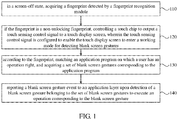
- FIG. 1 is a flow chart of a method for reducing power consumption of a mobile terminal provided by an embodiment of the present disclosure.
- the method can be executed by a device for reducing power consumption of a mobile terminal, wherein, the device can be implemented by software and/or hardware, and generally can be integrated in a mobile terminal.
- the method comprises an operation 110, an operation 120, an operation 130, and an operation 140.
- a fingerprint detected by a fingerprint recognition module is required.
- the fingerprint includes a fingerprint pattern.
- the fingerprint recognition module includes a press-type fingerprint recognition module or a touch-type fingerprint recognition module.
- For the press-type fingerprint recognition module when the mobile terminal is in the screen-off state, it can detect and recognize the fingerprint based on a touch operation of a user. It should be noted that, at this time, a pressing pressure of the touch operation input by the user is insufficient to press the press-type fingerprint recognition module. Otherwise, after the press-type fingerprint recognition module is pressed, the display screen will be triggered to light.
- the touch-type fingerprint recognition module when the mobile terminal is in the screen-off state, it can detect and recognize a fingerprint input by a user.
- the fingerprint recognition module is controlled to enter a working mode for detecting fingerprints
- the touch display screen is controlled to enter a non-working mode which cannot detect blank screen gestures (it can be considered as a sleep state, there is no input touch sensing control signal, that is, touch operations applied on the touch display screen cannot be detected), such that the problem of high power consumption of the mobile terminal, which is caused by continuously providing the touch sensing control signal to the whole screen of the touch display screen, is avoided.
- an application layer can determine whether the blank screen gesture function is enabled according to a configuration operation of a user. For example, in an application scenario in which a user configures a blank screen gesture, if the user clicks a configuration option and selects the blank screen gesture function, a display interface of the terminal switches to a blank screen gesture function configuration interface. On the blank screen gesture function configuration interface, the user can click to enable the blank screen gesture function and set blank screen gestures which are enabled. At this time, the application layer modifies the value of the preset identifier representing the on and off state of the blank screen gesture function to indicate that the blank screen gesture function is currently enabled.
- the display screen sends a screen-off broadcast when the screen is turned off, it can be determined that the mobile terminal is in the screen-off state according to the screen-off broadcast.
- the mobile terminal When determining that the blank screen gesture function has been enabled and the mobile terminal is in the screen-off state, the mobile terminal outputs a driving signal to the fingerprint recognition module to enable the fingerprint recognition module to enter the working mode, but does not output any touch sensing control signal to the touch display screen, such that the touch display screen is in a sleep state in which blank screen gestures cannot be detected.
- a touch chip is controlled to output a touch sensing control signal to a touch display screen, wherein the touch sensing control signal is configured to enable the touch display screen to enter a working mode for detecting blank screen gestures.
- the touch sensing control signal is a driving signal controlling the touch display screen to work and being capable of detecting blank screen gestures, that is, the touch sensing control signal is configured to enable the touch display screen to enter a working mode for detecting blank screen gestures.
- a fingerprint template is a fingerprint set formed by fingerprints recorded by a user in advance. After acquiring the fingerprint detected by the fingerprint recognition module, the fingerprint is compared with the fingerprint template stored in the mobile terminal in advance, and whether the fingerprint is an unlocking fingerprint is determined according to the comparison result. For example, a fingerprint pattern of the fingerprint is matched with fingerprint patterns in the fingerprint template stored in advance, and whether there exists a template fingerprint pattern matching with the fingerprint is determined.
- a touch chip is controlled by a drive layer to output a touch sensing control signal to the touch display screen.
- an application program on which a user has an operation right is matched, and a set of blank screen gestures corresponding to the application program is required.
- the user is the user having the fingerprint.
- the mobile terminal provides a right setting option for users, and users can set application programs that can be operated by different users through the right setting option.
- a user can record a fingerprint as a fingerprint template when first using the blank screen gesture function and select application programs associated with the fingerprint template. For example, for the owner himself/herself, he/she has the greatest operation right, and can operate all application programs installed in the terminal. Therefore, after the owner himself/herself records a fingerprint, all application programs installed in the terminal are designated as application programs corresponding to the fingerprint recorded by the owner. For a child, he/she has operation right of some application programs.
- application programs which are operable for strangers can be set by users, and can also be set by system default.
- a second white list can be set to store the association relationships between blank screen gestures and application programs (e.g., a process number or an installation package name) or mobile phone functions (e.g., working mode switches such as mobile phone wake-up, a conference mode, or a standard mode, etc.). It can be understood that there are many kinds of methods for establishing association relationships between blank screen gestures and application programs, and are not limited by embodiments of the present disclosure.
- the flashlight is set to have a quick start function in advance, and the flashlight can be turned on in a screen-off state by inputting a blank screen gesture "O".
- the mobile terminal provides a blank screen gesture configuration function, when a user enables the blank screen gesture configuration function, the user is indicated to select an application program requiring setting a quick start function, and input or select a blank screen gesture corresponding to the application program, such that an association relationship between the blank screen gesture and the application program is established.
- inquiring an association relationship between the fingerprint template and application programs can determine application programs that can be operated by the user having the fingerprint.
- the first white list storing the association relationship between the fingerprint template and application programs is inquired, and application programs on which the user has operation right are determined; if the fingerprint fails to match with a fingerprint template stored in advance, preset application programs are used as application programs on which the user has operation right.
- the first white list is inquired according to a currently detected fingerprint successfully matching with a fingerprint template, and it is determined that the user has operation right to a camera application, instant messaging applications (such as Wechat, QQ, etc.) and shopping applications (such as Taobao, Jingdong, etc.).
- instant messaging applications such as Wechat, QQ, etc.
- shopping applications such as Taobao, Jingdong, etc.
- a currently detected fingerprint fails to match with a fingerprint template stored in advance
- the user having the fingerprint cannot directly enter a photo gallery through a camera application interface after enabling the camera application. For example, if the user having the fingerprint wants to enter the photo gallery, a dialog box is displayed to indicate the user to input a fingerprint.
- the second white list is inquired to determine a set of blank screen gestures corresponding to the application programs that can be operated by the user.
- a blank screen gesture event is reported to an application layer upon detection of a blank screen gesture belonging to the set of blank screen gestures to execute an operation corresponding to the blank screen gesture.
- a blank screen gesture type corresponding to the touch operation can be recognized by a drive layer, and the set of blank screen gestures is inquired according to the recognized blank screen gesture type to determine whether the currently detected blank screen gesture is a blank screen gesture in the set of blank screen gestures. If yes, the drive layer reports the blank screen gesture to the application layer.
- a touch chip when a blank screen gesture is detected, stores gesture data corresponding to the blank screen gesture into a set register, and sends an interruption wake-up signal to a kernel layer.
- the kernel layer executes a system wake-up operation. After the system is waked up, the kernel later calls an interruption processing function of the drive layer to execute, reads the gesture data from the set register of the touch chip, and stores the gesture data in a preset node of the drive layer.
- the set of blank screen gestures is inquired, and whether the currently detected blank screen gesture is a blank screen gesture in the set of blank screen gestures is determined.
- the drive layer recognizes that the blank screen gesture type is "O" according to read gesture data.
- the set of blank screen gestures is inquired. If there exists a blank screen gesture "O" in the blank screen gesture type, it is determined that the currently detected blank screen gesture belongs to the set of blank screen gestures.
- a blank screen gesture event is reported to the application layer to enable the application layer to execute an operation corresponding to the currently detected blank screen gesture.
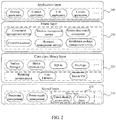
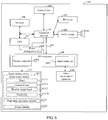
- FIG. 2 is a schematic diagram of an operation system framework provided by an embodiment of the present disclosure. Taking a mobile terminal shown in FIG. 2 , as an example, an execution flow of a blank screen gesture function provided by an embodiment of the present disclosure is described.
- the operation system framework includes a kernel layer 210, a core class library layer 220, a frame layer 230, and an application layer 240.
- the kernel layer 210 provides core system services, which include safety, memory management, process management, network protocol stack, hardware drive, etc.
- the hardware drive in the kernel layer 210 is recorded as a drive layer 211, the drive layer 211 includes a touch display screen drive, a camera drive, etc.
- the core class library layer 220 includes Runtime and Libraries. Wherein, Runtime provides most functions that are usable in Java programming language core class libraries, which comprise Core Libraries and Dalvik VM Each application program is a real example in the Dalvik VM and operates in its own process.
- the Libraries are used by various components of the operation system and include the following functions: Media Framework, Surface Manager, SQlite (relation database engine), FreeType (bitmap and vector font rendering), and so on, and the various functions are exposed to developers to use through the frame layer 230 of the operation system.
- the frame layer 230 provides a series of class libraries required by developing application programs, such that developers can perform quick application program developments, facilitate reuse of components, and can also realize personalized extension through inheritance; provided services include a component management service, a window management service, a system data source component, a control framework, a resource management service, an installation package management service, and so on.
- the application layer 240 includes various application programs directly interacting with users, or service programs written by Java language and running in the background, which include programs such as desktop applications, contact applications, call applications, camera applications, photo browsers, games, maps, web browsers, and so on, and other application programs developed by developers.
- the touch chip after a blank screen gesture function is enabled, the touch chip generates a wake-up signal when detecting a blank screen gesture and sends the wake-up signal to the kernel layer.
- the kernel layer By the wake-up signal, the kernel layer is triggered to execute a system wake-up operation.
- the kernel layer calls a drive layer interruption processing function to execute, the drive layer reads gesture data in the touch chip through the interruption processing function, and stores read gesture data in a preset node of the drive layer.
- the touch chip is configured to output a touch sensing control signal to the touch display screen, so as to detect touch operations, recognize gesture coordinates of blank screen gestures acting on the touch display screen, and stores the gesture coordinates as the gesture data in its own register.
- the preset node can be a file node, for example, can be a virtual file node under a proc-D content.
- the drive layer determines validity of the gesture data, there are many kinds of methods for determining validity, and this embodiment does not make specific limitation. For example, the drive layer determines a gesture type according to a gesture coordinate included in the gesture data, and stores the determined gesture type as gesture data in the preset node. If the gesture type is not a preset blank screen gesture, it is determined that the gesture data is invalid. For another instance, the drive layer counts the number of the gesture data, and determines whether the number meets requirement of drawing a preset blank screen gesture; if no, it is determined that the gesture data is invalid.
- the drive layer When the data is valid, the drive layer reports a blank screen gesture event.
- the blank screen gesture event is transmitted to the frame layer through the core class library layer, and is distributed by the frame layer and reaches the application layer.
- the application layer when receiving the blank screen gesture event, reads the gesture data from the preset node of the drive layer. After the gesture data is completely ready, a blank screen gesture track is calculated according to the gesture coordinate included in the gesture data, and the blank screen gesture track is drawn on the display screen to display. Afterwards, the application layer, based on the gesture type in the read gesture data, turns on an application program corresponding to the gesture type.
- the gesture type can be a gesture configured to realize a certain function, which is set in the mobile terminal in advance, and can also be a gesture customized by a user.
- the gesture type can be O representing turning on a camera; for another instance, the gesture type can be V representing turning on a flashlight, etc.
- the execution flow of the blank screen gesture function is not limited to the methods listed in this embodiment.
- a blank screen gesture event is reported once the system is waked up
- the kernel layer calls the drive layer interruption processing function to execute
- the drive layer reads gesture data in the touch chip through the interruption processing function, and stores the gesture data in a preset node of the drive layer
- the drive layer acquires the gesture data in the preset node, makes curve fitting for the gesture data to obtain a gesture type being most similar to the blank screen gesture, and stores the gesture type also as the gesture data in the preset node.
- curve fitting is a data processing method, that is, using continuous curves to approximately depict or simulate function relationships among coordinates represented by discrete points on a plane.
- the application layer receives the blank screen gesture event, whether the gesture data in the preset node is completely ready is detected according to a set cycle.
- the application layer reads the gesture data in the preset node. If the gesture data is successfully read and valid, a blank screen gesture track is calculated according to a gesture coordinate included in the gesture data, and the blank screen gesture track is drawn on the display screen to display. Afterwards, based on a gesture type in the read gesture data, the application layer turns on an application program corresponding to the gesture type.
- the solution for reducing power consumption of a mobile terminal comprises: in a screen-off state, acquiring a fingerprint detected by a fingerprint recognition module; if the fingerprint is a non-unlocking fingerprint, controlling a touch chip to output a touch sensing control signal to a touch display screen; according to the fingerprint, matching an application program on which a user has an operation right, and acquiring a set of blank screen gestures corresponding to the application program; upon detection of a blank screen gesture belonging to the set of blank screen gestures, reporting a blank screen gesture event to an application layer to trigger the application layer to execute an operation corresponding to the blank screen gesture.
- the condition of increasing power consumption of the mobile terminal caused by continuous working of the touch display screen can be avoided from occurring; at the same time, only a blank screen gesture corresponding to an application program matching with a current fingerprint can triggering report of a blank screen gesture event, so that the condition that the application layer triggers blank screen gesture events based on invalid blank screen gestures and executes gesture data reading operations, resulting in doing idle work, is further avoided from occurring.
- the power consumption of the mobile terminal can be effectively reduced, and a battery life can be extended.
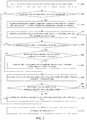
- FIG. 3 is a flow chart of another method for reducing power consumption of a mobile terminal provided by an embodiment of the present disclosure. As shown in FIG. 3 , the method comprises operations 301 to 311.
- a fingerprint detected by a fingerprint recognition module is acquired.
- the operation 302 whether the fingerprint is a non-unlocking fingerprint is determined; if yes, the operation 303 is executed, otherwise, the operation 311 is executed.
- the currently detected fingerprint is matched with an unlocking fingerprint set in advance, if matching succeeds, it is considered that the currently detected fingerprint is the unlocking fingerprint, and an unlocking operation is further executed based on the unlocking fingerprint; if matching fails, it is considered that the currently detected fingerprint is a non-unlocking fingerprint.
- an application program on which a user has an operation right is matched, and a set of blank screen gestures corresponding to the application program is required.
- the user is a user having the fingerprint.
- a touch chip is controlled to output a touch sensing control signal to a touch display screen, and detecting blank screen gesture input.
- a driver layer controls a touch chip to output a touch sensing control signal to a touch display screen, and activates the touch display screen according to the touch sensing control signal to make the touch display screen enter a working mode for detecting blank screen gestures. In this way, the touch display screen can detect blank screen gesture input.
- the set time length is the longest tolerable time of the mobile terminal for a blank screen gesture detection operation. In the set time length, if no blank screen gesture acting on a touch display screen is detected, it is determined that there is no blank screen gesture input, therefore, blank screen gesture input is no longer detected.
- the set time can be set by system default, and can also be set by users themselves according to actual needs.
- a timer when outputting the touch sensing control signal to touch display screen, a timer is started. Before a count value of the timer reaches the set time length, whether blank screen gesture input is detected is determined; if yes, the operation 306 is executed; otherwise, the operation 310 is executed.
- a blank screen gesture event is reported to an application layer to execute an operation corresponding to the blank screen gesture.
- a user is prompted that the blank screen gesture input is wrong, and the number of times of wrong blank screen gesture inputs is recorded.
- the method for prompting a user that the blank screen gesture input is wrong can be vibration of the mobile terminal for a set number of times and/or sending set prompt sound. It can be understood that the methods for prompting a user that the blank screen gesture input is wrong listed above are examples but not limitations.
- the mobile terminal is controlled to vibrate a set number of times, so as to prompt a user that the currently input blank screen gesture is wrong. It is possible to indicate different error types by different vibration numbers of times. For example, twice vibrations of the mobile terminal indicate that the blank screen gesture is not a preset blank screen gesture, four times vibrations of the mobile terminal indicate that the user has no operation right to the application program corresponding to the blank screen gesture, and so on.
- a counter is started to record the number of times of wrong blank screen gesture inputs.
- the counting value of the counter is controlled to add 1.
- the set threshold value of the number of times can be set by system default, and can also be set by users themselves according to actual needs.
- the operation 304 is returned to execute, thereby continuing to detect blank screen gesture inputs.
- the touch chip is controlled to stop outputting the touch sensing control signal to the touch display screen.
- the application layer controls the touch chip to stop outputting the touch sensing control signal to the touch display screen, and thereby makes the touch display screen quit the working mode.
- the touch display screen is in a sleep state and avoids from inputting drive current to the touch display screen to keep the touch display screen working, so that power consumption of the mobile terminal is reduced.
- the detected fingerprint is an unlocking fingerprint, executing an unlocking operation for the mobile terminal.
- the solution for reducing power consumption of a mobile terminal comprises: if no blank screen gesture input is detected in the set time length, controlling the touch chip to stop outputting the touch sensing control signal to the touch display screen; if a blank screen gesture input is detected in the set time length, and the blank screen gesture does not belong to the set of blank screen gestures, prompting a user that the blank screen gesture input is wrong, and recording the number of times of wrong blank screen gesture inputs; when the number of times exceeds the set threshold value of the number of times, controlling the touch chip to stop outputting the touch sensing control signal to the touch display screen, and thereby making the touch display screen quit the working mode.
- the longest tolerable time is set for the blank screen gestures input by users, and the most tolerable number of times is set for the input wrong blank screen gestures, such that the condition that the touch display screen is activated for many times by the fingerprint recognition module, which results in that the service life of the fingerprint recognition module is affected, can be effectively avoided from occurring.
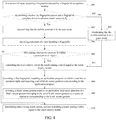
- FIG. 4 is a flow chart of further another method for reducing power consumption of a mobile terminal provided by an embodiment of the present disclosure. As shown in FIG. 4 , the method comprises operations 401 to 410.
- a fingerprint detected by a fingerprint recognition module is acquired.
- the fingerprint recognition module and a pressure sensor are controlled to be in a working state.
- the fingerprint recognition module is configured to detect fingerprints input by users, and the fingerprints include fingerprint patterns.
- the pressure sensor is configured to detect pressures of users inputting fingerprints. If a finger of a user contacts the fingerprint recognition module, a pressure of the user inputting a fingerprint is detected by the pressure sensor.
- Fingerprints recorded by users are stored in the mobile terminal in advance as the fingerprint template. It is possible to make the mobile terminal be in a user mode and a guest mode respectively according to whether the detected fingerprint belongs to the fingerprint template.
- application programs on which a user has operation right can be determined according to a fingerprint input by the user.
- the application programs set in advance can be application programs which do not relate to privacy of the owner, such as turning on a camera or a flashlight application program.
- a pressure of a user inputting a fingerprint is acquired.
- a pressure of a user inputting a fingerprint, which is detected by the pressure sensor, is acquired.
- the biological characteristic information can be face characteristic information or the like.
- the preset pressure region can be configured by system default, and can also be set by users themselves.
- the mobile terminal provides a pressure region adjustment function for users. When a user enters the pressure region adjustment function, the user is prompted to normally input a fingerprint for many times, pressures corresponding to these fingerprint input operations are recorded as the preset pressure region.
- a pressure of a current user inputting a fingerprint is respectively compared with the minimum value and the maximum value of the preset pressure region. If the pressure is less than the minimum pressure value of the preset pressure region or larger than the maximum value of the preset pressure region, it is determined that the pressure is not within the preset pressure region. If the pressure is larger than the minimum pressure value of the preset pressure region and less than the maximum value of the preset pressure region, it is determined that the pressure is within the preset pressure region.
- the touch chip is controlled to output the touch sensing control signal to the touch display screen.
- the touch display screen is controlled to activate, so as to detect blank screen gestures.
- an application program on which a user has an operation right is matched, and a set of blank screen gestures corresponding to the application program is acquired.
- a blank screen gesture event is reported to an application layer upon detection of a blank screen gesture belonging to the set of blank screen gestures to execute an operation corresponding to the blank screen gesture.
- the solution for reducing power consumption of a mobile terminal comprises: before controlling the touch chip to output the touch sensing control signal to the touch display screen, acquiring a pressure of a user inputting a fingerprint; if the mobile terminal is in a user mode, determining whether the pressure is within a preset pressure region; according to the determining result, determining whether to control the touch chip to output the touch sensing control signal to the touch display screen; if the mobile terminal is in a guest mode, executing an operation of controlling the touch chip to output the touch sensing control signal to the touch display screen.
- FIG. 5 is a structural block diagram of a device for reducing power consumption of a mobile terminal provided by an embodiment of the present disclosure.
- the device can be implemented by software and/or hardware, and is generally integrated in a mobile terminal.
- the device can comprise a fingerprint acquiring module 510, a touch chip control module 520, a gesture set acquiring module 530, and a gesture event report module 540.
- the fingerprint acquiring module 510 is configured to: in a screen-off state, acquire a fingerprint detected by a fingerprint recognition module.
- the touch chip control module 520 is configured to: if the fingerprint is a non-unlocking fingerprint, control a touch chip to output a touch sensing control signal to a touch display screen, wherein the touch sensing control signal is configured to enable the touch display screen to enter a working mode for detecting blank screen gestures.
- the gesture set acquiring module 530 is configured to: according to the fingerprint, match an application program on which a user has an operation right, and acquire a set of blank screen gestures corresponding to the application program.
- the gesture event report module 540 is configured to: report a blank screen gesture event to an application layer upon detection of a blank screen gesture belonging to the set of blank screen gestures to execute an operation corresponding to the blank screen gesture.
- the technical solution of this embodiment provides a device for reducing power consumption of a mobile terminal.
- the condition of increasing power consumption of the mobile terminal caused by the touch display screen working con tinuously can be avoided from occurring; at the same time, only a blank screen gesture corresponding to an application program matching with the current fingerprint can trigger report of a blank screen gesture event, and the condition that the application layer triggers a blank screen gesture event based on an invalid blank screen gesture and executes a gesture data reading operation, which results in doing idle working, is further avoided from occurring; in this way, the power consumption of the mobile terminal can be effectively reduced, and the battery life can be extended.
- the device further comprises a state control module configured to: before acquiring a fingerprint detected by the fingerprint recognition module, if a blank screen gesture function has been enabled and the mobile terminal is in the screen-off state, control the fingerprint recognition module to enter a working mode for detecting fingerprints, and control the touch display screen to enter a non-working which cannot detect blank screen gestures.
- a state control module configured to: before acquiring a fingerprint detected by the fingerprint recognition module, if a blank screen gesture function has been enabled and the mobile terminal is in the screen-off state, control the fingerprint recognition module to enter a working mode for detecting fingerprints, and control the touch display screen to enter a non-working which cannot detect blank screen gestures.
- the device further comprises a mode switching module configured to: after controlling the touch chip to output the touch sensing control signal to the touch display screen, if no blank screen gesture input is detected in a set time length, control the touch chip to stop outputting the touch sensing control signal to the touch display screen, so that the touch display screen enters the non-working mode again.
- a mode switching module configured to: after controlling the touch chip to output the touch sensing control signal to the touch display screen, if no blank screen gesture input is detected in a set time length, control the touch chip to stop outputting the touch sensing control signal to the touch display screen, so that the touch display screen enters the non-working mode again.
- the device further comprises a fault tolerant module configured to: after acquiring the set of blank screen gestures corresponding to the application program, if the detected blank screen gesture does not belong to the set of blank screen gestures, prompt a user that the blank screen gesture input is wrong, and record the number of times of wrong blank screen gesture inputs; when the number of times exceeds a set threshold value of the number of times, control the touch chip to stop outputting the touch sensing control signal to the touch display screen, and make the touch display screen to quit the working mode.
- a fault tolerant module configured to: after acquiring the set of blank screen gestures corresponding to the application program, if the detected blank screen gesture does not belong to the set of blank screen gestures, prompt a user that the blank screen gesture input is wrong, and record the number of times of wrong blank screen gesture inputs; when the number of times exceeds a set threshold value of the number of times, control the touch chip to stop outputting the touch sensing control signal to the touch display screen, and make the touch display screen to quit the working mode.
- the device further comprises a mode determining module configured to: after acquiring the fingerprint detected by the fingerprint recognition module, determine whether the fingerprint pattern and the fingerprint template stored in advance match successfully; if matching successfully, determine that the mobile terminal is in a user mode; otherwise, determine that the mobile terminal is in a guest mode.
- a mode determining module configured to: after acquiring the fingerprint detected by the fingerprint recognition module, determine whether the fingerprint pattern and the fingerprint template stored in advance match successfully; if matching successfully, determine that the mobile terminal is in a user mode; otherwise, determine that the mobile terminal is in a guest mode.
- the device further comprises a first anti-misoperation module configured to: before controlling the touch chip to output the touch sensing control signal to the touch display screen, acquire a pressure of the user inputting the fingerprint; if the mobile terminal is in the user mode, determine whether the pressure is within a preset pressure region; according to the determining result, determine whether to control the touch chip to output the touch sensing control signal to the touch display screen; if the mobile terminal is in the guest mode, execute an operation of controlling the touch chip to output the touch sensing control signal to the touch display screen.
- a first anti-misoperation module configured to: before controlling the touch chip to output the touch sensing control signal to the touch display screen, acquire a pressure of the user inputting the fingerprint; if the mobile terminal is in the user mode, determine whether the pressure is within a preset pressure region; according to the determining result, determine whether to control the touch chip to output the touch sensing control signal to the touch display screen; if the mobile terminal is in the guest mode, execute an operation of controlling the touch chip to output the touch sensing
- the device further comprises a second anti-misoperation module configured to: before controlling the touch chip to output the touch sensing control signal to the touch display screen, activate a camera to acquire biological characteristic information of the user, and match the biological characteristic information with a preset information template; according to the matching result, determine whether to control the touch chip to output the touch sensing control signal to the touch display screen.
- a second anti-misoperation module configured to: before controlling the touch chip to output the touch sensing control signal to the touch display screen, activate a camera to acquire biological characteristic information of the user, and match the biological characteristic information with a preset information template; according to the matching result, determine whether to control the touch chip to output the touch sensing control signal to the touch display screen.
- the gesture set acquiring module 530 is specifically configured to: if the fingerprint and the preset fingerprint template match successfully, inquire a white list storing relationships between the fingerprint template and application programs, and determine application programs on which the user has operation right; if the fingerprint and the preset fingerprint template fail to match, take preset application programs as application programs on which the user has operation right.
- An embodiment of the present disclosure further provides a storage medium including computer executable instruction, the computer executable instruction, when being executed by a computer processor, is configured to execute a method for reducing power consumption of a mobile terminal.
- the method comprises: in a screen-off state, acquiring a fingerprint detected by a fingerprint recognition module; if the fingerprint is a non-unlocking fingerprint, controlling a touch chip to output a touch sensing control signal to a touch display screen, wherein the touch sensing control signal is configured to enable the touch display screen to enter a working mode for detecting blank screen gestures; according to the fingerprint, matching an application program on which a user has an operation right, and acquiring a set of blank screen gestures corresponding to the application program; reporting a blank screen gesture event to an application layer upon detection of a blank screen gesture belonging to the set of blank screen gestures to execute an operation corresponding to the blank screen gesture.
- Storage medium any of various types of memory devices or storage devices.
- the term "storage medium” is intended to include: an installation medium, such as a read-only optical disc (CD-ROM), a floppy disk, or a tape device; a computer system memory or a random access memory, such as a dynamic random access memory (DRAM), a double rate synchronous dynamic random access memory (DDR RAM), a static random access memory (SRAM), an expanded data output random access memory (EDO RAM), a Rambus random access memory (Rambus RAM), etc.; a non-transitory memory, such as a flash memory, a magnetic medium (such as a hard disk or an optical storage); registers or other similar types of memory elements, and the like.
- an installation medium such as a read-only optical disc (CD-ROM), a floppy disk, or a tape device
- a computer system memory or a random access memory such as a dynamic random access memory (DRAM), a double rate synchronous dynamic random access memory (DDR RAM), a
- the storage medium may also include other types of memories or combinations thereof. Additionally, the storage medium may be located in a first computer system in which a program is executed, or may be located in a different second computer system, wherein the second computer system is coupled to the first computer system via a network, such as the Internet. The second computer system can provide program instruction to the first computer system for execution.
- the term "storage medium" can include two or more storage media that can reside in different locations (e.g, in different computer systems connected through a network).
- a storage medium may store program instruction (e.g., embodied as a computer program) being executable by one or more processors.
- the computer executable instruction is not limited to the aforementioned operations of implementing the method for reducing power consumption of a mobile terminal, and can also execute related operations in a method for reducing power consumption of a mobile terminal provided by any embodiment of the present disclosure.
- FIG. 6 is a structural schematic view of a mobile terminal 600 provided by an embodiment of the present disclosure. As shown in FIG.
- the mobile terminal 600 can comprise: a housing (not shown in the figures), a memory 601, a central processing unit (CPU) 602 (Also known as processor, hereinafter referred to as CPU), a circuit board (not shown in the figures), a touch display screen 612, a touch chip 61214, a fingerprint recognition module 61212, and a power supply circuit (not shown in the figures).
- CPU central processing unit
- the touch display screen 612 is configured to convert a user's operation into an electric signal input to the processor, and display a visible output signal;
- the touch display screen includes the touch chip 61214, the touch chip 61214 is configured to output a touch sensing control signal to the touch display screen 612 under control of the processor, and thereby make the touch display screen 612 be in a working mode for detecting touch operations;
- the fingerprint recognition module 61212 is disposed inside the touch display screen 612, and configured to detect fingerprints input by users;
- the circuit board is disposed in space enclosed by the touch display screen 612 and the housing;
- the CPU 602 and the memory 601 are disposed on the circuit board;
- the power supply circuit is configured to supply power to various circuits or elements of the mobile terminal;
- the memory 601 is configured to store association relationships among blank screen gestures, fingerprints, and application programs, and store a computer program being executable in a processor;
- the CPU 602 reads and executes the computer program stored in the memory 601.
- the CPU 602 when executing the computer program, implements the following steps: in a screen-off state, acquiring a fingerprint detected by a fingerprint recognition module; if the fingerprint is a non-unlocking fingerprint, controlling a touch chip to output a touch sensing control signal to a touch display screen, wherein the touch sensing control signal is configured to enable the touch display screen to enter a working mode for detecting blank screen gestures; according to the fingerprint, matching an application program on which a user has an operation right, and acquiring a set of blank screen gestures corresponding to the application program; reporting a blank screen gesture event to an application layer upon detection of a blank screen gesture belonging to the set of blank screen gestures to execute an operation corresponding to the blank screen gesture.
- the mobile terminal further comprises: a peripheral interface 603, an RF (Radio Frequency) circuit 605, an audio circuit 606, a speaker 611, a power management chip 608, an input/output (I/O) subsystem 609, an other input/control apparatus 610, and an external port 604, these elements communicate through one or more communication bus or signal line 607.
- RF Radio Frequency
- I/O input/output
- the mobile terminal 600 shown in the figures is merely one example of the mobile terminal, and the mobile terminal 600 can have more or less elements than that shown in the figures, can combine two or more elements, or can have different element configurations.
- the various elements shown in the figures can be implemented in hardware including one or more signal processing and/or special integrated circuit therein, software, or a combination of hardware and software.
- the mobile terminal with a device for reducing power consumption of a mobile terminal integrated therein provided by this embodiment is described in detail below.
- the mobile terminal takes a mobile phone as example.
- the memory 601 can be accessed by the CPU 602, the peripheral interface 603, etc.
- the memory 601 can include a high speed random access memory, and can also include a non-transitory memory, for example, one or more disk storage device, flash memory device, or other non-transitory solid state storage device.
- the peripheral interface 603. can connect input and output peripheral devices of the device to the CPU 602 and the memory 601.
- the I/O subsystem 609 can connect the input and output peripheral devices of the device, such as the touch display screen 612 and the other input/control apparatus 610, to the peripheral interface 603.
- the I/O subsystem 609 can include a display controller 6091 and one or more input controllers 6092 configured to control the other input/control apparatus 610.
- the one or more input controllers 6092 receive(s) electric signals from the other input/control apparatus 610 or send(s) electric signals to the other input/control apparatus 610.
- the other input/control apparatus 610 can include a physical button (push button, rocker button, etc.), a dial, a slide switch, a joystick, a click wheel, etc.
- the input controller 6092 can be connected with any one of the following: a keyboard, an infrared port, a USB interface, and an indication apparatus such as a mouse.
- the touch display screen 612 is an input interface and an output interface between a user terminal and a user.
- the touch display screen includes a display module 6122, a fingerprint recognition module 6123, and a touch screen module 6121; wherein, the touch screen module 6121 includes a panel 61211, a contact sensor 61212, a flexible circuit board 61213, and a touch chip 61214.
- the panel 61211 is a surface layer of the touch screen module 6121, contact operations of users act on the panel 61211.
- the contact sensor 61212 is manufactured.
- the contact sensor 61212 is electrically connected with the touch chip 61214 through the flexible circuit board 61213.
- the touch screen module 6121 can detect touch operations, the display module 6122 can display visible output to users, the visible output includes graphics, texts, icons, videos, etc.
- the fingerprint recognition module can be disposed inside the touch screen module, and can also be disposed to be independent from the touch screen module, for example, disposed at a bottom of the touch screen module.
- the display controller 6091 of the I/O subsystem 609 receives electric signals from the touch display screen 612 or sends electric signals to the touch display screen 612.
- the touch display screen 612 detect contacts on the touch display screen, the display controller 6091 converts detected contacts into interactions with user interface objects displayed on the touch screen display 612, that is, implement man-machine interaction.
- the user interface objects displayed on the touch display screen 612 can be an icon of an running game, an icon of connecting with a corresponding network, etc.
- the device can further include an optical mouse, the optical mouse is a touch sensitive surface which does not display any visible output, or extension of a touch sensitive surface formed by the touch screen module.
- the RF circuit 605 is mainly configured to establish communication between the mobile phone and a wireless network (i.e., network side), and implement data reception and transmission between the mobile phone and the wireless network, such as receiving and sending short messages, emails, etc.
- the RF circuit 605 receives and sends RF signals, the RF signals are also called as electromagnetic signals; the RF circuit 605 converts electric signals into electromagnetic signals or converts electromagnetic signals into electric signals, and communicates with a communication network and other devices by the electromagnetic signals.
- the RF circuit 605 can include known circuits configured to execute these functions, which include but are not limited to an antenna system, an RF transceiver, one or more amplifier(s), a tuner, one or more oscillator(s), a digital signal processor, a CODEC (COder-DECoder) chip group, a subscriber identity module (SIM), and so on.
- an antenna system an RF transceiver, one or more amplifier(s), a tuner, one or more oscillator(s), a digital signal processor, a CODEC (COder-DECoder) chip group, a subscriber identity module (SIM), and so on.
- CODEC COder-DECoder
- SIM subscriber identity module
- the audio circuit 606 is mainly configured to receive audio data from the peripheral interface 603, convert the audio data into electric signals, and send the electric signal to the speaker 611.
- the speaker 611 is configured to restore voice signals received from the wireless network through the RF circuit 605 by the mobile phone into sounds, and broadcast the sounds to users.
- the power management chip 608 is configured to supply power and perform power supply management for the CPU 602, the I/O subsystem, and hardware connected to the peripheral interface.
- the mobile terminal provided by this embodiment of the present disclosure can effectively reduce power consumption of a mobile phone and extend a battery life.
- the device for reducing power consumption of a mobile terminal, the storage medium, and the mobile terminal provided by the above embodiments can execute the method for reducing power consumption of a mobile terminal provided by any embodiment of the present disclosure, and have corresponding functional modules for executing the method and advantageous effect.
- Technical details which are not described in detail in the above embodiments can refer to the method for reducing power consumption of a mobile terminal provided by any embodiment of the present disclosure.
Landscapes
- Engineering & Computer Science (AREA)
- Theoretical Computer Science (AREA)
- Signal Processing (AREA)
- Computer Networks & Wireless Communication (AREA)
- Human Computer Interaction (AREA)
- General Engineering & Computer Science (AREA)
- Physics & Mathematics (AREA)
- General Physics & Mathematics (AREA)
- Computer Hardware Design (AREA)
- Computer Security & Cryptography (AREA)
- Telephone Function (AREA)
- User Interface Of Digital Computer (AREA)
Claims (13)
- Verfahren zum Reduzieren eines Stromverbrauchs eines mobilen Endgeräts, das Folgendes umfasst:Erfassen (110, 301, 401) eines Fingerabdrucks, der von einem Fingerabdruckerkennungsmodul detektiert wird, in einem Bildschirm-aus-Zustand;vorab Abgleichen des detektierten Fingerabdrucks mit einem Entriegelungsfingerabdrucksatz; wenn das Abgleichen fehlschlägt, Steuern (120, 304, 407) eines Berührungschips, um ein Berührungssensorsteuersignal an einen Berührungsanzeigebildschirm auszugeben, wobei das Berührungssensorsteuersignal dazu ausgelegt ist, es dem Berührungsanzeigebildschirm zu ermöglichen, zum Detektieren von Leerbildschirmgesten in einen Arbeitsmodus einzutreten;Abgleichen (130) eines Anwendungsprogramms, in dem ein Benutzer, der den detektierten Fingerabdruck aufweist, ein Bedienrecht aufweist, gemäß dem detektierten Fingerabdruck und Erfassen eines Satzes von Leerbildschirmgesten, die dem Anwendungsprogramm entsprechen;Melden (140) eines Leerbildschirmgestenereignisses bei einer Anwendungsschicht nach Detektion einer Leerbildschirmgeste, die zu dem Satz von Leerbildschirmgesten gehört, um eine Bedienung auszuführen, die der Leerbildschirmgeste entspricht; und dadurch gekennzeichnet, dass:das Verfahren vor dem Steuern (120, 304, 407) eines Berührungschips, um ein Berührungssensorsteuersignal an einen Berührungsanzeigebildschirm auszugeben, ferner Folgendes umfasst: Einschalten einer Kamera, um charakteristische biologische Informationen des Benutzers zu erfassen, und Abgleichen der charakteristischen biologischen Informationen mit einer voreingestellten Informationsvorlage und Bestimmen gemäß dem Abgleichergebnis, ob der Berührungschip gesteuert werden soll, um das Berührungssensorsteuersignal an den Berührungsanzeigebildschirm auszugeben;wobei die charakteristischen biologischen Informationen charakteristische Gesichtsinformationen beinhalten und das Verfahren ferner Folgendes umfasst: wenn eine Fingerabdruckeingabe detektiert wird, wenn charakteristische Gesichtsinformationen von der Kamera detektiert werden, Bestimmen, dass diese Fingerabdruckeingabe keine falsche Bedienung ist, und Steuern des Berührungschips, um das Berührungssensorsteuersignal an den Berührungsanzeigebildschirm auszugeben.
- Verfahren nach Anspruch 1, wobei das Verfahren vor dem Erfassen (110) eines Fingerabdrucks, der von einem Fingerabdruckerkennungsmodul detektiert wird, ferner Folgendes umfasst:
wenn eine Leerbildschirmgestenfunktion aktiviert wurde und das mobile Endgerät sich im Bildschirm-aus-Zustand befindet, Steuern des Fingerabdruckerkennungsmoduls, um zum Detektieren von Fingerabdrücken in einen Arbeitsmodus einzutreten, und Steuern des Berührungsanzeigebildschirms, um in einen Nichtarbeitsmodus, in dem Leerbildschirmgesten nicht detektiert werden können, einzutreten. - Verfahren nach Anspruch 2, wobei das Verfahren nach dem Steuern eines Berührungschips, um ein Berührungssensorsteuersignal an einen Berührungsanzeigebildschirm auszugeben, ferner Folgendes umfasst:
wenn in einer eingestellten Zeitlänge keine Leerbildschirmgesteneingabe detektiert wird, Steuern des Berührungschips, um das Ausgeben des Berührungssensorsteuersignals an den Berührungsanzeigebildschirm zu stoppen, und Bewirken, dass der Berührungsanzeigebildschirm wieder in den Nichtarbeitsmodus eintritt. - Verfahren nach einem der Ansprüche 1-3, wobei das Verfahren nach dem Erfassen eines Satzes von Leerbildschirmgesten, die dem Anwendungsprogramm entsprechen, ferner Folgendes umfasst:wenn eine detektierte Leerbildschirmgeste nicht zum Satz von Leerbildschirmgesten gehört, Hinweisen (306) eines Benutzers darauf, dass die Leerbildschirmgesteneingabe falsch ist, und Aufzeichnen der Anzahl von Malen von falschen Leerbildschirmgesteneingaben;wenn die Anzahl von Malen einen Schwellwert der Anzahl von Malen überschreitet, Steuern (310) des Berührungschips, um das Ausgeben des Berührungssensorsteuersignals an den Berührungsanzeigebildschirm zu stoppen, und Bewirken, dass der Berührungsanzeigebildschirm den Arbeitsmodus verlässt.
- Verfahren nach Anspruch 4, wobei das Hinweisen (306) eines Benutzers darauf, dass die Leerbildschirmgesteneingabe falsch ist, das Ansteuern des mobilen Endgeräts zum Vibrieren in einer eingestellten Anzahl von Malen und/oder das Senden eines eingestellten Hinweistons beinhaltet und verschiedene Anzahlen von Malen von Vibrationen des mobilen Endgeräts verschiedene Fehlertypen der falschen Leerbildschirmgesteneingabe anzeigen.
- Verfahren nach einem der Ansprüche 1-5, wobei das Verfahren nach dem Erfassen (110, 301, 401) eines Fingerabdrucks, der von einem Fingerabdruckerkennungsmodul detektiert wird, ferner Folgendes umfasst:
Bestimmen (402), ob ein Fingerabdruckmuster und eine Fingerabdruckvorlage, die vorab gespeichert wurden, erfolgreich abgeglichen werden; wenn das Abgleichen erfolgreich ist, Bestimmen (403), dass sich das mobile Endgerät im Benutzermodus befindet; andernfalls Bestimmen (404), dass sich das mobile Endgerät in einem Gastmodus befindet. - Verfahren nach Anspruch 6, wobei das Verfahren vor dem Steuern (120, 304, 407) eines Berührungschips, um ein Berührungssensorsteuersignal an einen Berührungsanzeigebildschirm auszugeben, ferner Folgendes umfasst:Erfassen (405) eines Drucks eines Benutzers, der den detektierten Fingerabdruck eingibt;wenn sich das mobile Endgerät im Benutzermodus befindet, Bestimmen (406), ob der Druck in einem voreingestellten Druckbereich liegt;Bestimmen gemäß dem Bestimmungsergebnis, ob der Berührungschip gesteuert werden soll, um das Berührungssensorsteuersignal an den Berührungsanzeigebildschirm auszugeben.
- Verfahren nach Anspruch 6, das ferner Folgendes umfasst:
wenn sich das mobile Endgerät im Gastmodus befindet, Ausführen einer Bedienung des Steuerns (120, 304, 407) des Berührungschips, um das Berührungssensorsteuersignal an den Berührungsanzeigebildschirm auszugeben. - Verfahren nach einem der Ansprüche 1-8, wobei das Abgleichen (130) eines Anwendungsprogramms, in dem ein Benutzer, der den detektierten Fingerabdruck aufweist, ein Bedienrecht aufweist, gemäß dem detektierten Fingerabdruck Folgendes beinhaltet:wenn der detektierte Fingerabdruck mit einer Fingerabdruckvorlage, die vorab gespeichert wurde, erfolgreich abgeglichen wird, Abfragen einer Weißliste, in der eine Verknüpfungsbeziehung zwischen der Fingerabdruckvorlage und Anwendungsprogrammen gespeichert ist, und Bestimmen der Anwendungsprogramme, in denen der Benutzer, der den detektierten Fingerabdruck aufweist, ein Bedienrecht aufweist;wenn der detektierte Fingerabdruck nicht mit der Fingerabdruckvorlage, die vorab gespeichert wurde, abgeglichen werden kann, Verwenden von voreingestellten Anwendungsprogrammen als die Anwendungsprogramme, in denen der Benutzer, der den detektierten Fingerabdruck aufweist, ein Bedienrecht aufweist.
- Verfahren nach Anspruch 9, wobei das Erfassen (130) eines Satzes von Leerbildschirmgesten, die dem Anwendungsprogramm entsprechen, Folgendes umfasst:
gemäß dem Anwendungsprogramm, in dem ein Benutzer, der den detektierten Fingerabdruck aufweist, ein Bedienrecht aufweist, Abfragen einer zweiten Weißliste, in der Verknüpfungsbeziehungen zwischen Leerbildschirmgesten und Anwendungsprogrammen oder Mobiltelefonfunktionen gespeichert sind, um den Satz von Leerbildschirmgesten zu bestimmen, die dem Anwendungsprogramm entsprechen. - Vorrichtung zum Reduzieren eines Stromverbrauchs eines mobilen Endgeräts, die Folgendes umfasst:ein Fingerabdruckerfassungsmodul (510), das zu Folgendem ausgelegt ist: Erfassen eines Fingerabdrucks, der von einem Fingerabdruckerkennungsmodul detektiert wird, in einem Bildschirm-aus-Zustand;ein Berührungschipsteuermodul (520), das zu Folgendem ausgelegt ist: vorab Abgleichen des detektierten Fingerabdrucks mit einem Entriegelungsfingerabdrucksatz;wenn das Abgleichen fehlschlägt, Steuern eines Berührungschips, um ein Berührungssensorsteuersignal an einen Berührungsanzeigebildschirm auszugeben, wobei das Berührungssensorsteuersignal dazu ausgelegt ist, es dem Berührungsanzeigebildschirm zu ermöglichen, zum Detektieren von Leerbildschirmgesten in einen Arbeitsmodus einzutreten;ein Gestensatzerfassungsmodul (530), das zu Folgendem ausgelegt ist: Abgleichen eines Anwendungsprogramms, in dem ein Benutzer, der den detektierten Fingerabdruck aufweist, ein Bedienrecht aufweist, gemäß dem detektierten Fingerabdruck und Erfassen eines Satzes von Leerbildschirmgesten, die dem Anwendungsprogramm entsprechen;ein Gestenereignismeldemodul (540), das zu Folgendem ausgelegt ist: Melden eines Leerbildschirmgestenereignisses bei einer Anwendungsschicht nach Detektion einer Leerbildschirmgeste, die zu dem Satz von Leerbildschirmgesten gehört, um eine Bedienung auszuführen, die der Leerbildschirmgeste entspricht; unddadurch gekennzeichnet, dass sie ferner Folgendes umfasst:ein zweites Fehlbedienungsverhinderungsmodul, das zu Folgendem ausgelegt ist: vor dem Steuern eines Berührungschips, um ein Berührungssensorsteuersignal an einen Berührungsanzeigebildschirm auszugeben, Einschalten einer Kamera, um charakteristische biologische Informationen des Benutzers zu erfassen, und Abgleichen der charakteristischen biologischen Informationen mit einer voreingestellten Informationsvorlage und Bestimmen gemäß dem Abgleichergebnis, ob der Berührungschip gesteuert werden soll, um das Berührungssensorsteuersignal an den Berührungsanzeigebildschirm auszugeben;wobei die charakteristischen biologischen Informationen charakteristische Gesichtsinformationen beinhalten und das zweite Fehlbedienungsverhinderungsmodul ferner zu Folgendem ausgelegt ist: wenn eine Fingerabdruckeingabe detektiert wird, wenn charakteristische Gesichtsinformationen von der Kamera detektiert werden, Bestimmen, dass diese Fingerabdruckeingabe keine falsche Bedienung ist, und Steuern des Berührungschips, um das Berührungssensorsteuersignal an den Berührungsanzeigebildschirm auszugeben.
- Computerlesbares Speichermedium, auf dem ein Computerprogramm gespeichert ist; das Computerprogramm, wenn es von einem Prozessor ausgeführt wird, implementiert das Verfahren zum Reduzieren eines Stromverbrauchs eines mobilen Endgeräts nach einem der Ansprüche 1-10.
- Mobiles Endgerät (600), das Folgendes umfasst:einen Prozessor (602);ein Fingerabdruckerkennungsmodul (6123), das dazu ausgelegt ist, eine Fingereingabe durch einen Benutzer zu detektieren;einen Speicher (601), der dazu ausgelegt ist, Verknüpfungsbeziehungen zwischen Leerbildschirmgesten, Fingerabdrücken und Anwendungsprogrammen zu speichern und ein Computerprogramm, das im Prozessor (602) ausführbar ist, zu speichern;einen Berührungsanzeigebildschirm (6121), der einen Berührungschip (61214) beinhaltet und dazu ausgelegt ist, eine Leerbildschirmgeste zu detektieren und eine Gestenspur der Leerbildschirmgeste anzuzeigen;wobei der Berührungschip (61214) dazu ausgelegt ist, unter der Steuerung des Prozessors (602) ein Berührungssensorsteuersignal an den Berührungsanzeigebildschirm (6121) auszugeben; undder Prozessor (602) dazu ausgelegt ist, das Verfahren zum Reduzieren eines Stromverbrauchs eines mobilen Endgeräts nach einem der Ansprüche 1-10 zu implementieren, wenn er das Computerprogramm ausführt.
Applications Claiming Priority (2)
| Application Number | Priority Date | Filing Date | Title |
|---|---|---|---|
| CN201710633671.5A CN107395889B (zh) | 2017-07-28 | 2017-07-28 | 降低移动终端功耗的方法、装置、存储介质及移动终端 |
| PCT/CN2018/090502 WO2019019816A1 (zh) | 2017-07-28 | 2018-06-08 | 降低移动终端功耗的方法、装置、存储介质及移动终端 |
Publications (3)
| Publication Number | Publication Date |
|---|---|
| EP3627809A1 EP3627809A1 (de) | 2020-03-25 |
| EP3627809A4 EP3627809A4 (de) | 2020-05-27 |
| EP3627809B1 true EP3627809B1 (de) | 2021-03-24 |
Family
ID=60342835
Family Applications (1)
| Application Number | Title | Priority Date | Filing Date |
|---|---|---|---|
| EP18838821.9A Not-in-force EP3627809B1 (de) | 2017-07-28 | 2018-06-08 | Verfahren und vorrichtung zur verringerung des stromverbrauchs eines mobilen endgeräts, speichermedium und mobiles endgerät |
Country Status (5)
| Country | Link |
|---|---|
| US (1) | US10932196B2 (de) |
| EP (1) | EP3627809B1 (de) |
| CN (1) | CN107395889B (de) |
| ES (1) | ES2871474T3 (de) |
| WO (1) | WO2019019816A1 (de) |
Families Citing this family (25)
| Publication number | Priority date | Publication date | Assignee | Title |
|---|---|---|---|---|
| CN107395889B (zh) * | 2017-07-28 | 2020-01-21 | Oppo广东移动通信有限公司 | 降低移动终端功耗的方法、装置、存储介质及移动终端 |
| CN108052389B (zh) * | 2017-11-30 | 2021-11-02 | 努比亚技术有限公司 | 基于核心库的内存优化方法、移动终端及可读存储介质 |
| KR20190095005A (ko) * | 2018-02-06 | 2019-08-14 | 주식회사 하이딥 | 터치입력장치의 블랙화면모드에서 압력으로 인한 지문 센싱 방법 및 터치입력장치 |
| CN108924350A (zh) * | 2018-06-28 | 2018-11-30 | 努比亚技术有限公司 | 应用锁功能扩展的实现方法、移动终端及可读存储介质 |
| CN109144317B (zh) * | 2018-08-17 | 2022-03-22 | 北京集创北方科技股份有限公司 | 屏幕的手势检测方法及装置 |
| WO2020097830A1 (zh) * | 2018-11-14 | 2020-05-22 | 华为技术有限公司 | 手持移动终端操控方法及相关装置 |
| CN109711135B (zh) * | 2018-12-28 | 2023-06-30 | 努比亚技术有限公司 | 一种息屏控制的方法、终端及计算机可读存储介质 |
| CN111949190A (zh) * | 2019-05-14 | 2020-11-17 | 深圳富泰宏精密工业有限公司 | 电子装置及控制方法 |
| CN110519444A (zh) * | 2019-07-25 | 2019-11-29 | 华为技术有限公司 | 一种设备的控制方法及电子设备 |
| CN113253858B (zh) * | 2020-02-13 | 2024-07-23 | 北京小米移动软件有限公司 | 触控屏的控制方法及装置、移动终端和存储介质 |
| CN111443823B (zh) * | 2020-03-23 | 2022-06-28 | Oppo(重庆)智能科技有限公司 | 终端控制方法、装置、终端及存储介质 |
| CN113496023B (zh) * | 2020-04-03 | 2024-09-27 | 北京小米移动软件有限公司 | 指纹触控检测方法、装置及存储介质 |
| CN113569215A (zh) * | 2020-04-29 | 2021-10-29 | 北京小米移动软件有限公司 | 一种指纹解锁方法、装置及存储介质 |
| US11580211B2 (en) * | 2020-06-23 | 2023-02-14 | Synaptics Incorporated | Indication for multi-factor authentication |
| CN113840358B (zh) * | 2020-06-24 | 2024-10-29 | Oppo(重庆)智能科技有限公司 | 报文过滤方法、移动终端及计算机可读存储介质 |
| CN114078595B (zh) * | 2020-08-17 | 2025-06-17 | 北京大学人民医院 | Itp患者发生cap风险的预测装置、系统及其应用 |
| CN112068947A (zh) * | 2020-09-23 | 2020-12-11 | 深圳市欢太科技有限公司 | 应用程序进入方法、装置、终端设备及计算机可读介质 |
| CN112256190A (zh) * | 2020-09-29 | 2021-01-22 | 宇龙计算机通信科技(深圳)有限公司 | 触控交互方法、装置、存储介质及电子设备 |
| CN112380515B (zh) * | 2020-11-13 | 2024-08-02 | 京东方科技集团股份有限公司 | 屏幕解锁方法、屏幕解锁装置、可读存储介质和显示设备 |
| CN112799497B (zh) * | 2021-01-18 | 2024-06-07 | 北京小米移动软件有限公司 | 指纹模组的工作模式控制方法、装置及存储介质 |
| CN113010000B (zh) * | 2021-02-22 | 2024-03-26 | 北京小米移动软件有限公司 | 功耗优化方法及装置、电子设备及存储介质 |
| CN115442474B (zh) * | 2021-06-02 | 2024-07-30 | 华为技术有限公司 | 信息保护方法、电子设备、计算机存储介质、计算机程序产品及芯片系统 |
| CN115774492B (zh) * | 2021-09-07 | 2026-04-24 | 广州创知科技有限公司 | 一种触摸数据处理方法及交互平板 |
| CN114513753A (zh) * | 2022-01-28 | 2022-05-17 | 青岛海信移动通信技术股份有限公司 | 一种终端设备、轨迹监控方法和存储介质 |
| CN114999033A (zh) * | 2022-05-31 | 2022-09-02 | 珠海格力电器股份有限公司 | 门锁控制方法、装置、智能门锁及存储介质 |
Family Cites Families (21)
| Publication number | Priority date | Publication date | Assignee | Title |
|---|---|---|---|---|
| EP2850510A2 (de) * | 2012-05-18 | 2015-03-25 | Apple Inc. | Vorrichtung, verfahren und grafische benutzeroberfläche zur manipulation von benutzeroberflächen auf basis von fingerabdrucksensoreingaben |
| CN103366107A (zh) * | 2013-06-27 | 2013-10-23 | 广东欧珀移动通信有限公司 | 一种保护应用程序访问权限的方法、装置及手机 |
| US9898642B2 (en) * | 2013-09-09 | 2018-02-20 | Apple Inc. | Device, method, and graphical user interface for manipulating user interfaces based on fingerprint sensor inputs |
| US9836637B2 (en) * | 2014-01-15 | 2017-12-05 | Google Llc | Finger print state integration with non-application processor functions for power savings in an electronic device |
| KR102158696B1 (ko) * | 2014-05-09 | 2020-09-22 | 엘지전자 주식회사 | 디스플레이 장치 및 제어 방법 |
| CN105426091B (zh) * | 2014-09-19 | 2021-07-20 | 中兴通讯股份有限公司 | 一种控制黑屏手势处理的方法及终端 |
| KR102327016B1 (ko) * | 2015-02-09 | 2021-11-16 | 삼성전자주식회사 | 권한 제어 방법 및 이를 운용하는 전자 장치 |
| US10387704B2 (en) * | 2015-06-29 | 2019-08-20 | Qualcomm Incorporated | Method and apparatus for enabling the touchscreen display of a mobile device |
| KR20170013064A (ko) * | 2015-07-27 | 2017-02-06 | 삼성전자주식회사 | 화면 운용 방법 및 이를 지원하는 전자 장치 |
| CN105094621A (zh) * | 2015-08-27 | 2015-11-25 | 广东欧珀移动通信有限公司 | 一种应用启动方法及终端设备 |
| CN105373741B (zh) * | 2015-10-19 | 2018-01-19 | 广东欧珀移动通信有限公司 | 一种指纹信息的使用方法及装置 |
| CN105425941B (zh) * | 2015-10-28 | 2019-04-16 | Oppo广东移动通信有限公司 | 一种防止误启动移动终端中应用程序的方法及装置 |
| CN105354474A (zh) | 2015-11-10 | 2016-02-24 | 广东欧珀移动通信有限公司 | 一种利用指纹确认防止误操作的方法、装置及移动终端 |
| CN105278863A (zh) * | 2015-11-10 | 2016-01-27 | 广东欧珀移动通信有限公司 | 利用时间区间检测防止误操作的方法、装置及移动终端 |
| CN112596847A (zh) * | 2016-01-08 | 2021-04-02 | 创新先进技术有限公司 | 一种应用中功能的调用方法及装置 |
| US10346599B2 (en) * | 2016-05-31 | 2019-07-09 | Google Llc | Multi-function button for computing devices |
| CN106327193B (zh) * | 2016-08-24 | 2019-08-02 | 宇龙计算机通信科技(深圳)有限公司 | 一种系统解锁方法和设备 |
| CN106874725A (zh) | 2017-01-23 | 2017-06-20 | 广东欧珀移动通信有限公司 | 一种指纹解锁方法及移动终端 |
| CN107087053B (zh) * | 2017-03-15 | 2019-09-17 | Oppo广东移动通信有限公司 | 一种屏幕背光控制方法及移动终端 |
| CN107395889B (zh) * | 2017-07-28 | 2020-01-21 | Oppo广东移动通信有限公司 | 降低移动终端功耗的方法、装置、存储介质及移动终端 |
| US10685102B2 (en) * | 2017-12-18 | 2020-06-16 | Lenovo (Singapore) Pte. Ltd. | Performing actions at a locked device responsive to gesture |
-
2017
- 2017-07-28 CN CN201710633671.5A patent/CN107395889B/zh not_active Expired - Fee Related
-
2018
- 2018-06-08 WO PCT/CN2018/090502 patent/WO2019019816A1/zh not_active Ceased
- 2018-06-08 ES ES18838821T patent/ES2871474T3/es active Active
- 2018-06-08 EP EP18838821.9A patent/EP3627809B1/de not_active Not-in-force
-
2019
- 2019-12-20 US US16/723,457 patent/US10932196B2/en not_active Expired - Fee Related
Also Published As
| Publication number | Publication date |
|---|---|
| US20200137689A1 (en) | 2020-04-30 |
| ES2871474T3 (es) | 2021-10-29 |
| EP3627809A4 (de) | 2020-05-27 |
| EP3627809A1 (de) | 2020-03-25 |
| CN107395889A (zh) | 2017-11-24 |
| WO2019019816A1 (zh) | 2019-01-31 |
| CN107395889B (zh) | 2020-01-21 |
| US10932196B2 (en) | 2021-02-23 |
Similar Documents
| Publication | Publication Date | Title |
|---|---|---|
| EP3627809B1 (de) | Verfahren und vorrichtung zur verringerung des stromverbrauchs eines mobilen endgeräts, speichermedium und mobiles endgerät | |
| US11086510B2 (en) | Split screen control method based on screen-off gestures, and storage medium and mobile terminal thereof | |
| US10831314B2 (en) | Method and electronic device for preventing touch button from being false triggered | |
| CN106959841B (zh) | 一种应用中功能的调用方法及装置 | |
| EP3435209B1 (de) | Verfahren zur erkennung einer geste abseits des bildschirms und speichermedium und endgerät dafür | |
| EP3570163A1 (de) | Verfahren zum start einer anwendung, speichermedium und endgerät | |
| KR102150778B1 (ko) | 정보 이미지 디스플레이 방법 및 장치 | |
| WO2019218886A1 (zh) | 应用预加载管理方法、装置、存储介质及智能终端 | |
| CN107450839B (zh) | 基于黑屏手势的控制方法、装置、存储介质及移动终端 | |
| TWI675329B (zh) | 資訊圖像顯示方法及裝置 | |
| CN107422860B (zh) | 基于黑屏手势的控制方法、装置、存储介质及移动终端 | |
| EP3435215B1 (de) | Verfahren, vorrichtung, speichermedium und mobiles endgerät zur erkennung einer geste jenseits des bildschirms | |
| CN107402713B (zh) | 加快黑屏手势处理的方法、装置、存储介质及移动终端 | |
| CN107395888B (zh) | 黑屏手势的处理方法、装置、存储介质及移动终端 | |
| CN111383012A (zh) | 一种支付方法及装置 | |
| HK1246536A1 (zh) | 基於黑屏手势的控制方法、装置、存储介质及移动终端 | |
| HK1246536B (zh) | 基於黑屏手势的控制方法、装置、存储介质及移动终端 | |
| HK1246427A1 (zh) | 黑屏手势的识别方法、装置、存储介质及移动终端 |
Legal Events
| Date | Code | Title | Description |
|---|---|---|---|
| STAA | Information on the status of an ep patent application or granted ep patent |
Free format text: STATUS: THE INTERNATIONAL PUBLICATION HAS BEEN MADE |
|
| PUAI | Public reference made under article 153(3) epc to a published international application that has entered the european phase |
Free format text: ORIGINAL CODE: 0009012 |
|
| STAA | Information on the status of an ep patent application or granted ep patent |
Free format text: STATUS: REQUEST FOR EXAMINATION WAS MADE |
|
| 17P | Request for examination filed |
Effective date: 20191216 |
|
| AK | Designated contracting states |
Kind code of ref document: A1 Designated state(s): AL AT BE BG CH CY CZ DE DK EE ES FI FR GB GR HR HU IE IS IT LI LT LU LV MC MK MT NL NO PL PT RO RS SE SI SK SM TR |
|
| AX | Request for extension of the european patent |
Extension state: BA ME |
|
| A4 | Supplementary search report drawn up and despatched |
Effective date: 20200424 |
|
| RIC1 | Information provided on ipc code assigned before grant |
Ipc: G07C 9/37 20200101ALI20200420BHEP Ipc: H04W 52/02 20090101ALI20200420BHEP Ipc: H04M 1/673 20060101ALN20200420BHEP Ipc: G06F 3/0488 20130101ALI20200420BHEP Ipc: G06F 1/329 20190101ALI20200420BHEP Ipc: H04M 1/725 20060101AFI20200420BHEP Ipc: G06F 1/3234 20190101ALI20200420BHEP |
|
| DAV | Request for validation of the european patent (deleted) | ||
| DAX | Request for extension of the european patent (deleted) | ||
| GRAP | Despatch of communication of intention to grant a patent |
Free format text: ORIGINAL CODE: EPIDOSNIGR1 |
|
| STAA | Information on the status of an ep patent application or granted ep patent |
Free format text: STATUS: GRANT OF PATENT IS INTENDED |
|
| RIC1 | Information provided on ipc code assigned before grant |
Ipc: G07C 9/37 20200101ALI20201209BHEP Ipc: G06F 1/3218 20190101ALI20201209BHEP Ipc: G06F 3/0488 20130101ALI20201209BHEP Ipc: G06F 1/329 20190101ALI20201209BHEP Ipc: H04W 52/02 20090101ALI20201209BHEP Ipc: H04M 1/673 20060101ALN20201209BHEP Ipc: H04M 1/725 20060101AFI20201209BHEP Ipc: G06F 1/16 20060101ALI20201209BHEP Ipc: G06F 1/3234 20190101ALI20201209BHEP |
|
| INTG | Intention to grant announced |
Effective date: 20210112 |
|
| GRAS | Grant fee paid |
Free format text: ORIGINAL CODE: EPIDOSNIGR3 |
|
| GRAA | (expected) grant |
Free format text: ORIGINAL CODE: 0009210 |
|
| STAA | Information on the status of an ep patent application or granted ep patent |
Free format text: STATUS: THE PATENT HAS BEEN GRANTED |
|
| AK | Designated contracting states |
Kind code of ref document: B1 Designated state(s): AL AT BE BG CH CY CZ DE DK EE ES FI FR GB GR HR HU IE IS IT LI LT LU LV MC MK MT NL NO PL PT RO RS SE SI SK SM TR |
|
| REG | Reference to a national code |
Ref country code: GB Ref legal event code: FG4D |
|
| REG | Reference to a national code |
Ref country code: CH Ref legal event code: EP |
|
| REG | Reference to a national code |
Ref country code: IE Ref legal event code: FG4D |
|
| REG | Reference to a national code |
Ref country code: DE Ref legal event code: R096 Ref document number: 602018014516 Country of ref document: DE Ref country code: AT Ref legal event code: REF Ref document number: 1375681 Country of ref document: AT Kind code of ref document: T Effective date: 20210415 |
|
| REG | Reference to a national code |
Ref country code: NL Ref legal event code: FP |
|
| REG | Reference to a national code |
Ref country code: LT Ref legal event code: MG9D |
|
| PG25 | Lapsed in a contracting state [announced via postgrant information from national office to epo] |
Ref country code: NO Free format text: LAPSE BECAUSE OF FAILURE TO SUBMIT A TRANSLATION OF THE DESCRIPTION OR TO PAY THE FEE WITHIN THE PRESCRIBED TIME-LIMIT Effective date: 20210624 Ref country code: FI Free format text: LAPSE BECAUSE OF FAILURE TO SUBMIT A TRANSLATION OF THE DESCRIPTION OR TO PAY THE FEE WITHIN THE PRESCRIBED TIME-LIMIT Effective date: 20210324 Ref country code: GR Free format text: LAPSE BECAUSE OF FAILURE TO SUBMIT A TRANSLATION OF THE DESCRIPTION OR TO PAY THE FEE WITHIN THE PRESCRIBED TIME-LIMIT Effective date: 20210625 Ref country code: HR Free format text: LAPSE BECAUSE OF FAILURE TO SUBMIT A TRANSLATION OF THE DESCRIPTION OR TO PAY THE FEE WITHIN THE PRESCRIBED TIME-LIMIT Effective date: 20210324 Ref country code: BG Free format text: LAPSE BECAUSE OF FAILURE TO SUBMIT A TRANSLATION OF THE DESCRIPTION OR TO PAY THE FEE WITHIN THE PRESCRIBED TIME-LIMIT Effective date: 20210624 |
|
| PG25 | Lapsed in a contracting state [announced via postgrant information from national office to epo] |
Ref country code: LV Free format text: LAPSE BECAUSE OF FAILURE TO SUBMIT A TRANSLATION OF THE DESCRIPTION OR TO PAY THE FEE WITHIN THE PRESCRIBED TIME-LIMIT Effective date: 20210324 Ref country code: RS Free format text: LAPSE BECAUSE OF FAILURE TO SUBMIT A TRANSLATION OF THE DESCRIPTION OR TO PAY THE FEE WITHIN THE PRESCRIBED TIME-LIMIT Effective date: 20210324 Ref country code: SE Free format text: LAPSE BECAUSE OF FAILURE TO SUBMIT A TRANSLATION OF THE DESCRIPTION OR TO PAY THE FEE WITHIN THE PRESCRIBED TIME-LIMIT Effective date: 20210324 |
|
| REG | Reference to a national code |
Ref country code: AT Ref legal event code: MK05 Ref document number: 1375681 Country of ref document: AT Kind code of ref document: T Effective date: 20210324 |
|
| PG25 | Lapsed in a contracting state [announced via postgrant information from national office to epo] |
Ref country code: EE Free format text: LAPSE BECAUSE OF FAILURE TO SUBMIT A TRANSLATION OF THE DESCRIPTION OR TO PAY THE FEE WITHIN THE PRESCRIBED TIME-LIMIT Effective date: 20210324 Ref country code: CZ Free format text: LAPSE BECAUSE OF FAILURE TO SUBMIT A TRANSLATION OF THE DESCRIPTION OR TO PAY THE FEE WITHIN THE PRESCRIBED TIME-LIMIT Effective date: 20210324 Ref country code: LT Free format text: LAPSE BECAUSE OF FAILURE TO SUBMIT A TRANSLATION OF THE DESCRIPTION OR TO PAY THE FEE WITHIN THE PRESCRIBED TIME-LIMIT Effective date: 20210324 Ref country code: SM Free format text: LAPSE BECAUSE OF FAILURE TO SUBMIT A TRANSLATION OF THE DESCRIPTION OR TO PAY THE FEE WITHIN THE PRESCRIBED TIME-LIMIT Effective date: 20210324 Ref country code: AT Free format text: LAPSE BECAUSE OF FAILURE TO SUBMIT A TRANSLATION OF THE DESCRIPTION OR TO PAY THE FEE WITHIN THE PRESCRIBED TIME-LIMIT Effective date: 20210324 |
|
| REG | Reference to a national code |
Ref country code: ES Ref legal event code: FG2A Ref document number: 2871474 Country of ref document: ES Kind code of ref document: T3 Effective date: 20211029 |
|
| PG25 | Lapsed in a contracting state [announced via postgrant information from national office to epo] |
Ref country code: SK Free format text: LAPSE BECAUSE OF FAILURE TO SUBMIT A TRANSLATION OF THE DESCRIPTION OR TO PAY THE FEE WITHIN THE PRESCRIBED TIME-LIMIT Effective date: 20210324 Ref country code: PT Free format text: LAPSE BECAUSE OF FAILURE TO SUBMIT A TRANSLATION OF THE DESCRIPTION OR TO PAY THE FEE WITHIN THE PRESCRIBED TIME-LIMIT Effective date: 20210726 Ref country code: RO Free format text: LAPSE BECAUSE OF FAILURE TO SUBMIT A TRANSLATION OF THE DESCRIPTION OR TO PAY THE FEE WITHIN THE PRESCRIBED TIME-LIMIT Effective date: 20210324 Ref country code: PL Free format text: LAPSE BECAUSE OF FAILURE TO SUBMIT A TRANSLATION OF THE DESCRIPTION OR TO PAY THE FEE WITHIN THE PRESCRIBED TIME-LIMIT Effective date: 20210324 Ref country code: IS Free format text: LAPSE BECAUSE OF FAILURE TO SUBMIT A TRANSLATION OF THE DESCRIPTION OR TO PAY THE FEE WITHIN THE PRESCRIBED TIME-LIMIT Effective date: 20210724 |
|
| REG | Reference to a national code |
Ref country code: DE Ref legal event code: R097 Ref document number: 602018014516 Country of ref document: DE |
|
| PG25 | Lapsed in a contracting state [announced via postgrant information from national office to epo] |
Ref country code: AL Free format text: LAPSE BECAUSE OF FAILURE TO SUBMIT A TRANSLATION OF THE DESCRIPTION OR TO PAY THE FEE WITHIN THE PRESCRIBED TIME-LIMIT Effective date: 20210324 Ref country code: DK Free format text: LAPSE BECAUSE OF FAILURE TO SUBMIT A TRANSLATION OF THE DESCRIPTION OR TO PAY THE FEE WITHIN THE PRESCRIBED TIME-LIMIT Effective date: 20210324 Ref country code: MC Free format text: LAPSE BECAUSE OF FAILURE TO SUBMIT A TRANSLATION OF THE DESCRIPTION OR TO PAY THE FEE WITHIN THE PRESCRIBED TIME-LIMIT Effective date: 20210324 |
|
| REG | Reference to a national code |
Ref country code: CH Ref legal event code: PL |
|
| PLBE | No opposition filed within time limit |
Free format text: ORIGINAL CODE: 0009261 |
|
| STAA | Information on the status of an ep patent application or granted ep patent |
Free format text: STATUS: NO OPPOSITION FILED WITHIN TIME LIMIT |
|
| PG25 | Lapsed in a contracting state [announced via postgrant information from national office to epo] |
Ref country code: SI Free format text: LAPSE BECAUSE OF FAILURE TO SUBMIT A TRANSLATION OF THE DESCRIPTION OR TO PAY THE FEE WITHIN THE PRESCRIBED TIME-LIMIT Effective date: 20210324 |
|
| 26N | No opposition filed |
Effective date: 20220104 |
|
| REG | Reference to a national code |
Ref country code: BE Ref legal event code: MM Effective date: 20210630 |
|
| PG25 | Lapsed in a contracting state [announced via postgrant information from national office to epo] |
Ref country code: LU Free format text: LAPSE BECAUSE OF NON-PAYMENT OF DUE FEES Effective date: 20210608 |
|
| PG25 | Lapsed in a contracting state [announced via postgrant information from national office to epo] |
Ref country code: LI Free format text: LAPSE BECAUSE OF NON-PAYMENT OF DUE FEES Effective date: 20210630 Ref country code: IE Free format text: LAPSE BECAUSE OF NON-PAYMENT OF DUE FEES Effective date: 20210608 Ref country code: CH Free format text: LAPSE BECAUSE OF NON-PAYMENT OF DUE FEES Effective date: 20210630 |
|
| PG25 | Lapsed in a contracting state [announced via postgrant information from national office to epo] |
Ref country code: IS Free format text: LAPSE BECAUSE OF FAILURE TO SUBMIT A TRANSLATION OF THE DESCRIPTION OR TO PAY THE FEE WITHIN THE PRESCRIBED TIME-LIMIT Effective date: 20210724 |
|
| PG25 | Lapsed in a contracting state [announced via postgrant information from national office to epo] |
Ref country code: BE Free format text: LAPSE BECAUSE OF NON-PAYMENT OF DUE FEES Effective date: 20210630 |
|
| P01 | Opt-out of the competence of the unified patent court (upc) registered |
Effective date: 20230412 |
|
| PG25 | Lapsed in a contracting state [announced via postgrant information from national office to epo] |
Ref country code: CY Free format text: LAPSE BECAUSE OF FAILURE TO SUBMIT A TRANSLATION OF THE DESCRIPTION OR TO PAY THE FEE WITHIN THE PRESCRIBED TIME-LIMIT Effective date: 20210324 |
|
| PG25 | Lapsed in a contracting state [announced via postgrant information from national office to epo] |
Ref country code: HU Free format text: LAPSE BECAUSE OF FAILURE TO SUBMIT A TRANSLATION OF THE DESCRIPTION OR TO PAY THE FEE WITHIN THE PRESCRIBED TIME-LIMIT; INVALID AB INITIO Effective date: 20180608 |
|
| PGFP | Annual fee paid to national office [announced via postgrant information from national office to epo] |
Ref country code: FR Payment date: 20230626 Year of fee payment: 6 Ref country code: DE Payment date: 20230628 Year of fee payment: 6 Ref country code: NL Payment date: 20230626 Year of fee payment: 6 |
|
| PGFP | Annual fee paid to national office [announced via postgrant information from national office to epo] |
Ref country code: IT Payment date: 20230622 Year of fee payment: 6 Ref country code: GB Payment date: 20230626 Year of fee payment: 6 Ref country code: ES Payment date: 20230704 Year of fee payment: 6 |
|
| PG25 | Lapsed in a contracting state [announced via postgrant information from national office to epo] |
Ref country code: MK Free format text: LAPSE BECAUSE OF FAILURE TO SUBMIT A TRANSLATION OF THE DESCRIPTION OR TO PAY THE FEE WITHIN THE PRESCRIBED TIME-LIMIT Effective date: 20210324 |
|
| PG25 | Lapsed in a contracting state [announced via postgrant information from national office to epo] |
Ref country code: MT Free format text: LAPSE BECAUSE OF FAILURE TO SUBMIT A TRANSLATION OF THE DESCRIPTION OR TO PAY THE FEE WITHIN THE PRESCRIBED TIME-LIMIT Effective date: 20210324 |
|
| REG | Reference to a national code |
Ref country code: DE Ref legal event code: R119 Ref document number: 602018014516 Country of ref document: DE |
|
| REG | Reference to a national code |
Ref country code: NL Ref legal event code: MM Effective date: 20240701 |
|
| GBPC | Gb: european patent ceased through non-payment of renewal fee |
Effective date: 20240608 |
|
| PG25 | Lapsed in a contracting state [announced via postgrant information from national office to epo] |
Ref country code: NL Free format text: LAPSE BECAUSE OF NON-PAYMENT OF DUE FEES Effective date: 20240701 |
|
| PG25 | Lapsed in a contracting state [announced via postgrant information from national office to epo] |
Ref country code: NL Free format text: LAPSE BECAUSE OF NON-PAYMENT OF DUE FEES Effective date: 20240701 |
|
| PG25 | Lapsed in a contracting state [announced via postgrant information from national office to epo] |
Ref country code: DE Free format text: LAPSE BECAUSE OF NON-PAYMENT OF DUE FEES Effective date: 20250101 |
|
| PG25 | Lapsed in a contracting state [announced via postgrant information from national office to epo] |
Ref country code: FR Free format text: LAPSE BECAUSE OF NON-PAYMENT OF DUE FEES Effective date: 20240630 |
|
| PG25 | Lapsed in a contracting state [announced via postgrant information from national office to epo] |
Ref country code: IT Free format text: LAPSE BECAUSE OF NON-PAYMENT OF DUE FEES Effective date: 20240608 Ref country code: GB Free format text: LAPSE BECAUSE OF NON-PAYMENT OF DUE FEES Effective date: 20240608 |
|
| REG | Reference to a national code |
Ref country code: ES Ref legal event code: FD2A Effective date: 20250728 |
|
| PG25 | Lapsed in a contracting state [announced via postgrant information from national office to epo] |
Ref country code: ES Free format text: LAPSE BECAUSE OF NON-PAYMENT OF DUE FEES Effective date: 20240609 |
|
| PG25 | Lapsed in a contracting state [announced via postgrant information from national office to epo] |
Ref country code: TR Free format text: LAPSE BECAUSE OF FAILURE TO SUBMIT A TRANSLATION OF THE DESCRIPTION OR TO PAY THE FEE WITHIN THE PRESCRIBED TIME-LIMIT Effective date: 20210324 |