EP3627863A1 - Procédé de resélection de cellule et dispositif associé - Google Patents
Procédé de resélection de cellule et dispositif associé Download PDFInfo
- Publication number
- EP3627863A1 EP3627863A1 EP18818108.5A EP18818108A EP3627863A1 EP 3627863 A1 EP3627863 A1 EP 3627863A1 EP 18818108 A EP18818108 A EP 18818108A EP 3627863 A1 EP3627863 A1 EP 3627863A1
- Authority
- EP
- European Patent Office
- Prior art keywords
- terminal device
- network slice
- carrier frequency
- cell reselection
- network
- Prior art date
- Legal status (The legal status is an assumption and is not a legal conclusion. Google has not performed a legal analysis and makes no representation as to the accuracy of the status listed.)
- Granted
Links
Images


Classifications
-
- H—ELECTRICITY
- H04—ELECTRIC COMMUNICATION TECHNIQUE
- H04W—WIRELESS COMMUNICATION NETWORKS
- H04W36/00—Hand-off or reselection arrangements
- H04W36/0005—Control or signalling for completing the hand-off
- H04W36/0055—Transmission or use of information for re-establishing the radio link
- H04W36/0079—Transmission or use of information for re-establishing the radio link in case of hand-off failure or rejection
-
- H—ELECTRICITY
- H04—ELECTRIC COMMUNICATION TECHNIQUE
- H04W—WIRELESS COMMUNICATION NETWORKS
- H04W36/00—Hand-off or reselection arrangements
- H04W36/0005—Control or signalling for completing the hand-off
- H04W36/0083—Determination of parameters used for hand-off, e.g. generation or modification of neighbour cell lists
-
- H—ELECTRICITY
- H04—ELECTRIC COMMUNICATION TECHNIQUE
- H04W—WIRELESS COMMUNICATION NETWORKS
- H04W36/00—Hand-off or reselection arrangements
- H04W36/04—Reselecting a cell layer in multi-layered cells
-
- H—ELECTRICITY
- H04—ELECTRIC COMMUNICATION TECHNIQUE
- H04W—WIRELESS COMMUNICATION NETWORKS
- H04W36/00—Hand-off or reselection arrangements
- H04W36/24—Reselection being triggered by specific parameters
-
- H—ELECTRICITY
- H04—ELECTRIC COMMUNICATION TECHNIQUE
- H04W—WIRELESS COMMUNICATION NETWORKS
- H04W36/00—Hand-off or reselection arrangements
- H04W36/34—Reselection control
- H04W36/36—Reselection control by user or terminal equipment
-
- H—ELECTRICITY
- H04—ELECTRIC COMMUNICATION TECHNIQUE
- H04W—WIRELESS COMMUNICATION NETWORKS
- H04W48/00—Access restriction; Network selection; Access point selection
- H04W48/20—Selecting an access point
-
- H—ELECTRICITY
- H04—ELECTRIC COMMUNICATION TECHNIQUE
- H04W—WIRELESS COMMUNICATION NETWORKS
- H04W76/00—Connection management
- H04W76/20—Manipulation of established connections
- H04W76/27—Transitions between radio resource control [RRC] states
-
- H—ELECTRICITY
- H04—ELECTRIC COMMUNICATION TECHNIQUE
- H04W—WIRELESS COMMUNICATION NETWORKS
- H04W76/00—Connection management
- H04W76/30—Connection release
-
- H—ELECTRICITY
- H04—ELECTRIC COMMUNICATION TECHNIQUE
- H04W—WIRELESS COMMUNICATION NETWORKS
- H04W4/00—Services specially adapted for wireless communication networks; Facilities therefor
- H04W4/06—Selective distribution of broadcast services, e.g. multimedia broadcast multicast service [MBMS]; Services to user groups; One-way selective calling services
-
- H—ELECTRICITY
- H04—ELECTRIC COMMUNICATION TECHNIQUE
- H04W—WIRELESS COMMUNICATION NETWORKS
- H04W48/00—Access restriction; Network selection; Access point selection
- H04W48/16—Discovering, processing access restriction or access information
Definitions
- Embodiments of the present invention relate to the field of communications technologies, and in particular, to a cell reselection method and a related device.
- a network slice includes all resources (for example, computing, storage, and network resources) that can meet a service requirement.
- a terminal device can simultaneously support and access a plurality of network slices.
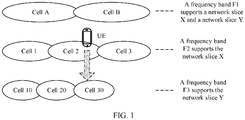
- a terminal device supports a network slice X and is attached to a cell (cell) 2 of a carrier frequency F2.
- the terminal device performs cell reselection.
- the terminal device selects a cell 30 of a carrier frequency F3, but the cell 30 does not support the network slice X. Therefore, when the terminal device initiates a connection request in the cell 30, the connection request of the terminal device is rejected by the cell 30.
- cell reselection of the terminal device becomes ineffective. Therefore, how to reduce ineffective cell reselection of a terminal device in an idle (idle) state or an inactive (inactive) state in a cell reselection process is a technical problem that needs to be resolved currently.
- Embodiments of the present invention provide a cell reselection method and a related device, so that when a terminal device performs cell reselection, cases in which the terminal device reselects a cell that does not support a network slice supported by the terminal device can be reduced, and signaling overheads generated because the terminal device performs ineffective cell reselection can be reduced.
- an embodiment of the present invention provides a cell reselection method, applied to a radio access network device side.
- the method includes: generating, by a radio access network device, cell reselection information, where the cell reselection information includes an identifier of at least one carrier frequency and an identifier of a network slice supported by each of the at least one carrier frequency; and sending, by the radio access network device, the cell reselection information to a terminal device, where the cell reselection information is used by the terminal device to perform cell reselection.
- the identifier of the network slice supported by each carrier frequency is newly added to the cell reselection information sent by the radio access network device to the terminal device.
- the terminal device may perform cell reselection based on a network slice supported by the terminal device and the network slice supported by each carrier frequency. In this way, cases in which the terminal device reselects a cell that does not support a network slice supported by the terminal device can be reduced, and signaling overheads generated because the terminal device performs ineffective cell reselection can be reduced.
- the radio access network device may send the cell reselection information to the terminal device in the following manner: broadcasting the cell reselection information to the terminal device.
- the radio access network device may send the cell reselection information to the terminal device in the following manner: adding the cell reselection information to a radio resource control (radio resource control, RRC) message, and sending the cell reselection information to the terminal device.
- RRC radio resource control
- the cell reselection information further includes priority information corresponding to each carrier frequency.
- the cell reselection information further includes priority information corresponding to each of network slices supported by the terminal device.
- the radio access network device adds the cell reselection information to the RRC message and sends the cell reselection information to the terminal device
- the network slice supported by each carrier frequency includes some or all of network slices supported by the terminal device.
- the RRC message includes an RRC connection release message or an RRC connection reject message.
- the radio access network device adds the cell reselection information to the RRC connection release message or the RRC connection reject message and sends the cell reselection information to the terminal device
- the cell reselection information further includes an identifier of a first network slice that causes an RRC connection of the terminal device to be released or rejected.
- the identifier of the network slice is session management slice selection assistance information (single network slice selection assistance information, SNSSAI) corresponding to the network slice, slice service type (slice service type, SST) information corresponding to the network slice, or a network slice set identifier corresponding to the network slice, where one piece of SNSSAI corresponds to one network slice, one SST corresponds to one or more network slices, and one network slice set identifier corresponds to one or more network slices.
- SNSSAI single network slice selection assistance information
- SST slice service type
- the radio access network device before generating the cell reselection information, receives a first request sent by the terminal device, where the first request is used to request the radio access network device to send the cell reselection information.
- the generating, by the radio access network device, the cell reselection information is specifically: generating, by the radio access network device, the cell reselection information based on the first request.
- the sending, by the radio access network device, the cell reselection information to the terminal device is specifically: adding, by the radio access network device, the cell reselection information to a random access response message (for example, a msg2 or a msg4 in a Long Term Evolution (LTE) or 5G system), and broadcasting the cell reselection information to the terminal device; or broadcasting, by the radio access network device, the cell reselection information to the terminal device through a broadcast channel.
- the radio access network device broadcasts the cell reselection information only after receiving the request sent by the terminal device, instead of always broadcasting the cell reselection information. Compared with a manner in which the radio access network device always broadcasts the cell reselection information, this can reduce broadcast signaling overheads.
- an embodiment of the present invention provides a cell reselection method, applied to a terminal device side.
- the method includes: receiving, by a terminal device, cell reselection information sent by a radio access network device, where the cell reselection information includes an identifier of at least one carrier frequency and an identifier of a network slice supported by each of the at least one carrier frequency; and when the terminal device performs cell reselection, selecting, by the terminal device based on the identifier of the network slice supported by each carrier frequency, a cell on a carrier frequency that supports a network slice supported by the terminal device as a reselected to-be-camped cell.
- the identifier of the network slice supported by each carrier frequency is newly added to the cell reselection information sent by the radio access network device to the terminal device. Therefore, during cell reselection, the terminal device may reselect, based on the network slice supported by the terminal device and the network slice supported by each carrier frequency, the cell on the carrier frequency that supports the network slice supported by the terminal device as the reselected to-be-camped cell. In this way, cases in which the terminal device reselects a carrier frequency that does not support the network slice supported by the terminal device can be reduced, and signaling overheads generated because the terminal device performs ineffective cell reselection can be reduced.
- the terminal device may receive, in the following manner, the cell reselection information sent by the radio access network device: receiving the cell reselection information broadcasted by the radio access network device.
- the terminal device may receive, in the following manner, the cell reselection information sent by the radio access network device: receiving the cell reselection information sent by the radio access network device by using an RRC message.
- the cell reselection information further includes priority information corresponding to each carrier frequency.
- the selecting, by the terminal device based on the identifier of the network slice supported by each carrier frequency, a cell on a carrier frequency that supports a network slice supported by the terminal device as a reselected to-be-camped cell is specifically: selecting, based on the identifier of the network slice supported by each carrier frequency and the priority information corresponding to each carrier frequency, a cell on a carrier frequency that supports the network slice supported by the terminal device and that has a highest priority as the reselected to-be-camped cell.
- the terminal device can reselect a cell that supports the network slice supported by the terminal device and that has the highest priority.
- the cell reselection information further includes priority information corresponding to each of network slices supported by the terminal device.
- the selecting, by the terminal device based on the identifier of the network slice supported by each carrier frequency, a cell on a carrier frequency that supports a network slice supported by the terminal device as a reselected to-be-camped cell is specifically: selecting, based on the identifier of the network slice supported by each carrier frequency and the priority information corresponding to each network slice, a cell on a carrier frequency that supports a highest-priority network slice of the network slices supported by the terminal device as the reselected to-be-camped cell.
- the terminal device can reselect a cell on a carrier frequency that supports a highest-priority network slice of the network slices supported by the terminal device.
- the network slice supported by each carrier frequency includes some or all of network slices supported by the terminal device.
- each carrier frequency carried in the cell reselection information sent by the radio access network device supports the network slice supported by the terminal device. Therefore, cases in which the terminal device reselects a cell that does not support the network slice supported by the terminal device can be reduced.
- the RRC message includes an RRC connection release message or an RRC connection reject message.
- the cell reselection information further includes an identifier of a first network slice that causes an RRC connection of the terminal device to be released or rejected.
- the selecting, by the terminal device based on the identifier of the network slice supported by each carrier frequency, a cell on a carrier frequency that supports a network slice supported by the terminal device as a reselected to-be-camped cell includes: selecting, by the terminal device based on the identifier of the network slice supported by each carrier frequency and the identifier of the first network slice, a cell on a carrier frequency that supports another network slice other than the first network slice as the reselected to-be-camped cell.
- the terminal device may select, based on the first network slice, a cell that supports a network slice that does not cause an RRC connection to be released or rejected.
- the identifier of the network slice is SNSSAI corresponding to the network slice, slice service type SST information corresponding to the network slice, or a network slice set identifier corresponding to the network slice, where one piece of SNSSAI corresponds to one network slice, one SST corresponds to one or more network slices, and one network slice set identifier corresponds to one or more network slices.
- the terminal device before receiving the cell reselection information sent by the radio access network device, the terminal device sends a first request to the radio access network device, where the first request is used to request the radio access network device to send the cell reselection information.
- the receiving, by a terminal device, cell reselection information sent by a radio access network device is specifically: receiving, by the terminal device, the cell reselection information broadcasted by the radio access network device by using a random access response message (for example, a msg2 or a msg4 in an LTE or 5G system); or receiving, by the terminal device, the cell reselection information broadcasted by the radio access network device through a broadcast channel.
- a random access response message for example, a msg2 or a msg4 in an LTE or 5G system
- the radio access network device broadcasts the cell reselection information only after receiving the request sent by the terminal device, instead of always broadcasting the cell reselection information. Compared with a manner in which the radio access network device always broadcasts the cell reselection information, this can reduce broadcast signaling overheads.
- an embodiment of the present invention further provides a radio access network device.
- the radio access network device implements functions of the radio access network device in the cell reselection method in the first aspect, and therefore can also implement beneficial effects of the cell reselection method in the first aspect.
- the functions of the radio access network device may be implemented by hardware, or may be implemented by hardware executing corresponding software.
- the hardware or the software includes at least one module or unit corresponding to the foregoing functions.
- the radio access network device includes a processing unit and a communications unit.
- the processing unit is configured to generate cell reselection information, where the cell reselection information includes an identifier of at least one carrier frequency and an identifier of a network slice supported by each of the at least one carrier frequency.
- the communications unit is configured to send the cell reselection information to a terminal device, where the cell reselection information is used by the terminal device to perform cell reselection.
- the identifier of the network slice supported by each carrier frequency is newly added to the cell reselection information sent by the radio access network device to the terminal device. Therefore, during cell reselection, the terminal device may perform cell reselection based on a network slice supported by the terminal device and the network slice supported by each carrier frequency. In this way, cases in which the terminal device reselects a cell that does not support a network slice supported by the terminal device can be reduced, and signaling overheads generated because the terminal device performs ineffective cell reselection can be reduced.
- the communications unit being configured to send the cell reselection information to a terminal device includes: broadcasting the cell reselection information to the terminal device.
- the communications unit being configured to send the cell reselection information to a terminal device includes: adding the cell reselection information to an RRC message, and sending the cell reselection information to the terminal device.
- the cell reselection information further includes priority information corresponding to each carrier frequency.
- the cell reselection information further includes priority information corresponding to each of network slices supported by the terminal device.
- the network slice supported by each carrier frequency includes some or all of network slices supported by the terminal device.
- the RRC message includes an RRC connection release message or an RRC connection reject message.
- the communications unit adds the cell reselection information to the RRC connection release message or the RRC connection reject message and sends the cell reselection information to the terminal device
- the cell reselection information further includes an identifier of a first network slice that causes an RRC connection of the terminal device to be released or rejected.
- the identifier of the network slice is SNSSAI corresponding to the network slice, an SST corresponding to the network slice, or a network slice set identifier corresponding to the network slice, where one piece of SNSSAI corresponds to one network slice, one SST corresponds to one or more network slices, and one network slice set identifier corresponds to one or more network slices.
- the communications unit before the processing unit generates the cell reselection information, is further configured to receive a first request sent by the terminal device, where the first request is used to request the radio access network device to send the cell reselection information.
- the generating, by the processing unit, the cell reselection information is specifically: generating the cell reselection information based on the first request.
- the communications unit being configured to send the cell reselection information to a terminal device is specifically: adding the cell reselection information to a random access response message (for example, a msg2 or a msg4 in an LTE or 5G system), and broadcasting the cell reselection information to the terminal device; or broadcasting the cell reselection information to the terminal device by using a broadcast channel.
- the radio access network device broadcasts the cell reselection information only after receiving the request sent by the terminal device, instead of always broadcasting the cell reselection information. Compared with a manner in which the radio access network device always broadcasts the cell reselection information, this can reduce broadcast signaling overheads.
- an embodiment of the present invention further provides a terminal device.
- the terminal device implements functions of the terminal device in the cell reselection method in the second aspect, and therefore can also implement beneficial effects of the cell reselection method in the second aspect.
- the functions of the terminal device may be implemented by hardware, or may be implemented by hardware executing corresponding software.
- the hardware or the software includes at least one module corresponding to the foregoing functions.
- the terminal device includes a processing unit and a communications unit.
- the communications unit is configured to receive cell reselection information sent by a radio access network device, where the cell reselection information includes an identifier of at least one carrier frequency and an identifier of a network slice supported by each of the at least one carrier frequency.
- the processing unit is configured to: when the terminal device performs cell reselection, select, based on the identifier of the network slice supported by each carrier frequency, a cell on a carrier frequency that supports a network slice supported by the terminal device as a reselected to-be-camped cell.
- the identifier of the network slice supported by each carrier frequency is newly added to the cell reselection information sent by the radio access network device to the terminal device. Therefore, during cell reselection, the terminal device may perform cell reselection based on a network slice supported by the terminal device and the network slice supported by each carrier frequency. In this way, cases in which the terminal device reselects a cell that does not support a network slice supported by the terminal device can be reduced, and signaling overheads generated because the terminal device performs ineffective cell reselection can be reduced.
- the communications unit being configured to receive cell reselection information sent by a radio access network device includes: receiving the cell reselection information broadcasted by the radio access network device.
- the communications unit being configured to receive cell reselection information sent by a radio access network device includes: receiving the cell reselection information sent by the radio access network device by using an RRC message.
- the cell reselection information further includes priority information corresponding to each carrier frequency.
- the processing unit being configured to select, based on the identifier of the network slice supported by each carrier frequency, a cell on a carrier frequency that supports a network slice supported by the terminal device as a reselected to-be-camped cell includes: selecting, based on the identifier of the network slice supported by each carrier frequency and the priority information corresponding to each carrier frequency, a cell on a carrier frequency that supports the network slice supported by the terminal device and that has a highest priority as the reselected to-be-camped cell.
- the terminal device can reselect a cell that supports the network slice supported by the terminal device and that has the highest priority.
- the cell reselection information further includes priority information corresponding to each of network slices supported by the terminal device.
- the processing unit being configured to select, based on the identifier of the network slice supported by each carrier frequency, a cell on a carrier frequency that supports a network slice supported by the terminal device as a reselected to-be-camped cell includes: selecting, based on the identifier of the network slice supported by each carrier frequency and the priority information corresponding to each network slice, a cell on a carrier frequency that supports a highest-priority network slice of the network slices supported by the terminal device as the reselected to-be-camped cell.
- the terminal device can reselect a cell on a carrier frequency that supports a highest-priority network slice of the network slices supported by the terminal device.
- the communications unit receives the cell reselection information sent by the radio access network device by using an RRC message
- the network slice supported by each carrier frequency includes some or all of network slices supported by the terminal device.
- each carrier frequency carried in the cell reselection information sent by the radio access network device supports the network slice supported by the terminal device. Therefore, cases in which the terminal device reselects a cell that does not support the network slice supported by the terminal device can be reduced.
- the RRC message includes an RRC connection release message or an RRC connection reject message.
- the communications unit receives the cell reselection information sent by the radio access network device by using the RRC connection release message or the RRC connection reject message
- the cell reselection information further includes an identifier of a first network slice that causes an RRC connection of the terminal device to be released or rejected.
- the terminal device may select, based on the first network slice, a cell that supports a network slice that does not cause an RRC connection to be released or rejected.
- the identifier of the network slice is SNSSAI corresponding to the network slice, an SST corresponding to the network slice, or a network slice set identifier corresponding to the network slice, where one piece of SNSSAI corresponds to one network slice, one SST corresponds to one or more network slices, and one network slice set identifier corresponds to one or more network slices.
- the communications unit before receiving the cell reselection information sent by the radio access network device, the communications unit is further configured to send a first request to the radio access network device, where the first request is used to request the radio access network device to send the cell reselection information.
- the communications unit being configured to receive cell reselection information sent by a radio access network device is specifically: receiving the cell reselection information broadcasted by the radio access network device by using a random access response message (for example, a msg2 or a msg4 in an LTE or 5G system); or receiving the cell reselection information broadcasted by the radio access network device through a broadcast channel.
- a random access response message for example, a msg2 or a msg4 in an LTE or 5G system
- the radio access network device broadcasts the cell reselection information only after receiving the request sent by the terminal device, instead of always broadcasting the cell reselection information. Compared with a manner in which the radio access network device always broadcasts the cell reselection information, this can reduce broadcast signaling overheads.
- an embodiment of the present invention further provides another radio access network device.
- the radio access network device implements functions of the radio access network device in the cell reselection method in the first aspect, and therefore can also implement beneficial effects of the cell reselection method in the first aspect.
- the functions of the radio access network device may be implemented by hardware, or may be implemented by hardware executing corresponding software.
- the hardware or the software includes at least one module corresponding to the foregoing functions.
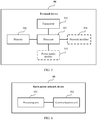
- the radio access network device includes a transceiver and a processor that respectively implement functions corresponding to the communications unit and the processing unit of the radio access network device in the third aspect.
- an embodiment of the present invention further provides another terminal device.
- the terminal device implements functions of the terminal device in the cell reselection method in the second aspect, and therefore can also implement beneficial effects of the cell reselection method in the second aspect.
- the functions of the terminal device may be implemented by hardware, or may be implemented by hardware executing corresponding software.
- the hardware or the software includes at least one module corresponding to the foregoing functions.
- the terminal device includes a transceiver and a processor that respectively implement functions corresponding to the communications unit and the processing unit of the terminal device in the fourth aspect.
- this application provides an apparatus.
- the apparatus may include a processor, and one or more interfaces coupled to the processor.
- the processor may be configured to: invoke, from a memory, an implementation program of the cell reselection method provided in the first aspect or the cell reselection method provided in any one of the possible implementations of the first aspect, and execute an instruction included in the program.
- the interface may be configured to output an execution result of the processor.
- this application provides an apparatus.
- the apparatus may include a processor, and one or more interfaces coupled to the processor.
- the processor may be configured to: invoke, from a memory, an implementation program of the cell reselection method provided in the second aspect or the cell reselection method provided in any one of the possible implementations of the second aspect, and execute an instruction included in the program.
- the interface may be configured to output an execution result of the processor.
- an embodiment of the present invention further provides a communications system, including: a radio access network device and a terminal device.
- the radio access network device is the radio access network device in the third aspect or the fifth aspect
- the terminal device is the terminal device in the fourth aspect or the sixth aspect.
- an embodiment of the present invention provides a computer storage medium, configured to store a computer software instruction used by the radio access network device in the first aspect.
- the radio access network device is enabled to perform the method in the first aspect.
- an embodiment of the present invention provides another computer storage medium, configured to store a computer software instruction used by the terminal device in the second aspect.
- the terminal device is enabled to perform the method in the second aspect.
- an embodiment of the present invention provides a computer program, where the program includes a computer software instruction.
- the instruction is executed by the radio access network device, the radio access network device is enabled to perform the method in the first aspect.
- an embodiment of the present invention provides another computer program, where the program includes a computer software instruction.
- the instruction is executed by the terminal device, the terminal device is enabled to perform the method in the second aspect.
- the radio access network device sends the cell reselection information to the terminal device in the broadcast manner or by using the RRC message, where the identifier of the network slice supported by each carrier frequency is newly added to the cell reselection information. Therefore, during cell reselection, the terminal device may perform cell reselection based on a network slice supported by the terminal device and the network slice supported by each carrier frequency. In this way, cases in which the terminal device reselects a cell that does not support a network slice supported by the terminal device can be reduced, and signaling overheads generated because the terminal device performs ineffective cell reselection can be reduced.
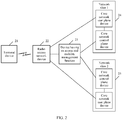
- FIG. 2 is a schematic architecture diagram of a network system according to an embodiment of the present invention.
- the network system includes a terminal device 21, a radio access network (radio access network, RAN) device 22, a device 23 having an access and mobility management function (access and mobility management function, AMF), a dedicated (dedicated) core network device (including a core network control plane device and a core network user plane device) 24 of a network slice 1, and a dedicated core network device (including a core network control plane device and a core network user plane device) 25 of a network slice 2.
- a service carrier frequency of the radio access network device 22 is F1
- the terminal device 21 supports the network slice 1 and the network slice 2.
- the terminal device 21 initially camps on a cell of the radio access network device 22.
- a device that can perform data communication with a radio access network device may be considered as a terminal device.
- the terminal device may also be referred to as user equipment, a mobile station, an access terminal, a subscriber unit, a subscriber station, a remote station, a remote terminal, a mobile device, a user terminal, a terminal, a wireless communications device, a user agent, a user apparatus, or the like.
- the terminal device may be a handheld terminal device, a notebook computer, a subscriber unit (subscriber unit), a cellular phone (cellular phone), a smartphone (smart phone), a wireless data card, a personal digital processing (personal digital assistant, PDA), a handheld device with a wireless communication function, a vehicle-mounted device, a wearable device, a mobile station in a future 5G network, a terminal device in a future evolved public land mobile network (public land mobile network, PLMN), or the like.
- a terminal device and a radio access network device communicate with each other by using an air interface technology.
- the radio access network device is mainly responsible for functions on an air interface side such as radio resource management, quality of service (quality of service, QoS) management, and data compression and encryption.
- the radio access network device may include various forms of radio access network devices, for example, a macro radio access network device, a micro radio access network device (also referred to as a small cell), a relay station, and an access point.
- a device having a function of a radio access network device may have different names.
- the device is referred to as a next-generation NodeB (next-generation NodeB, gNB).
- the device In an LTE system, the device is referred to as an evolved NodeB (evolved NodeB, eNB or eNodeB). In a 3rd-generation (3rd Generation, 3G) system, the device is referred to as a nodeB (Node B).
- eNB evolved NodeB
- eNode B nodeB
- 3rd Generation 3rd Generation
- the device 23 having the AMF is a core network element.
- the device 23 having the AMF may be any entity device having an access and mobility management function.
- the device 23 having the AMF is mainly responsible for signaling processing, that is, a control plane function, including functions such as access control, mobility management, and attachment and detachment.
- the device 23 having the AMF may further select a network slice that the terminal device accesses. For example, when initially accessing a network or performs tracking area update (tracking area update, TAU), the terminal device provides network slice selection assistance information (network slice selection assistance information, NSSAI) to the device 23 having the AMF.
- NSSAI network slice selection assistance information
- the NSSAI includes one piece of SNSSAI or a group of pieces of SNSSAI, and one piece of SNSSAI may be used to determine one network slice.
- a group of pieces of SNSSAI may be used to determine one or more network slices.
- the device 23 having the AMF or another core network device selects a network slice instance for the terminal device based on one or more pieces of SNSSAI included in NSSAI.
- each piece of SNSSAI may include an SST, used to indicate a specific feature and a specific service type of the network slice.
- each piece of SNSSAI may further include a slice differentiator (slice differentiator, SD).
- the slice differentiator may be used to further distinguish a plurality of network slice instances that having a same SST.
- the SNSSAI does not need to include the SD, and when different network slices cannot be distinguished by using the SST, the SNSSAI needs to include the SD.
- One SST may correspond to one or more network slices, and one piece of SNSSAI corresponds to one network slice.
- Three 5G application scenarios are defined in a 3GPP meeting, and include enhanced mobile broadband (enhanced mobile broadband, eMBB), ultra-reliable low-latency communication (ultra reliable & low latency communication, uRLLC), and massive machine-type communications (massive machine type communication, mMTC).
- eMBB enhanced mobile broadband
- uRLLC ultra-reliable low-latency communication
- mMTC massive machine-type communications
- Each application scenario may correspond to an SST.
- an SST corresponding to eMBB is 00000000
- an SST corresponding to URLLC is 00000001
- an SST corresponding to mMTC is 00000010.
- the eMBB application scenario involves a plurality of network slices, the plurality of network slices have a same SST.
- the plurality of network slices may be distinguished from each other based on SDs. SSTs may be classified in another manner. This is not specifically limited in this embodiment of the present invention.
- network slices are obtained through slicing in a core network. All network slices share a radio access network device. For example, the network slice 1 and the network slice 2 in FIG. 2 share the radio access network device 22. In addition, all network slices share the device 23 having the AMF.
- Each network slice may have one or more dedicated core network control plane devices, and each network slice may also have one or more dedicated core network user plane devices. Functions provided by a dedicated core network control plane device of each network slice may include: session management and the like, to set up a session for the terminal device.
- the terminal device 21 may simultaneously support one or more network slices.
- the terminal device 21 has a capability of simultaneously accessing one or more network slices.
- the terminal device 21 simultaneously uses a plurality of network slices, that is, when the terminal device 21 transmits service data corresponding to the plurality of network slices, if the radio access network device 22 supports the plurality of network slices, the terminal device 21 needs to establish only one RRC connection to the radio access network device 22, and the device 23 having the AMF may simultaneously serve the plurality of network slices used by the terminal device 21. For example, in FIG.
- the terminal device 21 may transmit, by using the radio access network device 22, data of the network slice 1 to a core network user plane device corresponding to the network slice 1, and the terminal device 21 transmits, by using the radio access network device 22, data of the network slice 2 to a core network user plane device corresponding to the network slice 2.
- each radio access network device has one or more carrier frequencies, and the radio access network device controls one or more cells on each carrier frequency.
- a plurality of cells on a same carrier frequency may be controlled by different radio access network devices.
- the terminal device camps on a gNB1, cells of the gNB1 include a cell 1 and a cell 2, a neighboring access network device of the gNB1 includes a gNB2, and cells of the gNB2 include a cell 3 and a cell 4.
- Both carrier frequencies corresponding to the cell 1 and the cell 3 are F1
- a carrier frequency corresponding to the cell 2 is F2
- a serving carrier frequency corresponding to the cell 4 is F3. Therefore, during cell reselection, the terminal device may reselect a cell on another carrier frequency, or may reselect a cell that has a same carrier frequency as that of a currently camped cell but that is of another radio access network device, to camp on the reselected cell.
- That a carrier frequency supports the network slice 1 means that a cell on the carrier frequency may send, to a core network control plane device corresponding to the network slice 1, a session request that is of the network slice 1 and that is sent by a terminal device, to set up a session for the network slice 1, and the cell on the carrier frequency may send, to a core network user plane device corresponding to the network slice 1, data that is of the network slice 1 and that is sent by the terminal device.
- That a carrier frequency supports the network slice 2 means that a cell on the carrier frequency may send, to a core network control plane device corresponding to the network slice 2, a session request that is of the network slice 2 and that is sent by a terminal device, to set up a session for the network slice 2, and the cell on the carrier frequency may send, to a core network user plane device corresponding to the network slice 2, data that is of the network slice 2 and that is sent by the terminal device.
- That the terminal device supports the network slice 1 means that the terminal device may send, by using the radio access network device, a session request of the network slice 1 to the core network control plane device corresponding to the network slice 1, to set up a session for the network slice 1, and service data of the network slice 1 may be transmitted between the terminal device and the core network user plane device corresponding to the network slice 1.
- That the terminal device supports the network slice 2 means that the terminal device may send, by using the radio access network device, a session request of the network slice 2 to the core network control plane device corresponding to the network slice 2, to set up a session for the network slice 2, and service data of the network slice 2 may be transmitted between the terminal device and the core network user plane device corresponding to the network slice 2.
- application scenarios in which the terminal device 21 performs cell reselection include but are not limited to the following types:
- the terminal device 21 camps on the cell of the radio access network device 22.
- the terminal device 21 learns through measurement that signal quality of the cell is less than a preset threshold, the terminal device 21 needs to reselect a cell.
- the terminal device 21 selects, based on the cell reselection information sent by the radio access network device 22, one of carrier frequencies that support the network slice supported by the terminal device 21 as a target carrier frequency, selects a cell on the target carrier frequency as a reselected to-be-camped cell, and then camps on the to-be-camped cell.
- the terminal device 21 camps on the cell of the radio access network device 22, and the terminal device 21 learns, based on the cell reselection information sent by the radio access network device 22, that both the carrier frequency F1 and the carrier frequency F2 support the network slice 1 and the network slice 2, and a priority of the carrier frequency F2 is higher than a priority of the carrier frequency F1, and the carrier frequency F3 supports neither the network slice 1 nor the network slice 2.
- the terminal device 21 needs to perform cell reselection, selects the carrier frequency F2 as a target carrier frequency, and then selects a cell on the carrier frequency F2 as a reselected to-be-camped cell.
- the terminal device 21 camps on the cell of the radio access network device 22, and the terminal device 21 learns, based on the cell reselection information sent by the radio access network device 22, that both the carrier frequency F1 and the carrier frequency F2 support the network slice 1 and the network slice 2.
- the terminal device 21 learns, through measurement, that signal quality of a cell on the carrier frequency F2 is higher than signal quality of a currently camped cell by a specific threshold. In this case, the terminal device 21 needs to perform cell reselection, selects the carrier frequency F2 as a target carrier frequency, and then selects a cell on the carrier frequency F2 as a reselected to-be-camped cell.
- the terminal device 21 camps on the cell of the radio access network device 22, and when learning, through measurement, that signal quality of the cell is less than the preset threshold, the terminal device 21 learns, based on the cell reselection information sent by the radio access network device 22, that the carrier frequency F1 supports the network slice 1 and the network slice 2. In addition, the terminal device 21 learns, through measurement, that signal quality of another cell 2 on the carrier frequency F1 is higher than signal quality of the currently camped cell by a specific threshold. In this case, the terminal device 21 needs to perform cell reselection, selects the carrier frequency F1 as a target carrier frequency, and then selects the cell 2 on the carrier frequency F1 as a to-be-camped cell.
- the terminal device 21 camps on the cell of the radio access network device 22, and the terminal device 21 learns, based on the cell reselection information sent by the radio access network device 22, that the carrier frequency F 1 and the carrier frequency F3 support neither the network slice 1 nor the network slice 2, and the carrier frequency F2 supports the network slice 1 and the network slice 2.
- the terminal device 21 needs to perform cell reselection, and selects the carrier frequency F2 as a target carrier frequency. After selecting the target carrier frequency, the terminal device 21 performs blind detection on the target carrier frequency, to determine whether a cell whose signal quality is higher than that of a currently camped cell by a specific threshold exists on the target carrier frequency.
- the terminal device 21 selects the cell whose signal quality is higher than that of the currently camped cell by the specific threshold as the reselected to-be-camped cell. Therefore, in the solutions in the embodiments of the present invention, when a terminal device performs cell reselection, cases in which the terminal device reselects a carrier frequency that cannot support a network slice supported by the terminal device can be reduced, and cell reselection efficiency can be improved.
- the states of the terminal device include: an idle state, an inactive state, and a connected (connected) state.
- an RRC connection exists between the terminal device and the radio access network device
- the terminal device is in the connected state, and data can be transmitted between the terminal device and the radio access network device.
- an RRC connection between the terminal device and the radio access network device may be released, and the terminal device enters the idle state.
- Releasing the RRC connection means releasing all radio bearers established between the terminal device and the radio access network device.
- the terminal device in the idle state or the inactive state may perform cell reselection.
- the identifier of the network slice may be SNSSAI corresponding to the network slice, or may be an SST corresponding to the network slice, or may be a network slice set identifier corresponding to the network slice.
- One network slice corresponds to one piece of SNSSAI
- one piece of NSSAI corresponds to one or more pieces of SNSSAI
- one SST corresponds to one or more pieces of SNSSAI
- one network slice set identifier corresponds to one or more pieces of SNSSAI.
- the network slice set identifier is different from the SST, and a plurality of network slices corresponding to a same network slice set identifier may correspond to different SSTs.
- the network slice set identifier may be obtained by grouping a plurality of network slices into different network slice sets by the radio access network device or the device 23 having the AMF, and each network slice set corresponds to one network slice set identifier.
- a network slice 1, a network slice 2, a network slice 3, and a network slice 4 are used for description, and SNSSAI of the four network slices may be, for example, SNSSAI1, SNSSAI2, SNSSAI3, and SNSSAI4.
- the network slice 1 and the network slice 2 belong to an eMBB service type, and a corresponding SST may be, for example, 00000000.
- the network slice 3 and the network slice 4 belong to a URLLC service type, and a corresponding SST may be, for example, 00000001.
- the radio access network device groups the network slice 1 and the network slice 3 into a network slice set, where a corresponding network slice set identifier may be, for example, S1, and groups the network slice 2 and the network slice 4 into another network slice set, where a corresponding network slice set identifier may be, for example, S2.
- a quantity of cells on each carrier frequency is not limited.
- a manner in which the terminal device selects a cell on the target carrier frequency as the reselected to-be-camped cell is not specifically limited.
- the terminal device may alternatively select a cell whose signal quality meets a preset condition on the target carrier frequency as the to-be-camped cell. For example, a cell whose cell quality is greater than that of the current cell by a threshold is selected as the to-be-camped cell, or a cell whose signal quality is the best is selected as the to-be-camped cell.
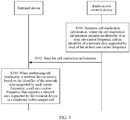
- the cell reselection method includes but is not limited to the following steps S301 to S303.
- a radio access network device generates cell reselection information, where the cell reselection information includes an identifier of at least one carrier frequency and an identifier of a network slice supported by each of the at least one carrier frequency.
- the radio access network device sends the cell reselection information to the terminal device.
- the identifier of the carrier frequency may be specifically a carrier frequency ID, a frequency value of the carrier frequency, or the like.
- a carrier frequency ID of the carrier frequency F1 is F001
- a carrier frequency ID of the carrier frequency F2 is F002
- a carrier frequency ID of the carrier frequency F3 is F003
- a frequency value of the carrier frequency F1 is 890.2 MHz
- a frequency value of the carrier frequency F2 is 890 MHz
- a frequency value of the carrier frequency F3 is 890.4 MHz.
- the at least one carrier frequency includes a serving carrier frequency of the radio access network device and/or a neighboring carrier frequency of the radio access network device or another carrier frequency.
- Application scenarios of the embodiments of the present invention mainly include two types: In a first application scenario, the terminal device is in an idle state or an inactive state, and an RRC connection with the radio access network device does not exist or suspends.
- the radio access network device generates the cell reselection information, and broadcasts the cell reselection information to the terminal device, so that when the terminal device needs to perform cell reselection, the terminal device can reselect, based on the cell reselection information, a carrier frequency that supports a network slice supported by the terminal device.
- the radio access network device adds the cell reselection information to an RRC message and sends the cell reselection information to the terminal device, so that when the terminal device needs to perform cell reselection, the terminal device can reselect, based on the cell reselection information, a carrier frequency that supports a network slice supported by the terminal device. For example, an RRC connection between the terminal device and the radio access network device exists, and the radio access network device generates the cell reselection information. After data transmission between the terminal device and the radio access network device stops, the RRC connection needs to be released.
- the radio access network device adds the cell reselection information to an RRC connection release message and sends the cell reselection information to the terminal device.
- the radio access network device rejects establishment of an RRC connection.
- the radio access network device adds the cell reselection information to an RRC connection rejection message and sends the cell reselection information to the terminal device, so that when the terminal device needs to perform cell reselection, the terminal device can reselect, based on the cell reselection information, a carrier frequency that supports a network slice supported by the terminal device.
- the radio access network device may alternatively add the cell reselection information to another RRC message and send the cell reselection information to the terminal device. This is not specifically limited in this embodiment of the present invention.
- the identifier of the network slice may be slice service type information, that is, an SST, corresponding to the network slice.
- SST slice service type information
- the terminal device can support a plurality of network slices, and when there are a relatively large quantity of network slices, broadcasting a large quantity of network slice identifiers causes a large quantity of signaling overheads.
- One SST may correspond to one or more network slices. Therefore, broadcasting the SST instead of broadcasting SNSSAI can reduce broadcast signaling overheads of the radio access network device.
- the SST may be obtained by the terminal device by sending a first request to the radio access network device.
- the first request is used to instruct the radio access network device to send the cell reselection information to the terminal device.
- the radio access network device After receiving the first request sent by the terminal device, the radio access network device generates the cell reselection information that includes the identifier of the carrier frequency and the SST supported by each carrier frequency, and broadcasts the cell reselection information to the terminal device by using a random access response message (for example, a msg2 or a msg4 in a random access procedure in an LTE or 5G system).
- a random access response message for example, a msg2 or a msg4 in a random access procedure in an LTE or 5G system.
- the radio access network device may further broadcast the cell reselection information to each terminal device through a broadcast channel.
- the terminal device in the idle state receives a broadcast message of a gNB1.
- a serving carrier frequency of the gNB1 is F1
- neighboring carrier frequencies or other carrier frequencies of F1 are F2, F3, and F4.
- the at least one carrier frequency included in the cell reselection information broadcasted by the gNB1 to the terminal device includes the carrier frequency F1, the carrier frequency F2, the carrier frequency F3, or the carrier frequency F4.
- Network slices supported by the carrier frequency F1 include a network slice 1, a network slice 2, and a network slice 3
- network slices supported by the carrier frequency F2 include the network slice 1 and a network slice 4
- network slices supported by the carrier frequency F3 include the network slice 2, the network slice 3, and a network slice 5,
- network slices supported by the carrier frequency F4 include the network slice 3 and the network slice 5.
- SSTs corresponding to the network slice 1 and the network slice 2 are an SST1
- SSTs corresponding to the network slice 3, the network slice 4, and the network slice 5 are an SST2.
- an identifier of the SST1 may be 00000000 corresponding to an eMBB service
- an identifier of the SST2 may be 00000001 corresponding to the URLLC.
- an identifier of the carrier frequency F1 is F001
- an identifier of the carrier frequency F2 is F002
- an identifier of the carrier frequency F3 is F003
- an identifier of the carrier frequency F4 is F004 is used for description. Therefore, in this embodiment of the present invention, for the identifier of the carrier frequency and the identifier of the SST that are included in the cell reselection information, refer to a mapping table shown in the following Table 1 or Table 2.
- Table 1 Identifier of a carrier frequency Identifier of an SST F001 SST1 and SST2 F002 SST1 and SST2 F003 SST1 and SST2 F004 SST2 Table 2 Identifier of an SST Identifier of a carrier frequency SST1 F001, F002, and F003 SST2 F001, F002, F003, and F004
- the cell reselection information may further include priority information corresponding to each carrier frequency.
- priorities of the carrier frequency F1, the carrier frequency F2, the carrier frequency F3, and the carrier frequency F4 are a first priority, a second priority, a third priority, and a fourth priority respectively. That is, the priorities of the carrier frequency F1, the carrier frequency F2, the carrier frequency F3, and the carrier frequency F4 decrease sequentially.
- Table 3 is an example of a mapping table of an identifier of a carrier frequency, an identifier of an SST supported by each carrier frequency, and a priority of each carrier frequency that are included in the cell reselection information.
- the cell reselection information may further include priority information corresponding to each SST.
- a priority of the SST1 is the first priority
- a priority of the SST2 is the second priority, that is, the priority of the SST1 is higher than that of the SST2.
- Table 4 is an example of a mapping table of an identifier of a carrier frequency, an identifier of an SST supported by each carrier frequency, and a priority of each SST that are included in the cell reselection information.
- Table 4 Identifier of an SST Identifier of a carrier frequency Priority of an SST SST1 F001, F002, and F003 First priority SST2 F001, F002, F003, and F004 Second priority
- the radio access network device sends the cell reselection information to the terminal device by using an RRC message.
- the identifier of the network slice may be SNSSAI corresponding to the network slice.
- the identifier of the network slice may also be an SST corresponding to the network slice.
- the identifier of the network slice may also be the SST corresponding to the network slice.
- each carrier frequency included in the cell reselection information supports the network slice supported by the terminal device, and the network slice supported by each carrier frequency is some or all of network slices supported by the terminal device.
- the terminal device in the idle state or the inactive state may perform cell reselection based on the network slice supported by the terminal device and the network slice supported by each carrier frequency. In this way, cases in which the terminal device reselects a cell that does not support a network slice supported by the terminal device can be reduced, and signaling overheads generated because the terminal device performs ineffective cell reselection can be reduced.
- network slices supported by the terminal device include a network slice 1 and a network slice 2.
- an identifier of the network slice 1 is SNSSAI1
- an identifier of the network slice 2 is SNSSAI2.
- An RRC connection exists between the terminal device and a gNB1.
- a serving carrier frequency of the gNB1 is F1
- neighboring or other carrier frequencies of F1 are F2, F3, and F4.
- F2 and F3 can support the network slice 1 or the network slice 2
- the carrier frequency F4 supports neither the network slice 1 nor the network slice 2.
- the at least one carrier frequency included in the cell reselection information includes the carrier frequency F1, the carrier frequency F2, and the carrier frequency F3, and does not include the carrier frequency F4.
- the carrier frequency F1 can support the network slice 1 and the network slice 2, the carrier frequency F2 can support the network slice 1, and the carrier frequency F3 can support the network slice 2.
- the network slice corresponding to each carrier frequency included in the cell reselection information includes some or all of the network slices supported by the terminal device.
- each carrier frequency can support a plurality of network slices, and network slices corresponding to the carrier frequency carried in the cell reselection information all belong to the network slices supported by the terminal device.
- An identifier of a network slice of the network slices supported by the carrier frequency other than the network slice supported by the terminal device does not need to be carried in the cell reselection information.
- the network slices supported by the terminal device include the network slice 1 and the network slice 2.
- the carrier frequency F1 may further support a network slice 3
- the carrier frequency F2 may further support a network slice 4
- the carrier frequency F3 may further support a network slice 3 and a network slice 5.
- Table 1 nor Table 2 includes identifiers of the network slice 3, the network slice 4, and the network slice 5. This is because the terminal device does not support these network slices, and identifiers of the network slices not supported by the terminal device do not need to be added to the cell reselection information to occupy a transmission resource.
- the cell reselection information further includes priority information corresponding to each carrier frequency.
- priorities of the carrier frequency F1, the carrier frequency F2, and the carrier frequency F3 are a first priority, a second priority, and a third priority respectively. That is, the priorities of the carrier frequency F1, the carrier frequency F2, and the carrier frequency F3 decrease sequentially.
- Table 7 is an example of a mapping table of an identifier of a carrier frequency, SNSSAI supported by each carrier frequency, and a priority of each carrier frequency that are included in the cell reselection information.
- Table 7 Identifier of a carrier frequency Identifier of a network slice Priority of a carrier frequency F001 SNSSAI1 and SNSSAI2 First priority F002 SNSSAI1 Second priority F003 SNSSAI2 Third priority
- the cell reselection information further includes priority information corresponding to each network slice.
- the terminal device supports the network slice 1 and the network slice 2, a priority of the network slice 1 is a first priority, and a priority of the network slice 2 is a second priority, that is, the priority of the network slice 1 is higher than that of the network slice 2.
- Table 8 is an example of a mapping table of an identifier of a carrier frequency, an identifier of a network slice supported by each carrier frequency, and a priority of each network slice that are included in cell reselection information.
- Table 8 Identifier of a carrier frequency Identifier of a network slice Priority of a network slice F001 and F002 SNSSAI1 First priority F001 and F003 SNSSAI2 Second priority
- the identifier of the network slice may be an SST corresponding to the network slice.
- the identifier of the carrier frequency and the SST supported by each carrier frequency where the identifier of the carrier frequency and the SST supported by each carrier frequency are carried in the cell reselection information sent by the radio access network device by using the RRC message, refer to Table 1 or Table 2.
- the cell reselection information further includes a priority of a carrier frequency, for an example of the identifier of the carrier frequency, the SST supported by each carrier frequency, and the priority of each carrier frequency, where the identifier of the carrier frequency, the SST supported by each carrier frequency, and the priority of each carrier frequency are carried in the cell reselection information sent by the radio access network device by using the RRC message, refer to Table 3.
- the cell reselection information further includes a priority of an SST, for an example of the identifier of the carrier frequency, the SST supported by each carrier frequency, and the priority of each SST, where the identifier of the carrier frequency, the SST supported by each carrier frequency, and the priority of each SST are carried in the cell reselection information sent by the radio access network device by using the RRC message, refer to Table 4.
- the cell reselection information may further include an identifier of a first network slice that causes an RRC connection of the terminal device to be released or rejected.
- the identifier of the first network slice is used to instruct the terminal device to reselect, during cell reselection, a cell on a carrier frequency that supports a network slice other than the first network slice as a reselected to-be-camped cell.
- the RRC connection release message is used as an example.
- the identifier of the first network slice may be carried in loadBalancingTAUrequired information in the RRC connection release message.
- the loadBalancingTAUrequired information carried in the RRC connection release message is loadBalancingTAUrequired-SNSSAI1.
- SNSSAI1 indicates that the RRC connection between the terminal device and the gNB1 is released because of network congestion triggered by the network slice 1.
- the network slice 1 is the first network slice. In this case, when performing cell reselection, the terminal device may reselect a cell on the carrier frequency that supports the network slice 2.
- the terminal device when the terminal device sends an RRC connection request to the radio access network device again, the RRC connection request does not need to carry the identifier of the network slice 1, so that the radio access network device selects another AMF device, and connects the terminal device to the another AMF device.
- the identifier of the network slice may alternatively be a network slice set identifier corresponding to the network slice.
- the network slice set identifier may alternatively have another name. This is not specifically limited in this embodiment of the present invention. This is because of the following reason:
- the terminal device can support a plurality of network slices, and when there are a relatively large quantity of network slices, broadcasting a large quantity of network slice identifiers causes a large quantity of signaling overheads. Therefore, broadcasting the network slice set identifier instead of broadcasting the SNSSAI can reduce broadcast signaling overheads of the radio access network device.
- the network slice set identifier may be obtained by the terminal device by sending a first request to the radio access network device.
- the first request is used to instruct the radio access network device to send the cell reselection information to the terminal device.
- the radio access network device After receiving the first request sent by the terminal device, the radio access network device generates the cell reselection information that includes the identifier of the carrier frequency and the network slice set identifier supported by each carrier frequency, and sends the cell reselection information to the terminal device by using a random access response message (for example, a msg2 or a msg4) or another message.
- a random access response message for example, a msg2 or a msg4
- the radio access network device may further broadcast the cell reselection information to each terminal device in a broadcast manner.
- the RRC connection between the terminal device and the gNB1 is released, the terminal device enters the idle state, and the gNB1 broadcasts the cell reselection information to the terminal device.
- the cell reselection information includes network slice set identifiers respectively corresponding to the serving carrier frequency F1 of the gNB1 and the neighboring carrier frequencies F2 and F3.
- the cell reselection information broadcasted by the gNB1 refer to Table 9.
- Table 9 Identifier of a carrier frequency Network slice set identifier F1 S1 F2 S1 and S2 F3 S2
- the terminal device after receiving the cell reselection information broadcasted by the gNB1, with reference to a pre-stored mapping table (which may be shown in the following Table 10) between an identifier of a network slice and a network slice set identifier based on the network slice 1 and the network slice 2 supported by the terminal device, the terminal device can learn that a corresponding network slice set identifier is S1, and can learn, based on the received cell reselection information, that carrier frequencies that can support S1 include the carrier frequency F1 and the carrier frequency F2. Therefore, the terminal device selects the carrier frequency F1 or the carrier frequency F2 as a target carrier frequency.
- a pre-stored mapping table which may be shown in the following Table 10
- the cell reselection information further includes priority information corresponding to each carrier frequency.
- priorities of the carrier frequency F1, the carrier frequency F2, and the carrier frequency F3 are a first priority, a second priority, and a third priority respectively. That is, the priorities of the carrier frequency F1, the carrier frequency F2, and the carrier frequency F3 decrease sequentially.
- Table 11 is an example of a mapping table of an identifier of a carrier frequency, an identifier of a network slice supported by each carrier frequency, and a priority of each carrier frequency that are included in cell reselection information.
- Table 11 Identifier of a carrier frequency Network slice set identifier Priority of a carrier frequency F002 S 1 and S2 First priority F001 S1 Second priority F003 S2 Third priority
- the cell reselection information may further include priority information corresponding to each network slice set.
- a priority of a network slice set 1 is a first priority
- a priority of a network slice set 2 is a second priority, that is, the priority of the network slice set 1 is higher than that of the network slice set 2.
- Table 12 is an example of a mapping table of an identifier of a carrier frequency, a network slice set identifier supported by each carrier frequency, and a priority of each network slice set that are included in cell reselection information.
- Table 12 Network slice set identifier Identifier of a carrier frequency Priority of a network slice set S1 F001 and F002 First priority S2 F002 and F003 Second priority
- the terminal device receives the cell reselection information sent by the radio access network device, and when performing cell reselection, the terminal device selects, based on the cell reselection information, a cell on a carrier frequency that supports a network slice supported by the terminal device as a reselected to-be-camped cell.
- the terminal device when performing cell reselection, reselects, based on the SST supported by each carrier frequency and the SST supported by the terminal device, a carrier frequency that can support the SST supported by the terminal device as a target carrier frequency, to select a to-be-camped cell on the target carrier frequency.
- the network slice supported by the terminal device is the network slice 1, and an SST corresponding to the network slice 1 is an SST1. If learning, based on the cell reselection information broadcasted by the gNB1, that a carrier frequency that supports the SST1 includes only the carrier frequency F1, the terminal device selects the carrier frequency F1 as the target carrier frequency, and selects a cell on the carrier frequency F1 as the reselected to-be-camped cell.
- a manner in which the terminal device selects a cell on the target carrier frequency as the reselected to-be-camped cell is not specifically limited.
- the terminal device may alternatively select a cell whose signal quality meets a preset condition on the target carrier frequency as the to-be-camped cell.
- a cell whose cell quality is greater than that of the current cell by a threshold is selected as the to-be-camped cell, or a cell whose signal quality is the best is selected as the to-be-camped cell.
- the target carrier frequency is F1
- the terminal device separately measures signal quality of the four cells, and obtains measurement values: -86 dBm, -96 dBm, -106 dBm, and -116 dBm. In this case, the terminal device selects the cell A with highest signal quality as the reselected to-be-camped cell, and then the terminal device camps on the cell A.
- the terminal device may further select a carrier frequency with best signal quality as the target carrier frequency based on signal quality of the plurality of carrier frequencies, to select a to-be-camped cell on the target carrier frequency.
- the network slice supported by the terminal device is the network slice 1, and an SST corresponding to the network slice 1 is an SST1.
- the terminal device selects the carrier frequency F1 as the target carrier frequency, to select a to-be-camped cell on the target carrier frequency.
- the terminal device selects, based on the identifier of the carrier frequency, the SST supported by each carrier frequency, and a priority of each carrier frequency, a carrier frequency that can support the SST supported by the terminal device and that has a highest priority as the target carrier frequency, to select a to-be-camped cell on the target carrier frequency.
- the network slices supported by the terminal device are the network slice 1 and the network slice 2, an SST corresponding to the network slice 1 is an SST1, and an SST corresponding to the network slice 2 is an SST2.
- the terminal device selects the carrier frequency F2 as the target carrier frequency, to select a to-be-camped cell on the carrier frequency F2.
- the terminal device may further select a carrier frequency with a highest priority as the target carrier frequency based on a priority of each carrier frequency, to select a to-be-camped cell on the target carrier frequency.
- the network slice supported by the terminal device is the network slice 1, and an SST corresponding to the network slice 1 is an SST1. If learning, based on the cell reselection information broadcasted by the gNB1, that carrier frequencies that support the SST1 include the carrier frequency F1 and the carrier frequency F2, and a priority of the carrier frequency F2 is higher than a priority of the carrier frequency F1, the terminal device selects the carrier frequency F2 as the target carrier frequency, to select a to-be-camped cell on the carrier frequency F2.
- the terminal device selects, based on the identifier of the carrier frequency, the SST supported by each carrier frequency, and a priority of each SST, a carrier frequency that can support a highest-priority SST supported by the terminal device as the target carrier frequency, to select a to-be-camped cell on the target carrier frequency.
- the network slices supported by the terminal device are the network slice 1 and the network slice 2, an SST corresponding to the network slice 1 is an SST1, and an SST corresponding to the network slice 2 is an SST2.
- the terminal device selects the carrier frequency F1 as the target carrier frequency, to select a to-be-camped cell on the carrier frequency F1.
- the radio access network device broadcasts the cell reselection information to the terminal device.
- the terminal device in the idle state or the inactive state performs cell reselection, the terminal device reselects, based on the cell reselection information, the cell that can support the SST supported by the terminal device. Therefore, cases in which the terminal device performs ineffective cell reselection are reduced, signaling overheads are reduced, and cell reselection efficiency is improved.
- the terminal device selects, based on the network slice set identifier corresponding to each carrier frequency carried in the cell reselection information, a mapping relationship between a network slice set identifier and a network slice identifier, and the network slice supported by the terminal device, a carrier frequency that can support the network slice supported by the terminal device as the target carrier frequency, and select a cell on the target carrier frequency as the to-be-camped cell.
- the network slices supported by the terminal device are the network slice 1 and the network slice 2, and it is learned, based on the mapping relationship shown in Table 10, that the network slice 1 and the network slice 2 correspond to the network slice set identifier S1.
- the terminal device selects a carrier frequency that supports S1 as the target carrier frequency. It can be learned from Table 9 that the carrier frequencies that support S1 include the carrier frequency F1 and the carrier frequency F2. Therefore, the terminal device may select F2 from the two carrier frequencies as the target carrier frequency, to select a to-be-camped cell on the carrier frequency F2.
- the terminal device selects, based on the network slice set identifier corresponding to each carrier frequency, a mapping relationship between a network slice identifier and a network slice set identifier, and a priority of each carrier frequency, a carrier frequency that can support the network slice supported by the terminal device and that has a highest priority as the target carrier frequency, to select a to-be-camped cell on the target carrier frequency.
- a carrier frequency having a highest priority is F2.
- the terminal device selects the carrier frequency F2 as the target carrier frequency.
- the terminal device may further select a carrier frequency with a highest priority as the target carrier frequency based on a priority of each carrier frequency, to select a to-be-camped cell on the carrier frequency F1.
- the terminal device selects, based on the identifier of the carrier frequency, the network slice set identifier corresponding to each carrier frequency, and a priority of each network slice set, a carrier frequency that can support a highest-priority network slice set supported by the terminal device as the target carrier frequency, to select a to-be-camped cell on the target carrier frequency.
- the network slices supported by the terminal device are the network slice 1 and the network slice 2, a network slice set identifier corresponding to the network slice 1 is S1, and a network slice set identifier corresponding to the network slice 2 is S2.
- the terminal device selects the carrier frequency F1 as the target carrier frequency, to select a to-be-camped cell on the carrier frequency F1.
- the radio access network device broadcasts the cell reselection information to the terminal device.
- the terminal device in the idle state or the inactive state performs cell reselection
- the terminal device reselects, based on the cell reselection information, the cell that can support the network slice supported by the terminal device. Therefore, cases in which the terminal device performs ineffective cell reselection are reduced, signaling overheads are reduced, and cell reselection efficiency is improved.
- the terminal device After the RRC connection between the terminal device and the radio access network device is released, the terminal device enters the idle state and needs to perform cell reselection.
- the terminal device When performing cell reselection, the terminal device performs cell reselection based on the cell reselection information.
- Each carrier frequency carried in the cell reselection information is a carrier frequency that can support the network slice supported by the terminal device. Therefore, cases in which the terminal device reselects a carrier frequency that does not support the network slice supported by the terminal device and consequently cell reselection is ineffective can be reduced, and signaling overheads generated because the terminal device performs ineffective cell reselection are reduced.
- the terminal device selects, based on the identifier of the network slice supported by each carrier frequency included in the cell reselection information, a carrier frequency that can support the network slice supported by the terminal device as a target carrier frequency, to select a to-be-camped cell on the target carrier frequency.
- a manner in which the terminal device performs cell reselection based on the identifier of each carrier frequency and the identifier of the network slice supported by each carrier frequency may be as follows: the terminal device selects, based on the identifier of each carrier frequency and the network slice supported by each carrier frequency, a carrier frequency that supports a largest quantity of network slices as the target carrier frequency. For example, in Table 3, the carrier frequency F1 supports two network slices, and the carrier frequency F2 and the carrier frequency F3 each support one network slice. In this case, the terminal device may select the carrier frequency F1 as the target carrier frequency.
- the terminal device may further select, based on signal quality of each carrier frequency, a carrier frequency with highest signal quality as the target carrier frequency. Alternatively, if a plurality of carrier frequencies supports a largest quantity of network slices, the terminal device may randomly select a carrier frequency as the target carrier frequency, to select a to-be-camped cell on the target carrier frequency.
- the terminal device supports the network slice 1 and the network slice 2
- the carrier frequency F2 supports only the network slice 1 and does not support the network slice 2
- an RRC connection exists between the terminal device and the radio access network device on the carrier frequency F2, to transmit data of the network slice 1. If the terminal device needs to transmit data of the network slice 2, cell reselection needs to be performed to select a carrier frequency that can support the network slice 2.
- a manner in which the terminal device performs cell reselection based on the identifier of each carrier frequency and the identifier of the network slice supported by each carrier frequency may be as follows: the terminal device selects, based on the identifier of each carrier frequency, the identifier of the network slice supported by each carrier frequency, and a network slice to which service data that currently needs to be transmitted belongs, a carrier frequency that can support the network slice to which the data currently to be transmitted belongs as the target carrier frequency.
- the terminal device supports the network slice 1 and the network slice 2, and an RRC connection exists between the terminal device and the radio access network device on the carrier frequency F2, but service data that currently needs to be transmitted is data of the network slice 2.
- the terminal device may select the carrier frequency F1 as the target carrier frequency, or select the carrier frequency F3 as the target carrier frequency, and then select a cell on the target carrier frequency as the to-be-camped cell. If a plurality of carrier frequencies can support the network slice to which the service data currently to be transmitted belongs, the terminal device may further select a carrier frequency with best signal quality as the target carrier frequency based on signal quality of the carrier frequencies, or the terminal device may randomly select a carrier frequency as the target carrier frequency, to select a to-be-camped cell on the target carrier frequency.
- the terminal device selects, based on the identifier of the network slice supported by each carrier frequency, and a priority of each carrier frequency, a carrier frequency that can support the network slice supported by the terminal device and that has a highest priority as the target carrier frequency, to select a to-be-camped cell on the target carrier frequency.
- a carrier frequency having a highest priority is F1.
- the terminal device selects the carrier frequency F1 as the target carrier frequency, to select a to-be-camped cell on the carrier frequency F1.
- the terminal device may further select a carrier frequency with a highest priority as the target carrier frequency based on a priority of each carrier frequency, to select a to-be-camped cell on the target carrier frequency.
- the terminal device selects, based on the identifier of the network slice supported by each carrier frequency, and a priority of each network slice, a carrier frequency that can support the network slice supported by the terminal device and that can support a network slice having a highest priority as the target carrier frequency, to select a to-be-camped cell on the target carrier frequency.
- a network slice having a highest priority is the network slice 1.
- the terminal device selects the carrier frequency F1 that can support the network slice 1 as the target carrier frequency.
- the terminal device selects the carrier frequency F2 that can support the network slice 1 as the target carrier frequency, to select a to-be-camped cell on the carrier frequency F2.
- the terminal device may further select, based on a priority of each network slice, a carrier frequency that can support a network slice having a highest priority as the target carrier frequency, to select a to-be-camped cell on the target carrier frequency.
- the radio access network device sends the cell reselection information to the terminal device by using the RRC message.
- the terminal device enters the idle state or the inactive state and needs to perform cell reselection, the terminal device reselects, based on the cell reselection information, the cell on the carrier frequency that can support the network slice supported by the terminal device. Therefore, cases in which the terminal device performs ineffective cell reselection are reduced, signaling overheads are reduced, and cell reselection efficiency is improved.
- the present invention further provides a related device for implementing the method.
- FIG. 4 is a schematic structural diagram of a radio access network device 40 according to an embodiment of the present invention.
- the radio access network device 40 includes a processor 401, a memory 402, and a transceiver 403.
- the processor 401, the memory 402, and the transceiver 403 may be connected by using a bus or in another manner.
- the radio access network device 40 may further include a network interface 404 and a power supply module 405.
- the processor 401 may be a general-purpose processor, for example, a central processing unit (central processing unit, CPU), or may be a digital signal processor (digital signal processor, DSP) an application-specific integrated circuit (application specific integrated circuit, ASIC), or one or more integrated circuits configured to implement this embodiment of the present invention.
- the processor 401 can process data received by the transceiver 403.
- the processor 401 may also process data that is to be sent to the transceiver 403 for transmission over an antenna.
- the memory 402 is configured to store an instruction and transmit the instruction to the CPU.
- the memory 402 may include a volatile memory (volatile memory), for example, a random access memory (random access memory, RAM).
- the memory 402 may also include a nonvolatile memory (non-volatile Memory) such as a read-only memory (read-only memory, ROM), a flash memory (flash memory), a hard disk drive (hard disk drive, HDD), or a solid-state drive (solid-state drive, SSD).
- the memory 402 may also include a combination of the foregoing types of memories.
- the memory 402 is connected to the processor 401 by using the bus.
- the memory 402 is further configured to store an identifier of a neighboring carrier frequency of the radio access network device 40, and SSTs separately supported by a serving carrier frequency of the radio access network device 40 and the neighboring carrier frequency.
- the memory is further configured to store the identifier of the neighboring carrier frequency of the radio access network device 40, and network slice set identifiers separately corresponding to the serving carrier frequency of the radio access network device 40 and the neighboring carrier frequency.
- the memory 402 is further configured to store SNSSAI supported by a terminal device, the identifier of the neighboring carrier frequency of the radio access network device 40, and SNSSAI supported by the neighboring carrier frequency of the radio access network device 40.
- the memory 402 is further configured to store an SST supported by the terminal device, the identifier of the neighboring carrier frequency of the radio access network device 40, and an SST supported by the neighboring carrier frequency of the radio access network device 40.
- the transceiver 403 is configured to perform transmitting processing (such as modulation) on a mobile communications signal generated by the processor 401, and is further configured to perform receiving processing (such as demodulation) on a mobile communications signal received by an antenna.
- transmitting processing such as modulation
- receiving processing such as demodulation
- the network interface 404 is configured to perform data communication between the radio access network device 40 and another device.
- the network interface 404 may be a wired interface or a wireless interface.
- the power supply module 405 is configured to supply power to modules of the radio access network device 40.
- the processor 401 is configured to invoke a program and data that are stored in the memory 402, to perform the following operations:
- the processor 401 generates cell reselection information, where the cell reselection information includes an identifier of at least one carrier frequency and an identifier of a network slice supported by each of the at least one carrier frequency.
- the transceiver 403 sends the cell reselection information to the terminal device, where the cell reselection information is used by the terminal device to perform cell reselection.
- the sending, by the transceiver 403, the cell reselection information to the terminal device includes:
- the cell reselection information further includes priority information corresponding to each carrier frequency.
- the cell reselection information further includes priority information corresponding to each of network slices supported by the terminal device.
- the network slice supported by each carrier frequency includes some or all of network slices supported by the terminal device.
- the RRC message includes an RRC connection release message or an RRC connection reject message.
- the cell reselection information further includes an identifier of a first network slice that causes an RRC connection of the terminal device to be released or rejected.
- the identifier of the network slice is SNSSAI corresponding to the network slice, an SST corresponding to the network slice, or a network slice set identifier corresponding to the network slice, where one piece of SNSSAI corresponds to one network slice, one SST corresponds to one or more network slices, and one network slice set identifier corresponds to one or more network slices.
- the transceiver 403 before the processor 401 generates the cell reselection information, the transceiver 403 further receives a first request sent by the terminal device, where the first request is used to request the radio access network device to send the cell reselection information.
- the generating, by the processor 401, the cell reselection information is specifically: generating the cell reselection information based on the first request.
- the sending, by the transceiver 403, the cell reselection information to the terminal device is specifically: adding the cell reselection information to a random access response message (for example, a msg2 or a msg4 in an LTE or 5G system), and broadcasting the cell reselection information to the terminal device; or broadcasting the cell reselection information to the terminal device by using a broadcast channel.
- a random access response message for example, a msg2 or a msg4 in an LTE or 5G system
- FIG. 5 is a schematic structural diagram of a terminal device according to an embodiment of the present invention.
- the terminal device 50 may include a processor 501, a memory 502, and a transceiver 503.
- the processor 501, the memory 502, and the transceiver 503 may be connected by using a bus or in another manner.
- the radio access network device 50 may further include a network interface 504 and a power supply module 505.
- the processor 501 may be a general-purpose processor, for example, a CPU, or may be a DSP, an ASIC, or one or more integrated circuits configured to implement this embodiment of the present invention.
- the processor 501 can process data received by the transceiver 503.
- the processor 501 may also process data that is to be sent to the transceiver 503 for transmission over an antenna.
- the memory 502 is configured to store an instruction and transmit the instruction to the CPU.
- the memory 502 may include a volatile memory, for example, a RAM.
- the memory 502 may also include a nonvolatile memory such as a ROM, a flash memory, an HDD, or an SSD.
- the memory 502 may also include a combination of the foregoing types of memories.
- the memory 502 is connected to the processor 501 by using the bus.
- the memory 502 in the foregoing first application scenario, is further configured to store an SST of a network slice supported by the terminal device 50.
- the memory 502 is further configured to store a network slice set identifier corresponding to the network slice supported by the terminal device 50.
- the memory 502 is further configured to store SNSSAI supported by the terminal device 50.
- the transceiver 503 is configured to perform transmitting processing (such as modulation) on a mobile communications signal generated by the processor 501, and is further configured to perform receiving processing (such as demodulation) on a mobile communications signal received by an antenna.
- transmitting processing such as modulation
- receiving processing such as demodulation
- the network interface 504 is configured to perform data communication between the radio access network device 50 and another device.
- the network interface 504 may be a wired interface or a wireless interface.
- the power supply module 505 is configured to supply power to modules of the radio access network device 50.
- the processor 501 is configured to invoke a program and data that are stored in the memory 502, to perform the following operations:
- the processor 501 receives, by using the transceiver 503, cell reselection information sent by a radio access network device, where the cell reselection information includes an identifier of at least one carrier frequency and an identifier of a network slice supported by each of the at least one carrier frequency.
- the processor 501 selects, based on the identifier of the network slice supported by each carrier frequency, a cell on a carrier frequency that supports a network slice supported by the terminal device as a reselected to-be-camped cell.
- the receiving, by the transceiver 503, cell reselection information sent by a radio access network device includes:
- the cell reselection information further includes priority information corresponding to each carrier frequency.
- the selecting, by the processor 501 based on the identifier of the network slice supported by each carrier frequency, a cell on a carrier frequency that supports a network slice supported by the terminal device as a reselected to-be-camped cell includes: selecting, based on the identifier of the network slice supported by each carrier frequency and the priority information corresponding to each carrier frequency, a cell on a carrier frequency that supports the network slice supported by the terminal device and that has a highest priority as the reselected to-be-camped cell.
- the cell reselection information further includes priority information corresponding to each of network slices supported by the terminal device.
- the selecting, by the processor 501 based on the identifier of the network slice supported by each carrier frequency, a cell on a carrier frequency that supports a network slice supported by the terminal device as a reselected to-be-camped cell includes: selecting, based on the identifier of the network slice supported by each carrier frequency and the priority information corresponding to each network slice, a cell on a carrier frequency that supports a highest-priority network slice of the network slices supported by the terminal device as the reselected to-be-camped cell.
- the network slice supported by each carrier frequency includes some or all of network slices supported by the terminal device.
- the RRC message includes an RRC connection release message or an RRC connection reject message.
- the cell reselection information further includes an identifier of a first network slice that causes an RRC connection of the terminal device to be released or rejected.
- the reselecting, by the processor 501 based on the identifier of the network slice supported by each carrier frequency, a carrier frequency that supports a network slice supported by the terminal device as a target carrier frequency includes: reselecting, based on the identifier of the network slice supported by each carrier frequency and the identifier of the first network slice, a carrier frequency that supports another network slice other than the first network slice as the target carrier frequency.
- the identifier of the network slice is SNSSAI corresponding to the network slice, an SST corresponding to the network slice, or a network slice set identifier corresponding to the network slice, where one piece of SNSSAI corresponds to one network slice, one SST corresponds to one or more network slices, and one network slice set identifier corresponds to one or more network slices.
- the transceiver 503 before receiving the cell reselection information sent by the radio access network device, the transceiver 503 further sends a first request to the radio access network device, where the first request is used to request the radio access network device to send the cell reselection information.
- the receiving, by the transceiver 503, cell reselection information sent by a radio access network device is specifically: receiving the cell reselection information broadcasted by the radio access network device by using a random access response message (for example, a msg2 or a msg4 in an LTE or 5G system); or receiving the cell reselection information broadcasted by the radio access network device through a broadcast channel.
- a random access response message for example, a msg2 or a msg4 in an LTE or 5G system
- FIG. 6 is a schematic structural diagram of another radio access network device according to an embodiment of the present invention.
- a radio access network device 60 includes a processing unit 601 and a communications unit 602.
- the processing unit 601 is configured to generate cell reselection information, where the cell reselection information includes an identifier of at least one carrier frequency and an identifier of a network slice supported by each of the at least one carrier frequency.
- the communications unit 602 is configured to send the cell reselection information to a terminal device, where the cell reselection information is used by the terminal device to perform cell reselection.
- the radio access network device 60 is presented in a form of a functional unit.
- the "unit" herein may be an ASIC, a processor executing one or more software or firmware programs, a memory, an integrated logical circuit, and/or another device that can provide the foregoing functions.
- the radio access network device may be in the form shown in FIG. 4 .
- the processing unit 601 may be implemented by using the processor 401 in FIG. 4
- the communications unit 602 may be implemented by using the transceiver 403 in FIG. 4 .
- the radio access network device 60 further includes a storage unit.
- the storage unit is configured to store an identifier of a neighboring carrier frequency of the radio access network device 60, and SSTs separately supported by a serving carrier frequency of the radio access network device 60 and the neighboring carrier frequency.
- the storage unit is configured to store the identifier of the neighboring carrier frequency of the radio access network device 60, and network slice set identifiers separately corresponding to the serving carrier frequency of the radio access network device 60 and the neighboring carrier frequency.
- the storage unit is configured to store SNSSAI supported by a terminal device, the identifier of the neighboring carrier frequency of the radio access network device 60, and SNSSAI supported by the neighboring carrier frequency of the radio access network device 60.
- the storage unit is configured to store an SST supported by the terminal device, the identifier of the neighboring carrier frequency of the radio access network device 60, and an SST supported by the neighboring carrier frequency of the radio access network device 60.
- the communications unit 602 being configured to send the cell reselection information to a terminal device includes:
- the cell reselection information further includes priority information corresponding to each carrier frequency.
- the cell reselection information further includes priority information corresponding to each of network slices supported by the terminal device.
- the network slice supported by each carrier frequency includes some or all of network slices supported by the terminal device.
- the RRC message includes an RRC connection release message or an RRC connection reject message.
- the communications unit 602 adds the cell reselection information to the RRC connection release message or the RRC connection reject message and sends the cell reselection information to the terminal device
- the cell reselection information further includes an identifier of a first network slice that causes an RRC connection of the terminal device to be released or rejected.
- the identifier of the network slice is SNSSAI corresponding to the network slice, an SST corresponding to the network slice, or a network slice set identifier corresponding to the network slice, where one piece of SNSSAI corresponds to one network slice, one SST corresponds to one or more network slices, and one network slice set identifier corresponds to one or more network slices.
- the communications unit 602 before the processing unit 601 generates the cell reselection information, the communications unit 602 further receives a first request sent by the terminal device, where the first request is used to request the radio access network device to send the cell reselection information.
- the generating, by the processing unit 601, the cell reselection information is specifically: generating the cell reselection information based on the first request.
- the sending, by the communications unit 602, the cell reselection information to the terminal device is specifically: adding the cell reselection information to a random access response message (for example, a msg2 or a msg4 in an LTE or 5G system), and broadcasting the cell reselection information to the terminal device; or broadcasting the cell reselection information to the terminal device through a broadcast channel.
- a random access response message for example, a msg2 or a msg4 in an LTE or 5G system
- FIG. 7 is a schematic structural diagram of another terminal device according to an embodiment of the present invention.
- a terminal device 70 includes a processing unit 701 and a communications unit 702.
- the communications unit 702 is configured to receive cell reselection information sent by a radio access network device, where the cell reselection information includes an identifier of at least one carrier frequency and an identifier of a network slice supported by each of the at least one carrier frequency.
- the processing unit 701 is configured to: when the terminal device performs cell reselection, select, based on the identifier of the network slice supported by each carrier frequency, a cell on a carrier frequency that supports a network slice supported by the terminal device as a reselected to-be-camped cell.
- the terminal device 70 is presented in a form of a functional unit.
- the "unit" herein may be an ASIC, a processor executing one or more software or firmware programs, a memory, an integrated logical circuit, and/or another device that can provide the foregoing functions.
- the radio access network device may be in the form shown in FIG. 5 .
- the processing unit 701 may be implemented by using the processor 501 in FIG. 5
- the communications unit 702 may be implemented by using the transceiver 503 in FIG. 5 .
- the receiving, by the communications unit 702, cell reselection information sent by a radio access network device includes:
- the cell reselection information further includes priority information corresponding to each carrier frequency.
- the selecting, by the processing unit 701 based on the identifier of the network slice supported by each carrier frequency, a cell on a carrier frequency that supports a network slice supported by the terminal device as a reselected to-be-camped cell includes: selecting, based on the identifier of the network slice supported by each carrier frequency and the priority information corresponding to each carrier frequency, a cell on a carrier frequency that supports the network slice supported by the terminal device and that has a highest priority as the reselected to-be-camped cell.
- the cell reselection information further includes priority information corresponding to each of network slices supported by the terminal device.
- the selecting, by the processing unit 701 based on the identifier of the network slice supported by each carrier frequency, a cell on a carrier frequency that supports a network slice supported by the terminal device as a reselected to-be-camped cell includes: selecting, based on the identifier of the network slice supported by each carrier frequency and the priority information corresponding to each network slice, a cell on a carrier frequency that supports a highest-priority network slice of the network slices supported by the terminal device as the reselected to-be-camped cell.
- the network slice supported by each carrier frequency includes some or all of network slices supported by the terminal device.
- the RRC message includes an RRC connection release message or an RRC connection reject message.
- the cell reselection information further includes an identifier of a first network slice that causes an RRC connection of the terminal device to be released or rejected.
- the selecting, by the processing unit 701 based on the identifier of the network slice supported by each carrier frequency, a cell on a carrier frequency that supports a network slice supported by the terminal device as a reselected to-be-camped cell includes: selecting, based on the identifier of the network slice supported by each carrier frequency and the identifier of the first network slice, a cell on a carrier frequency that supports another network slice other than the first network slice as the reselected to-be-camped cell.
- the identifier of the network slice is SNSSAI corresponding to the network slice, an SST corresponding to the network slice, or a network slice set identifier corresponding to the network slice, where one piece of SNSSAI corresponds to one network slice, one SST corresponds to one or more network slices, and one network slice set identifier corresponds to one or more network slices.
- the communications unit 702 before receiving the cell reselection information sent by the radio access network device, the communications unit 702 further sends a first request to the radio access network device, where the first request is used to request the radio access network device to send the cell reselection information.
- the receiving, by the communications unit 702, the cell reselection information sent by the radio access network device is specifically: receiving the cell reselection information broadcasted by the radio access network device by using a random access response message (for example, a msg2 or a msg4 in an LTE or 5G system); or receiving the cell reselection information broadcasted by the radio access network device by using a broadcast channel.
- a random access response message for example, a msg2 or a msg4 in an LTE or 5G system
- FIG. 8 is a schematic structural diagram of an apparatus according to an embodiment of the present invention.
- the apparatus 80 may include a processor 801, and one or more interfaces 802 coupled to the processor 801.
- the processor 801 may be configured to read and execute a computer-readable instruction.
- the processor 801 may mainly include a controller, an arithmetic unit, and a register.
- the controller is mainly responsible for decoding an instruction and sending a control signal for an operation corresponding to the instruction.
- the arithmetic unit is mainly responsible for performing a fixed-point or floating-point arithmetic operation, a shift operation, a logic operation, and the like, or may perform an address operation and address translation.
- the register is mainly responsible for storing a register operand, an intermediate operation result, and the like that are temporarily stored in an instruction execution process.
- a hardware architecture of the processor 801 may be an application-specific integrated circuit (application specific integrated circuits, ASIC) architecture, or the like.
- the processor 801 may have a single core or a plurality of cores.
- the interface 802 may be configured to input to-be-processed data to the processor 801, and may output a processing result of the processor 801.
- the interface 802 may be connected to a plurality of peripheral devices (for example, a display (LCD), a camera (camera), and a radio frequency module).
- the interface 802 may further include a plurality of independent interfaces, for example, an Ethernet interface, an LCD interface, and a camera interface, which are separately responsible for communication between different peripheral devices and the processor 801.
- the processor 801 may be configured to: invoke, from a memory, an implementation program of the cell reselection method on a radio access network device side provided in one or more embodiments of this application, and execute an instruction included in the program.
- the interface 802 may be configured to output an execution result of the processor 801.
- each of the processor 801 and the interface 802 may be implemented by using a hardware design, or may be implemented by using a software design, or may be implemented by combining software and hardware. This is not limited herein.
- FIG. 9 is a schematic structural diagram of an apparatus according to an embodiment of the present invention.
- the apparatus 90 may include a processor 901, and one or more interfaces 902 coupled to the processor 901.
- the processor 901 may be configured to read and execute a computer-readable instruction.
- the processor 901 may mainly include a controller, an arithmetic unit, and a register.
- the controller is mainly responsible for decoding an instruction and sending a control signal for an operation corresponding to the instruction.
- the arithmetic unit is mainly responsible for performing a fixed-point or floating-point arithmetic operation, a shift operation, a logic operation, and the like, or may perform an address operation and address translation.
- the register is mainly responsible for storing a register operand, an intermediate operation result, and the like that are temporarily stored in an instruction execution process.
- a hardware architecture of the processor 901 may be an application-specific integrated circuit (application specific integrated circuits, ASIC) architecture, or the like.
- the processor 901 may have a single core or a plurality of cores.
- the interface 902 may be configured to input to-be-processed data to the processor 901, and may output a processing result of the processor 901.
- the interface 902 may be connected to a plurality of peripheral devices (for example, a display (LCD), a camera (camera), and a radio frequency module).
- the interface 902 may further include a plurality of independent interfaces, for example, an Ethernet interface, an LCD interface, and a camera interface, which are separately responsible for communication between different peripheral devices and the processor 901.
- the processor 901 may be configured to: invoke, from a memory, an implementation program of the cell reselection method on a terminal device side provided in one or more embodiments of this application, and execute an instruction included in the program.
- the interface 902 may be configured to output an execution result of the processor 901.
- a function corresponding to each of the processor 901 and the interface 902 may be implemented by using a hardware design, or may be implemented by using a software design, or may be implemented by combining software and hardware. This is not limited herein.
- the software instruction may include a corresponding software module.
- the software module may be stored in a RAM, a flash memory, a ROM, an erasable programmable read only memory (erasable programmable ROM, EPROM), an electrically erasable programmable read only memory (electrically EPROM, EEPROM), a register, a hard disk, a removable hard disk, a compact disc read-only memory (CD-ROM), or any other form of storage medium well-known in the art.
- a storage medium is coupled to a processor, so that the processor can read information from the storage medium or write information into the storage medium.
- the storage medium may be a component of the processor.
- the processor and the storage medium may be located in the ASIC.
- the ASIC may be located in a transceiver or a relay device.
- the processor and the storage medium may exist in the radio access network device or the terminal device as discrete assemblies.
- the computer-readable medium includes a computer storage medium and a communications medium, where the communications medium includes any medium that enables a computer program to be transmitted from one place to another.
- the storage medium may be any available medium accessible to a general-purpose or special-purpose computer.
Landscapes
- Engineering & Computer Science (AREA)
- Computer Networks & Wireless Communication (AREA)
- Signal Processing (AREA)
- Computer Security & Cryptography (AREA)
- Multimedia (AREA)
- Mobile Radio Communication Systems (AREA)
Priority Applications (1)
| Application Number | Priority Date | Filing Date | Title |
|---|---|---|---|
| EP24154319.8A EP4387336B1 (fr) | 2017-06-16 | 2018-06-08 | Procédé de resélection de cellule et dispositif associé |
Applications Claiming Priority (2)
| Application Number | Priority Date | Filing Date | Title |
|---|---|---|---|
| CN201710459592.7A CN109246775B (zh) | 2017-06-16 | 2017-06-16 | 小区重选方法及相关设备 |
| PCT/CN2018/090518 WO2018228294A1 (fr) | 2017-06-16 | 2018-06-08 | Procédé de resélection de cellule et dispositif associé |
Related Child Applications (1)
| Application Number | Title | Priority Date | Filing Date |
|---|---|---|---|
| EP24154319.8A Division EP4387336B1 (fr) | 2017-06-16 | 2018-06-08 | Procédé de resélection de cellule et dispositif associé |
Publications (3)
| Publication Number | Publication Date |
|---|---|
| EP3627863A4 EP3627863A4 (fr) | 2020-03-25 |
| EP3627863A1 true EP3627863A1 (fr) | 2020-03-25 |
| EP3627863B1 EP3627863B1 (fr) | 2024-02-28 |
Family
ID=64659779
Family Applications (2)
| Application Number | Title | Priority Date | Filing Date |
|---|---|---|---|
| EP24154319.8A Active EP4387336B1 (fr) | 2017-06-16 | 2018-06-08 | Procédé de resélection de cellule et dispositif associé |
| EP18818108.5A Active EP3627863B1 (fr) | 2017-06-16 | 2018-06-08 | Procédé de resélection de cellule et dispositif associé |
Family Applications Before (1)
| Application Number | Title | Priority Date | Filing Date |
|---|---|---|---|
| EP24154319.8A Active EP4387336B1 (fr) | 2017-06-16 | 2018-06-08 | Procédé de resélection de cellule et dispositif associé |
Country Status (4)
| Country | Link |
|---|---|
| US (2) | US11611912B2 (fr) |
| EP (2) | EP4387336B1 (fr) |
| CN (2) | CN109246775B (fr) |
| WO (1) | WO2018228294A1 (fr) |
Cited By (12)
| Publication number | Priority date | Publication date | Assignee | Title |
|---|---|---|---|---|
| WO2021049993A1 (fr) * | 2019-09-13 | 2021-03-18 | Telefonaktiebolaget Lm Ericsson (Publ) | Sélection de fréquences d'ue et priorisation sur la base d'informations d'une tranche de réseau |
| WO2021201760A1 (fr) * | 2020-03-31 | 2021-10-07 | Telefonaktiebolaget Lm Ericsson (Publ) | Procédé de resélection de cellule de wd guidée par réseau |
| JPWO2021200234A1 (fr) * | 2020-04-02 | 2021-10-07 | ||
| WO2022154596A1 (fr) | 2021-01-14 | 2022-07-21 | Samsung Electronics Co., Ltd. | Procédé et appareil de procédure de sélection de cellule spécifique à une tranche dans un système de communication sans fil |
| CN115280843A (zh) * | 2020-07-16 | 2022-11-01 | Oppo广东移动通信有限公司 | 小区重选的方法、终端设备和网络设备 |
| EP4084527A4 (fr) * | 2020-01-13 | 2023-01-11 | Guangdong Oppo Mobile Telecommunications Corp., Ltd. | Procédé de communication sans fil, appareil terminal et appareil de réseau |
| EP4093094A4 (fr) * | 2020-01-19 | 2023-01-25 | Guangdong Oppo Mobile Telecommunications Corp., Ltd. | Procédé de resélection de cellule, dispositif électronique et support de stockage |
| WO2023015540A1 (fr) * | 2021-08-13 | 2023-02-16 | Qualcomm Incorporated | Techniques de resélection de cellules pour des tranches de réseau |
| EP4096292A4 (fr) * | 2020-01-20 | 2023-08-23 | Beijing Xiaomi Mobile Software Co., Ltd. | Procédé et appareil de resélection de cellule, procédé et appareil de transmission d'informations, dispositif de communication et support de stockage |
| EP4213541A4 (fr) * | 2020-10-12 | 2024-02-28 | Kyocera Corporation | Procédé de commande de communication |
| EP4290924A4 (fr) * | 2021-05-08 | 2024-04-03 | Guangdong Oppo Mobile Telecommunications Corp., Ltd. | Procédé et appareil de resélection de cellule sur la base d'une tranche, dispositif, et support de stockage |
| US12610390B2 (en) | 2020-01-19 | 2026-04-21 | China Mobile Communication Co., Ltd Research Institute | Determining a frequency to use in cell reselection |
Families Citing this family (63)
| Publication number | Priority date | Publication date | Assignee | Title |
|---|---|---|---|---|
| KR102601712B1 (ko) * | 2017-09-20 | 2023-11-15 | 삼성전자 주식회사 | 무선 통신 시스템에서 데이터 송수신 방법 및 장치 |
| CN111163498B (zh) * | 2018-02-13 | 2021-03-05 | Oppo广东移动通信有限公司 | 无线通信的方法、终端设备和网络设备 |
| JP6930666B2 (ja) | 2018-02-16 | 2021-09-01 | 日本電気株式会社 | Ng−ranノード、ue、ng−ranノードの方法、及びueの方法 |
| CN111935808B (zh) * | 2018-05-07 | 2022-02-18 | Oppo广东移动通信有限公司 | 一种悬挂rrc连接的方法及装置、计算机存储介质 |
| CN111866991A (zh) * | 2019-04-30 | 2020-10-30 | 中国移动通信有限公司研究院 | 一种终端接入方法及设备 |
| WO2020222509A1 (fr) * | 2019-05-02 | 2020-11-05 | 삼성전자 주식회사 | Procédé et appareil permettant d'économiser l'énergie d'un terminal dans un système de communication sans fil |
| US11356940B2 (en) * | 2019-07-30 | 2022-06-07 | Qualcomm Incorporated | Mobility enhancement with network slicing |
| WO2021026925A1 (fr) * | 2019-08-15 | 2021-02-18 | Oppo广东移动通信有限公司 | Procédé de communication sans fil et dispositif terminal |
| CN112584424A (zh) * | 2019-09-29 | 2021-03-30 | 中国移动通信有限公司研究院 | 一种非公共网络小区的测量上报方法及设备 |
| CN111149387B (zh) * | 2019-10-21 | 2022-07-01 | 北京小米移动软件有限公司 | 小区重选方法及装置、通信设备 |
| EP3849244B1 (fr) * | 2020-01-08 | 2024-07-17 | Nokia Technologies Oy | Procédé et appareil de sélection d'une cellule ou d'une fréquence de réseau influencée par le découpage du réseau |
| US20230037553A1 (en) * | 2020-01-18 | 2023-02-09 | FG Innovation Company Limited | User equipment and method for cell reselection |
| KR102932742B1 (ko) | 2020-01-20 | 2026-02-27 | 지티이 코포레이션 | 슬라이스 특정 정보에 대한 방법 |
| US11026149B1 (en) * | 2020-01-31 | 2021-06-01 | Dish Wireless Llc | Systems and methods for reducing slice access failures |
| WO2021159307A1 (fr) * | 2020-02-12 | 2021-08-19 | Apple Inc. | Sélection de cellule sensible à la tranche de réseau |
| CN121692076A (zh) * | 2020-02-17 | 2026-03-17 | 华为技术有限公司 | 通信方法及通信装置 |
| CN115486135A (zh) * | 2020-03-13 | 2022-12-16 | 艾普拉控股有限公司 | Ran切片 |
| EP4136889A1 (fr) * | 2020-04-16 | 2023-02-22 | Lenovo (Singapore) Pte. Ltd. | Informations de tranche de réseau cible pour des tranches de réseau cibles |
| JP2023528299A (ja) * | 2020-05-21 | 2023-07-04 | レノボ・シンガポール・プライベート・リミテッド | ネットワークスライスに関する選択支援情報 |
| CN111586807B (zh) * | 2020-05-22 | 2022-04-15 | Oppo广东移动通信有限公司 | 一种网络接入方法及通信装置 |
| CN113766608A (zh) * | 2020-06-03 | 2021-12-07 | 中国移动通信有限公司研究院 | 一种网络接入方法、装置和存储介质 |
| CN116506906B (zh) * | 2020-06-30 | 2025-05-16 | Oppo广东移动通信有限公司 | 无线通信的方法、终端设备和网络设备 |
| US20230262591A1 (en) * | 2020-07-08 | 2023-08-17 | Sharp Kabushiki Kaisha | Cell selection/reselection for network slicing |
| CN113950108B (zh) * | 2020-07-15 | 2024-05-07 | 大唐移动通信设备有限公司 | 一种小区重选方法、装置、终端及网络节点 |
| CN113950040A (zh) * | 2020-07-15 | 2022-01-18 | 大唐移动通信设备有限公司 | 一种切片注册方法、装置、终端及网络节点 |
| WO2022011618A1 (fr) * | 2020-07-15 | 2022-01-20 | Oppo广东移动通信有限公司 | Procédé de traitement d'informations, dispositif terminal et dispositif de réseau |
| WO2022027166A1 (fr) * | 2020-08-03 | 2022-02-10 | Zte Corporation | Schémas de configuration de cellule dans des communications sans fil |
| CN116349308A (zh) * | 2020-08-06 | 2023-06-27 | 诺基亚技术有限公司 | 与无线网络的网络切片或封闭接入组相关联的小区重选相关信息 |
| EP4203551B1 (fr) * | 2020-08-18 | 2025-02-12 | Guangdong Oppo Mobile Telecommunications Corp., Ltd. | Interruption de resélection de cellule lorsqu'une tranche prévue est reçue |
| US12426102B2 (en) * | 2020-08-19 | 2025-09-23 | Nokia Technologies Oy | Methods, apparatuses, and computer program products for supporting simultaneous access to mutally isolated network slices |
| CN114205877A (zh) * | 2020-09-02 | 2022-03-18 | 中兴通讯股份有限公司 | 一种网络切片确定方法、通信设备、系统及存储介质 |
| US11864026B2 (en) * | 2020-09-18 | 2024-01-02 | Verizon Patent And Licensing Inc. | Systems and methods for access barring based on slice information |
| WO2022067643A1 (fr) * | 2020-09-30 | 2022-04-07 | 华为技术有限公司 | Procédé et appareil de sélection de cellule et procédé et appareil de radiomessagerie |
| CN116546573A (zh) * | 2020-09-30 | 2023-08-04 | Oppo广东移动通信有限公司 | 网络切片信息处理方法、终端设备和网络设备 |
| WO2022069481A2 (fr) * | 2020-10-01 | 2022-04-07 | Nokia Technologies Oy | Procédé, appareil et produit-programme informatique pour une configuration de sélection de tranche de réseau et de bande de fréquence |
| CN112261698B (zh) * | 2020-10-13 | 2023-09-26 | 北京小米移动软件有限公司 | 接入网络的方法及装置、终端、存储介质 |
| WO2022077363A1 (fr) * | 2020-10-15 | 2022-04-21 | 华为技术有限公司 | Procédé et appareil de sélection de cellule |
| WO2022082445A1 (fr) * | 2020-10-20 | 2022-04-28 | 北京小米移动软件有限公司 | Procédé et appareil de détermination de priorité de fréquence, procédé et appareil de délivrance d'informations, ainsi que dispositif et support |
| US20220303884A1 (en) * | 2020-10-22 | 2022-09-22 | Apple Inc. | Radio Access Network Connectivity Enhancements for Network Slicing |
| CN116325910A (zh) * | 2021-01-08 | 2023-06-23 | Oppo广东移动通信有限公司 | 无线通信方法和终端设备 |
| US11582653B2 (en) * | 2021-01-21 | 2023-02-14 | T-Mobile Innovations Llc | Slicing policy for user equipment |
| WO2022176098A1 (fr) * | 2021-02-18 | 2022-08-25 | ソフトバンク株式会社 | Terminal, station de base, procédé de communication, et programme |
| EP4282188A4 (fr) * | 2021-02-19 | 2024-08-14 | LG Electronics Inc. | Procédé et appareil conçus pour une resélection de cellule dans un système de communication sans fil |
| WO2022193100A1 (fr) * | 2021-03-15 | 2022-09-22 | Oppo广东移动通信有限公司 | Procédé et dispositif de sélection de cellule, terminal et support d'enregistrement |
| WO2022198545A1 (fr) * | 2021-03-25 | 2022-09-29 | Oppo广东移动通信有限公司 | Procédés de communication sans fil, dispositifs terminaux et dispositifs réseaux |
| CN117099409A (zh) | 2021-04-01 | 2023-11-21 | 高通股份有限公司 | 用户装备因切片而异的蜂窝小区选择和重选 |
| CN115190548A (zh) * | 2021-04-01 | 2022-10-14 | 中国移动通信有限公司研究院 | 一种小区选择或重选方法、装置、通信设备及存储介质 |
| CN116491162A (zh) * | 2021-04-16 | 2023-07-25 | Oppo广东移动通信有限公司 | 进入连接态的方法和终端设备 |
| CN116671155A (zh) * | 2021-04-29 | 2023-08-29 | Oppo广东移动通信有限公司 | 无线通信方法及设备 |
| CN115278719A (zh) * | 2021-04-30 | 2022-11-01 | 华为技术有限公司 | 小区重选的方法、通信装置和计算机可读存储介质 |
| US12414177B2 (en) | 2021-05-28 | 2025-09-09 | Comcast Cable Communications, Llc | Multiple access |
| US20240292297A1 (en) * | 2021-06-23 | 2024-08-29 | Beijing Xiaomi Mobile Software Co., Ltd. | Methods and apparatus for determining cell and indicating support, communication apparatus, and storage medium |
| CN115696479B (zh) * | 2021-07-27 | 2023-10-10 | 中国电信股份有限公司 | 基于切片的小区重选方法及相关设备 |
| WO2023008504A1 (fr) * | 2021-07-28 | 2023-02-02 | Sharp Kabushiki Kaisha | Regroupement de tranches de réseau pour des informations système |
| EP4349066A4 (fr) * | 2021-08-02 | 2025-03-26 | Sharp Kabushiki Kaisha | Procédé de resélection de cellule reposant sur une tranche et dispositif associé |
| CA3227594A1 (fr) * | 2021-09-24 | 2023-03-30 | Prateek Basu Mallick | Informations de tranche pour cellules de desserte et voisines |
| WO2023057980A1 (fr) * | 2021-10-08 | 2023-04-13 | Telefonaktiebolaget Lm Ericsson (Publ) | Hiérarchisation de tranches commandée par réseau dans un ue |
| EP4401469A4 (fr) * | 2021-10-09 | 2025-01-08 | Huawei Technologies Co., Ltd. | Procédé de resélection de cellule et appareil de communication |
| US20250133488A1 (en) * | 2021-12-01 | 2025-04-24 | Qualcomm Incorporated | Techniques for network slice specific cell selection |
| CN116266934A (zh) * | 2021-12-14 | 2023-06-20 | 中国移动通信有限公司研究院 | 小区驻留方法、信息发送方法及设备 |
| US11792712B2 (en) | 2021-12-23 | 2023-10-17 | T-Mobile Usa, Inc. | Cell reselection priority assignment based on performance triggers |
| CN115039449B (zh) * | 2022-04-21 | 2024-06-14 | 北京小米移动软件有限公司 | 信息处理方法及装置、通信设备及存储介质 |
| CN117279054A (zh) * | 2022-06-14 | 2023-12-22 | 大唐移动通信设备有限公司 | 小区重选方法、装置及存储介质 |
Family Cites Families (10)
| Publication number | Priority date | Publication date | Assignee | Title |
|---|---|---|---|---|
| US8719368B2 (en) * | 2010-10-07 | 2014-05-06 | Facebook, Inc. | Preferred contact channel for user communications |
| US20150154258A1 (en) * | 2013-12-04 | 2015-06-04 | Nec Laboratories America, Inc. | System and method for adaptive query plan selection in distributed relational database management system based on software-defined network |
| US10425830B2 (en) * | 2015-09-07 | 2019-09-24 | Electronics And Telecommunications Research Institute | Mobile communication network system and method for composing network component configurations |
| EP3417657B1 (fr) * | 2016-02-15 | 2020-11-11 | Telefonaktiebolaget LM Ericsson (PUBL) | Noeud de réseau radio, dispositif sans fil et procédés réalisés dans ces derniers |
| US10893455B2 (en) * | 2016-04-01 | 2021-01-12 | Telefonaktiebolaget Lm Ericsson (Publ) | Handover in a wireless communication network with network slices |
| EP3488646B1 (fr) * | 2016-07-20 | 2021-04-21 | Convida Wireless, LLC | Mobilité pour équipement radio avec formation de faisceau et sélection de faisceau |
| CN106851589B (zh) * | 2016-12-30 | 2019-02-19 | 北京小米移动软件有限公司 | 无线网络接入方法、装置及系统 |
| CN106879009B (zh) * | 2017-03-24 | 2020-03-20 | 电信科学技术研究院 | 一种小区重选方法、用户设备及网络侧设备 |
| CN107223350B (zh) * | 2017-04-26 | 2020-03-17 | 北京小米移动软件有限公司 | 小区选择或重选方法、装置及系统 |
| EP3622754B1 (fr) * | 2017-05-08 | 2023-02-15 | Motorola Mobility LLC | Procedes et dispositifs pour la reconfiguration d'une liaison de données |
-
2017
- 2017-06-16 CN CN201710459592.7A patent/CN109246775B/zh active Active
- 2017-06-16 CN CN202111070019.XA patent/CN113766588B/zh active Active
-
2018
- 2018-06-08 WO PCT/CN2018/090518 patent/WO2018228294A1/fr not_active Ceased
- 2018-06-08 EP EP24154319.8A patent/EP4387336B1/fr active Active
- 2018-06-08 EP EP18818108.5A patent/EP3627863B1/fr active Active
-
2019
- 2019-12-16 US US16/715,291 patent/US11611912B2/en active Active
-
2023
- 2023-03-17 US US18/185,748 patent/US12471181B2/en active Active
Cited By (25)
| Publication number | Priority date | Publication date | Assignee | Title |
|---|---|---|---|---|
| WO2021049993A1 (fr) * | 2019-09-13 | 2021-03-18 | Telefonaktiebolaget Lm Ericsson (Publ) | Sélection de fréquences d'ue et priorisation sur la base d'informations d'une tranche de réseau |
| EP4084527A4 (fr) * | 2020-01-13 | 2023-01-11 | Guangdong Oppo Mobile Telecommunications Corp., Ltd. | Procédé de communication sans fil, appareil terminal et appareil de réseau |
| US12526736B2 (en) | 2020-01-13 | 2026-01-13 | Guangdong Oppo Mobile Telecommunications Corp., Ltd. | Wireless communication method, terminal apparatus, and network apparatus |
| US12610390B2 (en) | 2020-01-19 | 2026-04-21 | China Mobile Communication Co., Ltd Research Institute | Determining a frequency to use in cell reselection |
| US12328668B2 (en) | 2020-01-19 | 2025-06-10 | Guangdong Oppo Mobile Telecommunications Corp., Ltd. | Cell reselection method and device based on network slice information |
| EP4093094A4 (fr) * | 2020-01-19 | 2023-01-25 | Guangdong Oppo Mobile Telecommunications Corp., Ltd. | Procédé de resélection de cellule, dispositif électronique et support de stockage |
| US12256279B2 (en) | 2020-01-20 | 2025-03-18 | Beijing Xiaomi Mobile Software Co., Ltd. | Cell reselection method, information transmission method, and communication device |
| EP4096292A4 (fr) * | 2020-01-20 | 2023-08-23 | Beijing Xiaomi Mobile Software Co., Ltd. | Procédé et appareil de resélection de cellule, procédé et appareil de transmission d'informations, dispositif de communication et support de stockage |
| US12470990B2 (en) | 2020-03-31 | 2025-11-11 | Telefonaktiebolaget Lm Ericsson (Publ) | Method for network-guided WD cell reselection |
| JP2023520681A (ja) * | 2020-03-31 | 2023-05-18 | テレフオンアクチーボラゲット エルエム エリクソン(パブル) | ネットワーク誘導wdセル再選択のための方法 |
| WO2021201760A1 (fr) * | 2020-03-31 | 2021-10-07 | Telefonaktiebolaget Lm Ericsson (Publ) | Procédé de resélection de cellule de wd guidée par réseau |
| JPWO2021200234A1 (fr) * | 2020-04-02 | 2021-10-07 | ||
| EP3993466A4 (fr) * | 2020-04-02 | 2022-10-05 | NEC Corporation | Dispositif amf, ue et procédés associés |
| JP2023158147A (ja) * | 2020-04-02 | 2023-10-26 | 日本電気株式会社 | Amf、ue、及びこれらの方法 |
| JP7613523B2 (ja) | 2020-04-02 | 2025-01-15 | 日本電気株式会社 | Amf、ue、及びこれらの方法 |
| US12556991B2 (en) | 2020-07-16 | 2026-02-17 | Guangdong Oppo Mobile Telecommunications Corp., Ltd. | Cell reselection method, terminal device, and network device |
| CN115280843A (zh) * | 2020-07-16 | 2022-11-01 | Oppo广东移动通信有限公司 | 小区重选的方法、终端设备和网络设备 |
| EP4185004A4 (fr) * | 2020-07-16 | 2023-08-02 | Guangdong Oppo Mobile Telecommunications Corp., Ltd. | Procédé de resélection de cellule, dispositif terminal et dispositif de réseau |
| CN115280843B (zh) * | 2020-07-16 | 2026-04-21 | Oppo广东移动通信有限公司 | 小区重选的方法、终端设备和网络设备 |
| EP4213541A4 (fr) * | 2020-10-12 | 2024-02-28 | Kyocera Corporation | Procédé de commande de communication |
| EP4256856A4 (fr) * | 2021-01-14 | 2024-06-12 | Samsung Electronics Co., Ltd. | Procédé et appareil de procédure de sélection de cellule spécifique à une tranche dans un système de communication sans fil |
| WO2022154596A1 (fr) | 2021-01-14 | 2022-07-21 | Samsung Electronics Co., Ltd. | Procédé et appareil de procédure de sélection de cellule spécifique à une tranche dans un système de communication sans fil |
| US12058579B2 (en) | 2021-05-08 | 2024-08-06 | Guangdong Oppo Mobile Telecommunications Corp., Ltd. | Cell reselection method and apparatus based on slice, and device and storage medium |
| EP4290924A4 (fr) * | 2021-05-08 | 2024-04-03 | Guangdong Oppo Mobile Telecommunications Corp., Ltd. | Procédé et appareil de resélection de cellule sur la base d'une tranche, dispositif, et support de stockage |
| WO2023015540A1 (fr) * | 2021-08-13 | 2023-02-16 | Qualcomm Incorporated | Techniques de resélection de cellules pour des tranches de réseau |
Also Published As
| Publication number | Publication date |
|---|---|
| US20200120547A1 (en) | 2020-04-16 |
| US11611912B2 (en) | 2023-03-21 |
| US20230224766A1 (en) | 2023-07-13 |
| EP4387336B1 (fr) | 2025-09-24 |
| EP3627863B1 (fr) | 2024-02-28 |
| WO2018228294A1 (fr) | 2018-12-20 |
| CN109246775B (zh) | 2021-09-07 |
| EP3627863A4 (fr) | 2020-03-25 |
| EP4387336A2 (fr) | 2024-06-19 |
| CN109246775A (zh) | 2019-01-18 |
| CN113766588B (zh) | 2023-04-07 |
| US12471181B2 (en) | 2025-11-11 |
| EP4387336A3 (fr) | 2024-07-31 |
| CN113766588A (zh) | 2021-12-07 |
Similar Documents
| Publication | Publication Date | Title |
|---|---|---|
| US20230224766A1 (en) | Cell reselection method and related device | |
| EP4054233B1 (fr) | Réduction de la consommation d'énergie d'un dispositif terminal en connectivité double | |
| EP3886512A1 (fr) | Procédé et appareil de communication | |
| WO2018195825A1 (fr) | Procédé, dispositif et système de sélection ou de resélection de cellule | |
| WO2023066289A1 (fr) | Procédé et appareil de resélection de cellule, et dispositif associé | |
| WO2022242522A1 (fr) | Procédé et appareil d'envoi d'informations de requête, dispositif et support de stockage | |
| US11252594B2 (en) | Adjustment method, terminal, and network device | |
| WO2018014339A1 (fr) | Procédé et appareil de transmission d'informations | |
| WO2022068903A1 (fr) | Procédé et appareil de sélection de réseau, procédé et appareil de transmission d'informations, et procédé et appareil d'acquisition d'informations | |
| CN115550999A (zh) | 信息获取方法、信息发送方法、相关设备及可读存储介质 | |
| US20230217529A1 (en) | Methods and apparatus for inactive state initial uplink transmission using pre-configured grant at a user equipment in wireless communication | |
| KR102836989B1 (ko) | 모드 전환 방법, 단말 및 네트워크 측 기기 | |
| US12581418B2 (en) | Terminal device and wireless communications method | |
| CN114071646B (zh) | 接入控制方法、装置、终端及网络设备 | |
| CN115915301A (zh) | 接入网络的方法和通信装置 | |
| US20230217531A1 (en) | Methods and apparatus for inactive state initial uplink transmission using pre-configured grant at a base station in wireless communication | |
| CN114071654A (zh) | 接入控制方法、终端及网络侧设备 | |
| CN105530669B (zh) | 重选优先级的设置方法及装置 | |
| CN115643639A (zh) | 寻呼方法、装置、设备及计算机存储介质 | |
| CN119967601A (zh) | 通信方法、终端及网络侧设备 |
Legal Events
| Date | Code | Title | Description |
|---|---|---|---|
| STAA | Information on the status of an ep patent application or granted ep patent |
Free format text: STATUS: THE INTERNATIONAL PUBLICATION HAS BEEN MADE |
|
| PUAI | Public reference made under article 153(3) epc to a published international application that has entered the european phase |
Free format text: ORIGINAL CODE: 0009012 |
|
| STAA | Information on the status of an ep patent application or granted ep patent |
Free format text: STATUS: REQUEST FOR EXAMINATION WAS MADE |
|
| 17P | Request for examination filed |
Effective date: 20191217 |
|
| A4 | Supplementary search report drawn up and despatched |
Effective date: 20200130 |
|
| AK | Designated contracting states |
Kind code of ref document: A1 Designated state(s): AL AT BE BG CH CY CZ DE DK EE ES FI FR GB GR HR HU IE IS IT LI LT LU LV MC MK MT NL NO PL PT RO RS SE SI SK SM TR |
|
| AX | Request for extension of the european patent |
Extension state: BA ME |
|
| DAV | Request for validation of the european patent (deleted) | ||
| DAX | Request for extension of the european patent (deleted) | ||
| STAA | Information on the status of an ep patent application or granted ep patent |
Free format text: STATUS: EXAMINATION IS IN PROGRESS |
|
| 17Q | First examination report despatched |
Effective date: 20210309 |
|
| GRAP | Despatch of communication of intention to grant a patent |
Free format text: ORIGINAL CODE: EPIDOSNIGR1 |
|
| STAA | Information on the status of an ep patent application or granted ep patent |
Free format text: STATUS: GRANT OF PATENT IS INTENDED |
|
| INTG | Intention to grant announced |
Effective date: 20231018 |
|
| GRAS | Grant fee paid |
Free format text: ORIGINAL CODE: EPIDOSNIGR3 |
|
| GRAA | (expected) grant |
Free format text: ORIGINAL CODE: 0009210 |
|
| STAA | Information on the status of an ep patent application or granted ep patent |
Free format text: STATUS: THE PATENT HAS BEEN GRANTED |
|
| AK | Designated contracting states |
Kind code of ref document: B1 Designated state(s): AL AT BE BG CH CY CZ DE DK EE ES FI FR GB GR HR HU IE IS IT LI LT LU LV MC MK MT NL NO PL PT RO RS SE SI SK SM TR |
|
| REG | Reference to a national code |
Ref country code: GB Ref legal event code: FG4D |
|
| REG | Reference to a national code |
Ref country code: CH Ref legal event code: EP |
|
| REG | Reference to a national code |
Ref country code: DE Ref legal event code: R096 Ref document number: 602018065943 Country of ref document: DE |
|
| REG | Reference to a national code |
Ref country code: IE Ref legal event code: FG4D |
|
| REG | Reference to a national code |
Ref country code: LT Ref legal event code: MG9D |
|
| PG25 | Lapsed in a contracting state [announced via postgrant information from national office to epo] |
Ref country code: IS Free format text: LAPSE BECAUSE OF FAILURE TO SUBMIT A TRANSLATION OF THE DESCRIPTION OR TO PAY THE FEE WITHIN THE PRESCRIBED TIME-LIMIT Effective date: 20240628 |
|
| REG | Reference to a national code |
Ref country code: NL Ref legal event code: MP Effective date: 20240228 |
|
| PG25 | Lapsed in a contracting state [announced via postgrant information from national office to epo] |
Ref country code: LT Free format text: LAPSE BECAUSE OF FAILURE TO SUBMIT A TRANSLATION OF THE DESCRIPTION OR TO PAY THE FEE WITHIN THE PRESCRIBED TIME-LIMIT Effective date: 20240228 |
|
| PG25 | Lapsed in a contracting state [announced via postgrant information from national office to epo] |
Ref country code: GR Free format text: LAPSE BECAUSE OF FAILURE TO SUBMIT A TRANSLATION OF THE DESCRIPTION OR TO PAY THE FEE WITHIN THE PRESCRIBED TIME-LIMIT Effective date: 20240529 |
|
| PG25 | Lapsed in a contracting state [announced via postgrant information from national office to epo] |
Ref country code: NL Free format text: LAPSE BECAUSE OF FAILURE TO SUBMIT A TRANSLATION OF THE DESCRIPTION OR TO PAY THE FEE WITHIN THE PRESCRIBED TIME-LIMIT Effective date: 20240228 Ref country code: HR Free format text: LAPSE BECAUSE OF FAILURE TO SUBMIT A TRANSLATION OF THE DESCRIPTION OR TO PAY THE FEE WITHIN THE PRESCRIBED TIME-LIMIT Effective date: 20240228 Ref country code: RS Free format text: LAPSE BECAUSE OF FAILURE TO SUBMIT A TRANSLATION OF THE DESCRIPTION OR TO PAY THE FEE WITHIN THE PRESCRIBED TIME-LIMIT Effective date: 20240528 |
|
| PG25 | Lapsed in a contracting state [announced via postgrant information from national office to epo] |
Ref country code: ES Free format text: LAPSE BECAUSE OF FAILURE TO SUBMIT A TRANSLATION OF THE DESCRIPTION OR TO PAY THE FEE WITHIN THE PRESCRIBED TIME-LIMIT Effective date: 20240228 |
|
| PG25 | Lapsed in a contracting state [announced via postgrant information from national office to epo] |
Ref country code: RS Free format text: LAPSE BECAUSE OF FAILURE TO SUBMIT A TRANSLATION OF THE DESCRIPTION OR TO PAY THE FEE WITHIN THE PRESCRIBED TIME-LIMIT Effective date: 20240528 Ref country code: NO Free format text: LAPSE BECAUSE OF FAILURE TO SUBMIT A TRANSLATION OF THE DESCRIPTION OR TO PAY THE FEE WITHIN THE PRESCRIBED TIME-LIMIT Effective date: 20240528 Ref country code: NL Free format text: LAPSE BECAUSE OF FAILURE TO SUBMIT A TRANSLATION OF THE DESCRIPTION OR TO PAY THE FEE WITHIN THE PRESCRIBED TIME-LIMIT Effective date: 20240228 Ref country code: LT Free format text: LAPSE BECAUSE OF FAILURE TO SUBMIT A TRANSLATION OF THE DESCRIPTION OR TO PAY THE FEE WITHIN THE PRESCRIBED TIME-LIMIT Effective date: 20240228 Ref country code: IS Free format text: LAPSE BECAUSE OF FAILURE TO SUBMIT A TRANSLATION OF THE DESCRIPTION OR TO PAY THE FEE WITHIN THE PRESCRIBED TIME-LIMIT Effective date: 20240628 Ref country code: HR Free format text: LAPSE BECAUSE OF FAILURE TO SUBMIT A TRANSLATION OF THE DESCRIPTION OR TO PAY THE FEE WITHIN THE PRESCRIBED TIME-LIMIT Effective date: 20240228 Ref country code: GR Free format text: LAPSE BECAUSE OF FAILURE TO SUBMIT A TRANSLATION OF THE DESCRIPTION OR TO PAY THE FEE WITHIN THE PRESCRIBED TIME-LIMIT Effective date: 20240529 Ref country code: FI Free format text: LAPSE BECAUSE OF FAILURE TO SUBMIT A TRANSLATION OF THE DESCRIPTION OR TO PAY THE FEE WITHIN THE PRESCRIBED TIME-LIMIT Effective date: 20240228 Ref country code: ES Free format text: LAPSE BECAUSE OF FAILURE TO SUBMIT A TRANSLATION OF THE DESCRIPTION OR TO PAY THE FEE WITHIN THE PRESCRIBED TIME-LIMIT Effective date: 20240228 Ref country code: BG Free format text: LAPSE BECAUSE OF FAILURE TO SUBMIT A TRANSLATION OF THE DESCRIPTION OR TO PAY THE FEE WITHIN THE PRESCRIBED TIME-LIMIT Effective date: 20240228 |
|
| PG25 | Lapsed in a contracting state [announced via postgrant information from national office to epo] |
Ref country code: PL Free format text: LAPSE BECAUSE OF FAILURE TO SUBMIT A TRANSLATION OF THE DESCRIPTION OR TO PAY THE FEE WITHIN THE PRESCRIBED TIME-LIMIT Effective date: 20240228 Ref country code: PT Free format text: LAPSE BECAUSE OF FAILURE TO SUBMIT A TRANSLATION OF THE DESCRIPTION OR TO PAY THE FEE WITHIN THE PRESCRIBED TIME-LIMIT Effective date: 20240628 |
|
| REG | Reference to a national code |
Ref country code: AT Ref legal event code: MK05 Ref document number: 1662358 Country of ref document: AT Kind code of ref document: T Effective date: 20240228 |
|
| PG25 | Lapsed in a contracting state [announced via postgrant information from national office to epo] |
Ref country code: SE Free format text: LAPSE BECAUSE OF FAILURE TO SUBMIT A TRANSLATION OF THE DESCRIPTION OR TO PAY THE FEE WITHIN THE PRESCRIBED TIME-LIMIT Effective date: 20240228 Ref country code: PT Free format text: LAPSE BECAUSE OF FAILURE TO SUBMIT A TRANSLATION OF THE DESCRIPTION OR TO PAY THE FEE WITHIN THE PRESCRIBED TIME-LIMIT Effective date: 20240628 Ref country code: PL Free format text: LAPSE BECAUSE OF FAILURE TO SUBMIT A TRANSLATION OF THE DESCRIPTION OR TO PAY THE FEE WITHIN THE PRESCRIBED TIME-LIMIT Effective date: 20240228 Ref country code: LV Free format text: LAPSE BECAUSE OF FAILURE TO SUBMIT A TRANSLATION OF THE DESCRIPTION OR TO PAY THE FEE WITHIN THE PRESCRIBED TIME-LIMIT Effective date: 20240228 |
|
| PG25 | Lapsed in a contracting state [announced via postgrant information from national office to epo] |
Ref country code: DK Free format text: LAPSE BECAUSE OF FAILURE TO SUBMIT A TRANSLATION OF THE DESCRIPTION OR TO PAY THE FEE WITHIN THE PRESCRIBED TIME-LIMIT Effective date: 20240228 |
|
| PG25 | Lapsed in a contracting state [announced via postgrant information from national office to epo] |
Ref country code: SM Free format text: LAPSE BECAUSE OF FAILURE TO SUBMIT A TRANSLATION OF THE DESCRIPTION OR TO PAY THE FEE WITHIN THE PRESCRIBED TIME-LIMIT Effective date: 20240228 |
|
| PG25 | Lapsed in a contracting state [announced via postgrant information from national office to epo] |
Ref country code: EE Free format text: LAPSE BECAUSE OF FAILURE TO SUBMIT A TRANSLATION OF THE DESCRIPTION OR TO PAY THE FEE WITHIN THE PRESCRIBED TIME-LIMIT Effective date: 20240228 Ref country code: CZ Free format text: LAPSE BECAUSE OF FAILURE TO SUBMIT A TRANSLATION OF THE DESCRIPTION OR TO PAY THE FEE WITHIN THE PRESCRIBED TIME-LIMIT Effective date: 20240228 |
|
| PG25 | Lapsed in a contracting state [announced via postgrant information from national office to epo] |
Ref country code: AT Free format text: LAPSE BECAUSE OF FAILURE TO SUBMIT A TRANSLATION OF THE DESCRIPTION OR TO PAY THE FEE WITHIN THE PRESCRIBED TIME-LIMIT Effective date: 20240228 |
|
| PG25 | Lapsed in a contracting state [announced via postgrant information from national office to epo] |
Ref country code: SK Free format text: LAPSE BECAUSE OF FAILURE TO SUBMIT A TRANSLATION OF THE DESCRIPTION OR TO PAY THE FEE WITHIN THE PRESCRIBED TIME-LIMIT Effective date: 20240228 |
|
| PG25 | Lapsed in a contracting state [announced via postgrant information from national office to epo] |
Ref country code: SM Free format text: LAPSE BECAUSE OF FAILURE TO SUBMIT A TRANSLATION OF THE DESCRIPTION OR TO PAY THE FEE WITHIN THE PRESCRIBED TIME-LIMIT Effective date: 20240228 Ref country code: SK Free format text: LAPSE BECAUSE OF FAILURE TO SUBMIT A TRANSLATION OF THE DESCRIPTION OR TO PAY THE FEE WITHIN THE PRESCRIBED TIME-LIMIT Effective date: 20240228 Ref country code: RO Free format text: LAPSE BECAUSE OF FAILURE TO SUBMIT A TRANSLATION OF THE DESCRIPTION OR TO PAY THE FEE WITHIN THE PRESCRIBED TIME-LIMIT Effective date: 20240228 Ref country code: EE Free format text: LAPSE BECAUSE OF FAILURE TO SUBMIT A TRANSLATION OF THE DESCRIPTION OR TO PAY THE FEE WITHIN THE PRESCRIBED TIME-LIMIT Effective date: 20240228 Ref country code: DK Free format text: LAPSE BECAUSE OF FAILURE TO SUBMIT A TRANSLATION OF THE DESCRIPTION OR TO PAY THE FEE WITHIN THE PRESCRIBED TIME-LIMIT Effective date: 20240228 Ref country code: CZ Free format text: LAPSE BECAUSE OF FAILURE TO SUBMIT A TRANSLATION OF THE DESCRIPTION OR TO PAY THE FEE WITHIN THE PRESCRIBED TIME-LIMIT Effective date: 20240228 Ref country code: AT Free format text: LAPSE BECAUSE OF FAILURE TO SUBMIT A TRANSLATION OF THE DESCRIPTION OR TO PAY THE FEE WITHIN THE PRESCRIBED TIME-LIMIT Effective date: 20240228 |
|
| REG | Reference to a national code |
Ref country code: DE Ref legal event code: R097 Ref document number: 602018065943 Country of ref document: DE |
|
| PG25 | Lapsed in a contracting state [announced via postgrant information from national office to epo] |
Ref country code: IT Free format text: LAPSE BECAUSE OF FAILURE TO SUBMIT A TRANSLATION OF THE DESCRIPTION OR TO PAY THE FEE WITHIN THE PRESCRIBED TIME-LIMIT Effective date: 20240228 |
|
| PG25 | Lapsed in a contracting state [announced via postgrant information from national office to epo] |
Ref country code: IT Free format text: LAPSE BECAUSE OF FAILURE TO SUBMIT A TRANSLATION OF THE DESCRIPTION OR TO PAY THE FEE WITHIN THE PRESCRIBED TIME-LIMIT Effective date: 20240228 |
|
| PLBE | No opposition filed within time limit |
Free format text: ORIGINAL CODE: 0009261 |
|
| STAA | Information on the status of an ep patent application or granted ep patent |
Free format text: STATUS: NO OPPOSITION FILED WITHIN TIME LIMIT |
|
| PG25 | Lapsed in a contracting state [announced via postgrant information from national office to epo] |
Ref country code: MC Free format text: LAPSE BECAUSE OF FAILURE TO SUBMIT A TRANSLATION OF THE DESCRIPTION OR TO PAY THE FEE WITHIN THE PRESCRIBED TIME-LIMIT Effective date: 20240228 |
|
| REG | Reference to a national code |
Ref country code: CH Ref legal event code: PL |
|
| 26N | No opposition filed |
Effective date: 20241129 |
|
| PG25 | Lapsed in a contracting state [announced via postgrant information from national office to epo] |
Ref country code: LU Free format text: LAPSE BECAUSE OF NON-PAYMENT OF DUE FEES Effective date: 20240608 |
|
| PG25 | Lapsed in a contracting state [announced via postgrant information from national office to epo] |
Ref country code: IE Free format text: LAPSE BECAUSE OF NON-PAYMENT OF DUE FEES Effective date: 20240608 |
|
| PG25 | Lapsed in a contracting state [announced via postgrant information from national office to epo] |
Ref country code: SI Free format text: LAPSE BECAUSE OF FAILURE TO SUBMIT A TRANSLATION OF THE DESCRIPTION OR TO PAY THE FEE WITHIN THE PRESCRIBED TIME-LIMIT Effective date: 20240228 Ref country code: BE Free format text: LAPSE BECAUSE OF NON-PAYMENT OF DUE FEES Effective date: 20240630 Ref country code: CH Free format text: LAPSE BECAUSE OF NON-PAYMENT OF DUE FEES Effective date: 20240630 |
|
| PG25 | Lapsed in a contracting state [announced via postgrant information from national office to epo] |
Ref country code: FR Free format text: LAPSE BECAUSE OF NON-PAYMENT OF DUE FEES Effective date: 20240630 |
|
| REG | Reference to a national code |
Ref country code: BE Ref legal event code: MM Effective date: 20240630 |
|
| PGFP | Annual fee paid to national office [announced via postgrant information from national office to epo] |
Ref country code: DE Payment date: 20250429 Year of fee payment: 8 |
|
| PGFP | Annual fee paid to national office [announced via postgrant information from national office to epo] |
Ref country code: GB Payment date: 20250501 Year of fee payment: 8 |
|
| PG25 | Lapsed in a contracting state [announced via postgrant information from national office to epo] |
Ref country code: CY Free format text: LAPSE BECAUSE OF FAILURE TO SUBMIT A TRANSLATION OF THE DESCRIPTION OR TO PAY THE FEE WITHIN THE PRESCRIBED TIME-LIMIT; INVALID AB INITIO Effective date: 20180608 |
|
| PG25 | Lapsed in a contracting state [announced via postgrant information from national office to epo] |
Ref country code: HU Free format text: LAPSE BECAUSE OF FAILURE TO SUBMIT A TRANSLATION OF THE DESCRIPTION OR TO PAY THE FEE WITHIN THE PRESCRIBED TIME-LIMIT; INVALID AB INITIO Effective date: 20180608 |