EP3628337A1 - Stérilisation et filtration de compositions de peptide - Google Patents
Stérilisation et filtration de compositions de peptide Download PDFInfo
- Publication number
- EP3628337A1 EP3628337A1 EP19185614.5A EP19185614A EP3628337A1 EP 3628337 A1 EP3628337 A1 EP 3628337A1 EP 19185614 A EP19185614 A EP 19185614A EP 3628337 A1 EP3628337 A1 EP 3628337A1
- Authority
- EP
- European Patent Office
- Prior art keywords
- peptide
- shear
- solutions
- composition
- viscosity
- Prior art date
- Legal status (The legal status is an assumption and is not a legal conclusion. Google has not performed a legal analysis and makes no representation as to the accuracy of the status listed.)
- Granted
Links
Images





Classifications
-
- A—HUMAN NECESSITIES
- A61—MEDICAL OR VETERINARY SCIENCE; HYGIENE
- A61L—METHODS OR APPARATUS FOR STERILISING MATERIALS OR OBJECTS IN GENERAL; DISINFECTION, STERILISATION OR DEODORISATION OF AIR; CHEMICAL ASPECTS OF BANDAGES, DRESSINGS, ABSORBENT PADS OR SURGICAL ARTICLES; MATERIALS FOR BANDAGES, DRESSINGS, ABSORBENT PADS OR SURGICAL ARTICLES
- A61L2/00—Disinfection or sterilisation of materials or objects, in general; Accessories therefor
- A61L2/02—Disinfection or sterilisation of materials or objects, in general; Accessories therefor using physical processes
- A61L2/022—Filtration
-
- A—HUMAN NECESSITIES
- A61—MEDICAL OR VETERINARY SCIENCE; HYGIENE
- A61L—METHODS OR APPARATUS FOR STERILISING MATERIALS OR OBJECTS IN GENERAL; DISINFECTION, STERILISATION OR DEODORISATION OF AIR; CHEMICAL ASPECTS OF BANDAGES, DRESSINGS, ABSORBENT PADS OR SURGICAL ARTICLES; MATERIALS FOR BANDAGES, DRESSINGS, ABSORBENT PADS OR SURGICAL ARTICLES
- A61L2/00—Disinfection or sterilisation of materials or objects, in general; Accessories therefor
- A61L2/02—Disinfection or sterilisation of materials or objects, in general; Accessories therefor using physical processes
- A61L2/04—Heat
-
- A—HUMAN NECESSITIES
- A61—MEDICAL OR VETERINARY SCIENCE; HYGIENE
- A61L—METHODS OR APPARATUS FOR STERILISING MATERIALS OR OBJECTS IN GENERAL; DISINFECTION, STERILISATION OR DEODORISATION OF AIR; CHEMICAL ASPECTS OF BANDAGES, DRESSINGS, ABSORBENT PADS OR SURGICAL ARTICLES; MATERIALS FOR BANDAGES, DRESSINGS, ABSORBENT PADS OR SURGICAL ARTICLES
- A61L2/00—Disinfection or sterilisation of materials or objects, in general; Accessories therefor
- A61L2/02—Disinfection or sterilisation of materials or objects, in general; Accessories therefor using physical processes
- A61L2/04—Heat
- A61L2/06—Hot gas
- A61L2/07—Steam
-
- C—CHEMISTRY; METALLURGY
- C07—ORGANIC CHEMISTRY
- C07K—PEPTIDES
- C07K7/00—Peptides having 5 to 20 amino acids in a fully defined sequence; Derivatives thereof
- C07K7/04—Linear peptides containing only normal peptide links
- C07K7/08—Linear peptides containing only normal peptide links having 12 to 20 amino acids
-
- A—HUMAN NECESSITIES
- A61—MEDICAL OR VETERINARY SCIENCE; HYGIENE
- A61L—METHODS OR APPARATUS FOR STERILISING MATERIALS OR OBJECTS IN GENERAL; DISINFECTION, STERILISATION OR DEODORISATION OF AIR; CHEMICAL ASPECTS OF BANDAGES, DRESSINGS, ABSORBENT PADS OR SURGICAL ARTICLES; MATERIALS FOR BANDAGES, DRESSINGS, ABSORBENT PADS OR SURGICAL ARTICLES
- A61L2103/00—Materials or objects being the target of disinfection or sterilisation
- A61L2103/05—Living organisms or biological materials
Definitions
- Peptide agents with the ability to self-assemble into gel structures have a wide variety of uses in therapeutic and research contexts.
- One such peptide agent for example, a synthetic, 16-amino acid polypeptide with a repeating sequence of arginine, alanine, and aspartic acid (i.e., RADARADARADARADA [SEQ ID NO:1], also known as "RADA16")
- SEQ ID NO:1 also known as "RADA16”
- PuraStat®, PuraMatrix®, and PuraMatrix GMP® from 3-D Matrix Medical Technology, and has demonstrated utility in a wide range of laboratory and clinical applications, including cell culture, drug delivery, accelerated cartilage and bone growth, and regeneration of CNS, soft tissue, and cardiac muscle, and furthermore as a matrix, scaffold, or tether that can be associated with one or more detectable agents, biologically active agents, cells, and/or cellular components.
- the present invention provides, among other things, methods for handling peptide compositions and technologies relating thereto. Teachings provided herein may be particularly applicable to high-viscosity peptide compositions, and/or compositions of self-assembling peptides.
- compositions e.g., compositions of particular peptides, at particular concentrations, and/or having particular rheological properties
- certain peptide compositions have certain characteristics and/or may not be amenable to certain handling and/or processing steps such as, for example, filtration (e.g., sterilizing filtration).
- the present disclosure also demonstrates that certain particular peptide compositions are surprisingly stable to one or more treatments (e.g., heat treatment, as is applied in autoclave procedures) that damage many peptide compositions.
- the present disclosure provides a variety of technologies relevant to processing of peptide compositions, and particularly to sterilization.
- the present disclosure demonstrates that particular peptide compositions may have one or more useful and/or surprising characteristics (e.g., resistance to damage from heat treatment, rheological responsiveness to and/or recovery from application of shear stress, etc).
- the present disclosure provides, among other things, systems for sterilizing peptide compositions, andor systems for determining appropriate such systems for application to particular peptide compositions.
- particular peptide compositions may be defined, for example, by one or more features selected from the group consisting of: peptide sequence, peptide concentration, viscosity, stiffness, sensitivity to heat treatment, rheological responsiveness to application of shear stress, rheological recovery from application of shear stress, etc).
- the present disclosure provides certain peptide compositions that may be sterilized by autoclave treatment.
- the present disclosure provides certain technologies for achieving filtration of certain peptide compositions, and particularly for altering rheological properties of peptide compositions (as defined by identity and sequence of the peptide) so that they are rendered amenable to filtration.
- viscosity of peptide compositions to be filtered may be reduced prior to filtration.
- shear stress may be applied to peptide compositions, so that rheological properties may be altered.
- viscosity and/or stiffness of a peptide composition may be reduced prior to filtration; in some embodiments, such a reduction is temporary.
- provided technologies enable filtration of peptide compositions at higher concentrations than is feasible with conventional filtration techniques.
- technologies described herein permit RADA16 to be filtered, and particularly to be sterilized by filtration, at concentrations higher than 2.5% in accordance.
- the present disclosure provides a method for sterilizing a liquid peptide composition whose sequence comprises a series of repeating units of IEIK comprising subjecting the composition to autoclave treatment. In some embodiments, a method does not involve sterilizing filtration.
- the present disclosure provides a method for sterilizing a liquid peptide composition whose sequence comprises a series of repeating units of IEIK comprising subjecting the composition to heat treatment.
- the heat treatment performs at about 121 °C for about 25 min.
- the present disclosure provides a method for sterilizing a liquid peptide composition having an initial storage modulus within the range of about 300 to about 5,000 Pa at 1 Pa of oscillation stress, the method comprising steps of subjecting the composition to high shear stress so that storage modulus of the composition is temporarily reduced to a level within a range of about 0.01% to 80% of the initial storage modulus, and subjecting the composition to filtration while its viscosity is at the reduced level.
- the step of subjecting the composition to high shear stress utilizes at least one shear-thinning unit.
- At least one shear-thinning unit is or comprises at least one needle. In some embodiments, at least one needle is at least 10 mm long. In some embodiments, at least one needle has a gauge within the range of about 25 to about 35.
- At least one shear-thinning unit is or comprises at least one screen with micro- or nano-sized holes.
- micro- or nano-sized holes have a largest dimension within a range of about 0.5 ⁇ m to about 200 ⁇ m.
- a pinch between holes is about 5 ⁇ m to about 10 mm.
- a screen is made at least in part of a material selected from the group consisting of stainless-steel, tungsten, titanium, silicon, ceramic, plastic, and combination thereof.
- thickness of the screen is about 10 ⁇ m to about 10 mm.
- At least one shear-thinning unit is or comprises at least one membrane with micro- or nano-sized pores.
- the pores gave a size with a range of about 0.45 ⁇ m to about 120 ⁇ m.
- high shear stress for sterilization is with a range of about 30 to about 200 Pa.
- a liquid peptide composition comprises RADA16, IEIK13, or KLD12.
- a liquid peptide composition is pressurized prior to filtration. In some embodiments, a peptide liquid composition is further stored the under vacuum.
- agent may refer to a compound or entity of any chemical class including, for example, polypeptides, nucleic acids, saccharides, lipids, small molecules, metals, or combinations thereof.
- an agent is or comprises a natural product in that it is found in and/or is obtained from nature.
- an agent is or comprises one or more entities that is man-made in that it is designed, engineered, and/or produced through action of the hand of man and/or is not found in nature.
- an agent may be utilized in isolated or pure form; in some embodiments, an agent may be utilized in crude form.
- potential agents are provided as collections or libraries, for example that may be screened to identify or characterize active agents within them.
- an agent is or comprises a polymer.
- an agent is not a polymer and/or is substantially free of any polymer.
- an agent contains at least one polymeric moiety.
- an agent lacks or is substantially free of any polymeric moiety.
- amino acid in its broadest sense, refers to any compound and/or substance that can be incorporated into a polypeptide chain, e.g., through formation of one or more peptide bonds.
- an amino acid has the general structure H2N-C(H)(R)-COOH.
- an amino acid is a naturally-occurring amino acid.
- an amino acid is a synthetic amino acid; in some embodiments, an amino acid is a D-amino acid; in some embodiments, an amino acid is an L-amino acid.
- Standard amino acid refers to any of the twenty standard L-amino acids commonly found in naturally occurring peptides.
- Nonstandard amino acid refers to any amino acid, other than the standard amino acids, regardless of whether it is prepared synthetically or obtained from a natural source.
- an amino acid including a carboxy- and/or amino-terminal amino acid in a polypeptide, can contain a structural modification as compared with the general structure above.
- an amino acid may be modified by methylation, amidation, acetylation, and/or substitution as compared with the general structure.
- such modification may, for example, alter the circulating half-life of a polypeptide containing the modified amino acid as compared with one containing an otherwise identical unmodified amino acid.
- such modification does not significantly alter a relevant activity of a polypeptide containing the modified amino acid, as compared with one containing an otherwise identical unmodified amino acid.
- amino acid is used to refer to a free amino acid; in some embodiments it is used to refer to an amino acid residue of a polypeptide.
- the term “approximately” or “about” refers to a range of values that fall within 25%, 20%, 19%, 18%, 17%, 16%, 15%, 14%, 13%, 12%, 11%, 10%, 9%, 8%, 7%, 6%, 5%, 4%, 3%, 2%, 1%, or less in either direction (greater than or less than) of the stated reference value unless otherwise stated or otherwise evident from the context (except where such number would exceed 100% of a possible value).
- Two events or entities are "associated" with one another, as that term is used herein, if the presence, level and/or form of one is correlated with that of the other.
- a particular entity e.g., polypeptide, genetic signature, metabolite, etc
- two or more entities are physically "associated” with one another if they interact, directly or indirectly, so that they are and/or remain in physical proximity with one another.
- two or more entities that are physically associated with one another are covalently linked to one another; in some embodiments, two or more entities that are physically associated with one another are not covalently linked to one another but are non-covalently associated, for example by means of hydrogen bonds, van der Waals interaction, hydrophobic interactions, magnetism, and combinations thereof.
- ком ⁇ онент is used herein to describe two (or more) sets of conditions, circumstances, individuals, or populations that are sufficiently similar to one another to permit comparison of results obtained or phenomena observed.
- comparable sets of conditions, circumstances, individuals, or populations are characterized by a plurality of substantially identical features and one or a small number of varied features.
- sets of circumstances, individuals, or populations are comparable to one another when characterized by a sufficient number and type of substantially identical features to warrant a reasonable conclusion that differences in results obtained or phenomena observed under or with different sets of circumstances, individuals, or populations are caused by or indicative of the variation in those features that are varied.
- relative language used herein e.g., enhanced, activated, reduced, inhibited, etc
- determining involves manipulation of a physical sample.
- determining involves consideration and/or manipulation of data or information, for example utilizing a computer or other processing unit adapted to perform a relevant analysis.
- determining involves receiving relevant information and/or materials from a source.
- determining involves comparing one or more features of a sample or entity to a comparable reference.
- gel refers to viscoelastic materials whose rheological properties distinguish them from solutions, solids, etc.
- a composition is considered to be a gel if its storage modulus (G') is larger than its modulus (G").
- a composition is considered to be a gel if there are chemical or physical crosslinked networks in solution, which is distinguished from entangled molecules in viscous solution.
- in vitro refers to events that occur in an artificial environment, e.g., in a test tube or reaction vessel, in cell culture, etc., rather than within a multi-cellular organism.
- in vivo refers to events that occur within a multi-cellular organism, such as a human and a non-human animal. In the context of cell-based systems, the term may be used to refer to events that occur within a living cell (as opposed to, for example, in vitro systems).
- peptide refers to a polypeptide that is typically relatively short, for example having a length of less than about 100 amino acids, less than about 50 amino acids, less than 20 amino acids, or less than 10 amino acids.
- polypeptide refers to any polymeric chain of amino acids.
- a polypeptide has an amino acid sequence that occurs in nature.
- a polypeptide has an amino acid sequence that does not occur in nature.
- a polypeptide has an amino acid sequence that is engineered in that it is designed and/or produced through action of the hand of man.
- a polypeptide may comprise or consist of natural amino acids, non-natural amino acids, or both.
- a polypeptide may comprise or consist of only natural amino acids or only non-natural amino acids.
- a polypeptide may comprise D-amino acids, L-amino acids, or both.
- a polypeptide may comprise only D-amino acids. In some embodiments, a polypeptide may comprise only L-amino acids. In some embodiments, a polypeptide may include one or more pendant groups or other modifications, e.g., modifying or attached to one or more amino acid side chains, at the polypeptide's N-terminus, at the polypeptide's C-terminus, or any combination thereof. In some embodiments, such pendant groups or modifications may be selected from the group consisting of acetylation, amidation, lipidation, methylation, pegylation, etc., including combinations thereof. In some embodiments, a polypeptide may be cyclic, and/or may comprise a cyclic portion.
- a polypeptide is not cyclic and/or does not comprise any cyclic portion.
- a polypeptide is linear.
- a polypeptide may be or comprise a stapled polypeptide.
- the term "polypeptide" may be appended to a name of a reference polypeptide, activity, or structure; in such instances it is used herein to refer to polypeptides that share the relevant activity or structure and thus can be considered to be members of the same class or family of polypeptides.
- exemplary polypeptides within the class whose amino acid sequences and/or functions are known; in some embodiments, such exemplary polypeptides are reference polypeptides for the polypeptide class or family.
- a member of a polypeptide class or family shows significant sequence homology or identity with, shares a common sequence motif (e.g., a characteristic sequence element) with, and/or shares a common activity (in some embodiments at a comparable level or within a designated range) with a reference polypeptide of the class; in some embodiments with all polypeptides within the class).
- a member polypeptide shows an overall degree of sequence homology or identity with a reference polypeptide that is at least about 30-40%, and is often greater than about 50%, 60%, 70%, 80%, 90%, 91%, 92%, 93%, 94%, 95%, 96%, 97%, 98%, 99% or more and/or includes at least one region (e.g., a conserved region that may in some embodiments be or comprise a characteristic sequence element) that shows very high sequence identity, often greater than 90% or even 95%, 96%, 97%, 98%, or 99%.
- a conserved region that may in some embodiments be or comprise a characteristic sequence element
- Such a conserved region usually encompasses at least 3-4 and often up to 20 or more amino acids; in some embodiments, a conserved region encompasses at least one stretch of at least 2, 3, 4, 5, 6, 7, 8, 9, 10, 11, 12, 13, 14, 15 or more contiguous amino acids.
- a useful polypeptide may comprise or consist of a fragment of a parent polypeptide.
- a useful polypeptide as may comprise or consist of a plurality of fragments, each of which is found in the same parent polypeptide in a different spatial arrangement relative to one another than is found in the polypeptide of interest (e.g., fragments that are directly linked in the parent may be spatially separated in the polypeptide of interest or vice versa, and/or fragments may be present in a different order in the polypeptide of interest than in the parent), so that the polypeptide of interest is a derivative of its parent polypeptide.
- reference describes a standard or control relative to which a comparison is performed.
- an agent, animal, individual, population, sample, sequence or value of interest is compared with a reference or control agent, animal, individual, population, sample, sequence or value.
- a reference or control is tested and/or determined substantially simultaneously with the testing or determination of interest.
- a reference or control is a historical reference or control, optionally embodied in a tangible medium.
- a reference or control is determined or characterized under comparable conditions or circumstances to those under assessment.
- the present invention provides technologies for sterilization of peptide compositions.
- disclosed methods are particularly applicable to peptide solutions with high viscosity and/or stiffness.
- the present disclosure defines particular peptide solutions that may be sterilized by autoclave treatment.
- the present disclosure defines particular peptide solutions that may not be amenable to filtration unless and until treated so as to alter their rheological properties.
- the present disclosure provides technologies that may temporarily reduce peptide solution viscosity and/or stiffness sufficiently to permit filtration.
- the present disclosure teaches technologies for facilitating handling, processing, and/or filtration of certain peptide solutions, for example by applying high shear stress that modify rheological properties thereof.
- peptide compositions to which teachings of the present disclosure may be compositions of amphiphilic peptides having about 6 to about 200 amino acid residues.
- a relevant peptide may have a length of at least about 7 amino acids.
- a peptide may have a length of between about 7 to about 17 amino acids.
- a peptide may have a length of at least 8 amino acids, at least about 12 amino acids, or at least about 16 amino acids.
- an amphiphilic polypeptide is one whose sequence includes both hydrophilic amino acids and hydrophobic amino acids.
- such hydrophilic amino acids and hydrophobic amino acids may be alternately bonded, so that the peptide has an amino acid sequence of alternating hydrophilic and hydrophobic amino acids.
- such a peptide has an amino acid sequence that is or comprises repeats of Arg-Ala-Asp-Ala (RADA); in some embodiments, such a peptide has an amino acid sequence that is or comprises repeats of Lys-Leu-Asp (KLD); in some embodiments, such a peptide has an amino acid sequence that is or comprises repeats of Ile-Glu-Ile-Lys (IEIK).
- a peptide for use in accordance with the present disclosure may generally be self-assembling, and/or may exhibit a beta-sheet structure in aqueous solution under certain conditions.
- a peptide for use in accordance with the present disclosure has an amino acid sequence as found in the commercial product known as PuraMatrix®, i.e., has the amino acid sequence Arg-Ala-Asp-Ala-Arg-Ala-Asp-Ala-Arg-Ala-Asp-Ala-Arg-Ala-Asp-Ala-Arg-Ala-Asp-Ala (i.e., RADA16, aka [RADA]4; SEQ ID NO:1).
- a peptide for use in accordance with the present disclosure has an amino acid sequence: Lys-Leu-Asp-Leu-Lys-Leu-Asp-Leu-Lys-Leu-Asp-Leu-Asp-Leu (i.e., KLDL12, aka [KLDL]3, aka KLD12; SEQ ID NO:2).
- a peptide for use in accordance with the present disclosure has an amino acid sequence: Ile-Glu-Ile-Lys-Ile-Glu-Ile-Lys-Ile-Glu-Ile-Lys-Ile-Glu-Ile-Lys-Ile (i.e., IEIK13, aka (IEIK)3I; SEQ ID NO:3).
- peptide compositions to which the present disclosure may be relevant are those characterized by certain rheological properties.
- relevant rheological properties may be or include loss modulus, stiffness, rheological recovery time, storage modulus, viscosity, yield stress, etc.
- rheological properties are assessed via measurement; in some embodiments, one or more rheological properties may be assessed via visual observation.
- storage modulus and stiffness have a positive correlation; in general, those of ordinary skill appreciate that higher storage modulus is related to higher stiffness.
- a high viscosity peptide composition is characterized by a storage modulus within the range of about 300 to about 5,000 Pa at 1 rad/sec of frequency and 1 Pa of oscillation stress.
- a peptide composition for use in accordance with the present invention has a peptide concentration within the range of about 0.01% to about 10%.
- a peptide composition to which one or more of the methodologies described herein is applied is of a commercial-scale volume.
- a peptide composition to which one or more of the methodologies described herein is applied is one that has been stored for a period of time. In some embodiments, a peptide composition has been stored in a pressure vessel.
- a peptide composition to which one or more methodologies described herein is applied is then stored, for example, in a reservoir vessel prior to packaging.
- compositions e.g., particularly compositions of certain self-assembling peptides and/or of high peptide concentrations
- the present disclosure particularly demonstrates that certain peptide compositions are not amenable to filtration, and in particular to filtration through sterilizing filters.
- the present disclosure further appreciates that filtration challenges can complicate or preclude sterilization of such peptide compositions.
- the present disclosure provides technologies that permit filtration of certain peptide compositions and/or otherwise permit sterilization.
- Autoclave treatment is a conventional sterilization method that involves subjecting materials to high pressure saturated steam at 121 °C. It is generally understood in the art that application of high heat, such as is involved in autoclave treatment, can degrade peptides.
- the present disclosure surprisingly demonstrates that certain peptide compositions are stable to heat treatment, and particularly to autoclave treatment.
- the present disclosure demonstrates that such peptide compositions may be sterilized with the autoclave treatment.
- such compositions may be sterilized by heat treatment at about 121°C for about 25 minutes.
- peptide compositions that may be subjected to heat treatment, and/or to autoclave treatment are IEIK13 compositions.
- IEIK13 compositions have a concentration within the range of about 0.01% to about 10%
- peptide compositions that may be subjected to heat treatment and/or to autoclave treatment are KLD12 compositions. In some embodiments, however, KLD12 compositions are not subjected to autoclave treatment in accordance with the present invention.
- RADA16 compositions are not subjected to autoclave treatment in accordacce with the present invention.
- the stability of certain IEIK13 compositions to heat treatment such as autoclave treatment may be attributable, at least in part, to the absence of aspartic acid (Asp, D) in compositions, while RADA16 and KLD12 have aspartic acids.
- peptide compositions that can appropriately be subjected to heat treatment such as autoclave treatment in accordance with the present invention are characterized by resistance to degradation when exposed to such treatment and/or by stability of rheological properties (e.g., viscosity and/or stiffness) when subjected to such treatment.
- peptide compositions of interest may be exposed to heat treatment such as autoclave treatment, and one or more properties of the composition (e.g., peptide degradation and/or one or more rheological properties) can be assessed, for example before and after treatment, so that appropriateness of sterilizing such composition via autoclave treatment may be determined (see, e.g., Example 2).
- compositions can be rendered amenable to filtration via exposure to treatment that alters one or more rheological properties (e.g., that alters viscosity and/or stiffness).
- rheological property alteration is achieved by exposure to shear stress.
- the present disclosure proposes that subjecting peptide compositions as described herein to high shear stress can disrupt self-assembled structures.
- the present disclosure further proposes that recovery time may represent that required for such structures to re-form.
- shear stress applied to peptide solutions may be at least about 20 Pa. In some embodiments, shear stress applied to peptide solutions may be at least about 30 Pa. In some embodiments, shear stress applied to peptide solutions may be at least about 40 Pa. In some embodiments, shear stress applied to peptide solutions may be at least about 50 Pa. In some embodiments, shear stress applied to peptide solutions may be at least about 60 Pa. In some embodiments, shear stress applied to peptide solutions may be at least about 60 Pa. In some embodiments, shear stress applied to peptide solutions may be at least about 80 Pa. In some embodiments, shear stress applied to peptide solutions may be at least about 90 Pa.
- shear stress applied to peptide solutions may be at least about 100 Pa. In some embodiments, the amount of shear stress may be at least about 30 ⁇ 100 Pa, for example, in view of the yield stress of RADA16 2.5%, IEIK13 1.5% and 2.5% and KLD12 2.5% noted above.
- viscosity of peptide solutions may drop significantly with shear stress. In some embodiments, viscosity of peptides solutions may drop at least 10% with shear stress. In some embodiments, viscosity of peptides solutions may drop at least 30% with shear stress. In some embodiments, viscosity of peptides solutions may drop at least 50% with shear stress. In some embodiments, viscosity of peptides solutions may drop at least 70% with shear stress. In some embodiments, viscosity of peptides solutions may drop at least 90% with shear stress.
- the rheological property alteration is temporary.
- the peptide composition is characterized by rheological recovery characteristics. For example, in some embodiments, such compositions are characterized in that one or more of their rheological properties are restored within a time period within a range of about 1 min to about 48 hours.
- rheological restoration is considered to be achieved when one or more rheological properties returns to a level at least 20 % of its initial value.
- rheological restoration is considered to be achieved when the change observed in one or more rheological properties upon application of shear stress is at least 30% reversed.
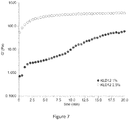
- peptide compositions may recover their storage modulus after application of shear stress. In some embodiments, peptide solutions may recover about 0.1 to 100% of their original storage modulus in 1 min. In some embodiments, peptide solutions may recover about 0.1 to 10% of their original storage modulus in 1 min. In some embodiments, peptide solutions may recover about 20 to 100% of their original storage modulus in 20 min. In some embodiments, peptide solutions may recover about 20 to 60% of their original storage modulus in 20 min.
- peptide solutions may recover their viscosity over time after filtration. In some embodiments, peptide solutions may recover about 0.1 to 30% of their original viscosity in 1 min. In some embodiments, peptide solutions may recover about 0.1 to 100% of their original viscosity in 1 min. In some embodiments, peptide solutions may recover about 20 to 100% of their original viscosity in 20 min. In some embodiments, peptide solutions may recover about 20 to 60% of their original viscosity in 20 min.
- the present disclosure specifically exemplifies appropriate adjustment of rheological properties of certain peptide compositions upon application of shear stress (e.g., specifically upon passage through a needle, for example of particular structure) (see Example 4).
- shear stress e.g., specifically upon passage through a needle, for example of particular structure
- the results presented in this Example show a logarithmic increase of storage modulus from 1 minute after injection, as shown in Figure 10 for RADA16, Figure 11 for KLD12, and Figure 12 for IEIK13.
- the present disclosure provides methodologies in accordance with which one or more certain peptide compositions are subjected to high shear stress so that one or more of their rheological properties is adjusted (e.g., viscosity is decreased) to an appropriate level so that the composition(s) become amenable to filtration, and in some embodiments to sterilizing filtration, and the composition(s) are subjected to such filtration, within a time period after the subjecting to shear stress selected so that filtration occurs while the rheological properties remain adjusted (e.g., before significant or complete restoration of such propert(ies) has occurred).
- rheological properties e.g., viscosity is decreased
- shear stress may be applied by application of a peptide composition to (and/or passage of a peptide composition through) a shear-thinning unit.
- a shear-thinning unit is or comprises a needle, a membrane, and/or a screen.
- a plurality of individual shear-thinning units is utilized, for example so that high-throughput filtration can be achieved.
- the present invention provides devices and methodologies that can achieve filtration of peptide compositions on a commercial scale.
- shear stress may be applied by injection through one or more needles.
- one or more needles may be used as a shear-thinning unit.
- a needle may be at least about 1 mm long. In some embodiments, a needle may be at least about 2 mm long. In some embodiments, a needle may be at least about 5 mm long. In some embodiments, a needle may be at least about a 10 mm long. In some embodiments, a needle may be at least about 15 mm long. In some embodiments, a needle may be at least about 20 mm long. In some embodiments, a needle may be at least about 30 mm long. In some embodiments, a needle may be at least about 40 mm long. In some embodiments, a needle may be at least about 50 mm long.
- a needle may have a gauge within a range of about 20 to about 34. In some embodiments, a needle may have a gauge within a range of about 25 to about 34. In some embodiments, a needle may have a gauge of about 27 to about 34.
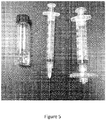
- Figure 5 discloses one non-limiting embodiment of a sterilization device in accordance with one or more non-limiting embodiments.
- peptide composition e.g., viscous solution of a self-assembling peptide
- left may be transferred to the first syringe with a needle, injected to the second syringe (right), and then filtered.
- a shear-thinning unit utilized to apply shear stress to a peptide composition as described herein may be a device or entity characterized by micro- or nano-pores.
- Figure 13 depicts one non-limiting embodiment of a sterilization device in accordance with one or more non-limiting embodiments of the present invention.
- a peptide solution e.g., a viscous solution of a self-assembling peptide
- a dispensing syringe or a pressure vessel
- diameter size of membrane may vary depending on the amount of peptide solution.
- pore size of a shear-thinning unit may be about 0.45 ⁇ m to 120 ⁇ m. In some embodiments, pore size of a shear-thinning unit may be about 1 ⁇ m to 100 ⁇ m. In some embodiments, pore size of a shear-thinning unit may be about 3 ⁇ m to 80 ⁇ m. In some embodiments, pore size of a shear-thinning unit may be about 4 ⁇ m to 50 ⁇ m.
- a shear-thinning unit may have micro- or nano-holes. In some embodiments, holes may be patterned or drilled on a plate whose thickness may be about 10 ⁇ m to 10 mm in some embodiments.
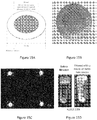
- Figure 15 depicts one non-limiting embodiment of a sterilization device in accordance with one or more non-limiting embodiments of the present disclosure. A shear-thinning unit may be inserted into the first filtering chamber shown Figure 13 .
- holes in an embodiment of a shear-thinnung unit described herein may have a largest dimension within the range of about may be about 0.5 ⁇ m to 200 ⁇ m. In some embodiments, such dimension may be within the range of about 0.5 ⁇ m to 100 ⁇ m. In some embodiments, such dimension may be within the range of about 0.5 ⁇ m to 80 ⁇ m. In some embodiments, such dimension may be within the range of about 0.5 ⁇ m to 50 ⁇ m.
- a shear-thinning unit of this embodiment may have a pitch between holes within the range of about 5 ⁇ m to about 10 mm.
- shear-thinning unit may be made, in whole or in part, of a material selected from the group consisting of stainless-steel, tungsten, titanium, similar metal, silicon, ceramic or plastic materials, and combinations thereof.
- peptide compositions to which technologies described herein are applied are then utilized in one or more applications that involve biological cells, tissues, or organisms (e.g., so that sterilized compositions are of particular utility).
- compositions e.g., certain compositions of self-assembling peptides
- void fillers e.g., hemostats, barriers to liquid movement, wound healing agents, etc.
- such compositions form peptide hydrogels with one or more desirable characteristics (e.g., pore and/or channel size, strength, deformability, reversibility of gel formation, transparency, etc).
- the present Example describes, among other things, rheological properties of various peptide compositions (i.e., specifically of compositions of self-assembling peptides), and demonstrates significant variability of parameters such as viscosity, storage modulus (e.g., stiffness), loss modulus, and yield stress for different peptides and/or for different concentrations of the same peptide.
- the Example also demonstrates that certain of these solutions are not readily amenable to filtration.
- the Example demonstrates that high viscosity solutions of such peptides present challenges for filtration technologies.
- Rheological properties were determined for a variety of peptide solutions. Specifically, solutions of RADA16, IEIK13, and KLD12 per prepared at concentrations indicated below in Table 1.
- Each of the peptide solutions listed in Table 1 was subjected to filtration through a 0.2 ⁇ m Nalgene syringe filter with 25 mm cellulose acetate membranes.
- the 1% and 1.5% KLD12 solutions (which, as can be seen, are characterized by relatively low concentration, viscosity and/or stiffness) passed successfully through the filter.
- the 2% and 2.5% KLD12 solutions and 1.5% IEIK13 solutions (which, as can be seen, are characterized by relatively high concentration, viscosity and/or stiffness) could not be passed successfully through the filter; instead, the filter burst.
- the present Example demonstrates that some peptide compositions (i.e., specifically compositions of self-assembling peptides as described herein) are surprisingly stable to heat treatment.
- this Example demonstrates that certain peptide compositions maintain a stable molar mass even upon application of autoclave treatment at 121°C for 25 minutes.
- the present Example therefore establishes that such compositions can successfully be sterilized through application of high heat (e.g., autoclave) technologies.
- high heat e.g., autoclave
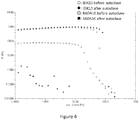
- Figures 1-3 present results of autoclave treatment for certain compositions of RADA16, IEKI13, and KLD12, respectively.
- the measured molar mass of KLD12, prior to autoclave treatment, is 1467, which matches its calculated molar mass.
- KLD12 was partially degraded during autoclave treatment. As KLD12 was degraded during autoclave treatment, it was determined that autoclave treatment is not a preferred technique for sterilization of such KLD12 compositions; a conventional filtration approach to sterilization was carried out on KLD12 at several concentrations of peptide.
- Autoclave treatment may be used for sterilization of IEIK13 compositions as described herein, but should be avoided for RADA16 compositions.
- Example 3 Rheological properties of peptide compositions with application of shear stress
- the present Example demonstrates that applied shear stress may decrease viscosity and/or stiffness of certain peptide solutions, and furthermore demonstrates that such decrease in viscosity and/or stiffness can render the compositions amenable to various and/or processing technologies (e.g., filtration) to which the compositions are not amenable absent such treatment.
- the percentages of recovery back to the original storage modulus at 1 min and 20 min after injection peptide compositios through a 30 gauge needle are listed in Table 2.
- the recovery rate of IEIK13 (specifically, of a 2.5% IEIK13 solution) was the fastest among the peptide solutions, showing 100% recovery to the original storage modulus in 20 min.
- KLD12 was the slowest among those tested to recover; it showed only 23% recovery to the original storage modulus in 20 min (for 2.5%). In some non-limiting embodiments, it may take about 12 to 48 hours for full recovery to an original modulus after passage through a needle (e.g., injection).
- Example 4 A needle as a shear-thinning unit
- the present Example describes a filtration process for peptide compositions (specifically, of self-assembling peptides as described herein) using a needle as a shear-thinning unit.
- the present Example demonstrates that application of appropriate shear stress (e.g., via passage through a shear-thinning unit) can alter rheological properties of the composition (e.g., can reduce viscosity and/or stiffness, etc) so that it can successfully be passed through a filter such as, for example, a sterilizing filter).
- Figure 5 depicts one non-limiting embodiment of a sterilization device in accordance with the present disclosure.
- the device includes a first syringe that applies sheer stress to the composition sufficient to alter its rheological properties such that it successfully passes through a second syringe that is fitted with a membrane filter of appropriate pore size to achieve sterilization of the composition.
- the depicted device includes a first syringe with a 30 gauge needle (0.3 mm x 25 mm, Endo irrigation needle with double side vent, Transcodent, Germany) (middle) and a second syringe with a membrane filter (right).
- a viscouse 2.5% KLD12 solution (left) was transferred to the first syringe, and was then injected into the second syringe (right) and then filtered through the membrane filter. Using this method, 2.5% KLD12 solutions were successfully filtered.
- each shear-thinning unit applies shear stress appropriate and sufficient to adjust one or more rheological properties of an applied peptide composition so that the composition becomes amenable to filtration, and specifically to filtration through a sterilizing filter.
- multiple needles or equivalents may be used as a shear-thinning unit.
- FIG. 1 This Examples demonstrates use of a with membrane filter (pore size > 0.45 ⁇ m) as a shear-thinning unit. Viscous 2.5% KLD12 or 1.5% IEIK13 solutions may be transferred to a dispensing syringe (or a pressure vessel), delivered to a first chamber with a shear-thinning unit (for example, pore size ranging from 0.45 ⁇ m to 120 ⁇ m), and then filtered through a filtering membrane (for example, pore size: 0.2 ⁇ m) in the second chamber.
- a shear-thinning unit for example, pore size ranging from 0.45 ⁇ m to 120 ⁇ m
- a filtering membrane for example, pore size: 0.2 ⁇ m
- RADA16 solutions were studied for viscosity reduction with a shear-thinning unit (shown in Figure 13 ).
- 1.0% RADA16 solution which shows shear thinning and thixotropic behavior, was passed through a shear-thinning unit at 50 psi of injection pressure.
- the solution showed 1.4 ⁇ 1.7 mL/min of output.
- the solution could not be passed through a filter (0.2 ⁇ m pore size) at 50 psi of injection pressure (i.e., without prior exposure to a shear-thinning unit).
- water which is a representative Newtonian fluid, showed that output flow rate was relatively consistent.
- Table 3 Filtering abilities of the system shown in Figure 13 for RADA16 1% solution and water.
- KLD12 and 1.5% IEK13 solutions were not able to be filtered through a 0.2 ⁇ m Nalgene syringe filter with 25 mm cellulose acetate membranes.
- 2.5% RADA16 is not usually amenable to filtration through 0.2 ⁇ m membrane.
- 2.5% RADA16, 1.5% IEIK13, and 2.5% KLD12 solutions were able to be filtered after being exposed to a shear-thinning unit at 100 psi of injection pressure showing 3.8, 12.5, and 11.4 mL/min of output, respectively. The solutions were not able to be filtered without the shear-thinning unit.
- a shear-thinning unit shown in Figure 16 may be successfully utilized for sterilization and filtration of viscous peptide solutions which are not easily filtered. The results are shown in Table 4. Table 4 Filtering abilities filtering system shown in Figure 13 for 2.5% RADA16, 1.5% IEIK13, 2.5% KLD12 solutions.
Landscapes
- Health & Medical Sciences (AREA)
- Life Sciences & Earth Sciences (AREA)
- General Health & Medical Sciences (AREA)
- Epidemiology (AREA)
- Animal Behavior & Ethology (AREA)
- Public Health (AREA)
- Veterinary Medicine (AREA)
- Chemical & Material Sciences (AREA)
- Organic Chemistry (AREA)
- Genetics & Genomics (AREA)
- Biophysics (AREA)
- Medicinal Chemistry (AREA)
- Molecular Biology (AREA)
- Proteomics, Peptides & Aminoacids (AREA)
- Biochemistry (AREA)
- Peptides Or Proteins (AREA)
- Medicines That Contain Protein Lipid Enzymes And Other Medicines (AREA)
- Processes Of Treating Macromolecular Substances (AREA)
- Materials For Medical Uses (AREA)
- Apparatus Associated With Microorganisms And Enzymes (AREA)
- Micro-Organisms Or Cultivation Processes Thereof (AREA)
Applications Claiming Priority (3)
| Application Number | Priority Date | Filing Date | Title |
|---|---|---|---|
| US201461950536P | 2014-03-10 | 2014-03-10 | |
| EP15731666.2A EP3116551B1 (fr) | 2014-03-10 | 2015-03-10 | Stérilisation de compositions de peptides |
| PCT/IB2015/000868 WO2015136370A2 (fr) | 2014-03-10 | 2015-03-10 | Stérilisation et de filtration de compositions de peptides |
Related Parent Applications (2)
| Application Number | Title | Priority Date | Filing Date |
|---|---|---|---|
| EP15731666.2A Division-Into EP3116551B1 (fr) | 2014-03-10 | 2015-03-10 | Stérilisation de compositions de peptides |
| EP15731666.2A Division EP3116551B1 (fr) | 2014-03-10 | 2015-03-10 | Stérilisation de compositions de peptides |
Publications (2)
| Publication Number | Publication Date |
|---|---|
| EP3628337A1 true EP3628337A1 (fr) | 2020-04-01 |
| EP3628337B1 EP3628337B1 (fr) | 2025-05-28 |
Family
ID=53488360
Family Applications (2)
| Application Number | Title | Priority Date | Filing Date |
|---|---|---|---|
| EP19185614.5A Active EP3628337B1 (fr) | 2014-03-10 | 2015-03-10 | Stérilisation et filtration de compositions de peptide |
| EP15731666.2A Active EP3116551B1 (fr) | 2014-03-10 | 2015-03-10 | Stérilisation de compositions de peptides |
Family Applications After (1)
| Application Number | Title | Priority Date | Filing Date |
|---|---|---|---|
| EP15731666.2A Active EP3116551B1 (fr) | 2014-03-10 | 2015-03-10 | Stérilisation de compositions de peptides |
Country Status (7)
| Country | Link |
|---|---|
| US (3) | US10369237B2 (fr) |
| EP (2) | EP3628337B1 (fr) |
| JP (4) | JP6684719B2 (fr) |
| CN (1) | CN106456811B (fr) |
| BR (1) | BR112016019510A2 (fr) |
| ES (2) | ES2927887T3 (fr) |
| WO (1) | WO2015136370A2 (fr) |
Families Citing this family (11)
| Publication number | Priority date | Publication date | Assignee | Title |
|---|---|---|---|---|
| RU2011118341A (ru) | 2008-10-06 | 2012-11-20 | 3-Д Матрикс, Лтд. (Jp) | Агент для окклюзии тканей |
| WO2014008400A2 (fr) | 2012-07-06 | 2014-01-09 | 3-D Matrix, Inc. | Procédé de remplissage-finition pour solutions de peptides |
| BR112016019510A2 (pt) | 2014-03-10 | 2017-10-24 | 3 D Matrix Ltd | esterilização e filtração de composições de peptídeos |
| RU2016139369A (ru) | 2014-03-10 | 2018-04-10 | 3-Д Матрикс, Лтд. | Композиции самоорганизующихся пептидов |
| US10245299B2 (en) | 2014-03-10 | 2019-04-02 | 3-D Matrix, Ltd. | Autoassembling peptides for the treatment of pulmonary bulla |
| HK1258374A1 (zh) | 2015-12-18 | 2019-11-08 | 立美基股份有限公司 | 止血组合物和使用止血组合物的止血方法 |
| US10814038B2 (en) | 2016-01-06 | 2020-10-27 | 3-D Matrix, Ltd. | Combination compositions |
| JP2021506815A (ja) | 2017-12-15 | 2021-02-22 | 株式会社スリー・ディー・マトリックス | 界面活性ペプチドナノ構造および薬物送達における使用 |
| CN115397454A (zh) | 2020-03-31 | 2022-11-25 | 立美基股份有限公司 | 通过辐照对自组装肽进行灭菌 |
| EP4137817A4 (fr) | 2020-04-16 | 2024-08-07 | Kikkoman Corporation | Procédé de mesure de matériau à l'état de trace à l'aide d'hydrolase |
| CN116347980A (zh) * | 2020-08-10 | 2023-06-27 | 歌尔4梅德股份有限公司 | 自组装的两亲性肽水凝胶的局部和肠外使用和施用 |
Citations (4)
| Publication number | Priority date | Publication date | Assignee | Title |
|---|---|---|---|---|
| WO2010017369A2 (fr) * | 2008-08-08 | 2010-02-11 | University Of Delaware | Diffusion et libération d’une macromolécule à partir d’hydrogels de peptides en épingle à cheveux b autoassemblés |
| WO2010147763A2 (fr) * | 2009-06-15 | 2010-12-23 | Biovec Transfusion, Llc | Procédé et dispositif de filtration de plaquettes |
| WO2014008400A2 (fr) * | 2012-07-06 | 2014-01-09 | 3-D Matrix, Inc. | Procédé de remplissage-finition pour solutions de peptides |
| WO2014017913A1 (fr) * | 2012-07-27 | 2014-01-30 | Koninklijke Coöperatie Cosun U.A. | Agent structurant pour produits détergents liquides et produits de soins personnels |
Family Cites Families (100)
| Publication number | Priority date | Publication date | Assignee | Title |
|---|---|---|---|---|
| DE3005495C2 (de) | 1980-02-14 | 1983-03-31 | Institut Pasteur, 75724 Paris | Herstellung von Fragmenten von Viren mit Lipidhülle und sie enthaltende Arzneimittelzubereitungen |
| US4582640A (en) | 1982-03-08 | 1986-04-15 | Collagen Corporation | Injectable cross-linked collagen implant material |
| US4466641A (en) | 1982-08-04 | 1984-08-21 | The Lockformer Company | Duct connecting system |
| US4642117A (en) | 1985-03-22 | 1987-02-10 | Collagen Corporation | Mechanically sheared collagen implant material and method |
| US4947840A (en) | 1987-08-21 | 1990-08-14 | Massachusetts Institute Of Technology | Biodegradable templates for the regeneration of tissues |
| US5236903A (en) | 1988-06-24 | 1993-08-17 | Ichiro Azuma | Polypeptide comprising repeated cell-adhesive core sequences |
| US5110604A (en) | 1988-06-30 | 1992-05-05 | Collagen Corporation | Processes for producing collagen matrixes and methods of using same |
| US5126141A (en) | 1988-11-16 | 1992-06-30 | Mediventures Incorporated | Composition and method for post-surgical adhesion reduction with thermo-irreversible gels of polyoxyalkylene polymers and ionic polysaccharides |
| US5550187A (en) | 1988-11-21 | 1996-08-27 | Collagen Corporation | Method of preparing crosslinked biomaterial compositions for use in tissue augmentation |
| US5629291A (en) | 1992-01-31 | 1997-05-13 | La Jolla Cancer Research Foundation | Methods of modulating fibronectin extracellular matrix assembly |
| US5292514A (en) | 1992-06-24 | 1994-03-08 | Minnesota Mining And Manufacturing Company | Azlactone-functional substrates, corneal prostheses, and manufacture and use thereof |
| US5670483A (en) | 1992-12-28 | 1997-09-23 | Massachusetts Insititute Of Technology | Stable macroscopic membranes formed by self-assembly of amphiphilic peptides and uses therefor |
| US5955343A (en) | 1992-12-28 | 1999-09-21 | Massachusetts Institute Of Technology | Stable macroscopic membranes formed by self-assembly of amphiphilic peptides and uses therefor |
| GB2274988A (en) | 1993-02-10 | 1994-08-17 | Mcconn Stern Rita | Iodine containing wound-healing preparations |
| US5709854A (en) | 1993-04-30 | 1998-01-20 | Massachusetts Institute Of Technology | Tissue formation by injecting a cell-polymeric solution that gels in vivo |
| US5773577A (en) | 1994-03-03 | 1998-06-30 | Protein Polymer Technologies | Products comprising substrates capable of enzymatic cross-linking |
| US5527610A (en) | 1994-05-20 | 1996-06-18 | The Uab Research Foundation | Elastomeric polypeptide matrices for preventing adhesion of biological materials |
| US5510102A (en) | 1995-01-23 | 1996-04-23 | The Regents Of The University Of California | Plasma and polymer containing surgical hemostatic adhesives |
| WO1996040033A1 (fr) | 1995-06-07 | 1996-12-19 | Clarion Pharmaceuticals Inc. | Timbre hemostatique non biologique |
| CZ318998A3 (cs) | 1996-04-04 | 1999-09-15 | Baxter Aktiengesellschaft | Hemostatická houba na bázi kolagenu, způsob její přípravy, kryt na ránu a kit k přípravě tohoto krytu |
| US6489446B1 (en) | 1996-08-07 | 2002-12-03 | Hsc Research And Development Limited Partnership | Self-aligning peptides modeled on human elastin and other fibrous proteins |
| US6083522A (en) | 1997-01-09 | 2000-07-04 | Neucoll, Inc. | Devices for tissue repair and methods for preparation and use thereof |
| US6224893B1 (en) | 1997-04-11 | 2001-05-01 | Massachusetts Institute Of Technology | Semi-interpenetrating or interpenetrating polymer networks for drug delivery and tissue engineering |
| US6187555B1 (en) | 1998-04-16 | 2001-02-13 | 3M Innovative Properties Company | Spores with increased sensitivity to sterilants using additives that bind to sterilant-sensitive sites |
| WO2000001238A1 (fr) * | 1998-07-06 | 2000-01-13 | Kajander E Olavi | Procedes relatifs a l'elimination des nanobacteries |
| US20020033184A1 (en) * | 1999-05-28 | 2002-03-21 | Peter Zhu | Method and kit for removing aldehyde-based stains |
| US6046160A (en) | 1999-07-22 | 2000-04-04 | Deroyal Industries, Inc. | Composition and method for enhancing wound healing |
| ATE389416T1 (de) | 2000-05-16 | 2008-04-15 | Genentech Inc | Behandlung von knorpelerkrankungen |
| JP2004508140A (ja) | 2000-09-11 | 2004-03-18 | クロージャー メディカル コーポレイション | 気管支閉塞法および装置 |
| JP4104462B2 (ja) | 2001-01-25 | 2008-06-18 | ニコメド ファーマ エイエス | コラーゲンスポンジを調製する方法、コラーゲンフォームの一部を抽出するための装置、および伸長したコラーゲンスポンジ |
| DE60230593D1 (de) | 2001-02-06 | 2009-02-12 | Massachusetts Inst Technology | Peptidgerüstverkapselung von gewebszellen und verwendungen davon |
| US7449180B2 (en) | 2001-02-06 | 2008-11-11 | John Kisiday | Macroscopic scaffold containing amphiphilic peptides encapsulating cells |
| AU2003222167A1 (en) | 2002-04-02 | 2003-10-20 | Northwestern University | Peptide amphiphile solutions and self assembled peptide nanofiber networks |
| AU2003249606A1 (en) | 2002-05-13 | 2003-12-02 | Massachusetts Institute Of Technology | Angiogenesis and cardiac tissue engineering with peptide hydrogels and related compositions and methods of use thereof |
| GB0216286D0 (en) | 2002-07-15 | 2002-08-21 | Univ Leeds | Network |
| EP1542709A2 (fr) | 2002-08-06 | 2005-06-22 | EPIX Pharmaceuticals, Inc. | Agregats de peptides |
| EP2711025A3 (fr) | 2003-06-25 | 2014-09-10 | Massachusetts Institute of Technology | Peptides à assemblage automatique présentant des modifications et leurs procédés d'utilisation |
| US7713923B2 (en) | 2003-06-25 | 2010-05-11 | Massachusetts Institute Of Technology | Self-assembling peptides incorporating modifications and methods of use thereof |
| WO2005001080A2 (fr) | 2003-06-27 | 2005-01-06 | Ethicon, Incorporated | Cellules derivees de tissus post-partum destinees a etre utilisees pour traiter des maladies du coeur et du systeme circulatoire |
| US7846891B2 (en) | 2003-10-17 | 2010-12-07 | Massachusetts Institute Of Technology | Self-assembling peptides for regeneration and repair of neural tissue |
| GB0404374D0 (en) | 2004-02-27 | 2004-03-31 | Univ Manchester | Treatment of bacterial infections |
| JP2005263631A (ja) | 2004-03-16 | 2005-09-29 | Sanyo Chem Ind Ltd | 細胞接着性ポリペプチド |
| JP5255274B2 (ja) | 2004-07-06 | 2013-08-07 | スリーディー マトリックス, インコーポレイテッド | 精製両親媒性ペプチド組成物およびその使用 |
| KR100689430B1 (ko) | 2004-12-16 | 2007-03-08 | 삼성전자주식회사 | 디지털 홈 서비스에서 하이브리드 모니터링을 통한 동적서비스 품질 매핑 장치 및 방법 |
| JP2008526749A (ja) | 2005-01-04 | 2008-07-24 | ザ ブライハム アンド ウイメンズ ホスピタル, インコーポレイテッド | 自己アセンブリするペプチドナノファイバーを用いたpdgfの徐放性の送達 |
| JP5021610B2 (ja) * | 2005-03-07 | 2012-09-12 | ジーイー・ヘルスケア・バイオサイエンス・アクチボラグ | 滅菌法 |
| US9162005B2 (en) | 2005-04-25 | 2015-10-20 | Arch Biosurgery, Inc. | Compositions for prevention of adhesions and other barrier applications |
| DK1879606T3 (da) | 2005-04-25 | 2013-09-23 | Massachusetts Inst Technology | Selvorganiserende peptider til fremme af hæmostase |
| US20060287243A1 (en) * | 2005-06-17 | 2006-12-21 | Navneet Puri | Stable pharmaceutical compositions including motilin-like peptides |
| CN101198350A (zh) * | 2005-06-17 | 2008-06-11 | 巴克斯特国际公司 | 含胃动素样肽的稳定的缓冲的药物组合物 |
| MX2007015895A (es) | 2005-06-17 | 2008-03-04 | Baxter Int | Composiciones farmaceuticas, amortiguadas por estabilidad que incluyen peptidos tipo motilin. |
| US20060293243A1 (en) * | 2005-06-17 | 2006-12-28 | Navneet Puri | Stable, buffered, pharmaceutical compositions including motilin-like peptides |
| JP4982841B2 (ja) | 2005-10-12 | 2012-07-25 | 国立大学法人名古屋大学 | 再生医療骨組成物 |
| EP1962870A4 (fr) | 2005-11-14 | 2010-08-11 | Univ Delaware Technology Corp | Nouveaux hydrogels et leurs utilisations |
| DK1969007T3 (da) | 2005-12-20 | 2013-11-25 | Bristol Myers Squibb Co | Sammensætninger og fremgangsmåder til fremstilling af en sammensætning |
| US8476239B2 (en) | 2005-12-20 | 2013-07-02 | Bristol-Myers Squibb Company | Stable protein formulations |
| US20070184087A1 (en) * | 2006-02-06 | 2007-08-09 | Bioform Medical, Inc. | Polysaccharide compositions for use in tissue augmentation |
| ES2673947T3 (es) | 2006-04-25 | 2018-06-26 | Massachusetts Institute Of Technology | Composiciones y métodos para afectar al movimiento de contaminantes, líquidos corporales u otras entidades y/o afectar a otras condiciones fisiológicas |
| WO2008039483A2 (fr) | 2006-09-26 | 2008-04-03 | Massachusetts Institute Of Technology | Peptides auto-assemblés modifiés |
| WO2008073392A2 (fr) | 2006-12-11 | 2008-06-19 | 3D Matrix, Inc. | Compositions et procédés visant à protéger et à régénérer un tissu cardiaque |
| US9415084B2 (en) | 2007-03-14 | 2016-08-16 | Arch Biosurgery, Inc. | Treatment of leaky or damaged tight junctions and enhancing extracellular matrix |
| AU2008239681B2 (en) | 2007-04-11 | 2013-10-03 | Henry Ford Health System | Cardiac repair, resizing and reshaping using the venous system of the heart |
| JP2009011341A (ja) | 2007-06-29 | 2009-01-22 | Yuka Denshi Co Ltd | ペースト状材料充填容器 |
| US20090053103A1 (en) | 2007-08-20 | 2009-02-26 | William Patrick Mortimer | Non-linting sterilization packaging material |
| GB0718346D0 (en) | 2007-09-20 | 2007-10-31 | Ind Res & Technology Ltd | Tooth-bleaching preparations |
| JP5497451B2 (ja) | 2007-12-05 | 2014-05-21 | 株式会社スリー・ディー・マトリックス | 創傷治癒・皮膚再建材 |
| WO2009132950A1 (fr) * | 2008-04-29 | 2009-11-05 | Unilever Nv | Procédé d'élaboration de boisson aqueuse emballée préservée de la chaleur qui renferme des micelles de caséine et des peptides riches en tryptophane, et produits résultants |
| US9399068B2 (en) | 2008-06-10 | 2016-07-26 | The Board Of Trustees Of The Leland Stanford Junior University | Hetero-assembling, tunable, and injectable hydrogels for cell encapsulation |
| US7598343B1 (en) * | 2008-07-27 | 2009-10-06 | The Medicines Company | Pharmaceutical formulations of bivalirudin and processes of making the same |
| RU2011118341A (ru) | 2008-10-06 | 2012-11-20 | 3-Д Матрикс, Лтд. (Jp) | Агент для окклюзии тканей |
| CN101514225B (zh) | 2008-10-13 | 2011-09-14 | 西安蓝晶生物科技有限公司 | 自聚体多肽及其制备方法和应用 |
| SG174857A1 (en) * | 2009-03-09 | 2011-11-28 | Menicon Co Ltd | Self-assembling peptide and peptide gel with high strength |
| WO2011005381A2 (fr) | 2009-06-01 | 2011-01-13 | Trustees Of Tufts College | Gélification de la fibroïne par traitement au vortex servant dans des applications dencapsulation et dadministration |
| US9439941B2 (en) | 2009-12-14 | 2016-09-13 | The University Of Hong Kong | Nano cancer barrier device (NCBD) to immobilize and inhibit the division of metastic cancer stem cells |
| WO2012008967A1 (fr) | 2010-07-16 | 2012-01-19 | Massachusetts Institute Of Technology | Peptides autoassemblés comprenant des modifications et leurs procédés d'utilisation |
| JP2012082180A (ja) | 2010-10-14 | 2012-04-26 | Nagoya Univ | 骨再生用自己組織化ペプチドハイドロゲル |
| FI123988B (fi) * | 2010-10-27 | 2014-01-31 | Upm Kymmene Corp | Soluviljelymateriaali |
| JP5613779B2 (ja) * | 2011-01-19 | 2014-10-29 | 株式会社メニコン | コンタクトレンズ用液剤 |
| US20130219531A1 (en) | 2011-08-19 | 2013-08-22 | Tuskegee University | Immortalized human prostate cell lines |
| JP6034868B2 (ja) | 2011-09-02 | 2016-11-30 | 株式会社スリー・ディー・マトリックス | 胸部の空気漏れ閉塞のための両親媒性ペプチド |
| US20150105336A1 (en) | 2012-03-09 | 2015-04-16 | 3-D Matrix, Ltd. | Mucosa-elevating agent |
| US9330255B2 (en) | 2012-05-03 | 2016-05-03 | Cisco Technology, Inc. | Method and system for monitoring a computer system |
| US20150307835A1 (en) * | 2012-08-01 | 2015-10-29 | Peptisyntha Sa | Peptides comprising a short-chain polyethylene glycol moiety |
| US20160287744A1 (en) | 2012-11-14 | 2016-10-06 | 3-D Matrix Ltd. | Vascular embolic system |
| WO2014089472A1 (fr) * | 2012-12-07 | 2014-06-12 | Kansas State University Research Foundation | Propriétés d'hydrogel peptide-albumine et ses applications |
| CN103251690B (zh) | 2013-02-26 | 2015-10-28 | 中国人民解放军新疆军区联勤部药品仪器检验所 | 维药瘤果黑种草子挥发油在制备治疗慢性阻塞性肺病药物的应用 |
| US9525571B2 (en) | 2013-03-05 | 2016-12-20 | Lattice Semiconductor Corporation | Calibration of single-ended high-speed interfaces |
| SG11201506232VA (en) | 2013-03-06 | 2015-09-29 | 3D Matrix Ltd | Surgical methods employing purified amphiphilic peptide compositions |
| US9724448B2 (en) | 2013-03-14 | 2017-08-08 | 3-D Matrix, Ltd. | Materials for gastrointestinal obstruction prevention |
| HK1220145A1 (zh) | 2013-03-14 | 2017-04-28 | 3-D Matrix, Ltd | 胆漏治疗 |
| ES2756531T3 (es) | 2013-08-22 | 2020-04-27 | Arch Biosurgery Inc | Mallas implantables para controlar el movimiento de fluidos |
| WO2015030063A1 (fr) | 2013-09-02 | 2015-03-05 | 大成化工株式会社 | Seringue et ensemble de seringue |
| JP6554121B2 (ja) | 2014-03-10 | 2019-07-31 | 株式会社スリー・ディー・マトリックス | 気管支閉鎖剤としての自己組織化ペプチド |
| BR112016019510A2 (pt) | 2014-03-10 | 2017-10-24 | 3 D Matrix Ltd | esterilização e filtração de composições de peptídeos |
| EP3116522B1 (fr) | 2014-03-10 | 2019-05-08 | 3-D Matrix Ltd. | Selbstanordnende peptide als wirkstoffe zur behandlung vom blutleck |
| US10245299B2 (en) | 2014-03-10 | 2019-04-02 | 3-D Matrix, Ltd. | Autoassembling peptides for the treatment of pulmonary bulla |
| RU2016139369A (ru) | 2014-03-10 | 2018-04-10 | 3-Д Матрикс, Лтд. | Композиции самоорганизующихся пептидов |
| WO2015185918A1 (fr) | 2014-06-02 | 2015-12-10 | University Of Exeter | Associations d'un photosensibilisateur avec un donneur de sulfure d'hydrogène, un inhibiteur de la thiorédoxine ou un nitroxyde pour une utilisation en thérapie photodynamique |
| CA2952777A1 (fr) | 2014-06-20 | 2015-12-23 | 3-D Matrix, Ltd. | Materiaux et procedes de remplissage de vides osseux |
| US10814038B2 (en) | 2016-01-06 | 2020-10-27 | 3-D Matrix, Ltd. | Combination compositions |
-
2015
- 2015-03-10 BR BR112016019510A patent/BR112016019510A2/pt not_active Application Discontinuation
- 2015-03-10 WO PCT/IB2015/000868 patent/WO2015136370A2/fr not_active Ceased
- 2015-03-10 EP EP19185614.5A patent/EP3628337B1/fr active Active
- 2015-03-10 JP JP2016556012A patent/JP6684719B2/ja active Active
- 2015-03-10 CN CN201580024216.4A patent/CN106456811B/zh active Active
- 2015-03-10 ES ES15731666T patent/ES2927887T3/es active Active
- 2015-03-10 EP EP15731666.2A patent/EP3116551B1/fr active Active
- 2015-03-10 ES ES19185614T patent/ES3037364T3/es active Active
- 2015-03-10 US US15/122,749 patent/US10369237B2/en active Active
-
2018
- 2018-10-26 US US16/171,734 patent/US11090398B2/en active Active
-
2019
- 2019-12-06 JP JP2019220878A patent/JP2020073489A/ja active Pending
-
2021
- 2021-05-25 JP JP2021087415A patent/JP7212104B2/ja active Active
- 2021-07-10 US US17/372,424 patent/US12115264B2/en active Active
-
2023
- 2023-01-11 JP JP2023002438A patent/JP2023040205A/ja active Pending
Patent Citations (4)
| Publication number | Priority date | Publication date | Assignee | Title |
|---|---|---|---|---|
| WO2010017369A2 (fr) * | 2008-08-08 | 2010-02-11 | University Of Delaware | Diffusion et libération d’une macromolécule à partir d’hydrogels de peptides en épingle à cheveux b autoassemblés |
| WO2010147763A2 (fr) * | 2009-06-15 | 2010-12-23 | Biovec Transfusion, Llc | Procédé et dispositif de filtration de plaquettes |
| WO2014008400A2 (fr) * | 2012-07-06 | 2014-01-09 | 3-D Matrix, Inc. | Procédé de remplissage-finition pour solutions de peptides |
| WO2014017913A1 (fr) * | 2012-07-27 | 2014-01-30 | Koninklijke Coöperatie Cosun U.A. | Agent structurant pour produits détergents liquides et produits de soins personnels |
Also Published As
| Publication number | Publication date |
|---|---|
| JP2021138725A (ja) | 2021-09-16 |
| WO2015136370A2 (fr) | 2015-09-17 |
| BR112016019510A2 (pt) | 2017-10-24 |
| US12115264B2 (en) | 2024-10-15 |
| EP3116551A2 (fr) | 2017-01-18 |
| US20220001047A1 (en) | 2022-01-06 |
| EP3116551B1 (fr) | 2022-09-07 |
| JP2020073489A (ja) | 2020-05-14 |
| EP3628337B1 (fr) | 2025-05-28 |
| JP7212104B2 (ja) | 2023-01-24 |
| ES3037364T3 (en) | 2025-10-01 |
| US11090398B2 (en) | 2021-08-17 |
| JP6684719B2 (ja) | 2020-04-22 |
| CN106456811B (zh) | 2021-04-02 |
| JP2017515793A (ja) | 2017-06-15 |
| ES2927887T3 (es) | 2022-11-11 |
| JP2023040205A (ja) | 2023-03-22 |
| US20190111165A1 (en) | 2019-04-18 |
| US20170202986A1 (en) | 2017-07-20 |
| US10369237B2 (en) | 2019-08-06 |
| WO2015136370A3 (fr) | 2016-01-28 |
| CN106456811A (zh) | 2017-02-22 |
Similar Documents
| Publication | Publication Date | Title |
|---|---|---|
| US12115264B2 (en) | Sterilization and filtration of peptide compositions | |
| US20260116919A1 (en) | Self-assembling peptide compositions | |
| US10814038B2 (en) | Combination compositions | |
| KR101702677B1 (ko) | 자기 조직화 펩티드 및 고강도 펩티드 겔 | |
| EP4023240A1 (fr) | Compositions peptidiques amphiphiles purifiées et utilisations de celles-ci | |
| US20210170073A1 (en) | Self-Assembling Peptides Comprising Non-Ionic Polar Amino Acids | |
| Bento et al. | Integrated processes (HPSE+ scCO2) to prepare sterilized alginate-gelatine-based aerogel | |
| HK40026497A (en) | Sterilization and filtration of peptide compositions | |
| WO2009105820A1 (fr) | Hydrogels dérivés de polymères biologiques | |
| HK40007142A (en) | Self-assembling peptide compositions | |
| JP2024078432A (ja) | 独立的に安定化された疎水性α-螺旋構造を有するペプチド、これを含むペプチド複合体及びその用途 |
Legal Events
| Date | Code | Title | Description |
|---|---|---|---|
| PUAI | Public reference made under article 153(3) epc to a published international application that has entered the european phase |
Free format text: ORIGINAL CODE: 0009012 |
|
| STAA | Information on the status of an ep patent application or granted ep patent |
Free format text: STATUS: THE APPLICATION HAS BEEN PUBLISHED |
|
| AC | Divisional application: reference to earlier application |
Ref document number: 3116551 Country of ref document: EP Kind code of ref document: P |
|
| AK | Designated contracting states |
Kind code of ref document: A1 Designated state(s): AL AT BE BG CH CY CZ DE DK EE ES FI FR GB GR HR HU IE IS IT LI LT LU LV MC MK MT NL NO PL PT RO RS SE SI SK SM TR |
|
| STAA | Information on the status of an ep patent application or granted ep patent |
Free format text: STATUS: REQUEST FOR EXAMINATION WAS MADE |
|
| 17P | Request for examination filed |
Effective date: 20201001 |
|
| RBV | Designated contracting states (corrected) |
Designated state(s): AL AT BE BG CH CY CZ DE DK EE ES FI FR GB GR HR HU IE IS IT LI LT LU LV MC MK MT NL NO PL PT RO RS SE SI SK SM TR |
|
| REG | Reference to a national code |
Ref country code: HK Ref legal event code: DE Ref document number: 40026497 Country of ref document: HK |
|
| RIN1 | Information on inventor provided before grant (corrected) |
Inventor name: GILBERT, KARL PATRICK Inventor name: GIL, EUN SEOK |
|
| STAA | Information on the status of an ep patent application or granted ep patent |
Free format text: STATUS: EXAMINATION IS IN PROGRESS |
|
| 17Q | First examination report despatched |
Effective date: 20230503 |
|
| P01 | Opt-out of the competence of the unified patent court (upc) registered |
Effective date: 20230530 |
|
| GRAP | Despatch of communication of intention to grant a patent |
Free format text: ORIGINAL CODE: EPIDOSNIGR1 |
|
| STAA | Information on the status of an ep patent application or granted ep patent |
Free format text: STATUS: GRANT OF PATENT IS INTENDED |
|
| INTG | Intention to grant announced |
Effective date: 20240926 |
|
| GRAJ | Information related to disapproval of communication of intention to grant by the applicant or resumption of examination proceedings by the epo deleted |
Free format text: ORIGINAL CODE: EPIDOSDIGR1 |
|
| STAA | Information on the status of an ep patent application or granted ep patent |
Free format text: STATUS: EXAMINATION IS IN PROGRESS |
|
| GRAP | Despatch of communication of intention to grant a patent |
Free format text: ORIGINAL CODE: EPIDOSNIGR1 |
|
| STAA | Information on the status of an ep patent application or granted ep patent |
Free format text: STATUS: GRANT OF PATENT IS INTENDED |
|
| INTC | Intention to grant announced (deleted) | ||
| INTG | Intention to grant announced |
Effective date: 20250127 |
|
| GRAS | Grant fee paid |
Free format text: ORIGINAL CODE: EPIDOSNIGR3 |
|
| GRAA | (expected) grant |
Free format text: ORIGINAL CODE: 0009210 |
|
| STAA | Information on the status of an ep patent application or granted ep patent |
Free format text: STATUS: THE PATENT HAS BEEN GRANTED |
|
| AC | Divisional application: reference to earlier application |
Ref document number: 3116551 Country of ref document: EP Kind code of ref document: P |
|
| AK | Designated contracting states |
Kind code of ref document: B1 Designated state(s): AL AT BE BG CH CY CZ DE DK EE ES FI FR GB GR HR HU IE IS IT LI LT LU LV MC MK MT NL NO PL PT RO RS SE SI SK SM TR |
|
| REG | Reference to a national code |
Ref country code: GB Ref legal event code: FG4D |
|
| REG | Reference to a national code |
Ref country code: CH Ref legal event code: EP |
|
| REG | Reference to a national code |
Ref country code: IE Ref legal event code: FG4D Ref country code: DE Ref legal event code: R096 Ref document number: 602015091752 Country of ref document: DE |
|
| REG | Reference to a national code |
Ref country code: ES Ref legal event code: FG2A Ref document number: 3037364 Country of ref document: ES Kind code of ref document: T3 Effective date: 20251001 Ref country code: NL Ref legal event code: MP Effective date: 20250528 |
|
| PG25 | Lapsed in a contracting state [announced via postgrant information from national office to epo] |
Ref country code: FI Free format text: LAPSE BECAUSE OF FAILURE TO SUBMIT A TRANSLATION OF THE DESCRIPTION OR TO PAY THE FEE WITHIN THE PRESCRIBED TIME-LIMIT Effective date: 20250528 |
|
| REG | Reference to a national code |
Ref country code: LT Ref legal event code: MG9D |
|
| PG25 | Lapsed in a contracting state [announced via postgrant information from national office to epo] |
Ref country code: NO Free format text: LAPSE BECAUSE OF FAILURE TO SUBMIT A TRANSLATION OF THE DESCRIPTION OR TO PAY THE FEE WITHIN THE PRESCRIBED TIME-LIMIT Effective date: 20250828 Ref country code: GR Free format text: LAPSE BECAUSE OF FAILURE TO SUBMIT A TRANSLATION OF THE DESCRIPTION OR TO PAY THE FEE WITHIN THE PRESCRIBED TIME-LIMIT Effective date: 20250829 |
|
| PG25 | Lapsed in a contracting state [announced via postgrant information from national office to epo] |
Ref country code: NL Free format text: LAPSE BECAUSE OF FAILURE TO SUBMIT A TRANSLATION OF THE DESCRIPTION OR TO PAY THE FEE WITHIN THE PRESCRIBED TIME-LIMIT Effective date: 20250528 Ref country code: PL Free format text: LAPSE BECAUSE OF FAILURE TO SUBMIT A TRANSLATION OF THE DESCRIPTION OR TO PAY THE FEE WITHIN THE PRESCRIBED TIME-LIMIT Effective date: 20250528 |
|
| PG25 | Lapsed in a contracting state [announced via postgrant information from national office to epo] |
Ref country code: BG Free format text: LAPSE BECAUSE OF FAILURE TO SUBMIT A TRANSLATION OF THE DESCRIPTION OR TO PAY THE FEE WITHIN THE PRESCRIBED TIME-LIMIT Effective date: 20250528 |
|
| PG25 | Lapsed in a contracting state [announced via postgrant information from national office to epo] |
Ref country code: HR Free format text: LAPSE BECAUSE OF FAILURE TO SUBMIT A TRANSLATION OF THE DESCRIPTION OR TO PAY THE FEE WITHIN THE PRESCRIBED TIME-LIMIT Effective date: 20250528 |
|
| PG25 | Lapsed in a contracting state [announced via postgrant information from national office to epo] |
Ref country code: RS Free format text: LAPSE BECAUSE OF FAILURE TO SUBMIT A TRANSLATION OF THE DESCRIPTION OR TO PAY THE FEE WITHIN THE PRESCRIBED TIME-LIMIT Effective date: 20250828 |
|
| PG25 | Lapsed in a contracting state [announced via postgrant information from national office to epo] |
Ref country code: IS Free format text: LAPSE BECAUSE OF FAILURE TO SUBMIT A TRANSLATION OF THE DESCRIPTION OR TO PAY THE FEE WITHIN THE PRESCRIBED TIME-LIMIT Effective date: 20250928 |
|
| PG25 | Lapsed in a contracting state [announced via postgrant information from national office to epo] |
Ref country code: LV Free format text: LAPSE BECAUSE OF FAILURE TO SUBMIT A TRANSLATION OF THE DESCRIPTION OR TO PAY THE FEE WITHIN THE PRESCRIBED TIME-LIMIT Effective date: 20250528 |
|
| REG | Reference to a national code |
Ref country code: AT Ref legal event code: MK05 Ref document number: 1798263 Country of ref document: AT Kind code of ref document: T Effective date: 20250528 |
|
| PG25 | Lapsed in a contracting state [announced via postgrant information from national office to epo] |
Ref country code: SM Free format text: LAPSE BECAUSE OF FAILURE TO SUBMIT A TRANSLATION OF THE DESCRIPTION OR TO PAY THE FEE WITHIN THE PRESCRIBED TIME-LIMIT Effective date: 20250528 Ref country code: AT Free format text: LAPSE BECAUSE OF FAILURE TO SUBMIT A TRANSLATION OF THE DESCRIPTION OR TO PAY THE FEE WITHIN THE PRESCRIBED TIME-LIMIT Effective date: 20250528 Ref country code: DK Free format text: LAPSE BECAUSE OF FAILURE TO SUBMIT A TRANSLATION OF THE DESCRIPTION OR TO PAY THE FEE WITHIN THE PRESCRIBED TIME-LIMIT Effective date: 20250528 |
|
| PG25 | Lapsed in a contracting state [announced via postgrant information from national office to epo] |
Ref country code: CZ Free format text: LAPSE BECAUSE OF FAILURE TO SUBMIT A TRANSLATION OF THE DESCRIPTION OR TO PAY THE FEE WITHIN THE PRESCRIBED TIME-LIMIT Effective date: 20250528 |
|
| PG25 | Lapsed in a contracting state [announced via postgrant information from national office to epo] |
Ref country code: EE Free format text: LAPSE BECAUSE OF FAILURE TO SUBMIT A TRANSLATION OF THE DESCRIPTION OR TO PAY THE FEE WITHIN THE PRESCRIBED TIME-LIMIT Effective date: 20250528 |
|
| PG25 | Lapsed in a contracting state [announced via postgrant information from national office to epo] |
Ref country code: RO Free format text: LAPSE BECAUSE OF FAILURE TO SUBMIT A TRANSLATION OF THE DESCRIPTION OR TO PAY THE FEE WITHIN THE PRESCRIBED TIME-LIMIT Effective date: 20250528 Ref country code: SK Free format text: LAPSE BECAUSE OF FAILURE TO SUBMIT A TRANSLATION OF THE DESCRIPTION OR TO PAY THE FEE WITHIN THE PRESCRIBED TIME-LIMIT Effective date: 20250528 |
|
| PG25 | Lapsed in a contracting state [announced via postgrant information from national office to epo] |
Ref country code: IT Free format text: LAPSE BECAUSE OF FAILURE TO SUBMIT A TRANSLATION OF THE DESCRIPTION OR TO PAY THE FEE WITHIN THE PRESCRIBED TIME-LIMIT Effective date: 20250528 |
|
| REG | Reference to a national code |
Ref country code: DE Ref legal event code: R097 Ref document number: 602015091752 Country of ref document: DE |
|
| REG | Reference to a national code |
Ref country code: CH Ref legal event code: U11 Free format text: ST27 STATUS EVENT CODE: U-0-0-U10-U11 (AS PROVIDED BY THE NATIONAL OFFICE) Effective date: 20260401 |
|
| PLBE | No opposition filed within time limit |
Free format text: ORIGINAL CODE: 0009261 |
|
| STAA | Information on the status of an ep patent application or granted ep patent |
Free format text: STATUS: NO OPPOSITION FILED WITHIN TIME LIMIT |
|
| REG | Reference to a national code |
Ref country code: CH Ref legal event code: L10 Free format text: ST27 STATUS EVENT CODE: U-0-0-L10-L00 (AS PROVIDED BY THE NATIONAL OFFICE) Effective date: 20260409 |
|
| PGFP | Annual fee paid to national office [announced via postgrant information from national office to epo] |
Ref country code: DE Payment date: 20260327 Year of fee payment: 12 |
|
| PGFP | Annual fee paid to national office [announced via postgrant information from national office to epo] |
Ref country code: BE Payment date: 20260327 Year of fee payment: 12 |