EP3629246A1 - Systeme und verfahren zur suche nach neuronalen architekturen - Google Patents
Systeme und verfahren zur suche nach neuronalen architekturen Download PDFInfo
- Publication number
- EP3629246A1 EP3629246A1 EP19154841.1A EP19154841A EP3629246A1 EP 3629246 A1 EP3629246 A1 EP 3629246A1 EP 19154841 A EP19154841 A EP 19154841A EP 3629246 A1 EP3629246 A1 EP 3629246A1
- Authority
- EP
- European Patent Office
- Prior art keywords
- model
- weightings
- candidate
- weighting
- trained
- Prior art date
- Legal status (The legal status is an assumption and is not a legal conclusion. Google has not performed a legal analysis and makes no representation as to the accuracy of the status listed.)
- Granted
Links
Images


Classifications
-
- G—PHYSICS
- G06—COMPUTING OR CALCULATING; COUNTING
- G06N—COMPUTING ARRANGEMENTS BASED ON SPECIFIC COMPUTATIONAL MODELS
- G06N3/00—Computing arrangements based on biological models
- G06N3/02—Neural networks
- G06N3/08—Learning methods
- G06N3/086—Learning methods using evolutionary algorithms, e.g. genetic algorithms or genetic programming
-
- G—PHYSICS
- G06—COMPUTING OR CALCULATING; COUNTING
- G06N—COMPUTING ARRANGEMENTS BASED ON SPECIFIC COMPUTATIONAL MODELS
- G06N3/00—Computing arrangements based on biological models
- G06N3/02—Neural networks
- G06N3/08—Learning methods
-
- G—PHYSICS
- G06—COMPUTING OR CALCULATING; COUNTING
- G06F—ELECTRIC DIGITAL DATA PROCESSING
- G06F18/00—Pattern recognition
- G06F18/20—Analysing
- G06F18/24—Classification techniques
-
- G—PHYSICS
- G06—COMPUTING OR CALCULATING; COUNTING
- G06F—ELECTRIC DIGITAL DATA PROCESSING
- G06F40/00—Handling natural language data
- G06F40/20—Natural language analysis
-
- G—PHYSICS
- G06—COMPUTING OR CALCULATING; COUNTING
- G06N—COMPUTING ARRANGEMENTS BASED ON SPECIFIC COMPUTATIONAL MODELS
- G06N3/00—Computing arrangements based on biological models
- G06N3/004—Artificial life, i.e. computing arrangements simulating life
- G06N3/006—Artificial life, i.e. computing arrangements simulating life based on simulated virtual individual or collective life forms, e.g. social simulations or particle swarm optimisation [PSO]
-
- G—PHYSICS
- G06—COMPUTING OR CALCULATING; COUNTING
- G06N—COMPUTING ARRANGEMENTS BASED ON SPECIFIC COMPUTATIONAL MODELS
- G06N3/00—Computing arrangements based on biological models
- G06N3/02—Neural networks
- G06N3/04—Architecture, e.g. interconnection topology
- G06N3/044—Recurrent networks, e.g. Hopfield networks
-
- G—PHYSICS
- G06—COMPUTING OR CALCULATING; COUNTING
- G06N—COMPUTING ARRANGEMENTS BASED ON SPECIFIC COMPUTATIONAL MODELS
- G06N3/00—Computing arrangements based on biological models
- G06N3/02—Neural networks
- G06N3/04—Architecture, e.g. interconnection topology
- G06N3/048—Activation functions
-
- G—PHYSICS
- G06—COMPUTING OR CALCULATING; COUNTING
- G06N—COMPUTING ARRANGEMENTS BASED ON SPECIFIC COMPUTATIONAL MODELS
- G06N3/00—Computing arrangements based on biological models
- G06N3/02—Neural networks
- G06N3/04—Architecture, e.g. interconnection topology
- G06N3/0499—Feedforward networks
-
- G—PHYSICS
- G06—COMPUTING OR CALCULATING; COUNTING
- G06N—COMPUTING ARRANGEMENTS BASED ON SPECIFIC COMPUTATIONAL MODELS
- G06N3/00—Computing arrangements based on biological models
- G06N3/02—Neural networks
- G06N3/08—Learning methods
- G06N3/082—Learning methods modifying the architecture, e.g. adding, deleting or silencing nodes or connections
-
- G—PHYSICS
- G06—COMPUTING OR CALCULATING; COUNTING
- G06N—COMPUTING ARRANGEMENTS BASED ON SPECIFIC COMPUTATIONAL MODELS
- G06N3/00—Computing arrangements based on biological models
- G06N3/02—Neural networks
- G06N3/08—Learning methods
- G06N3/084—Backpropagation, e.g. using gradient descent
-
- G—PHYSICS
- G06—COMPUTING OR CALCULATING; COUNTING
- G06N—COMPUTING ARRANGEMENTS BASED ON SPECIFIC COMPUTATIONAL MODELS
- G06N3/00—Computing arrangements based on biological models
- G06N3/02—Neural networks
- G06N3/08—Learning methods
- G06N3/09—Supervised learning
-
- G—PHYSICS
- G06—COMPUTING OR CALCULATING; COUNTING
- G06N—COMPUTING ARRANGEMENTS BASED ON SPECIFIC COMPUTATIONAL MODELS
- G06N3/00—Computing arrangements based on biological models
- G06N3/02—Neural networks
- G06N3/08—Learning methods
- G06N3/092—Reinforcement learning
-
- G—PHYSICS
- G06—COMPUTING OR CALCULATING; COUNTING
- G06N—COMPUTING ARRANGEMENTS BASED ON SPECIFIC COMPUTATIONAL MODELS
- G06N3/00—Computing arrangements based on biological models
- G06N3/02—Neural networks
- G06N3/10—Interfaces, programming languages or software development kits, e.g. for simulating neural networks
- G06N3/105—Shells for specifying net layout
-
- G—PHYSICS
- G06—COMPUTING OR CALCULATING; COUNTING
- G06N—COMPUTING ARRANGEMENTS BASED ON SPECIFIC COMPUTATIONAL MODELS
- G06N3/00—Computing arrangements based on biological models
- G06N3/02—Neural networks
- G06N3/04—Architecture, e.g. interconnection topology
- G06N3/045—Combinations of networks
Definitions
- the present disclosure relates to the field of neural architecture search.
- the present disclosure relates to systems and methods for designing neural networks.
- Neural networks typically have a structure which includes a plurality of interconnected neurons. Each neuron in the network is arranged to receive input data, which it scales and performs a function on before providing some output data. This output data may then be fed into subsequent neurons as their input data. These subsequent neurons may then also scale this data before performing further functions on it. This process may be repeated for many different neurons before a final output is decided. These networks may be trained by using input data which has a known output corresponding to it, where training involves repeatedly operating the network on the data to provide an output and performing a comparison with this output. That is, the output for a piece of input data is compared to the known output corresponding to that piece of input data.
- Weights of the network may then be updated based on the results of this comparison so that the network 'learns' to provide the correct output when provided with a given piece of input data.
- feedforward neural networks comprise a plurality of layers of neurons.
- feedforward networks the output of a neuron in one layer is fed into every neuron in the subsequent layer, so that each neuron receives an input from neurons in their preceding layer.
- Different configurations of neural networks include recurrent neural networks in which the input for a preceding layer may also be fed into the subsequent layer as input data.
- Another type of network is a residual network which has a similar arrangement to a simple feedforward network, except that the network may include branches which connect the output from neurons, or layers of neurons, to neurons in layers other than the subsequent layer.
- Different types of network have been found particularly effective at solving certain types of technical problems. Therefore, when designing a neural network, it can be beneficial to select a type of network based on the problem that network aims to address.
- the selection of the type of neural network can have a significant bearing on the overall ability of the network to perform a selected task
- the selection of the type of constituent neurons can also have a significant impact on the ability of a network to perform a selected task.
- a well-trained network made up of a first selection of neurons may have inferior performance to a less well-trained network with a different, better, selection of neurons.
- initially selecting suitable neurons can provide a significant reduction in the time, and resources, taken to provide a neural network which performs satisfactorily for a selected task.
- the ability to select a suitable configuration of neurons may make the difference between the provision of a neural network which can solve a technical problem, and one which cannot.
- Embodiments of the present disclosure may address these and other technical problems through the provision of systems and methods of neural architecture search to provide a neural network configured to solve, or contribute towards a solution to, a selected technical problem.
- a computer-implemented method of neural architecture search to provide a neural network configured to perform a selected task.
- the method comprises the steps of:
- Embodiments of the present disclosure may enable improved identification of a preferred model for a neural network configured to perform a selected task. Controlling the updates to shared weightings based on an indication of importance may enable e.g. updates to weightings associated with important features of the first model to be reduced in magnitude. For example, weightings which are less important to the first model may be changed more when training the second model than weightings which are more important to the first model. Then, when identifying the preferred model for the neural network, an analysis of the first and second trained candidate models may be more representative of the model's ability to perform the selected task. For example, the weightings for the first model may have changed less than they otherwise would have done as a consequence of sequentially training the first and second candidate models. In turn, this may enable more reliable identification of preferred models as part of the neural architecture search. Consequently, an improved neural network for performing the selected task may be provided.
- the neural network configured to perform the selected task may comprise a neural network configured for at least one of: (i) natural language processing, (ii) image recognition, (iii) classification and/or modelling of physical systems, (iv) data processing and (v) generation of search results.
- a neural network may find application in any number of technical problems, e.g. they may contribute to any number of technical solutions to technical problems.
- the network provided by the neural architecture search methods described herein may be operable to process input data and provide an output based on which a technical operation may be controlled.
- the indication of importance may be determined based on an indication of the Fisher information for said weighting.
- the indication of importance may be determined for each shared weighting; it may be determined for all weightings.
- Controlling the update to the shared weighting based on the indication of importance may comprise scaling a magnitude of the update based on a value for the Fisher information for said weighting. For example, the maximum possible change to a given weighting may be limited based on its Fisher information.
- the indication of importance may be implemented in a loss function which is used when training the candidate models.
- the indication of importance may be determined based on identifying a loss in performance associated with a node/edge in a candidate model. For example, the indication of importance for a given corresponding weighting may provide an indication of how sensitive performance of the model is to a notional change in the given weighting. A large decrease in performance as a result of a small change to the weighting may indicate that the weighting is very important. Performance of the model may be represented using a suitable loss function. The indication of importance may be defined as a norm of the gradient of the loss function with respect to the given weighting. Methods may comprise determining the Fisher information for each weighting. The Fisher information for each weighting may be determined based on a diagonal approximation of a Fisher matrix for that weighting. Use of Fisher information may provide a good indication of the indication of importance associated with a weighting.
- Training the second candidate model may comprise training using a loss function which includes a component indicative of the Fisher information for weightings in the second model.
- the component may be indicative of the Fisher information for the weightings in the first model, e.g. the component indicates how important to the first model (some of) the weightings in the second model are. If more than two candidate models are used, an indication of the Fisher information may be used for all other candidate models which have already been trained (in a batch of candidate models being sampled).
- the loss function used may include a term: ⁇ ⁇ i ⁇ ⁇ m j I ⁇ i ⁇ i ⁇ ⁇ ⁇ i 2 where ⁇ i represents each weighting, I ⁇ i represents the Fisher information for weighting ⁇ i , m j represents the j th candidate model and ⁇ i represents the optimal value for that weighting.
- the loss function may include a scaling factor configured to inhibit an exploding gradient associated with any of the weightings in the second model.
- the scaling factor may be indicative of a magnitude for the weighting, for example this may inhibit any change to this weighting which causes it to significantly increase in magnitude.
- the scaling factor may comprise a norm for the weightings.
- the scaling factor term may comprise: ⁇ ⁇ i ⁇ ⁇ m j ⁇ i 2
- the loss function may include a term indicative of the cross-entropy loss for the model.
- the weightings of the second model may be initialised based on the trained weightings of the first model. This may reduce the time taken to train each individual model, as the trained weightings which worked well with the first model may also work reasonably well with the second model. For example, they may provide a starting point which is closer to the optimal weightings for the second model than if a random assignment of weights was used.
- Identifying the preferred model for the neural network may comprise an analysis of the first and second candidate models using a controller having a policy based on at least one of: (i) reinforcement learning, and (ii) evolutionary learning.
- the controller may be arranged to perform a reinforcement learning analysis and/or an evolutionary learning analysis on the computational graph.
- the controller may itself comprise a neural network, such as a recurrent neural network.
- the controller may comprise a long short term memory ('LSTM') network.
- the controller may comprise a number of controller parameters.
- the controller may operate a policy (e.g. it may perform a selected operation based on functionality set out in the policy).
- the controller parameters may influence the policy, such that modifying the parameters may modify the outcome of actions taken by the policy.
- the controller may be trained by updating the controller parameters. For example, a reward may be established which the controller seeks to maximise, e.g. this may be to reduce a variance associated with a baseline average for the controller.
- the controller may be trained to suggest candidate models, e.g. from a subset of options of nodes for the model and possible subgraphs.
- the controller may be updated (or trained) based on presenting the controller with an indication of a preferred model out of a subset of candidate models. Performance of the preferred model may be tested using a validation set.
- the controller may then be trained to suggest better candidate models by learning which models worked well previously. To train the controller, its policy may be updated by updating values for the controller parameters.
- the controller may provide a set of suggested candidate models, which can then be sequentially trained before being analysed to help identify the preferred model. This process may be iterative.
- Identifying the preferred model may be an iterative process in which a plurality of candidate models are obtained which are then sequentially trained and then evaluated. Based on an evaluation (e.g. analysis) of the trained models, the controller may be updated. The updated controller may then suggest a subsequent set of candidate models for sequential training and evaluation. This process may be repeated until a preferred model is identified.
- identifying the preferred model may comprise:
- Such steps for identifying a preferred model may be repeated with different suggested candidate models until at least one of: (i) a time threshold is reached, and (ii) a difference between a best performing candidate model and a subsequently suggested candidate model is below a threshold difference. For example, a threshold number of epochs may be used, after which point, the preferred model may be established.
- Candidate models suggested by the controller may be compared to the last model the controller evaluated. In the event that a degree of similarity between the two models is above a threshold value, the iterative process may stop. The best-performing suggested candidate model from the last iteration of the steps may then be used as the model architecture for the neural network configured to perform the selected task.
- Providing the neural network may comprise providing a neural network having an architecture corresponding to the subgraph of the best-performing suggested candidate.
- the weightings for the nodes in the subgraph may be re-trained. For example, re-training may start from the weightings found during the search process or it may start from a set of random weightings.
- This trained neural network may be provided as the neural network configured to perform the selected task.
- the value for the trained weightings may not be held constant.
- both the policy and the weightings may be updated at the same time.
- the controller may be configured so that updates to the policy and updates to the weightings are independent of one another.
- updates to the weightings may be based on training using the training data set, and updates to the policy may be based on training the policy using a validation data set.
- stopping criteria may be introduced. For example, these may inhibit a model from being over-trained, e.g. trained too specifically to its training data set that the model struggles to generalise to unseen data.
- the stopping criteria may include use of a validation data set to identify performance of the model on a separate data set being above a threshold level. For example, stopping criteria may be based on an indication of accuracy for the model, e.g. once above a threshold level, the model may be deemed sufficiently trained.
- Each candidate model may be trained multiple times.
- the first and second candidate model may be trained, then analysed. Following this, both are trained again, before being analysed again.
- Subsequent training of both models may comprise updating some of the weightings which are shared between the first and second models, and wherein updating a said shared weighting is controlled based on an indication of how important to another trained candidate model a node and/or edge associated with said weighting is.
- further candidate models may be suggested, or a preferred candidate model may be identified. For example, each model may be trained over a plurality of epochs.
- Obtaining a candidate model may be based on selecting nodes based on: the selected task, and an indication of a performance of said nodes on similar tasks to the selected task.
- the nodes comprise at least one of: (i) neurons, and (ii) blocks of neurons.
- the internal workings of each block of neurons may be held constant during the training of candidate models.
- the arrangement (e.g. number/order of/weightings between) blocks may be varied when suggesting and training candidate models.
- a combination of neurons and blocks of neurons may be used.
- nodes may be selected so that the model includes nodes which have previously performed well on similar tasks. This may enable a more-reliable convergence on a preferred model.
- Operating the controller may comprise use of a reward based on: (i) a component indicative of a goodness of fit for a candidate model, and (ii) a component indicative of complexity of a said candidate model. Two components of the reward for the controller may be separated and/or scaled to prevent the reward being negative.
- the weightings may comprise a plurality of matrices which provide numerical weightings for scaling a value of information as it flows through the model.
- the method may comprise identifying weightings which have a low rate of change in response to training. For example, a second derivative may indicate that a weighting is not changing much (e.g. changes below a threshold level) in response to training, which may indicate that it is close to an optimum value.
- a gradient associated with a cost function may be monitored for each given weighting. This may indicate a degree of sensitivity of the model on that weighting.
- Weightings are applied to scale information passing between nodes. Weightings may be applied at at least one of: each node and each edge. Applying weightings at each edge may enable dimensionality to be managed more easily.
- the weightings may be stored in the edges.
- Training and analysing candidate models may be an iterative process in which first and second candidate models are trained and analysed multiple times. Initially the training of the second candidate model may occur wherein each update to a weighting is not based on an indication of how important to the trained first candidate model a node and/or edge associated with said weighting is. The iterative process may then proceed to iterations (e.g. at least one) wherein updating the weightings is controlled based on an indication of how important to the trained first candidate model a node and/or edge associated with said weighting is. This may reduce any bias towards earlier models which were trained.
- aspects of the present disclosure include a computer program product comprising program instructions configured to program a processor to perform any method described herein.
- Embodiments of the present disclosure relate to systems and methods of neural architecture search.
- the neural architecture search is used to identify a preferred model for such a neural network.
- a preferred model may be identified based on an analysis of multiple candidate models. Identifying a preferred model involves providing a computational graph made up of a plurality of different nodes which are connected by a plurality of edges. The computational graph may be considered to provide a plurality of subgraphs (which may be considered to be candidate models'). Each subgraph is a selection of some of the nodes and edges from the computational graph.
- the computational graph includes a plurality of weightings which scale information as it flows through the network (e.g. between different nodes). Between nodes, a weighting may be applied so that items of input data received at a node may be scaled based on the preceding node from which they have been received. A plurality of different subgraphs may be identified, and any two of these different subgraphs may both include some of the same nodes and weightings. The identified subgraphs represent a subset of all the possible configurations of nodes and edges from the computational graph.
- the identified subgraphs are trained sequentially using training data associated with the selected task.
- Training of a subgraph includes repeatedly operating the subgraph on items of training data which have a known output associated therewith. For each item of training data, the output from operating the subgraph on that input data is compared to the known output associated with that item of training data. By comparing the two outputs, the weightings of the subgraph may be modified based on a difference between the two outputs (e.g. so that if the network were to operate on that input data again, it would provide an output corresponding to the known output). This process is repeated a number of times before the subgraph is determined to be 'trained', e.g. once there has been a convergence on its ability to perform the selected task.
- a second subgraph is then trained in much the same way.
- embodiments of the present disclosure place constraints on how the weightings of the second subgraph may be updated.
- the first and second subgraphs may have an overlap in their selection of nodes and edges (and thus associated weightings).
- the weightings that also featured in the first subgraph (hereinafter referred to as 'shared weightings') will have already had their values updated and refined based on training the first subgraph to perform the selected task.
- updates to each shared weighting are controlled based on an indication of how important to the first subgraph that shared weighting is.
- a plurality of different subgraphs may be trained sequentially. Based on an analysis of the trained subgraphs, a preferred model for the neural network may be identified.
- a controller e.g. a reinforcement learning controller
- the preferred model may be any subgraph, e.g. any combination of the nodes and edges (and associated weightings) from the computational graph.
- a neural network configured to perform the task may be provided based on the preferred model.
- embodiments may provide less of a time-dependent bias to the neural architecture search. For example, weightings associated with nodes and edges which were important to an earlier-trained subgraph may not have their associated weightings changed as much in response to subsequent training of a different subgraph. Models which made use of such nodes and edges may be very suitable for providing a neural network configured to perform the selected task.
- the earlier-trained models may no longer lose an ability to perform the task as well, despite subsequent models being trained (and thus changes being made to some nodes in the earlier-trained model).
- subsequent analysis of the trained candidate models may be less biased towards the later-trained models. Instead, this may enable earlier-trained models to still be looked upon favourably, if relevant, and so they, e.g. weights that they used and that are shared with the candidate that will be the final one, may feature in a final architecture for the neural network, whereas previously they may have been overlooked as a consequence of important weightings being changed.
- the results of the neural architecture search may therefore provide an improved neural network for performing the selected task.
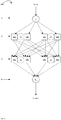
- Fig. 1 shows a schematic of a very simple feedforward neural network 100. It is to be appreciated that the present disclosure is applicable to all forms of neural network, and that the network 100 of Fig. 1 is just used as a simple schematic to illustrate the teaching of the present disclosure.
- the feedforward neural network 100 of Fig. 1 has four layers: a first layer 10, a second layer 20, a third layer 30 and a fourth layer 40.
- the first layer 10 includes one node 11.
- the second layer 20 includes two nodes 21 and 22, as does the third layer 30 which has nodes 31 and 32.
- the fourth layer 40 has a single node 41. Edges which connect different nodes are shown by arrows in Fig. 1 . For example, as can be seen, an edge connects node 11 to node 21, and another edge connects node 11 to node 22.
- the network 100 includes a plurality of weightings ⁇ i,j , where each ⁇ i,j represents a scaling factor applied to the input to node i which has been received from the output of node j .
- weightings may be applied at each edge or at each node. Weightings will hereinafter be referred to as being associated with a node, but this is not to be considered limiting. Rather, the weighting associated with a node means that said node will process input data which has been scaled according to that weighting.
- the node 11 in the first layer 10 is configured to receive an input.
- the input may be some form of data which is to be processed by the neural network 100. Processing this data may enable the neural network 100 to provide an output.
- the output may be based on an analysis of this data, as performed by the neural network 100.
- the output may provide an indication of the contents of the input data.
- the input data may comprise a photo, and the output may provide an indication of what is shown in the photo.
- the node 11 in the first layer 10 is configured to process the received input data based on a certain functionality specified at this node 11.
- the node 11 in the first layer 10 is arranged to then provide this processed data to each of the two nodes 21,22 in the second layer 20.
- Each of the two nodes 21,22 in the second layer 20 are configured to then process this data received from the first layer 10 based on certain functionality specified for that node 21,22 and a scaling factor applied to the processed data output from the node 11 in the first layer 10.
- Each of the nodes 21,22 in the second layer 20 is configured to then output their processed data and provide it to each of the nodes 31,32 in the third layer 30. Again, each of the two nodes 31,32 in the third layer 30 are configured to then process this data received from the second layer 20 based on certain functionality specified for that node and a scaling factor applied to this processed data. As can be seen in Fig. 1 , each of the nodes 31,32 in the third layer 30 receives input data from two preceding nodes 21,22 (the nodes in the second layer 20), as opposed to receiving input data from one node. Each of the nodes 31,32 in the third layer 30 is configured to process their input data and provide their processed output data to the node 41 in the fourth layer 40. The node 41 in the fourth layer 40 is configured to then provide an output value based on processing this data received from the third layer 30 based on certain functionality specified for that node 41 and a scaling factor applied to this processed data.
- each node in the network 100 there are numerous factors which contribute to the ability of a neural network to perform its selected task. For example, the size and/or depth of a network (e.g. the number of nodes/the number of layers of nodes) will influence the performance of a neural network. With regard to Fig. 1 , it is to be appreciated that the performance of this network 100 will, amongst other factors, depend on the weightings ⁇ i,j and the functionality applied at each of the nodes in the network 100. Embodiments of the present disclosure may enable an improved selection of the nodes for the network, and thus may enable the provision of an improved neural network for performing the selected task.
- a computational graph may be constructed.
- the computational graph includes a plurality of nodes connected by a plurality of edges. Each node is configured to receive at least one item of input data from a preceding node connected to it via an edge. Each node is arranged to process input data by applying a weighting to the input data and performing an operation on the weighted input data to provide output data. Different nodes may perform different operations, e.g. they may have different functionalities.
- the graph includes a weighting associated with each node for scaling that node's input data. Each node is configured to provide its output data to a subsequent node via an edge in the graph.
- the computational graph may be considered to define a plurality of candidate models, each candidate model being a subgraph in the computational graph.
- Each subgraph is made up of a selection from the computational graph of the plurality of nodes and edges, and the weightings associated with said selected nodes. Some of the nodes and their associated weightings are shared between both different subgraphs.
- Each candidate model may comprise a fixed, selected arrangement of nodes.
- the selected architecture e.g. arrangement of nodes
- the functionality provided at each node may vary between different candidate models.
- a plurality of options for the functionality of that node may be provided.
- the options for each node may be considered to be represented as a series of candidate nodes clustered together at a selected location in the graph (e.g. in a region where the selected node would be in the final neural network).
- the computational graph may include weightings for connections between each candidate node in a cluster to each candidate node in a subsequent cluster.
- Fig. 2 shows a schematic diagram of a functional illustration representing a computational graph 200.
- the graph 200 of Fig. 2 corresponds to the neural network 100 shown in Fig. 1 in that it has four layers, with one node per layer for the first and fourth layers, and two nodes per layer for the second and third layers.
- two candidate nodes 21a, 21b are provided as candidates for the first node 21 of the second layer 20.
- two candidate nodes 22a, 22b are provided as candidates for the second node 22 of the second layer 20.
- the same is shown for the third layer 30.
- Two candidate nodes 31a, 31b are provided as candidates for the first node 31 of the third layer 30, and two candidate nodes 32a, 32b are provided as candidates for the second node 32 of the third layer 30.
- the candidate nodes are shown as squares, and the corresponding nodes from Fig. 1 are shown as circles with dashed lines.
- the dashed lines of Fig. 2 show the possible routes along which information may flow through the network, e.g. they show all the possible edges. It is to be appreciated that some of these will be present in each model, and selection of the ones that will be present will depend on the candidate nodes present in said selected model. It is noted that in the example shown in Fig. 2 , each candidate node in the third layer 30 has four possible sources of input from the second layer 20, as does the node 41 in the fourth layer 40.
- a preferred candidate model may be identified.
- the preferred candidate model may be a particular subgraph (e.g. a candidate node may have been selected for each node in the network).
- the particular subgraph may be a combination identified in one of the candidate models, or it may be a new combination of candidate nodes.
- each of the candidate models in a subset of subgraphs included in the computational graph is trained. This process is performed in an iterative fashion. For example, a first candidate model may be trained, then, once the first candidate model is trained to a threshold level, a second candidate model may then be trained. This is repeated until a selected number of the candidate models have been trained (e.g. all of the candidate models in the subset). As discussed in more detail below, once the candidate models have been trained, a controller having a trained policy may analyse the computational graph and the trained models to help identify a candidate model to select for the neural network.
- neural networks here are used for illustration only.
- the computational graph 200 shown in Fig. 2 it would be computationally feasible to train and then test all of the possible combinations of subgraphs, and then select the best-performing one as the model on which the neural network will be based.
- neural networks may be much, much larger than this.
- analysis of a large neural network having a plurality of different options for each node in that network may hold a near-infinite number of possible configurations. To identify a preferred network from this number of configurations, only a subset of the total number of configurations will be used, otherwise the computational requirements would be unpractical.
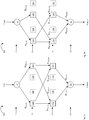
- Figs. 3a and 3b show two schematic diagrams of candidate models for the neural network.
- Fig. 3a shows a candidate model 301 in which nodes 21a, 22b, 31a and 32b have been selected.
- Fig. 3b shows a candidate model 302 in which nodes 21a, 22a, 31a and 32a have been selected. Training of a candidate model is now described with reference to Figs. 3a and 3b .
- the candidate model has a set of candidate nodes selected and a set of weightings ⁇ i,j selected.
- the weightings ⁇ i,j apply a scaling factor to each node-to-node connection in the model.
- the scaling factor for each weighting in the model may be 'learned' by training the model.
- the weightings may be learned, e.g. by using gradient-based learning. This involves defining a cost function and minimising it. Minimising the cost function may be achieved by following the gradient of the cost function in order to minimise it. Stochastic gradient descent may be used as the optimisation procedure. A gradient-descent optimisation algorithm may be used which uses backpropagation. For brevity, these shall not be discussed in much detail.
- a stochastic gradient descent algorithm updates the weightings until conversion.
- a modified loss function may be defined which is used during training. When training each model, the updates to the weightings are calculated based on minimising this modified loss function.
- the modified loss function includes a component which takes into account, for a selected weighting, the importance of that weighting in any previously trained models.
- weightings may be trained as part of a later model which have already been trained in relation to an earlier model. This can be seen from Figs. 3a and 3b . These two figures show two possible subgraphs (models) 301,302 from the computational graph 200 shown in Fig. 2 .
- the two subgraphs 301,302 both include nodes 11, 21a, 31a and 41.
- the weightings ⁇ 21 a ,11 , ⁇ 31 a ,21 a and ⁇ 41,31 a are shared by both models (subgraphs 301,302).
- the modified loss function may take into account the importance of that weighting (and its associated node) in an earlier-trained model. For example, this may be based on an indication of the Fisher information for that weighting (and node). Fisher information may provide an indication of the amount of information the node has for the operation of the model. For a selected weighting, the Fisher information provides an indication of the curvature of the log likelihood for that weighting. A Fisher information matrix may be calculated.
- a cross-entropy loss function may be obtained for said subgraph m j .
- the cross-entropy loss function may be defined so that minimising the cross-entropy likelihood provides a maximum likelihood for a classification problem.
- Fisher information for each weighting may be updated sequentially based on the cross-entropy loss function for the subgraph. The update may be based on a derivative of the cross-entropy loss function. For example, a squared gradient of the cross-entropy loss function relative to the selected subgraph may be calculated for each weighting (e.g. ⁇ L m j ⁇ ⁇ i ⁇ ⁇ m j 2 for all ⁇ i ⁇ ⁇ m j ).
- the update of the Fisher matrix may be calculated using a validation batch after each training of a model, e.g. the updates are determined based on the previously-trained candidate model.
- a loss function may be defined, e.g. for each architecture (subgraph). This will be referred to hereinafter as a weight plasticity loss function.
- This loss function may include a term indicative of Fisher information, e.g. of Fisher information for each weighting.
- the loss function may include a component which, for each weighting, is based on both: (i) a difference between that weighting's value and an optimum value for that weighting, and (ii) an indication of the Fisher information for that weighting, e.g.: ⁇ ⁇ i ⁇ ⁇ m j I ⁇ i ⁇ i ⁇ ⁇ ⁇ i 2
- Minimising the weight plasticity loss function may therefore be based at least in part on minimising this component.
- the optimal weights ⁇ l may be overwritten after each training of a model.
- the weight plasticity loss function for each weighting may also include an indication of the cross-entropy loss function for that subgraph.
- the weight plasticity loss function may therefore include the two terms: L m j ⁇ m j + ⁇ ⁇ i ⁇ ⁇ m j I ⁇ i ⁇ i ⁇ ⁇ ⁇ i 2
- Either and/or both of these terms may be scaled, e.g. by a respective hyperparameter.
- Such hyperparameters may be learned. They may be controlled to provide a selected learning rate for the equation.
- the weight plasticity loss function may be minimised. This may have the effect of reducing a magnitude of updates to weightings in a candidate model which are important to other candidate models.
- the weight plasticity loss function balances this minimising of changes to important weightings with a minimising of the performance at performing the selected task for each model, so that high performance for the task for each model may still be obtained without sacrificing performance on that same task in earlier trained models.
- the weight plasticity loss function may include a term indicative of a modulus of each weighting. For example, this may be based on a value for the modulus squared, e.g. the weight plasticity loss function may include the term: ⁇ ⁇ i ⁇ ⁇ m j ⁇ i 2
- Training of each subgraph may be based on minimizing this function when updating the weightings of that subgraph.
- Each of the three components may be scaled according to a hyperparameter to control their relative contributions. Values for these hyperparameters may be learned.
- Updates to the Fisher information matrix may be clipped, e.g. they may be scaled back based on a selected threshold for updates. This may help inhibit exploding gradients associated with the loss function.
- each update may be scaled based on a value for its respective weighting.
- the update to the Fisher information matrix may be scaled based on the norm for each weighting matrix.
- the parameters ⁇ and ⁇ may be tuned, e.g. they can be learned. They may provide a degree of constraint for controlling the learning of the models.
- an analysis of the candidate models may be performed.
- the analysis may comprise sequentially evaluating performance of the different candidate models using a validation set, e.g. a data set different to the training data set from which the performance of the model at performing the selected task (on unseen data) may be determined.
- the top performing model may be selected.
- the top performing model may be taken as the preferred model, and a neural network may be provided which is based on this preferred model.
- Providing the neural network may comprise creating a neural network using the preferred model and a random set of weightings, then training the network.
- FIG. 4 Another example is shown in Fig. 4 in which an iterative approach is used which enables a controller to evaluate trained candidate models which have performed well, and to learn from these, and based on this, to suggest candidate models to train and evaluate.
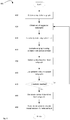
- Fig. 4 shows a method 400 of providing a neural network configured to perform the selected task.
- a computational graph is obtained. This may be the same as described above.
- a set of suggested subgraphs is obtained.
- This set of subgraphs may initially be selected randomly. However as the loop iterates, they will be selected by the controller. They may also initially be selected by the controller.
- each of these subgraphs is trained in an iterative fashion, as described above. That is, the training uses training data and minimizes a weight plasticity loss function so that updates to weightings of each candidate model are controlled based on how important those weightings are to other previously-trained candidate models.
- each of the candidate models has been trained. They may have been given a limited amount of training time, e.g. only a small number of batches. Each candidate may therefore be better than it was before, but not fully trained.
- a time threshold or batch threshold may be used to control the amount of training each model receives. They are then tested on a validation data set so that a best candidate model can be identified. The best candidate model is then evaluated by a controller.
- the controller may use reinforcement or evolutionary learning algorithms to update parameters of its policy based on results from the validation data for the best candidate model. For example, the controller may use a reinforcement learning algorithm.
- Reinforcement learning uses a trial and error process guided by an agent.
- the agent may interact with its environment in discrete or continuous time.
- the choice of this action is done by the policy ⁇ ⁇ p ( a
- the agent receives a new state S t +1 and a reward R t +1 .
- the objective maximizes some form of future reward.
- Reinforcement learning comprises changing the policy in response to a received reward and aiming to maximize a future reward. In order to do so, the reinforcement learning algorithm may address an exploration-exploitation trade off.
- bandit algorithms may be used.
- this may comprise identifying new, untested combinations/selections of nodes which have unknown performance capabilities, and sticking to known combinations/selections of nodes whilst making small changes to the combination/selection.
- Parameters for the policy of the controller may be learned using policy gradient methods, e.g. methods based on a gradient of a loss function.
- Policy gradient methods may be used in combination with a recurrent policy adapted to neural architecture search.
- An architecture e.g. a subgraph
- Each action may define an operation (e.g. the functionality of a node), such as a ReLU or softmax function.
- Each action may define an indication of how to compose an operation (e.g. defining the input of operations).
- the policy e.g. a recurrent neural network policy
- the state S T may be considered the hidden state of the neural network.
- the policy may be defined as: ⁇ ⁇ p a t
- s t ⁇ ⁇ p a t
- a 1 , ... , t ⁇ 1 P ⁇ p a t
- D defines the set of all possible architectures (subgraphs)
- ⁇ ⁇ p ( a 1 , ..., T ) is the probability of sampling the architecture a 1 ,..., T
- R (a 1 ,..., T ) is the inverse of the validation perplexity of the sampled architecture a 1 ,..., T .
- T ⁇ D ⁇ ⁇ p a 1 ... T R a 1 ... T ⁇ log ⁇ ⁇ p a 1 ... T E a 1 , ... T ⁇ ⁇ ⁇ p ⁇ log ⁇ ⁇ p a 1 ... T R a 1 ... T
- the gradient may be computed using a Monte Carlo estimate, e.g. which is unbiased.
- REINFORCE may be used.
- a Boltzmann softmax equation may be used which divides exponentials in the original softmax by a temperature T which decays over time. This temperature (and its decay) may be used to initially favour exploration (e.g. as opposed to exploitation).
- a validation set (different to the training data set used for updating the weightings) may be used. This may enable the policy to select models that generalize well (rather than ones which are too specialized/overfitted to the training data set). For example, the perplexity may be calculated on a validation data set (or a minibatch thereof).
- the controller's policy may be updated. This may be based on the approach described above.
- the updated policy may then select different subgraphs/identify different subgraphs it considers to be better.
- the controller may be configured to suggest further subgraphs which may be considered by the controller to be, as determined based on its updated policy, suitable for performing the selected task.
- the controller may be operated to use the updated policy to suggest subgraphs for the selected task. For example, it may select a set of actions corresponding to a sequence of operations for the subgraph. A plurality of such subgraphs may be selected by the controller. These may then form the candidate models for the next round of testing subgraphs.
- the controller may not suggest subgraphs. Steps 420 to 470 may be looped without suggesting new subgraphs so that the candidate models obtained at step 420 are trained for several iterations. During each iteration of training these candidate models, the policy may still be updated based on the evaluation of the trained models. In some examples, the controller may not suggest subgraphs, but may still provide an indication of which of a selection of trained subgraphs is the preferred subgraph. For example, step 460 may be skipped.
- step 470 it may be determined whether or not to iterate (e.g. repeat steps 420 to 460).
- the subgraphs suggested by the controller may be examined to determine this. Different criteria may be used in this step to determine whether or not to keep iterating.
- the suggested subgraphs may be used in step 420 as the obtained set of subgraphs, and steps 420 to 460 may be repeated using these newly-suggested candidate models. By iterating this process, the method may get closer to obtaining a preferred model for performing the selected task.
- Criteria may be applied to determine whether a suggested subgraph, or the best subgraph from the previous set of candidate models, should be used as the preferred model which the neural network will use for performing the selected task. For example, a comparison may be made between a suggested candidate model and the previous best candidate model. If the two are functionally very similar, e.g. have an architectural degree of similarity above a threshold level/contain a threshold number of the same neurons (e.g. in the same location in the network), it may be determined that the suggested model/the previous best model should be taken as the preferred model. If the controller suggests a plurality of different subgraphs, a comparison may be performed to see if any of these have been previously suggested by the controller.
- a threshold number of suggested subgraphs are the same as previous candidate models, then it may be determined that no meaningful changes have occurred, and the threshold may be determined to have been reached. Additionally and/or alternatively, a threshold time limit, or threshold number of iterations may be applied, and once this threshold is reached, the method may stop iterating.
- step 470 If at step 470, it is determined that iteration should stop, the method proceeds to step 480.
- step 480 a neural network is created based on the subgraph in the preferred model.
- this neural network is trained so that the weightings are updated to convergence, e.g. starting from a random initialization. This network is then provided as the selected neural network for performing the selected task.
- Figs. 5a and 5b show results for test accuracy when sequentially training two models.
- the two models were tested on the hand digit recognition dataset (MNIST).
- the two models were simple feedforward networks, with model 1 having 4 layers and model 2 having 6 layers. In both cases, the first model was trained until convergence, thus obtaining ( ⁇ 1 , ⁇ s ), which are the optimum weightings for model 1.
- the optimum weightings for model 1 include some weightings which are shared with model 2.
- Model 2 is then trained on the same data set as model 1. Training model 2 includes updating the shared weightings.
- Figs. 5a and 5b show how the test accuracy for these two models varies depending on the loss function used when training the models.
- Fig. 5a shows results when sequentially training two models using a cross-entropy loss function, e.g. it is trained by maximum likelihood of obtaining optimum weightings.
- the green line (which goes from top left to top right) shows the performance of model 1 after training. This is a flat line, which shows the performance achieved by model 1 remains at a test accuracy of approximately 92%. This line shows the performance of model 1 as a baseline.
- the blue line (which goes from bottom left to top right) shows the test accuracy of model 2 whilst this model is being trained. As expected, the test accuracy of model 2 increases with increased training. It can be seen that model 2 does not quite reach convergence over the number of iterations shown, but that a substantial increase in the ability of model 2 to perform the task has been observed.
- Fig. 5a The red line in Fig. 5a (top left to middle right) shows how the test accuracy of model 1 is affected by the training of model 2 (and thus updating of weightings shared between the two models). As can be seen, as model 2 is trained (and the shared weightings are changed) the performance of model 1 decreases. It is apparent from Fig. 5a that the drop in performance of model 1 is substantial, and so any subsequent analysis of model 1 would suggest that model 1 does not perform as well as it is capable of performing. As can be seen, over 500 iterations in training, the test accuracy of model 1 dropped almost 30%.
- Fig. 5b shows results when sequentially training two models using a weight plasticity loss function:
- L WPL m j ⁇ 2 ⁇ s L 2 ⁇ 2 ⁇ s + ⁇ 2 ⁇ ⁇ s i ⁇ ⁇ s I ⁇ s i ⁇ s i ⁇ ⁇ ⁇ s i 2 + ⁇ 2 ⁇ ⁇ s 2 i ⁇ ⁇ s , ⁇ 2 ⁇ s 2 i 2
- the lines represent the same indicators as in Fig. 5a .
- the performance of model 1 after training and the performance of model 2 during training are roughly the same as in Fig. 5a .
- the main difference is the test accuracy for model 1 whilst training model 2.
- the second optimization e.g. the training of model 2 predominantly modifies weightings that have low Fisher information. These are considered to be less important for the first model (e.g. because the Fisher information indicates the curvature of the log likelihood with regard to each particular weighting).
- Training model 2 using a loss function based on how important to model 1 the nodes and/or edges associated with a weighting are enables performance of model 1 to be retained during training of a subsequent model.
- Figs. 5a and 5b it can be seen that an analysis of model 1 and model 2 at iteration 500 of training model 2 would provide a different indication of which the model with the higher test accuracy.
- By training using the weight-plasticity loss function test accuracy of model 1 is preserved whilst training model 2.
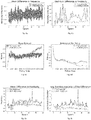
- Figs. 6a to 6f show further comparative data between use of a weight-plasticity loss function and a cross-entropy loss function.
- I ⁇ i t + 1 ⁇ I ⁇ i t + ⁇ L m j ⁇ ⁇ i ⁇ ⁇ m j 2 , ⁇ i ⁇ ⁇ m j , I ⁇ i t , otherwise .
- I w t + 1 ⁇ ⁇ I w t , I w t ⁇ ⁇ , ⁇ I w t I w t , otherwise .
- values for ⁇ and ⁇ were set to 1 and a 100 respectively, with 50 models being sampled per epoch, with 10 batches per epoch.
- the weight-plasticity loss function was introduced at the third epoch, and the Fisher information was set to zero at each epoch.
- the cross-entropy loss function a cross-entropy loss function was used throughout. Increasing the value of ⁇ places a larger constraint (e.g. penalty) on previously learned weightings.
- Fig. 6a shows mean difference in perplexity, for each trained model, between performances of: (i) that model after the sequential training of all of the 50 models, and (ii) that model when trained independently. This difference is shown over 50 epochs.
- Perplexity provides an indication of how well a model predicts a sample - a low perplexity indicates that the model predicts well.
- Fig. 6a also shows error bars for ⁇ 2 standard deviations.
- the use of weight-plasticity loss function (as shown by the lower of the two lines at the right-hand end, and the narrower of the two error bars) reduces the mean difference in perplexity between a model that has been sequentially trained and a model that has been independently trained. This is clearly beneficial. It means that models used for updating a policy of the controller are more reliably the correct choice (e.g. the selection of a best candidate model is less likely to have been skewed by the location in the sequence at which that model was trained).
- Fig. 6b shows the maximum difference in perplexity between performances of: (i) models after the sequential training of all of the 50 models, and (ii) corresponding models when trained independently.
- the weight-plasticity loss function provides a substantial reduction in the maximum difference in perplexity. Also, the fluctuations in this value are lower for the weight-plasticity loss function. This shows another clear benefit of using the weight-plasticity loss function.
- Figs. 6c to 6f show values for ⁇ and ⁇ were set to 70 and 10 respectively, with 70 models per epoch, with each model being trained for 15 batches.
- updates to the weightings are based on the weight-plasticity loss function at the eighth epoch, with the Fisher information matrix set to zero at each three epochs.
- 2000 steps per epoch are used to train the policy and the policy is not held fixed.
- Reinforcement learning algorithm REINFORCE was used as part of the controller with a policy to be determined.
- Fig. 6c shows the mean reward for the models plotted against the number of policy steps taken.
- the policy is designed to maximize the reward based on the candidate models, so a higher value for the reward is beneficial.
- the mean reward when using the weight-plasticity loss function is substantially higher than when using the cross-entropy loss function.
- the error bars shown represent 0.5 standard deviations. It can be seen that the mean reward is much higher for the weight-plasticity loss function and the standard deviation of this reward is much lower.
- Fig. 6d shows the entropy for the policy.
- the entropy of a policy provides a measure of the uncertainty of the probability distribution of the predictions made by the policy - the higher the entropy, the higher the uncertainty.
- the entropy of the policy obtained using the weight-plasticity loss function is substantially less than that obtained using the cross-entropy loss function.
- use of the weight-plasticity loss function may provide a more reliable neural network for performing a selected task.
- Figs. 6e and 6f show similar trends to graphs 6a and 6b in that when comparing models trained as part of a sequence using the weight-plasticity loss function to corresponding models trained independently, the mean and standard deviation of this difference over a number of candidate models is substantially lower than when using a cross-entropy loss function. Additionally, it is very apparent from Figs. 6e and 6f that the use of the weight-entropy loss function is responsible for this increase in performance. As mentioned above, the weight-plasticity loss function was only introduced at the eighth epoch. Before this point, the two loss functions were identical. As can be seen from Figs. 6e and 6f , the improvement in performance of the weight-plasticity loss function occurs after the eighth epoch. Prior to this, the two loss functions perform the same.
- the disclosure herein has made reference to nodes of the neural network.
- the functionality e.g. activation functions used in a neural network are generally known. Such functions may include: ReLU, Tanh, Sigmoid, Softmax etc. In particular, non-linear functions are used frequently. These functions may be used for individual neurons in a network.
- Embodiments of the present disclosure encompass each individual node (as described herein) being either an individual neuron or a block of neurons.
- the computational graph may include combinations of both.
- Embodiments of the present disclosure may utilize blocks of neurons at nodes.
- Each block of neurons may its own set topography and contents.
- a block may include a sequence of selected neurons connected by a selected set of edges, with fixed weightings associated therewith.
- Use of blocks of neurons may improve the neural architecture search as blocks may be selected based on previous knowledge of how those blocks perform on similar tasks. This may also reduce the number of weightings which need to be trained as part of the method because the weightings within a block may be held fixed.
- the neural architecture search methods may only then need to identify the edges and weightings between different blocks, e.g. between fewer features than if the blocks were expanded out and edges/weightings were needed for every neuron.
- Such examples may be referred to as neural architecture search with blocks.
- a controller may be used (e.g. with a LTSM policy) which samples blocks at nodes and determine edges at which to connect them.
- the internal weightings for a block may not be held fixed, e.g. instead only the component neurons are selected, but the weightings between them may be edited during training.
- weight plasticity loss functions may find particular application in such scenarios.
- a reward to be maximized by the controller may be modified to include a component which takes into account complexity of a candidate model.
- the reward may be based on the number of components within a candidate model. This may be in addition to the reward being based on a goodness of fit for a candidate model, e.g. a validation perplexity for the model. It is to be appreciated that introducing a component based on complexity of a candidate model into the reward function may be applicable to all methods described herein.
- a density based reward may be introduced.
- the reward may be configured to favour models with fewer weightings.
- ⁇ maximum is the maximum possible number of weightings to be included in the model.
- ppl is the validation perplexity, e.g. how well a model performs on a validation data set.
- the two components of the reward may be separated (as shown) to prevent the reward from turning negative. Use of this reward may therefore identify models which perform well and which have fewer weightings.
- Examples described herein have included use of iterative processes where candidate models are trained numerous times before a preferred model is selected.
- the same set of candidate models may be trained a number of times, e.g. they may be trained on a number of different batches.
- the iterative process may include multiple repetitions of training a set of candidate models and then evaluating the same models using the controller to update the policy, before re-training the same models and then re-evaluating them with the controller.
- the controller may suggest new candidate models for testing in response to having updated the policy based on a set of trained candidate models.
- the iterative process may not be needed.
- a single operation of sequentially training of candidate models may be enough for a preferred model to be identified.
- embodiments described herein enable sequentially trained models to be trained so that any updated weightings reduce the detriment to earlier-trained models, one run of sequentially training these models may still be enough for a preferred model to be identified.
- Obtaining a computational graph may be considered to be obtaining data indicative of a computational graph, such as an array of matrices and operations for controlling and scaling the flow of information between different functions.
- One particular subgraph e.g. collection of nodes, connected by edges with weightings included
- the candidate model is determined to be a preferred candidate model, then the particular architecture of the subgraph may be used as the architecture for the neural network (e.g. without the presence of the other nodes and edges in the computational graph).
- selected task could be any of a number of selected tasks.
- Neural networks may find application in a wide range of technical problems.
- selected tasks include: (i) natural language processing, (ii) image recognition, (iii) classification and/or modelling of physical systems, (iv) data processing and (v) generation of search results.
- This list is not to be considered as limiting, as any instance in which input data may be processed to provide output data, based on which technical operations may be carried out, could benefit from use of an improved neural network for processing said data. It is to be appreciated that the present disclosure is not linked to the provision of any particular type of neural network.
- suitable neural networks may include convolutional neural networks, deep residual neural networks, capsule networks, recurrent neural networks, multi-layer perceptrons etc.
- Neural networks disclosed herein may include recurrent neural networks used for encoders in sequence to sequence models which are of particular importance. These may find application in e.g. translation, churn detection and email classification.
- improved translation neural networks may be able to identify key phrases in a sentence which are to be translated. This may enable neural networks which can receive input data in the form of a string of text in a first language or coding, process this input data to provide output data in the form of a string of text in a different language or coding.
- neural networks may find application in image recognition systems. For example, at security checkpoints e.g. airports, a camera may capture an image of an individual, and the neural network may be arranged to classify/identify the individual. Improved neural network architectures may improve the ability of these neural networks to identify individuals in photos.
- controller/policy may be used during the analysis of trained candidate models. Whilst use of reinforcement learning has been described, other examples could be used. For example, evolutionary networks (and associated neuroevolutionary methods) may be used. In such examples, both the topology of the network and its weightings may be updated during training (e.g. the network architecture may evolve). Weightings may also be inherited by child nodes in a controlled manner, so that parental weightings may be applied to a child node where suitable.
- each of the examples described herein may be implemented in a variety of different ways. Any feature of any aspects of the disclosure may be combined with any of the other aspects of the disclosure. For example method aspects may be combined with apparatus aspects, and features described with reference to the operation of particular elements of apparatus may be provided in methods which do not use those particular types of apparatus.
- each of the features of each of the embodiments is intended to be separable from the features which it is described in combination with, unless it is expressly stated that some other feature is essential to its operation.
- Each of these separable features may of course be combined with any of the other features of the embodiment in which it is described, or with any of the other features or combination of features of any of the other embodiments described herein.
- equivalents and modifications not described above may also be employed without departing from the invention.
- each node may comprise a signal processing unit configured to receive an input signal, process the input signal and provide an output signal.
- Nodes may comprise circuitry configured to: receive at least one input signal indicative of an item of input data from a preceding node connected to said node via an edge, perform an operation on the input data to provide output data, optionally scale the input data according to a weighting associated with said node; and provide an output signal indicative of the output data to a subsequent node via an edge in the graph.
- Edges may comprise communication paths configured for the transmission of signals between nodes.
- the communication paths may be configured to receive an output signal from a preceding node, optionally scale that output signal according to a weighting, and transmit that output signal to a subsequent node.
- Localised data storage may be used for determining an end destination for transmitting the output signal to via the communication path.
- Computer programs include software, middleware, firmware, and any combination thereof. Such programs may be provided as signals or network messages and may be recorded on computer readable media such as tangible computer readable media which may store the computer programs in non-transitory form. Methods described herein and/or the functionality of components such as nodes and edges may be provided in hardware which includes computers, handheld devices, programmable processors, general purpose processors, application specific integrated circuits (ASICs), field programmable gate arrays (FPGAs), and arrays of logic gates.
- ASICs application specific integrated circuits
- FPGAs field programmable gate arrays
- one or more memory elements can store data and/or program instructions used to implement the operations described herein.
- Embodiments of the disclosure provide tangible, non-transitory storage media comprising program instructions operable to program a processor to perform any one or more of the methods described and/or claimed herein and/or to provide data processing apparatus as described and/or claimed herein.
Landscapes
- Engineering & Computer Science (AREA)
- Theoretical Computer Science (AREA)
- Physics & Mathematics (AREA)
- Health & Medical Sciences (AREA)
- Life Sciences & Earth Sciences (AREA)
- Data Mining & Analysis (AREA)
- Artificial Intelligence (AREA)
- General Engineering & Computer Science (AREA)
- General Physics & Mathematics (AREA)
- Computational Linguistics (AREA)
- General Health & Medical Sciences (AREA)
- Evolutionary Computation (AREA)
- Software Systems (AREA)
- Computing Systems (AREA)
- Biophysics (AREA)
- Biomedical Technology (AREA)
- Molecular Biology (AREA)
- Mathematical Physics (AREA)
- Bioinformatics & Cheminformatics (AREA)
- Bioinformatics & Computational Biology (AREA)
- Evolutionary Biology (AREA)
- Physiology (AREA)
- Audiology, Speech & Language Pathology (AREA)
- Computer Vision & Pattern Recognition (AREA)
- Image Analysis (AREA)
Priority Applications (3)
| Application Number | Priority Date | Filing Date | Title |
|---|---|---|---|
| CN201910926760.8A CN110956260B (zh) | 2018-09-27 | 2019-09-27 | 神经架构搜索的系统和方法 |
| US16/586,363 US12001957B2 (en) | 2018-09-27 | 2019-09-27 | Methods and systems for neural architecture search |
| US18/732,052 US20240354579A1 (en) | 2018-09-27 | 2024-06-03 | Methods and systems for neural architecture search |
Applications Claiming Priority (1)
| Application Number | Priority Date | Filing Date | Title |
|---|---|---|---|
| EP18197366 | 2018-09-27 |
Publications (2)
| Publication Number | Publication Date |
|---|---|
| EP3629246A1 true EP3629246A1 (de) | 2020-04-01 |
| EP3629246B1 EP3629246B1 (de) | 2022-05-18 |
Family
ID=63708165
Family Applications (1)
| Application Number | Title | Priority Date | Filing Date |
|---|---|---|---|
| EP19154841.1A Active EP3629246B1 (de) | 2018-09-27 | 2019-01-31 | Systeme und verfahren zur suche nach neuronalen architekturen |
Country Status (3)
| Country | Link |
|---|---|
| US (2) | US12001957B2 (de) |
| EP (1) | EP3629246B1 (de) |
| CN (1) | CN110956260B (de) |
Cited By (12)
| Publication number | Priority date | Publication date | Assignee | Title |
|---|---|---|---|---|
| CN111563591A (zh) * | 2020-05-08 | 2020-08-21 | 北京百度网讯科技有限公司 | 超网络的训练方法和装置 |
| CN111782398A (zh) * | 2020-06-29 | 2020-10-16 | 上海商汤智能科技有限公司 | 数据处理的方法、装置、系统及相关设备 |
| CN112487989A (zh) * | 2020-12-01 | 2021-03-12 | 重庆邮电大学 | 一种基于胶囊-长短时记忆神经网络的视频表情识别方法 |
| CN112579842A (zh) * | 2020-12-18 | 2021-03-30 | 北京百度网讯科技有限公司 | 模型搜索方法、装置、电子设备、存储介质和程序产品 |
| CN112685623A (zh) * | 2020-12-30 | 2021-04-20 | 京东数字科技控股股份有限公司 | 一种数据处理方法、装置、电子设备及存储介质 |
| CN113033773A (zh) * | 2021-03-03 | 2021-06-25 | 北京航空航天大学 | 面向旋转机械故障诊断的分层多叉网络结构高效搜索方法 |
| CN113935427A (zh) * | 2021-10-22 | 2022-01-14 | 北京达佳互联信息技术有限公司 | 训练任务的执行方法、装置、电子设备及存储介质 |
| DE102020211714A1 (de) | 2020-09-18 | 2022-03-24 | Robert Bosch Gesellschaft mit beschränkter Haftung | Verfahren und Vorrichtung zum Erstellen eines maschinellen Lernsystems |
| DE202022103792U1 (de) | 2022-07-06 | 2022-07-29 | Albert-Ludwigs-Universität Freiburg, Körperschaft des öffentlichen Rechts | Vorrichtung zum Bestimmen einer optimalen Architektur eines künstlichen neuronalen Netzes |
| CN114972334A (zh) * | 2022-07-19 | 2022-08-30 | 杭州因推科技有限公司 | 一种管材瑕疵检测方法、装置、介质 |
| CN116127849A (zh) * | 2023-02-28 | 2023-05-16 | 华中科技大学 | 基于单路径单元神经网络架构搜索的故障预测方法及系统 |
| DE102022206892A1 (de) | 2022-07-06 | 2024-01-11 | Robert Bosch Gesellschaft mit beschränkter Haftung | Verfahren zum Bestimmen einer optimalen Architektur eines künstlichen neuronalen Netzes |
Families Citing this family (45)
| Publication number | Priority date | Publication date | Assignee | Title |
|---|---|---|---|---|
| US12136039B1 (en) | 2018-12-05 | 2024-11-05 | Perceive Corporation | Optimizing global sparsity for neural network |
| US12045725B1 (en) | 2018-12-05 | 2024-07-23 | Perceive Corporation | Batch normalization for replicated layers of neural network |
| US20220092416A1 (en) * | 2018-12-27 | 2022-03-24 | Google Llc | Neural architecture search through a graph search space |
| KR102824644B1 (ko) * | 2019-02-18 | 2025-06-25 | 삼성전자주식회사 | 신경망 기반의 데이터 처리 방법, 신경망 트레이닝 방법 및 그 장치들 |
| US12112254B1 (en) | 2019-04-25 | 2024-10-08 | Perceive Corporation | Optimizing loss function during training of network |
| US11443162B2 (en) * | 2019-08-23 | 2022-09-13 | Google Llc | Resource constrained neural network architecture search |
| CN112561027B (zh) * | 2019-09-25 | 2025-02-07 | 华为技术有限公司 | 神经网络架构搜索方法、图像处理方法、装置和存储介质 |
| US11995555B1 (en) * | 2019-12-17 | 2024-05-28 | Perceive Corporation | Training a neural network with quantized weights |
| US12093816B1 (en) | 2020-07-07 | 2024-09-17 | Perceive Corporation | Initialization of values for training a neural network with quantized weights |
| CN113592060A (zh) * | 2020-04-30 | 2021-11-02 | 华为技术有限公司 | 一种神经网络优化方法以及装置 |
| CN113672798B (zh) * | 2020-05-15 | 2024-06-25 | 第四范式(北京)技术有限公司 | 基于协同滤波模型的物品推荐方法和系统 |
| CN111612062B (zh) * | 2020-05-20 | 2023-11-24 | 清华大学 | 一种用于构建图半监督学习模型的方法和系统 |
| US12430950B2 (en) * | 2020-06-04 | 2025-09-30 | Samsung Electronics Co., Ltd. | Systems and methods for continual learning |
| CN111667056B (zh) * | 2020-06-05 | 2023-09-26 | 北京百度网讯科技有限公司 | 用于搜索模型结构的方法和装置 |
| CN111723910B (zh) * | 2020-06-17 | 2025-12-16 | 腾讯科技(北京)有限公司 | 构建多任务学习模型的方法、装置、电子设备及存储介质 |
| DE102020208828A1 (de) * | 2020-07-15 | 2022-01-20 | Robert Bosch Gesellschaft mit beschränkter Haftung | Verfahren und Vorrichtung zum Erstellen eines maschinellen Lernsystems |
| CN112070205B (zh) * | 2020-07-30 | 2025-03-04 | 华为技术有限公司 | 一种多损失模型获取方法以及装置 |
| CN114556364B (zh) * | 2020-09-18 | 2024-07-26 | 百度时代网络技术(北京)有限公司 | 用于执行神经网络架构搜索的计算机实现方法 |
| CN114282678A (zh) * | 2020-09-18 | 2022-04-05 | 华为技术有限公司 | 一种机器学习模型的训练的方法以及相关设备 |
| US20220101089A1 (en) * | 2020-09-25 | 2022-03-31 | Samsung Electronics Co., Ltd. | Method and apparatus for neural architecture search |
| CN112116090B (zh) * | 2020-09-28 | 2022-08-30 | 腾讯科技(深圳)有限公司 | 神经网络结构搜索方法、装置、计算机设备及存储介质 |
| CN112183376A (zh) * | 2020-09-29 | 2021-01-05 | 中国人民解放军军事科学院国防科技创新研究院 | 针对eeg信号分类任务的深度学习网络架构搜索方法 |
| CN116368493B (zh) * | 2020-10-15 | 2025-11-25 | 罗伯特·博世有限公司 | 用于具有随机架构的权重共享神经网络的方法和装置 |
| CN112256878B (zh) * | 2020-10-29 | 2024-01-16 | 沈阳农业大学 | 一种基于深度卷积的水稻知识文本分类方法 |
| CN112801264B (zh) * | 2020-11-13 | 2023-06-13 | 中国科学院计算技术研究所 | 一种动态可微分的空间架构搜索方法与系统 |
| WO2022133725A1 (en) * | 2020-12-22 | 2022-06-30 | Orange | Improved distributed training of graph-embedding neural networks |
| CN113159115B (zh) * | 2021-03-10 | 2023-09-19 | 中国人民解放军陆军工程大学 | 基于神经架构搜索的车辆细粒度识别方法、系统和装置 |
| CN113095188A (zh) * | 2021-04-01 | 2021-07-09 | 山东捷讯通信技术有限公司 | 一种基于深度学习的拉曼光谱数据分析方法与装置 |
| CN115393662A (zh) * | 2021-05-08 | 2022-11-25 | Oppo广东移动通信有限公司 | 图像处理方法、装置、计算机设备及存储介质 |
| US12430551B2 (en) * | 2021-06-03 | 2025-09-30 | Google Llc | Reinforcement learning algorithm search |
| CN113469078B (zh) * | 2021-07-07 | 2023-07-04 | 西安电子科技大学 | 基于自动设计长短时记忆网络的高光谱图像分类方法 |
| CN115828271A (zh) * | 2021-09-16 | 2023-03-21 | 华为技术有限公司 | 一种模型保护方法及装置 |
| CN116860425A (zh) * | 2022-03-23 | 2023-10-10 | 戴尔产品有限公司 | 基于边缘计算节点组之间的知识共享控制边缘计算节点的操作 |
| US12265519B2 (en) * | 2022-04-26 | 2025-04-01 | Truist Bank | Change management process for identifying inconsistencies for improved processing efficiency |
| US12153581B2 (en) | 2022-04-26 | 2024-11-26 | Truist Bank | Remediating dataset issues identified in a machine learning change management architecture |
| US12326839B2 (en) | 2022-04-26 | 2025-06-10 | Truist Bank | Change management process for identifying confidential information for improved processing efficiency |
| US11983162B2 (en) | 2022-04-26 | 2024-05-14 | Truist Bank | Change management process for identifying potential regulatory violations for improved processing efficiency |
| CN114997377B (zh) * | 2022-07-07 | 2024-09-13 | 清华大学 | 面向超大规模图的架构搜索方法、装置、设备及存储介质 |
| CN117474065A (zh) * | 2022-07-18 | 2024-01-30 | 北京字跳网络技术有限公司 | 一种多任务模型的训练方法、装置、电子设备及存储介质 |
| CN115860249A (zh) * | 2022-12-20 | 2023-03-28 | 广东电网有限责任公司 | 一种分布式光伏发电功率预测方法、装置、设备和介质 |
| CN116795519B (zh) * | 2023-08-25 | 2023-12-05 | 江苏盖睿健康科技有限公司 | 一种基于互联网的远程智能调测方法和系统 |
| US20250077892A1 (en) * | 2023-08-30 | 2025-03-06 | Mediatek Inc. | Neural network optimization with preview mechanism |
| WO2025116903A1 (en) * | 2023-11-30 | 2025-06-05 | Stem Ai, Inc. | Inter-nodal sharing of generative models |
| CN118798312A (zh) * | 2024-01-17 | 2024-10-18 | 中国移动通信有限公司研究院 | 对话生成模型的训练方法、对话生成方法及装置 |
| CN118863004A (zh) * | 2024-06-27 | 2024-10-29 | 北京玄戒技术有限公司 | 一种模型训练方法、装置、电子设备、芯片及介质 |
Family Cites Families (13)
| Publication number | Priority date | Publication date | Assignee | Title |
|---|---|---|---|---|
| US6553357B2 (en) * | 1999-09-01 | 2003-04-22 | Koninklijke Philips Electronics N.V. | Method for improving neural network architectures using evolutionary algorithms |
| JP2008533615A (ja) * | 2005-03-14 | 2008-08-21 | エル ターラー、ステフエン | ニューラルネットワーク開発およびデータ解析ツール |
| US11074495B2 (en) * | 2013-02-28 | 2021-07-27 | Z Advanced Computing, Inc. (Zac) | System and method for extremely efficient image and pattern recognition and artificial intelligence platform |
| CN103268366B (zh) * | 2013-03-06 | 2017-09-29 | 辽宁省电力有限公司电力科学研究院 | 一种适用于分散式风电场的组合风电功率预测方法 |
| US11151446B2 (en) * | 2015-10-28 | 2021-10-19 | Google Llc | Stream-based accelerator processing of computational graphs |
| US10860925B2 (en) * | 2015-10-28 | 2020-12-08 | Google Llc | Processing computational graphs |
| WO2017083399A2 (en) * | 2015-11-09 | 2017-05-18 | Google Inc. | Training neural networks represented as computational graphs |
| US20170213127A1 (en) * | 2016-01-24 | 2017-07-27 | Matthew Charles Duncan | Method and System for Discovering Ancestors using Genomic and Genealogic Data |
| WO2017148536A1 (en) * | 2016-03-04 | 2017-09-08 | VON MÜLLER, Albrecht | Electronic devices, artificial evolutionary neural networks, methods and computer programs for implementing evolutionary search and optimisation |
| WO2018081563A1 (en) * | 2016-10-28 | 2018-05-03 | Google Llc | Neural architecture search |
| EP3545472B1 (de) * | 2017-01-30 | 2025-03-19 | DeepMind Technologies Limited | Neuronale multi-task-netze mit aufgabenspezifischen pfaden |
| CN108563755A (zh) * | 2018-04-16 | 2018-09-21 | 辽宁工程技术大学 | 一种基于双向循环神经网络的个性化推荐系统及方法 |
| US11126657B2 (en) * | 2018-06-11 | 2021-09-21 | Alibaba Group Holding Limited | Efficient in-memory representation of computation graph for fast serialization and comparison |
-
2019
- 2019-01-31 EP EP19154841.1A patent/EP3629246B1/de active Active
- 2019-09-27 US US16/586,363 patent/US12001957B2/en active Active
- 2019-09-27 CN CN201910926760.8A patent/CN110956260B/zh active Active
-
2024
- 2024-06-03 US US18/732,052 patent/US20240354579A1/en active Pending
Non-Patent Citations (4)
| Title |
|---|
| "International Conference on Computer Analysis of Images and Patterns. CAIP 2017: Computer Analysis of Images and Patterns", vol. 9908, 1 January 2016, SPRINGER, Berlin, Heidelberg, ISBN: 978-3-642-17318-9, article ZHIZHONG LI ET AL: "Learning Without Forgetting", pages: 614 - 629, XP055414041, 032548, DOI: 10.1007/978-3-319-46493-0_37 * |
| HIEU PHAM ET AL: "Efficient Neural Architecture Search via Parameter Sharing", ARXIV.ORG, CORNELL UNIVERSITY LIBRARY, 201 OLIN LIBRARY CORNELL UNIVERSITY ITHACA, NY 14853, 9 February 2018 (2018-02-09), XP081220341 * |
| JAMES KIRKPATRICK ET AL: "Overcoming catastrophic forgetting in neural networks", PNAS, vol. 114, no. 13, 28 March 2017 (2017-03-28), US, pages 3521 - 3526, XP055412644, ISSN: 0027-8424, DOI: 10.1073/pnas.1611835114 * |
| JU XU ET AL: "Reinforced Continual Learning", ARXIV.ORG, CORNELL UNIVERSITY LIBRARY, 201 OLIN LIBRARY CORNELL UNIVERSITY ITHACA, NY 14853, 31 May 2018 (2018-05-31), XP080884188 * |
Cited By (17)
| Publication number | Priority date | Publication date | Assignee | Title |
|---|---|---|---|---|
| CN111563591A (zh) * | 2020-05-08 | 2020-08-21 | 北京百度网讯科技有限公司 | 超网络的训练方法和装置 |
| CN111563591B (zh) * | 2020-05-08 | 2023-10-20 | 北京百度网讯科技有限公司 | 超网络的训练方法和装置 |
| CN111782398A (zh) * | 2020-06-29 | 2020-10-16 | 上海商汤智能科技有限公司 | 数据处理的方法、装置、系统及相关设备 |
| DE102020211714A1 (de) | 2020-09-18 | 2022-03-24 | Robert Bosch Gesellschaft mit beschränkter Haftung | Verfahren und Vorrichtung zum Erstellen eines maschinellen Lernsystems |
| CN112487989A (zh) * | 2020-12-01 | 2021-03-12 | 重庆邮电大学 | 一种基于胶囊-长短时记忆神经网络的视频表情识别方法 |
| CN112487989B (zh) * | 2020-12-01 | 2022-07-15 | 重庆邮电大学 | 一种基于胶囊-长短时记忆神经网络的视频表情识别方法 |
| CN112579842A (zh) * | 2020-12-18 | 2021-03-30 | 北京百度网讯科技有限公司 | 模型搜索方法、装置、电子设备、存储介质和程序产品 |
| CN112685623A (zh) * | 2020-12-30 | 2021-04-20 | 京东数字科技控股股份有限公司 | 一种数据处理方法、装置、电子设备及存储介质 |
| CN113033773B (zh) * | 2021-03-03 | 2023-01-06 | 北京航空航天大学 | 面向旋转机械故障诊断的分层多叉网络结构高效搜索方法 |
| CN113033773A (zh) * | 2021-03-03 | 2021-06-25 | 北京航空航天大学 | 面向旋转机械故障诊断的分层多叉网络结构高效搜索方法 |
| CN113935427A (zh) * | 2021-10-22 | 2022-01-14 | 北京达佳互联信息技术有限公司 | 训练任务的执行方法、装置、电子设备及存储介质 |
| DE202022103792U1 (de) | 2022-07-06 | 2022-07-29 | Albert-Ludwigs-Universität Freiburg, Körperschaft des öffentlichen Rechts | Vorrichtung zum Bestimmen einer optimalen Architektur eines künstlichen neuronalen Netzes |
| DE102022206892A1 (de) | 2022-07-06 | 2024-01-11 | Robert Bosch Gesellschaft mit beschränkter Haftung | Verfahren zum Bestimmen einer optimalen Architektur eines künstlichen neuronalen Netzes |
| CN114972334A (zh) * | 2022-07-19 | 2022-08-30 | 杭州因推科技有限公司 | 一种管材瑕疵检测方法、装置、介质 |
| CN114972334B (zh) * | 2022-07-19 | 2023-09-15 | 杭州因推科技有限公司 | 一种管材瑕疵检测方法、装置、介质 |
| CN116127849A (zh) * | 2023-02-28 | 2023-05-16 | 华中科技大学 | 基于单路径单元神经网络架构搜索的故障预测方法及系统 |
| CN116127849B (zh) * | 2023-02-28 | 2025-08-22 | 华中科技大学 | 基于单路径单元神经网络架构搜索的故障预测方法及系统 |
Also Published As
| Publication number | Publication date |
|---|---|
| CN110956260A (zh) | 2020-04-03 |
| US12001957B2 (en) | 2024-06-04 |
| US20240354579A1 (en) | 2024-10-24 |
| CN110956260B (zh) | 2024-11-08 |
| EP3629246B1 (de) | 2022-05-18 |
| US20200104688A1 (en) | 2020-04-02 |
Similar Documents
| Publication | Publication Date | Title |
|---|---|---|
| EP3629246B1 (de) | Systeme und verfahren zur suche nach neuronalen architekturen | |
| Dubois et al. | Data-driven predictions of the Lorenz system | |
| Fusi et al. | Probabilistic matrix factorization for automated machine learning | |
| US11551026B2 (en) | Dynamic reconfiguration training computer architecture | |
| US11037027B2 (en) | Computer architecture for and-or neural networks | |
| EP3888007A1 (de) | Computerarchitektur zur erzeugung künstlicher bilder unter verwendung eines auto-codierers | |
| US11003909B2 (en) | Neural network trained by homographic augmentation | |
| US20210374544A1 (en) | Leveraging lagging gradients in machine-learning model training | |
| JP7214863B2 (ja) | 人工画像生成用コンピュータアーキテクチャ | |
| US11593619B2 (en) | Computer architecture for multiplier-less machine learning | |
| Koch et al. | Deep learning of potential outcomes | |
| Paul et al. | Trends of optimization algorithms from supervised learning perspective | |
| US12387138B2 (en) | Meta-agent for reinforcement learning | |
| US20240028931A1 (en) | Directed Acyclic Graph of Recommendation Dimensions | |
| US20230092949A1 (en) | System and method for estimating model metrics without labels | |
| Carrillo et al. | Individual explanations in machine learning models: A case study on poverty estimation | |
| Salman et al. | Nifty method for prediction dynamic features of online social networks from users’ activity based on machine learning | |
| US20220405599A1 (en) | Automated design of architectures of artificial neural networks | |
| Bansal et al. | DEN-HMM: Deep emission network based hidden Markov model with time-evolving multivariate observations | |
| Bosnić et al. | Automatic selection of reliability estimates for individual regression predictions | |
| van Velzen | An analysis of imputation techniques under four missingness mechanisms using direct and indirect evaluation combined with computation time | |
| Pellegrino | Time series classification models for anomalous transport phenomena | |
| Roberts | Aspects of Bayesian inference, classification and anomaly detection | |
| Rost | Uncertainty Ensembles Of Deep Neural Networks As Predictive Distribution For Regression | |
| 신윤섭 | Review of bayesian learning for scalable deep neural network |
Legal Events
| Date | Code | Title | Description |
|---|---|---|---|
| PUAI | Public reference made under article 153(3) epc to a published international application that has entered the european phase |
Free format text: ORIGINAL CODE: 0009012 |
|
| STAA | Information on the status of an ep patent application or granted ep patent |
Free format text: STATUS: REQUEST FOR EXAMINATION WAS MADE |
|
| 17P | Request for examination filed |
Effective date: 20190911 |
|
| AK | Designated contracting states |
Kind code of ref document: A1 Designated state(s): AL AT BE BG CH CY CZ DE DK EE ES FI FR GB GR HR HU IE IS IT LI LT LU LV MC MK MT NL NO PL PT RO RS SE SI SK SM TR |
|
| AX | Request for extension of the european patent |
Extension state: BA ME |
|
| STAA | Information on the status of an ep patent application or granted ep patent |
Free format text: STATUS: EXAMINATION IS IN PROGRESS |
|
| 17Q | First examination report despatched |
Effective date: 20200417 |
|
| GRAP | Despatch of communication of intention to grant a patent |
Free format text: ORIGINAL CODE: EPIDOSNIGR1 |
|
| STAA | Information on the status of an ep patent application or granted ep patent |
Free format text: STATUS: GRANT OF PATENT IS INTENDED |
|
| INTG | Intention to grant announced |
Effective date: 20211215 |
|
| GRAS | Grant fee paid |
Free format text: ORIGINAL CODE: EPIDOSNIGR3 |
|
| GRAA | (expected) grant |
Free format text: ORIGINAL CODE: 0009210 |
|
| STAA | Information on the status of an ep patent application or granted ep patent |
Free format text: STATUS: THE PATENT HAS BEEN GRANTED |
|
| AK | Designated contracting states |
Kind code of ref document: B1 Designated state(s): AL AT BE BG CH CY CZ DE DK EE ES FI FR GB GR HR HU IE IS IT LI LT LU LV MC MK MT NL NO PL PT RO RS SE SI SK SM TR |
|
| REG | Reference to a national code |
Ref country code: GB Ref legal event code: FG4D |
|
| REG | Reference to a national code |
Ref country code: CH Ref legal event code: EP |
|
| REG | Reference to a national code |
Ref country code: IE Ref legal event code: FG4D |
|
| REG | Reference to a national code |
Ref country code: DE Ref legal event code: R096 Ref document number: 602019014998 Country of ref document: DE |
|
| REG | Reference to a national code |
Ref country code: AT Ref legal event code: REF Ref document number: 1493585 Country of ref document: AT Kind code of ref document: T Effective date: 20220615 |
|
| REG | Reference to a national code |
Ref country code: LT Ref legal event code: MG9D |
|
| REG | Reference to a national code |
Ref country code: NL Ref legal event code: MP Effective date: 20220518 |
|
| REG | Reference to a national code |
Ref country code: AT Ref legal event code: MK05 Ref document number: 1493585 Country of ref document: AT Kind code of ref document: T Effective date: 20220518 |
|
| PG25 | Lapsed in a contracting state [announced via postgrant information from national office to epo] |
Ref country code: SE Free format text: LAPSE BECAUSE OF FAILURE TO SUBMIT A TRANSLATION OF THE DESCRIPTION OR TO PAY THE FEE WITHIN THE PRESCRIBED TIME-LIMIT Effective date: 20220518 Ref country code: PT Free format text: LAPSE BECAUSE OF FAILURE TO SUBMIT A TRANSLATION OF THE DESCRIPTION OR TO PAY THE FEE WITHIN THE PRESCRIBED TIME-LIMIT Effective date: 20220919 Ref country code: NO Free format text: LAPSE BECAUSE OF FAILURE TO SUBMIT A TRANSLATION OF THE DESCRIPTION OR TO PAY THE FEE WITHIN THE PRESCRIBED TIME-LIMIT Effective date: 20220818 Ref country code: NL Free format text: LAPSE BECAUSE OF FAILURE TO SUBMIT A TRANSLATION OF THE DESCRIPTION OR TO PAY THE FEE WITHIN THE PRESCRIBED TIME-LIMIT Effective date: 20220518 Ref country code: LT Free format text: LAPSE BECAUSE OF FAILURE TO SUBMIT A TRANSLATION OF THE DESCRIPTION OR TO PAY THE FEE WITHIN THE PRESCRIBED TIME-LIMIT Effective date: 20220518 Ref country code: HR Free format text: LAPSE BECAUSE OF FAILURE TO SUBMIT A TRANSLATION OF THE DESCRIPTION OR TO PAY THE FEE WITHIN THE PRESCRIBED TIME-LIMIT Effective date: 20220518 Ref country code: GR Free format text: LAPSE BECAUSE OF FAILURE TO SUBMIT A TRANSLATION OF THE DESCRIPTION OR TO PAY THE FEE WITHIN THE PRESCRIBED TIME-LIMIT Effective date: 20220819 Ref country code: FI Free format text: LAPSE BECAUSE OF FAILURE TO SUBMIT A TRANSLATION OF THE DESCRIPTION OR TO PAY THE FEE WITHIN THE PRESCRIBED TIME-LIMIT Effective date: 20220518 Ref country code: ES Free format text: LAPSE BECAUSE OF FAILURE TO SUBMIT A TRANSLATION OF THE DESCRIPTION OR TO PAY THE FEE WITHIN THE PRESCRIBED TIME-LIMIT Effective date: 20220518 Ref country code: BG Free format text: LAPSE BECAUSE OF FAILURE TO SUBMIT A TRANSLATION OF THE DESCRIPTION OR TO PAY THE FEE WITHIN THE PRESCRIBED TIME-LIMIT Effective date: 20220818 Ref country code: AT Free format text: LAPSE BECAUSE OF FAILURE TO SUBMIT A TRANSLATION OF THE DESCRIPTION OR TO PAY THE FEE WITHIN THE PRESCRIBED TIME-LIMIT Effective date: 20220518 |
|
| PG25 | Lapsed in a contracting state [announced via postgrant information from national office to epo] |
Ref country code: RS Free format text: LAPSE BECAUSE OF FAILURE TO SUBMIT A TRANSLATION OF THE DESCRIPTION OR TO PAY THE FEE WITHIN THE PRESCRIBED TIME-LIMIT Effective date: 20220518 Ref country code: PL Free format text: LAPSE BECAUSE OF FAILURE TO SUBMIT A TRANSLATION OF THE DESCRIPTION OR TO PAY THE FEE WITHIN THE PRESCRIBED TIME-LIMIT Effective date: 20220518 Ref country code: LV Free format text: LAPSE BECAUSE OF FAILURE TO SUBMIT A TRANSLATION OF THE DESCRIPTION OR TO PAY THE FEE WITHIN THE PRESCRIBED TIME-LIMIT Effective date: 20220518 Ref country code: IS Free format text: LAPSE BECAUSE OF FAILURE TO SUBMIT A TRANSLATION OF THE DESCRIPTION OR TO PAY THE FEE WITHIN THE PRESCRIBED TIME-LIMIT Effective date: 20220918 |
|
| PG25 | Lapsed in a contracting state [announced via postgrant information from national office to epo] |
Ref country code: SM Free format text: LAPSE BECAUSE OF FAILURE TO SUBMIT A TRANSLATION OF THE DESCRIPTION OR TO PAY THE FEE WITHIN THE PRESCRIBED TIME-LIMIT Effective date: 20220518 Ref country code: SK Free format text: LAPSE BECAUSE OF FAILURE TO SUBMIT A TRANSLATION OF THE DESCRIPTION OR TO PAY THE FEE WITHIN THE PRESCRIBED TIME-LIMIT Effective date: 20220518 Ref country code: RO Free format text: LAPSE BECAUSE OF FAILURE TO SUBMIT A TRANSLATION OF THE DESCRIPTION OR TO PAY THE FEE WITHIN THE PRESCRIBED TIME-LIMIT Effective date: 20220518 Ref country code: EE Free format text: LAPSE BECAUSE OF FAILURE TO SUBMIT A TRANSLATION OF THE DESCRIPTION OR TO PAY THE FEE WITHIN THE PRESCRIBED TIME-LIMIT Effective date: 20220518 Ref country code: DK Free format text: LAPSE BECAUSE OF FAILURE TO SUBMIT A TRANSLATION OF THE DESCRIPTION OR TO PAY THE FEE WITHIN THE PRESCRIBED TIME-LIMIT Effective date: 20220518 Ref country code: CZ Free format text: LAPSE BECAUSE OF FAILURE TO SUBMIT A TRANSLATION OF THE DESCRIPTION OR TO PAY THE FEE WITHIN THE PRESCRIBED TIME-LIMIT Effective date: 20220518 |
|
| REG | Reference to a national code |
Ref country code: DE Ref legal event code: R097 Ref document number: 602019014998 Country of ref document: DE |
|
| PLBE | No opposition filed within time limit |
Free format text: ORIGINAL CODE: 0009261 |
|
| STAA | Information on the status of an ep patent application or granted ep patent |
Free format text: STATUS: NO OPPOSITION FILED WITHIN TIME LIMIT |
|
| PG25 | Lapsed in a contracting state [announced via postgrant information from national office to epo] |
Ref country code: AL Free format text: LAPSE BECAUSE OF FAILURE TO SUBMIT A TRANSLATION OF THE DESCRIPTION OR TO PAY THE FEE WITHIN THE PRESCRIBED TIME-LIMIT Effective date: 20220518 |
|
| 26N | No opposition filed |
Effective date: 20230221 |
|
| PG25 | Lapsed in a contracting state [announced via postgrant information from national office to epo] |
Ref country code: SI Free format text: LAPSE BECAUSE OF FAILURE TO SUBMIT A TRANSLATION OF THE DESCRIPTION OR TO PAY THE FEE WITHIN THE PRESCRIBED TIME-LIMIT Effective date: 20220518 |
|
| P01 | Opt-out of the competence of the unified patent court (upc) registered |
Effective date: 20230527 |
|
| PG25 | Lapsed in a contracting state [announced via postgrant information from national office to epo] |
Ref country code: LU Free format text: LAPSE BECAUSE OF NON-PAYMENT OF DUE FEES Effective date: 20230131 |
|
| REG | Reference to a national code |
Ref country code: BE Ref legal event code: MM Effective date: 20230131 |
|
| PG25 | Lapsed in a contracting state [announced via postgrant information from national office to epo] |
Ref country code: BE Free format text: LAPSE BECAUSE OF NON-PAYMENT OF DUE FEES Effective date: 20230131 |
|
| PG25 | Lapsed in a contracting state [announced via postgrant information from national office to epo] |
Ref country code: IT Free format text: LAPSE BECAUSE OF FAILURE TO SUBMIT A TRANSLATION OF THE DESCRIPTION OR TO PAY THE FEE WITHIN THE PRESCRIBED TIME-LIMIT Effective date: 20220518 Ref country code: IE Free format text: LAPSE BECAUSE OF NON-PAYMENT OF DUE FEES Effective date: 20230131 |
|
| PG25 | Lapsed in a contracting state [announced via postgrant information from national office to epo] |
Ref country code: MC Free format text: LAPSE BECAUSE OF FAILURE TO SUBMIT A TRANSLATION OF THE DESCRIPTION OR TO PAY THE FEE WITHIN THE PRESCRIBED TIME-LIMIT Effective date: 20220518 |
|
| PG25 | Lapsed in a contracting state [announced via postgrant information from national office to epo] |
Ref country code: MC Free format text: LAPSE BECAUSE OF FAILURE TO SUBMIT A TRANSLATION OF THE DESCRIPTION OR TO PAY THE FEE WITHIN THE PRESCRIBED TIME-LIMIT Effective date: 20220518 |
|
| PG25 | Lapsed in a contracting state [announced via postgrant information from national office to epo] |
Ref country code: BG Free format text: LAPSE BECAUSE OF FAILURE TO SUBMIT A TRANSLATION OF THE DESCRIPTION OR TO PAY THE FEE WITHIN THE PRESCRIBED TIME-LIMIT Effective date: 20220518 |
|
| PG25 | Lapsed in a contracting state [announced via postgrant information from national office to epo] |
Ref country code: BG Free format text: LAPSE BECAUSE OF FAILURE TO SUBMIT A TRANSLATION OF THE DESCRIPTION OR TO PAY THE FEE WITHIN THE PRESCRIBED TIME-LIMIT Effective date: 20220518 |
|
| PG25 | Lapsed in a contracting state [announced via postgrant information from national office to epo] |
Ref country code: CY Free format text: LAPSE BECAUSE OF FAILURE TO SUBMIT A TRANSLATION OF THE DESCRIPTION OR TO PAY THE FEE WITHIN THE PRESCRIBED TIME-LIMIT; INVALID AB INITIO Effective date: 20190131 |
|
| PG25 | Lapsed in a contracting state [announced via postgrant information from national office to epo] |
Ref country code: HU Free format text: LAPSE BECAUSE OF FAILURE TO SUBMIT A TRANSLATION OF THE DESCRIPTION OR TO PAY THE FEE WITHIN THE PRESCRIBED TIME-LIMIT; INVALID AB INITIO Effective date: 20190131 |
|
| PG25 | Lapsed in a contracting state [announced via postgrant information from national office to epo] |
Ref country code: TR Free format text: LAPSE BECAUSE OF FAILURE TO SUBMIT A TRANSLATION OF THE DESCRIPTION OR TO PAY THE FEE WITHIN THE PRESCRIBED TIME-LIMIT Effective date: 20220518 |
|
| REG | Reference to a national code |
Ref country code: CH Ref legal event code: U11 Free format text: ST27 STATUS EVENT CODE: U-0-0-U10-U11 (AS PROVIDED BY THE NATIONAL OFFICE) Effective date: 20260201 |
|
| PGFP | Annual fee paid to national office [announced via postgrant information from national office to epo] |
Ref country code: GB Payment date: 20260123 Year of fee payment: 8 |
|
| PGFP | Annual fee paid to national office [announced via postgrant information from national office to epo] |
Ref country code: DE Payment date: 20260121 Year of fee payment: 8 |
|
| PGFP | Annual fee paid to national office [announced via postgrant information from national office to epo] |
Ref country code: FR Payment date: 20260123 Year of fee payment: 8 |
|
| PGFP | Annual fee paid to national office [announced via postgrant information from national office to epo] |
Ref country code: CH Payment date: 20260201 Year of fee payment: 8 |