EP3629794B1 - Pocket for a garment, and clothing provided with such a pocket - Google Patents
Pocket for a garment, and clothing provided with such a pocket Download PDFInfo
- Publication number
- EP3629794B1 EP3629794B1 EP18718239.9A EP18718239A EP3629794B1 EP 3629794 B1 EP3629794 B1 EP 3629794B1 EP 18718239 A EP18718239 A EP 18718239A EP 3629794 B1 EP3629794 B1 EP 3629794B1
- Authority
- EP
- European Patent Office
- Prior art keywords
- textile
- metal
- radio
- wave
- Prior art date
- Legal status (The legal status is an assumption and is not a legal conclusion. Google has not performed a legal analysis and makes no representation as to the accuracy of the status listed.)
- Active
Links
Images



Classifications
-
- A—HUMAN NECESSITIES
- A41—WEARING APPAREL
- A41D—OUTERWEAR; PROTECTIVE GARMENTS; ACCESSORIES
- A41D31/00—Materials specially adapted for outerwear
- A41D31/04—Materials specially adapted for outerwear characterised by special function or use
- A41D31/26—Electrically protective, e.g. preventing static electricity or electric shock
- A41D31/265—Electrically protective, e.g. preventing static electricity or electric shock using layered materials
-
- A—HUMAN NECESSITIES
- A41—WEARING APPAREL
- A41D—OUTERWEAR; PROTECTIVE GARMENTS; ACCESSORIES
- A41D27/00—Details of garments or of their making
- A41D27/20—Pockets; Making or setting-in pockets
- A41D27/205—Pockets adapted to receive a mobile phone or other electronic equipment
-
- H—ELECTRICITY
- H01—ELECTRIC ELEMENTS
- H01Q—ANTENNAS, i.e. RADIO AERIALS
- H01Q17/00—Devices for absorbing waves radiated from an antenna; Combinations of such devices with active antenna elements or systems
- H01Q17/005—Devices for absorbing waves radiated from an antenna; Combinations of such devices with active antenna elements or systems using woven or wound filaments; impregnated nets or clothes
-
- A—HUMAN NECESSITIES
- A45—HAND OR TRAVELLING ARTICLES
- A45C—PURSES; LUGGAGE; HAND CARRIED BAGS
- A45C11/00—Receptacles for purposes not provided for in groups A45C1/00-A45C9/00
- A45C11/002—Receptacles for purposes not provided for in groups A45C1/00-A45C9/00 for storing portable handheld communication devices, e.g. pagers or smart phones
Definitions
- the invention relates to a pocket for a garment according to claim 1, in particular to a pocket comprising a rear side configured to be turned towards the body of a person and a front side which is connected to the rear side and configured to face away from the body of a person.
- the invention also relates to a garment provided with at least one pocket according to the invention.
- US2015/0061914 A1 discloses a pocket structure for a garment for a body to reflect radio frequency radiation from a radiating device in said pocket.
- the pocket structure includes a first wall of fabric and a second wall of fabric, wherein said second wall is closer to the body of the wearer than the first wall, and wherein an inner side of said second wall, facing said first wall, is associated with an electrically conductive material.
- a first object of the invention is to provide a clothing component by means of which, on the one hand, the human body, in particular vital body parts of the human body, can be protected in an improved way against high-frequency radiation emitted (and/or received) by a smartphone, and wherein, on the other hand, the mobile range of the smartphone can be ensured to the greatest possible degree.
- the invention provides a pocket for a garment, comprising a rear side configured to be turned towards the body of a person, and a front side which is connected to the rear side and configured to face away from the body of a person, wherein the rear side is at least partly made of a radio-wave-reflecting first textile, which first textile comprises at least one metal-comprising thread, and wherein the front side is at least partly made of a radio-wave-reflecting second textile, which second textile comprises at least one metal-comprising thread, wherein the rear side is substantially completely made of the radio-wave-reflecting second textile, and wherein at least one other part of the front side is made of a third textile which is substantially permeable to radio waves, wherein the third textile is substantially free from metal-comprising threads.
- the pocket according to the invention may be incorporated in a garment, such as a pair of trousers, jacket, waistcoat, etc., as a clothing component.
- the pocket according to the invention may be used for putting away a smartphone and/or other type of mobile telecommunications device, such as a (small) tablet.
- the pocket is made of a particular first textile and a particular second textile, which first textile and which second textile are configured to reflect, and thus substantially block, radio waves (high-frequency electromagnetic radiation) having a wavelength of approximately 1 millimetre (300 GHz) to approximately 1 metre (300 MHz), more particularly radio waves in the (ultra)high-frequency range (30-3000 MHz) which have a wavelength of 10 millimetres to 1 metre.
- radio waves are inter alia used for the following communication standards: GSM, CDMA, 3G, 4G, 5G, and Wifi (IEEE 802.11).
- the first textile and the second textile achieve this electromagnetic radiation-reflecting quality as a result of the use of metal-comprising threads in the textile, resulting in the creation of an electromagnetic barrier or reflective screen.
- an electronic telecommunications device such as for example a mobile telephone, in particular a smartphone
- a pocket according to the invention which is provided in or on a garment
- a part of the body which is situated in the direct vicinity of the telephone in particular the part of the body which surrounds and is situated under and behind the telephone, will be screened off and thus be protected against the radio waves emitted (and received) by the telecommunications device.
- the rear side (rear wall) of the pocket is turned towards the body of the person and is at least partly, and is preferably largely, more preferably substantially completely, made of the radio-wave-reflecting first textile, the body tissue situated under and/or behind the rear side will no longer be exposed at all to the emitted electromagnetic radiation.
- the radio-wave-reflecting first textile will reflect the radio waves to a large degree, usually substantially completely, in a direction turned away from the body, as a result of which the body is relatively well-protected against the emitted radiation.
- the radio-wave-reflecting second textile which usually only forms a(n edge) part of the front side (front wall) of the pocket, will additionally prevent the radio waves emitted by the telecommunications device, usually a smartphone, from being able to reach the body.
- the pocket according to the invention thus forms a radio-wave-blocking sleeve or barrel, by means of which the body can be protected against radio waves emitted from the pocket.
- a user will usually know that the user is wearing a garment which is provided with the radio-wave-reflecting pocket, as a result of which a user will more readily store a smartphone (or another mobile telecommunications device) in the respective pocket according to the invention and not in another conventional pocket which may be provided in the garment.
- the advantage of incorporating the radio-wave-blocking (reflecting) metal-comprising thread or threads in the (first and second) textile is that the thread forms an integral part of the textile (fabric), in which case the textile can already be given the desired radio-wave-blocking property during the production process in a relatively simple and efficient manner.
- substantially the entire rear wall of the pocket may solely be formed by the first (possibly single-layered) textile, and, optionally, substantially the entire front wall of the pocket may be solely formed by the second (possibly single-layered) textile.
- first textile and the second textile are primarily configured in order to reflect radio waves, reflection (and/or blocking) of other electromagnetic radiation by the textile is not excluded.
- the first textile and the second textile may have an identical composition. However, it is also conceivable for the composition (construction) of the first textile and the second textile to differ from one another. Further variant embodiments of the pocket according to the invention will be described below.
- the rear side (rear wall) of the pocket is substantially completely made of the radio-wave-reflecting first textile.
- a front side (front wall) of the pocket is only partly made of the second textile, with another part of the front side being made of at least a third textile which is substantially permeable to radio waves.
- the different material, such as the third textile will thus not, or hardly, reflect emitted radio waves, as a result of which the mobile range and a good reception of the mobile telecommunications device, such as a smartphone, can be ensured as much as possible.
- the third textile is free from metal-comprising threads in order to ensure the reception of the mobile telecommunications device as much as possible.
- the front side of the pocket is composed of the second textile and the aforementioned third textile, the second textile and the third textile, will (only) be able to overlap one another partly. This usually facilitates attachment of the material layers to each other, for example by means of sewing.
- the second textile forms at least a part of a peripheral edge of the front side of the pocket. More preferably, the peripheral edge of the front side of the pocket comprises an inner lateral edge, wherein the second textile forms at least a part of the inner lateral edge.
- the peripheral edge of the front side of the pocket may comprise a bottom lateral edge, wherein the second textile forms at least a part of the bottom lateral edge.
- the pocket according to the invention is used as a trouser pocket in a pair of trousers, in particular a suit trouser, it is advantageous only for the inner lateral edge and(/or) the bottom lateral edge of the front side of the side to be formed by the second textile, since, in this way, on the one hand, vital body parts, in particular the genitals, can be screened off against electromagnetic radiation emitted by, for example, a smartphone from the pocket, and, on the other hand, - due to the fact that only (a part of) the lateral periphery of the pocket is formed by the second textile - sufficient mobile range of the smartphone can be ensured as much as possible (for the exchange of mobile data).
- At least a part of the second textile is preferably substantially strip-shaped, wherein the width of at least a part of the strip-shaped second textile is at least 5 millimetres.
- the maximum width of at least a part of the strip-shaped second textile is preferably at most 20 millimetres.
- the width of the strip-shaped second textile is between 20 millimetres. More preferably, the width of the strip-shaped second textile is between 7 and 15 millimetres, in particular between 8 and 12 millimetres. Research shows that a width of the strip-shaped textile of (substantially) 10 millimetres is usually most ideal.
- the strip-shaped second textile is of an elongate (strip-shaped) shape design which may be linear, but which may also be designed differently, such as curved and/or angled.
- the strip-shaped second textile may form at least a part of the lateral periphery of the front side of the pocket.
- the first textile and/or the second textile comprises at least one thread which is provided with a metal coating.
- the metal-coated thread comprises a non-metal core, for example a core made of nylon or cotton, which core is covered by the metal coating, wherein the weight ratio between the metal coating and the non-metal core is at least 0.11.
- a minimum ratio ensures sufficient reflection of radio waves emitted by a mobile telecommunications device positioned nearby.
- at least 20 percent of the first textile and/or the second textile consists of metal-comprising threads.
- metal-comprising threads are usually incorporated in the textile crosswise, so that a metal-comprising reflective grid is de facto produced.
- the (first and/or second) textile is usually composed of warp threads and weft threads which are interwoven with the warp threads at an angle or at right angles. In this case, it is advantageous if several warp threads and/or several weft threads are formed by a metal-comprising thread.
- the metal may be of different types and, if desired, several metals may be used, as an alloy and/or as a laminate.
- the first textile and/or the second textile comprises at least one metal-comprising thread, wherein the metal is selected from the group consisting of: silver, copper, iron, aluminium, gold, (stainless) steel.
- the non-metal part of the first textile and/or the second textile and/or the third textile is preferably at least partly made of nylon, cotton, silk, linen and/or wool.
- the first textile and the second textile are connected to each other and in particular stitched together. This kind of attachment is usually performed on the longitudinal edges (peripheral edges) of the front side and the rear side of the pocket.
- the pocket is formed by and/or the pocket is intended as a trouser pocket, a breast pocket and/or an inside pocket. Different applications of the pocket according to the invention are also conceivable.
- the invention also relates to a garment provided with at least one pocket according to the invention.
- the garment may, for example, be formed by a pair of trousers, a jacket, a shirt, a sweater and/or a T-shirt.
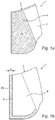
- Fig. 1a shows a diagrammatic representation of a first possible embodiment of a rear side (2) of a pocket (1) for a garment according to the invention, which rear side (2) is configured to be turned towards the body of a person.
- the rear side (2) is configured to be connected to the front side (3) of the pocket (1), as is illustrated in Fig. 1b .
- the hatched portion (R1) shows the portion of the rear side (2) of the pocket (1) which is partly made of radio-wave-reflecting first textile (4).
- the pocket (1) is configured to function as a trouser pocket of a pair of trousers.
- the pocket (1) is designed such that an electronic appliance placed in the pocket, such as for example a mobile telephone, is substantially completely covered by a radio-wave-reflecting first textile (4) on the side turned towards the body.
- the remaining part (7) of the rear side (2) may be made of a conventional textile.
- Fig. 1b shows a diagrammatic representation of a front side (3) of a pocket (1) for a garment according to the invention, which front side (3) is configured to face away from the body of a person.
- the front side (3) of the pocket (1) is configured to be connected to a rear side (2) of the pocket (1), as is illustrated in Fig. 1a .
- the hatched portion (R2) shows the portion of the front side (3) of the pocket (1) which is made of a radio-wave-reflecting second textile (5).
- the second textile (5) is strip-shaped.
- the second textile (5) forms at least a part of the bottom lateral edge of the front side (3) of the pocket (1).
- the strip-shaped second textile (5) has a predetermined width (b).
- the second textile (5) is connected to a third textile (6), which third textile (6) is made of a textile which is permeable to radio waves.
- Fig. 2a shows a diagrammatic representation of a second possible embodiment of a rear side (12) of a pocket (11) for a garment according to the invention, which rear side (12) is configured to be turned towards the body of a person.
- the rear side (12) is configured to be connected to the front side (13) of the pocket (11), as is illustrated in Fig. 2b .
- the illustrated embodiment of the pocket (11) is in particular suitable for use as a breast pocket of, for example, a jacket.
- the rear side (12) of the pocket (11) is substantially completely made of a radio-wave-reflecting first textile (R3, 14).
- Fig. 2b shows a diagrammatic representation of a front side (13) of a pocket (11) for a garment according to the invention, which front side (13) is configured to face away from the body of a person.
- the front side (13) of the pocket (11) is configured to be connected to the rear side (12) of the pocket (11), as is illustrated in Fig. 2a .
- the longitudinal edges of the front side (13) of the pocket (11) are made of a radio-wave-reflecting second textile (15).
- the reflecting edge has a width (b).
- the second textile (15) is connected to a third textile (16), which third textile (16) is substantially permeable to radio waves.
- the front side (13) is configured to be connected to the longitudinal edges of the rear side (12) by means of the outside of the longitudinal edges of the front side (13), as is illustrated in Fig. 2a .
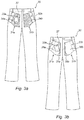
- Figs. 3a and 3b show a diagrammatic representation of a first garment (30) provided with a pair of pockets (31a, 31b) according to the invention.
- Fig. 3a shows the rear sides (32a, 32b) of the pockets (31a, 31b) and Fig. 3b shows the corresponding front sides (33a, 33b) of the pair of trousers (30).
- the rear sides (32a, 32b) are made of a radio-wave-reflecting first textile (34a, 34b).
- the front sides (33a, 33b) are partly made of a radio-wave-reflecting second textile (35a, 35b) and partly made of a third textile (36a, 36b) which is substantially permeable to radio waves.
- a mobile telephone (37) is situated in the first pocket (31a), in which case the mobile telephone (37) is substantially completely covered by the radio-wave-reflecting first textile (34a) on the side turned towards the body.
- the radio-wave-reflecting second textile (35a) on the front side (33a) of the first pocket (31a) is designed such that the vital body parts are screened off from radio waves and/or radiation originating from the mobile telephone (37).
- only the side wall of the front side (33a, 33b) turned towards the vital body parts is made of a radio-wave-reflecting second textile (35a, 35b).
- an adjacent part of the side wall may also be made of a radio-wave-reflecting textile, as is illustrated in Fig. 1b .
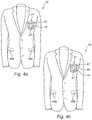
- Figs. 4a and 4b show a diagrammatic representation of a second garment (40) provided with a pocket (41) according to the invention.
- the figures show a jacket (40) provided with a possible embodiment of a pocket (41) according to the invention.
- Fig. 4a shows the rear side (42) of the pocket (41)
- Fig. 4b the front side (43) connected to the rear side (42).
- the rear side (43) is configured to be turned towards the body of the person wearing the jacket (40).
- the front side (43) is configured to face away from the body of the person.
- the illustrated mobile telephone (47) is substantially completely covered by the radio-wave-reflecting first textile (44) of the rear side (42) of the pocket (41).
- the longitudinal edges of the front side (43) of the pocket (41) are completely made of a radio-wave-reflecting second textile (45).
- the reflecting longitudinal edges completely surround the mobile telephone (47).
- the remaining portion of the front side (43) consists of a third textile (46) which is substantially permeable to radio waves, so that the reception of the mobile telephone (47) is not impeded.
- the breast pocket (41) is partly made of a radio-wave-reflecting textile, but it is also conceivable for the other pockets (48a, 48b) to also be partly made of a radio-wave-reflecting textile.
- Fig. 5a shows a diagrammatic representation of the propagation of an incident radio wave (110a) in a multi-layered structure consisting of a layer of conventional textile (112) which is substantially permeable to radio waves and a layer of body tissue (111).
- the incoming radio wave (110a) passes through the first textile layer (112) virtually completely and is then absorbed by the body tissue (111).
- the figure shows that the incoming wave (110a) passes through the textile (112), see wave (110b), and then largely passes through the body tissue (111), see wave (110c).
- Another part of the wave (110b) moving through the textile (112) is reflected as wave (110b') and subsequently allowed to pass through as wave (110b"). In practice, multiple reflections may take place. Also, it is probable that a small part of the wave (110a) is absorbed by the textile (112).
- Fig. 5b shows a diagrammatic representation of the propagation of an incident wave (120a) in a multi-layered structure consisting of a radio-wave-reflecting textile (124) and a layer of body tissue (121).
- the radio-wave-reflecting textile (124) comprises a layer of textile (122) provided with a radio-wave-reflecting layer (123).
- the reflective layer (123) consists of a textile enriched with metal threads, as used in a front side and/or rear side of a pocket according to the present invention.
- the incoming radio wave (120a, 120b) is virtually completely reflected by the reflective layer (123), with a reflection wave (20b', 20b") being formed.
- a small part of the incoming radio wave (120a) passes through the reflective layer (123) and propagates further to the body tissue (121). It is conceivable for multiple reflections to occur in the textile (122) provided with the reflective layer (123).
- a simple example of such multiple reflections is shown in the illustrated figure, reference being made to the illustrated radio waves (120b, 120b', 120b", 120c, 120c', 120c", 120d, 120e, 120f) which all originate from the primary incoming wave (120a).
- the figure indicates that virtually a complete incoming field of radio waves is reflected by the radio-wave-reflecting textile (124), and in particular by the reflective layer (123), so that only a small amount of radiofrequency energy passes through to the body tissue.
- Fig. 6 shows a graph which shows the results of empirical measurements of the transmission values of a pair of trouser pockets which are at least partly made of radio-wave-reflecting textile and a trouser pocket which is made of a textile which is permeable to radio waves.
- the X axis shows the frequency of the emitted signal in MHz
- the Y axis shows the measured transmission values in dB.
- the signal-transmitting antenna is situated in a trouser pocket during each experiment. A reference measurement was carried out prior to the start of the measurements.
- the distance between both antennas is the same for all measurements.
- the metal threads used during the experiments were silver yarns, in particular nylon thread provided with a silver coating.
- the silver yarn comprises 18 percent by weight of silver and another 82 percent by weight of nylon.
- Three different trouser pockets were tested, i.e. a conventional trouser pocket which allows radio waves to pass through, a trouser pocket in which only the rear side is substantially completely made of a radio-wave-reflecting textile and a trouser pocket in which the rear side is substantially completely made of a radio-wave-reflecting textile and in which the rear side is connected to a front side of the trouser pocket which is made of a radio-wave-reflecting textile on the peripheral edge.
- the graph indicates that the transmission value for the conventional trouser pocket, which is made of a textile which is permeable to radio waves is equal for all emitted frequencies.
- the measured transmission value is 3.3 dB across the entire frequency band. This transmission value is related to an insulation value of 53%.
- the use of a trouser pocket in which the rear side of the pocket is made of a radio-wave-reflecting textile results in a reduction in the transmission values.
- the transmission value measured at a frequency of 2.4 GHz is 4.2 dB. This corresponds to an insulation value of 62%.
- the trouser pocket on the front side is made of a reflective layer which is situated along the peripheral wall with a width of 10 mm.
- Fig. 7 shows a graph in which transmission values are illustrated as a function of the frequency, measured for different types of trouser pockets which are made of radio-wave-reflecting textile.
- a trouser pocket has been used of which only the rear side is made of radio-wave-reflecting textile and several trouser pockets of which both the rear side is made of radio-wave-reflecting textile and a part of the front side is made of radio-wave-reflecting textile.
- the metal threads used in the experiments consist of the above-described silver yarn.
- the measurements use is made of a pair of antennas, with a first antenna transmitting a signal and a second antenna measuring this signal at a distance, in which case the first antenna is situated in the trouser pocket.
- the measurements are performed for three different mutual positions of the antennas, with the angle ⁇ between both antennas being respectively -30°, 0° or 30°. These positions simulate the situation of a wearer of trousers provided with trouser pockets while walking.
- the transmission values for the trouser pocket in which both the rear side and the front side of the trouser pocket comprise a textile enriched with metal threads are average values of measurements of trouser pockets having a reflective layer on the peripheral wall with widths of 5, 10, 15 and 20 mm, respectively.
- the graph shows that the transmission values depend on the mutual position of the antennas.
- the graph also shows that the use of textile enriched with metal thread on the front side of the trouser pocket results in a significant reduction in the transmission values. In practice, this means an improved protection of the body tissue against the emitted radiation.
Landscapes
- Engineering & Computer Science (AREA)
- Textile Engineering (AREA)
- Details Of Garments (AREA)
Applications Claiming Priority (2)
| Application Number | Priority Date | Filing Date | Title |
|---|---|---|---|
| NL2018603A NL2018603B1 (nl) | 2017-03-29 | 2017-03-29 | Zak voor een kledingstuk, en kleding voorzien van een dergelijke zak |
| PCT/NL2018/050189 WO2018182409A1 (en) | 2017-03-29 | 2018-03-28 | Pocket for a garment, and clothing provided with such a pocket |
Publications (2)
| Publication Number | Publication Date |
|---|---|
| EP3629794A1 EP3629794A1 (en) | 2020-04-08 |
| EP3629794B1 true EP3629794B1 (en) | 2021-11-24 |
Family
ID=59295258
Family Applications (1)
| Application Number | Title | Priority Date | Filing Date |
|---|---|---|---|
| EP18718239.9A Active EP3629794B1 (en) | 2017-03-29 | 2018-03-28 | Pocket for a garment, and clothing provided with such a pocket |
Country Status (7)
| Country | Link |
|---|---|
| US (1) | US20210068484A1 (da) |
| EP (1) | EP3629794B1 (da) |
| DK (1) | DK3629794T3 (da) |
| ES (1) | ES2909564T3 (da) |
| NL (1) | NL2018603B1 (da) |
| PT (1) | PT3629794T (da) |
| WO (1) | WO2018182409A1 (da) |
Families Citing this family (2)
| Publication number | Priority date | Publication date | Assignee | Title |
|---|---|---|---|---|
| FR3095108B1 (fr) * | 2019-04-17 | 2022-04-08 | Act 1892 | Agencement de poches comprenant une poche de compartiment destinée à recevoir un téléphone mobile, et pantalon de type jean associé. |
| WO2026041209A1 (ru) * | 2024-08-23 | 2026-02-26 | Евгений Евгеньевич ПИСАРЕВ | Одежда, покрывающая нижнюю часть тела человека |
Family Cites Families (5)
| Publication number | Priority date | Publication date | Assignee | Title |
|---|---|---|---|---|
| WO2006109444A1 (ja) * | 2005-03-22 | 2006-10-19 | Tomoaki Ito | 情報漏洩防護フィルム、携帯用小物入れ、カードケース及び情報漏洩防止板 |
| GB0606108D0 (en) * | 2006-03-28 | 2006-05-03 | Forensic Science Service Ltd | Improvements in and relating to isolation |
| US20120047631A1 (en) * | 2010-08-25 | 2012-03-01 | Richard Kohler Connolly | Pocket Or Pouch Shield |
| US20120114270A1 (en) * | 2010-11-04 | 2012-05-10 | WRAPHabillement | Electromagnetic radiation attenuator pouch |
| US20150061914A1 (en) * | 2012-11-09 | 2015-03-05 | Robert Falken | Radiation attenuating clothing |
-
2017
- 2017-03-29 NL NL2018603A patent/NL2018603B1/nl not_active IP Right Cessation
-
2018
- 2018-03-28 US US16/499,334 patent/US20210068484A1/en not_active Abandoned
- 2018-03-28 DK DK18718239.9T patent/DK3629794T3/da active
- 2018-03-28 WO PCT/NL2018/050189 patent/WO2018182409A1/en not_active Ceased
- 2018-03-28 PT PT187182399T patent/PT3629794T/pt unknown
- 2018-03-28 EP EP18718239.9A patent/EP3629794B1/en active Active
- 2018-03-28 ES ES18718239T patent/ES2909564T3/es active Active
Also Published As
| Publication number | Publication date |
|---|---|
| US20210068484A1 (en) | 2021-03-11 |
| NL2018603B1 (nl) | 2018-10-10 |
| DK3629794T3 (da) | 2022-02-28 |
| ES2909564T3 (es) | 2022-05-09 |
| WO2018182409A1 (en) | 2018-10-04 |
| EP3629794A1 (en) | 2020-04-08 |
| PT3629794T (pt) | 2022-03-02 |
Similar Documents
| Publication | Publication Date | Title |
|---|---|---|
| EP1205589B1 (en) | Electro-magnetic wave shielding knitted material and electro-magnetic wave shielding clothes | |
| US10334898B2 (en) | Radio frequency shielded clothing | |
| US20120047631A1 (en) | Pocket Or Pouch Shield | |
| US4572960A (en) | Use of metallized knitted net fabrics for protection against microwave radiation | |
| US20120114270A1 (en) | Electromagnetic radiation attenuator pouch | |
| EP3629794B1 (en) | Pocket for a garment, and clothing provided with such a pocket | |
| JP2014501044A (ja) | 電磁波を吸収する紡織繊維表層及び紡織繊維材料、及び紡織繊維表層又は紡織繊維材料を有する保護器具 | |
| US20150061914A1 (en) | Radiation attenuating clothing | |
| CN108348023B (zh) | 服装 | |
| WO2008044414A1 (en) | Electromagnetic wave shielding sheet, and electromagnetic wave shielding cloths | |
| Chandran et al. | Antenna with switchable propagating modes for WBAN applications | |
| RU107387U1 (ru) | Радиозащитная одежда | |
| JP2005042223A (ja) | 電磁波防護衣服 | |
| JP6784425B2 (ja) | ウェアラブルアンテナ装置 | |
| US11028505B1 (en) | Protective apparel | |
| US20130117915A1 (en) | Radiation protector for mobile devices | |
| KR200234564Y1 (ko) | 전자파 차단 셔츠 | |
| EP3026993B1 (en) | Screening fabric for high-frequency radio waves | |
| US10624249B1 (en) | Electromagnetic radiation shielding in garments | |
| Orefice et al. | Electrically-small wearable antennas for emergency services applications | |
| RU52673U1 (ru) | Радиозащитное средство | |
| KR200257750Y1 (ko) | 전자파차단 앞치마 | |
| KR102119495B1 (ko) | 전자파 차폐 부재 및 이를 포함하는 기능성 피복 | |
| JP3073319U (ja) | 電磁波遮蔽帽子 | |
| JP2001131811A (ja) | 電磁波シールド衣服 |
Legal Events
| Date | Code | Title | Description |
|---|---|---|---|
| STAA | Information on the status of an ep patent application or granted ep patent |
Free format text: STATUS: UNKNOWN |
|
| STAA | Information on the status of an ep patent application or granted ep patent |
Free format text: STATUS: THE INTERNATIONAL PUBLICATION HAS BEEN MADE |
|
| PUAI | Public reference made under article 153(3) epc to a published international application that has entered the european phase |
Free format text: ORIGINAL CODE: 0009012 |
|
| STAA | Information on the status of an ep patent application or granted ep patent |
Free format text: STATUS: REQUEST FOR EXAMINATION WAS MADE |
|
| 17P | Request for examination filed |
Effective date: 20200130 |
|
| AK | Designated contracting states |
Kind code of ref document: A1 Designated state(s): AL AT BE BG CH CY CZ DE DK EE ES FI FR GB GR HR HU IE IS IT LI LT LU LV MC MK MT NL NO PL PT RO RS SE SI SK SM TR |
|
| AX | Request for extension of the european patent |
Extension state: BA ME |
|
| DAV | Request for validation of the european patent (deleted) | ||
| DAX | Request for extension of the european patent (deleted) | ||
| RIN1 | Information on inventor provided before grant (corrected) |
Inventor name: MEKKERING, DERCK ROELF |
|
| RAP1 | Party data changed (applicant data changed or rights of an application transferred) |
Owner name: DERCKULES B.V. |
|
| STAA | Information on the status of an ep patent application or granted ep patent |
Free format text: STATUS: EXAMINATION IS IN PROGRESS |
|
| 17Q | First examination report despatched |
Effective date: 20210311 |
|
| GRAP | Despatch of communication of intention to grant a patent |
Free format text: ORIGINAL CODE: EPIDOSNIGR1 |
|
| STAA | Information on the status of an ep patent application or granted ep patent |
Free format text: STATUS: GRANT OF PATENT IS INTENDED |
|
| INTG | Intention to grant announced |
Effective date: 20210614 |
|
| GRAS | Grant fee paid |
Free format text: ORIGINAL CODE: EPIDOSNIGR3 |
|
| GRAA | (expected) grant |
Free format text: ORIGINAL CODE: 0009210 |
|
| STAA | Information on the status of an ep patent application or granted ep patent |
Free format text: STATUS: THE PATENT HAS BEEN GRANTED |
|
| AK | Designated contracting states |
Kind code of ref document: B1 Designated state(s): AL AT BE BG CH CY CZ DE DK EE ES FI FR GB GR HR HU IE IS IT LI LT LU LV MC MK MT NL NO PL PT RO RS SE SI SK SM TR |
|
| RAP3 | Party data changed (applicant data changed or rights of an application transferred) |
Owner name: DERCKULES B.V. |
|
| REG | Reference to a national code |
Ref country code: GB Ref legal event code: FG4D |
|
| REG | Reference to a national code |
Ref country code: AT Ref legal event code: REF Ref document number: 1449174 Country of ref document: AT Kind code of ref document: T Effective date: 20211215 |
|
| REG | Reference to a national code |
Ref country code: DE Ref legal event code: R096 Ref document number: 602018027138 Country of ref document: DE |
|
| REG | Reference to a national code |
Ref country code: IE Ref legal event code: FG4D |
|
| REG | Reference to a national code |
Ref country code: DK Ref legal event code: T3 Effective date: 20220224 |
|
| REG | Reference to a national code |
Ref country code: PT Ref legal event code: SC4A Ref document number: 3629794 Country of ref document: PT Date of ref document: 20220302 Kind code of ref document: T Free format text: AVAILABILITY OF NATIONAL TRANSLATION Effective date: 20220223 |
|
| REG | Reference to a national code |
Ref country code: SE Ref legal event code: TRGR |
|
| REG | Reference to a national code |
Ref country code: NL Ref legal event code: FP |
|
| REG | Reference to a national code |
Ref country code: LT Ref legal event code: MG9D |
|
| REG | Reference to a national code |
Ref country code: AT Ref legal event code: MK05 Ref document number: 1449174 Country of ref document: AT Kind code of ref document: T Effective date: 20211124 |
|
| PG25 | Lapsed in a contracting state [announced via postgrant information from national office to epo] |
Ref country code: RS Free format text: LAPSE BECAUSE OF FAILURE TO SUBMIT A TRANSLATION OF THE DESCRIPTION OR TO PAY THE FEE WITHIN THE PRESCRIBED TIME-LIMIT Effective date: 20211124 Ref country code: LT Free format text: LAPSE BECAUSE OF FAILURE TO SUBMIT A TRANSLATION OF THE DESCRIPTION OR TO PAY THE FEE WITHIN THE PRESCRIBED TIME-LIMIT Effective date: 20211124 Ref country code: FI Free format text: LAPSE BECAUSE OF FAILURE TO SUBMIT A TRANSLATION OF THE DESCRIPTION OR TO PAY THE FEE WITHIN THE PRESCRIBED TIME-LIMIT Effective date: 20211124 Ref country code: BG Free format text: LAPSE BECAUSE OF FAILURE TO SUBMIT A TRANSLATION OF THE DESCRIPTION OR TO PAY THE FEE WITHIN THE PRESCRIBED TIME-LIMIT Effective date: 20220224 Ref country code: AT Free format text: LAPSE BECAUSE OF FAILURE TO SUBMIT A TRANSLATION OF THE DESCRIPTION OR TO PAY THE FEE WITHIN THE PRESCRIBED TIME-LIMIT Effective date: 20211124 |
|
| REG | Reference to a national code |
Ref country code: ES Ref legal event code: FG2A Ref document number: 2909564 Country of ref document: ES Kind code of ref document: T3 Effective date: 20220509 |
|
| PG25 | Lapsed in a contracting state [announced via postgrant information from national office to epo] |
Ref country code: IS Free format text: LAPSE BECAUSE OF FAILURE TO SUBMIT A TRANSLATION OF THE DESCRIPTION OR TO PAY THE FEE WITHIN THE PRESCRIBED TIME-LIMIT Effective date: 20220324 Ref country code: PL Free format text: LAPSE BECAUSE OF FAILURE TO SUBMIT A TRANSLATION OF THE DESCRIPTION OR TO PAY THE FEE WITHIN THE PRESCRIBED TIME-LIMIT Effective date: 20211124 Ref country code: NO Free format text: LAPSE BECAUSE OF FAILURE TO SUBMIT A TRANSLATION OF THE DESCRIPTION OR TO PAY THE FEE WITHIN THE PRESCRIBED TIME-LIMIT Effective date: 20220224 Ref country code: LV Free format text: LAPSE BECAUSE OF FAILURE TO SUBMIT A TRANSLATION OF THE DESCRIPTION OR TO PAY THE FEE WITHIN THE PRESCRIBED TIME-LIMIT Effective date: 20211124 Ref country code: HR Free format text: LAPSE BECAUSE OF FAILURE TO SUBMIT A TRANSLATION OF THE DESCRIPTION OR TO PAY THE FEE WITHIN THE PRESCRIBED TIME-LIMIT Effective date: 20211124 Ref country code: GR Free format text: LAPSE BECAUSE OF FAILURE TO SUBMIT A TRANSLATION OF THE DESCRIPTION OR TO PAY THE FEE WITHIN THE PRESCRIBED TIME-LIMIT Effective date: 20220225 |
|
| PG25 | Lapsed in a contracting state [announced via postgrant information from national office to epo] |
Ref country code: SM Free format text: LAPSE BECAUSE OF FAILURE TO SUBMIT A TRANSLATION OF THE DESCRIPTION OR TO PAY THE FEE WITHIN THE PRESCRIBED TIME-LIMIT Effective date: 20211124 Ref country code: SK Free format text: LAPSE BECAUSE OF FAILURE TO SUBMIT A TRANSLATION OF THE DESCRIPTION OR TO PAY THE FEE WITHIN THE PRESCRIBED TIME-LIMIT Effective date: 20211124 Ref country code: RO Free format text: LAPSE BECAUSE OF FAILURE TO SUBMIT A TRANSLATION OF THE DESCRIPTION OR TO PAY THE FEE WITHIN THE PRESCRIBED TIME-LIMIT Effective date: 20211124 Ref country code: EE Free format text: LAPSE BECAUSE OF FAILURE TO SUBMIT A TRANSLATION OF THE DESCRIPTION OR TO PAY THE FEE WITHIN THE PRESCRIBED TIME-LIMIT Effective date: 20211124 Ref country code: CZ Free format text: LAPSE BECAUSE OF FAILURE TO SUBMIT A TRANSLATION OF THE DESCRIPTION OR TO PAY THE FEE WITHIN THE PRESCRIBED TIME-LIMIT Effective date: 20211124 |
|
| REG | Reference to a national code |
Ref country code: DE Ref legal event code: R097 Ref document number: 602018027138 Country of ref document: DE |
|
| PLBE | No opposition filed within time limit |
Free format text: ORIGINAL CODE: 0009261 |
|
| STAA | Information on the status of an ep patent application or granted ep patent |
Free format text: STATUS: NO OPPOSITION FILED WITHIN TIME LIMIT |
|
| REG | Reference to a national code |
Ref country code: DK Ref legal event code: EBP Effective date: 20220331 |
|
| PG25 | Lapsed in a contracting state [announced via postgrant information from national office to epo] |
Ref country code: MC Free format text: LAPSE BECAUSE OF FAILURE TO SUBMIT A TRANSLATION OF THE DESCRIPTION OR TO PAY THE FEE WITHIN THE PRESCRIBED TIME-LIMIT Effective date: 20211124 Ref country code: AL Free format text: LAPSE BECAUSE OF FAILURE TO SUBMIT A TRANSLATION OF THE DESCRIPTION OR TO PAY THE FEE WITHIN THE PRESCRIBED TIME-LIMIT Effective date: 20211124 |
|
| REG | Reference to a national code |
Ref country code: CH Ref legal event code: PL |
|
| 26N | No opposition filed |
Effective date: 20220825 |
|
| PG25 | Lapsed in a contracting state [announced via postgrant information from national office to epo] |
Ref country code: SI Free format text: LAPSE BECAUSE OF FAILURE TO SUBMIT A TRANSLATION OF THE DESCRIPTION OR TO PAY THE FEE WITHIN THE PRESCRIBED TIME-LIMIT Effective date: 20211124 |
|
| REG | Reference to a national code |
Ref country code: BE Ref legal event code: MM Effective date: 20220331 |
|
| PG25 | Lapsed in a contracting state [announced via postgrant information from national office to epo] |
Ref country code: SE Free format text: LAPSE BECAUSE OF NON-PAYMENT OF DUE FEES Effective date: 20220329 Ref country code: LU Free format text: LAPSE BECAUSE OF NON-PAYMENT OF DUE FEES Effective date: 20220328 Ref country code: LI Free format text: LAPSE BECAUSE OF NON-PAYMENT OF DUE FEES Effective date: 20220331 Ref country code: IE Free format text: LAPSE BECAUSE OF NON-PAYMENT OF DUE FEES Effective date: 20220328 Ref country code: CH Free format text: LAPSE BECAUSE OF NON-PAYMENT OF DUE FEES Effective date: 20220331 |
|
| PG25 | Lapsed in a contracting state [announced via postgrant information from national office to epo] |
Ref country code: BE Free format text: LAPSE BECAUSE OF NON-PAYMENT OF DUE FEES Effective date: 20220331 |
|
| PG25 | Lapsed in a contracting state [announced via postgrant information from national office to epo] |
Ref country code: DK Free format text: LAPSE BECAUSE OF NON-PAYMENT OF DUE FEES Effective date: 20220331 |
|
| REG | Reference to a national code |
Ref country code: ES Ref legal event code: FD2A Effective date: 20230428 |
|
| P01 | Opt-out of the competence of the unified patent court (upc) registered |
Effective date: 20230515 |
|
| PG25 | Lapsed in a contracting state [announced via postgrant information from national office to epo] |
Ref country code: ES Free format text: LAPSE BECAUSE OF NON-PAYMENT OF DUE FEES Effective date: 20220329 |
|
| PG25 | Lapsed in a contracting state [announced via postgrant information from national office to epo] |
Ref country code: MK Free format text: LAPSE BECAUSE OF FAILURE TO SUBMIT A TRANSLATION OF THE DESCRIPTION OR TO PAY THE FEE WITHIN THE PRESCRIBED TIME-LIMIT Effective date: 20211124 Ref country code: CY Free format text: LAPSE BECAUSE OF FAILURE TO SUBMIT A TRANSLATION OF THE DESCRIPTION OR TO PAY THE FEE WITHIN THE PRESCRIBED TIME-LIMIT Effective date: 20211124 |
|
| PG25 | Lapsed in a contracting state [announced via postgrant information from national office to epo] |
Ref country code: HU Free format text: LAPSE BECAUSE OF FAILURE TO SUBMIT A TRANSLATION OF THE DESCRIPTION OR TO PAY THE FEE WITHIN THE PRESCRIBED TIME-LIMIT; INVALID AB INITIO Effective date: 20180328 |
|
| PGFP | Annual fee paid to national office [announced via postgrant information from national office to epo] |
Ref country code: FR Payment date: 20240619 Year of fee payment: 7 |
|
| PGFP | Annual fee paid to national office [announced via postgrant information from national office to epo] |
Ref country code: NL Payment date: 20240819 Year of fee payment: 7 |
|
| PG25 | Lapsed in a contracting state [announced via postgrant information from national office to epo] |
Ref country code: MT Free format text: LAPSE BECAUSE OF FAILURE TO SUBMIT A TRANSLATION OF THE DESCRIPTION OR TO PAY THE FEE WITHIN THE PRESCRIBED TIME-LIMIT Effective date: 20211124 |
|
| PGFP | Annual fee paid to national office [announced via postgrant information from national office to epo] |
Ref country code: DE Payment date: 20240819 Year of fee payment: 7 |
|
| PGFP | Annual fee paid to national office [announced via postgrant information from national office to epo] |
Ref country code: GB Payment date: 20240814 Year of fee payment: 7 Ref country code: PT Payment date: 20240823 Year of fee payment: 7 |
|
| PGFP | Annual fee paid to national office [announced via postgrant information from national office to epo] |
Ref country code: IT Payment date: 20240830 Year of fee payment: 7 |
|
| PGFP | Annual fee paid to national office [announced via postgrant information from national office to epo] |
Ref country code: TR Payment date: 20240820 Year of fee payment: 7 |
|
| REG | Reference to a national code |
Ref country code: DE Ref legal event code: R119 Ref document number: 602018027138 Country of ref document: DE |
|
| REG | Reference to a national code |
Ref country code: NL Ref legal event code: MM Effective date: 20250401 |
|
| GBPC | Gb: european patent ceased through non-payment of renewal fee |
Effective date: 20250328 |
|
| PG25 | Lapsed in a contracting state [announced via postgrant information from national office to epo] |
Ref country code: NL Free format text: LAPSE BECAUSE OF NON-PAYMENT OF DUE FEES Effective date: 20250401 |
|
| PG25 | Lapsed in a contracting state [announced via postgrant information from national office to epo] |
Ref country code: DE Free format text: LAPSE BECAUSE OF NON-PAYMENT OF DUE FEES Effective date: 20251001 |
|
| PG25 | Lapsed in a contracting state [announced via postgrant information from national office to epo] |
Ref country code: GB Free format text: LAPSE BECAUSE OF NON-PAYMENT OF DUE FEES Effective date: 20250328 |
|
| PG25 | Lapsed in a contracting state [announced via postgrant information from national office to epo] |
Ref country code: FR Free format text: LAPSE BECAUSE OF NON-PAYMENT OF DUE FEES Effective date: 20250331 Ref country code: IT Free format text: LAPSE BECAUSE OF NON-PAYMENT OF DUE FEES Effective date: 20250328 |