EP3629883B1 - Vorrichtung und verfahren zur beurteilung von sehfähigkeiten - Google Patents
Vorrichtung und verfahren zur beurteilung von sehfähigkeiten Download PDFInfo
- Publication number
- EP3629883B1 EP3629883B1 EP18733342.2A EP18733342A EP3629883B1 EP 3629883 B1 EP3629883 B1 EP 3629883B1 EP 18733342 A EP18733342 A EP 18733342A EP 3629883 B1 EP3629883 B1 EP 3629883B1
- Authority
- EP
- European Patent Office
- Prior art keywords
- visual
- display means
- viewer device
- subject
- test
- Prior art date
- Legal status (The legal status is an assumption and is not a legal conclusion. Google has not performed a legal analysis and makes no representation as to the accuracy of the status listed.)
- Active
Links
Images



Classifications
-
- A—HUMAN NECESSITIES
- A61—MEDICAL OR VETERINARY SCIENCE; HYGIENE
- A61B—DIAGNOSIS; SURGERY; IDENTIFICATION
- A61B3/00—Apparatus for testing the eyes; Instruments for examining the eyes
- A61B3/0016—Operational features thereof
- A61B3/0041—Operational features thereof characterised by display arrangements
- A61B3/005—Constructional features of the display
-
- A—HUMAN NECESSITIES
- A61—MEDICAL OR VETERINARY SCIENCE; HYGIENE
- A61B—DIAGNOSIS; SURGERY; IDENTIFICATION
- A61B3/00—Apparatus for testing the eyes; Instruments for examining the eyes
- A61B3/02—Subjective types, i.e. testing apparatus requiring the active assistance of the patient
- A61B3/028—Subjective types, i.e. testing apparatus requiring the active assistance of the patient for testing visual acuity; for determination of refraction, e.g. phoropters
- A61B3/032—Devices for presenting test symbols or characters, e.g. test chart projectors
-
- A—HUMAN NECESSITIES
- A61—MEDICAL OR VETERINARY SCIENCE; HYGIENE
- A61B—DIAGNOSIS; SURGERY; IDENTIFICATION
- A61B3/00—Apparatus for testing the eyes; Instruments for examining the eyes
- A61B3/02—Subjective types, i.e. testing apparatus requiring the active assistance of the patient
- A61B3/022—Subjective types, i.e. testing apparatus requiring the active assistance of the patient for testing contrast sensitivity
-
- A—HUMAN NECESSITIES
- A61—MEDICAL OR VETERINARY SCIENCE; HYGIENE
- A61B—DIAGNOSIS; SURGERY; IDENTIFICATION
- A61B3/00—Apparatus for testing the eyes; Instruments for examining the eyes
- A61B3/02—Subjective types, i.e. testing apparatus requiring the active assistance of the patient
- A61B3/024—Subjective types, i.e. testing apparatus requiring the active assistance of the patient for determining the visual field, e.g. perimeter types
-
- A—HUMAN NECESSITIES
- A61—MEDICAL OR VETERINARY SCIENCE; HYGIENE
- A61B—DIAGNOSIS; SURGERY; IDENTIFICATION
- A61B3/00—Apparatus for testing the eyes; Instruments for examining the eyes
- A61B3/02—Subjective types, i.e. testing apparatus requiring the active assistance of the patient
- A61B3/08—Subjective types, i.e. testing apparatus requiring the active assistance of the patient for testing binocular or stereoscopic vision, e.g. strabismus
Definitions
- the present invention relates to a viewer device and a method, based on digital technology, for the evaluation of the visual abilities of a subject.
- US 2011/027766 discloses a kiosk with a display for far vision tests rigidly hold and a sliding display for near vision tests.
- US 2008/189173 discloses a kiosk with two movable displays for far and near vision tests.
- the technical problem posed and solved by the present invention is therefore that of providing a device and a method for assessing the visual ability of a subject which allow overcoming the drawbacks mentioned above with reference to the prior art.
- the inventors have devised a device and a (non-claimed) method that allow, jointly or independently of each other, the evaluation of the visual ability of a subject in an objective, accurate and repeatable manner, also possibly with reference to a specific activity. This is achieved by measuring a plurality of factors, or parameters, that contribute to determining the overall visual capacity.
- the invention provides a viewer device, in particular based on digital technology, for the evaluation of a plurality of factors expressing the visual ability of the subject and preferably representative of the aspects that contribute to the dynamic vision during ordinary and extraordinary daily activities.
- the viewer device of the invention has some significant advantages.
- the device allows, in a single apparatus, the evaluation of several factors that contribute to the visual ability. This makes the exams faster, simpler, less expensive and that can also be performed by non-specialized operators. Moreover, it allows evaluating said parameters, in an accurate and repeatable manner, without the environmental artifacts that afflict already known measurement systems. Furthermore, the device lends itself to being made in a configuration of minimum weight and bulk, which is transportable and easy to assemble on site.
- the method and the device of the invention allow the calculation of a multifactorial visual index, which can also be defined global and/or dynamic, suitable for quantifying the visual ability of a subject by combining different parameters, each representative of a specific capacity.
- the value of this index is automatically (expressed numerically).
- This numerical expression can also be, for example to exemplify enabling procedures, entered at the end of the examination on a predefined scale of values, in particular made up of five different levels of visual quality.
- the definition of the quality level related to the vision of the examined subject within the evaluation scale allows facilitating enabling criteria which can be differentiated according to specific needs, for example by setting "ad hoc" thresholds.
- the device and the method of the invention are used for the evaluation of the visual ability of drivers of road vehicles and/or of agonistic drivers of motor vehicles, cars or other motor vehicles, including boats.
- the device and the method of the invention allow calculating also a visual skill index other than the one considered above and/or dedicated to different activities, thus modulating the values of relative importance of each visual factor that contributes to them.
- an index can be developed to assign relative enabling levels in the context of professional activities that require specific skills.
- the visual index calculated by the device and the method of the invention allows improving the current enabling methods, often based on incomplete tests that do not detect visual factors that come into play very significantly during activities of interest.
- such factors are, for example, in addition to the measurement of visual acuity, quality of the visual field, stereopsis, contrast sensitivity and dazzling recovery time.
- some national statistics indicate that many traffic accidents are caused by problems related to the driver's vision.
- the invention can advantageously allow a better selection of the athletes.
- Another field of application of the invention, and in particular of the proposed visual index is that of legal medicine and insurance, since the visual ability can contribute to the dynamics of an accident and therefore influence the criteria of responsibility and indemnity.
- the evaluation of visual abilities, and especially of the visual index as defined above allows a better selection of personnel, reporting the visual qualities to the type of activity they are required to perform at the time of recruitment.
- a viewer device is denoted as a whole with reference numeral 1.
- the viewer device 1 is configured to allow the execution of a multifactorial visual ability test on a subject.
- the viewer device 1 comprises an outer casing 2, which in the present example is shaped in the form of an irregular polyhedron defined by a plurality of walls, or surfaces, preferably connected to one another by means of curved profiles.
- the casing 1 has a front wall 21, an upper wall 22 connected with a rear wall 23, a first and a second side wall, respectively denoted by 24 and 25, and a lower wall 26.
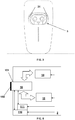
- a visual access window 3 is formed so as to house at least the upper part of the head of the subject and is better visible in Figure 3 .
- the visual access window 3 is screened by side walls 31 and may be associated with a chin support.
- the opening of the window 3 can be screened by means of a lens or a different transparent panel.
- a seat 200 is obtained for the application of any corrective lenses, for example to compensate for visual defects of the patient. The latter can easily be interchanged manually, for example by locking clips.
- the viewer device 1 comprises first display means 4, in particular having a first display preferably at high resolution.
- the display can be mono-ocular or bi-ocular, in this last case possibly with a physical or digital partition between the images to be administered to the two eyes.
- the first display means 4 preferably comprise focusing means, for example biconvex lenses, optionally adjustable from the outside, for example by means of a pin 401 movable within a guide groove 402 formed on the side wall 24 of the casing 2.
- the first display means 4 are movable between a first rest configuration, shown in Figure 4A , in which they are spaced from the window 3 and not interfering with the subject's field of view, and a second operative configuration, shown in Figure 4B , in which they are arranged in the subject's field of view and in front of the latter's eyes at the window 3.
- the movement of the display means 4 from the first to the second configuration is obtained mechanically, by coupling a pin 41 integral with a main body of the means 4 with a guide 42 formed on the side wall 25 of the casing 2.
- the viewer device 1 then comprises second display means 5, in particular including a second display 50 arranged in the proximity of the rear wall 23 within the casing 2.
- the display 50 is, in use, in a more distanced position from the window 3 and from the patient's eyes with respect to the first display 40 and is therefore suitable for the evaluation visual abilities "from afar".
- an inter-pupillary distance adjustment system is provided.
- This system can be mechanically driven, for example of the pin 401 - guide 402 type mentioned above.
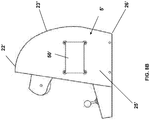
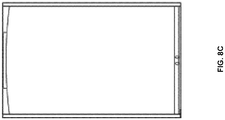
- FIGS 8A to 8C show another preferred embodiment of the viewer device according to the invention, which in this case is denoted as a whole with reference numeral 100.
- This viewing device 100 will be described below only with reference to the differences with respect to the first embodiment.
- components similar to those of the device 1 are denoted with the same numeral reference already used, with the addition of the apex " ' ".
- the device 100 comprises a casing 2', a visual access window 3', a seat and related component or associated elements similar to those already described.
- the device 100 comprises first display means 4' which differ from the means 4 described above in that they can be integral with the casing 2' and not movable with respect thereto.
- the first display means 4' of the device 100 can therefore assume a single operative configuration, in which they are arranged in the field of view of the subject and in front of the latter's eyes at the window 3'. Therefore, in the device 100, means for moving the first display means 4' may correspondingly be absent.
- the viewer device 100 then comprises second display means 5', in particular including a second display 50', which in the present example is arranged at or in the proximity of the side wall 24' or 25' of the casing 2', on the outer face of said wall.
- the patient or in general the subject to be evaluated, can be positioned so that the display 50' is in a more distanced position from him/her with respect to the first display means as accessible through the window 3'. Therefore, also this second display 50' is suitable for evaluations of visual capacities "from afar" and can be for this purpose programmed and/or controlled by a processing unit which will be described hereinafter.
- the second display 50' advantageously, can also be used by an operator to impart commands to the device 100 and/or only to the second display means 5' or to control the examination procedure, and in this sense it can also implement a panel control, also introduced hereinafter. Also in this embodiment an inter-pupillary distance adjustment system of the type already described may be provided.
- the viewer device 1, 100 may also have a processing unit, for example comprising one or more (micro)processors, associated with the first and/or second display means 4, 4' and 5, 5' to administer one or more predetermined visual tests to the patient.
- a processing unit for example comprising one or more (micro)processors, associated with the first and/or second display means 4, 4' and 5, 5' to administer one or more predetermined visual tests to the patient.
- Figure 5 shows, by way of example, processing means 14 and 15 as associated with the first and second display means 4, 4' and 5, 5', respectively.
- the processing unit of the viewer device 1 also comprises a central control unit 10, preferably in communication with the processing means 14 and/or 15, where provided.
- the control unit 10 can be managed directly by an operator, who works locally or remotely by means of an appropriate communication line.
- a control panel 102 can be associated to the control unit 10, for example in the form of a touch screen and/or keyboard, in particular for receiving the inputs of an operator.
- the control unit 10 can be placed inside the casing 2, 2' or at a further window thereof, for example a window 101 obtained at a side wall and exemplified in Figure 5 .
- the control unit 10 can be arranged in a remote position with respect to the casing 2, 2' and be considered part of the device 1, 100 itself or of an apparatus that includes it.
- the control unit 10 and/or the means 14 and 15 have processing and memory capacities capable of handling diagnostic images/videos proposed to the subject through the display means 4 and 5.
- the processing unit can be managed by an operator to present diagnostic tests to the subject and record the results.
- the device 1, 100 includes one or more memory units 110, preferably associated with the processing unit.
- the control unit 10 and the processing means 14 and 15 can be incorporated into a single processing unit, possibly including sub-units placed at the level of different components of the device 1, 100 itself and/or of an apparatus that includes it.
- the viewer device 1, 100 provides, in association with the control unit 10 and/or the display means 4, 4' and 5, 5' introduced above or independently, connectivity means, for example Wi-Fi and/or LAN.
- connectivity means for example Wi-Fi and/or LAN.
- a USB port, or equivalent, may also be provided for data export.
- This connectivity can be used to communicate with any complementary accessories and/or with a server dedicated to assistance, updates, archiving, data processing, connection with other similar devices for data sharing or other purposes.
- Embodiment variants may provide one or more tactile feedback devices 111, for example buttons and/or joysticks that the subject can use during the test to interact with the operator, the control unit, the display means and/or, in general, the processing unit.
- tactile feedback devices 111 for example buttons and/or joysticks that the subject can use during the test to interact with the operator, the control unit, the display means and/or, in general, the processing unit.
- the device 1, 100 is configured to administer tests related to the evaluation of one or more of the following factors to the patient:
- the device 1, 100, or the apparatus that includes it are used in the context of the evaluation of the visual ability of the subject which provides the following preliminary steps:
- the monocular visual acuity test is performed because if a visual acuity is found in the eye worse than or less than 2/10, a handicap will automatically be applied to the value of the global visual index calculated by the viewer device equal to 10% of its value.
- Three types of optotypes can be adopted, such as letters, Albini's Random Dot E and numbers presented either in monocular vision or binocular simulated vision or performed from a distance, thus via the second display means 5, 5'.
- Each of the three tests consists of ten rows of symbols that have a decreasing size according to a logarithmic progression.
- a line is considered perceived when the examined subject perceives at least 3 symbols out of 5 of it.
- the result is expressed through a numerical value ranging from 1 to 10 based on the line of symbols of smaller size perceived by the patient. This numerical value will be automatically expressed in an evaluation chart either individually or incorporated into the production calculation of a Global Visual Index which will be described later.
- the values obtained from the examination of this parameter are expressed numerically.
- the numerical value is linked to the level of the smaller size of the symbols that the subject is able to perceive. For example, if a subject perceives at most the fourth row of the optotype adopted for the measurement of visual acuity, the numerical value that expresses it will be 4.
- the base value for the calculation of its Global Visual Index will be linked exclusively to this value.
- the second display means 5, 5' are adopted, excluding, in the case of the viewer device 1, the first means 4 by the mechanical system described above.
- the same external display normally used by the examined subject is used to control the exam procedure (for example 7 or 10 inches in size) or, in an alternative embodiment, the first display means 4' are used, in particular the relative display.
- the evaluation test of visual acuity in monocular vision is performed, sequentially excluding each of the two eyes, with identical methods to those adopted for the examination of the binocular visual acuity.
- the result related to this test may not be reported in the constitution of the aforementioned Global Visual Index.
- the examination of the binocular visual field is preferably carried out taking into consideration 77 points located in an area of 105° in the horizontal plane, 38° in the upper quadrants and 48° in the lower ones.
- the sights which are presented in a randomized sequence, have a decreasing luminosity from the periphery towards the center.
- a diagram related to the execution of this test is presented in Figure 6 . The latter also indicates an exemplary mode for weighing the test result.
- the presentation time is preferably about 0.3 s.
- the response time, intended as patient feedback, is preferably about 1 s.
- the interval between two successive presentations is preferably random and preferably included in a range of about 0.2-1 s.
- the presentation sequence is preferably random.
- Undetected points are re-presented a second time at the end of the cycle.
- the percentage coefficient of the points perceived compared to the total of those presented allows defining the numerical value related to this factor that is included in the calculation of the Global Visual Index at the end of the examination. It may also be entered by way of example, for example in the case of vehicle driving qualification procedures, at the end of the examination of values in one of the seven exemplary quality scale assessment bands according to the methods of Table 2 below.
- the device 1, 100, or the apparatus that includes it, can show an operator:
- Three types of examination may also be provided according to the various age groups (for example: 0/40, 41/60 and over 60 years), selected by the device 1, 100 or by the related apparatus, which automatically calculates them from the master set. In this way, the physiological variation of the detection threshold that decreases with age is taken into account.
- the contrast of the sights presented with respect to the background which may for example exhibit a luminance of 1 Lux (31.5 ASB), will preferably increase according to Table 3 below.
- Table 3 Age range Points up to 10 Points 10 to 20 Points 20 to 30 Points 30 to 40 0-40 8% 16% 32% 48% 41-60 10% 20% 40% 54% Over 60 12% 24% 48% 60%
- the percentage value is entered by the operator in the aforementioned memory unit, which can automatically place it in one of the bands shown above.
- the visual field can also be examined in monocular vision by excluding each of the two eyes in succession.
- the grids used for this examination have the same characteristics as those used for binocular examination.
- the important innovation consists in having adopted for the first time the evaluation criterion through a viewer device, preferably with digital technology, of the useful binocular visual field.
- This examination is carried out through the evaluation of the location of the perception by the examined subject of an aim with respect to a numbered bar for horizontal heterophores and to notes of a pentagram for vertical ones.
- the aim can be presented to one eye and the numbered horizontal scale or the pentagram to the contralateral one. If no deviation exists, the aim will fall at the center of them.
- the magnitude of a possible horizontal heterophoria is calculated by evaluating the magnitude of the deviation of the aim with respect to a horizontal scale with values between -10 (for exophores) and +10 (for esophores).
- the evaluation of any vertical heterophoria takes place by measuring the magnitude of the displacement of the aim with respect to a pentagram of vertical notes with values between -3 diopters for hypofory and +3 dioptres for hyperforie.
- stereoscopic perception is the maximum expression of binocularity, it also requires quantitative evaluation. For the first time, this is done through a viewer using the "random-dot" test which is currently the most accurate evaluation system. All this has been possible thanks to digital technology that allows a much greater definition of the images compared to the evaluation systems adopted so far.
- This test is performed by creating a series of stereograms induced by moving horizontally two identical patterns presented simultaneously to the two eyes. This shift induces, if stereoscopy is present, a sensation of relief as groups relating to the image perceived by one eye merge with the corresponding ones perceived by the other eye. The lower the degree of perceived displacement that induces a sensation of relief the greater the degree of stereoscopy present.
- the level of stereoscopy detected can be viewed by the operator and entered into the aforementioned Global Visual Index.
- the evaluation coefficient of this factor used for the definition of the Global Visual Index is calculated by linking it to the level in the scale described above.
- This factor is preferably measured by presenting five quintets of symbols in a sequence (Albini's E of the same size as the fourth row of the optotype used to measure visual acuity) with a contrast decreasing with respect to the background and therefore increasingly difficult to perceive.
- the series of less contrasted images perceived (at least 3 symbols out of 5), within a time of 10" from the presentation - preferably calculated automatically by the viewer device or by an apparatus that includes it - defines the degree of sensitivity present, according to the following Table 5.
- the operator can enter in the memory unit the value relating to the minimum degree of perceived contrast (at least three of the five symbols presented). Also in this case, the evaluation coefficient used for the definition of the Global Visual Index is calculated by linking it to the level in the scale described above.
- the examined subject gets used to full dark for one minute and then dazzling him/her preferably for 30 s with a diffused light, preferably with a light intensity of 100 lux.
- symbols are presented at the center of the illuminated display that the subject will have to report to the examined subject so that he is forced to fix constantly in the center of the dazzling area, avoiding the possibility of fixation displacements that would modify the degree of induced dazzling.
- the series of 5 symbols of the dimension equal to the fourth row of the optotype is presented, with a contrast equal to the minimum one perceived by the same subject in the previous test related to the evaluation of the contrast sensitivity. From the moment in which the induced dazzling ceases, the time taken to read at least 3 out of 5 of the symbols presented is measured.
- the dazzling recovery quality is evaluated through the time taken to perceive the images expressed in seconds and its evaluation is divided into 3 different levels, as exemplified in Table 6 below.
- Table 6 Level 1 recovery time ⁇ 20 s
- the device 1, 100 or the apparatus that includes it can provide to calculate the relative quality level of the dazzling recovery from the number of seconds needed to perceive the symbols whose value the examined subject will enter into the system itself. Also in this case, the evaluation coefficient used for the definition of the Global Visual Index is calculated by linking it to the level in the scale described above.
- the viewer device 1, 100 allows the evaluation of the dazzling recovery time to be carried out not only and not as has been done thus far, relating it to visual acuity but also to contrast sensitivity. All this is possible due to the digital technology never adopted in the past for these types of tests. After a dazzle, in fact, the contrast sensitivity is reduced in a very significant manner for a variable time depending on the subjects, during which the perception of images or figures is partially or totally canceled.
- This test is preferably carried out through the presentation of 12 Ishihara tables.
- these are images consisting of small circles of different colors and constant brightness that the subject examined will be asked to recognize. They will all be clear to a subject with a normal chromatic sense, while they are difficult or impossible to perceive for those who have a relative or absolute lack with respect to a specific chromatic axis.
- tables are presented relating to all the chromatic axes so as to highlight any type of discromatopsia.
- the viewer device 1, 100 through its processing unit, can be configured to analyze the responses and, through a reset program, define the type and degree of dichromatopsy possibly present.
- the result of this test is not related to the aforementioned Global Visual Index, but it can define the quality of the chromatic sense.
- red-green glasses are used, through which the patient is asked to superimpose a luminous green part of a torch that he is given on another red one that the examined subject will move to the different peripheral points corresponding to the fields of action of the different pairs of oculomotor muscles.
- the examined subject and the examined subject will exchange the sights.
- an ocular paresis when the subject examined has the impression of superimposing the two traits actually diverges from them, due to the false projection of their images. In this way, two different diagrams are obtained depending on the fixing eye which describe the extent of the deviation in the different gaze positions.
- the examined subject can move a luminous target in the points related to the fields of action of the different oculomotor muscle pairs following the localization on his screen, and the examined subject is asked to locate it.
- the different sight location points gathered by the examined subject will describe a graphical trace that allows highlighting and quantifying any deficits in the extrinsic ocular musculature.
- the examined subject can follow on the display of a computer connected to the device 1, 100, and possibly part of the processing unit mentioned above, the scenario presented to the examined subject in order to follow the execution of the test in every step thereof, giving the patient all the necessary indications for a correct execution in real time.
- a graph showing the possible deviation and its entity can be displayed to the examined subject.
- one or more of the aforementioned tests can be administered to the subject automatically, possibly under the guidance of a real or virtual operator, by means of the viewer device 1, 100.
- the results can be acquired automatically, in particular through the aforementioned feedback means, and optionally displayed by the operator, in real time or not, by the processing unit associated with the device 1, 100 or by different means in communication with it.
- the results can also be stored in a memory unit associated with the processing unit.
- the method and the device of the invention allow the automatic calculation of the aforementioned Global Visual Index which, as mentioned, can also be defined as dynamic. It is suitable for quantifying the visual ability of a subject by combining different parameters, each representative of a specific capacity.
- the Global Visual Index can be calculated directly by the viewer device 1, 100, or by the apparatus that includes it, for example at the end of the tests described above.
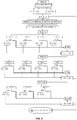
- Figure 7 shows an exemplary flow diagram relating to a possible calculation method of said Index.
- the method and the device of the invention can allow the automatic calculation of a particular visual index defined Advanced Visual Index adapted to the evaluation of the visual qualities of pilots participating in high-level motor competitions (for example motoring, motorcycling or motor-boating) or other particularly dynamic sports (e.g. bobsleigh, skydiving) or professional (airplane pilots) activities.
- a particular visual index defined Advanced Visual Index adapted to the evaluation of the visual qualities of pilots participating in high-level motor competitions (for example motoring, motorcycling or motor-boating) or other particularly dynamic sports (e.g. bobsleigh, skydiving) or professional (airplane pilots) activities.
- this index we use the same algorithm used for the evaluation of the Global Visual Index as explained above, possibly modifying the parameters adopted for some eye examinations. Some of the main variations that can be adopted are illustrated below. The test for measuring visual acuity remains unchanged.
- the visual field test will be carried out by reducing the brightness of the sights with respect to Table 3 for the calculation of the Global Visual Index according to the following scheme: Table 3 bis Age range Points up to 10 Points 10 to 20 Points 20 to 30 Points 30 to 40 0-40 6% 10% 18% 36% 41-60 8% 13% 23% 46% Over 60 10% 16% 28% 56%
- Table 4bis Quality level Shift Level 1 10" Level 2 20" Level 3 40" Level 4 80" Level 5 160"
- test execution mode remains unchanged considering a dimension of the presented symbols equal to that of the fifth row of the optotype instead of the fourth, as foreseen by the procedure relative to the calculation of the Global Visual Index as introduced above.
- the Inventors adopted a particular methodology, submitting different subjects to an eye examination for the measurement of various parameters, in particular those already indicated above.
- the subjects then performed a simulator driving test, during which they were presented various scenarios specifically created, with the possibility of modulating various factors concerning vision to analyze them separately or in combination.
- the driving ability at the simulator was then quantified by one or more scores for each subject.
- each individual parameter was assigned a value, or weight, an expression of its relative importance.
- the base value (optimal reference IVG) can be equal to a predetermined higher threshold, in particular to a base value of 100, for a subject having the highest quality in each parameter examined.
- the base value is equal to that of binocular visual acuity.
- a binocular visus 10/10 corresponds to a base value of 100
- a base value of 90 corresponds to a binocular visus of 9/10.
- a first filter is applied, that is, a first test, relating to the residual field of view, in ways similar to those defined in the previous section "Visual field test" (also with reference to Figures 6 and 7 ).
- This residual field of view is defined by the ratio between the total value of the points perceived and the value of the total points taking into account their number and relative importance thereof which naturally decreases with the increase of their eccentricity in the following mode (in particular based on a total of 77 points distributed in four different areas):
- a second filter, or text can be related to Stereoscopy.
- the result of the stereoscopy evaluation test can be expressed through a scale of values with five levels of decreasing quality, for example:
- a third filter, or test can be related to contrast sensitivity.
- the result of the contrast sensitivity evaluation test can be expressed through a scale of values with five levels of decreasing quality, in particular:
- a fourth filter, or test may be the one related to the dazzling recovery time.
- the result of the dazzling recovery time evaluation test is expressed through a scale of values with three different levels of decreasing quality:
- a monocular visual acuity evaluation test can be advantageously carried out. If the examined subject has in one of the two eyes a visual acuity equal to or ⁇ than 2/10, the IVG value calculated according to the above criteria will be decreased by 10%. For example, if a monocle or a subject suffering from severe amblyopia (eye visus worse ⁇ 2/10) had at the end of the procedure as explained above, an IVG of 65, it will be automatically reduced by 10% and then will become 58.50.
- IVG The Global Visual Index (IVG) is then calculated according to the following algorithm, expressed in Excel® language.
- the data processing carried out through the combination of the results obtained in the two test procedures conducted in a parallel and independent manner, allowed producing values expressing the relative importance of each single factor.
- This procedure was possible since in the fuzzy logic, the rules based on different inputs are independent of each other and do not influence the other units until the logical sum is executed.
- the individual rules are combined in order to constitute a structure within which it is possible to define a system that is however complicated in its entirety. But, due to the effects of parallel processing, it is the whole basis of rules that has a significant effect on the result.
- the defuzzification task aims to standardize all the results obtained from the elaboration of the rules and calculate the final value that must be made available to each output device.
- Operations performed by a fuzzy logic system can be divided into two main groups.
- the inferential process consists of a list of rules and a logical sum operation: the rules can be divided into conditions (which form the antecedent block), and in conclusions (the resulting block). The conclusion is satisfied when all conditions are completely met. It is important to remember that fuzzy reasoning, or the inferential process, starts with conditions for obtaining conclusions. Therefore, a logical sum and a defuzzification operation are needed to convert the results obtained from the inference process into a unique value.
- the rules based on different inputs are independent of each other and do not influence the other units until the logical sum is executed.
- the individual rules are combined in order to constitute a structure within which it is possible to define a system that is however complicated in its entirety.
- the defuzzification task aims to standardize all the results obtained from the elaboration of the rules and calculate the final value that must be made available to each output device.
- a very complex system can be developed in a rigorous manner.
- the synergy guaranteed by parallel processing allows fuzzy logic to proceed to the control of complex systems by resorting to particularly simple expressions.
- a fuzzy controller completes all processing steps without resorting to numerical calculations, thus increasing processing speed.
- Particularly high processing speeds can be obtained by using systems, implemented via hardware, that take full advantage of the potential offered by parallel processing. Therefore, it is possible to implement very complicated systems that can work in a precise, fast manner and guarantee high levels of reliability at the same time.
- the results of the tests relating to the evaluation of field of view, visual acuity, stereoscopy, contrast sensitivity and dazzling recovery time were selected as input variables, and such tests were preferably performed as illustrated above.
- the output parameter is the aforementioned Global Visual Index.
- Table 7 Parameter: Field of view Parameter: Visual acuity Very Insufficient (MI) Very Insufficient (MI) Insufficient (I) Insufficient (I) Almost Sufficient (AS) Almost Sufficient (AS) Sufficient (S) Sufficient (S) Almost Good (AG) Almost Good (AG) Good (G) Good (G) Excellent (E) Excellent (E) Parameter: Stereoscopy Parameter: Contrast sensitivity Insufficient (I) Very Insufficient (MI) Sufficient (S) Insufficient (I) Good (G) Sufficient (S) Very Good (VG) Good (G) Excellent (E) Really Good (RG) Parameter: Dazzling Recovery Time Insufficient (I) Sufficient (S) Really Good (RG)
- the Global Visual Index was evaluated according to the following Table 8. Table 8 Very Insufficient (MI) Band 5 Insufficient (I) Band 4 Sufficient (S) Band 3 Good (G) Band 2 Really Good (RG) Band 1
- the numerical value relative to the Global Visual Index is defined by the combination between the numerical value relative to the examination result of each single factor and its relative importance coefficient.
- the Global Visual Index value can be entered by way of example, for example in the case of motor vehicle driving qualification within a predefined scale of values at 5 different levels in the manner of the following Table 9.
- Table 9 Level Global Visual Index Value Level 1 100-95 Level 2 94-80 Level 3 79-55 Level 4 54-35 Level 5 ⁇ 35
Landscapes
- Life Sciences & Earth Sciences (AREA)
- Health & Medical Sciences (AREA)
- Medical Informatics (AREA)
- Biophysics (AREA)
- Ophthalmology & Optometry (AREA)
- Engineering & Computer Science (AREA)
- Biomedical Technology (AREA)
- Heart & Thoracic Surgery (AREA)
- Physics & Mathematics (AREA)
- Molecular Biology (AREA)
- Surgery (AREA)
- Animal Behavior & Ethology (AREA)
- General Health & Medical Sciences (AREA)
- Public Health (AREA)
- Veterinary Medicine (AREA)
- Eye Examination Apparatus (AREA)
Claims (13)
- Digitale Betrachtungsvorrichtung (1), die konfiguriert ist, um zu ermöglichen, einen multifaktoriellen Sehfähigkeitstest an einer Person auszuführen, wobei die Betrachtungsvorrichtung (1) umfasst:- ein äußeres Gehäuse (2) mit einem Sichtzugangsfenster (3) für die Augen der Person;- erste Anzeigemittel (4), die in dem Gehäuse (2) beherbergt sind, wobei diese in dem Gesichtsfeld angeordnet sind, das mit dem Sichtzugangsfenster (3) assoziiert ist, und die programmiert sind oder angewiesen werden, um die Person einem ersten Kurzsichttest zu unterziehen;- zweite Anzeigemittel (5), die programmiert sind oder angewiesen werden, um die Person einem zweiten Weitsichttest zu unterziehen;- Bewegungsmittel (41, 42) der ersten Anzeigemittel (4), die konfiguriert sind, um die ersten Anzeigemittel (4) in eine erste Betriebsposition zu bringen, wobei die ersten Anzeigemittel (4) sich in dem Sichtfeld befinden, das mit dem ersten Sichtzugangsfenster (3) assoziiert ist, um die Person einem ersten Sehtest zu unterziehen, sowie in eine zweite Ruheposition, wobei die ersten Anzeigemittel (4) aus dem Sichtfeld herausbewegt werden;wobei die zweiten Anzeigemittel (5) in Bezug auf das erste Sichtzugangsfenster (3) voneinander beabstandet angeordnet sind, wobei die Gesamtkonfiguration derart ist, dass die zweiten Anzeigemittel (5) betreibbar sind, um die Person einem zweiten Sehtest zu unterziehen, wenn sich die ersten Anzeigemittel (4) in der Ruheposition befinden.
- Betrachtungsvorrichtung (100) nach Anspruch 1, wobei das Gehäuse (2') eine im Wesentlichen vielflächige Gestalt aufweist.
- Betrachtungsvorrichtung (100) nach Anspruch 1 oder 2, wobei die ersten (4') und/oder die zweiten (5') Anzeigemittel eine programmierte oder programmierbare Anzeige (40', 50') umfassen, um statische und/oder dynamische Bilder eines monookularen oder biokularen Typs zuzuführen.
- Betrachtungsvorrichtung (100) nach einem der vorhergehenden Ansprüche, wobei die zweiten Anzeigemittel (5') an einer äußeren Seitenwand (24', 25') des Gehäuses (2') angeordnet sind.
- Betrachtungsvorrichtung (100) nach einem der vorhergehenden Ansprüche, wobei die zweiten Anzeigemittel (5') ein Steuerfeld umfassen oder einem solchen entsprechen, das von einem Nutzer (102) bedienbar ist.
- Betrachtungsvorrichtung (100) nach einem der vorhergehenden Ansprüche, die eine Verarbeitungseinheit (10, 14, 15) umfasst, welche konfiguriert ist, um die ersten (4') und/oder die zweiten (5') Anzeigemittel zu steuern.
- Betrachtungsvorrichtung (100) nach dem vorhergehenden Anspruch, wobei die Verarbeitungseinheit (10, 14, 15) in oder an dem Gehäuse (2') untergebracht ist.
- Betrachtungsvorrichtung (100) nach einem der vorhergehenden Ansprüche, welche eine Verarbeitungseinheit (10, 14, 15) umfasst, die für die Berechnung eines globalen Seh-Indexes (Global Visual Index) aus den Ergebnissen des ersten und/oder zweiten Sehtests programmiert ist, die durch die ersten (4') und/oder die zweiten (5') Anzeigemittel ausgeführt werden.
- Betrachtungsvorrichtung (100) nach einem der vorhergehenden Ansprüche, welche eine Speichereinheit (110) umfasst, die konfiguriert ist, um Ergebnisse von einem oder mehreren Sehtests zu speichern, die durch die ersten (4') und/oder die zweiten (5') Anzeigemittel ausgeführt werden, und die Vorzugsweise mit der Verarbeitungseinheit (10, 14, 15) assoziiert ist.
- Betrachtungsvorrichtung (100) nach einem der vorhergehenden Ansprüche, welche ein Steuerfeld (102) umfasst, das in dem Gehäuse (2') angeordnet ist und mit den ersten (4') und/oder den zweiten (5') Anzeigemitteln und/oder mit der Verarbeitungseinheit (10, 14, 15) kommuniziert.
- Betrachtungsvorrichtung (100) nach einem der vorhergehenden Ansprüche, welche Rückkoppelungsmittel (111) umfasst, die durch die Person während der Sehtests bedienbar sind.
- Betrachtungsvorrichtung (100) nach einem der vorhergehenden Ansprüche, die konfiguriert ist, um die Person Einschätzungstests im Hinblick auf einen oder mehrere der nachfolgenden Faktoren zu unterziehen: Natürliche und korrigierte Monookulare Sehschärfe beider Augen, natürliche und korrigierte biokulare Sehschärfe, monookulare und/oder biokulare Sichtfeldqualität, biokulares Sehniveau und stereoskopische Qualität, Kontrastsensitivität, Blenderholungszeit, irgendein Heterophoriegrad, Farberfassungsqualität, okulare Motilität durch den Hess-Screen.
- Betrachtungsvorrichtung (1) nach einem der vorhergehenden Ansprüche, wobei die Bewegungsmittel eine Kopplung zwischen einem Stift (41), der zu den ersten Anzeigemitteln (4) gehört und einer Führung (42), die in dem Gehäuse (2) vorliegt, umfasst, vorzugsweise an einer Seitenwand (25) davon.
Applications Claiming Priority (3)
| Application Number | Priority Date | Filing Date | Title |
|---|---|---|---|
| IT102017000058612A IT201700058612A1 (it) | 2017-05-30 | 2017-05-30 | Dispositivo e metodo per la valutazione delle capacità visive |
| IT201700137065 | 2017-11-29 | ||
| PCT/IB2018/053777 WO2018220508A2 (en) | 2017-05-30 | 2018-05-28 | Device and method for the evaluation of visual abilities |
Publications (2)
| Publication Number | Publication Date |
|---|---|
| EP3629883A2 EP3629883A2 (de) | 2020-04-08 |
| EP3629883B1 true EP3629883B1 (de) | 2020-10-28 |
Family
ID=62705625
Family Applications (1)
| Application Number | Title | Priority Date | Filing Date |
|---|---|---|---|
| EP18733342.2A Active EP3629883B1 (de) | 2017-05-30 | 2018-05-28 | Vorrichtung und verfahren zur beurteilung von sehfähigkeiten |
Country Status (2)
| Country | Link |
|---|---|
| EP (1) | EP3629883B1 (de) |
| WO (1) | WO2018220508A2 (de) |
Families Citing this family (1)
| Publication number | Priority date | Publication date | Assignee | Title |
|---|---|---|---|---|
| CN116781884B (zh) * | 2023-06-29 | 2024-03-12 | 广州视景医疗软件有限公司 | 一种单眼立体视的数据采集方法及装置 |
Family Cites Families (6)
| Publication number | Priority date | Publication date | Assignee | Title |
|---|---|---|---|---|
| JP2008512142A (ja) * | 2004-09-03 | 2008-04-24 | パナセカ, インコーポレイテッド | ビジョンセンターキオスク |
| EP3305174A3 (de) * | 2007-02-15 | 2018-10-24 | The UAB Research Foundation | Verbessertes photobleichungsverfahren |
| US9492344B2 (en) * | 2009-08-03 | 2016-11-15 | Nike, Inc. | Unified vision testing and/or training |
| US8967809B2 (en) * | 2010-03-01 | 2015-03-03 | Alcon Research, Ltd. | Methods and systems for intelligent visual function assessments |
| EP2669732A1 (de) * | 2012-05-30 | 2013-12-04 | ESSILOR INTERNATIONAL (Compagnie Générale d'Optique) | Verfahren zur Bereitstellung eines optischen Systems mit personalisierter Brille für einen Träger |
| US10736502B2 (en) * | 2013-09-02 | 2020-08-11 | Ocuspecto Oy | Testing and determining a threshold value |
-
2018
- 2018-05-28 EP EP18733342.2A patent/EP3629883B1/de active Active
- 2018-05-28 WO PCT/IB2018/053777 patent/WO2018220508A2/en not_active Ceased
Non-Patent Citations (1)
| Title |
|---|
| None * |
Also Published As
| Publication number | Publication date |
|---|---|
| EP3629883A2 (de) | 2020-04-08 |
| WO2018220508A2 (en) | 2018-12-06 |
| WO2018220508A3 (en) | 2019-02-21 |
Similar Documents
| Publication | Publication Date | Title |
|---|---|---|
| Bennett et al. | The assessment of visual function and functional vision | |
| US10123693B2 (en) | Quantification of inter-ocular suppression in binocular vision impairment | |
| US12533020B2 (en) | System and method for digital measurement of stereo vision | |
| CN111863256B (zh) | 一种基于视觉认知功能损害的精神性疾病检测装置 | |
| US10638925B2 (en) | Determining vision related physical conditions from cross-parameter vision tests | |
| CN115553707A (zh) | 一种基于眼动追踪的对比敏感度测量方法及设备 | |
| US20250241530A1 (en) | Self-Administered Adaptive Vision Screening Test Using Angular Indication | |
| Chang et al. | Visual assessment of camouflaged targets with different background similarities | |
| CN104382552B (zh) | 一种综合视觉功能检测设备 | |
| Lunsman et al. | What predicts changes in useful field of view test performance? | |
| CN114190891B (zh) | 基于眼动跟踪与沉浸式驾驶平台的单侧忽略评估系统 | |
| KR20220039666A (ko) | 뇌 활동 특징량의 추출 방법 | |
| Ahmad et al. | Reduced perception-action dissociation in children with amblyopia | |
| EP3629883B1 (de) | Vorrichtung und verfahren zur beurteilung von sehfähigkeiten | |
| DE102021133152B4 (de) | Verfahren, Vorrichtung und Computerprogrammprodukt zum Bestimmen einer Sensitivität zumindest eines Auges eines Probanden | |
| RU2210972C1 (ru) | Устройство для скрининговой диагностики зрения | |
| KR101722366B1 (ko) | 자각적 굴절검사 시스템, 자각적 굴절검사 방법, 및 그 굴절검사 방법을 실행하기 위한 프로그램을 기록하는 컴퓨터 판독 가능한 기록매체 | |
| Senger et al. | Spatial correlation between localized decreases in exploratory visual search performance and areas of glaucomatous visual field loss | |
| US10143367B2 (en) | Instrument and method for visual field examination | |
| Sumnall et al. | Optokinetic potential and the perception of head-centred speed | |
| CN110974147B (zh) | 一种双眼分视的双眼视觉功能检测定量化输出装置 | |
| Ahmad et al. | Eye tracking system measurement of saccadic eye movement with different illuminance transmission exposures during driving simulation | |
| DE102021202451A1 (de) | Verfahren, System und Computerprogrammprodukt zur Bestimmung optometrischer Parameter | |
| JP2023535681A (ja) | 対象の視力を改善するために屈折矯正を提供するように適合された眼科レンズの光学的特徴の丸められた値を特定するためのシステム及び方法 | |
| Bailey | Vision screening in industry: objectives and methods |
Legal Events
| Date | Code | Title | Description |
|---|---|---|---|
| STAA | Information on the status of an ep patent application or granted ep patent |
Free format text: STATUS: UNKNOWN |
|
| STAA | Information on the status of an ep patent application or granted ep patent |
Free format text: STATUS: THE INTERNATIONAL PUBLICATION HAS BEEN MADE |
|
| PUAI | Public reference made under article 153(3) epc to a published international application that has entered the european phase |
Free format text: ORIGINAL CODE: 0009012 |
|
| STAA | Information on the status of an ep patent application or granted ep patent |
Free format text: STATUS: REQUEST FOR EXAMINATION WAS MADE |
|
| 17P | Request for examination filed |
Effective date: 20191213 |
|
| AK | Designated contracting states |
Kind code of ref document: A2 Designated state(s): AL AT BE BG CH CY CZ DE DK EE ES FI FR GB GR HR HU IE IS IT LI LT LU LV MC MK MT NL NO PL PT RO RS SE SI SK SM TR |
|
| AX | Request for extension of the european patent |
Extension state: BA ME |
|
| GRAP | Despatch of communication of intention to grant a patent |
Free format text: ORIGINAL CODE: EPIDOSNIGR1 |
|
| STAA | Information on the status of an ep patent application or granted ep patent |
Free format text: STATUS: GRANT OF PATENT IS INTENDED |
|
| DAV | Request for validation of the european patent (deleted) | ||
| DAX | Request for extension of the european patent (deleted) | ||
| INTG | Intention to grant announced |
Effective date: 20200612 |
|
| GRAS | Grant fee paid |
Free format text: ORIGINAL CODE: EPIDOSNIGR3 |
|
| GRAA | (expected) grant |
Free format text: ORIGINAL CODE: 0009210 |
|
| STAA | Information on the status of an ep patent application or granted ep patent |
Free format text: STATUS: THE PATENT HAS BEEN GRANTED |
|
| AK | Designated contracting states |
Kind code of ref document: B1 Designated state(s): AL AT BE BG CH CY CZ DE DK EE ES FI FR GB GR HR HU IE IS IT LI LT LU LV MC MK MT NL NO PL PT RO RS SE SI SK SM TR |
|
| REG | Reference to a national code |
Ref country code: GB Ref legal event code: FG4D |
|
| REG | Reference to a national code |
Ref country code: CH Ref legal event code: EP |
|
| REG | Reference to a national code |
Ref country code: DE Ref legal event code: R096 Ref document number: 602018009187 Country of ref document: DE |
|
| REG | Reference to a national code |
Ref country code: AT Ref legal event code: REF Ref document number: 1327346 Country of ref document: AT Kind code of ref document: T Effective date: 20201115 |
|
| REG | Reference to a national code |
Ref country code: IE Ref legal event code: FG4D |
|
| REG | Reference to a national code |
Ref country code: AT Ref legal event code: MK05 Ref document number: 1327346 Country of ref document: AT Kind code of ref document: T Effective date: 20201028 |
|
| REG | Reference to a national code |
Ref country code: NL Ref legal event code: MP Effective date: 20201028 |
|
| PG25 | Lapsed in a contracting state [announced via postgrant information from national office to epo] |
Ref country code: GR Free format text: LAPSE BECAUSE OF FAILURE TO SUBMIT A TRANSLATION OF THE DESCRIPTION OR TO PAY THE FEE WITHIN THE PRESCRIBED TIME-LIMIT Effective date: 20210129 Ref country code: NO Free format text: LAPSE BECAUSE OF FAILURE TO SUBMIT A TRANSLATION OF THE DESCRIPTION OR TO PAY THE FEE WITHIN THE PRESCRIBED TIME-LIMIT Effective date: 20210128 Ref country code: RS Free format text: LAPSE BECAUSE OF FAILURE TO SUBMIT A TRANSLATION OF THE DESCRIPTION OR TO PAY THE FEE WITHIN THE PRESCRIBED TIME-LIMIT Effective date: 20201028 Ref country code: PT Free format text: LAPSE BECAUSE OF FAILURE TO SUBMIT A TRANSLATION OF THE DESCRIPTION OR TO PAY THE FEE WITHIN THE PRESCRIBED TIME-LIMIT Effective date: 20210301 Ref country code: FI Free format text: LAPSE BECAUSE OF FAILURE TO SUBMIT A TRANSLATION OF THE DESCRIPTION OR TO PAY THE FEE WITHIN THE PRESCRIBED TIME-LIMIT Effective date: 20201028 |
|
| REG | Reference to a national code |
Ref country code: LT Ref legal event code: MG4D |
|
| PG25 | Lapsed in a contracting state [announced via postgrant information from national office to epo] |
Ref country code: BG Free format text: LAPSE BECAUSE OF FAILURE TO SUBMIT A TRANSLATION OF THE DESCRIPTION OR TO PAY THE FEE WITHIN THE PRESCRIBED TIME-LIMIT Effective date: 20210128 Ref country code: SE Free format text: LAPSE BECAUSE OF FAILURE TO SUBMIT A TRANSLATION OF THE DESCRIPTION OR TO PAY THE FEE WITHIN THE PRESCRIBED TIME-LIMIT Effective date: 20201028 Ref country code: IS Free format text: LAPSE BECAUSE OF FAILURE TO SUBMIT A TRANSLATION OF THE DESCRIPTION OR TO PAY THE FEE WITHIN THE PRESCRIBED TIME-LIMIT Effective date: 20210228 Ref country code: PL Free format text: LAPSE BECAUSE OF FAILURE TO SUBMIT A TRANSLATION OF THE DESCRIPTION OR TO PAY THE FEE WITHIN THE PRESCRIBED TIME-LIMIT Effective date: 20201028 Ref country code: LV Free format text: LAPSE BECAUSE OF FAILURE TO SUBMIT A TRANSLATION OF THE DESCRIPTION OR TO PAY THE FEE WITHIN THE PRESCRIBED TIME-LIMIT Effective date: 20201028 Ref country code: AT Free format text: LAPSE BECAUSE OF FAILURE TO SUBMIT A TRANSLATION OF THE DESCRIPTION OR TO PAY THE FEE WITHIN THE PRESCRIBED TIME-LIMIT Effective date: 20201028 Ref country code: ES Free format text: LAPSE BECAUSE OF FAILURE TO SUBMIT A TRANSLATION OF THE DESCRIPTION OR TO PAY THE FEE WITHIN THE PRESCRIBED TIME-LIMIT Effective date: 20201028 |
|
| PG25 | Lapsed in a contracting state [announced via postgrant information from national office to epo] |
Ref country code: HR Free format text: LAPSE BECAUSE OF FAILURE TO SUBMIT A TRANSLATION OF THE DESCRIPTION OR TO PAY THE FEE WITHIN THE PRESCRIBED TIME-LIMIT Effective date: 20201028 Ref country code: NL Free format text: LAPSE BECAUSE OF FAILURE TO SUBMIT A TRANSLATION OF THE DESCRIPTION OR TO PAY THE FEE WITHIN THE PRESCRIBED TIME-LIMIT Effective date: 20201028 |
|
| REG | Reference to a national code |
Ref country code: DE Ref legal event code: R097 Ref document number: 602018009187 Country of ref document: DE |
|
| PG25 | Lapsed in a contracting state [announced via postgrant information from national office to epo] |
Ref country code: CZ Free format text: LAPSE BECAUSE OF FAILURE TO SUBMIT A TRANSLATION OF THE DESCRIPTION OR TO PAY THE FEE WITHIN THE PRESCRIBED TIME-LIMIT Effective date: 20201028 Ref country code: EE Free format text: LAPSE BECAUSE OF FAILURE TO SUBMIT A TRANSLATION OF THE DESCRIPTION OR TO PAY THE FEE WITHIN THE PRESCRIBED TIME-LIMIT Effective date: 20201028 Ref country code: SM Free format text: LAPSE BECAUSE OF FAILURE TO SUBMIT A TRANSLATION OF THE DESCRIPTION OR TO PAY THE FEE WITHIN THE PRESCRIBED TIME-LIMIT Effective date: 20201028 Ref country code: SK Free format text: LAPSE BECAUSE OF FAILURE TO SUBMIT A TRANSLATION OF THE DESCRIPTION OR TO PAY THE FEE WITHIN THE PRESCRIBED TIME-LIMIT Effective date: 20201028 Ref country code: RO Free format text: LAPSE BECAUSE OF FAILURE TO SUBMIT A TRANSLATION OF THE DESCRIPTION OR TO PAY THE FEE WITHIN THE PRESCRIBED TIME-LIMIT Effective date: 20201028 Ref country code: LT Free format text: LAPSE BECAUSE OF FAILURE TO SUBMIT A TRANSLATION OF THE DESCRIPTION OR TO PAY THE FEE WITHIN THE PRESCRIBED TIME-LIMIT Effective date: 20201028 |
|
| PG25 | Lapsed in a contracting state [announced via postgrant information from national office to epo] |
Ref country code: DK Free format text: LAPSE BECAUSE OF FAILURE TO SUBMIT A TRANSLATION OF THE DESCRIPTION OR TO PAY THE FEE WITHIN THE PRESCRIBED TIME-LIMIT Effective date: 20201028 |
|
| PLBE | No opposition filed within time limit |
Free format text: ORIGINAL CODE: 0009261 |
|
| STAA | Information on the status of an ep patent application or granted ep patent |
Free format text: STATUS: NO OPPOSITION FILED WITHIN TIME LIMIT |
|
| 26N | No opposition filed |
Effective date: 20210729 |
|
| PG25 | Lapsed in a contracting state [announced via postgrant information from national office to epo] |
Ref country code: AL Free format text: LAPSE BECAUSE OF FAILURE TO SUBMIT A TRANSLATION OF THE DESCRIPTION OR TO PAY THE FEE WITHIN THE PRESCRIBED TIME-LIMIT Effective date: 20201028 Ref country code: IT Free format text: LAPSE BECAUSE OF FAILURE TO SUBMIT A TRANSLATION OF THE DESCRIPTION OR TO PAY THE FEE WITHIN THE PRESCRIBED TIME-LIMIT Effective date: 20201028 |
|
| PG25 | Lapsed in a contracting state [announced via postgrant information from national office to epo] |
Ref country code: SI Free format text: LAPSE BECAUSE OF FAILURE TO SUBMIT A TRANSLATION OF THE DESCRIPTION OR TO PAY THE FEE WITHIN THE PRESCRIBED TIME-LIMIT Effective date: 20201028 |
|
| REG | Reference to a national code |
Ref country code: CH Ref legal event code: PL |
|
| PG25 | Lapsed in a contracting state [announced via postgrant information from national office to epo] |
Ref country code: LU Free format text: LAPSE BECAUSE OF NON-PAYMENT OF DUE FEES Effective date: 20210528 Ref country code: MC Free format text: LAPSE BECAUSE OF FAILURE TO SUBMIT A TRANSLATION OF THE DESCRIPTION OR TO PAY THE FEE WITHIN THE PRESCRIBED TIME-LIMIT Effective date: 20201028 Ref country code: LI Free format text: LAPSE BECAUSE OF NON-PAYMENT OF DUE FEES Effective date: 20210531 Ref country code: CH Free format text: LAPSE BECAUSE OF NON-PAYMENT OF DUE FEES Effective date: 20210531 |
|
| REG | Reference to a national code |
Ref country code: BE Ref legal event code: MM Effective date: 20210531 |
|
| PG25 | Lapsed in a contracting state [announced via postgrant information from national office to epo] |
Ref country code: IE Free format text: LAPSE BECAUSE OF NON-PAYMENT OF DUE FEES Effective date: 20210528 |
|
| PG25 | Lapsed in a contracting state [announced via postgrant information from national office to epo] |
Ref country code: IS Free format text: LAPSE BECAUSE OF FAILURE TO SUBMIT A TRANSLATION OF THE DESCRIPTION OR TO PAY THE FEE WITHIN THE PRESCRIBED TIME-LIMIT Effective date: 20210228 |
|
| PG25 | Lapsed in a contracting state [announced via postgrant information from national office to epo] |
Ref country code: BE Free format text: LAPSE BECAUSE OF NON-PAYMENT OF DUE FEES Effective date: 20210531 |
|
| PG25 | Lapsed in a contracting state [announced via postgrant information from national office to epo] |
Ref country code: CY Free format text: LAPSE BECAUSE OF FAILURE TO SUBMIT A TRANSLATION OF THE DESCRIPTION OR TO PAY THE FEE WITHIN THE PRESCRIBED TIME-LIMIT Effective date: 20201028 |
|
| PG25 | Lapsed in a contracting state [announced via postgrant information from national office to epo] |
Ref country code: HU Free format text: LAPSE BECAUSE OF FAILURE TO SUBMIT A TRANSLATION OF THE DESCRIPTION OR TO PAY THE FEE WITHIN THE PRESCRIBED TIME-LIMIT; INVALID AB INITIO Effective date: 20180528 |
|
| PG25 | Lapsed in a contracting state [announced via postgrant information from national office to epo] |
Ref country code: MK Free format text: LAPSE BECAUSE OF FAILURE TO SUBMIT A TRANSLATION OF THE DESCRIPTION OR TO PAY THE FEE WITHIN THE PRESCRIBED TIME-LIMIT Effective date: 20201028 |
|
| PG25 | Lapsed in a contracting state [announced via postgrant information from national office to epo] |
Ref country code: MT Free format text: LAPSE BECAUSE OF FAILURE TO SUBMIT A TRANSLATION OF THE DESCRIPTION OR TO PAY THE FEE WITHIN THE PRESCRIBED TIME-LIMIT Effective date: 20201028 |
|
| PGFP | Annual fee paid to national office [announced via postgrant information from national office to epo] |
Ref country code: DE Payment date: 20250521 Year of fee payment: 8 |
|
| PGFP | Annual fee paid to national office [announced via postgrant information from national office to epo] |
Ref country code: GB Payment date: 20250527 Year of fee payment: 8 |
|
| PGFP | Annual fee paid to national office [announced via postgrant information from national office to epo] |
Ref country code: FR Payment date: 20250528 Year of fee payment: 8 |
|
| PG25 | Lapsed in a contracting state [announced via postgrant information from national office to epo] |
Ref country code: TR Free format text: LAPSE BECAUSE OF FAILURE TO SUBMIT A TRANSLATION OF THE DESCRIPTION OR TO PAY THE FEE WITHIN THE PRESCRIBED TIME-LIMIT Effective date: 20201028 |