EP3630854B1 - Copolymère d'éthylène présentant des propriétés de film améliorées - Google Patents
Copolymère d'éthylène présentant des propriétés de film améliorées Download PDFInfo
- Publication number
- EP3630854B1 EP3630854B1 EP18730439.9A EP18730439A EP3630854B1 EP 3630854 B1 EP3630854 B1 EP 3630854B1 EP 18730439 A EP18730439 A EP 18730439A EP 3630854 B1 EP3630854 B1 EP 3630854B1
- Authority
- EP
- European Patent Office
- Prior art keywords
- ethylene copolymer
- disclosure
- mil
- ethylene
- film
- Prior art date
- Legal status (The legal status is an assumption and is not a legal conclusion. Google has not performed a legal analysis and makes no representation as to the accuracy of the status listed.)
- Active
Links
Images



Classifications
-
- C—CHEMISTRY; METALLURGY
- C08—ORGANIC MACROMOLECULAR COMPOUNDS; THEIR PREPARATION OR CHEMICAL WORKING-UP; COMPOSITIONS BASED THEREON
- C08F—MACROMOLECULAR COMPOUNDS OBTAINED BY REACTIONS ONLY INVOLVING CARBON-TO-CARBON UNSATURATED BONDS
- C08F210/00—Copolymers of unsaturated aliphatic hydrocarbons having only one carbon-to-carbon double bond
- C08F210/16—Copolymers of ethene with alpha-alkenes, e.g. EP rubbers
-
- C—CHEMISTRY; METALLURGY
- C08—ORGANIC MACROMOLECULAR COMPOUNDS; THEIR PREPARATION OR CHEMICAL WORKING-UP; COMPOSITIONS BASED THEREON
- C08F—MACROMOLECULAR COMPOUNDS OBTAINED BY REACTIONS ONLY INVOLVING CARBON-TO-CARBON UNSATURATED BONDS
- C08F2/00—Processes of polymerisation
- C08F2/34—Polymerisation in gaseous state
-
- C—CHEMISTRY; METALLURGY
- C08—ORGANIC MACROMOLECULAR COMPOUNDS; THEIR PREPARATION OR CHEMICAL WORKING-UP; COMPOSITIONS BASED THEREON
- C08F—MACROMOLECULAR COMPOUNDS OBTAINED BY REACTIONS ONLY INVOLVING CARBON-TO-CARBON UNSATURATED BONDS
- C08F4/00—Polymerisation catalysts
- C08F4/42—Metals; Metal hydrides; Metallo-organic compounds; Use thereof as catalyst precursors
- C08F4/44—Metals; Metal hydrides; Metallo-organic compounds; Use thereof as catalyst precursors selected from light metals, zinc, cadmium, mercury, copper, silver, gold, boron, gallium, indium, thallium, rare earths or actinides
- C08F4/60—Metals; Metal hydrides; Metallo-organic compounds; Use thereof as catalyst precursors selected from light metals, zinc, cadmium, mercury, copper, silver, gold, boron, gallium, indium, thallium, rare earths or actinides together with refractory metals, iron group metals, platinum group metals, manganese, rhenium technetium or compounds thereof
- C08F4/62—Refractory metals or compounds thereof
- C08F4/64—Titanium, zirconium, hafnium or compounds thereof
- C08F4/642—Component covered by group C08F4/64 with an organo-aluminium compound
- C08F4/6423—Component of C08F4/64 containing at least two different metals
- C08F4/6425—Component of C08F4/64 containing at least two different metals containing magnesium
-
- C—CHEMISTRY; METALLURGY
- C08—ORGANIC MACROMOLECULAR COMPOUNDS; THEIR PREPARATION OR CHEMICAL WORKING-UP; COMPOSITIONS BASED THEREON
- C08F—MACROMOLECULAR COMPOUNDS OBTAINED BY REACTIONS ONLY INVOLVING CARBON-TO-CARBON UNSATURATED BONDS
- C08F4/00—Polymerisation catalysts
- C08F4/42—Metals; Metal hydrides; Metallo-organic compounds; Use thereof as catalyst precursors
- C08F4/44—Metals; Metal hydrides; Metallo-organic compounds; Use thereof as catalyst precursors selected from light metals, zinc, cadmium, mercury, copper, silver, gold, boron, gallium, indium, thallium, rare earths or actinides
- C08F4/60—Metals; Metal hydrides; Metallo-organic compounds; Use thereof as catalyst precursors selected from light metals, zinc, cadmium, mercury, copper, silver, gold, boron, gallium, indium, thallium, rare earths or actinides together with refractory metals, iron group metals, platinum group metals, manganese, rhenium technetium or compounds thereof
- C08F4/62—Refractory metals or compounds thereof
- C08F4/64—Titanium, zirconium, hafnium or compounds thereof
- C08F4/647—Catalysts containing a specific non-metal or metal-free compound
- C08F4/649—Catalysts containing a specific non-metal or metal-free compound organic
- C08F4/6493—Catalysts containing a specific non-metal or metal-free compound organic containing halogen
-
- C—CHEMISTRY; METALLURGY
- C08—ORGANIC MACROMOLECULAR COMPOUNDS; THEIR PREPARATION OR CHEMICAL WORKING-UP; COMPOSITIONS BASED THEREON
- C08F—MACROMOLECULAR COMPOUNDS OBTAINED BY REACTIONS ONLY INVOLVING CARBON-TO-CARBON UNSATURATED BONDS
- C08F4/00—Polymerisation catalysts
- C08F4/42—Metals; Metal hydrides; Metallo-organic compounds; Use thereof as catalyst precursors
- C08F4/44—Metals; Metal hydrides; Metallo-organic compounds; Use thereof as catalyst precursors selected from light metals, zinc, cadmium, mercury, copper, silver, gold, boron, gallium, indium, thallium, rare earths or actinides
- C08F4/60—Metals; Metal hydrides; Metallo-organic compounds; Use thereof as catalyst precursors selected from light metals, zinc, cadmium, mercury, copper, silver, gold, boron, gallium, indium, thallium, rare earths or actinides together with refractory metals, iron group metals, platinum group metals, manganese, rhenium technetium or compounds thereof
- C08F4/62—Refractory metals or compounds thereof
- C08F4/64—Titanium, zirconium, hafnium or compounds thereof
- C08F4/659—Component covered by group C08F4/64 containing a transition metal-carbon bond
- C08F4/65916—Component covered by group C08F4/64 containing a transition metal-carbon bond supported on a carrier, e.g. silica, MgCl2, polymer
-
- C—CHEMISTRY; METALLURGY
- C08—ORGANIC MACROMOLECULAR COMPOUNDS; THEIR PREPARATION OR CHEMICAL WORKING-UP; COMPOSITIONS BASED THEREON
- C08J—WORKING-UP; GENERAL PROCESSES OF COMPOUNDING; AFTER-TREATMENT NOT COVERED BY SUBCLASSES C08B, C08C, C08F, C08G or C08H
- C08J5/00—Manufacture of articles or shaped materials containing macromolecular substances
- C08J5/18—Manufacture of films or sheets
-
- C—CHEMISTRY; METALLURGY
- C08—ORGANIC MACROMOLECULAR COMPOUNDS; THEIR PREPARATION OR CHEMICAL WORKING-UP; COMPOSITIONS BASED THEREON
- C08F—MACROMOLECULAR COMPOUNDS OBTAINED BY REACTIONS ONLY INVOLVING CARBON-TO-CARBON UNSATURATED BONDS
- C08F2500/00—Characteristics or properties of obtained polyolefins; Use thereof
- C08F2500/04—Broad molecular weight distribution, i.e. Mw/Mn > 6
-
- C—CHEMISTRY; METALLURGY
- C08—ORGANIC MACROMOLECULAR COMPOUNDS; THEIR PREPARATION OR CHEMICAL WORKING-UP; COMPOSITIONS BASED THEREON
- C08F—MACROMOLECULAR COMPOUNDS OBTAINED BY REACTIONS ONLY INVOLVING CARBON-TO-CARBON UNSATURATED BONDS
- C08F2500/00—Characteristics or properties of obtained polyolefins; Use thereof
- C08F2500/08—Low density, i.e. < 0.91 g/cm3
-
- C—CHEMISTRY; METALLURGY
- C08—ORGANIC MACROMOLECULAR COMPOUNDS; THEIR PREPARATION OR CHEMICAL WORKING-UP; COMPOSITIONS BASED THEREON
- C08F—MACROMOLECULAR COMPOUNDS OBTAINED BY REACTIONS ONLY INVOLVING CARBON-TO-CARBON UNSATURATED BONDS
- C08F2500/00—Characteristics or properties of obtained polyolefins; Use thereof
- C08F2500/12—Melt flow index or melt flow ratio
-
- C—CHEMISTRY; METALLURGY
- C08—ORGANIC MACROMOLECULAR COMPOUNDS; THEIR PREPARATION OR CHEMICAL WORKING-UP; COMPOSITIONS BASED THEREON
- C08F—MACROMOLECULAR COMPOUNDS OBTAINED BY REACTIONS ONLY INVOLVING CARBON-TO-CARBON UNSATURATED BONDS
- C08F2500/00—Characteristics or properties of obtained polyolefins; Use thereof
- C08F2500/18—Bulk density
-
- C—CHEMISTRY; METALLURGY
- C08—ORGANIC MACROMOLECULAR COMPOUNDS; THEIR PREPARATION OR CHEMICAL WORKING-UP; COMPOSITIONS BASED THEREON
- C08F—MACROMOLECULAR COMPOUNDS OBTAINED BY REACTIONS ONLY INVOLVING CARBON-TO-CARBON UNSATURATED BONDS
- C08F2500/00—Characteristics or properties of obtained polyolefins; Use thereof
- C08F2500/26—Use as polymer for film forming
-
- C—CHEMISTRY; METALLURGY
- C08—ORGANIC MACROMOLECULAR COMPOUNDS; THEIR PREPARATION OR CHEMICAL WORKING-UP; COMPOSITIONS BASED THEREON
- C08J—WORKING-UP; GENERAL PROCESSES OF COMPOUNDING; AFTER-TREATMENT NOT COVERED BY SUBCLASSES C08B, C08C, C08F, C08G or C08H
- C08J2323/00—Characterised by the use of homopolymers or copolymers of unsaturated aliphatic hydrocarbons having only one carbon-to-carbon double bond; Derivatives of such polymers
- C08J2323/02—Characterised by the use of homopolymers or copolymers of unsaturated aliphatic hydrocarbons having only one carbon-to-carbon double bond; Derivatives of such polymers not modified by chemical after treatment
- C08J2323/04—Homopolymers or copolymers of ethene
- C08J2323/08—Copolymers of ethene
-
- Y—GENERAL TAGGING OF NEW TECHNOLOGICAL DEVELOPMENTS; GENERAL TAGGING OF CROSS-SECTIONAL TECHNOLOGIES SPANNING OVER SEVERAL SECTIONS OF THE IPC; TECHNICAL SUBJECTS COVERED BY FORMER USPC CROSS-REFERENCE ART COLLECTIONS [XRACs] AND DIGESTS
- Y02—TECHNOLOGIES OR APPLICATIONS FOR MITIGATION OR ADAPTATION AGAINST CLIMATE CHANGE
- Y02P—CLIMATE CHANGE MITIGATION TECHNOLOGIES IN THE PRODUCTION OR PROCESSING OF GOODS
- Y02P20/00—Technologies relating to chemical industry
- Y02P20/50—Improvements relating to the production of bulk chemicals
- Y02P20/52—Improvements relating to the production of bulk chemicals using catalysts, e.g. selective catalysts
Definitions
- the present disclosure is directed to the preparation of polyethylene copolymers and the films made from them.
- a Ziegler-Natta catalyst one having as an internal electron donor, a trialkylamine molecule, is used to make the ethylene copolymers which have a relatively narrow molecular weight distribution.
- the ethylene copolymers have improved bulk density and provide good dart impact properties when blown into film at a relatively low blow up ratio.
- ethylene copolymer compositions having not only reduced melt flow ratios, but also to compositions having a more even comonomer distribution.
- a titanium based Zielger-Natta catalyst having an internal 2,6-lutidine electron donor molecule provides ethylene/1-hexene copolymers having a relatively narrow molecular weight distribution and a "single site catalyst" like comonomer distribution. These resins exhibit a good balance of tear and impact properties when made into film.
- the present disclosure provides ethylene copolymers having intermediate molecular weight distributions and intermediate comonomer distributions relative to resins made with traditional Ziegler-Natta catalysts and single site catalysts.
- the resins show advantages associated with products which arise from both of these catalyst types.
- an ethylene copolymer comprising ethylene and 1-hexene, the ethylene copolymer having a density of from 0.912 g/cm 3 to 0.925 g/cm 3 , a melt index (I 2 ) of from 0.1 g/10min to 5.0 g/10min, a melt flow ratio (I 21 /I 2 ) of from 20 to 30, and a normal comonomer distribution profile in a GPC-FTIR analysis, wherein the normal comonomer distribution profile has a slope of from -4.5 to -7.0, where the slope is defined as the number of short chain branches per 1000 carbons at a molecular weight of 300,000 minus the number of short chain branches per 1000 carbons at a molecular weight of 30,000.
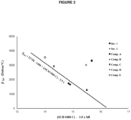
- One embodiment of the disclosure provides an ethylene copolymer having a characteristic composition distribution parameter, ⁇ Tp1 which satisfies the relationship: ⁇ Tp1 ⁇ 22750 - 1400 (SCB/1000C - 2.5 ⁇ I 2 ).
- One embodiment of the disclosure provides an ethylene copolymer having a characteristic composition transition parameter, ⁇ Tp1 ⁇ Tp2 which satisfies the relationship: ⁇ Tp1 ⁇ Tp2 ⁇ 4230 - 140 [SCB/1000C + 0.5 ⁇ (I 21 /I 2 ) - 2 ⁇ I 2 ].
- One embodiment of the disclosure provides an ethylene copolymer having a molecular weight distribution (M w /M n ) of from 2.5 to 4.0.
- One embodiment of the disclosure provides an ethylene copolymer having a multimodal profile in a TREF analysis, the multimodal profile comprising two intensity maxima occurring at elution temperatures Tp1 and Tp2, wherein Tp1 is between 80°C and 90°C and Tp2 is between 90°C and 100°C.
- One embodiment of the disclosure provides an ethylene copolymer in which less than 0.5 wt% of the copolymer elutes at a temperature of above 100°C in a TREF analysis.
- One embodiment of the disclosure provides an ethylene copolymer having a melt index (I 2 ) of from 0.2 to 2.0 g/10min.
- an ethylene copolymer when made into a blown film having a 0.8 mil thickness at a die gap of 85 mil and a blow up ratio (BUR) of 2:1 has a dart impact of greater than 350 g/mil.
- an ethylene copolymer is made with a Ziegler-Natta catalyst in a gas phase polymerization process.
- an ethylene copolymer has a bulk density of greater than 400 kg/m 3 (25 lbs/ft 3 ).
- a blown film has a dart impact of ⁇ 350 g/mil when the film has a thickness of 0.8 mil and is made at a die gap of 85 mil and a blow up ratio (BUR) of 2:1.
- the polymerization catalyst used in the present disclosure is a Ziegler-Natta type catalyst.
- the Ziegler-Natta catalyst comprises: (a) an inorganic oxide support; (b) a first aluminum compound (to chemically treat the surface of the inorganic oxide support); (c) a magnesium compound; (d) a halide donor (to precipitate magnesium halide on reaction with the magnesium compound); (e) a titanium compound; (f) an electron donor compound; and (g) a second aluminum compound (to serve as a catalyst reductant).
- the first aluminum compound is added to the inorganic oxide support to chemically treat it.
- the second aluminum compound is added at some point during the manufacture of the Ziegler-Natta catalyst and serves as a reductant.
- the inorganic oxide support used for the Ziegler-Natta catalysts may, in the present disclosure, comprise an inorganic oxide selected from an alumina or a silica material and will have pendant reactive moieties.
- the reactive moieties may be a silanol group or siloxane bridges.
- the inorganic oxide support used in the synthesis of the Ziegler-Natta catalyst is silica.
- the silica support has an average particle size from about 0.1 to about 150 microns, or from about 10 to about 150 microns, or about 20 to 100 microns.
- the silica support has a surface area which is greater than about 100 m 2 /g, or greater than about 250 m 2 /g, or from about 300 m 2 /g to about 800 m 2 /g.
- the silica support has a pore volume from about 0.5 to about 5.0 ml/g, or from about 0.7 to about 3.0 ml/g.
- Silica supports suitable for use in an embodiment of the present disclosure have a high surface area and are amorphous. Suitable non-limiting examples of such silica supports include commercially available silicas marketed under the trademark of SYLOPOL ® 958, 955 and 2408 by Davison Catalysts a Division of W. R. Grace and Company and ES-70W by Ineos Silica.
- the inorganic oxide support can be heat treated and/or chemically treated to reduce the level of surface hydroxyl (OH) groups and absorbed water in a similar fashion to that described by A. Noshay and F. J. Karol in Transition Metal Catalyzed Polymerizations, Ed. R. Quirk, 1989, pg. 396 .
- the inorganic oxide support is heat treated or "dried" prior to chemical treatment. Drying a support is also known as “calcining" a support.
- the inorganic support may be dried or calcined by heating it to a temperature of at least about 200°C for up to 24 hours, or to a temperature of from about 500°C to about 800°C for about 2 to 20 hours, or for about 4 to 10 hours.
- the resulting support may in an embodiment of the disclosure be free of adsorbed water and have a surface hydroxyl content of from about 0.1 to about 5 mmol/g, or from about 0.5 to about 3 mmol/g (where mmol is mmol of OH, and g is gram of support).
- the amount of hydroxyl groups present in silica support may be determined according to the method disclosed by J. B. Peri and A. L. Hensley, Jr., in J. Phys. Chem., 72 (8), 2926, 1968 .
- While heating is one of the methods that may be used to remove or reduce OH groups present in an inorganic support material, such as for example silica
- the OH groups may also be removed or reduced by chemical means.
- a desired proportion of the OH groups present in an inorganic support may be reacted with a suitable chemical agent, such as a hydroxyl reactive alkylaluminum compound (e.g. triethyl aluminum) or a silane compound.
- a suitable chemical agent such as a hydroxyl reactive alkylaluminum compound (e.g. triethyl aluminum) or a silane compound.
- Chemical treatment may in an embodiment of the disclosure involve treatment of an inorganic oxide support with a first aluminum compound.
- the first aluminum compound is selected from the group consisting of trimethyl aluminum (TMA), triethyl aluminum (TEAL), diethyl aluminum ethoxide, diisobutyl aluminum ethoxide, tri-isoprenyl aluminum, tri-isobutyl aluminum (TiBAL), diethyl aluminum chloride (DEAC), tri-n-hexyl aluminum (TnHAI), tri-n-octyl aluminum (TnOAl), and mixtures thereof.
- TMA trimethyl aluminum
- TEAL triethyl aluminum
- TEAL diethyl aluminum ethoxide
- diisobutyl aluminum ethoxide diisobutyl aluminum ethoxide
- tri-isoprenyl aluminum tri-isobutyl aluminum
- TiBAL diethyl aluminum chloride
- TnHAI tri-n-hexyl aluminum
- TnOAl tri-n-octyl aluminum
- the magnesium compound used in the formulation of the Ziegler-Nata catalyst has the formula (R 5 ) e MgX 2-e wherein each R 5 is independently a C 1-20 hydrocarbyl group, e is 1 or 2; and X is a halide.
- the magnesium compound is combined with a halide donor to form a magnesium halide composition as part of the Ziegler-Natta catalyst.
- the magnesium compound used in the formulation of the Ziegler-Nata catalyst has the formula Mg(R 5 ) 2 wherein each R 5 is independently a C 1-20 hydrocarbyl group.
- the magnesium compound used in the formulation of the Ziegler-Nata catalyst has the formula Mg(R 5 ) 2 wherein each R 5 is independently a C 1-8 alkyl group.
- solubilizing compound such as an organoaluminum or organozinc compound prior to use.
- organoaluminum or organozinc such compounds are discussed in, for example, U.S. Pat. Nos 4,127,507 and 4,250,288 .
- solubilizers such as organoaluminum or organozinc may be used to decrease the viscosity of the solution.
- the magnesium compound used has been treated with a solubilizing agent (or viscosity improving agent) and is formulated as a solution in a suitable hydrocarbon solvent.
- a solubilizing agent or viscosity improving agent
- Such magnesium compound containing solutions are commercially available from suppliers such as Albermarle, Akzo Nobel, etc.
- magnesium compounds available in hydrocarbon solution include solutions of butylethylmagnesium or dibutylmagnesium which have been treated with an organoaluminum compound to improve solubility and/or reduce solution viscosity.
- the halide donor is not specifically defined and can be any suitable halide source compound which is capable of providing an active (i.e. reactive) halide ion for reaction with an organomagensium bond in the magnesium compound.
- the halide donor will react spontaneously and fully with the magnesium compound, but a halide donor which requires a transfer agent such as described in U.S. Pat. No. 6,031,056 is also contemplated for use.
- the halide donor is a protic halide HX, or a reactive organic halide selected from the group consisting of CCl 4 and C 1-10 primary, secondary or tertiary alkyl halides, and mixture thereof.
- the halide donor is CCl 4 or one or more secondary or tertiary chlorides having the formula R 6 Cl wherein R 6 is selected from the group consisting of C 3-12 secondary and tertiary alkyl radicals.
- the halide donor is a reactive organic halide selected from the group consisting of CCl 4 and C 3-6 secondary and tertiary alkyl chlorides or a mixture thereof.
- the halide donor is selected from the group comprising sec-butyl chloride, tert-butyl chloride and sec-propyl chloride.
- the halide donor is tert-butyl chloride, (t-BuCl).
- the titanium compound is selected from the group consisting of Ti(O-tert-butyl) 4 (i.e. Ti(OC 4 H 9 ) 4 ), TiCl 4 and mixtures thereof.
- the titanium compound is titanium tetrachloride, TiCl 4 .
- the Ziegler-Natta catalyst of the present disclosure will additionally comprise an electron donor molecule.
- the electron donor molecule will be an amine compound, R 8 3 N, where each R 8 is independently a C 1-30 hydrocarbyl group.
- the electron donor molecule may be selected from the group consisting of trimethylamine (Me 3 N), tri-iso-propylamine (iPr 3 N), tri-n-propylamine (nPr 3 N), triethylamine (Et 3 N), and mixtures thereof.
- the first and second aluminum compounds may be the same or different.
- the second aluminum compound is selected from the group consisting of trimethyl aluminum (TMA), triethyl aluminum (TEAL), diethyl aluminum ethoxide, diisobutyl aluminum ethoxide, isoprenyl aluminum, tri-isobutyl aluminum (TiBAL), diethyl aluminum chloride (DEAC), tri-n-hexyl aluminum (TnHAI), tri-n-octyl aluminum (TnOAl), and mixtures thereof.
- TMA trimethyl aluminum
- TEAL triethyl aluminum
- TEAL diethyl aluminum ethoxide
- diisobutyl aluminum ethoxide diisobutyl aluminum ethoxide
- isoprenyl aluminum tri-isobutyl aluminum
- TiBAL diethyl aluminum chloride
- TnHAI tri-n-hexyl aluminum
- TnOAl tri-n-octyl aluminum
- the amount of the first aluminum compound added to an inorganic oxide support is such that the amount of aluminum (Al 1 ) on the support prior to adding other Ziegler-Natta catalyst components will be from about 0.5 to about 2.5 weight %, or from about 1.0 to about 2.0 wt% based on the weight of the inorganic oxide support.
- the halide donor is added in a quantity such that the molar ratio of active halide (e.g. chloride from a reactive organic halide) to magnesium, X:Mg will be from about 1.2:1 to about 6:1, or from about 1.5:1 to about 6:1, or from about 1.5:1 to about 5:1, or from about 1.5:1 to about 3:1, or from about 1.9:1 to about 3:1, or from about 1.9:1 to about 2.2:1.
- active halide e.g. chloride from a reactive organic halide
- the titanium compound is added in a quantity such that titanium is present in an amount from about 0.20 to about 3 weight %, or from about 0.20 to about 1.5 wt%, or from about 0.25 to about 1.25 wt%, or from about 0.25 to about 1.0 wt%, or from about 0.25 to about 0.70 wt%, or from about 0.35 to about 0.65 wt% (where wt%, is the weight percent of titanium present based on the final weight of the catalyst, including the inorganic oxide support).
- the molar ratio of magnesium from the magnesium compound to titanium from the titanium compound, Mg:Ti may be from about 0.5:1 to about 50:1, or from about 1:1 to 20:1, or from about 2:1 to about 15:1, or from about 4:1 to about 15:1, or from about 6:1 to about 15:1, or from about 2:1 to about 12:1, or from about 2:1 to about 10:1, or from about 3:1 to about 10:1.
- the molar ratio of the electron donor molecule to titanium from the titanium compound, ED:Ti will be from about 0.1:1 to about 18:1, or from about 0.1:1 to about 15:1, or from about 0.5:1 to about 15:1, or from about 1:1 to about 15:1, or from about 2:1 to about 12:1, or from about 3:1 to about 12:1, or from about 3:1 to about 10:1.
- the molar ratio of aluminum from the second aluminum compound to titanium from the titanium compound, Al 2 :Ti will be from about 1:1 to about 8:1, or from about 1.5:1 to about 7:1, or from about 2:1 to 6:1.
- the ratio of total aluminum from the first and the second aluminum compounds to titanium from the titanium compound, Al 1 +Al 2 : Ti will be from about 1:1 to about 15:1, or from about 2:1 to about 15:1, or from about 2:1 to about 12:1, or from about 3:1 to about 10:1.
- a Ziegler-Natta catalyst is prepared by carrying out the following steps in a hydrocarbon solvent or diluent at a temperature from 0°C to 100°C:
- the order of addition of the titanium compound, the electron donor, and the second aluminum compound is not essential and may be varied in an attempt to maximize the productivity of the Ziegler-Natta catalyst.
- the Ziegler-Natta catalyst is used in combination with one or more than one co-catalyst.
- the co-catalyst is selected from the group consisting of trialkyl aluminums, alkyl aluminum chlorides, and mixtures thereof, non-limiting examples of which include triethyl aluminum, tri-n-propyl aluminum, tri-iso-propyl aluminum, tri-n-butyl aluminum, tri-iso-butyl aluminum, tri-n-hexyl aluminum, diethyl aluminum chloride, diethyl aluminum ethoxide, di-n-butyl aluminum chloride, and mixtures thereof
- the co-catalyst is triethyl aluminum.
- the co-catalyst is tri-n-hexyl aluminum.
- the polymerization process used in an embodiment of the present disclosure is a gas phase polymerization process.
- a monomer feed comprising at least ethylene and optionally one or more C 3-8 alpha-olefins is fed to a gas phase fluidized bed reactor or to a stirred bed reactor.
- the polymer particles removed from the reactor are degassed to remove any volatile material and the resulting polymer (with entrained catalyst) may then be further treated (e.g. stabilizers added and pelletized if necessary).
- a fluidized bed is generally formed by the flow of a gaseous fluid through a bed of particles.
- the direction of flow is opposite gravity.
- the frictional drag of the gas on the solid particles overcomes the force of gravity and suspends the particles in a fluidized state referred to as the fluidized bed.
- the superficial gas velocity through the bed must exceed the minimum flow required for fluidization.
- a conventional fluidized bed polymerization process for producing ethylene copolymers is carried out by passing a gaseous stream comprising one or more monomers (e.g. ethylene and one or more alpha olefins) continuously through a fluidized bed reactor in the presence of a catalyst at a velocity sufficient to maintain the bed of solid particles in a suspended condition.
- a gaseous stream comprising one or more monomers (e.g. ethylene and one or more alpha olefins) continuously through a fluidized bed reactor in the presence of a catalyst at a velocity sufficient to maintain the bed of solid particles in a suspended condition.
- a fluidized bed process is typically a cyclical process in which the fluidizing medium, is heated within the reactor by the heat of the polymerization reaction and then passed from the reactor to a compressor unit and from a compressor unit to a cooling unit. After passing through a compressor unit, the cooled fluidizing medium is returned to the polymerization reactor.
- the hot gaseous stream exiting from polymerization reactor and which may contain unreacted monomer is continuously withdrawn from the reactor, compressed, cooled and recycled to the reactor.
- the product polymer e.g. an ethylene copolymer
- make-up monomers e.g. ethylene and/or alpha olefin comonomers
- the addition of monomers to the reactor system may include addition to the reactor per se or any other part of the reactor system such as anywhere in the recycle stream.
- Make up monomers are added to replace those monomers consumed during polymerization.
- Fluidization is achieved by a high rate of fluid recycle to and through the bed, typically on the order of about 50 times the rate of feed or make-up fluid. This high rate of fluid recycle provides the requisite superficial gas velocity needed to maintain the fluidized bed. Typical minimum superficial gas velocities required to maintain fluidization are from about 0.2 to about 0.5 feet/second and so the superficial gas velocity used during polymerization may be from at least 0.2 feet/second above the minimum flow for fluidization or from about 0.4 to about 0.7 feet/second.
- a fluidized bed reactor generally comprises a reaction zone and a velocity reduction zone.
- the reactor may comprise a generally cylindrical region beneath an expanded section (the velocity reduction zone or disentrainment zone).
- the reaction zone includes a bed of growing polymer particles, formed polymer particles and a minor amount of catalyst all fluidized by the continuous flow of polymerizable and modifying gaseous components, including inert components in the form of make-up feed and recycle fluid through the reaction zone.
- a fluidized bed reactor has a gas distributor plate above the point of return to aid in the distribution of gaseous medium flow and to uniformly fluidize the bed.
- the distributer plate is a plate with holes in it to allow the passage of the fluidizing or recycle fluids into the reactor.
- the distributer plate also supports the solid particles (e.g. seed bed particles) prior to start-up (i.e. before the particles are fluidized) or when the reactor system is shut down.
- the stream passing upwardly through the bed helps remove the heat of reaction generated by the exothermic polymerization reaction.
- Make-up fluids such as monomers may be fed at a point below the distributor plate via a feed line and/or recycle line.
- the composition of the recycle stream may be measured by a gas analyzer and the composition and amount of the make-up stream may be adjusted to maintain an essentially steady state composition within the reaction zone.
- the gas analyzer may be positioned to receive gas from a point between the velocity reduction zone and heat exchanger, or between a compressor and heat exchanger.
- the portion of the gaseous stream flowing through the fluidized bed which did not react in the bed becomes the recycle stream which leaves the reaction zone, passes into the velocity reduction zone above the bed where a major portion of the entrained particles drop back onto the bed thereby reducing solid particle carryover, and on to the compressor and heat exchanger system.
- the recycle stream is then compressed in a compressor and passed through heat exchanger where the heat of reaction is removed from the recycle stream before it is returned to the bed.
- the heat exchanger can also be positioned before the compressor.
- the heat exchanger can be, for example, a shell and tube heat exchanger, with the recycle gas traveling through the tubes.
- a deflector may be installed at the inlet to the reactor to prevent contained polymer particles from settling out and agglomerating into a solid mass and to maintain entrained or to re-entrain any particles or liquid which may settle out or become disentrained.
- the polymer product is continuously discharged from the reactor using an exit line positioned above the distribution plate. It is desirable to separate any fluid from the product and to return the fluid to the reactor vessel.
- the polymerization catalyst enters the reactor in solid, slurry or liquid form at a point somewhere above the distributer plate through a catalyst feed line. If one or more co-catalysts are to be added separately from the catalyst, as is sometimes the case, the one or more co-catalysts may be introduced separately into the reaction zone or below the reactor zone or another location in the polymerization reactor system, where they will react with the catalyst to form the catalytically active reaction product and/or affect the reaction proceeding in the reactor system. However, the catalyst and co-catalyst(s) may be mixed prior to their introduction into the reaction zone.
- the Zielger-Natta catalyst is fed to the reactor above a distributor plate into the bed of growing polymer particles using a metering device.
- a metering device is disclosed in U.S. Pat. No. 3,779,712 .
- the co-catalyst (in neat form or in a solution made with a hydrocarbon solvent) is fed to the reactor at a point below a distributor plate using a metering device.
- the co-catalyst (in neat form or in a solution made with a hydrocarbon solvent) is fed to the reactor at a point above a distributor plate and into the bed of growing polymer particles using a metering device.
- the co-catalyst may be fed to the reactor to provide from 10 to 50, preferably 10 to 40, more preferably from 17 to 30, most preferably from 20 to 26 ppm of aluminum (Al ppm) based on the polymer production rate.
- the molar ratio of total aluminum from the co-catalyst and the Ziegler-Natta catalyst to the titanium from the Ziegler-Natta catalyst, Al TOTAL :Ti is at least about 25:1.
- the molar ratio of total aluminum from the co-catalyst and the Ziegler-Natta catalyst to the titanium from the Ziegler-Natta catalyst, Al TOTAL :Ti is from about 25:1 to about 80:1.
- a continuity additive may be added in situ to the reactor system via an appropriate mechanism such as solid, liquid or slurry feed line.
- the reactor system may include sensors or probes to detect static levels and changes thereof.
- the reaction vessel may, by way of non-limiting example, have an inner diameter of at least about 2 feet, and is generally greater than about 10 feet.
- the reactor pressure in a gas phase process may vary from about 100 psig (690 kPa) to about 600 psig (4138 kPa), or from about 200 psig (1379 kPa) to about 400 psig (2759 kPa), or from about 250 psig (1724 kPa) to about 350 psig (2414 kPa).
- the reactor temperature in a gas phase process may vary from about 30°C to about 120°C.
- the reactor temperature is operated at less than about 40°C, or less than about 30°C, or less than about 20°C, or less than about 15°C below the melting point of the polyolefin being produced.
- the process can also be run at higher temperatures, such as for example less than about 10°C, or less than about 5°C below the melting point of the polyolefin being produced.
- Ethylene copolymers for example, may have a melting point in the range of approximately 115°C to 130°C.
- the gas phase process may be operated in a condensed mode, where an inert condensable fluid is introduced to the process to help remove the heat of the polymerization reaction.
- Condensable fluids are sometimes referred to as induced condensing agents or ICA's.
- ICA's induced condensing agents
- An example of a condensable fluid for use with condensed mode operation is n-pentane or isopentane.
- the fluidized bed reactor is capable of producing greater than 500 lbs of polymer per hour (227 Kg/hr) to about 175,000 lbs/hr (80,000 Kg/hr) or higher of polymer.
- the reactor utilized is capable of producing greater than 1,000 lbs/hr (455 Kg/hr), or greater than 10,000 lbs/hr (4540 Kg/hr), or greater than 25,000 lbs/hr (11,300 Kg/hr), or greater than 35,000 lbs/hr (15,900 Kg/hr), or greater than 50,000 lbs/hr (22,700 Kg/hr), or greater than 65,000 lbs/hr (29,545 Kg/hr), or greater than 85,000 lbs/hr (38,636 Kg/hr), or greater than 100,000 lbs/hr (45,454 Kg/hr), or greater than 110,000 lbs/hr (50,000 Kg/hr).
- the reactor On start-up, the reactor is generally charged with a bed of particulate polymer particles (e.g. the seed bed) before gas flow is initiated.
- particulate polymer particles e.g. the seed bed
- Such particles help to prevent the formation of localized "hot spots" when catalyst feed is initiated. They may be the same as the polymer to be formed or different. When different, they are preferably withdrawn with the desired newly formed polymer particles as the first product.
- a fluidized bed consisting of desired polymer particles supplants the start-up bed (or "seed bed").
- Monomers and comonomers include ethylene and C 3-12 alpha olefins respectively, where C 3-12 alpha olefins are unsubstituted or substituted by up to two C 1-6 alkyl radicals, C 8-12 vinyl aromatic monomers which are unsubstituted or substituted by up to two substituents selected from the group consisting of C 1-4 alkyl radicals, C 4-12 straight chained or cyclic diolefins which are unsubstituted or substituted by a C 1-4 alkyl radical.
- alpha-olefins are one or more of propylene, 1-butene, 1-pentene, 1-hexene, 1-octene, and 1-decene, styrene, alpha methyl styrene, p-tert-butyl styrene, and the constrained-ring cyclic olefins such as cyclobutene, cyclopentene, dicyclopentadiene norbornene, alkyl-substituted norbornenes, alkenyl-substituted norbornenes and the like (e.g. 5-methylene-2-norbornene and 5-ethylidene-2-norbornene, bicyclo-(2,2,1)-hepta-2,5-diene).
- cyclobutene cyclopentene
- dicyclopentadiene norbornene norbornene
- alkyl-substituted norbornenes alkenyl-substitute
- Also described herein is a polymerization process involving the polymerization of ethylene with 1-hexene.
- ethylene comprises at least 75 wt% of the total weight of monomer (i.e. ethylene) and comonomer (i.e. alpha olefin) that is fed to a polymerization reactor.
- monomer i.e. ethylene
- comonomer i.e. alpha olefin
- ethylene comprises at least 85 wt% of the total weight of monomer (i.e. ethylene) and comonomer (i.e. alpha olefin) that is fed to a polymerization reactor.
- monomer i.e. ethylene
- comonomer i.e. alpha olefin
- ethylene is polymerized with at least two different comonomers to form a terpolymer.
- ethylene copolymer is used interchangeably with the term “polyethylene copolymer” and each connote a polymer consisting of polymerized ethylene units and at least one type of polymerized alpha olefin.
- the ethylene copolymer compositions are copolymers of ethylene and 1-hexene.
- the ethylene copolymer compositions are copolymers of ethylene and 1-hexene.
- the short chain branching (SCB) in an ethylene copolymer is the branching due to the presence of alpha-olefin comonomer in the ethylene copolymer and will for example have two carbon atoms for a 1-butene comonomer, or four carbon atoms for a 1-hexene comonomer, or six carbon atoms for a 1-octene comonomer, etc.
- the short chain branching is quantified per 1000 carbon atoms (i.e. SCB/1000Cs) in an ethylene copolymer chain using methods such as for example by 13 C NMR, or FTIR or GPC-FTIR methods.
- the ethylene copolymer will have a density of from 0.912 g/cm 3 to 0.925 g/cm 3 , or from 0.914 g/cm 3 to 0.925 g/cm 3 , or from 0.914 g/cm 3 to 0.923 g/cm 3 , or from 0.914 g/cm 3 to 0.921 g/cm 3 , or from 0.914 g/cm 3 to 0.919 g/cm 3 .
- the ethylene copolymer will have a melt index (I 2 ) of from about 0.1 to about 5.0 g/10min, or from about 0.1 to about 4.5 g/10min, or from about 0.1 to about 4.0 g/10min, or from about 0.2 to about 5.0 g/10min, or from about 0.3 to about 5.0 g/10min, or from about 0.4 to about 5.0 g/10min, or from about 0.5 to about 5.0 g/10min, or from about 0.5 to about 4.5 g/10min, or from about 0.5 to about 4.0 g/10min, or from about 0.5 to about 3.5 g/10min, or from about 0.5 to about 3.0 g/10min, or from about 0.1 to about 2.5 g/10min, or from about 0.1 to about 2.0 g/10min, or from about 0.1 to about 1.5 g/10min, or from about 0.1 to about 1.0 g/10min, or from about 0.2 to about 3.0 g/10min, or from about 0.2 to about 2.5 g/10min, or from
- the ethylene copolymer of the present disclosure may have a unimodal, broad unimodal, bimodal, or multimodal profile in a gel permeation chromatography (GPC) curve generated according to the method of ASTM D6474-99.
- GPC gel permeation chromatography
- the term "unimodal” is herein defined to mean there will be only one significant peak or maximum evident in the GPC-curve.
- a unimodal profile includes a broad unimodal profile.
- “bimodal” it is meant that in addition to a first peak, there will be a secondary peak or shoulder which represents a higher or lower molecular weight component (i.e. the molecular weight distribution, can be said to have two maxima in a molecular weight distribution curve).
- bimodal connotes the presence of two maxima in a molecular weight distribution curve generated according to the method of ASTM D6474-99.
- multi-modal denotes the presence of two or more maxima in a molecular weight distribution curve generated according to the method of ASTM D6474-99.
- the ethylene copolymer will have a unimodal profile in a gel permeation chromatography (GPC) curve generated according to the method of ASTM D6474-99.
- GPC gel permeation chromatography
- the ethylene copolymer will exhibit a weight average molecular weight (Mw) as determined by gel permeation chromatography (GPC) of from about 25,000 to about 250,000, including narrower ranges within this range, such as for example, from about 30,000 to about 225,000, or from about 50,000 to about 200,000, or from about 50,000 to about 175,000, or from about 75,000 to about 150,000, or from about 80,000 to about 130,000.
- Mw weight average molecular weight
- the ethylene copolymer will exhibit a number average molecular weight (M n ) as determined by gel permeation chromatography (GPC) of from about 5,000 to about 100,000 including narrower ranges within this range, such as for example from about 7,500 to about 100,000, or from about 7,500 to about 75,000, or from about 7,500 to about 50,000, or from about 10,000 to about 100,000, or from about 10,000 to about 75,000, or from about 10,000 to about 50,000.
- M n number average molecular weight as determined by gel permeation chromatography
- the ethylene copolymer will exhibit a Z-average molecular weight (Mz) as determined by gel permeation chromatography (GPC) of from about 50,000 to about 1,000,000 including narrower ranges within this range, such as for example from about 75,000 to about 750,000, or from about 100,000 to about 500,000, or from about 100,000 to about 400,000, or from about 125,000 to about 375,000, or from about 150,000 to about 350,000, or from about 175,000 to about 375,000, or from about 175,000 to about 400,000, or from about 200,000 to about 400,000 or from about 225,000 to about 375,000.
- Mz Z-average molecular weight as determined by gel permeation chromatography
- the ethylene copolymer will have a molecular weight distribution (M w /M n ) as determined by gel permeation chromatography (GPC) of from about 2.0 to about 6.0, including narrower ranges within this range, such as for example, from about 2.2 to about 5.5, or from about 2.2 to about 5.0, or from about 2.2 to about 4.5, or from about 2.2 to about 4.0, or from about 2.4 to about 5.5, or from about 2.4 to about 5.0, or from about 2.4 to about 4.5, or from about 2.4 to about 4.0, or from about 2.4 to about 3.75, or from about 2.4 to about 3.5, or from about 2.5 to about 5.0, or from about 2.5 to about 4.5, or from about 2.5 to about 4.0, or from about 2.5 to about 3.75, or from about 2.5 to about 3.5.
- MPC molecular weight distribution
- the ethylene copolymer will have a Z average molecular weight distribution (M z /M w ) as determined by gel permeation chromatography (GPC) of from about 1.6 to about 4.5, including narrower ranges within this range, such as for example, from about 1.8 to about 4.0, or from about 2.0 to about 4.0, or from about 1.8 to about 3.75, or from about 2.0 to about 3.75, or from about 1.8 to about 3.5, or from about 2.0 to about 3.5, or from about 1.8 to about 3.25, or from about 2.0 to about 3.25, or from about 1.8 to about 3.0, or from about 2.0 to about 3.0, or from about 1.8 to about 2.75, or from about 2.0 to about 2.75.
- GPC gel permeation chromatography
- the ethylene copolymer will have a so called "normal” (i.e. negative) comonomer distribution profile as measured using GPC-FTIR.
- a "normal comonomer distribution" profile means that across the molecular weight range of the ethylene copolymer, comonomer contents for the various polymer fractions are not substantially uniform and that the comonomer incorporation decreases as molecular weight increases; if the comonomer incorporation is approximately constant with molecular weight, as measured using GPC-FTIR, the comonomer distribution is described as "flat” or “uniform” and the comonomer contents for the various polymer fractions is substantially uniform; the term “reverse comonomer distribution” is used herein to mean, that across the molecular weight range of the ethylene copolymer, comonomer contents for the various polymer fractions are not substantially uniform and the higher molecular weight fractions thereof have proportionally higher comonomer contents (i.e.
- the ethylene copolymer will have a comonomer distribution profile having a slope as determined by GPC-FTIR which is defined by: SCB/1000C at MW of 300,000 - SCB/1000C at MW of 30,000 where "-" is a minus sign, SCB/1000C is the comonomer content determined as the number of short chain branches per thousand carbons and MW is the corresponding molecular weight (i.e. the absolute molecular weight) on a GPC or GPC-FTIR chromatograph.
- GPC-FTIR GPC-FTIR
- the ethylene copolymer will have a commoner distribution profile having a slope, SCB/1000C at MW of 300,000 - SCB/1000C at MW of 30,000, which satisfies the following:
- the ethylene copolymer will have a commoner distribution profile having a slope, SCB/1000C at MW of 300,000 - SCB/1000C at MW of 30,000, which satisfies the following:
- the ethylene copolymer will have a commoner distribution profile having a slope, SCB/1000C at MW of 300,000 - SCB/1000C at MW of 30,000, which satisfies the following:
- the ethylene copolymer will have a commoner distribution profile having a slope, SCB/1000C at MW of 300,000 - SCB/1000C at MW of 30,000, which satisfies the following:
- the ethylene copolymer has a multimodal TREF profile comprising at least two elution intensity maxima (or peaks).
- the ethylene copolymer has a bimodal TREF profile comprising two elution intensity maxima (or peaks).
- the ethylene copolymer has a multimodal TREF profile defined by at least two intensity maxima (or peaks) occurring at elution temperatures Tp1, and Tp2, wherein Tp1 is between 85°C to 90°C and Tp2 is between 90°C and 100°C.
- the ethylene copolymer has a multimodal TREF profile defined by at least two intensity maxima (or peaks) occurring at elution temperatures Tp1, and Tp2, wherein Tp1 is between 85°C to 95°C and Tp2 is between 95°C and 100°C.
- the ethylene copolymer will have a composition distribution breadth index CDBI 50 , as determined by temperature elution fractionation (TREF) of from about 15% to about 50% by weight, or from about 20% to about 45% by weight, or from about 20% to about 40% by weight, or from about 20% to about 35% by weight, or from about 22.5% to about 40% by weight, or from about 22.5% to about 37.5%, or from about 22.5 to about 35% by weight.
- TEZ temperature elution fractionation
- Mw Tp1 weight average molecular weight of ethylene copolymer material eluting at Tp1
- Mw is the weight average molecular weight of the entire ethylene copolymer.
- the Mw Tp1 is determined from cross fractionation chromatography (CFC) using the method described in the Examples section.
- the ethylene copolymer will have a bulk density of greater than about 400 kg/m 3 (25 lbs/ft 3 ), or greater than about 416kg/m 3 (26 lbs/ft 3 ), or greater than about 430 kg/m 3 (27 lbs/ft 3 ), or greater than about 450 kg/m 3 (28 lbs/ft 3 ).
- the extrusion-blown film process is a well-known process for the preparation of plastic film.
- the process employs an extruder which heats, melts and conveys the molten plastic and forces it through an annular die.
- Typical extrusion temperatures are from 166 to 260 °C (330 to 500°F), especially 177 to 238 °C (350 to 460°F).
- an ethylene copolymer film is drawn from the die and formed into a tube shape and eventually passed through a pair of draw or nip rollers. Internal compressed air is then introduced from a mandrel causing the tube to increase in diameter forming a "bubble" of the desired size.
- the blown film is stretched in two directions, namely in the axial direction (by the use of forced air which "blows out” the diameter of the bubble) and in the lengthwise direction of the bubble (by the action of a winding element which pulls the bubble through the machinery).
- External air is also introduced around the bubble circumference to cool the melt as it exits the die.
- Film width is varied by introducing more or less internal air into the bubble thus increasing or decreasing the bubble size.
- Film thickness is controlled primarily by increasing or decreasing the speed of the draw roll or nip roll to control the draw-down rate.
- Multilayer films may be prepared by 1) a "co-extrusion" process that allows more than one stream of molten polymer to be introduced to an annular die resulting in a multi-layered film membrane; or 2) a lamination process in which film layers are laminated together.
- An alternative process is the so-called cast film process, wherein the ethylene copolymer is melted in an extruder, then forced through a linear slit die, thereby "casting" a thin flat film.
- the extrusion temperature for cast film is typically somewhat hotter than that used in the blown film process (with typically operating temperatures of from 450 to 550°F). In general, cast film is cooled (quenched) more rapidly than blown film.
- the films of this disclosure are prepared using a cast film process.
- the ethylene copolymer composition used in the current disclosure to make films may also contain additives, such as for example, primary antioxidants (such as hindered phenols, including vitamin E); secondary antioxidants (especially phosphites and phosphonites); nucleating agents, plasticizers or polymer processing aids PPAs (e.g. fluoroelastomer and/or polyethylene glycol bound process aid), acid scavengers, stabilizers, anticorrosion agents, blowing agents, other ultraviolet light absorbers such as chain-breaking antioxidants, etc., quenchers, antistatic agents, slip agents, anti-blocking agent, pigments, dyes and fillers and cure agents such as peroxide.
- primary antioxidants such as hindered phenols, including vitamin E
- secondary antioxidants especially phosphites and phosphonites
- nucleating agents such as hindered phenols, including vitamin E
- PPAs e.g. fluoroelastomer and/or polyethylene glycol bound process aid
- antioxidants and stabilizers such as organic phosphites and phenolic antioxidants may be present in the ethylene copolymer compositions from 0.001 to 5 wt% in one embodiment, and from 0.01 to 0.8 wt% in another embodiment, and from 0.02 to 0.5wt % in yet another embodiment.
- organic phosphites that are suitable are tris(2,4-di-tert-butylphenyl)phosphite (IRGAFOS 168) and tris (nonyl phenyl) phosphite (WESTON 399).
- One method of blending the additives with the ethylene copolymer is to contact the components in a tumbler or other physical blending means, the copolymer being in the form of reactor granules. This can then be followed, if desired, by melt blending in an extruder.
- Another method of blending the components is to melt blend the ethylene copolymer pellets with the additives directly in an extruder, or any other melt blending means.
- the film, or film layer of the present disclosure is made from the ethylene copolymers defined as above. Generally, an additive as described above is mixed with the ethylene copolymer prior to film production.
- a 0.8 mil blown film will have a dart impact of ⁇ 300 g/mil when the film is made at a blow up ratio (BUR) of 2:1 using an 85 mil die gap.
- a 0.8 mil blown film will have a dart impact of ⁇ 325 g/mil when the film is made at a blow up ratio (BUR) of 2:1 using an 85 mil die gap.
- a 0.8 mil blown film will have a dart impact of ⁇ 350 g/mil when the film is made at a blow up ratio (BUR) of 2:1 using an 85 mil die gap.
- a 0.8 mil blown film will have a dart impact of ⁇ 375 g/mil when the film is made at a blow up ratio (BUR) of 2:1 using an 85 mil die gap.
- a 0.8 mil blown film will have a machine direction (MD) tear of ⁇ 375 g/mil when the film is made at a blow up ratio (BUR) of 2:1 using an 85 mil die gap.
- a 0.8 mil blown film will have a machine direction (MD) tear of ⁇ 400 g/mil when the film is made at a blow up ratio (BUR) of 2:1 using an 85 mil die gap.
- a 0.8 mil blown film will have a machine direction (MD) tear of ⁇ 425 g/mil when the film is made at a blow up ratio (BUR) of 2:1 using an 85 mil die gap.
- a 0.8 mil blown film will have a transverse direction (TD) tear of ⁇ 700 g/mil when the film is made at a blow up ratio (BUR) of 2:1 using an 85 mil die gap.
- a 0.8 mil blown film will have a transverse direction (TD) tear of ⁇ 725 g/mil when the film is made at a blow up ratio (BUR) of 2:1 using an 85 mil die gap.
- a 0.8 mil blown film will have a transverse direction (TD) tear of ⁇ 750 g/mil when the film is made at a blow up ratio (BUR) of 2:1 using an 85 mm die gap.
- a 0.8 mil blown film will have a transverse direction (TD) tear of ⁇ 775 g/mil when the film is made at a blow up ratio (BUR) of 2:1 using an 85 mil die gap.
- a 0.8 mil blown film will have a transverse direction (TD) tear of ⁇ 800 g/mil when the film is made at a blow up ratio (BUR) of 2:1 using an 85 mil die gap.
- a 0.8 mil blown film will have a transverse direction (TD) tear of ⁇ 825 g/mil when the film is made at a blow up ratio (BUR) of 2:1 using an 85 mil die gap.
- a 0.8 mil blown film will have a transverse direction (TD) tear of ⁇ 850 g/mil when the film is made at a blow up ratio (BUR) of 2:1 using an 85 mil die gap.
- a 0.8 mil blown film will have a transverse direction (TD) tear of ⁇ 875 g/mil when the film is made at a blow up ratio (BUR) of 2:1 using an 85 mil die gap.
- a 0.8 mil blown film will have a machine direction (MD) secant modulus at 1% strain of ⁇ 160 MPa when the film is made at a blow up ratio (BUR) of 2:1 using an 85 mil die gap.
- a 0.8 mil blown film will have a machine direction (MD) secant modulus at 1% strain of ⁇ 170 MPa when the film is made at a blow up ratio (BUR) of 2:1 using an 85 mil die gap.
- a 0.8 mil blown film will have a machine direction (MD) secant modulus at 1% strain of ⁇ 180 MPa when the film is made at a blow up ratio (BUR) of 2:1 using an 85 mil die gap.
- a 0.8 mil blown film will have a machine direction (MD) secant modulus at 1% strain of ⁇ 190 MPa when the film is made at a blow up ratio (BUR) of 2:1 using an 85 mil die gap.
- MD machine direction
- BUR blow up ratio
- a 0.8 mil blown film will have a transverse direction (TD) secant modulus at 1% strain of ⁇ 160 MPa when the film is made at a blow up ratio (BUR) of 2:1 using an 85 mil die gap.
- a 0.8 mil blown film will have a transverse direction (TD) secant modulus at 1% strain of ⁇ 170 MPa when the film is made at a blow up ratio (BUR) of 2:1 using an 85 mil die gap.
- a 0.8 mil blown film will have a transverse direction (TD) secant modulus at 1% strain of ⁇ 180 MPa when the film is made at a blow up ratio (BUR) of 2:1 using an 85 mil die gap.
- a 0.8 mil blown film will have a transverse direction (TD) secant modulus at 1% strain of ⁇ 190 MPa when the film is made at a blow up ratio (BUR) of 2:1 using an 85 mil die gap.
- a 0.8 mil blown film made at a blow up ratio (BUR) of 2:1 using an 85 mil die gap will have a haze of less than about 30%, or less than about 28%, or less than about 26%, or less than about 24%, or less than about 22%, or less than about 20%, or less than about 18%.
- a 0.8 mil blown film made at a blow up ratio (BUR) of 2:1 using an 85 mil die gap film will have a gloss at 45° of at least about 30, or at least about 32, or at least about 34, or at least about 36, or at least about 38, or at least about 40.
- Multilayer films can be made using a co-extrusion process or a lamination process.
- co-extrusion a plurality of molten polymer streams are fed to an annular die (or flat cast) resulting in a multi-layered film on cooling.
- lamination a plurality of films are bonded together using, for example, adhesives, joining with heat and pressure and the like.
- a multilayer film structure may, for example, contain tie layers and/or sealant layers.
- the film of the current disclosure may be a skin layer or a core layer and can be used in at least one or a plurality of layers in a multilayer film.
- core or the phrase “core layer”, refers to any internal film layer in a multilayer film.
- skin layer refers to an outermost layer of a multilayer film (for example, as used in the production of produce packaging).
- stratum layer refers to a film that is involved in the sealing of the film to itself or to another layer in a multilayer film.
- a “tie layer” refers to any internal layer that adheres two layers to one another.
- the thickness of the multilayer films can be from about 0.5 mil to about 10 mil total thickness.
- the films can be used for bags, liner, wrap, shrink film, agricultural film, garbage bags and shopping bags.
- the films can be produced by blow extrusion, cast extrusion, co-extrusion and be incorporated also in laminated structures.
- Melt index, I 2 , in g/10 min was determined on a Tinius Olsen Plastomer (Model MP993) in accordance with ASTM D1238 Procedure A (Manual Operation) at 190°C with a 2.16 kilogram weight.
- High load melt index, I 21 , in g/10 min was determined in accordance with ASTM D1238 Procedure A at 190°C with a 21.6 kilogram weight.
- Melt flow ratio (also sometimes called melt index ratio) is I 21 /I 2 .
- Polymer density was determined in grams per cubic centimeter (g/cm 3 ) according to ASTM D792.
- Polymer sample solutions (1 to 2 mg/mL) were prepared by heating the polymer in 1,2,4-trichlorobenzene (TCB) and rotating on a wheel for 4 hours at 150°C in an oven.
- TCB 1,2,4-trichlorobenzene
- BHT 2,6-di-tert-butyl-4-methylphenol
- Sample solutions were chromatographed at 140°C on a PL 220 high-temperature chromatography unit equipped with four SHODEX columns (HT803, HT804, HT805 and HT806) using TCB as the mobile phase with a flow rate of 1.0 mL/minute, with a differential refractive index (DRI) as the concentration detector.
- BHT was added to the mobile phase at a concentration of 250 ppm to protect the columns from oxidative degradation.
- the sample injection volume was 200 mL.
- the raw data were processed with CIRRUS GPC software.
- the columns were calibrated with narrow distribution polystyrene standards.
- the polystyrene molecular weights were converted to polyethylene molecular weights using the Mark-Houwink equation, as described in the ASTM standard test method D6474.
- the branch frequency of copolymer samples i.e. the short chain branching, SCB per 1000 carbons
- C 6 comonomer content in wt% was determined by Fourier Transform Infrared Spectroscopy (FTIR) as per the ASTM D6645-01 method.
- FTIR Fourier Transform Infrared Spectroscopy
- branch frequency as a function of molecular weight (and hence the comonomer distribution) was carried out using high temperature Gel Permeation Chromatography (GPC) and FT-IR of the eluent. Polyethylene standards with a known branch content, polystyrene and hydrocarbons with a known molecular weight were used for calibration.
- Hexane extractables using compression molded plaques were determined according to ASTM D5227.
- Polymer bulk density (reported as lb/ft 3 ) was measured in general accordance with ASTM D1895-96 (2003).
- composition distribution breadth index CDBI 50 (which is also designated CDBI(50) in the present disclosure so that CDBI 50 and CDBI(50) are used interchangeably)
- a solubility distribution curve is first generated for the copolymer. This is accomplished using data acquired from the TREF technique (see below). This solubility distribution curve is a plot of the weight fraction of the copolymer that is solubilized as a function of temperature.
- This is converted to a cumulative distribution curve of weight fraction versus comonomer content, from which the CDBI 50 is determined by establishing the weight percentage of a copolymer sample that has a comonomer content within 50% of the median comonomer content on each side of the median (see WO 93/03093 for the definition of CDBI 50 ).
- the weight percentage of copolymer eluting at ⁇ 94°C is determined by calculating the area under the TREF curve at an elution temperature of ⁇ 94°C. The weight percent of copolymer eluting below at above 100°C was determined similarly.
- the specific temperature rising elution fractionation (TREF) method used herein was as follows. Homogeneous polymer samples (pelletized, 50 to 150 mg) were introduced into the reactor vessel of a crystallization -TREF unit (Polymer Char TM ). The reactor vessel was filled with 20 to 40 mL 1,2,4-trichlorobenzene (TCB), and heated to the desired dissolution temperature (e.g. 150°C) for 1 to 3 hours. The solution (0.5 to 1.5 mL) was then loaded into the TREF column filled with stainless steel beads. After equilibration at a given stabilization temperature (e.g.
- the polymer solution was allowed to crystallize with a temperature drop from the stabilization temperature to 30°C (0.1 or 0.2°C/minute).
- the crystallized sample was eluted with TCB (0.5 or 0.75 mL/minute) with a temperature ramp from 30°C to the stabilization temperature (0.25 or 1.0°C/minute).
- the TREF column was cleaned at the end of the run for 30 minutes at the dissolution temperature. The data were processed using Polymer Char software, Excel spreadsheet and TREF software developed in-house.
- TREF procedures described above are well known to persons skilled in the art and can be used to determine the temperatures or temperature ranges where elution intensity maxima (elution peaks) occur.
- CFC cross fractionation chromatography
- a polymer sample 100 to 200 mg was introduced into a sample dissolution vessel in the Polymer Char crystal-TREF unit.
- the sample dissolution vessel was filled with 25 to 35 ml 1,2,4-trichlorobenzene (TCB) containing 250 ppm antioxidant 2,6-di-tert-butyl-4-methylphenol (BHT) and heated to the desired dissolution temperature (e.g. 140 °C) for 2 to 3 hours.
- the polymer solution 1.0 ml was then loaded into the TREF column filled with stainless steel beads and equilibrated at a given stabilization temperature (e.g. 110°C) for 20 to 45 minutes.
- the polymer solution was allowed to crystallize by dropping from the stabilization temperature to 30°C at 0.2°C/minute. After equilibrating at 30°C for 90 minutes, the crystallized sample was eluted with TCB from 30 to 110°C, where 5 to 20 fractions were collected for the polymer characterization. Each eluted fraction was heated to a specific dissolution temperature, equilibrated for at least 50 minutes and subsequently introduced directly to a GPC system through a heated transfer line for testing. All above steps, including the sample dissolution, sample solution loading into TREF column, crystallization and elution, were programmed and controlled using the Polymer Char TREF software with the step-elution capability.
- the polymer fractions were chromatographed at 140°C on a PL 220 high-temperature chromatography unit equipped with either four SHODEX columns (HT803, HT804, HT805 and HT806), or four PL Mixed ALS or BLS columns, and with a differential refractive index (DRI) as the concentration detector.
- TCB was the mobile phase with a flow rate of 1.0 mL/minute
- BHT was added to the mobile phase at a concentration of 250 ppm to protect SEC columns and polymer from oxidative degradation.
- the SEC columns were calibrated with narrow distribution polystyrene standards.
- the polystyrene molecular weights were converted to polyethylene molecular weights using the Mark-Houwink equation, as described in the ASTM D6474.
- the data were acquired and processed with CIRRUS GPC software and EXCEL spreadsheet.
- the melting points including a peak melting point (T m ) and the percent crystallinity of the copolymers are determined by using a TA Instrument DSC Q1000 Thermal Analyzer at 10°C/min. In a DSC measurement, a heating-cooling-heating cycle from room temperature to 200°C or vice versa is applied to the polymers to minimize the thermo-mechanical history associated with them.
- the melting point and percent of crystallinity are determined by the primary peak temperature and the total area under the DSC curve respectively from the second heating data.
- the peak melting temperature T m is the higher temperature peak, when two peaks are present in a bimodal DSC profile (typically also having the greatest peak height).
- DMA Dynamic Mechanical Analysis
- ⁇ * is the complex viscosity @190°C determinable upon dynamic (sinusoidal) shearing or deformation of a copolymer as determined on a Discovery Hybrid Rheometer DHR-3 rotational rheometer using cone and plate geometry.
- the films of the current examples were made on a blown film line manufactured by Battenfeld Gloucester Engineering Company of Gloucester, Mass using a die diameter of 4 inches, and a die gap of 85 mil.
- This blown film line has a standard output of more than 100 pounds per hour and is equipped with a 50 horsepower motor. Screw speed was 25 to 50 RPM.
- the extruder screw has a 2.5 mil diameter and a length/diameter (L/D) ratio of 24/1. Melt Temperature and Frost Line Height (FLH) are 420 to 430°F and 14 inches respectively.
- 1000 ppm of calcium strearate masterbatch was added to the resins to improve the film appearance while the films were made.
- the blown film bubble is air cooled.
- Typical blow up ratio (BUR) for blown films prepared on this line are from 1.5/1 to 4/1.
- An annular die having a gap of 85 mil was used for these experiments.
- the haze (%) was measured in accordance with the procedures specified in ASTM D 1003-07, using a BYK-Gardner Haze Meter (Model Haze-gard plus).
- Dart impact strength was measured on a dart impact tester (Model D2085AB/P) made by Kayeness Inc. in accordance with ASTM D-1709-04 (method A).
- MD Machine
- TD transverse
- Elmendorf tear strengths were measured on a ProTear TM Tear Tester made by Thwing-Albert Instrument Co. in accordance with ASTM D-1922.
- Puncture resistance was measured on a MTS Systems Universal Tester (Model SMT(HIGH)-500N-192) in accordance with ASTM D-5748
- TEF & Lube puncture resistance was measured on a MTS Systems Universal Tester (Model SMT(HIGH)-500N-192) using a 3 ⁇ 4" diameter Teflon- coated round probe at a crosshead speed of 20 in/min. This test measures the energy required to puncture polyethylene films. A specimen of 4 1 ⁇ 4" wide and lay flat length was cut from a blown film sample in the transverse direction and then clamped on the tester. About 1 cm 3 of lube was applied to the centre of the film and the TEFLON-coated probe was set at 0.25 inch above the specimen for the testing. MTS Testworks software was used for the operation of the tester and the data acquisition and processing.
- Secant modulus and tensile properties were measured on the Type IV tensile specimens using an Instron Robotic Universal Tester with a grip separation of 2.0 inches in a single test. Testmaster2 TM and Bluehill TM software were used for the operation of the robotic system and test frame respectively for the testing.
- the secant modulus was first tested at a crosshead speed of 1.0 in/min up to 5.0 % strain and then followed by a tensile test at 20 in/min until the specimen breaks in compliant with ASTM D638.
- the MD or TD secant modulus was determined from an initial slope of the stress-strain curve from an origin to 1% strain.
- Re-block test of film was carried out at 60°C on a Kayeness Blocking Tester (Model D-9046). A specimen was cut from a film sample across the lay flat or in the transverse direction and placed under the 5" x 8" plates with the weight equivalent to 1 psi in an oven at 60°C for 24 hours. Then the film sample was conditioned at 23°C under the weighted plates for at least 16 hours prior to testing. The film sample was clamped to the platens of the tester and tested at a loading rate of 90 g/min until the separation of the two film layers reached 3 ⁇ 4 inch. The re-block data is reported as the blocking load at a desired film separation and temperature.
- Silica (Sylopol TM 2408 which is commercially available from Grace Davison) was dried at 150°C for a day in an oven and then transferred into a cylindrical tube. The tube was heated to 200°C under a flow of air for a further 2 hours. After this time the air was turned off, nitrogen was slowly passed over the silica and the temperature was increased to 600°C for 6 hours. The oven was then turned off and the silica was allowed to cool to room temperature. The silica was then transferred into a glovebox for storage. In a glovebox, 50 g of silica was added to a 1L three neck flask and brought into the fume hood. To the flask was added pentane (120 g). An overhead stirrer was used to provide stirring.
- TEAL triethylaluminum
- n-hexane 12.6 g of 24.2 wt. %
- the amount of TEAL was adjusted such that the total amount of TEAL (including the TEAL present as a viscosity modifier in the BEM added in the next step) was 0.555 mmol of Al per g of silica.
- the slurry was stirred for 1 hour at room temperature.
- t-BuCl dried tert-butyl chloride
- pentane in a ⁇ 2:1 weight ratio of pentane to t-BuCl was used
- Pelletization of Granular Resins The granular resins obtained from the above polymerization process were pelletized.
- IRGANOX 1076 (ca.300 ppm), Irganox 1010 (ca. 200 ppm) and TNPP (ca. 1500 ppm), an antiblocking compound (ca. 5000-6700 ppm), and a slip agent (ca. 1500 ppm) were dry blended with granular resin prior to pelletization.
- the resulting powder blend was extruded on Coperion ZSK26 twin-screw extruder with a screw diameter of 25.5 mm and L/D ratio of 30/1 under nitrogen atmosphere to minimize polymer degradation.
- the pelletization conditions of the extruder were set at a melt temperature of 235°C an output rate of 30 to 40 lb/hr, a screw speed of 200 rpm and a pelletizer speed of 950 rpm.
- the pelleted resin was cooled and then collected for the resin characterization and film evaluation.
- Comparative resin A is an ethylene/1-hexene copolymer having a density of 0.919 g/cm 3 , a melt index (I 2 ) of 0.85 g/10min, and is commercially available from NOVA Chemicals under the name TD-9022-D.
- Comparative B is an ethylene/1-hexene copolymer having a density of 0.922 g/cm 3 , a melt index (I 2 ) of 0.80 g/10min, and is commercially available from Formosa Plastics Corporation.
- Comparative C is an ethylene/1-hexene copolymer having a density of 0.920 g/cm 3 , a melt index (I 2 ) of 0.91 g/10min, and is commercially available from ExxonMobil.
- Comparative D is an ethylene/1-hexene copolymer having a density of 0.919 g/cm 3 , a melt index (I 2 ) of 0.53 g/10min, and is commercially available LyondellBasell Industries.
- Comparative E is an ethylene/1-hexene copolymer having a density of 0.916 g/cm 3 , a melt index (I 2 ) of 1.04 g/10min, and is commercially available from Westlake Industries. TABLE 2 Example No. Inv. 1 Inv. 2 Comp. A Comp. B Comp. C Comp. D Comp.
- the data in Table 2 shows that the inventive copolymers 1 and 2 have reduced melt flow ratios relative to Comparative copolymers A, D and E.
- the data also shows that the inventive resins have a normal comonomer distribution having a slope that is significantly lower than that observed for comparative copolymers A, C, D and E, but which is significantly higher than that observed for comparative copolymer B.
- the inventive ethylene copolymers 1 and 2 have a normal conomonmer distribution, but the slope of the distribution lies somewhere between that expected for a Ziegler-Natta catalyst and that expected for a single site catalyst.
- the slope of the comonomer distribution is determined by GPC-FTIR and is defined by: SCB/1000C at MW of 300,000 - SCB/1000C at MW of 30,000 where "-" is a minus sign, SCB/1000C is the comonomer content determined as the number of short chain branches per thousand carbons and MW is the corresponding molecular weight (i.e. the absolute molecular weight) on a GPC or GPC-FTIR chromatograph. As shown in Figures 1 and 2 and by the data in Table 1, the slope of the comonomer distribution for inventive copolymers 1 and 2 is less than about - 3.5, but greater than about - 7.5.
- inventive copolymers 1 and 2 each have a bulk density of more than 450 kg/m 3 (28 lbs/ft 3 ), while the comparative copolymer A has an average bulk density of about 370 kg/m 3 (23 lbs/ft 3 ).
- the inventive ethylene copolymers 1 and 2 can be distinguished from a number of commercially available ethylene/1-hexene resins using cross fractionation chromatography (CFC).
- CFC cross fractionation chromatography
- the ethylene copolymer is first fractionated using a temperature rising elution fractionation (TREF) method, followed by the analysis of each of the eluted fractions with gel permeation chromatography (GPC) and refractive index (RI) detection.
- GPC gel permeation chromatography
- RI refractive index
- M w of a polymer fraction eluting at a specific TREF temperature, T can be determined as M wT .
- the cross-fractionation elution analysis for inventive ethylene copolymer 1 is shown in Figure 2A .
- the ethylene copolymer has a bimodal TREF elution profile.
- the bimodality is defined by two distinct peaks or maximums present in the TREF elution curve: the first peak or maximum of intensity occurs at a TREF elution temperature of Tp1; the second peak or maximum of intensity occurs at a TREF elution temperature of Tp2.
- the CFC data for inventive ethylene copolymer 1 also shows that the GPC determined M wT values (filled circles) gradually increased with an increase in the TREF fraction elution temperatures.
- M wT a ⁇ T 2 + b ⁇ T + c .
- ⁇ Tp1 is defined as the first derivative (or gradient) of Equation 1 at a temperature equal to the temperature at which the first of two elution peaks or maxima occurs in the cross fractionation data, Tp1.
- ⁇ Tp2 can be defined as the first derivative (or gradient) of Equation 1, taken at a temperature Tp2, which corresponds to the location of the peak elution temperature of the higher of two elution peaks observed in the cross fractionation chromatograph.
- Figures 2A , 2B and 2C show the CFC analysis (and the quadratic equation model curve fitting as the dashed line) of inventive ethylene copolymer 1, inventive ethylene copolymer 2 and comparative ethylene copolymer A respectively.
- the inventive ethylene copolymers 1 and 2 are distinguished from the commercially available ethylene/1-hexene resins using the "characteristic composition distribution parameter", ⁇ Tp1 .
- the inventive ethylene copolymers 1 and 2 are further distinguished from the commercially available ethylene/1-hexene resins using the "characteristic composition transition parameter", ⁇ Tp1 ⁇ Tp2 .
- a 1 mil film made from the inventive copolymer 1 has a similar dart impact strength (465 g/mil) to an analogous film made from the comparative copolymer A (466 g/min) when the film is blown at a blow up ratio of 2.5:1.
- a 0.8 mil film made from the inventive copolymer 1 has a better dart impact strength of 388 g/mil, than an analogous film made from comparative copolymer A, where the dart impact strength is only 178 g/mil.
- the inventive composition offers greater dart impact values on a wider variety of commercially used blown film lines, many of which employ the lower blow up ratio.
- each of the films made from inventive copolymer 1 also had improved 1% MD secant modulus, and improved 1% TD secant modulus relative to analogous films made from comparative copolymer A. Also, with regard to both gloss and haze, each of the films made from inventive copolymer 1 have improved properties when compared to analogous films made from comparative copolymer A.
- Ethylene copolymers are provided which have improved bulk density and can be made into commercially useful films, such as blown films for packaging applications.
Landscapes
- Chemical & Material Sciences (AREA)
- Health & Medical Sciences (AREA)
- Chemical Kinetics & Catalysis (AREA)
- Medicinal Chemistry (AREA)
- Polymers & Plastics (AREA)
- Organic Chemistry (AREA)
- Engineering & Computer Science (AREA)
- Materials Engineering (AREA)
- Manufacturing & Machinery (AREA)
- Crystallography & Structural Chemistry (AREA)
- Transition And Organic Metals Composition Catalysts For Addition Polymerization (AREA)
- Addition Polymer Or Copolymer, Post-Treatments, Or Chemical Modifications (AREA)
- Manufacture Of Macromolecular Shaped Articles (AREA)
Claims (14)
- Copolymère d'éthylène comprenant de l'éthylène et du 1-hexène, le copolymère d'éthylène présentant une densité de 0,912 g/cm3 à 0,925 g/cm3, un indice de fluidité à chaud (I2) de 0,1 g/10 min à 5,0 g/10 min, un rapport de fluidité à chaud (I21/I2) de 20 à 30, et un profil de distribution de comonomères normal dans une analyse GPC-FTIR qui est mesuré comme décrit dans la description, dans lequel le profil de distribution de comonomères normal présente une pente de - 4,5 à -7,0, où la pente est définie comme le nombre de ramifications à chaîne courte pour 1 000 atomes de carbone à un poids moléculaire de 300 000 moins le nombre de ramifications à chaîne courte pour 1 000 atomes de carbone à un poids moléculaire de 30 000 ;dans lequel I2 est déterminé conformément à la procédure A de la norme ASTM DI238 (fonctionnement manuel) à 190°C avec un poids de 2,16 kilogrammes ; etdans lequel I21 est déterminé conformément à la procédure A de la norme ASTM DI238 à 190 °C avec un poids de 21,6 kilogrammes.
- Copolymère d'éthylène selon la revendication 1, dans lequel le copolymère d'éthylène présente un paramètre de distribution de composition caractéristique, βTp1, qui satisfait la relation : βTp1 ≤ 22 750 - 1 400 (SCB/1 000C - 2,5 x I2) ;
dans lequel βTp1 est déterminé par chromatographie de fractionnement croisé (CFC) en utilisant le procédé décrit dans la section Exemples. - Copolymère d'éthylène selon la revendication 1, dans lequel le copolymère d'éthylène présente un paramètre de transition de composition caractéristique, ΦTp1 -> ΦTp2, qui satisfait à la relation : ΦTp1 -> Tp2 ≤ 4 230 - 140 [SCB/1 000C + 0,5 x (I21/I2) - 2 x I2] ;
dans lequel ΦTp1 -> Tp2 est déterminée par chromatographie de fractionnement croisé (CFC) en utilisant le procédé décrit dans la section Exemples. - Copolymère d'éthylène selon la revendication 1, dans lequel le copolymère d'éthylène présente une distribution de poids moléculaire (Mw/Mn) de 2,5 à 4,0 ;
dans lequel la distribution du poids moléculaire est déterminée par chromatographie par perméation de gel (GPC). - Copolymère d'éthylène selon la revendication 1, dans lequel le copolymère d'éthylène présente un profil multimodal dans une analyse TREF, le profil multimodal comprenant deux maxima d'intensité se produisant à des températures d'élution Tp1 et Tp2, dans lequel Tp1 est entre 80°C et 90°C et Tp2 est entre 90°C et 100°C.
- Copolymère d'éthylène selon la revendication 1, dans lequel moins de 0,5 % en poids du copolymère d'éthylène est élué à une température supérieure à 100°C dans une analyse TREF.
- Copolymère d'éthylène selon la revendication 1, dans lequel le copolymère d'éthylène présente un CDBI50 de 20 % en poids à 40 % en poids ;
dans lequel le CDBI50 est mesuré selon le procédé indiqué dans la description. - Copolymère d'éthylène selon la revendication 1, dans lequel le copolymère d'éthylène présente un indice de fluidité à chaud (I2) de 0,2 à 2,0 g/10 min.
- Copolymère d'éthylène selon la revendication 1, dans lequel lorsqu'il est transformé en un film soufflé présentant une épaisseur de 0,8 mil à un intervalle de matrice de 85 mil et un rapport de soufflage (BUR) de 2:1, il présente un impact de fléchette supérieur à 350 g/mil.
- Copolymère d'éthylène selon la revendication 1, dans lequel le copolymère d'éthylène est fabriqué avec un catalyseur Ziegler-Natta.
- Copolymère d'éthylène selon la revendication 1, dans lequel le copolymère d'éthylène est fabriqué avec un catalyseur Ziegler-Natta dans un procédé de polymérisation en phase gazeuse.
- Copolymère d'éthylène selon la revendication 10 ou 11, dans lequel le catalyseur Ziegler-Natta comprend :a) un support de silice calcinée ;b) un premier composé d'aluminium présentant la formule Al1Rb(OR)aX3-(a+b), dans laquelle a + b = 3 et b ≥ 1, R est un radical alkyle en C1-10, et X est un atome de chlore ;c) un composé de magnésium présentant la formule Mg(R5)2 où chaque R5 est choisi indépendamment dans le groupe constitué de radicaux alkyle en C1-8 ;d) un halogénure organique réactif choisi dans le groupe constitué de chlorures d'alkyle secondaires et tertiaires CCl4 et C3-6 ou d'un mélange de ceux-ci ;e) un composé de titane présentant la formule Ti(OR2)cXd, dans laquelle R2 est choisi dans le groupe constitué d'un radical alkyle en C1-4, et d'un radical aromatique en C6-10, X est choisi dans le groupe constitué d'un atome de chlore et d'un atome de brome, c est 0 ou un entier jusqu'à 4 et d est 0 ou un entier jusqu'à 4, et la somme de c+d est la valence de l'atome de Ti ;f) un donneur d'électrons, dans lequel le donneur d'électrons est un composé de trialkylamine ; etg) un second composé d'aluminium présentant la formule Al2Rb(OR)aX3-(a+b), dans laquelle a + b = 3 et b ≥ 1, R est un radical alkyle en C1-10, et X est un atome de chlore.
- Copolymère d'éthylène selon la revendication 1, présentant une densité apparente supérieure à 400 kg/m3 (25 lbs/ft3).
- Film soufflé comprenant le copolymère d'éthylène selon la revendication 1.
Applications Claiming Priority (2)
| Application Number | Priority Date | Filing Date | Title |
|---|---|---|---|
| CA2969627A CA2969627C (fr) | 2017-05-30 | 2017-05-30 | Copolymeres d'ethylene ayant des proprietes de film ameliorees |
| PCT/IB2018/053363 WO2018220458A1 (fr) | 2017-05-30 | 2018-05-14 | Copolymère d'éthylène présentant des propriétés de film améliorées |
Publications (3)
| Publication Number | Publication Date |
|---|---|
| EP3630854A1 EP3630854A1 (fr) | 2020-04-08 |
| EP3630854C0 EP3630854C0 (fr) | 2025-06-25 |
| EP3630854B1 true EP3630854B1 (fr) | 2025-06-25 |
Family
ID=62567699
Family Applications (1)
| Application Number | Title | Priority Date | Filing Date |
|---|---|---|---|
| EP18730439.9A Active EP3630854B1 (fr) | 2017-05-30 | 2018-05-14 | Copolymère d'éthylène présentant des propriétés de film améliorées |
Country Status (9)
| Country | Link |
|---|---|
| US (2) | US10676552B2 (fr) |
| EP (1) | EP3630854B1 (fr) |
| AR (1) | AR111972A1 (fr) |
| BR (1) | BR112019025024B1 (fr) |
| CA (1) | CA2969627C (fr) |
| CL (1) | CL2019003456A1 (fr) |
| ES (1) | ES3036919T3 (fr) |
| MX (1) | MX2019013307A (fr) |
| WO (1) | WO2018220458A1 (fr) |
Families Citing this family (4)
| Publication number | Priority date | Publication date | Assignee | Title |
|---|---|---|---|---|
| CA2969627C (fr) * | 2017-05-30 | 2024-01-16 | Nova Chemicals Corporation | Copolymeres d'ethylene ayant des proprietes de film ameliorees |
| SG11202003356WA (en) * | 2017-10-27 | 2020-05-28 | Univation Tech Llc | Polyethylene copolymer resins and films |
| US11987655B2 (en) * | 2018-12-21 | 2024-05-21 | Lg Chem, Ltd. | Polyolefin |
| JP7276967B2 (ja) | 2018-12-21 | 2023-05-18 | エルジー・ケム・リミテッド | ポリオレフィン |
Family Cites Families (37)
| Publication number | Priority date | Publication date | Assignee | Title |
|---|---|---|---|---|
| US3779712A (en) | 1971-11-26 | 1973-12-18 | Union Carbide Corp | Particulate solids injector apparatus |
| US4250288A (en) | 1977-02-03 | 1981-02-10 | The Dow Chemical Company | High efficiency, high temperature catalyst for polymerizing olefins |
| US4127507A (en) | 1977-06-29 | 1978-11-28 | Texas Alkyls, Inc. | Hydrocarbon soluble straight-chain di-(lower alkyl) magnesium compositions |
| US4543399A (en) | 1982-03-24 | 1985-09-24 | Union Carbide Corporation | Fluidized bed reaction systems |
| US4588790A (en) | 1982-03-24 | 1986-05-13 | Union Carbide Corporation | Method for fluidized bed polymerization |
| USRE33683E (en) | 1986-01-24 | 1991-09-03 | Mobil Oil Corporation | Catalyst composition for polymerizing alpha-olefins |
| US5055533A (en) | 1986-01-24 | 1991-10-08 | Mobil Oil Corporation | Process for polymerizing alpha-olefins with trimethylaluminum-activated catalyst |
| US4888318A (en) | 1986-01-24 | 1989-12-19 | Mobil Oil Corporation | Catalyst composition for polymerizing alpha-olefins |
| US4719193A (en) | 1986-09-30 | 1988-01-12 | Union Carbide Corporation | Processes for preparing polyethylene catalysts by heating catalyst precursors |
| FR2634212B1 (fr) | 1988-07-15 | 1991-04-19 | Bp Chimie Sa | Appareillage et procede de polymerisation d'olefines en phase gazeuse dans un reacteur a lit fluidise |
| JP2665628B2 (ja) | 1990-11-22 | 1997-10-22 | 富士写真フイルム株式会社 | ハロゲン化銀カラー写真感光材料 |
| AU660043B2 (en) | 1991-07-18 | 1995-06-08 | Exxon Chemical Patents Inc. | Heat sealed article |
| US5139986A (en) | 1991-08-06 | 1992-08-18 | Mobil Oil Corporation | Catalyst composition for production of linear low-density ethylene-hexene copolymers and films thereof |
| US5352749A (en) | 1992-03-19 | 1994-10-04 | Exxon Chemical Patents, Inc. | Process for polymerizing monomers in fluidized beds |
| US5436304A (en) | 1992-03-19 | 1995-07-25 | Exxon Chemical Patents Inc. | Process for polymerizing monomers in fluidized beds |
| US5317036A (en) | 1992-10-16 | 1994-05-31 | Union Carbide Chemicals & Plastics Technology Corporation | Gas phase polymerization reactions utilizing soluble unsupported catalysts |
| US5462999A (en) | 1993-04-26 | 1995-10-31 | Exxon Chemical Patents Inc. | Process for polymerizing monomers in fluidized beds |
| JP3077940B2 (ja) | 1993-04-26 | 2000-08-21 | エクソン・ケミカル・パテンツ・インク | 流動層重合法のための安定な操作条件を決定する方法 |
| ZA943399B (en) | 1993-05-20 | 1995-11-17 | Bp Chem Int Ltd | Polymerisation process |
| CA2194178C (fr) | 1994-07-01 | 2006-02-07 | Nicolaas Hendrika Friederichs | Systeme catalytique de polymerisation de l'ethylene |
| US5453471B1 (en) | 1994-08-02 | 1999-02-09 | Carbide Chemicals & Plastics T | Gas phase polymerization process |
| US5616661A (en) | 1995-03-31 | 1997-04-01 | Union Carbide Chemicals & Plastics Technology Corporation | Process for controlling particle growth during production of sticky polymers |
| RU2190632C2 (ru) * | 1996-05-17 | 2002-10-10 | Дзе Дау Кемикал Компани | Полиолефиновая сополимерная композиция, способ полимеризации (варианты), металлоценовый катализатор, пленка на основе композиции и смесь двух или более полимерных компонентов |
| US6191239B1 (en) | 1998-02-18 | 2001-02-20 | Eastman Chemical Company | Process for producing polyethylene |
| US6228792B1 (en) | 1998-02-27 | 2001-05-08 | W. R. Grace & Co.-Conn. | Donor-modified olefin polymerization catalysts |
| ATE528327T1 (de) | 1998-10-27 | 2011-10-15 | Westlake Longview Corp | Verfahren zur polymerisierung von olefine. |
| US6417301B1 (en) | 1999-06-07 | 2002-07-09 | Eastman Chemical Company | Process for producing ethylene/olefin interpolymers |
| AU1790702A (en) | 2000-12-04 | 2002-06-18 | Univaton Technologies Llc | Polimerization process |
| US6825293B1 (en) | 2001-08-20 | 2004-11-30 | Nova Chemicals (International) S.A. | Polymer control through co-catalyst |
| US7211535B2 (en) * | 2004-10-29 | 2007-05-01 | Nova Chemicals Corporation | Enhanced polyolefin catalyst |
| US7651969B2 (en) | 2006-12-05 | 2010-01-26 | Formosa Plastics Corporation, U.S.A. | Catalyst system for producing ethylene (co) polymer with improved branch distribution |
| EP2003151A1 (fr) | 2007-06-15 | 2008-12-17 | Nova Chemicals Corporation | Réaction améliorée à l'hydrogène par modification du catalyseur |
| JP2012503686A (ja) | 2008-09-25 | 2012-02-09 | バーゼル・ポリオレフィン・ゲーエムベーハー | 耐衝撃性lldpe組成物及びそれから製造されるフィルム |
| US8993693B2 (en) * | 2012-03-23 | 2015-03-31 | Formosa Plastics Corporation | Ethylene copolymers with a novel composition distribution and processes for making the same |
| KR101657680B1 (ko) * | 2013-09-30 | 2016-09-19 | 주식회사 엘지화학 | 폴리올레핀 |
| CA2854224C (fr) * | 2014-06-13 | 2022-01-04 | Nova Chemicals Corporation | Controle de ramification a chaines courtes dans une resine d'ethylene-butene |
| CA2969627C (fr) * | 2017-05-30 | 2024-01-16 | Nova Chemicals Corporation | Copolymeres d'ethylene ayant des proprietes de film ameliorees |
-
2017
- 2017-05-30 CA CA2969627A patent/CA2969627C/fr active Active
-
2018
- 2018-05-14 BR BR112019025024-7A patent/BR112019025024B1/pt active IP Right Grant
- 2018-05-14 WO PCT/IB2018/053363 patent/WO2018220458A1/fr not_active Ceased
- 2018-05-14 MX MX2019013307A patent/MX2019013307A/es unknown
- 2018-05-14 ES ES18730439T patent/ES3036919T3/es active Active
- 2018-05-14 EP EP18730439.9A patent/EP3630854B1/fr active Active
- 2018-05-21 US US15/985,039 patent/US10676552B2/en active Active
- 2018-05-30 AR ARP180101425A patent/AR111972A1/es unknown
-
2019
- 2019-11-26 CL CL2019003456A patent/CL2019003456A1/es unknown
-
2020
- 2020-04-30 US US16/862,725 patent/US11142599B2/en active Active
Also Published As
| Publication number | Publication date |
|---|---|
| MX2019013307A (es) | 2020-07-28 |
| EP3630854C0 (fr) | 2025-06-25 |
| CL2019003456A1 (es) | 2020-06-12 |
| US20180346623A1 (en) | 2018-12-06 |
| BR112019025024B1 (pt) | 2022-12-27 |
| AR111972A1 (es) | 2019-09-04 |
| US10676552B2 (en) | 2020-06-09 |
| ES3036919T3 (en) | 2025-09-25 |
| US20200255563A1 (en) | 2020-08-13 |
| EP3630854A1 (fr) | 2020-04-08 |
| BR112019025024A2 (pt) | 2020-06-16 |
| WO2018220458A1 (fr) | 2018-12-06 |
| US11142599B2 (en) | 2021-10-12 |
| CA2969627C (fr) | 2024-01-16 |
| CA2969627A1 (fr) | 2018-11-30 |
Similar Documents
| Publication | Publication Date | Title |
|---|---|---|
| US9447265B2 (en) | Polyethylene blend compositions and film | |
| US9382394B2 (en) | Ethylene copolymers, film and polymerization process | |
| US10370469B2 (en) | Ethylene/1-butene copolymers with enhanced resin processability | |
| AU2004303753B2 (en) | Polyethylene films | |
| US11142599B2 (en) | Ethylene copolymer having enhanced film properties | |
| EP3221370B1 (fr) | Supports passivés : catalyseur, procédé, produit et film | |
| WO2012122624A1 (fr) | Film de polyéthylène | |
| SG192786A1 (en) | Polymer compositions for rotational molding applications | |
| EP2428526A1 (fr) | Procédé de production de polyéthylène d'une homogénéité améliorée | |
| EP3519445A1 (fr) | Procédé de polymérisation | |
| CA2911543C (fr) | Supports passives : catalyseur, procede et produit | |
| WO2018063764A1 (fr) | Procédé de polymérisation | |
| ZA200604493B (en) | Polyethylene films |
Legal Events
| Date | Code | Title | Description |
|---|---|---|---|
| STAA | Information on the status of an ep patent application or granted ep patent |
Free format text: STATUS: UNKNOWN |
|
| STAA | Information on the status of an ep patent application or granted ep patent |
Free format text: STATUS: THE INTERNATIONAL PUBLICATION HAS BEEN MADE |
|
| PUAI | Public reference made under article 153(3) epc to a published international application that has entered the european phase |
Free format text: ORIGINAL CODE: 0009012 |
|
| STAA | Information on the status of an ep patent application or granted ep patent |
Free format text: STATUS: REQUEST FOR EXAMINATION WAS MADE |
|
| 17P | Request for examination filed |
Effective date: 20191025 |
|
| AK | Designated contracting states |
Kind code of ref document: A1 Designated state(s): AL AT BE BG CH CY CZ DE DK EE ES FI FR GB GR HR HU IE IS IT LI LT LU LV MC MK MT NL NO PL PT RO RS SE SI SK SM TR |
|
| AX | Request for extension of the european patent |
Extension state: BA ME |
|
| DAV | Request for validation of the european patent (deleted) | ||
| DAX | Request for extension of the european patent (deleted) | ||
| STAA | Information on the status of an ep patent application or granted ep patent |
Free format text: STATUS: EXAMINATION IS IN PROGRESS |
|
| 17Q | First examination report despatched |
Effective date: 20230629 |
|
| GRAP | Despatch of communication of intention to grant a patent |
Free format text: ORIGINAL CODE: EPIDOSNIGR1 |
|
| STAA | Information on the status of an ep patent application or granted ep patent |
Free format text: STATUS: GRANT OF PATENT IS INTENDED |
|
| INTG | Intention to grant announced |
Effective date: 20250103 |
|
| GRAS | Grant fee paid |
Free format text: ORIGINAL CODE: EPIDOSNIGR3 |
|
| GRAA | (expected) grant |
Free format text: ORIGINAL CODE: 0009210 |
|
| STAA | Information on the status of an ep patent application or granted ep patent |
Free format text: STATUS: THE PATENT HAS BEEN GRANTED |
|
| AK | Designated contracting states |
Kind code of ref document: B1 Designated state(s): AL AT BE BG CH CY CZ DE DK EE ES FI FR GB GR HR HU IE IS IT LI LT LU LV MC MK MT NL NO PL PT RO RS SE SI SK SM TR |
|
| REG | Reference to a national code |
Ref country code: GB Ref legal event code: FG4D |
|
| REG | Reference to a national code |
Ref country code: CH Ref legal event code: EP |
|
| REG | Reference to a national code |
Ref country code: CH Ref legal event code: EP |
|
| REG | Reference to a national code |
Ref country code: IE Ref legal event code: FG4D |
|
| U01 | Request for unitary effect filed |
Effective date: 20250627 |
|
| U07 | Unitary effect registered |
Designated state(s): AT BE BG DE DK EE FI FR IT LT LU LV MT NL PT RO SE SI Effective date: 20250704 |
|
| REG | Reference to a national code |
Ref country code: ES Ref legal event code: FG2A Ref document number: 3036919 Country of ref document: ES Kind code of ref document: T3 Effective date: 20250925 |
|
| PG25 | Lapsed in a contracting state [announced via postgrant information from national office to epo] |
Ref country code: NO Free format text: LAPSE BECAUSE OF FAILURE TO SUBMIT A TRANSLATION OF THE DESCRIPTION OR TO PAY THE FEE WITHIN THE PRESCRIBED TIME-LIMIT Effective date: 20250925 Ref country code: GR Free format text: LAPSE BECAUSE OF FAILURE TO SUBMIT A TRANSLATION OF THE DESCRIPTION OR TO PAY THE FEE WITHIN THE PRESCRIBED TIME-LIMIT Effective date: 20250926 |
|
| PG25 | Lapsed in a contracting state [announced via postgrant information from national office to epo] |
Ref country code: HR Free format text: LAPSE BECAUSE OF FAILURE TO SUBMIT A TRANSLATION OF THE DESCRIPTION OR TO PAY THE FEE WITHIN THE PRESCRIBED TIME-LIMIT Effective date: 20250625 |
|
| PG25 | Lapsed in a contracting state [announced via postgrant information from national office to epo] |
Ref country code: RS Free format text: LAPSE BECAUSE OF FAILURE TO SUBMIT A TRANSLATION OF THE DESCRIPTION OR TO PAY THE FEE WITHIN THE PRESCRIBED TIME-LIMIT Effective date: 20250925 |
|
| PG25 | Lapsed in a contracting state [announced via postgrant information from national office to epo] |
Ref country code: IS Free format text: LAPSE BECAUSE OF FAILURE TO SUBMIT A TRANSLATION OF THE DESCRIPTION OR TO PAY THE FEE WITHIN THE PRESCRIBED TIME-LIMIT Effective date: 20251025 |
|
| PG25 | Lapsed in a contracting state [announced via postgrant information from national office to epo] |
Ref country code: SM Free format text: LAPSE BECAUSE OF FAILURE TO SUBMIT A TRANSLATION OF THE DESCRIPTION OR TO PAY THE FEE WITHIN THE PRESCRIBED TIME-LIMIT Effective date: 20250625 |
|
| PG25 | Lapsed in a contracting state [announced via postgrant information from national office to epo] |
Ref country code: CZ Free format text: LAPSE BECAUSE OF FAILURE TO SUBMIT A TRANSLATION OF THE DESCRIPTION OR TO PAY THE FEE WITHIN THE PRESCRIBED TIME-LIMIT Effective date: 20250625 |
|
| PG25 | Lapsed in a contracting state [announced via postgrant information from national office to epo] |
Ref country code: PL Free format text: LAPSE BECAUSE OF FAILURE TO SUBMIT A TRANSLATION OF THE DESCRIPTION OR TO PAY THE FEE WITHIN THE PRESCRIBED TIME-LIMIT Effective date: 20250625 |
|
| PG25 | Lapsed in a contracting state [announced via postgrant information from national office to epo] |
Ref country code: SK Free format text: LAPSE BECAUSE OF FAILURE TO SUBMIT A TRANSLATION OF THE DESCRIPTION OR TO PAY THE FEE WITHIN THE PRESCRIBED TIME-LIMIT Effective date: 20250625 |
|
| PLBE | No opposition filed within time limit |
Free format text: ORIGINAL CODE: 0009261 |
|
| STAA | Information on the status of an ep patent application or granted ep patent |
Free format text: STATUS: NO OPPOSITION FILED WITHIN TIME LIMIT |