EP3631082B1 - Pressfilz mit steckdrahtnaht und verfahren zu seiner herstellung - Google Patents
Pressfilz mit steckdrahtnaht und verfahren zu seiner herstellung Download PDFInfo
- Publication number
- EP3631082B1 EP3631082B1 EP18809754.7A EP18809754A EP3631082B1 EP 3631082 B1 EP3631082 B1 EP 3631082B1 EP 18809754 A EP18809754 A EP 18809754A EP 3631082 B1 EP3631082 B1 EP 3631082B1
- Authority
- EP
- European Patent Office
- Prior art keywords
- yarns
- fabric
- cmd
- pintle
- cabled
- Prior art date
- Legal status (The legal status is an assumption and is not a legal conclusion. Google has not performed a legal analysis and makes no representation as to the accuracy of the status listed.)
- Active
Links
Images

Classifications
-
- D—TEXTILES; PAPER
- D21—PAPER-MAKING; PRODUCTION OF CELLULOSE
- D21F—PAPER-MAKING MACHINES; METHODS OF PRODUCING PAPER THEREON
- D21F1/00—Wet end of machines for making continuous webs of paper
- D21F1/10—Wire-cloths
-
- D—TEXTILES; PAPER
- D21—PAPER-MAKING; PRODUCTION OF CELLULOSE
- D21F—PAPER-MAKING MACHINES; METHODS OF PRODUCING PAPER THEREON
- D21F7/00—Other details of machines for making continuous webs of paper
- D21F7/08—Felts
- D21F7/10—Seams thereof
-
- D—TEXTILES; PAPER
- D21—PAPER-MAKING; PRODUCTION OF CELLULOSE
- D21F—PAPER-MAKING MACHINES; METHODS OF PRODUCING PAPER THEREON
- D21F1/00—Wet end of machines for making continuous webs of paper
- D21F1/0027—Screen-cloths
- D21F1/0036—Multi-layer screen-cloths
-
- D—TEXTILES; PAPER
- D21—PAPER-MAKING; PRODUCTION OF CELLULOSE
- D21F—PAPER-MAKING MACHINES; METHODS OF PRODUCING PAPER THEREON
- D21F1/00—Wet end of machines for making continuous webs of paper
- D21F1/0027—Screen-cloths
- D21F1/0054—Seams thereof
-
- D—TEXTILES; PAPER
- D21—PAPER-MAKING; PRODUCTION OF CELLULOSE
- D21F—PAPER-MAKING MACHINES; METHODS OF PRODUCING PAPER THEREON
- D21F7/00—Other details of machines for making continuous webs of paper
- D21F7/08—Felts
- D21F7/083—Multi-layer felts
Definitions
- the present invention relates generally to papermaking, and more particularly to fabrics used in papermaking.
- a water slurry, or suspension, of cellulosic fibers (known as the paper "stock") is fed onto the top of the upper run of an endless belt of woven wire and/or synthetic material that travels between two or more rollers.
- the belt often referred to as a "forming fabric,” provides a papermaking surface on the upper surface of its upper run which operates as a filter to separate the cellulosic fibers of the paper stock from the aqueous medium, thereby forming a wet paper web.
- the aqueous medium drains through mesh openings of the forming fabric, known as drainage holes, by gravity alone or with assistance from one or more suction boxes located on the lower surface (i.e., the "machine side") of the upper run of the fabric.
- the paper web After leaving the forming section, the paper web is transferred to a press section of the paper machine, in which it is passed through the nips of one or more pairs of pressure rollers covered with another fabric, typically referred to as a "press felt.” Pressure from the rollers removes additional moisture from the web; the moisture removal is often enhanced by the presence of a "batt" layer on the press felt.
- the paper is then conveyed to a dryer section for further moisture removal. After drying, the paper is ready for secondary processing and packaging.
- Press felts typically include one or more base fabric layers; these can be "flat-woven” and formed after weaving into an endless belt, or can be woven in endless form.
- weaving a fabric of a base layer requires that provision be made for joining it into an endless belt.
- Such joints should be constructed in such a manner that they are sufficiently strong to withstand the extreme load, temperature, and wear conditions the press felt experiences, yet do not cause the surface of the press felt above the seam to unduly mark the paper.
- One popular method of joining the base fabric of a press felt is to form loops with machine direction yarns on each end of the base fabric; these loops are often formed over a pin or "pintle" during the weaving process.
- the ends of the fabric are placed adjacent to each other, with each of the loops on one end positioned between two loops on the other end in interdigitating fashion.
- a "pin” (usually formed of a single monofilament or multiple monofilament strands) is then inserted into all of the loops to join the ends.
- the batt layer(s) are needled or otherwise attached to the base layer, the batt layer(s) are cut at the seam location, the pin is removed, and the finished press felt is shipped to a paper mill.
- the press felt can be installed by placing it onto a paper machine, then inserting another (usually more flexible) monofilament pin or pintle into the loops. Examples of this type of seam are described in U.S. Patent Nos. 4,764,417 and 4,737,241 to Gulya ; 4,601,785 to Lilja et al. ; 5,476,123 to Rydin , and 7,135,093 to Gstrein .
- Base fabrics of press felts have taken a variety of configurations.
- the "fabric" is actually two separate fabrics that form a total of three layers.
- the bottom fabric is a double layer fabric that provides the seam loops, with the top fabric being a single layer fabric that is cut after weaving, combination with the bottom fabric, and needling of an overlying batt layer.
- An exemplary press felt of this configuration is shown in International Patent Application No. WO 0017432 .
- One apparent disadvantage of a fabric of this configuration is the need to cut the top fabric layer, which then has loose ends that can impact the manner in which the overlying batt lays over the fabric.
- a single layer fabric does not have this disadvantage. Prior art showing fabrics with multiple pintles can be seen in US 4,186,780 and US 4,892,781 .
- embodiments of the invention are directed to a fabric for a press felt as defined in claim 1 and comprising a plurality of repeat units, each of the repeat units comprising a plurality of cross machine direction (CMD) yarns and a plurality of machine direction (MD) yarns interwoven with the CMD yarns, the MD yarns and CMD yarns being part of a single fabric layer, wherein the machine direction yarns comprise a first set of MD yarns and a second set of MD yarns, wherein the first set of MD yarns include seam loops at their ends that capture a first pintle, and wherein the second set of MD yarns include loops at their ends that capture a second pintle that is positioned above the first pintle.
- CMD cross machine direction
- MD machine direction
- embodiments of the invention are directed to a method of making a fabric for a press felt for a papermaking machine, comprising:
- spatially relative terms such as “under”, “below”, “lower”, “over”, “upper” and the like, may be used herein for ease of description to describe one element or feature's relationship to another element(s) or feature(s) as illustrated in the figures. It will be understood that the spatially relative terms are intended to encompass different orientations of the device in use or operation in addition to the orientation depicted in the figures. For example, if the device in the figures is turned over, elements described as “under” or “beneath” other elements or features would then be oriented “over” the other elements or features. Thus, the exemplary term “under” can encompass both an orientation of over and under. The device may be otherwise oriented (rotated 90 degrees or at other orientations) and the spatially relative descriptors used herein interpreted accordingly.
- machine direction (MD) and “cross machine direction” (CMD) refer, respectively, to a direction aligned with the direction of travel of the papermakers' fabric on a papermaking machine, and a direction parallel to the fabric surface and transverse to the direction of travel.
- MD machine direction
- CMD cross machine direction
- endless belt refers to belts made by either method.
- the press section 10 includes a press felt 100 that is installed upon and conveyed by a set of rollers 12. In its travel, the felt 100 passes over a press roll 15. An opposed press roll 17 is positioned so that, in conjunction with the felt 100 and press roll 15, it forms a nip N between the press rolls 15, 17.
- a paper web P is conveyed from a forming section 16 through the nip N formed by the press rollers 15, 17, wherein pressure is applied to the paper web P by the press rolls 15, 17.
- the pressure forces moisture from the paper web P that is absorbed by the felt 100.
- the felt 100 is conveyed around its roller set 12, moisture is removed therefrom, and the felt 100 is conditioned by one or more suction boxes 20.
- Figure 2 shows the seam area of a base fabric 110 of a prior felt 100, with a portion of the seam 102 of the felt 100 being shown therein.
- the fabric 110 includes cabled CMD yarns 112 interweaving with two different varieties of MD yarns. More specifically, MD yarns 114 are monofilament yarns, and MD yarns 116 are cabled yarns. The monofilament MD yarns 114 alternate with the cabled MD yarns 116 in a 1:1 pattern as the MD yarns 114, 116 interweave with the CMD yarns 112.
- the weaving pattern of the MD yarns 114, 116 and the CMD yarns 112 can be any weave pattern known to those of skill in this art to be appropriate for a base fabric of a press felt and need not be described in detail herein.
- the monofilament MD yarns 114 are interwoven with the CMD yarns 112 such that seam loops 114a are formed as each MD yarn 114 "doubles back" on itself to weave with the CMD yarns 112.
- the seam loops 114a capture a pintle 118 or other seaming member within the seam 102.
- the seam loops 114a formed in one end of the fabric 110 interdigitate with the seam loops 114a from the other end of the fabric 110 to create space into which the pintle 118 can be inserted to form the seam 102.
- the cabled MD yarns 116 interweave with the CMD yarns 1.1.2, they do not form seam loops when they "double back” to weave with the CMD yarns 112. Instead, when the cabled yarns 116 "double back", they do so by forming a loop around the CMD yarn 112 nearest the seam 102.
- the ends 116a of the cabled MD yarns 116 are routed short of the seam 102 and are devoid of seam loops. It can be seen that each end 116a is aligned across the seam 102 with a seam loop 114a of a monofilament MD yarn 114 that is routed to the seam 102 from the opposite side of the seam 102.
- the press felt 100 includes two batt layers: a machine side batt layer 120 and a paper side batt layer 122.
- these batt layers 120, 122 are attached to the base fabric layer 110 through a needling process, although other attachment techniques, such as heat bonding and adhesives, can also be used with the present invention.
- the machine side and paper side batt layers 120, 122 should be formed of material, such as a synthetic fiber like acrylic, aramid, polyester, or nylon, or a natural fiber such as wool, that assists in wicking water away from the base fabric layer 110 .
- Exemplary materials for the batt layers 120, 122 include polyamide, polyester and blends thereof.
- the weight and thickness of the batt layers 120, 122 can vary, although it is typical that the ratio of batt weight to fabric weight is between about 0.5 and 2.0, with 1.0 being more common. Also, in some embodiments, it may be desirable to have additional batt layers or to omit either or both of the batt layers 120, 122.
- the fabric .1.10 which is described in detail in U.S. Patent Publication No. 2017/0037573, filed August 4, 2016 , can provide performance advantages to the felt 100.
- the use of the monofilament MD yarns 114 can provide a smooth, stable seam, while the inclusion of the cabled MD yarns 116 can improve anchoring of the batt fiber.
- typically press felts with cabled MD yarns lacked seam loops, as the cabled structure of the yarns was not conducive to forming seam loops that were easily interdigitated and/or filled with a pintle.
- the use of MD monofilament yarns for seam loops in combination with cabled yarns can enable the felt to achieve both acceptable fiber anchoring and easy installation.
- a potential shortcoming of the fabric 110 can occur when the fabric 110 and/or felt 100 are under tension, as when the felt 100 is installed on a papermaking machine.
- Tension can cause the ends 116a of the yarns 116 to "pull back" the CMD yarn 112 nearest the seam 102 (labelled as yarn 112' in Figure 2 ) away from the seam 102.
- open areas may form between the ends 116a and the seam 102, which can produce an uneven, inconsistent seam.
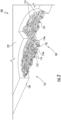
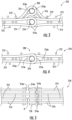
- the fabric 210 has a similar weave pattern to the fabric 110 discussed above, with monofilament MD yarns 214 and cabled MD yarns 216 interwoven with CMD yarns 212.
- the monofilament MD yarns 214 are woven such that their ends 214a form loops over a primary pintle 218, and the cabled MD yarns 216 are woven such that their ends 216a form loops over a secondary pintle 230 that is located above the primary pintle 218.
- the ends 216a of the cabled MD yarns 216 are positioned some distance from the CMD yarn 212 that is nearest the seam 202.
- auxiliary pintle 230 After weaving, the auxiliary pintle 230 is removed. Removal of the auxiliary pintle 230 results in the ends 216a of the cabled MD yarns 216 remaining positioned over the ends 214a of the monofilament MD yarns 214 as they are looped over the primary pintle 218.
- the fabric 210 is then subjected to a heat-setting process.
- the heat-setting process involves subjecting the fabric 210 to some degree of tension; this tension tends to draw the ends 216a of the cabled MD yarns 216 slightly away from the seam 202, to a positon in which the ends 216a are adjacent, and in some instances in contact with and may slightly overlie, the ends 214a of the monofilament MD yarns 214 that approach the seam 202 from the opposite side of the seam 202.
- the end 216a' which approaches the seam 202 from the left side of the figure, is adjacent the end 214a' , which approaches the seam 202 from the right side of the figure. Consequently, the ends 216a of the cabled MD yarns 216 can partially or completely fill the gap g that can otherwise form between the ends of the cabled MD yarns and the seam as described above in connection with Patent Publication No. 2017/0037573 , supra.
- the primary pintle 218 is removed and replaced with a smaller pintle or cable for use; in instances in which the ends 216a overlie their adjacent ends 214a, the use of a lower diameter pintle (e.g., replacing a 1.0-1.2mm primary pintle 218 with a 0.35-0.40 mm pintle), any overlying ends 216a no longer overlie the ends 214a, but instead drop to a position that is in-plane with the ends 214a.
- a lower diameter pintle e.g., replacing a 1.0-1.2mm primary pintle 218 with a 0.35-0.40 mm pintle
- the press felt of the invention may also include one or more batt layers such as those described above in connection with the felt 100 and fabric 110.
- the MD yarns 216 are illustrated and described as being cabled monofilament yarns, in some embodiments the MD yarns 216 may be cabled or twisted monofilament/multifilament and/or monofilament/card yarn combinations. Also, although the MD yarns 214 are illustrated and described as being monofilament yarns, in some embodiments the MD yarns 214 may be cabled or twisted monofilament/multifilament and/or monofilament/card yarn combinations. Further, the CMD yarns 212 are illustrated and described as being cabled monofilaments, but may in some embodiments be uncabled monofilaments. Other yarn varieties may also be employed.
- the monofilament MD yarns 214 and the cabled MD yarns 216 are shown in an alternating 1:1 pattern, these yarns may be included in other ratios. For example, there may be 1 monofilament MD yarn for every two or three cabled MD yarns, two or three monofilament MD yarns for every cabled MD yarn, three monofilament MD yarns for every two cabled MD yarns, two monofilament MD yarns for every three cabled MD yarns, and the like.
- the fabric 210 is endless woven.
Landscapes
- Paper (AREA)
Claims (15)
- Gewebe (210) für einen Pressfilz (100), umfassend eine Vielzahl von Rapporteinheiten, wobei jede der Rapporteinheiten eine Vielzahl von Garnen in Maschinenquerrichtung, CMD, (212) und eine Vielzahl von mit den CMD-Garnen (212) verwobenen Garnen in Maschinenrichtung, MD, (214, 216) umfasst, wobei die MD-Garne (214, 216) und die CMD-Garne (212) Teil einer einzigen Gewebelage sind, wobei die Garne in Maschinenrichtung (214, 216) einen ersten Satz von MD-Garnen (214) und einen zweiten Satz von MD-Garnen (216) umfassen, wobei der erste Satz von MD-Garnen (214) Nahtschlaufen an ihren Enden (214a) einschließt, die einen ersten Schließdraht (218) einfangen, und wobei der zweite Satz von MD-Garnen (216) Schlaufen an ihren Enden (216a) einschließt, die einen zweiten Schließdraht (230) einfangen, der oberhalb des ersten Schließdrahts (218) positioniert ist.
- Gewebe (210) nach Anspruch 1, wobei der erste Satz von MD-Garnen (214) Monofilgarne umfasst.
- Gewebe (210) nach Anspruch 2, wobei der zweite Satz von MD-Garnen (216) Mehrfachzwirne umfasst.
- Gewebe (210) nach einem der Ansprüche 1 bis 3, wobei die CMD-Garne (212) Mehrfachzwirne umfassen.
- Gewebe (210) nach einem der Ansprüche 1 bis 4, wobei sich die MD-Garne (214) des ersten Satzes mit den MD-Garnen (216) des zweiten Satzes abwechseln.
- Gewebe (210) nach einem der Ansprüche 1 bis 5, wobei sich erste Satz von MD-Garnen (214) in seiner Art vom zweiten Satz von MD-Garnen (216) unterscheidet.
- Verfahren zur Herstellung eines Gewebes (210) für einen Pressfilz (100) für eine Papierherstellungsmaschine, umfassend:(a) Ausbilden eines Basisgewebes (210), umfassend eine Vielzahl von Rapporteinheiten, wobei jede der Rapporteinheiten eine Vielzahl von Garnen in Maschinenquerrichtung, CMD, (212) und eine Vielzahl von mit den CMD-Garnen (212) verwoben Garnen in Maschinenrichtung, MD, (214, 216) umfasst, wobei die MD-Garne (214, 216) und CMD-Garne (212) Teil einer einzigen Gewebelage sind, wobei die Garne in Maschinenrichtung (214, 216) einen ersten Satz von MD-Garnen (214) und einen zweiten Satz von MD-Garnen (216) umfassen, umfassend eine Vielzahl von Rapporteinheiten, wobei jede der Rapporteinheiten eine Vielzahl von Mehrfachzwirnen in Maschinenquerrichtung, CMD, (212) und eine Vielzahl von mit den CMD-Garne (212) verwobenen Garnen in Maschinenrichtung, MD, (214, 216) umfasst, wobei die Garne in Maschinenrichtung (214, 216) einen ersten Satz von MD-Garne (214) und einen zweiten Satz von MD-Garne (216) umfassen, wobei der erste Satz von MD-Garnen (214) Nahtschlaufen an ihren Enden (214a) aufweist, die einen ersten Schließdraht (218) einfangen, und wobei der zweite Satz von MD-Garnen (216) Schlaufen an ihren Enden (216a) aufweist, die einen zweiten Schließdraht (230) einfangen, der oberhalb des ersten Schließdrahts (218) positioniert ist; und(b) Entfernen des zweiten Schließdrahts (230) von den Enden (216a) des zweiten Satzes von MD-Garnen (216); und(c) Spannen des Gewebes (210), so dass jedes der Enden (216a) des zweiten Satzes von MD-Garnen (216) eine Lücke mit einem jeweiligen Ende (214a) des ersten Satzes von MD-Garnen (214) bildet, das sich der Naht (102) aus der entgegengesetzten Richtung nähert, und wobei die Lücke nicht mehr als etwa 0,3 mm beträgt.
- Verfahren nach Anspruch 7, ferner umfassend den Schritt des Befestigens einer das Gewebe (210) überlagernden Vlieslage (122).
- Verfahren nach Anspruch 7 oder 8, wobei der erste Satz von MD-Garnen (214) Monofilgarne umfasst.
- Verfahren nach Anspruch 9, wobei der zweite Satz von MD-Garnen (216) Mehrfachzwirne umfasst.
- Verfahren nach Anspruch 9, wobei die CMD-Garne (212) Mehrfachzwirne umfassen.
- Verfahren nach Anspruch 7, wobei die MD-Garne (214) des ersten Satzes sich mit den MD-Garnen (216) des zweiten Satzes abwechseln.
- Verfahren nach Anspruch 7, wobei sich der erste Satz von MD-Garnen (214) in seiner Art vom zweiten Satz von MD-Garnen (216) unterscheidet.
- Verfahren nach Anspruch 7, wobei mindestens einige der Enden (216a) des zweiten Satzes von MD-Garnen (216) ein entsprechendes Ende (214a) des ersten Satzes von MD-Garnen (214), das sich der Naht (102) aus der entgegengesetzten Richtung nähert, berühren.
- Verfahren nach Anspruch 7, wobei Schritt (c) während des Thermofixierens des Gewebes (210) durchgeführt wird.
Applications Claiming Priority (2)
| Application Number | Priority Date | Filing Date | Title |
|---|---|---|---|
| US201762512874P | 2017-05-31 | 2017-05-31 | |
| PCT/US2018/034996 WO2018222633A1 (en) | 2017-05-31 | 2018-05-30 | Pin seamed press felt and method of making same |
Publications (4)
| Publication Number | Publication Date |
|---|---|
| EP3631082A1 EP3631082A1 (de) | 2020-04-08 |
| EP3631082A4 EP3631082A4 (de) | 2021-03-10 |
| EP3631082B1 true EP3631082B1 (de) | 2025-01-15 |
| EP3631082C0 EP3631082C0 (de) | 2025-01-15 |
Family
ID=64455576
Family Applications (1)
| Application Number | Title | Priority Date | Filing Date |
|---|---|---|---|
| EP18809754.7A Active EP3631082B1 (de) | 2017-05-31 | 2018-05-30 | Pressfilz mit steckdrahtnaht und verfahren zu seiner herstellung |
Country Status (10)
| Country | Link |
|---|---|
| US (1) | US10982389B2 (de) |
| EP (1) | EP3631082B1 (de) |
| JP (1) | JP7080310B2 (de) |
| KR (1) | KR102337532B1 (de) |
| CN (1) | CN110662867B (de) |
| AU (1) | AU2018277741B2 (de) |
| BR (1) | BR112019021017B1 (de) |
| CA (1) | CA3058201C (de) |
| MX (1) | MX2019014391A (de) |
| WO (1) | WO2018222633A1 (de) |
Families Citing this family (2)
| Publication number | Priority date | Publication date | Assignee | Title |
|---|---|---|---|---|
| CN114207213B (zh) * | 2020-07-06 | 2023-03-24 | 艾斯登强生国际股份有限公司 | 具有部分锚定填塞纱线封装的接缝压毡 |
| CN121925339A (zh) * | 2023-09-28 | 2026-04-24 | 艾斯登强生国际股份有限公司 | 具正交接缝环的螺旋缠绕压毡及方法 |
Family Cites Families (29)
| Publication number | Priority date | Publication date | Assignee | Title |
|---|---|---|---|---|
| GB1488815A (en) * | 1974-09-27 | 1977-10-12 | Scapa Porritt Ltd | Providing loops at a fabric end |
| GB1529728A (en) | 1975-11-27 | 1978-10-25 | Jwi Ltd | Woven seam in fabric and method of making same |
| US4186780A (en) * | 1978-12-15 | 1980-02-05 | Albany International Corp. | Seam construction for multi-layer felts |
| US4438789A (en) | 1981-06-04 | 1984-03-27 | Jwi Ltd. | Woven pin seam in fabric and method |
| SE429982C (sv) | 1982-11-02 | 1985-11-18 | Nordiskafilt Ab | Filt med oglesom for presspartiet i en pappersmaskin samt forfarande for dess framstellning |
| JPS6319598U (de) * | 1986-07-17 | 1988-02-09 | ||
| US4737241A (en) | 1987-02-20 | 1988-04-12 | Appleton Mills | Method of making a papermaker's felt |
| US4764417A (en) | 1987-06-08 | 1988-08-16 | Appleton Mills | Pin seamed papermakers felt having a reinforced batt flap |
| US4892781A (en) * | 1987-10-14 | 1990-01-09 | Asten Group, Inc. | Base fabric structures for seamed wet press felts |
| US4824525A (en) * | 1987-10-14 | 1989-04-25 | Asten Group, Inc. | Papermaking apparatus having a seamed wet press felt |
| JPH01102198U (de) * | 1987-12-23 | 1989-07-10 | ||
| US5411062A (en) | 1990-06-06 | 1995-05-02 | Asten Group, Inc. | Papermakers fabric with orthogonal machine direction yarn seaming loops |
| SE467696B (sv) | 1990-12-21 | 1992-08-31 | Nordiskafilt Ab | Vaev foer en pappersmaskin eller liknande samt saett att tillverka en dylik vaev |
| US5618612A (en) | 1995-05-30 | 1997-04-08 | Huyck Licensco, Inc. | Press felt having fine base fabric |
| US5799708A (en) | 1996-10-11 | 1998-09-01 | Albany International Corp. | Papermaker's fabric having paired identical machine-direction yarns weaving as one |
| US6079454A (en) | 1997-11-24 | 2000-06-27 | Astenjohnson, Inc. | Loop/tie-back woven loop seam press base |
| GB9807704D0 (en) * | 1998-04-09 | 1998-06-10 | Scapa Group Plc | Fabric and seam construction |
| WO2000017433A1 (en) | 1998-09-24 | 2000-03-30 | Weavexx Corporation | Pin seamed papermaker's press felt with low melt material band in laminated base fabric |
| US6213164B1 (en) | 1999-03-11 | 2001-04-10 | Geschmay Corporation | Pintle seamed press felt |
| US6302155B1 (en) * | 2000-07-14 | 2001-10-16 | Albany International Ab | Four-layer seamed press fabric |
| US6776878B2 (en) * | 2002-04-02 | 2004-08-17 | Albany International Corp. | Laminated multiaxial press fabric |
| US7135093B2 (en) * | 2003-03-20 | 2006-11-14 | Weavexx Corporation | Pin seamed papermaker's press felt with cross machine direction yarns woven in Dreher weave at seam loops |
| JP2009041161A (ja) | 2007-08-10 | 2009-02-26 | Ichikawa Co Ltd | 多層基布構造のシーム付抄紙用プレスフェルト及びその製造方法 |
| GB2473039A (en) | 2009-08-28 | 2011-03-02 | Ian Gerald Lang | Seam for a woven industrial fabric |
| US8317979B2 (en) | 2010-05-04 | 2012-11-27 | Voith Patent Gmbh | Papermaking pickup fabric |
| US9890501B2 (en) | 2012-07-27 | 2018-02-13 | Voith Patent Gmbh | Dryer fabric |
| US9005399B2 (en) | 2013-01-10 | 2015-04-14 | Huyck Licensco, Inc. | Pin seamed press felt with triple layer base fabric |
| US9315940B2 (en) | 2013-04-19 | 2016-04-19 | Astenjohnson, Inc. | Seamed press felt including an elastic carrier layer and method of making |
| WO2017023995A1 (en) | 2015-08-05 | 2017-02-09 | Huyck Licensco, Inc. | Pin seamed press felt with base fabric with monofilament and cabled md yarns |
-
2018
- 2018-05-30 CA CA3058201A patent/CA3058201C/en active Active
- 2018-05-30 JP JP2020515838A patent/JP7080310B2/ja active Active
- 2018-05-30 BR BR112019021017-2A patent/BR112019021017B1/pt active IP Right Grant
- 2018-05-30 CN CN201880034947.0A patent/CN110662867B/zh active Active
- 2018-05-30 AU AU2018277741A patent/AU2018277741B2/en active Active
- 2018-05-30 EP EP18809754.7A patent/EP3631082B1/de active Active
- 2018-05-30 US US15/992,753 patent/US10982389B2/en active Active
- 2018-05-30 KR KR1020197031031A patent/KR102337532B1/ko active Active
- 2018-05-30 WO PCT/US2018/034996 patent/WO2018222633A1/en not_active Ceased
- 2018-05-30 MX MX2019014391A patent/MX2019014391A/es unknown
Also Published As
| Publication number | Publication date |
|---|---|
| KR102337532B1 (ko) | 2021-12-10 |
| AU2018277741B2 (en) | 2021-09-02 |
| US10982389B2 (en) | 2021-04-20 |
| WO2018222633A1 (en) | 2018-12-06 |
| BR112019021017B1 (pt) | 2023-04-25 |
| CN110662867A (zh) | 2020-01-07 |
| BR112019021017A2 (pt) | 2020-05-05 |
| CN110662867B (zh) | 2021-03-23 |
| EP3631082A1 (de) | 2020-04-08 |
| US20180347113A1 (en) | 2018-12-06 |
| KR20190139888A (ko) | 2019-12-18 |
| JP7080310B2 (ja) | 2022-06-03 |
| CA3058201A1 (en) | 2018-12-06 |
| CA3058201C (en) | 2022-08-16 |
| EP3631082A4 (de) | 2021-03-10 |
| MX2019014391A (es) | 2020-01-23 |
| AU2018277741A1 (en) | 2019-10-31 |
| JP2020521892A (ja) | 2020-07-27 |
| EP3631082C0 (de) | 2025-01-15 |
Similar Documents
| Publication | Publication Date | Title |
|---|---|---|
| US7980275B2 (en) | Papermaker's press felt with long machine direction floats in base fabric | |
| US20030183358A1 (en) | Laminated multiaxial press fabric | |
| US7135093B2 (en) | Pin seamed papermaker's press felt with cross machine direction yarns woven in Dreher weave at seam loops | |
| US9005399B2 (en) | Pin seamed press felt with triple layer base fabric | |
| US20170037573A1 (en) | Pin seamed press felt with base fabric with monofilament and cabled md yarns | |
| US10982389B2 (en) | Pin seamed press felt and method of making same | |
| EP1270807A1 (de) | Papiermacherfilz mit Doppelösennaht und laminiertem Grundgewebe welches niedrig schmelzende Kettfäden enthält | |
| CA2539690C (en) | Papermaker's press felt with long machine direction floats in base fabric | |
| WO2000017433A1 (en) | Pin seamed papermaker's press felt with low melt material band in laminated base fabric |
Legal Events
| Date | Code | Title | Description |
|---|---|---|---|
| STAA | Information on the status of an ep patent application or granted ep patent |
Free format text: STATUS: THE INTERNATIONAL PUBLICATION HAS BEEN MADE |
|
| PUAI | Public reference made under article 153(3) epc to a published international application that has entered the european phase |
Free format text: ORIGINAL CODE: 0009012 |
|
| STAA | Information on the status of an ep patent application or granted ep patent |
Free format text: STATUS: REQUEST FOR EXAMINATION WAS MADE |
|
| 17P | Request for examination filed |
Effective date: 20191023 |
|
| AK | Designated contracting states |
Kind code of ref document: A1 Designated state(s): AL AT BE BG CH CY CZ DE DK EE ES FI FR GB GR HR HU IE IS IT LI LT LU LV MC MK MT NL NO PL PT RO RS SE SI SK SM TR |
|
| AX | Request for extension of the european patent |
Extension state: BA ME |
|
| DAV | Request for validation of the european patent (deleted) | ||
| DAX | Request for extension of the european patent (deleted) | ||
| A4 | Supplementary search report drawn up and despatched |
Effective date: 20210210 |
|
| RIC1 | Information provided on ipc code assigned before grant |
Ipc: D21F 1/00 20060101ALI20210204BHEP Ipc: D21F 1/10 20060101AFI20210204BHEP Ipc: D21F 7/08 20060101ALI20210204BHEP |
|
| GRAP | Despatch of communication of intention to grant a patent |
Free format text: ORIGINAL CODE: EPIDOSNIGR1 |
|
| STAA | Information on the status of an ep patent application or granted ep patent |
Free format text: STATUS: GRANT OF PATENT IS INTENDED |
|
| RIC1 | Information provided on ipc code assigned before grant |
Ipc: D21F 7/10 20060101ALI20240707BHEP Ipc: D21F 1/00 20060101ALI20240707BHEP Ipc: D21F 7/08 20060101ALI20240707BHEP Ipc: D21F 1/10 20060101AFI20240707BHEP |
|
| INTG | Intention to grant announced |
Effective date: 20240807 |
|
| GRAS | Grant fee paid |
Free format text: ORIGINAL CODE: EPIDOSNIGR3 |
|
| GRAA | (expected) grant |
Free format text: ORIGINAL CODE: 0009210 |
|
| STAA | Information on the status of an ep patent application or granted ep patent |
Free format text: STATUS: THE PATENT HAS BEEN GRANTED |
|
| AK | Designated contracting states |
Kind code of ref document: B1 Designated state(s): AL AT BE BG CH CY CZ DE DK EE ES FI FR GB GR HR HU IE IS IT LI LT LU LV MC MK MT NL NO PL PT RO RS SE SI SK SM TR |
|
| REG | Reference to a national code |
Ref country code: CH Ref legal event code: EP Ref country code: GB Ref legal event code: FG4D |
|
| REG | Reference to a national code |
Ref country code: DE Ref legal event code: R096 Ref document number: 602018078547 Country of ref document: DE |
|
| REG | Reference to a national code |
Ref country code: IE Ref legal event code: FG4D |
|
| U01 | Request for unitary effect filed |
Effective date: 20250131 |
|
| U07 | Unitary effect registered |
Designated state(s): AT BE BG DE DK EE FI FR IT LT LU LV MT NL PT RO SE SI Effective date: 20250207 |
|
| U20 | Renewal fee for the european patent with unitary effect paid |
Year of fee payment: 8 Effective date: 20250527 |
|
| PG25 | Lapsed in a contracting state [announced via postgrant information from national office to epo] |
Ref country code: RS Free format text: LAPSE BECAUSE OF FAILURE TO SUBMIT A TRANSLATION OF THE DESCRIPTION OR TO PAY THE FEE WITHIN THE PRESCRIBED TIME-LIMIT Effective date: 20250415 |
|
| PG25 | Lapsed in a contracting state [announced via postgrant information from national office to epo] |
Ref country code: PL Free format text: LAPSE BECAUSE OF FAILURE TO SUBMIT A TRANSLATION OF THE DESCRIPTION OR TO PAY THE FEE WITHIN THE PRESCRIBED TIME-LIMIT Effective date: 20250115 |
|
| PG25 | Lapsed in a contracting state [announced via postgrant information from national office to epo] |
Ref country code: ES Free format text: LAPSE BECAUSE OF FAILURE TO SUBMIT A TRANSLATION OF THE DESCRIPTION OR TO PAY THE FEE WITHIN THE PRESCRIBED TIME-LIMIT Effective date: 20250115 |
|
| PGFP | Annual fee paid to national office [announced via postgrant information from national office to epo] |
Ref country code: GB Payment date: 20250527 Year of fee payment: 8 |
|
| PG25 | Lapsed in a contracting state [announced via postgrant information from national office to epo] |
Ref country code: IS Free format text: LAPSE BECAUSE OF FAILURE TO SUBMIT A TRANSLATION OF THE DESCRIPTION OR TO PAY THE FEE WITHIN THE PRESCRIBED TIME-LIMIT Effective date: 20250515 Ref country code: NO Free format text: LAPSE BECAUSE OF FAILURE TO SUBMIT A TRANSLATION OF THE DESCRIPTION OR TO PAY THE FEE WITHIN THE PRESCRIBED TIME-LIMIT Effective date: 20250415 |
|
| PG25 | Lapsed in a contracting state [announced via postgrant information from national office to epo] |
Ref country code: HR Free format text: LAPSE BECAUSE OF FAILURE TO SUBMIT A TRANSLATION OF THE DESCRIPTION OR TO PAY THE FEE WITHIN THE PRESCRIBED TIME-LIMIT Effective date: 20250115 |
|
| PG25 | Lapsed in a contracting state [announced via postgrant information from national office to epo] |
Ref country code: GR Free format text: LAPSE BECAUSE OF FAILURE TO SUBMIT A TRANSLATION OF THE DESCRIPTION OR TO PAY THE FEE WITHIN THE PRESCRIBED TIME-LIMIT Effective date: 20250416 |
|
| PGFP | Annual fee paid to national office [announced via postgrant information from national office to epo] |
Ref country code: CH Payment date: 20250601 Year of fee payment: 8 |
|
| PG25 | Lapsed in a contracting state [announced via postgrant information from national office to epo] |
Ref country code: SM Free format text: LAPSE BECAUSE OF FAILURE TO SUBMIT A TRANSLATION OF THE DESCRIPTION OR TO PAY THE FEE WITHIN THE PRESCRIBED TIME-LIMIT Effective date: 20250115 |
|
| PG25 | Lapsed in a contracting state [announced via postgrant information from national office to epo] |
Ref country code: CZ Free format text: LAPSE BECAUSE OF FAILURE TO SUBMIT A TRANSLATION OF THE DESCRIPTION OR TO PAY THE FEE WITHIN THE PRESCRIBED TIME-LIMIT Effective date: 20250115 |
|
| PG25 | Lapsed in a contracting state [announced via postgrant information from national office to epo] |
Ref country code: SK Free format text: LAPSE BECAUSE OF FAILURE TO SUBMIT A TRANSLATION OF THE DESCRIPTION OR TO PAY THE FEE WITHIN THE PRESCRIBED TIME-LIMIT Effective date: 20250115 |
|
| PLBE | No opposition filed within time limit |
Free format text: ORIGINAL CODE: 0009261 |
|
| STAA | Information on the status of an ep patent application or granted ep patent |
Free format text: STATUS: NO OPPOSITION FILED WITHIN TIME LIMIT |
|
| 26N | No opposition filed |
Effective date: 20251016 |
|
| PG25 | Lapsed in a contracting state [announced via postgrant information from national office to epo] |
Ref country code: MC Free format text: LAPSE BECAUSE OF FAILURE TO SUBMIT A TRANSLATION OF THE DESCRIPTION OR TO PAY THE FEE WITHIN THE PRESCRIBED TIME-LIMIT Effective date: 20250115 |
|
| PG25 | Lapsed in a contracting state [announced via postgrant information from national office to epo] |
Ref country code: IE Free format text: LAPSE BECAUSE OF NON-PAYMENT OF DUE FEES Effective date: 20250530 |