EP3631779B1 - Procédé, dispositifs et support d'enregistrement lisible par ordinateur comprenant des instructions pour déterminer des règles de circulation à appliquer pour un véhicule automobile - Google Patents
Procédé, dispositifs et support d'enregistrement lisible par ordinateur comprenant des instructions pour déterminer des règles de circulation à appliquer pour un véhicule automobile Download PDFInfo
- Publication number
- EP3631779B1 EP3631779B1 EP18720587.7A EP18720587A EP3631779B1 EP 3631779 B1 EP3631779 B1 EP 3631779B1 EP 18720587 A EP18720587 A EP 18720587A EP 3631779 B1 EP3631779 B1 EP 3631779B1
- Authority
- EP
- European Patent Office
- Prior art keywords
- motor vehicle
- applicable
- information
- traffic rules
- determining
- Prior art date
- Legal status (The legal status is an assumption and is not a legal conclusion. Google has not performed a legal analysis and makes no representation as to the accuracy of the status listed.)
- Active
Links
Images




Classifications
-
- G—PHYSICS
- G08—SIGNALLING
- G08G—TRAFFIC CONTROL SYSTEMS
- G08G1/00—Traffic control systems for road vehicles
- G08G1/09—Arrangements for giving variable traffic instructions
- G08G1/0962—Arrangements for giving variable traffic instructions having an indicator mounted inside the vehicle, e.g. giving voice messages
- G08G1/0967—Systems involving transmission of highway information, e.g. weather, speed limits
- G08G1/096766—Systems involving transmission of highway information, e.g. weather, speed limits where the system is characterised by the origin of the information transmission
- G08G1/096775—Systems involving transmission of highway information, e.g. weather, speed limits where the system is characterised by the origin of the information transmission where the origin of the information is a central station
-
- G—PHYSICS
- G08—SIGNALLING
- G08G—TRAFFIC CONTROL SYSTEMS
- G08G1/00—Traffic control systems for road vehicles
- G08G1/123—Traffic control systems for road vehicles indicating the position of vehicles, e.g. scheduled vehicles; Managing passenger vehicles circulating according to a fixed timetable, e.g. buses, trains, trams
- G08G1/127—Traffic control systems for road vehicles indicating the position of vehicles, e.g. scheduled vehicles; Managing passenger vehicles circulating according to a fixed timetable, e.g. buses, trains, trams to a central station ; Indicators in a central station
-
- G—PHYSICS
- G08—SIGNALLING
- G08G—TRAFFIC CONTROL SYSTEMS
- G08G1/00—Traffic control systems for road vehicles
- G08G1/01—Detecting movement of traffic to be counted or controlled
- G08G1/0104—Measuring and analyzing of parameters relative to traffic conditions
- G08G1/0125—Traffic data processing
- G08G1/0129—Traffic data processing for creating historical data or processing based on historical data
-
- G—PHYSICS
- G08—SIGNALLING
- G08G—TRAFFIC CONTROL SYSTEMS
- G08G1/00—Traffic control systems for road vehicles
- G08G1/01—Detecting movement of traffic to be counted or controlled
- G08G1/0104—Measuring and analyzing of parameters relative to traffic conditions
- G08G1/0125—Traffic data processing
- G08G1/0133—Traffic data processing for classifying traffic situation
-
- G—PHYSICS
- G08—SIGNALLING
- G08G—TRAFFIC CONTROL SYSTEMS
- G08G1/00—Traffic control systems for road vehicles
- G08G1/09—Arrangements for giving variable traffic instructions
- G08G1/0962—Arrangements for giving variable traffic instructions having an indicator mounted inside the vehicle, e.g. giving voice messages
- G08G1/0967—Systems involving transmission of highway information, e.g. weather, speed limits
- G08G1/096708—Systems involving transmission of highway information, e.g. weather, speed limits where the received information might be used to generate an automatic action on the vehicle control
- G08G1/096716—Systems involving transmission of highway information, e.g. weather, speed limits where the received information might be used to generate an automatic action on the vehicle control where the received information does not generate an automatic action on the vehicle control
-
- G—PHYSICS
- G08—SIGNALLING
- G08G—TRAFFIC CONTROL SYSTEMS
- G08G1/00—Traffic control systems for road vehicles
- G08G1/09—Arrangements for giving variable traffic instructions
- G08G1/0962—Arrangements for giving variable traffic instructions having an indicator mounted inside the vehicle, e.g. giving voice messages
- G08G1/0967—Systems involving transmission of highway information, e.g. weather, speed limits
- G08G1/096708—Systems involving transmission of highway information, e.g. weather, speed limits where the received information might be used to generate an automatic action on the vehicle control
- G08G1/096725—Systems involving transmission of highway information, e.g. weather, speed limits where the received information might be used to generate an automatic action on the vehicle control where the received information generates an automatic action on the vehicle control
-
- G—PHYSICS
- G08—SIGNALLING
- G08G—TRAFFIC CONTROL SYSTEMS
- G08G1/00—Traffic control systems for road vehicles
- G08G1/09—Arrangements for giving variable traffic instructions
- G08G1/0962—Arrangements for giving variable traffic instructions having an indicator mounted inside the vehicle, e.g. giving voice messages
- G08G1/0967—Systems involving transmission of highway information, e.g. weather, speed limits
- G08G1/096733—Systems involving transmission of highway information, e.g. weather, speed limits where a selection of the information might take place
- G08G1/096741—Systems involving transmission of highway information, e.g. weather, speed limits where a selection of the information might take place where the source of the transmitted information selects which information to transmit to each vehicle
Definitions
- the present invention relates to methods, devices and a computer-readable storage medium with instructions for determining applicable traffic regulations for a motor vehicle.
- the invention further relates to a motor vehicle in which a method or device according to the invention is used.
- a first approach is based on the use of navigation maps on which traffic signs are marked.
- a second approach is traffic sign recognition using camera systems.
- the DE 10 2013 013 799 A1 an assistance system that supports a driver during an overtaking maneuver by determining whether the overtaking maneuver can be completed safely based on the difference in speed to the vehicle to be overtaken and taking into account the remaining overtaking distance.
- the remaining overtaking distance can be determined using traffic sign recognition or GPS-based maps.
- the DE 10 2007 034 505 A1 describes a method for traffic sign recognition. Based on provided image data, traffic sign recognition is carried out using a country-specific traffic sign database with at least partially country-specific classification features or at least partially country-specific classification methods. If the If the traffic sign recognition results in a poor quality, the traffic sign recognition is repeated using another alternative country-specific traffic sign database using saved image regions with detected traffic signs. This is repeated until the traffic sign recognition result shows sufficient quality. The country-specific traffic sign database is then preset for further traffic sign recognitions for which at least sufficient quality was determined during the traffic sign recognition.
- traffic sign data is stored in the vehicle.
- Stored traffic sign data is then assigned to a current position of a vehicle.
- traffic sign information is provided based on the traffic sign data that is assigned to the current position of the vehicle.
- the traffic sign data can be queried section by section from an online service based on position information of the vehicle.
- a disadvantage of camera-based solutions is their limited range, i.e. predictive detection of traffic signs is only possible to a limited extent.
- the reliability of detection decreases with increasing vehicle speed.
- a disadvantage of solutions based on navigation maps is that these maps must always be up-to-date, meaning that the maps must be continually updated, for example through online updates.
- the required maps incur licensing costs and are usually only sold together with a navigation function. This results in additional costs for the user.
- the DE 102 10 546 A1 describes a method for automatic vehicle guidance in which infrastructure data is transmitted wirelessly to the vehicle and commands for vehicle guidance are calculated based on the infrastructure data.
- the infrastructure data is loaded into the vehicle's own memory for at least one section of the route immediately ahead.
- the current position of the vehicle is continuously determined using a precise positioning system.
- the commands are then calculated based on the position data and the stored infrastructure data.
- the US 9,539,901 B1 describes a method for warning about speed limits.
- the method uses a current location of a user who is traveling in a vehicle. Based on the current location, a posted speed limit is determined for the vehicle. This is compared with a measured speed of the vehicle. If the posted speed limit is exceeded by too much, an acoustic or visual warning is given.
- the term computer is to be understood broadly. In particular, it also includes control units and other processor-based data processing devices.
- a history of positions of the motor vehicle is transmitted to the backend.
- the history of positions ie a trace of past Waypoints are extremely helpful for correctly assigning the vehicle position to a road, especially to the correct lane in the case of multi-lane roads.
- the term computer is also to be understood broadly here. In particular, it also includes workstations, distributed systems and other processor-based data processing devices.
- the backend only receives the position and direction of movement of a motor vehicle. Based on this information, the backend determines details of the applicable traffic regulations, which are then transmitted to the motor vehicle. In order to keep the required data volume low, the backend also determines a validity distance and transmits it to the motor vehicle, which indicates a minimum distance until the applicable traffic regulations change. A query of the traffic regulations by the motor vehicle can then be made based on the validity, so that no more queries than necessary are received by the backend.
- the desired information on traffic regulations can be taken directly from the map data.
- possible routes can be checked for changes in traffic regulations using the map. This makes it easy to determine up to which future vehicle positions no further query of traffic regulations by the vehicle is required.
- the information on the traffic regulations applicable at the position of the motor vehicle includes several distances until a change in the applicable traffic rules for different routes.
- the transmission of at least one position and one direction of movement of the motor vehicle to the backend is carried out again when a distance contained in the validity information is reached.
- the information on the traffic regulations applicable at the position of the motor vehicle includes detailed information on at least one intersection.
- the detailed information e.g. an intersection model or an intersection network
- a certain degree of foresight can be achieved in the event of latencies in the request to the backend, so that the reliability of the method is further increased.
- the traffic rules applicable at the position of the motor vehicle describe a speed limit, a right of way or a ban on overtaking. This covers typical cases of traffic rules that apply over longer stretches of road and are therefore particularly suitable for the application of the solutions described.
- a method according to the invention or a device according to the invention is used in a vehicle, in particular a motor vehicle.
- Fig. 1 shows a schematic of a method for determining applicable traffic regulations for a motor vehicle from the perspective of the motor vehicle.
- the position and direction of movement of the motor vehicle are determined 10.
- the position and direction of movement of the motor vehicle are then transmitted to a backend 11 by a transmission device of the motor vehicle. It can be provided that a history of positions of the motor vehicle is transmitted to the backend.
- information on traffic regulations applicable at the position of the motor vehicle is finally received by the transmission device 12, for example information on a speed limit, right of way or a ban on overtaking.
- the transmission 11 of the position and direction of movement of the motor vehicle to the backend takes place depending on information on the validity of the traffic regulations, which is contained in the information on the traffic regulations applicable at the position of the motor vehicle and contains at least a distance until a change in the applicable traffic regulations.
- the information on validity can also contain several distances until a change in the applicable traffic regulations for different routes.
- the query for the applicable traffic regulations at the backend is preferably only carried out again when a distance contained in the validity information is reached.
- the information on the traffic regulations applicable at the position of the vehicle can include detailed information on intersections.
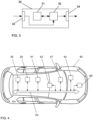
- Fig. 2 shows a simplified schematic representation of a first embodiment of a device 20 for determining applicable traffic regulations for a motor vehicle, which can be installed in a motor vehicle.
- the device 20 has an input 21 for receiving information on the position and direction of movement of the motor vehicle, for example from a navigation system, or data that allow the position and direction of movement of the motor vehicle to be determined.
- a tracking unit 22 extracts or determines the position and direction of movement of the motor vehicle from the received data and selects the data that are to be transmitted to a backend.
- a transmission device 23 transmits the selected data, ie the position and direction of movement of the motor vehicle, to the backend. It can be provided that the transmission device 23 transmits a history of positions of the motor vehicle to the backend.
- the transmission device 23 receives from the backend Information on traffic regulations applicable at the position of the motor vehicle, for example information on a speed limit, right of way or a no-overtaking rule.
- the transmission device 23 is set up to transmit the position and direction of movement of the motor vehicle to the backend depending on information on the validity of the traffic regulations, which is contained in the information on the traffic regulations applicable at the position of the motor vehicle and contains at least a distance until a change in the applicable traffic regulations.
- the information on validity can also contain several distances until a change in the applicable traffic regulations for different routes.
- the query of the applicable traffic regulations at the backend is preferably only carried out again when a distance contained in the information on validity is reached.
- the information on the traffic regulations applicable at the position of the motor vehicle can include detailed information on intersections.
- a data processing unit 24 evaluates the received information on the traffic regulations applicable at the position of the motor vehicle.
- the data generated by the data processing unit 24 are preferably made available for further use via an output 26 of the device 20.
- the tracking unit 22, the transmission device 23 and the data processing unit 24 can be controlled by a control unit 25. Settings of the tracking unit 22, the transmission device 23, the data processing unit 24 or the control unit 25 can be changed via a user interface 28.
- the data generated in the device 20 can be stored in a memory 27 of the device 20, for example for later evaluation or for use by the components of the device 20.
- the tracking unit 22, the transmission device 23, the data processing unit 24 and the control unit 25 can be implemented as dedicated hardware, for example as integrated circuits. Of course, they can also be partially or completely combined or implemented as software that runs on a suitable processor, for example on a GPU.
- the input 21 and the output 26 can be implemented as separate interfaces or as a combined bidirectional interface.
- Fig. 3 shows a simplified schematic representation of a second embodiment of a device 30 for determining applicable traffic regulations for a motor vehicle, which can be installed in a motor vehicle.
- the device 30 has a processor 32 and a memory 31.
- the device 30 is a computer or a control unit. Instructions are stored in the memory 31 which, when executed by the processor 32, cause the device 30 to carry out the steps according to one of the described methods.
- the instructions stored in the memory 31 Instructions thus embody a program that can be executed by the processor 32 and that implements the method according to the invention.
- the device has an input 33 for receiving information, for example data that has been recorded by a sensor system of the motor vehicle. Data generated by the processor 32 is provided via an output 34. In addition, it can be stored in the memory 31.
- the input 33 and the output 34 can be combined to form a bidirectional interface.
- the processor 32 may include one or more processing units, such as microprocessors, digital signal processors, or combinations thereof.
- the memories 27, 31 of the described embodiments can have both volatile and non-volatile memory areas and can comprise a wide variety of storage devices and storage media, for example hard disks, optical storage media or semiconductor memories.
- Fig. 4 schematically shows a motor vehicle 40 in which a solution according to the invention is implemented.
- the motor vehicle 40 has, among other things, a navigation system 41 and an environmental sensor system 42, for example a camera system.
- the data recorded by the navigation system 41 and, if applicable, the data recorded by the environmental sensor system 42 are transmitted via a network 43 to a device 20 for determining applicable traffic regulations for the motor vehicle. In addition, they can be stored in a memory 44 of the motor vehicle 40. If required, the data is transmitted from the device 20 to a backend for evaluation by means of a communication unit 45.
- the information on the traffic regulations applicable to the motor vehicle transmitted by the backend in response to the sent data is communicated to the driver by means of a user interface 47, for example an infotainment system with a display device.
- a user interface 47 for example an infotainment system with a display device.
- infotainment system with a display device for example an infotainment system with a display device.
- they can be made available to a driver assistance system 46 of the motor vehicle 40, for example for automatically regulating the vehicle speed.
- Fig. 5 shows a schematic of a method for determining applicable traffic rules for a motor vehicle from the perspective of a backend.
- a first step at least one position and one direction of movement of the motor vehicle are received 50.
- information on traffic rules applicable at the position of the motor vehicle is then determined 51, for example information on a speed limit, right of way or a ban on overtaking.
- the information on the traffic rules applicable at the position of the motor vehicle includes information on the validity of the traffic regulations, which includes at least a distance until a change in the applicable traffic regulations.
- the information on validity can also describe a spatial validity, in particular a spatial validity dependent on a route.
- the information on the traffic regulations applicable at the position of the motor vehicle can include detailed information on intersections.
- the information on the traffic regulations applicable at the position of the motor vehicle is finally transmitted to the motor vehicle 52.
- Fig. 6 shows further details for determining the information on the traffic regulations applicable at the position of the motor vehicle.
- the position of the motor vehicle is assigned 60 to a road in a road network.
- the traffic regulations that apply to the road at the position of the motor vehicle are then determined 61.
- at least one validity distance is determined 62, ie a distance in the road network until a change in the applicable traffic regulations.
- Fig. 7 shows a simplified schematic representation of a first embodiment of a device 70 for determining applicable traffic regulations for a motor vehicle, which can be installed in a backend.
- the device 70 has a first interface 71, via which a transmission device 72 can receive information on at least one position and one direction of movement of the motor vehicle. Via the first interface, the transmission device 72 can also transmit information on traffic regulations applicable at the position of the motor vehicle to the motor vehicle, for example information on a speed limit, right of way or a no-overtaking zone.
- a location unit 73 locates the motor vehicle on a map.
- the map can be provided by an external database via a second interface 76.
- a computing unit 74 determines the desired information on the traffic regulations applicable at the position of the motor vehicle.
- the computing unit 74 is set up to provide the information on the traffic regulations applicable at the position of the motor vehicle with information on the validity of the traffic regulations, which includes at least a distance until a change in the applicable traffic regulations.
- the information on the validity can also describe a spatial validity, in particular a spatial validity dependent on a route.
- the information on the traffic regulations applicable at the position of the motor vehicle can include detailed information on intersections.
- the transmission device 72, the location unit 73 and the computing unit 74 can be controlled by a control unit 75. Settings can be made via a user interface 78 if necessary.
- the transmission device 72, the location unit 73, the computing unit 74 or the control unit 75 can be implemented as dedicated hardware, for example as integrated circuits. Of course, they can also be partially or completely combined or implemented as software that runs on a suitable processor, for example on a GPU.
- the first interface 71 and the second interface 76 can be implemented as separate interfaces or as a combined interface.
- Fig. 8 shows a simplified schematic representation of a second embodiment of a device 80 for determining applicable traffic regulations for a motor vehicle, which can be installed in a backend.
- the device 80 has a processor 82 and a memory 81.
- the device 80 is a computer or a workstation. Instructions are stored in the memory 81 which, when executed by the processor 82, cause the device 80 to carry out the steps according to one of the described methods.
- the instructions stored in the memory 81 thus embody a program which can be executed by the processor 82 and which implements the method according to the invention.
- the device has an input 83 for receiving information, for example from a data packet which was transmitted by a motor vehicle. Data generated by the processor 82 are provided via an output 84. In addition, they can be stored in the memory 81.
- the input 83 and the output 84 can be combined to form a bidirectional interface.
- the processor 82 may include one or more processing units, such as microprocessors, digital signal processors, or combinations thereof.
- the memories 77, 81 of the described embodiments can have both volatile and non-volatile memory areas and can comprise a wide variety of storage devices and storage media, for example hard disks, optical storage media or semiconductor memories.
- a speed limit for the vehicle is determined.
- the same principle can also be used for priority rules or overtaking bans, for example.
- priority rules no currently valid speed is transmitted, but rather the status of the road, for example superior or subordinate, as well as the validity distance.
- overtaking bans the admissibility of overtaking maneuvers is transmitted along with the validity distance, for example permitted, prohibited, prohibited for certain vehicle classes or prohibited with exceptions.
- Fig. 9 illustrates a system for determining applicable traffic regulations for a motor vehicle 40.
- the system comprises the motor vehicle 40 and a backend 90.
- the motor vehicle 40 has a navigation system 41, a driver assistance system 46 and a user interface 47.
- the backend comprises at least one device 70 for determining applicable traffic regulations and a database 91 with map data and traffic regulation information.
- the map material can be in NDS format (NDS: Navigation Data Standard), for example.
- NDS Navigation Data Standard
- the backend 90 uses this information to assign the motor vehicle 40 to a road.
- the map material from the database 91 is made available to the device 70 for determining applicable traffic regulations.
- the currently valid speed limit for the motor vehicle 40 is determined and transmitted to the motor vehicle 40.
- a validity distance for the speed limit and at least one subsequent speed limit can also be determined and transmitted. This can be done in particular taking possible route decisions into account.
- the current speed limit determined by the device 20 from the received data can be shown on a display of the user interface 47.
- the speed limit and possibly also subsequent speed limits can be made available to the driver assistance system 46. If the subsequent speed limits are route-dependent, information on the selected route can be provided by the navigation system 41 if required. In addition, the navigation system 41 can be instructed to restart position tracking as soon as a request for applicable traffic regulations has been transmitted to the backend 90.
- Fig. 10 illustrates two advantageous algorithms 92, 93, which are used in the system of Fig. 9 can be implemented.
- a first algorithm 92 is implemented in the database 91. However, it can also be executed by the device 70 for determining applicable traffic regulations or by a dedicated component of the backend 90.
- the algorithm 92 is a search algorithm. This determines the speed limit applicable at the position of the motor vehicle 40. In addition, the search algorithm can be able to determine a minimum, possibly route-dependent minimum distance until a change in the speed limit. This will be explained below using the Figures 12 to 14 explained.
- a further algorithm 93 is implemented in the device 20 arranged in the motor vehicle 40 for determining applicable traffic regulations. This algorithm 93 can also alternatively be carried out by a dedicated component of the motor vehicle 40.
- the algorithm carries out in particular the selection of those past waypoints that are to be transmitted to the backend 90.
- the past positions are stored in a ring buffer so that the newest waypoint always replaces the oldest waypoint already stored. In this way, only a small amount of storage space is required and at the same time a continuous trace to the current position is provided.
- the past waypoints should have a certain minimum distance in order to be meaningful. Waypoints immediately before and after a lane change are particularly interesting for the correct assignment of the vehicle position to a road, and in particular to the correct lane in the case of multi-lane roads. Such waypoints are therefore preferably transmitted to the backend 90.
- Positions with steering angle changes are particularly interesting, for example a curve entry, a crest or a curve exit. It is also possible to transmit the path curvature, which can be calculated from the steering angle, for each waypoint. In addition, the detected lane markings (dashed, solid, double line, none) can also be transmitted. This information can be used to further improve the assignment.
- Querying the applicable traffic regulations at Backend 90 can be done in different ways, some of which are explained below.
- the vehicle 40 initially queries the backend 90 for the current speed limit.
- the backend 90 uses the search algorithm 92 to determine both the current speed limit and the minimum distance until the speed limit changes. Both pieces of information are transmitted to the vehicle 40.
- the vehicle 40 tracks the route traveled, for example using vehicle sensors, and queries the speed limit again at the backend 90 when the transmitted minimum distance is reached.
- This variant requires a very small number of queries, so that the data volume generated is very low. In addition, no permanent data connection is necessary. Instead of the minimum distance until a change in the speed limit, several distances for different possible routes can also be transmitted. In other words, the shortest distance to a change in the speed limit is stored under the direction condition of the first intersection encountered.
- the next change is at a distance of 525 m. If the vehicle 40 goes straight at the first intersection in 500 m, the next change is at a distance of 751 m. If the vehicle 40 turns right at the first intersection in 500 m, the next change is at a distance of 612 m. In this case, the vehicle 40 monitors not only the distance traveled but also the chosen route.
- the backend 90 transmits a simple intersection model in addition to the current speed limit and the distances until the speed limit changes.
- An example of such an intersection model is shown in Fig. 11
- the intersection is represented by a circle that represents the intersection area.
- the outgoing intersection arms are represented by their position on the circular ring and by the direction of the arm.
- the position on the circular ring is given by the position in degrees to the intersection center, while the direction in degrees is used for the direction of the arm.
- the vehicle 40 can decide which intersection arm to drive on from its own direction.
- An alternative intersection model uses GPS points to display the intersection arms. By comparing the vehicle position with the GPS points, the vehicle 40 can determine which intersection arm it belongs to. It is also possible for the backend 90 to transmit an intersection network for a defined area.
- the vehicle 40 locates itself independently within this network and uses it to determine the current speed limit. With the help of the intersection models or the intersection network, a certain degree of foresight can be achieved in the event of latencies in the query to the backend, so that the reliability of the process is increased.
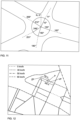
- Fig. 12 illustrates a first iteration step of determining a validity distance of a speed limit.
- a section of a road network is shown, with the roads represented by solid and dashed lines.
- the type of dashed line represents the associated speed limit.
- Roads with a solid line represent those roads that are irrelevant for the given position of the vehicle.
- the search carried out in the road network corresponds to a tree search.
- the road network splits into many directions.
- the shortest path to a speed change in this network is sought.
- the vehicle is at a position P, which is represented by a circle.
- the arrow in the circle represents the direction of travel.
- Another circle VP illustrates a previous position of the vehicle.
- the vehicle is currently on a road section between two intersections "1" and "2", which could be possible future positions ZP of the vehicle.
- the speed limit on this road section is 30 km/h.
- the distance to the next intersection "1" in the direction of travel is now first determined.
- the distance to the next intersection "2" against the direction of travel is determined, assuming a turning maneuver at the next intersection "1" in the direction of travel.
- the distance to intersection "1" is 150 m
- the distance to intersection "2" is 450 m.
- the speed limit does not change on the road sections up to the two intersections. The minimum distance until the speed limit changes is therefore definitely greater than 150 m.
- the current road section is now marked as already used for the search.
- Fig. 13 illustrates a second iteration step of determining a validity distance for a speed limit. Since no change in the speed limit was found, the search for further intersections at which the speed limit could change is continued. Starting from the intersections found in the first iteration, five further intersections "1" to "5" can be reached. Road sections that have already been used are not taken into account in the search, provided that the speed limit applies in both directions and the current route is shorter than the route already used. The distance to intersections "1", “2” and “5" is 200 m each, the distance to intersection "3" is 250 m, and the distance to intersection "4" is 270 m. The speed limit does not change on the road sections up to the intersections. The minimum distance until the speed limit changes is therefore always greater than 350 m, i.e. the Distance from the starting position P to the intersections "1" or "2". The current road sections are now marked as already used for the search.
- Fig. 14 illustrates a final result of determining a validity distance of a speed limit.
- the search result is as follows. At intersection "1", the speed limit changes to 60 km/h after a total of 550 m. At intersection "3”, the speed limit changes to 50 km/h after a total of 700 m. At intersection "4", the speed limit changes to 50 km/h after a total of 720 m. At intersection "5", the speed limit changes to 5 km/h after a total of 650 m.
Landscapes
- Physics & Mathematics (AREA)
- General Physics & Mathematics (AREA)
- Life Sciences & Earth Sciences (AREA)
- Atmospheric Sciences (AREA)
- Chemical & Material Sciences (AREA)
- Analytical Chemistry (AREA)
- Engineering & Computer Science (AREA)
- Radar, Positioning & Navigation (AREA)
- Remote Sensing (AREA)
- Traffic Control Systems (AREA)
- Navigation (AREA)
Claims (11)
- Procédé permettant d'établir des règles de circulation en vigueur pour un véhicule automobile (40), comprenant les étapes consistant à :- transmettre (11) au moins une position et une direction de mouvement du véhicule automobile (40) à un serveur dorsal (90) par un dispositif de transmission (23) du véhicule automobile (40) ; et- recevoir (12) des indications concernant des règles de circulation en vigueur à la position du véhicule automobile (40) par l'intermédiaire du dispositif de transmission (23) ;caractérisé en ce que les indications concernant les règles de circulation en vigueur à la position du véhicule automobile (40) contiennent au moins une distance de validité qui indique une distance minimale jusqu'à un changement des règles de circulation en vigueur, et en ce que lorsque la distance minimale est atteinte, la transmission (11) au serveur dorsal (90) au moins d'une position et d'une direction de mouvement du véhicule automobile (40) est effectuée à nouveau.
- Procédé selon la revendication 1, dans lequel un historique des positions du véhicule automobile (40) est transmis (11) au serveur dorsal (90).
- Procédé permettant d'établir des règles de circulation en vigueur pour un véhicule automobile (40), comprenant les étapes consistant à :- recevoir (50) au moins une position et une direction de mouvement du véhicule automobile (40) ;- déterminer (51) des indications concernant des règles de circulation en vigueur à la position du véhicule automobile (40) ; et- transmettre (52) au véhicule automobile (40) les indications concernant les règles de circulation en vigueur à la position du véhicule automobile (40) ;caractérisé en ce que les indications concernant les règles de circulation en vigueur à la position du véhicule automobile (40) contiennent au moins une distance de validité qui indique une distance minimale jusqu'à un changement des règles de circulation en vigueur.
- Procédé selon la revendication 3, dans lequel la détermination (51) des indications concernant les règles de circulation en vigueur à la position du véhicule automobile (40) comprend les étapes consistant à :- associer (60) la position du véhicule automobile (40) à une route dans un réseau routier ;- établir (61) des règles de circulation en vigueur à la position du véhicule automobile (40) pour la route ; et- établir (62) au moins une distance dans le réseau routier jusqu'à un changement des règles de circulation en vigueur.
- Procédé selon l'une quelconque des revendications 1 à 4, dans lequel les indications concernant les règles de circulation en vigueur à la position du véhicule automobile (40) contiennent plusieurs distances jusqu'à un changement des règles de circulation en vigueur pour différents itinéraires.
- Procédé selon l'une quelconque des revendications précédentes, dans lequel les indications concernant les règles de circulation en vigueur à la position du véhicule automobile (40) comprennent des informations détaillées concernant au moins une intersection.
- Procédé selon l'une quelconque des revendications précédentes, dans lequel les règles de circulation en vigueur à la position du véhicule automobile (40) décrivent une limitation de vitesse, une priorité ou une interdiction de doubler.
- Support de stockage lisible par ordinateur, comprenant des instructions qui, lorsqu'elles sont exécutées par un ordinateur, font que l'ordinateur exécute les étapes d'un procédé selon l'une quelconque des revendications 1 à 7 permettant d'établir des règles de circulation en vigueur pour un véhicule automobile (40) .
- Dispositif (20) permettant d'établir les règles de circulation en vigueur pour un véhicule automobile (40), comprenant :- un dispositif de transmission (23) pour transmettre (11) au moins une position et une direction de mouvement du véhicule automobile (40) à un serveur dorsal (90) et pour recevoir (12) des indications concernant des règles de circulation en vigueur à la position du véhicule automobile (40) ; et- une unité de traitement de données (24) pour évaluer les indications concernant les règles de circulation en vigueur à la position du véhicule automobile (40) ;caractérisé en ce que les indications concernant les règles de circulation en vigueur à la position du véhicule automobile (40) contiennent au moins une distance de validité qui indique une distance minimale jusqu'à un changement des règles de circulation en vigueur, et en ce que le dispositif de transmission (23) est conçu pour effectuer à nouveau la transmission (11) d'au moins une position et d'une direction de mouvement du véhicule automobile (40) au serveur dorsal (90) lorsque la distance minimale est atteinte.
- Dispositif (70) permettant d'établir des règles de circulation en vigueur pour un véhicule automobile (40), comprenant :- un dispositif de transmission (72) pour recevoir (50) au moins une position et une direction de mouvement du véhicule automobile (40) et pour transmettre (52) au véhicule automobile (40) des indications concernant des règles de circulation en vigueur à la position du véhicule automobile (40) ; et- une unité de calcul (74) pour déterminer (51) les indications concernant les règles de circulation en vigueur à la position du véhicule automobile (40) ;caractérisé en ce que l'unité de calcul (74) est conçue pour munir les règles de circulation en vigueur à la position du véhicule automobile (40) au moins d'une distance de validité qui indique une distance minimale jusqu'à un changement des règles de circulation en vigueur.
- Véhicule automobile (40) présentant un dispositif selon la revendication 9.
Applications Claiming Priority (2)
| Application Number | Priority Date | Filing Date | Title |
|---|---|---|---|
| DE102017208854.0A DE102017208854B4 (de) | 2017-05-24 | 2017-05-24 | Verfahren, Vorrichtungen und computerlesbares Speichermedium mit Instruktionen zum Ermitteln von geltenden Verkehrsregeln für ein Kraftfahrzeug |
| PCT/EP2018/060649 WO2018215156A1 (fr) | 2017-05-24 | 2018-04-26 | Procédé, dispositifs et support d'enregistrement lisible par ordinateur comprenant des instructions pour déterminer des règles de circulation à appliquer pour un véhicule automobile |
Publications (2)
| Publication Number | Publication Date |
|---|---|
| EP3631779A1 EP3631779A1 (fr) | 2020-04-08 |
| EP3631779B1 true EP3631779B1 (fr) | 2025-01-22 |
Family
ID=62063538
Family Applications (1)
| Application Number | Title | Priority Date | Filing Date |
|---|---|---|---|
| EP18720587.7A Active EP3631779B1 (fr) | 2017-05-24 | 2018-04-26 | Procédé, dispositifs et support d'enregistrement lisible par ordinateur comprenant des instructions pour déterminer des règles de circulation à appliquer pour un véhicule automobile |
Country Status (5)
| Country | Link |
|---|---|
| US (1) | US11538341B2 (fr) |
| EP (1) | EP3631779B1 (fr) |
| CN (1) | CN110622228B (fr) |
| DE (1) | DE102017208854B4 (fr) |
| WO (1) | WO2018215156A1 (fr) |
Families Citing this family (7)
| Publication number | Priority date | Publication date | Assignee | Title |
|---|---|---|---|---|
| DE102017208854B4 (de) | 2017-05-24 | 2025-01-23 | Volkswagen Aktiengesellschaft | Verfahren, Vorrichtungen und computerlesbares Speichermedium mit Instruktionen zum Ermitteln von geltenden Verkehrsregeln für ein Kraftfahrzeug |
| JP2021103408A (ja) * | 2019-12-25 | 2021-07-15 | パナソニックIpマネジメント株式会社 | 制御装置、車両、プログラムおよび制御方法。 |
| JP7490486B2 (ja) * | 2020-07-28 | 2024-05-27 | 株式会社日立製作所 | ソフトウェア照会情報管理システム、及びソフトウェア照会情報管理方法 |
| CN114255606B (zh) * | 2020-09-21 | 2023-09-22 | 华为技术有限公司 | 辅助驾驶提醒、地图辅助驾驶提醒方法、装置和地图 |
| FR3122515A1 (fr) * | 2021-11-08 | 2022-11-04 | Continental Automotive | Procédé, dispositif et serveur de détermination d’une limite de vitesse sur un segment de route particulier. |
| DE102022104796A1 (de) * | 2022-03-01 | 2023-09-07 | Valeo Schalter Und Sensoren Gmbh | Cloudbasiertes Bestimmen einer aktuellen Geschwindigkeitsbegrenzung |
| FR3135684A1 (fr) * | 2022-05-17 | 2023-11-24 | Psa Automobiles Sa | Procédé d’acquisition de la vitesse autorisée dans un véhicule automobile, dispositif et véhicule associés |
Citations (1)
| Publication number | Priority date | Publication date | Assignee | Title |
|---|---|---|---|---|
| US9539901B1 (en) * | 2015-04-29 | 2017-01-10 | State Farm Mutual Automobile Insurance Company | Method and system for providing speed limit alerts |
Family Cites Families (72)
| Publication number | Priority date | Publication date | Assignee | Title |
|---|---|---|---|---|
| JP3435623B2 (ja) * | 1996-05-15 | 2003-08-11 | 株式会社日立製作所 | 交通流監視装置 |
| DE10210546A1 (de) * | 2002-03-09 | 2003-09-18 | Bosch Gmbh Robert | Verfahren und System zur automatischen Fahrzeugführung |
| US6810328B2 (en) * | 2002-11-23 | 2004-10-26 | Alpine Electronics, Inc | Navigation method and system for indicating area-specific traffic information |
| US7106219B2 (en) * | 2003-11-07 | 2006-09-12 | Pearce James W | Decentralized vehicular traffic status system |
| US7274306B2 (en) * | 2003-12-24 | 2007-09-25 | Publicover Mark W | Traffic management device and system |
| JP2006184105A (ja) * | 2004-12-27 | 2006-07-13 | Aisin Aw Co Ltd | ナビゲーション装置 |
| DE102005024953A1 (de) * | 2005-05-31 | 2006-12-07 | Siemens Ag | Verfahren zur Ermittlung von Abbiegeraten in einem Straßennetz |
| DE102006006850B4 (de) * | 2006-02-15 | 2022-12-29 | Bayerische Motoren Werke Aktiengesellschaft | Verfahren zur Ausrichtung eines verschwenkbaren Fahrzeugsensors |
| JP2009020685A (ja) * | 2007-07-11 | 2009-01-29 | Honda Motor Co Ltd | 交通情報処理装置、交通情報管理サーバ、交通情報管理システム |
| DE102007034505A1 (de) | 2007-07-24 | 2009-01-29 | Hella Kgaa Hueck & Co. | Verfahren und Vorrichtung zur Verkehrszeichenerkennung |
| US7491009B1 (en) * | 2007-09-05 | 2009-02-17 | Intersection Solutions Llc | Traffic intersection |
| US8294594B2 (en) * | 2008-03-10 | 2012-10-23 | Nissan North America, Inc. | On-board vehicle warning system and vehicle driver warning method |
| US10107630B2 (en) * | 2008-07-08 | 2018-10-23 | Nuriel Hatav | Driver alert system |
| US10438483B2 (en) * | 2008-10-27 | 2019-10-08 | James Jacob Free | Mobile “fast lane on warning” (FLOW) output readout and mobile-sequencer features for green light scheduling |
| RU2011119211A (ru) * | 2008-11-13 | 2012-12-20 | Асер Рич Лимитед. | Система и способ повышения безопасности транспортного средства путем улучшения знания ситуации водителем транспортного средства |
| DE102008043756B4 (de) | 2008-11-14 | 2022-09-01 | Robert Bosch Gmbh | Verfahren und Steuergerät zum Bereitstellen einer Verkehrszeicheninformation |
| US20100188265A1 (en) * | 2009-01-23 | 2010-07-29 | Hill Lawrence W | Network Providing Vehicles with Improved Traffic Status Information |
| US8397063B2 (en) * | 2009-10-07 | 2013-03-12 | Telcordia Technologies, Inc. | Method for a public-key infrastructure for vehicular networks with limited number of infrastructure servers |
| WO2011044922A1 (fr) | 2009-10-12 | 2011-04-21 | Tomtom International B.V. | Dispositif de navigation avec avertissement concernant la priorité d'autres usagers |
| US8487780B2 (en) * | 2010-03-25 | 2013-07-16 | Global Traffic Technologies, Inc. | Defining approach maps for traffic signal preemption controllers |
| JP5315362B2 (ja) * | 2011-01-19 | 2013-10-16 | 株式会社ゼンリン | 規制情報解析システム |
| US8884783B2 (en) * | 2011-02-24 | 2014-11-11 | Global Traffic Technologies, Llc | Systems and method for controlling preemption of a traffic signal |
| CA2735458A1 (fr) * | 2011-03-22 | 2012-09-22 | Denis Hugron | Systeme interactif pour la prevention des accidents automobiles causes par le non respect des regles de la circulation, procede de fabrication et utilisation du systeme avec des vehicules |
| US8723687B2 (en) * | 2011-03-31 | 2014-05-13 | Alex Thomas | Advanced vehicle traffic management and control |
| DE102012200182A1 (de) * | 2012-01-09 | 2013-07-11 | Robert Bosch Gmbh | Verfahren zum Unterstützen eines Fahrers |
| US20130278441A1 (en) * | 2012-04-24 | 2013-10-24 | Zetta Research and Development, LLC - ForC Series | Vehicle proxying |
| WO2013161439A1 (fr) | 2012-04-26 | 2013-10-31 | 日本電気株式会社 | Dispositif de communication, dispositif de commande d'intervalle de transmission, procédé de transmission d'informations de position, procédé de commande d'intervalle de transmission d'informations de position, et support d'enregistrement |
| KR101972089B1 (ko) * | 2012-05-15 | 2019-04-24 | 엘지전자 주식회사 | 정보 제공 방법 및 그 장치 |
| US8676500B1 (en) * | 2012-08-30 | 2014-03-18 | Mitac International Corp. | Method of providing intersection assistance and related portable electronic device |
| JP5829226B2 (ja) * | 2013-02-28 | 2015-12-09 | 本田技研工業株式会社 | ナビゲーションシステム、情報提供方法及び移動通信端末 |
| DE102013003798A1 (de) | 2013-03-05 | 2014-09-11 | GM Global Technology Operations LLC (n. d. Ges. d. Staates Delaware) | Fahrerassistenzsystem |
| JP6260114B2 (ja) * | 2013-05-31 | 2018-01-17 | 株式会社デンソー | 走行路情報生成装置 |
| WO2015008290A2 (fr) * | 2013-07-18 | 2015-01-22 | Secure4Drive Communication Ltd. | Procédé et dispositif d'aide à la conduite sûre d'un véhicule |
| DE202013006466U1 (de) * | 2013-07-18 | 2014-10-27 | GM Global Technology Operations LLC (n. d. Gesetzen des Staates Delaware) | Computerprogrammprodukt und Fahrerassistenzsystem für einFahrzeug |
| DE102013013799A1 (de) | 2013-08-19 | 2015-02-19 | Günter Fendt | Verfahren zur Information eines Fahrzeugführers |
| DE102013219909A1 (de) | 2013-10-01 | 2015-04-02 | Conti Temic Microelectronic Gmbh | Verfahren und Vorrichtung zur Erkennung von Verkehrszeichen |
| DE102013225497A1 (de) | 2013-12-10 | 2015-06-11 | Bayerische Motoren Werke Aktiengesellschaft | Datenkommunikation zwischen einer Recheneinrichtung eines Fahrzeugs und einem Dienstserver |
| US9163950B2 (en) * | 2014-01-24 | 2015-10-20 | Maan ALDUAIJI | Vehicle navigation device, a method for navigating and a non-transitory computer readable medium |
| DE102014212781A1 (de) | 2014-07-02 | 2016-01-07 | Continental Automotive Gmbh | Verfahren zum Ermitteln und Bereitstellen einer Landmarke zur Positionsbestimmung für ein Fahrzeug |
| JP2016022936A (ja) * | 2014-07-24 | 2016-02-08 | トヨタ自動車株式会社 | 車両走行制御装置 |
| DE102014219423B4 (de) | 2014-09-25 | 2023-09-21 | Continental Autonomous Mobility Germany GmbH | Dynamisches Modell zur Kompensation von Verzeichnungen einer Windschutzscheibe |
| DE102014219418B4 (de) | 2014-09-25 | 2021-12-23 | Conti Temic Microelectronic Gmbh | Verfahren zur Stereorektifizierung von Stereokamerabildern und Fahrerassistenzsystem |
| CN107111946B (zh) | 2014-10-10 | 2022-02-11 | 大陆-特韦斯股份有限公司 | 用于运行中央服务器的方法和用于操纵管制图的方法 |
| US10024684B2 (en) * | 2014-12-02 | 2018-07-17 | Operr Technologies, Inc. | Method and system for avoidance of accidents |
| US10262213B2 (en) * | 2014-12-16 | 2019-04-16 | Here Global B.V. | Learning lanes from vehicle probes |
| US9928735B2 (en) * | 2015-02-09 | 2018-03-27 | Operr Technologies, Inc. | Systems and methods for traffic violation avoidance |
| US20180174446A1 (en) * | 2015-02-09 | 2018-06-21 | Kevin Sunlin Wang | System and method for traffic violation avoidance |
| JP6062473B2 (ja) * | 2015-03-17 | 2017-01-18 | 本田技研工業株式会社 | 道路標識判断装置及び道路標識判断方法 |
| US9459623B1 (en) * | 2015-04-29 | 2016-10-04 | Volkswagen Ag | Stop sign intersection decision system |
| US10553111B2 (en) * | 2015-05-29 | 2020-02-04 | Huawei Technologies Co., Ltd. | Traffic information update method and apparatus |
| WO2017003230A1 (fr) * | 2015-06-30 | 2017-01-05 | 엘지전자 주식회사 | Terminal et son procédé de communication v2x dans un système de communication v2x |
| US20180108252A1 (en) * | 2015-07-03 | 2018-04-19 | Marcelo Pividori | Device known as real time total control digital tachograph (tcdt) for vehicle and other nearby vehicles by means of cameras and mobile connections |
| DE102015008553A1 (de) | 2015-07-07 | 2016-02-18 | Daimler Ag | Vorrichtung und Verfahren zur adaptiven Ausrichtung des Kamerasichtfelds einer Fahrzeugkamera |
| US10035509B2 (en) * | 2015-08-06 | 2018-07-31 | Safer Technology Solutions LLC | Early warning intersection device |
| US9734455B2 (en) * | 2015-11-04 | 2017-08-15 | Zoox, Inc. | Automated extraction of semantic information to enhance incremental mapping modifications for robotic vehicles |
| US9983591B2 (en) * | 2015-11-05 | 2018-05-29 | Ford Global Technologies, Llc | Autonomous driving at intersections based on perception data |
| WO2017077807A1 (fr) * | 2015-11-06 | 2017-05-11 | 本田技研工業株式会社 | Dispositif de commande de déplacement de véhicule |
| KR20170099188A (ko) * | 2016-02-23 | 2017-08-31 | 엘지전자 주식회사 | 차량 운전 보조장치 및 이를 포함하는 차량 |
| JP6520781B2 (ja) * | 2016-03-18 | 2019-05-29 | 株式会社デンソー | 通信制御装置 |
| JP6718715B2 (ja) * | 2016-03-28 | 2020-07-08 | アイシン・エィ・ダブリュ株式会社 | 通信端末、サーバ装置、移動案内システム及びコンピュータプログラム |
| US20180113450A1 (en) * | 2016-10-20 | 2018-04-26 | Toyota Motor Engineering & Manufacturing North America, Inc. | Autonomous-mode traffic lane selection based on traffic lane congestion levels |
| US11623647B2 (en) * | 2016-10-27 | 2023-04-11 | Toyota Motor Engineering & Manufacturing North America, Inc. | Driver and vehicle monitoring feedback system for an autonomous vehicle |
| DE102016222505A1 (de) * | 2016-11-16 | 2018-05-17 | Robert Bosch Gmbh | Verfahren und Vorrichtung zur Erkennung einer Regelverletzung |
| WO2018106757A1 (fr) * | 2016-12-06 | 2018-06-14 | Nissan North America, Inc. | Avertissement avancé de menace pour véhicules autonomes |
| JP6678776B2 (ja) * | 2017-01-17 | 2020-04-08 | 株式会社日立製作所 | 移動体の走行制御装置 |
| US10160459B2 (en) * | 2017-03-22 | 2018-12-25 | Ford Global Technologies, Llc | Vehicle lane direction detection |
| US10650256B2 (en) * | 2017-04-18 | 2020-05-12 | nuTonomy Inc. | Automatically perceiving travel signals |
| DE102017208854B4 (de) | 2017-05-24 | 2025-01-23 | Volkswagen Aktiengesellschaft | Verfahren, Vorrichtungen und computerlesbares Speichermedium mit Instruktionen zum Ermitteln von geltenden Verkehrsregeln für ein Kraftfahrzeug |
| US10633001B2 (en) * | 2017-06-05 | 2020-04-28 | Allstate Insurance Company | Vehicle telematics based driving assessment |
| US10156845B1 (en) * | 2017-06-20 | 2018-12-18 | International Business Machines Corporation | Autonomous vehicle operation using altered traffic regulations |
| US10867510B2 (en) * | 2018-04-05 | 2020-12-15 | Toyota Jidosha Kabushiki Kaisha | Real-time traffic monitoring with connected cars |
| US10678249B2 (en) * | 2018-04-20 | 2020-06-09 | Honda Motor Co., Ltd. | System and method for controlling a vehicle at an uncontrolled intersection with curb detection |
-
2017
- 2017-05-24 DE DE102017208854.0A patent/DE102017208854B4/de active Active
-
2018
- 2018-04-26 EP EP18720587.7A patent/EP3631779B1/fr active Active
- 2018-04-26 WO PCT/EP2018/060649 patent/WO2018215156A1/fr not_active Ceased
- 2018-04-26 US US16/611,320 patent/US11538341B2/en active Active
- 2018-04-26 CN CN201880031341.1A patent/CN110622228B/zh active Active
Patent Citations (1)
| Publication number | Priority date | Publication date | Assignee | Title |
|---|---|---|---|---|
| US9539901B1 (en) * | 2015-04-29 | 2017-01-10 | State Farm Mutual Automobile Insurance Company | Method and system for providing speed limit alerts |
Also Published As
| Publication number | Publication date |
|---|---|
| WO2018215156A1 (fr) | 2018-11-29 |
| DE102017208854A1 (de) | 2018-11-29 |
| CN110622228A (zh) | 2019-12-27 |
| US11538341B2 (en) | 2022-12-27 |
| CN110622228B (zh) | 2023-06-20 |
| DE102017208854B4 (de) | 2025-01-23 |
| US20200143679A1 (en) | 2020-05-07 |
| EP3631779A1 (fr) | 2020-04-08 |
Similar Documents
| Publication | Publication Date | Title |
|---|---|---|
| EP3631779B1 (fr) | Procédé, dispositifs et support d'enregistrement lisible par ordinateur comprenant des instructions pour déterminer des règles de circulation à appliquer pour un véhicule automobile | |
| DE102018204254B4 (de) | Verfahren zur Berechnung einer Einblendung von Zusatzinformationen für eine Anzeige auf einer Anzeigeeinheit, Vorrichtung zur Durchführung des Verfahrens sowie Kraftfahrzeug und Computerprogramm | |
| DE102017101460B4 (de) | Situationsbezogene deaktivierung eines spurhalteassistenzsystems | |
| DE102019217429B4 (de) | Verfahren zur Unterstützung der Längsregelung eines Fahrzeugs mittels Metadaten und Verfahren zur Zurverfügungstellung solcher Metadaten | |
| DE102016213817B4 (de) | Verfahren, Vorrichtung und computerlesbares Speichermedium mit Instruktionen zur Bestimmung der lateralen Position eines Fahrzeuges relativ zu den Fahrstreifen einer Fahrbahn | |
| DE102016201667B4 (de) | Verfahren zum Bestimmen einer Solltrajektorie für einen ersten Verkehrsteilnehmer, insbesondere für ein Kraftfahrzeug, für einen Streckenabschnitt | |
| EP3385673B1 (fr) | Procédé et dispositif de réduction du nombre de noeuds intermédiaires dans une route | |
| DE102018203462A1 (de) | Verfahren zur Berechnung einer Einblendung von Zusatzinformationen für eine Anzeige auf einer Anzeigeeinheit, Vorrichtung zur Durchführung des Verfahrens sowie Kraftfahrzeug und Computerprogramm | |
| DE102010042089B4 (de) | Navigationssystem und Verfahren zur Zielführung für ein Kraftfahrzeug | |
| DE102015111535A1 (de) | Algorithmus zur genauen Krümmungsschätzung für die Bahnplanung von autonom fahrenden Fahrzeugen | |
| EP3609755B1 (fr) | Système d'assistance au conducteur pour un véhicule | |
| EP3465088B1 (fr) | Procédé, dispositif et support d'informations lisible par ordinateur comprenant des instructions pour déterminer la position latérale d'un véhicule par rapport aux bandes de circulation d'une chaussée | |
| DE102015114464A1 (de) | Einheitlicher Bewegungsplaner für ein autonom fahrendes Fahrzeug beim Ausweichen vor einem bewegten Hindernis | |
| DE102012010865A1 (de) | Fahrsteuervorrichtung und Fahrsteuerverfahren | |
| DE112015004218T5 (de) | Fahrassistentvorrichtung | |
| DE112012006226T5 (de) | Fahrassistenzvorrichtung | |
| DE102014009627A1 (de) | Verfahren zur Meldung einer freien Parklücke für ein Fahrzeug | |
| WO2017202522A1 (fr) | Procédé pour fournir une information de trajectoire de véhicule et procédé pour localiser un nid de poule | |
| WO2022002901A1 (fr) | Procédé de détection d'environnement au moyen d'au moins deux capteurs de détection d'environnement indépendants à formation d'image, dispositif pour la mise en œuvre de ce procédé, véhicule et programme informatique conçu de manière correspondante | |
| DE102010007091A1 (de) | Verfahren zur Positionsermittlung für ein Kraftfahrzeug | |
| WO2016206992A1 (fr) | Procédé, dispositif, programme d'ordinateur et produit-programme d'ordinateur pour le traitement de données d'un profil de trajet pour un véhicule | |
| DE102020109001A1 (de) | Fahrassistenzsystem | |
| DE102019215657A1 (de) | Fahrzeugsteuerungsstystem und -verfahren | |
| DE102017215316A1 (de) | Verfahren zum Unterstützen eines Benutzers beim Betreiben eines Kraftfahrzeugs im Anhängerbetrieb, Fahrerassistenzeinrichtung, und Kraftfahrzeug | |
| DE112018005756T5 (de) | Fahrzeugsteuerungssystem und Fahrzeugsteuerungsprogramm |
Legal Events
| Date | Code | Title | Description |
|---|---|---|---|
| STAA | Information on the status of an ep patent application or granted ep patent |
Free format text: STATUS: UNKNOWN |
|
| STAA | Information on the status of an ep patent application or granted ep patent |
Free format text: STATUS: THE INTERNATIONAL PUBLICATION HAS BEEN MADE |
|
| PUAI | Public reference made under article 153(3) epc to a published international application that has entered the european phase |
Free format text: ORIGINAL CODE: 0009012 |
|
| STAA | Information on the status of an ep patent application or granted ep patent |
Free format text: STATUS: REQUEST FOR EXAMINATION WAS MADE |
|
| 17P | Request for examination filed |
Effective date: 20200102 |
|
| AK | Designated contracting states |
Kind code of ref document: A1 Designated state(s): AL AT BE BG CH CY CZ DE DK EE ES FI FR GB GR HR HU IE IS IT LI LT LU LV MC MK MT NL NO PL PT RO RS SE SI SK SM TR |
|
| AX | Request for extension of the european patent |
Extension state: BA ME |
|
| DAV | Request for validation of the european patent (deleted) | ||
| DAX | Request for extension of the european patent (deleted) | ||
| STAA | Information on the status of an ep patent application or granted ep patent |
Free format text: STATUS: EXAMINATION IS IN PROGRESS |
|
| 17Q | First examination report despatched |
Effective date: 20220103 |
|
| GRAP | Despatch of communication of intention to grant a patent |
Free format text: ORIGINAL CODE: EPIDOSNIGR1 |
|
| STAA | Information on the status of an ep patent application or granted ep patent |
Free format text: STATUS: GRANT OF PATENT IS INTENDED |
|
| INTG | Intention to grant announced |
Effective date: 20240923 |
|
| P01 | Opt-out of the competence of the unified patent court (upc) registered |
Free format text: CASE NUMBER: APP_59745/2024 Effective date: 20241105 |
|
| GRAS | Grant fee paid |
Free format text: ORIGINAL CODE: EPIDOSNIGR3 |
|
| GRAA | (expected) grant |
Free format text: ORIGINAL CODE: 0009210 |
|
| STAA | Information on the status of an ep patent application or granted ep patent |
Free format text: STATUS: THE PATENT HAS BEEN GRANTED |
|
| AK | Designated contracting states |
Kind code of ref document: B1 Designated state(s): AL AT BE BG CH CY CZ DE DK EE ES FI FR GB GR HR HU IE IS IT LI LT LU LV MC MK MT NL NO PL PT RO RS SE SI SK SM TR |
|
| REG | Reference to a national code |
Ref country code: GB Ref legal event code: FG4D Free format text: NOT ENGLISH |
|
| REG | Reference to a national code |
Ref country code: CH Ref legal event code: EP |
|
| REG | Reference to a national code |
Ref country code: IE Ref legal event code: FG4D Free format text: LANGUAGE OF EP DOCUMENT: GERMAN |
|
| REG | Reference to a national code |
Ref country code: DE Ref legal event code: R096 Ref document number: 502018015512 Country of ref document: DE |
|
| REG | Reference to a national code |
Ref country code: NL Ref legal event code: MP Effective date: 20250122 |
|
| PG25 | Lapsed in a contracting state [announced via postgrant information from national office to epo] |
Ref country code: NL Free format text: LAPSE BECAUSE OF FAILURE TO SUBMIT A TRANSLATION OF THE DESCRIPTION OR TO PAY THE FEE WITHIN THE PRESCRIBED TIME-LIMIT Effective date: 20250122 |
|
| PG25 | Lapsed in a contracting state [announced via postgrant information from national office to epo] |
Ref country code: RS Free format text: LAPSE BECAUSE OF FAILURE TO SUBMIT A TRANSLATION OF THE DESCRIPTION OR TO PAY THE FEE WITHIN THE PRESCRIBED TIME-LIMIT Effective date: 20250422 |
|
| PG25 | Lapsed in a contracting state [announced via postgrant information from national office to epo] |
Ref country code: FI Free format text: LAPSE BECAUSE OF FAILURE TO SUBMIT A TRANSLATION OF THE DESCRIPTION OR TO PAY THE FEE WITHIN THE PRESCRIBED TIME-LIMIT Effective date: 20250122 |
|
| PG25 | Lapsed in a contracting state [announced via postgrant information from national office to epo] |
Ref country code: PL Free format text: LAPSE BECAUSE OF FAILURE TO SUBMIT A TRANSLATION OF THE DESCRIPTION OR TO PAY THE FEE WITHIN THE PRESCRIBED TIME-LIMIT Effective date: 20250122 |
|
| PGFP | Annual fee paid to national office [announced via postgrant information from national office to epo] |
Ref country code: DE Payment date: 20250430 Year of fee payment: 8 |
|
| PG25 | Lapsed in a contracting state [announced via postgrant information from national office to epo] |
Ref country code: ES Free format text: LAPSE BECAUSE OF FAILURE TO SUBMIT A TRANSLATION OF THE DESCRIPTION OR TO PAY THE FEE WITHIN THE PRESCRIBED TIME-LIMIT Effective date: 20250122 |
|
| PGFP | Annual fee paid to national office [announced via postgrant information from national office to epo] |
Ref country code: GB Payment date: 20250422 Year of fee payment: 8 |
|
| REG | Reference to a national code |
Ref country code: LT Ref legal event code: MG9D |
|
| PG25 | Lapsed in a contracting state [announced via postgrant information from national office to epo] |
Ref country code: IS Free format text: LAPSE BECAUSE OF FAILURE TO SUBMIT A TRANSLATION OF THE DESCRIPTION OR TO PAY THE FEE WITHIN THE PRESCRIBED TIME-LIMIT Effective date: 20250522 Ref country code: NO Free format text: LAPSE BECAUSE OF FAILURE TO SUBMIT A TRANSLATION OF THE DESCRIPTION OR TO PAY THE FEE WITHIN THE PRESCRIBED TIME-LIMIT Effective date: 20250422 |
|
| PG25 | Lapsed in a contracting state [announced via postgrant information from national office to epo] |
Ref country code: HR Free format text: LAPSE BECAUSE OF FAILURE TO SUBMIT A TRANSLATION OF THE DESCRIPTION OR TO PAY THE FEE WITHIN THE PRESCRIBED TIME-LIMIT Effective date: 20250122 |
|
| PG25 | Lapsed in a contracting state [announced via postgrant information from national office to epo] |
Ref country code: PT Free format text: LAPSE BECAUSE OF FAILURE TO SUBMIT A TRANSLATION OF THE DESCRIPTION OR TO PAY THE FEE WITHIN THE PRESCRIBED TIME-LIMIT Effective date: 20250522 Ref country code: LV Free format text: LAPSE BECAUSE OF FAILURE TO SUBMIT A TRANSLATION OF THE DESCRIPTION OR TO PAY THE FEE WITHIN THE PRESCRIBED TIME-LIMIT Effective date: 20250122 |
|
| PGFP | Annual fee paid to national office [announced via postgrant information from national office to epo] |
Ref country code: FR Payment date: 20250424 Year of fee payment: 8 |
|
| PG25 | Lapsed in a contracting state [announced via postgrant information from national office to epo] |
Ref country code: BG Free format text: LAPSE BECAUSE OF FAILURE TO SUBMIT A TRANSLATION OF THE DESCRIPTION OR TO PAY THE FEE WITHIN THE PRESCRIBED TIME-LIMIT Effective date: 20250122 Ref country code: GR Free format text: LAPSE BECAUSE OF FAILURE TO SUBMIT A TRANSLATION OF THE DESCRIPTION OR TO PAY THE FEE WITHIN THE PRESCRIBED TIME-LIMIT Effective date: 20250423 |
|
| PG25 | Lapsed in a contracting state [announced via postgrant information from national office to epo] |
Ref country code: SE Free format text: LAPSE BECAUSE OF FAILURE TO SUBMIT A TRANSLATION OF THE DESCRIPTION OR TO PAY THE FEE WITHIN THE PRESCRIBED TIME-LIMIT Effective date: 20250122 |
|
| PG25 | Lapsed in a contracting state [announced via postgrant information from national office to epo] |
Ref country code: SM Free format text: LAPSE BECAUSE OF FAILURE TO SUBMIT A TRANSLATION OF THE DESCRIPTION OR TO PAY THE FEE WITHIN THE PRESCRIBED TIME-LIMIT Effective date: 20250122 |
|
| PG25 | Lapsed in a contracting state [announced via postgrant information from national office to epo] |
Ref country code: DK Free format text: LAPSE BECAUSE OF FAILURE TO SUBMIT A TRANSLATION OF THE DESCRIPTION OR TO PAY THE FEE WITHIN THE PRESCRIBED TIME-LIMIT Effective date: 20250122 |
|
| PG25 | Lapsed in a contracting state [announced via postgrant information from national office to epo] |
Ref country code: IT Free format text: LAPSE BECAUSE OF FAILURE TO SUBMIT A TRANSLATION OF THE DESCRIPTION OR TO PAY THE FEE WITHIN THE PRESCRIBED TIME-LIMIT Effective date: 20250122 |
|
| PG25 | Lapsed in a contracting state [announced via postgrant information from national office to epo] |
Ref country code: CZ Free format text: LAPSE BECAUSE OF FAILURE TO SUBMIT A TRANSLATION OF THE DESCRIPTION OR TO PAY THE FEE WITHIN THE PRESCRIBED TIME-LIMIT Effective date: 20250122 Ref country code: EE Free format text: LAPSE BECAUSE OF FAILURE TO SUBMIT A TRANSLATION OF THE DESCRIPTION OR TO PAY THE FEE WITHIN THE PRESCRIBED TIME-LIMIT Effective date: 20250122 |
|
| REG | Reference to a national code |
Ref country code: DE Ref legal event code: R097 Ref document number: 502018015512 Country of ref document: DE |
|
| PG25 | Lapsed in a contracting state [announced via postgrant information from national office to epo] |
Ref country code: RO Free format text: LAPSE BECAUSE OF FAILURE TO SUBMIT A TRANSLATION OF THE DESCRIPTION OR TO PAY THE FEE WITHIN THE PRESCRIBED TIME-LIMIT Effective date: 20250122 |
|
| PG25 | Lapsed in a contracting state [announced via postgrant information from national office to epo] |
Ref country code: SK Free format text: LAPSE BECAUSE OF FAILURE TO SUBMIT A TRANSLATION OF THE DESCRIPTION OR TO PAY THE FEE WITHIN THE PRESCRIBED TIME-LIMIT Effective date: 20250122 |
|
| REG | Reference to a national code |
Ref country code: CH Ref legal event code: H13 Free format text: ST27 STATUS EVENT CODE: U-0-0-H10-H13 (AS PROVIDED BY THE NATIONAL OFFICE) Effective date: 20251125 |
|
| PLBE | No opposition filed within time limit |
Free format text: ORIGINAL CODE: 0009261 |
|
| STAA | Information on the status of an ep patent application or granted ep patent |
Free format text: STATUS: NO OPPOSITION FILED WITHIN TIME LIMIT |
|
| PG25 | Lapsed in a contracting state [announced via postgrant information from national office to epo] |
Ref country code: LU Free format text: LAPSE BECAUSE OF NON-PAYMENT OF DUE FEES Effective date: 20250426 |
|
| PG25 | Lapsed in a contracting state [announced via postgrant information from national office to epo] |
Ref country code: MC Free format text: LAPSE BECAUSE OF FAILURE TO SUBMIT A TRANSLATION OF THE DESCRIPTION OR TO PAY THE FEE WITHIN THE PRESCRIBED TIME-LIMIT Effective date: 20250122 |
|
| REG | Reference to a national code |
Ref country code: BE Ref legal event code: MM Effective date: 20250430 |
|
| 26N | No opposition filed |
Effective date: 20251023 |
|
| PG25 | Lapsed in a contracting state [announced via postgrant information from national office to epo] |
Ref country code: BE Free format text: LAPSE BECAUSE OF NON-PAYMENT OF DUE FEES Effective date: 20250430 |
|
| PG25 | Lapsed in a contracting state [announced via postgrant information from national office to epo] |
Ref country code: CH Free format text: LAPSE BECAUSE OF NON-PAYMENT OF DUE FEES Effective date: 20250430 |
|
| PG25 | Lapsed in a contracting state [announced via postgrant information from national office to epo] |
Ref country code: IE Free format text: LAPSE BECAUSE OF NON-PAYMENT OF DUE FEES Effective date: 20250426 |