EP3632302B1 - Vorrichtung und verfahren zur schätzung des blutdrucks - Google Patents
Vorrichtung und verfahren zur schätzung des blutdrucks Download PDFInfo
- Publication number
- EP3632302B1 EP3632302B1 EP19185522.0A EP19185522A EP3632302B1 EP 3632302 B1 EP3632302 B1 EP 3632302B1 EP 19185522 A EP19185522 A EP 19185522A EP 3632302 B1 EP3632302 B1 EP 3632302B1
- Authority
- EP
- European Patent Office
- Prior art keywords
- value
- signal
- bio
- variation
- processor
- Prior art date
- Legal status (The legal status is an assumption and is not a legal conclusion. Google has not performed a legal analysis and makes no representation as to the accuracy of the status listed.)
- Active
Links
Images




Classifications
-
- A—HUMAN NECESSITIES
- A61—MEDICAL OR VETERINARY SCIENCE; HYGIENE
- A61B—DIAGNOSIS; SURGERY; IDENTIFICATION
- A61B5/00—Measuring for diagnostic purposes; Identification of persons
- A61B5/72—Signal processing specially adapted for physiological signals or for diagnostic purposes
- A61B5/7271—Specific aspects of physiological measurement analysis
- A61B5/7278—Artificial waveform generation or derivation, e.g. synthesizing signals from measured signals
-
- A—HUMAN NECESSITIES
- A61—MEDICAL OR VETERINARY SCIENCE; HYGIENE
- A61B—DIAGNOSIS; SURGERY; IDENTIFICATION
- A61B5/00—Measuring for diagnostic purposes; Identification of persons
- A61B5/02—Detecting, measuring or recording for evaluating the cardiovascular system, e.g. pulse, heart rate, blood pressure or blood flow
- A61B5/021—Measuring pressure in heart or blood vessels
-
- A—HUMAN NECESSITIES
- A61—MEDICAL OR VETERINARY SCIENCE; HYGIENE
- A61B—DIAGNOSIS; SURGERY; IDENTIFICATION
- A61B5/00—Measuring for diagnostic purposes; Identification of persons
- A61B5/02—Detecting, measuring or recording for evaluating the cardiovascular system, e.g. pulse, heart rate, blood pressure or blood flow
- A61B5/02007—Evaluating blood vessel condition, e.g. elasticity, compliance
-
- A—HUMAN NECESSITIES
- A61—MEDICAL OR VETERINARY SCIENCE; HYGIENE
- A61B—DIAGNOSIS; SURGERY; IDENTIFICATION
- A61B5/00—Measuring for diagnostic purposes; Identification of persons
- A61B5/02—Detecting, measuring or recording for evaluating the cardiovascular system, e.g. pulse, heart rate, blood pressure or blood flow
- A61B5/021—Measuring pressure in heart or blood vessels
- A61B5/02108—Measuring pressure in heart or blood vessels from analysis of pulse wave characteristics
-
- A—HUMAN NECESSITIES
- A61—MEDICAL OR VETERINARY SCIENCE; HYGIENE
- A61B—DIAGNOSIS; SURGERY; IDENTIFICATION
- A61B5/00—Measuring for diagnostic purposes; Identification of persons
- A61B5/02—Detecting, measuring or recording for evaluating the cardiovascular system, e.g. pulse, heart rate, blood pressure or blood flow
- A61B5/021—Measuring pressure in heart or blood vessels
- A61B5/02108—Measuring pressure in heart or blood vessels from analysis of pulse wave characteristics
- A61B5/02116—Measuring pressure in heart or blood vessels from analysis of pulse wave characteristics of pulse wave amplitude
-
- A—HUMAN NECESSITIES
- A61—MEDICAL OR VETERINARY SCIENCE; HYGIENE
- A61B—DIAGNOSIS; SURGERY; IDENTIFICATION
- A61B5/00—Measuring for diagnostic purposes; Identification of persons
- A61B5/24—Detecting, measuring or recording bioelectric or biomagnetic signals of the body or parts thereof
- A61B5/316—Modalities, i.e. specific diagnostic methods
- A61B5/318—Heart-related electrical modalities, e.g. electrocardiography [ECG]
-
- A—HUMAN NECESSITIES
- A61—MEDICAL OR VETERINARY SCIENCE; HYGIENE
- A61B—DIAGNOSIS; SURGERY; IDENTIFICATION
- A61B5/00—Measuring for diagnostic purposes; Identification of persons
- A61B5/24—Detecting, measuring or recording bioelectric or biomagnetic signals of the body or parts thereof
- A61B5/316—Modalities, i.e. specific diagnostic methods
- A61B5/389—Electromyography [EMG]
-
- A—HUMAN NECESSITIES
- A61—MEDICAL OR VETERINARY SCIENCE; HYGIENE
- A61B—DIAGNOSIS; SURGERY; IDENTIFICATION
- A61B5/00—Measuring for diagnostic purposes; Identification of persons
- A61B5/68—Arrangements of detecting, measuring or recording means, e.g. sensors, in relation to patient
- A61B5/6801—Arrangements of detecting, measuring or recording means, e.g. sensors, in relation to patient specially adapted to be attached to or worn on the body surface
- A61B5/6802—Sensor mounted on worn items
-
- A—HUMAN NECESSITIES
- A61—MEDICAL OR VETERINARY SCIENCE; HYGIENE
- A61B—DIAGNOSIS; SURGERY; IDENTIFICATION
- A61B5/00—Measuring for diagnostic purposes; Identification of persons
- A61B5/72—Signal processing specially adapted for physiological signals or for diagnostic purposes
- A61B5/7235—Details of waveform analysis
-
- A—HUMAN NECESSITIES
- A61—MEDICAL OR VETERINARY SCIENCE; HYGIENE
- A61B—DIAGNOSIS; SURGERY; IDENTIFICATION
- A61B5/00—Measuring for diagnostic purposes; Identification of persons
- A61B5/72—Signal processing specially adapted for physiological signals or for diagnostic purposes
- A61B5/7271—Specific aspects of physiological measurement analysis
- A61B5/7275—Determining trends in physiological measurement data; Predicting development of a medical condition based on physiological measurements, e.g. determining a risk factor
-
- A—HUMAN NECESSITIES
- A61—MEDICAL OR VETERINARY SCIENCE; HYGIENE
- A61B—DIAGNOSIS; SURGERY; IDENTIFICATION
- A61B5/00—Measuring for diagnostic purposes; Identification of persons
- A61B5/74—Details of notification to user or communication with user or patient; User input means
- A61B5/7455—Details of notification to user or communication with user or patient; User input means characterised by tactile indication, e.g. vibration or electrical stimulation
-
- A—HUMAN NECESSITIES
- A61—MEDICAL OR VETERINARY SCIENCE; HYGIENE
- A61B—DIAGNOSIS; SURGERY; IDENTIFICATION
- A61B5/00—Measuring for diagnostic purposes; Identification of persons
- A61B5/74—Details of notification to user or communication with user or patient; User input means
- A61B5/746—Alarms related to a physiological condition, e.g. details of setting alarm thresholds or avoiding false alarms
-
- A—HUMAN NECESSITIES
- A61—MEDICAL OR VETERINARY SCIENCE; HYGIENE
- A61B—DIAGNOSIS; SURGERY; IDENTIFICATION
- A61B2560/00—Constructional details of operational features of apparatus; Accessories for medical measuring apparatus
- A61B2560/02—Operational features
- A61B2560/0223—Operational features of calibration, e.g. protocols for calibrating sensors
-
- A—HUMAN NECESSITIES
- A61—MEDICAL OR VETERINARY SCIENCE; HYGIENE
- A61B—DIAGNOSIS; SURGERY; IDENTIFICATION
- A61B5/00—Measuring for diagnostic purposes; Identification of persons
- A61B5/0002—Remote monitoring of patients using telemetry, e.g. transmission of vital signals via a communication network
- A61B5/0004—Remote monitoring of patients using telemetry, e.g. transmission of vital signals via a communication network characterised by the type of physiological signal transmitted
-
- A—HUMAN NECESSITIES
- A61—MEDICAL OR VETERINARY SCIENCE; HYGIENE
- A61B—DIAGNOSIS; SURGERY; IDENTIFICATION
- A61B5/00—Measuring for diagnostic purposes; Identification of persons
- A61B5/02—Detecting, measuring or recording for evaluating the cardiovascular system, e.g. pulse, heart rate, blood pressure or blood flow
- A61B5/024—Measuring pulse rate or heart rate
-
- A—HUMAN NECESSITIES
- A61—MEDICAL OR VETERINARY SCIENCE; HYGIENE
- A61B—DIAGNOSIS; SURGERY; IDENTIFICATION
- A61B5/00—Measuring for diagnostic purposes; Identification of persons
- A61B5/02—Detecting, measuring or recording for evaluating the cardiovascular system, e.g. pulse, heart rate, blood pressure or blood flow
- A61B5/026—Measuring blood flow
- A61B5/029—Measuring blood output from the heart, e.g. minute volume
-
- A—HUMAN NECESSITIES
- A61—MEDICAL OR VETERINARY SCIENCE; HYGIENE
- A61B—DIAGNOSIS; SURGERY; IDENTIFICATION
- A61B5/00—Measuring for diagnostic purposes; Identification of persons
- A61B5/68—Arrangements of detecting, measuring or recording means, e.g. sensors, in relation to patient
- A61B5/6801—Arrangements of detecting, measuring or recording means, e.g. sensors, in relation to patient specially adapted to be attached to or worn on the body surface
- A61B5/6802—Sensor mounted on worn items
- A61B5/681—Wristwatch-type devices
Definitions
- Example embodiments of the present disclosure relate to an apparatus and method for cufflessly estimating blood pressure.
- Typical examples of bio-signals which indicate the health condition of individuals, include an electrocardiography (ECG) signal, a photoplethysmogram (PPG) signal, an electromyography (EMG) signal, and the like, and various bio-signal sensors are being developed to measure these signals in daily life.
- ECG electrocardiography
- PPG photoplethysmogram
- EMG electromyography
- a PPG sensor may estimate blood pressure of a human body by analyzing a shape of pulse waves which reflect a cardiovascular state and the like.
- WO 2008/154647 A1 relates to a vital sign monitor for cufflessly measuring blood pressure corrected for vascular index.
- a method and apparatus for measuring a patient's blood pressure is disclosed, featuring the steps of measuring a time-dependent optical waveform with an optical sensor, measuring a time-dependent electrical signal with an electrical sensor, estimating the patient's arterial properties using the optical waveform, determining a pulse transit time (PTT) from the time-dependent electrical signal and the time- dependent optical waveform, and calculating a blood pressure value using a mathematical model that includes the PTT and the patient's arterial properties.
- PTT pulse transit time
- an apparatus for estimating blood pressure including: a bio-signal measurer configured to measure a bio-signal from a user; and a processor configured to extract one or more feature values from the bio-signal, adjust a combination coefficient for combining the one or more feature values based on a reference value associated with vascular compliance, and estimate a blood pressure based on the adjusted combination coefficient and the one or more feature values extracted from the bio-signal.
- the reference value is obtained at a reference time including at least one of a calibration time of the bio-signal and a time at which the user is in a stable state.
- the processor may be further configured to obtain, as the reference value, a maximum amplitude value of a reference bio-signal that is measured from the user at a reference time.
- the processor may be further configured to: obtain a reference bio-signal including a first pulse waveform component and a second pulse waveform component, from the user at a reference time; and obtain, as the reference value, at least one of a ratio between a first amplitude value of a first pulse waveform component and a second amplitude value of a second pulse waveform component of the reference bio-signal, and a ratio between the first amplitude value and a maximum amplitude value of the reference bio-signal.
- the reference value includes a vascular compliance index including an Augmentation Index.
- the processor may be further configured to receive the vascular compliance index from an external device which measures the vascular compliance of the user.
- the processor may be further configured to obtain the Augmentation Index by analyzing a waveform of a reference bio-signal that is measured from the user at reference time.
- the processor may be further configured to obtain an adjustment value for adjusting the combination coefficient by inputting the reference value into a pre-defined adjustment value estimation equation.
- the processor may be further configured to obtain the adjustment value by further inputting a statistical value of a plurality of reference values obtained from a plurality of other users, into the adjustment value estimation equation.
- the one or more feature values includes a first feature value associated with cardiac output and a second feature value associated with total peripheral resistance.
- the processor may be further configured to obtain at least one information of heart rate information, an area under the waveform of the bio-signal, time and amplitude values of a maximum point of the bio-signal, time and amplitude values of a minimum point of the bio-signal, and amplitude and time values of pulse waveform components included in the bio-signal, and extract the one or more feature values based on the at least one information.
- the processor is further configured to obtain a first variation in the first feature value compared to a first reference feature value, and a second variation in the second feature value compared to a second reference feature value, obtain a third variation based on the first variation and second variation, and estimate the blood pressure based on the first variation, the second variation, and the third variation.
- the combination coefficient may be one of a plurality of combination coefficients.
- the processor may be further configured to adjust the plurality of combination coefficients corresponding to each of the first, the second, and the third variations, and combine the first, the second, and the third variations by multiplying the first, the second, and the third variations by the adjusted corresponding combination coefficients, respectively.
- the processor may be further configured to estimate the blood pressure by applying a scaling factor to a resulting value of the combining the first, the second, and the third variations.
- a method of estimating blood pressure including: measuring a bio-signal from a user; extracting one or more feature values from the bio-signal; adjusting a combination coefficient for combining the one or more feature values based on a reference value associated with vascular compliance; and estimating blood pressure based on the adjusted combination coefficient, and the one or more feature values extracted from the bio-signal.
- the method may further include: obtaining, as the reference value, a maximum amplitude value of a reference bio-signal that is measured from the user at reference time.
- the method may further include: obtaining a reference bio-signal including a first pulse waveform component and a second pulse waveform component, from the user at a reference time; and obtaining, as the reference value, at least one of a ratio between a first amplitude value of a first pulse waveform component and a second amplitude value of a second pulse waveform component of the reference bio-signal, and a ratio between the first amplitude value and a maximum amplitude value of the reference bio-signal.
- the adjusting the combination coefficient may include obtaining an adjustment value for adjusting the combination coefficient by inputting the reference value into a pre-defined adjustment value estimation equation.
- the adjusting the combination coefficient may include obtaining the adjustment value by further inputting a statistical value of a plurality of values obtained from a plurality of other users, into the adjustment value estimation equation.
- the one or more feature values includes a first feature value associated with cardiac output and a second feature value associated with total peripheral resistance.
- the expression, "at least one of a, b, and c,” should be understood as including only a, only b, only c, both a and b, both a and c, both b and c, all of a, b, and c, or any variations of the aforementioned examples.
- the blood pressure estimating apparatus may be embedded in a terminal, such as a smartphone, a tablet PC, a desktop computer, a laptop computer, and the like, or may be manufactured as an independent hardware device.
- the independent hardware device may be a wearable device worn on an object, and examples thereof include a wristwatch-type wearable device, a bracelet-type wearable device, a wristband-type wearable device, a ring-type wearable device, a glasses-type wearable device, a hairband-type wearable device, or the like, but is not limited thereto.
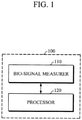
- FIG. 1 is a block diagram illustrating an apparatus for estimating blood pressure according to an example embodiment.
- FIG. 2 is a block diagram illustrating an apparatus for estimating blood pressure according to another example embodiment.
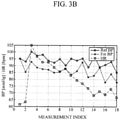
- FIGS. 3A to 3G are diagrams explaining an example of estimating blood pressure.
- the blood pressure estimating apparatuses 100 and 200 include a bio-signal measurer 110 and a processor 120.
- the bio-signal measurer 110 includes one or more sensors, and may measure various bio-signals from an object using the sensors.
- the one or more sensors may be sensors for measuring a photoplethysmogram (PPG) signal, an electrocardiography (ECG) signal, an electromyography (EMG) signal, a ballistocardiogram (BCG) signal, and the like, but are not limited thereto.
- PPG photoplethysmogram
- ECG electrocardiography
- EMG electromyography
- BCG ballistocardiogram
- Examples of the bio-signal measurer 110 may include an optical sensor, a spectrometer, a PPG sensor, an ECG sensor, an EMG sensor, and a BCG sensor.
- the object may be a body part which comes into contact with or is adjacent to the bio-signal measurer 110, and may be a body part where pulse waves may be easily measured.
- the object may be an area of skin on the wrist that is adjacent to the radial artery or a human skin area through which veins or capillaries pass.
- the object is not limited thereto, and may be peripheral body portions, such as fingers, toes, and the like, which have a high density of blood vessels.
- the bio-signal measurer 110 may include a light source which emits light onto an object, and a detector which detects light scattered or reflected from the object.
- the light source may include a light emitting diode (LED), a laser diode, a fluorescent body, and the like, and may be formed as one or two or more arrays.
- the detector may include one pixel or a pixel array including two or more pixels, each of which may include a photo diode, a photo transistor, an image sensor, and the like which detect light and convert the detected light signal into an electric signal, but the detector is not limited thereto.
- the processor 120 may be electrically connected to the bio-signal measurer 110.
- the processor 120 may control the bio-signal measurer 110, and may receive a bio-signal from the bio-signal measurer 110.
- the request for estimating blood pressure may be input by a user or may be generated at predetermined intervals.
- the processor 120 may perform a preprocessing process, such as filtering for removing noise, amplifying a bio-signal, converting a bio-signal into a digital signal, and the like.
- MAP Mean Arterial Pressure
- CO cardiac output
- TPR total peripheral resistance
- ⁇ MAP denotes a difference in MAP between the left ventricle and the right atrium, in which MAP of the right atrium is generally in a range of 3 mmHg to 5 mmHg, such that MAP of the right atrium is similar to MAP of the left ventricle or MAP of the upper arm.
- MAP may be obtained from the aorta or the upper arm.
- it may be difficult to estimate absolute CO and TPR values based on a bio-signal.
- the processor 120 extracts a feature value associated with cardiac output (CO) (hereinafter referred to as a "first feature value”) from a bio-signal, and may extract a feature value associated with total peripheral resistance (TPR) (hereinafter referred to as a "second feature value”) from the bio-signal.
- the first feature value may be a feature value which shows an increasing/decreasing trend in proportion to an actual CO value which relatively increases/decreases when an actual TPR value does not change significantly compared to a reference TRP value that is measured while the user is in a stable state.
- the second feature value may be a feature value which shows an increasing/decreasing trend in proportion to an actual TPR value which relatively increases/decreases when an actual/measured CO value does not change significantly compared to a reference CO value that is measured while the user is in a stable state.
- the processor 120 may extract the feature values by analyzing a waveform of the measured bio-signal.
- the processor 120 may obtain, from a bio-signal, feature values such as heart rate information, time and amplitude values of a maximum point of the bio-signal, time and amplitude values of a minimum point of the bio-signal, an area under a bio-signal waveform, amplitude and time values of pulse waveform components included in the bio-signal, information on an internally dividing point between the obtained values, and may extract feature values by using the obtained characteristic points.
- the pulse waveform components included in the bio-signal may be obtained by performing secondary differentiation on the bio-signal, and by detecting a local minimum point of the secondary differential signal.
- the pulse wave signal PS is represented as a superposition of propagation waves, starting from the heart toward the distal end portions of the body or a branching point in the blood vessel, and reflection waves returning back from the distal end portions or the branching point in the blood vessel.
- FIG. 3A illustrates an example where a waveform of a pulse wave signal PS is formed by a superposition of five pulse waveform components (e.g., the propagation wave fw and the reflection waves rw1, rw2, rw3, and rw4).
- the processor 120 may extract feature values from the pulse wave signal PS by analyzing the pulse waveform components fw, rw1, rw2, rw3, and rw4. For example, the processor 120 may use pulses up to the third constituent pulse to estimate blood pressure. Pulses after the third pulse may not be observed depending on individuals in some cases, and may be difficult to be found due to noise or have a low correlation with estimation of blood pressure.
- the processor 120 may extract, as characteristic points, times t 1 , t 2 , and t 3 , and amplitudes P 1 , P 2 , and P 3 of a maximum point of the first to the third constituent pulse waveforms fw, rw1, and rw2.
- the processor 120 may perform secondary differentiation on the obtained pulse wave signal PS, and may extract the times T 1 , T 2 , and T 3 , and the amplitudes P 1 , P 2 , and P 3 of the maximum point of the first to the third constituent pulse waveforms fw, rw1, and rw2 by using the secondary differential signal.
- the processor 120 may extract the times T 1 , T 2 , and T 3 corresponding to the local minimum point of the first to the third constituent pulse waveforms fw, rw1, and rw2, and may extract amplitudes P 1 , P 2 , and P 3 corresponding to the times T 1 , T 2 , and T 3 from the pulse wave signal PS.
- the local minimum point may refer to the smallest value of the secondary differential signal in a given interval (e.g., a systolic interval, or a diastolic interval), and may correspond to a specific point having a downward convex shape in the interval of the secondary differential signal which is observed to be decreased and then is increased again past the specific point.
- the characteristic point is not limited thereto, and the processor 120 may detect a local maximum point from the secondary differential signal, and may extract time and amplitude values corresponding to the detected local maximum point as characteristic points.
- the local maximum point may refer to the largest value of the secondary differential signal in a given interval (e.g., a systolic interval, or a diastolic interval), and may correspond to a specific point having an upward convex shape in the interval which is observed to be increased until the specific point and then is decreased past the specific point.
- a given interval e.g., a systolic interval, or a diastolic interval
- the processor 120 may obtain, as characteristic points, a time t max and an amplitude P max , at which an amplitude has a maximum value in a specific interval of the pulse wave signal PS.
- the specific interval may refer to an interval between a starting point of the pulse wave signal PS and a point where a dicrotic notch (DN) appears, which indicates a systolic interval of blood pressure.
- the processor 120 may obtain, as characteristic points, a duration PPG dur indicating the entire measurement time period of a bio-signal, or an area PPG area of a bio-signal waveform.
- the area under the bio-signal waveform may refer to the entire area under a bio-signal waveform, or an area under a bio-signal waveform corresponding to a predetermined percentage (e.g., 70%) of the total duration PPGdur of the bio-signal.
- the processor 120 may extract, as an additional characteristic point, an internally dividing point between the extracted two or more characteristic points.
- characteristic points may be extracted at wrong locations.
- the measurement of blood pressure may be supplemented by using the internally dividing point between the wrongly extracted characteristic points.
- the processor 120 may calculate an internally dividing point (T sys , P sys ) between the extracted characteristic points (T 1 , P 1 ) and (T max , P max ).
- the processor 120 may apply a weighted value to time values T 1 and T max of the two characteristic points (T 1 , P 1 ) and (T max , P max ), and may calculate a time T sys of the internally dividing point by using each of the time values to which the weighted value is applied, and may extract an amplitude P sys corresponding to the time T sys of the internally dividing point.
- the internally dividing point is not limited thereto, and by analyzing the waveform of the obtained bio-signal, the processor 120 may further calculate an internally dividing point between the characteristic points (T 1 , P 1 ) and (T 2 , P 2 ) associated with the first and the second constituent pulse waveforms fw and rw 1 in the systolic interval of blood pressure, and an internally dividing point between the characteristic points (T 3 , P 3 ) and (T 4 , P 4 ) associated with the third and the fourth constituent pulse waveforms rw 2 and rw 3 in a diastolic interval of blood pressure, and the like.
- the processor 120 may extract the first feature value and the second feature value by combining various characteristic points obtained from the bio-signal. For example, the processor 120 may extract the first feature value and the second feature value by multiplying, dividing, adding, and subtracting the plurality of characteristic points, or a combination thereof. Alternatively, the processor 120 may extract the first feature value and the second feature value by using a function having, as input values, values obtained by multiplying, dividing, adding, and subtracting the plurality of characteristic points or a combination thereof.
- the function may be a linear function, a quadratic function, a polynomial function, a logarithmic function, or an exponential function, but is not limited thereto, and any other type of function may also be used.
- the processor 120 may extract the first feature value and the second feature value by using a function having at least one characteristic point as an input value, but is not limited thereto.
- processor 120 may extract the first feature value and the second feature value by combining characteristic points differently. Further, by combining characteristic points differently according to blood pressure values to be extracted, e.g., mean arterial pressure, systolic blood pressure, diastolic blood pressure, processor 120 may extract each characteristic point for each type of blood pressure measurements.
- the processor 120 calculates a first variation in the first feature value compared to a first reference feature value. Further, the processor 120 calculates a second variation in the second feature value compared to a second reference feature value.
- the first variation may increase as a ratio of the first feature value to the first reference value increases
- the second variation may increase as a ratio of the second feature value to the second reference value increases.
- the first reference feature value and the second reference feature value may refer to feature values associated with CO and TPR which are extracted from the bio-signal acquired at a reference time( e.g., a time of calibration or a time of a stable state including a time of an empty stomach state).
- the processor 120 may calculate the first variation and the second variation by using the following Equation 2.
- ⁇ f 1 denotes the first variation
- f 1cur denotes the first feature value
- f 1cal denotes the first reference feature value
- ⁇ f 2 denotes the second variation
- f 2cur denotes the second feature value
- f 2cal denotes the second reference feature value
- the processor 120 calculates a third variation based on the first variation and the second variation. For example, the processor 120 may calculate the third variation by multiplying the first variation by the second variation.
- the third variation may be a factor for correcting a blood pressure variation, which may not be reflected using only the first feature value and the second feature value under the condition of blood pressure change such as high-intensity aerobic exercise.
- the processor 120 estimates a blood pressure variation by combining the calculated first variation, second variation, and third variation.
- the processor 120 may multiply each of the first, the second, and the third variations by a combination coefficient, and may add up the multiplied variations.
- the processor 120 may obtain a blood pressure estimation result, in which characteristics of each user are reflected, by further applying a scaling factor to the result of combination.
- Equation 3 represents a blood pressure estimation equation, but the equation is not limited thereto.
- ⁇ BP SF ⁇ f 1 + ⁇ f 2 + ⁇ f 3
- ⁇ BP denotes the estimated blood pressure variation
- ⁇ f 1 , ⁇ f 2 , and ⁇ f 3 each denote the first variation, the second variation, and the third variation
- ⁇ , ⁇ , and ⁇ each denote combination coefficients applied to each of the variations, and may be defined according to the types of blood pressure to be estimated and/or characteristics of a user
- SF denotes a scaling factor pre-defined according to characteristics of a user and/or the types of blood pressure to be estimated.
- the scaling factor may be a reference MAP, a reference diastolic blood pressure (DBP), or a reference systolic blood pressure (SBP_ at a calibration time which are measured from a user by an external blood pressure measuring apparatus, or may be a value calculated by combining two or more thereof.
- the processor 120 may estimate blood pressure by using a function as represented by the following Equation 4.
- BP est BP cal + ⁇ Bp
- blood pressure BP may refer to MAP, DBP, and SBP.
- the processor 120 may independently estimate variations in MAP, DBP, and SBP by using the following Equations 3 and 4.
- the first feature value and the second feature value may be extracted separately for each type of blood pressure.
- the processor 120 may independently estimate variations in MAP, DBP, and SBP by setting a combination coefficient and/or a scaling factor differently for each type of blood pressure.
- the processor 120 may sequentially estimate MAP, DBP, and SBP.
- the processor 120 may obtain an estimated MAP value by using the above Equations 3 and 4, and may estimate DBP and SBP sequentially by using the estimated MAP value.
- the processor 120 may estimate DBP and SBP by using a pulse pressure along with the estimated MAP value.
- the pulse pressure may be obtained by analyzing a bio-signal, a pulse pressure measured by a pulse pressure measuring device may be received, or a predetermined reference pulse pressure of a user may also be used.
- the following Equations 5 and 6 are examples of functions for estimating DBP based on the estimated MAP value and the pulse pressure.
- DBP MAP ⁇ PP 3
- DBP MAP ⁇ 0.01 ⁇ exp 4.14 ⁇ 40.74
- HR ⁇ PP SBP DBP + PP
- MAP mean arterial pressure
- DBP denotes diastolic blood pressure
- SBP denotes systolic blood pressure
- PP denotes pulse pressure
- HR heart rate
- vascular compliance of each individual varies depending on a cardiovascular health condition.
- a shape of pressure waves may be changed differently.
- the waveform of PPG signal may be changed differently for each individual.
- a variation in the first feature value and the second feature value may be different from a variation in the actual CO and TPR values.
- FIGS. 3B and 3C in a blood pressure change mechanism associated with high-intensity aerobic exercise, a heart rate HR increases sharply in an interval of 2 to 4 of a measurement index.
- FIG. 3B illustrates an example where in the change mechanism, an estimated blood pressure value Est BP, which is estimated based on the first feature value and the second feature value, is measured lower than an actual blood pressure value Ref BP in the blood pressure change mechanism.
- FIG. 3C illustrates an example where an estimated blood pressure value Est BP is measured higher than the actual blood pressure value Ref BP in the blood pressure change mechanism.
- errors may occur, such as the estimated blood pressure value measured higher or lower than the actual blood pressure value, even in the same blood pressure change mechanism.
- FIG. 3D illustrates a pulse wave signal in a condition showing the result of FIG. 3B .
- an amplitude P1 of a first pulse waveform component included in the pulse wave signal of a reference time may be observed at a lower position than an amplitude P2 of a second pulse waveform component.
- the amplitude of the first pulse waveform component increases sharply.
- FIG. 3E illustrates a pulse wave signal in a condition showing the result of FIG. 3C .
- the amplitude P1 of the first pulse waveform component included in the pulse wave signal of the reference time may be observed at a very high position.
- it can be seen that the amplitude P1 of the first pulse waveform component hardly changes, but the amplitude P2 of the second pulse waveform component is significantly decreased.
- an amplitude of each pulse waveform component included in the bio-signal of a time of a stable state may be different for each individual, and may be related to vascular compliance of each individual.
- accuracy in estimating blood pressure may be improved.
- the processor 120 may obtain a reference value associated with vascular compliance, and may reflect an effect of vascular compliance of each individual in each feature value by adjusting combination coefficients ⁇ , ⁇ , and ⁇ for each variation, which is described above in Equation 3, based on the obtained reference value. In this case, only a portion of each combination coefficient may be adjusted, but the combination coefficient is not limited thereto.
- a combination coefficient of the second feature value associated with TPR hereinafter referred to as a "second combination coefficient" will be described below.
- the processor 120 may obtain an adjustment value to adjust the second combination coefficient for the second feature value associated with TPR by using a pre-defined adjustment value estimation equation as represented by the following Equation 7.
- the adjustment value is not limited thereto, and the processor 120 may obtain an adjustment value to adjust a combination coefficient for another feature value by using the following Equation 7 or other function similar thereto.
- ⁇ ⁇ ⁇ a b ⁇ 1 + 1
- ⁇ denotes an adjustment value for adjusting the second combination coefficient
- ⁇ denotes a predetermined constant
- a denotes a statistical value (e.g., a mean value) of reference values related to vascular compliance, which are obtained from a plurality of users, and may be a value pre-obtained through preprocessing
- b denotes a reference value of a specific user desired to estimate blood pressure.
- the processor 120 may multiply the obtained adjustment value ⁇ by the second combination coefficient ⁇ , and may combine variations by using the multiplied value ( ⁇ ).
- the processor 120 may obtain a reference value to be input into an adjustment value estimation equation at a reference time (e.g., a time of a stable state including a time of an empty stomach state, or a time of calibration). For example, the processor 120 may calculate, as a reference value, a ratio between a first amplitude value at a position of the first pulse waveform component and a second amplitude value at a position of the second pulse waveform component, which are included in a bio-signal of the reference time. In another example, the processor 120 may calculate, as a reference value, a ratio between the first amplitude value and a maximum amplitude value of the bio-signal of the reference time.
- a reference value e.g., a time of a stable state including a time of an empty stomach state, or a time of calibration.
- the processor 120 may calculate, as a reference value, a ratio between a first amplitude value at a position of the first pulse waveform component and a second amplitude value at
- the processor 120 may calculate, as a reference value, a ratio between the first amplitude value and an amplitude at a local maximum point of a secondary differential signal of a bio-signal, an amplitude at a maximum point of a secondary differential signal, and the like.
- the reference value is not limited thereto, and the processor 120 may use a ratio between the first amplitude value and various other values as a reference value.
- the reference value includes a vascular compliance index.
- the vascular compliance index may include an Augmentation Index (Aix).
- Aix refers to a value obtained by dividing a difference between a first systolic peak and a second systolic peak by a total peak, and it is known that the Aix reflects vascular compliance.
- the processor 120 may receive the Aix at a reference time from an external device which measures the Aix. Alternatively, the Aix may be measured similarly using pressure waves of the radial artery.
- the waveform of a pulse wave signal which is measured from a body part such as a wrist, a finger, and the like, is highly relevant to pressure waves of the artery, such that the processor 120 may obtain the Aix by analyzing the waveform of the pulse wave signal obtained at the reference time.
- an adjustment value calculation equation may be obtained by calculating a correlation between an average of errors, obtained from a plurality of users, and a reference value of each user.
- An average error value of each user may refer to an average value of errors between blood pressure values actually measured at a plurality of measurement times by each user and blood pressure values estimated using the first feature value and the second feature value.
- the reference value may be a pre-defined value to be used as an input of the adjustment value calculation equation, and may refer to P1/P2, P1/Pmax, and the like as described above.
- the blood pressure estimating apparatus 200 may further include a communication interface 210, an output interface 220, and a memory 230.
- the communication interface 210 may communicate with an external device 250 by using wired or wireless communication techniques under the control of the processor 120, and may transmit and receive various data to and from the external device 250.
- the communication interface 210 may transmit a blood pressure estimation result to the external device 250, and may receive various criteria required for estimating blood pressure from the external device 250.
- the communication interface 210 may receive a reference blood pressure which is measured by a cuff-type blood pressure measuring device and the like, the vascular compliance index, the blood pressure estimation equation, the adjustment value estimation equation, and the like.
- examples of the external device 250 may include a cuff-type blood pressure measuring device, a device for measuring vascular compliance index, and an information processing device such as a smartphone, a tablet PC, a desktop computer, a laptop computer, and the like.
- Examples of the communication techniques may include Bluetooth communication, Bluetooth Low Energy (BLE) communication, Near Field Communication (NFC), WLAN communication, Zigbee communication, Infrared Data Association (IrDA) communication, Wi-Fi Direct (WFD) communication, Ultra-Wideband (UWB) communication, Ant+ communication, WIFI communication, Radio Frequency Identification (RFID) communication, 3G communication, 4G communication, 5G communication, and the like.
- BLE Bluetooth Low Energy
- NFC Near Field Communication
- WLAN Zigbee communication
- IrDA Infrared Data Association
- Wi-Fi Direct Wi-Fi Direct
- UWB Ultra-Wideband
- Ant+ communication Zigbee
- WIFI Radio Frequency Identification
- RFID Radio Frequency Identification
- the output interface 220 may output results processed by the bio-information measurer 110 and the processor 120.
- the output interface 220 may visually output an estimated bio-information value by using a display, or may output the information in a non-visual manner through voice, vibrations, tactile sensation, and the like by using a speaker, a haptic motor, a vibrator, and the like.
- the output interface 220 may divide a display area into two or more areas according to a setting, in which the output interface 220 may output a bio-signal graph, a blood pressure estimation result, and the like, which are used for estimating blood pressure, in a first area; and may output a blood pressure estimation history in the form of graphs in a second area.
- the output interface 130 may output warning information in various manners, such as highlighting an abnormal value in red and the like, displaying the abnormal value along with a normal range, outputting a voice warning message, adjusting a vibration intensity, and the like.
- the memory 230 may store processing results of the bio-information measurer 110 and the processor 120. Further, the memory 230 may store various criteria required for estimating blood pressure. For example, the criteria may include user feature information such as a user's age, gender, health condition, and the like. In addition, the criteria may include various types of information, such as the reference blood pressure, the blood pressure estimation equation, a blood pressure estimation interval, the adjustment value estimation equation, and the like, but are not limited thereto.
- the memory 230 may include at least one storage medium of a flash memory type memory, a hard disk type memory, a multimedia card micro type memory, a card type memory (e.g., an SD memory, an XD memory, etc.), a Random Access Memory (RAM), a Static Random Access Memory (SRAM), a Read Only Memory (ROM), an Electrically Erasable Programmable Read Only Memory (EEPROM), a Programmable Read Only Memory (PROM), a magnetic memory, a magnetic disk, and an optical disk, and the like, but is not limited thereto.
- a flash memory type memory e.g., an SD memory, an XD memory, etc.
- RAM Random Access Memory
- SRAM Static Random Access Memory
- ROM Read Only Memory
- EEPROM Electrically Erasable Programmable Read Only Memory
- PROM Programmable Read Only Memory
- FIG. 4 is a flowchart illustrating a method of estimating blood pressure according to an example embodiment.
- the method of estimating blood pressure of FIG. 4 may be an example of a blood pressure estimating method according to the example embodiment of FIG. 1 or 2 .
- Various example embodiments thereof are described above in detail, such that the description thereof will be briefly made below.
- the blood pressure estimating apparatus 100/200 may receive a request for estimating blood pressure in operation 410.
- the blood pressure estimating apparatus 100/200 may provide an interface to a user, and may receive the request for estimating blood pressure input by the user through the interface.
- the blood pressure estimating apparatus 100/200 may communicate with an external device 250, and may receive the request for estimating blood pressure from the external device 250.
- the external device 250 may be a smartphone or a tablet PC carried by a user, and a user may control the operation of the blood pressure estimating apparatus 100/200 by using a device having excellent interface or computing performance.
- the blood pressure estimating apparatus 100/200 may obtain a bio-signal from an object in operation 420.
- the bio-signal may include various bio-signals, such as a PPG signal, an ECG signal, an EMG signal, a BCG signal, and the like.
- the blood pressure estimating apparatus 100/200 may extract feature values by analyzing the obtained bio-signal in operation 430.
- the cardiovascular feature values includes a feature value associated with cardiac output and a feature value associated with total peripheral resistance.
- the blood pressure estimating apparatus 100/200 may extract feature values related to cardiac output and total peripheral resistance by analyzing a bio-signal, a differential signal obtained by differentiating the bio-signal, and the like, and by properly combining heart rate information, time and amplitude values of a maximum point of the bio-signal, time and amplitude values of a minimum point of the bio-signal, an area under a waveform of the bio-signal, amplitude and time values of pulse waveform components included in the bio-signal, and the like.
- the blood pressure estimating apparatus 100/200 adjusts a combination coefficient to combine the extracted feature values for estimating blood pressure in operation 440.
- the blood pressure estimating apparatus 100/200 may obtain a reference value associated with vascular compliance of a user based on a shape of a waveform of a bio-signal measured at a reference time, and may adjust a combination coefficient by using the reference value.
- the blood pressure estimating apparatus 100/200 may obtain, as a reference value, a ratio between pulse waveform components included in the bio-signal, and may calculate an adjustment value for adjusting a combination coefficient by inputting the obtained reference value into a pre-defined adjustment value calculation equation.
- the reference value is not limited thereto, and various other indices which may reflect vascular compliance of a user may also be used.
- the blood pressure estimating apparatus 100/200 may estimate blood pressure by combining the feature values in operation 450. For example, the blood pressure estimating apparatus 100/200 may normalize each feature value by dividing each feature value by a corresponding feature value of a reference time, and may calculate a variation in each feature value based on the result of normalization. Further, upon calculating the variation in each feature value, the blood pressure estimating apparatus 100/200 may estimate blood pressure by multiplying each calculated variation by a combination coefficient, or the adjusted combination coefficient if adjusted in operation 440, and combining the variations. In particular, the blood pressure estimating apparatus 100/200 may estimate blood pressure by multiplying a value, obtained by combining the variations, by a scaling factor.
- FIG. 5 is a diagram illustrating a wearable device according to an example embodiment.
- Various example embodiments of the blood pressure estimating apparatus 100/200 described above may be mounted in a smart watch worn on a wrist or a smart band-type wearable device.
- the wearable device is not limited thereto, and may be mounted in a smartphone, a tablet PC, a desktop computer, a laptop computer, and the like.
- the wearable device 500 includes a main body 510 and a strap 530.
- the main body 510 may be formed to have various shapes, and may include modules which are mounted inside or outside of the main body 510 to perform the aforementioned function of estimating blood pressure as well as various other functions.
- a battery may be embedded in the main body 510 or the strap 530 to supply power to various modules of the wearable device 500.
- the strap 530 may be connected to the main body 510.
- the strap 530 may be flexible, so as to be bent around a user's wrist.
- the strap 530 may be bent in a manner that allows the strap 530 to be detached from the user's wrist or may be formed as a band that is not detachable.
- Air may be injected into the strap 530 or an airbag may be included in the strap 530, so that the strap 530 may have elasticity according to a change in pressure applied to the wrist, and the change in pressure of the wrist may be transmitted to the main body 510.
- the main body 510 may include a bio-signal measurer 520 for measuring a bio-signal.
- the bio-signal measurer 520 may be mounted on a rear surface of the main body 510, which comes into contact with the upper portion of a user's wrist, and may include a light source for emitting light onto the skin of the wrist and a detector for detecting light scattered or reflected from the object.
- the bio-signal measurer 520 may be implemented as a spectrometer including the light source and the detector.
- the bio-signal measurer 520 may further include a contact pressure sensor for measuring contact pressure applied by the object.
- a processor 120 may be mounted in the main body 510.
- the processor 120 may be electrically connected to various modules, mounted in the wearable device 500, to control operations thereof.
- the processor 120 may estimate blood pressure by using the bio-signal measured by the bio-signal measurer 520.
- the processor 120 may obtain a feature value associated with CO and a feature value associated with TPR from the bio-signal. Further, the processor 120 may calculate variations in the feature values by normalizing each feature value with a feature value of a reference time, and may estimate blood pressure by combining the calculated variations. In particular, the processor 120 may obtain an additional feature value based on the feature value associated with CO and the feature value associated with TPR.
- the processor 120 may estimate blood pressure by multiplying the variations in each of the feature values by each combination coefficient, and combining the multiplied variations.
- the processor 120 may obtain a reference value by analyzing a waveform of the bio-signal of the reference time, and may adjust a combination coefficient for a variation in the feature value, which is affected by vascular compliance, by using the reference value, thereby reflecting the effect of vascular compliance of each individual in estimation of blood pressure.
- the processor 120 may monitor a contact state of the object based on contact pressure between the wrist and the bio-signal measurer 520, and may provide guidance on a contact position and/or a contact state to a user through a display.
- the main body 510 may include a memory 230 which stores a processing result of the processor 120 and various types of information.
- various types of information may include criteria for estimating blood pressure as well as information associated with functions of the wearable device 500.
- the main body 510 may also include a manipulator 540 which receives a control command of a user and transmits the received control command to the processor 120.
- the manipulator 540 may include a power button to input a command to turn on/off the wearable device 500.
- the display may be mounted on a front surface of the main body 510, and may include a touch panel for touch input.
- the display may receive a touch input from a user, may transmit the received touch input to the processor 120, and may display a processing result of the processor 120.
- the display may display the estimated blood pressure information.
- the display may display additional information, such as an estimation date of blood pressure, a user's health condition, and the like, along with the estimated blood pressure information.
- the display may output detailed information in various manners.
- a communication interface provided for communication with an external device such as a mobile terminal of a user, may be mounted in the main body 510.
- the communication interface may transmit an estimation result of bio-information to an external device, e.g., a user's smartphone, to display the result to a user.
- an external device e.g., a user's smartphone
- the communication interface may transmit and receive various types of necessary information.
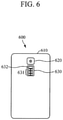
- FIG. 6 is a diagram illustrating a smart device 600, to which embodiments of a blood pressure estimating apparatus are applied.
- the smart device may be a smartphone, a tablet PC, and the like.
- the smart device 600 includes a main body 610 and a bio-signal measurer 630 mounted on one surface of a main body 610.
- the bio-signal measurer 630 may include a pulse wave sensor which includes at least one or more light sources 631 and a detector 632. As illustrated in FIG. 6 , the bio-signal measurer 630 may be mounted on a rear surface of the main body 610, but is not limited thereto. Further, the bio-signal measurer 630 may be configured in combination with a fingerprint sensor or a touch panel mounted on a front surface.
- a display may be mounted on a front surface of the main body 610.
- the display may visually display an estimation result of and the like.
- the display may include a touch panel, and may receive various types of information input through the touch panel and transmit the received information to the processor 120.
- an image sensor 620 may be mounted in the main body 610.
- the image sensor 620 may capture an image of the finger and may transmit the captured image to the processor 120.
- the processor 120 may identify a relative position of the finger with respect to an actual position of the bio-signal measurer 630, and may provide the relative position of the finger to the user through the display, so as to guide measurement of pulse wave signals with improved accuracy.
- the processor 120 may estimate blood pressure by using the bio-signal measured by the bio-signal measurer 630. As described above, the processor 120 may extract feature values related to cardiac output and total peripheral resistance from the bio-signal, and may estimate blood pressure by combining the extracted feature values. In this case, in order to compensate for a feature value which is affected by vascular compliance of each individual, the processor 120 may properly adjust a combination coefficient applied to the feature value, and then may combine the feature values, and detailed description thereof is made above.
- one or more units of the above-described apparatuses and devices can include circuitry, a processor, a microprocessor, etc., and may execute a computer program stored in a computer-readable medium.
Landscapes
- Health & Medical Sciences (AREA)
- Life Sciences & Earth Sciences (AREA)
- Engineering & Computer Science (AREA)
- Molecular Biology (AREA)
- Animal Behavior & Ethology (AREA)
- Veterinary Medicine (AREA)
- Biophysics (AREA)
- Pathology (AREA)
- Public Health (AREA)
- Biomedical Technology (AREA)
- Heart & Thoracic Surgery (AREA)
- Medical Informatics (AREA)
- General Health & Medical Sciences (AREA)
- Surgery (AREA)
- Physics & Mathematics (AREA)
- Cardiology (AREA)
- Physiology (AREA)
- Vascular Medicine (AREA)
- Artificial Intelligence (AREA)
- Computer Vision & Pattern Recognition (AREA)
- Psychiatry (AREA)
- Signal Processing (AREA)
- Hematology (AREA)
- Measuring Pulse, Heart Rate, Blood Pressure Or Blood Flow (AREA)
Claims (14)
- Vorrichtung (100) zum Schätzen des Blutdrucks, wobei die Vorrichtung umfasst:
einen Biosignalmesser (110), ausgebildet zum Messen eines Biosignals von einem Benutzer; und einen Prozessor (120), ausgebildet zum:Extrahieren von einem oder mehreren Merkmalswerten aus dem Biosignal, wobei der eine oder die mehreren Merkmalswerte einen mit der Herzleistung verknüpften ersten Merkmalswert und einen mit dem gesamten peripheren Widerstand verknüpften zweiten Merkmalswert umfassen,Anpassen eines Kombinationskoeffizienten zum Kombinieren des einen oder der mehreren Merkmalswerte auf der Basis eines Referenzwerts umfassend einen vaskulären Compliance-Index,Ermitteln einer ersten Variation im ersten Merkmalswert im Vergleich zu einem ersten Referenzmerkmalswert und einer zweiten Variation im zweiten Merkmalswert im Vergleich zu einem zweiten Referenzmerkmalswert und Ermitteln einer dritten Variation auf der Basis der ersten Variation und der zweiten Variation, undSchätzen eines Blutdrucks auf der Basis des angepassten Kombinationskoeffizienten und der ersten Variation, der zweiten Variation und der dritten Variation,wobei der Prozessor (120) ferner zum Ermitteln des Referenzwerts, des ersten Referenzmerkmalwerts und des zweiten Referenzmerkmalwerts zu einer Referenzzeit umfassend eine Kalibrierzeit des Biosignals oder/und eine Zeit, zu der sich der Benutzer in einem stabilen Zustand befindet, ausgebildet ist. - Vorrichtung nach Anspruch 1, wobei der Prozessor (120) ferner zum Ermitteln eines Maximumamplitudenwerts eines Referenzbiosignals, das vom Benutzer zu einer Referenzzeit gemessen wird, als Referenzwert ausgebildet ist.
- Vorrichtung nach Anspruch 1 oder Anspruch 2, wobei der Prozessor (120) ferner ausgebildet ist zum:Ermitteln eines Referenzbiosignals umfassend eine erste Impulsformkomponente und eine zweite Impulsformkomponente vom Benutzer zu einer Referenzzeit; undErmitteln eines Verhältnisses zwischen einem ersten Amplitudenwert der ersten Impulsformkomponente und einem zweiten Amplitudenwert der zweiten Impulsformkomponente des Referenzbiosignals oder/und eines Verhältnisses zwischen dem ersten Amplitudenwert und einem Maximumamplitudenwert des Referenzbiosignals.
- Vorrichtung nach einem der Ansprüche 1 bis 3, wobei der vaskuläre Compliance-Index einen Augmentationsindex umfasst.
- Vorrichtung nach Anspruch 4, wobei der Prozessor (120) ferner zum Empfangen des vaskulären Compliance-Index von einer externen Vorrichtung, welche die vaskuläre Compliance des Benutzers misst, oder zum Ermitteln des Augmentationsindex durch Analysieren einer Wellenform des Referenzbiosignals, das vom Benutzer zu einer Referenzzeit gemessen wird, ausgebildet ist.
- Vorrichtung nach einem der Ansprüche 1 bis 5, wobei der Prozessor (120) ferner zum Ermitteln eines Anpassungswerts zum Anpassen des Kombinationskoeffizienten durch Einfügen des Referenzwerts in eine vordefinierte Anpassungswert-Schätzungsgleichung ausgebildet ist.
- Vorrichtung nach Anspruch 6, wobei der Prozessor (120) ferner zum Ermitteln des Anpassungswerts durch ferner Einfügen eines statistischen Werts einer Vielzahl von von einer Vielzahl von anderen Benutzern ermittelten Referenzwerten in die Anpassungswert-Schätzungsgleichung ausgebildet ist.
- Vorrichtung nach einem der Ansprüche 1 bis 7, wobei der Prozessor (120) ferner zum Ermitteln von wenigstens einer Information der Gruppe umfassend eine Herzschlaginformation, eine Fläche unter einer Wellenform des Biosignals, Zeit- und Amplitudenwerte eines Maximumpunkts des Biosignals, Zeit- und Amplitudenwerte eines Minimumpunkts des Bio-signals und Amplituden- und Zeitwerte von im Biosignal enthaltenen Impulsformkomponenten und Extrahieren des einen oder der mehreren Merkmalswerte auf der Basis der wenigstens einen Information ausgebildet ist.
- Vorrichtung nach Anspruch 8, wobei der Kombinationskoeffizient einer einer Vielzahl von Kombinationskoeffizienten ist, und
wobei der Prozessor (120) ferner zum Anpassen der Vielzahl von Kombinationskoeffizienten entsprechend jeder von erster, zweite und dritter Variation und Kombinieren von erster, zweiter und dritter Variation durch Multiplizieren von erster, zweiter und dritter Variation jeweils mit den angepassten entsprechenden Kombinationskoeffizienten ausgebildet ist. - Vorrichtung nach Anspruch 9, wobei der Prozessor (120) ferner zum Schätzen des Blutdrucks durch Anwenden eines Skalierungsfaktors auf einen resultierenden Wert des Kombinierens von erster, zweiter und dritter Variation ausgebildet ist.
- Computerimplementiertes Verfahren zum Schätzen des Blutdrucks, wobei das Verfahren umfasst:Messen (420) eines Biosignals von einem Benutzer; unddurch einen Prozessor Ausführen der Schritte zum:Extrahieren (430) von einem oder mehreren Merkmalswerten aus dem Biosignal, wobei der eine oder die mehreren Merkmalswerte einen mit der Herzleistung verknüpften ersten Merkmalswert und einen mit dem gesamten peripheren Widerstand verknüpften zweiten Merkmalswert umfassen;Anpassen (440) eines Kombinationskoeffizienten zum Kombinieren des einen oder der mehreren Merkmalswerte auf der Basis eines Referenzwerts umfassend einen vaskulären Compliance-Index;Ermitteln einer ersten Variation im ersten Merkmalswert im Vergleich zu einem ersten Referenzmerkmalswert und einer zweiten Variation im zweiten Merkmalswert im Vergleich zu einem zweiten Referenzmerkmalswert und Ermitteln einer dritten Variation auf der Basis der ersten Variation und der zweiten Variation; undSchätzen (450) eines Blutdrucks auf der Basis des angepassten Kombinationskoeffizienten, der ersten Variation, der zweiten Variation und der dritten Variation,wobei das Verfahren ferner das Ermitteln des Referenzwerts, des ersten Referenzmerkmalwerts und des zweiten Referenzmerkmalwerts zu einer Referenzzeit umfassend eine Kalibrierzeit des Biosignals oder/und eine Zeit, zu der sich der Benutzer in einem stabilen Zustand befindet, umfasst.
- Verfahren nach Anspruch 11, ferner umfassend: Ermitteln eines Maximumamplitudenwerts eines Referenzbiosignals, das vom Benutzer zu einer Referenzzeit gemessen wird, als Referenzwert, oder
ferner umfassend: Ermitteln eines Referenzbiosignals umfassend eine erste Impulsformkomponente und eine zweite Impulsformkomponente vom Benutzer zu einer Referenzzeit; und Ermitteln eines Verhältnisses zwischen einem ersten Amplitudenwert der ersten Impulsformkomponente und einem zweiten Amplitudenwert der zweiten Impulsformkomponente des Referenzbiosignals oder/und eines Verhältnisses zwischen dem ersten Amplitudenwert und einem Maximumamplitudenwert des Referenzbiosignals. - Verfahren nach Anspruch 11 oder Anspruch 12, wobei das Anpassen des Kombinationskoeffizienten das Ermitteln eines Anpassungswerts zum Anpassen des Kombinationskoeffizienten durch Einfügen des Referenzwerts in eine vordefinierte Anpassungswert-Schätzungsgleichung umfasst.
- Verfahren nach Anspruch 13, wobei das Anpassen des Kombinationskoeffizienten das Ermitteln des Anpassungswerts durch ferner Einfügen eines statistischen Werts einer Vielzahl von von einer Vielzahl von anderen Benutzern ermittelten Werten in die Anpassungswert-Schätzungsgleichung umfasst.
Applications Claiming Priority (1)
| Application Number | Priority Date | Filing Date | Title |
|---|---|---|---|
| KR1020180118825A KR102560306B1 (ko) | 2018-10-05 | 2018-10-05 | 혈압 추정 장치 및 방법 |
Publications (2)
| Publication Number | Publication Date |
|---|---|
| EP3632302A1 EP3632302A1 (de) | 2020-04-08 |
| EP3632302B1 true EP3632302B1 (de) | 2022-03-09 |
Family
ID=67437651
Family Applications (1)
| Application Number | Title | Priority Date | Filing Date |
|---|---|---|---|
| EP19185522.0A Active EP3632302B1 (de) | 2018-10-05 | 2019-07-10 | Vorrichtung und verfahren zur schätzung des blutdrucks |
Country Status (4)
| Country | Link |
|---|---|
| US (2) | US11298086B2 (de) |
| EP (1) | EP3632302B1 (de) |
| KR (1) | KR102560306B1 (de) |
| CN (1) | CN111000543B (de) |
Families Citing this family (6)
| Publication number | Priority date | Publication date | Assignee | Title |
|---|---|---|---|---|
| CN108245148B (zh) * | 2016-12-28 | 2022-08-23 | 三星电子株式会社 | 自适应生物信号特征组合设备及方法 |
| KR102560305B1 (ko) * | 2018-08-20 | 2023-07-26 | 삼성전자주식회사 | 혈압 추정 장치 및 방법 |
| EP3957236A1 (de) * | 2020-08-21 | 2022-02-23 | Koninklijke Philips N.V. | Fehlererkennungsvorrichtung und verfahren für eine blutdrucküberwachungsvorrichtung |
| US12121335B2 (en) * | 2021-01-25 | 2024-10-22 | Samsung Electronics Co., Ltd. | Apparatus and method for estimating blood pressure |
| KR102806309B1 (ko) * | 2021-08-17 | 2025-05-09 | 삼성전자주식회사 | 혈압 추정 장치 및 방법 |
| KR102721189B1 (ko) * | 2021-12-20 | 2024-10-24 | 삼성전자주식회사 | 혈압 추정 장치 및 방법 |
Family Cites Families (19)
| Publication number | Priority date | Publication date | Assignee | Title |
|---|---|---|---|---|
| JP3210737B2 (ja) * | 1992-08-26 | 2001-09-17 | 松下電工株式会社 | 電子血圧計 |
| GB0500430D0 (en) * | 2005-01-10 | 2005-02-16 | Micro Medical Ltd | A method of obtaining an estimation of a person's aortic blood pressure |
| WO2008124107A1 (en) | 2007-04-04 | 2008-10-16 | The Regents Of The University Of California | Compositions, devices, systems, and methods for using a nanopore |
| EP2162059B1 (de) | 2007-06-12 | 2021-01-13 | Sotera Wireless, Inc. | Vitalzeichenmonitor und verfahren zur messung des blutdrucks mit optischen, elektrischen und druck-wellenformen |
| WO2008154647A1 (en) | 2007-06-12 | 2008-12-18 | Triage Wireless, Inc. | Vital sign monitor for cufflessly measuring blood pressure corrected for vascular index |
| CN102791192B (zh) | 2009-10-29 | 2015-02-25 | Cn体系药物技术有限公司 | 增强和分析来自连续无创血压设备的信号的装置 |
| US11253159B2 (en) * | 2010-01-31 | 2022-02-22 | Vladimir Shusterman | Tracking cardiac forces and arterial blood pressure using accelerometers |
| KR101270592B1 (ko) | 2010-07-12 | 2013-06-05 | 조선대학교산학협력단 | 오실로매트릭 동맥 혈압 측정에 기반한 개인적인 특성 분석 장치 및 방법 |
| KR102083559B1 (ko) * | 2013-02-13 | 2020-03-02 | 삼성전자주식회사 | 생체용 전극, 생체 신호 처리 장치 및 생체 신호 처리 방법 |
| SG11201705186UA (en) | 2014-12-23 | 2017-07-28 | Nitto Denko Corp | Device and method for removal of artifacts in physiological measurements |
| WO2016130083A1 (en) | 2015-02-09 | 2016-08-18 | Nitto Denko Corporation | Method and apparatus for deriving mean arterial pressure of a subject |
| EP3261524B1 (de) | 2015-02-25 | 2021-04-21 | Spry Health, Inc. | Systeme und verfahren für nicht-invasive blutdrucküberwachung |
| CN107405090B (zh) | 2015-03-17 | 2021-06-29 | 皇家飞利浦有限公司 | 用于测量血压的方法和装置 |
| CN107920758B (zh) | 2015-06-18 | 2023-07-18 | 瑞士Csem电子显微技术研发中心 | 用于确定血压值的方法、装置和计算机程序 |
| EP3117766B1 (de) | 2015-07-16 | 2021-02-24 | Preventicus GmbH | Verarbeitung biologischer daten |
| KR20170063416A (ko) | 2015-11-30 | 2017-06-08 | 주식회사 휴이노 | 생체 정보를 제공하기 위한 방법, 디바이스, 서버 및 비일시성의 컴퓨터 판독 가능한 기록 매체 |
| KR101746492B1 (ko) | 2016-05-25 | 2017-06-14 | 대요메디(주) | 맥변화 측정장치와 이를 이용한 맥변화 측정 방법 |
| KR102655671B1 (ko) * | 2016-10-12 | 2024-04-05 | 삼성전자주식회사 | 생체정보 추정 장치 및 방법 |
| IT201700031915A1 (it) | 2017-03-23 | 2018-09-23 | Univ Degli Studi Di Modena E Reggio Emilia | Sistema e metodo per la rilevazione di parametri fisiologici vitali di un soggetto. |
-
2018
- 2018-10-05 KR KR1020180118825A patent/KR102560306B1/ko active Active
-
2019
- 2019-05-10 US US16/409,128 patent/US11298086B2/en active Active
- 2019-06-06 CN CN201910491554.9A patent/CN111000543B/zh active Active
- 2019-07-10 EP EP19185522.0A patent/EP3632302B1/de active Active
-
2022
- 2022-03-09 US US17/690,615 patent/US11744526B2/en active Active
Also Published As
| Publication number | Publication date |
|---|---|
| KR20200039197A (ko) | 2020-04-16 |
| US11744526B2 (en) | 2023-09-05 |
| US20220192607A1 (en) | 2022-06-23 |
| EP3632302A1 (de) | 2020-04-08 |
| US11298086B2 (en) | 2022-04-12 |
| US20200107789A1 (en) | 2020-04-09 |
| CN111000543B (zh) | 2024-10-18 |
| CN111000543A (zh) | 2020-04-14 |
| KR102560306B1 (ko) | 2023-07-26 |
Similar Documents
| Publication | Publication Date | Title |
|---|---|---|
| EP3692895B1 (de) | Vorrichtung und verfahren zur schätzung von bioinformationen | |
| US11744526B2 (en) | Apparatus and method for estimating blood pressure | |
| KR102626585B1 (ko) | 혈압 추정 장치 및 방법 | |
| EP3457410B1 (de) | Vorrichtung und verfahren zur schätzung von bioinformationen | |
| EP3701859B1 (de) | Vorrichtung und verfahren zur schätzung von bio-informationen | |
| EP4032468B1 (de) | Vorrichtung und verfahren zur schätzung des blutdrucks | |
| EP3795069B1 (de) | Vorrichtung und verfahren zur schätzung von bioinformationen | |
| EP3613340B1 (de) | Vorrichtung und verfahren zur schätzung des blutdrucks | |
| US20230255503A1 (en) | Apparatus and method for estimating bio-information | |
| EP3636145B1 (de) | Vorrichtung und verfahren zur schätzung des blutdrucks | |
| EP3834715B1 (de) | Vorrichtung und verfahren zur schätzung von bioinformationen | |
| CN111035379B (zh) | 用于估计血压的设备 | |
| EP3824802B1 (de) | Vorrichtung und verfahren zur erkennung eines charakteristischen punktes einer oszillometrischen hüllkurve und vorrichtung zum schätzen von bioinformationen |
Legal Events
| Date | Code | Title | Description |
|---|---|---|---|
| PUAI | Public reference made under article 153(3) epc to a published international application that has entered the european phase |
Free format text: ORIGINAL CODE: 0009012 |
|
| STAA | Information on the status of an ep patent application or granted ep patent |
Free format text: STATUS: THE APPLICATION HAS BEEN PUBLISHED |
|
| AK | Designated contracting states |
Kind code of ref document: A1 Designated state(s): AL AT BE BG CH CY CZ DE DK EE ES FI FR GB GR HR HU IE IS IT LI LT LU LV MC MK MT NL NO PL PT RO RS SE SI SK SM TR |
|
| AX | Request for extension of the european patent |
Extension state: BA ME |
|
| STAA | Information on the status of an ep patent application or granted ep patent |
Free format text: STATUS: REQUEST FOR EXAMINATION WAS MADE |
|
| 17P | Request for examination filed |
Effective date: 20200702 |
|
| RBV | Designated contracting states (corrected) |
Designated state(s): AL AT BE BG CH CY CZ DE DK EE ES FI FR GB GR HR HU IE IS IT LI LT LU LV MC MK MT NL NO PL PT RO RS SE SI SK SM TR |
|
| STAA | Information on the status of an ep patent application or granted ep patent |
Free format text: STATUS: EXAMINATION IS IN PROGRESS |
|
| 17Q | First examination report despatched |
Effective date: 20201218 |
|
| GRAP | Despatch of communication of intention to grant a patent |
Free format text: ORIGINAL CODE: EPIDOSNIGR1 |
|
| STAA | Information on the status of an ep patent application or granted ep patent |
Free format text: STATUS: GRANT OF PATENT IS INTENDED |
|
| RIC1 | Information provided on ipc code assigned before grant |
Ipc: A61B 5/029 20060101ALI20210827BHEP Ipc: A61B 5/024 20060101ALI20210827BHEP Ipc: A61B 5/02 20060101ALI20210827BHEP Ipc: A61B 5/00 20060101ALI20210827BHEP Ipc: A61B 5/021 20060101AFI20210827BHEP |
|
| INTG | Intention to grant announced |
Effective date: 20211006 |
|
| GRAS | Grant fee paid |
Free format text: ORIGINAL CODE: EPIDOSNIGR3 |
|
| GRAA | (expected) grant |
Free format text: ORIGINAL CODE: 0009210 |
|
| STAA | Information on the status of an ep patent application or granted ep patent |
Free format text: STATUS: THE PATENT HAS BEEN GRANTED |
|
| AK | Designated contracting states |
Kind code of ref document: B1 Designated state(s): AL AT BE BG CH CY CZ DE DK EE ES FI FR GB GR HR HU IE IS IT LI LT LU LV MC MK MT NL NO PL PT RO RS SE SI SK SM TR |
|
| REG | Reference to a national code |
Ref country code: CH Ref legal event code: EP Ref country code: AT Ref legal event code: REF Ref document number: 1473475 Country of ref document: AT Kind code of ref document: T Effective date: 20220315 |
|
| REG | Reference to a national code |
Ref country code: IE Ref legal event code: FG4D |
|
| REG | Reference to a national code |
Ref country code: DE Ref legal event code: R096 Ref document number: 602019012282 Country of ref document: DE |
|
| REG | Reference to a national code |
Ref country code: LT Ref legal event code: MG9D |
|
| REG | Reference to a national code |
Ref country code: NL Ref legal event code: MP Effective date: 20220309 |
|
| PG25 | Lapsed in a contracting state [announced via postgrant information from national office to epo] |
Ref country code: SE Free format text: LAPSE BECAUSE OF FAILURE TO SUBMIT A TRANSLATION OF THE DESCRIPTION OR TO PAY THE FEE WITHIN THE PRESCRIBED TIME-LIMIT Effective date: 20220309 Ref country code: RS Free format text: LAPSE BECAUSE OF FAILURE TO SUBMIT A TRANSLATION OF THE DESCRIPTION OR TO PAY THE FEE WITHIN THE PRESCRIBED TIME-LIMIT Effective date: 20220309 Ref country code: NO Free format text: LAPSE BECAUSE OF FAILURE TO SUBMIT A TRANSLATION OF THE DESCRIPTION OR TO PAY THE FEE WITHIN THE PRESCRIBED TIME-LIMIT Effective date: 20220609 Ref country code: LT Free format text: LAPSE BECAUSE OF FAILURE TO SUBMIT A TRANSLATION OF THE DESCRIPTION OR TO PAY THE FEE WITHIN THE PRESCRIBED TIME-LIMIT Effective date: 20220309 Ref country code: HR Free format text: LAPSE BECAUSE OF FAILURE TO SUBMIT A TRANSLATION OF THE DESCRIPTION OR TO PAY THE FEE WITHIN THE PRESCRIBED TIME-LIMIT Effective date: 20220309 Ref country code: BG Free format text: LAPSE BECAUSE OF FAILURE TO SUBMIT A TRANSLATION OF THE DESCRIPTION OR TO PAY THE FEE WITHIN THE PRESCRIBED TIME-LIMIT Effective date: 20220609 |
|
| REG | Reference to a national code |
Ref country code: AT Ref legal event code: MK05 Ref document number: 1473475 Country of ref document: AT Kind code of ref document: T Effective date: 20220309 |
|
| PG25 | Lapsed in a contracting state [announced via postgrant information from national office to epo] |
Ref country code: LV Free format text: LAPSE BECAUSE OF FAILURE TO SUBMIT A TRANSLATION OF THE DESCRIPTION OR TO PAY THE FEE WITHIN THE PRESCRIBED TIME-LIMIT Effective date: 20220309 Ref country code: GR Free format text: LAPSE BECAUSE OF FAILURE TO SUBMIT A TRANSLATION OF THE DESCRIPTION OR TO PAY THE FEE WITHIN THE PRESCRIBED TIME-LIMIT Effective date: 20220610 Ref country code: FI Free format text: LAPSE BECAUSE OF FAILURE TO SUBMIT A TRANSLATION OF THE DESCRIPTION OR TO PAY THE FEE WITHIN THE PRESCRIBED TIME-LIMIT Effective date: 20220309 |
|
| PG25 | Lapsed in a contracting state [announced via postgrant information from national office to epo] |
Ref country code: NL Free format text: LAPSE BECAUSE OF FAILURE TO SUBMIT A TRANSLATION OF THE DESCRIPTION OR TO PAY THE FEE WITHIN THE PRESCRIBED TIME-LIMIT Effective date: 20220309 |
|
| PG25 | Lapsed in a contracting state [announced via postgrant information from national office to epo] |
Ref country code: SM Free format text: LAPSE BECAUSE OF FAILURE TO SUBMIT A TRANSLATION OF THE DESCRIPTION OR TO PAY THE FEE WITHIN THE PRESCRIBED TIME-LIMIT Effective date: 20220309 Ref country code: SK Free format text: LAPSE BECAUSE OF FAILURE TO SUBMIT A TRANSLATION OF THE DESCRIPTION OR TO PAY THE FEE WITHIN THE PRESCRIBED TIME-LIMIT Effective date: 20220309 Ref country code: RO Free format text: LAPSE BECAUSE OF FAILURE TO SUBMIT A TRANSLATION OF THE DESCRIPTION OR TO PAY THE FEE WITHIN THE PRESCRIBED TIME-LIMIT Effective date: 20220309 Ref country code: PT Free format text: LAPSE BECAUSE OF FAILURE TO SUBMIT A TRANSLATION OF THE DESCRIPTION OR TO PAY THE FEE WITHIN THE PRESCRIBED TIME-LIMIT Effective date: 20220711 Ref country code: ES Free format text: LAPSE BECAUSE OF FAILURE TO SUBMIT A TRANSLATION OF THE DESCRIPTION OR TO PAY THE FEE WITHIN THE PRESCRIBED TIME-LIMIT Effective date: 20220309 Ref country code: EE Free format text: LAPSE BECAUSE OF FAILURE TO SUBMIT A TRANSLATION OF THE DESCRIPTION OR TO PAY THE FEE WITHIN THE PRESCRIBED TIME-LIMIT Effective date: 20220309 Ref country code: CZ Free format text: LAPSE BECAUSE OF FAILURE TO SUBMIT A TRANSLATION OF THE DESCRIPTION OR TO PAY THE FEE WITHIN THE PRESCRIBED TIME-LIMIT Effective date: 20220309 Ref country code: AT Free format text: LAPSE BECAUSE OF FAILURE TO SUBMIT A TRANSLATION OF THE DESCRIPTION OR TO PAY THE FEE WITHIN THE PRESCRIBED TIME-LIMIT Effective date: 20220309 |
|
| PG25 | Lapsed in a contracting state [announced via postgrant information from national office to epo] |
Ref country code: PL Free format text: LAPSE BECAUSE OF FAILURE TO SUBMIT A TRANSLATION OF THE DESCRIPTION OR TO PAY THE FEE WITHIN THE PRESCRIBED TIME-LIMIT Effective date: 20220309 Ref country code: IS Free format text: LAPSE BECAUSE OF FAILURE TO SUBMIT A TRANSLATION OF THE DESCRIPTION OR TO PAY THE FEE WITHIN THE PRESCRIBED TIME-LIMIT Effective date: 20220709 Ref country code: AL Free format text: LAPSE BECAUSE OF FAILURE TO SUBMIT A TRANSLATION OF THE DESCRIPTION OR TO PAY THE FEE WITHIN THE PRESCRIBED TIME-LIMIT Effective date: 20220309 |
|
| REG | Reference to a national code |
Ref country code: DE Ref legal event code: R097 Ref document number: 602019012282 Country of ref document: DE |
|
| PLBE | No opposition filed within time limit |
Free format text: ORIGINAL CODE: 0009261 |
|
| STAA | Information on the status of an ep patent application or granted ep patent |
Free format text: STATUS: NO OPPOSITION FILED WITHIN TIME LIMIT |
|
| PG25 | Lapsed in a contracting state [announced via postgrant information from national office to epo] |
Ref country code: DK Free format text: LAPSE BECAUSE OF FAILURE TO SUBMIT A TRANSLATION OF THE DESCRIPTION OR TO PAY THE FEE WITHIN THE PRESCRIBED TIME-LIMIT Effective date: 20220309 |
|
| 26N | No opposition filed |
Effective date: 20221212 |
|
| PG25 | Lapsed in a contracting state [announced via postgrant information from national office to epo] |
Ref country code: SI Free format text: LAPSE BECAUSE OF FAILURE TO SUBMIT A TRANSLATION OF THE DESCRIPTION OR TO PAY THE FEE WITHIN THE PRESCRIBED TIME-LIMIT Effective date: 20220309 Ref country code: MC Free format text: LAPSE BECAUSE OF FAILURE TO SUBMIT A TRANSLATION OF THE DESCRIPTION OR TO PAY THE FEE WITHIN THE PRESCRIBED TIME-LIMIT Effective date: 20220309 |
|
| REG | Reference to a national code |
Ref country code: CH Ref legal event code: PL |
|
| REG | Reference to a national code |
Ref country code: BE Ref legal event code: MM Effective date: 20220731 |
|
| PG25 | Lapsed in a contracting state [announced via postgrant information from national office to epo] |
Ref country code: LU Free format text: LAPSE BECAUSE OF NON-PAYMENT OF DUE FEES Effective date: 20220710 Ref country code: LI Free format text: LAPSE BECAUSE OF NON-PAYMENT OF DUE FEES Effective date: 20220731 Ref country code: CH Free format text: LAPSE BECAUSE OF NON-PAYMENT OF DUE FEES Effective date: 20220731 |
|
| PG25 | Lapsed in a contracting state [announced via postgrant information from national office to epo] |
Ref country code: BE Free format text: LAPSE BECAUSE OF NON-PAYMENT OF DUE FEES Effective date: 20220731 |
|
| P01 | Opt-out of the competence of the unified patent court (upc) registered |
Effective date: 20230520 |
|
| PG25 | Lapsed in a contracting state [announced via postgrant information from national office to epo] |
Ref country code: IT Free format text: LAPSE BECAUSE OF FAILURE TO SUBMIT A TRANSLATION OF THE DESCRIPTION OR TO PAY THE FEE WITHIN THE PRESCRIBED TIME-LIMIT Effective date: 20220309 Ref country code: IE Free format text: LAPSE BECAUSE OF NON-PAYMENT OF DUE FEES Effective date: 20220710 |
|
| PG25 | Lapsed in a contracting state [announced via postgrant information from national office to epo] |
Ref country code: HU Free format text: LAPSE BECAUSE OF FAILURE TO SUBMIT A TRANSLATION OF THE DESCRIPTION OR TO PAY THE FEE WITHIN THE PRESCRIBED TIME-LIMIT; INVALID AB INITIO Effective date: 20190710 |
|
| PG25 | Lapsed in a contracting state [announced via postgrant information from national office to epo] |
Ref country code: MK Free format text: LAPSE BECAUSE OF FAILURE TO SUBMIT A TRANSLATION OF THE DESCRIPTION OR TO PAY THE FEE WITHIN THE PRESCRIBED TIME-LIMIT Effective date: 20220309 Ref country code: CY Free format text: LAPSE BECAUSE OF FAILURE TO SUBMIT A TRANSLATION OF THE DESCRIPTION OR TO PAY THE FEE WITHIN THE PRESCRIBED TIME-LIMIT Effective date: 20220309 |
|
| PG25 | Lapsed in a contracting state [announced via postgrant information from national office to epo] |
Ref country code: MT Free format text: LAPSE BECAUSE OF FAILURE TO SUBMIT A TRANSLATION OF THE DESCRIPTION OR TO PAY THE FEE WITHIN THE PRESCRIBED TIME-LIMIT Effective date: 20220309 |
|
| PGFP | Annual fee paid to national office [announced via postgrant information from national office to epo] |
Ref country code: GB Payment date: 20250624 Year of fee payment: 7 |
|
| PGFP | Annual fee paid to national office [announced via postgrant information from national office to epo] |
Ref country code: FR Payment date: 20250624 Year of fee payment: 7 |
|
| PGFP | Annual fee paid to national office [announced via postgrant information from national office to epo] |
Ref country code: DE Payment date: 20250624 Year of fee payment: 7 |
|
| PG25 | Lapsed in a contracting state [announced via postgrant information from national office to epo] |
Ref country code: TR Free format text: LAPSE BECAUSE OF FAILURE TO SUBMIT A TRANSLATION OF THE DESCRIPTION OR TO PAY THE FEE WITHIN THE PRESCRIBED TIME-LIMIT Effective date: 20220309 |