EP3632965A1 - Procédé de fabrication d'un article de traitement prophylactique - Google Patents
Procédé de fabrication d'un article de traitement prophylactique Download PDFInfo
- Publication number
- EP3632965A1 EP3632965A1 EP19210944.5A EP19210944A EP3632965A1 EP 3632965 A1 EP3632965 A1 EP 3632965A1 EP 19210944 A EP19210944 A EP 19210944A EP 3632965 A1 EP3632965 A1 EP 3632965A1
- Authority
- EP
- European Patent Office
- Prior art keywords
- multifunctional
- latex
- carboxylated
- phr
- crosslinking
- Prior art date
- Legal status (The legal status is an assumption and is not a legal conclusion. Google has not performed a legal analysis and makes no representation as to the accuracy of the status listed.)
- Granted
Links
- PDGJOQOHOOTGSM-UHFFFAOYSA-N C=CC(OCCC[N](CCON)(N)ON)=O Chemical compound C=CC(OCCC[N](CCON)(N)ON)=O PDGJOQOHOOTGSM-UHFFFAOYSA-N 0.000 description 1
Images


Classifications
-
- C—CHEMISTRY; METALLURGY
- C08—ORGANIC MACROMOLECULAR COMPOUNDS; THEIR PREPARATION OR CHEMICAL WORKING-UP; COMPOSITIONS BASED THEREON
- C08K—Use of inorganic or non-macromolecular organic substances as compounding ingredients
- C08K9/00—Use of pretreated ingredients
- C08K9/04—Ingredients treated with organic substances
-
- C—CHEMISTRY; METALLURGY
- C08—ORGANIC MACROMOLECULAR COMPOUNDS; THEIR PREPARATION OR CHEMICAL WORKING-UP; COMPOSITIONS BASED THEREON
- C08C—TREATMENT OR CHEMICAL MODIFICATION OF RUBBERS
- C08C19/00—Chemical modification of rubber
- C08C19/25—Incorporating silicon atoms into the molecule
-
- A—HUMAN NECESSITIES
- A61—MEDICAL OR VETERINARY SCIENCE; HYGIENE
- A61B—DIAGNOSIS; SURGERY; IDENTIFICATION
- A61B42/00—Surgical gloves; Finger-stalls specially adapted for surgery; Devices for handling or treatment thereof
- A61B42/10—Surgical gloves
-
- B—PERFORMING OPERATIONS; TRANSPORTING
- B29—WORKING OF PLASTICS; WORKING OF SUBSTANCES IN A PLASTIC STATE IN GENERAL
- B29C—SHAPING OR JOINING OF PLASTICS; SHAPING OF MATERIAL IN A PLASTIC STATE, NOT OTHERWISE PROVIDED FOR; AFTER-TREATMENT OF THE SHAPED PRODUCTS, e.g. REPAIRING
- B29C35/00—Heating, cooling or curing, e.g. crosslinking or vulcanising; Apparatus therefor
- B29C35/02—Heating or curing, e.g. crosslinking or vulcanizing during moulding, e.g. in a mould
- B29C35/08—Heating or curing, e.g. crosslinking or vulcanizing during moulding, e.g. in a mould by wave energy or particle radiation
- B29C35/0805—Heating or curing, e.g. crosslinking or vulcanizing during moulding, e.g. in a mould by wave energy or particle radiation using electromagnetic radiation
-
- B—PERFORMING OPERATIONS; TRANSPORTING
- B29—WORKING OF PLASTICS; WORKING OF SUBSTANCES IN A PLASTIC STATE IN GENERAL
- B29C—SHAPING OR JOINING OF PLASTICS; SHAPING OF MATERIAL IN A PLASTIC STATE, NOT OTHERWISE PROVIDED FOR; AFTER-TREATMENT OF THE SHAPED PRODUCTS, e.g. REPAIRING
- B29C41/00—Shaping by coating a mould, core or other substrate, i.e. by depositing material and stripping-off the shaped article; Apparatus therefor
- B29C41/003—Shaping by coating a mould, core or other substrate, i.e. by depositing material and stripping-off the shaped article; Apparatus therefor characterised by the choice of material
-
- B—PERFORMING OPERATIONS; TRANSPORTING
- B29—WORKING OF PLASTICS; WORKING OF SUBSTANCES IN A PLASTIC STATE IN GENERAL
- B29C—SHAPING OR JOINING OF PLASTICS; SHAPING OF MATERIAL IN A PLASTIC STATE, NOT OTHERWISE PROVIDED FOR; AFTER-TREATMENT OF THE SHAPED PRODUCTS, e.g. REPAIRING
- B29C41/00—Shaping by coating a mould, core or other substrate, i.e. by depositing material and stripping-off the shaped article; Apparatus therefor
- B29C41/02—Shaping by coating a mould, core or other substrate, i.e. by depositing material and stripping-off the shaped article; Apparatus therefor for making articles of definite length, i.e. discrete articles
- B29C41/14—Dipping a core
-
- B—PERFORMING OPERATIONS; TRANSPORTING
- B29—WORKING OF PLASTICS; WORKING OF SUBSTANCES IN A PLASTIC STATE IN GENERAL
- B29C—SHAPING OR JOINING OF PLASTICS; SHAPING OF MATERIAL IN A PLASTIC STATE, NOT OTHERWISE PROVIDED FOR; AFTER-TREATMENT OF THE SHAPED PRODUCTS, e.g. REPAIRING
- B29C41/00—Shaping by coating a mould, core or other substrate, i.e. by depositing material and stripping-off the shaped article; Apparatus therefor
- B29C41/34—Component parts, details or accessories; Auxiliary operations
- B29C41/46—Heating or cooling
-
- C—CHEMISTRY; METALLURGY
- C08—ORGANIC MACROMOLECULAR COMPOUNDS; THEIR PREPARATION OR CHEMICAL WORKING-UP; COMPOSITIONS BASED THEREON
- C08J—WORKING-UP; GENERAL PROCESSES OF COMPOUNDING; AFTER-TREATMENT NOT COVERED BY SUBCLASSES C08B, C08C, C08F, C08G or C08H
- C08J3/00—Processes of treating or compounding macromolecular substances
- C08J3/24—Crosslinking, e.g. vulcanising, of macromolecules
- C08J3/26—Crosslinking, e.g. vulcanising, of macromolecules of latex
-
- C—CHEMISTRY; METALLURGY
- C08—ORGANIC MACROMOLECULAR COMPOUNDS; THEIR PREPARATION OR CHEMICAL WORKING-UP; COMPOSITIONS BASED THEREON
- C08J—WORKING-UP; GENERAL PROCESSES OF COMPOUNDING; AFTER-TREATMENT NOT COVERED BY SUBCLASSES C08B, C08C, C08F, C08G or C08H
- C08J5/00—Manufacture of articles or shaped materials containing macromolecular substances
- C08J5/02—Direct processing of dispersions, e.g. latex, to articles
-
- C—CHEMISTRY; METALLURGY
- C08—ORGANIC MACROMOLECULAR COMPOUNDS; THEIR PREPARATION OR CHEMICAL WORKING-UP; COMPOSITIONS BASED THEREON
- C08L—COMPOSITIONS OF MACROMOLECULAR COMPOUNDS
- C08L13/00—Compositions of rubbers containing carboxyl groups
- C08L13/02—Latex
-
- B—PERFORMING OPERATIONS; TRANSPORTING
- B29—WORKING OF PLASTICS; WORKING OF SUBSTANCES IN A PLASTIC STATE IN GENERAL
- B29K—INDEXING SCHEME ASSOCIATED WITH SUBCLASSES B29B, B29C OR B29D, RELATING TO MOULDING MATERIALS OR TO MATERIALS FOR MOULDS, REINFORCEMENTS, FILLERS OR PREFORMED PARTS, e.g. INSERTS
- B29K2083/00—Use of polymers having silicon, with or without sulfur, nitrogen, oxygen, or carbon only, in the main chain, as moulding material
-
- B—PERFORMING OPERATIONS; TRANSPORTING
- B29—WORKING OF PLASTICS; WORKING OF SUBSTANCES IN A PLASTIC STATE IN GENERAL
- B29L—INDEXING SCHEME ASSOCIATED WITH SUBCLASS B29C, RELATING TO PARTICULAR ARTICLES
- B29L2031/00—Other particular articles
- B29L2031/48—Wearing apparel
- B29L2031/4842—Outerwear
- B29L2031/4864—Gloves
-
- C—CHEMISTRY; METALLURGY
- C08—ORGANIC MACROMOLECULAR COMPOUNDS; THEIR PREPARATION OR CHEMICAL WORKING-UP; COMPOSITIONS BASED THEREON
- C08J—WORKING-UP; GENERAL PROCESSES OF COMPOUNDING; AFTER-TREATMENT NOT COVERED BY SUBCLASSES C08B, C08C, C08F, C08G or C08H
- C08J2307/00—Characterised by the use of natural rubber
- C08J2307/02—Latex
-
- C—CHEMISTRY; METALLURGY
- C08—ORGANIC MACROMOLECULAR COMPOUNDS; THEIR PREPARATION OR CHEMICAL WORKING-UP; COMPOSITIONS BASED THEREON
- C08J—WORKING-UP; GENERAL PROCESSES OF COMPOUNDING; AFTER-TREATMENT NOT COVERED BY SUBCLASSES C08B, C08C, C08F, C08G or C08H
- C08J2309/00—Characterised by the use of homopolymers or copolymers of conjugated diene hydrocarbons
- C08J2309/02—Copolymers with acrylonitrile
- C08J2309/04—Latex
-
- C—CHEMISTRY; METALLURGY
- C08—ORGANIC MACROMOLECULAR COMPOUNDS; THEIR PREPARATION OR CHEMICAL WORKING-UP; COMPOSITIONS BASED THEREON
- C08J—WORKING-UP; GENERAL PROCESSES OF COMPOUNDING; AFTER-TREATMENT NOT COVERED BY SUBCLASSES C08B, C08C, C08F, C08G or C08H
- C08J2309/00—Characterised by the use of homopolymers or copolymers of conjugated diene hydrocarbons
- C08J2309/10—Latex
-
- C—CHEMISTRY; METALLURGY
- C08—ORGANIC MACROMOLECULAR COMPOUNDS; THEIR PREPARATION OR CHEMICAL WORKING-UP; COMPOSITIONS BASED THEREON
- C08J—WORKING-UP; GENERAL PROCESSES OF COMPOUNDING; AFTER-TREATMENT NOT COVERED BY SUBCLASSES C08B, C08C, C08F, C08G or C08H
- C08J2313/00—Characterised by the use of rubbers containing carboxyl groups
- C08J2313/02—Latex
-
- C—CHEMISTRY; METALLURGY
- C08—ORGANIC MACROMOLECULAR COMPOUNDS; THEIR PREPARATION OR CHEMICAL WORKING-UP; COMPOSITIONS BASED THEREON
- C08L—COMPOSITIONS OF MACROMOLECULAR COMPOUNDS
- C08L2312/00—Crosslinking
- C08L2312/08—Crosslinking by silane
Definitions
- the invention relates to a method for producing a prophylactic article, in particular a glove, from a (carboxylated) diene rubber, according to which at least one layer of a (carboxylated) diene latex is applied to a mold and the (carboxylated) diene latex is crosslinked with a crosslinking agent.
- the invention also relates to the use of a multifunctional monomer and / or polymer.
- Prophylactic items such as surgical and examination gloves in particular, are usually made from an elastomer latex by dipping hand-shaped dipping forms.
- Prophylaxis articles made from natural latex have a relatively high allergy potential. For this reason, synthetic latices are increasingly used to manufacture the prophylactic items. But even these are not entirely hypoallergenic, since they can still have allergens from the manufacturing process, such as, for example, powders to improve the attractiveness, or process chemicals, such as, for example, crosslinking chemicals or crosslinking accelerators.
- the WO 2011/068394 A1 a method by which methacrylic acid and ZnO are added to a carboxylated nitrile butadiene. This gives this mixture self-crosslinking properties so that sulfur crosslinkers and accelerators can be dispensed with. However, this composition still contains the heavy metal Zn, so that a certain allergy residue potential remains.
- the present invention has for its object to provide an improved prophylactic article.
- the object is achieved in the process mentioned at the outset by using a multifunctional monomer and / or polymer as the crosslinking agent, which is added to the (carboxylated) diene latex and dissolved therein or emulsified or dispersed therein, the crosslinking agent being selected from a group consisting of multifunctional epoxides, multifunctional silanes, multifunctional siloxanes, multifunctional polymeric thiols, and mixtures thereof.
- the object of the invention is also achieved by using a multi-functional polymer with a number of monomer units between 2 and 50 (a molecular weight between 170 g / mol and 4000 g / mol) for adjusting the module of a prophylactic article from a (carboxylated) diene elastomer, the polymer being selected from a group consisting of multifunctional epoxides, multifunctional silanes, multifunctional siloxanes, multifunctional thiols, and mixtures thereof.
- the object of the invention is achieved by the use of a multifunctional organic compound as a crosslinking agent for producing a prophylactic article, the multifunctional organic compound having a molecular weight between 170 g / mol and 4000 g / mol and at least two functional groups, and the basic catalysis forms hydroxyl groups, the crosslinking agent being selected from a group consisting of multifunctional epoxides, multifunctional silanes, multifunctional siloxanes, multifunctional polymeric thiols, and mixtures thereof.
- the advantage here is that the chemical reaction of the crosslinking agent with the elastomer molecules means that the crosslinking agent is better incorporated into the crosslinked elastomer.
- the crosslinking agent is difficult or impossible to extract from the elastomer or does not migrate and only very slowly from the elastomer.
- very slow it is meant that the migration time is much longer than the application time of the prophylactic article. This prevents the crosslinking agent from coming into contact with human skin, which can significantly reduce the allergy potential of the prophylactic article.
- the migration of the crosslinking agent from the prophylactic article can also be prevented or significantly reduced during the storage of the prophylactic article.
- leaching processes to remove unbound process chemicals can be shortened or even saved.
- the crosslinking agent can be a multifunctional monomer and / or polymer or mixtures thereof.
- the method can be used to produce a prophylactic article that has very good mechanical properties and high aging and gamma resistance. It was also not possible to demonstrate that film formation was influenced during the manufacturing process, in particular the dipping process, so that no further measures are required for this.
- Another advantage of the process is that no pre-crosslinking of the (carboxylated) diene latex is required, so that continuous mixing processes can be used and process flows can be accelerated. The process enables energy-efficient, sustainable and production-efficient production of hypoallergenic prophylactic items, in particular surgical and examination gloves.
- an emulsifier is not or not absolutely required when it is introduced into the latex mixture.
- the multifunctional monomers and / or polymers have the advantage of easier handling, since the soluble monomer and / or polymer can be mixed into the latex without prior dispersion or emulsion. Mixing in the form of an emulsion is possible, especially in the case of oil-soluble monomers and / or oil-soluble polymers.
- the module of the prophylactic article can be set better.
- the method it can be provided that only the multi-functional monomer and / or polymer is used as the crosslinking agent.
- the effects mentioned above can thus be further improved, and it can also be achieved that the omission of heavy metal ions, such as Zn 2+ from ZnO, further reduces the allergy potential (zinc can be used, for example, with carboxylic acids, such as acetic acid, can be extracted from the elastomer).
- no other crosslinking system can be influenced, as is partially reported in the prior art.
- the (carboxylated) diene latex molecules can be crosslinked thermally.
- the crosslinking of the latex molecules can thus already take place during the drying of the latex film which has been immersed in the immersion mold, which makes it possible to increase the efficiency of the process.
- the pH of the (carboxylated) diene latex is preferably adjusted to a value of 9 or greater. A significant improvement in the reaction kinetics was observed with pH values from 9, which means that the molecules can be crosslinked more quickly.
- the crosslinking agent is selected from a group consisting of multifunctional epoxides, multifunctional silanes, multifunctional siloxanes, multifunctional polymeric thiols. It is advantageous if these (i) have more than one epoxy function for crosslinking the rubber chains.
- the multifunctional epoxides preferably had a structure such that the hydrolysis product has "nourishing" properties, such as, for example, diglycidyl-terminated polyethylene glycol derivative, epoxy-sorbitol derivative, derivative of a sugar alcohol.
- Mono- and polysaccharides with epoxy functionalities can be used.
- epoxides Another advantage of epoxides is their high reactivity with carboxyl groups (no additional accelerator or initiator is required), which leads to efficient crosslinking during the drying step.
- silanes and siloxanes are if they (i) carry more than one reactive group (e.g. CoatOSil MP200 leads to higher tensile strengths than 3-glycidoxypropyltrimethoxysilane). It is also advantageous that these are still liquid even at high molecular weights (e.g. up to 4000 g / mol) and can therefore be more easily incorporated into the latex mixture. With the siloxanes, the flexible back bone can also prevent the module from being increased too much.
- CoatOSil MP200 leads to higher tensile strengths than 3-glycidoxypropyltrimethoxysilane. It is also advantageous that these are still liquid even at high molecular weights (e.g. up to 4000 g / mol) and can therefore be more easily incorporated into the latex mixture.
- the flexible back bone can also prevent the module from being increased too much.
- an organic monomer and / or polymer which has a molecular weight between 170 g / mol and 4000 g / mol. A better wearing comfort for the user of the prophylactic article can thus be achieved.
- crosslinking agent to the (carboxylated) diene latex as an emulsion.
- the fine distribution of the crosslinking agent in the emulsion makes it easier to achieve a more homogeneous prophylactic article.
- the crosslinking agent can be added to the (carboxylated) diene latex in a proportion of 1 phr to 10 phr, based on the total composition of the (carboxylated) diene latex. It can thus be better avoided that the 50% module becomes too high, which means the portability of the prophylactic item would suffer. At the same time, however, with a concentration of the crosslinking agent from this area, good mechanical additional properties of the elastomer, such as, for example, the tensile strength or the maximum extensibility, are obtained. At least one photoinitiator is preferably also added in a proportion of 0.5 phr to 5 phr.
- ⁇ -hydroxyalkylphenones ⁇ -aminoalkylphenones, acylphosphine oxides, benzoin ethers, benzil ketals and ⁇ -dialkoxyacetophenones can be used as photoinitiators.
- the invention relates to a method for producing a prophylactic article.
- the prophylactic article is preferably a glove, in particular a surgical glove (surgical glove) or an examination glove.
- the prophylactic article can, for example, also be a finger cot, a catheter, a condom, a (medical) balloon, a teat, etc.
- the prophylactic article is preferably a diving article, that is to say a product which is produced by means of a diving process.
- the glove comprises or consists of a diene elastomer (diene rubber), in particular a carboxylated diene elastomer.
- the elastomer of the elastomer layer can be based on both a natural and a synthetic latex. These can be selected from a group comprising or consisting of natural rubber (NR), polyisoprene latex (IR), nitrile butadiene rubber latex (NBR), carboxylated nitrile butadiene rubber latex (XNBR), carboxylated butadiene latex (XBR), chloroprene latex (CR) , Styrene-butadiene latex (SBR), carboxylated latices made from polymer blends, and mixtures thereof.
- natural rubber NR
- IR polyisoprene latex
- NBR nitrile butadiene rubber latex
- XNBR carboxylated nitrile butadiene rubber latex
- XBR carboxylated butadiene latex
- CR chloroprene latex
- SBR Styrene-butadiene latex
- a carboxylated nitrile butadiene rubber latex or a polyisoprene latex or a natural rubber is used to produce the elastomer layer.
- the nitrile butadiene rubber latex preferably has an acrylonitrile content of between 15% by weight and 40% by weight, in particular between 20% by weight and 35% by weight.
- the prophylactic article or the elastomer glove is preferably produced by an immersion process.
- immersion processes are known in principle from the prior art, so that details are referred to the relevant prior art.
- this method involves immersing one immersion mold (usually several immersion molds are used in serial production) in an immersion bath.
- the immersion form has the shape of the finished product, for example the shape of a hand.
- the respective elastomer latex that is to be dipped on the dipping form is placed in the dipping bath.
- any other suitable shape can also be used in the methods described in this description, in particular if the elastomer layer is not produced by an immersion method.
- the elastomer layer can also be produced, for example, by brushing or spraying the elastomer latex onto a mold. Other suitable methods of applying the latex to a mold can also be used.
- an elastomer latex is a dispersion of uncrosslinked or pre-crosslinked or crosslinkable polymer molecules for the production of an elastomer. It can also be pre-crosslinked within the scope of the invention Elastomer latexes are processed, the pre-crosslinking being able to take place in particular by means of the crosslinking agent mentioned in this description, which is a multifunctional monomer and / or polymer which is added to the (carboxylated) diene latex and dissolved therein or emulsified or dispersed therein.
- the elastomer latex it is also possible for the elastomer latex to be crosslinked only after it has been applied to the mold, that is to say the applied elastomer latex.
- photochemical crosslinking can also be carried out by means of UV light, if appropriate after adding a photoinitiator.
- the photoinitiator can be a commercially available photoinitiator and can be added in customary concentrations. It should be noted on the above US 2014/0096307 A1 and US 2014/0096308 A1 referenced in the scope of the photoinitiators and their concentrations in latex to the objective description.
- elastomer glove is constructed in multiple layers
- further layers made of the first elastomer latex or of another elastomer latex or another polymer can be dipped or generally applied.
- a polymer layer can be dipped as the last layer, which, after the glove has been removed from the dipping form, is brought to the inside of the glove by turning the glove.
- Such polymer layers can be designed, for example, as sliding layers in order to improve the attractiveness of the elastomer glove.
- the elastomer glove can therefore be formed in one or more layers, wherein the individual layers can consist of different materials or of the same materials. It is also possible for two or more layers of the elastomer glove to consist of the same material and one or more layers of a different material.
- materials are understood to mean elastomers and polymers, but the elastomer glove has at least one layer made of an elastomer.
- vulcanization and crosslinking are used synonymously in this description.
- a crosslinking agent is added to the immersion bath for producing the at least one layer of the (carboxylated) diene elastomer.
- the diene elastomer latex or the immersion bath can have at least one further additive, such as, for example, at least one emulsifier, at least one anti-aging agent, at least one dye, at least one antiozonate, as are known per se for the production of diving articles.
- the total proportion of these additives can be between 0.1 phr and 10 phr, based on the total composition of the diene elastomer latex or the immersion bath.
- a monomer and / or polymer-based crosslinking agent is added to the (carboxylated) diene elastomer latex and dissolved in the (carboxylated) diene elastomer latex.
- the concentration of crosslinking agent can be between 1 phr and 15 phr, in particular between 1 phr and 7.5 phr.
- no further crosslinking agents are used, i.e. that only the monomer and / or polymer soluble in the (carboxylated) diene elastomer latex is used as the crosslinking agent.
- at least one photoinitiator can be added.
- polymer in the sense of this description generally includes molecules from two monomer units, ie molecules from dimers.
- the multifunctional monomers and / or polymers are preferably selected from a group comprising or consisting of multifunctional epoxy (s), multifunctional silane (s), multifunctional siloxane (s), multifunctional thiols (s), as well as mixtures thereof.
- Examples of these are short-chain: sorbitol polyglycidyl ether, glycerol glycidyl ether, 1,6-hexanediol diglycidyl ether, resorcinol diglycidyl ether, 1,4-cyclohexanedimethanol diglycidyl ether, diglycidyl 1,2-cyclohexanedicarboxylate, long-chain: diepoxy-terminated polyethylene glycol , Polyglycidyl methacrylate (homopolymers and copolymers with ethylene glycol units, ethylene units, etc.), polyglycerol polyglycidyl ether, polyglycidoxypropyltrimethoxysilane.
- Short-chain compounds are monomeric multifunctional compounds, in particular such compounds with a molecular weight of at least 170 g / mol. Long-chain compounds have at least two or more repeating units (dimers and larger).
- polymer generally also includes oligomers.
- a mercapto-functional siloxane homopolymer or a copolymer of the mercapto-functional siloxane homopolymer with an acrylic siloxane is used as the mercapto-functional siloxane polymer.
- a mercapto-functional siloxane homopolymer with the structural formula used wherein R1 for a first unit selected from a first group consisting of -CH 3 , -OH, -C 2 H 5 , -C 3 H 7 , aromatic groups, R2 for a second unit selected from a second group consisting of -CH 2 , C 2 H 4 , C 3 H 6 ; - (CH 2 ) 11 -, aromatic groups, -CH 2 -aromatic, and / or an acrylic siloxane with the structural formula used, wherein R1 for a first unit selected from a first group consisting of -OH, -CH 3 , -C 2 H 5 , -C 3 H 7 , aromatic groups, R2 for a second unit selected from a second group consisting of -CH 2 , C 2 H 4 , C 3 H 6 ; aromatic groups.
- the following dimer can also be used as the mercapto-functional siloxane.
- the mercapto-functional siloxane homopolymer is selected from a group consisting of poly (mercaptomethylpropyl) siloxane, poly (mercaptomethylpropyl) siloxane, poly (mercaptomethylmethyl) siloxane, poly (mercaptoethylmethyl) siloxane, poly (mercaptomethylethyl) siloxane, poly- ly (mercaptopropylmethyl) siloxane, poly (mercaptomethylbenzyl) siloxane, poly (mercaptopropylbenzyl) siloxane, poly (mercaptoethylbenzyl) siloxane and / or the copolymer of the mercapto-functional siloxane homopolymer with an acrylic siloxane is selected from a group consisting of poly (mercaptomethylpropyl) ) siloxane, poly (mercaptomethylmethylco-acryloxymethylpropyl) siloxan
- the proportion of the mercapto-functional siloxane polymer in the copolymer of the mercapto-functional siloxane polymer with an acrylic siloxane can be selected from a range from 20% by weight to 99% by weight, in particular from a range from 20% by weight to 80% by weight.
- the layer thickness of the elastomer layer can be between 30 ⁇ m and 500 ⁇ m.
- the (carboxylated) diene elastomer latex can have a solids content of (carboxylated) diene elastomer between 10 drc (dry rubber content) and 60 drc.
- the pH of the (carboxylated) diene elastomer latex is adjusted to a value of 9 or greater.
- an aqueous KOH solution 1% by weight to 5% by weight
- suitable basic substances such as alkalis can be used.
- the (carboxylated) diene elastomer molecules are crosslinked thermally, in particular during the drying of the (exposed) layer of the (carboxylated) diene elastomer latex.
- the temperature can be between 90 ° C and 140 ° C.
- Crosslinking can take place between 5 minutes and 20 minutes.
- a crosslinking agent can be used which has a molecular weight between 170 g / mol and 4000 g / mol, in particular between 170 g / mol and 1700 g / mol (polymeric, water-soluble compounds according to DIN 55672-3: 2007-08 (GPC)) or about the viscosity of liquid polymers according to DIN 51 562-1).
- ethylene glycol diglycidyl ether molecular weight 170 g / mol
- diethylene glycol diglycidyl ether molecular weight 218 g / mol
- the method can be used to produce a prophylactic article, in particular a glove, comprising a layer of a (carboxylated) diene elastomer, the (carboxylated) Diene elastomer molecule chains of the (carboxylated) diene elastomer are covalently cross-linked via organic molecules.
- the elastomer gloves produced by the process are well tolerated by the skin. No skin irritation or sensitization potential was found on the basis of the examinations carried out.
- An anti-aging agent 0.5 phr to 2 phr Ralox
- the films were then produced using the coagulation immersion process described above and the films were dried at 100 ° C. for 15 minutes. No pre-crosslinking or latex ripening was required. The crosslinking took place during the drying of the films at 100 ° C.
- the latex mixture can be easily stirred using a magnetic stirrer during the dipping process. This generally applies to the method described in this description.
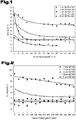
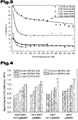
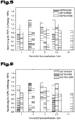
- the successful crosslinking of XNBR latex with the addition of selected water-soluble polymeric crosslinking agents was determined by means of equilibrium swelling in chloroform (determined according to: (1) Macromolecules 2008, 41, 4717-4729 , (2) J. Appl. Polym. Sci. 129 (5), 2735-2743 or (3) Zaborski, M .; Kosmalska, A .; Gulinski, J. Kautsch. Rubber plastic 2005, 58, 354 ) proven. The results are in the 1 to 3 shown.
- the crosslinking time in minutes is shown on the abscissa and the degree of swelling is shown on the ordinate.
- the crosslinking density increases with increasing crosslinking time and crosslinking agent concentration, the reactivity of the crosslinking agents increasing from DEPEG-500 ⁇ SPE ⁇ GE100.
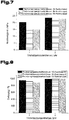
- crosslinking of XNBR latex was also demonstrated by means of tensile testing when selected water-soluble polymeric crosslinking agents were added.
- a concentration of 1 phr to 7.5 phr of multifunctional monomers and / or polymeric crosslinking agents in the latex is generally preferred.
- the stress value at 50% elongation is in the range from 1.2 to 1.4 MPa even at high tensile strengths and is hardly increased, especially when using 5 phr of crosslinking agent, even after hot air aging and gamma sterilization. This is particularly advantageous for the production of surgical gloves, since a low tension value at 50% stretch is a criterion for comfortable wearing.
- the results of measuring the 50% elongation are in Fig. 4 shown.
- the bars are arranged in groups of five, the bars within each group of five for a concentration of DEPEG-500 from left to right of 0.5 phr, 1.0 phr, 3.0 phr, 5.0 phr and 7.5 phr stand.
- the groups of five themselves stand from left to right for non-sterile and non-aged, non-sterile and aged, sterile and non-aged as well as sterile and aged samples.
- the 50% modules are given in MPa on the ordinate.
- DEPEG-500 is therefore preferably used in an amount of 5 phr to 7.5 phr.
- SPE As a water-soluble polymeric crosslinking agent, a pronounced increase in the tension value at 50% elongation is additionally observed, which is disadvantageous for the comfort of the elastomer glove.
- SPE is therefore preferably used in a concentration of 0.5 phr to 5 phr.
- the module value of the crosslinked XNBR latex films was specifically adjusted by the molecular weight of the epoxy-terminated polyethylene glycol derivative (DEPEG).
- DEPEG epoxy-terminated polyethylene glycol derivative
- the 50% modulus can be brought below 1MPa, but the corresponding tensile strengths are also below 15MPa.
- the results therefore show that a balance between tensile strength and modulus can be established over the chain length of the crosslinking agent.
- the chain lengths of the polymeric crosslinking agents mentioned above are therefore preferred.
- PolyLac 582N was crosslinked as a further alternative latex type at different pH values with 5 phr DEPEG-200. The results clearly show that PolyLac 582N can be successfully crosslinked.
- Table 2 summarizes the starting materials used for this. Table 2: Materials used Surname function description Natural rubber latex latex NO High ammonia, 60% drc Isoprene rubber - latex Kraton latex 60% drc 3-mercaptopropyl-trimethoxysilane ABCR Monomer for synthesis of the polymeric crosslinker MPTMS 3-mercaptopropyl-methyldimethoxysilane ABCR Monomer for synthesis of the polymeric crosslinker MPMDMS 3-mercaptomethyl-methyldimethoxysilane ABCR Monomer for synthesis of the polymeric crosslinker MMMDMS 3-Acryloxypropyl-methyldimethoxysilane ABCR Monomer for synthesis of the polymeric crosslinker APMDMS Lucirin TPO-L BASF Photo initiator Tween 20 Emulsifier Ionol LC Antioxidant
- the polymeric siloxane crosslinking agent can be prepared as follows.
- the UV crosslinking of the NR latex films was carried out in the course of UV exposure of the dried films (post-curing) with a UV lamp from Fusion UV Systems Inc.
- the UV exposure was carried out in air with a Ga-doped Hg lamp a lamp power of 60% and a belt speed of 3.5 m / min. After three passes, the radiation dose corresponds to 15.6 J / cm 2 .
- UV networking In general, the following parameters can be used for UV networking:
- IR latices - parameters for UV pre-crosslinking in a falling film reactor lamp output at 800 W -1000 W (800 W results in an average radiation flow of ⁇ 500 mW / cm 2 ), double exposure pass, conveying speed (latex mixture) at 1.1 l / min to 1.5 l / min, solids content (latex) at 40% drc., Photoinitiator concentration at 0.5 phr to 2phr, thiol concentration at 0.5 phr to 2phr.
- NR-Latices - parameters for UV pre-crosslinking in a falling film reactor lamp output at 2000 W- 3500 W (3000 W gives an average radiation flow of ⁇ 1690 mW / cm 2 ) double exposure, conveying speed (latex mixture) at 1.1 l / min to 1 , 5 l / min, solids content (latex) at 40% drc., Photoinitiator concentration at 0.5 phr to 2phr, thiol concentration at 1 phr to 5phr.
- UV postcrosslinking residual moisture content of the films preferably below 20%. Subsequent dosing of 0.5 phr to 5 phr photoinitiator and 1 phr to 7.5 phr thiol, radiation dose between 1 J / cm 2 and 25 J / cm 2 (240 nm - 420 nm wavelength range).
- the exposure is preferably carried out in air with a Ga-doped mercury lamp.
- the structure of the polymeric crosslinking agents was determined by means of FT-IR spectroscopy and by means of thermogravimetry (TGA).
- TGA thermogravimetry
- the characteristic SH band (approx. 2558 cm-1) is only weakly pronounced because the infrared bands of thiol groups generally have a very low intensity.
- a 2% by weight solution of polyisoprene standard in chloroform was prepared and 1phr of lucirin TPO-L and 5 phr of the corresponding thiol were added.
- the crosslinking agents (1 phr) were mixed together with a photoinitiator (1 phr Lucirin TPO-L) in a polyisoprene standard solution (2% by weight in chloroform) and then knife-coated (40 ⁇ m), dried, structured and exposed in chloroform developed. Similar to a negative resist, the exposed areas of the layer are cross-linked by the thiol-ene reaction and in the subsequent development in chloroform only the unexposed areas could be dissolved and removed.
- poly (mercaptopropyl) siloxane Due to its chemical structure (high concentration of free Si-OH groups), poly (mercaptopropyl) siloxane can crosslink during storage (even under an inert atmosphere) via a condensation reaction.
- the polymeric compound therefore has only a limited shelf life (approx. 1 week).
- UV crosslinked NR latex films (before aging and gamma sterilization) with 1 and 2phr crosslinking agents have a tensile strength of 12 MPa - 15 MPa.
- disiloxane monomers were used in further synthesis approaches.
- the polymeric compound is characterized by the lower concentration of free Si-OH groups, by a significantly higher shelf life, and no change in viscosity is observed even after storage for 1 month (under an atmosphere).
- the influence of different parameters (including reaction time, monomer content) in the synthesis on the corresponding mechanical strengths and aging resistance of NR latex films was further investigated.
- the synthesis of poly (mercaptopropylmethyl) siloxane was stopped at a constant monomer concentration in the reaction mixture (9% (w / v)) after different reaction times (3, 6 and 9 hours), the polymeric product was worked up and corresponding crosslinking experiments were carried out.
- the monomer concentration in the synthesis was varied with a constant reaction time of 3 hours (9 and 18% (w / v)). While at lower monomer concentrations (9 (w / v)) an increase in tear strength (from 20 to 26 ⁇ 2 MPa) with increasing crosslinker concentration in the latex mixture (from 1 to 3 phr) can be observed, at a higher monomer concentration (18% (w / v)) achieved an optimum at 2 phr of the crosslinker in the latex mixture (27 ⁇ 2 MPa). The results of this investigation are in the Figures 10 to 12 shown.
- NR latex films were produced at higher concentrations of polymeric crosslinking agents, UV exposed and the influence of the crosslinking agent concentration on the mechanical properties was investigated.
- Poly (mercaptopropylmethyl) siloxane (monomer concentration: 18% (w / v); reaction time: 3h) was chosen as the polymeric crosslinking agent.
- the results lead to the conclusion that a further increase in the crosslinking agent concentration from 3 phr to 4 phr does not lead to a significant improvement in the tear strengths.
- an increase in the tension value can be achieved at 50% elongation, which indicates a higher degree of crosslinking, the tensile strengths remain in the range of 25 MPa.
- a polymeric thiol crosslinking agent with a shorter intermediate group (between thiol group and polymer main chain) was synthesized.
- a methyl group was chosen instead of the propyl group.
- the monomer concentration in the synthesis was 9% (w / v) and the reaction time was three hours. This polymeric compound is also stable in storage and no changes in viscosity can be observed over a storage period of one month.
- poly (mercaptomethylmethyl) siloxane as crosslinking agent, compared to poly (mercaptopropylmethyl) siloxane, the same crosslinker concentrations (1 phr or 2 phr) tend to achieve higher mechanical strengths in the UV crosslinking of NR latex.
- the tensile strengths for non-sterile and non-aged films are about 23 MPa at a concentration of poly (mercaptopropylmethyl) siloxane of 1 phr and about 26 MPa at 2 phr.
- the 50% moduli for non-sterile and non-aged films are about 0.45 MPa at a concentration of poly (mercaptopropylmethyl) siloxane of 1 phr and about 0.5 MPa at 2 phr.
- copolymers with acryloxypropylmethyl units were also synthesized and used as crosslinking agents in the UV crosslinking of NR latex.
- the acrylate groups as the second monomer unit are intended on the one hand to prevent the formation of disulfides (as a side reaction of the thiol-ene reaction) and on the other hand to provide a reactive group (acrylates) for the attachment of the polymeric crosslinking agent to the rubber chain.
- the total concentration of both monomers in the synthesis was 9% (w / v) and the reaction time was three hours.
- This polymeric compound is also stable in storage and no changes in viscosity can be observed over a storage period of one month.
- the copolymer can achieve significantly higher tensile strengths (up to 30MPa) with the same crosslinking agent concentration in the latex mixture.
- An acrylate homopolymer was also synthesized as a reference (analogous to the synthesis of the crosslinking agents given above) and used as the crosslinking agent. Due to the high reactivity of the acrylate groups, photochemical crosslinking is achieved via direct CC linkage with the isoprene units.
- the successful structured exposure of polyisoprene films with poly (acryloxypropylmethyl) siloxane as crosslinking agent leaves Although the reactivity in UV crosslinking is sufficiently high, the mechanical properties of corresponding NR latex films (with 1 phr and 2 phr crosslinking agent) are significantly lower (14 to 17 MPa) compared to the mercapto-functional homo- and Copolymers. In addition, the films are characterized by inadequate resistance to aging (7 days hot air aging at 70 ° C) ( ⁇ 3 MPa and strong yellowing).
- the synthesized polymeric crosslinking agents (0.5 phr) were emulsified with Lucirin TPO-L (0.5 phr) in deionized water with Tween 20 (0.1 phr) and then the NR latex (40 drc.) Or the IR -Latex (40 drc., Kraton) added.
- the latex mixture was stirred at room temperature for 2 hours.
- the respective latex mixture was then poured into a Petri dish (approx. 1 mm layer thickness) and exposed with a UV lamp from Fusion UV Systems Inc.
- the NR latex mixtures were irradiated in air with a Ga-doped mercury lamp at a lamp power of 60% and a belt speed of 3.5 m / min in four passes (corresponds to a radiation dose of 20.8 J / cm 2 ).
- the IR latex mixtures were irradiated in air with a Ga-doped mercury lamp with a lamp power of 60% and a belt speed of 3.5 m / min in two passes (corresponds to a radiation dose of 10.4 J / cm 2 ).
- Post-crosslinking was also optionally carried out.
- the respective latex mixtures pre-crosslinked or not pre-crosslinked with an emulsion consisting of the synthesized polymeric crosslinking agent (2 phr), Lucirin TPO-L (1 phr), deionized water (2 phr) and Tween 20 (0.1 phr) , offset.
- the latex mixture was mixed with an anti-aging agent (0.5 phr Ionol LC) and stirred for 2 hours at room temperature.
- Corresponding films were produced with the help of the coagulation dipping process and the postcrosslinking takes place in the course of UV exposure of the dried films (post-curing) with a UV lamp from Fusion UV Systems Inc. Both NR latex films and IR latex films were exposed to air irradiated with a Ga-doped Hg lamp at a lamp output of 60% and a belt speed of 3.5 m / min in three passes (corresponds to a radiation dose of 15.6 J / cm 2 ).
- the photochemical crosslinking of the NR latex showed that the highest mechanical strengths can be achieved by post-crosslinking.
- the tensile strength of the NR latex films was approx. 22.5 MPa for the pre-cross-linked sample, approx. 18 MPa for the pre-cross-linked and post-cross-linked sample and approx. 25 MPa for the exclusively post-cross-linked sample. This result is surprising in that the pre- and post-crosslinked sample had the lowest tensile strength.
- the tensile strength of UV post-crosslinked NR latex films (not sterile, not aged) is consistently between 25 MPa and 27 MPa.
- post-crosslinked NR latex films were extracted in the course of a Soxhlet extraction (10 hours / toluene). The solvent was removed using a Rotavapor and the extract was dried in a vacuum drying cabinet to constant weight at 35 ° C. and 100 mbar.
- the extractable S compounds (thiols and proteins of the NR latex) were determined in a triplicate using C / H / N / S.
- the following exemplary embodiments are intended to show that the thermal crosslinking of XNBR latex films is successful not only with polar, water-soluble epoxy crosslinking agents but also with nonpolar epoxy derivatives.
- Example A The preparation is carried out analogously to Example A - only 3 phr or 5 phr of a hydrogenated bisphenol A diglycidyl ether (EPALLOY®5000 and EPALLOY®5001 from CVC Thermoset Specialties) are used instead of the bisphenol A diglycidyl ether.
- a hydrogenated bisphenol A diglycidyl ether EPALLOY®5000 and EPALLOY®5001 from CVC Thermoset Specialties
- the preparation is carried out analogously to Example A, except that a 1,4-cyclohexanedimethanol diglycidyl ether (3 phr and 5 phr ERISYS TM GE 22 from CVC Thermoset Specialties) is used instead of the bisphenol A diglycidyl ether.
- a 1,4-cyclohexanedimethanol diglycidyl ether (3 phr and 5 phr ERISYS TM GE 22 from CVC Thermoset Specialties) is used instead of the bisphenol A diglycidyl ether.
- the exemplary embodiments describe possible embodiment variants of the method, and various combinations of the individual embodiment variants with one another are also possible.
Landscapes
- Chemical & Material Sciences (AREA)
- Health & Medical Sciences (AREA)
- Engineering & Computer Science (AREA)
- Chemical Kinetics & Catalysis (AREA)
- Medicinal Chemistry (AREA)
- Polymers & Plastics (AREA)
- Organic Chemistry (AREA)
- Life Sciences & Earth Sciences (AREA)
- Surgery (AREA)
- Mechanical Engineering (AREA)
- Physics & Mathematics (AREA)
- Dispersion Chemistry (AREA)
- Materials Engineering (AREA)
- Manufacturing & Machinery (AREA)
- Animal Behavior & Ethology (AREA)
- Biomedical Technology (AREA)
- Medical Informatics (AREA)
- General Health & Medical Sciences (AREA)
- Public Health (AREA)
- Veterinary Medicine (AREA)
- Heart & Thoracic Surgery (AREA)
- Molecular Biology (AREA)
- Electromagnetism (AREA)
- General Chemical & Material Sciences (AREA)
- Toxicology (AREA)
- Oral & Maxillofacial Surgery (AREA)
- Thermal Sciences (AREA)
- Compositions Of Macromolecular Compounds (AREA)
- Silicon Polymers (AREA)
- Gloves (AREA)
- Manufacture Of Macromolecular Shaped Articles (AREA)
- Moulding By Coating Moulds (AREA)
- Processing And Handling Of Plastics And Other Materials For Molding In General (AREA)
Applications Claiming Priority (3)
| Application Number | Priority Date | Filing Date | Title |
|---|---|---|---|
| ATA50176/2016A AT518307B1 (de) | 2016-03-04 | 2016-03-04 | Verfahren zum Herstellen eines Prophylaxeartikels |
| PCT/AT2017/060053 WO2017147639A1 (fr) | 2016-03-04 | 2017-03-02 | Procédé de fabrication d'un article de prophylaxie |
| EP17717060.2A EP3423515B1 (fr) | 2016-03-04 | 2017-03-02 | Procédé de fabrication d'un article de prophylaxie |
Related Parent Applications (2)
| Application Number | Title | Priority Date | Filing Date |
|---|---|---|---|
| EP17717060.2A Division-Into EP3423515B1 (fr) | 2016-03-04 | 2017-03-02 | Procédé de fabrication d'un article de prophylaxie |
| EP17717060.2A Division EP3423515B1 (fr) | 2016-03-04 | 2017-03-02 | Procédé de fabrication d'un article de prophylaxie |
Publications (2)
| Publication Number | Publication Date |
|---|---|
| EP3632965A1 true EP3632965A1 (fr) | 2020-04-08 |
| EP3632965B1 EP3632965B1 (fr) | 2025-09-17 |
Family
ID=58544655
Family Applications (2)
| Application Number | Title | Priority Date | Filing Date |
|---|---|---|---|
| EP17717060.2A Active EP3423515B1 (fr) | 2016-03-04 | 2017-03-02 | Procédé de fabrication d'un article de prophylaxie |
| EP19210944.5A Active EP3632965B1 (fr) | 2016-03-04 | 2017-03-02 | Procédé de fabrication d'un article de traitement prophylactique |
Family Applications Before (1)
| Application Number | Title | Priority Date | Filing Date |
|---|---|---|---|
| EP17717060.2A Active EP3423515B1 (fr) | 2016-03-04 | 2017-03-02 | Procédé de fabrication d'un article de prophylaxie |
Country Status (9)
| Country | Link |
|---|---|
| US (1) | US10808046B2 (fr) |
| EP (2) | EP3423515B1 (fr) |
| JP (1) | JP7166924B2 (fr) |
| AT (1) | AT518307B1 (fr) |
| ES (1) | ES2833935T3 (fr) |
| MY (1) | MY191181A (fr) |
| PL (1) | PL3423515T3 (fr) |
| PT (1) | PT3423515T (fr) |
| WO (1) | WO2017147639A1 (fr) |
Families Citing this family (3)
| Publication number | Priority date | Publication date | Assignee | Title |
|---|---|---|---|---|
| EP3575357B1 (fr) | 2018-04-06 | 2022-04-20 | Midori Anzen Co., Ltd. | Composition pour moulage par immersion, procédé de production de gants et gants |
| MY201626A (en) * | 2019-03-28 | 2024-03-06 | Midori Anzen Co Ltd | Composition for dip molding, method for producing glove using same, and glove |
| CN110215737B (zh) * | 2019-06-13 | 2021-07-02 | 厦门华厦学院 | 一种基于石墨烯-纳米金复合界面超高负载核酸适配体的亲和整体柱及其制备方法 |
Citations (8)
| Publication number | Priority date | Publication date | Assignee | Title |
|---|---|---|---|---|
| WO2000011980A1 (fr) * | 1998-08-27 | 2000-03-09 | Gardon John L | Articles medicaux et d'hygiene non-allergenes fabriques a partir d'elastomeres synthetiques reticules |
| EP1209186A1 (fr) * | 1999-05-28 | 2002-05-29 | Suzuki Latex Industry Co., Ltd. | Produits de latex non collants |
| EP1762586A2 (fr) * | 2005-09-12 | 2007-03-14 | Semperit Aktiengesellschaft Holding | Procédé de production d'un élastomère réticulé |
| US20100152365A1 (en) | 2008-12-16 | 2010-06-17 | Lg Chem, Ltd. | Carboxylic acid-modified nitrile copolymer latex and latex composition for dip forming comprising the same |
| WO2010105283A1 (fr) * | 2009-03-17 | 2010-09-23 | Semperit Aktiengesellschaft Holding | Procédé de production d'un élastomère réticulé |
| WO2011068394A1 (fr) | 2009-12-01 | 2011-06-09 | Kossan Sdn Bhd | Caoutchouc élastomère et produits en caoutchouc sans emploi d'accélérateurs de vulcanisation ni de soufre |
| US20140096308A1 (en) | 2012-10-09 | 2014-04-10 | Semperit Aktiengesellschaft Holding | Elastomer product with covalently bonded particles |
| US20140096307A1 (en) | 2012-10-09 | 2014-04-10 | Semperit Aktiengesellschaft Holding | Method for modifying the surface of an elastomer product |
Family Cites Families (14)
| Publication number | Priority date | Publication date | Assignee | Title |
|---|---|---|---|---|
| DE1520022C3 (de) | 1964-12-09 | 1973-10-31 | Th. Goldschmidt Ag, 4300 Essen | Verfahren zur Herstellung von schwefelhaltigen, mit organischen SiIi ciumverbindungen modifizierten Epoxid harzen |
| BR9809700A (pt) * | 1997-05-28 | 2000-07-11 | Reichhold Chemicals Inc | Material elastomérico para artigos de borracha |
| AU781491B2 (en) * | 1999-04-14 | 2005-05-26 | Sumitomo Rubber Industries, Ltd. | Acrylic resin glove and internal surface treating agent thereof |
| US20030118761A1 (en) * | 2001-12-21 | 2003-06-26 | Kimberly-Clark Worldwide, Inc. | Elastomeric articles having improved chemical resistance |
| JP4350434B2 (ja) * | 2003-06-13 | 2009-10-21 | 横浜ゴム株式会社 | 熱可塑性エラストマー組成物 |
| US20050113527A1 (en) * | 2003-11-21 | 2005-05-26 | Perrella Frank W. | Crosslinking polymer composition |
| US7465765B2 (en) | 2004-09-27 | 2008-12-16 | Hewlett-Packard Development Company, L.P. | Latex particulates with epoxide functional groups |
| WO2008001764A1 (fr) * | 2006-06-30 | 2008-01-03 | Four Road Research Ltd. | Agent de réticulation contenant une composition de latex et corps moulé réticulé correspondant |
| US8389620B2 (en) * | 2006-06-30 | 2013-03-05 | Four Road Research Ltd. | Dip forming latex composition containing crosslinking agent and dip formed article obtained therefrom |
| GB2455409A (en) * | 2007-12-07 | 2009-06-10 | Bangkok Synthetics Co Ltd | Crosslinking of diene-type polymers |
| KR101126583B1 (ko) * | 2008-09-26 | 2012-03-29 | 주식회사 엘지화학 | 황 및 가황 촉진제를 포함하지 않는 고무장갑용 라텍스 수지 조성물 및 그 조성물을 이용한 딥 성형물 제조방법 |
| AT511292B1 (de) | 2010-05-26 | 2013-01-15 | Semperit Ag Holding | Handschuh |
| JP2017160279A (ja) * | 2014-07-25 | 2017-09-14 | ミドリ安全株式会社 | 手袋用エラストマー組成物及び強度、剛性に優れた薄手手袋 |
| US20170099889A1 (en) * | 2015-10-07 | 2017-04-13 | Derlink Co., Ltd. | High stress retention nitrile glove |
-
2016
- 2016-03-04 AT ATA50176/2016A patent/AT518307B1/de active
-
2017
- 2017-03-02 EP EP17717060.2A patent/EP3423515B1/fr active Active
- 2017-03-02 MY MYPI2018703100A patent/MY191181A/en unknown
- 2017-03-02 EP EP19210944.5A patent/EP3632965B1/fr active Active
- 2017-03-02 PL PL17717060.2T patent/PL3423515T3/pl unknown
- 2017-03-02 ES ES17717060T patent/ES2833935T3/es active Active
- 2017-03-02 US US16/081,486 patent/US10808046B2/en active Active
- 2017-03-02 PT PT177170602T patent/PT3423515T/pt unknown
- 2017-03-02 JP JP2018546527A patent/JP7166924B2/ja active Active
- 2017-03-02 WO PCT/AT2017/060053 patent/WO2017147639A1/fr not_active Ceased
Patent Citations (9)
| Publication number | Priority date | Publication date | Assignee | Title |
|---|---|---|---|---|
| WO2000011980A1 (fr) * | 1998-08-27 | 2000-03-09 | Gardon John L | Articles medicaux et d'hygiene non-allergenes fabriques a partir d'elastomeres synthetiques reticules |
| EP1209186A1 (fr) * | 1999-05-28 | 2002-05-29 | Suzuki Latex Industry Co., Ltd. | Produits de latex non collants |
| EP1762586A2 (fr) * | 2005-09-12 | 2007-03-14 | Semperit Aktiengesellschaft Holding | Procédé de production d'un élastomère réticulé |
| US20100152365A1 (en) | 2008-12-16 | 2010-06-17 | Lg Chem, Ltd. | Carboxylic acid-modified nitrile copolymer latex and latex composition for dip forming comprising the same |
| WO2010105283A1 (fr) * | 2009-03-17 | 2010-09-23 | Semperit Aktiengesellschaft Holding | Procédé de production d'un élastomère réticulé |
| WO2011068394A1 (fr) | 2009-12-01 | 2011-06-09 | Kossan Sdn Bhd | Caoutchouc élastomère et produits en caoutchouc sans emploi d'accélérateurs de vulcanisation ni de soufre |
| US20140096308A1 (en) | 2012-10-09 | 2014-04-10 | Semperit Aktiengesellschaft Holding | Elastomer product with covalently bonded particles |
| US20140096307A1 (en) | 2012-10-09 | 2014-04-10 | Semperit Aktiengesellschaft Holding | Method for modifying the surface of an elastomer product |
| EP2719720A1 (fr) * | 2012-10-09 | 2014-04-16 | Semperit Aktiengesellschaft Holding | Procédé destiné à la modification de la surface d'un produit élastomère |
Non-Patent Citations (6)
| Title |
|---|
| BROWN H P ET AL: "CROSSLINKING REACTIONS OF CARBOXYLIC ELASTOMERS", RUBBER CHEMISTRY AND TECHNOLOGY, AMERICAN CHEMICAL SOCIETY, RUBBER DIVISION, US, vol. 36, no. 4, 4 September 1963 (1963-09-04), pages 931 - 962, XP001109664, ISSN: 0035-9475 * |
| DIETMAR LENKO ET AL: "Dual crosslinking of carboxylated nitrile butadiene rubber latex employing the thiol-ene photoreaction", JOURNAL OF APPLIED POLYMER SCIENCE, vol. 129, no. 5, 5 September 2013 (2013-09-05), US, pages 2735 - 2743, XP055387216, ISSN: 0021-8995, DOI: 10.1002/app.38983 * |
| J. APPL. POLYM. SCI., vol. 129, no. 5, pages 2735 - 2743 |
| MACROMOLECULES, vol. 41, 2008, pages 4717 - 4729 |
| SANDRA SCHLÖGL ET AL: "Photo-vulcanization using thiol-ene chemistry: Film formation, morphology and network characteristics of UV crosslinked rubber latices", POLYMER., vol. 55, no. 22, 10 June 2014 (2014-06-10), GB, pages 5584 - 5595, XP055387227, ISSN: 0032-3861, DOI: 10.1016/j.polymer.2014.06.007 * |
| ZABORSKI, M.KOSMALSKA, A.GULINSKI, J. KAUTSCH, GUMMI KUNSTST., vol. 58, 2005, pages 354 |
Also Published As
| Publication number | Publication date |
|---|---|
| US10808046B2 (en) | 2020-10-20 |
| US20190092879A1 (en) | 2019-03-28 |
| WO2017147639A1 (fr) | 2017-09-08 |
| EP3423515B1 (fr) | 2020-08-26 |
| AT518307A1 (de) | 2017-09-15 |
| EP3423515A1 (fr) | 2019-01-09 |
| PL3423515T3 (pl) | 2021-03-22 |
| JP7166924B2 (ja) | 2022-11-08 |
| ES2833935T3 (es) | 2021-06-16 |
| PT3423515T (pt) | 2020-11-24 |
| MY191181A (en) | 2022-06-04 |
| AT518307B1 (de) | 2020-04-15 |
| EP3632965B1 (fr) | 2025-09-17 |
| JP2019518808A (ja) | 2019-07-04 |
Similar Documents
| Publication | Publication Date | Title |
|---|---|---|
| EP2408849B1 (fr) | Procédé de préparation d'un élastomère réticulé | |
| DE60126926T2 (de) | Vulkanisation von tauchgeformten gummigegenständen mittels eines schmelzbades | |
| DE2918313C2 (de) | Verfahren zur Herstellung von Polysiloxanelastomeren hoher Festigkeit | |
| EP0269819B1 (fr) | Utilisation de produits de polyaddition de polyéther-uréthane-urée comme masse d'empreinte dentaire | |
| DE69633662T2 (de) | Verfahren zur herstellung von formteilen aus entproteinisiertem natürlichem elastomerer kautschuk und entproteinisierungsmittel für naturkautschuk | |
| DE10297860B3 (de) | Beschleunigerzusammensetzung und dessen Verwendung | |
| DE2509654C2 (de) | Verfahren zur Herstellung gegen Oxidation stabiler Polymere | |
| DE69810382T2 (de) | Spritzennadel | |
| DE69001551T2 (de) | Latexfilme von Naturkautschuk von modifizierter Zugfestigkeit. | |
| DE69220950T2 (de) | Siloxanzusammensetzung mit hohem brechungsindex | |
| EP3423514B1 (fr) | Procédé de fabrication d'un article prophylactique | |
| DE69630300T2 (de) | Operationshandschuhe aus neoprencopolymeren | |
| DE69801240T2 (de) | Dünnwandige Kautschukartikel | |
| DE69628438T2 (de) | Verbesserte verfahren zur reduzierung der allergischen wirkung von gegenständen aus naturkautschuklatex | |
| AT502764B1 (de) | Mischung und verfahren zur herstellung eines vernetzten elastomers sowie vorrichtung zur herstellung eines tauchartikels | |
| EP3423515B1 (fr) | Procédé de fabrication d'un article de prophylaxie | |
| EP2719720B1 (fr) | Procédé destiné à la modification de la surface d'un produit élastomère | |
| DE60118757T2 (de) | Synthetische kautschukelastomere als ersatz für naturkautschuklatex | |
| EP3560980A1 (fr) | Polyester à chaîne allongée, dérivés prépolymérisés dudit polyester et leur utilisation ainsi que masses de résine époxyde | |
| DE10113971A1 (de) | Verfahren zur Beschichtung von Oberflächen aus Kunststoff mit Bis-Poly-Trifluorethoxy-Polyphosphazen und Derivaten | |
| DE4222953C2 (de) | Verfahren zur Herstellung nachträglich modifizierbarer thermoplastisch verarbeitbarer Polymerisate | |
| AT518300B1 (de) | Verfahren zum Herstellen eines Prophylaxeartikels | |
| Utama et al. | Trial production of surgical gloves from irradiated natural rubber latex on factory scale | |
| AT522889A4 (de) | Verfahren zur Herstellung einer flüssigen Formulierung für eine Herstellung eines Elastomers im 3-D-Druck, Formulierung daraus und deren Verwendung | |
| DE3910830A1 (de) | Herstellung von vorvernetztem naturkautschuk-latex |
Legal Events
| Date | Code | Title | Description |
|---|---|---|---|
| PUAI | Public reference made under article 153(3) epc to a published international application that has entered the european phase |
Free format text: ORIGINAL CODE: 0009012 |
|
| STAA | Information on the status of an ep patent application or granted ep patent |
Free format text: STATUS: THE APPLICATION HAS BEEN PUBLISHED |
|
| AC | Divisional application: reference to earlier application |
Ref document number: 3423515 Country of ref document: EP Kind code of ref document: P |
|
| AK | Designated contracting states |
Kind code of ref document: A1 Designated state(s): AL AT BE BG CH CY CZ DE DK EE ES FI FR GB GR HR HU IE IS IT LI LT LU LV MC MK MT NL NO PL PT RO RS SE SI SK SM TR |
|
| STAA | Information on the status of an ep patent application or granted ep patent |
Free format text: STATUS: REQUEST FOR EXAMINATION WAS MADE |
|
| 17P | Request for examination filed |
Effective date: 20200918 |
|
| RBV | Designated contracting states (corrected) |
Designated state(s): AL AT BE BG CH CY CZ DE DK EE ES FI FR GB GR HR HU IE IS IT LI LT LU LV MC MK MT NL NO PL PT RO RS SE SI SK SM TR |
|
| STAA | Information on the status of an ep patent application or granted ep patent |
Free format text: STATUS: THE APPLICATION IS DEEMED TO BE WITHDRAWN |
|
| 18D | Application deemed to be withdrawn |
Effective date: 20201001 |
|
| 18RA | Request filed for re-establishment of rights before grant |
Effective date: 20210325 |
|
| STAA | Information on the status of an ep patent application or granted ep patent |
Free format text: STATUS: REQUEST FOR EXAMINATION WAS MADE |
|
| D18D | Application deemed to be withdrawn (deleted) | ||
| STAA | Information on the status of an ep patent application or granted ep patent |
Free format text: STATUS: EXAMINATION IS IN PROGRESS |
|
| 17Q | First examination report despatched |
Effective date: 20230725 |
|
| RAP1 | Party data changed (applicant data changed or rights of an application transferred) |
Owner name: LATEXX MANUFACTURING SDN. BHD. |
|
| GRAP | Despatch of communication of intention to grant a patent |
Free format text: ORIGINAL CODE: EPIDOSNIGR1 |
|
| STAA | Information on the status of an ep patent application or granted ep patent |
Free format text: STATUS: GRANT OF PATENT IS INTENDED |
|
| INTG | Intention to grant announced |
Effective date: 20250409 |
|
| GRAS | Grant fee paid |
Free format text: ORIGINAL CODE: EPIDOSNIGR3 |
|
| GRAA | (expected) grant |
Free format text: ORIGINAL CODE: 0009210 |
|
| STAA | Information on the status of an ep patent application or granted ep patent |
Free format text: STATUS: THE PATENT HAS BEEN GRANTED |
|
| AC | Divisional application: reference to earlier application |
Ref document number: 3423515 Country of ref document: EP Kind code of ref document: P |
|
| AK | Designated contracting states |
Kind code of ref document: B1 Designated state(s): AL AT BE BG CH CY CZ DE DK EE ES FI FR GB GR HR HU IE IS IT LI LT LU LV MC MK MT NL NO PL PT RO RS SE SI SK SM TR |
|
| REG | Reference to a national code |
Ref country code: CH Ref legal event code: EP |
|
| REG | Reference to a national code |
Ref country code: DE Ref legal event code: R096 Ref document number: 502017017064 Country of ref document: DE |
|
| P01 | Opt-out of the competence of the unified patent court (upc) registered |
Free format text: CASE NUMBER: UPC_APP_5137_3632965/2025 Effective date: 20250829 |
|
| REG | Reference to a national code |
Ref country code: IE Ref legal event code: FG4D Free format text: LANGUAGE OF EP DOCUMENT: GERMAN |
|
| PG25 | Lapsed in a contracting state [announced via postgrant information from national office to epo] |
Ref country code: NO Free format text: LAPSE BECAUSE OF FAILURE TO SUBMIT A TRANSLATION OF THE DESCRIPTION OR TO PAY THE FEE WITHIN THE PRESCRIBED TIME-LIMIT Effective date: 20251217 |
|
| REG | Reference to a national code |
Ref country code: LT Ref legal event code: MG9D |
|
| PG25 | Lapsed in a contracting state [announced via postgrant information from national office to epo] |
Ref country code: FI Free format text: LAPSE BECAUSE OF FAILURE TO SUBMIT A TRANSLATION OF THE DESCRIPTION OR TO PAY THE FEE WITHIN THE PRESCRIBED TIME-LIMIT Effective date: 20250917 |
|
| PG25 | Lapsed in a contracting state [announced via postgrant information from national office to epo] |
Ref country code: HR Free format text: LAPSE BECAUSE OF FAILURE TO SUBMIT A TRANSLATION OF THE DESCRIPTION OR TO PAY THE FEE WITHIN THE PRESCRIBED TIME-LIMIT Effective date: 20250917 |
|
| PG25 | Lapsed in a contracting state [announced via postgrant information from national office to epo] |
Ref country code: GR Free format text: LAPSE BECAUSE OF FAILURE TO SUBMIT A TRANSLATION OF THE DESCRIPTION OR TO PAY THE FEE WITHIN THE PRESCRIBED TIME-LIMIT Effective date: 20251218 |
|
| PG25 | Lapsed in a contracting state [announced via postgrant information from national office to epo] |
Ref country code: SE Free format text: LAPSE BECAUSE OF FAILURE TO SUBMIT A TRANSLATION OF THE DESCRIPTION OR TO PAY THE FEE WITHIN THE PRESCRIBED TIME-LIMIT Effective date: 20250917 |
|
| REG | Reference to a national code |
Ref country code: NL Ref legal event code: MP Effective date: 20250917 |
|
| PG25 | Lapsed in a contracting state [announced via postgrant information from national office to epo] |
Ref country code: LV Free format text: LAPSE BECAUSE OF FAILURE TO SUBMIT A TRANSLATION OF THE DESCRIPTION OR TO PAY THE FEE WITHIN THE PRESCRIBED TIME-LIMIT Effective date: 20250917 |
|
| PG25 | Lapsed in a contracting state [announced via postgrant information from national office to epo] |
Ref country code: BG Free format text: LAPSE BECAUSE OF FAILURE TO SUBMIT A TRANSLATION OF THE DESCRIPTION OR TO PAY THE FEE WITHIN THE PRESCRIBED TIME-LIMIT Effective date: 20250917 |
|
| PG25 | Lapsed in a contracting state [announced via postgrant information from national office to epo] |
Ref country code: RS Free format text: LAPSE BECAUSE OF FAILURE TO SUBMIT A TRANSLATION OF THE DESCRIPTION OR TO PAY THE FEE WITHIN THE PRESCRIBED TIME-LIMIT Effective date: 20251217 |
|
| PG25 | Lapsed in a contracting state [announced via postgrant information from national office to epo] |
Ref country code: NL Free format text: LAPSE BECAUSE OF FAILURE TO SUBMIT A TRANSLATION OF THE DESCRIPTION OR TO PAY THE FEE WITHIN THE PRESCRIBED TIME-LIMIT Effective date: 20250917 |
|
| PG25 | Lapsed in a contracting state [announced via postgrant information from national office to epo] |
Ref country code: SM Free format text: LAPSE BECAUSE OF FAILURE TO SUBMIT A TRANSLATION OF THE DESCRIPTION OR TO PAY THE FEE WITHIN THE PRESCRIBED TIME-LIMIT Effective date: 20250917 |
|
| PG25 | Lapsed in a contracting state [announced via postgrant information from national office to epo] |
Ref country code: ES Free format text: LAPSE BECAUSE OF FAILURE TO SUBMIT A TRANSLATION OF THE DESCRIPTION OR TO PAY THE FEE WITHIN THE PRESCRIBED TIME-LIMIT Effective date: 20250917 |
|
| PG25 | Lapsed in a contracting state [announced via postgrant information from national office to epo] |
Ref country code: IT Free format text: LAPSE BECAUSE OF FAILURE TO SUBMIT A TRANSLATION OF THE DESCRIPTION OR TO PAY THE FEE WITHIN THE PRESCRIBED TIME-LIMIT Effective date: 20250917 |
|
| PG25 | Lapsed in a contracting state [announced via postgrant information from national office to epo] |
Ref country code: IS Free format text: LAPSE BECAUSE OF FAILURE TO SUBMIT A TRANSLATION OF THE DESCRIPTION OR TO PAY THE FEE WITHIN THE PRESCRIBED TIME-LIMIT Effective date: 20260117 |
|
| PG25 | Lapsed in a contracting state [announced via postgrant information from national office to epo] |
Ref country code: CZ Free format text: LAPSE BECAUSE OF FAILURE TO SUBMIT A TRANSLATION OF THE DESCRIPTION OR TO PAY THE FEE WITHIN THE PRESCRIBED TIME-LIMIT Effective date: 20250917 Ref country code: PT Free format text: LAPSE BECAUSE OF FAILURE TO SUBMIT A TRANSLATION OF THE DESCRIPTION OR TO PAY THE FEE WITHIN THE PRESCRIBED TIME-LIMIT Effective date: 20260119 |
|
| PG25 | Lapsed in a contracting state [announced via postgrant information from national office to epo] |
Ref country code: PL Free format text: LAPSE BECAUSE OF FAILURE TO SUBMIT A TRANSLATION OF THE DESCRIPTION OR TO PAY THE FEE WITHIN THE PRESCRIBED TIME-LIMIT Effective date: 20250917 |
|
| PG25 | Lapsed in a contracting state [announced via postgrant information from national office to epo] |
Ref country code: EE Free format text: LAPSE BECAUSE OF FAILURE TO SUBMIT A TRANSLATION OF THE DESCRIPTION OR TO PAY THE FEE WITHIN THE PRESCRIBED TIME-LIMIT Effective date: 20250917 Ref country code: SK Free format text: LAPSE BECAUSE OF FAILURE TO SUBMIT A TRANSLATION OF THE DESCRIPTION OR TO PAY THE FEE WITHIN THE PRESCRIBED TIME-LIMIT Effective date: 20250917 |