EP3633625A1 - Verfahren zur texturierung von 3d modellen - Google Patents
Verfahren zur texturierung von 3d modellen Download PDFInfo
- Publication number
- EP3633625A1 EP3633625A1 EP19201284.7A EP19201284A EP3633625A1 EP 3633625 A1 EP3633625 A1 EP 3633625A1 EP 19201284 A EP19201284 A EP 19201284A EP 3633625 A1 EP3633625 A1 EP 3633625A1
- Authority
- EP
- European Patent Office
- Prior art keywords
- model
- image
- scene
- images
- surface element
- Prior art date
- Legal status (The legal status is an assumption and is not a legal conclusion. Google has not performed a legal analysis and makes no representation as to the accuracy of the status listed.)
- Granted
Links
Images



Classifications
-
- G—PHYSICS
- G06—COMPUTING OR CALCULATING; COUNTING
- G06T—IMAGE DATA PROCESSING OR GENERATION, IN GENERAL
- G06T17/00—Three-dimensional [3D] modelling for computer graphics
- G06T17/20—Finite element generation, e.g. wire-frame surface description, tesselation
-
- G—PHYSICS
- G06—COMPUTING OR CALCULATING; COUNTING
- G06T—IMAGE DATA PROCESSING OR GENERATION, IN GENERAL
- G06T15/00—Three-dimensional [3D] image rendering
- G06T15/04—Texture mapping
-
- G—PHYSICS
- G06—COMPUTING OR CALCULATING; COUNTING
- G06T—IMAGE DATA PROCESSING OR GENERATION, IN GENERAL
- G06T19/00—Manipulating three-dimensional [3D] models or images for computer graphics
-
- G—PHYSICS
- G06—COMPUTING OR CALCULATING; COUNTING
- G06T—IMAGE DATA PROCESSING OR GENERATION, IN GENERAL
- G06T2219/00—Indexing scheme for manipulating 3D models or images for computer graphics
- G06T2219/021—Flattening
Definitions
- the invention relates to a method for texturing a 3D digital model.
- a known method consists in meshing, by surface elements, generally of triangular shape, a point cloud obtained by a method of measuring the relief of the object, such as stereoscopy or Lidar (English acronym of "Light Detection And Ranging"). The points then define the vertices of the surface elements of the mesh.
- a texturing step of the mesh surface is then implemented, during which a property, generally a color, is assigned to each element of the mesh surface. So that the display of the mesh and textured surface visually represents the scene as faithfully as possible, most texturing models aim to assign a color close to that of the part of the object that the mesh element aims to model. .
- a property generally a color
- most texturing models aim to assign a color close to that of the part of the object that the mesh element aims to model.
- a color can be associated with each point of the point cloud, in a defined color space, for example RGB.
- a texture can then be associated with each surface element by interpolating, for example linearly between the vertices of the element, the associated colorimetric data.
- the textured 3D model obtained by the method according to the invention comprises more details of the scene than a textured 3D model obtained by the interpolation method of the prior art described above.
- the textured 3D model can also be displayed without the need for a more powerful graphics card. In addition, its display more accurately reflects the scene.
- scene part of an environment that can be observed by an image acquisition device when it is stationary at a given location.
- the environment can be an underground installation, for example a gallery of a sewer or a mine, or be outside. It can in particular be urban or rural.
- the scene comprises at least one, preferably several objects.
- the object can be a work, for example a bridge or a tunnel, a building, a house, a stadium, a ship, a warehouse, an element of urban furniture, for example a bus shelter, a traffic sign, a traffic light. signage. It can be a piece of furniture or an ornamental item. It can be a natural element, for example a tree or a rock.
- the point cloud can be obtained by reconstruction from overlapping images of the scene, from a LIDAR acquisition or from a joint use of these two techniques.
- the method comprises a step, prior to step a), in which the scene is discretized in the form of the point cloud, from a bank of images comprising images each representing a portion of the scene seen by at least one camera and in which at least two images acquired in different positions represent overlapping portions of the scene.
- the image bank is preferably identical to that used in step i).
- the discretization of the scene is preferably carried out by photogrammetric processing of the images of the bank.
- the images are advantageously used both to generate the point cloud and to texture a surface element of the 3D model.
- Photogrammetric processing can implement a conventional stereovision algorithm, which identifies constituent elements of a scene on different images acquired according to different axes of view, then determines the relative positions of said constituent elements.
- photogrammetric processing is implemented using PhotoScan software published by the company Agisoft.
- the image bank can be saved on a computer storage medium, for example a hard disk or a memory of SSD or Flash type.
- the images are preferably saved in a raw format, for example of the .raw type.
- raw format is meant an image recording format in which the color information collected by the sensor of a camera is transcribed directly to a pixel. of the image, without being altered by a stage of development and digital compression, as is the case for example when saving a file of type .jpg or .png.
- the images can each comprise more than 1 million, or even more than 4 million, or even more than 8 million, better still more than 16 million pixels.
- the image bank may include images representing portions of different scenes. For example, it has more than 200 million images.
- the projection step described above is carried out when the angle between the viewing axes of the camera or cameras in the different positions is greater than 5 °.
- the image bank comprises images acquired in the same acquisition location by different cameras. In this way, the construction of the point cloud is facilitated, these images being able to be correlated with each other.
- the bank includes images acquired in the same acquisition location, for example by cameras oriented differently from each other, representing the scene with an angular aperture greater than 90 °, or even greater than 180 °, or even greater than 270 °, in particular equal to 360 °.
- An image comprises, in each pixel which composes it, at least one piece of pixel information.
- the pixel information characterizes a property of the material constituting the part of the scene imaged by the camera in the pixel.
- Information from pixel may result from image acquisition by the camera. Alternatively, the pixel information can be measured regardless of how the image is acquired and be assigned later to the pixel after the image is acquired.
- the pixel information is a color, defined in a color space, for example RGB or CMNY.
- the images of the bank are then for example acquired by at least one camera comprising a visible light sensor.
- Each image can comprise, for each pixel which composes it, several pieces of information of pixels which are different from each other.
- an image can include in each pixel the color and the temperature of the part of an object imaged in the pixel.
- the image bank may include metadata, preferably associated with each image, or even with each pixel of each of the images.
- the metadata may include at least one piece of information relating to the camera chosen from an identifier of the camera having acquired the image, the position and the accuracy of the position, for example recorded by GPS of the camera having acquired the image, the orientation of the camera's viewing axis, as well as the focal length and aperture of the camera lens.
- position of the camera we consider the position, in a frame of reference of the scene, of the center of the image plane of the camera, through which the optical axis of the camera passes.
- orientation of the camera we consider the direction of the optical axis of the camera.
- Metadata can include the date of image acquisition, and other EXIF data.
- the x, y, z coordinates of the system associated with the 3D model can also be added to this metadata.
- the image bank preferably comprises at least one, preferably a plurality of images, the portion of which representing the area of the object modeled by the surface element has a resolution greater than 50 px.mm -2 [ pixels per square millimeter], preferably greater than 70 px.mm -2 , preferably greater than 80 ppx.mm -2 , or even preferably greater than 90 px.mm -2 , better greater than or equal to 100 px.mm - 2 , based on the surface area of the area of the object modeled by the surface element.
- an observer of a display of the textured 3D model obtained by the method according to the invention can discern in the surface element all the details of the area of the object that he would actually observe if he were facing the 'object.
- the image bank implemented in step i) is generated by moving, in a plurality of acquisition locations, a scanning device comprising at least one camera, and a portion of the scene seen by the scanning device is acquired at each acquisition location by taking at least one image by means of the camera, the acquisition locations being chosen so that the portions of the scene seen by the scanning device at two respective consecutive acquisition locations at least partially overlap.
- the acquisition device comprises an acquisition module comprising a rod and at least two acquisition stages arranged at different heights on the rod, each acquisition stage comprising a plurality of cameras configured to each acquire an image of the scene, the axes of view of the cameras of an acquisition stage being distributed angularly around the axis of the rod so that the acquired images overlap angularly.
- the cane can be adapted to be carried by an operator moving in the environment. It can include a foot in the lower part allowing it to be placed on the ground.
- the device can comprise at least three, preferably three acquisition stages. The cameras of each stage being distributed around the longitudinal axis of the rod, over a total angular sector of between 90 ° and 120 °, preferably between 150 ° and 190 °, in particular equal to 180 °.
- the spacing between the acquisition stages can be adjustable.
- the cameras of an acquisition stage are preferably fixed relative to each other.
- the acquisition module can comprise at least six, preferably at least ten, preferably at least twelve, in particular fifteen cameras.
- the acquisition of the images is preferably carried out by means of the image acquisition device described in the request. FR 1856591 incorporated here by reference.
- step a) the point cloud is meshed using surface elements. It can be carried out using specific software, called a mesh, well known to those skilled in the art, such as 3D Reshaper or Photoscan, for example.
- the mesh formed in step a) may comprise, or even consist of quadrangular elements and / or preferably triangular surface elements, better suited to the mesh of 3D surfaces.
- the ratio of the number of images from the bank representing the scene to the number of elements of the surface mesh is greater than 1, preferably greater than 100, preferably greater than 300.
- the image bank comprises a particularly large amount of pixel information to define a detailed texture for each surface element of the mesh.
- “unfolding” means the mathematical operation by which the 2D model is made to correspond to the 3D model, by associating a unique pair of 2D coordinates, generally noted (u, v), of a vertex of a polygon of the planar mesh, at a vertex of the surface element of the 3D mesh which corresponds to it.
- a “flat pattern” which comprises in a single plane, the set of three-dimensional surfaces of the 3D model flattened in the plane.
- plane mesh formed of polygons it is understood that all the vertices of the polygons of the mesh are contained in a plane.
- each polygon is a triangle and each surface element is a triangle.
- the polygon and the surface element have the same shape and the same dimensions.
- the 2D model can include one or more connected 2D mesh surfaces, preferably a single connected 2D mesh surface.
- connected surface is meant a surface delimited by a single contour line closing in on itself.
- the area defined by a rectangle is a related area.
- the surface delimited by two concentric circles of different diameters is not connected.
- step b) of unfolding is carried out so as to obtain the lowest possible number of connected surfaces.
- step b) of unfolding is carried out so as to obtain the lowest possible number of connected surfaces.
- the basket handle discretized in the model is unfolded independently of the rest of the basket model.
- the unfolding is carried out by minimizing the number of surfaces of the 2D model and by minimizing the number of orphans in the connectivity table of the 2D model.
- a 3D mesh, respectively 2D is characterized by a connectivity table, which indicates for each vertex of a surface element, respectively of a polygon of the mesh, to which surface elements, respectively polygons, it belongs.
- An “orphan” corresponds to the mathematical impossibility of preserving, for a vertex of a polygon in the 2D model, the connectivity information of the vertex of the corresponding surface element.
- the rate of orphans calculated as the ratio of the number of orphans to the number of points of the 3D model, expressed in percent, is less than 30%, preferably less than 10%, or even less than 5%.
- a 2D model is thus obtained which is easily manipulated by the operator implementing the method, and the production of the textured 3D model is facilitated. As will be illustrated below, the operator can more easily intervene on the textured 2D model thus unfolded to correct the artifacts that he could observe on the textured 3D model.
- Unfolding can be carried out automatically with software known to those skilled in the art, such as Blender, Autodesk Maya, Cinema 4D. As a variant, it can be carried out semi-automatically, the operator being able to overcome the limitations of the automatic methods, in particular encountered in the case where these automatic methods generate a high number of non-connected surfaces.
- step c) the 2D model is textured from the image pixel information of the bank.
- the generation of the textured 2D model facilitates the generation of the textured 3D model, as will be explained in step d) below.
- Step c) is implemented for at least one, preferably for all the surface elements of the 3D model generated in step a).
- step i) the images of the bank which represent the area of the scene and which have been acquired by a camera whose image plane has a normal direction, in the corresponding acquisition position, making a lower angle, are identified. at 10 °, preferably less than 5 °, better still less than 3 °, with a direction normal to the face of the surface element.
- the identification can be carried out, starting from the knowledge for each image of the bank of the position and / or the orientation of the camera having acquired the image.
- the position and / or orientation of the camera can be metadata or result from the photogrammetric processing of images. For example, an image is discarded when it has been taken by a camera oriented in a direction substantially opposite to the area of the object delimited by the surface element considered.
- Step i) aims to determine the images which appear to be the best oriented with respect to the surface element, so as to assign it pixel information contained in one of these images.
- the method comprises a step i ') intermediate between steps i) and ii), in which the clear images are identified from the images determined in step i).
- the sharpness of an image can be determined by means of at least one descriptor such as the maximum of the gradient.
- the gradient of the image measures the local variation of the color intensity of the pixels. The higher the value of the gradient, the more visible the details of the image.
- the sharpness can also be determined simply and easily by the eye of the operator implementing the method.
- the method further comprises a step i ") intermediate between steps i ') and ii), in which one identifies, among the images determined in steps i) and i'), the image taken by the camera whose the image plane is the closest to the surface element, thus identifying among the best oriented and clearest images, that which was acquired closest to the area of the object modeled by the surface element.
- a step i " intermediate between steps i ') and ii), in which one identifies, among the images determined in steps i) and i'), the image taken by the camera whose the image plane is the closest to the surface element, thus identifying among the best oriented and clearest images, that which was acquired closest to the area of the object modeled by the surface element.
- Such an image is the one with the most pixels, and therefore with associated information, describing the area of the object modeled by the surface element.
- step i) it is possible to select the image whose image plane of the camera has a normal direction, in the corresponding acquisition position, making the smallest angle, with a direction normal to the face of the surface element.
- Such an image is not necessarily the clearest and / or that acquired by the camera whose image plane is closest to the zone of the object modeled by the surface element, but has the advantage of being the better oriented with respect to the surface element.
- step ii) an image is selected from the images identified in step i), or if necessary in step i ') or ii').
- the image identified in step i ") is selected.
- step i) a subset of images which have been acquired at an acquisition location situated at a distance less than a maximum distance can be selected from the set of images in the bank. predetermined surface element. The images identified in step i) are then in the subset. The computation time in step i) is thus reduced, as well as the execution time of step c).
- characteristic points common to the 3D model and to the images of the bank can be recognized.
- This recognition can be carried out for example by means of a neural network trained to recognize characteristic points or any optimization algorithm, for example by least squares.
- step iii) a texture property is associated with the corresponding polygon of the 2D model from information provided by each pixel of the selected image which is superimposed on the surface element. This generates a textured 2D model.
- This pixel can be partially superimposed with the surface element, when it is superimposed with a ridge connecting two vertices of the surface element. It can be superimposed entirely inside the surface element.
- a polygon can include a number of values of the texture property corresponding to the number of pixels for which information has been associated.
- texture information can be assigned to the same polygon, in particular when several pixel information is assigned to the same pixel.
- At least one pixel overlaps at least partially inside at least one, preferably of each polygon.
- textured 2D model in particular when the textures reconstructed from several images of the bank contain variations in hue and / or in brightness and / or in contrast between the different images.
- a polygon may have a duller average hue after texturing than the polygons to which it is connected.
- smoothing and / or filtering can be applied to reduce the texture property gradient between the related polygons.
- step d the textured 3D model is produced by correspondence of the 3D model and the textured 2D model.
- All the texture information associated with the 2D model in step iii) can therefore be easily transmitted to the 3D model by simple bijective operation, which is for example carried out automatically by means of unfolding software such as those mentioned in l 'step b).
- the method can be implemented for texturing a 3D model modeling several scenes of an environment, the image bank comprising images each representing at least a portion of one of the scenes.
- the scenes are contiguous to each other.
- the scenes can be discretized one by one and independently of one another from the image bank, and the point clouds representing each scene are then assembled together using software. adapted, such as Photoscan.
- the scenes can be jointly discretized, so as to form a single point cloud.
- the method can also comprise the display on a screen, for example of a computer or of an augmented reality headset, of a visual representation of the model.
- Textured 3D of a scene can be assigned for the display of the model, to the texture information.
- the texture information can be a temperature and different colors are assigned to different temperatures. The observer can thus easily visualize hot zones, for example in red, and cold zones, for example in blue by moving virtually in the scene.
- the invention finally relates to a computer data storage module, in which the textured 3D model obtained by the method according to the invention is recorded.
- the storage module is for example a hard disk.
- the figure 1 represents a scene 5 of an environment 10.
- the object is a vase which has a curved outer envelope 20.
- An image acquisition device 25 comprising a camera 30 is arranged in the environment at a plurality of acquisition locations 35a-c.
- the camera acquires at least one image 40a-c of the scene at each acquisition location.
- the acquisition locations are chosen so that the images acquired in at least two locations overlap.
- An image bank is thus formed, comprising all of the images of the scene acquired by the image acquisition device.
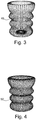
- a point cloud 45 is then generated by photogrammetric processing of the images by means of the Photoscan software, then is meshed by means of surface elements 50 of triangular shape. We thus obtain a 3D mesh model of the scene, which is illustrated on the figure 4 .
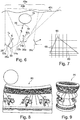
- the 3D model is then unfolded to obtain a 2D model 60a formed of a plane mesh comprising two connected 2D mesh surfaces 62a and 62b, as illustrated in the figure 5a .
- the surface 62b corresponds to the lateral face of the vase in the plane and the surface 62a corresponds to the bottom of the vase unfolded in the plane.
- the semi-automatic unfolding illustrated on the figure 5a is achieved by minimizing the number of 2D surfaces.
- the semi-automatic unfolding illustrated on the figure 5a in comparison with the automatic unfolding illustrated on the figure 5b , in addition to the fact that it minimizes the number of 2D surfaces, better preserves the connectivity of the 3D mesh.
- the figure 5b illustrates a 2D 60b model obtained by automatic unfolding using Blender software. This results in a greater number of surfaces, and in particular non-connected surfaces. It is also more difficult for the operator to associate visually in the 2D model 60b, the polygon corresponding to a surface element of the 3D model.
- a texture is then associated with the 2D model.
- the normal 70 of the surface element, external to the object, is calculated from the position of the vertex points of the element.
- images 40a and 40b are identified.
- the two images 40a and 40b fulfill the condition mentioned in the preceding paragraph.
- each of these images can be selected and be superimposed with the surface element in step ii) of the method.
- the images 40a and 40b being clear, the image whose image plane is closest to the surface element is identified. In this case, on the figure 6 , this is the image referenced 40b, which contains the most details of the area of the scene delimited in the 3D model by the surface element.
- Image 40b is therefore selected to texture the surface element 55.
- the texturing is first carried out on the corresponding polygon 65 of the 2D model.
- the image 40b is projected onto the 2D model so as to assign to the polygon, a texture property from the pixel information of the image 40b superimposed on the corresponding surface element.
- the texture property associated with the region having the dimensions of the pixel is defined by associating with it the color of the corresponding pixel.
- the pixel texture property is assigned to the region having the shape of the part of the pixel completely covered by the polygon of the 2D model.
- each polygon has a texture faithfully reproducing the details of the area of the scene it models.
- the succession of steps i) to iii) described above is preferably carried out for all polygons of the 2D model corresponding to the different surface elements of the 3D model. Thus, one obtains a textured 2D mesh.
- the 3D model can then be textured by assigning, in an unequivocal manner, to each surface element, the texture or textures associated with the corresponding polygon, as illustrated in the figure 9 .
Landscapes
- Engineering & Computer Science (AREA)
- Physics & Mathematics (AREA)
- Computer Graphics (AREA)
- General Physics & Mathematics (AREA)
- Theoretical Computer Science (AREA)
- Software Systems (AREA)
- Geometry (AREA)
- Computer Hardware Design (AREA)
- General Engineering & Computer Science (AREA)
- Processing Or Creating Images (AREA)
- Image Generation (AREA)
Applications Claiming Priority (1)
| Application Number | Priority Date | Filing Date | Title |
|---|---|---|---|
| FR1859189A FR3087036B1 (fr) | 2018-10-03 | 2018-10-03 | Procede de texturation d'un modele 3d |
Publications (2)
| Publication Number | Publication Date |
|---|---|
| EP3633625A1 true EP3633625A1 (de) | 2020-04-08 |
| EP3633625B1 EP3633625B1 (de) | 2022-05-11 |
Family
ID=66218133
Family Applications (1)
| Application Number | Title | Priority Date | Filing Date |
|---|---|---|---|
| EP19201284.7A Not-in-force EP3633625B1 (de) | 2018-10-03 | 2019-10-03 | Verfahren zur texturierung von 3d modellen |
Country Status (5)
| Country | Link |
|---|---|
| US (1) | US11302073B2 (de) |
| EP (1) | EP3633625B1 (de) |
| AU (1) | AU2019240624A1 (de) |
| CA (1) | CA3057337A1 (de) |
| FR (1) | FR3087036B1 (de) |
Families Citing this family (2)
| Publication number | Priority date | Publication date | Assignee | Title |
|---|---|---|---|---|
| CN113223149B (zh) * | 2021-05-08 | 2024-07-02 | 中煤(西安)航测遥感研究院有限公司 | 三维模型纹理生成方法、装置、设备及存储介质 |
| JP7349546B1 (ja) * | 2022-03-25 | 2023-09-22 | Solize株式会社 | 革シボを有する樹脂成形品の製造方法 |
Family Cites Families (4)
| Publication number | Priority date | Publication date | Assignee | Title |
|---|---|---|---|---|
| US8633939B2 (en) * | 2009-02-05 | 2014-01-21 | Autodesk, Inc. | System and method for painting 3D models with 2D painting tools |
| US8669976B1 (en) * | 2010-10-12 | 2014-03-11 | Google Inc. | Selecting and verifying textures in image-based three-dimensional modeling, and applications thereof |
| US9607388B2 (en) * | 2014-09-19 | 2017-03-28 | Qualcomm Incorporated | System and method of pose estimation |
| EP3462418B1 (de) * | 2017-09-28 | 2024-06-19 | Siemens Healthineers AG | Verfahren und vorrichtung zur darstellung von materialeigenschaften |
-
2018
- 2018-10-03 FR FR1859189A patent/FR3087036B1/fr not_active Expired - Fee Related
-
2019
- 2019-10-01 CA CA3057337A patent/CA3057337A1/fr not_active Abandoned
- 2019-10-02 AU AU2019240624A patent/AU2019240624A1/en not_active Abandoned
- 2019-10-03 US US16/591,947 patent/US11302073B2/en active Active
- 2019-10-03 EP EP19201284.7A patent/EP3633625B1/de not_active Not-in-force
Non-Patent Citations (6)
| Title |
|---|
| JUNHUA KANG ET AL: "AUTOMATIC TEXTURE RECONSTRUCTION OF 3D CITY MODEL FROM OBLIQUE IMAGES", ISPRS - INTERNATIONAL ARCHIVES OF THE PHOTOGRAMMETRY, REMOTE SENSING AND SPATIAL INFORMATION SCIENCES, vol. XLI-B1, 3 June 2016 (2016-06-03), pages 341 - 347, XP055589749, DOI: 10.5194/isprsarchives-XLI-B1-341-2016 * |
| PASCAL FREYFRÉDÉRIC HECHT, MAILLAGE 2D, SURFACIQUE ET 3D |
| SAMUEL BIDA, RECONSTRUCTION TRIDIMENSIONNELLE D'ÉLÉMENTS ANATOMIQUES ET GÉNÉRATION AUTOMATIQUE D'ÉLÉMENTS FINIS OPTIMISÉS, 2003 |
| SOUHAIL HAJRI, MODÉLISATION DES SURFACES ROCHEUSES NATURELLES À PARTIR D'UNE SCANNÉRISATION LASER 3D ET EXTRACTION AUTOMATIQUE DE FORMES CARACTÉRISTIQUES : APPLICATION AUX SPÉLÉOTHÈMES ET SURFACES GÉOLOGIQUES, 2010 |
| ZHOU GUOQING ET AL: "Texture mapping based on multiple aerial imageries in urban areas", VISUAL COMMUNICATIONS AND IMAGE PROCESSING; 20-1-2004 - 20-1-2004; SAN JOSE,, vol. 9808, 9 December 2015 (2015-12-09), pages 98080Z - 98080Z, XP060063020, ISBN: 978-1-62841-730-2, DOI: 10.1117/12.2207625 * |
| ZSOLT JANKÓ ET AL: "Creating entirely textured 3D models of real objects using surface flattening", MACHINE GRAPHICS AND VISION, INSTITUTE OF COMPUTER SCIENCE, WARZAW, PL, vol. 14, no. 4, 1 January 2005 (2005-01-01), pages 379 - 398, XP002691168, ISSN: 1230-0535 * |
Also Published As
| Publication number | Publication date |
|---|---|
| FR3087036A1 (fr) | 2020-04-10 |
| EP3633625B1 (de) | 2022-05-11 |
| US11302073B2 (en) | 2022-04-12 |
| CA3057337A1 (fr) | 2020-04-03 |
| FR3087036B1 (fr) | 2021-06-25 |
| US20200111253A1 (en) | 2020-04-09 |
| AU2019240624A1 (en) | 2020-04-23 |
Similar Documents
| Publication | Publication Date | Title |
|---|---|---|
| US11810272B2 (en) | Image dehazing and restoration | |
| EP2828834B1 (de) | Modell und verfahren zur herstellung fotorealistischer 3d-modelle | |
| BE1018615A4 (fr) | Procede et systeme d'amelioration de la modelisation optique de pierres precieuses. | |
| Mudge et al. | Robust and scientifically reliable rock art documentation from digital photographs | |
| JP4880090B2 (ja) | 3dテクスチャの超解像のための画像生成装置及び方法 | |
| De Paolis et al. | Photogrammetric 3D reconstruction of small objects for a real-time fruition | |
| AU2020278256A1 (en) | Physics-based recovery of lost colors in underwater and atmospheric images under wavelength dependent absorption and scattering | |
| EP3633625B1 (de) | Verfahren zur texturierung von 3d modellen | |
| KR102551077B1 (ko) | 2d 애셋으로부터의 3d 모델 구축 | |
| EP1190208B1 (de) | Messverfahren für 3d-objekt oder objektgruppe | |
| Samaan et al. | Close-range photogrammetric tools for epigraphic surveys | |
| EP4432157A2 (de) | Verfahren und system zur erzeugung prädiktiver synthesebilder und in diesem system verwendete lichtumgebungserfassungsvorrichtung | |
| Tominaga et al. | Surface reconstruction of oil paintings for digital archiving | |
| Redman | Advances in digital imaging for fine art and cultural heritage | |
| FR3164821A1 (fr) | Procédé de modélisation numérique d’une surface tridimensionnelle d’un objet | |
| WO2018229358A1 (fr) | Procédé et dispositif de construction d'une image tridimensionnelle | |
| Bacci et al. | Evolving perspectives in digitizing Cultural Heritage: novel paradigms through self-built and adaptable equipment | |
| Tsairis et al. | Close-Range Photogrammetry and RTI for 2.5 D Documentation of Painted Surfaces: A Tiryns Mural Case Study. Coatings 2025, 15, 388 | |
| CN115272076A (zh) | 一种面向林区的无人机图像拼接方法 | |
| FR3052287B1 (fr) | Construction d'une image tridimensionnelle | |
| Campana et al. | Hacking Light in the Digitization of Archaeological Glass Vessels: the Quest for Geometric Rigor | |
| Ammirati et al. | 3D Digitisation for Geological and Paleontological Specimens: Challenges and Solutions | |
| FR3134645A1 (fr) | Prédiction du teint de la peau à l'aide d'un modèle de visage 3D | |
| Tsairis et al. | Proposition of an Innovative Methodology Coupling Structure from Motion Photogrammetry and Reflectance Transformation Imaging as a Standard Workflow Tool for Documenting and Researching Painted Surfaces in 2.5 D. The Case Study of a Mural Painting from the Palace of Tiryns | |
| Paterson et al. | Efficient field capture of epigraphy via photometric stereo |
Legal Events
| Date | Code | Title | Description |
|---|---|---|---|
| PUAI | Public reference made under article 153(3) epc to a published international application that has entered the european phase |
Free format text: ORIGINAL CODE: 0009012 |
|
| STAA | Information on the status of an ep patent application or granted ep patent |
Free format text: STATUS: THE APPLICATION HAS BEEN PUBLISHED |
|
| AK | Designated contracting states |
Kind code of ref document: A1 Designated state(s): AL AT BE BG CH CY CZ DE DK EE ES FI FR GB GR HR HU IE IS IT LI LT LU LV MC MK MT NL NO PL PT RO RS SE SI SK SM TR |
|
| AX | Request for extension of the european patent |
Extension state: BA ME |
|
| STAA | Information on the status of an ep patent application or granted ep patent |
Free format text: STATUS: REQUEST FOR EXAMINATION WAS MADE |
|
| 17P | Request for examination filed |
Effective date: 20201008 |
|
| RBV | Designated contracting states (corrected) |
Designated state(s): AL AT BE BG CH CY CZ DE DK EE ES FI FR GB GR HR HU IE IS IT LI LT LU LV MC MK MT NL NO PL PT RO RS SE SI SK SM TR |
|
| GRAP | Despatch of communication of intention to grant a patent |
Free format text: ORIGINAL CODE: EPIDOSNIGR1 |
|
| STAA | Information on the status of an ep patent application or granted ep patent |
Free format text: STATUS: GRANT OF PATENT IS INTENDED |
|
| INTG | Intention to grant announced |
Effective date: 20211220 |
|
| RIN1 | Information on inventor provided before grant (corrected) |
Inventor name: CHAMBAUD, LUC Inventor name: VALCKE, SERGE Inventor name: PERAL, JOSE Inventor name: PERAZIO, GUY |
|
| GRAS | Grant fee paid |
Free format text: ORIGINAL CODE: EPIDOSNIGR3 |
|
| GRAA | (expected) grant |
Free format text: ORIGINAL CODE: 0009210 |
|
| STAA | Information on the status of an ep patent application or granted ep patent |
Free format text: STATUS: THE PATENT HAS BEEN GRANTED |
|
| AK | Designated contracting states |
Kind code of ref document: B1 Designated state(s): AL AT BE BG CH CY CZ DE DK EE ES FI FR GB GR HR HU IE IS IT LI LT LU LV MC MK MT NL NO PL PT RO RS SE SI SK SM TR |
|
| REG | Reference to a national code |
Ref country code: GB Ref legal event code: FG4D Free format text: NOT ENGLISH |
|
| REG | Reference to a national code |
Ref country code: CH Ref legal event code: EP |
|
| REG | Reference to a national code |
Ref country code: AT Ref legal event code: REF Ref document number: 1492106 Country of ref document: AT Kind code of ref document: T Effective date: 20220515 |
|
| REG | Reference to a national code |
Ref country code: DE Ref legal event code: R096 Ref document number: 602019014795 Country of ref document: DE |
|
| REG | Reference to a national code |
Ref country code: IE Ref legal event code: FG4D Free format text: LANGUAGE OF EP DOCUMENT: FRENCH |
|
| REG | Reference to a national code |
Ref country code: LT Ref legal event code: MG9D |
|
| REG | Reference to a national code |
Ref country code: NL Ref legal event code: MP Effective date: 20220511 |
|
| REG | Reference to a national code |
Ref country code: AT Ref legal event code: MK05 Ref document number: 1492106 Country of ref document: AT Kind code of ref document: T Effective date: 20220511 |
|
| PG25 | Lapsed in a contracting state [announced via postgrant information from national office to epo] |
Ref country code: SE Free format text: LAPSE BECAUSE OF FAILURE TO SUBMIT A TRANSLATION OF THE DESCRIPTION OR TO PAY THE FEE WITHIN THE PRESCRIBED TIME-LIMIT Effective date: 20220511 Ref country code: PT Free format text: LAPSE BECAUSE OF FAILURE TO SUBMIT A TRANSLATION OF THE DESCRIPTION OR TO PAY THE FEE WITHIN THE PRESCRIBED TIME-LIMIT Effective date: 20220912 Ref country code: NO Free format text: LAPSE BECAUSE OF FAILURE TO SUBMIT A TRANSLATION OF THE DESCRIPTION OR TO PAY THE FEE WITHIN THE PRESCRIBED TIME-LIMIT Effective date: 20220811 Ref country code: NL Free format text: LAPSE BECAUSE OF FAILURE TO SUBMIT A TRANSLATION OF THE DESCRIPTION OR TO PAY THE FEE WITHIN THE PRESCRIBED TIME-LIMIT Effective date: 20220511 Ref country code: LT Free format text: LAPSE BECAUSE OF FAILURE TO SUBMIT A TRANSLATION OF THE DESCRIPTION OR TO PAY THE FEE WITHIN THE PRESCRIBED TIME-LIMIT Effective date: 20220511 Ref country code: HR Free format text: LAPSE BECAUSE OF FAILURE TO SUBMIT A TRANSLATION OF THE DESCRIPTION OR TO PAY THE FEE WITHIN THE PRESCRIBED TIME-LIMIT Effective date: 20220511 Ref country code: GR Free format text: LAPSE BECAUSE OF FAILURE TO SUBMIT A TRANSLATION OF THE DESCRIPTION OR TO PAY THE FEE WITHIN THE PRESCRIBED TIME-LIMIT Effective date: 20220812 Ref country code: FI Free format text: LAPSE BECAUSE OF FAILURE TO SUBMIT A TRANSLATION OF THE DESCRIPTION OR TO PAY THE FEE WITHIN THE PRESCRIBED TIME-LIMIT Effective date: 20220511 Ref country code: ES Free format text: LAPSE BECAUSE OF FAILURE TO SUBMIT A TRANSLATION OF THE DESCRIPTION OR TO PAY THE FEE WITHIN THE PRESCRIBED TIME-LIMIT Effective date: 20220511 Ref country code: BG Free format text: LAPSE BECAUSE OF FAILURE TO SUBMIT A TRANSLATION OF THE DESCRIPTION OR TO PAY THE FEE WITHIN THE PRESCRIBED TIME-LIMIT Effective date: 20220811 Ref country code: AT Free format text: LAPSE BECAUSE OF FAILURE TO SUBMIT A TRANSLATION OF THE DESCRIPTION OR TO PAY THE FEE WITHIN THE PRESCRIBED TIME-LIMIT Effective date: 20220511 |
|
| PG25 | Lapsed in a contracting state [announced via postgrant information from national office to epo] |
Ref country code: RS Free format text: LAPSE BECAUSE OF FAILURE TO SUBMIT A TRANSLATION OF THE DESCRIPTION OR TO PAY THE FEE WITHIN THE PRESCRIBED TIME-LIMIT Effective date: 20220511 Ref country code: PL Free format text: LAPSE BECAUSE OF FAILURE TO SUBMIT A TRANSLATION OF THE DESCRIPTION OR TO PAY THE FEE WITHIN THE PRESCRIBED TIME-LIMIT Effective date: 20220511 Ref country code: LV Free format text: LAPSE BECAUSE OF FAILURE TO SUBMIT A TRANSLATION OF THE DESCRIPTION OR TO PAY THE FEE WITHIN THE PRESCRIBED TIME-LIMIT Effective date: 20220511 Ref country code: IS Free format text: LAPSE BECAUSE OF FAILURE TO SUBMIT A TRANSLATION OF THE DESCRIPTION OR TO PAY THE FEE WITHIN THE PRESCRIBED TIME-LIMIT Effective date: 20220911 |
|
| PG25 | Lapsed in a contracting state [announced via postgrant information from national office to epo] |
Ref country code: SM Free format text: LAPSE BECAUSE OF FAILURE TO SUBMIT A TRANSLATION OF THE DESCRIPTION OR TO PAY THE FEE WITHIN THE PRESCRIBED TIME-LIMIT Effective date: 20220511 Ref country code: SK Free format text: LAPSE BECAUSE OF FAILURE TO SUBMIT A TRANSLATION OF THE DESCRIPTION OR TO PAY THE FEE WITHIN THE PRESCRIBED TIME-LIMIT Effective date: 20220511 Ref country code: RO Free format text: LAPSE BECAUSE OF FAILURE TO SUBMIT A TRANSLATION OF THE DESCRIPTION OR TO PAY THE FEE WITHIN THE PRESCRIBED TIME-LIMIT Effective date: 20220511 Ref country code: EE Free format text: LAPSE BECAUSE OF FAILURE TO SUBMIT A TRANSLATION OF THE DESCRIPTION OR TO PAY THE FEE WITHIN THE PRESCRIBED TIME-LIMIT Effective date: 20220511 Ref country code: DK Free format text: LAPSE BECAUSE OF FAILURE TO SUBMIT A TRANSLATION OF THE DESCRIPTION OR TO PAY THE FEE WITHIN THE PRESCRIBED TIME-LIMIT Effective date: 20220511 Ref country code: CZ Free format text: LAPSE BECAUSE OF FAILURE TO SUBMIT A TRANSLATION OF THE DESCRIPTION OR TO PAY THE FEE WITHIN THE PRESCRIBED TIME-LIMIT Effective date: 20220511 |
|
| REG | Reference to a national code |
Ref country code: DE Ref legal event code: R097 Ref document number: 602019014795 Country of ref document: DE |
|
| PLBE | No opposition filed within time limit |
Free format text: ORIGINAL CODE: 0009261 |
|
| STAA | Information on the status of an ep patent application or granted ep patent |
Free format text: STATUS: NO OPPOSITION FILED WITHIN TIME LIMIT |
|
| PG25 | Lapsed in a contracting state [announced via postgrant information from national office to epo] |
Ref country code: AL Free format text: LAPSE BECAUSE OF FAILURE TO SUBMIT A TRANSLATION OF THE DESCRIPTION OR TO PAY THE FEE WITHIN THE PRESCRIBED TIME-LIMIT Effective date: 20220511 |
|
| 26N | No opposition filed |
Effective date: 20230214 |
|
| REG | Reference to a national code |
Ref country code: DE Ref legal event code: R119 Ref document number: 602019014795 Country of ref document: DE |
|
| PG25 | Lapsed in a contracting state [announced via postgrant information from national office to epo] |
Ref country code: SI Free format text: LAPSE BECAUSE OF FAILURE TO SUBMIT A TRANSLATION OF THE DESCRIPTION OR TO PAY THE FEE WITHIN THE PRESCRIBED TIME-LIMIT Effective date: 20220511 Ref country code: MC Free format text: LAPSE BECAUSE OF FAILURE TO SUBMIT A TRANSLATION OF THE DESCRIPTION OR TO PAY THE FEE WITHIN THE PRESCRIBED TIME-LIMIT Effective date: 20220511 |
|
| REG | Reference to a national code |
Ref country code: CH Ref legal event code: PL |
|
| REG | Reference to a national code |
Ref country code: BE Ref legal event code: MM Effective date: 20221031 |
|
| PG25 | Lapsed in a contracting state [announced via postgrant information from national office to epo] |
Ref country code: LU Free format text: LAPSE BECAUSE OF NON-PAYMENT OF DUE FEES Effective date: 20221003 |
|
| P01 | Opt-out of the competence of the unified patent court (upc) registered |
Effective date: 20230530 |
|
| PG25 | Lapsed in a contracting state [announced via postgrant information from national office to epo] |
Ref country code: LI Free format text: LAPSE BECAUSE OF NON-PAYMENT OF DUE FEES Effective date: 20221031 Ref country code: DE Free format text: LAPSE BECAUSE OF NON-PAYMENT OF DUE FEES Effective date: 20230503 Ref country code: CH Free format text: LAPSE BECAUSE OF NON-PAYMENT OF DUE FEES Effective date: 20221031 |
|
| PG25 | Lapsed in a contracting state [announced via postgrant information from national office to epo] |
Ref country code: BE Free format text: LAPSE BECAUSE OF NON-PAYMENT OF DUE FEES Effective date: 20221031 |
|
| PG25 | Lapsed in a contracting state [announced via postgrant information from national office to epo] |
Ref country code: IE Free format text: LAPSE BECAUSE OF NON-PAYMENT OF DUE FEES Effective date: 20221003 |
|
| PGFP | Annual fee paid to national office [announced via postgrant information from national office to epo] |
Ref country code: FR Payment date: 20230920 Year of fee payment: 5 |
|
| PG25 | Lapsed in a contracting state [announced via postgrant information from national office to epo] |
Ref country code: IT Free format text: LAPSE BECAUSE OF FAILURE TO SUBMIT A TRANSLATION OF THE DESCRIPTION OR TO PAY THE FEE WITHIN THE PRESCRIBED TIME-LIMIT Effective date: 20220511 |
|
| PG25 | Lapsed in a contracting state [announced via postgrant information from national office to epo] |
Ref country code: HU Free format text: LAPSE BECAUSE OF FAILURE TO SUBMIT A TRANSLATION OF THE DESCRIPTION OR TO PAY THE FEE WITHIN THE PRESCRIBED TIME-LIMIT; INVALID AB INITIO Effective date: 20191003 |
|
| PG25 | Lapsed in a contracting state [announced via postgrant information from national office to epo] |
Ref country code: CY Free format text: LAPSE BECAUSE OF FAILURE TO SUBMIT A TRANSLATION OF THE DESCRIPTION OR TO PAY THE FEE WITHIN THE PRESCRIBED TIME-LIMIT Effective date: 20220511 |
|
| PG25 | Lapsed in a contracting state [announced via postgrant information from national office to epo] |
Ref country code: MK Free format text: LAPSE BECAUSE OF FAILURE TO SUBMIT A TRANSLATION OF THE DESCRIPTION OR TO PAY THE FEE WITHIN THE PRESCRIBED TIME-LIMIT Effective date: 20220511 |
|
| GBPC | Gb: european patent ceased through non-payment of renewal fee |
Effective date: 20231003 |
|
| PG25 | Lapsed in a contracting state [announced via postgrant information from national office to epo] |
Ref country code: GB Free format text: LAPSE BECAUSE OF NON-PAYMENT OF DUE FEES Effective date: 20231003 |
|
| PG25 | Lapsed in a contracting state [announced via postgrant information from national office to epo] |
Ref country code: GB Free format text: LAPSE BECAUSE OF NON-PAYMENT OF DUE FEES Effective date: 20231003 |
|
| PG25 | Lapsed in a contracting state [announced via postgrant information from national office to epo] |
Ref country code: MT Free format text: LAPSE BECAUSE OF FAILURE TO SUBMIT A TRANSLATION OF THE DESCRIPTION OR TO PAY THE FEE WITHIN THE PRESCRIBED TIME-LIMIT Effective date: 20220511 |
|
| PG25 | Lapsed in a contracting state [announced via postgrant information from national office to epo] |
Ref country code: BG Free format text: LAPSE BECAUSE OF FAILURE TO SUBMIT A TRANSLATION OF THE DESCRIPTION OR TO PAY THE FEE WITHIN THE PRESCRIBED TIME-LIMIT Effective date: 20220511 |
|
| PG25 | Lapsed in a contracting state [announced via postgrant information from national office to epo] |
Ref country code: BG Free format text: LAPSE BECAUSE OF FAILURE TO SUBMIT A TRANSLATION OF THE DESCRIPTION OR TO PAY THE FEE WITHIN THE PRESCRIBED TIME-LIMIT Effective date: 20220511 |
|
| PG25 | Lapsed in a contracting state [announced via postgrant information from national office to epo] |
Ref country code: FR Free format text: LAPSE BECAUSE OF NON-PAYMENT OF DUE FEES Effective date: 20241031 |
|
| PG25 | Lapsed in a contracting state [announced via postgrant information from national office to epo] |
Ref country code: TR Free format text: LAPSE BECAUSE OF FAILURE TO SUBMIT A TRANSLATION OF THE DESCRIPTION OR TO PAY THE FEE WITHIN THE PRESCRIBED TIME-LIMIT Effective date: 20220511 |