EP3633676A1 - Procédé et dispositif de réduction de bruit fondé sur rnn pour une conférence en temps réel - Google Patents
Procédé et dispositif de réduction de bruit fondé sur rnn pour une conférence en temps réel Download PDFInfo
- Publication number
- EP3633676A1 EP3633676A1 EP18923762.1A EP18923762A EP3633676A1 EP 3633676 A1 EP3633676 A1 EP 3633676A1 EP 18923762 A EP18923762 A EP 18923762A EP 3633676 A1 EP3633676 A1 EP 3633676A1
- Authority
- EP
- European Patent Office
- Prior art keywords
- noise reduction
- rnn
- real
- speech signal
- logarithmic spectrum
- Prior art date
- Legal status (The legal status is an assumption and is not a legal conclusion. Google has not performed a legal analysis and makes no representation as to the accuracy of the status listed.)
- Ceased
Links
Images


Classifications
-
- G—PHYSICS
- G10—MUSICAL INSTRUMENTS; ACOUSTICS
- G10L—SPEECH ANALYSIS TECHNIQUES OR SPEECH SYNTHESIS; SPEECH RECOGNITION; SPEECH OR VOICE PROCESSING TECHNIQUES; SPEECH OR AUDIO CODING OR DECODING
- G10L21/00—Speech or voice signal processing techniques to produce another audible or non-audible signal, e.g. visual or tactile, in order to modify its quality or its intelligibility
- G10L21/02—Speech enhancement, e.g. noise reduction or echo cancellation
- G10L21/0208—Noise filtering
- G10L21/0216—Noise filtering characterised by the method used for estimating noise
-
- G—PHYSICS
- G10—MUSICAL INSTRUMENTS; ACOUSTICS
- G10L—SPEECH ANALYSIS TECHNIQUES OR SPEECH SYNTHESIS; SPEECH RECOGNITION; SPEECH OR VOICE PROCESSING TECHNIQUES; SPEECH OR AUDIO CODING OR DECODING
- G10L21/00—Speech or voice signal processing techniques to produce another audible or non-audible signal, e.g. visual or tactile, in order to modify its quality or its intelligibility
- G10L21/02—Speech enhancement, e.g. noise reduction or echo cancellation
- G10L21/0208—Noise filtering
-
- G—PHYSICS
- G06—COMPUTING OR CALCULATING; COUNTING
- G06N—COMPUTING ARRANGEMENTS BASED ON SPECIFIC COMPUTATIONAL MODELS
- G06N3/00—Computing arrangements based on biological models
- G06N3/02—Neural networks
- G06N3/04—Architecture, e.g. interconnection topology
- G06N3/044—Recurrent networks, e.g. Hopfield networks
- G06N3/0442—Recurrent networks, e.g. Hopfield networks characterised by memory or gating, e.g. long short-term memory [LSTM] or gated recurrent units [GRU]
-
- G—PHYSICS
- G06—COMPUTING OR CALCULATING; COUNTING
- G06N—COMPUTING ARRANGEMENTS BASED ON SPECIFIC COMPUTATIONAL MODELS
- G06N3/00—Computing arrangements based on biological models
- G06N3/02—Neural networks
- G06N3/08—Learning methods
-
- G—PHYSICS
- G06—COMPUTING OR CALCULATING; COUNTING
- G06N—COMPUTING ARRANGEMENTS BASED ON SPECIFIC COMPUTATIONAL MODELS
- G06N3/00—Computing arrangements based on biological models
- G06N3/02—Neural networks
- G06N3/08—Learning methods
- G06N3/09—Supervised learning
-
- G—PHYSICS
- G10—MUSICAL INSTRUMENTS; ACOUSTICS
- G10L—SPEECH ANALYSIS TECHNIQUES OR SPEECH SYNTHESIS; SPEECH RECOGNITION; SPEECH OR VOICE PROCESSING TECHNIQUES; SPEECH OR AUDIO CODING OR DECODING
- G10L21/00—Speech or voice signal processing techniques to produce another audible or non-audible signal, e.g. visual or tactile, in order to modify its quality or its intelligibility
- G10L21/02—Speech enhancement, e.g. noise reduction or echo cancellation
- G10L21/0208—Noise filtering
- G10L21/0216—Noise filtering characterised by the method used for estimating noise
- G10L21/0224—Processing in the time domain
-
- G—PHYSICS
- G10—MUSICAL INSTRUMENTS; ACOUSTICS
- G10L—SPEECH ANALYSIS TECHNIQUES OR SPEECH SYNTHESIS; SPEECH RECOGNITION; SPEECH OR VOICE PROCESSING TECHNIQUES; SPEECH OR AUDIO CODING OR DECODING
- G10L21/00—Speech or voice signal processing techniques to produce another audible or non-audible signal, e.g. visual or tactile, in order to modify its quality or its intelligibility
- G10L21/02—Speech enhancement, e.g. noise reduction or echo cancellation
- G10L21/0208—Noise filtering
- G10L21/0216—Noise filtering characterised by the method used for estimating noise
- G10L21/0232—Processing in the frequency domain
-
- G—PHYSICS
- G10—MUSICAL INSTRUMENTS; ACOUSTICS
- G10L—SPEECH ANALYSIS TECHNIQUES OR SPEECH SYNTHESIS; SPEECH RECOGNITION; SPEECH OR VOICE PROCESSING TECHNIQUES; SPEECH OR AUDIO CODING OR DECODING
- G10L25/00—Speech or voice analysis techniques not restricted to a single one of groups G10L15/00 - G10L21/00
- G10L25/03—Speech or voice analysis techniques not restricted to a single one of groups G10L15/00 - G10L21/00 characterised by the type of extracted parameters
- G10L25/18—Speech or voice analysis techniques not restricted to a single one of groups G10L15/00 - G10L21/00 characterised by the type of extracted parameters the extracted parameters being spectral information of each sub-band
-
- G—PHYSICS
- G10—MUSICAL INSTRUMENTS; ACOUSTICS
- G10L—SPEECH ANALYSIS TECHNIQUES OR SPEECH SYNTHESIS; SPEECH RECOGNITION; SPEECH OR VOICE PROCESSING TECHNIQUES; SPEECH OR AUDIO CODING OR DECODING
- G10L25/00—Speech or voice analysis techniques not restricted to a single one of groups G10L15/00 - G10L21/00
- G10L25/27—Speech or voice analysis techniques not restricted to a single one of groups G10L15/00 - G10L21/00 characterised by the analysis technique
- G10L25/30—Speech or voice analysis techniques not restricted to a single one of groups G10L15/00 - G10L21/00 characterised by the analysis technique using neural networks
-
- G—PHYSICS
- G10—MUSICAL INSTRUMENTS; ACOUSTICS
- G10L—SPEECH ANALYSIS TECHNIQUES OR SPEECH SYNTHESIS; SPEECH RECOGNITION; SPEECH OR VOICE PROCESSING TECHNIQUES; SPEECH OR AUDIO CODING OR DECODING
- G10L25/00—Speech or voice analysis techniques not restricted to a single one of groups G10L15/00 - G10L21/00
- G10L25/45—Speech or voice analysis techniques not restricted to a single one of groups G10L15/00 - G10L21/00 characterised by the type of analysis window
-
- G—PHYSICS
- G10—MUSICAL INSTRUMENTS; ACOUSTICS
- G10L—SPEECH ANALYSIS TECHNIQUES OR SPEECH SYNTHESIS; SPEECH RECOGNITION; SPEECH OR VOICE PROCESSING TECHNIQUES; SPEECH OR AUDIO CODING OR DECODING
- G10L25/00—Speech or voice analysis techniques not restricted to a single one of groups G10L15/00 - G10L21/00
- G10L25/48—Speech or voice analysis techniques not restricted to a single one of groups G10L15/00 - G10L21/00 specially adapted for particular use
- G10L25/51—Speech or voice analysis techniques not restricted to a single one of groups G10L15/00 - G10L21/00 specially adapted for particular use for comparison or discrimination
- G10L25/60—Speech or voice analysis techniques not restricted to a single one of groups G10L15/00 - G10L21/00 specially adapted for particular use for comparison or discrimination for measuring the quality of voice signals
Definitions
- the present disclosure relates to a method and a system for noise reduction in a real-time conference, more particularly, to a method and a device for RNN-based noise reduction in a real-time conference.
- the problem to be solved in a real-time conference system is separation of noise and speech.
- the main problem to be solved is that the microphone collects the noise of the surrounding environment (air conditioning noise, keyboard noise, environmental noise, etc.) while collecting the sound of the speaker in the real-time conference system.
- noise reduction mainly focuses on two aspects.
- a microphone array of multiple microphone devices is used to reduce noise.
- the multiple microphones simultaneously collect sounds, and the phase difference between multiple signals is calculated, so as to obtain spatial information of the sound source.
- the adjacent sound sources are removed by using techniques such as MVDR, thereby enhancing signal-to-noise ratio.
- MVDR MVDR
- a single microphone is used with conventional noise suppression. By estimating noise based on noise characteristics, the noise is suppressed.
- Such single microphone has simple arrangement, but merely has significant effect on the smooth bottom noise of the environment. Use of bottom noise of the environment is based on a stationary Gaussian distribution. However, the sudden noise cannot be correctly estimated.
- Deep learning is based on machine learning theory, which is a neural network that performs analysis and learning by building and simulating the human brain.
- Geoffery Hinton proposes a deep learning (DNN) method (A Fast Learning Algorithm for Deep Belief Nets) for Deep Belief Networks (DBN, Deep Belief Networks) formed by overlapping multiple restricted Boltzmann Machines (RBM, Restricted Boltzmann Machines).
- DNN deep learning
- BBN Deep Belief Networks
- RBM Restricted Boltzmann Machines
- This method which takes advantage of a large amount of calibrated noise data and speech to learn speech characteristics and thus perform noise reduction for speech, can be implemented by a Recurrent Neural Network (RNN).
- RNN Recurrent Neural Network
- problems in noise reduction for speech implemented by using RNN which in turn limit application of RNN-based noise reduction method in real-time conferences.
- one critical problem is that the current method for RNN noise reduction for speech fails to meet the real-time requirements of real-time conferences.
- the volume of the data to be processed by the RNN-based noise reduction method is too large to integrate into the real-time conference system. Since the RNN noise reduction method has poor real-time performance and large computation burden, such noise reduction method cannot be used in the real-time conference system. Therefore, there is a need for the RNN noise reduction method that can be used in real-time conferences.
- a method and a device for RNN-based noise reduction in a real-time conference to solve the problems caused by poor real-time performance and large computation burden of the current RNN noise reduction method that cannot be used in a real-time conference system.
- a method for RNN-based noise reduction in a real-time conference comprising the following steps:
- the RNN-based noise reduction method in a real-time conference comprises: performing frame-and-window for a speech signal to obtain a logarithmic spectrum of the speech signal, and placing the logarithmic spectrum into the RNN model to determine a noise reduction suppression coefficient, and then obtaining the denoised speech signal by applying the noise reduction suppression coefficient to the logarithmic spectrum of the original signal, thereby achieving utilization of the RNN noise reduction method in real-time conferences.
- the conventional RNN model is not suitable for the noise reduction in real-time conferences since it cannot well handle the long-distance dependence.
- the LSTM which can well handle the long-distance dependence, it cannot be used for noise reduction in a real-time conference due to many existing problems, such as complicated structure, design difficulty, large computation burden, and unsatisfied real-time requirements.
- the structure of the GRU is relatively simple and suitable for noise reduction in a real-time conference. Therefore, the RNN model as used herein is the RNN model that uses the GRU.
- the GRU model as used herein retains information in past-time to some extent by updating and resetting the gate, so as to ensure the reliability of the training model.
- the GRU model as used herein retains the characteristics of the information in past-time to some extent, and an appropriate window length is selected for performing the frame-and-window of the speech signal, when inputting the RNN model for estimation, only the logarithmic spectrum of the current frame needs to be input.
- the RNN model of the present disclosure has few requirements on inputted information, without performing huge preprocessing on the received speech signal, which in turn reduces computation burden, increases response speed, and enhances real-time performance.At the same time, a logarithmic spectrum in the frequency domain is used when performing signal comparison, and the logarithmic spectrum can significantly highlight the signal variation, and the logarithmic spectrum can be used to facilitate signal comparison when performing signal comparison.
- a logarithmic spectrum in the frequency domain is used for further reduction of the time for signal comparison and improvement of the real-time performance.
- the processed result is subjected to window overlap and inverse Fourier transform processing.
- the denoised signal is still subjected to window overlap processing, the effect for the processed signal can be further ensured, and excessive noise reduction can be avoided to ensure speech integrity.
- computation burden is reduced compared with that in the general RNN noise reduction method, the model structure and signal processing is simplified, and the real-time performance is enhanced by performing frame-and-window for the speech signal, selecting an appropriate window length, using the RNN model that uses the GRU, and using the logarithmic spectrum in the frequency domain to compare the signals.
- the denoised signal is still subjected to window overlap processing, without excessive noise reduction, so as to ensure the speech integrity.
- the RNN-based noise reduction method in a real-time conference as provided herein solves the problems caused by poor real-time performance and large computation burden in the currently existing RNN noise reduction method which cannot be used in a real-time conference system.
- the RNN-based noise reduction method as provided herein has simple structure, simplified signal processing, reduced data computation burden and great real-time performance, thereby achieving RNN-based noise reduction in a real-time conference.
- step S1 comprises the following steps:
- the RNN-based noise reduction method in a real-time conference comprises determining appropriate parameters for the RNN model by training the RNN model that adopts the GRU.
- the training signal synthesizes the noisy speech signal with the pure speech signal and the noise speech signal, calculates the mean square error of the accurate suppression parameters and the expected suppression parameters, and uses the mean square error for derivation to update the parameters of the RNN model that adopts the GRU.
- the expected suppression parameters in the present disclosure is calculated from an estimated logarithmic spectrum and a logarithmic spectrum of a noisy speech signal.
- the estimated logarithmic spectrum is generated by allowing the logarithmic spectrum of the noisy speech signal to pass through a fully connected layer and two GRU layers.
- the fully connected layer and the two GRU layers are the RNN model structure as used herein.
- the RNN model is composed of a fully connected layer and two GRU layers, with simple model structure and the structure of the GRU layer itself is relatively simple.
- the RNN model as used in the present disclosure has a simple structure and improves the real-time performance of signal noise reduction to some extent. Furthermore, although the RNN model has a simple structure, it can achieve an excellent noise reduction effect in combination with the signal processing steps and the characteristics of the GRU itself.
- the RNN model as provided herein achieves use of RNN noise reduction in real-time conferences, and solves the problems caused by poor real-time performance and large computation burden in the currently existing RNN noise reduction method that cannot be used in a real-time conference system.
- the present disclosure provides a RNN-based noise reduction method which has simple structure, simplified signal processing, reduced data computation burden and great real-time performance, and the RNN-based noise reduction method as provided herein can be used in real-time conferences.
- frame-and-window for the signal is performed with the window length of 256 samples, and the framed signals are overlapped by 50%.
- the optimal window length in the present disclosure is 256 samples, which can improve the computation efficiency while ensuring that information is not lost.
- the GRU model can retain limited information in the past-time.
- the present disclosure provides an improvement on processing of speech signals. Since the minimum unit of a segment of speech can be divided into a basic syllable, the basic syllable of ordinary people's speech is between 80ms and 160ms, and the fast Fourier transform can improve the calculation speed based on the data of 2 ⁇ N length, the window length of the present disclosure is set to 256 samples.
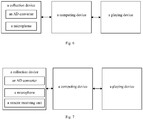
- a RNN-based noise reduction device in a real-time conference comprising a collection device, a computing device and a playing device.
- the collection device collects a noisy speech signal and transmits it to the computing device.
- the computing device processes the noisy speech signal to obtain a denoised speech signal which is transmitted to the playing device.
- the computing device is the one that uses the RNN-based noise reduction method in a real-time conference as described above.
- the RNN-based noise reduction device in a real-time conference as disclosed herein comprises a collection device through which a speech signal is collected, a computing device through which the speech signal is subject to noise reduction processing, and a playing device through which a denoised speech signal is played, wherein the computing device adopts a RNN-based noise reduction method in a real-time conference as provided herein.
- the RNN-based noise reduction method in a real-time conference as disclosed herein comprises: performing frame-and-window for a speech signal to obtain a logarithmic spectrum of the speech signal, and placing the logarithmic spectrum into the RNN model to determine the noise reduction suppression coefficient, and then obtaining the denoised speech signal by applying the noise reduction suppression coefficient to the logarithmic spectrum of the original signal, thereby achieving utilization of the RNN noise reduction method in real-time conferences.
- the conventional RNN model is not suitable for the noise reduction in real-time conferences since it cannot well handle the long-distance dependence.
- the LSTM which can well handle the long-distance dependence, it cannot be used for noise reduction in a real-time conference due to many existing problems, such as complicated structure, design difficulty, large computation burden, and unsatisfied real-time requirements.
- the structure of the GRU is relatively simple and suitable for noise reduction in a real-time conference. Therefore, the RNN model as used herein is the RNN model that uses the GRU.
- the GRU model as used herein retains information in past-time to some extent by updating and resetting the gate, so as to ensure the reliability of the training model.
- the GRU model can retain limited information in the past-time.
- the present disclosure provides an improvement on processing of speech signals. Since the minimum unit of a segment of speech can be divided into a basic syllable, the basic syllable of ordinary people's speech is between 80ms and 160ms, and the fast Fourier transform can improve the calculation speed based on the data of 2 ⁇ N length, the window length of the present disclosure is set to 256 samples.
- the RNN model of the present disclosure has few requirements on inputted information, without performing huge preprocessing on the received speech signal, which in turn reduces computation burden, increases response speed, and enhances real-time performance.
- a logarithmic spectrum in the frequency domain is used when performing signal comparison, and the logarithmic spectrum can significantly highlight the signal variation, and the logarithmic spectrum can be used to facilitate signal comparison when performing signal comparison.
- a logarithmic spectrum in the frequency domain is used for further reduction of the time for signal comparison and improvement of the real-time performance.
- the processed result is subjected to window overlap and inverse Fourier transform processing.
- the denoised signal is still subjected to window overlap processing, the effect for the processed signal can be further ensured, and excessive noise reduction can be avoided to ensure speech integrity.
- computation burden is reduced compared with that in the general RNN noise reduction method, the model structure and signal processing is simplified, and the real-time performance is enhanced by performing frame-and-window for the speech signal, selecting an appropriate window length, using the RNN model that uses the GRU, and using the logarithmic spectrum in the frequency domain to compare the signals.
- the denoised signal is still subjected to window overlap processing, without excessive noise reduction, so as to ensure the speech integrity.
- the RNN-based noise reduction device in a real-time conference realizes the application of the RNN noise reduction method in a real-time conference system, and solves the problem due to no RNN-based noise reduction device used in a real-time conference.
- the collection device further comprises a remote receiving unit, which is coupled to the computing device.
- the present disclosure provides a RNN-based noise reduction device in a real-time conference, wherein the collection device is configured to collect speech information and send it to the computing device.
- the RNN-based noise reduction device in a real-time conference as provided herein is applied to a real-time conference system to reduce noise in the real-time conference.
- noise reduction in a real-time conference is achieved by performing noise reduction on the speech signal collected from the microphone, and the denoised speech signal is sent to the playing device via a network to play.
- Such playing device is another real-time conference system.
- the current real-time conferences often use two real-time conference systems which are in communication with each other. One conference system sends speech information to another one.
- the current noise reduction in a real-time conference performs noise reduction immediately after receiving the speech in the conference system, and the denoised information is sent to another conference system which plays the denoised speech.
- the collection device comprises a remote receiving unit, that is, the collection device can receive the speech that has been subjected to noise reduction sent by other conference systems, and the computing device performs further noise reduction on the received speech.
- the further denoised speech information is sent by the computing device to the playing device to play. That is to say, the conference system receives the speech information that has been subjected to noise reduction by other conference systems, which is further denoised and then played by the conference systems.
- the present disclosure provides a RNN-based noise reduction device in a real-time conference, which performs noise reduction twice for both communication parties in the real-time conference. Such repeated noise reduction ensures the noise reduction effect of the speech information, and the speech noise in the real-time conference is extremely removed.
- the RNN-based noise reduction device in the real-time conference as provided herein utilizes the RNN model with simple structure and simplified processing method for speech signal, such that the RNN-based noise reduction device in a real-time conference has a simple structure, simplified signal processing, reduced data computation burden, and enhanced real-time performance, with twice noise reduction for both communication parties to satisfy the real-time requirements of the real-time conference.
- a device for applying RNN noise reduction method in a real-time conference system which maintains excellent noise reduction effect from RNN noise reduction method, and satisfies the real-time requirements of the real-time conference, and in turn solves the problem due to no RNN-based noise reduction device used in a real-time conference.
- a method for RNN-based noise reduction in a real-time conference comprises the following steps: S1, training RNN model that uses GRU to determine suitable parameters for the RNN model, to obtain the trained RNN model; S2, performing frame-and-window for the speech signal transmitted by a collecting unit, to calculate a logarithmic spectrum of each frame of the speech signal in the frequency domain; S3, placing the logarithmic spectrum of the current frame into the trained RNN model for estimation, to obtain an estimated logarithmic spectrum of the current speech; S4, calculating a signal-to-noise ratio of the current frame according to the estimated logarithmic spectrum and the logarithmic spectrum of the original signal, to calculate a current noise reduction suppression coefficient according to the signal-to-noise ratio; S5, applying the noise reduction suppression coefficient to the logarithmic spectrum of the original signal, performing window overlap and inverse Fourier transform on the result, and transmitting the result to a corresponding playing device through a network, to play the processed signal.
- the RNN-based noise reduction method in a real-time conference comprises: performing frame-and-window for a speech signal to obtain a logarithmic spectrum of the speech signal, and placing the logarithmic spectrum into the RNN model to determine the noise reduction suppression coefficient, and then obtaining the denoised speech signal by applying the noise reduction suppression coefficient to the logarithmic spectrum of the original signal, thereby achieving utilization of the RNN noise reduction method in real-time conferences.
- the conventional RNN model is not suitable for the noise reduction in real-time conferences since it cannot well handle the long-distance dependence.
- the LSTM which can well handle the long-distance dependence, it cannot be used for noise reduction in a real-time conference due to many existing problems, such as complicated structure, design difficulty, large computation burden, and unsatisfied real-time requirements.
- the structure of the GRU is relatively simple and suitable for noise reduction in a real-time conference. Therefore, the RNN model as used herein is the RNN model that uses the GRU.
- h t is defined as the candidate implied state, and uses the reset gate to control the inflow of the last implied state containing the past time information. The smaller the reset gate is, the more the previous implied state which is discarded is. Therefore, the reset gate provides a mechanism to discard past implied states that are unrelated to the future.
- h t ⁇ tanh W h ⁇ ⁇ r t ⁇ h t ⁇ 1 , x t
- Implied state h t uses update gate z t to update the previous implied state h t- 1 and the candidate implied state.
- the update gate can control the importance of the past implied state at the current moment. If the update gate always approximates to 1, the past implied state will always be saved by time and passed to the current moment. This design can cope with the gradient attenuation problem in the cyclic neural network and better capture the large interval dependencies in the time series data.
- the original input generates a corresponding estimated signal after passing through a connected layer and two GRUs, and then MSE is obtained from the logarithmic spectrum of the clean speech signal before synthesis. Convergence and iteration are continuously performed through the activation function. The parameters of Dense and GRU are updated to obtain the minimum error.
- the method can be implemented by any hardware devices having a computing instruction function.
- the present disclosure adopts multiple GPUs to performing training, resulting in acceleration of the training process.
- the GRU model as used herein retains information in past-time to some extent by updating and resetting the gate, so as to ensure the reliability of the training model. Since the GRU model as used herein retains characteristics of the information in past-time to some extent, and an appropriate window length is selected for performing the frame-and-window of the speech signal, when inputting the RNN model for estimation, only the logarithmic spectrum of the current frame needs to be input.
- the RNN model of the present disclosure has few requirements on inputted information, without performing huge preprocessing on the received speech signal, which in turn reduces computation burden, increases response speed, and enhances real-time performance.
- a logarithmic spectrum in the frequency domain is used when performing signal comparison, and the logarithmic spectrum can significantly highlight the signal variation, and the logarithmic spectrum can be used to facilitate signal comparison when performing signal comparison.
- a logarithmic spectrum in the frequency domain is used for further reduction of the time for signal comparison and improvement of the real-time performance.
- the processed result is subjected to window overlap and inverse Fourier transform processing. Since the denoised signal is still subjected to window overlap processing, the effect for the processed signal can be further ensured, and excessive noise reduction can be avoided to ensure speech integrity.
- the model structure and signal processing is simplified, and the real-time performance is enhanced by performing frame-and-window for the speech signal, selecting an appropriate window length, using the RNN model that uses the GRU, and using the logarithmic spectrum in the frequency domain to compare the signals.
- the denoised signal is still subjected to window overlap processing, without excessive noise reduction, so as to ensure the speech integrity.
- the RNN-based noise reduction method in a real-time conference as provided herein solves the problems caused by poor real-time performance and large computation burden in the currently existing RNN noise reduction method which cannot be used in a real-time conference system.
- the RNN-based noise reduction method as provided herein has simple structure, simplified signal processing, reduced data computation burden and great real-time performance, thereby achieving RNN-based noise reduction in a real-time conference.
- the step S1 comprises the following steps: S11, collecting a pure speech signal and a noise speech signal, and superimposing the pure speech signal and the noise speech signal in a time domain to generate a noisy speech signal; S12, performing frame-and-window for the noisy speech signal and the pure speech signal respectively, to calculate the logarithmic spectrum of each frame in the frequency domain, comparing the logarithmic spectrum of the noisy speech signal with the logarithmic spectrum of the pure speech signal to obtain corresponding accurate suppression parameters; S22, using the logarithmic spectrum of the noisy speech signal obtained after performing the frame-and-window as an input for the RNN model that uses the GRU; S23, generating a corresponding estimated logarithmic spectrum by allowing the logarithmic spectrum of the noisy speech signal to pass through a fully connected layer and two GRU layers, to obtain the expected suppression parameters according to the estimated logarithmic spectrum and the logarithmic spectrum of the noisy speech signal; S24, calculating a mean square error using the expected suppression parameters and the
- the step S1 of the present disclosure is the training step for the RNN model that uses the GRU.
- the noise that needs to be processed is additive noise.
- the feature extraction is performed by a windowed short-time Fourier transform to avoid the problem of inter-frame mutation and the framed signals are subject to 50% overlap.
- the fast Fourier transform can be performed based on the data of 2 ⁇ N length to improve calculation speed, and therefore the window length is set to 256 samples.
- the RNN-based noise reduction method in a real-time conference comprises determining appropriate parameters for the RNN model by training the RNN model that adopts the GRU.
- the training signal synthesizes the noisy speech signal with the pure speech signal and the noise speech signal, calculates the mean square error of the accurate suppression parameters and the expected suppression parameters, and uses the mean square error for derivation to update the parameters of the RNN model that adopts the GRU.
- the expected suppression parameters in the present disclosure is calculated from an estimated logarithmic spectrum and a logarithmic spectrum of a noisy speech signal.
- the estimated logarithmic spectrum is generated by allowing the logarithmic spectrum of the noisy speech signal to pass through a fully connected layer and two GRU layers.
- the fully connected layer and the two GRU layers are the RNN model structure as used herein.
- the RNN model is composed of a fully connected layer and two GRU layers, with simple model structure and the structure of the GRU layer itself is relatively simple.
- the RNN model as used in the present disclosure has a simple structure and improves the real-time performance of signal noise reduction to some extent. Furthermore, although the RNN model has a simple structure, it can achieve an excellent noise reduction effect in combination with the signal processing steps and the characteristics of the GRU itself.
- the RNN model as provided herein achieves utilization of RNN noise reduction in real-time conferences, and solves the problems caused by poor real-time performance and large computation burden in the currently existing RNN noise reduction method that cannot be used in a real-time conference system.
- the present disclosure provides a RNN-based noise reduction method which has simple structure, simplified signal processing, reduced data computation burden and great real-time performance, and the RNN-based noise reduction method as provided herein can be used in real-time conferences.
- Tanh function is used as the activation function for the fully connected layer, which has a mean value of 0.
- the structure of the fully connected layer is shown in Figure 4 , and Tanh is used as the activation function.
- the mean value of the Tanh function is 0, which achieves a good effect in practical applications.
- the noise reduction suppression coefficient is obtained by smoothing the expected suppression parameter, which is obtained by estimating a logarithmic spectrum and the logarithmic spectrum of the original signal. Since the noise reduction suppression coefficient obtained is obtained by smoothing the expected suppression parameter, the continuity of the speech is ensured.
- Frame-and-window for the signal is performed with the window length of 256 samples, and the framed signals are overlapped by 50%.
- the optimal window length in the present disclosure is 256 samples, which can improve the computation efficiency while ensuring that information is not lost.
- the GRU model can retain limited information in the past-time.
- the present disclosure provides an improvement on processing of speech signals.
- the window length of the present disclosure is set to 256 samples. Although framing according to 256 samples per frame may result in loss of the previous frame information, such a window length is able to ensure an increased calculation speed without loss of information since the GRU model can retain the information in the past-time to some extent. And in the present disclosure, 50% overlap of the framed signals can avoid inter-frame mutation.
- the GRU model as used in the present disclosure could retain the characteristics of the information in past-time to some extent, and an appropriate window length is selected for performing the frame-and-window of the speech signal, when inputting the RNN model for estimation, only the logarithmic spectrum of the current frame needs to be inputted.
- the RNN model of the present disclosure has few requirements on inputted information, without performing huge preprocessing on the received speech signal, which in turn reduces computation burden, increases response speed, and enhances real-time performance.
- the present disclosure provides a RNN-based noise reduction device in a real-time conference, comprising a collection device, a computing device and a playing device.
- the collection device collects a noisy speech signal and transmits it to the computing device.
- the computing device processes the noisy speech signal to obtain a denoised speech signal which is transmitted to the playing device.
- the computing device is the one that uses the RNN-based noise reduction method in a real-time conference as described above.
- the RNN-based noise reduction device in a real-time conference as disclosed herein comprises a collection device through which a speech signal is collected, a computing device through which the speech signal is subject to noise reduction processing, and a playing device through which a denoised speech signal is played, wherein the computing device adopts a RNN-based noise reduction method in a real-time conference as provided herein.
- the RNN-based noise reduction method in a real-time conference comprises: performing frame-and-window for a speech signal to obtain a logarithmic spectrum of the speech signal, and placing the logarithmic spectrum into the RNN model to determine the noise reduction suppression coefficient, and then obtaining the denoised speech signal by applying the noise reduction suppression coefficient to the logarithmic spectrum of the original signal, thereby achieving utilization of the RNN noise reduction method in real-time conferences.
- the conventional RNN model is not suitable for the noise reduction in real-time conferences since it cannot well handle the long-distance dependence.
- the LSTM which can well handle the long-distance dependence, it cannot be used for noise reduction in a real-time conference due to many existing problems, such as complicated structure, design difficulty, large computation burden, and unsatisfied real-time requirements.
- the structure of the GRU is relatively simple and suitable for noise reduction in a real-time conference. Therefore, the RNN model as used herein is the RNN model that uses the GRU.
- the GRU model as used herein retains information in past-time to some extent by updating and resetting the gate, so as to ensure the reliability of the training model.
- the GRU model can retain limited information in the past-time.
- the present disclosure provides an improvement on processing of speech signals. Since the minimum unit of a segment of speech can be divided into a basic syllable, the basic syllable of ordinary people's speech is between 80ms and 160ms, and the fast Fourier transform can improve the calculation speed based on the data of 2 ⁇ N length, the window length of the present disclosure is set to 256 samples.
- the GRU model as used in the present disclosure could retain the characteristics of the information in past-time to some extent, and an appropriate window length is selected for performing the frame-and-window of the speech signal, when inputting the RNN model for estimation, only the logarithmic spectrum of the current frame needs to be inputted.
- the RNN model of the present disclosure has few requirements on inputted information, without performing huge preprocessing on the received speech signal, which in turn reduces computation burden, increases response speed, and enhances real-time performance.
- a logarithmic spectrum in the frequency domain is used when performing signal comparison, and the logarithmic spectrum can significantly highlight the signal variation, and the logarithmic spectrum can be used to facilitate signal comparison when performing signal comparison.
- a logarithmic spectrum in the frequency domain is used for further reduction of the time for signal comparison and improvement of the real-time performance.
- the processed result is subjected to window overlap and inverse Fourier transform processing. Since the denoised signal is still subjected to window overlap processing, the effect for the processed signal can be further ensured, and excessive noise reduction can be avoided to ensure speech integrity.
- the model structure and signal processing is simplified, and the real-time performance is enhanced by performing frame-and-window for the speech signal, selecting an appropriate window length, using the RNN model that uses the GRU, and using the logarithmic spectrum in the frequency domain to compare the signals.
- the denoised signal is still subjected to window overlap processing, without excessive noise reduction, so as to ensure the speech integrity. Therefore, the RNN-based noise reduction device in a real-time conference as disclosed herein, realizes the application of the RNN noise reduction method in a real-time conference system, and solves the problem due to no RNN-based noise reduction device used in a real-time conference.
- the collection device includes a microphone and an AD converter.
- the microphone is coupled to the computing device via the AD converter; and the playing device is coupled to the computing device via a network.
- the microphone collects environment sounds which is converted into digital signal for calculation by the AD converter.
- the collection device further comprises a remote receiving unit, which is coupled to the computing device.
- the present disclosure provides a RNN-based noise reduction device in a real-time conference, wherein the collection device is configured to collect speech information and send it to the computing device.
- the RNN-based noise reduction device in a real-time conference as provided herein is applied to a real-time conference system to reduce noise in the real-time conference.
- noise reduction in a real-time conference is achieved by performing noise reduction on the speech signal collected from the microphone, and the denoised speech signal is sent to the playing device via a network to play.
- Such playing device is another real-time conference system.
- the current real-time conferences often use two real-time conference systems which are in communication with each other.
- the collection device comprises a remote receiving unit, that is, the collection device can receive the speech that has been subjected to noise reduction sent by other conference systems, and the computing device performs further noise reduction on the received speech.
- the further denoised speech information is sent by the computing device to the playing device to play. That is to say, the conference system receives the speech information that has been subjected to noise reduction by other conference systems, which is further denoised and then played by the conference systems.
- the present disclosure provides a RNN-based noise reduction device in a real-time conference, which performs noise reduction twice for both communication parties in the real-time conference. Such repeated noise reduction ensures the noise reduction effect of the speech information, and the speech noise in the real-time conference is extremely removed.
- the RNN-based noise reduction device in the real-time conference as provided herein utilizes the RNN model with simple structure and simplified processing method for speech signal, such that the RNN-based noise reduction device in a real-time conference has a simple structure, simplified signal processing, reduced data computation burden, and enhanced real-time performance, with twice noise reduction for both communication parties to satisfy the real-time requirements of the real-time conference.
- a device for applying RNN noise reduction method in a real-time conference system which maintains excellent noise reduction effect from RNN noise reduction method, and satisfies the real-time requirements of the real-time conference, and in turn solves the problem due to no RNN-based noise reduction device used in a real-time conference.
- the computing device is a multi-CPU hardware device having a computing instruction function. Since the RNN-based noise reduction method in a real-time conference as described herein can be implemented by any hardware devices having a computing instruction function,the present disclosure adopts multiple CPUs for processing, thereby speeding up the processing, enhancing operating efficiency and improving real-time performance.
Landscapes
- Engineering & Computer Science (AREA)
- Physics & Mathematics (AREA)
- Health & Medical Sciences (AREA)
- Computational Linguistics (AREA)
- Human Computer Interaction (AREA)
- Audiology, Speech & Language Pathology (AREA)
- Signal Processing (AREA)
- Acoustics & Sound (AREA)
- Multimedia (AREA)
- Quality & Reliability (AREA)
- Theoretical Computer Science (AREA)
- Artificial Intelligence (AREA)
- Evolutionary Computation (AREA)
- Biomedical Technology (AREA)
- General Engineering & Computer Science (AREA)
- Biophysics (AREA)
- Data Mining & Analysis (AREA)
- General Health & Medical Sciences (AREA)
- Molecular Biology (AREA)
- Computing Systems (AREA)
- Life Sciences & Earth Sciences (AREA)
- General Physics & Mathematics (AREA)
- Mathematical Physics (AREA)
- Software Systems (AREA)
- Spectroscopy & Molecular Physics (AREA)
- Telephonic Communication Services (AREA)
- Telephone Function (AREA)
- Two-Way Televisions, Distribution Of Moving Picture Or The Like (AREA)
Applications Claiming Priority (2)
| Application Number | Priority Date | Filing Date | Title |
|---|---|---|---|
| CN201810904699.2A CN109273021B (zh) | 2018-08-09 | 2018-08-09 | 一种基于rnn的实时会议降噪方法及装置 |
| PCT/CN2018/101820 WO2020029332A1 (fr) | 2018-08-09 | 2018-08-22 | Procédé et dispositif de réduction de bruit fondé sur rnn pour une conférence en temps réel |
Publications (2)
| Publication Number | Publication Date |
|---|---|
| EP3633676A1 true EP3633676A1 (fr) | 2020-04-08 |
| EP3633676A4 EP3633676A4 (fr) | 2020-05-06 |
Family
ID=65153280
Family Applications (1)
| Application Number | Title | Priority Date | Filing Date |
|---|---|---|---|
| EP18923762.1A Ceased EP3633676A4 (fr) | 2018-08-09 | 2018-08-22 | Procédé et dispositif de réduction de bruit fondé sur rnn pour une conférence en temps réel |
Country Status (4)
| Country | Link |
|---|---|
| US (1) | US11024324B2 (fr) |
| EP (1) | EP3633676A4 (fr) |
| CN (1) | CN109273021B (fr) |
| WO (1) | WO2020029332A1 (fr) |
Cited By (1)
| Publication number | Priority date | Publication date | Assignee | Title |
|---|---|---|---|---|
| CN111710344A (zh) * | 2020-06-28 | 2020-09-25 | 腾讯科技(深圳)有限公司 | 一种信号处理方法、装置、设备及计算机可读存储介质 |
Families Citing this family (21)
| Publication number | Priority date | Publication date | Assignee | Title |
|---|---|---|---|---|
| CN109712628B (zh) * | 2019-03-15 | 2020-06-19 | 哈尔滨理工大学 | 一种基于rnn建立的drnn降噪模型的语音降噪方法及语音识别方法 |
| CN110189260B (zh) * | 2019-04-15 | 2021-01-26 | 浙江大学 | 一种基于多尺度并行门控神经网络的图像降噪方法 |
| CN110010144A (zh) * | 2019-04-24 | 2019-07-12 | 厦门亿联网络技术股份有限公司 | 语音信号增强方法及装置 |
| CN110689901B (zh) * | 2019-09-09 | 2022-06-28 | 苏州臻迪智能科技有限公司 | 语音降噪的方法、装置、电子设备及可读存储介质 |
| CN110648680B (zh) * | 2019-09-23 | 2024-05-14 | 腾讯科技(深圳)有限公司 | 语音数据的处理方法、装置、电子设备及可读存储介质 |
| CN111223493B (zh) * | 2020-01-08 | 2022-08-02 | 北京声加科技有限公司 | 语音信号降噪处理方法、传声器和电子设备 |
| CN111477239B (zh) * | 2020-03-31 | 2023-05-09 | 厦门快商通科技股份有限公司 | 一种基于gru神经网络的去除噪声方法及系统 |
| CN111508519B (zh) * | 2020-04-03 | 2022-04-26 | 北京达佳互联信息技术有限公司 | 一种音频信号人声增强的方法及装置 |
| CN111653285B (zh) * | 2020-06-01 | 2023-06-30 | 北京猿力未来科技有限公司 | 丢包补偿方法及装置 |
| CN111739555B (zh) * | 2020-07-23 | 2020-11-24 | 深圳市友杰智新科技有限公司 | 基于端到端深度神经网络的音频信号处理方法及装置 |
| SE545513C2 (en) * | 2021-05-12 | 2023-10-03 | Audiodo Ab Publ | Voice optimization in noisy environments |
| CN113611292B (zh) * | 2021-08-06 | 2023-11-10 | 思必驰科技股份有限公司 | 用于语音分离、识别的短时傅里叶变化的优化方法及系统 |
| GB2612621A (en) * | 2021-11-05 | 2023-05-10 | Iris Audio Tech Limited | Audio processing device and method for suppressing noise |
| CN115527547B (zh) * | 2022-04-29 | 2023-06-16 | 荣耀终端有限公司 | 噪声处理方法及电子设备 |
| CN115171642B (zh) * | 2022-07-07 | 2024-10-29 | 山东省计算中心(国家超级计算济南中心) | 一种基于改进的循环神经网络的主动降噪方法及系统 |
| CN115565542A (zh) * | 2022-09-27 | 2023-01-03 | 睿云联(厦门)网络通讯技术有限公司 | 一种基于纯时域信息的实时语音去噪方法和装置以及设备 |
| CN115762540B (zh) * | 2022-10-27 | 2025-12-02 | 深圳市龙芯威半导体科技有限公司 | 多维度的rnn的语音降噪方法、装置、设备及介质 |
| US12469510B2 (en) * | 2022-11-16 | 2025-11-11 | Cisco Technology, Inc. | Transforming speech signals to attenuate speech of competing individuals and other noise |
| CN116597852B (zh) * | 2022-12-27 | 2026-04-03 | 厦门亿联网络技术股份有限公司 | 一种语音降噪模型训练方法及装置 |
| US20240304186A1 (en) * | 2023-03-08 | 2024-09-12 | Google Llc | Audio signal synthesis from a network of devices |
| CN119360873B (zh) * | 2024-12-26 | 2025-04-22 | 深圳市海威恒泰智能科技有限公司 | 基于ai的会议音频流智能降噪方法、装置、设备及介质 |
Family Cites Families (13)
| Publication number | Priority date | Publication date | Assignee | Title |
|---|---|---|---|---|
| FI100840B (fi) * | 1995-12-12 | 1998-02-27 | Nokia Mobile Phones Ltd | Kohinanvaimennin ja menetelmä taustakohinan vaimentamiseksi kohinaises ta puheesta sekä matkaviestin |
| US6097820A (en) * | 1996-12-23 | 2000-08-01 | Lucent Technologies Inc. | System and method for suppressing noise in digitally represented voice signals |
| US9008329B1 (en) * | 2010-01-26 | 2015-04-14 | Audience, Inc. | Noise reduction using multi-feature cluster tracker |
| JP5870476B2 (ja) * | 2010-08-04 | 2016-03-01 | 富士通株式会社 | 雑音推定装置、雑音推定方法および雑音推定プログラム |
| US8239196B1 (en) * | 2011-07-28 | 2012-08-07 | Google Inc. | System and method for multi-channel multi-feature speech/noise classification for noise suppression |
| CN103310789B (zh) * | 2013-05-08 | 2016-04-06 | 北京大学深圳研究生院 | 一种基于改进的并行模型组合的声音事件识别方法 |
| US10013975B2 (en) * | 2014-02-27 | 2018-07-03 | Qualcomm Incorporated | Systems and methods for speaker dictionary based speech modeling |
| US9881631B2 (en) * | 2014-10-21 | 2018-01-30 | Mitsubishi Electric Research Laboratories, Inc. | Method for enhancing audio signal using phase information |
| CN104952448A (zh) * | 2015-05-04 | 2015-09-30 | 张爱英 | 一种双向长短时记忆递归神经网络的特征增强方法及系统 |
| WO2017164954A1 (fr) * | 2016-03-23 | 2017-09-28 | Google Inc. | Amélioration audio adaptative pour reconnaissance vocale multicanal |
| CN107452389B (zh) * | 2017-07-20 | 2020-09-01 | 大象声科(深圳)科技有限公司 | 一种通用的单声道实时降噪方法 |
| CN107886967B (zh) * | 2017-11-18 | 2018-11-13 | 中国人民解放军陆军工程大学 | 一种深度双向门递归神经网络的骨导语音增强方法 |
| CN108197327B (zh) * | 2018-02-07 | 2020-07-31 | 腾讯音乐娱乐(深圳)有限公司 | 歌曲推荐方法、装置及存储介质 |
-
2018
- 2018-08-09 CN CN201810904699.2A patent/CN109273021B/zh active Active
- 2018-08-22 EP EP18923762.1A patent/EP3633676A4/fr not_active Ceased
- 2018-08-22 WO PCT/CN2018/101820 patent/WO2020029332A1/fr not_active Ceased
- 2018-08-22 US US16/628,679 patent/US11024324B2/en active Active
Cited By (1)
| Publication number | Priority date | Publication date | Assignee | Title |
|---|---|---|---|---|
| CN111710344A (zh) * | 2020-06-28 | 2020-09-25 | 腾讯科技(深圳)有限公司 | 一种信号处理方法、装置、设备及计算机可读存储介质 |
Also Published As
| Publication number | Publication date |
|---|---|
| US11024324B2 (en) | 2021-06-01 |
| CN109273021A (zh) | 2019-01-25 |
| WO2020029332A1 (fr) | 2020-02-13 |
| EP3633676A4 (fr) | 2020-05-06 |
| US20210035594A1 (en) | 2021-02-04 |
| CN109273021B (zh) | 2021-11-30 |
Similar Documents
| Publication | Publication Date | Title |
|---|---|---|
| US11024324B2 (en) | Methods and devices for RNN-based noise reduction in real-time conferences | |
| US20220172708A1 (en) | Speech separation model training method and apparatus, storage medium and computer device | |
| CN112735456B (zh) | 一种基于dnn-clstm网络的语音增强方法 | |
| CN111445919B (zh) | 结合ai模型的语音增强方法、系统、电子设备和介质 | |
| CN101685638B (zh) | 一种语音信号增强方法及装置 | |
| CN111292762A (zh) | 一种基于深度学习的单通道语音分离方法 | |
| CN118486318B (zh) | 一种户外直播环境杂音消除方法、介质及系统 | |
| CN103258533B (zh) | 远距离语音识别中的模型域补偿新方法 | |
| CN113707136B (zh) | 服务型机器人语音交互的音视频混合语音前端处理方法 | |
| CN105632512A (zh) | 一种基于统计模型的双传感器语音增强方法与装置 | |
| CN111192598A (zh) | 一种跳变连接深度神经网络的语音增强方法 | |
| CN118899005B (zh) | 一种音频信号处理方法、装置、计算机设备及存储介质 | |
| CN110867192A (zh) | 基于门控循环编解码网络的语音增强方法 | |
| CN111341331B (zh) | 基于局部注意力机制的语音增强方法、装置及介质 | |
| CN117746874A (zh) | 一种音频数据处理方法、装置以及可读存储介质 | |
| CN120071950A (zh) | 基于多模态感知的轨道交通听力障碍语音辅助系统 | |
| CN113782044B (zh) | 一种语音增强方法及装置 | |
| JP6265903B2 (ja) | 信号雑音減衰 | |
| CN106531156A (zh) | 一种基于室内多移动源实时处理的语音信号增强技术方法 | |
| CN115421099B (zh) | 一种语音波达方向估计方法及系统 | |
| Lei et al. | A study on a two-stage UAV noise removal method based on deep residual neural networks | |
| CN114495974B (zh) | 音频信号处理方法 | |
| CN114613384B (zh) | 一种基于深度学习多输入语音信号波束形成信息互补方法 | |
| CN114267357A (zh) | 一种基于联合训练的端到端鲁棒语音识别系统 | |
| Pei et al. | Speech recognition method based on dnn-lstm combined with wiener filtering algorithm |
Legal Events
| Date | Code | Title | Description |
|---|---|---|---|
| STAA | Information on the status of an ep patent application or granted ep patent |
Free format text: STATUS: UNKNOWN |
|
| STAA | Information on the status of an ep patent application or granted ep patent |
Free format text: STATUS: THE INTERNATIONAL PUBLICATION HAS BEEN MADE |
|
| PUAI | Public reference made under article 153(3) epc to a published international application that has entered the european phase |
Free format text: ORIGINAL CODE: 0009012 |
|
| STAA | Information on the status of an ep patent application or granted ep patent |
Free format text: STATUS: REQUEST FOR EXAMINATION WAS MADE |
|
| REG | Reference to a national code |
Ref country code: DE Ref legal event code: R079 Free format text: PREVIOUS MAIN CLASS: G10L0021021600 Ipc: G10L0021020800 |
|
| 17P | Request for examination filed |
Effective date: 20200103 |
|
| AK | Designated contracting states |
Kind code of ref document: A1 Designated state(s): AL AT BE BG CH CY CZ DE DK EE ES FI FR GB GR HR HU IE IS IT LI LT LU LV MC MK MT NL NO PL PT RO RS SE SI SK SM TR |
|
| AX | Request for extension of the european patent |
Extension state: BA ME |
|
| A4 | Supplementary search report drawn up and despatched |
Effective date: 20200408 |
|
| RIC1 | Information provided on ipc code assigned before grant |
Ipc: G10L 21/0208 20130101AFI20200402BHEP Ipc: G10L 25/30 20130101ALI20200402BHEP |
|
| STAA | Information on the status of an ep patent application or granted ep patent |
Free format text: STATUS: EXAMINATION IS IN PROGRESS |
|
| 17Q | First examination report despatched |
Effective date: 20210422 |
|
| DAX | Request for extension of the european patent (deleted) | ||
| REG | Reference to a national code |
Ref country code: DE Ref legal event code: R003 |
|
| STAA | Information on the status of an ep patent application or granted ep patent |
Free format text: STATUS: THE APPLICATION HAS BEEN REFUSED |
|
| 18R | Application refused |
Effective date: 20221201 |