EP3633702B1 - Verfahren zur herstellung eines leitfähigen polymerfestelektrolytkondensators und leitfähiges polymer - Google Patents
Verfahren zur herstellung eines leitfähigen polymerfestelektrolytkondensators und leitfähiges polymer Download PDFInfo
- Publication number
- EP3633702B1 EP3633702B1 EP18810398.0A EP18810398A EP3633702B1 EP 3633702 B1 EP3633702 B1 EP 3633702B1 EP 18810398 A EP18810398 A EP 18810398A EP 3633702 B1 EP3633702 B1 EP 3633702B1
- Authority
- EP
- European Patent Office
- Prior art keywords
- conductive polymer
- ring
- dopant
- dispersion
- carbon atoms
- Prior art date
- Legal status (The legal status is an assumption and is not a legal conclusion. Google has not performed a legal analysis and makes no representation as to the accuracy of the status listed.)
- Active
Links
Images


Classifications
-
- H—ELECTRICITY
- H01—ELECTRIC ELEMENTS
- H01G—CAPACITORS; CAPACITORS, RECTIFIERS, DETECTORS, SWITCHING DEVICES, LIGHT-SENSITIVE OR TEMPERATURE-SENSITIVE DEVICES OF THE ELECTROLYTIC TYPE
- H01G11/00—Hybrid capacitors, i.e. capacitors having different positive and negative electrodes; Electric double-layer [EDL] capacitors; Processes for the manufacture thereof or of parts thereof
- H01G11/54—Electrolytes
- H01G11/56—Solid electrolytes, e.g. gels; Additives therein
-
- C—CHEMISTRY; METALLURGY
- C08—ORGANIC MACROMOLECULAR COMPOUNDS; THEIR PREPARATION OR CHEMICAL WORKING-UP; COMPOSITIONS BASED THEREON
- C08G—MACROMOLECULAR COMPOUNDS OBTAINED OTHERWISE THAN BY REACTIONS ONLY INVOLVING UNSATURATED CARBON-TO-CARBON BONDS
- C08G16/00—Condensation polymers of aldehydes or ketones with monomers not provided for in the groups C08G4/00 - C08G14/00
- C08G16/02—Condensation polymers of aldehydes or ketones with monomers not provided for in the groups C08G4/00 - C08G14/00 of aldehydes
- C08G16/025—Condensation polymers of aldehydes or ketones with monomers not provided for in the groups C08G4/00 - C08G14/00 of aldehydes with heterocyclic organic compounds
- C08G16/0275—Condensation polymers of aldehydes or ketones with monomers not provided for in the groups C08G4/00 - C08G14/00 of aldehydes with heterocyclic organic compounds containing sulfur in the ring
-
- C—CHEMISTRY; METALLURGY
- C08—ORGANIC MACROMOLECULAR COMPOUNDS; THEIR PREPARATION OR CHEMICAL WORKING-UP; COMPOSITIONS BASED THEREON
- C08G—MACROMOLECULAR COMPOUNDS OBTAINED OTHERWISE THAN BY REACTIONS ONLY INVOLVING UNSATURATED CARBON-TO-CARBON BONDS
- C08G61/00—Macromolecular compounds obtained by reactions forming a carbon-to-carbon link in the main chain of the macromolecule
- C08G61/12—Macromolecular compounds containing atoms other than carbon in the main chain of the macromolecule
- C08G61/122—Macromolecular compounds containing atoms other than carbon in the main chain of the macromolecule derived from five- or six-membered heterocyclic compounds, other than imides
- C08G61/123—Macromolecular compounds containing atoms other than carbon in the main chain of the macromolecule derived from five- or six-membered heterocyclic compounds, other than imides derived from five-membered heterocyclic compounds
- C08G61/126—Macromolecular compounds containing atoms other than carbon in the main chain of the macromolecule derived from five- or six-membered heterocyclic compounds, other than imides derived from five-membered heterocyclic compounds with a five-membered ring containing one sulfur atom in the ring
-
- C—CHEMISTRY; METALLURGY
- C09—DYES; PAINTS; POLISHES; NATURAL RESINS; ADHESIVES; COMPOSITIONS NOT OTHERWISE PROVIDED FOR; APPLICATIONS OF MATERIALS NOT OTHERWISE PROVIDED FOR
- C09D—COATING COMPOSITIONS, e.g. PAINTS, VARNISHES OR LACQUERS; FILLING PASTES; CHEMICAL PAINT OR INK REMOVERS; INKS; CORRECTING FLUIDS; WOODSTAINS; PASTES OR SOLIDS FOR COLOURING OR PRINTING; USE OF MATERIALS THEREFOR
- C09D165/00—Coating compositions based on macromolecular compounds obtained by reactions forming a carbon-to-carbon link in the main chain; Coating compositions based on derivatives of such polymers
-
- C—CHEMISTRY; METALLURGY
- C09—DYES; PAINTS; POLISHES; NATURAL RESINS; ADHESIVES; COMPOSITIONS NOT OTHERWISE PROVIDED FOR; APPLICATIONS OF MATERIALS NOT OTHERWISE PROVIDED FOR
- C09D—COATING COMPOSITIONS, e.g. PAINTS, VARNISHES OR LACQUERS; FILLING PASTES; CHEMICAL PAINT OR INK REMOVERS; INKS; CORRECTING FLUIDS; WOODSTAINS; PASTES OR SOLIDS FOR COLOURING OR PRINTING; USE OF MATERIALS THEREFOR
- C09D5/00—Coating compositions, e.g. paints, varnishes or lacquers, characterised by their physical nature or the effects produced; Filling pastes
- C09D5/24—Electrically-conducting paints
-
- H—ELECTRICITY
- H01—ELECTRIC ELEMENTS
- H01B—CABLES; CONDUCTORS; INSULATORS; SELECTION OF MATERIALS FOR THEIR CONDUCTIVE, INSULATING OR DIELECTRIC PROPERTIES
- H01B1/00—Conductors or conductive bodies characterised by the conductive materials; Selection of materials as conductors
- H01B1/06—Conductors or conductive bodies characterised by the conductive materials; Selection of materials as conductors mainly consisting of other non-metallic substances
- H01B1/12—Conductors or conductive bodies characterised by the conductive materials; Selection of materials as conductors mainly consisting of other non-metallic substances organic substances
- H01B1/124—Intrinsically conductive polymers
- H01B1/127—Intrinsically conductive polymers comprising five-membered aromatic rings in the main chain, e.g. polypyrroles, polythiophenes
-
- H—ELECTRICITY
- H01—ELECTRIC ELEMENTS
- H01G—CAPACITORS; CAPACITORS, RECTIFIERS, DETECTORS, SWITCHING DEVICES, LIGHT-SENSITIVE OR TEMPERATURE-SENSITIVE DEVICES OF THE ELECTROLYTIC TYPE
- H01G11/00—Hybrid capacitors, i.e. capacitors having different positive and negative electrodes; Electric double-layer [EDL] capacitors; Processes for the manufacture thereof or of parts thereof
- H01G11/84—Processes for the manufacture of hybrid or EDL capacitors, or components thereof
-
- H—ELECTRICITY
- H01—ELECTRIC ELEMENTS
- H01G—CAPACITORS; CAPACITORS, RECTIFIERS, DETECTORS, SWITCHING DEVICES, LIGHT-SENSITIVE OR TEMPERATURE-SENSITIVE DEVICES OF THE ELECTROLYTIC TYPE
- H01G9/00—Electrolytic capacitors, rectifiers, detectors, switching devices, light-sensitive or temperature-sensitive devices; Processes of their manufacture
- H01G9/0029—Processes of manufacture
- H01G9/0036—Formation of the solid electrolyte layer
-
- H—ELECTRICITY
- H01—ELECTRIC ELEMENTS
- H01G—CAPACITORS; CAPACITORS, RECTIFIERS, DETECTORS, SWITCHING DEVICES, LIGHT-SENSITIVE OR TEMPERATURE-SENSITIVE DEVICES OF THE ELECTROLYTIC TYPE
- H01G9/00—Electrolytic capacitors, rectifiers, detectors, switching devices, light-sensitive or temperature-sensitive devices; Processes of their manufacture
- H01G9/004—Details
- H01G9/022—Electrolytes; Absorbents
- H01G9/025—Solid electrolytes
-
- H—ELECTRICITY
- H01—ELECTRIC ELEMENTS
- H01G—CAPACITORS; CAPACITORS, RECTIFIERS, DETECTORS, SWITCHING DEVICES, LIGHT-SENSITIVE OR TEMPERATURE-SENSITIVE DEVICES OF THE ELECTROLYTIC TYPE
- H01G9/00—Electrolytic capacitors, rectifiers, detectors, switching devices, light-sensitive or temperature-sensitive devices; Processes of their manufacture
- H01G9/004—Details
- H01G9/022—Electrolytes; Absorbents
- H01G9/025—Solid electrolytes
- H01G9/028—Organic semiconducting electrolytes, e.g. TCNQ
-
- H—ELECTRICITY
- H01—ELECTRIC ELEMENTS
- H01G—CAPACITORS; CAPACITORS, RECTIFIERS, DETECTORS, SWITCHING DEVICES, LIGHT-SENSITIVE OR TEMPERATURE-SENSITIVE DEVICES OF THE ELECTROLYTIC TYPE
- H01G9/00—Electrolytic capacitors, rectifiers, detectors, switching devices, light-sensitive or temperature-sensitive devices; Processes of their manufacture
- H01G9/004—Details
- H01G9/04—Electrodes or formation of dielectric layers thereon
-
- H—ELECTRICITY
- H01—ELECTRIC ELEMENTS
- H01G—CAPACITORS; CAPACITORS, RECTIFIERS, DETECTORS, SWITCHING DEVICES, LIGHT-SENSITIVE OR TEMPERATURE-SENSITIVE DEVICES OF THE ELECTROLYTIC TYPE
- H01G9/00—Electrolytic capacitors, rectifiers, detectors, switching devices, light-sensitive or temperature-sensitive devices; Processes of their manufacture
- H01G9/15—Solid electrolytic capacitors
-
- C—CHEMISTRY; METALLURGY
- C08—ORGANIC MACROMOLECULAR COMPOUNDS; THEIR PREPARATION OR CHEMICAL WORKING-UP; COMPOSITIONS BASED THEREON
- C08G—MACROMOLECULAR COMPOUNDS OBTAINED OTHERWISE THAN BY REACTIONS ONLY INVOLVING UNSATURATED CARBON-TO-CARBON BONDS
- C08G2261/00—Macromolecular compounds obtained by reactions forming a carbon-to-carbon link in the main chain of the macromolecule
- C08G2261/10—Definition of the polymer structure
- C08G2261/11—Homopolymers
-
- C—CHEMISTRY; METALLURGY
- C08—ORGANIC MACROMOLECULAR COMPOUNDS; THEIR PREPARATION OR CHEMICAL WORKING-UP; COMPOSITIONS BASED THEREON
- C08G—MACROMOLECULAR COMPOUNDS OBTAINED OTHERWISE THAN BY REACTIONS ONLY INVOLVING UNSATURATED CARBON-TO-CARBON BONDS
- C08G2261/00—Macromolecular compounds obtained by reactions forming a carbon-to-carbon link in the main chain of the macromolecule
- C08G2261/10—Definition of the polymer structure
- C08G2261/14—Side-groups
- C08G2261/142—Side-chains containing oxygen
- C08G2261/1424—Side-chains containing oxygen containing ether groups, including alkoxy
-
- C—CHEMISTRY; METALLURGY
- C08—ORGANIC MACROMOLECULAR COMPOUNDS; THEIR PREPARATION OR CHEMICAL WORKING-UP; COMPOSITIONS BASED THEREON
- C08G—MACROMOLECULAR COMPOUNDS OBTAINED OTHERWISE THAN BY REACTIONS ONLY INVOLVING UNSATURATED CARBON-TO-CARBON BONDS
- C08G2261/00—Macromolecular compounds obtained by reactions forming a carbon-to-carbon link in the main chain of the macromolecule
- C08G2261/30—Monomer units or repeat units incorporating structural elements in the main chain
- C08G2261/32—Monomer units or repeat units incorporating structural elements in the main chain incorporating heteroaromatic structural elements in the main chain
- C08G2261/322—Monomer units or repeat units incorporating structural elements in the main chain incorporating heteroaromatic structural elements in the main chain non-condensed
- C08G2261/3223—Monomer units or repeat units incorporating structural elements in the main chain incorporating heteroaromatic structural elements in the main chain non-condensed containing one or more sulfur atoms as the only heteroatom, e.g. thiophene
-
- C—CHEMISTRY; METALLURGY
- C08—ORGANIC MACROMOLECULAR COMPOUNDS; THEIR PREPARATION OR CHEMICAL WORKING-UP; COMPOSITIONS BASED THEREON
- C08G—MACROMOLECULAR COMPOUNDS OBTAINED OTHERWISE THAN BY REACTIONS ONLY INVOLVING UNSATURATED CARBON-TO-CARBON BONDS
- C08G2261/00—Macromolecular compounds obtained by reactions forming a carbon-to-carbon link in the main chain of the macromolecule
- C08G2261/30—Monomer units or repeat units incorporating structural elements in the main chain
- C08G2261/33—Monomer units or repeat units incorporating structural elements in the main chain incorporating non-aromatic structural elements in the main chain
- C08G2261/334—Monomer units or repeat units incorporating structural elements in the main chain incorporating non-aromatic structural elements in the main chain containing heteroatoms
-
- C—CHEMISTRY; METALLURGY
- C08—ORGANIC MACROMOLECULAR COMPOUNDS; THEIR PREPARATION OR CHEMICAL WORKING-UP; COMPOSITIONS BASED THEREON
- C08G—MACROMOLECULAR COMPOUNDS OBTAINED OTHERWISE THAN BY REACTIONS ONLY INVOLVING UNSATURATED CARBON-TO-CARBON BONDS
- C08G2261/00—Macromolecular compounds obtained by reactions forming a carbon-to-carbon link in the main chain of the macromolecule
- C08G2261/40—Polymerisation processes
- C08G2261/43—Chemical oxidative coupling reactions, e.g. with FeCl3
-
- C—CHEMISTRY; METALLURGY
- C08—ORGANIC MACROMOLECULAR COMPOUNDS; THEIR PREPARATION OR CHEMICAL WORKING-UP; COMPOSITIONS BASED THEREON
- C08G—MACROMOLECULAR COMPOUNDS OBTAINED OTHERWISE THAN BY REACTIONS ONLY INVOLVING UNSATURATED CARBON-TO-CARBON BONDS
- C08G2261/00—Macromolecular compounds obtained by reactions forming a carbon-to-carbon link in the main chain of the macromolecule
- C08G2261/50—Physical properties
- C08G2261/51—Charge transport
- C08G2261/512—Hole transport
-
- C—CHEMISTRY; METALLURGY
- C08—ORGANIC MACROMOLECULAR COMPOUNDS; THEIR PREPARATION OR CHEMICAL WORKING-UP; COMPOSITIONS BASED THEREON
- C08G—MACROMOLECULAR COMPOUNDS OBTAINED OTHERWISE THAN BY REACTIONS ONLY INVOLVING UNSATURATED CARBON-TO-CARBON BONDS
- C08G2261/00—Macromolecular compounds obtained by reactions forming a carbon-to-carbon link in the main chain of the macromolecule
- C08G2261/50—Physical properties
- C08G2261/51—Charge transport
- C08G2261/514—Electron transport
-
- C—CHEMISTRY; METALLURGY
- C08—ORGANIC MACROMOLECULAR COMPOUNDS; THEIR PREPARATION OR CHEMICAL WORKING-UP; COMPOSITIONS BASED THEREON
- C08G—MACROMOLECULAR COMPOUNDS OBTAINED OTHERWISE THAN BY REACTIONS ONLY INVOLVING UNSATURATED CARBON-TO-CARBON BONDS
- C08G2261/00—Macromolecular compounds obtained by reactions forming a carbon-to-carbon link in the main chain of the macromolecule
- C08G2261/70—Post-treatment
- C08G2261/79—Post-treatment doping
- C08G2261/792—Post-treatment doping with low-molecular weight dopants
-
- H—ELECTRICITY
- H01—ELECTRIC ELEMENTS
- H01G—CAPACITORS; CAPACITORS, RECTIFIERS, DETECTORS, SWITCHING DEVICES, LIGHT-SENSITIVE OR TEMPERATURE-SENSITIVE DEVICES OF THE ELECTROLYTIC TYPE
- H01G9/00—Electrolytic capacitors, rectifiers, detectors, switching devices, light-sensitive or temperature-sensitive devices; Processes of their manufacture
- H01G9/004—Details
- H01G9/04—Electrodes or formation of dielectric layers thereon
- H01G9/042—Electrodes or formation of dielectric layers thereon characterised by the material
-
- H—ELECTRICITY
- H01—ELECTRIC ELEMENTS
- H01G—CAPACITORS; CAPACITORS, RECTIFIERS, DETECTORS, SWITCHING DEVICES, LIGHT-SENSITIVE OR TEMPERATURE-SENSITIVE DEVICES OF THE ELECTROLYTIC TYPE
- H01G9/00—Electrolytic capacitors, rectifiers, detectors, switching devices, light-sensitive or temperature-sensitive devices; Processes of their manufacture
- H01G9/004—Details
- H01G9/04—Electrodes or formation of dielectric layers thereon
- H01G9/048—Electrodes or formation of dielectric layers thereon characterised by their structure
- H01G9/052—Sintered electrodes
Definitions
- the present invention relates to a method for manufacturing a conductive polymer solid electrolytic capacitor and a dispersion including a conductive polymer.
- a capacitor is a kind of electronic component used in various electronics such as personal computers and mobile phones and, basically, has a structure in which a dielectric is held between two opposing electrode plates. When a DC voltage is applied to the plates, electric charges are stored in each electrode by the polarization action of the dielectric.
- capacitors There are many types of capacitors and, for example, an aluminum electrolytic capacitor, a multilayer ceramic capacitor, a tantalum electrolytic capacitor, a film capacitor, and the like are known. In recent years, as electronics has become smaller, lighter, and more functional, small and high capacity capacitors are demanded, and many studies are conducted to improve performance of capacitors.
- the conductive polymer has a conjugated structure and is composed of a combination of a main skeleton enabling electron transfer and a dopant for giving electron or hole carriers to the main skeleton in the expanded conjugate.
- a skeleton having a chemical structure with a developed n-electron conjugated system such as a polymer including 3,4-ethylenedioxythiophene (EDOT), pyrrole, aniline, and the like, is generally used.
- Various dopants such as an inorganic Lewis acid and an organic proton acid, correspond to it. Of these, a sulfonic acid compound as an organic protonic acid is generally used.
- Patent Literature 1 has reported a method for manufacturing an electrolytic capacitor by impregnating a PEDOT / PSS aqueous dispersion into a porous metal element.
- the PEDOT / PSS having a particle diameter of about several tens of nanometers, was prepared by polymerizing EDOT with using polystyrene sulfonic acid (PSS) as a dispersant and a dopant.
- PSS polystyrene sulfonic acid
- Patent literature 2 discloses a conductive polymer capable of adjusting an ionization potential by using a conductive polymer obtained by polymerizing various EDOT derivatives with using PSS as a dopant.
- the present invention has been made in view of such circumstances, and an object thereof is to provide a method for manufacturing a conductive polymer solid electrolytic capacitor having an excellent capacitance appearance rate, and a conductive polymer suitable for the method for manufacturing.
- a method for manufacturing a conductive polymer solid electrolytic capacitor comprises:
- the inventors have found that, by using the method for manufacturing a conductive polymer solid electrolytic capacitor described above, pores of a porous material can be easily impregnated with a dispersion including a conductive polymer, and as a result, a conductive polymer solid capacitor with an excellent capacitance appearance rate can be produced and have completed the present invention.
- the conductive polymer solid electrolytic capacitor 1, obtained by the method for manufacturing the conductive polymer solid electrolytic capacitor of the present invention has an electrode material which forms a porous material and works as a anode 2, an oxide thin film which is obtained by oxidation treatment on the surface of the porous material and works as a dielectric 3, and a conductive polymer which fills the pores of the porous material and works as a cathode 4.
- a capacitance appearance rate is shown by the following formula.
- the capacitance appearance rate is a ratio of an actual capacitance (2), measured after introducing a solid electrolyte into pores of a porous material, to a capacitance (1), measured with pores of a porous material filled with an electrolyte (sulfuric acid, phosphoric acid, and the like.).
- Capacitance appearance rate % 2 / 1 ⁇ 100
- a high capacitance appearance rate indicates that the pores of the porous material are filled with sufficient quantity of the solid electrolyte (the conductive polymer in the present invention), and that the resulting solid electrolytic capacitor exerts sufficiently its electrode capacitance.
- an average pore diameter of the porous material is 0.03 ⁇ m or more and 5.0 ⁇ m or less.
- the electrode material includes tantalum, niobium or an alloy thereof.
- the dopant includes at least one atom selected from the group consisting of oxygen, fluorine, and nitrogen.
- a dispersion including a conductive polymer dispersed in a non-aqueous solvent wherein the conductive polymer comprises at least one of the structural units represented by the following formula (1) and the following formula (2) wherein:
- the method for manufacturing the conductive polymer solid electrolytic capacitor according to the present invention comprising a conductive polymer introduction step and a solvent removal step. From the viewpoint of sufficiently filling the pores of the porous material with the conductive polymer, each of these steps is preferably performed a plurality of times, such as 2 times or more, 3 times or more, 4 times or more.
- the conductive polymer used in the present invention has a main skeleton, which has a developed n-conjugated system and is suitable for the conductive polymer.
- R 1 in the formula (1) and the formula (2) is an alkyl group having 1 to 12 carbon atoms, an alkoxy group having 1 to 12 carbon atoms, an alkylene oxide group having 1 to 12 carbon atoms and having 1 to 50 repeating units, a phenyl group optionally having any substituent at any position, heterocyclic group optionally having any substituent at any position, or condensed ring group optionally having any substituent at any position. From the viewpoint of conductivity, an alkyl group and a phenyl group are preferable, and among them, a phenyl group having substituents at 2,6- positions can be more preferably used.
- An arbitrary substituent, which the phenyl group, the heterocyclic group, or the condensed ring group has, includes, for example, an alkyl group having 1 to 12 carbon atoms, an alkoxy group having 1 to 12 carbon atoms, an alkylene oxide group having 1 to 12 carbon atoms and having 1 to 50 repeating units, a phenyl group, a naphthyl group, a hydroxy group, a halogen such as a fluorine, a chlorine, a bromine and an iodine, an aldehyde group, an amino group, a cycloalkyl group having 3 to 8 carbons, and the like.
- heterocyclic group for example, silole ring, furan ring, thiophene ring, oxazole ring, pyrrole ring, pyridine ring, pyridazine ring, pyrimidine ring, pyrazine ring, triazine ring, oxadiazole ring, triazole ring, imidazole ring, pyrazole.
- naphthalene ring for example, naphthalene ring, azulene ring, anthracene ring, phenanthrene ring, pyrene ring, chrysene ring, naphthacene ring, triphenylene ring, acenaphthene ring, coronene ring, fluorene ring, fluoranthrene ring, pentacene ring, perylene ring, pentaphen ring, picene ring, pyranthrene ring, and the like can be mentioned.
- an alkyl group having 1 to 12 carbon atoms, an alkoxy group having 1 to 12 carbon atoms, an alkylene oxide group having 1 to 12 carbon atoms and having 1 to 50 repeating units, a phenyl group, a naphthyl group, a hydroxy group, a halogen such as a fluorine, a chlorine, a bromine, a iodine, an aldehyde group, an amino group, a cycloalkyl group having 3 to 8 carbon atoms can be mentioned.
- the dopant is not particularly limited, but preferably includes at least one atom selected from the group consisting of oxygen, fluorine, and nitrogen, and more preferably at least one selected from the group consisting of a sulfonic acid derivative, a boronic acid derivative, a carboxylic acid derivative, and a phosphoric acid derivative.
- polyanion such as polystyrene sulfonic acid, poly-2-sulfoethyl (meth) acrylate, poly-3-propylsulfo (meth) acrylate and copolymers thereof, or alkali metal salt thereof
- monoanion such as p-toluene sulfonic acid, dodecyl sulfonic acid, dodecylbenzene sulfonic acid, di (2-ethylhexyl)sulfosuccinic acid, polyoxyethylene polycyclic phenyl ether sulfonate, polyoxyethylene aryl ether sulfate, tetrafluoroboric acid, trifluoro Acetic acid, hexafluorophosphoric acid, trifluoromethane sulfonimide, and the like, or alkali metal salt thereof can be mentioned.
- a dopant having 1 or 2 anions in one dopant molecule is included, and preferably 1 anion in one dopant molecule is included, wherein 80 to 100 mass% of the dopant include a dopant having 1 or 2 anions in one dopant molecule.
- One kind of dopant may be used alone, or two or more kinds may be used.
- the content ratio of the dopant component having 1 or 2 anions in one dopant molecule is 80mass% to 100mass%, and may be within a range between.
- the number of structural units (1) and (2) that the conductive polymer has is not particularly limited, is preferably 2 or more and 300 or less. Specifically, it may be, for example, 2, 5, 10, 20, 30, 40, 50, 60, 70, 80, 90, 100, 200 or 300, and within a range between any two of the numerical values exemplified here.
- the conductivity of the conductive polymer is preferably 0.01 S/cm or more and 1000 S/cm or less, for example, 0.02, 0.05, 0.1, 0.2, 0.3, 0.5, 0.8, 1, 2, 5, 10, 50, 100, 500 S/cm or the like, and may be within a range between any two of the numerical values exemplified here.
- the method for synthesizing the conductive polymer is not particularly limited.
- the conductive polymer can be obtained by a condensation polymerization and / or an oxidative polymerization by adding a dopant and an oxidizing agent to 3,4-ethylenedioxythiophene (EDOT) and aldehyde, followed by heating and stirring in a solvent under an inert gas atmosphere. Further, an oxidant as a decomposition accelerator may be added.
- the oxidant is not particularly limited and may be any oxidant allowing the polymerization reactions to proceed.
- the solvent is not particularly limited and may be any solvent in which condensation reaction of the heterocyclic compound and the aldehyde derivative proceeds.
- a solvent alcohol solvents such as Gamma butyrolactone, propylene carbonate, ethylene carbonate, acetonitrile, tert-butyl methyl ether, ethyl acetate, benzene, heptane, water, methanol, ethanol, isopropyl alcohol, butanol, and ketone solvent such as acetone, methyl ethyl ketone, methyl isobutyl ketone, and glycol solvents such as methyl cellosolve, ethyl cellosolve, propylene glycol methyl ether, propylene glycol ethyl ether, and lactic acid solvents such as methyl lactate and ethyl lactate, and the like can be mentioned.
- the same solvent as that used in the step of introducing conductive polymer may be used, a different solvent may be used, or a non-aqueous solvent may be used.
- the solvent used in the synthesis is preferably an aprotic solvent in view of efficiency of the oxidant.
- the content ratio of the structural units (1) and (2) contained in the conductive polymer according to the present invention can be adjusted by the ratio of amount of EDOT and aldehyde added.
- the mole ratio of EDOT and aldehyde added, EDOT/aldehyde is 1/1, 2/1, 3/1, 4/1, and 5/1, for example, and may be within the range between any two of the numerical values. From the viewpoint of the balance between solubility and conductivity, a ratio of 1/1 to 4/1 is preferable, and a ratio of 1/1 to 2/1 is more preferable.
- the conductive polymer is dispersed and the resulting dispersion is used to impregnate the porous material with.
- the non-aqueous solvent is not particularly limited as long as the conductive polymer can be dispersed in it.
- a non-aqueous solvent is alcohol solvents such as methanol, ethanol, isopropyl alcohol, butanol, ketone solvents such as acetone, methyl ethyl ketone, methyl isobutyl ketone, glycol solvents such as methyl cellosolve, ethyl cellosolve, propylene glycol methyl ether, propylene glycol ethyl ether, Lactic acid solvents such as methyl lactate and ethyl lactate, toluene, ethyl acetate, propylene carbonate, ⁇ -butyrolactone, methyl ethyl ketone, toluene, isopropyl alcohol, ethylene glycol, dimethyl sulfoxide, methanol, benzyl alcohol and the like can be mentioned.
- Propylene carbonate, ⁇ -butyrolactone, methyl ethyl ketone, toluene, isopropyl alcohol, ethylene glycol, dimethyl sulfoxide, methanol, benzyl alcohol and the like is particularly preferred.
- a plurality of solvents may be used in combination.
- the dispersion includes the above conductive polymer dispersed in the non-aqueous solvent.
- the non-volatile content excluding the solvent component from the dispersion is not particularly limited, but is, for example, 1.0mass% or more and 20.0mass% or less, specifically, 0.5, 1.0, 1.5, 2.0, 2.5, 3.0, 5.0, 10.0, 15.0, 20.0mass%, and the like, and may be within a range between any two of the numerical values exemplified here.
- the conductive polymer in the dispersion has a volume average particle diameter D50 of 0.1 to 100 nm.
- the average particle diameter of the conductive polymer in the dispersion is preferably small from the viewpoint of easy introduction of the conductive polymer into the pores of the porous material.
- D10 is 0.1nm, 0.5nm, 1nm, 3nm, 5nm, 10nm, 25nm, 40nm, 50nm, and may be in the range between any two of these numerical values.
- D50 is 0.1 nm, 0.5 nm, 1 nm, 3 nm, 5 nm, 10 nm, 20 nm, 40 nm, 55 nm, 80 nm, 100 nm, and may be within the range between any two of these numbers.
- D90 is 0.1 nm, 0.5 nm, 1 nm, 5 nm, 10 nm, 40 nm, 85 nm, 100 nm, 120 nm, and may be within the range between any two of these numbers.
- D90/D10 which is the ratio of D90 and D10, is 1, 1.5, 2, 2.5, 3.5, 4, 4.5, 5, and the like, and may be within the range between any two of the numerical values exemplified here.
- the porous material used in the present invention includes an electrode material that is a sintered body of particles and a dielectric that covers the surface of the electrode material.
- the electrode material may include, for example, a material containing aluminum, tantalum, niobium or an alloy thereof. From the viewpoint of using a porous material having smaller pores, the electrode material preferably includes tantalum, niobium or an alloy thereof.
- the average particle diameter of the electrode material particles is preferably 0.01 ⁇ m or more, more preferably 0.03 ⁇ m or more. From the viewpoint of making the pores of the porous body smaller, 10 ⁇ m or less is preferable, and 5 ⁇ m or less is more preferable.
- the average particle diameter of the electrode material particles is, for example, 0.01, 0.03, 0.05, 0.1, 0.2, 0.3, 0.4, 0.5, 0.6, 0.8, 1.0, 1.5, 2.0, 3.0, 5.0, 10.0 ⁇ m, and the like, and may be within a range between any two of the numerical values.
- a method for producing a sintered body of particles is not particularly limited, but includes a method in which the particles are once compressed to form a pellet and then heated and sintered.
- a tantalum sintered element can be manufactured in accordance with the test condition of 100 kCV powder specified in Table 1 of the appendix of "Test method of tantalum sintered anodes for electrolytic capacitors" of Standard of Electronic Industries Association of Japan EIAJ RC-2361A.
- the average pore diameter of the porous material is preferably 0.01 ⁇ m or more and 10.0 ⁇ m or less, more preferably 0.03 ⁇ m or more and 5.0 ⁇ m or less, for example, 0.01, 0.05, 0.1, 0.2, 0.3, 0.4, 0.5, 0.6, 0.8, 1.0, 1.5, 2.0, 3.0, 5.0, 10.0 ⁇ m, and the like, and may be within the range between any two of the numerical values exemplified here.
- a CV value ( ⁇ F ⁇ V/g) is generally used as an index to evaluate the electrical characteristics of an electrode material for a capacitor.
- C ( ⁇ ⁇ S) / t, S: electrode area (m 2 ), t: distance between electrodes (m), ⁇ : dielectric constant (F / m)
- the charge capacity C increases as the electrode area S increases, the distance between electrodes t decreases, and the dielectric constant ⁇ increases. Therefore, in order to increase the CV value, it is effective to increase the electrode area S, for example, by selecting a porous material as the electrode material or to reduce the distance between electrodes t, for example, by making the dielectric thinner.
- the CV value of the electrode material is, for example, 50, 100, 150, 200, 250, 300 kCV/g, and the like, and may be within a range between any two of the numerical values exemplified here.
- the thickness of the dielectric is preferably thin from the viewpoint of increasing the CV value, but is preferably not too thin from the viewpoint of preventing dielectric breakdown.
- the film thickness of the dielectric is, for example, 1, 2, 5, 10, 20, 30, 50, 100 nm, and the like, and may be in the range between any two of the numerical values exemplified here.
- the dielectric used in the present invention is an oxide thin film obtained by oxidation treatment of the surface of the electrode material.
- the method of oxidizing the surface of the electrode material is not particularly limited. For example, the method of anodizing in an aqueous solution by applying a voltage can be mentioned.
- the solvent removal step according to the present invention is to remove at least a part of the non-aqueous solvent and form the solid electrolyte that covers the surface of the porous material.
- the method for removing the solvent is not particularly limited, and a drying method, a heating method, and a combination thereof can be mentioned.
- a heating method a method of holding in a heating chamber and a method of contacting with a hot plate can be mentioned.
- the heating temperature is preferably 350°C or lower, more preferably 250°C or lower.
- the heating temperature is preferably 100°C or higher, more preferably 120°C or higher.
- a propylene carbonate dispersion B of a conductive polymer with a non-volatile content of 2.6mass% was obtained by the same procedure except that 2.4 g of 2,4,6-trimethylbenzaldehyde in Production Example 1 was changed to 2.8 g of 2,6- dichlorobenzaldehyde s.
- a propylene carbonate dispersion C of a conductive polymer with a non-volatile content of 2.1mass% was obtained by the same procedure except that 2.4 g of 2,4,6-trimethylbenzaldehyde in production example 1 was changed to 0.58 g of butylaldehyde.
- a propylene carbonate dispersion D of a conductive polymer with a non-volatile content of 2.1mass% was obtained by the same procedure except that 2.4 g of 2,4,6-trimethylbenzaldehyde in Production Example 1 was changed to 0.85 g of benzaldehyde.
- a propylene carbonate dispersion F of a conductive polymer with a non-volatile content of 2.3mass% was obtained by the same procedure except that PTS ⁇ H 2 O in Production Example 2 was changed to 2.2 g of trifluoromethanesulfonimide.
- a propylene carbonate dispersion G of a conductive polymer with a non-volatile content of 2.3mass% was obtained by the same procedure except that PTS ⁇ H 2 O in Production Example 2 was changed to 1.8 g of trifluoroacetic acid.
- a propylene carbonate dispersion H of a conductive polymer with a non-volatile content 2.3mass% was obtained by the same procedure except that PTS ⁇ H 2 O in Production Example 2 was changed to 4.2 g of 55mass% aqueous solution of hexafluorophosphoric acid.
- a propylene carbonate dispersion I of a conductive polymer with a non-volatile content of 2.5mass% was obtained by the same procedure except that PTS ⁇ H 2 O in Production Example 2 was changed to 10 g of 18mass% aqueous solution of polystyrene sulfonic acid (PSS) (manufactured by Akzo Nobel) and 1.8 g of PTS ⁇ H 2 O.
- PSS polystyrene sulfonic acid
- a ⁇ - butyrolactone dispersion J of a conductive polymer with a non-volatile content of 2.5mass% was obtained in the same procedure except that propylene carbonate in Production Example 1 was changed to ⁇ - butyrolactone (y-BL).
- Orgacon ICP1050 (PEDOT/PSS) manufactured by AGFA was treated with an ultrasonic homogenizer. Then, DMSO in an amount of 5wt% based on the total amount was added and the resultant mixture was stirred to obtain a dispersion O with a non-volatile content of 1.2%.
- reaction liquid After completion of the polymerization reaction, the total amount of reaction liquid was transferred to an evaporator, and heated and distilled off under reduced pressure until the volume of a remaining amount of the reaction liquid became 50g. Thereafter, the reaction liquid was filtered under reduced pressure and the residue was transferred to a 0.5L beaker. The residue was washed with water by adding 50 g of ion exchange water, stirring the mixture with a stirrer for 30 minutes, and filtering the mixture under reduced pressure again.
- a dispersion P was obtained by adding 1.0 g of the conductive polymer to a mixed solvent of 80 g of methanol and 20 g of benzyl alcohol, stirring and dispersing at room temperature.
- Each of dispersion A to P was applied to a glass substrate in a size of 2cm ⁇ 2cm, and then dried at 150°C to form a 5 ⁇ m thin film. Thereafter, the conductivity of each thin film was measured by using a resistivity meter (Loresta GP, manufactured by Mitsubishi Chemical Analytech). The results are shown in Tables 1-1, 1-2.
- Potassium fluorotantalate was added to the diluted salt and the potassium fluorotantalate in the diluted salt was reacted with sodium to produce 100kCV tantalum powder.
- the tantalum powder was formed into a pellet having a density of 4.5 g/cm 3 and the pellet was sintered at a temperature of 1200°C or higher in a degree of vacuum of 10 -3 Pa to produce a sintered body.
- the pore diameter was measured by using a pore distribution measuring device (Micromeritec Autopore III 9400, manufactured by Shimadzu Corporation) by mercury intrusion porosimetry. The results are shown in Tables 1-1, 1-2. Detailed results of example 1 are shown in FIG. 2 .
- the pores of example 1 were distributed between 0.1 and 2 ⁇ m, and the average pore diameter was 0.4 ⁇ m.
- the 100kCV tantalum powder was formed into a pellet having a density of 4.5 g/cm 3 and the pellets was sintered at a temperature of 1200°C or higher in a degree of vacuum of 10 -3 Pa to produce a sintered body. Thereafter, the sintered body was treated with 20V in a phosphoric acid electrolyte solution to form a dielectric oxide film, and a porous material including dielectric was obtained.
- the tantalum pellet was immersed in 41% sulfuric acid, and the capacity was measured with an LCR meter (4263B, manufactured by Agilent).
- porous materials were immersed in the dispersions A to P to impregnate with the conductive polymer, and then dried at 150°C for 10 minutes to remove the solvent.
- the steps of immersing in the dispersions A to P and drying were repeated 4 times, and then silver paste was applied to the porous materials to obtain conductive polymer solid electrolytic capacitors with silver coating of examples 1 to 15 and comparative examples 1 to 3.
- Capacitance appearance rate % 2 / 1 ⁇ 100 Table1-1 Dispersion P A Mole ratio EDOT/aldehyde Dispersion medium Particle diameter (nm) Non-volatile content (%) Conductivity (S/cm) Average pore diameter ( ⁇ m) Capacity appearance rate(%) D10/D50/D90 D90/D10 example 1 A 2/1 PC 1.2/2.6/4.2 3.5 2.4 0.2 0.4 94.9 2 0.6 96.9 3 B 2/1 PC 0.8/1.2/2.5 3.13 2.6 0.8 0.4 95.7 4 C 4/1 PC 2.6/4.2/8.8 3.38 2.1 0.03 0.4 93.1 5 D 4/1 PC 2.8/4.0/7.2 2.57 2.1 0.2 0.4 93.2 6 E BF4 1/1 PC 50/80/120 2.4 1.3 8.5 0.4 96.4 7 F (CF3SO2)N 2/1 PC 0.5/0.8/1.5 3 2.3 0.03
- the conductive polymer solid electrolytic capacitors with an excellent capacitance appearance rate of 90% or more were obtained by the method for manufacturing the conductive polymer solid electrolytic capacitor.
- the conductive polymer solid electrolytic capacitors of comparative examples 1 to 3 using different conductive polymer solvents, and comparative example 4, in which single molecule, 3,4-ethylenedioxythiophene (EDOT), was reacted inside the capacitor showed inferior capacitance appearance rate compared to examples 1 to 15 of the present invention.
- EDOT 3,4-ethylenedioxythiophene
Landscapes
- Engineering & Computer Science (AREA)
- Chemical & Material Sciences (AREA)
- Power Engineering (AREA)
- Chemical Kinetics & Catalysis (AREA)
- Electrochemistry (AREA)
- Microelectronics & Electronic Packaging (AREA)
- Organic Chemistry (AREA)
- Medicinal Chemistry (AREA)
- Health & Medical Sciences (AREA)
- Polymers & Plastics (AREA)
- Materials Engineering (AREA)
- Manufacturing & Machinery (AREA)
- Wood Science & Technology (AREA)
- Life Sciences & Earth Sciences (AREA)
- Physics & Mathematics (AREA)
- Spectroscopy & Molecular Physics (AREA)
- Compositions Of Macromolecular Compounds (AREA)
Claims (5)
- Verfahren zur Herstellung eines ein leitfähiges Polymer umfassenden Festelektrolytkondensators, umfassend:einen Schritt der Einbringung eines leitfähigen Polymers; undeinen Lösungsmittelentfernungsschritt,wobei:der Schritt der Einbringung eines leitfähigen Polymers das Tränken eines porösen Materials mit einer Dispersion umfasst,wobei die Dispersion ein leitfähiges Polymer umfasst, das in einem nichtwässrigen Lösungsmittel dispergiert ist,das leitfähige Polymer wenigstens eine der Struktureinheiten umfasst, die durch die folgende Formel (1) und die folgende Formel (2) dargestellt werden
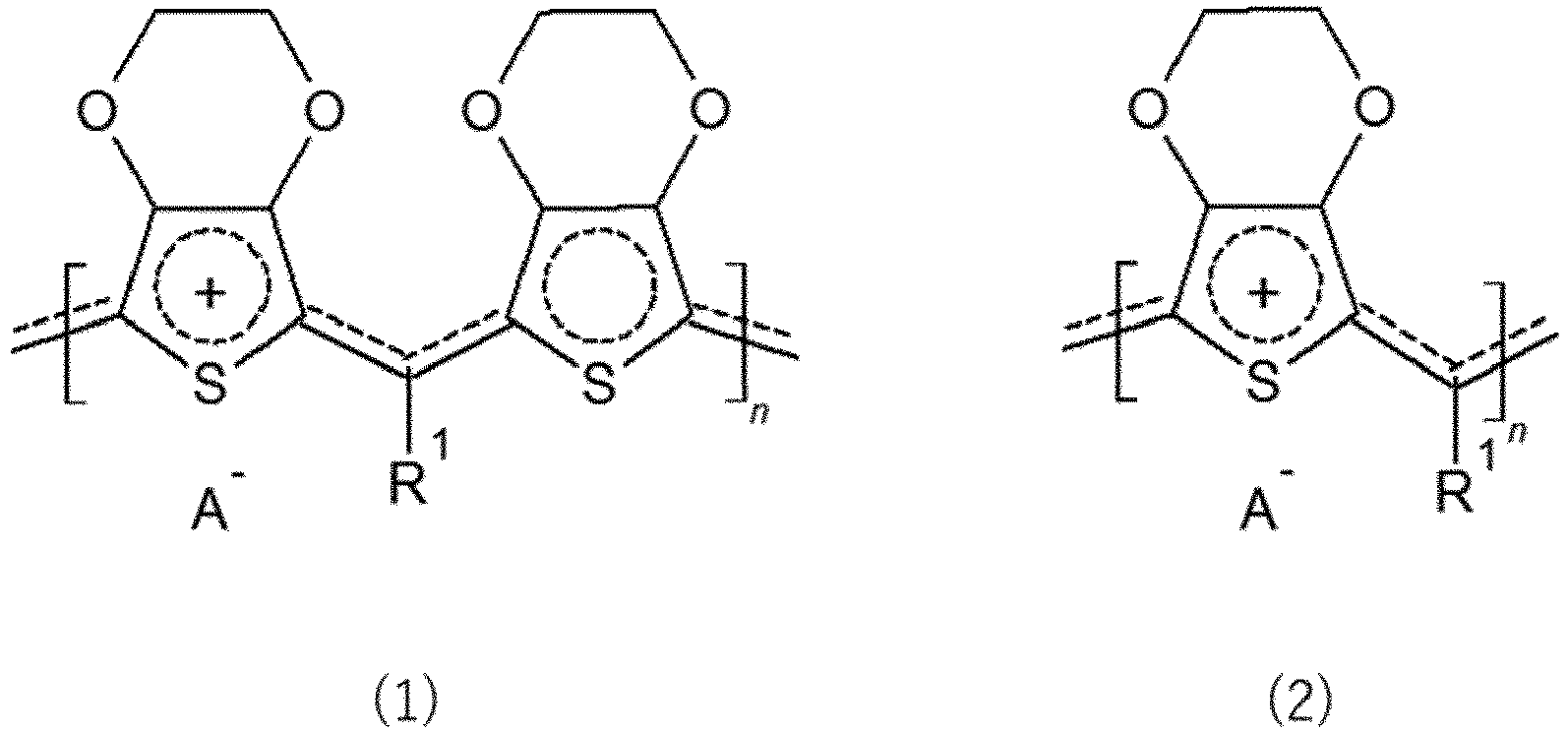 in den Formeln (1) und (2) R1 eine Alkylgruppe mit 1 bis 12 Kohlenstoffatomen, eine Alkoxygruppe mit 1 bis 12 Kohlenstoffatomen, eine Alkylenoxidgruppe mit 1 bis 12 Kohlenstoffatomen und mit 1 bis 50 Wiederholungseinheiten, eine Phenylgruppe, die optional einen Substituenten aufweist, eine heterocyclische Gruppe, die optional einen Substituenten aufweist, oder eine kondensierte Ringgruppe, die optional einen Substituenten aufweist, ist, A- ein Anion ist, das von einem Dotierstoff abgeleitet ist, und n 2 oder mehr und 300 oder weniger beträgt,wobei 80 bis 100 Masse-% des Dotierstoffs einen Dotierstoff mit 1 oder 2 Anionen in einem Dotierstoffmolekül umfassen;das leitfähige Polymer einen volumenbezogenen durchschnittlichen Partikeldurchmesser D50 von 0,1 bis 100 nm in der Dispersion, gemessen mit einem photodynamischen Streuungsverfahren, aufweist,das poröse Material ein Elektrodenmaterial, das ein Sinterkörper aus Partikeln ist, und ein Dielektrikum, das eine Oberfläche des Elektrodenmaterials bedeckt, umfasst; undder Lösungsmittelentfernungsschritt das Entfernen wenigstens eines Teils des nichtwässrigen Lösungsmittels und des Ausbildens eines Festelektrolyten, der die Oberfläche des porösen Materials bedeckt, umfasst.
 - Verfahren nach Anspruch 1, wobei ein durchschnittlicher Porendurchmesser des porösen Materials 0,03 µm oder mehr und 5,0 µm oder weniger, gemessen mittels Quecksilberporosimetrie, beträgt.
- Verfahren nach Anspruch 1 oder 2, wobei das Elektrodenmaterial Tantal, Niob oder eine Legierung davon umfasst.
- Verfahren nach einem der Ansprüche 1 bis 3, wobei der Dotierstoff wenigstens ein Atom, ausgewählt aus der Gruppe bestehend aus Sauerstoff, Fluor und Stickstoff, umfasst.
- Dispersion, die ein leitfähiges Polymer umfasst, das in einem nichtwässrigen Lösungsmittel dispergiert ist, wobei:
das leitfähige Polymer wenigstens eine der Struktureinheiten umfasst, die durch die folgende Formel (1) und die folgende Formel (2) dargestellt werden wobei in den Formeln (1) und (2) R1 eine Alkylgruppe mit 1 bis 12 Kohlenstoffatomen, eine Alkoxygruppe mit 1 bis 12 Kohlenstoffatomen, eine Alkylenoxidgruppe mit 1 bis 12 Kohlenstoffatomen und mit 1 bis 50 Wiederholungseinheiten, eine Phenylgruppe, die optional einen Substituenten aufweist, eine heterocyclische Gruppe, die optional einen Substituenten aufweist, oder eine kondensierte Ringgruppe, die optional einen Substituenten aufweist, ist, A- ein Anion ist, das von einem Dotierstoff abgeleitet ist, und n 2 oder mehr und 300 oder weniger beträgt,der Dotierstoff wenigstens eines, ausgewählt aus der Gruppe bestehend aus einem Sulfonsäurederivat, einem Boronsäurederivat, einem Carbonsäurederivat und einem Phosphorsäurederivat, umfasst,dadurch gekennzeichnet, dass 80 bis 100 Masse-% des Dotierstoffs einen Dotierstoff mit 1 oder 2 Anionen in einem Dotierstoffmolekül umfassen; unddas leitfähige Polymer einen volumenbezogenen durchschnittlichen Partikeldurchmesser D50 von 0,1 bis 100 nm in der Dispersion, gemessen mit einem photodynamischen Streuungsverfahren, aufweist.
Applications Claiming Priority (2)
| Application Number | Priority Date | Filing Date | Title |
|---|---|---|---|
| JP2017108403 | 2017-05-31 | ||
| PCT/JP2018/020297 WO2018221438A1 (ja) | 2017-05-31 | 2018-05-28 | 導電性高分子固体電解コンデンサの製造方法及び導電性高分子 |
Publications (3)
| Publication Number | Publication Date |
|---|---|
| EP3633702A1 EP3633702A1 (de) | 2020-04-08 |
| EP3633702A4 EP3633702A4 (de) | 2020-06-24 |
| EP3633702B1 true EP3633702B1 (de) | 2024-11-20 |
Family
ID=64454763
Family Applications (1)
| Application Number | Title | Priority Date | Filing Date |
|---|---|---|---|
| EP18810398.0A Active EP3633702B1 (de) | 2017-05-31 | 2018-05-28 | Verfahren zur herstellung eines leitfähigen polymerfestelektrolytkondensators und leitfähiges polymer |
Country Status (7)
| Country | Link |
|---|---|
| US (1) | US20200118766A1 (de) |
| EP (1) | EP3633702B1 (de) |
| JP (1) | JP7100029B2 (de) |
| KR (1) | KR102414097B1 (de) |
| CN (1) | CN110622268B (de) |
| TW (1) | TWI760497B (de) |
| WO (1) | WO2018221438A1 (de) |
Families Citing this family (16)
| Publication number | Priority date | Publication date | Assignee | Title |
|---|---|---|---|---|
| US11114250B2 (en) | 2018-08-10 | 2021-09-07 | Avx Corporation | Solid electrolytic capacitor formed from conductive polymer particles |
| JP7426986B2 (ja) | 2018-08-10 | 2024-02-02 | キョーセラ・エイブイエックス・コンポーネンツ・コーポレーション | ポリアニリンを含む固体電解キャパシタ |
| CN117912850A (zh) | 2018-08-10 | 2024-04-19 | 京瓷Avx元器件公司 | 包含本征导电聚合物的固体电解电容器 |
| CN113196429A (zh) * | 2018-12-11 | 2021-07-30 | 阿维科斯公司 | 含有本征导电聚合物的固体电解电容器 |
| WO2020129854A1 (ja) * | 2018-12-19 | 2020-06-25 | 綜研化学株式会社 | 導電性高分子組成物 |
| JP2022078370A (ja) * | 2019-03-26 | 2022-05-25 | 綜研化学株式会社 | 導電性高分子組成物 |
| KR20220056862A (ko) * | 2019-08-30 | 2022-05-06 | 소켄 케미칼 앤드 엔지니어링 캄파니, 리미티드 | 도전성 고분자 및 수지 조성물 |
| DE112020004416T5 (de) | 2019-09-18 | 2022-06-15 | KYOCERA AVX Components Corporation | Festelektrolytkondensator zur Verwendung bei hohen Spannungen |
| WO2021119065A1 (en) | 2019-12-10 | 2021-06-17 | Avx Corporation | Solid electrolytic capacitor containing a pre-coat and intrinsically conductive polymer |
| DE112020006024T5 (de) | 2019-12-10 | 2022-10-06 | KYOCERA AVX Components Corporation | Tantalkondensator mit erhöhter Stabilität |
| US11631548B2 (en) * | 2020-06-08 | 2023-04-18 | KYOCERA AVX Components Corporation | Solid electrolytic capacitor containing a moisture barrier |
| KR102400192B1 (ko) * | 2020-06-26 | 2022-05-20 | 광주과학기술원 | 전도성 나노 다공성 멤브레인 및 이의 제조 방법 |
| CN112795144A (zh) * | 2021-01-29 | 2021-05-14 | 森曼泰冷链科技(绍兴)有限公司 | 含导电聚合物的水分散液及其制备方法 |
| JP7558130B2 (ja) * | 2021-08-27 | 2024-09-30 | 信越ポリマー株式会社 | キャパシタ及びその製造方法 |
| CN116365025B (zh) * | 2021-12-28 | 2024-09-10 | 比亚迪股份有限公司 | 一种电解液添加剂、电解液和锂电池 |
| CN116666115B (zh) * | 2023-07-31 | 2023-09-22 | 南通江海电容器股份有限公司 | 一种基于n型导电聚合物的电解电容器及其制备工艺 |
Citations (2)
| Publication number | Priority date | Publication date | Assignee | Title |
|---|---|---|---|---|
| US20110182002A1 (en) * | 2010-01-27 | 2011-07-28 | Nec Tokin Corporation | Conductive polymer suspension and method for producing the same, conductive polymer material, and solid electrolytic capacitor and method for producing the same |
| US20130279079A1 (en) * | 2010-10-01 | 2013-10-24 | Heraeus Precious Metals Gmbh & Co. Kg | Method for improving electrical parameters in capacitors comprising pedot/pss as a solid electrolyte through a polyalkylene glycol |
Family Cites Families (12)
| Publication number | Priority date | Publication date | Assignee | Title |
|---|---|---|---|---|
| WO2006025262A1 (ja) * | 2004-08-30 | 2006-03-09 | Shin-Etsu Polymer Co., Ltd. | 導電性組成物及び導電性架橋体、コンデンサ及びその製造方法、並びに帯電防止塗料、帯電防止膜、帯電防止フィルム、光学フィルタ、及び光情報記録媒体 |
| DE102005043828A1 (de) | 2005-09-13 | 2007-03-22 | H.C. Starck Gmbh | Verfahren zur Herstellung von Elektrolytkondensatoren |
| CN101350252B (zh) * | 2008-09-17 | 2012-06-27 | 中国振华(集团)新云电子元器件有限责任公司 | 一种常温稳定存放的导电高分子电解质聚合液配方及其应用 |
| JP5441952B2 (ja) | 2011-05-17 | 2014-03-12 | Necトーキン株式会社 | 導電性高分子懸濁溶液およびその製造方法、導電性高分子材料、ならびに電解コンデンサおよびその製造方法 |
| WO2014087617A1 (ja) * | 2012-12-07 | 2014-06-12 | パナソニック株式会社 | 固体電解コンデンサの製造方法 |
| US9761347B2 (en) * | 2013-05-17 | 2017-09-12 | Kemet Electronics Corporation | Process to improve coverage and electrical performance of solid electrolytic capacitor |
| JP6079966B2 (ja) * | 2013-05-20 | 2017-02-15 | 三菱マテリアル株式会社 | 強誘電体薄膜形成用組成物とその製造方法 |
| US10108991B2 (en) * | 2014-10-31 | 2018-10-23 | Bank Of America Corporation | Instant customer service feedback system |
| TWI675033B (zh) | 2015-01-05 | 2019-10-21 | 日商綜研化學股份有限公司 | 含有雜環的化合物、使用該化合物的聚合物及其用途 |
| JP6796755B2 (ja) * | 2015-02-04 | 2020-12-09 | パナソニックIpマネジメント株式会社 | 電解コンデンサおよびその製造方法 |
| EP3275916B1 (de) * | 2015-03-27 | 2021-12-15 | Soken Chemical & Engineering Co., Ltd. | Polymer, oxidiertes polymer, polymerzusammensetzung, gelartige polymerzusammensetzung und verwendung davon |
| CN105761938B (zh) * | 2016-02-25 | 2019-02-15 | 深圳新宙邦科技股份有限公司 | 一种铝电解质电容器及其制备方法 |
-
2018
- 2018-05-28 CN CN201880031737.6A patent/CN110622268B/zh active Active
- 2018-05-28 KR KR1020197034163A patent/KR102414097B1/ko active Active
- 2018-05-28 US US16/617,808 patent/US20200118766A1/en not_active Abandoned
- 2018-05-28 JP JP2019522210A patent/JP7100029B2/ja active Active
- 2018-05-28 WO PCT/JP2018/020297 patent/WO2018221438A1/ja not_active Ceased
- 2018-05-28 EP EP18810398.0A patent/EP3633702B1/de active Active
- 2018-05-29 TW TW107118316A patent/TWI760497B/zh active
Patent Citations (2)
| Publication number | Priority date | Publication date | Assignee | Title |
|---|---|---|---|---|
| US20110182002A1 (en) * | 2010-01-27 | 2011-07-28 | Nec Tokin Corporation | Conductive polymer suspension and method for producing the same, conductive polymer material, and solid electrolytic capacitor and method for producing the same |
| US20130279079A1 (en) * | 2010-10-01 | 2013-10-24 | Heraeus Precious Metals Gmbh & Co. Kg | Method for improving electrical parameters in capacitors comprising pedot/pss as a solid electrolyte through a polyalkylene glycol |
Also Published As
| Publication number | Publication date |
|---|---|
| CN110622268B (zh) | 2023-03-28 |
| KR20200015488A (ko) | 2020-02-12 |
| EP3633702A4 (de) | 2020-06-24 |
| JPWO2018221438A1 (ja) | 2020-04-09 |
| WO2018221438A1 (ja) | 2018-12-06 |
| JP7100029B2 (ja) | 2022-07-12 |
| EP3633702A1 (de) | 2020-04-08 |
| TWI760497B (zh) | 2022-04-11 |
| TW201902979A (zh) | 2019-01-16 |
| CN110622268A (zh) | 2019-12-27 |
| KR102414097B1 (ko) | 2022-06-27 |
| US20200118766A1 (en) | 2020-04-16 |
Similar Documents
| Publication | Publication Date | Title |
|---|---|---|
| EP3633702A1 (de) | Verfahren zur herstellung eines leitfähigen polymerfestelektrolytkondensators und leitfähiges polymer | |
| JP7181873B2 (ja) | 固体電解コンデンサ及び固体電解コンデンサの製造方法 | |
| CN102199288B (zh) | 导电聚合物及其制备方法,导电聚合物分散体,和固体电解电容器及其制备方法 | |
| US7411779B2 (en) | Electrolytic capacitors with a polymeric outer layer and process for the production thereof | |
| EP2267053A1 (de) | Leitentes Polymersuspension und Verfahren zur Herstellung, leitentes Polymermaterial und electrolytisches Kapacitor und Verfahren zur deren Herstellung | |
| EP2395514A1 (de) | Elektrisch leitfähige polymerzusammensetzung und verfahren zu ihrer herstellung sowie feststoffelektrolytkondensator mit der elektrisch leitfähigen polymerzusammensetzung | |
| US9922771B2 (en) | Electrolytic capacitor and method for manufacturing same | |
| EP2099041B1 (de) | Leitfähiges Polymer und dieses verwendender Festelektrolytkondensator | |
| CN115380344A (zh) | 用于生产用于高可靠性应用的聚合物电容器的方法 | |
| EP3157976B1 (de) | Zusammensetzung und verfahren zur bildung einer elektroaktiven polymerlösung oder -beschichtung mit konjugiertem heteroaromatischem polymer, elektroaktive polymerlösung, kondensator und antistatisches objekt mit der elektroaktiven beschichtung und festelektrolytkondensator und verfahren zur herstellung davon | |
| US11183340B2 (en) | Method for manufacturing solid electrolytic capacitor | |
| CN101681690B (zh) | 共轭低聚物作为形成导电聚合物用的添加剂的用途 | |
| US11773276B2 (en) | Conductive polymer composition | |
| WO2020196473A1 (ja) | 導電性高分子組成物 | |
| JP2025526672A (ja) | 高純度スルホン化チオフェンモノマー | |
| US20080233274A1 (en) | Manufacturing method of tantalum condenser | |
| EP4383294A1 (de) | Festelektrolyt, festelektrolytkondensator, elektrisch leitfähige polymerdispersion, verfahren zur herstellung des festelektrolyts und verfahren zur herstellung einer elektrisch leitfähigen polymerdispersion | |
| EP4717697A1 (de) | Selbstdotierte thiophene für thermisch stabile kondensatoranwendungen | |
| EP4428884A1 (de) | Elektrische oder elektronische vorrichtung, verfahren zur herstellung einer elektrischen oder elektronischen vorrichtung und vorrichtung mit der elektrischen oder elektronischen vorrichtung |
Legal Events
| Date | Code | Title | Description |
|---|---|---|---|
| STAA | Information on the status of an ep patent application or granted ep patent |
Free format text: STATUS: THE INTERNATIONAL PUBLICATION HAS BEEN MADE |
|
| PUAI | Public reference made under article 153(3) epc to a published international application that has entered the european phase |
Free format text: ORIGINAL CODE: 0009012 |
|
| STAA | Information on the status of an ep patent application or granted ep patent |
Free format text: STATUS: REQUEST FOR EXAMINATION WAS MADE |
|
| 17P | Request for examination filed |
Effective date: 20191230 |
|
| AK | Designated contracting states |
Kind code of ref document: A1 Designated state(s): AL AT BE BG CH CY CZ DE DK EE ES FI FR GB GR HR HU IE IS IT LI LT LU LV MC MK MT NL NO PL PT RO RS SE SI SK SM TR |
|
| AX | Request for extension of the european patent |
Extension state: BA ME |
|
| A4 | Supplementary search report drawn up and despatched |
Effective date: 20200527 |
|
| RIC1 | Information provided on ipc code assigned before grant |
Ipc: H01G 9/028 20060101ALI20200519BHEP Ipc: H01G 9/00 20060101AFI20200519BHEP Ipc: H01G 9/052 20060101ALI20200519BHEP Ipc: C08G 61/12 20060101ALI20200519BHEP Ipc: H01G 9/15 20060101ALI20200519BHEP |
|
| DAV | Request for validation of the european patent (deleted) | ||
| DAX | Request for extension of the european patent (deleted) | ||
| STAA | Information on the status of an ep patent application or granted ep patent |
Free format text: STATUS: EXAMINATION IS IN PROGRESS |
|
| 17Q | First examination report despatched |
Effective date: 20220830 |
|
| GRAP | Despatch of communication of intention to grant a patent |
Free format text: ORIGINAL CODE: EPIDOSNIGR1 |
|
| STAA | Information on the status of an ep patent application or granted ep patent |
Free format text: STATUS: GRANT OF PATENT IS INTENDED |
|
| INTG | Intention to grant announced |
Effective date: 20240830 |
|
| GRAS | Grant fee paid |
Free format text: ORIGINAL CODE: EPIDOSNIGR3 |
|
| GRAA | (expected) grant |
Free format text: ORIGINAL CODE: 0009210 |
|
| STAA | Information on the status of an ep patent application or granted ep patent |
Free format text: STATUS: THE PATENT HAS BEEN GRANTED |
|
| AK | Designated contracting states |
Kind code of ref document: B1 Designated state(s): AL AT BE BG CH CY CZ DE DK EE ES FI FR GB GR HR HU IE IS IT LI LT LU LV MC MK MT NL NO PL PT RO RS SE SI SK SM TR |
|
| REG | Reference to a national code |
Ref country code: GB Ref legal event code: FG4D |
|
| REG | Reference to a national code |
Ref country code: CH Ref legal event code: EP |
|
| REG | Reference to a national code |
Ref country code: DE Ref legal event code: R096 Ref document number: 602018076784 Country of ref document: DE |
|
| REG | Reference to a national code |
Ref country code: IE Ref legal event code: FG4D |
|
| REG | Reference to a national code |
Ref country code: LT Ref legal event code: MG9D |
|
| REG | Reference to a national code |
Ref country code: NL Ref legal event code: MP Effective date: 20241120 |
|
| PG25 | Lapsed in a contracting state [announced via postgrant information from national office to epo] |
Ref country code: PT Free format text: LAPSE BECAUSE OF FAILURE TO SUBMIT A TRANSLATION OF THE DESCRIPTION OR TO PAY THE FEE WITHIN THE PRESCRIBED TIME-LIMIT Effective date: 20250320 Ref country code: HR Free format text: LAPSE BECAUSE OF FAILURE TO SUBMIT A TRANSLATION OF THE DESCRIPTION OR TO PAY THE FEE WITHIN THE PRESCRIBED TIME-LIMIT Effective date: 20241120 Ref country code: IS Free format text: LAPSE BECAUSE OF FAILURE TO SUBMIT A TRANSLATION OF THE DESCRIPTION OR TO PAY THE FEE WITHIN THE PRESCRIBED TIME-LIMIT Effective date: 20250320 |
|
| PG25 | Lapsed in a contracting state [announced via postgrant information from national office to epo] |
Ref country code: FI Free format text: LAPSE BECAUSE OF FAILURE TO SUBMIT A TRANSLATION OF THE DESCRIPTION OR TO PAY THE FEE WITHIN THE PRESCRIBED TIME-LIMIT Effective date: 20241120 Ref country code: NL Free format text: LAPSE BECAUSE OF FAILURE TO SUBMIT A TRANSLATION OF THE DESCRIPTION OR TO PAY THE FEE WITHIN THE PRESCRIBED TIME-LIMIT Effective date: 20241120 |
|
| REG | Reference to a national code |
Ref country code: AT Ref legal event code: MK05 Ref document number: 1744369 Country of ref document: AT Kind code of ref document: T Effective date: 20241120 |
|
| PG25 | Lapsed in a contracting state [announced via postgrant information from national office to epo] |
Ref country code: BG Free format text: LAPSE BECAUSE OF FAILURE TO SUBMIT A TRANSLATION OF THE DESCRIPTION OR TO PAY THE FEE WITHIN THE PRESCRIBED TIME-LIMIT Effective date: 20241120 |
|
| PG25 | Lapsed in a contracting state [announced via postgrant information from national office to epo] |
Ref country code: ES Free format text: LAPSE BECAUSE OF FAILURE TO SUBMIT A TRANSLATION OF THE DESCRIPTION OR TO PAY THE FEE WITHIN THE PRESCRIBED TIME-LIMIT Effective date: 20241120 |
|
| PG25 | Lapsed in a contracting state [announced via postgrant information from national office to epo] |
Ref country code: NO Free format text: LAPSE BECAUSE OF FAILURE TO SUBMIT A TRANSLATION OF THE DESCRIPTION OR TO PAY THE FEE WITHIN THE PRESCRIBED TIME-LIMIT Effective date: 20250220 |
|
| PG25 | Lapsed in a contracting state [announced via postgrant information from national office to epo] |
Ref country code: LV Free format text: LAPSE BECAUSE OF FAILURE TO SUBMIT A TRANSLATION OF THE DESCRIPTION OR TO PAY THE FEE WITHIN THE PRESCRIBED TIME-LIMIT Effective date: 20241120 Ref country code: GR Free format text: LAPSE BECAUSE OF FAILURE TO SUBMIT A TRANSLATION OF THE DESCRIPTION OR TO PAY THE FEE WITHIN THE PRESCRIBED TIME-LIMIT Effective date: 20250221 Ref country code: AT Free format text: LAPSE BECAUSE OF FAILURE TO SUBMIT A TRANSLATION OF THE DESCRIPTION OR TO PAY THE FEE WITHIN THE PRESCRIBED TIME-LIMIT Effective date: 20241120 |
|
| PG25 | Lapsed in a contracting state [announced via postgrant information from national office to epo] |
Ref country code: PL Free format text: LAPSE BECAUSE OF FAILURE TO SUBMIT A TRANSLATION OF THE DESCRIPTION OR TO PAY THE FEE WITHIN THE PRESCRIBED TIME-LIMIT Effective date: 20241120 |
|
| PG25 | Lapsed in a contracting state [announced via postgrant information from national office to epo] |
Ref country code: RS Free format text: LAPSE BECAUSE OF FAILURE TO SUBMIT A TRANSLATION OF THE DESCRIPTION OR TO PAY THE FEE WITHIN THE PRESCRIBED TIME-LIMIT Effective date: 20250220 |
|
| PG25 | Lapsed in a contracting state [announced via postgrant information from national office to epo] |
Ref country code: SM Free format text: LAPSE BECAUSE OF FAILURE TO SUBMIT A TRANSLATION OF THE DESCRIPTION OR TO PAY THE FEE WITHIN THE PRESCRIBED TIME-LIMIT Effective date: 20241120 |
|
| PGFP | Annual fee paid to national office [announced via postgrant information from national office to epo] |
Ref country code: DE Payment date: 20250521 Year of fee payment: 8 |
|
| PG25 | Lapsed in a contracting state [announced via postgrant information from national office to epo] |
Ref country code: DK Free format text: LAPSE BECAUSE OF FAILURE TO SUBMIT A TRANSLATION OF THE DESCRIPTION OR TO PAY THE FEE WITHIN THE PRESCRIBED TIME-LIMIT Effective date: 20241120 |
|
| PGFP | Annual fee paid to national office [announced via postgrant information from national office to epo] |
Ref country code: BE Payment date: 20250521 Year of fee payment: 8 |
|
| PG25 | Lapsed in a contracting state [announced via postgrant information from national office to epo] |
Ref country code: EE Free format text: LAPSE BECAUSE OF FAILURE TO SUBMIT A TRANSLATION OF THE DESCRIPTION OR TO PAY THE FEE WITHIN THE PRESCRIBED TIME-LIMIT Effective date: 20241120 |
|
| PG25 | Lapsed in a contracting state [announced via postgrant information from national office to epo] |
Ref country code: RO Free format text: LAPSE BECAUSE OF FAILURE TO SUBMIT A TRANSLATION OF THE DESCRIPTION OR TO PAY THE FEE WITHIN THE PRESCRIBED TIME-LIMIT Effective date: 20241120 |
|
| PG25 | Lapsed in a contracting state [announced via postgrant information from national office to epo] |
Ref country code: SK Free format text: LAPSE BECAUSE OF FAILURE TO SUBMIT A TRANSLATION OF THE DESCRIPTION OR TO PAY THE FEE WITHIN THE PRESCRIBED TIME-LIMIT Effective date: 20241120 |
|
| PGFP | Annual fee paid to national office [announced via postgrant information from national office to epo] |
Ref country code: CZ Payment date: 20250520 Year of fee payment: 8 |
|
| PG25 | Lapsed in a contracting state [announced via postgrant information from national office to epo] |
Ref country code: IT Free format text: LAPSE BECAUSE OF FAILURE TO SUBMIT A TRANSLATION OF THE DESCRIPTION OR TO PAY THE FEE WITHIN THE PRESCRIBED TIME-LIMIT Effective date: 20241120 |
|
| REG | Reference to a national code |
Ref country code: DE Ref legal event code: R097 Ref document number: 602018076784 Country of ref document: DE |
|
| PG25 | Lapsed in a contracting state [announced via postgrant information from national office to epo] |
Ref country code: SE Free format text: LAPSE BECAUSE OF FAILURE TO SUBMIT A TRANSLATION OF THE DESCRIPTION OR TO PAY THE FEE WITHIN THE PRESCRIBED TIME-LIMIT Effective date: 20241120 |
|
| PLBE | No opposition filed within time limit |
Free format text: ORIGINAL CODE: 0009261 |
|
| STAA | Information on the status of an ep patent application or granted ep patent |
Free format text: STATUS: NO OPPOSITION FILED WITHIN TIME LIMIT |
|
| 26N | No opposition filed |
Effective date: 20250821 |
|
| REG | Reference to a national code |
Ref country code: CH Ref legal event code: H13 Free format text: ST27 STATUS EVENT CODE: U-0-0-H10-H13 (AS PROVIDED BY THE NATIONAL OFFICE) Effective date: 20251223 |
|
| PG25 | Lapsed in a contracting state [announced via postgrant information from national office to epo] |
Ref country code: LU Free format text: LAPSE BECAUSE OF NON-PAYMENT OF DUE FEES Effective date: 20250528 |
|
| PG25 | Lapsed in a contracting state [announced via postgrant information from national office to epo] |
Ref country code: CH Free format text: LAPSE BECAUSE OF NON-PAYMENT OF DUE FEES Effective date: 20250531 |
|
| GBPC | Gb: european patent ceased through non-payment of renewal fee |
Effective date: 20250528 |
|
| PG25 | Lapsed in a contracting state [announced via postgrant information from national office to epo] |
Ref country code: MC Free format text: LAPSE BECAUSE OF FAILURE TO SUBMIT A TRANSLATION OF THE DESCRIPTION OR TO PAY THE FEE WITHIN THE PRESCRIBED TIME-LIMIT Effective date: 20241120 |
|
| PG25 | Lapsed in a contracting state [announced via postgrant information from national office to epo] |
Ref country code: GB Free format text: LAPSE BECAUSE OF NON-PAYMENT OF DUE FEES Effective date: 20250528 |
|
| PG25 | Lapsed in a contracting state [announced via postgrant information from national office to epo] |
Ref country code: IE Free format text: LAPSE BECAUSE OF NON-PAYMENT OF DUE FEES Effective date: 20250528 |
|
| PG25 | Lapsed in a contracting state [announced via postgrant information from national office to epo] |
Ref country code: FR Free format text: LAPSE BECAUSE OF NON-PAYMENT OF DUE FEES Effective date: 20250531 |