EP3634616B1 - Procédé de préparation de combustibles hydrocarbonés à partir de déchets de polyoléfine - Google Patents
Procédé de préparation de combustibles hydrocarbonés à partir de déchets de polyoléfine Download PDFInfo
- Publication number
- EP3634616B1 EP3634616B1 EP18730461.3A EP18730461A EP3634616B1 EP 3634616 B1 EP3634616 B1 EP 3634616B1 EP 18730461 A EP18730461 A EP 18730461A EP 3634616 B1 EP3634616 B1 EP 3634616B1
- Authority
- EP
- European Patent Office
- Prior art keywords
- depolymerisation
- packing
- reaction chamber
- temperature
- hydrogenation
- Prior art date
- Legal status (The legal status is an assumption and is not a legal conclusion. Google has not performed a legal analysis and makes no representation as to the accuracy of the status listed.)
- Active
Links
Images

Classifications
-
- C—CHEMISTRY; METALLURGY
- C10—PETROLEUM, GAS OR COKE INDUSTRIES; TECHNICAL GASES CONTAINING CARBON MONOXIDE; FUELS; LUBRICANTS; PEAT
- C10G—CRACKING HYDROCARBON OILS; PRODUCTION OF LIQUID HYDROCARBON MIXTURES, e.g. BY DESTRUCTIVE HYDROGENATION, OLIGOMERISATION, POLYMERISATION; RECOVERY OF HYDROCARBON OILS FROM OIL-SHALE, OIL-SAND, OR GASES; REFINING MIXTURES MAINLY CONSISTING OF HYDROCARBONS; REFORMING OF NAPHTHA; MINERAL WAXES
- C10G1/00—Production of liquid hydrocarbon mixtures from oil-shale, oil-sand, or non-melting solid carbonaceous or similar materials, e.g. wood, coal
- C10G1/008—Controlling or regulating of liquefaction processes
-
- C—CHEMISTRY; METALLURGY
- C10—PETROLEUM, GAS OR COKE INDUSTRIES; TECHNICAL GASES CONTAINING CARBON MONOXIDE; FUELS; LUBRICANTS; PEAT
- C10G—CRACKING HYDROCARBON OILS; PRODUCTION OF LIQUID HYDROCARBON MIXTURES, e.g. BY DESTRUCTIVE HYDROGENATION, OLIGOMERISATION, POLYMERISATION; RECOVERY OF HYDROCARBON OILS FROM OIL-SHALE, OIL-SAND, OR GASES; REFINING MIXTURES MAINLY CONSISTING OF HYDROCARBONS; REFORMING OF NAPHTHA; MINERAL WAXES
- C10G1/00—Production of liquid hydrocarbon mixtures from oil-shale, oil-sand, or non-melting solid carbonaceous or similar materials, e.g. wood, coal
- C10G1/08—Production of liquid hydrocarbon mixtures from oil-shale, oil-sand, or non-melting solid carbonaceous or similar materials, e.g. wood, coal with moving catalysts
- C10G1/086—Characterised by the catalyst used
-
- C—CHEMISTRY; METALLURGY
- C10—PETROLEUM, GAS OR COKE INDUSTRIES; TECHNICAL GASES CONTAINING CARBON MONOXIDE; FUELS; LUBRICANTS; PEAT
- C10G—CRACKING HYDROCARBON OILS; PRODUCTION OF LIQUID HYDROCARBON MIXTURES, e.g. BY DESTRUCTIVE HYDROGENATION, OLIGOMERISATION, POLYMERISATION; RECOVERY OF HYDROCARBON OILS FROM OIL-SHALE, OIL-SAND, OR GASES; REFINING MIXTURES MAINLY CONSISTING OF HYDROCARBONS; REFORMING OF NAPHTHA; MINERAL WAXES
- C10G1/00—Production of liquid hydrocarbon mixtures from oil-shale, oil-sand, or non-melting solid carbonaceous or similar materials, e.g. wood, coal
- C10G1/10—Production of liquid hydrocarbon mixtures from oil-shale, oil-sand, or non-melting solid carbonaceous or similar materials, e.g. wood, coal from rubber or rubber waste
-
- C—CHEMISTRY; METALLURGY
- C10—PETROLEUM, GAS OR COKE INDUSTRIES; TECHNICAL GASES CONTAINING CARBON MONOXIDE; FUELS; LUBRICANTS; PEAT
- C10G—CRACKING HYDROCARBON OILS; PRODUCTION OF LIQUID HYDROCARBON MIXTURES, e.g. BY DESTRUCTIVE HYDROGENATION, OLIGOMERISATION, POLYMERISATION; RECOVERY OF HYDROCARBON OILS FROM OIL-SHALE, OIL-SAND, OR GASES; REFINING MIXTURES MAINLY CONSISTING OF HYDROCARBONS; REFORMING OF NAPHTHA; MINERAL WAXES
- C10G3/00—Production of liquid hydrocarbon mixtures from oxygen-containing organic materials, e.g. fatty oils, fatty acids
- C10G3/50—Production of liquid hydrocarbon mixtures from oxygen-containing organic materials, e.g. fatty oils, fatty acids in the presence of hydrogen, hydrogen donors or hydrogen generating compounds
- C10G3/52—Hydrogen in a special composition or from a special source
-
- C—CHEMISTRY; METALLURGY
- C10—PETROLEUM, GAS OR COKE INDUSTRIES; TECHNICAL GASES CONTAINING CARBON MONOXIDE; FUELS; LUBRICANTS; PEAT
- C10G—CRACKING HYDROCARBON OILS; PRODUCTION OF LIQUID HYDROCARBON MIXTURES, e.g. BY DESTRUCTIVE HYDROGENATION, OLIGOMERISATION, POLYMERISATION; RECOVERY OF HYDROCARBON OILS FROM OIL-SHALE, OIL-SAND, OR GASES; REFINING MIXTURES MAINLY CONSISTING OF HYDROCARBONS; REFORMING OF NAPHTHA; MINERAL WAXES
- C10G45/00—Refining of hydrocarbon oils using hydrogen or hydrogen-generating compounds
- C10G45/32—Selective hydrogenation of the diolefin or acetylene compounds
-
- C—CHEMISTRY; METALLURGY
- C10—PETROLEUM, GAS OR COKE INDUSTRIES; TECHNICAL GASES CONTAINING CARBON MONOXIDE; FUELS; LUBRICANTS; PEAT
- C10G—CRACKING HYDROCARBON OILS; PRODUCTION OF LIQUID HYDROCARBON MIXTURES, e.g. BY DESTRUCTIVE HYDROGENATION, OLIGOMERISATION, POLYMERISATION; RECOVERY OF HYDROCARBON OILS FROM OIL-SHALE, OIL-SAND, OR GASES; REFINING MIXTURES MAINLY CONSISTING OF HYDROCARBONS; REFORMING OF NAPHTHA; MINERAL WAXES
- C10G45/00—Refining of hydrocarbon oils using hydrogen or hydrogen-generating compounds
- C10G45/58—Refining of hydrocarbon oils using hydrogen or hydrogen-generating compounds to change the structural skeleton of some of the hydrocarbon content without cracking the other hydrocarbons present, e.g. lowering pour point; Selective hydrocracking of normal paraffins
-
- C—CHEMISTRY; METALLURGY
- C10—PETROLEUM, GAS OR COKE INDUSTRIES; TECHNICAL GASES CONTAINING CARBON MONOXIDE; FUELS; LUBRICANTS; PEAT
- C10G—CRACKING HYDROCARBON OILS; PRODUCTION OF LIQUID HYDROCARBON MIXTURES, e.g. BY DESTRUCTIVE HYDROGENATION, OLIGOMERISATION, POLYMERISATION; RECOVERY OF HYDROCARBON OILS FROM OIL-SHALE, OIL-SAND, OR GASES; REFINING MIXTURES MAINLY CONSISTING OF HYDROCARBONS; REFORMING OF NAPHTHA; MINERAL WAXES
- C10G65/00—Treatment of hydrocarbon oils by two or more hydrotreatment processes only
- C10G65/02—Treatment of hydrocarbon oils by two or more hydrotreatment processes only plural serial stages only
- C10G65/12—Treatment of hydrocarbon oils by two or more hydrotreatment processes only plural serial stages only including cracking steps and other hydrotreatment steps
-
- C—CHEMISTRY; METALLURGY
- C10—PETROLEUM, GAS OR COKE INDUSTRIES; TECHNICAL GASES CONTAINING CARBON MONOXIDE; FUELS; LUBRICANTS; PEAT
- C10G—CRACKING HYDROCARBON OILS; PRODUCTION OF LIQUID HYDROCARBON MIXTURES, e.g. BY DESTRUCTIVE HYDROGENATION, OLIGOMERISATION, POLYMERISATION; RECOVERY OF HYDROCARBON OILS FROM OIL-SHALE, OIL-SAND, OR GASES; REFINING MIXTURES MAINLY CONSISTING OF HYDROCARBONS; REFORMING OF NAPHTHA; MINERAL WAXES
- C10G2300/00—Aspects relating to hydrocarbon processing covered by groups C10G1/00 - C10G99/00
- C10G2300/10—Feedstock materials
- C10G2300/1003—Waste materials
-
- C—CHEMISTRY; METALLURGY
- C10—PETROLEUM, GAS OR COKE INDUSTRIES; TECHNICAL GASES CONTAINING CARBON MONOXIDE; FUELS; LUBRICANTS; PEAT
- C10G—CRACKING HYDROCARBON OILS; PRODUCTION OF LIQUID HYDROCARBON MIXTURES, e.g. BY DESTRUCTIVE HYDROGENATION, OLIGOMERISATION, POLYMERISATION; RECOVERY OF HYDROCARBON OILS FROM OIL-SHALE, OIL-SAND, OR GASES; REFINING MIXTURES MAINLY CONSISTING OF HYDROCARBONS; REFORMING OF NAPHTHA; MINERAL WAXES
- C10G2400/00—Products obtained by processes covered by groups C10G9/00 - C10G69/14
- C10G2400/02—Gasoline
-
- C—CHEMISTRY; METALLURGY
- C10—PETROLEUM, GAS OR COKE INDUSTRIES; TECHNICAL GASES CONTAINING CARBON MONOXIDE; FUELS; LUBRICANTS; PEAT
- C10G—CRACKING HYDROCARBON OILS; PRODUCTION OF LIQUID HYDROCARBON MIXTURES, e.g. BY DESTRUCTIVE HYDROGENATION, OLIGOMERISATION, POLYMERISATION; RECOVERY OF HYDROCARBON OILS FROM OIL-SHALE, OIL-SAND, OR GASES; REFINING MIXTURES MAINLY CONSISTING OF HYDROCARBONS; REFORMING OF NAPHTHA; MINERAL WAXES
- C10G2400/00—Products obtained by processes covered by groups C10G9/00 - C10G69/14
- C10G2400/04—Diesel oil
-
- C—CHEMISTRY; METALLURGY
- C10—PETROLEUM, GAS OR COKE INDUSTRIES; TECHNICAL GASES CONTAINING CARBON MONOXIDE; FUELS; LUBRICANTS; PEAT
- C10G—CRACKING HYDROCARBON OILS; PRODUCTION OF LIQUID HYDROCARBON MIXTURES, e.g. BY DESTRUCTIVE HYDROGENATION, OLIGOMERISATION, POLYMERISATION; RECOVERY OF HYDROCARBON OILS FROM OIL-SHALE, OIL-SAND, OR GASES; REFINING MIXTURES MAINLY CONSISTING OF HYDROCARBONS; REFORMING OF NAPHTHA; MINERAL WAXES
- C10G2400/00—Products obtained by processes covered by groups C10G9/00 - C10G69/14
- C10G2400/06—Gasoil
-
- C—CHEMISTRY; METALLURGY
- C10—PETROLEUM, GAS OR COKE INDUSTRIES; TECHNICAL GASES CONTAINING CARBON MONOXIDE; FUELS; LUBRICANTS; PEAT
- C10G—CRACKING HYDROCARBON OILS; PRODUCTION OF LIQUID HYDROCARBON MIXTURES, e.g. BY DESTRUCTIVE HYDROGENATION, OLIGOMERISATION, POLYMERISATION; RECOVERY OF HYDROCARBON OILS FROM OIL-SHALE, OIL-SAND, OR GASES; REFINING MIXTURES MAINLY CONSISTING OF HYDROCARBONS; REFORMING OF NAPHTHA; MINERAL WAXES
- C10G2400/00—Products obtained by processes covered by groups C10G9/00 - C10G69/14
- C10G2400/20—C2-C4 olefins
-
- C—CHEMISTRY; METALLURGY
- C10—PETROLEUM, GAS OR COKE INDUSTRIES; TECHNICAL GASES CONTAINING CARBON MONOXIDE; FUELS; LUBRICANTS; PEAT
- C10G—CRACKING HYDROCARBON OILS; PRODUCTION OF LIQUID HYDROCARBON MIXTURES, e.g. BY DESTRUCTIVE HYDROGENATION, OLIGOMERISATION, POLYMERISATION; RECOVERY OF HYDROCARBON OILS FROM OIL-SHALE, OIL-SAND, OR GASES; REFINING MIXTURES MAINLY CONSISTING OF HYDROCARBONS; REFORMING OF NAPHTHA; MINERAL WAXES
- C10G2400/00—Products obtained by processes covered by groups C10G9/00 - C10G69/14
- C10G2400/26—Fuel gas
-
- Y—GENERAL TAGGING OF NEW TECHNOLOGICAL DEVELOPMENTS; GENERAL TAGGING OF CROSS-SECTIONAL TECHNOLOGIES SPANNING OVER SEVERAL SECTIONS OF THE IPC; TECHNICAL SUBJECTS COVERED BY FORMER USPC CROSS-REFERENCE ART COLLECTIONS [XRACs] AND DIGESTS
- Y02—TECHNOLOGIES OR APPLICATIONS FOR MITIGATION OR ADAPTATION AGAINST CLIMATE CHANGE
- Y02P—CLIMATE CHANGE MITIGATION TECHNOLOGIES IN THE PRODUCTION OR PROCESSING OF GOODS
- Y02P30/00—Technologies relating to oil refining and petrochemical industry
- Y02P30/20—Technologies relating to oil refining and petrochemical industry using bio-feedstock
Definitions
- This invention relates to a method for producing of hydrocarbon fuels with a reduced content of unsaturated compounds, from polyolefin waste materials using feedstock recycling.
- Waste plastics mainly include thermoplastic materials, while more than 10% of communal waste are polyolefins, such as polyethylene (PE), polypropylene (PP) and polystyrene (PS), due to their application on a mass scale in the production of packages, i.e. the main source of polymer waste.
- PE polyethylene
- PP polypropylene
- PS polystyrene
- Known methods of treatment of polyolefin waste materials include, among others, feedstock recycling, material recycling and energy recycling.
- Energy recycling is based on the combustion of waste plastics and collecting the energy produced in the process.
- polyolefins have high calorific values
- combustion of plastics releases environmentally hazardous substances, such as chlorine, sulphur or nitrogen compounds.
- feedstock recycling which consist in depolymerisation of polymer chains in order to produce hydrocarbons of lower molecular weight that can be used in various processes, for example, as fuel ingredients or as substrates in a variety of industrial processes, plays such an important role in the disposal of waste thermoplastics, including polyolefins.
- depolymerisation of waste plastics is usually carried out with the use of catalysts, which decrease activation energy of depolymerisation reaction and make it possible to control molecular weight of products.
- catalysts which decrease activation energy of depolymerisation reaction and make it possible to control molecular weight of products.
- polish patent application P.408583 discloses a method of thermal decomposition of waste plastics and biomass, wherein waste plastics and biomass are subjected to catalytic depolymerisation in the presence of zeolite catalysts, in higher temperature conditions, from 450 to 550°C.
- the depolymerisation is carried out in a tower flow reactor packed with Pall rings, in a continuous way, in a process in which the packing and reactants in the form of crushed plastic material mixed with a catalyst are fed into the reactor, and the blend is heated in the reactor during a predefined period of time.
- the plastics in the reaction chamber first undergo plasticisation and then thermal decomposition to compounds of lower molecular weight.
- Gaseous products are removed through a top outlet of the reaction chamber while a char deposit on the Pall rings is removed through a bottom outlet of the reaction chamber. Then, the gaseous products consisting of a mixture of hydrocarbons can be separated into fractions using distillation: a benzine fraction with a boiling point of up to 180°C, and an oil fraction with a boiling point of up to 360°C.
- the advantage of this process is a relatively high yield of the depolymerisation process, while its disadvantages include uneven distribution of the plasticised material on the Pall rings and a high content of the depolymerisation product with unsaturated bonds.
- polish patent description PL210518 discloses a two-step method for hydrogenation of the hydrocarbon fraction from polymer waste processing, wherein, in the first step, methanol is reduced to carbon monoxide and hydrogen in an inert gas atmosphere, at a temperature from 100 to 300°C, in the presence of a catalyst: metal oxide selected from the group of: CoO, NiO, CuO and ZnO, deposited on a carrier selected from the group of: SiO 2 , Al 2 O 3 , TiO 2 and ZrO 2 .
- a catalyst metal oxide selected from the group of: CoO, NiO, CuO and ZnO, deposited on a carrier selected from the group of: SiO 2 , Al 2 O 3 , TiO 2 and ZrO 2 .
- unsaturated fractions produced in polyolefin decomposition and with a boiling point below 360°C are subjected to hydrogenation with the use of a mixture of carbon monoxide and hydrogen, at a temperature from 100 to 400°C, in the presence of metal catalyst selected from the group of: Pt, Rh, Co/Mo, Mo, W and Fe, on an oxide carrier selected from the group of: SiO 2 , Al 2 O 3 , TiO 2 , MgO and ZrO 2 .
- metal catalyst selected from the group of: Pt, Rh, Co/Mo, Mo, W and Fe
- oxide carrier selected from the group of: SiO 2 , Al 2 O 3 , TiO 2 , MgO and ZrO 2 .
- WO2004/037906 discloses a method of production providing high value products: kerosene, including cosmetic kerosene, white oils, high value paraffin and purified liquid fuels from polyolefin waste material and polyolefins.
- kerosene including cosmetic kerosene, white oils, high value paraffin and purified liquid fuels from polyolefin waste material and polyolefins.
- the product of the thermocatalytic decomposition of polyolefin waste material which is obtained in a vapour form is subjected to a fractionating condensation or full condensation followed by fractionating distillation and then subjected to catalytic hydrogenation to remove unsaturated double bonds and hydrogenation of aromatic hydrocarbons which are eventually present in the product.
- the prepared fractions undergo further treatment by means of distillation in order to obtain fractions corresponding with the boiling temperature limits of the following high purity final products: a gasoline fraction, cosmetic kerosene, a white oil fraction - that can be eventually separated into narrower fractions having physicochemical properties characteristic for different grades of white oil, as well as a paraffin fraction used as a raw material for preparation of cosmetic paraffin and other high quality paraffin grades.
- Partial condensation and re-circulation of the vaporised decomposition product to the thermocatalytic reactor is advantageous in order to increase the content of low boiling hydrocarbons corresponding with kerosene and white oil fractions in the product of the thermocatalytic decomposition.
- the Japanese patent application JPH0559372A discloses polyolefin resin such as waste cross-linked polyethylene material that is pyrolyzed at a temperature within the range of 300-550°C and the produced oily or vaporous product, together with gaseous nitrogen, etc., supplied from a carrier gas feeding part, is fed from the feeding part to a catalyst layer reaction part of a catalytic reforming reactor filled with rare earth ion-exchanging Y type zeolite, etc., and subjected to complete ion exchange with a rare earth element mixture (e.g., 36% La, 28% Ce, 25% Na, and others), then heated at 200-600°C with an electric heater and subjected to catalytic converting reaction.
- a rare earth element mixture e.g., 36% La, 28% Ce, 25% Na, and others
- the resultant product is subsequently cooled to 0°C with an ice-cooled condenser and then cooled to - 80°C with a dry ice condenser to separate the gaseous nitrogen and lower hydrocarbons.
- high-octane fuel oil is obtained.
- the Japanese patent application JP2009242485A discloses a method for producing light oil from waste plastic.
- the method for producing light oil from waste plastics includes a process of crushing the waste plastics to prepare a slurry, a process of preliminary heating the waste plastics slurry, and a two-step reaction process under a high temperature and high pressure of hydrogen atmosphere, wherein the two-step reaction process includes a mainly thermolytic reaction process of obtaining light oil from the waste plastics having high reactivities such as polystyrene, polypropylene, etc., under the hydrogen atmosphere, and a mainly hydrogenation process of obtaining light oil from the waste plastics having low reactivities such as polyethylene, polyvinyl chloride, etc., under the hydrogen atmosphere and at a higher temperature than that of the mainly thermolytic reaction process.
- the subject-matter of the invention is a method of producing hydrocarbon fuels from polyolefin waste materials, wherein: polyolefin waste materials are subjected to continuous depolymerisation in a tower flow reactor with a movable packing, which comprises a heating system for heating the lower half of the reaction chamber, where products of the depolymerisation are collected in a gaseous state through an outlet in the upper half of the reaction chamber; and the collected products of the depolymerisation are subjected to catalytic hydrogenation and isomerisation in an atmosphere of synthesis gas under atmospheric pressure, to obtain a mixture of hydrocarbon fuels.
- polyolefin waste materials are mixed with heated elements constituting the tower reactor packing until the surface of the packing elements is coated with a thin layer of plasticised material, wherein in the depolymerisation process, the obtained mixture is fed as a stream into the reaction chamber from the top of the chamber, whereas a synthesis gas is fed in a counter-current from the bottom, and whereas the gas contains carbon monoxide (CO) and hydrogen (H 2 ), with the CO:H 2 molar ratio from 0.25 to 1.5 : from 0.5 to 3.
- CO carbon monoxide
- H 2 hydrogen
- the depolymerisation is carried out under atmospheric pressure.
- the packing of the reaction chamber is selected from the group of Raschig rings, Pall rings, and Bialecki rings.
- the polyolefin waste materials are mixed with the reactor packing in an amount not exceeding 1 kg of the material per 1 m 2 of the specific surface area of the packing.
- the mixture of the reactor packing and plasticised material is fed into the reaction chamber at a temperature from 240 to 260°C, preferably 250°C.
- the depolymerisation is carried out maintaining a temperature gradient, wherein the lower half of the reaction chamber is heated using a heating system to a temperature in the range of 400 to 440°C, while near the outlet for the depolymerisation products, the temperature is maintained in the range of 200 to 360°C.
- the depolymerisation is used for polyolefin materials selected from the group of polyethylene, and polypropylene.
- the process of the hydrogenation and isomerisation is fed with depolymerisation products in a gaseous state having a temperature in the range of 320 to 360°C.
- the hydrogenation is carried out in the presence of at least one metal catalyst selected from the group of platinum and palladium, deposited on an oxide carrier selected from the group of Al 2 O 3 and P 2 O 5 .
- at least one metal catalyst selected from the group of platinum and palladium, deposited on an oxide carrier selected from the group of Al 2 O 3 and P 2 O 5 .
- the hydrogenation and isomerisation are carried out in an atmosphere of synthesis gas containing carbon monoxide and hydrogen, and with the CO:H 2 weight ratio from 0.25 to 1.5 : from 0.5 to 3.
- the hydrogenation and isomerisation products are subjected to a fractional distillation with a separation into a low-boiling fraction (C1-C4), a benzine fraction, and an oil fraction.
- a fractional distillation with a separation into a low-boiling fraction (C1-C4), a benzine fraction, and an oil fraction.
- the low-boiling fraction is used to produce synthesis gas for depolymerisation and hydrogenation.
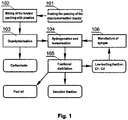
- the method of the manufacturing of liquid fuels from waste plastics includes: heating the packing of the depolymerisation reactor in step 101, mixing the waste plastics with the packing in step 102, feeding the obtained mixture into the reactor and depolymerising the waste plastics in step 103, hydrogenating and isomerising of the depolymerisation products in step 104, and a fractional distillation of the hydrocarbon mixture in step 105.
- waste polyolefins polyethylene (PE) and polypropylene (PP) are cleansed and ground and then rinsed with nitrogen, in order to limit the amount of oxygen fed into the reactor with the air trapped in the spaces among fragments of the ground waste.
- the packing of the reactor is prepared, and then heated in step 101 to a temperature from 430 and 470°C, preferably 450°C.
- the reactor can be packed with any known elements that are used as structured packing of distillation columns, for example Raschig rings, Pall rings, and Bialecki rings.
- Heated elements of the packing are then mixed in step 102 with the cleansed and crushed polyolefin waste for a time period necessary for plasticisation and formation of the uniform thin layer of the plastic on the surface of the packing elements, with thickness preferably from 0.3 to 2 mm.
- the weight of the plastic per each 1 m 2 of the specific surface area of the packing elements should not exceed 1 kg, preferably not more than 0.5 kg.
- the plastic can be gradually fed into the chamber filled with the packing elements heated to an appropriate temperature, in such proportions as to maintain constant plasticity of the raw material on the surface of the packing elements.
- the average temperature of the mixture should range from 240 to 260°C, preferably 250°C, which is a result of heat that is transferred from the packing elements to the plastic.
- the reactor 200 can be constructed and dimensioned as similar to the depolymerisation reactor described in the Polish patent application P.408583 .
- the depolymerisation reactor 200 is a tower reactor and it comprises a reaction chamber in the form of a vertical pipe 201, with an inlet 202 for raw material and packing and an outlet 203 for gaseous products of depolymerisation located within an upper portion of the chamber, and an outlet 204 for the packing located in a lower portion of the chamber.
- the raw material and packing inlet 202 and the packing outlet 204 are equipped with coreless screw conveyors, what provides an adjustment of the flow of the packing through the reaction chamber and therefore it provides control over the dwell time of the reagents inside the chamber.
- the reaction chamber 201 preferably has a diameter smaller than its height, and preferably it has a diameter to height proportion of 1:6, which provides the optimal temperature distribution of during the depolymerisation process.
- the depolymerisation reactor 200 presented in Fig. 2 is further equipped with an inlet 205, located near the packing outlet 204, for a synthesis gas feeding into the reaction chamber in a counter-current with respect to the direction in which the packing elements move during the depolymerisation process.
- the depolymerisation reactor 200 is further equipped with a heating system (for the clarity, not presented in the drawing) in the form of a heating jacket located in the lower portion of the reaction chamber 201 and extending to the mid-height of the chamber 201.
- a heating system for the clarity, not presented in the drawing
- the heating system of the reactor is supplied with liquid metal alloy, preferably tin alloy, as a heating agent, which additionally provides the uniform temperature distribution of in the selected areas of the reaction chamber and allows obtaining a suitable temperature gradient inside the chamber.
- the temperature measured in the lower half of the reaction chamber should range from 400 to 470°C, more preferably 400 to 440°C, most preferably 420°C, whereas in the upper (not heated) half of the reaction chamber 201, the temperature is gradually decreased, so that in the top point of the chamber 201, namely near the outlet 204 for depolymerisation products, the temperature measured inside the chamber should range from 200 to 360°C.
- the temperature gradient inside the reaction chamber, between the lowest and the top point of the chamber can reach up to 270°C. Such a temperature gradient inside the reaction chamber is obtained when the reactor heating system does not exceed 500°C.
- step 103 the raw material is fed into the reaction chamber, together with the packing elements, in a plasticised state - creating a thin, even layer of the plastic on the surface of the packing elements, at a temperature preferably about 250°C.
- the raw material is gravitationally transported towards the lower outlet 204, where it undergoes further heating and depolymerisation in an atmosphere of the synthesis gas which is fed into the reaction chamber 202 in a counter-current through the inlet 205.
- the synthesis gas used in the depolymerisation process contains hydrogen, carbon monoxide, and optionally, an addition of nitrogen as an inert gas, to dilute the components of the synthesis gas.
- the molar ratio of the components of the used synthesis gas CO : H 2 : N 2 ranges from 0.25 to 1.5 : from 0.5 to 3 : from 0 to 1. Most preferably, the CO : H 2 molar ratio in the synthesis gas is 1:2.
- the synthesis gas is fed into the reaction chamber as a stream in an amount of 50 to 500 litres of the synthesis gas per 1 kg of the raw material.
- the processes of the depolymerisation in the lower parts of the reactor 200, where the temperature inside the reaction chamber reaches about 420°C, as well as the further process of the condensation supplied with the condensate of the stream of "a fresh" raw material, can be repeated in the reactor 200 periodically, until the depolymerisation products with a boiling point below 360°C are obtained, preferably with a boiling point ranging between 200 and 360°C.
- the depolymerisation products with a specific boiling point are discharged from the reaction chamber 201 through the outlet 203.
- the process of the packing decharring can be carried out, for example, by the use of char sifting. Therefore, the process carried out in a such way provides reduced production downtimes, allowing to remove the char from the packing elements outside the area of the reaction chamber 201.
- the as-obtained depolymerisation products in a gaseous state are subjected to hydrogenation and isomerisation in step 104.
- the processes of the hydrogenation and isomerisation can be carried out analogously to the description of the patent PL210518 : using a metal catalyst such as platinum and/or palladium deposited on an oxide carrier, for example, Al 2 O 3 or P 2 O 5 , at a temperature in the range of 320 to 360°C, in the presence of a synthesis gas which comprises CO and H 2 with the CO:H 2 molar ratio from 0.25 to 1.5 : from 0.5 to 3, and preferably with the CO:H 2 molar ratio of 1:2.
- the synthesis gas used in the present process is not produced from methanol but from C1-C4 hydrocarbons that are preferably obtained in the process of the polyolefins depolymerisation .
- the processes of the hydrogenation and isomerisation uses hydrocarbons in a gaseous state at a temperature from 320 to 360°C.
- the pipe for transporting the depolymerisation products to the hydrogenation and isomerisation reactor is equipped with a heating system and a temperature control system providing an appropriate temperature of the depolymerisate at the inlet of the hydrogenation and isomerisation reactor.
- a mixture of saturated hydrocarbons is obtained, which is then subjected, in step 105, to fractional distillation in order to obtain a low-boiling fraction (C1-C4), a benzine fraction, and an oil fraction.
- the distillation process can be carried out, for example, with the use of a conventional distillation column.
- the obtained C1-C4 fraction can be used to produce synthesis gas 106 ( Fig. 2 ), which is used for polyolefins depolymerisation and for the subsequent hydrogenation and isomerisation processes, as well as to fuel the burners of the hydrogenation and isomerisation reactor or the power generator, for example, in the form of a steam turbine.
- the employed isomerisation process makes it possible to obtain branched products, resulting in an increased octane number of the produced hydrocarbon fuels.
- both the polyolefins depolymerisation and the hydrogenation and isomerisation processes are carried out under atmospheric pressure, providing reduced installation and processing costs. For this reason, the process is economically profitable regardless of whether a large or a small volume of waste plastics is processed annually, in contrast to pressure technologies, which require considerably large volumes of raw materials to be processed annually in order to render the process economically profitable.
- a hydrogen donor is a mixture of carbon monoxide and hydrogen (synthesis gas) at an appropriate ratio, with the volume of the synthesis gas stream fed into the reaction chamber is maintained in the range of 50 to 500 litres of synthesis gas per 1 kg of raw material.
- the present process also enables the production of saturated hydrocarbon products, including a low-boiling fraction C1-C4, a benzine fraction, and an oil fraction, of characteristic high purity - with a decreased amount of double bonds in the products, what is particularly difficult to obtain in the case of waste materials due to the presence of impurities in such materials, and other sorts of additives.
- a satisfactory decrease of the content of unsaturated compounds in the produced hydrocarbon fractions is particularly crucial when depolymerisation products are used as fuels; due to relatively high reactivity of double and triple bonds, which undergo polymerisation and oxidation processes, which promote accelerated fuel aging and precipitation of solid impurities.
Landscapes
- Chemical & Material Sciences (AREA)
- Oil, Petroleum & Natural Gas (AREA)
- Engineering & Computer Science (AREA)
- Chemical Kinetics & Catalysis (AREA)
- General Chemical & Material Sciences (AREA)
- Organic Chemistry (AREA)
- Life Sciences & Earth Sciences (AREA)
- Wood Science & Technology (AREA)
- Crystallography & Structural Chemistry (AREA)
- Separation, Recovery Or Treatment Of Waste Materials Containing Plastics (AREA)
- Production Of Liquid Hydrocarbon Mixture For Refining Petroleum (AREA)
- Organic Low-Molecular-Weight Compounds And Preparation Thereof (AREA)
- Low-Molecular Organic Synthesis Reactions Using Catalysts (AREA)
Claims (9)
- Procédé de production de carburants hydrocarbonés à partir de déchets de polyoléfines, dans lequel :- les déchets de polyoléfines sont soumis à une dépolymérisation continue dans un réacteur à flux tour avec un garnissage mobile, qui comprend un système de chauffage pour chauffer la moitié inférieure d'une chambre de réaction, où les produits de la dépolymérisation sont collectés à l'état gazeux par une sortie dans la moitié supérieure de la chambre de réaction ;- et les produits obtenus de la dépolymérisation sont soumis à une hydrogénation et une isomérisation catalytiques dans une atmosphère de gaz de synthèse, sous pression atmosphérique, ce qui donne un mélange de combustibles hydrocarbonés ;caractérisé en ce que:- les déchets de polyoléfines nettoyés, rincés à l'azote et broyés sont mélangés avec des éléments chauffés constituant le garnissage du réacteur, pendant une période de temps nécessaire à la plastification, et jusqu'à ce que la surface des éléments de garnissage soit revêtue d'une fine couche de matière plastifiée, dans lequel la température moyenne du mélange est comprise entre 240 et 260°C, et dans lequel, dans le procédé de dépolymérisation, qui est effectué sous pression atmosphérique, le mélange obtenu est introduit sous forme de courant dans la chambre de réaction par le haut de la chambre, tandis qu'un gaz de synthèse est introduit à contre-courant par le bas, le gaz comprend du monoxyde de carbone (CO) et de l'hydrogène (H2), avec le rapport molaire CO:H2 de 0.25 à 1.5 : de 0.5 à 3, dans lequel, dans le procédé de dépolymérisation, la température de la moitié inférieure de la chambre de réaction est comprise entre 400 et 440°C, tandis que la température près de la sortie des produits de dépolymérisation est maintenue dans la gamme de 200 à 360°C.
- Procédé selon la revendication 1, caractérisé en ce que le garnissage de la chambre de réaction est choisi dans le groupe des anneaux de Raschig, des anneaux Pall et des anneaux Bialecki.
- Procédé selon l'une quelconque des revendications 1 à 2, caractérisé en ce que les déchets de polyoléfine sont mélangés au garnissage du réacteur en une quantité n'excédant pas 1 kg de matériau pour 1 m2 de surface spécifique du garnissage.
- Procédé selon les revendications 1 à 3, caractérisé en ce que le mélange du garnissage du réacteur et de la matière plastifiée est introduit dans la chambre de réaction, de préférence à une température de 250°C.
- Procédé selon l'une quelconque des revendications 1 à 4, caractérisé en ce que les matériaux polyoléfines soumis à la dépolymérisation sont choisis dans le groupe constitué par le polyéthylène et le polypropylène.
- Procédé selon l'une quelconque des revendications 1 à 5, caractérisé en ce que les produits de dépolymérisation sont fournis dans un état gazeux ayant une température dans la gamme de 320 à 360°C pour le procédé d'hydrogénation et d'isomérisation.
- Procédé selon l'une quelconque des revendications 1 à 6, caractérisé en ce que l'hydrogénation est réalisée en présence d'au moins un catalyseur métallique choisi dans le groupe constitué par le platine et le palladium déposé sur un support d'oxyde choisi dans le groupe de Al2O3 et P2O5.
- Procédé selon l'une quelconque des revendications 1 à 7, caractérisé en ce que les produits d'hydrogénation et d'isomérisation sont soumis à une distillation fractionnée avec une séparation en une fraction à bas point d'ébullition (C1-C4), une fraction de benzine, et une fraction d'huile.
- Procédé selon la revendication 8, caractérisé en ce que la fraction à bas point d'ébullition est utilisée pour produire du gaz de synthèse pour la dépolymérisation et l'hydrogénation.
Applications Claiming Priority (2)
| Application Number | Priority Date | Filing Date | Title |
|---|---|---|---|
| PL421467A PL231852B1 (pl) | 2017-05-03 | 2017-05-03 | Sposób wytwarzania paliw węglowodorowych z odpadowych tworzyw poliolefinowych |
| PCT/PL2018/000040 WO2018203763A1 (fr) | 2017-05-03 | 2018-04-20 | Procédé de préparation de combustibles hydrocarbonés à partir de déchets de polyoléfine |
Publications (2)
| Publication Number | Publication Date |
|---|---|
| EP3634616A1 EP3634616A1 (fr) | 2020-04-15 |
| EP3634616B1 true EP3634616B1 (fr) | 2022-06-22 |
Family
ID=62567717
Family Applications (1)
| Application Number | Title | Priority Date | Filing Date |
|---|---|---|---|
| EP18730461.3A Active EP3634616B1 (fr) | 2017-05-03 | 2018-04-20 | Procédé de préparation de combustibles hydrocarbonés à partir de déchets de polyoléfine |
Country Status (8)
| Country | Link |
|---|---|
| US (1) | US10774269B2 (fr) |
| EP (1) | EP3634616B1 (fr) |
| JP (1) | JP6909923B2 (fr) |
| KR (1) | KR102379696B1 (fr) |
| CN (1) | CN110582345B (fr) |
| CA (1) | CA3062270C (fr) |
| PL (1) | PL231852B1 (fr) |
| WO (1) | WO2018203763A1 (fr) |
Families Citing this family (2)
| Publication number | Priority date | Publication date | Assignee | Title |
|---|---|---|---|---|
| CN113502174B (zh) * | 2021-07-27 | 2022-08-19 | 大连理工大学 | 一种由聚烯烃废塑料直接制备航空汽油及航空煤油的方法 |
| KR102937113B1 (ko) | 2023-05-24 | 2026-03-11 | 이화여자대학교 산학협력단 | 폐플라스틱으로부터 고순도 수소를 생성하기 위한 폐플라스틱 전처리 방법 및 이를 포함하는 수소 생성 방법 |
Family Cites Families (23)
| Publication number | Priority date | Publication date | Assignee | Title |
|---|---|---|---|---|
| PL150773B2 (pl) | 1988-08-25 | 1990-06-30 | Przed Projektowania I Dostaw K | Reaktor do niestacjonarnych procesów katalitycznych |
| ES2072403T3 (es) | 1990-03-30 | 1995-07-16 | Koch Eng Co Inc | Estructura y metodo para la reaccion catalitica de chorros de fluido en un aparato de transferencia de masa. |
| JPH0559372A (ja) * | 1991-09-02 | 1993-03-09 | Sanwa Kako Kk | ポリオレフイン系樹脂から燃料油を製造する方法 |
| CN1073471A (zh) * | 1991-12-21 | 1993-06-23 | 周逸 | 一种催化裂化剂及其使用方法 |
| DE4311034A1 (de) * | 1993-04-03 | 1994-10-06 | Veba Oel Ag | Verfahren zur Gewinnung von Chemierohstoffen und Kraftstoffkomponenten aus Alt- oder Abfallkunststoff |
| NO179753B1 (no) * | 1994-09-12 | 1999-03-08 | Thermtech As | Fremgangsmate og anordning for termomekanisk krakking og hydrering |
| MY134898A (en) * | 2002-01-25 | 2007-12-31 | Sheel Internationale Res Mij B V | Method for the preparation of lower olefines by steam cracking |
| US6822126B2 (en) * | 2002-04-18 | 2004-11-23 | Chevron U.S.A. Inc. | Process for converting waste plastic into lubricating oils |
| KR100499860B1 (ko) * | 2002-08-29 | 2005-07-07 | (주)에너피아 | 고효율 합성가스 제조용 촉매를 이용한 합성가스의 제조공정 |
| PL196875B1 (pl) * | 2002-10-28 | 2008-02-29 | Bl Lab Sp Z Oo | Sposób otrzymywania wysokowartościowych produktów z poliolefin lub odpadów poliolefinowych |
| PL208516B1 (pl) | 2006-12-14 | 2011-05-31 | Sarnecki Jozef Przedsiębiorstwo Wielobranżowe Uni Tech | Konwertor do przetwarzania odpadów z tworzyw sztucznych |
| JP5196814B2 (ja) * | 2007-03-07 | 2013-05-15 | 三菱レイヨン株式会社 | 樹脂の分解生成物の回収方法 |
| US7834226B2 (en) * | 2007-12-12 | 2010-11-16 | Chevron U.S.A. Inc. | System and method for producing transportation fuels from waste plastic and biomass |
| PL214388B1 (pl) | 2008-03-12 | 2013-07-31 | Jan Tylisz | Sposób uzyskiwania węglowodorów ciekłych z odpadów tworzyw sztucznych oraz instalacja do uzyskiwania węglowodorów ciekłych z odpadów tworzyw sztucznych |
| JP2009242485A (ja) * | 2008-03-28 | 2009-10-22 | Mitsui Eng & Shipbuild Co Ltd | 廃プラスチックからの軽質油製造方法 |
| JP5481996B2 (ja) * | 2009-02-12 | 2014-04-23 | 株式会社明電舎 | 芳香族炭化水素製造方法 |
| PL210518B1 (pl) | 2009-11-12 | 2012-01-31 | Inst Chemii Przemysłowej Im Prof Ignacego Mościckiego | Sposób uwodornienia frakcji węglowodorowej z przerobu odpadów polimerowych |
| PL228362B1 (pl) * | 2014-06-16 | 2018-03-30 | Adam Handerek | Sposób termicznego rozkładu odpadowych tworzyw sztucznych i/lub biomasy i instalacja do prowadzenia procesu |
| CN104479717A (zh) * | 2014-11-10 | 2015-04-01 | 东南大学 | 一种采用废聚烯烃塑料与生物质共催化提高生物油品质的方法 |
| KR20160019914A (ko) * | 2016-02-02 | 2016-02-22 | 최영철 | 바이오매스에서 고품질 바이오오일을 회수하기 위한 급속병합촉매열분해공법 |
| US10301556B2 (en) * | 2016-08-24 | 2019-05-28 | Saudi Arabian Oil Company | Systems and methods for the conversion of feedstock hydrocarbons to petrochemical products |
| CN106520174B (zh) * | 2016-10-18 | 2019-01-22 | 沈阳建筑大学 | 一种废聚烯烃塑料催化热解制备芳烃的方法 |
| US10870802B2 (en) * | 2017-05-31 | 2020-12-22 | Saudi Arabian Oil Company | High-severity fluidized catalytic cracking systems and processes having partial catalyst recycle |
-
2017
- 2017-05-03 PL PL421467A patent/PL231852B1/pl unknown
-
2018
- 2018-04-20 CN CN201880029185.5A patent/CN110582345B/zh active Active
- 2018-04-20 WO PCT/PL2018/000040 patent/WO2018203763A1/fr not_active Ceased
- 2018-04-20 CA CA3062270A patent/CA3062270C/fr active Active
- 2018-04-20 US US16/610,106 patent/US10774269B2/en active Active
- 2018-04-20 EP EP18730461.3A patent/EP3634616B1/fr active Active
- 2018-04-20 KR KR1020197033792A patent/KR102379696B1/ko active Active
- 2018-04-20 JP JP2020511725A patent/JP6909923B2/ja active Active
Also Published As
| Publication number | Publication date |
|---|---|
| KR102379696B1 (ko) | 2022-03-28 |
| CA3062270C (fr) | 2023-04-04 |
| CN110582345B (zh) | 2021-11-16 |
| JP2020518714A (ja) | 2020-06-25 |
| US20200080004A1 (en) | 2020-03-12 |
| US10774269B2 (en) | 2020-09-15 |
| CN110582345A (zh) | 2019-12-17 |
| EP3634616A1 (fr) | 2020-04-15 |
| KR20190139969A (ko) | 2019-12-18 |
| CA3062270A1 (fr) | 2018-11-08 |
| PL231852B1 (pl) | 2019-04-30 |
| JP6909923B2 (ja) | 2021-07-28 |
| PL421467A1 (pl) | 2018-07-30 |
| WO2018203763A1 (fr) | 2018-11-08 |
Similar Documents
| Publication | Publication Date | Title |
|---|---|---|
| CN102781886B (zh) | 通过利用白云石催化剂从废塑料材料产生燃料的方法 | |
| EP1725633B1 (fr) | Procede et centrale destines a la transformation de dechets en combustible liquide | |
| US10240093B2 (en) | Method and equipment for producing hydrocarbons by catalytic decomposition of plastic waste products in a single step | |
| EP3312223B1 (fr) | Procédé de destruction thermique de déchets de polyéthylène et de polypropylène | |
| EP1707614A1 (fr) | Procédé de craquage thermique ou catalytique de charges hydrocarbures et système correspondant | |
| EP3634616B1 (fr) | Procédé de préparation de combustibles hydrocarbonés à partir de déchets de polyoléfine | |
| US11851384B2 (en) | Method and system embodiments for converting ethanol to para-xylene and ortho-xylene | |
| TW202413597A (zh) | 作為流體化催化裂解器之進料的液化廢塑料 | |
| CN103789037A (zh) | 一种乙烯装置副产的加工方法 | |
| Farshi et al. | Application of clay catalysts in waste plastic pyrolysis to convert to fuel grade hydrocarbon | |
| Uddin et al. | Hydrogen Application in Commercialized Petrochemical Units | |
| Matuszewska et al. | Fundamentals of Thermochemical Processes and Polyolefin Plastic Waste Treatment for Resource Recycling and Conservation | |
| US20260035624A1 (en) | Recycled content paraxylene and related chemical compounds from waste plastic | |
| US20210355390A1 (en) | A process and two-step catalytic reactor system for the production of liquid hydrocarbons from plastic waste | |
| EP4377004A1 (fr) | Catalyseur et procédé de fabrication de para-xylène et d'ortho-xylène | |
| WO2024132595A1 (fr) | Procédé de recyclage efficace du carbone pour la production de polymères à partir de déchets | |
| TW202413602A (zh) | 來自蒸汽熱解回收物之對二甲苯回收物 | |
| WO2023046324A1 (fr) | Procédé de pyrolyse activé par des réactifs exempts de métal à base de nanocarbone pour obtenir des carburants synthétiques à partir de déchets plastiques | |
| Pungthum et al. | Catalytic Cracking of Polypropylene under Hydrogen Atmosphere by Iron on Palm–oil Activated Carbon | |
| JPH0552352B2 (fr) |
Legal Events
| Date | Code | Title | Description |
|---|---|---|---|
| STAA | Information on the status of an ep patent application or granted ep patent |
Free format text: STATUS: UNKNOWN |
|
| STAA | Information on the status of an ep patent application or granted ep patent |
Free format text: STATUS: THE INTERNATIONAL PUBLICATION HAS BEEN MADE |
|
| PUAI | Public reference made under article 153(3) epc to a published international application that has entered the european phase |
Free format text: ORIGINAL CODE: 0009012 |
|
| STAA | Information on the status of an ep patent application or granted ep patent |
Free format text: STATUS: REQUEST FOR EXAMINATION WAS MADE |
|
| 17P | Request for examination filed |
Effective date: 20191129 |
|
| AK | Designated contracting states |
Kind code of ref document: A1 Designated state(s): AL AT BE BG CH CY CZ DE DK EE ES FI FR GB GR HR HU IE IS IT LI LT LU LV MC MK MT NL NO PL PT RO RS SE SI SK SM TR |
|
| AX | Request for extension of the european patent |
Extension state: BA ME |
|
| DAV | Request for validation of the european patent (deleted) | ||
| DAX | Request for extension of the european patent (deleted) | ||
| STAA | Information on the status of an ep patent application or granted ep patent |
Free format text: STATUS: EXAMINATION IS IN PROGRESS |
|
| 17Q | First examination report despatched |
Effective date: 20201008 |
|
| GRAP | Despatch of communication of intention to grant a patent |
Free format text: ORIGINAL CODE: EPIDOSNIGR1 |
|
| STAA | Information on the status of an ep patent application or granted ep patent |
Free format text: STATUS: GRANT OF PATENT IS INTENDED |
|
| INTG | Intention to grant announced |
Effective date: 20220121 |
|
| GRAS | Grant fee paid |
Free format text: ORIGINAL CODE: EPIDOSNIGR3 |
|
| GRAA | (expected) grant |
Free format text: ORIGINAL CODE: 0009210 |
|
| STAA | Information on the status of an ep patent application or granted ep patent |
Free format text: STATUS: THE PATENT HAS BEEN GRANTED |
|
| AK | Designated contracting states |
Kind code of ref document: B1 Designated state(s): AL AT BE BG CH CY CZ DE DK EE ES FI FR GB GR HR HU IE IS IT LI LT LU LV MC MK MT NL NO PL PT RO RS SE SI SK SM TR |
|
| REG | Reference to a national code |
Ref country code: GB Ref legal event code: FG4D |
|
| REG | Reference to a national code |
Ref country code: CH Ref legal event code: EP |
|
| REG | Reference to a national code |
Ref country code: DE Ref legal event code: R096 Ref document number: 602018037013 Country of ref document: DE |
|
| REG | Reference to a national code |
Ref country code: AT Ref legal event code: REF Ref document number: 1499412 Country of ref document: AT Kind code of ref document: T Effective date: 20220715 |
|
| REG | Reference to a national code |
Ref country code: IE Ref legal event code: FG4D |
|
| REG | Reference to a national code |
Ref country code: LT Ref legal event code: MG9D |
|
| REG | Reference to a national code |
Ref country code: NL Ref legal event code: MP Effective date: 20220622 |
|
| PG25 | Lapsed in a contracting state [announced via postgrant information from national office to epo] |
Ref country code: SE Free format text: LAPSE BECAUSE OF FAILURE TO SUBMIT A TRANSLATION OF THE DESCRIPTION OR TO PAY THE FEE WITHIN THE PRESCRIBED TIME-LIMIT Effective date: 20220622 Ref country code: NO Free format text: LAPSE BECAUSE OF FAILURE TO SUBMIT A TRANSLATION OF THE DESCRIPTION OR TO PAY THE FEE WITHIN THE PRESCRIBED TIME-LIMIT Effective date: 20220922 Ref country code: LT Free format text: LAPSE BECAUSE OF FAILURE TO SUBMIT A TRANSLATION OF THE DESCRIPTION OR TO PAY THE FEE WITHIN THE PRESCRIBED TIME-LIMIT Effective date: 20220622 Ref country code: HR Free format text: LAPSE BECAUSE OF FAILURE TO SUBMIT A TRANSLATION OF THE DESCRIPTION OR TO PAY THE FEE WITHIN THE PRESCRIBED TIME-LIMIT Effective date: 20220622 Ref country code: GR Free format text: LAPSE BECAUSE OF FAILURE TO SUBMIT A TRANSLATION OF THE DESCRIPTION OR TO PAY THE FEE WITHIN THE PRESCRIBED TIME-LIMIT Effective date: 20220923 Ref country code: FI Free format text: LAPSE BECAUSE OF FAILURE TO SUBMIT A TRANSLATION OF THE DESCRIPTION OR TO PAY THE FEE WITHIN THE PRESCRIBED TIME-LIMIT Effective date: 20220622 Ref country code: BG Free format text: LAPSE BECAUSE OF FAILURE TO SUBMIT A TRANSLATION OF THE DESCRIPTION OR TO PAY THE FEE WITHIN THE PRESCRIBED TIME-LIMIT Effective date: 20220922 |
|
| REG | Reference to a national code |
Ref country code: AT Ref legal event code: MK05 Ref document number: 1499412 Country of ref document: AT Kind code of ref document: T Effective date: 20220622 |
|
| PG25 | Lapsed in a contracting state [announced via postgrant information from national office to epo] |
Ref country code: RS Free format text: LAPSE BECAUSE OF FAILURE TO SUBMIT A TRANSLATION OF THE DESCRIPTION OR TO PAY THE FEE WITHIN THE PRESCRIBED TIME-LIMIT Effective date: 20220622 Ref country code: LV Free format text: LAPSE BECAUSE OF FAILURE TO SUBMIT A TRANSLATION OF THE DESCRIPTION OR TO PAY THE FEE WITHIN THE PRESCRIBED TIME-LIMIT Effective date: 20220622 |
|
| PG25 | Lapsed in a contracting state [announced via postgrant information from national office to epo] |
Ref country code: NL Free format text: LAPSE BECAUSE OF FAILURE TO SUBMIT A TRANSLATION OF THE DESCRIPTION OR TO PAY THE FEE WITHIN THE PRESCRIBED TIME-LIMIT Effective date: 20220622 |
|
| PG25 | Lapsed in a contracting state [announced via postgrant information from national office to epo] |
Ref country code: SM Free format text: LAPSE BECAUSE OF FAILURE TO SUBMIT A TRANSLATION OF THE DESCRIPTION OR TO PAY THE FEE WITHIN THE PRESCRIBED TIME-LIMIT Effective date: 20220622 Ref country code: SK Free format text: LAPSE BECAUSE OF FAILURE TO SUBMIT A TRANSLATION OF THE DESCRIPTION OR TO PAY THE FEE WITHIN THE PRESCRIBED TIME-LIMIT Effective date: 20220622 Ref country code: RO Free format text: LAPSE BECAUSE OF FAILURE TO SUBMIT A TRANSLATION OF THE DESCRIPTION OR TO PAY THE FEE WITHIN THE PRESCRIBED TIME-LIMIT Effective date: 20220622 Ref country code: PT Free format text: LAPSE BECAUSE OF FAILURE TO SUBMIT A TRANSLATION OF THE DESCRIPTION OR TO PAY THE FEE WITHIN THE PRESCRIBED TIME-LIMIT Effective date: 20221024 Ref country code: ES Free format text: LAPSE BECAUSE OF FAILURE TO SUBMIT A TRANSLATION OF THE DESCRIPTION OR TO PAY THE FEE WITHIN THE PRESCRIBED TIME-LIMIT Effective date: 20220622 Ref country code: EE Free format text: LAPSE BECAUSE OF FAILURE TO SUBMIT A TRANSLATION OF THE DESCRIPTION OR TO PAY THE FEE WITHIN THE PRESCRIBED TIME-LIMIT Effective date: 20220622 Ref country code: CZ Free format text: LAPSE BECAUSE OF FAILURE TO SUBMIT A TRANSLATION OF THE DESCRIPTION OR TO PAY THE FEE WITHIN THE PRESCRIBED TIME-LIMIT Effective date: 20220622 Ref country code: AT Free format text: LAPSE BECAUSE OF FAILURE TO SUBMIT A TRANSLATION OF THE DESCRIPTION OR TO PAY THE FEE WITHIN THE PRESCRIBED TIME-LIMIT Effective date: 20220622 |
|
| PG25 | Lapsed in a contracting state [announced via postgrant information from national office to epo] |
Ref country code: PL Free format text: LAPSE BECAUSE OF FAILURE TO SUBMIT A TRANSLATION OF THE DESCRIPTION OR TO PAY THE FEE WITHIN THE PRESCRIBED TIME-LIMIT Effective date: 20220622 Ref country code: IS Free format text: LAPSE BECAUSE OF FAILURE TO SUBMIT A TRANSLATION OF THE DESCRIPTION OR TO PAY THE FEE WITHIN THE PRESCRIBED TIME-LIMIT Effective date: 20221022 |
|
| REG | Reference to a national code |
Ref country code: DE Ref legal event code: R097 Ref document number: 602018037013 Country of ref document: DE |
|
| PG25 | Lapsed in a contracting state [announced via postgrant information from national office to epo] |
Ref country code: AL Free format text: LAPSE BECAUSE OF FAILURE TO SUBMIT A TRANSLATION OF THE DESCRIPTION OR TO PAY THE FEE WITHIN THE PRESCRIBED TIME-LIMIT Effective date: 20220622 |
|
| PG25 | Lapsed in a contracting state [announced via postgrant information from national office to epo] |
Ref country code: DK Free format text: LAPSE BECAUSE OF FAILURE TO SUBMIT A TRANSLATION OF THE DESCRIPTION OR TO PAY THE FEE WITHIN THE PRESCRIBED TIME-LIMIT Effective date: 20220622 |
|
| PLBE | No opposition filed within time limit |
Free format text: ORIGINAL CODE: 0009261 |
|
| STAA | Information on the status of an ep patent application or granted ep patent |
Free format text: STATUS: NO OPPOSITION FILED WITHIN TIME LIMIT |
|
| 26N | No opposition filed |
Effective date: 20230323 |
|
| PG25 | Lapsed in a contracting state [announced via postgrant information from national office to epo] |
Ref country code: SI Free format text: LAPSE BECAUSE OF FAILURE TO SUBMIT A TRANSLATION OF THE DESCRIPTION OR TO PAY THE FEE WITHIN THE PRESCRIBED TIME-LIMIT Effective date: 20220622 |
|
| REG | Reference to a national code |
Ref country code: CH Ref legal event code: PL |
|
| PG25 | Lapsed in a contracting state [announced via postgrant information from national office to epo] |
Ref country code: LU Free format text: LAPSE BECAUSE OF NON-PAYMENT OF DUE FEES Effective date: 20230420 |
|
| PG25 | Lapsed in a contracting state [announced via postgrant information from national office to epo] |
Ref country code: MC Free format text: LAPSE BECAUSE OF FAILURE TO SUBMIT A TRANSLATION OF THE DESCRIPTION OR TO PAY THE FEE WITHIN THE PRESCRIBED TIME-LIMIT Effective date: 20220622 |
|
| PG25 | Lapsed in a contracting state [announced via postgrant information from national office to epo] |
Ref country code: MC Free format text: LAPSE BECAUSE OF FAILURE TO SUBMIT A TRANSLATION OF THE DESCRIPTION OR TO PAY THE FEE WITHIN THE PRESCRIBED TIME-LIMIT Effective date: 20220622 Ref country code: LI Free format text: LAPSE BECAUSE OF NON-PAYMENT OF DUE FEES Effective date: 20230430 Ref country code: IT Free format text: LAPSE BECAUSE OF FAILURE TO SUBMIT A TRANSLATION OF THE DESCRIPTION OR TO PAY THE FEE WITHIN THE PRESCRIBED TIME-LIMIT Effective date: 20220622 Ref country code: CH Free format text: LAPSE BECAUSE OF NON-PAYMENT OF DUE FEES Effective date: 20230430 |
|
| REG | Reference to a national code |
Ref country code: IE Ref legal event code: MM4A |
|
| PG25 | Lapsed in a contracting state [announced via postgrant information from national office to epo] |
Ref country code: IE Free format text: LAPSE BECAUSE OF NON-PAYMENT OF DUE FEES Effective date: 20230420 |
|
| PG25 | Lapsed in a contracting state [announced via postgrant information from national office to epo] |
Ref country code: IE Free format text: LAPSE BECAUSE OF NON-PAYMENT OF DUE FEES Effective date: 20230420 |
|
| PG25 | Lapsed in a contracting state [announced via postgrant information from national office to epo] |
Ref country code: BG Free format text: LAPSE BECAUSE OF FAILURE TO SUBMIT A TRANSLATION OF THE DESCRIPTION OR TO PAY THE FEE WITHIN THE PRESCRIBED TIME-LIMIT Effective date: 20220622 |
|
| PG25 | Lapsed in a contracting state [announced via postgrant information from national office to epo] |
Ref country code: BG Free format text: LAPSE BECAUSE OF FAILURE TO SUBMIT A TRANSLATION OF THE DESCRIPTION OR TO PAY THE FEE WITHIN THE PRESCRIBED TIME-LIMIT Effective date: 20220622 |
|
| PGFP | Annual fee paid to national office [announced via postgrant information from national office to epo] |
Ref country code: DE Payment date: 20250417 Year of fee payment: 8 |
|
| PGFP | Annual fee paid to national office [announced via postgrant information from national office to epo] |
Ref country code: GB Payment date: 20250423 Year of fee payment: 8 |
|
| PGFP | Annual fee paid to national office [announced via postgrant information from national office to epo] |
Ref country code: BE Payment date: 20250422 Year of fee payment: 8 |
|
| PGFP | Annual fee paid to national office [announced via postgrant information from national office to epo] |
Ref country code: FR Payment date: 20250425 Year of fee payment: 8 |
|
| PG25 | Lapsed in a contracting state [announced via postgrant information from national office to epo] |
Ref country code: CY Free format text: LAPSE BECAUSE OF FAILURE TO SUBMIT A TRANSLATION OF THE DESCRIPTION OR TO PAY THE FEE WITHIN THE PRESCRIBED TIME-LIMIT; INVALID AB INITIO Effective date: 20180420 |
|
| PG25 | Lapsed in a contracting state [announced via postgrant information from national office to epo] |
Ref country code: HU Free format text: LAPSE BECAUSE OF FAILURE TO SUBMIT A TRANSLATION OF THE DESCRIPTION OR TO PAY THE FEE WITHIN THE PRESCRIBED TIME-LIMIT; INVALID AB INITIO Effective date: 20180420 |
|
| PG25 | Lapsed in a contracting state [announced via postgrant information from national office to epo] |
Ref country code: TR Free format text: LAPSE BECAUSE OF FAILURE TO SUBMIT A TRANSLATION OF THE DESCRIPTION OR TO PAY THE FEE WITHIN THE PRESCRIBED TIME-LIMIT Effective date: 20220622 |