EP3635532B1 - Réglage de niveaux de volume de haut-parleurs - Google Patents
Réglage de niveaux de volume de haut-parleurs Download PDFInfo
- Publication number
- EP3635532B1 EP3635532B1 EP18813507.3A EP18813507A EP3635532B1 EP 3635532 B1 EP3635532 B1 EP 3635532B1 EP 18813507 A EP18813507 A EP 18813507A EP 3635532 B1 EP3635532 B1 EP 3635532B1
- Authority
- EP
- European Patent Office
- Prior art keywords
- speaker
- volume level
- sound pressure
- logical volume
- level
- Prior art date
- Legal status (The legal status is an assumption and is not a legal conclusion. Google has not performed a legal analysis and makes no representation as to the accuracy of the status listed.)
- Active
Links
Images
Classifications
-
- G—PHYSICS
- G06—COMPUTING OR CALCULATING; COUNTING
- G06F—ELECTRIC DIGITAL DATA PROCESSING
- G06F3/00—Input arrangements for transferring data to be processed into a form capable of being handled by the computer; Output arrangements for transferring data from processing unit to output unit, e.g. interface arrangements
- G06F3/16—Sound input; Sound output
- G06F3/165—Management of the audio stream, e.g. setting of volume, audio stream path
-
- H—ELECTRICITY
- H04—ELECTRIC COMMUNICATION TECHNIQUE
- H04R—LOUDSPEAKERS, MICROPHONES, GRAMOPHONE PICK-UPS OR LIKE ACOUSTIC ELECTROMECHANICAL TRANSDUCERS; ELECTRIC HEARING AIDS; PUBLIC ADDRESS SYSTEMS
- H04R3/00—Circuits for transducers
- H04R3/12—Circuits for transducers for distributing signals to two or more loudspeakers
-
- H—ELECTRICITY
- H04—ELECTRIC COMMUNICATION TECHNIQUE
- H04R—LOUDSPEAKERS, MICROPHONES, GRAMOPHONE PICK-UPS OR LIKE ACOUSTIC ELECTROMECHANICAL TRANSDUCERS; ELECTRIC HEARING AIDS; PUBLIC ADDRESS SYSTEMS
- H04R2430/00—Signal processing covered by H04R, not provided for in its groups
- H04R2430/01—Aspects of volume control, not necessarily automatic, in sound systems
Definitions
- the present disclosure relates to adjusting a volume level of one or more speakers.
- logical volume level e.g., a digital value sent to the speaker
- actual volume produced by the speaker can vary between the speakers.
- sending a particular value of logical volume level e.g., a level of "11" to these two speakers may cause one speaker to be significantly louder than the other. This can lead to a perception of imbalance between the speakers, which is undesirable.
- Document US 2009/245538 A1 discloses a system comprising a digital television broadcasting receiving device, an external speaker controller and two external speakers.
- the broadcasting receiving device comprises a control module which detects a playback volume value of the external speaker controller.
- the control module then calculates a decibel value that corresponds to the detected playback volume value.
- the control module stores a conversion table showing a corresponding relation between plural playback volume values and plural decibel values.
- the control module calculates the decibel value that corresponds to the detected playback value on the basis of the conversion table. Subsequently, the control module generates a digital audio signal that corresponds to the obtained decibel value and is output to a HDMI interface.
- Document US 2017/094409 A1 discloses that a user's volume setting is input into a volume control block which generates an appropriate gain value that is applied to a digital audio output signal.
- the playback level is derived based on the user volume setting and based on a stored or predetermined knowledge of the level transfer characteristics of the playback system.
- the invention provides for a method for adjusting a volume level of a first speaker and a second speaker with the features of claim 1 and a volume-control system with the features of claim 7.
- Embodiments of the invention are identified in the dependent claims.
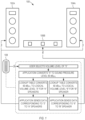
- FIG. 1 shows a block diagram of an example of a volume-control system that can control the volume of a single speaker, or one or more speakers in a multi-speaker audio system, in accordance with some examples.
- speakers 102A and 104A are a matched pair of speakers (e.g., two units of the same product).
- Speaker 106B is a different speaker product from 102A and 104A , and can be made by the same manufacturer or a different manufacturer.
- the speakers 102A , 104A , and 106B can each have a non-standardized relationship between logical volume level that is input to the speaker and sound pressure level that is produced by the speaker.
- Speaker 106B can have a different relationship between logical volume level and sound pressure level than speakers 102A and 104A.
- the volume-control system can run as an application on a user device 108 .
- the application can present a user interface to a user on a screen of the user device.
- a user selects a desired volume level on the user interface. In this example, the desired volume level is "5".
- the desired volume level is specified in non-standard units.
- the application can convert the desired volume of "5" to a standardized measure of volume.
- the standardized measure of volume is sound pressure level, although other standardized measures can also be used.
- the application converts "5" to a sound pressure level of 60 decibels, or 60 dB SPL .
- the application can access a lookup table to convert the sound pressure level to a product-specific logical volume levels for each speaker.
- the lookup table can be maintained by an owner or operator of the application, and can include measured data for each speaker.
- the measured data can tabulate the relationship between logical volume level sent to the speaker and sound pressure level produced by the speaker.
- the application can convert 60 dB SPL to a logical volume level of "3" for speakers 102A and 104A , and "6" for speaker 106B.
- setting speaker 102A to "3" produces a sound pressure level of 60 dB SPL
- setting speaker 104A to “3” produces a sound pressure level of 60 dB SPL
- setting speaker 106B to "6" produces a sound pressure level of 60 dB SPL .
- the application can transmit data corresponding to each product-specific logical volume level to the respective speaker.
- the application sends a logical volume level of "3" to speakers 102A and 104A , and a logical volume level of "6" to speaker 106B.
- the application can ensure that speaker volumes are adjusted together in a manner that does not raise or lower the volume of one speaker disproportionately over another speaker.
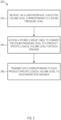
- FIG. 2 shows a flowchart of an example of a method for adjusting a volume level of a speaker, in accordance with some examples.
- the method can also adjust volume levels of first and second speakers, or any suitable number of speakers, such as in a multi-speaker sound system.
- the method can adjust the volume levels simultaneously.
- the method can be executed by a software application stored locally on a user device, such as a smart phone, a tablet, a laptop, a computer, a computing device, or another suitable device.
- the speaker can have a non-standardized relationship between logical volume level that is input to the speaker and sound pressure level that is produced by the speaker.
- logical volume level may not be standardized from product-to-product or manufacturer-to-manufacturer.
- a logical volume level of "3" may produce a sound pressure level of 50 dB SPL for one particular speaker product, but 55 dB SPL . for another speaker product.
- the software application can receive, via a user interface, a selected volume level corresponding to a sound pressure level.
- the software application can display the user interface on a screen of a user device.
- the screen can be touch-sensitive.
- the software application can receive the selected volume level on the touch-sensitive screen.
- the user interface can include one or more controls that resemble the volume controls on a remote control device. For example, a user can select a volume level of "3" on the user interface.
- the software can relate the selected volume level to a sound pressure level.
- Sound pressure levels are standardized, and are defined as the local pressure deviation from the ambient (average, or equilibrium) atmospheric pressure, caused by a sound wave.
- the software can relate the selected volume level of 3 to a sound pressure level of 60 dB SPL , which can correspond roughly to a relatively quiet volume, such as for conversation speech at a distance of 1 meter.
- the software can relate the selected volume level of 11 to a sound pressure level of 100 dB SPL , which can correspond roughly to a relatively loud volume, such as a location 1 meter away from a speaker in loud nightclub.
- a sound pressure level of 100 dB SPL can correspond roughly to a relatively loud volume, such as a location 1 meter away from a speaker in loud nightclub.
- the software application can access a stored lookup table to convert the sound pressure level to a product-specific logical volume level for the speaker.
- the stored lookup table can tabulate the non-standardized relationship between logical volume level and sound pressure level for the speaker, and optionally, for additional speaker products.
- the lookup table can provide the logical value of a particular speaker that will produce a specific sound pressure level for that speaker. For matched speakers, such as a pair of speakers that are two units of the same product made by the same manufacturer, the lookup table can include one tabulation that covers all the matched speakers. It is intended that the stored lookup table include one measured set of values for each speaker product that is commercially available. It is not intended that the stored lookup table address part-to-part variations of the same speaker product.
- the stored lookup table can be maintained or updated by a manufacturer of the software application, and can include a measured relationship between logical volume level and sound pressure level for each of the speakers included in the stored lookup table. In some examples, the stored lookup table can be updated as needed to include additional speaker products that are introduced to the marketplace. In some examples, more than one stored lookup table can be used. In some examples, the stored lookup table can be stored locally on the user device. In some examples, the stored lookup table can tabulate the non-standardized relationship between logical volume level and sound pressure level for multiple speakers, of which at least two speakers can be different products.
- the stored lookup table can include only discrete values of logical volume level. For these examples, for a sound pressure level that corresponds to a logical volume level that falls between two tabulated values, the software application can select a closer of the two tabulated values. For example, for a specified sound pressure level of 73 dB SPL , and tabulated values in the lookup table of 72 dB SPL for a logical volume level of 5 and 75 dB SPL for a logical volume level of 6, the software application can select the logical volume level of 5 as being closer to the specified sound pressure level. This is but a numerical example, other suitable values can also be used.
- the software application can interpolate to generate an intermediate logical volume level that falls between the discrete values.
- the stored lookup table can include a mathematical relationship that allows calculation of logical volume level from the sound pressure level.
- the stored lookup table can include only values of logical volume level at which the sound pressure level is less than or equal to a specified maximum sound pressure level for the speaker, which can prevent damage to the speaker.
- the software application can transmit data corresponding to the first product-specific logical volume level to the first speaker.
- the software application can control multiple speakers, the software application can transmit data corresponding to the each product-specific logical volume level to each respective speaker.
- the receiving at operation 202 , the accessing at operation 204 , and the transmitting at operation 206 can be initiated automatically by the software application. In other examples, one or more of these operations can be initiated automatically by a server connected to the software application on the user device.
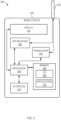
- FIG. 3 is a block diagram showing an example of a volume-control system 300 that can be used to adjust the volume of one speaker, or simultaneously adjust the volume of two or more speakers in a multi-speaker system, in accordance with some examples.
- the volume-control system 300 is but one example of such a volume-control system; other suitable volume-control systems can also be used.
- the volume-control system 300 can execute the method 200 of FIG. 2 ; other suitable volume-control systems can also execute the method 200 of FIG. 2 .
- the volume-control system 300 can be configured as software executable on a user device, such as a smart phone, a tablet, a laptop, a computer, or another suitable device.
- a user device such as a smart phone, a tablet, a laptop, a computer, or another suitable device.
- the volume-control system 300 includes a software application that can run on a mobile device 302 , such as a smart phone.
- the volume-control system 300 can include a processor 304 , and a memory device 306 storing instructions executable by the processor 304.
- the instructions can be executed by the processor 304 to perform a method for adjusting a volume level of a first speaker, a first speaker and a second speaker, or more than two speakers in a multi-speaker system.
- the mobile device 302 can include a processor 304.
- the processor 304 may be any of a variety of different types of commercially available processors 304 suitable for mobile devices 302 (for example, an XScale architecture microprocessor, a microprocessor without interlocked pipeline stages (MIPS) architecture processor, or another type of processor 304 ).
- a memory 306 such as a random access memory (RAM), a flash memory, or other type of memory, is typically accessible to the processor 304.
- the memory 306 may be adapted to store an operating system (OS) 308 , as well as application programs 310 , such as a mobile location enabled. In some examples, the memory 306 can store the lookup table discussed above.
- OS operating system
- application programs 310 such as a mobile location enabled.
- the memory 306 can store the lookup table discussed above.
- the processor 304 may be coupled, either directly or via appropriate intermediary hardware, to a display 312 and to one or more input/output (I/O) devices 314 , such as a keypad, a touch panel sensor, a microphone, and the like.
- the display 312 can display the user interface to a user, and can receive selection of a desired volume level from the user.
- the processor 304 may be coupled to a transceiver 316 that interfaces with an antenna 318.
- the transceiver 316 may be configured to both transmit and receive cellular network signals, wireless data signals, or other types of signals via the antenna 318 , depending on the nature of the mobile device 302.
- a GPS receiver 320 may also make use of the antenna 318 to receive GPS signals.
- the transceiver 316 can transmit signals over a wireless network that correspond to logical volume levels for respective speakers in a multi-speaker system.
Landscapes
- Engineering & Computer Science (AREA)
- Theoretical Computer Science (AREA)
- Health & Medical Sciences (AREA)
- Physics & Mathematics (AREA)
- General Health & Medical Sciences (AREA)
- General Engineering & Computer Science (AREA)
- Signal Processing (AREA)
- Otolaryngology (AREA)
- Multimedia (AREA)
- Human Computer Interaction (AREA)
- Audiology, Speech & Language Pathology (AREA)
- General Physics & Mathematics (AREA)
- Acoustics & Sound (AREA)
- Circuit For Audible Band Transducer (AREA)
- Selective Calling Equipment (AREA)
- Telephone Function (AREA)
- User Interface Of Digital Computer (AREA)
Claims (9)
- Procédé pour régler un niveau de volume de premier et second haut-parleurs, les premier et second haut-parleurs présentant une relation non standardisée entre un niveau de volume logique qui est entré sur le haut-parleur et un niveau de pression de son qui est produit par le haut-parleur, le procédé comprenant :la réception, via une interface utilisateur, d'un niveau de volume sélectionné ;la conversion du niveau de volume sélectionné selon un niveau de pression de son ;l'accès à une table de consultation stockée pour convertir le niveau de pression de son selon un premier niveau de volume logique spécifique au produit pour le premier haut-parleur, la relation entre le niveau de volume logique et le niveau de pression de son pour le premier haut-parleur étant indépendante du contenu audio envoyé sur le premier haut-parleur, la table de consultation stockée compilant des relations non standardisées entre le niveau de volume logique et le niveau de pression de son pour une pluralité de haut-parleurs spécifiques au produit incluant le premier haut-parleur ;l'émission de données correspondant au premier niveau de volume logique spécifique au produit sur le premier haut-parleur ;l'accès à la table de consultation stockée pour convertir le niveau de pression de son selon un second niveau de volume logique spécifique au produit pour le second haut-parleur de la pluralité de haut-parleurs spécifiques au produit, la table de consultation stockée compilant la relation non standardisée entre le niveau de volume logique et le niveau de pression de son pour le second haut-parleur, les premier et second haut-parleurs étant des produits différents ; etl'émission de données correspondant au second niveau de volume logique spécifique au produit sur le second haut-parleur ;dans lequel la réception, l'accès et l'émission sont initiés par une application de logiciel stockée localement sur un dispositif utilisateur.
- Procédé selon la revendication 1, dans lequel la table de consultation stockée est stockée localement sur le dispositif utilisateur.
- Procédé selon la revendication 2, dans lequel la table de consultation stockée compile des relations mesurées entre le niveau de volume logique et le niveau de pression de son pour la pluralité de haut-parleurs spécifiques au produit, la pluralité de haut-parleurs spécifiques au produit incluant le premier haut-parleur et le second haut-parleur.
- Procédé selon la revendication 3, dans lequel, pour au moins l'un de la pluralité de haut-parleurs spécifiques au produit :la table de consultation stockée inclut seulement des valeurs discrètes de niveau de volume logique ; etpour un niveau de pression de son qui correspond à un niveau de volume logique qui tombe entre deux valeurs compilées, l'application de logiciel sélectionne celle plus proche des deux valeurs compilées.
- Procédé selon la revendication 3, dans lequel, pour au moins l'un de la pluralité de haut-parleurs spécifiques au produit :
la table de consultation stockée inclut une relation mathématique qui permet le calcul du niveau de volume logique à partir du niveau de pression de son. - Procédé selon la revendication 3, dans lequel, pour au moins l'un de la pluralité de haut-parleurs spécifiques au produit :
la table de consultation stockée inclut seulement des valeurs de niveau de volume logique pour lesquelles le niveau de pression de son est inférieur ou égal à un niveau de pression de son maximum spécifié pour le haut-parleur. - Système de commande de volume, comprenant :un processeur ; etun dispositif de mémoire stockant des instructions pouvant être exécutées par le processeur, les instructions pouvant être exécutées par le processeur pour réaliser un procédé pour régler un niveau de volume d'un premier haut-parleur et d'un second haut-parleur, le premier haut-parleur et le second haut-parleur présentant une relation non standardisée entre un niveau de volume logique qui est entré sur le haut-parleur et un niveau de pression de son qui est produit par le haut-parleur, le procédé comprenant :la réception, via une interface utilisateur, d'un niveau de volume sélectionné ;la conversion du niveau de volume sélectionné selon un niveau de pression de son ;l'accès à une table de consultation stockée pour convertir le niveau de pression de son selon un premier niveau de volume logique spécifique au produit pour le premier haut-parleur, la relation entre le niveau de volume logique et le niveau de pression de son pour le premier haut-parleur étant indépendante du contenu audio envoyé sur le premier haut-parleur, la table de consultation stockée compilant des relations non standardisées entre le niveau de volume logique et le niveau de pression de son pour une pluralité de haut-parleurs spécifiques au produit incluant le premier haut-parleur ;l'émission de données correspondant au premier niveau de volume logique spécifique au produit sur le premier haut-parleur ;l'accès à la table de consultation stockée pour convertir le niveau de pression de son selon un second niveau de volume logique spécifique au produit pour le second haut-parleur de la pluralité de haut-parleurs spécifiques au produit, la table de consultation stockée compilant la relation non standardisée entre le niveau de volume logique et le niveau de pression de son pour le second haut-parleur, les premier et second haut-parleurs étant des produits différents ; etl'émission de données correspondant au second niveau de volume logique spécifique au produit sur le second haut-parleur ;dans lequel la réception, l'accès et l'émission sont initiés par une application de logiciel stockée localement sur un dispositif utilisateur.
- Système de commande de volume selon la revendication 7, dans lequel la table de consultation stockée est stockée localement sur le dispositif utilisateur.
- Système de commande de volume selon la revendication 7, dans lequel la table de consultation stockée compile des relations mesurées entre le niveau de volume logique et le niveau de pression de son pour la pluralité de haut-parleurs spécifiques au produit, la pluralité de haut-parleurs spécifiques au produit incluant le premier haut-parleur et le second haut-parleur.
Applications Claiming Priority (2)
| Application Number | Priority Date | Filing Date | Title |
|---|---|---|---|
| US15/617,692 US10795637B2 (en) | 2017-06-08 | 2017-06-08 | Adjusting volume levels of speakers |
| PCT/US2018/036656 WO2018227085A1 (fr) | 2017-06-08 | 2018-06-08 | Réglage de niveaux de volume de haut-parleurs |
Publications (4)
| Publication Number | Publication Date |
|---|---|
| EP3635532A1 EP3635532A1 (fr) | 2020-04-15 |
| EP3635532A4 EP3635532A4 (fr) | 2021-03-17 |
| EP3635532C0 EP3635532C0 (fr) | 2024-08-07 |
| EP3635532B1 true EP3635532B1 (fr) | 2024-08-07 |
Family
ID=64563292
Family Applications (1)
| Application Number | Title | Priority Date | Filing Date |
|---|---|---|---|
| EP18813507.3A Active EP3635532B1 (fr) | 2017-06-08 | 2018-06-08 | Réglage de niveaux de volume de haut-parleurs |
Country Status (6)
| Country | Link |
|---|---|
| US (2) | US10795637B2 (fr) |
| EP (1) | EP3635532B1 (fr) |
| JP (1) | JP7273736B2 (fr) |
| KR (1) | KR102622711B1 (fr) |
| CN (1) | CN111213120B (fr) |
| WO (1) | WO2018227085A1 (fr) |
Families Citing this family (5)
| Publication number | Priority date | Publication date | Assignee | Title |
|---|---|---|---|---|
| US10795637B2 (en) | 2017-06-08 | 2020-10-06 | Dts, Inc. | Adjusting volume levels of speakers |
| KR102574476B1 (ko) | 2018-12-18 | 2023-09-05 | 삼성전자주식회사 | 오디오 컨텐츠의 음량을 측정하는 방법 및 그에 따른 장치 |
| US12081959B2 (en) * | 2019-08-27 | 2024-09-03 | Lg Electronics Inc. | Display device and surround sound system |
| CN118519602A (zh) * | 2023-02-20 | 2024-08-20 | 荣耀终端有限公司 | 扬声器管理方法、装置、介质和电子设备 |
| WO2026014848A1 (fr) * | 2024-07-08 | 2026-01-15 | 엘지전자 주식회사 | Procédé et appareil de réglage de volume audio dans un environnement de haut-parleurs audio multicanal sans fil/filaires |
Family Cites Families (28)
| Publication number | Priority date | Publication date | Assignee | Title |
|---|---|---|---|---|
| FI99062C (fi) * | 1995-10-05 | 1997-09-25 | Nokia Mobile Phones Ltd | Puhesignaalin taajuuskorjaus matkapuhelimessa |
| WO2004043111A2 (fr) | 2002-10-30 | 2004-05-21 | Roark, Sabrina, Nelson | Appareil montable servant a mesurer le niveau de pression acoustique |
| US7251337B2 (en) * | 2003-04-24 | 2007-07-31 | Dolby Laboratories Licensing Corporation | Volume control in movie theaters |
| AU2005282680A1 (en) | 2004-09-03 | 2006-03-16 | Parker Tsuhako | Method and apparatus for producing a phantom three-dimensional sound space with recorded sound |
| US9008319B2 (en) | 2004-12-30 | 2015-04-14 | Plantronics, Inc. | Sound pressure level limiter with anti-startle feature |
| US7848527B2 (en) | 2006-02-27 | 2010-12-07 | Apple Inc. | Dynamic power management in a portable media delivery system |
| US8213653B2 (en) | 2006-05-10 | 2012-07-03 | Phonak Ag | Hearing device |
| JP2007306444A (ja) * | 2006-05-15 | 2007-11-22 | Sony Corp | コントロール機器、音量制御方法および音量制御プログラム |
| US8199919B2 (en) | 2006-06-01 | 2012-06-12 | Personics Holdings Inc. | Earhealth monitoring system and method II |
| CN101163215B (zh) * | 2006-10-10 | 2010-12-15 | 康佳集团股份有限公司 | 电视机实际音量的设置方法和装置 |
| US7983426B2 (en) | 2006-12-29 | 2011-07-19 | Motorola Mobility, Inc. | Method for autonomously monitoring and reporting sound pressure level (SPL) exposure for a user of a communication device |
| JP4374058B2 (ja) * | 2008-03-31 | 2009-12-02 | 株式会社東芝 | 映像音声出力装置及び映像音声出力方法 |
| US20090315708A1 (en) | 2008-06-19 | 2009-12-24 | John Walley | Method and system for limiting audio output in audio headsets |
| US20090323987A1 (en) * | 2008-06-26 | 2009-12-31 | Motorola, Inc. | Method and apparatus for synchronizing audio levels of a device and an audio accessory |
| JP2010028582A (ja) * | 2008-07-22 | 2010-02-04 | Sharp Corp | 音声処理装置及び音声処理システム |
| WO2010138311A1 (fr) * | 2009-05-26 | 2010-12-02 | Dolby Laboratories Licensing Corporation | Profils d'égalisation pour égalisation dynamique de données audio |
| MX2011012736A (es) * | 2009-05-29 | 2011-12-16 | Sharp Kk | Aparato de reproduccion de sonido, metodo de reproduccion de sonido y medio de grabacion. |
| US9112466B1 (en) * | 2012-06-11 | 2015-08-18 | Google Inc. | Method for controlling volume using a rotating knob interface |
| US8831146B2 (en) * | 2012-06-14 | 2014-09-09 | Samsung Electronics Co., Ltd. | Communication system with iterative detector and decoder and method of operation thereof |
| US9735746B2 (en) * | 2012-08-01 | 2017-08-15 | Harman Becker Automotive Systems Gmbh | Automatic loudness control |
| EP2901711B1 (fr) * | 2012-09-24 | 2021-04-07 | Cirrus Logic International Semiconductor Limited | Commande et protection de haut-parleurs |
| US9385674B2 (en) | 2012-10-31 | 2016-07-05 | Maxim Integrated Products, Inc. | Dynamic speaker management for multichannel audio systems |
| US20170374476A9 (en) * | 2013-11-08 | 2017-12-28 | Avraham Suhami | Hearing Eyeglass System and Method |
| US9860641B2 (en) * | 2013-12-02 | 2018-01-02 | Audyssey Laboratories, Inc. | Audio output device specific audio processing |
| US9661430B2 (en) | 2014-07-30 | 2017-05-23 | Texas Instruments Incorporated | Method of identifying passive radiator parameters |
| TWI604715B (zh) * | 2015-05-28 | 2017-11-01 | 仁寶電腦工業股份有限公司 | 電話會議音量調整方法及系統 |
| US10341770B2 (en) * | 2015-09-30 | 2019-07-02 | Apple Inc. | Encoded audio metadata-based loudness equalization and dynamic equalization during DRC |
| US10795637B2 (en) | 2017-06-08 | 2020-10-06 | Dts, Inc. | Adjusting volume levels of speakers |
-
2017
- 2017-06-08 US US15/617,692 patent/US10795637B2/en active Active
-
2018
- 2018-06-08 JP JP2019568018A patent/JP7273736B2/ja active Active
- 2018-06-08 WO PCT/US2018/036656 patent/WO2018227085A1/fr not_active Ceased
- 2018-06-08 CN CN201880051539.6A patent/CN111213120B/zh active Active
- 2018-06-08 EP EP18813507.3A patent/EP3635532B1/fr active Active
- 2018-06-08 KR KR1020207000589A patent/KR102622711B1/ko active Active
-
2020
- 2020-09-17 US US17/024,345 patent/US11163524B2/en active Active
Also Published As
| Publication number | Publication date |
|---|---|
| EP3635532C0 (fr) | 2024-08-07 |
| KR20200024832A (ko) | 2020-03-09 |
| JP2020526064A (ja) | 2020-08-27 |
| US20210004202A1 (en) | 2021-01-07 |
| EP3635532A1 (fr) | 2020-04-15 |
| US11163524B2 (en) | 2021-11-02 |
| EP3635532A4 (fr) | 2021-03-17 |
| CN111213120A (zh) | 2020-05-29 |
| JP7273736B2 (ja) | 2023-05-15 |
| US20180357037A1 (en) | 2018-12-13 |
| US10795637B2 (en) | 2020-10-06 |
| WO2018227085A1 (fr) | 2018-12-13 |
| KR102622711B1 (ko) | 2024-01-08 |
| CN111213120B (zh) | 2023-08-25 |
Similar Documents
| Publication | Publication Date | Title |
|---|---|---|
| EP3635532B1 (fr) | Réglage de niveaux de volume de haut-parleurs | |
| US20220182032A1 (en) | Audio System Equalizing | |
| CN110891305B (zh) | 一种功率控制装置、方法及电子设备 | |
| CN109905812B (zh) | 一种输入功率控制方法及装置、终端设备 | |
| US20080132295A1 (en) | System and method for improved loudspeaker functionality | |
| CN110806849A (zh) | 智能设备及其音量调节方法和计算机可读存储介质 | |
| US10694288B2 (en) | Correcting for a latency of a speaker | |
| EP3373591B1 (fr) | Procédé et appareil de réglage de volume bluetooth adaptatif | |
| CN109918039B (zh) | 一种音量调节方法及移动终端 | |
| EP3111738A1 (fr) | Procédé de commande de fonctionnement d'une machine agricole et système | |
| CN107633849B (zh) | 蓝牙设备音量调整方法、设备及计算机可读存储介质 | |
| EP4052482A1 (fr) | Microphone à traitement de signal ajustable | |
| US20170170796A1 (en) | Electronic device for adjusting an equalizer setting according to a user age, sound playback device, and equalizer adjustment method | |
| CN107786751A (zh) | 一种多媒体文件播放方法及移动终端 | |
| US10178482B2 (en) | Audio transmission system and audio processing method thereof | |
| US20250054483A1 (en) | Noise cancellation method, device and apparatus and computer readable storage medium for earphones | |
| US9942658B2 (en) | Method and apparatus for increasing audio output of a device | |
| CN106972870A (zh) | 一种天线调谐电路、移动终端及天线调谐方法 | |
| US10680568B2 (en) | Sound signal detection device | |
| US10932074B2 (en) | Detachable smart speaker system and control method thereof | |
| HK40019767A (en) | Adjusting volume levels of speakers | |
| CN110086483A (zh) | 一种通信控制方法及终端 | |
| CN121645114A (zh) | 基于车辆的调音参数的确定方法、装置、设备及存储介质 | |
| KR20230019647A (ko) | 네트워크를 통한 원격 보청 장치 피팅 시스템, 방법 및 컴퓨터프로그램 |
Legal Events
| Date | Code | Title | Description |
|---|---|---|---|
| STAA | Information on the status of an ep patent application or granted ep patent |
Free format text: STATUS: THE INTERNATIONAL PUBLICATION HAS BEEN MADE |
|
| PUAI | Public reference made under article 153(3) epc to a published international application that has entered the european phase |
Free format text: ORIGINAL CODE: 0009012 |
|
| STAA | Information on the status of an ep patent application or granted ep patent |
Free format text: STATUS: REQUEST FOR EXAMINATION WAS MADE |
|
| 17P | Request for examination filed |
Effective date: 20200108 |
|
| AK | Designated contracting states |
Kind code of ref document: A1 Designated state(s): AL AT BE BG CH CY CZ DE DK EE ES FI FR GB GR HR HU IE IS IT LI LT LU LV MC MK MT NL NO PL PT RO RS SE SI SK SM TR |
|
| AX | Request for extension of the european patent |
Extension state: BA ME |
|
| DAV | Request for validation of the european patent (deleted) | ||
| DAX | Request for extension of the european patent (deleted) | ||
| A4 | Supplementary search report drawn up and despatched |
Effective date: 20210211 |
|
| RIC1 | Information provided on ipc code assigned before grant |
Ipc: G06F 3/16 20060101AFI20210205BHEP Ipc: H04R 3/12 20060101ALI20210205BHEP |
|
| STAA | Information on the status of an ep patent application or granted ep patent |
Free format text: STATUS: EXAMINATION IS IN PROGRESS |
|
| 17Q | First examination report despatched |
Effective date: 20220621 |
|
| GRAP | Despatch of communication of intention to grant a patent |
Free format text: ORIGINAL CODE: EPIDOSNIGR1 |
|
| STAA | Information on the status of an ep patent application or granted ep patent |
Free format text: STATUS: GRANT OF PATENT IS INTENDED |
|
| INTG | Intention to grant announced |
Effective date: 20240423 |
|
| GRAS | Grant fee paid |
Free format text: ORIGINAL CODE: EPIDOSNIGR3 |
|
| GRAA | (expected) grant |
Free format text: ORIGINAL CODE: 0009210 |
|
| STAA | Information on the status of an ep patent application or granted ep patent |
Free format text: STATUS: THE PATENT HAS BEEN GRANTED |
|
| AK | Designated contracting states |
Kind code of ref document: B1 Designated state(s): AL AT BE BG CH CY CZ DE DK EE ES FI FR GB GR HR HU IE IS IT LI LT LU LV MC MK MT NL NO PL PT RO RS SE SI SK SM TR |
|
| REG | Reference to a national code |
Ref country code: GB Ref legal event code: FG4D |
|
| REG | Reference to a national code |
Ref country code: CH Ref legal event code: EP |
|
| REG | Reference to a national code |
Ref country code: IE Ref legal event code: FG4D |
|
| REG | Reference to a national code |
Ref country code: DE Ref legal event code: R096 Ref document number: 602018072854 Country of ref document: DE |
|
| U01 | Request for unitary effect filed |
Effective date: 20240829 |
|
| U07 | Unitary effect registered |
Designated state(s): AT BE BG DE DK EE FI FR IT LT LU LV MT NL PT RO SE SI Effective date: 20240910 |
|
| PG25 | Lapsed in a contracting state [announced via postgrant information from national office to epo] |
Ref country code: NO Free format text: LAPSE BECAUSE OF FAILURE TO SUBMIT A TRANSLATION OF THE DESCRIPTION OR TO PAY THE FEE WITHIN THE PRESCRIBED TIME-LIMIT Effective date: 20241107 |
|
| PG25 | Lapsed in a contracting state [announced via postgrant information from national office to epo] |
Ref country code: PL Free format text: LAPSE BECAUSE OF FAILURE TO SUBMIT A TRANSLATION OF THE DESCRIPTION OR TO PAY THE FEE WITHIN THE PRESCRIBED TIME-LIMIT Effective date: 20240807 Ref country code: GR Free format text: LAPSE BECAUSE OF FAILURE TO SUBMIT A TRANSLATION OF THE DESCRIPTION OR TO PAY THE FEE WITHIN THE PRESCRIBED TIME-LIMIT Effective date: 20241108 |
|
| PG25 | Lapsed in a contracting state [announced via postgrant information from national office to epo] |
Ref country code: IS Free format text: LAPSE BECAUSE OF FAILURE TO SUBMIT A TRANSLATION OF THE DESCRIPTION OR TO PAY THE FEE WITHIN THE PRESCRIBED TIME-LIMIT Effective date: 20241207 |
|
| PG25 | Lapsed in a contracting state [announced via postgrant information from national office to epo] |
Ref country code: HR Free format text: LAPSE BECAUSE OF FAILURE TO SUBMIT A TRANSLATION OF THE DESCRIPTION OR TO PAY THE FEE WITHIN THE PRESCRIBED TIME-LIMIT Effective date: 20240807 |
|
| PG25 | Lapsed in a contracting state [announced via postgrant information from national office to epo] |
Ref country code: RS Free format text: LAPSE BECAUSE OF FAILURE TO SUBMIT A TRANSLATION OF THE DESCRIPTION OR TO PAY THE FEE WITHIN THE PRESCRIBED TIME-LIMIT Effective date: 20241107 Ref country code: ES Free format text: LAPSE BECAUSE OF FAILURE TO SUBMIT A TRANSLATION OF THE DESCRIPTION OR TO PAY THE FEE WITHIN THE PRESCRIBED TIME-LIMIT Effective date: 20240807 |
|
| PG25 | Lapsed in a contracting state [announced via postgrant information from national office to epo] |
Ref country code: RS Free format text: LAPSE BECAUSE OF FAILURE TO SUBMIT A TRANSLATION OF THE DESCRIPTION OR TO PAY THE FEE WITHIN THE PRESCRIBED TIME-LIMIT Effective date: 20241107 Ref country code: PL Free format text: LAPSE BECAUSE OF FAILURE TO SUBMIT A TRANSLATION OF THE DESCRIPTION OR TO PAY THE FEE WITHIN THE PRESCRIBED TIME-LIMIT Effective date: 20240807 Ref country code: NO Free format text: LAPSE BECAUSE OF FAILURE TO SUBMIT A TRANSLATION OF THE DESCRIPTION OR TO PAY THE FEE WITHIN THE PRESCRIBED TIME-LIMIT Effective date: 20241107 Ref country code: IS Free format text: LAPSE BECAUSE OF FAILURE TO SUBMIT A TRANSLATION OF THE DESCRIPTION OR TO PAY THE FEE WITHIN THE PRESCRIBED TIME-LIMIT Effective date: 20241207 Ref country code: HR Free format text: LAPSE BECAUSE OF FAILURE TO SUBMIT A TRANSLATION OF THE DESCRIPTION OR TO PAY THE FEE WITHIN THE PRESCRIBED TIME-LIMIT Effective date: 20240807 Ref country code: GR Free format text: LAPSE BECAUSE OF FAILURE TO SUBMIT A TRANSLATION OF THE DESCRIPTION OR TO PAY THE FEE WITHIN THE PRESCRIBED TIME-LIMIT Effective date: 20241108 Ref country code: ES Free format text: LAPSE BECAUSE OF FAILURE TO SUBMIT A TRANSLATION OF THE DESCRIPTION OR TO PAY THE FEE WITHIN THE PRESCRIBED TIME-LIMIT Effective date: 20240807 |
|
| PG25 | Lapsed in a contracting state [announced via postgrant information from national office to epo] |
Ref country code: SM Free format text: LAPSE BECAUSE OF FAILURE TO SUBMIT A TRANSLATION OF THE DESCRIPTION OR TO PAY THE FEE WITHIN THE PRESCRIBED TIME-LIMIT Effective date: 20240807 |
|
| PG25 | Lapsed in a contracting state [announced via postgrant information from national office to epo] |
Ref country code: CZ Free format text: LAPSE BECAUSE OF FAILURE TO SUBMIT A TRANSLATION OF THE DESCRIPTION OR TO PAY THE FEE WITHIN THE PRESCRIBED TIME-LIMIT Effective date: 20240807 |
|
| PG25 | Lapsed in a contracting state [announced via postgrant information from national office to epo] |
Ref country code: SK Free format text: LAPSE BECAUSE OF FAILURE TO SUBMIT A TRANSLATION OF THE DESCRIPTION OR TO PAY THE FEE WITHIN THE PRESCRIBED TIME-LIMIT Effective date: 20240807 |
|
| PLBE | No opposition filed within time limit |
Free format text: ORIGINAL CODE: 0009261 |
|
| STAA | Information on the status of an ep patent application or granted ep patent |
Free format text: STATUS: NO OPPOSITION FILED WITHIN TIME LIMIT |
|
| PGFP | Annual fee paid to national office [announced via postgrant information from national office to epo] |
Ref country code: GB Payment date: 20250617 Year of fee payment: 8 |
|
| 26N | No opposition filed |
Effective date: 20250508 |
|
| U20 | Renewal fee for the european patent with unitary effect paid |
Year of fee payment: 8 Effective date: 20250624 |
|
| REG | Reference to a national code |
Ref country code: CH Ref legal event code: H13 Free format text: ST27 STATUS EVENT CODE: U-0-0-H10-H13 (AS PROVIDED BY THE NATIONAL OFFICE) Effective date: 20260127 |
|
| PG25 | Lapsed in a contracting state [announced via postgrant information from national office to epo] |
Ref country code: MC Free format text: LAPSE BECAUSE OF FAILURE TO SUBMIT A TRANSLATION OF THE DESCRIPTION OR TO PAY THE FEE WITHIN THE PRESCRIBED TIME-LIMIT Effective date: 20240807 |
|
| PG25 | Lapsed in a contracting state [announced via postgrant information from national office to epo] |
Ref country code: IE Free format text: LAPSE BECAUSE OF NON-PAYMENT OF DUE FEES Effective date: 20250608 |
|
| PG25 | Lapsed in a contracting state [announced via postgrant information from national office to epo] |
Ref country code: CH Free format text: LAPSE BECAUSE OF NON-PAYMENT OF DUE FEES Effective date: 20250630 |