EP3636152A1 - Instrument zur messung des fusssohlendrucks, informationsbereitstellungsvorrichtung und informationsbereitstellungsverfahren - Google Patents
Instrument zur messung des fusssohlendrucks, informationsbereitstellungsvorrichtung und informationsbereitstellungsverfahren Download PDFInfo
- Publication number
- EP3636152A1 EP3636152A1 EP18846378.0A EP18846378A EP3636152A1 EP 3636152 A1 EP3636152 A1 EP 3636152A1 EP 18846378 A EP18846378 A EP 18846378A EP 3636152 A1 EP3636152 A1 EP 3636152A1
- Authority
- EP
- European Patent Office
- Prior art keywords
- pressure
- foot sole
- running
- subject
- foot
- Prior art date
- Legal status (The legal status is an assumption and is not a legal conclusion. Google has not performed a legal analysis and makes no representation as to the accuracy of the status listed.)
- Ceased
Links
Images





Classifications
-
- A—HUMAN NECESSITIES
- A61—MEDICAL OR VETERINARY SCIENCE; HYGIENE
- A61B—DIAGNOSIS; SURGERY; IDENTIFICATION
- A61B5/00—Measuring for diagnostic purposes; Identification of persons
- A61B5/103—Measuring devices for testing the shape, pattern, colour, size or movement of the body or parts thereof, for diagnostic purposes
- A61B5/11—Measuring movement of the entire body or parts thereof, e.g. head or hand tremor or mobility of a limb
- A61B5/112—Gait analysis
-
- A—HUMAN NECESSITIES
- A61—MEDICAL OR VETERINARY SCIENCE; HYGIENE
- A61B—DIAGNOSIS; SURGERY; IDENTIFICATION
- A61B5/00—Measuring for diagnostic purposes; Identification of persons
- A61B5/103—Measuring devices for testing the shape, pattern, colour, size or movement of the body or parts thereof, for diagnostic purposes
- A61B5/1036—Measuring load distribution, e.g. podologic studies
- A61B5/1038—Measuring plantar pressure during gait
-
- A—HUMAN NECESSITIES
- A43—FOOTWEAR
- A43B—CHARACTERISTIC FEATURES OF FOOTWEAR; PARTS OF FOOTWEAR
- A43B3/00—Footwear characterised by the shape or the use
- A43B3/34—Footwear characterised by the shape or the use with electrical or electronic arrangements
-
- A—HUMAN NECESSITIES
- A61—MEDICAL OR VETERINARY SCIENCE; HYGIENE
- A61B—DIAGNOSIS; SURGERY; IDENTIFICATION
- A61B5/00—Measuring for diagnostic purposes; Identification of persons
- A61B5/103—Measuring devices for testing the shape, pattern, colour, size or movement of the body or parts thereof, for diagnostic purposes
- A61B5/11—Measuring movement of the entire body or parts thereof, e.g. head or hand tremor or mobility of a limb
- A61B5/1124—Determining motor skills
-
- A—HUMAN NECESSITIES
- A61—MEDICAL OR VETERINARY SCIENCE; HYGIENE
- A61B—DIAGNOSIS; SURGERY; IDENTIFICATION
- A61B5/00—Measuring for diagnostic purposes; Identification of persons
- A61B5/68—Arrangements of detecting, measuring or recording means, e.g. sensors, in relation to patient
- A61B5/6801—Arrangements of detecting, measuring or recording means, e.g. sensors, in relation to patient specially adapted to be attached to or worn on the body surface
- A61B5/6802—Sensor mounted on worn items
- A61B5/6804—Garments; Clothes
- A61B5/6807—Footwear
-
- A—HUMAN NECESSITIES
- A61—MEDICAL OR VETERINARY SCIENCE; HYGIENE
- A61B—DIAGNOSIS; SURGERY; IDENTIFICATION
- A61B5/00—Measuring for diagnostic purposes; Identification of persons
- A61B5/74—Details of notification to user or communication with user or patient; User input means
- A61B5/742—Details of notification to user or communication with user or patient; User input means using visual displays
-
- A—HUMAN NECESSITIES
- A63—SPORTS; GAMES; AMUSEMENTS
- A63B—APPARATUS FOR PHYSICAL TRAINING, GYMNASTICS, SWIMMING, CLIMBING, OR FENCING; BALL GAMES; TRAINING EQUIPMENT
- A63B22/00—Exercising apparatus specially adapted for conditioning the cardio-vascular system, for training agility or co-ordination of movements
- A63B22/0015—Exercising apparatus specially adapted for conditioning the cardio-vascular system, for training agility or co-ordination of movements with an adjustable movement path of the support elements
- A63B22/0023—Exercising apparatus specially adapted for conditioning the cardio-vascular system, for training agility or co-ordination of movements with an adjustable movement path of the support elements the inclination of the main axis of the movement path being adjustable, e.g. the inclination of an endless band
-
- A—HUMAN NECESSITIES
- A63—SPORTS; GAMES; AMUSEMENTS
- A63B—APPARATUS FOR PHYSICAL TRAINING, GYMNASTICS, SWIMMING, CLIMBING, OR FENCING; BALL GAMES; TRAINING EQUIPMENT
- A63B22/00—Exercising apparatus specially adapted for conditioning the cardio-vascular system, for training agility or co-ordination of movements
- A63B22/02—Exercising apparatus specially adapted for conditioning the cardio-vascular system, for training agility or co-ordination of movements with movable endless bands, e.g. treadmills
-
- A—HUMAN NECESSITIES
- A63—SPORTS; GAMES; AMUSEMENTS
- A63B—APPARATUS FOR PHYSICAL TRAINING, GYMNASTICS, SWIMMING, CLIMBING, OR FENCING; BALL GAMES; TRAINING EQUIPMENT
- A63B24/00—Electric or electronic controls for exercising apparatus of preceding groups; Controlling or monitoring of exercises, sportive games, training or athletic performances
- A63B24/0003—Analysing the course of a movement or motion sequences during an exercise or trainings sequence, e.g. swing for golf or tennis
-
- A—HUMAN NECESSITIES
- A63—SPORTS; GAMES; AMUSEMENTS
- A63B—APPARATUS FOR PHYSICAL TRAINING, GYMNASTICS, SWIMMING, CLIMBING, OR FENCING; BALL GAMES; TRAINING EQUIPMENT
- A63B24/00—Electric or electronic controls for exercising apparatus of preceding groups; Controlling or monitoring of exercises, sportive games, training or athletic performances
- A63B24/0062—Monitoring athletic performances, e.g. for determining the work of a user on an exercise apparatus, the completed jogging or cycling distance
-
- A—HUMAN NECESSITIES
- A63—SPORTS; GAMES; AMUSEMENTS
- A63B—APPARATUS FOR PHYSICAL TRAINING, GYMNASTICS, SWIMMING, CLIMBING, OR FENCING; BALL GAMES; TRAINING EQUIPMENT
- A63B71/00—Games or sports accessories not covered in groups A63B1/00 - A63B69/00
- A63B71/06—Indicating or scoring devices for games or players, or for other sports activities
- A63B71/0619—Displays, user interfaces and indicating devices, specially adapted for sport equipment, e.g. display mounted on treadmills
- A63B71/0622—Visual, audio or audio-visual systems for entertaining, instructing or motivating the user
-
- A—HUMAN NECESSITIES
- A61—MEDICAL OR VETERINARY SCIENCE; HYGIENE
- A61B—DIAGNOSIS; SURGERY; IDENTIFICATION
- A61B2503/00—Evaluating a particular growth phase or type of persons or animals
- A61B2503/10—Athletes
-
- A—HUMAN NECESSITIES
- A61—MEDICAL OR VETERINARY SCIENCE; HYGIENE
- A61B—DIAGNOSIS; SURGERY; IDENTIFICATION
- A61B2562/00—Details of sensors; Constructional details of sensor housings or probes; Accessories for sensors
- A61B2562/02—Details of sensors specially adapted for in-vivo measurements
- A61B2562/0247—Pressure sensors
-
- A—HUMAN NECESSITIES
- A61—MEDICAL OR VETERINARY SCIENCE; HYGIENE
- A61B—DIAGNOSIS; SURGERY; IDENTIFICATION
- A61B5/00—Measuring for diagnostic purposes; Identification of persons
- A61B5/48—Other medical applications
- A61B5/4866—Evaluating metabolism
-
- A—HUMAN NECESSITIES
- A63—SPORTS; GAMES; AMUSEMENTS
- A63B—APPARATUS FOR PHYSICAL TRAINING, GYMNASTICS, SWIMMING, CLIMBING, OR FENCING; BALL GAMES; TRAINING EQUIPMENT
- A63B24/00—Electric or electronic controls for exercising apparatus of preceding groups; Controlling or monitoring of exercises, sportive games, training or athletic performances
- A63B24/0062—Monitoring athletic performances, e.g. for determining the work of a user on an exercise apparatus, the completed jogging or cycling distance
- A63B2024/0065—Evaluating the fitness, e.g. fitness level or fitness index
-
- A—HUMAN NECESSITIES
- A63—SPORTS; GAMES; AMUSEMENTS
- A63B—APPARATUS FOR PHYSICAL TRAINING, GYMNASTICS, SWIMMING, CLIMBING, OR FENCING; BALL GAMES; TRAINING EQUIPMENT
- A63B24/00—Electric or electronic controls for exercising apparatus of preceding groups; Controlling or monitoring of exercises, sportive games, training or athletic performances
- A63B24/0087—Electric or electronic controls for exercising apparatus of groups A63B21/00 - A63B23/00, e.g. controlling load
- A63B2024/0093—Electric or electronic controls for exercising apparatus of groups A63B21/00 - A63B23/00, e.g. controlling load the load of the exercise apparatus being controlled by performance parameters, e.g. distance or speed
-
- A—HUMAN NECESSITIES
- A63—SPORTS; GAMES; AMUSEMENTS
- A63B—APPARATUS FOR PHYSICAL TRAINING, GYMNASTICS, SWIMMING, CLIMBING, OR FENCING; BALL GAMES; TRAINING EQUIPMENT
- A63B71/00—Games or sports accessories not covered in groups A63B1/00 - A63B69/00
- A63B71/06—Indicating or scoring devices for games or players, or for other sports activities
- A63B71/0619—Displays, user interfaces and indicating devices, specially adapted for sport equipment, e.g. display mounted on treadmills
- A63B2071/065—Visualisation of specific exercise parameters
-
- A—HUMAN NECESSITIES
- A63—SPORTS; GAMES; AMUSEMENTS
- A63B—APPARATUS FOR PHYSICAL TRAINING, GYMNASTICS, SWIMMING, CLIMBING, OR FENCING; BALL GAMES; TRAINING EQUIPMENT
- A63B71/00—Games or sports accessories not covered in groups A63B1/00 - A63B69/00
- A63B71/06—Indicating or scoring devices for games or players, or for other sports activities
- A63B2071/0675—Input for modifying training controls during workout
-
- A—HUMAN NECESSITIES
- A63—SPORTS; GAMES; AMUSEMENTS
- A63B—APPARATUS FOR PHYSICAL TRAINING, GYMNASTICS, SWIMMING, CLIMBING, OR FENCING; BALL GAMES; TRAINING EQUIPMENT
- A63B2220/00—Measuring of physical parameters relating to sporting activity
- A63B2220/30—Speed
-
- A—HUMAN NECESSITIES
- A63—SPORTS; GAMES; AMUSEMENTS
- A63B—APPARATUS FOR PHYSICAL TRAINING, GYMNASTICS, SWIMMING, CLIMBING, OR FENCING; BALL GAMES; TRAINING EQUIPMENT
- A63B2220/00—Measuring of physical parameters relating to sporting activity
- A63B2220/50—Force related parameters
- A63B2220/51—Force
-
- A—HUMAN NECESSITIES
- A63—SPORTS; GAMES; AMUSEMENTS
- A63B—APPARATUS FOR PHYSICAL TRAINING, GYMNASTICS, SWIMMING, CLIMBING, OR FENCING; BALL GAMES; TRAINING EQUIPMENT
- A63B2220/00—Measuring of physical parameters relating to sporting activity
- A63B2220/50—Force related parameters
- A63B2220/56—Pressure
-
- A—HUMAN NECESSITIES
- A63—SPORTS; GAMES; AMUSEMENTS
- A63B—APPARATUS FOR PHYSICAL TRAINING, GYMNASTICS, SWIMMING, CLIMBING, OR FENCING; BALL GAMES; TRAINING EQUIPMENT
- A63B2220/00—Measuring of physical parameters relating to sporting activity
- A63B2220/80—Special sensors, transducers or devices therefor
- A63B2220/83—Special sensors, transducers or devices therefor characterised by the position of the sensor
- A63B2220/836—Sensors arranged on the body of the user
-
- A—HUMAN NECESSITIES
- A63—SPORTS; GAMES; AMUSEMENTS
- A63B—APPARATUS FOR PHYSICAL TRAINING, GYMNASTICS, SWIMMING, CLIMBING, OR FENCING; BALL GAMES; TRAINING EQUIPMENT
- A63B2225/00—Miscellaneous features of sport apparatus, devices or equipment
- A63B2225/50—Wireless data transmission, e.g. by radio transmitters or telemetry
- A63B2225/52—Wireless data transmission, e.g. by radio transmitters or telemetry modulated by measured values
-
- A—HUMAN NECESSITIES
- A63—SPORTS; GAMES; AMUSEMENTS
- A63B—APPARATUS FOR PHYSICAL TRAINING, GYMNASTICS, SWIMMING, CLIMBING, OR FENCING; BALL GAMES; TRAINING EQUIPMENT
- A63B2230/00—Measuring physiological parameters of the user
- A63B2230/20—Measuring physiological parameters of the user blood composition characteristics
- A63B2230/201—Measuring physiological parameters of the user blood composition characteristics used as a control parameter for the apparatus
-
- A—HUMAN NECESSITIES
- A63—SPORTS; GAMES; AMUSEMENTS
- A63B—APPARATUS FOR PHYSICAL TRAINING, GYMNASTICS, SWIMMING, CLIMBING, OR FENCING; BALL GAMES; TRAINING EQUIPMENT
- A63B69/00—Training appliances or apparatus for special sports
- A63B69/0028—Training appliances or apparatus for special sports for running, jogging or speed-walking
- A63B69/0035—Training appliances or apparatus for special sports for running, jogging or speed-walking on the spot
Definitions
- the present invention relates to a foot sole pressure measurement instrument, an information provision device, and an information provision method.
- Non-Patent Document 1 a new technology that targets exercise (for example, refer to Non-Patent Document 1). Poor physical condition, fatigue, and worsening of chronic diseases cause a balance or rhythm of running exercise to deteriorate. Therefore, it is possible to prevent accidents due to overwork and poor physical condition or occurrence of major failures by monitoring a situation of running exercise, detecting an abnormal fluctuation in the balance or rhythm of running exercise based on data acquired from a sensor, and intervening sooner when the balance or rhythm of running exercise has deteriorated.
- Information detected by a wearable sensor ranges variously from a heartbeat, myoelectricity, and electroencephalography to body temperature and the like, but since a foot sole pressure among them allows direct evaluation of a state of running or walking of a runner, and conversion of the state into load information such as a lactate concentration, the foot sole pressure is very important information for runners.
- Non Patent Document 1 "C3fit IN-pulse” [online]. Internet ⁇ URL:http://www.goldwin.co.jp/ec/contents/c3fit/inpulse/about.html>
- a lower edge of an epiphyseal portion of a heel bone and a lower edge of an epiphyseal portion of a metatarsal bone are important as points of action of a floor reaction force.
- An accurate measurement of the foot sole pressure directly below is required, but since a position of the action point changes according to a size of a bone of a subject, for example, a small-size round pressure sensor installed at a fixed point may deviate from a center of an action point. Furthermore, this action point often shifts according to a speed, a direction, an inclination, and the like of running or walking, which causes an error in measurement.
- enlarging an area of the sensor part may cause a change in shape due to an impact such as landing, flexion and extension of the legs, and a reception of stress in a lateral or front-rear direction at the time of stepping down because many pressure sensors have characteristics of causing errors due to bending or pulling stress, and thus there is a defect in that an error occurs in the measurement of a foot sole pressure.
- a foot sole pressure at the time of running on a sloping road is increased by 1.1 to 3 times.
- a higher foot sole pressure (force) is required than when running on a flat road. It is essential to set a gradient and a running speed according to the ability of a runner in running training on a sloping road, but these adjustments are empirically performed, and determination of appropriate setting values for the measurement of a foot sole pressure is an issue.
- An enlarged sensor causes distortion in the shape of a sensor and partial bending or stretching due to deformation of a sole or action of complicated forces at the time of running exercise, and causes a large error in the characteristics of a sensor.
- reducing a sensor size is advantageous in terms of suppressing the error described above, but since a measurement area decreases, this may cause occurrence of a new error such as a sensor deviating from a maximum pressure point and having a reduced sensitivity.
- an object of the present invention is to provide a technology capable of measuring an exercise intensity of walking or running without imposing a burden on a subject or a measurer.
- a foot sole pressure measurement instrument includes a measurement unit which is installed on a foot sole part of a subject and measures a pressure applied to the foot sole part of the subject, and an output unit configured to output data of the measured pressure.
- the measurement unit be installed on or near a part at which a pressure is twice or more an average value of pressure applied per unit area of the foot sole part.
- the measurement unit include a pressure-sensing unit configured to sense a pressure contact, and a shape of the pressure-sensing unit be strip with different aspect ratios.
- the pressure-sensing unit be disposed in a longitudinal direction of bones of at least one of a big toe ball, a little toe ball, and a calcaneal portion of the foot sole part of the subject.
- an information provision device includes the foot sole pressure measurement instrument, and an information provision unit configured to determine an indicator of running stability based on a fluctuation in foot sole pressure when the subject is running on the basis of the data of the pressure measured by the foot sole pressure measurement instrument, and to provide load information in accordance with an ability of the subject according to the determined indicator.
- the information provision device it is preferable to further include a calculation unit configured to perform a predetermined calculation on the basis of the data of the pressure measured by the foot sole pressure measurement instrument, and a display unit configured to display information based on a result of the calculation performed by the calculation unit.
- an information provision method includes an exercise load information provision step of determining an indicator of running stability based on a fluctuation in foot sole pressure when the subject is running on the basis of the data of the pressure measured by the foot sole pressure measurement instrument, and of providing load information in accordance with the ability of the subject according to the determined indicator.
- FIG. 1 is a system configuration diagram of an information provision system 100.
- the information provision system 100 includes one or a plurality of foot pressure sensors 10 (measurement units of a foot sole pressure), a relay device 20 (an output unit), an information provision device 30, and a load-applying device 60.
- the foot pressure sensor 10 and the relay device 20 are connected via a wired cable 40.
- the relay device 20 and the information provision device 30 perform communication using wired communication or wireless communication.
- the foot pressure sensor 10 is installed on a foot sole part of a subject 50.
- the subject is a person who is a target for measurement of exercise intensity during walking or running.
- the foot pressure sensor 10 measures a pressure (hereinafter, referred to as a "foot sole pressure") applied to the foot sole part of the subject.
- the foot pressure sensor 10 transmits a result of the measurement (a measured foot sole pressure) to the relay device 20 via the wired cable 40.
- the relay device 20 receives the result of the measurement transmitted from the foot pressure sensor 10. The relay device 20 transmits the received result of the measurement to the information provision device 30.
- the information provision device 30 is configured using an information processing device such as a personal computer.
- the information provision device 30 calculates a standard deviation and the like of a peak value (a maximum foot sole pressure) of a foot sole pressure (force) while the subject 50 is walking or running on the basis of a result of the measurement transmitted from the relay device 20, and displays a result of the calculation.
- the information provision device 30 provides information (hereinafter, referred to as "load information") for providing a load in accordance with an ability of the subject.
- the load information is, for example, information on an inclination angle ⁇ and a running speed v of the load-applying device 60.
- the information provision device 30 sets a fluctuation in foot sole pressure at the time of running as an indicator of running stability, and determines an endurance exercise capacity of a subject, a running technique skill, and a degree of fatigue of a subject in accordance with continuation of exercise or a running method (full-speed running or constant speed running such as a marathon) of the subject.
- the load-applying device 60 is a device that applies a load to a subject.
- the load-applying device 60 assists, for example, walking and running on a treadmill, a room runner, and a stepper.
- the load-applying device 60 can adjust an angle ⁇ and the running speed v of a conveyor belt.
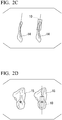
- FIGS. 2A to 2D Next, a configuration and an installation method of the foot pressure sensor 10 will be described using FIGS. 2A to 2D .
- the foot pressure sensor 10 is a rectangular plan-type constituent, and is installed on or near a part of the foot sole part at which the pressure is equal to or larger than a threshold.
- the foot pressure sensor 10 is installed on or near a part (a pressure concentration portion) at which a pressure is twice or more an average value of pressure applied per unit area of the foot sole part.
- the pressure concentration portion is, for example, a portion at which a big toe ball 13, a little toe ball 14, and a heel bone 15 are located.
- the foot pressure sensor 10 adheres to the part at which the big toe ball 13, the little toe ball 14, and the heel bone 15 of the foot sole part of the subject are located.
- the foot pressure sensor 10 may be attached to the foot sole part in which the big toe ball 13, the little toe ball 14, and the heel bone 15 are located in socks worn by the subject.
- the foot pressure sensor 10 may be attached to insoles of athletic shoes in which the big toe ball 13, the little toe ball 14, and the heel bone 15 are located.
- an area indicated by a dotted line in the foot pressure sensor 10 is a pressure-sensing unit 11 of the sensor.
- the pressure-sensing unit 11 senses a pressure using pressure contact.
- the pressure-sensing unit 11 has a long strip shape with an aspect ratio of 1:2 or more.
- the foot pressure sensor 10 is provided in three places in the foot sole part of the subject 50, but the foot pressure sensor 10 may be provided in at least one place.
- a part 12 indicated by + in the pressure-sensing unit 11 represents a center of a pressure applied to an inside of the pressure-sensing unit 11.
- FIG. 2B shows an example in which the foot pressure sensor 10 is disposed along a metatarsal bone located at the big toe ball 13.
- FIG. 2C shows an example in which the foot pressure sensor 10 is disposed along a metatarsal bone located at the little toe ball 14.
- FIG. 2D shows an example in which the foot pressure sensor 10 is disposed along the heel bone 15.
- the foot pressure sensor 10 is anatomically disposed in a longitudinal direction of bones (heel bone, metatarsal bone, toe bone) of the foot.
- the foot pressure sensor 10 includes an adjusting unit.
- the adjusting unit adjusts a gain and a base line of an amplifier for an analog signal of the pressure-sensing unit when change in sensitivity due to individual differences in pressure distribution, wearing of the pressure-sensing unit of the foot pressure sensor 10, or the like is equal to or more than a threshold.
- the adjusting unit adjusts the gain or base line of an amplifier by signal processing after analog to digital conversion.
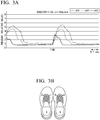
- FIG. 3A is a graph which indicates a measurement example of change with time in the foot sole pressure (force) at a position of each foot pressure sensor 10 at the time of running with the foot pressure sensor 10 attached.
- FIG. 3B is a diagram which shows the position of the foot pressure sensor 10.
- the load-applying device 60 is inclined by 13% and the subject 50 is caused to run at a running speed of 150 m/min.
- three foot pressure sensors 10 are attached to the foot sole part of both feet of the subject 50. ch1, ch2, and ch3 in FIG.
- FIG. 3A indicate a result of measuring the foot sole pressure (force) by disposing the foot pressure sensors 10 at positions 1, 2, and 3 in FIG. 3B , respectively.
- chl in FIG. 3A indicates a result of measuring the foot sole pressure (force) by disposing the foot pressure sensor 10 at the position 1 in FIG. 3B .
- FIGS. 4A, 4B, and 4C are diagrams which show change in the peak value of the foot sole pressure (force) of a short distance runner, an intermediate distance runner, and a non-experienced person, respectively.
- a magnitude of the fluctuation in the peak value of the foot sole pressure (force) varies depending on a runner and a running state, and can be used as an indicator of stability of running.
- the intermediate distance runner who requires high-efficiency running exercise has less fluctuation in foot sole pressure (ground pressure) as shown in FIG. 4B
- the non-experienced person has a large fluctuation in foot sole pressure (ground pressure) and low stability as shown in FIG. 4C
- the short distance runner who exerts full power in a short time has a slightly large fluctuation in the foot sole pressure (ground pressure), and is somewhat unstable as shown in FIG. 4A . That is, it is clear that the foot sole pressure at the time of contact with the ground is maintained in a stable estate in intermediate and long distance running in which exercise is continued for a long time to some extent.
- the intermediate distance runner has higher efficiency in running exercise than the non-experienced person and the short distance runner.
- the peak value (maximum foot sole pressure) of the foot sole pressure when the intermediate distance runner is grounded is constant.
- the peak value of the foot sole pressure at the time of contact with the ground is unstable, and strength of the peak value at each step is recognized.
- the peak value of the foot sole pressure at the time of contact with the ground is more unstable, and the strength of the peak value at each step becomes more prominent.
- the information provision device 30 evaluates the efficiency and skill of running exercise using the fluctuation (variation) in the peak value (maximum foot sole pressure) of the foot sole pressure at the time of contact with the ground.
- an exercise intensity at which the fluctuation (variation) in the peak value (maximum foot sole pressure) of the foot sole pressure at the time of contact with the ground described above increases is correlated with an exercise intensity of a lactic acid threshold (lactate threshold). Accordingly, the lactate threshold can be estimated by gradually increasing the exercise intensity and detecting an increase in the fluctuation (variation) of the peak value (maximum foot sole pressure) of the foot sole pressure at the time of contact with the ground as a change point.
- the change with time in the foot sole pressure at the time of running is measured, and, as an indicator of running stability, the fluctuation in the peak value of the foot sole pressure (force) in repeated landing and jumping operations is used as a feature value.
- the foot sole pressure (force) at sole surfaces increases, and accordingly, the fluctuation in the peak value of the foot sole pressure gradually increases.
- the magnitude of the fluctuation is an indicator of the skill of the running technique of the subject.
- a large fluctuation in the peak value of the foot sole pressure indicates that a training intensity for the subject is higher than an optimum intensity.
- the fluctuation in the peak value of the foot sole pressure changes with time due to running for a long time, and can be used as an indicator of the progress of fatigue of a runner.
- Various indicators used in statistical processing can be used to calculate the fluctuation (variation) in the peak value of the foot sole pressure (force).
- the various indicators include, for example, a standard deviation, a variance, a standard error, a range, an interquartile range, an average difference, an average absolute deviation, and the like.
- data may be normalized when necessary in a calculation process of these indicators.
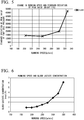
- FIG. 5 is a diagram which shows a running speed and change in standard deviation of the peak value of the foot sole pressure in the big toe ball (a position 4 of FIG. 3B ).
- FIG. 5 shows a degree (a standard deviation of the peak value of the foot sole pressure at a certain running speed) of the fluctuation of the peak value of the foot sole pressure when the running speed of a certain runner is increased.
- the standard deviation of the peak value of the foot sole pressure has a tendency to increase as the running speed increases (big toe ball (the position 4 of FIG. 3B )), and shows a shift to an unstable state in which the fluctuation in the peak value of the foot sole pressure is large at a running speed of 300 m/min or higher.
- a change in the magnitude of the fluctuation in the peak value of the foot sole pressure also corresponds to an increase in blood lactate concentration measured simultaneously at a running speed of 260 to 300 m/min or higher. That is, in FIG. 6 , the blood lactate concentration at a running speed of 325 m/min or higher becomes a state of 4 mmol/l or higher in which it is difficult for the runner to maintain running for a long time.
- the fluctuation in the peak value of the foot sole pressure at the time of running corresponds to difficulty for the runner. That is, the fluctuation in the peak value of the foot sole pressure becomes large in a load that causes difficulty for the runner. While the running speed is low and running is stable, the fluctuation of the peak value is also maintained to be low ( FIG. 5 ).
- the lactate threshold can be determined non-invasively using such a property of the fluctuation of the peak value of the foot sole pressure.
- the runner can determine whether the exercise intensity is too high or too low, and the lactate threshold can be used as an indicator for setting an optimum exercise intensity.
- FIGS. 7A and 7B are diagrams which show an increase in an amount of exercise load due to running on a sloping road measured by the information provision system 100.
- the horizontal axis represents the number of times of contact with the ground by the runner
- the vertical axis represents an integrated pressure for each time of contact with the ground. This integrated pressure is a value obtained by adding values of foot sole pressures measured in a certain sampling period for each time of contact with the ground.
- FIG. 7A shows an integrated pressure for each time of contact with the ground in running on a sloping road
- FIG. 7B shows an integrated pressure for each time of contact with the ground in running on flat ground. As shown in FIG.
- the average of the integrated pressure of foot sole pressures at all times of contact with the ground in running on a sloping road is about 1.5 times higher than the average of the integrated pressure of foot sole pressures at all times of contact with the ground in running on flat ground, as shown in FIG. 7B .
- a foot sole pressure (force) and a pitch can be measured at the same time by the foot pressure sensor 10.
- the information provision device 30 determines a gradient and a speed of the load-applying device 60 to achieve an optimum foot sole pressure (force) in accordance with the ability of the subject, and a pitch, provides these to the load-applying device 60, and provides the subject with more effective training. For example, beginners respond by increasing the pitch more than the stride as the running speed increases, but, if the pitch reaches a certain degree or more, the fluctuation in the peak value of the foot sole pressure (force) increases, and a tendency to decrease the efficiency of running exercise is recognized.
- the information provision device 30 provides information (the gradient and speed of the load-applying device 60, and the pitch of the subject) which enables a highly efficient and stable running exercise based on a changing point at which the fluctuation of the peak value of the foot sole pressure increases, whereby practicing more effectively and learning to run marathons without withdrawals or weakening is able to be achieved.
- an intermediate runner can increase a force by gradually raising an inclination angle ⁇ while observing the peak value of the foot sole pressure (force) and perform a reinforcement exercise for enabling a larger stride to improve performance by improving the efficiency of running exercise.
- an efficient reinforcement exercise can be performed by exercising with a load which suppresses the fluctuation of the peak value of the foot sole pressure (force) within a range of not exceeding a predetermined magnitude.
- FIG. 8 is a diagram which shows a comparison result in a relationship between the pitch, stride, and blood lactate concentration between running on flat ground and running on a sloping road.
- the pitch increases (gets higher), the stride becomes shorter, and the blood lactate concentration rises in the case of the sloping load running compared with the case of running on flat ground.
- the pitch increases, the stride becomes shorter, and the blood lactate concentration significantly rises in the case of the sloping load running compared with the case of running on flat ground.
- the foot sole pressure (force) is higher. That is, the foot sole pressure (force) becomes higher and the blood lactate concentration also rises in running on a sloping road, and a higher load is applied to a runner.
- Training focusing on force (stride) improvement can be implemented by restricting the pitch with respect to an increase in running speed, instructing maintaining a speed by increasing a force (maintaining or increasing the stride), and efficiently improving the force in training based on the points described above.
- the information provision device 30 can measure the force and the pitch, it is possible to devise an appropriate combination of the gradient, running speed, force, and pitch of the load-applying device 60 in accordance with the ability of a player, and to perform efficient guidance.
- FIG. 9 is a schematic block diagram which represents a functional configuration of the information provision device 30.
- the information provision device 30 includes a central processing unit (CPU), a memory, an auxiliary storage device, and the like connected by a bus, and executes a provision program. According to the execution of the provision program, the information provision device 30 functions as a device which includes an acquisition unit 301, a calculation unit 302, a display controller 303, a display unit 304, and an information provision unit 305. Note that all or some of the functions of the information provision device 30 may be realized using hardware such as an application-specific integrated circuit (ASIC), a programmable logic device (PLD), or a field-programmable gate array (FPGA). In addition, the provision program may also be recorded in a computer-readable recording medium.
- ASIC application-specific integrated circuit
- PLD programmable logic device
- FPGA field-programmable gate array
- the computer-readable recording medium is, for example, a portable medium such as a flexible disk, an optical magnetic disc, a ROM, or a CD-ROM, and a storage device such as a hard disk embedded in a computer system.
- the provision program may be transmitted or received via a telecommunication line.
- the acquisition unit 301 acquires a result of the measurement measured by the foot pressure sensor 10 from the relay device 20.
- the acquisition unit 301 outputs the acquired result of the measurement to the calculation unit 302.
- the calculation unit 302 performs a predetermined calculation on the measurement results output from the acquisition unit 301.
- the predetermined calculation is, for example, a standard deviation, a variance, a standard error, a range, an interquartile range, an average difference, an average absolute deviation, and the like.
- the display controller 303 causes the display unit 304 to display information on the basis of a result of the calculation. For example, the display controller 303 causes the display unit 304 to display the graphs shown in FIGS. 5 to 8 .
- the display unit 304 is an image display device such as a liquid crystal display or an organic electro luminescence (EL) display.
- the display unit 304 may also be an interface for connecting an image display device to the information provision device 30. In this case, the display unit 304 generates a video signal for displaying information, and outputs the video signal to an image display device connected thereto.
- EL organic electro luminescence
- the information provision unit 305 sets a fluctuation in the foot sole pressure at the time of running obtained on the basis of measurement data of the pressure as an indicator of running stability, determines the endurance exercise capacity of a subject, the skill of a running technique, and the degree of fatigue of a subject in accordance with continuation of exercise or a running method (full-speed running or constant speed running such as a marathon) of the subject, and provides load information in accordance with the ability of a subject according to a result of the determination.
- the information provision unit 305 holds a determination table.
- the determination table is a table used to determine a state of the subject 50 at the time of exercising.
- a fluctuation in the foot sole pressure at the time of running and information on a determination target are associated with each other. That is, states of the endurance exercise capacity of a subject, the skill of a running technique, the degree of fatigue of the subject in accordance with continuation of exercise, and a running method of the subject are determined in accordance with the fluctuation in the foot sole pressure at the time of running.
- the information provision unit 305 refers to the determination table and determines the endurance exercise capacity of a subject, the skill of a running technique, the degree of fatigue of the subject in accordance with continuation of exercise, or a running method of the subject in accordance with the fluctuation obtained on the basis of the measurement data of the pressure. Note that it is not necessary that all determination targets be associated with the fluctuation of the foot sole pressure at the time of running, and only some of the determination targets may be associated in the determination table. In addition, the determination targets may be set for each subject or may be set each time.
- the information provision unit 305 holds a load information table.
- the load information table is used when load information in accordance with the ability of a subject is determined.
- a result of determination and load information in accordance with the result of the determination are associated with each other.
- the information provision unit 305 acquires load information in accordance with the ability of a subject according to a result of the determination with reference to the load information table. Thereafter, the information provision unit 305 provides the acquired load information.
- the information provision unit 305 may provide load information by causing the display unit 304 to display the load information, provide load information by reading the load information using speech, and provide load information by printing the load information.
- the information provision unit 305 evaluates the efficiency and skill of running exercise according to a deviation (variation) of the peak value (maximum foot sole pressure) of the foot sole pressure at the time of contact with the ground. For example, the information provision unit 305 may evaluate that the efficiency and skill of running exercise are very poor when the deviation (variation) of the peak value (maximum foot sole pressure) of the foot sole pressure at the time of contact with the ground is equal to or greater than a first threshold.
- the information provision unit 305 evaluates that the efficiency and skill of running exercise are poor when the deviation (variation) of the peak value (maximum foot sole pressure) of the foot sole pressure at the time of grounding is equal to or greater than a second threshold value smaller than the first threshold value, and is smaller than the first threshold. In addition, for example, the information provision unit 305 evaluates that the efficiency and skill of running exercise are good when the deviation (variation) of the peak value (maximum foot sole pressure) of the foot sole pressure at the time of contact with the ground is smaller than the second threshold.
- exercise information can be measured non-invasively.
- the foot pressure sensor 10 is installed in the foot sole part of a subject, and measures a pressure applied to the foot sole part of a subject.
- the subject only needs to walk or run. For this reason, it is possible to measure exercise information non-invasively.
- the information provision system 100 can expand a width corresponding to a variation in the size of the bone by installing the foot pressure sensor 10 with a different aspect ratio.
- a direction in which a foot sole force is applied is mainly inclined to a longitudinal axis (close to a long axis of the bone) due to a change in a state of running or walking by taking a short side of the pressure-sensing unit slightly wider (for example, a width of 0.5 to 1.0 cm)
- stable measurement with respect to a change of state can be realized.
- an error caused by the above-described shape distortion with a large sensor can be avoided by using a sensor corresponding to bending in one direction.
- the foot pressure sensor 10 According to the shape of the foot pressure sensor 10 described above, it is possible to make a pressure-sensing area wider than that of a conventional sensor, to reduce the number of sensors by optimizing a range covered by the pressure-sensing unit 11 and disposition places, and to respond to areas of foot sole parts having individual differences, a pressure distribution, a deformation of a foot sole part due to a change in gait, and a change in a direction of force. Furthermore, sensor replacement and sensitivity adjustment can be simplified for durability issues or sensor sensitivity fluctuation due to mechanical stress according to running exercise.
- foot pressure sensor 10 According to the foot pressure sensor 10 described above, it is possible to ascertain a precise running situation while actually running in the field as well as in a laboratory.
- This is a general-purpose foot sole pressure sensor system which can be used continuously in competition and daily life.
- the information provision device 30 can provide exercise information of an optimal foot sole pressure (force) with which a training effect in accordance with the ability of a user is obtained. Then, the subject can perform more effective training by running with settings (for example, a gradient, a running speed, and the like) in accordance with the provided information.
- the display unit 304 included in the information provision device 30 may be included in another device (for example, a single display device), and other functional units except for the display unit 304 may also be included in the information provision device 30.
- the information provision device 30 is disposed near the subject 50, and the other device including the display unit 304 is disposed in a place (for example, an adjacent room, or the like) spaced apart from a place where the subject 50 is located.
- the display controller 303 transmits information to be displayed on the display unit 304 to another device including the display unit 304.
- a measurer can ascertain information of a subject even if the measurer is not near the subject.
- the information provision system 100 may also be configured to further include an adjusting unit that adjusts a load amount to an optimum range by changing the running speed or slopes of the load-applying device 60 that assists walking and running of a treadmill, a room runner, and a stepper on the basis of load information of the information provision unit 305 and a past exercise history.
- the adjusting unit is included in, for example, the load-applying device 60. With such a configuration, the adjusting unit acquires load information from the information provision unit 305. In addition, the adjusting unit holds information on the past exercise history of the subject 50.
- the information on the past exercise history is, for example, information related to a running speed and a slope when the subject 50 performed an exercise within a predetermined period using the load-applying device 60. Then, the adjusting unit determines the changed running speed and slope of the load-applying device 60 on the basis of the acquired load information and the held past exercise history. For example, the adjusting unit may also determine an average running speed and a slope on the basis of the load information and the held past exercise history. The adjusting unit adjusts the running speed and slope of the load-applying device 60 to be the determined running speed and slope.
- the adjusting unit may also determine a running speed and a slope using other statistical values (for example, a mode value, a maximum value, and the like) instead of the average running speed and slope as the changed running speed and slope of the load-applying device 60.
- the load may be increased gradually to reach an optimum load or increased for a certain period of time during interval running.
- the load amount may be reduced gradually or the load amount may also be optimized by giving a uniformly slowing section.
- the load applied to the subject 50 can be dynamically adjusted.
- the foot sole pressure measurement device of the present invention it is possible to measure an exercise intensity of walking or running without giving an excessive burden to a subject or measurer.
Landscapes
- Health & Medical Sciences (AREA)
- Life Sciences & Earth Sciences (AREA)
- General Health & Medical Sciences (AREA)
- Engineering & Computer Science (AREA)
- Surgery (AREA)
- Veterinary Medicine (AREA)
- Pathology (AREA)
- Physics & Mathematics (AREA)
- Biomedical Technology (AREA)
- Heart & Thoracic Surgery (AREA)
- Medical Informatics (AREA)
- Molecular Biology (AREA)
- Biophysics (AREA)
- Animal Behavior & Ethology (AREA)
- Public Health (AREA)
- Physical Education & Sports Medicine (AREA)
- Dentistry (AREA)
- Oral & Maxillofacial Surgery (AREA)
- Cardiology (AREA)
- Vascular Medicine (AREA)
- Physiology (AREA)
- Microelectronics & Electronic Packaging (AREA)
- Multimedia (AREA)
- Human Computer Interaction (AREA)
- Measurement Of The Respiration, Hearing Ability, Form, And Blood Characteristics Of Living Organisms (AREA)
- Rehabilitation Tools (AREA)
Priority Applications (1)
| Application Number | Priority Date | Filing Date | Title |
|---|---|---|---|
| EP23151569.3A EP4183337A1 (de) | 2017-08-16 | 2018-08-13 | Fusssohlendruckmessinstrument, informationsbereitstellungsvorrichtung und informationsbereitstellungsverfahren |
Applications Claiming Priority (2)
| Application Number | Priority Date | Filing Date | Title |
|---|---|---|---|
| JP2017157049 | 2017-08-16 | ||
| PCT/JP2018/030207 WO2019035444A1 (ja) | 2017-08-16 | 2018-08-13 | 足底圧測定器、情報提供装置及び情報提供方法 |
Related Child Applications (1)
| Application Number | Title | Priority Date | Filing Date |
|---|---|---|---|
| EP23151569.3A Division EP4183337A1 (de) | 2017-08-16 | 2018-08-13 | Fusssohlendruckmessinstrument, informationsbereitstellungsvorrichtung und informationsbereitstellungsverfahren |
Publications (2)
| Publication Number | Publication Date |
|---|---|
| EP3636152A1 true EP3636152A1 (de) | 2020-04-15 |
| EP3636152A4 EP3636152A4 (de) | 2020-10-14 |
Family
ID=65362524
Family Applications (2)
| Application Number | Title | Priority Date | Filing Date |
|---|---|---|---|
| EP23151569.3A Withdrawn EP4183337A1 (de) | 2017-08-16 | 2018-08-13 | Fusssohlendruckmessinstrument, informationsbereitstellungsvorrichtung und informationsbereitstellungsverfahren |
| EP18846378.0A Ceased EP3636152A4 (de) | 2017-08-16 | 2018-08-13 | Instrument zur messung des fusssohlendrucks, informationsbereitstellungsvorrichtung und informationsbereitstellungsverfahren |
Family Applications Before (1)
| Application Number | Title | Priority Date | Filing Date |
|---|---|---|---|
| EP23151569.3A Withdrawn EP4183337A1 (de) | 2017-08-16 | 2018-08-13 | Fusssohlendruckmessinstrument, informationsbereitstellungsvorrichtung und informationsbereitstellungsverfahren |
Country Status (5)
| Country | Link |
|---|---|
| US (1) | US11666244B2 (de) |
| EP (2) | EP4183337A1 (de) |
| JP (1) | JP6845534B2 (de) |
| CN (2) | CN116269325A (de) |
| WO (1) | WO2019035444A1 (de) |
Families Citing this family (10)
| Publication number | Priority date | Publication date | Assignee | Title |
|---|---|---|---|---|
| USD918317S1 (en) * | 2018-10-01 | 2021-05-04 | Technogym S.P.A. | Exercise equipment |
| KR102550861B1 (ko) * | 2018-12-21 | 2023-07-04 | 삼성전자주식회사 | 보행 보조 방법 및 그 방법을 수행하는 보행 보조 장치 |
| JP7103307B2 (ja) * | 2019-06-07 | 2022-07-20 | トヨタ自動車株式会社 | 歩行訓練システムおよび歩行訓練システムの制御プログラム |
| CN113244084B (zh) * | 2020-02-11 | 2023-05-23 | 上银科技股份有限公司 | 可适应性主动训练系统 |
| JP7209363B2 (ja) * | 2020-04-13 | 2023-01-20 | リオモ インク | スタビリティ評価システム、プログラム及び方法 |
| CN112716482A (zh) * | 2020-12-28 | 2021-04-30 | 常州福普生电子科技有限公司 | 一种足底压力分布测量装置及测量方法 |
| JP7573107B2 (ja) * | 2021-05-25 | 2024-10-24 | 株式会社アシックス | 走法分析装置、走法分析方法および走法分析プログラム |
| KR102665026B1 (ko) * | 2021-10-18 | 2024-05-13 | 부산대학교 산학협력단 | 디지털 트윈 기반의 가상 인솔을 이용한 맞춤형 인솔 설계 방법, 가상 인솔의 설계 방법 및 설계 단말 |
| US20240024735A1 (en) * | 2022-07-20 | 2024-01-25 | Michelle Rubio | Treadmill with Running Form Detection Device |
| CN117100250B (zh) * | 2023-07-10 | 2024-05-28 | 北京华益精点生物技术有限公司 | 脚趾位置的确定方法、装置、电子设备及存储介质 |
Family Cites Families (26)
| Publication number | Priority date | Publication date | Assignee | Title |
|---|---|---|---|---|
| US5469740A (en) * | 1989-07-14 | 1995-11-28 | Impulse Technology, Inc. | Interactive video testing and training system |
| US6216545B1 (en) * | 1995-11-14 | 2001-04-17 | Geoffrey L. Taylor | Piezoresistive foot pressure measurement |
| JPH105369A (ja) * | 1996-04-23 | 1998-01-13 | Matsushita Electric Works Ltd | トレーニング装置 |
| US9247901B2 (en) * | 2003-08-22 | 2016-02-02 | Dexcom, Inc. | Systems and methods for replacing signal artifacts in a glucose sensor data stream |
| JP2005156531A (ja) * | 2003-11-05 | 2005-06-16 | Sony Corp | 圧力センサおよび生体情報処理装置 |
| US7398688B2 (en) * | 2003-12-11 | 2008-07-15 | Proteus Biomedical, Inc. | Pressure sensor circuits |
| JP4138814B2 (ja) * | 2006-04-06 | 2008-08-27 | 本田技研工業株式会社 | 運動管理システム |
| CN102143695A (zh) | 2008-06-13 | 2011-08-03 | 耐克国际有限公司 | 具有传感器系统的鞋 |
| DE102008058020A1 (de) * | 2008-11-19 | 2010-05-20 | Zebris Medical Gmbh | Anordnung zum Training des Ganges |
| US20100152619A1 (en) * | 2008-12-16 | 2010-06-17 | 24/8 Llc | System, method, and computer-program product for measuring pressure points |
| US8823526B2 (en) * | 2009-07-02 | 2014-09-02 | The Regents Of The University Of California | Method of assessing human fall risk using mobile systems |
| US8998828B2 (en) * | 2009-07-09 | 2015-04-07 | Nike, Inc. | Visualization testing and/or training |
| US8581731B2 (en) * | 2011-02-16 | 2013-11-12 | Connor Kent Purks | Circuits, systems, and methods for monitoring and reporting foot impact, foot placement, shoe life, and other running/walking characteristics |
| CN102319503B (zh) * | 2011-10-18 | 2013-06-19 | 中国科学院合肥物质科学研究院 | 一种基于柔性阵列压力传感器的跑步机自适应调速系统 |
| US9451881B2 (en) * | 2012-12-06 | 2016-09-27 | Autonomous_Id Canada Inc. | Gait-based biometric system for detecting weight gain or loss |
| CN103340735B (zh) * | 2013-07-26 | 2015-11-25 | 上海市第六人民医院 | 测力型助行装置 |
| JP6357003B2 (ja) * | 2014-04-17 | 2018-07-11 | 株式会社Nttドコモ | 走行支援ウェアラブル端末、走行支援サーバ、および走行支援方法 |
| CN105078463A (zh) * | 2015-09-08 | 2015-11-25 | 常州先进制造技术研究所 | 用于人体下肢运动意图识别的分布式多通道信号采集系统 |
| CN105748078A (zh) * | 2016-02-16 | 2016-07-13 | 北京理工大学 | 基于压力传感鞋垫的足底压力测量装置及系统 |
| JP6746851B2 (ja) | 2016-03-02 | 2020-08-26 | 国際航業株式会社 | 地形分類システム、及び地形分類方法 |
| CN205885432U (zh) * | 2016-06-22 | 2017-01-18 | 河北师范大学 | 一种基于鞋垫的足底压力测试装置 |
| CN109688923B (zh) * | 2016-09-09 | 2022-04-19 | 日本电信电话株式会社 | 乳酸性作业阈值推测装置以及乳酸性作业阈值推测方法 |
| CN106618579A (zh) * | 2016-12-02 | 2017-05-10 | 华东师范大学 | 一种基于柔性薄膜压力传感器的可穿戴足底压力测量装置 |
| CN107174252A (zh) * | 2017-05-23 | 2017-09-19 | 广东远峰电子科技股份有限公司 | 一种足部运动姿态的判断装置和方法 |
| KR102064563B1 (ko) * | 2017-07-28 | 2020-01-09 | 충남대학교산학협력단 | 착용자의 보행 상태를 판단하는 스마트 슈즈 시스템 |
| CN107281700B (zh) * | 2017-07-31 | 2019-08-30 | 北京小米移动软件有限公司 | 跑带速度控制方法、装置、跑步机及存储介质 |
-
2018
- 2018-08-13 WO PCT/JP2018/030207 patent/WO2019035444A1/ja not_active Ceased
- 2018-08-13 EP EP23151569.3A patent/EP4183337A1/de not_active Withdrawn
- 2018-08-13 US US16/633,320 patent/US11666244B2/en active Active
- 2018-08-13 CN CN202310333728.5A patent/CN116269325A/zh active Pending
- 2018-08-13 JP JP2019536774A patent/JP6845534B2/ja active Active
- 2018-08-13 EP EP18846378.0A patent/EP3636152A4/de not_active Ceased
- 2018-08-13 CN CN201880053122.3A patent/CN110944582A/zh active Pending
Also Published As
| Publication number | Publication date |
|---|---|
| EP4183337A1 (de) | 2023-05-24 |
| US20200146592A1 (en) | 2020-05-14 |
| JPWO2019035444A1 (ja) | 2020-05-28 |
| JP6845534B2 (ja) | 2021-03-17 |
| US11666244B2 (en) | 2023-06-06 |
| CN110944582A (zh) | 2020-03-31 |
| CN116269325A (zh) | 2023-06-23 |
| WO2019035444A1 (ja) | 2019-02-21 |
| EP3636152A4 (de) | 2020-10-14 |
Similar Documents
| Publication | Publication Date | Title |
|---|---|---|
| US11666244B2 (en) | Foot sole pressure measurement instrument, information provision device, and information provision method | |
| US9616290B2 (en) | Foot monitoring system that generates an indication of how much shoe cushioning life remains in a shoe | |
| US8581731B2 (en) | Circuits, systems, and methods for monitoring and reporting foot impact, foot placement, shoe life, and other running/walking characteristics | |
| TWI438018B (zh) | 人體下肢力學行為評估系統與方法 | |
| US9788758B2 (en) | Method for determining abnormal gait | |
| Willson et al. | Plantar loading and cadence alterations with fatigue | |
| US11948470B2 (en) | Artificial intelligence assistance to change biomechanical loading | |
| Wellenkotter et al. | The effects of running cadence manipulation on plantar loading in healthy runners | |
| CN102387744A (zh) | 用于确定试验对象的总体健康状况的方法和装置 | |
| Hohmann et al. | Plantar pressures during long distance running: an investigation of 10 marathon runners | |
| Mann et al. | Reliability and validity of pressure and temporal parameters recorded using a pressure-sensitive insole during running | |
| JP2012176170A (ja) | 足部バランス評価装置及び訓練器及び訓練方法 | |
| CN109730687A (zh) | 用于脑瘫患者的可穿戴步态检测分析系统 | |
| US11337621B2 (en) | Lactate working threshold-estimating device and lactate working threshold-estimating method | |
| Arndt | Correction for sensor creep in the evaluation of long-term plantar pressure data | |
| US20240000378A1 (en) | System and method for quantifying an injury recovery state | |
| WO2018110621A1 (ja) | 足裏計測装置 | |
| CA3193792A1 (en) | System and method for generating a virtual avatar representing a plurality of users | |
| WO2018110622A1 (ja) | 足部異常解析装置及び方法 | |
| Yi | Impact of sport dancing on the dynamics characteristic of foot movement of college students | |
| TWI769554B (zh) | 步訊號感應方法及其裝置 | |
| CN120036767A (zh) | 足底压力感应系统及其数据处理方法 | |
| JP2019150229A (ja) | 足部解析装置及び方法 | |
| Koyama et al. | Jump performance following foot muscle training: Influence of barefoot vs. shod exercise | |
| Ingram | Symmetry of in-shoe force signatures in athletes under field conditions: an application for injury prevention |
Legal Events
| Date | Code | Title | Description |
|---|---|---|---|
| STAA | Information on the status of an ep patent application or granted ep patent |
Free format text: STATUS: THE INTERNATIONAL PUBLICATION HAS BEEN MADE |
|
| PUAI | Public reference made under article 153(3) epc to a published international application that has entered the european phase |
Free format text: ORIGINAL CODE: 0009012 |
|
| STAA | Information on the status of an ep patent application or granted ep patent |
Free format text: STATUS: REQUEST FOR EXAMINATION WAS MADE |
|
| 17P | Request for examination filed |
Effective date: 20200106 |
|
| AK | Designated contracting states |
Kind code of ref document: A1 Designated state(s): AL AT BE BG CH CY CZ DE DK EE ES FI FR GB GR HR HU IE IS IT LI LT LU LV MC MK MT NL NO PL PT RO RS SE SI SK SM TR |
|
| AX | Request for extension of the european patent |
Extension state: BA ME |
|
| A4 | Supplementary search report drawn up and despatched |
Effective date: 20200916 |
|
| RIC1 | Information provided on ipc code assigned before grant |
Ipc: A63B 71/06 20060101ALI20200910BHEP Ipc: A63B 22/00 20060101ALI20200910BHEP Ipc: A61B 5/00 20060101ALI20200910BHEP Ipc: A43B 5/00 20060101ALI20200910BHEP Ipc: A63B 24/00 20060101ALI20200910BHEP Ipc: A61B 5/103 20060101ALI20200910BHEP Ipc: A61B 5/11 20060101AFI20200910BHEP Ipc: A63B 22/02 20060101ALI20200910BHEP |
|
| DAV | Request for validation of the european patent (deleted) | ||
| DAX | Request for extension of the european patent (deleted) | ||
| STAA | Information on the status of an ep patent application or granted ep patent |
Free format text: STATUS: EXAMINATION IS IN PROGRESS |
|
| 17Q | First examination report despatched |
Effective date: 20210416 |
|
| REG | Reference to a national code |
Ref country code: DE Ref legal event code: R003 |
|
| STAA | Information on the status of an ep patent application or granted ep patent |
Free format text: STATUS: THE APPLICATION HAS BEEN REFUSED |
|
| 18R | Application refused |
Effective date: 20221004 |