EP3636362B1 - Procédé de fabrication d'article embouti et ligne d'emboutissage - Google Patents
Procédé de fabrication d'article embouti et ligne d'emboutissage Download PDFInfo
- Publication number
- EP3636362B1 EP3636362B1 EP18814001.6A EP18814001A EP3636362B1 EP 3636362 B1 EP3636362 B1 EP 3636362B1 EP 18814001 A EP18814001 A EP 18814001A EP 3636362 B1 EP3636362 B1 EP 3636362B1
- Authority
- EP
- European Patent Office
- Prior art keywords
- punch
- die
- formed article
- press
- portions
- Prior art date
- Legal status (The legal status is an assumption and is not a legal conclusion. Google has not performed a legal analysis and makes no representation as to the accuracy of the status listed.)
- Active
Links
Images











Classifications
-
- B—PERFORMING OPERATIONS; TRANSPORTING
- B30—PRESSES
- B30B—PRESSES IN GENERAL
- B30B15/00—Details of, or accessories for, presses; Auxiliary measures in connection with pressing
- B30B15/06—Platens or press rams
-
- B—PERFORMING OPERATIONS; TRANSPORTING
- B21—MECHANICAL METAL-WORKING WITHOUT ESSENTIALLY REMOVING MATERIAL; PUNCHING METAL
- B21D—WORKING OR PROCESSING OF SHEET METAL OR METAL TUBES, RODS OR PROFILES WITHOUT ESSENTIALLY REMOVING MATERIAL; PUNCHING METAL
- B21D22/00—Shaping without cutting, by stamping, spinning, or deep-drawing
- B21D22/20—Deep-drawing
- B21D22/206—Deep-drawing articles from a strip in several steps, the articles being coherent with the strip during the operation
-
- B—PERFORMING OPERATIONS; TRANSPORTING
- B21—MECHANICAL METAL-WORKING WITHOUT ESSENTIALLY REMOVING MATERIAL; PUNCHING METAL
- B21D—WORKING OR PROCESSING OF SHEET METAL OR METAL TUBES, RODS OR PROFILES WITHOUT ESSENTIALLY REMOVING MATERIAL; PUNCHING METAL
- B21D22/00—Shaping without cutting, by stamping, spinning, or deep-drawing
- B21D22/20—Deep-drawing
- B21D22/21—Deep-drawing without fixing the border of the blank
-
- B—PERFORMING OPERATIONS; TRANSPORTING
- B21—MECHANICAL METAL-WORKING WITHOUT ESSENTIALLY REMOVING MATERIAL; PUNCHING METAL
- B21D—WORKING OR PROCESSING OF SHEET METAL OR METAL TUBES, RODS OR PROFILES WITHOUT ESSENTIALLY REMOVING MATERIAL; PUNCHING METAL
- B21D22/00—Shaping without cutting, by stamping, spinning, or deep-drawing
- B21D22/20—Deep-drawing
- B21D22/26—Deep-drawing for making peculiarly, e.g. irregularly, shaped articles
-
- B—PERFORMING OPERATIONS; TRANSPORTING
- B21—MECHANICAL METAL-WORKING WITHOUT ESSENTIALLY REMOVING MATERIAL; PUNCHING METAL
- B21D—WORKING OR PROCESSING OF SHEET METAL OR METAL TUBES, RODS OR PROFILES WITHOUT ESSENTIALLY REMOVING MATERIAL; PUNCHING METAL
- B21D22/00—Shaping without cutting, by stamping, spinning, or deep-drawing
- B21D22/20—Deep-drawing
- B21D22/30—Deep-drawing to finish articles formed by deep-drawing
-
- B—PERFORMING OPERATIONS; TRANSPORTING
- B21—MECHANICAL METAL-WORKING WITHOUT ESSENTIALLY REMOVING MATERIAL; PUNCHING METAL
- B21D—WORKING OR PROCESSING OF SHEET METAL OR METAL TUBES, RODS OR PROFILES WITHOUT ESSENTIALLY REMOVING MATERIAL; PUNCHING METAL
- B21D24/00—Special deep-drawing arrangements in, or in connection with, presses
- B21D24/005—Multi-stage presses
-
- B—PERFORMING OPERATIONS; TRANSPORTING
- B21—MECHANICAL METAL-WORKING WITHOUT ESSENTIALLY REMOVING MATERIAL; PUNCHING METAL
- B21D—WORKING OR PROCESSING OF SHEET METAL OR METAL TUBES, RODS OR PROFILES WITHOUT ESSENTIALLY REMOVING MATERIAL; PUNCHING METAL
- B21D24/00—Special deep-drawing arrangements in, or in connection with, presses
- B21D24/04—Blank holders; Mounting means therefor
-
- B—PERFORMING OPERATIONS; TRANSPORTING
- B21—MECHANICAL METAL-WORKING WITHOUT ESSENTIALLY REMOVING MATERIAL; PUNCHING METAL
- B21D—WORKING OR PROCESSING OF SHEET METAL OR METAL TUBES, RODS OR PROFILES WITHOUT ESSENTIALLY REMOVING MATERIAL; PUNCHING METAL
- B21D24/00—Special deep-drawing arrangements in, or in connection with, presses
- B21D24/04—Blank holders; Mounting means therefor
- B21D24/06—Mechanically spring-loaded blank holders
-
- B—PERFORMING OPERATIONS; TRANSPORTING
- B21—MECHANICAL METAL-WORKING WITHOUT ESSENTIALLY REMOVING MATERIAL; PUNCHING METAL
- B21D—WORKING OR PROCESSING OF SHEET METAL OR METAL TUBES, RODS OR PROFILES WITHOUT ESSENTIALLY REMOVING MATERIAL; PUNCHING METAL
- B21D5/00—Bending sheet metal along straight lines, e.g. to form simple curves
- B21D5/01—Bending sheet metal along straight lines, e.g. to form simple curves between rams and anvils or abutments
-
- B—PERFORMING OPERATIONS; TRANSPORTING
- B30—PRESSES
- B30B—PRESSES IN GENERAL
- B30B13/00—Methods of pressing not special to the use of presses of any one of the preceding main groups
Definitions
- the present disclosure relates to a press-formed article manufacturing method and a press line as recited in the preamble of the independent claims, example thereof being found in Patent Document 3.
- Patent Document 1 and Patent Document 2 disclose a method of manufacturing a press-formed article having a substantially U-shaped (groove-shaped) section by using a pressing apparatus including a punch having a punch-side pad (inner pad) and a die having a die-side pad (die pad).
- a material metal plate is sandwiched by the punch-side pad protruding from the punch and the die-side pad protruding from the die, and in this state, the die is pushed to the punch side to form the press-formed article. Accordingly, the occurrence of springback in the press-formed article is suppressed.
- a third moment which faces the outside of the press-formed article, is generated at a ridge portion of the press-formed article before release (refer to an arrow in FIG. 5(b) of Patent Document 2).
- the third moment and the first and second moments are offset (balanced), and the springback in the press-formed article is suppressed.
- the above press-formed article manufacturing method As the protruding amount of the punch-side pad from the punch increases, the above first and second moments increase. Therefore, the amount by which the standing wall is displaced to the inside tends to increase. In other words, as the magnitude of the first and second moments changes, the position of the standing wall in a width direction tends to change sensitively with respect to the protruding amount of the punch-side pad from the punch. Accordingly, the range of the protruding amount of the punch-side pad in which the dimension of the standing wall in the width direction can be settled within a set tolerance becomes relatively narrow. For this reason, it is necessary to accurately adjust the protruding amount of the punch-side pad to form the press-formed article. From the viewpoint of productivity, in the press-formed article manufacturing method, even if the range of the protruding amount of the punch-side pad is expanded, it is required that a press-formed article in which the dimension of the standing wall is within the tolerance can be formed.
- the pads are included in both the punch and the die as components of the die and punch. Therefore, the structure of the pressing apparatus becomes complicated, and the manufacturing cost becomes high. Since the material metal plate is formed while being sandwiched between the punch-side pad and the die-side pad, a suitable bearing capability is required, and a case where facility restrictions increase and the required load of the pad is not obtained depending on part shape or size occurs.
- the invention has been made in view of the above circumstances and is to provide a press-formed article manufacturing method and a press line that can expand the allowable range of the protruding amount of a convex portion protruding from a punch by using simplified pressing apparatuses.
- FIGS. 1 to 13 a press-formed article manufacturing method related to a first embodiment of the invention will be described referring to FIGS. 1 to 13 .
- a flat-plate-shaped blank 10 is used as a first intermediate formed article 14 in a first step 12. Then, after the first intermediate formed article 14 is used as a second intermediate formed article 18 by in a second step 16, a press-formed article 22, which is a final formed article, is formed using the second intermediate formed article 18 in a third step 20.
- a press line 24 will first be described, and then, the configuration of the press-formed article 22, the configuration of the first intermediate formed article 14, the configuration of the second intermediate formed article 18, and the press-formed article manufacturing method will be described.
- the same members will be designated by the same reference signs, and the description of the same members earlier described in the following description will be appropriately omitted.
- FIG. 1 is a view illustrating an example of the press line 24.
- a tandem press line in which a plurality of arranged pressing apparatuses are connected to each other by a conveying device will be described as an example.
- the invention is not limited to this but the scope of the invention is limited merely by the appended claims.
- a transfer press line in which a formed article is sequentially formed while being fed to a plurality of dies and punches provided within a single device may be adopted.
- a material table 26 In the press line 24, a material table 26, a first pressing apparatus 100, a second pressing apparatus 200, and a third pressing apparatus 300 are sequentially arranged from an upstream side in a conveyance direction.
- the blank 10 made of a flat steel sheet is supplied to the material table 26.
- the blank 10 on the material table 26 is conveyed to the first pressing apparatus 100 by a first manipulator 34 constituted of a multi joint robot, which is an example of conveying means, is formed by the first pressing apparatus 100, and becomes the first intermediate formed article 14.
- the first intermediate formed article 14 formed by the first pressing apparatus 100 is conveyed to the second pressing apparatus 200 by a second manipulator 36, is formed by the second pressing apparatus 200, and becomes the second intermediate formed article 18.
- the second intermediate formed article 18 formed by the second pressing apparatus 200 is conveyed to the third pressing apparatus 300 by a third manipulator 38, is formed by the third pressing apparatus 300, and becomes the press-formed article 22.
- the press-formed article 22 formed by the third pressing apparatus 300 is delivered to the following step by a fourth manipulator 40.
- the conveying means includes, for example, a conveyor.
- the first pressing apparatus 100, the second pressing apparatus 200, the third pressing apparatus 300, and the respective manipulators 34, 36, 38, and 40 are connected to a control unit 42 constituted of an industrial computer or the like, and performs processing in accordance with a control signal from the control unit 42.
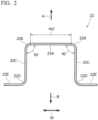
- FIG. 2 is a view illustrating an example of the press-formed article 22 formed in the present embodiment.
- an arrow W indicates a width direction of the press-formed article 22
- an arrow A indicates an upper side of the press-formed article 22.
- an arrow B indicates a lower side of the press-formed article 22.
- the press-formed article 22 is constituted of a high strength steel sheet having a tensile strength exceeds 980 MPa, for example, and includes a steel sheet having a tensile strength of 1180 MPa as an example.
- the press-formed article 22 is, for example, an elongated skeleton member that constitutes the skeleton of an automobile. Also, the press-formed article 22 has a hat shape as seen from the front that is one side in the longitudinal direction thereof.
- the press-formed article 22 includes a flat top plate 22A that extends in the width direction W of the press-formed article 22, and a pair of ridge portions 22B that is located on both sides of the top plate 22A in the width direction W, and each ridge portion 22B is constituted of a curved surface protruding to the front side.
- the press-formed article 22 includes a pair of standing walls 22C that extends from the respective ridge portions 22B, respectively, to a rear surface side that is one side (lower side B) of the top plate 22A in a plate thickness direction, and a pair of ridge portions 22D that is located at lower ends of the respective standing walls 22C, and the ridge portion 22D is constituted of a curved surface that protrudes to the rear surface side.
- the press-formed article 22 includes a pair of flanges 22E that extends from the pair of ridge portions 22D, to both sides of the top plate 22A in the width direction W, that is, the front sides of the standing walls 22C, respectively.
- the rear surface side which is one side of the press-formed article 22 in the plate thickness direction
- the front side which is the other side of the press-formed article 22 in the plate thickness direction
- the pair of ridge portions 22B is boundary portions between the top plate 22A and the standing wall 22C and is bent portions that are convex to the outside of the press-formed article 22 in a front view.
- FIG. 3 is a view illustrating an example of the first intermediate formed article 14 formed in the present embodiment.
- the arrow W indicates a width direction of the first intermediate formed article 14, and the arrow A indicates an upper side of the first intermediate formed article 14. Additionally, the arrow B indicates a lower side of the first intermediate formed article 14.
- the width direction W of a top plate 14A of the first intermediate formed article 14, as illustrated in FIGS. 2 and 3 coincides with the width direction W of the top plate 22A of the press-formed article 22, and an upward-downward direction of the top plate 14A of the first intermediate formed article 14 coincides with an upward-downward direction of the top plate 22A of the press-formed article 22.
- the first intermediate formed article 14 is W-shaped as seen from the front. Specifically, the first intermediate formed article 14 includes the top plate 14A corresponding to a center portion of the top plate 22A of the press-formed article 22 in the width direction, bent portions 14B, and inclined walls 14C corresponding to both side portions of the top plate 22A of the press-formed article 22 in the width direction, the ridge portions 22B, and the standing walls 22C.
- the inclined walls 14C are inclined to the lower side B that is one side in the plate thickness direction as being closer to both end sides in the width direction from the top plate 14A, and the bent portions 14B, which are bent to the lower side B that is one side in the plate thickness direction, are formed between the top plate 14A and the inclined walls 14C.
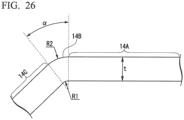
- FIG. 26 is an enlarged view of the periphery of a bent portion 14B in FIG. 3 .
- the bent portion 14B is an area formed by bending the flat-plate-shaped blank 10 such that the inner curvature radius thereof is R1 (mm) and the bending angle thereof is alpha (deg.).
- the outer curvature radius of the bent portion 14B is R2 (mm) and the plate thickness (that is, the plate thickness of the blank 10) of the first intermediate formed article 14 is t (mm)
- the outer curvature radius R2 of the bent portion 14B is expressed by the following Formula (1).
- R2 R1 + t
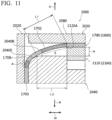
- the expression "the bent portion that is bent to one side in the plate thickness direction” means the bent portion 14B having such a bending angle alpha, an inner curvature radius R1, and an outer curvature radius R2 and is completely different from a loose portion 1702 that is curved in a wide range of a length L1 as illustrated in FIG. 11 relating to a comparative example.
- the comparative example will be described below.
- the first intermediate formed article 14 includes ridge portions 14D corresponding to the ridge portions 22D of the press-formed article 22, and flanges 14E corresponding to the flanges 22E of the press-formed article 22.
- a width W 1 on the rear surface side of the top plate 14A indicating the spacing between the pair of bent portions 14B in the width direction W of the first intermediate formed article is narrower than a width W2 of the top plate 22A indicating the spacing between the pair of ridge portions 22B in the width direction W of the press-formed article 22.
- the width W2 of the top plate 22A of the press-formed article 22 indicates the distance from an edge of a curved portion formed by one ridge portion 22B to an edge of a curved portion formed by the other ridge portion 22B.
- a difference between the width W1 and the width W2 is at least twice or more the plate thickness of the first intermediate formed article 14, and desirably, 10 mm or more.
- an end of the top plate 22A of the press-formed article 22 is located outside an end of the top plate 14A of the first intermediate formed article 14 in the width direction by the plate thickness or more of the first intermediate formed article 14, desirably, 5 mm or more.
- the top plate 14A of the first intermediate formed article 14 is formed as the center portion of the top plate 22A of the press-formed article 22 in the width direction. Additionally, portions on base end sides that are top plate 14A sides of the inclined walls 14C of the first intermediate formed article 14 become both the side portions of the top plate 22A of the press-formed article 22 in the width direction.
- a pre-curvature angle ⁇ 1 formed between the top plate 14A of the first intermediate formed article 14 and an inclined wall 14C is larger than an angle ⁇ 2 (refer to FIG. 2 ) formed between the top plate 22A of the press-formed article 22, and a standing wall 22C, and is an obtuse angle.
- the angle of the pre-curvature angle ⁇ 1 will be described below.
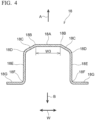
- FIG. 4 is a view illustrating an example of the second intermediate formed article 18 formed in the present embodiment.
- the arrow W indicates a width direction of the second intermediate formed article 18, and the arrow A indicates an upper side of the second intermediate formed article 18. Additionally, the arrow B indicates a lower side of the second intermediate formed article 18.
- the width direction W of a top plate 18A of the second intermediate formed article 18 coincides with the width direction W of the top plate 14A of the first intermediate formed article 14 and the width direction W of the top plate 22A of the press-formed article 22. Additionally, an upward-downward direction of the top plate 18A of the second intermediate formed article 18 coincides with the upward-downward direction of the top plate 14A of the first intermediate formed article 14 and the upward-downward direction of the top plate 22A of the press-formed article 22.
- the shape of the second intermediate formed article 18 is a hat shape close to the press-formed article 22.
- the second intermediate formed article 18 includes the top plate 18A, bent portions 18B, and inclined walls 18C.
- the top plate 18A corresponds to the center portion of the top plate 22A of the press-formed article 22 in the width direction
- the inclined walls 18C correspond to both the side portions of the top plate 22A of the press-formed article 22 in the width direction.
- the inclined walls 18C are inclined to the lower side B of the second intermediate formed article 18 that is the one side in the plate thickness direction of the top plate 18A as being closer to both end sides of the second intermediate formed article 18 in the width direction.
- the bent portions 18B correspond to the bent portions 14B of the first intermediate formed article 14.
- the second intermediate formed article 18 includes punch shoulder bent portions 18D, standing wall portions 18E, ridge portions 18F, and the flange portions 18G.
- the punch shoulder bent portions 18D correspond to the ridge portions 22B of the press-formed article 22
- the standing wall portions 18E correspond to the standing walls 22C of the press-formed article 22.
- a region between the pair of standing wall portions 18E protrudes to the upper side A as compared to the press-formed article 22.
- the ridge portions 18F of the second intermediate formed article 18 correspond to the ridge portions 22D of the press-formed article 22, and the flange portions 18G correspond to the flanges 22E of the press-formed article 22.
- a width W3 on the rear surface side of the top plate 18A indicating the spacing between the pair of bent portions 18B of the second intermediate formed article 18 is equal to the width W1 on the rear surface side of the top plate 14A indicating the spacing between the pair of bent portions 14B in the width direction W of the first intermediate formed article 14.
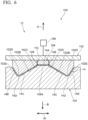
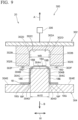
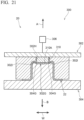
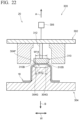
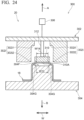
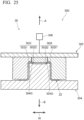
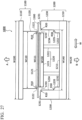
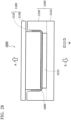
- the press-formed article manufacturing method has the first step 12 using the first pressing apparatus 100 as illustrated in FIGS. 5 and 6 , and the second step 16 using the second pressing apparatus 200 as illustrated in FIGS. 7 and 8 . Additionally, as illustrated in FIGS. 9 and 10 , the press-formed article manufacturing method has the third step 20 using the third pressing apparatus 300 and will be described in order of the first step 12, the second step 16, and the third step 20. Additionally, in the description of the respective steps 12, 16, and 20, the pressing apparatuses 100, 200, and 300 used in the respective steps 12, 16, and 20 will first be described.
- the first intermediate formed article 14 is formed from the blank 10 by using the first pressing apparatus 100.
- the arrow W indicates a width direction of the first pressing apparatus 100
- the arrow A indicates an upper side of the first pressing apparatus 100
- the arrow B indicates a lower side of the first pressing apparatus 100
- the arrow A and the arrow B indicate a press direction.
- the width direction W of the first pressing apparatus 100 coincides with the width direction W of the first intermediate formed article 14, and a device upward-downward direction of the first pressing apparatus 100 coincides with the upward-downward direction of the first intermediate formed article 14.
- the first pressing apparatus 100 used in the first step 12 includes a first die 102 that constitutes a device upper portion of the first pressing apparatus 100, and a first punch 104 that constitutes a device lower portion of the first pressing apparatus 100, and the first die 102 and the first punch 104 face each other in the press direction.
- the first die 102 has a forming surface corresponding to the front-side shapes of the top plate 14A, the bent portions 14B, the inclined walls 14C, the ridge portions 14D, and the flanges 14E of the first intermediate formed article 14.
- the first die 102 is coupled to a moving device 106, and the moving device 106 includes, for example, a hydraulic device, an electric drive device, or the like.
- the moving device 106 moves the first die 102 in the device upward-downward direction, which is the press direction, to approach or separate from the first punch 104.
- a first die recessed part 102A that becomes narrower as being closer to the upper side A is formed in the first die 102, and wall surfaces of the first die recessed part 102A constitute first die recessed part inclined surfaces 102B that are inclined to a center side in the width direction as being closer to the upper side A.
- the first die 102 includes a first die pad 108, and the first die pad 108 is coupled to the first die 102 by a first pad pressing device 110.
- the first pad pressing device 110 includes, for example, a gas cushion, a hydraulic device, a spring, an electric drive device, or the like.
- the first pad pressing device 110 moves the first die pad 108 relative to the first die 102 in the device upward-downward direction that is the press direction. At a bottom dead point where the first die 102 approaches the first punch 104 most, the first die pad 108 is housed in a first die pad housing portion 112 provided in the first die 102 (refer to FIG. 6 ).
- a die bottom of the first die recessed part 102A is constituted of a first die pad lower surface 108A of the first die pad 108 housed in the first die pad housing portion 112, and the first die pad lower surface 108A crosses the press direction that is the device upward-downward direction.
- the first die pad lower surface 108A has a shape based on the product shape of the press-formed article 22, and in the present embodiment, the shape of the first die pad lower surface 108A is flat.
- first die recessed part corner portions 102C are formed between the first die pad lower surface 108A and the first die recessed part inclined surfaces 102B.
- FIG. 5 illustrates an example in which the full width of the die bottom is used as a die pad, a configuration in which a part of the width of the die bottom is used as the die pad and the first die recessed part corner portions 102C are formed in the first die 102 may be adopted.
- first die shoulder portions 102D are formed on both sides of the first die recessed part 102A, and first die side wall surface 102E inclined with respect to the device upward-downward direction extends from the first die shoulder portions 102D.
- the first punch 104 which faces the first die 102, has the forming surface corresponding to the back-side shapes of the top plate 14A, the bent portions 14B, the inclined walls 14C, the ridge portions 14D, and the flanges 14E of the first intermediate formed article 14.
- a first punch top surface 104A corresponding to the first die pad lower surface 108A, first punch shoulder portions 104B, and first punch inclined surfaces 104C corresponding to the first die recessed part inclined surfaces 102B are formed in the first punch 104.
- the first punch shoulder portions 104B are located between the first punch top surface 104A and the first punch inclined surfaces 104C.
- first punch corner portions 104D corresponding to the first die shoulder portions 102D and first punch wall surfaces 104E corresponding to the first die side wall surfaces 102E are formed in the first punch 104.
- a width W4 in the width direction W of the first punch top surface 104A indicating the spacing between the first punch shoulder portions 104B, and a width W5 of the first die pad lower surface 108A are the same dimension.
- the width W4 in the width direction W of the first punch top surface 104A and the spacing between the first die recessed part corner portions 102C are equal to each other.
- the region of the other (for example, the first die 102) of the die and punch corresponding to the region of one (for example, the first punch 104) of the die and punch that constitutes each of the pressing apparatuses 100, 200, and 300 refers to portions that face each other at the bottom dead point where both the die and punch have approached each other most (the same applies). Additionally, a case where the region of one of the die and punch and the region of the other of the die and punch are constituted of surfaces, and a case where the surface one of the die and punch and the surface of the other of the die and punch are not parallel to each other are also included.
- the blank 10 supplied to the material table 26 is conveyed to the first pressing apparatus 100 by the first manipulator 34, and the blank 10 is disposed on the first punch top surface 104A of the first punch 104 in a state where the first die pad 108 is separated from the first punch 104 to the upper side A (refer to FIG. 5 ). Then, as illustrated in FIG. 5 , the first die pad 108 is moved to the lower side B by the first pad pressing device 110, and the center portion of the blank 10 is sandwiched between the first die pad lower surface 108A of the first die pad 108 and the first punch top surface 104A of the first punch 104.
- the first die 102 is moved to the lower side B relative to the first punch 104 by the moving device 106 to approach the first punch 104, and the first die 102 and the first die pad 108 are made to reach the bottom dead point as illustrated in FIG. 6 .
- the blank 10 is pressed by the first die 102, the first die pad 108 and the first punch 104 to obtain the first intermediate formed article 14 including the top plate 14A, the bent portions 14B bent from the top plate 14A to one side in the plate thickness direction (refer to FIG. 26 ), the inclined walls 14C, the ridge portions 14D, and the flanges 14E.
- the width W1 of the top plate 14A indicating the spacing between the bent portions 14B of the first intermediate formed article 14 is narrower than the width W2 of the top plate 22A of the press-formed article 22 and is equal to or more than a width W7 of a convex portion top surface 216A of the second pressing apparatus 200 to be described below.
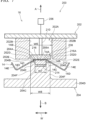
- the second intermediate formed article 18 is formed from the first intermediate formed article 14 by using the second pressing apparatus 200.
- the arrow W indicates a width direction of the second pressing apparatus 200
- the arrow A indicates an upper side of the second pressing apparatus 200
- the arrow B indicates a lower side of the second pressing apparatus 200
- the arrow A and the arrow B indicate a press direction.
- the width direction W of the second pressing apparatus 200 coincides with the width direction W of the first intermediate formed article 14 and the second intermediate formed article 18, and a device upward-downward direction of the second pressing apparatus 200 coincides with the upward-downward direction of the first intermediate formed article 14 and the second intermediate formed article 18.
- the second pressing apparatus 200 used in the second step 16 includes a second die 202 that constitutes a device upper portion of the second pressing apparatus 200, and a second punch 204 that constitutes a device lower portion of the second pressing apparatus 200, and the second die 202 and the second punch 204 face each other in the press direction.
- the second die 202 has a forming surface corresponding to the front-side shapes of the top plate 18A and the standing wall portions 18E of the second intermediate formed article 18.
- the second die 202 is coupled to a moving device 206, and the moving device 206 includes, for example, a hydraulic device, an electric drive device, or the like.
- the moving device 206 moves the second die 202 in the press direction to approach or separate from the second punch 204.
- a second die hole 202A opening to the lower side B is formed at a center portion of the second die 202 in the width direction, and the spacing between second die hole wall surfaces 202B of the second die hole 202A indicates a width W6 in the width direction W of the second die hole 202A.
- a second die pad 208 is housed in the second die hole 202A, and the second die hole 202A also serves as a second die pad housing portion that houses the second die pad 208.
- the second die pad 208 is coupled to the second die 202 by a second pad pressing device 210, and the second pad pressing device 210 includes, for example, a gas cushion, a hydraulic device, a spring, an electric drive device, or the like.
- the second pad pressing device 210 moves the second die pad 208 relative to the second die 202 in the device upward-downward direction that is the press direction.
- the second die pad 208 moves back up to the back of the second die hole 202A (refer to FIG. 8 ).
- a die bottom of the second die 202 is constituted of a lower surface of the second die pad 208 that has moved back to the back of the second die hole 202A, and the lower surface of the second die pad 208 constitutes a convex-portion facing surface 208A that faces the convex portion top surface 216A to be described below.
- the convex-portion facing surface 208A crosses the press direction that is the device upward-downward direction.
- the convex-portion facing surface 208A has a shape based on the product shape of the press-formed article 22, and in the present embodiment, the shape of the convex-portion facing surface 208A is flat.
- second die hole corner portions 202C are formed by the convex-portion facing surface 208A and the second die hole wall surfaces 202B.
- Second die shoulder portions 202D are formed on both sides of the second die hole 202A in the width direction W, and second die end surfaces 202E extend from the second die shoulder portions 202D.
- the second punch 204 which faces the second die 202, has a forming surface corresponding to the back-side shapes of the top plate 18A and the standing wall portions 18E of the second intermediate formed article 18.
- the second punch 204 includes a second punch top portion 204A that crosses the press direction, and a second punch recessed part 204C recessed from a second punch top surface 204B is formed in the second punch top portion 204A.
- a split die 212 which is split from a second punch body 204D constituting a main body portion of the second punch 204, is housed in the second punch recessed part 204C.
- a spacer 214 is disposed between the split die 212 and a bottom surface of the second punch recessed part 204C, which is provided in the second punch body 204D, in the press direction.
- the split die 212 constitutes a convex portion 216 that protrudes to the upper side A from the second punch top surface 204B.
- the protruding amount of the convex portion 216 from the second punch top surface 204B is obtained by simulating the shape of the press-formed article 22 formed on the basis of the tensile strength, plate thickness, or the like of a material metal plate (blank 10) to be used, and is appropriately set depending on the simulation result.
- press forming may be formed instead of the protruding amount under several conditions in actual machines, and an appropriate protruding amount may be obtained.
- the convex portion top surface 216A of the convex portion 216 crosses the press direction that is the device upward-downward direction.
- the convex portion top surface 216A has a shape based on the product shape of the press-formed article 22, and in the present embodiment, the shape of the convex portion top surface 216A is flat.
- the split die 212 that forms the convex portion top surface 216A is replaceable, the split die can be changed in accordance with the product shape of the press-formed article 22. Additionally, the protruding amount of the convex portion 216 from the punch top surface 204B can be changed by the replacement of the spacer 214. In this way, although the protruding amount (a position in the press direction) of the convex portion 216 provided in the second punch 204 can be adjusted by the replacement of the spacer 214, it is natural that the protruding amount of the convex portion 216 under pressing is constant. That is, the convex portion 216 in the present embodiment does not have a mechanism (for example, a gas cushion, a hydraulic device, a spring, an electric drive device, or the like) that is made movable in the press direction during pressing.
- a mechanism for example, a gas cushion, a hydraulic device, a spring, an electric drive device, or the like
- the width W7 of the convex portion top surface 216A in the width direction W of the convex portion 216 is equal to or less than the width W4 in the width direction W of the first punch top surface 104A indicating the spacing between the first punch shoulder portions 104B in the first punch 104 of the first pressing apparatus 100.
- Second punch shoulder portions 204E are respectively provided on both sides of the second punch top portion 204A, and second punch wall surfaces 204F extend from the second punch shoulder portion 204E, respectively.
- the second punch wall surfaces 204F correspond to the second die hole wall surfaces 202B, and the second punch wall surfaces 204F constitute a forming surface corresponding to the back-side shape of the standing wall portions 18E of the second intermediate formed article 18.
- the width W8 of the shoulder of the second punch 204 indicating the spacing between the second punch shoulder portions 204E is larger than the width W4 in the width direction W of the first punch top surface 104A that is the spacing between the first punch shoulder portions 104B in the first punch 104 of the first pressing apparatus 100.
- the first intermediate formed article 14 formed by the first pressing apparatus 100 is conveyed to the second pressing apparatus 200 by the second manipulator 36, and the first intermediate formed article 14 is disposed on the convex portion top surface 216A of the second punch 204 in a state where the second die pad 208 is separated from the second punch 204 to the upper side A (refer to FIG. 7 ).
- the rear surface side which is one side of the first intermediate formed article 14 in the plate thickness direction, is the second punch 204 side, and the top plate 14A between the bent portions 14B of the first intermediate formed article 14 is disposed on the convex portion 216.
- the inclined walls 14C are supported by the second punch shoulder portions 204E while being kept flat in a state where the top plate 14A of the first intermediate formed article 14 is disposed on the convex portion 216.
- the width W1 on the rear surface side of the top plate 14A of the first intermediate formed article 14 and the width W7 of the convex portion top surface 216A are made to coincide with each other, the positional deviation, in the width direction W, of the first intermediate formed article 14 disposed on the convex portion top surface 216A can be suppressed.
- the second die pad 208 is moved to the lower side B by the second pad pressing device 210, the top plate 14A of the first intermediate formed article 14 is sandwiched between the convex-portion facing surface 208A of the second die pad 208 and the convex portion top surface 216A of the convex portion 216.
- the second die 202 is moved to the lower side B relative to the second die pad 208 and the second punch 204 by the moving device 206 to approach the second punch 204, and the second die 202 and the second die pad 208 are made to reach the bottom dead point as illustrated in FIG. 8 .
- the second die pad 208 and the back of the die hole 202A approach each other with the relative movement of the second die 202 to the lower side B, and the second die pad 208 approaches the back of the second die hole 202A most at the time of the arrival of the bottom dead point.
- the inclined walls 14C are pressed and bent to the lower side B by the second die shoulder portions 202D of the second die 202 and are formed as the punch shoulder bent portions 18D. Additionally, parts of the inclined walls 14C of the first intermediate formed article 14 are pressed by the second die hole wall surfaces 202B and the second punch wall surface 204F and are formed as the standing wall portions 18E.
- the press-formed article 22, which is the final formed article is formed from the second intermediate formed article 18 by using the third pressing apparatus 300.
- the arrow W indicates a width direction of the third pressing apparatus 300
- the arrow A indicates an upper side of the third pressing apparatus 300
- the arrow B indicates a lower side of the third pressing apparatus 300
- the arrow A and the arrow B indicate a press direction.
- the width direction W of the third pressing apparatus 300 coincides with the width direction W of the second intermediate formed article 18 and the press-formed article 22
- a device upward-downward direction of the third pressing apparatus 300 coincides with the upward-downward direction of the second intermediate formed article 18 and the press-formed article 22.
- the third pressing apparatus 300 used in the third step 20 includes a third die 302 that constitutes a device upper portion of the third pressing apparatus 300, and a third punch 304 that constitutes a device lower portion of the third pressing apparatus 300, and the third die 302 and the third punch 304 face each other in the press direction.
- the third die 302 has a forming surface corresponding to the front-side shapes of the top plate 22A, the ridge portions 22B, the standing walls 22C, the ridge portions 22D, and the flanges 22E of the press-formed article 22.
- the third die 302 is coupled to a moving device 306, and the moving device 306 includes, for example, a hydraulic device, an electric drive device, or the like.
- the moving device 306 moves the third die 302 in the device upward-downward direction, which is the press direction, to approach or separate from the third punch 304.
- a third die hole 302A which opens to the lower side B, is formed at a center portion of the third die 302 in the width direction.
- the spacing between third die hole wall surfaces 302B of the third die hole 302A indicates a width W9 in the width direction W of the third die hole 302A, and the width W9 is equal to the width W6 of the second die hole 202A in the second die 202 of the second pressing apparatus 200.
- a third die hole bottom surface 302C of the third die hole 302A crosses the press direction that is the device upward-downward direction.
- the third die hole pad bottom surface 302C has a shape based on the product shape of the press-formed article 22, and in the present embodiment, the shape of the third die hole pad bottom surface 302C is flat.
- Third die hole corner portions 302D are provided between the third die hole bottom surface 302C and the third die hole wall surfaces 302B, and in the embodiment, the third die hole corner portions 302D constitute a forming surface corresponding to the front-side shape of the ridge portions 22B of the press-formed article 22.
- Third die shoulder portions 302E are formed on both sides of the third die hole 302A, and third die end surfaces 302F extend from the third die shoulder portions 302E.
- the third die end surfaces 302F constitute a forming surface corresponding to the front-side shape of the flanges 22E of the press-formed article 22.
- the third punch 304 facing the third die 302 has a forming surface corresponding to the back-side shapes of the top plate 22A, the ridge portions 22B, the standing walls 22C, the ridge portions 22D, and the flanges 22E of the press-formed article 22.
- the third punch 304 includes a third punch top surface 304A that crosses the press direction, and the third punch top surface 304A crosses the press direction that is the device upward-downward direction.
- the third punch top surface 304A has a shape based on the product shape of the press-formed article 22, and in the present embodiment, the shape of the third punch top surface 304A is flat.
- Third punch shoulder portions 304B are provided on both sides of the third punch top surface 304A.
- the third punch shoulder portions 304B correspond to the third die hole corner portions 302D and constitute the forming surface corresponding to the back-side shape of the ridge portions 22B of the press-formed article 22.
- Third punch wall surfaces 304C extend from the third punch shoulder portions 304B, respectively.
- the third punch wall surfaces 304C correspond to the third die hole wall surfaces 302B, and the third punch wall surfaces 304C constitute a forming surface corresponding to the back-side shape of the standing walls 22C of the press-formed article 22.
- Third punch corner portions 304D are formed at end portions of the third punch wall surfaces 304C.
- the third punch corner portions 304D corresponds to the third die shoulder portions 302E, and the third punch corner portions 304D constitutes a forming surface corresponding to the back-side shape of the ridge portions 22D of the press-formed article 22.
- Third punch base surfaces 304E extend in the width direction W from the third punch corner portions 304D.
- the third punch base surfaces 304E correspond to the third die end surfaces 302F of the third die 302, and constitute a forming surface corresponding to the back-side shape of the flanges 22E of the press-formed article 22.
- a spacing W10 in the width direction W between the third punch shoulder portions 304B is equal to the spacing W8 in the width direction W between the second punch shoulder portions 204E in the second punch 204 of the second pressing apparatus 200.
- the second intermediate formed article 18 formed by the second pressing apparatus 200 is conveyed to the third pressing apparatus 300 by the third manipulator 38, and the second intermediate formed article 18 is disposed on the third punch top surface 304A of the third punch 304 (refer to FIG. 9 ).
- the rear surface side which is one side in the plate thickness direction of the second intermediate formed article 18, is the third punch 304 side, and a portion between the punch shoulder bent portions 18D of the second intermediate formed article 18 is disposed on the third punch top surface 304A.
- the region of the second intermediate formed article 18 between the punch shoulder bent portions 18D protrudes to the front side that is the upper side A, and the punch shoulder bent portions 18D are positioned by being supported by the third punch shoulder portions 304B in a state where the top plate 18A is separated from the third punch top surface 304A.
- the third die 302 is moved to the lower side B relative to the third punch 304 by the moving device 306 to approach the third punch 304, and the third die 302 is made to reach the bottom dead point as illustrated in FIG. 10 .
- the region of the second intermediate formed article 18 between the punch shoulder bent portions 18D, which protrudes to the front side that is the upper side A, is pressed by the third die hole bottom surfaces 302C and the third punch top surface 304A, and the protrusion portion between the punch shoulder bent portions 18D is crushed. Additionally, in the second intermediate formed article 18, the bent portions 18B are bent and stretched flatly to form the press-formed article 22.
- the press-formed article manufacturing method of the comparative example has a first step of forming a first intermediate formed article by pressing a flat-plate-shaped blank, a second step of forming a second intermediate formed article by pressing the first intermediate formed article, and a third step of forming a press-formed article, which is an end product, by pressing the second intermediate formed article.
- FIGS. 27 and 28 are schematic views illustrating the first step of a comparative example.
- FIG. 27 illustrates a state before press forming is started
- FIG. 28 illustrates a state when the press forming is completed.
- a first pressing apparatus 1000 which forms a first intermediate formed article 1600 by pressing a flat-plate-shaped blank 1500.
- the first pressing apparatus 1000 includes a first punch 1100 disposed on an upper side (a direction of an arrow A in the drawings) in a press direction, and a first die 1200 disposed on a lower side (a direction of an arrow B in the drawings) in the press direction.
- a central axis of the first punch 1100 coincides with a central axis of the first die 1200.
- the first punch 1100 has a punch baseplate 1110 of which the length (that is, width) in the width direction W of the first pressing apparatus 1000 is W100, and a punch body 1120 provided so as to protrude toward the lower side in the press direction from a center portion of the punch baseplate 1110.
- the punch body 1120 has a width W 110 shorter than the width W100 of the punch baseplate 1110.
- a punch tip end surface 1121 which is a surface parallel to the width direction W, is provided at the tip (lower end) of the punch body 1120. Additionally, a pair of punch shoulder surfaces 1122, which is curved surfaces having a center of curvature located inside the punch body 1120 and having a predetermined curvature radius R10, is provided at both end portions of the punch tip end surface 1121 in the width direction so as to be continuous with the punch tip end surface 1121.
- the first punch 1100 configured in this way is movable upward and downward in the press direction by a drive device (not illustrated).
- the first die 1200 has a die baseplate 1210 having the same width W120 as the width W100 of the punch baseplate 1110, a die pad 1220 provided so as to be capable of being lifted and lowered in the press direction with respect to the die baseplate 1210, a pair of die wall portions 1230 that rises toward the upper side in the press direction from both end portions of the die baseplate 1210 in the width direction.
- the die pad 1220 has a pad plate 1221 having a width W130, and a pad lifting mechanism 1222 that supports the pad plate 1221 so as to be capable of being lifted and lowered with respect to the die baseplate 1210.
- the pad plate 1221 is provided so as to be parallel to and face the punch tip end surface 1121.
- the width W130 of the pad plate 1221 is the same as a width W111 of the punch tip end surface 1121.
- the pad lifting mechanism 1222 is, for example, a gas cushion, a hydraulic device, a spring, or an electric actuator.
- Die tip end surfaces 1231 which are surfaces parallel to the width direction W, are provided at tips (upper ends) of the pair of die wall portions 1230. Additionally, the pair of die wall portions 1230 have first inner wall surfaces 1232, die shoulder surfaces 1233, second inner wall surfaces 1234, and inner wall concave surfaces 1235 as surfaces that face inward in the width direction, respectively.
- the first inner wall surfaces 1232 are planar surfaces that rise perpendicularly from an upper surface 1211 of the die baseplate 1210.
- the distance in the width direction W between the pair of first inner wall surfaces 1232 is equal to the width W130 of the pad plate 1221.
- the length (height) of the first inner wall surfaces 1232 in the press direction is equal to the plate thickness of the pad plate 1221. That is, the pad plate 1221 is capable of being housed in a space (hereinafter, this space is referred to as a pad housing space) surrounded by the upper surface 1211 of the die baseplate 1210 and the pair of first inner wall surfaces 1232 (refer to FIG. 28 ).
- the die shoulder surfaces 1233 are curved surfaces having a center of curvature located inside the die wall portions 1230, and have a predetermined curvature radius R20, and are provided so as to be continuous with the die tip end surfaces 1231.
- the second inner wall surfaces 1234 are planar surfaces that are continuous with the die shoulder surfaces 1233 and extend toward the lower side in the press direction from the die shoulder surfaces 1233.
- a distance W140 in the width direction between the pair of second inner wall surfaces 1234 is larger than the width W110 of the punch body 1120. Specifically, when the plate thickness of the blank 1500 is t, the distance W140 between the pair of second inner wall surfaces 1233 is expressed by the following Formula (3). W140 ⁇ W110 + 2 ⁇ t
- the inner wall concave surfaces 1235 are curved surfaces that are continuous with the first inner wall surfaces 1232 and the second inner wall surfaces 1234, in other words, curved surfaces that connect the first inner wall surfaces 1232 and the second inner wall surfaces 1234 to each other. Additionally, the inner wall concave surfaces 1235 are curved surfaces having a center of curvature located outside the die wall portions 1230 and having a predetermined curvature radius R30.
- the curvature radius R30 of the inner wall concave surfaces 1235 is expressed by the following Formula (4). R30 ⁇ R10 + t
- the distance (height) in the press direction from upper ends of the first inner wall surfaces 1232 to the die tip end surfaces 1231 are the same as the length of the punch body 1120 in the press direction.
- the punch body 1120 in a space (hereinafter, this space is referred to as a punch housing space) surrounded by the pair of die shoulder surfaces 1233, the pair of second inner wall surfaces 1234, the pair of inner wall concave surfaces 1235, and the pad plate 1221 in a state where the blank 1500 (first intermediate formed article 1600) is sandwiched (refer to FIG. 28 ).
- the configuration of the first pressing apparatus 1000 used in the first step of the comparative example has been described above. Subsequently, a method of forming the first intermediate formed article 1600 by pressing the blank 1500 by the first pressing apparatus 1000 will be described.
- the position (height) of the pad plate 1221 in the press direction is held at a maximum height position by the pad lifting mechanism 1222. That is, in this state, an upper surface of the pad plate 1221 is located above the die tip end surfaces 1231. In this way, the blank 1500 is placed on the upper surface of the pad plate 1221 held at the maximum height position. In this case, the center of the blank 1500 in the width direction coincides with a central axis of the pad plate 1221 (a central axis of the first die 1200). In addition, as can be seen from FIG. 27 , the width of the blank 1500 is larger than the distance W140 between the pair of second inner wall surfaces 1234.
- the blank 1500 is sandwiched between the punch tip end surface 1121 and the upper surface of the pad plate 1221.
- the pad plate 1221 is pressed downward from the maximum height position, and the blank 1500 is brought into contact with the pair of die tip end surfaces 1231.
- the blank 1500 starts to be bent with positions corresponding to both end surfaces of the pad plate 1221 in the width direction as starting points such that both end portions of the blank 1500 in the width direction face the upper side in the press direction.
- the pad plate 1221 is housed in the pad housing space and the punch body 1120 is housed in the punch housing space in a state where the blank 1500 (first intermediate formed article 1600) is sandwiched.
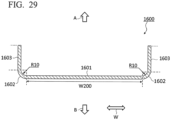
- the first intermediate formed article 1600 having the shape as illustrated in FIG. 29 is obtained.
- the first intermediate formed article 1600 has a flat plate portion 1601, a pair of bent portions 1602, and a pair of flanges 1603.
- the flat plate portion 1601 has a width W200 equal to the width W130 of the pad plate 1221.
- One of the pair of bent portions 1602 is a region that is continuous with one end portion of the flat plate portion 1601 in the width direction and is curved toward the upper side in the press direction.
- the other of the pair of bent portions 1602 is a region that is continuous with the other end portion of the flat plate portion 1601 in the width direction, and curves toward the upper side in the press direction.
- Each of the pair of bent portions 1602 has an inner curvature radius equal to the curvature radius R10 of each punch shoulder surfaces 1122 and has an outer curvature radius equal to the value of R10 + t. Additionally, the bending angle of each of the pair of bent portions 1602 is 90 degrees.
- One of the pair of flanges 1603 is a region that is continuous with one of the pair of bent portions 1602 and extends perpendicularly to the width direction W toward the upper side in the press direction.
- the other of the pair of flanges 1603 is a region that is continuous with the other of the pair of bent portions 1602 and extends perpendicularly to the width direction W toward the upper side in the press direction.
- the first step of the comparative example is intended to press the blank 1500, thereby obtaining the first intermediate formed article 1600 in which the flanges 1603 corresponding to flanges of an end product (press-formed article) are formed.
- the bent portions 1602 are additionally formed in the first intermediate formed article 1600.
- the bent portions 1602 of the first intermediate formed article 1600 is different from the bent portions 14B of the first intermediate formed article 14 obtained in the first step 12 of the present embodiment.
- the bent portions 14B of the first intermediate formed article 14 obtained in the first step 12 of the present embodiment are "the bent portions that are bent to one side in the plate thickness direction” and are regions, which are provided in regions corresponding to a top plate of an end product, among the regions of the first intermediate formed article 14.
- the bent portions 1602 of the first intermediate formed article 1600 obtained in the first step of the comparative example are "the bent portions that are bent to one side in the plate thickness direction", but are regions provided between regions (flanges 1603) corresponding to flanges of an end product, and the other region (flat plate portion 1601), among the regions of the first intermediate formed article 1600.
- the first intermediate formed article 14 obtained in the first step 12 of the present embodiment has the bent portions 14B, whereas the first intermediate formed article 1600 obtained in the first step of the comparative example does not have regions equivalent to the bent portions 14B.
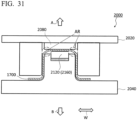
- FIGS. 30 and 31 are schematic views illustrating the second step of the comparative example.
- FIG. 30 illustrates a state before press forming is started
- FIG. 31 illustrates a state when the press forming is completed.
- a second pressing apparatus 2000 which forms a second intermediate formed article 1700 by pressing the first intermediate formed article 1600, is used.
- the second pressing apparatus 2000 includes the same configuration as the second pressing apparatus 200 of the present embodiment. That is, the second pressing apparatus 2000 has a second die 2020 having the same configuration as the second die 202 of the present embodiment, and a second punch 2040 having the same configuration as the second punch 204 of the present embodiment. Therefore, the detailed description of the configuration of the second pressing apparatus 2000 is omitted.
- a flat plate portion 1601 of the first intermediate formed article 1600 is sandwiched between a second die pad 2080 of the second die 2020 and the split die 2120 of the second punch 2040. Additionally, in this state, a pair of second die end surfaces 2020E is in contact with the flat plate portion 1601 of the first intermediate formed article 1600.
- the first intermediate formed article 1600 is processed in order of the following (i) to (iii).
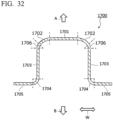
- the flat plate portion 1601 of the first intermediate formed article 1600 is subjected to two steps of bending work. Then, as illustrated in FIG. 31 , when the second die 2020 is finally lowered to the bottom dead point, the second intermediate formed article 1700 having a shape close to an end product is obtained.
- the second intermediate formed article 1700 has a top plate portion 1701, a pair of loose portions 1702, a pair of punch shoulder bent portions 1706, a pair of standing wall portions 1703, a pair of ridge portions 1704, and a pair of flanges 1705.
- the top plate portion 1701, the pair of loose portions 1702, the pair of punch shoulder bent portions 1706, and the pair of standing wall portions 1703 are regions that are formed by the flat plate portion 1601 of the first intermediate formed article 1600 being subjected to two steps of bending work.
- the ridge portions 1704 and the flanges 1705 are regions corresponding to the bent portions 1602 and the flanges 1603 of the first intermediate formed article 1600.
- the top plate portion 1701 is a region that extends in the width direction W, and the width thereof is substantially equal to the width of the split die 2120.
- One of the pair of loose portions 1702 is a region that is continuous with one end portion of the top plate portion 1701 in the width direction, is gently curved toward the lower side in the press direction, and is continuous with one of the pair of punch shoulder bent portions 1706.
- the other of the pair of loose portions 1702 is a region that is continuous with the other end portion of the top plate portion 1701 in the width direction, is gently curved toward the lower side in the press direction, and is continuous with the other of the pair of punch shoulder bent portions 1706.
- One of the pair of punch shoulder bent portions 1706 is a region that is bent by one of the pair of second punch shoulder portions 2040E, an upper end thereof is continuous with one of the pair of loose portions 1702, and a lower end thereof is continuous with one of the pair of standing wall portions 1703.
- the other of the pair of punch shoulder bent portions 1706 is a region that is bent by the other of the pair of second punch shoulder portions 2040E, an upper end is continuous with the other of the pair of loose portions 1702, and a lower end thereof is continuous with the other of the pair of standing wall portions 1703.
- One of the pair of standing wall portions 1703 is a region that extends perpendicularly to the width direction W toward the lower side in the press direction, an upper end thereof is continuous with one of the pair of punch shoulder bent portions 1706, and a lower end thereof is continuous with one of the pair of ridge portions 1704.
- the other of the pair of standing wall portions 1703 is a region that extends perpendicularly to the width direction W toward the lower side in the press direction, an upper end thereof is continuous with the other of the pair of punch shoulder bent portions 1706, and a lower end thereof is continuous with the other of the pair of ridge portions 1704.
- One of the pair of ridge portions 1704 is a region that is continuous with one of the pair of standing wall portions 1703 and is curved toward the outside in the width direction.
- the other of the pair of ridge portions 1704 is a region that is continuous with the other of the pair of standing wall portions 1703 and is curved toward the outside in the width direction.
- the pair of ridge portions 1704 has the same inner curvature radius and outer curvature radius as the bent portions 1602 of the first intermediate formed article 1600, respectively. Additionally, the bending angles of the pair of ridge portions 1704 are 90 degrees, respectively.
- One of the pair of flanges 1705 is a region that is continuous with one of the pair of ridge portions 1704 and extends toward the outside in the width direction.
- the other of the pair of flanges 1705 is a region that is continuous with the other of the pair of ridge portions 1704 and extends toward the outside in the width direction (opposite side of one flange 1705).
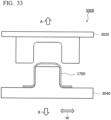
- FIGS. 33 and 34 are schematic views illustrating the third step of the comparative example.
- FIG. 33 illustrates a state before press forming is started
- FIG. 34 illustrates a state when the press forming is completed.
- a third pressing apparatus 3000 which forms the press-formed article 22 that is an end product by pressing the second intermediate formed article 1700, is used.
- the third pressing apparatus 3000 includes the same configuration as the third pressing apparatus 300 of the present embodiment. That is, the third pressing apparatus 3000 includes a third die 3020 having the same configuration as the third die 302 of the present embodiment, and a third punch 3040 having the same configuration as the third punch 304 of the present embodiment. Therefore, the detailed description of the configuration of the third pressing apparatus 3000 is omitted.
- the third die 3020 is lowered toward the third punch 3040.
- the hat-shaped press-formed article 22 which is an end product is obtained by crushing swelled portions (portions that are formed by the top plate portion 1701 and the pair of loose portions 1702 and are swelled to the upper side in the press direction) of the second intermediate formed article 1700.
- FIG. 11 is an enlarged view of an area AR illustrated in FIG. 31 .
- the second die 2020 is pushed into the second punch 2040 side to form a standing wall portion 1703 of the second intermediate formed article 1700 in a state where the first intermediate formed article 1600 is placed on the split die 2120 (convex portion 2160) of the second punch 2040.
- the split die 2120 protrudes to the second die 2020 side with respect to the second punch 2040.
- a portion (that is, a loose portion 1702) of the second intermediate formed article 1700 from a shoulder portion 2120A of the split die 2120 to a second punch shoulder portion 2040E is obliquely bent to the lower side B as being closer to the outside of the second pressing apparatus 2000 in the width direction. Accordingly, the loose portion 1702 is curved so as to be convex to the front side of the second intermediate formed article 1700.
- the length L1 along the loose portion 1702 is longer than a length L2 between the split die 2120 and the second punch shoulder portion 2040E in the width direction W. For this reason, when the second die 2020 is moved from this state to the bottom dead point, a part of a portion (portion a) bent by the second punch shoulder portion 2040E is pushed out to the lower side B and is formed as the standing wall portion 1703. Additionally, in the subsequent third step, a portion (portion b portion) of the loose portion 1702 on the split die 2120 side is crushed and t becomes a part of the top plate 22A of the press-formed article 22.
- the above portion a constitutes a base end portion of a standing wall 22C
- the above portion b constitutes each of both the side portions of the top plate 22A in the width direction.
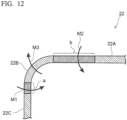
- the portion a is bent in an arc shape, which is convex to the outside of the second intermediate formed article 1700, by the second punch shoulder portion 2040E, as illustrated in FIG. 12
- the portion a is pushed out to the standing wall 22C side and is bent back as the standing wall 22C of the press-formed article 22.
- the portion b of the loose portion 1702 is bent back and formed in a flat plate shape as the top plate 22A of the press-formed article 22 after being curved so as to be convex to the outside of the press-formed article 22, that is, the front side of the second intermediate formed article 1700.
- a compressive stress is generated outside the press-formed article 22, and a tensile stress is generated inside the press-formed article 22.
- a second moment M2 which faces the inside of the press-formed article 22, is generated.
- a ridge portion 22B formed between the portion a and the portion b of the press-formed article 22 is bent in an arc shape, which is convex to the outside of the press-formed article 22, by the second punch shoulder portion 2040E.
- a tensile stress is generated outside the press-formed article 22 and a compressive stress is generated inside the press-formed article 22.
- a third moment M3, which faces the outside of the press-formed article 22, is generated in the ridge portion 22B of the press-formed article 22 before release.
- the first intermediate formed article 14 which has a bent portion 14B that is bent to one side in the plate thickness direction (refer to FIG. 26 ), is formed. Accordingly, when the first intermediate formed article 14 is pressed into the second intermediate formed article 18 in the subsequent second step 16, an inclined wall 18C in which the curved deformation is suppressed can be formed between a bent portion 18B that is similarly bent to one side in the plate thickness direction and a punch shoulder bent portion 18D.
- a curved region which is equivalent to the loose portion 1702 formed in the second intermediate formed article 1700 of the comparative example is not formed between the bent portion 18B and the punch shoulder bent portions 18D.
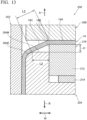
- the bent portion 14B which is bent to one side in the plate thickness direction, is formed at an intermediate portion of the first intermediate formed article 14 in the width direction, and the inclined wall 14C of the first intermediate formed article 14 corresponding to the above loose portion 1702 is bent in advance to a second punch shoulder portion 204E side of the second pressing apparatus 200. Accordingly, compared to the above comparative example (refer to FIG. 11 ), the inclined wall 14C of the first intermediate formed article 14 approaches the second punch shoulder portion 204E. Additionally, as illustrated in FIG. 13 , in the length L1 including the bent portion 14B and the inclined wall 14C, the length of the bent portion 14B is extremely small.
- the moment of the press-formed article 22 can be limited mainly to the first moment M1 that faces outward at the base end portion of the standing wall 22C and the third moment M3 that faces outward at the ridge portion 22B.
- the third moment M3 can be offset mainly by only the first moment M1, and the opening amount (position) of the standing wall 22C in the width direction W can be adjusted.
- management of the dimensional accuracy of the standing wall 22C of the press-formed article 22 becomes easy.
- the allowable range for maintaining the dimensional accuracy of the press-formed article 22 can be expanded.
- the inclined wall 18C (extra line portion) is formed between the bent portion 18B and the punch shoulder bent portion 18D by forming the second intermediate formed article 18 from the first intermediate formed article 14 by the second pressing apparatus 200
- the inclined wall 18C (extra line portion) is crushed by forming the press-formed article 22 from the second intermediate formed article 18 by using the third pressing apparatus 300.
- the punch-side pad of the second punch 204 can be eliminated in the second pressing apparatus 200.
- the punch-side pad of the third punch 304 is unnecessary.
- the second pressing apparatus 200 and the third pressing apparatus 300 can be simplified, and the press line 24 can be configured by the combination of the simplified pressing apparatuses.
- the convex portion 216 of the second punch 204 is constituted of the split die 212 split from the second punch body 204D. For this reason, the press-formed article 22 having a different product shape can be formed by changing the split die 212 to one in which the shape of the convex portion top surface 216A is different.
- the spacer 214 is disposed between the split die 212 and the second punch body 204D in the press direction. For this reason, the protruding amount of the convex portion 216 from the second punch top surface 204B can be changed by changing the spacer 214 to one having a different height.
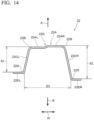
- FIGS. 14 and 15 A comparative test will be described using FIGS. 14 and 15 .
- the press-formed article 22 to be formed will be described with reference using FIG. 14 .
- the press-formed article 22 is different from the press-formed article 22 illustrated in the first embodiment in the shape of the top plate 22A, and the height of the standing wall 22C that extends from the top plate 22A to the lower side B.
- the tensile strength of the press-formed article 22 to be formed is 1180 MPa, and the plate thickness thereof is 1.4 mm.
- a stepped part 22G is formed on a part of the top plate 22A, and a level difference is provided between a first top plate portion 22AL on one side with the stepped part 22G as a boundary, and a second top plate portion 22AR on the other side.
- a dimension S1 from the surface of the first top plate portion 22AL on the upper side A to the surface of a first flange 22EL on the upper side A is 50 mm
- a dimension S2 from the surface of the second top plate portion 22AR on the upper side A to the surface of a flange 22ER on the upper side A is 75 mm
- a separation distance S3 between an end portion of a first standing wall 22CL on the lower side B and an end portion of a second standing wall 22CR lower side B is 140 mm.
- an opening amount indicating a displacement in the width direction W as compared with the normal-shaped press-formed article 22 is measured at an R stop that is a boundary between the standing wall 22CR and a curved ridge portion 22D. This measurement is performed at the higher standing wall 22CR in which the influence on the opening caused by a change in angle with the top plate 22A is significant.
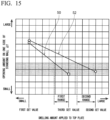
- the second intermediate formed article 18 is formed from the first intermediate formed article 14 with the protruding amount H of the convex portion 216 from the punch top surface 204B of the second pressing apparatus 200 as a first set value and a second set value larger than the first set value. Then, the press-formed article 22 is formed using the second intermediate formed article 18, and the opening amount in each protruding amount H is measured and recorded. In addition, the swelling amount applied to the top plate 22A is determined depending on the protruding amount H of the convex portion 216.
- the second intermediate formed article 1700 is formed from the first intermediate formed article 1600 with the protruding amount H of the convex portion 2160 from a second punch top surface 2040B of the second pressing apparatus 2000 (refer to FIG. 11 ) as the first set value and a third set value between the first set value and the second set value.
- the press-formed article 22 is formed using the second intermediate formed article 1700, and the opening amount in each protruding amount H is measured and recorded.
- the swelling amount applied to the top plate 22A is determined by the protruding amount H of the convex portion 2160 of the second punch 2040.
- a horizontal axis represents the swelling amount applied to the top plate 22A, that is, the protruding amount H.
- a vertical axis represents the position deviation amount (displacement) of one standing wall 22CR of the press-formed article 22 in the width direction with respect to the normal shape of the front end section as the opening amount.
- a plus side of the vertical axis indicates that the standing wall 22CR after release is located on the outer side in the width direction with respect to the normal shape (position), and a minus side of the vertical axis indicates that the standing wall 22CR after release is located on the inner side in the width direction with respect to the normal shape (position).
- a region illustrated by a dot indicates an area within a tolerance with respect to the normal shape of the standing wall 22CR.
- the inclination of the graph showing the relationship between the swelling amount applied to the top plate 22A and the opening amount on one side of the standing wall is relatively large.
- the allowable range of the protruding amount H become the first range in terms of manufacturing.
- the inclination of the graph indicating the relationship between the swelling amount applied to the top plate 22A and the opening amount on one side of the standing wall becomes small compared to the comparative example 50.
- the protruding amount H for forming the standing wall 22CR within the tolerance of the normal shape is in a second range wider than the first range, and the allowable range of the protruding amount H is expanded to a second range in terms of manufacturing.
- the allowable range (a difference between an upper limit value and a lower limit value) of the protruding amount H of the convex portion 216 from the punch top surface 204B, for settling the standing wall 22CR after forming within the tolerance of the normal shape in the width direction by the combination of the pressing apparatuses simplified without including the punch-side pad, can be expanded.
- the adjustment range of the convex portion 216 can be expanded, it is possible to contribute to productivity improvement for the press-formed article 22.
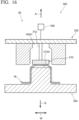
- FIGS. 16 and 17 are views illustrating a second embodiment of the invention, and the same or equivalent portions as those of the first embodiment will be designated by the same reference signs and will be described, or different portions will be described.
- the second embodiment is different from the first embodiment in that the third pressing apparatus 300 used in the third step 20 is different, and only the third pressing apparatus 300 will be described.
- the third die 302 of the third pressing apparatus 300 includes a third die pad 310 as illustrated in FIG. 16
- a third die bottom 302G of the third die 302 is configured to include the third die pad 310 as illustrated in FIG. 17 .
- the third die pad 310 is coupled to the third die 302 by the third pad pressing device 312 as illustrated in FIG. 16 , and the third pad pressing device 312 includes, for example, a gas cushion, a hydraulic device, a spring, an electric drive device, or the like.
- the third pad pressing device 312 moves the third die pad 310 relative to the third die 302 in the device upward-downward direction that is the press direction.
- the third die pad 310 is housed in a third pad housing portion 302H of the third die 302 as illustrated in FIG. 17 .
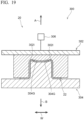
- FIGS. 18 and 19 are views illustrating a third embodiment of the invention, and the same or equivalent portions as those of the first embodiment will be designated by the same reference signs and will be described, or only different portions will be described.
- the third embodiment is different from the first embodiment in that the third pressing apparatus 300 used in the third step 20 is different, and only the third pressing apparatus 300 will be described.
- a punch-side inclined surface 304G which is recessed as being closer to a central side of the third punch 304 in the width direction from the third punch shoulder portion 304B, is formed in the third punch top surface 304A that constitutes a third punch top portion of the third punch 304 in the third pressing apparatus 300.
- the punch-side inclined surface 304G is formed in each of a pair of the third punch shoulder portions 304B. Although the punch-side inclined surfaces 304G are provided the third punch shoulder portions 304B on both sides, the punch-side inclined surface 304G may be provided only on one third punch shoulder portion 304B side.
- a spacing W12 between end portions of both the punch-side inclined surfaces 304G on the central side of the third punch 304 in the width direction is equal to the width W4 of the first punch top surface 104A indicating the spacing between the first punch shoulder portions 104B in the first punch 104 of the first pressing apparatus 100.
- the distance from a first punch shoulder portion 104B from the center of the first punch in the width direction, and the distance from the center of the third punch 304 in the width direction to an end portion of a punch-side inclined surface 304G on the center portion side in the width direction are equal to each other. Accordingly, the position of the end portion of the punch-side inclined surface 304G on the center portion side in the width direction and the position of the bent portion 18B are aligned with each other in the width direction.
- Die-side inclined surfaces 302I which are corresponding to the punch-side inclined surfaces 304G and parallel to the punch-side inclined surfaces 304G, are formed at the third die bottom 302G of the third die 302 that faces the third punch top portion 304F.
- the inclined walls 18C of the second intermediate formed article 18 can be bent back at the bottom dead point where the third die 302 approaches the third punch 304 most. Accordingly, even in a case where the second intermediate formed article 18 formed with the bent portions 18B are formed of a high strength steel sheet, the top plate 22A of the press-formed article 22 can be made flat.
- the bent portions 18B of the second intermediate formed article 18 are bent back to the rear surface side of the top plate 18A by the punch-side inclined surfaces 304G, respectively, and the bending tendency of the bent portions 18B can be removed.
- the top plate 22A forms the flat press-formed article 22
- the top plate 22A of the press-formed article 22 formed using the second intermediate formed article 18 can be effectively flattened.
- FIGS. 20 and 21 are views illustrating a fourth embodiment of the invention, and the same or equivalent portions as those of the first embodiment and the third embodiment will be designated by the same reference signs and will be described, or only different portions will be described.
- the fourth embodiment is different from the third embodiment in that the third pressing apparatus 300 used in the third step 20 is different, and only the third pressing apparatus 300 will be described.
- the third die 302 of the third pressing apparatus 300 includes a third die pad 310 as illustrated in FIG. 20 , and a third die bottom 302G of the third die 302 is configured to include the third die pad 310 as illustrated in FIG. 21 .
- a width W13 of the third die pad 310 is equal to the spacing W12 between the end portions of the respective punch-side inclined surfaces 304G and the width W4 of the first punch top surface 104A indicating the spacing between the first punch shoulder portions 104B in the first punch 104 of the first pressing apparatus 100. Moreover, the positions of the end portions of the third die pad 310, the positions of the end portions of the punch-side inclined surfaces 304G on the centerr portion in the width direction, and the positions of the bent portions 18B are aligned with each other the width direction.
- FIGS. 22 and 23 are views illustrating a fifth embodiment of the invention, and the same or equivalent portions as those of the aforementioned other embodiments will be designated by the same reference signs and will be described, or only different portions will be described.
- the fifth embodiment is different from the other embodiments in that the third pressing apparatus 300 used in the third step 20 is different, and only the third pressing apparatus 300 will be described.
- the third die 302 of the third pressing apparatus 300 includes a third die pad 310 as illustrated in FIG. 22
- a third die bottom 302G of the third die 302 is configured to include the third die pad 310 as illustrated in FIG. 23 .
- Die-pad-side inclined surfaces 310B serving as die-side inclined surfaces are formed at a third die pad lower surface 310A of the third die pad 310 that faces the third punch top portion 304F and constitutes the third die bottom 302G.
- the die-pad-side inclined surfaces 310B correspond to the punch-side inclined surfaces 304G and are parallel to the punch-side inclined surfaces 304G.
- a spacing W 14 between end portions of the pair of die-pad-side inclined surfaces 310B on the central side of the third die pad 310 in the width direction, and the spacing W12 between the end portions of the pair of punch-side inclined surfaces 304G on the central side of the third punch 304 in the width direction are equal to each other. Additionally, the spacing W14 between the end portions of the pair of die-pad-side inclined surfaces 310B on the central side of the third die pad 310 in the width direction, and the width W4 of the first punch top surface 104A indicating the spacing between the first punch shoulder portions 104B in the first punch 104 of the first pressing apparatus 100 are equal to each other.
- the positions of end portions of the third die pad lower surface 310A, the positions of the end portions of the punch-side inclined surfaces 304G on the center portion side in the width direction, and the position of the bent portions 18B are aligned with each other in the width direction.
- FIGS. 24 and 25 are views illustrating a sixth embodiment of the invention, and the same or equivalent portions as those of the aforementioned fifth embodiment will be designated by the same reference signs and will be described, or only different portions will be described.
- the sixth embodiment is different from the fifth embodiment in that the third pressing apparatus 300 used in the third step 20 is different, and only the third pressing apparatus 300 will be described.
- die-side inclined surfaces 3021 which are corresponding to the punch-side inclined surfaces 304G and parallel to the punch-side inclined surfaces 304G, are formed at the third die bottom 302G of the third die 302 that faces the third punch top portion 304F.
- Each of the die-side inclined surfaces 3021 is constituted of a first die-side inclined surface 302I1 formed in the third die 302, and a second die-side inclined surface 30212 formed in the third die pad lower surface 310A of the third die pad 310.
- the die-side inclined surface 3021 constituted of the first die-side inclined surface 30211 and the second die-side inclined surface 302I2 faces each punch-side inclined surface 304G.
- the positions of end portions of the third die pad lower surface 310A, the positions of the end portions of the punch-side inclined surfaces 304G on the center portion side in the width direction, and the position of the bent portions 18B are aligned with each other in the width direction.
Landscapes
- Engineering & Computer Science (AREA)
- Mechanical Engineering (AREA)
- Shaping Metal By Deep-Drawing, Or The Like (AREA)
Claims (10)
- Procédé de fabrication d'article embouti qui consiste à fabriquer un article embouti (22), à l'aide d'un premier appareil de pressage (100) et d'un deuxième appareil de pressage (200), le premier appareil de pressage comprenant une première matrice (102) et un premier poinçon (104) qui est disposé afin de faire face à la première matrice et comprend une paire de parties d'épaulement de premier poinçon (104B), le deuxième appareil de pressage comprenant une deuxième matrice (202) comprenant un bloc de matrice (208) et un deuxième poinçon (204) qui est disposé afin de faire face à la deuxième matrice, caractérisé en ce quele procédé utilise en outre un troisième appareil de pressage (300), dans lequelle deuxième poinçon possède une partie convexe (216) ayant une largeur (W7) égale ou inférieure à un espacement (W4) entre les parties d'épaulement de premier poinçon au niveau d'une surface supérieure (216A) de celui-ci, et comprend une paire de parties d'épaulement de deuxième poinçon (204E) ayant un espacement (W8) plus large que l'espacement entre les parties d'épaulement de premier poinçon,le troisième appareil de pressage comprend une troisième matrice (302) ayant une largeur (W9) d'un orifice de matrice (302A) égale à une largeur (W6) d'un orifice de matrice (202A) de la deuxième matrice, et un troisième poinçon comprenant une paire de parties d'épaulement de troisième poinçon (304B) ayant un espacement (W10) égal à l'espacement entre les parties d'épaulement de deuxième poinçon, etl'article embouti possède une plaque supérieure (22A), une paire de parties nervurées (22B) situées des deux côtés d'une plaque supérieure dans une direction de largeur, et une paire de parois verticales (22C) qui s'étendent des parties nervurées vers un côté de la plaque supérieure dans une direction d'épaisseur de plaque,le procédé de fabrication d'article embouti comprenant :une première étape de pressage d'une ébauche (10) avec le premier appareil de pressage afin de former un premier article formé intermédiaire (14) ayant une paire de parties cintrées qui est cintré vers un côté dans la direction d'épaisseur de plaque et ayant un espacement (W1) entre les parties cintrées qui est plus étroit qu'une largeur (W2) de la plaque supérieure et égal ou supérieur à la largeur de la surface supérieure de la partie convexe ;une deuxième étape de déplacement de la deuxième matrice vers le deuxième poinçon par rapport au bloc de matrice et au deuxième poinçon et de formation d'un deuxième article formé intermédiaire (18), ayant la paroi verticale formée à l'intérieur, avec la deuxième matrice et le deuxième poinçon, dans un état dans lequel une partie située entre les parties cintrées est prise en sandwich entre le bloc de matrice qui dépasse de la deuxième matrice vers le deuxième poinçon, et la partie convexe, avec un côté du premier article formé intermédiaire dans la direction d'épaisseur de plaque en guise de partie convexe du deuxième appareil de pressage ; etune troisième étape de pressage du deuxième article formé intermédiaire avec la troisième matrice et le troisième poinçon du troisième appareil de pressage afin de former l'article embouti dans lequel la paire de parties cintrées est cintrée et étirée.
- Procédé de fabrication d'article embouti selon la revendication 1,dans lequel des surfaces inclinées côté poinçon, qui sont renfoncées étant donné qu'elles sont plus proches d'un côté central du troisième poinçon dans la direction de largeur par rapport aux parties d'épaulement de troisième poinçon, sont formées au niveau d'une partie supérieure du troisième poinçon, etdans lequel des surfaces inclinées côté matrice qui correspondent aux surfaces inclinées côté poinçon sont formées au niveau d'une partie inférieure de matrice de la troisième matrice qui fait face à la partie supérieure du troisième poinçon.
- Procédé de fabrication d'article embouti selon la revendication 1,dans lequel des surfaces inclinées côté poinçon, qui sont renfoncées étant donné qu'elles sont plus proches d'un côté central du troisième poinçon dans la direction de largeur par rapport aux parties d'épaulement de troisième poinçon, sont formées au niveau d'une partie supérieure du troisième poinçon, etdans lequel une partie inférieure de matrice de la troisième matrice est configurée pour comprendre un bloc de matrice, et des surfaces inclinées côté bloc de matrice qui correspondent aux surfaces inclinées côté poinçon sont formées sur une surface exposée du bloc de matrice de ma troisième matrice qui fait face à la partie supérieure du troisième poinçon.
- Procédé de fabrication d'article embouti selon la revendication 2 ou 3,
dans lequel un espacement entre les parties d'extrémité des deux surfaces inclinées côté pinçon sur le côté central du troisième poinçon dans la direction de largeur et un espacement entre la paire de parties cintrées du deuxième article formé intermédiaire sont identiques l'un à l'autre. - Ligne d'emboutissage (24) comprenant :un premier appareil de pressage (100) comprenant une première matrice (102), et un premier poinçon (104) qui est disposé afin de faire face à la première matrice dans une direction de pressage et comprend une paire de parties d'épaulement de premier poinçon (104B) ;un deuxième appareil de pressage (200) comprenant une deuxième matrice (202) et un deuxième poinçon (204), le deuxième poinçon comprenant une partie supérieure qui croise une direction de pressage, une paire de parties d'épaulement de deuxième poinçon (204E) prévues des deux côtés de la partie supérieure, et des surfaces de paroi de poinçon (204F) qui s'étendent depuis les parties d'épaulement de deuxième poinçon respectives, la deuxième matrice comprenant un orifice de matrice (202A) ayant une surface de paroi d'orifice de matrice (202B) qui correspond à la surface de paroi de poinçon, et un bloc de matrice (208), caractérisé en ce quele deuxième poinçon comprend une partie convexe (216) qui est disposée au niveau de la partie supérieure et possède une largeur (W7) égale ou inférieure à un espacement (W4) entre les parties d'épaulement de premier poinçon,le bloc de matrice possède une surface exposée de partie convexe (208A) qui fait face à la partie convexe, est disposée dans l'orifice de matrice, et peut se déplacer dans une direction de pressage, etla ligne d'emboutissage comprend en outre un troisième appareil de pressage (300) qui comprend une troisième matrice (302) ayant une largeur (W9) d'un orifice de matrice (302A) égale à une largeur (W6) de l'orifice de matrice de la deuxième matrice, et un troisième poinçon (304) comprenant une paire de parties d'épaulement de troisième poinçon (304B) ayant un espacement (W10) égal à un espacement (W8) entre les parties d'épaulement de deuxième poinçon.
- Ligne d'emboutissage selon la revendication 5,dans laquelle des surfaces inclinées côté poinçon, qui sont renfoncées étant donné qu'elles sont plus proches d'un côté central du troisième poinçon dans la direction de largeur par rapport aux parties d'épaulement de troisième poinçon, sont formées au niveau d'une partie supérieure du troisième poinçon, etdans laquelle des surfaces inclinées côté matrice qui correspondent aux surfaces inclinées côté poinçon sont formées au niveau d'une partie inférieure de matrice de la troisième matrice qui fait face à la partie supérieure du troisième poinçon.
- Ligne d'emboutissage selon la revendication 5,dans laquelle des surfaces inclinées côté poinçon, qui sont renfoncées étant donné qu'elles sont plus proches d'un côté central du troisième poinçon dans la direction de largeur par rapport aux parties d'épaulement de troisième poinçon, sont formées au niveau d'une partie supérieure du troisième poinçon, etdans laquelle une partie inférieure de matrice de la troisième matrice est configurée pour comprendre un bloc de matrice, et des surfaces inclinées côté bloc de matrice qui correspondent aux surfaces inclinées côté poinçon sont formées sur une surface exposée du bloc de matrice de la troisième matrice qui fait face à la partie supérieure du troisième poinçon.
- Ligne d'emboutissage selon la revendication 6 ou 7,
dans laquelle un espacement entre les parties d'extrémité des deux surfaces inclinées côté poinçon sur le côté central du troisième poinçon dans la direction de largeur et un espacement entre les parties d'épaulement de premier poinçon du premier poinçon sont identiques l'un à l'autre. - Ligne d'emboutissage selon l'une quelconque des revendications 5 à 8,
dans laquelle le deuxième poinçon comprend une matrice divisée qui constitue la partie convexe, et un corps de deuxième poinçon qui constitue une partie autre que la partie convexe. - Ligne d'emboutissage selon la revendication 9,
dans laquelle une entretoise est prévue entre la matrice divisée et le corps de deuxième poinçon dans une direction de pressage.
Applications Claiming Priority (2)
| Application Number | Priority Date | Filing Date | Title |
|---|---|---|---|
| JP2017112876 | 2017-06-07 | ||
| PCT/JP2018/021917 WO2018225832A1 (fr) | 2017-06-07 | 2018-06-07 | Procédé de fabrication d'article embouti et ligne d'emboutissage |
Publications (3)
| Publication Number | Publication Date |
|---|---|
| EP3636362A1 EP3636362A1 (fr) | 2020-04-15 |
| EP3636362A4 EP3636362A4 (fr) | 2021-03-31 |
| EP3636362B1 true EP3636362B1 (fr) | 2024-11-27 |
Family
ID=64565892
Family Applications (1)
| Application Number | Title | Priority Date | Filing Date |
|---|---|---|---|
| EP18814001.6A Active EP3636362B1 (fr) | 2017-06-07 | 2018-06-07 | Procédé de fabrication d'article embouti et ligne d'emboutissage |
Country Status (5)
| Country | Link |
|---|---|
| US (1) | US11478836B2 (fr) |
| EP (1) | EP3636362B1 (fr) |
| JP (1) | JP6518847B1 (fr) |
| CN (1) | CN110709181B (fr) |
| WO (1) | WO2018225832A1 (fr) |
Families Citing this family (7)
| Publication number | Priority date | Publication date | Assignee | Title |
|---|---|---|---|---|
| JP6969584B2 (ja) * | 2019-03-29 | 2021-11-24 | Jfeスチール株式会社 | プレス成形方法およびその方法に用いられるプレス成形金型並びにそのプレス成形金型でプレス成形された車体部品 |
| US12194523B2 (en) | 2020-03-09 | 2025-01-14 | Jfe Steel Corporation | Method for manufacturing pressed component, metal sheet for press forming, and high-tensile steel sheet |
| KR102921437B1 (ko) * | 2020-09-02 | 2026-01-30 | 제이에프이 스틸 가부시키가이샤 | 프레스 부품의 제조 방법, 금형의 설계 방법, 금형 형상 설계 장치 및, 금형 |
| JP7008159B1 (ja) | 2021-10-05 | 2022-01-25 | 株式会社ジーテクト | 曲げ加工装置 |
| KR20250059453A (ko) * | 2022-10-07 | 2025-05-02 | 제이에프이 스틸 가부시키가이샤 | 프레스 성형품의 제조 방법 |
| JP2024070951A (ja) * | 2022-11-14 | 2024-05-24 | Jfeスチール株式会社 | プレス成形品の製造方法 |
| US12427628B2 (en) * | 2023-05-16 | 2025-09-30 | Toyota Motor Engineering & Manufacturing North America, Inc. | Door jig press |
Family Cites Families (16)
| Publication number | Priority date | Publication date | Assignee | Title |
|---|---|---|---|---|
| JPS6028885B2 (ja) | 1980-12-27 | 1985-07-08 | 川崎製鉄株式会社 | 高靭性溶接金属が得られるuoe鋼管熱処理方法 |
| JPS63133821U (fr) * | 1987-02-17 | 1988-09-01 | ||
| JPH0798238B2 (ja) * | 1989-09-06 | 1995-10-25 | 株式会社カネミツ | 円形鋼板からシールリング嵌合用溝を形成する方法 |
| JP4681420B2 (ja) * | 2005-10-19 | 2011-05-11 | 新日本製鐵株式会社 | 形状凍結性に優れたプレス成形方法及びプレス金型 |
| JP5079655B2 (ja) | 2008-09-30 | 2012-11-21 | 新日本製鐵株式会社 | プレス成形方法 |
| JP2012051005A (ja) | 2010-09-01 | 2012-03-15 | Sumitomo Metal Ind Ltd | プレス成形装置およびプレス成形品の製造方法 |
| MX345043B (es) * | 2011-05-20 | 2017-01-16 | Nippon Steel & Sumitomo Metal Corp | Método de moldeo por presión y componente de vehículo. |
| WO2013094705A1 (fr) | 2011-12-22 | 2013-06-27 | 新日鐵住金株式会社 | Produit embouti |
| JP5664810B1 (ja) * | 2013-06-27 | 2015-02-04 | Jfeスチール株式会社 | プレス成形方法及び装置 |
| CN105682819B (zh) * | 2013-09-24 | 2017-10-13 | 新日铁住金株式会社 | 帽型截面部件的制造装置 |
| ES2818648T3 (es) * | 2013-12-06 | 2021-04-13 | Nippon Steel Corp | Dispositivo de moldeo a presión y método de producción de artículo moldeado a presión utilizando dicho dispositivo de moldeo |
| CN107405669B (zh) * | 2015-03-03 | 2018-11-27 | 新日铁住金株式会社 | 冲压成型方法以及冲压成型装置 |
| US10857583B2 (en) * | 2015-04-28 | 2020-12-08 | Nippon Steel Corporation | Press-working apparatus, press-working method, and press-molded product |
| CN108367328B (zh) * | 2015-12-08 | 2019-08-20 | 日本制铁株式会社 | 冲压成型品的制造方法、冲压装置以及冲压生产线 |
| JP6640552B2 (ja) | 2015-12-22 | 2020-02-05 | 株式会社シマノ | 両軸受リール |
| JP6696937B2 (ja) * | 2017-05-31 | 2020-05-20 | フタバ産業株式会社 | プレス成形品の製造方法 |
-
2018
- 2018-06-07 EP EP18814001.6A patent/EP3636362B1/fr active Active
- 2018-06-07 WO PCT/JP2018/021917 patent/WO2018225832A1/fr not_active Ceased
- 2018-06-07 JP JP2018562375A patent/JP6518847B1/ja active Active
- 2018-06-07 US US16/619,813 patent/US11478836B2/en active Active
- 2018-06-07 CN CN201880037027.4A patent/CN110709181B/zh active Active
Also Published As
| Publication number | Publication date |
|---|---|
| CN110709181A (zh) | 2020-01-17 |
| JPWO2018225832A1 (ja) | 2019-06-27 |
| CN110709181B (zh) | 2021-07-20 |
| EP3636362A1 (fr) | 2020-04-15 |
| US20200101514A1 (en) | 2020-04-02 |
| EP3636362A4 (fr) | 2021-03-31 |
| WO2018225832A1 (fr) | 2018-12-13 |
| JP6518847B1 (ja) | 2019-05-22 |
| US11478836B2 (en) | 2022-10-25 |
Similar Documents
| Publication | Publication Date | Title |
|---|---|---|
| EP3636362B1 (fr) | Procédé de fabrication d'article embouti et ligne d'emboutissage | |
| CN113365750B (zh) | 冲压成形品的制造方法和冲压生产线 | |
| US9266162B2 (en) | Press-forming method of component with L shape | |
| US10160031B2 (en) | Method of forming a closed cross-sectional structure | |
| EP2896467B1 (fr) | Procédé de fabrication de composant courbé | |
| EP3437751B1 (fr) | Procédé de fabrication d'un article formé à la presse | |
| EP2878392B1 (fr) | Moule de formage sous pression et procédé pour fabriquer un produit formé sous pression | |
| EP3760330B1 (fr) | Plaque métallique pour moulage à la presse, dispositif de moulage à la presse et procédé de production pour un élément pressé | |
| CN111727089B (zh) | 冲压部件的制造方法、冲压成型装置和冲压成型用的金属板 | |
| EP3842164A1 (fr) | Procédé de moulage par pression | |
| EP2857117B1 (fr) | Procédé permettant de former une structure qui présente une section transversale fermée, et dispositif permettant de former une structure qui présente une section transversale fermée | |
| CN106413935A (zh) | 冲压成型品的制造方法以及冲压模具 | |
| KR20170139646A (ko) | 프레스 성형 방법 및 프레스 성형 금형 | |
| CN107921504B (zh) | 拉伸凸缘成形零件的制造方法 | |
| EP4035789A1 (fr) | Procédé de fabrication d'un article formé à la presse, article formé à la presse et dispositif de formage à la presse | |
| EP4137245B1 (fr) | Moule de formage sous pression et procédé de formage sous pression | |
| EP3915694B1 (fr) | Procédé de moulage à la presse et machine de presse | |
| CN113365749B (zh) | 冲压成形品的制造方法和冲压生产线 | |
| JP4015398B2 (ja) | 金属板の曲げ成形方法 | |
| CN114845822B (zh) | 冲压成形品的制造方法、冲压成形装置及冲压成形生产线 | |
| JP2022087659A (ja) | 鋼部品の製造方法 | |
| RU2527820C2 (ru) | Способ штамповки коробки из листовой заготовки на прессе простого действия |
Legal Events
| Date | Code | Title | Description |
|---|---|---|---|
| STAA | Information on the status of an ep patent application or granted ep patent |
Free format text: STATUS: THE INTERNATIONAL PUBLICATION HAS BEEN MADE |
|
| PUAI | Public reference made under article 153(3) epc to a published international application that has entered the european phase |
Free format text: ORIGINAL CODE: 0009012 |
|
| STAA | Information on the status of an ep patent application or granted ep patent |
Free format text: STATUS: REQUEST FOR EXAMINATION WAS MADE |
|
| 17P | Request for examination filed |
Effective date: 20200107 |
|
| AK | Designated contracting states |
Kind code of ref document: A1 Designated state(s): AL AT BE BG CH CY CZ DE DK EE ES FI FR GB GR HR HU IE IS IT LI LT LU LV MC MK MT NL NO PL PT RO RS SE SI SK SM TR |
|
| AX | Request for extension of the european patent |
Extension state: BA ME |
|
| DAV | Request for validation of the european patent (deleted) | ||
| DAX | Request for extension of the european patent (deleted) | ||
| A4 | Supplementary search report drawn up and despatched |
Effective date: 20210302 |
|
| RIC1 | Information provided on ipc code assigned before grant |
Ipc: B21D 22/26 20060101AFI20210224BHEP Ipc: B30B 13/00 20060101ALI20210224BHEP Ipc: B21D 24/00 20060101ALI20210224BHEP |
|
| GRAP | Despatch of communication of intention to grant a patent |
Free format text: ORIGINAL CODE: EPIDOSNIGR1 |
|
| STAA | Information on the status of an ep patent application or granted ep patent |
Free format text: STATUS: GRANT OF PATENT IS INTENDED |
|
| INTG | Intention to grant announced |
Effective date: 20240711 |
|
| GRAS | Grant fee paid |
Free format text: ORIGINAL CODE: EPIDOSNIGR3 |
|
| GRAA | (expected) grant |
Free format text: ORIGINAL CODE: 0009210 |
|
| STAA | Information on the status of an ep patent application or granted ep patent |
Free format text: STATUS: THE PATENT HAS BEEN GRANTED |
|
| AK | Designated contracting states |
Kind code of ref document: B1 Designated state(s): AL AT BE BG CH CY CZ DE DK EE ES FI FR GB GR HR HU IE IS IT LI LT LU LV MC MK MT NL NO PL PT RO RS SE SI SK SM TR |
|
| RAP3 | Party data changed (applicant data changed or rights of an application transferred) |
Owner name: TOYODA IRON WORKS CO., LTD. Owner name: NIPPON STEEL CORPORATION |
|
| REG | Reference to a national code |
Ref country code: GB Ref legal event code: FG4D |
|
| REG | Reference to a national code |
Ref country code: CH Ref legal event code: EP |
|
| REG | Reference to a national code |
Ref country code: DE Ref legal event code: R096 Ref document number: 602018077044 Country of ref document: DE |
|
| REG | Reference to a national code |
Ref country code: IE Ref legal event code: FG4D |
|
| REG | Reference to a national code |
Ref country code: LT Ref legal event code: MG9D |
|
| REG | Reference to a national code |
Ref country code: NL Ref legal event code: MP Effective date: 20241127 |
|
| PG25 | Lapsed in a contracting state [announced via postgrant information from national office to epo] |
Ref country code: PT Free format text: LAPSE BECAUSE OF FAILURE TO SUBMIT A TRANSLATION OF THE DESCRIPTION OR TO PAY THE FEE WITHIN THE PRESCRIBED TIME-LIMIT Effective date: 20250327 Ref country code: IS Free format text: LAPSE BECAUSE OF FAILURE TO SUBMIT A TRANSLATION OF THE DESCRIPTION OR TO PAY THE FEE WITHIN THE PRESCRIBED TIME-LIMIT Effective date: 20250327 Ref country code: HR Free format text: LAPSE BECAUSE OF FAILURE TO SUBMIT A TRANSLATION OF THE DESCRIPTION OR TO PAY THE FEE WITHIN THE PRESCRIBED TIME-LIMIT Effective date: 20241127 |
|
| PG25 | Lapsed in a contracting state [announced via postgrant information from national office to epo] |
Ref country code: FI Free format text: LAPSE BECAUSE OF FAILURE TO SUBMIT A TRANSLATION OF THE DESCRIPTION OR TO PAY THE FEE WITHIN THE PRESCRIBED TIME-LIMIT Effective date: 20241127 Ref country code: NL Free format text: LAPSE BECAUSE OF FAILURE TO SUBMIT A TRANSLATION OF THE DESCRIPTION OR TO PAY THE FEE WITHIN THE PRESCRIBED TIME-LIMIT Effective date: 20241127 |
|
| REG | Reference to a national code |
Ref country code: AT Ref legal event code: MK05 Ref document number: 1745248 Country of ref document: AT Kind code of ref document: T Effective date: 20241127 |
|
| PG25 | Lapsed in a contracting state [announced via postgrant information from national office to epo] |
Ref country code: BG Free format text: LAPSE BECAUSE OF FAILURE TO SUBMIT A TRANSLATION OF THE DESCRIPTION OR TO PAY THE FEE WITHIN THE PRESCRIBED TIME-LIMIT Effective date: 20241127 |
|
| PG25 | Lapsed in a contracting state [announced via postgrant information from national office to epo] |
Ref country code: ES Free format text: LAPSE BECAUSE OF FAILURE TO SUBMIT A TRANSLATION OF THE DESCRIPTION OR TO PAY THE FEE WITHIN THE PRESCRIBED TIME-LIMIT Effective date: 20241127 |
|
| PG25 | Lapsed in a contracting state [announced via postgrant information from national office to epo] |
Ref country code: NO Free format text: LAPSE BECAUSE OF FAILURE TO SUBMIT A TRANSLATION OF THE DESCRIPTION OR TO PAY THE FEE WITHIN THE PRESCRIBED TIME-LIMIT Effective date: 20250227 |
|
| PG25 | Lapsed in a contracting state [announced via postgrant information from national office to epo] |
Ref country code: LV Free format text: LAPSE BECAUSE OF FAILURE TO SUBMIT A TRANSLATION OF THE DESCRIPTION OR TO PAY THE FEE WITHIN THE PRESCRIBED TIME-LIMIT Effective date: 20241127 Ref country code: AT Free format text: LAPSE BECAUSE OF FAILURE TO SUBMIT A TRANSLATION OF THE DESCRIPTION OR TO PAY THE FEE WITHIN THE PRESCRIBED TIME-LIMIT Effective date: 20241127 Ref country code: GR Free format text: LAPSE BECAUSE OF FAILURE TO SUBMIT A TRANSLATION OF THE DESCRIPTION OR TO PAY THE FEE WITHIN THE PRESCRIBED TIME-LIMIT Effective date: 20250228 |
|
| PG25 | Lapsed in a contracting state [announced via postgrant information from national office to epo] |
Ref country code: PL Free format text: LAPSE BECAUSE OF FAILURE TO SUBMIT A TRANSLATION OF THE DESCRIPTION OR TO PAY THE FEE WITHIN THE PRESCRIBED TIME-LIMIT Effective date: 20241127 |
|
| PG25 | Lapsed in a contracting state [announced via postgrant information from national office to epo] |
Ref country code: RS Free format text: LAPSE BECAUSE OF FAILURE TO SUBMIT A TRANSLATION OF THE DESCRIPTION OR TO PAY THE FEE WITHIN THE PRESCRIBED TIME-LIMIT Effective date: 20250227 |
|
| PG25 | Lapsed in a contracting state [announced via postgrant information from national office to epo] |
Ref country code: SM Free format text: LAPSE BECAUSE OF FAILURE TO SUBMIT A TRANSLATION OF THE DESCRIPTION OR TO PAY THE FEE WITHIN THE PRESCRIBED TIME-LIMIT Effective date: 20241127 |
|
| PG25 | Lapsed in a contracting state [announced via postgrant information from national office to epo] |
Ref country code: DK Free format text: LAPSE BECAUSE OF FAILURE TO SUBMIT A TRANSLATION OF THE DESCRIPTION OR TO PAY THE FEE WITHIN THE PRESCRIBED TIME-LIMIT Effective date: 20241127 |
|
| PGFP | Annual fee paid to national office [announced via postgrant information from national office to epo] |
Ref country code: GB Payment date: 20250626 Year of fee payment: 8 |
|
| PG25 | Lapsed in a contracting state [announced via postgrant information from national office to epo] |
Ref country code: EE Free format text: LAPSE BECAUSE OF FAILURE TO SUBMIT A TRANSLATION OF THE DESCRIPTION OR TO PAY THE FEE WITHIN THE PRESCRIBED TIME-LIMIT Effective date: 20241127 |
|
| PGFP | Annual fee paid to national office [announced via postgrant information from national office to epo] |
Ref country code: FR Payment date: 20250623 Year of fee payment: 8 |
|
| PG25 | Lapsed in a contracting state [announced via postgrant information from national office to epo] |
Ref country code: RO Free format text: LAPSE BECAUSE OF FAILURE TO SUBMIT A TRANSLATION OF THE DESCRIPTION OR TO PAY THE FEE WITHIN THE PRESCRIBED TIME-LIMIT Effective date: 20241127 |
|
| PG25 | Lapsed in a contracting state [announced via postgrant information from national office to epo] |
Ref country code: SK Free format text: LAPSE BECAUSE OF FAILURE TO SUBMIT A TRANSLATION OF THE DESCRIPTION OR TO PAY THE FEE WITHIN THE PRESCRIBED TIME-LIMIT Effective date: 20241127 |
|
| PG25 | Lapsed in a contracting state [announced via postgrant information from national office to epo] |
Ref country code: CZ Free format text: LAPSE BECAUSE OF FAILURE TO SUBMIT A TRANSLATION OF THE DESCRIPTION OR TO PAY THE FEE WITHIN THE PRESCRIBED TIME-LIMIT Effective date: 20241127 |
|
| PG25 | Lapsed in a contracting state [announced via postgrant information from national office to epo] |
Ref country code: IT Free format text: LAPSE BECAUSE OF FAILURE TO SUBMIT A TRANSLATION OF THE DESCRIPTION OR TO PAY THE FEE WITHIN THE PRESCRIBED TIME-LIMIT Effective date: 20241127 |
|
| REG | Reference to a national code |
Ref country code: DE Ref legal event code: R097 Ref document number: 602018077044 Country of ref document: DE |
|
| PG25 | Lapsed in a contracting state [announced via postgrant information from national office to epo] |
Ref country code: SE Free format text: LAPSE BECAUSE OF FAILURE TO SUBMIT A TRANSLATION OF THE DESCRIPTION OR TO PAY THE FEE WITHIN THE PRESCRIBED TIME-LIMIT Effective date: 20241127 |
|
| PLBE | No opposition filed within time limit |
Free format text: ORIGINAL CODE: 0009261 |
|
| STAA | Information on the status of an ep patent application or granted ep patent |
Free format text: STATUS: NO OPPOSITION FILED WITHIN TIME LIMIT |
|
| REG | Reference to a national code |
Ref country code: CH Ref legal event code: L10 Free format text: ST27 STATUS EVENT CODE: U-0-0-L10-L00 (AS PROVIDED BY THE NATIONAL OFFICE) Effective date: 20251008 |
|
| PGFP | Annual fee paid to national office [announced via postgrant information from national office to epo] |
Ref country code: DE Payment date: 20250630 Year of fee payment: 8 |
|
| 26N | No opposition filed |
Effective date: 20250828 |
|
| REG | Reference to a national code |
Ref country code: CH Ref legal event code: H13 Free format text: ST27 STATUS EVENT CODE: U-0-0-H10-H13 (AS PROVIDED BY THE NATIONAL OFFICE) Effective date: 20260127 |
|
| PG25 | Lapsed in a contracting state [announced via postgrant information from national office to epo] |
Ref country code: MC Free format text: LAPSE BECAUSE OF FAILURE TO SUBMIT A TRANSLATION OF THE DESCRIPTION OR TO PAY THE FEE WITHIN THE PRESCRIBED TIME-LIMIT Effective date: 20241127 |
|
| PG25 | Lapsed in a contracting state [announced via postgrant information from national office to epo] |
Ref country code: LU Free format text: LAPSE BECAUSE OF NON-PAYMENT OF DUE FEES Effective date: 20250607 |
|
| REG | Reference to a national code |
Ref country code: BE Ref legal event code: MM Effective date: 20250630 |
|
| PG25 | Lapsed in a contracting state [announced via postgrant information from national office to epo] |
Ref country code: IE Free format text: LAPSE BECAUSE OF NON-PAYMENT OF DUE FEES Effective date: 20250607 |
|
| PG25 | Lapsed in a contracting state [announced via postgrant information from national office to epo] |
Ref country code: BE Free format text: LAPSE BECAUSE OF NON-PAYMENT OF DUE FEES Effective date: 20250630 |
|
| PG25 | Lapsed in a contracting state [announced via postgrant information from national office to epo] |
Ref country code: CH Free format text: LAPSE BECAUSE OF NON-PAYMENT OF DUE FEES Effective date: 20250630 |