EP3636729A1 - Procédé de fabrication de charbon à coke - Google Patents
Procédé de fabrication de charbon à coke Download PDFInfo
- Publication number
- EP3636729A1 EP3636729A1 EP19202487.5A EP19202487A EP3636729A1 EP 3636729 A1 EP3636729 A1 EP 3636729A1 EP 19202487 A EP19202487 A EP 19202487A EP 3636729 A1 EP3636729 A1 EP 3636729A1
- Authority
- EP
- European Patent Office
- Prior art keywords
- coker
- oil
- biomass
- pyrolysis
- coal
- Prior art date
- Legal status (The legal status is an assumption and is not a legal conclusion. Google has not performed a legal analysis and makes no representation as to the accuracy of the status listed.)
- Granted
Links
Images

Classifications
-
- C—CHEMISTRY; METALLURGY
- C10—PETROLEUM, GAS OR COKE INDUSTRIES; TECHNICAL GASES CONTAINING CARBON MONOXIDE; FUELS; LUBRICANTS; PEAT
- C10G—CRACKING HYDROCARBON OILS; PRODUCTION OF LIQUID HYDROCARBON MIXTURES, e.g. BY DESTRUCTIVE HYDROGENATION, OLIGOMERISATION, POLYMERISATION; RECOVERY OF HYDROCARBON OILS FROM OIL-SHALE, OIL-SAND, OR GASES; REFINING MIXTURES MAINLY CONSISTING OF HYDROCARBONS; REFORMING OF NAPHTHA; MINERAL WAXES
- C10G1/00—Production of liquid hydrocarbon mixtures from oil-shale, oil-sand, or non-melting solid carbonaceous or similar materials, e.g. wood, coal
- C10G1/02—Production of liquid hydrocarbon mixtures from oil-shale, oil-sand, or non-melting solid carbonaceous or similar materials, e.g. wood, coal by distillation
-
- C—CHEMISTRY; METALLURGY
- C10—PETROLEUM, GAS OR COKE INDUSTRIES; TECHNICAL GASES CONTAINING CARBON MONOXIDE; FUELS; LUBRICANTS; PEAT
- C10B—DESTRUCTIVE DISTILLATION OF CARBONACEOUS MATERIALS FOR PRODUCTION OF GAS, COKE, TAR, OR SIMILAR MATERIALS
- C10B55/00—Coking mineral oils, bitumen, tar, and the like or mixtures thereof with solid carbonaceous material
- C10B55/02—Coking mineral oils, bitumen, tar, and the like or mixtures thereof with solid carbonaceous material with solid materials
-
- C—CHEMISTRY; METALLURGY
- C10—PETROLEUM, GAS OR COKE INDUSTRIES; TECHNICAL GASES CONTAINING CARBON MONOXIDE; FUELS; LUBRICANTS; PEAT
- C10B—DESTRUCTIVE DISTILLATION OF CARBONACEOUS MATERIALS FOR PRODUCTION OF GAS, COKE, TAR, OR SIMILAR MATERIALS
- C10B57/00—Other carbonising or coking processes; Features of destructive distillation processes in general
- C10B57/02—Multi-step carbonising or coking processes
-
- C—CHEMISTRY; METALLURGY
- C10—PETROLEUM, GAS OR COKE INDUSTRIES; TECHNICAL GASES CONTAINING CARBON MONOXIDE; FUELS; LUBRICANTS; PEAT
- C10G—CRACKING HYDROCARBON OILS; PRODUCTION OF LIQUID HYDROCARBON MIXTURES, e.g. BY DESTRUCTIVE HYDROGENATION, OLIGOMERISATION, POLYMERISATION; RECOVERY OF HYDROCARBON OILS FROM OIL-SHALE, OIL-SAND, OR GASES; REFINING MIXTURES MAINLY CONSISTING OF HYDROCARBONS; REFORMING OF NAPHTHA; MINERAL WAXES
- C10G2300/00—Aspects relating to hydrocarbon processing covered by groups C10G1/00 - C10G99/00
- C10G2300/10—Feedstock materials
- C10G2300/1011—Biomass
-
- Y—GENERAL TAGGING OF NEW TECHNOLOGICAL DEVELOPMENTS; GENERAL TAGGING OF CROSS-SECTIONAL TECHNOLOGIES SPANNING OVER SEVERAL SECTIONS OF THE IPC; TECHNICAL SUBJECTS COVERED BY FORMER USPC CROSS-REFERENCE ART COLLECTIONS [XRACs] AND DIGESTS
- Y02—TECHNOLOGIES OR APPLICATIONS FOR MITIGATION OR ADAPTATION AGAINST CLIMATE CHANGE
- Y02P—CLIMATE CHANGE MITIGATION TECHNOLOGIES IN THE PRODUCTION OR PROCESSING OF GOODS
- Y02P30/00—Technologies relating to oil refining and petrochemical industry
-
- Y—GENERAL TAGGING OF NEW TECHNOLOGICAL DEVELOPMENTS; GENERAL TAGGING OF CROSS-SECTIONAL TECHNOLOGIES SPANNING OVER SEVERAL SECTIONS OF THE IPC; TECHNICAL SUBJECTS COVERED BY FORMER USPC CROSS-REFERENCE ART COLLECTIONS [XRACs] AND DIGESTS
- Y02—TECHNOLOGIES OR APPLICATIONS FOR MITIGATION OR ADAPTATION AGAINST CLIMATE CHANGE
- Y02P—CLIMATE CHANGE MITIGATION TECHNOLOGIES IN THE PRODUCTION OR PROCESSING OF GOODS
- Y02P30/00—Technologies relating to oil refining and petrochemical industry
- Y02P30/20—Technologies relating to oil refining and petrochemical industry using bio-feedstock
Definitions
- the present invention relates to a method for producing coker coal.
- First generation biofuels are fuels that are obtained by converting oil-bearing crops or that are fermented from starch / glucose-containing cereals.
- Second-generation biofuels aim for holistic plant use. Particular emphasis is placed on the use of the non-edible components - the so-called lignocellulose. These include, for example, the bioethanol production from lignocellulose which is between 10% [2] and 20% [3] of the convert biogenic carbon used into bioethanol. Indirect and direct liquefaction of biomass [4] also belong to the manufacturing processes of second-generation biofuels.
- Indirect liquefaction of biomass is a very flexible technology, based on the choice of input materials [5].
- a synthesis gas is generated from the biomass [6].
- the synthesis gas mostly CO and H2
- biofuel is generated by the Fischer-Tropsch synthesis and subsequent refining [7].
- the biogenic products from synthesis gas can, depending on the synthesis route, be alkanes or also methanol. These products serve as platform chemicals.
- Another way of producing biofuels is by direct biomass liquefaction. This means the direct conversion of lignocellulose-containing "non-food” biomass to hydrophilic liquids and subsequent hydrodeoxygenation (HDO) to biofuels.
- HDO hydrodeoxygenation
- the first step is the pyrolysis of the biomass and the second step is the hydrodeoxygenation of the pyrolysis oil to reduce the oxygen content of the products produced in the pyrolysis.
- the yield of liquid products during fast or flash pyrolysis in a circulating fluidized bed can be up to 80% of the biomass used [12], but the direct utilization of this liquid is due to the complex composition [13] and the low pH [14] very difficult.
- the second step is the HDO of the pyrolysis oil [15]. This requires the use of high-pressure catalysts and hydrogen and has not yet been implemented commercially.
- the pyrolysis coal formed is usually burned directly and is no longer available for further use.
- a process for the direct conversion of biomass to liquid energy sources is the so-called liquid phase pyrolysis.
- Biomass especially lignocellulose
- a liquid heat transfer medium with a temperature above in the absence of oxygen 300 ° C supplied.
- Solid biomass is converted into gases, condensable vapors and a solid residue - the so-called pyrolysis coal.
- bioCRACK process which in the WO 2010/031803 A1 is disclosed.
- the WO 2010/031803 A1 describes a process for the liquid phase pyrolysis of hydrocarbon-containing biomass with heavy oil as a heat carrier, wherein a hydrocarbon-containing biomass is to be used, the moisture content of which is at most 1.0% by weight based on the biomass.
- the biomass can be impregnated with the heat transfer medium (heavy oil) before pyrolysis.
- Vacuum gas oil is preferably used as the heat carrier.
- the solid pyrolysis coal must be separated beforehand and the rest of the carrier oil contained therein must be separated by extraction and / or thermal evaporation. In addition to increased technical effort for cooling and subsequent mechanical separation, this also requires the use of high-temperature heat and / or additional chemical solvents in order to utilize the remaining solid pyrolysis coal.
- the US 2012/0289752 A1 describes a process for the joint implementation of a solid biomass with a liquid hydrocarbon - which can originate, among other things, from a coker (coker gas oil) - together with an FCC catalyst.
- the US 2011/0232146 A1 describes a process in which pyrolysis oil is fed to a coker together with a heavy mineral oil.
- the pyrolysis is carried out separately beforehand without the use of heavy mineral oil.
- the US 2012 / 0325641A1 or the WO 2012/178131 A describe a process for converting a solid biomass - described as a duckweed - and a hydrocarbon in a coker.
- the coker coal created in the coker points accordingly US 2012 / 0325641A1 a carbon content of 63.6% and an oxygen content of 13.19%.
- the following proportions are given for the liquid phase (liquid or condensable fission products): 84.67% carbon and 6.08% oxygen.
- the US 8,288,600 B2 describes a process in which dry torrefied biomass is crushed and introduced into a reactor together with a hydrocarbon.
- the object of the present invention is to provide a further improvement in the production of second generation biofuels from biomass.
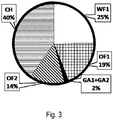
- Figure 3 shows the distribution of the biogenic carbon in the pyrolysis products from Example 1.
- WO 2010/031803 A1 Describes an example of the prior art WO 2010/031803 A1 the "bioCRACK process".
- biomass is fed to a liquid heat transfer medium (carrier oil, in particular vacuum gas oil) by means of liquid phase pyrolysis and with the exclusion of oxygen and reacted at a temperature above 300 ° C.
- carrier oil in particular vacuum gas oil
- the solid biomass produces gases, condensable vapors and a solid residue (pyrolysis coal).
- the WO 2010/031803 A1 specifically describes the use of vacuum gas oil as a carrier oil, which is characterized by a low kinematic viscosity and is a comparatively high-quality intermediate product.
- the liquid phase pyrolysis is followed by a mechanical separation of the soil product into the liquid products (remaining carrier oil) and the pyrolysis coal.
- the mechanical separation of the soil product is necessary in order to operate the process economically.
- the vacuum gas oil can be processed further or, if necessary, recycled using the liquid phase pyrolysis process.
- the mechanical separation which includes cooling the bottom product to a temperature below the flash point of the carrier oil,
- the resulting pyrolysis coal is solid, but due to its high porosity it still has a carrier oil content (vacuum gas oil) of around 50%.
- the WO 2010/031803 A1 leads the thermal recycling as the only recycling of this pyrolysis coal (incl. 50% valuable vacuum gas oil).
- a direct supply of the solid pyrolysis coal following the mechanical separation of a bottom product containing vacuum gas oil, as for example in WO 2010/031803 A1 described in a coker would not be technically possible.
- a heavy oil with a higher kinematic viscosity (kinematic viscosity at 100 ° C. of more than 10 mm 2 / s, preferably of more than 15 mm 2 / s) is used as the vacuum gas oil.
- This heavy oil used according to the invention is cheaper than vacuum gas oil.
- a mechanical separation of the soil product, as in WO 2010/031803 A1 described, however, would not be technically possible due to the higher kinematic viscosity of the heavy oil used as carrier oil compared to vacuum gas oil. This would leave the expert only a thermal recovery of the soil product obtained, which is not economically viable.
- the bottom product produced in the process according to the invention is in contrast to solid pyrolysis coal, which follows after the mechanical separation WO 2010/031803 A1 is obtained, represents a liquid process stream.
- This can therefore be transported, heated and cooled using conventional technology and is - if necessary after conditioning such as tempering, crushing larger particles and possibly adding conventional additives or other usual material flows from oil processing according to the prior art - in an oven and in follow the second process step fed coker.
- the method according to the invention thus provides an elegant possibility to achieve an even more complete utilization of all input materials (carrier oil and biomass) up to high-quality coker coal using a cheaper carrier oil.
- the heavy oil used according to the invention can have a higher density (more than 930 kg / m 3 , preferably more than 940 kg / m 3 at 15 ° C.) and / or a lower API degree (less than 21 ° API, preferably less) as 19 ° API) as vacuum gas oil.
- the API degree describes a relative density (based on water) at 60 ° F.
- the novel two-stage processing removes the vapors produced under the pyrolysis conditions, which contain gaseous, oxygen-rich pyrolysis products such as pyrolysis gas, hydrophilic pyrolysis oil and hydrophobic crack products, and only the bottom product (oxygen-reduced pyrolysis coal with determinable biogenic content of carbon and remaining heavy oil, preferably residual oil) are introduced into the coker.
- the resulting coker coal (petroleum coke) consequently contains biogenic components of the pyrolysis coal and can be obtained in the usual way.
- the vapors produced in liquid phase pyrolysis by cracking biomass and heavy oil are collected and processed. In particular, the vapors are drawn off and condensed. The non-condensable components are collected separately as a gas. All reaction products already contain a determinable proportion of biogenic carbon ("Biobased Carbon Content" according to ASTM D6866) from the biomass and thus automatically contain a proportion of renewable energy.
- biogenic carbon Biobased Carbon Content
- more volatile liquids in particular more volatile fractions from petroleum processing, can also be added to the heavy oil or the mixture of heavy oil and biomass.
- a material selected from the group consisting of lignocellulosic material such as wood, straw, plant components, biological residues, such as e.g. Agricultural residues, non-lignocellulosic materials such as Algae, and mixtures thereof are used.
- the proportion of biomass in the mixture with the heavy oil is preferably 20% by weight or less.
- Liquid phase pyrolysis can be carried out at temperatures in the range from 350 ° C. to 450 ° C., preferably 400 ° C. to 450 ° C. and an excess pressure of 0.5 bar or less.
- liquid phase pyrolysis in particular at higher temperatures in the range from 400 ° C. to 450 ° C., as a result of which a higher yield can be achieved in liquid phase pyrolysis.
- vacuum gas oil as the carrier gas oil, the liquid phase pyrolysis can only be carried out up to a temperature of 380 ° C.
- liquid phase pyrolysis can be carried out without the presence of a catalyst.
- Condensable vapors and gases that cannot be condensed at room temperature are preferably collected and processed.
- the coal remaining in the coker is discharged and dried in a manner typical of coker. It is also characterized by a measurable proportion of biogenic carbon and therefore has a determinable proportion of sustainably generated energy from biomass.
- This coal with biogenic components (typically around 10 - 30% according to ASTM D6866), can be used in the usual way like its purely fossil counterpart, or the recycling channels typical of pyrolysis coal can be used.
- the present invention also relates to a coker coal which has a biogenic carbon content of more than 0.1%, preferably 5% to 30% according to ASTM D6866 and an oxygen content of less than 10%, preferably less than 5 % is marked.
- the coker coal according to the invention can be obtainable by the method according to the invention.
- the low proportion of oxygen in the coker coal according to the invention can be achieved by the two-stage process according to the invention because oxygen-rich fractions can be separated off in the first process step of liquid phase pyrolysis.
- the coker coal according to the invention preferably has a proportion of total carbon of more than 85%, preferably more than 90%.
- fission products are also created in the coker.
- These cleavage products can be separated by a condenser, which can form condensable cleavage products which the person skilled in the art understands in the context of the invention as "coker-cracking products".
- the coker cracking products can be separated by a separator into a volatile fraction LF, a non-volatile fraction HF and, if appropriate, a water fraction WF2.
- the condensable fission products LF + HF + WF2 hereinafter combined with fission products "OF2" or with "coker-cracking products", and the remaining coker-coal CH can be collected separately.
- the present invention therefore also relates to coker cracking products which have a biogenic carbon content of more than 0.1%, preferably 2% - 10% according to ASTM D6866 and an oxygen content of less than 5%, preferably less than 3% Marked are.
- the coker cracking products according to the invention can be obtainable by the process according to the invention.
- the low proportion of oxygen in the coker cracking products according to the invention can be achieved by the two-stage process according to the invention, analogous to the description of the low oxygen proportion of the coker coal according to the invention.
- the coker cracking products according to the invention preferably have a total carbon content of more than 80%, preferably more than 85%.
- the inventive method comprises a mechanical and / or thermal pretreatment P1 of a possibly moist biomass BM, which is preferably present as lignocellulose.
- a possibly moist biomass BM which is preferably present as lignocellulose.
- the conditioned biomass BM is continuously fed to a reactor R1.
- a hot heavy oil such as, for example, a mineral oil HCl, which is a residual oil, as is usually supplied to a coker of mineral oil processing, is also fed to the reactor R1.
- pyrolysis is carried out at temperatures in the range from typically 350 ° C. to 450 ° C. and low excess pressure (for example 0.5 bar at 410 ° C.) without the addition of a catalyst.
- the vapors from reactor R1 enter a condenser C1. Gaseous components are collected as gas GA1.
- the fission products originate both from heavy oil, preferably residual oil, and from biomass BM or lignocellulose and contain determinable proportions of biogenic carbon from lignocellulose.
- the bottom product of the reactor R1 is tempered in a conditioning M1, if necessary pyrolysis coal particles are crushed and further oils / hydrocarbons HC2, e.g. also heavy oils, preferably residual oils from mineral oil processing, and additives are added in order to set typical conditions for a coker according to the prior art.
- the mixture goes further into an oven H1 and - depending on the driving style and the type of Cokes - steam ST is added. Typical conditions according to the state of the art prevail in the Coker R2.
- the resulting fission products are drawn off as vapors in a condenser C2.
- the non-condensable gaseous components are collected as gas GA2.
- the condensed constituents pass into a separator S2 and are separated there into a volatile fraction LF, a non-volatile fraction HF and, if appropriate, a water fraction WF2. Depending on the requirements and possibilities, parts of these fractions can be recycled into the coker process.
- the resulting coker coal CH also known as petroleum coke, is - depending on the type of coker and driving style - discharged and processed according to conventional methods according to the state of the art.
- the products obtained in the Coker R2 are also characterized by a determinable proportion of biogenic carbon from the biomass BM or lignocellulose.
- FIG 2 shows a further embodiment of the method according to the invention.
- a possibly moist biomass BM preferably lignocellulose
- a mechanical and / or thermal pretreatment step P1 For example, it can be crushed and / or moisture MO present can be removed.
- an impregnation I1 of the pretreated biomass BM with a mineral oil / hydrocarbon HC3 is then provided.
- a special embodiment of such a method, in which the impregnation is carried out with a volatile, non-aqueous liquid is, for example, in US Pat WO 2016/071208 A1 disclosed.
- moisture MO can be separated from the biomass by the impregnation I1.
- Excess liquid is separated from the biomass in a first separator S1 and returned to the impregnation step I1.
- the impregnated biomass BM or lignocellulose is fed to a reactor R1.
- a hot heavy oil HC1 preferably a residual oil, as is usually supplied to a coker of mineral oil processing, is also fed to the reactor R1.
- pyrolysis is carried out at temperatures in the range from typically 350 ° C. to 450 ° C. and low excess pressure (for example 0.5 bar at 410 ° C.) without the addition of a catalyst.
- the vapors from reactor R1 enter a condenser C1. Gaseous Components are collected as gas GA1.
- the condensed constituents go into a separator S2 and are separated there into an oily, hydrophobic hydrocarbon fractions OF and a hydrophilic aqueous fraction WF1 (usually pyrolysis oil).
- the fission products originate both from heavy oil, preferably residual oil / impregnation oil, and from biomass BM or lignocellulose and contain determinable proportions of biogenic carbon from biomass BM or lignocellulose.
- the bottom product of the reactor R1 is tempered in the conditioning M1, pyrolysis coal particles are comminuted, if necessary, and further heavy oils, preferably residual oils HC2 from mineral oil processing and additives, are added in order to set typical conditions for a coker according to the prior art.
- the streams of heavy oil, preferably residual oil HCl, mineral oils / hydrocarbons HC2 and HC3 can each be identical to one another or with partial streams thereof, or can each be an independent fraction from the refinery.
- the mixture goes further into an oven H1 and - depending on the driving style and type of coker - steam ST is added. Typical conditions according to the state of the art prevail in the Coker R2.
- the resulting fission products are drawn off as vapors in a condenser C2.
- the non-condensable gaseous components are collected as gas GA2.
- the condensed constituents pass into a separator S3 and are separated there into a volatile fraction LF, a non-volatile fraction HF and, if appropriate, a water fraction WF2. Depending on the requirements and possibilities, parts of these fractions can be recycled into the coker process.
- the resulting coker coal CH also known as petroleum coke
- the products from Coker R2 are also characterized by a determinable proportion of biogenic carbon from the biomass BM or lignocellulose.
- An externally heated stirred tank on a laboratory scale with a subsequent condenser unit was used as the reactor unit.
- the remaining mineral oil HC1 with the pyrolysis coal from conditioning M1 dispersed therein has a biogenic carbon content of approximately 5.6%, as shown in Table 1 below: Table 1 designation Mass [g] Biogenic carbon content C-14 [%] dry biomass BM1 98.75 100 Mineral oil (vacuum residue) HC1 603.10 0 Gas (as difference) GA1 -35.19 nb aqueous pyrolysis oil WF1 -36.25 100 hydrocarbon-soluble liquid product fraction OF1 -160.10 7.0 Residue and pyrolysis coal from the conditioning M1 -470.31 5.6
- fission products OF2 have a biogenic carbon content C-14 according to ASTM D6866 of around 3% and the coker carbon CH of around 15%.
- Figure 3 shows a calculated distribution of the biogenic carbon based on the results from Example 1 and Example 2. Accordingly, about 40% of the biogenic carbon of the biomass BM1 used remains in the coker coal CH, 25% goes into the pyrolysis oil WF1, 19% and 14 respectively % go into the oily fission products OF1 and OF2 and around 2% remain as a difference to 100% for the gas fractions GA1 and GA2.
- Table 4 shows the content of oxygen (O) and carbon in the prior art ( US 2012/0325641 A1 ).
- the "liquid phase” is the counterpart to the condensable cleavage products OF2, ie to the coker cracking products according to the invention.
- the content of the O + S + ash fraction in the cleavage product according to the invention and in particular in the coker coal according to the invention are significantly lower than the oxygen content which has been described in the prior art. This is due to the two-stage process according to the invention, in which oxygen-rich fractions were removed during the first process stage (liquid phase pyrolysis) before entering the coker (second stage of the process).
- the products according to the invention have a higher proportion of total carbon than those in the prior art ( US 2012/0325641 A1 ) described.
- the method according to the invention meets the increasing demand for processes for producing second-generation biofuels from inedible raw materials such as lignocellulose.
- the process can be integrated into existing refinery concepts and can thus bring existing infrastructure, the renewable raw materials lignocellulose, into processes for mineral oil processing in a sensible and economical manner. Due to their share of biogenic carbon, the resulting products automatically contain a determinable share of renewable energy and can be used in the usual way with methods according to the state of the art (co-processing).
- the respective process conditions and the technical implementation can be adapted to the requirements for an optimal conversion.
- the operational safety of the entire system is increased, the amount of oxygen or low-boiling hydrocarbons introduced into the coker is reduced and the conversion of solid lignocellulose into liquid and gaseous products is increased.
- the processing temperature can be increased compared to conventional liquid phase pyrolysis , and thus the degree of conversion of lignocellulose into liquid and gaseous products can be increased.
- the combined implementation of fossil carrier oil and lignocellulose increases the yield of lighter fission products from the fossil hydrocarbon fractions. This contributes to improved yield and economy in processing heavy residues in petroleum refining.
- the resulting pyrolysis coal does not have to be separated separately due to the use of heavy oil, preferably residual oil, in contrast to processes known in the art using vacuum gas oil.
- the pyrolysis coal produced by the process according to the invention can be introduced directly into a coker and can ultimately be obtained as coker coal by conventional operation and emptying of the coker in the customary manner according to the prior art. In contrast to the usual flash pyrolysis process, pyrolysis coal is not consumed internally and is then available for further use.
- the coker coal Due to the use of biomass, the coker coal also contains biogenic, CO 2 -neutral carbon and thus has reduced GHG emissions per energy unit compared to its purely fossil counterpart.
Landscapes
- Chemical & Material Sciences (AREA)
- Engineering & Computer Science (AREA)
- Oil, Petroleum & Natural Gas (AREA)
- Organic Chemistry (AREA)
- Chemical Kinetics & Catalysis (AREA)
- General Chemical & Material Sciences (AREA)
- Materials Engineering (AREA)
- Life Sciences & Earth Sciences (AREA)
- Wood Science & Technology (AREA)
- Production Of Liquid Hydrocarbon Mixture For Refining Petroleum (AREA)
Applications Claiming Priority (1)
| Application Number | Priority Date | Filing Date | Title |
|---|---|---|---|
| EP18199674 | 2018-10-10 |
Publications (2)
| Publication Number | Publication Date |
|---|---|
| EP3636729A1 true EP3636729A1 (fr) | 2020-04-15 |
| EP3636729B1 EP3636729B1 (fr) | 2021-11-24 |
Family
ID=63833815
Family Applications (1)
| Application Number | Title | Priority Date | Filing Date |
|---|---|---|---|
| EP19202487.5A Active EP3636729B1 (fr) | 2018-10-10 | 2019-10-10 | Procédé de fabrication de charbon à coke |
Country Status (1)
| Country | Link |
|---|---|
| EP (1) | EP3636729B1 (fr) |
Citations (11)
| Publication number | Priority date | Publication date | Assignee | Title |
|---|---|---|---|---|
| WO2008011925A1 (fr) | 2006-07-27 | 2008-01-31 | The Jordanian Pharmaceutical Manufacturing Co. | Godet de détection immunochromatographique urinaire |
| WO2008034596A1 (fr) | 2006-09-20 | 2008-03-27 | Lignosol Gmbh & Co. Kg | Installation et procédé pour la production de carburants à partir de matières premières biogènes |
| WO2010031803A1 (fr) | 2008-09-17 | 2010-03-25 | Bdi-Biodiesel International Ag | Procédé d'extraction de combustibles ou de carburants |
| US20110232146A1 (en) | 2010-03-26 | 2011-09-29 | Hung Lung Lin | Photo frame with message board function |
| US8288600B2 (en) | 2009-05-22 | 2012-10-16 | Kior Inc. | Methods for co-processing of biomass and petroleum feed |
| US20120289752A1 (en) | 2011-04-21 | 2012-11-15 | Shell Oil Company | Process for converting a solid biomass material |
| WO2012178131A1 (fr) | 2011-06-23 | 2012-12-27 | Foster Wheeler Usa Corporation | Pyrolyse de biomasse dans la production de biocarburants |
| US20150152334A1 (en) * | 2013-11-23 | 2015-06-04 | Indian Oil Corporation Limited | Delayed coking process |
| WO2016071208A1 (fr) | 2014-11-05 | 2016-05-12 | Bdi-Bioenergy International Ag | Procédé de conversion de biomasse en sources d'énergie liquides et/ou gazeuses |
| US20160200579A1 (en) * | 2013-09-05 | 2016-07-14 | Graftech International Holdings Inc. | Carbon products derived from lignin/carbon residue |
| US20170137715A1 (en) * | 2014-06-24 | 2017-05-18 | South China Agricultural University | Method of continuous pyrolysis and carbonization of agricultural and forestry biomass |
-
2019
- 2019-10-10 EP EP19202487.5A patent/EP3636729B1/fr active Active
Patent Citations (12)
| Publication number | Priority date | Publication date | Assignee | Title |
|---|---|---|---|---|
| WO2008011925A1 (fr) | 2006-07-27 | 2008-01-31 | The Jordanian Pharmaceutical Manufacturing Co. | Godet de détection immunochromatographique urinaire |
| WO2008034596A1 (fr) | 2006-09-20 | 2008-03-27 | Lignosol Gmbh & Co. Kg | Installation et procédé pour la production de carburants à partir de matières premières biogènes |
| WO2010031803A1 (fr) | 2008-09-17 | 2010-03-25 | Bdi-Biodiesel International Ag | Procédé d'extraction de combustibles ou de carburants |
| US8288600B2 (en) | 2009-05-22 | 2012-10-16 | Kior Inc. | Methods for co-processing of biomass and petroleum feed |
| US20110232146A1 (en) | 2010-03-26 | 2011-09-29 | Hung Lung Lin | Photo frame with message board function |
| US20120289752A1 (en) | 2011-04-21 | 2012-11-15 | Shell Oil Company | Process for converting a solid biomass material |
| WO2012178131A1 (fr) | 2011-06-23 | 2012-12-27 | Foster Wheeler Usa Corporation | Pyrolyse de biomasse dans la production de biocarburants |
| US20120325641A1 (en) | 2011-06-23 | 2012-12-27 | Foster Wheeler Usa Corporation | Pyrolysis of solid biomass in the production of biofuels |
| US20160200579A1 (en) * | 2013-09-05 | 2016-07-14 | Graftech International Holdings Inc. | Carbon products derived from lignin/carbon residue |
| US20150152334A1 (en) * | 2013-11-23 | 2015-06-04 | Indian Oil Corporation Limited | Delayed coking process |
| US20170137715A1 (en) * | 2014-06-24 | 2017-05-18 | South China Agricultural University | Method of continuous pyrolysis and carbonization of agricultural and forestry biomass |
| WO2016071208A1 (fr) | 2014-11-05 | 2016-05-12 | Bdi-Bioenergy International Ag | Procédé de conversion de biomasse en sources d'énergie liquides et/ou gazeuses |
Non-Patent Citations (14)
| Title |
|---|
| A. R. ARDIYANTIA. GUTIERREZM. L. HONKELAA. O. I. KRAUSEH. J. HEERES, APPL. CATAL. A GEN., vol. 407, no. 1-2, 2011, pages 56 - 66 |
| A. V. BRIDGWATERD. MEIERD. RADLEIN, ORG. GEOCHEM., vol. 30, no. 12, 1999, pages 1479 - 1493 |
| D. LECKEL, ENERGY & FUELS, vol. 23, no. 5, 2009, pages 2342 - 2358 |
| D. MEIERO. FAIX, BIORESOUR. TECHNOL., vol. 68, 1999, pages 71 - 77 |
| EUROPEAN COMMISSION, 2016, pages 382 |
| F. BEHRENDTY. NEUBAUER, CHEM. ENG. TECHNOL., vol. 31, no. 5, 2008 |
| F. D. M. MERCADERP. KOEHORST, AICHE J., vol. 57, no. 11, 2011, pages 3160 - 3170 |
| F. DE MIGUEL MERCADERM. J. GROENEVELDS. R. A. KERSTENN. W. J. WAYC. J. SCHAVERIENJ. A. HOGENDOORN, APPL. CATAL. B ENVIRON., vol. 96, no. 1-2, 2010, pages 57 - 66 |
| H. J. ARPE: "Industrielle Organische Chemie", 2007, WILEY-VCH |
| J. LARSEN, 3 INT. CONF. LIGNOCELLUL. ETHANOL, 2013 |
| N. SCHWAIGERD. C. ELLIOTTJ. RITZBERGERH. WANGP. PUCHERM. SIEBENHOFER, GREEN CHEM., vol. 17, no. 4, 2015, pages 2487 - 2494 |
| N. SCHWAIGERR. FEINERK. ZAHELA. PIEBERV. WITEKP. PUCHERE. AHNP. WILHELMB. CHERNEVH. SCHRÖTTNER ET AL., BIOENERGY RES., vol. 4, no. 4, 2011, pages 294 - 302 |
| R. RAUCH, STATUS OF R&D OF SYNTHETIC BIOFUELS IN GÜSSING, 2010 |
| R. RINALDIF. SCHÜTH, ENERGY ENVIRON. SEI., vol. 2, no. 6, 2009, pages 610 |
Also Published As
| Publication number | Publication date |
|---|---|
| EP3636729B1 (fr) | 2021-11-24 |
Similar Documents
| Publication | Publication Date | Title |
|---|---|---|
| US11466219B2 (en) | Process for increasing gasoline and middle distillate selectivity in catalytic cracking | |
| EP3262140B1 (fr) | Huile de pyrolyse et son procédé de production | |
| US8063258B2 (en) | Catalytic hydropyrolysis of organophillic biomass | |
| DE102010014768B4 (de) | Verfahren zur thermischen Spaltung hochmolekularer organischer Abfälle | |
| DE102009030809B3 (de) | Thermochemische Umwandlung von Biomasse | |
| EP0182309A1 (fr) | Procédé pour la réutilisation par hydration de déchets contenant du carbone d'origine synthétique | |
| EP2598605A2 (fr) | Installation et procédé de production de carburants à partir de mélanges de biomasse et de plastique | |
| DE2953190A1 (de) | Verfahren zum herstellen von hochwertigem koks | |
| EP2325281A1 (fr) | Procédé de craquage catalytique d'huiles de pyrolyse | |
| DE2855403A1 (de) | Kohleverfluessigungsverfahren | |
| EP1489157B1 (fr) | Procédé pour convertir de déchets et matières premières contenant de l'huile ou de la graisse en un mélange contenant des hydrocarbures | |
| DE10215679B4 (de) | Direkte thermochemische Umwandlung von hochmolekularen organischen Substanzen in niedrigviskose flüssige Brennstoffe | |
| US10703978B2 (en) | Composition for biomass oil, and preparation method and use thereof | |
| EP2445991B1 (fr) | Procédé de bioraffinerie | |
| EP4444823B1 (fr) | Procédé de production d'un hydrocarbure liquide à partir de sources renouvelables | |
| EP3636729B1 (fr) | Procédé de fabrication de charbon à coke | |
| EP2692425A1 (fr) | Procédé et installation de génération de carburants à partir de matières organiques au moyen d'un traitement échelonné à micro-ondes | |
| DE112012002578T5 (de) | Pyrolyse von Biomasse bei der Herstellung von Biokraftstoffen | |
| DE102009049767A1 (de) | Verfahren zur katalytischen Umsetzung von feststoffartigen Kohlenwasserstoffen | |
| EP3215588B1 (fr) | Procédé de conversion de biomasse en supports d'énergie liquides et/ou gazeux | |
| DE3116517A1 (de) | Verfahren zur herstellung von pech aus erdoelfraktionen und das erhaltene pech | |
| EP0123161B1 (fr) | Procédé d'hydrogénation de charbon | |
| DE2922553A1 (de) | Verfahren zur umwandlung von gummiabfaellen in gasfoermige und fluessige brennstoffe durch kracken | |
| DE2711105A1 (de) | Verfahren zum verfluessigen von kohle | |
| DE102022133257A1 (de) | Verfahren zur Herstellung von Synthesegas und Industrieruß aus aluminiumhaltigen Verbundverpackungen |
Legal Events
| Date | Code | Title | Description |
|---|---|---|---|
| PUAI | Public reference made under article 153(3) epc to a published international application that has entered the european phase |
Free format text: ORIGINAL CODE: 0009012 |
|
| STAA | Information on the status of an ep patent application or granted ep patent |
Free format text: STATUS: THE APPLICATION HAS BEEN PUBLISHED |
|
| AK | Designated contracting states |
Kind code of ref document: A1 Designated state(s): AL AT BE BG CH CY CZ DE DK EE ES FI FR GB GR HR HU IE IS IT LI LT LU LV MC MK MT NL NO PL PT RO RS SE SI SK SM TR |
|
| AX | Request for extension of the european patent |
Extension state: BA ME |
|
| RBV | Designated contracting states (corrected) |
Designated state(s): AL AT BE BG CH CY CZ DE DK EE ES FI FR GB GR HR HU IE IS IT LI LT LU LV MC MK MT NL NO PL PT RO RS SE SI SK SM TR |
|
| STAA | Information on the status of an ep patent application or granted ep patent |
Free format text: STATUS: REQUEST FOR EXAMINATION WAS MADE |
|
| 17P | Request for examination filed |
Effective date: 20201023 |
|
| GRAP | Despatch of communication of intention to grant a patent |
Free format text: ORIGINAL CODE: EPIDOSNIGR1 |
|
| STAA | Information on the status of an ep patent application or granted ep patent |
Free format text: STATUS: GRANT OF PATENT IS INTENDED |
|
| INTG | Intention to grant announced |
Effective date: 20210625 |
|
| GRAS | Grant fee paid |
Free format text: ORIGINAL CODE: EPIDOSNIGR3 |
|
| GRAA | (expected) grant |
Free format text: ORIGINAL CODE: 0009210 |
|
| STAA | Information on the status of an ep patent application or granted ep patent |
Free format text: STATUS: THE PATENT HAS BEEN GRANTED |
|
| AK | Designated contracting states |
Kind code of ref document: B1 Designated state(s): AL AT BE BG CH CY CZ DE DK EE ES FI FR GB GR HR HU IE IS IT LI LT LU LV MC MK MT NL NO PL PT RO RS SE SI SK SM TR |
|
| REG | Reference to a national code |
Ref country code: GB Ref legal event code: FG4D Free format text: NOT ENGLISH |
|
| REG | Reference to a national code |
Ref country code: DE Ref legal event code: R096 Ref document number: 502019002830 Country of ref document: DE |
|
| REG | Reference to a national code |
Ref country code: AT Ref legal event code: REF Ref document number: 1449883 Country of ref document: AT Kind code of ref document: T Effective date: 20211215 |
|
| REG | Reference to a national code |
Ref country code: IE Ref legal event code: FG4D Free format text: LANGUAGE OF EP DOCUMENT: GERMAN |
|
| REG | Reference to a national code |
Ref country code: LT Ref legal event code: MG9D |
|
| REG | Reference to a national code |
Ref country code: NL Ref legal event code: MP Effective date: 20211124 |
|
| PG25 | Lapsed in a contracting state [announced via postgrant information from national office to epo] |
Ref country code: RS Free format text: LAPSE BECAUSE OF FAILURE TO SUBMIT A TRANSLATION OF THE DESCRIPTION OR TO PAY THE FEE WITHIN THE PRESCRIBED TIME-LIMIT Effective date: 20211124 Ref country code: LT Free format text: LAPSE BECAUSE OF FAILURE TO SUBMIT A TRANSLATION OF THE DESCRIPTION OR TO PAY THE FEE WITHIN THE PRESCRIBED TIME-LIMIT Effective date: 20211124 Ref country code: FI Free format text: LAPSE BECAUSE OF FAILURE TO SUBMIT A TRANSLATION OF THE DESCRIPTION OR TO PAY THE FEE WITHIN THE PRESCRIBED TIME-LIMIT Effective date: 20211124 Ref country code: BG Free format text: LAPSE BECAUSE OF FAILURE TO SUBMIT A TRANSLATION OF THE DESCRIPTION OR TO PAY THE FEE WITHIN THE PRESCRIBED TIME-LIMIT Effective date: 20220224 |
|
| PG25 | Lapsed in a contracting state [announced via postgrant information from national office to epo] |
Ref country code: IS Free format text: LAPSE BECAUSE OF FAILURE TO SUBMIT A TRANSLATION OF THE DESCRIPTION OR TO PAY THE FEE WITHIN THE PRESCRIBED TIME-LIMIT Effective date: 20220324 Ref country code: SE Free format text: LAPSE BECAUSE OF FAILURE TO SUBMIT A TRANSLATION OF THE DESCRIPTION OR TO PAY THE FEE WITHIN THE PRESCRIBED TIME-LIMIT Effective date: 20211124 Ref country code: PT Free format text: LAPSE BECAUSE OF FAILURE TO SUBMIT A TRANSLATION OF THE DESCRIPTION OR TO PAY THE FEE WITHIN THE PRESCRIBED TIME-LIMIT Effective date: 20220324 Ref country code: PL Free format text: LAPSE BECAUSE OF FAILURE TO SUBMIT A TRANSLATION OF THE DESCRIPTION OR TO PAY THE FEE WITHIN THE PRESCRIBED TIME-LIMIT Effective date: 20211124 Ref country code: NO Free format text: LAPSE BECAUSE OF FAILURE TO SUBMIT A TRANSLATION OF THE DESCRIPTION OR TO PAY THE FEE WITHIN THE PRESCRIBED TIME-LIMIT Effective date: 20220224 Ref country code: NL Free format text: LAPSE BECAUSE OF FAILURE TO SUBMIT A TRANSLATION OF THE DESCRIPTION OR TO PAY THE FEE WITHIN THE PRESCRIBED TIME-LIMIT Effective date: 20211124 Ref country code: LV Free format text: LAPSE BECAUSE OF FAILURE TO SUBMIT A TRANSLATION OF THE DESCRIPTION OR TO PAY THE FEE WITHIN THE PRESCRIBED TIME-LIMIT Effective date: 20211124 Ref country code: HR Free format text: LAPSE BECAUSE OF FAILURE TO SUBMIT A TRANSLATION OF THE DESCRIPTION OR TO PAY THE FEE WITHIN THE PRESCRIBED TIME-LIMIT Effective date: 20211124 Ref country code: GR Free format text: LAPSE BECAUSE OF FAILURE TO SUBMIT A TRANSLATION OF THE DESCRIPTION OR TO PAY THE FEE WITHIN THE PRESCRIBED TIME-LIMIT Effective date: 20220225 Ref country code: ES Free format text: LAPSE BECAUSE OF FAILURE TO SUBMIT A TRANSLATION OF THE DESCRIPTION OR TO PAY THE FEE WITHIN THE PRESCRIBED TIME-LIMIT Effective date: 20211124 |
|
| PG25 | Lapsed in a contracting state [announced via postgrant information from national office to epo] |
Ref country code: SM Free format text: LAPSE BECAUSE OF FAILURE TO SUBMIT A TRANSLATION OF THE DESCRIPTION OR TO PAY THE FEE WITHIN THE PRESCRIBED TIME-LIMIT Effective date: 20211124 Ref country code: SK Free format text: LAPSE BECAUSE OF FAILURE TO SUBMIT A TRANSLATION OF THE DESCRIPTION OR TO PAY THE FEE WITHIN THE PRESCRIBED TIME-LIMIT Effective date: 20211124 Ref country code: RO Free format text: LAPSE BECAUSE OF FAILURE TO SUBMIT A TRANSLATION OF THE DESCRIPTION OR TO PAY THE FEE WITHIN THE PRESCRIBED TIME-LIMIT Effective date: 20211124 Ref country code: EE Free format text: LAPSE BECAUSE OF FAILURE TO SUBMIT A TRANSLATION OF THE DESCRIPTION OR TO PAY THE FEE WITHIN THE PRESCRIBED TIME-LIMIT Effective date: 20211124 Ref country code: DK Free format text: LAPSE BECAUSE OF FAILURE TO SUBMIT A TRANSLATION OF THE DESCRIPTION OR TO PAY THE FEE WITHIN THE PRESCRIBED TIME-LIMIT Effective date: 20211124 Ref country code: CZ Free format text: LAPSE BECAUSE OF FAILURE TO SUBMIT A TRANSLATION OF THE DESCRIPTION OR TO PAY THE FEE WITHIN THE PRESCRIBED TIME-LIMIT Effective date: 20211124 |
|
| REG | Reference to a national code |
Ref country code: DE Ref legal event code: R097 Ref document number: 502019002830 Country of ref document: DE |
|
| PLBE | No opposition filed within time limit |
Free format text: ORIGINAL CODE: 0009261 |
|
| STAA | Information on the status of an ep patent application or granted ep patent |
Free format text: STATUS: NO OPPOSITION FILED WITHIN TIME LIMIT |
|
| PG25 | Lapsed in a contracting state [announced via postgrant information from national office to epo] |
Ref country code: AL Free format text: LAPSE BECAUSE OF FAILURE TO SUBMIT A TRANSLATION OF THE DESCRIPTION OR TO PAY THE FEE WITHIN THE PRESCRIBED TIME-LIMIT Effective date: 20211124 |
|
| 26N | No opposition filed |
Effective date: 20220825 |
|
| PG25 | Lapsed in a contracting state [announced via postgrant information from national office to epo] |
Ref country code: SI Free format text: LAPSE BECAUSE OF FAILURE TO SUBMIT A TRANSLATION OF THE DESCRIPTION OR TO PAY THE FEE WITHIN THE PRESCRIBED TIME-LIMIT Effective date: 20211124 |
|
| PG25 | Lapsed in a contracting state [announced via postgrant information from national office to epo] |
Ref country code: MC Free format text: LAPSE BECAUSE OF FAILURE TO SUBMIT A TRANSLATION OF THE DESCRIPTION OR TO PAY THE FEE WITHIN THE PRESCRIBED TIME-LIMIT Effective date: 20211124 Ref country code: IT Free format text: LAPSE BECAUSE OF FAILURE TO SUBMIT A TRANSLATION OF THE DESCRIPTION OR TO PAY THE FEE WITHIN THE PRESCRIBED TIME-LIMIT Effective date: 20211124 |
|
| REG | Reference to a national code |
Ref country code: CH Ref legal event code: PL |
|
| REG | Reference to a national code |
Ref country code: BE Ref legal event code: MM Effective date: 20221031 |
|
| PG25 | Lapsed in a contracting state [announced via postgrant information from national office to epo] |
Ref country code: LU Free format text: LAPSE BECAUSE OF NON-PAYMENT OF DUE FEES Effective date: 20221010 |
|
| PG25 | Lapsed in a contracting state [announced via postgrant information from national office to epo] |
Ref country code: LI Free format text: LAPSE BECAUSE OF NON-PAYMENT OF DUE FEES Effective date: 20221031 Ref country code: FR Free format text: LAPSE BECAUSE OF NON-PAYMENT OF DUE FEES Effective date: 20221031 Ref country code: CH Free format text: LAPSE BECAUSE OF NON-PAYMENT OF DUE FEES Effective date: 20221031 |
|
| PG25 | Lapsed in a contracting state [announced via postgrant information from national office to epo] |
Ref country code: BE Free format text: LAPSE BECAUSE OF NON-PAYMENT OF DUE FEES Effective date: 20221031 |
|
| PG25 | Lapsed in a contracting state [announced via postgrant information from national office to epo] |
Ref country code: IE Free format text: LAPSE BECAUSE OF NON-PAYMENT OF DUE FEES Effective date: 20221010 |
|
| PG25 | Lapsed in a contracting state [announced via postgrant information from national office to epo] |
Ref country code: HU Free format text: LAPSE BECAUSE OF FAILURE TO SUBMIT A TRANSLATION OF THE DESCRIPTION OR TO PAY THE FEE WITHIN THE PRESCRIBED TIME-LIMIT; INVALID AB INITIO Effective date: 20191010 |
|
| PG25 | Lapsed in a contracting state [announced via postgrant information from national office to epo] |
Ref country code: CY Free format text: LAPSE BECAUSE OF FAILURE TO SUBMIT A TRANSLATION OF THE DESCRIPTION OR TO PAY THE FEE WITHIN THE PRESCRIBED TIME-LIMIT Effective date: 20211124 |
|
| PG25 | Lapsed in a contracting state [announced via postgrant information from national office to epo] |
Ref country code: MK Free format text: LAPSE BECAUSE OF FAILURE TO SUBMIT A TRANSLATION OF THE DESCRIPTION OR TO PAY THE FEE WITHIN THE PRESCRIBED TIME-LIMIT Effective date: 20211124 |
|
| GBPC | Gb: european patent ceased through non-payment of renewal fee |
Effective date: 20231010 |
|
| PG25 | Lapsed in a contracting state [announced via postgrant information from national office to epo] |
Ref country code: TR Free format text: LAPSE BECAUSE OF FAILURE TO SUBMIT A TRANSLATION OF THE DESCRIPTION OR TO PAY THE FEE WITHIN THE PRESCRIBED TIME-LIMIT Effective date: 20211124 |
|
| PG25 | Lapsed in a contracting state [announced via postgrant information from national office to epo] |
Ref country code: GB Free format text: LAPSE BECAUSE OF NON-PAYMENT OF DUE FEES Effective date: 20231010 |
|
| PG25 | Lapsed in a contracting state [announced via postgrant information from national office to epo] |
Ref country code: GB Free format text: LAPSE BECAUSE OF NON-PAYMENT OF DUE FEES Effective date: 20231010 |
|
| PG25 | Lapsed in a contracting state [announced via postgrant information from national office to epo] |
Ref country code: MT Free format text: LAPSE BECAUSE OF FAILURE TO SUBMIT A TRANSLATION OF THE DESCRIPTION OR TO PAY THE FEE WITHIN THE PRESCRIBED TIME-LIMIT Effective date: 20211124 |
|
| REG | Reference to a national code |
Ref country code: DE Ref legal event code: R082 Ref document number: 502019002830 Country of ref document: DE Representative=s name: RAVENSPAT PATENTANWAELTE PARTNERSCHAFT MBB, DE |
|
| PGFP | Annual fee paid to national office [announced via postgrant information from national office to epo] |
Ref country code: DE Payment date: 20251020 Year of fee payment: 7 |
|
| PGFP | Annual fee paid to national office [announced via postgrant information from national office to epo] |
Ref country code: AT Payment date: 20250926 Year of fee payment: 7 |