EP3636800A2 - Traitement de surface résistant à la corrosion et système d'amorce pour aéronef en aluminium à l'aide d'inhibiteurs exempts de chrome - Google Patents
Traitement de surface résistant à la corrosion et système d'amorce pour aéronef en aluminium à l'aide d'inhibiteurs exempts de chrome Download PDFInfo
- Publication number
- EP3636800A2 EP3636800A2 EP19213692.7A EP19213692A EP3636800A2 EP 3636800 A2 EP3636800 A2 EP 3636800A2 EP 19213692 A EP19213692 A EP 19213692A EP 3636800 A2 EP3636800 A2 EP 3636800A2
- Authority
- EP
- European Patent Office
- Prior art keywords
- corrosion
- protection layer
- corrosion protection
- inhibitor
- corrosion inhibitor
- Prior art date
- Legal status (The legal status is an assumption and is not a legal conclusion. Google has not performed a legal analysis and makes no representation as to the accuracy of the status listed.)
- Granted
Links
Images


Classifications
-
- C—CHEMISTRY; METALLURGY
- C23—COATING METALLIC MATERIAL; COATING MATERIAL WITH METALLIC MATERIAL; CHEMICAL SURFACE TREATMENT; DIFFUSION TREATMENT OF METALLIC MATERIAL; COATING BY VACUUM EVAPORATION, BY SPUTTERING, BY ION IMPLANTATION OR BY CHEMICAL VAPOUR DEPOSITION, IN GENERAL; INHIBITING CORROSION OF METALLIC MATERIAL OR INCRUSTATION IN GENERAL
- C23F—NON-MECHANICAL REMOVAL OF METALLIC MATERIAL FROM SURFACE; INHIBITING CORROSION OF METALLIC MATERIAL OR INCRUSTATION IN GENERAL; MULTI-STEP PROCESSES FOR SURFACE TREATMENT OF METALLIC MATERIAL INVOLVING AT LEAST ONE PROCESS PROVIDED FOR IN CLASS C23 AND AT LEAST ONE PROCESS COVERED BY SUBCLASS C21D OR C22F OR CLASS C25
- C23F11/00—Inhibiting corrosion of metallic material by applying inhibitors to the surface in danger of corrosion or adding them to the corrosive agent
- C23F11/08—Inhibiting corrosion of metallic material by applying inhibitors to the surface in danger of corrosion or adding them to the corrosive agent in other liquids
- C23F11/10—Inhibiting corrosion of metallic material by applying inhibitors to the surface in danger of corrosion or adding them to the corrosive agent in other liquids using organic inhibitors
- C23F11/16—Sulfur-containing compounds
-
- C—CHEMISTRY; METALLURGY
- C09—DYES; PAINTS; POLISHES; NATURAL RESINS; ADHESIVES; COMPOSITIONS NOT OTHERWISE PROVIDED FOR; APPLICATIONS OF MATERIALS NOT OTHERWISE PROVIDED FOR
- C09D—COATING COMPOSITIONS, e.g. PAINTS, VARNISHES OR LACQUERS; FILLING PASTES; CHEMICAL PAINT OR INK REMOVERS; INKS; CORRECTING FLUIDS; WOODSTAINS; PASTES OR SOLIDS FOR COLOURING OR PRINTING; USE OF MATERIALS THEREFOR
- C09D175/00—Coating compositions based on polyureas or polyurethanes; Coating compositions based on derivatives of such polymers
- C09D175/04—Polyurethanes
-
- C—CHEMISTRY; METALLURGY
- C23—COATING METALLIC MATERIAL; COATING MATERIAL WITH METALLIC MATERIAL; CHEMICAL SURFACE TREATMENT; DIFFUSION TREATMENT OF METALLIC MATERIAL; COATING BY VACUUM EVAPORATION, BY SPUTTERING, BY ION IMPLANTATION OR BY CHEMICAL VAPOUR DEPOSITION, IN GENERAL; INHIBITING CORROSION OF METALLIC MATERIAL OR INCRUSTATION IN GENERAL
- C23C—COATING METALLIC MATERIAL; COATING MATERIAL WITH METALLIC MATERIAL; SURFACE TREATMENT OF METALLIC MATERIAL BY DIFFUSION INTO THE SURFACE, BY CHEMICAL CONVERSION OR SUBSTITUTION; COATING BY VACUUM EVAPORATION, BY SPUTTERING, BY ION IMPLANTATION OR BY CHEMICAL VAPOUR DEPOSITION, IN GENERAL
- C23C18/00—Chemical coating by decomposition of either liquid compounds or solutions of the coating forming compounds, without leaving reaction products of surface material in the coating; Contact plating
- C23C18/02—Chemical coating by decomposition of either liquid compounds or solutions of the coating forming compounds, without leaving reaction products of surface material in the coating; Contact plating by thermal decomposition
- C23C18/12—Chemical coating by decomposition of either liquid compounds or solutions of the coating forming compounds, without leaving reaction products of surface material in the coating; Contact plating by thermal decomposition characterised by the deposition of inorganic material other than metallic material
- C23C18/1204—Chemical coating by decomposition of either liquid compounds or solutions of the coating forming compounds, without leaving reaction products of surface material in the coating; Contact plating by thermal decomposition characterised by the deposition of inorganic material other than metallic material inorganic material, e.g. non-oxide and non-metallic such as sulfides, nitrides based compounds
- C23C18/1208—Oxides, e.g. ceramics
- C23C18/1212—Zeolites, glasses
-
- C—CHEMISTRY; METALLURGY
- C09—DYES; PAINTS; POLISHES; NATURAL RESINS; ADHESIVES; COMPOSITIONS NOT OTHERWISE PROVIDED FOR; APPLICATIONS OF MATERIALS NOT OTHERWISE PROVIDED FOR
- C09D—COATING COMPOSITIONS, e.g. PAINTS, VARNISHES OR LACQUERS; FILLING PASTES; CHEMICAL PAINT OR INK REMOVERS; INKS; CORRECTING FLUIDS; WOODSTAINS; PASTES OR SOLIDS FOR COLOURING OR PRINTING; USE OF MATERIALS THEREFOR
- C09D5/00—Coating compositions, e.g. paints, varnishes or lacquers, characterised by their physical nature or the effects produced; Filling pastes
- C09D5/08—Anti-corrosive paints
-
- C—CHEMISTRY; METALLURGY
- C09—DYES; PAINTS; POLISHES; NATURAL RESINS; ADHESIVES; COMPOSITIONS NOT OTHERWISE PROVIDED FOR; APPLICATIONS OF MATERIALS NOT OTHERWISE PROVIDED FOR
- C09D—COATING COMPOSITIONS, e.g. PAINTS, VARNISHES OR LACQUERS; FILLING PASTES; CHEMICAL PAINT OR INK REMOVERS; INKS; CORRECTING FLUIDS; WOODSTAINS; PASTES OR SOLIDS FOR COLOURING OR PRINTING; USE OF MATERIALS THEREFOR
- C09D5/00—Coating compositions, e.g. paints, varnishes or lacquers, characterised by their physical nature or the effects produced; Filling pastes
- C09D5/08—Anti-corrosive paints
- C09D5/082—Anti-corrosive paints characterised by the anti-corrosive pigment
- C09D5/086—Organic or non-macromolecular compounds
-
- C—CHEMISTRY; METALLURGY
- C09—DYES; PAINTS; POLISHES; NATURAL RESINS; ADHESIVES; COMPOSITIONS NOT OTHERWISE PROVIDED FOR; APPLICATIONS OF MATERIALS NOT OTHERWISE PROVIDED FOR
- C09D—COATING COMPOSITIONS, e.g. PAINTS, VARNISHES OR LACQUERS; FILLING PASTES; CHEMICAL PAINT OR INK REMOVERS; INKS; CORRECTING FLUIDS; WOODSTAINS; PASTES OR SOLIDS FOR COLOURING OR PRINTING; USE OF MATERIALS THEREFOR
- C09D7/00—Features of coating compositions, not provided for in group C09D5/00; Processes for incorporating ingredients in coating compositions
- C09D7/40—Additives
- C09D7/60—Additives non-macromolecular
- C09D7/63—Additives non-macromolecular organic
-
- C—CHEMISTRY; METALLURGY
- C23—COATING METALLIC MATERIAL; COATING MATERIAL WITH METALLIC MATERIAL; CHEMICAL SURFACE TREATMENT; DIFFUSION TREATMENT OF METALLIC MATERIAL; COATING BY VACUUM EVAPORATION, BY SPUTTERING, BY ION IMPLANTATION OR BY CHEMICAL VAPOUR DEPOSITION, IN GENERAL; INHIBITING CORROSION OF METALLIC MATERIAL OR INCRUSTATION IN GENERAL
- C23C—COATING METALLIC MATERIAL; COATING MATERIAL WITH METALLIC MATERIAL; SURFACE TREATMENT OF METALLIC MATERIAL BY DIFFUSION INTO THE SURFACE, BY CHEMICAL CONVERSION OR SUBSTITUTION; COATING BY VACUUM EVAPORATION, BY SPUTTERING, BY ION IMPLANTATION OR BY CHEMICAL VAPOUR DEPOSITION, IN GENERAL
- C23C18/00—Chemical coating by decomposition of either liquid compounds or solutions of the coating forming compounds, without leaving reaction products of surface material in the coating; Contact plating
- C23C18/02—Chemical coating by decomposition of either liquid compounds or solutions of the coating forming compounds, without leaving reaction products of surface material in the coating; Contact plating by thermal decomposition
- C23C18/12—Chemical coating by decomposition of either liquid compounds or solutions of the coating forming compounds, without leaving reaction products of surface material in the coating; Contact plating by thermal decomposition characterised by the deposition of inorganic material other than metallic material
- C23C18/1204—Chemical coating by decomposition of either liquid compounds or solutions of the coating forming compounds, without leaving reaction products of surface material in the coating; Contact plating by thermal decomposition characterised by the deposition of inorganic material other than metallic material inorganic material, e.g. non-oxide and non-metallic such as sulfides, nitrides based compounds
- C23C18/1208—Oxides, e.g. ceramics
-
- C—CHEMISTRY; METALLURGY
- C23—COATING METALLIC MATERIAL; COATING MATERIAL WITH METALLIC MATERIAL; CHEMICAL SURFACE TREATMENT; DIFFUSION TREATMENT OF METALLIC MATERIAL; COATING BY VACUUM EVAPORATION, BY SPUTTERING, BY ION IMPLANTATION OR BY CHEMICAL VAPOUR DEPOSITION, IN GENERAL; INHIBITING CORROSION OF METALLIC MATERIAL OR INCRUSTATION IN GENERAL
- C23C—COATING METALLIC MATERIAL; COATING MATERIAL WITH METALLIC MATERIAL; SURFACE TREATMENT OF METALLIC MATERIAL BY DIFFUSION INTO THE SURFACE, BY CHEMICAL CONVERSION OR SUBSTITUTION; COATING BY VACUUM EVAPORATION, BY SPUTTERING, BY ION IMPLANTATION OR BY CHEMICAL VAPOUR DEPOSITION, IN GENERAL
- C23C18/00—Chemical coating by decomposition of either liquid compounds or solutions of the coating forming compounds, without leaving reaction products of surface material in the coating; Contact plating
- C23C18/02—Chemical coating by decomposition of either liquid compounds or solutions of the coating forming compounds, without leaving reaction products of surface material in the coating; Contact plating by thermal decomposition
- C23C18/12—Chemical coating by decomposition of either liquid compounds or solutions of the coating forming compounds, without leaving reaction products of surface material in the coating; Contact plating by thermal decomposition characterised by the deposition of inorganic material other than metallic material
- C23C18/1204—Chemical coating by decomposition of either liquid compounds or solutions of the coating forming compounds, without leaving reaction products of surface material in the coating; Contact plating by thermal decomposition characterised by the deposition of inorganic material other than metallic material inorganic material, e.g. non-oxide and non-metallic such as sulfides, nitrides based compounds
- C23C18/1208—Oxides, e.g. ceramics
- C23C18/1216—Metal oxides
-
- C—CHEMISTRY; METALLURGY
- C23—COATING METALLIC MATERIAL; COATING MATERIAL WITH METALLIC MATERIAL; CHEMICAL SURFACE TREATMENT; DIFFUSION TREATMENT OF METALLIC MATERIAL; COATING BY VACUUM EVAPORATION, BY SPUTTERING, BY ION IMPLANTATION OR BY CHEMICAL VAPOUR DEPOSITION, IN GENERAL; INHIBITING CORROSION OF METALLIC MATERIAL OR INCRUSTATION IN GENERAL
- C23C—COATING METALLIC MATERIAL; COATING MATERIAL WITH METALLIC MATERIAL; SURFACE TREATMENT OF METALLIC MATERIAL BY DIFFUSION INTO THE SURFACE, BY CHEMICAL CONVERSION OR SUBSTITUTION; COATING BY VACUUM EVAPORATION, BY SPUTTERING, BY ION IMPLANTATION OR BY CHEMICAL VAPOUR DEPOSITION, IN GENERAL
- C23C18/00—Chemical coating by decomposition of either liquid compounds or solutions of the coating forming compounds, without leaving reaction products of surface material in the coating; Contact plating
- C23C18/02—Chemical coating by decomposition of either liquid compounds or solutions of the coating forming compounds, without leaving reaction products of surface material in the coating; Contact plating by thermal decomposition
- C23C18/12—Chemical coating by decomposition of either liquid compounds or solutions of the coating forming compounds, without leaving reaction products of surface material in the coating; Contact plating by thermal decomposition characterised by the deposition of inorganic material other than metallic material
- C23C18/1204—Chemical coating by decomposition of either liquid compounds or solutions of the coating forming compounds, without leaving reaction products of surface material in the coating; Contact plating by thermal decomposition characterised by the deposition of inorganic material other than metallic material inorganic material, e.g. non-oxide and non-metallic such as sulfides, nitrides based compounds
- C23C18/122—Inorganic polymers, e.g. silanes, polysilazanes, polysiloxanes
-
- C—CHEMISTRY; METALLURGY
- C23—COATING METALLIC MATERIAL; COATING MATERIAL WITH METALLIC MATERIAL; CHEMICAL SURFACE TREATMENT; DIFFUSION TREATMENT OF METALLIC MATERIAL; COATING BY VACUUM EVAPORATION, BY SPUTTERING, BY ION IMPLANTATION OR BY CHEMICAL VAPOUR DEPOSITION, IN GENERAL; INHIBITING CORROSION OF METALLIC MATERIAL OR INCRUSTATION IN GENERAL
- C23C—COATING METALLIC MATERIAL; COATING MATERIAL WITH METALLIC MATERIAL; SURFACE TREATMENT OF METALLIC MATERIAL BY DIFFUSION INTO THE SURFACE, BY CHEMICAL CONVERSION OR SUBSTITUTION; COATING BY VACUUM EVAPORATION, BY SPUTTERING, BY ION IMPLANTATION OR BY CHEMICAL VAPOUR DEPOSITION, IN GENERAL
- C23C18/00—Chemical coating by decomposition of either liquid compounds or solutions of the coating forming compounds, without leaving reaction products of surface material in the coating; Contact plating
- C23C18/02—Chemical coating by decomposition of either liquid compounds or solutions of the coating forming compounds, without leaving reaction products of surface material in the coating; Contact plating by thermal decomposition
- C23C18/12—Chemical coating by decomposition of either liquid compounds or solutions of the coating forming compounds, without leaving reaction products of surface material in the coating; Contact plating by thermal decomposition characterised by the deposition of inorganic material other than metallic material
- C23C18/125—Process of deposition of the inorganic material
- C23C18/1254—Sol or sol-gel processing
-
- C—CHEMISTRY; METALLURGY
- C23—COATING METALLIC MATERIAL; COATING MATERIAL WITH METALLIC MATERIAL; CHEMICAL SURFACE TREATMENT; DIFFUSION TREATMENT OF METALLIC MATERIAL; COATING BY VACUUM EVAPORATION, BY SPUTTERING, BY ION IMPLANTATION OR BY CHEMICAL VAPOUR DEPOSITION, IN GENERAL; INHIBITING CORROSION OF METALLIC MATERIAL OR INCRUSTATION IN GENERAL
- C23C—COATING METALLIC MATERIAL; COATING MATERIAL WITH METALLIC MATERIAL; SURFACE TREATMENT OF METALLIC MATERIAL BY DIFFUSION INTO THE SURFACE, BY CHEMICAL CONVERSION OR SUBSTITUTION; COATING BY VACUUM EVAPORATION, BY SPUTTERING, BY ION IMPLANTATION OR BY CHEMICAL VAPOUR DEPOSITION, IN GENERAL
- C23C18/00—Chemical coating by decomposition of either liquid compounds or solutions of the coating forming compounds, without leaving reaction products of surface material in the coating; Contact plating
- C23C18/02—Chemical coating by decomposition of either liquid compounds or solutions of the coating forming compounds, without leaving reaction products of surface material in the coating; Contact plating by thermal decomposition
- C23C18/12—Chemical coating by decomposition of either liquid compounds or solutions of the coating forming compounds, without leaving reaction products of surface material in the coating; Contact plating by thermal decomposition characterised by the deposition of inorganic material other than metallic material
- C23C18/125—Process of deposition of the inorganic material
- C23C18/1262—Process of deposition of the inorganic material involving particles, e.g. carbon nanotubes [CNT], flakes
- C23C18/1266—Particles formed in situ
-
- C—CHEMISTRY; METALLURGY
- C23—COATING METALLIC MATERIAL; COATING MATERIAL WITH METALLIC MATERIAL; CHEMICAL SURFACE TREATMENT; DIFFUSION TREATMENT OF METALLIC MATERIAL; COATING BY VACUUM EVAPORATION, BY SPUTTERING, BY ION IMPLANTATION OR BY CHEMICAL VAPOUR DEPOSITION, IN GENERAL; INHIBITING CORROSION OF METALLIC MATERIAL OR INCRUSTATION IN GENERAL
- C23C—COATING METALLIC MATERIAL; COATING MATERIAL WITH METALLIC MATERIAL; SURFACE TREATMENT OF METALLIC MATERIAL BY DIFFUSION INTO THE SURFACE, BY CHEMICAL CONVERSION OR SUBSTITUTION; COATING BY VACUUM EVAPORATION, BY SPUTTERING, BY ION IMPLANTATION OR BY CHEMICAL VAPOUR DEPOSITION, IN GENERAL
- C23C18/00—Chemical coating by decomposition of either liquid compounds or solutions of the coating forming compounds, without leaving reaction products of surface material in the coating; Contact plating
- C23C18/02—Chemical coating by decomposition of either liquid compounds or solutions of the coating forming compounds, without leaving reaction products of surface material in the coating; Contact plating by thermal decomposition
- C23C18/12—Chemical coating by decomposition of either liquid compounds or solutions of the coating forming compounds, without leaving reaction products of surface material in the coating; Contact plating by thermal decomposition characterised by the deposition of inorganic material other than metallic material
- C23C18/125—Process of deposition of the inorganic material
- C23C18/1262—Process of deposition of the inorganic material involving particles, e.g. carbon nanotubes [CNT], flakes
- C23C18/127—Preformed particles
-
- C—CHEMISTRY; METALLURGY
- C23—COATING METALLIC MATERIAL; COATING MATERIAL WITH METALLIC MATERIAL; CHEMICAL SURFACE TREATMENT; DIFFUSION TREATMENT OF METALLIC MATERIAL; COATING BY VACUUM EVAPORATION, BY SPUTTERING, BY ION IMPLANTATION OR BY CHEMICAL VAPOUR DEPOSITION, IN GENERAL; INHIBITING CORROSION OF METALLIC MATERIAL OR INCRUSTATION IN GENERAL
- C23C—COATING METALLIC MATERIAL; COATING MATERIAL WITH METALLIC MATERIAL; SURFACE TREATMENT OF METALLIC MATERIAL BY DIFFUSION INTO THE SURFACE, BY CHEMICAL CONVERSION OR SUBSTITUTION; COATING BY VACUUM EVAPORATION, BY SPUTTERING, BY ION IMPLANTATION OR BY CHEMICAL VAPOUR DEPOSITION, IN GENERAL
- C23C18/00—Chemical coating by decomposition of either liquid compounds or solutions of the coating forming compounds, without leaving reaction products of surface material in the coating; Contact plating
- C23C18/02—Chemical coating by decomposition of either liquid compounds or solutions of the coating forming compounds, without leaving reaction products of surface material in the coating; Contact plating by thermal decomposition
- C23C18/12—Chemical coating by decomposition of either liquid compounds or solutions of the coating forming compounds, without leaving reaction products of surface material in the coating; Contact plating by thermal decomposition characterised by the deposition of inorganic material other than metallic material
- C23C18/125—Process of deposition of the inorganic material
- C23C18/1295—Process of deposition of the inorganic material with after-treatment of the deposited inorganic material
-
- C—CHEMISTRY; METALLURGY
- C23—COATING METALLIC MATERIAL; COATING MATERIAL WITH METALLIC MATERIAL; CHEMICAL SURFACE TREATMENT; DIFFUSION TREATMENT OF METALLIC MATERIAL; COATING BY VACUUM EVAPORATION, BY SPUTTERING, BY ION IMPLANTATION OR BY CHEMICAL VAPOUR DEPOSITION, IN GENERAL; INHIBITING CORROSION OF METALLIC MATERIAL OR INCRUSTATION IN GENERAL
- C23F—NON-MECHANICAL REMOVAL OF METALLIC MATERIAL FROM SURFACE; INHIBITING CORROSION OF METALLIC MATERIAL OR INCRUSTATION IN GENERAL; MULTI-STEP PROCESSES FOR SURFACE TREATMENT OF METALLIC MATERIAL INVOLVING AT LEAST ONE PROCESS PROVIDED FOR IN CLASS C23 AND AT LEAST ONE PROCESS COVERED BY SUBCLASS C21D OR C22F OR CLASS C25
- C23F11/00—Inhibiting corrosion of metallic material by applying inhibitors to the surface in danger of corrosion or adding them to the corrosive agent
- C23F11/08—Inhibiting corrosion of metallic material by applying inhibitors to the surface in danger of corrosion or adding them to the corrosive agent in other liquids
- C23F11/10—Inhibiting corrosion of metallic material by applying inhibitors to the surface in danger of corrosion or adding them to the corrosive agent in other liquids using organic inhibitors
- C23F11/16—Sulfur-containing compounds
- C23F11/161—Mercaptans
-
- C—CHEMISTRY; METALLURGY
- C23—COATING METALLIC MATERIAL; COATING MATERIAL WITH METALLIC MATERIAL; CHEMICAL SURFACE TREATMENT; DIFFUSION TREATMENT OF METALLIC MATERIAL; COATING BY VACUUM EVAPORATION, BY SPUTTERING, BY ION IMPLANTATION OR BY CHEMICAL VAPOUR DEPOSITION, IN GENERAL; INHIBITING CORROSION OF METALLIC MATERIAL OR INCRUSTATION IN GENERAL
- C23F—NON-MECHANICAL REMOVAL OF METALLIC MATERIAL FROM SURFACE; INHIBITING CORROSION OF METALLIC MATERIAL OR INCRUSTATION IN GENERAL; MULTI-STEP PROCESSES FOR SURFACE TREATMENT OF METALLIC MATERIAL INVOLVING AT LEAST ONE PROCESS PROVIDED FOR IN CLASS C23 AND AT LEAST ONE PROCESS COVERED BY SUBCLASS C21D OR C22F OR CLASS C25
- C23F11/00—Inhibiting corrosion of metallic material by applying inhibitors to the surface in danger of corrosion or adding them to the corrosive agent
- C23F11/08—Inhibiting corrosion of metallic material by applying inhibitors to the surface in danger of corrosion or adding them to the corrosive agent in other liquids
- C23F11/10—Inhibiting corrosion of metallic material by applying inhibitors to the surface in danger of corrosion or adding them to the corrosive agent in other liquids using organic inhibitors
- C23F11/16—Sulfur-containing compounds
- C23F11/165—Heterocyclic compounds containing sulfur as hetero atom
-
- C—CHEMISTRY; METALLURGY
- C23—COATING METALLIC MATERIAL; COATING MATERIAL WITH METALLIC MATERIAL; CHEMICAL SURFACE TREATMENT; DIFFUSION TREATMENT OF METALLIC MATERIAL; COATING BY VACUUM EVAPORATION, BY SPUTTERING, BY ION IMPLANTATION OR BY CHEMICAL VAPOUR DEPOSITION, IN GENERAL; INHIBITING CORROSION OF METALLIC MATERIAL OR INCRUSTATION IN GENERAL
- C23F—NON-MECHANICAL REMOVAL OF METALLIC MATERIAL FROM SURFACE; INHIBITING CORROSION OF METALLIC MATERIAL OR INCRUSTATION IN GENERAL; MULTI-STEP PROCESSES FOR SURFACE TREATMENT OF METALLIC MATERIAL INVOLVING AT LEAST ONE PROCESS PROVIDED FOR IN CLASS C23 AND AT LEAST ONE PROCESS COVERED BY SUBCLASS C21D OR C22F OR CLASS C25
- C23F11/00—Inhibiting corrosion of metallic material by applying inhibitors to the surface in danger of corrosion or adding them to the corrosive agent
- C23F11/08—Inhibiting corrosion of metallic material by applying inhibitors to the surface in danger of corrosion or adding them to the corrosive agent in other liquids
- C23F11/18—Inhibiting corrosion of metallic material by applying inhibitors to the surface in danger of corrosion or adding them to the corrosive agent in other liquids using inorganic inhibitors
- C23F11/184—Phosphorous, arsenic, antimony or bismuth containing compounds
-
- C—CHEMISTRY; METALLURGY
- C08—ORGANIC MACROMOLECULAR COMPOUNDS; THEIR PREPARATION OR CHEMICAL WORKING-UP; COMPOSITIONS BASED THEREON
- C08K—Use of inorganic or non-macromolecular organic substances as compounding ingredients
- C08K5/00—Use of organic ingredients
- C08K5/36—Sulfur-, selenium-, or tellurium-containing compounds
- C08K5/37—Thiols
Definitions
- Corrosion is defined as the chemical or electrochemical reaction between a material, usually a metal, and its environment that produces a deterioration of the material and its properties. Corrosive attack begins on the surface of the metal. The corrosion process involves two chemical changes. The metal that is attacked or oxidized undergoes an anodic change, with the corrosive agent being reduced and undergoing a cathodic change.
- Chromium-based anti-corrosive systems containing hexavalent chromium compounds have proven to be an extremely useful and versatile group of chemistries that are extensively used in aircraft metal treatment processes. They impart many beneficial anti-corrosive characteristics to metallic substrates on which they are applied and have been used extensively for the pre-treatment of metals before coating, adhesive bonding and surface finishing. Chemically, chromium-based anti-corrosive systems have involved the combination of hexavalent chromium (e.g., CrO 3 , CrO 4 -2 , Cr 2 O 7 -2 ) and hydrofluoric acid (HF) in the case of aluminum and its alloys.
- hexavalent chromium e.g., CrO 3 , CrO 4 -2 , Cr 2 O 7 -2
- HF hydrofluoric acid
- the hydrofluoric acid removes oxide film from the surface of the metallic substrate (e.g., aluminum) and the hexavalent chromium reacts with the exposed metal and a trivalent chromium oxide precipitates.
- the metallic substrate e.g., aluminum
- the hexavalent chromium reacts with the exposed metal and a trivalent chromium oxide precipitates.
- aluminum e.g., aluminum
- Chromium oxide such as that produced according to the above reaction, is quite useful in anti-corrosive applications. It is quite stable in alkaline environments, it is water repellant (hydrophobic) and may act as a barrier coating towards water. Finally, it exhibits a "self-healing effect"--that is, residual hexavalent chromium in the coating may react with damaged areas of the coating--thereby producing more trivalent chromium oxide repassivated at exposed, damaged sites.
- chromium-based, and in particular hexavalent chromium-based systems have been extensively used in the aerospace industry because they have proven to be: highly effective at reducing corrosion and as an adhesion promoter for organic coatings and adhesives; particularly resilient as the application/treatment process exhibits a low sensitivity towards variation in process conditions; extremely effective on aluminum alloys; and ensure considerable quality control characteristics as a skilled worker may tell the amount of chromium on the surface of a substrate by mere inspection (color) of the coating.
- An article includes a substrate; a first corrosion protection layer disposed on the substrate; and a second corrosion protection layer disposed on the first corrosion protection layer.
- the first corrosion protection layer includes a sol-gel composition and the second corrosion protection layer includes a polyurethane composition. At least one of the first or second corrosion protection layers include a corrosion inhibitor.
- a method for forming an article includes forming a first corrosion protection layer on a substrate; and forming a second corrosion protection layer on the first corrosion protection layer.
- the first corrosion protection layer includes a sol-gel composition and the second corrosion protection layer includes a polyurethane composition. At least one of the first or second corrosion protection layers include a corrosion inhibitor.
- compositions, coatings and methods disclosed herein may be used for providing corrosion protection and durability for metallic articles such as components of a vehicle, such as an airplane. Additional advantages will be set forth in part in the description which follows, and in part will be understood from the description, or may be learned by practice thereof. The advantages will be realized and attained by means of the elements and combinations particularly pointed out in the appended claims.
- Articles such as any external and/or internal metallic surface(s) and/or component(s), that are subject to environmental corrosion, in particular to oxidative corrosion such as those of a vehicle, such as an aircraft shown in FIG. 1 or a metal component of a vehicle can be protected against such corrosion.
- a metal surface of such an article(s) may be protected by treating with corrosion-inhibiting coating formed from a corrosion-inhibiting coating composition.
- a first corrosion protection layer 103 is disposed over substrate 101, for example, on a surface of substrate 101.
- a second corrosion protection layer 105 is disposed over the first corrosion protection layer 103, for example, on a surface of first corrosion protection layer 103.
- the first corrosion protection layer 103 comprises a sol-gel composition.
- the second corrosion protection layer 105 comprises a polyurethane composition.
- the first corrosion protection layer 103, the second corrosion protection layer 105, or both layers 103 and 105 further comprise a corrosion inhibitor.
- the first corrosion protection layer 103, the second corrosion protection layer 105, or both may be free of or substantially free of hexavalent chromium.
- the layers may each or separately be chrome-free.
- the first corrosion protection layer 103, the second corrosion protection layer 105, or both may include hexavalent chromium.
- the first corrosion protection layer 103 may comprise a composition that is different than a composition of the second corrosion resistant layer 105. That is, in an implementation, the first corrosion protection layer 103 may comprise the sol-gel composition, the second corrosion protection layer 105 may comprise the polyurethane composition and each of the first corrosion protection layer 103 and the second corrosion protection layer 105 may comprise the same corrosion inhibitor or may each comprise different corrosion inhibitors. For example, in the case for which the first corrosion protection layer 103 and the second corrosion protection layer 105 each comprise different corrosion inhibitors, the first corrosion protection layer 103 may comprise a first corrosion inhibitor and the second corrosion protection layer 105 may comprise a second corrosion inhibitor that is different than the first corrosion inhibitor.
- one reason to include different corrosion inhibitors in each of the corrosion protection layers 103 and 105 may be to prevent or minimize damage to a particular corrosion protection layer caused by its corresponding corrosion inhibitor. Meanwhile, one reason to include the same corrosion inhibitor in each of the first corrosion protection layer 103 and the second corrosion protection layer 105 is to reduce costs by minimizing the number of raw materials that need to be purchased and/or minimizing the number of processing steps required to introduce additional raw materials.
- a topcoat layer 107 may be formed over the second corrosion protection layer, for example, a surface of the second corrosion protection layer.
- the top coat layer 107 may function as a protective coating over all, or substantially all of the first corrosion protection layer and/or the second corrosion protection layer.
- the topcoat layer 107 may comprise a polyurethane paint or coating, a urethane paint or coating, an acrylic paint or coating, an adhesive coating, a combination thereof, or another suitable topcoat layer.
- the topcoat layer 107 may be at least one of durable, abrasion resistant, chemical resistant, heat resistant, and visually appealing.
- the topcoat may comprise at least one corrosion-inhibitor.
- the corrosion inhibitor of the topcoat layer 107 may be the same or different than a corrosion-inhibitor of the first corrosion protection layer 103.
- the corrosion inhibitor of the topcoat layer 107 may be the same or different than a corrosion inhibitor of the second protection layer 105.
- FIG. 3 is a flow-chart of a method 300 for forming an article, such as for forming article 100 of FIG. 2 .
- the method includes applying a first corrosion protection layer on a substrate surface at 301, applying a second corrosion protection layer on the first corrosion protection layer at 303, and applying a topcoat layer on the second corrosion protection layer at 305.
- the first corrosion protection layer comprises a sol-gel composition.
- the applying of the first corrosion protection layer on the substrate can include spraying sol-gel composition onto to the substrate.
- Other deposition techniques may be used as well, such as dipping, immersion, spinning, and brushing.
- a spray-drenching technique may be used. This technique involves spraying generously the substrate with the sol-gel material and allowing excess of the sol-gel material to run off the surface of the conversion layer.
- additional sol-gel material may be formed thereon (e.g., via spraying).
- This operation may be repeated multiple times to deposit an adequate amount of the sol-gel material onto the surface, for example, an amount of the sol-gel material for forming a continuous layer on the surface. It will be appreciated that the deposited sol-gel material may not be dried. Sol gel must be kept wet for about 0.5 minutes to 5 minutes, e.g., about 2 minutes (depending on specific sol gel formulation used) before spraying additional sol-gel material on it.
- the second corrosion protection layer comprises a polyurethane.
- the polyurethane may be deposited onto a surface, such as a surface of the first corrosion protection layer, by methods known in the art, including immersing, brushing, and/or wiping the coating material.
- the polyurethane may include at least one of UV absorbers and light stabilizers.
- aliphatic polyurethane may be used. While not limited to any particular theory, it is believed that aliphatic polyurethanes are highly UV stable and highly resistant to yellowing.
- Substrate 101 of article 100 comprises a metal or a metal alloy.
- An exemplary metal for substrate 101 comprises aluminum and aluminum alloys, steel, magnesium and magnesium alloys, copper and copper alloys, tin and tin alloys, nickel alloys and titanium and titanium alloys.
- Substrate 101 may be at least a portion, for example an internal and/or external surface and/or component of a vehicle, such as an airplane.
- the first corrosion protection layer 103 can be formed from a first corrosion-inhibiting coating composition that includes a first carrier and may include a corrosion inhibitor, such as a plurality of non-chromium-based (i.e., non-chrome) corrosion inhibitor particles.
- the first carrier may comprise a material that bonds to the substrate and/or bonds to the second corrosion protection layer.
- the first carrier may comprise an anti-corrosive sol-gel composition.
- sol-gel a contraction of solution-gelation, refers to a series of reactions where a soluble metal species, typically a metal alkoxide or metal salt, hydrolyzes to form a metal hydroxide.
- the soluble metal species usually contain organic ligands.
- the metal hydroxides condense (peptize) in solution to form a hybrid organic/inorganic polymer.
- the metal polymers may condense to colloidal particles or they may grow to form a network gel.
- the ratio of organics to inorganics in the polymer matrix is controlled to maximize performance for a particular application.
- the corrosion inhibitor may be incorporated with the corrosion-inhibiting coating composition. That is, if a corrosion inhibitor is included in the first corrosion protection layer, the corrosion inhibitor may be in the sol-gel composition.
- the first corrosion-inhibiting coating composition may be cured with or without incorporated corrosion inhibitor to form the first corrosion protection layer 103.
- the anti-corrosive sol-gel composition can include silicon, zirconium or both.
- the anti-corrosive sol-gel composition can include an organometallic compound and an organosilane.
- the organometallic compound covalently bonds to the underlying substrate, such as a metal surface, through the metallic constituent and the organosilane covalently bonds to at least the second corrosion protection layer which may comprise a primer, for example a polyurethane primer.
- An exemplary organometallic compound is an alkoxy metallic compound, and preferably an alkoxy zirconium compound.
- the preferred zirconium compounds are of the general formula Zr(OR) 4 wherein R is a lower aliphatic having 2-8 carbon atoms, especially normal aliphatic groups (alkyl groups) and tetra n-zirconium. Because of its ready commercial availability, Zr (IV) n-propoxide is preferred as the organometallic compound.
- Alkoxy metallic compounds having branched aliphatic, alicyclic, or aryl groups also perform satisfactorily.
- the organozirconium compound In addition to covalently bonding to the metal surface, the organozirconium compound also serves to minimize the diffusion of oxygen to the surface and to stabilize the metal-resin interface. Additionally other metal alkoxides, such as titanates, and yttrium alkoxides, may be utilized as the alkoxide.
- organosilanes include glycidoxysilanes because of their stability in solution and their ability to crosslink with common, aerospace urethane adhesives, however, other organosilanes may be used.
- suitable organosilane compounds include, but are not limited to, 3-glycidoxypropyltrimethoxysilane (GTMS).
- organosilanes for making the sol-gel coating include, but are not limited to, tetraethylorthosilicate, 3-aminopropyltriethoxysilane, 3-glycidoxy-propyltriethoxysilane, p-aminophenylsilane, p or m-aminophenylsilane, allyltrimethoxysilane, n-(2-aminoethyl)-3-aminopropyltrimethoxysilane, 3-aminopropyltriethoxysilane, 3-aminopropyltrimethoxysilane, 3-glycidoxypropyldiisopropyl ethoxysilane, (3-glycidoxypropyl)methyldiethoxysilane, 3-glycidoxypropyltrimethoxysilane, 2-(3,4-epoxycyclohexyl)ethyltriethoxysilane, 3-mercapto
- a preferred organosilane for use in the sol-gel composition is GTMS.
- the GTMS includes an active epoxy group which can react with common epoxy and urethane resins. GTMS does not form strong Lewis acid-base interactions with the hydrated metal oxide substrate. Also, the oxide surface of the metal is more accessible to the zirconium organometallic when GTMS is used as the organosilane, allowing the desired stratification of the sol-gel film in essentially a monolayer with the epoxy groups of the silane coupling agents oriented toward the second corrosion protection layer which may comprise a primer, for example a resin-based primer layer comprising a polyurethane primer.
- the ideal concentration of the sol depends upon the mode of application. A higher concentration may be preferred for drench or spray applications.
- Use of GTMS with the zirconium organometallic allows strong covalent bonding to develop between the metal substrate and zirconia and silica, as well as maximizing bonding between the epoxy moiety of the GTMS to the second corrosion protection layer.
- the sol-gel comprises a mixture of GTMS, Zr (IV) n-propoxide, and a phosphate component, in a medium of water, methanol, and acetic acid.
- the GTMS and Zr (IV) n-propoxide are preferably present in concentrations of about 2 mls to about 30 mls per 100.0 mls of prepared sol-gel solution.
- the sol-gel composition may include an organometallic, such as an organozirconium compound, for example, a Zr (IV) n-propoxide; and an organosilane, such GTMS.
- the sol-gel composition may comprise between about 2% and about 15% by volume, for example 10% by volume, of zirconium n-propoxide and between about 4% and about 30% by volume, for example, 20% by volume, of 3-glycidoxypropyltrimethoxy silane.
- the sol-gel composition may further include at least one anti-corrosion additive.
- a borate, zinc, or phosphate containing additive can impart anti-corrosive properties to the sol-gel and may be present in the sol-gel.
- the anti-corrosive additive may include a compound with functionality selected from borate, zinc, or phosphate.
- Exemplary borate, zinc, and phosphate precursors which may be added to the sol-gel are zinc acetate, triethylphosphate, and boron n-butoxide.
- an organic acid preferably acetic acid
- a sol-gel composition includes water and glacial acetic acid as a catalyst. A portion of the water may be replaced with other solvents that provide desirable properties or processing characteristics to the composition.
- the sol-gel material may include a surfactant.
- the surfactant can be an ethoxylated propoxylated C8-C10 alcohol such as ANTAROX® BL-240 available from Rhodia-Solvay Group in Brussels, Belgium.
- the thickness of the first corrosion protection layer 103 when coated on, adhered to, and/or bonded to the substrate 101, and/or when the second corrosion protection layer 105 is formed thereon, is relatively thin, i.e., generally thinner than the substrate 101.
- the thickness of the first corrosion protection layer may be at least 20 nm, at least 100 nm, at least 500 nm, at least 1 ⁇ m, at least 5 ⁇ m, at least 10 ⁇ m, at most 100 ⁇ m, at most 10 ⁇ m, at most 1 ⁇ m, at most 500 nm, and/or at most 100 nm.
- Thinner coatings may have fewer defects (more likely to be defect free), while thicker coatings may provide more abrasion, electrical, and/or thermal protection to the underlying substrate 101.
- the thickness of the first corrosion protection layer 103 may be controlled, for example, by varying the composition. In some examples, the thickness is between about 10 nanometers and 800 nanometers, such as between about 100 nanometers and 500 nanometers.
- the sol-gel composition may be synthesized or may be obtained from a commercial source, such as AC-131 sol-gel coating (available from AC Technology of Costa Mesa, CA).
- the first corrosion-inhibiting composition may be applied to a substrate 101 or underlying layer, followed by air-drying and/or UV curing to form a first corrosion protection layer.
- the sol-gel composition may be formed on the substrate and may be subsequently cured to form a sol-gel layer as the first corrosion protecting layer 103, for example, at a curing temperature of about 65 degrees F or greater.
- Such a layer may be permeable to allow water to diffuse therein. Additionally, such water may diffuse through the layer and can reach the reactive corrosion-inhibitor.
- the water may dissolve the corrosion-inhibitor, which can then subsequently diffuse out and reach a defect site and absorb to the underlying metal substrate, thereby protecting the substrate against corrosion.
- the second corrosion protection layer 105 can be formed from a second corrosion-inhibiting coating composition that includes a second carrier, for example, a polyurethane, and may include a corrosion-inhibitor, such as the same or a different non-chromium-based corrosion inhibiting particle as that which may be included in the first corrosion protection layer 103.
- the corrosion inhibitor may be incorporated with the second corrosion-inhibiting coating composition.
- the corrosion inhibitor may also be incorporated in the polyurethane of the second corrosion protection layer 105.
- the second corrosion-inhibiting coating composition may be cured with or without incorporated corrosion inhibitor to form the second corrosion protection layer 105.
- the second carrier may comprise a material that may bond to at least the first corrosion protection layer.
- the second carrier may comprise a polyurethane. Because the corrosion inhibitor may react with epoxy, the second carrier may be substantially free of epoxy.
- Exemplary compositions for the second carrier include oil-modified polyurethanes, moisture cured polyurethanes, blocked urethanes, two component polyurethanes, aliphatic isocyanate curing polyurethanes, and the like.
- the polyurethane may a commercially available polyurethane such as Sherwin Williams JETFLEX® interior polyurethane primer CM0480930 (available from The Sherwin Williams Company, Cleveland, OH). Methods for preparing these polymers are known or the polymeric material is available commercially. It should be understood that various modifications to the polymers can be made such as providing it in the form of a copolymer.
- the second corrosion protection layer may have a dry film thickness of about 1.0 to 1.1 mils (e.g., about 25 ⁇ m to about 28 ⁇ m) and a wet thickness of about 3.8 to about 4.2 mils (e.g., about 96 ⁇ m to about 106 ⁇ m).
- the corrosion-inhibitor may be an organic or inorganic compound that imparts corrosion resistance to a metal when at least a portion of it is dissolved.
- the corrosion inhibitor may be a plurality of corrosion inhibitor particles, such as a plurality of chemically reactive, non-chrome corrosion-inhibitor particles.
- the corrosion inhibitor particles may be thiol-containing corrosion inhibitor particles in that they include an insoluble thiol or sulfide containing organic molecule.
- the plurality of corrosion-inhibitor particles may be prepared by air-milling of a synthesized or commercially purchased, crude non-chrome corrosion inhibitor.
- non-chrome refers to materials that are chromium free, for example, they may not include chromium (VI).
- the corrosion inhibitor may be a disulfide/dithiol compound, for example, an insoluble thiol or sulfide containing organic molecule.
- the thiol or sulfide containing organic molecule may be a polydisulfide, such as a mercaptan-terminated polysulfide of dimercaptothiadiazole.
- the corrosion-inhibitor may be derived from crude non-chrome corrosion inhibitor particles, for example, bulk non-chrome corrosion inhibitor particles formed according to known synthesis routes or available as commercial powders.
- the corrosion inhibitor comprises 2,5-dimercapto-1,3,4-thiadiazole (DMCT).
- DMCT 2,5-dimercapto-1,3,4-thiadiazole
- the crude corrosion inhibitor may be 5,5-dithiobis-(1,3,4-thiadiazole-2(3H)-thione), Zn (DMcT)2 or Zn (bis-DMcT) 2 .
- Preparation of a corrosion-inhibiting particle may include precipitation of an insoluble species, such as by dissolving a compound in an organic solvent and then precipitating the corrosion inhibitor out of solution by adding the dissolved compound into a non-solvent.
- a compound such as the dimer of DMcT, bis-DMcT
- THF organic solvent
- the dissolved bis-DMcT may be added to water to precipitate a crude corrosion inhibitor particle.
- crude corrosion-inhibitor may be derived from bis-DMCT (e.g., VANLUBE® 829 available from Vanderbilt Chemicals, LLC, Norwalk, CT), or Zn (DMcT) 2 (e.g., INHIBICOR® 1000 or WAYNCOR® 204 available from Wayne Pigment Corporation, Milwaukee, WI), or a combination of both. While not limited to any particular theory, it is believed that micronizing the crude corrosion-inhibitor exposes functional groups thereof, such as mercaptan-terminated chains, thereby enriching a surface of particles comprising the corrosion-inhibitor.
- bis-DMCT e.g., VANLUBE® 829 available from Vanderbilt Chemicals, LLC, Norwalk, CT
- Zn (DMcT) 2 e.g., INHIBICOR® 1000 or WAYNCOR® 204 available from Wayne Pigment Corporation, Milwaukee, WI
- the corrosion inhibitor may also comprise strontium aluminium polyphosphate hydrate (SAPP) (available as HEUCOPHOS® SAPP from Heubach GmbH of Langelsheim, Germany)
- SAP strontium aluminium polyphosphate hydrate
- the first corrosion protection layer 103 and the second corrosion protection layer 105 may each include a corrosion inhibitor.
- the first corrosion protection layer 103 includes a first corrosion inhibitor and the second corrosion protection layer 105 includes a second corrosion inhibitor, wherein the first and the second corrosion inhibitors are the same or different corrosion inhibitors.
- Corrosion inhibitor may be present in the first corrosion protection layer in an amount of from about 12 to about 45 pigment volume concentration (PVC), including 24 PVC.
- the corrosion inhibitor may be present in the second corrosion protection layer in an amount of from about 15 to about 25 PVC, for example, about 20 PVC.
- PVC is the ratio of the volume of corrosion inhibitor to the volume of the remaining reagents in the first or second protection layers respectively.
- the PVC may be calculated as a percentage of the total volume of the corrosion inhibitor to the total volume of the sol-gel reagents (in unhydrolyzed form) that form the sol-gel composition of the first protection layer.
- the PVC may be calculated as a percentage of the total volume of the corrosion inhibitor to the total volume of the polyurethane reagents (in unhydrolyzed form) that form the polyurethane composition of the second corrosion protection layer.
- PVC may suitably be measured in accordance with ISO 4618/1.
- the formulations that are used in forming the first corrosion protection layer 103 and the second corrosion protection layer 105 may be applied to a substrate or an underlying layer by an appropriate manual or automated coating method, such as dip coating, spin coating, and spray coating, brushing, rolling and the like.
- the compositions that are used for forming the first corrosion protection layer 103, the second corrosion protection layer 103 or both may include additional materials.
- any plasticizer, colorant, curing catalyst, residual monomer, surfactant, or any other material that adds useful properties to the first corrosion protection layer, the second corrosion protection layer or both, or at least does not reduce the functionality of the corresponding coating can be included in the compositions in amounts that are known to those of skill in the art of polymer compounding.
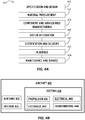
- aircraft manufacturing and service method 400 shown in FIG. 4A and an aircraft 430 shown in FIG. 4B will now be described to better illustrate various features of structural bonds presented herein.
- aircraft manufacturing and service method 400 may include specification and design 402 of aircraft 430 and material procurement 404.
- the production phase involves component and subassembly manufacturing 406 and system integration 408 of aircraft 430.
- aircraft 430 may go through certification and delivery 410 in order to be placed in service 412.
- routine maintenance and service 414 which may also include modification, reconfiguration, refurbishment, and so on. While the examples described herein relate generally to servicing of commercial aircraft, they may be practiced at other stages of the aircraft manufacturing and service method 400.
- Each of the processes of aircraft manufacturing and service method 400 may be performed or carried out by a system integrator, a third party, and/or an operator (e.g., a customer).
- a system integrator may include, without limitation, any number of aircraft manufacturers and major-system subcontractors
- a third party may include, for example, without limitation, any number of venders, subcontractors, and suppliers
- an operator may be an airline, leasing company, military entity, service organization, and so on.
- aircraft 430 produced by aircraft manufacturing and service method 400 may include airframe 432, interior 436, and multiple systems 434 and interior 436.
- systems 434 include one or more of propulsion system 438, electrical system 440, hydraulic system 442, and environmental system 444. Any number of other systems may be included in this example.
- Apparatus and methods embodied herein may be employed during any one or more of the stages of aircraft manufacturing and service method 400.
- components or subassemblies corresponding to component and subassembly manufacturing 406 may be fabricated or manufactured in a manner similar to components or subassemblies produced while aircraft 430 is in service.
- one or more apparatus examples, method examples, or a combination thereof may be utilized during component and subassembly manufacturing 406 and system integration 408, for example, without limitation, by substantially expediting assembly of or reducing the cost of aircraft 430.
- one or more of apparatus examples, method examples, or a combination thereof may be utilized while aircraft 430 is in service, for example, without limitation, to maintenance and service 414 may be used during system integration 408 and/or maintenance and service 414 to determine whether parts may be connected and/or mated to each other.
- the present methods can be used for forming corrosion protection layers for preventing or reducing corrosion for any corrodible metal.
- the methods and compositions are useful on steel and aluminum alloys, and on aluminum/copper alloys.
- the aluminum/copper alloys are those that comprise at least 1% by weight copper, such as aluminum/copper alloys that contain at least 4% by weight copper, for example, copper-containing aluminum alloys AA2024 and AA7075.
- First and second corrosion protection layers were prepared on AmChem 6-16 deoxidized Alclad 7075 T6 substrate panels and on AmChem 6-16 deoxidized bare 2024 T3 substrate panels.
- the first corrosion inhibiting coating was formed from a sol-gel surface composition comprising AC-131 and the second corrosion inhibiting coating was formed from JETFLEX® (available from Sherwin-Williams) polyurethane primer.
- One or both of the AC-131 and JETFLEX® compositions included one or more corrosion inhibitor material (e.g., VANLUBE® 829, WAYNCOR® 204, INHIBICOR® 1000, DMCT, SAPP).
- first and second corrosion protection layers dispersions of the corrosion inhibitor material in AC-131 sol-gel solution and in the JETFLEX® polyurethane primer composition, respectively, were prepared by mixing with 2mm glass beads in a planetary mixer (available from Thinky USA, Inc.) for 20 minutes at 750 rpm.
- the first corrosion protection layer was prepared at 4 different concentrations (0.5 wt%, 1 wt%, 2 wt% and 3 wt%) of dry VANLUBE® 829.
- other corrosion inhibitor materials were included.
- the second corrosion protection layer was prepared with VANLUBE® 829, WAYNCOR® 204 or INHIBICOR® 1000 samples, with each loaded into volumes of fully mixed polyurethane primer at, for example, 20 PVC and 24 PVC levels.
- DMCT corrosion inhibitor appeared to react with the AC-131 solution and, while not limited to any particular theory, is believed to be a result of reaction with epoxy functional groups. For example, clumps of yellow material were observed on the surface of the AC-131 solution. No observable reaction products were noticed for the dispersion of DMCT in the JETFLEX® polyurethane primer composition or during spray application onto the panel substrates.
- First and second corrosion protection layers were formed on sample substrate panels as described above.
- the coated panels were dry tape adhesion tested (BSS7225 Type 1, Class 5, 45 degree cross-hatch) and wet tape adhesion tested (BSS7225 Type III, Class 5).
- the samples for the wet tape adhesion tests were conditioned for five days in 64 degrees C de-ionized (DI) water prior to testing. Tape adhesion testing of the samples was performed after the 5 days of hot water conditioning.
- DI de-ionized
- Table 1 below shows the results of dry and wet tape adhesion tests performed on sample panels with various combinations of one or more inhibitors in the first and/or second protection layers. Each of the tests for dry and wet tape adhesion were rated with a score of from 1 to 10. Relative amount of blistering, if any, were noted if observed. All samples containing the mixture of Vanlube 829 and the SAPP inhibitor demonstrated poor wet adhesion and a tendency to blister. All samples with DMCT in the primer also had poor wet tape adhesion and developed blisters during 65 degrees C DI H 2 O conditioning. In contrast, samples containing Vanlube 829, Wayncor 204 or Inhibicor 1000 did not blister and had perfect dry and wet tape adhesion test scores.
- First and Second corrosion protection layers were formed on sample panels as described above.
- the samples were prepared for filiform testing and for scribed neutral salt spray exposures.
- the samples were evaluated through approximately 500 hours of testing under conditions set forth in the standard, ASTM D2803 - 09(2015).
- a control substrate was prepared with sol-gel surface treatment compositions (e.g., AC-131 solution) as a first layer and polyurethane primer (e.g., JetFlex) to form a second layer, each layer without corrosion inhibitor. Results are shown in Table 2 below.
- Salt-Spray Testing Samples were assessed under neutral salt spray for 528 hours of total exposure time under conditions set forth in the standard, ASTM B117-16. A value was assigned to indicate the presence or absence of visual features indicating corrosion on the neutral salt spray samples. In contrast to the filiform testing samples, improved corrosion protection relative to the control sample was observed from samples that contained the same inhibitor in both the AC-131 layer and the primer. Notably poor performing inhibitors in neutral salt spray exposures on deoxidized bare 2024 T3 panels were DMCT, SAPP and mixtures of VANLUBE® 829 with SAPP added to the AC-131 coating.
- Samples were ranked based on the results of neutral salt spray testing.
- the best performing samples included those having combinations of different corrosion inhibitors rather than the same inhibitor across both the first corrosion protection layer (e.g., AC-131 coating) and the second corrosion protection layer (e.g., polyurethane primer).
- first corrosion protection layer e.g., AC-131 coating
- second corrosion protection layer e.g., polyurethane primer
- one or more of the acts depicted herein may be carried out in one or more separate acts and/or phases.
- the terms “including,” “includes,” “having,” “has,” “with,” or variants thereof are used in either the detailed description and the claims, such terms are intended to be inclusive in a manner similar to the term “comprising.”
- the term “at least one of” is used to mean one or more of the listed items may be selected.
- the term “on” used with respect to two materials, one “on” the other means at least some contact between the materials, while “over” means the materials are in proximity, but possibly with one or more additional intervening materials such that contact is possible but not required.
Landscapes
- Chemical & Material Sciences (AREA)
- Engineering & Computer Science (AREA)
- Materials Engineering (AREA)
- Organic Chemistry (AREA)
- Metallurgy (AREA)
- Mechanical Engineering (AREA)
- Inorganic Chemistry (AREA)
- Thermal Sciences (AREA)
- Physics & Mathematics (AREA)
- General Chemical & Material Sciences (AREA)
- Chemical Kinetics & Catalysis (AREA)
- Wood Science & Technology (AREA)
- Life Sciences & Earth Sciences (AREA)
- Ceramic Engineering (AREA)
- Nanotechnology (AREA)
- Dispersion Chemistry (AREA)
- Paints Or Removers (AREA)
- Laminated Bodies (AREA)
- Preventing Corrosion Or Incrustation Of Metals (AREA)
- Application Of Or Painting With Fluid Materials (AREA)
- Chemical Treatment Of Metals (AREA)
Applications Claiming Priority (2)
| Application Number | Priority Date | Filing Date | Title |
|---|---|---|---|
| US15/274,456 US20180087162A1 (en) | 2016-09-23 | 2016-09-23 | Corrosion resistant surface treatment and primer system for aluminum aircraft using chromium-free inhibitors |
| EP17192603.3A EP3299491B1 (fr) | 2016-09-23 | 2017-09-22 | Traitement de surface résistant à la corrosion et système d'amorce pour aéronef en aluminium à l'aide d'inhibiteurs exempts de chrome |
Related Parent Applications (1)
| Application Number | Title | Priority Date | Filing Date |
|---|---|---|---|
| EP17192603.3A Division EP3299491B1 (fr) | 2016-09-23 | 2017-09-22 | Traitement de surface résistant à la corrosion et système d'amorce pour aéronef en aluminium à l'aide d'inhibiteurs exempts de chrome |
Publications (3)
| Publication Number | Publication Date |
|---|---|
| EP3636800A2 true EP3636800A2 (fr) | 2020-04-15 |
| EP3636800A3 EP3636800A3 (fr) | 2020-06-10 |
| EP3636800B1 EP3636800B1 (fr) | 2024-03-20 |
Family
ID=60083082
Family Applications (2)
| Application Number | Title | Priority Date | Filing Date |
|---|---|---|---|
| EP17192603.3A Active EP3299491B1 (fr) | 2016-09-23 | 2017-09-22 | Traitement de surface résistant à la corrosion et système d'amorce pour aéronef en aluminium à l'aide d'inhibiteurs exempts de chrome |
| EP19213692.7A Active EP3636800B1 (fr) | 2016-09-23 | 2017-09-22 | Traitement de surface résistant à la corrosion et système d'amorce pour aéronef en aluminium à l'aide d'inhibiteurs exempts de chrome |
Family Applications Before (1)
| Application Number | Title | Priority Date | Filing Date |
|---|---|---|---|
| EP17192603.3A Active EP3299491B1 (fr) | 2016-09-23 | 2017-09-22 | Traitement de surface résistant à la corrosion et système d'amorce pour aéronef en aluminium à l'aide d'inhibiteurs exempts de chrome |
Country Status (5)
| Country | Link |
|---|---|
| US (1) | US20180087162A1 (fr) |
| EP (2) | EP3299491B1 (fr) |
| CN (1) | CN107868597B (fr) |
| BR (1) | BR102017020318B1 (fr) |
| CA (2) | CA2979673C (fr) |
Families Citing this family (3)
| Publication number | Priority date | Publication date | Assignee | Title |
|---|---|---|---|---|
| WO2022169765A1 (fr) * | 2021-02-04 | 2022-08-11 | Bps Just Energy Technology, Llc | Compositions et procédés anticorrosion à structures supramoléculaires |
| US11932949B2 (en) * | 2021-08-31 | 2024-03-19 | The Boeing Company | Corrosion resistant coating systems |
| US20230357592A1 (en) * | 2022-05-06 | 2023-11-09 | The Boeing Company | Corrosion resistant adhesive sol-gel |
Family Cites Families (18)
| Publication number | Priority date | Publication date | Assignee | Title |
|---|---|---|---|---|
| WO1999018044A1 (fr) * | 1997-10-02 | 1999-04-15 | Wayne Pigment Corp. | Procedes et compositions pigmentaires hybrides anticorrosion |
| US5958578A (en) * | 1996-11-04 | 1999-09-28 | The Boeing Company | Hybrid laminate having improved metal-to-resin adhesion |
| US6623908B2 (en) * | 2001-03-28 | 2003-09-23 | Eastman Kodak Company | Thermal imaging composition and imaging member containing polymethine IR dye and methods of imaging and printing |
| US20020197468A1 (en) * | 2001-05-04 | 2002-12-26 | Wayne Pigment Corporation | Corrosion inhibitor composition applicable for aluminum and steel protection and procedure |
| US7601425B2 (en) * | 2003-03-07 | 2009-10-13 | The Curators Of The University Of Missouri | Corrosion resistant coatings containing carbon |
| DE102006003956A1 (de) * | 2006-01-26 | 2007-08-02 | Degussa Gmbh | Korrossionsschutzschicht auf Metalloberflächen |
| US20080317962A1 (en) * | 2007-03-05 | 2008-12-25 | Scott Hayes | Multi-layer and composite corrosion resistant coatings |
| JP2010521582A (ja) * | 2007-03-05 | 2010-06-24 | クロスリンク | 耐腐食性有機陰イオンの改質金属塩を有する耐腐食性コーティング |
| DE102009005105B4 (de) * | 2009-01-19 | 2015-12-31 | Airbus Defence and Space GmbH | Korrosionshemmende Zusammensetzung für Aluminium- und Magnesiumlegierungen und ihre Verwendung, Verfahren zum Korrosionsschutz sowie korrosionsbeständiges Substrat |
| US8628689B2 (en) * | 2009-04-03 | 2014-01-14 | Akzo Nobel Coatings International B.V. | Anti-corrosive coating composition |
| FR2946664B1 (fr) * | 2009-06-15 | 2011-07-29 | Eads Europ Aeronautic Defence | Particules ceramiques et compositions de revetement comprenant lesdites particules |
| WO2012162056A1 (fr) * | 2011-05-24 | 2012-11-29 | The Sherwin-Williams Company | Système de revêtement comprenant une résine hautement acide |
| GB2508434B (en) * | 2012-12-03 | 2015-08-05 | Univ Sheffield Hallam | Sol-Gel derived coating to inhibit biofouling and corrosion at a substrate |
| US9771483B2 (en) * | 2013-04-19 | 2017-09-26 | The Boeing Company | Systems, compositions, and methods for corrosion inhibition |
| US9845418B2 (en) * | 2013-11-08 | 2017-12-19 | Hrl Laboratories, Llc | Transparent anti-icing coatings |
| US9562000B2 (en) * | 2014-02-14 | 2017-02-07 | Prc-Desoto International, Inc. | Amino alcohol treatment for sol-gel conversion coatings, substrates including the same, and methods of making the substrates |
| US10508203B2 (en) * | 2014-09-26 | 2019-12-17 | The Boeing Company | Compositions and coatings with non-chrome corrosion inhibitor particles |
| US10167394B2 (en) * | 2014-11-26 | 2019-01-01 | The Boeing Company | Corrosion-inhibiting sol-gel coating systems and methods |
-
2016
- 2016-09-23 US US15/274,456 patent/US20180087162A1/en active Pending
-
2017
- 2017-09-18 CA CA2979673A patent/CA2979673C/fr active Active
- 2017-09-18 CA CA3177373A patent/CA3177373A1/fr active Pending
- 2017-09-22 EP EP17192603.3A patent/EP3299491B1/fr active Active
- 2017-09-22 EP EP19213692.7A patent/EP3636800B1/fr active Active
- 2017-09-22 BR BR102017020318-2A patent/BR102017020318B1/pt active IP Right Grant
- 2017-09-25 CN CN201710872093.0A patent/CN107868597B/zh active Active
Also Published As
| Publication number | Publication date |
|---|---|
| CA2979673C (fr) | 2024-04-23 |
| EP3636800A3 (fr) | 2020-06-10 |
| CN107868597B (zh) | 2021-09-03 |
| US20180087162A1 (en) | 2018-03-29 |
| CA2979673A1 (fr) | 2018-03-23 |
| EP3299491A2 (fr) | 2018-03-28 |
| CA3177373A1 (fr) | 2018-03-23 |
| CN107868597A (zh) | 2018-04-03 |
| BR102017020318B1 (pt) | 2022-12-06 |
| BR102017020318A2 (pt) | 2018-05-02 |
| EP3636800B1 (fr) | 2024-03-20 |
| EP3299491A3 (fr) | 2018-06-27 |
| EP3299491B1 (fr) | 2019-12-11 |
Similar Documents
| Publication | Publication Date | Title |
|---|---|---|
| AU2013251173B2 (en) | Process for coating metallic surfaces with coating compositions containing particles of a layered double hydroxide | |
| KR101595669B1 (ko) | 수산화 마그네슘을 포함하는 코팅 조성물 및 관련된 코팅된 기재 | |
| AU2005303936B2 (en) | Method for the coating of metallic surfaces with an aqueous composition comprising silanes silanols siloxanes and polysiloxanes and said composition | |
| US6579472B2 (en) | Corrosion inhibiting sol-gel coatings for metal alloys | |
| KR101433488B1 (ko) | 아연계 도금 강판 | |
| EP3031950B1 (fr) | Systèmes et procédés de revêtement sol-gel anti-corrosion | |
| US12509589B2 (en) | Corrosion resistant adhesive sol-gel | |
| JP4683582B2 (ja) | 水系金属材料表面処理剤、表面処理方法及び表面処理金属材料 | |
| JP5554531B2 (ja) | 金属材料の塗装方法 | |
| KR102376587B1 (ko) | 아연 도금 강재용의 금속 표면 처리제, 피복 방법 및 피복 강재 | |
| US20080138615A1 (en) | Method for Coating Metallic Surfaces with an Aqueous Composition and Said Composition | |
| EP3299491B1 (fr) | Traitement de surface résistant à la corrosion et système d'amorce pour aéronef en aluminium à l'aide d'inhibiteurs exempts de chrome | |
| CN105164313A (zh) | 金属表面处理剂及金属表面处理方法 | |
| US11072712B2 (en) | Corrosion resistant sol-gel coating and composition and process for making the same | |
| EP2037003A1 (fr) | Tôle d'acier à revêtement | |
| CN101925414A (zh) | 弯曲加工性优良的涂装钢材 | |
| EP4524180A1 (fr) | Sol-gel résistant à la température | |
| TW202521492A (zh) | 塗裝金屬板 | |
| JP2011137221A (ja) | 金属表面処理用組成物、及び表面処理皮膜を有する金属基材 | |
| HK1194411B (en) | Coating compositions including magnesium hydroxide and related coated substrates |
Legal Events
| Date | Code | Title | Description |
|---|---|---|---|
| PUAI | Public reference made under article 153(3) epc to a published international application that has entered the european phase |
Free format text: ORIGINAL CODE: 0009012 |
|
| STAA | Information on the status of an ep patent application or granted ep patent |
Free format text: STATUS: THE APPLICATION HAS BEEN PUBLISHED |
|
| AC | Divisional application: reference to earlier application |
Ref document number: 3299491 Country of ref document: EP Kind code of ref document: P |
|
| AK | Designated contracting states |
Kind code of ref document: A2 Designated state(s): AL AT BE BG CH CY CZ DE DK EE ES FI FR GB GR HR HU IE IS IT LI LT LU LV MC MK MT NL NO PL PT RO RS SE SI SK SM TR |
|
| PUAL | Search report despatched |
Free format text: ORIGINAL CODE: 0009013 |
|
| AK | Designated contracting states |
Kind code of ref document: A3 Designated state(s): AL AT BE BG CH CY CZ DE DK EE ES FI FR GB GR HR HU IE IS IT LI LT LU LV MC MK MT NL NO PL PT RO RS SE SI SK SM TR |
|
| RIC1 | Information provided on ipc code assigned before grant |
Ipc: C23F 11/18 20060101ALI20200507BHEP Ipc: C23F 11/00 20060101ALI20200507BHEP Ipc: C09D 5/08 20060101ALI20200507BHEP Ipc: C23F 11/16 20060101ALI20200507BHEP Ipc: C08K 5/37 20060101ALN20200507BHEP Ipc: C23C 18/12 20060101AFI20200507BHEP Ipc: C09D 7/63 20180101ALI20200507BHEP |
|
| STAA | Information on the status of an ep patent application or granted ep patent |
Free format text: STATUS: REQUEST FOR EXAMINATION WAS MADE |
|
| 17P | Request for examination filed |
Effective date: 20201204 |
|
| RBV | Designated contracting states (corrected) |
Designated state(s): AL AT BE BG CH CY CZ DE DK EE ES FI FR GB GR HR HU IE IS IT LI LT LU LV MC MK MT NL NO PL PT RO RS SE SI SK SM TR |
|
| STAA | Information on the status of an ep patent application or granted ep patent |
Free format text: STATUS: EXAMINATION IS IN PROGRESS |
|
| 17Q | First examination report despatched |
Effective date: 20210518 |
|
| RAP3 | Party data changed (applicant data changed or rights of an application transferred) |
Owner name: THE BOEING COMPANY |
|
| RIC1 | Information provided on ipc code assigned before grant |
Ipc: C08K 5/37 20060101ALN20230323BHEP Ipc: C09D 175/04 20060101ALI20230323BHEP Ipc: C23F 11/16 20060101ALI20230323BHEP Ipc: C23F 11/18 20060101ALI20230323BHEP Ipc: C09D 7/63 20180101ALI20230323BHEP Ipc: C09D 5/08 20060101ALI20230323BHEP Ipc: C23F 11/00 20060101ALI20230323BHEP Ipc: C23C 18/12 20060101AFI20230323BHEP |
|
| GRAP | Despatch of communication of intention to grant a patent |
Free format text: ORIGINAL CODE: EPIDOSNIGR1 |
|
| STAA | Information on the status of an ep patent application or granted ep patent |
Free format text: STATUS: GRANT OF PATENT IS INTENDED |
|
| RIC1 | Information provided on ipc code assigned before grant |
Ipc: C08K 5/37 20060101ALN20230417BHEP Ipc: C09D 175/04 20060101ALI20230417BHEP Ipc: C23F 11/16 20060101ALI20230417BHEP Ipc: C23F 11/18 20060101ALI20230417BHEP Ipc: C09D 7/63 20180101ALI20230417BHEP Ipc: C09D 5/08 20060101ALI20230417BHEP Ipc: C23F 11/00 20060101ALI20230417BHEP Ipc: C23C 18/12 20060101AFI20230417BHEP |
|
| RIC1 | Information provided on ipc code assigned before grant |
Ipc: C08K 5/37 20060101ALN20230511BHEP Ipc: C09D 175/04 20060101ALI20230511BHEP Ipc: C23F 11/16 20060101ALI20230511BHEP Ipc: C23F 11/18 20060101ALI20230511BHEP Ipc: C09D 7/63 20180101ALI20230511BHEP Ipc: C09D 5/08 20060101ALI20230511BHEP Ipc: C23F 11/00 20060101ALI20230511BHEP Ipc: C23C 18/12 20060101AFI20230511BHEP |
|
| INTG | Intention to grant announced |
Effective date: 20230524 |
|
| P01 | Opt-out of the competence of the unified patent court (upc) registered |
Effective date: 20230808 |
|
| GRAJ | Information related to disapproval of communication of intention to grant by the applicant or resumption of examination proceedings by the epo deleted |
Free format text: ORIGINAL CODE: EPIDOSDIGR1 |
|
| STAA | Information on the status of an ep patent application or granted ep patent |
Free format text: STATUS: EXAMINATION IS IN PROGRESS |
|
| GRAP | Despatch of communication of intention to grant a patent |
Free format text: ORIGINAL CODE: EPIDOSNIGR1 |
|
| STAA | Information on the status of an ep patent application or granted ep patent |
Free format text: STATUS: GRANT OF PATENT IS INTENDED |
|
| INTC | Intention to grant announced (deleted) | ||
| RIC1 | Information provided on ipc code assigned before grant |
Ipc: C08K 5/37 20060101ALN20230920BHEP Ipc: C09D 175/04 20060101ALI20230920BHEP Ipc: C23F 11/16 20060101ALI20230920BHEP Ipc: C23F 11/18 20060101ALI20230920BHEP Ipc: C09D 7/63 20180101ALI20230920BHEP Ipc: C09D 5/08 20060101ALI20230920BHEP Ipc: C23F 11/00 20060101ALI20230920BHEP Ipc: C23C 18/12 20060101AFI20230920BHEP |
|
| INTG | Intention to grant announced |
Effective date: 20231018 |
|
| GRAS | Grant fee paid |
Free format text: ORIGINAL CODE: EPIDOSNIGR3 |
|
| GRAA | (expected) grant |
Free format text: ORIGINAL CODE: 0009210 |
|
| STAA | Information on the status of an ep patent application or granted ep patent |
Free format text: STATUS: THE PATENT HAS BEEN GRANTED |
|
| AC | Divisional application: reference to earlier application |
Ref document number: 3299491 Country of ref document: EP Kind code of ref document: P |
|
| AK | Designated contracting states |
Kind code of ref document: B1 Designated state(s): AL AT BE BG CH CY CZ DE DK EE ES FI FR GB GR HR HU IE IS IT LI LT LU LV MC MK MT NL NO PL PT RO RS SE SI SK SM TR |
|
| REG | Reference to a national code |
Ref country code: GB Ref legal event code: FG4D |
|
| REG | Reference to a national code |
Ref country code: CH Ref legal event code: EP |
|
| REG | Reference to a national code |
Ref country code: DE Ref legal event code: R096 Ref document number: 602017080302 Country of ref document: DE |
|
| REG | Reference to a national code |
Ref country code: IE Ref legal event code: FG4D |
|
| PG25 | Lapsed in a contracting state [announced via postgrant information from national office to epo] |
Ref country code: LT Free format text: LAPSE BECAUSE OF FAILURE TO SUBMIT A TRANSLATION OF THE DESCRIPTION OR TO PAY THE FEE WITHIN THE PRESCRIBED TIME-LIMIT Effective date: 20240320 |
|
| REG | Reference to a national code |
Ref country code: LT Ref legal event code: MG9D |
|
| PG25 | Lapsed in a contracting state [announced via postgrant information from national office to epo] |
Ref country code: GR Free format text: LAPSE BECAUSE OF FAILURE TO SUBMIT A TRANSLATION OF THE DESCRIPTION OR TO PAY THE FEE WITHIN THE PRESCRIBED TIME-LIMIT Effective date: 20240621 |
|
| PG25 | Lapsed in a contracting state [announced via postgrant information from national office to epo] |
Ref country code: RS Free format text: LAPSE BECAUSE OF FAILURE TO SUBMIT A TRANSLATION OF THE DESCRIPTION OR TO PAY THE FEE WITHIN THE PRESCRIBED TIME-LIMIT Effective date: 20240620 Ref country code: HR Free format text: LAPSE BECAUSE OF FAILURE TO SUBMIT A TRANSLATION OF THE DESCRIPTION OR TO PAY THE FEE WITHIN THE PRESCRIBED TIME-LIMIT Effective date: 20240320 |
|
| REG | Reference to a national code |
Ref country code: NL Ref legal event code: MP Effective date: 20240320 |
|
| PG25 | Lapsed in a contracting state [announced via postgrant information from national office to epo] |
Ref country code: RS Free format text: LAPSE BECAUSE OF FAILURE TO SUBMIT A TRANSLATION OF THE DESCRIPTION OR TO PAY THE FEE WITHIN THE PRESCRIBED TIME-LIMIT Effective date: 20240620 Ref country code: NO Free format text: LAPSE BECAUSE OF FAILURE TO SUBMIT A TRANSLATION OF THE DESCRIPTION OR TO PAY THE FEE WITHIN THE PRESCRIBED TIME-LIMIT Effective date: 20240620 Ref country code: LT Free format text: LAPSE BECAUSE OF FAILURE TO SUBMIT A TRANSLATION OF THE DESCRIPTION OR TO PAY THE FEE WITHIN THE PRESCRIBED TIME-LIMIT Effective date: 20240320 Ref country code: HR Free format text: LAPSE BECAUSE OF FAILURE TO SUBMIT A TRANSLATION OF THE DESCRIPTION OR TO PAY THE FEE WITHIN THE PRESCRIBED TIME-LIMIT Effective date: 20240320 Ref country code: GR Free format text: LAPSE BECAUSE OF FAILURE TO SUBMIT A TRANSLATION OF THE DESCRIPTION OR TO PAY THE FEE WITHIN THE PRESCRIBED TIME-LIMIT Effective date: 20240621 Ref country code: FI Free format text: LAPSE BECAUSE OF FAILURE TO SUBMIT A TRANSLATION OF THE DESCRIPTION OR TO PAY THE FEE WITHIN THE PRESCRIBED TIME-LIMIT Effective date: 20240320 Ref country code: BG Free format text: LAPSE BECAUSE OF FAILURE TO SUBMIT A TRANSLATION OF THE DESCRIPTION OR TO PAY THE FEE WITHIN THE PRESCRIBED TIME-LIMIT Effective date: 20240320 |
|
| REG | Reference to a national code |
Ref country code: AT Ref legal event code: MK05 Ref document number: 1667896 Country of ref document: AT Kind code of ref document: T Effective date: 20240320 |
|
| PG25 | Lapsed in a contracting state [announced via postgrant information from national office to epo] |
Ref country code: SE Free format text: LAPSE BECAUSE OF FAILURE TO SUBMIT A TRANSLATION OF THE DESCRIPTION OR TO PAY THE FEE WITHIN THE PRESCRIBED TIME-LIMIT Effective date: 20240320 Ref country code: LV Free format text: LAPSE BECAUSE OF FAILURE TO SUBMIT A TRANSLATION OF THE DESCRIPTION OR TO PAY THE FEE WITHIN THE PRESCRIBED TIME-LIMIT Effective date: 20240320 |
|
| PG25 | Lapsed in a contracting state [announced via postgrant information from national office to epo] |
Ref country code: NL Free format text: LAPSE BECAUSE OF FAILURE TO SUBMIT A TRANSLATION OF THE DESCRIPTION OR TO PAY THE FEE WITHIN THE PRESCRIBED TIME-LIMIT Effective date: 20240320 |
|
| PG25 | Lapsed in a contracting state [announced via postgrant information from national office to epo] |
Ref country code: NL Free format text: LAPSE BECAUSE OF FAILURE TO SUBMIT A TRANSLATION OF THE DESCRIPTION OR TO PAY THE FEE WITHIN THE PRESCRIBED TIME-LIMIT Effective date: 20240320 |
|
| PG25 | Lapsed in a contracting state [announced via postgrant information from national office to epo] |
Ref country code: IS Free format text: LAPSE BECAUSE OF FAILURE TO SUBMIT A TRANSLATION OF THE DESCRIPTION OR TO PAY THE FEE WITHIN THE PRESCRIBED TIME-LIMIT Effective date: 20240720 |
|
| PG25 | Lapsed in a contracting state [announced via postgrant information from national office to epo] |
Ref country code: SM Free format text: LAPSE BECAUSE OF FAILURE TO SUBMIT A TRANSLATION OF THE DESCRIPTION OR TO PAY THE FEE WITHIN THE PRESCRIBED TIME-LIMIT Effective date: 20240320 Ref country code: PT Free format text: LAPSE BECAUSE OF FAILURE TO SUBMIT A TRANSLATION OF THE DESCRIPTION OR TO PAY THE FEE WITHIN THE PRESCRIBED TIME-LIMIT Effective date: 20240722 |
|
| PG25 | Lapsed in a contracting state [announced via postgrant information from national office to epo] |
Ref country code: ES Free format text: LAPSE BECAUSE OF FAILURE TO SUBMIT A TRANSLATION OF THE DESCRIPTION OR TO PAY THE FEE WITHIN THE PRESCRIBED TIME-LIMIT Effective date: 20240320 |
|
| PG25 | Lapsed in a contracting state [announced via postgrant information from national office to epo] |
Ref country code: EE Free format text: LAPSE BECAUSE OF FAILURE TO SUBMIT A TRANSLATION OF THE DESCRIPTION OR TO PAY THE FEE WITHIN THE PRESCRIBED TIME-LIMIT Effective date: 20240320 Ref country code: CZ Free format text: LAPSE BECAUSE OF FAILURE TO SUBMIT A TRANSLATION OF THE DESCRIPTION OR TO PAY THE FEE WITHIN THE PRESCRIBED TIME-LIMIT Effective date: 20240320 |
|
| PG25 | Lapsed in a contracting state [announced via postgrant information from national office to epo] |
Ref country code: AT Free format text: LAPSE BECAUSE OF FAILURE TO SUBMIT A TRANSLATION OF THE DESCRIPTION OR TO PAY THE FEE WITHIN THE PRESCRIBED TIME-LIMIT Effective date: 20240320 |
|
| PG25 | Lapsed in a contracting state [announced via postgrant information from national office to epo] |
Ref country code: PL Free format text: LAPSE BECAUSE OF FAILURE TO SUBMIT A TRANSLATION OF THE DESCRIPTION OR TO PAY THE FEE WITHIN THE PRESCRIBED TIME-LIMIT Effective date: 20240320 |
|
| PG25 | Lapsed in a contracting state [announced via postgrant information from national office to epo] |
Ref country code: SK Free format text: LAPSE BECAUSE OF FAILURE TO SUBMIT A TRANSLATION OF THE DESCRIPTION OR TO PAY THE FEE WITHIN THE PRESCRIBED TIME-LIMIT Effective date: 20240320 |
|
| PG25 | Lapsed in a contracting state [announced via postgrant information from national office to epo] |
Ref country code: SM Free format text: LAPSE BECAUSE OF FAILURE TO SUBMIT A TRANSLATION OF THE DESCRIPTION OR TO PAY THE FEE WITHIN THE PRESCRIBED TIME-LIMIT Effective date: 20240320 Ref country code: SK Free format text: LAPSE BECAUSE OF FAILURE TO SUBMIT A TRANSLATION OF THE DESCRIPTION OR TO PAY THE FEE WITHIN THE PRESCRIBED TIME-LIMIT Effective date: 20240320 Ref country code: RO Free format text: LAPSE BECAUSE OF FAILURE TO SUBMIT A TRANSLATION OF THE DESCRIPTION OR TO PAY THE FEE WITHIN THE PRESCRIBED TIME-LIMIT Effective date: 20240320 Ref country code: PT Free format text: LAPSE BECAUSE OF FAILURE TO SUBMIT A TRANSLATION OF THE DESCRIPTION OR TO PAY THE FEE WITHIN THE PRESCRIBED TIME-LIMIT Effective date: 20240722 Ref country code: PL Free format text: LAPSE BECAUSE OF FAILURE TO SUBMIT A TRANSLATION OF THE DESCRIPTION OR TO PAY THE FEE WITHIN THE PRESCRIBED TIME-LIMIT Effective date: 20240320 Ref country code: IS Free format text: LAPSE BECAUSE OF FAILURE TO SUBMIT A TRANSLATION OF THE DESCRIPTION OR TO PAY THE FEE WITHIN THE PRESCRIBED TIME-LIMIT Effective date: 20240720 Ref country code: ES Free format text: LAPSE BECAUSE OF FAILURE TO SUBMIT A TRANSLATION OF THE DESCRIPTION OR TO PAY THE FEE WITHIN THE PRESCRIBED TIME-LIMIT Effective date: 20240320 Ref country code: EE Free format text: LAPSE BECAUSE OF FAILURE TO SUBMIT A TRANSLATION OF THE DESCRIPTION OR TO PAY THE FEE WITHIN THE PRESCRIBED TIME-LIMIT Effective date: 20240320 Ref country code: CZ Free format text: LAPSE BECAUSE OF FAILURE TO SUBMIT A TRANSLATION OF THE DESCRIPTION OR TO PAY THE FEE WITHIN THE PRESCRIBED TIME-LIMIT Effective date: 20240320 Ref country code: AT Free format text: LAPSE BECAUSE OF FAILURE TO SUBMIT A TRANSLATION OF THE DESCRIPTION OR TO PAY THE FEE WITHIN THE PRESCRIBED TIME-LIMIT Effective date: 20240320 |
|
| PG25 | Lapsed in a contracting state [announced via postgrant information from national office to epo] |
Ref country code: IT Free format text: LAPSE BECAUSE OF FAILURE TO SUBMIT A TRANSLATION OF THE DESCRIPTION OR TO PAY THE FEE WITHIN THE PRESCRIBED TIME-LIMIT Effective date: 20240320 |
|
| REG | Reference to a national code |
Ref country code: DE Ref legal event code: R097 Ref document number: 602017080302 Country of ref document: DE |
|
| PG25 | Lapsed in a contracting state [announced via postgrant information from national office to epo] |
Ref country code: IT Free format text: LAPSE BECAUSE OF FAILURE TO SUBMIT A TRANSLATION OF THE DESCRIPTION OR TO PAY THE FEE WITHIN THE PRESCRIBED TIME-LIMIT Effective date: 20240320 |
|
| PG25 | Lapsed in a contracting state [announced via postgrant information from national office to epo] |
Ref country code: DK Free format text: LAPSE BECAUSE OF FAILURE TO SUBMIT A TRANSLATION OF THE DESCRIPTION OR TO PAY THE FEE WITHIN THE PRESCRIBED TIME-LIMIT Effective date: 20240320 |
|
| PLBE | No opposition filed within time limit |
Free format text: ORIGINAL CODE: 0009261 |
|
| STAA | Information on the status of an ep patent application or granted ep patent |
Free format text: STATUS: NO OPPOSITION FILED WITHIN TIME LIMIT |
|
| PG25 | Lapsed in a contracting state [announced via postgrant information from national office to epo] |
Ref country code: DK Free format text: LAPSE BECAUSE OF FAILURE TO SUBMIT A TRANSLATION OF THE DESCRIPTION OR TO PAY THE FEE WITHIN THE PRESCRIBED TIME-LIMIT Effective date: 20240320 |
|
| 26N | No opposition filed |
Effective date: 20241223 |
|
| PG25 | Lapsed in a contracting state [announced via postgrant information from national office to epo] |
Ref country code: SI Free format text: LAPSE BECAUSE OF FAILURE TO SUBMIT A TRANSLATION OF THE DESCRIPTION OR TO PAY THE FEE WITHIN THE PRESCRIBED TIME-LIMIT Effective date: 20240320 Ref country code: MC Free format text: LAPSE BECAUSE OF FAILURE TO SUBMIT A TRANSLATION OF THE DESCRIPTION OR TO PAY THE FEE WITHIN THE PRESCRIBED TIME-LIMIT Effective date: 20240320 |
|
| REG | Reference to a national code |
Ref country code: CH Ref legal event code: PL |
|
| PG25 | Lapsed in a contracting state [announced via postgrant information from national office to epo] |
Ref country code: LU Free format text: LAPSE BECAUSE OF NON-PAYMENT OF DUE FEES Effective date: 20240922 |
|
| REG | Reference to a national code |
Ref country code: BE Ref legal event code: MM Effective date: 20240930 |
|
| PG25 | Lapsed in a contracting state [announced via postgrant information from national office to epo] |
Ref country code: BE Free format text: LAPSE BECAUSE OF NON-PAYMENT OF DUE FEES Effective date: 20240930 |
|
| PG25 | Lapsed in a contracting state [announced via postgrant information from national office to epo] |
Ref country code: CH Free format text: LAPSE BECAUSE OF NON-PAYMENT OF DUE FEES Effective date: 20240930 |
|
| PG25 | Lapsed in a contracting state [announced via postgrant information from national office to epo] |
Ref country code: IE Free format text: LAPSE BECAUSE OF NON-PAYMENT OF DUE FEES Effective date: 20240922 |
|
| PGFP | Annual fee paid to national office [announced via postgrant information from national office to epo] |
Ref country code: DE Payment date: 20250929 Year of fee payment: 9 |
|
| PGFP | Annual fee paid to national office [announced via postgrant information from national office to epo] |
Ref country code: GB Payment date: 20250929 Year of fee payment: 9 |
|
| PGFP | Annual fee paid to national office [announced via postgrant information from national office to epo] |
Ref country code: FR Payment date: 20250925 Year of fee payment: 9 |
|
| PG25 | Lapsed in a contracting state [announced via postgrant information from national office to epo] |
Ref country code: CY Free format text: LAPSE BECAUSE OF FAILURE TO SUBMIT A TRANSLATION OF THE DESCRIPTION OR TO PAY THE FEE WITHIN THE PRESCRIBED TIME-LIMIT; INVALID AB INITIO Effective date: 20170922 |
|
| PG25 | Lapsed in a contracting state [announced via postgrant information from national office to epo] |
Ref country code: HU Free format text: LAPSE BECAUSE OF FAILURE TO SUBMIT A TRANSLATION OF THE DESCRIPTION OR TO PAY THE FEE WITHIN THE PRESCRIBED TIME-LIMIT; INVALID AB INITIO Effective date: 20170922 |