EP3636801A1 - Matériau revêtu d'aluminium pour assemblage et matériau composite aluminium-résine - Google Patents
Matériau revêtu d'aluminium pour assemblage et matériau composite aluminium-résine Download PDFInfo
- Publication number
- EP3636801A1 EP3636801A1 EP18799325.8A EP18799325A EP3636801A1 EP 3636801 A1 EP3636801 A1 EP 3636801A1 EP 18799325 A EP18799325 A EP 18799325A EP 3636801 A1 EP3636801 A1 EP 3636801A1
- Authority
- EP
- European Patent Office
- Prior art keywords
- aluminum
- coated material
- joining
- resin
- aluminum coated
- Prior art date
- Legal status (The legal status is an assumption and is not a legal conclusion. Google has not performed a legal analysis and makes no representation as to the accuracy of the status listed.)
- Granted
Links
Images
Classifications
-
- B—PERFORMING OPERATIONS; TRANSPORTING
- B32—LAYERED PRODUCTS
- B32B—LAYERED PRODUCTS, i.e. PRODUCTS BUILT-UP OF STRATA OF FLAT OR NON-FLAT, e.g. CELLULAR OR HONEYCOMB, FORM
- B32B15/00—Layered products comprising a layer of metal
- B32B15/04—Layered products comprising a layer of metal comprising metal as the main or only constituent of a layer, which is next to another layer of the same or of a different material
- B32B15/08—Layered products comprising a layer of metal comprising metal as the main or only constituent of a layer, which is next to another layer of the same or of a different material of synthetic resin
-
- B—PERFORMING OPERATIONS; TRANSPORTING
- B05—SPRAYING OR ATOMISING IN GENERAL; APPLYING FLUENT MATERIALS TO SURFACES, IN GENERAL
- B05D—PROCESSES FOR APPLYING FLUENT MATERIALS TO SURFACES, IN GENERAL
- B05D1/00—Processes for applying liquids or other fluent materials
- B05D1/28—Processes for applying liquids or other fluent materials performed by transfer from the surfaces of elements carrying the liquid or other fluent material, e.g. brushes, pads, rollers
-
- B—PERFORMING OPERATIONS; TRANSPORTING
- B05—SPRAYING OR ATOMISING IN GENERAL; APPLYING FLUENT MATERIALS TO SURFACES, IN GENERAL
- B05D—PROCESSES FOR APPLYING FLUENT MATERIALS TO SURFACES, IN GENERAL
- B05D7/00—Processes, other than flocking, specially adapted for applying liquids or other fluent materials to particular surfaces or for applying particular liquids or other fluent materials
- B05D7/14—Processes, other than flocking, specially adapted for applying liquids or other fluent materials to particular surfaces or for applying particular liquids or other fluent materials to metal, e.g. car bodies
-
- B—PERFORMING OPERATIONS; TRANSPORTING
- B29—WORKING OF PLASTICS; WORKING OF SUBSTANCES IN A PLASTIC STATE IN GENERAL
- B29C—SHAPING OR JOINING OF PLASTICS; SHAPING OF MATERIAL IN A PLASTIC STATE, NOT OTHERWISE PROVIDED FOR; AFTER-TREATMENT OF THE SHAPED PRODUCTS, e.g. REPAIRING
- B29C45/00—Injection moulding, i.e. forcing the required volume of moulding material through a nozzle into a closed mould; Apparatus therefor
- B29C45/14—Injection moulding, i.e. forcing the required volume of moulding material through a nozzle into a closed mould; Apparatus therefor incorporating preformed parts or layers, e.g. injection moulding around inserts or for coating articles
-
- B—PERFORMING OPERATIONS; TRANSPORTING
- B32—LAYERED PRODUCTS
- B32B—LAYERED PRODUCTS, i.e. PRODUCTS BUILT-UP OF STRATA OF FLAT OR NON-FLAT, e.g. CELLULAR OR HONEYCOMB, FORM
- B32B15/00—Layered products comprising a layer of metal
- B32B15/20—Layered products comprising a layer of metal comprising aluminium or copper
-
- C—CHEMISTRY; METALLURGY
- C09—DYES; PAINTS; POLISHES; NATURAL RESINS; ADHESIVES; COMPOSITIONS NOT OTHERWISE PROVIDED FOR; APPLICATIONS OF MATERIALS NOT OTHERWISE PROVIDED FOR
- C09J—ADHESIVES; NON-MECHANICAL ASPECTS OF ADHESIVE PROCESSES IN GENERAL; ADHESIVE PROCESSES NOT PROVIDED FOR ELSEWHERE; USE OF MATERIALS AS ADHESIVES
- C09J5/00—Adhesive processes in general; Adhesive processes not provided for elsewhere, e.g. relating to primers
- C09J5/02—Adhesive processes in general; Adhesive processes not provided for elsewhere, e.g. relating to primers involving pretreatment of the surfaces to be joined
-
- C—CHEMISTRY; METALLURGY
- C23—COATING METALLIC MATERIAL; COATING MATERIAL WITH METALLIC MATERIAL; CHEMICAL SURFACE TREATMENT; DIFFUSION TREATMENT OF METALLIC MATERIAL; COATING BY VACUUM EVAPORATION, BY SPUTTERING, BY ION IMPLANTATION OR BY CHEMICAL VAPOUR DEPOSITION, IN GENERAL; INHIBITING CORROSION OF METALLIC MATERIAL OR INCRUSTATION IN GENERAL
- C23C—COATING METALLIC MATERIAL; COATING MATERIAL WITH METALLIC MATERIAL; SURFACE TREATMENT OF METALLIC MATERIAL BY DIFFUSION INTO THE SURFACE, BY CHEMICAL CONVERSION OR SUBSTITUTION; COATING BY VACUUM EVAPORATION, BY SPUTTERING, BY ION IMPLANTATION OR BY CHEMICAL VAPOUR DEPOSITION, IN GENERAL
- C23C22/00—Chemical surface treatment of metallic material by reaction of the surface with a reactive liquid, leaving reaction products of surface material in the coating, e.g. conversion coatings, passivation of metals
- C23C22/02—Chemical surface treatment of metallic material by reaction of the surface with a reactive liquid, leaving reaction products of surface material in the coating, e.g. conversion coatings, passivation of metals using non-aqueous solutions
- C23C22/03—Chemical surface treatment of metallic material by reaction of the surface with a reactive liquid, leaving reaction products of surface material in the coating, e.g. conversion coatings, passivation of metals using non-aqueous solutions containing phosphorus compounds
-
- C—CHEMISTRY; METALLURGY
- C23—COATING METALLIC MATERIAL; COATING MATERIAL WITH METALLIC MATERIAL; CHEMICAL SURFACE TREATMENT; DIFFUSION TREATMENT OF METALLIC MATERIAL; COATING BY VACUUM EVAPORATION, BY SPUTTERING, BY ION IMPLANTATION OR BY CHEMICAL VAPOUR DEPOSITION, IN GENERAL; INHIBITING CORROSION OF METALLIC MATERIAL OR INCRUSTATION IN GENERAL
- C23C—COATING METALLIC MATERIAL; COATING MATERIAL WITH METALLIC MATERIAL; SURFACE TREATMENT OF METALLIC MATERIAL BY DIFFUSION INTO THE SURFACE, BY CHEMICAL CONVERSION OR SUBSTITUTION; COATING BY VACUUM EVAPORATION, BY SPUTTERING, BY ION IMPLANTATION OR BY CHEMICAL VAPOUR DEPOSITION, IN GENERAL
- C23C22/00—Chemical surface treatment of metallic material by reaction of the surface with a reactive liquid, leaving reaction products of surface material in the coating, e.g. conversion coatings, passivation of metals
- C23C22/05—Chemical surface treatment of metallic material by reaction of the surface with a reactive liquid, leaving reaction products of surface material in the coating, e.g. conversion coatings, passivation of metals using aqueous solutions
- C23C22/60—Chemical surface treatment of metallic material by reaction of the surface with a reactive liquid, leaving reaction products of surface material in the coating, e.g. conversion coatings, passivation of metals using aqueous solutions using alkaline aqueous solutions with pH greater than 8
- C23C22/66—Treatment of aluminium or alloys based thereon
-
- C—CHEMISTRY; METALLURGY
- C23—COATING METALLIC MATERIAL; COATING MATERIAL WITH METALLIC MATERIAL; CHEMICAL SURFACE TREATMENT; DIFFUSION TREATMENT OF METALLIC MATERIAL; COATING BY VACUUM EVAPORATION, BY SPUTTERING, BY ION IMPLANTATION OR BY CHEMICAL VAPOUR DEPOSITION, IN GENERAL; INHIBITING CORROSION OF METALLIC MATERIAL OR INCRUSTATION IN GENERAL
- C23C—COATING METALLIC MATERIAL; COATING MATERIAL WITH METALLIC MATERIAL; SURFACE TREATMENT OF METALLIC MATERIAL BY DIFFUSION INTO THE SURFACE, BY CHEMICAL CONVERSION OR SUBSTITUTION; COATING BY VACUUM EVAPORATION, BY SPUTTERING, BY ION IMPLANTATION OR BY CHEMICAL VAPOUR DEPOSITION, IN GENERAL
- C23C22/00—Chemical surface treatment of metallic material by reaction of the surface with a reactive liquid, leaving reaction products of surface material in the coating, e.g. conversion coatings, passivation of metals
- C23C22/73—Chemical surface treatment of metallic material by reaction of the surface with a reactive liquid, leaving reaction products of surface material in the coating, e.g. conversion coatings, passivation of metals characterised by the process
- C23C22/74—Chemical surface treatment of metallic material by reaction of the surface with a reactive liquid, leaving reaction products of surface material in the coating, e.g. conversion coatings, passivation of metals characterised by the process for obtaining burned-in conversion coatings
-
- B—PERFORMING OPERATIONS; TRANSPORTING
- B05—SPRAYING OR ATOMISING IN GENERAL; APPLYING FLUENT MATERIALS TO SURFACES, IN GENERAL
- B05D—PROCESSES FOR APPLYING FLUENT MATERIALS TO SURFACES, IN GENERAL
- B05D2202/00—Metallic substrate
- B05D2202/20—Metallic substrate based on light metals
- B05D2202/25—Metallic substrate based on light metals based on Al
-
- B—PERFORMING OPERATIONS; TRANSPORTING
- B05—SPRAYING OR ATOMISING IN GENERAL; APPLYING FLUENT MATERIALS TO SURFACES, IN GENERAL
- B05D—PROCESSES FOR APPLYING FLUENT MATERIALS TO SURFACES, IN GENERAL
- B05D2518/00—Other type of polymers
- B05D2518/10—Silicon-containing polymers
-
- B—PERFORMING OPERATIONS; TRANSPORTING
- B05—SPRAYING OR ATOMISING IN GENERAL; APPLYING FLUENT MATERIALS TO SURFACES, IN GENERAL
- B05D—PROCESSES FOR APPLYING FLUENT MATERIALS TO SURFACES, IN GENERAL
- B05D3/00—Pretreatment of surfaces to which liquids or other fluent materials are to be applied; After-treatment of applied coatings, e.g. intermediate treating of an applied coating preparatory to subsequent applications of liquids or other fluent materials
- B05D3/02—Pretreatment of surfaces to which liquids or other fluent materials are to be applied; After-treatment of applied coatings, e.g. intermediate treating of an applied coating preparatory to subsequent applications of liquids or other fluent materials by baking
- B05D3/0254—After-treatment
-
- B—PERFORMING OPERATIONS; TRANSPORTING
- B29—WORKING OF PLASTICS; WORKING OF SUBSTANCES IN A PLASTIC STATE IN GENERAL
- B29K—INDEXING SCHEME ASSOCIATED WITH SUBCLASSES B29B, B29C OR B29D, RELATING TO MOULDING MATERIALS OR TO MATERIALS FOR MOULDS, REINFORCEMENTS, FILLERS OR PREFORMED PARTS, e.g. INSERTS
- B29K2705/00—Use of metals, their alloys or their compounds, for preformed parts, e.g. for inserts
- B29K2705/02—Aluminium
-
- B—PERFORMING OPERATIONS; TRANSPORTING
- B32—LAYERED PRODUCTS
- B32B—LAYERED PRODUCTS, i.e. PRODUCTS BUILT-UP OF STRATA OF FLAT OR NON-FLAT, e.g. CELLULAR OR HONEYCOMB, FORM
- B32B2255/00—Coating on the layer surface
- B32B2255/06—Coating on the layer surface on metal layer
-
- B—PERFORMING OPERATIONS; TRANSPORTING
- B32—LAYERED PRODUCTS
- B32B—LAYERED PRODUCTS, i.e. PRODUCTS BUILT-UP OF STRATA OF FLAT OR NON-FLAT, e.g. CELLULAR OR HONEYCOMB, FORM
- B32B2255/00—Coating on the layer surface
- B32B2255/20—Inorganic coating
-
- B—PERFORMING OPERATIONS; TRANSPORTING
- B32—LAYERED PRODUCTS
- B32B—LAYERED PRODUCTS, i.e. PRODUCTS BUILT-UP OF STRATA OF FLAT OR NON-FLAT, e.g. CELLULAR OR HONEYCOMB, FORM
- B32B2255/00—Coating on the layer surface
- B32B2255/26—Polymeric coating
-
- B—PERFORMING OPERATIONS; TRANSPORTING
- B32—LAYERED PRODUCTS
- B32B—LAYERED PRODUCTS, i.e. PRODUCTS BUILT-UP OF STRATA OF FLAT OR NON-FLAT, e.g. CELLULAR OR HONEYCOMB, FORM
- B32B2255/00—Coating on the layer surface
- B32B2255/28—Multiple coating on one surface
-
- B—PERFORMING OPERATIONS; TRANSPORTING
- B32—LAYERED PRODUCTS
- B32B—LAYERED PRODUCTS, i.e. PRODUCTS BUILT-UP OF STRATA OF FLAT OR NON-FLAT, e.g. CELLULAR OR HONEYCOMB, FORM
- B32B2264/00—Composition or properties of particles which form a particulate layer or are present as additives
- B32B2264/10—Inorganic particles
- B32B2264/102—Oxide or hydroxide
- B32B2264/1021—Silica
-
- C—CHEMISTRY; METALLURGY
- C09—DYES; PAINTS; POLISHES; NATURAL RESINS; ADHESIVES; COMPOSITIONS NOT OTHERWISE PROVIDED FOR; APPLICATIONS OF MATERIALS NOT OTHERWISE PROVIDED FOR
- C09J—ADHESIVES; NON-MECHANICAL ASPECTS OF ADHESIVE PROCESSES IN GENERAL; ADHESIVE PROCESSES NOT PROVIDED FOR ELSEWHERE; USE OF MATERIALS AS ADHESIVES
- C09J2400/00—Presence of inorganic and organic materials
- C09J2400/10—Presence of inorganic materials
- C09J2400/16—Metal
- C09J2400/163—Metal in the substrate
-
- C—CHEMISTRY; METALLURGY
- C09—DYES; PAINTS; POLISHES; NATURAL RESINS; ADHESIVES; COMPOSITIONS NOT OTHERWISE PROVIDED FOR; APPLICATIONS OF MATERIALS NOT OTHERWISE PROVIDED FOR
- C09J—ADHESIVES; NON-MECHANICAL ASPECTS OF ADHESIVE PROCESSES IN GENERAL; ADHESIVE PROCESSES NOT PROVIDED FOR ELSEWHERE; USE OF MATERIALS AS ADHESIVES
- C09J2400/00—Presence of inorganic and organic materials
- C09J2400/10—Presence of inorganic materials
- C09J2400/16—Metal
- C09J2400/166—Metal in the pretreated surface to be joined
-
- C—CHEMISTRY; METALLURGY
- C09—DYES; PAINTS; POLISHES; NATURAL RESINS; ADHESIVES; COMPOSITIONS NOT OTHERWISE PROVIDED FOR; APPLICATIONS OF MATERIALS NOT OTHERWISE PROVIDED FOR
- C09J—ADHESIVES; NON-MECHANICAL ASPECTS OF ADHESIVE PROCESSES IN GENERAL; ADHESIVE PROCESSES NOT PROVIDED FOR ELSEWHERE; USE OF MATERIALS AS ADHESIVES
- C09J2423/00—Presence of polyolefin
-
- C—CHEMISTRY; METALLURGY
- C09—DYES; PAINTS; POLISHES; NATURAL RESINS; ADHESIVES; COMPOSITIONS NOT OTHERWISE PROVIDED FOR; APPLICATIONS OF MATERIALS NOT OTHERWISE PROVIDED FOR
- C09J—ADHESIVES; NON-MECHANICAL ASPECTS OF ADHESIVE PROCESSES IN GENERAL; ADHESIVE PROCESSES NOT PROVIDED FOR ELSEWHERE; USE OF MATERIALS AS ADHESIVES
- C09J2483/00—Presence of polysiloxane
- C09J2483/003—Presence of polysiloxane in the primer coating
-
- C—CHEMISTRY; METALLURGY
- C23—COATING METALLIC MATERIAL; COATING MATERIAL WITH METALLIC MATERIAL; CHEMICAL SURFACE TREATMENT; DIFFUSION TREATMENT OF METALLIC MATERIAL; COATING BY VACUUM EVAPORATION, BY SPUTTERING, BY ION IMPLANTATION OR BY CHEMICAL VAPOUR DEPOSITION, IN GENERAL; INHIBITING CORROSION OF METALLIC MATERIAL OR INCRUSTATION IN GENERAL
- C23C—COATING METALLIC MATERIAL; COATING MATERIAL WITH METALLIC MATERIAL; SURFACE TREATMENT OF METALLIC MATERIAL BY DIFFUSION INTO THE SURFACE, BY CHEMICAL CONVERSION OR SUBSTITUTION; COATING BY VACUUM EVAPORATION, BY SPUTTERING, BY ION IMPLANTATION OR BY CHEMICAL VAPOUR DEPOSITION, IN GENERAL
- C23C2222/00—Aspects relating to chemical surface treatment of metallic material by reaction of the surface with a reactive medium
- C23C2222/20—Use of solutions containing silanes
Definitions
- This invention relates to an aluminum coated material having a silica-containing film as a joining undercoat film, and a joining aluminum coated material including an adhesion layer provided on the silica-containing film, and further, an aluminum resin composite material including a resin molded body joined thereto with the joining undercoat film or the adhesion layer provided thereunder, and relates to a joining aluminum coated material which is not only excellent in adhesion strength of aluminum/resin junction surface, but also excellent in corrosion resistance, and can be preferably used in a wide variety of many fields including components, casings, heat insulating panels, and the like for automobiles, for transport equipment, for home electrical appliance products, for industrial equipment, and the like, although not particularly limited thereto, and an aluminum/resin composite material obtained by using the joining aluminum coated material.
- an aluminum component is often joined with a resin component which is lightweight and low-priced, and has high insulating property, heat insulating properties, rigidity, and the like entirely or partially on a surface before or after machining such as press working, and is used as an aluminum resin composite material. Then, for dissimilar material joining between the aluminum components and the resin components, an adhesive is generally used, or methods such as screwing and fitting are adopted.
- the components are often used under severe environment exposed to temperature, humidity, dust, or acid rain resulting from sulfur dioxide, nitrogen oxide, or the like, corrosive substances such as sea salt particles coming flying from the sea along the coast, or the like, or other substances.
- corrosive substances such as sea salt particles coming flying from the sea along the coast, or the like, or other substances.
- the casing components, sensor components, cooling components, switching components, capacitor components, battery components, heat insulating panels, and the like it becomes an important problem how to achieve the improvement of the corrosion resistance, the airtightness, and the like under such severe environment.
- PTL 1 proposes a surface treated metal sheet in which, on a surface of a metal substrate, a chemical conversion film including a colloidal silica and a thermosetting resin are stacked, and an adhesive layer is stacked further thereon, and further proposes a metal sheet composite resin molded product obtained by making a composite of the surface-treated metal sheet and the resin molded product.
- PTL 2 proposes an insert molding lamination adhesion film obtained by stacking an adhesion film having adhesion, the adhesion film containing a modified polyolefin type resin, which is prepared by introducing a polar group into a polyolefin type resin, and a thermoplastic resin film not having adhesion.
- the insert molding lamination adhesion film is used for setting a metallic member in a mold and injection molding a thermoplastic resin, and favorably bonds the metallic member and the injection-molded resin member, resulting in a high heat resistance.
- PTL 3 proposes a metallic member-propylene resin foam member composite body obtained by subjecting the surface of a metallic member such as a member made of aluminum or a member made of an aluminum alloy to a surface treatment such as anodic oxidation treatment, and subjecting a propylene resin to insert foaming molding in a molten foamed state using the resulting surface-treated metallic member, and integrating the metallic member and the propylene resin foam member.
- the composite body is excellent in sealing property and joining property, and also contributes to the reduction of the weight.
- PTL 4 proposes a method for manufacturing a metal insert resin composite molded product by setting a metallic component with the surface previously chemically etched in a mold, and then, performing injection molding using a thermoplastic resin material. According to PTL 4, the metal insert resin composite molded product can ensure the airtightness even in changes in severe environment.
- the present inventors have proposed an aluminum coated material in which a coating film is formed on a surface of an aluminum material with an inorganic film (silica-containing film) containing silicon oxide within the range of a silicon amount of 5 to 200 mg/m 2 and a silicon content of 25 to 46.7 mass% and containing a phosphorus compound within the range of a phosphorus amount of 0.1 to 20 mg/m 2 and a phosphorus content of 0.2 to 10 mass% provided therebetween (PTL 5), and further proposed an aluminum coated material in which a coating film is formed on a surface of an aluminum material with an inorganic film (silica-containing film) containing a silicon compound within the range of a silicon amount of 5 to 200 mg/m 2 and a silicon content of 30 to 46.7 mass%, and containing a phosphorus compound within the range of a phosphorus amount of 0.1 to 20 mg/m 2 and a phosphorus content of 0.2 to 10 mass%, and containing an organic binder within the range of 35 mass% or less provided there
- the aluminum coated materials are so-called "chromium-free" substantially not containing hexavalent and trivalent chromiums at all, and are environmentally friendly, and are further excellent in corrosion resistance, and have been used in a large number of fields including automobile industry requiring an aluminum coated material excellent in corrosion resistance, and the like.
- the adhesion strength at the metal-resin interface when the material is exposed under severe environment is not necessarily sufficient. Namely, in PTL 1, when the metal sheet is a steel sheet, favorable adhesion strength and corrosion resistance are exhibited. However, when the metal sheet is aluminum, the adhesion strength is not sufficient, and there is room for improvement in water-resistant adhesion, in particular.
- the surface is basically a metallic base metal itself in any case, and the corrosion resistance is not enough;
- the surface treatments to be applied to the surface of the metallic member there are shown physical treatments such as sandblast treatment, liquid honing treatment, and laser processing treatment, and chemical treatments such as anodic oxidation treatment method, and methods using an aqueous solution of an acid or an alkali.
- physical treatments such as sandblast treatment, liquid honing treatment, and laser processing treatment
- chemical treatments such as anodic oxidation treatment method, and methods using an aqueous solution of an acid or an alkali.
- attachment of an adhesion film to a metallic member, physical treatments and/or chemical treatments on the metallic member surface, or the treatment on the metal surface such as chemical etching on the metallic component surface is performed after removing a processing oil such as a press oil after performing molding processing such as press working. Accordingly, it is difficult to previously perform the treatments before molding processing and as a result, applicability may be undesirably restricted and may result in poor multiplicity of use.
- an aluminum material including aluminum or an aluminum alloy has been often used, and, in particular, is often used outdoors depending upon the intended use thereof. Accordingly, various products manufactured using an aluminum coated material may be used under still severer environment than in the cases of other fields.
- an aluminum coated material having a coating film with a film thickness as large as 30 ⁇ m or more, and further 40 ⁇ m or more in total is sometimes demanded, and such an aluminum coated material can be obtained in the following manner: processing such as pressing is performed to the aluminum coated material; further, after the processing, the surface was subjected to coating such as post coating.
- a condition wherein a coating film with a film thickness as relatively large as 5 ⁇ m or more, and further 10 ⁇ m or more even when the film thickness is less than 30 ⁇ m is used, and a condition where the coating film is used under the severe wet environment as described above may be combinedly imposed.
- the aluminum material has a coated surface on a surface thereof except for the portion in which the aluminum material and the resin molded body have been made composite, as with the case of use under severe use environment, there may be a demand for more excellent adhesion strength and corrosion resistance performance between the aluminum material and the coating film.
- an aluminum resin composite material which can be joined with a resin with ease even before molding processing or even after molding processing, and is not only excellent in adhesion strength at the aluminum/resin junction surface, but also excellent in corrosion resistance and water resistance, and further excellent in tensile strength of the aluminum/resin junction surface after a corrosion resistance test also at the portion of the aluminum material other than the portion in which the aluminum material and the resin molded body have been made composite, and further can exert excellent adhesion strength and corrosion resistance performance even under the severe use conditions.
- the present inventors have conducted a close study in order to further improve the aluminum coated materials in PTL 5 and 6, and to develop a joining aluminum coated material and an aluminum resin composite material capable of exhibiting a high adhesion strength between the resin molded body and itself and a high corrosion resistance of the aluminum coated material in a balanced manner even under severe use conditions when joined with the resin molded body for preparing an aluminum resin composite material.
- the present inventors unexpectedly found the following: when a silica-containing film containing a water dispersible silica and a phosphorus compound is formed on a surface of the aluminum material as a joining undercoat film, not only the content or content ratio of silicon (Si) or phosphorus (P) is controlled, but also a silane coupling agent is allowed to be present at a prescribed ratio, and the P/Si mass ratio of the P content to the Si content is controlled within a given specific range; as a result, the aluminum resin composite material exerts excellent adhesion strength and corrosion resistance performance even under severe use conditions while being chromium-free. This led to the completion of the present invention.
- the present invention is an aluminum coated material characterized by including an aluminum material including aluminum or an aluminum alloy, and a silica-containing film, as a joining undercoat film, formed on a surface of the aluminum material, the silica-containing film containing a water dispersible silica, phosphoric acid, and a silane coupling agent.
- the silica-containing film includes the silane coupling agent in a ratio of 0.5 to 35 mass%, and has a Si content falling within the range of 2 to 60 mg/m 2 , a P content falling within the range of 0.1 to 6.0 mg/m 2 , and a mass ratio (P/Si mass ratio) of the P content to the Si content falling within the range of 0.02 to 0.15.
- the present invention is a joining aluminum coated material characterized by including an aluminum material including aluminum or an aluminum alloy, and an adhesion layer formed on a surface of the aluminum material with a silica-containing film including a water dispersible silica, phosphoric acid, and a silane coupling agent provided therebetween.
- the silica-containing film includes the silane coupling agent in a ratio of 0.5 to 35 mass%, and has a Si content falling within the range of 2 to 60 mg/m 2 , a P content falling within the range of 0.1 to 6.0 mg/m 2 , and a mass ratio (P/Si mass ratio) of the P content to the Si content falling within the range of 0.02 to 0.15.
- the present invention is an aluminum resin composite material characterized in that a resin molded body is joined to the joining undercoat film of the aluminum coated material, or the adhesion layer of the joining aluminum coated material.
- the adhesion layer and a coating film layer described later to be stacked on a surface of the aluminum material with a silica-containing film provided therebetween are each formed of a coating film formed by coating.
- Each film thickness thereof is simply referred to as "film thickness”.
- the film thickness of the sum of the film thickness of the adhesion layer, and the film thickness of the coating film layer stacked on a surface of the aluminum material may be referred to as "total film thickness".
- aluminum materials mention may be made of rolled material, extruded material, die-cast material, cast material, and the like, including aluminum or an aluminum alloy, processed materials obtained by appropriately processing these, combined materials resulting from appropriate combinations of the materials, and the like.
- the silicon content (Si content) falls within the range of 2 mg/m 2 or more and 60 mg/m 2 or less, preferably 2 mg/m 2 or more and 45 mg/m 2 or less, and more preferably 4 mg/m 2 or more and 40 mg/m 2 or less
- the phosphorus content (P content) falls within the range of 0.1 mg/m 2 or more and 6.0 mg/m 2 or less, preferably 0.3 mg/m 2 or more and 5 mg/m 2 or less, and more preferably 0.3 mg/m 2 or more and 3.0 mg/m 2 or less
- the P/Si mass ratio of the P content to the Si content falls within the range of 0.02 or more and 0.15 or less, preferably 0.02 or more and 0.13 or less, and more preferably 0.04 or more 0.13 or less.
- the content of the silane coupling agent is 0.5 mass% or more and 35 mass% or less, preferably 1 mass% or more and 25 mass% or less, and more preferably 4 mass% or more and 21 mass% or less.
- the corrosion resistance in the use under severe use conditions is reduced, and the adhesion between the aluminum material and the resin or the coating film is reduced. Accordingly, the durability of the aluminum/resin composite material is impaired.
- the film thickness of the silica-containing film it is generally desirable that the film thickness is 5 nm or more 500 nm or less, and preferably 20 nm or more 300 nm or less. Further, it is desirable that, in the silica-containing film, the silicon content (Si content) is 30 mass% or more and 50 mass% or less, and preferably 35 mass% or more and 45 mass% or less, and the phosphorus content (P content) is 0.8 mass% or more and 5.5 mass% or less, and preferably 1 mass% or more and 5 mass% or less. When the film thickness of the inorganic film is smaller than 5 nm, the filiform corrosion resistance may be insufficient.
- the adhesion may be insufficient.
- the Si content in the silica-containing film is smaller than 30 mass%, the filiform corrosion resistance may be reduced.
- the Si content is larger than 50 mass%, it becomes difficult to form the film with general-purpose raw materials, resulting in a higher cost.
- the P content in the silica-containing film is smaller than 0.8 mass%, the corrosion resistance may be reduced.
- the P content is larger than 5.5 mass%, the adhesion may be deteriorated.
- examples of the water dispersible silica for use in the silica-containing film of the present invention may include colloidal silica, and vapor phase silica, and preferably colloidal silica.
- the colloidal silica is not particularly limited. Specific examples thereof may include spheroidal colloidal silicas such as SNOWTEX-C, SNOWTEX-O, SNOWTEX-N, SNOWTEX-S, SNOWTEX-OL, SNOWTEX-XS, and SNOWTEX-XL manufactured by Nissan Chemical Corporation, and chain colloidal silicas such as SNOWTEX-UP and SNOWTEX-OUP manufactured by Nissan Chemical Corporation.
- vapor phase silicas may include AEROSIL 130, AEROSIL 200, AEROSIL 200CF, AEROSIL 300, AEROSIL 300CF, AEROSIL 380, and AEROSIL MOX80 manufactured by Nippon Aerosil Co., Ltd.
- the phosphorus compound for use in the silica-containing film is added for the purpose of improving the corrosion resistance of one layer or for some other purposes, and is not particularly limited.
- examples thereof may include orthophosphoric acid, phosphonic acid, pyrophosphoric acid, tripolyphosphoric acid, and mixtures of one or two or more selected from salts thereof.
- phosphoric acid, triammonium phosphate, trisodium phosphate, aluminum phosphate, zinc phosphate, magnesium phosphate, and the like can be exemplified.
- silane coupling agent for use in the silica-containing film is added for the purpose of imparting the adhesion and the corrosion resistance or for some other purposes, and is not particularly limited.
- the silane coupling agent is preferably a silane coupling agent having a reactive functional group such as vinyl group, epoxy group, styryl group, methacryl group, acryl group, amino group, ureido group, mercapto group, sulfido group, isocyanato group, thiocarbonyl group, halo group, or triazine thiol group as a reactive group, and is not particularly limited so long as it finally generates a reactive silanol group.
- a reactive functional group such as vinyl group, epoxy group, styryl group, methacryl group, acryl group, amino group, ureido group, mercapto group, sulfido group, isocyanato group, thiocarbonyl group, halo group, or triazine
- Specific examples thereof may include vinyltrimethoxysilane, 2-(3,4-epoxycyclohexyl)ethyltrimethoxysilane, 3-glycidoxypropyltriethoxysilane, p-styryltrimethoxysilane, 3-methacryloxypropyltrimethoxysilane, 3-acryloxypropyltrimethoxysilane, 3-aminopropyltrimethoxysilane, 3-aminopropyltriethoxysilane, 3-ureidopropyltriethoxysilane, 3-mercaptopropylmethyldimethoxysilane, 3-mercaptopropyltrimethoxysilane, bis(triethoxysilylpropyl)tetrasulfide, and 3-isocyanatopropyltriethoxysilane.
- the silane coupling agents may be used alone, or may be used in mixture of two or more thereof. Further, an alkoxy oligomer having an alkoxy silyl group and the reactive functional group in combination is also acceptable. Further, a silicone alkoxy oligomer including a triazine thiol group in the molecule, and a multifunctional silane compound including a vinyl group, an alkyl group, an amino group, or the like are also acceptable.
- the water dispersible silica, the phosphorus compound, and the silane coupling agent forming the silica-containing film of the present invention are prepared as a film-forming treatment solution when the silica-containing film is formed on a surface of the aluminum material.
- the film-forming treatment solution is preferably formed as aqueous solution or an alcohol solution.
- a third component such as a surface conditioner, an antimicrobial agent, a fungicide, or a solvent except for water and alcohol is added.
- the components derived from the third component may be present.
- an adhesion layer is formed on a surface of the aluminum material with the silica-containing film as the joining undercoat film provided therebetween.
- the adhesion layer forms the outermost layer of the joining aluminum coated material.
- a coating film layer may be provided between the silica-containing film and the adhesion layer with the aim of relaxing the internal stress between the aluminum material and a resin molded body in the aluminum resin joined material after joining of the resin molded body to the joining aluminum coated material with the adhesion layer provided thereunder.
- the film thickness of the adhesion layer to be formed on a surface of the aluminum material with the silica-containing film provided thereunder is desirably 1 ⁇ m or more and 500 ⁇ m or less, preferably 1 ⁇ m or more and 200 ⁇ m or less, more preferably 2 ⁇ m or more and 100 ⁇ m or less, and further preferably 5 ⁇ m or more and 80 ⁇ m or less.
- the film thickness is less than 1 ⁇ m, joining may be insufficient.
- the film thickness exceeds 500 ⁇ m the performances are saturated, also resulting in an increase in cost.
- the film thickness of the coating film layer is appropriately selected, or determined according to the intended use of the joining aluminum coated material, and the like, and is not particularly limited.
- the film thickness is desirably 1 ⁇ m or more and 50 ⁇ m or less, and preferably 3 ⁇ m or more and 30 ⁇ m or less.
- the film thickness of the coating film layer is less than 1 ⁇ m, the effect of the interposition of the coating film may be eliminated.
- the film thickness exceeds 50 ⁇ m poor adhesion may be caused due to the large film thickness of the coating film.
- the film thickness of the sum of the film thickness of the adhesion layer and the film thickness of the coating film layer (which will be hereinafter referred to as "the total film thickness of the adhesion layer and the coating film layer” or simply as “the total film thickness”) is desirably in general 2 ⁇ m or more and 500 ⁇ m or less, preferably 5 ⁇ m or more and 200 ⁇ m or less, and more preferably 5 ⁇ m or more and 80 ⁇ m or less.
- the total film thickness of the coating film layer and the adhesion layer when the total film thickness is smaller than 2 ⁇ m, a sufficient corrosion resistance is not exerted. Conversely, when the total film thickness exceeds 500 ⁇ m, the effects are saturated.
- the film thickness of the adhesion layer may only be 1 ⁇ m or more, so that sufficient joining is possible.
- the effects of the coating film layer, corrosion resistance impartment, and heat-insulating properties impartment during injection molding or during coextrusion molding are observed. Unless sufficient heat-insulating properties are imparted during injection molding or during coextrusion molding, the resin molten during injection molding or during coextrusion molding is deprived of heat in an instant via the aluminum material with good thermal conductivity, and is cooled.
- the molten resin and the molten adhesion layer are solidified before becoming compatible with each other, and being sufficiently joined with each other, which may result in insufficient joining.
- the pick-up property of the adhesive by a pick-up roll is often bad.
- Such a case entails a necessity of repeating coating plural times and forming a multilayer coating in order to increase the thickness of the adhesion layer, which may result in an increase in cost.
- a heat insulating layer is formed with ease, which enables the reduction of the thickness of the adhesion layer.
- the adhesion paint for forming the adhesion layer is not particularly limited so long as it is a coating type paint, and can provide a joining aluminum coated material by drying and removing the solvent after coating, or being solidified by cooling, and further is joined with a resin molded body by heating.
- adhesion paints include various thermoplastic resin type and thermosetting resin type adhesives.
- thermoplastic resin type adhesives may include, for example, hot melt type polyamide resin type, hot melt type urethane resin type, hot melt type ethylene vinyl acetate resin type, hot melt type modified polyolefin resin type, hot melt type synthetic rubber type, and other type adhesives, modified polyolefin resin type adhesives of acid modified polypropylene resin type, acid modified polyethylene resin type, urethane modified polypropylene resin type, urethane modified polyethylene resin type, chlorinated polypropylene resin type, and other types, and vinyl chloride/vinyl acetate resin type, polyester resin type, and other types of adhesives.
- thermosetting resin type adhesives may include, for example, adhesives of epoxy resin type, phenol resin type, urethane resin type, and other types.
- the paint for forming the coating film layer to be provided between the silica-containing film and the adhesion layer is also not particularly limited. Mention may be made of various paints such as organic type paints, inorganic type paints, and organic/inorganic hybrid type paints. Examples thereof may include acrylic type paints, polyester type paints, urethane type paints, acrylic urethane type, acrylic polyester type, and epoxy type paints, fluorine type paints, acrylic silicon type paints, urethane silicon type paints, acrylic urethane silicon type paints, ceramics type paints, and titanium oxide type paints.
- various paints such as organic type paints, inorganic type paints, and organic/inorganic hybrid type paints. Examples thereof may include acrylic type paints, polyester type paints, urethane type paints, acrylic urethane type, acrylic polyester type, and epoxy type paints, fluorine type paints, acrylic silicon type paints, urethane silicon type paints, acrylic urethane silicon type paints, ceramics type
- the aluminum coated material of the present invention having a joining undercoat film as the outermost layer, or the joining aluminum coated material of the present invention having an adhesion layer as the outermost layer is finally joined with a resin molded body with the adhesion layer provided thereunder, and is used as an aluminum resin composite material.
- the resin molded body to be joined with the aluminum coated material or the joining aluminum coated material is not particularly limited so long as it can be joined thereto with the joining undercoat film or the adhesion layer provided thereunder.
- the molded bodies of various thermoplastic resins or thermosetting resins are acceptable.
- the foam bodies of the thermoplastic resins or the thermosetting resins are also acceptable.
- the method for joining the resin molded body to the aluminum coated material or the joining aluminum coated material is also not particularly limited.
- examples thereof may include a method of thermocompression in which a resin molded body previously formed by injection molding or extrusion molding is joined under heating and pressurizing conditions using, for example, a hot press, a method for joining a resin molded body previously formed by coating a thermosetting type, room temperature setting type, or UV setting type adhesive to the joining undercoat film of the aluminum coated material, and a method of insert molding in which a joining aluminum coated material is set in a mold, and a molten thermoplastic resin is injected on the adhesion layer, thereby performing molding and joining at the same time.
- thermoplastic resin for the resin molded body preferably, mention may be made of, for example, diene type rubbers such as polyethylene resins, polypropylene resins, styrene butadiene rubbers and butadiene rubbers; non-diene type rubbers such as ethylene propylene rubbers (EPM) and ethylene propylene diene rubbers (EPDM); methacrylic resins; polyvinyl chloride resins; acrylonitrile/butadiene/styrene copolymer (ABS); polycarbonate resins, polyamide resisn, polyimide resins, polyarylene sulfide resins such as polyphenylene sulfide (PPS); polyacetal resins; liquid crystalline resins; polyester resins such as polyethylene terephthalate (PET) and polybutylene terephthalate (PBT);
- diene type rubbers such as polyethylene resins, polypropylene resins, styrene butad
- thermoplastic resins after joining to the aluminum coated material, if required, fibrous, particulate, sheet-shaped, or other shaped fillers, and various elastomer components can be added in order to more improve the performances such as the adhesion between the aluminum material and it, the mechanical strength, the heat resistance, the dimensional stability (such as deformation or warp resistance), and electrical properties.
- examples of the filler to be added to the thermoplastic resin for the resin molded body may include inorganic fiber fillers such as glass fiber, carbon fiber, metallic fiber, asbestos fiber, and boron fiber, high melting point organic fiber fillers such as polyamide, fluorine resin, and acrylic resin, powdery fillers such as inorganic powders including quartz powder, glass beads, glass powder, and calcium carbonate, and sheet-shaped fillers of silicates such as glass flake, talk, and mica.
- Each filler is added in an amount within the range of 250 parts by weight or less, preferably 20 parts by weight or more and 220 parts by weight or less, and more preferably 30 parts by weight or more and 100 parts by weight or less for every 100 parts by weight of the thermoplastic resin.
- examples of the elastomer component to be added to the thermoplastic resin for the resin molded body may include elastomers of urethane type, core-shell type, olefin type, polyester type, amide type, styrene type, and other types.
- the elastomer component is selected in view of the melting temperature of the thermoplastic resin during injection molding, and the like, and is used in an amount of 30 parts by weight or less, and preferably within the range of 3 to 25 parts by weight for every 100 parts by weight of the thermoplastic resin.
- the amount of the elastomer component to be added exceeds 30 parts by weight, a further adhesion strength improving effect is not observed, undesirably resulting in the reduction of the mechanical characteristics, or other problems.
- the addition effect of the elastomer component is produced particularly remarkably when a polyester type resin is used as the thermoplastic resin.
- thermoplastic resin for the resin molded body known additives to be generally added to the thermoplastic resin, namely, a flame retarder, a coloring agent such as a dye or a pigment, a stabilizer such as an antioxidant or an ultraviolet absorber, a plasticizer, a lubricant, a slipping agent, a mold lubricant, a crystallization accelerator, a nucleating agent, and the like can be appropriately added according to the required performances.
- thermoplastic resin for the injection molding of the thermoplastic resin to be performed by setting an aluminum coated material or a joining aluminum coated material in an injection molding mold, general molding conditions required for the thermoplastic resin used can be adopted. However, it is important that the thermoplastic resin molten during injection molding comes in contact with the joining undercoat film of the aluminum coated material or the adhesion layer of the joining aluminum coated material, and is solidified with reliability.
- the mold temperature or the cylinder temperature is preferably set relatively higher within the range allowed by the kind and the physical properties of the thermoplastic resin, and further the molding cycle.
- the mold temperature is required to be set at 20°C or more, and preferably 40°C or more for the lower limit temperature, and is preferably set at 100°C or less, and preferably 70°C or less according to the kind of the thermoplastic resin used for the upper limit temperature.
- thermosetting resin for forming the resin molded body when the aluminum resin composite material of the present invention is prepared is also not particularly limited. Typically, epoxy type resins, phenol type resins, and the like may be mentioned.
- thermoplastic resins and the thermosetting resins for example, normal temperature setting resins of epoxy type, polyester type, and other types, and ultraviolet ray setting resins of acrylic type, epoxy type, and other types can also be used.
- the surface of the aluminum material may be previously subjected to a pretreatment such as a degreasing treatment or a surface conditioning treatment.
- a pretreatment such as a degreasing treatment or a surface conditioning treatment.
- the degreasing treatment may include solvent cleaning using a thinner or the like, and a degreasing treatment using a commercially available acid or alkaline degreasing agent.
- the surface conditioning treatment mention may be made of an acid treatment with an acid solution, and preferably an acid solution with a pH of 6 or less, an alkali treatment with an alkali solution, and preferably an alkali solution with a pH of 8 or more, and/or the like.
- examples which can be used may include, for example, the one prepared using the commercially available acid degreasing agent, the one prepared using organic acids including mineral acid such as sulfuric acid, nitric acid, hydrofluoric acid, or phosphoric acid, acetic acid, citric acid, and the like, and the one prepared using an acid reagent including a mixed acid obtained by mixing the mineral acid and the organic acid, or the like.
- alkali solution examples which can be used may include, for example, the one prepared using a commercially available alkaline degreasing agent, the one prepared using an alkali reagent such as sodium hydroxide, the one prepared using a sodium silicate type degreasing agent, and the one prepared by mixing these.
- alkali reagent such as sodium hydroxide
- sodium silicate type degreasing agent examples which can be used may include, for example, the one prepared using a commercially available alkaline degreasing agent, the one prepared using an alkali reagent such as sodium hydroxide, the one prepared using a sodium silicate type degreasing agent, and the one prepared by mixing these.
- the same method as the operation method and the treatment conditions conventionally performed in the surface conditioning treatment using this kind of acid solution or alkali solution is applicable.
- the treatment is performed under the treatment conditions of a treatment temperature of from room temperature to 90°C, and preferably from room temperature to 70°C, a treatment time of about 1 second to 15 minutes, preferably about 2 seconds to 10 minutes, and more preferably from 2 seconds to 3 minutes per step, and the number of steps of generally 2 or more and 6 or less, and preferably 2 or more and 4 or less.
- a surface of the aluminum material may be etched, or may not be etched.
- a water washing treatment may be performed.
- industrial water, ground water, tap water, ion exchanged water, or the like can be used, and is appropriately selected according to the aluminum coated material to be prepared.
- the aluminum material subjected to the pretreatment is subjected to a dry treatment, if required.
- the dry treatment may be air drying of being allowed to stand at room temperature, or may be forced drying performed using an air blow, a dryer, a far infrared heater, an oven, or the like.
- the film-forming treatment solution including a water dispersible silica, a phosphorus compound, and a silane coupling agent is coated, thereby forming the silica-containing film of the present invention.
- the water dispersible silica, the phosphorus compound, and the silane coupling agent are mixed with a necessary third component in a solvent such as water or alcohol so as to attain a Si content in the silica-containing film formed on a surface of the aluminum material of 2 mg/m 2 or more and 60 mg/m 2 or less, a P content of 0.1 mg/m 2 or more and 6.0 mg/m 2 or less, and a P/Si mass ratio of the P content to the Si content of 0.02 or more and 0.15 or less, and a content of the silane coupling agent of 0.5 mass% or more and 21 mass% or less.
- a solvent such as water or alcohol
- the film formation treatment when the silica-containing film is formed on a surface of the aluminum material is carried out by, for example, a pre-coating method with a roll coating method, a spray coating method, an immersion method, a bar coating method, an electrostatic coating method, or the like, or a post-coating method with a spray coating method, a spin coating method, an immersion method, an electrostatic coating method, or the like.
- a dry treatment is performed after coating.
- the dry treatment may also be air drying of allowing to stand at room temperature, or may also be forced drying performed using an air blow, a dryer, a far infrared heater, an oven, or the like.
- forced drying is desirably performed under conditions of generally room temperature to 250°C, for about 1 second to 10 minutes, and preferably about 2 seconds to 5 minutes.
- the adhesion paint is coated on the silica-containing film thus formed, thereby to form an adhesion layer.
- the coating method at that step may be, for example, a pre-coating method with a roll coating method, a spray coating method, an immersion method, a bar coating method, an electrostatic coating method, or the like, or a post-coating method with a spray coating method, a spin coating method, an immersion method, an electrostatic coating method, or the like.
- a drying method according to the paint may be adopted. Examples of methods which can be exemplified may include a method performed using, for example, an air blow, a dryer, or an oven under drying conditions of room temperature to 300°C, and for 5 seconds to 24 hours.
- the coating film layer forming paint is coated on the silica-containing film, thereby forming a coating film layer, then, forming the adhesion layer on the coating film layer.
- a topcoat paint is coated on the coating film of the formed first layer by a pre-coating method such as a roll coating method, a spray coating method, an immersion method, a bar coating method, or an electrostatic coating, or a post-coating method such as a spray coating method, a spin coating method, an immersion method, or an electrostatic coating method, and then, drying is performed by the drying method according to the coated topcoat paint.
- a pre-coating method such as a roll coating method, a spray coating method, an immersion method, a bar coating method, or an electrostatic coating
- a post-coating method such as a spray coating method, a spin coating method, an immersion method, or an electrostatic coating method
- an aluminum coated material having a silica-containing film as an adhesion undercoat film of the present invention is high in adhesion strength between it and an adhesion layer formed thereon (on a surface thereof).
- the excellent adhesion strength is kept even when the aluminum coated material is exposed to severe corrosive environment.
- the excellent corrosion resistance can be held. Thus, a high reliability can be kept over a long term.
- a joining aluminum coated material having an adhesion layer of the present invention is high in adhesion strength between it and a resin molded body to be joined with the adhesion layer provided thereunder.
- the excellent adhesion strength is kept even when the joining aluminum coated material is exposed to severe corrosive environment.
- the excellent corrosion resistance can be held.
- a high reliability can be kept over a long term.
- the silica-containing film and the adhesion layer are interposed at the interface between the aluminum material and the resin molded body (aluminum/resin interface), as an adhesion undercoat film.
- the silica-containing film exerts an excellent adhesion strength with respect to the aluminum material
- the adhesion layer exerts an excellent adhesion strength with respect to the resin molded body.
- the aluminum resin composite material of the present invention can be preferably used for metal - resin integrally molded components in a wide variety of fields including, for example, various components for automobile, various components for home electrical appliance, casings, and heat exchanger components for various industrial equipment, and particularly can be preferably used for the metal - resin integrally molded component in which a resin molded body protrudes from some surface of the aluminum shaped body in a butting state, and which is required to have a high bonding strength.
- an aluminum sheet (JIS 5052-H18) with dimensions of 70 mm ⁇ 150 mm ⁇ 1.0 mm was prepared.
- Each prepared aluminum sheet of respective Examples and Comparative Examples was subjected to a pretreatment, a film-forming treatment of a silica-containing film, and formation of a coating film shown below, thereby preparing each aluminum coated material of respective Examples and Comparative Examples.
- each of the aluminum sheets was subjected to the following pretreatment.
- a degreasing treatment in which the aluminum sheet was immersed in a 2 mass% aqueous solution of a degreasing agent (trade name: SURFCLEANER 155 manufactured by NIPPON PAINT Co., Ltd.) containing sodium metasilicate under the conditions of 60°C and 30 seconds was performed, followed by water washing and drying.
- a degreasing agent trade name: SURFCLEANER 155 manufactured by NIPPON PAINT Co., Ltd.
- the film-forming treatment solution with each composition shown in Table 2 or Table 3 was coated so as to achieve a coating amount of 2.5 g/m 2 . Then, at a PMT of 180°C, drying was performed for 1 minute, thereby forming a silica-containing film on a surface of the aluminum sheet.
- Example 4 after completion of the pretreatment, using a spray gun, the film-forming treatment solution with each composition shown in Table 2 or Table 3 was coated so as to achieve a coating amount of 25 g/m 2 . Then, at a PMT of 180°C, drying was performed for 1 minute, thereby forming a silica-containing film on a surface of the aluminum sheet.
- Example 10 after completion of the pretreatment, using a bar coater, the film-forming treatment solution with each composition shown in Table 2 was coated so as to achieve a coating amount of 2 g/m 2 . Then, at a PMT of 220°C, drying was performed for 1 minute, thereby forming a silica-containing film on a surface of the aluminum sheet.
- Example 11 after completion of the pretreatment, using a bar coater, the film-forming treatment solution with each composition shown in Table 2 was coated so as to achieve a coating amount of 10 g/m 2 . Then, at a peak temperature (PMT: Peak metal temperature) of 220°C, drying was performed for 1 minute, thereby forming a silica-containing film on a surface of the aluminum sheet.
- PMT Peak metal temperature
- Comparative Example 5 after completion of the pretreatment, using a bar coater, the film-forming treatment solution with each composition shown in Table 2 (the same as that in Comparative Example 4) was coated so as to achieve a coating amount of 2 g/m 2 . Then, at a PMT of 180°C, drying was performed for 1 minute, thereby forming a silica-containing film on a surface of the aluminum sheet.
- the silicon content (Si content: mg/m 2 ) and the phosphorus content (P content: mg/m 2 ) of the silica-containing film formed on a surface thereof were measured by fluorescent X ray analysis, respectively.
- a silica-containing film was prepared on a 99.999% pure aluminum sheet by the same method as that in respective Examples and Comparative Examples.
- the silicon content (Si content: mg/m 2 ) and the phosphorus content (P content: mg/m 2 ) contained in unit area of the silica-containing film were subjected to quantitative analysis.
- each aluminum coated material of respective Examples and Comparative Examples an adhesion layer, or a coating film layer and an adhesion layer were stacked with the silica-containing film provided therebetween, thereby manufacturing each joining aluminum material of respective Examples and Comparative Examples.
- the coating film layer forming paint and the adhesion layer forming adhesion paint shown in Table 4 shown below were used, and were coated so that the coating film layer becomes the lower layer, and the adhesion layer becomes the upper layer by the following method, thereby forming a coating film with each film thickness shown in Table 5 and Table 6.
- Example 1 a paint A was subjected to bar coat coating, and was subjected to a baking treatment at a PMT of 210°C for 60 seconds to be dried, thereby forming a 5- ⁇ m coating film (coating film layer). Then, an adhesion paint C was subjected to bar coat coating, and was subjected to a baking treatment at a PMT of 130°C for 60 seconds to be dried, thereby forming a 25- ⁇ m coating film (adhesion layer). As a result, a specimen (joining aluminum coated material) with a total film thickness of 30 ⁇ m was prepared.
- Example 2 a paint B was subjected to bar coat coating, and was subjected to a baking treatment at a PMT of 210°C for 60 seconds to be dried, thereby forming a 10- ⁇ m coating film (coating film layer). Then, an adhesion paint D was subjected to bar coat coating, thereby forming a 5- ⁇ m coating film (adhesion layer), and was subjected to a baking treatment at a PMT of 150°C for 60 seconds to be dried, thereby preparing a specimen (joining aluminum coated material) with a total film thickness of 15 ⁇ m.
- Example 3 an adhesion paint C was subjected to bar coat coating, and was subjected to a baking treatment at a PMT of 130°C for 60 seconds to be dried, thereby forming a coating film (adhesion layer) with a film thickness of 15 ⁇ m, resulting in preparation of a specimen (joining aluminum coated material).
- Example 4 the adhesion paint C was subjected to bar coat coating, and was subjected to a baking treatment at a PMT of 130°C for 60 seconds to be dried, thereby forming a coating film (adhesion layer) with a film thickness of 40 ⁇ m, resulting in preparation of a specimen (joining aluminum coated material).
- Example 5 the adhesion paint D was subjected to bar coat coating, and was subjected to a baking treatment at a PMT of 150°C for 60 seconds to be dried, thereby forming a coating film (adhesion layer) with a film thickness of 20 ⁇ m, resulting in preparation of a specimen (joining aluminum coated material).
- Example 6 an adhesion paint E was subjected to bar coat coating, and was subjected to a baking treatment at a PMT of 220°C for 60 seconds to be dried, thereby forming a coating film (adhesion layer) with a film thickness of 35 ⁇ m, resulting in preparation of a specimen (joining aluminum coated material.
- Example 7 the adhesion paint E was subjected to bar coat coating, and was subjected to a baking treatment at a PMT of 220°C for 60 seconds to be dried, thereby forming a coating film (adhesion layer) with a film thickness of 20 ⁇ m, resulting in preparation of a specimen (joining aluminum coated material).
- Example 8 an adhesion paint F was subjected to bar coat coating, and was subjected to a baking treatment at a PMT of 150°C for 60 seconds to be dried, thereby forming a coating film (adhesion layer) with a film thickness of 35 ⁇ m, resulting in preparation of a specimen (joining aluminum coated material). Note that, in Examples 9 to 11, without forming either of the coating film layer and the adhesion layer, the aluminum coated material was used as an Example as it was.
- Example 12 the paint A was subjected to bar coat coating, and was subjected to a baking treatment at a PMT of 210°C for 60 seconds to be dried, thereby forming a 10- ⁇ m coating film (coating film layer). Then, the adhesion paint C was subjected to bar coat coating, and was subjected to a baking treatment at a PMT of 130°C for 60 seconds to be dried, thereby forming a 5- ⁇ m coating film (adhesion layer), thereby preparing a specimen (joining aluminum coated material) with a total film thickness of 15 ⁇ m.
- Example 13 the paint B was subjected to bar coat coating, and was subjected to a baking treatment at a PMT of 210°C for 60 seconds to be dried, thereby forming a coating film (coating film layer) with a film thickness of 10 ⁇ m. Then, the adhesion paint D was subjected to bar coat coating, thereby forming a 2- ⁇ m coating film (adhesion layer), and was subjected to a baking treatment at a PMT of 150°C for 60 seconds to be dried, thereby preparing a specimen (joining aluminum coated material) with a total film thickness of 12 ⁇ m.
- Example 14 the adhesion paint C was subjected to bar coat coating, and was subjected to a baking treatment at a PMT of 130°C for 60 seconds to be dried, thereby forming a coating film (adhesion layer) with a film thickness of 10 ⁇ m, resulting in preparation of a specimen (joining aluminum coated material).
- Example 15 the adhesion paint D was subjected to bar coat coating, and was subjected to a baking treatment at a PMT of 150°C for 60 seconds to be dried, thereby forming a coating film (adhesion layer) with a film thickness of 40 ⁇ m, resulting in preparation of a specimen (joining aluminum coated material).
- Example 16 the adhesion paint C was subjected to bar coat coating, and was subjected to a baking treatment at a PMT of 130°C for 60 seconds to be dried, thereby forming a coating film (adhesion layer) with a film thickness of 20 ⁇ m, resulting in preparation of a specimen (joining aluminum coated material).
- Example 17 an adhesion paint G was subjected to bar coat coating, and was subjected to a baking treatment at a PMT of 210°C for 60 seconds to be dried, thereby forming a coating film (adhesion layer) with a film thickness of 10 ⁇ m.
- the adhesion paint E was subjected to bar coat coating, and was subjected to a baking treatment at a PMT of 220°C for 60 seconds to be dried, thereby forming a coating film (adhesion layer) with a film thickness of 10 ⁇ m, resulting in preparation of a specimen (joining aluminum coated material).
- Example 18 the adhesion paint E was subjected to bar coat coating, and was subjected to a baking treatment at a PMT of 220°C for 60 seconds to be dried, thereby forming a coating film (adhesion layer) with a film thickness of 20 ⁇ m, resulting in preparation of a specimen (joining aluminum coated material).
- Example 19 the adhesion paint F was subjected to bar coat coating, and was subjected to a baking treatment at a PMT of 120°C for 60 seconds to be dried, thereby vaporizing the solvent, and forming a coating film (adhesion layer) with a film thickness of 50 ⁇ m, resulting in preparation of a specimen (joining aluminum coated material).
- Example 20 the adhesion paint C was subjected to bar coat coating, and was subjected to a baking treatment at a PMT of 130°C for 60 seconds to be dried, thereby forming a 5- ⁇ m coating film (adhesion layer), resulting in preparation of a specimen (joining aluminum coated material).
- Example 21 the adhesion paint G was subjected to bar coat coating, and was subjected to a baking treatment at a PMT of 210°C for 60 seconds to be dried, thereby forming a 4- ⁇ m coating film (adhesion layer). Then, the adhesion paint C was subjected to bar coat coating, and was subjected to a baking treatment at a PMT of 130°C for 60 seconds to be dried, thereby forming a 1- ⁇ m coating film (adhesion layer), resulting in preparation of a specimen (joining aluminum coated material) with a total film thickness of 5 ⁇ m.
- Example 22 the paint G was subjected to bar coat coating, and was subjected to a baking treatment at a PMT of 210°C for 60 seconds to be dried, thereby forming a 9- ⁇ m coating film (coating film layer). Then, the adhesion paint C was subjected to bar coat coating, and was subjected to a baking treatment at a PMT of 130°C for 60 seconds to be dried, thereby forming a 1- ⁇ m coating film (adhesion layer), resulting in preparation of a specimen (joining aluminum coated material) with a total film thickness of 10 ⁇ m.
- Comparative Example 1 the adhesion paint C was subjected to bar coat coating, and was subjected to a baking treatment at a PMT of 130°C for 60 seconds to be dried, thereby forming a 20- ⁇ m coating film (adhesion layer), resulting in preparation of a specimen (joining aluminum coated material).
- the joining aluminum coated material of Comparative Example 1 has a silica-containing film with substantially the same P/Si mass ratio as that described in Example 2 of PTL 5, and is free from a silane coupling agent.
- the adhesion paint D was subjected to bar coat coating, and was subjected to a baking treatment at a PMT of 150°C for 60 seconds to be dried, thereby forming a 2- ⁇ m coating film (adhesion layer), resulting in preparation of a specimen (joining aluminum coated material).
- the silane coupling agent content exceeds the upper limit value.
- Comparative Example 3 the paint A was subjected to bar coat coating, and was subjected to a baking treatment at a PMT of 210°C for 60 seconds to be dried, thereby forming a 5- ⁇ m coating film (coating film layer). Then, the adhesion paint C was subjected to bar coat coating, and was subjected to a baking treatment at a PMT of 130°C for 60 seconds to be dried, thereby forming a 30- ⁇ m coating film (adhesion layer), resulting in preparation of a specimen (joining aluminum coated material) with a total film thickness of 35 ⁇ m.
- the aluminum coated material of Comparative Example 3 has a silica-containing film with substantially the same P/Si mass ratio as that described in Example 9 of PTL 5, and is free from a silane coupling agent.
- the paint B was subjected to bar coat coating, and was subjected to a baking treatment at a PMT of 210°C for 60 seconds to be dried, thereby forming a coating film (coating film layer) with a film thickness of 5 ⁇ m.
- the paint D was subjected to bar coat coating, thereby forming a 30- ⁇ m coating film (adhesion layer), and was subjected to a baking treatment at a PMT of 150°C for 60 seconds to be dried, thereby forming a specimen (joining aluminum coated material) with a total film thickness of 35 ⁇ m.
- the P/Si mass ratio is less than the lower limit value.
- the adhesion paint E was subjected to bar coat coating, and was subjected to a baking treatment at a PMT of 220°C for 60 seconds to be dried, thereby forming a coating film (adhesion layer) with a film thickness of 20 ⁇ m, resulting in preparation of a specimen (joining aluminum coated material).
- the P/Si mass ratio is smaller than the lower limit value.
- the paint B was subjected to bar coat coating, and was subjected to a baking treatment at a PMT of 210°C for 60 seconds to be dried, thereby forming a coating film (coating film layer) with a film thickness of 5 ⁇ m.
- the adhesion paint E was subjected to bar coat coating, thereby forming a 30- ⁇ m coating film (adhesion layer), and was subjected to a baking treatment at a PMT of 220°C for 60 seconds to be dried, thereby forming a specimen (joining aluminum coated material) with a total film thickness of 35 ⁇ m.
- the P/Si mass ratio exceeds the upper limit value.
- Comparative Example 7 the adhesion paint C was subjected to bar coat coating, and was subjected to a baking treatment at a PMT of 130°C for 60 seconds to be dried, thereby forming a 40- ⁇ m coating film (adhesion layer), resulting in preparation of a specimen (joining aluminum coated material).
- the joining aluminum coated material of Comparative Example 7 has a silica-containing film with substantially the same P/Si mass ratio as that described in Example 2 of PTL 6, and is free from a silane coupling agent.
- the adhesion paint E was subjected to bar coat coating, and was subjected to a baking treatment at a PMT of 220°C for 60 seconds to be dried, thereby forming a coating film (adhesion layer) with a film thickness of 20 ⁇ m, resulting in preparation of a specimen (joining aluminum coated material).
- the aluminum coated material of Comparative Example 8 is the chemical conversion film (silica-containing film) of PTL 1 in which a phosphorus compound is not added, the P/Si mass ratio is zero (0), and a silane coupling agent is added in an amount exceeding 21 mass%.
- the adhesion paint E was subjected to bar coat coating, and was subjected to a baking treatment at a PMT of 220°C for 60 seconds to be dried, thereby forming a coating film (adhesion layer) with a film thickness of 40 ⁇ m, resulting in preparation of a specimen (joining aluminum coated material).
- the adhesion paint C was subjected to bar coat coating, and was subjected to a baking treatment at a PMT of 130°C for 60 seconds to be dried, thereby forming a coating film (adhesion layer) with a film thickness of 4 ⁇ m, resulting in preparation of a specimen (joining aluminum coated material).
- the paint G was subjected to bar coat coating, and was subjected to a baking treatment at a PMT of 210°C for 60 seconds to be dried, thereby forming a coating film (coating film layer) with a film thickness of 2 ⁇ m.
- the adhesion paint C was subjected to bar coat coating, thereby forming a 2- ⁇ m coating film (adhesion layer), and was subjected to a baking treatment at a PMT of 130°C for 60 seconds to be dried, thereby preparing a specimen (joining aluminum coated material) with a total film thickness of 4 ⁇ m.
- the adhesion paint E was subjected to bar coat coating, thereby forming a 10- ⁇ m coating film (adhesion layer), and was subjected to a baking treatment at a PMT of 220°C for 60 seconds to be dried, thereby preparing a specimen (joining aluminum coated material) with a total film thickness of 20 ⁇ m.
- each of the joining aluminum coated materials 2 of Examples 1 to 7 and 12 to 22, and Comparative Examples 1 to 12 was set in a mold of an injection molding machine.
- a polypropylene resin GCS 30 NOVATEC prepared by Japan Polypropylene Corporation
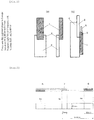
- a joining aluminum specimen aluminum resin composite material for tensile shear strength evaluation according to the ISO 19095 testing method shown in (a) in Fig. 1 was prepared.
- the injection molding conditions for manufacturing each specimen were a resin temperature of 250°C, a mold temperature of 50°C, an injection speed of 40 mm/s, a holding pressure of 30 MPa, and an injection time of 8 seconds.
- the tensile shear strength As for the tensile shear strength, with the method according to the ISO 19095 testing method shown in (b) in Fig. 1 , there was carried out a test in which the aluminum resin composite material (specimen) was fixed at a jig 4, and the upper end of the resin molded body was applied with a load 5 from above at a speed of 10 mm/min, thereby breaking the junction part between the aluminum material and the resin molded body. The breaking force of the aluminum resin composite material (injection integrally molded product) of the specimen was taken as the tensile shear strength.
- Example 8 joining aluminum coated materials were prepared in a required number. From the joining aluminum coated materials, 18 specimens having dimensions of 25 mm ⁇ 150 mm were cut out. A support body 6 with dimensions of an area (grab area 6a) of 25 mm ⁇ 38 mm was attached to one end of each specimen. Further, the specimens thus obtained were used in pairs of two thereof. With each pair of specimens, respective adhesion layers on the other end without the support body 6 were stacked one on another.
- junction part 7 was fixed with a clip so that the area (junction area 7a) of the stacked junction part 7 becomes 25 mm ⁇ 25 mm, and was baked and dried in an oven under the conditions of a set temperature of 150°C and for 20 minutes, thereby manufacturing nine adhesion specimens according to the JIS K 6829 testing method.
- Example 19 joining aluminum coated materials were prepared in a required number. From the joining aluminum coated materials, 24 specimens having dimensions of 25 mm ⁇ 150 mm were cut out. In the same manner as in the case of Example 8, 12 adhesion specimens according to the JIS K 6829 testing method were prepared.
- Example 9 aluminum coated materials were prepared in a required number. From the aluminum coated materials, 18 specimens having dimensions of 25 mm ⁇ 150 mm were cut out. A support body 6 with dimensions of an area (grab area 6a) of 25 mm ⁇ 38 mm was attached to one end of each specimen for grasping the specimen. Further, the specimens thus obtained were used in pairs of two thereof.
- each resulting aluminum coated material was used as it was, and the appearances after the salt spray test and the wetting test were evaluated, and were taken as the evaluation of the corrosion resistance performance. The results are shown in Table 5 and Table 6.
- Examples 12 to 22, and Comparative Examples 9 to 12 using a high acceleration life test apparatus [EHS-411(M) manufactured by ESPEC Co.], a PCT test ranked as a high temperature high humidity acceleration test was conducted under the conditions of 95%RH, at 150°C, and for 5 hours, thereby evaluating the tensile shear strength after the high temperature high humidity test. Further, for the coated surface except for the junction part, the adhesion (cross-cut adhesion) was evaluated by the method (cross-cut method) of the adhesion evaluation of JIS K 5600. Further, the appearance was evaluated, and was taken as the evaluation of the corrosion resistance performance.
- EHS-411(M) manufactured by ESPEC Co. a high acceleration life test apparatus
- evaluation was performed with the evaluation criteria of ⁇ : corrosion, swelling, and the like are not caused at the cut part at all, and the adhesion of the cut part was good, ⁇ : the corrosion of the cut part is equal to or smaller than 1 mm in size, and swelling was not caused, and the adhesion was good, and ⁇ : the corrosion of the cut part was 1 mm or more in size, or abnormal condition such as occurrence of swelling or poor adhesion was caused, in the coating film after 500 hours.
- the results are shown in Table 5 and Table 6.
Landscapes
- Chemical & Material Sciences (AREA)
- Engineering & Computer Science (AREA)
- Mechanical Engineering (AREA)
- Organic Chemistry (AREA)
- General Chemical & Material Sciences (AREA)
- Chemical Kinetics & Catalysis (AREA)
- Materials Engineering (AREA)
- Metallurgy (AREA)
- Wood Science & Technology (AREA)
- Life Sciences & Earth Sciences (AREA)
- Manufacturing & Machinery (AREA)
- Laminated Bodies (AREA)
- Chemical Treatment Of Metals (AREA)
- Other Surface Treatments For Metallic Materials (AREA)
- Adhesive Tapes (AREA)
- Adhesives Or Adhesive Processes (AREA)
Applications Claiming Priority (2)
| Application Number | Priority Date | Filing Date | Title |
|---|---|---|---|
| JP2017092279 | 2017-05-08 | ||
| PCT/JP2018/017460 WO2018207685A1 (fr) | 2017-05-08 | 2018-05-01 | Matériau revêtu d'aluminium pour assemblage et matériau composite aluminium-résine |
Publications (3)
| Publication Number | Publication Date |
|---|---|
| EP3636801A1 true EP3636801A1 (fr) | 2020-04-15 |
| EP3636801A4 EP3636801A4 (fr) | 2021-03-03 |
| EP3636801B1 EP3636801B1 (fr) | 2022-05-11 |
Family
ID=64105243
Family Applications (1)
| Application Number | Title | Priority Date | Filing Date |
|---|---|---|---|
| EP18799325.8A Active EP3636801B1 (fr) | 2017-05-08 | 2018-05-01 | Matériau revêtu d'aluminium pour assemblage et matériau composite aluminium-résine |
Country Status (5)
| Country | Link |
|---|---|
| US (1) | US12053952B2 (fr) |
| EP (1) | EP3636801B1 (fr) |
| JP (1) | JP6421906B1 (fr) |
| CN (1) | CN110506136B (fr) |
| WO (1) | WO2018207685A1 (fr) |
Families Citing this family (7)
| Publication number | Priority date | Publication date | Assignee | Title |
|---|---|---|---|---|
| JP6760196B2 (ja) * | 2017-05-08 | 2020-09-23 | 日本軽金属株式会社 | アルミニウム塗装材及びその製造方法 |
| JP7167719B2 (ja) * | 2019-01-09 | 2022-11-09 | 株式会社デンソー | 接合構造体およびその製造方法 |
| WO2020149248A1 (fr) * | 2019-01-15 | 2020-07-23 | 昭和電工株式会社 | Stratifié composite, son procédé de production et corps assemblé en métal-résine |
| JP7434901B2 (ja) * | 2020-01-08 | 2024-02-21 | 株式会社デンソー | 構造体 |
| CN112246577A (zh) * | 2020-09-14 | 2021-01-22 | 中国第一汽车股份有限公司 | 一种钢铝混合柔性化涂装前处理工艺 |
| JP2024005335A (ja) * | 2022-06-30 | 2024-01-17 | アルテミラ製缶株式会社 | 黒変防止処理剤、表面処理アルミニウム材、及び表面処理アルミニウム材の製造方法 |
| JP7729848B2 (ja) | 2023-05-15 | 2025-08-26 | 株式会社神戸製鋼所 | 表面処理金属材の製造方法及び接合体の製造方法 |
Family Cites Families (18)
| Publication number | Priority date | Publication date | Assignee | Title |
|---|---|---|---|---|
| JPS58177473A (ja) * | 1982-04-12 | 1983-10-18 | Nippon Shokubai Kagaku Kogyo Co Ltd | 金属表面処理用組成物 |
| JP3904358B2 (ja) | 1998-12-28 | 2007-04-11 | 新日本製鐵株式会社 | クロムを含有しない防錆コーティング鋼材 |
| FR2796655B1 (fr) * | 1999-07-22 | 2001-10-19 | Dacral Sa | Procede et composition de traitement anti-corrosion d'un substrat metallique prealablement protege par une couche de revetement a base de zinc |
| WO2001007679A1 (fr) * | 1999-07-26 | 2001-02-01 | Chemetall Plc | Traitement de surface de metaux |
| JP3467471B2 (ja) | 1999-12-08 | 2003-11-17 | ポリプラスチックス株式会社 | 金属インサート樹脂複合成形品の製造方法 |
| TWI331085B (en) * | 2002-07-02 | 2010-10-01 | Nippon Steel Corp | Precoated metal sheet with excellent press-formability and production method thereof |
| JP4159998B2 (ja) * | 2003-02-05 | 2008-10-01 | 株式会社神戸製鋼所 | 表面処理金属板 |
| US20050282945A1 (en) | 2004-06-21 | 2005-12-22 | Vampire Optical Coatings, Inc. | Coating compositions |
| JP5125285B2 (ja) | 2006-07-25 | 2013-01-23 | 日本軽金属株式会社 | アルミニウム塗装材及びその製造方法 |
| JP5125284B2 (ja) * | 2006-07-25 | 2013-01-23 | 日本軽金属株式会社 | アルミニウム塗装材及びその製造方法 |
| JP2011121309A (ja) | 2009-12-11 | 2011-06-23 | Nippon Light Metal Co Ltd | アルミニウム接着複合材及びその製造方法 |
| CN103069048B (zh) * | 2010-06-18 | 2015-02-18 | 日新制钢株式会社 | 化成处理镀层钢板及其制造方法 |
| US20130264741A1 (en) | 2010-11-05 | 2013-10-10 | Kaneka Corporation | Laminated adhesive film for use in insert molding |
| WO2014024877A1 (fr) * | 2012-08-07 | 2014-02-13 | 日本軽金属株式会社 | Corps lié d'aluminium et résine, ainsi que procédé de fabrication de celui-ci |
| JP2014034201A (ja) | 2012-08-10 | 2014-02-24 | Tosoh Corp | 金属部材−プロピレン樹脂発泡部材複合体及びその製造方法 |
| CN105189816B (zh) | 2013-04-26 | 2018-06-08 | 日本帕卡濑精株式会社 | 水性亲水化表面处理剂、亲水性皮膜和亲水化表面处理方法 |
| JP6703803B2 (ja) | 2013-10-31 | 2020-06-03 | 株式会社神戸製鋼所 | 表面処理金属板および金属板複合樹脂成形品 |
| JP6760196B2 (ja) | 2017-05-08 | 2020-09-23 | 日本軽金属株式会社 | アルミニウム塗装材及びその製造方法 |
-
2018
- 2018-05-01 EP EP18799325.8A patent/EP3636801B1/fr active Active
- 2018-05-01 JP JP2018541239A patent/JP6421906B1/ja active Active
- 2018-05-01 WO PCT/JP2018/017460 patent/WO2018207685A1/fr not_active Ceased
- 2018-05-01 US US16/610,954 patent/US12053952B2/en active Active
- 2018-05-01 CN CN201880025054.XA patent/CN110506136B/zh active Active
Also Published As
| Publication number | Publication date |
|---|---|
| CN110506136A (zh) | 2019-11-26 |
| EP3636801A4 (fr) | 2021-03-03 |
| JPWO2018207685A1 (ja) | 2019-06-27 |
| CN110506136B (zh) | 2020-06-23 |
| US20200061973A1 (en) | 2020-02-27 |
| JP6421906B1 (ja) | 2018-11-14 |
| WO2018207685A1 (fr) | 2018-11-15 |
| US12053952B2 (en) | 2024-08-06 |
| EP3636801B1 (fr) | 2022-05-11 |
Similar Documents
| Publication | Publication Date | Title |
|---|---|---|
| EP3636801B1 (fr) | Matériau revêtu d'aluminium pour assemblage et matériau composite aluminium-résine | |
| JP5581680B2 (ja) | 耐候性に優れたアルミ・樹脂複合品及びその製造方法 | |
| EP3006526B1 (fr) | Tôle d'acier revêtue d'un complexe d'aluminium et de zinc par un procédé d'immersion à chaud et caractérisée par une remarquable résistance aux intempéries, à la corrosion et aux bases, son procédé de fabrication et agent de traitement de surface associé | |
| EP1333107B1 (fr) | Revêtements de silane pour métaux | |
| EP2990504B1 (fr) | Agent hydrophilisant aqueux de traitement de surface, film de revêtement hydrophile et procédé de traitement de surface par hydrophilisation | |
| EP2240628A2 (fr) | Tôle d'acier revêtue de résine, composition de résine associée et composition de traitement de tôle d'acier | |
| KR102165012B1 (ko) | 금속 표면 처리용 수용액, 금속 표면의 처리 방법 및 접합체 | |
| JP2017203208A (ja) | 金属表面処理用水溶液、金属表面の処理方法、及び接合体 | |
| EP3623150B1 (fr) | Matériau en aluminium revêtu et son procédé de fabrication | |
| WO2017006805A1 (fr) | Solution aqueuse de traitement de surface métallique, procédé de traitement de surface métallique et conjugué | |
| US12438234B2 (en) | Separator, method of manufacturing separator, and electrochemical device including separator | |
| CN121851861A (zh) | 一种无铬表面处理锌铝镁镀层钢板及其制造方法 | |
| WO2017195802A1 (fr) | Matériau en alliage d'aluminium, matériau en alliage d'aluminium ayant une couche de résine adhésive, procédé de production de matériau en alliage d'aluminium, et procédé de production de matériau en alliage d'aluminium ayant une couche de résine adhésive | |
| KR100596463B1 (ko) | 쉬링키지 밴드용 강판에 피복되는 수지용액 및 이 강판의제조방법 | |
| JP2012188480A (ja) | ポリフェニレンサルファイド樹脂の組成物、複合体およびそれらの製造方法 |
Legal Events
| Date | Code | Title | Description |
|---|---|---|---|
| STAA | Information on the status of an ep patent application or granted ep patent |
Free format text: STATUS: THE INTERNATIONAL PUBLICATION HAS BEEN MADE |
|
| PUAI | Public reference made under article 153(3) epc to a published international application that has entered the european phase |
Free format text: ORIGINAL CODE: 0009012 |
|
| STAA | Information on the status of an ep patent application or granted ep patent |
Free format text: STATUS: REQUEST FOR EXAMINATION WAS MADE |
|
| 17P | Request for examination filed |
Effective date: 20191129 |
|
| AK | Designated contracting states |
Kind code of ref document: A1 Designated state(s): AL AT BE BG CH CY CZ DE DK EE ES FI FR GB GR HR HU IE IS IT LI LT LU LV MC MK MT NL NO PL PT RO RS SE SI SK SM TR |
|
| AX | Request for extension of the european patent |
Extension state: BA ME |
|
| DAV | Request for validation of the european patent (deleted) | ||
| DAX | Request for extension of the european patent (deleted) | ||
| A4 | Supplementary search report drawn up and despatched |
Effective date: 20210129 |
|
| RIC1 | Information provided on ipc code assigned before grant |
Ipc: B05D 3/02 20060101ALI20210125BHEP Ipc: C23C 22/66 20060101ALI20210125BHEP Ipc: C09J 5/02 20060101ALI20210125BHEP Ipc: C23C 22/07 20060101AFI20210125BHEP Ipc: C23C 22/08 20060101ALI20210125BHEP Ipc: C23C 22/74 20060101ALI20210125BHEP Ipc: C23C 22/03 20060101ALI20210125BHEP Ipc: B32B 15/04 20060101ALI20210125BHEP Ipc: B05D 1/28 20060101ALI20210125BHEP Ipc: B05D 7/14 20060101ALI20210125BHEP |
|
| GRAP | Despatch of communication of intention to grant a patent |
Free format text: ORIGINAL CODE: EPIDOSNIGR1 |
|
| STAA | Information on the status of an ep patent application or granted ep patent |
Free format text: STATUS: GRANT OF PATENT IS INTENDED |
|
| INTG | Intention to grant announced |
Effective date: 20211119 |
|
| GRAS | Grant fee paid |
Free format text: ORIGINAL CODE: EPIDOSNIGR3 |
|
| GRAA | (expected) grant |
Free format text: ORIGINAL CODE: 0009210 |
|
| STAA | Information on the status of an ep patent application or granted ep patent |
Free format text: STATUS: THE PATENT HAS BEEN GRANTED |
|
| AK | Designated contracting states |
Kind code of ref document: B1 Designated state(s): AL AT BE BG CH CY CZ DE DK EE ES FI FR GB GR HR HU IE IS IT LI LT LU LV MC MK MT NL NO PL PT RO RS SE SI SK SM TR |
|
| REG | Reference to a national code |
Ref country code: GB Ref legal event code: FG4D |
|
| REG | Reference to a national code |
Ref country code: CH Ref legal event code: EP |
|
| REG | Reference to a national code |
Ref country code: AT Ref legal event code: REF Ref document number: 1491488 Country of ref document: AT Kind code of ref document: T Effective date: 20220515 |
|
| REG | Reference to a national code |
Ref country code: DE Ref legal event code: R096 Ref document number: 602018035528 Country of ref document: DE |
|
| REG | Reference to a national code |
Ref country code: IE Ref legal event code: FG4D |
|
| REG | Reference to a national code |
Ref country code: LT Ref legal event code: MG9D |
|
| REG | Reference to a national code |
Ref country code: NL Ref legal event code: MP Effective date: 20220511 |
|
| REG | Reference to a national code |
Ref country code: AT Ref legal event code: MK05 Ref document number: 1491488 Country of ref document: AT Kind code of ref document: T Effective date: 20220511 |
|
| PG25 | Lapsed in a contracting state [announced via postgrant information from national office to epo] |
Ref country code: SE Free format text: LAPSE BECAUSE OF FAILURE TO SUBMIT A TRANSLATION OF THE DESCRIPTION OR TO PAY THE FEE WITHIN THE PRESCRIBED TIME-LIMIT Effective date: 20220511 Ref country code: PT Free format text: LAPSE BECAUSE OF FAILURE TO SUBMIT A TRANSLATION OF THE DESCRIPTION OR TO PAY THE FEE WITHIN THE PRESCRIBED TIME-LIMIT Effective date: 20220912 Ref country code: NO Free format text: LAPSE BECAUSE OF FAILURE TO SUBMIT A TRANSLATION OF THE DESCRIPTION OR TO PAY THE FEE WITHIN THE PRESCRIBED TIME-LIMIT Effective date: 20220811 Ref country code: NL Free format text: LAPSE BECAUSE OF FAILURE TO SUBMIT A TRANSLATION OF THE DESCRIPTION OR TO PAY THE FEE WITHIN THE PRESCRIBED TIME-LIMIT Effective date: 20220511 Ref country code: LT Free format text: LAPSE BECAUSE OF FAILURE TO SUBMIT A TRANSLATION OF THE DESCRIPTION OR TO PAY THE FEE WITHIN THE PRESCRIBED TIME-LIMIT Effective date: 20220511 Ref country code: HR Free format text: LAPSE BECAUSE OF FAILURE TO SUBMIT A TRANSLATION OF THE DESCRIPTION OR TO PAY THE FEE WITHIN THE PRESCRIBED TIME-LIMIT Effective date: 20220511 Ref country code: GR Free format text: LAPSE BECAUSE OF FAILURE TO SUBMIT A TRANSLATION OF THE DESCRIPTION OR TO PAY THE FEE WITHIN THE PRESCRIBED TIME-LIMIT Effective date: 20220812 Ref country code: FI Free format text: LAPSE BECAUSE OF FAILURE TO SUBMIT A TRANSLATION OF THE DESCRIPTION OR TO PAY THE FEE WITHIN THE PRESCRIBED TIME-LIMIT Effective date: 20220511 Ref country code: ES Free format text: LAPSE BECAUSE OF FAILURE TO SUBMIT A TRANSLATION OF THE DESCRIPTION OR TO PAY THE FEE WITHIN THE PRESCRIBED TIME-LIMIT Effective date: 20220511 Ref country code: BG Free format text: LAPSE BECAUSE OF FAILURE TO SUBMIT A TRANSLATION OF THE DESCRIPTION OR TO PAY THE FEE WITHIN THE PRESCRIBED TIME-LIMIT Effective date: 20220811 Ref country code: AT Free format text: LAPSE BECAUSE OF FAILURE TO SUBMIT A TRANSLATION OF THE DESCRIPTION OR TO PAY THE FEE WITHIN THE PRESCRIBED TIME-LIMIT Effective date: 20220511 |
|
| PG25 | Lapsed in a contracting state [announced via postgrant information from national office to epo] |
Ref country code: RS Free format text: LAPSE BECAUSE OF FAILURE TO SUBMIT A TRANSLATION OF THE DESCRIPTION OR TO PAY THE FEE WITHIN THE PRESCRIBED TIME-LIMIT Effective date: 20220511 Ref country code: PL Free format text: LAPSE BECAUSE OF FAILURE TO SUBMIT A TRANSLATION OF THE DESCRIPTION OR TO PAY THE FEE WITHIN THE PRESCRIBED TIME-LIMIT Effective date: 20220511 Ref country code: LV Free format text: LAPSE BECAUSE OF FAILURE TO SUBMIT A TRANSLATION OF THE DESCRIPTION OR TO PAY THE FEE WITHIN THE PRESCRIBED TIME-LIMIT Effective date: 20220511 Ref country code: IS Free format text: LAPSE BECAUSE OF FAILURE TO SUBMIT A TRANSLATION OF THE DESCRIPTION OR TO PAY THE FEE WITHIN THE PRESCRIBED TIME-LIMIT Effective date: 20220911 |
|
| PG25 | Lapsed in a contracting state [announced via postgrant information from national office to epo] |
Ref country code: SM Free format text: LAPSE BECAUSE OF FAILURE TO SUBMIT A TRANSLATION OF THE DESCRIPTION OR TO PAY THE FEE WITHIN THE PRESCRIBED TIME-LIMIT Effective date: 20220511 Ref country code: SK Free format text: LAPSE BECAUSE OF FAILURE TO SUBMIT A TRANSLATION OF THE DESCRIPTION OR TO PAY THE FEE WITHIN THE PRESCRIBED TIME-LIMIT Effective date: 20220511 Ref country code: RO Free format text: LAPSE BECAUSE OF FAILURE TO SUBMIT A TRANSLATION OF THE DESCRIPTION OR TO PAY THE FEE WITHIN THE PRESCRIBED TIME-LIMIT Effective date: 20220511 Ref country code: EE Free format text: LAPSE BECAUSE OF FAILURE TO SUBMIT A TRANSLATION OF THE DESCRIPTION OR TO PAY THE FEE WITHIN THE PRESCRIBED TIME-LIMIT Effective date: 20220511 Ref country code: DK Free format text: LAPSE BECAUSE OF FAILURE TO SUBMIT A TRANSLATION OF THE DESCRIPTION OR TO PAY THE FEE WITHIN THE PRESCRIBED TIME-LIMIT Effective date: 20220511 Ref country code: CZ Free format text: LAPSE BECAUSE OF FAILURE TO SUBMIT A TRANSLATION OF THE DESCRIPTION OR TO PAY THE FEE WITHIN THE PRESCRIBED TIME-LIMIT Effective date: 20220511 |
|
| REG | Reference to a national code |
Ref country code: DE Ref legal event code: R097 Ref document number: 602018035528 Country of ref document: DE |
|
| PLBE | No opposition filed within time limit |
Free format text: ORIGINAL CODE: 0009261 |
|
| STAA | Information on the status of an ep patent application or granted ep patent |
Free format text: STATUS: NO OPPOSITION FILED WITHIN TIME LIMIT |
|
| PG25 | Lapsed in a contracting state [announced via postgrant information from national office to epo] |
Ref country code: AL Free format text: LAPSE BECAUSE OF FAILURE TO SUBMIT A TRANSLATION OF THE DESCRIPTION OR TO PAY THE FEE WITHIN THE PRESCRIBED TIME-LIMIT Effective date: 20220511 |
|
| 26N | No opposition filed |
Effective date: 20230214 |
|
| PG25 | Lapsed in a contracting state [announced via postgrant information from national office to epo] |
Ref country code: SI Free format text: LAPSE BECAUSE OF FAILURE TO SUBMIT A TRANSLATION OF THE DESCRIPTION OR TO PAY THE FEE WITHIN THE PRESCRIBED TIME-LIMIT Effective date: 20220511 |
|
| P01 | Opt-out of the competence of the unified patent court (upc) registered |
Effective date: 20230519 |
|
| REG | Reference to a national code |
Ref country code: CH Ref legal event code: PL |
|
| PG25 | Lapsed in a contracting state [announced via postgrant information from national office to epo] |
Ref country code: MC Free format text: LAPSE BECAUSE OF FAILURE TO SUBMIT A TRANSLATION OF THE DESCRIPTION OR TO PAY THE FEE WITHIN THE PRESCRIBED TIME-LIMIT Effective date: 20220511 |
|
| REG | Reference to a national code |
Ref country code: BE Ref legal event code: MM Effective date: 20230531 |
|
| PG25 | Lapsed in a contracting state [announced via postgrant information from national office to epo] |
Ref country code: MC Free format text: LAPSE BECAUSE OF FAILURE TO SUBMIT A TRANSLATION OF THE DESCRIPTION OR TO PAY THE FEE WITHIN THE PRESCRIBED TIME-LIMIT Effective date: 20220511 Ref country code: LU Free format text: LAPSE BECAUSE OF NON-PAYMENT OF DUE FEES Effective date: 20230501 Ref country code: LI Free format text: LAPSE BECAUSE OF NON-PAYMENT OF DUE FEES Effective date: 20230531 Ref country code: IT Free format text: LAPSE BECAUSE OF FAILURE TO SUBMIT A TRANSLATION OF THE DESCRIPTION OR TO PAY THE FEE WITHIN THE PRESCRIBED TIME-LIMIT Effective date: 20220511 Ref country code: CH Free format text: LAPSE BECAUSE OF NON-PAYMENT OF DUE FEES Effective date: 20230531 |
|
| REG | Reference to a national code |
Ref country code: IE Ref legal event code: MM4A |
|
| PG25 | Lapsed in a contracting state [announced via postgrant information from national office to epo] |
Ref country code: IE Free format text: LAPSE BECAUSE OF NON-PAYMENT OF DUE FEES Effective date: 20230501 |
|
| PG25 | Lapsed in a contracting state [announced via postgrant information from national office to epo] |
Ref country code: IE Free format text: LAPSE BECAUSE OF NON-PAYMENT OF DUE FEES Effective date: 20230501 |
|
| PG25 | Lapsed in a contracting state [announced via postgrant information from national office to epo] |
Ref country code: FR Free format text: LAPSE BECAUSE OF NON-PAYMENT OF DUE FEES Effective date: 20230531 Ref country code: BE Free format text: LAPSE BECAUSE OF NON-PAYMENT OF DUE FEES Effective date: 20230531 |
|
| PG25 | Lapsed in a contracting state [announced via postgrant information from national office to epo] |
Ref country code: BG Free format text: LAPSE BECAUSE OF FAILURE TO SUBMIT A TRANSLATION OF THE DESCRIPTION OR TO PAY THE FEE WITHIN THE PRESCRIBED TIME-LIMIT Effective date: 20220511 |
|
| PG25 | Lapsed in a contracting state [announced via postgrant information from national office to epo] |
Ref country code: BG Free format text: LAPSE BECAUSE OF FAILURE TO SUBMIT A TRANSLATION OF THE DESCRIPTION OR TO PAY THE FEE WITHIN THE PRESCRIBED TIME-LIMIT Effective date: 20220511 |
|
| PGFP | Annual fee paid to national office [announced via postgrant information from national office to epo] |
Ref country code: DE Payment date: 20250521 Year of fee payment: 8 |
|
| PGFP | Annual fee paid to national office [announced via postgrant information from national office to epo] |
Ref country code: GB Payment date: 20250527 Year of fee payment: 8 |
|
| PG25 | Lapsed in a contracting state [announced via postgrant information from national office to epo] |
Ref country code: CY Free format text: LAPSE BECAUSE OF FAILURE TO SUBMIT A TRANSLATION OF THE DESCRIPTION OR TO PAY THE FEE WITHIN THE PRESCRIBED TIME-LIMIT; INVALID AB INITIO Effective date: 20180501 |
|
| PG25 | Lapsed in a contracting state [announced via postgrant information from national office to epo] |
Ref country code: HU Free format text: LAPSE BECAUSE OF FAILURE TO SUBMIT A TRANSLATION OF THE DESCRIPTION OR TO PAY THE FEE WITHIN THE PRESCRIBED TIME-LIMIT; INVALID AB INITIO Effective date: 20180501 |
|
| PG25 | Lapsed in a contracting state [announced via postgrant information from national office to epo] |
Ref country code: TR Free format text: LAPSE BECAUSE OF FAILURE TO SUBMIT A TRANSLATION OF THE DESCRIPTION OR TO PAY THE FEE WITHIN THE PRESCRIBED TIME-LIMIT Effective date: 20220511 |