EP3636832B1 - Verfahren zur herstellung eines papiersubstrats, das für eine trennschicht mit hohem gehalt an funktionellen vinylgruppen geeignet ist, sowie produkte und verwendungen davon - Google Patents
Verfahren zur herstellung eines papiersubstrats, das für eine trennschicht mit hohem gehalt an funktionellen vinylgruppen geeignet ist, sowie produkte und verwendungen davon Download PDFInfo
- Publication number
- EP3636832B1 EP3636832B1 EP18199295.9A EP18199295A EP3636832B1 EP 3636832 B1 EP3636832 B1 EP 3636832B1 EP 18199295 A EP18199295 A EP 18199295A EP 3636832 B1 EP3636832 B1 EP 3636832B1
- Authority
- EP
- European Patent Office
- Prior art keywords
- polymer
- vinyl groups
- paper
- primer layer
- functional vinyl
- Prior art date
- Legal status (The legal status is an assumption and is not a legal conclusion. Google has not performed a legal analysis and makes no representation as to the accuracy of the status listed.)
- Active
Links
Images




Classifications
-
- D—TEXTILES; PAPER
- D21—PAPER-MAKING; PRODUCTION OF CELLULOSE
- D21H—PULP COMPOSITIONS; PREPARATION THEREOF NOT COVERED BY SUBCLASSES D21C OR D21D; IMPREGNATING OR COATING OF PAPER; TREATMENT OF FINISHED PAPER NOT COVERED BY CLASS B31 OR SUBCLASS D21G; PAPER NOT OTHERWISE PROVIDED FOR
- D21H27/00—Special paper not otherwise provided for, e.g. made by multi-step processes
- D21H27/001—Release paper
-
- D—TEXTILES; PAPER
- D21—PAPER-MAKING; PRODUCTION OF CELLULOSE
- D21H—PULP COMPOSITIONS; PREPARATION THEREOF NOT COVERED BY SUBCLASSES D21C OR D21D; IMPREGNATING OR COATING OF PAPER; TREATMENT OF FINISHED PAPER NOT COVERED BY CLASS B31 OR SUBCLASS D21G; PAPER NOT OTHERWISE PROVIDED FOR
- D21H17/00—Non-fibrous material added to the pulp, characterised by its constitution; Paper-impregnating material characterised by its constitution
- D21H17/20—Macromolecular organic compounds
- D21H17/33—Synthetic macromolecular compounds
- D21H17/34—Synthetic macromolecular compounds obtained by reactions only involving carbon-to-carbon unsaturated bonds
-
- D—TEXTILES; PAPER
- D21—PAPER-MAKING; PRODUCTION OF CELLULOSE
- D21H—PULP COMPOSITIONS; PREPARATION THEREOF NOT COVERED BY SUBCLASSES D21C OR D21D; IMPREGNATING OR COATING OF PAPER; TREATMENT OF FINISHED PAPER NOT COVERED BY CLASS B31 OR SUBCLASS D21G; PAPER NOT OTHERWISE PROVIDED FOR
- D21H19/00—Coated paper; Coating material
- D21H19/10—Coatings without pigments
- D21H19/14—Coatings without pigments applied in a form other than the aqueous solution defined in group D21H19/12
- D21H19/20—Coatings without pigments applied in a form other than the aqueous solution defined in group D21H19/12 comprising macromolecular compounds obtained by reactions only involving carbon-to-carbon unsaturated bonds
-
- D—TEXTILES; PAPER
- D21—PAPER-MAKING; PRODUCTION OF CELLULOSE
- D21H—PULP COMPOSITIONS; PREPARATION THEREOF NOT COVERED BY SUBCLASSES D21C OR D21D; IMPREGNATING OR COATING OF PAPER; TREATMENT OF FINISHED PAPER NOT COVERED BY CLASS B31 OR SUBCLASS D21G; PAPER NOT OTHERWISE PROVIDED FOR
- D21H19/00—Coated paper; Coating material
- D21H19/36—Coatings with pigments
- D21H19/44—Coatings with pigments characterised by the other ingredients, e.g. the binder or dispersing agent
- D21H19/56—Macromolecular organic compounds or oligomers thereof obtained by reactions only involving carbon-to-carbon unsaturated bonds
-
- D—TEXTILES; PAPER
- D21—PAPER-MAKING; PRODUCTION OF CELLULOSE
- D21H—PULP COMPOSITIONS; PREPARATION THEREOF NOT COVERED BY SUBCLASSES D21C OR D21D; IMPREGNATING OR COATING OF PAPER; TREATMENT OF FINISHED PAPER NOT COVERED BY CLASS B31 OR SUBCLASS D21G; PAPER NOT OTHERWISE PROVIDED FOR
- D21H19/00—Coated paper; Coating material
- D21H19/80—Paper comprising more than one coating
- D21H19/82—Paper comprising more than one coating superposed
Definitions
- the invention relates to a paper substrate that is suitable for binding silicone in a catalytic hydrosilation reaction containing a high vinyl content polymer.
- the invention further relates to a method for manufacturing such paper substrate.
- the invention further relates to use of high-vinyl content polybutadiene in a method for manufacturing a paper substrate containing a high vinyl content polymer.
- a release liner refers to a product comprising a paper substrate and a release layer (i.e. a cured release coating), such as a silicone-based release layer, applied on at least one side of the paper substrate.
- Release layers have a dehesive surface facing away from the paper substrate, the surface energy level typically being in the range of 21 to 25 dynes/cm.
- the dehesive surface of the release layer may be used to protect adhesive material in contact with the dehesive surface.
- Papers used as paper substrates for siliconizing are typically manufactured from bleached chemical pulp, such as bleached Kraft pulp, with an aim to provide dimensionally stable and dense paper surface able to reduce the surface penetration of a release coating, when the release coating is applied on the paper surface.
- the surface penetration of the release coating can be further reduced by applying a coating (i.e. a primer layer) on the paper surface and/or calendaring the paper prior to applying the release layer.
- a primer layer typically applied on the paper surface is a surface coating.
- a conventional surface coating also referred to as a "surface size" may improve the surface smoothness and reduce the porosity of the paper surface and thus act as a barrier between the release layer and the paper surface.
- Release coatings based on silicone polymers are typically easy to apply and well-flowing. Uncured silicone polymers may penetrate easily into the pores of a paper, unless sufficient hydrophobicity is present at the paper surface.
- the curing of a silicone refers to a thermally induced cross-linking reaction of the silicone polymer once applied onto the substrate surface, which results into a cross-linked surface coating attached to the substrate surface.
- Release coatings have previously been cured by radiation, wherein the coating contains either an initiator in the formulation, such as a photo initiator sensitive to ultra violet light, or the curing relies on high-energy radiation, such as an electron beam, producing sufficient amounts of energy to start the cross-linking reaction.
- the radiation cured layer functioned by either breaking chemical bonds and/or generating ions, which resulted into a cured silicone polymer based release layer, without the use of additional heat.
- Thermally curable release coatings refer to specific type of release coatings, which are distinguished from radiation curable systems.
- Low temperature curable silicone polymer or "LTC" silicone polymer refers to an addition-curable polymer comprising silicone base polymer with functional vinyl groups and a cross-linker compound with silane hydride groups, which components are configured to cross-link in a catalytic hydrosilation reaction at a low temperature.
- a silane hydride group undergoes an addition reaction with a vinyl group.
- the addition reaction is typically catalysed by a platinum catalyst. Platinum-catalyzed addition reactions are fast, and the curing speed of the reaction can be controlled via the curing temperature.
- a low temperature in this context refers to a catalytic hydrosilation reaction temperature of less than 120°C, preferably in the range of 55 to 110°C, wherein the silane hydride groups and the functional vinyl groups form covalently cross-linked structures within the release coating, thereby forming the cured release layer.
- Novel fast-curing silicone polymers are often further designed to function with low amounts of platinum catalyst.
- a problem with respect to the fast-curing silicone polymers is the relatively low anchorage of the release coating applied on the paper substrate. Further, due to the high volumes of release liner material produced, there is a constant aim to reduce the amounts of platinum catalyst from the current level in the range of 50 to 35 ppm to a lower level, such as to a level of 30 ppm or below. Due to the wide use of fast-curing silicone polymers in release liners, there is a constant need to save costs by using less platinum. Platinum is a very expensive catalyst material. In addition, the amount of other reagents, such as silicone used for a release coating, is a cost factor to be minimized.
- a further challenge is the curing temperature, which refers to the minimum temperature wherein the silicone polymers begins to cross-link, such that a fixed layer structure with dehesive properties is obtained.
- the curing temperature should be maintained relatively low in order to save production costs due to heating.
- a very low curing temperature e.g. below 45°C, may be problematic as the silicone polymers may then begin to cross-link prematurely, for example before it has been applied on the paper substrate surface. The importance of such parameters is emphasized when the machine speed is increased.
- the anchorage of fast-curing silicone polymers on the paper substrate has been improved by using a primer layer containing chemically post-treated polymer, such as water soluble polyvinyl alcohol, which has been modified to contain functional vinylic groups.
- a primer layer containing chemically post-treated polymer such as water soluble polyvinyl alcohol
- the reaction typically takes place through the highly reactive hydroxyl group.
- a polymer containing hydroxyl groups is most often reacted with a compound that contains a carbonyl group.
- Carbonyl groups may be oxidized, and may undergo addition reactions under basic or neutral conditions.
- the modification of the polymer is performed by means of carbonyl group reactions with one or more hydroxyl groups of the polymer, thereby providing water soluble polymer modified to contain functional vinylic groups.
- Examples of carbonyl compounds are aldehydes, carboxylic acids, esters, anhydrides and acid halides.
- Examples of chemical post-treatment of polyvinyl alcohol by carbonyl group reactions are disclosed in publications WO 2009/147283 and WO 2011/104427 , which disclose methods for grafting PVA polymer with organic molecule to provide the PVA polymer with vinylic functions.
- a disadvantage related to chemical post-treatment of polyvinyl alcohol is, however, that when the amount of the carbonyl compound further containing a vinyl group in such a post-treatment reaction is increased, the solution quickly becomes highly viscose and increasingly less water-soluble. Hence, the solubility of the compounds significantly limits the amount of vinylic side groups that can be grafted into the PVA polymer. Attempts to increase the aldehyde content in the reaction solution dramatically increase the viscosity of the reaction solution such that the reactants will prematurely precipitate out of the solution.
- the polymer when grafting polyvinyl alcohol, having a hydrolysis degree of 98 - 99 % and degree of polymerization of 1400, with undecylenic aldehyde (an aldehyde comprising 11 carbon atoms), the polymer typically becomes significantly less water-soluble already when undecylenic aldehyde is added to the reaction mixture more than 2% by weight, when expressed as grams of aldehyde compound per 100 grams of polyvinyl alcohol.
- the formed reaction product thus becomes highly viscose and very difficult to apply on a substrate surface as a coating.
- the amount of vinylic side chains in a modified PVA polymer is maintained relatively low, which typically is necessitated by current high-speed release liner applications.
- a selectively addition-polymerized diene may be used to provide an oleophilic primer layer, which contains a polymer having high amounts of functional vinyl groups without styrene groups.
- the anchorage of a release layer to a paper substrate may thus be improved by providing a paper substrate having a primer layer surface containing a high amount of functional vinyl groups throughout the primer layer surface plane.
- a primer layer containing a high-vinyl content polymer provides an unprecedented means of improving the anchorage characteristics of a silicone-based release layer.
- the covalent attachment of other silicone polymers based on addition-curable cross-linker compound containing silane hydride bonds may also be improved.
- a method for manufacturing polymer having high vinyl group content without a significant amount of hydroxyl groups may comprise selective polymerization of diene monomers.
- a method for manufacturing polymer having high vinyl group content may comprise reacting diene monomers having two or more vinylic groups in the presence of a catalyst selective for addition reaction.
- the percentage of the polymer repeat units containing a vinyl group may be adjusted by selecting the polymerization conditions and a suitable catalyst.
- a suitable catalyst is, for example, butyl lithium.
- the 1,3-butadiene monomer is highly selective for 1,2-addition reaction in the presence of butyl lithium, thereby producing high vinyl content polybutadiene that does not contain a significant amount of hydroxyl groups.
- High vinyl content polybutadiene may have a vinyl group content of up to 18,5 mmol/g, wherein the vinyl groups content represents the molality of the functional groups in the formed polymer.
- the high amount of functional vinyl groups on a selectively addition-polymerized diene provides a composition which may be coated on a cellulose fiber-based paper, thereby providing a substrate improved anchorage properties toward silane hydride groups.
- a further advantage of such an oleophilic primer layer is the hydrophobicity of the surface.
- a hydrophobic primer layer may be used to resist the penetration of various substances, such as a water-based adhesive material, which may become into contact with the hydrophobic polymer coating.
- a hydrophobic polymer also evens out the characteristics of the whole surface, despite the existence of possible defects, such as holes, which may sometimes be present in the cellulose fiber-based paper.
- Hydrophobic polymer coating has a poor adhesion to silicone.
- the silicone adhesion towards a hydrophobic polymer coating is furthermore inversely related to the coating speed. When the coating and curing is performed at higher speed, there is less adhesion of the silicone towards the hydrophobic polymer coating.
- the cellulose fiber-based paper is, however, coated with a primer layer which contains a non-polar polymer having high vinyl group content without a significant amount of hydroxyl group, the polymer has a tendency to be hydrophobic and avoids the hydrophilic surface of the cellulose fibre-based paper.
- hydrophobic polymer coating While a hydrophobic polymer coating, as such, has a poor adhesion to silicone, the catalytic hydrosilation reaction enables chemical bonding of the silicone with the functional vinylic group present in the polymer.
- An advantage of the hydrophobic surface on the cellulose fiber-based paper is that less adhesive may penetrate through a release layer into the cellulose fibre-based paper beneath, when the paper substrate is used as release liner paper substrate. Thus, also the minimum amount of force required to detach a label or excess matrix material is reduced.
- a further effect of the hydrophobic surface on the cellulose fiber-based paper is that this enables the thickness of the release layer to be reduced, since the minimum amount of force required to detach a label from the release liner is dependent of the thickness of the release layer.
- the hydrophobic surface therefore facilitates the reduction of the amounts of silicone and platinum required for providing a release layer.
- a thinner release layer further enables a lower high-speed release value.
- the vinyl groups Without a significant amount of hydroxyl groups in the polymer the vinyl groups thereby have a tendency to orientate away from a hydrophilic surface, such as cellulose fiber-based paper, when coated on such a surface.
- a particular advantage of a primer layer that contains functional vinylic groups in an amount of equal to or higher than 0.3 mmol/g, preferably an amount of equal to or higher than 0.5 mmol/g in the formed polymer is that the high amount of functional vinyl groups enables the use of very fast curing silicone compounds in the release coating.
- the cellulose fiber-based paper may be e.g. a coated paper having a grammage equal to or more than 38 g/m 2 , for example in the range of 38 to 160 g/m 2 .
- the formed paper substrate may therefore be arranged to have a tight, closed surface with oleophilic properties resembling those of a synthetic paper substrate surface.
- a synthetic material, such as polypropylene, conventionally tends to have a low surface energy level, and reduced anchorage of silicone to the substrate surface.
- this improves the anchorage of the silicone polymers cured via the polyaddition reaction.
- SBR styrene-butadiene copolymer
- SB-latex Styrene-butadiene copolymers for paper coatings
- emulsifying agents such as surfactants like various soaps.
- the emulsifying agents are used to control the molecular weight and hence the viscosity of the formed copolymer product, but do not stay attached in the formation of copolymer and instead easily separate and float to the surface during manufacturing of the coating.
- the polymerized diene comprising functional vinyl groups may further be arranged to contain unsaturated dicarboxylic acid or an anhydride or monoester thereof, such as maleic acid or maleic anhydride.
- the polymeric primer layer having high amounts of functional vinyl groups which is on top of the cellulose fiber-based paper, is without styrene groups. Thereby, a paper substrate having a surface without styrene groups may be obtained.
- the lack of styrene groups in the polymeric primer layer is related to the theoretical amount of functional vinyl groups obtainable on a polymer formed of monomers.
- the amount of functional vinyl groups in the polymer formed of monomers is maximized, which improves the hydrophobic properties of the polymer, as is the case with polybutadiene obtainable from 1,3-butadiene monomers by 1,2-addition polymerization.
- a further introduction of polar groups to the polymeric structure such as the covalent grafting of unsaturated dicarboxylic acid, anhydride or monoester thereof, however, will consume said functional vinyl groups of the polymer.
- Polar groups which are covalently grafted to the vinylic groups of polymer structure therefore supercede part of the functional vinyl groups of the polymer.
- the amount of polar groups which have been covalently grafted to the polymer structure may be used to control the hydrophobicity of the polymer, thereby selecting how the polymer behaves in water.
- a balance between the hydrophobic and hydrophilic properties of the polymer may be used to reduce problems commonly associated to emulsifying agents, which tend to separate easily and float to the surface.
- Such polar groups in the polymer composition may thus be arranged to modify the degree of hydrophobicity of the polymer composition.
- a polymerized diene may be arranged to contain hydrophilic groups to improve the water-solubility of the polymer composition, thereby facilitating the application of the polymer to a cellulose fiber-based paper layer.
- the polymer composition may be water soluble or it may be applied as an water-based emulsion or water-based dispersion.
- the amount of unsaturated dicarboxylic acid or an anhydride or monoester thereof may be equal to or higher than 3 mol-% of the polymer. It is contemplated, that an amount of unsaturated dicarboxylic acid or an anhydride or monoester thereof in the range of 3 to 6 mol-% provides conditions suitable for a water-based emulsion.
- a water soluble polymer composition may be obtained, when the amount of unsaturated dicarboxylic acid or an anhydride or monoester thereof is equal to or higher than 20 mol-% and the solution has an alkaline pH, preferably a pH value above 8.
- Sodium salts may be used to improve solubility and stability of the polymer composition.
- a method for manufacturing polymer having high vinyl group content may thus further comprise grafting unsaturated dicarboxylic acid or an anhydride or monoester thereof, such as maleic acid or maleic anhydride, into the polymer having high vinyl group content, thereby modifying the hydrophobicity of the polymer.
- a paper substrate that is suitable for binding silicone in a catalytic hydrosilation reaction, the paper substrate comprising
- the polymeric primer layer is made of or contains a polymerized diene compound comprising functional vinyl functional groups, such as high-vinyl content polybutadiene obtainable from 1,2-addition polymerization reaction of 1,3-butadiene.
- Such a paper substrate could be used in a method for manufacturing a release liner, the method comprising
- High-vinyl content polybutadiene obtainable from 1,2-addition polymerization reaction may be used in a primer layer composition of a paper substrate suitable for binding silicone in a catalytic hydrosilation reaction.
- the polymerized diene compound may further contain unsaturated dicarboxylic acid or an anhydride or monoester thereof, such as maleic acid or maleic anhydride.
- the polymeric primer layer contains a polymer comprising functional vinyl groups in an amount of equal to or higher than 2 millimoles per gram (mmol/g) of the polymer, preferably equal to or higher than 4 mmol/g, most preferably equal to or higher than 8 mmol/g.
- a higher amount of functional vinyl groups correlates directly with the hydrophobicity of the surface, thereby decreasing the surface energy, while still enabling silicone polymers to be cured via the polyaddition reaction.
- Experimental results have suggested that up to functional vinyl groups in an amount of 18.5 mmol/g of the polymer may be obtained on a primer layer applied on top of the cellulose fiber-based paper layer. Therefore, the amount of functional vinyl groups may be in the range of 0.5 to 18.5 mmol/g of the polymer, which amount represents the molality of the vinyl groups in the polymer.
- Sx and Sz denote orthogonal directions.
- a silicone-based release layer SIL1 (as denoted in Figure 2 ) may be formed in a polyaddition reaction of a silicone base polymer containing a functional vinyl group VIN1 and a cross-linker compound SH1 containing silane hydride bonds.
- the functional vinyl group VIN1 may be an end group or it may be positioned elsewhere in the silicone base polymer.
- a polyaddition reaction refers to a silicone cross-linking reaction, wherein a silicone base polymer containing a functional vinyl group VIN1 is arranged to form a covalent bond with a cross-linker compound SH1 in the presence of a catalyst compound.
- the catalyst compound is typically a metal catalyst, such as platinum catalyst, abbreviated as Pt.
- Pt platinum catalyst
- Fast-curing silicone polymers typically cross-link already at a temperature equal to or less than 100°C, such as in the range of 60 to 100°C.
- the activation temperature range and reaction kinetics may be adjusted by selecting the chemical composition of the silicone base polymer containing a functional vinyl group VIN1 and the chemical composition of the cross-linker compound SH1. Compositions having a cross-linking temperature close to room temperature of 25°C are not preferred, since this would increase the risk of premature silicone cross-linking reaction, before the compounds have been applied on the substrate surface.
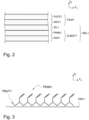
- a release liner REL1 may comprise a cellulose fiber-based paper PAP1 which may be cellulose fiber-based, a release layer SIL1 formed of a silicone resin, and an oleophilic primer layer PRIM1 between the cellulose fiber-based paper PAP1 and the release layer SIL1.
- a release liner REL1 may be used as backing material for a facestock laminate FILM1.
- a facestock laminate FILM1 is used for manufacturing adhesive labels. In such manufacturing, some of the facestock laminate FILM1 may be made e.g. by cutting discrete labels LAB1 out of the facestock laminate FILM1.
- Adhesive labels LAB1 may be, for example, self-adhesive labels or pressure sensitive labels formed of the facestock laminate FILM1.
- the release liner REL1 is provided with a dehesive surface in order to facilitate the separation of the facestock laminate FILM1 containing an adhesive layer ADH1 from the release liner REL1.
- the paper substrate SUBST1 for a release liner REL1 denotes a combination of at least a cellulose fiber-based paper PAP1 and a primer layer PRIM1 as applied on at least one side of the cellulose fiber-based paper PAP1.
- the primer layer PRIM1 is typically applied on the side or sides intended to be coated with the silicone-based release layer SIL1.
- the primer layer PRIM1 is an oleophilic primer layer containing a polymerized diene PBUT1 having vinylic functions, said polymerized diene PBUT1 being present in the composition of the oleophilic primer layer PRIM1.
- the primer layer PRIM1 is formed between the cellulose fiber-based paper PAP1 and the silicone-based release layer SIL1.
- a method for manufacturing a release liner REL 1 may comprise providing a cellulose fiber-based paper PAP1.
- Examples of commercial products typically used as a release liner paper substrate SUBST1 are coated papers, vegetable parchment, glassine and greaseproof paper. Typical examples of coated papers are Super Calandered Kraft paper (SCK) and glassine.
- SCK Super Calandered Kraft paper
- Glassine in general refers to paper made of chemical pulp, typically having a coat weight (grammage) in the range of 50 to 150 g/m 2 . Glassine paper has a good transparency level; for example a 60 g/m 2 glassine paper typically has a transparency level of at least 45, when measured with visible light (ISO 2469:1994).
- Coated papers may have a grammage equal to or more than 38 g/m 2 , such as in the range of 38 to 160 g/m 2 .
- a method for manufacturing a release liner REL1 may further comprise applying a primer layer PRIM1 on a cellulose fiber-based paper PAP1 surface.
- the primer layer PRIM1 may contain high vinyl content polymer PBUT1, such as a polymerized diene comprising functional vinyl groups VIN1, which is applied as a coating on top of the cellulose fiber-based paper PAP1, thereby forming a paper substrate SUBST1.
- a paper manufacturer typically provides the cellulose fiber-based paper PAP1 as a paper substrate SUBST1 comprising the primer layer PRIM1.
- the primer layer PRIM1 surface may be arranged to have hydrophobicity.
- the primer layer PRIM1 is arranged to contain a polymer comprising a catenated carbon structure, such as a linear chain of carbons without hydroxyl groups, the non-polar nature of the polymer is increased.
- Such polymer when applied on a primer layer surface, therefore provides hydrophobicity and may thus be oleophilic.
- a hydrophobic primer layer PRIM1 surface may improve the orientation of functional vinyl groups VIN1 towards the surface of the primer layer PRIM1, thereby promoting the formation of covalent bonds with a silicone-based release layer SIL1, after a release coating has been applied on top of the hydrophobic primer layer PRIM1.
- a paper substrate SUBST1 may thus be arranged to have an oleophilic primer layer PRIM1 applied on top of a cellulose fiber-based paper PAP1 and covalent connections will be formed during the cross-linking of silicone, wherein the silane hydride groups of the cross-linker react with the vinyl groups VIN1 of the high vinyl content polymer PBUT1.
- a method for manufacturing a release liner REL1 may further comprise coating the oleophilic primer layer PRIM1 with a silicone-based release layer SIL1.
- the silicone-based release layer SIL1 may comprise a fast-curing silicone polymer comprising cross-linker compound with silane hydride groups.
- the silicone-based release layer SIL1 may be cured by a polyaddition reaction in the presence of a catalyst, thereby anchoring the polymerized diene of the oleophilic primer layer to the silicone-based release layer SIL1, thereby forming the release liner REL1.
- the hydrophobicity of the primer layer PRIM1 improves the spreading of the silicone polymer applied on the paper substrate SUBST1, thereby enabling reducing the amount of silicone polymer needed to form a silicone-based release layer SIL1.
- the silicone-based release layer SIL1 may be applied later than during or immediately after manufacturing the paper substrate SUBST1, for example during manufacturing of the face stock FILM1.
- the silicone-based release layer SIL1 may be applied on the paper substrate SUBST1 during or immediately after manufacturing the paper substrate SUBST1, such as in the same production process and/or production line.
- An additional advantage of the hydrophobicity is, that a thinner release layer SIL1 may be provided, thereby reducing the amount of silicone polymer needed to form the silicone-based release layer SIL1.
- the silicone-based release layer may thereby remain thin, such as less than 1 micrometer in thickness.
- a hydrophobic (i.e. oleophilic) paper substrate surface therefore facilitates the even spreading of the uncured silicone polymer applied on the surface.
- the release liner paper substrate contains a polymer comprising functional vinyl groups in an amount of equal to or higher than 0.5 millimoles per gram of the polymer, the release layer SIL1 is more firmly bonded to the paper substrate.
- a hydrophobic primer layer may be used to resist the penetration of water-based or hot-melt adhesive material, which may be used in the manufacturing of a face stock FILM1 and may thus become into contact with the paper substrate SUBST1 surface.
- a hydrophobic polymer also evens out the characteristics, for example release characteristics, of the whole surface, despite the existence of possible defects, such as holes, which may sometimes be present in the cellulose fiber-based paper.
- a removable facestock laminate FILM1 may be attached on a release liner REL1.
- the facestock laminate FILM1 may contain a face layer FACE1 and an adhesive layer ADH1 for attaching the facestock laminate FILM1 onto the release liner REL1 surface.
- the facestock laminate FILM1 may be used, for example to manufacture a label stock.
- a release liner REL1 carrying a plurality of adhesive labels is referred to as a label stock.
- a label stock is typically wound on a roll and used in a labelling process during which use the label stock is unwound as labels are needed.
- Figure 3 illustrates a primer layer PRIM1 containing a high vinyl content polymer PBUT1 applied on a cellulose fiber-based paper PAP1 surface SURF1.
- a high vinyl content polymer PBUT1 refers to a polymer comprising functional vinyl groups VIN1 in an amount of equal to or higher than 0.5 millimoles per gram (mmol/g) of the polymer.
- the primer layer contains a polymer comprising functional vinyl groups in an amount of equal to or higher than 1 millimoles per gram (mmol/g) of the polymer, preferably equal to or higher than 2 mmol/g, most preferably equal to or higher than 4 mmol/g, such as equal to or higher than 8 mmol/g.
- the amount of functional vinyl groups may be, for example, in the range of 0.5 to 18.5 mmol/g of the polymer.
- a primer layer PRIM1 containing high vinyl content polymer PBUT1 is hydrophobic, as a large proportion of the functional vinyl groups VIN1 are present on the surface of the primer layer PRIM1.
- a higher amount of chains that end into functional vinyl groups correlates directly with the hydrophobicity of the surface, thereby decreasing the surface energy.
- Functional vinyl groups VIN1 present on the top surface of the primer layer PRIM1 i.e. the surface facing away from cellulose fiber-based paper PAP1 are capable to form covalent bonds with a silicone-based release layer SIL1 which may be applied on top of the primer layer PRIM1.
- the primer layer PRIM1 may contain high vinyl content polymer PBUT1, such as polymerized diene.
- 1,3 -butadiene can be polymerized in three different ways, referred to as cis-, trans- and vinyl -additions, which result in different forms of polybutadiene.
- the cis and trans forms may be obtained in 1,4-addition reactions.
- High vinyl content polybutadiene may be obtained from 1,3 -butadiene by selective polymerization, when the polymerization is 1,2-addition reaction of 1,3-butadiene.
- 1,3-butadiene may be 1,2-addition polymerized in the presence of a selective catalyst, such as metallocene catalyst.
- a butyl lithium initiator as such may be used to provide 80-90 % of 1 ,4-addition product, as evidenced by Samotsvetov et al. (Butadiene polymerization in the presence of butyl lithium modified with sodium butylate, Polym Sci USSR 23 (1981) 100-107 ).
- n in Figure 4 refers to the amount of monomer units used to form a polymer.
- the reference sign CAT1 in turn, refers to the catalyst used for the polymerization reaction.
- the n may be, for example in the range of 10 to 10000, thereby providing a polybutadiene having a molecular weight in the range of 110 to 540000 g/mol.
- the oleophilic primer layer PRIM1 between the cellulose fiber-based paper PAP1 and the release layer SIL1 may further contain solubilizing agent between 3 mol-% and 20 mol-% of the polymer, such that the high vinyl content polymer PBUT1 comprising functional vinyl groups is water-dispersible or water-emulsifiable, when applied on top of the cellulose fiber-based paper PAP1. Further, the high vinyl content polymer PBUT1 may contain solubilizing agent in an amount equal to or higher than 20 mol-% of the polymer, such that the polymer comprising functional vinyl groups is water-soluble, when applied on top of the cellulose fiber-based paper PAP1.
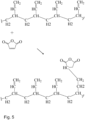
- the solubilizing agent may be, for example, an unsaturated dicarboxylic acid or an anhydride or monoester thereof, such as maleic acid or maleic anhydride, which has been grafted into the high vinyl content polymer PBUT1 comprising the functional vinyl groups, as shown in Figure 5 .
- an unsaturated carboxylic acid or an unsaturated acrylic containing a functional vinyl group may be used.
- the improved water-solubility of a polymer composition comprising the high vinyl content polymer PBUT1 facilitates the homogeneous application of the polymer composition on a cellulose fiber-based paper PAP1 surface.
- the silicone layer and excess cross-linker compound SH1 is thereby bonded covalently and more strongly to the substrate surface.
- Example 1 preparation of high-vinyl content polybutadiene
- the reaction mixture was then agitated for 120 min with a mechanical stirrer, after which 2000 g of ethanol was added to stop the reaction and precipitate the polymer.
- the reaction product was purified by evaporating solvent and monomer residues at 50°C in vacuum.
- the purified polybutadiene had number average molecular weight of 150000 g/mol, analyzed by size exclusion chromatography (abbreviated as SEC), and included 99 mol-% of 1 ,2-addition product, when analyzed by nuclear magnetic resonance (abbreviated as NMR).
- Table 1 (below) demonstrates a correlation between vinyl percentage, i.e. the percentage of the polymer repeat units containing a vinyl group, and the vinyl group content (mmol/g).
- vinyl percentage i.e. the percentage of the polymer repeat units containing a vinyl group
- vinyl group content mmol/g
- a lower molecular weight of the polybutadiene may be advantageous for reducing the risk of premature cross-linking of the polybutadiene repeat units.
- Table 1 Comparison of vinyl group molality (mmol/g) between polymerized butadiene (polybutadiene) grades as a function of vinyl percent of polymer.
- the 'vinyl percent of polybutadiene' in this context refers to the percentage of the polymer repeat units containing a vinyl group.
- the 'vinyl content in this context refers to the classification of the polybutadiene with respect to the vinyl content.
- Normal (conventional) catalyst and reaction route typically results to a butadiene having vinyl groups in the range of 1 to 2 percent of the amount of polymer repeat units.
- polybutadiene having increased amount of vinyl groups may be obtained.
- vinyl percentage of polybutadiene vinyl group molality (mmol/g) vinyl content 1 0.19 normal 2 0.37 normal 4 0.74 increased 6 1.11 increased 10 1.85 increased 20 3.70 increased 30 5.56 high 40 7.41 high 50 9.26 high 60 11.11 high 80 14.81 high 90 16.67 high
- Comparative example 3 vinyl group content obtainable by post-grafting polyvinyl alcohol
- a comparative experiment was performed to demonstrate the level of vinyl group contents achievable by grafting polyvinyl alcohol with an organic molecule containing a functional vinyl group in an acetalization reaction.
- grafting polyvinyl alcohol having a hydrolysis degree of 98 - 99 % and degree of polymerization of 1400 with 10-undecenal an aldehyde comprising 11 carbon atoms
- the polymer became significantly less water-soluble already when 10-undecenal was added 3 wt.-%, when expressed as grams of aldehyde compound per 100 grams of polyvinyl alcohol.
- the formed reaction product further became highly viscose and such that application of the reaction product on a substrate surface as a coating was not feasible by conventional coating means.
- the 'coatability' refers to the coatability of the reaction product to a cellulose fibre-based paper, wherein the formed polymer product is either easy to coat ( ⁇ 1') such that reaction product viscosity is low enough to apply by conventional coating means, or the polymer is difficult to coat ( ⁇ 2') such that that reaction product forms a viscose gel which is not easy to apply by conventional coating means, or the polymer has lost its coatability ( ⁇ 3') to such a degree that the reaction product could no longer be applied as a coating.
- Proton nuclear magnetic resonance ( 1 H-NMR) analysis may be used to identify chemical structures from the chemical shift values ⁇ of individual hydrogen atoms.
- Samples for 1 H-NMR analysis may be prepared by dissolving PBD into a suitable solvent, such as deuterated chloroform.
- the molality (mmol/g) of vinyl groups in the product can be calculated according to equation 1.
- b 1,2 A 1,2 A 1,2 + A 1,4 ⁇ 1000 mmol mol M BD
- b 1,2 represents the molality (mmol/g) of vinyl groups
- a 1,2 and A 1,4 represent the integrated areas of the peaks representing terminal vinyl protons and 1,4-olefinic protons, respectively
- M BD represents the molecular weight of butadiene.
Landscapes
- Chemical & Material Sciences (AREA)
- Chemical Kinetics & Catalysis (AREA)
- Paper (AREA)
Claims (13)
- Ein Papierträgermaterial (SUBST1), das zum Binden von Silikon in einer katalytischen Hydrosilylierungsreaktion geeignet ist, wobei das Papierträgermaterial (SUBST1) umfasst- ein Papier auf Zellulosefaserbasis (PAP1) und- eine Polymerprimerschicht (PRIM1),wobei die Polymerprimerschicht (PRIM1) ein Polymer umfasst, das funktionelle Vinylgruppen in einer Menge von 0,5 Millimol oder mehr pro Gramm des Polymers enthält, so dass die Oberfläche der Polymerprimerschicht (PRIM1) hydrophob ist, wobei das Polymer, das funktionelle Vinylgruppen enthält, Polybutadien mit hohem Vinylgehalt ist, das eine isomere Form von Polybutadien ist, das aus 1,3-Butadienmonomeren durch 1,2-Additionspolymerisation erhältlich ist.
- Ein Verfahren zur Herstellung eines Papierträgermaterials (SUBST1), das zum Binden von Silikon in einer katalytischen Hydrosilylierungsreaktion geeignet ist, wobei das Verfahren umfasst- die Bereitstellung eines Papiers auf Zellulosefaserbasis (PAP1) und- die Beschichtung einer Polymerprimerschicht (PRIM1) auf dem Papier auf Zellulosefaserbasis (PAP1), wodurch das Papierträgermaterial (SUBST1) gebildet wird, wobei die Polymerprimerschicht (PRIM1) ein Polymer umfasst, das funktionelle Vinylgruppen in einer Menge von 0,5 Millimol oder mehr pro Gramm des Polymers enthält, so dass die Oberfläche der Polymerprimerschicht (PRIM1) hydrophob ist und die funktionellen Vinylgruppen in der Lage sind, kovalente Bindungen mit einer Trennschicht (SIL1) auf Silikonbasis zu bilden, die auf das Papierträgermaterial (SUBST1) aufgebracht werden kann, wobei das Polymer, das funktionelle Vinylgruppen enthält, Polybutadien mit hohem Vinylgehalt ist, das eine isomere Form von Polybutadien ist, das aus 1,3-Butadien-Monomeren durch 1,2-Polyaddition erhalten werden kann.
- Das Verfahren nach Anspruch 2, umfassend ferner- die Polymerisierung von Dienmonomeren, die funktionelle Vinylgruppen enthalten, in einer Polyadditionsreaktion, wodurch das Polymer gebildet wird, das funktionelle Vinylgruppen enthält.
- Das Verfahren nach Anspruch 3, wobei- die Polyadditionsreaktion durch Butyllithium und, falls erforderlich, in Gegenwart eines 1,2-Bis(piperidino)ethan-Initiatorsystems katalysiert wird.
- Das Verfahren nach einem der Ansprüche 2 bis 4, wobei das Polymer, das funktionelle Vinylgruppen enthält, ferner ein Lösungsvermittlungsmittel zwischen 3 Mol-% und 20 Mol-% des Polymers enthält, so dass das Polymer, das funktionelle Vinylgruppen umfasst, wasserdispergierbar oder wasseremulgierbar ist, wenn es auf das Papier auf Zellulosefaserbasis (PAP1) aufgetragen wird.
- Das Verfahren nach einem der vorhergehenden Ansprüche 2 bis 4, wobei das Polymer, das funktionelle Vinylgruppen enthält, weiterhin ein Lösungsvermittlungsmittel in einer Menge von 20 Mol-% oder mehr des Polymers enthält, so dass das Polymer, das funktionelle Vinylgruppen umfasst, wasserlöslich ist, wenn es auf das Papier auf Zellulosefaserbasis (PAP1) aufgetragen wird.
- Das Verfahren nach dem vorhergehenden Anspruch 5 bzw 6, wobei es sich bei dem Lösungsvermittler um eine ungesättigte Dicarbonsäure oder ein Anhydrid oder einen Monoester davon, wie Maleinsäure oder Maleinsäureanhydrid, handelt, die bzw. der auf das Polymer, das funktionelle Vinylgruppen enthält, aufgebracht worden ist.
- Das Papierträgermaterial (SUBST1) nach Anspruch 1 oder das Verfahren nach einem der Ansprüche 2 bis 7, wobei die Polymerprimerschicht (PRIM1) ein Polymer umfasst, das funktionelle Vinylgruppen in einer Menge von 2 Millimol oder mehr pro Gramm des Polymers, vorzugsweise von 4 Millimol oder mehr pro Gramm des Polymers, am meisten bevorzugt von 8 Millimol oder mehr pro Gramm des Polymers enthält.
- Das Papierträgermaterial (SUBST1) oder das Verfahren nach einem der vorhergehenden Ansprüche, wobei das Papier auf Zellulosefaserbasis (PAP1) ein beschichtetes Papier mit einem Flächengewicht von 38 g/m2 oder mehr, beispielsweise im Bereich von 38 bis 160 g/m2, ist.
- Das Papierträgermaterial (SUBST1) oder das Verfahren nach einem der vorhergehenden Ansprüche, wobei die Polymerprimerschicht (PRIM1), die auf das Papier auf Zellulosefaserbasis (PAP1) aufgetragen wird, in einer Menge von 0,1 bis 20 g/m2, vorzugsweise in einer Menge von 1 bis 5 g/m2, aufgebracht wird.
- Das Papierträgermaterial (SUBST1) oder das Verfahren nach einem der vorhergehenden Ansprüche, wobei die Polymerprimerschicht (PRIM1), die auf das Papier auf Zellulosefaserbasis (PAP1) aufgebracht wird, das Polymer enthält, das funktionelle Vinylgruppen in Höhe von 1 Gew.-% oder mehr, wie etwa in einem Bereich von 1 bis 100 Gew.-% des Gewichts der Polymerprimerschicht (PRIM1), umfasst.
- Das Papierträgermaterial (SUBST1) oder das Verfahren nach einem der vorhergehenden Ansprüche, wobei die Polymerprimerschicht (PRIM1), die auf das Papier auf Zellulosefaserbasis (PAP1) aufgebracht wird, keine Styrolgruppen enthält.
- Die Verwendung eines Polybutadiens mit hohem Vinylgehalt, bei dem es sich um eine isomere Form von Polybutadien handelt, das aus 1,3-Butadien-Monomeren durch 1,2-Polyaddition erhältlich ist, das funktionelle Vinylgruppen in einer Primerschichtzusammensetzung eines Papierträgermaterials enthält, das zur Bindung von Silikon in einer katalytischen Hydrosilylierungsreaktion geeignet ist.
Priority Applications (3)
| Application Number | Priority Date | Filing Date | Title |
|---|---|---|---|
| EP18199295.9A EP3636832B1 (de) | 2018-10-09 | 2018-10-09 | Verfahren zur herstellung eines papiersubstrats, das für eine trennschicht mit hohem gehalt an funktionellen vinylgruppen geeignet ist, sowie produkte und verwendungen davon |
| CN201980066446.5A CN113260763A (zh) | 2018-10-09 | 2019-10-08 | 适用于剥离衬里的具有高含量官能乙烯基的纸基材的制造方法及其产物和用途 |
| PCT/FI2019/050716 WO2020074775A1 (en) | 2018-10-09 | 2019-10-08 | A method for manufacturing a paper substrate suitable for a release liner with high content of functional vinyl groups, and products and uses thereof |
Applications Claiming Priority (1)
| Application Number | Priority Date | Filing Date | Title |
|---|---|---|---|
| EP18199295.9A EP3636832B1 (de) | 2018-10-09 | 2018-10-09 | Verfahren zur herstellung eines papiersubstrats, das für eine trennschicht mit hohem gehalt an funktionellen vinylgruppen geeignet ist, sowie produkte und verwendungen davon |
Publications (3)
| Publication Number | Publication Date |
|---|---|
| EP3636832A1 EP3636832A1 (de) | 2020-04-15 |
| EP3636832B1 true EP3636832B1 (de) | 2023-12-06 |
| EP3636832C0 EP3636832C0 (de) | 2023-12-06 |
Family
ID=63798893
Family Applications (1)
| Application Number | Title | Priority Date | Filing Date |
|---|---|---|---|
| EP18199295.9A Active EP3636832B1 (de) | 2018-10-09 | 2018-10-09 | Verfahren zur herstellung eines papiersubstrats, das für eine trennschicht mit hohem gehalt an funktionellen vinylgruppen geeignet ist, sowie produkte und verwendungen davon |
Country Status (3)
| Country | Link |
|---|---|
| EP (1) | EP3636832B1 (de) |
| CN (1) | CN113260763A (de) |
| WO (1) | WO2020074775A1 (de) |
Family Cites Families (9)
| Publication number | Priority date | Publication date | Assignee | Title |
|---|---|---|---|---|
| US3457250A (en) * | 1968-01-31 | 1969-07-22 | Phillips Petroleum Co | Process and catalyst for production of high-vinyl polybutadiene |
| IL73921A0 (en) * | 1983-12-29 | 1985-03-31 | Hercules Inc | Filament winding resins and their preparation |
| US4859511A (en) * | 1987-06-30 | 1989-08-22 | James River Corporation Of Virginia | Undercoated silicone release sheet |
| US5238998A (en) * | 1990-09-24 | 1993-08-24 | Xerox Corporation | Toner and developer compositions with liquid glass resins |
| US5804663A (en) * | 1995-03-16 | 1998-09-08 | Shell Oil Company | Radiation sensitive vinyl aromatic block copolymers and compositions containing them |
| US7704676B2 (en) * | 2007-09-04 | 2010-04-27 | Kraton Polymers U.S. Llc | Block copolymers having distinct isoprene and butadiene midblocks, method for making same, and uses for such block copolymers |
| FI123351B2 (fi) | 2008-06-03 | 2024-10-11 | Upm Specialty Papers Oy | Irrokemateriaalikoostumus, pohjamateriaali ja menetelmä pohjamateriaalin valmistamiseksi, pintakäsittelyaine pohjamateriaalia varten sekä pintakäsittelyaineen käyttö |
| FR2956671B1 (fr) | 2010-02-23 | 2012-03-30 | Ahlstroem Oy | Support a base de fibres cellulosiques contenant une couche de pva modifie - procede d'elaboration et utilisation |
| EP3161087B1 (de) * | 2014-06-26 | 2023-12-27 | UPM Specialty Papers Oy | Trägerschicht für einen releaseliner mit nanofibrillärer zellulose |
-
2018
- 2018-10-09 EP EP18199295.9A patent/EP3636832B1/de active Active
-
2019
- 2019-10-08 WO PCT/FI2019/050716 patent/WO2020074775A1/en not_active Ceased
- 2019-10-08 CN CN201980066446.5A patent/CN113260763A/zh active Pending
Also Published As
| Publication number | Publication date |
|---|---|
| CN113260763A (zh) | 2021-08-13 |
| EP3636832C0 (de) | 2023-12-06 |
| EP3636832A1 (de) | 2020-04-15 |
| WO2020074775A1 (en) | 2020-04-16 |
Similar Documents
| Publication | Publication Date | Title |
|---|---|---|
| JP5288812B2 (ja) | 水分散型粘着剤組成物および粘着シート | |
| TWI655261B (zh) | Curing adhesive, reactive tape based thereon and method for bonding two substrates using same | |
| US20060111469A1 (en) | Multifunctional autonomically healing composite material | |
| KR20190117530A (ko) | 가스 센싱 요소 및 그 제조 방법 | |
| EP2574644A1 (de) | Trennfolienzusammensetzung, Ausgangsmaterial und Verfahren zur Herstellung eines Ausgangsmaterials sowie Oberflächenbehandlungsmittel für ein Ausgangsmaterial und Verwendung eines Oberflächenbehandlungsmittels | |
| KR20120120338A (ko) | 변형된 pva 층을 함유하는 셀룰로오스 섬유계 지지체와, 이를 제조하는 방법과, 이를 사용하는 방법 | |
| TWI401289B (zh) | Resin composition and its use | |
| EP1647588A2 (de) | An der Oberfläche aktivierte Michaelhärtung | |
| EP3584278B1 (de) | Selbstadsorbierbare, geschäumte laminatfolie und zusammensetzung für selbstadsorbierbare geschäumte folie | |
| EP2417296A1 (de) | Verfahren zur behandlung einer oberfläche eines substrats | |
| CN115181542B (zh) | 一种有机硅压敏胶及其产品和制备方法 | |
| EP3864220A1 (de) | Papiersubstrat mit modifiziertem pva mit niedrigem molekulargewicht mit funktionellen vinylgruppen | |
| EP3636832B1 (de) | Verfahren zur herstellung eines papiersubstrats, das für eine trennschicht mit hohem gehalt an funktionellen vinylgruppen geeignet ist, sowie produkte und verwendungen davon | |
| CN103210013A (zh) | 由环烯烃共聚物制成的屏蔽涂层 | |
| Carlsson et al. | Surface-initiated ring-opening metathesis polymerisation from cellulose fibres | |
| US9297115B2 (en) | Barrier film with molecular expansion under strain | |
| EP4722278A1 (de) | Gradienten-silikondünnschicht und herstellungsverfahren dafür | |
| EP3636833A1 (de) | Papiersubstrat mit vinylalkohol-oligomeren, die zum enthalten von verketteten kohlenstoffstrukturen mit funktionellen vinylgruppen modifiziert sind | |
| EP1355972A2 (de) | Thermoplastische siliconblockcopolymere, deren herstellung und verwendung | |
| CN119213092A (zh) | 含有氯丁二烯聚合物胶乳的粘接剂组合物 | |
| WO2022186126A1 (ja) | 粘着シート | |
| CN117683482B (zh) | 一种耐低温的水性丙烯酸酯型压敏胶及其制备方法和胶带 | |
| JPH10168406A (ja) | 離型シートの製造方法 | |
| JP2022101282A (ja) | 自己吸着性発泡シート用組成物、自己吸着性発泡シート、自己吸着性積層体、および自己吸着性積層体の製造方法 | |
| US12441820B2 (en) | Method for manufacturing thermoplastic poly(vinyl alcohol) derivative in a melt state reaction and products thereof |
Legal Events
| Date | Code | Title | Description |
|---|---|---|---|
| PUAI | Public reference made under article 153(3) epc to a published international application that has entered the european phase |
Free format text: ORIGINAL CODE: 0009012 |
|
| STAA | Information on the status of an ep patent application or granted ep patent |
Free format text: STATUS: THE APPLICATION HAS BEEN PUBLISHED |
|
| AK | Designated contracting states |
Kind code of ref document: A1 Designated state(s): AL AT BE BG CH CY CZ DE DK EE ES FI FR GB GR HR HU IE IS IT LI LT LU LV MC MK MT NL NO PL PT RO RS SE SI SK SM TR |
|
| AX | Request for extension of the european patent |
Extension state: BA ME |
|
| STAA | Information on the status of an ep patent application or granted ep patent |
Free format text: STATUS: REQUEST FOR EXAMINATION WAS MADE |
|
| 17P | Request for examination filed |
Effective date: 20201013 |
|
| RBV | Designated contracting states (corrected) |
Designated state(s): AL AT BE BG CH CY CZ DE DK EE ES FI FR GB GR HR HU IE IS IT LI LT LU LV MC MK MT NL NO PL PT RO RS SE SI SK SM TR |
|
| STAA | Information on the status of an ep patent application or granted ep patent |
Free format text: STATUS: EXAMINATION IS IN PROGRESS |
|
| 17Q | First examination report despatched |
Effective date: 20230302 |
|
| GRAP | Despatch of communication of intention to grant a patent |
Free format text: ORIGINAL CODE: EPIDOSNIGR1 |
|
| STAA | Information on the status of an ep patent application or granted ep patent |
Free format text: STATUS: GRANT OF PATENT IS INTENDED |
|
| INTG | Intention to grant announced |
Effective date: 20230725 |
|
| GRAS | Grant fee paid |
Free format text: ORIGINAL CODE: EPIDOSNIGR3 |
|
| GRAA | (expected) grant |
Free format text: ORIGINAL CODE: 0009210 |
|
| STAA | Information on the status of an ep patent application or granted ep patent |
Free format text: STATUS: THE PATENT HAS BEEN GRANTED |
|
| AK | Designated contracting states |
Kind code of ref document: B1 Designated state(s): AL AT BE BG CH CY CZ DE DK EE ES FI FR GB GR HR HU IE IS IT LI LT LU LV MC MK MT NL NO PL PT RO RS SE SI SK SM TR |
|
| REG | Reference to a national code |
Ref country code: GB Ref legal event code: FG4D |
|
| REG | Reference to a national code |
Ref country code: CH Ref legal event code: EP |
|
| REG | Reference to a national code |
Ref country code: DE Ref legal event code: R096 Ref document number: 602018062125 Country of ref document: DE |
|
| REG | Reference to a national code |
Ref country code: IE Ref legal event code: FG4D |
|
| U01 | Request for unitary effect filed |
Effective date: 20231211 |
|
| U07 | Unitary effect registered |
Designated state(s): AT BE BG DE DK EE FI FR IT LT LU LV MT NL PT SE SI Effective date: 20231214 |
|
| PG25 | Lapsed in a contracting state [announced via postgrant information from national office to epo] |
Ref country code: GR Free format text: LAPSE BECAUSE OF FAILURE TO SUBMIT A TRANSLATION OF THE DESCRIPTION OR TO PAY THE FEE WITHIN THE PRESCRIBED TIME-LIMIT Effective date: 20240307 |
|
| PG25 | Lapsed in a contracting state [announced via postgrant information from national office to epo] |
Ref country code: ES Free format text: LAPSE BECAUSE OF FAILURE TO SUBMIT A TRANSLATION OF THE DESCRIPTION OR TO PAY THE FEE WITHIN THE PRESCRIBED TIME-LIMIT Effective date: 20231206 |
|
| PG25 | Lapsed in a contracting state [announced via postgrant information from national office to epo] |
Ref country code: GR Free format text: LAPSE BECAUSE OF FAILURE TO SUBMIT A TRANSLATION OF THE DESCRIPTION OR TO PAY THE FEE WITHIN THE PRESCRIBED TIME-LIMIT Effective date: 20240307 Ref country code: ES Free format text: LAPSE BECAUSE OF FAILURE TO SUBMIT A TRANSLATION OF THE DESCRIPTION OR TO PAY THE FEE WITHIN THE PRESCRIBED TIME-LIMIT Effective date: 20231206 |
|
| PG25 | Lapsed in a contracting state [announced via postgrant information from national office to epo] |
Ref country code: RS Free format text: LAPSE BECAUSE OF FAILURE TO SUBMIT A TRANSLATION OF THE DESCRIPTION OR TO PAY THE FEE WITHIN THE PRESCRIBED TIME-LIMIT Effective date: 20231206 Ref country code: NO Free format text: LAPSE BECAUSE OF FAILURE TO SUBMIT A TRANSLATION OF THE DESCRIPTION OR TO PAY THE FEE WITHIN THE PRESCRIBED TIME-LIMIT Effective date: 20240306 Ref country code: HR Free format text: LAPSE BECAUSE OF FAILURE TO SUBMIT A TRANSLATION OF THE DESCRIPTION OR TO PAY THE FEE WITHIN THE PRESCRIBED TIME-LIMIT Effective date: 20231206 |
|
| PG25 | Lapsed in a contracting state [announced via postgrant information from national office to epo] |
Ref country code: IS Free format text: LAPSE BECAUSE OF FAILURE TO SUBMIT A TRANSLATION OF THE DESCRIPTION OR TO PAY THE FEE WITHIN THE PRESCRIBED TIME-LIMIT Effective date: 20240406 |
|
| PG25 | Lapsed in a contracting state [announced via postgrant information from national office to epo] |
Ref country code: CZ Free format text: LAPSE BECAUSE OF FAILURE TO SUBMIT A TRANSLATION OF THE DESCRIPTION OR TO PAY THE FEE WITHIN THE PRESCRIBED TIME-LIMIT Effective date: 20231206 |
|
| PG25 | Lapsed in a contracting state [announced via postgrant information from national office to epo] |
Ref country code: SK Free format text: LAPSE BECAUSE OF FAILURE TO SUBMIT A TRANSLATION OF THE DESCRIPTION OR TO PAY THE FEE WITHIN THE PRESCRIBED TIME-LIMIT Effective date: 20231206 |
|
| PG25 | Lapsed in a contracting state [announced via postgrant information from national office to epo] |
Ref country code: SM Free format text: LAPSE BECAUSE OF FAILURE TO SUBMIT A TRANSLATION OF THE DESCRIPTION OR TO PAY THE FEE WITHIN THE PRESCRIBED TIME-LIMIT Effective date: 20231206 Ref country code: SK Free format text: LAPSE BECAUSE OF FAILURE TO SUBMIT A TRANSLATION OF THE DESCRIPTION OR TO PAY THE FEE WITHIN THE PRESCRIBED TIME-LIMIT Effective date: 20231206 Ref country code: RO Free format text: LAPSE BECAUSE OF FAILURE TO SUBMIT A TRANSLATION OF THE DESCRIPTION OR TO PAY THE FEE WITHIN THE PRESCRIBED TIME-LIMIT Effective date: 20231206 Ref country code: IS Free format text: LAPSE BECAUSE OF FAILURE TO SUBMIT A TRANSLATION OF THE DESCRIPTION OR TO PAY THE FEE WITHIN THE PRESCRIBED TIME-LIMIT Effective date: 20240406 Ref country code: CZ Free format text: LAPSE BECAUSE OF FAILURE TO SUBMIT A TRANSLATION OF THE DESCRIPTION OR TO PAY THE FEE WITHIN THE PRESCRIBED TIME-LIMIT Effective date: 20231206 |
|
| PG25 | Lapsed in a contracting state [announced via postgrant information from national office to epo] |
Ref country code: PL Free format text: LAPSE BECAUSE OF FAILURE TO SUBMIT A TRANSLATION OF THE DESCRIPTION OR TO PAY THE FEE WITHIN THE PRESCRIBED TIME-LIMIT Effective date: 20231206 |
|
| PG25 | Lapsed in a contracting state [announced via postgrant information from national office to epo] |
Ref country code: PL Free format text: LAPSE BECAUSE OF FAILURE TO SUBMIT A TRANSLATION OF THE DESCRIPTION OR TO PAY THE FEE WITHIN THE PRESCRIBED TIME-LIMIT Effective date: 20231206 |
|
| REG | Reference to a national code |
Ref country code: DE Ref legal event code: R097 Ref document number: 602018062125 Country of ref document: DE |
|
| PLBE | No opposition filed within time limit |
Free format text: ORIGINAL CODE: 0009261 |
|
| STAA | Information on the status of an ep patent application or granted ep patent |
Free format text: STATUS: NO OPPOSITION FILED WITHIN TIME LIMIT |
|
| 26N | No opposition filed |
Effective date: 20240909 |
|
| U20 | Renewal fee for the european patent with unitary effect paid |
Year of fee payment: 7 Effective date: 20241028 |
|
| REG | Reference to a national code |
Ref country code: CH Ref legal event code: PL |
|
| GBPC | Gb: european patent ceased through non-payment of renewal fee |
Effective date: 20241009 |
|
| PG25 | Lapsed in a contracting state [announced via postgrant information from national office to epo] |
Ref country code: MC Free format text: LAPSE BECAUSE OF FAILURE TO SUBMIT A TRANSLATION OF THE DESCRIPTION OR TO PAY THE FEE WITHIN THE PRESCRIBED TIME-LIMIT Effective date: 20231206 |
|
| PG25 | Lapsed in a contracting state [announced via postgrant information from national office to epo] |
Ref country code: GB Free format text: LAPSE BECAUSE OF NON-PAYMENT OF DUE FEES Effective date: 20241009 |
|
| PG25 | Lapsed in a contracting state [announced via postgrant information from national office to epo] |
Ref country code: CH Free format text: LAPSE BECAUSE OF NON-PAYMENT OF DUE FEES Effective date: 20241031 |
|
| PG25 | Lapsed in a contracting state [announced via postgrant information from national office to epo] |
Ref country code: IE Free format text: LAPSE BECAUSE OF NON-PAYMENT OF DUE FEES Effective date: 20241009 |
|
| U20 | Renewal fee for the european patent with unitary effect paid |
Year of fee payment: 8 Effective date: 20251027 |
|
| PG25 | Lapsed in a contracting state [announced via postgrant information from national office to epo] |
Ref country code: CY Free format text: LAPSE BECAUSE OF FAILURE TO SUBMIT A TRANSLATION OF THE DESCRIPTION OR TO PAY THE FEE WITHIN THE PRESCRIBED TIME-LIMIT; INVALID AB INITIO Effective date: 20181009 |
|
| PG25 | Lapsed in a contracting state [announced via postgrant information from national office to epo] |
Ref country code: HU Free format text: LAPSE BECAUSE OF FAILURE TO SUBMIT A TRANSLATION OF THE DESCRIPTION OR TO PAY THE FEE WITHIN THE PRESCRIBED TIME-LIMIT; INVALID AB INITIO Effective date: 20181009 |