EP3637295B1 - Procédé et appareil d'identification d'adresse risquée, et dispositif électronique - Google Patents
Procédé et appareil d'identification d'adresse risquée, et dispositif électronique Download PDFInfo
- Publication number
- EP3637295B1 EP3637295B1 EP18827964.0A EP18827964A EP3637295B1 EP 3637295 B1 EP3637295 B1 EP 3637295B1 EP 18827964 A EP18827964 A EP 18827964A EP 3637295 B1 EP3637295 B1 EP 3637295B1
- Authority
- EP
- European Patent Office
- Prior art keywords
- address
- risk
- word
- words
- address word
- Prior art date
- Legal status (The legal status is an assumption and is not a legal conclusion. Google has not performed a legal analysis and makes no representation as to the accuracy of the status listed.)
- Active
Links
Images


Classifications
-
- G—PHYSICS
- G06—COMPUTING OR CALCULATING; COUNTING
- G06N—COMPUTING ARRANGEMENTS BASED ON SPECIFIC COMPUTATIONAL MODELS
- G06N20/00—Machine learning
- G06N20/10—Machine learning using kernel methods, e.g. support vector machines [SVM]
-
- G—PHYSICS
- G06—COMPUTING OR CALCULATING; COUNTING
- G06F—ELECTRIC DIGITAL DATA PROCESSING
- G06F16/00—Information retrieval; Database structures therefor; File system structures therefor
- G06F16/30—Information retrieval; Database structures therefor; File system structures therefor of unstructured textual data
- G06F16/33—Querying
- G06F16/3331—Query processing
- G06F16/334—Query execution
-
- G—PHYSICS
- G06—COMPUTING OR CALCULATING; COUNTING
- G06F—ELECTRIC DIGITAL DATA PROCESSING
- G06F18/00—Pattern recognition
- G06F18/20—Analysing
- G06F18/21—Design or setup of recognition systems or techniques; Extraction of features in feature space; Blind source separation
- G06F18/214—Generating training patterns; Bootstrap methods, e.g. bagging or boosting
-
- G—PHYSICS
- G06—COMPUTING OR CALCULATING; COUNTING
- G06F—ELECTRIC DIGITAL DATA PROCESSING
- G06F18/00—Pattern recognition
- G06F18/20—Analysing
- G06F18/24—Classification techniques
- G06F18/241—Classification techniques relating to the classification model, e.g. parametric or non-parametric approaches
- G06F18/2411—Classification techniques relating to the classification model, e.g. parametric or non-parametric approaches based on the proximity to a decision surface, e.g. support vector machines
-
- G—PHYSICS
- G06—COMPUTING OR CALCULATING; COUNTING
- G06F—ELECTRIC DIGITAL DATA PROCESSING
- G06F18/00—Pattern recognition
- G06F18/20—Analysing
- G06F18/29—Graphical models, e.g. Bayesian networks
- G06F18/295—Markov models or related models, e.g. semi-Markov models; Markov random fields; Networks embedding Markov models
-
- G—PHYSICS
- G06—COMPUTING OR CALCULATING; COUNTING
- G06F—ELECTRIC DIGITAL DATA PROCESSING
- G06F21/00—Security arrangements for protecting computers, components thereof, programs or data against unauthorised activity
- G06F21/50—Monitoring users, programs or devices to maintain the integrity of platforms, e.g. of processors, firmware or operating systems
- G06F21/55—Detecting local intrusion or implementing counter-measures
-
- G—PHYSICS
- G06—COMPUTING OR CALCULATING; COUNTING
- G06F—ELECTRIC DIGITAL DATA PROCESSING
- G06F21/00—Security arrangements for protecting computers, components thereof, programs or data against unauthorised activity
- G06F21/50—Monitoring users, programs or devices to maintain the integrity of platforms, e.g. of processors, firmware or operating systems
- G06F21/55—Detecting local intrusion or implementing counter-measures
- G06F21/56—Computer malware detection or handling, e.g. anti-virus arrangements
- G06F21/562—Static detection
-
- G—PHYSICS
- G06—COMPUTING OR CALCULATING; COUNTING
- G06F—ELECTRIC DIGITAL DATA PROCESSING
- G06F40/00—Handling natural language data
- G06F40/20—Natural language analysis
- G06F40/279—Recognition of textual entities
- G06F40/289—Phrasal analysis, e.g. finite state techniques or chunking
-
- G—PHYSICS
- G06—COMPUTING OR CALCULATING; COUNTING
- G06F—ELECTRIC DIGITAL DATA PROCESSING
- G06F40/00—Handling natural language data
- G06F40/30—Semantic analysis
-
- G—PHYSICS
- G06—COMPUTING OR CALCULATING; COUNTING
- G06N—COMPUTING ARRANGEMENTS BASED ON SPECIFIC COMPUTATIONAL MODELS
- G06N7/00—Computing arrangements based on specific mathematical models
- G06N7/01—Probabilistic graphical models, e.g. probabilistic networks
-
- H—ELECTRICITY
- H04—ELECTRIC COMMUNICATION TECHNIQUE
- H04L—TRANSMISSION OF DIGITAL INFORMATION, e.g. TELEGRAPHIC COMMUNICATION
- H04L63/00—Network architectures or network communication protocols for network security
- H04L63/14—Network architectures or network communication protocols for network security for detecting or protecting against malicious traffic
- H04L63/1408—Network architectures or network communication protocols for network security for detecting or protecting against malicious traffic by monitoring network traffic
-
- G—PHYSICS
- G06—COMPUTING OR CALCULATING; COUNTING
- G06F—ELECTRIC DIGITAL DATA PROCESSING
- G06F2221/00—Indexing scheme relating to security arrangements for protecting computers, components thereof, programs or data against unauthorised activity
- G06F2221/21—Indexing scheme relating to G06F21/00 and subgroups addressing additional information or applications relating to security arrangements for protecting computers, components thereof, programs or data against unauthorised activity
- G06F2221/2119—Authenticating web pages, e.g. with suspicious links
-
- G—PHYSICS
- G06—COMPUTING OR CALCULATING; COUNTING
- G06Q—INFORMATION AND COMMUNICATION TECHNOLOGY [ICT] SPECIALLY ADAPTED FOR ADMINISTRATIVE, COMMERCIAL, FINANCIAL, MANAGERIAL OR SUPERVISORY PURPOSES; SYSTEMS OR METHODS SPECIALLY ADAPTED FOR ADMINISTRATIVE, COMMERCIAL, FINANCIAL, MANAGERIAL OR SUPERVISORY PURPOSES, NOT OTHERWISE PROVIDED FOR
- G06Q30/00—Commerce
- G06Q30/06—Buying, selling or leasing transactions
- G06Q30/0601—Electronic shopping [e-shopping]
Definitions
- the specification relates to the field of computer technologies, and in particular to a risk address identification method and apparatus, and an electronic device.
- word segmentation and labeling may be performed on an input address using a word segmentation algorithm, and finally address word matching is performed one by one according to the labeled information of different address words, so as to identify whether the input address is a risk address through the matching result.
- US 2008034073 A1 discloses a method and system for identifying network addresses associated with suspect network destinations.
- One embodiment receives a target Uniform Resource Locator (URL) to be analyzed; segments the target URL into a set of component parts; classifies each component part in the set of component parts as a primary domain, a subdomain, or a page; hashes each component part in the set of component parts to produce a hash value for that component part; compares the hash values of the set of component parts from the target URL with hash values stored in a database, the hash values stored in the database having been obtained by segmenting, classifying, and hashing, in the same manner as the target URL, each of a set of URLs known to be associated with suspect network destinations; computing a score that indicates the extent to which the hash values of the set of component parts from the target URL match hash values stored in the database; and taking corrective action, when the score satisfies a predetermined criterion.
- URL Uniform Resource Locator
- CN 105447204 A discloses a website recognition method and apparatus.
- a specific embodiment of the method comprises: acquiring a website to be recognized; according to a preset rule, performing segmentation on the website to be recognized, and converting each segmented webpage part into a type identifier corresponding to a content type of the website part; according to a type identifier sequence corresponding to the website to be recognized, determining the website to be recognized to a probability value of a non junk website; generating website recognition information according to the probability value.
- the embodiment enlarges a recognition range of website recognition.
- the embodiments of the specification provide a risk address identification method and apparatus, and an electronic device, for solving the following technical problem: a more accurate risk address identification solution is needed.
- embodiments of the specification provide a risk address identification method according to claim 1.
- the embodiments of the specification provide an electronic device according to claim 12.
- the embodiments of the specification provide a computer storage medium according to claim 13.
- At least one of the above-mentioned technical solutions employed in the embodiments of the specification can achieve the following beneficial effects: using a hidden Markov model obtained based on semantics learning before and after address words and a support vector machine model to obtain a classification determination result of an input address according to an address word obtained after processing the input address and the semantics before and after the address word, so that a risk address can be identified more accurately.
- the embodiments of the specification provide a risk address identification method and apparatus, and an electronic device.
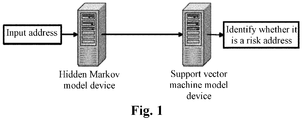
- Fig. 1 is a schematic diagram of an overall architecture involved in the solution of the specification in a practical application scenario.
- an address is firstly input and processed by a device containing a Hidden Markov Model (HMM) to obtain a decision vector corresponding to the input address, then the decision vector is further processed by a device containing a Support Vector Machine (SVM), and finally, whether the input address is a risk address is determined.
- HMM Hidden Markov Model
- SVM Support Vector Machine
- Fig. 2 is a schematic flowchart of the risk address identification method, and the flow in Fig. 2 may include the following steps: S102: an address word sequence corresponding to an input address is acquired.
- the address word sequence can be obtained after processing the input address.
- an interference character removing operation can be firstly performed on the input address, and then an address word sequence is further obtained.
- the address word sequence may also be the input address itself if the input address includes word separators such as spaces, or if the processing ability, for excluding interference characters, of the risk address identification in the subsequent steps is good.
- the various risk addresses can be understood as a risk address library composed of multiple risk addresses.
- a risk word can be understood as a risky address word contained in the risk address.
- the risk address may contain one or more risk words, and these risk words may constitute the risk address sequentially according to a certain rule or may be relatively independent.
- the method for determining hitting may, for example, comprise: respectively scanning each address word in the address word sequence and matching same with each address word in the risk address, and determining a hit address word (for ease of description, such an address word may be hereinafter referred to as a hit address word).
- the address word sequence can be represented as one multi-dimensional vector, with each dimension of the vector respectively corresponding to one address word in the address word sequence; further, the dimension, in the vector, corresponding to the address word A can be determined by scanning, and the dimension is labeled as 1 to determine that the address word A is hit; and for the other address words that are not hit, the corresponding dimensions are labeled as 0.
- each of required address words can be obtained from the address word sequence according to the determined address word and the semantics before and after it, and an observation sequence is generated according to the determined address word and the obtained address words, wherein the extracted address words may be continuous address words, and may also be discontinuous address words that conform to a certain rule;
- the way of generating an observation sequence corresponding to the address word sequence may also be: first splitting the address word sequence to obtain a plurality of address word sub-sequences, and then generating an observation sequence according to required address word subsequence.
- S108 the observation sequence is processed using a hidden Markov model obtained based on semantics learning before and after address words, to obtain a decision vector, wherein the decision vector represents probabilities of the risk address being hit by the various address words contained in the address word sequence.
- the semantics before and after address words may be associated semantics of address words before and after, and associated with, a current address word, and the current address word, and the number of associated address words may be two or three, wherein the associated address words may be either address words adjacent to the current address word or address words spaced apart from the current address word by a word.
- the above-mentioned current address word may be the determined address word in step S106.
- the semantics before and after the address word may be that the address words before and after, and adjacent to, the determined address word serve as the semantics before and after the address word, for example, Chaoyang District, Beijing, China, wherein the semantics before and after Beijing includes China and Chaoyang District; and it is also possible to use address words, in the address word sequence, not adjacent to each other as the semantics before and after the determined word.
- an observation sequence may also be an address word sequence or an input address itself.
- the probability of hitting the risk address can be labeled directly based on the hit address word and the semantics before and after it according to a labeling result of the hit address word in the address word sequence or the input address.
- S110 whether the input address is a risk address is identified by making a classification decision on the decision vector.
- the classification decision may be a binary classification decision made on the decision vector.
- one class may be a decision vector corresponding to a risk address, and the other class may be a decision vector corresponding to a non-risk address. Further, whether the input address corresponding to the decision vector is a risk address may be determined.
- acquiring an address word sequence corresponding to an input address may specifically comprise: receiving an input address; and performing data cleaning processing and word segmentation processing on the input address to obtain an address word sequence corresponding to the input address.
- the method of the data cleaning processing may comprise: removing an interference character from the input address to obtain a standardized address character string; or adjusting the arrangement order of various address words in the input address.
- the method of the word segmentation processing may comprise: segmenting the standardized address character string using a specific character such as a space or a semicolon, to obtain an address word sequence corresponding to the input address.
- an interference character removing operation can be firstly performed on the input address, and then an address word sequence is further obtained.
- interference characters existing in an input address to remove the interference characters
- the interference characters may, for example, include at least one of the following: extra spaces, half-width characters, "
- the cleaned input address can be, for example, a standardized address character string separated by spaces
- word segmentation labeling is performed: the cleaned address character string is segmented by spaces, auxiliary words, such as of and the, appearing in the address character string are labeled lexicographically, and these auxiliary words often can be not used in subsequent address matching and identification; and finally, an address word sequence composed of address words is obtained after the word segmentation labeling.
- an address word sequence is obtained, so that quick, efficient and accurate operations such as identification of risk address words can be performed on the address word sequence subsequently.
- the address word sequence may also be the input address itself if the input address includes word separators such as a space, or if the processing ability, for excluding interference characters, of the risk address identification in the subsequent steps is good; as such, the step of processing the input address can be omitted.
- determining, in various address words contained in the address word sequence, an address word hitting a risk word corresponding to each risk address may specifically comprise:
- the labeling may be: correspondingly labeling, with a number or a character, a matching result of various address words in the address word sequence respectively, including labeling a result indicating hitting and labeling a result indicating not hitting after the matching in the address word sequence, and composing a labeling vector together by these numbers or characters indicating the labeling results.
- an address word sequence or various address words in an observation sequence corresponding to the address word sequence is globally scanned, matched, and labeled, and if the second address word A in a certain address word sequence matches an address word a in an address word set corresponding to a risk address, then the address word A is labeled as 1, otherwise the address word A is labeled as 0.
- a labeling vector is obtained, which may also be referred to as an initial labeling vector, such as [0, 0, 1, 0, 0, 0].
- the various address words in the address word sequence are respectively matched, and the specific matching method may comprise: performing global risk address scanning and matching on the address word sequence (risk address information includes countries, regions, and major cities), wherein the matching algorithms used may, for example, include a character string similarity matching algorithm, a pronunciation similarity matching algorithm, and an editing distance matching algorithm, etc.
- determining, in various address words contained in the address word sequence, an address word hitting a risk word corresponding to each risk address further comprises: if there is no successfully matched address word, determining that the input address is not a risk address.
- generating an observation sequence corresponding to the address word sequence according to the determined address word may specifically comprise: for the determined address word, respectively performing the following: generating an observation sequence corresponding to the address word sequence according to the address word and associated words of the address word in the address word sequence, wherein the associated words reflect the semantics before and after the address word in the address word sequence.
- the address word sequence contains a plurality of determined address words, a plurality of corresponding observation sequences may be generated, and it may also be chosen to generate an observation sequence corresponding to one of the determined address words.
- An associated word can be understood as a word that has a certain logical relationship or a specific association relationship with words before and after it, or a word artificially defined to produce an association relationship with words before and after it.
- the associated words are adjacent to the current word, for example they can be two words before or after, and adjacent to, the current word.
- a hidden Markov model can be obtained in advance based on the semantics learning before and after address words.
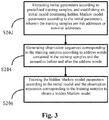
- Fig. 3 is a schematic flowchart of the modeling method, and the flow in Fig. 3 may include the following steps:
- the training samples include positive samples and negative samples; a risk address can be a positive sample, and a non-risk address can be a negative sample.
- the negative samples may be the addresses of 235 non-sanction countries or regions in the whole world, and the positive samples may be address data for all sanction countries and regions.
- a risk address contains a risk word, and of course, a non-risk address may also contain a risk word.
- the address words in step S204 can be understood as address words, which match the risk words corresponding to the risk addresses, in the training samples.
- a predefined sample address whether the sample address contains a risk word and which address word is a risk word have been labeled in advance.
- the sample address is a training sample address contained in the training samples.
- a required observation sequence is extracted according to the labeled address word in the sample address and the semantics before and after it; and generally, 2 or 3 words before and after and associated with the labeled address word are selected as the semantics before and after the address word, which all together form the observation sequence.
- hidden Markov model parameters are trained until appropriate hidden Markov model parameters are obtained, and then a needed hidden Markov model is determined according to the hidden Markov model parameters obtained through the training.
- the quantity and scale of training sample addresses will directly affect the quality of the training result.
- the address library used for the training sample addresses is more comprehensive and has a wider coverage, it is advantageous to improve the accuracy of the identification of the model, and therefore, the method can achieve a great modeling effect in the case of having enough training sample addresses.
- the initial parameters include: an initial probability vector ⁇ t , a state transition matrix, a ij , and the like; and extracting initial parameters according to predefined training samples may specifically comprise: based on the training samples, obtaining an initial probability vector by respectively performing probability labeling on the address words contained in the training samples; and obtaining a state transition matrix of the sample addresses according to state transition probabilities, between a risk word and a non-risk word, of the address words contained in the training samples.
- a risk word is an address word contained in a risk address
- a non-risk word is an address word contained in a non-risk address
- some address words can be both risk words and non-risk words.
- each training sample may be a sample address.
- a state transition matrix of the sample addresses is obtained according to state transition probabilities, between a risk word and a non-risk word, of the address words contained in the training samples.
- the state transition probability refers to the probability that state transition of an address word between two hidden states, i.e., a risk address and a non-risk address, may happen.
- training the hidden Markov model parameters according to the initial model and the observation sequences corresponding to the training samples to obtain a hidden Markov model may specifically comprise: according to the initial model and the observation sequences corresponding to the training samples, using a Baum-Welch algorithm to train the hidden Markov model parameters so as to obtain a hidden Markov model.
- O 0 1 0 2 ⁇ 0 h ⁇ 0 n -1 0 n , wherein the sequence O is an address word sequence containing a hit risk country/region word, and O h is an address word to be labeled.
- an objective function of the model is defined as: argmax P ( O h ,S h
- processing the observation sequence using a hidden Markov model obtained based on semantics learning before and after address words, to obtain a decision vector may specifically comprise:
- an obtained decision vector may be represented as [0, 0.5, 1, 0.3, 0, 0].
- making a classification decision on the decision vector may specifically comprise: making a classification decision on the decision vector using an SVM model obtained through training.
- a decision vector is obtained by calculation through a hidden Markov model, and then a decision with binary or more classification is made on the decision vector; and explanation is made below by mainly taking a binary classification decision as an example.
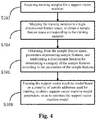
- Fig. 4 is a schematic flowchart of the modeling method for a support vector machine model, and the flow in Fig. 4 may include the following steps:
- the training samples for the support vector machine may be decision vectors corresponding to training samples obtained by training sample addresses through the above-mentioned hidden Markov model, or may be other to-be-discriminated data characterizing the input address.
- An SVM model parameter ⁇ i is obtained by training based on a large amount of address data such as global address library data, to further optimize the support vector machine model.
- a classification determination result of a risk address is obtained according to a matching result of each address word and the semantics before and after it, which can effectively identify risk addresses or forged risk addresses, and can avoid the misjudgment of risk-free addresses.
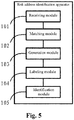
- Fig. 5 is a schematic structural diagram of a risk address identification apparatus corresponding to Fig. 2 provided in an embodiment of the specification.
- the structure as shown in Fig. 5 may specifically include:
- a classification determination result of the input address is obtained according to the address word obtained after processing the input address and the semantics before and after it, which can effectively identify risk addresses or forged risk addresses, and can avoid the misjudgment of risk-free addresses. Therefore, problems in the prior art can be partially or completely solved.
- the receiving module 101 acquiring an address word sequence corresponding to an input address may specifically comprise: the receiving module 101 receiving an input address; and performing data cleaning processing and word segmentation processing on the input address to obtain an address word sequence corresponding to the input address. Through further cleaning processing and word segmentation processing on the input address, a standardized address word sequence is obtained, so as to facilitate the labeling operation on the address word sequence in subsequent steps, which can improve the work efficiency of probability labeling of the determined address words in the address word sequence.
- the matching module 102 determining, in various address words contained in the address word sequence, an address word hitting a risk word corresponding to each risk address may specifically comprise:
- the matching module 102 determining, in various address words contained in the address word sequence, an address word hitting a risk word corresponding to each risk address may further comprise: if there is no successfully matched address word, determining that the input address is not a risk address.
- the generation module 103 generating an observation sequence corresponding to the address word sequence according to the determined address word may specifically comprise: for the determined address word, respectively performing the following: generating an observation sequence corresponding to the address word sequence according to the address word and associated words of the address word in the address word sequence, wherein the associated words reflect the semantics before and after the address word in the address word sequence.
- the semantics before and after the address word refers to a plurality of address words before and after, and associated with, the hit address word
- the number of associated address words may be two or three, where the associated address words may be address words associated continuously with the hit address word and may also be address words associated with and spaced apart from the hit address word.
- obtaining a hidden Markov model based on the semantics learning before and after address words comprises:
- the observation sequence consisting of the hit risk word and the semantics before and after the risk word is used to train the hidden Markov model parameters, so as to obtain the required hidden Markov model (HMM), which can improve the accuracy of input address risk identification by the hidden Markov model.
- HMM hidden Markov model
- a risk word is an address word contained in a risk address
- a non-risk word is an address word contained in a non-risk address
- some address words can be both risk words and non-risk words.
- training the hidden Markov model parameters according to the initial model and the observation sequences corresponding to the training samples to obtain a hidden Markov model may specifically comprise: according to the initial model and the observation sequences corresponding to the training samples, using a Baum-Welch algorithm to train the hidden Markov model parameters so as to obtain a hidden Markov model.
- the labeling module 104 processing the observation sequence using a hidden Markov model obtained based on semantics learning before and after address words, to obtain a decision vector may specifically comprise: processing the observation sequence using the hidden Markov model obtained by semantics learning before and after address words, and a Viterbi algorithm, to obtain a decision vector.
- the decision vector represents the probabilities of the risk address being hit by the various address words contained in the address word sequence.
- the identification module 105 making a classification decision on the decision vector may specifically comprise: making a classification decision on the decision vector using a support vector machine (SVM) model obtained through training.
- SVM support vector machine
- obtaining a support vector machine model through training comprises:
- the training samples can be understood as the decision vector in the above-mentioned embodiments, or other to-be-discriminated data characterizing the input address.
- the SVM needs to be used to map the decision vector to a high-dimensional feature space and then make a binary classification decision.
- a classification decision can be made on some decision vectors, which are easy to process, without mapping same to a high-dimensional feature space, for example, a linear classification decision can be made, which can reduce the computational difficulty and promote the processing speed.
- an electronic device comprising:
- Fig. 6 is a schematic flowchart where risk address identification indicates that an address has no risk, provided in an embodiment of the specification, which may specifically include:
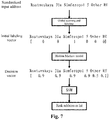
- Fig. 7 is a schematic flowchart where risk address identification indicates that an address is risky, provided in an embodiment of the specification, which may specifically comprise:
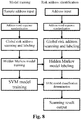
- Fig. 8 is a schematic flowchart of the modeling and identification of the risk address identification provided in an embodiment of the specification, which may specifically include:
- the hidden Markov model parameters are trained to obtain a needed hidden Markov model.
- the parameters of the SVM are trained according to the decision vector output through the hidden Markov model, to finally obtain a needed SVM model.
- a user When performing risk address scanning and identification, a user firstly inputs an address; then, standardization processing and global risk address scanning and labeling are performed on the input address to obtain a labeled address word sequence, and further, an observation sequence is obtained based on the risk word and the semantics before and after it.
- risk probability calculation and labeling are performed on the address word sequence (the observation sequence) through the hidden Markov model to generate a decision vector.
- the SVM makes a binary classification decision according to the decision vector to determine whether the input address is a risk address.
- the hidden Markov model and the support vector machine are used to judge and identify the input address based on the risk address word and the semantics before and after it, and the accuracy of the identification can be effectively improved.
- the apparatus, electronic device and non-volatile computer storage medium provided in the embodiments of the specification correspond to the method. Therefore, the apparatus, electronic device and non-volatile computer storage medium also have the similar beneficial technical effects to those of the corresponding method. Since the beneficial technical effects of the method have been described in detail above, the beneficial technical effects of the corresponding apparatus, electronic device and non-volatile computer storage medium will not be described herein.
- an improvement on a technology may be obviously distinguished as an improvement on hardware (for example, an improvement on a circuit structure such as a diode, a transistor, and a switch) or an improvement on software (an improvement on a method procedure).
- improvements of many method procedures at present may be considered as direct improvements on hardware circuit structures. Almost all designers program the improved method procedures into hardware circuits to obtain corresponding hardware circuit structures. Therefore, it cannot be said that the improvement of a method procedure cannot be implemented using a hardware entity module.
- a Programmable Logic Device for example, a Field Programmable Gate Array (FPGA)
- FPGA Field Programmable Gate Array
- the "logic compiler” software is similar to a software complier used for developing and writing a program, and original code before compiling also needs to be written in a specific programming language, which is referred to as a Hardware Description Language (HDL).
- HDL Hardware Description Language
- HDLs there are many types of HDLs, such as ABEL (Advanced Boolean Expression Language), AHDL (Altera Hardware Description Language), Confluence, CUPL (Cornell University Programming Language), HDCal, JHDL (Java Hardware Description Language), Lava, Lola, MyHDL, PALASM, and RHDL (Ruby Hardware Description Language), among which VHDL (Very-High-Speed Integrated Circuit Hardware Description Language) and Verilog are most commonly used now.
- ABEL Advanced Boolean Expression Language
- AHDL Altera Hardware Description Language
- Confluence CUPL (Cornell University Programming Language)
- HDCal Joint Deformation Language
- JHDL Joint Hardware Description Language
- Lava Lava
- Lola MyHDL
- PALASM Phase Change Language
- RHDL Raby Hardware Description Language
- VHDL Very-High-Speed Integrated Circuit Hardware Description Language
- Verilog Verilog
- a controller may be implemented in any suitable manner.
- the controller may be in the form of a microprocessor or a processor, and a computer readable medium storing computer readable program codes (for example, software or firmware) executable by the (micro)processor, a logic gate, a switch, an Application Specific Integrated Circuit (ASIC), a programmable logic controller, and an embedded micro-controller.
- Examples of the controller include, but are not limited to, the following micro-controllers: ARC 625D, Atmel AT91SAM, Microchip PIC18F26K20, and Silicone Labs C8051F320.
- a memory controller may also be implemented as a part of a control logic of a memory.
- the method steps may be logically programmed to enable the controller to implement the same function in the form of a logic gate, a switch, an application specific integrated circuit, a programmable logic controller and an embedded microcontroller. Therefore, such a controller may be considered as a hardware component, and apparatuses included therein for implementing various functions may also be considered as structures inside the hardware component. Alternatively, the apparatuses for implementing various functions may even be considered as both software modules for implementing the method and structures inside the hardware components.
- the system, apparatus, modules or units illustrated in the above-described embodiments can be implemented by a computer chip or an entity, or implemented by a product having a specific function.
- a typical implementation device is a computer.
- the computer may be a personal computer, a laptop computer, a cellular phone, a camera phone, a smart phone, a personal digital assistant, a media player, a navigation device, an email device, a game console, a tablet computer, a wearable device, or a combination of any of these devices.
- the embodiments of the specification may be provided as a method, a system, or a computer program product. Therefore, the embodiments of the specification may be implemented in a form of complete hardware embodiments, complete software embodiments, or embodiments combining software and hardware. Moreover, the embodiments of the specification may be in the form of a computer program product implemented on one or more computer usable storage mediums (including, but not limited to, a magnetic disk memory, a CD-ROM, an optical memory and the like) including computer usable program codes therein.
- a computer usable storage mediums including, but not limited to, a magnetic disk memory, a CD-ROM, an optical memory and the like
- These computer program instructions may also be stored in a computer readable memory that can guide a computer or other programmable data processing devices to operate in a particular manner, such that the instructions stored in the computer readable memory produce a manufactured product, including an instruction apparatus.
- the instruction apparatus implements a function specified in one or more processes in the flowcharts and/or in one or more blocks in the block diagrams.
- These computer program instructions may also be loaded onto a computer or other programmable data processing devices, such that a series of operation steps are performed on the computer or other programmable devices, thus producing computer-implemented processing. Therefore, the instructions executed on the computer or other programmable devices provide steps for implementing a function specified in one or more processes in the flowcharts and/or in one or more blocks in the block diagrams.
- the computing device comprises one or more central processing units (CPUs), an input/output interface, a network interface, and a memory.
- CPUs central processing units
- input/output interface input/output interface
- network interface network interface
- memory a memory
- the memory may include a computer-readable medium such as a non-permanent memory, a Random Access Memory (RAM), and/or a non-volatile memory, e.g., a Read-Only Memory (ROM) or a flash RAM.
- a computer-readable medium such as a non-permanent memory, a Random Access Memory (RAM), and/or a non-volatile memory, e.g., a Read-Only Memory (ROM) or a flash RAM.
- RAM Random Access Memory
- ROM Read-Only Memory
- flash RAM flash RAM
- the computer readable medium includes permanent and non-permanent media as well as removable and non-removable media, and may store information by any method or technology.
- the information may be a computer-readable instruction, a data structure, a module of a program, or other data.
- An example of the storage medium of a computer includes, but is not limited to, a phase change memory (PRAM), a static random access memory (SRAM), a dynamic random access memory (DRAM), other types of random access memories (RAMs), a read-only memory (ROM), an electrically erasable programmable read-only memory (EEPROM), a flash memory or other memory technologies, a compact disk read-only memory (CD-ROM), a digital versatile disc (DVD) or other optical storages, a cassette tape, a magnetic tape/magnetic disk storage or other magnetic storage devices, or any other non-transmission medium, and can be used to store information accessible to the computing device.
- the computer-readable medium does not include a computer-readable transitory medium, such as modulated data signals and carriers.
- the specification may be described in a general context of computer-executable instructions executed by a computer, for example, a program module.
- the program module includes a routine, a program, an object, a component, a data structure, and the like for executing a specific task or implementing a specific abstract data type.
- the specification may also be practiced in distributed computing environments. In the distributed computing environments, a task is executed by a remote processing device connected through a communications network. In the distributed computing environments, the program module may be located in a local and remote computer storage medium, including a storage device.
Landscapes
- Engineering & Computer Science (AREA)
- Theoretical Computer Science (AREA)
- Physics & Mathematics (AREA)
- General Engineering & Computer Science (AREA)
- General Physics & Mathematics (AREA)
- Data Mining & Analysis (AREA)
- Artificial Intelligence (AREA)
- Software Systems (AREA)
- Evolutionary Computation (AREA)
- Computer Security & Cryptography (AREA)
- Computer Vision & Pattern Recognition (AREA)
- Computer Hardware Design (AREA)
- Evolutionary Biology (AREA)
- Bioinformatics & Computational Biology (AREA)
- Bioinformatics & Cheminformatics (AREA)
- Life Sciences & Earth Sciences (AREA)
- Health & Medical Sciences (AREA)
- Computational Linguistics (AREA)
- General Health & Medical Sciences (AREA)
- Computing Systems (AREA)
- Mathematical Physics (AREA)
- Audiology, Speech & Language Pathology (AREA)
- Medical Informatics (AREA)
- Databases & Information Systems (AREA)
- Virology (AREA)
- Probability & Statistics with Applications (AREA)
- Algebra (AREA)
- Computational Mathematics (AREA)
- Mathematical Analysis (AREA)
- Mathematical Optimization (AREA)
- Pure & Applied Mathematics (AREA)
- Business, Economics & Management (AREA)
- Accounting & Taxation (AREA)
- Signal Processing (AREA)
- Computer Networks & Wireless Communication (AREA)
- Finance (AREA)
- Strategic Management (AREA)
- Economics (AREA)
- Marketing (AREA)
- Development Economics (AREA)
Claims (13)
- Procédé d'identification d'adresse risquée, comprenant :l'acquisition (S102) d'une séquence de mots d'adresse correspondant à une adresse d'entrée ;la détermination (S104), dans divers mots d'adresse contenus dans la séquence de mots d'adresse, d'un mot d'adresse correspondant à un mot risqué concordant avec chaque adresse risquée ;la génération (S106) d'une séquence d'observation concordant avec la séquence de mots d'adresse selon le mot d'adresse déterminé ;le traitement (S108) de la séquence d'observation à l'aide d'un modèle de Markov caché obtenu sur la base d'un apprentissage sémantique utilisant des mots associés avant et après le mot d'adresse déterminé, pour obtenir un vecteur de décision, le vecteur de décision représentant les probabilités de correspondance entre l'adresse risquée et les différents mots d'adresse contenus dans la séquence de mots d'adresse ; etl'identification (SI 10) pour savoir si l'adresse d'entrée est une adresse risquée en prenant une décision de classification sur le vecteur de décision.
- Procédé selon la revendication 1, ladite acquisition d'une séquence de mots d'adresse concordant avec une adresse d'entrée comprenant spécifiquement :la réception d'une adresse d'entrée ;la réalisation d'un traitement de nettoyage de données et d'un traitement de segmentation de mot sur l'adresse d'entrée pour obtenir une séquence de mots d'adresse concordant avec l'adresse d'entrée.
- Procédé selon la revendication 1, ladite détermination, dans divers mots d'adresse contenus dans la séquence de mots d'adresse, d'un mot d'adresse correspondant à un mot risqué concordant avec chaque adresse risquée comprenant spécifiquement :la mise en correspondre respectivement des divers mots d'adresse dans la séquence de mots d'adresse à l'aide des mots risqués concordant avec chaque adresse risquée ; etsi l'un des mots d'adresse est mis en correspondance avec succès, l'étiquetage de celui-ci et la détermination de celui-ci en tant que mot d'adresse correspondant à un mot risqué correspondant à chaque adresse risquée.
- Procédé selon la revendication 3, ladite détermination, dans divers mots d'adresse contenus dans la séquence de mots d'adresse, d'un mot d'adresse correspondant à un mot risqué concordant avec chaque adresse risquée comprenant en outre :
si aucun mot d'adresse n'est mis en correspondance avec succès, la détermination que l'adresse d'entrée n'est pas une adresse risquée. - Procédé selon la revendication 3, ladite génération d'une séquence d'observation concordant avec la séquence de mots d'adresse selon le mot d'adresse déterminé comprenant spécifiquement :
pour le mot d'adresse déterminé, la réalisation respective des suivants : la génération d'une séquence d'observation concordant avec la séquence de mots d'adresse selon le mot d'adresse et des mots associés du mot d'adresse dans la séquence de mots d'adresse, lesdits mots associés reflétant la sémantique avant et après le mot d'adresse dans la séquence de mots d'adresse. - Procédé selon la revendication 1, ladite obtention d'un modèle de Markov caché sur la base de l'apprentissage sémantique avant et après les mots d'adresse comprenant :l'extraction (S202) des paramètres initiaux selon des échantillons d'entraînement prédéfinis, et l'établissement d'un modèle initial contenant des paramètres de modèle de Markov caché selon les paramètres initiaux, lesdits échantillons d'entraînement étant des adresses risquées ou des adresses non risquées ;la génération (S204) des séquences d'observation concordant aux échantillons d'entraînement selon les mots d'adresse contenus dans les échantillons d'entraînement et la sémantique avant et après les mots d'adresse ; etl'entraînement (S206) des paramètres de modèle de Markov caché selon le modèle initial et des séquences d'observation concordant avec les échantillons d'entraînement pour obtenir un modèle de Markov caché.
- Procédé selon la revendication 6, lesdits paramètres initiaux comprenant : un vecteur de probabilité initial et une matrice de transition d'état ; et
ladite extraction de paramètres initiaux selon des échantillons d'entraînement prédéfinis comprenant spécifiquement : sur la base d'une pluralité d'échantillons d'entraînement prédéfinis, l'obtention d'un vecteur de probabilité initial en effectuant respectivement un étiquetage de probabilité sur des mots d'adresse contenus dans les échantillons d'entraînement ; et
l'obtention d'une matrice de transition d'état des adresses d'échantillons selon des probabilités de transition d'état, entre un mot risqué et un mot non risqué, des mots d'adresse contenus dans les échantillons d'entraînement. - Procédé selon la revendication 6, ledit entraînement des paramètres de modèle de Markov caché selon le modèle initial et les séquences d'observation concordant avec les échantillons d'entraînement pour obtenir un modèle de Markov caché comprenant spécifiquement :
selon le modèle initial et les séquences d'observation concordant avec les échantillons d'entraînement, l'utilisation d'un algorithme de Baum-Welch pour entraîner les paramètres du modèle de Markov caché de façon à obtenir un modèle de Markov caché. - Procédé selon la revendication 1, ledit traitement de la séquence d'observation à l'aide d'un modèle de Markov caché obtenu sur la base d'un apprentissage sémantique utilisant des mots associés avant et après le mot d'adresse déterminé pour obtenir un vecteur de décision comprenant spécifiquement :
le traitement de la séquence d'observation à l'aide du modèle de Markov caché obtenu par sémantique, l'apprentissage à l'aide de mots associés avant et après le mot d'adresse déterminé, et un algorithme de Viterbi, pour obtenir un vecteur de décision. - Procédé selon la revendication 1, ladite prise d'une décision de classification sur le vecteur de décision comprenant spécifiquement :
la prise d'une décision de classification sur le vecteur de décision à l'aide d'un modèle de machine à vecteurs de support (SVM) obtenu par entraînement. - Procédé selon la revendication 10, ladite obtention d'un modèle de machine à vecteurs de support par entraînement comprenant :l'acquisition (S302) des échantillons d'entraînement pour une machine à vecteurs de support ;la mise en correspondance (S304) des échantillons d'entraînement de la machine à vecteurs de support avec un espace de caractéristiques de grande dimension, pour obtenir un espace de caractéristiques d'échantillon concordant avec les échantillons d'entraînement de la machine à vecteurs de support ;l'acquisition (S306), à partir de l'espace de caractéristiques d'échantillon, des paramètres représentant des caractéristiques d'échantillon, et l'établissement d'une fonction de discrimination en vue de la détermination d'une catégorie des caractéristiques d'échantillon selon les paramètres des caractéristiques d'échantillon ; etl'entraînement (S308) des paramètres de modèle SVM concordant dans la fonction de discrimination sur la base des échantillons d'entraînement de la machine à vecteurs de support, pour obtenir un modèle SVM
- Dispositif électronique, comprenant : au moins processeur ; et
une mémoire en connexion de communication avec le au moins un processeur, ladite mémoire stockant des instructions exécutables par le au moins un processeur, les instructions étant exécutées par le au moins un processeur pour permettre à l'au moins un processeur d'effectuer le procédé selon l'un quelconque des revendications 1 à 11. - Support de stockage informatique comprenant des instructions qui, lorsqu'elles sont exécutées par au moins un processeur, configurent le au moins un processeur pour effectuer le procédé selon l'une quelconque des revendications 1 à 11.
Applications Claiming Priority (2)
| Application Number | Priority Date | Filing Date | Title |
|---|---|---|---|
| CN201710543805.4A CN107526967B (zh) | 2017-07-05 | 2017-07-05 | 一种风险地址识别方法、装置以及电子设备 |
| PCT/CN2018/093791 WO2019007288A1 (fr) | 2017-07-05 | 2018-06-29 | Procédé et appareil d'identification d'adresse risquée, et dispositif électronique |
Publications (3)
| Publication Number | Publication Date |
|---|---|
| EP3637295A1 EP3637295A1 (fr) | 2020-04-15 |
| EP3637295A4 EP3637295A4 (fr) | 2020-04-29 |
| EP3637295B1 true EP3637295B1 (fr) | 2021-08-04 |
Family
ID=60748842
Family Applications (1)
| Application Number | Title | Priority Date | Filing Date |
|---|---|---|---|
| EP18827964.0A Active EP3637295B1 (fr) | 2017-07-05 | 2018-06-29 | Procédé et appareil d'identification d'adresse risquée, et dispositif électronique |
Country Status (10)
| Country | Link |
|---|---|
| US (2) | US10762296B2 (fr) |
| EP (1) | EP3637295B1 (fr) |
| JP (1) | JP6894058B2 (fr) |
| KR (1) | KR102244417B1 (fr) |
| CN (1) | CN107526967B (fr) |
| MY (1) | MY201873A (fr) |
| PH (1) | PH12019501823A1 (fr) |
| SG (1) | SG11201907079QA (fr) |
| TW (1) | TWI682302B (fr) |
| WO (1) | WO2019007288A1 (fr) |
Families Citing this family (23)
| Publication number | Priority date | Publication date | Assignee | Title |
|---|---|---|---|---|
| CN107423883B (zh) * | 2017-06-15 | 2020-04-07 | 创新先进技术有限公司 | 待处理业务的风险识别方法及装置、电子设备 |
| CN107526967B (zh) * | 2017-07-05 | 2020-06-02 | 阿里巴巴集团控股有限公司 | 一种风险地址识别方法、装置以及电子设备 |
| CN108920457B (zh) * | 2018-06-15 | 2022-01-04 | 腾讯大地通途(北京)科技有限公司 | 地址识别方法和装置及存储介质 |
| CN108876545A (zh) * | 2018-06-22 | 2018-11-23 | 北京小米移动软件有限公司 | 订单识别方法、装置和可读存储介质 |
| CN109102303B (zh) * | 2018-06-28 | 2021-06-08 | 招联消费金融有限公司 | 风险检测方法和相关装置 |
| CN114119137B (zh) * | 2018-06-29 | 2024-06-28 | 创新先进技术有限公司 | 风险控制方法和装置 |
| CN108960645B (zh) * | 2018-07-10 | 2020-11-13 | 创新先进技术有限公司 | 一种风险防控方法、系统及终端设备 |
| CN109598000B (zh) * | 2018-12-28 | 2023-06-16 | 百度在线网络技术(北京)有限公司 | 语义关系识别方法、装置、计算机设备和存储介质 |
| CN111488334B (zh) * | 2019-01-29 | 2023-04-14 | 阿里巴巴集团控股有限公司 | 数据处理方法及电子设备 |
| CN110322252B (zh) * | 2019-05-30 | 2023-07-04 | 创新先进技术有限公司 | 风险主体识别方法以及装置 |
| CN110335115A (zh) * | 2019-07-01 | 2019-10-15 | 阿里巴巴集团控股有限公司 | 一种业务订单处理方法及装置 |
| CN110348730A (zh) * | 2019-07-04 | 2019-10-18 | 创新奇智(南京)科技有限公司 | 风险用户判断方法及其系统、电子设备 |
| CN112579713B (zh) * | 2019-09-29 | 2023-11-21 | 中国移动通信集团辽宁有限公司 | 地址识别方法、装置、计算设备及计算机存储介质 |
| US11132512B2 (en) * | 2019-11-08 | 2021-09-28 | International Business Machines Corporation | Multi-perspective, multi-task neural network model for matching text to program code |
| CN112988989B (zh) * | 2019-12-18 | 2022-08-12 | 中国移动通信集团四川有限公司 | 一种地名地址匹配方法及服务器 |
| CN113111232B (zh) * | 2020-02-13 | 2024-09-06 | 北京明亿科技有限公司 | 基于正则表达式的接处警文本地址提取方法和装置 |
| CN111738358B (zh) | 2020-07-24 | 2020-12-08 | 支付宝(杭州)信息技术有限公司 | 一种数据识别方法、装置、设备和可读介质 |
| CN112818667B (zh) * | 2021-01-29 | 2024-07-02 | 上海寻梦信息技术有限公司 | 地址纠正方法、系统、设备及存储介质 |
| CN113343670B (zh) * | 2021-05-26 | 2023-07-28 | 武汉大学 | 基于隐马尔可夫与分类算法耦合的地址文本要素提取方法 |
| US12289332B2 (en) | 2021-11-15 | 2025-04-29 | Cfd Research Corporation | Cybersecurity systems and methods for protecting, detecting, and remediating critical application security attacks |
| CN114528908B (zh) * | 2021-12-31 | 2024-09-06 | 安徽航天信息有限公司 | 网络请求数据分类模型训练方法、分类方法及存储介质 |
| CN116521881B (zh) * | 2023-05-29 | 2025-11-28 | 湖南大学 | 一种哨单分类方法 |
| CN119848164B (zh) * | 2024-12-24 | 2025-12-16 | 京东城市(北京)数字科技有限公司 | 地址匹配方法、装置、设备、介质和产品 |
Family Cites Families (31)
| Publication number | Priority date | Publication date | Assignee | Title |
|---|---|---|---|---|
| US8812300B2 (en) * | 1998-03-25 | 2014-08-19 | International Business Machines Corporation | Identifying related names |
| JP4497834B2 (ja) * | 2003-04-28 | 2010-07-07 | パイオニア株式会社 | 音声認識装置及び音声認識方法並びに音声認識用プログラム及び情報記録媒体 |
| JP4545540B2 (ja) * | 2004-10-01 | 2010-09-15 | 三菱電機株式会社 | アクセス防止装置 |
| JP4639784B2 (ja) * | 2004-12-06 | 2011-02-23 | ソニー株式会社 | 学習装置および学習方法、並びにプログラム |
| US7590536B2 (en) * | 2005-10-07 | 2009-09-15 | Nuance Communications, Inc. | Voice language model adjustment based on user affinity |
| AU2007248585A1 (en) * | 2006-05-04 | 2007-11-15 | Jpmorgan Chase Bank, N.A. | System and method for restricted party screening and resolution services |
| US7668921B2 (en) * | 2006-05-30 | 2010-02-23 | Xerox Corporation | Method and system for phishing detection |
| JPWO2008004663A1 (ja) * | 2006-07-07 | 2009-12-10 | 日本電気株式会社 | 言語モデル更新装置、言語モデル更新方法、および言語モデル更新用プログラム |
| US7590707B2 (en) * | 2006-08-07 | 2009-09-15 | Webroot Software, Inc. | Method and system for identifying network addresses associated with suspect network destinations |
| US7984500B1 (en) * | 2006-10-05 | 2011-07-19 | Amazon Technologies, Inc. | Detecting fraudulent activity by analysis of information requests |
| KR100897553B1 (ko) * | 2007-01-04 | 2009-05-15 | 삼성전자주식회사 | 사용자의 기기 사용 패턴을 이용한 음성 인식 방법 및 장치 |
| US8805861B2 (en) * | 2008-12-09 | 2014-08-12 | Google Inc. | Methods and systems to train models to extract and integrate information from data sources |
| CN101923618B (zh) * | 2010-08-19 | 2011-12-21 | 中国航天科技集团公司第七一0研究所 | 一种基于隐马尔可夫模型的汇编指令级漏洞检测方法 |
| US8468167B2 (en) * | 2010-10-25 | 2013-06-18 | Corelogic, Inc. | Automatic data validation and correction |
| CN102339320B (zh) * | 2011-11-04 | 2013-08-28 | 华为数字技术(成都)有限公司 | 恶意网页的识别方法以及识别装置 |
| US9275339B2 (en) * | 2012-04-24 | 2016-03-01 | Raytheon Company | System and method for probabilistic name matching |
| CN103810425B (zh) * | 2012-11-13 | 2015-09-30 | 腾讯科技(深圳)有限公司 | 恶意网址的检测方法及装置 |
| TWI461952B (zh) * | 2012-12-26 | 2014-11-21 | Univ Nat Taiwan Science Tech | 惡意程式偵測方法與系統 |
| US9178901B2 (en) * | 2013-03-26 | 2015-11-03 | Microsoft Technology Licensing, Llc | Malicious uniform resource locator detection |
| CN103220302A (zh) * | 2013-05-07 | 2013-07-24 | 腾讯科技(深圳)有限公司 | 恶意网址的访问防御方法和相关装置 |
| CN103530562A (zh) * | 2013-10-23 | 2014-01-22 | 腾讯科技(深圳)有限公司 | 一种恶意网站的识别方法和装置 |
| CN104217160B (zh) * | 2014-09-19 | 2017-11-28 | 中国科学院深圳先进技术研究院 | 一种中文钓鱼网站检测方法及系统 |
| CN106157700B (zh) * | 2015-01-07 | 2018-10-09 | 江苏理工学院 | 基于4d航迹运行的空中交通管制方法 |
| US10049099B2 (en) * | 2015-04-10 | 2018-08-14 | Facebook, Inc. | Spell correction with hidden markov models on online social networks |
| CN104766014B (zh) * | 2015-04-30 | 2017-12-01 | 安一恒通(北京)科技有限公司 | 用于检测恶意网址的方法和系统 |
| CN106296195A (zh) * | 2015-05-29 | 2017-01-04 | 阿里巴巴集团控股有限公司 | 一种风险识别方法及装置 |
| CN104933443A (zh) * | 2015-06-26 | 2015-09-23 | 北京途美科技有限公司 | 一种敏感数据自动识别与分类的方法 |
| CN105574146A (zh) * | 2015-12-15 | 2016-05-11 | 北京奇虎科技有限公司 | 网址拦截方法及装置 |
| CN105447204B (zh) * | 2016-01-04 | 2017-12-12 | 北京百度网讯科技有限公司 | 网址识别方法和装置 |
| CN106682502B (zh) * | 2016-12-13 | 2019-07-19 | 重庆邮电大学 | 基于隐马尔可夫和概率推断的入侵意图识别系统及方法 |
| CN107526967B (zh) * | 2017-07-05 | 2020-06-02 | 阿里巴巴集团控股有限公司 | 一种风险地址识别方法、装置以及电子设备 |
-
2017
- 2017-07-05 CN CN201710543805.4A patent/CN107526967B/zh active Active
-
2018
- 2018-05-16 TW TW107116561A patent/TWI682302B/zh not_active IP Right Cessation
- 2018-06-29 WO PCT/CN2018/093791 patent/WO2019007288A1/fr not_active Ceased
- 2018-06-29 MY MYPI2019004454A patent/MY201873A/en unknown
- 2018-06-29 JP JP2019542684A patent/JP6894058B2/ja active Active
- 2018-06-29 SG SG11201907079QA patent/SG11201907079QA/en unknown
- 2018-06-29 EP EP18827964.0A patent/EP3637295B1/fr active Active
- 2018-06-29 KR KR1020197023966A patent/KR102244417B1/ko active Active
-
2019
- 2019-08-06 PH PH12019501823A patent/PH12019501823A1/en unknown
- 2019-10-04 US US16/592,895 patent/US10762296B2/en active Active
-
2020
- 2020-01-29 US US16/775,913 patent/US10699076B2/en active Active
Non-Patent Citations (1)
| Title |
|---|
| None * |
Also Published As
| Publication number | Publication date |
|---|---|
| MY201873A (en) | 2024-03-21 |
| JP2020524314A (ja) | 2020-08-13 |
| WO2019007288A1 (fr) | 2019-01-10 |
| US10762296B2 (en) | 2020-09-01 |
| TWI682302B (zh) | 2020-01-11 |
| KR20200015444A (ko) | 2020-02-12 |
| PH12019501823A1 (en) | 2019-10-07 |
| JP6894058B2 (ja) | 2021-06-23 |
| KR102244417B1 (ko) | 2021-04-28 |
| CN107526967B (zh) | 2020-06-02 |
| EP3637295A1 (fr) | 2020-04-15 |
| US20200034426A1 (en) | 2020-01-30 |
| EP3637295A4 (fr) | 2020-04-29 |
| CN107526967A (zh) | 2017-12-29 |
| US10699076B2 (en) | 2020-06-30 |
| SG11201907079QA (en) | 2019-08-27 |
| US20200167526A1 (en) | 2020-05-28 |
| TW201907325A (zh) | 2019-02-16 |
Similar Documents
| Publication | Publication Date | Title |
|---|---|---|
| US10699076B2 (en) | Risk address identification method and apparatus, and electronic device | |
| CN109918673B (zh) | 语义仲裁方法、装置、电子设备和计算机可读存储介质 | |
| US20240013563A1 (en) | System and method to extract information from unstructured image documents | |
| CN114780691B (zh) | 模型预训练及自然语言处理方法、装置、设备及存储介质 | |
| CN110413787B (zh) | 文本聚类方法、装置、终端和存储介质 | |
| JP6335898B2 (ja) | 製品認識に基づく情報分類 | |
| CN107480143A (zh) | 基于上下文相关性的对话话题分割方法和系统 | |
| US20210358570A1 (en) | Method and system for claim scope labeling, retrieval and information labeling of gene sequence | |
| CN111159354A (zh) | 一种敏感资讯检测方法、装置、设备及系统 | |
| CN113642320B (zh) | 文档目录结构的提取方法、装置、设备和介质 | |
| CN112287071A (zh) | 一种文本关系提取方法、装置及电子设备 | |
| CN119740577A (zh) | 基于大语言模型的主题聚类文本分割方法、设备、介质及程序产品 | |
| CN118535737A (zh) | 一种基于文本分类进行地址分类的快速微调方法及系统 | |
| CN116029280A (zh) | 一种文档关键信息抽取方法、装置、计算设备和存储介质 | |
| US11210605B1 (en) | Dataset suitability check for machine learning | |
| CN114254622B (zh) | 一种意图识别方法和装置 | |
| CN117131159A (zh) | 一种提取敏感信息的方法、装置、设备及存储介质 | |
| WO2024244255A1 (fr) | Extraction de synonymes | |
| CN116069905A (zh) | 图像文本模型处理方法及图像文本检索系统 | |
| Ekbal et al. | Ensemble based active annotation for named entity recognition | |
| CN111400577B (zh) | 一种搜索召回方法及装置 | |
| CN112598279A (zh) | 一种信息的提供方法及装置 | |
| CN115439790B (zh) | 基于级联的种子区域生长模块的弱监督时序动作定位方法 | |
| CN113688233A (zh) | 一种用于知识图谱语义搜索的文本理解的方法 | |
| US20230326046A1 (en) | Application matching method and application matching device |
Legal Events
| Date | Code | Title | Description |
|---|---|---|---|
| STAA | Information on the status of an ep patent application or granted ep patent |
Free format text: STATUS: THE INTERNATIONAL PUBLICATION HAS BEEN MADE |
|
| PUAI | Public reference made under article 153(3) epc to a published international application that has entered the european phase |
Free format text: ORIGINAL CODE: 0009012 |
|
| STAA | Information on the status of an ep patent application or granted ep patent |
Free format text: STATUS: REQUEST FOR EXAMINATION WAS MADE |
|
| 17P | Request for examination filed |
Effective date: 20191206 |
|
| AK | Designated contracting states |
Kind code of ref document: A1 Designated state(s): AL AT BE BG CH CY CZ DE DK EE ES FI FR GB GR HR HU IE IS IT LI LT LU LV MC MK MT NL NO PL PT RO RS SE SI SK SM TR |
|
| AX | Request for extension of the european patent |
Extension state: BA ME |
|
| A4 | Supplementary search report drawn up and despatched |
Effective date: 20200401 |
|
| RIC1 | Information provided on ipc code assigned before grant |
Ipc: G06N 7/00 20060101ALI20200326BHEP Ipc: G06F 21/55 20130101ALI20200326BHEP Ipc: G06F 40/30 20200101ALI20200326BHEP Ipc: G06Q 30/06 20120101ALI20200326BHEP Ipc: H04L 29/06 20060101ALI20200326BHEP Ipc: G06F 21/56 20130101AFI20200326BHEP Ipc: G06K 9/62 20060101ALI20200326BHEP Ipc: G06F 16/33 20190101ALI20200326BHEP Ipc: G06N 20/00 20190101ALI20200326BHEP |
|
| STAA | Information on the status of an ep patent application or granted ep patent |
Free format text: STATUS: EXAMINATION IS IN PROGRESS |
|
| DAV | Request for validation of the european patent (deleted) | ||
| DAX | Request for extension of the european patent (deleted) | ||
| 17Q | First examination report despatched |
Effective date: 20200928 |
|
| RAP1 | Party data changed (applicant data changed or rights of an application transferred) |
Owner name: ADVANCED NEW TECHNOLOGIES CO., LTD. |
|
| REG | Reference to a national code |
Ref country code: DE Ref legal event code: R079 Ref document number: 602018021403 Country of ref document: DE Free format text: PREVIOUS MAIN CLASS: G06F0021560000 Ipc: G06N0020100000 |
|
| RIC1 | Information provided on ipc code assigned before grant |
Ipc: G06N 20/10 20190101AFI20210331BHEP Ipc: G06F 16/33 20190101ALI20210331BHEP Ipc: G06F 21/55 20130101ALI20210331BHEP Ipc: G06F 21/56 20130101ALI20210331BHEP Ipc: G06F 40/30 20200101ALI20210331BHEP Ipc: G06K 9/62 20060101ALI20210331BHEP Ipc: G06N 7/00 20060101ALI20210331BHEP Ipc: G06Q 30/06 20120101ALI20210331BHEP Ipc: H04L 29/06 20060101ALI20210331BHEP |
|
| GRAP | Despatch of communication of intention to grant a patent |
Free format text: ORIGINAL CODE: EPIDOSNIGR1 |
|
| STAA | Information on the status of an ep patent application or granted ep patent |
Free format text: STATUS: GRANT OF PATENT IS INTENDED |
|
| GRAS | Grant fee paid |
Free format text: ORIGINAL CODE: EPIDOSNIGR3 |
|
| INTG | Intention to grant announced |
Effective date: 20210510 |
|
| GRAA | (expected) grant |
Free format text: ORIGINAL CODE: 0009210 |
|
| STAA | Information on the status of an ep patent application or granted ep patent |
Free format text: STATUS: THE PATENT HAS BEEN GRANTED |
|
| AK | Designated contracting states |
Kind code of ref document: B1 Designated state(s): AL AT BE BG CH CY CZ DE DK EE ES FI FR GB GR HR HU IE IS IT LI LT LU LV MC MK MT NL NO PL PT RO RS SE SI SK SM TR |
|
| REG | Reference to a national code |
Ref country code: GB Ref legal event code: FG4D |
|
| REG | Reference to a national code |
Ref country code: AT Ref legal event code: REF Ref document number: 1417762 Country of ref document: AT Kind code of ref document: T Effective date: 20210815 |
|
| REG | Reference to a national code |
Ref country code: CH Ref legal event code: EP |
|
| REG | Reference to a national code |
Ref country code: DE Ref legal event code: R096 Ref document number: 602018021403 Country of ref document: DE |
|
| REG | Reference to a national code |
Ref country code: IE Ref legal event code: FG4D |
|
| REG | Reference to a national code |
Ref country code: LT Ref legal event code: MG9D |
|
| REG | Reference to a national code |
Ref country code: NL Ref legal event code: MP Effective date: 20210804 |
|
| REG | Reference to a national code |
Ref country code: AT Ref legal event code: MK05 Ref document number: 1417762 Country of ref document: AT Kind code of ref document: T Effective date: 20210804 |
|
| PG25 | Lapsed in a contracting state [announced via postgrant information from national office to epo] |
Ref country code: HR Free format text: LAPSE BECAUSE OF FAILURE TO SUBMIT A TRANSLATION OF THE DESCRIPTION OR TO PAY THE FEE WITHIN THE PRESCRIBED TIME-LIMIT Effective date: 20210804 Ref country code: NO Free format text: LAPSE BECAUSE OF FAILURE TO SUBMIT A TRANSLATION OF THE DESCRIPTION OR TO PAY THE FEE WITHIN THE PRESCRIBED TIME-LIMIT Effective date: 20211104 Ref country code: PT Free format text: LAPSE BECAUSE OF FAILURE TO SUBMIT A TRANSLATION OF THE DESCRIPTION OR TO PAY THE FEE WITHIN THE PRESCRIBED TIME-LIMIT Effective date: 20211206 Ref country code: LT Free format text: LAPSE BECAUSE OF FAILURE TO SUBMIT A TRANSLATION OF THE DESCRIPTION OR TO PAY THE FEE WITHIN THE PRESCRIBED TIME-LIMIT Effective date: 20210804 Ref country code: AT Free format text: LAPSE BECAUSE OF FAILURE TO SUBMIT A TRANSLATION OF THE DESCRIPTION OR TO PAY THE FEE WITHIN THE PRESCRIBED TIME-LIMIT Effective date: 20210804 Ref country code: BG Free format text: LAPSE BECAUSE OF FAILURE TO SUBMIT A TRANSLATION OF THE DESCRIPTION OR TO PAY THE FEE WITHIN THE PRESCRIBED TIME-LIMIT Effective date: 20211104 Ref country code: FI Free format text: LAPSE BECAUSE OF FAILURE TO SUBMIT A TRANSLATION OF THE DESCRIPTION OR TO PAY THE FEE WITHIN THE PRESCRIBED TIME-LIMIT Effective date: 20210804 Ref country code: ES Free format text: LAPSE BECAUSE OF FAILURE TO SUBMIT A TRANSLATION OF THE DESCRIPTION OR TO PAY THE FEE WITHIN THE PRESCRIBED TIME-LIMIT Effective date: 20210804 Ref country code: RS Free format text: LAPSE BECAUSE OF FAILURE TO SUBMIT A TRANSLATION OF THE DESCRIPTION OR TO PAY THE FEE WITHIN THE PRESCRIBED TIME-LIMIT Effective date: 20210804 Ref country code: SE Free format text: LAPSE BECAUSE OF FAILURE TO SUBMIT A TRANSLATION OF THE DESCRIPTION OR TO PAY THE FEE WITHIN THE PRESCRIBED TIME-LIMIT Effective date: 20210804 |
|
| PG25 | Lapsed in a contracting state [announced via postgrant information from national office to epo] |
Ref country code: PL Free format text: LAPSE BECAUSE OF FAILURE TO SUBMIT A TRANSLATION OF THE DESCRIPTION OR TO PAY THE FEE WITHIN THE PRESCRIBED TIME-LIMIT Effective date: 20210804 Ref country code: LV Free format text: LAPSE BECAUSE OF FAILURE TO SUBMIT A TRANSLATION OF THE DESCRIPTION OR TO PAY THE FEE WITHIN THE PRESCRIBED TIME-LIMIT Effective date: 20210804 Ref country code: GR Free format text: LAPSE BECAUSE OF FAILURE TO SUBMIT A TRANSLATION OF THE DESCRIPTION OR TO PAY THE FEE WITHIN THE PRESCRIBED TIME-LIMIT Effective date: 20211105 |
|
| PG25 | Lapsed in a contracting state [announced via postgrant information from national office to epo] |
Ref country code: NL Free format text: LAPSE BECAUSE OF FAILURE TO SUBMIT A TRANSLATION OF THE DESCRIPTION OR TO PAY THE FEE WITHIN THE PRESCRIBED TIME-LIMIT Effective date: 20210804 |
|
| PG25 | Lapsed in a contracting state [announced via postgrant information from national office to epo] |
Ref country code: DK Free format text: LAPSE BECAUSE OF FAILURE TO SUBMIT A TRANSLATION OF THE DESCRIPTION OR TO PAY THE FEE WITHIN THE PRESCRIBED TIME-LIMIT Effective date: 20210804 |
|
| REG | Reference to a national code |
Ref country code: DE Ref legal event code: R097 Ref document number: 602018021403 Country of ref document: DE |
|
| PG25 | Lapsed in a contracting state [announced via postgrant information from national office to epo] |
Ref country code: SM Free format text: LAPSE BECAUSE OF FAILURE TO SUBMIT A TRANSLATION OF THE DESCRIPTION OR TO PAY THE FEE WITHIN THE PRESCRIBED TIME-LIMIT Effective date: 20210804 Ref country code: SK Free format text: LAPSE BECAUSE OF FAILURE TO SUBMIT A TRANSLATION OF THE DESCRIPTION OR TO PAY THE FEE WITHIN THE PRESCRIBED TIME-LIMIT Effective date: 20210804 Ref country code: RO Free format text: LAPSE BECAUSE OF FAILURE TO SUBMIT A TRANSLATION OF THE DESCRIPTION OR TO PAY THE FEE WITHIN THE PRESCRIBED TIME-LIMIT Effective date: 20210804 Ref country code: EE Free format text: LAPSE BECAUSE OF FAILURE TO SUBMIT A TRANSLATION OF THE DESCRIPTION OR TO PAY THE FEE WITHIN THE PRESCRIBED TIME-LIMIT Effective date: 20210804 Ref country code: CZ Free format text: LAPSE BECAUSE OF FAILURE TO SUBMIT A TRANSLATION OF THE DESCRIPTION OR TO PAY THE FEE WITHIN THE PRESCRIBED TIME-LIMIT Effective date: 20210804 Ref country code: AL Free format text: LAPSE BECAUSE OF FAILURE TO SUBMIT A TRANSLATION OF THE DESCRIPTION OR TO PAY THE FEE WITHIN THE PRESCRIBED TIME-LIMIT Effective date: 20210804 |
|
| PLBE | No opposition filed within time limit |
Free format text: ORIGINAL CODE: 0009261 |
|
| STAA | Information on the status of an ep patent application or granted ep patent |
Free format text: STATUS: NO OPPOSITION FILED WITHIN TIME LIMIT |
|
| 26N | No opposition filed |
Effective date: 20220506 |
|
| PG25 | Lapsed in a contracting state [announced via postgrant information from national office to epo] |
Ref country code: IT Free format text: LAPSE BECAUSE OF FAILURE TO SUBMIT A TRANSLATION OF THE DESCRIPTION OR TO PAY THE FEE WITHIN THE PRESCRIBED TIME-LIMIT Effective date: 20210804 |
|
| PG25 | Lapsed in a contracting state [announced via postgrant information from national office to epo] |
Ref country code: SI Free format text: LAPSE BECAUSE OF FAILURE TO SUBMIT A TRANSLATION OF THE DESCRIPTION OR TO PAY THE FEE WITHIN THE PRESCRIBED TIME-LIMIT Effective date: 20210804 |
|
| PG25 | Lapsed in a contracting state [announced via postgrant information from national office to epo] |
Ref country code: MC Free format text: LAPSE BECAUSE OF FAILURE TO SUBMIT A TRANSLATION OF THE DESCRIPTION OR TO PAY THE FEE WITHIN THE PRESCRIBED TIME-LIMIT Effective date: 20210804 |
|
| REG | Reference to a national code |
Ref country code: CH Ref legal event code: PL |
|
| REG | Reference to a national code |
Ref country code: BE Ref legal event code: MM Effective date: 20220630 |
|
| PG25 | Lapsed in a contracting state [announced via postgrant information from national office to epo] |
Ref country code: LU Free format text: LAPSE BECAUSE OF NON-PAYMENT OF DUE FEES Effective date: 20220629 Ref country code: LI Free format text: LAPSE BECAUSE OF NON-PAYMENT OF DUE FEES Effective date: 20220630 Ref country code: IE Free format text: LAPSE BECAUSE OF NON-PAYMENT OF DUE FEES Effective date: 20220629 Ref country code: CH Free format text: LAPSE BECAUSE OF NON-PAYMENT OF DUE FEES Effective date: 20220630 |
|
| PG25 | Lapsed in a contracting state [announced via postgrant information from national office to epo] |
Ref country code: BE Free format text: LAPSE BECAUSE OF NON-PAYMENT OF DUE FEES Effective date: 20220630 |
|
| P01 | Opt-out of the competence of the unified patent court (upc) registered |
Effective date: 20230530 |
|
| PG25 | Lapsed in a contracting state [announced via postgrant information from national office to epo] |
Ref country code: MK Free format text: LAPSE BECAUSE OF FAILURE TO SUBMIT A TRANSLATION OF THE DESCRIPTION OR TO PAY THE FEE WITHIN THE PRESCRIBED TIME-LIMIT Effective date: 20210804 Ref country code: CY Free format text: LAPSE BECAUSE OF FAILURE TO SUBMIT A TRANSLATION OF THE DESCRIPTION OR TO PAY THE FEE WITHIN THE PRESCRIBED TIME-LIMIT Effective date: 20210804 |
|
| PG25 | Lapsed in a contracting state [announced via postgrant information from national office to epo] |
Ref country code: HU Free format text: LAPSE BECAUSE OF FAILURE TO SUBMIT A TRANSLATION OF THE DESCRIPTION OR TO PAY THE FEE WITHIN THE PRESCRIBED TIME-LIMIT; INVALID AB INITIO Effective date: 20180629 |
|
| PG25 | Lapsed in a contracting state [announced via postgrant information from national office to epo] |
Ref country code: MT Free format text: LAPSE BECAUSE OF FAILURE TO SUBMIT A TRANSLATION OF THE DESCRIPTION OR TO PAY THE FEE WITHIN THE PRESCRIBED TIME-LIMIT Effective date: 20210804 |
|
| PGFP | Annual fee paid to national office [announced via postgrant information from national office to epo] |
Ref country code: DE Payment date: 20250402 Year of fee payment: 8 |
|
| PGFP | Annual fee paid to national office [announced via postgrant information from national office to epo] |
Ref country code: GB Payment date: 20250401 Year of fee payment: 8 |
|
| PGFP | Annual fee paid to national office [announced via postgrant information from national office to epo] |
Ref country code: FR Payment date: 20250508 Year of fee payment: 8 |
|
| PG25 | Lapsed in a contracting state [announced via postgrant information from national office to epo] |
Ref country code: TR Free format text: LAPSE BECAUSE OF FAILURE TO SUBMIT A TRANSLATION OF THE DESCRIPTION OR TO PAY THE FEE WITHIN THE PRESCRIBED TIME-LIMIT Effective date: 20210804 |