EP3637342A1 - Procédé et système de prévention d'opérations en avance compatibles d'incitations et vérifiables - Google Patents
Procédé et système de prévention d'opérations en avance compatibles d'incitations et vérifiables Download PDFInfo
- Publication number
- EP3637342A1 EP3637342A1 EP18199126.6A EP18199126A EP3637342A1 EP 3637342 A1 EP3637342 A1 EP 3637342A1 EP 18199126 A EP18199126 A EP 18199126A EP 3637342 A1 EP3637342 A1 EP 3637342A1
- Authority
- EP
- European Patent Office
- Prior art keywords
- computing device
- smart contract
- address
- blockchain
- message
- Prior art date
- Legal status (The legal status is an assumption and is not a legal conclusion. Google has not performed a legal analysis and makes no representation as to the accuracy of the status listed.)
- Withdrawn
Links
Images

Classifications
-
- G—PHYSICS
- G06—COMPUTING OR CALCULATING; COUNTING
- G06Q—INFORMATION AND COMMUNICATION TECHNOLOGY [ICT] SPECIALLY ADAPTED FOR ADMINISTRATIVE, COMMERCIAL, FINANCIAL, MANAGERIAL OR SUPERVISORY PURPOSES; SYSTEMS OR METHODS SPECIALLY ADAPTED FOR ADMINISTRATIVE, COMMERCIAL, FINANCIAL, MANAGERIAL OR SUPERVISORY PURPOSES, NOT OTHERWISE PROVIDED FOR
- G06Q20/00—Payment architectures, schemes or protocols
- G06Q20/22—Payment schemes or models
- G06Q20/223—Payment schemes or models based on the use of peer-to-peer networks
-
- G—PHYSICS
- G06—COMPUTING OR CALCULATING; COUNTING
- G06Q—INFORMATION AND COMMUNICATION TECHNOLOGY [ICT] SPECIALLY ADAPTED FOR ADMINISTRATIVE, COMMERCIAL, FINANCIAL, MANAGERIAL OR SUPERVISORY PURPOSES; SYSTEMS OR METHODS SPECIALLY ADAPTED FOR ADMINISTRATIVE, COMMERCIAL, FINANCIAL, MANAGERIAL OR SUPERVISORY PURPOSES, NOT OTHERWISE PROVIDED FOR
- G06Q20/00—Payment architectures, schemes or protocols
- G06Q20/38—Payment protocols; Details thereof
- G06Q20/389—Keeping log of transactions for guaranteeing non-repudiation of a transaction
-
- G—PHYSICS
- G06—COMPUTING OR CALCULATING; COUNTING
- G06Q—INFORMATION AND COMMUNICATION TECHNOLOGY [ICT] SPECIALLY ADAPTED FOR ADMINISTRATIVE, COMMERCIAL, FINANCIAL, MANAGERIAL OR SUPERVISORY PURPOSES; SYSTEMS OR METHODS SPECIALLY ADAPTED FOR ADMINISTRATIVE, COMMERCIAL, FINANCIAL, MANAGERIAL OR SUPERVISORY PURPOSES, NOT OTHERWISE PROVIDED FOR
- G06Q40/00—Finance; Insurance; Tax strategies; Processing of corporate or income taxes
- G06Q40/04—Trading; Exchange, e.g. stocks, commodities, derivatives or currency exchange
Definitions
- This patent application relates to the field of a method for front running proof digital trading. Specifically, the subject matter of this patent application relates to a computer implemented method that allows for auditable and incentive compatible trading while preventing front-running.
- a distributed ledger usually a blockchain
- the transactional items are based on ownership entries in the distributed ledgers maintained by distributed nodes. While such systems provide an audit trail of the transactions, they do not provide a way to prevent 'front running'.
- Front-running refers to the investment strategy of undertaking a transaction with advance knowledge of a transaction that will influence the price of the underlying security to capitalize on the trade. For instance, if a trader has prior knowledge that another trader or trading entity will buy a large volume of shares of a given stock, then he can anticipate that the price of this stock would rise. Based on this, he can buy shares from the stock himself at a lower price before the trading entity's large order, and sell them once the price has risen after the completion of the large order, thus making a sizeable profit.
- US2018/0089759A1 discloses a method that provides a comprehensive audit trail of digital transactions in digital trading without any provisions for avoiding front-running.
- US 2016/0350749 A1 discloses a method that prevents front-running by using encrypted orders and involves a third party platform that manages individual customer's accounts.
- the problem with the latter approach is that the third party controls customer accounts, thus it needs to be trusted, and takes away autonomy from the hands of the individual customers. Further, every customer has to trust that the third party provider does not violate their privacy by disclosing their trades. This also means that the third party gets a monopoly in such a system, in the manner of 'clearing houses' in the current stock market. Also, this makes it hard for new exchange markets to be set up, because they would need to have a contract with this third party.
- the disclosed method involves at least three cryptographic key pairs per order for obscuring order details and adds needless complexity to the system.
- a system that does not involve a trusted third party avoids the above problems.
- faithfulness refers to the well-known property describing robustness to rational manipulation in information revelation in computing protocols.
- protocols that ensure faithfulness are incentive compatible, in that no entity in the system has any incentive to not follow the protocol.
- the system has to be devised in such a way that the data which is exchanged in the system (among system entities) and the actions that are taken in the system, are all verifiable and transparent. This facilitates subsequent auditing if required.
- the basic problem is to provide a computationally simple system in which the interacting entities are faithful to the prescribed system protocols, which further ensures the verifiability and security of all data exchanges and actions in the system, and prevents front-running.
- the suggested computer-implemented method comprises the following steps: a smart contract is stored on a blockchain by a first computing device.
- This computing device may be an entity that is responsible for trading digital transaction items e.g., digital securities, digital currencies etc., on digital exchanges.
- 'computer-implemented' refers to a piece of executable code written in a computer programming language that is supported by a given blockchain.
- the preferred traded assets are crypto currencies.
- the first computing device may trade items in any kind of market where orders are executed immediately/quickly: e.g., online casinos, future markets, sport bets, or stock markets.
- a second computing device initiates an electronic order at the first computing device.
- This second computing device may belong to an individual customer, who can either be a company or an individual, technically called a market maker.
- the order is sent by the second computing device to the first computing device, not via the blockchain but using an off-chain channel.
- This off-chain channel can take many forms, including, but not limited to, a dedicated connection between the first computing device and the second computing device on the one hand, to encrypted emails messages on the other. It may also take the form of a web API.
- the basic idea is for the first computing device and the second computing device to have a separate channel other than the blockchain, hence referred to as an off-chain channel, where they can communicate without oversight.
- the assets and accounts of the second computing device are on the blockchain.
- the first computing device has no access or control over these accounts.
- the second computing device maintains its autonomy from the first computing device.
- a blockchain is a preferred distributed ledger in this embodiment.
- Blockchain is preferred as it is open, verifiable and tamper proof.
- platforms based on blockchain such as Ethereum are widely used and have a wide user and developer base.
- any suitable distributed ledger may be used.
- the order message initiated by the second computing device may contain order details.
- the details may include the following information: Instruction to Buy/Sell; volume; price, market, limit, stop, stop-loss, sell-stop; and expiration, etc.
- the second computing device sends an unspent transaction, or alternatively a transaction with an unspent output, to an address on the blockchain, which is random or seemingly random.
- an unspent transaction or alternatively a transaction with an unspent output
- an address on the blockchain which is random or seemingly random.
- 'random' and 'seemingly random' are used interchangeably throughout the application and they refer to the fact that from the perspective of malicious observers, the transaction is sent to an address that looks random, i.e., the address arouses no suspicions as it does not belong to the first computing device.
- This transaction contains the funds that are needed to carry out the order initiated by the second computing device.
- 'unspent output' means that the receiving address may use the output funds in the transaction for future transactions.
- Funds may refer to a cryptocurrency such as Ether or any other blockchain specific currency, where the said blockchain supports smart contracts. Put simply, they may refer to any currency supported by a blockchain network that provides smart contract functionality.
- the transaction is sent to a random address instead of the contract stored by the first computing device. In this way an observer cannot deduce that this transaction is meant for the first computing device and cannot know that the second computing device is placing, or has placed, an order on the first computing device. For the sake of the reader's understanding, this point is further elaborated below.
- the order details can anyway not be known to observers because, as stated above, they are communicated by the second computing device to the first computing device using an off-chain channel.
- the skilled reader would note that if the above unspent transaction was addressed to the first computing device instead of a random address, it would imply that an order has been placed by the second computing device at the first computing device. And this knowledge of order placement, even without knowing the exact order details, can facilitate malicious observers in performing front-running.
- the second computing device After sending the transaction to a random address, the second computing device also sends a message to the contract and broadcasts the same on the blockchain with the message comprising a hash over: the unspent transaction; an unused address on the blockchain that belongs to the second computing device; and the electronic order details. However, since the message is hashed, no sensitive information related to the order is revealed to any observer.
- the hash may be performed by any of the widely used hashing algorithms, including but not limited to, SHA3-256, SHA3-512, or SHAKE256.
- This message serves as a 'commit message' and can be later used for auditing purposes.
- a 'commit message' is a signed declaration from the second computing device that it is placing an order on the smart contract associated with the first computing device.
- the reader is referred to the term 'message' in the 'Glossary of Terms'. Put simply, the reader will note that the first computing device receives the order from the second computing device on an off-chain channel, with no public record of this order.
- the above 'commit message' which is broadcasted on the blockchain and is addressed to the contract associated with the first computing device, gives the assurance that an auditable trail of the second computing device's order is present on the blockchain.
- the second computing device sends the above 'commit message' from a freshly generated address. This means that no other computing device on the blockchain can trace the message back to the second computing device. Thus, it can be said that the message has been sent from an anonymous address.
- the second computing device will reveal this address publically on the blockchain when it forwards the funds on the random unspent transaction, something which will be described below in the paragraph after the next.
- the address may be revealed in a variety of ways, for example, by publishing it on a website associated with the second computing device, or better, in a smart contract that records the address, so once published, the address cannot be changed.
- the second device does not send the 'commit message' from an anonymous address, then sending the above unspent transaction to a random address will not serve its purpose.
- the purpose which was to hide the fact that the second computing device has placed an order on the first computing device, will no longer be achieved.
- a malicious observer on the blockchain would be able to see that: a) the second computing device has sent a transaction to random address worth a certain amount of funds, and b) that it has sent a commit message to a smart contract associated with the first computing device.
- the first computing device by way of illustration and not limitation, deals with Bitcoin exchanges, then an observer would deduce that the second computing device has placed an order for Bitcoins worth certain amount of funds.
- the second computing device After waiting for a suitable duration of time, the second computing device generates a script at the unspent transaction random address.
- the suitable duration of time, or timeout is chosen by the second computing device to ensure that during this time, the first computing device has executed the order initiated by the second computing device.
- the order may relate to trading digital transactional items on digital exchanges or other comparable markets.
- This script contains the address, or the public key hash or the PPHK ('Pay to Public Hash Key'), of the contract.
- the script then forwards the output funds of the transaction to the contract.
- the funds can be forwarded to the contract in several ways.
- One method would be for the script code to create a new transaction which contains the same amount of funds (or cryptocurrency value) as the existing transaction, and address it to the PPHK of the smart contract.
- Another way would be unlocking another smart contract in a multi-signature-setup that then sends the funds to its target.
- Multi-signature means that several addresses have to send their approval (could be manually controlled addresses, i.e. wallets) to one contract that pays out funds only if all multi-signers approve.
- the first computing device shall receive the funds as payment for executing the order placed by the second computing device. Since all this is done on the blockchain, it is all part of the public record and can be audited later by any regulating authority. At the same time, this scheme also prevents front-running since the order and the payment details are only revealed publically after a certain delay, once the order has already been executed.
- the smart contract stores the message broadcasted on the blockchain which is addressed to it. Furthermore, the smart contract also at least defines: a function to receive input, a first condition, a second condition and an action whose performance is dependent on the evaluation of the first and the second conditions.
- a function to receive input a first condition
- a second condition a second condition
- an action whose performance is dependent on the evaluation of the first and the second conditions.
- an input may be provided to the function in the smart contract to trigger the action, if either the first, the second, or both the conditions are true.
- the access to at least some of the contents of the smart contract is restricted to the first computing device.
- the first computing device should be able to access certain functions, such as those related to assigning tokens after the successful completion of an order.
- ACL access control list
- some functions could also, or only, be accessible to entities other than the first computing device.
- a function for placing orders on the contract has to be available to entities other than the first computing device, in this case the second computing device.
- the ACL should provide access to such functions to the second computing device.
- the second computing device also sends the contents of the broadcasted message to the first computing device using an off-chain channel.
- the contents are not hashed but since they are sent on an off-chain channel, they are not visible to any malicious observer.
- the first computing device can hash these contents, and determine whether the hash matches with the hash sent to the smart contract by the second computing device. In this way, the first computing device can be sure that the second computing device has left a truthful record of its order and related activities on the public blockchain. Also, using this information, the first computing device can also check, for instance, if the random unspent transaction address has the required funds to carry out the order.
- the off-chain channel on which the second and the first device privately communicate is encrypted to protect against snooping. This can be done by the exchange of encryption keys between the first computing device and the second computing device through any out of band means such as email. Alternatively, virtual private network tunnels or SSL certificate exchanges can be used to secure the connection between the second computing device and the first computing device.
- random noise traffic may be injected into the communication channel.
- the timeout or time delay before the second computing device forwards the funds at the random address transaction to the first computing device is up to fifteen minutes. After the elapse of this time, the second computing device can be sure that the first computing device has already executed the order, and thus, the second computing device can execute the transaction and send the output funds of the transaction to the first computing device.
- the timeout or time delay may be shorter or longer than fifteen minutes depending on the context in which the order has been placed. Factors such as historic order-completion times, current market order-volume, operating hours, and the type of market, may be taken into account to determine the appropriate time delay.
- the important point is that the second computing device needs to wait for an appropriate amount of time to be certain that the first computing device has executed the order, before transferring funds to it. This facilitates the prevention of front-running.
- the script generated by the second computing device at the random transaction address is an Ethereum forwarding contract.
- An Ethereum forwarding contract typically involves simply resending incoming messages to some desired destination only if certain conditions are met.
- a script the forwarding contract is generated on the random transaction address. The 'resending' refers to sending the output of the transaction, to the chosen destination, which in this case is the smart contract associated with the first computing device.
- a condition could be that there needs to be a certain amount of funds available at the address of the forwarding contract, below which it would not resend or forward funds to the target address.
- a condition could be for the forwarding contract to check the status of a variable/value in another smart contract, based on which it can decide whether or not, funds should be forwarded.
- the first computing device can assign or burn tokens, to and from the second computing device, respectively, when certain conditions are satisfied.
- a 'token' can refer to a representation of any fungible tradable good such as currency, loyalty points, gold certificates, in-game items, etc. What a token represents in any given digital trading system depends on the specific tradable good(s) that the digital trading system specializes in trading.
- the tokens are 'burned' in case the second computing device had made a trade order for 'Selling', and they are assigned (and minted) if the second computing device has made a trade order for 'Buying', where selling and buying refer to selling and buying the underlying tradeable good.
- 'burning' a token in simple terms means making the token permanently unspendable. This can be traditionally achieved in a number of ways.
- One way to burn tokens is by sending the tokens to a bogus address (an address with no known private key) so that the token is no longer usable.
- tokens may be burned by creating a contract which sends the tokens to itself and immediately self destructs.
- minting tokens refers to the production of new tokens by using the resources, for instance, computing resources, as required by the underlying blockchain.
- the smart contract receives an input in a function called by its owner, the first computing device.
- the first computing device calls this function after executing the order placed by the second computing device.
- the input to this function is the data of the broadcasted message in its unhashed form. This data contains the order details, an unused address that belongs to the second computing device, and the random unspent transaction address.
- the smart contract then evaluates the first condition, which is to determine if it has received output funds from the random transaction address, which address it now knows since it has been provided to it in its unhashed form.
- the smart contract then hashes the received data, and compares it with the hash it earlier received from the second computing device. This corresponds to evaluating the second condition.
- the smart contract determines that it has received the output funds from the random transaction address, which is a true response of the evaluation of the first condition, and further determines that the two hashes match, which is a true response of the evaluation of the second condition, it will burn or assign tokens, from or to the unused address of the second computing device based on the order details.
- the first computing device may publish the proof of the finishing of the order by publishing the hashed values in clear text into a variable in the smart contract. In the end, the hash value is cleared from the list of pending transactions.
- the second computing device since the first computing device assigns tokens to the second computing device only after it has confirmed that it has received the funds for the executed order, the second computing device has an incentive to transfer funds to the first computing device. This is because if it doesn't do so, then it would not be assigned any tokens. Thus, the disclosed method achieves protocol faithfulness.
- the second computing device can also be certain that the first computing device would assign tokens to the second computing device, as the contract of the first computing device is publically visible and which stipulates that it will transfer tokens to the address from which it receives funds.
- both the first computing device and the second computing device have an incentive to follow the protocol, since everything is being audited and the devices can be held accountable by a regulatory authority.
- a further embodiment is a system, preferably according to the computer implemented method described above, which comprises: a first computing device which is associated with a smart contract on a blockchain; a second computing device which is configured to initiate an electronic order, to forward an unspent transaction to a random address on the blockchain, and to broadcast a message on the blockchain, the message comprising, the unspent transaction, an unused address on the blockchain, and the electronic order details; and the second computing device is further configured to: execute the unspent transaction output in the following manner: generate a script after a certain timeout at the transaction address comprising the public key hash of the smart contract, and send the output of the transaction to the contract address.
- Address/P2PKH- A blockchain address is a unique identifier that serves as a virtual location where cryptocurrency can be sent.
- the address itself usually consists of 26-35 alphanumericcharacters. This string is the public half of an asymmetric key pair.
- the standard format for an address is P2PKH (pay to public key hash).
- Devices on blockchain can generate addresses through cryptographic operations: The software generates a private key through an asymmetric signature algorithm and then derives the public key from the private one. The user signs with the private key and verifies that signature with the public key.
- One or more computing devices may comprise a blockchain network, which may be configured to process and record transactions as part of a block in the blockchain. Once a block is completed, the block is added to the blockchain and the transaction record thereby updated.
- the blockchain may be a ledger of transactions in chronological order, or may be presented in any other order that may be suitable for use by the blockchain network.
- transactions recorded in the blockchain may include a destination address and a currency amount, such that the blockchain records how much currency is attributable to a specific address.
- additional information may be captured. Such as a source address, timestamp, etc.
- a computing device includes a processing unit (CPU or processor) and a system bus that couples various system components including the system memory such as read only memory (ROM) and random access memory (RAM) to the processor.
- the memory can include multiple different types of memory with different performance characteristics.
- the computing device can also include a cache of high-speed memory connected directly with, in close proximity to, or integrated as part of the processor.
- the computing device may further comprise a storage medium such as an internal or external hard drive.
- the drive can include types of drives with different performance characteristics.
- the computing device may take many forms including that of a laptop computer, a tablet, or any piece of hardware that is programmable and that can operate on a blockchain network.
- Message- A message is a signed piece of information that is sent from one addresses on the blockchain to another.
- the message sent by the second computing device to the smart contract is referred to as a 'commit message' because it makes the order intent of the second computing device publically visible. Since it is a signed message, it cannot be repudiated by the second computing device.
- Protocol- A protocol refers to the series of steps that a computing device follows when it exchanges data and/or executes commands in a computing system.
- a protocol may be coded into a software program or may be embedded on hardware.
- protocol refers to the entire series of steps, including all communications and commands that are executed therein, that the first computing device and the second computing device perform for the correct execution of an order, where a correct order execution results in the correct number of tokens and values.
- Script- Script is a piece of code in any programming language that can transfer value from one address to another address on the blockchain.
- Smart Contract- A smart contract is a computer protocol intended to digitally facilitate, verify, or enforce the negotiation or performance of a contract. Smart contracts allow the performance of credible transactions without third parties. These transactions are trackable and irreversible. Smart contracts are implemented by various blockchains such as Ethereum and Bitcoin.
- Smart contracts help in the exchange of money, property, shares, or anything of value in a transparent, conflict-free way while avoiding the services of a middleman. They also define the rules and penalties around an agreement in the same way that a traditional contract does, but also automatically enforce those obligations.
- Transaction- A transaction is a basic unit of task that is broadcast to the blockchain network and collected into blocks.
- An example would be the transfer of cryptocurrency value (or funds) from one node to another on the blockchain network.
- a transaction typically references previous transaction outputs as new transaction inputs and dedicates all input Bitcoin values to new outputs.
- Transactions are not encrypted, so it is possible to browse and view every transaction ever collected into a block. Once transactions are buried under enough confirmations they can be considered irreversible. Standard transaction outputs nominate addresses, and the redemption of any future inputs requires a relevant signature. All transactions are visible in the block chain, and can be viewed with a hex editor
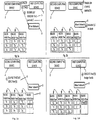
- Step (a) in Fig. 1a the second computing device simultaneously sends out the order details to the first computing device via an off-chain channel and a seemingly random unspent transaction S to the Ethereum mining network (the blockchain).
- the off-chain channel uses an Internet connection. Either VPN tunnels or SSL certificate exchanges can be used to secure the connection.
- the communication between the first computing device and the second computing device consists of commands to buy or sell assets. Of course, the messages have to be signed cryptographically in all cases.
- a commit message C is sent to the smart contract associated with the first computing device on the Ethereum blockchain.
- C contains a hash over a previously unused address A from the second computing device, unspent transaction S, the order details, and also preferably the public address of the first computing device in case a cancellation fee has to be collected.
- the committed data is revealed after the first computing device executes its orders and thus an outside observer can always reconstruct the entire trade history of the system.
- the commit is placed into the token contract using a function placeOrder(hash).
- the sending of the commit is performed from a freshly generated address to stay anonymous until the commit is revealed in the end.
- the smart contract stores the hash in a mapping that maps hashValues to timeout timestamps. This timeout can either be calculated by the smart contract or be passed in as another parameter by the second computing device.
- the second computing device communicates to the first computing device using the off-chain communication channel and sends over all data that is included in the hash.
- the first computing device can confirm that the committed values are the ones it received.
- the first computing device also checks if the address S has received its funds and then executes the orders specified by the second computing device.
- the first computing device executes the order on connected crypto markets in step (b).
- S and C are included in the next block by the mining network, depicted as 'Block hash PoW' in the figure.
- the target address of S is not associated with the first computing device so that an observer cannot deduct that the second computing device has sent a transaction to the first computing device.
- the contract managing C however is associated with the first computing device, but the information encoded in there is not revealing any sensitive information about the order details.
- the second computing device sends a forwarding contract Fwd() to the address S in step (c).
- Fwd checks for any funds at its own address and forwards them to the GenerateNewTokens() function in the smart contract. By that, the funds located at address S are transferred to the first computing device. This step can be described as the reveal phase.
- step (d) the first computing device's contract mints new tokens in case of a Buy transaction (or burns them when the second computing device requested a Sell trade) and assigns them to the second computing device address. This is facilitated by the GenerateNewTokens() function of the smart contract.
- no miner can perform frontrunning on the second computing device's order because the corresponding transaction on the blockchain is revealed after the first computing device has already acted.
- the second computing device can be sure to be assigned its tokens, as the first computing device's contract will always assign tokens to the sender of the forwarding contract upon reception of any amount of Ether.
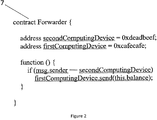
- Figure 2 is a pseudo code description of one way in which a forwarding contract can be framed.
- the forwarding contract has the address of the first computing device and the second computing device.
- the second computing device generates the forwarding contract after a certain timeout. Then for executing the contract, the second computing device messages the forwarding contract. Upon checking that the message is from the second computing device, the contract forwards the funds located at its address (the unspent transaction address) to the first computing device. The transfer of these funds may be to the smart contract associated with the first computing device.
- Figure 3 is a sequence diagram which illustrates the series of steps starting from the second computing device placing an order on the first computing device, and ending with the first computing device, assigning or burning tokens, to and from, the second computing device, respectively.
- a second computing device sends an electronic order to a first computing device via an off-chain channel. At the same time, the second computing device also sends a seemingly random unspent transaction S to a random address in the blockchain network.
- a commit message is also sent by the second computing device to the contract, which is associated with the first computing device. This is done when the second computing device calls the placeOrder ( ) function of the contract, and passes the commit message as an argument.
- the commit message contains a hash of the random transaction address, the orders details, and a previously unused address of the second computing device.
- this commit message and also the random transaction are broadcasted on the blockchain network, or in other words, are included in the next block by the mining blockchain network.
- This commit message in its unhashed form, is also sent by the second computing device to the first computing device via the off-chain channel. Based on this message, the first computing device can firstly analyze the random transaction address and determine if it indeed contains the funds required to carry out the order. These funds could be, by way of illustration, Bitcoins or Ether, or any currency.
- the first computing can also ensure that the commit message that the second computing device has sent to the contract, and which is publically available on the blockchain network, is the same as the message sent via the off-chain channel. This can be done by hashing the unhashed commit message and comparing it with the hashed commit message sent to the contract.
- this market could be any market where orders are executed rather quickly: e.g., online casinos, future markets etc.
- the second computing device waits for a predetermined timeout, preferably of fifteen minutes, before setting up a forwarding contract Fwd on the address of the random transaction S.
- the forwarding contract transfers the funds located at S, to the contract. Now the transaction is publically observable and everyone that can observe the blockchain can know that the second computing device has transferred funds to the first computing device. However since the order has already been executed, front-running has been avoided.
- the first computing device calls the finishOrders ( ) function on the contract, and passes the commit message in its unhashed form as an argument.
- the contract checks if funds from S have been received.
- the dashed lines from the condition, "Check if funds from S have been received” to the previous action "Fwd contract transfers funds at S" have been added only for the sake of the reader's ease of understanding. These dashed lines illustrate that the condition is checking whether the action occurred or not.
- the contract also hashes the unhashed commit message sent by the first computing device. Then it checks whether the hashed commit message is the same that it received earlier from the second computing device. The dashed lines from the condition to the earlier action have been added only for the sake of the reader's ease of understanding.
- the contract calls the GenerateNewTokens () function, to either mint or burn tokens, in case of a buy or sell order, respectively. And finally, the tokens are assigned by the contract to the address of the second computing device.
- the system brings the following advantages: a) Transparency and Verifiability: Since everything is recorded on the blockchain, any outside observer can reconstruct the trade history; b) Incentive Compatibility: The first computing device knows that the second computing device has no incentive to not transfer order related funds to it; and c) Since the transaction is revealed only after the order has been executed, safeguards are provided against front-running.
- the system is computationally simple as it does not need much state information. Everything can be stored in the unspent transaction itself, apart from the commitment message that is later revealed. Also, no cryptographic messages need to be exchanged between the system entities.
- the one transaction into the blockchain is an exchange of a cryptographically secured message.
Landscapes
- Business, Economics & Management (AREA)
- Accounting & Taxation (AREA)
- Engineering & Computer Science (AREA)
- General Physics & Mathematics (AREA)
- Physics & Mathematics (AREA)
- General Business, Economics & Management (AREA)
- Strategic Management (AREA)
- Finance (AREA)
- Theoretical Computer Science (AREA)
- Development Economics (AREA)
- Economics (AREA)
- Marketing (AREA)
- Technology Law (AREA)
- Financial Or Insurance-Related Operations Such As Payment And Settlement (AREA)
Priority Applications (1)
| Application Number | Priority Date | Filing Date | Title |
|---|---|---|---|
| EP18199126.6A EP3637342A1 (fr) | 2018-10-08 | 2018-10-08 | Procédé et système de prévention d'opérations en avance compatibles d'incitations et vérifiables |
Applications Claiming Priority (1)
| Application Number | Priority Date | Filing Date | Title |
|---|---|---|---|
| EP18199126.6A EP3637342A1 (fr) | 2018-10-08 | 2018-10-08 | Procédé et système de prévention d'opérations en avance compatibles d'incitations et vérifiables |
Publications (1)
| Publication Number | Publication Date |
|---|---|
| EP3637342A1 true EP3637342A1 (fr) | 2020-04-15 |
Family
ID=63794386
Family Applications (1)
| Application Number | Title | Priority Date | Filing Date |
|---|---|---|---|
| EP18199126.6A Withdrawn EP3637342A1 (fr) | 2018-10-08 | 2018-10-08 | Procédé et système de prévention d'opérations en avance compatibles d'incitations et vérifiables |
Country Status (1)
| Country | Link |
|---|---|
| EP (1) | EP3637342A1 (fr) |
Cited By (3)
| Publication number | Priority date | Publication date | Assignee | Title |
|---|---|---|---|---|
| CN113822595A (zh) * | 2021-10-11 | 2021-12-21 | 中国平安人寿保险股份有限公司 | 金融产品激励数据的配置方法、装置、计算机设备及介质 |
| US20220147995A1 (en) * | 2019-03-06 | 2022-05-12 | NEC Laboratories Europe GmbH | Turing-complete smart contracts for cryptocurrencies |
| US20250343768A1 (en) * | 2021-10-11 | 2025-11-06 | Citibank, N.A. | Systems and methods for executing multi-party validations for complex communications across multiple computer networks using bifurcated digital signing processes |
Citations (5)
| Publication number | Priority date | Publication date | Assignee | Title |
|---|---|---|---|---|
| US20160342977A1 (en) * | 2015-05-20 | 2016-11-24 | Vennd.io Pty Ltd | Device, method and system for virtual asset transactions |
| US20160350749A1 (en) | 2015-05-26 | 2016-12-01 | Medici, Inc. | Obfuscation of intent in transactions using cryptographic techniques |
| WO2018039722A1 (fr) * | 2016-08-30 | 2018-03-08 | Commonwealth Scientific And Industrial Research Organisation | Contrôle d'accès dynamique sur chaîne de blocs |
| US20180089759A1 (en) | 2016-09-26 | 2018-03-29 | Shapeshift Ag | System and method of managing trustless asset portfolios |
| US20180123779A1 (en) * | 2016-11-01 | 2018-05-03 | Jiangang Zhang | Flexible Blockchain Smart-Contract Deployment |
-
2018
- 2018-10-08 EP EP18199126.6A patent/EP3637342A1/fr not_active Withdrawn
Patent Citations (5)
| Publication number | Priority date | Publication date | Assignee | Title |
|---|---|---|---|---|
| US20160342977A1 (en) * | 2015-05-20 | 2016-11-24 | Vennd.io Pty Ltd | Device, method and system for virtual asset transactions |
| US20160350749A1 (en) | 2015-05-26 | 2016-12-01 | Medici, Inc. | Obfuscation of intent in transactions using cryptographic techniques |
| WO2018039722A1 (fr) * | 2016-08-30 | 2018-03-08 | Commonwealth Scientific And Industrial Research Organisation | Contrôle d'accès dynamique sur chaîne de blocs |
| US20180089759A1 (en) | 2016-09-26 | 2018-03-29 | Shapeshift Ag | System and method of managing trustless asset portfolios |
| US20180123779A1 (en) * | 2016-11-01 | 2018-05-03 | Jiangang Zhang | Flexible Blockchain Smart-Contract Deployment |
Non-Patent Citations (2)
| Title |
|---|
| ALAN REINER: "Bitcoin Wallet Identity Verification Specification Bitcoin Wallet Identity Verification Specification Authors", 27 February 2015 (2015-02-27), XP055245135, Retrieved from the Internet <URL:http://diyhpl.us/~bryan/papers2/bitcoin/armory-verisign-bitcoin-wallet-identity-specification.pdf> [retrieved on 20160127] * |
| PASQUALE FORTE ET AL: "Beyond Bitcoin - Part I: A critical look at blockchain-based systems", INTERNATIONAL ASSOCIATION FOR CRYPTOLOGIC RESEARCH,, vol. 20151202:213043, 1 December 2015 (2015-12-01), pages 1 - 34, XP061019757 * |
Cited By (5)
| Publication number | Priority date | Publication date | Assignee | Title |
|---|---|---|---|---|
| US20220147995A1 (en) * | 2019-03-06 | 2022-05-12 | NEC Laboratories Europe GmbH | Turing-complete smart contracts for cryptocurrencies |
| CN113822595A (zh) * | 2021-10-11 | 2021-12-21 | 中国平安人寿保险股份有限公司 | 金融产品激励数据的配置方法、装置、计算机设备及介质 |
| CN113822595B (zh) * | 2021-10-11 | 2024-03-19 | 中国平安人寿保险股份有限公司 | 金融产品激励数据的配置方法、装置、计算机设备及介质 |
| US20250343768A1 (en) * | 2021-10-11 | 2025-11-06 | Citibank, N.A. | Systems and methods for executing multi-party validations for complex communications across multiple computer networks using bifurcated digital signing processes |
| US12587488B2 (en) * | 2021-10-11 | 2026-03-24 | Citibank, N.A. | Systems and methods for executing multi-party validations for complex communications across multiple computer networks using bifurcated digital signing processes |
Similar Documents
| Publication | Publication Date | Title |
|---|---|---|
| US12437275B2 (en) | Cryptographic currency for securities settlement | |
| JP7652951B2 (ja) | ブロックチェーン上で匿名で保持されるトークンに関連付けられた交換を指示する方法及びシステム | |
| TWI723658B (zh) | 基於區塊鏈中智慧合約保護交易活動敏感資料的方法和設備 | |
| KR102309819B1 (ko) | 블록체인 기반의 거래 시스템 및 그 방법 | |
| US11250507B2 (en) | Trusted tokenized transactions in a blockchain system | |
| TWI716140B (zh) | 基於區塊鏈的資料處理方法和裝置 | |
| US11880836B1 (en) | Gated control for blockchain units | |
| KR101920015B1 (ko) | 이종 블록체인 기반의 토큰 관리 방법 및 이를 이용한 토큰 관리 서버 | |
| US20200175601A1 (en) | Systems and methods for transferring digital assets using a de-centralized escrow service | |
| CN108885761B (zh) | 用于区块链上的安全点对点通信的方法 | |
| CN109089428B (zh) | 数字资产零保管转换 | |
| US10552829B2 (en) | Obfuscation of intent in transactions using cryptographic techniques | |
| WO2020155789A1 (fr) | Procédé et appareil de stockage de certificat basé sur une chaîne de blocs | |
| US20150081567A1 (en) | Electronic transaction system and method with participant authentication via separate authority from real-time payment validation | |
| JP6521421B1 (ja) | 通貨情報処理装置および通貨情報処理システム | |
| CN107615317A (zh) | 区块链交易记录的系统和方法 | |
| CN113449340B (zh) | 基于联盟链的存量房交易资金监管方法及装置 | |
| TW201935299A (zh) | 用於處理金融資產之策略模型腳本之區塊鏈系統、節點伺服器及其方法 | |
| WO2019122977A1 (fr) | Procédé de fourniture d'un prêt avec une cryptomonnaie en tant que garantie | |
| KR102039570B1 (ko) | 암호화폐를 사용하지 않는 법정화폐용 p2p 장부 | |
| KR102195830B1 (ko) | 블록체인 기반의 보안이 강화된 암호화폐 시스템 | |
| WO2022153641A1 (fr) | Système de paiement, dispositif de paiement, procédé de paiement et programme de paiement | |
| Broniszewska et al. | Anonymization of Bids in Blockchain Auctions Using Zero-Knowledge Proof | |
| Priem | Blockchains and OTC Derivatives Markets: A Possible Combination? | |
| Team | Crave Financial Privacy |
Legal Events
| Date | Code | Title | Description |
|---|---|---|---|
| PUAI | Public reference made under article 153(3) epc to a published international application that has entered the european phase |
Free format text: ORIGINAL CODE: 0009012 |
|
| STAA | Information on the status of an ep patent application or granted ep patent |
Free format text: STATUS: THE APPLICATION HAS BEEN PUBLISHED |
|
| AK | Designated contracting states |
Kind code of ref document: A1 Designated state(s): AL AT BE BG CH CY CZ DE DK EE ES FI FR GB GR HR HU IE IS IT LI LT LU LV MC MK MT NL NO PL PT RO RS SE SI SK SM TR |
|
| AX | Request for extension of the european patent |
Extension state: BA ME |
|
| STAA | Information on the status of an ep patent application or granted ep patent |
Free format text: STATUS: THE APPLICATION IS DEEMED TO BE WITHDRAWN |
|
| 18D | Application deemed to be withdrawn |
Effective date: 20201016 |